media partner of the year
United nations
2015 environmental Media Award leadership award 2008
BusinessMirror A broader look at today’s business
www.businessmirror.com.ph
n
Sunday, March 11, 2018 Vol. 13 No. 151
2016 ejap journalism awards
business news source of the year
P25.00 nationwide | 2 sections 20 pages | 7 days a week
Investors’ bet on a company’s name rattles some analysts
Supparsorn | Dreamstime.com
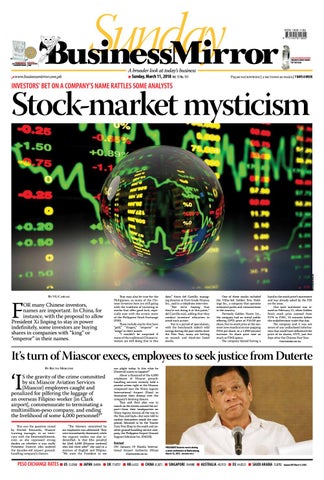
Stock-market mysticism
F
By VG Cabuag
OR many Chinese investors, names are important. In China, for instance, with the proposal to allow President Xi Jinping to stay in power indefinitely, some investors are buying shares in companies with “king” or “emperor” in their names.
That may also be true for the Philippines, as many of the Chinese investors here are still going with the tradition of investing in stocks that offer good luck, especially now with the erratic move of the Philippine Stock Exchange (PSE). These include stocks that have “gold,” “dragon,” “emperor” or “mega” in their names. “I wouldn’t be surprised if many of the traditional Chinese investors are still doing that to this
date,” Astro del Castillo, managing director at First Grade Finance Inc., said in a telephone interview. “But we’re hoping that they’re not doing it at this point,” del Castillo said, adding that they conduct investors’ education to avoid such action. But in a period of speculation, with the benchmark index’s wild swings during the past weeks since the New Year, many are betting on second- and third-tier listed stocks.
One of these stocks included the Villar-led Golden Bria Holdings Inc., a company that operates memorial parks and crematoriums in the country. Formerly Golden Haven Inc., the company had an initial public offering (IPO) price of P10.50 per share, but its stock price at the moment now stands at an eye-popping P314 per share, or a 2,890-percent increase. Its share price rose as much as P343 apiece. The company denied having a
hand in the stock price’s movement and was already asked by the PSE on the issue. One such statement was issued on February 21, when Golden Bria’s stock price zoomed from P174 to P261, 15 minutes before the midafternoon trade that day. The company said it was not aware of any undisclosed information that could have influenced the price of its shares, HVN, just five days after the Chinese New Year. Continued on A2
It’s turn of Miascor execs, employees to seek justice from Duterte
‘I
By Recto Mercene
s the gravity of the crime committed by six Miascor Aviation Services [Miascor] employees caught and penalized for pilfering the luggage of an overseas Filipino worker [in Clark airport], commensurate to terminating a multimillion-peso company, and ending the livelihood of some 4,000 personnel?” This was the question raised by Ritchel Bernardo, Miascor training manager, in an interview with the BusinessMirror, even as she expressed strong doubts on whether it was really President Duterte who ordered the decades-old airport groundhandling company’s closure.
“The thievery committed by six employees was addressed: They were immediately dismissed, while the migrant worker was also indemnified. Is that [the penalty] for [the] 4,000 [Miascor workers] who lost their jobs?” she said in a mixture of English and Filipino. “We want the President to see
PESO exchange rates n US 52.0160
our plight today. Is this what he [Duterte] wants to happen?” About a thousand of the 4,000 employees of Miascor groundhandling services recently held a protest action right at the Miascor compound near the Ninoy Aquino International Airport (Naia) to dramatize their dismay over the company’s looming closure. They said their plan was to march on the streets around the airport—from their headquarters on Ninoy Aquino Avenue all the way to the Naia and back—but were told to confine themselves inside the compound, hemmed in by the Tourist Duty Free Shop to the south and another ground-handling service company, the Philippine Airport Ground Support Solutions Inc. (PAGSS).
Evicted
ON January 19 Manila International Airport Authority (Miaa) Continued on A2
President Duterte reacts during a news conference at Malacañang, March 13, 2017. AP/Aaron Favila
n japan 0.4896 n UK 71.8757 n HK 6.6332 n CHINA 8.2072 n singapore 39.4988 n australia 40.5153 n EU 64.0525 n SAUDI arabia 13.8702
Source: BSP (March 9, 2018 )
NewsSunday BusinessMirror
A2 Sunday, March 11, 2018
www.businessmirror.com.ph
It’s turn of Miascor execs, employees to seek justice from President Duterte
Exhibit A
Following the President’s stern
warning, Transportation Secretary Arthur P. Tugade ordered all baggage handlers to wear body cameras and also gave security firms operating in all airports five days to clean their ranks. Airport officials were asked to produce an initial 100 units of cameras, while private security firms were directed by the transportation chief to buy their own, Monreal said. “Let this be a warning to all players at the airport that one more mistake will put their jobs and businesses at stake,” Monreal warned. In the wake of these developments, Miascor formally issued an appeal to President Duterte to “reconsider his position on behalf of almost 4,000 regular employees and their families who will be affected.” “It is unfortunate that the actions of six erring employees in Clark International Airport have negatively impacted the company. The recent incident does not define what Miascor stands for and how it operates,” the ground handler’s statement read. Miascor has been in operation since 1974 and has presence in several key airports in the country, including the Naia, providing aviation services.
Meddling?
ELISABETO OPON, an aircraft mechanic, was more unequivocal in denouncing Speaker Pantaleon D. Alvarez and Tugade. “Mr. Speaker, Secretary Tugade, ano ba talaga ang duty ninyo [What are you duty-bound to do]? Don’t meddle at the airport. You were here at the Naia before, this has been an issue here, [and] who is your best friend [some people are talking about]?” Opon then pointed to the direction of the building occupied by Pair Pags at the airport and said, “There, it is just beside us.” The employees laughed and guffawed at Opon’s antics, seemingly conscious of what message he intended to convey. Additional background information about Alvarez online showed that that he was once an action officer at the Miaa early in his career in the government. “From an action officer, he rose through the ranks, becoming a senior assistant manager and chief operating officer of the Miaa in March 1995, a position he held until September 1997.” In 2005 Alvarez, along with four other former Department of Transportation and Communications officials, were charged with graft before the Sandiganbayan in connection with the construc-
tion of Naia Terminal 3. In 2010 the charges, however, were dismissed by the Sandiganbayan Special Second Division due to lack of evidence. Alvarez allegedly used information gained by his position to preempt the bidding process by creating a company called Wintrack, which the board awarded a major subcontract for the project’s site development and excavation works. He and other members of the Philippine International Air Transport Co. and Fraport AG, the German partner, became board members of Wintrack, reportedly benefiting and amassing profits from the deal. “The staggering income earned by Wintrack from the deal has prompted the Ombudsman to file a case of graft against Alvarez and his cohorts,” the web site said. Some of the Miascor employees, who requested not to be named for fear, said they are afraid that the fate that happened to Philippine Skylander Inc. (PSI) might happen to Miascor, too. They recalled that in the late 1980s, PSI was the largest groundhandling company in the Philippines, with most of the major airlines as its clients. Following the Edsa People Power Revolution in 1986, it was alleged that Teresa Aquino Oreta put up a new groundhandling company at the Naia called People’s Cargo. Sometime in 1987, another source said, practically all of the ma-
jor airlines left PSI and became clients overnight of the People’s Cargo. “Kami naman [It’s our turn],” the source quoted the staff and officials of People’s Cargo after it took over the PSI’s ground-handling services. This happened despite the clout of the owner/president, Marielez Romulo, a sibling of the late Ambassador Carlos P. Romulo, who was allegedly very close to the late strongman Ferdinand Marcos. The Miascor source said Romulo called on her friend and supporter, Oreta’s uncle, Jose “Peping” Cojuangco, to intervene. Nothing came out of it and People’s Cargo became a huge company. It later changed its corporate name to Philippine Airport Ground Support Solutions Inc., the source said. The latest transformation is the joint company called Pair Pags Cargo, “a comprehensive cargo handling and storage service company established in 1987.” The company, second only in size to Miascor, has an extensive warehouse space for cargo storage, professionalized handling services and a full component of Customs personnel, with highly competent and personalized service. The BusinessMirror asked PAGSS President Janet Cordero to comment on the Miascor employees’ allegations. “Naku, hayaan mo sila [Please let them be]. I don’t want to comment, we want to concentrate now on our work.” Luigi Avanceña, Miascor con-
sultant, said the company has been given an extension until April 15 to close its ground-handling service, from the original deadline; but Monreal, it seems, is inclined not to extend its contract beyond March 31. “The management of Miascor is talking to other ground-handling services to accept some of the dismissed employees, like Dnata, Skylogistics, Macro Asia and Pair Pags.” He added that, usually, it is the airline company that chooses what ground-handling provider to patronize. “Miascor continues some of the remaining services, such as catering, mechanic, airline services and several more,” Avanceña added. He said the company continues to offer below- and above-thewing services. Its core businesses are in ground handling, cargo handling and warehousing, and in-flight catering. The company’s portfolio also includes a wide range of ancillary services, such as fixed base operations, into-plane refueling, manpower deployment, general sales agency and training. Although Miascor would not give its actual number of employees, airport sources said it has close to 8,000 to 9,000 employees, with about 40 airline clients, making it the current leading aviation-services company in terms of market share for its passenger, ramp handling and in-flight catering services.
Stock-market mysticism Continued from A1
Notably, while its board of directors approved the change of name from Golden Haven to Golden Bria, the word “golden” was retained. Gold is one of the lucky colors for many Chinese. However, Luis Limlingan, head of research at broker Regina Capital and Development Corp., is skeptical on the relation between the stock and the name of the company behind the stock. Limlingan said such wild swings on the share price may not be due to the name alone, but on speculation on the third telco player, which the Villar family is rumored to also be interested in. He added that there is little evidence on the behavior of investors from mainland China, as the data are lumped together with other foreign transactions. The market is abuzz with the supposed third player to enter the telecom industry, long dominated by PLDT Inc., led by the group of Manuel V. Pangilinan; and Globe Telecom Inc., a company backed by the Ayala group. Shares of both companies grew an average of 17 percent during the last few months after the Duterte administration has invited last November a Chinese telecom giant to pose a challenge to the two major players. Even shares of Easycall Communications Philippines Inc., an operator of pagers killed by text messaging service of mobile-phone operators, jumped almost four times over the last four weeks, closing at P52 per share last week. It is rumored that the third player will use Easycall as its backdoor entry. “Looking at China Telecom’s financials, the company definitely packs a punch and could easily overcome the high barriers to entry posed by the high capex [capital expenditure] requirement of the industry,” broker Papa Securities Inc. said in a research note. “It could easily cover the $700 million to $1 billion in capex re-
Christineg | Dreamstime.com
Continued from A1
General Manager Eddie V. Monreal wrote a letter to Miascor President Fidel Reyes, asking the latter’s company to vacate the premises it occupies in the airport grounds within 60 days. The “eviction” order came after six employees of the groundhandling firm at the Clark International Airport were charged with theft in connection with the high-profile luggage-pilferage incident. The victim involved is an overseas Filipino worker (OFW) whose video of his looted baggage went viral on Facebook. Miascor paid OFW Jovenil de la Cruz some P80,000 in damage compensation. However, his Facebook account of the looting, including the snapshots of the damaged suitcase, went viral, angering many Filipino migrant workers. They expressed sympathies to de la Cruz, to whom President Duterte even apologized later for the incident. It was on July 8, 2014, when Miascor signed a lease and concession agreement with the Miaa. It is the ground handler under contract with airlines that service flights in Clark and other airports in the country, including the Naia.
quirement, as this accounts for only 1.8 percent of its 2018 projected revenue,” the note said. “If in any case China Telecom is able to find a well-funded Filipino partner or partners that could absorb their investments, the typical capex requirement would only increase its projected capex by 7.6 percent or about 1.8 percent of revenues.” Other than the importance of names, some Philippine investors rely mainly on market rumors, which are usually communicated through Facebook groups and other chat platforms in the social media. Prior to Golden Haven, the first wild movement was last seen on the stock of mobile-games maker Xurpas Inc., a technology company specializing in the creation and development of digital products and services for mobile end-users. Another wild movement was also seen on the stock of up-andcoming property developer DoubleDragon Properties Inc. Back then DoubleDragon had no track record to speak of, aside from being backed by Mang Inasal fastfood chain founder Edgar J. Sia II and Jollibee Foods Corp. Chairman Tony Tan Caktiong. Both Xurpas and DoubleDragon enjoyed upward swings in their
stock price during the initial trading weeks, but Xurpas was now below its IPO price of P3.97 apiece. DoubleDragon, with its IPO price of P2 per share, reached as high as P70. However, its share price is now down to P32.45. According to Christopher Mangun, head of research at Eagle Equities Inc., the speculative issues in the coming weeks include Puregold Price Club Inc., a company led by businessman Lucio Co. “The name may not be true for other stocks,” according to Limlingan, who said some of the share price of those that has the word “lucky” on a company name were lightly traded. Puregold’s stock price is barely moving at P52.20 and only reached a 52-week high of P55.10; liquor maker Emperador Inc. was last traded at P7.88 and reached a one-year high of P8.96, and so are the stocks of property developer Megaworld Corp., last traded at P4.83 from a year high of P5.85 and Megawide Construction Corp. that was last traded at P21 from a 52-week high of P22.15. “We are hoping that they [investors] are not investing [based] on the names alone,” del Castillo said. “Because there will surely be a reality check after the period of speculation.”
News
BusinessMirror
www.businessmirror.com.ph
Sunday, March 11, 2018
A3
Trade dept vows to sustain ‘excellent’ grade in resolving consumer complaint
I
By Elijah Felice E. Rosales
t might be difficult to ace a test, but the trade department almost perfected an exam last year.
T he Depa r t ment of Trade and Industry (DTI) recorded a 99.38-percent resolution rate on consumer complaints in the previous year, meaning it was able to resolve almost all grievances filed by the buying public. It was an accomplishment hailed by both retailers and consumers in a country infamous for red tape and slow bureaucratic processes. In spite of this near-perfect rate, however, a lot of work still has to be done, as the DTI believes there might have been more complaints had there been more consumers informed of their rights. This is why the agency is stepping up its efforts to educate the buying public of their rights. In an interview with the BusinessMirror, Trade Undersecretary Ruth B. Castelo said a majority of the complaints the DTI had
received last year were dissatisfaction on the quality of a product. She said this commonly resulted to a return of the product in exchange for a new one. “Most common are on return or exchange and then on the quality in service. Most of the complaints are like that, actually,” Castelo said. “Then another is the speed of delivery of balikbayan boxes. Some complaints are on the date of delivery, others are boxes that went missing,” she added. A document obtained by the BusinessMirror showed that 37 percent of the 7,847 complaints filed last year were on defective products, while 30 percent were on deceptive features of an item. At least 3 percent were on sales promo, while 2 percent were on balikbayan boxes.
Other complaints were on prices, warranties, business name, pyramiding schemes, credit transactions and violations of the pricetag law. Out of all this, 31 percent were resolved through mediation, or through a conference by which the DTI served as a third-party mediator between the consumer and the retailer. On the other hand, at least 21 percent were endorsed to other government agencies, while another 21 percent were dismissed. Grievances dismissed were mainly due to nuances or lack of information. Castelo said most of the complaints were resolved through mediation, wherein the two parties agree to settle the case through an agreement. “Once a complaint is filed, that will be issued a notice of preliminary conference,” she said. “ The parties will meet before a mediation officer and we would try as much as possible to settle through mediation. In most cases, the grievance is concluded through mediation,” Castelo added. However, in cases where the two parties do not reach a settlement, the case is elevated to adjudication, the trade official
said. This is where an actual case is filed and the trade chief is already involved. Last year at least 3 percent of the complaints were submitted for adjudication. “Under adjudication, an actual case is filed through an adjudication officer, meaning the complainant will submit a position paper, the respondent will reply and there will be a rejoinder,” Castelo said. Cases up for adjudication are mostly on repair of a product that the service center does not want to cover. Castelo said the DTI intends to conclude all complaints through mediation, and adjudication will only be considered as last resort. Philippine Retailers Association Chairman Emeritus Samie Lim said the DTI always has the backing of the PRA in resolving consumer complaints. In aid of the agency, Lim said, the PRA coordinates with the government in cases a retailer’s attention is called to respond on a grievance. “We always support the DTI because we know they are doing it to establish good relations between retailers and consumers. They serve as the bridge to address the concerns of consumers
and retailers,” Lim told the BusinessMirror. If there is one thing Lim wants the DTI to address, it is the nuance complaints. “There really are nuance complaints and we would appreciate it if that is lessened,” he said. On the other hand, Laban Konsyumer Inc. President Victorio A. Dimagiba said his group would like to see complaints resolved at a faster pace. He said it was during his stint as a trade official that the resolution on consumer complaints was initiated. “I agree that the culture of alternative dispute resolution we embedded in the DTI had bear very good results. During my time, we trained DTI personnel on mediation as a mode of complaints resolution, institutionalized the system and set timelines in complaint resolution. Personally, I am happy to read that the systems we left behind bear sweet fruits,” Dimagiba told the BusinessMirror. “And as a consumer advocate now through our Laban Konsyumer Inc., we propose to further reduce the timelines for mediation and adjudication. This should be a challenged to the DTI now as
their report shows they can hurdle a shorter period to resolve complaints. [By this, we mean] shorter than 10 days for mediation and shorter than 20 days for adjudication,” he added. Castelo also said the DTI is readying its informational materials that it will post in major department stores and supermarkets. The information materials will promote consumer rights and how consumers can reach the government should they have any complaints. “This year we are intensifying consumer education and information through consumer materials that we will install on all business establishments, especially the big department stores and supermarkets, with permission and coordination of the owners of these establishments. We would put at one corner the information materials of the DTI on consumer rights and basic consumer information,” she said. Through this, Castelo said, the agency hopes to repeat its nearperfect feat this year. After all, she added, all these efforts being exerted by the DTI are for the consumers.
A4
Sunday, March 11, 2018
The World BusinessMirror
Editor: Lyn Ressureccion | www.businessmirror.com.ph
How Xi Jinping made his power grab: With stealth, speed, guile H
UK ready to act after Russian ex-spy, daughter poisoned with nerve agent
B
EIJING—Some 200 senior Communist Party officials gathered behind closed doors in January to take up a momentous political decision: whether to abolish presidential term limits and enable Xi Jinping to lead China for a generation.
In a two-day session in Beijing, they bowed to Xi’s wish to hold onto power indefinitely. But a bland communiqué issued afterward made no mention of the weighty decision, which authorities then kept under wraps for more than five weeks. That meeting of the party’s Central Committee was the culmination of months of secretive discussions that are only now coming to light—and show how X i maneuvered w ith stea lth, swiftness and guile to rewrite China’s Constitution. T he dec i sion w a s abr upt ly announced only last week, days before the annual session of China’s legislature, the National People’s Congress. The delay was apparently an effort
to prevent opposition from coalescing before formal approval of the change by the legislature’s nearly 3,000 members. The Congress is all but certain to approve the change and ot her const it ut ion a l a mendments—the first since 2004— in a vote last Sunday, sweeping away a rule that restricts presidents to two five-year terms and has been in the constitution for 35 years. Congress alone has the power to amend the constitution, by a two-thirds vote, but lawmakers, picked by the party, have always passed proposals presented to them. Even those who thought they had taken the full measure of Xi’s ambition are surprised by how fast he has moved.
“I always thought Xi would seek to stay for three or four terms, and could even introduce a new presidential system after his terms were finished. But I never thought the constitution would be revised so quickly,” said Wu Wei, a former official who advised Zhao Ziyang, the party leader ousted during the mass protests of 1989 in Tiananmen Square. “For such a major revision to an important clause of the constitution, the views of the whole public nationwide should have been more broadly sought,” he added, pausing to contain his emotion. X i deployed speed, secrecy and intimidation to smother potential opposition inside and outside the party. He swept past the consensus-building conventions that previous leaders used to amend the constitution. He installed loyalists to draft and support the amendments. And he kept the whole process under the tight control of the party, allowing little debate, even internally. X i first for ma lly proposed amending the constitution little more than five months ago, at a September 29 meeting of the Politburo, a council of 25 party leaders more powerful than the Central Committee, according to
an official account issued at the Congress on Monday. But he did not immediately raise the possibility of removing the term limit, a retired official said, citing a senior serving official. To avoid being seen as dictating changes, Xi let loyal provincial and city leaders quietly promote the idea in his stead, the retired official said. He spoke on condition of anonymity, citing fear of punishment for describing internal discussions. At that same meeting, the Politburo agreed to purge one of its own members, Sun Zhengcai, who had once been considered a potential successor to Xi, on corruption charges—a warning to other party officials that needed little elaboration. Previous rounds of constitutional amendments in China took much longer and involved at least the trappings of public discussion. Xi’s predecessor, Hu Jintao, proposed less significant constitutional changes 15 months before the amendments became law and tolerated some open debate, including forums held by liberal intellectuals. The wording of Hu’s revisions was released to the public nearly three months before lawmakers approved them in March 2004. B y c o nt r a s t , X i f i r s t a n nounced that he wanted to make constitutional changes in December, without specifying what they would be. The full details of the amendments, including the abolition of his term limit, were released to the public only eight days before the National People’s Congress convened. Xi kept a tight lid on his machinations. A fter the Politburo meeting in late-September, he entrusted the task of revising the constitution to just three officials: the chairman of the Congress, Zhang Dejiang, and two close allies, Li Zhanshu and Wang Huning, both of whom were elevated last year into the Politburo Standing Committee, the party’s top body. Wang has long been sympathetic to the authoritarian argument that China needs a strongman to maintain social order while pushing through painful policies, such as closing down inefficient factories. “If somewhere lacks a central authority, or central authority is in decline, the country falls into a state of rupture and turmoil,” he said in an interview published in 1995. In recent speeches, X i has echoed that theme, arguing that China faces unprecedented risks and opportunities. “Our party was born under a sense of peril, grew up under a sense of peril and matured under a sense of peril,” he told a meeting of senior officials last December. Momentum for ending the term limit built last November, when the party began secretly seeking suggestions on possible constitutional changes, according to the official account issued at Congress. Xi’s allies began an effort to support the change, and in a clue of their effectiveness, the official account said there was “consistent approval for issuing new rules on the term of office of the president.” Still, Xi needed to win approval for his plan at the January meeting of the Central Committee, and when and how he did so have been the subject of dispute. Reuters, citing two unnamed sources, has reported that the Central Committee failed to reach a consensus at the January meeting and convened its next meeting earlier than usual. New York Times News Service
ome Secretar y A mber Rudd said she is “confident” police and security services will identify those responsible for the poisoning of a former Russian spy and his daughter, and that Britain is ready to act once blame is attributed. She cautioned against jumping to conclusions, after Wednesday’s announcement that a nerve agent was used increased speculation the attack was the work of another state. Lawmakers have accused Russia of being responsible. “When we have all the evidence of what took place we will, if it’s appropriate, attribute it to somebody. If that is the case we will have a plan in place,” Rudd told BBC Radio 4’s Today show. “We are absolutely robust about crimes committed on these streets, in the UK. There’s nothing soft about the UK’s response to any sort of state activity in this country.” Sergei Skripal and his daughter Yulia were found unconscious on a bench last Sunday in Salisbury, southwest of London. They were “targeted specifically,” Metropolitan Police Assistant Commissioner Mark Rowley told reporters in London late on Wednesday. Government experts have identified the “specific nerve agent used,” which will help identify the source, the police said.
Swap deal
Skripal was convicted in 2006 of passing the identities of Russian agents in Europe to the UK’s Secret Intelligence Service, MI6. Russian authorities said payments totaling $100,000 were made into a Spanish bank account in return for his work for the UK. He was sentenced to 13 years in jail, but in 2010 was pardoned and sent to Britain, in a swap deal involving agents who had been arrested in the US. Rudd said security services are working constantly behind the scenes to counter threats to UK and foreign citizens in Britain. “You may not hear about it all— but when we do see there is action to be taken, we will take it,” Rudd said. “There is activity the police,
the security services take day in day out that protects us, that keeps us safe that we don’t hear about every day, partly because of their success at doing the job they do so bravely and so well.” Rob Wainwright, the head of the European Union’s law-enforcement agency Europol, offered a heavy hint about where he thought responsibility for the attack lay in a comment on Twitter. “Of course we should exercise caution before jumping to any conclusions,” he wrote. “But, whoever is responsible—and there are not 101 likely offenders—this is an outrageous affront to our security in Europe and our way of life.”
Alternative theories
The Times of London reported that intelligence officials are treating the poisoning as a statesponsored assassination attempt, although there are also alternative theories, including crime. Russia has adopted an increasingly aggressive foreign policy in recent years, directed toward both its immediate neighbors and further afield. Britain has accused it of interfering in elections worldwide, and has stationed forces in countries on its border to deter military action. Foreign Secretary Boris Johnson told Parliament on Tuesday that Russia had become a “malign and disruptive force,” and that Britain would be likely to increase sanctions if evidence emerged that Russia was behind the attack. The incident has uncomfortable echoes of the case of Alexander Litvinenko, a Russian ex-spy who was murdered in 2006 after his tea was spiked with radioactive polonium. Johnson also made a connection with that case. In 2016, a judge ruled that Russian President Vladimir Putin probably approved the murder. Russia dismissed the UK inquiry at the time as a “politicized farce.” A police officer, who was early on the scene, is also in hospital, although Rudd said he is talking and engaging, so she was more “optimistic” about his condition. Bloomberg News
Amid threats of retaliation, Trump set to impose steel, aluminum tariffs
P
resident Donald J. Trump could exempt some nations when he formalizes tariffs on imported steel and aluminum, amid threats of retaliation from US trading partners and warnings from his own party that the move will hurt American businesses and consumers. The administration will initially exclude Canada and Mexico from the tariffs, an exemption they would lose if they can’t agree to an updated North American Free Trade Agreement (Nafta) with the United States, White House trade adviser Peter Navarro said on Wednesday. Other American allies could use a similar system to ask for an exemption, he said. If Nafta talks fail, Canada and Mexico would face the same tariffs as other nations, Navarro said. While the order to establish the tariffs was earlier expected to be signed on Thursday, a person familiar with the planning said it would likely be pushed back to allow more time to prepare the legal documents. The White House schedule for Thursday did not list a tariff announcement. The decision-making process regarding the tariffs has evolved and more changes could be made before the president formally approves them. Other nations have threatened reprisals, and tensions are escalating. On Thursday China’s foreign minister, Wang Yi, vowed a “justified and necessary response” to any efforts to incite a trade war. It was the Chinese government’s most forcible response yet to the new tariffs. Wang, who spoke on the sidelines of the National People’s Congress in Beijing, urged the US to work with China on a mutually beneficial solution. “A trade war has never been the right way to solve the problem, especially under globalization,”Wang said. Such a conflict “will only harm everyone and China will surely make a justified and necessary response.”
Exemption or retaliation
Canada, the biggest supplier of steel and aluminum to the US, and No. 4 steel-provider Mexico have asked to be exempted, and both have indicated they’ll retaliate if Trump includes them in the duties. The US may exempt countries from the duties based on national security considerations, White House Press Secretary Sarah Huckabee Sanders said on Wednesday. She didn’t comment on how those determinations would be made and or which countries would qualify. “There are potential carve-outs for Canada and Mexico based on national security and possibly other countries, as well,” Sanders told reporters at the White House. “That would be a case-by-case and country-by-country basis.” Negotiators from the US, Canada and Mexico wrapped up the seventh round of Nafta talks this week in Mexico still hoping for a breakthrough on the biggest sticking points. The president hinted at the tariff incentive in a tweet earlier this week, without elaborating on how the trade-off would work. Trump has said he’s determined to impose a 25-percent tariff on steel imports and 10 percent on aluminum to protect national security. The plan has been widely criticized by Republicans, panned by corporate America, shaken global financial markets, and prompted the resignation of Trump’s top economic adviser, Gary Cohn, this week. More than 100 House Republicans, led by Ways and Means Committee Chairman Kevin Brady, urged Trump on Wednesday to reconsider broad tariffs, warning that they would cost American jobs, raise prices for consumers and hurt domestic manufacturing. Adding to the wave of criticism, the head of the US Chamber of Commerce Thomas Donohue said his organization was very concerned about the potential for retaliation and a trade war. Bloomberg News
Science
www.businessmirror.com.ph • Editor: Lyn Resurreccion
BusinessMirror
Sunday
Sunday, March 11, 2018 A5
Experts conclude: Fukushima must do more to reduce radioactive water
T
OKYO—A governmentcommissioned group of experts concluded on Wednesday that a costly underground ice wall is only partially effective in reducing the evergrowing amount of contaminated water at Japan’s destroyed Fukushima nuclear plant, and said other measures are needed, as well. The plant’s operator, Tokyo Electric Power Co. (Tepco), said the ice wall has helped reduce the radioactive water by half. The plant also pumps out several times as much groundwater before it reaches the reactors via a conventional drainage system using dozens of wells dug around the area. The groundwater mixes with radioactive water leaking from the damaged reactors. Contaminated water also results from rainwater that comes in contact with tainted soil and structures at the plant, which suffered meltdowns of three reactors after the March 11, 2011, earthquake and tsunami. The panel agreed that the ice wall helps, but said it doesn’t completely solve the problem. Panel members suggested that additional measures be taken to minimize the inflow of rainwater and groundwater, such as repairing roofs and other damaged parts of buildings. Results from the recent dry season were positive, but they noted that heavy rainfalls caused
spikes in the amount of contaminated water. “We recognize that the ice wall has had an effect, but more work is needed to mitigate rainfall ahead of the typhoon season,” said panel chairman Yuzo Onishi, a Kansai University civil engineering professor. The 1.5-kilometer coolantfilled underground structure was installed around the wrecked reactor buildings to create a frozen soil barrier and keep groundwater from flowing into the heavily radioactive area. The ice wall has been activated in phases since 2016. Frozen barriers around the reactor buildings are now deemed complete. On Wednesday Tepco said the
A Tokyo Electric Power Co. (Tepco) official wearing a radioactive protective gear stands in front of Advanced Liquid Processing Systems during a press tour at the Fukushima Dai-ichi nuclear-power plant in Okuma, Fukushima Prefecture, northeastern Japan, on November 12, 2014. AP/Shizuo Kambayashi
amount of contaminated water that collects inside the reactor buildings was reduced to 95 tons per day with the ice wall, compared to nearly 200 tons without one. That is part of the 500 tons of contaminated water created every day at the plant, with the other 300 tons pumped out via wells, treated and stored in tanks.
We recognize that the ice wall has had an effect, but more work is needed to mitigate rainfall ahead of the typhoon season.”—Onishi
In addition to the ¥35-billion ($320-million) construction cost funded by taxpayers’ money, the ice wall needs more than ¥1 billion ($9.5 million) annually in operating and maintenance costs. Critics have been skeptical about t he ice w a l l a nd sug gested greater use of wells—a standard groundwater drainage method—as a cheaper and more proven option. The head of Tepco’s decommissioning company, Naohiro Masuda, said the ice wall deser ves more recog n it ion be cause it has stabilized groundwater movement a nd helped eliminate emergencies, while reducing the total amount of water pumped up, which also
saves costs for water treatment and storage tanks. “We can work more stably, thanks to the ice wall. Intuitively, it is ver y effective,” Masuda said at the meeting, adding that the wall contributed more than its cost. The plant has been struggling with the ever-growing amounts of water—only slightly contaminated after treatment—now totaling 1 million tons and stored in 1,000 tanks, taking up significant space at the complex, where a decades-long decommissioning effort continues. Officials aim to minimize the contaminated water in the reactor before starting to remove melted fuel in 2021. AP
Arctic registered its record warm winter
W
ASHINGTON—Winter at the top of the world wimped out this year. The Arctic just finished its warmest winter on record. And sea ice hit record lows for this time of year, with plenty of open water, where ocean water normally freezes into thick sheets of ice, new US weather data show. Scientists say what’s happening is unprecedented, part of a global warming-driven vicious cycle that likely plays a role in strong, icy storms in Europe and the United States Northeast. “It’s just crazy, crazy stuff,” said Mark Serreze, director of the National Snow and Ice Data Center in Boulder, Colorado, who has been studying the Arctic since 1982. “These heat waves, I’ve never seen anything like this.” It’s been so unusually warm that the land weather station closest to the North Pole—at the tip of Greenland—spent more than 60 hours above freezing in February. Before this year, scientists had seen the temperature there rise above freezing in February only twice before, and only ever so briefly. Last month’s record-hot temperatures at Cape Morris Jesup have been more like those in May, said Ruth Mottram, a climate scientist at the Danish Meteorological Institute. But it’s more than that one place. Across the Arctic Circle in Barrow, Alaska, February was 18 degrees (10 degrees Celsius) warmer than normal and the entire winter averaged 14 degrees (7.8 degrees Celsius) above normal. Of nearly three-dozen different Arctic weather stations, 15 of them were at least 10 degrees (5.6 degrees Celsius) above normal
for the winter, according to data from climatologist Brian Brettschneider of the International Arctic Research Center at the University of Alaska Fairbanks. Meteorologists consider December, January and February to be winter, and Arctic weather stations averaged 8.8 degrees (4.9 degrees Celsius) warmer than normal for the season that just ended. The air above the Chukchi and Bering seas near Alaska averaged about 20 degrees (11 degrees Celsius) warmer than normal for February, the data center reported. “The extended warmth really has kind of staggered all of us,” Mottram said. In February Arctic sea ice covered 5.4 million square miles (13.9 million square kilometers), about 62,000 square miles (160,000 square kilometers) smaller than last year’s record low, the ice data center said on Tuesday. The difference is an area about the size of the state of Georgia. Sea ice coverage in February also was 521,000 square miles (1.4 million square kilometers) below the 30-year normal—an area nearly twice the size of Texas. Sea ice is frozen ocean water that—in contrast to icebergs and glaciers—forms, grows and melts on the ocean. It is still growing, but “whatever we grow now is going to be thin stuff ” that easily melts in the summer, Serreze said. Near Greenland, war m air moved north up over a section of the Atlantic that usually has sea ice, Mottram said. Something similar was happening in the Pacific with open water on the normally iced up Bering Sea, data center senior scientist Walt Meier said. To be happening on
opposite sides of the Arctic at the same time is unusual, Meier added. While some natural weather fronts were involved, “climate change is the overriding thing,” Meier said. “When you have warmer temperatures you are going to melt more ice and it’s going to grow more slowly.” In the winter, sea ice “acts as a lid to keep the warmth of the water at bay” but when there is less sea ice, more heat goes into the air, Brettschneider said. “You end up with a vicious cycle of warm air preventing sea ice formation and lack of sea ice allowing warmth to escape into the air.” One scientific theory is that this is changing weather further south and plays a role with extreme events, especially in winter. The theory is still debated but gaining acceptance. It suggests that reduced sea ice, especially in the winter, reduces the difference in atmospheric pressure between the Arctic and mid-latitudes, weakening the jet stream. The jet stream is the usually fast-moving west-east current of air that affects daily weather and moves storm fronts along. A weaker jet stream often means strange weather, leaving storms stuck in place for days on end, said one of the theory’s leading proponents, Rutgers University’s Jennifer Francis. She points to recent US nor’easters and freak snowstorms in Europe. “ T h i s i s wh at we’ve b e e n ta l k ing about; it cou ldn’t be more classic,” Francis said. “If you look at the whole picture, the whole jet stream around the northern hemisphere, it’s had these ver y large excursions north and south and that’s led to all of the wacky weather.” AP
The students in work immersion in one of the Department of Science and Technology projects
Student’s work immersion: A journey through S&T
W
ork immersion sounds stressful for senior high-school students. Yet, as part of the K to 12 curriculum, we science, technology, engineering and mathematics (Stem) students were required to gain relevant learning experiences through actual work. We were assigned to specific partner institution, business organization or establishment parallel to our specializations in order to help us reinforce our knowledge from classrooms and enhance our skills. For us, a group of six students, we were engaged with the Department of Science and Technology (DOST). Foremost, we learned that the DOST is the premiere science and technology (S&T) body in the country, in charge with the mandate of providing central direction, leadership and coordination of all scientific and technological activities, and of formulating policies, programs and projects to support national development. DOST Biliran, officially called Biliran Provincial Science and Technology Center (DOST Biliran-PSTC), is one of the six provincial centers of the DOST-Eastern Visayas located inside the campus of Naval State University. As we commence the work immersion on February 6, little did we know that an exciting adventure was about to begin. A journey that
would make us realize that science is not a mere concept taught inside a classroom and make us gaze in amazement how these scientific concepts are applied in the world. Initially, we were oriented with the nature and mandate of the institution, as well as the staff who would function as our advisers and supervisors as we initiated our training. Furthermore, our work environment had become comfortable with the friendly, approachable and cheerful nature of the staff which was essential for us to effectively absorb all the knowledge and acquaint ourselves with the work of DOST personnel. As we progressed and became acquainted with the work and processes in the DOST, we were assigned to make a variety of reports, such as Technology Needs Assessment (TNA), Yolanda Recovery and Rehabilitation Program (YRRP) Monitoring and even a Small Enterprise Technology Upgrading Program (Setup) Project Proposal. But the most exciting part of our work immersion was the“travels.” Going to different towns and barangays around Biliran was a delightful experience for us not just because we saw the beauty of this island dubbed as “Undiscovered Paradise,” but also since we have learned new techniques on how to handle businesses and technologies that are
Higher coconut productivity through 2 genomics projects set
T
wo spin-off projects on coconut genetic and varietal improvement are expected to boost the country’s coconut industry. The two projects kicked off following the success of the Industry Strategic S&T Program (ISP) for Coconut, particularly the use of genomics, genetics and molecular-marker assisted breeding for a competitive and sustainable Philippine Coconut Industry. The two projects will be implemented by the National Institute for Molecular Biology and Biotechnology, University of the Philippines Diliman and Institute of Plant Breeding, UP Los Baños. The Philippine Council for Agriculture, Aquatic and Natural Resources Research and Development of the Department of Science and Technology, which prioritizes coconut among other commodities, is funding the projects. The first project, “Curation, validation and utilization of coconut transcriptome sequences for gene-based marker development,” aims to generate accurate and consistent transcriptomes of seven Philippine coconut varieties and use their sequences for the development of gene-based markers. The gene-based markers will be used for coconut genetic and varietal improvement. Coconut breeders are expected to benefit in utilizing these markers to target desired traits, such as high nut yield and high coco-water quality, among many other characteristics. With 20 years of continued research and development, the project hopes that breeders could introduce a range of new coconut varieties to farmers. The second project focuses on evaluating a coconut gene expression and its effect on oil biosynthesis. Like the first project, it also pursues higher coconut productivity by validating the expression of a coconut gene in an experimental model system. The generation of gene-based markers with target traits is expected to boost the competitive edge of the local supply in the international market. This will ultimately help the industry, especially the local farmers, in achieving a more sustainable source of livelihood. The two projects were reviewed in an inception meeting held recently at the Council’s headquarters. In attendance were National Scientist Dr. Dolores A. Ramirez and Dr. Benigno D. Peczon, who both served as technical evaluators, as well as Crops Research Division staff members led by its Assistant Director Dr. Edna A. Anit. S&T Media Service being used to help local enterprises grow. We were introduced to new experiences and tried new products from DOST -assisted projects. We have also learned about the concept of Project Deployment of Early Warning System for Disaster-Prone Areas. The project is undertaken in cooperation with the Advanced Science and Technology Institute; the Philippine Atmospheric, Geophysical and Astronomical Services Administration; and the DOST regional offices, and its role in mitigating the impacts of disasters in the province. We visited the different installation of hydro-meteorological devices, such as the automated rain gauge (ARG) in Barangay Talustusan, Naval, Biliran. ARG is an instrument used by meteorologists to gather and measure the amount of liquid precipitation over a set period of time. We have also visited the Water Level Monitoring System (WLMS) installed at Pitogohan Bridge in Almeria. The instrument is essential in monitoring the rate of change of water level of the river where it is installed. Moreover, we have also visited the early warning device installed in Barangay Santo Niño in Naval, which functions as a receiver of data from the WLMS on Caraycaray Bridge. It issues a particular warning level to alert all nearby areas in cases of an impending flood. In Barangay Villaconsuelo in Naval, we were introduced to a YRRP Project, the Coconut Sugar Processing Facility. The primary raw material of making this coconut sugar is the collected coconut sap, which is heated and stirred continuously until it solidifies and powdered. This is considered a healthy sugar because it has low glycemic index and is preferable for persons with diabetes. One of our most challenging travel was when we held a TNA of the Eces Compunix Center in Biliran town. We were assigned to interview the supervisor of the business and gather the information to accomplish the specific task assigned to us: to contribute in formulating a Setup project proposal. Setup is DOST’s program that helps micro, small and medium enterprises to adopt technology innovations to improve their business. Miles Vincent Garrido and Aura Gahera/DOST-Easter Visayas S&T Media Service
Faith A6 Sunday, March 11, 2018
Sunday
www.businessmirror.com.ph • Editor: Lyn Resurreccion
Pope decrees slain El Salvador Archbishop Romero to be a saint
V
ATICAN CITY—Pope Francis has cleared the way for Archbishop Oscar Romero to be made a saint, declaring that the churchman murdered by El Salvador’s right-wing death squads for standing up for the poor and oppressed should be a model for today’s church.
Francis signed a decree confirming a miracle attributed to Romero’s intercession on Tuesday, the same day he approved a miracle for another important figure for the 20th century Catholic Church, Pope Paul VI, the Vatican said last Wednesday. No date was set for either canonization. Vatican officials have previously said Paul would likely be canonized in October, during a big Vatican meeting of bishops. T he Vat ic a n of f ic i a l w ho spearheaded Romero’s sainthood cause, Archbishop Vincenzo Paglia, said he hoped the two would be declared saints together in October, saying a joint canonization would give Catholics a “burst” of energy and example of the need to live one’s life for others. “I’m in a hurry because there’s an urgent need to change the world,” Paglia told The Associated Press. Another option would be to canonize Romero closer to home, such as when Francis travels to Panama in January for World Youth Day. The big Catholic youth rally will unite tens of thousands of young Catholics from across Central and South America, where Romero is considered a hero. Romero was gunned down by right-wing death squads on March 24, 1980, as he celebrated Mass in a hospital chapel. The country’s military dictatorship had vehemently opposed his preaching against the army’s repression of the poor at the start of the country’s 1980-1992 civil war. News of his pending canonization was met with celebration in San Salvador, where President Salvador Sanchez Ceren tweeted that Francis’s decision “fills us with immense joy.” Cardinal Gregorio Rosa Chavez, a close associate of Romero, called it “an answer from God to the outcry of a people who have suffered so much.” Paglia said Romero’s example of literally paying with his life for the poorest of the poor was particularly needed today, “in a world full of individualism and oppression, where inequality grows rather than diminishes.” Romero biographer Roberto Morozzo della Rocca, who collaborated with Paglia on the saint-making case, said Romero’s witness in opposing violence would resonate
particularly in Latin America, “where violence by youth gangs has brought enormous suffering and created a true nightmare for the population.” Pope Benedict XVI unblocked Romero’s stalled sainthood case in December of 2012, and Francis pushed it through, declaring him a martyr for the faith in 2015. The case had been held up for years by the Vatican, primarily due to opposition from conservative Latin American churchmen who feared Romero’s perceived association with liberation theology would embolden the movement that holds that Jesus’ teachings require followers to fight for social and economic justice.
The pope is giving us a blessing with this news, but Saint Romero is already on the altars. He is already miraculous and a saint.”—Trejos
Pope Francis is presented with an image of Roman Catholic Archbishop Oscar Romero during a private audience granted to participants to the pilgrimage from El Salvador at the Vatican on October 20, 2015. L’Osservatore Romano/Pool Photo via AP
Death, life; darkness, light Msgr. Josefino S. Ramirez SUNDAY GOSPEL IN OUR LIFE
‘F
Francis with pushing it forward, noting that Francis spoke to him about the cause on March 19, 2013, the first official day of his pontificate. Paglia said the miracle that cleared the way for Romero’s sainthood concerned the medically inexplicable cure of a pregnant, terminally ill Salvadoran woman who was “condemned to death” by illness but lived, and gave birth to a healthy child. The woman’s husband first began praying to Romero on May 24, 2015, the day Romero was beatified in San Salvador, Paglia said. By late-August or early-September, the woman’s condition had worsened and her doctors delivered the child fearing that he too would die. “They did the caesarean and were waiting for her to die,” because all the tests indicated she wouldn’t survive. Paglia didn’t specify the illness. Her friends started praying to Romero “and after five days, in an inexplicable way, this woman begins to improve and was completely healed.” Romero was beatified in San Salvador on May 24, 2015, before a quarter-million jubilant Salvadorans, and held up as model of peace and forgiveness for Francis’s home continent. For Salvadoran churchgoer Josefa Trejos, the news of his pending canonization only confirmed what she had long believed. “The pope is giving us a blessing with this news, but Saint Romero is already on the altars,” she said. “He is already miraculous and a saint.” AP
Saint Paul, by Rembrandt Harmensz van Rijn (c. 1657) Wikimedia Commons By Corazon Damo-Santiago
S
aint Paul is one of the two pillars of the church together with Saint Peter, the first pope. While in prison, Paul wrote to Timothy to express his firmness in faith even in adverse situations: “I have fought the good fight to the end. I have run the race to the finish. I have kept the faith” (2 Timothy 4:6-7). Good is an understatement, for Paul lived his life only for Christ after his conversion. “Next to Saint John, the Evangelist, he probably is the greatest genius Christianity has ever known,” according to Mausolfe and Mausolfe, 238. He “overshadowed all other New Testament characters except the Lord,” said Stephen Fortosis in Great Men and Women of the Bible. Saint Paul’s missionary travels, as presented by Bible Study. org, noted that “the most-traveled apostle is an amazing individual who influenced Christianity more than any other person short of Jesus.” An epitome of humility, Saint Paul calls himself “a slave of Christ” (Romans 1:1), “the least of the apostles” (1Corinthians 5:9), and “the very least of the holy ones” (Ephesians 3:8).
An unlikely apostle of Christ
4th Sunday of Lent: John 3:14-21
or God loved the world so much that he gave His only Son, that all trusting in Him might not be destroyed but might have eternal life.” This ultimate promise is our invitation to come to Him because He already gave. His love has no limits that He freely gave us a supreme
Saint John Paul II’s conservative Vatican had launched a crackdown on liberation theology, and the cause languished in the Vatican’s doctrine office while theologians studied his writings to ensure they were doctrinally sound. They were, and both Romero and theologians associated with the movement have been rehabilitated under Francis’s papacy. “It has been a long, tortuous journey, full of obstacles and opposition,” Paglia said. “But it has finally reached its conclusion.” In an interview at his Vatic a n home on Wed nesd ay, a s he fielded congratulatory calls from well-wishers in El Salvador, Paglia recalled that the Salvadoran vicar-general had given him Romero’s pectora l cross when he was named postulator for the cause some 30 years ago. It was to be a source of help and hope, Paglia said, because everyone involved knew opposition to the cause would be so fierce. “In fact, they were right, because as soon as the cause from San Salvador arrived in Rome at the Congregation for the Causes of Saints, it was blocked,” Paglia said, fingering the gold cross that he now uses as his own. He credited Benedict, and later
Saint Paul, Apostle to the Gentiles
gift. We were given a clear pathway to lay down the “darkness” so He can cast it away and make us new through the “light”—Jesus Christ. We have our own experiences of darkness as we go about our days. It may seem bleak as we encounter failure, loss, fear, devastation and desperation. They can last
for days, months or even years. At one point (or several), we may have been prompted to ask “if God loved the world, then why do bad things happen to me?” I want you to understand that bad or evil comes only from Satan, not from God. We cannot simply blame God for all the evil in our lives. The bible also tells us that, someday, all evil will be banished because God has triumphed. And most timely and helpful to what you are feeling right now is that He sees us through and gives us victory over the bad things. So, if you are facing problems right now, face it with God. We are always stronger with Him alongside us.
God is not interested in a onetime experience with us. He desires a relationship with us. Today and each day we wake up, God patiently waits for us to come, and listen to him and to simply be with Him! Let us strive to commit ourselves in seeking God as we embrace the reality of His presence. As we surrender ourselves to Him, we are filled with a sense of peace—a peace that transcends beyond human understanding. Believe with all your heart that, as long as we surrender to God’s will, all is well, everything is working according to His divine plan. His love is so great and easily attainable. All we need to do is to accept and believe that the light is in our life.
Saul of Tharsis was a staunch Pharisee, the most inf luential group among the three prominent sectors of Judaism. Born at the beginning of the Christian era, his parents were Jews, descendants of the tribe of Benjamin. A Roman citizen, he studied in the School of Gamaliel and learned the laws of Moses. A Pharisee in search for Christians to denounce before authorities, he was a most unlikely follower of Christ. He entered Christian homes, “dragging out men and women, he handed them over for imprisonment” (Acts 8:3). He was in the crowd that stoned to death Saint Stephen, the first martyr of the church. Then the “murderous mob laid their garments at Saul’s feet” (Ellsberg, 282). Despite the persecution of Christians, the apostles continued to preach. Saul was able to secure a letter from the high priest of the Pharisees, authorizing him to apprehend Christians in the synagogues of Damascus. Near Damascus, a light from the sky surrounded Saul. He fell on the ground blind. He heard a voice: “Saul, Saul why are you persecuting me?” To his question, “Who are you, Sir?” came the reply: “I am Jesus whom you are persecuting. Now get up and go to the city and you will be told what you must do” (Acts 9:4-6). The men traveling with him brought him to Damascus, where Ananias, on the Lord’s instruction, was to heal him. To the hesitant Ananias, the Lord said: “This man is a chosen instrument of mine to carry my name before the Gentiles, Kings and Israelites (Acts 9:3-19). Baptized immediately, Saul started to preach—Jesus as the Son of God—in Damascus, which
solicited doubts for he was known as an enemy of Christians. Barnabas shared Saul’s Damascus experience and his conversion to Christianity, which convinced others that he shared their faith.
Paul’s missionary journeys
During Saint Paul’s lifetime, all who were not Jews were called Gentiles or heathens. They did not acknowledge the God of the Bible. They were his audience, and to them he boldly preached about the Lord, His merciful love and the wonders He performed. The New Testament lists at least 50 cities Paul had visited during his five missionary journeys, which started when he was 31 years old until he was 66. (Saint Paul’s Travel Map Bible Study.org) During the first century, travel was a challenging task. So he must have walked most of the time beside a donkey, which carried a few belongings. Although he sometimes rode on a ship, pirates and shipwrecks also endangered his life. Saul traversed streams, unbridged waters, mountains, desserts and experienced hunger, lack of shelter, proper clothes and sleep, and survived on the charity of converts. Exposed to robbers, mobs, wild animals unbelievers and angry Jews, he was stoned, beaten, humiliated and imprisoned. Paul endured the labors, trials and perils he encountered in his journeys because of mystical experiences implied in his having “caught up in the third heaven” (Acts 12:12). He ack nowledged that the grace of God is with him (1 Corinthians 15:10). For his concern, he expressed “anxiety for all the churches” (2 Corinthians 1:28). H i s i nterest a nd c a re for the people who he converted, prompted him to write letters to the Christians in Rome, Thessalonians, Corinthians, Philippians in Greece, Ephesians, Galatians, Collossians and Hebrews in Turkey for them to nurture their faith in the lordship of Christ. The letters that have survived and became part of the Bible. Others were lost before the Bible was established by the church. The letters are important for the advice on how Christians ought to live. Of the 27 books in the New Testament, 13 were attributed to Saint Paul. Half of the Acts of the Apostles were about his life and works.
Paul’s martyrdom
When Emperor Nero launched his persecution of Christians, Saints Peter and Paul were imprisoned. After months of impr isonment, Sa int Peter was crucified and Saint Paul, who was a Roman, could not be crucified according to Roman law. So, Paul was beheaded at a place called “ healing waters,” three miles from Rome. Santiago is a former regional director of the Department of Education National Capital Region. She is currently a faculty member of Mater Redemptoris Collegium in Calauan, Laguna, and of Mater Redemptoris College in San Jose City, Nueva Ecija.
Sports BusinessMirror
Editor: Jun Lomibao | mirror_sports@yahoo.com.ph
Sunday, March 11, 2018
A7
Josef Newgarden describes the advantages of the new race car setup during the North American International Auto Show in Detroit. AP
NEW CHAMP, NEW CAR, NEW HOPE S
By Jenna Fryer
The Associated Press
AINT PETERSBURG, Florida—IndyCar heads into the season with a new American champion, a new car and the same hopes for a momentum-building year. Josef Newgarden arrives for the season-opening race this weekend on the streets of Saint Petersburg as the reigning champion. He won the title in his first season with Team Penske, a breakout year in which the 27-year-old won a career-best four races. Penske drivers won 10 of 17 races last year and all four of its drivers finished in the top five of the final standings. “Any driver that gets an opportunity like the one I got with Team Penske will tell you they expect to win right away,” Newgarden said. “I certainly did as well, but I think we were all surprised at how quickly we gelled together and made it happen. But that is last year. The drive for the
2018 championship starts at Saint Pete, and it’s a track where I’ve never won before. That is our only thought this weekend—going to victory lane.” Newgarden and the entire field will be in a redesigned and universal Dallara chassis. The 2018 car was overhauled and completed with input from drivers and teams, who objected to the many pieces on the previous aerokits that created debris fields during crashes. Drivers wanted reduced downforce
and got their wish. They also wanted faster tire degradation and what ultimately was developed could force drivers to change their racing style. The car has a sleek and clean look, and IndyCar is hopeful tweaks have made it safer for drivers and cheaper for teams to field. It also could help the small teams close the gap on Team Penske, Chip Ganassi Racing and Andretti Autosport, winner of three of the last four Indianapolis 500. “I do think it will equalize things,” said Graham Rahal, who this year at Rahal Letterman Lanigan Racing is joined by 2017 Indy 500 winner Takuma Sato. “If you do your job and you nail the setup, you will be right there contending for wins,” he said. “Before, there were certainly cases and tracks where that wasn’t the way it was for us, and it is nice now to feel like we can be rewarded for lots of hard work.” IndyCar has been chipping away for years at rebuilding its fan base and stabilizing the series, and leadership feels good headed into
C
LEARWATER, Florida—Aaron Nola has all the right stuff to be a longtime ace for the Philadelphia Phillies. The 24-year-old righty has a sharp, biting curve, a deceptive fastball and pinpoint control. New manager Gabe Kapler raves about Nola’s “presence” on the mound and already mentioned him with Clayton Kershaw and Max Scherzer when he announced he’ll start opening day. “He knows himself so well,” Kapler said. “He knows he’s a command guy. He’s going to command all four quadrants of the strike zone with three pitches. There’s very few guys who can spot up with the fastball, curve and changeup. The way he changes speeds is really spectacular and his presence on the mound really stands out from a lot of the guys in baseball. It’s exciting to have him on our side.” Nola dominated the Red Sox on Wednesday, tossing four innings of one-hit ball with five strikeouts. He faced a split-squad lineup filled with many minor league players and worked on improving his changeup. “He was pretty special,” Kapler said. “What stood out most is how he adds and subtracts to his fastball. You see some 88 mph [fastballs] up there and then he’ll reach back for 94. It’s very reminiscent of some of the best pitchers in baseball.”
B
“As a federation, how can you defend this in front of your sponsors, and especially families and women? Even men,” Demir wrote, before adding some of Damso’s most criticized lyrics on her Facebook page. The Women’s Forum, a coalition of women’s groups, has vowed that it will take further action. AP
racing for Andretti. His teammates will be Indy 500 winners Ryan Hunter-Reay and Alexander Rossi, as well as veteran Marco Andretti. Ganassi has scaled back to two teams this year and Ed Jones will join Scott Dixon in the lineup this year. Dixon needs just one more victory to reach 42, which would tie him with Michael Andretti for third on the all-time win list. Dixon is coming off a disappointing season in which he won just one IndyCar race and couldn’t catch Newgarden in the season finale to win the championship. Roger Penske has also cut his team by one car, which meant three-time Indianapolis 500 winner Helio Castroneves has left the series for sports cars. Castroneves will return for the Indy 500 and is the grand marshal on Sunday in Saint Pete, but he’s a popular driver the series will have to replace. Even without Castroneves, IndyCar goes into the year with seven former champions and 13 former race winners—enough to put on a good show all year. “We are all refreshed. We are all anxious and excited for what’s to come,” Rahal said.
Nola has right stuff to become ace pitcher
Scandal brewing over rapper’s World Cup song RUSSELS—The Belgian football federation says it will not change its mind about choosing a rapper known for lacing his songs with misogynistic lyrics to produce its official World Cup song. The federation said in a statement on its web site recently—International Women’s Day—that it did not want to be taken “hostage” by pro-women groups, who say it is unacceptable that an artist using degrading lyrics could be picked to produce what should be a unifying song for the country. The rapper, Damso, has said that his songs are more complicated that the denigrating terms imply. Belgian State secretary for equal opportunities Zuhal Demir said the federation’s choice was incomprehensible.
the opener. The car count of 24 entries at Saint Petersburg is the highest since 2015 and includes three new teams. Gabby Chaves will race for Harding Racing, Juncos Racing has a split lineup and Max Chilton and Charlie Kimball left Ganassi at the end of last season to form Carlin. IndyCar’s television audience has continued to slowly grow, the series is returning to Portland International Raceway this year for the first time in more than a decade, and Danica Patrick is coming back for one last hurrah in the Indianapolis 500. She will retire after the May race, her first in an Indy car since 2011. The series still has obstacles. American driver Conor Daly, a fan favorite who just completed a popular stint on the reality show The Amazing Race, can’t find sponsorship for anything more than an Indianapolis 500 ride right now. Daly was a full-time driver the last two years. The field has seven rookies this season, four of whom—Rene Binder, Jordan King, Matt Leist and Robert Wickens—will be making their series debut at Saint Pete. The leading candidate for top rookie right now might be Zach Veach, a six-time Indy Lights winner
The 24-year-old righty Aaron Nola has a sharp, biting curve, a deceptive fastball and pinpoint control. AP
INTER-SCHOOL BEACH VOLLEY TILT
The Tanduay Athletics InterSchool Under-18 Beach Volleyball Championships culminate over the weekend at the Cantada Sports Center in Taguig City with National University and Rizal Technological University winning the boys and girls title against University of the East and Calayan Educational Foundation of Lucena, respectively. Thirty teams—18 boys and 12 girls—participated in the one-day tournament of the Philippine Volleyball Federation (PVF) headed by President Edgardo Cantada. The event is supported by Tanduay Athletics, Lucio Tan Jr. and PVF Chairman Mikey Arroyo (inset).
Nola was the seventh overall pick in the 2014 amateur draft and quickly reached the majors the following year. He was quite impressive in 13 starts in 2015, going 6-2 with a 3.59 ERA. But Nola had an up-and-down season in 2016 before an elbow injury shut him down. He was 6-9 with a 4.78 ERA in 20 starts. The setback was frustrating but Nola handled it well. “Pitching a bad game, two bad games in a row, whatever, it’s not going to define your season,” he said. “When I had a bad game, I stuck with my plan. I don’t throw those games away, I know who I am, I know what I can do and what I can’t do and I try to learn from mistakes.” Nola bounced back last year and established himself as the No. 1 starter on a team that finished 66-96. He was 12-11 with a 3.54 ERA in 27 starts and had 184 strikeouts in 168 innings. During a stretch from June 22 to August 12, Nola became the first pitcher in franchise history to throw at least six innings and allow two runs or fewer in 10 straight starts. He arrived to camp in excellent shape and is determined to help the Phillies be a surprise contender after five straight losing seasons. “I trained a little harder, stuck to my routine, stayed disciplined and feel really good,” Nola said. “I’m just trying to do my part and I think everyone has the same mind-set. If each one of us takes a step up in our game, we’re going to be better. We think we’re going to compete. We want to play all the way to the end. A lot of people think we’re still rebuilding, but we’re past the rebuilding.” AP
A8
Sunday, March 11, 2018
BusinessMirror
www.businessmirror.com.ph
In the Name of the Daughter
Collage by JIMBO ALBANO
Rough hands have marked the territory over long rice fields from the unseen land to another horizon’s walk to the edge.
M
By Miguel Carlos Lazarte
arya Ignacio weaves her hair with her fingers watching as the curls separate adhesively from her sweatdripped forehead. They have been on the hillside for more than four hours now—the days just seem to grow longer every day. As noon strikes, Marya and her Papa retreat under the shade of the largest banana tree which they have just lodged in yesterday.
“Here,” Papa hands her a knotted plastic bag from his pocket while they rest their back on the tree. “Pansithabhab, your favorite.” Her Papa has told her that come the time, he will make them a house of concrete. Marya holds onto his Papa’s promises, he tells her that the house won’t shake anymore when that time comes. “The floor won’t be sandy. It will be cold… and shiny… and smooth that you can slide on it as much as you want.” For more t h a n h a l f a cent u r y, t he Ig n ac ios h ave t i l led t he hec t a res of l a nd i n t he tow n of Sa ra. T he god of t i me has ser ved w itness to t he h a nd s of t hou sa nd s of fa r mers who toi led the acreage over t he yea rs. Rough h a nd s h ave marked the ter r itor y over long r ice f ie ld s f rom t he u n seen land to another hor izon’s wa l k to t he edge. * It was a cold Monday on summer encumbered by the early morning levy of every farmer as Papa, along with the neighbors and kin, started a day’s work ahead of the sunrise. Marya woke up to her cat Itim finding a good spot to sleep on her back. She wafted the smell of sour broth whiffing from the palayok being heated outside the house. She took a sip of Mama’s salabat, perfect as always. And thepaksiw she sipped on, was also stowed away in an empty ice bag and tucked into her backpack for school. She would a lways wa lk a long
t he st retc h of t he t hen-r ice f ie ld s, now tossed over f rom the dr y season and grazing catt le fed on the remains. However tod ay, C h a r it y, a c l a ssm ate f rom a fa r t her ba ra ngay, let her r ide a long their motorc ycle to the publicelementar y school they were attending. T hen thesc hool d ay wou ld go t he sa me; w r iting notes from blackboard to notebook , a qu i z or t wo on h istor y a nd Engl ish l iterat u re even the teacher barely underst a nd s, a nd wa x i ng t he f loor w it h t he l a mpa so —t he Mond ay ’s c lea ner sc hedu le. She would then take a fifteenminute walk to the bayan arriving at the peak of noon along with the other children. Kwek-kwek, isaw, and paper-bagged buttered or cheese popcorn closed with sago’tgulaman top cupped with thinly shaved ice. Many kids would dread Mond ays because of t he c l asses, but Ma r ya look s for wa rd to the after noon of it ever y week. Papa wou ld ar r ive a lways ha lf an hour af ter she does. T he week before they just wa l ked across the d if ferent stores in the bayan; groceries, hardware, general merchandise, and even the sma l l ones. A nd the week before that, they went to the barangay ha l ls and the sma l l of f ices near the pla za. Mar ya wou ld help Papa car r y t he bunch of bananas. Sometimes hung by a straw, but most of the times she lug ged severa l hands a l l at once. Today, they were to go to the church to sell bananas. Papa knew
Today, they were to go to the church to sell bananas. Papa knew it wasn’t much, but it’s all we have.
Admit One By Divina Grace R. Sobrepeña
I have never been to a general hospital alone before: sitting on one of the plastic benches shoulder to shoulder with faces stuck on the Now Serving sign above all four counters I can see it is I am a no big deal I am. Just another walk-in. I watch scrubs, robes,
benches and stethoscopes come and go as tickets wither to the rhythm of digital numbers. I look—at the stub on my hand count heartbeats under my tongue until I reach the printed value: a game, coping with government services. I walk to a counter my turn to answer; the rhythm to a form with an HBW fill out my patient card
it wasn’t much, but it’s all we have. She tried to understand Papa most of the times, but the hardships he find hard don’t matter that much. “We don’t go hungry, we have a simple home, and the land will never betray us,” Papa would tell Marya and Mama. “And we’re still together.” It’s all that mattered. T he C hurc h of Sa nta R ita looks different from the ap pearance of other churches they teach at school. Unlike the town church at the plaza, the Church of Santa Rita was at the highest peak near the bayan in Sara. T he church seemed a church that was never renovated. The stone walls are heav y, thick, and br immed w ith black antiquity. The stone cross above the church wou ld sometimes seem to move when the mirage of the noon heat dances. W hite benches stick a sore eye outside the ageless church where kids wou ld bepedd lingsampag uita and the vendors would sell pan de sal and putobumbong on December misa de gallo’s. O ut side t he ony x c hu rc h, an eer ie pav i lion stands out where a life-size statue of Sta. Rita de Cascia stands behind a clear-glass enclosure all clad in her black nun robes, holding a large crucifix on one hand and a skull on the other. Her eyes always seem grief-striken and deep, but still manages to look solemn in her gaze. Marya and Papa entered the huge wooden door of the church where a breeze of the cold air greeted the two. The smell of the church was distinct, of the scent of candlewax and pews. The stained glass displayed beautifully of a baby Jesus and the Virgin Mary while an angel watches from the sidelines – all in bright red, blue, green, and yellow replication. “Marya!” Charity greeted her classmate, approaching her with a pat on her shoulder. “I’m here with my dad, too.” Mar ya blushed. She wasn’t used to being seen by her classmates carrying a bunch of bananas. She asked Papa if she could put it down for the moment. He nodded. “Hey Cha! W-W here’s your dad?” Marya peered around the almost empty basilica looking for her father. “Confessing.” “I see.” Marya smiled. “Good afternoon, Tito.” Charity reached for Papa’s hand and gave a mano. “Good afternoon, ‘nak.” Papa genu f lected towa rd the a ltar before lay ing dow n t he ba n a n a s. T he y sat on a pew behind where Char it y and her father’s bags were at. Papa k nee led , took a sig n of t he cross,then closed his eyes praying si lent ly. Mar ya remained seated, and she thought of the
like I would a test eighteen? yes down the hall to my left fix my eyes on signs overhead, dodge crutches, wheelchairs tuberculosis, Uratex queues, and airborne benches. I stand just outside the door, the same blank card blank mouth of every other ward no. nurse to patient a fetch, outside no bench
Sunday, March 11, 2018
“Ma,” she asked as she returned to treat her ache. “Where’s Papa?” “’Nak, maybe, maybe he just went out. Got some fresh air, maybe?” She thought for a while as well. “He told me he wasn’t able to sleep.” d ay’s trouble and what Mama w i l l be prepar ing for d inner when they get home. When Papa took to sit, she found Charity’s father peering at Papa. “Uy, opiser! Good afternoon ho.” “Ignacio, am I right?” “Oho, ser. You are the MARO ho, ser?” Papa smiled shyly. Charity’s father peered intently at the bananas. “Yes.” He smiled. “My daughter and I are going. Hope the harvest is good. We’ll see each other around Ignacio, yes?” Papa smiled in reply. When the two left, Papa stood up and asked Marya to wait a bit. He entered the confessional stall, and the hint of the closing of the door left Marya alone at the church. Minutes passed. Marya was a patient kid. An hour passed. As soon as she worried, she went near the stall. “Forgive them, Father… for they have sinned…” “Forgive them, Father… for they have sinned…” “Forgive them, Father… for they have sinned…” “F—” “Papa?” “Amen.” A click. The stall door opened. “Papa, are you okay?” “Yes, ‘nak. Let’s go home.” Papa smiled. T he y w a l k e d home toget h er, rat her l ate t h a n u su a l. T he s u n set w a s bidd i ng a d a rk e r n i g ht ton i g ht . T he l a st c r i m son r ay s i l lu m i n ate d t he d r y r ice f ie ld s. “You still remember?” Papa put the unsold bananas down and outstretched his hands from the farthest reach of the land at the horizon over to the direction their house was at. “When these were ours?”
Marya shook her head. “These were ours. These are ours.” Dinug u a n was for d inner, but t here was no meat, just vegetables. Mama said the neighbor had given the blood for free because they had just slaughtered their pig for the fiesta the next Wednesday. It was good. Even traces of meat always tasted good. That night they fell asleep earlier because of the darkness. Marya woke up at midnight, her teeth were aching. “Ma, Pa?” she shouted. Mama got Marya into their room, mixed water and salt, and went outside to heat up some salabat. It was uncanny, as Marya noticed that Papa was not at the room. “Ma,” she asked as she returned to treat her ache. “Where’s Papa?” “’Nak, maybe, maybe he just went out. Got some fresh air, maybe?” She thought for a while as well. “He told me he wasn’t able to sleep.” The night passed. The next day, his father wasn’t at home, still. She asked Mama where Papa is, “… maybe helped in the bungkalan with your Tito Marcel.” “Why hasn’t he gone home?” Mama: “You know it’s far. “Hope he’s fine.” “He is.” The day of the fiesta, Papa was still not home. “Mama, where’s Pa?” “Maybe helped for fiesta prep.” “Are you sure?” Mama: “Most likely.” Fiesta night was a lways the best n ig ht i n tow n. L echon, pabo, tapangk alaba w — e ver yone’s specia lt y. Relatives over re l at ives i nv it i ng ne ig hbors across neighbors even t hose each barely k new. T he night w a s long ; t he k a r aoke were restless, the local fair charmed ever y k id f rom school, and the
Papa was crying. His eyes bloodshot. “The land. They took.” “What are you saying Papa?” Marya hugs her Papa. “I prayed for the rain.” “Why?” “To start taking it back.” assisted to exist the anxious no queue to slip away from as if hungry in urgency or noticing the time. I knock twice, steady? st: steadier a fist a patient a breathe released on the count of three digital stubs or heartbeats walking stretching seconds into tickets as the knob turns turnsturns
A9
annua l pageants were crowded at the pla za. Marya played with her friends at the fair, played the one-peso festivities and the boys took the risk in the color game, losing one after another. She watched her friends ride the rapid ferris wheel from a distance. As the night grew, parents picked up their children. As Charity’s father went to pick up her classmate, he managed to smile at Marya. “Enjoying the fiesta, Ignacio? Here, for a few games.” He hands a 100-peso bill. Marya smiled in reply but just shook her head. “You definitely are an Ignacio. Good night, iha.” Marya hoped, and waited at the plaza for her Papa, where he usually picks her up even though she hasn’t seen him since Monday. Mama arrives a few minutes later. “Where is Papa?” she asked hurriedly. “Nako. I worry too, ‘nak. But your tiyo told me he saw him enter Santa Rita.” The two went to the church. Although the door was barred, the parish façade was lit—its onyx grandeur haunts beautifully at that festive night. “PAPA!”Marya shouted. Mama knocked at the church door heavily. Bagg! Baggg! Bagggg! An hour passed, then two. She waited, shouted. Her Mama praying every time she returns to the church, going back and forth from the plaza proper where Tito Marcel kept watch for the missing father. There was no one around the church, because everybody was enjoying the fiesta finale, venerating Viva Santa Rita!, a final procession from the plaza toward the church where the Ignacios were. Then midnight came. The bells tolled. The procession march neared. Bag! Baggg! Bagggg! The sound of metal was being pulled from behind the doors. Click! Chak! It unlocked. “PA!” Papa was cr y ing. His eyes bloodshot. “The land. They took.” “What are you saying Papa?” Marya hugs her Papa. “I prayed for the rain.” “Why?” “To start taking it back.” Her father ran behind the church where a wide stretch of lands greet the darkness of the fiesta’s new moon. The bells tolled seven times now. Then eight. She wasn’t able to understand. Her teeth still ached somehow. Then ten.The plaza was seen from above. The procession was in sight. Pap a b o we d , mu mbl i n g a prayer she cannot understand. Her teeth hurt, her head hurt. The late night breeze then smelled of wet asphalt. Then twelve.
Collage by GUILLERMO ALTRE JR.
BusinessMirror
www.businessmirror.com.ph