media partner of the year
United nations
2015 environmental Media Award leadership award 2008
BusinessMirror A broader look at today’s business
www.businessmirror.com.ph
n
Thursday, June 28, 2018 Vol. 13 No. 257
Delayed ODA projects may shift to private funds
T
By Cai U. Ordinario
@cuo_bm
HE government is open to shifting financing sources for big-ticket projects to the private sector if its official development assistance (ODA) partners fail to meet the timeline for projects, the National Economic and Development Authority (Neda) said.
Puno on ‘rights of the poor’: Make them ‘demandable’ Rene E. Ofreneo
laborem exercens
T
he country’s leading scholar on social justice is undeniably former Chief Justice Reynato Puno, chairman of the consultative committee to Review the 1987 Constitution. He has been writing about the subject since the 1960s when he was studying law. Under his leadership (during the Macapagal-Arroyo Administration), the Supreme Court institutionalized three powerful legal instruments protecting the rights of the poor when seeking legal redress —the writ of amparo, the writ of habeas data and the writ of kalikasan. Continued on A2
See “ODA,” A8
Peso to reach 54 to the dollar by year-end– Fitch subsidiary
GOVT JAN-MAY SPENDING UP 25% ON INFRA RAMP-UP By Bernadette D. Nicolas
G
@BNicolasBM
OVERNMENT spending for the first five months of the year is at P1.325 trillion, higher by P265 billion or 25 percent from the same period last year. Infrastructure spending from January to May also amounted to P280.8 billion, up by P83.6 billion or 42.4 percent, compared to the same period last year, while Personnel Services also reached P385.7 billion, increasing by P69.5 billion or 22 percent, from the same period in 2017. Government spending in May also reached P292 billion, which is P30 billion or 12 percent higher year-on-year, sustaining the momentum of government disbursements in 2018. Growth drivers continue to be Infrastructure and Other Capital Outlays, as well as Personnel Services. Budget Secretary Benjamin E. Diokno said this spending data just proves that the Philippines is continuing to make strides in the fiscal sector of the economy. “This should translate to better outcomes in the real economy, that is, more jobs for our people, improved standards of living and robust economic activity,” Diokno said on Wednesday. “We are confident that we will hit our Q2 disbursement targets. In fact, actual disbursements for the first quarter exceeded the program, so it’s justified to anticipate good results for the second quarter.” In May this year, infrastructure spending amounted to P58 billion,
₧58B
T
The infrastructure spending for the month of May alone surging by P12 billion or by 26 percent as the Department of Public Works and Highways completed various infrastructure projects, such as road concreting, widening and improvement; construction of bypass or diversion roads and flood control structure; and the reconstruction, rehabilitation and repair of roads and bridges. Also contributing to the rise in infrastructure spending is the repair and rehabilitation of school buildings of the Department of Education and acquisition of medical equipment and facilities under the Health Facilities Enhancement Program. Personnel Services also reached P107 billion, higher by P18 billion or 20 percent year-on-year, which is attributed to the release of the midyear bonus of civilian government employees and higher compensation for military and uniformed personnel. The release of the data from the Department of Budget and Management comes on the heels of the President’s statement that the “economy is in the doldrums,” notwithstanding the country’s 6.8-percent growth in the first quarter of the the year, compared to the previous year’s 6.5 percent.
PESO exchange rates n US 53.4210
business news source of the year
P25.00 nationwide | 6 sections 40 pages | 7 days a week
“If there are too many delays from a particular funding source, we are going to give them a deadline so that, if they cannot fulfill their commitment on time, then we will shift to another funding source.”—Pernia
In a briefing on Wednesday, Socioeconomic Planning Secretary Ernesto M. Pernia said delays caused by the development partner’s own bureaucracies often stall the signing of project loan agreements. “If there are too many delays from a particular funding source,
2016 ejap journalism awards
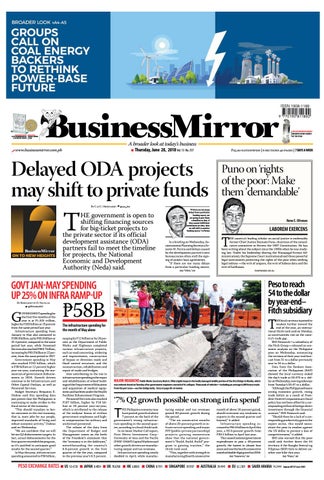
MAJOR HEADACHE Public Works Secretary Mark A. Villar (right) inspects the badly damaged middle portion of the Otis Bridge in Manila, which was ordered closed on Tuesday after government engineers warned of its collapse. Thousands of vehicles—including an average 6,000 heavy trucks from the port area—use the bridge daily. Story on page A8. ROY DOMINGO
‘7% Q2 growth possible on strong infra spend’
T
HE Philippine economy may have posted growth of above 7 percent on the back of the government’s strong infrastructure spending in the second quarter, according to a local think tank. In its latest Market Call report, First Metro Investment Corp.University of Asia and the Pacific (FMIC-UA&P) Capital Markets said other growth drivers are manufacturing output and tax revenues. Infrastructure spending nearly doubled in April, while manufac-
turing output and tax revenues posted 30-percent growth during the period. “The six consecutive months of above 20-percent growth in infrastructure spending and major PPP [public-private partnership] projec t s ga i n i ng moment u m show that the national government’s “Build, Build, Build” program is gaining traction,” the think tank said. “This, together with strength in manufacturing [fourth consecutive
month of above 16-percent gains], should overcome any weakness in exports in the second quarter and beyond,” it added. Infrastructure spending increased to P65.6 billion in April this year, a 95.9-percent growth from P33.5 billion in April last year. This caused national government expenditures to post a 43-percent growth, the fastest in almost four years and was the fourth consecutive month of double-digit growth in 2018. See “Growth,” A8
HE local currency is poised to weaken further toward the end of the year, an international think tank said on Monday, as uncertainties rise on the country’s trade gap. BMI Research—a subsidiary of the Fitch Group—released an economic analysis on the Philippine peso on Wednesday, announcing the revision of their year-end forecast from 51 to a dollar previously now to 54 to a dollar. Data from the Bankers Association of the Philippines (BAP) showed the local currency ended the day’s trade at 53.475 to a dollar on Wednesday, moving sideways from Tuesday’s 53.47 to a dollar. “Although the Philippines boasts strong economic growth, rising trade deficit as a result of President Duterte’s expansionary fiscal policy has not been offset by a corresponding inflow of foreign direct investment through the financial account,” BMI Research said. “Should there be a lack of a corresponding productivity gain in the export sector, this would necessitate the peso to weaken against the US dollar to prevent a loss of competitiveness,” it added. BMI also warned that the peso could sink further down the 54 territory if the Bangko Sentral ng Pilipinas (BSP) fails to deliver another rate hike this year. See “Peso,” A8
n japan 0.4854 n UK 70.6760 n HK 6.8063 n CHINA 8.1191 n singapore 39.1937 n australia 39.4941 n EU 62.2301 n SAUDI arabia 14.2444
Source: BSP (27 June 2018 )
A4 Thursday, June 28, 2018 • Editor: Vittorio V. Vitug A2
The Nation BusinessMirror
President’s men squabble over ₧70-B 4Ps largesse
A
cting Social Welfare Secretary Virginia Orogo on Tuesday opposed a proposal aired last month by Agriculture Secretary Emmanuel F. Piñol to divert the P70-billion Pantawid Pamilyang Pilipino Program (4Ps) into a farmers’ livelihood assistance fund. Removing the 4Ps, she said, will also harm farmers. “If you are going to remove [4Ps]… [it] would [also] cost a lot for our 4.4 million beneficiaries,” Orogo added, stressing that 51 percent of these beneficiaries are farmers. “They will lose a big chunk of monthly benefit, which is [the] CCT or the conditional-cash transfer,” she said. The CCT program, also known as 4Ps, aims to provide conditionalcash grants to the so-called poorest of the poor in the Philippines. Piñol was earlier quoted as saying
that the 4Ps is a “questionable” social program as it “reduces” poor families to “a level of waiting for money from the government instead of making them productive.” Orogo said, however, that she had given an account on how PPP funds are spent, adding beneficiaries are given
grants if their children stay in school and get regular health check-ups, have their growth monitored and receive vaccines, among other conditions. “For 4Ps beneficiaries, we are giving P300 per child [every month] who goes to school and another P500 [per month] for them to encourage them to go and have a check-up with the doctor for the health of the children and pregnant women.” Orogo added she is yet to encounter a family who had become exclusively dependent on the 4Ps largesse. For a household with three children, a household may receive P1,400 every month or a total of P15,000 every year for five years. Nevertheless, Orogo said, there are ongoing talks between her and Piñol to have a more sustainable livelihood for farmers and the urban poor. “We did not talk about the DSWD [Department of Social Welfare and
If you are going to remove [4Ps]… [it] would [also] cost a lot for our 4.4 million beneficiaries [where 51 percent are farmers].”—Orogo
Development] opposing [his proposal]. What we are saying is that Piñol told us that we should talk so that we can strengthen and to use the big chunk of [4Ps] to help the farmers.” Meanwhile, Orogo also backed a lawmaker’s proposal to hike the amount of unconditional cash transfer (UCT) to P500 a month. Section 82 of Tax Reform for Acceleration and Inclusion law provides that there should be a P200 monthly assistance on the first year of the law implementation and P300 for second and third year. “I think if the lawmakers will do that, many of our poor people will really be very happy. Now that it’s at P200 a month, the 4Ps beneficiaries are already happy or those we call senior citizens,” she said. “Maybe they are the ones who know and see the budget so why not? That is good news for us that the lawmakers wants to hike [UCT]…,” Orogo said. It was 1Pacman Party-list Rep. Mikee Romero who aired the hike proposal, saying he doubts the current UCT provided will be sufficient for poor families to deal with the inflationary consequence of the new tax law. Bernadette D. Nicolas
Comelec sees no hurdle in securing fund for Charter change vote in ’19
T
he Commission on Elections (Comelec) said on Tuesday it is confident it will be able to secure funding from Congress for a referendum on Charter change, which is expected to take place next year. In an interview, Comelec Spokesman James Jimenez admitted the electoral body is yet to allocate an amount for the referendum since they are still waiting for signals
from the constitutional commission (Con-com) if the Charter change will push through. The Con-com was formed earlier this year to review the 1987 Constitution. The body earlier said it is targeting to submit to President Duterte its draft constitution before his forthcoming State of the Nation Address (Sona) next month. “I was in the PLLO [Presiden-
tial Legislative Liaison Office] yesterday [June 26], and it looks like the earliest date [for the referendum] is on January [2019], since they will submit their report to the President I think on July 14,” Jimenez said. “If they are going to stick to the six-month education period, then definitely it will take them up to January,” he added. The Comelec will conduct the
nationwide referendum to determine if Filipinos will support the proposed Charter change. Jimenez said Congress is likely to provide the necessary funding for it since the Charter change was initiated by lawmakers. “As long as their is a line item for it...then we could supplement [our budget] if the need for it [referendum] arises,” Jimenez said. Samuel P. Medenilla
www.businessmirror.com.ph
US aircraft carrier patrols disputed sea amid China military buildup
AN American sailor takes photos of the US aircraft carrier USS Ronald Reagan (CVN 76) as it anchors off Manila Bay for a goodwill visit on Tuesday. The US military has deployed the aircraft carrier to patrol the South China Sea “to deter conflict and coercion” in a disputed region, where Washington has moved against China’s military buildup on man-made islands. AP
M
ANILA, Philippines —The US military has deployed the third aircraft carrier this year to patrol the disputed South China Sea, where Washington has criticized China’s military buildup on new man-made islands. The 97,000-ton USS Ronald Reagan, carrying more than 70 aircraft, anchored in Manila Bay on Tuesday after plying the strategic waters for meetings between Navy officials of the two countries and liberty for its thousands of sailors after weeks at sea. The US military presence in the region “has supported our ability to defend our nation and our allies” and “promotes our ability to safeguard freedom of the seas, unimpeded commerce, to deter conflict and coercion and to promote adherence to rules-based international order,” Rear Admiral Marc Dalton told reporters on board the ship. Two other American carriers earlier patrolled the waterway, where China and five other governments have been locked in decades of disputes over territories that straddle some of the world’s busiest sea lanes. Some areas are believed to have undersea deposits of natural gas and oil.
China has reportedly deployed anti-ship missiles, surface-to-air missiles, electronic jammers and other equipment on islands it built on disputed reefs in the Spratly Islands, and landed a bomber aircraft on Woody Island in the Paracels, sparking alarm among rival claimants and the United States. Washington has no territorial claims in the region but has declared that freedom of navigation and overflight in the waters is in US national interest. US Defense Secretary Jim Mattis said earlier this month that the Trump administration’s recent decision to disinvite China from a multinational naval exercise this summer was an “initial response” to Beijing’s island activity. Mattis called the US action a “relatively small consequence. I believe there are much larger consequences in the future.” China argues that it is within its rights to build up defenses on islands in the South China Sea that it claims are its sovereign territory. There is fear that Beijing will use its new islands, including some with runways, to project its military might and potentially to restrict navigation in the busy waters. AP
De Lima seeks SC okay to attend Puno on ‘rights of the poor’: Make them ‘demandable’. . . oral argument on ICC withdrawal By Joel R. San Juan @jrsanjuan1573
D
ETAINED Sen. Leila M. de Lima has asked the Supreme Court (SC) to allow her to personally represent herself during the oral argument on the two petitions seeking to declare as invalid the decision of President Duterte to withdraw from the Rome Statute of the International Criminal Court (ICC). The Court has moved from July 24 to August 7 the oral argument on the consolidated petitions filed by de Lima and other opposition senators, namely, Francis “Kiko” N. Pangilinan, Paolo Benigno “Bam” A. Aquino IV, Franklin M. Drilon, Antonio F. Trillanes IV and Risa Hontiveros and the Philippine Coalition for the International Criminal Court (PCICC), led by former Commission on Human Rights chairman Loretta Ann Rosales. In her four-page manifestation with motion, de Lima said while it is true that the 1987 Constitution prohibits members of Congress to personally appear before any court of justice, among others, such prohibition only applies when he or she does so as counsel. She pointed out that the Rules of Court expressly allows a litigant to personally prosecute his or her case. “Likewise, the Honorable Court is respectfully asked to take judicial notice of its practice of permitting members of Congress to appear before it and argue their cases. The situation of Sen. de Lima is not different from them,” the manifestation read. “Considering the foregoing, Sen. de Lima manifests her utmost intent to personally appear before the Supreme Court in her capacity
as one of the petitioners in this case, and to participate in the oral arguments set on July 24, 2018, as announced in the media, and any possible subsequent dates that the Court may determine,” it added. However, the Court has moved from July 24 to August 7 the oral argument on the consolidated petitions filed by de Lima and her co-petitioners. In their petition, the senators said the Palace’s decision to withdraw its membership from the ICC should be considered invalid since it has no concurrence of at least two-thirds of all the 24 members of the Senate. They argued that the Office of the President and the Department of Foreign Affairs gravely abused their discretion in withdrawing the country’s membership in the ICC without the concurrence of at least two thirds of the Senate under Article VII, Section 21 of the Constitution. They pointed out that the Rome Statute is a treaty validly entered into by the Philippines which has the same status as a law enacted by Congress, thus, can only be withdrawn with the approval of Congress. The PCICC, on the other hand, argued that President Duterte’s unilateral act of withdrawing from the ICC would deprive Filipinos of their right to seek redress against cases of impunity should their own government become unable or unwilling to prosecute such cases of impunity. De Lima has been detained at the Philippine National Police Custodial Center since last year in connection with her alleged participation in the proliferation of drug-trafficking activities inside the New Bilibid Prison in Muntinlupa during her term as justice secretary.
In 2012 the UP College of Law published Puno’s magnum opus, Equal Dignity and Respect, a 650page treatise on social justice and equality. The book deals with the timeless issue of equality and its opposite, inequality and how the Philippines, through the 1935, 1973 and 1987 Constitutions grappled with these twin issues. It is a mesmerizing scholarly review of the roots of the constitutional provisions on the equal protection of the laws and the resulting Philippine, American and Canadian jurisprudence on this subject matter. The book, however, raises a painful question that bedevils the nation up to the present: “Twenty five years after the Filipino people overwhelmingly ratified the 1987 Constitution, has Philippine society bridged crushing inequalities between the nourished and famished, the schooled and unlettered, the powers that be and the lowly?” He posed this question because t he 1987 Constitution has numerous references on the rights of the poor. For example, in Section 3, Article XIII, the charter mandates the State to provide protection to all. It states: “Section 3. The State shall afford full protection to labor, local and overseas, organized and unorganized, and promote full employment and equality of employment opportunities for all.” No exception given. All workers are entitled to “full protection”— social, economic and employment. And yet, statistics show that only 200,000 workers, out of a work force of over 42 million, enjoy the right to collective bargaining. Unionism is unheard of in the large informal economy. And the growing army of the precariat —casu-
als, project workers, agency-listed personnel, job-order government workers, etc.—are unable to exercise the right to form unions and negotiate for better terms and conditions of work. Also, statistics and recent studies tell us that inequality is not only persistent but is even widening and deepening. The high economic growth rates that the country has been posting since the turn of the millennium is making the 40 or so richest Filipino families happy but the fruits of growth are not trickling down to the masses. Majority of our workers today —factory workers, service industry personnel, peasants, landless rural poor, tribal farmers, fisherfolk, transport drivers and “barkers,” ambulant vendors, homebased workers, maids at home and in foreign lands, scavengers, “unpaid family workers” and so on—ontinue to face the chronic or persistent problems of unemployment, underemployment, low incomes and yes, labor precarity and informality. This is why the claim of our economic planners that more and more people are being lifted out of poverty was met with wide disbelief. When these planners came up with the fantastically low poverty threshold—P10,000 a month as the supposedly decent standard for a family of five, Sen. Chiz Escudero asked: Saang planeta ba sila nagmumula? So, to go back to the question raised by Justice Puno, is there hope for the ordinary, jobless or semi-jobless, impoverished and famished Juan and Juana de la Cruz? Can the State provide them adequate, timely and guaranteed social protection? Apparently, Justice Puno and his team in the constitutional reform body has stumbled or has
found some solutions through Charter change. Justice Puno is batting for the inclusion of the basic socioeconomic rights of every citizen under the “Bill of Rights.” This, he said, is a departure from the mechanical or rhetorical listing of these rights under the abstract State principles. Such listing of principles is simply “aspirational.” In contrast, political and civil rights are fully fleshed out in the Bill of Rights. With the socioeconomic rights included in the Bill of Rights, a poor and impoverished Juan or Juana can demand, as a matter of citizen right, ample social protection against any social risk, such as unemployment, illness, malnutrition, lack of shelter, poor access to educational facilities and so on. Additionally, citizens Juan and Juana can demand the right to a job or work, right to decent housing, right to health protection, right to education and skills training, and right to a clean and sustainable environment. As Justice Puno himself explained, these rights should and must be demandable. In short, these become Constitutional writs on karapatang pangkabuhayan at pangdugtong-buhay.
Importance of macro social and economic policy coherence
But how then should the State guarantee the delivery of social protection? Obviously, by putting these socioeconomic rights under the Bill of Rights, Justice Puno and his team are not only nudging but virtually goading and telling the State to organize itself in a way that its form of economic governance will result in the guaranteed delivery of such rights. This means the delivery of these rights should get the highest budgetar y priority of the
continued from a1
government. However, this is not enough. A government experiencing budgetary stress, which keeps recurring in the case of the Philippines, cannot possibly allocate adequate funds to cover all the social protection needs of the poor. A robust, inclusive and sustainable economy is needed. Hence, sound socioeconomic development strategy and programs should or must be pursued. This is why the effort of the Constitutional body to put the basic socioeconomic rights under the Bill of Rights need to be further strengthened through the addition of a clause or a provision stating that there should be policy coherence in the formulation of social, economic and employment policies. In fact, this is one of the major recommendations of the International Labour Organization when it adopted Resolution 202 in 2012. The said resolution asks all ILO member-states to adopt a “National Social Protection Floor” based on the concept that social protection should be adequate, comprehensive and universal. The resolution stressed that such a social protection floor requires coherence in social, economic and employment policies. In other words, a pro-poor reform-minded government supportive of social protection for all should have a visionary and transformative pro-poor socioeconomic program in place. (The foregoing are remarks given by the author in the 1st National Forum and Public Consultation on the Review of the 1987 Constitution held at Manila Hotel, June 21, 2018. The author is a co-convenor of Dignidad, a coalition of civilsociety organizations pushing for adequate, comprehensive and transformative Social Protection for All.)
Economy BusinessMirror
www.businessmirror.com.ph
Editor: Vittorio V. Vitug • Thursday, June 28, 2018
Go slow on fuel surcharge add-on to airline fares, lawmaker tells CAB By Jovee Marie N. dela Cruz
T
@joveemarie
he chairman of the House Committee on Good Government and Public Accountability on Wednesday cautioned the Civil Aeronautics Board (CAB) against hastily authorizing commercial airlines to impose fuel surcharges on passengers. Surigao del Sur Rep. Johnny Pimentel, the panel chairman, said additional charges would hurt the estimated 25 million Filipinos relying on domestic air travel every year. The CAB is set to hear on July
10 petitions for airlines to renew fuel surcharges after airlines claim they need the add-on charges to help them pay for rising aviation fuel costs, amid surge in world oil prices. “The last time the CAB allowed
fuel surcharges, airlines were collecting anywhere from P500 per domestic passenger to $400 per international passenger,” said Pimentel, also House Transportation Committee member. “The CAB should hold the horses for now. It is a bit premature for the extra charges,” Pimentel said in a news statement. He said new charges would also weigh down the 7,000 Filipino contract workers—new hires, as well as rehires—leaving the country every day for overseas employment. However, Pimentel said airlines are still in a position to absorb the higher fuel costs. If approved, the lawmaker said the surcharges would be tucked into ticket prices and shouldered by passengers. Based on a filing with the CAB, Philippine Airlines (PAL) plans to levy the following fuel surcharge on its domestic ticket
9 new aerobridges at Naia 1 ready by year-end, 20 more in 2019–Miaa By Recto Mercene
@rectomercene
A
fter 33 years of continuous use, the Ninoy Aquino International Airport (Naia) Terminal 1 will install nine new aerobridges by December this year. Another 11 new aerobridges are scheduled for completion in the first quarter of 2019, according to Manila International Airport Authority (Miaa) General Manager Ed V. Monreal. The first phase of the P319million project entails the design, manufacturing, factory testing, delivery and installation of new and customized units of apron-type and pedestal-type passenger boarding bridges (PBB). “Soon Naia 1 passengers would be treated to more modern aerobridges as they disembark or board their flights,” Monreal said. The airport chief announced that Miaa has embarked on replacing the 30-year-old PBBs with new ones. “Currently being implemented is Phase 1, with a total project cost of P318,998,885.98, and actual replacement will start this week,” Monreal said, adding the completion of Phase 1 is in December 2018. “Phase 2, on the other hand, is due for bidding with actual implementation expected to commence by the first quarter of 2019,” he added. The passenger boarding bridge connects the airport walkway directly to the aircraft. It provides ease
and convenience to passengers and protects them both the elements, especially during inclement weather. The new aerobridges are made of glass wall, instead of steel like the previous ones. The units are air-conditioned and equipped with CCTV camera with a view of the apron. The bridges are also designed with programmable motor controller and are GPU (ground power unit) ready. Passenger Aerobridge Number 8 became an iconic landmark when former Sen. Benigno Aquino Jr., was assassinated on the stairs in 1983, when he was forcibly taken out of a China Airlines plane while returning from self-exile in the United States. A commemorative marker had been placed on the tarmac at the exact spot where his blood-spattered body had fallen. Subsequent improvements have been made on this aerobridge when a new steel staircase was installed beside the old one to accommodate the new types of longer, higher capacity commercial airplanes, rendering the old stairs useless. Thus, there is no basis to allegations that a new steel staircase was installed to conceal the old one the late Aquino used when he descended to his death in the hands of military men who accompanied him. Media Affairs Department chief Connie Bungag said the bridges being replaced have been in operation for more than three decades “and are now outdated rendering them un-
reliable with frequent breakdowns occurring from time to time.” She added that Japanese firm Shinmaywa Industries Inc. supplied the original 20 aerobridges in the late1970s, when Naia 1 was under construction. The units were the first of its kind in the Philippines back then. Shenzhen CIMC-TianDa Airport Support Ltd (CIMC-TIanDa) is supplying the new aerobridges for Naia 1. Thecompany’scorebusinessisairport support equipment, among others, Bungag said. To date, the company has supplied over 4000 units of passenger boarding bridges in 200 airports worldwide exported to more than 60 countries since it began manufacturing PBBs in 1989. “The Miaa is doing its best to make the Naia [a] world-class airport that Filipinos could be proud of. Rest assured that the Miaa will try to make a difference for the benefit of the air riding public,” Monreal said. Since he took over in 2016, Monreal was able to remove the premier airport from the list of “The Worst Airport in the World.” He said he would consider proposals to connect all the Naia passenger terminals by a rail system, instead of the current passenger bus that could barely accommodate the number of passengers wanting to transfer from one terminal to another. Currently, only passengers with connecting flights could take the bus from Naia 1 to Naia 2, 3 and 4.
Diokno sees delay in China-funded infrastructure projects under ‘BBB’
B
udget Secretary Benjamin E. Diokno on Wednesday said he’s not aware of the President’s reported dissatisfaction over the slow implementation of “Build, Build, Build” (BBB) projects in the provinces, but admitted there could be delays in the actual negotiation and signing of China-funded projects. Diokno told the BusinessMirror that his observation was based on a sideto-side comparison he made between Japan and China-funded projects for the Duterte administration’s massive infrastructure buildup program. The budget chief mentioned the Philippine National Railway’s (PNR) South railway rehabilitation and restoration project funded by China. “Between Japan and China, China is slower,” he said. “In the sense that there should have serious discussion already with the PNR [project].” China has also promised to finish the
PNR project before the President’s term expires in 2022. The revival of PNR south railway stretching from Paco, Manila, to Matnog, Sorsogon, will be funded by a loan from China amounting to P175 billion payable in 20 years at 2-percent interest per annum. This is one of the flagship projects under the Duterte administration’s “Build, Build, Build” program. But he told the BusinessMirror that he did not yet voice this concern to the President. Asked on what’s the cause of the delay, Diokno said: “I don’t know, but that is the problem of [Foreign Secretary Allan Peter] S. Cayetano and the Chinese government.” Pressed if has anything to do with the West Philippine Sea dispute, Diokno said he’s not inclined to speculate. Presidential Spokesman Harry L. Roque Jr. said earlier this week that
prices: P282 for flights originating from Luzon going to another point in Luzon or the Visayas; P405 for Luzon to Mindanao; P158 for Visayas to Visayas; and P22 for Mindanao to the Visayas or Mindanao. According to PAL, this will help the airline to recoup its losses from the rising cost of jet fuel in the global market. A fuel surcharge is a temporary relief granted to airlines to help them recover losses incurred from higher jetfuel prices. For its part, Cebu Pacific seeks to impose P70 to P250 in fuel charges for its domestic flights. The regulator removed this component from ticket prices
starting 2015, as prices of jet fuel plummeted by as much as $40 per barrel in mid-2014, after the Organization of the Petroleum Exporting Countries decided to maintain current production levels despite a market glut. When the regulator decided to scrap the fuel surcharge fee on ticket prices in 2015, the average price of jet fuel was at $75 per barrel. Data from the International Air Transport Association showed jetfuel cost was at $86.9 per barrel as of June 15, down by 6.5 percent from the preceding month, but 54 percent more than the year-ago price.
The CAB should hold the horses for now. It is a bit premature for the extra charges.”—Pimentel
Electric cooperative sales increase 11 percent in Q1 By Lenie Lectura
@llectura
E
lectricity sales by electric cooperatives (ECs) in the first quarter of the year reached 4,924 gigawatt-hours (gWh), an increase of 11 percent compared to the same period last year, the National Electrification Administration (NEA) reported on Wednesday. Data released by the NEA Information Technology and Communication Services Department (ITCSD) identified the residential sector as the biggest consumer of electricity, accounting for 2,506 gWh or 51 percent, followed by the commercial sector with 1,187 gWh, or 24 percent. Electricity sales to the industrial sector came in at 881 gWh or 18 percent, public building electricity sales at 268 gWh or 5 percent, and others at 82 gWh or 2 percent. Latest NEA data also showed that of the total electricity sale of 2,371 gWh, or 48 percent, was recorded in Luzon, 1,164 gWh or 24 percent in the Visayas and 1,389 gWh or 28 percent in Mindanao. Compared to the same period in 2017, electricity sales by the ECs improved by 11 percent to 4,924 gWh, from 4,417 gWh, driven by the increased consumption within the three major islands.
the President observed a “weaker implementation” of BBB projects in the provinces. Roque also said that the President is already growing impatient with the projects’ implementation and that he is sure that he will be reminding Cabinet members to fast-track project implementation. Diokno added the President “maybe impatient,” but infrastructure projects are not easy to embark upon, especially the big ones. “It is not possible that you make a train, then it will be immediately there tomorrow. We have to have a feasibility study, detailed engineering, there is a process there,” he said. Under the BBB program, 75 infrastructure projects are expected to be rolled out with a total budget of around P8 trillion to P9 trillion to usher in what the Duterte administration calls the “golden age of infrastructure.” Bernadette D. Nicolas
NEA Administrator Edgardo Masongsong welcomed this development as this reaffirmed the significance of the ECs in driving rural economic growth. “These data show an upward trend in the demand for electricity in the rural areas, a positive surge in economic activity, including those in production, manufacturing and consumer trade being catered to and aptly provided by electric cooperatives in the past year,” Masongsong said. “These numbers, while showing a direct correlation between the services of the electrification sector and national growth, also validate our contention that ECs drive the rural economy and continue to immensely contribute to the country’s impressive numbers, despite challenges, as far as economic fundamentals are concerned,” the NEA chief added. The state-run agency is mandated to implement the total electrification of the country. To date, the NEA, in partnership with 121 ECs, has energized more than 12 million households across the country. About 19,740 sitios, however, still do not have access to electricity. Of these, 1,702 sitios are identified as “off-grid” found mainly in Mindanao with 1,003, followed by the Visayas with 557 and Luzon with 142.
Maasin Airport gets upgrade to ‘Principal Class 2’ status
T
he Civil Aviation Aut hor it y of t he Phi lip p i ne s (C a ap) w i l l inaugurate on July 2 a new passenger terminal building at the Maasin Airport in Southern Leyte, effectively upg rad ing t he a ir por t to “Principal Class 2” status from being just a community airport. Caap Spokesman Er ic Apolonio on Tuesday said that Principal Class 2 airports are used for domestic f l ights, ser v ing propel ler aircraft or jet aircraft, with passenger capacities of below 100 but more than 19. Maasin Airport, the only community airport serving Southern Leyte, also served as an alternative to the Dan-
iel Z. Romualdez Airport in Tacloban for the delivery of relief goods and medicines during the onslaught of Supertyphoon Yolanda a few years ago. The airport’s upgrade also aims to meet the increasing airport demand in the area, according to the Caap. Apolonio said the project cost P57.889 million, and was completed in March 2017. “Factors, such as aerodrome certification, runway lights and markings are required before an airport becomes commercially operational,” Apolonio said when asked why it took more than a year for Caap to inaugurate the new passenger terminal building. PNA
A3
Senate eyes review of TRAIN law social mitigating measures By Butch Fernandez
T
@butchfBM
he Senate is poised to open an inquiry into “unexplained delays” in government delivery of social measures to mitigate the impact of higher levies under the Duterte administration’s Tax Reform for Acceleration and Inclusion, also known as TRAIN law. Upon resumption of Congress sessions next month, senators are expected to adopt Resolution 767 filed by detained Sen. Leila M. de Lima, paving the way for the upcoming Senate assessment of the TRAIN law’s mitigating measures, with a view to enact amending legislation to plug loopholes, if needed. Resolution 767 specifically tasks the Committee on Social Justice, Welfare and Rural Development, chaired by de Lima, to hold Senate hearings in order to get updates from implementing Executive agencies on the status of remedial measures intended to “cushion the adverse impact” of the TRAIN Law. The senator cited the “unexpected surge in inflation,” saying this should have spurred “immediate action on the part of our implementing agencies to fast-track the distribution of the social benefit provisions” provided in the TRAIN law. De Lima lamented the “unexplained delays in implementation of the social benefit mechanisms in TRAIN Act led to the poorest of the poor taking the full brunt of inflation without any support system in sight to ease its impact.” She pointed out that the TRAIN law, enacted last December, specifically provided that a portion of the yearly incremental revenues be alloted for social welfare and benefits programs which include unconditional cash transfers, fuel vouchers, fare and rice discounts, among others. The senator, however, voiced concerns that since the implementation of the tax law, the “average year-todate headline inflation has already breached the upper limit of the Bangko Sentral ng Pilipinas target of 2 percent to 4 percent for 2018 and hit a five-year high of 4.6 percent as early as May this year.” Moreover, de Lima took note that headline inflation has been forecast to surge further for the rest of the year due to the second-round effect of the TRAIN, such as the anticipated approval of fare and wage-hike petitions that, she said, could further result to inflationary pressures. “Even the fuel voucher program under the Department of Transportation has not yet been implemented for the public-utility vehicles, amid the continuing increases of crude oil prices in the global market,” de Lima said. In a news statement, de Lima, likewise, expressed disappointment over what she described as “the mismanagement by the National Food Authority of the supply of cheaper rice that further exacerbated the already-difficult situation of consumers because prices of the staple have steadily increased.” She suggested that with the rising costs of basic goods and commodities, particularly those consumed by the poor, “there is a need for the Senate to look into how the Executive department is addressing the problem of the decreasing purchasing power of our consumers.” At the same time, the senator recalled that Rep. Dakila Cua, a member of the powerful House Ways and Means Committee, also admitted that implementation of the administrationsponsored TRAIN law has “already been marred with delays.” Citing reports reaching her office, de Lima quoted Cua claim that the distribution of social benefits cards to unemployed wage earners and the poorest 50 percent of the population lacked a definite time frame, preventing target beneficiaries from availing themselves of discounts on fare and rice, and free skills training. Invoking her position as chairman of the Senate Social Justice Committee, the senator said the panel would move to “find out if additional and targeted social safety nets are urgently needed to be passed in order to mitigate the burden of the Duterte administration’s taxreform law to poor Filipino families.”
A4
TheBroa
Business
Thursday, June 28, 2018
Groups call on coal-energy backe
SAN Miguel Corp.’s coal-fired power plant in Malita, Davao del Sur. NONIE REYES
By Lenie Lectura & Jonathan L. Mayuga | Reporters Anne Gumapos & Marc Dela Paz | Interns
G
REEN should be the new black. That is, if anticoal activists like Lydinyda Nacpil have their way.
Across the country electricity is propelled by coal, called dirty energy by Nacpil and similar-minded members of groups like the Asia Peoples’ Movement on Debt and Development (APMDD). Nacpil, APMDD regional coordinator, and other activists also want the juice powering coal energy investments to stop. On Wednesday, dozens of them trooped in front of the local office of Korea Electric Power Corp. (Kepco) at the Makati central business district to gather attention on the investment on coal plants by Kepco, one of several they dubbed as Asia’s dirtiest firms. The others are Sumitomo Mitsui Banking Corp., Mitsubishi Corp., Marubeni Corp. and Mizuho Bank Ltd. “We are calling on them and the shareholders to act quickly and urgently, so that their corporations stop investing in coal heavily,” Nacpil said during a news briefing on June 26. “The call to stop coal energy is a worldwide call already.” Nacpil said that coal energy will become a stranded asset in a few years’ time and companies who continue to invest in it will no longer earn profit. The shift from fossil fuel energy to renewable will not pose a threat to the country’s economy and instead will have positive effects in the long run, according to Nacpil.
Still useful
GOVERNMENT officials and industry captains, however, view coal differently. “Coal is a fuel that is affordable and available,” Felix William Fuentebella said in an interview on June 5. “It is utilized by the baseload power plants in order to meet the power requirements of the country.” Fuentebella, undersecretary of the Department of Energy (DOE), explained that the country could not do without coal at current demand levels. He added that the DOE expects new coalpowered plants to “comply with environmental standards”. Arnulfo A. Robles, executive director of the Philippine Chamber
of Coal Mines (PCCM), stressed the importance of coal, which is also used for cement manufacturing and other industrial uses, not just power generation. “Coal is indispensable for national development,” Robles said. “Even with the introduction of nonconventional energy sources, the country, not to mention most Southeast Asian nations, continues to rely on coal for its power needs.” He added: “It is undeniable that coal gives reliable, stable, sufficient, affordable and dependable power supply to drive the economic growth of the country.” Unbeknownst to many, coal is also currently being used in the production of commodities such as sardines, instant noodles and processed foods, according to Robles. The use of cheaper coal (versus more expensive sources such as bunker fuel) enables the price of these commodities to stay significantly cheap and relatively stable, he explained. Without coal use in many manufacturing industries, the hardest hit will be the poorest Filipinos who rely on cheap options such as canned sardines and instant noodles for survival, according to Robles.
Coal capacity
AS of end-2017, the Philippines had a total installed capacity of 22,728 megawatts (MW), of which coal has remained the dominant energy source at 35.4 percent. Coal-fired power plants had a total installed capacity of 8,049 MW. Renewable energy sources followed closely at 7,079 MW or 31.1 percent of the total, although taken individually only hydroelectric power plants posted a doubledigit share of the total at 16 percent or 3,627 MW. Oil-based energy sources made up 18.3 percent of the dependable capacity at 4,153 MW. Natural gas had a share of 15.2 percent or 3,447 MW as of end-2017. The DOE said a total of 8,618.36 MW of capacity is expected to be added to the country’s power grid from 2017-2025.
Of which, coal will remain the dominant source of power with an expected addition of 6,325 MW. Hydroelectric power is a distant second with 1,133.5 MW, followed by biomass with 240.46 MW. Kepco, to note, has a total 1,677-MW capacity in its three plants in the Philippines. Of this, 477 MW are from its coal-fired plant in Cebu (200 MW) and in Naga (277 MW). The company, which is 51-percent owned by the Korean government, has only three coal-fired plants operating overseas. The third is in Shanxi, China, which has 9,135-MW total capacity, Kepco’s investor presentation revealed. The presentation also revealed that by end of 2030, the Kepco Group would have a total capacity of 31,371 MW from coal. Its current capacity from coal at the end of 2017 increased by 29 percent to 34,125 MW. Only 5 percent of the group’s capacity of 82,132 MW at the end of 2017 came from renewables, the presentation read.
Consumer prices
CONSUMER advocacy group Laban Konsyumer Inc. (LKI) conforms to the views advanced by the DOE and PhilCoal. Government support for stable costs and the uninterrupted supply of coal for the production of consumer goods such as canned sardines and instant noodles will insulate consumers from further price increases caused by the ongoing oil price hikes, according to LKI President Victor Mario A. Dimagiba. “Coal at the moment remains the number-one source of electricity in Luzon, the Visayas and Min danao,” Dimagiba said. “Coal is also the cheapest energy resource.” Dimagiba, a lawyer, said he hopes Package 2 of the Tax Reform Acceleration and Inclusion (TRAIN) law would keep incentives for exploration and development. “Hopefully, the finance department did not take out [those] incentives,” said Dimagiba, who is also former undersecretary of the DTI. He also wants the removal of excise taxes of coal imposed under TRAIN 1. “That should lower the VAT [value-added tax] on sales of coal,” he added when asked what incentives should be provided by the government. Dimagiba’s statements come amid successive spikes in the prices of basic goods such as canned goods, vegetable and meat products and other important commodities after the TRAIN law came into
effect in January. According to the trade department’s latest suggested retail price (SRP) released on June 8, the prices of sardines, corned beef, meat loaf and other canned products have already increased by P0.55 to P0.90.
Tax opposed
DIMAGIBA has vocally opposed the nearly 3,000-percent excise tax on coal senators deliberated last year. That tax could see prices of products such as cement spike by as much as P9 per bag. “We estimate that if cement companies use 60-percent coal, at this proposed excise tax one bag of cement will see an increase of P3, P6, P9 per bag over the next three years,” Dimagiba had said. Supply also remains a major concern as the industry still reels from the nightmare of 2017. A coal shortage crisis that hounded the fishing and canning industry in Zamboanga late that year created shutdowns in two canning companies in the region and nearly caused hikes for the price of sardines nationwide. Shortages in the supply of coal to canning companies can result in nonoperation of major players, causing higher prices in sardines and affecting the income of tens of thousands of canning workers in key areas such as the Zamboanga region, General Santos, and even Metro Manila, Dimagiba said.
Not cheap
NACPIL, however, said coal is no longer the cheap fossil fuel people were led to believe. The understanding that coal is cheap is no longer accurate since in recent years renewable energy has become cheaper than coal energy, she said. Coal energy now has a great cost to the environment, health of the people, and livelihood, Nacpil added. According to APMDD research, renewable energy has become competitive in recent years, pricing at P2.99, while coal energy costs P5. Investing in coal is also not cheap. Sanlakas Secretary General Aaron Pedrosa cited reports from the Department of Trade and Industry announcing in March last year a P75-billion investment by Marubeni Corp. for brand-new coal power plants. Earlier this year, Kepco also proposed a 1,000-megawatt coalfired power plant in Sual, Pangsinan. This power plant will be the second facility in the area next to the 25-year-old Marubeni power plant.
aderLook
sMirror
www.businessmirror.com.ph | Thursday, June 28, 2018
A5
ers to rethink power-base future
Other coal investments of Kepco include the Cebu CFBC Power Plant and the Naga Power Plant Complex. Documents provided by APMDD noted that Japanese banks Sumitomo Mitsui and Mizuho lent funds to San Miguel Corp. for the Masinloc coal-fired power plant. Sumitomo Mitsui also provided financing to the coal projects of the Ayala Corp. Mizuho also supported the SMC’s coal plant in Limay, Bataan, and the Ayala GNPower coal plant in Mariveles, Bataan, the documents showed. Mitsubishi UFJ Financial Group also financed the coal energy projects of SMC Global and Aboitiz Power. The financier has helped construct the coal power plant in Balingasag, Misamis Oriental. Marubeni also supported the coal power plant in Pagbilao, Quezon, and is financing a new $85-million coal-fired power plant in Calaca, Batangas.
INE2PI | DREAMSTIME.COM
Paris agreement
APMDD and its allies emphasize the need to uphold the 2015 Paris Agreement, a deal by parties to the United Nations Framework Convention on Climate Change (UNFCCC) that account for 55 percent of global greenhouse gas (GHG). These parties agreed to keep the increase in global warming temperature below 1.5 degrees Celsius. Nearly 200 countries that are part of the UN signed the agreement on December 12, 2015. “Achieving or failing to achieve the 1.5 degrees mark will determine who will survive, how many islands will sink, who and how many will have food and shelter, [or] what new diseases will threaten life,” a joint statement by groups allied with the APMDD said. The statement said the agreed temperature is not just a number but represents the “fate” of 7.6 billion people and the earth’s troubled ecosystem. Nacpil also said there must be decarbonization on or before 2050, as scientists predict greater disasters to occur if temperature increase reaches 1.5 degrees Celsius or 2.0 degrees Celsius. “What does decarbonization mean? There should be lesser emissions of greenhouse gases, so this necessitates very profound transformation of our society beginning with our energy systems,” Nacpil added. For decarbonization to happen by 2050, she said that coal power and other fossil fuels should be phased out completely and start
shifting to renewable energy. She also said that all existing coal plants should be phased out immediately after phasing out coal and fossil fuels. Investments will be pulled out but Nacpil explained that the long-term effect won’t damage the country. “We’re not saying these power plants must be phased out, period. These plants have to be replaced with renewables,” Nacpil said. “So we are calling on corporations first, to stop financing new coal projects because if new coal power plants will be constructed, that’s another 25 to 30 years of greenhouse gas emissions.”
Obey laws
APMDD allies did not take the issue sitting down and powered on to the courts on June 21. They were Toribio R. Ortega Jr., the Environmental Legal Assistance Center (ELAC) Inc., the Philippine Movement for Climate Justice (PMCJ) Inc., the Philippine Earth Justice Center (PEJC) Inc. and Sanlakas. Last week, Ortega filed a petition for the writ of continuing mandamus before the High Tribunal following the Supreme Court’s refusal to compel the Department of Environment and Natural Resources (DENR) to strictly enforce laws that regulate air and water pollution caused by coal-fired power plants. The petition insists the SC orders the DENR to do its job and compel coal-fired power plants to obey the law. “What is clear is that the DENR failed to enforce environmental laws on energy projects,” Aaron Pedrosa, secretary-general of Sanlakas and one of the petitioners in the case, was quoted in a statement as saying. “As we have articulated in our MR, we believe that there are sufficient legal grounds for the Court to compel these legal duties to be performed by the DENR,” Pedrosa, a lawyer, added. The petitioners prayed for the High Tribunal to compel the DENR to review and revise the list of hazardous air pollutants, emission standards for stationary sources and effluent standards to comply with the latest standards. The SC earlier denied the prayer on the ground that the “petitioners failed to discharge their burden of proving that the DENR did not perform these duties.” However, Avril de Torres, legal officer at the Center for Energy, Ecology and Development (CEED), said that if the DENR in
fact reviewed and revised these standards as mandated by law, they could easily prove the same by presenting the records in court. “DENR presented no evidence to that effect,” the lawyer argued. According to de Torres, regular reviews are essential to keep standards and guidelines on pollutants up to date. He said these standards and guidelines remain unchanged since 1999. “This puts at risk the health and welfare of host communities,” he added.
CEMS, COMS
IN their petition, the groups also asked the SC to compel the DENR to file administrative charges for energy projects already found to be operating without a Continuous Emission Monitoring System (CEMS) and a Continuous Opacity Monitoring System (COMS). These energy projects also failed to issue industry-specific, technologybased water-testing standards for coal-fired power plants, the petitioners said. The petitioners argued these constitute unlawful neglect of duty on the part of DENR officials. De Torres emphasized the importance of the strict implementation of laws penalizing energy projects which fail to comply with requirements that safeguard host communities. “Effectively enforcing environmental laws and penalizing violating energy projects which fail to meet the highest environmental protection standards ensure the protection of our rights to a healthful and balanced ecology,” she added. “The case proves crucial given the administration’s pro-coal energy policy as manifested in the issuance of Executive Order 30 [in] June [last year],” added Pedrosa. “EO30 drastically hastens the process of approval for coal companies to a 30-day period.” He said following the issuance of President Duterte’s EO 30, it is important for the DENR to prove that it has the capacity and political will to take on those who violate laws protecting the environment and the people. “Unfortunately, Duterte’s alleged ‘political will’ is always suspiciously absent whenever it comes to enforcing laws which will affect large corporations, like the energy companies behind coal-fired power plants,” Pedrosa added.
A6 Thursday, June 28, 2018 • Editor: Angel R. Calso
Opinion BusinessMirror
www.businessmirror.com.ph
editorial
God bless our President
F
ollowing his controversial remarks about God and the Catholic Church, President Duterte has formed a three-man committee that would engage the Catholic Church and other Christian groups in dialogue. Presidential Spokesman Harry Roque said the theme will be “how to lessen the rift between the government and the Church.” Roque said the President realized he needed to mend bridges with the Catholic Church, and to open the dialogue because there is only one society served by both the government and the church. Unfortunately, the night when the President decided to form the group to talk to Church leaders was the same night he continued his rant against God, this time questioning the Last Supper. Duterte inflamed tensions last week after he called God “stupid” in a speech in Davao. Lingayen-Dagupan Archbishop Socrates Villegas rebuked Duterte but called for prayers for him. The archbishop said Duterte must have received so much rejection, and hurts in the past that he blurts out so much hatred and angst now. “If he had been loved much, he would be giving so much of that love, too. He could be a victim of his scarred past and his wounded background. Pray for him with compassion.” Sen. Panfilo Lacson, a Catholic, also issued a statement that singled out the President, who now faces widespread condemnation. “Between him and my God to whom I pray every single day and with whom I’ve found solace and comfort in all my difficult times, I don’t even have to think of my choice. May my God forgive him and make him atone for all his sins,” the senator said, noting he had taken Duterte’s side in many conflicts with his political adversaries “because I believed he was different from all the presidents who led before him. At times, I thought he was God’s gift to a benighted land, hoping the elusive change for the better has finally come to our country under his leadership.” The Philippine Council of Evangelical Churches joined in the denunciation, saying it is “completely inappropriate for our nation’s President to derisively curse at the God of the Christian faith who is deeply worshipped by a majority of Filipinos.” Bro. Eddie Villanueva, founder of Jesus is Lord, said insulting God is the highest order of blasphemy as stated in the Bible. He said Duterte should recant his statement and apologize or risk punishment by the Creator. “The Bible is clear, when you slander God, you are inviting curses not only to yourself but to the entire nation,” he said. In a situation where even the most ardent Duterte supporters can’t invent an expedient defense for the President, some netizens still show they care: “We love you Mr. President, that’s why we need to correct you. We highly respect your leadership, your boldness to stop illegal drugs and corruption, but without God you can do nothing. Please don’t disappoint us because we are behind you in prayers. God is the giver of life. We love and respect God alone. Pero kung ’yung god na tinutukoy n’yo stupid talaga, hindi si God the Father ’yan. God bless you!” Mr. President, the God of the Bible is one of mercy, forgiveness and love. However, if people willfully choose to commit blasphemy against Him, He will honor their choice. Since 2005
BusinessMirror A broader look at today’s business ✝ Ambassador Antonio L. Cabangon Chua
Where did all the money go? John Mangun
OUTSIDE THE BOX
A
lthough there is an unlimited supply of money, at any given time the amount is relatively definable. As a result, in the short term, investments are a zero-sum proposition for those that are liquid and even for some that are not.
There are six basic investments starting with cash, which is the default. Whether you keep your money under the bed or in a bank, it is still cash. An “airplane” is a bus with wings until it is in the air and money is not invested until it moves from cash. Regardless of the marketing strategy, life insurance is not an investment. While critically important, life insurance is a forced savings plan. The incentive to force yourself to put money away every month is that if you die, the company pays you as if you had continued to “force save” for many years ahead. No other “investment” requires you to keep putting money in and then penalizes you if you stop. Not an investment. A private business, whether active or passive, is the investment that we are most familiar with.
While not liquid, a business owner must make continuing decisions as to put more money, in depending on conditions. Investing in the stock market is a liquid investment that allows quick movement both in and out. Decisions are made daily even if no action is taken. Commodities—from rice to crude oil—is an investment that can be physical or “paper” through futures contracts. While paper is instantly liquid, even physical holdings usually have ready buyers. Loaning money or holding public or private debt—“bond” for simplicity—is also relatively liquid. The advantage of owning a bond is that it is usually secured by some physical asset or, in the case of the public debt, the credit of the government. Precious metals—primarily gold
Editor in Chief Associate Editor News Editor Senior Editors
T. Anthony C. Cabangon
Ruben M. Cruz Jr. Angel R. Calso
Creative Director Chief Photographer
Eduardo A. Davad Nonilon G. Reyes Judge Pedro T. Santiago (Ret.) Benjamin V. Ramos Adebelo D. Gasmin Marvin Nisperos Estigoy Aldwin Maralit Tolosa Rolando M. Manangan
BusinessMirror is published daily by the Philippine Business Daily Mirror Publishing, Inc., with offices on the 3rd floor of Dominga Building III 2113 Chino Roces Avenue corner De La Rosa Street, Makati City, Philippines. Tel. Nos. (Editorial) 817-9467; 813-0725. Fax line: 813-7025. (Advertising Sales) 893-2019; 817-1351, 817-2807. (Circulation) 893-1662; 814-0134 to 36. E-mail: news@businessmirror.com.ph.
www.businessmirror.com.ph
Printed by brown madonna Press, Inc.–San Valley Drive KM-15, South Superhighway, Parañaque, Metro Manila MEMBER OF
database
Jennifer A. Ng Vittorio V. Vitug
Online Editor Social Media Editor
Chairman of the Board & Ombudsman President VP-Finance VP Advertising Sales Advertising Sales Manager Group Circulation Manager
Cecilio T. Arillo
Lourdes M. Fernandez
Lorenzo M. Lomibao Jr., Gerard S. Ramos Lyn B. Resurreccion, Efleda P. Campos Dennis D. Estopace
but also silver—can be held in physical or paper form. While in paper it trades like other commodities, it is not a commodity since only a small portion of the supply goes to an end user. Most is only an investment vehicle. Residential and commercial buildings and undeveloped land is also in investment category. This is an illiquid investment that requires a long-term financial commitment. Therefore, it is not an investment that is entered in quickly or moved out of in a hurry. The current value of all shares on the Philippine Stock Exchange is about P15 trillion or $280 billion. Assuming that the approximately 700,000 individual investors hold 10 percent of that total, we are talking about $28 billion of investors’
money in the local stock market. But that is just a guess. We do know that foreigners have sold $1 billion in local shares and it is safe to say locals have converted a significant portion of their holdings into cash. Money is moving around the investment sectors all the time. But billions have been taken out of the global second line stock markets in the past months. Where has all the money gone? This is an impossible question to accurately answer. However, we do know this: The JP Morgan Emerging Markets Bond ETF (Exchange Traded Fund) average daily volume was 1.5 million shares in December. In January and February, this jumped to 2.8 million and 4.5 million, respectively. In April volume dropped to 2.1 million, but May showed an increase to 3.6 million shares and June is up to 3.8 million. What we are witnessing is simply a move between investment classes, including into cash. It is probable that once the next US interest rate increase comes through, there will be a shift back into stocks. But, hopefully, not into investing in siomai kiosks.
E-mail me at mangun@gmail.com. Visit my web site at www.mangunonmarkets.com. Follow me on Twitter @mangunonmarkets. PSE stockmarket information and technical analysis tools provided by the COL Financial Group Inc.
Wrong policies that keep oil prices and power rates rising
Founder Publisher
Investing in the stock market is a liquid investment that allows quick movement both in and out. Decisions are made daily even if no action is taken. Commodities—from rice to crude oil—is an investment that can be physical or “paper” through futures contracts. While paper is instantly liquid, even physical holdings usually have ready buyers.
Conclusion
Past administrations can’t escape responsibility
I
T was in the set of macroeconomics policies that Presidents Corazon C. Aquino, her son, Benigno S. Aquino III and the two presidents between them—Fidel V. Ramos and Gloria Macapagal-Arroyo—who failed to examine the IMF-World Bank prescriptions for the Philippines, which were mostly prepared by neoclassicists whose macroeconomic fallacies merely resulted in economic hardship for many Filipinos today. In fairness, President Joseph E. Estrada, now the mayor of Manila, stopped the practice of issuing sovereign guarantees and did not approve a single power project in his time. Five days after Mrs. Arroyo stepped into the presidency, she restored the issuance of sovereign guarantees. As early as March 2009, Joseph E. Stiglitz, the 1981 Nobel laureate in economics, and 17 other UN economic experts said that the neoliberal policies of the IMF-World Bank and other financial institutions had pushed the very policies of deregula-
tions and financial and capital market liberalization that led to the economic crisis in the US and its spread around the world. For instance, they swallowed hook, line and sinker such elitist prescriptions as free trade, liberalization, deregulation, privatization, rehabilitation, deficit spending, floating rate exchange and other structural adjustments that consequently caused the country to sink deeper in debt and further widened the gap between the poor and the rich. Structural adjustments are the
Congress then should have asserted its mandate and called the attention of the Executive Department or should have brought the issue to the Supreme Court for resolution or decision. The present members of Congress can still correct these destructive and erroneous policies, but if they remain negligent of their duties like their predecessors, such inaction will also be on their conscience. Hopefully, it will hound them for the rest of their lives.
set of macroeconomics policies, known as the Washington Consensus, created and imposed by narrowminded neoclassicists or neoliberals of the International Monetary Fund (IMF), World Bank and US Treasury on debtor countries in order to access loans. These policies came in exchange for trade liberalization, privatization, devaluation, socalled tax reform, deficit spending and floating rate exchange. They are what the late Harvardtrained Filipino economist-lawyer Alejandro Lichauco described in my best-selling book, A Country Imperiled, published by Amazon in 2011, as those who have dehumanized Filipinos. “They are evils capable of
planning the mass murder of peoples. They planned the mass enslavement of Africans and American Indians.” The past administrations cannot escape responsibility for their failures to shape the future because they controlled the currency, contracted debts, shaped the budget and decided the economic priorities with their hot shot technocrats, mostly IMF-WB disciples. Both houses of Congress (Senate and House) cannot also escape responsibility for the country’s economic debacle, particularly on the issue of debt servicing, for deliberately abdicating its power over public funds in two specific instances. In fact, it is in this area of public responsibility and accountability that betrayal of public trust appeared to have been flagrantly committed by most of the country’s politicians over the past decades. Under the 1987 Aquino Constitution, Congress is the only government branch empowered to authorize and appropriate funds, two distinct congressional functions but inextricably linked with each other, to service debts and spur economic growth. The Constitution is very clear on this in Section 24, Article VI, which says: “All appropriation, revenue or See “Arillo,” A7
Opinion BusinessMirror
www.businessmirror.com.ph
‘Dutertenomics’ derails economic gains, but BSP remains confident Val A. Villanueva
Businesswise
P
resident Rodrigo Duterte recently admitted that the Philippine economy is in the doldrums. His “ingenious” solution: promote jueteng, an illegal numbers game that originated from, where else, China. Such off-the-cuff pronouncement reflects the mind of a simpleton. He’s basically telling us that, if we need more money, just simply roll the dice. Here’s a leader who’s supposed to guide us to prosperity egging us to put our livelihood on a wager. I’m not sure if his economic team was even consulted with such contemptible, outright ridiculous tact to pump up the economy. The Capital Economics, a London-based independent macroeconomic research, analysis and forecasts firm has, in fact, attributed Duterte’s erratic and crass leadership for the ambivalence of foreign investors to park their money here. It says that Duterte’s style of leadership “is putting off investors as poor leadership and political uncertainty could derail the country’s economic growth momentum.” Gereth Leather, the research firm’s senior economist, says: “The country’s own history shows how poor leadership and political uncertainty can hold back an economy. The biggest risk for the Philippines is that history now repeats itself. There are already signs that things are taking a turn for the worse. Since Duterte came to power, the stock market has underperformed, inflows into the country’s equity market have dropped, while pledges of foreign direct investment have fallen.” I believe that the country’s economic fundamentals are still very much in good shape. If economic policy will only be left in the hands of his economic team, there’s an excellent chance that we’ll survive the tumultuous headwinds. Duterte certainly doesn’t have what it takes to understand economics and is incapable of even offering a decent policy alternative. I agree with University of the Philippines economist JC Punongbayan’s tweet that Duterte “Gets it wrong on so many levels… saying the economy is ‘in the doldrums’ could just end up being a self-fulfilling prophecy.” The fact remains that there’s a growing discontent among local and foreign investors. In various e-mails sent to me, they complain that the business atmosphere feels like “we’re heading for the worst.” I asked Bangko Sentral ng Pilipinas (BSP) Governor Nestor ‘Nesting’ Espenilla Jr. about his views on where the country’s economy is headed. This is his response: “I can understand the unhappiness of some businessmen/investors. But we need perspective here. There’s considerable global market turbulence and uncertainty at this time, and it’s a challenging environment for many economies, especially emerging markets like the Philippines. We’re definitely affected, but we’re not an isolated case. We do need to carefully navigate, but we should be ultimately fine. I’m truly convinced we have good economic fundamentals at this time and have provided for safety buffers to sail through this. [We] just need to hunker down.” From a monetary standpoint, Espenilla says that the BSP has been managing the consequences of the Fed action to normalize US rates from ultra-low levels at a time when US fiscal policy is also very expansionary because of Trump tax cuts. “This is strongly pulling back in
from the rest of the world portfolio flows that has also led to overall appreciation of the US dollar against most currencies. For the Philippines, this would account for sharp correction in the Philippine Stock Exchange where foreign hot money is dominant. This is then reflected in capital outflows affecting the Balance of Payment and the peso exchange rate. On top of this theme, there is also the considerable uncertainty injected by Trump’s protectionist policies and geopolitical tensions that have affected oil supply, causing oil prices to spike.” He says that these high profile global developments give rise to a lot of negative sentiments that inconveniently amplify local developments. Here at home, rice and other food-supply disruptions added to the higher excise tax under the Tax Reform for Acceleration and Inclusion (TRAIN) law. The confluence of these factors have led to faster than expected inflation. He reveals that the TR AIN package already included certain budgetary subsidies to cushion its inflationary effects, but laments that there was considerable delay by government agencies to implement: “Now they’re catching up on the release of these subsidies, as well as importing rice. These will help ease inflation pressure. Rice tariffs will also help once enacted, possibly later this year.” The BSP also hiked the policy rate twice to curb inflationary expectations that can build on the supply side shocks: “We’re being very measured about this, so the country’s strong growth prospect is still protected.” Espenilla predicts that the economy will continue to grow close to 7 percent and be back to inflation target by next year. He’s also not worried by strong import growth because, as he says, it’s just consistent with investment-led growth. “We expect the current account deficit and the BOP deficit, while bigger, to remain manageable relative our growing economy. Both less than 1 percent of GDP.” He explains: “Historical sources of currency crises, high external debt and low reserves, are no longer there. Our external debt to GDP ratio is down to 23 percent, from over 50 percent 12 years ago. Our reserves are much thicker, $79 billion, equivalent to seven months of imports. Finally, our banking system is very solid and far from any crisis. The fiscal position is also stronger, precisely because of tax reform. I truly believe, we shouldn’t be too negative on the economic front. A lot of emerging markets will be happy to trade places with us at this point. We’re on the right track although there’s always room to execute better. It’s definitely a challenging environment but I remain fundamentally positive on our economic prospects especially if we continue to forge ahead with reforms.” Of course, my friend Nesting is speaking from a vantage point. He knows whereof he speaks, but the thorn will always be on how the President will project the Philippines as a safe haven for investment. So far, the foul-mouthed Duterte has proved to be a bane. He is the problem. For comments and suggestions, e-mail me at mvala.v@gmail.com.
Over sickness and death Msgr. Sabino A. Vengco Jr.
Alálaong Bagá
T
he messianic power of Jesus over sickness and death is illustrated for us in two miracle stories dovetailing together, the healing of a woman with hemorrhage sandwiched in the narration of the raising from death of a child (Mark 5:21-43).
If I touch His clothes Jesus, on the way to the seriously sick daughter of Jairus, revealed what coming into contact with him in faith meant. Amid the jostling of the large crowd around Jesus, a woman afflicted with hemorrhage for 12 years already thought to herself that if only she could touch Jesus’ clothes, she would be cured. She had heard about Jesus, and her hope was high that her unhappy experience with expensive but ineffective medication would not be the last word about her worsening condition. From behind, she touched the cloak of Jesus, and at once, she felt healing in her body. Jesus also was at once aware that power had gone out of him. He looked around and asked who touched him, a silly question, thought his disciples, considering the many people pressing upon him. The unknown woman fearfully fell down before Jesus and
confessed to her impropriety. In contrast to the crowd pressing upon Jesus out of curiosity, the woman in her bleeding rendered unfit by the law of ritual purity to take part in public events followed the urging of her faith nonetheless that she must come into contact with Jesus. To the kneeling woman, Jesus identified and held up to all that it was her faith that saved her from her affliction. She merited to be told by Jesus, “Daughter, your faith has saved you. Go in peace.” And she went in her new life, a living witness to the saving power of Jesus.
He took the child by the hand
AS the woman decidedly sought contact with Jesus, Jesus also decided to come to the aid of a seriously ailing child of a synagogue official, who, in contrast to the usual hostility of Jewish officials
Thursday, June 28, 2018 A7
The presence of sickness and death in the woman 12 years in suffering and in the 12-year-old girl revealed the awaited savior in Jesus. In both incidents, irreplaceable is the faith in the power of Jesus. Physical contact with Jesus may no longer be available to us now, but our personal communion with Him through His Word and Sacraments in the Church is the faith encounter that today brings us healing and life. against Jesus (Mark 3:2, 22), approached Him with the hope that by laying His hands upon his daughter, her life could be saved. To the begging and kneeling father, Jesus said, “Let us go to her.” Just as the pressing mass of people did not make it easy for the woman to get into a touching distance with Jesus, people from the official’s house tried to stop the father from further bothering Jesus with the news that the girl was dead already. Jesus nonetheless urged the father, “Do not be afraid. Just have faith.” Arriving at the house, another obstruction stood on their path, the group of loud mourners who laughed at Jesus’ declaration that the girl was not dead. With only the child’s believing father and mother and three of his disciples, Jesus entered the room where the 12-year-old girl was. He
Withholding on retirement benefits Atty. Septfonette Fe D. Balusdan
Tax Law for Business
T
he responsibility to withhold tax on retirement benefits depends on whether the retirement benefit is considered taxable, which shall be determined by the law used in granting such benefit. Under the Tax Code, as amended, a retirement benefit is considered part of the compensation income of the income earner, since it is paid by reason of an employer-employee relationship. However, a retirement benefit is one of the exclusions from gross income, and thus, exempt from income tax. The taxability of retirement benefits is covered by Republic Act 4917 and RA 7641. RA 4917 provides that retirement benefits of employees of private firms shall not be subject to attachment, levy, execution or any tax whatsoever. This applies when the employer has a Reasonable Private Benefit Plan (RPBP). On the other hand, RA 7641 amended Section 287 of the Labor Code; which provides for a retirement pay to qualified private-sector employees in the absence of any retirement plan. In order for a retirement benefit to be qualified as nontaxable, the conditions under RA 4917 and RA 7641, whichever is applicable, should be met. Under RA 4917, a retirement benefit shall be nontaxable if the employee has been in the service of the same employer for at least 10 years, is not less than 50 years old, and that such benefit is availed only once. On the other hand, a
Arillo . . .
continued from A6
tariff bills, bills authorizing increase of public debt, bills of local application and private bills shall originate exclusively in the House of Representatives, but the Senate may propose or concur with amendments.” This happened because Congress failed to amend or repeal Presidential Decree 1177 that automatically services the country’s foreign and domestic debts on the sole discretion of the finance secretary and the governor of the Central Bank. It also failed to abrogate the Cory Aquino-issued Proclamation No. 50 and 50-A that dovetailed with PD 1177 and authorized President Aquino, without interference from
Knowing the conditions for the nontaxability of retirement benefits is actually the responsibility of the employer, since said employer shall be the one to suffer the consequences of nonwithholding and non-remittance in case the retirement benefit is released to the employee without first withholding the tax.
retirement benefit shall be nontaxable under RA 7641 if there is a Collective Bargaining Agreement granting retirement benefits to the employees; or, if there is no CBA, the employee must have rendered at least five years of service, and that he/she must be at least 60 years old. Based merely on the forgoing conditions, an employee covered under a Bureau of Internal Revenueapproved retirement plan would be subject to tax but not if he is not covered under a retirement plan or if the retirement plan is not a BIRapproved plan. Thus, to avoid this absurd situation, the BIR issued BIR Ruling (DA-151-04) in 2004, reconciling the rules on retirement benefits obtained under a retirement plan (governed by RA 4917) vis-avis the retirement benefits obtained without a retirement plan (governed by RA 7641).
The 2004 ruling provided the following rules: (1) If the retirement benefits received under a BIRapproved retirement plan covered by RA 4917 is equal to or less than the minimum retirement benefit provided by RA 7641, said benefits shall be exempt from income tax to prevent an absurd situation where the retirement benefits will be exempt if an employer does not have such a retirement plan or if the retirement plan is not approved by the BIR. (2) If the retirement benefits received under a BIR-approved retirement plan covered by RA 4917 exceed the minimum retirement benefit provided by RA 7641, the employee must comply with the conditions of RA 4917 in order that his retirement benefits may be tax-exempt. BIR Ruling 234-13 emphasized that the age and length of service requirements under the Tax Code must be complied with to avail of the tax exemption on the retirement benefits. Based on this 2013 issuance, it appears that the age and length of service requirements imposed under the Tax Code are
Congress, to assume all the foreign and domestic liabilities incurred by the Marcos regime and unjustly dumped them on the shoulders of the Filipino people. Proclamation No. 50 and 50-A, signed by President Aquino, respectively on December 15, 1986, and June 8, 1987, legitimized her economic policy of privatization, which mandated the rehabilitation of debt-ridden government financial institutions (GFIs), such as the Central Bank, Philippine National Bank and Development Bank of the Philippines. According to the Freedom from Debt Coalition, the idea of rehabilitating the GFIs was the brainchild of then-Finance Secretary Jaime Ongpin and then-Central Bank Governor Jose “Jobo” Fernandez
(both deceased, the former committed suicide and the latter died of cancer), who reasoned that “it will not be a good picture for the government if the GFIs were closed due to unpaid debts.” In other words, they were more concerned of the country’s image abroad than the country’s povertystricken people. Later, Sen. Franklin M. Drilon, who was then the secretary of justice, upheld the proclamations when some lawmakers questioned their use, stating that the “law vests upon the Chief Executive the discretion whether or not to undertake such assumption [of debts]”...even in a situation where the “value of assets transferred is less than the amount of liabilities assumed.” Curiously, Drilon issued this legal
took the child by the hand and told her, “Talitha koum!” meaning “Little girl, I say to you, arise!” Upon the physical contact with Jesus, the girl arose immediately and walked around. And with Jesus’ instruction that she should be given something to eat, the 12-year-old girl became another living witness to the saving power of Jesus. In the faith of the father, Jairus, Jesus was the eschatological prophet bringing life to the people, in the manner of Elijah and Elisha giving life back to the dead (1 Kings 17:2123; 2 Kings 4:32-36). Alálaong bagá, the two above intercalated miracle stories have many things in common that explain why early on Christians have coupled them together in narration. The presence of sickness and death in the woman 12 years in suffering and in the 12-year-old daughter revealed the awaited savior in Jesus. In both incidents, irreplaceable is the faith in the power of Jesus. Physical contact with Jesus may no longer be available to us now, but our personal communion with Him through his Word and Sacraments in the Church is the faith encounter that today brings us healing and life. Join me in meditating on the Word of God every Sunday, from 5 to 6 a.m. on DWIZ 882, or by audio streaming on www.dwiz882.com.
deemed by the BIR as minimum requirements for retirement benefits to qualify for income-tax exemption. Based on these prevailing laws and jurisprudence, there must be strict compliance with the minimum conditions under the Tax Code to avail the income-tax exemptions on retirement benefits. Therefore, if the conditions above are met, the retirement benefit is exempt from income tax. However, if said conditions for the income-tax exemption are not met, the retirement benefit is taxable; and since the employer is constituted by law to be a withholding agent, it is charged to withhold and remit to the BIR the withholding taxes on its employees’ retirement benefits. Thus, knowing the conditions for the nontaxability of retirement benefits is actually the responsibility of the employer, since said employer shall be the one to suffer the consequences of nonwithholding and non-remittance in case the retirement benefit is released to the employee without first withholding the tax. “Know when to properly withhold, and when not to withhold.” The author is a junior associate of Du-Baladad and Associates Law Offices (BDB Law), a memberfirm of WTS Global. The article is for general information only and is not intended, nor should be construed as a substitute for tax, legal or financial advice on any specific matter. Applicability of this article to any actual or particular tax or legal issue should be supported, therefore, by a professional study or advice. If you have any comments or questions concerning the article, you may e-mail the author at septfonettefe.balusdan@bdblaw.com.ph or call 403-2001, local 170.
opinion after the Aquino Constitution took effect in 1987, explicitly mandating Congress to assume full control over the disposition of budgetary liabilities. Congress then should have asserted its mandate and called the attention of the Executive Department, or should have brought the issue to the Supreme Court for resolution or decision. The present members of Congress can still correct these destructive and erroneous policies, but if they remain negligent of their duties like their predecessors, such inaction will also be on their conscience. Hopefully, it will hound them for the rest of their lives. To reach the writer, e-mail cecilio.arillo@ gmail.com.
2nd Front Page BusinessMirror
A8 Thursday, June 28, 2018
NFA rice returns to NCR; prices seen to stabilize soon
T
By Jasper Emmanuel Y. Arcalas
@jearcalas
he National Food Authority (NFA) said it has resumed selling low-priced rice in Metro Manila markets on Wednesday, following the delivery of imports that were stuck in ports for days due to bad weather.
“We have seen how our poor and low-income patrons, who rely on NFA rice as their only option for their daily meals, suffered in the midst of rising prices as a result of new tax measures,” NFA Administrator Jason Laureano Y. Aquino said in a statement. “We will not allow that to happen again.” Aquino also defended the NFA,
saying it “cannot be blamed for the depletion of its buffer stocks that resulted in the temporary absence of NFA rice in the market.” The spike in the retail prices of commercial rice, particularly in Metro Manila, was blamed on the absence of NFA rice in local markets. “As we have repeatedly explained, we saw this coming as early
as last year. The problem is that our economic managers didn’t believe us, and when the problem got worse, we had to go straight to the President to seek his intervention,” he said. “The absence of NFA rice has been blamed for the increase in commercial rice prices and high inflation, a problem that could have been avoided if they listened to us when we proposed solutions early on,” Aquino added. The NFA added that it has resumed the normal distribution of rice sold at P27 per kilogram (kg) and P32 per kg in Central Luzon, Bicol, Northern Mindanao and Caraga regions. Last week NFA Spokesman Rex Estoperez told the BusinessMirror that of the total 10 million 50kg bags the agency imported, about 2 million bags, or 100,000 metric tons
(MT) have arrived in the country. Of the volume that arrived in the Philippines, 326,000 bags have already been discharged and distributed in the market following protocols under the importation guidelines, Estoperez said. He attributed the delay in the arrival of imports to bad weather. About 1 million bags of rice arrived at the Manila port last week. Estoperez said the entire 250,000 MT of rice imported by the NFA via the government-to-government procurement scheme would be discharged and distributed in the market before the month ends. The volume, which consisted of 130,000 MT of rice from Vietnam and 120,000 MT from Thailand, is meant to be immediately sold to the public to stabilize the retail price of the staple.
DOF seeks funds from China-led AIIB for ‘BBB’ projects
F
INANCE Secretary Carlos G. Dominguez III has urged the China-led Asian Infrastructure Investment Bank (AIIB) to finance the rollout of other big-ticket infrastructure projects under the Duterte administration’s “Build, Build, Build” (BBB) program. During the Asian Infrastructure Forum (AIF) seminar held on June 26 at the Experimental Theatre of the National Centre for the Performing Arts in Mumbai, the Department of Finance (DOF) chief also underscored the urgency of developing the physical and digital infrastructure of the Philippines and other emerging economies in Asia. “A dynamic regional common market will
provide our economies a strong base to build competitive industries and profitably trade with the rest of the world. An emergent Southeast Asia will complement the mature economies of East Asia and the rapidly growing Indian subcontinent,” Dominguez said. In the Philippines, the DOF chief said the massive infrastructure buildup has been made possible by the expanded support of multilateral financing institutions such as the AIIB. The AIIB has so far committed to cofinance with the World Bank the first phase of the Metro Manila Flood Management Project, meant to improve flood forecasting, reduce long-term flooding and modernize pumping
stations and build new ones in the National Capital Region and its surrounding areas. “We are hopeful that with the approval of the funding for this project, the AIIB would find it feasible to invest in other big-ticket infrastructure projects under the Duterte administration’s BBB program,” Dominguez said. Among the projects the Philippines has pitched to the AIIB for possible financing support are the Metro Manila Bus Rapid Transit System (Phase 3) spanning from Bonifacio Global City to Ninoy Aquino International Airport; the Pasacao-Balatan Tourism Coastal Highway in Camarines Sur; and the Camarines Sur Expressway Project
(San Fernando-Pili Section). The AIF gathered policy-makers and experts involved in infrastructure development in practical and projectdriven discussions that focus on matching innovative financing programs to critical infrastructure needs. According to Dominguez, the initiative to improve infrastructure across the region, which is the AIIB’s primary goal, “will help stimulate economic activity in all our economies and help us build inclusive growth for our people in the immediate term, and improve the interconnectivity of the region’s economies and foster productive exchange over the longer term.” Rea Cu
MMDA offers alternate routes as DPWH repairs Otis Bridge By Claudeth Mocon-Ciriaco Correspondent
M
OTORISTS were advised to take alternate routes following the closure of Otis Bridge in Manila to vehicular traffic. The closure was to allow government engineers to repair a badly damaged portion that had put the bridge—used by thousands of vehicles, including heavy trailer trucks from Manila’s Port Area—in “near collapse” status. Metropolitan Manila Development Authority (MMDA) General Manager Jojo Garcia said the bridge will have to be replaced altogether, a process that may take at least nine months to a year. “ We c a n not c omp rom i s e safety. Motorists and truckers have to take a detour for their safety,” said Garcia, adding that motorists must detour as the Depar tment of Public Works and Highways (DPWH) starts
LOW PRESSURE AREA (LPA) 1,295 KM EAST OF APARRI, CAGAYAN as of 4:00 pm - June 27, 2018
6,000 The number of heavy trucks that pass Otis Bridge daily
the bridge’s reconstruction. DPWH South Manila District Engineer Mike Macud said the 50-year-old structure could no longer hold trailer and cargo trucks, which account for much of the bridge’s vehicular volume daily. “We consider this bridge an old infrastructure. The girder supporting the bridge has already collapsed,” said Macud. Besides old age, another factor behind the damage was the number of trucks passing the area, particularly overloaded heav y vehicles.“There are at least 6,000 trucks passing the bridge daily,”
DTI’s Lopez: Label reform won’t spell huge costs By Elijah Felice E. Rosales @alyasjah
B
EVERAGE makers should not worry about incurring additional costs in the government’s plan to put health warnings on sugar-sweetened beverages (SSBs), Trade Secretary Ramon M. Lopez said, as he pointed out that they only need to alter the packaging of the drinks. In an interview with reporters on Wednesday, Lopez said his agency is now engaging the Food and Drug Administration and the beverage industry on President Duterte’s recently declared, albeit verbal, policy to place health warnings on sugar-based drinks. He said the FDA will head the selection of beverages that will be required to abide by the new directive. “We’ll select the products that will be included and what kind of warning should we put at the label. What is important is that there has to be some kind of warning,” Lopez said in a mix of English and Filipino. He explained the sugar indicator on powdered juice packs is different from the sugar content when the concentrate is mixed with water. This is what the FDA has to identify, according to Lopez, for consumers to be aware of how much sugar is in their drinks. The trade chief said he is in favor—although it is still up for review—of putting health warnings on SSBs with more than 30
ODA. . .
Continued from A1
we are going to give them a deadline so that, if they cannot fulfill their commitment on time, then we will shift to another funding source,” Pernia said. Shifting to a different funding source could mean another ODA partner, multilateral development bank, and/or the private sector, Pernia said. “What could be the critical timeline consideration with regard to ODA is really the signing, the signing of the contract. Once it’s signed, there’s already a commitment on both sides of the agreement,” he added. Neda Assistant Secretary for Investment Programming Jonathan L. Uy said the timing is crucial for projects, especially for the flagship projects which will require many imported materials.
Growth. . .
Continued from A1
Cargo trucks and other vehicles are stuck in traffic in Quirino Avenue Extension due to the repair of Otis Bridge. NONIE REYES
Macud added. The rehabilitation work will be done in phases and will be undertaken on 24/7 schedule. Garcia said the bridge’s repair was given the necessary permit as early as 2016 but was put on hold to make way for the repair of Concordia Bridge and the relocation of an electric post in the area. Garcia directed MMDA Task Force Special Operations head Bong Nebrija to intensify the removal of illegally parked vehicles and other obstructions along alternate routes to mitigate the expected traffic congestion that the reconstruction project would cause.
Listed alternate routes: For light vehicles:
■ From Nagtahan to South Luzon Expressway (Slex), turn right at Zamora Street, left to President Quirino Extension to destination.
For Trucks/Trailers:
■
From Slex to R-10, ta ke
President Quirino Avenue, left turn at Plaza Dilao, right to President Quirino Avenue Extension, straight to UN Avenue, right to Romualdez, right to Romualdez to destination. ■ From R-10 to Slex, right at C-3 Road, 5th Avenue, left to A. Bonifacio Avenue, Nlex, right to Smart Connect Service Road, right to Mindanao Avenue to destination. For the safety of motorists, the MMDA installed plastic barriers around the damaged portion of the bridge, particularly the middle portion where cracks have developed. The MMDA also asked the DPWH to seek the help of barangay officials in managing traffic flow in the area. Aside from Otis Bridge, Garcia said 40 other bridges in Metro Manila are undergoing inspection due to safety concerns. Four of the 40 have been retrofitted. “We are asking the DPWH to give us a list of the bridges that need massive repairs,” Garcia said.
www.businessmirror.com.ph
The think tank added that strong spending in April led to P1 trillion worth of disbursements in the first four months of the year. “The construction of roads and police stations, as well as the rehabilitation of schools accounted for the strong outlay on infrastructure,” the think tank said. Data released by the Philippine Statistics Authority (PSA) showed the manufacturing sector’s Volume of Production Index (VoPI) grew 31.1 percent in April, which was 0.1 percent higher than the growth in April 2017. The Neda earlier said the growth in
Peso. . .
Continued from A1
“We are expecting the BSP to keep pace with the US Federal Reserve, and hike interest rates by an additional 25 basis points over the remainder of 2018. Should the BSP fail to deliver a corresponding rate hike or the US Fed hike interest rates more aggressively than expected, the peso could fall further against the dollar.” The BSP has already hiked its rates twice this year, each for 25 basis points. Analysts have since expressed mixed views on whether the BSP will hike again before the year ends.
grams of sugar per serving. “What can we look at [are those with] high grams—but, of course, subject for discussion—[of sugar], probably anything about 28 grams to 30 grams above per serving,” he said. “Right now, we’re looking at high sugar beverages [both ready to drink and powdered], but what is important is to compute it on per serving,” he added. Lopez also told beverage makers not to get concerned about additional costs, as they can easily change a portion of their packaging to make space for the health warning. He added the warnings will not contain the same graphic images seen in cigarette packs, which the government rolled out in a bid to bring down the number of smokers. “It’s just [a] change [in] packaging [with] no additional costs. You only add cost if it is immediate implementation and you have to scrap the existing packaging. However, if you allow them to use it up [until the old inventory runs out], their next order will have the right layout, the right label,” Lopez said. He added the government will allow beverage makers to dry out their inventory first, before running the first batch of SSBs with health warnings by August. Lopez explained the policy’s rationale is to inform buyers how much sugar they will be taking in when consuming SSBs. He said the nutrition information and ingredients of a drink are not enough to inform consumers who “do not read what’s on the back.”
Uy said the timing for the financing is important because this will affect the manufacture and delivery of imported goods that will be used for the flagships. This can be a “trigger” to assess whether the government will encounter possible delays in implementation and completion. “We are committed so if the timeline that we have in terms of constructing the project with these foreign inputs and the targetted ODA is not able to push through, that is going to be the trigger,” he said. Pernia stressed the Duterte administration welcomes private-sector firms investing in publicly funded projects, especially in the regions. While there are only 75 flagship projects, which are “game-changing projects,” there are 4,909 other smaller projects identified under the Public Investment Program (PIP) which will be undertaken in various regions nationwide.
production of food and export-oriented products, such as processed food, chemicals, fabricated metals, leather, petroleum, nonmetallic minerals, electrical and nonelectrical machinery, among others, contributed to the higher VoPI. The Neda also said the higher government spending on infrastructure in the months leading to April helped sustain growth in construction- related manufactures. It added that construction-related manufactures continued its upward trend given higher demand for nonmetallic mineral products, particularly cement. The Neda earlier said this can also be attributed to the passage of the Ease of Doing Business Act of 2018. Cai U. Ordinario BSP Governor Nestor Espenilla Jr., meanwhile, remains open to the possibility of another hike, saying they are prepared to take further action even after they have already pulled the trigger for two consecutive meetings this year. BMI Research said risks to their 54 to a dollar forecast remain tilted to the downside. Aside from the BSP’s pending move before the year ends, BMI said the outbreak of a full-blown US-China trade war could lead to an increase in risk off sentiment globally and emerging market assets—including the Philippines’s— are likely to bear the brunt of the capital flight to safety. Bianca Cuaresma