MEDIA PARTNER OF THE YEAR
UNITED NATIONS
2015 ENVIRONMENTAL MEDIA AWARD LEADERSHIP AWARD 2008
BusinessMirror
www.businessmirror.com.ph
A broader look at today’s business n
Sunday, June 24, 2018 Vol. 13 No. 253
2016 EJAP JOURNALISM AWARDS
BUSINESS NEWS SOURCE OF THE YEAR
P25.00 nationwide | 2 sections 20 pages | 7 DAYS A WEEK
MAXIM SENSE (MAXIM061156.WORDPRESS.COM)
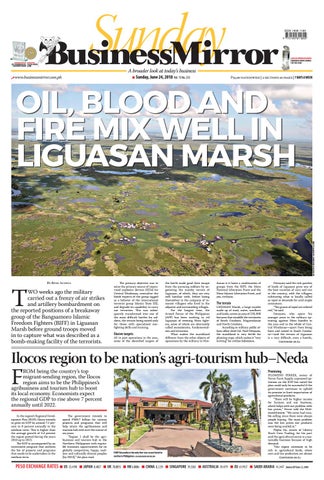
OIL, BLOOD AND FIRE MIX WELL IN LIGUASAN MARSH
T
By Rene Acosta
WO weeks ago the military carried out a frenzy of air strikes and artillery bombardment on the reported positions of a breakaway group of the Bangsamoro Islamic Freedom Fighters (BIFF) in Liguasan Marsh before ground troops moved in to capture what was described as a bomb-making facility of the terrorists.
The primary objective was to seize the primary source of improvised explosive devices (IEDs) for Central Mindanao, neutralize the bomb experts of the group tagged as a believer of the international terrorist group Islamic State (IS), and degrade its capability to carry out terrorism. This was subsequently transformed into one of the most difficult battles for soldiers, the terrain being suited only for those with specialized warfighting skills and training.
Elusive targets
AS in past operations in the area, some of the identified targets of
the battle made good their escape from the pursuing soldiers by negotiating the marshy terrain of Liguasan, of which, they are very well familiar with, before losing themselves in the company of innocent villagers who lived in the adjacent and surrounding villages. For the longest time, the Armed Forces of the Philippines (AFP) has been working to rid Liguasan of teeming Moro fighters, some of whom are alternately called secessionists, fundamentalists and terrorists. What makes the marshland different from the other objects of operations by the military in Min-
danao is it hosts a combination of groups from the BIFF, the Moro National Liberation Front and the Moro Islamic Liberation Front, and yes, civilians.
The terrain
LIGUASAN Marsh, a large swathe made up of mud, water, sandbars and lands, covers an area of 220, 000 hectares that straddle the territories of South Cotabato, Maguindanao and North Cotabato. According to military public affairs office chief Col. Noel Detoyato, the marshland is very fertile for planting crops, which makes it “very inviting” for civilian habitation.
Detoyato said the rich patches of lands of Liguasan grow one of the best varieties of corn and rice in the country, with the villagers cultivating what is locally called as tapul or denorado for avid staple consumers. “The grains of tapul are colored red,” he said. Detoyato, who spent his younger years in the military operating against Moro bandits in the area and in the whole of Central Mindanao—apart from being born and raised in South Cotabato—said the terrain of Liguasan is a very difficult, even a hostile, Continued on A2
Ilocos region to be nation’s agri-tourism hub–Neda
F
ROM being the country’s top migrant-sending region, the Ilocos region aims to be the Philippines’s agribusiness and tourism hub to boost its local economy. Economists expect the regional GDP to rise above 7 percent annually until 2022.
In the region’s Regional Development Plan (RDP), Ilocos intends to grow its GDP by around 7.2 percent to 8 percent annually in the medium term. This is higher than the average growth of 5.4 percent the region posted during the years 2010 up to 2015. The RDP is accompanied by an investment program that outlines the list of projects and programs that needs to be undertaken in the medium term.
The government intends to spend P589.7 billion for various projects and programs that will help attain the agribusiness and tourism hub title over the course of six years. “Region 1 shall be the agribusiness and tourism hub in the Northern Philippines with equitable economic opportunities for its globally competitive, happy, resilient and culturally diverse peoples [by 2022],” the plan read.
PESO EXCHANGE RATES n US 53.4190
Promising
FORT Ilocandia is the only five-star resort hotel in northern Philippines. HELGIDINSON | DREAMSTIME.COM
FILOMENO FERRER, owner of Ferrer Farm Supply, expressed optimism on the RDP but noted the plan could only be successful if the government continues to uphold its promise to limit importation of agricultural products. “There will be higher income for farmers and our business, which helps with our problem with low prices,” Ferrer told the BusinessMirror. “We never had trouble selling since there were always people buying. The main problem was the low prices our products were being availed at.” Pepito Go, owner of Liberty Rico’s Corn Trading, for his part said the agricultural sector is a sustainable business because of high demand. “Our region continues to be rich in agricultural lands, where corn and rice production are almost Continued on A2
n JAPAN 0.4857 n UK 70.8015 n HK 6.8086 n CHINA 8.2259 n SINGAPORE 39.3365 n AUSTRALIA 39.4179 n EU 61.9927 n SAUDI ARABIA 14.2447
Source: BSP (June 22, 2018 )
NewsSunday BusinessMirror
A2 Sunday, June 24, 2018
www.businessmirror.com.ph
Ilocos region to be nation’s agri-tourism hub–Neda Continued from A1
concentrated,” Go said. “Regardless of economic situation, our product remains highly [sellable] given local constant market demand.” He explained this is so because Filipinos “are top in rice consumption.” “Our product [likewise] is not only catered [by] households, because corn is also used as feeds for poultry, piggery and fishery.” However, Go said, the government should look into the decreasing size of farmlands and low farm-gate prices. The decreasing farm size is linked with the conversion of farmlands into commercial and residential use. According to Go, the government should provide an elbow room so businesses could introduce new technology to boost production.
Tourism hub
THE investment program for the Ilocos region, however, still requires an additional spending by as much as 62 percent, or P363.6 billion, for the social development sector. Caroline Castro of the National Economic and Development Authority (Neda) said the economic, governance and environment sectors require a total of P22.67 billion between 2017 and 2022. Only 34 percent, or P203.4 billion, to note, is allocated for infrastructure. The importance of this latter allocation could be better appreci-
BANGUI Windmills in Ilocos Norte ALEXEY KORNYLYEV | DREAMSTIME.COM
ated in the face of Region 1’s agritourism vision. A number of 995,710 tourists have visited Region 1 last year. Of these, a majority (53.15 percent) went to Pangasinan. La Union at-
tracted 37.61 percent, while Ilocos Sur and Ilocos Norte shared 5.25 percent and 3.99 percent, respectively. The national government has already begun laying down the foundation for the region’s transformation
into a tourism hub with the Department of Public Works and Highways (DPWH) allocating as much as P1.6 billion to improve infrastructure in Pangasinan this year. This accounts for half of the P3.3-billion budget allocated for Region 1’s infrastructure development.
Local support
THE Office of the Sangguniang Panlalawigan Secretary of Pangasinan approved the Local Road Network Development Plan (LRNDP) 2018-2022 in January. The LRNDP serves as “an integrated five-year development plan for the sustainable development of provincial road networks and contains core road projects [that] were selected based on prioritization criteria and consistent with and in support of the goals and objectives
of the provincial government of Pangasinan.” The local government also included in the proposed P1.6-billion budget several projects to improve tourism facilities and buildings, such as rest areas, view decks and boardwalks. A road project that was implemented six years ago is seen as having helped boost the region’s chances of becoming a premier tourist destination in the country.
Agri-tourism
THE marriage of agriculture and tourism starts in La Union, which aims to bag by 2025 the title of being the “Heart of Agri-Tourism in North Luzon.” Achieving this goal includes the recent reopening of the Honeybee Center as well as the Mabanag
Hall. The latter will be converted into a multipurpose building to become the new La-Union Agri-Tourism Center. Meanwhile, Ilocos Norte aims to complete the Metro Ilocos Master Plan for Tourism, which will “connect and integrate the cities and towns of Ilocos Norte as one.” The master plan aims to redefine the “cultural footprint and help sustain its natural treasures as a contemporary tourism hub on a par with global trends.” Ilocos Norte’s tourism plan will focus on the Cape of Bojeador Lighthouse, the Pasuquin Mangrove in Davila, the Kapupuraoan Rock Formation and Paoay Church. The plan also intends to transform the Port of Currimao into a “seaport economy” and transportation hub. Pearl Anne M. Gumapos, Intern
Oil, blood and fire mix well in Liguasan Marsh Continued from A1
course for operating troops. “The water in the marshy areas sometimes goes up to knee-deep or even rises up to the chest or even higher, depending on the season,” he said. Sometimes, its expanse of sandbars, and even lands, disappears and reappears.
‘Filthy’ rich marshland
DETOYATO said that occupants of the marshland, including its settled villages, have already mastered its routes; and they use bancas as a means of primary transportation and in moving from one area to another to another. “They don’t walk, they use boats. They are very familiar with the rivers in going to municipalities,” he said. Detoyato said the Liguasan Marsh, especially the Rio de Grande River, which cuts through it, was even used by the Spaniards centuries ago in going into the heartland of Mindanao. The muddy terrain of Liguasan helped the creation of the Riverine Unit of the Army Special Forces, whose first sets of watercraft were donated by Australia several years ago under the country’s Status of Visiting Forces Agreement with Canberra. Liguasan is literally a “filthy” rich marshland that some even called it the “Arab heartland” of the Moros in Mindanao, compar-
ing it to the oil-rich territories that were snatched by the IS in its rampage in Iraq and Syria.
Blood-drenched
THE marshland has the same tale as those of the areas taken and lost by the IS: it is drenched in blood, it is the hotbed of extremism, and it reportedly contains a combination of oil and natural gas. However, Detoyato said it is not the deposits that sit beneath Liguasan that drives the military operations against the lawless elements in the area. It is the desire of the government to get rid of terrorism and end threat groups that continue to challenge the government, he said.
Oil, natgas deposits
DETOYATO said that, while there may be reports of oil and natural gas in Liguasan, the amount of deposits is “inconclusive.” “The oil there is young, and as to how big the deposit is, it is inconclusive,” he said. Reports about the presence of natural gas in the marshland were buoyed by information that some residents who lived in the surrounding municipalities have their water pipes spew with fire when lighted. “In Kabuntalan, Maguindanao, there’s a water pipe where natural gas comes out. If lighted, it creates fire,” Detoyato said. Similar discoveries were also reported in Sultan sa Barongis in
the same province, and even in Tantangan, South Cotabato. The presence of gas deposits in Maguindanao was confirmed by the Tukanakuden Oil Exploration project by the Philippine National Oil Co. in 1997, and whose drilling equipment were secured by Detoyato and his team then. However, Detoyato could not give the results of the explorations. Reports said the drilling operations, held in the barangay of Tukanakuden in Maguindanao, unearthed a composition of 99 percent of methane gas with small traces of ethane gas. The same composition of gas was also discovered at Barangay Kulambog, also in Maguindanao. “Liguasan Marsh will benefit the Moros and all the residents that live within and even in the surrounding areas and provinces if it really has oil deposits. It will be put into good use,” said Detoyato. In the years since the first comprehensive peace agreement was forged with Moro rebels in 1996 during the Ramos administration, various research teams from several countries that supported the post-agreement development program were reported to have been deployed to Liguasan, sparking speculation that, indeed, the marsh may be holding a lot of resources. But if Detoyato’s report is to be taken as basis, the recent military operations are purely for peace and order, nothing more.
www.businessmirror.com.ph
The World BusinessMirror
Coal being squeezed out of power by renewables
C
oal will be increasingly squeezed out of the power generation market over the next three decades as the cost of renewables plunges and technology improves the flexibility of grids globally. That’s the conclusion of a report by Bloomberg New Energy Finance, which estimated some $11.5 trillion of investment will go into electricity generation between now and 2050. Of that, 85 percent, or $9.8 trillion, will go into wind, solar and other zero-emissions technologies such as hydro and nuclear, the London-based researcher said. Better batteries, which allow grid managers to store power for times when it’s neither breezy nor sunny, will allow utilities to take advantage of plunging costs for solar panels and wind turbines. The ability of natural gas plants to work at a few minutes notice means the fuel will become the choice for most utilities wanting guaranteed generation capacity. “Coal emerges as the biggest loser in the long run,” said Elena Giannakopoulou, head of energy economics at BNEF. “Beaten on cost by wind and PV for bulk electricity generation, and by batteries and gas for flexibility, the future electricity system will reorganize around cheap renewables.” B N E F ’s f o re c a s t s c o m p a re w i t h International Energy Agenc y ’s most o p t i m i s t i c s ce n a r i o f o r e l e c t r i c i t y generation, envisioning clean energy and fossil fuels reaching parity at 50 percent of the market each in 2025. The Paris-based institution’s central forecast puts the two on par by 2040, and fossil fuels would retain about a two-thirds share of generation by
then if governments make no further steps to tighten regulations, the IEA says. Gas will keep much of its market share, BNEF says. The nature of plants being built in the future will shift to peaker units that utilities can switch on and off quickly and away from the baseload plants that tend to operate around the clock. The chart below shows BNEF’s forecast that utilities will burn much less coal over time. The decline of coal won’t be enough to dramatically alter the picture for a gradual increase in global temperatures in excess of the threshold of 2 degrees Celsius since preindustrial times that has become the United Nations climate target. “Even if we decommission all the world’s coal plants by 2035, the power sector would still be tracking above a climate-safe trajectory, burning too much unabated gas,” said Matthias Kimmel, energy economist at BNEF. Even without tighter environmental rules, renewables will be increasingly attractive to utilities if only because of their falling costs. Building wind and solar farms will become much cheaper by 2040, according to the BNEF estimates, while traditional nuclear and coal projects become more costly. With solar energy, the amount of capacity being installed is rising as overall capital costs decline, BNEF estimates. The chart below shows investment in photovoltaics peaking in the 2030s and declining in the decade after, while the capacity that investment buys remains strong.
Sunday, June 24, 2018
A3
Daimler is 1st to predict profit hit on trade war
D
aimler AG became the first prominent company to cut its profit outlook due to escalating trade tensions between the United States and China, claiming Chinese customers will now buy fewer cars after Beijing slaps tariffs on US auto imports. The German luxury-car maker said late Wednesday its full-year earnings excluding some items will be slightly lower than last year. Many Daimler C-Class sedans and sport-utility vehicles (SUVs) are built in Alabama and then shipped to China. Those vehicles are now caught up in retaliatory tariffs announced in China in response to President Donald J. Trump’s levies on $50 billion in Chinese goods. With the rising prospect of an all-out trade war, few industries will be spared and more companies may have to follow Daimler, said Nicholas Smith, a strategist at
CLSA Securities in Tokyo. MillerCoors, the maker of Miller Lite and Coors Lite, warned last week that US tariffs on aluminum imports could result in a $40 million hit to its bottom line. Shares of German carmakers fell on Thursday. Daimler dropped 2.9 percent at 9:06 a.m. in Frankfurt. BMW, which also exports vehicles to China from its plant in Spartanburg, South Carolina, declined 2.1 percent. Volkswagen AG, which has limited China-US trade exposure, slipped 1.4 percent. BMW, the second-big gest lu xur y carmaker, last year ex ported
more than 100,000 SUVs to China from its US factor y. W hile that number w i l l dec l ine t his year w ith BMW mov ing to produce its X 3 SU V in China, it’ ll continue to ex port the high-end X 5. Last year it shipped 46,151 of those vehicles. BMW is ex posed to an operating-ear nings hit of €100 million, or $115 million to €200 million, according to analyst Juergen Pieper at Bank haus Metzler. “Taking the cynic’s view, I think there will be a lot of companies needing to cut sales forecast and this will be an incredibly convenient reason to blame it on,” Smith said. “The Europeans will take a hit on this, the Chinese are going to find this very bumpy and it’s in the nature of a trade war that everyone loses.” T he tar if fs announced by Trump, and China’s in-kind response, may just be a start in the escalating conf lict. On Monday Trump said he had instructed the US Trade Representative’s office to identify $200 billion in Chinese imports for additional tariffs of 10 percent. He said the US
would impose tariffs on another $200 billion after that if Beijing retaliates. The range of products that could eventually be taxed by Trump is approaching the value of all US imports from China last year—bout $505 billion. On Thursday a Chinese commerce ministry spokesman reiterated that China is “fully prepared” to respond to any new list of US tariffs on Chinese exports. Daimler and its German rival BMW AG are among carmakers most affected by China’s additional tariffs against American-made cars—more so than US auto manufacturers, according to Evercore ISI. Daimler and BMW will ship just over 100,000 vehicles to China from the US this year, Evercore estimated in April—almost $7 billion worth of goods. “Fewer than expected SUV sales and higher than expected costs— not completely passed on to the customers—must be assumed because of increased import tariffs for US vehicles into the Chinese market,” Daimler said in its statement. The company called this “the decisive factor” in its revised outlook. Bloomberg News
A4
The World BusinessMirror
Sunday, June 24, 2018
Trade brawls leave top central bankers worried about growth
T
he world’s most-powerful central bankers warned that escalating international trade tensions have started damaging confidence among companies, threatening the global economic expansion.
Powell Andrew Harrer/Bloomberg
“Changes in trade policy could cause us to have to question the outlook,” Federal Reserve Chairman Jerome Powell said during a panel discussion at a European Central Bank (ECB) conference in Sintra, Portugal. “For the first time, we’re hearing about decisions to postpone investment, postpone hiring.” His sentiment was echoed at Wednesday’s event by Bank of Japan Governor Haruhiko Kuroda, ECB President Mario Draghi and Reserve Bank of Australia Governor Philip Lowe. Those four central banks set monetary policy for more than a third of the world’s economy. A trade war would be a headache for central banks, given it would likely deal stagflationary blows to their economies by forcing consumer prices up and demand down. The policy-makers would then be forced to decide whether to act to support growth or cap the inflationary pressures, for example by hiking interest rates.
US President Donald J. Trump on Monday evening threatened to impose tariffs on another $200 billion of Chinese imports, prompting a response from Beijing warning of additional retaliation. The European Union also made good on a threat to hit American goods with retaliatory tariffs. Draghi said it was still too early to measure a significant economic impact, but that he had begun worrying about an erosion of confidence, among both businesses and consumers.
“It’s not yet time, in a sense, to see what the consequences on monetary policy of all this can be,” he said. “There’s no ground to be optimistic on that.” He added that there are lessons to be learned about trade conflict and protectionism from history, and “they’re all very negative.” The burgeoning set of disputes was undermining “the multilateral framework that all of us have grown up with,” he said. While Japan is not yet a target for new tariffs from the Trump administration, Kuroda said the indirect impact of the dispute could be to disrupt the network across East Asia that acts to supply Chinese industry. “I really hope that this escalation could be rescinded, and a normal trading relationship between the US and China would prevail,” he said. “This is a matter of great concern for Japan.” Australia’s Lowe had, perhaps, the most dire warning. While trade tariffs alone probably wouldn’t derail global growth, he said they could spark damaging market volatility and the postponement of business decisions. “It wouldn’t take that much for financial markets to combine with businesses that are waiting to turn this into a big global event,” he said. “I hope it has a low probability, but I’m very disturbed at what is happening.” Australia is about to start freetrade talks with the European Union, a sign that some economies are pushing for closer ties as the Trump administration pulls back. “Can any of us think of a country that’s made itself wealthier and boosted productivity growth
Can any of us think of a country that’s made itself wealthier and boosted productivity growth by building walls? Probably not. I view what’s happening as incredibly worrying.”—Lowe
by building walls? Probably not,” Lowe said. “I view what’s happening as incredibly worrying.” For now, market economists say the overall hit to economic growth from the trade dispute has been limited, though they caution that picture could change. “So far, the economic damage is likely to be light,” said Michael Every, head of financial markets research at Rabobank Group in Hong Kong. “Of course, it gets much worse if the trade war gets worse, but so far it’s manageable.”
N
Workplace impropriety that has cost executives their jobs runs a broad range from consensual dalliances to accusations of assault. Earlier this month, Guess Inc. co-founder Paul Marciano stepped down following a company investigation into allegations of sexual harassment and assault. John Lasseter, co-founder of Pixar Animation Studios and Walt Disney’s animation chief, also recently said he was resigning over what he called “missteps” with employees. Years before #MeToo, the CEO of Hewlett-Packard Co., Mark Hurd, was ousted following accusations of sexual harassment by a female contract worker. Hurd settled with the woman in 2010. In 2012, Best Buy CEO Brian Dunn resigned abruptly after the company launched an internal investigation into what the company called his “personal conduct” unrelated to Best Buy’s business. An audit later revealed t he issue was an “e x tremely close personal relationship with a female employee.” The male-dominated tech industry has been a hotbed for allegations of harassment and discrimination, and in some ways foreshadowed #MeToo as female employees began speaking out. In
February 2017, former Uber engineer Susan Fowler wrote an explosive, detailed blog post about the culture of systemic harassment and abuse that she experienced at the ride-hailing company. It wasn’t until the fall that #MeToo began taking off. Krzanich joined Intel Corp. in 1982 as an engineer and rose through the ranks until he became CEO in 2013. During his tenure, Intel worked to push into growing businesses such as internet-based computing, highspeed memory chips and smart, connected objects that make up what’s known as the “Internet of Things,” or IoT—along with fields such as artificial intelligence and self-driving cars. Earlier this year, Google security researchers announced that they have discovered serious security flaws affecting computer processors built by Intel and other chipmakers. Google’s Project Zero team disclosed the vulnerability not long after Intel said it’s working to patch it. Krzanich sold about $39 million in Intel stock and options in late November of last year, after Intel was notified but before the security vulnerability was publicly known. Intel had said it was notified about the bugs in June. But the company also said at the time
Thai premier sees polls early next year to end military rule
India’s retaliation
INDIA raised tariffs on a slew of items in retaliation to US imposing higher levies on some products shipped from the South Asian nation, a move that echoes steps taken by China and the EU. The import duty on chickpeas and Bengal gram, or chana, has been increased to 70 percent and will be effective from August 4, the ministry of finance said in a notification dated June 20. The tariffs have also been raised on other items, including walnuts, almonds, boric acid, apples, diagnostic reagents and some hotrolled coil products. Prime Minister Narendra Modi’s administration’s tit-for-tat move comes amid a trade war between the US and its key trading partners. President Donald J. Trump on Monday ordered identification of $200 billion in Chinese imports for additional tariffs of 10 percent—with another $200 billion after that if Beijing retaliates. He’s already promised to place tariffs of 25 percent on $50 billion, starting July 6 with an initial $34 billion worth of imports. China on Thursday said it is “fully prepared” to respond to any new list of US tariffs. “The increase in tariffs is a message to the US administration to take concerns of other nations seriously,” said Sachin Chaturvedi, director general at New Delhibased think tank Research and Information System for Developing Countries. “Now this is unlikely to remain confined to a tariff war and will escalate to non-tariff measures, as well.” Bloomberg News
Intel CEO out after consensual relationship with employee EW YORK—Intel Chief Executive Officer (CEO) Brian Krzanich resigned after the company learned of what it called a past, consensual relationship with an employee. Intel said on Thursday that the relationship was in violation of the company’s non-fraternization policy, which applies to all managers. Spokesman William Moss said. Intel has had the policy in place for “many years.” He declined to comment further. Chief Financial Officer (CFO) Robert Swan will take over as interim CEO immediately. A search for a new CEO is underway. Corporate America is under intense pressure to enforce workplace policies on gender equality and sexual harassment. Thanks largely to the #MeToo era, even relationships that appear consensual are closely scrutinized—and often prohibited by companies—if they involve a power imbalance such as the one between a manager and an employee. Intel said it has enforced the policy, which has been in place since 2011, against managers on several occasions. It applies to both direct and indirect reports of managers. If an employee suspects such a relationship, they are required to report it.
www.businessmirror.com.ph
that the stock sale was unrelated to the security flaws. Krzanich had also been a champion of workplace diversity. In 2015 at the CES gadget show in Las Vegas, Krzanich challenged the tech industry to increase the hiring of women and minorities, and he set a goal of full representation in his company’s workforce by 2020. Intel said it was investing $300 million to improve diversity at the company. K r z a n i c h ’s r e s i g n a t i o n “comes at a d i f f ic u lt t i me for I n t e l ,” s a i d C o w e n a n a l y s t Mat t hew R a msay i n a note to i nvestors. He added t h at he does not see a “c lea r i nter n a l long-ter m successor” g iven recent h igh- prof i le de pa r t u res at t he compa ny. D i a ne Br ya nt, t he for mer president of Intel ’s data center g roup, went to Google in 2017. For mer CFO St a c y Sm it h a n nou nc e d h i s ret i rement l a st su m mer a nd R enee Ja mes, Inte l ’s for mer president, lef t i n 2015. Given that so much change at the company was driven by Krzanich, Ramsay said his departure could make succession planning and further transitions “challenging.” His abrupt departure overshadowed other w ise positive news for the giant chip maker. AP
T
hailand’s Prime Minister Prayuth Chan-Ocha said his military government is committed to holding an election early next year, and that he may clarify his political future in September. The pending coronation of King Maha Vajiralongkorn won’t affect the plan for a poll possibly in February, Prayuth said in an interview. He added that it was too early to make a decision on joining a political party ahead of the vote. Prayuth, a former army chief, seized power in Thailand in May 2014 after a prolonged period of sometimes bloody unrest, pledging to restore stability and revamp the country’s political system. Over the years the timeline for elections has been repeatedly pushed back, most recently to February 2019. Earlier this week, Prayuth said the coronation of the king would precede the polls, stirring fresh doubt about the latest schedule. “I don’t think there will be any issue with the coronation and the general elections,” Prayuth, 64, said in London Thursday on an official visit. “It shouldn’t have an impact on the roadmap. I think we can work on both in tandem.” The current stretch of military rule is one of the longest since the 1970s, in a nation with frequent coups since the end of absolute monarchy in 1932. Prayuth has unfettered executive power as head of the National Council for Peace and Order, the formal name of the junta, and politicians have speculated he may seek to retain power after the election. “Some people are worried that what I’m working on now will not be transferred to future governments, that there will be no continuity to my policy,” he said.
Staying on?
The next vote will be under a military-backed constitution, which critics say gives appointed soldiers, judges and bureaucrats the power to stifle elected politicians. The charter makes it possible for Prayuth to be reappointed as premier in certain circumstances—even if he doesn’t join a political party. It’s also not clear whether a fresh election will inspire confidence in Thailand ’s outlook, or revive memories of its destabilizing cycle of violent protests and military intervention to oust elected governments. While economic growth is at a 5-year high, the military government faces a fight for support as people in rural areas say they aren’t seeing the benefits of the expansion. In the years before the most recent army takeover, fissures in Thai society triggered violent clashes between urban royalists and rural backers of exiled former leader Thaksin Shinawatra. Allies of Thaksin have won every election dating back to 2001, only to be unseated by the courts or military. Thaksin’s sister Yingluck Shi-
nawatra, whose government was ousted in the 2014 coup, fled the country last year to avoid a jail sentence in a negligence case she said was politically motivated. The UK has since given her a 10year visa, according to a report by BBC Thai.
Cycle of unrest
The economy slowed to a crawl in the months of protests leading up to the coup more than four years ago. The junta banned political activity after seizing power and continues to impose the prohibition, although it has permitted parties to make some initial preparations for elections. Growth in Southeast Asia’s second-largest economy has recovered and jumped to 4.8 percent in the first quarter. Prayuth’s administration has tried to diversify the economy, seeking to curb reliance on tourism and exports of products such as parts for computers and cars. It’s accelerated large transport projects, cut red tape and put more money in the pockets of low-income households. The government is also touting the Eastern Economic Corridor, a 1.5 trillion baht, or $46 billion, development project on the eastern seaboard to promote urbanization and encourage the development of advanced industries. One unanswered question is whether the next civilian administration will champion the same policies or try to dismantle them. Political risk is one of the challenges to reviving private-sector investment, which was subdued after the unrest and coup until a recent uptick. The Eastern Economic Corridor is backed by legislation and part of Thailand’s long-term strategy, so the next administration will continue it, Prayuth said.
Rights abuses
The European Union and United Nations have accused the junta of severely curtailing civil rights and freedom of expression. The military administration in a January letter to the UN said it supports and values freedom of expression within the law. But in December, the EU said it would pursue a gradual political re-engagement with Thailand because of the prospect of an end to military rule. Prayuth visited British Prime Minister Theresa May on Wednesday and meets French President Emmanuel Macron on Monday. He and Macron are expected to preside over the signing of an agreement for Thailand to purchase a satellite from Airbus SE. Prayuth said the political system implemented by his government is intended to stop the cycle of unrest and coups. “We don’t want to see intervention in the future,” he said. “The system that we designed and put in place now is to make sure that Thailand will become a fully functional democratic country.” Bloomberg News
Faith
Editor: Lyn Resurreccion • www.businessmirror.com.ph
Solemnity of the Nativity of Saint John the Baptist: ‘Luke 1:57-66, 80’
The birth and naming of John Msgr. Josefino S. Ramirez SUNDAY GOSPEL IN OUR LIFE
T
his specia l week mark s t he ce lebr at ion of t he bir t h of John t he Bap tist. T he names we are g iven is somet hing we d id not choose yet, somehow, we seem to embody its meaning and happi ly res pond to some one c a l l i ng out to us. Somet imes, our pa rents a lso don’t choose our names. You k now how people plan for t he baby’s name long before conception and stic k to it unt i l t h at wonder f u l d ay t he y meet t he baby and, sudden ly, anot her name seems more ap propr iate? I t hink t hose are t he times t hat God spea k s to the parents through the baby’s “spir it” as to what name t he chi ld w i l l be ca l led. The birth of John was proof that God had been gracious to His people by putting into motion the plan to bring the Savior, the Messiah, into the world. Joh n’s bi r t h , i n s o m a ny ways, is so much like Jesus’. Both events evoked feelings of wonder and awe. Both made a big impression throughout the entire region. And what began as an ordinary day in the life of the people over nine months had
now been turned by God into a miraculous event that became known all over. To all the childless couples who have yearned to conceive a child just like Elizabeth, I hope you do not ever feel that God has forgotten or no longer cares about you. And in case you are experiencing hopelessness, always remember that there is hope regarding your situation. If it is God’s will, then we shall have it in God’s time. Even when it seems he has forgotten, He remembers. The many seemingly hopeless situations we have are reminders that God is faithful to carry out His oath that He made to all generations of His people all throughout history that He will send a Savior who would bring hope to all. May it always remind us that God delights in extending His grace to us. My dear brothers and sisters, whatever we are called to do, whatever situation of despair we are in, know and believe that the hand of the Lord is with us. Let us thank God for his powerful presence in our lives and in our quiet time of prayer, to ask Him to always strengthen our faith.
V
Typical standards, norms and laws in regard to communications are first eliminated, the pope said in his homily early this week during a morning Mass at Domus Sanctae Marthae. Then an entire media or communication out let is handed over “to a firm, a business that slanders, tells lies, weakens democracy, and then the judges come to judge these weakened institutions, these destroyed, condemned people, and a dictatorship makes progress this way,” he said. “All dictatorships, all of them, began like this, by adulterating communication, by putting communications in the hands of people without scruples, of governments without scruples,” he added. T he pope’s hom i ly foc u sed
A
John is his name
Zechariah, son of Berekiah, a Pharises, is a holy priest in the temple of Jerusalem. He is married to Elizabeth. Both were born in Hebron in the first century to priestly families. The holy couple were sad for they were childless, which was considered as a punishment from God. One day, while Zechariah was ministering incense at the altar, the angel Gabriel appeared to him, saying: “Do not be afraid, Zechariah, because your prayer has been heard. Your wife Elizabeth will bear you a son, and you shall name him John.... He will be great in the sight of the Lord. He will be filled with the Holy Spirit even from his mother’s womb” (Luke 1:13,15). Overjoyed was Zechariah, for God has removed his disgrace. Since he and Elizabeth were advanced in age, doubt gripped him, thus, he asked, “How shall I know this? For I am an old man, and my wife is advanced in years” (Luke 1:18). B e c au se he doubte d t he angel ’s message, he became speechless. W hen he emerged
Saint John the Baptist by Leonardo da Vinci Wikimedia Commons
Death for outspoken courage
W hen John wa s bapt ised , ma ny people asked, “ W hat then, will this child be? For surely the hand of the Lord was with him” (Luke 1:66). John grew up in the dessert. As a forerunner of Jesus, his mission was to prepare and announce the coming of the Messiah to people, which he started when Jesus was 30 years old. Six months older then Jesus, John looked eccentric with his wild hair and leather belt. He ate grasshoppers and wild honey, and wandered in the wilderness. He preached the need for repentance and commitment to a righteous way of living. His odd looks and unusual manners were overshadowed by his eloquence, forceful voice and messages. The
A5
ATICAN—All dictatorships begin the same way: media outlets are put in the hands of “unscrupulous” people who spread lies and weaken democracy, Pope Francis said.
By Corazon Damo-Santiago
from the sanctuary, he made gestures, and the crowd knew he had a vision. As soon as he reached home, Elizabeth conceived. Eight days after Elizabeth gave birth, his son has to be circumcised according to Jewish tradition, and has to be named Zechariah according to the custom. Elizabeth insisted, he has to be named John. So Zechariah was asked, and he wrote John (meaning “Yahweh is gracious”), and he immediately regained his speech. Overwhelmed, he praised God.
Sunday, June 24, 2018
Pope: Dictatorships begin with taking over media to spread lies
Saint John the Baptist: Precursor of Jesus ll saints, except John, are honored on the day of their death. John is one of three church personalities who were honored by the church on their birthdays. John on June 24, the Blessed Mother on September 8 and Christ on December 25. They were born without sin. The Blessed Virgin Mary and Jesus were without sin from the moment of conception. Although John was conceived with sin, a great miracle happened while he was in the womb of his mother Elizabeth, a cousin of Mary. When Mary went to visit Elizabeth, at the sound of Mary’s voice, Elizabeth was filled with the Holy Spirit and John, in her mother’s womb, quickened joyfully. Jesus’ proximity changed John. This was announced by an angel to his father that John would be “filled with the Holy Spirit even from his mother’s womb” (Luke 1:15).
Sunday
people from Jerusalem, Jordan and Judea flocked to listen to him, even the proud Pharisees and Sadducess. Penitents lined to be baptized in the Jordan River. Even Jesus came from Galilee to be baptized, and John was hesitant and said, “I need to be baptized by you and yet you are coming to me” (Matthew 3:14). In reply, Jesus said it should be, in fulfilment of a prophecy, submit to God’s plan for the salvation of the human race: “Allow it now for it is fitting for us to fulfil it” (Matthew 3:15). A fearless man, he rebuked Herod A ntipas for adulter y and his incestuous affair with Herodias, his brother’s wife. For this denouncement, John was imprisoned in the palace of Machaerus. Biblical passages narrated how Herodias advised her daughter, Salome, for the head of John the Baptist as a prize for her seductive dance during Herod’s birthday. Saint John the Baptist was the last of the Old Covenant prophets. His feast day is June 24. Damo-Santiago is a former regional director of the Department of Education National Capital Region. She is currently a faculty member of Mater Redemptoris Collegium in Calauan, Laguna, and of Mater Redemptoris College in San Jose City, Nueva Ecija.
on t he d ay ’s f i rst read i ng i n wh ic h Je z ebe l succeed s i n her a plot to he lp her hu sba nd , K i ng A h a b, t a k e p os ses sion of t he i r ne ig hbor ’s l a nd ; t he ne ig hbor, Nabot h , ref u sed to se l l wh at h ad be longed to h i s f a m i ly for generat ion s. Jezebel arranged for two men to accuse Naboth of cursing God and the king, for which Naboth was stoned to death. Francis said what happened to Naboth is similar to what happened to Jesus, Saint Stephen and all martyrs who were condemned as a result of lies and falsehoods. Today, many people, “many heads of state or government,” forge the same scenario: start with a lie and, “after you destroy both a person and a situation with that falsehood,” there is a judgment and
Pope Francis gives the homily during the morning Mass in the Domus Sanctae Marthae at the Vatican on May 25. CNS/VATICAN MEDIA
a conviction, he said. Many countries today, he added, “they use this method: destroy free communication.” But individuals, too, are also tempted to destroy others by talking behind their back, telling lies or spreading scandalous news, the pope said. Talking about scandals is enormously seductive, he said, and “one is seduced by scandals. Good news isn’t a seductress.” “The seduction of scandal in communication backs one into a corner,” in that it destroys people like Naboth or Saint Ste-
phen, who was stoned to death by people who didn’t want to hear the truth. There have been “so many people, so many countries destroyed by evil and calumnious dictatorships,” he said, including the ones that persecuted the Jews with “calumnious communication” so they ended up in Auschwitz. “Oh, it was a horror, but it’s a horror that happens today—in small communities, to people, in many countries. The first step is to seize communications, and later destroy, judgment and death,” he said. Carol Glatz/Catholic News Service
A BusinessMirror Special
MANIL A6
Sunday, June 24, 2018 | www.businessmirror.com.ph
MANILA’S RENAISSANCE A
By Marane A. Plaza
S Manila celebrates its 446th anniversary, Filipinos are being reminded again why the the historically and commercially rich city has been the capital of the Philippines for centuries. With its P4-billion debts back in 2013, right before Erap took his seat as the mayor, it was hard to remember why Manila was originally dubbed as the “Pearl of the Orient.” Manila, always at the forefront of commerce and business, had had consistently made headlines—but for not so good reasons. Pollution, crimes and a total downfall into debts and economical failures, Manila had had its shares of tribulations. Former president Joseh Estrada, a true blue Manileno, had seen his hometown’s dark days when he was welcomed with the P4-billion debts in June 2013. But just like the hero he was in his films, Erap has turned the doomed days of Manila into just another phase of strengthening the city. By 2018, the city has paid off its 4-billion peso debts, and has enjoyed higher employment rate for the Manilenos. The mayor has focused his projects on hi 10-point agenda, projects that are solely aimed at improving the city’s condition on Peace & Order, Health, 3. Housing / Urban Settlement, Transportation & Traffic, Cleanliness, Education, Sports, Governance, Transparency and People Participation Starting from the Basics. With the goals of lessening debts and generating revenues, Mayor Erap has addressed the economic issues head-on by solving seemingly basic, but truly impactful problems such as Manila’s peace and safety problems. Manila Mayor Joseph “Erap” Estrada has
linked forces with the Armed Forces of the Philippines (AFP) in empowering lower barangays to deal with all kinds of security threats. “The efforts of AFP to insulate our communities from violent extremist ideologies, and from the influence of groups seeking to recruit individuals for their radical activities, will have long-term benefits as we seek to create a peaceful and progressive city,” the mayor said at his press con in 2017. The community support program is a military initiative that seeks to build conflict-resilient communities that will be able to independently address all kinds of threats, particularly terror threats and natural calamities and disasters. The effort was directed towards “ending the radicalization and polarization, and improve the prospects for peace and unity”, said Erap.
from the mayor, but also a message of encouragement. The mayor emphasized that the shoes are for the true “superstars” of Manila.
Better public transporation
Health is wealth
MAYOR Joseph Ejercito Estrada and Department of Social Welfare & Development (DSWD) has sealed the Memorandum of Agreement that has intensified and broadened the coverage of the Lingap sa Masa (Lingap at Gabay Para sa May Sakit) program’s implementation in the City of Manila. Lingap’s core objective of providing free medicines stems from President Rodrigo Duterte’s firm commitment to care for the health needs of indigents and other vulnerable sectors as well as needy government workers. The president has allocated P1-billion for the program, and Mayor Estrada expressed his gratitude that Manila’s own health initiatives for the poor would receive a great boost through the formalization of the MOA. He has also im-
proved public hospitals and has given away free wheelchairs to the elders. An “All-Star” Education for A Better Future Erap has always put education at the top of his priority projects. The city ahs invested on the education more than ever. In April, the local gov-
ernment gave away 7,196,000 cash incentives to 1,161 K-12 graduate students. I want you to be the best. I am giving you cash incentives because you strove to be the brightest students and not just average students of Manila,” he said.
Aside from educational cash assistance, free school and PE uniformsand other schools supplies, the mayor also gave away 2, 508 pairs of “Erap All-Stars Shoes”. On the first day of school at Bacood Elementary School students from kinder to sixth grade got not just footwear
A huge chunk of bettering the economy is investing on better traffic of transporations . In his persistent efforts to clear Manila’s major roads of obstructions and improve traffic flow, Manila Mayor Joseph “Erap” Estrada is re-intensifying his drive against illegal parking that he said has become a milking cow for profiteering syndicates. And to put those money-making syndicates out of business, Estrada launched the Manila-wide Mapping and No Parking Zone program that involves the strict enforcement of the city’s policies against illegal parking. Furthermore, he has improved the road situation by giving away electric tricycles (etrikes) to driver beneficiaries in Binondo. Aside from bettering the transportation landscape in Manila, it has been poised to lessen pollution and provide means of livelihood. “This is primarily a livelihood program with the main objective of providing our poor tricycle and kuliglig (motorized pedicabs) drivers an ‘upgraded’ public transport vehicle which they can call their own and from which they could earn more”, he said. Today, Manila has indeed become debtfree. It is on its way to being the home of worldclass real estate developements poised to offer more economic opportunities for all. If there’s one thing Erap has proven, addressing the basic issues in excellent and focused ways can make a world of difference.
l Feature
LA DAY www.businessmirror.com.ph | Sunday, June 24, 2018 A7
Manila inches closer to reviving its glory days
I
By Diego C. Cagahastian
N 2013, Joseph Ejercito Estrada was enjoying his blissful retirement from politics and public service and was content in relaxing tasks of caring for his children and grandchildren, aside from writing bits and pieces of his memoirs, later to be turned into a book. This book-writing endeavor led him to revisit his roots, as far back as the very beginning, meaning his birth at a hospital in Manuguit, Tondo, Manila. Erap thought about the city of his birth, the people who gave him their support and loyalty when he was a struggling actor until a character from Tondo, Asiong Salonga, catapulted him to movie stardom in the 1960s. Estrada realized that he owed so much from the ordinary masses of Manila, and when he realized how badly the principal city of the nation was managed and ruled then, he decided to make himself available again for another run in the local elections, this time in Manila. And so Mayor Estrada started his planned 3-yearterm on June 30, 2013, and is now in the cusp of starting his third and final term in 2019. It is time, then, for the mayor to take stock of what he had done for the city, how far he had pushed with his original objective of putting Manila back in the map, of effecting an urban renewal for the city that would reclaim for Manila its original title of "Pearl of the Orient." In so many words, and finding Manila bankrupt and deep in more than P4billion debt when he started his administration, Estrada wanted to rescue the city from oblivion, bring back to Manilans the respect and dignity that they deserve, provide a livable environment, and set up the city which after all is the capital of the Philippines on its way to becoming world-class. A year after, Manila received the award Most Competitive City in Metro Manila, and Estrada realized that his dreams for the city was bearing fruit. Now the mayor is proud to have given the city its world-class health facilities and renovated hospitals, an efficient dialysis center, an MRI machine in Ospital ng Maynila, well-appointed health centers, and dedicated health professionals, doctors, nurses, etc. who are trained to help. Modern public markets and parks with clean airconditioned toilets, free education, tertiary level institutions, street lighting, flood control, waste management, in-city housing, residential land distribution, antidrugs campaign, disaster preparedness, social welfare, assistance in burial, cemeteries and columbarium, job opportunities, livelihood programs, policies on ease of doing business, taxpayer ser-
vices, tourism and cultural concerns, etc. are all in place. And to cap all these, Mayor Estrada and the City Council were able to pay off the millions of city liabilities. Then, if there will be a so-called Erap legacy in the city of Manila, as Mayor Joseph Estrada girds for a third and final term as mayor of the nation’s capital, it would be a new map of the city with a couple hundreds of hectares of new land rising from Manila Bay, thanks to the latest technology in reclamation engineering. This is in consonance with President Duterte’s massive infrastructure push called “Build, build, build.” Erap has been mayor of Manila since July, 2013 and through the years has been fairly successful in revitalizing the city, first by getting enough revenues to pay off its creditors of Lim-era liabilities then totalling P4.4 billion, and then restoring and bolstering basic social services to Manilans after making the city financially viable and debt-free. As of latest count, there are five huge proposals in various stages of approval or implementation for reclaiming land in Manila.
These are:
THE 318-hectare commercial and tourism hub along the shorelines of Roxas Boulevard called “Manila Waterfront City.” This mixed-use development project is the fourth big-ticket reclamation venture approved under the Estrada administration in less than two years. Mayor Estrada signed a Memorandum of Understanding (MOU) with the Philippine Reclamation Authority (PRA) and real estate firm JBros Construction Corp. last June for the construction of a P100-billion, 419-hectare commercial district in another portion of the bay. The Horizon Manila, touted to be the biggest reclamation project in Manila Bay so far, involves the construction of three islands between the Manila-Pasay boundary in the south and Roxas Boulevard in the east, stretching to about 3.5 kilometers on the edge of the bay. A third reclamation proposal has been offered by the UAA Kinming Group Development Corp. It is called New Manila Bay International Community and will have a total of 407.42 hectares new land reclaimed from the bay. Also planned is the P7.4-billion expansion of the Manila Harbour Centre in Tondo by the construc-
tion firm R-II Builders, Inc. A fifth reclamation project, which had long been in the drawing board before Estrada’s term, is set to begin construction in Manila Bay – the 148-hectare Solar City urban center. Last January, the city council of Manila finally ratified the consortium agreement and the Joint Venture Agreement (JVA) signed by the city government and Solar City proponent Manila Goldcoast Development Corp. (MGDC) on April 7, 2012 and June 7, 2012, respectively. Solar City is a 148-hectare, stateof-the-art, tourism, commercial and residential district that will rise in Manila Bay to host business centers, residential and commercial properties, and tourism facilities, including an international cruise ship terminal.
Estrada realized that Manila’s land area has remained the same all these years, from the time of Spanish colonizers, up to the American and Commonwealth era, and onward to modern times -- 42.88 square kilometers. Adding to the problem is the presence of so many churches, mosques, houses of worship, government buildings, schools and colleges, both religious and secular, which are all exempted from taxes although some of them are being run as businesses. Just like modern metropolitan areas such as Hong Kong, Singapore and Cebu, the city of Manila needs to expand its land area to modernize and march to progress, Estrada said. Once completed, these reclamation projects will increase the land area of the city to 58.3 square kilometers (5,830 hect-
ares). From the point of view of taxation, these will be quality land because exempted lots such are churches and schools are relatively few, unlike in, say, Intramuros. “All these reclamation projects will redound to the benefit of Manilans, first by providing the city with tremendous increases in real property tax revenues along with business and corporate taxes, and second, by generating jobs in the various businesses and enterprises for Manila’s jobless and new graduates entering the labor force,” said Mayor Estrada. He added that increased tax collections will directly translate into more social services for the city, such as public health care, hospitalization benefits, subsidies for the elderly, cemeteries and schools, feeding programs for children,
educational benefits, economic and livelihood opportunities for women, police and security matters, college and university education for residents, barangay programs, and a host of other concerns. Rebuilding the city and restoring its principal role and image as the nation’s capital is no mean task, as Mayor Estrada is now realizes. Critics and nitpickers are everywhere, some even filing charges against him for the reforms that he would like to implement in Manila. But Mayor Estrada, the tough guy that he is, is unperturbed. Once he set his mind into achieving a good dream, he will follow through on it. This is the kind of tenacity he displayed during his 16-year stint as mayor of San Juan. His dreams for Manila are a work in progress, as he realized that he needed one last term to finish them.
Science
BusinessMirror
A8 Sunday, June 24, 2018
Sunday
www.businessmirror.com.ph • Editor: Lyn Resurreccion
AghamBayan showcases S&T contributions to Filipinos
I
By Lyn Resurreccion
t was a science coup of sorts that the Department of Science and Technology and the University of the Philippines pulled through the “AghamBayan: DOST-UP Science, Technology and Innovation Festival” on June 20. The event was the first time that the “joint power, ingenuity and intellectual capacity” of the DOST and the UP System was celebrated, Science Secretary Fortunato T. de la Peña said in his message at the opening of the festival. AghamBayan showcased the science, technology and innovation (STI) products that were generated through the collaboration of DOST and UP scientists and researchers. It signifies how science contributes to the public good and its relevance to people’s everyday life, the festival information sheet said. De la Peña and UP President Danilo Concepcion cited in their respective opening remarks some of the STI projects produced. Both leaders were proud in highlighting the DOST-UP tie-up in the PHL-Microsat Program that uses microsatellite technology for real-time and on-demand access to data that enhance local planning and decision support for climatology, disaster risk, mitigation and resource management. The project produced the first Filipino-built 5-kilograms microsatellite Diwata-1, which is still orbiting in space, and the soonto-be-launched Diwata-2. Diwata-1 has high-precision telescope, which can determine the extent of damages from disasters, while Diwata-2 will have an amateur radio to enable communication among emergency responders, planners and affected communities during disasters, de la Peña said at the festival held at the Philippine International Convention Center in Cultural Center Complex in Pasay City. De la Peña and Concepcion also featured the DOST-UP collaboration in the Light Detection and Ranging (LiDAR) Data for Disaster and Exposure Assessment for Mitigation (DREAM) Program that produced high-quality, upto-date, detailed and high-resolution, three-dimensional flood modeling and hazard maps that identify areas to be affected by typhoons or landslide. Concepcion also mentioned the positive impact of the dengue detection kit that has “ high efficienc y,” unlike the costly conventional system.
“Tatak Pinoy pa! [And it’s a Filipino brand!]” Concepcion proudly said in his message delivered in Filipino. De la Peña noted in his message the STI initiatives in agriculture as the country maneuvers to achieve food security as it fights climate change. The “Smarter Approaches to Reinvigorate Agriculture as an Industry in the Philippines,” or Sarai, de la Peña said, provides farmers modern tools and techniques to help them manage their farm in deciding on when to plant, crop suitability, early warning systems for pest and disease infestation, water management and daily weather conditions. He said the fungus Fusarium that causes the Panama disease that devastated the country’s banana industry is being controlled by ACTICon—composed of naturally occurring soil microbes—and “is giving hope to saving the [country’s] banana industry.” The development of biofertilizers and nanofertilizers—such as Mykoplus, Mykovam, Nitro Plus, Nutrio and FertiGroe—have helped farmers in reducing production costs through environmentfriendly and cost-effective alternative fertilizers. “These products improve nutri-
ent and water absorption, as well as protect plants from pathogens,” de la Peña said. He also mentioned the “astonishing” breakthroughs in health, including the Newborn Screening Systems for the early detection of possible mental retardation or morbidity of infants, and in the process save their lives. The popular “wonder plants lagundi and sambong” became household names. Lagundi is used as cure for cough and asthma, while sambong is used as anti-urolithiasis, which can dissolve kidney stones without the need for surgery. Among the highlights of the event are the panel discussions on industry and government. Industry leaders, including Roberto Amores of the Philippine Chamber of Commerce and Industry, Dan Lachica of Semiconductor and Electronics Industries in the Philippines Foundation Inc., and Michael Toledo of the MVP Group of Cos. discussed the importance of the synergy between industry and science. Amores raised his concern on the gap between science and industry, especially in the slow commercialization of researches. “The proof of the pudding is in the eating,” he said. “The activity to commercialize is important. There is the technology, but we have to generate the bottom line that is to boost production and yield.” He said the Philippines is far behind its Asean neighbors, such as Thailand, Vietnam and Indonesia, in export volume. “Let us walk the talk,” he said. Toledo, who is an executive in Philex Mining owned by the MVP Group, raised the challenge to scientists in the need to mitigate the environmental disruption in the extraction of resources, such as the minerals used in cell phones and other modern gadgets.
“What is important is that we provide the means of today for the future generation,” he said. On the other hand, government officials—de la Peña, Health Undersecretary Rolando Domingo, Undersecretary Adoracion Navarro of National Economic and Development Authority and Assistant Secretary Rafaelita Aldaba—discussed the direction of STI in the country and how the government bridge STI researches for use by industries and other stakeholders. De la Peña said the Technology Transfer Act was able to help in commercializing researches and the researchers now gain from the outputs. At the same time, the DOST already has increased its budget to provide more funds to researches. Aldaba said the gap between the academe and the industry is being bridged through the signing of memorandum of understanding between the innovator and the entrepreneur. “ The technolog y has to be brought to the market,” she said. AghamBayan was attended by STI scientists and researchers, faculty members of different private and state colleges and u n i ve r s it ie s, p ol ic y - m a k e r s, government officials, including Cabinet secretar ies—such as Trade Secretar y R amon M. Lopez—members of chambers of commerce, industr y leaders— including Teresita Sy- Coson of SM and Jaime Augusto Zobel de Ayala of Ayala Corp.—investors, entrepreneurs and local government units. The festival also held an exhibit that highlighted the collaboration’s projects on health and well-being, environment, food and human resource development/ job creation. Many of the projects are currently directly benefiting the government, industry and the public.
The opening of exhibits at the “AghamBayan: DOST-UP Science, Technology and Innovation Festival” at the PICC on June 20 starts with a ribbon-cutting, led by Science Secretary Fortunato T. de la Peña (third from left) and UP President Danilo Concepcion (fourth from left). With them are (from left) Science Undersecretary Rowena Guevarra, Trade Secretary Ramon M. Lopez and Jaime Augusto Zobel de Ayala of Ayala Corp. (right). Dr. Carmencita Padilla of UP Manila and former UP President Emil Javier also graced the event. Henry de Leon/S&T Media Service
National Scientist Ernesto Domingo
PCHRD Executive Director Dr. Jaime Montoya
D.O.S.T.: All-around policy approach means better health for Filipinos Story & photos by Edd K. Usman Special to the BusinessMirror
I
n order to improve the health of Filipinos, the approach should be one that is allaround, meaning all government policies and programs should take into consideration their impact on health. There are reasons for a holistic approach that should be adopted by the national government. Scientists and researchers of the National Academy of Science and Technology (NAST) Philippines of the Department of Science and Technology (DOST) gave this recommendation recently, saying the state of health of people are influenced by other factors that are not health-related per se. It is called the “social determinants of health” for which the DOST-NAST held a conference recently to address the factors and how to incorporate them in government policies. The event was at the National Summit on Social Determinants of Health 2: Attaining the Sustainable Development Goals (SDGs) by Integrating Health in All Policies held in Makati City. In an interview with the B usiness M irror, National Scientist Ernesto O. Domingo identified five of the major social determinants that have important bearing in attaining better health for Filipinos. They are education, jobs, culture, governance and environment. “In other words, they are not health at all, but they determine what configuration of health care will come out. Very simple,” said Domingo, a Ramon Magsaysay Awardee in 2013. Domingo explained. “In a society where income is high, naturally the ability to secure health services is better. So that comes out as a better health status. It is not a 100-percent one-to-one correspondence but it is a trend,” he pointed out. He cited education. “ Educating mothers is a better approach to correcting malnutrition than just feeding the children,” he said. “A family comes to the mother [for cooked food] and decides it is better nutrition for children [that way] than a feeding program.” Domingo emphasized that the intervention, in this case, is not medical. On environment, the national scientist said that when there are good spaces for walking, people are healthier. It has nothing to do with health per se, but it is about providing good roads or parks. “Definitely, jobs [influence health],” he said. “For example, lack of jobs forces families to seek employment elsewhere. What happens to the children left by the mothers? Certainly, [they are] less cared for and, therefore, more prone to illnesses, etc. “[The illnesses] are not only physical but mental for those left behind by their mothers than those whose mothers are here. Seeking jobs has an impact on children’s health,” Domingo said. Dr. Jaime C. Montoya, executive director of the Philippine Council for Health Research and Development (DOST-PCHRD), agreed with Domingo’s assessment. “The social determinants of [good]
health are truly very important, intertwined, integrated, embedded, unified with the other existing plans, policies and programs,” he said. Montoya said integrating health to all policies is very important in the attainment of the SDGs. The PCHRD is the national coordinating agency for health research. “That is really the solution, that is what we want to happen,” said Montoya, referring to the conference’s proposal addressed to the government to integrate health in all policies. He cited the conference as an example where all the sectors were present and involved to make them aware on how impor tant is integrating health in all government policies. “If we look at environment per se, there is no health involved. But health should be part of the environmental policy. Waste management will come in; its impact on health. So in all of that health should be integrated,” he pointed out. Montoyo acknowledged that PCHRD might be biased being in the health sector. “But it should really be part of all the policies being put up because, eventually, at the end of the day, it will be the people who will be affected.” Since the people need health, housing, food and job, all sectors must be involved. The mayors, governors and national government executives must be engaged and involved so they will know the importance of integrating health into all policies. There is one problem, though. The formulation of policies are not integrated. “For example, on environment, we only look at environment. On health care, we only look at health care. We do not look at the chain of events, like having a holistic approach,” Montoya said. Meanwhile, D omingo cited NAST ’s mandate as the highest policy-making body for government, with its six divisions, including health and others. He said out of the meetings or conferences being conducted by NAST have produced many policy decisions. He lamented, though, that there were “many policies recommended by NAST, [but] many were not taken up by government.” During the whole-day event, conference participants, many of them in the medical field and other health professionals, along with scientists and researchers, were separated into groups aimed at identifying problems and offering solutions to attain the SDG for health. It can be recalled that world leaders assembled at the United Nations in New York in 2015 adopted 17 SDGs “to achieve several extraordinary things by 2030: end poverty, promote prosperity and well-being for all and protect the planet...for people everywhere. Usman, a freelance journalist, has won awards, including the “Best Science Feature Story” in the inaugural University of the Philippines Science Journalism Award 2018 on February 17 and the Kabalikat Award Media Category of PCIEERD-DOST Science Journalism Award for print media in June 2014. He was an alumnus of United States’s East-West Center 2008 Senior Journalists Seminar. He was a senior journalist at Manila Bulletin until April 15, 2016.
Doctors: Nicotine doesn’t kill smokers, burning tobacco does W ARSAW, Poland—Smoking causes hear t disease, stroke and lung c a n c e r, a m o n g m a ny o t h e r s. However, smoking-related diseases are not caused by nicotine. The sickness and death caused by smoking is due to the burning of dried tobacco leaf, which produces poisonous gases, such as carbon monoxide, formaldehyde and cyanide that are inhaled by the smoker. This was the key message of two Australian doctors, who are advocating for tobaccoharm reduction in their country, where buying, possessing or using liquid nicotine in e-cigarettes is illegal without a doctor’s prescription. “Nicotine is what causes addiction to
smoking, but nicotine is relatively harmless with minor health effects. E-cigarettes give users the same hand-to-mouth behavior and the nicotine they want—the whole cigarette smoking experience but without the harm. Moreover, the nicotine addiction with vaping is not as strong as that with cigarettes,” said Dr. Colin Mendelsohn, an associate professor in the University of New South Wales. He is a medical practitioner and tobacco treatment specialist working in private practice and chairman of the Australian Tobacco Harm Reduction Association. “It is the burning of tobacco in cigarettes that produces harmful chemicals. This does not occur in e-cigarettes, which only heat and vaporize liquid at lower temperatures. The
scientific evidence shows that e-cigarettes are much, much safer than tobacco cigarettes,” said Dr. Joe Kosterich, adjunct professor in University of Western Australia. A general practitioner in private practice, he is also a speaker, author of three books, media presenter and health industry consultant. The two tobacco harm-reduction advocates spoke with Filipino reporters on the sidelines of the fourth Global Forum on Nicotine held in Warsaw, Poland, last week. For people who consult him to quit smoking, Mendelsohn first recommends approved treatments that involve professional counseling and medications, such as nicotine-replacement therapy. “In my experience, most people who try
those treatments fail to quit smoking,” he said. There are about 240,000 vapers in Australia who, with a doctor’s prescription, buy liquid nicotine in e-cigarettes online or import it overseas; otherwise, they can purchase nicotine illegally in the local black market. “But most doctors won’t write the prescription because e - cigarettes are not approved by the government, which discourages its use,” Mendelsohn said. The Australian Medical Association and most medical organizations in Australia are opposed to e-cigarettes. “When we talk to doctors, many do not know much about the evidence for e-cigarettes. They follow their medical organizations, which are against e-cigarettes. But when we explain
to them the evidence showing that e-cigarettes are 95-percent less harmful than smoking, they accept it. We need to educate doctors, and that’s what we’re working on now,” Kosterich said. Australia has long been considered a world leader in tobacco control; the country’s smoking rates have dropped by nearly 10 percent over the past two decades. “But for the first time, from 2013 to 2016, adult-smoking rates in Australia have stalled despite our very strict tobacco control laws. In other countries, such as the UK and US where e-cigarettes are widely available, smoking rates are falling. We think tobacco-harm reduction is playing a role in these countries,” Mendelsohn noted. As doctors who work directly with patients,
Mendelsohn explained, they see firsthand how people who had repeatedly failed with approved smoking-cessation treatments are able to successfully quit smoking through e-cigarettes. “That’s not enough on its own, but then you look at the scientific evidence plus the personal experience of people, and you realize that e-cigarettes have huge potential.” “That is an important point,” Kosterich said. “Policy-makers are often people who don’t deal with patients. They work in universities or health departments with people who are like themselves. They don’t mix with smokers and people with different backgrounds. They assume that their policies work because everybody that they talk to is like them.”
Sports RICCIARDO DRAWN TO NASCAR, EVEN NFL BusinessMirror
Sunday, June 24, 2018 A9
Editor: Jun Lomibao | mirror_sports@yahoo.com.ph
By Jimmy Golen
M
The Associated Press
ONTREAL—Daniel Ricciardo drove go-karts while growing up in Australia and found himself drawn to stock car racing and the big personalities behind the wheels. “I loved a lot of motorsports, but as far as the ovals go, I was more into Nascar,” Ricciardo said this month. “Dale Earnhardt was kind of a hero of mine. The No. 3—it was my first go-kart number, so I already had a bit of affection to No. 3. But being a fan of Dale’s as well, that definitely made me want to run that number.” In an interview before the Canadian Grand Prix, where he finished fourth in his No. 3 Red Bull, Ricciardo said he saw a lot of similarities between Earnhardt and three-time Formula One champion Ayrton Senna. And he wanted to be like them. “I was so ruthless on track,” Ricciardo said, recalling Earnhardt’s nickname: The Intimidator. “Everyone was intimidated by him. But off-track [they] had a massive following and could balance that aggressiveness with humility off of track. I thought both Senna and Earnhardt carried that really well.” Speaking to reporters in a Montreal hotel fresh off his victory in Monaco—the seventh of his Formula One career—Ricciardo joked about having to share the spotlight back home after the win with Will Power, who won the Indianapolis 500 on the same day. It was the first time drivers from the same country had won the two races on the same day. Britain (1965, 1966) and Brazil (1989, 1993) had claimed both victories in the same year. Ricciardo, who is from Perth in Western Australia, said he was featured on the front page in his home state but didn’t know how the East Coast papers played the news; Power is from Queensland. “I would probably guess both of us would have gotten—if not front page, the back page,” he said, chuckling. “And if not, shame on them.” Although Ricciardo said he has followed Power’s career—the IndyCar driver is nine years his senior—the two have never met. “But I was really happy for him because everyone that’s worked with him tells me that he’s a really hard worker and he’s earned every step of his career,” Ricciardo said. Like the Indy 500 for IndyCar, Monaco is the signature race of the Formula One season, and Ricciardo’s victory gave him a newfound celebrity.
After performing his trademark “shoey”—drinking champagne out of his racing boot on the victory podium, in front of the Monaco royal family—he continued the celebration later by diving into a rooftop swimming pool while still wearing his racing overalls. It was the conclusion of a fun weekend for him. Earlier, while standing on the bow of a boat in the port, Ricciardo caught a pass from New England Patriots quarterback Tom Brady—thrown from another boat— and then booted the football back to the Brady on the other yacht. “I spoke to him a bit. Super-nice guy. I’m sure he gets harassed everywhere he goes,” said Ricciardo, who like the five-time NFL champion is sponsored by Tag Heuer watches. “I never really have expectations when I meet someone of his caliber, but the fact that we spoke and he showed an interest and he was excited to be there, that was cool.” But the encounter left Ricciardo with one, lingering letdown. “Australian rules football, we’re used to that shaped balls, catching and kicking. I grew up doing a lot of that. So that’s why I thought I would maybe impress a few people,” he said. “The only thing I’m really, really disappointed with is I haven’t gotten a call from the Patriots yet. “They’ve got to spot talent when they see it,” he said with a laugh. “I mean this kid can catch. And I can run.”
RED Bull Racing driver Daniel Ricciardo signs autographs for fans at the Canadian Grand Prix. AP
Devils’ Hall wins NHL MVP award
Lyle going through ‘scary’ period in cancer recovery
L
Jarrod LYLE, 36, underwent a bone marrow transplant last December following a recurrence of acute myeloid leukemia. AP
M
ELBOURNE, Australia—Jarrod Lyle’s wife says the Australian golfer is struggling through a “really scary” period in his third battle with cancer. Lyle, 36, underwent a bone marrow transplant last December following a recurrence of acute myeloid leukemia. “It’s been 190 days since Jarrod’s stem-cell transplant and we are going through a really rough patch at the moment,” Briony Lyle wrote on jarrodlylegolf.com. “I’m typing this blog on his behalf because he’s not able to do it.
Jarrod’s not able to drive, struggles to prepare any food for himself, can’t read stories to the girls and is not able to offer much help at all around the house. “He is also starting to look like a very frail, sick person.” Briony Lyle added: “We are both very aware of the amount of drugs and medication that has gone into Jarrod’s body over the years but things are starting to get really scary at the moment. It looks as if this recovery is going to be the longest and hardest one so far.”
Lyle has twice beaten acute myeloid leukemia, in 1998 and 2012, and was able to return to play professional golf. He made an emotional comeback to the golf course during the 2013 Australian Masters in Melbourne before using a medical exemption to play on the US Professional Golfers’ Association Tour in 2015. He played four seasons on the US tour, where he earned $1.875 million in 121 tournaments. Lyle has since returned to Australia permanently to be with Briony and daughters Lusi and Jemma. AP
Davao swimmers snatch top honors
S
WIMMERS from the Davao Merchant Marine Academy College of Southern Philippines bagged top honors in the recent Swim Across the Bay as part of the 12th Sarangani Bay Festival. The Davao City-based school bested nine other teams in the 15-kilometer relay, regarded as Asia’s most extreme swim contest, with a time of three hours, 12 minutes and 16 seconds and brought home P50,000 in cash prize. Koronadal Swim Team 1 of South Cotabato finished a close second spot with a time of 3:12: 54, a thrilling 38-second difference. Perennial winners Dadiangas Torpedoes of General Santos City settled for third place with 3:16:00. Thea Canda, a decorated swimmer and twotime speed record holder in the Palarong Pambansa 400-meter freestyle, anchored the Torpedoes’ bid and became one of the only 50 swimmers to complete the course. She was joined by Philippine Swim Team member Erica Lukang. Swimmers took off from the Sarangani Energy Corp. jetty in Maasim and swam to the shores of Beach View Resort in Tango, Glan, battling waves and strong current. This year’s edition saw the debut of M’lang Torpedoes from Cotabato Province, the youngest team to take part in the competition—with 9-year-old Dionela Xandra Cubita being declared as the youngest swimmer. Supported by the Department of Tourism, the event is one of the activities within the SarBay Fest to make Sarangani a center for sports tourism in Mindanao.
AS VEGAS—Taylor Hall doesn’t love public speaking, and the New Jersey Devils forward’s nervousness grew while the National Hockey League (NHL) Awards show moved along. But after Hall and the hockey world watched moving tributes to the Humboldt Broncos and the victims of two mass shootings, he was ready to accept the Hart Trophy with the proper perspective. “It’s not all about you,” Hall said. “It’s not all about winning awards. It’s about enjoying life and doing what you love.” Hall was named the NHL’s most valuable player on Wednesday night, becoming the first New Jersey player to win the award after edging Colorado’s Nathan MacKinnon in a close vote. The hometown Vegas Golden Knights also went home with four trophies in recognition of their incredible expansion season from a celebratory and occasionally somber evening at the Hard Rock Hotel and Casino. Hall, who finished sixth in the league with 93 points, beat out fellow first-time Hart finalists MacKinnon and Anze Kopitar of Los Angeles. Hall got 72 first-place votes and 1,264 total points in the voting, while MacKinnon got 60 first-place votes and 1,194 points. Hall likely got the nod over two worthy contenders because of the way he carried the Devils offensively while they rebounded from a last-place finish in the Eastern Conference and reached the playoffs for the first time in five years. Hall put together a 26-game points streak during the
CHINESE FAN IN MOSCOW
A Portugal supporter cheers from the stands during the Group B match between Portugal and Morocco at the 2018 soccer World Cup at the Luzhniki Stadium in Moscow, Russia, early this week. Chinese sponsors are more visible than ever and tens of thousands of Chinese fans have descended on Moscow, using their growing economic clout to secure top-dollar seats and dreaming of the day, perhaps not that far off, when China will host football’s showcase. AP
UE, CEU cagebelles triumph
U
NIVERSITY of the East (UE) and Centro Escolar University (CEU) scored contrasting victories to remain on track in the quarterfinals of the Breakdown Basketball Invitationals Women’s Under-25 tournament recently at the Moro Lorenzo Sports Center. The Lady Red Warriors survived the University of the Philippines (UP) Lady Fighting Maroons, 57-49, in a close match that saw eight lead changes and three deadlocks. CEU, even with their graduation of many of its stars of recent years, had enough firepower to pummel College of Saint Benilde, 57-36. Princess Pedrigosa led UE with 19 points and 12 rebounds, while Christine Cortizano added 17. Gene Amar
topscored for UP with 13 points. After Gene Amar hit a triple to give UP a 36-35 lead at the 4:26 mark of the third quarter, UE underscored its strength off the boards by grabbing three offensive rebounds and taking three attempts. One stop later, Pedrigosa buried a triple to give the Lady Red Warriors a 38-36 lead they would not surrender. Mercy Lawan led CEU with 13 points and 11 rebounds, while Rica Parungao paced Saint Benilde with nine points. UE will face De La Salle in the semifinals on Sunday at 12:30 p.m., while Far Eastern University and CEU square off in the other final four matchup at 2 p.m. also at the Moro Lorenzo Sports Center. Rick Olivares
season, and he finished with 41 more points than rookie Nico Hischier, New Jersey’s second-leading scorer. “If there is one thing I’m proud of, it’s to be the first Devil to win MVP,” Hall said. “At the start of the season, people wrote us off. People have wrote me off, and it feels pretty good standing up here now.” Indeed, the award is a sweet validation for Hall, who was traded by Edmonton to New Jersey for defenseman Adam Larsson just two years ago. The Oilers gave up on the No. 1 pick in the 2010 draft, but Hall never gave up on reaching his potential. He reached it on the Devils’ top line with Hischier, forming a potent scoring tandem with the Swiss rookie. “I was a good player for a long time, and I feel what really brought me to the next level was being in Jersey, playing with my teammates, drafting Nico No. 1 overall and getting to play with him as a centerman all season long,” Hall said. “I think probably the biggest reason why I’m up here today is No. 13 [Hischier] on my team, and the trust that [general manager] Ray Shero and [coach] John Hynes have put in me.” While Hall closed the show with the biggest trophy, the Golden Knights were big winners, as well. Coach Gerard Gallant won the Jack Adams Award, and George McPhee was named the NHL’s general manager of the year in recognition of the Knights’ immediate growth into champions of the Pacific Division and the Western Conference. High-scoring Knights forward William Karlsson won the Lady Byng Trophy for the player best combining sportsmanship and ability. Defenseman Deryk Engelland also won the Mark Messier NHL Leadership Award for his actions during his team’s breakthrough season in the wake of the shooting massacre on the Las Vegas Strip shortly before their first game. “It’s been a remarkable season,” Engelland said. “[We had] a great group of guys. They did a tremendous job putting the group together. For myself, I know there’s a lot of other guys in our locker room that could be here right now in my place. It’s just an honor, and once we look back on the season, it’s pretty special.” AP
Lady Bulldogs bag Fr. Martin crown
N
ATIONAL player Jack Danielle Animam and newcomer Kaye Pingol showed the way with 12 points as defending champion National University (NU) beat University of Santo Tomas (UST), 87-68, to retain the women’s crown of the 24th Fr. Martin Cup Summer Basketball Tournament over the weekend at the Saint Placid Gym at San Beda-Manila. Rookie Jeanne Camelo, a prized find from Chiang Kai Shek College, had nine points she highlighted with three triples to share the spotlight in the title-clinching win. It was the third Fr. Martin Cup crown for the Lady Bulldogs, who went 8-1 won-lost in the tournament supported by Cocolife. “I’m happy that we won again. For the girls, this is a learning experience, especially for the new ones in the
group,” Lady Bulldogs Coach Patrick Aquino said. The Lady Bulldogs took control early with Camelo unloading two treys in the first five minutes to help the Lady Bulldogs to a 15-8 advantage. With Annick Fabienne Edimo Tiky controlling the boards, the Lady Bulldogs posted a 38-29 advantage at the half. Grace Irebu led the Tigresses with 16 points. Nico Abatayo, meanwhile, scored 11 points and Anthony Sistoza had nine as NU downed Our Lady of Fatima University, 72-62, in a men’s contest. Adama Diakhite hit 23 points as defending champion Diliman College scored a 72-65 triumph over University of the East for a 3-0 record also in the men’s division. Adam Doria made 13 points for Adamson University, which downed Hope Christian School, 85-71, in juniors action.
A10 Sunday, June 24, 2018
BusinessMirror
www.businessmirror.com.ph
The H I
By Jade-Ceres Violet Dolor Munoz
n the sterile hallways of a public hospital. The fluorescent lights buzz above, giving off a dim white light— never bright enough. Just like that, I was back in the land of my birth. Awaiting news from the doctor, who seemed too busy to even stop and talk to me about her.
A Visit from a Ghost Father By Mia Corazon Aureus
You came to me in a dream, But I failed to remember Your gaunt face, half-hidden in the moonlight, Dappled by the shadows of Gnarled trees, their dark leaves Falling like rain, in the passing of the wind. You spoke to me in a dream, But I failed to recall Your deep voice drowned by the cry of A wolf, deserted in these dim woods Where you dig hallowed graves, Under the eaves of crumbling angels’ wings. You beckoned to me in a dream, But I froze when I recalled your face From my days as a child, when we played trees, And I climbed up your knees, And you raised me to your cheeks, Now, hollowed, unkissed.
You sang to me in a dream, And I remembered. Your melancholy voice, Echoing in the void, reminiscent of the many nights You hummed me to sleep, with your song of a man Who hurled questions at the stars And sought answers from the wind.
I asked you in a dream, Where have you been? Where have you gone? Why are you digging graves until the crack of dawn? You tilted your face, smiled, looked up to the stars And threw your answer to the wind When it broke into a song.
Mia Corazon Aureus is an MA Creative Writing graduate student at Singapore’s Lasalle College of the Arts. She has recently published a travel piece on Argentina, published in the online journal, Wanderlust. Originally from Quezon City, Philippines, she is also working full time as a commodity market reporter in Singapore. In writing stories of her memories of home and life as a woman migrant worker, she hopes to find her space and voice in the Asian/international literary scene.
Last night, a call from my aunt had me packing quick as a flash. Mismatched socks. The lightest shirts I have. My favourite pair of jeans. And a black dress. Of course, a black dress. You’ll never know in these situations how it’ll turn out. A few clicks of my mouse and I had my flights all planned and the airport shuttle was at the door at 5am. I didn’t even have time to say goodbye to Mike. He was dropping by for our usual weekend date later that day. When I picked up that ringing phone and heard Aunt Meling’s voice on the other end, I knew I had to rush home. “It’s your Mama, Anita.” Her voice was cracking. I knew she was on the verge of tears. “You have to be here tomorrow. It’s happening.” Then the line was dead. I was left to bear the weight of the news. I haven’t seen my mother in years. I left when I was 19. Right out of college, I got a post-grad scholarship in another country. I scraped every centavo I earned from part-time work. A month after graduating, I took the first flight out to continue studying in New Zealand. I needed that fresh start. I needed to run away from a life that had no future. Mama didn’t want me to, of course. She raised me as a single parent. She worked day and night to send me to good schools. My father ran off before I was even born, she tells me. And my late grandmother and Aunty Meling were really the ones who were there for me when I was growing up. But I did it any way. Her heart broke as she took me to the airport that day. It’s been almost seven years. She didn’t talk to me for the first few months as I struggled to make a life in a strange city. Even without phone calls, I knew she cared. Aunty Meling always kept in touch. She told me how my mother has changed since I left. She was always angry. She was always unhappy. But most of all, she was always lonely. I almost gave up after a year in Auckland. Then Mike came along. He was sweet, strong and most of all he cared for me like no man ever did. We were classmates in grad school. He always looked after me. He made sure I ate my lunch on time and that I never did it alone. He stayed up all night giving me hot soup and medicine when I was down with the flu. He puts up with my weird quirks. He lets me flourish and enjoy little wins that I have. When I landed my first job as a copywriter, he prepared a little surprise party with all our mates from school. I felt important. I felt loved for who I am. He didn’t know anything about the family I left behind in the Philippines and would often ask me about them. He even threatened to buy tickets for the two of us one summer so he could meet my mother. “Let’s talk about it some other day,” was always my answer. I just never felt ready to go back
to my past and re-live that life. Mike made this life perfect. And I wanted it to last for as long as it can. And then Aunt Meling’s call came. A nd I knew my perfect little world w ill soon come crashing dow n. “Oh, Mike” was all I could muster as I let the tears flow. I’m not ready for this. Not now. He says he wants to marry me. He’s been asking for a few months now. I do want to be his wife. But I don’t know if I’m ready for a commitment just yet. I grew up without a father or any father-figure in my life. I don’t think I can bear the pain of losing the only man I ever loved. So, I jumped on the plane without an excuse. Without even a goodbye. I woke up with a jolt and a sharp pain to the arm. I fell asleep at the hospital’s waiting area. The wooden bench gave no comfort to this tired soul. A thirteen-hour flight, a twohour cab ride and a four-hour wait and I’m finally ready to see my mother. The doctor’s light tap on the shoulder felt more like an uncaring stab. “She’s still in critical condition but she insists on seeing you.” The stern tone of his voice had me at a loss for words. “We don’t usually allow offhours visits, but I’ll make this exception just this time, okay?” He added. I got up and headed to the closed double doors of the Intensive Care Unit. The nurses were too busy going back and forth between patients. Back and forth taking notes. Back and forth dispensing medicine. Back and forth checking charts. No one even noticed I was in the room. There were four beds with the curtains all drawn. There was a loud coughing coming from one of the closed curtains. From another a soft whining noise— more like a soft cry of one in desperate pain. Then I heard my name in a hoarse whisper coming from the third curtained bed. I pulled the sheet back slightly. Then I saw her. The mother I abandoned. She looked so fragile. Her cheeks hallowed out by poverty and longing for the daughter she lost. Her eyes timid and tired—perhaps from years of crying. Her hair was thin and white, huge chunks have fallen out and I could see her white scalp. Her skin hung wrinkled to her bony frame. Yet she managed to smile. “Anita. You’re so beautiful. I missed you.” “It’s Annie now, mom.” That’s all I could say. I didn’t say I missed her terribly. Or that I’m sorry for leaving her. I managed to let her know that I’m a different person now. That’s all. “Annie. Sounds good. Come, darling.” I hesitantly pulled a chair closer to her bed. But she motioned for me to come even closer. “There’s something you need to know,” she whispered.
BusinessMirror
www.businessmirror.com.ph
ome Coming RICA ESPIRITU
But I already knew what she was going to tell me. Growing up, my classmates never failed
to remind me. The rumors persisted even after we moved. They said that my mother was
a creature. That she was evil. I came home bruised and beaten, fighting off mean girls and even meaner boys. They pulled my hair. They scratched my arm. They threw mud at me and sometimes small rocks. I had the courage to ask her one time if the rumors were true. If she was indeed an aswang. She had the audacity to laugh. There I was, a 13-year-old in tears, with mud and blood running down a bruised cheek. And all she did was laugh. “Don’t mind them, Nita.” She even said. But I did. The cut on my cheek healed but the pain from that day never went away. I knew then that I had to escape that life and I started planning a new one.
“No mom. You don’t need to tell me anything.” I tried to pull away and escape yet again. But I was too late. Her deathly grip on my arm wouldn’t let me. “It’s true what they said, Anita” her voice was barely audible. “No, mom. Please. I can’t do this.” The tears came rolling down again. “I am what they say I am. I am an aswang.” I was about ready to turn on my heels and run away from her forever. But the world turned dark. I saw it happening before I could do anything. A strange otherworldly lump started forming on her flat belly. It was moving up towards her heart. It was moving faster now. A huge lump on her throat. She opens her mouth wide, ready
to release that Evil into me. “Mom, please….I can’t..” And then everything went dark. No sound. No feeling. Nothing. I woke up in a different room. My Auntie Meling was beside me, crying. “She’s gone.” Was all she could say. I was in a hospital bed. They said I fainted when my mother flat-lined. I must have been exhausted from the trip and weak from lack of sleep, the doctors said. I blink and try to remember what really happened. Then I felt a gentle stir in the pit of my stomach. Hot tears started coming relentlessly. I do not know if they were for my mother. For Mike.
Sunday, June 24 , 2018 A11
Or for myself. The life I’ve left behind has caught up with me. I am an aswang, just like mama. I am home. Jade- Ceres Violet Dolor Munoz lives in Auckland, New Zealand with her husband and six-year-old daughter. She currently works as a digital marketing consultant specializing in SEO and Content Strategy. Jade has been writing fiction since her early teens. She studied AB Literature from De La Salle University and been working for over 15 years as a professional writer. She has written for a San Franciscobased broadsheet, several magazines, blogs and websites in Canada, the US, Australia and New Zealand. She blogs about their family adventures at www. babyjetsetgo.com.
Tourism&Entertainment BusinessMirror
A12 Sunday, June 24, 2018
Editor: Carla Mortel-Baricaua
Muses of coastal India: Tamil Nadu and Goa
The neo-Gothic San Thome Basilica in Chennai, built on top of the grave of the Apostle Thomas
The vimana of the Brihadeesvara temple of Thanjavur, the premier component of the Great Living Chola Temples Unesco World Heritage Site
Story & photos by Bernard Joseph Esposo Guerrero
M
umbai’s Victorian and Art Deco ensemble might finally get inscribed as a Unesco World Heritage Site this month, and this development has taken me to a series of flashbacks on my monthlong trip to India three years ago. Despite months of preparation and reading about what can be seen and done, there were still a lot to be surprised about in this incredible country. In fact, it remains to this day as one of my favourite destinations, not only because of its builtheritage but also of its rich history, flavourful cuisines and immense diversity. While most visitors content themselves in seeing the Golden Triangle region alone, the other corners of India are as pleasant to explore—if not even better. In this article, I trace again the first leg of that trip: in and around the states of Tamil Nadu and Goa.
Tamil Nadu, an unchanged world
It is important to know that the Tamil civilization is the last classical civilization in the world that still thrives to this day. Arriving in Chennai, I was immediately welcomed by two friends who drove for me in going further down south to see Tamil Nadu’s two most invaluable gems: the nearby Maha-
balipuram and the Brihadeesvara Temple in Thanjavur. Traveling by car¸ covering nearly 1,000 miles back and forth, afforded us to stop at other interesting spots like Pondicherry, the former French territory that is now a favorite amongst those wanting meditative retreats. Also, having a Christian, a Muslim and a Hindu on the trip made a good recipe for fruitful, deeper discussions on culture. Mahabalipuram was a major seaport until the Cholas took control of the region. Its monuments along the Coromandel coast are the best examples of Pallava art and architecture from the seventh to the eighth century. It boasts the Shore temple, the oldest example of a Dravidianstyle temple and the only one left of the historic seven seaside temples that once stood. The 2004 tsunami badly hit Mahabalipuram, eventually uncovering a lot of underwater ruins and artifacts that could be from those structures that got submerged hundreds of years ago.
Aside from the Shore temple, from which Southeast Asia’s Angkor and Prambanan forms were derived, Mahabalipuram is also known for its almost legendary Pancha Rathas. These are five chariot-shrines, accompanied by several statues of animals, that were meticulously hewn from one massive granite rock. A few meters away is Arjuna’s Penance, the largest open-air bas relief in the world, as well as Krishna’s Butterball, a large boulder that continues to defy the laws of physics by not rolling down the incline it precariously sits. Heading toward Thanjavur, we also stopped in Chidambaram. This town is said to be of mythical origins and is the location of the 10th century-built Nataraja temple, one of the five elemental lingas in the Shaivism pilgrimage route. Visiting this Chola temple proved to be a good introduction to our next destination—the most important of the Great Living Chola Temples. The Brihadeesvara temple is a
monumental complex constructed on the orders of Rajaraja Chola the Great in the 11th century. The Big Temple, as it is also called, can easily give Angkor Wat a good run for its money. It represents the greatest achievement of the Cholas in the arts and culture, and what is truly remarkable is that traditions and rituals performed in this temple have neither changed nor ceased in over 1,000 years, hence the reason it is regarded as “living.” The central tower, called a vimana, rises 64 meters in height, and nearly no surface is left without carvings or Brahmi inscriptions. The galleries surrounding the complex also contain traces of ancient frescoes. Because of the Brihadeesvara temple and the atmosphere it has created, Thanjavur gained the nickname “Athens of India.” Back in Chennai, I also made a visit to the San Thome Basilica, the site where Saint Thomas was believed to be buried. It is one of the only three churches in the world
Churches and Covents of Goa, a UNESCO World Heritage Site. The painted vaulted ceiling and walls of St Francis of Assisi church.
that was built on top of the grave of an apostle of Christ.
Goa, India’s Portuguese Enclave
From 1510 to 1961 the state of Goa was ruled by Portugal. While it is most famous for its beaches, its Old Goa is home to several colonial period churches and convents, earning it the moniker “Rome of India.” Old Goa sees a fair share of tourists during the day, but it becomes almost deserted by sundown. The most significant site here is the Basilica of Bom Jesus, a baroque church that enshrines the final resting place of Saint Francis Xavier after his remains were moved from the ruins of Saint Paul’s in Malacca. The nearby Saint Francis of Assisi church, however, is a personal favorite. It keeps some of the best frescoes and panel paintings in all of Goa. The church sits in between the charming Saint Catherine chapel and the Se cathedral, one of the largest churches in Asia. Close to
the river is the church of Saint Cajetan, which was patterned after the Vatican’s Saint Peter’s church. Half a mile away, up a hill, is another cluster of religious buildings that includes the House of Mater Dei, Saint Anthony chapel, and the well-preserved ruins of the Saint Augustine church. The fortress-like church of the Our Lady of the Rosary, the oldest church in Goa, lies at the highest part of the promontory where Alfonso de Albuquerque sat and watched over while his troops conquered Goa.
Lasting identities and legacies
While Southern India represents a strong statement about the country’s Hindu soul, these two states are also seasoned with numerous Christian heritage sites that were instrumental in spreading the new faith throughout South and Southeast Asia. Indeed, this region offers a completely different experience from that of the north.
The massive rock-hewn elephant and one of the five chariot-shrines in the Pancha Ratha complex of Mahabalipuram, a UNESCO World Heritage Site.
SPi Global acquires Scope LIMA PARK HOTEL EARNS 2018 TRIPADVISOR CERTIFICATE OF EXCELLENCE e-Knowledge Center F
S
Pi Global, the market leading content technology and content solutions enterprise that provides data services and subject matter expertise (SME) to multiple industries, has completed the transaction for the acquisition of Scope e-Knowledge Center, a leading provider of specialized knowledge services for publishers and information providers. Scope is one of the five businesses under the Quatrro Group of companies’ umbrella, largely focused on services and fulfillment, leveraging platforms and technology in specified domains. “The acquisition of Scope is part of our strategic plan to expand and become the undisputed leader in content technology and knowledge services industries. It will reinforce our ongoing efforts to build a sophisticated suite of solutions for data discovery and smart content in STM publishing, health care and a wide spectrum of professional content segments. This is an exciting development for our customers, employees and partners,” said SPi Global President and CEO Ratan Datta. Scope is a leading knowledge services company providing content and data enrichment solutions to publishers,
information providers, and professional societies across the world, catering to the requirements of more than 100 clients for over three decades now since it was established in 1987. Powered by cuttingedge technology for data discovery, it has built a strong brand name in the areas of taxonomy and ontology, abstracting, indexing, health science solutions and database services. These services are delivered by a talented pool of 1,100 plus specialists located out of its delivery centers in Chennai and Salem, India. “Being one of the most advanced players in its space, Scope’s skills, knowledge and capabilities are complementary to SPi Global’s. Coming together is, therefore, a highly strategic step forward and we believe SPi’s wide reach in different content markets and geographies makes this a good move for us,” said Scope’s President Tram Venkatraman. “With Scope now in the SPi Global fold, we look forward to leveraging our joint strengths and vision in order to deliver increasing value to customers. This move also enables us to offer a broader range of innovative solutions to serve existing and new markets that will further solidify our position as an industry leader,” Datta further added.
or the fourth straight year, Lima Park Hotel received another TripAdvisor Certificate of Excellence for 2018. The achievement celebrates businesses that have earned great traveler reviews on TripAdvisor over the past year. Certificate of Excellence recipients include accommodations, restaurants and attractions all over the world that have continually delivered a quality customer experience. “TripAdvisor is excited to announce the recipients of the 2018 Certificate of Excellence, which celebrates businesses that have consistently received strong praise and ratings from travelers,” said Heather Leisman, vice president of Industry Marketing, TripAdvisor. “This recognition allows us to publicly honor businesses that are actively engaging with customers and using feedback to help travelers identify and confidently book the perfect trip.” Lima Park Hotel is 2018 TripAdvisor Travelers’ Choice In February this year Lima Park Hotel bagged the 2018 TripAdvisor Travelers Choice award, having been cited as among the top 25 Hotels for Families in the Philippines. The annual TripAdvisor Traveller’s Choice awards are given to exceptional businesses or establishments that have
received consistent positive reviews from millions of travelers. According to TripAdvisor, the Travelers Choice award is the highest citation that it bestows on a property. With this recognition, Lima Park Hotel now belongs to the top 1 percent of best hotels worldwide. The first and only four-star hotel in the province of Batangas, Lima Park Hotel sits at the heart of the master planned world-class township of the Lima Technology Center economic zone in the Lipa-Malvar area of Batangas. The hotel boasts of 136 guest rooms which are categorized into Superior, De Luxe, Premiere Luxe, Suite,
Executive Suite and Governor’s Suite. Lima Park Hotel’s top-notch facilities include a gym, an expansive outdoor swimming pool, a playground, a team building park and pocket gardens. It is also the most-sought-after hub for convention and social events in the province. Aside from families, the hotel’s world-class hospitality services have won over a big number of expatriate executives who work in multinational companies in Batangas. With its curated menu, Lima Park Hotel has carved a niche as an eating destination. Its restaurants, Asian Flavors and
La Terrazza Bar, feature Asian fusion and continental dishes that please the palate. The lobby coffee shop Brew Company specializes in artisan coffee, savory breads, cakes and pastries. Lima Park Hotel is a frontliner in promoting tourism in the province. It offers tour experiences that include Lake Taal cruises, Marian Orchard pilgrimage in Balete and a short visit to heritage spots. The Department of Tourism recently honored the hotel with the Tourism Excellence award at the fourth Calabarzon (Cavite, Laguna, Batangas, Rizal, Quezon) Tourism Summit.