MEDIA PARTNER OF THE YEAR
UNITED NATIONS
2015ENVIRONMENTAL MEDIA AWARD LEADERSHIP AWARD 2008
BusinessMirror
www.businessmirror.com.ph
A broader look at today’s business n
Saturday, June 23, 2018 Vol. 13 No. 252
2016 EJAP JOURNALISM AWARDS
BUSINESS NEWS SOURCE OF THE YEAR
P25.00 nationwide | 12 pages | 7 DAYS A WEEK
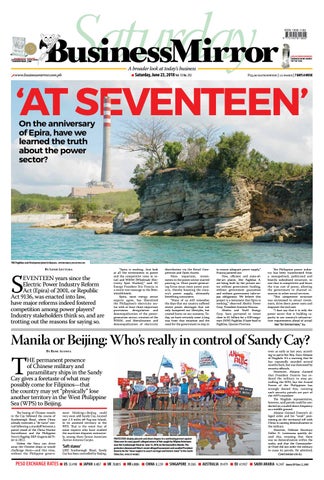
‘AT SEVENTEEN’ On the anniversary of Epira, have we learned the truth about the power sector?
THE Pagbilao coal-fired power plant in Quezon.
S
ANTONIO OQUIAS | DREAMSTIME.COM
By Lenie Lectura
EVENTEEN years since the Electric Power Industry Reform Act (Epira) of 2001, or Republic Act 9136, was enacted into law, have major reforms indeed fostered competition among power players? Industry stakeholders think so, and are trotting out the reasons for saying so.
“Epira is working. Just look at all the investments in power and the competitive rates in retail and WESM [Wholesale Electricity Spot Market],” said AC Energy President Eric Francia in a recent text message to the BusinessMirror. Epira, most energy sector experts agree, has liberalized the Philippines’s electricity sector with at least three important provisions: deregulation and demonopolization of the powergeneration sector; creation of the WESM, and liberalization and demonopolization of electricity
distribution via the Retail Competition and Open Access. More important, investments in the power sector started pouring in. More power-generating firms mean more power projects, thereby boosting the country’s power supply, ultimately benefiting consumers. “Many of us still remember the days that our country suffered severe power shortages that not only hampered our lifestyles, but created havoc on our economy. Today, we have certainly come a long way from that situation and the need for the government to step in
to ensure adequate power supply,” Francia pointed out. New, efficient and state-ofthe-art plants, like Pagbilao 3, are being built by the private sector without government funding, without government guarantees and without government take-orpay obligations. We believe this project is a testament that Epira is working,” observed Aboitiz Power Corp. President Antonio Moraza. Aboitiz and TeaM Energy Corp. have partnered to invest close to $1 billion for a 420-megawatt (MW) Pagbilao 3 base-load in Pagbilao, Quezon Province.
The Philippine power industry has been transformed from a monopolized, politicized and heavily subsidized structure, to one that is competitive and bears the true cost of power, allowing the government to channel resources to other social services. “This competitive structure was envisioned to attract investment, drive down power costs and empower the end user. “I dare say that it is only the power sector that is building capacity in our country’s infrastructure requirements ahead of actual See “At Seventeen,” A2
Manila or Beijing: Who’s really in control of Sandy Cay?
T
By Rene Acosta
HE permanent presence of Chinese military and paramilitary ships in the Sandy Cay gives a foretaste of what may possibly come for Filipinos—that the country may yet “physically” lose another territory in the West Philippine Sea (WPS) to Beijing. The basing of Chinese vessels in the Cay followed the course of Scarborough Shoal, where China already exercises a “de facto” control following a standoff between a patrol vessel of the China Marine Surveillance and the Philippine Navy’s flagship BRP Gregorio del Pilar in 2012. Unless the Navy can drive away the Chinese ships or would challenge them—and this time, without the Philippine govern-
ment blinking—Beijing could very soon add Sandy Cay, located just 2.5 miles off Pag-asa Island, to its annexed territory in the WPS. That is the worst fear of some experts who have studied the maritime disputes extensively, among them Senior Associate Justice Antonio Carpio.
‘Soft stance’
LIKE Scarborough Shoal, Sandy Cay has been controlled by Beijing,
PESO EXCHANGE RATES n US 53.4190
PROTESTERS display placards and shout slogans in a continuing protest against China over its coast guard’s alleged seizure of fish caught by Filipino fishermen near the Scarborough Shoal on June 14, 2018, by the baywalk in Manila. The protesters denounced China’s recent alleged harassment and assailed President Duterte for his “sheer neglect to assert our legal and historic claim” in the South China Sea. AP/BULLIT MARQUEZ
even as early as last year, according to party-list Rep. Gary Alejano of Magdalo. It’s a warning that he has repeatedly sounded several months back, but was dismissed by security officials. Moreover, Alejano claimed that President Duterte has ordered the military to stop patrolling the WPS, but the Armed Forces of the Philippines has strongly denied this, insisting such security patrols are part of the AFP’s mandate. The Magdalo representative, however, said patrols could be conducted on a scaled-down frequency as a middle ground. Alejano claimed Duterte’s alleged order and his “weak” positioning on the territorial tiff with China is causing demoralization in the military. However, Defense Secretary Delfin N. Lorenzana quickly denied this, stressing that there was no demoralization within the ranks, and that the Commanderin-Chief did not order the military to cease its patrols. He admitted, Continued on A2
n JAPAN 0.4857 n UK 70.8015 n HK 6.8086 n CHINA 8.2259 n SINGAPORE 39.3365 n AUSTRALIA 39.4179 n EU 61.9927 n SAUDI ARABIA 14.2447
Source: BSP (June 22, 2018 )
News
BusinessMirror
A2 Saturday, June 23, 2018
www.businessmirror.com.ph
Manila or Beijing: Who’s really in control of Sandy Cay? Continued from a1
though, that Duterte can order the halt if he wanted to, but it is something that, according to Lorenzana, Duterte will never do. “He [Duterte] can, but he will not do it,” he said.
Challenges, harassments
LORENZANA and other defense and military officials have remained mum on China’s “control” of Sandy Cay, although the defense chief admitted that China, from time to time, challenges Philippine patrols in the WPS. The defense chief also called the recent harassment by China of a government resupply mission to the Ayungin Shoal as “isolated,” an incident that Duterte claimed he was not aware of. Alejano insisted the country has already lost its effective control over Sandy Cay due to the dedicated presence of Chinese ships within or near the area, but this was disputed by Foreign Secretary Alan Peter S. Cayetano. Cayetano maintained the Philippines has never lost any single territory in the WPS. While the country owns or lays legal claim to Sandy Cay and the Scarborough Shoal, the government has lost physical control over them due to the presence of Chinese ships.
In Scarborough, fishing activities by Filipinos are even regulated by China.
Blame-passing
ECHOING the position of Supreme Court Senior Associate Justice Carpio, former Foreign Secretary Albert del Rosario said that if China exercises control over Sandy Cay, then it could also claim jurisdiction over Subi Reef. Lorenzana blamed the previous administration for the situation in the WPS, saying it mismanaged the issue.
Contingency plan
GIVEN that Beijing has exercised control over Sandy Cay and Scarborough Shoal, former Defense Secretary Norberto Gonzales has urged the government to draw a contingency plan as he foresees China will not stop occupying features in the WPS, and may even wage war just to protect them. However, Lorenzana said this will never happen, because even while China is a superpower, it does not have the habit of invading or occupying other countries. “Although China is a superpower, it is not their practice to invade other countries, even when they were [in their] heyday during ancient times,” he said. “They are trying their best to
‘At seventeen’... demand, without any need of government’s funds or financial support,” added Moraza.
Most privatization projects ‘successful’
IN the view of Semirara Chief Executive Officer Isidro Consunji, the privatization of most state-owned power-generation assets has been successful. “Offhand, I think privatization of the power-generation sector is successful,” he said in a text message. Prior to Epira, the National Power Corp. owned the country’s generating capacity before priva-
PROTESTERS display placards and shout slogans in continuing protest against China over its coast guard’s alleged seizure of fish caught by Filipino fishermen near the Scarborough Shoal on June 14, 2018, by the baywalk in Manila. AP/BULLIT MARQUEZ
become also a good, respectable superpower, so I don’t think they will invade the Philippines,” he added. China lays claim to nearly almost all features in the South China Sea, even extending deep into the maritime waters and claims of its neighbors, which include Vietnam, the Philippines, Malaysia, Brunei Darussalam and Taiwan.
In the Philippines, and through its nine-dash-line map that covers 85.7 percent of the total maritime waters of the South China Sea, China has set its delineation that cut through Malampaya, and moved its boundary within less than a kilometer away from Batanes, Ilocos Norte and even Palawan, taking away at least 70 percent of the
meanwhile, hopes that the strong investor appetite would continue in the many years to come. Joe Zaldarriaga, the utility firm’s spokesman, said Epira has encouraged competition, especially in the power-generation business. The law, he said, also increased efficiencies in distribution, as evidenced by all-time low system-loss levels. “If we look at it, further current retail rates approximate that of around eight years back, which, perhaps, shows that the market is working as it is,” he said. Amid the success of Epira, AC Energy noted some delays in
implementing the law. “What’s needed is the full implementation of Epira, especially open access at the household level, so that all consumers can benefit from open competition,” added Francia.
country’s territorial waters.
Diplomacy
LORENZANA said that, instead of crafting a war plan, the government should go for soft power or diplomacy with China, which Duterte is already doing. “We will use diplomacy…talk to the Chinese,” he said.
Still, critics have pointed to the obvious: the occupation of Scarborough Shoal and the harassment of Filipino fishermen in the area and even the resupply mission for troops guarding the Ayungin Shoal, as well as the basing of Chinese ships in Sandy Cay, all happened while the Chinese-friendly Duterte is talking to Beijing.
continued from A1
tization. At that time, these assets left a heavy dent on state coffers because of the high costs of maintaining them. Emmanuel de Dios, GE Philippines CEO and formerly Department of Energy (DOE) undersecretary, also noted a lot of power projects that came on stream for the past few years. “A lot of capacity still coming on stream. Indeed, we have come a long way. Not bad at all, because it takes years to put to bed a power project.”
Strong investor appetite
THE Manila Electric Co. (Meralco),
Challenge: Faster implementation
ENERGY Secretary Alfonso G. Cusi gave assurances that the agency is working really hard on how to speed up the implementation. “Indeed, supply has improved. Price has gone down. There are more players so the price of electricity is becoming more competi-
tive. In general, the goal is being achieved, but there are some delays,” Cusi noted. One of the delays they were referring to is the implementation of the Retail Competition and Open Access (RCOA), a landmark policy meant to give consumers the choice to choose their own supplier of electricity to encourage competition in the generation and supply sector. “Epira is incomplete without RCOA,” DOE Undersecretary Felix William Fuentebella said. He could not stress enough how vital this policy is in order for consum-
ers to fully appreciate the benefits of the law. It may be recalled that the Supreme Court (SC) issued a temporary restraining order (TRO) against a DOE circular and Energy Regulatory Commission (ERC) resolutions days before some of the RCOA rules were supposed to take effect. In particular, power users consuming an average of at 1 MW per month are required to source power from a licensed retail electricity supplier. At present, the majority of power consumers are being supplied by Meralco, the country’s largest distribution utility firm.
Pricing debate continues– Gatchalian
SENATE Committee on Energy Chairman Sherwin T. Gatchalian, meanwhile, noted that there are debates going on whether electricity prices in the country have indeed gone down to a level that most Filipinos can afford. “Epira is supposed to make the market efficient, among others. When it comes to spot market prices, the lowering of cost has been achieved. But that is only a small component. What Epira didn’t cover is CSP [competitive selection process]. Still, 80 percent of the power contracts are sourced bilaterally and only 20 percent from the spot market. The CSP should have been included in Epira,” he said. Consumer group Laban Konsyumer Inc. (LKI) said that consumers continue to pay a number of subsidies, such as lifeline rates, system loss and universal charges, among others. “Interlocking ownerships in power generation and distribution companies continue to limit the effectiveness of the spot market, the bright spot of the Epira” making up for all its limitations. “We still have one of the highest electricity rates. Attention and care for consumer welfare and protection was not developed for the past years,” asserted LKI President Victor Dimagiba. Indeed, for such a landmark legislation promising sweeping reforms in such an important sector, Epira has spurred progress, since its enactment on June 4, 2001, in chipping away at monopolies in the power-generation sector, providing for a more transparent pricing system and liberalizing electricity distribution. Still, much more remains to be done and the challenges are daunting.
BusinessMirror
www.businessmirror.com.ph S. No. 1354 H. No. 6452
REPUBLIC OF THE PHILIPPINES
CONGRESS OF THE PHILIPPINES METRO MANILA SEVENTEENTH CONGRESS SECOND REGULAR SESSION
community services; personal assistants and ombudsmen; powers of attorney and other legal and personal planning tools; peer support for self-advocacy; nonformal community caregiver networks; dialogue systems; alternate communication methods, such as nonverbal sign, augmentative, and manual communication; and the use of assistive devices and technology; and
purposes of supported decision making. These supporters shall have the authority to: access the service user’s medical information; consult with the service user vis-à-vis any propose treatment or therapy; and be present during a service user’s appointments and consultations which mental health professionals, workers, and other service providers during the course of treatment or therapy.
(v) Supported Decision Making refers to the act of assisting a service user who is not affected by an impairment or loss of decision-making capacity, in expressing a mental healthrelated preference, intention or decision. It includes all the necessary support, safeguards and measures to ensure protection from undue influence, coercion or abuse.
SEC. 12. Internal review Board. – Public and private health facilities are mandated to create the respective internal review boards to expeditiously review all cases, disputes, and controversies involving the treatment, restraint or confinement of service users within their facilities.
CHAPTER II RIGHTS OF SERVICE USERS AND OTHER STAKEHOLDERS
Begun and hold in Metro Manila, On Monday, the twenty- fourth day of July, two thousand seventeen.
[Republic Act No. 11036] AN ACT ESTABLISHING A NATIONAL MENTAL HEALTH POLICY FOR THE PURPOSE OF ENHANCING THE DELIVERY OF INTEGRATED MENTAL HEALTH SERVICES PROMOTING AND PROTECTING THE RIGHTS OF PERSONS UTILIZING PSYCHIATRIC, NEUROLOGIC AND PSYCHOSOCIAL HEALTH SERVICES, APPROPRIATING FUNDS THEREFOR, AND FOR OTHER PURPOSES. Be it enacted by the Senate and House of Representatives of the Philippines in congress assembled: CHAPTER 1 GENERAL PROVISIONS
SECTION 1. Short Title. This Act shall be known as the “Mental Health Act”.
SEC.2. Declaration of Policy – The state affirms the basic right of all Filipinos to mental health as well as the fundamental rights of the people who require mental health services. The State commits itself to promoting the well-being of people by ensuring that: mental health is valued, promoted and protected; Mental health conditions are treated and prevented; timely, affordable, high-quality, and culturally, appropriate mental health care is made available to the public; mental health services are free from coercion and accountable to the service users; and persons affected by mental health conditions are able to exercise the full range of human rights, and participate fully in society and at work, free from stigmatization and discrimination. The State shall comply strictly with its obligations under the United Nations Declaration of Human Rights, the Convention on the Rights of Person and Disabilities, and all other relevant international and regional human rights conventions and declarations. The applicability of Republic Act No. 7277, as Amended, otherwise known as the “Magna Carta for Disabled Persons”, to persons with mental health conditions, as defined herein, is expressly recognized. SEC.3. Objectives – the objectives of this act are as follows: (a) Strengthen effective leadership and governance for mental health by, among others, formulating, developing, and implementing national policies, strategies, programs, and regulations relating to mental health. (b) Develop and establish a comprehensive, integrated, effective, and efficient national mental health care system responsive to the psychiatric, neurologic and psychosocial needs of the Filipino people. (c) Protect the rights and freedoms of persons with psychiatric, neurologic, and psychosocial health needs; (d) Strengthen information systems, evidence and research for mental health. (e) Integrate mental health care in the basic health services; and (f) Integrate strategies promoting mental health in educational institutions, the workplace and in communities. SEC.4. Definitions – As used in this act, the following terms are defined as follows: (a) Addiction refer to a primary chronic relapsing disease of brain reward, motivation, memory and related circuitry. Dysfunctions in the circuitry lead to characteristic biological, psychological, social, and spiritual manifestations. It is characterized by the inability to consistently abstain impairment and behavioral control, craving, diminished recognition of significant problems with one’s behavior and interpersonal relationships and dysfunctional emotional response;
Sec. 5. Rights of Service Users. – Service users shall enjoy, on an equal and nondiscriminatory basis, all rights guaranteed by the Constitution as well as those recognized under the United Nations Universal Declaration of Human Rights and the Convention on the Rights of Persons with Disabilities and all other relevant international and regional human rights conventions and declaration, including the right to: (a) Freedom from social, economic and political discrimination and stigmatization, whether committed by public or private actors; (b) Exercise all their inherent civil, political, economic social regional educational and cultural rights respecting individual qualities abilities and diversity of background, without discrimination on the basis of physical disability, age, gender, sexual orientation, race, color, language, religion or nationality, ethnic or social origin; (c) Access to evidence-based treatment of the same standard and quality, regardless of age, sex, socioeconomic status, race, ethnicity or sexual orientation; (d) Access to affordable essential health and social services for the purpose of achieving the highest attainable standard of mental health; (e) Access to mental health services at all levels of the national health care system;
(i) Access to aftercare and rehabilitation when possible in the community for the purpose of social reintegration and inclusion; (j) Access to adequate information regarding available multidisciplinary mental health services; (k) Participate in mental health advocacy, policy planning, legislation, service provision, monitoring research and evaluation; (l) Confidentiality of all information, communications and records in whatever form or medium stored regarding the service user, any aspect of the service user’s mental health, or any treatment or care received by the service user, which information, communications and records shall not be disclosed to their parties without the written consent of the service user concerned or the service user’s legal representative, except in the following circumstances: (1) Disclosure is required by law or pursuant to an order issued by a court of competent jurisdiction; (2) The service user has expressed consent to the disclosure; (3) A life-threatening emergency exists and such disclosure in necessary to prevent harm or injury to the service user or to other persons; (4) The service user is a minor and the attending mental health professional reasonably believes that the service user is a victim of child abuse; or (5) Disclosure is required in connection with an administrative, civil, or criminal case against a mental health professional or worker for negligence or a breach of professional ethics, to the extent necessary to completely adjudicate settle or resolve any issue or controversy involved therein; (m) Give informed consent before receiving treatment or care, including the right to withdraw such consent. Such consent shall be recorded in the service user’s clinical record; (n) Participate in the development and formulation of the psychosocial care or clinical treatment plan to be implemented;
(r) Access to their clinical records unless, in the opinion of the attending mental health professional, revealing such information would cause harm to the service user’s health or put the safety of others at risk. When any such clinical records are withheld, the service user or his or her legal representative may contest such decision with the internal review board created pursuant to this Act authorized to investigate and resolve disputes, or with the CHR’ (s) Information, within twenty-four (24) hours of admission to a mental health facility, of the rights enumerated in this section in a form and language understood by the service user; and (t) By oneself or through a legal representative, to file with the appropriate agency, complaints of improprieties, abuses in mental health care, violations of rights of persons with mental health needs, and seek to initiate appropriate investigation and action against those who authorized illegal or unlawful involuntary treatment or confinement, and other violations. SEC. 6. Right of Family Members, Carers and Legal Representatives. – Family members, carers and duly designated or appointed legal representative of the service user shall have the right to:
(m) Mental Health Professional refers to a medical doctor, psychologist, nurse, social worker or any other appropriately-trained and qualified person with specific skills relevant to the provision of mental health services; (n) Mental Health Service Provider refers to an entity or individual providing mental health services as defined in this Act, whether public or private, including, but not limited counselors, peer counselors, informal community caregivers, mental health advocates and their organizations, personal ombudsmen, and persons or entities offering nonmedical alternative therapies; (o) Mental Health Services refer to psychosocial, psychiatric or neurologic activities and programs along the whole range of the mental health support services including promotion, prevention, treatment, and aftercare, which are provided by mental health facilities and mental health professionals; (p) Mental Health Worker refers to a trained person, volunteer or advocate engaged in mental health promotion, providing support services under the supervision of a mental health professional; (q) Psychiatric or Neurologic Emergency refers to a condition presenting a serious and immediate threat to the health and well-being of a service user or any other person affected by a mental health condition, or to the health and well-being of others, requiring immediate medical intervention; (r) Psychosocial Problem refer to a condition that indicates the existence of dysfunctions in a person’s behavior, thoughts and feelings brought about by sudden, extreme, prolonged or cumulative stressors in the physical or social environment; (s) Recovery-Based Approach refers to an approach to intervention and treatment centered on the strengths of a services user and involving the active participation, as equal partners with lived experiences in mental health. This requires integrating a service user’s understanding of his or her condition into any plan for treatment and recovery; (t) Service User refer to a person with lived experience of any mental health condition including persons who require, or are undergoing psychiatric, neurologic or psychosocial care; (u) Support refers to the spectrum of informal and formal arrangements or services of varying types and intensities, provided by the State, private entities, or communities aimed at assisting a service user in the exercise of his or her legal capacity or rights, including;
(4) Take all necessary action to rectify or remedy violations of a service user’s rights vis-à-vis treatment, confinement or restraint, including recommending that an administrative, civil, or criminal case be filed by the appropriate government agency.
(c ) Upon the order of the service user’s attending mental health professional, which order must be reviewed by the internal review board of the mental health facility where the patient is being treated within fifteen (15) days from the date such order was issued, and every fifteen (15) days thereafter while the treatment or restraint continues; and (d) That such involuntary treatment or restraint shall be in accordance with guidelines approved by the appropriate authorities, which must contain clear criteria regulating the application and termination of such medical intervention, and fully documented and subject to regular external independent monitoring, review, and audit by the internal review boards established by this Act. CHAPTER IV MENTAL HEALTH SERVICES SEC. 14. Quality of Mental Health Services. – Mental health services provided pursuant to this Act shall be:
(a) Based on medical and scientific research finding;
(b) Responsive to the clinical, gender, cultural and ethnic and other special needs of the individuals being served;
(c ) Most appropriate and least restrictive setting;
(d) Age appropriate; and
(e) Provided by the mental health professionals and workers in a manner that ensures accountability. SEC.15. Mental Health Service at the Community Level. – Responsive primary mental health services shall be developed and integrated as part of the basic health services at the appropriate level of acre, particularly at the city, municipal, and barangay level. The standards of mental health services shall be determined by the DOH in consultation with stakeholders based on current evidences. Every local government unit (LGU) and academic institutional shall create their own program in accordance with the general guideline set by the Philippine Council for Mental Health, created under this Act, in coordination with other stakeholders. LGUs and academic institutions shall coordinate with all concerned government agencies and the private sector for the implementation of the program. SEC.16. Community-based Mental Health Care facilities. – the national government through the DOH shall fund the establishment and assist in the operation of the communitybased mental health care facilities in the provinces , cities and cluster of municipalities in the entire country based on the needs of the population, to provide appropriate mental health care services, and enhance the right-based approach to mental health care. Each community-based mental health care facility shall, in addition to adequate room, office or clinic, have a complement of mental health professionals, allied professionals, support staff, trained barangay health workers (BHWs), volunteer family members of patients or service users, basic equipment and supplies and adequate stock of medicines appropriate at that level. SEC.17. Reportorial Requirements. – LGUs through their health offices shall make a quarterly report to the Philippine Council for Mental Health through the DOH. The report shall include, among others, the following date: number of patients/service users attended to and/or served, the respective kinds of mental illness or disability, duration and the result of the treatment, and patients/service users’ age, gender, educational attainment and employment without disclosing the identities of such patients/service users for confidentiality. SEC.18. Psychiatric, Psychosocial, and Neurologic Services in Regional, Provincial, and Tertiary Hospitals. – All regional, provincial, and tertiary hospitals, including private hospitals rendering service to paying patients, shall provide the following psychiatric, psychosocial, and neurologic services:
(a) Short-term, in-patient hospital care in a small psychiatric or neurologic symptoms;
(c ) Out-patient service in close collaboration with existing mental health programs at primary health care centers in the same area;
(c) Apply for release and transfer of the service user to an appropriate mental health facility; and
(d) Home care services for service users with the special needs as a result of, among others, long-term hospitalization, compliance with or inadequate of treatment, and absence of immediate family;
(d) Participate in mental health advocacy, policy planning, legislation, service provision, monitoring, research and evaluation. SEC. 7. Right of Mental Health Professionals. – Mental health professionals shall have right to:
(c) Participate in the planning, development and management of mental health services;
(l) Mental Health Facility refers to any establishment, or any unit of establishment, which has, as its primary function, the provision of mental health services;
(3) Motu propio, or upon the receipt of a written complaint or petition filed b a service user or a service user’s immediate family or legal representative, investigate cases, disputes, and controversies involving the involuntary treatment, confinement or restraint a service user; and
(b) With the consent of the concerned service user, participate in the formulation, development and implementation of the service user’s individualized treatment plan;
(4) Effectively communicate consent to treatment or hospitalization or information regarding one’s own condition;
(k) Mental Health Condition refers to a neurologic or psychiatric condition characterized by the existence or a recognizable, clinically-significant disturbance in an individual’s cognition emotional regulation, or behavior that reflects a genetic or acquired dysfunction in the neurobiological, psychosocial, or developmental processes underlying mental functioning. The determination of neurologic and psychiatric conditions shall be based on scientifically-accepted medical nomenclature and best available scientific and medical evidence;
(2) Inspect mental health facilities to ensure the service user therein are not being subjected to cruel, inhumane, or degrading conditions or treatment;
(a) Receive appropriate psychosocial support from the relevant government agencies;
(a) A safe and supportive work environment;
(j) Mental Health refers to a state of well-being in which the individual realizes one’s own abilities and potentials, copes adequately with the normal stresses of life, displays resilience in the face of extreme life events, works productively and fruitfully, and is able to make a positive contribution to the community;
(b) Each internal review board shall have the following powers and functions;
(1) Conduct regular review, monitoring, and audit of all cases involving the treatment, confinement or restraint of service users within its jurisdiction;
(b) Partial hospital care for those exhibiting psychiatric symptoms or experiencing difficulties vis-à-vis their personal and family circumstances;
(3) Understand information about the nature of the treatment proposed, including methodology, direct effects and possible side effects; and
(i) Legal Representative refers to a person designated by the service user, appointed by a court of competent jurisdiction, or authorized by this act or any other applicable law, to act on the service user’s behalf. The legal representative may also be a person appointed in writing by the service user to act on his or her behalf through an advance directive;
(b) Only to the extent that such treatment or restraint is necessary, and only while a psychiatric or neurologic emergency; or impairment or temporary loss of capacity, exist or persists;
(q) Legal services, through competent counsel of the service user’s choice. In case the service user cannot afford the services of a counsel, the Public Attorney’s Office, or a legal aid institution of the service user or representative’s choice, shall assist the service user;
(h) Informed Consent refers to consent voluntarily given by a service user to a plan for treatment, after a full disclosure communicated in plain language by the attending mental health service provider, of the nature, consequences, benefits, and risks of the proposed treatment, as well as available alternatives;
(4) Other designated members deemed necessary, to be determined under the implementing rules and regulations (IRR).
(h) Humane treatment free from solitary confinement, torture, and other forms of cruel, inhumane, harmful or degrading treatment and invasive procedures not backed by scientific evidence;
(d) Deinstitutionalization refers to the process of transitioning service users, including persons with mental health conditions and psychosocial disabilities, from institutional and other segregated settings, to community- based settings that enable social participations, recovery-based approaches to mental health, and individualized care in accordance with the service user’s will and preferences;
(2) Understand the consequences of one’s decisions and actions on one’s life or health, or the life or health to others;
(2) A representative from the CHR;
(3) A person nominated by an organization representing service users and their families duly accredited by the Philippine Council for Mental Health; and
(a) In compliance with the service user’s advance directives; if available, unless doing so would pose an immediate risk of serious harm to the patient or another person;
(p) Send or receive uncensored private communication which may include communication by letter, telephone or electronic means, and receive visitors at reasonable times, including the service user’s legal representative and representative from the Commission on Human Rights (CHR);
(1) Understand information concerning the nature of a mental health condition;
(1) A representative from the Department of Health (DOH);
(g) Access to psychosocial care and clinical treatment in the least restrictive environment and manner;
(c) Confidentiality refers to ensuring the all relevant information related to persons with psychiatric, neurologic, and psychosocial health needs is kept safe from access or used by, or disclosure to, persons or entities who are not authorized to access, use, or possess such information;
(g) Impairment or Temporary Loss of Decision- Making Capacity refers to a medicallydetermined inability on the part of a service user or any other person affected by a mental health condition, to provide informed consent. A service user has impairment or temporary loss of decision-making capacity when the service user as assessed by a mental health professional is unable to do the following:
(a) The Board shall be composed of the following:
(f) Access to comprehensive and coordinated treatment integrating holistic prevention, promotion, rehabilitation care and support, aimed at addressing mental health care needs through a multidisciplinary, user-driven treatment and recovery plan;
(o) Designate or appoint a person of legal age to act as his or her legal representative in accordance with this Act, except in cases of impairment or temporary loss of decisionmaking capacity;
(f) Drug Rehabilitation refers to the processes of medical or psychotherapeutic treatment for dependency on psychoactive substances such as alcohol, prescription drugs, and other dangerous drug pursuant to Republic Act NO. 9165, otherwise known as the “Comprehensive Dangerous Drugs Act of 2002”. Rehabilitation process may also be applicable to diagnosed behavioral addictions such as gambling, internet and sexual addictions. The general intent is to enable the patient to confront his or her addiction/s and cease substance abuse to avoid the psychological, legal, financial, social and physical consequences. Treatment includes medication for co-morbid psychiatric or other medical disorders, counseling by experts and sharing of experience with other addicted individuals.
SEC. 13. Exceptions to Informed Consent. – During psychiatric or neurologic emergencies, or when there is impairment or temporary loss of decision-making capacity on the part of a service user, treatment, restraint if confinement, whether physical or chemical, may be administered or implemented pursuant to the following safeguards and conditions:
(b) Carer refers to the person, who may or may not be the patient’s next-of-kin of relative, who maintains a close personal relationship and manifests concern for the welfare of the patient;
(e) Discrimination refers to any distinction, exclusion or restriction which has the purpose or effect of nullifying the recognition, enjoyment or exercise, on an equal basis with others, of all human rights and fundamental freedoms in the political, economic, social, cultural, civil, or any other field. It includes all forms of discrimination, including denial of reasonable accommodation. Special measures solely to protect the rights or secure the advancement of persons with decision-making impairment capacity shall not be deemed to discriminatory;
Saturday, June 23, 2018
(b) Participate in a continuous professional development program; (d) Contribute to the development and regular review of standards for evaluating mental health services provided to service users; (e) Participate in the development of mental health policy and service delivery guidelines; (f) Except in emergency situations, manage and control all aspects of his or her practice, including whether or not t accept or decline a service user for the treatment; and (g) Advocate for the rights of a service user, in cases where the service user’s wishes are at odds with those of his or her family in legal representative. CHAPTER III TREATMENT AND CONSENT SEC. 8. Informed Consent to Treatment – Service users must provide informed consent in writing prior to the implementation by mental health professionals, workers, and other service providers of any plan or program of therapy or treatment, including physical or chemical restraint. All persons, including service user’s persons with disabilities, and minors, shall be presumed to possess legal capacity for the purposes of this Act or any other applicable law, irrespective of the nature or effects of their mental health condition or disability. Children shall have the right to express their views on all matters affecting themselves and have such views given due consideration in accordance with their age and maturity. SEC. 9. Advance Directive. – A service user may set out his or her preference in relation to treatment through a signed, date, and notarized advance directive executed for the purpose. An advance directive may be revoked by a new advance directive or by notarized revocation SEC. 10. Legal Representative – A service user may designate a person of legal age to act as his or her legal representative through a notarized document executed for that purpose.
(a) Functions. A service user’s a legal representative shall:
(1) Provide the service user with support and help; represent his or her interest; and receive medical information about the service user in accordance with this Act; (2) Act as substitute decision maker when the service user has been assessed by a mental health professional to have temporary impairment of decision-making capacity;
(3) Assist the service user vis-à-vis the exercise of any right provided under this Act; and
(4) Be consulted with respect to any treatment or therapy receive by the service user. The appointment of a legal representative may be revoked by the appointment of a new legal representative or by a notarized revocation. (b) Declining an Appointment. A person thus appointed may decline to act as a service user’s legal representative. However, a person who declines to continue being a service user’s legal representative must take reasonable steps to inform the service user, as well as the service users’ attending mental health professional or worker, of such decision. (c ) Failure to appointment. If the service user fails to appoint a legal representative, the following persons shall act as the service user’s legal representative, in the order provided below: (1) The spouse, if any, unless permanently separated from the service user by a decree issued by a court of competent jurisdiction, or unless such spouse has abandoned or been abandoned by the service user for any period which has not yet come to an end;
(2) Non-minor children;
(3) Either parent by mutual consent, if the service user is a minor;
(4) Chief, administrator, or medical director of a mental health care facility; or
(5) A person appointed by the court.
SEC. 11. Supported Decision Making – A service user may designate up to three (3) persons or “supporters”, including the service user’s legal representative, for the
(e) Coordination with drug rehabilitation centers vis-à-vis the acre, treatment, and rehabilitation of persons suffering from addiction and other substance-induced mental health conditions; and (f) A referral system involving other public and private health and social welfare service providers, for the purpose of the expanding access to programs aimed at preventing mental illness and managing the condition of persons at risk of developing mental, neurologic, and psychosocial problems.
SEC. 19. Duties and Responsibilities of Mental Health Facilities. – Mental health facilities shall:
(a) Established policies, guidelines, and protocols for minimizing the use of the restrictive care and involuntary treatment;
(b) Inform service users of their rights under this Act and all other pertinent laws and regulations;
(c ) Provide every service user, whether admitted for voluntary treatment, with complete information regarding the plan of treatment to be implemented; (d) Ensure that informed consent is obtained from service users prior to the implementation of any medical procedure or plan of treatment or care, except during psychiatric or neurologic emergencies or when the service user has impairment or temporary loss of decision-making capacity;
A3
raise awareness on mental health issues, correct the stigma and discrimination associated with the mental health conditions to treatment and psychosocial support.
CHAPTER VI CAPACITY BUILDING, RESEARCH AND DEVELOPMENT
SEC. 26. Capacity Building, Reorientation, and Training. – In close coordination with mental health facilities, academic institutions, and other stakeholders, mental health professionals, workers, and other service providers shall undergo capacity building, reorientation, and training to develop their ability to deliver evidence-based, gender-sensitive, culturally-appropriate and human rights-oriented mental health services, with emphasis on the community and public health aspects of mental health. SEC. 27. Capacity Building of Barangay Health Workers (BHWs). – The DOH shall be responsible for disseminating information and providing training programs to LGUs. The LGUs, with technical assistance from the DOH, shall be responsible for the training of BHWs and other barangay volunteers on the promotion of mental health. The DOH shall provide assistance to LGUs with medical supplies and equipment needed by the BHWs to carry out their functions effectivity. SEC. 28. Research and Development. – Research and development shall be undertaken, in collaboration with academic institutions, psychiatric, neurologic, and related associations, data, nongovernment organizations, to produce the information, data, and evidence necessary to formulate and develop a culturally-relevant national mental health program incorporating indigenous concepts and practices related to mental health. High ethical standards in mental health research shall be promoted to ensure that: research is conducted only with the free and informed consent to the persons involved; researchers do not receive any privilege, compensation or remuneration in exchange for encouraging or recruiting participants; potentially harmful and dangerous research is not undertaken; and all research is approved by an independent ethics committee, in accordance with applicable law. Research and development shall also be undertaken vis-à-vis nonmedical, traditional or alternative practices. SEC. 29. The National Center for Mental Health (NCMH). –The NCMH, formerly the National Mental Hospital, being the premiere training and research center under the DOH, shall expand its capacity for research and development of interventions on mental and neurological services in the country. CHAPTER VII DUTIES AND RESPNSIBILITIES OF GOVERNMENT AGENCIES SEC. 30. Duties and Responsibilities of the Department of Health (DOH).– To achieve the policy and objectives of this Act, the DOH shall: (a) Formulate, develop, and implement a national mental health program. In coordination with relevant government agencies, create a framework for Mental Health Awareness Program to promote effective strategies regarding mental health care, its components, and services, as well as to improve awareness on stigmatized medical conditions; (b) Ensure that a safe, therapeutic, and hygienic environment with sufficient privacy exists in all mental health facilities and, for this purpose, shall he responsible for the regulation, licensing, monitoring, and assessment of all mental health facilities; (c ) Integrate mental health into the routine health information system and identify, collate, routinely report and use core mental health data disaggregated by sex and age, and health outcomes, including data on completed and attempted suicides, in order to improve mental health service delivery, promotion and prevention strategies; (d) Improve research capacity and academic collaboration on national priorities for research in mental health, particularly operational research with direct relevance to service development, implementation, and the exercise of human rights by persons with mental health conditions, including the establishment of centers of excellence; (e) Ensure that all public and private mental health institutions uphold the right of patients to be protected against torture or cruel, inhumane, and degrading treatment; (f)Coordinate with the Philippine Health Insurance Corporation to ensure that insurance packages equivalent to those covering physical disorders of comparable impact to the patient, as measured by Disability-Adjusted Life Year or other methodologies, are available to patients affected by me ntal health conditions; (g) Prohibit force or inadequately remunerated labor within mental health facilities, unless such labor is justified as part of an accepted therapeutic treatment program; (h) Provide support services for families and co-workers of service users, mental health professionals, workers, and other service providers; (i) Develop alternatives to institutionalization, particularly community, recovery-based approaches to treatment aimed at receiving patients discharged from hospitals, meeting the needs expressed by persons with mental health conditions, and respecting their autonomy, decisions, dignity, and privacy; (j) Ensure that all health facilities shall establish their respective internal review boards. In consultation with stakeholders, the DOH shall promulgate the rules and regulations necessary for the efficient disposition of all proceedings, matters, and cases referred to, or reviewed by, the internal review board; (k) Establish a balanced system of community-based and hospital-based mental health services at all levels of the public health care systems from the barangay, municipal, city, provincial, regional to the national level; and (1) Ensure that all health workers shall undergo human rights trainings in coordination with appropriate agencies or organizations. SEC. 31. Duties and Responsibilities of the Commission on Human Rights (CHR) – The CHR shall: (a) Establish mechanism to investigate, address, and act upon complaints of impropriety and abuse in the treatment and care received by service users, particularly when such treatment or care is administered or implemented involuntarily; (b) Inspect mental health facilities to ensure that service users therein are not being subjected to cruel, inhumane, or degrading conditions or treatment; (c) Investigate all cases involving involuntarily treatment, confinement, or care of service users, for the purpose of ensuring strict compliance with domestic and international standards respecting the legality, quality, and appropriateness of such treatment, confinement, or care: and (d) Appoint a focal commissioner for mental health tasked with protecting and promoting the rights of service users and other persons utilizing mental health services or confines in mental health facilities , as well as the rights of mental health professionals and workers. The focal commissioner shall, upon a finding that a mental health facility, mental health professionals, or mental health worker has violated any of the rights provided for in this Act, take all necessary actions to rectify or remedy such violation, including recommending that an administrative, civil, or criminal case files by the appropriate government agency. SEC. 32. Investigate Role of the Commission on Human Rights (CHR). – The investigative role of the CHR as provided in the pertinent provisions of this Act shall be limited to all violations of human rights involving civil and political rights consistent with the powers and functions of the CHR under Section 18 of Article XIII of the Constitution. SEC. 33 Complaint and Investigation. – The DOH, CHR and Department of Justice (DOJ) shall receive all complaints of improprieties and abuses in mental health care shall initiate appropriate investigation and actions. Further, the CHR shall inspect all places where psychiatric service users are held for involuntary treatment or otherwise to ensure full compliance with domestic and international standards governing the legal basis for treatment and detention, quality of medical care and living standards. The CHR may, motu proprio, file a complaint against erring mental health care institutions should they find any noncompliance, based on its investigations. Sec. 34 Duties and Responsibilities of the Department of Education (DepEd), Commission on Higher Education (CHED), and the Technical Education and Skills Development Authority (TESDA). The DepED, CHED, and TESDA shall: (a) Integrate age-appropriate content pertaining to mental health into curriculum at all educational levels both in public and private institutions; (b) Develop guidelines and standards on age-appropriate and evidences-based mental health programs both in public institutions;
(e) Maintain a register containing information on all medical treatments and procedures administered to service users; and
(c) Pursue strategies that promote the realization of mental health and well-being in educational institutions; and
(f) Ensure that legal representatives are designated or appointed only after the requirements of this Act and the procedures established for the purpose have been observed, which procedures should respect the autonomy and preferences of the patient as far as possible.
(d) Ensure that mental health promotions in public and private educational institutions shall be adequately complemented with qualified mental health professionals.
SEC. 20. Drug Screening Services. – Pursuant to its duty to provide mental health services and consistent with the policy of treating drug dependency as a mental health issue, each local health care facility must be capable of conducting drug screening.
SEC. 35 Duties and Responsibilities of the Department of Labor and Employment (DOLE) and the Civil Service Commission (CSC). The DOLE and the CSC shall: (a) Develop guidelines and standards on appropriate and evidences-based mental health programs for the workplace as described in this Act, and
SEC.21. Suicide Prevention. – Mental health services shall also include mechanisms for suicide intervention, prevention, and response strategies, with particular attention to the concerns of the youth, Twenty-four seven (24/7) hotlines, to provide assistance to individuals at risk of committing suicide, conditions, especially individuals at risk of committing suicide, shall be set up, and existing hotlines shall be strengthened.
(b) Develop policies that promote mental health in t he workplace and address stigma and discriminations suffered by people with mental health conditions.
SEC. 22. Public Awareness. – the DOH and the LGUs shall initiate and sustain a heightened nationwide multimedia campaign to raise the level of the public awareness on the protection and promotion of mental health and rights including, but not limited to, mental health and nutrition, stress handling, guidance and counseling; and other elements of mental health.
(a) Refer service users to mental health facilities, professionals, workers, and other service providers for the appropriate care:
CHAPTER V EDUCATION, PROMOTION OF MENTAL HEALTH IN EDUCATIONAL INSTITUTIONS AND IN THE WORKPLACE SEC. 23. Integration of Mental Health into the Educational System. – The State shall ensure the integration of mental health into the educational system, as follows: (a) Age-appropriate content pertaining to mental health shall be integrated into the curriculum at all educational levels; and (b) Psychiatry and neurology shall be required subjects in all medical and allied health courses, including post-graduate courses in health. SEC. 24. Mental health Promotion in Educational Institutions. – Educational institutions, such as schools, colleges, universities, and technical schools, shall develop policies and programs for students, educators, and other employees designed to: raise awareness on mental health issues, identify and provide support and services for individuals at risk, and facilitate access, including referral mechanisms of individuals with mental health health conditions to treatment and psychosocial support. All public and private educational institutions shall be required to have a complement of mental health professionals. SEC. 25. Mental Health Promotion and Policies in the Workplace. – Employers shall develop appropriate policies and programs on mental health in the workplace designed to:
SEC 36. Duties and Responsibilities of the Department of Social Welfare and Development (DSWD). – The DSWD shall:
(b) Provide or facilitate access to public or group housing facilities, counseling, therapy, and livelihood training and other available skills development programs. and (c) In coordination with the LGUs and DOH, formulate, develop, and implement community resilience and psychosocial well-being training, including psychosocial support service during and after natural disasters and other calamities.
SEC. 37. Duties and Responsibilities of the Local Government Unit (LGUs). – The LGUS shall:
(a) Review, formulate and develop the regulations and guidelines necessary to implement an effective mental health care and wellness policy within the territorial jurisdiction of each LGU including the passage of a local ordinance on the subject of mental health, consistent with the existing relevant national policies and guidelines; (b) Integrate mental health care services in the basic health care services, ensure that mental health services are provided in primary health care facilities and hospitals, within their respective territorial jurisdictions; (c) Establish training programs necessary to enhance the capacity of mental health service providers at the LGU level, in coordination with appropriate national government agencies and other stakeholders; (d) Promote deinstitutionalization and other recovery-based approaches to the delivery of mental health care service: (e) Establish, reorient, and modernize mental health care facilities necessary to adequately provide mental health services, within their respective territorial jurisdictions; (f) Where independent living arrangements are not available, provide or facilitate access to public housing facilities, vocational training and skills development programs, and disability or pension benefits;
(g) Refer service users to mental health facilities, professionals, workers, and other
A4
The World BusinessMirror
Saturday, June 23, 2018
www.businessmirror.com.ph
White House split over hard-line response to China trade war
S
By Jenny Leonard | Bloomberg News
ome White House officials are trying to restart talks with China to avoid a trade war before US tariffs on Chinese products take effect on July 6, three people familiar with the plans said, setting up a battle with others in the administration who favor a harder line. Robert Lighthizer (right) and Peter Navarro Bloomberg
Staff of the National Economic Council have contacted former US government officials and China experts in recent days to gauge chances for high-level talks in the next two weeks, the people said on condition of anonymity to discuss the inquiries. One idea NEC staff f loated was inviting Chinese Vice President Wang Qishan before the tariff deadline, they said. The outreach signals a willingness by some US officials to seek a truce before $34 billion in Chinese products are hit with tariffs rather than trigger a trade war between the world ’s two largest economies. Still, the chances of such negotiations happening in the near term are slim as long as opponents inside the administration favor penalizing Beijing. President Donald J. Trump has shown no signs of backing down. The White House didn’t immediately respond to a request for comment. The US administration has said that after July 6, tariffs on an additional $16 billion worth of Chinese goods will be imposed after a public review period. The tariff threats have hurt US stocks in the
past week, and the Dow Jones Industrial Average declined for an eighth straight day on Thursday.
Tit-for-tat
AFTER China swiftly responded with counter threats on the same amount of tariffs and timeline, Trump on Monday directed the US Trade Representative’s (USTR) office to identify an additional $200 billion worth of Chinese products that would be subject to a 10-percent tariff. The administration has not published a timeline for these tariffs. “If it really does get to be a big war, we have many more bullets than any of these other countries,” Commerce Secretary Wilbur Ross said in a Bloomberg Television interview on Thursday. There are different views within the Trump administration on what could be considered a win. Hard-liners, such as US Trade Representative Robert Lighthizer and White House trade adviser Peter Navarro, are pushing for structural changes to China’s policies. Treasury Secretary Steven Mnuchin and NEC Director Larry Kudlow are more receptive to a deal aimed at lowering the bilateral trade deficit.
Crude slides as Saudis stick with higher Opec output bid
C
rude slipped as Saudi Arabia pressed ahead with efforts to boost Organization of the Petroleum Exporting Countries’ (Opec) output. Futures in London slid 2.3 percent as t he Saud i energ y minister said Opec and its allies need to release more oil to the market as demand rises. Hikes to country quotas floated during talks in Vienna would amount to 1 million to 1.8 million barrels a day, a delegate said. It’s unclear how much that would translate into actual production because not all members are able to reach their quotas. “Any supply increase that is less than 500,000 barrels a day would be bullish for the market,” said Alessio de Longis, a portfolio manager in OppenheimerFunds Inc.’s global multi-asset group in New York. “The risk, of course, is that we may have an announcement that is closer to 1 million.” Saudi Arabia has proposed that the group increase output by about 600,000 barrels a day, according to delegates with knowledge of the talks. That would be commensurate with a combined quota increase of 1 million barrels a day, according to Bloomberg calculations based on data from the International Energ y Agency. Yet, the push for a supply boost by Saudi Arabia and non-Opec member Russia has been opposed by producers such as Venezuela, and Iran Oil Minister Bijan Namdar Zanganeh said he doesn’t think Opec can reach any agreement.
Consumers ‘important’
“The most important thing is the consumers,” Saudi Energy Minister Khalid Al-Falih said on Thursday. “We’re not going to allow a shortage to materialize to the point that markets will be squeezed and consumers will be hurt.” West Texas Intermediate (WTI) crude for August delivery slid 17 cents to settle at $65.54 a barrel on the New York Mercantile Exchange, after earlier rising to as high as $66.22. Total volume traded was about 23 percent above the 100-day average. WTI fell less than Brent as a Genscape Inc. report was said to show crude stockpiles shrank by 2.45 million barrels at the key storage hub in Cushing, Oklahoma, Friday through Tuesday. Brent futures for August settlement declined $1.69 to end the session at $73.05 a barrel on the ICE Futures Europe exchange. The global benchmark traded at a $7.51 premium to WTI. Producers are still discussing four scenarios for output hikes, according to a delegate. Meanwhile, Russia Energy Minister Alexander Novak said any oil output increase should be shared equally and oil prices are at suitable levels. “With the Saudis sort of talking up the need for a lot more oil in the second half, that makes people feel they’ll likely be a little more aggressive than they would have otherwise,” said Michael Lynch, president of Strategic Energy & Economic Research in Winchester, Massachusetts. Bloomberg News
Trade infighting
DIVISIONS within the administration on how to deal with China make it harder for the White House to get Wang to visit on short notice. But other administration officials are thinking about bilateral talks in the longer term, the people familiar with the matter said. A more realistic possibility would be for Wang to visit before the bigger round of tariffs are imposed, according to Derek Scissors, a China analyst at the American Enterprise Institute in Washing ton. T he US st i l l needs to release a product list for the threatened tariffs on $200 billion of Chinese goods, and then there would be a 60-day comment period before those take effect. “We just failed to reach a deal a few weeks ago, so reaching one in the next few weeks is unlikely,” Scissors said. “The real deadline is more like September 6 than July 6.” The two sides have tried, and failed, to resolve their differences through earlier rounds of negotiations. Ross told a Senate commit-
tee on Wednesday that previous talks with Chinese officials showed “that the administration is tr y ing,” but that the two sides “were not able to accomplish enough to justify in the president’s mind not going ahead with the tariffs.” “There are already some signs that we may get some ultimate solution,” Ross told senators at a hearing that focused on his agency’s Section 232 investigations into imports that pose a nationalsecurity threat. “I don’t think the Chinese want a trade war any more than we do.” US-China tensions could be further strained before the tariff deadline. The Treasury Department is slated to announce measures to restrict Chinese investments in the US by June 30 as part of a probe under USTR’s Section 301 into alleged intellectual-property theft and the forced transfer of technology. In an editorial published late on Thursday, the state-run tabloid Global Times newspaper said that while competition with the US would grow, Chinese should focus on domestic affairs and “maintain strategic composure.”
US out of sync with world on climate change–Canada
C
anada has an environmental message for Donald J. Trump: you can’t stop the global campaign against climate change and you will hurt the US by abandoning the battle. Canadian Environment and Climate Change Minister Catherine McKenna said countries around the world are forging ahead with measures to reduce greenhouse gases, unfazed by Trump’s planned withdrawal from a landmark United Nations deal to counter global warming. Canada, the European Union and China are leading the charge, which will bring businesses big rewards, she said. “I hate to say this, but I don’t want to overestimate the importance of the US,” McKenna said in an interview on Thursday in Brussels, where she attended a gathering with her EU and Chinese counterparts. “The world is moving forward because we need to do that for our kids and there’s a huge economic opportunity.” The US turn inward under Trump and his upending of American foreign policies ranging from trade to security have left the rest of the world rushing to fill a void and create new alliances. A central part of this effort aims to preserve the landmark UN agreement reached in Paris in 2015 on limiting gases blamed for more frequent heat waves, storms and floods. The premise, rejected by the Trump
administration, is that the accord is good for both the earth and the economy. “We’re just going to continue marching on,” McKenna said. “There are other voices that want to say ’forget it, if the US pulls out it’s all going to fall apart,’ and I think we demonstrated quite clearly that’s not the case.” In t heir c l imate leadership pact, Canada, the EU and China are focused on ensuring that envoys from more than 190 countries reach an agreement on detailed rules to enact the Paris accord. The next key meeting will be held in Poland in December. “Every country is now stepping up and saying what they’re going to do, but you need the engine of the Paris Agreement,” McKenna said. “It’s extremely important and business needs to see that.” China, the EU and Canada together accounted for 40 percent of global emissions of carbon dioxide, the main greenhouse gas, in 2017, according to the latest BP Plc statistical review. China, the top polluter, had a 28 percent share of worldwide discharges, followed by the US with 15 percent. While Trump is depriving the US of a climate leadership role at the federal level, other American actors are helping to ensure the country doesn’t miss out altogether on the worldwide shift to cleaner energy, according to McKenna. Bloomberg News
Sports BusinessMirror
Editor: Jun Lomibao • mirror_sports@yahoo.com.ph
B
By Lance Agcaoili
ANKO and Pocari Sweat-Air Force shoot for the last two semifinals berths as they battle separate foes in the quarterfinals of the Premier Volleyball League (PVL) Season 2 Reinforced Conference today at the Filoil Flying V Centre in San Juan City. After leading the quarterfinal race with a clean 3-0 win-loss record, BanKo tries to clinch the third semifinals spot when it battles back-against-the-wall BaliPure (1-2) at 4 p.m. Pocari Sweat-Air Force (3-1), meanwhile, needs to beat ousted Tacloban (0-3) at 6:30 p.m. and pray for a loss by PetroGazz (2-1) in its 2 p.m. match with Iriga-Navy (1-3) to clinch the last semifinals seat. In men’s play, Air Force and PLDT, which won their first two quarterfinals matches to clinch the last two semifinals seats, battle for the No. 3 seed at 10 a.m. The winner will play No. 2 team Vice Co. in the best-of-three semifinals series, while the loser battles defending champion and league leader Cignal in the other pairing.
N
EW YORK—The Phoenix Suns stayed close to home for their first No. 1 pick. The Dallas Mavericks looked all the way to Slovenia for the player they hope can be their next European superstar. Shortly after the Suns took Deandre Ayton to start the National Basketball Association (NBA) draft on Thursday night, the Mavericks traded up two spots for the rights to Luka Doncic. The Atlanta Hawks swapped the rights to Doncic, the No. 3 pick who has spent the last year winning championships all over Europe, to Atlanta for Trae Young, the No. 5 selection from Oklahoma. The Mavericks also gave up a future first-round pick to draft Doncic, who only arrived in New York on Wednesday after helping Spain’s Real Madrid win its league championship after he won Euroleague Most Valuable Player (MVP) and Final Four MVP honors when they won that title this year. His lengthy European season kept him from working out for teams but he knew the Mavericks were interested in having him on their team for what’s expected to be Dirk Nowitzki’s final NBA season. “I’ve been talking to Dallas a lot. They really wanted me, and they were very, very nice,” the 19-year-old said. “They were very nice to me, and I think we had a very good relationship.” The Hawks will get perhaps the most exciting player in college basketball last season in Young, the first player to lead the nation in scoring and assists in the same season. “Whatever city I went to, I was going to be able to be comfortable in,” said Young, who wore suit shorts with his burgundy-colored jacket. “I was just really excited to get to Atlanta.” AP
Nilo Salahog shares the view at the top.
N
IZHNY NOVGOROD, Russia— Lionel Messi’s frustrating international career may be coming to an early and anti-climactic finish after Argentina’s worst loss in World Cup group play in 60 years. With Diego Maradona watching from the stands, the 2014 runnersup were routed by Croatia, 3-0, on Thursday. The Croats are moving on to the round of 16. Messi got off only one shot in a defeat that pushed Argentina to the brink of elimination. Messi, who turns 31 on Sunday, has never won a major title with Argentina’s senior national team despite of decade of championships with Barcelona and five player of the year awards. “He is our captain, he leads the team and we quite simply couldn’t pass to him,” Argentina Coach Jorge Sampaoli said. “We work to give Leo the ball, but the opponent also works hard to prevent him from getting the ball.” Messi also missed a penalty kick in his team’s opening 1-1 draw against Iceland.
S
IX young tennis superstars are set to compete in the International Tennis Federation (ITF)-AGS Junior Tennis Championships, which will be held in Jakarta starting tomorrow until July 1. The young sensations are part of the newly formed national junior tennis team by the Unified Tennis Philippines (UTP). The players are Bea Acena, Manuel Balce III, Macie Carlos, Melanie Dizon, Michael Eala and prodigy Alex Eala. The players were chosen based on their 2017 UTP ranking, from which they placed in the top four for their respective age division. “These young tennis superstars have proven their skills and talent on the court, and we are confident that they will bring honor to our country. We will support them in their quest for tennis excellence,” UTP President Jean Henri Lhuillier said.
LIONEL MESSI gets off only one shot in a defeat that pushed Argentina to the brink of elimination. AP
Argentina, hurt by the poor play of goalkeeper Willy Caballero on Thursday, had not lost by such a large margin in the first round since a 6-1 defeat to Czechoslovakia in 1958. Caballero gained the starting role because No. 1 keeper Sergio Romero injured his knee last month in the run-up to the tournament. “We have to swallow the poison,” Argentina midfielder Javier Mascherano said. “The game says it all.” Argentina, which has not missed making the second round since 2002, has not been eliminated. But the twotime champions need to win their next match against Nigeria on Tuesday, as well as get help from other matches. Thursday’s humiliating loss came in humiliating fashion for one of soccer’s most storied nations. Caballero mangled a clearance and kicked the ball toward Croatia defender Ante Rebic, who one-timed it into the net in the 53rd minute. Caballero buried his face in his hands while a giant television screen showed Maradona doing the same. “After they scored on us, we were emotionally broken,” Sampaoli said. “I had a lot of hope. I am extremely hurt by this defeat, but I probably didn’t understand the match the way I should have.” And it got worse as Argentina crumbled, frustrated by the Croatian defense. Modric scored with a hooking shot in the 80th and Ivan Rakitic added the third in stoppage time. Croatia frustrated Argentina throughout the match and never gave Messi space to operate. “Argentina wasn’t confused. We were excellent,” Croatia Coach Zlatko Dalic said. “We beat a great Argentina with the best player in the world playing, Messi.” Croatia, which reached the 1998 World Cup semifinals but has not advanced past the group stage since then, will face Iceland on Tuesday in Rostov-onDon. Argentina won the World Cup in 1978 and 1986—the last with Maradona as the star player—but has not won any major title in 25 years. The Argentines also lost in the last two Copa America finals.
Saturday, June 23, 2018
A5
A6
BusinessMi
Saturday, June 23, 2018 | Editor: Jun Lomibao
Tour de France grid start: Gimmick or game changer? L AST week it emerged that on Stage 17 of the Tour de France—already a novel one with three major climbs packed into 65 kilometers—the riders would be setting off in an unprecedented grid structure. Borrowing from Formula One, the riders will be staged according to their position on general classification. Riders will be put into different groups along a 70-meter-wide stretch of road. With the innovation causing quite a stir, Cyclingnews spoke to some of the sports directors at the Critérium du Dauphiné to get the view from those who’ll be calling the tactics on the day.
Servais Knaven (Team Sky) I DON’T think the yellow jersey will attack from the gun. It will be nice on television to see everyone line up in different positions. It’s an interesting thing, but let’s see how it works in practice, and if the top 20 go from the gun or they go easy for the start like the other guys. The guys who start in the back probably won’t be the guys who are going to work uphill anyway. It’s nice to add some changes into the conservative cycling world. Max Sciandri (BMC Racing) I WOULD have put the last guys in front. And the first guys—the first 20 or however many they want out in the grid, I would have put them last. For sure, it just tells you that race organizers are always on the thought of how to make it more appealing to the public at home, on TV, just get the show going. There’s an old saying in Italy, which is that the riders make the race. Sometimes what they have to consider is transfers, time spent in the bus—that takes a lot out of riders, that
contributes a lot to fatigue. If the riders are fresh, you can have a big show on a relatively easier course. But sometimes you have to consider after 18 days it depends how people are. I don’t think it will change the race. You’re already putting the top 20 in front. They’re starting ahead already, they just have to be there and control each other. If you put them behind and gave them a default compared to the non-GC guys then...I don’t know...they do that in mountain biking. For sure it’s just a way of trying to get the show going. Aike Visbeek (Team Sunweb) AT first sight it favors the teams who have a lot of guys near the top of the GC. If you have Sky, for example, with three guys in the top 15, then they have three guys in the front group. That adds a new challenge to it. I think that may be the biggest factor. Of course, the problem is what it does when you make a cut of the last 15 riders, because that’s how I understood it—if you’re 16th or 17th, are you still within six minutes or are you 10 minutes down? It maybe would have been better to test it here at the Dauphiné, to see what it really does.
José Luis Arrieta (Movistar) I DON’T think it will affect the race much. At the end of the day, the riders will all be in the space of 100 meters, pretty much like all the other days. Logically, the leaders are going to wait for their teammates. Some of them are going to be with them already. We’re not talking about leaders going off and their teammates being three minutes back—no, they’re there, like all the other days. It’s going to add something to the spectacle, but it’s not going to change the result. In theory the strong guys will be up there
and the strong guys will be strong in the mountains and will have guys up there. But it’s not like the rest of your teammates will be at two minutes, they’ll still be there. Didier Jannel (AG2R La Mondiale) I THINK there aren’t too many other options, I think it’s to give the top GC riders the chance to leave in the first positions in a very, very short stage, and have a fair placement at least on the start line. Then the race will take its shape back in a few kilometers. But I think it’s an interesting idea to have a placement for the big favourites to have to be on it right from the start. In the grand scheme of things I don’t think it will change much. It’s going to allow people to find their place more easily, with less stress. It will allow riders to be active from the start but with less stress. The teams are going to rapidly find their leaders, who will wait for them to come back—they’re not going stay on their own, that’s clear.
Charly Wegelius (EF-Drapac) It’d be nice if they did it the opposite way around actually, the people at the front aren’t going to want to attack at the start. I don’t think it will have a huge impact, it’s a nice idea though. It’s no different from any other stage really, it’s just a compressed version of the race. Brian Holm (Quick-Step Floors) WHY not try something new? I think it’s a good thing. If it will change a lot, I don’t know, but it’s a good idea. I think trying something new in oldfashioned cycling doesn’t really hurt anybody, so I like it. First of all, we have to see the GC. A few guys will be fighting for victory, a few for the podium, and a few will be hanging on. If a team, let’s say Sky, have some guys up
there, they could go full speed. But on the other hand they could have a few riders in the wheel. I think it’s interesting because when it’s new we don’t really know, do we. Philippe Mauduit (UAE Team Emirates) IT can be fun. It’s something new in cycling. I don’t know, we have to try some new things to make it more visible, more attractive, especially for young people. That will be a different picture for the start. I don’t think it will change the end of the race, but the start will be more fun. For sure it won’t make a big difference. It will probably take a few weeks because the start will be on a narrow road so it will be difficult for the guys to come back to each other but in the end they will make it probably. Marc Sergeant (Lotto Soudal) I think it’s a good idea. It’s very short, and of course, the leader...it’s like in F1, if you do the best lap, you can have the first place on the grid. It’s a matter of 70 meters, so it’s not so very important. But you are in the group of your classification and of course, for sure, for some helpers of that leading guy, it will be a test to go as quickly as possible to their guy. I think they wanted it, because it’s short, they want a clear start, and give the advantage of the leader to have the space he deserves. Dirk Demol (Trek-Segafredo) IT will be interesting to see what happens. It’s not bad because sometimes you see that a lot of riders struggle with the time limit for example. They fight to be in a good position, they try to start near the front and everything. It could be interesting. I like the idea, but I hope there’s a large time limit because it will be a hell of a day. Cyclingnews
Cycling rife with Tramadol use C YCLING is far from having cleaned up its act when it comes to drugs, a new report from the World AntiDoping Agency (Wada) shows. The agency released the data from its Monitoring Program—where it tracks the use of substances that are not on the banned list but are being tracked for potential abuse. Tramadol, a synthetic opioid painkiller, showed up in over 4 percent of all doping controls tested—a rate an order of magnitude higher than in any other endurance sport. The use of Tramadol to mask the pain of intense efforts in races has been on the radar of the program for more than five years. The group has been calling on Wada to ban its use in competition. In a book published this year, retired rider Lieuwe Westra admitted to abusing Tramadol and caffeine as performance-enhancing aids. Former Team Sky rider
Jonathan Tiernan-Locke claimed to have been offered Tramadol by team doctor Richard Freeman. The Wada report shows the scale of the drug’s abuse somewhat declined over the past two years. In 2015, 730 out of 12358 doping controls had more than 200 ng/ml of Tramadol (5.9 percent). In 2017 out of 12,554 samples tested, 548 were positive for more than 50 ng/ml of the painkiller, a rate of 4.4 percent. Other sports like rugby and football showed increased use of the drug, with 1.4 percent of samples from rugby players positive (up from 0.95 percent), 0.35 percent of footballers (up from 0.28). Wada also monitored glucocorticoids—steroids that are used to treat inflammation. Cyclists also showed the highest incidence of positive samples of any sport for this class of drug, in competition, with 3.8 percent of samples positive. Out of competition, cycling was third to skiing and
TIGHT RA IN TOUR P
THE doping-control van is an imposing fixture in the race.
triathlon with 4.38 per cent of cyclists’ samples positive compared with 4.7 percent of triathletes and 5.5 percent of skiers. While these drugs are not on the banned list, road cycling also showed higher than average rates of anti-doping rule violations (ADRV) compared with other sports in Wada’s 2016 testing data released earlier this year. Seven out of a thousand doping controls led to an ADRV in cycling, the most of any endurance sport. Only bodybuilding (one in 10), weightlifting, wrestling and taekwondo (all one in 100) had higher rates of ADRVs. The high rate could be due to cycling’s use of intelligence-led testing, but when asked for comment on the rate, the Union Cycliste Internationale did not respond to Cyclingnews. Cyclingnews
Retracing Jewish child refugees’ journey to Britain
Paul Alexander (center) attends a memorial bike ride from Berlin to London to mark the “Kindertransport’s” 80th anniversary near a train station Friedrichstrasse in Berlin. AP
B
ERLIN—Almost 80 years after the first “Kindertransport” evacuations of Jewish children to safety in Britain, 42 people set off on Sunday on a memorial bike ride that will retrace their journey from Berlin to London. The cyclists set off from Berlin’s Friedrichstrasse station, where a statue commemorates the 10,000 mostly Jewish children who made it to Britain from Nazi Germany and elsewhere in Europe starting in late-1938. Organized by the British-based World Jewish Relief group, the ride retraces the route of the trains. It’s expected to take the riders six days to get to London’s Liverpool Street station. Among the saved children was Paul Alexander. The only participant in the ride who was on a Kindertransport—”children’s transport”—he was joined by his 34-year-old son, Nadav, and 14-year-old grandson, Daniel. “This ride is, for me, a victory ride. It’s one of celebrating a good life,” he said. “I’m riding also in honor of my mother and father who sent me away and had the courage and foresight to save me to send me away from the Holocaust.”
ETER SAGAN (Bora-Hansgrohe) said he still has some way to go to reach the form he needs ahead of next month’s Tour de France. Following the Tour de Suisse, where he won a stage and took the points jersey, Sagan said that he was not yet in top shape for the Grand Tour. Sagan will be looking for a record-equalling sixth points classification victory this summer to bring him level with Erik Zabel. The three-time world champion looked set to do that last season but was disqualified in Stage 4 after he was deemed to have caused Mark Cavendish to crash in the sprint finish. “I have a lot of hard work to do and I hope my legs are not at the top, because I need some improvement before the Tour de France,” Sagan said after the final stage, according to Slovakian web site aktuality.sk. Sagan came into the Tour de Suisse after a monthlong break from racing following the Tour of California, after which he spent time at altitude. Following a fourth place in the team time trial, Sagan went on to win Stage 2 ahead of Fernando Gaviria (Quick-Step Floors), a record-extending 16th win at the Swiss race. While Sagan was unable to add to the tally over the remaining week, the Slovakian went out swinging with an aggressive approach to the stages. He would take three more top 3 finishes, which proved enough for him to seal his seventh win in that particular competition. Sagan will now turn his focus to the Slovakian national championships this weekend, which he won five times in a row between 2011 and 2015, before the Tour de France begins in Noirmoutieren-l’Île on July 7. “It’s good to finish the Tour de Suisse with two records—seven times winner of the points leader jersey and a total of 16 stage victories,” Sagan wrote on his own Facebook page. “This year’s edition was probably one of
“It’s a ride I do every 80 years,” joked Alexander, whose mother reluctantly sent him—aged only 1—to safety abroad. He was able to reunite with his family in England, where they settled. He later moved to Israel. Many of the rescued children never saw their parents again. As Sunday’s ride started, the cyclists gathered for a safety briefing and the Jewish prayer for travelers. The British ambassador and German government representatives gathered to see them off. “Our past is a reminder to fight against anti-Semitism, racism and other forms of discrimination,” said German Foreign Ministry representative Karina Haeuslmeier. “We owe this to the children who survived and those who didn’t.”
the best, with an excellent organization, lots of spectators in every city and nice weather. It’s good to see this race growing and stepping up on all levels. As for me, racing continues with the Slovak National Championship next weekend and then, of course, Le Tour de France.”
DUMOULIN SETS TARGET
TOM DUMOULIN (Sunweb) has confirmed that he will target the general classification at the Tour de France. The Dutchman was initially coy about his July objectives after placing second overall at last month’s Giro d’Italia, but he told De Telegraaf that he has recovered well from his efforts in Italy. After the Giro d’Italia, I consciously took more rest than I would normally do,” Dumoulin told De Telegraaf. “For the first nine days, I hardly even touched the bike. I have never been so fresh two weeks after a Grand Tour.” Throughout the early part of the season, Dumoulin stressed that a decision on his Tour participation would only be taken after the Giro, but his reconnaissance of the cobbled stage of the Grande Boucle in April was a firm indication of his plans. “I had in mind since the winter that I really wanted to ride the double,” Dumoulin said. “But you never know what will happen in the Giro. For that reason, I always thought that I would really make the decision after that race.” By the time he finished the Giro in second place behind Chris Froome, Dumoulin was already certain of his participation in the Tour. On the night the Giro concluded in Rome, he informed the Sunweb team of his intention to line out in France, with the news made public the following week. “The Giro actually went very well from start to finish, and I did not see anything crazy in those weeks,” Dumoulin said. “The choice to ride the Tour was actually quite simple for me.” At the Tour, Dumoulin will lead a strong
Frane Ludovic poses in Kaliningrad after cycling from his hometown Zagreb in Croata to Kaliningrad. AP
irror CYCLING
mirror_sports@yahoo.com.ph | Saturday, June 23, 2018
A7
CHALLENGING CHALLENGE CLASS
In the run-up to the Elite International Cycling Union BMX World Championships, 1,500 athletes from 43 countries competed in the amateur Challenge classes at the BMX Velo Park in Baku, Azerbaijan. After three days of competition in categories ranging from five to six years to 50 plus, Team USA gathered the most gold medals with a total of eight, including that of Tyler Brown in the Masters class. The Netherlands scored the most Challenge class medals in total with 19 with seven gold, six silver and six bronze medals. France, Australia and Great Britain also looked strong winning, 15,14 and nine medals, respectively. UCI News
RIVERA WINS WITH APLOMB T
ACE UP DE FRANCE Richie Porte: I will do better.
Sunweb team that also includes Wilco Kelderman, who placed fourth at last year’s Vuelta a España, and Michael Matthews, who won the green jersey at last year’s Tour. With Chris Froome’s salbutamol case unlikely to be resolved before July 7, Dumoulin’s opponents look set to include the man who beat him to the Giro. It will be Dumoulin’s first Tour appearance since he won two stages in 2016, and his first time to target the general classification in the race. No Dutch rider has won the Tour since Joop Zoetemelk in 1980, and no Dutch rider has so much as worn the yellow jersey since Erik Breukink in 1989. 2018, meanwhile, marks the 50th anniversary of Jan Janssen becoming the first Dutch Tour champion. “If things go badly in the Tour, it’s nice that I know that I have shown myself well in the Giro. I am very happy and proud of my performance in that race,” Dumoulin said. “That feeling, nobody can take from me. Whatever happens in the Tour, I will stay happy with that.” Not that Dumoulin is viewing the Tour simply as a bonus. He was speaking with De Telegraaf during a pre-Tour training camp in the high Alps. “I’ll be full-on for the overall at the Tour,” Dumoulin said. “I know it’s going to be a physical and mental fight. It will once again become a
Peter Sagan: I need some improvement.
tough fight. I’m not going to be riding there [satisfied] with the idea that I have already done a good Tour. I am going to do everything to finish high up at the Tour too.”
PORTE HAS MOMENTUM
RICHIE PORTE (BMC) took the biggest win of his professional career recently as he wrapped up the general classification at the Tour de Suisse, his final race before the Tour de France. And he vowed to improve his form at July’s Grand Tour. The Australian had an indifferent spring but after finishing third at the Tour de Romandie in April he found another gear at the Tour de Suisse, winning the event from Jakob Fuglsang (Astana) and Nairo Quintana (Movistar). “This was a big goal. Let’s not beat around the bush. It’s a very important race and I think it’s disrespectful to say it’s a ‘lead in’ race for the Tour de France as it means a lot to win it. It’s such a prestigious race,” Porte said in a press release on Sunday. “So, I think going forward into the Tour de France, it’s a good sign to win here. It would have been nice to have won a stage here and maybe if the breakaway hadn’t stayed away on Thursday’s stage, I would have won one but, at the end of the day, to win the general
WO riders could celebrate victories in Colwyn Bay as the OVO Energy Women’s Tour came to an end on recently. Coryn Rivera (Team Sunweb) defended her green jersey on Stage 5 through Snowdonia, and Lotta Lepistö (Cervelo-Bigla) did one better than on Saturday’s Stage 4 when she won the seaside sprint. After a spring season hampered by illness and injury, the Finnish sprinter was relieved to stand on the top step of the podium. “Finally a win, now the pressure is off my shoulders,” Lepistö said. “It’s a big thing to have a win in this race. I was struggling on the first stages but on Stage 3 my legs started opening up, and that gave me confidence.” On a stage passing by some of Wales’s highest mountains, Lepistö had to work for her victory. “There were two climbs early in the race, and I was in the second group when it split, but it came back together,” she said. “The pace was steady on the longer climb so I survived it. I was worried about a late attack, but a headwind made that difficult. Cecilie Uttrup Ludwig and Clara Koppenburg made sure I wasn’t boxed in coming to the line. I opened my sprint with 100 meters to go and put the hammer down.” Rivera was a confident race leader on the final stage, defending her green jersey with aplomb. “Being in the leader’s jersey is all about being calm and in control,” Rivera said. “The girls and I did that really well throughout the
K
They’re now looking forward to Saturday’s game between Croatia and Nigeria. Frane Lukovic, a 46-year-old lawyer from Zagreb, insisted it was nothing out of the ordinary for long-distance cyclists such as himself. “I’m planning my world tour, so this is just preparation for it,” he said. For Lukovic, the trip represented a personal comeback, having been diagnosed with skin cancer six years ago. “A lot of people call us crazy, but we are just regular guys who choose cycling as our hobby, and we think about ourselves that it is possible to do this, and we did it,” he said.
Danielle Rowe (WaowDeals) won the blue jersey for the best British rider with her third place overall. Her teammate Marianne Vos also had a successful race as overall runner-up and winner of the points classification. Rowe found the final stage very hard after her crash on Stage 4, but she made it through the day. “I was suffering when riding out of the saddle so I just tried to conserve energy,” Rowe said. “I had my doubts that I would get over the two climbs, but my teammates believed in me. Marianne went for the intermediate sprint to help defend my third place from the two Boels Dolmans girls who were just three seconds behind me. It’s been a really special week.” Rivera took the honors in Daventry in Stage 2 in a photo-finish sprint against Marianne Vos (WaowDeals) that moved her into the overall race lead. Rivera said after the race that she profited from a strong team that was at full strength on the last 40 km, highlighting the work of Floortje Mackaij and Ellen van Dijk in the finale. “It was a super hard day on the road with some climbs and a lot of wind. We had all of the girls there in the last lap, and they did a great lead-out to the bottom of the final climb. Floortje Mackaij was riding really well today, she did a monster pull to pace me on the climb, and I was in the front group over the top. Ellen van Dijk was there as well, she went to the front and strung it out to make sure nobody could come back from behind.” Cyclingnews
Tom Dumoulin: I’ll be full-on for the overall lead.
classification was the big goal and I’m still happy with the victory. I’m ready for the Tour de France. I did a good race here. I’m not at the top of my form just yet so I am excited for July.” BMC Racing won the team time trial at the start of the race with Stefan Küng leading until Stage 5, when Porte moved into the yellow jersey. Quintana put Porte under pressure and won the mountaintop finish at Arosa on Stage 7 before Porte extended his advantage during the final time trial on Sunday. “It hasn’t been an easy week but the guys did a fantastic job. We really had our work cut out for us and we didn’t get a lot of help from the other teams. I was a little bit worried coming into today about guys like [Wilco] Kelderman but I’m happy with the time we put into them at the start of the race. I think it was a fantastic week.” Porte, 33, heads into the Tour de France with his confidence high. BMC Racing will center their race ambitions around the Australian, who is bidding to end Chris Froome’s run of domination. “Before this race, I hadn’t raced since Tour de Romandie. I was at home for the birth of my son two weeks ago and I’ve only had one night at home with him so, I think it’s great for me to get to go home for a bit of time before a training camp and then hopefully I’ll be better at the Tour de France.” Cyclingnews
CORYN RIVERA (center) celebrates her victory.
‘The Vuelta must know who won in 2017’
V
UELTA a España race Director Javier Guillen has called for a resolution to the Chris Froome salbutamol case before the start of the 2018 edition on August 25. Froome won last year’s Vuelta, but risks being stripped of the title after returning a positive test for salbutamol following Stage 18. As salbutamol is a specified substance, Froome is free to race until the case is resolved. The Team Sky rider won the Giro d’Italia last month and looks set to line out at the Tour de France in July.
Cycling to Russia for World Cup ALININGRAD, Russia—Some soccer fans will follow their teams anywhere to see them play in the World Cup. For five friends from Croatia that meant cycling 1,500 kilometers (930 miles) all the way from Zagreb to Kaliningrad in Russia. The epic trek took them 15 days, cycling for 10 hours a day as they pedaled through Slovenia, Hungary, Slovakia, the Czech Republic and Poland. On the way they encountered a number of challenges including a broken bridge. As they reached their final destination, the group collapsed into a bar and celebrated with a wellearned drink.
whole week. Today was a difficult stage, but we set the pace on the climbs and were in a good position all day. There were a few attacks but eventually they came back.” Normally seen as a sprinter and one-day racer, winning a stage race is a rare occurrence for Rivera. The 25-year-old thanked her team that supported her well throughout the race. “This is something special for me,” she said. “I am really proud of the work that I and the team and staff have put in this week. We played to our strengths with the intermediate sprints. We knew that the race would come down to seconds so we put our energy in that at the beginning of the race and this proved to be the difference at the end. The jersey belongs to the whole team.” Italian champion Elisa Longo Borghini (Wiggle High5) was not to be found in her usual tricolor jersey this week as she took the black mountain jersey after Stage 1 and defended it throughout the race. On Stage 5, Longo Borghini had a scare when she crashed early in the race and had to spend some time chasing back on, but her team was there for her. “I dedicate this jersey to my teammates and the staff, because they helped me a lot throughout this week and especially today after my crash,” Borghini said. “They all waited for me. Even Kirsten Wild sacrificed her sprint a bit. It gives me a boost of confidence after a very strange spring. Now I’m looking forward to the nationals and the Giro Rosa.”
CHRIS FROOME talks with Vuelta a España race Director Javier Guillen.
“What is absolutely necessary for the 2018 Vuelta is to start out knowing who has won the Vuelta of 2017,” Guillen said in a press conference, according to Marca. “We can’t be in the position a year later of not knowing what has happened.” If Froome were to be sanctioned with a doping offense and stripped of his Vuelta title, Vincenzo Nibali (Bahrain-Merida) would enter the record books as the winner of the 2017 Vuelta. When news of Froome’s salbutamol case first broke last December, Vuelta organizer Unipublic said that its position was one “of extreme caution.” Froome’s anti-doping sample contained twice the permissible threshold of salbutamol, but the case has proven to be a protracted one, with no resolution in sight some nine months on from the 2017 Vuelta. “Froome has won the Giro and we do not know what will happen with the rest of the races that he can ride. I get the feeling that with the passing of time it becomes more complicated,” Guillen said. “I do not know what we would do, but I do know that the Vuelta must know who won in 2017 before the 2018 edition begins.” “Time is not helping us. The winner of the Vuelta should have been known at the
end of 2017 and it could not be. It should have been known before the Giro d’Italia and was not.” “I hope that it is known before the Tour de France, but I do not have any more information about it. It is a topic that should be resolved for the good of the Tour, for the sake of Sky, but above all for the good of cycling in general. The Tour is the most important event, it reaches many millions of spectators and I think we all deserve to have a resolution.” Guillen could not confirm which riders will line out at the 2018 Vuelta, but he expressed satisfaction at the likely participation of Vincenzo Nibali (Bahrain-Merida) and Fabio Aru (UAETeam Emirates). He also looks for a strong representation of Spanish riders. “For me, the ideal situation is to have a Spanish rider fighting against one or more foreign riders,” Guillen said. Guillen added that he was in favor of introducing innovations to the race, and to cycling in general, such as the “grid start” of Stage 17 of this year’s Tour de France. “It seems to me to be a brilliant idea, a great idea, an idea of such simplicity that you say, ‘And why has it not occurred to others before?’” Guillen said. Cyclingnews
A8 Saturday, June 23, 2018 • Editor: Efleda P. Campos
OurTime BusinessMirror
www.businessmirror.com.ph
Solon: PhilHealth eyes premium hike for senior-citizen members A PARTY-LIST lawmaker representing senior citizens has revealed that the Philippine Health Insurance Corp. (PhilHealth) is planning to increase the premium allotment for senior citizens from P3,120 to P5,000 per patient.
Party-list Rep. Milagros AquinoMagsaysay of Senior Citizen revealed the planned premium hike after meeting with PhilHealth acting president Roy Ferrer on June 13. “The government intends to subsidize all of these premium payments via the 2019 national budget,
from the proceeds of “sin” taxes, as mandated by law,” Magsaysay said. The lawmaker said PhilHealth will request the Department of Budget and Management (DBM) a P27.177- billion allotment for the coverage of senior citizens in the 2019 budget. “This is a positive and responsive
action on the part of PhilHealth, a sign of goodwill of its new leadership in keeping true to its mandate of serving all senior citizens of the Philippines with affordable, reliable and sustainable health-care security,” she said. “Hopefully, the DBM will support this move in rectifying the
disenfranchisement of the elderly from the national health-care insurance program in the past,” she added. Magsaysay also revealed that PhilHealth has pledged to resume coverage for all senior citizens as mandated by Republic Act 10546, particularly for the full
implementation of the primary care benefits package. The agency has been hounded by corruption and mismanagement issues, such as the alleged diversion of the P10.6-billion funds for senior citizens to the supposed construction of rural health units in 2015. PNA
BusinessMirror
Editor: Gerard S. Ramos • lifestylebusinessmirror@gmail.com
Saturday, June 23, 2018 A9
Is Twitter dead?
/
PHILCARE Chief Information Officer James Indino
PRIMETIME
DINNA CHAN VASQUEZ @dinnachanvasquez luckydinna@gmail.com
IT solutions improve health-care delivery NOWADAYS, information technology in health care is essential in state-of-the-art diagnostic tools, such as MRIs and ultrasound and CAT scanners. However, HMO PhilCare is using IT to create surprising and very helpful applications that are crucial in the delivery of health-care services. The faster, more efficient and more timely this delivery is, the quicker patients receive therapeutic and life-saving procedures. This is why PhilCare constantly improves its health-care delivery process, keeping in step with advances in technology. The man behind PhilCare’s constant drive toward tech-enabled perfection is PhilCare Chief Information Officer James Indino. When Indino joined PhilCare, the company was using a nationwide point of sale (POS) system with over 1,000 devices, maintained by a staff of 200 engineers. The system cost the company P9 million to purchase and set up, and yet did not address their members’ main problem. “Maintenance was hefty” lamented Indino. Yet, despite this complex, expensive, high-maintenance POS network, PhilCare members weren’t happy. Indino interviewed PhilCare members and learned what their main difficulty was: securing a Letter of Authorization. Customers told him that, despite the POS system, getting an LOA was still a very time-consuming process. After studying the problem, he found a solution: a cloud-based Near Field Communication terminal branded PhilCare Snap. PhilCare Snap greatly reduced the time required to generate an LOA, saving PhilCare members a great deal of time and trouble. Currently, PhilCare Snap is at 90-percent usage at accredited hospitals and clinics. This IT-based innovation by PhilCare has already become the gold standard among the local HMOs in terms of efficiency and speed of LOA generation. For Indino, the best motivation for their continuing drive toward IT-enabled innovations are the PhilCare members themselves. This remains true for the latest incarnation and fulfillment of PhilCare’s tech-enabled promise—HeyPhil, which takes advantage of a technology trend that nobody would have predicted as recently as 10 years ago: the ubiquity of the smartphone. HeyPhil is PhilCare’s smartphone-based app that generates LOAs remotely. Now, PhilCare members and prepaid card holders who have HeyPhil no longer need to go to the PhilCare coordinator of their hospitals to get an LOA drafted. The HeyPhil app can check eligibility, find the accredited PhilCare hospital or clinic, the appropriate PhilCare accredited doctor and generate an LOA. All the member has to do is show the LOA to his or her HeyPhil recommended doctor.
/
NOA OVADIA (left) and Dan Zafrir prepare for their debate against the IBM Project Debater, on June 18, in San Francisco. AP
T
WITTER’S golden age was probably from 2009 to 2013 when everybody who was anybody was on the micro-blogging site spilling all the details of his or her day. “Just woke up” was a normal tweet in 2000, followed by “OTW to school/work.” Every detail, from one’s lunch to the shoes one wore, was shared on Twitter. Before “Instagram famous” people started earning money from being influencers, there were those who became famous for their tweets. Snarky tweets weren’t something you’d get death threats for. Everybody had an opinion and no one was scared to share it. In 2009 Ashton Kutcher became the first person to hit one million on Twitter followers. He beat cable news channel CNN by a few thousands. It seemed at the time an indication of mainstream media being on the way out. Mainstream media, while struggling and sputtering, is still here. So how is Twitter doing? It’s still there, populated by fans, keyboard warriors, those with causes and advocacies and many other people with different purposes in life. I once read that being on Twitter is like talking to yourself and waiting for someone to reply. It’s true! Tweeting is like having a one-sided conversation. And this, in my humble opinion, is where Twitter lost to Facebook, aside from the fact that the latter’s Messenger is something that everybody uses. Facebook is a community with a wider reach because a lot of things are relatable. Twitter, on the other hand, intimidates a lot of
people. I really don’t know why. (It could be on account that only smart people can condense something brilliant or witty or provocative or compelling in 140 characters, the original character limit of Twitter.—Ed.) Experts also attribute Facebook’s growth to its app optimization for affordable Android handsets and low-bandwidth connections. Networks, for instance, offer free Facebook for prepaid users. According to Forbes Magazine in 2014, Facebook had 1.3 billion active users per month. Twitter, on the other hand, has 271 million active users per month. Facebook is still the biggest social network site with around two billion logged-in users. YouTube has 1.5 billion. Facebook Messenger has 1.2 billion. Free messaging and calling app WeChat has almost nine million users. Instagram has around 700 million
users. As for Twitter, there are over 300 million logged-in users. I read somewhere that more than 80 percent of millennials check Twitter at least twice a day. For many users, Twitter is like a bridge between them and brands. For instance, you will probably get a faster response from your phone company if you tweeted them than if you spent 30 minutes to call their hotline. Via Twitter, brands can talk to their customers one on one. So is Twitter really dead? I think that it may not have as much numbers as Facebook, YouTube or Instagram right now, but give it a few years and it will become stronger. I’d like to think that this stage is kind of a transition for Twitter and it will move on and evolve from here. ■
Taiwan Excellence connects Filipinos to a smarter world EXCITING brands and fun activities were showcased at the first-ever Taiwan Excellence Day (www. taiwanexcellence.ph) in SMX Aura Convention Center in Taguig on June 15. The program aimed to promote Taiwan as the Asian economic powerhouse’s vibrant image, culture, brands, and industries to enhance awareness and business cooperation with Philippine consumers and partners. Taiwan Excellence’s first event for 2018 also marked the campaign’s fifth year in the country. Organized by the Taiwan Bureau of Foreign Trade, Ministry of Economic Affairs, and the Taiwan
External Trade Development Council, Taiwan Excellence Day kicked off with a forum, titled “Smart Technology, Smart Living.” The program gathered key industry players and thought leaders on tech-driven lifestyles. They discussed and promoted the use and integration of technology in the everyday lives of Filipinos, addressing the needs and demands of an increasingly digital society. The brand representatives presented ingenious communication and connectivity solutions for households, offices and businesses.
Asus launched their new ROG notebooks, premium notebook devices and latest additions to their smartphone line—the Zenfone 5 and Max Pro (M1). Atop Technologies Inc. highlighted their 3G/4G Internet of Things Gateway to connect and remotely supervise multiple field devices. D-Link brought out their latest product line for consumer, small and medium businesses and surveillance business. Last, Gigabyte showcased their 300-series chipset and gaming series, which included the Z370, H370, B350 Aorus motherboards for actionpacked gaming.
assistants such as Amazon’s Alexa rely on listening comprehension to answer questions posed by people. Google recently demonstrated an eerily human-like voice assistant that can call hair salons or restaurants
to make appointments. But IBM says it’s breaking new ground by creating a system that tackles deeper human practices of rhetoric and analysis, and how they’re used to discuss big questions whose answers aren’t always clear. “If you think of the rules of debate, they’re far more open-ended than the rules of a board game,” said Ranit Aharonov, who manages the debater project. As expected, the machine tends to be better than humans at bringing in numbers and other detailed supporting evidence. It’s also able to latch onto the most salient and attention-getting elements of an argument, and can even deliver some self-referential jokes about being a computer. But it lacks tact, researchers said. Sometimes the jokes don’t come out right. And on Monday, some of the sources it cited—such as a German official and an Arab sheikh—didn’t seem particularly germane. “Humans tend to be better at using more expressive language, more original language,” said Dario Gil, IBM’s vice president of AI research. “They bring in their own personal experience as a way to illustrate the point. The machine doesn’t live in the real world or have a life that it’s able to tap into.” There are no immediate plans to turn Project Debater into a commercial product, but Gil said it could be useful in the future in helping lawyers or other human workers make informed decisions. AP
IBM pits computer against human debaters SAN FRANCISCO—IBM pitted a computer against two human debaters in the first public demonstration of artificial-intelligence (AI) technology it’s been working on for more than five years. The company unveiled its Project Debater in San Francisco on Monday, asking it to make a case for government-subsidized space research—a topic it hadn’t studied in advance but championed fiercely with just a few awkward gaps in reasoning. “Subsidizing space exploration is like investing in really good tires,” argued the computer system, its female voice embodied in a 5-foot-tall machine shaped like a monolith with TV screens on its sides. Such research would enrich the human mind, inspire young people and be a “very sound investment,” it said, making it more important even than good roads, schools or health care. The computer delivered its opening argument by pulling in evidence from its huge internal repository of newspapers, journals and other sources. It then listened to a professional human debater’s counterargument and spent four minutes rebutting it. An IBM research team based in Israel began working on the project not long after IBM’s Watson computer beat two human quizmasters on a Jeopardy challenge in 2011. But rather than just scanning a giant trove of data in search of factoids, IBM’s latest project taps
into several more complex branches of AI. Search engine algorithms used by Google and Microsoft’s Bing use similar technology to digest and summarize written content and compose new paragraphs. Voice
BusinessMirror
A10 Saturday, June 23, 2018
www.businessmirror.com.ph
Top 5 tips on how to maximize your extreme adventures PLANNING a thrilling adventure can get tricky at times, from getting the best out of your itinerary to getting hold of the right tools that will capture each moment. Luckily, Sony’s new Xperia XZ2 has all the right features that will elevate your travel experience to the next level. Sony’s newest Xperia XZ2 is the perfect partner for your next #XZ2Xtreme adventures, so here are five tips to ensure you only get the adventure that you deserve. DON’T BE AFRAID. Going on an extreme adventure will make you break a sweat from all the physical activities. Whether you are going on a hike, riding a bike, or perhaps a longboard, the XZ2’s Corning Gorilla Glass 5 gives you one less thing to worry about—your phone’s durability. DON’T HESITATE. Outdoor activities involve different types of settings. You may be doing courses on land, suspended on high grounds, or even submerged underwater. The XZ2 will surely not fail you. Designed with up to IP65/68, the XZ2 comes protected with water resistance. You will never have to worry about
breaking your phone when doing water activities. DON’T BE A WALL-HUGGER. These outdoor activities may take hours to pan out, and sometimes even days. The XZ2’s Qualcomm Snapdragon 845 gives you the best battery management performance which is perfect for trips that have all-day, all-night long activities. With Smart Stamina Mode, you will never have to charge your phone repeatedly, as this amazing feature on the XZ2 can manage battery consumption so your battery lasts a whole day. CAPTURE EVERY MOMENT. These are the moments that deserve to be treasured and relived. Shooting outdoors may be tricky considering the fast-moving physical activities that are subjected to uncontrollable lighting. Fortunately, taking high-quality photos is now made easier with the Sony Xperia XZ2. The phone’s powerful 19MP Motion Eye camera with 4K HDR Movie recording is designed to make your travel vlog stand out with crisp colors and sharp contrasts. The phone’s “Predictive Capture feature” automatically captures the subject’s movements even before you tap the capture button. Giving you
different options and saving you time from clicking that button. TAKE A QUICK BREAK. Doing all these different physical activities can take a toll on your energy and sometimes you just have to sit down, relax and take a break. Perfect for your downtime, you can put your ears, eyes and hands to work. With the XZ2’s dynamic entertainment feature, you are definitely up for an immersive experience. Designed with High Definition Resolution (HDR) display and Dynamic Vibration System, it’s as if you are feeling and living every action. Topping this off with the Xperia XZ2’s powerful front facing speakers that takes your entertainment experience to the next level.
PHL businesses urged to secure digital infrastructure in compliance with EU’s data-protection policy GOOGLE BARELY MOVES NEEDLE ON GENDER, DIVERSITY IN WORK FORCE MOUNTAIN VIEW, California—Google barely raised the number of women and under-represented minorities among its ranks, while it got less white and more Asian over the past year, according to the search giant’s fifth annual diversity report. The report released on Thursday comes a week after shareholders voted down proposals to study linking executive pay to diversity goals and as it grapples with ongoing lawsuits over gender discrimination Google bumped the percentage of its female employees up by a tenth of a percentage point to 30.9 percent. Despite falling more than 2 percent, white workers remained the majority at 53.1 percent, while Asians grew more than a percentage point to 36.3 percent. Black and Latino workers grew a tenth of a percent to 2.5 percent and 3.6 percent. Google says it needs to do more on diversity, and added new data on hiring, attrition and gender by ethnicity. The new data showed black workers left the company at far higher rates than other groups. The report said its efforts at improving diversity must include “creating an inclusive culture” and not just boosted hiring. Google is part of Alphabet Inc., which is based in Mountain View, California, and employs about 85,000 people. AP
/
APPLE’S upcoming 911 feature relies on technology from RapidSOS, a New York start-up. The approach developed by Apple and RapidSOS sends location data from an iPhone to a “clearinghouse” accessible to emergency calling centers. AP
H
BY RODERICK L. ABAD Contributor
OMEGROWN and multinational companies in the Philippines with presence or serving the European Union (EU) market are encouraged to secure their digital infrastructure now in compliance with the regional economic block’s General Data Protection Regulation (GDPR), which finally was enforced last month after a two-year transition period. Adopted on April 14, 2016, and just became effective on May 25, this law is aimed at protecting the personal information of all citizens of the 28 EU member-states and implemented through fines, sanctions and injured-party compensation. It’s quite akin to the Philippines’s Data Privacy Act of 2012, which subjects any business based in the country to stringent data-protection laws that could cost erring organizations fines and jail time of up to six years. The GDPR balances the rights of EU citizens to control their personal data against the responsibilities of organizations to protect their information in the course of normal operations or from any infringement case. Under this policy, the people can explicitly approve the use of their personal data and have the “right to be forgotten,” thus allowing them to demand an organization to purge any information about them. According to network solutions provider Fortinet,
key industries poised to be impacted by the EU’s GDPR compliance requirements include retail, health care and financial services. All players in these sectors need to review all business processes involving personally identifiable information (PII) and assess their readiness to meet the 72-hour data breach reporting mandate. Studies have shown that most businesses here and the rest of Asia Pacific, which cater to the EU zone or have significant transactions that capture PII, are still not fully prepared to meet the impending deadline. In fact, only 12 percent of these enterprises in the region have a GDPR compliance plan in place, based on the third biennial EY Global Forensic Data Analytics Survey by Ernst & Young. “While GDPR affects private and public-sector organizations handling PII, certain key industries will have heightened exposure as a result of the volumes of PII data they handle, as well as the nature of their business,” said Peerapong Jongvibool, regional director for Southeast Asia and Hong Kong, Fortinet. “These include e-commerce-based organizations operating internationally, as well as companies that serve significant numbers of tourists, visitors or expatriates from the EU,” he added. In preparation for GDPR compliance, businesses and governments with a physical presence in the EU, as well as firms serving customers in the region, must focus on reconfiguring their business processes and information-technology architectures, while
Apple sets up iPhones to relay location for 911 calls SAN FRANCISCO—Apple is trying to drag the United States’s antiquated system for handling 911 calls into the 21st century. If it lives up to Apple’s promise, the iPhone’s next operating system will automatically deliver quicker and more reliable information pinpointing the location of 911 calls to about 6,300 emergency response centers in the US. Apple is trying to solve a problem caused by the technological mismatch between a 50-year-old system built for landlines and today’s increasingly sophisticated smartphones. An estimated 80 percent of roughly 240 million emergency calls in the US this year will come from mobile phones, most of which are capable of precisely tracking where their users are. Emergency calling centers, however, don’t get that detailed location information from mobile 911 calls. Instead, they get the location of the cellular tower transmitting the call, and must rely on other methods to figure out where the caller is. That can take up precious time and often isn’t very accurate, especially when calls come from inside a building. Emergency responders are sometimes dispatched a mile or more away from a caller’s location. Apple’s upcoming 911 feature relies on technology from RapidSOS, a New York start-up. The approach
developed by Apple and RapidSOS sends location data from an iPhone to a “clearinghouse” accessible to emergency calling centers. Only the 911 calling centers will be able to see the data during the call, and none of it can be used for nonemergency purposes, according to Apple. Individual call centers will each have to embrace the technology required to communicate with the RapidSOS clearinghouse. Some centers already have the compatible software, according to Apple, but others will have to install upgrades to their existing software. Apple expects calling centers for large metropolitan areas to upgrade more quickly than those in rural areas. Tom Wheeler, a former chairman for the Federal Communications Commission, believes Apple’s new approach for locating 911 calls will set a new industry standard. “This is going to save a lot of lives,” said Wheeler, now a visiting professor at Harvard University. He said he hopes other phone makers will follow Apple’s lead. The planned changes were announced recently in Nashville, Tennessee, during a 911 convention. They’ll be part of iOS 12, the next version of Apple’s iPhone software, which the company will release in September as a free update. AP
lessening exposure of PII data. In doing so, Fortinet advised enterprises in the Philippines to tap a third-party firm to assess dataprotection practices and exposure to the rules. Likewise, they are suggested to conduct a comprehensive audit to understand data source, collection and processing. It must include documenting where GDPRimpacted data is stored, how it is communicated between systems within the domain, and any external clouds or third-party data custodians. Moreover, they need to determine how long it takes for data-breach detection and mitigation, and what is required to improve these processes to meet the requirements. This element of the action plan should also include a detailed security assessment, according to Fortinet. “At the end of the day, complying with GDPR may well turn out to be the right thing to do to protect the privacy and interests of all stakeholder communities linked to an organization,” said Jongvibool. “As onerous as GDPR might seem, it could mark a big step toward restoring public confidence in the ability of businesses to deliver social benefits while simultaneously curbing social risks,” he stressed. Fortinet is a global leader in broad, integrated and automated cybersecurity solutions. Serving over 340,000 international customers, the company is leading in the most security appliances shipped worldwide. ■
www.businessmirror.com.ph
BusinessMirror
Saturday, June 23, 2018 A11
Compulsive video-game playing could be mental-health problem G ENEVA—Obsessive video gamers know how to anticipate dangers in virtual worlds. The World Health Organization (WHO) says they now should be on guard for a danger in the real world: spending too much time playing. In its latest revision to a disease classification manual, the UN health agency said on Monday that compulsively playing video games now qualifies as a mental-health condition. The statement confirmed the fears of some parents but led critics to warn that it may risk stigmatizing too many young video players. WHO said classifying “gaming disorder” as a separate addiction will help governments, families and health-care workers be more vigilant and prepared to identify the risks. The agency and other experts were quick to note that cases of the condition are still very rare, with no more than up to 3 percent of all gamers believed to be affected. Dr. Shekhar Saxena, director of WHO’s department for mental health and substance abuse, said the agency accepted the proposal that gaming disorder should be listed as a new problem based on scientific evidence, in addition to “the need and the demand for treatment in many parts of the world.” Dr. Joan Harvey, a spokesman for the British Psychological Society, warned that the new designation might cause unnecessary concern among parents. “People need to understand this doesn’t mean every child who spends hours in their room playing games is an addict, otherwise medics are going to be flooded with requests for help,” she said. Others welcomed WHO’s new classification, saying it was critical to identify people hooked on video games quickly because they are usually teenagers or young adults who don’t seek help themselves. “We come across parents who are distraught, not only because they’re seeing their child drop out of school, but because they’re seeing an entire family structure fall apart,” said Dr. Henrietta Bowden-Jones, a spokesman for behavioral addictions at Britain’s Royal College of Psychiatrists. She was not connected to WHO’s decision. Bowden-Jones said gaming addictions were usually best treated with psychological therapies but that some medicines might also work. The American Psychiatric Association has not yet deemed gaming disorder to be a new mental-health problem. In a 2013 statement, the association said it’s “a condition warranting more clinical research
and experience before it might be considered for inclusion” in its own diagnostic manual. The group noted that much of the scientific literature about compulsive gamers is based on evidence from young men in Asia. “The studies suggest that when these individuals are engrossed in Internet games, certain pathways in their brains are triggered in the same direct and intense way that a drug addict’s brain is affected by a particular substance,” the association said in that statement. “The gaming prompts a neurological response that influences feelings of pleasure and reward, and the result, in the extreme, is manifested as addictive behavior.” Dr. Mark Griffiths, who has been researching the concept of video gaming disorder for 30 years, said the
new classification would help legitimize the problem and strengthen treatment strategies. “Video gaming is like a nonfinancial kind of gambling from a psychological point of view,” said Griffiths, a distinguished professor of behavioral addiction at Nottingham Trent University. “Gamblers use money as a way of keeping score whereas gamers use points.” He guessed that the percentage of video-game players with a compulsive problem was likely to be extremely small—much less than 1 percent—and that many such people would likely have other underlying problems, like depression, bipolar disorder or autism. WHO’s Saxena, however, estimated that 2 percent to 3 percent of gamers might be affected. Griffiths said playing video games, for the vast
majority of people, is more about entertainment and novelty, citing the overwhelming popularity of games like “Pokémon Go.” “You have these short, obsessive bursts and, yes, people are playing a lot, but it’s not an addiction,” he said. Saxena said parents and friends of video-game enthusiasts should still be mindful of a potentially harmful problem. “Be on the lookout,” he said, noting that concerns should be raised if the gaming habit appears to be taking over. “If [video games] are interfering with the expected functions of the person—whether it is studies, whether it’s socialization, whether it’s work— then you need to be cautious and perhaps seek help,” he said. AP
Huawei P20 Pro: After the honeymoon is over CONTINUED FROM A12 higher than the Pixel 2 and 12 points higher than the iPhone X. But does that score translate to amazing photos especially for the ordinary user? Neatly placed on the rear and positioned vertically, the P20 Pro has a 40MP (f/1.8, 27mm, 1/1.7”) RGB lens plus a 20 MP monochrome sensor (f/1.6, 27mm) and an 8 MP (f/2.4, 80mm), all with OIS, Leica optics, phase detection, laser autofocus and LED flash. On paper, it’s already crazy impressive as it allows the phone to add DSLR-style depth of field to your images, as well as offering a 5x hybrid and 3x optical zoom. I’ve always wanted a smartphone with usable zoom and I’m pretty satisfied with the P20 Pro. The 3x zoom and 5x zoom is especially useful when you are covering events and there are a lot of people crowding near the stage. I’ve even used it for concerts and the photos are still very good— even the 10x zoom is usable. All you need is to wait a second for the phone to stabilize before you tap that shutter button. There’s even a viral post doubting the 10x zoom of the P20 Pro, but believe me it can take pretty decent photos from such a long distance. There’s also the F1.6 aperture which helps shoot photos when the lights get low and the inclusion of the incredible Night Mode (four-second handheld) means you can even get nice results even when it’s really dark. That’s because the P20 Pro uses some clever tech to open the shutter longer while automatically keeping the lens perfectly still in your hand. Let me add that Huawei has just released an OTA update that allows you to shoot on insanely high ISOs up to 102400 on Pro Mode.
Now, for the most intriguing part of the P20 Pro’s camera—AI. Notice that when you boot the phone the sequence of letters that appear begin with AI before the rest of the letters form the word Huawei? That probably is meant to show you just how serious Huawei is about AI. At first, it may sound like just another party trick or ridiculous gimmick but the AI actually works really well—for 90 percent of the time. The minute you point the phone at something, such as a cat, or maybe a flower, or the sky, the device instantly sets itself to take the perfect picture. The same happens in a lot of other scenarios including shooting in snow, on the beach, fireworks, green landscapes, etc. It does get it right almost all of the time, but the improvement it decides to make once it knows what you’re taking a photo can be pretty basic. When it detects greenery, it blasts to make it more green; point it at the sky and the blue hues are almost exaggerated. Now, here’s where it gets a bit divisive. Leaving the camera to decide how to take your pictures will probably annoy pro photographers as it does tend to over-exaggerate contrast, and color highlights make photos a bit to sharp. But for the rest of us who rely on other several editing apps to make our photos better, the AI is perfect—I mean nearly perfect. Again, I am a fan of the Master AI feature, but there are also times when you have to turn it off. For example, when you are taking a photo of someone making a presentation on stage, the AI may detect the person, making it switch to portrait or even stage performance scene. But when there’s a lot of text in the background or a LED screen, it might switch to
document scan and crop everything else on the photo. It’s not bothersome, but like I said, there are times when it’s better to turn it off. But for everyday use and social-media posts, I doubt you’ll find anything else better than the P20 Pro’s camera. Along with the incredible image quality, there’s also the ability to film super slow-motion footage at 960 frames per second. It’s a bit hard to get the timing right but there’s apparently an upcoming update that will only start shooting once movement is detected, hopefully lessening the multiple takes. Video quality is great, and it does have stabilization except for 4K videos, which is okay for me since I’m happy with taking Full HD videos. But it would be nice to finally have 4K stabilization in the future as well as Front Camera video stabilization, as well. DEVOUR ■ Great design, premium feel ■ Twilight is still the best smartphone color ■ Incredible triple camera and zoom capability ■ Best camera for mobile photography enthusiasts social-media postings ■ Awesome battery life and quick charging ■ Handheld Night Mode DISLIKE ■ Camera AI can be too aggressive at times ■ Glass finish is a fingerprint magnet
FINAL WORD IF there’s anything I learned from my honeymoon period with the P20 Pro, it’s that like with any human relationship, it’s never going to be perfect. But there will always be new things to learn and discover the more time you spend with it. ■
Amazon launches Echo for hotels NEW YORK—Alexa has a new job: hotel concierge. Amazon has launched a version of Alexa for hotels that lets guests order room service through the voice assistant, ask for more towels or get restaurant recommendations without having to pick up the phone and call the front desk. Marriott has signed up for the service, and will place Amazon Echo smart speakers in 10 hotels this summer, including its Westin and Saint Regis brands. It is another way for Amazon to sell its voice assistant and devices to businesses and get Alexa in front of more customers. Amazon already sells a version of Alexa for workplaces, and has struck deals to place Alexa in cars and refrigerators. Alexa has become an important part of Amazon’s business because it keeps users attached to Amazon services, such as music streaming. Amazon said data from hotel guests will be deleted daily, and Marriott said those who don’t want an Echo device in their room can ask to have it removed. Hotels will be able to customize the responses Alexa gives their guests, such as nearby restaurant recommendations or pool hours. Other tasks that Alexa for hospitality can do include checking guests out of their room, turning on the lights or playing lullabies to help them fall asleep. Later this year, Amazon will allow hotel guests to link their Amazon.com account to Alexa so they can listen to their music playlists or audio books during their stay. Shopping, however, won’t be allowed through the hotel version of Alexa, Amazon said. AP
/
A MAN plays a game at the Paris Games Week in Paris. The World Health Organization says that compulsively playing video games now qualifies as a new mental-health condition, in a move that some critics warn may risk stigmatizing its young players. AP
Editor: Gerard S. Ramos • lifestylebusinessmirror@gmail.com
BusinessMirror
Saturday, June 23, 2018 A12
Huawei P20 Pro: A�ter the honeymoon is over WE’LL ALWAYS HAVE PARIS
THE TECHNIVORE ED UY
whereiseduy@gmail.com
W
HEN you are writing tech, being promiscuous is part of the job. We may be loyal to our women, but when it comes to gadgets and smartphones, we are even worse than those “starboys.” One-night stands are all too common for us. Sometimes, we even have to do it at the venue—in groups—with people watching. Since we only have a few minutes of hands-on time to do an unboxing and first impressions on the device, we can’t help but be frisky aggressive. But for most of the time, its two weeks. Two weeks. That’s how most of our relationships with these devices last. Just enough time to run them through all sorts of benchmarks and daily tests, and do a fairly comprehensive review. For most, especially the notso-good ones, its long enough for us to discover most of its quirks and flaws, and by the time its picked up, we are more than happy to get it off our hands. But sometimes, we come across a device that’s so good, we make up excuses just so we could hold on to it longer. My rule? One month. Max. Because after a month, you begin to get too familiar, attached, committed, heck, maybe even crave for that four-letter word and when it’s time to finally let go… Bam! #SepAnx! I’ve been using the Huawei P20 Pro for more than two months now, which compared to most tech reviewers is probably an eternity. But now that our honeymoon period is over and there are Xs and NEXs out there that look so tempting and need discovering, will I be able to let it go, let it go, turn away and slam the door? Or will the cold finally bother me anyway? (you sang that part didn’t you?)
THE entire world was mesmerized when the Huawei revealed the P20 Pro in Paris, and I was among those who stayed up late to watch the livestreaming. The world’s third-largest smartphone maker proved it was dead serious about becoming more than a just contender—but rather the flagship phone of choice, and a replacement to the one you currently have in your pocket. Boasting of a beautiful design, a super-fast processor, a battery that lasts long and charges even quicker, and of course a camera whose DXO mark are a gamechanging, the P20 Pro remains the king of all smartphone shooters. There’s plenty to like about the look and feel of the P20 Pro after a receiving a much needed makeover from its predecessor the, P10. It now has a premium glass and metal construction that gives it all the appeal of its flagship rivals. The Twilight variant is a stunner with its unique gradient color and mirror finish, and despite all the comments about being too flamboyant, no one can deny that it’s the color that got everyone’s looking Huawei’s way. There are other more subdued color options like Black and Midnight Blue, which are equally elegant, plus there’s also a shiny pink gold variant for all the ladies out there. Like almost all new Android devices, the P20 Pro has a notch at the top of the display which houses the speaker and front-facing camera. If you hate the notch though, you can easily hide it in the settings. But while Huawei is clearly going for the full edge-to-edge look, some question the placement of the fingerprint scanner on the front of the phone, giving it a small chin. I, for one, like the placement of the fingerprint scanner because it’s easier to access when you are driving and using Waze. The fingerprint scanner also does more than just unlock your phone and doubles as a navigation bar which you can use to go back, return to the home screen, or display all your current apps— and it’s still the fastest one out there. The P20 Pro’s 6.1-inch OLED Full View display (2240x1080) is absolutely beautiful. Its super sharp with plenty of color and contrast which is perfect for watching videos, browsing the Web or even looking at your photo gallery. I think the only phone that has a better screen is the more expensive Samsung Galaxy S9 Plus, but let’s be honest,
nothing is beating that display right now. The P20 Pro also has some pretty good speakers, which include Dolby Atmos technology and some clever artificial inteligence (AI) to detect the type of audio you’re listening too, adjusting the level to give you an improved listening experience. Like I mentioned, the P20 Pro in encased in gleaming glass which looks and feels ultra-premium and although I love how it looks, it also means it’s highly breakable, and you really have to be careful not to drop it, otherwise, and if you’re OC like me, you have no choice but to get a protective case. Other manufacturers have opted for the glass back so they could add wireless charging. I’m not a fan of wireless charging, because its slow and not entirely wireless, and prefer Huawei’s SuperCharge. Since the P20 Pro is not using that technology, I just feel like choosing a stronger material would have been a more practical option. The P20 Pro has a monster 4,000 mAh battery tucked inside its glass body and it’s amazing how they managed to keep the phone slim. It’s still one of the biggest power packs in a phone and despite heavy usage and with mobile Internet on, it can still last an entire day’s use on a single charge. In fact, with some adjustments (via Phone Manager) and normal use, you may even find yourself going for a couple days without the need for a refill, and when it does finally run low, you can get over 50 percent in 30 minutes via its SuperCharge adaptor. As for the rest of the specs, there’s really nothing to complain about the P20 Pro’s HiSilicon Kirin 970 chipset, octa-core (4x2.4 GHz Cortex-A73 & 4x1.8 GHz Cortex-A53) processor and 6GB RAM. It can handle everything you can throw at it and runs any app and all the games I’ve installed on it (NBA2k18, Asphalt, PUBG, Rules of Survival, etc) smoothly even on highest settings. It’s not the fastest on the market, but the P20 Pro doesn’t disappoint. It may not have an extra microSD card slot but the 128 GB storage is more than enough for your photo, video and music library. I’ve already used up nearly 75 percent of the storage space and installed a lot of apps/games but besides the regular maintenance reboot/restart every four days or so, I have yet to experience any hang-ups or noticeable slowdown in performance. I’ve also used the phone in the rain and while swimming, confident of its IP67 dust/water resistance
(up to 1m for 30 mins) but you can’t take photos while submerged in water. I’ve also read some complaints about Huawei’s EMUI 8.1 skin, but as someone who isn’t much of a fan of stock Android, I prefer the customizations and extra features of the EMUI. Besides, its also cleaner and has a less cluttered look than before. The P20 Pro might have abandoned the 3.5 headphone port, but it does include a USB-C to headphone adaptor, so those complaining about its absence are probably just nitpicking. What if the connector gets lost? You can always order a replacement for about P100 on Shopee.
THE DRAMA ABOUT THE CAMERA NOW, let’s talk about the prized feature of the P20 Pro—the triple camera. They say three’s a crowd, and Huawei certainly caused a whole lot of trouble with its newest Leicabranded camera setup. Huawei is confident that this is the best smartphone snapper on the market and DXO confirms it by giving it the highest score of 109—10 points higher than the Samsung S9 plus, 11 points
CONTINUED ON A11