media partner of the year
United nations
2015 environmental Media Award leadership award 2008
BusinessMirror A broader look at today’s business
www.businessmirror.com.ph
n
Monday, June 11, 2018 Vol. 13 No. 240
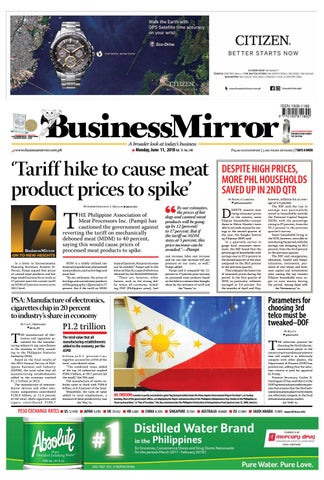
‘Tariff hike to cause meat product prices to spike’
T
By Jasper Emmanuel Y. Arcalas
@jearcalas
HE Philippine Association of Meat Processors Inc. (Pampi) has cautioned the government against reverting the tariff on mechanically deboned meat (MDM) to 40 percent, saying this would cause prices of processed meat products to spike.
In a letter to Socioeconomic Planning Secretary Ernesto M. Pernia, Pampi argued that prices of canned meat products and hot dogs would increase by as much as 17 percent once the current tariff on MDM of 5 percent reverts to its 2012 level.
MDM is a widely utilized raw material in production of processed meat products, such as hot dogs and meat loaf. “By our estimates, the prices of hot dogs and canned meat products will be going up by 12[percent] to 17 percent. But if the tariff on MDM
stays at 5 percent, this price increase can be avoided,” Pampi said in the letter on May 24, a copy of which was obtained by the BusinessMirror. “ There are, however, other factors, such as the strong dollar versus all currencies, including PHP [Philippine peso], fuel
By our estimates, the prices of hot dogs and canned meat products will be going up by 12 [percent] to 17 percent. But if the tariff on MDM stays at 5 percent, this price increase can be avoided.” —Pampi
cost increase, labor cost increase and tin can cost increase will put pressure on our costs, as well,” Pampi added. Pampi said it computed the 12percent to 17-percent price increase on processed meat products based on the hike in customs duty brought about by the reversion of tariff and See “Tariff,” A2
T
@cuo_bm
HE manufacture of electronics and cigarettes accounted for the manufacturing industry’s top contributors to the economy in 2015, according to the Philippine Statistics Authority (PSA). Based on the final results of the 2015 Annual Survey of Philippine Business and Industr y (ASPBI), the total value that all manufacturing establishments added to the economy reached P1.2 trillion in 2015. The manufacture of semiconductor devices and other electronic components contributed P133.8 billion, or 11.4 percent of the total, while cigarettes and c i g a r s c o n t r i b u t e d P 1 0 8 .7
DESPITE HIGH PRICES, MORE PHL HOUSEHOLDS SAVED UP IN 2ND QTR By Bianca Cuaresma @BcuaresmaBM
D
ESPITE concern over rising consumer prices in the country, more Filipino households—except those in Metro Manila—were able to set aside money for savings in the second quarter of the year, the Bangko Sentral ng Pilipinas (BSP) said. In a quarterly survey to gauge local consumer sentiment, the BSP found that the percentage of households with savings rose to 37.4 percent in the second quarter of the year, compared to the 36.6 percent in the previous quarter. This is despite the faster rise of consumer prices during the period. In the first quarter of 2018, in particular, inflation averaged at 3.8 percent. For the months of April and May,
PESO exchange rates n US 52.4590
See “Households,” A2
By Rea Cu
The total value that all manufacturing establishments added to the economy, per the ASPBI
See “PSA,” A2
however, inflation hit an average of 4.5 percent. The BSP said the rise in s av i n g s w a s p a r t ic u l a rl y noted in households outside the National Capital Region (NCR), with the percentage rising to 37 percent, from the 35.2 percent in the previous quarter’s survey. Fewer households living in the NCR, however, were able to save during the period, with the savings rate dropping to 40.2 percent, from the 44.8 percent in the previous quarter. The BSP said emergencies, education, health and hospitalization, retirement, purchase of real estate and business capital and investments were among the top reasons Filipino households were eager to save money during the period. Among those with
Parameters for choosing 3rd telco must be tweaked–DOF
₧1.2 trillion
b i l l ion , or 9. 2 p e rce nt — or, together account for a fifth of the total contributed value. “The combined value added of the top 10 industries reached P596.3 billion, or 50.7 percent [of the total],” the PSA said. The manufacture of motor vehicles came in third with P104.6 billion, or 8.9 percent of the total. Meanwhile, the ratio of value added to total employment, a measure of labor productivity, was
business news source of the year
P25.00 nationwide | 5 sections 28 pages | 7 days a week
PSA: Manufacture of electronics, cigarettes chip in 20 percent to industry’s share in economy By Cai U. Ordinario
2016 ejap journalism awards
T
AH, FREEDOM A worker is partly seen behind a giant flag being installed inside the Ninoy Aquino International Airport Terminal 1, on Sunday morning. Most of the government offices, are displaying the flag in commemoration of the Philippine Independence Day. Known in the Philippines as “Araw ng Kasarinlan,” or “Day of Freedom,” this day commemorates the Philippine Declaration of Independence from Spain on June 12, 1898. NONIE REYES
@ReaCuBM
HE selection process for choosing the third telecommunications player in the country must mandate parameters that will enable it to effectively compete with other players, the Department of Finance (DOF) has pointed out, adding that the selection criteria is eyed for approval by Friday. Finance Secretary Carlos G. Dominguez III has said that it is the DOF’s priority to have a selection process that ensures that the third telecommunications player to be chosen can effectively compete in the local telecommunications market. See “DOF,” A2
n japan 0.4783 n UK 70.4262 n HK 6.6861 n CHINA 8.2056 n singapore 39.3364 n australia 40.0000 n EU 61.9069 n SAUDI arabia 13.9895
Source: BSP (8 June 2018 )
News
BusinessMirror
A2 Monday, June 11, 2018
www.businessmirror.com.ph
Senate studying options on TRAIN–Sotto
T
By Butch Fernandez
@butchfBM
HE Senate is poised to review options to suspend certain impositions in the Duterte administration’s Tax Reform for Acceleration and Inclusion (TRAIN) law even as senators weigh the cost-benefits of providing relief to overburdened taxpayers.
DOF. . .
Continued from A1
The DOF is hoping for the final draft of the terms of reference (TOR), or the rules and regulations in line with choosing the new telco player, to be approved soon. “We hope to be done with this task by Friday next week,” Dominguez said. He added that he “finds the proposed process fails to set up parameters that will ensure that the third telco has the capability, both financial and technical, to compete in the long term.” The proposed process used “Committed Level of Service” as the main criteria in the selection of the third telco player. “I’ve expressed my concerns on the proposed process as I find the prequalification criteria as being weak, and I think that scoring should not be based on ‘commitments.’ You know, the beauty contest in the past resulted in frequency hoarding and those companies failed to improve service. They just made money by flipping assets government owns. I don’t want that to happen again,” he added. On the part of the DOF, the finance chief pointed out that it is currently evaluating what prequalification criteria, like financial and previous telco experience, can be applied to improve the selection of the third telco player. Additionally, he said that the “government should not forget what the task at hand is. The mandate of the President was not only to bring in a third telco player, but more important, to ensure that its entry will result in the rendering of better services to the consumers at the lowest possible cost.” Under Administrative Order
11 issued by President Duterte, an oversight committee was created to assist the National Telecommunications Commission (NTC) in formulating the TOR for the entry of a new telco player. Members of the oversight committee include: the Department of Information and Communications Technology (DICT) secretary as chairman; the finance secretary as vice chairman, Office of the Executive Secretary and the National Security Adviser. In April Dominguez pointed out that a new telecommunications player wanting to operate in the country must have at least P200 billion to compete in the local arena. Last month Communications Secretary Eliseo M. Rio Jr. listed four major issues that need to be resolved before releasing the official TOR for the selection of the third major telco player which are, namely: the concern on frequency spectrum formerly awarded to Bayan Telecommunications Inc.; the establishment of a common tower policy; the commercialization of the National Grid Corp. of the Philippines-Transco Dark Fiber; and the lowering of interconnection rates. Rio emphasized the need to address the four key issues to strengthen the sustainability of the third telco player, apart from ensuring the successful implementation of the selection process. The third telco player is seen to help disrupt the market by lowering price points, while challenging telco giants PLDT Inc. and Globe Telecom Inc. to improve their services. Interested parties for the third player’s slot include Now Corp., Philippine Telegraph and Telephone Corp. and Converge ICT Solutions Inc.
This was confirmed over the weekend by Senate President Vicente Sotto III, noting that the TRAIN law passed by Congress contains such a provision mandating the Department of Finance to conduct timely review to assess the need to suspend impositions in the revenue-raising measure. “There is really a provision there, and I’m sure the DOF knows this. They’re study ing whether or not to suspend and they will share this with us in our next hearing,” Senate President Sotto on Sunday.
PSA. . .
Continued from A1
recorded at P909,000 per worker. The manufacture of malt liquors and malt exhibited the highest labor productivity of P15.37 million per worker. The manufacturing industries with more than P4 million of reported labor productivity in 2015 also included motor vehicles with P15.29 million; distilling, rectifying and blending of spirits, P14.43 million; cigarettes and cigars, P14.17 million; and refined petroleum products, P11.42 million. In terms of total value of output, which is the sum of the sale of products and by-products, the manufacturing sector generated P4.6 trillion. Total value of output also accounts for the income from industrial services done for others, sale of goods less cost of goods sold, fixed assets produced on own account, and change in inventories of finished products and work-in-progress. The manufacture of semiconductor devices and other electronic components had the highest with output value of P441.7 billion, or 9.7 percent of the total. The list of the top 10 contributors
Tariff. . .
Continued from A1
increasing global prices of MDM due to limited import sources coupled by the depreciation of the Philippine peso against the US dollar. Furthermore, Pampi argued that they are pushing for the decoupling of the treatment on the tariffs on MDM from the country’s quantita-
He added that former Senate President Aquilino Pimentel III, who now chairs the Committee on Trade and Commerce, is expected to convene a public hearing together with the Committee on Finance, to clarify the matter in aid of crafting remedial legislation, if needed. “The Senate cannot disregard the issue,” Sotto said, adding “it is easy to say: suspend the TRAIN, but there are many beneficial programs there.” For instance, the Senate President said the upcoming review will
also enable senators to verify the basis for complaints that the oil tax is “excessive.” “They said the levy on petroleum is ‘excessive,’ and we will now have a chance to study that. I recently spoke to Finance Secretary [Carlos] Dominguez and it was learned that even in January, just before the TRAIN took effect, other factors were already at play. For example, the dollar kept gaining and this affected us even if we were doing nothing,” said Sotto, speaking mostly in Filipino. Sotto admitted the senators also
welcome the opportunity to review which of the tax law’s provisions are, indeed, excessive and need to be suspended, as provided in the TRAIN law. “But only the [excessive] provision, not the entire TRAIN,” the new Senate President hastened to clarify. If proposed remedies are found to be still unacceptable, he said senators will consider amendments when they take up the remedial legislation “in TRAIN 2,” citing as an example the clamor to “cut the value-added tax to 10 percent.”
to P1.9 trillion worth of value of output also included the manufacture of refined petroleum products with P389.6 billion, followed by computers and peripheral equipment and accessories, P213.5 billion; motor vehicles, P200.6 billion; and cigarettes and cigars, P145 billion. It also included powdered milk and condensed or evaporated milk, P139.1 billion; parts and accessories for motor vehicles and their engines, P98.2 billion; soap and detergents, P88.2 billion; cement, P87.2 billion; and electric ignition or starting equipment for internal combustion engines, P85.3 billion. Meanwhile, PSA data showed that Filipinos extended P2.2 billion worth of subsidies for the manufacturing sector in 2015. “Subsidies are all special grants in the form of financial assistance or tax exemption or tax privilege given by the government to aid and develop an industry,” the PSA explained. There are three sectors which received the top 3 largest subsidies worth P1.2 billion, or a combined share of 54.4 percent. The fluid power equipment industry received the most with P554.8 million worth of subsidies, or 25.3 percent of the total. The building of ships and boats other than sports and pleasure
boats followed with P357 million, or 16.3 percent of the total, followed by the manufacture of parts and accessories for motor vehicles and their engines, P282.9 million, or 12.9 percent. A total of 24,296 manufacturing establishments were counted in the formal sector of the economy in 2015. The top 10 manufacturing industries comprised more than half, or 58.4 percent of all manufacturing establishments in the country. Baking of bread, cakes, pastries, pies and similar “perishable” bakery products accounted for the biggest number with 6,704 establishments, or 27.4 percent of the total. The manufacture of bottled water followed with 2,350 establishments, or 9.6 percent, followed by printing with 1,439 establishments, or 5.9 percent of the total. The 2015 ASPBI is one of the designated statistical activities of the PSA. Data collected from the survey provides information on the levels, structure, performance and trends of economic activities of the formal sector in the entire country. The survey was conducted nationwide in April 2016 with the year 2015 as the reference period, except for employment which is as of November 15, 2015.
‘Habagat’ to bring more rains over Luzon next week
tive restriction on rice. The reduction of tariff on MDM from 40 percent to 5 percent was a concession made by the Philippines in securing its waiver on the special treatment on rice in 2012. Under the Executive Order (EO) 23 issued by President Duterte, the tariff levels of the concessions made by the Philippines, including MDM, would revert to their 2012 levels once the
rice QR is lifted—or by January 1, 2021, whichever comes first. “It is time to decouple the treatment of rice from the treatment of MDM,” the letter read. “Needless to say, the aforementioned thesis further justifies our proposal that the 5-percent duty on MDM/MSM be made permanent, all for the national interest.” Pampi said the meat processing industry’s import of MDM last year reached 189.1 million kilograms, 12.09 percent higher than the 168.7 million kg recorded volume in 2016. “MDM has been used since the late-1960s in certain meat and meat products, such as hot dogs, luncheon meats, other sausages,” it said. “The use of MDM in processed products has allowed us to maintain affordable protein-filled wholesome processed meats, which benefits the consumers and its use is regulated by the National Meat Inspection Service since March of 2015,” it added. Earlier this year, Trade Secretary Ramon M. Lopez said he will push for the permanent enforcement of the reduced rates under EO 23, which will make permanent the 5-percent tariff on MDM. “Yes,” Lopez said when asked if he favored keeping the rates. “In fact, we were the ones who extended that. Even before the tariffication of rice, we see it as an important support to the local industry so that there will be a good entry of raw materials here.” “That means we are expecting prices of meat to not go up if we keep the tariff at 5 percent, especially on MDMs. If you ask the DTI [Department of Trade and Industry], we will continue to support that policy,” Lopez said in English and Filipino. “That is why we are saying that if we are to be asked, we would like to keep it at that. It doesn’t have to be reverted back to higher tariff,” the trade chief said.
By Rene Acosta
@reneacostaBM
R
ESIDENTS of Luzon should expect monsoon rains to prevail until next week due to the southwest monsoon, which is being enhanced by Domeng, the tropical storm that turned into a typhoon upon leaving the country. “The southwest monsoon [Habagat], enhanced by the typhoon, will continue bringing monsoon rains over Luzon, especially over the western section, until early next week,”the National Disaster Risk Reduction and Management Council (NDRRMC) said on Sunday. “The public is advised to continue monitoring for updates, take appropriate actions against possible flooding and landslides, and coordinate with local disaster risk reduction and management offices,” it added. The NDRRMC, in its 9 a.m. a d v i s o r y o n S u n d a y, s a i d Domeng was already out of the Philippine area of responsibility, but it will continue to enhance the southwest monsoon, thus extending the rainy period for some more days. Meanwhile, the NDRRMC also reported 10 incidents of flashfloods, overflowed spillway and collapsed ripraps in the past four days that rain hit Luzon and some parts of the Visayas. Thirty municipalities in Regions 4A, 4B and in Region 8 were forced to suspend classes due to flooding, which was also reported in 43 barangays and areas in Metro Manila and Calabarzon on Friday. However, the NDRRMC said that floodwaters have already subsided as of Sunday in 37 of the affected barangays in Metro Manila and in Region 4A. In Coron, Palawan, a staff of the Orient Pearl Resort, Algemon Dalisam Nunez, 27, drowned after he tipped from a jet ski which was battered by strong waves.
Households. . . Continued from A1
savings, only 61 percent had bank deposit accounts, while 47.8 percent had savings kept at home. Some 34.3 percent of household savers, meanwhile, put their money in cooperatives, paluwagan and other credit or loan associations. Households’ savings outlook for the third quarter of the year was also upbeat, despite their expectations of a continued rise in inflation, depreciation of the peso and higher unemployment rates. In particular, the BSP said the percentage of respondents who reported that they could set aside money for savings during the quarter rose to 43.3 percent, from the 41.8 percent in the previous survey.
Economy BusinessMirror
A4 Monday, June 11, 2018 • Editor: Vittorio V. Vitug
Neda vows ₧2.69-B China-funded Chico River project to succeed
T
By Cai U. Ordinario
@cuo_bm
he National Economic and Development Authority (Neda) seeks to assure Filipinos the P2.69-billion Chico River Pump Irrigation Project funded by the Chinese government will not fail. Socioeconomic Planning Secretary Ernesto M. Pernia told the BusinessMirror that the government has instituted safeguard mechanisms to ensure that projects, including the Chico River Pump Irrigation project, funded by Beijing will all be aboveboard. “We’re selecting the best of the three companies also prescreened by their [China’s] NDRC [National Development and Reform Commission],” Pernia said via SMS on Sunday. The Chico River Pump Irrigation Project is one of the first Beijing-funded projects in the country. It is among the priority projects to be funded by the Chinese government under its new cooperation framework with the Philippines. Pernia said this is not the first time China will be financing an
irrigation project in the Philippines, but it will be among the first in the current developmentcooperation framework between the two countries. Ned a Undersecretar y for Investment Programming Rolando G. Tungpalan also told the BusinessMirror that the Chico River project is the third China-assisted irrigation project in the country. The first two projects are the Banaoang Pump Irrigation Project implemented in 2002 and the Agno river integrated irrigation project that commenced implementation in 2009. “Cooperation with China started with the DA [Department of Agriculture] cooperation agreement,” Tungpalan said. “Hence, [the] first projects assisted by China Eximbank were agriculture-related, i.e., GenSan fish-port rehabilitation
and Banaoang Pump.” “It is us who proposed these irrigation projects [so that we will] have rural agriculture projects for farmers apart from transport projects,” he added. Last week the Philippines and Chinese governments jump-started the Chico River Pump Irrigation Project in the Kalinga, Cordillera Administrative Region. The project will involve the installation of pumps, the construction of pumping station, irrigation canals, facilities and other appurtenant structures, covering the municipalities of Tuao, Piat and Pinukpuk. It will be completed in three years. Once completed, it will provide a stable supply of water to around 8700 hectares of agricultural land, benefiting 4350 households in 21 barangays in the Kalinga province and Cagayan province in Northern Luzon, and create hundreds of employment opportunities for the local people. “The Chinese side will spare no efforts to build this project and make it a symbol of China-Philippines friendship…. I firmly believe that China-Philippines strategic mutual trust is bound to be much stronger and economic cooperation even closer. China, together with the Philippines, will continue to steer the ship of building the 21st Century Maritime Silk Road toward a brighter future,” Chinese
Embassy Commercial Counsellor Jin Yuan had said. Yuan added that apart from the Chico River Pump Irrigation Project, the Chinese government has also began constructing two drug-rehabilitation centers in Mindanao; the first was in January and the second began in February. He added that two bridges across Pasig River in Manila, funded through Chinese grant—the Estrella-Pantaleon Bridge and Binondo Intramuros Bridge—will begin at the end of the month. Further, Beijing and Manila are already in the process of discussing projects to be included in the second basket of infrastructure cooperation projects, which will be financed by $10 billion worth of concessional loans from China. “To the People’s Republic of China who unfailingly supports the projects of the Philippine government, especially to this irrigation project, thank you very much…. Let us continue to work hand in hand so that we may break more grounds for irrigation soon,” National Irrigation Administrator Ricardo Visaya said. T he g rou ndbrea k i ng cere mony was graced by Yuan and Visaya, as well as K alinga Gov. Jocel C . Ba ac, Cagaya n Gov. Manuel N. Mamba and other members of the local government and media.
www.businessmirror.com.ph
WTO urged to help MSMEs in poor countries tap e-commerce By Elijah Felice E. Rosales @alyasjah
M
icro, small and medium enterprises (MSMEs) will get the short end of the stick if developing economies continue to lag behind the multitrillion-dollar industry of e-commerce, international firms argued in a recent meeting at the World Trade Organization (WTO). In a meeting last week, over 60 senior business representatives urged the WTO to intensify talks on how members should face the challenges of online trading. They claimed “e-commerce is changing the face of trade, affecting both big and small enterprises, and rich and poor countries.” The platform, they reported, has a value of at least $25 trillion annually. Keeping up with this fast-growing trade activity is a challenge, and business officials said they will appreciate if the WTO address the issues entailed to ecommerce in a “frank and open manner.” Their primary concern is how to integrate MSMEs into e-commerce, and how to bridge the digital divide between developed and developing economies. Sunil Bharti Mittal, chairman of the International Chamber of Commerce, said MSMEs will lose big time if they are not provided support to utilize the online platform. “The digital economy is changing the composition, nature and speed of global trade, leading to policy friction—today’s trade rules reflect 20thcentury patterns of trade. With the size of e-commerce, touching $25-trillion, digital infrastructure is a key determinant required by MSMEs in develop-
ing countries to be a part of the global value chain,” Mittal said. He added the WTO is now pressed to initiate negotiations on e-commerce because, without it, MSMEs will be further marginalized in a digital environment. The multilateral trading body is urged to iron out rules on how to manage flow of data across borders; data localization requirements; cybersecurity; customs duties on e-commerce; and consumer protection. Business officials said there is a “lack of set of stable international rules on data transfers and data flows”—a privacy and national security concern—“and a major void in the current system, which needs to be addressed.” They are, therefore, asking the WTO to put in paper a regulatory framework for e-commerce to be followed by member-countries. This is to ensure online trading of goods is moderated and consumers are protected. Business officials said the framework is crucial in the data localization of e-commerce, particularly on payment systems, to prevent the platform from dividing into smaller localized regimes. Apart from this, it will also address nontariff barriers on customs and bureaucratic processes, including increased documentation requirements, taxes and customs delays. On top of the discussion on e-commerce, business officials also threshed out issues on investment facilitation, MSMEs and sustainable development. These topics were named as trade priorities at the business forum at the WTO’s 11th Ministerial Conference last December.
Revenues from coconut oil exports down 39.2 percent in January to April By Jasper Emmanuel Y. Arcalas @jearcalas
T
he value of the country’s coconut oil (CNO) exports fell by 39.2 percent to $383.046 million in January to April, from last year’s $630.048 million, preliminary data from the Philippine Statistics Authority (PSA) showed. In its latest trade report, the PSA said export receipts from CNO in the first four months of the year were lower by $247.002 million, as the world market price of vegetable oil continued to decline. For the month of April alone, the value of CNO exports slid by nearly 24 percent to $79.69 million, from $104.728 million recorded in the same period last year. The World Bank’s price monitoring report showed that the average price of CNO during the January-to-April period declined by almost 26 percent to $1,228 per metric ton, from $1,659 per MT recorded last year. On a monthly basis, the average quotation of coconut oil in April reached $1,138 per MT, recovering from a 28-month low of $1,124 per MT recorded in March. However, the April average price of coconut oil is nearly 28 percent lower than last year’s $1,580 per MT. The World Bank has already slashed its forecast for the average price of coconut oil this year by 20 percent to $1,275 per MT, from $1,593 per MT, due to higher-thanexpected production. The average price of coconut oil in 2017 reached $1,603 per MT, 8.67 percent higher than the previous year’s average of $1,475 per MT in 2016, according to the World Bank. Revenues from coconut-oil exports could decline by at least a fifth to $1.2 billion due to lower international prices, according to the
Coconut nurseries that are home to more than 28,000 seedlings in the Supertyphoon Yolanda (international code name Haiyan)-affected areas in Leyte province. Receipts from Philippine coconut oil shipments declined by 39.2 percent year-on-year due to low international prices, according to the Philippine Statistics Authority. Cargill Inc./Bloomberg
Philippine Coconut Authority (PCA). In terms of volume, however, PCA Administrator Romulo J. de la Rosa said coconut oil shipments for 2018 could rise by 8.46 percent to 1 million metric tons (MMT).
“We can hit 1 MMT of coconut oil exports this year. But if prices will remain at their current levels, then we can expect lower receipts, even if we ship 1 MMT,” de la Rosa told the BusinessMirror.
Receipts from coconut oil shipments expanded by 30.56 percent to $1.504 billion last year, from $1.152 billion in 2016. Coconut output in 2017 rose by nearly 17 percent year-on-year.
‘Performance targets for agencies to hasten poverty alleviation’ By Jovee Marie N. dela Cruz @joveemarie
A
lawmaker on Sunday called on the Department of the Interior and Local Government (DILG) and the Department of Budget and Management (DBM) to set performance targets for government agencies to address poverty in the country. According to Deputy Majority Leader Michael Romero of 1-Pacman party-list, the country’s “poverty line” is still at P10,969 per month, which means 2 of 10 Filipinos are “ultra-poor.”
“I recommend to DILG Secretary Eduardo Año and DBM Secretary Benjamin Diokno the setting of performance targets on jobs creation, underemployment reduction, high-school graduation/completion, and fewer deaths of pregnant mothers, and improved child nutrition,” Romero said. “Tie these targets to the Local Government Support Fund. That should be a good incentive for the governors, mayors and barangay chairmen to truly improve the lives of their constituents,” he added. Poverty line, Romero said, is the minimum threshold government computed for a
family of five to meet the very basic needs of food, shelter, housing, transportation, health and education. In the Philippines he said the poverty- line threshold computed by the Philippine Statistics Authority is now at P10,969 per month ($200 per month). Romero added that the computed national food threshold for a family of five is at P7,638 per month. This P7,638 per month is the minimum requirement for a family to be able to have three regular meals in a day. To cross that poverty line, the lawmaker said the national government should create more jobs and bring down
underemployment to below 10 percent, keep more young Filipinos in school and have more of them graduate from high school and from college. “We must also focus on maternal health and child care. Emphasis and clear results on these three key areas alone would have transformational impact,” he said. Romero said there are now more middleclass Filipinos because they were able to cross over the poverty line. “That line is the subject of much debate and furor. That line even has different names: poverty threshold, living wage, minimum wage, survival income and so on.”
Agriculture/Commodities BusinessMirror
www.businessmirror.com.ph
Editor: Jennifer A. Ng • Monday, June 11, 2018
A5
PHL rice inventory hits 6-month high By Jasper Emmanuel Y. Arcalas
T
@jearcalas
he country’s rice inventory as of May 1 rose to the highest level in six months, after the harvest of local paddy kicked into high gear in April, according to data released by the Philippine Statistics Authority (PSA).
Data from the PSA showed that the rice inventory during the period reached 2.909 million metric tons (MMT). On a monthly basis, the figure is 33.3 percent higher than the April inventory. The May 1 stockpile, however, is 9.48 percent lower than the previous year’s 3.214 MMT. Based on the BusinessMirror’s computation, the May 1 rice inventory would be enough for 90 days. This is the second consecutive month that the country’s rice inventory posted an increment, following a six-month skid in
March due to the depletion of the National Food Authority’s (NFA) stockpile. Of the total rice inventory, 52.11 percent were with households, 47.77 percent were held by commercial warehouses and 0.12 percent was in NFA depositories, according to the PSA. The total volume of rice held by commercial warehouses during the period reached 1.516 MMT, while those in households amounted to 1.389 MMT. The NFA’s rice stockpile as of May 1 plunged to its lowest level
A man arranges sacks of rice at a warehouse of the National Food Authority in Quezon City in this file photo. The Philippine Statistics Authority (PSA) said in its latest report that the country’s rice inventory as of May 1 reached 2.909 million metric tons. NONIE REYES
in 38 years at 3,480 MT. This is the first time that the grains agency’s buffer stock sank below the 10,000 MT-level.
The bulk of the NFA’s inventory, or 62.67 percent, consisted of imported rice. “Rice stocks in commercial
warehouses increased by 4.33 percent with reference to last year’s inventory level. However, both stocks held
in the households and NFA depositor ies decreased by 6.77 percent and 98.71 percent, respectively,” the PSA said in its mont h ly repor t, t it led “R ice a nd Cor n Stoc k s Inventor y,” published recently. “ This month ’s stocks level for both households and commerc ia l wa rehouses went up by 1.01 percent and 90.84 percent, respectively, compared to the prev ious month ’s record. On the contrary, rice stocks inventory level in NFA depositories dropped by 71.58 percent,” it added. The government periodically monitors rice inventory to determine whether it would need to import the staple to boost local stocks. During the period, PSA data showed that total corn stock i nve ntor y stoo d at 33 8 , 310 M T, 7 8 . 2 7 p e r c e n t l o w e r than the last year’s record of 1.556 MMT. The country’s total corn inventory as of May 1 was also 8.40 percent lower than the 369,340 MT recorded on April 1.
SM Foundation’s program plants the seeds of farming Cacao growers seen
benefiting from stringent EU limits for cadmium
W
ith children of farmers now choosing to work in factories, business-process outsourcing (BPO) firms, offices, abroad or even putting up their microenterprises to earn a living, farming has practically become a dying vocation. But SM Found at ion Inc. (SMFI), through its Kabalikat sa Kabuhayan (KSK) program—which teaches farmers to earn more from farming using a system that would veer them away from the boom-bust cycles of farming—has been going on for several years in the hope that by planting the seeds of farming now, the love for this calling would be renewed not just in the rural areas but also in urban settings. With partners like Macondray for its urban-gardening program and Harbest Agriculture for its rural farm-training programs, the three-month planting/ lecture and demo farm modules, and of late, even the financial literacy and business planning sessions will give t he far mers a systematic approach to far ming and develop a business acumen in them. Indeed, the typical farmer keeps producing without caring where to sell their produce, practically leaving them at the mercy of traders (who also provide them production loans in exchange for their final harvest acquired at rock-bottom prices). The modern-day farmer, which SMFI hopes to create for the future, is one who is empowered both in technology, financing and market access, thereby ensuring the sustainability of their livelihood, said Chito Macapagal, corporate affairs head and board of trustee of SMFI. “We should raise the bar of the farmers and not make them forever a victim of their trade. They should be smart and empowered so that they can pass on their learning to their children, who will not avoid the vocation just as they are doing so now,” Macapagal said in a statement. SMFI VP (under which KSK falls) Cristie Angeles has graduated for the first
By Elijah Felice E. Rosales @alyasjah
P
KSK Iloilo
SM Foundation Inc.
quarter this year close to a thousand rural and urban farmers, who are all determined to produce food crops not just for their personal/family needs but for the needs of all Filipinos. The urban garden farmers who graduated from the KSK courses this year were from: Valenzuela, Parañaque, Manila and Muntinlupa, while the KSK graduates in the provinces were from Dinalupihan, Bataan (considered the most successful public-private partnership), Butuan, Santa Rosa, Laguna, and soon in Marawi, Lanao del Sur, as well. But more provinces and cities of Metro Manila were covered by the KSK farmers training program but have yet to finish their courses and culminate it with a “harvest festival” (their graduation and awarding of certificates) where they use their produce in a cooking contest (to win cash prize) and the rest they sell among themselves and the visitors in such harvest festivals. Marawi, for instance, has just reeled
from a six-month armed battle between government troops and renegade bandits (pushing for the establishment of a caliphate for the ISIS) where farming and livelihood are most urgent to ensure the return to normalcy of the people and the entire province. Ensuring the sustainability of the program would rest largely on the shoulders of the trainees, who thus far have assured SMFI that they would form production/ marketing clusters within their areas so that they can teach and pass on to their fellow farmers the new systems and skills they acquired. Hopefully, just like the case in Dinalupihan, where the local government is deeply involved in ensuring that the province would be the “modern agropolis by 2022” by providing funding per production cluster and the local agriculture office would provide seeds and technical assistance, a lot more local governments would follow suit so that farming would not die in the country.
hilippine cacao growers are expected to gain from a European Union (EU) law that limited the maximum levels of cadmium in cocoabased products, according to the Philippine Trade and Investment Center (PTIC) in Geneva, Switzerland. The Department of Trade and Industry’s PTIC in Geneva tested the cadmium level of Philippine cacao beans, and said it passed the new EU limits set on the heavy metal. This makes the local produce acceptable to use in Swiss chocolates. The EU in 2014 approved Commission Regulation 488 which calls for new limits on the cadmium levels in cocoa products by January 1, 2019. The law is seen as a “serious threat” to smallholder cacao farmers and challenges manufacturers to look for alternative sources for the bean. “While Switzerland is not part of the EU, it adopts the EU General Food Law and exports the majority of its chocolate production to the EU. Swiss consumers also have the highest per-capita rate of chocolate consumption worldwide,” said Jean-Benoit Charrin of Farm Strong Foundation. FarmStrong’s Michiel Hendriksz added that cacao beans from Davao have just the right amount of cadmium regulated under the EU law. “Davao-sourced fermented cacao beans have low cadmium level that is well within the acceptable values, providing a big opportunity for Filipino cacao farmers,” he said. Local cacao farmers should take advantage of the low cadmium level of their cacao beans, the PTIC in Geneva said, as Swiss chocolatiers look for new sources of
the produce to protect their international reputation for high-quality chocolate. Cadmium is a heavy metal found in industrial and agricultural resources. Since 2001 the EU has imposed a regulation on the maximum levels for cadmium in food. The regional bloc finds it necessary to moderate exposure levels to the heavy metal in certain food groups where exposure is highest or where the consumer groups are most vulnerable. Wide-ranging products are affected by the regulation, from infant food to cocoa-based goods. Under the EU law that will take effect next year, milk chocolate with below 30 percent of cocoa can only contain no more than 0.10 milligram per kilogram (mg/kg) content of cadmium; chocolate with over 30 percent cocoa but below 50 percent should have no more than 0.30 mg/kg of cadmium; and chocolate with more than 50 percent cocoa will have a threshold of 0.80 mg/kg of cadmium. Cocoa powder for drinking can only contain 0.60 mg/kg of the heavy metal. The tighter regulation is seen to impact on cacao growers in Latin America, as previous research reported their beans to have higher levels of lead and cadmium compared to those from West Africa. However, cacao beans from West Africa are considered “bulk beans” and lack the flavor Swiss chocolate manufacturers are looking for. With the imminent entry into force of the EU law, Manila is keen on bolstering the presence of local cacao beans in the global value chain, and this discussion could come into play in the country’s hosting of the Asia-Pacific Cacao Congress in September.
The World
A6 Monday, June 11, 2018 • Editor: Lyn Resurreccion
BusinessMirror
Trump disavows joint G-7 statement, lashes at Trudeau
my guest,” Macron told reporters last Saturday. “We need seven to dance that tango, and the next move needs to be made by the one who first took a step backward.” Copies of the communiqué stamped with “approuve,” or approved in French, were being circulated around the G-7 media center in Quebec City, as Trump made his order on Twitter. The statement had been published online minutes before Trump’s tweets. Before Trudeau spoke and announced the communiqué, a US administration official told a pool reporter Trump had agreed to the communiqué.
North Korea German Chancellor Angela Merkel (center) speaks with US President Donald J. Trump (seated, right) during the Group of Seven Leaders Summit in La Malbaie, Quebec, Canada, on June 9. Also in the photo are French President Emmanuel Macron (second from left, partly hidden), Prime Minister Shinzo Abe (third from right, front) and US National Security Adviser John Bolton (standing, right). Jesco Denzel/German Federal Government via AP
P
resident Donald J. Trump broadsided his allies and upended a Group of Seven (G-7) meeting just as it wound up—disavowing a joint statement the United States had agreed to, lashing out at Canada’s Justin Trudeau and ratcheting up trade tensions. Trump fired off a pair of tweets several hours after leaving the summit in Canada to fly to Singapore for another on North Korea. Trudeau and other leaders had given closing press conferences and announced a US-backed joint G-7 statement. Minutes after that statement was published online, Trump complained about comments made by Trudeau and revoked his support. “I have instructed our US Reps not to endorse the Communiqué as we look at Tariffs on automobiles flooding the US Market!” Trump tweeted on Saturday evening, saying he was responding to Trudeau. “Very dishonest & weak,” he said of the Canadian leader. His comments undermine the G-7, a bloc that was once a pillar of US foreign policy and has long acted as a defender of the global economic system.
Fresh friction
It could also cause fresh friction with his northern neighbor as tensions percolate over efforts to redraw the North American Free Trade Agreement (Nafta). And it could even undercut the upcoming North Korea summit—Trump effectively backed out of a deal with allies while traveling to try and reach a deal with a foe. “It’s a brutal blow to a summit
of significant success, both in substance and in presentation,” said John Kirton, director of the University of Toronto’s G-7 Research Group. The brief glow of this year’s summit “has been destroyed, for now and probably for good.” The president’s reference to cars is not new. Trump last month directed Commerce Secretary Wilbur Ross to initiate a national-security investigation into imports of cars, trucks and vehicle parts that could possibly lead to tariffs. Canada would be among the biggest losers from such a move as the second-largest source of US vehicle imports. The top source is the other Nafta member, Mexico.
Image of cooperation
But the remarks came shortly after Trudeau, the G-7 host, had projected an image of cooperation. At his closing press conference, he announced all G-7 nations had worked hard to finalize a joint statement, which largely committed them to keep talking on trade. “Those who doubted our capacity to work together will have seen our ability to deliver,” he said. Trudeau also repeated statements he’d made earlier—calling US steel and aluminum tariffs “insulting” and pledging to proceed with previously announced retaliatory tariffs. Trump said that retaliation is
a “mistake,” according to Trudeau. Canada is “polite, we’re reasonable but we also will not be pushed around,” Trudeau added. Trump’s tweets cited those comments. Trudeau’s office responded to the tweets with a written statement, saying the prime minister’s comments in public and in private with Trump were “nothing he hasn’t said before” and that he was “focused on everything we accomplished here at the G-7 summit.” Trudeau himself declined to comment during an appearance with Argentina’s president. “Good to see you guys,” Trudeau said to journalists asking for reaction. “It’s a beautiful evening, a great weekend.” French President Emmanuel Macron declined to comment. A senior United Kingdom government official said Theresa May’s government stands by commitments made in the communiqué. “I think they’ll all come down on Trudeau’s side” with the possible exception of Japan’s Shinzo Abe, Kirton said. “This is clearly six versus one.”
Tango dance
Even before Trump’s shock reversal, Macron bemoaned the lack of G-7 unity, giving a hint that the tensions hadn’t been put to rest. Trump had at one point proposed that G-7 nations eliminate all tariffs, barriers and subsidies. “I heard President Trump say he wants maximum trade and minimum tariffs for G-7 members. Be
Trump left the summit early last Saturday to head for a meeting in Singapore with North Korean leader Kim Jong Un on June 12. “This bodes very poorly for the North Korea summit because it basically underlines the fact that Trump’s word means nothing,” said Jacob Kirkegaard, a senior fellow at the Peterson Institute for International Economics. Trump’s tariff hikes and threats to proceed with new duties on Chinese goods have raised the prospect of a trade war—and of congressional intervention. Senate Foreign Relations Committee Chairman Bob Corker, a Republican, introduced legislation this month that would curb the president’s executive powers to impose tariffs. Arizona Republican Sen. John McCain tweeted a message to allies, saying the US is pro-free trade and “Americans stand with you, even if our president doesn’t.”
Nafta tensions
Kirkegaard said he hopes Congress takes back trade powers from the president. “You cannot conduct international economic policy in this manner. First of all, to not have the guts to do it face to face, that’s one thing, but disavowing something you agreed to just a few hours ago is kindergarten stuff,” he said. “I don’t know what to say. I hope Republicans grow a spine, really.” The G-7 summit included ample discussion on Nafta—Trump said any new agreement would include some kind of sunset clause, which would kill the deal after five years unless all three countries agree to change or renew it. Trudeau repeated that Canada won’t accept a sunset clause. Bloomberg News
This bodes very poorly for the North Korea summit because it basically underlines the fact that Trump’s word means nothing.” —Kirkegaard
www.businessmirror.com.ph
Trump faces toughest test yet in N. Korea summit
S
INGAPORE—Embarking on a self-described “mission of peace,” President Donald J. Trump’s seat-of-the-pants foreign policy is facing its toughest test yet as he attempts this week to personally broker an end to North Korea’s nuclear program with Kim Jong Un. The impulsive American president, who just days earlier called into doubt a pillar of the Western alliance, is set to face his match on the global stage as he prepares to meet Kim in Singapore. In the historic first meeting between the leaders of the technically still-warring nations, Trump is prioritizing instinct over planning. Unlike traditional summits between heads of state, where most of the work is completed in advance of a photo-op, United States officials say the only thing certain ahead of these talks will be their unpredictability. Ever since Trump shocked allies, White House officials, and, by some accounts, the North Koreans themselves when he accepted Kim’s March invitation for a meeting, the two leaders have lurched toward an uncertain encounter that may well determine the fate of millions. “It’s unknown territory in the truest sense, but I really feel confident,” Trump told reporters last Saturday. “I feel that Kim Jong Un wants to do something great for his people and he has that opportunity and he won’t have that opportunity again.” Trump’s engagement with Kim fulfills the North Korean ruling family’s long-unrequited yearning for international legitimacy, itself a substantial concession that could weaken more than a generation of US efforts to isolate the country on the global stage. “It’s never been done before,” Trump said last Saturday. “And obviously, what has been done before hasn’t worked.” A triumvirate of forces is bringing the meeting to fruition, said Scott Snyder, senior fellow for Korea Studies and director of the Program on US-Korea Policy at the Council on Foreign Relations, describing the summit as “Produced by Kim, directed by [South Korean President Moon Jae-in] and inspired by Trump.” The hard-hitting sanctions and desire for legitimacy brought the youthful Kim to the table. The South Korean leader’s efforts to avert a potentially catastrophic US first strike pushed both leaders to take a risk. And Trump is the first US president willing to sit-down with the autocratic ruler with so few concessions, believing his selfprofessed negotiating prowess will guide him though uncharted diplomatic waters. Raising expectations in advance of the meeting, Trump said the outcome would rely heavily on his own instincts. The US president, who prides himself on his dealmaking prowess, said he will know “within the first minute” of meeting Kim whether the North Korean leader is serious about the nuclear negotiations.
“I think I’ll know pretty quickly whether or not, in my opinion, something positive will happen. And if I think it won’t happen, I’m not going to waste my time. I don’t want to waste his time,” Trump said. “This is a leader who really is an unknown personality,” Trump added of Kim. “People don’t know much about him. I think that he’s going to surprise on the upside, very much on the upside.” White House aides described Trump in the days after receiving the initial Kim invitation as being obsessed by visions of winning the Nobel Peace Prize and using The Art of the Deal to put his mark on the global order. In recent weeks Trump’s enthusiasm has been tempered somewhat by the challenge of dealmaking with such an unpredictable opponent. And there are worries from the White House to East Asian allies that Trump’s desire for an agreement will lead him to accept any deal—even if it’s a bad one. Trump is set to dangle before Kim visions of protection, economic investment and even a White House visit, in return for a commitment to abandon his nuclear weapons program. Kim, US officials say, has agreed to put his stockpile of a half-hundred or more weapons on the table for negotiation, but the two countries have offered differing visions of what that would entail. Despite Kim’s apparent eagerness for a summit with Trump, there are doubts that he would fully relinquish his nuclear arsenal, which he may see as his guarantor of his survival. US defense and intelligence officials have assessed the North to be on the threshold of having the capability to strike anywhere in the continental US with a nuclear-tipped missile—a capacity that Trump and other US officials have said they would not tolerate. Trump reiterated his promise last Saturday that the US “will watch over and we’ll protect” Kim and his government in return for him giving up the nuclear program. Traveling to Singapore, Trump is looking to temporarily escape his flaring personal conflicts with key US allies over trade, as well as domestic pressure like the swirling Russia probe. Acutely aware of his coverage in the media, Trump has enjoyed how North Korea has overshadowed some of the more negative coverage of his tumultuous White House. Still, Trump’s team has not always been on the same page, with Secretary of State Mike Pompeo —who has been leading the administration’s efforts—more supportive, while the hawkish National Security Adviser John Bolton has been more skeptical. Bolton has been far less visible in the planning process, after a comment he made about favoring the “Libya model” for denuclearization enraged the North Koreans. Libya gave up its program at an early stage only to see its longtime dictator overthrown and brutally killed years less than a decade later. AP
Pope tells leading oil executives: Energy needs must not destroy civilization
V
ATICAN CITY—Pope Francis told leading oil executives last Saturday that the transition to less-polluting energy sources “is a challenge of epochal proportions” and warned that satisfying the world’s energy needs “must not destroy civilization.” The Vatican said Francis held a two-day conference with the executives as a follow-up to his encyclical three years ago that called on people to save the planet from climate change and other environmental ills. Participants included the CEOs of Italian oil giant ENI, British Petroleum, ExxonMobil and Norway’s Statoil as well as scientists and man-
agers of major investment funds. Their remarks on the first day of the closed-door conference were not released by the Vatican. While Francis lauded the oil executives for embedding an assessment of climate-change risks into their planning strategies, he also put them on notice for their “continued search for fossil-fuel reserves,” two-anda-half years after the Paris climate accord “clearly urged keeping most fossil fuels underground.” “Civilization requires energy, but energy must not destroy civilization,” he implored. Energy experts and those who advocate fighting climate change
expressed doubts before the conference that it would amount to anything other than a PR opportunity for the companies to burnish their image without making meaningful changes. In his remarks, the pope said he hoped the meeting gave participants the chance to “reexamine old assumptions and gain new perspectives.” Francis said that modern society with its “massive movement of information, persons and things requires an immense supply of energy.” And still, he said, as many as 1 billion people still lack electricity. The pope said meeting the
energy needs of everyone on the planet must be done in ways “that avoid creating environmental imbalances, resulting in deterioration and pollution that is gravely harmful to our human family, both now and in the future.” Francis also recalled his own appeal in the Laudato Si encyclical for an energy policy “aimed at averting disastrous climate changes that could compromise the well-being and future of the human family, and our common home.” That includes transitioning to efficient, clean energy sources. “This is a challenge of epochal proportions,” he said last Saturday.
“At the same time it is an immense opportunity to encourage efforts to ensure fuller access to energy by less developed countries...as well as diversifying energy sources and promoting the sustainable development of renewable forms of energy.” The pope called for a “long-term global strategy to provide energy security,” along with “precise commitments” to tackle the challenge of climate change. He said it was “disturbing and a cause for real concern” that the levels of carbon-dioxide emissions and the concentrations of greenhouse gases remain high despite commitments taken in the 2015 Paris accord to
fight global warming. He urged participants to use their “demonstrated aptitude for innovation” to address “two of the great needs in today’s world: the care of the poor and the environment.” He noted that the poor pay the highest price for climate change, often being forced to migrate due to water insecurity, severe weather and an accompanying collapse in agriculture. “The transition to accessible and clean energy is a duty that we owe toward millions of our brothers and sisters around the world, poor countries and generations yet to come,” the pope said. AP
www.businessmirror.com.ph
Banking&Finance BusinessMirror
Monday, June 11, 2018
A7
DOF assures Europe-Asean Business Alliance: Transparency to prevail in TRAIN 2, ‘BBB’
F
By Rea Cu
@ReaCuBM
INANCE Secretary Carlos G. Dominguez III has assured European businessmen that transparency will prevail in the continuing tax-reform program and the Duterte administration’s flagship infrastructure projects, aimed to enhance productivity and create new jobs. During a recent meeting with key officials of top European multinational companies belonging to the Europe-Asean Business Alliance (Eaba), the finance chief pointed out that the Philippines is open for business, particularly in the area of infrastructure development, but he has yet to see companies from Europe participating in the bidding for these type of projects.
Dominguez told the Eaba that the government has been “very transparent” in its transactions, and continues to pursue reforms in the tax system following the enactment this year of the first package of the Comprehensive Tax Reform Program (CTRP). The first pacakge—the Tax Reform for Acceleration and Inclusion law—took effect on January
1 and lowered personal-income tax rates while raising additional revenues to help support the government’s “Build, Build, Build” (BBB) infrastructure program and other priority projects, which are being fast-tracked. The Eaba members told Dominguez and Trade Secretary Ramon M. Lopez at the meeting that they want to contribute to the economic-reform agenda of the Duterte administration by setting up businesses, which they called “an important contributor to economic prosperity.” Dominguez pointed out that President Duterte’s policies on attracting investments, on top of pursuing a massive infrastructure program and pushing tax reform, are to provide a conducive climate for business by maintaining peace and order, and curbing corruption in the bureaucracy. Present at the meeting were officials from Swiss Re, a wholesale provider of reinsurance, insurance and other insurance-based
More insurance firms now using telemarketing channel–IC
T
HERE are already 13 insurance companies and one insurance broker engaged in selling their insurance products through telemarketing, the Insurance Commission (IC) has reported. “Since the issuance of the guidelines on telemarketing of insurance products in 2016, there are now 13 insurance companies and one insurance broker with IC-approved telemarketing agreements,” Insurance Commissioner Dennis Funa said. Under IC regulations, an insurance company with an approved telemarketing agreement is allowed to market its insurance products by means of telephone calls, typically unsolicited, to potential customers. A telemarketer can promote the insurance product of a particular insurance company, as well conclude insurance contracts, under a telemarketing platform. “The authority of a telemarketer to conclude an insurance product depends on whether or not he or she is a licensed insurance agent. In other words, an individual who is not a licensed agent is only allowed to conduct preliminary introduction and presentation of insurance products. On the other hand, a telemarketer who is a licensed agent may solicit or sell insurance products.” he added. Through telemarketing agreements, insurance companies have alternative distribution channels, allowing them to promote their insurance products and provide advice, sales and support to their customers. “Telemarketing does not only involve the utilization of technol-
ogy in the development of alternative platforms in offering insurance products to the public; more important, it is a distribution innovation, which can highly contribute to bring about an increase on market penetration and expansion of public awareness of existing insurance products,” he said. Insurance companies are free to develop their own script or spiel to be used in their telemarketing activities, under the IC regulation on telemarketing. However, the following processes are required to be incorporated: notice to the prospective client that the call is being recorded, and confirmation of client’s interest and information details. To ensure that clients are adequately protected, insurance companies and insurance brokers are required to have a mechanism in place to address customer complaints and grievances. “Telemarketing offers insurance solutions to the insuring public through this platform. In other jurisdictions, telemarketing proves to be an effective tool to reach out to the customers by providing valuable information and access to insurance products,” he added. The most recent telemarketing agreement approved by the IC is the telephone appointment activity to be conducted by FWD Life Insurance Corp. (FWD Life) through the telesales associates of its bancassurance partner, Security Bank Corp. (SBC). “We are delighted to reach out to more Filipinos in providing financial protection relevant to the
lifestyles of the customers through the telesales associates of SBC, our bancassurance partner. FWD Life is currently active in more than 300 Security Bank branches nationwide and this customer engagement activity enables more Filipinos to be financially secured,” said FWD Life Philippines President and CEO Peter Grimes. The IC would develop a reporting framework on telemarketing activities of insurance companies, to aid the insurance regulator in analyzing the level of growth of insurance telemarketing in the country, according to Funa. “We reiterate our continuing challenge to the insurance industry players to explore ways to reinvent sales and distribution models and to innovate ways of unlocking new and emerging markets,” he said. The following are the insurance companies with approved telemarketing agreements: Philippine AXA Life Insurance Corp., BPI/MS Insurance Corp., BPI-Philam Life Assurance Corp., FWD Life, Insurance Company of North America (A Chubb Company), Malayan Insurance Co. Inc., Manila Bankers Life Insurance Corp., Manufacturers Life Insurance Co. (Phils.) Inc., Mapfre Insular Insurance Corp., Paramount Life & General Insurance Corp., Pioneer Insurance and Surety Corp., Prudential Guarantee and Assurance Inc., Sun Life Grepa Financial Inc. The only insurance broker with an approved telemarketing agreement is Citicorp Financial Services and Insurance Brokerage Philippines Inc. Rea Cu
forms of risk transfer; Van Oord, a contractor for dredging, marine engineering, offshore and energy products; East West Seed, which is involved in plant breeding; Ofo, which is the world’s first and largest dock-free bicyclesharing platform; Zuellig Pharma; ABB; and Rabobank Singapore & Representative Markets. Officials from A laska Milk Corp.; Vriens & Partners, a corporate advisory firm specializing in government affairs; and Roche Philippines, which is engaged in pharmaceuticals and diagnostics, were also at the meeting.
The proposed second package of the CTRP aims to lower corporateincome tax rates from 30 percent to 25 percent while harmonizing the country’s fiscal incentives regime. It is meant to level the business playing field and help the country be on a par with its Asean neighbors. Dominguez earlier said that the “pro-business, pro-investments and pro-incentives” Package 2 will help the government build a fairer and more competitive business environment through reforms in the corporate tax system “that will deliver a more even playing field, sim-
plify collection procedures, bring greater transparency and reward genuine efficiency.” He said Package 2 will continue to grant incentives to businesses, but the government must now ensure “that every peso given up as an incentive must benefit the society in the form of better jobs, faster innovation and countryside development.” “The success we have so far achieved for the first tax-reform package is encouraging, but we cannot and should not stop the train from mov ing for ward,” Dominguez said.
Perspectives
The next major defense challenge
T
O win the data war, defense forces look to leverage specialized skills in digital automation and artificial intelligence. Organizations of all kinds are examining ways to use digital automation, under names including artificial intelligence, machine learning or bots. But defense agencies have among the strongest motivations to adopt this group of technologies, known collectively as intelligent automation, given the ever-increasing volumes of data they need to analyze accurately, safely and quickly, in the interests of national security. “Intelligent automation is absolutely essential for the military,” says Ian McDonald, director of Technology Enablement in Defense and National Security, KPMG in Australia. “They cannot operate the capabilities they currently have to their full potential without it.” Take ballistic-missile defense, a vital part of many countries’ military activity. As many as a dozen satellite and sensor systems may be used in detecting hostile missile launches, with a further dozen systems involved in destroying such missiles. A defense agency could have just eight to 10 minutes to decide whether a launch represents a threat, share findings with allies and decide what to do. The use of countermeasures has to happen quickly, given that missiles could impact 16 minutes after launch. “At the moment, there are humans in the loop between those systems,” says McDonald. “You cannot respond within 16 minutes, unless you are already in a state of high alert.” Intelligent automation can rapidly integrate all the data from satellites and sensors and present findings, allowing personnel to decide what action to take.
Finding the right level of automation
Intelligent automation, which David Kirk, managing Director of Advisory for KPMG in the United States,
defines as “the automation of mission delivery and business processes by leveraging digital technologies to support tasks undertaken by knowledge workers,” can be split into three levels of sophistication. The first level, robotic process automation, can make routine tasks more efficient in areas including finance, accounting, human resources and compliance. KPMG firms have worked with defense clients to automate payments between agencies, including securely accessing systems and obtaining and processing the data required. The second level of intelligent automation, learning cognitive automation, often involves the use of natural language processing and chatbots. Kirke Everson, managing director of the Intelligent Automation Group at KPMG in the US, says this has potential to automate routine communication such as helpdesk ticketing and directory inquiries. “Chatbots can understand sentiment and intent, they take care of multithread questions depending on the datasets plugged into them and they tend to learn over time based on interactions with humans,” he says. “Virtual agents” that use multiple channels, including mobile and desktop computers, telephone, and voiceactivated speakers, are already used by some companies and civilian government organizations. They could allow military personnel to get answers to straightforward questions on travel or housing, pulling together data from different agencies, leaving humans in call centers to handle more complex queries. “It’s moving from a user interface to a conversational interface,” says Payam Mousavi, director of Public Sector Advisory Services for KPMG in the US. “It makes accessing that information a lot easier and faster.” The third and highest level of intelligent automation, reasoning cognitive automation, is able to derive insights from large amounts of data, including unstructured material, such as written
text, audio and video. In administrative work this has potential in recruitment and training, where existing staff records could be used to propose which specialisms a new recruit could be trained in. But there is stronger potential for reasoning cognitive automation in improving battlefield decision-making. Currently, when a scout tank at the front of a group crossing hostile territory is running low on shells or fuel, it requires radio communication with the group commander to order another tank to take over the lead role. However, this process could be automated by analyzing data generated by the tanks. “What you can do is speed everything up on the battlefield,” says McDonald. Integrating all the data from an area into a battle-management system can improve safety, by accurately keeping track of allied forces and friendly nonmilitary personnel, such as aid workers. “Bringing all that data together is where intelligent automation comes in,” McDonald says, given the large quantities that need to be integrated quickly. This is particularly important for the most advanced drones, which can collect terabytes of data— including visual, radio and radar—in missions lasting more than 24 hours. Intelligent automation can allow this data to be analyzed in near real time, highlighting what looks important within minutes rather than days later. The article “The next major defense challenge” was taken from the publication, entitled “The next major defense challenge: Recruiting intelligent automation talent.” © 2018 R.G. Manabat & Co.is Philippine partnership and a member-firm of the KPMG network of independent memberfirms affiliated with KPMG International Cooperative (“KPMG International”), a Swiss entity. All rights reserved. Printed in the Philippines For more information on KPMG in the Philippines, you may visit www.kpmg. com.ph.
AUB expands accredited merchants for WeChat Pay
A
New Monetary Board member Chairman of the Monetary Board and Bangko
Sentral ng Pilipinas (BSP) Governor Nestor A. Espenilla Jr. (center) welcomed newly appointed Monetary Board (MB) Member V. Bruce Jularbal Tolentino to the BSP on June 8. With them in this photo are (from left) MB members Antonio S. Abacan Jr., Felipe M. Medalla, Peter B. Favila and Juan D. de Zuñiga Jr. The appoinment of Tolentino completes the roster of the MB, the highest policy-making body of the BSP.
SIA United Bank (AUB), one of the fastest-growing universal banks in the country, is riding on the growing bandwagon of Chinese tourist arrivals in the Philippines by accrediting more local merchants that accept mobile payment transactions through WeChat Pay, the world’s biggest social and mobile payment platform. The latest company to sign up with AUB is Direct Agent 5 Inc., an authorized direct agent of Western Union Money Transfer. With over 1,000 company-owned and partner locations nationwide, DA5 offers international and local remittance services, airline ticketing, bills-payment facility and cell-phone loading services, foreign-exchange transactions and mobile payments. “We continue to expand our partnerships
that offer financial technology solutions and harness a safe and efficient online, cross-border platform for the payment acceptance of utility bills from Chinese nationals. Customers deserve this convenience at their fingertips as part of the high-quality service and assistance we seek to provide them,” said DA5 President and CEO Raymond Babst. Using WeChat Pay, Chinese nationals currently residing or working in the Philippines can pay their utility bills, such as electricity and phone bills. “They have working opportunities in the Philippines, but since they use WeChat Pay in China to pay for all their utility bills, we would like to mirror their experience here as they consider Philippines as their new home,” said AUB President Manuel Gomez. AUB developed the AUB PayMate app in
late-2017 to enable merchants to offer Chinese tourists a fast, secure, and convenient way to pay for their shopping, dining, hotel and airline bookings, and other tourismrelated activities using WeChat Pay. With the AUB PayMate app, DA5 can now provide seamless convenience by accepting utility bills payments from Chinese nationals residing in the Philippines. “We’ve come up with a streamlined process for accrediting merchants. They simply need to submit accreditation requirements, open an AUB deposit account, have a smartphone and Internet connection, and download the AUB PayMate App to start accepting QR code-based transactions from their Chinese clients,” said AUB First Vice President and Cards Business Group Head Mags Surtida.
Green Monday BusinessMirror
A8 Monday, June 11, 2018
www.businessmirror.com.ph • Editor: Lyn Resurreccion
World Environment Day
Plastic pollution, land reclamation threatening PHL bodies of water
E
By Jonathan L. Mayuga
@jonlmayuga
nvironment Secretary Roy A. Cimatu on June 3 issued a call to the public to refrain from using plastic products, particularly single-use plastics that end up clogging waterways or, worse, polluting the oceans. The statement was issued in time for the celebration of June as Environment Month in the Philippines by virtue of Proclamation 237 and in celebration of June 5 each year as the World Environment Day (WED). This year’s WED theme is “Beat plastic pollution.”
Ocean pollution
The Philippines is one of the major sources of ocean pollution. Next to China and Indonesia, the Philippines placed third on the list of countries with most ocean plastic pollution, according to a 2015 study conducted by the University of Georgia and reported by Ocean Conservancy and McKinsey Center for Business and Environment. The historic Manila Bay is a witness to this growing dilemma on ocean plastic pollution as tons of garbage end up on its shores, especially after a storm.
Land reclamation
Ocean pollution, however, is not the only problem besetting Manila Bay. Massive land-reclamation projects are currently in the pipeline, threatening the Manila Bay region with ecological collapse, said Leon Dulce, national coordinator of Kalikasan-People’s Network for the Environment (Kalikasan-PNE). A convenor of the People’s Network for the Integrity of Coastal Habitats and Ecosystems (People’s NICHE), Dulce said land-reclamation projects are posing equally serious threats to the country’s ocean environment. “Land reclamation kills mangroves, seagrass and corals. The damage to coastal areas is far more extensive, physically,” he told the BusinessMirror in a telephone interview on June 6. Massive land reclamation is ongoing in various parts of the country, but many of these dumpand-fill activities, are waiting to happen in Manila Bay, courtesy of the Philippine Reclamation Authority (PRA).
Environmental destruction
At a forum last week in Quezon City, People’s NICHE said an airport project would pose a very serious threat to Manila Bay’s coastal environment. The forum, held days before the WED, aired concerns over the P700-billion project, which will involve the land reclamation of not less than 2,500 hectares of foreshore areas in Manila Bay, particularly in the coastal towns of Bulacan. Dulce said a recent scoping study by researchers of Advocates of Science and Technology for the People (Agham) and the Center for Environmental Concerns (CEC)-Philippines on the proposed project site in Bulacan, on May 7 saw stretches of mangrove areas
that had already been cut in April this year.
Uninformed
Residents in the area revealed that they were not consulted or informed about the project and were surprised to learn through the news that the National Economic Development Authority Board has already approved the project. “The fact that the cutting of the mangroves was already happening despite the lack of the necessary area and environmental clearances make it more shocking that such an environmentally destructive project of this scale can proceed with impunity,” Dulce said. Citing its importance, Dulce said the mangrove forests along Bulacan coastal areas serve as the habitat of important marine life.
Migratory bird site
Migratory birds, he said, depend upon the habitat and subsistence from the mangrove forest in the area. He expressed fear that the destruction and disruption associated with the project will eventually drive them away. On the other hand, poor fisherfolk who also depend on the bounty of the ocean, including the mangrove forest, will be deprived of their source of food and livelihood. “This pattern of destruction will be repeated in other proposed reclamation sites in Manila Bay,” Dulce said.
Major risks
During the forum, Save Our Shores geologists Arlene Tengonciang and Narod Eco discussed the three major risks posed by reclamation in the bay. These are the amplified risks of liquefaction, flooding, storm surges and other hazards; marine biodiversity and resource depletion; and runaway “urban sprawl” that heightens the number of people exposed to extreme weather and climate events. “Corporations like San Miguel and government offices and officials in cahoots with them must be investigated and held accountable for these reclamation projects that have secured approval despite not having scientifically stringent environmental impact assessments and genuine consultations with the affected communities,” Dulce said.
Lack of national policy
According to Dulce, land reclamation will remain unless a national policy on the sound, peopledriven management of coastal and marine ecosystems and resources is instituted. “Until then, a moratorium on reclamation should be put in place,” Dulce said. Meanwhile, in a statement issued in time for the celebration of
Plastics compose most of the waste at the Taytay Materials Recovery Facility in Barangay Muzon, Taytay, Rizal. BusinessMirror file
WED, the CEC-Philippines called on the Duterte administration to immediately address the issues relating to the proliferation of reclamation projects nationwide. “Fisherfolk and local communities have been raising their concerns on the impacts that t he y h ave e x per ienced f rom previous reclamation projects even before the National Reclamation Plan during the term of President Benigno Aquino III,” the group said. “We have conducted a Reclamation Summit in 2012 and a National Consultation of Fisherfolk on Coastal Resource Management in 2016. The position of the fisherfolk have been consistently clear: fishing grounds should be rehabilitated and not reclaimed; and that there should be sufficient government support for their basic needs, such as equipment, housing and additional income,” CEC-Philippines added.
Economic dislocation
According to CEC-Philippines, fisherfolk communities have been displaced due to reclamation projects, losing their access to their fishing grounds. The habitat destruction caused by reclamation have affected their fish catch and, therefore, caused a decline in their income. The question on what problems reclamation solves is still vague, they said. Does reclamation rehabilitate the degraded fishing grounds? Does reclamation provide stable and regular livelihood with sufficient income? Does reclamation give housing to communities? The brandishing of the PRA, local government units (LGUs) and the Duterte administration of new reclamation projects add insult to injury to fisherfolk who remain as the poorest sector in the country, the group said. According to the PRA, there are 110 pending reclamation projects and more are encouraged under the Public-Private Partnership program. The response of the government is a far cry from the calls of the fisherfolk and environmental advocates. With the approaching State of the Nation Address by President Duterte, they expect to hear a meticulously crafted speech on the administrations so-called achievements toward development. But the truth of the worsening condition of the environment
and the people cannot be hidden, they said.
Action from all fronts
For its part, Greenpeace is training its eye on the responsibility of plastic producers as it deals with the multifaceted problem brought about by plastic pollution. Greenpeace said “action from all fronts,” especially from companies most responsible for producing single-use plastic, is a must to beat “catastrophic pollution” that chokes the planet. In a statement, Greenpeace the companies were tagged as the biggest sources of plastic waste as revealed in a waste assessment and brand audit, conducted in six Philippine cities by the Global Alliance for Incinerator Alternatives (GAIA) and Mother Earth Foundation (MEF) This is consistent with the released result in September 2017 that also identified the companies as top-polluters in a brand audit conducted by the Break Free from Plastic movement, including Greenpeace, on Freedom Island in Metro Manila. “These companies must get their act together and start the reduction of single-use plastic packaging of their products,” Angelica Carballo Pago, campaigner for Greenpeace Philippines, said in a statement. “Rather than just relying on individuals who are sincerely changing their habits in using plastics, the companies, who are making a lot of money from consumers, should invest in long-term solutions that will curb plastic pollution in our cities and waterways,” Pago said.
Shun single-use packaging
Greenpeace urged companies to do away with single-use packaging and instead introduce ecologically sound, long-term innovations that will help alleviate the mounting plastic-pollution problem, which primarily affects the poor and marginalized sectors of society. Plastic pollution is a multifaceted challenge that encompasses many environmental ills—from polluting the oceans to the promotion of unhealthy diets, to fuelling climate change. All over the world, 300 million tons of plastic are produced annually, while approximately 8 million tons of plastic wastes enter the sea each year. In addition, plastic production
reinforces an even bigger problem that’s already affecting the lives of millions of people around the world: climate change.
‘Refuse plastic’
Greenpeace Climate and Energy Campaigner Kevin Yu said consumers could help in the reduction not just of plastic pollution, but of carbon emission as well, through their everyday choices. “By refusing plastic, which is a byproduct of fossil fuels, consumers are breaking free not just from plastics, but also from dirty energy. This is a simple yet valuable act that can help end the fossil-fuel industry’s grip on our economy, our politics and our lives,” Yu said.
Food and plastic
The new data from GAIA and MEF also revealed that 79 percent of branded plastic residual-waste that were collected come from food packaging. Virginia Benosa-Llorin, Food and Ecological Agriculture campaigner of Greenpeace Philippines, said the promotion of supposedly cheap but unhealthy food, tainted with toxic chemicals and preservatives, and wrapped in singleuse plastic packaging, is costing Filipino citizens more, especially low-income families. “It is communities in marginalized sectors who have to deal with these interconnected problems— not just dealing with the single-use plastic trash from our cities and towns, but also the cost to their health, from both the plastic pollution and the unhealthy food that these big corporations peddle,” Benosa-Llorin said. “The global food system is currently responsible for a quarter of all GHG emissions that are causing climate change. Livestock alone accounts for 14 percent, comparable to the whole transport sector. We need ecologically produced, plantbased food choices over industrial and processed meat. We need to reimagine our consumption, including our food, from their sources down to how they reach our plates,” Benosa-Llorin added.
‘Dissonant’ environment policy
ThE ecological research institution Center for Energy, Ecology and Development (CEED) expressed concern over what was described as “dissonance” in the administration’s pronounced commitment to the environment and its present environmental policies and
implementation. Such dissonance, the group said in a statement, is found both in the administration’s pro-environment policies that are “weakly” implemented and its energy and environmental policies that “put the country’s environmental resources at risk” instead of safeguarding them. “This policy and governance inconsistency is cause for concern because it enables industries like fossil fuels and extractives to operate without proper implementation of environmental safeguards. These are industries that both worsen climate change and weaken our adaptive capacity to climate impacts. They stand to be one of the major threats today not only to our environment but to our people,” CEED Legal and Policy Officer Atty. Avril de Torres said. De Tor res s a id wh i le t he Duterte administration has made several environmental commitments—notably the Paris Agreement and the national ban on open-pit mining which would supposedly address issues surrounding fossil fuels and mining—accounts from communities show that these commitments are not felt on the ground.
Destruction caused by mining
Benito Molino of the Zambales-based anti-mining group Concerned Citizens of Santa Cruz, Zambales (CCOS) said that mining operations continue despite the nationwide open-pit mining ban, through the alleged complicity between mining host communities’ LGUs and mining companies. In a message to t he Busin e ssM i r ror t h rou g h soc i a l med i a, Mol ino told t he Busin e s s M i r r o r t h a t i n S a nt a Cr u z one m ining compa ny is, in fact, literally dumping backfilling mater ials on a stream to a l low its du mp t r uc k to cross t he r iver u n ha mpered. He said despite the ban, mining operations carry on across a number of mining sites. “In Zambales operations still continue through the unbridled illegal hauling and transport of ore by mining companies. It has been a continuing struggle for miningaffected communities across the country to raise this to the level of national government,” he said. Mining is often being blamed for ridge-to-reef destruction as shaving of forests atop mountains result in the degradation of the terrestrial environment, causing siltation of rivers that trigger landslide and flashflood in coastal areas. The DENR chief, in appealing to the public to cease from using plastic products, is also concerned of the adverse impact of uncollected waste once they found their way to waterways—the massive flood—especially with the onset of the rainy season.
Persistent pollutant
According to Cimatu, plastics are nonbiodegradable, they do not decay and are not absorbed by the environment. “Once discarded, plastic is likely to end up in oceans after being washed down rivers, flushed down toilets, or windblown from dumps,” he said. The easiest and best way to reduce plastic waste is to use reusable alternatives, such as eco-friendly tumblers and eco-bags, Cimatu urged the public.
Biodiversity Monday BusinessMirror
Asean Champions of Biodiversity Media Category 2014
Monday, June 11, 2018
Editor: Lyn Resurreccion • www.businessmirror.com.ph
A9
Philippine eagle ‘feather mites’ suggest species’ prehistoric existence–study By Jonathan L. Mayuga
@jonlmayuga
T
he Philippine eagle, the country’s national bird, may have been living among other prehistoric animals like whales, marine turtles and crocodiles. The evidence, according to a group of Filipino, German and Russian scientists, were discovered in the eagles themselves—the mites, the prehistoric feather mites that coevolved with the revered king of all birds of prey in the Philippines. Jayson Ibañez, the director for Research and Conservation of the Philippine Eagle Foundation (PEF), said the recent discovery of feather mites on two captive Philippine raptors—including three specimens of the world’s largest bird of prey— strengthens the theory that the Philippine eagle is indeed the only one of its kind. This conclusion was supported by a peer-reviewed paper published in the International Journal for Parasitology: Parasites and Wildlife (IJP-PAW) sponsored by the Australian Society for Parasitology. The study reports the discovery of three species of feather mites found on three captive Philippine eagles and the Mindanao hawk eager at the Philippine Eagle Center in Davao City.
New to science
The feather mites, according to the scientists, are entirely new to science. The journal publishes the results of original research on parasites of all wildlife, invertebrate and vertebrate. It includes freeranging, wild populations, as well as captive wildlife, semidomesticated species and farmed populations of recently domesticated or wild-captured species. The paper, which was accepted on March 16, was cowritten by Ibanez, Sergey V. Mironov, Boris D. Efeykin, Anna Mae T. Sumaya and Oleg O. Tolstenkov. It was a result of the collaboration of the researchers’ various institutions namely the Philippine Eagle Foundation, University of the Philippines in Mindanao; the Zoological Institute, Russian Academy of Sciences; A.N. Severtsov Institute of Ecology and Evolution, Russian Academy of Sciences; Kharkevich Institute for Information Transmission Problems, Russian Academy of Sciences; and Johann Wolfgang Goethe-University, Frankfurt; Buchmann Institute for Molecular Life Sciences and Institute of Biophysical Chemistry.
Ancient parasites
The feather mites, the paper said, coevolved with the eagles, which means they are the ancient ectoparasites, or external parasites, of the first Philippine eagle population. The third and last feather mite species, the Pseudogabucinia nisaeti sp. n. (Kramerellidae), was from the Mindanao hawk eagle. The Philippine eagle and the Mindanao hawk eagle are the top 2 most endangered birds in the Philippines. The International Union for the Conservation of Nature (IUCN) lists the Philippine eagle as “critically endangered” species, while the Mindanao hawk eagle is listed as an “endangered” species. Both birds are found only in the Philippines.
Goliath kin
The feather mites of the Philippine eagles were found to be closely related to the mites found among several eagles of the family Circaetinae or the Serpent-eagle family. According to the paper, such similarity in ectoparasites between the Philippine eagle and other serpent eagles further support the genetic relatedness between these two eagle groups. “This means that the Philippine eagle is the Goliath kin of the world’s serpent or snake eagles,” the paper said. Previously, eagles were thought to be relatives of the Harpy group of eagles, a bird family which contains the largest eagles of the world, such as the Harpy Eagle and Crested Eagle, until a DNA study by researchers from the University of Michigan in 2005, showed that the two groups are similar in their general appearances only because they feed on the same kind of animals (forest mammals) and that they live in the same kind of habitat (tropical forests). Scientists call this phenomenon “convergent evolution.”
No chewing mites
According to the report, most of the bird species host several groups of ectosymbionts, or organisms living together on the surface, including obligatory feather mites and chewing lice species. However, upon examination of the captive Philippine eagles, revealed the existence of the feathermites species and no chewing lice. “Although we sampled only three individuals of the great Philippine eagles, the fact that we found no
Philippine eagle John McKean/Philippine Eagle Foundation
chewing lice suggests that these insects are much more susceptible to the antiparasite treatment, and endemic lice will likely not survive on captive birds in the Philippine Eagle Center. The loss of chewing lice is not unusual for small populations of endangered species of birds conserved and bred in captivity,” the paper pointed out. Based on the results of the examination, the feather mites are capable of surviving annual antiparasitic treatments for a longtime, citing one of the examined birds named “Thor,” which was captured in the wild in 1974, and at the day of examination in 2016 hosted a viable population of the mite, H. philippinensis. “This fact, assuming this population of mites is endemic, suggests that these ectosymbionts have been able to survive 43 years in captivity,” the paper added.
Part of biodiversity
Asked about the significance of the discovery of the mites in the captive Philippine eagles, Tolstenkov of the Russian-based Severtsov Institute of Ecology and Evolution told the BusinessMirror in an e-mailed reply to a question that parasites are a significant part of biodiversity, plays important role in the ecosystem and have evolved together with their host
species for millions of years. Tolstenkov came to the Philippines in 2016 and joined the PEF staff in the regular physical checkup of the eagles, during which feather mite specimens were collected and preserved from the Philippine eagle and the Mindanao hawk eagle. “They both host and parasites are coadapted, the race of reciprocal adaptations of parasites and hosts was called the red queen race. This process is going so far for some permanent parasites like feather mites that they cannot survive without their host. They cannot live on any other bird species. So, when species of host becomes endangered the parasites may disappear forever, too,” he explained.
Coevolution
According to Tolstenkov, some critically endangered species of birds were conserved and reintroduced due to the efforts of propagation centers and conservation enthusiasts, but they learned of same cases when parasites of this species were lost because of the need to treat the core captive population by antiparasitic drugs. “The Californian condor can serve as an example of bird species which lost all their native parasites. However, we can lose not only the biodiversity of parasites. [It is] important to understand some exciting questions in the field of parasitology [not only] the evolution of parasites and host-parasite relations, but the very important information that helps to understand their host, too. “Millions of years of coevolution made parasites the trackers of the host’s evolution history. We can get a lot of useful information of their host by analyzing, for example, the phylogeny of parasites and this information can be essential for the host conservation,” he explained.
Mysterious life
Ibañez, who took up biology at the
As long as the eagle is healthy and is able to preen and groom itself the effect of the mites would be benign. But if an eagle becomes sickly, and can no longer groom itself, then mites can overpopulate and eventually affect the bird.”—Ibañez
University of the Philippines-Los Baños and Zoology at the Ateneo de Davao University, for his part, said the unique mites on Philippine eagles indicate that it is a very ancient species. “The fact that its [Philippine eagles] feathers became the habitat of at least two very unique mites suggests that the Philippine eagles have lived for so very long, perhaps way longer than the human species. The evolution of new species require very long years,” Ibañez, who earned his doctorate degree in Natural Resource Management, explained. “Second, if the eagle [goes] extinct, so too will the mites. So you have a case here of what science calls coevolution: the life history of two species—in this case, the predator and its ectoparasite—are so entwined that the extinction of the host would mean the extinction of the other,” Ibañez said. Last, Ibañez said a highly unique species like the Philippine eagle giving rise to another highly unique species, this time its mites, show the wonder of creation where uniqueness begets uniqueness. “It underscores how miraculously and mysterious life really is,” he said.
No serious threat
According to Ibañez, the mites discovered on the captured Philippine raptors pose no serious threat. “As long as the eagle is healthy and is able to preen and groom itself the effect of the mites would be benign. But if an eagle becomes sickly, and can no longer groom itself, then mites can overpopulate and eventually affect the bird,” he said. “Together with the effect of sickness, individuals might perish. But this process is also important to make sure that the sickly and less fit animals are culled out of the population. So ectoparasites play an important role [in] making sure that only healthy birds survive in the wild. So survival of the fittest,” he explained. The Philippine eagle is the largest bird of prey in the world. There are only around 400 to 500 breeding pairs of this bird species left in the wild. Highly territorial, this bird of prey is the apex predator, within its range or territory, which covers a radius of 7 kilometers to 13 kilometers of lush forests and a healthy ecosystem, provides a life-support system for its favorite preys like monkeys, snakes, monitor lizards and flying lemurs. In addition, the study, Ibañez
said, showed that even after decades in captivity, endangered birds can maintain the native species of parasites that should encourage scientists around the globe to check the species of birds in the zoo collections and propagation centers for the feather mites.
Cause troubles
Tolstenkov said feather mites are endosymbionts than parasites and do not have a major negative effect on the host’s fitness. “They feed mostly on oil secretes that cover the feathers of birds. They do not damage the skin or feathers. However, this is relevant to native feather mites in the natural host species only,” Tolstenkov pointed out. He pointed out that millions of years of coadaptation caused hostendosymbiont equilibrium when none of the participants in relationship lose a lot. By some reason, for example for birds in captivity or domestic birds when alien parasites switch to the nonnatural host, they can cause troubles. He cited an instance in Brazil when the feather mite species from the local passerine bird species became a severe problem for the chicken farms causing the death of domestic birds. The species found on the Philippine eagles, however, do not pose serious threats to the eagles, as they are native to the eagles or natural symbionts.
Contribution to evolutionary history
Meanwhile, the spread in other species can be controlled or prevented, as they can be treated as most birds in captivity are treated annually by antiparasitic powder. He, however, pointed out that feather mites are not a major problem for the health of their hosts. The findings on the Philippine eagles, he said, allowed the scientists to contribute to the evolutionary history of both feather mites and the host. Tolstenkov said feather mites are present on all wild eagles naturally as their endosymbionts. “The ancestor of Philippine eagles feather mites came with the ancestors of Philippine eagles which are not really eagles as mentioned by Jayson [Ibañez] several million years ago when this species arrived on the Philippines. Later both the hosts and endosymbionts evolved into the present species on the islands,” he said.
Asean, Cambodia celebrate Intl Day for Biological Diversity T
he month of May marked the worldwide celebration of the “variety of life on Earth,” or what is collectively known as biodiversity. It encompasses all life forms— microorganisms, plants, animals and humans. Biodiversity is where people get their food, clothing, shelter and medicine, among many other basic needs for survival. In celebration of the 25th anniversary of the International Day for Biological Diversity (IDB), dignitaries from the government of Cambodia, the Asean Secretariat and the Asean Centre for Biodiversity (ACB) gathered in Siem Reap, Cambodia, on May 22. Held at Wat Bo Primary School, the annual event, which carried the theme, “Celebrating 25 years of action for biodiversity,” served as a venue for representatives of the government, international organizations, youth, media and other sectors to come together, not only to celebrate this milestone, but also to show their commitment to biological diversity conservation. “Challenges on biodiversity conservation are far from over. As we continue to accomplish significantly in the forefronts of environmental
concerns, problems continue to arise and persist—with this, a lot still needs to be done,” said ACB Executive Director Dr. Theresa Mundita S. Lim. “As we speak, the trash isles or garbage patches in the North and South Pacific oceans continue to increase in size; killing aquatic life and endangering the marine food chain, which includes, us, humans in the process. The rapid loss of species we are seeing today is estimated by experts to be between 1,000 and 10,000 times higher than the natural extinction rate. Our population number puts so much pressure on the environment that its carrying capacity is at the brink of collapse,” Lim said. “Twenty-five years of action for biodiversity speaks of the shared vision and passion translated into coherent initiatives toward aligning ourselves on the noble cause to take care of our natural heritage,” she added. To highlight the actions that have been taken by the center and the Asean Member States in actively promoting biodiversity conservation and the sustainable use of natural resources, ACB held an exhibit featuring the
ACB Executive Director Dr. Theresa Mundita S. Lim (left) shakes hands with Krittin Laohawarutchai of Thailand, who emerged as the grand-prize winner in the European UnionAsean Youth Video Competition during the awarding ceremony in Cambodia. ACB photo
second edition of Asean Biodiversity Outlook, a publication on the progress of the AMS in achieving the Aichi Biodiversity Targets, and the Asean Biodiversity Heroes composed of the 10 outstanding individuals from AMS who have contributed significantly to biodiversity conservation.
Other highlights of the IDB 2018 celebration in Cambodia is the conduct of the 28th Meeting of the Asean Working Group on Nature Conservation and Biodiversity, Sixth Asean Heritage Parks Committee Meeting and the European Union-Asean Youth Video Competition Awards ceremony.
With biodiversity as the overall theme, the video competition aimed at showcasing the importance of preserving the rich biodiversity of Southeast Asia and strengthening joint actions for protecting the environment. Krittin Laohawarutchai of Thailand emerged as the grand-prize winner, who won an all-expense-paid trip for two to an AHP. AHPs are the best of the best national protected areas in the Asean region in terms of biodiversity and ecological richness. Another ac tivity in this year ’s IDB celebration is the launching of the “Zooming in on Biodiversity,” an Asean-wide photo contest that aims to promote biodiversity conser vation and appreciation through power ful photographs. D etails about the contest can be accessed at w w w. aseanbiodiversity.org/zoomingin. Officials who attended the celebration included Eang Sophallete, undersecretary of state, Ministry of Environment; Pin Prakort, deputy governor of Siem Reap province; Tin Ponlok, secretary-general of the National Council for Sustainable Development; Sou Sovuth, undersecretary of state, Ministry of
Environment; Somaly Chan, deputy secretary general of the National Council for Sustainable Development, Ministry of Environment; Dr. Vong Sok, head of Environment Division, Asean Secretariat; and ACB Executive Director Lim. The event was hosted by Secretariat of Cambodia’s National Council for Sustainable Development of the Ministry of Environment. IDB 2018 coincides with the silver anniversary of the entry into force of the Convention on Biological Diversity. May 22 was proclaimed by the United Nations as the International Day for Biological Diversity to raise awareness and understanding of the public on biodiversity issues. The ACB is an intergovernmental organization that facilitates cooperation and coordination among the Asean memberwwzwstates and with relevant national governments, regional and international organizations on the conser vation and sustainable use of biological diversity, guided by fair and equitable sharing of benefits arising from the use of such natural resources. The ACB is the sole Asean center being hosted by the Philippines.
A10 Monday, June 11, 2018 • Editor: Angel R. Calso
Opinion BusinessMirror
www.businessmirror.com.ph
editorial
‘Air Force One’ meets ‘Air Force Un’
S
cheduled to begin on Tuesday, the Singapore summit between US President Donald J. Trump and the Supreme Leader of North Korea Kim Jong Un is the first meeting between a sitting United States president and a leader of North Korea. As in most situations like this, there is a national history between the two nations. In 1866 an American armed merchant marine steamer—the General Sherman—attempting to open Korea to western trade violated Korean sovereignty, anchoring without permission west of Pyongyang, North Korea’s current capital. The ship was attacked and sunk three days later. On June 10, 1871, about 650 Americans landed and captured several forts, killing over 200 Korean troops. Korea continued to refuse to negotiate with the US until 1882. In 1905, at the end of the Russo-Japanese War, Japan and the United States accepted Korea as part of Japan’s sphere of influence, and did not protest when Japan annexed Korea five years later. The US wants North Korea to abandon its nuclear weapons in return for the potential of the lifting of all economic sanctions. North Korea wants a guarantee (read removal of the US military from South Korea) of its sovereignty and that no military action will be taken against the country. Regardless of the outcome and result of the Singapore summit, the meeting is both historic and important. But it is not without precedent. Several US presidents have met with other adversarial world leaders and have made history, perhaps bringing about world change. Former vice president—and eventually president—Richard Nixon had several impromptu exchanges with Soviet Premier Nikita Khrushchev at the American National Exhibition in Moscow in 1959. The two leaders never discussed critical issues but talked of which country’s economic system was superior in their so-called Kitchen Debate. Khrushchev claimed later that following his confrontation with Nixon he did all he could to bring about Nixon’s presidential defeat in the 1960 campaign. In 1961 President John F. Kennedy also met with Khrushchev in Vienna, Austria. Kennedy said of that meeting that it was the “worst thing in my life. [Khrushchev] savaged me.” Khrushchev wrote later, “I was generally pleased with our meeting in Vienna. I could tell that [Kennedy] was interested in finding a peaceful solution to world problems and avoiding conflict with the Soviet Union.” Perhaps his perception about Kennedy not wanting a confrontation led to the Cuban Missiles Crisis in 1962. Nixon as US president ventured to China in 1972 to meet with Mao Zedong. This was definitely a world changer that ended more than two decades of nondiplomatic relations between the two countries. A former US diplomat who attended the meeting between Mao and Nixon called the visit a “geopolitical earthquake” that laid the foundation for China’s emergence as a major world power bringing the two nations closer, both politically and economically. The Reykjavík (Iceland) Summit was a meeting between US President Ronald Reagan and the Soviet Union’s Mikhail Gorbachev in 1986. These talks actually collapsed. Gorbachev wanted to discuss arms control and had proposed banning all ballistic missiles. Reagan wanted to also talk about the Soviet invasion of Afghanistan. However, what positively did come from the summit was that both parties more fully understood how far the other would go toward a compromise. Further, all subsequent treaties regarding nuclear weapons were significant steps built on the foundation of the “collapsed talks” in Reykjavík. The eyes and ears of the world will focus on the two men who called each other a “mentally deranged US dotard” and “Little Rocket Man.” We wish them both success in hopefully changing East Asia and the world for the better. Since 2005
BusinessMirror A broader look at today’s business ✝ Ambassador Antonio L. Cabangon Chua Founder Publisher Editor in Chief Associate Editor News Editor Senior Editors
T. Anthony C. Cabangon Lourdes M. Fernandez Jennifer A. Ng Vittorio V. Vitug Lorenzo M. Lomibao Jr., Gerard S. Ramos Lyn B. Resurreccion, Efleda P. Campos Dennis D. Estopace
Online Editor Social Media Editor
Ruben M. Cruz Jr. Angel R. Calso
Creative Director Chief Photographer
Eduardo A. Davad Nonilon G. Reyes
Chairman of the Board & Ombudsman President VP-Finance VP Advertising Sales Advertising Sales Manager Group Circulation Manager
Judge Pedro T. Santiago (Ret.) Benjamin V. Ramos Adebelo D. Gasmin Marvin Nisperos Estigoy Aldwin Maralit Tolosa Rolando M. Manangan
BusinessMirror is published daily by the Philippine Business Daily Mirror Publishing, Inc., with offices on the 3rd floor of Dominga Building III 2113 Chino Roces Avenue corner De La Rosa Street, Makati City, Philippines. Tel. Nos. (Editorial) 817-9467; 813-0725. Fax line: 813-7025. (Advertising Sales) 893-2019; 817-1351, 817-2807. (Circulation) 893-1662; 814-0134 to 36. E-mail: news@businessmirror.com.ph.
www.businessmirror.com.ph
Printed by brown madonna Press, Inc.–San Valley Drive KM-15, South Superhighway, Parañaque, Metro Manila MEMBER OF
Ideas about independence Atty. Jose Ferdinand M. Rojas II
RISING SUN
W
hen General Emilio Aguinaldo proclaimed the Philippine independence in Kawit, Cavite, on June 12, 1898, he was declaring the nation’s independence from Spain. From that time the Filipino people have been celebrating this day to remember our fight for freedom from the conquerors. There have been symbolic celebrations through the years to also acknowledge our struggles and victories against other forms of subjugation.
Today we have thinkers like Vishen Lakhiani who supports the concept of constantly updating our belief systems, or notions that we have adopted in childhood and are still holding on up to the present. Some of these beliefs don’t serve us anymore and it pays to examine now, on this occasion, our deep beliefs about independence.
It is always good to remember the lessons of the past and pay tribute to the heroes that helped us earn our independence from Spain. But we must also look at the other forms of dependency that we have as a nation, as citizens of this country, and as individuals. Who controls us? To whom are we attached? Why are we dependent? And what must be done
‘Sweet sorrow’
T
By Ding I. Generoso
he deaths of Kate Spade and Anthony Bourdain—“apparent suicide” one after the other—give me an excuse to resurrect from the grave of forgotten work this piece written almost 18 years ago in Medical Observer. The first line is the one I used in the first chapter of—until today— an unfinished book titled Chasing the Wind, the writing of which began around this time 21 years ago, inspired by a life-changing event and by the Book of Ecclesiastes. Here it goes: No death is sweeter than the one you planned and in the manner you chose. For that reason, suicide may be considered the highest form of death. Lest I be misconstrued, this is not meant to justify—much less glorify—suicide, but to put the act in another perspective and give one a different level of understanding of the person who takes his own life. Few people can face death in the eye. Nearly everyone is afraid of death—or of dying. Most people would do everything to prolong their life, unwilling or unable to accept that death is more certain than life itself. But the person who commits suicide defies conventional thought and shows twice the courage it is required to live. Putting one’s final words on paper alone requires a great deal of courage. And most suicides leave behind a note, indicating that the act was planned and thought out. In contrast, the remark we hear from many people is very often that
the person who hangs himself, slices her wrist, leaps from the roof, jumps onto an oncoming train or drinks poison is weak in resolve to face life, if not sick in the mind. Loosely or not, but wrong as it is, many refer to suicide as an “insane” act. A person who commits suicide may not be the sanest person on Earth but he could be saner than most. Suicide, of course, is not limited to killing one’s self. It encompasses acts that put one’s life in grave danger, pursuing a life that leads to “premature” death, or knowingly walking into a “grave invitation.” In that sense, Jesus may be considered to have committed suicide— pressing on with His “Christianization” of the world, despite being fully aware that by His acts He would be crucified. For us, Filipinos, our concept of suicide subliminally begins in childhood when we sing the National Anthem each single day for 180 days or so of every school year, proclaiming to the whole world that we are ready to die for our motherland—Ang mamatay ng dahil sa ’yo. One can argue that this is entirely a different matter—it is dying for your country. But there lies perhaps a misplaced view of dying. Why is it okay to die for your country, or for
to achieve true independence? These are just some of the questions that we could ask ourselves, and perhaps this day, June 12, would be the best time to find answers to these questions. It would make a good Independence Day activity or ritual among family members, friends, or even as a solitary act. Hopefully, we could also declare our independence from toxic attachments and dependencies in our personal, social, economic and political lives—all for the achievement of growth or development. For example, we as a people have always believed (or were made to believe) that we have gained true independence because we have democracy and sovereignty. Yet it would serve us well to examine if, indeed, we are nurturing unhealthy reliance on something else. Are we serving others’ interests at the expense of our people’s interests? As citizens of the Philippines, sometimes we also rely too much on our government and on our leaders to make changes that we ourselves
can make. Leaders must always be accountable, but the people must also do their share. Maybe it is time to review long-held beliefs about the way we blame and complain, and replace these with new ideas on gratitude and responsibility. To be independent as an individual is to be responsible for our own happiness. Socrates said we need to be able to think for ourselves so we can find ourselves. This is, of course, easier said than done as the noise of the modern world often makes it hard to think independently. Our thoughts and beliefs are sometimes colored by other people’s opinions and judgment. Perhaps there needs to be some conscious effort to withdraw from the crowd and think in silence, to allow our original thoughts to surface unaffected by other people’s criticism or evaluation. Independence in our thoughts is another idea that is good for further exploration, as it was the great philosopher himself who said that independent thinking leads to self-knowledge.
a cause, for your friend, for another person, but not for yourself? Except perhaps for the Japanese and German suicide pilots in World War II, the Jews who killed themselves in Masada, and a few other cases, most suicides involve people who died for themselves. Maybe, that’s one reason we find it hard to accept the “rationality” of suicide. We think death by suicide is a “waste,” “it lacks meaning,” and serves no purpose because we cannot understand why a person should die for himself. We don’t like it because, somehow, it makes us feel guilty and partly responsible—especially if the act was precipitated by a factor or event that relates to us or to our relationship with the one involved. Do persons who commit suicide value life less than we do? I prefer not to look at it that way. Instead, I’d like to think that maybe, they have a more defined and concrete concept of—and a stronger faith in—the afterlife. Granted that depression is a factor in suicide, does everyone who commits suicide die sad? Or does a depressed person who ends his life and suffering—at the moment of his last breath—experience a flash of joy, a split-second of triumph so that to him, death becomes “such sweet sorrow”? Now, is there a genetic predisposition to depression and suicide just as asthma or diabetes could be in one’s genes? Obviously there is proof, and in this age of evidencebased medicine, such link cannot be
easily dismissed. But this is one case I don’t like to give DNA more credit than it deserves. The trouble with DNA-bashing is that it approaches racial discrimination. To a certain degree it robs man of the responsibility for his actions and diminishes man’s capacity for reason and intelligent decision. Suicide is a “conscious act” that qualifies as an intelligent decision. Just because the Jews at one time in history showed they are capable of committing mass suicide does not mean it’s in their genes, or even if they have a suicide gene, that doesn’t mean it cannot be turned off. It’s a state of mind, and state of mind is more what you put in your process of thought than the chemicals that your brain uses to process thought. As for depression, I’d like to view it as a force not unlike gravity. And from what we know of gravity, it is a stabilizer. It does not bring us down. Rather, it pulls us to the center of the Earth—to its very core, deep into the Earth’s heart. Depression is a force that pulls us to the center of our existence, the core of our being, our innermost self. Like gravity, it stabilizes us and keeps our cup from running over; it lets us put our feet firmly on the ground. We should not fear depression as much as we should not fear failure, because, as one scriptwriter puts it: “Failure keeps geniuses from becoming too vain.” To borrow from Ecclesiastes, “Sorrow is better than laughter: for by the sadness of the countenance, the heart is made better.”
www.businessmirror.com.ph
Opinion
Female CPA power
A back channel
BusinessMirror
Joel L. Tan-Torres
Siegfred Bueno Mison, Esq.
DEBIT CREDIT
THE PATRIOT
he issue on gender parity or diversity is oftentimes the point of discourse. There is always the debate on the opportunities (or lack thereof ) extended to women in the various socioeconomic areas. In the Philippines, how are our female Certified Public Accountants faring in the work or career-related area? What kind of progress are Filipina CPAs making in their accountancy careers? Are there more female accountants moving up the top accounting and finance ladder?
onflicts will arise inevitably. No matter how much we try to appease everyone, there will be opposing views. Resolutions of these conflicts may leave everyone contented, but never fully satisfied. After all, resolutions will almost always be something between what you want and what the other party wants. In my work experience, both in the public and private sector, I learned a few things about successful negotiation strategies.
T
Our lady CPAs apparently are doing quite well. Three of the seven members of the Board of Accountancy (BOA) are women. Two of the Big 6 accounting firms are headed by lady CPAs. Ms. Heidi Mendoza, a CPA and former Commission on Audit Commissioner, is the undersecretary-general for Internal Oversight Services of the United Nations, the second-highest position in the UN. The number of new CPA exam passers based on the respondents to the CPA Tracker Survey of the BOA indicates that over 64 percent of these new CPAs are females. These definitely indicate that women have prominent roles in the Philippine accountancy profession. In the 2017 Global Gender Gap report of the World Economic Forum (WEF), the Philippines placed 10th place in the ranking among the countries of the world as to being the most gender equal. This WEF report ranked 144 countries based on four categories: labor-force participation, educational attainment, health and survival, and political empowerment. As indicated in this report, the Philippines maintained its status of being the most gender-equal country in Asia with an index score of 0.790. In the Grant Thornton’s latest 2018 “Women in Business” survey report, the Philippines was ranked No. 1 for women in business. The report disclosed that the country’s female population holding senior positions was at a far higher rate than the global average. This report indicated that 46.5 percent of senior management roles in the Philippines were held by women, nearly doubling the global average of 24 percent. The International Labour Organization has also been conducting
studies that confirms that the ratio of women to men in executive jobs in the Philippines is the highest in the world. While these reports do not focus specifically on the gender status of female CPAs, these findings and the proven successes of our lady CPAs in the Philippines is a clear indication of the extent of female power in the accountancy profession. In recognition of the important role of the women in the accountancy profession, the BOA has a number of initiatives involving our female CPAs. These include the search for the Ms. CPA Diamond Ambassadress of Goodwill (Goodwill Ambassadress) and a forthcoming survey study on gender issues in the accountancy profession. The Goodwill Ambassadress project is one of the activities for the celebration of the 95th year anniversary of the accountancy profession in the Philippines. The BOA is searching for female CPAs who exemplify the values and personality of the Filipina accounting professional. The announcement of the selected Goodwill Ambassadresses will be during the oath taking of the new CPAs on July 10 at the Philippine International Convention Center. Definitely, in the Philippines, it is more fun to be a Filipina accountant. Chairman Joel L. Tan-Torres is the chairman of the Professional Regulatory Board of Accountancy. He is a Certified Public Accountant who placed No. 1 in the May 1979 CPA Board Examinations. He was the former commissioner of the Bureau of Internal Revenue from 2009 to 2010. This column accepts contributions from accountants, especially articles that are of interest to the accountancy profession, in particular, and to the business community, in general. These can be e-mailed to boa.secretariat.@gmail.com.
The world can’t afford to buy high-tech insulin
T
he researchers who pioneered insulin injections for diabetes sufferers in 1922 were dedicated to making the life-saving treatment widely available, and gave away their rights to profit from the discovery. Yet almost a century later, the medicine is still beyond the reach of roughly half of the 100 million people around the world who need it. Governments should be asking why, and doing something to put this right. Insulin is still expensive because the three major producers—Novo Nordisk, Eli Lilly and Sanofi—have been granted patents on the drug as they have incrementally changed it. First they derived the hormone from animals, then from humans, and most recently from recombinant DNA techniques. With each small advance, the price has gone up. The advanced formulations are meant to work faster or longer, but they’ve been shown to offer little or no advantage over the basic alternatives. Yet they cost nearly six times as much. On average, patients pay less than $8 a vial for human insulin, and $45 a vial for the analogs. Nevertheless, in developed countries, doctors are widely prescribing analog insulin. In the UK, analog insulin now accounts for three-quarters of the total supply, up from just 11 percent in 2000. A similar shift in the US has tripled the annual insulin bill since 2002, to $15 billion. Unfortunately, many doctors in low- and middle-income countries have done the same. The World Health Organization (WHO) has declared that the cost of high-tech insulin outweighs its potential benefit, because governments cannot afford enough of it for all the people who need it. In Iran, where 5 million people have diabetes, buying analogs rather than human insulin costs the government an
extra $49 million a year—money that could be used instead to more widely diagnose and treat the disease. (An estimated 35 percent of diabetes cases in Iran remain undiagnosed.) In sub-Saharan Africa, only 40 percent of countries provide insulin of any kind at public hospitals and clinics. Children born in the least developed of these countries who have type 1 diabetes have a life expectancy of less than one year. Governments could save money by purchasing only simple human insulin from smaller drug companies, but they have been reluctant to challenge the big three in the face of the companies’ vigorous marketing. As a first step, they should arrange for competitive bidding. Nine countries in the Caribbean have collectively saved money on insulin in this way. Governments can lower prices further by reducing their own taxes and Customs duties on imported insulin. They should also try to encourage drug companies to create cheaper copies of branded insulin, as patents on existing medicines expire over the next five to 10 years. Here, the WHO could help by creating a prequalification process to vet potential competitors and guide national regulators as they evaluate and approve new products. Also needed in many countries are coordinated efforts to better distribute insulin to avoid the kind of unnecessary regional shortages that force people to buy higher-priced drugs from private retailers. The world’s shortage of insulin, with all the harm it causes, is an avoidable problem. Closer attention to value for money could ensure an adequate supply of affordable insulin to treat everyone with diabetes worldwide.
Bloomberg View
C
For one, whenever disagreement arises, the one who reaches out first gets the advantage. We should never wait until the other person becomes impatient. Whenever we acknowledge our misgivings, before the upset person complains, his temper is somewhat controlled. Saying sorry ahead manages anger. And, asking how we can make up for the inconvenience, regardless of fault, also allows patient and cooler heads to prevail. In Proverbs 14:29, the Bible tells us that “A patient man has great understanding, but a quick-tempered man displays folly.” Thus, patience can really help subdue emotions— an element detrimental to a peaceful conflict resolution. In one recent negotiation (Episode), initial discussions were very difficult as it took several negotiators from our end to offer the appropriate compensation to one complainant.
Negative emotions were sky-high since the unhappy experience was still very fresh in the human memory. But, in the end, patience and compassion prevailed, perhaps due to back channeling. In all negotiations, one voice is desired but back channeling, when coordinated, also contributes. Defined as an unofficial communications channel used to make informal negotiations, back channel is a useful tool to allow for a different perspective on the issue at hand. Back channeling is often resorted to, especially in diplomacy, considering that there are some things better left unexposed to the rest of the community. There may be practical considerations or presidential prerogatives that would require certain statements not put into writing or certain actions not done in official capacities. Going back to the Episode, a
Monday, June 11, 2018 A11
friend and colleague, BC, unofficially took the initiative and did some back channeling with the other party; after all, they both have friends in common and belong to the same religious organization. Patiently listening to what was said without promising anything except her time and attention, BC managed to allow the other side to see the issue from a different angle. In Proverbs 16:2, the Bible tells us, “All a person’s ways seem pure to them, but motives are weighed by the Lord.” With no other motive but to help PAL and convince parties to understand the issue at hand, albeit unofficially and from a spiritual standpoint, BC displayed admirable skills in back channeling. Charisma can only take us that far, but transparency will take us to a higher ground. At the threshold of resolving the Episode, the other party told me that the negotiation was never about winning and losing, but more about preserving the relationship. And to him, the unofficial yet genuine channel that BC gave him played a pivotal role in making him accept something less than what he demanded. BC utilized the most fundamental element in back channeling, which is transparency. BC sincerely reached out first to the other party and allowed him to perhaps vent until emotions came to a manageable level. As a consequence, the other party placed himself in the shoes of the PAL management, eventually understood that employee misbehavior is not a norm tolerated
nor promoted by PAL management, and agreed to resolve the issue without going to court. Whenever negotiations fail between the parties, a third party, either mediator/arbitrator will decide by prior agreement or a judge will resolve the issue for the parties. Once the issue goes to court, I say everybody loses since resources in terms of money, time and energy will be spent in protracted court litigation. How to convince another to accept a mutually beneficial resolution is therefore key to avoid these expenses and preserve the relationship. Dale Carnegie once said, “By fighting, you never get enough—but by yielding, you get more than you expected.” Whenever we yield, we do not necessarily lose, but we surely save the relationship. Negotiating cases will always be difficult at the start. But, whenever well-meaning people reach out first, negotiate with utmost transparency, and place themselves in the shoes of the other, indulgence from both parties will put the matter to a close. In Ecclesiastes 7:8, the Bible tells us, “The end of the matter is better than the beginning, and patience is better than pride.” Arrogance has no place in negotiations. Patience pays dividends in all conflict resolutions. In the words of author Leo Tolstoy, “The two most powerful warriors are patience and time.” And all conflicts, without exceptions, are resolved in time. Thank you BC! For questions and comments, please e-mail me at sbmison@gmail.com.
The best and worst that can happen in Singapore
W
By Tobin Harshaw | Bloomberg Opinion
hen Ronald Reagan and Mikhail Gorbachev met in Moscow in 1988 to discuss nuclear reductions, Reagan compared it to appearing in an epic cinematic production by Cecil B. DeMille. By this he meant more than, as he put it, “being dropped into a great historical moment.” He was also noting that much, if not most, of the interaction between the two leaders had been prescripted as tightly as a Hollywood blockbuster.
This included months of direct meetings between the leaders’ top aides; negotiations over a list of 20 proposed prospective events prepared by Nancy Reagan’s staff; even the creation a “focus group” of voters in Philadelphia on which to test Reagan’s lines. The only surprise was when Gorbachev quoted a Russian proverb that was supposed to be part of Reagan’s welcoming speech. Reagan improvised by repeating the line, but crediting Gorbachev on his “wonderful phrase”: “It is better to see once than hear a hundred times.” In contrast, next week’s Singapore summit between Donald J. Trump and Kim Jong Un has been preceded by a paucity of seeing, hearing or communication of any kind. Singapore was chosen less than a month ago. The venue, an island resort, was announced only days ago. And, with less than five days to go as of this writing, there is no word on when Trump will even arrive. And, if the logistics remain a question mark, the substance of the meeting is a complete mystery. Will they discuss little more than agreeing to more discussions? Will Kim make a dramatic concession on his nuclear arsenal? Will Trump respond with a drawdown of US troops on the peninsula? Will they finally end the Korean War? To answer some of these questions, I talked to someone who has dealt with the North Koreans before: Victor Cha. Now a professor at Georgetown and chairman of the Korea program at the Center for Strategic and International Studies, Cha was director of Asian affairs at the National Security Council from 2004 to 2007. But perhaps what he is best known for is a job he doesn’t have: US ambassador to South Korea. After being all but named to the position by the Trump administration, he created a minor firestorm by publicly criticizing the White House for considering a limited military strike to give North Korea a “bloody nose.” The more hawkish element of Republican foreign-policy circles drew out the long knives and, well, Cha is enjoying the academic/think tank life. Here is a lightly edited transcript of our discussion: Tobin Harshaw (TH): So, although there’s never been a USNorth Korea summit at this level,
Washington has made several deals with the North Koreans in the past, and they have always flouted them. What would you need to see from this Kim, beyond a declaration, to show he is more serious than his father? Victor Cha (VC): First, it would take a clear statement of intent to adhere to the process. Then it would mean committing to allowing the International Atomic Energy Agency (IAEA) to seal the buildings involved in the nuclear program and then to take everything out of them. This would be a real sign that things are different. TH: We know the US is not going to get everything it wants. So what is the very minimum it should accept in any deal? VC: I think the bare minimum would be statements by the North Korean leader committing to denuclearization and negotiating a process, conducted at a high level, such as Secretary of State Pompeo and his equivalent, to negotiate terms of full denuclearization. That is the bare minimum of what could be called success. If there are just a bunch of words, we know it’s just made for TV and not a real process. That wouldn’t make us more secure—if anything it would make us less secure. TH: Kim’s not going to give up his arsenal overnight. If there is a deal, it will be over a timeline. What needs to come first, and how would you structure the other elements over time? VC: Kim would have to give a full accounting of their sites, and the IAEA would have to go in and confirm and seal them. You cannot stop fissile material; you have to seal it up. Next would come the disabling of the operating systems, so that if the North broke the seals they could not easily restore the program. Eventually would come preparations for dismantling and removal. Equally important would be creating a disputeresolution mechanism. There needs to be a process of adjudication between the two sides, probably involving third parties. It becomes very complex very quickly. TH: I had a conversation some months ago with former National Security Council staffer Philip Bobbitt, who had a somewhat radical plan:
the US should negotiate not with the North but with China. China would agree to protect North Korea under its nuclear umbrella, thus giving Kim no need for a bomb. Does that strike you as realistic? VC: I would say that China wouldn’t do that. It presumes that China is like us and willing to give security guarantees to other countries. China doesn’t do that. They did during Cold War with North Korea but that was over concerns about the Soviets, not the US. China would be happy to help provide capital for infrastructure, to take out minerals from North Korea, etc. But when you give security guarantees you can get trapped. And the last country you want to be trapped with is North Korea. TH: In any case, China has a large stake in this summit working out. How will any deal help them? What can the US do to minimize the benefits to a rival? VC: That’s very hard to do. Because if this goes well, it will open opportunities for China, things like the Asian Infrastructure Investment Bank becoming more involved in North Korea, and this means China exercises more influence over the peninsula. And if Singapore goes badly, the US will need China even more because you cannot do maximum pressure sanctions without them. They win either way. The only worry for Beijing is if Trump went very far and asked for a peace treaty ending the Korean War. China would not be happy—it’s too far for them to go. But it’s also too far for us to go. After a treaty, our Congress and South Korea would ask if we still needed troops in Korea. Every US ally would start looking over their shoulder. Of course, Trump doesn’t really care about that. TH: We agree that’s a farfetched scenario. But what if the US pulled out its troops: how would South Korea and Japan react? VC: Japan would be the most concerned. Because its forward line of defense is the Korean Peninsula, and the US has always looked at the defense of the two nations as an integrated whole. We could say we would double down on the troop presence in Japan, but there would still be a great deal of concern. It would have an effect on markets, at least initially, because they respond not to what North Korea does but to what the US does in response. As for the South, it has a government that wants to do more of its own defense, but it does not want that to be part of the bargaining process. They would see that as a degrading of alliance. TH: Would they build their own nuclear weapons? VC: I believe that the norm against nuclear weapons in Japan is quite strong.
But if you ask people there what scenario would make them consider it, 99 percent would say it is if the US substantially downgraded its troop commitment in the region. TH: Many people thought the Iran nuclear deal was flawed because it dealt only with the nuclear issue. Do you think any North Korea deal should go beyond the nuclear and missile program—to deal with things like human-rights abuses, weapons shipments, chemical weapons stocks and the like? VC: I think it has to. The last two deals we did were just about nukes, and they didn’t succeed. I worked on one of them. Trump says he wants a more normal relationship with the North Koreans, and Kim says the same. This means necessarily that chemical and biological weapons need to be part of the solution. Human rights is also integral. It is very hard to normalize relations with a country that treats its own people the way the North does. If the regime wants an assurance of security, the primary threat is not from external powers like Japan or the US or Russia, but from its own people. And the US cannot guarantee a government against the will of its own people. TH: Finally, most people know you were the leading candidate to become ambassador to South Korea until you raised concerns over a potential limited military strike. What’s it like now for you to watch things from the outside, and what might you have handled differently if you were on the scene? VC: First, let me say that all presidents have the right to choose their own people, and the right to change their minds. In my case, the president changed his mind. I’m very happy to see the administration giving diplomacy a try, and taking us away from where we were in 2017, when there was no talk of diplomacy. Conflict on the peninsula would not solve the nuclear problem and would result in the vast loss of Korean and American lives. I’m trying to be as supportive as I can as an American as we think about this problem. I’m willing to give advice if they ask for it. But I am very content to be back in my position as a professor at Georgetown and adviser at CSIS. What would I do differently? The main thing is to stop the loud tweets. A long time ago I would have recommended going into a quiet phase, to focus on allowing the professionals to get some deliverables for the president when he shows up in Singapore. I also would have advised not impulsively agreeing to this summit back in March, as I am sure many people around the president did. But I seriously doubt Trump would have listened to me or anyone else.