DEPARTMENT OF SCIENCE & TECHNOLOGY
PHILIPPINE STATISTICS AUTHORITY
2018 BANTOG DATA MEDIA AWARDS CHAMPION
BusinessMirror
www.businessmirror.com.ph
A broader look at today’s business n
Saturday, June 8, 2019 Vol. 14 No. 241
2018 EJAP JOURNALISM AWARDS
BUSINESS NEWS SOURCE OF THE YEAR
P25.00 nationwide | 16 pages | 7 DAYS A WEEK
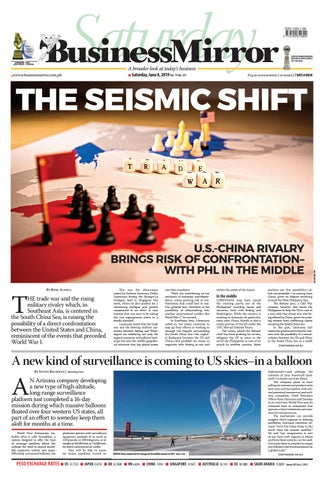
U.S.-CHINA RIVALRY BRINGS RISK OF CONFRONTATION– WITH PHL IN THE MIDDLE
T
By Rene Acosta
HE trade war and the rising military rivalry which, in Southeast Asia, is centered in the South China Sea, is raising the possibility of a direct confrontation between the United States and China, reminiscent of the events that preceded World War I.
This was the observation raised by Defense Secretary Delfin Lorenzana during the Shangri-La Dialogue held in Singapore last week, where he also pushed for a continuing dialogue and greater cooperation in an effort to ease tension that was seen to be taking the two superpowers closer to a deadly standoff. Lorenzana noted that the trade war and the brewing military animosity between Beijing and Washington are redefining not only the region’s economic and political landscape but also the world’s geopolitical structure that has placed states
into their crosshairs. “With the untethering of our networks of economic interdependence, comes growing risk of confrontation that could lead to war. Our greatest fear, therefore, is the possibility of sleepwalking into another international conflict like World War I,” he warned. In Southeast Asia, Lorenzana called on the Asean countries to step up their efforts in working to manage the dispute surrounding the South China Sea—the regional flashpoint between the US and China—but prodded the states to negotiate with Beijing as one and
within the ambit of the Asean.
In the middle
LORENZANA may have issued the warning partly out of the Philippines’ standing issues and concerns, both with Beijing and Washington. While the country is working to maintain its good relations with China, Manila is also a treaty partner of the US under the 1951 Mutual Defense Treaty. The treaty, which the defense chief has been pushing for review, obligates the US to come to the aid of the Philippines in case of an attack by another country. Some
analysts see this possibility—albeit not probable—as coming from China, given its dispute revolving around the West Philippine Sea. The defense pact, a Cold War creation, however, also forces the Philippines to help the US in case of a war, with that threat now also being offered by China, given the existing tension from conflicting claims involving the South China Sea. In the past, Lorenzana had raised the government’s fearful concern over the possibility of a miscalculation between the US and China in the South China Sea as a result Continued on A2
A new kind of surveillance is coming to US skies–in a balloon
A
By Justin Bachman |
Bloomberg News
N Arizona company developing a new type of high-altitude, long-range surveillance platform just completed a 16-day mission during which massive balloons floated over four western US states, all part of an effort to someday keep them aloft for months at a time. World View Enterprises Inc. builds what it calls Stratollites, a system designed to offer the type of coverage satellites afford but without the need to launch incredibly expensive rockets into space. Effectively unmanned balloons, the
platforms operate with surveillance equipment payloads of as much as 220 pounds, or 100 kilograms, at altitudes of 50,000 feet to 75,000 feet, far above commercial air traffic. They will be able to monitor mines, pipelines, transit in-
PESO EXCHANGE RATES n US 51.7720
WORLD View conducted its inaugural Stratollite launch in 2017. WORLD VIEW
frastructure—and perhaps the contents of your fenced-off backyard—in hyper-accurate detail. The company plans to start selling its commercial product early next year and has spoken with several potential commercial and military customers, Chief Executive Officer Ryan Hartman said Tuesday in an interview. World View sees its customer base as companies that operate critical industrial and commercial infrastructure. The mechanism can provide imagery that’s superior to orbiting platforms, Hartman contends, because “we’re five times closer to the earth than the nearest satellite.” He said “our imagination is sort of our limit with regards to where and how these systems can be used. Certainly there is a market in target surveillance and reconnaissance on a global scale.” Continued on A2
n JAPAN 0.4776 n UK 65.7608 n HK 6.6034 n CHINA 7.4934 n SINGAPORE 37.9672 n AUSTRALIA 36.1161 n EU 58.3885 n SAUDI ARABIA 13.8059
Source: BSP (June 7, 2019 )
DREAMTIME.COM
THE SEISMIC SHIFT
News
BusinessMirror
A2 Saturday, June 8, 2019
www.businessmirror.com.ph
The seismic shift: US-China rivalry brings risk of confrontation frontation with the US, something that it still wanted to avoid, perhaps believing it would be a disaster for both countries. Wei Fenghe, the Chinese defense minister, criticized the US patrols, which have also been joined on separate occasions, or taken individually by the United Kingdom, France, Australia and Japan, in the waters it considered as forming part of China’s “sovereign rights.” China has declared as “indisputable” its ownership of a large portion of the South China Sea, including those that have been claimed or occupied by the Philippines, Malaysia, Taiwan, Brunei and Vietnam. Its ownership claims also prompted it to intrude into the waters of Indonesia. Recently, National Security Adviser Hemogenes Esperon Jr. said the Armed Forces of the Philippines is not afraid to go to war with China over the West Philippine Sea, but stressed that armed confrontation should be the last option for both countries.
Continued from a1
of Washington’s regular conduct of freedom-of-navigation patrols in the disputed waters and a warning from Beijing for such activities to stay away from its man-made islands. If that happens, the Philippines could be dragged into the war—willing or otherwise. Lorenzana, however, maintained that the South China Sea should be opened to sea and air travels, a position shared by all other states. On its own, the Philippines is also facing Beijing over the dispute. China’s continued aggressive stance against the country in the West Philippine Sea has recently prompted President Duterte to warn he would send soldiers on a suicide mission against China at Pagasa Island, the largest in the Kalayaan island group that is a municipality of Palawan province. The President’s statement was prompted by the stationary—but overwhelming—presence of Chinese militia disguised as fishermen in boats near and surrounding the island. SKYPIXEL/DREAMTIME.COM
Defending South China Sea
AT the recent Singapore dialogue, China repeated its willingness and readiness to defend its interests over the South China Sea, even if such could set it on a direct con-
Governing conduct
NOTING that the rivalry revolving around the issue of the South China Sea has become the center of the global landscape, Lorenzana sought to temper it by pushing for the adoption of a binding Asean
Code of Conduct with China. “In the South China Sea, where the Philippines is a claimant state, we espouse a dialogue-based, peaceful and multilateral approach, which takes the interest of all relevant players into consideration in accordance with international law and regional norms and principles,” he said. “We are witnessing a seismic geopolitical shift that is changing the very fabric of international relations in the 21st century. And with change, especially of this magnitude and with such speed, come new challenges and, consequently, responsibilities,” Lorenzana pointed out. The defense chief added that countries must push and adhere to international cooperation and inclusivity in order “to effectively manage and reduce tensions in the Indo-Pacific.” Lorenzana viewed the possibility of a regional conflict as a “dangerous distraction from the coming storm,” which he summed up as the vulnerability of many countries to the “socially destabilizing” consequences of climate change and the “Fourth Industrial Revolution.” “Let’s be clear: each and every nation has a shared and unquestionable responsibility in preserving peace and prosperity in the Indo-Pacific,” he declared.
A new kind of surveillance is coming to US skies–in a balloon Continued from a1
“There’s a very real potential here that these kinds of systems will lead to a pervasive aerial surveillance.” Given that satellites have the capacity to read license plates, World View’s product may have implications for privacy and civil liberties. Asked if the company would sell access to police departments,
Andrew Antonio, director of business development for World View, said “flying a Stratollite is no different” than how “domestic law enforcement agencies leverage aerial technologies like helicopters and aircraft.” Jay Stanley, a senior policy analyst with the American Civil Liberties Union, isn’t so sure. “Everything depends on how expansive it is and how high resolu-
tion it is and how wide of an area it can surveil,” Stanley said of World View’s Stratollite. “There’s a very real potential here that these kinds of systems will lead to a pervasive aerial surveillance of cities where our every move will be tracked.” He pointed to a sweeping 2012 ruling by the US Supreme Court that limited police power to track people using GPS devices. The reasoning used by some of the justices in that
THE inaugural Stratollite launch in 2017. WORLD VIEW
unanimous ruling could easily be expanded to other types of surveillance technology, Stanley said. Jeramie Scott, senior counsel for the Electronic Privacy Information Center’s Domestic Surveillance Project, said that while highaltitude surveillance balloons may have beneficial uses, “they will also pose a serious threat to our privacy and civil liberties. “The balloons will likely drive down the cost of surveillance, making persistent aerial surveillance of all our public movements a real possibility,” Scott said. “Traditionally, our privacy in public has been protected by the limitations
of technology and the exorbitant costs of tracking everyone’s public movements, but surveillance balloons potentially remove these barriers.” World View’s own test showed that the ability for surveillance technology to linger overhead for long periods of time, covering a wide swath of America, is indeed in reach. The company’s 16-day test flight started near the company’s Tucson headquarters and spanned more than 3,000 miles over Nevada, Utah and southern Oregon, ending Monday in the Nevada desert. The company said it plans to extend its next test flight to 30
days, and then 60 days. Several satellite firms do offer similar data to a range of clients, from agriculture to meteorologists to hedge funds. Meanwhile, Alphabet Inc.’s Project Loon also uses balloons in the stratosphere, designed to provide Internet and communications services. The company said it’s worked with AT&T Inc. and T-Mobile US Inc. to provide infrastructure to Puerto Rico following its devastation by a hurricane. As for World View, the company said it expects to station its systems at multiple locations worldwide, offering customers quick access to flight launches and data.
News BusinessMirror
www.businessmirror.com.ph
Saturday, June 8, 2019
A3
China has lots of policy room if trade war worsens, says PBOC chief Yi Gang
C
HINA has “tremendous” room to adjust monetary policy if the trade war with the US deepens, People’s Bank of China (PBOC) Governor Yi Gang said. “We have plenty of room in interest rates, we have plenty of room in required reserve ratio rate, and also for the fiscal, monetary-policy toolkit, I think the room for adjustment is tremendous,” said Yi in an exclusive interview in Beijing. Asked if his scheduled bilateral
meeting with US Treasury Secretary Steven Mnuchin on the sidelines of the Group of 20 gathering of finance ministers and central bank governors in Japan over the weekend would get negotiations with the US back on track, Yi said it would probably be a “productive talk, as always,” though the topic of the trade war would be “uncertain and difficult.” That meeting takes place as the two nations escalate their
trade war amid a darkening outlook for the global economy, with Citigroup Inc. and Morgan Stanley warning this week that it risks tipping the world into recession. The first publicly announced meeting since the trade talks fell apart last month could pave the way for a meeting between Presidents Donald J. Trump and Xi Jinping, who w i l l l i ke ly b e i n Japa n at t he e nd of t he mont h for t he G -20 le aders’ su m m it .
Mnuchin, along with US Trade Rep. Robert Lighthizer, has led the US-China talks while Yi has been a member of China’s delegations. The offshore yuan erased gains to weaken 0.1 percent to 6.9343 per dollar as of 11:02 a.m. in Hong Kong. The yuan has stabilized in recent weeks as authorities voiced support for the currency, following a rapid sell-off that pushed it near 7 per dollar—a level not breached since
the global financial crisis. It still lost about 2.5 percent in May, among the worst in Asia. “Recently, it’s a little bit weaker, because the tremendous pressure from the US side,” Yi said. Asked if there’s a red line for the exchange rate, Yi said no “numerical number” is more important than another. “The trade war would have a temporary depreciation pressure on renminbi, but you see, after the noise, renminbi will continue to be very
stable and relatively strong compared to emerging market currencies, even compared to convertible currencies,” Yi said, using the yuan’s official name. “I’m very confident renminbi will continue to be stable at a more or less equilibrium level.” “A little bit of flexibility of RMB is good for the Chinese economy and for the global economy because it provides an automatic stabilizer for the economy,” he said. Bloomberg News
DIOKNO: MAY 2019 INFLATION UPTICK WILL NOT DERAIL POLICY DIRECTION
T
By Bianca Cuaresma
HE surprise uptick in the countr y ’s inflation rate in May will not derail the Bangko Sentral ng Pilipinas’s (BSP) monetary-policy course in the policy horizon, its chief told reporters on Friday, as the data point is not seen as a “major departure” from the general downward trend. Speaking at the B usiness M irror ’s Coffee Club Forum in Makati City, Central Bank Governor Benjamin Diokno said the rise in the country’s price growth in May is a “one-off ” and gave the assurance that their models still point to a deceleration in the overall inflation print toward the end of this year. Just this week, the Philippine Statistics Authority (PSA) repor ted that the countr y’s inflation hit 3.2-percent print in May—an uptick from the 3 percent in the previous month but lower than the 4.6 percent in the previous year. The data, which was r e l e a s e d o n We d n e s d a y, s h o w e d t h a t
inflation snapped its six-month declining trend in May. The country’s inflation started to decline in November 2018 after hitting its peak of 6.7 percent in September and October last year. The decline was a result of concerted efforts from economic managers to put in place monetary and nonmonetary policy levers to bring down the growth of prices. The BSP, for its part, made rate hikes to the tune of 175 basis points in 2018—one of their most aggressive cycles to date—to curb inflationary pressures. A few months after, the BSP started to shift its direction toward easing—with its latest move being a cut in its main rate by 25 basis points. Asked about the surprise inflation uptick’s effect on the BSP’s future monetary-policy direction, Diokno said: “It has no effect because it’s really a part of the trend. It is not a major departure from the trend. We are optimistic that inflation will be 2 or below 2 percent by the third quarter.”
He added, “Overall, I think inflation will be right there: at 2 to 4 percent by the end of the year.”
Election knee jerk
NATIONAL Statistician Claire Dennis S. Mapa said the main factors for the increase in inflation in May were higher food and nonalcoholic beverages, which increased to 3.4 percent, and housing, water, electricity, gas and other fuels which rose to 3.3 percent. “I am not worried because my own theory, aside from what was discussed by Dennis Mapa, our new statistician, is that May was the election month. There was a lot of money floating around,” Diokno said. “I am not worried. This is one-off. In fact, if you look at the data we are expecting inflation to be around 2 percent or even less by the third quarter because of the base effects,” he added. It was in the third quarter of 2018 when inflation hit its peak of 6.7 percent before consistently going down to the 3-percent levels
as seen in recent months. In the May 9 monetary-policy meeting— where the BSP cut its main policy rates by 25 basis points—the Central Bank reduced its inflation forecast to 2.9 percent from the earlier 3-percent forecast about two months ago. The reduction in the inflation forecast was based on the lower actual monthly inflation in the first four months of 2019, the lower growth for the year, lower cash-supply growth, as well as the lower global growth for the year. For next year, however, the inflation projection was scaled upward to 3.1 percent from the earlier 3-percent forecast—which the BSP attributed to increases in global oil prices and adjustments in jeepney fares. The governor, however, seemed to open the door to yet another tweak in that inflation forecast, because he pointed to a sustained deceleration in global oil prices. The next monetary policy of the BSP is scheduled on June 20. This will be the BSP’s fourth monetary-policy meeting of the year.
BSP Governor Benjamin E. Diokno stresses a point at the BM Coffee Club forum on Friday at the BusinessMirror’s Makati offices. He fielded questions on a wide range of economic and monetary issues from BusinessMirror, DWIZ, Philippines Graphic magazine, Pilipino Mirror and CNN Philippines. BERNARD TESTA
Sports BusinessMirror
Editor: Jun Lomibao • mirror_sports@yahoo.com.ph
Saturday, June 8, 2019 A5
DJOKOVIC
LOWRY
RED DIWA is in harness.
GUIDO VAN DER VALK finds himself within striking of his rivals. NONIE REYES
ExportUnlimited
A4 Saturday, June 8, 2019 • Editor: Efleda P. Campos
BusinessMirror
Chinese market reveals old, new 34 govt agencies to sign deal preferences in children’s toys for ease of doing business in PHL T
REPRESENTATIVES from 34 government agencies gather to finalize a memorandum of agreement (MOA) aimed at further improving the ease of doing business in the country and attract more investments by immediately acting and resolving issues encountered by investors.
T
HE Philippine Board of Investments (BOI), the country’s primary industry development and investments promotion agency (IPA), together with the 33 other members of the Investments Promotion Unit Network (IPUNet), has finalized the contents of a memorandum of agreement (MOA) seen to further improve the ease of doing business in the country and attract more investments by immediately acting and resolving issues encountered by investors.
At the IPUNet meeting conducted at the Great Eastern Hotel in Quezon City on May 24, 2019, 34 memberagencies committed to further collaborate and set the date of the MOA signing on July 10, 2019, with the heads of all the participating agencies expected to be on board for the ceremony. The BOI, which serves as the IPUNet secretariat, through its Investment Assistance Service, presided over the review of the MOA and gathered the inputs and feedback of the participating government agencies. It was determined that the AntiRed Tape Authority (Arta), as one of the new members of the network, will facilitate the issues not acted by concerned government agencies, as referred by the BOI-IAS. “We have gained so much ground
in our efforts to streamline our processes and procedures with the active participation of all stakeholders. As we finalized this, we look forward to the eventual signing of the MOA,” BOI-IAS Director Bobby G. Fondevilla said. The signing of the MOA is in accordance with Republic Act 11032 otherwise known as the “Ease of Doing Business and Efficient Delivery of Government Services Act” and Republic Act 6713,“An Act Establishing a Code of Conduct and Ethical Standards for Public Officials and Employees, to Uphold the TimeHonored Principle of Public Office Being a Public Trust, Granting Incentives and Rewards for Exemplary Service, Enumerating Prohibited Acts and Transactions, and Providing Penalties for Violations Thereof and for Other Purposes.”
OY traders looking to penetrate the mainland Chinese market need to understand which sorts of toys are now gaining popularity among children and their parents. In a new survey, HKTDC Research found that traditional toys remain the most preferred toys overall in China. However other kinds of toys are also catching attention, propelled mainly by an emphasis on building children’s abilities and intelligence, such as the riseof “STEM” toys and new tech toys. A number of STEM toys have been launched in recent years as China vigorously promotes STEM education, an educational approach that integrates the different subjects of Science, Technology, Engineering and Mathematics. STEM toys require the child to assemble the parts or even do the programming themselves, which parents think can enhance the child’s ability. A physics toy kit with different sets of components is also looked on favorably, allowing the child to explore while following the instructions. Also gaining ground are new-tech toys as manufacturers begin to incorporate new technologies into toys. The most popular are AI smart toys and virtual reality or VR toys. Mainland parents are happy to spend on new-tech toys because these toys integrate learning and recreation and can enhance children’s knowledge, said the HKTDC report. At the same time, while demand for elec-
PHL to improve trade with Indonesia
DTI pitches PHL to Sokor investors, potential of e-vehicle industry
S
EOUL—Trade Secretary Ramon M. Lopez highlighted the strong macroeconomic fundamentals, as well as the continuing growth story of the Philippines to South Korean business executives during a high-level roundtable meeting on June 4, 2019. The trade chief emphasized the opportunities South Korean companies, particularly in the manufacturing industry, may explore when locating and expanding their operations in the country. Lopez underscored the wider market access for companies in the country through the preferential trade agreements the Philippines has with the United States (GSP), European Union (GSP+), as well as with the European Free Trade Association (Efta). “The Philippines is an ideal geographic base for South Korean
manufacturing companies, specifically those focusing on automotive and auto parts, electronics and semiconductors, food processing, agribusiness, and other labor-intensive industries. South Korea is a manufacturing powerhouse and expanding the business operations in the Philippines is a win-win, with businesses having greater market access for their products and being our partners,” Lopez told over 30 South Korean business executives from construction and infrastructure, tool and die, as well as energy industries. Likewise, the trade chief discussed possible opportunities in the Philippines’s e-vehicle (EV) industry. He cited the tariff modification of EV products under the AseN Free Trade Agreement as well the consideration of a target date full EV utilization/ registration in the Philippines.
The International Electric Vehicle Association and other companies in the e-vehicle industry in South Korea, such as Hyundai Motor, POSCO E and C, and Phillips Group are encouraging the Philippines to provide additional support to attract more investors in the e-vehicle and parts industry, aside from the usual fiscal incentives. Tax incentives are not enough in developing an industry of the future. The association suggested to provide tax holidays and monetary support per unit produced, as well as government cost sharing in charging/battery replacement stations, the same package that are now being provided by the governments in South Korea and other Asean member-states. Accordingly, these countries have local programs to strengthen the industry to encourage the shift to e-vehicle,
such as free registration and free parking for e-vehicles. “This would have to be a special progam similar to our CARS program, so it can quickly attract investors in the industry,” Lopez said. Together with Department of Trade and Industry Undersecretary Ceferino S. Rodolfo, Lopez addressed the issues and clarified the concerns raised by existing locators on the Tax Reform for Attracting Better and Higher-Quality Opportunities (Trabaho) Bill, which rationalizes tax incentives to investments. “The Trabaho Bill will offer modern and more relevant incentives,” Rodolfo said. The trade chief also assured investors that there will be a good transition period of the new tax system and there’s no reason for them to delay their expansion projects in the country.
tronic toys is waning, spin-offs of electronic games such as physical toys are still popular and reportedly have a huge potential in the Chinese market. Meanwhile, among traditional toys, toy blocks are the most played with and regarded by many parents as a “must-have” toy. This is followed by dolls and jigsaw puzzles. Boys of all ages display a marked preference for electronic/electric toys, said the report. Younger children also tend to like musical instrument toys, dolls, and jigsaw puzzles while older ones prefer model toys, toy blocks, science experiment toy kits and so on. As they grow older, boys show a stronger preference for toys which allow for hands-on exploration, favoring science experiment toy kits and various electronic games. Newtech toys have a greater appeal to older boys, followed by electronic/electric toys. Dolls are the most popular toy for little girls. The survey indicated that girls across all age groups like make-believe toys, traditional inspirational toys, and do-it-yourself or DIY toys. New-tech toys that feature various functions such as artificial intelligence (AI) are also attractive, regarded as novelties that make good company for children. Meanwhile, the popularity of mobile games is on the wane following the mainland government’s repeated advice to parents against over exposing their children to electronic games.
By Mary Fatima N. Barrameda
Trade-Industry Development Specialist Market Innovation Division, DTI-EMB
EXPORT READY!
I
NDONESIA is the largest economy in Southeast Asia and one of the emerging market economies of the world. With a population of 260 million, Indonesia is the fourth largest country in terms of population size. The country’s gross domestic product (GDP) expanded 5.17 percent in 2018, up from a growth rate of 5.07 percent in the preceding year. In 2018 Indonesia was the ninth trading partner of the Philippines, 14th as export market and sixth as import supplier. Total bilateral trade was valued at $7.81 billion. E xports to Indonesia increased by 21.79 percent,
from $724.21 million in 2017 to $881.99 million in 2018. The top 10 Philippine exports to Indonesia accounted for 52.53 percent of the total exports that include semiconductor devices, cathodes and sections of cathodes of refined copper, input or output units, tobacco, and polypropylene. Imports also increased by 9.05 percent, from $6.35 billion in 2017 to $6.93 billion in 2018. The top 10 Philippine imports from Indonesia comprised 61.38 percent of the total imports that include other coal, motorcycles, coffee-extract preparations and bituminous coal. This resulted in the Philippines’s having a trade deficit of $5.53 billion with Indonesia. To help address the widening trade deficit between the Philippines and Indonesia, the Indonesian government agreed to ease restrictions on the Philippines’s agricultural exports during the bilateral meeting in April 2019. The Government of Indonesia decided not to extend the imposition of dumping duty on Cavendish bananas originating from the Philippines and recognized the Davao region, Northern Mindanao, and Soccsksargen as pest-free areas for banana production. Both parties also agreed to form a Technical Working Group to continue to discuss other issues including nontariff measures affecting the two countries. They also agreed to conduct business missions alternately between Manila and Jakarta. As Indonesia is a party to the Asean Free Trade Agreement, Philippine exporters can avail themselves of zero tariffs on most products when exporting to Indonesia.
A6
BusinessMi
Saturday, June 8, 2019 | Editor: Jun Lomibao
W
Nibali, Roglic, Carapaz climb world ranking
T
HE International Cycling Union’s (UCI) World Ranking has seen something of a shake-up, thanks to the Giro d’Italia, with Richard Carapaz (Movistar), Primoz Roglic (Jumbo-Visma) and Vincenzo Nibali (BahrainMerida) all climbing the overall standings. Julian Alaphilippe remains in control of the individual standings thanks to his superb start to the season. Despite not winning a stage of the Giro d’Italia, Alaphilippe’s Deceuninck-Quick-Step is still well clear of the chasing pack in the teams classification, while France continues to lead Belgium in the nations rankings. Alaphilippe’s lead in the individual standings has been cut down to just 50 points, with Roglic climbing three places to second after a stint in the Maglia Rosa and finishing third place overall at the Giro d’Italia. Roglic has raced 41 days this season, solely at WorldTour level, with the UAE Tour, Tirreno-Adriatico and the Tour de Romandie—all of which he won—providing his preparation for the Giro d’Italia. His Giro result has bumped his Jumbo-Visma team up two placed to third, behind Deceuninck-Quick-Step and Bora-Hansgrohe. The overall Giro winner, Carapaz, enjoyed a surge up the rankings too, climbing a total of 35 spots to move just inside the top 30. The Ecuadorian also gained some points from his victory at the Vuelta a Asturias just before the Giro and his top 10 placings at the Vuelta a San Juan and Tour Colombia 2.1 at the start of the season. Movistar also moved up three positions to jump Mitchelton-Scott and Team Sunweb and take up seventh place in the teams standings. Nibali, runner-up at the Giro, jumped up a whopping 44 places to put himself 23rd in the standings. Unlike Roglic, Nibali had a much slower buildup to the first Grand Tour of the season, with just a select few visits to the top 10 prior to the start in Bologna. Despite his efforts, Bahrain-Merida slid down two places in the teams classification. Another climber in the standings is maglia ciclamino winner Pascal Ackermann, who moved from 19th to eighth. As well as winning the Giro’s points classification, the German took home two stage wins. Perhaps the biggest loser in the post-Giro shuffle was Tom Dumoulin (Sunweb) after he abandoned in the opening week. The World Ranking works on a 52-week system and Dumoulin had been sitting in second place behind Alaphilippe due to his podium finishes at the Giro and Tour de France last season. Following his abandon, Dumoulin dropped out of the top 10 and now sits in 12th place. Simon Yates suffered a similar, if slightly less drastic, fate. Last season, Yates earned plenty of points for his time in the Maglia Rosa, but struggled to match his early performance from 12 months ago and has moved down to 14th place. In the nations ranking, France continues to dominate thanks to Alaphilippe, Thibaut Pinot and Romain Bardet. Arnaud Demare’s stage win at the Giro added a few points to the pot. Behind France, Belgium and the Netherlands remain in second and third respectively. Italy, Spain and Germany all moved up a spot while Great Britain dropped down three. Britain had enjoyed the benefit of Chris Froome’s haul from last year’s Giro d’Italia victory and Yates’s early performances. Yates’s eighth and Hugh Carthy’s 11th overall meant the drop was not too far.
Cyclingnews
RICHARD CARAPAZ, in becoming the first Ecuadorian to win a Grand Tour, has instantly become one of Ecuador’s all-time sporting greats. AP
Giro d’Italia victory gives Carapaz ‘sporting immortality’ in Ecuador
E
CUADOR hardly has a rich cycling heritage, but a glance at the newspapers on Monday left little doubt as to the extent to which Richard Carapaz’s Giro d’Italia victory has captured the imagination of a nation. The “Locomotive of Carchi,” to borrow the nickname that has caught on over the past three weeks, dominated pretty much every front page. “Historic,” cried El Universo, beneath the letters CARAPAZ, printed in pink upon a full-page photo of the champion with the trofeo senza fine in the Verona Arena. Indeed, the consensus was that Carapaz, in becoming the first Ecuadorian to win a Grand Tour and the second South American—after Colombian Nairo Quintana—to win the Giro, had instantly become one of the country’s all-time sporting greats. “Richard Carapaz is already an immortal figure in Ecuadorian sport,” wrote Ricardo Vasconcellos Figueroa in El Universo. “At the 2019 Giro d’Italia, the rider from Carchi attained the sort of legend status that is only reached through unprecedented success, through world class achievement, through memorable acts that give you goosebumps and fill you with pride, through exploits that shake a nation and absolutely grip its people to a competition that consecrates a champion forever. That’s how Carapaz reached sporting immortality. “June 2 is an indelible date in the history of Ecuadorian sport, and from now is the national day of cycling. It’s the date that Richard Carapaz became, through a superhuman performance, one of the country’s greatest sporting figures.” Most newspapers in Ecuador drew comparisons with the country’s sporting icons, such as the runner Jefferson Perez, tennis players Pancho Segura Cano and Andres Gomez, and footballer Alberto Spencer. Most also ran quotes from President Lenin Moreno, who said: “There are 17 million hearts that have been cheered by Richard Carapaz, who has shown us we can do great things.” Daily newspaper El Comercio painted a picture of the scenes on the final Sunday, as big screens were erected across the
country and monuments were lit up pink. The Giro had only been available on ESPN South America, but the Ecuadorian government negotiated an agreement with the commercial network and the final two stages were broadcast live on free-to-air television. The time zone difference meant an early start, but squares and parks were already heaving by 6 a.m., nowhere more so than in Carapaz’s home province of Carchi. Government officials and sporting stars turned out at the Anthropological Museum of Contemporary Art in Guayaquil, while at the Olympic Stadium in Atahualpa, some 5,000 fans gathered to cheer their man on. “When the moment came for Carapaz to start his time trial, the music stopped and the commentary was turned up,” read El Comercio’s article. “When he reached the line, applause broke out and flags were unfurled.” It’s clear that Carapaz’s exploits captured the imagination of a nation where cycling is ordinarily far from the forefront of the collective conscience. The rider’s own journey, which passed through Colombia over the border, has been used to highlight the lack of infrastructure for prospective professional cyclists and indeed sportspeople in general. Writing in El Telegrafo, former cycling-cross rider Sebastian Palacios issued something of a call to arms. “Some say sport changes lives. I believe that sport can change an entire country,” he wrote. “For that, Richard’s triumph, as well as filling us with happiness and pride, must make us reflect on those athletes who have the ability but not the means— those that need dedicated structures to help them train, to provide them with the resources to enable them to fulfil their potential. Fewer words and more actions. Let’s hope that, with Richard’s victory, the government treats sport as a priority and that the President understands the benefits of investing in sport, which keeps us healthy, keeps us away from drugs and other vices, and cultivates values like discipline and perseverance.” It seems the government is already on the same page. President Moreno has just announced that taxes on bicycle imports will be removed, and that the state will go further in supporting its athletes. For now, though, Ecuadorians are simply still basking in the euphoria of national glory on the world stage. Carapaz’s homecoming should be some party, but in the meantime, El Universo delivered a message to him from the people. “The country, which rose early for three weeks to see him in action and buzzed with the pride of being Ecuadorian, says with great emotion, at full voice and with a tear in the eye: ‘Brilliant, Carapaz! Wonderful, Richard! Eternal thanks, the Locomotive of Carchi!’” Cyclingnews
HAT do BMX, cotton candy, penny farthing, bike polo and Buffalo Bikes have in common? They were part of an action-packed program of activities experienced by several hundred schoolchildren from Aigle on the second edition of World Bicycle Day. Local students participated in an interactive circuit of bicycle games, skill testing challenges, entertaining bicycle prototypes—including a cotton candy-producing bicycle— and education about the impact of bicycles in Africa. Organizations including World Bicycle Relief, Pro Vélo Suisse, the Tour des Stations and local bicycle artist Gerry Oulevay were on site to support the delivery of these activities, which were then offered to the public all evening long. In addition, several representatives from organizations based in Switzerland had the opportunity to discover the discipline of track cycling, benefiting from the expert advice of Swiss Olympian and International Cycling Union’s (UCI)staff member Gaël Suter. Members of the public also took part in initiatives which started earlier in the day, including a lunch ride with UCI staff and a used bicycle collection drive for Swiss NGO Vélafrica, through which almost 20 bikes were collected and will be refurbished and sent to rural communities in Africa. Finally, the UCI’s Ride for World Bicycle Day Challenge on Strava surpassed expectations, as cyclists from all around the world who joined the UCI Cycling Club totalled an impressive 103,019 km on the day, raising enough money to send 50 Buffalo bikes to Africa on behalf of World Bicycle Relief. “World Bicycle Relief was thrilled to partner with UCI on World Bicycle Day, to celebrate the Power of Bicycles not just in sports and recreation, but also as an engine of sustainable development for people at the bottom of the economic pyramid,” World Bicycle Relief’s CEO Dave Neiswander said. “World Bicycle Relief helped students reflect on what their daily life looks like compared to Scholastica’s, a 17 year old student in rural Kenya—to highlight the direct impact bicycles have in providing access to education and to help students save valuable time,” Neiswander added.
WORLD BICYLE DAY: A SHORT HISTORY
ON April 12, 2018, the UN General Assembly declared June 3 World Bicycle Day, adopting a resolution introduced by Turkmenistan and cosponsored by 56 member countries. In formalizing this day of recognition, the UN acknowledged “the uniqueness, longevity and versatility of the bicycle, which has been in use for two centuries, and that it is a simple, affordable, reliable, clean and environmentally fit sustainable means of transportation, fostering environmental stewardship and health.” To mark the second edition of this historical milestone, the UCI has joined with the Embassy of Turkmenistan in Switzerland to host the interactive celebrations at the UCI WCC.
ACTIVITIES FOR EVERYONE
THE UCI hosted several hundred children from schools in Aigle who took part in a series of fun cycling activities, including—but in no way limited to—BMX initiations, slow races, and bike polo games. Later in the day, adults will have the chance to complete the same cycling discovery circuit, and learn about different types of bicycles, cargo bikes and original bike prototypes. Around midday, members of the public were invited to join UCI staff members for a bike ride to Torgon, the ski resort that recently hosted the finish of the Queen Stage of the 2019 Tour de Romandie. The public also had the chance to witness the skills and speed of the UCI WCC’s talented track and BMX athletes, who have come from all over the world to train at the UCI WCC. More than a few of them aim to compete at the Tokyo 2020 Olympic Games. Following the afternoon of activities, an evening ceremony in the velodrome was attended by local and state authorities, international sporting organizations and UN agencies.
WO BIC JOINING WITH CHARITIES TO CELEBRATE THE BIKE
TO further promote the long-lasting impact of the bicycle worldwide, and in particular Africa, the UCI collaborated with two charities for World Bicycle Day: Velafrica and World Bicycle Relief. The UCI organized a used bicycle collection drive on behalf of the Swiss organization Velafrica—members of the public awerere invited to bring bikes in any condition to the UCI World Cycling Centre, which will then be restored, in collaboration with Swiss social institutions, and transported to Africa. Meanwhile, representatives from World Bicycle Relief engaged with schoolchildren and members of the public to share the positive impact the Buffalo Bike has had in numerous rural communities in Africa.
WORLD ENVIRONMENT DAY
NINE out of 10 people breathe dirty air—responsible for over 7 million premature deaths a year—according to the World Health Organization (WHO). The theme of this year’s United Nations World Environment Day was #BeatAirPollution. Cycling was high on the agenda as one solution to help combat this environmental and public health emergency. Changing how we move people and goods toward nonpolluting modes of transport is essential if we wish to breathe easier and stay healthier. The transport sector’s reliance on fossil fuels— particularly diesel—remains a major source of air pollution. According to the UN:
irror CYCLING
mirror_sports@yahoo.com.ph | Saturday, June 8, 2019
ORLD
IS DISC BRAKE TO BLAME? C
YCLE DAY! n Transport emissions were linked to nearly 400,000 premature deaths in EU countries in 2014. n Almost half of all deaths linked to air pollution from transport are caused by diesel emissions. n Those living closest to major traffic arteries are up to 12 percent more likely to be diagnosed with dementia. n On top of this, transport is responsible for a quarter of global CO2 emissions—a number that is rising. Switching to cycling, walking and public transport is one of the best changes an individual can make to reduce local air pollution and congestion. In cities in particular, where trips tend to be shorter, it is easier to take up cycling as a daily mode of transport that generates zero air pollution. Further, switching to cycling could actually reduce an individual’s exposure to toxic air on busy roads. A 2018 UK study found that cyclists suffered the least exposure to air pollution during a 4-km journey, compared to people in cars, buses and even walkers The emergence and rise of the e-cargo bike also holds great potential for reducing air pollution. These types of bicycles are used more and more for delivering goods— thereby taking diesel-powered delivery vehicles off the road. Major players in the courier and delivery market have
launched e-bike/e-cargo bike delivery programs, and a 2018 Dutch study found that 20 percent of all delivery vans in cities could be replaced by e-cargo bikes.
SIMPLE TW0-WHEELED SOLUTION
CHINA is this year’s host of the global World Environment Day celebrations, and events are taking place across Chinese cities to raise awareness on air pollution and encourage action by individuals, companies and politicians. The country has made great strides in tackling air pollution—in no small part by promoting cycling. Hangzhou, a major Chinese city with a population close to 10 million, will host the main event in the country. It was the first Chinese city to introduce a public bike-share scheme in 2008, and by 2017 there were ten bike-sharing companies operating in the city, providing over 882,000 bikes. The city has constructed good quality bike lanes, and the public bike-share scheme is well integrated with other public transport options. Since 2008, it is estimated that hundreds of millions of bike trips have taken place in Hangzhou—discouraging the use of polluting vehicles and curbing air pollution for the benefit of people and the environment. UCI News
A7
LOCAL students participate in an interactive circuit of bicycle games, skill-testing challengesentertaining bicycle prototypes—including a cotton candy producing bicycle—and education about the impact of bicycles in Africa.
HAMBERY CF rider Matteo Jorgenson said that a disc brake rotor was the cause of a deep cut that he received to his leg in a crash at the Paris-Roubaix Espoirs under-23 race in France recently. The 19-year-old—who rode for US Continental team Jelly Belly in 2018 ahead of joining French team Chambery CF for this season—collided with another rider during the race, which was won by British Team Wiggins Le Col rider Tom Pidcock. “I didn’t believe they could do this until it happened to me,” wrote Jorgensen in a tweet, accompanied by a picture of his injured leg while he waited for surgery at the hospital in Cambrai. In response to Twitter user @MR_Ciclismo, who asked whether there was proof that the injury was due to a disc brake, though he had not seen what caused it, Jorgenson said that it could not have been anything else. “When I got up, I saw [the other rider’s] rear [disc brake] rotor and my shoe completely soaked in my blood. Nothing else could have cut so clean and four centimetres deep,” Jorgenson added. The Chambery CF team—a feeder team to WorldTour outfit AG2R La Mondiale—later sent out its own tweet, showing a smiling Jorgenson following successful surgery on his leg. Jorgenson is not the first rider to suggest that a disc brake has wounded them during a crash. After the 2016 elite Paris-Roubaix, Fran Ventoso said that a disc brake had caused a large wound under his knee during a fall. The assertion was questioned by some, but the International Cycling Union chose to suspend the testing of disc brakes within the peloton and it was not reinstated until the start of the following year. USA Cycling officials, meanwhile, disqualified Redlands Bicycle Classic winner Cory Lockwood from
the Cascade Cycling Classic in Oregon last week after the Semper Porro rider was accused of intentionally causing a crash near the end of Stage 3 that took down Serghei Tvetcov (Floyd’s Pro Cycling) and Luis Villalobos (Aevolo). The incident occurred on the final climb of Stage 3, which ended with a long, grinding ascent to the Kapka Butte Sno Park outside of host city Bend. Eventual overall winner Travis McCabe (Floyd’s Pro Cycling) won the stage from a group of seven riders that finished nearly six minutes ahead of the nearest chase group. Most of the biggest teams in the race were represented in the move, including Floyd’s, Aevolo, 303 Project, Team California and Hangar 15, but noticeably absent was anyone from Semper Porro. That’s where the trouble began. With other teams unmotivated to chase their riders well up the road, and the general classification all but over except for the seven riders about to book a huge advantage, Lockwood and his teammates found little if any help on the pull to the finish. Aevolo director Mike Creed told Cyclingnews his rider claimed Lockwood twice locked up his brakes in front of other riders during the stage, angry that no one would help him work. Lockwood’s final rapid deceleration on the climb caused a pileup, taking out Villalobos, who was the first rider on his wheel, a rider from Hangar 15 and Tvetcov, who told Cyclingnews he did not see what caused the crash. “I was far back, so I didn’t really see it,” Tvetcov, a twotime winner at Cascade, said in an exchange of messages with Cyclingnews. “I think the Aevolo guy [Villalobos] was on his wheel, so I am crashed because all three guys were on the ground. “The race was gone; the breakaway was five-plus minutes up the road, so who was interested in working? Just Semper Porro, but it was too late,” Tvetcov said.
Cyclingnews
THOMAS: TOUR DE FRANCE WILL BE TOUGHER THIS YEAR G ERAINT THOMAS (Team Ineos) is confident that he’ll be competitive and ready to try to defend his Tour de France title this July following some extended post-win celebrations and a winter of media appearances. In an interview published on telegraph.co.uk, Thomas said that he’s now only about a kilogram away from his optimum racing weight of 67kg, and that his third place overall at the Tour de Romandie in early May was the confidence boost he needed to know that he was on the way back to his best, although he admitted that the competition he’ll face could be tougher than ever at this year’s Tour de France. “By the start of last November, even though I still had three weeks of doing stuff, I was itching to get back on the bike,” he said, referring to the multiple public appearances and media interviews he did in the aftermath of his win. “That’s when I knew I’d be OK. Because I didn’t want to be doing that anymore. “I was definitely coming back slowly,” Thomas admitted. “I just didn’t want to rush it and then overdo it. But yeah, I would say it’s all worked out well now. “Obviously Romandie was nice to get a little result—a boost for the confidence,” he said of his third place at the Swiss stage race, behind Primoz Roglic (Jumbo-Visma) and UAE Team Emirates’ Rui Costa. “And, yeah, I think we’re all on track now.” While Romandie was his last race, following an earlyseason program that included Strade Bianche, TirrenoAdriatico and the Itzulia Basque Country, Thomas has continued to work toward July, with his weight continuing to drop, too, after a recent training camp in Tenerife. The 33-year-old British rider told telegraph.co.uk that he was “more confident than ever” of rediscovering the form that saw him beat Tom Dumoulin (Sunweb) and his Team Sky—now Ineos—teammate Chris Froome to win the world’s biggest bike race last year. “Although whether that will be enough, we will see,” said Thomas. “Everyone’s improving. The competition is definitely tougher this year. I think there are a lot of guys who could potentially podium. “I just have to stick to the philosophy I’ve always had, which is just to do the best I can do,” he continued. “I can’t affect how Tom Dumoulin goes,
DOWNHILL GALORE Britain’s Rachel Atherton celebrates after winning the Women’s Downhill event during the recent International Cycling Union Mountain Bike World Cup at Fort William, Scotland. AP
GERAINT THOMAS says he’s almost back at his optimum weight for this July’s race.
or Yatesy [Mitchelton-Scott’s Adam Yates], or Richie Porte [Trek-Segafredo], or Jumbo-Visma with Steven Kruijswijk or Primoz Roglic,” with the latter, following his third place at the recently concluded Giro d’Italia, not yet ruled out of starting the Tour. Thomas’s path to the Tour now includes mid-June’s Tour de Suisse—while Froome will ride the Criterium du Dauphine—and an intensive training schedule to ensure that he arrives in Brussels, Belgium, for the start of La Grande Boucle on July 6 in race-ready shape. Thomas also has no regrets about celebrating his Tour de France victory long and hard into winter, finding the recent suffering he has needed to get back to form as “sadistic” but enjoyable. Thomas only raced the Deutschland Tour and the Tour of Britain after winning Tour de France, and was determined to savor every minute of the celebrations despite warnings from Team Sky to watch his weight and keep riding. Thomas was visibly heavier than his racing weight at the Saitama and Shanghai criteriums in November, and only got back into regular training in early December. He has since done blocks of training in Los Angeles, raced the Vuelta a Valenciana in Spain and spent time at altitude on Mount Teide. He has lost much of the weight he gained during the winter but is not yet competitive in races. “It was definitely worth it. You never know how often you’re going to win the Tour. It could be the last race I ever win, so at least I enjoyed it,” Thomas said before Tirreno-Adriatico, where he’ll share team leadership with Wout Poels. “I knew it was going to be really hard work, but that’s what I enjoy in a bit of a sadistic way. I enjoyed training hard and getting back. When you start to feel that condition coming and you start to lose that bit of weight and you are going up the climbs a little bit quicker, it’s just a snowball effect. You thrive off of that. I just enjoy that side of bike racing: the riding and training.” Thomas revealed that Tom Dumoulin (Team Sunweb) had teased him about how big he was in November before the Tirreno-Adriatico photo shoot on Tuesday. He avoided the scales for a while. “I was pretty big, but it’s all good now,” Thomas said, at ease with joking about his weight. “To be honest, I avoided the scales for a long time. I could just tell I was fat by looking in the mirror. It wasn’t really until Valencia, maybe, when I started looking again. I’m mid-71kg now, which is okay. I’m where I want to be.” He insisted there was no pressure from Team Sky to be on form, or from himself. The Welshman is firmly focused on being back to his best for the Tour de France in July, when he hopes to win for a rare second consecutive time. “They understand the winter I had and the off season I had, too,” Thomas said of his team. “There’s no point in rushing back too soon and then sort of tailing off. It’s just a nice steady buildup like always. It’s all good. “I had a really good block in LA, then the first race in Valencia, a bit of a rest and then a good camp in Tenerife. Now I feel like I’ve gone up to the next level, which Strade Bianche showed. Now I have this race, then Tenerife again, and then Basque and Romandie. So I think progression-wise it’s heading the right way and I’m where I want to be.” Cyclingnews
A8 Saturday, June 8, 2019 • Editor: Efleda P. Campos
OurTime BusinessMirror
SCA Batch 1969 reunion: 50 years in the making
F
By Efleda P. Campos | Senior Editor
OR the first time in 50 years, my high-school classmates and I met in our hometown in Bangar, La Union, to celebrate our golden jubilee. I have not seen some of them since we graduated from the Saint Christopher Academy (SCA) in March 1969. If I met them before the reunion, I would not have recognized them. The men and women who showed up for our get-together on May 17 and 18, 2019, were mere shadows of the young people I went to school with five decades ago. Then, we were bright-eyed teenagers, full of life, eager to make our mark into adulthood. The classmates I met have wizened, were wrinkled like me, some with their girth double—if not triple—their size as teenagers. For months before the scheduled reunion, a core group of organizers surfed the Internet and reached out to classmates via the social media and personal contact, inviting them to the reunion. Of the 70 or so members of the graduating class, 35 showed up, wearing the golden-yellow polo shirts distributed to commemorate the occasion. Some came all the way from the US, others from Metro Manila, while most lived in our hometown. There were nurses
among us, engineers, accountants, former government employees, bank employees and teachers. I was the only one who became a journalist. At least nine members of our batch have passed on to the other side, mere wisps of memories among their surviving classmates. I also was the only one who went to the University of the Philippines in Diliman. Some went to the nearby Osias Colleges in nearby Balaoan town. Some enrolled at the Saint Louis University in Baguio City and its branch in San Fernando, the capital of La Union. Others studied at the different universities and colleges in the university belt in Manila. Those who could not afford to go to college became farmers, taking over their family farms from their aging parents. Others went into business, some succeeding while others remained in buy-and-sell microenterprises. Most jubilarians gathered for Holy Mass at the parish church the morning of May 17 then proceeded for breakfast at the Papag Restaurant run by the family of a batch-
mate. The group then proceeded to the Villa Adelfa Resort in Barangay Bangaoilan where we stayed the rest of the day. We gathered to register and introduced ourselves to one another, reminiscing our school days. We moved to the rented hall, decorated golden yellow where we held a program. A prayer was offered, followed by the singing of one of our two commencement songs. One by one, each of us went to the front of the hall and in five minutes or so, narrated our life story. Some were widows and widowers; others were in successful marriages. Some remained unmarried and others raised children on their own, single mothers. Others survived abusive relationships. All proudly narrated their children’s achievements, calling their success the crowning glory of their lives. Everyone who worked had retired, all reaching 65, the mandatory age of retirement in the Philippines. Of those living in the Philippines, only the class valedictorian remained working, asked by her employer to work as a consultant. Eight were chosen to receive gifts prepared by the class valedictorian as a memento of their gathering. Weeks before the reunion, she asked three balikbayan classmates to bring back souvenirs to give to their classmates. Three kind-hearted batchmates also pooled their money and gave
the same eight chosen classmates a token of P500 each. A classmate who became a nurse in Maui, Hawaii, brought floral polos, t-shirts, monogrammed ballpens engraved with her name, and Coach coin purses, giving each attendee a present to commemorate the occasion. A set of officers was elected comprised of an overall coordinator; coordinators for Metro Manila, hometown residents and those living abroad; a secretary; a treasurer and an assistant treasurer; and committee members for programs and invitations, food, and ways and means. The group resolved to hold a yearly reunion to make up for lost time as well as mini reunions for available classmates whenever a batchmate visiting from abroad arrived. Lunch and dinner were served by Papag Restaurant. The rest of the afternoon was spent exchanging stories, lingering in the hallway, reminiscing the past. Some went home to change into festive attire in preparation for the evening party where Karaoke singing and some dancing were expected. The celebration resumed the next day with a trip to Bahay na Bato, a tourist site in neighboring Luna town, owned by the brother of a classmate. Selected classmates were prayed over. While most of us remained lifelong Catholics, some have changed religions, all still accepting the Christian God as Our Creator and Savior.
GRANDPA’S EARTHENWARE Guarded by his dog, an elderly man in Roxas, Isabela, sun-dries earthenware like flower pots and jars. Made of clay, these organic garden planting containers help farmers avoid using plastic bags. CEASAR M. PERANTE
Immigrants help to alleviate US health-care staffing shortage
T
HE health-care skills gap would be even larger without American immigrants. In 2017, immigrants accounted for 18.2 percent of health-care workers, according to a study published in Health Affairs. As the US faces a shortage of healthcare workers, immigrants have helped fill some of the gaps. Migrants, in particular, are covering key shortage positions such as rural physicians, wrote Leah Zallman, an assistant professor of Medicine at Harvard Medical School and lead author of the study. A growing elderly population and strict licensing requirements required of many health-care work-
ers has contributed to the shortage. “On the demand side, Baby Boomers are aging and their health-care needs are growing faster than the supply of qualified providers,” said Josh Wright, chief economist at iCIMS. “On the supply side, the shortfall is due in part to the difficulty in expanding capacity at educational institutions, as Baby Boomers retire out of medical education occupations.” The need for health-care workers is acute—more than 717,000 health-care practitioners and support staff were aged 65 years and over in 2018, including 164,000 registered nurses, according to Bureau of Labor Statistics data.
In March, health-care contributed 40 percent to the total nonfarm hiring deficit even though the industry makes up 16 percent of overall job openings, according to Wright’s analysis of the Job Openings and Labor Turnover Survey. The size of the elderly population is expected to double by 2050, raising concerns about the supply of long-term care workers, according to the study. Directcare workers including nursing, home health and personal care aides are primary providers for the elderly and disabled population. Immigrants made up 27.5 percent of direct-care workers in 2017. They mostly were employed
in home-health agencies and nursing homes. This cohort of health-care workers differs from their US-born counterparts in several ways. Immigrants were more likely to be employed in home health agencies and were typically more educated than the US-born citizens. However, the immigrant healthcare workers were more likely to work at lower professional levels because of lack of certification or license, the report noted. Non-Hispanic Asians were most likely to be in the health care industry compared with other races. That group made up 30.9 percent of all immigrant health-care workers. Bloomberg News
www.businessmirror.com.ph
Rediscovering Corregidor
A
VISIT to Corregidor is on the bucket list of virtually every Filipino, and while interest in the island as a tourist destination has never actually waned, there are more reasons than ever to visit today. Corregidor was the site of one of the most heroic and crucial battles in World War II between the allied US and Filipino forces against Japanese invasion forces. The battle lasted for three months, when against all odds, American and Filipino troops held back the Japanese from entering Manila Bay. Decades later, the island continues to hold special significance to all Filipinos, especially so close to our Independence Day, June 12. The years have been kind to Corregidor, once just a historical tourism destination. The island has evolved into a multi-faceted destination that combines history, ecotourism, and leisure opportunities. It is a family-friendly place that showcases meaningful heritage, heroic history, and natural beauty to visitors. Corregidor offers beautiful, refreshing beaches and sandy coves, perfect for just chilling on the sand and surf, going for refreshing swims, and bonding with family and friends. Corregidor is also a good place for hiking, biking, adventure races, team building, and other outdoor activities. For those who wish to spend the night, they can even do some ghost hunting—if they are brave enough to do so. More leisurely and special occa-
sions, of course, are also possible. Some visitors go to Corregidor to celebrate birthdays, anniversaries, and they can even hold weddings there. Corregidor is a place where visitors can virtually walk through history as they drop by and reflect at various historical spots in the island. There’s the Pacific War Memorial that has a museum and a domeshaped shrine and park. It was opened in 1968 as a tribute to the heroes of the Pacific side of World War II. Close by is The Eternal Flame of Freedom, a steel sculpture dedicated to freedom and how all human beings come together to defend it. There’s also the Japanese Garden of Peace built to honor the Japanese soldiers who fought and died in World War II. Then there’s the Filipino Heroes Memorial that represents the Filipinos’ heroic battles in their fight for freedom since the 15th century against various colonizers. Visitors should not miss historical attractions on the island like the Malinta Tunnel tour and audiovisual presentation. Thanks to the efforts of the Department of Tourism, the Tourism Promotions Board and the Corregidor Foundation, the island is experiencing a resurgence of interest and importance. Corregidor tells us that the way to peace and freedom is not simply a matter of taking up arms, but more importantly, linking hands in compassion, respect and cooperation.
Suddenly it’s D-Day again; aging veterans recall invasion
A
BOARD THE BOUDICCA IN THE ENGLISH CHANNEL— The veterans hobble along on canes and lean on walking frames now, slower and weaker than they were on D-Day, when they stormed the Normandy beaches with the fate of the free world resting on their shoulders. It’s hard to imagine them as soldiers carrying rifles across their chests and 60-pound packs on their backs—until they start talking. Then the scales of age fall way. They are all young men heading to France—a place most had never been. “The noise was deafening,” said former Royal Marine Les Budding, now 93. “The black smoke and the acrid smell of cordite, which was coming from the battleships firing the big shells. They are the outstanding things in my memory coming from that day.” Suddenly it’s D-Day again. The soft-spoken Budding is once again an 18-year-old gunner — a baby-faced, pink-cheeked cherub who smiles from a war-time photograph in a dress uniform that looks like he borrowed it from his father. Budding said he just did what Marines are supposed to do. In his case that meant offering cover to other Marines storming beaches and moving forward. Keep going. Stay alive. Budding got to Sword Beach just after the frogmen who went in early to defuse the mines and clear the way for the invasion. He still remembers their heads bobbing in the sea. “We were the first wave in at 7:25 in the morning,” Budding said. “We were spot-on time as well.” For years, Budding and other veterans thought of the landings as events that were important to them, but forgotten by the rest of the world. But the 75th anniversary of D-Day has put their exploits back into the public eye. As part of the commemorations, some 300 veterans are traveling back to France on a six-day cruise sponsored by the Royal British Legion, the UK’s largest veterans charity. They traveled to Dunkirk on Monday, remembering the evacuation of British forces after the fall of France in 1940. The veterans will be back in Portsmouth for Britain’s main D-Day ceremony on Wednes-
day before sailing to Normandy for the anniversary of the landings on June 6. The trip is meant as an act of appreciation from a grateful nation. But it takes a team effort to help the old warriors make the trip back to France to commemorate events others might want to forget. They’ve come with younger friends, children and in some cases grandchildren—a strong companion to offer an elbow, or a quickly procured chair when aging joints get tired. No one seems to be alone on this voyage. Take the team of Budding and Philip Collins, 62, son of the late FE Collins of 45 Commando, who fought alongside Budding on D-Day. Collins, you see, believes that Budding saved his father’s life that day. Budding was a gunner on a “flak 34,” a specially armed boat that defended FE Collins’s landing craft as it hit the beach. He pauses at the notion he saved the life of Collins’s father. “I suppose you could say that, yes,” Budding said. “But just one of many who helped save some of these guys.” Collins looked Budding up after his father died at the age of 59. They became fast friends. The younger man brought along photos of his father, which he displays with pride as he tells his dad’s story. His father told him about his time in France, about how the Marines dug in around a farmyard, and how the farmer gave the men eggs and bacon in the morning. The farmer told them to return at the end of the war, and FE Collins did so every year until he died. The Frenchman also gave the young soldier a cross to protect him during the fighting. Collins wears the big silver crucifix to this day. “The cross means so much,” Collins said, breaking down in tears. “He loved the commandos, he loved France. He was so proud of being a commando in France. It’s just a shame he’s not here today.” And then Budding leaned over and offered a comforting hand to the younger man, who is part of his military family. “Once a Marine,” he said, “always a Marine.” AP
BusinessMirror
Editor: Gerard S. Ramos • lifestylebusinessmirror@gmail.com
/
Saturday, June 8, 2019 A9
DELL Precision 7540 and 7740
FR. Leo Reiner of the Bamboo Organ Foundation scans the QR code at the Nuestra Señora del Pilar Parish Church in Sibonga, Cebu.
New Dell workstations deliver ‘intelligent performance’ NOW featuring the latest processors, next-gen graphics, new display options and longer battery life, Dell’s new Precision mobile workstations give customers the freedom to create wherever they are like never before. Designed for creators and innovators needing extreme performance and reliability, these powerhouse systems are fully equipped to take on the most demanding data- and graphics-intensive workloads, whether that be to help you power the next healthcare breakthrough or to edit a blockbuster movie. Users will have peace of mind that applications will run smoothly whatever the workload, as all Dell Precision workstations are Independent Software Vendor certified and also equipped with Dell Precision Optimizer software—an intelligent solution that automatically tailors the system’s settings to get the best software performance from the workstation allowing you to get intensive work done faster and smarter. The compact design of the new Dell Precision 5000 and 7000 series mobile workstations means that power seekers do not need to sacrifice style or mobility to create and crunch data on-the-go. The combination of extreme battery life, powerful processor configurations and large storage options mean that users can stay connected and deliver their mission-critical projects wherever they are, eliminating any worries about a dip in productivity when users leave their desks. Starting at 3.9 lbs, Dell’s thinnest and lightest 15-inch mobile workstation, the Dell Precision 5540, features up to Intel Xeon E or 9th Gen Intel Core 8-core processors. Professional-grade graphics are powered with up to an NVIDIA Quadro T2000 (4GB). Embodying Dell Precision 5540, a sleek design that fits a 15.6-inch InfinityEdge display into a 14-inch chassis, the Precision 5540 is thin on the outside, but up to 4TB of storage and up to 64GB of memory means you can access, transfer and store large 3D, video and multimedia files quickly and easily. Editors, designers and photographers focused on the finer details also will benefit from impressive contrast ratios, touch capability and picture quality with up to an UHD, 100 percent Adobe color gamut display or the new OLED display with 100-percent DCI-P3 color gamut. Meanwhile, its more commanding sibling, the Dell Precision 7540 mobile workstation, is Dell’s most powerful 15-inch mobile workstation and comes with a range of 15.6-inch display options, including a UHD HDR 400 display. Customers developing or analyzing detailed content will love that it supports up to 8K resolution and playback of HDR content via single Display Port 1.4. Despite its deceivingly compact form, the device packs a punch as Dell’s smallest Ready for Virtual Reality and Artificial Intelligence mobile workstation, and it features the performance you need for the most demanding workloads.
Conservation and technology PRIMETIME
DINNA CHAN VASQUEZ @dinnachanvasquez luckydinna@gmail.com
T
HE conservation of a country’s cultural heritage is something that should go beyond religion, politics and even business. History is crucial in moving forward. Whatever your faith or belief is, it cannot be denied that the Philippines is a predominantly Catholic country and churches are part of the landscape. PLDT wireless unit Smart Communications recently joined the 11th Biennial National Convention of Church Cultural Heritage Workers held at Parklane Hotel, Cebu City. As part of a digital tourism and catechism initiative, Smart unveiled interactive tourism markers
at Saints Peter and Paul Parish Church in Bantayan, Cebu. The markers have QR codes and near-field communication chips that mobile users can scan with their phones to get more information about the history and heritage of the place. The church is over 500 years old and is said to be the oldest parish in Cebu. Established in June 11, 1580, the church was offered to the Nuestra Señora de la Asuncion by the Augustinian priests and served as a hiding place for people. The convention is organized by the Catholic Bishops’ Conference of the Philippines’s Episcopal Commission for the Cultural Heritage of the Church, University of Santo Tomas Graduate School Center for Conservation of Cultural Property and Environment in the Tropics, and the Archdiocese of Cebu. It is supported by the National Commission for Culture and the Arts (NCCA) and Defending Family Values Foundation. Smart’s digital tourism program covers travel destinations and heritage sites, among them nature parks, historic cities and notable churches. The initiative uses technology to deliver cultural, historical and travel content to mobile users. It includes the creation of apps, mobile guides and interactive materials that will provide comprehensive
and localized information about destinations and landmarks. The initiative has also been implemented at the Cebu Metropolitan Cathedral and in heritage churches in Carcar, Argao, Dalaguete, Sibonga and Boljoon, among other areas in Cebu. “Heritage awareness is important in conservation and management efforts. One of the most effective ways to instill respect for culture and heritage is to raise community awareness,” said Smart VisayasMindanao Public Affairs Head Maria Jane Paredes. The convention is part of activities in the run up to the celebration of 500 years of Christianity in the Philippines in 2021. “As the bastion of Christianity in the Philippines, Cebu is home to some of the most prominent churches in the country. We Cebuanos and Filipinos are blessed to have these historically significant churches within our reach, and we should do our best to help take care of these national treasures,” said Paredes. The digital tourism program is a collaboration by local government units, tourism offices and dioceses with NCCA, Department of Tourism, Smart and InnoPub Media. Launched in 2012 in Cebu, it has been implemented in Antique, Baguio City, Bicol region, Davao and Metro Manila, among other areas. ■
EU legal expert says online defamation enforceable worldwide BRUSSELS—A top European Union (EU) legal adviser said on Tuesday that social-media networks like Facebook could be ordered to take down anywhere in the world any text, photo or other media ruled to be defamatory by a court. The US social network said the opinion risks letting countries undermine freedom of expression beyond their borders. The case concerns a Facebook user who shared an online article on their personal page about Austrian Greens politician Eva Glawischnig-Piesczek. The user put a disparaging comment about Glawischnig-Piesczek under a “thumbnail” photo from the article, so she took legal action to make Facebook stop the comment from spreading. An Austrian court ruled that the comments were intended to insult and defame the politician and Facebook removed access to them in Austria. In his legal opinion, EU Court of Justice Advocate General Maciej Szpunar said companies like Facebook can be ordered by a court “to seek and identify” duplicate copies of information that a court has deemed illegal posted by any users of a platform. Szpunar added that because European law on electronic commerce “does not regulate the territorial scope of an obligation to remove information disseminated via a social network platform,” platforms can be ordered to remove the information posted by users worldwide. He also ruled that platforms could be forced to
FACEBOOK’S former security chief is disagreeing with calls to break up the social network. Instead, Alex Stamos believes the way to fix problems is for Mark Zuckerberg to step aside as CEO. AP
track down any similar illegal content, but only if it was posted by the original user. Facebook said Szpunar’s opinion undermines a long-standing principle that countries shouldn’t have the right to curb free expression in other countries and it called on the EU Court of Justice to limit court orders to national borders. “This case raises important questions about freedom of expression online and about the role
that Internet platforms should play in locating and removing speech, particularly when it comes to political discussions and criticizing elected officials,” the company said in a statement. Szpunar said that his recommendation sought to respect the balance between privacy rights, the freedom to do business and freedom of expression. The adviser’s decision is not legally binding but top EU courts follow that guidance in most cases. AP
A10 Saturday, June 8, 2019
/
APPLE CEO Tim Cook speaks at the Apple Worldwide Developers Conference in San Jose, California, on June 3. AP
BusinessMirror
www.businessmirror.com.ph
Apple previews new so�tware as it diversifies beyond iPhones
S
BY MICHAEL LIEDTKE The Associated Press
AN JOSE, California—Apple, beset by falling iPhone sales, announced upcoming changes to its phone and computer software intended to highlight its increasing emphasis on digital services and to further position it as a fierce guardian of personal privacy. The revisions previewed on Monday during a conference in San Jose, California, included a new feature that will let people log into apps and other services with an Apple ID instead of relying on similar sign-in options from Facebook and Google—two companies that mine data to sell advertising. Apple said it won’t collect tracking information about users from that service. As part of that feature, Apple will also let users mask their true e-mail addresses when signing into apps and services. That will involve faux e-mail addresses that automatically forward to the user’s personal e-mail. When the next version of the iPhone software comes out this fall, Apple is also promising to give people the option of limiting the time apps can follow their locations and prevent tracking through Bluetooth and Wi-Fi signals. The revisions are part of Apple’s ongoing attempts to differentiate itself from other technology giants, many of whom offer free services in exchange for personal data such as whereabouts and personal interests, which in turn fuels the advertising that generates most of their revenue. Apple, by contrast, makes virtually all its money selling devices and services, making it easier for CEO Tim Cook to embrace “privacy is a fundamental human right” as one of the company’s battle cries in an age of increasingly intrusive technology. Monday’s software showcase is an annual rite that Apple holds for thousands of programmers at the end of spring. This year, however, Apple is grappling with its biggest challenge since its visionary cofounder, Steve Jobs, died nearly eight years ago. Although still popular, the iPhone is no longer reliably driving Apple’s profits the way it has for the past decade. Sales have fallen sharply for the past two quarters, and could suffer another blow if China’s government targets the iPhone in retaliation for the trade war being waged by the US government. Another potential problem looms for Apple. Regulatory complaints and a consumer lawsuit both question whether Apple has been abusing the power of its iPhone app store to thwart competition and gouge smaller technology companies that rely on it to attract users and sell their services. Apple is trying to adapt by squeezing money from digital services tailored for the more than 900 million iPhones currently in use. The transition includes a Netflix-like video service that Apple teased in March and thrust to center stage again on Monday with a preview of one of the new series due out this fall, For All Mankind. But the iPhone remains Apple’s marquee attraction. The next version of its iPhone operating software, iOS 13, manages to offer both privacy
MYNT CFO NAMED FINTECH CFO OF THE YEAR
RECEIVING recognition could lull many leaders into complacency, but Globe Fintech Innovations Inc. (Mynt) Chief Financial Officer (CFO) Ray Berja is not one of them. Having received the award for Best Fintech CFO of the Year from the Global CFO Excellence Awards, Berja claims the title only shows how Mynt, which operates GCash, is affecting the industry of finance and its role in propelling the Philippines into the cashless economy. “This award says a lot about credibility and trust. The market having been able to see that there’s a very resilient, strong and internationally recognized function, it means a lot for the organization, as it tells them that the back-end is not run by a typical group, that it’s run by a world-class organization,” Berja said. As a sanctioned international search by British global digibase Acquisition International magazine, the awardee is chosen from a large pool of candidates in the global fintech industry, based on commitment to excellence, innovation and customer focus. At the core of Berja’s values as CFO is innovation. Since fintech is a very agile industry, he had to come up with ways of putting a fresh spin on maximizing technology to benefit Mynt’s business process. Berja’s background in accountancy, business management and financial technology provide strong pillars to his expertise in the field. Aside from being a certified public accountant, Berja is also an International Capital Market Association Australiacertified management accountant. He is likewise a certified financial accountant. Berja has a masters degree in business administration from the Ateneo de Manila University Graduate Business School and Regis University in the US, as well as a diploma on financial technology from Saïd Business School, University of Oxford. features and an aesthetic “dark mode” for the screen—a feature already available on Macs. Apple executives also claimed that iOS 13 will open apps faster and features a new version of the Face ID system that will unlock your phone 30 percent faster. The software also will introduce more artificial intelligence to enable Apple’s digital assistant, Siri, to speak more like a human and, if so assigned, automatically tackle even more tasks, such as reading incoming messages out loud as Apple tries to catch up to the digital assistants made by Google and Amazon. Apple’s improvements in artificial intelligence also hatched a new photo-management tool that picks out the best photos taken on a certain day or in an entire month or year. Apple Maps will get the biggest makeover of any of the company’s built-in apps. Beginning with iOS 13 the maps will include granular street and place data that Apple says it collected with street and aerial footage—tactics its largest mobile app rival Google has been using for years. Apple also unveiled several new apps for its smartwatch, including independent apps that don’t
rely on the iPhone in another sign of the company’s determination to lessen its dependence on that product. The App Store will be available on the watch, making it possible for people to find and download apps right on their watch—expanding the availability of purchases that generate commissions for Apple. The iPad will also get its own operating system instead of piggybacking on the iPhone software as Apple tries to cater to consumers who would like the tablet to be able to do more of the things a laptop computer can do. In its laptop and desktop businesses, Apple is breaking up its iTunes software for computers into three apps: Apple Music, Apple Podcasts and Apple TV. Apple debuted iTunes 16 years ago to sell and manage digital music for the iPod, which paved the way for the iPhone. Apple has already de-emphasized iTunes on the iPhone and iPad, but now it will do the same on the Mac as well later this year. iTunes will still be available on Macs using older versions of the operating system, as well on all machines running on Microsoft’s Windows. ■
Lenovo helps start-up to revolutionize local advertising industry BY RODERICK L. ABAD Contributor LENOVO has enabled AdMov Transport Marketing Solutions Inc. to revolutionize the commuter experience by providing its mobile technology to deliver them highly interactive and personalized contents while on the road. The company directly provided the start-up 10,000 Lenovo Tab 4 tablets to show targeted advertisements to the riding public. According to Lenovo Philippines Country General Manager Michael Ngan, their services are designed on a flexible framework to develop the best solution for their customers’ requirements and business goals. “By providing AdMov with a device that is powerful and robust enough to handle its software and facilitating direct acquisition, we help them to be on track in targeting their clients’ preferred audience,” he said. Their partnership revolutionizes the local advertising industry. It aims to help bridge the gap between brands and customers. In so doing, Lenovo Tab 4 tablets are attached
behind the front-seat headrests of cars that are on ride-hailing services, such as Grab. Its software can analyze the passenger’s gender, age and even mood through facial detection technology. Then, it allows AdMov to present the appropriate content based on the information gathered. The program likewise uses geo-fencing to consider the vehicle’s real-time location. For instance, if the vehicle is traveling within Taguig City, the tablet will show content about nearby establishments. Augmented-reality technology is integrated in the software to further add interactivity. “Personalized and interactive ads are simply more attention-grabbing as they greatly enhance the experience of those watching. Augmented reality, for example, allows interested buyers to try on products like accessories while inside the car,” said Ellard Capiral, cofounder and CEO of AdMov. For the safety of commuters’ personal data, they are not stored by any means. So AdMov and its advertisers do not see the faces of passengers. If a rider wants to purchase the product after seeing the generated ad, the software will provide
links to the advertiser’s e-commerce site or socialmedia accounts via QR codes, coupons and e-mail lead generation. Then, the passenger can conduct the transaction at his or her own time and device. Lenovo Tab 4 runs on a 1.40GHz Qualcomm Snapdragon APQ8017 processor and has 2GB LPDDR3 RAM for memory, 16GB internal storage, 2MP front camera and LTE connectivity. With a 7000-mAh battery, it does not overheat easily. “It is a great opportunity to showcase Lenovo’s innovative capabilities in the advertising industry, where digital technology is steadily being integrated into the creation of new content,” said Ngan. The top executive of Lenovo noted it’s hard for brands to connect with their audience since the latter is being flooded with tons of content everyday. “The interactive advertisements shown by AdMov helps them stand out because the software has increased the efficiency of their ads in terms of reaching out and attracting potential customers, and we’re very excited that our products are part of this development within the advertising industry,” he said.
REVAMPED HUAWEI M5 LITE 8” GIVES ‘IMMERSIVE ENTERTAINMENT EXPERIENCE’
COMPARED to other M series tablets, the Huawei MediaPad M5 Lite 8” is capable of offering remarkable cinematic audio experience. Boasting an IPS display with aspect ratio of 16:10, the tablet delivers clear and stunning visuals. The tablet runs with the powerful Kirin 710 chipset and GPU Turbo that can provide higher processing performance and enhanced power efficiency. With a 5000-mAh battery capacity, you can also get more usage time for your daily use (talk about never ending selfie game!). Using top-quality Harman Kardon, a leading brand in audio technology, makes the M5 Lite 8” a theatre on the go. The Huawei MediaPad M5 Lite 8” also has several innovative technologies that are very useful for individuals’ daily tasks: transferring of documents, printing of files—all these can be done with the Huawei Share app. Last but not the least, the new tablet runs a dedicated kids-friendly feature, Children’s Corner, to help parents manage their child’s tablet usage time, thus cultivating healthy usage habits for their children. Available in Champagne Gold and Space Gray, the Huawei MediaPad M5 lite 8” is a simple yet versatile choice for your smart lifestyle.
BusinessMirror
www.businessmirror.com.ph
Saturday, June 8, 2019 A11
Is ‘Big Tech’ too big? A look at growing antitrust scrutiny S
AN FRANCISCO—Is Big Tech headed for a big breakup? The US Justice Department and the Federal Trade Commission are moving to investigate Google, Facebook, Amazon and Apple over their aggressive business practices, and the House Judiciary Committee has announced an unprecedented antitrust probe, promising “a top-to-bottom review of the market power held by giant tech platforms.” In addition, at least two 2020 presidential hopefuls have expressed support for breaking up some of technology’s biggest players amid concerns they have become too powerful. Experts say breakups are unlikely in the short term, and Rep. David Cicilline, the Rhode Island Democrat who leads the subcommittee pursuing the House investigation, called such measures a “last resort.” But even without that, Facebook, Google, Amazon and Apple could face new restrictions on their power. Google, Facebook, Amazon and Apple declined to comment on the investigations. Here’s a look at the cases that could be brought against them and what their defenses could be.
FACEBOOK WITH 2.4 billion users, $56 billion in revenue last year and a name that’s synonymous with social media, Facebook is certainly big. But is it an illegal, competition-crushing monopoly? Federal regulators are already investigating the company’s privacy practices. But the antitrust question has been rumbling in the background, with critics calling for spinning off WhatsApp and Instagram. Democratic presidential candidate Elizabeth Warren has called for breaking up Big Tech, as has Chris Hughes, a cofounder of Facebook. Former Vice President Joe Biden has said that he is open to the idea . Critics believe a breakup is needed because Facebook can squash competitors either by buying them or using its enormous resources to mimic services they offer—as it’s done with Snapchat, for example. Facebook executives have been calling broadly for regulation, though nothing that comes close to breaking it up. In a recent statement, the company’s vice president of global affairs, Nick Clegg, said Facebook “accepts that with success comes accountability. But you don’t enforce accountability by calling for the breakup of a successful American company.” CEO Mark Zuckerberg has called for “new rules” in four areas: harmful content, election integrity, privacy and data portability. Facebook has also stressed that it has competitors in messaging and digital communication, including Apple and Google. New York University law professor Eleanor Fox said that because antitrust law focuses on companies that raise prices too much, and since Facebook is free, it will be a tough to break up the business. And Facebook commands less than a quarter of worldwide
digital advertising, well behind Google. Warren, however, has laid out plans for legislation that targets companies with more than $25 billion of annual revenue. It would limit their ability to expand and force parts of their business to operate as separate entities.
GOOGLE AS Google becomes a leading mail provider, search engine and advertising platform, federal regulators are starting to wonder if it needs to be knocked down a bit. Critics say Google’s dominance in search has allowed it to squash rivals—notably because Google can show its own products above competitors’ or feature its own ads prominently. Google might argue it doesn’t have an obligation to do business with its rivals at all—an argument that other companies have made when faced with similar challenges, said Sandeep Vaheesan, legal director for Open Markets Institute, which advocates breaking up monopolies. It’s Google’s technology and Google can use it as it wishes, goes one line of reasoning. Google has also faced scrutiny over the practices it uses to get its search and other products featured on smartphones. Some say Google imposes too many self-serving regulations on smartphone makers who use Google’s Android operating system. But Google might simply argue that Android users like Google products and want them on their phones. Under existing laws, it is difficult to make the case that Google has monopoly power, “even though I think a lot of people think it’s really obvious,” Fox said.
APPLE SINCE its opening in 2008, Apple’s pioneering app
store has given customers instant access to services that entertain, enlighten and engage. But it’s also a place where Apple controls all the access and sets commission rates for subscriptions and other purchases made through the apps. If it opens an investigation, the Justice Department is most likely to focus on whether Apple is abusing its veto and pricing power to throttle and gouge its competition. The commissions it collects are also the subject of a consumer lawsuit that the Supreme Court recently cleared to proceed. App makers periodically allege that they are blocked because Apple wants people to use its own services. In a recent example, several makers of apps for managing the amount of time kids can use their iPhones say they were kicked out of the store not long after Apple introduced its own screen-management controls. Apple says it typically blocks only apps with buggy software or features that invade users’ privacy. The company likens its rules to merchants deciding what products to carry. Apple also says its store includes apps that compete with its own products, including Google Maps and Google’s Chrome browser. Also under criticism is the 30-percent cut that Apple pockets on new subscription sign-ups during the first year and a 15-percent slice for renewals. The app store is expected to generate about $16 billion in revenue this year. Apple says the commissions cover costs for running the app store, including hiring people to review apps. Antitrust regulators could try to impose requirements that lower Apple’s commissions or, in a worst-case scenario, force it to spin off the app store. The latter option, though, could hurt consumers by making iPhones and other Apple products more
cumbersome to use. Wedbush Securities analyst Daniel Ives likened a breakup to “a complex and almost impossible Siamese twin operation.”
AMAZON FROM an online bookseller, Amazon has grown into a gigantic e-commerce player with its tentacles in everything from Web hosting to streaming video to groceries. The European Union’s antitrust chief has been conducting an early-stage probe into whether Amazon is using data to gain an edge on third-party merchants, who are both its customers and rivals. Italy has been looking into whether Amazon abused its dominance by offering preferential treatment to companies that used Amazon’s own deliverymanagement services. Cicilline, the congressman, said Amazon has identified best-selling products elsewhere, rolled out replicas under its own brand and then steered customers to its own products over those of its rivals. When Warren tweeted in April that big tech companies like Amazon should be broken up, Amazon tweeted back: “Walmart is much larger.” Amazon CEO and founder Jeff Bezos made a similar case in a recent letter to shareholders: “Amazon today remains a small player in global retail. We represent a low single-digit percentage of the retail market, and there are much larger retailers in every country where we operate. And that’s largely because nearly 90 percent of retail remains offline, in brick and mortar stores.” But Amazon does dominate online. Market research company eMarketer expects Amazon to account for 52 percent of all online sales in the US this year, up from 48 percent last year. ■
Local SI firm optimistic on entry of third telecom player, overseas market BY RIZAL RAOUL S. REYES A LOCAL systems integrator (SI) recently said the entry of a third player in the country’s telecommunications sector will enhance competition and the drive for innovation that will spur Filipino companies to provide solutions and services upon demand. “The entry of a third telco player in the market place will change the status quo and drive innovation among existing ones. We are expecting technology innovation initiatives from the telcos, and IT infrastructure is definitely included,” Radenta Technologies President Randall Lozano told BUSINESSMIRROR in a recent e-mail interview. Lozano added the overseas market also looks promising for the company. He said the Government Resource Integrated Planning System (GRIPS) and Smart City Solution, which were designed for the Philippine government, can definitely be applicable to nearby countries in Southeast Asia with the same
/
FACEBOOK CEO Mark Zuckerberg returns from a break as he testifies before a joint hearing of the Commerce and Judiciary Committees on Capitol Hill in Washington in April 2018. AP
BY BARBARA ORTUTAY & RACHEL LERMAN The Associated Press
RADENTA Technologies President Randall Lozano
type of government as the Philippines. Lozano said the country’s digital transformation initiatives also open up numerous growth opportunities to the company and other players in the industry. “We are in the government space and currently dealing with medium- to large-scale projects already. We have launched GRIPS and Smart City Solution, both crafted for the Philippine government setting,” Lozano said. He added the company is also focusing on cloud-based projects both with the government and the private enterprises. As part of the digital transformation, he said Radenta must also give emphasis on cloud adoption, and its implementation is part of the digital transformation. He said Radenta is currently working on a number of projects, including one for a telecommunications company that will provide faster processing of transactions, a more stable environment and improved security using a database machine and flash
storage system. Lozano said Radenta pioneered on the implementation of an on-premise private cloud appliance with the latest storage technology in the Philippines. This resulted into centralized infrastructure and resource allocation that allow flexibility to consolidate workloads on one system. He said there are a lot of opportunities both in the government and the private sector. “We do projects for both the business sector and the government. We have so far handled telecommunication, banking and finance, media and entertainment, manufacturing and retail. Solutions integration is now a valuable aspect of every industry.” Aside from providing best-of-breed technologies, Lozano said Radenta complements this with technology integration, virtualization and cloud technologies. Moreover, technical support is on 24/7 availability to ensure adherence to the client’s security policies, business continuity and integration for seamless management and operations.
Editor: Gerard S. Ramos • lifestylebusinessmirror@gmail.com
BusinessMirror
X-Mi: First Class TECHNIVORE ED UY
whereiseduy@gmail.com
I
F you only know Xiaomi as a smartphone brand, it means that you haven’t stepped foot inside a Mi store. You’d be amazed at the diverse stuff they are selling. Of course there’s the latest Mi, Redmi and Poco phones, plus the usual accessories like powerbanks, earphones and selfie sticks. They also have smart watches, speakers, webcams and laptops, which probably explain why they also have bags on display (plus luggage!). But things start to get really interesting once you see the weighing scale, robot vacuum, smart kettle, induction rice cooker, running shoes, toothbrush and the item that’s currently on my wish list—the electric scooter. Simply put, just like their Mi stores, there has never, ever been a company exactly like Xiaomi. When the company first went public last year, Xiaomi CEO Lei Jun spoke about its “triathlon business model and that it is really three companies in one.” Lei said that Xiaomi’s “triathlon” model consists of “three pillars”—selling smartphones, selling connected hardware and other products offline, and selling Internet services, typically advertisements or virtual goods over a suite of mobile apps it develops. These three pillars are all connected in a way that bodes well for growth—Xiaomi smartphone owners, the argument goes, are likely to buy other Xiaomi goods, and the company has invested in over 200 companies which make products ranging from electric scooters to air filters to ballpoint pens, most of which are sold under Xiaomi’s brand. Call it unconventional, but no one can deny that this strategy is definitely working for Xiaomi as for the first time, the company has made it to the Forbes Global 2000 list. Xiaomi enters the list at 426th thanks to its strong performance in market capitalization and strong growth in multiple performance indicators, including revenue, profit and assets. In 2019 Xiaomi officially launched the “smartphone+AIoT” dual-core strategy, which the group believes will provide more opportunities for AIoT in the future and help Xiaomi reach its full potential. Forbes Magazine compiles the Forbes’s Global 2000 rankings annually. The list is regarded as one of the world’s most authoritative and closelywatched corporate rankings, and is based on the integrated rating of revenue, profit, assets and market capitalization. Of the 61 countries represented on the list, the United States has the largest number of companies, 575. China and Hong Kong were next
with 309, followed by Japan with 223. This year, 154 technology companies made the 2019 Global 2000 rankings, of which only 20 of them are Chinese companies.
UNLEASHING THE CAMERA BEASTS IN time for the release of one of the most anticipated movies of the year X-Men: Dark Phoenix, Xiaomi is highlighting three of its latest phones all of which have proven to be “camera beasts”, thanks to their 48MP cameras. For its 2019 flagship, there’s the Mi 9 that combines incredible performance, specs and a stunning new design at just a fraction of current flagship prices. The Mi 9 is equipped with the latest Snapdragon 855 processor and a new AI triple camera containing the latest 48-megapixel Sony IMX586 sensor. It is also the world’s first smartphone to feature 20W wireless charging. It has an all-curved back cover design, allowing it to fit comfortably in the hand and has advanced back cover color process that gives it a stylish holographic rainbow spectrum. On the front, Mi 9 sports a 6.39inch, 19.5:9 Samsung AMOLED Dot Drop display. The Mi 9 is Xiaomi’s first flagship with an AI triple camera, with the main camera utilizing a 48-megapixel Sony IMX586 1/2” sensor. The AI triple camera combination of the 48-megapixel main camera, 16-megapixel ultra wide-angle camera, and a 12-megapixel telephoto camera earned the Mi 9 a score of 107 from the authoritative DxOMark web site, giving it a third-place world ranking of all tested smartphones at the time of launch. It also received a video score of 99 that puts it at No. 1 on DxOMark for video capture. For those looking for a more affordable midrange option, there’s the Mi 9 SE that features Qualcomm’s Snapdragon 712 processor, a 5.97-inch Dot Drop display, and a 48MP camera using the Sony IMX586 sensor. The Mi 9 SE is the first device powered by Snapdragon 712, an upgrade from the previous Snapdragon 710. Built with a 10nm processor consisting the Kryo 360 CPU (2.3GHz maximum clock speed) and Adreno 616 GPU, Mi 9 SE is engineered to handle even the most demanding tasks and delivers up to 35 percent improved graphics performance and power efficiency compared to its predecessor. It also boasts of a triple camera setup with a 48MP primary sensor that lets you capture ultra-clear shots in daytime or 12-megapixel in low-light conditions, when four pixels combine into one large 1.6-micron pixel. It is also equipped with a 123° ultra-wide angle lens that is perfect for capturing those landscape and architectural photographs the next time you travel. Last, yet always the first to go out of stock is the Redmi Note 7, arguably the best sub-P10,000 smartphone out there. The Redmi Note 7 continues the series’ tradition of featuring a large display and excellent battery life, but this time it also pushes smartphone photography to a new level in its price range. The Redmi Note 7 marks the greatest shift in design in the series, sporting a new premium style with the front and rear covered in Corning Gorilla Glass 5. It has a clear 19.5:9 Dot Drop display
that measures 6.3 inches diagonally with a FHD+ resolution of 2380 x 1080. On the back, Redmi Note 7 sports the Samsung ISOCELL Bright GM1 backside illuminated CMOS sensor that has 48 million physical pixels. When taking pictures, the sensor uses Samsung’s Tetracell technology that merges four pixels to work as one large 1.6µm pixel. This greatly increases light sensitivity and makes the resulting 12MP image much brighter and clearer, even in low-light conditions. The Redmi Note 7 is also capable of night mode photography, a feature introduced by the Mi MIX 3, as well as AI scene detection, AI beautify and AI portraits. The Redmi Note 7 is powered by the Qualcomm Snapdragon 660 AIE SoC, ensuring uncompromised performance when playing games and processing data and is backed by a large 4000mAh battery, which can easily last over a day of regular use. Redmi Note 7 comes in Space Black, Neptune Blue, and Nebula Red, and comes in three variants 3GB+32GB version, 4GB+64GB, and 4GB+128GB. There’s no better time to be an X-Fan because as part of their tie up with X-Men: Dark Phoenix, they are also giving away a free limitededition X-Men case when you buy a Redmi Note 7 on Lazada.
MOBILE LEGENDS: BANG BANG SOUTHEAST ASIA CUP MOBILE Legends: Bang Bang Southeast Asia Cup, the region’s elite Mobile Legends: Bang Bang tournament, is coming to Manila this June 19 to 23. Happening at the Smart Araneta Coliseum, MSC 2019 is going to be the biggest and most exciting MLBB eSports event to take place in the Philippines. JJ Lin, eSports Manager for Moonton, said MLBB fans in the Philippines have shown great love for the game and the level of MLBB eSports talent here is outstanding. In fact, MSC 2018’s 1st and 2nd place winners were both Filipino teams. It is only fitting for us to have MSC, the region’s most prestigious MLBB eSports tournament, right here in Manila. MSC will see a total of 12 invited teams from nine different Southeast Asian countries compete for the prestigious title of MSC Champion. Countries with their respective Mobile Legends: Bang Bang Professional Leagues such as the Philippines, Indonesia and Myanmar will each send two teams, with the exception of Malaysia and Singapore which will send one team each. Thailand, Vietnam, Lao PDR and Cambodia are hosting local qualifiers with the winning team from each country qualifying for MSC. MSC 2019 kicked off with a group stage draw last June 4 where all participating teams were drawn into four groups. On June 19 and 20, the group stage will take place to determine which teams get a spot in the upper bracket of the playoffs. The remaining teams will then face off in a play-in round to fight for the last four spots in the lower bracket of the playoffs. Both the play-in round and playoffs will happen on the big stage from June 21 to 23 at Smart Araneta Coliseum. The entire tournament including the group stages will be streamed live on Facebook at the official Mobile Legends: Bang Bang page. ■
Saturday, June 8, 2019 A12
YOUTUBE UPDATES HATE SPEECH GUIDELINES TO PROHIBIT VIDEOS BY RACHEL LERMAN The Associated Press SAN FRANCISCO—YouTube updated its hate speech policies on Wednesday to prohibit videos with white supremacy and neo-Nazi viewpoints. The video streaming company says it has already made it more difficult to find and promote such videos, but it’s now removing them outright. YouTube will also prohibit videos that deny certain proven events have taken place, such as the Holocaust. The changes come as YouTube, Facebook, Twitter and other online services face mounting concern that the services allow, and in some cases foster, extremism. YouTube’s new policies will take effect immediately. Specifically, the service is banning videos “alleging that a group is superior in order to justify discrimination, segregation or exclusion.” The ban applies to a range of characteristics, including race, sexual orientation and veteran status. YouTube, which is owned by Google, said it’s removing thousands of channels that violate the new policies. YouTube’s changes follow moves from Facebook to prohibit not only white supremacy, but also white nationalism and white separatism. The two services, which allow people to create and upload their own materials, have faced considerable backlash about offensive videos on their services— and for how long they allowed live video feeds to stay online, such as during the mosque shooting in Christchurch, New Zealand. The companies have said they are walking the balance between creating safe spaces while also protecting freedom of expression. With little government oversight on online material, Internet companies have become the arbiters for what is and isn’t allowed. And the policies don’t always fall into clean, delineated lines. YouTube is facing controversy over its refusal to remove videos from conservative commentator Steven Crowder, in which he uses homophobic slurs to describe Vox reporter Carlos Maza. YouTube said Crowder hasn’t told people to harass Maza, and the primary point of his video is to offer opinion, and thus it didn’t violate YouTube’s anti-harassment policies. Criticism of the decision has poured out online. YouTube later said it had removed Crowder’s ability to make money on YouTube. Crowder did not immediately respond to a request for comment but posted a video on Twitter saying his channel is not going anywhere.
www.businessmirror.com.ph
BusinessMirror
Saturday, June 8, 2019 A13
A14 Saturday, June 8, 2019
BusinessMirror
www.businessmirror.com.ph
www.businessmirror.com.ph
BusinessMirror
Saturday, June 8, 2019 A15
A16 Saturday, June 8, 2019
BusinessMirror
www.businessmirror.com.ph
If you have any information / objection to the above mentioned application/s, please communicate with the Regional Director thru Employment Promotion and Workers Welfare (EPWW) Division with Telephone No. 400-6011. ATTY. ANA C. DIONE, CPA REGIONAL DIRECTOR