media partner of the year
United nations
2015 environmental Media Award leadership award 2008
BusinessMirror
www.businessmirror.com.ph
A broader look at today’s business n Friday, June 8, 2018 Vol. 13 No. 237
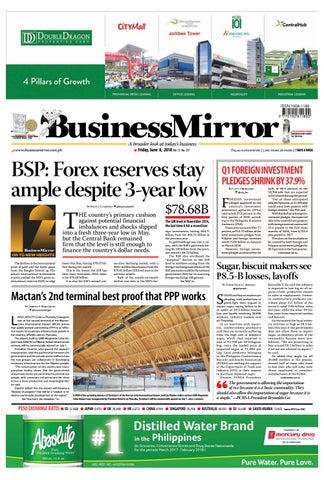
BSP: Forex reserves stay ample despite 3-year low
T
By Bianca Cuaresma
@BcuaresmaBM
HE country’s primary cushion against potential financial imbalances and shocks slipped into a fresh three-year low in May, but the Central Bank remained firm that the level is still enough to finance the country’s dollar needs. The decline in the international price of gold and the lower gains from the Bangko Sentral ng Pilipinas’s international investments mainly pushed the BSP’s gross international reserves (GIR) to edge
lower this May, hitting $78.97 billion during the month. This is the lowest the GIR has been since November 2014, when it hit $78.68 billion. It is also the GIR’s second con-
secutive declining month, with a $641-million discrepancy from the $79.61 billion GIR level seen in the previous month. Bulk of the month-on-month decline was seen in the BSP’s for-
eign investments, hitting $63.71 billion from the $64.52 billion in the previous year. Its gold holdings was also a culprit, with the BSP’s gold stock hitting $8.196 billion from the previous month’s $8.25 billion. The BSP also attributed the “marginal” decline in the GIR level to outflows arising from the foreign-exchange operations of the BSP, payments made by the national government (NG) for its maturing foreign-exchange obligations. See “BSP,” A2
Q1 foreign investment pledges shrink by 37.9% By Cai U. Ordinario
L
A view of the sprawling interiors of Terminal 2 of the Mactan-Cebu International Airport, built by Filipino-Indian venture GMR-Megawide Cebu-Airport Corp. Inaugurated by President Duterte on Thursday, Terminal 2 will be commercially opened on July 1. LORENZ S. MARASIGAN
PESO exchange rates n US 52.3600
bulk, or 66.9 percent, of the 33,704 jobs that are expected to be created during the period. “Out of these anticipated jobs, 66.9 percent, or 22,535 jobs would come from projects with foreign interest,” the PSA said. With the decline in foreign investment pledges, the expected jobs to be created from projects with foreign interest contracted 42.4 percent in the first three months of 2018, from 3,723.8 jobs posted in 2017. This also cut the total jobs to be created by both foreign and Filipino investment pledges by 35.5 percent in the first quarter. Continued on A2
Sugar, biscuit makers see ₧8.5-B losses, layoffs By Elijah Felice E. Rosales @alyasjah
UGAR and biscuit makers are pleading with authorities to green-light their request to import sugar, saying failure to do so spells an P8.5-billion revenue loss and layoffs involving 20,000 workers, industry leaders said on Thursday. In an interview with reporters, confect ioner y producers said they are currently suffering from the high cost of domestic sugar, which they reported is now at P2,790 per 50-kilogram bag, twice the landed price of imported sugar at P1,300 per Lkg. Local producers belonging to the Philippine Confectionery Biscuits and Snacks Association (PCBSA) are seeking the support of the Department of Trade and Industry (DTI) in their request to purchase imported sugar. Fo r m e r P C B S A P r e s i d e nt
@lorenzmarasigan
APU-LAPU CITY, Cebu—Thursday’s inauguration of the second terminal of the MactanCebu International Airport (MCIA) proves that public-private partnership (PPP) is an effective means to accelerate infrastructure growth in the country, officials said on Thursday. The airport, built by GMR-Megawide Cebu-Airport Corp. (GMCAC), a Filipino-Indian infrastructure venture, will be commercially opened on July 1. President Duterte, who graced the airport’s inauguration, said the partnership between the government and the private sector retflects how the two groups can collaborate in developing necessary infrastructure for the Filipino people. “The construction of this world-class transportation facility shows that the government and private sector are committed to provide our people with necessary infrastructure for them to live a more productive and meaningful life,” he said. Duterte added that the airport will become a “beacon of progress” that will be a “catalyst in inclusive countryside development in the region.” See “Mactan’s 2nd terminal,” A2
@cuo_bm
OR EIGN i nvest ment pledges approved by the countr y’s investment promotion agencies (IPAs) contracted 37.9 percent in the first quarter of 2018, according to the Philippine Statistics Authority (PSA). These only accounted for 7.7 percent, or P14.21 billion, of the total investment pledges from Filipino and foreign investors worth P185 billion in January to March 2018. However, foreign investment pledges accounted for the
Mactan’s 2nd terminal best proof that PPP works S By Lorenz S. Marasigan
business news source of the year
P25.00 nationwide | 5 sections 28 pages | 7 days a week
F $78.68B The GIR level in November 2014, the last time it hit a record low
2016 ejap journalism awards
Reynaldo Y. Go said the industry is expected to lose big on all aspects—from production output to sales to employment. Domestic confectionery producers contribute about P21 billion of the sector’s total P30-billion sales last year, while the other P9 billion came from imported candies and biscuits. Go estimated the local industry will lose as high as P8.5 billion this year if the government does not allow them to import sugar, as domestic prices of the commodity become more prohibitive. “We are projecting to lose around P8.5 billion in sales if we are not allowed to import,” he said. Go added they might lay off 20,000 workers in the process. Around half of those who stand to lose their jobs will come from t hose employed in membermanufacturers of the PCBSA. Continued on A2
The government is allowing the importation of rice because it is a basic commodity. They should also allow the importation of sugar because it is a staple.” —PCBSA President Reynaldo Go
n japan 0.4753 n UK 70.2409 n HK 6.6723 n CHINA 8.1943 n singapore 39.2916 n australia 40.1392 n EU 61.6487 n SAUDI arabia 13.9631
Source: BSP (7 June 2018 )
News
BusinessMirror
A2 Friday, June 8, 2018
www.businessmirror.com.ph
BIR’s ₧172-B May collections push up 5-month total to ₧828B
T
By Rea Cu
@ReaCuBM
HE Bureau of Internal Revenue (BIR) has reported revenue collections of P172.21 billion for the month of May, pushing total collections of the bureau to P827.910 billion for the January-toMay period.
The robust intake continued the positive streak earlier noted among government collection agencies, which the finance department traced mainly to the effective implementation of the Tax Reform for Acceleration and Inclusion (TRAIN) law. This is crucial to the Department of Finance (DOF), as it enables the government to sustain an aggressive spending policy to sup-
port an ambitious infrastructure program without breaching the programmed budget deficit. Based on data from the DOF, the BIR has thus far collected P827.910 billion as of end-May this year, 3.10 percent higher than its target for the period of P803 billion. The collection for the period is also higher by 14.7 percent compared to the recorded revenue collection of P721.402 billion
Mactan’s 2nd terminal. . . GMCAC President Louie B. Ferrer said the new terminal will help beef up the airport’s capacity to handle more passengers more efficiently and effectively. “For the past years, MCIA’s demand has exceeded the physical capacity of its terminal. With the addition of Terminal 2, not only will we be able to sustainably cope with the steadily increasing number of passengers, we will also be able to open Cebu to more flights,” Ferrer said. Terminal 2 will increase the airport’s annual passenger capacity to 12.5 million from 4.5 million. The airport reached the 10 million passenger traffic mark in 2017, an 11.72-percent increase from 9.93 million the year prior. It aims to serve 11.2 million passengers by end-2018. “This is an affirmation of the private sector’s efficiency and capability to deliver projects on schedule,” PPP Center Executive Director Ferdinand G. Pecson said. Transportation Secretary Arthur P. Tugade noted the beauty of the newly constructed airport, and his agency’s push for its on-time completion. “It was our job to make sure that construction will be completed by June 2018 as stated in the contract, and that’s what we did, and that’s why we are here. No delays, no corruption,” he said. The Filipino-Indian group started constructing the new terminal in June 2015. The airport, envisioned to be the “friendliest gateway destination,”is host to 26 airlines flying to 25 international destinations and 30 domestic destinations. Former PPP Center Executive Director Cosette V. Canilao said the airport
Continued from A1
is clear evidence that the infrastructure program is a valuable method to fund projects for nation building. “It is very gratifying to again witness the realization of a dream,” she told the BusinessMirror. “It cemented the framework—policies and procedures—that was put in place in bidding out infrastructure projects via PPP.” She recalled that the project is one of the earlier ones the feasibility study for which was funded out of the project development and monitoring fund established and managed by the PPP Center through a grant from the Asian Development Bank. The Filipino-Indian joint venture started operating the airport in Mactan in November 2014, after winning the deal to modernize the existing facility while building a second terminal to support projected growth. “Whenever PPP projects get completed, I vividly recall the late nights poured into the project by everyone involved from the very beginning, the obstacles that had to be overcome, the noise that had to be ignored, and the taunting that had to be endured. It is all worth it,” Canilao said. The new terminal, spanning 65,500 square meters, will not only lessen congestion but will also offer an exciting and wide-ranging retail environment, its top proponents said. The architectural design is inspired by Cebu’s island heritage. With the opening of the new facility, all international flights in and out of Cebu will be transferred to Terminal 2. Domestic flights will remain at Terminal 1. The group has decided to bring in
for the same period in 2017. The BIR’s collection for May of P172.21 billion is 3.27 percent higher than its target for the month of P166.746 billion. This also represented growth of 8.52 percent from the actual collection in May 2017 amounting to P158.680 billion. Broken down, revenue collections from BIR operations for the five-month period amounted to P810.461 billion, while collections from non-BIR operations accounted for P17.499 billion. The collections from BIR operations posted an increase of 3.76 percent compared to its target for the period of P781.084 billion, while revenue collections from non-BIR operations came up short by 17.4 percent from its target of P21.196 billion. BIR operations include collections from its Large Taxpayers Service (LTS), as well as the bureau’s Revenue Region (RR) offices. For the period, the LTS collected rev-
enues of P543.550 billion, with the RRs collecting P266.911 billion. The collections from the LTS showed an increase of 12.7 percent compared to the goal for the period of P482.261 billion; that of the RRs contracted was 10.6 percent short of the goal of P298.822 billion from January to May this year. Last month Finance Secretary Carlos G. Dominguez III said the impressive increases in revenue collections shown by the government’s collection agencies, as a result of the effective implementation of TRAIN, enabled the government to sustain its aggressive spending policy within limits of the programmed budget deficit. The Bureau of the Treasury (BTr) earlier reported that the national government registered a P105.9billion deficit for the period of January to April this year, on the back of strong revenue collections despite the surge in government spending. Actual government spending for the period reached P1.033 trillion.
a new identity for the Mactan Airport with its new tagline, “Experience the Warmth of Cebu.” Anchored on Cebu’s positioning as a resort destination and its vision of becoming the world’s friendliest airport, the airport will showcase to the world the natural gem of Cebu—the warmth and genuine hospitality of its people. Tourism Secretary Bernadette Fatima Romulo Puyat said that besides helping the government achieve its tourism goals for 2018, the facility will be a conduit to help reduce poverty and inequality. “Tourism will become an agent to reduce poverty and inequality,” Romulo Puyat said. Tourism department data showed that in March alone, 119,065 tourists flew in to Cebu, or 18.52 percent of the total foreign arrivals that month. About 40 percent of the total foreign travelers going to Cebu are South Koreans; 15 percent, Japanese; 8 percent, Chinese; 6 percent, Americans; and 31 percent, mixed nationalities. With the demand for travel to and from Cebu seen growing in the coming years, the Filipino-Indian group asked the government to further develop the airport through a P208-billion unsolicited proposal. Under the proposal, the company will take in the improvement, operations and maintenance of the runway and other related facilities, which to date remain with the Mactan-Cebu International Airport Authority (MCIAA). This was not included in the modernization contract it won in December 2013. The proposal, submitted on June 7, 2017, to the transportation department, has three main phases, spread throughout five decades. First is to take over the airside facili-
ties, and rehabilitate the existing runway and taxiways; construct an additional full-length parallel taxiway that can act as an emergency runway; and develop additional rapid exit taxiways and runway holding positions, all of which will improve the efficiency of aircraft movements. Second is to construct a second parallel and independent runway to significantly increase airside capacity. Third is to build a third terminal in the area. These will allow the airport to accommodate at least 50 million passengers per annum. The rehabilitation of existing airside facilities, together with the construction of a new runway, will help ease congestion in a single runway facility. Once completed, the project will make MCIA the first airport in the Philippines with two parallel independent runways. The project calls for expanding airport land in order to accommodate the new facilities, Hence, the group is now looking into options to minimize the impact on surrounding communities, such as a possible reclamation in Magellan Bay.
BSP. . .
Continued from A1
The BSP also said the decline could have been larger, had it not been partially tempered by the NG’s net foreign currency deposits. The BSP, however, stood firm that the GIR level remains adequate to support the economy’s growing needs. “The end-May 2018 level of GIR serves as an ample external liquidity buffer and is equivalent to 7.7 months’ worth of imports of goods, and payments of services and primary income,” the BSP said. “It is also equivalent to 5.4 times the country’s shortterm external debt based on original maturity and 3.9 times based on residual maturity,” it added.
NEW CENTENARIANS Makati City Mayor Abigail Binay greets 100-year-
old Siu Loan S. Co, whom she visited at her home in Barangay La Paz to hand over a P100,000 check, bouquet of flowers and a plaque of recognition. Born on December 8, 1917, Co is one of two new centenarians recognized by the city government. She has been a Makati resident since 1975. Besides eating healthy foods, Co said living a simple life is her secret to longevity. The other new centenarian visited by Binay was Felisa R. Mendoza of Barangay Poblacion. To date, 49 centenarians have been awarded with P100,000 cash gift from the city. The recognition of Makati centenarians started in 2012 through City Ordinance 2012-099.
Q1 foreign investment pledges shrink by 37.9% Continued from A1
Total jobs created from these pledges were expected to reach 2,706.4 in the January-to-March period in 2018, from 4,184.7 jobs in the same period in 2017.
Japan top investor
Japan was the country’s top investing country during the quarter with P7.9 billion. It contributed 55.3 percent to the total foreign investment commitments. T he Un ited K i ngdom a nd the Netherlands occupied the second and third posts, pledging P1.5 billion or 10.9 percent and P878.5 million or 6.2 percent, respectively, January to March 2018. The bulk of foreign investment applications—91.2 percent of the total foreign investment pledges in the first quarter of 2018—came from the Philippine Economic Zone Authority (Peza). T he Board of Investments (BOI) contributed 5.6 percent or P792.8 million; Clark Development Corp. contributed 2.4 percent or P339.8 million; and Cagayan Economic Zone Authority (Ceza), 0.7 percent or P104.1 million. The Subic Bay Metropolitan Authority (SBMA) accounted for only 0.1 percent or P11.5 million worth of the approved foreign investments. Meanwhile, approved investments of foreign and Filipino nationals in the first quarter of 2018
grew by 52.3 percent, from P121.5 billion in the same period last year. Filipino nationals accounted for P170.8 billion or 92.3 percent of the total approved investments during the quarter. This represented a growth rate of 73.3 percent, from the P98.57 billion posted in the same period in 2017. Over three-fourths of investment commitments made by foreign, and Filipino nationals in the first quarter in 2018 were coursed through the BOI with P152.1 billion worth of investments. Around 16.6 percent of the tot a l ap pro ve d i nve st me nt s amounting to P30.7 billion were approved by Peza. Investments approved by SBMA reached P793.5 million. or 0.4 percent, while investments approved by Ceza were valued at P520.3 million, or 0.3 percent of the total. Data also showed that Electricity, Gas, Steam and Air Conditioning Supply topped the list of industries that received investment pledges. The PSA said the sector received a total of P104.3 billion in pledges or 56.4 percent of the total during the quarter. Real Estate Activities, which ranked second, would receive 13.5 percent, or P25.1 billion, of the total investments. Approved investments for Manufacturing ranked third, which would receive P24.5 billion, or 13.2 percent of the total.
Sugar, biscuit makers see P8.5-B losses, layoffs Continued from A1
“We ask only fairness from the government and the SRA [Sugar Regulatory Administration]. The government supported the sugar industry, but we, confectionery producers, are not given much backing. The government is allowing the importation of rice because it is a basic commodity. They should also allow the importation of sugar because it is a staple,” Go said. Candy and biscuit makers are looking to import 15,000 metric tons (MT) of sugar to beef up their
manufacturing requirements. If the importation is permitted by the government this month, they are anticipating the bags to come in from July to September, right before the next sugar milling on October. “We need to sustain our production, our sales and our work force. I hope the government allows us to import, or else the sector will become more depressed,” Go said. Trade Secretary Ramon M. Lopez earlier issued a statement supporting candy and biscuit makers in their request to import sugar. He
said it is high time that government allows them to import the commodity to ensure confectionery goods remain competitive. “They should be allowed to import. Before, we talked to industrial users to commit to buy local sugar to help local farmers. Now that [industrial buyers] are buying local sugar, [farmers] should ensure competitive pricing and supply. World market prices are much lower, and it is fair to allow importation to serve the supply requirements of sugar users,” Lopez told the BusinessMirror.
A4 Friday, June 8, 2018 • Editor: Vittorio V. Vitug
Economy BusinessMirror
Lower generation, transmission charges cut power rates in June
T
By Lenie Lectura
@llectura
he Manila Electric Co. (Meralco) announced on Thursday a decrease in power rates this month mainly on account of lower generation and transmission charges. Overall electricity rates for June stood at P9.8789 per kilowatt-hour, P0.1252 per kWh lower than the previous month’s P10.0041 per kWh. The downward adjustment is equivalent to a decrease of around P25 in the bill of a residential customer consuming 200 kWh. This is the second consecutive month of an overall rate decrease. Generation charge, the largest component of an electric bill, stood at P4.9828 per kWh, from P5.0523 per kWh last month. The reduction is the result of a P0.4420 per kWh decrease in the cost of power from power supply agreements (PSAs), mainly due to higher dispatch of Pagbilao Unit 1 and Ilijan Unit 1, as both returned to normal operations after undergoing scheduled maintenance. T he s h a re of P S A pu rc h a s e s to Meralco’s total requirement this month was 45 percent. Meanwhile, charges from the Wholesale Electricity Spot Market (WESM)
₧25
The estimated decrease in the monthly bill of Manila Electric Co. residential customers consuming 200 kWh and Independent Power Producers (IPPs) increased by P0.1954 per kWh and P0.2266 per kWh, respectively. As demand for power in the Luzon grid grew by about 239 megawatt, charges from the WESM increased due to higher effective rates of line rentals. Higher IPP charges, on the other hand, were driven by the weakening of the peso
against the US dollar. Around 96 percent of IPP charges are dollar-denominated. The shares of WESM and IPP purchases to Meralco’s total requirement this month was 15 percent and 40 percent, respectively. Transmission charge to residential customers decreased by P0.0861 per kWh due to lower National Grid Corp. of the Philippines’s (NGCP) Power Delivery and Ancillary Service Charges. With the lower generation and transmission charges, taxes and other charges also went down by P0.0429 per kWh this month. However, starting this month, the feed-in-tariff allowance (FiT-All) rate will go up to P0.2563 per kWh, after regulators recently approved an increase of P0.0733 per kWh on the previous rate. The FiT-All is a pass-through charge remitted to the National Transmission Corp. as an incentive for renewable-energy developers, such as those operating wind, solar, biomass and run-of-river hydropower facilities. Meralco’s distribution, supply and metering charges, meanwhile, have remained unchanged for 35 months, after these registered reductions in July 2015. Meralco reiterated that it does not earn from the pass-through charges, such as the generation and transmission charges. Payment for the generation charge goes to the power suppliers, while payment for the transmission charge goes to the NGCP. Taxes and other public policy charges like the FiT-All rate are remitted to the government.
www.businessmirror.com.ph
Reintegration drive prompts OWWA to seek ₧5-B budget By Samuel P. Medenilla
@sam_medenilla
T
HE Overseas Workers Welfare Administration (OWWA) is eyeing a P5-billion budget for 2019—twice its proposed budget for this year—to fund its reintegration-focused services. In an ambush interview, OWWA Administrator Hans J. Cacdac told the BusinessMirror about 3 billion of their proposed budget will be from the 2019 General Appropriations Act (GAA), while the remaining 2.7 billion will come directly from member contributions through the OWWA Fund. Last year OWWA’s proposed budget for 2018 was only P2.8 billion, of which P1.9 billion came from the OWWA Fund and P916 million from the national budget. Cacdac explained that the request for more funding in the next budget deliberations of Congress is warranted by the spike in the number of overseas Filipino workers (OFW) who availed themselves of OWWA’s reintegration services last year. “In 2017 there was a dramatic increase in the number of beneficiaries of our Balik Pinas, Balik Hanapbuhay [BPBH] program from 3,800 the year before to 20,000,” Cacdac said. Prior to being revamped in 2017, the BPBH was a livelihood program that provided its beneficiaries with “noncash support via entrepreneurial training.” The OWWA Board of Trustees approved last year the integration of a P20,000 cash aid to the BPBH to make it more “responsive and tangible” to its members. The reform together with OWWA’s more aggressive promotion of its programs led to a surge in the number of members who accessed its services. “I would attribute that to our outreach programs. I think we have empowered more returning distressed OFWs to avail of the program. Even our scholarship program is now being availed by many OFWs,” Cacdac said.
Paralegal costs
Cacdac said they also intend to use the additional fund for their proposed legal auxiliary services, supporting the Department Foreign Affairs’s (DFA) legal assistance program. “While DFA will still handle the hiring of lawyers and retain-
ers [for OFWs], through our [proposed] auxiliary we want to hire legal interpreters or paralegals to accompany OFWs in hearings and to keep them informed about cases abroad,” Cacdac said. This responds to the migrant advocate groups’ recommendation for the government to provide interpreters to OFWs with pending cases so they could properly defend themselves in foreign courts. “So far the signs from the DBM [Department of Budget and Management] are very positive.... So we are praying they would grant it,” Cacdac said.
Blueprint
OWWA’S higher budget request also aims to fund its proposed new reintegration blueprint. The blueprint, the result of the series of stakeholder consultations conducted by OWWA in previous months, aims to benchmark the government’s reintegration services. “It aims to standardized financial literacy for OFWs depending on their level. So if they are distressed their module would be different to those who are professionals or semiskilled. We will offer them separate and distinct financial literacy and investment,” said Roel B. Martin, the National Reintegration Center for OFWs officer in charge. Martin said in an interview the duration of financial literacy programs currently differs depending on the implementer. “The duration may be for one hour or even the whole day,” Martin said. With the new program, OWWA hopes to better guide OFWs on how to better use their remittances.
Career guides
Aside from improving financial education, Integrated Seafarers of the Philippines President Gaudencio C. Morales said the blueprint also aims to provide better career outcomes for OFWs. “For seafarers, we have that road map for sustainable career advancement that will guide from boarding their first ship to their reintegration,” said Morales, who was among those consulted for the blueprint. Migrante International supported the more long-term approach of the blueprint to empower OFWs to better contribute to the country’s economic development.
Senator paints ‘pro-poor’ picture on e-vehicle use By Butch Fernandez @butchfBM
S
en. Juan Miguel F. Zubiri is pushing for green, hybrid, electric vehicles (e-vehicles), pitching the production and use of these modern conveyance in the country as “a pro-poor measure.” “This is one of the most propoor energy, transportation and health measures,” Zubiri said on Thursday, adding that “contrary to widespread opinion, going electric is not all about multimillion-peso Tesla cars. It’s not about sporting the glitzy status symbol.” In filing Senate Bill 1524 outlining a Motor Vehicle Development Program, Zubiri explained he was “thinking of the greater good of millions of drivers and passengers in public-utility vehicles,”adding he was pushing passage of the law “for the tricycle, jeepney and bus drivers and commuters.” Zubiri reported that the Philippines’s electric-vehicle campaign is now supposed to be in the third
phase of a four-phase program. He explained that the Motor Vehicle Development Program for the automotive industry was intended to be implemented in four phases within a 10-year-period, of which the first phase (2013) was the launch of the program, including technology upgrading needed by the industry; the second phase (2014 to 2015) involved the buildup of the local market and enhancement of its production capacity; the third phase (2016 to 2018) for local and export market expansion, together with horizontal and vertical integration with the local automotive industry; and the fourth phase (2019 to 2023) will be the full integration, regional and global, developmental evolution in technological advancement and market size up.” Zubiri recalled other senators have filed related bills. “I hope the committees concerned will tackle them.” Aside from the energy, transportation and health benefits that we can derive from a successful e-
vehicle program, we shall generate new jobs,” he said. “Even if the e-vehicle development program starts with assembly of imported CKD [completely knocked-down] units, there will be jobs created as we replace high-carbon, high NO² polluting tricycles, jeepneys and buses.” Moreover, Zubiri said he expects that “thousands will be employed in setting up, operating and maintaining electric power charging stations.” He acknowledged in a news statement that the main arguments going against e-vehicles centered on the source of electric power, manufacture of batteries and ecological waste management of batteries. “To that, we have actually laid down solutions through past laws, primarily the Renewable Energy Act and the Ecological Solid Waste Management Act,” the senator said, even as he pointed out that the science and technology of e-vehicles “gave advanced and some countries have been successfully recycling around 80 percent of the battery.”
PSA data: Tourism generated about 100K jobs last year By Cai U. Ordinario
T
@cuo_bm
he country’s tourism industry created around 100,000 jobs last year, according to data released by the Philippine Statistics Authority (PSA) on Thursday. Data from the Philippine Tourism Satellite Accounts (PTSA) showed there were 5.3 million Filipinos employed in the sector in 2017, a 0.9-percent growth from the 5.2 million posted in 2016. However, this was the first-time growth in the tourism sector which fell below 1 percent since 2001. Before 2017 the slowest growth of employment in the industry was 1.9 percent in 2005, while the fastest was 10 percent in 2006. “Share of employment in tourism industries to total employment in the country was recorded at 13.1 percent in 2017,” the PSA said. The tourism subsectors that posted the highest contribution to employment were passenger transport and accommodation and food and beverage, which accounted for 1.2 million and 1.7 million workers, respectively.
There were only 35,000 jobs for travel agents, tour operators and tourism guides, which accounted for the smallest share in total tourism jobs. Meanwhile, employment in passenger transport grew 3.5 percent, while jobs in accommodation and food and beverage contracted 0.9 percent. The largest growth in employment was in decline for travel agents, tour operators and tourism guides at 6.1 percent, while employment in the recreation, entertainment and cultural services contracted 11.7 percent. Meanwhile, PSA data showed that the tourism sector accounted for 12.2 percent of the economy in 2017. Tourism direct gross value added to gross domestic product amounted to P1.93 trillion at current prices in 2017. This is higher by 24.2 percent than the previous year’s record of P1.55 trillion. Inbound tourism expenditure, which refers to the expenditure of nonresident visitors (foreign visitors and Filipinos permanently residing abroad) within the Phil-
ippines, grew by 43.9 percent in 2017, amounting to P448.6 billion, from P311.7 billion in 2016. The PSA said inbound tourism ranked third among the country’s biggest export items in 2017, after semiconductors at 21.9 percent and miscellaneous services at 15.7 percent. “Compared to the country’s total exports, the share of inbound tourism expenditure was 9.2 percent,” the PSA said. Domestic tourism expenditure, which includes expenditure of resident visitors within the country either as domestic trip or part of an international trip, grew by 25.5 percent to P2.64 trillion in 2017, from P2.11 trillion in 2016. Domestic tourism expenditure represents 22.8 percent of the household final consumption expenditure in 2017. The PTSA is compiled by the PSA is based on the international recommendations for tourism statistics and tourism satellite accounts of the United Nations World Tourism Organization.
www.businessmirror.com.ph
Banking&Finance BusinessMirror
DOF seeks IFC help to set up digital banking system for OFB
T
HE Department of Finance (DOF) has sought assistance from the International Finance Corp. (IFC) in line with the setting up of a digital banking system for the Overseas Filipino Bank (OFB) to keep it updated with technological advancements and prepare it for partial privatization. During a recent meeting with World Bank and IFC officials, Finance Secretary Carlos G. Dominguez III said he wants the OFB to start with a clean slate and leapfrog to digital banking to make it more effective and responsive in catering to the financial needs of overseas Filipino workers (OFWs). Given that the OFB has not yet invested heavily in legacy systems that are now fast becoming outdated, the finance chief said the bank can “leapfrog” to new technologies to enable it to operate as a digital bank. “It’s tabula rasa. No legacy mistakes here. But we don’t have the people and the system. So we’re looking at your expertise to assist here,” Dominguez told the World Bank delegation led by Victoria Kwakwa, the regional vice president for East Asia and Pacific of the institution. Also at the meeting was Nena Stoiljkovic, the IFC’s vice president for Asia and Pacific, along with other IFC and World Bank officials. “We’d love to take a look at that,” Stoiljkovic said, while also pointing out that the IFC is undertaking similar types of interventions in other countries. The OFB is among the campaign promises of President Duterte to OFWs in 2016 that the DOF had helped fulfill earlier this year. The DOF has expanded the bank’s coverage to include all overseas-based Filipinos to make it more inclusive.
A digital banking system for the OFB could later lead to less state interference, with the Land Bank of the Philippines (LandBank), which has made the OFB a subsidiary, controlling less than 50 percent of it in the future, according to Dominguez. “We just need funds for all these, and we’re looking for assistance in this leapfrogging operation. This will allow us to partially privatize it in the future. Even bring down the share of LandBank to below 50 percent. These are things we’re looking at,” he added. Earlier, Dominguez said the OFB could be the ideal vehicle for the Philippines to leapfrog to the digital economy. Instead of setting up physical branches around the world, the OFB could just rely on digital technology applications to serve as many overseas-based Filipinos as possible. Dominguez added that the OFB could be transformed into a virtual bank where bank tellers and managers would be replaced by information technology experts who have the knowledge to manage large amounts of data and operate the OFB using cutting-edge technologies. Ten million OFWs could be the initial beneficiaries of this technological leapfrog that would radically transform the way Filipinos buy, receive and sell and distribute goods and services, he explained. The finance chief further pointed out that a key feature of the OFB will be its provision of remittance service for OFWs and a loan program for Filipinos planning to return to the Philippines to start businesses or build houses. The OFB was inaugurated at the Postbank Center in Manila by President Duterte on January 17, 2018. Rea Cu
I
Association World Octavio Peralta with a colleague who is a kindred spirit or hearing a provocative thought, an engaged member wants to be around the larger community more. He/She may join a group or committee within the association and regularly participates in at least one aspect of the association’s work. “Member leader. He/she takes on a leadership role as the chairman of a committee or the coordinator of a project. He/she perceives the organization as having a role to play in moving his/ her agenda because her/his agenda and that of the association now seem to be aligned. “Member ambassador. Not only does the member appreciate what the association does and can do, but he/she also wants others to see this, too. He/she knows that the association is stronger with more people sharing their ideas, strategizing together, and presenting a front united behind a common vision. He/she is reaching out to others, encouraging them to join. “Member catalyst. His/her involvement is no longer simply suggesting a training session or a speaker. He/she suggests major interventions, ways in
A5
Cut ‘excessive’ transfer fees of banks on OFW remittances–lawmakers By Jovee Marie N. dela Cruz
T
@joveemarie
HE allegedly “excessive” transfer fees imposed by foreign and local banks, as well as global payment processing firms on cash remittances of overseas Filipino workers should be reduced to put extra cash in the pockets of the OFWs and their families, a representative from ACTSOFW party-list said on Thursday. Marking the celebration of Migrant Workers’ Day, Partylist Rep. Aniceto D. Bertiz III of ACTS-OFWs are seen paying $3.1 billion in bank charges to send home $29.3 billion this year. “We reckon that Filipino workers abroad will spend $3.1 billion in bank charges when they send home $29.3 billion this year,” said Bertiz. “A migrant Filipino worker pays an average of $10.57 in bank charges for every $100 wired home,” he added. The lawmaker, citing a World Bank study, titled “Remittance Prices Worldwide,” said the global average cost of a personal cash transfer through bank channels was 10.57 percent in the first quarter of 2018. “Slashing remittance fees by
Progression of an association member N my talks with members of associations, I often get this question: “How can I be an active member?” This reminds me of this article from the American Society of Association Executives written by Tamara Lucas Copeland, president of the Washington Regional Association of Grantmakers: “I gravitated to the membership association world because I understand and value the ‘power of the collective.’ For me, membership in an association isn’t simply about obtaining discounts on magazines or insurance. It’s about developing and furthering a shared vision for change. An association is a powerful construct for improving society. Lofty? Perhaps. But that really is the way I see it. “When I read that some are questioning the relevance of membership associations, I want to raise my voice in celebrating their impact. I want people to get it, and get it quickly; so, I challenged myself to capture that power and potential in one quick Tweet: “Membership in Association =Change: n Member n Engaged Member n Member Leader n Member Ambassador n Member Catalyst n Member Activist “Member. An individual enters an association as a member who simply participates in a few events, attends occasionally a training session, maybe scans the newsletter, and goes to the annual meeting. “Engaged member. Connecting
Friday, June 8, 2018
which the organization might take on that big, hairy, audacious goal. He/She is confident in the potential of the association, and wants the association to actualize its potential as a change agent. “Member activist. As a leader in the association, he/she has developed strong ties with others in the group. He/ she has brought a major idea to his/her colleagues, led them in developing a shared vision in a particular area of concern to the membership, and worked to develop a strategy. He/she is ready to move outside of the organization. The work is of a scale that it needs external allies. He/she is moving an agenda that benefits a community that is much larger than simply the association. She is a fully actualized member!” I hope this “member progression” would spark interest and passion from both the member and the association. The column contributor, Octavio “Bobby” Peralta, is concurrently the secretary-general of the Association of Development Financing Institutions in Asia and the Pacific (Adfiap) and the CEO and founder of the Philippine Council of Associations and Association Executives (PCAAE). PCAAE is holding a mini-conference on Branding, Public Relations and Communications on July 4, 2018, at the Philippine International Convention Center (PICC). The event is supported by Adfiap, the Tourism Promotions Board, the PICC, Springtime Design, International PR Association and Writers Edge. E-mail inquiries: @adfiap.org.
half would easily mean $1.5 billion in cost savings and extra cash in the pockets of migrant Filipino workers and their families here,” Bertiz said. According to Bertiz, there’s no reason banks cannot reduce fees, considering that nonbank money transfer agents are already charging as low as 3 percent. Despite the growth of nonbank remittance channels, Bertiz, however, said Filipinos still prefer to send their money home via banks. In the first quarter of 2018 the solon, citing the Bangko Sentral ng Pilipinas, said OFWs remitted $7 billion through the banking system. In 2017 he said Filipino overseas workers wired home $28.1 billion using bank channels.
OUTBOUND migrant workers are seen at the NAIA in file photo. nonie reyes
Meanwhile, Bertiz, quoting a World Bank report, said the Philippines received a total of $33 billion in personal cash remittances in 2017. He said $4.9 billion in remittances last year were coursed outside of the banking system. Bertiz added the Philippines is the world’s third-largest recipient of personal cash remittances, after India and China.
Bill for remittance protection Meanwhile, Rep. Aurelio D. Gonzales Jr. of the Third District of Pampanga has already filed House Bill 4740 to protect the remittances of OFWs. “These OFW remittances are transferred from the OFWs, to intermediaries, such as financial
and nonbank financial institutions, before it reaches beneficiaries. In the course of transfer of the funds, the amounts remitted are subjected to several fees and high remittance charge, which result to the depletion of the amount to be remitted and received by beneficiaries,” he said. The bill seeks to provide for a limit on the amount of remittance fees to be imposed, provide for discounts to OFWs and for tax incentives to the discount-giving establishments. It also encourages establishments and institutions to provide loans to OFWs and mandates government agencies to give financial education to OFWs and their families.
Malaysian central bank governor’s exit deepens anxiety over economy in flux
T
HE sudden resignation of Malaysia’s central bank governor adds another layer of uncertainty to the economy following last month’s unexpected change in government. Muhammad Ibrahim’s departure this week has left Bank Negara Malaysia (BNM) without a leader at a time of the country’s biggest political upheaval in decades, and as policy-makers in emerging markets grapple with heightened volatility and the threat of a global trade war. A successor hasn’t been named yet, but local media reports say former Deputy governor Nor Shamsiah Mohd Yunus may get the job. Investors are already dealing with uncertainty around the budget after Prime Minister Mahathir Mohamad followed through with a campaign pledge and scrapped a 6-percent goodsand-services tax, putting pressure on government revenues and triggering concern about a credit-rating downgrade. The growth outlook is also unclear: consumers will get a temporary boost from the tax move, but the government’s pledge to review large-scale investment projects may slow spending. Some analysts say the administration’s moves could prompt the next governor to tweak the monetary policy stance. The central bank raised rates
in January, and left borrowing costs unchanged twice since then. Policymakers are due to meet again in July.
Language change
“Our view is the possibility of more dovish language with regards to interest-rate policy as the political landscape continues to unfold with greater clarity over the next few months,” said Ray Choy, head treasury strategist at CIMB Bank in Kuala Lumpur. “All in, the review of mega-projects and zerorized GST should lower GDP growth and inflation, which could lead to a dovish stance.” Others are more sanguine and predict continuity at one of the country’s most respected institutions. “The reason why the governor’s resignation is not a catastrophe is that his departure is highly unlikely to jeopardize or destabilize the BNM’s policy,” said Vishnu Varathan, head of economics and macro strategy at Mizuho Bank Ltd. in Singapore. “Point being, no monetary policy response is required given that inflation is well-contained while fiscal slippage risks are overstated.” All of this is coming against the backdrop of a slide in emerging markets, prompted by rising United States interest rates and a stronger dollar. Malaysia has fared better than some of its Asian
counterparts, with the currency up 1.8 percent against the dollar this year, but the nation’s higher debt levels make it vulnerable.
Negative image
The government accepted Muhammad’s offer to resign, which he said was to protect the central bank’s image and reputation. Questions had been raised about the central bank’s purchase of land from the previous administration and the subsequent use of the proceeds to repay debt at scandal-plagued state fund 1MDB. In late-2016 Muhammad implemented curbs on some foreign-exchange trading that drew criticism from currency traders and worsened the ringgit slump. The sudden restriction on the ability of foreign investors to hedge their positions hurt sentiment toward the government bond market and contributed to surging yields. The move to clamp down on offshore forwards also raised the specter of capital controls, which Malaysia employed in the late-1990s, fears the central bank called ‘‘baseless.” Later, it allowed investors to fully hedge their currency exposure and eased rules to let all domestic players short-sell government bonds. Bloomberg News
A6
Friday, June 8, 2018
The World BusinessMirror
Editor: Lyn Resurreccion | www.businessmirror.com.ph
Putin heads to China to bolster ties
M
OSCOW—Just a month after beginning his new term in office, Russian President Vladimir Putin is heading to China for a state visit, underscoring how mounting United States pressure is drawing the two countries increasingly close. Russia and China have responded to the US national security strategy describing them as America’s top adversaries by vowing to further expand their economic, political and military cooperation. T hey h ave a l so sought to strengthen the Shanghai Cooperation Organization, a regional grouping they created. Beijing and Moscow’s rapprochement is driven by a strong personal relationship between Putin and Chinese President Xi Jinping, seen as the most powerful Chinese leader since Mao Zedong. The two have met 25 times— five times last year alone, according to Putin’s foreign affairs adviser, Yuri Ushakov. Putin’s visit begins on Friday. Underlining his close personal relationship with Xi, Putin told a Chinese state broadcaster in an
interview aired on Wednesday the Chinese president is the only world leader whom he once invited to celebrate his birthday. “I’ll be frank with you, I hope he won’t be angry at me: we had a shot of vodka and had some sausages at the end of a workday,” Putin said. He praised Xi as a “comfortable partner, a good and reliable friend.” The two leaders rely on tight security controls to block challenges to their rule, and both tightened their grip on power this year; Xi by engineering a move to stay in power indefinitely and Putin, Russia’s longest-serving leader since Josef Stalin, by winning another six-year term. “They appear to have an excellent rapport,” Fyodor Lukyanov, a top Moscow-based foreign-policy expert. “They have similar ho-
rizons and share a common vision.” Putin has been driven closer to China by a sharp decline in relations with the West after Moscow’s 2014 annexation of Crimea and support for a separatist insurgency in eastern Ukraine. Moscow is increasingly looking to Beijing for trade and investment following waves of Western sanctions targeting its vital energy sector and military industries and limiting the country’s access to global financial markets. “Over the past decades, we have developed relations that have no parallel in the world today,” Putin said in the interview, referring to China and Russia. “These relations are built on consideration of mutual interests.” Russia’s hopes for better ties with the US under President Donald J. Trump have withered, while frictions between China and Washington have sharpened over a potential trade war and American criticism of Beijing’s claims to territory in the strategically vital South China Sea. In an unusually blunt statement, the newly named Chinese defense minister, Gen. Wei Fenghe, said in April that he chose Russia for his first trip abroad to send a signal to Washington about the increasingly close military ties between Moscow and Beijing. “Put simply, everything the US has done in an attempt to sanction Russia and curb China will make China and Russia step up cooperation in all fields,” said Li Xin, director of the Shanghai Institute for Foreign Studies’ Center for Russian and Central Asian Studies. Russia and China have largely aligned
Ryan contradicts Trump’s claim that the FBI planted a ‘spy’
W
Chinese President Xi Jinping (left) walks with Russian President Vladimir Putin during a welcome ceremony at the Great Hall of the People in Beijing on June 25, 2016. AP/Mark Schiefelbein
their positions at the UN to oppose intervention in Syria and quash attempts to criticize their human-rights records. They’ve both sought to assert their interests in North Korea talks and Moscow has backed Beijing’s opposition to freedom of navigation operations by the US Navy in the South China Sea. Russia and China have conducted joint military maneuvers, including exercises in the South China Sea and last summer’s joint navy drills in the Baltics. Last December, the two militaries held missile defense drills intended to practice a joint response to missile threats from other countries, reflecting their shared concern about America’s missile defense program. Russia also has shared its top-of-the-line military technologies with China, providing it with batteries of the long-range S-400 air-defense missiles and its latest Su-35 fighter jets. However, wh i le pol it ic a l and secur it y cooperation has blossomed, economic ties have lag ged. China is Russia’s top trading partner, while Russia ranks 10th on Beijing’s list. Exports of oil, timber and other raw materials made up the bulk of Russian exports to China, while the Chinese exports mostly consisted of industrial goods, replacing the imports of Western products blocked from sanctions. Bilateral trade sank from nearly $100 billionz in 2014 to some $60 billion the following year due to a sharp depreciation of the Russian currency. It
has since partly recovered as the ruble has strengthened, reaching nearly $90 billion last year. In comparison, US- China trade amounted to $636 billion last year, with a US deficit at $375 billion. Moscow and Beijing have pledged to boost their trade to $200 billion by 2020—a goal that looks overly ambitious in view of a slow pace of Russian economic growth and remaining restrictions that hamper mutual trade on both sides. New agreements are due to be signed during Putin’s visit, which will also feature the two leaders taking in a youth hockey game. Beijing has also shown a renewed interest in railway and other infrastructure projects in Russia, while pursuing its “Belt and Road ” initiative intended to encourage development in ex-Soviet Central Asian nations. Yu Bin, a political scientist at Wittenberg University in Ohio, sees “growing asymmetry in their national power” as China’s economy continues to forge ahead and it rapidly expands its military, especially its navy. Still, differences between the sides are manageable, Yu said, and unlike their exchanges with the US, are seldom politicized. Moscow continues to see Central Asia as falling within its sphere of inf luence and early on had reservations about China’s economic expansion in the reg ion—a ref lection in part of lingering suspicion dating from their Cold War-era competition for leadership of the Communist bloc. AP
Over the past decades, we [China and Russia] have developed relations that have no parallel in the world today. These relations are built on consideration of mutual interests.”—Putin
ASHINGTON—In a break with President Donald J. Trump, House Speaker Paul Ryan said on Wednesday that he agrees there is no evidence that the Federal Bureau of Investigation (FBI) planted a “spy” in Trump’s 2016 presidential campaign in an effort to hurt his chances at the polls. He also issued a careful warning about Trump’s recent assertion that he has the authority to pardon himself. “I don’t know the technical answer to that question, but I think obviously the answer is he shouldn’t and no one is above the law,” Ryan told reporters on Wednesday. The comments come after Trump insisted in a series of angry tweets last month that the agency planted a spy “to help Crooked Hillary win,” referring to his Democratic opponent Hillary Clinton. There is a growing sense that Republicans are uncomfortable with those statements. Ryan, Republican-Wisconsin, is one of three congressional Republicans who have now contradicted Trump on the spying matter, including House Oversight and Government Reform Committee Chairman Trey Gowdy, Republican-South Carolina, and Senate Intelligence Committee Chairman Richard Burr, Republican-North Carolina. Ryan, Gowdy and Burr all attended classified briefings on the matter late last month, following reports that the FBI used an informant in its Russian election meddling investigation to speak to members of the Trump campaign who had possible connections to Russia. The Department of Justice held two briefings on Trump’s orders after House Intelligence Committee Chairman Devin Nunes, Republican-California, had asked for documents concerning the informant. Trump said it was “starting to look like one of the biggest political scandals in US history.” Gowdy said afterward that the FBI was doing its duty. “I am even more convinced that the FBI did exactly what my fellow citizens would want them to do when they got the information they got,” Gowdy said on Fox News last week. “And that it has nothing to do with Donald J. Trump.” Gowdy added, in a separate interview on CBS, that such informants are used all the time and “the FBI, if they were at the table this morning, they would tell you that Russia was the target and Russia’s intentions toward our country were the target.” Ryan told reporters on Wednesday that he thinks Gowdy’s “initial assessment is accurate,” and he has seen “no evidence to the contrary” of what Gowdy said. Hours after Ryan’s comments, Burr told The Associated Press that he, too, agreed with Gowdy. “I have no disagreement with the description Trey Gowdy gave,” Burr said. AP
Mystery ailment leads US to evacuate workers from China
W
ASHINGTON—The United States has evacuated several more government workers out of the southern Chinese city of Guangzhou after medical testing revealed they might have been affected by unexplained health incidents that have already hurt US personnel in Cuba, the State Department said on Wednesday. State Department Spokesman Heather Nauert said “a number of individuals” have been brought to the US. They are in addition to a US worker in Guangzhou who was evacuated earlier, as the Trump administration had already disclosed. The new evacuations come after the US sent a medical team to Guangzhou to screen American government workers. The team arrived earlier this week, and Nauert said the medical screenings were ongoing. She said they are being offered to “any personnel who have noted concerning symptoms or wanted baseline screening.” A US official said the evacuated Americans are being brought for testing
to the University of Pennsylvania. That’s where doctors have been treating and studying patients evacuated from the US Embassy in Havana. The official wasn’t authorized to discuss the situation publicly, and requested anonymity. It wasn’t clear whether the incidents occurred in the consulate or at the homes of diplomats and other employees, many of them in luxury high rises. The China incidents have raised fears the unexplained incidents that started in Cuba in 2016 have expanded. The US government has deemed those incidents “specific attacks” on American workers but hasn’t publicly identified a cause or culprit. Most of the incidents were accompanied by bizarre, unexplained sounds that initially led US investigators to suspect a sonic attack. The American government worker who was removed from China earlier reported “subtle and vague, but abnormal,
sensations of sound and pressure.” China said last month that it had found no explanation. In testimony before the Senate Foreign Relations Committee last month, US Secretary of State Mike Pompeo said China had “said all the right things and have demonstrated their willingness to help us identify the vector, which led to this medical incident.” The China incidents affect one of the most important of the seven US diplomatic outposts in the country. The Guangzhou consulate opened months after the establishment of diplomatic relations between Beijing and Washington in 1979 and moved to its new purpose-built facility in 2013. It serves four southern provinces with a combined population of more than 204 million and processes more than 1 million visa applications of all types annually. It is also the only US diplomatic installation in China authorized to process immigrant visas and handle adoptions. AP
www.businessmirror.com.ph | Editor: Lyn Resurreccion
The World
2nd-biggest Arab econ steps to boost growth
D
ubai said it would waive some fees on aviation and real-estate transactions, in the latest step by authorities in the United Arab Emirates to bolster economic growth and attract investments. The Executive Council also approved plans to cut charges levied on businesses, and freeze private school fees for a year, state-r un WA M news agenc y reported on Wednesday. The move comes a day after neighboring Abu Dhabi announced plans to spend 50 billion dirham ($13.6 billion) over three years to stimulate growth. Abu Dhabi and Dubai are the largest of the seven emirates that make up the UAE, the second-biggest Arab economy after Saudi Arabia. “The measures were broader in scope than we had expected following the instructions by the ruler Sheikh Mohammed bin Rashid last month for the government to reduce the cost of doing business in the emirate and take steps to accelerate economic
growth,” according to a research note from Emirates NBD PJSC. “The new measures should offer some relief for businesses across all sectors as well as providing a boost to the key transport and logistics sector.” Dubai has led the way as Gulf nations seek to shift their economies away from oil, turning itself into the Middle East’s main banking, commerce and transport hub. But with many oil-rich neighbors still struggling to recover from the 2014 slump in crude prices, the emirate’s economic growth has also slowed. The decision to waive 19 fees imposed on the aviation industry and aircraft landing-permits aims to attract more than 1 billion dirhams in investments, the Executive Council said. Other decisions include: waiving the 4-percent fee for a delay in property registration imposed by the Dubai Land Department; and reducing so-called market rate, a charge imposed by the municipality on businesses, by half to 2.5 percent. Bloomberg News
House GOP in eleventh-hour attempt for immigration accord
W
ASHINGTON—House leaders want to push fractured Republicans toward consensus on immigration, racing the clock as they seek to defuse a GOP civil war threatening to wound their hopes for keeping control of the chamber in November’s elections. Republicans planned a closeddoor meeting on the topic for Thursday morning. But there were no indications that a deal ending the party’s internal struggle over immigration was at hand and no definitive detail of where middle ground might be. If leaders fail to find a solution, that would give momentum to moderates seeking to stage election-year votes in just three weeks on the issue, a showdown that leaders want to head off. G OP l aw m a k e r s e m e r g e d from the office of Speaker Paul Ryan, Republican-Wisconsin, on Wednesday saying he would present the rank and file with broad ideas for resolving a dispute that has split Republicans for years, damaging the party with Hispanic and moderate voters. “There’s some loose consensus right now,” said Rep. Carlos Curbelo, Republican-Florida, a leader of centrists threatening to force votes if they can’t strike a deal with conservatives. He said leaders would unveil “an outline of a potential bill,” while conservative leader Rep. Ma rk Meadow s, R e publ ic a nNorth Carolina, said Ryan would present “concepts.” Curbelo, Rep. Jeff Denham, Republican-California, and other moderates need just two more GOP signatures on a petition to require immigration votes, assuming all Democrats sign on. If Thursday’s meeting doesn’t produce an accord, the moderates could reach that threshold quickly.
The major hang-up in GOP talks has been how, as the moderates have demanded, to offer citizenship to young “Dreamer” immigrants brought to the US illegally as children. Conservatives have opposed creating a special pathway for them to become citizens, calling it amnesty. “We’ve got the rule of law in this country, and nobody gets special consideration,” said Rep. Scott Perry, Republican-Pennsylvania, a member of the conservative House Freedom Caucus. Rep. Mark Walker, RepublicanNorth Carolina, said a large group of conservatives he leads has discussed providing a pathway to citizenship to Dreamers in exchange for giving President Donald J. Trump nearly all the $25 billion he wants to build his proposed wall with Mexico. In addition, the conservatives want to end a lottery that grants visas to countries with few immigrants to the US and curb the relatives who can be brought over by immigrants, Walker said. Democrats and at least some moderates would likely oppose such measures, giving it little chance of surviving in the more centrist Senate. Walker said the more Dreamers who’d be given an opportunity for citizenship, the tighter curbs on family-based migration would be. Roughly 700,000 people are protected under the Deferred Action for Childhood Arrivals program, an Obama-era policy that Trump has halted. But by some estimates, 1 million or more other people qualify for that program but haven’t applied. The moderates’ petition would force House votes on four immigration bills, ranging from a liberal one helping Dreamers win citizenship to a conservative version curbing legal immigration. AP
BusinessMirror
Friday, June 8, 2018
A7
France warns Trump it will not sign a G-7 statement
F
rance has joined Germany in warning President Donald J. Trump that it won’t sign a joint statement of the Group of Seven (G-7) at the summit in Quebec this week, a French official in the president’s office said.
President Emmanuel Macron has signaled that progress on tariffs, Iran nuclear agreement and Paris climate accord must be made before he’ll be willing to sign a joint statement, the official told reporters on Wednesday in Ottawa. The French president spent the day meeting with Prime Minister Justin Trudeau and other Canadian officials ahead of the June 8 and 9 summit in La Malbaie, Quebec. The official requested anonymity in keeping with rules of the French president’s office. Macron has concluded that the other members of the G7—the United Kingdom, Germany, Japan, France, Italy and Canada— must stand up to the US over Trump’s decision to impose tariffs on steel and aluminum from the European Union (EU), Canada and Mexico as well as other issues. Macron’s stance emerged as world leaders converged upon Canada for the summit and echo German Chancellor Angela Merkel’s vow to challenge Trump on trade and climate change at the summit. She also said the lack of room for compromise meant leaders might not agree on the traditional final statement.
‘Special friendship’
The French leader’s open challenge to Trump is a far cry from the “very special friendship” he sought to promote during his visit to Washington in late-April. At that point, Macron said he believed he could persuade the US remain in the Iran accord and forgo any tariffs against the EU. At last year’s G-7 summit in Sicily, Macron said he could talk the US out of withdrawing from the climate accord. W hile Trump’s top economic adviser, Larr y Kudlow, called trade tensions shadowing the summit “a family quarrel,” finance ministers from the six ot her n at ion s i s sue d a r a re public rebuke during a preliminar y meeting last week, saying they would retaliate against the American tariffs. And Trudeau, the summit’s host, said last Sunday that the tariffs were “insulting” to the longstanding alliance between the US and Canada. Trump is to attend the summit on Friday and Saturday before flying to Singapore for a historic meeting with North Korean leader Kim Jong Un on June 12. The official said that France wants any joint statement to state that trade should be open, fair and
free among members of the G-7 and beyond, and that any attempt to jeopardize the global trade system would constitute a threat. All members would also pledge to respect rules, and seek a reform of the World Trade Organization (WTO). The statement, the official added, would accept no language about Iran not respecting the terms of the nuclear accord or any condemnation of the agreement.
Trump to face a chilly G-7 reception
The White House is expecting a chilly reception from Canada and West European countries, already frustrated over Trump’s withdrawal from the Paris climate accord and the Iran nuclear agreement. German Chancellor A ngela Merkel previewed the dynamics on Wednesday, telling the German parliament that “it is apparent that we have a serious problem with multilateral agreements here, and so there will be contentious discussions.” Anticipating a tense two days in Quebec, Trump has complained about having to attend the summit, particularly since it comes just before his high-stakes meeting in Singapore with North Korean leader Kim Jong Un, said two people with knowledge of his thinking. But the White House has signaled no change in plans. “The president wants to go on the trip,” Larry Kudlow, Trump’s top economic adviser, said of the summit in Canada. “The president is at ease with all of these tough issues. “There may be disagreements,” Kudlow added. “I regard this as much like a family quarrel.”
One-on-one meetings
Trump also is set to hold a series of one-on-one meetings, including with Canadian Prime Minister Justin Trudeau and French President Emmanuel Macron. Trump is unlikely to back away from the nationalistic policies that have frustrated and unnerved al-
German Chancellor Angela Merkel delivers a statement on the Group of Seven summit prior to a government questioning as part of a meeting of the German parliament, Bundestag, at the Reichstag building in Berlin, Germany, on June 6. AP/Michael Sohn
lies but which he sees as key promises to his most loyal voters. He has highlighted his efforts on Twitter, writing on Monday: “The US has made such bad trade deals over so many years that we can only WIN!” Kudlow said allies should understand that Trump “will do what is necessary to protect the US, its businesses and its work force,” adding that Trump “has always said, and I agree, tariffs are a tool in that effort.” Trump announced in March that he was imposing tariffs on imports of steel and aluminum, but he temporarily granted a waiver to US allies like Canada, Mexico and the EU, and also to China, as his administration said trade talks were continuing. Trump ended that temporary relief this month, seeking to pressure the other countries to cut new trade agreements with the US. Japan was never granted a waiver, despite Prime Mininster Shinzo Abe’s pleas.
WTO
Asked if the administration will respect decisions from the WTO on tariffs, Kudlow said that “international multilateral organizations are not going to determine American policy. I think the president’s made that very clear.” This will be Trump’s second summit of the G-7, an informal gathering that meets every year under a rotating chairmanship. W hile trade is expected to dominate, Trudeau also wants to focus on gender equality and climate change. Kudlow was vague on whether the summit will produce a joint decision or a clear outcome on trade or other issues, saying “let them meet first.” The meeting comes after a gathering of G-7 finance ministers
The idea that we are somehow a national security threat to the United States is, quite frankly, insulting and unacceptable.” —Trudeau
concluded last week with a message of “concern and disappointment” to Trump from the other six countries. Describing the tense three days, Bruno Le Maire, France’s finance and economy minister, said it was “far more a G-6 plus one than a G-7.” Treasur y Secretar y Steven Mnuchin responded: “We believe in the G-7, it’s an important group,” adding that Trump looks forward to the gathering.
Cajole Trump
The increasingly critical tone from allies is a shift after leaders spent the past year and a half seeking to woo and cajole the American president. Thomas Wright, a senior fellow at the Brookings Institution, told reporters that for Trump’s first 500 days, “these countries generally were bent over backwards not to criticize President Trump. They tried to have close relations with him. They all tried to hug him close, as we used to say about Blair and Bush.” But Wright added: “There is a feeling, I think, over the last few months, that that approach has not borne fruit, and that they haven’t really gotten anything for that friendly approach.” Canada in particular has been outraged by Trump’s tariffs, taking umbrage at the argument that they were motivated by national security concerns.
‘Insulting and unacceptable’
Trudeau told NBC: “The idea that we are somehow a national security threat to the United States is, quite frankly, insulting and unacceptable.” Edward Alden, a senior fellow at the Council on Foreign Relations, said this marked the lowest point in decades in Canada-US relations, describing the two countries as allies that have “fought and died alongside each other” since World War I. “This is deeply offensive to Canadians,” Alden said. Kudlow played down any conflict, saying he had “no doubt the United States and Canada will remain firm friends and allies whatever short-term disagreements may occur.” Bloomberg News and AP
A4 Friday, June 8, 2018 • Editor: Vittorio V. Vitug A8
The Nation BusinessMirror
www.businessmirror.com.ph
3 out of 20 not bad: Palace defends ‘recycling’ of Duterte appointees
M
By Bernadette D. Nicolas
@BNicolasBM
alacañang on Thursday said that the reappointment of officials who were fired amid suspicions of irregularities was an “exception to the rule” of President Duterte, asserting that it takes only “a whiff of corruption” for the Chief Executive to sack his appointees.
Out of more than 20 officials that the President had fired, there were only three who were reappointed by the President to other positions, according to Presidential spokesman Harry L. Roque Jr. These officials include newly appointed Agriculture Undersecretary Jose Gabriel “Pompee” M. La Viña, who replaced Bernadette Fatima Romulo Puyat, who is now the tourism secretary. The two other officials who were reappointed in the past months were Nicanor E. Faeldon and Melissa Avanceña Aradanas, who are currently serving as deputy administrator III at the Office of Civil Defense and deputy secretary-general of the Housing and Urba n Development Coord inat ing Council, respectively. La Viña was previously appointed by Duterte as tourism undersecretary. Prior to that, he also served as Social Security System commissioner, but his term ended
when it was not renewed by the Palace on alleged corruption issues. Notably, La Viña was Duterte’s social media manager during his campaign. Asked if the reappointed officials were already cleared from the accusations, Roque said he does not know, but pointed out that the appointment is of “presidential prerogative.” “As far as Mr. La Viña is concerned, that is really his prerogative. There was an investigation. He was removed, but the President made the decision to reappoint [him] so be it,” he said. The Palace issued the statement following the claim of Sen. Benigno “Bam” Aquino IV that Duterte’s “recycling” of officials accused of anomalies in government sends mixed signals on his fight against corruption. The Palace brushed the criticism aside, saying that these kinds of statements should already be expected from those who are seeking reelection.
La Viña’s appointment paper dated June 6 was released on Thursday to the media, along with the appointment of Manuel Serra Jr., who was recently reappointed by the President as member of the governing board of Philippine Coconut Authority after he was fired together with other commissioners of the Presidential Commission for the Urban Poor, including Avanceña Aradanas for failing to meet regularly as a collegial body and for making unnecessary trips abroad. Faeldon was former Bureau of Customs (BOC) chief, who was suspected to be involved in a P6.4-billion shabu smuggling case. As for Faeldon, Roque noted that it was not clear whether he was fired but there was a clamor for him to be removed. “But the President never lost trust in Mr. Faeldon,” he said. Mea nwh i le, t he P resident a l so appointed Cagayan Economic Zone Authority Administrator and Chief Executive Officer Atty. Raul L. Lambino as presidential adviser for Northern Luzon with compensation of P1 per annum. Education Assistant Secretary Atty. Nepomuceno A. Malaluan was also appointed as the new department undersecretary, replacing Alberto Muyot while International Rice Research Institute Deputy Director General Bruce J. Tolentino was also appointed as Monetary Board member of the Bangko Sentral ng Pilipinas for a term expiring in July 2020, replacing Valentin A. Araneta.
JOB WELL DONE
Senators hand over to Lt. Gen. Rolando Joselito Bautista, Army commander, a ceremonial copy of Senate Resolution 746 honoring the bravery, sacrifice and heroism of the troops who served under the Joint Task Force (JTF) Marawi that liberated the city from bandits. JTF Marawi is composed of units from the Armed Forces, National Police and the Philippine Coast Guard. Photo shows Senate President Vicente C. Sotto III (first row, fifth from right) turning over a copy of the resolution to Bautista in the presence of several senior military officers and Sen. Richard J. Gordon (first row, second from left), Sen. Gregorio B. Honasan II (beside Sotto) and Senate Majority Leader Juan Miguel F. Zubiri (right). NONIE REYES
BOC installs x-ray carry on luggage x-rays at Naia Terminals 3, 2 and 1
T
he Bureau of Customs (BOC) is about to complete the installation of seven new handcarry x-ray luggage machines in three terminals of the Ninoy Aquino International Airport (Naia) in a bid to curb smuggling and strengthen aviation security. Customs Commissioner Isidro S. Lapeña on Thursday reported that two brand-new Rapiscan xray machines have been installed in Naia Terminal 3, two units in Naia Terminal 2, while three more are being set up in Terminal 1. He added that the x-ray installation by the BOC started on June 5. “These new x-rays will help us detect taxable items inside the passenger luggage such as jewelry, luxury bags and watches, undeclared foreign currency, and more important smuggled illegal drugs and other prohibited items,” Lapeña said. With the installation of the new machines, departing passengers will be required to submit their hand-carry luggage to the BOC’s x-ray personnel for the conduct of a nonintrusive examination. “We will still observe the standing rule, no opening of bags in the airport. However, baggage
marked by the x-ray machine…suspected to contain contraband items or misdeclared items can be physically examined,” he added. In April 2017 President Duterte called on the BOC and the Bureau of Immigration to stop the opening of baggage in airports after numerous reports on baggage theft and pilferage. In October 2017 the BOC beefed up its antismuggling capability by adding 19 new x-rays in the three terminals of the Naia. The incidents of drug trafficking and jewelry smuggling in airports prompted the BOC to implement stricter border security and safety measures. “If you don’t have anything illegal under your sleeve, then there’s no need to be alarmed by the x-ray inspection,” Lapeña said. The BOC chief added that since March this year, 12 apprehensions of illegal-drug importations were done by the BOC at the Naia. The apprehensions were done due to the strict profiling of Customs examiners on suspicious shipments as well as subsequent confirmation through Xray examination and K9 inspection. Rea Cu
Comelec readies for 2019 polls by opening ₧300-million bidding for election materials By Samuel P. Medenilla @sam_medenilla
T
he Commission on Elections (Comelec) has allotted at least P300 million for the initial procurement of election materials for the automated midterm polls next year. The poll body’s bids and awards committee (BAC) announced the amount would be spent for the lease of external batteries for vote counting machines (VCMs) and acquisition of thermal papers to be used as voter receipts. In an invitation to bid, the poll body said it has an approved budget for contract (ABC) of P174,990,519.00 for the lease of external batteries for 97,350 VCM units, at P1,797.54 per unit. In a separate bidding invitation, the Comelec said it has an ABC of P117,439,146 for the purchase of 1,168,200 rolls of thermal paper, at P100.53 per unit.
“Bidding will be conducted through open competitive bidding procedures using a nondiscretionary ‘pass/fail’ criterion as specified in the 2016 Revised Implementing Rules and Regulations [IRR] of Republic Act [RA] 9184, otherwise known as the Government Procurement Reform Act,” the Comelec said. To qualify for the two bidding process, bidders must be Filipino citizens/ sole proprietorships, partnerships, or organizations with at least 60 percent interest or outstanding capital stock belonging to citizens of the Philippines, and to citizens or organizations of a country the laws or regulations of which grant similar rights or privileges to Filipino citizens. The Comelec said interested parties, who would like to bid for the either item, may get hard copies of the bidding documents for a nonrefundable fee of P50,000 from June 5 to July 2, 2018. The bidding documents could also be downloaded for free at
the web site of the Philippine Government Electronic Procurement System. The Comelec is scheduled to conduct a prebid conference for both items on June 18 at 10 a.m. at the Comelec Session Hall, 8th Floor Palacio del Gobernador Building, Gen. Luna corner Postigo streets in Intramuros, Manila. The deadline for submission of bids to the BAC Secretariat is on or before 9 a.m. of July 2 at the Comelec Session Hall. On the same day and venue, the BAC will hold the bid opening at 10 a.m. “Bids will be opened in the presence of the bidders’ representatives who choose to attend. Late bids shall not be accepted,” the Comelec said. “The Comelec reserves the right to reject any and all bids, declare a failure of bidding, or not award the contract at any time prior to contract award,” it added.
On Filipino Migrant Workers Day, DFA’s Cayetano cites gains in protecting OFWs
F
oreign Secretary Alan Peter S. Cayetano hailed on Thursday the more than 10 million overseas Filipinos and assured them that the Department of Foreign Affairs (DFA) will continue to be responsive to their needs. In a statement on the occasion of Filipino Migrant Workers Day, the country’s top diplomat reaffirmed the DFA’s commitment to continue to strengthen its efforts to protect and promote the rights and welfare of Filipinos abroad. “We cannot just say we care for our kababayan abroad. We must be able to demonstrate that we care enough for them,” Cayetano said. He also underscored President Duterte’s vow to look after the welfare of Filipinos wherever in the world they may be. Cayetano also expressed his appreciation to the President and Congress for approving the increase in the
assistance to nationals (ATN) fund from P400 million last year to P1 billion in 2018. “This generous gesture of the President and members of Congress has allowed us to help more of our distressed kababayan abroad,” the secretary said, as he cited the more than 9,000 overseas workers the DFA has been able to assist from January to April alone. Cayetano said the P200 million that was added to the DFA’s Legal Assistance Fund also benefited almost 300 overseas workers during the same period. “The department has also opened additional consular offices in various regional locations to bring its frontline services closer to our overseas workers,” he added. “This is all in recognition of the hard work and sacrifice of our modern-day heroes,” Cayetano said, adding that all Philippine embassies and consulates
abroad shall be more proactive in promoting the welfare and protecting the rights of overseas workers. “We will also strive to enhance access of our overseas workers to government services abroad and in the Philippines, in cooperation with other relevant agencies of the government such as the Department of Labor and Employment,” he said. In a separate message to overseas Filipinos, Cayetano recognized the sacrifices of overseas Filipinos and their invaluable contribution to nation-building. “Through their indomitable Filipino spirit, they have braved foreign lands and overcome many challenges to gain economic freedom for their families and to give them better opportunities in life. In doing so, they built communities and lifted up our beloved country, the Philippines,” he said.
The Regions BusinessMirror
www.businessmirror.com.ph
Editor: Dennis D. Estopace • Friday, June 8, 2018
A9
SoKor firms to explore opportunities in power sector with $4.4-B investment
S
By Lenie Lectura
@llectura
OUTH Korean firms want to explore business opportunities in the power sector with investments amounting to $4.4 billion (P232.145 billion), the Department of Energy (DOE) said. These firms are interested to put up wind and solar-power facilities, coal-power plant and a hub for liquefied natural gas (LNG). SK Engineering & Construction, an EPC contractor in the Philippines, submitted a proposal for a coal-fired power plant and plans to expand its operations amounting to more than $2 billion in Quezon province. As an EPC contractor, SK Engineering will be involved in the design, procurement, construction and commissioning up to the handover of the project to the end-user. The power project in Quezon is expected to create at least 3,000
jobs per year during the construction period, and a total of 600 jobs per year during its operations, the DOE said. SK E&S, a global clean-energy and solutions provider, submitted a proposal for the construction of an LNG terminal. It is willing to pour in $1.6 billion for the project, which is projected to generate 2,200 jobs during the construction period. SK E&S is engaged in the business of power generation, district energy and city gas in both South Korea and overseas. The DOE is aiming to turn the Philippines into a hub for LNG, amid a depletion of natural gas from the Malampaya gas field in
Palawan in less than a decade. Currently, around 3,500 megawatts (MW) of power-plant capacity is dependent on the country’s sole natural-gas source. LNG is natural gas that has been converted into a liquid state for easier storage and transportation. Upon reaching its destination, LNG is regasified so it can be distributed through pipelines as natural gas. Meanwhile, a solar-power facility estimated to cost $500 million was proposed by BKS Energy Industry Ltd. The renewable-energy project is projected to generate more or less 1,000 jobs per year. Sy Enc Co. wants to put up a wind-power generation project. The company plans to expand its operations amounting to over $255 million in the Philippines, which is projected to generate 10,000 jobs. These four firms submitted their letters of intent during the Philippines-South Korea business forum and luncheon, part of the activities included in President Duterte’s official visit to the Republic of Korea. “We welcome these investments, especially as we anticipate
Quezon food, herbal center seen assisting farmer-producers
P
AGBI L AO, Q ue z on— Q ue z on farmer-producers are expected soon to become entrepreneurs and help facilitate the progress of the agricultural sector in the whole Quezon province with the establishment of Quezon Food and Herbal Processing Center (QFHPC) in Barangay Talipan here. Party-list Rep. Anna Villaraza-Suarez of Alona, who led the inauguration of QFHPC on Friday at the Provincial Agricultural Complex here, said the establishment of the processing center will give Quezon farmers the opportunity to become entrepreneurs. Villaraza-Suarez, wife of Gov. David “Jayjay” Suarez, addressed the participants of the short program at the inauguration and blessing attended by provincial agriculturist Roberto Gajo,
Department of Science and Technology and Department of Trade and Industry Provincial Heads Girlie Jawili and Juliet Tadiosa, Philippine Coconut Authority Region 4A Regional Manager Erlene Manohar, Municipal Agriculturists and nutrition action officers, and various representatives of nongovernment groups and other stakeholders of the agricultural sector of the province. The QFHPC will cater to the production of complementary foods for the supplemental feeding of some 86,000 underweight children aged 6 to 59 months of the Quezon provincial nutrition office and for processing and manufacture of the province’s agricultural food and herbal products, Villaraza-Suarez said. John Bello
Santiago City strengthens massive anti-rabies drive
S
ANTIAGO CIT Y—The veterinary office here has fortified its yearly anti-rabies campaign in all the 37 villages of the city as a preemptive move against attacks from rabies-infected dogs this summer. Most of the reported cases of dog assaults are on strangers visiting friends or relatives during the summer months, when high temperatures could easily provoke canines to launch attacks on unfamiliar guests. Dr. Solomon Maylem, Santiago City veterinary officer, said his office is strengthening the city’s dog-registration program and the sustainability of mass anti-rabies vaccination in the city “to keep our dogs free from rabies infection that could be fatal to unwitting victims of dog bites.” “We keep encouraging more dog owners to submit their dogs for registration, especially during the summer months when most students are on vacation and their invited friends are prone to dog bites,” Maylem said. A decade ago, in line with a city ordinance on the adoption of standard form of certificate of anti-rabies vaccination, dog-tagging system and mandatory registration of dogs in the city, the veterinary department has
implemented a city-wide dog-identification and canine vaccination in the entire city. “Attaching tags on dogs could easily identify them, the owners, their addresses, the history when they were vaccinated and when the anti-rabies vaccines shall expire. The tag should be color-coded and distinguishable in shape and color as it serves as a tracking devise. Prevention is better than cure,” Maylem said in an online interview with the BusinessMirror. Provided in the Anti-rabies Act of 2007, a central database system shall be established and be required to all local government units. The law mandates the registry of all dogs for vaccination. Santiago City Mayor Joseph Tan emphasized that, renewable annually, a permanent and nontransferable registry shall be provided by the city government unit to all registered dogs, and their corresponding tags are automatically issued to the owner upon registration. A standard vaccination tagging system, which includes registration number, code bearing the name of the city and the village, shall be used in the identification of the vaccinated animals.
the growth of our economy and expected demand due to the government’s ‘Build, Build, Build’ program,” Energy Secretary Alfonso G. Cusi said. The other day, the agency said it is working with another South Korean firm to explore the possibility of putting up a 100-MW nuclear facility in Cagayan de Oro. DOE Undersecretary Donato Marcos and Assistant Secretary Gerardo Erquiza Jr. met with officials of Korea Hydro and Nuclear Power (KHNP), led by its president Chung Jae Hoon. They discussed energy-cooperation endeavors, including the possibility of conducting a feasibility study on the establishment of a modular reactor in the Cagayan Economic Zone Authority. “We are expecting more South Korean firms to express their interest in investing in Philippine energy projects. We are hoping that this will result in a more robust energy sector for the country, help our job generation efforts and boost our economy,” Cusi added. Meanwhile, the agency highlighted the importance of coal as a source of energy amid rising prices of petroleum products.
“Coal is a fuel that is affordable and available. It is utilized by the base load power plants in order to meet the power requirements of the country,” DOE Undersecretary Felix William Fuentebella said. Fuentebella said the country could not do without coal at current demand levels. He added the DOE expects new coal-powered plants to “comply with environmental standards.” Arnulfo Robles, executive director of the Philippine Chamber of Coal Mines (Philcoal), stressed the importance of coal, also used for cement manufacturing and other industrial uses, not just power generation. “Coal is indispensable for national development. Even with the introduction of nonconventional energy sources, the country, not to mention most Southeast Asian nations, continues to rely on coal for its power needs,” Robles said. He added, “It is undeniable that coal gives reliable, stable, sufficient, affordable and dependable power supply to drive economic growth of the country.” Unknown to many, coal is also currently being used in the production of commodities such as
sardines, instant noodles and processed foods. The use of cheaper coal (versus more expensive sources such as bunker fuel) enables the price of these commodities to stay significantly cheap and relatively stable. As of end-2017, the Philippines had a total installed capacity of 22,728 MW, of which coal has remained the dominant energy source at 35.4 percent. Coal-fired power plants had a total installed capacity of 8,049 MW. Renewable energy sources followed closely at 7,079 MW or 31.1 percent of the total. Although, taken individually, only hydroelectric power plants posted a double-digit share of the total, at 16 percent or 3,627 MW. Oil-based energy sources made up 18.3 percent of the dependable capacity at 4,153 MW. Natural gas had a share of 15.2 percent, or 3,447 MW, as of end-2017. The DOE said a total of 8,618.36 MW of capacity is expected to be added to the country’s power grid from 2017 to 2025. Of this, coal will remain the dominant source of power with an expected addition of 6,325 MW. Hydroelectric power is a distant second with 1,133.5 MW, followed by biomass with 240.46 MW.
₧135.8-million port devt projects to bring bigger ships to Subic Bay By Henry Empeño Correspondent
S
UBIC BAY FREEPORT—Some P135.8 million worth of infrastructure projects designed to expand and further develop port facilities here will bring in bigger ships and boost the income of the Port of Subic upon their completion by next year. Subic Bay Metropolitan Aut hor it y (SBMA) Administrator Wilma T. Eisma said both the national government and the Subic agency have allocated funds for the port projects bundled in three development packages. Eisma said these are major infrastructure projects that would significantly develop the Port of Subic to provide better services to port users, rein in more shipping lines, and increase port revenue. “From merely a handful just a few years back, the number of commercial shipping lines regularly visiting Subic has now reached 23—and these do not include the growing number of cruise ships docking in Subic and bringing in tourists,” Eisma said. “With the completion of these three port projects by next year, we expect to see more attractive and more efficient port facilities, more customers coming in, and more income for the port,” she added. The SBMA Seaport Department said the Subic port generated P1.17 billion in 2017, 3.27 percent higher than the P1.13 billion collected in 2016.
Among the shipping lines that regularly call on Subic are APL, Maersk Line, Evergreen Line, K Line, Wan Hai and NYK FilJapan Shipping Corp. Meanwhile, cruise ships have been making regular stops at the Alava Wharf here after the Italian-flagged MV Costa Atlantica arrived in February with about 2,500 passengers and crew. This year, at least 20 cruise-ship arrivals have been scheduled in this free port. Eisma said bigger cruise ships with about 4,500 guests and personnel on board are expected to arrive once Subic’s port facilities are fully developed. SBMA Seaport Department General Manager Jerome Martinez said the portdevelopment projects are being implemented in three phases. Package 1, which cost P4.28 million and was funded by the SBMA, was actually completed last year. This included the repair of SBMA Seaport’s ISPS CCTV Surveillance System Phase I, which covers the area of the former Naval Supply Depot, New Container Terminal and Kalaklan Sector Light. Package 2, which covers the rehabilitation of port facilities and navigational equipment with the installation of 11 new navigational buoys, including tracking system for existing navigational buoys, is
expected to be completed next year. This is being funded by the national government in the amount of P47.5 million. Package 3, also funded by the national government at P83.9 million, includes the rehabilitation of the NSD Road Network Project (Phase 2) and is expected to be finished next year. Martinez said the closed-circuit television surveillance system for the port will also augment traffic monitoring on top of its surveillance purpose to help deter theft, vandalism and unauthorized entry. The new navigational buoys and tracking system will improve ship safety, especially for the giant Quantum-class cruise and cargo ships, as these will provide ship skippers updated maritime information and help determine their current position in relation to land and hidden underwater features. Martinez said this is more necessary with the arrival in Subic of bigger cruise ships like MS World Dream, which has gross tonnage of 151,300, or the Quantum-class MS Ovation of the Seas with 168,666 gross tons. World Dream, owned by Genting Hong Kong , v isited Subic last Wednesd ay, while Royal Caribbean International ’s Ovation of the Seas is expected to arrive today, June 8.
A10 Friday, June 8, 2018 • Editor: Angel R. Calso
Opinion BusinessMirror
www.businessmirror.com.ph
editorial
The Philippine foreign investment problems?
T
he American Chamber of Commerce of the Philippines (AmCham) is an important part of the local business scene and has been for nearly 100 years. Its stated purpose: “The Chamber exists to serve the interests of Philippine and American businesses through the participation of members in promoting their long-term objectives, while contributing to the civic and economic development of the Philippines”. This past week, the AmCham was reported as providing an analysis on foreign direct investments to the Philippines. Once again—or maybe as usual—the discussion starts with the Philippines “lagging” behind our neighbors. Then, maybe grudgingly, is the fact that 2017 saw the greatest amount of FDI coming in and receiving more than both Thailand and Malaysia. We all know that the Philippines has been a laggard for many years despite the seemingly best efforts of succeeding administrations to improve our standing. But the “problems” that the Philippines confronts in getting FDI never seem to change, and there might be good reasons why. While we respect the views of the AmCham, no organization like this is completely unbiased and probably should not be. However, when foreign business groups start talking about what should be changed, it always seems that changes are in the best short-term interests of the investors and, hopefully, in the long-term interest of the nation. It is like the person who owns the bread factory advising the meat companies that they should promote sandwiches. Certainly, selling sandwiches would help sell more meat, but it also sells a lot more bread. The AmCham was quoted as saying that the Philippines and Vietnam are nearly compatible in most aspects, with the sizes of their work forces almost similar. How many times have we heard that? And then, the Philippines has downsides, such as major manufacturing cost factors like electricity cost, higher minimum wages and too many nonworking holidays in comparison to other countries. Once again, how many times have we been told those are major problems for us? But let’s be realistic. Vietnam generates nearly 40 percent of its electricity from hydroelectric sources, the most cost-effective and efficient power generation available. Vietnam has 306 hydropower plants in operation; the Philippines has less than 50. While the Philippines will adopt more efficient and cheaper energy sources in the future, nothing can be done immediately as the country tries to meet its energy needs. If low-cost electricity is what FDI is looking for, then the Philippines is not the place. The average monthly minimum wage in the Philippines, as of last year, is between $172 and $300. For Vietnam the numbers are $147 and $166. So now the AmCham suggests we must be “competitive” with Vietnam? It is intellectually dishonest—and actually a waste of time—to say that the Philippine minimum wage is a problem without offering a solution. Maybe you also get what you pay for. Last month the latest Vietnam Annual Economic Report shows that Vietnam’s labor productivity remains among the lowest in Asia, 1/18th of Singapore, 1/16th of Malaysia, one-third of Thailand and China, and less than one-half of the Philippines’s. As far as nonworking holidays go, the difference in the number of holidays based on 260 working days is about 2 percent. No worries; the Philippines easily makes up those few days in increased productivity. Finally, two days ago it was reported that over 1.2 million computers in Vietnam had been infected with W32.XFileUSB, which can delete data on USB drives, according to Vietnamese leading computer-security firm BKAV. Virus infections made computer users in Vietnam suffer losses of $544 million in 2017, from $460 million in 2016. Welcome to the Philippines.
Since 2005
BusinessMirror A broader look at today’s business ✝ Ambassador Antonio L. Cabangon Chua Founder Publisher Editor in Chief Associate Editor News Editor Senior Editors
T. Anthony C. Cabangon Lourdes M. Fernandez Jennifer A. Ng Vittorio V. Vitug Lorenzo M. Lomibao Jr., Gerard S. Ramos Lyn B. Resurreccion, Efleda P. Campos Dennis D. Estopace
Online Editor Social Media Editor
Ruben M. Cruz Jr. Angel R. Calso
Creative Director Chief Photographer
Eduardo A. Davad Nonilon G. Reyes
Chairman of the Board & Ombudsman President VP-Finance VP Advertising Sales Advertising Sales Manager Group Circulation Manager
Judge Pedro T. Santiago (Ret.) Benjamin V. Ramos Adebelo D. Gasmin Marvin Nisperos Estigoy Aldwin Maralit Tolosa Rolando M. Manangan
BusinessMirror is published daily by the Philippine Business Daily Mirror Publishing, Inc., with offices on the 3rd floor of Dominga Building III 2113 Chino Roces Avenue corner De La Rosa Street, Makati City, Philippines. Tel. Nos. (Editorial) 817-9467; 813-0725. Fax line: 813-7025. (Advertising Sales) 893-2019; 817-1351, 817-2807. (Circulation) 893-1662; 814-0134 to 36. E-mail: news@businessmirror.com.ph.
www.businessmirror.com.ph
Printed by brown madonna Press, Inc.–San Valley Drive KM-15, South Superhighway, Parañaque, Metro Manila MEMBER OF
Proving our mettle James Jimenez
spox
A
S both spokesman and the Commission on Elections (Comelec) director for Education and Information, there’s a lot of things that need doing. The entirety of what I aim to achieve, however, is greater than the sum of its parts. I educate, but the end isn’t just to share knowledge; I inform, but not just so people know when, where and how; I engage not simply for the sake of giving people someone to talk to in an otherwise monolithic institution. The outcome I pursue is the emergence of a voter for whom the very core foundations of electoral practice and norms are integral to their very lives.
When these democratic concepts, norms and practices become an inextricable part of how we live, we will have a society that will always take the path that leads to freedom and equality. Faced with a situation where there is a choice between a course of action based on consensus, and one that amounts to the imposition of someone’s iron will, a truly democratic person—one for whom adherence to the precepts of democracy isn’t just lip service—will always choose consensus even when it’s a tougher road. And faced with the use of power in an authoritarian manner, individuals with democracy in their DNA will always resist though it endangers them.
I had hoped that we would not be tested. But, increasingly, it’s beginning to look like we might soon have to be. Quite independently of anyone’s views on the current crop of elected officials, the inescapable truth is that we are quickly coming up on an opportunity to elect new public servants. The fact, however, that some elected officials have already started floating the idea of scuttling the coming polls, makes my blood run cold. There was a time when elections scheduled by the Constitution were reliable enough to set your clocks by. We knew as an article of faith that we would elect a president and vice president every six years; 12
senators and all other government officials, every three. But given recent developments, we’re just not sure anymore. There has been an unquestionable erosion of the soil beneath our feet; never deeply rooted anyway, our democracy is in very real danger now of finally being uprooted. The reasons being given for this turn of events are not new. “Elections are expensive,” they say—echoing the propaganda machine’s line, back in the early-1970s. “People are tired of elections,” they proclaim, “The people want to empower us to bring stability and prosperity to them.” None of these assertions are new, just as none of them are believable. People are tired of elections? People want incumbent officials to rule indefinitely? In the last barangay and Sangguniang Kabataan polls, close to 80 percent of all registered voters turned out to vote. Of that number, almost a third were voters aged 18 to 30 years old. Overseas registration is steadily climbing. By the time the overseas registration period ends on the 30th of September 2018, I would not be surprised to find close to 2 million registered overseas voters. And we are anticipating a resumption of domestic voter registration by July, or even earlier. It won’t be for a long time—possibly a month at most—but it is a sure bet that millions will come to sign up. As it is, there are already approximately 57 million voters in the books. In 2019
I expect that number to rise by about 1.5 million. Elections are expensive? Yes, they are. But calculate the costs of a stalled democracy. If democratic leadership is compromised, incompetence, malfeasance and corruption will inevitably follow. The cost then will not be counted in the tens of billions that it costs to hold modern elections, but in the hundreds of billions that will be tolled from the inefficiency that corruption brings, the loss of competitiveness, the stagnation of the economy, the evaporation of confidence—both locally and internationally—in the viability of the country. At this crucial moment in our country’s history—in the life of our democracy—it behooves us all to see to its health. We, in the Comelec, will do our part to ensure that the electoral system is accurate, reliable and ready for use by May 2019; and part of that commitment is ensuring that the public’s questions are answered, that transparency is not sacrificed and that the lines of accountability are clear at all times. But the Comelec, ultimately, is a servant of the law; and the law is the province of the people’s elected representatives. If those very representatives are the ones dismantling the democratic mechanisms that gave them public office, then clearly, the solution rests squarely in the hands of the people that put them there. Here’s hoping that we are all able to prove our mettle.
Hedge funds are just loving the Fomo in Frankfurt
T
By Mark Gilbert | Bloomberg Opinion
here’s no way of telling what particular trades delivered a staggering 36.7-percent return last month for billionaire Alan Howard. But given that the hedge-fund manager’s track record was built on investing in fixed income, you could do worse than rearrange the words “volatility,” “Italian” and “bond” to form a likely answer. Howard’s AH Master Fund, which he started in 2017, is up about 44 percent this year. Brevan Howard’s main Master Fund, which is managed by a team of traders at his firm, has returned almost 9 percent this year, according to my Bloomberg News colleagues Saijel Kishan and Nishant Kumar. It’s too soon to say whether that better performance will reverse the outflows that saw the firm’s assets decline by 75 percent from their peak in 2013 to about $8 billion. But it would be odd if making almost 40 percent in a month proved to be a fluke. The return of volatility this year has been widely heralded as creating a friendlier environment for macro hedge-fund managers, whose returns have lagged benchmark stock indexes in recent years. In Europe there may be a simpler path to
making money: Betting that the European Central Bank’s (ECB) coming policy shift will finally shake government bonds in the region out of their torpor. “Fear of Missing Out” (Fomo) is typically used to describe investors chasing stocks higher without conviction that further gains are justified by company fundamentals. But the same epithet can be applied to the guardians of monetary stability. The Federal Reserve has made every other central bank jealous. By raising official interest rates several times, it’s given itself elbow room to ease monetary policy if the economy nosedives. Its peers don’t have that luxury. And they’re gagging to hike. That goes a long way in explaining the enthusiasm among ECB hawks for halting quantitative easing by the end of the year, so the central bank can get on with driving its deposit
rate out of the negative territory it’s been stuck in for the past four years. Last month’s jump in the euro region’s inflation rate to 1.9 percent, effectively meeting the ECB’s target, is expected to be transitory. Economists polled by Bloomberg don’t expect the rate to push higher than 1.6 percent between now and September 2019. But that’s unlikely to deter policy makers from halting the government bond-buying program by December, something comments by ECB policy-makers Jens Weidmann and K laas Knot this week only underlined. For sure, fund managers who’ve wagered that German yields will rise sharply in recent years have been burned. In April 2015 fixedincome guru Bill Gross described a bet against the 10-year bund as “the short of a lifetime.” But a fall in prices in the two weeks or so after he made that call came much quicker than he had expected, contributing to a 2.6percent loss in Janus Capital Group Inc.’s Global Unconstrained fund. And in the month before Hugh Hendry closed his Eclectica hedge fund last year, he lost 3.8 percent, almost all of that due to a wrongway bet on a rise in Germany’s two-year yield, which remained
stubbornly stuck at about -0.7 percent. In March 2017 Hendry said he had made a “substantial” bet that spread between the Italian 10-year bond and its German equivalent would widen. Back then, the gap was about 200 basis points; it’s currently about 245 basis points and got as wide as 290 last week. The market could stay irrational longer than Hendry could stay in the game. The surge that saw Italian spreads blow out in recent days was idiosyncratic, as investors demanded an extra premium to lend to a nation with a new, seemingly spendthrift government. But Wednesday’s rise in euro government borrowing costs swept across the board, with even French yields rising by 10 basis points following the ECB board members’ comments. Economists are anticipating higher German yields in the coming quarters. A shift toward ECB policy normalization should shake eurodenominated government bonds out of the range that’s seen benchmark bund yields trapped in a range between 0.2 percent and 0.8 percent for the past year—and that should hand more opportunities for profit to macro hedge-fund managers like Howard.
Opinion BusinessMirror
www.businessmirror.com.ph
Giving of the faithful stewards
Friday, June 8, 2018 A11
The village of sorrowful silences Tito Genova Valiente
annotations
Rev. Fr. Antonio Cecilio T. Pascual
SERVANT LEADER
A
S we approach the nation’s celebration of 500 years of Christianity in 2021, we are challenged to raise the bar of our social commitment as Christians and faithful stewards. We received God’s gift gratefully, cultivate them responsibly, share them lovingly with others and return them multiplied to the Lord.
It is indeed that we will never feel that Jesus truly loves us, unless we try to imitate Him who did the will of God the Father, the Act of Giving. Our Lord Jesus Christ is pioneer in leading early Christians in giving help to the less, lost and last. “If we want to be perfect, go, sell our possessions and give to the poor, and we will have treasure in heaven.” (Matthew 19:21) As a faithful Christian we are “obliged to assist with the needs of the Church so that the Church has what is necessary for divine worship, for the works of the apostolate and of charity, and for the decent support of ministers. They are also obliged to promote social justice and, mindful of the precept of the Lord, to assist the poor from their own resources.” (Canon Law 222) However, “when we give to the needy, do not announce it with trumpets, as the hypocrites do in the synagogues and on the streets, to be honored by others. Truly He tells us, they have received their reward in full.” (Matthew 6:2) People who never speak about how they care and love are those usual people that, instead of saying something, they do what’s in their mind to express their love, and Giving is the firm deed that they can show off. It sounds masculine but it really works.
As a faithful Christian we are “obliged to assist with the needs of the Church so that the Church has what is necessary for divine worship, for the works of the apostolate and of charity, and for the decent support of ministers. They are also obliged to promote social justice and, mindful of the precept of the Lord, to assist the poor from their own resources.” Our world is truly diverse. All nations and all breed have different culture and tradition, have their own standard and values, but one thing that surely they are together in spite of boundaries is giving. My dear brothers and sisters in Christ, Jesus called us to give, to understand God’s love. May God continue to bless and prosper all the generous Catholic faithful in our society. To know more about Caritas Manila, visit or follow us on Facebook: CaritasManilaInc. For your donations, please call our DonorCare lines 563-9311, 564-0205, 0999-7943455, 09054285001, and 09298343857. Make it a habit to listen to Radio Veritas 946 in the AM band, or through live streaming at www.veritas846.ph and follow its Twitter and Instagram accounts @veritasph and YouTube at veritas846.ph. For your comments, e-mail veritas846pr@gmail.com.
T
here was a village, many years ago, with people full of happiness because even if the food on the table were simple, they could talk to each other. More than that, they could tell each other their secrets, their longings, their pains. They could tell their beloved if they sensed in their heart that something was wrong—or lacking or missing or too much—in the lives they were leading together. One day, by the grace of the full moon, they went to the middle of the village to elect the leader. Out of the throng was this simple man, with simple ways. Or so they thought. While other leaders spoke loftily of the ideals taught by them by their ancestors, stories that were carried by the wind and the waves, this man spoke from the heart. Or so they thought. It was something new. Leaders in that village were reared to respect the Sun, the Moon and the ways of the Stars. When they spoke, they think of the person’s position and nature: Is the person a woman or a wife? Is the person a believer of a different divinity (for in that village, there were so many notions of the divine and the afterlife)? Is the person someone who had braved the storm to gather food from different islands so he or she could feed the family? This man was odd: he made false, funny tales that made people laugh. As the village was enclosed, they grew up and grew old aware of boundaries, of lines and markers that reminded them where to go and where to stop and what to say and what to keep quiet about. This leader made them forget about those lines, about those boundaries. The noisier among them shouted: Enough of these! Burn the limits! Scar the lines!
The village—a big number of them—chose this leader to carry the village as it hummed across the universe of deep seas and giant mountains. At first, the leader seemed to be one of them. He shared what made him happy and he spoke of what made him sad. But as days went on, he started to show more anger. Every now and then, the people would be puzzled: is he doing something good for us. He continued to be angry and he went on breaking lines. There were no lines he did not cross; there were no gates he did not breach. He entered the rooms of couples and commented on their bodies. He kissed every woman who stood near him. He threatened those who also showed anger towards him. He had people who followed him, who initiated rites that destroyed boundaries. He paid men and women to make fun of others who started to find him not funny anymore. The village of happy people started to be silent. It was good for them. For people whose gift was sound and joy, silence appeared to be the strongest wall. No one could penetrate their silence. Or so they thought. But the women and men this leader paid with gold and silver were themselves silenced before. They
China’s spies elude outdated US vacuum cleaner Adam Minter
BLOOMBERG
P
resident Donald J. Trump could never be accused of underestimating the impact of Chinese economic espionage and technology transfer on the United States. “We’re talking about big damages,” he said when discussing retaliation for intellectual-property (IP) theft in a January interview. “We’re talking about numbers that you haven’t even thought about.” His tariffs and a recently floated proposal to restrict certain Chinese researchers in the US are calibrated to be equally tough. But will they work? To answer this question, I spoke to Mara Hvistendahl, a national fellow at the New America Foundation, a contributing correspondent at science, and an expert on Chinese industrial espionage. During the eight years she covered science and politics from China, she wrote a series of groundbreaking stories that demystified and personalized China’s hackers and scientists. She’s currently at work on her next book, The Scientist and the Spy, which examines industrial espionage, China and the FBI. It’ll be published in 2019. Our conversation has been lightly edited: Adam Minter (AM): In February FBI Director Christopher Wray told a Senate Intelligence Committee hearing that Chinese students, academics and researchers are exploiting the US’s “very open research and development environment” and constitute a “whole-of-society threat.” Is that a new outlook at the bureau? Mara Hvistendahl (MH): To be clear, industrial espionage—which is sometimes perpetrated by Chinese professors and researchers— is a significant threat. But Wray’s
comments touched a nerve because they follow on a long line of intelligence officials making blanket statements about the role played by Chinese-Americans in Beijing’s intelligence efforts. For years, the prevailing theory about Chinese espionage was that Beijing used a “vacuum cleaner” approach, relying on a large number of amateur collectors of Chinese descent to vacuum up small amounts of information. You can see how that metaphor lends itself to broad generalizations about an entire group. But it turns out that the metaphor is wrong. The vacuum-cleaner theory— which dates back to the late1990s—has lately come under attack by a new cohort of experts on Chinese intelligence, most notably Peter Mattis, a research fellow at the Victims of Communism Memorial Foundation. If you look at the actual espionage cases that have emerged from China, there is a broad diversity of approaches taken. Instead of one central actor controlling an army of informal collectors, a number of different actors are often separately pursuing a variety of goals. So spying might originate with the Ministry of State Security or the People’s Liberation Army, or it might originate with private-sector businesses that have other motives for wanting information. And these
entities often rely on collectors who are not of Chinese descent. But this more complex landscape is much harder to sum up with a pat metaphor. So the vacuum-cleaner comparison won’t die. AM: To what extent are China’s industrial policies dependent on information gleaned from foreign research efforts, including universities, whether legally or illicitly? MH: If you look at Chinese development plans like Made in China 2025, which aims to make China a leader in strategic areas like robotics and advanced medical devices, there’s a clear emphasis on assimilating foreign technologies. What makes this issue so complicated is that this emphasis exists alongside legitimate and robust scientific development. There is now extensive scientific cooperation between the United States and China, with many researchers traveling back and forth and often even holding posts in both countries. The FBI now has to make sense of that. And it’s not easy. Scientists, meanwhile, are caught in the middle. On the one hand, they are often encouraged—by their universities, by US government research organizations—to collaborate with colleagues in China. On the other hand, they worry that they could be prosecuted for a wrong move. So they’re getting mixed messages. AM: One of the themes in your work on Chinese hacking is that it’s wrong to assume every incident or plan is cooked up at the highest levels of China’s intelligence bureaucracy. Does it go for economic espionage? MH: Yes. There have certainly been examples of Chinese military or state ministry personnel engaging in industrial espionage, but these typically involve technologies with military applications. When a Chinese business sets out to steal a US competitor’s technology or trade
secret, state approval is often implicit rather than explicit—meaning that the Chinese government prioritizes certain areas for development, and then looks the other way once an abuse is committed. Policy-makers often get hung up on whether the Chinese government is directly involved in a specific case and end up overlooking the role played by the private sector. Some of the experts I talked with point out that to really combat IP theft, you have to create penalties that affect the companies responsible for it, rather than just going after the researchers who are caught in the act of stealing a trade secret. To compare this to the fight against drug trafficking, you can’t go after drug runners
knew the power of silence and they knew, in their pomp, that silence must not be allowed to go on. One man, a man of law and logic, was divine in his ability to read the silences of people. In those silences, he carved his most cruel and dumbest epithets. His epigrams were destructive because they came from the well of senselessness colored by the most acidic of smiles. Remember this village was where a smile was currency circulated among kinsmen to bind them together. This currency was used to acquire power and submission. The leader also paid witches. These were women who have sold their bodies to all the cruel men in the land and to all the devils possible in the universe. They had nothing to lose and so they talked and talked in a language that, for some reason, entertained those who were getting bored with the chosen leader. You could not fight with them with reason because their language was not born of any meaning. This went on and on. Silence became gold in that village made poor by viciousness. In that village, there was one group of ritualists. They were men and women who had, as they say,
FBI reached out to Muslim American groups to ensure that the bureau’s response was appropriate. They’re calling for the same thing to happen now. Scientists need to be turned into allies rather than potential threats in the effort to combat industrial espionage. It’s also important to note that the long-term fallout from a single bungled case can be significant. If you look at the Wen Ho Lee case, for example: In 1999 Lee was accused of stealing secrets connected to the US nuclear arsenal. He committed clear security breaches, but the investigation into his actions spun out of control, leading activists to allege that Lee was targeted because of his race. Not surprisingly, this percep-
The vacuum-cleaner theory—which dates back to the late-1990s—has lately come under attack by a new cohort of experts on Chinese intelligence, most notably Peter Mattis, a research fellow at the Victims of Communism Memorial Foundation. If you look at the actual espionage cases that have emerged from China, there is a broad diversity of approaches taken. Instead of one central actor controlling an army of informal collectors, a number of different actors are often separately pursuing a variety of goals. without looking at the cartels. AM: In recent years, the FBI has successfully prosecuted several cases of Chinese economic espionage, including some connected to research institutions. But there have also been some very high-profile failures that raise questions of outright prejudice, as well as agent and prosecutorial incompetence. Is there a risk that—as the FBI raises the profile and fears around such cases—we might see more of the latter than the former? MH: Any time something becomes a top priority, you see questionable cases being brought. This happened with terrorism after 9/11 and it’s happening now with industrial espionage. But groups like the Committee of 100 point out that after 9/11, the
tion damaged recruitment efforts at America’s leading weapons labs. In the years following the debacle, Los Alamos had difficulty attracting new scientists of Asian descent. Several Chinese-born scientists, who worked at the lab, meanwhile, accepted positions back in China. So many left, according to a South China Morning Post report, that a group of researchers in China became known as the “Los Alamos club.” AM: Even before the Trump administration, there seemed to be fairly widespread, bipartisan, even international, support for the idea that China’s technology transfer demands had gone too far. What was the preferred route to dealing with them before the Trump administration? MH: There have been a number
direct line to the gods. They, too, had been quiet. In the tales of the village, these men and women saved them from cruel giants and vicious invaders. Now, they were quiet, too. It was only in their quarters secluded from the rest that they broke their silences They started to talk among each other. On one of these gatherings, the oldest among them gathered a document and from it selected a fragment from a sheaf called “Sonatina.” Here is what he read: Listen, the world is no longer/So simple. It is no respecter/ Of tenderness. Ripening,/It crumples like a fruit./Prepare yourself. Sorrows past/Are sorrows still to come. The words were pure. They looked at each other in silence. The oldest among them mumbled: The gods are not happy anymore. We have stolen from them what made them divine. There was silence among them again. The youngest among them asked: what do the gods want us to do? The old man replied: Talk! Be noisy! Be heard. Only gods are supposed to be silent. The poem are quoted from Sonatina by Marne Kilates who, I assume, is a beloved poet of the village of sorrowful silences.
E-mail: titovaliente@yahoo.com.
of approaches put on the table over the past five years, most notably by the IP Commission, an independent body then led by Jon Huntsman, the former US ambassador to China (and now US ambassador to Russia). These include blocking offending companies from using the American banking system and improving the International Trade Commission’s process for sequestering goods containing stolen IP. The Obama administration made a lot of noise about IP theft from China, and had some limited success in addressing the issue. So Trump is certainly not the first president to take on this challenge. AM: The Trump administration raised the possibility of excluding certain Chinese researchers from the United States, or at least restricting their access to various research areas. What impact would that have on US science? MH: Additional security reviews in some fields might make sense. But reducing the total number of visas granted—if indeed that is what’s planned—would be a mistake. There’s no question that Chinese scientists and engineers are critical to innovation. According to the National Science Foundation, about half of the PhDs in science and engineering granted in the United States each year go to foreigners: of these, almost a third are Chinese citizens, more than to any other nationality. The IP Commission actually recommended increasing the number of green cards given to Chinese students in the United States, to induce them to stay rather than return to China. And that makes sense to me. We need to proceed cautiously. But if the end goal in cracking down on industrial espionage is to safeguard American innovation, we’re not going to accomplish that by closing off our borders to the people who power our scientific community.