media partner of the year
United nations
2015 environmental Media Award leadership award 2008
BusinessMirror
www.businessmirror.com.ph
A broader look at today’s business n
Sunday, June 3, 2018 Vol. 13 No. 232
2016 ejap journalism awards
business news source of the year
P25.00 nationwide | 2 sections 20 pages | 7 days a week
D.A. eyes options as prices climb and profiteers hijack ‘TRAIN’
Is it time to impose SRPs on farm products?
A
By Jasper Emmanuel Y. Arcalas
S the specter of steadily climbing inflation continues to spook markets and consumers, different agriculture industry stakeholders are throwing their support behind the government’s proposal to establish a suggested retail price (SRP) scheme on basic farm products, according to the Department of Agriculture (DA).
PiÑol: “I think the movement of price in the market is more likely caused by speculation. Because there is no [supply] shortage. There is no shortage in vegetables, there is no shortage in fish.”
an apparent trend: traders are currently profiteering by taking advantage of the hike in oil prices brought about by higher excise taxes under the Tax Reform for Acceleration and Inclusion (TRAIN) law. Continued on A2
Junpinzon | Dreamstime.com
This emerged after a meeting convened by Agriculture Secretary Emmanuel F. Piñol on Thursday, which was prompted by the increasing retail prices of agriculture products in recent months. The meeting looked into the issue of increasing retail prices of farm products in the domestic market despite sufficient supply. It also sought to discuss the possibility of imposing an SRP on basic agriculture commodities, according to Piñol. “Basically, we agreed that there should be an SRP on basic commodities like rice, vegetables and fish,” he told reporters in an interview on May 31 after the stakeholders’ meeting. “As a whole, the different sectors supported the idea of having an SRP.” The agriculture chief noted
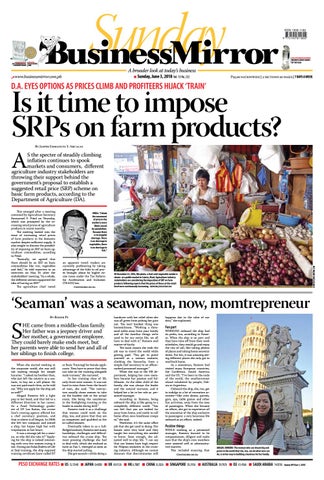
IN December 22, 2016, file photo, a fruit-and-vegetable vendor is shown at a public market in Cainta, Rizal. Agriculture industry stakeholders are considering the imposition of SRP on farm products following reports that the prices of these at the retail level were continuously increasing. Junpinzon | Dreamstime.com
‘Seaman’ was a seawoman, now, momtrepreneur
S
By Roger Pe
HE came from a middle-class family. Her father was a jeepney driver and her mother, a government employee. They could barely make ends meet, but her parents were able to send her and all of her siblings to finish college.
When she started working in the corporate world, she was still not making enough for simple luxuries. “I asked my brother then, who just left the country as a seafarer, to buy me a cell phone. He was not paid much then, so he told me: ‘Why not apply for the ship job as well?’” Abigail Romero felt a light pop in her head, and that led to a different direction in her career. As a Food Technology graduate of UP Los Baños, the cruise line’s crewing agency offered her a chef secretary position, and that is where it all begun. In 2006 she left her company and joined a ship, her hopes high but with trepidation in her heart. It was a strange job for a woman, so why did she take it? “Applying for the ship is indeed interesting with very few women trying it out. During our Solas [Safety of Life at Sea] training, the ship required training certificate [now called BT
or Basic Training] for female applicants. They have to prove that they can take on the training alongside male trainees,” she narrated. In her training class of 30, only three were women. It was not hard to miss them from the bunch of men, she said. “The instructors usually chose women to take on the hardest role in the actual exam, like being the nozzleman in the firefighting training or the leader in smoke diving drill.” Romero took it as a challenge that women could work on the ship, too, and prove that they are as competent and qualified as the so-called seamen. Eventually taken in as a fullfledged seafarer, Romero met many hardships, challenges and difficulties onboard the cruise ship. The most pressing challenge she had to deal with, which she realized as early as Day 1, emerged as soon as the ship started sailing. She got seasick—while doing a
PESO exchange rates n US 52.5540
handover with her relief when she was all green from puking her guts out. The next hardest thing was homesickness. “Working a thousand miles away from your family and all the familiar things we’re used to for our entire life, we all have to deal with it,” Romero said matter-of-factly. The main reason she took the job was to travel the world while getting paid. “You get to prove yourself as a woman seafarer, climbing the hierarchy, from a simple chef secretary to an officerranked personnel manager.” When she was in the HR department, helping her crew members became her passion and fulfillment. As the elder child of the family, she was always the leader and the natural nurturer, and it helped her a lot in her role as personnel manager. According to Romero, being onboard the ship is like going to a completely different world. “You can feel that you are indeed far away from home, and costly to call home often once loneliness creeps in,” she said. Workwise, it’s the same office job that she got used to doing. Her bosses were very kind and they taught her everything she needed to know. Soon enough, she adjusted well to ship life. “I can say that our bosses have high respect for Filipino seafarers in the cruising industry. Although we cannot discount that discrimination still
happens due to the color of our skin,” she explained.
Fun part
Working onboard the ship had its perks, too, according to Romero. When the ship is on port and they have time off from their work schedules, they would go and enjoy the city of call, like taking photos of places and taking home souvenir items. For her, it was amazing seeing different places she only got to read back home. As a seawoman, Romero had visited many European countries, the Caribbean, South America and the US. “I’ve been to the ends of the world, the southernmost island inhabited by people, Ushuia in Argentina. Onboard the ship, she, too, got to indulge in a lot of recreation activities—like crew shows, parties, gym, spa, table games and other fun activities, away from the eyes of passengers. When she became an officer, she got to experience all the amenities of the ship exclusive to passengers: a very luxurious life onboard as an officer, indeed.
Positive things
While working as a personnel manager, Romero learned to be compassionate, diligent and make sure that the ship’s crew members were assisted well in administrative matters. This included ensuring that Continued on A2
Abigail Romero: The woman who can dream big and prove to the world that she, too, can do what men can do, is on her way to building a business for her family.
n japan 0.4830 n UK 69.9126 n HK 6.7007 n CHINA 8.2026 n singapore 39.2956 n australia 39.7676 n EU 61.4566 n SAUDI arabia 14.0136
Source: BSP (June 1, 2018 )
NewsSunday BusinessMirror
A2 Sunday, June 3, 2018
www.businessmirror.com.ph
Is it time to impose SRPs on farm products? Continued from A1
Don’t blame TRAIN
“Definitely the movement of the price hike has nothing to do with TRAIN,” Piñol said. His remark echoes the observation by other government and private economists earlier that much of the seeming outrage against the TRAIN law’s gouging impact on household bottom lines is caused by certain parties hiding behind, or, to use an apt metaphor, “riding on” the first leg of the administration’s vital tax-reform package. Read also: “Profiteers seen riding the Train,” BusinessMirror Broader Look, May 31, 2018. “I think the movement of price in the market is more likely caused by speculation. Because there is no [supply] shortage. There is no shortage in vegetables, there is no shortage in fish,” Piñol added. Piñol said traders are blaming the increasing fuel prices as the reason behind the price of their farm products. “They will always have a way of justifying the increase in the price of the items in the market. And they would always point out all of these things,” he said. “But if you will compute [the price increase] through scientific computation using the Ishikawa formula, [the impact of TRAIN law] is very minimal. That’s profiteering already and that’s the reason why we are moving toward the setting of the SRP,” he added. Piñol said the establishment of SRP would allow the government to intervene in the market and to prosecute profiteering traders. Piñol added that a technical working group has been created to formulate the SRP on basic farm
products based on the inputs of the various agriculture stakeholders. He said that they may announce the first set of SRP next week. “[The SRP] could be weekly or it could be twice a week. The [Department of Trade and Industry] said it should be weekly,” he added. “By the way, in the case of agricultural products, for example, we will have to implement a regional SRP because agricultural commodities are priced differently in different regions in the country depending on the availability of supplies,” he said. During the meeting with stakeholders, the DA asked members of the sectors of livestock, poultry, fish, grains, sugar and vegetables on their current cost of production. These will be used as a basis for SRP, according to Piñol. He said they are also looking into imposing an SRP on imported goods, particularly rice. “I really believe imported rice should not be more expensive than the local [produce]. In fact, it should be even lower than the local rice,” Piñol said. “That’s the reason we invited the stakeholders today because they are the producers. We asked them how much would they need to produce 1 kilo of rice so that we will be able to come up with the computations already of how much we should dictate to the market,” he added. The proposal to establish an SRP on basic farm products was revealed by the interagency National Price Coordinating Council (NPCC) after its emergency meeting on May 30. The NPCC, chaired by the Department of Trade and Industry,
considered the imposition of SRP on farm products following reports that the prices of these at the retail level were continuously increasing. The establishment of SRP on farm products was aimed to protect consumers from profiteers who attribute their price increases to the TRAIN law. Economist Pablito M. Villegas told the BusinessMirror it is time to impose an SRP scheme on farm products, so the government could legally apprehend profiteers in the market. “[It is time to address] the oligopolistic situation of the market…which is highly influenced by traders, millers and middlemen. You will see a very huge difference between farm-gate price and the market price of farm products today,” Villegas said in an interview. “There is so much profiteering [in] the supply chain, which should be drastically reduced. The only countervailing force is to impose this and apprehend the people who are doing excessive profiteering,” he added. Villegas, a former vice president of Land Bank of the Philippines, explained that farmers are put at a disadvantage due to a “cost-price squeeze” situation in the current value chain. “At the input side farmers are at the mercy of suppliers and money lenders. It is a sellers’ market,” he said. “Meanwhile, the output side is a buyers’ market. The prices of the produce by the farmers are dictated by traders and processors,” he added. “So, there should be an equalizer in the value chain. And the SRP is the equalizer to penalize un-
scrupulous and exploitative traders and middlemen,” Villegas said. He noted that the imposition of SRP would also allow the government more weapons to protect legitimate retailers. Villegas explained that retailers would also be affected by the SRP as they only pass with minimal increase the value of goods passed to them by traders and processors. “If you do not implement the SRP properly, the retailers would be the ones hit. Because, naturally they get higher prices because they just pass on what the traders give them,” he said. “The government must be able to target the unscrupulous traders and processors so that the SRP would work effectively,” he pointed out. One way to address this problem, Villegas suggested, is by directly linking the farmers
to the market. “The government should help the farmers directly link their produce to the market, through their respective cooperatives,” he said. “They should be empowered. The only way for them not to be victimized by unscrupulous and exploitative traders and middlemen is through directly linking them to their respective markets,” he added. Meanwhile, Villegas dismissed the notion that the increase in prices was brought about by the provisions of the TRAIN law. He noted that the increase in global oil prices is the culprit for the price increases of farm products. “The TRAIN law is not the reason behind the increase in the transport costs. The impact of TRAIN on transport cost is very minimal,” he said. “The increase is attributable to the oil-price in-
crease in the world market. So that is the problem and that problem is not only true for the Philippines but other countries, as well.” The Philippine Maize Federation Inc. supports the establishment of an SRP scheme on farm products, including corn. “Yes this is quite a serious issue but in our democracy we both have freedom of free enterprise and laws, where we need to balance the whims of profit and service,” PhilMaize President Roger V. Navarro told the BusinessMirror. “SRP is a mechanism for the government to show to the people their calculations and suggest a price which is not mandatory. My take is that [we should] let the government be more vigilant in monitoring and intelligence gathering on who is abusing, profiteering, etc. Let them enforce the full force of the law,” Navarro said.
‘Seaman’ was a seawoman, now, momtrepreneur Continued from A1
they have complete travel documents, visas and other requirements needed for their employment. “I learned that you can make a difference in touching a persons’ life in any small way you can,” she said. Romero stayed 11 long years in her job with maternity leave for 20 months in between. Recently, she said goodbye to a career that helped her grow tremendously and started a new life as a travel agency owner. Traveling almost around the world for a decade and having seen the most beautiful places that were simply magazine-picture perfect, she now wants people to experience the same. “I wished for our fellow countrymen to be able to see these places, too. When I resigned from the lucrative job as a seafarer, our family decided to embark on a new journey: the travel business,” she related excitedly. Being new to the tourism industry is a bit challenging for Romero. She needed to ensure that the business is properly registered with the government. She and her mom painstakingly did the legwork of securing their DTI, barangay, mayor’s and BIR permits. Being a travel agent now, Romero has to deal with the unfamiliar, strangers who contact her asking for assistance for their dream travel destination. That takes a lot of hard work, patience, rapport and establishing trust in making transactions, according to her. She also reiterated that it is not easy to be solely on an online platform, as trust is the biggest hurdle she and people in the industry have to overcome in booking clients. What are her goals and how would she like to see her business in the next few years? “The tourism business is massive. It has strings of wellestablished travel agencies and thousands of aspiring ones. As a newbie in this business, we aim to establish our niche in this industry by offering one-of-a-kind tourist destinations, local and abroad, in all forms, by land, sea and air. There is a lot of untapped natural beauty hiding in the country that we can offer to our local and foreign tourists. Our country is rich with potential, and with our fresh eyes, we get to see it from another perspective and offer these unique destinations,” she explained. Asked why she put up a travel and booking business, Romero said that a travel and booking business seemed like an easy transition from her previous overseas job since she mostly dealt with documentation and travel needs of her employees. “As we’ve decided to settle home
for good, it was hopefully a wise decision for our family,” she said. Her husband is the company’s financier and her mother, the operations manager. Does she think she has what it takes to succeed in the travel business? Romero said that, while she might not have had the right educational background when she jumped into the tourism industry, she certainly has the perseverance to do what it takes to make a difference. “We take it one client at a time, and eventually at the end of their trips, we have become friends. And that itself is a fulfillment when we have our satisfied clients making their travel memories,” she said. Romero believes that “we are all part of the whole and each one can make a difference in putting our imprints in the general welfare of the tourism industry. With the right leadership as we have now, the goal is achievable. Our government is doing its best in protecting our tourist spots, environmentally speaking, that would benefit us in the long run. In protecting the environment, we are ensuring the future of our country in terms of tourism,” she said. To be able to achieve the country’s 7 million tourist target, Romero said it is important to ensure that our world-class tourist destinations are good and viable attractions not just for this year, but in the future as well. “In that way we can ensure the exponential increase of tourists coming to visit. Safety should also be a priority. Tourists will come if they know that they are going to a safe and beautiful place,” she said.
Best of the country
Places she recommends to clients? Top on Romero’s list are Boracay, Palawan, Davao and Ilocos. “Anywhere where you can commune with nature is always the best. Savoring the majestic beauty of God’s creation is one of the few luxuries that we are abundant with. There are a lot of unexplored pristine nooks hiding like gems in the outskirts of the country, which are yet to be discovered,” she said. “Every inch of our country has its own beauty. Each one has its unique beauty to offer and with proper conservation, these unique places will shine in the eyes of our much-coveted tourists,” she emphasized. With the country’s vibrant tourism industry, travel agents are a dime a dozen. What is a good travel agent to her? Romero defines a good travel agent as one with the genuine desire to help clients achieve the best vacation offers. “We should be able to provide the best value for money that they are willing to spend in exchange for those wonderful
memories that traveling can create. Whenever we travel, it is the memories we count, not the pennies we spent,” she said.
Dreamer, believer
Romero said the Philippines’s potential for growth is huge. “We have a lot of competitive platforms to use in terms of making our offerings to the clients unique yet comprehensive packages. We make hassle-free all-in packages to compete with each other. It is just a matter of who can offer the best value for money.” Born and raised in Quezon City, Romero went to high school at Diliman Preparatory School and finished college in UP Los Baños. She plans to take up graduate courses soon, either in business administration or industrial relations. She met her husband, also a seafarer, onboard the same ship 10 years ago. They have been married for six years now and are blessed with a 3-year-old boy. When she was young, she always wanted to be a businesswoman, not even knowing what it meant to be one. Now, she is one. The newbie entrepreneur relies on social media to show her newest promotions and latest updates, and by word of mouth from her family and friends who promote her small business. “Our clients who had a good experience from our bookings are also promoting our services and have become repeat customers. When we established the agency, we [made sure] that we are affiliated with experienced agencies and tour operators that can provide us with competitive rates with tried and tested quality services. In doing so, our packages are not the cheapest in the market. We have invested in ensuring that what we offer is of utmost quality and yet still affordable,” she said. Social media had been good to her by covering all types of demographic market that she targets. With a wide variety of audience and potential clients, it has given her a good chunk of clients. However, “it can also have a lot of untrustworthy sources that also affect the general question of legitimacy of travel agencies,” she lamented. The woman who can dream big and prove to the world that she, too, can do what men can do, is on her way to building a business for her family. Parting words to those who may want to follow her footsteps? “Never be afraid to follow your dreams. It might be scary trying out the unfamiliar in putting yourself out there. Be genuine, be kind, be smart, be your own unique you. And when life gets rough, travel. Find your peace,” she said.
The World BusinessMirror
www.businessmirror.com.ph
Sunday, June 3, 2018
A3
Kim Jong Un complains of US ‘hegemonism’ as summit nears By Eric Talmadge & Hyung-Jin Kim
T
The Associated Press
OKYO—North Korean leader Kim Jong Un complained of “US hegemonism” to Russia’s visiting foreign minister on Thursday, as one of his top lieutenants was in New York trying to pave the way for a summit with President Donald J. Trump.
Kim told Sergey Lavrov that he hopes to boost cooperation with Russia, which has remained largely on the sidelines in recent months, as Kim has reached out diplomatically to the United States as well as to South Korea and China. “As we move to adjust to the political situation in the face of US hegemonism, I am willing to exchange detailed and in-depth opinions with your leadership and hope to do so moving forward,” Kim told Lavrov.
K i m h a s pre v iou sly m ade h a rsher comments a nd even threatened to launch nuclear attacks on the United States numerous times. But his comments Thursday come at a sensitive moment, when a senior North Korean official was in New York for talks with US Secretary of State Mike Pompeo on the planned summit. After his meeting with North Korean senior envoy Kim Yong Chol, Pompeo said “real progress” has been made in the last three
Korean leader Kim Jong Un (left) and Russia’s Foreign Minister Sergei Lavrov shake hands during a meeting in Pyongyang, North Korea, on May 31. Lavrov’s visit to North Korea comes ahead of a planned summit between President Donald J. Trump and North Korean leader Kim Jong Un, and is seen as an attempt by Moscow to ensure its voice is heard in the North’s diplomatic overtures with Washington, Seoul and Beijing. Valery Sharifulin/TASS News Agency Pool via AP
days toward setting the conditions needed for Trump and Kim Jong Un to have a successful summit in Singapore. Still, Pompeo said he doesn’t yet know whether the meeting will proceed on the an-
New business deals speed up deployment of self-driving cars
D
ETROIT—Two technology giants announced major new investments in self-driving vehicles on Thursday, bringing the world a step closer to a time when autonomous cars are a part of everyday life—a reality that General Motors aims to achieve in some places as early as next year. The deals, and other ongoing negotiations, show that the technology is authentic and it’s accelerating. “It’s all starting to coalesce into something that’s more real,” said Navigant Research analyst Sam Abuelsamid, who closely follows autonomous vehicle developments. SoftBank, a giant Japanese tech investment firm, announced on Thursday it would spend $2.25 billion for a 20-percent stake in GM’s autonomous vehicle business. Then Waymo, Google’s self-driving operation, said it would buy up to 62,000 more minivans from Fiat Chrysler to expand its soonto-start ride-hailing venture. Not to be outdone, Uber’s new CEO said at a Wednesday conference that he’s in talks with Waymo about adding Waymo self-driving vehicles to the Uber network to carry passengers, although there was no indication that was imminent. “Everything in the autonomous world is moving very quickly,” said Rebecca Lindland, executive analyst for Kelley Blue Book. Also, as part of the Waymo-Fiat Chrysler announcement, the companies said they are discussing use of Waymo technology in Fiat-Chrysler selfdriving vehicles that would be sold to the public. That raises the possibility that personal car ownership won’t die if robotaxis become ubiquitous. Waymo, the current front-runner, already is testing self-driving Chrysler vans with no human backup behind the wheel in Arizona. The company plans to start an app-based autonomous ride-hailing service there later this year. At GM, widely viewed as being in second place, the SoftBank cash infusion will help the autonomous unit named GM Cruise to roll out a robotaxi service in at least one major city starting next year, CEO Mary Barra said. The deal, the largest yet between a technology investment firm and an old-line automaker, boosted General Motors Co. shares to their biggest one-day gain since the automaker returned to the public markets in 2010 after a trip through bankruptcy protection. The stock closed on Thursday up nearly 13 percent at 42.70. GM Cruise would remain a wholly owned subsidiary of GM with the automaker keeping roughly 80 percent of the business. SoftBank can trade its stake for shares in GM if Cruise isn’t spun off into a new company within seven years.
The stock soared because investors are starting to realize that GM is a serious player in automated mobility, Abuelsamid said. But analysts were cautious about predicting a future of self-driving cars everywhere. Lindland said the recent Arizona crash in which a self-driving Uber SUV struck and killed a pedestrian, as well as crashes involving Tesla Inc.’s semi-autonomous “Autopilot” feature, have rattled public confidence in the technology. “Even as the industry is pushing forward and collaborating and getting billions of dollars in investment, we can’t leave the consumer behind,” Lindland said. The announcements keep the front-runners on pace to start carrying passengers within the next couple of years in small-scale operations in a few Metro areas, Abuelsamid said. But he said it still will take until the middle of the next decade before self-driving taxis are ubiquitous worldwide. Although he views Waymo as having the lead in the autonomous vehicle race, Abuelsamid said GM’s alliance with SoftBank could boost the automaker’s standing. SoftBank owns big stakes in Uber, as well as in India’s Ola ride service and Didi Chuxing, China’s top ride-hailing firm. Michael Ronen, a managing partner for SoftBank, said on Thursday the companies will make their own decisions, but Abuelsamid sees more alliances with GM coming. He foresees GM vehicles carrying passengers on the Uber, Didi or Ola networks. “Softbank can become a conduit for GM into all these different companies that GM doesn’t now have a relationship with,” Abuelsamid said. Even though Waymo and GM now lead in autonomous vehicles, competitors—such as auto electronics supplier Aptiv as well as ride-hailing service Lyft, chip maker Intel, and Ford, Renault Nissan and Germany’s Diamler—all have room to catch up in what could be a huge market, Abuelsamid said. Being able to produce the cars gives GM and other automakers a big advantage over tech firms that don’t have their own auto factories, he said. Even with all the corporate deals, no one really knows for sure how people will get around in 10 or 15 years, Lindland said. They could embrace autonomous vehicles and the potential to eliminate the human errors that cause most crashes. Or they could distrust and reject them, Lindland said. Also, after the Uber crash, there have been calls for more supervision of autonomous vehicle testing. Currently the federal government and most states allow testing with little or no regulation. “The last time our world was so disrupted could arguably be the Internet,” Lindland said. AP
nounced date of June 12 and that he believes North Korea’s leaders are contemplating a different path forward that would allow their nation to more fully integrate into the international community.
Kim Yong Chol, the highestlevel North Korean official to visit the United States in 18 years, plans to travel to Washington to convey a personal letter by Kim Jong Un to Trump. Kim Jong Un’s comment on US hegemonism wasn’t carried by the North’s official Korean Centra l News A genc y, whic h targets an external audience. The agency quoted Kim as saying that the North’s willingness for the “denuclearization of the Korean Peninsula still remains unchanged ” but also that the process should be “stage-by-stage basis by founding a solution to meet the interests of each other.” Since January, Kim has significantly toned down his rhetoric against Washington and Seoul and tried to reach out to them following a year of heightened nuclear tensions that saw increased fears of war on the Korean Peninsula. But continuing differences led Trump to abruptly cancel the planned summit last week, and then quickly announce it might still be held as scheduled. Despite having a border with
North Korea and relatively cord ia l relations that President V ladimir Putin has seemed to want to develop further, Russia has kept a surprisingly low profile as Kim has emerged onto the world stage this year, meeting twice with Chinese President Xi Jinping and South Korean President Moon Jae-in. Lavrov’s visit suggests Russia wants to become involved and make sure North Korea informs it of its intentions and is mindful of Moscow’s concerns. In their talks, Lavrov relayed Putin’s “warmest regards and best wishes” for Kim’s “big endeavors” on the Korean Peninsula. He also expressed Moscow’s support for an agreement Kim reached with Moon at a summit last month that focused on measures to ease hostilities and increase exchanges between the two Koreas. Video of the beginning of their meeting also showed Lavrov inviting Kim to Moscow. According to Russian media, he also discussed ways to expand relations during a meeting with Foreign Minister Ri Yong Ho.
A4
BusinessMirror
Sunday, June 3, 2018
Going it alone: US alienates allies before taking on Beijing
W
The World
ASHINGTON—The Trump administration’s decision to slap tariffs on its top allies on Thursday could weaken Commerce Secretary Wilbur Ross’s hand as he travels to Beijing to try to fend off a trade war with China. That, at least, is the view of many longtime trade analysts and China watchers. “This is really the US going it alone,” said Philip Levy, senior fellow at the Chicago Council on Global Affairs who was a trade adviser in the George W. Bush administration. “By assaulting all our allies, we leave ourselves standing unprotected and by ourselves in a way we really never have been.” “We are alienating all of our friends and partners at a time when we could really use their support,” added Wendy Cutler, a former US trade negotiator who is now vice president at the Asia Society Policy Institute. Briefing reporters on the administration’s decision to slap tariffs on imported steel from Canada, Mexico and the European Union, Ross said he would leave on Friday for Beijing for negotiations aimed at resolving a dispute over China’s aggressive attempts to challenge US technological supremacy. Trade analysts say the Trump team should be enlisting its allies to present a united front to China. After all, US friends like Japan and the European Union share many of the same gripes about China. They decry rampant theft of intellectual property and Chinese overproduction, which has flooded world markets with cheap steel and aluminum. And, in fact, US Trade Representative Robert Lighthizer, Japan’s Economics Minister Hiroshige Seko, and EU Trade Commissioner Cecilia Malmstrom did issue a vague statement from Paris on Thursday urging unidentified countries to do more to protect intellectual property and to reduce overcapacity. But the US undermined the alliance by slapping key allies and trading partners— Canada, Mexico and the EU—with tariffs of 25 percent on steel and 10 percent on aluminum. All vowed to retaliate by penalizing American products. Canadian Prime Minister Justin Trudeau, noting that Canadians and Americans have been allies for 150 years and fought and died together in World War II and in Afghanistan, took a shot at the Trump team: “Americans remain our partners, friends, and allies,” Trudeau said. “This is not about the American people. We have to believe that at some point their common sense will prevail. But we see no sign of that in this action today by the US administration.” Now, the US is turning to Beijing and to a standoff that has taken some confusing turns. Last month the administration proposed tariffs on $50 billion of Chinese imports to punish China for forcing US companies to hand over technology in exchange for access to its market. Trump later ordered his top trade negotiator to seek up to an additional $100 billion in Chinese products to tax. China responded by targeting $50 billion in US products, including soybeans—a shot at Trump supporters in America’s heartland. Rising tensions between the world’s two biggest economies alarmed investors and business leaders. But they breathed a sigh of relief earlier this month when the US and China declared a cease-fire after talks in Washington. Treasury Secretary Steven Mnuchin said then that the trade war was “on hold.” And the tariffs were suspended after China agreed to “substantially reduce” its trade surplus with America by buying more US products. The truce didn’t last long. Trump, facing criticism from some in Congress for cozying up to Beijing, on Tuesday renewed his threat to impose the tariffs on China. His hard-line trade adviser, Peter Navarro, charged on Wednesday that Mnuchin’s conciliatory comments about China were “an unfortunate sound bite.” AP
www.businessmirror.com.ph
After moving US embassy, Trump weighs Jerusalem consulate changes By Josh Lederman & Matthew Lee
W
The Associated Press
ASHINGTON—President Donald J. Trump is considering giving US Ambassador to Israel David Friedman more authority over the US outpost that handles Palestinian affairs, five US officials said, a shift that could further dampen Palestinian hopes for an independent state. Any move to downgrade the autonomy of the US Consulate General in Jerusalem—responsible for relations with the Palestinians—could have potent symbolic resonance, suggesting American recognition of Israeli control over east Jerusalem and the West Bank. And while the change might be technical and bureaucratic, it could have potentially significant policy implications. As president, Trump has departed from traditional US insistence on a “two-state solution” for the Mideast conflict by leaving open the possibility of just one state. As his administration prepares to unveil a long-awaited peace plan, the Palestinians have all but cut off contact, enraged by Trump’s decision to move the US embassy to Jerusalem. T he deliberations come as Friedman, who has pushed for changes to the consulate since he arrived in Israel last year, faces growing indignation in the US over partisan comments and other actions in which he has publicly sided with Israel over its critics. On Thursday, a top Democratic lawmaker even suggested Friedman should be recalled after he waded into domestic US politics on Israel’s behalf, telling an Israeli newspaper that Democrats have failed to support Israel as much as Republicans. For decades, the Jerusalem consulate has operated differently than almost every other consulate around the world. Rather than reporting to the US Embassy
in Israel, it has reported directly to the State Department in Washington, giving the Palestinians an unfiltered channel to engage with the US government. That arrangement was relatively clear-cut before Trump moved the embassy. Until Trump’s decision last December to move it from Tel Aviv, the United States did not recognize Jerusalem as Israel’s capital. The Jerusalem consulate provided services to Americans in Jerusalem and also served as the de facto US embassy to the Palestinians, who claim east Jerusalem for the capital of a future independent state. But since Trump earlier this month moved the embassy to Jerusalem, the situation has become more complicated. Now the US maintains an embassy in one part of the city and a separate consulate less than a mile away, potentially creating confusion about who has ultimate authority if, for example, an American citizen needs help and turns to the US government. No final decision has been made about what changes to make to the consulate’s chain of command, a decision complicated by the consulate’s unique circumstances. But the embassy, run by Friedman, is expected to end up with ultimate authority over the consulate, officials said. They weren’t authorized to discuss the matter publicly and requested anonymity. Dan Shapiro, the former US ambassador to Israel, said such a move would be perceived as un-
In this May 21, 2017, file photo, Israeli Prime Minister Benjamin Netanyahu (left) and David Friedman, the new United States ambassador to Israel, attend a ceremony celebrating the 50th anniversary of the liberation and unification of Jerusalem, in front of the walls of the Old City of Jerusalem. AP sources say President Donald J. Trump is considering giving Friedman more authority over the US outpost that handles Palestinian affairs, a shift likely to further dampen Palestinian hopes for an independent state. Abir Sultan/Pool via AP, File
dermining Palestinians’ claims to sovereignty and statehood aspirations, because it would suggest that Washington considers the Palestinian Authority to be under Israel’s jurisdiction. Otherwise, Shapiro said, why would it expect the Palestinians to talk to the US through its mission to Israel? “They don’t want to deal with the US embassy to Israel as their channel,” said Shapiro, now a scholar at Israel’s Institute for National Security Studies. “They want their voice to be heard directly in Washington.” Typically, the head of a consulate, known as a consul general, reports to the ambassador, who has “chief of mission authority” over all US posts in the country. In contrast, the consul general running the Jerusalem consulate has historically had his or her own chief of mission authority. The closest comparable case to the Jerusalem situation is the US Consulate in Hong Kong, which also has its own chief of mission who does not report to the US ambassador in Beijing. Friedman has advocated for having the embassy in Jerusalem subsume the consulate, officials said, although the State Department has ruled out that possibility. Other possibilities include
allowing the consulate to retain some day-to-day authorities while letting the embassy set the direction for major policy decisions. Staunchly pro-Israel and with close ties to the West Bank settler movement, Friedman is broadly seen by Palestinian leadership as lacking good faith in US efforts to mediate a fair resolution to the Mideast conflict. But on the consulate issue, he has an ally in the White House in the form of national security adviser John Bolton, the officials said. It wasn’t clear precisely when the changes would be made, although one official said the administration is waiting until current Consul General Donald Blome leaves Jerusalem over the summer, possibly in July. Regardless of any changes, the Jerusalem consulate will remain the primary US point of contact for the Palestinian Authority and for Palestinians, including those in the West Bank and the Gaza Strip seeking visas or other US consular services. “Consulate General Jerusalem continues to operate as an independent mission with an unchanged mandate from its historic Agron Road location,” the State Department said in a statement.
Such changes would likely be carried out by Trump issuing new “letters of instruction,” which delegate authorities to ambassadors and chiefs of mission, to Friedman and whoever heads the Jerusalem consulate, the official said. Separately, the Trump administration is also facing calls in Congress for the US to recognize Israeli sovereignty over the Golan Heights, the strategic plateau that Israel captured from Syria in the 1967 Mideast war. Although Israel annexed the Golan in 1981, the US and others consider it to be disputed territory with its status subject to an eventual peace deal between Israel and Syria. In recent months, however, Iran’s increasing involvement in Syria and growing presence in southern Syria near the Golan Heights have drawn alarm in Israel and elsewhere, leading some US law- and policy-makers to believe that Washington should end its official neutrality in a show of support for Israeli security in the face of a threat from Iran and its proxies. Ideas under discussion range from flat-out recognition that the Golan is part of Israel to lifting restrictions on US investment incentives for projects or more symbolic steps like including the area on official maps as part of Israel.
Trudeau declines to meet Trump because of US precondition US sanctions
Canadian Prime Minister Justin Trudeau speaks during a news conference in Ottawa, Ontario, on May 31. The Trump administration announced Thursday that it will impose tariffs on steel and aluminum imports from Europe, Mexico and Canada. Trudeau said: “These tariffs are totally unacceptable.” Patrick Doyle/The Canadian Press via AP
T
ORONTO— Canadian P r i me Mi n i ster Ju st i n Trudeau said on Thursday he offered to go to Washington to complete talks on renegotiating the North American Free Trade Agreement (Nafta) but that Vice President Mike Pence called and told him a meeting with the US president would only happen if Trudeau agreed to put a five-year sunset clause into the deal. Trudeau said he refused to go
because of the “totally unacceptable” precondition. He made the comment while outlining Canada’s response to US tariffs on steel and aluminum imports. Late Thursday, President Donald J. Trump responded in a statement released by the White House, “Earlier today, this message was conveyed to Prime Minister Justin Trudeau of Canada: The United State (sic) will agree to a fair deal, or there will be no deal at all.” In a call to Trump last Friday, Trudeau offered to meet Trump because he felt they were close to an agreement that only required a “final deal-making moment.” Trudeau said Trump seemed agreeable before Pence called him on Tuesday. “I stated that I thought we were quite close to reaching an agreement, and perhaps the time had come for me to sit down with the president in Washington in order to finalize the Nafta agreement,” Trudeau said in French. “We already had the bones of a very good agreement for all parties, and I thought it might be opportune for all of us to sit down for a few hours and discuss it.” Tr udeau h a s long sa id he
wouldn’t agree to a sunset clause because businesses need certainty when they make long-term investments and putting a sunset clause in every five years would create uncertainty. “I had to highlight there was no possibility of any Canadian prime minister signing a Nafta deal that included a five-year sunset clause and obviously the visit didn’t happen,” Trudeau said. Pence discussed preliminary issues that the Trump administration wanted clarity on before any in-person meeting at the White House, including the sunset clause, according to a White House official who spoke on condition of anonymity to describe internal discussions. The official said a range of issues remains to be resolved but the US looks forward to continuing the negotiations with Canada. Trudeau earlier deplored a decision by Trump to impose tariffs on steel and aluminum imports. Canada announced plans to slap tariffs on $12.8 billion worth of US products, ranging from steel to yogurt and toilet paper. Trudeau said he regrets the action but said they must do it. AP
have a weak spot: Tiny allies like Latvia
R
IGA, Latvia—Latvia has come into focus as a potential weak link in the West’s banking system that allows countries like Russia and North Korea to dodge sanctions. As the US increasingly uses sanctions in diplomacy, it is now cracking down on such practices. T he t iny countr y, a member of the European Union and Nato, has long tried to become a “Switzerland on the Baltic” by providing financial services to foreigners, particularly former Soviet states. Hav ing str ug gled to avoid dirty money f lowing into the country and the EU, Latvia is now overhauling its banking system. Prime Minister Maris Kucinskis told The Associated Press in a recent interview that Latvia “cannot afford to have any uncontrolled money flows from the countries which have to be constantly monitored in order to avoid meddling or influence.” AP
Sports BusinessMirror
Editor: Jun Lomibao | mirror_sports@yahoo.com.ph
Sunday, June 3, 2018
A5
Filipino youngsters gear up for football program in Russia
A
j Boy Victoriano and Matteo de Venecia will fly to Russia on June 8 to participate in the Sixth Gazprom Football for Friendship International Program. The 12-year-old young ambassadors will be joined by other kids from more than 210 countries in Moscow. Victoriano, selected in the role of a midfielder, will be a part of the 32 International Teams of Friendship that will play against each other. The young footballer will be a part of the “Komodo Dragon” team and will undergo a three-day training camp in Moscow to get used to the playing conditions and get ample practice with his team, before the start of the championship. Each team will be trained by 14- to 16-year-old coaches from different countries. The young footballers will also participate in workshops and sessions, conducted by renowned celebrities. Victoriano, who hails from Parañaque, started playing football at 8. He has participated in tournaments across the country and has played a pivotal role in getting his team to win trophies at the Laguna Carmeltown Championship and the Ambassador Camp. De Venecia, on the other hand, will act as a young journalist and cover all the local and global activities of the program as part of the International Children’s Press Center. The Press Center acts as hub for the young journalists who gather information, make reports, write news articles and prepare materials on the initiatives implemented as part of the program. De Venecia is a sports enthusiast who hails from Metro Manila. He belongs to a sports-loving family and started playing football when he was 4. Matteo De Venecia will act as a young journalist while in Moscow.
TRUMP: HAVE A GOOD LIFE W
By Ken Thomas The Associated Press
ASHINGTON—Taking his turn in the batting cage and swinging a golf club, President Donald J. Trump joined a group of famous athletes for a field day with kids at the White House on Wednesday as he kicked off an effort to increase youth participation in sports. “Work hard, get in the game, play to win and, most of all,
have a good time,” the president told the youngsters. He later told them to “have a great life.” His administration wants to reverse a trend of declining participating in athletic activity and to make youth sports more accessible to economically disadvantaged students. At the event on the South Lawn, Trump also spotlighted members of the President’s Council on Sports, Fitness and Nutrition. The long-established group is headed by former New York Yankees pitcher Mariano Rivera, retired beach volleyball Olympian Misty May-Treanor and ex-National Football League
running back Herschel Walker. After addressing participants, Trump joined athletes at stations that included flag football, baseball, golf and track and field. He asked kids to name their favorite players and posed for photos. “Any Tigers? Who’s the next Tiger?” he asked the young golfers, referring to champion Tiger Woods. Trump issued an executive order in February refocusing the council on youth sports as opposed to President Barack Obama’s emphasis on fitness and healthy eating. Trump, who played high-school sports and is a competitive golfer, has tried
to work with public and private groups to address declining participation in youth sports. Ivanka Trump, the president’s daughter and senior adviser, told reporters in a conference call before the event that sports participation lags disproportionately among young girls and children who live in economically distressed areas. Many high schools have “pay to play” policies requiring students to pay a fee to join a school sports team, making it difficult for families to afford after-school sports. “We must break down barriers to youth sports participation and
President Donald J. Trump watches runners as he attends the White House Sports and Fitness Day on the South Lawn of the White House. AP
empower each child to reach his or her full potential through sport and play,”Ivanka Trump said. She said that by the time girls reach age 14, they drop out of athletics at two times the rate of boys. Other participants at the White House event included The Incredible Hulk actor Lou Ferrigno, who befriended Trump while appearing on Celebrity Apprentice; former New York Yankees baseball player Johnny Damon; and professional golfer Natalie Gulbis. Trump particularly seemed to enjoy getting the chance to hit a golf ball on a work day. “I love golf,” he said earlier of his favorite sport.
A6 Sunday, June 3, 2018
Science
BusinessMirror
Sunday
www.businessmirror.com.ph • Editor: Lyn Resurreccion
‘Aghambayan’ to highlight D.O.S.T., U.P. scientific projects, achievements
Newborn screening: Science saves lives Story & photo by Edd K. Usman
S
Special to the BusinessMirror
cience saves lives; science saves Filipino babies’ lives. That should not be a subject of debate. Medical and health breakthroughs through the years have provided enough proofs.
In the Philippines a collaboration between the Department of Science and Technology (DOST) and University of University of the Philippines (UP) System has added to those proofs. Dr. Carmencita David Padilla’s newborn screening (NBS) has saved more than 120,000 babies from illness and death from among the 10,653,226 babies screened. Padilla made the disclosure at the media briefing in Quezon City during the launching of “Aghambayan”: A DOST-UP Sc ience a nd Tec h nolog y a nd Innovation Festival on May 30.
NBS law
Padilla, the chancellor of UP Manila, a professor of pediatrics and a pioneer not only in the Philippines but also in the Asia-Pacific region, is behind the Newborn Screening Act of 2004 (Republic Act 9288). The law called for the implementation of NBS services in the country’s health institutions with birthing facilities. She led an expert team of researchers in 1996 to study newborn screening. It resulted in her writing a bill on NBS that eventually became a law in 2014. “Infant mortality was high sometime in 1985 to 1995; I think [there were] 55 deaths per 1,000 live births. Now, we have
21 deaths per 1,000 live births,” Padilla reported. The Philippine Council for Health Research and Development of the DOST provided P500,000 for the research, with UP Manila giving P1.5 million to the NBS. Acknowledging the uptick in surviving babies since the law was implemented, she hastened to add, though, that it should not end at that point. “W hy do babies die between birth to 1 year of age? Perhaps, the baby had an ailment that the medical professionals, who assisted in the deliver y, and the baby’s parents, did not know about ,” Pad i l l a poi nted out. That’s where NBS comes in to save babies’ lives. “Newborn screening,” she said, “is a universally accepted public health program aimed at the early identification of infants who are affected by certain genetic, metabolic or infectious conditions,” Padilla explained. NBS, she underscored, is a very cheap procedure but it has to be done starting at seven days of birth. Screening the babies, she said, benefits the country $11 million (at least P563 million) a year.
10,653,226 babies screened
To date the country has 6,500
Officials of the Department of Science and Technology and the University of the Philippines System lock arms to signify their partnership and collaboration on research and development to produce technologies benefiting the citizens and the nation. The occasion was the media briefing on May 30 to launch “Aghambayan,” a festival to celebrate the two agencies’ scientific projects and achievements.
NBS facilities and six laboratories nationwide. Across the globe, she said, developed and developing countries are already implementing NBS for decades. “So, we thought the Philippines had to catch up with pediatric and obstetrics procedures going on worldwide.” Padilla cited the success of the newborn screening program. “We have testimonials attesting to that. Some of the babies, who were screened when the law was starting to be implemented, are all grown-ups and are in college now. They have inspiring stories,” she said. As of December 2017 the NBS has already screened 10,653,226 babies. Padilla said that from 1996 the NBS already saved “more than 120,000 babies from mental retardation and death!” “We now have enough data to show how beneficial it is, because we are expanding to screen from six health conditions to 28 health conditions. And it is now
covered by the Philippine Health Insurance System,” she said. Initially her project, titled as Philippine NBS Project, was testing only six metabolic conditions, such as hy pothyroidi sm , conge n it a l ad re n a l hyper plasia, galactosemia, phenylketonuria, homocystinuria and glucose- 6 -phosphate dehydorgenase deficiency. Since 2014 the NBS is being done on 28 conditions.
Feed ingredient, LiDAR
The success of Padilla’s groundbreaking NBS research was one of the three R&D success stories featured during the media launch for Aghambayan. T he t wo ot he r s we re t he Protein Enriched Copra Meal (PECM): A Valuable Protein Feed Ingredient for the Livestock and Aquaculture Industries, led by Dr. Laura J. Pham, and the Light Detection and Ranging (LiDAR) and Data for Disaster Risk and Exposure Assessment for Mitigation (DREAM) Program headed
by Dr. Enrico C. Paringit. Pham is a university researcher with vast experience at the National Institute of Molecular Biology and Biotechnology, UP Los Baños, Laguna, while Paringit is an erstwhile chairman of the UP Department of Geodetic Engineering and director of the Training Center for Applied Geodesy and Photogrammetry. The latter’s LiDAR-DREAM, now Phi l ippine LiDA R I and Philippine LiDAR II, “is one of the biggest if not the biggest R&D projects supported by the [DOST]” which develops and deploys technologies to provide life-saving information to communities endanger of environmental hazards. All three R&D products are already being utilized in the country. Pham’s research focused on the “ bio-conversion of copra meal into a protein-rich ingredient...that can partially substitute imported soybean meal to boost the livestock and poultry production.”
Celebration of scientific projects, achievements
On June 20 scientists, engineers and researchers and other like-minded people from the country’s scientific community will gather at the Philippine International Convention Center in Pasay City to celebrate their scientific projects and achievements intended to benefit the citizens and the nation. Branded as Aghambayan it is aimed at raising public awareness of the value of science and its role in improving ordinary Filipinos’ quality of life; they are what the DOST calls “Juana and Juan.” Behind the event are the DOST and the UP System. The two have been collaborating in hundreds, if not already thousands, of programs and projects intended to
give flesh to science through researches and their products that Filipinos can taste, see, touch, smell and hear. A l so p a r t ic ip at i n g i n t he event are government agencies, such as the Departments of Environment and Natural Resources, Agrarian Reform, Trade and Industry, Budget and Management, and National Economic and Development Authority.
Knowledge fest
Dr. Elena E. Pernia, a professor of communication and dean of UP Diliman’s College of Mass Communication, descr ibed Aghambayan as knowledge festival of DOST-funded researches in UP. It will be presented to the public, to specific sectors in the private industry as well as to lead government agencies. She said in an interview with the BusinessMirror that R&D outputs directly benefit Filipinos because what will be shown in the festival are not just concepts but genuine products. “So, we will see that LiDAR already has an application, newborn screening is already being used and has been in use for several years, and then the PECM is already being fed to chickens, pigs, livestock and even to fishes,” Pernia emphasized. The UPCM dean added that more of the genuine R&D products which are now actual technologies out of DOST and UP will be showcased at Aghambayan. “Expect more of these on June 20, more researches that directly benefit the people, more focused on products, even those that are patented,” she said. Another feature of the festival, Pernia said, will be the signing of memorandum of agreement to demonstrate the outputs are already being adopted by private and government sectors.
‘Bringing R&D outputs, technology innovations to countryside is important’ Golden Rice meets food-safety standards in 3 global agencies
C
LARK FREEPORT ZONE, Pampanga— Volumes of research studies and innovations continue to come out of the Department of Science and Technology (DOST). One critical thing is to bring the outputs to the country’s 17 regions—to make them useful. As far as the DOST—headed by Secretary Fortunato T. de la Peña, and its 18 agencies and 17 regional offices—are concerned, nothing is being left to chance. One of the ways to do transfer of technology to users—small and medium enterprises (SMEs), individuals, organizations, etc.—is the holding of conferences or fora in the provinces. “This is important because, first, it helps in the development of the countryside; second, the technology that should benefit our citizens is utilized,” said Engineer Sancho A. Mabborang, regional director of DOST Cagayan Valley. Mabborang spoke with this journalist during the Luzon Regional Scientific Meeting (RSM) at a hotel here last month. The DOST’s National Academy of Science and Technology (NAST) Philippines organized the RSM. It will soon conduct similar RSMs in the Visayas and Mindanao, precisely to communicate to local government units (LGUs), SMEs and individuals the gains out of research and development (R&D) studies and innovations funded by the government. Mabborang cited the vital importance of holding RSM “because we are showing here and presenting the various issues and concerns of the scientific community.” Besides that, he added, the DOST is showing its achievements, citing the presentation at the RSM on Smart City made by architect and urban development planner Felino A. Palafox Jr. Discussions were also made on the presentations on sustainability and resiliency, smart city, water quality and wastewater management, information and
Science Secretary Fortunato T. de la Peña (center) leads the ribbon cutting for Luzon Regional Scientific Meeting last month. Edd K. Usman
communications technology (ICT) ecosystems, competition, railway development and sustainable water resources. From the presentations, the DOST Cagayan Valley chief noted that the citizens, not only the scientific community, would know and understand modern concepts, which can be expanded and communicated to the society’s various sectors. “In our case, we have the here the LGUs, academe, businessmen, SMEs, who, through this opportunity [in the RSM], would know about the latest developments, cutting-edge technology that can help in their respective localities, and respective fields. “It is important that we have this kind of assembly so we can further improve the condition of our nation,” he said. Mabborang seemed to have embedded in his mind one speaker’s “menu for success:” a visionary leader armed with political will, and not involved in graft and corruption. Meanwhile, de la Peña noted that the DOST has one specific activity or program that has really been generating opportunities.
“I’m referring to the human-resource program. Our scholarships, which have been expanding over the years, are really creating opportunities, particularly for the very poor in the different regions,” he said. The DOST head said for 2018, around 7,000 new scholarship slots were opened under the program being implemented by the Science Education Institute. “By this time, we are already covering 97 percent of all municipalities in the whole Philippines. Now, there is already a scholar in almost all municipalities, except in 52 municipalities.” The Philippines has a total of 1,489 municipalities as of December 2017. Just how important is the scholarship program? “We have already established the fact that when you are able to graduate a poor student from a DOST scholarship, [the scholar] is able to lift his family from poverty,” de la Peña said. T h e L u z o n RS M , t h r o u g h t w o academicians, seven regional directors, another DOST executive and a university professor, issued a resolution containing their eight-point recommendations to
hasten the attainment of the United Nations Sustainable Development Goals (SDGs). n Strengthen the fundamentals, including better institutions and governance, growing stocks of human capital, skills and knowledge; n Localize and concretize the application of the SDGs at all levels of the government, from the national level to the local government units; n Leverage scientific and technological advances, which lead to higher productivity, economic growth, higher incomes and clean government; n Strengthen the competition policy as it is the key to removing uncompetitive market practices that harm people’s welfare and prevent growth; n Shift the transportation systems away from oil toward sustainable, clean and renewable energy. Design pedestrian- and person with disability-friendly mass transportation systems, such as urban and intercity railways; n Harness the tools of information and communication technology (ICT) ecosystem that promotes collaborative innovation. Expand the use of ICT in planning, monitoring and decision-making; n Provide efficient management of water supply and wastewater treatment with strict quality controls to minimize human-health risks and environmental pollution; and n Use innovative and holistic approaches to smart cities, which consider multifaceted strategies: visionary, progressive, green and sustainable, digital and inclusive. Meanwhile, the Vitune: Vir tual Instrumentation Technology for Ultrasonic Nondestructive Evaluation of Concrete, a poster presented by Albatross Amante and Tirso A. Ronquillo from Batangas State University, won the Luzon RSM Poster Making Contest. Edd K. Usman
L
OS BAÑOS, Laguna—Golden Rice, a pro vitamin-A biofortified rice variety, completed its third positive food-safety evaluation, this time from the United States Food and Drug Administration (US FDA). In an official response received by the International Rice Research Institute (IRRI) on May 24, the US FDA concurred with IRRI’s assessment regarding the safety and nutrition of Golden Rice, IRRI said in a news release. The US FDA statement comes on the heels of the safety and nutritional approvals from Food Standards Australia New Zealand and Health Canada in February and March 2018, respectively. These three national regulatory agencies carry out their assessments based on concepts and principles developed over more than two decades by international organizations—such as the World Health Organization ( WHO), the Food and Agriculture Organization of the United Nations, the Organisation for Economic Cooperation and Development and the Codex Alimentarius Commission. “Each regulator y application that Golden Rice completes with national regulatory agencies takes us one step closer to bringing Golden Rice to the people who need it the most,” IRRI Director General Matthew Morell said. “ The rigorous safety standards observed by the US FDA and other agencies provide a model for decision-making in all countries wishing to reap the benefits of Golden Rice.” For those who struggle with vitamin A deficiency (VAD)—including an estimated 250 million preschool-age children—this announcement represents one more step forward to making this rice available to them. Once Golden Rice receives all necessary n at i o n a l a p p ro va l s, a s u s t a i n a b l e deployment program will ensure that
Golden Rice is acceptable and accessible to its target communities. VAD remains a pervasive public health problem worldwide. WHO estimates that alongside children under 5 years old, a substantial number of pregnant and lactating women are afflicted with VAD. South and Southeast Asia rank high among the regions where VAD is prevalent. Golden Rice is intended as a complementar y, food-based solution to existing nutritional interventions, such as diet diversification and oral supplementation. It achieves this by providing 30 percent to 50 percent of the estimated average requirement for vitamin A of women and children. GR2E Golden Rice is the first nutritionally enhanced genetically modified rice to receive regulatory approval for use in food. IRRI is working with national research partners in the development and deployment of healthier rice varieties that have more iron, zinc and beta-carotene content to improve the nutritional status of vulnerable populations with limited access to diverse diets. Because rice is already widely grown and eaten, these bio-fortified rice varieties have the potential to reach many people. In Bangladesh and the Philippines, the Bangladesh Rice Research Institute and Philippine Rice Research Institute are developing high-yielding inbred local rice varieties with the beta-carotene producing GR2E Golden Rice trait. Being high-yielding, GR2E Golden Rice is the more preferred trait than the earlier lowyielding GR2R. Golden Rice applications with the appropriate national regulatory agencies have been made by BRRI in Bangladesh, and a joint IRRI/PhilRice application has been submitted in the Philippines. Both were lodged in 2017.
Tourism&Entertainment BusinessMirror
Editor: Carla Mortel-Baricaua
Sunday, June 3, 2018
A7
Bohol on Full Throttle Story & photos by Celine Murillo
B
Additional photos courtesy of the Bohol Tourism Council and Sandugo Foundation
ohol sets to take on the tourism mantle as one of the country’s most popular spots closes down for rehabilitation.
If you are to make a list of the most well-known destinations in the Philippines, Bohol would most likely make it to the top 5. Especially in the international community, the province is one that is often thrown into the mix of “where to go” and “must-visits.” Its Chocolate Hills has reached iconic level, being one of the few places that gets instant recognition even in photos— right up there with the Mayon and the Underground River. Yet even with this secured status, Bohol refuses to rest easy. For one thing, while it already plays host to a treasure trove of veritable tourist spots, Bohol continues to develop other destinations. Like the adventurers it draws in, it fearlessly scours its own folds for new wonders. Among its latest discoveries is Vita Isola.
Bucolic island life
In the town of Loon, northwest from the capital city of Tagbilaran, lies a quaint but picturesque corner with a name that literally translates to “island life.” You’d think it’s a resort at first glance. Honestly, who could blame you? With its pool and nice cottages, that’s what most people’s first impression would be. The stunning seascape it affords
also doesn’t help. But Vista Isola offers more than just your regular kind of leisure. Its main goal is to promote “backyard” farming to Boholanos. On a portion of it is a patch of farmland that both serves as a source of ingredients for their in-house restaurant, as well as a tour venue where guests can learn about the basics of organic farming and that anyone can do it even with limited space. It is one of the emerging farm destinations in Bohol—a fairly new, but not unheard of, concept in the province. The local government has eyed this place as another potential tourism stronghold. Then, there’s the island of Panglao. It and the establishments in the area are also being prepped for the expected increase in tourist arrivals. Amorita Resort, Donatela Hotel and the rest of the island’s resorts are being tapped, working to ensure that guests would have a similar, if not better, experience of island life.
Lowering the draw bridge
And it’s not just the destinations that are being braced. The transportation sectors are also doing significant efforts in anticipation
A LUXURIOUS villa at Donatela Hotel
The opening of the Bohol branch of the National Museum is scheduled to coincide with the festivities to boot.
Challenge accepted
BOHOL’S iconic Chocolate Hills
of the tourism exodus. The Tagbilaran City Port, for instance, has been overhauled, upgraded with quality infrastructures and processes that will make entry and exit as convenient as possible. Considering the current situation, and the fact that it connects Bohol to other popular spots like Cebu and Dumaguete, the modernization couldn’t come at better time. The new Bohol airport is also set to commence operations in August, expected to be on full capacity early-2019. Bigger and better, the airport can accommodate more flights that airlines are more than happy
to respond. In fact, low-cost carrier Philippines AirAsia has signed on as the official airline partner for the Behold Bohol Tourism campaign. This means Bohol will become a hub, with the said airline increasing its flights to the province.
Come one, come all
Speaking of the festival, the Sandugo will be on its 27th year this coming July. Congruent to all the efforts from other sectors, the monthlong celebration, too, is being outfitted for the tourism boom. Activities lined up are made to be more inclusive, more palatable and
This coming Sandugo Festival, the morning street parade of the traditional “Kuradang” dance will be followed by a street party.
THE popular Loboc River cruise
relatable to nonlocals. For example, the street parade, featuring the traditional dance of “Kuradang,” will transition into an afternoon-to-midnight street party. The International Fusion Nights, where top resorts purvey their world-class dishes for affordable prices, will go on longer to accommodate a larger crowd. There’s also the mainstay activities, such as the Ms. Bohol Pageant, Sandugo Songwriting Contest, Trade and Agri Fair, and the awarding of the Ten Outstanding Boholanos Across the World. All are marketed to both local and foreign visitors.
With these in the works, coupled with the province’s usual fanfare— Chocolate Hills, Loboc River, Tarsier Sanctuary—and its share of white-sand beaches, plus the array of fresh and new destinations, guests will surely not run out of things to do. Their visit would be deemed a value-for-money-andtime experience. This just goes to show that Bohol is not one to slack. It’s constantly determined to prove why it deserves one of the top rails in the country’s tourism ladder. Other provinces should take heed. Learn from its impressive proactive plays. Better safe than sorry, it seems to say, for while there may be three more months before it holds its biggest and grandest event, Bohol is already standing proud, looking very much all set.
VITA Isola’s piece of island paradise
Our Lady of Mt. Carmel celebrates 400 years at San Sebastian Basilica
I
By Gelyka Ruth R. Dumaraos
n the celebration of 400 years of Our Lady of Mt. Carmel on May 4, Manila Archbishop Luis Antonio Cardinal Tagle said, “In a world that is loud and refuses to hear the cry of the people, especially the poor, let us go back to Carmel. In a world that worships false gods, let us go back to Carmel. We hope that the guns and the cries would turn silent and be replaced by a silence brought about by genuine peace.” “In a world that is being destroyed by false gods, may the Lord mold us to become givers of life.” During the High Mass at the Quirino Grandstand, Tagle also underscored the need to live a life emulating the values of the Our Lady of Mt. Carmel, who has been the refuge of thousands of devotees since the image came to the Philippines. Organized by San Sebastian Basilica, home of Our Lady of Mt. Carmel, the one-day festivity kicked off with the re-
enactment of the arrival of the first image of Our Lady of Mount Carmel from Mexico in 1618 that was held at the Manila Bay dock. Tagle said that the salubong and traslacion tradition aims to strengthen the people’s devotions to Our Lady of Mount Carmel and to draw strengthen from her. He also called on the devotees to pray for the country’s healing and reconciliation. The procession ended at the San Sebastian Basilica at around 11 a.m. Aside from the main event, there were also catechism and pilgrimage tours within the Basilica as organized by the church. Since January, pre-salubong activities have been conducted such as novena masses, procession of Saints, and Marian exhibits at the San Sebastian Basilica. The organizers projected over a million devotees in attendance, however the event only gathered over 5,000 devotees.
The image was welcomed by devotees who flocked the area early morning of May 4
‘Dungaw’
The highlight of the traslacion was the dungaw or salubong at the Quiapo Church, where the image of the Black Nazarene was brought to meet the image of Our Lady of Mt. Carmel. Traditionally the salubong is a part of the annual traslacion of the Black Nazarene held outside the San Sebastian Church. Many devotees come before dawn to get a glimpse of the historic meet while offering prayers of devotion. According Bing Kimpo, trustee of the San Sebastian Basilica Conservation and Development Foundation, while dungaw is an age-old tradition during traslacion, this celebration was a different. It used to be that both images meet for the traditional dungaw during the Feast of the Black Nazarene, Kimpo says, but this will be the first time that the Black Nazarene looked out to the image during the Our Lady’s traslacion. It was five years ago when a more
The San Sebastian Basilica
meaningful approach was adapted, after the discovery that the Black Nazarene and the Our Lady of Mt. Carmel were both brought by the Augustinian Recollects in the country.
Beginnings
In 1617, the Order of Augustinian Recollects (OAR) set on their third mission to the Philippines from Spain, led by Fr. Rodrigo Moriz Aganduru, OAR. They passed by Acapulco, Mexico where the image of Nuestra Señora del Carmen (Our Lady of Mount Carmel) was given by the Discalced Carmelite nuns as a gift. The image served as their protectress as it sailed for over two months to the country. In 1621, San Sebastian Church welcomed Nuestra Senora del Carmen where it was enthroned. In the same year, the Augustinian Recollect community was inaugurated in San Sebastian de Calumpang, Quiapo. The church was pulverized by two consecutive earthquakes—one in 1863 and another in 1880. The Carmelite Prior General in Rom granted the Augustinian Recollects the permission to promote the brown scapular of Our Lady of Mt. Carmel in San Sebastian Church. From 1887-1891, a four year project was launched to build an all-steel church of San Sebastian. While the project was ongoing, the church was raised to a status of Minor Basilica, attached to St. Peter’s Basilica in Rome. By virtue of the Presidential Decree No. 260, San Sebastian Basilica was declared a National Historical Landmark in the Philippines in August 1, 1973. Come 1991, Our Lady was canonically crowned by St. Pope John Paul II.
LITE Ferrey 88
New Lite Ferries vessel boosts Bohol-Cebu link
T
ravelers between Cebu and Bohol can now travel seamlessly in style with the recent introduction of the Lite Ferry 88 (LF88), the latest world-class and the biggest roll-on, roll-off (Roro) catamaran passenger ferry of Lite Shipping Corp. The mid-speed vessel, which has an average speed of 16 knots, sails the Cebu-Tubigon route four times daily. It has a capacity of 352 passengers (business, tourist and sundeck economy classes), 20 four-wheeled vehicles and 12 10-wheeler trucks. Tubigon town is the commercial center of northwestern Bohol and is easily accessible from the capital city of Tagbilaran and other key points of the province. It is one of the major routes serviced by the shipping line. The biggest of its kind in the country today, the LF88 was acquired from Sealease Ltd. of Hong Kong and upgraded by Sea Transport Solutions of Australia, and is classed by Lloyd’s Register of Shipping in
London, the world’s most prestigious ship classification society. Lite Ferries Chief Executive and President Lucio Lim Jr. said that the new Roro boat will further boost commercial and tourism links in the two vital destinations in the Central Visayas. He noted that with the new vessel, tourist transport players, traders and travelers can conveniently take their vehicles across the sea. LF88 is the first of three international class vessels Lite Shipping Corp. acquired this year, with two more ferries (LF5 and LF9) set for delivery this October and classification by the International Association of Classification Society. The 28-year-old shipping firm connects the islands of Cebu, Bohol, Siquijor, Negros Oriental, Samar, Leyte and Northern Mindanao with its fleet of 25 Roro passenger ships, and is planning to expand its routes in southern Philippines.
Faith A8 Sunday, June 3, 2018
Sunday
Editor: Lyn Resurreccion • www.businessmirror.com.ph
Some Irish Catholics worried, dismayed after abortion vote
D
UBLIN—Irish Catholics attending last Sunday’s Mass were disappointed with the result of a referendum in which voters opted to legalize abortion and think it reflects the weakening of the Church—a situation that was unthinkable in Ireland a generation ago. There was no mention of the referendum during the sermon at Saint Mary’s Pro Cathedral, but it was weighing heavily on the minds of some worshippers as they left the Mass in central Dublin. Ireland voted by a roughly two-to-one margin last Friday to end a constitutional ban on abortion, and parliament is expected to approve a more liberal set of laws governing the termination of pregnancies. Some worshippers said the overwhelming victory of abortionrights activists seeking the repeal of the Eighth Amendment of the Constitution reflects a weakening of the Catholic Church’s historic influence and fills them with dread for Ireland’s future. “I think the ‘yes’ vote was an anti-Church vote,” said Annemarie McCarrick, referring to the “yes” vote in favor of ending the constitutional ban. The 52-year-old lecturer said on the cathedral steps that a series of sex-abuse scandals had undermined the influence of the Church in Ireland. She said the Church had in recent weeks taken a “quiet” stand against repeal, but hadn’t been able to sway people. “I am religious but the Church has def initely lost inf luence here because of the scandals,” she added. “ T he people w i l l not t a ke d irect ion f rom t he
Church anymore. It’s hard for the Church to have credibility.” Recent census figures show a small decline in the number of Catholics in Ireland, but it remains by far the dominant religion. Frank Gaynor, a 75-year-old retiree, said after the Mass that he never imagined the vote in favor of abortion rights would be so lopsided. He added he was troubled by the way the “yes” campaign used the case of Sav ita Halappanavar, a 31-year-old dentist who died of sepsis during a prolonged miscarriage after being denied an abortion in Galway in 2012, to drum up support for repeal. “I was disappointed to see the tragic death of Savita being shamelessly used as an excuse for introducing abortion into a country,” he said. “That was a sepsis issue that was mishandled. Not an Eighth Amendment issue.” He felt alienated by the campaign: “It’s extraordinary the way the campaign focused so much on ‘me, me, me,’ the rights of the mother, and very little mention of the unborn child. That was sidelined.”
People from the “Yes” campaign react as the results of the votes begin to come in, after the Irish referendum on the 8th Amendment of the Irish Constitution at Dublin Castle, in Dublin, Ireland, on May 26. AP/Peter Morrison
With the vote decided, attention is turning to Ireland’s parliament, which will make new laws to govern abortions. The referendum vote ended a harsh anti-abortion regime enacted in 1983 that required doctors to regard the rights of a fetus, from the moment of conception, as equal to the rights of the mother. In practice, it meant Irish women had to travel abroad for terminations. The nationwide rejection of the amendment represented a growing tolerance on social issues in the traditionally Roman Catholic country. Prime Minister Leo Varadkar hailed the vote as bringing a new era to Ireland. He said it would be remembered as “the day Ireland stepped out from under the last of our shadows and into the light. The day we came of age as a country. The day we took our place among the nations of the world.”
I think the ‘yes’ vote was an antiChurch vote.”—McCarrick
M
other Earth is man’s home. Thus, man ought to live in harmony with nature. The Celtics, Frisians and Saxons of Europe in the Middle Ages did not only take care of nature. They revered, worshipped and performed devotional rituals to honor trees. Growing upwards with roots sinking into the earth, they regarded the trees as the link to the heavens and the underworld, symbolizing life, death and rebirth. The sacred Donar oak tree in the summit of Gudenburg Mountain in Germany was regarded holy. It was believed to have personified the Germanic god Thor. The tree was in Fritzlar town in North Hesse, Germany. It was cut by Saint Boniface, who was unafraid of the consequences that awaited him, to prove that the Christian religion is the true religion. The inhabitants came to see the retaliation of their gods on Boniface, but the curse they expected did not happen. A great wind came, but when the tree fell on the ground, it formed a cross, according to Father Willibald, the early biographer of Saint Boniface. A chapel dedicated to Saint Peter was built from the wood at the site, noted Wilhelm Levison in Vitae Sancti Bonifati.
Evangelizer of Frisia
Saint Boniface was born as Wynfrid in 675 in Devon, England, from respected and prosperous parents. At the age of 5 he heard the conversation of monks at home and was inspired to be a monk too. He was sent to the monastery at 7 to study, and continued his education in the Benedictine Abbey in Nursling and Winchester, both in England. He taught in the abbey schools and wrote
the first Latin grammar Ars Grammatica, known to be the first compilation in England. He was ordained as priest at 30. In 716 Wynfrid asked the permission of his abbot to help in the evangelization in Frisia in the Netherlands. With two companions he joined Willibord, who had been working as “apostle of the Frisians” since 690. He spent a year preaching in the countryside. He later realized that opposition from lords who were at war made evangelization very difficult. Frustrated, he returned to the abbey in Nursling, while Williboard fled to Echternach in Luxembourg, an abbey he founded. Wynfrid realized that he needed the help of Rome in his evangelization work. He presented himself to Pope Gregory II in 718. The pope noted his enthusiasm, named him Boniface and sent him to central Germany “to those people who are still in the bonds of infidelity.... To teach them the service of the kingdom of God by persuasion of the truth in the name of Christ, the Lord our God.”
Church reformer
Boniface worked relentlessly in evangelizing and converting many people. After four years, Pope Gregory II ordained him bishop to evangelize the entire country. A common feature of German folk religion is the worship of trees. Although Boniface respected the natives’ culture, his determination to prove that Christ is the most powerful God, challenged the pagan followers of Thor. Th e p e o p l e co nve n e d o n M o u nt Gudenburg to see him punished by gods, and be stricken by lightning bolts. On a designated day in 723, Boniface cut the Donar tree, which the people considered as sacred. However, no harm befell on him. The
Solemnity of the Most Holy Body and Blood of Christ Msgr. Josefino S. Ramirez SUNDAY GOSPEL IN OUR LIFE
S
Saint Boniface, bishop and martyr By Corazon Damo-Santiago
The Lord's Supper: ‘Mark 14:12-16, 22-26’
His government will propose that abortions be permissible in the first 12 weeks of pregnancy. It isn’t yet clear what strategy abortion opponents will use in parliament in light of the unexpectedly large vote in favor of repeal. Some opposition figures have indicated they won’t block legislation because they must respect the public will. The decisive outcome of the landmark referendum was cast as a historic victory for women’s rights. Exit polls indicated that the repeal was endorsed in urban and rural areas alike, with strong support from both men and women. Backing for repeal was highest among young voters, including many who returned from jobs or universities in continental Europe to vote, but was also high among every age group except those 65 or older. Since 1983, the Eighth A mendment had forced women seek ing to ter minate pregnancies to go abroad for abortions, bear chi ldren conceived through rape or incest, or ta ke r isk y i l lega l measures at home. AP considered as a church reformer of Europe. Christopher Dawson (1889-1970), a historian in Great Britain, said in his book The Making of Europe, that Boniface “had a deeper influence on the history of Europe than any Englishman who has ever lived.” Boniface was sent to a new mission territory in Bavaria, in southern Germany, by Pope Gregory III. In succeeding year he founded dioceses in Salzburg, Vienna; Regensburg in southeast Germany; and in Passau, a German city on the Austrian border. In 741 he founded the famous abbey at Fulda, a city in central Germany, and obtained a pontifical exemption for the monastery three years after, the “first such privilege in the history of the Church.”
Saint Boniface by Cornelis Bloemaert (c. 1630) Wikimedia Commons
incident resulted in countless conversions. In 732 he was appointed archbishop of Mainz, Germany. While he continued the Christianization of Germany he also concerned himself with the problems of the church in France. The pope asked Boniface to help the decadent clergy serving the Merovingian rulers of France. Acting as moral guardian to the “Frankish Medieval Church,” he told the pope: “Religion is trodden underfoot. Benefices are given to greedy laymen or to unchaste clerks. All their crimes do not prevent their attaining the priesthood at last, rising in rank as they increase in sin.” He convinced rulers Pepin and Carloman, who were brothers, to initiate a synod to correct abuses in the church. Two synods were convened, which were presided over by Boniface. Within five years the church of France was restored to its former greatness. Although generally acknowledged as “Saint Paul of Germany,” Boniface was also
Heroic death
With his resolve to spend his last years in the Netherlands, he returned to Friesland province at the age of 75. While he was preparing new converts for baptism in Dokkum, Friesland, fierce pagan warriors murdered him along with 12 clerics and 40 converts. His dying words: “So be heroic in the Lord and suffer this royal grace of His will gladly. Keep your trust in Him and He will set your souls free.” Saint Boniface was buried in the monastery in Fulda. The book that he raised above his head before he was killed was preserved. The book was dented with the sharp edge of the sword and with stains of blood. Pope Pius IX extended the martyr’s cult to the universal church in 1874. Saint Boniface is known as apostle of Germany. His feast day is June 5. Damo-Santiago is a former regional director of the Department of Education National Capital Region. She is currently a faculty member of Mater Redemptoris Collegium in Calauan, Laguna, and of Mater Redemptoris College in San Jose City, Nueva Ecija.
itting down together and sharing a meal fosters a special feeling of togetherness. Meals are important but more than nourishment, it serves as a means for families and friends to be together, to enjoy a simple or a lavish spread. We also see sharing of meals as part of peace initiatives among leaders of nations and even between adversaries to create better relations. These are special events that require preparation because they are worthwhile and serve a larger purpose. Jesus left us a powerful and symbolic tool to help us remember a simple lesson. Bread and cup are symbols, but what they represent is very real. At the meal, Jesus took bread, blessed it, broke it, and gave it to the disciples. In the same way, Jesus’ body was broken. The soldiers broke Him down through torture and abuse. The whipping shredded the flesh on His back. His brow was broken open by the crown of thorns. His hands and feet were broken open by the nails. His precious blood was poured out that day to make atonement for our sins. It was God’s way of saying, “a new way has been opened to My presence. It is through the blood of Jesus.” We prepare and participate for the Lord’s Supper and it helps prepare us for eternity.
The Lord’s Supper requires preparation and participation. As we prepare for this meal, we need to ask the Holy Spirit to shine His searchlight into the deepest darkest corners of our lives. Is there anything in there that needs to be swept out? Are there bad habits, anger, resentment, or envy particles hiding in there? The Scripture tells us that the way to prepare for this meal is by getting rid of the leaven of malice and wickedness and replace it with the bread of sincerity and truth. Jesus intended His Last Supper to be a beginning rather than an end. Jesus looked forward to a time in the future when He would be alive, and He would celebrate a feast in the Kingdom of God. This will be a future time of reunion, refreshment and rejoicing. As Jesus said, “I tell you the truth, I will not drink again of the fruit of the vine until that day when I drink it anew in the kingdom of God.” Every time we partake in communion, the gospel is proclaimed. And we believe and embrace it again. In other words, we remember. My hope is that we come to the Lord’s table with eagerness and expectancy, believing that it is not a routine religious ceremony but a spiritual experience of God's everlasting words.
CMMA pays tribute to Cardinal Sin, Saint John Paul II on its 40th year
T
he Catholic Mass Media Awards (CMMA) pays tribute to Jaime L. Cardinal Sin and Saint John Paul II as it celebrates its 40th anniversary this year. Cardinal Sin and Saint John Paul II figure prominently in a photo exhibit showcasing milestones in the four decades of CMMA. Sin, an esteemed azzwwwrchbishop of Manila, is remembered with love and joy as the leader who established the CMMA in 1978, describing the awards as “a tribute to those who serve God through the media.” The CMMA, likewise, has fond and proud memories of how twice its awarding ceremonies were graced by the presence of John Paul II, one of history’s most beloved popes and now a saint whose holiness inspires the faithful. The two great men of the Catholic Church are the most important individuals shown in a panel exhibit featuring posters and photographs showcasing some of the highlights of the 40-year history of the CMMA. Also displayed in the exhibit are the winners of the CMMA and their winning works. The cardinal had established the CMMA in 1978, when he was then on his fifth year as archbishop of Manila. With the awards, he honored the men and women of the media who had made outstanding contributions through their respective fields of communication to the country and the Church. Then-Pope John Paul II, on the other hand, had two times personally handed the CMMA plaques to winners. The first was on February 21, 1981, when he came to Manila to beatify Lorenzo Ruiz, the first Filipino saint, and to bring his message to the faithful in other parts of the country. He arrived in Manila on February 17, 1981, and left on February 22, 1981. Besides in Manila, he celebrated Mass and spoke to huge crowds in the cities of Cebu, Davao and Bacolod, the town of Morong in Bataan and Baguio City. The second time the pope handed out the awards was in the course of his visit for the World Youth Day celebration in 1995. He stayed in the country from January 12 to 16, 1995. He presented the CMMA to winners on February 15 at the Philippine International Convention Center (PICC), where he also celebrated a Mass to commemorate the fourth centenary of the Archdiocese of Manila and the Dioceses of Cebu, Caceres and Nueva Segovia. Photographs of these CMMA occasions are among 40, one for each year, displayed in the panel exhibit unveiled on May 12 to kick off the celebration of the organization’s 40th anniversary, which culminates with the CMMA ceremonies in November. For its initial showing, the exhibit was
held at the Arzobispado in Intramuros, Manila, along with the celebration of World Social Communications Day by the Commission on Social Communications of the Archdiocese of Manila. Fr. Jerome Secillano, parish priest of Our Lady of Perpetual Help Parish in Sampaloc, Manila, shared a reflection on Pope Francis’s message for World Communications Day, which has the theme “The truth will set you free” (John 8:32), against fake news and journalism for peace. D. Edgard A. Cabangon, chairman of the CMMA, thanked the Archdiocesan commission on Social Communications for sharing its event with the CMMA for the soft launching of its anniversary. “The CMMA, as a project of the Archdiocese of Manila established by our late beloved Cardinal Sin, shares the Commission’s desire to put communications and the mass media at the service of Christian values,” Cabangon said. Under the current guidance of Luis Antonio G. Cardinal Tagle, Cabangon said the current board of trustees and officers of CMMA would strive to uphold Cardinal Sin’s vision of encouraging the media to exercise their responsibility in contributing to full human development and the uplifting of social values and norms. Fr. Joselito Buenafe, trustee and chairman of CMMA Production, expressed the hope that those who viewed the CMMA panel exhibit, mass media workers in particular, would be encouraged to promote truth in their works. Ambassador Antonio L. Cabangon Chua, founder of the ALC Group of Companies, served as president and chairman of the CMMA since 1999, when he was appointed by Cardinal Sin, until he passed away in March 2016.
www.businessmirror.com.ph
RegionsSunday BusinessMirror
Sunday, June 3, 2018 A9
Calapan: A booming port city Story and photos By Bernard L. Supetran Special to the Businessmirror
T
HERE was a time when Calapan, the capital of Oriental Mindoro, was a sleepy port town across Batangas City and served as the gateway to the province.
Mayor Arnan Panaligan (second from left) leads Cityhood Day Parade
Even before the Strong Republic Nautical Highway was institutionalized by former President Gloria Macapagal-Arroyo, it served the function of being a transit point to southern Philippines. While thousands of vehicles pass through its roads daily, the municipality was unable to reap the potentials of a port town where goods, passengers and cargo pass through almost round the clock. But things began to look up in 1998, when it was converted into a component city on March 21 when the residents ratified Republic Act 8475 authored at the House of Representatives by then-Rep. Renato Leviste and signed by President Fidel V. Ramos. To date, it is the first and only city in the two Mindoro provinces, and the second in the MindoroMarinduque-Romblon-Palawan (Mimaropa) region. The once backwater town slowly gained the attention of the national leadership and major investors as a vital economic hub in the region. Mayor Arnan Panaligan said Calapan experienced significant improvements in commerce and industry, infrastructure, social services and governance since attaining cityhood. He said that, in 1999, the first year after its conversion into a city, the local government received close to P300-million internal revenue allotment (IRA), compared to the P50 million it was getting when it was still a municipality. Since then, the annual fund from the national government grew steadily and reached close to P500 million this year. This amount, he noted, enabled them to improve the delivery of social services and infrastructure projects, and created livelihood opportunities to uplift the economic standing of individual households. He said that with the increased
CALAPAN recreational and zoological park
IRA, they were able to put up the City College of Calapan, one of the country’s few local government-run schools of higher learning that caters to deserving residents. In anticipation of the urban migration, the city is undertaking socialized housing projects to be slum-free. “Calapan envisions to be the premier center of investments and agro-industry in the Mimaropa region by initiating and sustaining programs to create an environment conducive to development and progress through transparent and participatory governance,” Panaligan said. Various Manila-based investors have made their presence felt, which include medium-sized shopping malls, popular food franchises, car dealers, businessprocess-outsourcing companies and theme parks. These initiatives haven’t gone unnoticed by national agencies and private groups, and the city’s notable undertakings have been aptly rewarded. Last year Calapan bagged third place in the eGov Awardee for Excellence in Information and Communications Technology for Local Government Units because of its automated transactions used widely by the public. In the said award, competing with much bigger and richer highly urbanized cities, Calapan was edged only by Cebu and Davao. Its ranking in the Cities and Municipalities Competitiveness Index (CMCI) of the National Competitiveness Council of the Philippines rose significantly in 2016-2017, earning it the recognition of being one of the Three Most Improved Cities in Competitiveness. It was also named No. 2 Most Competitive Component City in Resilience for its outstanding pro-
HARCA Piloto
CALAPAN City Port
grams in climate-change adaptation and disaster-risk reduction and preparedness. In 2014 Calapan was elevated to the Hall of Fame of the Philippine Chamber of Commerce and Industry (PCCI) for being the country’s most business-friendly city for three consecutive years. Panaligan pointed out this award is due to the city’s simplified business registration and reasonable taxes. He added that Calapan’s high competitiveness ranking validates its rapid growth, vibrant economy and best practices in local governance.
KALAP festival
With an area of 250 square kilometers. and five islets, it has a vast land for potential beach and inland resorts, boutique hotels, recreational parks, farm-tourism sites, and facilities for large meetings, sports tournaments and special events to make it a convention city. Panaligan noted the city does not intend to compete with its neighboring municipalities where the natural attractions are located. Puerto Galera, known for its worldclass dive spots and white sands, and the scenic Lake Naujan are located just an hour away. Far from being a stopover, Calapan has a couple of attractions that
are worth visiting, should a visitor stay a little longer. A few minutes away from the poblacion is the Bulusan Nature Park, a 3-hectare mini-zoo, aviary and picnic and camping grounds ideal for outdoor recreational activities. Beach lovers can hop around the islands of Pulong Malaki and Harka-Piloto, a marine-protected area that is a potential scuba dive and snorkeling site with its crystal-blue waters and rich coral and fish life. Nature-trippers can unwind at the Silonay Mangrove Conservation and Eco-tourism Park, an ecosystem-based adaptation project that-
HARCA Piloto dive spot
involves reforestation to protect village dwellers from storm surges, rise in sea level and coastal erosion. Bird-watching, kayaking, boardwalk tour, mangrove planting are among the activities in the 42-hectare mangrove forest. Various exotic fowls have made the mangrove forest their sanctuary. Among these are the Philippine nightjar, pygmy swiftlet, Asian glossy starling, Oriental magpie robin, clamorous reed warbler and the black-naped oriole. To mark these important milestones, Calapan recently marked its 20th cityhood anniversary through the Kalap Festival, a three-week observance from March 2 to 21, which bore the theme “20 Taon ng Lungsod: Kaunlaran, Kalinga at Malasakit para sa Lahat.” The highlight of the festivities was the Kalap Festival streetdance parade, which portrayed the city’s humble beginnings during the pre-Spanish period. According to legends, Calapan originated from the word kalap, which means “to gather” tree branches—which was a means of livelihood in the ancient days. The festival also depicted the town’s rich farmlands and fishing grounds in the street-dance tilt topped by the Canubing National High School. Celebrations drew to a close with the Araw ng Lungsod Grand Parade led by the city government, the 2018 Natatanging Calapeño Award Gala Night won by educator Julius Gonzales, and the Kalap Fest Street Party series featuring TM Republikaravan. Fringe events included the Kalap Photo Marathon, Kulinarya Cooking and Bartending Competition, a car show and daily sectoral programs.
A10 Sunday, June 3, 2018
RegionsSunday BusinessMirror
www.businessmirror.com.ph
Bohol: Ecotourism Capital
of the Philippines B
Story and photos by Estrella Torres Special to the Businessmirror
OHOL lives up to its legacy as the Ecotourism Capital of the Philippines amid challenges of massive infrastructure projects. The six-month closure of paradise island Boracay is poised to further increase its tourist arrivals in the coming months. The province practices sustainable tourism that takes full account of environmental, economic and sociocultural impacts of tourism development.
BLUEWATER Panglao’s entrance façade
Despite the strong political leadership of the local government, as well as support from the community, private investors have been critical of the success of Bohol’s ecotourism campaign. Bohol Gov. Edgar Chato said the provincial government is actively promoting green tourism to mitigate threats of climate change and impact of calamities that affect the tourism sector. Newly opened hotels and resorts in Bohol believe they share the responsibility to achieve sustainable tourism goals. This development can be observed in many of Bohol’s attractions that revolve around Filipino traditions, cultural practices and native products made from
APLAYA pool
indigenous materials. Beyond providing luxury tourism facility, Bluewater Resort in Panglao has a Filipino-inspired architecture inside and out, with the steel roof topped by more than 6 inches of cogon grass that requires regular replacement every five years. The cogon grass makes the structures, not only very Filipino, but also well insulated from heat and sound. Even heavy rains cannot be heard inside. Between the two rows of two-story premier deluxe buildings is nestled an almost 1,000-square-meter swimming pool with a poolside bar that uniquely offers adobo and sisig pizzas. The 6.2-hectare resort is a
well-landscaped paradise between heaven and the deep blue sea, but all in the context and character of a true-blue Filipino. It has 54 rooms and six venues for various functions. Electric carts take guests around the verdant landscape featuring indigenous plants along the footpaths and walkways leading to the accommodation and leisure facilities, restaurant, events venues, activity areas and the 70-meterwide beachfront. A bridge runs across the pool
to link the facades of the two buildings and provide access to an island-like central platform for sunbathing. A roofed and curtained open structure on an elevated ground nearby offers a relaxing massage. Another pool of 520 sq m for day tours is situated near the 120pax capacity restaurant and coffeeshop that serves buffet breakfast and a la carte meals. Leading its best-sellers is the adobo rice in bamboo with fried pork and lechon toppings.
HONEYMOON Villa
The restaurant overlooks the beach, which is best for kayaking and snorkeling as it is just 300 meters away from a marine sanctuary. Buoys mark the perimeter of the sanctuary where the beach comes to a sudden steep drop, making a majestic coral wall out of the underwater cliff and attracting divers and marine videographers from around the world. Bohol has over 75 islets with numerous waterfalls, caves and its pride—1,776 Chocolate Hills.
The island province is home to many of the world’s wonders, such as the tarsier—an endemic primate that can only be found in the province. With strong partnership between local government, private sector and community, many of the 15th-Century Spanish churches and ancestral houses damaged by the 2013 earthquake are not being rehabilitated and restored. Bohol is developing new destinations, such as the mangroves in Banacon, white and powdery sands in Anda that can be on a par with Boracay and Lamanok’s mystical island. Margie F. Munsayac, Vice president for Marketing of Bluewater Panglao, said the resort opened in 2011 and has endured the 7.2-magnitude earthquake in 2013. The resort has drawn visitors from various parts of the Philippines, China, Korea, Taiwan, the United States and Europe. Chato said sustainable tourism should be a model in all tourist destinations across the country to maintain natural environment, sociocultural heritage and push economic growth in provinces. The United Nations World Tourism Organization (UNWTO) defines sustainable tourism as tourism taking into full account of its current and future economic, social and environmental impacts, addressing the needs of visitors, the industry, the environment and host communities. There are three dimensions of sustainable tourism, according to the UNWTO. These include: 1) Make optimal use of environmental resources that constitute a key element in tourism development, maintaining essential ecological processes and helping to conserve natural heritage and biodiversity. 2) Respect the sociocultural authenticity of host communities, conserve their built and living cultural heritage and traditional values and contribute to intercultural understanding and tolerance. 3) Ensure viable, long-term economic operations, providing socioeconomic benefits to all stakeholders that are fairly distributed, including stable employment and income-earning opportunities and social services to host communities, and contributing to poverty alleviation. The informed participation of all relevant stakeholders, particularly private investors and strong political leadership help ensure wide participation and consensus building.
www.businessmirror.com.ph
RegionsSunday BusinessMirror
Sunday, June 3, 2018 A11
Quirino: The lily of Cagayan Valley
Billy John Kohut does motocross acrobatics
Story and photos By Bernard L. Supetran
Q
UIRINO, the smallest and youngest province in Cagayan Valley, might as well be its proverbial lily because of its hidden natural wonders. Tucked in the region’s interior, this quaint place is not the typical destination because of its aura of isolation, but once you get to discover it, you will realize that is a quintessential and promising hideaway. Named after former Philippine President Elpidio R. Quirino, it was created on September 10, 1971, when it was declared an independent province by virtue of Republic Act 6394. A former subprovince of Nueva Vizcaya, it occupied the forest area inhabited by various indigenous peoples’ tribal groups. Consisting of six municipalities, namely, Diffun, Saguday, Aglipay, Maddela and Nagtipunan, with Cabarroguis as the provincial capital, the province can be reached via the Cagayan Valley Road. At the junction in Cordon, Isabela, turn right all the way to Quirino. You can also fly to Cauayan City, Isabela, and make a one-hour land trip. But while it is landlocked and does not have any powdery beaches sought-after by travelers, the province tries to position itself with its veritable mix of adventure, nature and culture. It is like a diamond in the rough with a great outdoors to explore, especially those who love cruising on two wheels. The 111-hectare Provincial Capitol Complex in Cabarroguis is a serendipitous playground for leisure and adventure aside from being the seat of the government. Within the enclave is the Quirino Watersports Complex landscaped from an undulating terrain framed by the perfectly
contoured Susong Dalaga twin hills. It boasts of a hostel with well-appointed rooms, a pavilion and dining area overlooking an infinity pool and a world-class wakeboarding park whose water is fed by natural springs. Gov. Junie Cua said the province has been trying to earn its place as a mecca for motorsports in Northern Luzon, with its challenging man-made track and scenic country roads. In 2015 he introduced Quirino Motorismo, which features racing activities on two wheels—drag racing, motocross, slalom racing, bike shows and long-distance drives. He said the motorsport festival, the only one of its kind in the Philippines, is their novel way of luring visitors to explore the province on motorbikes or any automobile. While the motocross is the top crowd-drawer because of the breathtaking acrobatics, riders look forward to the Endurance Challenge which zooms around Cagayan Valley. The event’s recent edition ran for 1,000 kilometers with 435 motorcyclists going around Isabela, Cagayan, Aurora, Nueva Vizcaya and Nueva Ecija. For a glimpse of local heritage, the Quirino Museum is a repository of the province’s amalgam of cultures—the upland tribes from the Cordillera and Sierra Madre
mountain ranges, and the migrant lowlanders. A must-do is spelunking at Aglipay Caves and Campsite, which has hollow and fragile draws, amazing drapers and stunning stalactites attesting to the rich biodiversity of the watershed and forrestal land. Eight chambers have been mapped for tours, which are ideal even for neophytes because of its moderate difficulty. Named after revolutionary priest Gregorio Aglipay who is believed to have hidden there during the Filipino-American War in the 1900s, the 101-hectare site is surrounded by forests which provide a refuge for vegetation, wildlife and recreation. Since the province has no
beach to boast of, Quirino compensates with lush rivers and waterfalls where its emerging tourism industry revolves. Governor’s Rapids, a tributary of the Cagayan River, is its poster image because of its amazing rockscape and white water where guests do an exciting two-hour cruise. The area’s iconic features are the majestic jagged limestone formations and naturally carved 30foot high platforms ideal for diving. Tucked inside one of the rock crevices is a small cascade which form a chest-deep natural pool, which serves as a pit stop in the river tour. The river has been among those named several times as among the region’s cleanest inland bodies of water, making it ideal for bathing
and white-water tubing. Siitan River in Nagtipunan town is a cousin of Governor’s Rapids, where tourists can cruise aboard a dugout canoe and marvel at the amazing geological wonders. A picturesque rock formation is the “Bimmapor” which sits on the bank, which got its name from bapor because of its resemblance to a steel ship’s hull. It is a favorite site for camping and outdoor events, and has been the venue of the annual Motorismo, where close to 1,000 riders sleep under the stars before doing the Unity Ride to the Provincial Capitol. The numerous waterfalls tucked in the mountains’ bosom make the province a virtual waterworld. Maddela has seven emerald waterfalls, whose fifth cas-
GOVERNOR’S Rapids at Maddela
AGLIPAY caves
QUIRINO museum
cade offers a stunning view of the Sierra Madres. Adventurers can dip in the rejuvenating cool pools in the waterfalls of Manuela, San Pascual and Battumbaket in Diffun, Tucod in Cabarroguis, Maddela, Pensal, Victoria in Maddela, and Mactol, Tayguido and Guiyayan in Nagtipunan. For a consummate trip, interactive visits to indigenous tribes, such as the Bugkalot, Agta, Igorot, Kalinga and Dumagat, can be arranged with local authorities for a glimpse and an understanding of their way of life. With its natural and cultural wonders, and the warm hospitality of its people, Quirino is unquestionably the lily of the Cagayan Valley.
RegionsSunday BusinessMirror
A12 | Sunday, June 3, 2018
VOLUNTEERS lug their donations on the way to an Ayta camp near Mount Pinatubo.
‘Voluntourism’ brings cheer, hope to far-flung Zambales villages
B
Story and photos by Henry Empeño Correspondent
OTOLAN, Zambales— Homegrown travel outfit Bisikleta Pilipinas is revolutionizing the tourism scene in Zambales, successfully bringing in visitors to local adventure sites while providing community service to residents of far-flung villages.
A start-up founded just a year ago, Bisikleta has conducted projects in remote areas here, as well as in similar locales in Bulacan and the Mountain Province beginning January this year. But Bisikleta does not simply arrange tours for travelers; it actually makes them pay to serve as volunteers for community service. And more volunteers are coming each time. Travel blogger Ruffie Cruz, who founded Bisikleta Pilipinas, said their charity work actually began on December 25 last year, when they mounted the “Bisikleta-Santa” project that saw volunteers riding bikes and giving out Christmas gifts to the homeless, street vendors, traffic officers and other people on the street. “We never planned to continue the charity work after that, but then Project Chickenjoy happened,” Cruz recalled. This was early-January when an Ayta kid they met on a trek to Mount Pinatubo asked: “Kuya, pagbalik mo, gusto namin ng Chickenjoy.” Cruz said yes, meaning it as a roadside banter. But on January 20, just 15 days after he gave his promise, Project Chickenjoy happened and about 80 volunteers brought 200 boxes of chicken meal from Jollibee to an Ayta camp some 40 kilometers into the foothills of Mount Pinatubo and the concept of “self-less travel” was born.
Growing network
SINCE then Bisikleta Pilipinas began organizing more “voluntourism” projects—sourcing out items
needed by a community from generous donors, then mobilizing small armies of volunteers to undertake charity work and take paid side trips to tourist attractions. On March 3 and 4 Bisikleta staged Project Braveheart at Sitio Mabato in San Narciso, Zambales, fielding 83 participants, among them 48 volunteers who paid for a side trip to the nearby Paper Tree Resort. In this project, Bisikleta formally engaged what would become a growing network of support groups—Rexa Center for an art workshop for children; Cerana Farms for kamote cookie-making demo, as well as free kamote pandesal and home-brewed coffee; RP Energy for storybooks (and later a workshop on community organizing); and the Let’s Go Pampanga team for a dental mission. Other volunteers conducted a seminar on women empowerment, and donated food and toys for the beneficiary community. One volunteer took group pictures of families to have them printed, framed and given as gift on her return trip to the village.
Bringing cheer
SUCCESS brought forth more success. Braveheart was followed by two other projects that same month, which delivered solar panels, school supplies, clothes and groceries and, of course, more Chickenjoy meals to another Ayta community in the Pinatubo area. In these trips, Jollibee brought its mascot to the Ayta camps, bringing greater joy to children who previously saw the jolly-bee
character only on TV. Meanwhile, these charity projects were accompanied by tourism side trips to the Mount Pinatubo crater lake and Mangwey Falls, as well as camping at Camp Kainomayan, an adventure campsite in Botolan town. In April Bisikleta reached another remote community in Botolan: the Loob-Bunga Resettlement Area, where volunteers delivered 50 armchairs for a local school. Again, this project provided promotion for local tourism sites: Tukal-tukal Falls, the four-tiered waterfalls in Botolan; and Cerana Farms, which produces the Zambalino line of wines and Zambrew coffee. April also saw Bisikleta in the province of Bulacan for Project Dumagat, which brought voluntourists to San Miguel town on April 28 and 29 for some donations, storytelling, feeding and parlor games with kids. Sidetrips included hikes to Mount Manalmon, Mount Gola, Madlum Cave and Bayukbok Cave. Then on May 11 and 12, Bisikleta voluntourists conquered Mount Fato and Mount Kupapey in the Mountain Province, and brought toys for kids, some sports equipment and funds for an LCD projector for the Maligcong Elementary School. Cruz said they also plan to return to Maligcong late this year and help the community harvest rice.
VOLUNTEERS give out chocolate candies to Ayta children.
AYTA children mill around a volunteer storyteller.
Bringing hope
BISIKLETA creator Ruffie Cruz said these travels for a cause highlight the best part of the Philippines—its beautiful places, and its equally beautiful people. But it is something more. “As a writer, I try my best to describe the destinations we go to. However, there are moments, places and people too beautiful to be put down into words,” Cruz said. “Some volunteers told me they forget they were helping change the lives of others, because it’s already changing theirs. This is what I think voluntourism is all about.” Faye Arceo, a tourism graduate of the University of the Philippines who had partnered with Cruz for the Bisikleta program, said the voluntourism projects are creating genuine change among the participants—perhaps more than they
A REXA Center volunteer teaches kids how to mix colors during an art workshop.
A REFRESHING dip at Paper Tree Resort in San Narciso, Zambales, after volunteer work.
change the people they serve. “Our audience come from the working class; some, from the upper middle. They can afford our travels, and they have the heart to help out because they understand the difficulties of the people in remote areas,” Arceo said. “I think we create genuine change among the participants because they learn how to be more sensitive to the plight of others, but I can only hope that we somehow create impact among the people in the communities we visit,” she added. Jake Mactal, of Cerana Farms, said that aside from the donated solar panels, school equipment and other items that would bring long-term benefits to communities, the Bisikleta projects can also help empower poor communities by means of providing training. “Not everyone in the rural areas has access to high-paying jobs, but they’re blessed with natural resources. And getting them started with livelihood skills and entrepreneurship could help them learn to stand on their own and not rely on quick fixes or easy money,” Mactal added.
Story worth sharing
JASON Gavina, a corporate social responsibility officer of RP Energy in the Subic Bay Freeport Zone, who has been involved in some Bisikleta projects, both as sponsor and training organizer, also sees the potent power of voluntourism in societal change. “Voluntourism is great because it combines both our millennial need to see the world, while pacifying our existential angst to help others” Gavina noted. “It’s traveling that humbles you, enlightens you, moves you. It’s a selfie worth posting because it’s the story of our community. It is a shared story of how we want to see the world.” On June 9 and 10 Bisikleta volunteers are scheduled to paint school chairs and tables at the island-barangay of San Salvador in Masinloc, Zambales. Dubbed as “Project Deep,” the trip will also bring the volunteers to the marine sanctuaries in the locality: the San Salvador taklobo (giant clams) farm and the Yaha mangrove forest. Bisikleta organizers hope it will be another selfie worth posting and another story worth sharing.