DEPARTMENT OF SCIENCE & TECHNOLOGY
PHILIPPINE STATISTICS AUTHORITY
2018 BANTOG DATA MEDIA AWARDS CHAMPION
BusinessMirror
www.businessmirror.com.ph
A broader look at today’s business n
Sunday, June 2, 2019 Vol. 14 No. 235
2018 EJAP JOURNALISM AWARDS
BUSINESS NEWS SOURCE OF THE YEAR
P25.00 nationwide | 2 sections 16 pages | 7 DAYS A WEEK
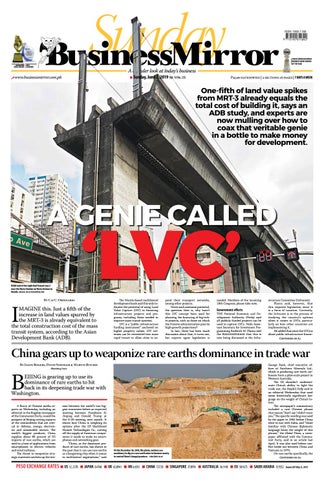
One-fifth of land value spikes from MRT-3 already equals the total cost of building it, says an ADB study, and experts are now mulling over how to coax that veritable genie in a bottle to make money for development.
A GENIE CALLED DEAD end of the Light Rail Transit Line 2 near the Recto Station on Recto Avenue in Manila. MICHAEL WELS/ DREAMSTIME.COM
By Cai U. Ordinario
I
‘LVC’
MAGINE this. Just a fifth of the increase in land values spurred by the MRT-3 is already equivalent to the total construction cost of the mass transit system, according to the Asian Development Bank (ADB).
The Manila-based multilateral development bank said this only indicates the potential of using Land Value Capture (LVC) in financing infrastructure projects and programs, including those needed to improve mass transit systems. LVC is a “public infrastructure funding instrument" anchored on higher property values. LVC revenues can be reinvested into mass rapid transit to allow cities to ex-
pand their transport networks, among other projects. Given such awesome potential, the question then is, why hasn’t this LVC concept been used for planning the financing of big-ticket projects, such as those on which the Duterte administration pins its high-growth projections? In fact, there has been much discussion about that, it turns out, but experts agree legislation is
needed. Members of the incoming 18th Congress, please take note.
Government efforts
THE National Economic and Development Authority (Neda) said all publicly funded projects can be used to capture LVCs. Neda Assistant Secretary for Investment Programming Roderick M. Planta told the BusinessMirror that this is now being discussed at the Infra-
structure Committee (Infracom). Planta said, however, that this requires legislation since it is a form of taxation. Currently, the Infracom is in the process of studying the country’s options when it comes to LVCs, particularly on how other countries are implementing it. He added that since the LVCs is about public infrastructure financContinued on A2
China gears up to weaponize rare earths dominance in trade war By Jason Rogers, David Stringer & Martin Ritchie
B
Bloomberg News
EIJING is gearing up to use its dominance of rare earths to hit back in its deepening trade war with Washington. A flurry of Chinese media reports on Wednesday, including an editorial in the flagship newspaper of the Communist Party, raised the prospect of Beijing cutting exports of the commodities that are critical in defense, energy, electronics and automobile sectors. The world’s biggest producer, China supplies about 80 percent of US imports of rare earths, which are used in a host of applications from smartphones to electric vehicles and wind turbines. The threat to weaponize strategic materials ratchets up the ten-
sion between the world’s two biggest economies before an expected meeting between Presidents Xi Jinping and Donald Trump at the G-20 meeting next month. It shows how China is weighing its options after the US blacklisted Huawei Technologies Co., cutting off the supply of American components it needs to make its smartphones and networking gear. “China, as the dominant producer of rare earths, has shown in the past that it can use rare earths as a bargaining chip when it comes to multilateral negotiations,” said
PESO EXCHANGE RATES n US 52.2570
IN this December 30, 2010, file photo, workers use machinery to dig at a rare earth mine in Ganxian county in central China’s Jiangxi province. CHINATOPIX VIA AP
George Bauk, chief executive officer of Northern Minerals Ltd., which is producing rare earth carbonate from a pilot-scale project in Western Australia. The US shouldn’t underestimate China’s ability to fight the trade war, the People’s Daily said in an editorial Wednesday that used some historically significant language on the weight of China’s intent. The newspaper’s commentary included a rare Chinese phrase that means “don’t say I didn’t warn you.” The specific wording was used by the paper in 1962 before China went to war with India, and “those familiar with Chinese diplomatic language know the weight of this phrase,” the Global Times, a newspaper affiliated with the Communist Party, said in an article last April. It was also used before conflict broke out between China and Vietnam in 1979. On rare earths specifically, the Continued on A2
n JAPAN 0.4768 n UK 65.8961 n HK 6.6592 n CHINA 7.5720 n SINGAPORE 37.8976 n AUSTRALIA 36.1148 n EU 58.1673 n SAUDI ARABIA 13.9352
Source: BSP (May 31, 2019 )
NewsSunday BusinessMirror
A2 Sunday, June 2, 2019
www.businessmirror.com.ph
A GENIE CALLED ‘LVC’ Continued from A1
ing, the government’s actions may need to involve the Economic Development Cluster, specifically the Department of Finance. “Technically, all government projects that are able to raise land values can be used for LVCs. [However,] we still need to study what other jurisdictions are doing,” Planta said. According to the ADB report, “Just one-fifth of the incremental land value increase due to MRT-3 would have been enough to pay for the $655 million total cost of MRT3, while still leaving a very substantial windfall for private property owners. This implies substantial scope for generating ‘win-win’ situations via LVC: more infrastructure funding means more mass rapid transit gets built, and more quickly; this generates more windfalls for property owners and improves productivity and welfare for all residents.” Data showed that residential land values in areas farther from the MRT posted a growth of over 100 percent while land values in nearer residential areas grew over 200 percent. In farther areas, data showed, land values increased to P7,584 or $172 per square meter (sqm) from P2,789, or $107 per sqm; in nearby areas, it surged to P16,036 or $364 per sqm from P4,972 or $190 per sqm. The ADB said this translates to a difference of about P6,268 or $154 per sqm, while estimated differences are even larger for commercial parcels, at P22,140 or $545 per sqm.
However, taking into consideration other factors that affect land values such as distance to other rail lines, distance to central business districts (CBDs), population density, and per capita income, among others, the ADB said the MRT-3’s impact on land values reached P3,743 ($92) per sqm for residential parcels and P13,968 ($344) per sqm for commercial parcels. The ADB said that based on more conservative estimates, the aggregate impact on land values within 1 km of MRT-3 stations was close to P180 billion or $3.4 billion at current exchange rates. This is roughly five times the $655-million construction cost of the MRT-3.
‘Triple win’
ADB Vice President for Knowledge Management and Sustainable Development Bambang Susantono said in an Asian Development blog that such impressive figures indicate why adopting LVC in cities like Metro Manila can “create a triple win.” “The first win is that it helps finance metro systems and thus improve overall urban mobility. The second win is that, if used properly, LVC reduces the subsidy levels required in running metro systems, since the money from LVC can also go toward operating costs,” Susantono said. “For the third win, the money generated from LVC creates the fiscal space to use government finance productively for other sectors—such as health, education and slum improvement,” he added. Based on the ADB report, there are six ways cities can pursue LVC. These are through the mainstream
EPIFANIO de los Santos Avenue, as seen from the MRT-3 Guadalupe Station in Makati City. NAMHWI KIM | DREAMSTIME.COM
tax system; special fees and levies; auction of development rights; urban renewal agency with value capture capabilities; rail agency as developer; and a combination of these mechanisms. However, the Philippines encounters a number of challenges in these mechanisms. In terms of the mainstream tax system, LVC revenues are based on “outdated assessments, inadequate systems for accurate property valuation.” Further, while local governments collect property taxes, the
national government is the one financing big-ticket infrastructure projects such as those identified under the Build, Build, Build. In terms of using special fees and levies, the ADB said local government units lack awareness regarding these special levy mechanisms that are already included in the law. The ADB also decried a lack of incentive to tap into LVCs. It said LGUs find it “technically and politically easier to rely on national government to provide infrastructure funds.” The report stated that with regard to auction of development rights, the Philippines continues to struggle with the lack of competition when it comes to the property and infrastructure development market. It added that the government lacks the know-how in assessing benefits to the private sector, making negotiations and/or bid parameters/mechanisms challenging. With regard to urban renewal agencies with value capture capabilities, the Philippines could not maximize LVC as there is no agency tasked to push coherent urban
transport plans and coordinates with all cities, the ADB said. Technically, the Metropolitan Manila Development Authority (MMDA) has the mandate when it comes to urban and transport planning and coordination, but its current focus is on traffic management. The Manila-based multilateral body also said that in terms of tapping a rail agency as developer, entities such as the Philippine National Railway (PNR) lack the capacity and incentive to adopt a longer-term and “entrepreneurial, revenue-maximizing perspective.” In terms of cross-cutting across mechanisms, the ADB said the evaluation and selection of infrastructure projects are viewed from an individual rather than a master-plan perspective. “Basic policy reform actions should be proactively considered for Bangkok, Jakarta, Manila, and beyond: to spur a new period of sustained growth in transit investment, with a conscious focus on integrated urban planning, high-quality transit networks, and encouraging non-car, nonmotorized and pedestrian movement for dense yet highly accessible city ar-
eas,” the report stated. The ADB said Metro Manila’s population is at 12.88 million with a population density of 20,785 people per kilometer. In terms of mass rapid transit network, there are 61 stations and 78.4 kilometers of track. Metro Manila’s main thoroughfare is the circumferential Epifanio de los Santos Avenue (Edsa), which can carry 6,000 vehicles per hour in each direction. However, it currently carries 7,500 in each direction, or 25 percent above its carrying capacity. Despite the congestion, mass rapid transit systems have not been able to keep up. The ADB said the combined daily ridership on the three mass rapid transit lines and the commuter line is about 1.24 million, which accounts for less than a tenth of the 13.4 million motorized trips a day that Metro Manila’s citizens make. Private transport accounts for 91 percent of trips in the metropolis—29 percent by own vehicle and 62 percent by paratransit such as jeepney, bus and public utility vehicle—but on increasingly congested roads.
China gears up to weaponize rare earths dominance in trade war Continued from A1
People’s Daily said it isn’t hard to answer the question whether China will use the elements as retaliation in the trade war. China is “seriously” considering restricting rare earth exports to the US and may also implement other countermeasures, the editorin-chief of the Global Times, said in a tweet. An official at the National Development and Reform Commission told CCTV that people in the country won’t be happy to see products made with exported rare earths being used to suppress China’s development. Editorials in the Global Times and Shanghai Securities News took similar tacks in their Wednesday editions. What our analysts are saying: The US will continue to rely on importing rare-earth minerals from China, the materials used in key components for a wide variety of products including electronics, hybrid vehicles and energy-storage systems. Importing from China is cheaper than producing domestically in the US, Yi Zhu, Bloomberg Intelligence senior analyst said in a May 21 report. The nation’s producers have rallied hard in recent weeks on the view that rare earths could be an ace in the trade war. President Xi
Jinping visited a plant earlier this month, accompanied by his chief trade negotiator with the US, fueling speculation that the strategic materials could be weaponized in China’s tit-for-tat with the US. Rare earths have already featured in the trade dispute. The Asian country raised tariffs to 25 percent from 10 percent on imports from America’s sole producer, while the US excluded the elements from its own list of prospective tariffs on roughly $300 billion worth of Chinese goods to be targeted in its next wave of measures. Rare earths aren’t particularly rare. Cerium, the most abundant, is more common in the Earth’s crust than copper. All other rare-earth elements, besides promethium, can be found more widely than silver, gold, or platinum, according to the US Geological Survey (USGS). However, concentrated and economic deposits are scarce, and production is dominated by a handful of countries. China is the biggest by far, accounting for almost 70 percent of global production and 40 percent of the world’s reserves, USGS data show. China’s rare earth market is dominated by a handful of producers, including China Northern Rare Earth Group, Minmetals Rare Earth Co., Xiamen Tungsten Co.
and Chinalco Rare Earth & Metals Co. The nation has a template in using the elements to make a political point. It blocked exports to Japan after a maritime dispute in 2010, although the consequent spike in prices saw a flurry of activity to secure supplies elsewhere, which would be the risk again if Beijing follows through with its threat of retaliation. China Northern rose as much as 9.3 percent in Shanghai, while Lynas Corp., the biggest producer of rare earth products outside China, added as much as 16 percent in Sydney. Hong Kong-listed China Rare Earth Holdings Ltd. spiked as much as 41 percent and has doubled in value in May. China’s stranglehold is so strong that the US joined with other nations earlier this decade in a World Trade Organization (WTO) case to force the nation to export more amid a global shortage. The WTO ruled in favor of America, while prices eventually slumped as manufacturers turned to alternatives. In December 2017, US President Donald Trump signed an executive order to reduce the country’s dependence on external sources of critical minerals, including rare earths, which was aimed at reducing US vulnerability to supply disruptions.
A4
News BusinessMirror
Sunday, June 2, 2019
www.businessmirror.com.ph
BSP governor ‘promises’ more rate cuts
P
HILIPPINE Central Bank Governor Benjamin Diokno pledged to cut interest rates further and lower the reserve ratio for lenders to support the economy as inflation pressures ease.
Diokno has cut the benchmark rate by 25 basis points and announced a phased reduction in the reserve requirement ratio for banks, reversing some of the monetary tightening last year. Inflation has eased to the midpoint of a 2-percent to 4-percent target while economic growth slowed to a four-year low. Diokno sees inflation cooling to below 2 percent as early as next
quarter on base effects, while economic growth this year will reach at least 6 percent, the lower end of the government’s 6-percent to 7-percent forecast range. A fullblown trade war between the US and China will have little effect on the Philippine economy, he said. Analysts are betting the Bangko Sentral ng Pilipinas will continue cutting interest rates and the
If the rest of the world goes cutting or easing, we’ll be accelerating the process of monetary easing.”—Diokno
RRR this year as inflation eases. Consumer-price data is scheduled for release next week, while the Central Bank will meet to decide on monetary policy on June 20. Half of the 2-percentage-point reduction in banks’ reserve ratio announced earlier this month takes effect on Friday, adding about P100 billion, or $1.9 billion, in funds to the economy. Policy easing “is positive for the local economy and financial markets due to greater lending and investment activities,” said Michael Ricafort, an economist at Rizal Commercial Banking Corp. in Manila.
The benchmark Philippine stock index rose as much as 1 percent to a three-week high on Friday in Manila. The peso was little changed at 52.20 against the dollar. Asian central banks are shifting to more looser monetary policy to boost their economies, as heightened trade tensions between the US and China weigh on global growth. India has lowered rates twice this year, while the Philippines, Malaysia and New Zealand eased this month. “If the rest of the world goes cutting or easing, we’ll be accelerating the process of monetary easing,” Diokno said. Bloomberg News
“We have more room for monetary easing,” Diokno, 71, said in an interview with Bloomberg TV’s Stephen Engle in Tokyo. “I can promise more cuts,” but the timing will depend on upcoming
economic data, he said. The governor said he also wants to lower the ratio of deposits banks must hold as reserves to “single digits” by the end of his term. Since taking office in March,
IRAN THREATENING GLOBAL OIL SUPPLIES, SAUDI KING SAYS
Japan travel agents to help PHL CANADIAN GARBAGE develop, market PHL destinations OUT OF SUBIC AT LAST
S
AU D I King Salman Bin Abdulaziz accused Iran of threatening global oil supplies and shipping at a meeting of Arab leaders that called on the international community to confront Tehran following attacks on shipping and rising tensions in the oil rich region. Leaders of Gulf and Arab states held two emergency summits in Mecca on Thursday to present a united front to Iran. At the end of the meetings, Arab League chief Ahmed Aboul Gheit said it was too early to talk of war with Tehran. “What the Iranian regime is doing, from intervening in regional countries’ affairs and developing its nuclear program, threatening global maritime traffic and global oil supplies, is a blatant violation of the treaties and principles of the United Nations,” King Salman said in a speech at the Gulf leaders summit. Hours later he told Arab leaders at their meeting that the international community should “use all means to deter this regime.” Saudi Arabia called the emergenc y summits following attacks on oil installations in the kingdom and tankers heading toward the Strait of Hormuz, a key choke point for international shipping. The US has blamed Iran for the attacks on the vessels and dispatched additional forces to the region. Tensions have spiked in the Gulf since the US tightened sanctions on Iran’s oil exports in early May, prompting an Iranian threat to walk away from the landmark 2015 nuclear deal the Trump administration abandoned a year ago. Donald J. Trump has made confronting Iran a cornerstone of his foreign policy and is squeezing its economy to force it to roll back its ballistic missile program and support for groups such as Lebanon’s Hezbollah, which the US deems a terrorist organization. The White House is counting on Saudi Arabia and other Arab allies to form a united front to contain Iran. Thursday’s meetings are meant to be a step toward that. I n t h e i r c l o s i n g s t ate m e n t re a d o u t b y A b o u l G h e i t, t h e l e a d e r s d e m a n d e d that the international community “stand with all decisiveness and s t re n g t h a g a i n s t a n y I r a n i a n a t t e m p t t o t h re a t e n e n e rg y s e c u r i t y.” But Aboul Gheit played down talk of war with Iran at a press conference, saying “we should not get past ourselves” and that the Arab states wanted Iran to stop interfering in regional affairs. “If this happens, then I don’t think there’s need to use military action against Iran, but let’s wait,” he said. Among the officials present was Qatar’s prime minister, Sheikh Abdullah Bin Nasser Al Thani, the most senior Qatari official to visit Saudi Arabia since 2017, when the kingdom, along with three Arab allies, imposed an overnight embargo on its tiny neighbor, accusing it of being too close to Iran and supporting militant Islamist groups around the region. Coming amid rising regional tensions, Thursday’s visit is seen as the first concrete step toward ending the rift. But Saudi Foreign Minister Ibrahim Assaf indicated there had been no breakthrough at the end of the summit, telling reporters that the crisis would end once Qatar “returns to the right path.” Bloomberg News
By Ma. Stella F. Arnaldo
Special to the BusinessMirror
E
XECUTIVES of Japan’s travel industry vowed to help the Philippines develop and promote more tourism destinations outside of Manila and Cebu. This was disclosed by the Depar tment of Tourism (DOT) in a news statement issued last Thursday from Tokyo, where a 200-man delegation led by President Duter te has been attending various conferences and business meetings with private and government officials of Japan. Th e D OT s a i d Ta d a s h i S h i m u r a , president of the Japanese Association of Travel Agents (Jata) and his colleagues promised to “send 20 travel agencies to the Philippines to meet with local travel agents and explore possible areas of collaboration.“ The DOT added that Jata will also s u p p o r t t h e co u nt r y ’s a d vo c a c y o n sustainable tourism. This developed as Duterte encouraged Japanese businessmen to especially invest in the tourism industry, with the Philippine government targeting foreign inbound tourists to reach 12 million by 2022. “We are receiving a lot of tourists now, and soon, some areas might not be able to accommodate you for lack of facilities,” said the President in a meeting with the businessmen on Wednesday. “We suggest for those who are interested to go into business to participate in building resorts for your citizens,” he added. Tourism Secretary Bernadette Romulo Puyat earlier presented an “economically viable tourism sec tor teeming with exciting investment opportunities in the areas of accommodation, transportation, leisure and recreation facilities, food and beverage and even infrastructure,” the DOT statement said. I n a p a ra l l e l e ve nt to t h e 1 4 t h Philippine Business Mission (PBM) for tourism held in Japan, Duterte met with
leaders of the Japanese travel industry at the Imperial Hotel in Tokyo. He noted that the tourism and travel sector stand to benefit from government’s “Build, Build, Build” program, which has a number of ongoing transportation infrastructure development projects to achieve seamless travel to and around the archipelago. Organized by the DOT, the travel industr y meeting with the President was an historic occasion, signaling the importance held by Japan as the country’s fourth-biggest foreign tourist market. Earlier on in her term, Romulo Puyat admitted that inbound tourists from Japan have been tepid, necessitating her very first travel out of the country as DOT chief to be in Japan last year. Since then, she has visited Japan three more times, trying to appeal to its citizens to visit the Philippines, On Wednesday, she finally brought Duterte to meet with Jata to convince them to push the Philippines more to their countrymen. (See, “DOT chief brings her ‘Daruma doll’ to boost Japanese arrivals,” in the B usiness M irror , May 29, 2019.) Arrivals from Japan dropped by almost 2 percent to 177,769 in the first quarter of the year, a turnaround from the 8.98-percent growth in the same period in 2018. Last year, Japanese tourists grew by 8.15 percent to 631,801, slower though than the 9.14-percent increase in tourists in 2017. While the DOT chief has acknowledged a problem in the tourism flow from Japan, other tourism officials spin the current arrival numbers in a more positive light. Asked why there seemed to be a sluggishness in the arrivals from Japan, A ssistant S ecretar y and conc urrent To u r i s m A t t a c h é t o To k y o Ve r n a Buensuceso told the B usiness M irror : “Our negative figure was only for January. February and March already registered positive growth.” She also noted, “Our growth last year is actually higher than the 7.2-percent average growth over the past five years.”
The slackening in Japan’s inbound arrivals was also recognized by Jose Clemente III, president of the Tourism Congress of the Philippines since last year. “We’ve received reports from some of our members that they were not getting as many bookings from Japan as before,” he noted. But the industry is also at a loss to the reason why. Meanwhile, this year, the annual PBM organized by the DOT and its marketing arm, the Tourism Promotions Board, covers Sapporo, Nagoya and Tokyo from May 27 to 31. Led by Romulo Puyat, this year’s delegation includes 38 companies. Jata’s Shimura, according to the DOT news statement, mentioned that under the leadership of Romulo Puyat, there have been focused marketing initiatives in Japan for Philippine tourism. “He noted that in 2018, the 8.15-percent growth rate of Japanese arrivals to the Philippines was higher than the total Japan outbound rate of 6 percent, and thanked the Philippines for supporting efforts to grow the Japanese market further,” the DOT said. F o r h i s p a r t , Tr a n s p o r t a t i o n Secretar y Ar thur Tugade pointed out the development of new airpor ts and expansion of existing gateways will attract many investment and business opportunities for airline companies and airpor t operators in Japan. As of March 2019, international air seats from Japan to the Philippines have reached 3.25 million. The inbound traffic is projected to rise with Philippine Airlines’s introduction of Chitose-Manila thrice weekly flights last December; Japan Airlines’s daily service linking Haneda and Manila since February; and the upcoming flights of AirAsia between Osaka and Manila on July 1; and Cebu Pacific’s Narita-Clark flights beginning August 9. With the improved airpor ts and seaports, inter-island travel will be easier, more comfortable and with more providers coming in, more affordable, Duterte informed the Japanese businessmen.
By Henry Empeño
S
UBIC BAY FREEPORT—Goodbye and good riddance. The 69 garbage-laden shipping containers temporarily stored at the Subic Bay Freeport, including two that were recently transferred from the Port of Manila, finally sailed out of here early Friday morning to be returned to their sender in Canada. The containerized wastes were loaded onto the M/V Bavaria, a Liberian-flagged c argo c arrier that arrived here on Thursday afternoon. Subic Bay Metropolitan Authority ( S B M A ) C h a i r m a n Wi l m a T. E i s m a , who briefed mediamen on the loading procedure, said the reexportation of the Canadian trash was treated here “like any other commercial shipment” and with the ship offloading and loading other cargoes at the port. Loading of the 69 container vans began at 9 p.m. on Thursday and was completed more than five hours later at 3:19 a.m. on Friday, with a one-hour break at midnight. SBMA deputy administrator for port operations Rani Cruz said that 127 other commercial containers were loaded thereafter until 6:30 a.m. before M/V Bavaria finally left port at 7:22 a.m. Eisma said the vessel will make a stopover at the Kaohsiung port in Taiwan to unload and load other cargoes before heading for its final destination, the port of Vancouver. M/V Bavaria will reach Canada after 22 days, port officials here said. The reexpor tation of what were originally declared by the shipper as “plastic scraps” came 15 days after the Philippines recalled its ambassador and consuls to Canada over the latter’s failure to take back the garbage-filled vans that were brought to the Philippines between 2013 and 2014. The 69 reexported containers were part
of a total of 103 container vans exported to the Philippines by Chronic Inc. (Canada) and consigned to three local companies: Chronic Inc., Chronic Plastics and Live Green Enterprise. According to the Bureau of Customs, which took custody of the containers following the discovery of the wastes inside, 34 container vans were transferred to the Metro Clark Waste Management Corp. in Pampanga for disposal, while two remained at the Manila International Container Port (MICP). The rest were transferred to the New Container Terminal here in Subic for eventual repatriation. The reexportation is apparently being funded by the Canadian government, which had committed to ship back the garbage from the Philippines. A reexportation order issued on May 7 by MICP District Collector Erastus Sandino Austria quoted Canadian officials as saying that Canada is “prepared to cover the cost of, and make the necessary arrangements to being the waste materials contained in the subject 69 containers.” The reexportation of waste materials to its country of origin, Austria said, “is legally anchored” under Section 1145 o f t h e Cu s to m s M o d e r n i z at i o n a n d Tariff Act, which allows such procedure “if goods are found to be injurious to public health.” To facilitate the reexport, ownership over the subject shipment is ceded to the Canadian government, “who shall oversee and ensure that the same are returned to the country of origin, Canada, with dispatch,” the May 7 order also indicated. The removal of the Canadian trash here was warmly applauded by the Subic Freeport community, with SBMA’s Eisma describing the pullout as “one proud moment for all Filipinos.” “We thank President Rodrigo Duterte for his decisive action that brought about a satisfactory conclusion to this sordid chapter in our history,” Eisma added.
Asia Society, JP Morgan to hold last leg of One Step Ahead Series in Manila
W
HAT challenges and opportunities will the Asia-Pacific region face in this age of automation and digitization? How can employers, policy-makers, and educators confront the new socioeconomic realities accompanying Asia Pacific’s vast digital transformation? These key questions and more will inform discussions at the last leg of the One Step Ahead Series on June 4, 2019, at The Peninsula Manila. Organized by Asia Society and multinational investment bank JP Morgan, the event will bring public, private and civil-society leaders to discuss the theme “Rethinking the Future of Work to Promote Inclusive Growth in Asia Pacific.” The One Step Ahead Series,
launched in 2014, is a collaboration that combines the Asia Society’s mission to educate and JP Morgan’s long-standing commitment to investing in communities. Distinguished experts and academics converge to investigate critical issues affecting competitiveness and growth of cities in Asia. Previous forums were hosted in Hong Kong, Singapore, Mumbai and Beijing. For the Manila leg, key panel sessions will be on the following topics: n Unleashing the Potential of Inclusive Growth in the Future of Work: Findings from Research and the Field; n The Future of Work Ecosystem—A ligning Supply and Demand for an Inclusive Labor
Market; and n Reskilling and Upskilling— Reinventing Education and Training for the Workforce of the Future. Panelists for the Manila forum include leaders from the International Labour Organization, and the Organisation for Economic Co-operation Development, as well as McKinsey and Company A ssociate Partner Bor is Van, LinkedIn Regional Sales Leader Atul Harkisanka, NCAER Director General Dr Shekhar Shah, Bainian Vocational School Board Member Sabina Brady, and SkillsFuture Singapore Deputy Chief Executive Michael Fung. They will be joined by local leaders Ayala Corp. Chairman and Chief Executive Officer Jaime Augusto Zobel de Ayala, Department of Information
and Communications Technology former Undersecretary Monchito Ibrahim, and Technical Educationand Skills Development Authority Deputy Director General Rosanna Urdaneta. “ Te c h nolog y br i ng s r apid changes to all facets of our life, but more so in the area of work. We need to have these discussions on confronting innovations in automation, artificial intelligence and digitization so we are prepared to adapt,” Doris Ho, Asia Society Philippines chairman noted.
The state of work in Asia
ASIA Pacific, being home to 60 percent of the world’s population, is the world’s largest and most diverse region. In terms of work, automation and digitization are not
new to the region. It is already a global leader in employing robots for manufacturing, with an estimated 65 percent of the world’s total industrial robot usage. In recent years, however, accelerations in artificial intelligence have allowed machines to do work that previously only humans could do. As “the factory to the world,” the region will likely face socioeconomic challenges with growing numbers of displaced workers seeking employment and living wages. Doris Ho noted: “With the highlevel discussions at One Step Ahead Manila Forum, our aim is to come up with solutions and share best practices on dealing with the challenges of the future of work. Navigating this complexity needs a multisectoral, multilevel approach.”
Sports BusinessMirror
Editor: Jun Lomibao • mirror_sports@yahoo.com.ph
Sunday, June 2, 2019
A5
IT’S “Roland Garros” that’s stamped on the tennis balls and court walls. It’s festooned on hats, shirts and other items sold in merchandise boutiques. AP
HEAD Coach Apichat Kongsawat (sixth from left) is flanked by his players (from left) Mary Mae Tajima, team captain Nicole Tiamzon, Katherine Adrielle Bersola, Ma. Gizelle Jessica Tan, Turkish import Yasemin Yildirim, US import Lakia Bright, Jamenea Ferrer, Jeanette Villareal, Jorella Marie de Jesus, Roma Doromal and Angeline Marie “Dzi” Gervacio.
Faith
Sunday
A6 Sunday, June 2, 2019
www.businessmirror.com.ph • Editor: Lyn Resurreccion
Ramadan in Mideast is for fasting–and Facebook
D
UBAI, United Arab Emirates— The Muslim holy month of Ramadan, with its long days of fasting and prayer meant to draw worshippers closer to God and away from worldly distractions, is being reshaped by technology. People in the Middle East spend close to 58 million more hours on Facebook during Ramadan and watch more YouTube videos—everything from beauty tips and recipes to sports and TV dramas—than any other time of the year, making the holy month not only the most important one for Muslims, but also the prime time of the year for advertisers. For Facebook, which also owns Instagram, and Google, which owns YouTube, Ramadan brings a welcome boost of business in the region. “Consumption and time spent on our platforms does indeed increase,” said Ramez Shehadi, Facebook’s managing director for Mideast and North Africa. People stay up a lot more at night during Ramadan and have more downtime—especially before “iftar,”the evening meal that breaks the daylong fast, and the “suhoor,” when people gather to eat before another day of fasting. Many also work shorter hours during the day. All that translates to 5 percent more time spent on Facebook’s platforms, or what is nearly 58 million more hours, Shehadi said. Put another way, there are almost 2 million hours of additional time spent daily on Facebook in the Mideast during Ramadan. Ramadan is also the peak season for advertising in the region, as TV dramas and soap operas get a 151-percent increase in viewership on YouTube during the holy month, according to Google. “Our revenue is a function of people’s engagement,” Shehadi said. “The more that they engage on our platforms, the more that advertisers want to be able to reach those that are engaging. That’s what drives our revenue.” So much ad revenue is spent during R amadan that Google launched “The Lantern Award” to celebrate the most creative and engaging ads of the month. Yet, Ramadan is not just about abstaining from food and drink,
including water, during the day. It’s also about disconnecting from vacuous distractions and focusing on contemplation, introspection, acts of good, charity and connecting with God. It can appear then as a contradiction that this is also when companies ramp up their efforts to get people to buy more, view more and engage in excess consumerism. Google does not disclose total watch time for YouTube during Ramadan, but says that in Egypt, Saudi Arabia and the United Arab Emirates, for example, viewing of sports videos jumps by 22 percent, travel videos by 30 percent, and action games, simulation and video games by 10 percent and 20 percent during the holy month. People also spend 27 percent more time watching religious content on YouTube in Ramadan. “To us, YouTube brings people together. We see a lot of people wanting to watch things together,” said Joyce Baz, Google’s head of communications in Mideast and North Africa. She added that Google products, like its search engine, are there “to simplify people’s lives so that they can focus on things that matter like being with their loved ones and family.” Google’s “Qibla Finder,” for example, helps Muslims find the direction of Mecca to pray toward, wherever they happen to be. Google says this year’s top
The Church will never fail MSGR. JOSEFINO S. RAMIREZ SUNDAY GOSPEL IN OUR LIFE
T
trending search queries during the first week of Ramadan in Egypt, Iraq and Saudi Arabia included a surprising mix of Game of Thrones, prayer times, Ramadan TV shows, movie timings and English Premier League results. Meanwhile, some of the most popular downloaded apps in the Mideast on the Google Play store during Ramadan include games like Stack Ball, streaming apps like Vu and Shahid and online retailers Noon and Jolly Chic. Iftar evening meals are a major social affair during Ramadan, ranging from lavish spreads at home to decadent five-star hotel buffets. This translates into a 16-percent spike in beauty product searches and an 18-percent spike in searches for beauty tips on YouTube, compared to the rest of the year. Also, according to Google maps, trips to the malls increase by more than 20 percent in the last weeks of Ramadan in preparation for the Eid al-Fitr holiday, which ends the holy month. Fatima el-Barbar, an Egyptian mother living in Dubai, said she searches more for recipes and watches her favorite TV dramas online during Ramadan. But she said that between her job, taking care of the children, preparing if-
We’re trying to be magnifiers and propagators of goodness as opposed to what might seem on the surface like an extension of consumerism. It resonates with the ethos of Ramadan and certainly the ethos of Facebook, which is around bringing people together around things that matter to them.”—Shehadi
SOLEMNITY OF THE LORD’S ASCENSION: ‘LUKE 24:46-53’
ODAY we commemorate the fact that Jesus Christ, 40 days after His resurrection, ascended into heaven in order to take His proper place “at the right hand of God the Father.” Jesus is present with us in the most Blessed Sacrament of the altar, but His place and location is heaven. This physical absence of the Glorified Christ from the Earth is compensated for by the presence of what Saint Paul calls “the mystical body of Christ” which is the Church. In today’s reading, before Christ ascended to heaven, He told the apostles, “I am sending forth upon you the
A WOMAN looks at a Ramadan-related page on her mobile phone in Dubai, United Arab Emirates. AP/KAMRAN JEBREILI
promise of my Father” (Luke 24:49). And in Saint Matthew’s account of the same event, Jesus told the disciples, “Behold, I am with you all days, even unto the consummation of the world” (Matthew 28:20). It is quite logical that Jesus should have left some kind of assurance to those who were supposed to continue His salvific task here on Earth. If we had no guarantee that Jesus’ words and actions could continue unadulterated, then we would be subjected to a great insecurity regarding such an important matter as our eternal salvation. That is why these words of Jesus
constitute the basis for that prerogative of the Church that we call “indefectibility.” It means that the Church cannot fail in its mission. Individual members of the Church at different times and epochs may fail. But the Church itself pushes on despite the limitations of its members and ministers. The Church will never be destroyed, even though it may pass through difficult moments. Part of this charism of indefectibility is the gift of infallibility. The Church cannot err when it teaches on matters affecting our eternal salvation. We need a sure guide to teach us authoritatively what Christ wanted to teach his followers. Without infallibility somewhere, Christ’s work would have been a failure because there would be no way of being certain about what He taught. Individual members of the Church can make mistake either in teaching or in accepting teachings. But
tar each night, her daily prayers and reading the Quran, the Muslim holy book, there’s little time for the Internet. “I actually have less time for the Internet in Ramadan than in other days of the year,” she said. To help companies better understand consumer habits in Ramadan, Google identified six categories of audiences: dedicated watchers, devoted fasters, foodies, groomers, travelers and shoppers. “YouTube is a companion during Ramadan, a platform where viewers can watch what they want, whenever they want throughout the day,” Google says in its own pitch to advertisers. To more authentically connect with roughly 180 million users in the Middle East, Facebook and Instagram launch special Ramadan icons to give people more customized ways of expressing themselves online. Instagram also has a campaign to promote acts of kindness during the month. “We’re trying to be magnifiers and propagators of goodness as opposed to what might seem on the surface like an extension of consumerism,” Shehadi said. “It resonates with the ethos of Ramadan and certainly the ethos of Facebook, which is around bringing people together around things that matter to them.” Haitham el-Ghoneim, a Jordanian resident in Dubai, the United Arab Emirates, said he uses Facebook to connect with friends during Ramadan, sharing traditional greetings for the holy month and checking on his family in Jordan. Still, he doesn’t think the rest of it—all that time spent online, on games, scrolling and ads—is a good thing. “It’s not being spent in a useful way. It’s mostly fake news, or jokes and things that have no benefit,” he said. AP the Church as such can never err in these matters. These charisms of indefectibility and infallibility are found in the Church as a whole. But if we want to know where to find it more specifically, then following the actions of Christ, we can find it in the college of apostles. And among the apostles, we can find it personified in Peter. Bishops are the successors of the apostles, and the pope is the successor of Saint Peter. In the Church, there is an unbroken line of continuity in the sacrament of Holy Orders that can be historically traced, from the apostles to the present college of bishops and the pope. By being united to the bishops who are in union with the pope, we can avail ourselves of that sense of security contained in the promise of Christ to remain constantly with the Church, despite the vicissitudes of time, “even unto the consummation of the world.”
Saint Mary Magdalene: Witness to Christ’s resurrection By Corazon Damo-Santiago
A
N epitome of courage, she followed Jesus to Calvary, unmindful of indignant Jews, high-strung Roman soldiers, edgy crowds with volatile emotions that can crush her to death. Steadfast, she was at the foot of the cross with the Blessed Mother and John the Beloved. On the first day of Sabbath, she went to the tomb, carrying species for Jesus’ body to be accorded the proper care and honors. Her indomitable spirit was crushed to the core to see an empty tomb. In sobs, she pleaded to Jesus, whom she mistook as the gardener. “Sir if you carried Him away, tell me where you laid Him and I will take Him” (John 20:15). Saint Mary Magdalene, First Mystic of the Church, was honored as the second-most important woman in the New Testament, after the Blessed Mother. She was dubbed as the Apostle of the Apostles.
Mystic of La Sainte Baume
AFTER the Resurrection, the apostles and disciples went on their separate ways to spread the Gospel in Greece, Italy, Spain, France and countries within the Roman empire. Mary Magdalene with Martha, Lazarus, Mary Salome, Mary Jacobe and two of the 70 disciples of Christ, Maximin and Sidonius, crossed the Mediterranean and went to Gaul (France). Tradition maintains that the boat without oars, sails and steering device arrived safely in Rha (Saintes Maries de la Mer). Then the group went on separate ways. Mary Magdalene, Lazarus and Sidonius preached in Massilla (Marseilles), a Roman-occupied city. After six months Lazarus became the first bishop of Massilla. Magdalene and Sidonius left for La Sainte Baume (Saint Maximin Provence-Alpes-Cote d’ Azur, France). Mary Magdalene settled in a grotto alone for 30 years. In Mystics of the Church it was narrated that seven times a day she ascended to the hilltop to hear music and songs of heaven. She
was presumed as ecstatic, neither ate nor drank and made sacrificial offerings. Her sacrifices were beneficial to the church.
’Noli me tangere’
AFTER three decades, Mary Magdalene went down to the village and was met by Maximin who was divinely directed. Lead to his church, she received Holy Communion and fell lifeless on the altar. Latin documents in the fifth century to sixth century noted that she died on the 11th day before Kalends of August, which is July 22, around 72 AD. Her body was embalmed in aromatic herbs. Many miracles took place in her tomb. When the Saracens from Arabia arrived, her remains were moved to another place and the entire chapel was buried in sand. In 1279, Prince Charles II of Salerno, nephew of King Louis IV of France, resolved to find Magdalene’s tomb. On May 5, 1280, the prelates and nobles of the kingdom of Provence and France and the Town of Maxim rejoiced. Her tomb was found. On the identification cork was written: “Year of the Lord 710, 6th day of December, in fear of the Saracens, the body of well-loved and venerable Mary Magdalene has been transferred to be better concealed from the alabaster tomb to the one in marble out of which the body of Sidonius had been removed.... Hic requiescit corpus Mariae Magdalenae [Here lies the body of Mary Magdalene].” A distinct feature is the “tongue adhered to the mouth cavity and from it had grown an aromatic plant. Also, on her brow is smooth, clear skin lighter than the remainder of the body, the size of two small fingertips...which resembled live skin, and was named Noli me tangere (Do not touch me). It was believed to have been the touch of the Lord on the brow of Mary Magdalene.” Damo-Santiago is a former regional director of the Department of Education National Capital Region. She is currently a faculty member of Mater Redemptoris Collegium in Calauan, Laguna, and of Mater Redemptoris College in San Jose City, Nueva Ecija.
COLUMBAN MISSIONARIES CELEBRATE 90 YEARS IN PHL By Recto Mercene
T
ODAY, dozens of Filipino men and women, ordained and lay, are serving as Columban Missionaries around the world following the footsteps of the first Columban Missionaries who arrived in Our Lady of Remedies Parish in Malate, Manila, on May 30, 1929. From three priests in 1929 the number of Columbans in the Philippines grew to 257, serving 150 parishes in 13 dioceses. At one point, the Columban Missionaries comprised 5 percent of all the clergy in the Philippines. They shared the fate of the people they work with. During World War II, the Malate Martyrs and Fr. Vernon Douglas paid the highest price. Fruits of the 90 years of Columban mission in the Philippines are not only the promotion of vocation to mission but also taking concrete steps to respond to the challenges of the time. The Columbans addressed the issues of poverty and the need to provide education by building parochial schools in parishes where they were working. They saw the need to strengthen the faith of the young and develop leadership skills from among the hundreds of thousands of students in Manila’s nonsectarian colleges. Thus, they founded the Student Catholic Action. D uring the mar tial-law years, the Columbans stayed with the people they served. Two Columban priests, together with a diocesan priest and six lay workers, were falsely accused and put into prison because
of their work with the poor. Responding to the call of Pope Paul VI for reconciliation between Muslims and Christians, the Columbans embraced the Dialogue of Life way of living initiated by the late Bp. Bienvenido Tudtud. While living this call to dialogue, two Columbans suffered violent deaths in Lanao del Sur. Over the years, the Columban missionaries have realized that the system that created and perpetuated poverty was also destroying planet Earth. Together with the people, they have protested and organized pickets against logging and mining. A priority of the Columbans is to care for our fragile planet as urged by the Catholic Bishops’ Conference of the Philippines’s 1988 pastoral letter, “What is Happening to Our Beautiful Land,” and by Pope Francis’s “Laudato Si’ On the Care of Our Common Home.” Columbans invite young Filipinos to be lay missionaries and to be Columban Missionary priests. Presently, these young men and women are the fruit of the work done by Columbans in the Philippines over 90 years. This year, the Columbans celebrate their commitment to the poor and the exploited Earth. “We honor those who have gone before us as we continue to commit ourselves to God’s mission in collaboration with our mission partners and benefactors.” This commitment is expressed in the Columbans’ work with the vulnerable and the marginalized, indigenous people, interfaith dialogue and the care for God’s creation in our ministries and parishes.
Tourism&Entertainment BusinessMirror
Editor: Carla Mortel-Baricaua
Sunday, June 2, 2019
A7
Of beautiful landscapes formed over time
A
Story & photos by Joshua Berida
S our small passenger plane descended toward Basco airport from Calayan Island, I was already thinking of the province’s unique culture, storied past and stunning landscapes. We were on the first flight between the two islands; coincidentally it was also my first time to both destinations. I was eager to explore this province and discover all that it had to offer. As soon as we arrived, we immediately started our trip around Batan Island. The Vayang Rolling Hills is an ideal introduction to the beautiful landscapes of Batanes. The day was pleasant and I saw the contrasts of blue, green and brown as far as my eyes could see. The drives to and from destinations were part of the attraction. Batanes is surrounded by the sea and in the path of winds and typhoons that helped shaped the landscape. Out of all the chaos, beauty was born. Rock formations, verdant rolling hills and sandy beaches line its shores. Our van drove through narrow, serpentine roads that hugged the mountains and linked villages and towns. On our first day, we visited Valugan Boulder Beach, and true to its name, the shore is filled with rocks and pebbles of varying colors and sizes. The sound of the waves, the sea breeze and the sunlight spreading over on a glacial pace created a serene ambiance. En route to Racuh a Payaman, a.k.a Marlboro Hills, we stopped at Chawa View Deck to admire the Alapad Hill and rock formations. The midafternoon’s golden rays passed over the uneven patterns formed by nature and shaped by time. The rounded and jagged surfaces gleamed with a golden hue with a hint of grassy and earthy colors. Like golems, the rocks and hills either sat or stood with their arms or
legs, and stretched across the sea. We drove to the last landscapethemed destination for the day, Racuh a Payaman. Our guide said Marlboro Hills isn’t just an attraction, but also a pastureland for cows and carabaos. As we made our way to the viewpoint, we passed by grazing cows and stunning vistas. I walked and saw 360 views of the landscape; the mountain in the distance, the undulating curves of the hills and the sea below. After taking few short, I put my camera and phone away and instead captured a mental image and savored the moment. The next day, we went on a short boat trip to Sabtang. This municipality has landscapes that are just as beautiful as the ones we found and drove through in Batan. In my opinion, the most notable is Chamantad-Tinyan Viewpoint. Chamantad’s towering rock formation rising from the ground, the ascending and descending hills and the craggy rocks facing the sea made me eager to get closer. We walked under the sweltering heat of the sun, but it was all worth it. The mix of colors, emerald waters, gray stones, greenish-brown surfaces and the clear blue sky seemed like they were taken from a painting. The deep crevices descending into the beach below, Earth’s scars, these would be what the moon would be like if there was life on it, I imagined. Then we drove to Morong Beach. Its most eye-catching feature is the natural arch. The beach itself is fetching with whitish sand and cerulean waters. Other than its beautiful natural attractions, Batanes has an eclectic mix of local and foreign influ-
Government officials laud HSMA, congratulate new officers
O
FFICIALS from the Executive and Legislative branches of government were present at the Hotel Sales and Marketing Association (HSMA) General Meeting held at the Manila Diamond hotel recently. During his keynote address, Sen. Joel Villanueva reiterated HSMA’s vital role in Philippine tourism, citing the organization’s close working relations with the Tourism Promotions Board and the Department of Tourism. He then called on the organization to continue its role in nation-building by making the hospitality industry truly robust therefore encouraging more hotel investments in the country and creating more employment. Secretary Bernadette Romulo
Puyat of the Department of Tourism manifested her endorsement for HSMA’s newly elected officers by leading the oath-taking ceremonies. With Secretary Puyat at the oathtaking were HSMA officers Carmela Bocanegra of Chroma Hospitality (treasurer), Benjie Martinez of Bayleaf Hotels (vice president), Christine Ann Ibaretta of Golden Phoenix Hotel Manila (president), Pearl Maclang of Marco Polo Davao (director of PR), Joy Demesa of Novotel Hotel Araneta Center (director of Ways and Means), Tet Romualdo of Best Western Hotel La Corona Manila (director of Memberships), Amie Villena of Bellevue Resorts Bohol (director of Programs) and HSMA chairman Margie Munsayac of Bluewater Resorts.
DAKAY House, one of the oldest stone houses in the province.
THE verdant Vayang Rolling Hills is just one of the Batanes’ many attractions.
THE Vayang Rolling Hills typifies the landscape of Batanes.
INSTEAD of sand, the Valugan Boulder Beach’s shore is lined with rocks of different sizes.
ence, and old and new features. There were vestiges of the Spanish conquistadors that governed the Philippines for centuries. I saw colonial epoch churches in Basco and Sabtang, as locals were predominantly Catholic as well. Traditional stone houses, cut from coral and limestone, mingle with concrete bed and breakfasts, homes, souve-
MORONG Beach’s natural arch is an ideal spot for taking pictures.
A MAJOR landmark, the Basco Church is more than a century old.
nir shops and quirky cafés. The island is slowly transforming, brought about by tourism and developments. Despite these, the communities in Chavayan and Savidug managed to retain their culture and way of life; the grandmothers still wore vakul, made from the vuyavuy palm, for rain and sun protection.
As our van took us to the outskirts of Sabtang, our group leaders decided to include the Diura Fishing Village, a side trip from the original itinerary. The rest of the team went to the mountain pool while I decided to stay. I walked around the bucolic village; huts were just a few meters from the shore, and locals hung blue tail fish and dorados in
front of their houses, or near their roofs to dry. There were small fishing boats safely docked that littered the beach. Batanes is straddling the fence between its ancient ways and development. It is treading its past, present and future, benefitting both its communities and visitors who want to experience its unique island life.
ADVENTURE MEETS LEISURE IN MONTALBAN N
OT too long ago, during the simpler and unsophisticated travel lifestyle of Filipinos, this town at the eastern metropolitan doorstep was every urbanite’s weekend getaway. Rodriguez town, also popularly known as Montalban, in Rizal province was and still is an inexpensive excursion place for outdoor lovers. Just 30 minutes away from the urban jungle, one is transported to the Pamitinan Protected Landscape (PPL), a 608-hectare nature reserve which covers Montalban Gorge, Wawa Dam, Upper Marikina River, Pamitinan and Binacayan mountains, and Pamitinan Cave. Referred to as “Wawa” by trekkers, the area is both legendary and historic, which adds to the magnetic pull of the place. Mount Pamitinan is rock climber’s favorite because of its jagged limestone crags and breath-taking mountaintop vista, while the dam is ideal for the good old picnic by the cascade. According to folklore, the twin peaks is where Filipino giant Bernardo Carpio once stood and prevented the land masses from colliding. A white limestone boulder resembles what is believed to be the footprint of the fabled character who is likened to the Atlas of ancient Greek mythology. Meanwhile, the multichambered cave is a Katipunan hideout where freedom fighters led by Andres Bonifacio declared “independence” from Spain for the first time in 1895. It can be explored with permission from local authorities, and the writings on the walls declaring the Filipinos’ libertarian ideals can be seen. A new activity the municipal tourism has developed in the area is a river cruise with Dumagat tribesmen serving as boatmen and tour guides. Beyond the PPL, adventurers can venture into the mountains of Puray, Hapunang Banoy, Paruwagan, Susong Dalaga, Sipit-Ulang, Lubog, Parawagan and Balagbag, in the mighty Sierra
Madre range. Tucked within these geological formations are the waterfalls of Puray, Biteng Uhay, Payaran, Tu-Ay, and Karugo, and a series of caves which shut you off from the outside world. Off-road enthusiasts can take their motorcycles, mountain bikes or 4x4 vehicles to upland Macabud village which is known for its tree canopy, which provides a soothing shade. The good news is this old-time getaway is making a comeback and is trying to lure families who want to frolic in its exciting inland resorts. Among the noteworthy resorts are Costa Abril known for its wave pool and slide pools, Rancho Luisito for its zip line, giant pail and waterslides, and outdoor wall, and Noah’s Park for its team-building facilities and hanging bridges. A chill-out place for its open-air bar is Coco Mountain Resort, themed like an Australian surf camp and fronts an Instagrammable mountainscape. School children will be fascinated by Avilon Zoo, a man-made safari which is arguably the biggest and best in the country. This 7.5-hect-
DUMAGATS in Montalban
are park houses nearly 3,000 animals, a good number of which are imported, comprising of 500 species of mammals, birds, reptiles, amphibians, fishes and plants with emphasis on Philippine endemic species. For a glimpse of local heritage, visit the ancestral home of the eminent Senate President and statesman, Eulogio “Amang” Rodriguez, whom the town is named after. Considered a “living museum,” the typical Spanish stone house showcases his memorabilia, including portraits, paintings, photographs, vintage car and other personal effects. the mansion has undergone minimal physical repairs over the decades and is currently inhabited by the late patriarch’s descendants. For a hearty meal, local favorites are the nondescript carinderias offering sinigang na tilapia and an assortment of goat dishes. The town has interesting homegrown dining outlets, most notably Kristal-G Ristorante, which boasts of cozy interiors, Italian-Filipino cuisine, and acoustic music, and its sister café, Coffee &
AT Wawa Dam, you can relax and enjoy a picnic.
Pastry Shop by Chef G. For snacks and takeaways, Tia Goye Kutsinta offers kutsinta and bibingka galapong—which are perhaps the best-tasting you can sink your teeth into. To put the spotlight on its resurgent tourism industry, Rodriguez recently held its second Pamitinan Festival, which celebrates the municipal foundation day. Named after the legendary mountain, the event-filled festivity included the Hammock Festival, a street-dance showdown depicting the myth of Bernardo Carpio, and the Vice Mayor Dennis Tom Hernandez Motocross Competition, which aims to make the town the motorsports site in the mega-Manila region. As Bonifacio’s revolutionary quarters, the town holds commemorative events every April 12 and November 30 at the Pamitinan Cave to observe his proclamation of independence and his birth anniversary, respectively. With the unique blend of legend, adventure and leisure, Montalban may yet be your newest weekend haunt.
To lead older staff, young executive turns to reading By Rizal Raoul Reyes
R
EADING manuals can sometimes resolve insomnia. For a 29-year-old Sodexo On-Site Services Philippines Inc. executive, reading manuals gave her the resolve to lead people older than she is.
She is Kristine Charis Aguila, Country Quality Health Security, Environment (HSE) Manager of the local office of Sodexo S.A., a French food services and facilities management company. Under Aguila’s department, the majority of the staff are older than her. Some people have expressed how a young woman can handle such responsibility. Aguila told the BusinessMirror it was no cakewalk. She had to prove she is equipped to handle various tasks by doing her homework and meeting expectations of her colleagues. “It is a good thing that I love to read,” Aguila said. “It helped me a lot in learning all the details of the job.” As part of her job as safety officer, Aguila said she had to read documents containing the requirements and regulations of the Department of Labor and Employment. Studying all the details on safety developed into a passion, she said. She is also the youngest member of the On-Site Services Philippines’ Country Leadership Committee of the Paris, Franceheadquartered Sodexo. Aguila began her tenure at Sodexo in 2013 as one of its pioneer employees, double-hatting as QHSE Support Officer and Marketing and Communications Manager. “Since I love to read, it was not a problem to read volumes of documents,” Aguila said.
Champion AGUILA is credited for helping set up and implement food safety-related protocols and occupational safety-related protocols in line with Sodexo’s regional and global policies for all accounts of the company. To support the company’s growth, she was then assigned as an HSE Manager for an energy and resources client. Her hard work, excellent performance, dedication, and progressive experiences have made her qualified to become the company’s top executive on quality, health, safety and environment (QHSE). In 2017, she was promoted as head of health and safety for all of the firm’s on-site services operations. The company entrusted her to champion and implement safety
KRISTINE CHARIS AGUILA, Country Quality Health Security, Environment Manager of the local office of Sodexo S.A. policies and procedures across all levels: the country’s legal requirements and their clients’ own requirements. Being a very sensitive issue, she said she sometimes feels being “a bit paranoid” regarding the safety of the people. Aguila, a graduate of the University of the Philippines Diliman, looks after the safety of 3,000 employees of one of the top integrated facilities management services providers in the country. She continuously strives to ensure all of the company’s team members go through their day-to-day operations safely and facilities management for various clients in the business-process outsourcing, corporate, energy and education sectors. Her leadership has resulted in consistent client recognition and commendable safety record and safety culture for the entire business here in the Philippines.
2 BusinessMirror
Credit AGUILA, a certified occupational safety and health (OSH) practitioner with experience in the fields of facilities management, food services and security solutions, was sent overseas for training and exposure to the company’s operations. “I love the way Sodexo is investing in the development of its people,” she told the BusinessMirror in an interview in Makati City. “Those training sessions helped me a lot in applying those things in a localized setting.” Aguila said the work environment in the company is “lovely” as it promotes diversity. With this setup, people are more willing to accept changes. Sodexo is one big workplace composed of different nationalities, she said. “The top management gives value and focuses on diversity and trickles down the JUNE 2, 2019
line because they value the same thing.” With various clients engaged in various industries, Aguila said she considers Sodexo as the right place for her as the company allows her “to adapt to different types of clients, which removes the monotony of the work.” “That is because there are many facets when you are working with Sodexo,” she said. “If you want to explore a different side of the industry you get the opportunity to do that because the company encourages its people to excel.” Being a safety officer, Aguila is often out on the field to inspect the sites to determine if they are compliant. This gives her the time and opportunity to interact with clients. Aguila said she believes her company is one of the right places for Millennials to work for if they want a fast-paced environment and a conducive workplace. “I think that is the major reason why we have an 83-percent retention rate; one of the highest in the industry.”
Challenge IN a field where there is a big perception that it is a man’s world, Aguila noted it was also a challenge to be a woman. “It was not easy to be a female in this field. There were challenges but I didn’t feel prejudiced despite my gender and my age,” she said. “For you to be successful, you have to work hard for it.” She said she’s grateful to the company “for giving that genuine value, all-out support and output- based setup to harness my potential.”
BusinessMirror
MUSIC
THE SLEEVES’ ‘DELIVERANCE’ ONE COOL FIND OF AN ALBUM by Rick Olivares
T
WO men walked into a record bar… I always wanted to use and paraphrase that classic opening line for a joke. Except, this chance encounter was far from being one. It’s fortuitous. So, once again: Two men walked into a record bar: Treskul Records in Ali Mall, and I followed suit by happenstance. I was there to check for new arrivals and, much to my surprise, there were two foreign nationals inside who lugged guitar cases and were digging. I struck up a conversation with one of them, Stu McCutcheon (who plays bass), and turns out that he and his band, The Sleeves, a British band
based in Hong Kong, performed last Saturday night (May 25) somewhere along Visayas Avenue. It was their second time in Manila, with the band having performed in the first-ever “Summer Noise” in 2018. McCutcheon and bandmate (lead singer and guitarist) Keith Goodman dropped by to leave a few copies of their second album, “Deliverance,” as well as some CDs at Treskul. I purchased one copy and asked both Brits to sign the cover. When I got home, I played the record, and loved it instantly. If you are a fan of ‘90s Brit rock (minus any obnoxious swagger): James, The Vines, Jet, Kasabian, The Stone Roses, Hives, or any new millennium act like Hard-Fi and other similar bands that mix garage rock and classic ‘70s rock and roll (that includes Led Zeppelin and Jimi Hendrix), then The Sleeves’ “Deliverance” is something worth getting. The record opens with the gloriously titled (Out on the) Dance Floor (Get What You Ask For) that kicks off with a Born to Be Wild-like riff. It is an indication of this band’s classic rock
influence that sets the tone for the rest of the album. I like the album because it is different from any of the indie/ underground releases that are out today. It reminds me when The Darkness also released their debut “Permission to Land” in August 2003. Said album was celebrated not only for its classic-rock feel, but even their unabashed Queen influence. The same applies to The Sleeves (McCutcheon, Goodman, drummer Matt Coleman and lead guitarist Pete Gordon), who literally wear their hearts on their sleeves. While the album drips with much of their influences, the band finds their own voice. I’ll say though… you’re going to love the guitar work. No, they don’t go off on long guitar solos. They keep it tight. And yet, the arrangements allow each member to shine. Freedom Now, the second track, has this Hendrix-like opening before it takes off. Terrific song. I love the bass work on Broken Key that adds some funk to the song, and has a vibe of the Strokes. Never Let Me Go, another track
I like, reminds me of The Stone Roses. I like I Feel Alive, which ends Side 1 in soaring fashion. The Menace (Parts I & II) kicks off Side 2 and in my opinion, it is one of the best tracks on the record. It is the “Champagne Supernova” of Deliverance. Rumble (Inside My Head) finds Goodman in his full Johnny Rotten snarl, with a “Sex Pistols”-esque number. Angel of the North is another cut that I like. I love the album. It’s a surprise gem of a pick-up. I do wonder how Deliverance (recorded in Cambodia, mixed in Hong Kong, and mastered in London) would sound in the hands of a muscular producer like Butch Vig or even Steve Lillywhite (who is now based in Indonesia). I think the stick work of Coleman would be even more propulsive and in the end, awesome. The Sleeves’ Deliverance is a welcome and cool addition to my collection (and I urge you to check out the record at Treskul, while copies last…)
4
Sound BusinessMirror
JUNE 2, 2019 | soundstrip.businessmirror@gmail.com
MUS
SEUNGRI AVERTS DETE by Sabah S. Themis
B.S. of Political Science, J.D. in Law and LL.M. in International Law OREAN pop star Seungri has consistently maintained his innocence throughout the investigation for his alleged wrongdoings, and his pre-trial detention hearing was no different. He had been investigated for more than three months and questioned 18 times within the said period. However, the South Korean police have not brought any formal charges against him and
K
pushed for detention. Recently, authorities have decided to hand-over the case to the prosecution and asked for a pre-trial detention warrant, or Arrest Warrant (AW). South Korean prosecutors, citing concerns about destruction of evidence, requested the court to approve an order for an AW for Seungri. Even as the prosecution moved forward, it was apparent from the investigator’s official statements that it would be hard to know if their request would meet the courts’ exacting standards. There was no guarantee that the arrest warrant would be granted.
Sr. Prosecutor Shin Eungseok of the Seoul Central District Prosecutor’s office identified three charges that could be leveled against Seungri. Based upon the request for the AW, three alleged crimes and criminal codes could be confirmed: 1. Prostitution mediation (SK Criminal Code Article 242 - Arranging for Prostitution); 2. Embezzlement of corporate funds (SK Criminal Code Article 356 - Occupational Embezzlement and Breach of Trust, and Article 3 - Aggravated Punishment for Specific Property Crime, On The Aggravated Punishment, Etc. of Specific Economic Crimes); and 3. Food Sanitation Act (SK Criminal Code Article 21 - Enforcement Decree of Food Sanitation Law). Wrongfully registering a business is a violation. The pre-trial AW, or detention warrant, is simply a judicial authorization that allows the lengthy detention of the suspect. In South Korea, police can detain a suspect for questioning for 48 hours without an arrest. For a longer period than 48 hours, investigators must secure an AW. However, the police cannot apply for the request on their own. They must pass on the case to the prosecution, who decides if detaining the suspect for more than 48 hours is merited, and make the formal request of a detention warrant from a court. A presiding judge, based on the recommendations and evidence, decides whether to grant an AW to hold the suspect in detention while the investigation continues.
Investigation begins
THE investigators’ actions led to a pre-trial detention hearing on May 14. The Seoul Central District Court was tasked to decide if Seungri should be detained for further investigation. With his lawyer Son Byungho, Seungri arrived ready, willing and able to answer the court about the allegations brought against him. When the artist entered the Seoul Central District Court around 10 a.m., he walked in without restraints as it was deemed unnecessary by law. He was not a flight risk, nor a risk to injure himself,
the officers, or the public. After hours in the court, Seungri was escorted to a detention facility at the Jungnang Police Station to await the court’s decision. In South Korea, the subjects of such requests usually wait in a detention center for the outcome of the court hearing, so they can go straight into custody if the AW is granted. If the AW is rejected, they are free to leave. After the AW hearing, there are three possibilities that determine if restraints are used or not used on suspects upon leaving the court: 1) If the court immediately rejects an AW, the suspect is free to leave. At this time, s/he is completely free to leave and return to his/her normal life, and is not restrained when leaving the building. 2) If the court immediately grants an AW, then the suspect is put under arrest. An arrested suspect is not free to leave and they are put under police custody. S/he loses his/her freedom, and is therefore restrained when leaving the courthouse. 3) If the court adjourns to deliberate a decision, then the suspect will not be placed under arrest, but must remain in custody of the police until the decision is passed. When a suspect is taken into police custody pending decision of an AW, they are by law restrained while leaving the court building. When Seungri’s hearing concluded after two hours and 20 minutes, the court had not reached a decision on the AW. Thus, his case falls under the third circumstance where the suspect is not arrested nor classified as a criminal. However, the suspect, by law, must be held in police custody until the court makes the ruling regarding the AW. Seungri was bound with a cloth and rope restraints as he was led out of the court and into custody. It is a legal practice to use lesser forms of restraint when taking a suspect into custody pending the court’s decision. This is to protect his human rights, as he is still considered innocent by the law. According to South Korea’s National Human Rights Commission, publishing images of a suspect in handcuffs violates their rights, as guaranteed by Articles
d trip
soundstrip.businessmirror@gmail.com | JUNE 2, 2019
5
SIC ON PRINT
ENTION…WHAT NOW?
PHOTO BY KIMBERLY LUMAGUE
12 and 27 of the Constitution of the Republic of Korea.
After the hearing
JUDGE Shin Jong-yeol of the Seoul Central District Court rejected the request for an AW, citing the fact that there was room for debate. The judge reasoned, “There is room for dispute [with regard] to the main suspicion, which is embezzlement. It is also difficult to recognize a reason for detention, such as the potential destruction of evidence, [with regard] to the remaining suspicions.” Furthermore,
the judge revealed the points where the prosecution failed to make their case, explaining that there was doubt as to “the existence and scope of criminal liability” as well as lacking answers to the basic questions of “how the funds are withdrawn” and “the allocation of the funds.” Simply put, the judge rejected the AW because it failed to measure up to the standards required by the law. The rejection means Seungri cannot be detained; he is still a free man and innocent of any criminal charges. Now, the police must go
Cheers for Cowboy Grill, a staple for 25 years
L
IVE bands, great food, unique experiences, and where fun and party starts, are the best ways to describe Cowboy Grill as it celebrates 25 years. Throughout these years, Cowboy Grill remains to be a standout from the others, as it stays true to its passion for music, while seamlessly adapting to the ever-changing demands of a competitive industry. Cowboy Grill also boasts of its impressive food menu and clean fun that’s perfect for barkadas and families alike. From its humble beginnings in 1994, the concept of Cowboy Grill was never expected to be as successful as it is right now. Being called Golden Pizza, the former Shakey’s restaurant then had an “epiphany” of sorts. The company’s COO Jun Caasi kept firm with his belief that customers do not just come for the great food; they also want to experience music performed live. Thus came the birth of Cowboy Grill that we all came to know and love. Its brand of fun has always been envisioned as a place where people can easily get along: No frills, not too “macho,” but also not too “shabby.” People kept coming back for what they have come to know as “Alagang Cowboy,” as the establishment made its customers feel they are at home and can be themselves while having fun and enjoying live music of all genres. All these elements have become
Cowboy Grill’s staple as the restobar effortlessly combines great food, good music, and a satisfying customer experience, making it standout among others in its league. Most restobars only lasted for about five years, changed their identities, or shut down completely. Cowboy Grill has withstood the test of time—25 years to be exact—and remains to be the successful one that didn’t have to overhaul itself amid the changing trends. The strings of successes, however, did not translate into a complacent mindset for those behind the reins of Cowboy Grill. Rather, these served as encouragement to give their best to their loyal customers. Expansion in Northern Luzon has been in the works. Management revealed of plans to put up kiosks for schools, hospitals and the like to showcase its food specialties. Cowboy Grill hopes to stay in the scene for another 25 years, or maybe even more, to give back and continue doing what it does best: To deliver its signature kind of service to more happy customers, remain a staple in its industry, and be a standout among young ones and loyal patrons alike.(Visit www. cowboygrill.ph for more information. For reservations and other inquiries, call 525-1474 (Mabini), 522-0429 (Malate), 801-7644 (Las Piñas) or 922-1130 (Delta), or check out its Facebook page Cowboy Grill Restaurant for updates and promos.)
back to their investigation and examine their points. Nevertheless, the rejection of the AW was accepted by the police. On May 15, the Seoul Regional Police said they will respect “the results of the AW evaluation.” Furthermore, they stated that pursuing embezzlement charges will be extremely difficult, and thus they may not request a second AW. As for the other charges, they plan to carefully review and examine their case and evidence. The prosecution will now closely monitor any further investigation and will take the lead in determining “when” or “if” they will file a second AW request. After careful reevaluation, they will either proceed with a new request or not. As such, these developments currently do not have a major impact on Seungri’s impending military service. Unless he is arrested and indicted
(meaning, officially charged with crime), he still has an obligation to serve and is not exempt from entering the military. The military manpower administration (MMA) announced, “It’s not true that Seungri is enlisting this June 25. As of now, that is the date by which his enlistment has been delayed. By [then], the MMA will send Seungri another enlistment summons date.” Seungri is eligible to request for another three-month extension for his mandatory enlistment after his current extension ends. The MMA explained, “Once [he receives the] new summons date, he can decide to request another delay or not.” If Seungri enters the military before his case is concluded, then it will become a joint investigation between the prosecution currently in-charge, as well as the military. With a report from Carla Mortel
6
JUNE 2, 2019 | soundstrip.businessmirror@gmail.com
Sound trip BusinessMirror
MUSIC ON PRINT
SoundSampler | by Tony M. Maghirang
Serious helpings: Twoshiba, Sun O))), Himig Masa, plus Durand Jones & The Indications they have something to offer to every type of listener who still cares about the music.
TWOSHIBA Twoshiba
I
T’S easy to forget how radio has forged the tastes of entire generations. Today, just plug into your phone and you’ll get to listen to the music you want, which is actually largely influenced by your peers. It’s an unfortunate situation than puts aspiring musicians like the two-man, one female outfit Twoshiba at a disadvantage. Despite their corny name, the trio plays striking synth pop that deserves radio’s wide reach. They’re actually ambitious enough, or even sufficiently gifted, to bring the broad expanse of ‘90s club music right here, right now. Episode 13 starts on a new wave drive a la A-ha’s Take on Me. Then, singer Miki splashes it over with yearning lyrics, giving the entire track the push-pull of a supple electro-ballad. She gives Love Language the requisite wispy pillow talk to charm a lover, and effortlessly transforms her whispery vocals into a siren call in Victims, sending the We Will Rock You! intent into bittersweet shoegaze terrain. The twosome musical support of Hans Canteras and Cyrus Co is the perfect foil for Miki. Case in point: Feel Good sees the male pair surrounding the singer with playful riffs, melodic synth colors and sturdy bass that should position Twoshiba in a league of their own. Adrenaline-fueled guitars rumble throughout the indie-rock bedlam of Run before downshifting to a Sonic Youth-like experimental outro. Twoshiba displays the sonic range of performers during the golden age of radio. Like that bygone era,
period that seems to see those old fears and dreads coming back in sharp relief. Time perhaps for a millennial “Ang Himig Natin”?
HIMIG MASA Tyranny
H
IMIG MASA is an Ottawa-based group made up mainly of four Filipina migrants who seek to draw attention to social justice issues that affect migrants and other oppressed groups. Their recent release raises political awareness to build alliances in effecting fundamental change in what they perceive as a despotic regime. The title track opens the album in a rampage of slashed guitars and drums cracking like gunfire. The accompanying lyrics sang in militant female vocals paint images of an armed encounter:“Soldiers marching, machine guns blazing in staccato beat… Resistance must reign; the enemy must die.” A solemn folk rock vibe propels New Beginnings into a louder update of Where Have All The Flowers Gone? A paean to the casualties of war, it’s nevertheless a poignant elegy for the widows and children left behind. The iconic sound of ‘60s singer-songwriter Bob Dylan crops up in Where Is The Heart? and It’s You. Lounge music drops some salve to the unsettling sentiments expressed in The Greatest Gift, while album-ender True Heroes revels in ‘50s pop as the singer laments the dearth of defenders of the invisible and the defenseless when tyrants rise to power. No drug lords, no fake news, not even police scalawags in Himig Masa’s damning compositions, which could easily situate their politics as a throwback to the martial law years. Except that, we’re living in a
They’re the first four tracks, and the remaining ones are just as memorable and evocative of good times. By the way, opener Morning in America is rife with political undercurrents but the simple bliss of “throwback” music will put you in no other mood than immensely pleased and sated.
DURAND JONES & THE INDICATIONS American Love Call
S
OUL music hasn’t gotten any better than its first incarnation in the ‘60s. If it were the Big Bang, what echoed in the ensuing decades was its background noise. It can be argued that primordial ‘60s soul progressed to the unique stellar turns of Stevie Wonder, Diana Ross, and Michael Jackson as well as the intergalactic meanderings of the likes of Run Ra and Tower of Power, for example. Still, it’s a personal opinion to say the original emanation of vintage soul is its zenith. Sure, Johnnycome-latelies can be accused of being mere copycats. In the spirit of imitation being the sincerest form of flattery, any decent pair of ears will be justified, flattered and flustered joyfully by the borrowed sound of Durand Jones and The Indications. A multi-racial jam band, the five-man combo makes music steeped in the influences of James Brown, Sam Cooke and the Stax Volt stable going by the energy of the party-hearty stuff and the sticky melodicism of the slower tunes. How Can I Be Sure? is neck-deep in the handsome falsetto croon of Smokey Robinson. The ghost of Otis Redding haunts the wails and eruptions of Circles and the great True Love. The execution of Long Way Home is a loving tribute to soul icons right down to second-generation soul clones Blue Magic and their Soul Train compadres.
SUN O))) Life Metal
W
HAT do you get when you cross a punk rocker with jazz heads playing metal? Drone weirdoes Sun O))), that’s for sure. For their eighth and best studio album, uber-punk producer Steve Albini pushed the duo of Greg Anderson and Stephen O’Malley to some unknown outposts. In previous recordings, Sun O))) just explored the limits of what they can create in the studio. On their latest “Life Metal,” they appear to have turned inward mixing and dicing their own past music and expanding the tiny chopped parts similar to the original source. Expect a lot of elongated distortion, extended surges, symphonic passages, delicate silences and sound alike to distress signals at sea, sinister tolling bells and alien bleeps and scrapes. Titles like Troubled Air and Aurora are merely signposts to separate one track from the others. The emotional impact will vary with every listener. “Life Metal” isn’t confrontational by any measure, but you’ll come away from it possibly with a new-found appreciation of life, metal and their cacophonies. (Find their music on Bandcamp and Spotify.)
Darren Espanto, Morissette enchant Filipino fans in ‘a whole new world’
by Leony R. Garcia
‘U
NBELIEVABLE sights, indescribable feeling; Soaring, tumbling, freewheeling, through an endless diamond sky…”
Thus, went the familiar lines of the classic duet, A Whole New World. And who is isn’t entranced by the enthralling Princess Jasmine and the story of Alladin, who are mesmerizing hearts—yet
again—all over the country? Disney’s animated classic, of course, is about the exciting tale of the charming, street-smart Aladdin; the courageous, self-determined Princess Jasmine; and the wise-cracking Genie who holds the key to their future. The song, popularized in the movies by Brad Kane and the country’s Broadway sweetheart Lea Salonga (and in the ‘90s airwaves courtesy of Peabo Bryson and Regina Belle) comes alive anew through the rendition of today’s generation of pop artists Darren Espanto and Morissette, who had performed it live in various venues during the opening week of Disney’s Aladdin in Philippine cinemas. With the release of their version, the pair literally embarked on their own “magic carpet ride” to render the song for their fans. The first stop on their journey was via the Wish 107.5 bus at SM by the Bay, where huge crowds excitedly anticipated their visit. The two granted wishes of their fans with their first public performance of the song, as well as a fun Q&A portion. Come the second day, the two stars brought the magic to SM North EDSA-The Block Atrium. Once again,
they amazed fans and media guests with their own take on the beloved classic. Throughout the tour, the powerhouse pair was able to share their experiences during the project, along with some fun facts about the song as a soundtrack to their growing up years. “It truly is an honor to be chosen by Disney. The entire process was just so much fun. Working on this project, Darren and I really discovered new facets and placements for our voices,” shared Morissette. Espanto even reminisced his performance of A Whole New World when he was younger, during one of his workshops: “When I first found out I was chosen, I was like, ‘Why me?’ I’m so grateful because this is a Disney kid’s dream come true.” The young singers’ version will be used to promote the movie locally. This is the second time in two years that Disney has tapped a local artist to promote its movies in the Philippines—the first one with Iñigo Pascual for “Coco.” Catch the duo’s splendid “Wishclusive” performance via http://bit.ly/2EAYwaB, or stream the local rendition on Spotify at https://spoti.fi/2wdc1ss.
Millennial entrepreneurs more generous with their money, time
B
OSTON—Millennial entrepreneurs show higher levels of charitable giving and volunteerism than entrepreneurs of earlier generations, one of many differences uncovered in a new Fidelity Charitable survey focusing on three generations of business owners. The data shows that younger entrepreneurs have different approaches to business— and to philanthropy— than those who came before.
Millennial entrepreneurs are generous with both their money and time, with 93 percent reporting that they spent time volunteering in 2017, compared to 74 percent of Boomers. Millennial business owners are already planning their charitable legacies. Nearly two thirds plan to leave money to charity after they’re gone, versus 46 percent of Boomers. Millennials are also more likely to be serial entrepreneurs, with 61 percent having founded more than one business; almost two-thirds of Baby Boomer entrepreneurs have founded only one business. “The philanthropic landscape is changing, and our research shows that Millennial entrepreneurs are shaping a new way for charitable giving. Millennials want to feel a connection to causes they care about. While these characteristics are not limited just to the entrepreneurs of the Millennial generation, their practical impacts on philanthropy become more pronounced through the lens of entrepreneurship,” Pamela Norley, president of Fidelity Charitable, said.
Next generation
Entrepreneurs’ philanthropy
MILLENNIAL entrepreneurs are the most highly engaged and committed to philanthropy compared with Boomers and Gen X. More than 80 percent of Millennial business owners say that giving is a very important activity in their lives versus 57 percent of Gen X and 48 percent of Boomers. Nearly half say charitable giving is a critical piece of who they are. The median annual donation of Millennial business owners was $13,654 in 2017, more than twice the median donation of Gen X and Baby Boomer entrepreneurs—$6,200 and $6,192, respectively.
A CLOSER look at the generations shows a clear divide—traditional and intentional Boomers, optimistic and active Millennials and Gen Xers who bridge the gap, sharing qualities with the generations on either side. Gen X entrepreneurs are focused on their local communities, with 90 percent valuing charities that benefit the area where they live, compared to 79 percent of Boomers. Similar to Boomers, Gen X entrepreneurs tend to focus their giving on a narrow set of causes and prefer to support traditional, well-established nonprofits.
7 BusinessMirror
However, more closely aligned with Millennials, Gen X likes to be hands-on, with 61 percent preferring to be personally involved with the charities they support. Millennial entrepreneurs want to be involved, with 90 percent valuing charities that offer meaningful volunteer opportunities. More than half say that volunteering is a chance to learn new skills, compared to a third of Gen X and only 20 percent of Boomers. Younger entrepreneurs see charitable giving as a way to build their reputation, with 84 percent saying they value giving as an opportunity to demonstrate leadership in the community. 74 percent value having their contributions recognized publicly, compared to only 19 percent of Boomers.
JUNE 2, 2019
Two-thirds of Baby Boomer entrepreneurs give to a limited number of specific causes, displaying a more focused approach to their philanthropic efforts compared to the 57 percent of Millennials who support a wide variety of causes. “We know that entrepreneurs are committed and effective philanthropists. While different generations may approach philanthropy with varying attitudes, behaviors and values, the unique giving behaviors of entrepreneurs will continue to make an outsized impact on the causes they support,” Norley said. “Regardless of generation, entrepreneurs will continue to be a driving force for philanthropy in the world.” AP
Small business cultures need to evolve along with work force
N
EW YORK—Meloney Perry once worked at a traditional big law firm with a formal, corporate atmosphere, and knew she wanted a different culture at her own firm.
“I learned the ‘old school’ way, but it’s changed,” says Perry, founder of Perry Law in Dallas. “Nowadays, with the employees coming in younger, you do have to have more of a family feel.” That means allowing more casual attire when clients aren’t around, and giving staffers laptops so they don’t have to work long hours at their desks. “They want to be home. They want to be watching the playoffs while they work,” Perry says. Small businesses’ cultures are becoming a bigger priority as more owners respond to the dramatically different expectations of a younger work force and a low unemployment rate and shrinking labor pool that make it harder to find staffers. In a survey released last fall by Bank of America, a quarter of the 1,067 owners surveyed said they were shifting to more flexible cultures in hopes of attracting the workers they want. Companies are creating environments that recognize staffers’ need for growth in their careers, more balance between their work and personal lives and open communication. And to have a role in the company’s direction—employees don’t want to just do their work and keep quiet. “They want to feel appreciated and be included in the firm decisions,” Perry says. They also need an atmosphere that’s less rigid than old-style corporate environments. Owners have come to recognize that reading personal email, texting friends and doing online searches for personal matters are a part of life, and not just for younger people. Baby boomer staffers are just as likely to be checking their phones periodically during the day as their younger colleagues are. Guy Fardone recognizes that younger employees, those known as millennials, are in some regards more openly ambitious than baby boomers or Generation Xers, people who are now in their 40s and 50s. They want to know what their next move is. “Many millennials thrive on continuous growth opportunities, which could take many forms: learning a new technology, getting a technical certification or getting the nod to lead a project or opportunities to advance, says Fardone, CEO of Evolve IP, an information technology company based in Wayne, Pennsylvania. Owners who want a good culture will need to be aware of their interactions with staffers—what they do can have a greater
IN this May 14, 2019, photo, business owner Meloney Perry, of Perry Law, shows off her miniature Meloney Perry Stress Doll as she poses for a portrait at her law firm in Dallas. AP impact than what they say. “Your values really emerge from how you behave,” says Tony Fross, who advises clients on workplace practices for the consulting firm Prophet. For example, micromanagers need to understand they’ll get more out of their staffers by giving them autonomy, Fross says. “People live down to your expectations rather than up to them” when they’re overcontrolled, Fross says. “You need to give people incentives and make it easy from a decision-making perspective to do the things you want them to do.” Culture isn’t something many entrepreneurs think of when launching their companies, but many realize as they begin hiring that it needs to be a priority. “You think so much about the bottom line and being able to expand and hire that you don’t always consider other factors,” says David Wurst, who says he had no idea about how to develop a company culture when he launched WebCitz, a website development company based in Appleton, Wisconsin. But as he began hiring staffers, prospective employees asked him about the company culture, and also said they hated the suffocating atmosphere at the jobs they
8 BusinessMirror
were leaving. Wurst educated himself by reading about what constitutes a good company culture. He learned “the managers of a business have to understand employees deserve respect and encouragement in order to thrive in their positions, which will help the company as a whole.” So Wurst aims at giving employees opportunities to make a meaningful contribution to the company’s growth. He also tries to create a warm and congenial workplace; he takes staffers out for lunch to celebrate successful project launches and is flexible about staffers’ personal time. Melinda Byerley learned from a former employer that a good company culture recognizes staffers as humans with anger and other emotions not always welcome in the workplace. “We ask everyone to own those emotions and use them productively—whether that’s taking a short break or the afternoon off, to admit that something triggers or upsets them, or however they process and deal with those emotions,” says Byerley, owner of TimeShare CMO, a digital marketing company based in San Francisco. Byerley, who has a staff of about 20, also has created what she calls the Rage JUNE 2, 2019
Cage, a messaging channel where everyone can vent. “I’m modeling productive behavior as well as making a psychologically safe space for others to acknowledge the very real emotions that come with all humans,” she says. A company’s culture shouldn’t be set in stone; at some firms, it needs a complete overhaul. When Dave Stout was hired 13 years ago as chief financial officer of Banker Wire, the owners presided over what Stout calls a centralized, controlling environment. He almost quit after the first day. But as Stout gradually took on more responsibility at the Mukwonago, Wisconsin-based manufacturer of wire mesh products, and eventually a 40-percent stake in the business, he remade the culture. Stout, who became president 10 years ago, began by increasing staffers’ pay and implementing a flexible work schedule. He encouraged their autonomy. He recognized that younger staffers had a different but no less valid way of doing things. He built up their trust. Today, Stout says, “I think 98 percent of Banker Wire’s culture comes from my colleagues and only 2 percent comes from me.” AP