MEDIA PARTNER OF THE YEAR
UNITED NATIONS
2015ENVIRONMENTAL MEDIA AWARD LEADERSHIP AWARD 2008
BusinessMirror
www.businessmirror.com.ph
A broader look at today’s business
n
Saturday, July 28, 2018 Vol. 13 No. 287
2016 EJAP JOURNALISM AWARDS
BUSINESS NEWS SOURCE OF THE YEAR
P25.00 nationwide | 2 sections 20 pages | 7 DAYS A WEEK
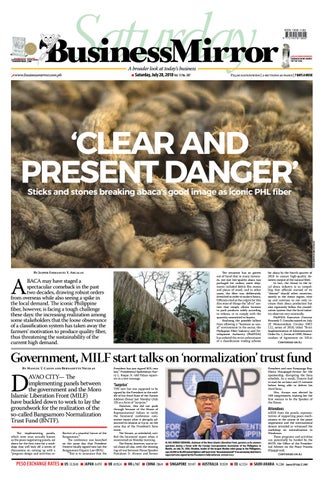
‘CLEAR AND PRESENT DANGER’ PAITOON SIRICHOTIWAT | DREAMSTIME.COM
Sticks and stones breaking abaca’s good image as iconic PHL fiber
A
By Jasper Emmanuel Y. Arcalas
The situation has so gotten out of hand that in many instances, not just low-quality abaca was packaged for orders; some shipments included debris like stones and pieces of wood, and in other cases, the fiber was deliberately drenched in order to make it heavy. Officials cited as the culprit for this dire state of things the “all-in” system that simply allows farmers to pack products solely according to volume, or to comply with the quantity committed to buyers. Realizing the possible fallout from allowing a “business as usual” environment in the sector, the Philippine Fiber Industry and Development Authority (PhilFIDA) has ordered the strict enforcement of a classification trading scheme
BACA may have staged a spectacular comeback in the past two decades, drawing robust orders from overseas while also seeing a spike in the local demand. The iconic Philippine fiber, however, is facing a tough challenge these days: the increasing realization among some stakeholders that the loose observance of a classification system has taken away the farmers’ motivation to produce quality fiber, thus threatening the sustainability of the current high demand.
for abaca by the fourth quarter of 2018 to ensure high-quality domestic output of the natural fiber. In fact, the threat to the local abaca industry is so compelling that officials warned of its “demise” should other countries, mostly in the Asean region, wise up and continue to not only increase their abaca production but also rigorously follow the classification system that the local industry observes very minimally. PhilFIDA Executive Director Kennedy T. Costales issued on July 25 Memorandum Circular (MC) 112, series of 2018, titled “Strict Implementation of Administrative Order No. 1, Series of 1999, Memorandum of Agreement on ‘All-in Continued on A2
Government, MILF start talks on ‘normalization’ trust fund By Manuel T. Cayon and Bernadette Nicolas
D
AVAO CITY— The implementing panels between the government and the Moro Islamic Liberation Front (MILF) have buckled down to work to lay the groundwork for the realization of the so-called Bangsamoro Normalization Trust Fund (BNTF).
The implementing panels, which were once actually known as the peace negotiating panels, sat down for the first time for a workshop that will kick off a series of discussions on coming up with a “program design and activities re-
flective of a peaceful future of the Bangsamoro.” The conference was launched on the same day that President Duterte finally signed into law the Bangsamoro Organic Law (BOL). “This is to announce that the
PESO EXCHANGE RATES n US 53.3540
President and now Pampanga Rep. Gloria Macapagal-Arroyo for the speakership, disrupting the Sona schedule. As a result, Duterte had to wait for an hour and 21 minutes before being able to deliver his third Sona. Mrs. Arroyo was elected by 186 congressmen, making her the first woman to be the Speaker of the House.
President has just signed BOL into law,” Presidential Spokesman Harry L. Roque Jr. told Palace reporters in a text message.
‘Surprise’
THE new law was supposed to be signed by the President in the middle of his third State of the Nation Address (Sona) last Monday (July 23) as a form of “surprise.” However, this did not push through because of the House of Representatives’ failure to ratify the bicameral conference committee report after it abruptly adjourned its session at 4 p.m. on the same day of the President’s Sona event. The Senate, as scheduled, ratified the bicameral report when it reconvened on Monday morning. The House, however, was in total chaos all day, with the ensuing tug-of-war between House Speaker Pantaleon D. Alvarez and former
Attendees
AL HAJ MURAD EBRAHIM, chairman of the Moro Islamic Liberation Front, gestures as he answers questions during a forum with the Foreign Correspondents Association of the Philippines in Manila, on July 24, 2018. Ebrahim, leader of the largest Muslim rebel group in the Philippines, says 30,000 to 40,000 armed fighters will have to be “decommissioned” if an autonomy deal that is expected to be signed by the President is fully enforced. AP/AARON FAVILA
ASIDE from the panels, representatives of supporting peace mechanisms in the course of the peace negotiation and the international donors attended or witnessed the workshop on normalization in Mindanao. These programs and activities can potentially be funded by the BNTF, the Office of the Presidential Adviser on the Peace Process (Opapp) said. Continued on A2
n JAPAN 0.4797 n UK 69.9524 n HK 6.7987 n CHINA 7.8641 n SINGAPORE 39.1417 n AUSTRALIA 39.3539 n EU 62.1254 n SAUDI ARABIA 14.2266
Source: BSP (July 27, 2018 )
News
BusinessMirror
A2 Saturday, July 28, 2018
www.businessmirror.com.ph
Government, MILF start talks on ‘normalization’ trust fund Continued from a1
The international donor community has continued to lend its financial and technical assistance to the peace process in Mindanao and its presence in the workshop was also deemed important “to create an avenue for international donors and their partners to efficiently release urgent support for the Bangsamoro,” the Opapp added. International donors had generously supported the earlier Mindanao peace agreement forged in September 1996 between the government of President Fidel V. Ramos and the Moro National Lib-
eration Front (MNLF), from which later sprang the MILF that is now the main player in the creation of a Bangsamoro region.
Steadfast commitment
THE trust fund was specifically mentioned in the Annex on Normalization under the Comprehensive Agreement on the Bangsa moro, the document that embodied the terms and conditions that finally nailed down the peace settlement in parts of Mindanao where the MILF has waged its war since the 1980s. “The terms of reference [TOR] of the trust fund was signed by
both the government and MILF on December 15, 2017, which also reaffirmed their steadfast commitment in moving the peace forward in the Bangsamoro,” the Opapp added. The TOR said the trust fund would “finance, coordinate and oversee the delivery of assistance from international partners and other donors in the implementation of the normalization process.” It said the BNTF would also assist “in the development of six previously acknowledged MILF camps, with the end in view of transforming these areas into peaceful and productive communities.”
Milestone
IN his speech, Presidential Peace Adviser Jesus Dureza expressed his gratitude “to all those who helped in the passage of the organic law.” “All of us brought this milestone here,” he said. MILF Implementing Panel Chairman Mohagher Iqbal said that, while the organic law is “not a perfect law,” it is “more than enough to start with.” He said the MILF and the government have become “partners” for peace and the fulfillment of Bangsamoro aspirations. “After the signing of the Framework Agreement on the
Bangsamoro and Comprehensive Agreement on the Bangsamoro [CAB], the situation between the two partners have improved very much,” Iqbal said. Government of the Philippines Implementing Panel Head Nabil A. Tan said the bigger work now looming “is the implementation of the CAB.” “The normalization program under the CAB would be in full swing, as all of us strive to accomplish the noble task toward just and lasting peace,” he added. The CAB was signed in 2014. Both sides said “normalization is a process whereby communities
in the Bangsamoro can achieve their desired quality of life in a peaceful manner.” The peace mechanisms which were present in the start of the workshops were Task Force Decommissioned Combatants and their Communities, Joint Task Force Camps Transformation, Joint Normalization Committee, Joint Peace and Security Committee, Independent Decommissioning Body, and Transitional Justice and Reconciliation. Representatives from the World Bank and United Nations Development Programme were also present to facilitate during the workshop.
‘Clear and present danger’
Buying,’ and other rules and regulations safeguarding the quality of fibers in the Philippines.” The MC was addressed to all grading baling establishments, trader-exporters, traders, processors and buying stations of abaca. MC 112 would implement the MOA among abaca processors and manufacturers and grading establishments that seek to end the current “all-in” abaca trading scheme in the country. “For the guidance of all concerned stakeholders, starting October 1, 2018, PhilFIDA shall strictly implement the provisions of Administrative Order No. 1, Series of 1999, the Memorandum of Agreement against ‘All-in Buying’, and other related rules and regulations issued by this Office pertaining to the regulation and production of the quality of Fibers being produced, processed and exported by the Philippines,” the MC 112 read. “In connection thereof, PhilFIDA shall take all the necessary
corrective actions and impose sanctions upon those who shall be found to be acting in violation of the aforementioned orders, circulars, rules and regulations,” the MC 112 added.
Shortage, poor quality
COSTALES said the practice of allin buying scheme in the abaca industry has worsened fiber quality and resulted in lower income for farmers. “The gist of this is basically that all-in buying is not allowed anymore. This has been practiced by everybody because of the shortage in supply,” he told the BusinessMirror in an interview. “They just want to get the volume in order to cover their commitment abroad. So, in order to do that they resorted to all-in buying, which contains garbage materials such as rocks and [pieces of] wood,” he added. Costales initiated the MOA among abaca players to “voluntarily and unilaterally” halt the all-in
buying practice in the country. According to Costales, 13 of the 19 major abaca players in the industry have signed the MOA as of July 24. These 13 industry players, according to Costales, already purchase “more than 80 percent of the total produce of farmers.” They are eyeing to have the remaining six players—five rope makers and one grading baling establishment—to sign the MOA before August ends. Under the classification-based trading scheme, abaca manufacturers, processors and traders would be forced to buy high-quality fiber from their sources. The PhilFIDA chief said the implementation of a classification trading scheme would allow farmers to earn double, as first-class abaca is being bought at around P120 per kilogram compared to the P60-per-kg average quotation of low-grade ones. Furthermore, stopping the all-in buying scheme would ensure
KAZAKI2103 | DREAMSTIME.COM
Continued from a1
that farmers would produce the highest-quality of abaca fiber, according to Costales.
Quantity at all cost
“DURING my time with the industry, it was classification basis of trading,” but now, he lamented, most farmers are oriented toward “all-in buying because they do not care about the quality—[for as long as it’s] abaca buyers [will buy it] due to [the] shortage,” he said. “Farmers are not really disciplined to produce better quality. And over the past 10 years the quality of our abaca fiber has worsened,” he added. The first-class abaca fiber grades are EF, S2, S3 and I, while G and H are second-class abaca fiber grade; JK is the tag for fifth class, Y fiber grades are damaged fibers; and WS is the tag for the worst kind of abaca fiber. Costales said that, due to the all-in buying system, the grade quality that the farmers produce is mostly JK, and damaged fibers like Y2 and WS fiber. He hopes that bringing back the old buying system would discipline the farmers and give them a “motivation to improve the quality.” “There will be a gradual improvement on quality; EF-I [abaca fiber grade] cannot happen overnight,” he said. “To reverberate down the line, it would take four to six months. Expect great improvements in the quality in four to six months,” he added. Under the MOA, all-in buying is defined as “the practice of buying abaca fibers in a wholesale manner, where this kind of trading does not require semi-classifi-
cation or classification of fibers as to quality—specifically the color, cleaning, tensile strength, moisture content and length.” It also refers to the buying of abaca fibers “with high moisture content and/or contaminated with foreign matter, i.e., stones, rocks, leaves, twigs, oils, plastics, etc., which give more weight to the abaca fiber bundles.” It also involves the purchase of abaca fibers that are “mixed with spurious fibers like Dartex, Pakol, Lalusin, Canton, MSP, among others.”
Pact for all
UNDER the MOA, the parties (abaca players) agree that the all-in buying scheme of abaca has discouraged the farmers from producing high-quality abaca fibers and allowed them vis-a-vis local traders/middlemen to take advantage of each other. Furthermore, parties that signed the MOA “voluntarily and unilaterally agree to stop, cease and desist the practice of buying abaca fibers from the abaca farmers and traders [Class A to D], at ‘all-in’ basis as a self-imposed regulation.” “The Parties categorically and voluntarily abide by this selfimposed regulation as set forth in this memorandum of agreement despite the principle of ‘free enterprise’ and ‘laissez-faire’,” said the MOA, a copy of which was obtained by the BusinessMirror. The signatories also agreed to purchase abaca fiber on a classification basis only in accordance with the guidelines of the Philippine National Standards. Payments to farmers should be based on the
classification system, the MOA stressed. The MOA established a compliance committee that would impose regulatory sanctions on abaca players that continue to buy at an all-in basis. The compliance committee will be comprised of two representatives each from the pulping, grade baling establishments and cordages sectors and the head of the PhilFIDA. The compliance committee was given these functions under the MOA: monitor the compliance; decide on the merits of cases of noncompliance with the MOA; decide on the use of the penalties generated and conduct regular meetings. Under the MOA, violators of the agreement will be fined P10,000 for first offense; P30,000 for second; P50,000 for third; P75,000 for fourth; and P100,000 for the fifth infringement and beyond it. “The Parties hereby unilaterally and voluntarily agree that the penalties collected shall be earmarked for the accelerated growth and development of the abaca industry,” the document read.
‘Clear and present danger’
TO say the stakes are high in this push for reforms is an understatement. The Philippines produces 85 percent of the world’s abaca fiber supply, and 1.5 million Filipinos depend on it for their livelihood. “A clear and present danger in the Philippine abaca industry has been identified in the horizon which could bring about the demise of the Philippine Abaca Industry,” declared the PhilFIDA document. The danger mostly arises from “external threats” posed by countries like Indonesia and Costa Rica that are now into plantation-type farming, which could allow them to ramp up production in a few years. In contrast, 95 percent of Philippine abaca farms are only intercropped to other primary agricultural products like coconut, falcata, rubber and fruit trees. Industry officials said Malaysia, Thailand and Vietnam are looking to follow in the footsteps of Indonesia, making the Philippines truly at risk of eventually being the laggard among its Asean peers. Assuming, said government estimates, that the so-called abaca emerging countries devote a total 10,000 hectares to abaca and then observe the Philippine classification system— which the locals now disregard—then the Philippine abaca industry “could lose 36 percent by year 2020 from the current 85 percent” (market share) it had as of 2017. If these other countries then ramp up hectarage and production further, and on top of that observe the rigorous classification system that pays heed to quality, “the same would mean a death sentence to the Philippine abaca industry,” the government report warns. Clearly then, sticks and stones may eventually break our fabled fiber unless all stakeholders put their act together—or risk killing yet again an industry that was so painstakingly plucked from the grave just two decades ago.
News
BusinessMirror
www.businessmirror.com.ph
Remains of American war dead repatriated from North Korea
N
orth Korea released the remains of some US war dead on the 65th anniversary of the armistice, the White House said, marking the first tangible outcome of President Donald Trump’s summit with Kim Jong Un and signaling progress in broader nuclear talks. A US Air Force C-17 transport plane flew to the eastern North Korean city of Wonsan early Friday and returned to Osan Air Base in South Korea with boxes containing what are believed to be the remains of missing American personnel. The aircraft arrived around 11 a.m. carrying 55 sets of remains, South Korea’s Yonhap News Agency said, representing about 1 percent of the service members still missing from the 1950 to 1953 conflict. “After so many years, this will be a great moment for so many families,” Trump said in a tweet. “Thank you to Kim Jong Un.” The US will formally accept the remains at an August 1 ceremony at Osan, before being flown to Hawaii for verification. The Department of Defense had estimated before the trip that North Korea was holding about 200 sets of remains out of some 5,300 military personnel believed lost in the country. At the air base on Friday, whitegloved service members representing countries who fought on the allied side removed boxes carrying the remains one by one and loaded them into vans. Each box was draped in the flag of the United Nations, which formally led the fighting against North Korea and China. The exchange on the historic anniversary follows Kim’s vow during his June 12 meeting with Trump to facilitate the “ immediate repatriation” of identified remains. Discussions about returning the war dead have dragged on amid signs of disagreements about the pace, sequence and possible outcomes of Kim’s other pledge to “work toward complete denuclearization of the Korean Peninsula.” Recovering the war dead adds a boost of goodwill to overall talks and provides Trump a political
victory similar to Kim’s May release of three living American detainees. The focus on soldiers remains, however, risks giving the North Koreans leverage to continue diplomacy and drag out disarmament talks. “Today, the chairman is fulfilling part of the commitment he made to the president to return our fallen American service members,” the White House said in an e-mailed statement. “We are encouraged by North Korea’s actions and the momentum for positive change.” Ne got i at ion s ap p e a re d to stumble when North Korea denounced the US’s “gangster-like” demands for unilateral disarmament after a visit to Pyongyang earlier this month by Secretary of State Michael Pompeo. Trump said on Thursday that talks were “ making terrific progress,” citing Kim’s dismantlement of weapons-testing sites. South Korean President Moon Jae-in said earlier this week that he expected progress with denuclearization efforts to advance after the war dead issue was resolved. Expectations for the soldiers’ return have been raised by Trump, who told reporters after the summit that Kim “was really very gracious” and immediately agreed to return the remains in response to his own spur-of-the-moment request. Trump continued to raise hopes in the subsequent days, telling Fox News that Kim was “giving us back the remains of probably 7,500 soldiers” and supporters in Nevada that North Korea had already handed over 200 sets of remains. The recovery of war dead has long been among the most fraught issues between the US and North Korea, dating back to even before the two sides formally stopped fighting. Joint efforts to find and identify US personnel between 1990 and 2005 recovered more than 300 sets of remains, and were suspended as nuclear talks between the two sides deteriorated. North Korea last repatriated the remains of six individuals in 2007. Bloomberg News
Washington intel office lists top ‘cyber threats’
C
hina, Russia and Iran pose the biggest threats of computer attacks to spy on US companies and steal their trade secrets, according to a report from the Office of the Director of National Intelligence. The three countries have conducted sophisticated, large-scale hacking attacks across multiple US industries, targeting the networks of technology and manufacturing contractors, defense contractors and utilities, according to the 20-page report compiled by office’s National Counterintelligence and Security Center. “Our economic security is our national security,” William Evanina, director of the National Counterintelligence and Security Center, told reporters during a briefing on Thursday. “We cannot just get numb to our adversaries stealing our intellectual property and trade secrets.” There’s no sign the cyber thefts will stop. “We anticipate that China, Russia, and Iran will remain aggressive and capable collectors of sensitive US economic information and technologies, particularly in cyberspace,” the intelligence center said in the report. “All will almost certainly continue to deploy significant resources and a wide array of tactics to acquire intellectual property and proprietary information,” the report added. A new threat is that hackers are infiltrating corporate networks, while software code is being written, Evanina said. That lets the hackers insert malware into the code from the start that will stay as it’s used by consumers and updated.
Russia
Russian government hackers compromised dozens of US energy companies in 2017, including their operational networks, according to the report.
“The threat to US technology from Russia will continue over the coming years, as Moscow attempts to bolster an economy struggling with endemic corruption, state control and a loss of talent departing for jobs abroad,” the counterintelligence center said.
China
Most Chinese cyberattacks against US industry are focused on defense contractors and technology and communications companies “whose products and services support government and private-sector networks worldwide,” according to the report. China reached an agreement with the US in 2015 to stop conducting digital economic espionage. Attacks from China have lessened since then but still continue, the counterintelligence center said.
Iran
Iran is described as taking a noticeable turn in 2017 toward targeting US networks, as it seeks to expand industries unrelated to oil. “We believe that Iran will continue working to penetrate US networks for economic or industrial espionage purposes,” according to the report. “Iran’s economy—still driven heavily by petroleum revenue—will depend on growth in nonoil industries, and we expect Iran will continue to exploit cyberspace to gain advantages in these industries.” Looking ahead, the counterintelligence office said software vulnerabilities will continue to let hackers insert malicious code into US networks. Additionally, new laws put in place by other countries might require US companies to submit their software code for security reviews or store their data locally in the host country. Bloomberg News
Saturday, July 28, 2018
A3
Asia’s worst equities market shows signs of a comeback
P
By Ian Sayson | Bloomberg
hilippine stocks are heading for the sharpest monthly gain in more than two years as foreign funds start trickling back into a market that was among the world’s worst performers in the first half of the year. T he benchmark Phi lippine Stock Exchange index has gained 6.6 percent in loca l currenc y ter ms so far t his mont h, a mong t he world ’s f ive best per for mers. T he gauge, which tumbled 16 percent in the f irst ha lf and sank into a bear market in June, has ra l lied more than 3.9 percent in three days, as overseas investors tur ned net buyers this week fol low ing a record 25 stra ight week s of w it hdrawa ls. “Foreign funds have started
coming back as investors have realized there’s value in the market,” said Alfred Dy, research head at CLSA Philippines Inc., the nation’s largest foreign broker. “There’s still room for more gains because in spite of the bounce there is still value on the table.” Philippine stocks are trading at 16.47 times 12-month estimated earnings and while that has gone up from 15.1 times in June, the multiple is still more than one standard deviation below the 17.75 times five-year average.
Still, Morgan Stanley strategist Sean Gardiner advises investors to stay underweight on Philippine equities as the market is fairly valued relative to its 10 to 25 year average. “A more substantial re-rating in P/E valuation is difficult given global tightening, rising earnings risk and reduced domestic liquidity,” according to a June 26 note he wrote with analyst Aarti Shah. Overseas investors bought $19.45 mi l lion of Phi lippine shares this week, as they also picked up shares in other Asian markets, such as Thailand and Indonesia. They bought $12.06 million on Thursday, the most since January 17. The trend is welcome news for the Philippines after it saw international funds unload $1.3 billion of stocks this year, exceeding the record $1.19 billion withdrawn for all of 2015. They had sold shares, amid fears of a weakening peso, rising inflation, a trade war between the US and China, and a general selloff in emerging markets.
Dy, rated the top Philippine equities strategist by Asiamoney from 2010 to 2017, said the Central Bank’s stance on inflation next month will be a key factor that could boost stocks. Progress on the government’s tax reform and its plan to remove caps for rice imports will be additional catalysts, he said. Among the big caps, Dy recommends Ayala Corp., Ayala Land and Bank of the Philippine Islands. Investors should also buy so-called second-liners, such as Bloomberry Resorts Corp., Puregold Price Club Inc. and Robinsons Retail Holdings Inc., he said. Potential risks for the market include US-China trade tensions and the possibility secondquarter corporate earnings will miss expectations of 8-percent to 9-percent growth this year, according to Dy. “We could already be on the road to recovery provided there won’t be any missteps from here,” Dy said. “Investors should continue to buy selective blue chips that will lead the rebound.”
FB’s $119-billion 1-day rout makes US history
I
t’s official. Facebook Inc. just had the biggest stock-market wipeout in American history. Shares tumbled 19-percent on Thursday to close at $176.26 after sales and user growth disappointed investors. The 19-percent drop vaporized $119 billion of the company’s stock-market value; Chief Executive Officer (CEO) Mark Zuckerberg saw his net worth fall by roughly $16 billion as a result. It was Facebook’s worst trading day since going public in 2012; the collapse eclipsed Intel’s decline of $91 billion in September 2000, without adjusting for inflation. T he plunge fol lowed Facebook ’s warning late Wednesday that its revenue g row th w il l slow dow n significantly for at least the remainder of the year and that expenses will continue to sky rocket. In a sign of just how bullish i nve stor e x p e c t at ion s we re, though, the collapse merely returned Facebook shares to a level last seen in early May. At that point, the stock was still recovering from an earlier battering over its big privacy scandal, in which a political consulting firm with ties to President Donald J. Trump improperly accessed the data of tens of millions of Facebook users. Now come the big questions: Is this a temporary setback, or the start of a painful new road for the giant social network? And does a similar comeuppance await other high-flying technology behemoths? Both the slower growth forecast and heavier spending reflect problems largely of Facebook’s own making. New European privacy rules, inspired in part by Facebook ’s relentless mining of its own users’ data, are starting to hamper the company’s advertising bu si ness. A nd t he i nc rea sed spend ing a ims, among ot her things, to prevent a replay of the fake news and propaganda that Russian agents unleashed on an unguarded Facebook in an attempt to sway the 2016 presidential election. Zuckerberg even noted during a call with analysts that “we’re investing so much in security that it will significantly impact our profitability.”
The logo for Facebook appears on screen at the Nasdaq MarketSite in New York’s Times Square. Facebook’s user base and revenue grew slower than expected in the second quarter of 2018, as the company grappled with privacy issues, sending its stock tumbling on Thursday. AP
Overall, technology giants— Facebook, Apple, Google, Amazon and others—have enjoyed almost unprecedented growth in revenue and stock price for years. They have seemed unstoppable, even in the face of regulatory pressure, user dissatisfaction and broader existential questions about their impact on society. Technology companies account for six of the 10 biggest companies in the S&P 500 Index. Some see the Facebook sell-off as clear evidence that nothing can grow forever, especially not the world’s biggest companies, especially not at the rate of nimble, promising start-ups. Facebook revenue is still growing at a rate double that of Tw itter. A decade ago, almost no one could have imagined that Facebook would have more than 2 billion users, much less that its family of apps—Instagram, W hatsApp a nd Me s s e n ge r — wou ld a l so count members in the billions. “Nobody knows where the top is, where that growth slows down,” said Phil Bak, CEO of Exponential ETFs and a former managing director of the New York Stock Exchange who said he’s been warning investors of a potential sell-off in large tech stocks. Things could get rougher still. Those European privacy regulations, known as the General Data Privacy Regulation, or GDPR, went into effect with just one
month left in the second quarter. That means Facebook could feel its effects more strongly later this year. For more than a year—ever since Zuckerberg published a 5,000 word manifesto arguing that Facebook needs to make the world a better place by bolstering
civic engagement and addressing social ills—the company has seemed torn between its philosophical mission and its economic one. Wednesday may have been the first time this tension really broke into the open, probably because it threatened the one thing all investors care about: Money. Michael Connor, whose Open Mic group helps investors push tech companies to address privacy, abuse and other issues, said it’s “ far too early” to see if Facebook ’s efforts to improve itself w ill prove fruitful. But the real question, he said, is whether the company can “continue to do what they are doing in the face of criticism from Wall Street.” Siva Vaidhyanathan, a media studies professor at the University of Virginia and author of the new book, Antisocial Media: How Facebook Disconnects Us and Undermines Democracy, dismissed the significance of the stock plunge. “Mark Zuckerberg isn’t panicking,” he said. “The Facebook board isn’t panicking. Most of its large institutional investors aren’t panicking. They know they’re in it for the long game.” Bloomberg and AP
ExportUnlimited
A4 Saturday, July 28, 2018 • Editor: Efleda P. Campos
BusinessMirror
BOI FDI up 165% in H1
PHL spearheads entry to global electronics, auto markets through intl trade fairs in Germany T
T
HE Philippines is expanding its promotion drive to nontraditional global markets as the Department of Trade and Industry, through the Center for International Trade Expositions and Missions (DTICitem), looks to bring local companies in the world’s biggest automotive and electronics fairs in Germany. “We are inviting the country’s electronics and automotive companies to join us and explore the global market to promote the export and investment opportunities in the Philippines through trade exhibits abroad,” DTI Undersecretary for Trade and Investments Promotion Group (TIPG) and concurrently Citem Officer in Charge (OIC) Nora K. Terrado said. “For this year, we are set to bring a country delegation in two of the world’s biggest industrial events in electronics and automotive both held in Germany with the goal of creating more business opportunities to companies in nontraditional sectors, diversifying our export promotion and globalizing our local industry players,” Terrado said. From September 11 to 15 Citem
is inviting local companies to join the Philippine delegation in Automechanika in Frankfurt, Germany. It is the world’s leading trade fair for the automotive aftermarket industry that exhibits a wide range of products including, but not limited to parts and components, electronics and systems, repair and maintenance, accessories and customizing, car wash, care and reconditioning, (dealer and workshop management, and alternative drive systems and digital solutions (tomorrow’s service and mobility). The DTI-Citem last participated in Automechanika in 1996 with 10 companies. Products showcased included battery clamps, alloy wheels, seat covers and other interior upholstery and parts, radiators, leaf springs and oil lubricants.
For Automechanika 2018, Citem is inviting automotive aftermarket companies that produce and services parts and components, electronic and systems, and accessories manufacturing companies, among others. “The primary objective of returning to Automechanika Frankfurt is to make the Philippines’s presence be felt again and create awareness globally on the extent of industry capabilities of Philippine automotive companies,” Terrado said. Meanwhile, Philippine companies may also join from November 13 to 16 in electronica in Munich, Germany. Existing for more than 50 years, it has become the world’s leading international trade fair for electronic components, systems, applications and solutions make new developments, such as smart homes and connected cars possible in the first place. On its 2016 edition, a total of 2,912 exhibitors from more than 50 countries gathered to network with almost 74,000 visitors and dialog with professionals from around the world. Citem’s fourth and last participation in electronica was in 1998. For electronica, Citem is looking for companies that produce or service semiconductors and other components, electronics data processing equipment, office equipment, telecommunications, consumer electronics, radar and communications, control and instrumentation, medical and industrial, automotive elec-
tronics, and solar and photovoltaics. “After consultations from industry players and public partners, we have determined that the time is ripe for the Philippines to once again make a comeback in these trade events which we have not participated in for more than two decades,” Terrado said. “ Through a synergy among stakeholders, we hope to seal export deals and partnerships with international buyers and investors to mobilize much‐needed funding and technology to our local players,” Terrado said. “Germany is a strategic location to meet such partners since it has been a premier hub for various industry events.” The Association of the German Trade Fair Industry (AUMA) said two-thirds of the world’s leading trade fairs take place in Germany, which hosts around 150 international trade fairs each year for 180,000 exhibitors and 10 million visitors. History, geography and economics have made Germany a global leader in a centuries-old method of matching buyers to sellers, according to news agency Handelsblatt Global. “Promoting local players in developing industry sectors is part of the DTI’s current agenda to expand and develop the country’s export portfolio and make its nontraditional exports get a bigger share in the global value chain,” Terrado said.
The DTI’s export diversification thrust is in line with recommendations of World Trade Organization (WTO) in recently released report on “Mainstreaming trade to attain the SDGs” as part of keeping up with the 2030 Agenda for Sustainable Development and its Sustainable Development Goals (SDGs). The WTO said diversification into other exports should be high on the list of priorities, therefore, for countries dependent on commodity exports. The global trade regulator noted there is an “urgent need to adapt to changing environmental conditions makes trade diversification even more important.” “To assist their diversification efforts, these countries need predictable market access conditions and capacity building,” the report read. “This will help in achieving decent work and economic growth, fostering industrialization, innovation and infrastructure, reducing inequalities among countries and increasing participation in world trade,” the report added. Interested exhibitors for Automechanika may contact Katrina Ledesma at 831-2201 loc. 227 or via e-mail at katlesdesma@citem.com.ph. Those interested in electronica may contact Giselle Erese at 831-2201 loc. 322 or via e-mail at gaerese@ citem.com.ph.
CanCham: More opportunities abound in key Canadian areas for Filipino exporters By Roderick L. Abad
F
Contributor
OR local products to penetrate Canada even further, the Philippines needs to improve its trade relation with this North American nation, said a top executive of a Canadian business group in the country. “Historically, the Philippines has [significantly] traded with Europe, the United States and other Asian countries. [But] it has not traded a huge amount with Canada,” Canadian Chamber of Commerce of the Philippines (CanCham) President and CEO Julian H. Payne told the BusinessMirror at the sideline of “Opportunities for Philippine Exports to Canada” Forum held at the Dusit Thani Hotel in Makati on July 19. He attributed this mainly to the fact that there is no free-trade agreement (FTA) reached yet between the two nations. “If there’s an FTA that includes both Canada and the Philippines, it would be great,” he said, citing it as a way for an exchange of more goods in both countries. Payne noted, though, the ongoing discussion for a possible FTA between Canada and the Asean from which the Philippines, as a member, could benefit from. The high-ranking official of CanCham also pointed out the TransPacific Partnership signed by 11 countries, excluding the US. “If the Philippines would have become a part of that, that again would open up more trade opportunities,” he said. Based on the recent CanCham study, the Philippines was just the seventh Asean exporting country to Canada from 2014 to 2016, with an average value of $559 million, or 7.62 percent of the total $7.3-billion export cost of the region. Vietnam outdid its peers, with $2.4 billion or a share of 32.41 percent. It was followed by Thailand, $1.4 billion, 18.99 percent; Singapore, $823 million, 11.19 percent; Malaysia, $766 million, 10.43 percent; Indonesia, $736 million, 10.02 percent; and Cambodia, $575 million, 7.83 percent.
Trailing behind the Philippines were Brunei Darussalam, $82 million, 1.12 percent; Myanmar, $15 million, 0.2 percent; and Lao PDR, $12 million, 0.1 percent. The top 10 Asean export products to Canada were electrical and electronic equipment, $1.5 billion, 6.9 percent; articles of apparels, $892 million, 4 percent; nuclear reactors or boilers, $599 million, 2.7 percent; articles of apparel or clothing (excluding knitted), $425 million, 1.9 percent; rubber, $349 million, 1.5 percent; footwear, gaiters and the like, $334 million, 1.5 percent; meat of fish or crustaceans, $309 million, 1.4 percent; furniture, $275 million, 1.1 percent; fish or crustaceans, $244 million, 1.1 percent; and optical or photographic materials, $168 million, 0.8 percent. The leading Philippine-made products exported to Canada were electrical or electronic equipment at $328 million; articles of apparel (not knit or crocheted), $25.9 million; articles of apparel, $23.8 million; vegetable, fruit and nut food preparations, $21.6 million; edible fruits, nuts, peel of citrus and melon, $21.3 million; animal and vegetable fats and oils, $20.6 million; optical, photo, technical and medical apparatus, $11.2 million; machinery, nuclear reactors and boilers, $9.2 million; articles of leather, $8.8 million; and rubber products, $0.88 million. “Right now, the Philippines does actually export more to Canada than Canada exports to the Philippines,” Payne said. While there was a decline during the three-year period in review, he emphasized it turned around and started to increase again in 2017. “I don’t have the figures right in my hand, but I know that the trend was slightly reversed,” he said of their bullish expectation on the results of their planned data gathering with regards the exportation of Philippine produced goods to Canada last year. “The demand is there. It depends on the competitiveness of Philippine exports and relative to the other competing countries, which include the Asean countries and, of course, other tropical countries from South
DTI-PAB, UAE-ESMA MOU SIGNING
The Department of Trade and Industry (DTI), through the Philippine Accreditation Bureau (PAB), signed a memorandum of understanding (MOU) with United Arab Emirates-Emirates Authority for Standardization and Metrology (UAE-ESMA) on July 19 at the DTI International Building in Makati City. The MOU aims to ease the technical barriers on trade and enable bilateral trade between the Philippines and the UAE, particularly the halal products. Through this MOU, the two countries intend to develop the technical cooperation in the Halal Accreditation’s field aligned with both of the countries’ rules and regulations and also relevant with the World Trade Organization’s (WTO) provisions. In photo are (from left): DTI Industry Development and Trade Policy Group Undersecretary Ceferino S. Rodolfo, DTI Export Marketing Bureau (EMB) Assistant Director Anthony B. Rivera, DTI-EMB Director Senen M. Perlada, DTI-PAB Assistant Director and Officer in Charge Ernani M. Dionisio, ESMA Director General Abdulla Abdelqader Al Maeeni, UAE Ambassador to the Philippines Hamad Saeed Al Zaabi and DTI Foreign Trade Service Corps Commercial Attaché Eric C. Elnar.
America and Central America which export to Canada with similar products like bananas,” he added. To cope up with the competition, the CanCham president and CEO suggested that Filipino exporters should improve logistics, like having direct container services from here to Canada. Payne also recommended them to leverage on the growing population of Filipino immigrants or workers there, which to date is around 800,000. “You can serve to other parts; there’s nothing wrong with that. And if you have an interest, please try. But look for big established markets, with significant population and significant imports,” he said, citing Southern Ontario, Vancouver, Winnipeg, Manitoba, Alberta and Calgary as potential export markets. “There’s a lot of opportunities there. What you have to identify first is what is the demand in Canada. That means looking at Canadian global imports. Second, look at where the Philippines has been successful in exporting to Canada because, with a few exceptions, you’re only catching a bit of the Canadian market, so obviously there is hope for more. The third is to look at where Asean is successful in exporting to Canada of items the Philippines actually produces. So that means, they’re doing better than you, and you should be able to do it,” he said.
Ifex PHL 2018: Agro-biodiversity touted as a viable business
A
MONG the many palatable attractions at the 12th edition of the International Food Exhibition (Ifex) Philippines was the pavilion of the project called “Dynamic Conservation and Sustainable Use of Agro-Biodiversity in the Traditional Agro-Ecosystems of the Philippines [Agro-Biodiveristy Project].” A collaboration between the Food and Agriculture Organization of the United Nations (FAO), the Department of Agriculture’s (DA) Bureau of Agricultural Research, and the municipalities of Hingyon and Hungduan (both in Ifugao province) and Lake Sebu (South Cotabato), this initiative aims to enhance, expand and sustain the dynamic conservation practices that support globally significant agro-biodiversity in traditional agroecosystems of the Philippines. A total of 12 communities in Ifugao and five in Lake Sebu directly benefited from this project. Jose Luis Fernandez, FAO representative in the Philippines, said the success of this initiative will greatly contribute to the country’s food security. “First of all, we need to understand that a nutritionally adequate diet must be composed of a variety of foods. Biodiversity contributes significantly to this variety. The conservation and sustainable use of plant genetic resources for food and agriculture are key to ensuring that the world will produce enough food to feed its growing population in the future.” With the end-view of test-marketing the products and benchmarking these against others already in the market, the FAO pavilion at Ifex 2018 showcased the processed products from agro-biodiversity crops (taro, yam, tomato and ginger) produced by the Tuwali Indigenous Peoples of Ifugao and T’boli Indigenous Peoples of Lake Sebu such as various flavors of banana and taro chips, rice and taro cookies, as well as ginger pastillas and candies.
RADE Secretary and Board of Investments (BOI) Chairman Ramon M. Lopez announced a 165-percent increase in foreign direct investments (FDI) in the first semester of the year, contributing to the 27-percent increase in overall approved investments for the period. FDI approved by the agency grew to P14.5 billion from only P5.5 billion in the same period last year. The growth in FDI contributed to the overall increase in BOI approvals as investment projects approved by the agency reached P238.9 billion in the first semester of 2018, up by 27.1 percent compared to the P188 billion recorded in the same period last year. By country, Indonesia topped all foreign investors with P6.4 billion, followed by Japan with P2.6 billion, and China with P880 million. The United States (P582 million) and Italy (P486 million) came in as fourth and fifth placers, respectively. “The impressive investment registrations with the BOI is a concrete proof of the continued confidence of both foreign and local investors in the country,” Lopez said. He said the strategic nature of investments registered with the BOI and the strong confidence of investors is strongly linked to the administration’s policies which are independent and pragmatic, but principled in addressing the critical social problems and bottlenecks to industry competitiveness such as infrastructure and power. The Philippine economy will continue to grow and create investment opportunities in infrastructure, manufacturing and services. With this growth, we intend to have more inclusive businesses and ensure that economic gains are spread throughout the country,” Lopez added. Trade Undersecretary and BOI Managing Head Ceferino S. Rodolfo said the BOI investment figures are a significant lead indicator for the overall growth of FDI. He cited the FDI figures released by the Bangko Sentral ng Pilipinas which showed a 40-percent increase in the first quarter of the year. Rodolfo said the agency is still on track in achieving its target of P680 billion for 2018, a 10-percent improvement from last year’s P617 billion. “We expect big-ticket projects to come in by the second half of the year. Foreign and domestic investors remain optimistic especially in view of the government’s “Build, Build, Build” and manufacturing resurgence programs,” he said. Citra Central Expressway Corp. was the biggest project registered in the month of June as it invested P25.7 billion in extending the Skyway that will connect Buendia Avenue all the way to the North Luzon Expressway in Balintawak. Other notable projects include the P1.1-billion theme park of Newscapes Haven Development Inc. in Nabas, Aklan; Hydrocor Corp.’s P990-million renewableenerg y project in Ifugao; the P710-million hospital project of Allegiant Regional Care Hospitals Inc. in Lapu-Lapu City, Cebu; and the P439-million mass housing project of PDB Properties Inc. in Tanauan City, Batangas. The renewable-energy/power sector remains the top source of investments with P108.2 billion for the first semester, a 168-percent increase from last year’s P40.3 billion in the same frame. The transportation and storage segment is runner-up with P37.4 billion, up 298 percent from P9.4 billion in 2017. Construction/PPP projects (P32.9 billion), manufacturing (P19.8 billion) and real estate (P15 billion) make up the top 5 sectors.
Sports BusinessMirror
Editor: Jun Lomibao • mirror_sports@yahoo.com.ph
Saturday, July 28, 2018
Members of Team Arellano and Team Enderun celebrate their top two finish in the last eliminations leg.
Chiang Huang proudly poses with her first Champion Tour trophy.
A5
A6
BusinessMi
Saturday, July 28, 2018 | Editor: Jun Lomibao
The handling of Chris Froome’s recently closed salbutamol case is a “blow” to the World Anti-Doping Agency’s credibility.
‘Wada CREDIB
TRICYCLE athletes have an impairment that affects their balance and coordination, hence the three wheels.
Tricycle racing shows steady growth
T
HE three-wheeled tricycle is one of the oldest forms of human-powered vehicle, and most people usually encounter it when they first learn to ride as a child. In the para-cycling world, it is one of four divisions, along with Tandem, Handcycle and Cycle, and has two classes, designated as T1 and T2 for both women and men. Tricycle athletes have an impairment that affects their balance and coordination, hence the three wheels. T1 is allocated to athletes with more significant coordination problems or loss of muscle power than athletes competing in T2. “There is not much difference in terms of training for tricycle athletes as any others; they respond to training the same as any able-bodied athlete,” said Sébastien Travers, Para Head Coach for Cycling Canada. There is a definite need for adaptations to technical training, because a tricycle doesn’t behave the same as a two-wheeled bike. So, we put a lot of emphasis around the technical aspects of training, to make sure the athletes are as efficient on their bikes as any other athlete.” “We are seeing a slow rise in the number of women tricycle athletes and a renewal in the men’s category,” Travers continued. For sure, in the T1 division there is a smaller depth of field because currently there are not a lot of athletes who can perform at world level. Canada, as a nation,
is focused on identifying and developing more trikers because it is a category that has a place in the national program. One of the most decorated athletes in tricycle racing is Shelley Gautier of Canada, winner of 12 UCI Para-cycling world titles in the road race and time trial for the women’s T1 category—undefeated in her category since 2010. Gautier also won a bronze medal at the Rio 2016 Paralympics in the women’s combined T1-T2 time trial, and silver medals in both the time trial and road race for the women’s combined T1-T2 category at the 2015 Parapan Continental Games. In 2015 she was nominated for the prestigious Laureus Award for the World Sportsperson of the Year with a Disability. In 2001 Gautier suffered a head injury and was in coma for six weeks from a mountain bike crash. She was diagnosed with hemiparesis—a weakening or partial paralysis on the right side of her body. This did not deter her from competing, first in sailing where she won multiple awards, before moving back to cycling, when she became the first female tricycle T1 rider on the international scene in early 2009. Indeed, she has dominated the category ever since. “As a disabled person I became involved with Disabled Sailing,” said Gautier. “When I realized that I could not go to the Paralympics with sailing, I decided to
explore para-cycling. I have competed in the London and Rio Paralympic Games. Tokyo is the next Paralympics and I hope to bring home a different color medal. “Cycling is very enjoyable for me and is how I became disabled. Winning the UCI World Championships is constant work. I enjoy training and competing. I am always working on mental and physical activities related to keeping me on top.” Shelley points to some of the particular challenges faced by tricycle athletes: “My trikes require custom construction, and set up, plus it is very difficult to find training partners.” Although she will turn 50 later this year, Gautier is still on top of her game, winning both the time trial and road race events at the two UCI Para-cycling Road World Cup rounds held so far this season, and she is hoping to extend her winning streak at the 2018 UCI Para-cycling Road World Championships in Maniago, Italy, from August 2 to 5. “It gets more difficult, with more competitors coming in. This year there will be 12 female trikers for the World Championships.”
CHRIS FROOME and general classification leader Geraint Thomas converse before the start of Stage 16 of the Tour de France. AP
Young riders showcase talent i
F
OR the second time after 2016, the International Cycling Union (UCI) Juniors Track World Championships will take place at the UCI World Cycling Centre (WCC) in Aigle, Switzerland. For a group of 17 athletes from 10 countries, the boards of the center’s velodrome will hold no secrets during the competition, which takes place from August 15 to 19. The young hopefuls are training at the UCI WCC for the most important event of their young careers under the watchful eyes of two former Olympians, Craig MacLean (GBR) and Walter Pérez (ARG).
UCI News
Handcycling an amazing sight
A
FULL field of handcycles—also known as handbikes—is truly an amazing sight, reminding the spectators of Formula 1 race cars as they weave around corners and speed down descents. While modern racing versions are constructed of carbon fiber and use much of the same technology as bicycles, the handcycle is actually among the oldest of human-powered vehicles. Called the “manumotive cycle” in the 1800s, the term vélocimane came to the fore in France in the early-1900s, possibly due to the popular Velociman model produced by Singer of Coventry, England. Early designs included power delivery
through both chain-drive cranks with a rowing style (also known as cyclorameurs), and were either tricycles or quadracycles. Most modern designs are tricycles, and usually consist of a single front wheel and two rear wheels (although the reverse is also seen), with power output and steering through the front wheel. While many upright designs exist, for racing an aerodynamic design is the most common, with the riders lying on their backs, legs on either side of the front wheel. The hand crank system is chain-driven, but with one significant difference from the bicycle: both cranks are beside each other rather than 180 degrees out of phase. This allows the rider to use his/her torso to increase power output. Racing handcycles are made of lightweight aluminium and carbon fiber, with carbon fiber aerodynamic wheels and electronic shifting. For H1 and H2 category athletes, there are elbow operated braking and shifting systems.
THE young hopefuls are training in Aigle for the most important event of their young careers.
THE handcycle is actually among the oldest of human-powered vehicles.
UCI News
Gilbert: Leaving the Tour really hurts
P
HILIPPE GILBERT (Quick-Step Floors) already knew his Tour de France was over before he was diagnosed with a fracture to his left kneecap. The Belgian was on the attack from a breakaway on Stage 16, descending the treacherous Col de Portet d’Aspet, when he misjudged a bend and ran into a low stone wall before cartwheeling over the edge to the ground 3 meters below. His team confirmed that he sustained a “fracture on the lateral pole of his left patella”
and on Wednesday issued an update that he would be off his bike for “a few weeks” and out of competition for at least six weeks. However, considering the death of Fabio Casartelli on the same descent 23 years ago, Gilbert knew his crash could have ended much worse. “First of all, I want to say that I’m happy to be here after that tough moment,” Gilbert said in a team press release. “I landed pretty hard on some stones, and initially didn’t want to move, but someone from Mavic
came and helped me stand up and crawl back from that ravine.” The cycling world breathed a sigh of relief when Gilbert stood on the roadside and gave the thumbs up to the television camera, but after he finished the stage and was examined in the medical truck, he knew he would not continue on Stage 17. “This isn’t how I wanted to finish my Tour, and leaving it like this really hurts,” Gilbert said. He was awarded the most combative prize for his attack, and his teammate
Julian Alaphilippe claimed the stage victory, but if the Frenchman had any nerves after passing Gilbert’s accident he didn’t show it as he later hurtled down the Col du Portillon en route to the win. “Seeing his bike on the ground, I got a bit scared, so I slowed down on the descent,” Alaphilippe said. “It’s a real pity he crashed and is now out of the Tour. He’s been a huge helper for the team during the race and he deserves a lot of credit for the role played in our success.” Cyclingnews
Since June, they have been devoting their lives to their chosen sport, with sessions in the gym, on the track and on the road. Despite their vastly differing experience upon arrival in Aigle, they have coped well and are making commendable progress, according to MacLean, former team sprint UCI World Champion (2002) and Olympic silver medalist (Sydney 2000). “They have adapted well,” their Switzerland-based coach said. “It was tough at the beginning. The first week was very exciting, the next week the jet lag caught up with some of them, and by week three there
irror CYCLING
mirror_sports@yahoo.com.ph | Saturday, July 28, 2018
LOST BILITY!’ T RAVIS RUGART, head of the USA Anti-Doping Agency (USADA), has told BBC Sports that the handling of Chris Froome’s recently closed salbutamol case is a “blow” to the World AntiDoping Agency’s (Wada) credibility. “The question is whether justice was truly served or did a star get an undeserved break,” Tygart said in an interview with BBC Sport early this week, expressing his concern that there was a lack of transparency and credibility over the decision to drop Froome’s case. “Unfortunately, it’s another blow to the perceived credibility of the global anti-doping movement,” he said. Froome returned an anti-doping sample, an adverse analytical finding, that contained double the permitted level of salbutamol, 2000ng/ml, at the 2017 Vuelta a España, a race he went on to win. The findings for salbutamol were later reduced to 19 percent above the allowable limit after being adjusted for dehydration. Froome and Team Sky were notified of the findings on September 20, though it only became public knowledge when news of the test leaked to the The Guardian and Le Monde in December. He risked a possible ban and the loss of his Vuelta title and all subsequent results, but he continued to race while the case was being adjudicated and won the Giro d’Italia in May. After a nine-month investigation, the International Cycling Union (UCI) closed the case just days ahead of the Tour de France, saying
in junior worlds was homesickness and some tears.”
Racing, benchmarking and specialization
NOW they have settled in and are 100-percent focused on the upcoming Worlds. At the beginning of their stay, they had the chance to compete in the time trial at the Swiss Championships which were hosted by the UCI WCC. This enabled the coaches to benchmark the new trainees’ performances and see how they coped with stress. The athletes have since been separated into an endurance group and a sprint group, with training
that the results did not constitute an adverse analytical finding (AAF). The UCI’s decision was based on Wada’s position on the case after reviewing expert evidence brought forth by Froome and his legal team. Froome, however, did not undergo a controlled pharmacokinetic study (CPKS) allowed under Wada rules to prove that the level of salbutamol was a normal consequence of his physiology because Wada said “it would not have been practicable as it would not have been possible to adequately recreate the unique circumstances that preceded the 7 September doping control.” Instead, Wada accepted Froome’s 1,500 pages of expert evidence and explanations, and said that it recognized that “in rare cases, athletes may exceed the decision limit concentration without exceeding the maximum inhaled dose”. Wada supported the UCI decision to then clear Froome, saying that it “believes this to be the right and fair outcome for what was a very complex case.” However, very little of the extensive expert evidence used to make both the UCI’s and Wada’s decision to close Froome’s case has been made public. Tygart, who led the investigation that exposed former cyclist Lance Armstrong’s doping operation and saw him banned for life, said that not being able to review the evidence makes it impossible to know how the decision was reached and that is what lessens the UCI’s and Wada’s credibility in their decision. He said that it is also unfair to Froome because the cycling
community thinks he has benefited from having a high profile, even if his reputation may have already been “unfairly tarnished.” He said Froome’s case is “another shard that has damaged the credibility of Wada”. He also said that the lack of transparency forces the cycling community to question the case, particularly when in previous salbutamol cases—such as Alessandro Petacchi and Diego Ulissi—the UCI and Wada rejected arguments that the athlete’s use of the drug was within the allowed limits. “You can never un-ring that bell, and it’s why more answers have to be provided so that people have confidence that he’s not just a star who got away with it—that’s a natural conclusion,” Tygart said. “Athletes should not be accused or it be inferred that they’re not clean until proven through the established process, and that didn’t happen here and he deserves the benefit of that presumption of innocence.” Tygart also expressed concerns when he told BBC Sport that in nearly 75,000 antidoping tests conducted by the USADA since the salbutamol rule was updated in 2011, the organization did not find “a single athlete” in any sport that exceeded the maximum permitted amount. A Wada spokesman responded to Tygart’s claims of there being a lack of transparency, telling BBC Sport, “Wada has publicly set out the reasoning for its position on the case of Mr. Froome.” “Mr. Tygart’s assessment appears uninformed, is unconstructive, and, quite frankly is surprising given that the USADA has itself previously taken the decision to close a salbutamol case where the athlete exceeded the threshold without a controlled pharmacokinetic study being conducted. “In leading the fight against doping in sport, Wada is sometimes forced to make difficult decisions related to complex cases that people, who are not in possession of the facts, do not understand or agree with. “This is one of those occasions. Wada is convinced that, in view of the complex and unique circumstances of Mr. Froome’s case, the UCI reached a correct and fair outcome.” Cyclingnews
specific to their different specialities. MacLean observes: “It’s a question of getting the best out of them.They are massively out of their comfort zone and for some of them it’s the first time they’ve had any coaching structure. At their age I wouldn’t have had the discipline or the tolerance to be told what to do all the time! They are admirable.” He said there was a fine line between ensuring they did not get bored, and not letting them get too tired. The aim was to favor quality training over quantity. “A lot of them are very tall and athletic, and you forget how young they are!” Some have competed at continental level, while others had never ridden on an indoor, wooden track before arriving in Aigle. The
group has been competing in local midweek events on the UCI WCC track, with the endurance riders adding in some road racing. MacLean and Pérez will be setting the trainees’ goals for the Junior Worlds, although for most these will be process goals and not outcome goals: “I want them to enjoy it. I want them to do their best and achieve what they are capable of. They all have potential, but some show it earlier than others,” said Maclean. In the lead-up to the Worlds, the coaches will replicate races in training, pitting their athletes against some of the older, more experienced road cycling trainees: “That will make their thighs really hurt and stop them getting complacent,” MacLean said with a smile. UCI News
A7
Mathieu Van der Poel accomplishes a rare feat—as his nation’s champion in cyclo-cross, road and mountain bike all in the same calendar year.
A RIDER FOR ALL SEASONS
T
PETER SAGAN’S 282-point lead over his closest pursuer is unassailable.
Sagan, mathematically, secures record-equaling sixth Tour green jersey
P
ETER SAGAN (Bora-Hansgrohe) has mathematically sealed a recordequaling sixth Tour de France green jersey after none of his nearest rivals were able to pick up points on Stage 16 to Bagneres-de-Luchon. There is still the small matter of four more stages, two in the high mountains, a time trial and a sprint day, before the final one in Paris but Sagan’s 282-point lead over Alexander Kristoff (UAE Team Emirates) is now unassailable. Sagan had already secured his 100th day in the green jersey, and as long as he can make it to Paris, Sagan will equal the record of Erik Zabel with no clear rival for the competition for the foreseeable future. Speaking to the press afterward, Sagan did not appear awed at all by his achievement but joked with journalists in the mixed zone. Sagan has made many big achievements but perhaps it was the knowledge of what is still to come that has his emotions in check. “I feel good. I will try to hold it until Paris and I’m happy for it,” Sagan said in a matterof-fact way. “The Tour de France isn’t over, we still have more difficult days to race until we reach Paris.” The primary hurdle for Sagan will be Wednesday’s short 65-kilometer stage. There will be no neutral start for the riders and it is expected to be full gas right from the start with the first climb of the day coming immediately. Get through it, and Paris will be within sniffing distance. “It would be better if it was a mountain time trial,” joked Sagan. “Tomorrow is a shorter one but I think the hardest stage for the time limit. If we survive tomorrow then it’s almost done.” Sagan’s day wasn’t as easy and breezy as he might have hoped after he was one of the many riders who ended up with pepper spray in their eyes and lungs after police used it on demonstrators in the opening 30 kilometers of the race. The race was stopped for several minutes while many riders had their eyes cleaned out. “You tell me what happened. I think the police calmed the situation with pepper spray and everybody got it in their eyes and in their lungs,” he said. “It wasn’t directly but it was in the air from that. It was OK. After 10 minutes everything was OK.” Cyclingnews
HIS month Mathieu Van der Poel of the Netherlands accomplished a rare feat— he became his nation’s champion in cyclo-cross, road and mountain bike all in the same calendar year. The only comparable result is French rider Pauline Ferrand-Prévot’s remarkable similar triple in 2014-2015, when she held the Elite Women’s International Cycling Union (UCI) world titles in the same three disciplines—road in 2014, cyclo-cross and mountain bike in 2015. The Dutch rider has been recognized as a rare talent since he was a Cadet—winning the national cyclo-cross title for that category in 2010-2011. When he turned Junior the next year, he won his first UCI world title, as well as the Junior World Cup title, and repeated the following year—also becoming European Champion in both years—in his final Junior year, he won 32 of 32 races he entered. Van der Poel also proved his ability on the road, becoming the Under-23 road UCI World Champion in 2013, and in the 2014-2015 cyclocross season became the youngest ever Elite World Champion, at the age of 20. In the most recent cyclo-cross season, Van der Poel won an incredible seven World Cup races out of nine. It is often suggested that he was destined to greatness as a cyclist—his father, Adri Van der Poel, was the Cyclo-cross UCI World Champion in 1996, as well as winning two stages of the Tour de France and such Classics
as the Tour of Flanders, Liège-Bastogne-Liège, Amstel Gold Race and Clásica San Sebastián. However, his family’s history goes back further: his grandfather is the legendary Raymond Poulidor—eight times on the podium of the Tour de France, winner of the Vuelta a España, Milano-San Remo, Flèche Wallonne, Paris-Nice and Critérium Dauphiné. Having established his credentials in cyclo-cross and on the road, Van der Poel turned his attention to mountain bike in 2017, announcing his interest in going to the 2020 Olympics. His first World Cup was in Nove Mesto na Morave, Czech Republic, starting well back in 90th place on the starting grid, he finished eighth, and one race later, in Albstadt, Germany, was challenging UCI World Champion Nino Schurter for the win, eventually finishing second after crashing. This season, he has finished on the podium in four out of five World Cup races thus far, and currently sits second in the overall standings. Most experts think it is a matter of when, not if, he wins his first UCI Mountain Bike World Cup, and Schurter—the dominant rider on the circuit - points to Van der Poel as the rider he is always most worried about. In Tokyo, at the 2020 Games, he will be only 25 years old, so if he meets his mountain bike goals there what will be next? A return to cyclo-cross? A career on the road? Whatever it is, Mathieu Van der Poel will likely be at the front of the field. UCI News
Nibali to undergo vertebrae surgery
T
HE Bahrain-Merida team have announced that Vicenzo Nibali will undergo percutaneous vertebroplasty surgery on the T10 vertebrae he fractured during Stage 12 of the Tour de France to L’Alpe d’Huez. According to La Gazzetta dello Sport, the Italian hopes the surgery will help reduce his back pain and so allow Nibali to start training within a week. The Vuelta a España starts on August 25 and is considered vital if Nibali is to lead the Italian team at the world road race championships in Innsbruck at the end of September. Percutaneous vertebroplasty surgery involves injecting a special bone cement into the fractured vertebrae, with the goal of creating an internal cast to stablize the bone and so ease any pain. “After consultations of the Team Bahrain-Merida medical staff with various specialists and after an attentive and careful examination of the athlete’s clinical condition and future perspectives, the team and the rider agreed to the decision to have
a percutaneous vertebroplasty surgery. The procedure is going to take place next week in Italy,” Bahrain-Merida team doctor Emilio Magni confirmed in a brief statement from the team. Nibali is currently recovering at home in Lugano, Switzerland. He has been wearing a special corset when standing and working in a swimming pool to try to ease the pain in his back. A spectator’s camera strap has been blamed for sparking Nibali’s crash as he chased after Chris Froome 4 kilometers from the finish at L’Alpe d’Huez. Socialmedia videos captured the moment of the incident and showed how fans and police motorbikes invaded the road, with flare smoke greatly reducing visibility. Despite an apology from Tour de France Race Director Christian Prudhomme, BahrainMerida Team Manager Brent Copeland has confirmed to Cyclingnews that the team is considering legal action against the Tour de France for the damage caused by the crash.
Cyclingnews
OurTime
A8 Saturday, July 28, 2018 • Editor: Efleda P. Campos
BusinessMirror
www.businessmirror.com.ph
Lost connection: My grandmother’s search for her brother
J
By Nina Ricci Caasi | Special to the BusinessMirror
ULY 16, 1974 was the date of the last letter my grandmother received from her brother who worked for the US Navy. She was organizing her piles of old documents and photos when she found the letter dated more than 40 years ago. Her longing and desire to reunite with her longlost brother only grew larger while holding the letter in her hands. Lydia Adan Bañaria, born April 10, 1930, is from Pili, Camarines Sur. Her older brother, Avito Adan is only a year older. They were very poor growing up in the Bicol region. Their father didn’t have a job while their mother worked as a laundry woman in the convent located behind their house. Lydia admitted she was quite naughty and mischievous as a child. She always used to get into trouble with the other kids and she did gambling as a hobby. Her older brother Avito—Hermano as she called him— was her total opposite. She describes him as a very kind and gentle boy. “My brother was a kind soul. Every time my father scolded him and hit him with a stick, I always defended him,” she recalled. Their father died due to illness when they were just teenagers.
In 1946 when Avito finished high school in an agricultural school in Pili, he hid in the baggage compartment of a bus going to Manila in hopes of overcoming poverty. But getting the “better” opportunities he had hoped for was not an easy task. He was only 17 years old when he arrived in Quiapo, Manila. Coming from a devout Catholic family, the first thing he did was to work as a sacristan (altar boy) at the Quiapo Church. He always prayed that his decision to go to the country’s capital would enable him to have a better life. He then decided to study in college so he enrolled at the National University. While studying, he sold balut at night to pay for his college fees. Lydia recalled that his brother struggled financially that he even sent her a letter, asking if she can send him some money. “I always won at the [gambling] games I played that I even filled my whole alkansya [piggy bank], so I was able to send him some money whenever he asked,” Lydia said. But there was an instance when
she received a letter from him that enclosed the money she sent the last time. She got nervous at first because she thought her brother might have died. Little did she know that he was already working outside of the country. “He just told me to not send money anymore. He also said that I can go and study whatever I want in college, which was quite puzzling,” she said. Her brother later revealed in the letters that followed he stopped his college studies. When he saw a wanted poster by the US Navy, he promptly applied and was hired. In 1901 US President William McKinley signed an executive order allowing the Navy to enlist 500 Filipinos as part of the insular force. Filipinos were generally assigned to steward duties. After the Philippines was granted independence in 1946, recruitment was closed. An agreement was negotiated in 1952 when up to 1,000 Filipino citizens could be enlisted in the US Navy each year. Thus, from 1953 to 1958 alone, a total of 5,525 Filipinos were enlisted in the Navy. Avito was among the thousands of young Filipinos who saw a US sailor’s uniform as a ticket to a better life. And indeed, life became better for his family. “When he was assigned to Japan, very big boxes of pasalubong and different household materials were sent to our house in Bicol,” Lydia said. Lydia then decided to study in college. At age 25, she enrolled at
Ateneo de Naga and took up Accountancy. When she was about to finish college, the school said she could not graduate because she missed the exam of one of her major subjects. She objected to the decision of the school, saying she was sick on examination day so she had a valid reason. The school considered her appeal and she graduated with the title of Associate in Commercial Science. In 1958 she and her mother moved to Metro Manila when her brother bought them a house in Project 2, Quezon City. She wanted to continue her studies so she enrolled at Far Eastern University, where she finally obtained her degree in Accountancy. When she graduated, her brother said he could bring both of them to the US and live there permanently. But unfortunately, it was not what their mother wanted. “My mother felt very lonely in the big house so we sold the house and she went back to Bicol,” she said. “Maybe it was not just her lifestyle, so what more if she’s in a very distant place like the US?” Lydia expressed her desire to go to America, but she didn’t want to leave her mother alone in the Philippines. Months later, another dilemma arose when she was about to take her board exam in accountancy. On that day, her mother died. “My life became a mess. I didn’t know who to follow and what to do. My mother died when I was away
Her brothers-in-law frequently visited their house, taking advantage of their kindness and generosity. Her husband instructed their children to always treat his brothers as guests whenever they visited from the province. Each time a balikbayan box arrived, her brothers-in-law opened them and helped themselves to the contents, even getting the money that arrived to themselves, instead of giving them to the children. Because of this, Lydia decided to cut her connection with her brother Avito. She asked him to stop sending boxes and even financial support, since he also has his own family to support in the US. Avito respected her wishes. Letters from America stopped coming to her house. She lost the only connection she had with her brother. It was a hard decision for her, but she felt it was her only choice. She and her husband started a new life by selling vegetables at the nearby market with their three kids. Lydia is now 88 years old. It’s been seven years since her husband died. She currently lives in Cubao, Quezon City, with her three daughters, two sons-in-law and 10 grandchildren. More than 40 years have passed since Lydia received a letter from her brother. She doesn’t know where he is, whether he is dead or alive, but she wants to know how he is. The old letter she found sparked hope in her—that one day, she will reunite with her long-lost brother.
195,000 older citizens in Bicol receive UCT benefits
P2.32-M social pension released to Bacolod senior citizens
L
B
ACOLOD CITY—A total of 1,547 indigent senior citizens in this city received P2.32 million in cash assistance given under the government’s Social Pension Program on Thursday. The distribution, facilitated by the city’s Department of Social Services and Development, was held at the Bacolod Arts, Youth and Sports Center. Eac h benef ic i a r y received P1,500 each, or P500 per month, for the first quarter of 2018. In February this year, 650 senior citizens in the city also received a total of P1.95 million in the government social pension. Each senior citizen received P3,000, or P500 each month covering six months. The Social Pension Program, implemented through the Department of Social Welfare and Development (DSWD), is provided under the Expanded Senior Citizens Act of 2010 or Republic Act (RA) 9994. Senior citizens qualified to receive the P500 monthly pension are those who are frail, sickly or with disability; without any pension from other government agencies; and without a permanent source of income or source of financial assistance/compensation to support their basic needs. The age requirement of beneficiaries has been lowered to 60 years with additional funds as provided for by RA 9994. Originally, only senior citizens aged 77 and above received the pension, but the age was later lowered to 65 and then 60 years old. Social workers of local government units are tasked to conduct a validation/assessment to determine the qualified indigent senior citizens from the list submitted by the Senior Citizens Affairs Office. The validated list will then be submitted to the DSWD for final assessment. PNA
from her. My brother was also away from us. I realized it was very hard when I only have one sibling and he’s very far away,” she said. She did not want to live alone single so she decided to get a companion in life. In 1961 she married Teofilo Bañaria at the Santa Mesa Catholic Church in Manila. The nuns who were close to their family were not happy because they wanted her to become a nun. Her brother supported her and kept in touch with her. He also visited them from time to time. Her life slowly started to get better. She and her husband had their own house, her husband’s business was going well and they had their own kids. But sadly, when a destructive typhoon hit the country, their business vanished with the flood. It was like déjà vu for her because she was faced again with a life of poverty. In 1963 she started working as an accountant in the Manila post office under the Foreign Mails Division. She eventually left her job after a year when she witnessed the corruption of post office officials. Because of this, her brother Avito offered her financial help, which she gladly accepted. Since then, they always received boxes of goods and materials from the US. He also gave them some money. Unfortunately, the boxes attracted the siblings of his husband, giving her family another dilemma.
CENTENARIAN Zuriel Zaragoza (right), municipal mayor of Narvacan, Ilocos Sur, together with Social Welfare Secretary Virginia N. Orogo (second from left), gives the centenarian plaque and cash benefit to the relatives of Basilia Cabera, for having reached 101 years old. Lola Basilia was born on May 30, 1917, in Narvacan, llocos Sur. MAU VICTA
Over 2,000 indigent seniors in Iloilo City receive pension
I
LOILO CITY—Some 2,191 indigent elderly pensioners from the city proper district received their social pension for the first two quarters of this year. Each indigent elderly received P3,000 during the distribution held at the gymnasium of Barangay Veterans Village on July 18. “This really favors us. At least we know our government really looks after our welfare,” said 74-year-old Delia Mapeso from Barangay Tanza Baybay. She will use the amount she received to pay their electric bills and buy food and medicine. Rodolfo Sarmiento, 69, from Barangay Legaspi de la Rama, said he was happy because he now has money to spend at home, especially to buy rice. The Social Pension Program for Indigent Senior Citizens (SPISC) serves as additional assistance of the government to qualified beneficiaries. The monthly stipend of P500 is expected to augment their daily subsistence and other medical needs. In Iloilo City 13,190 indigent senior citizens are qualified to avail themselves of the SPISC, according to data from the City Social Welfare and Development Office. The distribution started on Tuesday in Molo district, where 2,369 beneficiaries were given the social pension. The distribution in Lapuz and Mandurriao districts was on July 19 for 983 and 1,471 recipients, respectively and La Paz district on Friday with 1,959 beneficiaries. The distribution will resume on July 24 in Jaro for 1,943 recipients and Arevalo district on July 25 for 1,959 seniors. PNA
EGAZPI CITY, Albay—Some 195,107 indigent senior citizens in Bicol began receiving P2,400 under the Unconditional Cash Transfer (UCT) Program of the Department of Social Welfare and Development (DSWD). The payout started over the weekend and continues to date in the towns of Catanduanes, Albay, Sorsogon, Camarines Norte and Camarines Sur. “The UCT is a cash subsidy provided under the Tax Reform for Acceleration and Inclusion [TRAIN] law to lessen the adverse economic effects brought by the said law to poor Filipinos. This will be implemented for three years—2018 to 2020,” Arnel Garcia, director of DSWD 5 (Bicol), said in an interview with the Philippine News Agency on Tuesday. “The UCT cash grant cannot
cover all the household expenses. This is only an augmentation to the poor affected by the inflation,” he added. For this year, each beneficiary will receive P2,400, equivalent to P200 per month. For the succeeding years, a beneficiary will receive P300 monthly or P3,600 annually. The UCT is given to beneficiaries of Social Pension, Pantawid Pamilyang Pilipino Program (4Ps) and Listahanan-identified poor households. The DSWD 5 has completed the validation of 147,486 Listahananidentified poor households for potential inclusion in the UCT Program, Garcia noted. The department targets to complete the release of the grant by September, with the Land Bank of the Philippines handling and monitoring the distribution. PNA
20,000 elderly in Antique DSWD-Eastern Visayas to receive unconditional distributes UCT cash grants to poor elderly cash transfer very soon
S
AN JOSE DE BUENAVISTA, Antique—About 20,000 elderly in this province are entitled to receive the national government’s unconditional cash transfer (UCT) through the Department of Social Welfare and Development (DSWD) to cushion the effects of the Tax Reform for Acceleration and Inclusion (TRAIN) law. Melrose Amaran, head of the DSWD office in Antique, said the UCT, amounting to P2,400, is a one-shot deal assistance to senior citizens 64 years old and older who had been identified through the National Household Targeting System. “We are just waiting for the payroll so we would know exactly how many seniors would be given this UCT,” Amaran said in an interview on July 20. She said the P2,400, or P200 per month assistance to the beneficiaries, will be released by the DSWD through the Land Bank of the Philippines. “Hopefully, we could release the amount within this month,” she said. She said the assistance could go a long way to help the beneficiaries in buying milk and food. The UCT is being implemented nationwide to help indigents cope with the economic impact of the TRAIN law. PNA
T
ACLOBAN CITY—The Department of Social Welfare and Development (DSWD) regional office here will start releasing the P200 unconditional-cash grants to poor senior citizens in Eastern Visayas. DSWD Regional Director Restituto Macuto said the simultaneous payout in the region would start on July 20 and end on July 31. However, it may be extended considering the huge number of recipients entitled to receive the cash assistance. The official has no data on the total number of social pensioners during the interview. The distribution of money under the unconditional cash transfer (UCT) to social-pension beneficiaries is a government intervention to minimize the impact of the Tax Reform for Acceleration and Inclusion (TRAIN) law that raised fuel prices and basic commodities. Each social pensioner will receive an additional P200 cash grant monthly. The request of local chief executives to bring the payout to towns is impossible since there are only 16 branches of the Land Bank of the Philippines in Eastern Visayas serving seven cities and 136 towns in six provinces. “There are factors we have to consider as reason why we will not be able to meet our July deadline and may extend it to August because we have to consider that banks are unable to do the payout from Monday to Friday because it will affect other banking transactions of regular clients,” Macuto said. PNA
BusinessMirror
Editor: Gerard S. Ramos • lifestylebusinessmirror@gmail.com
GET UP CLOSE AND PERSONAL WITH AMBER ROSE
MOTHER, activist, entrepreneur, spokesperson, published author and social-media sensation Amber Rose has announced the launch of the Official Amber Rose app available on iOS and Android devices. Amber has complete control of her app where fans can post content and be seen through the fan feed feature. The app comes from US-based tech firm escapex, whose patented technology allows for Amber’s biggest fans to boost their comments for Amber to see and respond to. Empowered by the freedom of her own platform, Amber is sharing neverbefore-seen content, interacting with her biggest fans and building an inclusive community for them to come together. “I’m so excited to finally be launching my official app,” Amber said. “We’ve been working really hard to make sure it’s perfect. I wanted it to be very personal so it’s going to be full of content you can’t find on any of my other platforms. I also know how amazing my fans are, so this gives me the opportunity to show them I see and hear them. I want to give back and build a tight-knit community in which they can all feel empowered to be themselves with the support of other members of the amazing Amber Rose community.” Fans on the app will feel closer than ever before to Amber, as they will be the first and only to see content with comedic viral sensation “Blame It On Kway,” live videos, behind-thescenes photos, giveaways and more. Fans will also be able to contribute their own content to the fan feed, in which they can build up and buy in-app currency to boost their posts for Amber to see. With the ability to see who her biggest fans are, Amber plans to give back in as many ways as possible — fueling their business goals, paying a month’s rent, assisting in tuition and much more. “My main goal is to use my platform as a medium to help women. I want everyone to feel heard and loved. I’m looking forward to hearing their life stories on the fan feed and helping as much as I can.” Amber said. In celebration of her launch, Amber will be holding a mega-contest on her app. She’ll be picking three of her biggest fans on the app to fly out and get an opportunity to be a part of Amber Rose slutwalk and get to meet her. “With the use of technology we are glad to have enabled Amber to have her own platform in the mobile environment, where she controls engagement, reach, content and monetization. Amber Rose has always been a pioneering personality and she leads the way in this space and it will be a delight for the fans who idolize her,” said Shamik Talukder, chief business officer of escapex.
PERFECTLY CAPTURE LIFE WITH THE NEW SAMSUNG GALAXY J8
NOWADAYS, people love to use their smartphones to capture picture-perfect moments, from fun barkada selfies to breathtaking vacation destinations. This is where the new Samsung Galaxy J8 comes in perfectly. The tech giant’s newest addition to the J-series comes with a Professional Dual Camera. The 16MP F1.7 + 5MP F1.9 rear camera is equipped with Live Focus, allowing users to produce vibrant and expertly taken photos. The feature allows one to adjust the level of background blur in photos for that artistic bokeh effect. The Galaxy J8’s Great Night Camera ensures that any magical moment will never be missed even in low-light conditions. Snap fun nights out in breathtaking fashion with the F1.7 Aperture camera. The smartphone’s 16MP front camera takes gorgeous selfies, highlighting one’s best features perfectly. Both front and rear cameras of the Galaxy J8 are equipped with LED flash, preserving precious moments in bright and clear quality. Take photos all day with confidence with the Galaxy J8’s long-lasting 3,500 mAh battery. Review memories in high resolution through the Galaxy J8’s premium 6.0” Super AMOLED Infinity Display, allowing users to browse photos and videos in vivid colors. The Galaxy J8 also provides access to exclusive benefits via the Samsung Members app, anti-theft function through Find My Mobile, and quick emergency access via the Samsung 321 app. The Galaxy J8 will be available in black, purple and gold variants. Preorder is ongoing until August 3 at a suggested retail price of P15,990. All pre-orders come with exclusive freebies, including a JBL Clip 2 Bluetooth Speaker and a NanoFixIt Screen Protection and Insurance. For information, visit www.samsung.com/ph.
Saturday, July 28, 2018 A9
New emoji, streaming, accessories for Galaxy phones, and another look at ‘OTWOL’ PRIMETIME
DINNA CHAN VASQUEZ @dinnachanvasquez luckydinna@gmail.com
T
HE good thing about writing for this section is that you’ll never run out of things to write about. There’s always something new and I’m not just talking about new gadgets or hardware, but about developments that would make our digital lives more exciting. On World Emoji Day (July 17), Apple revealed 70 new emojis, which would include new emoji hairstyles for redheads and bald people. There’s a curly haired emoji and a man and a woman with white hair. There’s also a puppy eyes emoji, and a new way to greet someone happy birthday. New animals include a kangaroo, lobster, peacock and parrot. For food, new emojis to watch out for are a cupcake, mooncake and mango. Also included are male and female superheroes and sports emojis. The new emojis have been approved by Unicode and will be released later this year. Meanwhile, Globe has announced that it will give additional 2GB data allocation when subscribers register on GoSURF and GoSAKTO. These days, everybody who has a smartphone is always streaming something, whether they’re at home or on the go. This announcement from Globe means its subscribers will have more access to content from their favorite streaming sites such as YouTube, HOOQ, Netflix, Disney and Cartoon Network. Speaking of HOOQ, the video-on-demand streaming service recently started streaming the Nadine Lustre-James Reid hit series On the Wings of Love (OTWOL). On the Wings of Love was a 2015 romantic comedy about Leah (Lustre) and Clark (Reid), who enter into a marriage of convenience but fall in love with each other. The story isn’t just about romance but family and loyalty. The series ended in 2016 with a live broadcast where Lustre and Reid publicly declared their love for each other. “At HOOQ, we aim to continuously provide our customers with fresh, innovative and entertaining content like OTWOL,” said Sheila Paul, HOOQ Philippines country manager. “We are very proud to be able to bring hit shows and movies to those who can’t watch them during regular runs and times. We will also be streaming restored classics and catch-up series for those who want to binge watch,” added Jeffrey Remigio, content and programming head at HOOQ Philippines. HOOQ invited Jadine fans to its office in Taguig City for a special viewing of several OTWOL episodes. There were pictures of Jadine hanging from the lights and even a Jadine standee so the guests could pose for photos. It’s true that Samsung—and Android—users have been neglected, so to speak, when it comes to the
availability of mobile accessories. OtterBox, the No. 1 selling smartphone case, announces a full lineup of cases for Galaxy S9 and Galaxy S9+. OtterBox offers its full lineup for the Galaxy S9 and Galaxy S9+ with the Pursuit Series, Symmetry Series, Defender Series, Commuter Series and Strada Series Folio cases, as well as Alpha Glass screen guards. “For years, we have heard our fans ask why OtterBox doesn’t extend the range of styles, colors and designs offered for Galaxy devices,” OtterBox CEO Jim Parke said. “We’re here to say that we have heard you and are expanding our case colors, graphics and series offerings for the Galaxy S9 and Galaxy S9+.” The Pursuit Series, the thinnest, toughest OtterBox case, is available for the first time on a Galaxy device. The two-piece case snaps around the device to block out drops, dings, dust and grime. The Symmetry Series comes in a variety of colors, in graphic or clear styles. It is easy to slip on and off the device, and in and out of pockets with a slim,
single-piece form. The Defender Series guards the Galaxy S9 and Galaxy S9+ from scrapes, drops and dings. The tough case is designed with an open screen to suit the curved display and is fully compatible with the Alpha Glass Defender Series. The slim Commuter Series keeps the Galaxy S9 and Galaxy S9+ covered with two layers of slim protection. The thin case slips easily in and out of pockets for on-the-go use. Cover the Galaxy S9 and Galaxy S9+ in 360-degrees of crafted protection with the Strada Series Folio. This slim protective case guards the brilliant display with a genuine leather folio that protects the touchscreen from damage. The OtterBox offerings are available at OtterBox retail kiosks and select Samsung Experience Stores. Prices start at P2,250. For information and product availability, visit www.tenkiebox.com. ■
BusinessMirror
A10 Saturday, July 28, 2018
www.businessmirror.com.ph
No, Twitter will not ban Trump, here’s why CARDLESS A.T.M. WITHDRAWALS NOW POSSIBLE WITH CITI
THE country’s leading global bank, Citibank (www.citibank. com.ph) continues to pursue innovation in order to enhance the banking experience of their customers. Cardless ATM withdrawals from debit accounts are now possible in all Citibank ATMs. You don’t have to visit a Citibank branch and do tedious over-the-counter withdrawals when you forget your Citibank Debit Card and are in immediate need of cash. With the cardless cash withdrawal facility, you may simply set up a cardless cash withdrawal in Citibank Online or your Citi Mobile App, with a One-Time PIN (OTP) sent via SMS. Then, proceed to the nearest Citibank ATM, where you will receive a second OTP which you need to input before you get your cash. This new feature of Citibank ATMs is free of charge and can also minimize fraud and ATM skimming.
WATCH ALL THE VIDEOS YOU WANT WITH GLOBE ONLINE TREATS
STAY updated with trending videos, never miss an episode of your favorite TV show and catch a special private screening of your desired movie right in your hands—what better way to pass the time than streaming your favorite content? Of course, when watching your favorite videos, shows and movies online, you’ll need more than your usual data to enjoy streaming without worries. With Globe GoSurf and GoSakto’s additional 2GB data allocation, every day is a binge-watch day wherever you are. Check out video streaming apps like Netlix and YouTube and the latest titles you can enjoy with your free 2GB.
/
A CAMERA with facial-recognition capabilities hangs from a wall while being installed at Lockport High School in Lockport, New York. The western New York school district is upgrading its existing surveillance system to add technology that will scan faces and alert officials to the appearance of expelled students, sex offenders or weapons it has been programmed to look out for. AP
N
BY BARBARA ORTUTAY The Associated Press
EW YORK—Calls to ban Donald Trump from Twitter are at least as old as his presidency. But it’s not going to happen, at least not while he’s in office. The latest strive involves an all-caps tweet sent late Sunday warning Iran of “CONSEQUENCES THE LIKE OF WHICH FEW THROUGHOUT HISTORY HAVE EVER SUFFERED BEFORE.” So, does threatening nuclear annihilation upon an entire country get you the boot from the social network? Twitter’s policy states that threats of violence can get you kicked off. For instance, if somebody were to tweet a threat to kill his neighbor with a sawed-off shotgun, they could easily be kicked off for violating Twitter’s policies. But not if you are Trump—or another world leader. Here’s why: Twitter treats Trump differently than a “regular” user. In January, Twitter published a blog post publicly codifying what had already been company policy, saying that “Blocking a world leader from Twitter or removing their controversial Tweets would hide important information people should be able to see and debate.” Twitter’s view is that keeping up political figures’ controversial tweets encourages discussion and helps hold leaders accountable. The comments, the company argues, can either happen in the open, on Twitter, or behind closed doors. The blog post, written a year after Trump became president, does not reference him. But it’s a clear response to calls to remove him, by liberal activists, writers and Twitter users even before he became president. And it nods to criticism that Twitter is only keeping on Trump because as arguably the world’s best-known tweeter he’s made the service more visible. “No one person’s account drives Twitter’s growth, or influences these decisions. We work hard to remain unbiased with the public interest in mind,” the policy says. So, what about regular users?
Twitter bans “specific threats of violence or wishing for serious physical harm, death, or disease to an individual or group of people.” It also prohibits users from affiliating with organizations that “use or promote violence against civilians to further their causes.” This policy is in part to keep what Twitter calls “extremist groups” off its service. It defines them as groups that subscribe to violence to advance their cause. But there’s a big exception: “This policy does not apply to military or government entities.” Since the president is obviously a government
entity, and, as commander in chief, a military entity as well, a nuclear threat won’t get him kicked off Twitter. That leads some to wonder if there is anything Trump could say on the platform to get himself banned. It’s unclear, but unlikely. Twitter would not say whether it has ever deleted a tweet by the president, and it appears that it has not. While the company says it reviews tweets by world leaders within their political context and “enforce our rules accordingly,” this leaves a lot of room for interpretation, likely just as the company intends. ■
Schools eye facial-recognition technology to boost security BY CAROLYN THOMPSON The Associated Press LOCKPORT, New York—The surveillance system that has kept watch on students entering Lockport schools for over a decade is getting a novel upgrade. Facialrecognition technology soon will check each face against a database of expelled students, sex offenders and other possible troublemakers. It could be the start of a trend as more schools fearful of shootings consider adopting the technology, which has been gaining ground on city streets and in some businesses and government agencies. Just last week, Seattle-based digital software company RealNetworks began offering a free version of its facial-recognition system to schools nationwide. Already, the Lockport City School District’s plan has opened a debate in this western New York community and far beyond about the system’s potential effectiveness, student privacy and civil rights. “We shake our heads that we’re having to deal with and talk about these kinds of security issues,” said Robert LiPuma, technology director for the Lockport district, east of Niagara Falls, “but here we are.” The idea behind the Lockport system is to enable security officers to quickly respond to the appearance of expelled students, disgruntled employees, sex offenders or certain weapons the system is programmed to detect. Only students seen as threats will be loaded into the database. Officials say it is the first school district in the country to adopt the Canadian-made system it is installing. Administrators say it could thwart shootings like February’s attack in which expelled student Nikolas Cruz is charged with killing 17 at Marjory Stoneman Douglas High School in Parkland, Florida. “This would have identified [Cruz] as not being able to be in that building,” said Tony Olivo, a security consultant who recommended the system for Lockport. Cameras mounted throughout the building
would have followed the banned student’s every move until he left. Critics say the technology has been absent from schools for good reason. In light of Lockport’s plans, the New York Civil Liberties Union (NYCLU) asked the state Education Department to block the technology from any New York school, saying it would “have a chilling effect on school climate.” Education officials say they are reviewing the request. “Lockport is sending the message that it views students as potential criminals who must have their faces scanned wherever they go,” NYCLU Executive Director Donna Lieberman said. Jennifer Lynch, senior staff attorney with the Electronic Frontier Foundation, a digital-rights group, said any school considering facial recognition must consider who will have access to data, how such a system would be managed and whether students can opt out. Others question the technology’s cost
and effectiveness, given reports like one released in February by Massachusetts Institute of Technology and Stanford University that found some facialrecognition programs don’t work as well on racial minorities and women. Lockport parent Belinda Cooper would have preferred metal detectors in her 15-year-old daughter’s school. “It would have been cheaper for the school district, and you can guarantee no guns or knives will be brought in,” she said. District officials say the Aegis system they are installing, made by SN Technologies of Ontario, will not build or store a database of student and faculty face prints that could be shared with the government or marketers. Nor will the $1.4-million cost, funded through a state technology bond, siphon funding from staffing or supplies. District officials acknowledge it won’t stop a determined attacker from coming through the door,
nor will it warn against someone who is not a known threat. But “there’s no system that’s going to solve every problem,” LiPuma said. “It’s another tool that we feel will give us an advantage to help make our buildings and our communities a little safer.” Individual schools and districts, as well as the governors of Wyoming and one other state, have already expressed interest in RealNetworks’s customizable SAFR System, senior product director Michael Vance said. At the University Child Development School in Seattle where it was piloted, rather than rely on office staff buzzing in late arrivals or visitors, the system gives parents who have registered their faces automatic access through a locked gate and tells the office who is coming. Schools can opt to register students’ faces and customize how to respond to people who have been flagged for alert. “All of that resides with the school,” Vance said. “We don’t see it. We don’t have access to the pictures, the images, the video, anything like that. It’s stored in the same way that school attendance databases, grades, records, everything is kept.” Nevertheless, citing a patchwork of regulations, Vance said the company would welcome the kind of government guidelines for facial-recognition technology that Microsoft President Brad Smith called for in a blog post on July 13. In Lockport, as crews worked on wiring the system inside, 16-year-old student Teliyah Sumler expressed some reservations. “I feel like it’s too personal,” she said. “Cameras all in my face. It’s too much.” Khari Demos, 22, who has two siblings in Lockport High School, said he worries for their safety and views facial recognition as another piece of a security puzzle that includes locked doors and active shooter drills. “It’ll actually identify who should and shouldn’t be in the school,” said Demos, who graduated from the school in 2013. “The system will never be 100-percent perfect but it’s a step in the right direction.”
www.businessmirror.com.ph
BusinessMirror
Saturday, July 28, 2018 A11
Zuckerberg’s Holocaust comment puts Facebook on the spot
N
BY BARBARA ORTUTAY The Associated Press
EW YORK—Denying the Holocaust happened is probably OK on Facebook. Calling for a mob to kill Jews is not. Mark Zuckerberg’s awkward and eyebrow-raising attempt this week to explain where Facebook draws the line illustrates the complexities social-media platforms face as they take on the unwanted role of referee in this age of online misinformation, manipulation and hate speech. Facebook, with 2.2 billion users, disallows such things as nudity, the selling of guns, credible threats of violence and direct attacks on people because of their race, sex or sexual orientation. Hours after the Facebook founder’s comments about Holocaust deniers aired on Wednesday, the company announced it will also start removing misinformation that could lead to bloodshed. The policy will begin in Sri Lanka and expand to Myanmar, where Facebook users have been accused of inciting anti-Muslim violence. But beyond those guidelines, there are large gray areas. What, exactly, qualifies as supporting terrorist groups versus merely posting about them? Or mocking someone’s premature death—something that is also prohibited? If Facebook were to ban Holocaust denial, it might also be called on to prohibit the denial of other historical events, such as the Armenian genocide or the massacre of Native Americans by European colonizers. This, Facebook might argue, could lead to a slippery slope where the company finds itself trying to verify the historical accuracy of users’ posts. So, where it can, Facebook stays out of policing content. While thousands of Facebook moderators around the world are assigned to review potentially objectionable content, aided by artificial intelligence, executives like to say the company doesn’t want to become an “arbiter of truth” and instead tries to let users decide for themselves. This is why fake news isn’t actually banned from Facebook, though you might see less of it these days thanks to the company’s algorithms and third-party fact-checking efforts. Instead, Facebook might label disputed news stories as such and show you related content that might change your mind. YouTube recently started doing this too. Twitter has been even more freewheeling in what sorts of content it allows, only recently ramping up a crackdown on hate and abuse. “Facebook doesn’t want to put time and resources to policing content. It’s costly and difficult,” said Steve Jones a professor of communications at the University of Illinois at Chicago. “It’s a difficult job, I’m sure an emotionally draining job, and given the scale of
Converge ICT Solutions partners with Tata Communications
FACEBOOK CEO Mark Zuckerberg, who is Jewish, told Recode’s Kara Swisher in an interview that although he finds Holocaust denial “deeply offensive,” such content should not be banned from the platform. AP
Facebook, it would take a lot of people to monitor what goes through that platform.” At the same time, Jones said he has his doubts that throwing more moderators (Facebook’s goal is to increase the number from 10,000 to 20,000 this year) and more technology at the problem would make a difference. He said he has no idea how Facebook can fix things. “If I knew,” he said, “I’d probably be sitting next to Mr. Zuckerberg asking for a big fat check.” Why these companies try to stay out of regulating speech goes back to their roots. They were all founded by engineers as tech companies that shun labels such as “media” and “editor.” Facebook’s chief operating officer, Sheryl Sandberg, even said in an interview last year that, as a tech company, Facebook hires engineers—not reporters and journalists. Then there’s the legal shield. While a newspaper can be held responsible for something printed on its pages, Internet companies by law are not responsible for the content others post on their sites. If they start policing content too much—editing, if you will—tech companies risk becoming media companies. Zeynep Tufekci, a prominent techno-sociologist,
said on Twitter that the notion that you can “fight bad speech with good speech” doesn’t really work in a Facebook world, if it ever did. “Facebook is in over its head,” she tweeted on Thursday, but she also confessed that “nobody has a full answer.” In an interview with Recode , Zuckerberg, who is Jewish, said posts denying the Nazi annihilation of 6 million Jews took place would not necessarily be removed. Zuckerberg said that as long as posts are not calling for harm or violence, even offensive content should be protected. While this has been a long-standing position at the company, Zuckerberg’s statement and his reasoning— that he doesn’t think Holocaust deniers are “intentionally” getting it wrong—caused an uproar. The Anti-Defamation League said Facebook has a “moral and ethical obligation” not to allow people to disseminate Holocaust denial. Zuckerberg later tried to explain his words, saying in an e-mail to Recode’s Kara Swisher that he personally finds “Holocaust denial deeply offensive, and I absolutely didn’t intend to defend the intent of people who deny that.” Still, for now the policy is not changing. ■
TO accomplish its mission of upgrading the overall Filipino digital connectivity, Converge ICT Solutions Inc., through its business arm Converge Enterprise, partnered with Tata Communications, a global leader in telecommunications solutions. With a multinational company as partner, Converge ICT powers its industry-changing services with more relevant value-added solutions that Tata provides. Converge Enterprise offers the country’s premier connectivity and data solutions that runs on Converge ICT’s pure end-to-end fiber network. It has been instrumental in ensuring that its business partners and clients enjoy operational efficiency that is integral to their sustainable growth. Thus, the partnership with Tata Communications was part of Converge ICT’s vision to continue to innovate and strengthen its brand to better serve the market. As for Tata, the partnership with Converge ICT was part of its Global Partners Program, which is to forge strategic alliances with leading local companies from different regions worldwide. Initially, the Tata services to be offered under the partnership include the “Direct Cloud Connect,” “A-Z VoIP service” and international ethernet service. Present during the contract-signing which marked the partnership were (from left) Michael Bernardo, solutions architect, Tata Communications; Kapil Barman, global partner program director, Tata Communications; George Buenafe, head of product management, Converge ICT; Alan Smyth, head of enterprise sales and wholesale group, Converge ICT; Patty Briones, regional partner manager, Tata Communications; Mahesh Karthikeyan, UCC solutions director, Tata Communications; and Manish Tiwari, UCC business development director, Tata Communications. To learn more about Converge ICT, visit www. convergeict.com.
Oppo showcases the future of flagship smartphones with Find X IT made its global debut on June 19 in the Louvre Museum in Paris. It made international waves surpassing the limits of consumer expectation of what makes a smartphone. And with much anticipated hype on one of the most futuristic smartphones to date, the Oppo Find X finally makes its way to the Philippines. The launch of the Find X both globally and locally marks a massive milestone for the technology giant as it reintroduces the premium Find Series which launched its preceding model last 2014. After years of future-forward concepts, consumer behavioral research, and meticulous product development, the Find X has finally surfaced and there’s nothing ordinary about it—it’s geared to rival any other flagship smartphone in the industry and succeed. The Find X carries the purposefully crafted features and user benefits found in all Oppo smartphones, but its elevation is credited to its seamless combination of distinctive art and front-line technology. Its unrivaled sophistication, perceived at first glance, is complemented by innovative concepts which Oppo has developed through the years to come together in one powerhouse device. Fit for an aspirational, digitally driven lifestyle, Oppo Find X rightfully embraces its role as the global smartphone brand’s newest flagship model. The body of the Find X is a stunner, raising the bar for premium smartphone design. It exhibits a sleek 6.4-inch panoramic arc screen and is the first smartphone to achieve a 93.8 percent screen-to-body
ratio—the highest in its class, allowing for the most expansive viewing experience possible. A driving force for this feature is the breakthrough 3D stealth camera, which has a sliding structure to be able to hide the camera when not in use. When the camera is needed, it discreetly slides up to take photos. With strong photography game becoming a norm among digitally savvy consumers, photography is levelled up as the Find X incorporates a 25MP front camera and 16MP+20MP dual rear cameras. Its other camera components that allow for the most flattering photos and controlled picture quality are the 3D structured light module, flood illuminator, infrared camera, proximity sensor, dot projector, receiver and RGB camera. Oppo Find X also pushes boundaries with its performance, another vital part of any smartphone experience. The device is powered by the latest Qualcomm Snapdragon 845 platform and backed up by 8GB of RAM and a massive 256GB internal storage. Battery problems are a thing of the past with OPPO’s signature VOOC flash charge technology for four times faster charging than slower-charging smartphones. The company also announced the Oppo Find X Automobili Lamborghini Edition, with the same carbon fiber pattern commonly used in Lamborghini sports cars covering the svelte phone body. “Find X carries the user-centric integrity of OPPO smartphones, yet it transcends any other smartphone in terms of overall design and performance,” Oppo
/
INTRODUCING the Oppo Find X to the Philippine market are (from left): Oppo Philippines Public Relations Manager Eason de Guzman, Oppo Philippines Vice President for Marketing Jane Wan, Oppo Philippines CEO James Ma and Oppo Philippines Vice President for Operations Garrick Hung.
Philippines Vice President for Marketing Jane Wan said. “We are very excited to officially launch our newest flagship smartphone in the country. Beauty and user experience are some of the things that Filipinos look for and appreciate in a smartphone, and the Find X definitely elevates these basic needs with its premium, pioneering features.” The flagship Find X will be available nationwide starting August 11 for P49,990. Preorder reservations are currently being
accepted from interested buyers who provide a down payment of P5,000 in selected Oppo concept stores, and the claiming of preorders and settling of the remaining balance will happen on August 11. Other preorder methods are available through OPPO’s online partners Lazada, Argomall and Shopee, with every preorder coming with premium items like a Rock Space headset, charger and game controller worth P5,000.
Editor: Gerard S. Ramos • lifestylebusinessmirror@gmail.com
THE powerful cameras of the Huawei Nova 3i
BusinessMirror
THE Iris Purple variant of the Huawei Nova 3i
Back four more: Huawei’s new midrange #Novastar THE TECHNIVORE ED UY
whereiseduy@gmail.com
A
QUAD camera setup (with AI), Q-Mojis, a powerful new processor and James Reid. Just four of the reasons the Huawei Nova 3i has become a big hit even before it officially launches today in the Philippines. It’s been barely three months since Huawei shook up the flagship market with P20 Pro, the world’s first smartphone with a triple-rear camera setup and now it seeks to further establish its name in the midrange category with its new “Novastar.” And judging from the early reviews, I do agree: the Nova 3i is one of the most polished midrange phones that’s packed with flagship features. As I’m writing this column, I’ve only had the phone for two days, but even if I’ve been used to the P20 Pro, I must admit that the Nova 3i is pretty impressive. Here are eight things that I instantly liked about the Nova 3i: 1. QUAD CAMERAS: The four camera setup has become a trademark of the Nova series and Huawei has given the Nova 3i a boost in megapixels with a 16MP + 2MP rear camera, and 24MP + 2MP front camera. The secondary camera sensors are there to give your shots that bokeh effect. The camera modes are robust and include Aperture, Portrait, Pro, HDR, Panorama, 3D Panorama, Artist Mode, Timelapse, Document Scan as well as Video, Super Slo-Mo (HD 720p 120fps and HD 720p 480fps) and AR Lens which I will discuss a more in a bit. The Nova 3i has AI-powered cameras which are capable of scene recognition much like Huawei’s Mate 10 and P20 phones. This feature can detect more than 500 different scenery, such as the beach, sunset, food, blue sky, fireworks, stage performance, etc., and will apply the appropriate customized enhancements to make your photos look even better. 2. QMOJI AND AR LENS: AR or augmented reality stickers have become such a hit, I think it’s becoming the new mandatory beauty mode feature in a smartphone. The Nova 3i’s AR Lens provide not only stickers but also 3D objects, as well as photo and video backgrounds. My favorite so far is the one with the “Kimi no Na wa” background music, although I don’t think I’d be able to use it because of those pink cat ears.
But the star of this feature is definitely the 3D Qmoji. Huawei’s version of Apple’s Animoji, Qmoji allows you to choose from a chameleon, blow fish, wolf, cat, rabbit, robot, penguin or a cherry with headphones that mimics your face movements. It’s fun to use and don’t be surprised to hear video greetings via Qmoji’s real soon. 3. FINGERPRINT AND FACE UNLOCK: The Nova 3i uses two biometric security features. Huawei arguably has the fastest fingerprint unlock and the Nova 3i is as fast as you’d expect. It uses the 24MP front camera for a pretty neat Face Unlock, which I like, because you have the option of either immediately unlocking your phone after it detects your face, or if you still need to “slide to open” to prevent accidentally unlocking your phone when you look at it. 4. FHD+ DISPLAY: The Nova 3i has a large 6.3-inch FullView Display 2.0 with a FHD+ resolution of 2340 x 1080, or equal to 409ppi. It does have the polarizing (but “hideable”) notch with a 19.5:9 aspect ratio and boasts an 81-percent screen-to-body ratio. The display is bright and beautiful, and you have several color mode and temperature options which you can further tweak depending on your preference. If you want to save power, you can switch to Smart Resolution that automatically lowers the resolution to HD+ (1560 x 720). 5. IRIS PURPLE: Just like the P20 Pro’s Twilight color, the Nova 3i has a similar color graidient called Iris Purple, which is as eye-catching and makes it easily standout from all other smartphones. But there are safer color options, like Classic Black and White, as well. 6. PREMIUM BUILD QUALITY: Color isn’t the only thing that makes the Nova 3i standout. The new design is a big improvement, and the Nova 3i now looks more like the sibling of the P20. The Nova 3i’s build is more premium, sporting Huawei’s latest signature touch of an iridescent glass back that sparkles and a glossy metallic frame that is very nice to hold. 7. ALL NEW KIRIN 710: The Nova 3i is the first phone equipped with Huawei’s new generation Kirin chipset: the octa-core HiSilicon Kirin 710. It has an eight-core processor, two of them Cortex-A75 running at 2.2 GHz and two other Cortex-A53 at 1.7 GHz. Compared to Kirin 659, it said to be almost 40 percent faster in terms of performance based on benchmark tests. The Nova 3i also comes with a whopping 128 GB storage, but there is still a micro SD card slot if you need even more storage. As for the OS, it ships with the latest Android Oreo 8.1, with Huawei EMUI 8.1. 8. PRICE TAG: Probably the best thing about the Nova 3i is its price. With an SRP of P15,990, it makes the Huawei Nova 3i one of, if not the best bang-forthe-buck smartphone in its class. Does it get even better with daily use? Wait for our full review in the next few weeks.
REDMI 6: THE DUAL-CAMERA BUDGET KING? ALSO launched earlier in the week was Xiaomi’s new budget king, the Redmi 6 and 6A, as well as its 2018 flagship, the Mi 8. A follow-up to the world’s best-selling Android smartphone, the Redmi 6 has a 5.45-inch 18:9 display with a screen-to-body ratio of 80.5 percent. It sports the latest MediaTek Helio P22 SoC. Its octa-core CPU is built on 12nm process and consumes about 48 percent less power than comparable 28nm chipsets. Its 3,000 mAh high-capacity battery allows the phone to stay in standby mode for up to 19 days. It has a 12MP+5MP dual camera setup with the main sensor having a 1.25µm large pixel—the largest among popular smartphones in this price range. The 5MP front camera of Redmi 6 is supported by Xiaomi’s AI Portrait mode, which renders a realistic bokeh effect with a single lens. The Redmi 6A, on the other hand, offers great value as it adopts the same body and screen as Redmi 6 and sports the MediaTek Helio A22 SoC that’s also built on the 12nm process. Redmi 6A has a 3,000mAh battery that allows the phone to stay in standby mode for up to 19 days, a 13MP rear camera featuring phase detection autofocus. and a 5MP front camera—both capable of using Xiaomi’s AI Portrait mode. The Redmi 6 comes in two versions: 3GB + 32GB for P7,490 and 4GB + 64GB for P8,990, while the Redmi 6A 2GB + 16GB is priced at P5,290. A Redmi 6A 2GB + 32GB version will also be available soon for P5,990. Now, for those looking for a flagship phone with a more affordable price tag, look no further than the Mi 8. Boasting of Xiaomi’s best ever camera, the Mi 8 received a 105 photo score from the respected camera benchmark organization DxOMark. The Mi 8 has a 12MP dual AI camera, and a 20MP front camera that uses pixel binning technology to combine information from four pixels to create one large 1.8µm pixel for clearer photos in low light. Powered by the red-hot Qualcomm Snapdragon 845 SoC, the Mi 8 offers stunning performance justified by an AnTuTu score of more than 30,000, and it’s the first phone in the world to have dual frequency GPS that offers extremely accurate navigation. The Mi 8 features a four-sided curved glass back panel, aviation-grade aluminum frame and a 2.5D glass screen. It sports a 6.21-inch FHD+ Samsung AMOLED full screen display with an 18.7:9 aspect ratio and 86.68 percent screen-to-body ratio. The Mi 8 will be available starting August 3 with a price of P25,990 for the 6GB + 64GB version, and the 6GB+128GB variant at P27,990.
SKECHERS PERFORMANCE RUN I’VE been desperately trying to get in shape, and most of my friends have suggested I try running. So I’ve been window shopping for a new pair of legit running
Saturday, July 28, 2018 A12
THE Redmi 6
shoes and doing a bit of research on how to pick the right pair. I came across Skechers Performance shoes at a recent event and the brand says their shoes have been engineered to provide maximum speed and comfort because of their their all-new Flight Gen midsole technology. Flight Gen is a new generation midsole designed to provide a highly responsive ride with plenty of cushion protection. It generates an increased rebound with less weight, coming in a huge 30 percent lighter than the previous Flight Gen midsole material. In terms of actual benefit, it delivers increased comfort and enables the wearer to move at higher speeds. The Skechers Go Run 6 is a neutral shoe sporting a breathable nearly seamless compression knitupper for a snug and sock-like fit and silhouette. Soft yet secure, the upper conforms to the wearer’s foot shape for optimal fit and comfort. A durable parametric Web outsole provides multisurface traction. For secure and comfortable stability, runners can opt for the Go Run Forza 3. Favored by elite marathoners, the Forza is a lightweight and responsive stability shoe designed with a full rubber outsole and triple density midsole to provide a stable, smooth transition with durability and traction. The Go Run Forza 3 offers added support for superior active stability ideal for long distance running. Last, there’s the Go Run Ride 7, the go-to well-cushioned neutral shoe. It features an ultralightweight Flight Gen cushioned midsole for optimal impact protection and response, as well a breathable knit fabric upper and a durable high-traction outsole. The Go Run Ride 7 is a must-have for those looking for a neutral shoe with substantial cushioning guaranteeing smoother runs. In addition to Flight Gen technology, the entire collection is also equipped with Skechers Performance’s signature M-Strike, which works by reducing each stride from three counts: landing on the heel, rolling to the midfoot and then toe off to only two counts: landing on the midfoot, followed by immediate toe-off which promotes efficiency in each stride. Skechers is holding its very first inaugural Skechers Performance Run at SM By the Bay, Mall of Asia Complex, on August 5. Headlined by its celebrity ambassador Gerald Anderson, the event highlights the brand’s slogan to “GO like never before” and its mission to make a fit and active lifestyle more accessible and enjoyable to more people. The Skechers Performance Run 2018 consists of three categories: 5k, 10k and 21k run distances to cater to both beginners and seasoned runners. To register online, visit www.skechers.com.ph or to www.takbo.ph, or you can visit any of the Skechers Concept Stores. ■