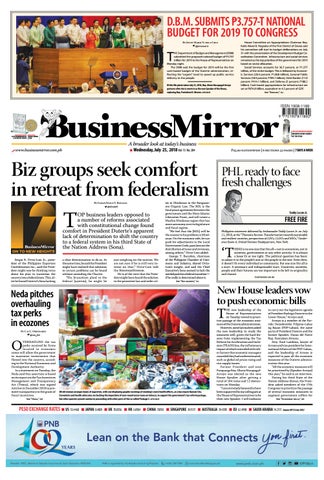
D.B.M. SUBMITS P3.757-T NATIONAL BUDGET FOR 2019 TO CONGRESS By Jovee Marie N. dela Cruz @joveemarie
T
he Department of Budget and Management (DBM) submitted the proposed national budget of P3.757 trillion for 2019 to the House of Representatives on Monday night. The DBM said the budget for 2019 will be the first cash-based budget of the Duterte administration, reflecting the “urgent” need to speed up public service delivery to the people. In this file photo taken July 23, 2018, Rep. Gloria Macapagal-Arroyo gestures after she is sworn in as the new Speaker of the House, replacing Rep. Pantaleon D. Alvarez. ALYSA SALEN
media partner of the year
United nations
2015 environmental Media Award leadership award 2008
A broader look at today’s business n
Wednesday, July 25, 2018 Vol. 13 No. 284
Biz groups seek comfort in retreat from federalism By Elijah Felice E. Rosales @alyasjah
T
OP business leaders opposed to a number of reforms associated with constitutional change found comfort in President Duterte’s apparent lack of determination to shift the country to a federal system in his third State of the Nation Address (Sona). Sergio R. Ortiz-Luis Jr., president of the Philippine Exporters Confederation Inc., said the President might now be thinking twice about his plan to transition the country into a federal state. This, after he found Duterte’s Sona lacking
a clear determination to do so. At the same time, he said the President might have realized that solutions to certain problems can be found without amending the Charter. “His [transition plan] to the federal [system], he might be
just weighing on the motion. We are not sure if he is still very intense on that,” Ortiz-Luis told the BusinessMirror. He is of the view that the President might have found the solution to the persistent law and order cri-
sis in Mindanao in the Bangsamoro Organic Law. The BOL is the final peace agreement between the government and the Moro Islamic Liberation Front, and will create a Muslim Mindanao region that has more autonomy over its legislature and fiscal regime. “We feel that the [BOL] will be the answer to his problem in Mindanao. On the economic side, he can push for adjustments in the Local Government Code, pass laws on the distribution of taxes and revenues, among others,” Ortiz-Luis added. George T. Barcelon, chairman of the Philippine Chamber of Commerce and Industry, shared OrtizLuis’s insight, and said the Chief Executive’s Sona seemed to lack the needed push for a federal transition— if he really is determined about it.
business news source of the year
P25.00 nationwide | 6 sections 32 pages | 7 days a week
PHL ready to face fresh challenges Teddy Locsin Jr.
free fire Philippine statement delivered by Ambassador Teddy Locsin Jr. on July 11, 2018, at the “Thematic Review: Transformation towards sustainable and resilient societies, perspectives of LDCs, LLDCs and MICs,” Conference Room 4, United Nations Headquarters, New York.
‘T
here is no one size that fits all—not in economies, not in societies, governments or any other activity. It is always a loose fit or too tight. The political question has been: to adjust it to the people’s size or the people to the size. Even then, it doesn’t fit every individual or community. But one size fits all is a start. A necessary and indispensable start. Countries, societies, people and their futures are too important to be left to originality and chance. Continued on A6
New House leaders vow to push economic bills
T
By Cai U. Ordinario @cuo_bm
VERHAULING the tax perks received by firms lo c at e d i n e conom ic zones will allow the government to maximize investments that flowed into the country, according to the National Economic and Development Authority. In a statement on Tuesday, the Neda said this assertion is based on its report on the Tax Incentives Management and Transparency Act (Timta), which was signed into law in December 2016 to promote transparency in the grant of fiscal incentives.
2016 ejap journalism awards
See “Biz groups,” A2
Neda pitches overhauling tax perks in ecozones
See “Neda,” A8
See “Budget,” A2
BusinessMirror
www.businessmirror.com.ph
O
House Committee on Appropriations Chairman Rep. Karlo Alexei B. Nograles of the First District of Davao said his committee will start its budget deliberations on July 31 with the presentation of the Development Budget Coordination Committee. Infrastructure and social services remained as the top priorities of the government for 2019 based on sector allocation. Social Services accounts for 36.7 percent, or P1.377 trillion, of the entire budget. This is followed by Economic Services (28.4 percent; P1.068 trillion), General Public Services (18.9 percent; P709.1 billion), Debt Burden (11.0 percent; P414.1 billion), and Defense (5 percent; P188.2 billion). Cash-based appropriations for infrastructure are set at P874.8 billion, equivalent to 4.5 percent of GDP.
An old woman arranges boxes of cigarettes, with one displaying graphic warnings of smoking’s worst health effects, at a bus stop in Quezon City. Economists and health advocates are backing the imposition of next-round excise taxes on tobacco, to support the government’s tax-reform package, but other quarters preach caution in proceeding with other parts of the so-called Package 2. ALYSA SALEN
PESO exchange rates n US 53.4460
HE new leadership of the House of Representatives on Tuesday vowed to prioritize passage of the economic measures of the Duterte administration. However, some lawmakers asked the new leadership to study the measures well, given the hard lessons from implementing the Tax Reform for Acceleration and Inclusion (TRAIN) law, the inflationary impact of which coincided with other factors that economic managers conceded they had underestimated, such as global oil prices rising and rice supply issues. Former President and now Pampanga Rep. Gloria MacapagalArroyo was elected as the new House Speaker after getting a total of 184 votes and 12 abstentions on Monday. “I am extremely honored to have been supported by my colleagues at the House of Representatives to be their new Speaker. I will endeavor
to carry out the legislative agenda of President Rodrigo Duterte in the Lower House,” Arroyo said. Arroyo is a member of the Partido Demokratiko Pilipino-Lakas ng Bayan (PDP-Laban), the same party of President Duterte and the former Speaker, Davao del Norte Rep. Pantaleon Alvarez. Atty. Raul Lambino, lawyer of Arroyo and vice president for International Affairs of the PDP-Laban, said the leadership of Arroyo is expected to pass all the economic measures of the Duterte administration this year. “All the economic measures will be prioritized by [Speaker Arroyo] this year,” he said in an interview. During his third State of the Nation Address (Sona), the President asked members of the 17th Congress to prioritize the passage of several economic measures to augment government coffers for See “Economic bills,” A8
n japan 0.4801 n UK 70.0356 n HK 6.8104 n CHINA 7.8765 n singapore 39.1517 n australia 39.4378 n EU 62.4998 n SAUDI arabia 14.2511
Source: BSP (24 July 2018 )
News
BusinessMirror
A2 Wednesday, July 25, 2018
Ban on ‘contractualization’ may hinge on semantics
B
By Elijah Felice E. Rosales
@alyasjah
USINESS executives fear lawmakers might prohibit all forms of contractualization under a security of tenure law, but the country’s trade chief believes consultations with stakeholders will dissuade legislators from doing so.
It boiled down to a choice of words. Sergio R. Ortiz-Luis Jr., president of the Philippine Exporters Confederation Inc., said President Duterte used the word “contractualization” in the third State of t he Nat ion Add ress (Sona), and lawmakers might make use of this in discussing the security of tenure measure. “He used the word ‘contractualization,’ which the labor [sector] defines differently. He endorsed it to Congress, and legislators might adopt the labor’s
definition of contractualization, which is impossible,” Ortiz-Luis told the BusinessMirror. Workers and employers have a clashing definition of contractualization. Employers believe the illegal form of contractualization, notoriously known as endo, has long been outlawed under the Labor Code. Endo is the practice of hiring and terminating workers after every five months to circumvent their regularization. On the other hand, labor groups are pushing for
a more stringent measure against fixed-term employment, putting the practice of hiring employees through a manpower agency in question. They think companies should not be allowed to avoid bearing the costs of regularizing workers who perform tasks related to the firms’ core business by the expedient of resorting to manpowercontracting agencies. In his Sona on Monday, the President added his voice to workers “in asking Congress to pass legislation ending the practice of contractualization once and for all.” For his part, George T. Barcelon, chairman of the Philippine Chamber of Commerce and Industry, said the Chief Executive might just be reassuring workers that there is a national policy against endo. However, Barcelon believes the President is aware that the call to ban outsourcing of workers through providers is against the Labor Code. “In my perspective, the President wants to reassure the workers that the agreement between man-
Carpio declines automatic nomination for CJ post
agement and labor against endo is still being implemented. [As for t] he other contractualization, our jurisprudence is clear on it, that employers can utilize service providers for their work force,” Barcelon told the BusinessMirror. Trade Secretary Ramon M. Lopez hailed Duterte’s move to leave it to Congress to decide the issue on security of tenure. “Yes, that’s good, [because] he said he will ask Congress to work on this because it is beyond his power to change what’s in the law; thus, the discussions on the matter, like the definition of contractualization, will be tackled in Congress in consultation with all stakeholders,” he told reporters in a text message. “If you ask me, we have been also for the protection of workers and security of tenure, and one can be regularized, but it can be in the company client or the contractor. What cannot be discontinued is the option to outsource or contract out certain functions or activities to achieve efficiencies and effectiveness,” Lopez added.
A
CTING Chief Justice Antonio T. Carpio has officially declined his automatic nomination for the Chief Justice position that was left vacant with the ouster of Chief Justice Maria Lourdes A. Sereno last month. “I am declining my automatic nomination for Chief Justice,” Carpio said in a letter addressed to the Judicial and Bar Council (JBC). Carpio’s decision not to vie for the CJ post has left four other senior associate justices— Presbitero Velasco Jr., Teresita Leonardo de Castro, Diosdado Peralta and Lucas Bersamin— as possible contenders for the post. However, the four have yet to signify whether they are interested in the position. The JBC earlier announced that the five senior associate justices of the Supreme Court are automatically nominated for the post. H owe ve r, fo r m e r C h i e f J u s t i ce Hilario G. Davide Jr. raised the possibility of their automatic inclusion in the short list of nominees after Carpio expressed his disinterest to be appointed as Sereno’s replacement out of delicadeza considering that he voted against the granting of the quo warranto petition. Davide pointed out that “ delicadeza should no longer be invoked because the decision in the quo warranto case is final.” He added that “personal consideration must now yield to the demands of public interest.” This developed as Justice Secretary Menardo I. Guevarra on Tuesday confirmed that the JBC will require all nominees including the five senior associate justices of the SC to formally accept their nomination before they can be considered for the position that was left vacant owing to the ouster of Sereno last month. Guevarra, one of the members of the seven-man JBC panel, said the rule requiring consent of the nominee for a Judiciary post will as stay as agreed upon by the council during its meeting last Friday. “The same rule will continue to be applied; the nominee, even the most senior one, must agree to be nominated,” Guevarra said in a text message. The contenders for the post should first accept their nomination prior to the submission of the requirements such as bank statements, Statement of Assets, Liabilities and Net worth and other documents. Joel R. San Juan
Budget. . .
Continued from A1
By expense class, the P3.757trillion cash budget is divided as follows: personnel services (31.5 percent; P1.185 trillion), capital outlays (20 percent; P752.7 billion), allotment to local government units (17.1 percent; P640.6
www.businessmirror.com.ph
Experts, Koko weigh in on 3rd telco search after Duterte’s pitch By Lorenz S. Marasigan @lorenzmarasigan
& Butch Fernandez
W
@butchfBM
HILE the selection process for the third telco has made significant strides over the weekend, experts are now advocating for a tweaking of the draft terms of reference (TOR) to help facilitate a smoother entry of a new player in the market. This, as Sen. Aquilino L. Pimentel III, citing President Duterte’s push for a third telco in his third State of the Nation Address (Sona), prodded government regulators on Tuesday to “fast-track the entry of a third telco player.” “Now that the President has declared very adamantly in his Sona that improvement of telecoms services is a top government priority, the lead agencies should take their cue and fast-track the rules on the entry of a third telco player,” Pimentel said. Better Broadband Alliance Convener Mary Grace Mirandilla-Santos listed at least two items in the draft rules governing the search for the third player that could warrant some revisiting. For example, she said, the government should not give unilateral powers to the National Telecommunications Commission (NTC) over a possible termination of the process. “Primarily, the TOR should delete the clause on NTC’s power to unilaterally terminate the selection process, in order to promote the transparency and integrity of the selection process,” she told the BusinessMirror. Santos also pointed out that the government must impose tougher rules on the minimum broadband speeds for the new telco. “The minimum broadband speed should ideally increase over the course of five years,” she said. Friday last week saw the Department of Information and Communications Technology (DICT) adopting the terms of reference that favors the highest committed level of service over the auction model. The said rules is a pointsbased contest that will judge third telco aspirants on the basis of their committed speed, coverage and capital. Under the draft rules, third telco bidding participants should target
Biz groups. . . Continued from A1
“Other than [his usual positions], I didn’t see any new pronouncement in the Sona. I didn’t get to see that federalism was even discussed,” Barcelon told the BusinessMirror. He argued the President might have taken a step back about the grand reforms the shift to a federal system will entail. Duterte might have also seen the BOL as the proper alternative toward giving Mindanao what is due to Mindanao, Barcelon added. “At least for me, there is the Bangsamoro, so we can use the [BOL] for the meantime. I think he mentioned that, and that is good, to allay fears that it might be all too sudden and grand this plan to create a federal state,” Barcelon pointed out. Business groups have been criticizing proposed changes to the 1987 Constitution as drafted by the Consultative Committee. They fear the shift to a federal system might give local governments too much financial power that they can increase taxes at will and spend
billion), maintenance expenditures (15 percent; P562.9 billion), debt burden (11 percent; P414.1 billion), Support to GOCCs (5 percent; P187.1 billion), and tax expenditures (0.4 percent; P14.5 billion). The sector with the highest allocation is education, comprised of the budgets of the Department
to cover at least 30 percent of the population with a minimum speed of 5 Mbps through a P40-billion capital and operational expenditure program annually. These minimum requirements are to be matched or topped to earn extra points for each criterion. The weight of each criterion varies from the first year to the fifth. A public hearing—much like a congressional deliberation—will be set in August, depending on the speed of the resolution of a legal tussle over a slice of radio frequency. The public hearing will allow the agency to enhance the current draft terms, and publish the official TOR after two weeks of review and amendments—if any. The selection process had been on a standstill before the finalization of its mode of implementation, as the Department of Finance raised valid points on revenue generation through an auction. Friday’s resolution was seen as a landmark decision, as even President Duterte made special mention of the third telco initiative during his third Sona late Tuesday. During his national report, Duterte said the third telco search will break what he termed as a “wellentrenched duopoly.” Long dominated by Smart Communications Inc. and Globe Telecom Inc., the telco market in the Philippines continues to lag behind peers in the Asean in terms of speed, infrastructure and, in some areas, price. Based on Ookla’s research, the Philippines ranked 97th out of 125 countries in terms of mobile data speeds, and 84th out of 135 in fixed broadband. Tower infrastructure is likewise below par —at only 16,000 towers versus the total demand of 70,000 towers. The third telco, according to Duterte, will usher in an era wherein telco services will be “reliable, inexpensive and secure,” something that his administration “resolved” to do over its six-year term. He also said the selection process will be “fair, reasonable, comprehensive,” and open to all aspirants. Santos said her group is “happy to hear the President emphasize during the Sona that the third telco to be chosen must provide the best possible services at reasonably accessible prices as public service is the primary objective in introducing a new player.” their budget in risky ways.
Biz groups’ warning
In a June statement, six of the country’s largest business groups warned investments might be at risk if federated regions are permitted to reform their fiscal regime on their own. They also opposed the plan to equalize the budget allocation for regions. They said some federated regions do not have the capacity to maintain strong production and trade to support their population. No less than Trade Secretary Ramon M. Lopez sided with the business community, and said the fiscal regime of local governments under a federal system must still be under the helm of the national government. He explained this is to ensure the country’s investment promotion program is properly coordinated. In his Sona on Monday, the President did not prioritize the push for federalism nor did he call on his congressional allies to fast-track it. This, even as the Consultative Committee on July 9 transmitted to his office the proposed changes to the Charter, and was expecting him to discuss his views on it in his Sona.
of Education, State Universities and Colleges, the Commission on Higher Education and the Technical Education and Skills Development Authority. Its cash appropriations in the proposed 2019 budget amounts to P659.3 billion, higher by P72.2 billion, or 12.3 percent, than its cash-based equivalent in the 2018 budget.
The Nation BusinessMirror
www.businessmirror.com.ph
Editor: Vittorio V. Vitug • Wednesday, July 25, 2018 A3
Analysts weigh Sona ‘silence’ on federalism By Bernadette D. Nicolas
D
@BNicolasBM
espite expectations on the formal endorsement of the proposed draft federal constitution of the Consultative Committee (Con-com) to Congress, the President did not push hard for Charter change (Cha-cha) in his third State of the Nation Address (Sona) on Monday, analysts said. Some of them also raised concerns that the change in House leadership may also hinder the push for federal Charter. In a bid to shift the country’s form of government from unitary to federal, federalism advocates, including the President, believe that this will help spur economic development across all regions and not just in “imperial Manila.”
With the timing of the submission of the proposed draft f e d e r a l c o n s t it ut i o n b y h i s Con-com, federalism or Charter change was expected to be one of the Sona highlights. Even the Con-com said they were hoping that the President will endorse their draft in his Sona. University of the Philippines Political Science Professor Jean
S. Encinas-Franco told the BusinessMirror that it seemed the President “somehow turned soft on Cha-cha.” “He could have had a stronger message for it,” Encinas-Franco said in an SMS, adding that she was expecting the President to detail the timeline and the general parameters of federalism that he wants but he did not do this. For IBON Executive Director Jose Enrique A. Africa, the reason for that “tepid talk” in his speech was the upsurge in protests so as not to add fuel to the fire. Protesters flocked on Sona day to Commonwealth Avenue to oppose the President’s priority programs, such as Charter change, war on drugs and tax reform, among others. But more than the lukewarm stance of the President on federalism or Charter change in his speech, Africa said giving former President and Pampanga Rep. Gloria Macapagal-Arroyo the House Speaker position amid resistance from erstwhile allies “shows calculating intent to have someone more capable to push
Cha-cha in Congress.” Pantaleon D. Alvarez was ousted as House Speaker on Sona day. A total of 184 members voted in favor of installing Arroyo as the new Speaker. This was after Nueva Ecija Rep. Magnolia Antonino declared the position of Alvarez as vacant, prompting Deputy Speaker and Batangas Rep. Raneo Abu to nominate Arroyo for the speakership. A fr ica said this change in House leadership might a lso backfire since Arroyo, he said, is a “poster-child of self-serving Chacha since her time as president.” “Rep. Arroyo might be able to control the majority better than ousted Rep. Alvarez, but she brings the harsh public image of pushing Cha-cha for self-serving ends first as president in 2003, 2005, 2009 and then as HOR [House of Representatives] representative in 2011,” he told the BusinessMirror. Ateneo School of Government Dean Ronald U. Mendoza said that he was more troubled with the takeover of Arroyo as House Speaker. “The federalism initiative has no more credibility. It’s dead,” Men-
doza told the BusinessMirror. Asked if this change in House leadership will help fast-track the shift to federal system, EncinasFranco said it will be fast-tracked if the President says so, no matter who is sitting as House Speaker. But Con-com member and former Senate President Aquilino Q. Pimentel Jr., who was present during the President’s Sona, said he was not disappointed that the President did not endorse their draft during Sona since the President can still endorse it at other appropriate times. “And that he can do either personally or through his close confidants,” he said. “The issue is very much alive in the hearts and minds of the believers in the cause. And we know that the President is one of them.” Pimentel also told the BusinessMirror that he doesn’t see the change in House leadership as a hindrance to their push for federalism since Arroyo is a partymate of the President in PDP-Laban. But he added that it is also unfortunate that the incident of the leadership struggle in the
House happened on Sona day. “The event should not have taken place during the solemn occasion. They could have changed the leadership the day after so that the citizens will be able to focus on Sona,” he said. In his curse-free, 48-minute Sona speech, his shortest one so far, the President declared his full intent to sign the Bangsamoro Organic Law as soon as it gets ratified by both houses of Congress. However, the President only made a passing ment ion of federa l ism. He did not even prioritize it as urgent nor did he call on lawmakers to deliberate on the proposed draft Federal Constitution of Con-com. But, notably, he thanked Concom Chairman and former Chief Justice Reynato S. Puno and Pimentel for crafting the proposed constitution. Nevertheless, he went on to reiterate that he has no plan to stay in power any longer than what the present or future constitution states.
DFA to Filipinos traveling to Paris: Be wary of break-ins, robberies
M
ANILA—The Philippine Embassy in France on Monday issued a travel advisory, reminding Filipinos traveling to Paris to be wary of the spate of break-ins, robberies, and pickpocketing incidence in the city. The advisory, coursed through the Department of Foreign Affairs (DFA), also noted “the string of terror incidents in the past three years,”
with the latest on May 12, 2018, that “require the extra vigilance of Filipinos traveling in Paris.” Filipinos are requested to follow the list of safety guidelines when traveling to France: 1. Always secure personal belongings, such as bags, wallets, phones and other personal items when visiting tourist spots, walking around and riding public transportations.
2. Be wary of pickpockets. They are rampant at Metro stations, trains and even in shopping areas. 3. Keep passport and identity card in separate areas of your bag, so as to lessen the risk of losing both identity documents. 4. Theft may also occur in hotels and apartments. Make sure that your briefcases, bags and other valuables are secure. Be wary of the so-called
Global Witness 2017 report: Killings of land, environmental defenders in PHL highest in Asia By Jonathan L. Mayuga @jonlmayuga
A
N international environmental and human-rights watchdog on Monday said the year 2017 is the deadliest year on record for land and environmental defenders, including the Philippines, which tops Asia with the highest number of recorded deaths. The report released by Global Witness entitled “At What Cost?” shows that agribusiness has overtaken mining as the industry most associated with these attacks. Global Witness campaigns to end environmental and human-rights abuses driven by the exploitation of natural resources and corruption in the global political and economic system, its web site said. Among its key findings, Global Witness said annual figures show at least 207 land and environmental activists were killed in 2017 across 22 countries, almost four a week, marking it the worst year on record.
Highest in Asia
A total of 48 recorded deaths took place in the Philippines, the highest for an Asian country. The Duterte administration, which took over on June 30, 2016, has been criticized by local and international human-rights groups for deaths in connection with populist leader Rodrigo R. Duterte’s war on drugs. The report was released, coincidentally, as Duterte was scheduled to deliver his third State of the Nation Address (Sona).
Human-rights issue Duterte, a former mayor of Davao City, has been vocal against environmentally destructive projects, particularly large-scale mining, which was one of the highlights of his first Sona, threatening to stop mining for causing massive environmental destruction, particularly in Mindanao. Such declaration by Duterte was
followed by a 10-month campaign by former Environment Secretary Regina Paz L. Lopez to mount a campaign against irresponsible mining operations that led to closure or suspension orders affecting more than two dozens largescale mines, a ban on prospective openpit mining for select ores, including gold, copper, silver and complex ore, and the cancellation of 74 mining deals for projects within or near watersheds. Environmental groups, however, said the drug war and campaign against environmentally destructive mining did not spare environmental defenders fighting “ridge to reef destruction” caused by mining, logging, quarrying and other destructive development projects in upland areas, or those happening in defense of coastal and marine environment against illegal and large-scale commercial fishing activities.
Alarming
Sought for comment, Environment Undersecretary Jonas R. Leones said he has not yet read the report but was quick to say that the Department of Environment and Natural Resources (DENR) takes such alarming report seriously. However, Leones, the spokesman of Environment Secretary Roy A. Cimatu, said there is a need to verify the veracity of such report and find out how Global Witness came up with its conclusion that included the Philippines among what appears to be the dangerous place for environmental and land defenders in Asia. “We intend to know more about the basis of their report and how they came up with their conclusion,” he said. “For now, I haven’t seen the report. But we will definitely write them a letter for clarification,” he added.
Isolated
AS far as the DENR is concerned, Leones said it only monitors attacks against DENR employees who are at the frontlines, like forest protectors, by those into illegal mining, illegal logging and quarrying, and those
involved in the illegal wildlife trade. “We receive reports of killings from time to time. But these are isolated cases. For killings involving others or non-DENR employees, I believe it is the human-rights groups that monitor and have these records,” he said. The DENR also investigates incidents involving attacks against its employees and work closely with the police and military, especially if the incident is work-related or involves the protection of the environment by its employees.
Dangerous job
According to Leones, the DENR’s undersecretary for policy, planning, international affairs and foreignassisted projects, the DENR is not oblivious to the dangers its employees face, particularly those assigned to protect the forests, in the performance of its duties and responsibilities. In fact, he said the shooting of DENR employees in Palawan last year prompted Cimatu to consider arming foreign protection officers and volunteers called “Bantay Gubat.” However, he said, such policy is for the protection of the DENR employees who risk being shot by members of a syndicate involved in illegal mining, logging, quarrying and wildlife trade, and it has nothing to do with the killings, as claimed by Global Witness. “It is for the protection of our forest protection officers who face the danger of being shot. It’s for self-defense. But as a policy, our protection officers are only armed while on duty. After their duty, they return the firearms issued to them,” Leones said.
Other key findings
This is not the first time that Global Witness came up with a report identifying the Philippines as a dangerous place for environmental and land defenders. This year, however, it revealed that the killing linked to agribusiness is increasing.
hotel rats, scam artists who pretend to be hotel guests or tourists and who can swipe baggage in hotel lobbies, or book rooms with fake names and break-in rooms to steal valuables. 5. Do not carry a lot of cash. Most stores accept cards. Should you use your card, cover your hand discreetly when typing the pin. 6. Keep your bags out of sight when inside the vehicles. Robber-
ies may sometimes occur during traffic jams. 7. Be alert and vigilant when visiting different areas in France. Make sure to follow the instructions of police and military personnel in case of any incident. 8. Be updated with the news. Refrain from going to areas that are declared to be unsafe or that have terrorism threat.
In case an urgent assistance is needed, Filipinos may call the embassy via their 24/7 emergency hot line at +33 6 20 59 25 15. Filipinos seeking help may also visit the embassy at 45 Rue de Ranelagh, 4 Hameau de Boulainvilliers, 75016 Paris, France, or send them a message at +33 1 44 14 57 00 or via their e-mail address paris.pe@ dfa.gov.ph. PNA/ Joyce Ann L. Rocamora
Customer Service A BusinessMirror Special Feature
A4 Wednesday, July 25, 2018
www.businessmirror.com.ph
The 3 magnitudes of first-rate customer service in a business
A
By Angelica Pia Romana-Panibio
N international research done by RedAlkemi, an organization that does web development and Internet marketing, suggests that 60 percent of organizations consider customer service as the top-most priority for their businesses. However, customer service is something that is not given as much as important here in the Philippines, as much as to other countries. Try visiting an average local sari-sari store: The store owner or manager would give you service and sell their products without even looking in the eye, with a frowning face some times. You, as a local buyer, would feel less empowered and not given as much importance and consideration as you should. “A big percent of micro, small and medium enterprisebusinesses in the Philippines close down within three years from its opening. The more advanced and more success-driven companies, however, know the difference that a good customer service can make for their company,” according to Philip Nucleus Sia, founder of Competad Training and Professional Development Services, a company that offers time- and stress management, communications, basic leadership, change management, professionalism courses, and image and perception management. Customer service should be a deep experiential effort you do for your clientele, as your efforts should connect to them in a sensory level—and even mentally and emotionally—because you are
driving them to create purchase decisions from your brand. “There is a spiritual aspect to our live—when we give, we receive—when a business does something good for somebody; that somebody feels good about them!” famously quoted by Ben Cohen, cofounder of Ben and Jerry’s, a successful American ice-cream business that began its journey in 1978 in providing great quality ice cream around the world. Let’s take a step back and let us take a look at an even bigger picture. We are all individual consumers. As consumers, we all want to feel comfortable and have the sense of being welcomed and taken cared of while doing transactions in every business. If we feel otherwise, we will most likely to never come back. Enterprises should recognize and always remember the importance of customer service. Here are the three magnitudes of first-rate customer service in a business.
Helping build and increase customer loyalty
WHEN customers feel important, valued and appreciated, it is likely that they will return the courtesy to your company. “Filipino agents made their mark in the world of customer service with their genuine concern for their customers,” according to
Customer Support Philippines, a premier call-center organization catering to large-scale enterprises, and small and medium businesses engaged in manufacturing, consumer electronics, technology and consumer electronics. The Filipino innate hospitality and nurturing attributes translate to global standards of customer service. That is the reason multinational companies have built their organizations with outsourced Filipino agents, which then proves excellent customer service, and attracts more revenues and investment opportunities.
Enhancing spending amount of your products
LOYAL customers tend to spend more time with the businesses they have already experienced, resulting to a positive transaction. The more products they purchase and services they render from you, the more profits will come that will help boost your business. For Illac Diaz, executive director of My Shelter Foundation and founder of Pier One Seaman’s Dorm, making money and social responsibility are two sides of the same coin. “I could have turned my back. I grew up with privilege; I have my own business, but I believe that, whatever is given to you, you need to give back to the community [and] society,” he mentioned in an interview with the Philippine Daily Inquirer. He is so focused and concerned about the satisfaction of his guests; he even gives
FILE PHOTO NONOY LACZA them his mobile number, so they can personally tell him of their complaints or suggestions. Trust is the key.
Driving positive word of mouth
SINCE the trust and value between
Going the extra mile in taking care to make your trusted consumers feel good about doing commerce with your company can have a huge difference over time.”
the customers and the business have been solidly established, they will be happily obliged to promote your enterprise. This will put you in good standing with the community. Dr. Roland Hortaleza, chairman and chief executive officer of Splash Corp., a premier Filipino company with business interests in personal care, and food manufacturing marketing and distribution in the Philippines and in the international market, mentioned that, “A lot of businessmen are fueled by the insatiable need to get bigger. I am not like that. Right now I just want to professionalize my team, continuously improve our system, and I know everything else will follow. I’m at a stage where I want to give back to society, in particular to my constituents, and to the Filipino consumer who has helped us to be where we are now.
This company has a mission: ‘To uplift the pride and well-being of the Filipino.’” This kind of business mind-set has definitely resulted to Splash Corp.’s successful venture as their products, such as Vitresse, Maxipeel and SkinWhite, have been some of the beauty staples of satisfied Filipina customers today. Going the extra mile in taking care to make your trusted consumers feel good about doing commerce with your company can have a huge difference over time. It’s completely a win-win situation for the enterprise and the customers. Not only have you gained a good profit for your company, but also to be able to have a sense of good service to give to your fellowmen will also ultimately benefit the society, which then can give you happiness and satisfaction from within.
LISTEN, FIRST: ATTEND TO COMPLAINTS AND PITCH LATER By Leony R. Garcia
I
S there anything more exasperating than telling someone what you want or what your problem is, and then knowing that the person hasn’t been paying attention? And worst, you need to have everything explained all over again. This scenario alone spells business disaster: End of a potential or a booming transaction. If you are a business person and you truly want to provide the best customer service, you will let your customer talk and show him that you listen by responding appropriately. Show emphaty if you must and suggest how to solve the problem. A good business, whether offering products or services, thrives best through repeat orders, or use or service by loyal clients. That’s why a good customer service is essential—it’s all about bringing customers back
and sending them away happy. Once satisfied, they will be happy enough to pass positive feedback about your business along to others who may then try the product or service you offer for themselves and, in turn, become repeat customers, as well. After all, the essence of good customer service is forming a relationship with customers—a relationship that that individual customer feels that he would like to pursue. Remember the one true secret of good customer service and act accordingly: You will be judged by what you do, not by what you say. Here are some basic rules to follow. Deal with complaints. No one actually likes hearing complaints, more so the business people. That’s why we say, “You can’t please all the people all the time”. But if you give the complaint your attention, you may be able
to please him or her once— and position your business to reap the benefits of good customer service. Properly dealt with, complaints can become opportunities. Be helpful. Oftentimes, customers want to buy, but they seem to be lost in the sea of brands and products in the store. If a sales person could differentiate the wrist watches on display, for example, and prescribe the right one for the active, sporty buyer, then he or she surely has made a sale. At the same time, he or she has helped the client choose the best brand for his or her lifestyle. It may just be a piece of wrist watch this time, but the buyer would certainly be taking business with him in the future. And, who knows, how many other customers will be visiting him or her because the customer would be telling them how well he or she has been guided and treated.
So, to provide good customer service, keep your eye on the customer and not on the profit. Don’t make promises unless you will keep them. Reliability is one of keys to any good relationship, and good customer service is no exception. If you promise to deliver, say a bedroom furniture, on Tuesday, make sure it is delivered on Tuesday. Otherwise, don’t say it. The same rule applies to client appointments, deadlines, among others. Think before you give any promise, because nothing annoys customers more than a broken one. Take the extra step. If someone walks into your store and asks you to help them find something, lead the customer to the item. Wait and see if he or she has questions about it or needs anything else. Whatever the extra step may be, take it if you want to provide good customer service. They may not say so to
you, but people notice when people make an extra effort. And that good word of mouth will win you more customers. Throw in something extra. Whether it’s a coupon for a future discount, additional information on how to use the product or a genuine smile, people love to get more than they thought they were getting. No gesture is large or small to be effective. A local organic soap manufacturer attaches a sample cut product to your order—a small thing, but well appreciated. Business owners couldn’t attend to his customers by himself all the time. That’s why he needs to duplicate himself among his staff. Train your staff to be always helpful, courteous, and knowledgeable. Do it yourself or hire someone to train them. Talk to them about good customer service and what it is (and isn’t) regularly. Give every member of your staff enough information
and power to make those small customer-pleasing decisions. But most important, your business phone needs to be answered. Get a call-forwarding or an answering service. Hire staff if you need to. But make sure that someone is picking up the phone when someone calls your business. Make sure that customers calling into your business are thrilled with the way you answer the phone rather than hanging it up. If you train your people well, good customer service will bring in more new customers than promotions and price-slashing over time. A good customer service is the lifeblood of any business. You can offer promotions and slashed prices to bring in as many new customers as you want but, unless you can get some of those customers to come back, your business won’t be profitable for long.
A6 Wednesday, July 25, 2018 • Editor: Angel R. Calso
Opinion BusinessMirror
www.businessmirror.com.ph
editorial
Govt should make food affordable
P
resident Duterte has sent the strongest signal that the Philippines is ready to further open up its rice market when he urged lawmakers to pass a law that would amend Republic Act (RA) 8178. In his third State of the Nation Address (Sona), Duterte exhorted his fellow government workers to fast-track the amendment of the Agricultural Tariffication Act of 1996 to remove the quantitative restriction on rice. The law did not specify an end-date for the rice so it had to be amended to convert it into tariffs.
When the Philippines joined the World Trade Organization (WTO) in 1995, Congress had to pass a law that converted QRs on agricultural commodities, except rice, into tariffs. This was done because the rice subsector is a major contributor to farm output. Unmilled rice production alone accounts for about 15 percent of the agriculture sector’s output at any given time. Also, some 2.4 million farmers rely on growing rice for their livelihood. It doesn’t come as a surprise, therefore, if the government pours money on the rice sector. The impending shift to a QR-less regime would practically free up government funds. A proposal to amend RA 8178 indicates that tariffs collected from imports would be channeled to the rice sector. The removal of the rice QR and the expected hike in the purchase of imported rice, according to a study of the Philippine Institute for Development Studies (Pids), would allow the government to collect some P27 billion in tariffs annually. This amount is on a par with the budget set aside for the sector in recent years, if the allocation for the National Irrigation Administration is included. After the QR is scrapped, the government should consider raising the budget for other farm commodities if it wants to tame inflation and make food prices more affordable. Inflation data from the Philippine Statistics Authority shows that Filipinos spend heavily on food. Food items account for nearly 40 percent of the consumption basket of Filipinos, according to the PSA. This is why even a slight hike in the prices of select food items—rice, corn, bread, fish, vegetables and fruits—would accelerate inflation. Supporting other agricultural subsectors would not only boost food supply but also the income of farmers. The poultry and livestock subsector, for instance, could use more assistance from the government. Hog raisers have been urging the government to set up state-of-the-art animal diagnostic laboratories that would ensure prompt diagnosis of emerging animal diseases. Goat raisers also need help in expanding their herd. Money could also be pumped into other government research and development (R&D) activities. The government can consider channeling funds to promote cash crops cultivation, such as coffee and cacao. Unlike the time needed to harvest other crops like rice and corn, it takes a minimum of two years to realize any gain from planting coffee and cacao. That’s why farmers who are into growing these cash crops need government assistance, such as production loans with low interest rates. It may take longer for growers to earn from planting coffee and cacao, but the potential rewards are huge. Coffee consumption is on the rise and cacao commands a good price in the international market. Congress will soon deliberate on the budget proposals of government agencies. It is hoped that lawmakers would keep these things in mind when they start scrutinizing the budget of the Department of Agriculture. It is time for the government to adopt innovative ways that will allow the farm sector to profitably supply the country’s food requirements and provide decent livelihood opportunities to Filipino farmers.
Since 2005
BusinessMirror A broader look at today’s business ✝ Ambassador Antonio L. Cabangon Chua Founder Publisher Editor in Chief Associate Editor News Editor Senior Editors
T. Anthony C. Cabangon Lourdes M. Fernandez Jennifer A. Ng Vittorio V. Vitug
Ruben M. Cruz Jr. Angel R. Calso
Creative Director Chief Photographer
Eduardo A. Davad Nonilon G. Reyes Judge Pedro T. Santiago (Ret.) Benjamin V. Ramos Adebelo D. Gasmin Marvin Nisperos Estigoy Aldwin Maralit Tolosa Rolando M. Manangan
BusinessMirror is published daily by the Philippine Business Daily Mirror Publishing, Inc., with offices on the 3rd floor of Dominga Building III 2113 Chino Roces Avenue corner De La Rosa Street, Makati City, Philippines. Tel. Nos. (Editorial) 817-9467; 813-0725. Fax line: 813-7025. (Advertising Sales) 893-2019; 817-1351, 817-2807. (Circulation) 893-1662; 814-0134 to 36. E-mail: news@businessmirror.com.ph.
www.businessmirror.com.ph
Printed by brown madonna Press, Inc.–San Valley Drive KM-15, South Superhighway, Parañaque, Metro Manila MEMBER OF
hey all start with an attempt to find the one size that fits, if not all their needs and capacities, then most of those; enhancing capacities to meet need. If we groped blindly as we went along, we’d be lost. There’s always been planning. We need a template; a guide showing, if not everything that works in every situation, something that works in most of them. The fact of the matter is we are more alike than we are different.
My country is set to become an upper middle-income economy if everything goes well; but one can never tell if everything will go well until it does. Or not. And so, with confidence in the path we have taken this far, and in the scheme we adopted which has worked; we remain open to new ideas in the expectation that the unexpected can happen. But it will not catch us unprepared without alternatives to cope with new situations and fresh challenges.
weak who are productive—feeding off each other’s capacities and incapacities; though the strong tend to have a bigger appetite than their numbers deserve. Feudalism yields surpluses—or it does not. Surpluses inspire barter and then trade. Trade may develop into commerce and commerce beget industry; nothing is started unless someone wants to buy it. This is a gross simplification but every society goes through such stages. Some get stuck in one stage; or several stages are conflated at one time: feudalism, commerce, industrialization and military power in the Prussian state: the preeminent model for the most advanced Asian countries in the past century and
a half—and it worked after fashion. It is called mercantilism or paradoxical state-sponsored free enterprise that works pretty well in China. “Yes, one size fits all but there are many fashions. The thing is not to reinvent the wheel but study whatever rolls, and make adjustments and refinements for this or that kind of road a country travels. But always one size fits all for specific purpose and capacity, as another size fits all for another of those and then adjustments. “The key is to study the patterns and follow them as far as they can take you; and then change it a bit or altogether. This is why we need to be able to appeal to a final authority; nothing compul-
Teddy Locsin Jr.
Free fire Continued from A1
‘T
“A free market economy has over time generated a great deal of progress, perhaps more than any other economic system. But a free market system assumes a free market, which is not the original state of economic man as the historical similarity of every place has shown. Free markets are the most complex to sustain. There is always a tendency to anarchy or overregulation. “It starts with scattered agriculture; and branches off to hydraulic agriculture as in Han China and ancient Egypt. Or into feudalism where the strong who grow nothing take everything they can from those who grow. The strong who are violent offer protection to the
Coup de grace
Lorenzo M. Lomibao Jr., Gerard S. Ramos Lyn B. Resurreccion, Efleda P. Campos Dennis D. Estopace
Online Editor Social Media Editor
Chairman of the Board & Ombudsman President VP-Finance VP Advertising Sales Advertising Sales Manager Group Circulation Manager
PHL ready to face fresh challenges
Florante S. Solmerin
W
FACT IS MIGHT!
hat transpired at the House of the Representatives on Monday before the arrival of President Duterte to deliver his third State of the Nation Address (Sona) is a coup de grace for a wounded Speaker Pantaleon D. Alvarez. There was a “coup” at the House where 161 congressmen crossing party lines signed a petition ousting Alvarez and installing former President and Pampanga Rep. Gloria Macapagal-Arroyo as the new Speaker. The drama delayed for more than an hour the President’s scheduled 4 p.m. Sona. Of course, the President’s timely intervention saved the Philippine Congress from further embarrassment as the international community is closely watching developments. Duterte never spoke about the incident; he just delivered his prepared speech, which lasted for more than 30 minutes. It was the shortest of his three Sonas.
The incident, however, spoiled t he e x pected sig ning of t he Bangsamoro Organic Law by both houses of Congress. However, the President promised to sign the measure into law 48 hours after submission to his office. Sometimes, politics becomes dirty when players “brawl” in public. It’s just like when one is doing
The President’s timely intervention saved the Philippine Congress from further embarrassment as the international community is closely watching developments. Duterte never spoke about the incident; he just delivered his prepared speech, which lasted for more than 30 minutes. It was the shortest of his three Sonas. the right thing, there will always be spoilers or detractors. Alvarez and Arroyo are both Duterte allies. What happened on Monday, however, could cause cracks in the administration’s solid supermajority at the House. For one, this could jeopardize the President’s vision of a federal Philippines. He needs allies, not enemies, in Congress. After the Sona, the 161 signatures swelled to 184, officially ousting Alvarez. He should thank the President for allowing him to bang the gavel one more
sory but something dependable like the United Nations: a kind of department store of designs for economies, polities and societies—each one of a size that fits all, with allowances for place and capacity. But one need not start from scratch at all. “But we all need money, resources, incentives: the lower income countries to start on the path they choose; the middle income to continue on the path they’ve taken to its end. “Here at the UN are all the tried and tested sizes on display; every country showing how well the size had fitted them or badly if it fitted them at all. In showing and sharing experiences, they discover the adjustments others made and make that one size fit each of them better. Here we do not discuss wild notions but only tried and tested ideas as exemplified by the members here united, each of us sharing our experiences with them all. “My country is set to become an upper middle-income economy if everything goes well; but one can never tell if everything will go well until it does. Or not. And so, with confidence in the path we have taken this far, and in the scheme we adopted which has worked; we remain open to new ideas in the expectation that the unexpected can happen. But it will not catch us unprepared without alternatives to cope with new situations and fresh challenges. Thank you.”
time on Monday. Pundits, however, said Alvarez designed his own downfall. I’m sure the President can’t help but sympathize with his friend Alvarez. At the same time, he welcomes another friend—Arroyo —as his top honcho in the Lower House. I think one of Arroyo’s missions now is to help the President mend fences with the Catholic Church. Arroyo has a lot of friends at the Catholic Bishops’ Conference of the Philippines (CBCP), especially the influential bishops who were her defenders during her tumultuous years as president. Unlike Alvarez, Arroyo is antideath penalty, anti-divorce, antireproductive health, anti-abortion, anti-same sex marriage, among others. Alvarez removed her as Deputy Speaker for not supporting the death penalty bill. I don’t want to think that some bishops had a hand in Alvarez’s ouster. The CBCP is very influential and we all know that. E-mail: fetad@yahoo.com.
Opinion BusinessMirror
www.businessmirror.com.ph
No-deal Brexit is crazy, but might just happen
T
Successful HS reunions and the ‘kwaknit’ analogy
By Therese Raphael | Bloomberg Opinion
he prospect that the United Kingdom would leave the European Union (EU) without a deal setting out the terms of the withdrawal once seemed laughably remote. When it was mentioned at all, it was mainly as a negotiating tactic aimed at securing favorable trade and tariff agreements between the UK and the EU. Even when Prime Minister Theresa May uttered the mantra “No deal is better than a bad deal,” few took it seriously. It was impossible to imagine the bad deal that was worse than a pileup of shipping containers at the border, grounded planes, hellish passport lines, medicine shortages, rising debt servicing costs and a nosediving currency. Now some EU officials are said to put the odds of a no-deal exit at 50-50. While some 80 percent of the withdrawal terms have been agreed to, the remaining 20 percent is up in the air and time is running out. A deal was supposed to be concluded by October to leave time for approval by the UK Parliament and the EU before the divorce becomes official on March 29, 2019. The withdrawal deal would be followed by a transition period in which the terms of the future trading relationship were hashed out. No deal would mean no transition period, either. But there’s no majority in Parliament for any kind of deal right now, much less the plan that May revealed earlier this month, and which prompted a backlash within her own party and government resignations. The EU is likely to demand further concessions that Brexiters in both main parties will find hard to swallow. Both the EU and the UK. have stepped up preparations for a no-deal exit. The UK budgeted an extra £3 billion ($3.93 billion) for Brexit contingency planning last year (though some of it is earmarked for after the departure date), and will be publishing dozens of technical notices in the next two months to help businesses and consumers get ready for a nodeal exit. The EU has already put out 68 such papers; Bloomberg News reported some of the measures different EU countries were taking last week. The UK Department of Health is reportedly stockpiling medicines for the eventuality. Thinking positively here (and this has been the sunniest summer on record in 42 years in Britain, so why not?), there should be every reason for both sides to avoid a no-deal scenario. The International Monetary Fund said last week that the cost to the EU in the event the UK leaves without a deal would be around $250 billion, or 1.5 percent of annual economic output, with more than 1 million jobs lost. No deal would also be a failure for the EU’s chief negotiator, Michel Barnier, and for the European Commission. United Kingdom voters would probably blame the EU as much as their own government. For Britain, the risks are even bigger. Amazon’s UK boss, Doug Gurr, reportedly told an audience that included Brexit Secretary Dominic Raab that the United Kingdom could face “civil unrest” within weeks of a no-deal Brexit. Even if that’s hyperbole, it’s hard to see any outcome in which crashing out of the EU wouldn’t leave Britain poorer for a long time.
“The overall cost of a hard Brexit, including the influence of slower migration flows, would be about 7 percent of GDP annually by the end of 2030,” Bloomberg Intelligence analysts Dan Hanson and Jamie Murray have calculated. They estimate that a combination of new tariffs and a drop in the exchange rate would lead to inflation of around 3.6 percent; incomes would be squeezed. By 2030 say the BI economists, the loss of output would rise to £290 billion; more than 10 times the size of the Brexit bill and interest paid on borrowing to finance it. Some hardline Brexiters have changed the language they use to refer to a no-deal scenario, preferring to call it a “World Trade Organization option.” By that they mean that the United Kingdom would trade with the EU according to the WTO’s mostfavored-nation rules, under which the UK would be obligated to levy the same tariffs on imports from the EU as from other countries. According to a study by the Resolution Foundation last year, mostfavored-nation rules could lead to a 37-percent increase in tariffs on meat products and a 45-percent increase in tariffs on dairy, while clothing, footwear, beverages and tobacco products would be subject to an increase of 10 percent or more. But for Brexiters who promised that Britain would become a great trading nation after Brexit, saying “world trade” sounds a lot better than “no deal.” “I think we are heading to WTO and I think WTO is nothing to be frightened of,” said leading Brexiter Jacob Rees-Mogg over the weekend. “I think we should carry on negotiating until the end. I don’t think we necessarily need the theatrics of walking away, but the truth is that WTO is likely to be all that they will offer us.” Changing the language, as George Orwell understood, is the first step to normalizing an idea. Convincing the public that trading on WTO terms is the only way to deliver on the Brexit vote seems far-fetched, but not impossible. Meanwhile, apart from EU mandarins, nobody in Europe seems to be paying much attention. Last week German Chancellor Angela Merkel took questions for 90 minutes from reporters in Berlin and was asked nothing about Brexit. Europeans see Brexit as a problem made in Britain. They are focused on the tariffs imposed by US President Donald J. Trump, and also on Russia, immigration and their beach holidays. Only a small hard-Brexit minority would seriously entertain a nodeal exit right now, but accidents happen. Preventing the unthinkable was what preoccupied strategists during the Cold War. The damage to exiting the EU without a deal would be grave, with the UK taking the big hit. Now, though, nobody dares say that it couldn’t happen.
Michael Makabenta Alunan
H
on the contrary
igh-school reunions are indeed memorable, but our batch from the quaint town of Ozamiz in Northern Mindanao has many secrets to its successful three-day reunions. One secret that explains our close-knit bond is what we call the kwaknit analogy. A batch like bats? It is interesting to observe that among all creatures, bats (or kwaknit in our local language) are creatures that go out in swarms as one batch. They do not have a first batch, second batch or third batch. Bats never come out at dawn, mornings, noontime, or afternoons, but all come out simultaneously at dusk or nightfall. Similarly, our high-school batch of 1973 from the Immaculate Concepcion College (ICC) in Ozamiz, now renamed La Salle University, is peculiar as we hold reunions involving all six sections. This is in contrast to other batches whose reunions are held separately per section, which only reinforces the literal “class” differences between the so-called elite and brightest and other sections. Out-of-reach can get rich? My batch’s experience shows that it is not always the brightest, or those with high IQs who become successful in life. On the contrary, even the bullies and those almost outof-reach in the peripheries of academic excellence, can end up more successful financially and socially. Regardless of individual academic performance, our batch produced top Corporate Executive Gerry Bacarro, as former president and
Asia-wide director of Pfizer; Leo Ocampos, one-time outstanding provincial governor; Vice Mayor Kaloy Bernad, who would have long been mayor had local politics not been tangled with the Kuratong Baleleng; Erwin Cortes, the biggest grains miller in our region, who treated us to a delightful stay at his resort; chicken incubator inventor Gilbert Inesin, contractors like Anggo Tan, Bingbong Villanueva, and many more, most of whom came from the lower sections. We also had nerd-like classmates who became highly skilled and proficient but quiet-type employees. One intelligent classmate who graduated from high school at the age of 14 and won a national science or math quiz, an award nobody seems to remember, became an engineer and lawyer, but lamentably turned eccentric and unstable. Although there is no hard and fast rule that says brawn surpasses brain, the opposite is equally true. It all boils down probably to attitude and the choices we make in life. This reminds us of management guru Zig Ziglar’s wisdom: “It is attitude, not aptitude that determines altitude in life.” So, in the end, even those who are out-of-reach among the less privileged can change their lot and carve a bright future.
T
here is a common narrative that President Donald J. Trump attacked the independence of the US Federal Reserve Bank on Twitter last week. It’s wrong on several points. First, Trump’s attack was on the Fed itself rather than on its independence per se. He did report that he was “not happy” with forthcoming interest rate increases, and at first I too thought he was seeking to forestall them. But upon reflection, I decided that Trump is playing a subtler game: laying the groundwork for blaming the Fed if anything goes wrong with the US economy. In essence, Trump wants a fall
guy. He may be secretly afraid that his “trade war” and general political volatility—or just plain bad luck — will damage the US economy. If that happens, Trump will need a political target to absorb the criticism. With midterm elections around the corner, he doesn’t want to point the finger at Congress. Hillary Clinton can no longer serve as a plausible target. So the Fed is the convenient scapegoat. The last thing he wants is for the Fed to do exactly as he says, because then he would have no one to blame but himself. He did stress, “I’m letting them do what they feel is best.” If Trump really wanted lower interest rates, he could have nominated extreme doves to the Fed board. But in fact he has selected
Measure or miss your success. Our guest speaker, Erlita TanGulane, PhD, was one of the best teachers not only because she taught geometry, logic and reason but because she also instilled discipline, right values and the sense of social responsibility in our young minds. She said “our school is like a farmer who sows seeds,” which germinated into small plants and grew into huge trees 45 years later.” She expressed gratitude for having a part in sowing “some of those seeds— the seeds of hard work, honesty and perseverance.” She reminded us not to measure success by material things, like how many cars or houses we have, the places traveled, or the amount of money in our bank accounts, lest we get caught in the “false ethic of success.” Lift souls by keeping soles on ground? She measured success by the “admirable qualities” we have developed as persons, as responsible parents, as great coworkers and by the positive traits we are being described and remembered. A second criterion of success, she reminded us, was not to measure what we have accomplished, but what we have become as a person as the best father, best teacher, best engineer, best husband or wife, etc. Her third criterion for success is by being compassionate, by extending help, walking the extra mile, easing the suffering of others or making a difference in their lives, and all other forms of understanding and expressing our faith. Tankful and thankful. Gerry Bacarro, our batch valedictorian, expressed our collective gratitude to everyone—to our parents, who nourished and reared us; our schoolmates and batchmates with whom we share the same past and colorful memories; and to all teachers, who
contributed in shaping our hearts and minds and guided us to follow the right path. Why our batch was marked with such distinction is also partly because we were products of a confluence of change and conflicts. There was social and cultural change as we witnessed the counterculture of hippie flower people, anti-Vietnam war, the Beatles, a-gogo generation, first quarter storm, martial law, while we were undergoing physiological and biological change as teenagers, struggling with crushes, vanity and experimenting on booze, cigarettes, disco parties, while coping with identity crisis and all that jazz. There was a period when there was also tension among class sections, which was more a manifestation of misplaced machismo and ego. I guess the higher values instilled in us fortunately brought us back to our senses to become mature enough to reach out, embrace each other and accept our differences. Pride and remembering. Another factor that reinforces success is the sense of pride, not arrogance, which enhances one’s foundation, sense of belonging and acceptance and confidence. Studies show that kids who take pride in their heritage, their family and ancestry, school, community, organization, class or batch, end up more confident, more responsible and more socially concerned for others. Fr. Nestor Bahala’s homily at a mass describes the value and importance of reunions as concrete ways of reliving life and Re-MEMBER-ing, or becoming a member again, by building more memories by building more ties that bind. As our years get numbered, we have no choice but to look back, not only to remember but to strengthen our unions through reunions.
Tapping oil reserves won’t cure Trump’s gas pain By Liam Denning
| Bloomberg Opinion
B
esides Twitter—especially of the ALL-CAPS variety— President Donald J. Trump has another way of influencing troublesome oil prices: the Strategic Petroleum Reserve (SPR). The question is which is more influential. In theory, those 660 million barrels stashed at four sites along the Gulf Coast should count for more than 280 characters in the ether. But if the aim is to push down pump prices ahead of midterms, then the SPR is both a blunt and not necessarily effective tool. Many competitive House races where gasoline prices could weigh on voters’ minds are in the Midwest. Pushing down pump prices there would require at least one of two things: sending more gasoline into the region, or suppressing oil prices. Crude oil released from the SPR (or from anywhere) has to be refined to be useful. And this is where an SPR release would run into its first challenge. The SPR would be pushing extra crude oil onto refiners running flatout already; mainly to produce distillate, where inventories are low.
As a result, they’ve also been producing a lot of gasoline; stockpiles sit slightly above the seasonal average. Meanwhile, the increase in pump prices has slowed demand growth sharply. In short, there is no shortage of gasoline. This matters because, in order for barrels to be drawn north from the Gulf Coast—either as finished gasoline or crude oil for local refining—there has to be an incentive for refiners to do so. There isn’t one. If anything, the Chicago area is increasingly producing surplus gasoline, says Zachary Rogers, a refining and oil products analyst at Wood Mackenzie. He points to an increasing volume of gasoline seeking an exit out of the Midwest to East Coast markets as evidence of this. That shift has already sparked a tussle in Pennsylvania over plans to change the direction of flow on part of a key pipeline running between Philadelphia and Pittsburgh. It also seems unlikely Midwestern refiners would pull much more crude oil up from the Gulf Coast; they prefer using cheaper barrels from the Bakken shale in North Dakota or, better yet, heavily discounted oil from Canada. A sophisticated mid-continent
Trump wants to blame the Fed, not control it By Tyler Cowen | Bloomberg Opinion
Wednesday, July 25, 2018 A7
a mix of moderates and sometimes even (mild) inflation hawks. That’s another sign Trump is playing a blame-shifting game, rather than trying to undermine the Fed’s independence or to achieve eternal low interest rates. You might even argue that Trump is trying to increase the Fed’s independence, though at the cost of its credibility. “Don’t associate these losers with me” is the message. The other problem with interpreting Trump’s tweets as weakening the Fed’s independence is that the Fed never has been fully independent in the first place. For one, the president appoints Fed governors, subject to Senate approval. For another, Congress can revoke or alter the charter of the
Fed at any time. Within these constraints, the Fed does make its own decisions. But that is not the same as saying it is free to make any decision it wants. During a downturn, for instance, the Fed could aim for 4-percent inflation, to boost aggregate demand. Its clear reluctance to do so can be explained not by macroeconomic theory but by public opinion and, ultimately, congressional pressure. In an age of relative wage stagnation, higher inflation rates would mean real wage cuts for many voters. The result? A Fed that does not respond strongly enough to crises. To better see the role of politics here, compare the US Fed to the New Zealand Reserve Bank, per-
refinery with a coking unit—think BP Plc’s Whiting plant near Chicago— would earn a theoretical margin of about $27 a barrel using West Texas Sour crude oil, according to Bloomberg data. Their margin on Western Canada Select would be $37. This reflects, and has encouraged, a broader shift in the US oil system toward more barrels flowing from north to south and pipelines being adjusted to accommodate it. At this point, anyone trying to shift more crude oil north from the Gulf Coast could struggle to find pipeline capacity to do so. Besides physical flows, the other way the SPR could influence things is by depressing oil prices. Even this isn’t a slam dunk. The last notable release was in 2011, as Libya erupted. In earlyJune reports that then-President Barack Obama was considering tapping the SPR began pushing oil prices lower; a formal Notice of Sale for 30 million barrels was issued on June 24. By the end of September, Nymex oil futures had dropped by 20 percent. Midwest gasoline prices fell by just 11 percent, however. Instead, roughly half the benefit
accrued to refiners. In a report published this weekend, energy economist Philip Verleger pointed out 2011’s SPR release was too little and too late to help consumers against higher gasoline prices; they fell later in the year, but in the context of weaker demand. If an SPR release succeeded in pushing crude oil prices lower this summer, it’s tough to see why a large portion of the savings wouldn’t also end up in refiners’ pockets. An added complication is that, since 2011, the US ban on crude oil exports was lifted. Given the current physical constraints on shifting barrels north or refining more of them, it’s a fair bet at least some of those SPR barrels would simply head overseas. That’s especially so because some other barrels would likely just shift into commercial storage, widening the US discount to international markets. In theory, if a real crisis sent oil soaring—Iran? Venezuela? Both? —the president could consider even more radical moves, such as a temporary ban on crude oil or even refined product exports. (Crazy? Perhaps, but have you read any news lately?)
haps the least independent central bank among developed nations. Since 1990 New Zealand has had a system where the Reserve Bank and the minister of finance agree on a range for the rate of price inflation. In other words, the government takes basic responsibility for what the Reserve Bank will do. If the Reserve Bank fails in this regard, there is an obligation to explain what went wrong and why. On paper, this is very different from the procedures of the US Federal Reserve. Yet, the Reserve Bank and the minister of finance, acting together, have chosen inflation rates between zero percent and 3 percent, with 2 percent as a desired midpoint. US rates of price inflation have been in the zero-percent
to 2-percent range over the same period. And both the US and New Zealand have been falling somewhat short of a 2-percent target as of late. In other words, broadly similar results end up being channeled through some very different institutional procedures. All this said, Trump’s Twitter outburst is likely to be harmful to monetary policy looking forward. Ideally, the Fed would have more latitude to defy public opinion and opt for higher inflation rates when the next economic crisis so dictates. Attacking the Fed won’t help in that regard. What would, in contrast, is a president—and a Congress—that indicate in advance that they will have the Fed’s back in an economic or financial emergency.
2nd Front Page BusinessMirror
A8 Wednesday, July 25, 2018
DBCC weighs fiscal impact of LGUs’ bigger IRA share
T
By Rea Cu
Governor Nestor A. Espenilla Jr. and Executive Secretary Salvador C. Medialdea are the members of the DBCC. T he intended beneficiaries of the SC ruling should be made aware. Dominguez said that the issue “is not a simple matter” and thus, should be implemented with due care to ensure that the government maintains its strong fiscal position. Dominguez pointed out that while both credit rating agencies remain bullish on the country’s high growth prospects over the medium term, they mentioned the SC ruling as a possible challenge to effective public finance management. On July 17 Fitch Ratings an-
nounced that it has affirmed the Philippines’s investment-grade rating at “BBB” with a stable outlook, citing the country’s strong macroeconomic performance, growth in investments and private consumption. “We expect domestic demand to maintain strong growth of 6.8 percent in both 2019 and 2020, which would maintain the Philippines’ place among the fastestgrowing economies in the AsiaPacific region,” Fitch said in its press statement. However, Fitch noted “the impact on the Philippines’ fiscal balances of a recent SC ruling requiring increased transfers from the central to local government units remains unclear given the uncertainty over the precise timing and content of the ruling.” It added that “based on our preliminary assessment, the ruling could put upward pressure on the general government debt ratio, as well as creating challenges for effective public-finance management.” Moody ’s a l so a f f i r med its “Baa2” rating on the Philippines and maintained its stable outlook, citing the country’s “high economic strength derived from a large and fast-growing economy and improving fiscal strength
based on moderate government debt levels and gains in debt affordability.” “The government has made progress on several facets of the socioeconomic reform agenda that was unveiled at the outset of the term of President Rodrigo Duterte. In particular, tax reform has complemented faster implementation of infrastructure development. As a result, Moody’s expects a broadly stable government debt burden at moderate levels, below 40 percent of GDP, improving debt affordability, and sustained high GDP growth,” Moody’s said. On Moody’s positive assessment, Dominguez said that this was “yet another recognition of the Duterte administration’s commitment to structural reforms in the economy that would lead to robust and inclusive growth into the medium term.” Moody’s, however, also noted that “prospective changes to governance frameworks could have negative implications for public finances,” which it said include, among others, “the recent SC ruling that redefines the share of national government revenue to be transferred to local levels of government.”
grant tax incentives. “ The regulatory framework governing tax incentives needs to be carefully evaluated and modified so that the incentives deliver the best returns,” Socioeconomic Planning Secretary Ernesto M. Pernia said on Tuesday. The Neda said tax incentives,
including income tax holidays and gross income tax incentive, claimed by firms in 2015 reached P91.3 billion. This represented 18.6 percent of the total corporate income taxes recorded in 2015. It also said the Philippines has the longest time frame for in-centives in Southeast Asia, with the
latest data showing 654 firms have been getting tax incentives for at least 15 years. Firms registered with IPAs posted a total of $18.4 billion in export earnings and $292.1 billion in domestic sales. “Whether or not firms in special economic zones [SEZs] make a positive impact on the country’s gross domestic product is difficult to determine due to the gross trade deficit these registered firms have incurred,” the Neda said. The Neda said the contribution of businesses to the trade balance is negated by their heavy import dependence. In 2015 the P780-billion trade deficit would have widened to at least P3.2 trillion were it not for the performance of other export industries not receiving incentives. “Higher imports of registered firms from the zones is not necessarily harmful to the economy. But extended reliance on import content and technology over the long run could work against the economy, as the zones are eventually decoupled from the domestic economy,” the report said. “While the Philippines is one of the early adopters of SEZs, unfortunately, their potentials are still largely untapped due to the weak backward and forward linkages in the domestic economy,” it added.
@ReaCuBM
HE Development Budget Coordination Committee (DBCC) would still have to deliberateon the implications of the recent Supreme Court ruling expanding coverage of the internal revenue allotment (IRA)due to local government units (LGUs) to include all national taxes, the Department of Finance has said. Finance Secretary Carlos G. Dominguez III underscored the broad impact of the SC ruling which increases the coverage of the LGUs’ IRA share, a matter that even Fitch Ratings and Moody’s Investor Service have flagged as a possible challenge to the Philippines’s t public finance management program. “We should communicate that this issue is not a simple matter. Both Fitch and Moody’s have put a red flag as warning regarding this SC ruling. They are fully aware of the [ruling’s] possible risks,” Dominguez said. The DOF chief, along with Budget Secretary Benjamin E. Diokno, Socioeconomic Planning Secretary Ernesto M. Pernia, Bangko Sentral
Neda. . .
Continued from A1
Under the law, registered businesses are required to disclose a tax incentives report to investment promotion agencies (IPAs), which govern economic zones and
SOUTHWEST MONSOON AFFECTING LUZON AND VISAYAS as of 5:00 am - July 24, 2018
Converging tax rates
Meanwhile, Pernia said there is a need to lower the corporate income tax rate such that the regular regime tax rate should converge and become indistinguishable from the special income tax rates, and simplify incentives across IPAs. He also cited the need to set conditions when granting incentives; define the life span of incentives; and consider the spatial externalities generated by the incentives (e.g., locators to poorer regions/provinces receiving higher incentives). Pernia pitched, as well, the need to strengthen the facilitation mandate and investment assistance of IPAs; identify the overall administrator of IPAs; and define the transition mechanism to facilitate the shift to the new investment regime.
www.businessmirror.com.ph
‘IMPACT OF STORMS ON PRICES MINIMAL DESPITE HIKE IN AGRI DAMAGE’ By Cai U. Ordinario @cuo_bm
& Jasper Emmanuel Y. Arcalas @jearcalas
T
HE destruction wrought by Tropical Storms Henry and Inday and Tropical Depression Josie will not cause a significant increase in commodity prices and poverty incidence this year, according to local economists. Economists made the statement to the BusinessMirror after the Department of Agriculture (DA) reported on Tuesday that the losses incurred by farmers and fishermen due to Henry, Inday and Josie rose to P631.32 million. The storms affected rice, corn, high-value crops, livestock and fisheries. Philippine Institute for Development Studies (Pids) Senior Research Fellow Roehlano Briones said this may have led to a slight increase in the price of some goods. Briones said, however, that prices would start to “normalize” this week. “[The damage] appears huge but it’s less than a billion [pesos]. And the whole sector is, I believe right now, at P1.7 trillion or P1.8 trillion. The impact [of the three storms] may not be as significant as the last El Niño, which was quite severe,” Briones said. “Maybe in some localities, there were some supply bottlenecks so there were slight increases but eventually, prices are expected to normalize,” he added. PIDS President Celia M. Reyes noted that both natural and manmade disasters can cause Filipinos to become poor, or fall deeper into poverty. Reyes said, however, that it was still difficult to determine at this point whether the damage caused by the typhoons
will have an impact on the country’s poverty situation, especially this year. The Philippine Statistics Authority (PSA) is currently conducting the Family Income and Expenditure Survey this year. The FIES is the basis for the poverty incidence data of the government. The first round of the survey covers the first half of 2018, while the second round, to be conducted in January 2019, will cover the second half of the year. “We don’t know the extent of the affected areas as well as we don’t know the sample that will be covered by the FIES,” Reyes said. She said if prices continue to rise, it could cut the purchasing power of the households. This is especially the case when it comes to food, which accounts for over 50 percent of poor household’s budget.
Damage The DA said majority of the production losses was recorded in the rice sector, which accounted for 74 percent of the total. About 27,698 rice farmers in at least 12 provinces lost 1,400 metric tons valued at P466.44 million. The storms affected 30,274 hectares in Pangasinan, Bataan, Bulacan, Nueva Ecija, Pampanga, Tarlac, Batangas, Rizal, Laguna, Occidental Mindoro, Negros Occidental and Aklan. “Region 1 remains the most affected region in terms of damage and losses in rice amounting to P311.48 million [67 percent], which were reported in Pangasinan alone,” the DA report read. “ The increase in repor ted damage and losses comes from the reports from provinces of Pangasinan and Occidental Mindoro,” it added.
Economic bills. . . the delivery of such social services. The President sought urgent passage of rice tariffication, the second package of the tax-reform law, lowering of interconnection rates between telecommunications industry players, universal health care, end of contractualization, and environment protection. Meanwhile, the AGRI Party-list echoed the President’s call to immediately pass the rice tariffication bill, which he had certified as urgent, as a long-term measure to lower the price of rice. The President had said in his Sona that “we need to switch from the current quota system in importing rice to a tariff system where rice can be imported more freely. This will give us additional resources for our farmers, reduce the price of rice by up to P7 per kilo, and lower inflation significantly.” House Bill 7735, or the “Revised Agricultural Tariffication Act,” is up for plenary debates in the House of Representatives. “We believe that rice tariffication will not only lower rice prices; the revenue from the tariffs can be used to help farmers increase their productivity,” AGRI Party-list Secretary-General Benjie Martinez said. The House Appropriations Committee chairman, Rep. Karlo Alexei B. Nograles of Davao, said the legislative agenda Duterte laid out in his Sona will be supported by the new House leadership. “If we have the majority of the House of Representatives supporting a new Speaker, and the new Speaker is supportive of the present administration, then, [whatever it is the President said in his Sona], members of the House of Representatives will support,” Nograles said. Nograles said a transition team
Continued from A1
has been formed to smoothen things out with former Speaker Alvarez. However, he declined to name the transition team members for now, as he is not at liberty to do so.
Alternative measures
Ifugao Rep. Teddy Baguilat, meanwhile, said the Duterte administration should look for alternative measures to collect more revenues. “The poor have not yet recovered from the devastating effect of inflation brought by the TRAIN law and here comes the pitch for TRAIN 2,” Baguilat said. “It’s possible to raise again the excise taxes on mining and tobacco. However, not all of the tax provisions in the TRAIN 2 should be included as they would further burden the poor,” he added. Package 2 of the TRAIN law seeks to lower the corporate income tax and rationalize fiscal incentives. Albay Rep. Edcel C. Lagman said President Duterte had failed to address in his third Sona the “change” he promised the people during the presidential campaign. “The people want economic reforms to arrest poverty. Yet the President insists on the full implementation of the TRAIN law, which has triggered the rise of inflation to 6.1 percent on food and nonalcoholic beverages, thus exacerbating food poverty, further reducing the people’s purchasing power, and decreasing the value of real wages,” Lagman added. For his part, Akbayan Rep. Tom S. Villarin said “again, his promises to end contractualization, give the coco-levy trust fund to farmers, and other basic sector issues are good sound bytes but lack political will. He totally skirted the state of our economy, inflation, unemployment and rising debts.” Jovee Marie N. De la Cruz