MEDIA PARTNER OF THE YEAR
UNITED NATIONS
2015 ENVIRONMENTAL MEDIA AWARD LEADERSHIP AWARD 2008
BusinessMirror
www.businessmirror.com.ph
A broader look at today’s business n
Sunday, July 15, 2018 Vol. 13 No. 274
2016 EJAP JOURNALISM AWARDS
BUSINESS NEWS SOURCE OF THE YEAR
P25.00 nationwide | 2 sections 20 pages | 7 DAYS A WEEK
AMID SPIKE IN ASSASSINATION OF LOCAL OFFICIALS, UPCOMING MIDTERM POLLS
PNP’s next impossible mission: Recover 1 million+ loose guns
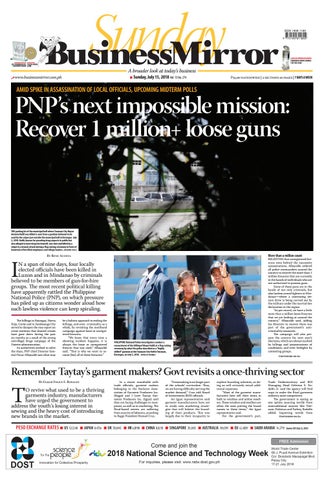
THE parking lot of the municipal hall where Tanauan City Mayor Antonio Halili was killed is seen from a position believed to be used by the sniper just outside the municipal hall in Batangas July 2, 2018. Halili, known for parading drug suspects in public but also alleged to have drug ties himself, was shot and killed by a sniper in a brazen attack during a flag-raising ceremony in front of hundreds of horrified employees and village leaders. AP/AARON FAVILA
I
More than a million count
By Rene Acosta
BELIEVING that unregistered firearms were behind the successive assassinations, Albayalde ordered all police commanders around the country to recover the more than 1 million firearms that are currently in the hands of individuals who are not authorized to possess guns. Some of these guns are in the hands of not only criminals, but also lawless armed fighters in Mindanao—where a continuing seizure drive is being carried out by the military under the martial-law declaration in the region. “As per record, we have a little more than a million loose firearms that we are looking at around the country,” Albayalde said, adding his directive to recover them was part of the government’s anticriminality measures. The campaign will also prepare the country for next year’s elections, which are always marked by killings and assassinations of candidates, and even firefights by contesting groups.
N a span of nine days, four locally elected officials have been killed in Luzon and in Mindanao by criminals believed to be members of gun-for-hire groups. The most recent political killing have apparently rattled the Philippine National Police (PNP), on which pressure has piled up as citizens wonder aloud how such lawless violence can keep spiraling. The killings in Batangas, Nueva Ecija, Cavite and in Zamboanga City served to dampen the rosy report on crime statistics that showed crimes have gone down during the past six months as a result of the strong anti-illegal drugs campaign of the Duterte administration. As authorities worked to solve the slays, PNP chief Director General Oscar Albayalde saw what may
be a holistic approach in ending the killings, and even criminality as a whole, by revisiting the moribund campaign against loose or unregistered firearms. “We know that every time a shooting incident happens, it is always the loose or unregistered firearm that was used,” Albayalde said. “That is why we want to account [for] all of these firearms.”
PHILIPPINE National Police investigators conduct a reenactment of the killing of Mayor Halili at a flag-raising ceremony by what the police described as a “highly skilled” gunman at the Tanauan City Hall in Tanauan, Batangas, on July 5, 2018. AP/BULLIT MARQUEZ
Continued on A2
Remember Taytay’s garment makers? Govt revisits a once-thriving sector
T
By Elijah Felice E. Rosales
O revive what used to be a thriving garments industry, manufacturers have urged the government to address the youth’s losing interest in sewing and the heavy cost of introducing new brands in the market. PESO EXCHANGE RATES n US 53.5240
In a recent roundtable with trade officials, garment makers belonging to the Baclaran Association of Garment Producers Inc. (Bagpi) and I Love Taytay Garments Producers Inc. (Igpai) said they are facing challenges in manpower, as well as in marketing. The Rizal-based sewers are suffering from scarcity of laborers, according to Bagpi President Manuel Cruz.
“Dressmaking is no longer part of the schools’ curriculum. Thus, we are having difficulty serving the market demand,” Cruz told Board of Investments (BOI) officials. An Igpai representative said garment manufacturers have yet to study new marketing strategies that will bolster the branding of their products. This was largely due to their incapacity to
explore branding schemes, as doing so will certainly entail additional expenses. “Most of the garment manufacturers here sell their items in bulk to retailers and online resellers. These retailers and resellers are often the ones putting the brand names to these items,” the Igpai representative said. For the government’s part,
Trade Undersecretary and BOI Managing Head Ceferino S. Rodolfo Jr. said the agency will find ways to make the Rizal garments industry more competitive. The government is eyeing as one option sourcing textile from nontraditional sources like Vietnam, Pakistan and Turkey, Rodolfo added. Importing textile from Continued on A2
n JAPAN 0.4756 n UK 70.6945 n HK 6.8198 n CHINA 8.0210 n SINGAPORE 39.2693 n AUSTRALIA 39.6399 n EU 62.4839 n SAUDI ARABIA 14.2719
Source: BSP (July 13, 2018 )
NewsSunday BusinessMirror
A2 Sunday, July 15, 2018
www.businessmirror.com.ph
PNP’s next impossible mission: Recover 1 million+ loose guns Continued from A1
“This is all part of our preventive measures. These are all part of our target-hardening measures so that we could also prevent possible hostilities or violence that may still happen in view of the forthcoming midterm elections next year,” Albayalde said.
3-pronged campaign
THE PNP chief directed police commanders to synergize the campaign against loose firearms with the crackdown on private armed groups (PAGs) and gun-for-hire groups, which he had also ordered to be undertaken. Albayalde wanted members of these outlawed groups to be neutralized and accounted for, noting guns are more dangerous in their hands. “We will intensify our campaign against these gun-for-hire and private armed groups as part of our preventive measures…the order is not only to disarm, but arrest them, put them behind bars,” he said. According to the PNP chief, there are at least 78 PAGs around the country, most of them located or based in Mindanao. “We will intensify intelligence gathering, our surveillance. That is one way of monitoring them. Otherwise, if we know where these areas are, then we can apply for search warrants,” he said. The PNP chief declared that PAGs are being used by VIPs (very important persons), most of whom, however, are politicians and elected government officials. While Albayalde could not say
the exact number of operating and existing gun-for-hire groups, most of them are based in Luzon. Gun-for-hire groups, which are paid for every assassination work, usually employ two or three members in a murder hit, as in the cases of killings in Nueva Ecija, Cavite and in Zambonga City. He said those cases, as initial investigation revealed, were perpetrated by gun-for-hire groups. Albayalde said the three campaigns would be carried out by the police while intensifying their “Oplan Sita” and checkpoint operations, which are also being implemented around the country. “In the absence of a gun ban, we have to intensify our Oplan Sita, checkpoint operations, the campaign against loose firearms, gun-for- hire and PAGs. These are the things that we will do as preventive measures,” he said.
Gun amnesty
OTHER than conducting operations against loose firearms, the PNP is also proposing to declare a gun amnesty, which it was looking to implement by next month. The amnesty allows owners of unregistered guns, or even those with expired licenses to register their firearms with the PNP. “This is to encourage the owners of loose firearms, especially those that are not really covered by licenses, to register their firearms. This is one way for us to account for loose firearms,” Albayalde said. Based on the PNP record, the number of gun owners in the country has increased although Albayalde could not say the exact figure.
THOUSANDS of residents follow the hearse bearing the coffin of slain Mayor Antonio Halili during his funeral in Tanauan, Batangas, on July 8, 2018. AP/BULLIT MARQUEZ
Remember Taytay’s garment makers? Govt revisits a once-thriving sector Continued from A1
these economies will not only upgrade the capabilities of garment manufacturers, but will also expand their market. “Our garments industry used to be one of the top-performing sectors, both locally and internationally. But with challenges brought about by the end of the Multi-Fiber Agreement [MFA], which grants preferential tariffs to Philippine exports of garments and textiles, we saw a decline in the sector’s general performance,” Rodolfo said. “We, however, observed that while this is the overall state of the sector, the garments industry here in Taytay [in Rizal] is thriving despite challenges, and we hope to replicate this successful model to other parts of the country,” he added. Garments production is one of the industries the province intend to maintain, with about 190 registered manufacturers, 52 remnant cloths sellers, 29 authorized ready-to-wear retailers and 4,000 flea market vendors, according to the Taytay Business License Processing Office.
Beginnings
THE Taytay industry can be traced back to as far as the 1950s, when remnant textiles from New York were imported to the province through the efforts of its then municipal mayor. Sewers were mostly operating on the ground floor of their houses to lessen overhead costs, as well as permits and licensing requirements. As the country’s labor cost increased, the number of garments
manufacturer decreased—most of them transferred operations in other Southeast Asian countries. The garments industry as a whole is struggling to compete with secondhand clothes from developed countries, mostly sold also in flea markets, and Chinese-made garments and textiles. Factories in Taytay have also shut down, and those who stayed the course are heavily relying on imported remnants from China. “The information gathered from the roundtable discussion is very important to us,” Rodolfo said. “As we go around the country and conduct similar focusedgroup discussions with garments and textile industry players and stakeholders, these collected information will serve as substantive inputs to the Garments and Textile Industry Roadmap that we envision for the industry.” The BOI is drawing up a road map for the garments industry as part of the government’s overall manufacturing program. The roadmapping exercise involves defining the industry’s objectives, assessing its current situation and performance, identifying the binding constraints to its development and recommending strategies to achieve growth and competitiveness. The BOI has engaged stakeholders since December of last year, and conducted five roundtable sessions with garment manufacturers in different parts of the country. The Rizal-based sewers were the sixth batch to be consulted.
Top exporter
THE Philippines used to be a top exporter of garments, and was
even the fifth in the world in 1995. Since the MFA concluded, the country’s garment exports fell and was soon taken over by other Asian exporting economies, such as Bangladesh, Cambodia, Sri Lanka, Vietnam and China. Its decline reflected on the heavy contraction in the number of its workers. In the early 1990s, the garments industry had over 300,000 factories and nearly 700,000 workers, including embroidery and piece-rated subcontracted laborers. In 2010 only 100,000 workers were left to produce for the industry. The overdependence of garments makers on MFA quotas has caused the downfall of the garments industry. Industrial experts pointed to the failure of many aging textile firms to modernize, as well as the downfall of the World Bank-backed textile modernization program. They also saw the lack of productive linkages between homebased sewers and the exportoriented garments industry as another cause of decline. Last, Philippine garments makers were deemed unready for the World Bank-financed trade liberalization program of the 1980s and the 1990s. Beyond the clinical analysis of all the factors behind the failure of what was once a thriving sector, those familiar with how things were in the olden days can only sigh in lamentation for the days when “dressing up” meant something much more than just mindlessly snatching clothes from a rack in some mall, or from stores for cheap, secondhand goods from abroad.
The World BusinessMirror
www.businessmirror.com.ph
Facebook wins the title of best company to work for in the U.S.
F
acebook Inc.—despite suffering through what could be charitably described as a turbulent year—was ranked as best place to work in 2018, according to Indeed. The career web site compiled its annual list of the 50 top-rated workplaces, based on 72 million employer ratings and reviews of Fortune 500 companies. The social-media platform was fourth on last year’s list. “Clearly, Facebook’s employees over the last two years believe that there’s been transparency internally, from the top down,” said Paul Wolfe, senior vice president at Indeed. “The company is also focused on perks and benefits, which brings it to the top of the list.” Although Facebook is repor tedly re ve re d b y e m p l o ye e s f o r a s e n s e of internal corporate transparenc y, the company has spent the last year warding off criticism from politicians and the media for a lack of transparenc y surrounding algorithmic news rankings, content policies and data breaches. The issue has brought Facebook congressional hearings and and an FBI probe. “While it might appear that the challenges the company has recently faced might deter people, the employees we attract are the type of people that tend to be excited and engaged in those big, complicated problems and would like to solve them,” Anthony Harrison, a Fa ce b o o k s p o ke s m a n , s a i d i n a n inter view. Bloomberg News
I
Forward freight Over the past year, derivatives to bet on, or hedge, shipping rates in 2020 surged by 44 percent for giant Capesize ships that haul hundreds of thousands of tons of iron ore and coal, according to data from the Baltic Exchange Ltd. in London. The 2020 contracts, called forward freight agreements, were near $19,000 a day on Thursday, close to the highest since that specific contract began trading. Across every class of commodity shipping, FFAs for 2020 are trading much higher than they were a year ago. The fleet slowdown is being anticipated because of rules mandated by the I nternational Maritime Organization (IMO) in October 2016 that vessels cap sulfur levels in their fuel from 2020. Doing so should help to fight human health issues, such as asthma, as well as acid rain. As the deadline approaches, the decision is starting to ripple through the global trading system, creating winners and losers in both the refining and shipping industries.
A3
Trade war kills currency volatility, leaves forex analysts confounded
F
oreign-exchange traders are struggling to know which way to lean when it comes to betting on the escalating global trade war. While the US and China have been exchanging blows over tariffs in recent weeks, swings in major developed-market currencies have remained muted, and opinion is divided about what might constitute a haven if tensions escalate. Measures of realized volatility are close to the lows for the year and well below where they were during Italy’s recent political crisis. That may also be acting as a drag on option-implied volatility. A global trade war with the US at the epicenter has upended some assumptions about how certain currencies move in times of risk aversion, and that’s left a number of strategists flummoxed. Standard Bank said Wednesday it’s disinclined to make new forecasts given the murky outlook, while Société Générale SA said it’s struggling to figure out why the yen isn’t acting as a haven. Commerzbank AG said
it was stumped about where the dollar is headed from here. “A problem that we have found all this year is that the sharp and sudden sentiment shifts caused primarily by trade tensions are stopping many currencies from trending in a clear way and that has made position-taking more difficult,” Steve Barrow, head of currency strategy at Standard Bank in London, said in a research note. “There are few signs of this abating and, perhaps not too surprisingly, our currency indicators tend to be both mixed and weak.” A big part of the difficulty, Barrow said, comes from trying to work out if the trade conflict is going to also turn into a currency war, and whether the US actually wants a weaker dollar or a stronger one. He argues that while embracing a weakening policy may be an effective way to stage a currency
Coming soon to an ocean near you: Ships moving a bit tiny slower f you happen to be at the beach this summer, make a mental note of any giant freighters crossing the horizon. In a few years’ time those same ships will probably be moving just a fraction slower. If the slowdown does happen—and the likes of Citigroup Inc. say it will— then the wider consequences would be profound for both the shipping industry and its customers, given that about 90 percent of world trade moves by sea. The cause of this deceleration? A rule to combat the merchant fleet’s emissions of sulfur oxides starting in January 2020. While such a slowdown might shave billions of dollars off shipowners’ single largest expense—fuel—it would also effectively limit the number of available vessels, risking an upward spiral in freight costs. “It’s going to impact all of shipping: containers, tankers and, in particular, dry-bulk,” said John Kartsonas, New York-based managing partner at Breakwave Advisors Llc., which runs an exchange-traded fund for dry bulk shipping. “You will have shipowners instructing their captains to slow down, and if everybody does, global supply will come down significantly.”
Sunday, July 15, 2018
Slow-steaming The rule is expected to make IMOcompliant fuel more expensive, which shipping companies are trying to offset. Reducing speeds, or slow-steaming, “will be part of the arsenal of options that we as shipowners will have available to us,” said Brian Gallagher, head of investor relations at Euronav NV. “It will be very dependent on what the costs are and what the environment is when we get to 2020.” Svein Moxnes Harfjeld, the joint chief executive officer of DHT Holdings Inc., said speed cuts “will be positive for the market” in the event that rates are weak, because fleet capacity would effectively drop. Analysts from Goldman Sachs Group Inc. to Wood Mackenzie have predicted that the rule change will create an additional $40 billion to $60 billion in costs for shipping companies, which the industry will pass along to its customers. That could affect trade in everything from commodities like oil, soybeans and steel to items that move on container ships, like TVs, furniture and clothes.
Pass it on “We see that as a critical issue, the ability of operators to pass on this extra cost,” said Peter Sand, chief shipping analyst at BIMCO, a Denmark-based industry group that represents shipowners. “The shipping industry does not have a financial war chest to cover an escalating cost like that.” Shipowners have limited ways to comply with the rule change. They can buy IMO-compliant fuels, though it’s not clear there will be enough to go around. They can install pollution-reducing scrubbers but the cost of those upgrades has deterred investment. A third option is to simply slow down, since owners can cut fuel consumption disproportionately by sailing their fleets more slowly. “For tankers, the majority of the fleet will show up in 2020 without scrubbers,” Harfjeld said. “That fleet will have to consume compliant fuel. This fuel is expected to be quite expensive. This part of the fleet might consider slow speed to save cost on fuel.”
Fuel savings While rising earnings will always tempt
some owners to speed up, the need to cope with complex and shifting fuel economics will work in their favor as not all vessels will accelerate at a uniform rate, says Eirik Haavaldsen, head of research at Oslo-based Pareto Securities AS, which focuses on the energy and shipping industries. Higher fuel costs will, in particular, encourage owners to sail slower when they don’t have cargoes on board, said Kartsonas of Breakwave. In addition, while more modern carriers might be able to accelerate when rates rise, the economics for older vessels to do so may still not work, he said. Slow steaming is the most likely way for shippers to respond to high fuel costs, analysts at RBC Capital Markets Llc. including Brad Heffern said in a July 11 research note. “Fuel consumption has a nonlinear relationship with speed, so any given reduction in speed leads to a greater reduction in fuel consumption,” the analysts wrote. Slowing by just 1 knot, or 1.2 miles per hour, could allow oil tankers to save as much as 17 percent on its fuel consumption, analysts at Citigroup said in a June report. Bulk carriers— those carrying cargoes like iron ore, coal and crops—and container vessels could save as much as 37 percent by slowing by 1.5 knots.
Higher rates “Rates benefit from slow-steaming because the existing fleet is essentially being spread out further by completing fewer round trip voyages,” said Jonathan Chappell, an analyst focusing on marine transportation equities at Evercore ISI. T h a t ’s n o t g o o d n e w s f o r companies looking to send their commodities from continent to continent in a hurry. Not only would the voyage become more expensive, a reduction in speed could add days to a trip from, say, Europe to Asia. Fortunately for them, slow-steaming is likely to be only a temporary fix as the market adjusts to the IMO’s rules and the associated higher fuel costs. “You may slow-steam initially, but there will always be someone who will sail a little bit faster and charter a little bit less, to get the business done,” said BIMCO’s Sand. Bloomberg News
battle against the European Union, China is more likely to succumb to US pressure if the greenback is strong because it would lift the cost of debt and could trigger capital flight. Then there’s the question of the yuan, which will intermediate the terms of trade between the world’s two largest economies. The
Chinese currency has been weakening since mid-June as tensions intensified and it dropped to the lowest versus the dollar since August on Wednesday. Michael Every, a macro strategist at Rabobank, said the market is still seeing the yuan’s weakness as a “catch up” rather than a currency war, which makes the out-
A problem that we have found all this year is that the sharp and sudden sentiment shifts caused primarily by trade tensions are stopping many currencies from trending in a clear way and that has made positiontaking more difficult. There are few signs of this abating and, perhaps not too surprisingly, our currency indicators tend to be both mixed and weak.”—Barrow
look difficult to gauge. That could still change if the trade war gets worse, the Federal Reserve raises interest rates and China’s economy slows, he wrote in a research note published Wednesday, in which he maintained a forecast for the currency to continue to weaken. The other big question hanging over markets is what direction will haven currencies take from here. The yen and the Swiss franc retreated on Wednesday, extending losses versus the dollar for the past month. Kit Juckes, a Société Générale strategist in London, described the yen as “the pick of the currencies within Asia” in a research note published Wednesday. “I really don’t know why the yen isn’t stronger,” Juckes wrote. “My default position is to believe that it will be, in due course.” Viraj Patel, a strategist at ING Groep NV said in a phone interview that the limited spillover effect on currencies has been an “unusual phenomenon, but one that equally we’ve become accustomed too.” He’s forecasting the dollar to continue to strengthen against emerging-market currencies, but to stay flat against the euro and yen. Bloomberg News
A4
The World BusinessMirror
Sunday, July 15, 2018
US Inc. keeps faith in China despite trade row–AmCham
U
nited States companies operating in China plan to increase investment in the Asian nation this year as rising consumer spending and improving profits offset trade tensions. Almost 62 percent of companies surveyed by the American Chamber of Commerce (AmCham) in Shanghai expect to boost investment, led by technology hardware, software and services companies, as well as aerospace and aviation firms, the group said in a report released onThursday. “Despite US-China trade frictions clouding the bilateral relationship over the past year, most US businesses continue to perform well in China,” the chamber said. “Uncertainty about US- China trade policy had a limited impact on investment, and more companies are producing goods solely for the Chinese market.” But g iven t he su r ve y wa s c o n du c t e d b e f o r e U S - C h i n a trade tensions ratcheted up this month, the firms may be overly optimistic. The Trump administration on July 6 imposed 25 percent duties on $34 billion in Chinese imports. China immediately retaliated with duties on the same value of US goods, including soybeans and cars.
Earlier this week the US unveiled a list of Chinese imports worth $200 billion that could face higher duties. “There’s an impact for sure,” Stephen Shafer, Greater China president at 3M, said on the sidelines of a media briefing about the survey. “We are more of an importer in China, and we are impacted
more by the Chinese tariffs.” Ken Jarrett, president of the AmCham in Shanghai, said there are concerns among some US companies in China that they will be targeted by the Chinese government as a result of the trade conflict. “For companies at the moment they have been going through a mental check list of what they could encounter in the forms of retaliation. There are other ways that China can show its unhappiness,” Jarrett said. “Typically it could be a form of regulatory harassment. For example, things coming into the country held up by customs.” Companies surveyed by the chamber saw broadly positive operating results as the yuan kept stable against the dollar, financial deleveraging continued,
Despite US-China trade frictions clouding the bilateral relationship over the past year, most US businesses continue to perform well in China. Uncertainty about US-China trade policy had a limited impact on investment and more companies are producing goods solely for the Chinese market.”—AmCham report
consumer spending remained firm and the global economy supported demand. About 15 percent of the companies surveyed reported “very profitable” businesses in China, the highest proportion since 2004, while another 62 percent said their businesses were “profitable.” About 85 percent of the companies planning to expand investment this year are in the technology hardware, software, and services space, according to the report. Still, regulatory barriers and persistent government favoritism toward local companies impede US companies, and market access restrictions and the distorting effects of China’s industrial policies concern members, according to the survey of 434 companies conducted between April 10 and May 10. L ac k of intel lect u a l prop er t y (IP) r ights protection and enforcement, and difficu lties in obtaining required licenses remain the top t wo cha l lenges foreign firms face in China, the chamber said. “As China looks to the future, it should note lessons from the past,” the chamber said, citing Japan’s failed experiment with state industrial policies to finance and nurture companies. “Far better would be to improve market access, better protect IP, respect data security and thus create the conditions for national success.” Bloomberg News
Why productivity is not keeping up with technology
E
xisting advances in technology from smart phones to new car services affect our everyday lives. Yet aggregate productivity has been growing very sluggishly. In 2016 and 2017, for example, output per hour in the US non-farm business sector rose by less than 1 percent per year on average. The disconnect between productivity growth and the technology revolution has triggered a sharp debate in economics. A scintillating new paper by Adair Turner of the Institute for New Economic Thinking suggests that rather than presenting a puzzle, the combination of technological innovation and low measured productivity growth is exactly what we should expect. Before turning to Lord Turner’s argument, it’s worth revisiting previous attempts to resolve the apparent puzzle. One perspective argues that slow productivity growth is at least partly a mirage. For example, if new inventions improve the quality of goods and services but the improvements are not properly incorporated into the economic statistics, the result would be that measured productivity is lower than actual productivity. The challenge is to determine whether the measurement errors are any bigger today than in the past (if not, they could not explain the deceleration in measured productivity) and how large they plausibly are in any case. Some new research suggests that the errors may be growing meaningfully larger, but most studies suggest that any effect is too small to explain the bulk of the productivity slowdown. A second argument is that there is a lag before new technologies raise productivity, because businesses need to adjust operations to take advantage of them and that takes time. Unfortunately, according to this perspective, we
Lord Adair Turner, director of the Foundation for Science & Technology and former chairman of the United Kingdom Financial Services Authority, speaks during a Bloomberg Television interview in New York. Christopher Goodney/Bloomberg
are still in the interregnum. As three leading economists, Erik Brynjolfsson, Daniel Rock and Chad Syverson, argue: It takes a considerable time— often more than is commonly appreciated—to be able to sufficiently harness new technologies. Ironically, this is especially true for those major new technologies that ultimately have an important effect on aggregate statistics and welfare. A third perspective attributes the phenomenon to sand in the wheels of the economy, as reflected in the decline in geographic mobility and the rising gap between leading firms and others in the same sector. At frontier firms, productivity growth has not declined, which raises the question of why those advances are not spilling over to other companies. Jason Furman and I explore this decline in dynamism and the growing gaps between firms in a recent working paper for the Peterson Institute for International Economics. None of these arguments have thus far resolved the productivity puzzle. Enter Lord Turner, who has punctured many economic debates, from pensions to climate change. He writes that “it is quite possible that an acceleration in underlying technological progress, which allows us to achieve dramatic productivity improvement in existing production processes, can be accompanied by a decline
in total measured productivity.” In other words, there is really no puzzle to explain. The core of Turner’s argument is that the impact of new technology on total productivity growth depends crucially on who accrues the income from the new inventions; what additional consumption they choose to enjoy with that income; and the nature of productivity advances in the sectors that workers are shifted into as a result. In particular, if those who directly accrue income from the new inventions choose to consume more services (such as personal services or artistic ones) that are hard to automate, the net result could be the coexistence of rapid technological progress and slow or nonexistent overall productivity growth. So technological progress and productivity growth have tended to coexist in the past because the workers shifted as a result of the new technologies moved from one sector (say, farming) to another (manufacturing) and in both the sender and recipient sector rapid productivity growth was occurring. What would happen, though, if the recipient sectors suffer from “Baumol’s disease,” which features limited potential for productivity improvements because it is hard to replace people with machines in those areas? Then, aggregate productivity growth will not march in lockstep with technological progress.
Furthermore, as our incomes rise, we may demand more services with Baumol’s disease characteristics. The employment projections from the Bureau of Labor Statistics highlight the point. The top four occupations ranked by the number of new jobs projected to be created between 2016 and 2026, for example, are personal care aides, cooks and ser vers, registered nurses and home health aides. In all four cases, the service provided involves person-to-person interactions that are, at least for now, difficult to automate. That means productivity explosions are unlikely, whatever is happening in the rest of the economy. Turner’s analysis is much broader than just the impact of such sector-shifting, but that forms an important pillar of his argument. And while there’s no doubt he may be right in theory, the question is how important this phenomenon is to the aggregate productivity puzzle. One piece of evidence comes from a recent McKinsey report, which estimates that productivity growth declined by 0.2 percentage points per year between 1987 and 2014 “as employment transitioned from high-productivity manufacturing sectors to lower-productivity sectors such as health care and administrative and support services.” The McKinsey numbers suggest that, at least until recently, Turner’s argument does not fully eliminate the empirical productivity puzzle. But Turner is focused on the next several decades, and over that period he may prove to be increasingly correct—unless we see automation dramatically changing how services ranging from personal care to education to health care can be delivered. His analysis is important in any case because it is a reminder that it may be perfectly natural to see rapid technological advances associated with low productivity growth. Peter R. Orszag/Bloomberg Opinion
www.businessmirror.com.ph
Even parents can’t stop texting behind the wheel
T
here has been a historic surge in United States traffic fatalities over the last four years as more drivers use their phones to respond to texts or scroll through Instagram feeds. Even parents can’t keep keep their hands on the wheel and their eyes on the road, new research shows. Ha lf of a l l parents use their cel l phones while dr iv ing w ith young children in the car, according to a study released on T hu r s d ay b y t he C h i l d re n’s Hospita l of Philadelphia and the Universit y of Pennsylvania School of Nursing. About a t h i rd of pa rent s re por ted reading text messages, 1 in 4 sent text messages and 1 in 7 used socia l media over the last t h ree mont h s wh i le d r iv i ng children bet ween the ages of 4 and 10 in a mov ing vehicle. The study was conducted in 2017 from a national sample of 760 parents and caregivers of children aged 4 to 10. It’s not a surprise, given that A mer ic a n adu lt s u se sm a r t phone s “a l mo s t con s t a nt l y ” throughout the day. Seventyseven percent now own a smartphone, according to the Pew Research Center. “Engaging with a cell phone inherently takes our attention away from the roadway,” said Catherine McDonald, a senior
fellow at the Children’s Hospital of Philadelphia, who coauthored the study. “As technology rapidly changes and accelerates, we need to intervene.” Parents who reported using their phone while driving young children in a moving vehicle were more likely to have demonstrated other risky behaviors, including driving under the influence, not using a seatbelt and not using proper child-restraint systems, according to the study. “Deterring cell-phone use while driving is going take a multipronged approach,” McDonald said, pointing to increased law enforcement, insurance penalties and health-education counseling as possible solutions. But, thus far, insurance companies and police departments have been fairly lenient in terms of identifying and punishing distracted drivers. Laws banning the use of hand-held phones have also had little effect. Beyond the immediate consequences, McDonald said she’s worried that parents who text and drive may encourage their children to model that behavior when they eventually take the wheel. “We want to help parents understand t he r isk associated with these behaviors,” McDonald said. “Parents want to keep children safe, but this behavior places their children at crash risk.” Bloomberg News
Surge in hacked credit-card info offered for sale on Web
T
he number of hacked US credit cards whose information was offered for sale to other criminals on the Dark Web jumped by about twothirds in the first half of this year, according to a cybersecurity research firm. More than 4,000 credit cards per bank were on sale in the first half, up from about 2,400 in the second half of 2017, New Yorkbased IntSights said in a report released on Wednesday. IntSights said its researchers analyzed data from the “top 50” banks and financial firms in the United States and Europe for its report on the Dark Web, where anonymous browsing
allows illegal activity to flourish. The number of cards up for sale has almost quadrupled in the last two years, IntSights said. That will probably increase the losses banks and insurance companies face this year. Hackers a re a lso t a rget ing ba n kaccount data, IntSights’s Itay Kozuch said in an inter view. “To get credit-card or bank-account credentials you don’t need to hack the bank, but you just trick the customer into giving up his credentials on a fake site,” said Kozuch, director of threat research. “As banks fortify their defenses, hackers go for the weaker link: the customer.” Bloomberg News
Electric vehicle surge poised to test UK grid for decades
E
lectric vehicle (EV) numbers in the United Kingdom are likely to jump so much that balancing power supply and demand will become even harder for decades to come. After the renewable-energy revolution introduced intermittent supply to test the nation’s main grid company, as well as energy traders, the expected jump in EVs will add yet another layer of complexity. There could be as many as 11 million EVs in the UK by 2030, National Grid Plc. estimates in a report published on Thursday. That number could grow to as much as 36 million by 2040, according to the company’s Future Energy Scenarios. Electricity demand will increase to fuel the transformation, but exactly how much strain it puts on Britain’s grid system will depend on when people decide to charge their cars. “The continued growth in electric vehicles, a greater volume of low carbon generation and the advancement of storage technology, are among the major trends,” we are seeing, said Fintan Slye, a National Grid director. “Balancing energy supply and demand will become increasingly complex
between now and 2050.” The takeup of EVs in Britain has been slow with only about 160,000 plug-in cars registered, according to Next Green Car Ltd. That still makes the UK one of the top 3 markets for the vehicles. The global fleet is expected to more than triple to 13 million by the end of the decade from 3.7 million last year, according the International Energy Agency in Paris. Sales may soar 24 percent per year on average through to 2030. Energy consumption is predicted to fall in all four scenarios explored in National Grid’s report. Electricity demand by contrast is expected to jump, particularly from 2030 when EVs become more common. If smart charging technologies are developed and consumers incentivized to charge vehicles at off peak times, the increase in peak demand could be as little as 8 gigawatts in 2040, or just 16 percent higher. Balancing supply from wind farms in Scotland and houses with solar panels in the southwest with demand from EVs in London and factories in the West Midlands will become even more complex in the future, the grid said. Bloomberg News
Sports BusinessMirror
Editor: Jun Lomibao | mirror_sports@yahoo.com.ph
Sunday, July 15, 2018
A5
eSports debuts on biggest sports platform on US TV
SINGER Mick Jagger (in black baseball hat) of the Rolling Stones smiles during the semifinal match between Croatia and England on Wednesday. AP
E
Kikkan Randall says that she has breast cancer. AP
Pink takes on new chapter in Randall’s life
A
NCHORAGE, Alaska—Olympic gold medalist Kikkan Randall has been diagnosed with early stage breast cancer. The 35-year-old cross-country skier known for pinkhighlighted hair said on Wednesday on social media that “the color pink has taken on a new chapter” in her life. She said the prognosis is good, but she expects life to change significantly in the months ahead. “I am going to bring as much tenacity, strength and energy toward this challenge as I have throughout my entire career,” she wrote. Randall, the most accomplished American cross-country skier ever, made good on her nickname “Kikkanimal” by riding her bike to and from her first round of chemo on Monday in Anchorage, Alaska, her hometown before she moved earlier this year to Penticton, British Columbia, with her 2-year-old son, Breck, and husband Jeff Ellis. She said she woke up on Wednesday feeling “fairly decent still.” The response to her news has been comforting, she said, with people rallying around her. A group of Anchorage friends even accompanied her to her first chemo appointment. “You always want to celebrate the gold medals together, but you know, in a way, you really see the strength of the whole community when they come to your aid when you’re having a tough time,” she told The Associated Press. The pink in Randall’s hair has faded, but there’s a good chance she will dye the color back in during the coming days. If her hair ends up falling out because of the chemo, they’d find a “fun way” to put the pink back, she said. Randall is a five-time Olympian who returned to competition in 2016 after a break and delivered the first Olympic gold in cross-country for the US with relay team partner Jessica Diggins at the Pyeongchang Games in February. She is the only American woman to win season-long World Cup titles, taking home three sprint titles. She has won 14 individual World Cup races. After she completed her fourth Winter Games, in Sochi, Randall decided it was the right time to have a baby. So at age 32, she planned accordingly. She figured she could give birth then return to competition and qualified for Pyeongchang. Randall will undergo six rounds of chemo every three weeks. She will stay with her parents for the next three weeks to see how she fares. If all goes well, she hopes to travel back and forth between Anchorage and Canada between rounds to be with her son and husband. She said she has weathered past “bumps in the road,” like a blood clot she was treated for a decade ago, by reaching out to others. “Being able to share my experiences really helped me kind of process it and find the good,” she said. AP
MICK JAGGER: By Chris Lehourites
M
The Associated Press
OSCOW—In a literal case of life imitating art, Mick Jagger went to see England and England lost. The Rolling Stones frontman was at the Luzhniki Stadium on Wednesday to see Croatia beat England, 2-1, in extra time in the World Cup semifinals. Last year Jagger unexpectedly released a pair of solo songs. One of the songs was called “England Lost,” and its starts with the tale of someone ostensibly going to watch England play a soccer match and finishes with some political commentary about Britain’s exit
from the European Union. “I went to see England, but England’s lost,” Jagger sings. “And everyone said we were all ripped off.” Jagger arrived in Russia for the World Cup after he and his bandmates completed a short European tour in Warsaw on Sunday. He attended Tuesday’s match between France and Belgium in Saint Petersburg and then came to Moscow to see his home national team play—and lose to—Croatia. Jagger has been a regular in recent years at major soccer tournaments. He attended the World Cup final four years ago in Brazil and also watched the United States play Ghana in the round of 16 at the 2010 tournament in South Africa. He was at that match alongside former President Bill Clinton, who had a cameo in the Martin Scorsese-directed Rolling Stones concert film Shine A Light. But Jagger, who is also a keen cricket fan, has been thought of as a bit of a jinx at World Cup soccer stadiums. During another European tour in 2014, Jagger wrote some encouraging words on Twitter ahead of England’s match against Uruguay in the group stage. “Let’s go England! This is the one to win!!,” he wrote. England lost. Jagger then predicted at a show in Rome that Italy would beat
JUVENTUS SEES RONALDO AS KEY TO TITLE DREAM M
ILAN—With the arrival of five-time Ballon d’Or winner Cristiano Ronaldo, this could be the year that Juventus finally wins the Champions League again. Juventus has won Europe’s premier club competition twice but the last time was in 1996. It has been on the losing side in the final five times since then, including twice in the past four editions. The Bianconeri lost to Real Madrid in the 2017 final, with Ronaldo scoring twice in a 4-1 win. Ronaldo also scored twice against Juventus in the first leg of the Champions League quarterfinals last season, including a spectacular overhead goal—which earned him a standing ovation from Juventus fans. Juventus always plays down the idea that the Champions League has become an obsession but Coach Massimiliano Allegri knows that having a player who has won the competition five times—including in four of the last five seasons—can bring some much-needed experience to the club. “We’ve always had the aim of winning the Champions League and certainly the signing of Ronaldo will give us
CRISTIANO RONALDO is expected to bring some much-needed experience to the Italian club. AP
SPORTS are coming to ESPN. The network will air the inaugural Overwatch League Grand Finals in prime time this month as part of a multiyear agreement to bring eSports to the biggest sports platform on American television. Disney and Blizzard Entertainment announced plans on Wednesday to broadcast the OWL’s playoffs and championship on ESPN, ABC and Disney XD. The Grand Finals on July 27 will be shown live on ESPN, marking the first time the network will carry eSports in prime time. “We think that really reflects the commitment they’re making to the category,” said Pete Vlastelica, president and CEO of Activision Blizzard Esports Leagues. Coverage begins on Wednesday with the playoffs on Disney XD and ESPN3. There will be 10 hours total of Grand Finals coverage, including a recap show on July 29 on ABC. Disney’s networks will also broadcast OWL matches next season. Financial terms of the partnership were not disclosed. Overwatch is a team-based first-person shooter, with two teams of six players competing over various objectives. The OWL has city-based teams in four countries, including nine US franchises plus teams in London, Seoul and Shanghai. The league plans to expand after its first season. “There’s no doubt that this partnership will increase the reach of our league content,” Vlastelica said. “And open up, have access to a new audience that maybe doesn’t spend so much time streaming content online, but who has heard of eSports and is familiar with gaming and who’s a big sports fan.” The playoffs will take place at Blizzard’s eSports arena in Burbank, California, and the Grand Finals will be held at the Barclays Center in New York. The OWL had been streaming all matches on Twitch, a livestream platform owned by Amazon, and it will continue to provide simulcasts there through at least 2019. The league signed a two-year agreement with Twitch prior to this season and drew 10 million viewers to the platform on its opening weekend, besting Amazon’s NFL Thursday Night Football numbers from the 2017 season. This won’t be ESPN’s first foray into events that aren’t strictly sports. Its programming has included the Scripps National Spelling Bee, the World Series of Poker and the Drum Corps International championship. ESPN also aired part of the Fifa Ultimate Team Championship Series in 2017, and it previously partnered with Blizzard Entertainment on “Heroes of the Dorm,” an eSports tournament for college gamers. AP
A CROATIAN soccer official will be allowed to watch the
team’s World Cup semifinal match from a VIP section on Wednesday, despite being convicted last month in a corruption case linked to the transfer of captain Luka Modric. When Croatia beat Russia in the quarterfinals on Saturday, the director general of the country’s soccer federation sat in the same row of seats as Croatian President Kolinda Grabar-Kitarovic and Russian Prime Minister Dmitry Medvedev. Damir Vrbanovic has stayed in office since being sentenced in June to a three-year jail term even though Fifa’s disciplinary code bars officials “convicted of a criminal offense in the past five years.” However, Fifa says the sentence is not final because the former Dinamo Zagreb director general is appealing to a higher court. “The evaluation of the position of the person concerned, then, is made only by its national association according to the applicable national law,” Fifa said in a statement to The Associated Press. The Croatian federation said any other interpretation would be “unconstitutional and serious violation of his human rights.” “In accordance to the Croatian and general law, Mr. Vrbanovic is innocent because the relevant judgment is not final and binding,” the soccer body said in a statement to the AP. The criminal case hasn’t affected Croatia’s progress to its first World Cup semifinal in 20 years, despite Modric being charged with perjury in March. Defender Dejan Lovren, another former Dinamo Zagreb player, is also under investigation for suspected false statements.
more awareness of how to achieve it,” Allegri said at an event at the European Parliament in Brussels on Wednesday. “But that, together with the league, the Italian Cup and the Italian Super Cup are the four aims for which Juventus has always played for.” Juventus has won the Serie A title for the last seven seasons—and the league and Italian Cup double for the past four—but it has struggled to transfer its domestic supremacy to the European stage. Ronaldo has dominated the Champions League and has scored a competition record of 120 goals, 105 of them since moving to Madrid in 2009—12 more than Juventus as a team managed in that same period. “I think it’s a very important signing and a step up for everyone, for the club and the whole environment,” Allegri said. “When we start again on July 30 and everyone comes back, we’ll have an important year ahead of us, like all the others, with objectives that need to be achieved.” Juventus announced on Tuesday it would pay €112 million ($131.5 million) for Ronaldo, who signed a four-year deal with the Serie A champions. The 33-year-old Portugal international will undergo a medical in Turin and is expected to be presented to the media on Monday. The signing got a warm welcome in Italy as it will bring more attention to a league which has been largely devoid of big-name players in recent years. It will also boost the Italian game, with the country still reeling after not qualifying for
the World Cup for the first time in 60 years. “Signing Ronaldo is a great thing for the club but also a great thing for Italian football,” said former footballer Alessandro del Piero, who spent most of his career at Juventus and won the World Cup with Italy in 2006. “The whole city, the whole country will welcome him with great affection for what he has done and what he will do. “I think he will increase the level of Juve’s rivals, their desire to beat this Juventus side which already seemed unbeatable. With Ronaldo, Juve has been elevated to another dimension: Today everyone is talking of Juve, of Turin and the Italian league like never before, in the whole world.” Napoli pushed Juventus closest for the title last year in what was for months a two-horse race but ended up finishing four points behind. New Napoli Coach Carlo Ancelotti does not believe the arrival of Ronaldo makes the title fight even more of a foregone conclusion. “No,” said Ancelotti when asked if Juventus had already all but won the title. “Certainly Ronaldo is among the best in the world, maybe even the best...but the truth is that his arrival in Serie A gives great benefits to Juve and really great motivation to challenge them to all of us.” There are some question marks over how Ronaldo will fit into the Juventus team, alongside the likes of Gonzalo Higuain. The Argentina forward was the previous record Serie A signing, two years ago, when Juventus paid Napoli €90 million (then $99 million). AP
Uruguay in a subsequent group match. Italy lost. At an earlier concert in Lisbon, Jagger said Portugal would win the title in Brazil. The Portuguese were eliminated in the first round. Then came the semifinals, which essentially cemented Jagger’s reputation as a harbinger of bad luck in Brazil. The man who sang “Hoo Doo Blues” on the band’s most recent album went to Belo Horizonte to see the host nation face Germany with his son Lucas, who is half Brazilian. Brazil lost, big time. Those examples only reinforced the theory that began in South Africa in 2010. A day after the US-Ghana match, Jagger attended England’s game against Germany. England lost. He then went to watch Brazil play the Netherlands in the quarterfinals with his son, who was wearing the national team’s yellow jersey. Yes, Brazil lost. Perhaps it was that dire history that prompted Jagger to write England Lost, which he released last July—one day after his 74th birthday—along with “Gotta Get A Grip.” At the time of release, Jagger said in a statement that the song was about more than just watching his team lose a soccer match. “It’s obviously got a fair amount of humor because I don’t like anything too on the nose,” Jagger said then, “but it’s also got a sense of vulnerability of where we are as a country.” Regardless of why he wrote England Lost, it certainly didn’t help England win on Wednesday.
CONVICTED CROATIA OFFICIAL KEEPS V.I.P. STATUS
A6 Sunday, July 15, 2018
Science
BusinessMirror
Sunday
www.businessmirror.com.ph • Editor: Lyn Resurreccion
To focus on projects, mentoring, training of PhD students
Visiting researchers to govt: Enlist more long-term Balik Scientists
D
Story & photo by Edd K. Usman
AVAO CITY—Filipino scientists working abroad have been giving back to their homeland and fellow citizens through their time, expertise, experience and, doubtless, in some cases, personal resources. Many have been doing this patriotic duty even with a big bite off their earnings abroad where they receive what one may call a “king’s ransom.” Never theless, many felt it is in their heart to give back to their homeland and their fellow citizens, not only because many of them pursued their studies through scholarships from the Department of Science and Technology (DOST). They see it as a sense of duty. The Science Education Institute (SEI), an attached agenc y of t he DOST, is implementing t he gover nment ’s var ious scie n c e a n d t e c h no l o g y (S & T ) scholarship prog rams. DOST-SEI’s scholarships have provisions for college, master of science (MS) and doctorate (PhD) degrees. And through the 16 campuses of the Philippine Science High School (PSHS) nationwide, the DOST also has scholarships for secondary level. T he DOST has its Balik Scientist Program (BSP). Its objective is the strengthening of the scientific and technological human resources of academe, public and private institutions, which include locally registered enterprises to promote sharing of knowledge and speed up the f low of new technologies into the countr y. Needless to say, the program also addresses brain drain involving Filipino researchers, scientists and engineers (RSE). According to the DOST, a Balik Scientist “refers to a science, technology or innovation expert or professional, as certified by the DOST, who is a Filipino citizen or a foreigner of Filipino descent, residing abroad and engaged by the government to undertake [S&T] activities along his/her field of expertise with a host institution.” Just recently, Congress put more teeth to the program. The BSP, which has been in place since 1975 (but implemented in 1986), received a shot-in-the-arm, so to speak, after President Duterte on June 15 signed Republic Act (RA) 11035, or Act Institutionalizing the Balik Scientist Program. R A 11035 ensures the giving of more incentives to returning
Some of the Balik Scientists honored at the NSTW celebration joined by two leaders of the House of Representatives (in coat).
Filipino experts, scientists, inventors and engineers who would agree to come over and share their expertise. Among others, one of the objectives is to boost the Philippines’s march toward a technology-savvy nation, and a producer and user of innovation.
of the high-level trainers are in Manila. We are in a disadvantage in the provinces.” If the quality trainers are dispersed in the regions, professors who want to take PhD do not have to go to Manila to have a doctoral training that is globally competitive, he emphasized.
More scientists needed
More long-term slots
In relation with this, two returning scientists suggested a few more measures to further derive more benefits from the program. There should be more scientists for a long-term engagement, from a year to three years, than shortterm returnees. In addition, universities in the country should endeavor to get more qualified professors with the capability to train fellow Filipinos up to the PhD level. Besides being able to train students for doctorate degrees, professors should also be globa l ly competitive and imbued with quality. These suggestions were from Dr. Jonel P. Saludes, who spoke from experience. Saludes was among the 2018 crop of 41 Balik Scientists. He worked at the Washington State University, United States. He is in the country for long term and is being hosted—now associate VP for research—of Iloilo City’s University of San Agustin. He spoke with this reporter during the July 6 to 8 National Science and Technology Week (NSTW) in Davao City, the first time an inaugural NSTW was held in Mindanao.
Disperse trainers in regions
Saludes explained his idea. “They [scientists] can take their PhDs in universities with high ranks in the Philippines, expand their program so their graduates can also train PhDs.” The Filipino scientist explained that these trainers of doctoral students should be localized, or in regions around the country, not confined to big universities in Metro Manila. “Hopefully, they are distributed in universities in the entire country. There must be a regional human-resource development because presently most
Saludes also suggested increasing the number of slots for longterm serving scientists in the BSP. He noted that there are more short-term slots at present. He backed up his suggestion. “If you are here for three years your impact will be more readily seen because you are here all the time. So you can give advice on the PhD training, you can teach one or two semesters in the PhD program,” he pointed out. In a short-term program, he said, a scientist is in the country for three months at most, then return to their foreign base. “It’s just like a visit,” he agreed. “So, you can’t have a mentoring time because you do not last [at least] a semester [in class]. You have no project.” Hopefully, Saludes wished, if the long-term scientists do not exceed the short-term ones, the former should be doubled or tripled so Filipinos can see a tangible product from them. A scientist who is in the country for one or three years is seen by the students being mentored every day, thus, there is constant mentoring and training. It’s not a cure-all solution, he admitted, though, he said.
Left behind in number of experts
“At the end of that [long-term period] the number of our PhD graduates may not work like magic but we will have a progression. We are being left behind by Singapore, Malaysia and Vietnam [which have many scientists]. We are far f rom t he Unesco [United Nations Educational, Scientific and Cultural Organization] number,” he said. S a lu d e s w a s r e f e r r i n g t o t he b e nc h m a rk of 3 8 0 R SE s p e r a m i l l ion p o pu l at ion s e t b y t he Une sco. “ Ph D t r a i n i n g c a n not b e
rushed, it should not be done hastily, it should be a planned progression,” he suggested. It is also vital, Saludes said, to have a constant communication between the DOST through a focused liaison officer and university administrators, which can be done through frequent visits to the universities to closely monitor the projects’ implementation. If there is any delay of the project, he said, it can be quickly remedied through a DOST liaison officer’s frequent visits.
Welcome suggestion
Science Secretary Fortunato T. de la Peña welcomed the suggestion. In fact, he said increasing the number of returning scientists is already in his mind. “I am aiming at 50-percent increase in BSP beneficiaries for three years. Then 20-percent increase the next three years,” he assured, as he hopes the longt e r m b e ne f i c i a r i e s ’ nu m b e r would increase. De la Peña also welcomed the suggestion of nurturing honor students. “That is a good suggestion, to recruit our honor graduates to the government service.”
Increase number of RSEs
Balik Scientists are expected to perform activities in line with their expertise. Among them are the introduction of new technologies; research and development col l aborat ions; col l aborat ion with international universities and R&D institutions; and S&T capacity development that includes lectures, seminars, workshops and hands-on training. As for their deployment from 2007 to 2018, eight Northern Luzon institutions got 25 Balik Scientists; Southern Luzon, 63 institutions and 275 Balik Scientists; Visayas, 14 institutions and 30 Ba lik Scientists; and Mindanao, 17 institutions and 26 Balik Scientists. The Balik Scientists in the same time f rame came f rom their respective bases in North America, 145 beneficiaries, 69 percent; Asia, 28, 13.3 percent; Europe, 20, 9.5 percent; Australia, 16, 7.6 percent; and Africa, one, 0.5 percent. A total of 140 Balik Scientists
are male, or 67 percent; and female, 70, or 33 percent. The DOST ’s Balik Scientist Program is vital to the Philippines’s initiative to increase the number of RSEs to at least be on a par with the benchmark of 380 RSE per a million population set by the Unesco. As of 2015 the country has reached 270 RSE. The DOST’s target is to increase the number of RSE to 300 by 2022. Every Balik Scientist has a choice from three categories: short-term program (minimum of 15 days, six months maximum per award); medium term (exceeds six months, not more than one year per award); and long term (over one year up to three years, but can be renewed). A Ba li k Scientist is entit led to i nce nt ive s, a mon g t he m : e xemption f rom licensing or permitting requirements of the Professiona l Reg u lation Commission; accident and med ica l insurance cover ing t he durat ion of t he engagement; re imbursement of e x penses for e xcess bag gage a l lowance; Exemption from renouncing their oath of allegiance to the country where they took the oath; tax and duty exemption in the donation of equipment, instruments and materials and in the importation of professional equipment, instruments and materials. T he DOST m ay a lso d raw up ot her benef it s a nd pr iv i leges, a nd m ay i nc lude a one -t i me i ncent ive bonu s. Duterte attended the NSTW celebration in Davao City on July 7 during which he cited the importance of innovation. “Innovate, or perish,” the President said even as he renewed his support for the DOST and the science community. Of course, the significance of the President’s gracing the event was not lost on the DOST chief. “It was ver y important bec au se I t hought we shou ld give him all the information [about the DOST projects and programs], where we are now, our strengths and weaknesses, etc. It is ver y important that he knows them.” De la Peña thanked the President for his strong support.
N.S.T.W.: Celebration of science, tech, innovation from July 17 to 21
T
housands of visitors are expected to flock to the World Trade Center, Pasay City, starting on July 17 for the 2018 National Science and Technology Week (NSTW). The event scheduled to run until July 21 will be a treat for S&T enthusiasts, the Department of Science and Technology (DOST), the lead government agency and host said on July 12. Science Secretary Fortunato T. de la Peña and some DOST officials of attached agencies briefed members of the media during a pre-NSTW press conference in a hotel in Manila. The DOST has been staging the NSTW every
year to “highlight how science, technology and innovation [STI] play a major part in achieving national development.” In this year’s edition, the week long celebration of STI products and services revolves around the theme “Science for the People: Innovation for Collective Prosperity.” In an interview with Director Richard P. Burgos, head of DOST’s Science and Technology Information Institute (STII), he cited the difference between past NSTW celebrations to this year’s edition. “I think it’s really the way we display, or reexhibit our technologies and developments on
R&D [research and development],” he pointed out, recalling that last year exhibits were conducted by sectors. This year, he explained, gives the visitors an experience, like technologies found in a home set up and those found in school setting. Four clusters will feature interactive displays of technologies developed by DOST and its attached agencies and its partners. They are STI at Home, STI in School, STI in Workplace and STI in Marketplace, Burgos said. As visitors to the NSTW enter the venue, they will be greeted by technologies being used in each
of the four clusters and feel the impact of STI in their lives. It is a simulation of an ecosystem of how STI work in unison a community’s progress. “Science affects us even if we may not know it,” Burgos noted. There will be games and raffles for the guests who may take home some prizes and tokens. The NSTW as in years past will feature a main exhibit, various forums, including on updates on the Small Enterprise Technology Upgrading Program and Community Empowerment through Science and Technology. Guests will have the opportunity to watch
films, learn from scientific career talks or how science journalism works through writing lessons. NSTW is celebrated every third week of July as mandated by Proclamation 169 of 1993 aimed at giving recognition to S&T’s contribution in the country’s development. It also seeks to muster support from the public and private institutions for its sustainable development. Burgos invited the public, not only the S&Tinclined people, but everyone to what he assured is going to be a huge celebration of the innovations in products and services, many of which are already being used or commercialized. Edd K. Usman
S.e.a.r.c.a. director’s term winds down, search for successor on
Dr. Gil C. Saguiguit Jr.
T
he director of Southeast Asian Regional Center for Graduate Study and Research Agriculture (Searca) is stepping down after four decades of service to the Center, starting as a student assistant and working himself to the top post and holding it for an unprecedented three terms. Although Dr. Gil C. Saguiguit Jr. enjoys the support and full backing of Searca’s 11-member governing board, the Center’s Charter does not allow him a fourth term. Saguiguit himself feels it is time to move on. “My job is to see to it that Searca is better than when I first took over as director,” he said. “I would like to think I did just that as evidenced by the kind of development organization Searca is today.” A professional search for qualified candidates to succeed Saguiguit is ongoing. The call for applications has been published and all application information are available online at the Searca’s web site. Proof that the Philippine government-hosted Asian agency has come into its own is the kind of recognition the Center has been receiving from partners, donors and stakeholders within and outside the Southeast Asian region. Under Saguiguit’s leadership, Searca reached unparalleled heights as a research and capacitybuilding organization. Donor confidence, partnerships, and international linkages soared under his watch and through his efforts. It became the partner institution of choice for international agencies, such as Asian Development Bank (ADB), Food and Agriculture Organization of the United Nations, European Union, International Fund for Agricultural Development, Organisation for Economic Co-operation and Development, Deutsche Gesellschaft für Internationale Zusammenarbeit, German Academic Exchange Service, Australian Ce n t re f o r I n t e r n a t i o n a l A g r i c u l t u r a l Research, French Agricultural Research Centre for International Development and Agropolis Fondation of France, to name a few. This has translated in significant increases in grants and external funding Searca has received from major international donors and partners. The Center has also evolved into a think tank that addresses contemporary and emerging issues in the agriculture sector brought about by the Asean Economic Integration. It convened policy forums and conducted cutting-edge research that produced science-based policy recommendations and legislation for national governments Searca is mandated to serve. The Center has become increasingly engaged with the Asean with Saguiguit at the helm. At the home front, Searca gave back to its host government. Technical assistance to government line agencies, including the Departments of Agriculture, Agrarian Reform, Environment and Natural Resources, Commission on Higher Education, and the Climate Change Commission, flourished under his leadership and contributed much to agricultural and rural development in the Philippines. Alongside making headway in its technical work, Searca also improved the efficiency of its operations and support infrastructure to cope with the influx of new programs and projects. During his tenure, Searca and Saguiguit received many awards and citations from member and associate member-countries of the Southeast Asian Ministers of Education Organization, Searca’s mother organization. In 2015 the president of Myanmar recognized Searca’s contributions to sustainable development of the country through its humanresource development and capacity-building programs. Searca has twice landed in the top 10 list of firms doing work with ADB on development projects focused on the agriculture sector. Among his personal achievements, Saguiguit was awarded an Honorary Doctorate Degree in Applied Economics from Thailand’s Maejo University awarded by the late King Bhumipol through the princess of Thailand. He was also recognized by the French government, which conferred on him the rank of Chevalier de l’Ordre du Mérite Agricole (Knight of the Order of Agricultural Merit). The Vietnamese government recognized him for his contributions to education and his tireless efforts to promote agricultural d e ve l o p m e n t i n t h e c o u n t r y. H e a l s o re c e i ve d t h e O u t s t a n d i n g A l u m n u s i n Regional Institutional Development and the Distinguished Alumnus Award for Agriculture and Rural Development from the University of the Philippines Los Baños Alumni Association.
Tourism&Entertainment BusinessMirror
Editor: Carla Mortel-Baricaua
Sunday, July 15, 2018 A7
India’s unsurpassed past and monuments
I
Story & photos by Bernard Joseph Esposo Guerrero
n this second part of my India travelogue, I reminisce the joy and fulfillment in surveying a bit of India’s timeline prior to the British occupation through various religious and historic sites. A glimpse of prehistory at the heart of the country
I arrived in my good friend’s hometown Bhopal, the capital of Madhya Pradesh, in time for my birthday, which coincides with the World Heritage Day. The city is surrounded by scenic lakes, and is a good base in exploring Central India. While the region is most notorious for its Kamasutra temples at Khajuraho, it is also home to the oldest-standing stone structures in the Subcontinent, the stupas at Sanchi, built in 300 BC by Emperor Ashoka. Beyond temples, however, the region also features some of Asia’s oldest artworks. Braving the 45-degree-Celcius temperature outside, which is not unusual in this part of India, I went to the Ratapani Tiger Reserve not to visit the big cats, but to examine the rock shelters of Bhimbekta. In these ancient, natural dwellings, India’s early inhabitants left several paintings. Some of them are now 12,000 years, old, but still in very crisp conditions. These paintings depict various animals, some of which are already extinct, as well as portray humans perform-
ing religious rites, ritualized dances and even hunting. These prehistoric works of art are four times older than the Angono petroglyphs, the oldest in the Philippines.
Classical India and the rise of sacred cities
Religions started to flourish and societies became more complex in classical India. In Varanasi, considered as one of the world’s oldest continuously inhabited cities, my understanding of life and death came in full circle. It is the most sacred site in Hinduism and Jainism, and is an enduring portrait of how faith plays a crucial role in humanity. Every day, the river Ganges is flooded by pilgrims in what they consider as the ultimate act in professing their religious identities. Cremation of the remains of those who wished to be returned to the life-giving river is also a common scene in some ghats or riverfront steps. The evening Aarti pooja performance is also a sight to behold and is best viewed from the river on a boat. Together with a visit to nearby Sarnath, where the Buddha preached his first Dharma, going to
Holy men called sadhus in Varanasi.
Humayun’s Tomb in Delhi, an architectural achievement of the early Mughals.
Varanasi is a truly spiritual undertaking anyone should do in his or her lifetime. An overnight journey aboard India’s highly efficient railway systems brought me next to Bodhgaya. In 623 BC on the site where the Mahabodhi Temple Complex now stands, Prince Siddhartha Gautama attained enlightenment under a Bodhi tree. This makes the site the holiest place related to the life of the Buddha and the “navel of the world” in the Buddhism worldview. Inside the temple complex, I fortunately gained the acquaintances of a local and a resident monk who enthusiastically showed me around, explaining some of the Buddha’s teachings. In my later trips, I would
be seeing other Bodhi trees derived from the original one that became instrumental in spreading the faith down to Sri Lanka and as far as Indonesia. Nearby Nalanda and Patna also enjoyed immense fame during their heydays, to the extent of having been mentioned by Greek and Chinese chroniclers. Patna’s beauty was once described to even rival that of Susa, the magnificent Persian capital.
Islamic conquest during the medieval period
More than a millennium later, India embraced another religion in an event that history would like to remember as “the meeting of two
The spacious courtyard of the Rajput-Mughal influenced Amer Fort.
First global summit underscores millennial farmers and PHL farm tourism
T
Story & photo by Gelyka Ruth R. Dumaraos
he Philippines’s farm tourism sector promises a bright future with the emerging worldwide trend gaining interest among the youth. Former Department of Tourism (DOT) chief and International School of Sustainable Tourism (ISST) president, Dr. Mina Gabor is optimistic about farm tourism gaining more traction in the country as more and more farm owners are showing interest in transforming their land into a viable tourism destination. She highlights how millennials have gained interest in the union of farming and tourism as a component in the economic rise despite the common perception of farming as a less lucrative choice of livelihood. “This is the situation now, young people are leaving farms, but they are coming back for farm tourism. That’s the beauty,” she said in a recent media conference. Gabor stresses technology as the key component in driving millennial’s attention to farming. She added, “A lot of the millennial is actually the ones running the farms for tourism now and their marrying technology and all the knowledge in digital marketing to push their farms as destinations. So it is quite exciting.”
Starting with small farms
To date, there are 32 accredited farms sprawled around the country, with 50 percent located in Region 4A. Gabor said, “Farm tourism is meant for small farmers, even those with a small area of 20 square meters. There are various ways of implementing farm tourism, such as putting up urban farming and farm schools.” Gabor encourages people who are interested in farming, especially the young, to undergo
DR. Mina T. Gabor
training for farm tourism provided by ISST. The training courses tackle introduction on farm tourism, funding, marketing and plan for sustainability. She underscores that funding will not be a problem as ISST’s training courses shed light on creative and effective ways on how to seek financial help. More important, after putting up the farm and getting the necessary funds, making the income-generating avenue sustainable is the next challenge. “You have to stay there. You have to continually bring innovation, something new,” she added, stressing how product development is important in sustaining your farm.
First global summit on farm tourism
Millennials in farming and sustainable farm tourism practices are among this year’s topics in the first Global Farm Tourism Summit set for July
17 to 19 at Summit Ridge Hotel in Tagaytay City. With the theme “Managing Climate Risks through Sustainable Farm Tourism,” the summit aims to tackle the role of farm tourism in the achievement of the United Nation’s Sustainable Development Goals. It will highlight farm tourism’s contribution to the inclusive and sustainable economic growth, social inclusiveness, employment and poverty reduction. Gabor stresses that farm tourism plays a vital role in alleviating the environmental risks of climate change. “Very few realize that the first ones to be affected by climate change are the farms and yet it is also the farms that will provide the solution to climate change.” As it hosts the global summit, Gabor looks forward for attendees to gain best practices and learn from the success stories of local and international experts. The summit is also an avenue for networking with various farm tourism stakeholders. Invited international speakers are Sapa O’Chau founder Tan Thi Su (Vietnam), Phutawen Farm owner Dalounny Douangpaseuth (LaoPDR), and National Institute of Agricultural Science Senior Agricultural Researcher Dr. LockHwan Jo (South Korea). Also included are Ohtawara Tourism Co. Ltd. President Daisuke Fujii, and Philippine Ambassador to New Zealand Jesus Domingo. Tourism Secretary Bernadette Fatima Romulo Puyat will deliver the keynote address, highlighting the bureau’s initiative in accordance with Republic Act 10816, also known as the Farm Tourism Development Act of 2016. This act is authored by Sen. Cynthia A. Villar, who is an active farm tourism advocate. The global tourism summit will also be attended by local farm tourism operators, local government officials, landowners, local brands, agriculturists and entrepreneurs.
oceans.” The Islamic presence in India was cemented when the Qutb Minar complex in Delhi was constructed. The Qutb Minar, erected in 1192 to commemorate the Afghan conquest over the Rajputs, remains as the tallest brick tower in the world at 73 metres high. The blossoming of Indo-Islamic architecture, however, came centuries later with the rise of the Mughals, gifting India and Pakistan some of their most invaluable jewels. The first appearance of a purely Mughal form was realized with Humayun’s tomb, also in Delhi. Built in the mid-1500s, it is also the earliest application of the Persian garden-tomb layout. Humayun’s tomb would later be con-
sidered as the grandfather of the more famous Taj Mahal. Agra’s Taj Mahal, commissioned by Shah Jahan, Humayun’s great grandson, is a masterpiece of human creative genius. Half a day admiring its architectural perfection and superlative beauty was not enough, but doing so convinced me well that the world would not have forgiven the British had their plan to demolish it pushed through during their rule. The formidable Agra fort, Delhi’s Red Fort, and the elegant Fatehpur Sikri are other Mughal period built-heritage not to be missed. Mughal art also blended with vernacular styles. The synthesis of Rajput and Islamic Mughal traditions, for example, can be found in Rajasthan’s Amer Fort. This 17th-century palace represents an important stage in hill fortification architecture when purely defensive, rugged structures were already transforming into lavish, court-style residences of the Maharajas. Staying in the Pink City of Jaipur, 11 kilometres from Amer Fort, also allowed me to explore the Jantar Mantar, a medieval open-air astronomical observatory that stands as a testament to India’s brilliance in the sciences. Jaipur is also known for its outstanding town planning.
A country like no other
India is the birthplace of four world religions—the other is Sikhism—and has become a shining bastion of yet another one. As the cradle of one of the earliest known civilizations, it is not too difficult to understand why this country has such a rich history and a strong reputation echoed across the globe many times over.
The tomb of Sufi Saint Salim Chisti inside Fatehpur Sikri’s Friday Mosque.
TURNER & THE MAJ GROUP TO OPEN CARTOON NETWORK ENTERTAINMENT PARK IN BALI
T
urner Asia Pacific has announced a licensing partnership with Indonesian real-estate and hospitality investment company, The MAJ Group, to develop a 4.3-hectare entertainment park in Bali. The family destination will feature the island’s largest waterpark and an indoor entertainment center—all splashed with Cartoon Network theme and unique sense of fun. Slated to be fully operational in 2020, the development will include thrilling water rides, and massive surf and wave pools. The integrated project will be a key part of The MAJ Nusa Dua complex, a premier tourist destination in southern Bali featuring world-class hotels and an award-winning golf course. Ricky Ow, president of Turner Asia Pacific, said: “Turner and The MAJ Group share the same vision of creating the ultimate family destination in Indonesia, and the entertainment park will combine world-class design with unparalleled Balinese hospitality. Above all, it will offer guests genuine fun powered by Cartoon Network, Asia’s leading kids entertainment brand.” Gita Wirjawan, chairman of The MAJ Group, added: “We are proud to be Turner’s
partner of choice in bringing the Cartoon Network experience to Bali and game changing the entertainment industry landscape in Indonesia. The new park will enhance the development of The MAJ Nusa Dua complex which will offer a full suite of leading hospitality and entertainment choices for the whole family. Furthermore, it will further cement Bali as the premier family destination in Asia and one of the world’s top tourist locations.” This will be Indonesia’s first-ever park to partner with an international brand, and it will be Cartoon Network’s first with both indoor and outdoor attractions. The whole environment will be brought to life by live entertainment and performances featuring characters from shows, such as Ben 10, We Bare Bears, The Powerpuff Girls and Adventure Time. The announcement was made on June 6 at IAAPA’s Asian Attractions Expo 2018 in Hong Kong. Other Cartoon Network-branded projects licensed by Turner International include Cartoon Network Amazone in Thailand, IMG Worlds of Adventures in Dubai, Amaazia in India and Cartoon Network Wave cruise liner in Asia Pacific.
Faith A8 Sunday, July 15, 2018
Sunday
www.businessmirror.com.ph • Editor: Lyn Resurreccion
Bishops: Suffering of the poor more Jesus sends the 12 serious than attacks on the Church 15th Sunday in Ordinary Time: ‘Mark 6:7-13’
Msgr. Josefino S. Ramirez
A
SUNDAY GOSPEL IN OUR LIFE
mid President Duterte’s relentless tirades against the Catholic Church, bishops said that church people are called to stand their ground, pointing out that their sufferings “are nothing” compared to the ordeals of the poor.
After its three-day plenary assembly, the Catholic Bishops’ Conference of the Philippines (CBCP) issued a letter expressing concern over a host of problems faced by Filipinos. “We have a saying ‘the pain of one part of the body is felt by the whole body.’ Alas, this is not always true! There is no way we can feel each other’s pains when some parts of the body are numbed by sheer indifference,” the CBCP said. Signed by its president, Archbishop Romulo Valles of Davao, the strongly worded pastoral exhortation lists a litany of abuses “ in these times of darkness,” such as the drug-war killings and slum dwellers being jailed for “ loitering.” In pa r t icu l a r, t he bishops lashed out at people who agree that drug users are not part of humanity and seeming apathy and indifference of the public in the face drug-related killings. “Do we not feel the sufferings of drug addicts who are labeled as ‘non-humans,’ and are stigmatized as criminals when their names end up in the dreaded ‘drug-watch lists’?” the CBCP said. Noting the suffer ing of t hose v ictimized by substance abuse, t he bishops ca l led on t he people to a lso see t hem as “sick people who are strug gling w it h a d isease.” “Should we not rather look at them also as victims who are crying out for help? Are we to remain as bystanders when we hear of people being killed in cold blood by ruthless murderers who dispose of human lives like trash?” The church leaders pointed out that for every drug suspect
killed, there is widowed wife and there are orphaned children left behind “who could hardly even afford a decent burial for their loved ones.” “Do we not care about the misery of people charged of drugrelated offenses and packed like sardines in extremely congested jails? Can we even bear the thought of seeing most of them languishing in jail, knowing that rehabilitation is what many of them need?” they said. The bishops also noted the hardships and difficulties faced by t he cou nt r y ’s i nd igenou s peoples, especially those displaced by mining operations and conf licts. “Do we not hear of the sufferings of indigenous peoples who are displaced from their ancestral lands in order to give way to mining companies and dams? And how do we feel about communities that are forced to leave their homes for fear of being caught in the crossfire of conf licts between government t roops a nd i nsu rgents? ” t he CBCP said. “How are we affected when our own troops die because of unceasing hostilities that have not been adequately addressed through peaceful dialogue?” it said. Saying they are “no strangers to ridicule and persecution,” the bishop admonished the faithful to “be not afraid” and to remain steadfast “in our common vocation and mission to actively work for peace.”
Not out to topple govt
The bishops also alluded to another statement made by Duterte,
I
Davao Archbishop Romulo Valles (center), president of the Catholic Bishops’ Conference of the Philippines (CBCP), is flanked by CBCP Vice President Bishop Pablo Virgilio David (right) of Caloocan and Bishop Mylo Hubert Vergara of Pasig, chairman of the Episcopal Commission on Social Communications, at a news conference held after bishops’ recent plenary assembly in Manila. Richard de Leon
when he criticized the Church “creeping inf luence” over the country, which “sometimes run counter to what the government believes to be good for the people.” The Catholic hierarchy assured that they are not out to destabilize the government, much less to takeover. “There are those who accuse us of getting involved in political moves to destabilize the government. Nothing can be farthest from the truth,” the bishops said. The prelates, though, noted that this does not mean that they will just stay quiet whenever they see issues concerning morality and social justice. “ T he C hu rc h respec t s t he political authority, especially of democratically elected government officials, as long as they do not contradict the basic spiritual and moral principles we hold dear, such as respect for the sacredness of life, the integrity of creation, and the inherent dignity of the human person,” the CBCP said. “ W hen we speak out on certain issues, it is always from the perspective of faith and morals, especially the principles of social justice, never w ith any political or ideological agenda in mind.”
Prayer, fasting
The bishops also called for days of prayer and penance to call for justice on those who have blasphemed God. Without naming Duterte, who attacked several teachings of the Catholic faith and even called God as “stupid,” they admonished those “who arrogantly regard themselves as wise.” “Saint Pau l ’s words are to the point: ‘For the stupidity of God is wiser than human wisdom, and the weakness of God is stronger than human strength,’” the letter read. Va l l e s s a i d t h a t e v e n i n Dav ao, w he re D ute r te come s f rom , m a ny p e o ple we re hu r t b y t he P re s ide nt ’s word s a nd ac t ion s. “I would say that from my take in the area of Davao that a good number of people are pained by this,” Valles told reporters. The days of prayer and fasting are scheduled to take place from July 17 to 19 that will be preceded by a day of prayer on the feast of Our Lady of Mount Carmel, to atone for the sins of blasphemy, slander, and murder. “We invite you to join us, your bishops, in three days of fasting, prayer and almsgiving,” the bishops added. Roy Lagarde/CBCPNews
n today’s gospel, Jesus gives His disciples the power to do what He has accomplished— heal the sick and drive out demons. As He gives them power and authority to perform these actions, He also instructs them on how to conduct themselves with utmost humility and without concern for where and how they will meet their basic needs. Perhaps not many of us would have the courage to do as Jesus has instructed them. We enjoy the comforts we have, and would consider it completely absurd to have no money when heading out on a trip. W hat would rea l ly require courage and total faith from the disciples would be this new role of healing and having power over demons. They have seen Jesus do these things but now He is sending them out in pairs without Him. Do you think it dawned on them that they might attempt to heal someone and be unsuccessful, or that no one would be willing to provide them with shelter or food? But the disciples did not display any form of reluctance or doubt. Rather, they embraced their new role as if it was the only thing that mattered.
The heaviest burden we tend to carry in any relationship, and even with God, is our desperate need to be effective, to look good and be successful. We go on a trip and you know much things we take with us with the largest carry-on bag in tow. What started as a few essentials wind up as a stack of “just-in-case essentials.” We fear getting caught short, are fearful of not being adequate to the task. So because we always do it, it must be natural, healthy and provident. Besides we assure ourselves that it never hurts to be prepared for anything. Take heart, listen and believe. Jesus tells us that we need not worry that we may not have what it takes to complete God’s plan for our life. He alone can provide us with what we need to overcome our failures and inadequacies. We simply need to trust that He is with us and that He will provide everything we need. Let us call to our Heavenly Father to help us stay focused on the fact that He is always with us and we have always been part of His divine plan. Thank you, Lord and take my heart, empower me with the courage to use my life however You wish and I will obey.
Feast of Our Lady of Mount Carmel
Saint Bonaventure, Bishop and Doctor of the Church By Corazon Damo-Santiago
P
ope Sixtus V bestowed on Saint Bonaventure the title “Angelic and Seraphic Doctor of the Church” in recognition of his unfathomable love for God and outstanding theological writings. Pope Leo XIII and Saint Bernard called him “The Prince Par Excellence.” His brother Franciscans agreed that he is the second founder of the friars minors. “Exceptionally gifted in soul and personality,” is how he is described in Vatican II Weekday Missal. But this saint, an astounding model of mental giftedness, humility and charity, made Pope Gregory X legates wait. When the papal officials were sent to the convent near Florence to present him the red hat plus insignia of office as Cardinal Bishop of Albano, Italy, he opted to finish washing the dishes and requested that the Cardinal’s hat and other insignia be hang on a tree, “not wanting to interrupt his work.”
O buona ventura
Giovanni di Fidanza was born in Bagnorea, Tuscany, not far from the province of Viterbo, then part of the papal state. His parents, Giovanni di Fidanza and Maria Ritella, belong to a wealthy family in Orvieto in Umbra, Italy. He was named Bonaventure, which means “Happy Future.” His name originated from an exclamation of his mother in response to a recovery from a dangerous illness when he was young. She cried out. “O buona ventura! [Oh good fortune!].” While studying in the University of Paris,
the exemplary life of the Franciscans and his professor, Fr. Alexander of Hales, inspired him to join the Franciscan Order. He believed that the Order “was not invented by human providence but by Christ.” Bonaventure “was decidedly one of the learned Franciscans in contrast to the simplicity of Saint Francis of Assisi,” wrote Robert Ellsberg in All Saints. However, he respected the search for knowledge if this is subordinated to the pursuit of a virtuous life. Thus, Bonaventure received the support of the Order to continue his studies. As a student, he devoted long hours in formal prayer. He thought of Christ as the “one true master who offers human knowledge that begins in faith, is developed through rational understanding and perfected by the mystical union with Christ,” The Standard Encyclopedia of Philosophy, edited by Edward N. Zalta, described him and commented on his profound learning and spirituality. Saint Thomas Aquinas, a good friend and contemporary in the university, once asked him for the source of his knowledge and wisdom. Bonaventure led Thomas to his room and pointed to a crucifix. “It is He who tells me everything. He is my only teacher,” Bonaventure said. He was a professional lecturer at the University of Paris for seven years. He also wrote many of his ideas about theology and spirituality to integrate faith and reason, holiness and doctrine. His writings were described by Fr. Nil Guillemette, SJ, as “overflowing with profound learning, scholarly and full of
fervor, which also betray a poetic soul and lively imagination.” In 1257 he received his doctorate degree in theology. His good friend Thomas, did too. In the same year, he was elected the seventh Minister General of the Franciscan Order. As Prior of the Order, the challenge was to reconcile the spirituals or observants, and the conventuals or relaxed group. The spirituals favored a literal observance of the rule of poverty, while the conventuals proposed certain mitigations, deviations as a practical approach toward property and requirement in the Order. Balance and prudence personified by Bonaventure restored discipline and order in the community. He was successful in establishing the rules for the second generation of Franciscans.
Writer par excellence
His major work is the Commentary on the Sentences, which was written at the command of his superiors when he was 27 years old. The most influential among his writings, however, was the Journey of the Mind to God, which he wrote in 1259 during a retreat on Mount Alveria, the site were Saint Francis received his stigmata. Th e Th re e fo l d Wa y to G o d wa s a compendium on mysticism, while Breviloquim dealt with Catholic dogmas. The Life of Saint Francis of Assisi was declared by the Pisa Chapter in 1263 as the standard biography of the saint. The Commentary of the Senses includes the entire field of scholastic theology in over 4,000 folio pages. Saint Bonaventure was blessed with a
twofold gift in communication—expressing his spiritual ideas in an enlightening and inspiring manner. Of his mystical union with God in his poetic and exegetical expositions in the interplay of doctrine and holiness, he said: “If you ask how such things can occur, seek the answer in God’s grace, not in doctrine; in the longing of the will, not in understanding; in the sighs of prayer, not in research.” Many writings during the middle ages, which were believed to be his, were now being collected under the title Pseudo Bonaventura. The saint, who ordered that bells be rung at nightfall in every monastery to honor the Annunciation of the Blessed Mother while Hail Mary is recited, died on July 15, 1274. He was unable to participate in the execution of the second Council of Lyons, which he helped plan on the year of his death. The Council of Lyons described him as “a man of eminent learning and eloquence and outstanding holiness, beloved by God and man.” He was canonized on April 14, 1482, by Pope Sixtus IV and declared Doctor of the Church in 1588 by Pope Sixtus V. His feast day is July 15. Damo-Santiago is a former regional director of the Department of Education National Capital Region. She is currently a faculty member of Mater Redemptoris Collegium in Calauan, Laguna, and of Mater Redemptoris College in San Jose City, Nueva Ecija.
T
he faithful are enjoined to celebrate the feast of Our Lady of Mount Carmel on July 16. Masses and distribution and imposition of the Carmelite brown scapular will be held in churches around the country. Fr. Joey Mabborang, OCD, the rector and parish priest of the National Shrine of Our Lady of Mount Carmel in New Manila, Quezon City, announced that devotees, pilgrims and the faithful may receive the Plenary Indulgence during the novena days until July 15 and on
the Solemn Commemoration on July 16 under the usual conditions (Sacramental Confession, Eucharistic Communion and Prayer for the intention of the Pope) when visiting and attending Mass at the National Shrine. The Plenary Indulgence could be availed of for ourselves and for the poor souls. A Marian Exhibit, titled Dulce Nombre de Maria in honor of the patroness will is being held until July 23 at the Peñafrancia Hall in Saint Joseph Building. Lyn Resurreccion
Journey
»life on the go
BusinessMirror
Editor: Tet Andolong
Sunday, July 15, 2018
A9
Lingering in Lingayen
Kayaking at Lingayen Gulf
S
Story & photos by Bernard L. Supetran
UMMER might be officially over, but that doesn’t mean beach bumming has also come to an end. On the brighter side, the third quarter lean season might be better as there would be lesser people on the road, hotel rates are cheaper, and the sun isn’t as scorching as it was during the long, hot summer. Capitol Resort Hotel Driving Range Patrick Panlilio
And among the closest beach destinations just a few hours away up north is Lingayen Gulf in Pangasinan which can be easily reached through the newly opened Tarlac-Pangasinan-La Union Expressway (TPLEx), which makes the obscure destinations more accessible. Arguably one of the country’s most historic bodies of water, the Gulf dates back to the legendary pre-Spanish amazon Princesa Urduja, the storied Chinese pirate Lim Ah Hong, Japanese Imperial Army Commander General Masaharu Homma who landed his invasion troops during World War II, and then General Douglas MacArthur with the Allied Forces to liberate Luzon. But you need not be a culture vulture to bask in its sun-kissed sleepy shores which will entice you to linger a little longer. A largely under-the-radar getaway, Lingayen Gulf may yet be your biggest unexpected find with its merry mix of interesting stuff on and off the beach. A most Instagrammable spot is the American-era Provincial Capitol Complex, reputedly the most postcard-perfect government building which has become a tourist destination. The centerpiece of the sprawling center is the main capitol building of Graeco-Roman architecture which is marking the centennial of its construction this year. The landmark was the ground zero of MacArthur’s second major Allied troop landing and is immortalized in the Veterans Park where vintage photos and war materiel are displayed Nearby are the equally majestic Sison Auditorium, the cultural and civic center of northern Luzon restored in 2010, and the stately Urduja House, the governor’s ceremonial residence. At the Capitol
Resort Hotel, you can perfect your golf swing at the Driving Range which looks out into the sea. One of the earliest pueblos organized by Spain, Lingayen takes pride in its scores of heritage structures which have withstood the ravages of time. Worthy seeing are the Church of the Epiphany with its century-old bells on display at the patio, the ancestral house of President Fidel Ramos and the Bengson-Yuzon House which acts as the town’s de facto museum. The town’s public market is a shopping ground for Pangasinense food, such as Bolinao’s binungey (sticky rice in a bamboo), Dagupan’s boneless bangus, Calasiao’s puto, Bayambang’s malangsi (fresh water fish), Mangatarem’s tupig (grilled rice cake in coconut milk), patupat (sweet sticky rice in banana leaves) and Lingayen’s very own bagoong (fish paste), and other provincial delicacies. And when it’s time to lay your head, El Puerto Marina is the hands-down choice for family and friends. This quaint resort hotel and spa has Balinese tropicalthemed rooms which combines homey ambiance and modern amenities, including suites affiliated with the Resorts Club Inc. global hotel consortium. A sought-after room type is the single detached bungalow huts because of the fronting man-made lagoon where guests can fish. Adjacent the resort is Aquatica Marina Waterpark, a beachside water park which is first of its kind in northern Luzon. It boasts five swimming pools—a giant slide pool, a wave and giant bucket pool, the raging river, a smaller slide pool and a playground pool ideal for small children. Lingayen’s powdery gray beachfront is ideal for bonfires, sand-
Aquatica Marina giant slide and bucket
Biking at Lingayen Baywalk Patrick Panlilio
Infinity pool by the beach
castle building, luau-themed dinners, team-bonding activities, beach sports, sunset or sunrise gazing or simply whiling away time. At dawn, you can witness the fisherfolk with their bountiful catch which you can buy fresh at rock-bottom pric es before they get to the market. A place to be seen is the newly completed kilometers-long Lingayen Baywalk, which is brimming with people jogging, biking, strolling, doing Zumba and a host of beach recreation from daybreak to dusk, which make you appreciate the simpler joys of the coastal village way of life. With a shoreline which spans almost infinitely, the Gulf is a haven for water sports, such as surfing, kayaking, skimboarding and banana boating which El Puerto Marina can provide. The resort can also arrange tours around the town, the iconic Hundred Islands Natural Park in neighboring Alaminos City and transportation to various parts of Luzon. Come chow time, its Playa Restaurant offers a gastronomic journey with mouthwatering Pangasinense cuisine, such as the famed bangus, longganisa, pingka (swordfish), as well as all-time Pinoy favorites. And if you’re still itching for some more powdery white sand and gin clear water, you can hie off to the far beaches to the west—Patar in Bolinao, Tondol in Anda, Sabangan in Agno, Masamirey Cove in Sual and Cabongaoan in Burgos. With beaches of various shades and shapes, luscious cuisine, cozy staycations and everything in between, there are a hundred and one reasons to linger longer in Lingayen Gulf even beyond the summer season.
Journey
»life on the go
BusinessMirror
A10 Sunday, July 15, 2018
Editor: Tet Andolong
BRB, Boracay! Kayangan Lake in Coron
siargao
B
ORACAY may be closed for the next few months, but the rest of the Philippines is open for a beach getaway. The country is teeming with summer destinations, and you can get all the vitamin sea all year round in any of the 7,000 islands from north to south of the country. With the affordable airfares available online, getting to the country’s tropical wonders doesn’t have to be difficult. Here are 10 must-experience vacation destinations in the country sure to satisfy your sand-and-sea craving:
Moalboal, Cebu
Dive in the crystal clear blue waters of South Cebu, especially at the island of Moalboal to witness a patch of tiny, but dense group of fishes—yes, sardines—moving in perfect harmony. In an hour of snorkeling, you can come close and witness the dolphins, and if you’re lucky, a whale shark (but hopefully from afar, as human interaction stresses them out). How to get there: From Manila, fly to Cebu, which is as low as P1,758 one-way economy fare at Philippine Airlines. From Cebu’s South Bus Terminal, take a bus south to Moalboal City Hall. From there, you can hire a tricycle to take you to White Beach or Panagsama Beach.
Sohoton Natural Park, Siargao
Siargao is indeed a popular surfer town, but what a lot of people don’t know is that one of the main attractions of this province
is the Sohoton Natural Park. In the south of the province, the park features a 60-meter-long tunnel passable only by boat during the low tide season. Within, you can discover the Hagukan Cave or the Diving Cave. How to get there: Philippine Airlines now has direct flights from Clark to Siargao starting July 1, for as low as P988 one-way economy fare. Van transfers from Sayak Domestic Airport are available going to General Luna, where Cloud 9 is.
Deca Wakeboard Park, Davao
Apart from its famous Durian, Davao has lots to offer! Famous for white water rafting, Davao is also home to wakeboarding. Try your hand at getting through the obstacles at Deca Wakeboard Park, which features a state-of-the-art cable park. How to get there: Philippine Airlines has flights from Manila to Davao daily for as low as P2,348 one-way economy fare. Only just 20 minutes away from Davao City, you may look for the Mintal-bound jeep. In Mintal, ride a trike going to the wakeboard park.
Apo Island, Dumaguete
The highlight of your stay in
Another spot to visit is the Cabagnow Cave Pool in the outskirts of Anda. With its rich blue waters that go as deep as 12 feet, it’s worth taking a dip (or a dive) in the cave pool. How to get there: Catch a plane from Manila to Bohol (Tagbilaran) via Philippine Airlines for as low as P1,948 one-way economy fare. Upon arrival at the airport, you may hail a trike going to Dao Bus Terminal. From there, take a bus or van to the town of Anda.
Lakawon Island, Negros Occidental
Camuigin White Island
Dumaguete is visiting Apo Island, a volcanic island situated at the southeastern tip of Negros Oriental, where you can dive and freestyle with the pawikans and see them up close and personal in this marine-protected sanctuary (but don’t touch or feed them, they easily get stressed!). How to get there: Daily flights are available from Manila to Dumaguete via Philippine Airlines for P1,828 one-way economy fare. From the airport, take a bus to Zamboanguita and get dropped off at Malatapay. From Malatapay, there are boats that regularly bring tourists from there to Apo Island.
Coron Islands, Palawan
You can island hop in Malcapuya Beach, touted to be the next Bo-
racay; Culion Island; Malaroyroy Island; and Banana Island, known to be good spot for snorkeling. Coron is also known for its majestic “karst” limestones formations, which began forming 260 million years ago! How to get there: Philippine Airlines offers a flight for as low as P1,288 one-way economy fare from Clark and Cebu directly to Coron (Busuanga). Upon arrival at Busuanga Airport, take a van to the town of Coron.
Anda Beach, Bohol
Bohol has a way of drawing you into its embrace. Aside from the popular Chocolate Hills, there are a whole lot of things to explore in this famed island. Visit Anda Beach and enjoy its white and powdery sand.
Visit Lakawon Island Resort and Spa, touted to be Negros Occidental’s secret paradise. Once there, be enchanted with the TawHai Floating Bar, believed to be the biggest floating bar in Asia. Sip some wine or beer while watching the sunset at TawHai (which means “relaxed” in the dialect). You may also find refuge in the stunning cabanas of Lakawon, while getting a soothing massage or simply dozing off with the summer breeze. How to get there: Flights to Bacolod from Manila via Philippine Airlines are frequent and only cost around P1,628 one-way economy fare. Upon arrival, take a bus to Cadiz. From there, take a trike to Barangay Cadiz Viejo, where you’ll find boats that will take you to Lakawon Island.
San Vicente, Palawan
Dubbed as the “longest white beach in the Philippines” with its 14-kilometer stretch, San Vicente is a budding destination in Palawan, seen to be on a par with Coron’s fine white sand beaches. The beach stretches across the coast of Barangays San Isidro, Alimangoan and New Agutaya. Now is the best time to catch this tropical paradise, still untouched by commercial resorts. How to get there: Conveniently enough, PAL is soon opening a direct flight from Clark to San Vicente on July 16. From San Vicente Airport, you may hire a trike driver to give you a tour of the beach.
Pagudpud, Ilocos Norte
White Island, Camiguin
The White sandbar of Camiguin is one of the most popular destinations in the whole of Camiguin. Only a few kilometers away from the northern area of Camiguin Island, it’s the only beach in the area that has fine white sand. It also has an excellent view of Mount Vulcan and Hibok-Hibok. How to get there: Direct flights are available from Cebu to Camiguin for as low as P988 one-way economy fare. From Camiguin Airport, you may choose to stay in resorts 10 minutes away. From there, you can plan a day trip to White Island.
At the northern-most part of Luzon, Pagudpud is a sleepy town with a lot of iconic travel destinations, such as the pristine Blue Lagoon. The ever-popular beach is an excellent beach destination for peace and relaxation, since it’s coast is not populated by noisy bars. Not so far from Pagudpud are neighboring iconic tourist spots, such as the Bangui Windmills, the Bantay Abot Cave in the east and the secluded Maira-ira Beach. How to get there: From Laoag Airport, Pagudpud is only one hour away. Via Philippine Airlines, airfare is only P1,728 one-way economy fare. From the airport, take a tricycle to bring you to the terminal. From there, take the bus to Claveria; this bus passes through Pagudpud. Traveling to these amazing spots are all made easier with Philippine Airlines’s affordable fares with a full-service flight experience, such as snacks and beverages, baggage allowance, comfortable seats and signature heartfelt service at affordable fares. Even with Boracay closed to the public, these destinations can satisfy your wanderlust. Head on to www. philippineairlines.com and book your way to your next escapade.
economy class roundtrip tickets via Philippine Airlines, four days-three nights twin-sharing accommodation at Seda Hotel Atria, full-board meals, entrance fees, DOT-accredited professional tour guides, air-conditioned
transport, medical and emergency personnel, security escorts, souvenir items and travel insurance. For details, contact AAP Travel at 705-3333 local 224 or 0928-507-4288, or email info_aaptravel@yahoo.com.ph.
AAP sets Iloilo-Guimaras Fly-Drive Caravan
D
ISCOVER the colorful culture, farm tourism and culinary heritage of Western Visayas in the “Fly-Drive Caravan” organized by the Automobile Association Philippines (AAP) in Iloilo and Guimaras from August 23 to 26. Now on its 14th edition, the fourday tour bears the theme “A Culinary, Heritage and Farm Expedition,” and will visit well-loved historic spots of Iloilo City, once bestowed the distinction “The Most Loyal and Noble City” and later “Queen Regent’s City in the South” by Queen Regent Maria Cristina during the Spanish occupation. According to AAP Director and former Tourism Secretary Mina Gabor, the Caravan is a series of road tour
packages put together by the AAP, the country’s National Auto Club, to rediscover the charming rural sceneries across the archipelago. Day One rolls off to Casa Mariquit, Patrocinio Gamboa Museum, Molo Mansion, Sanson y Montinola Antillan House, Museo Iloilo, Nelly’s Garden, Parish Church of Saint Anne, Jaro Metropolitan Cathedral, y Iloilo River Esplanade and sample local delicacies at Casa Gamboa’s Tinukib Café and Souvenirs. Participants will experience the traditional warm Ilonggo hospitality in the Iloilo Fiesta Night at the stately Casa Real, the old provincial capitol building. There will also be back-to-basics immersion in the countryside farms of
Ephratha Farms, Orchard Valley Farm, Garin Farm Pilgrimage Resort and Seafdec Fish World Museum to showcase the province’s freshest produce and learn about organic farming and farm tourism. Along the way, there will be stopovers in postcard-pretty landmarks, such as Guimbal Moro Watch Tower, Campo Santo de San Joaquin and the Church of Saint Thomas of Villanueva in Miagao, a United Nations Educational, Scientific and Cultural Organization World Heritage Site. Day two will take travelers to the gorgeous island province of Guimaras to swing by the Trappist Monastery, Alobihod Beach, the Pawikan Caring and Feeding Station, the Ave Maria
White Sand Beach and Baras Cave. The AAP Fly-Drive Caravan is made possible by the cooperation of the Department of Tourism (DOT) region 6, Tourism Promotions Board, provincial government of Iloilo, City of Iloilo, Municipality of Miagao and the province of Guimaras. The tour is also supported by Petron Corp., Seda Atria, Philippine Amusement and Gaming Corp. and official carrier, Philippine Airlines. Concluding the tour is a cozy period dinner at the Camiña Balay nga Bato, the 1865 Avanceña family ancestral house is known for its antiquarian collection and delectable culinary offerings. The Caravan package tour includes
Journey
»life on the go
BusinessMirror
Editor: Tet Andolong
Sunday, July 15, 2018 A11
Cuisine, culture and countryside
A
SK any jaded traveler the things he or she is looking for in a destination, and chances are, they will be culture, cuisine and countryside. The quaint town of Camalig in Albay has them all, which it showcased in the Pinangat Festival, which was held recently.
The festivity is named after a signature Bicol delicacy, pinangat, an age-old local vegetable dish, which put the town on the country’s culinary map with its succulent and spicy taste. Perhaps the most popular regional dish after Bicol Express, it is made up of shredded gabi leaves, red ginger, tiny shrimps (balaw) or a slice of salted fish or pork and crushed pepper. Wrapped in leaves, tied in bundles and cooked in coconut milk, pinangat is a staple of many Bicolanos, and also is sold nationally and select markets abroad. According to Municipal Mayor Ding Irwin Baldo, the celebrated pinangat has put Camalig in the limelight through Culinaria Albay, a culinary tourism program of the province, which takes foodies to a food-trip circuit around notable dining outlets. At any given day, motorists and travelers make a pit stop in the town to buy pinangat, while others opt for a meal at homegrown roadside restaurants. The festival’s highlight is a colorful street dance parade dramatizing the harvest and cooking process of the pinangat. The townsfolk also shared hundreds of servings of the popular delicacy in a boodle fight, and distributed the same to motorists passing by. Spicing up the weeklong festivity are fringe sporting and special interest activities, and concluded with the municipal patronal feast of Saint John the Baptist. Baldo noted that Camalig is ac-
Sumlang Lake Bamboo Raft Cruise
pinangat
Festival Street Dancing Competition
F1 Hotel Manila’s seasonal showers T
HERE’S something about the rain that brings a cool calm to the city, especially after the searing heat of the summer. Allow F1 Hotel Manila to cuddle you in comfort with our seasonal offerings. Let F1 Hotel Manila be your home away from home with our “Rainy Day Serenity” room promotion. You may avail yourself of an overnight stay in a Fort Suite inclusive of buffet breakfast and a pampering complimentary in-room massage for two persons at a special rate of P6,800 net per night. Enjoy the season with a friend or a loved one with a relaxing treatment. You don’t have to leave the country to satisfy your adventurous heart and palate by taking a South-east Asian journey when you dine at F All-Day Dining. Travel to Thailand, Indonesia, Singapore, Malaysia and more as F1 Hotel Manila lets you experience a complete adventure through different cuisines from our neighboring countries. Explore “The Taste of South-East Asia” starting July 1 to August 31, either for lunch or dinner, Friday to Sunday at the price of P1,699 per person. Take part in South-East Asian delicacies like salads from Thailand; Phla Kung, Yam Nuea Yang, Taiwanese Noodles, Singaporean Chili Prawns and Char KwayTeow from Singapore; Philippines’s Sisig Itum; Malaysia’s Sea Food Laksa; and many more as we give you a chance to savor the authentic flavors of Southeast Asia.
F1 Hotel Fort Suite
The Taste of South-East Asia
Craving for something new to quench your thirst? Have a sip of our local drink—Nilasing na Mangga at P350 net per glass, served at the Canary Lounge. Also try our own take on Pinoy Street Food with a modern fusion twist. All your favorites in one platter: SisigChili Poppers, Adobo Liver Rumaki and Shrimp Beignet for
only P388 net that matches perfectly with our 2+1 beer plunge or with the drink of the month, Nilasing na Mangga. Tantalize your taste buds as we serve you a unique combo based on this local delicacy. The season’s about to get a little gloomy, and what better way to lighten it up than having some dec-
adent delights for you to indulge! Snag some Mango Shortcake at the F All-Day Dining Patisserie for only P1,388 net. Brighten up the drizzly season and explore F1 Hotel Manila’s latest offerings. For inquiries and reservations, please visit www.f1hotelmanila.com. Reni Salvador
Nilasing na Mangga
knowledged as a heritage town of Albay because of the gentry’s ancestral houses, structures and antiquities, which have survived the ravages of time. The most notable among this is the Nuyda House of the late Congressman Justino Nuyda, which as a living museum. In the heart of the town is the postcard-pretty Spanish-era Saint John Church the Baptist, which was declared last year as an Important Cultural Property by the National Museum. Its convent serves as repository of artifacts excavated from archaeological sites in the forest reserve of Hoyop-Hoyopan Cave, one of Luzon’s prehistoric settlements. In addition to the well-loved dish, visitors troop to Sumlang Lake, Camalig’s newest tourist icon, with the picturesque Mayon Volcano in the background. An idle nine-hectare farm swamp a few years back, it was transformed by the villagers through a bayanihan system into a man-made lagoon ideal for a bamboo raft cruise. Today, the area is a landscaped tourist zone with a souvenir shop and a cozy restaurant adorned by the export-quality furnishings created by village chief Felipe Napa Jr. Other hot spots that have been drawing guests to Camalig is the Quitinday Green Hills Formation Reserve, whose contour is akin to the famed Chocolate Hills, and the Quituinan Tunnels, which served as a Japanese garrison and hospital during World War II.
Journey BusinessMirror
»life on the go
A12 | Sunday, July 15, 2018 • Editor: Tet Andolong
Bluewater Sumilon Island Resort top view
My personal paradise in the Visayas
payag
THE TOURISM ADVOCATE
H
Part One
AS it really been 12 years since I stayed alone in what’s probably the most incredibly beautiful island in the Visayas—Sumilon?
This place holds so many special firsts for me. This is where I learned how to dive, even before I can swim. Carcar and Oslob is literally a step back in time, the Spanish era to be exact. Bluewater Sumilon Island Resort is in the southernmost tip
infinity pool
of the island of Cebu where the Bohol and Sulu seas converge. The 24-hectare coral island is surrounded by crystal-clear waters and is the site of the first marine protected area in the Philippines, that was made a marine sanctuary in 1974 under the guidance of
the Siliman University Marine Research Department. Pristine white-sand beaches are situated in different areas of the island. Its Sandbar is wellknown for its changing shapes and shifting locations around the island depending on the season, and the more permanent 1-kilometer lagoon beach in the northern side of the island, where guests can lounge in beachside cabanas or take a kayak and explore its natural lagoon and its ancient mangrove forest teeming with fish and various bird species. A visit to Bluewater Sumilon Island Resort is like having an adventure island all to yourself. During dives, one will find varied marine species and even occasional sightings of black tip and white tip sharks in the area. The marine sanctuary offers an exquisite diving experience, as the depths blossom into color-
lighthouse and baluarte
pulo restaurant
ful encounters of various tropical fish species, coral formations and even large pelagic fishes that seek sanctuary in the area. On the south side of the island is a lighthouse that rests on a protected tree park, right beside it is a “Baluarte” a relic of the dreaded history of piracy in the south. Built as part of a warning system that runs through the southern towns of Cebu, it is instrumental in warning the townsfolk to imminent attacks by slavers and marauders in the 19th century. The resort has 31 well-appointed rooms that will surely delight the weary traveler looking for a place to stay in the south of Cebu. Their private villas offer a private cliff-side enclave for families seeking complete privacy and relaxation right in the heart of Bluewater Sumilon Island Resort. Designed by the CEO of Bluewater Resorts with its signature contem-
porary Filipino design, each villa has a floor area of 106 sq m and comes with its own private dipping pool and veranda that offers an almost unimpeded view of the ocean and the rest of the island. Guests may enjoy its amenities that include a mini-bar, Netflix connection, cable television, telephone, hot and cold shower, bathtub, coffee maker, private veranda and its own dipping pool. Their Premier Deluxe and Deluxe rooms are built overlooking the ocean. Designed with the intention to capitalize on the natural beauty of the place, each room offers a panoramic view of the majestic southern Cebu mountain range and the surrounding sea. The resort’s infinity pool is just perfect for those Instagram worthy moments, it is built overlooking the Bohol sea and offers a great view of the south Cebu mountain ranges. The island boasts of a
one-bedroom villa
full-service restaurant called the Pavillion that serves a delectable selection of local and international cuisine. In one of the highest points in the island, its octagonal design and high “Nipa” thatched roofing and open air construction allows diners to have an almost 360 degree view of the area. Pulo, the soon to be opened restaurant at the lagoon area will cater to the growing number of tourists visiting the island. For those guests who would like to take a more intimate encounter with nature, the number of island trails offers hikers plenty of opportunities to wander in the island. One can also take a bike ride into the heart of the island and explore its nooks and crannies. As a spelunking enthusiast, the island holds many mysterious caves and opportunities for bird watching abound, as the island is home to 22 endemic bird species.