The World BusinessMirror
www.businessmirror.com.ph
Monday, January 30, 2017 A11
Trump makes uneven entry onto world stage
W
ASHINGTON—One week into office, President Donald J. Trump was trying to clean up his first international incident.
The president shifted a jampacked schedule on Friday to make room for an hourlong phone call with Mexican President Enrique Peña Nieto, who had abruptly snubbed the new president by canceling a visit. Trump’s team had appeared to respond by threatening a hefty border tax on Mexican imports. By the end of the conversation, Trump had tasked his son-inlaw and senior adviser, Jared Kushner—a real -state executive with no national-security experience—with managing the ongoing dispute, according to an administration official with knowledge of the call. The episode, an uneven diplomatic debut, revealed the earliest signs of how the new president plans to manage world affairs. In a matter of days, he both alarmed and reassured international partners. He picked fights, then quickly backed away from them. He talked tough, and toned it down. At each step, Trump relied on the small clutch of advisers that guided his normbreaking campaign, a group with scant foreign-policy experience but the trust of the president. Much of the foreign-policy decision-making has rested with Kushner and Steve Bannon, the conservative media executive-turned-White House adviser, according to administration officials and diplomats. Rex Tillerson, his nominee for secretary of state, is still awaiting confirmation. Officials at the National Security Council, an agency Trump has described as bloated, are still seeking marching orders from the new administration.
Phone calls
Some of Trump’s early diplomatic moves have followed standard protocols. He scheduled early phone calls with friendly allies, including Canadian Prime Minister Justin Trudeau and Israeli Prime Minis-
ter Benjamin Netanyahu, who both plan to meet Trump at the White House next month. Additional calls were planned on Saturday with German Chancellor Angela Merkel and French President François Hollande, key European partners. But Trump also moved swiftly to announce a new era. He declared an end to efforts to pursue multination trade deals and used his first executive action to withdraw the US from a sweeping Pacific Rim pact. He also effectively closed off the United States to refugees, at least temporarily, and risked angering the Arab world by halting visas for people from seven majority Muslim nations for at least three months. On his first full day as president, he told members of the intelligence community gathered at CIA headquarters that the US should have taken Iraq’s oil for “economic reasons,” given America’s efforts in the country, adding, “but, OK, maybe you’ll have another chance.” Some officials at the National Security Council raised concerns over several elements of the refugee measure, as well as other early actions the president took on border security. But administration officials say Trump’s inner circle has addressed few of their concerns. Administration officials and diplomats insisted on anonymity to disclose private dealings with the White House.
Kushner and Bannon
Kushner and Bannon have been heavily involved in the Trump administration’s early dealings with some European partners, leading during both phone calls and in-person meetings with diplomats and government officials. In a discussion with British officials, Kushner is said to have angrily denounced the United Kingdom’s decision to support a UN
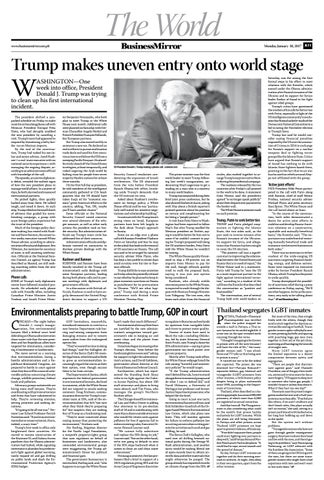
US President Donald J. Trump making a phone call.
Security Council resolution condemning the expansion of Israeli settlements. The US abstained from the vote before President Barack Obama left office, brushing aside Trump’s demands that the US exercise its veto. Asked about Kushner’s involvement on foreign policy, a White House official said he was “particularly well-suited for sensitive negotiations and relationship building.” In contrast with the Trump team’s strong views on Israel, European partners have been left largely in the dark about Trump’s approach to Russia. Some are on edge over a phone call with Russian President Vladimir Putin on Saturday and fear he may strike a deal that leads to the removal of US sanctions on Russia. The call was said to be arranged by national security adviser Mike Flynn, who has kept a low profile in recent days amid scrutiny over his ties to Russian officials. Trump did little to ease anxieties on Friday when he pointedly refused to say whether he planned to keep in place economic sanctions on Russia as punishment for its provocations in Ukraine. “We’ll see what happens,” Trump said during a news conference with British Prime Minister Theresa May.
Bloomberg News
The prime minister was the first world leader to meet Trump following last week’s inauguration, underscoring May’s eagerness to get a reading on a man who is a mystery to many world leaders. Trump was measured during their brief joint press conference, but he also showed flashes of charm, joking with May about a British reporter’s pointed question about his position on torture and complimenting her for being a “people person.” A visit from Peña Nieto to Washington had been expected to follow May’s. But after Trump needled the Mexican president on Twitter, saying it would be better for him not to come if he couldn’t commit to paying for Trump’s proposed wall along the US southern border, Peña Nieto told the White House he wouldn’t be coming. The White House quickly threatened to slap a 20-percent tax on imports from Mexico to pay for the wall, though officials quickly tried to walk the proposal back, saying it was just one option being considered. Kushner, who already wields enormous power in the White House, is expected to work through the dispute with Mexican Foreign Minister Luis Videgaray. The two men, who know each other from the financial
Environmentalists preparing to battle Trump, GOP in court
C
HICAGO—The night before Donald J. rump’s inauguration, five environmental lawyers filed a federal court brief defending an Obama administration clean-water rule that the new president and his Republican allies have targeted for elimination, considering it burdensome to landowners. The move served as a warning that environmentalists, facing a hostile administration and a Republican-dominated Congress, are prepared to battle in court against what they fear will be a wave of unfavorable policies concerning climate change, wildlife protection, federal lands and pollution. Advocacy groups nationwide are hiring more staff lawyers. They’re coordinating with private attorneys and firms that have volunteered to help. They’re reviewing statutes, setting priorities and seeking donations. “It’s going to be all-out war,” Vermont Law School Professor Patrick Parenteau said. “If you’re an environmentalist or conservationist, this is, indeed, a scary time.” Trump’s first week in office only heightened their anxieties. He moved to resume construction of the Keystone XL and Dakota Access pipelines that the Obama administration had halted, while signaling intentions to abandon his predecessor’s fight against global warming, vastly expand oil and gas drilling on public lands and slash the Environmental Protection Agency’s (EPA) budget.
GOP lawmakers, meanwhile, introduced measures to overturn a new Interior Department rule barring coal-mining companies from damaging streams and to remove some wolves from the endangered species list. “They’ve wasted no time in doing bad things,” said Pat Gallagher, director of the Sierra Club’s 50-member legal team, which he said is likely to grow as environmentalists increasingly regard the courts as their best option, even though success there is far from certain. The Department of Justice, which represents the federal government in environmental lawsuits, declined to comment, while the White House did not respond to emails seeking comment. Doug Ericksen, communications director for Trump’s transition team at EPA, said of the environmentalists that he’s “not sure what they think they’re preparing for” but suspects they are stoking fear of Trump as a fundraising tool. “They’re more concerned about raising money than protecting the environment,” Ericksen said. Jim Burling, litigation director for the Pacific Legal Foundation, a nonprofit property-rights group that sues regulators on behalf of businesses and landowners, also contended environmental groups were exaggerating the Trump administration’s threat for political and financial gain. The government bureaucracy is entrenched, Burling said, and, “who happens to occupy the White House
hasn’t made that much difference”. Environmentalists say their fears are justified by the new administration’s antagonism toward government’s role in keeping air and water clean and the planet from overheating. Donations began increasing after Trump’s election, “even before the fundraising letters were sent” asking for support to fight the administration’s actions, said David Goldston, government affairs director at the Natural Resources Defense Council. Earthjustice, which has represented the Standing Rock Sioux tribe in its fight against the Dakota Access Pipeline, has about 100 staff attorneys and plans to bring more aboard, said Tim Preso, who manages the group’s Northern Rockies office. The Chicago-based Environmental Law and Policy Center is adding four attorneys to its pre-election staff of 18 and is coordinating with more than a dozen outside attorneys who would file citizen suits against polluters for free if agencies fail to enforce existing rules, Executive Director Howard Learner said. “We cannot fully substitute and replace the EPA doing its job,” Learner said. “But on the other hand, we’re not going to default to zero if the EPA steps backward when it comes to clean air and clean water enforcement.” On inauguration eve, five law professors filed a brief in support of a 2015 regulation giving EPA and the Army Corps of Engineers discretion
to regulate tributaries and wetlands far upstream from navigable lakes and rivers to protect water quality. Dozens of states have sued to block the rule—including Oklahoma, led by state Attorney General Scott Pruitt, now Trump’s choice for EPA administrator—saying it gives government too much power over private property. Shortly after Trump took office, his White House webpage listed the rule among “harmful and unnecessary policies” he would target. “If the Trump administration won’t defend the rule, I want to stand alongside environmental groups and do what I can to defend [it],” said David Uhlmann, a University of Michigan law professor and former Justice Department prosecutor, who helped file the brief. Going to court is just one tactic environmental lawyers will use, said Erik Schlenker-Goodrich of the Oregon-based Western Environmental Law Center, which also plans new hires. They will monitor agencies for failure to enforce pollution law or cutting corners when writing permits for activities such as oil and gas drilling, he said. The Sierra Club’s Gallagher, who sued over oil drilling beneath national parks during the George W. Bush administration, said another tactic would be making liberal use of open-records laws to obtain scientific data and other materials that might otherwise be purged. The group already has requested records on climate change from the EPA. AP
circles, also worked together to arrange Trump’s surprise visit to Mexico during the presidential campaign. The readouts released by the two countries after Friday’s call pointed to the work to be done. A statement from Mexico said the presidents agreed “to no longer speak publicly” about their dispute over payment for the border wall. The White House statement made no such promise.
Trump, Putin to seek better ties
Trump and Putin pledged cooperation in fighting the Islamic State, the two sides said, as the pair seek to reverse tension after Russia’s invasion of the Ukraine, its support for Syria, and allegations that Russian hackers sought to sway the US election. “The positive call was a significant start to improving the relationship between the United States and Russia that is in need of repair,” the White House said in a statement. Putin told Trump he “sees the US as a most important partner in the fight against international terrorism,” according to a readout of the call from the Kremlin that described the conversation as “positive and businesslike.” The conversation, one of several Trump held with world leaders on
Saturday, was the among the first formal steps in his effort to reset relations with the Kremlin, which soured under the Obama administration after Russia’s invasion of the Ukraine and its support for Syrian leader Bashar al-Assad in his fight against rebel groups. Trump’s critics have questioned the wisdom of his calls for better ties with Putin, especially in light of the US intelligence community’s conclusion that Russia hacked e-mails of the Democratic National Committee in a bid to swing the November election in Trump’s favor. Trump has said he would consider easing financial penalties imposed by the US over the annexation of Crimea in 2014 in exchange for Russia’s support on a nuclear weapons deal or fighting terror groups like the Islamic State. Critics have argued that Russia’s support of Assad has nothing to do with Islamic State fighters based there, pointing to the fact that its air war has focused on rebels around Aleppo not affiliated with the group.
‘Active joint efforts’
Vice President Mike Pence participated in the call with Putin along with Bannon, chief of staff Reince Priebus, national security adviser Michael Flynn and press secretary Sean Spicer. The White House said the call lasted about an hour. “In the course of the conversation, both sides demonstrated a desire for active joint efforts to stabilize and develop Russia-American relations on a constructive, equitable and mutually beneficial basis,” the Kremlin said. “The importance was underlined of restoring mutually beneficial trade and economic ties between business on both sides.” There was no mention in either readout of the wide-ranging US sanctions targeting Russia’s banking, energy, and defense sectors. Some were imposed via executive order by former President Barack Obama, which Trump has the power to undo quickly. Trump downplayed the possibility of sanctions relief during a press conference on Friday, saying, “We’ll see what happens. As far as the sanctions, very early to be talking about that.” AP and Bloomberg News
Thailand segregates LGBT inmates
P
ATTAYA, Thailand—Theerayut Charoenpakdee was terrified when the police stopped her outside a mall in Pattaya, a Thai resort famous for its sordid nightlife. A urine test on the spot revealed meth coursing through her veins. “I thought I was going to be thrown in prison with all the men because I still have the title of Mr.,” the transgender woman said. “I was afraid. News and TV tells us that being sent to prison is scary.” It turned out not to be the ordeal she expected. The prison she was destined for—Pattaya Remand— separates lesbian, gay, bisexual and transgender (LGBT) prisoners from other inmates, a little-known policy despite being in place nationwide since 1993, according to the Department of Corrections. Thailand, often described as a haven for gay people, has around 300,000 prisoners, of which more than 6,000 are registered as sexual minorities. And that’s not all. The Thai government is also considering what could be the world’s first prison facility exclusively for LGBT inmates. While the plans are still being discussed, in Pattaya and other prisons across Thailand LGBT prisoners are kept apart to prevent violence, officials say. “If we didn’t separate them, people could start fighting over partners to sleep with,” said Pattaya Remand Warden Watcharavit Vachiralerphum. “It could lead to rape, sexual assault and the spread of disease.” By day, Pattaya LGBT inmates eat together and do their morning exercises in uniform. At night, they sleep in their own quarters, apart from the other inmates.
But most of the time, they mingle freely with the others, though they tend to stick together for daytime activities like sewing or football. Transgender women spike volleyballs next to men pressing barbells and sparing with punching bags; gay men train together in first aid at the jail clinic, sanitizing and bandaging the wounds of straight men. Ma ny LGBT i n m ates ag ree the limited separation is a decent compromise between safety and segregation. “There are people that discriminate against gays,” said Chawalit Chankiew, one of the gay clinic workers, sentenced to nine years for document forgery. “If I happen to sleep next to someone who hates gay people, I wouldn’t know it unless they show it. What if they hurt me one day?” Theerayut says the prison’s segregation makes her one-and-a-half-year sentence more bearable. “If we behave like others, if we aren’t stubborn and don’t break rules, this place actually isn’t so vicious,” she said, sitting in a prison yard fenced with barbed wire, her long hair bobbing up and down as she spoke. But the system isn’t without problems. “Transgender women who have not gone through gender reassignment surgery, they have to shave their head and live with the men, and there’s going to be problems,” says Wannapong Yodmuang, an LGBT advocate with the Rainbow Sky Association. “Some of them are going to be OK living with the men, but there are some transgender women who might have a bad experience with men and won’t want to live with them.” AP