BMReports
‘Capitalism with a heart’ v. 3.0 gains more advocates in PHL By Rizal Raoul S. Reyes |
@rizreyes
Conclusion
O
NE man is shrugging off the superb performance of the Philippine economy: Antonio S. Yap.
A fisherman works on his boat in Negros Occidental. According to Antonio S. Yap, founder of the Benita & Catalino Yap Foundation (BCYF), one of the environments individuals must be exposed to is the environment where the poor engage in, so that they can contribute to building a corporate social responsibility ecosystem. NONIE REYES
media partner of the year
United nations
2015 environmental Media Award leadership award 2008
Continued on A2
BusinessMirror A broader look at today’s business
www.businessmirror.com.ph
n
Wednesday, January 24, 2018 Vol. 13 No. 105
E
@cuo_bm
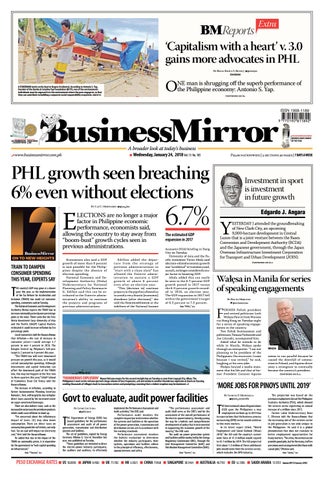
lections are no longer a major factor in Philippine economic performance, economists said, allowing the country to stay away from “boom-bust” growth cycles seen in previous administrations.
TRAIN to dampen consumer spending this year, experTs say
T
he country’s GDP may grow at a slower pace this year, as the implementation of the Tax Reform for Acceleration and Inclusion (TRAIN) law could cut consumer spending, economists said on Tuesday. The National Economic and Development Authority (Neda) expects the TRAIN law to increase commodity prices by one percentage point at the most. Think tanks like the First Metro Investment Corp.-University of Asia and the Pacific (UA&P) Capital Markets estimated it could increase inflation by 0.6 percentage point. Local economists told the B usiness M irror that inflation—the rate of increase in consumer prices—could average 3.7 percent to over 4 percent in 2018. The Bangko Sentral ng Pilipinas’s full-year target is 2 percent to 4 percent this year. “The TRAIN law will exert downward pressure on growth this year, as it would curtail consumption spending. Although investments and capital formation can offset the downward push of the TRAIN law, this may not happen in the first two to three quarters this year,” UA&P School of Economics Dean Cid Terosa told the B usiness M irror. The increase in inflation, according to former Socioeconomic Planning Secretary Romulo L. Neri, will largely be due to higher direct taxes caused by the increased excise on sugar-sweetened beverages. There are also indirect taxes, such as the increased in excise taxes for petroleum products which could cause inflation to shoot up. “I’m concerned about the inflationary impact of taxes. [It] may slow down consumption. There are direct taxes on consumption goods like soft drinks, not only fuel. Tax on coal will impact on electricity cost,” Neri told the B usiness M irror. He added that due to the impact of the TRAIN on commodity prices, it is imperative for the government to “rush capital spending on infrastructure.” See “Train,” A2
Economists also said a GDP growth of more than 6 percent is now possible for the Philippines despite the absence of election spending. National Economic and Deve lopment Aut hor it y ( Ned a) Undersec ret a r y for Nat ion a l Planning and Policy Rosemarie G. Edillon said this can be attributed to the Duterte administration’s ability to continue the projects and programs of previous administrations.
E d i l lon ad de d t he de p a r ture from the strateg y of pre v iou s ad m i n i st rat ion s to “st a r t w it h a c lea n sl ate” h a s a l lowed t he D uter te ad m i ni s t r at i o n t o s u s t a i n a G DP g r o w t h o f a b o v e 6 p e r c e nt e ven a f ter a n e lec t ion yea r. “This [decision to] continue projects in the pipeline allowed us to avoid a very drastic [economic] slowdown [after elections],” she told the BusinessMirror at the sidelines of the National Income
6.7% The estimated GDP expansion in 2017
Accounts (NIA) briefing in Pasig City on Tuesday. University of Asia and the Pacific economist Victor Abola said election-related economic growth was “accidental” or transitory and, as such, no longer considered a major factor in boosting GDP. Abola added this can easily be seen in the 6.7-percent GDP growth posted in 2017 versus the 6.9-percent growth recorded in 2016, an election year. The GDP expansion in 2017 fell within the government’s target of 6.5 percent to 7.5 percent. See “PHL,” A2
‘Thunderous explosion’ Mayon Volcano erupts for the second straight day on Tuesday as seen from Legazpi City, Albay. The
Philippines’s most active volcano ejected a huge column of lava fragments, ash and smoke in another thunderous explosion at dawn on Tuesday, sending thousands of villagers back to evacuation centers and prompting a warning that a violent eruption may be imminent. AP
Govt to evaluate, audit power facilities By Lenie Lectura
T
@llectura
he Department of Energy (DOE) has issued guidelines for the performance assessment and audit of all power generation, transmission and distribution systems and facilities. The set of guidelines, signed by Energy Secretary Alfonso G. Cusi in December last year, was published on Tuesday. “These guidelines are intended to direct the electric-power industry participants, the auditors and auditees, to effectively
PESO exchange rates n US 50.8350
implement the Performance Assessment and Audit activities,” the DOE said. Per formance audit involves the complete inspection to determine whether the systems and facilities in the operation of the power generation, transmission and distribution sectors are in accordance with the existing standards. Per formance assessment involves the holistic evaluation to determine whether the industry participants, their systems, operations and facilities adhere to the principle of efficiency, effectiveness, appropriateness and safety.
“The performance assessment and audit shall serve as the DOE’s tool for the assessment of the overall performance of the electric-power industry, thereby paving the way for a holistic and comprehensive development of policy that is instrumental in supporting the economic growth of the country,” the DOE said. The audit on power-generation system and facilities will be conducted by the Energy Regulatory Commission (ERC), through the Grid Management Committee (GMC) and Distribution Management Committee (DMC). See “Govt,” A2
business news source of the year
P25.00 nationwide | 5 sections 30 pages | 7 days a week
PHL growth seen breaching 6% even without elections By Cai U. Ordinario
2016 ejap journalism awards
Investment in sport is investment in future growth Edgardo J. Angara
Y
esterday I attended the groundbreaking of New Clark City, an upcoming 9,000-hectare development in Central Luzon that is a joint venture between the Bases Conversion and Development Authority (BCDA) and the Japanese government, through the Japan Overseas Infrastructure Investment Corporation for Transport and Urban Development (JOIN). Continued on A11
Wałęsa in Manila for series of speaking engagements By Recto Mercene @rectomercene
F
or mer Polish president and retired politician Lech Wałęsa flew in from Warsaw via Hong Kong on Tuesday night for a series of speaking engagements in the country. Two Polish businessmen and politicians, Tomasz Turkowski and Jan Litynski, accompanied him. Asked what he intends to do while in Manila, Wałęsa spoke through an interpreter: “I am not planning to be president of the Philippines. Our era is over. I come because I was invited,” he said, laughing at his own joke. Wałęsa fancied a media statement that his life and that of former President Corazon Aquino
Wałęsa
seems to run parallel because he caused the downfall of communism in Poland, and Aquino drove away a strongman to eventually become the country’s president. Continued on A12
‘MORE JOBS FOR PINOYS UNTIL 2019’ By Samuel P. Medenilla @sam_medenilla
T
he International Labour Organizations (ILO) gave the Philippines a rosy employment outlook up to 2019 due to expectations that the business-process outsourcing (BPO) sector would continue to hire more workers. In its latest repor t titled, “World Employment and Social Outlook [Weso] 2018,” the ILO said the country’s current work force of 41.9 million would expand to 43.7 million by 2019. The ILO projected that about 1.5 million of these additional jobs would come from the services sector, which includes the BPO industry.
The projection was based on the previous employment data of the Philippine Statistics Authority (PSA), which showed the services sector registering an annual increase of a million since 2015. Former Labor Undersecretary Rene E. Ofreneo told the B usiness M irror that the increasing role of the services sector in job generation is not only unique to the Philippines. He said it is a global phenomenon that does not translate to better employment opportunities for many workers. “For a few, the services sector provides good jobs, but for the many, it offers precarious work arrangements like those with casual jobs,” Ofreneo said.
n japan 0.4582 n UK 71.1182 n HK 6.5023 n CHINA 7.9368 n singapore 38.5464 n australia 40.7392 n EU 62.3186 n SAUDI arabia 13.5553
See “Jobs,” A2
Source: BSP (23 January 2018 )
A2 Wednesday, January 24, 2018
BMReports BusinessMirror
‘Capitalism with a heart’ v. 3.0 gains more advocates in PHL Continued From A1
The founder of the Benita & Catalino Yap Foundation (BCYF) believes determining if socialdevelopment schemes benefit desired stakeholders go beyond the GDP. Government economists on Tuesday said the “performance of the Philippine economy remains on target, hitting a solid 6.6-percent growth rate in the last quarter of 2017.” “ T h i s st a ble p e r for m a nce br ings our f u l l-year grow th in 2017 to 6.7 percent—a strong finish that keeps our position as one of the fastest-grow ing economies in A sia, after China’s 6.9 and Vietnam’s 6.8 percent,” Socioeconomic Planning Secretar y Er nesto M. Per nia said in a news br iefing. However, for Yap, relying on the tool to measure the economy has shown the GDP rate is not adequate as a barometer of growth and social progress. Although using GDP remains useful, it is commonly known that economic growth is just one element of development, he said. Nowadays, “happiness” and “wellbeing” are also used as metrics in measuring development.
Todaro’s view
YAP’S views mirror that of economist Michael Todaro’s. According to Todaro, economic development is a “broad term that does not have a single, unique definition.”
Govt...
Continued from A1
The Philippine Electricity Market Corp. (PEMC), through its Enforcement and Compliance Office and Market Surveillance Committee, will also be involved in the audit to check the compliance of generators with the Wholesale Electricity Spot Market rules. The audit on transmission system and facilities will also be conducted by the GMC and PEMC. The National Transmission Corp. and the Power Sector Assets Liabilities and Management Corp. will audit the performance of the transmission network provider and system operator. The GMC and DMC, once again, will be involved in the audit of distribution systems and facilities. They will be assisted by the National Electrification Administration with respect to the electric cooperatives’ overall performance. The audit reports must be submitted to the DOE and ERC within seven days after the completion of the audit report. The DOE
Todaro specified three objectives of development, namely, life-sustaining goods and services; higher incomes and freedom to make social and economic choices. Life-sustaining goods and services refer to expanding the availability and giving wider access to the distribution of basic life-sustaining goods, such as food, shelter, health and protection. Higher incomes seek to raise the standards of living, including higher incomes, employment, qua lit y education and big ger emphasis on cultural and human values, all aiming not only to boost material well-being but also to create greater individual and national self-esteem. Freedom to make economic and social choices aims to broaden the range of economic and social choices available to individuals and nations by extricating them from the shackles of servitude and dependence from people and nation-states but also against ignorance and human misery.
Yap’s plans
ACCORDING to Yap, supporting the government in its role to make the GDP meatier are groups like the BCYF. And the man has big plans. For one, he said, the BCYF will provide assistance to depressed areas to uplift their economic status through a “social development area” or SDA-building strategy. This refers to the BCYF will then evaluate all audit. It may tap a third-party entity to assist the agency in the evaluation. The DOE, with the Performance Assessment and Audit Task Forces, will prepare a recommendation to address assessment findings in order to attain the objective of the energy-related laws and may develop policies.
Energy contracting
The DOE has also adopted a simpler and faster method for awarding petroleum service contracts (PSCs). Under Department Circular 2017-12-0017, the DOE adopted the Philippine Conventional Energy Contracting Program of PSCs via nomination through publication to facilitate the acceptance of applications for PSCs from interested applicants at any given time. This method, said the DOE, is deemed to be more responsive if the development of the country’s petroleum resources is to be intensified. Based on the circular, the selection process in the awarding of PSCs to qualified applicants shall be conducted either through
concept of a geographical area where a “social development intervention”—social enterprise, socia l business, polic y work, etc.—will result in a significant impact to the area’s economy within the next 10 years. Yap added the BCYF is not concentrating on economic gains, but on the holistic picture. This is in line with the group’s objective of being people-centered and focused on enhancing human dignity. He noted that academe can be a vital partner in developing a pool of dedicated agents of social change. To achieve this goal, the sector must be pushed to craft a so-called corporate social responsibility (CSR) ecosystem. This ecosystem, he said, is where the personal transformation of a young individual from regular volunteer to a purpose-driven individual is going to be molded.
Joy of volunteerism
THE Merriam-Webster dictionary refers to volunteerism as the “act or practice of doing volunteer work in community service.” Volunteering is also defined as a giving of time and energy for the benefit of society and the communit y, the env ironment or i nd iv idu a l s out side one’s immediate family. More important, volunteerism is done freely and by choice, with the indiv idual not ex pecting any monetary gain. As far as the BCYF is concerned, Yap said, volunteerism aims to applicants’ nomination and publication of areas of interest, or the DOE itself may publish identified petroleum areas that are not covered by any application for nomination. The applicant maybe a local or foreign firm. In case two or more applicants are interested in the same area, the highest-ranked applicant who meets the legal, technical and financial requirements shall be selected. The Philippine National Oil Co.(PNOC) or the PNOC-Exploration Corp. (PNOC-EC) will have the option to participate in the PSCs. “An option shall be reserved for PNOC, or PNOC-EC for a maximum of 10 percent participating interest in a proposed PSC involving one or more Filipino participant or a maximum of 15 percent participating interest in a proposed PSC involving no Filipino participant,” the circular read. Last year DOE Assistant Director Ismael Ocampo said the areas that could be offered under the new scheme include parts of the West Philippine Sea, Sulu Sea and areas around Palawan province. The DOE is hoping that another Malampaya will be discovered.
make changes for the common good through the collective efforts of people working with the same vision and objective. Yap emphasized that more than volunteers, the Philippines needs “change-makers” to help society achieve relevant and significant change. Change-makers are people who contribute to the field of making a positive difference in society, he explained. More often than not, their desire is triggered by an experience with volunteerism. The BCYF Volunteer Development Program (VDP) is run by the Volunteer Matching Exchange. The VDP is aimed at forming what BCYF calls as “Volunteers with a Purpose.” Yap believes that a volunteer doesn’t only require an individual “to do good.” This should be complemented by serving with a purpose that should be also effective and sustainable, he said. For BCYF, Yap added they ensure the volunteers should strive to be practitioners of CSR 2.0, which he describes as “transformative social responsibility.” These are actions that serve the common good, Yap explained. But, more important, as individuals, Yap said volunteers pursue a lifestyle of CSR 3.0
Social enterprise
FOR Yap, BC Y F ’s Socia l Development Model identifies social enter pr ises as t he agents of development in societ y.
Train...
“Social enterprises can be effective multipliers of social progress,” Yap explained. “They are businesses that have integrated a social objective in their operations.” An enterprise must have an a priori commitment to a particular social objective, he added. In order for an individual to absorb the essence and lifestyle of CSR, Yap said, the individual must be exposed to an environment that supports such a lifestyle. “Doing so gives way to the development of the CSR ecosystem,” he added. For BCYF, this ecosystem is composed of the group’s programs to provide a holistic experience of CSR 3.0 (citizenship, sustainability and social responsibility). Yap said schools, colleges and universities will have a special role in enhancing the CSR ecosystem because they are in the top position to mold an individual in his or her formative years. As he or she matures, Yap said, the person is equipped with the tools and foundation to help pursue the common good. He added that through research, the BCYF can “strengthen the effectiveness of initiatives as opposed to simply relying on anecdotal evidence.” “We believe that individuals can progress through volunteerism with a purpose,” the BCYF said. “Once done sustainably, this can lead to [CSR 3.0-based] social enterprises, which can multiply progress in society.”
Continued from A1
Socioeconomic Planning Secretary Ernesto M. Pernia assured that this will happen since 2018 is being envisioned as a defining year for the Duterte administration’s “Build, Build, Build” program, as well as the 75 flagship projects since many of these will break ground in 2018. “[These will] probably [have an impact of] one to two percentage points in the growth rate. That’s possible. In other words, our growth targets of 7 percent to 8 percent will be more feasible,” Pernia said. The only downside to the implementation of these projects is worsening traffic, especially in cities and municipalities where big-ticket projects will be rolled out. However, Pernia said, the program will also increase capital formation, which also represents public and private construction, and boost GDP this year. The Neda chief added the projects that will be implemented this year will also increase employment opportunities for Filipinos. This, coupled with the reduction in personal-income tax, will increase the income of 99 percent of Filipino taxpayers. “In the next quarter, we see the domestic demand picking up as household consumption will likely improve, following the recently approved tax-reform package, which will result in higher take-home pay for 99 percent of Filipino taxpayers. Household consumption is also seen to benefit from expanded employment opportunities from the Build, Build, Build program,” Pernia said. He added the government will ensure that the ill effects of the TRAIN and the infrastructure program will be kept under control through the provision of safety nets and other reforms. Pernia said that, in terms of keeping commodity prices in check, benefits from the salary-standardization law (SSL) will help boost incomes and the cash assistance to the bottom 50 percent of families will help combat the inflationary impact of the TRAIN. Other measures to keep commodity prices low include the tarrification of the quantitative restrictions on rice imports, where the tariff revenues can be used to channel better extension services to farmers, thereby making them more resilient. “This will improve the investment climate in the sector by eliminating policy uncertainty, thereby enabling farmers and farm operators to decide based on market and geophysical conditions,” Pernia said.
“The expected outcome is a substantial reduction in the retail price of rice, and the higher and more stable income of farmers,” he added. In terms of addressing the traffic situation, Pernia said agencies, such as the Metropolitan Manila Development Authority, are ready to provide rerouting schemes that will help motorists avoid choke points caused by infrastructure projects. He added the government would also encourage flexible working arrangements in the country to reduce the number of workers traveling to and from cities like Metro Manila to ease congestion.
GDP growth
The Philippine Statistics Authority announced on Tuesday that the country posted a GDP growth of 6.7 percent in 2017. In the fourth quarter alone, the economy expanded by 6.6 percent. Among the major economic sectors, industry recorded the fastest growth of 7.3 percent in the October-to-December period. It also posted the highest annual increase of 7.2 percent in 2017. The growth was buoyed by the manufacturing sector, which grew by 8.8 percent in the fourth quarter of last year and 8.6 percent in 2017. However, the construction industry expanded by 2.8 percent in the fourth quarter of 2017, slower than the 10.7 percent recorded in 2016. This caused fixed capital to grow slower at 9.3 percent during the period, from the previous year’s 18.5 percent. For the whole of 2017, fixed capital growth of 9 percent was slower than the 23.7 percent recorded in 2016. Services expanded by 6.8 percent in the fourth quarter and 6.7 percent in 2017. These were slower than the 7.2-percent and 7.4-percent increases posted by the sector in the fourth quarter and full-year 2016, respectively. The main culprit for this, Pernia said, was miscellaneous services under which the business-process outsourcing industry is categorized. He noted that the BPO sector has already reached its “saturation point.” “We can take this as an indication that the current market profile of the BPO sector is ripe to move into higher value-added services,”he said. The laggard among the production sectors was agriculture which only recorded a 2.4-percent growth in the fourth quarter and 3.9 percent in 2017. Cai U. Ordinario
www.businessmirror.com.ph
Jobs...
Continued from A1
Wo r ke r s u n d e r a p r e c a r i o u s o r vulnerable work arrangement are usually poorly paid, have no social-security protection and unprotected by labor laws. It includes contractual workers. The ILO said the number of vulnerable workers in the country will grow from 14.9 million to 15.4 million by next year. Ofreneo added both the private and the public sector should prevent the proliferation of “precarious work.” No less than the ILO acknowledged this trend in its Weso 2018 report. “In some Asian countries, such as China, Vietnam, Bangladesh and the Philippines, the expansion of the services sector, coupled with the proliferation of global supply chains and reforms that liberalized the labor markets, gave rise to the spread of temporary work in the region,” the ILO said. The ILO attributed this to the slow pace of creation of “high value added” s e c to r s i n t h e A s i a - Pa c i f i c re g i o n , where workers with precarious work could transfer to could enjoy better working conditions. It, however, noted of the gains in many countries in the region to raise wage rates in their region to reduce t h e n u m b e r o f wo r ki n g p ove r t y i n their jurisdic tion. The ILO said the Asia-Pacific region will face the greatest challenge of reducing the number of workers in precarious work as it becomes one of the top job generators in the world.
PHL...
Continued from A1
“We can easily grow 6.5 percent even without elections moving forward,” Abola told the B usiness M irror. “We’re not overheating and we’re making better use of our resources, that is why the Philippines is growing at a faster pace.” The country’s dependence on election spending to boost economic growth has given rise to the so-called boom-andbust cycles. Boom growth occurs during election years, while bust growth occurs in nonelection years. During election years, consumption spending—a major growth driver—grows faster as politicians purchase more goods and services to run their campaigns. Ateneo de Manila University EagleWatch senior research fellow Alvin Ang said the Philippines has already escape the boom-bust cycle of economic growth as early as 2000. Proof of this, Ang said, is the fact that the 2009 global financial crisis did not severely affect Philippine economy. In his speech at the NIA briefing, S o c i o e c o n o m i c P l a n n i n g S e c re t a r y Ernesto M. Pernia said that, for the past eight quarters, growth has been stable at above 6 percent or better. Growth only slowed to 6.7 percent in 2017, from 6.9 percent in 2016. In previous election years, such as in 2004 and 2005, from an average growth of 6.7 percent in 2004, growth slowed to 4.8 percent in 2005. The same thing happened in 2010 and 2011. From an average growth of 7.6 percent in 2010, growth slowed to an average of only 3.7 percent. “You can see that our decline is really very moderate at 0.2 percent of one percentage point. To me, this is a good performance, given the fact that it is already normal for post-election years to witness a decline in economic growth,” Pernia said. However, in order to maintain the country’s current economic position, Edillon said succeeding administrations must continue the projects and programs of the Duterte administration. To this end, Edillon said, the Neda is planning to continue project approvals to allow the next administration to “hit the ground running” and ensure national projects would be implemented and would contribute to economic growth. Edillon added the current administration benefited from the approvals of the Neda Board toward the end of the previous administration in terms of building up the pipeline of projects to be implemented. I n Nove m b e r 2 0 1 6 t h e D u te r te administration launched the “Build, Build, Build” (3Bs) program which included 70 road, bridge, railway, bus-rapid transit projects, to the Philippines’s first subway, among others. The list of projects in the 3Bs included unfinished projects that were began by previous administrations.
Economy
A4 Wednesday, January 24, 2018 • Editors: Vittorio V. Vitug and Max V. de Leon
BusinessMirror
www.businessmirror.com.ph
Court orders govt to answer petitions against TRAIN law implementation
T
By Joel R. San Juan
@jrsanjuan1573
HE Supreme Court (SC) has directed the Palace, the Senate and the House of Representatives to answer the two petitions questioning the constitutionality of Republic Act 10963, or the Tax Reform for Acceleration and Inclusion (TRAIN) law.
At a news briefing, SC Spokesman Theodore O. Te said the 15man High Tribunal issued the directive during its regular en banc session on Tuesday. S p e c i f i c a l l y, Te s a i d t h e magistrates gave the respondents a period of 10 days to submit their comments on the petitions and the applications for temporar y restraining order (TRO). T he Cour t a lso directed the consolidation of the second petition filed by the Laban Konsumer Inc. on Monday, through its president Trade Undersecretar y Victor A . Dimag iba,
to the first petition filed by part y-list Representatives A ntonio L . Tinio of ACT Teachers, C a r l o s T. Z a r at e o f B a y a n Muna and A r iel B. Casilao of A na kpaw is. Aside from assailing the constitutionality of TR AIN, both petitions are seeking the issuance of TRO to immediately enjoin its implementation. I n it s 4 0 - p a g e p e t it io n , Laban Konsy umer Inc. assailed the imposition of excise ta xes on p e t rol e u m p ro du c t s a nd coa l under the new ta x measure, claiming that this wou ld f ur ther br ing dow n those be-
long ing to the low income and poor families, whose resources are extremely finite for their subsistence. “The increase and/or imposition of excise taxes on coal, liquefied petroleum gas [LPG], diesel and kerosene are clearly violative of the basic principles and inherent limitations on Philippine taxation,” the petitioners said. T he g roup f ur t her a rg ued that the TR AIN law also violates due process, and equa l protection clause, as the “exorbitant excise taxes on basic commodities stand to greatly impact and impose heav y financial burden on low-income and poor families.” It branded TRAIN law as “inequitable and regressive,” insisting that taxation is equitable only when its burden falls on those who can afford to pay. “If the TRAIN law is truly the biggest gift of the government to the Filipinos, then by all means, the provisions, thereof, should muster the test as to its reasonabi lit y and propr iety, particularly in relation to the segment of our society whose voice we have long forgotten— the majority of the Filipinos who have less in life and, incidentally,
If the TRAIN law is truly the biggest gift of the government to the Filipinos, then by all means, the provisions, thereof, should muster the test as to its reasonability and propriety particularly in relation to the segment of our society whose voice we have long forgotten—the majority of the Filipinos who have less in life, and incidentally, those who may not fully understand the full extent of the TRAIN law.”—Laban Konsumer Inc.
those who may not fully understand the f u l l ext e n t o f t h e T R A I N l a w ,” the petition read. Named respondents in the petition were Executive Secretary Salvador C. Medialdea, Finance Secretary Carlos G. Dominguez III, Internal Revenue Commissioner Caesar R. Dulay, House Speaker Pantaleon D. Alvarez and Senate President Aquilino L. Pimentel III. TR A IN, sig ned into l aw by President Duter te last D e c e m b e r 19, w a s t he f i r s t p a c k a ge of t he go v e r n me nt ’s prop ose d Compre he n s ive Ta x R e for m P ro g r a m , s e e n ge ne r at i n g a d d it ion a l re v e nue t o f u n d t h e c o u n t r y ’s i n v e s t me nt re q u i re me nt s . On the other hand, the first petition argued that the TR AIN should be struck down for having been ratified by the House of Representatives and enacted by the President in violation of the House Rules and the 1987 Constitution. The petitioners said that the respondents committed grave abuse of discretion when they ratified the final bicameral conference committee report on the night of December 13, 2017, despite lack of quorum necessary to vote on its passage.
The petitioners noted that Section 16 (2), Article VI of the 1987 Constitution and Section 75 of Rule XI of the House Rules mandate the House to comply with the quorum requirement of majority of the House membership before they can do any legislative business. T he pet it ioners, howe ver, claimed that around 280 out of the total 295 members of the House were absent during the ratification stage. Aside from lack of quorum, the petitioners added that the second equally important requirement, which is the majority vote, was also not met. They said that the requirements of quorum and approval of bills are constitutional mandates. Likewise, the petitioners insisted that there was also grave abuse of discretion on the part of the President when he enacted the TR AIN bill, which was not validly passed by Congress. Named respondents were President Duterte, Alvarez, Deputy Speaker Raneo E. Abu, Majority Floor Leader Rodolfo L. Fariñas Sr. and Deputy Majority Leader Arthur R. Defensor Jr. The respondents in the second pet it ion a re Med i a ldea , Dom i ng ue z , D u l ay, A lv a re z , and Pimentel.
ERC’s Devanadera gathers power consumer feedback on PSA, CSP By Lenie Lectura
T
@llectura
he Energ y Reg u lato ry Commission (ERC) is reaching out to consumers through a series of meetings with various consumer groups to discuss various issues related to the competitive selection process (CSP) and the pending applications for power-supply agreements (PSAs) filed by the Manila Electric Co. (Meralco). ERC Cha ir man A g nes VST Devanadera conducted a dialogue on January 19 with some consumer groups to listen to their issues. “This consumer dialogue started from a simple conversation and has now developed into a forum where we can discuss the consumers’ issues and concerns on electricity matters. We will take their issues into consideration, but we also have to manage their expectations considering the fact that there is already a pending case before the Supreme Court on CSP,” Devanadera said. T he meeting was attended by representatives from the Freedom from Debt Coalition (FDC) and United Filipino Consumers and Commuters (UFCC), particularly Erwin Puhawan of FDC,
Romeo Junia of UFCC and FDC, and Mark Tecson, Rodolfo Javellana Jr. and Uriel Borja of UFCC. The ERC said the groups provided various documents to the agency. Among these are proposals on how to bring down electricity rates. They also requested Devanadera to reply on their position papers. According to the agency, there will be similar fora to dwell on the performance-based regulation and other regulatory concerns. On January 15 the consumers groups, together with some civil-society organizations, staged a rally in front of the ERC Office. Devanadera invited them to her office to listen to their grievances. She then proposed that subsequent meetings be held to thresh out their issues and concerns. “This is a positive development and this is just the first of the many forums to be held of this kind. Our doors are open and we expect that the consumer groups will go along with these forums with an open mind and understanding that each of us has a role to play in order to have checks and balances in our regulatory system,” the ERC official said.
SC lifts TRO on release of 700K motor vehicle plates
T
HE Supreme Court (SC) on Tuesday lifted the temporary restraining order (TRO) it issued in June 2016, e joining the release of 300,000 pairs of license plates for motor vehicles and 400,000 plates for motorcycles earlier seized by the Bureau of Customs (BOC) and donated to the Land Transportation Office (LTO) last April. SC Spokesman Theodore O. Te said the order was issued during the 15-man regular en banc session, as the Court ruled to dismiss the petition filed by Party-list Rep. Jonathan de la Cruz of Abakada Rep. and Gustavo Tambunting of the Second District of Parañaque, questioning the legality of the BOC’s move to donate the plates to the LTO. The petitioners argued that the confiscated license plates can’t be donated to the LTO by the BOC in view of the notice of disallowance issued by the Commission on Audit (COA) on LTO Motor Vehicle License Plate Standardization Program (LTO-MVLPSP). In a resolution issued on June 14, 2016, the Court stopped the LTO and the Department of Transportation and Communications, which was later renamed Department of Transportation (DOTr), from distributing license plates which may be subsequently turned over by the BOC in connection with the LTO-MVLPSP. I n l i f t i n g t h e T RO, t h e Court unanimously declared as constitutional the use of the appropriation under the Motor Vehicle Registration and Driver’s Licensing Regulatory Services in the General Appropriations Act of 2014 for the implementation of the LTO-MVLPSP of the DOTr. “The Court ruled that the 2014 GAA included an appropriation for the program and the use of the appropriation is constitutional,” Te announced. Te added the Court took into consideration two issues raised in the petition: Whether the 2014 GAA included an appropriation for the MVLPSP and whether the use of the 2014 appropriation was constitutional. The Court noted that it already ruled in the case of Jacomille v. Abaya on April 22, 2015, on the legality of the procurement of the MVLPSP intended to supply the new license plates for both old and new vehicle registrants. The program, which shall run from July 2013 to June 2018, has a budgetofP3.8billionfortheprocurement of license plates for 5,236,439 motor vehicles and 9,968,017 for motorcycles nationwide. The DOTC has awarded the project to the joint venture of Netherlands-based J.Knieriem B.V. Goes and local company Power Plates Development Concepts with the contract being signed on February 21, 2014. The DOTr and the LTO said the project involved adding safety features to license plates, such as tamper-resistant locks and bolts and reflectorized sheeting. In the said ruling, the Court agreed with the Office of the Solicitor General that the controversy has been rendered moot by the passage of the 2014 GAA. Whatever defects attended the procurement, the SC said, had been cured by the appropriation in the 2014 GAA of the full amount. The Court noted that, while Jacomille’s petition focused on the legality of the procurement of the MVLPSP in consideration of the insufficient funding of the project under the 2013 GAA,it neverthelessdeterminedthatthe2014 GAA contained appropriation for the MVLPSP amounting to P4.8 billion , thus, could be implemented using the funds under the 2014 GAA. Joel R. San Juan
Agriculture/Commodities BusinessMirror
www.businessmirror.com.ph
Editor: Jennifer A. Ng • Wednesday, January 24, 2018
A5
Rice output in H1 seen exceeding 8.7 MMT Fish prices decline sharply in Cebu City–PSA report
S
elected fish species sold in Cebu City recorded the steepest drop in prices in the second week of January, according to data from the Philippine Statistics Authority (PSA). In its latest report, the PSA noted that the price of alumahan fell by P220 per kilogram (kg) in Cebu City. The price of bangus sold in Cebu also declined by P80 per kg. “The price of alumahan per kg was higher by P40 in Butuan City and by P10 in Cabanatuan City, Tacloban City and Cotabato City. Price fell by P220 in Cebu City, by P40 in Zamboanga City and by P2.50 in the National Capital Region [NCR],” the PSA report read. “Price increment of P10 per kg of bangus was noticed in Batangas City and Cotabato City. On the contrary, the price dropped by P80 in Cebu City, by P20 in Zamboanga City and Butuan City and by P10 in Baguio City and Cabanatuan City,” it added. The PSA also noted varied price movements for indicator vegetables, such as ampalaya, carrots and eggplant, in selected regional centers. For ampalaya, the PSA noted that price increases ranged from P10 to P40 per kg in seven regional centers. Price cuts of P10 and P20 per kg of cabbage were noted in six regional centers, the PSA said. “The price of a kilogram of carrots rose by P20 in Butuan City. Meanwhile, prices were reduced from P10 to P30 in 11 regional centers. Price markups for eggplant ranging from P10 to P30 per kg were posted in 10 regional centers,” the PSA report read. Data from the PSA showed the
price per kg of habichuelas went up by P20 in Butuan City and by P10 in Cebu City. In contrast, habichuelas was cheaper by P40 per kg in Batangas City, by P20 in Iloilo City and by P10 in Tuguegarao City. “A kilogram of pechay native went up by P20 in Naga City; by P10 in Batangas City and Butuan City; and by P5 in Zamboanga City. It was, however, priced lower by P40 in Iloilo City and by P5 in NCR and Tuguegarao City,” the report read. As for meat products, the PSA noted upward price adjustments for poultry meat and beef in selected trading centers. “In Cagayan de Oro City price for beef lean meat moved up by P10 per kg. Compared to previous week’s levels, a kilogram of dressed chicken during the week went up by P15 in Cotabato City and by P3 in Cagayan de Oro City. Meanwhile, it went down by P10 in NCR,” the report read. The PSA said selected regional centers exhibited varying price adjustments in fruits. For instance, the price of banana sold in Cotabato City rose by P1 per kg, but it was cheaper by P5 in Kidapawan City. “Price markup of P10 per kg of calamansi was registered in Zamboanga City. Meanwhile, it dropped by P10 in both Batangas City and Cotabato City. The price per kg of mango gained by P10, P20 and P30 in five regional centers. However, it went down by P20, P30 and P50 in another five regional centers,” the PSA report read. As for milled rice, the PSA said few trading centers exhibited price changes during the second week of January.
Russia expands global reach of wheat sales with surge in Sudan
Andrey Rudakov/Bloomberg
R
ussian wheat exports are expanding further across the globe as the world’s biggest shipper edges out competitors. In the latest example, its shipments to Sudan have jumped 87 percent so far this season, turning the African country into the seventh-largest customer for Russian wheat, Institute for Agricultural Market Studies figures show. Sudan imported no Russian wheat until 2014, when millers decided the grain met their quality requirements, according to the country’s embassy in Moscow. Such shifts among consumers, along with a third straight bumper crop and a weakened ruble, have allowed Russia to send wheat grown in the Black Sea region to markets as far away as Indonesia. That’s cut into the market shares of traditional suppliers, including the United States, the European Union and Australia. “Competitiveness of Black Sea origin is the main reason Russian wheat has displaced Aussie origin into Sudan,” said Tom Basnett, general manager at commodity consultant Market Check in Sydney. “Australia has exported nothing over the last few years into Sudan, and will no doubt do nothing this year.” Russia was Sudan’s biggest supplier in 2016-2017, followed by the EU, according to
Market Check. Australia held the top spot as recently as 2012-2013, shipping more than 800,000 metric tons, it said. Since this season began in July through December, Sudan already bought 821,000 tons from Russia, Ikar data show. The African country is set to be the continent’s fifth-largest importer of wheat this season, data compiled by the US Department of Agriculture show. Russia may benefit further in Sudan from changes in government policy. The African nation ended a cap on bread prices this year and will pay subsidies to 800,000 families instead, encouraging millers to boost imports, according to Nadir Yousif, Sudan’s ambassador in Russia. “Now that prices are liberated, we expect Russian businesses are aggressive enough to give good offers to the Sudanese market so we can get more than 1 million tons,” Yousif said. “We can speak to the tune of 1.5 million tons.” The unit of Agricultural Bank of Sudan responsible for much of the nation’s wheat purchases and retaining strategic inventories currently buys a total of about 1 million tons of wheat a year, mainly from Russia, he said. A ban on flour imports is also seen spur r ing purchases of wheat, Yousif added. Bloomberg News
P
addy production in the first half of 2018 could rise by 1.63 percent to 8.709 million metric tons (MMT), from last year’s record of 8.569 MMT, according to the Philippine Statistics Authority (PSA).
File photo
Data from the PSA showed the projected hike in paddy production in the first quarter would offset the anticipated decline in second-quarter output. In the January-to-March period, PSA data showed paddy production would increase by 5.65 percent to 4.669 MMT, from the previous year’s 4.419 MMT. The projection was based on standing crop. “Harvest area may expand to 1.19 million hectares, from 1.15 million hectares in 2017, or by 3.85 percent. Yield per hectare may improve to 3.92 met-
ric tons [MT], from 3.85 MT,” the PSA said in its report titled “Rice and Corn Situation Outlook.” In the April-to-June period, harvest area may contract by 3.89 percent to 910,000 hectares, from the previous year’s 947,000 hectares. Yield per hectare, however, is seen expanding by 1.29 percent to 4.44 MT, from 4.38 MT in the same period last year. “The farmers’ planting intentions for April to June 2018 will probably be affected by the earlier decision to plant dur-
ing the fourth quarter of 2017, moving the harvest earlier in the first quarter of 2018 since they are apprehensive of unpredictable weather,” the PSA report read. “Nevertheless, they expect yield to increase due to anticipation of sufficient water supply from irrigation and sustained distribution of good quality seeds from the government,” it added. Paddy output in 2017 reached 19.28 MMT, 9.36 percent higher than the 2016 output of 17.36 MMT. The PSA said harvest area expanded to 4.81 million hectares, from 4.56 million hectares. Yield was up by 3.54 percent to 4.01 MT, from 3.87 MT in 2016. As for corn, the PSA said output in the first semester could increase by 2.25 percent to 3.779 MMT, from last year’s 3.696 MMT. Yellow-corn production could go up by 1.71 percent to 3.003 MMT, while whitecorn output could rise by 4.37 percent to 776,000 MT. “Based on standing crop, probable production in January to March 2018 will be 2.49 MMT, 5.05 percent above the 2.37 MMT output in 2017. Harvest area may be larger from 695,740 hectares in 2017 to 720,960 MT in 2018, or by 3.26 percent,” the PSA report read. “Possible increases in production are expected in all regions, except the Cordillera Administrative Region, Ilocos region, Western Visayas, Eastern Visayas, Davao region, and the Autonomous Region in Muslim Mindanao,” it added. Based on farmers’ planting intentions, the PSA said corn output could decline by 2.73 percent to 1.294 MMT in the second quarter, from last year’s 1.33 MMT. “Farmers are pessimistic to plant due to expectations of unfavorable weather, limited seeds and insufficient soil moisture,” the PSA said. Corn output last year rose by 9.64 percent to 7.91 MMT, from 7.22 MMT in 2016. The PSA said harvest area increased to 2.55 million hectares from the previous year’s 2.48 million hectares, or by 2.74 percent. Yield improved by 6.72 percent to 3.1 MT, from the previous year’s 2.91 MT.
Banking&Finance BusinessMirror
A8 Wednesday, January 24, 2018 • Editor: Jun B. Vallecera
www.businessmirror.com.ph
Ramped-up bid rates prompt partial 3-year bond sale
T
he Bureau of the Treasury (BTr) loathed seeing the three-year bond rate widen by as much as 26 basis points on Tuesday and sold only a portion of the P20 billion worth of Treasury bonds it originally expected from the various government securities eligible dealers (GSEDs) at the auction.
Fintech firm Appsolutely pushes for regional adoption of LoyalCoin
L
de Leon
It wasn’t as if the partial award caught the GSEDs by surprise but National Treasurer Rosalia V. de Leon said such awards often result from attempts at driving the bond rates unreasonably higher when the sovereign’s fundamentals do not warrant such a push. As a result, the BTr awarded only P14.891 billion at Tuesday’s auction when the GSEDs proved they were looking only on shorter-dated placements. According to de Leon, there was no sense awarding the entire lot of P20 billion to a market clearly looking to profit from getting high rates from the auction committee. “There will be a significant increase have we done a full award at this auction, so we went for a partial award,” de Leon
told financial reporters. Had the auction committee relented, the three-year bond rate would have risen to 4.287 percen, from the previous auction’s 4.027 percent, it was noted. Tenders for the security reached a total of P39.107 billion, but the accepted bids aggregated only P14.891 billion as the auction committee thwarted the other P24.216 billion worth of bids. As a result, the three-year bond rate now averages only 4.256 percent on a partial award. According to de Leon, the demand drive for the short tenor securities came from expectations of interest rate hikes by the US Federal Reserve (the Fed,) as well as that expected from the Monetary Board meeting of the Bangko Sentral ng
Premium payment via smartphones ok’d
T
he Insurance Commission (IC) has permitted the use of mobile phones as distribution channels for insurance products. Insurance Commissioner Dennis B. Funa recently issued Circular Letter 2018-07 in support of the Guidelines on Electronic Commerce of Insurance Products issued in 2014. The framework provides for the distribution of insurance products through the Internet. Under IC Circular Letter 2018-07, insurance companies may use mobile applications in the distribution of their products provided that its use had been previously approved. “As far as the IC is concerned, the pay ment of insurance premiums by charging such amount to the prepaid load, postpaid plans and other electronic means is not (in violation) of the Insurance Code. However, these payment methods are still subject to existing rules and regulations of the National Telecommunications Commission,” Funa said. The mobile applications allowed for the distribution of insurance products may either be preinstalled in a mobile device, an item in a SIM menu of a mobile-network carrier, or downloadable through major digital platforms, such as
Apple Store, Google Play and Microsoft Windows Marketplace. According to Funa, the new regulation provides a flexible framework as to the mode of payment of insurance products marketed and sold through mobile phones in addition to the usual payment using a credit or debit card or through accredited online-payment systems. “Under the enhanced framework, payment of insurance premiums availed through the use of mobile phones may now be paid through automatic deduction to existing load of the user to the network carrier, billed through the postpaid plan or deducted from existing load wallet,” he said. He added the enhanced framework addresses the emerging trend in the distribution of insurance products through alternative channels. “This will allow insurance providers to collaborate with telecommunications and mobile companies and to develop and introduce new and innovative integrated customer experience to the insuring public with the use of a mobile phone alone,” he said. According to the IC, the enhanced framework allows insurance companies to offer more features of their respective products under the mobile platform, with the platform being used by a majority of Filipinos. Rea Cu
Pilipinas (BSP) next month. “First, the expectations on the Fed rates and, of course, they’re watching what would be the BSP action come the Monetary Board meeting this February 8,” de Leon said. Earlier on January 9, the BTr also thwarted attempts to ramp up bond rates on the back of subscriptions totaling only P18.676 billion against an offer of only P20 billion. “We had a full rejection for [10-year] bonds” whose bid rates were unreasonably high, de Leon said. Rea Cu
eading loyalty-program provider Appsolutely eyes the strong adoption of its proprietary digital currency in the Asia-Pacific region as it opens its offices in Japan. Expected to make its turnkey digital currency LoyalCoin (LYL) more accessible in Japan, Appsolutely is opening its office in Tokyo before the end of January 2018 and its Osaka office to follow suit. Its entry to Japan is just another step into becoming a truly global company, after establishing LoyalCoin’s presence in the United States and Thailand. Appsolutely sees Japan as an important market for LoyalCoin and its loyalty solution LoyalPlatform due to the country’s high level of acceptance and enthusiasm for blockchain and digital currencies. Last year the Japanese government made significant moves
Case clippings
By Justice S J Ranada Jr.
LITIGANTS–duty to check case status It is the responsibility of litigants to check the status of their case from time to time. Litigants, who are represented by counsel, should not expect that all they need to do is sit back, relax and await the outcome of their case. They should give the necessary assistance to their counsel, for what is at stake is their interest in the case. Hernan v. Sandigan 05 Dec. 2017
GR 17874 Peralta, J
BOJ keeps stimulus unchanged, maintains inflation outlook
T
he Bank of Japan (BOJ) maintained its massive monetary stimulus program and kept its price and economic forecasts unchanged. In a small sign of progress, it said inflation expectations had stopped falling. The BOJ will keep its policy interest rates and asset purchases at current levels in its quest to hit 2-percent inflation, it said in a statement on Tuesday. Inflation expectations remain more or less unchanged, versus a previous assessment that they were weakening, it said, though risks to prices remain “skewed to the downside.” The yen strengthened as the market reacted to the BOJ’s view of price expectations. It traded at 110.77 against the dollar as of 1:23 p.m. in Tokyo, versus around 110.90 prior to the BOJ’s release of its policy statement. The central bank forecast the economy to grow 1.4 percent in the fiscal year starting last April, with inflation of 1.4 percent over the same period.
With the economy growing and inflation slowly but steadily rising, some investors have started to bet that the BOJ is nearing the point where it begins to normalize its ultra-loose monetary policy. The yen gained strength after the BOJ cut its bond purchases earlier this month. “The decision makes it clear that the BOJ doesn’t want any noise about early tightening now,” said Hiromichi Shirakawa, chief Japan economist at Credit Suisse Group AG and a former BOJ official. “The BOJ could have raised its growth forecast, given recent economic data, but it didn’t because it’s fearful of fueling speculation of policy normalization.” He added that “what they fear most is a strong yen.” Some economists do see tightening on the horizon. Nearly half of those surveyed by Bloomberg said they expected the first move to come later this year. And even a minority of BOJ policy-makers are raising the need for future discussions on normalizing policy, though they agree that
The 2018 national budget in broad strokes
E
ven as the 2018 national budget is starting to be implemented this January, the Department of Budget and Management (DBM) has initiated the preparation of the 2019 national budget with a National Budget Call, asking national government agencies and government-owned and -controlled corporations to submit their budget proposals for next year. Related to this, the DBM conducted a forum on January 17, 2018 to discuss and clarify budget issues pertaining to the whole budget process and to the concerns of individual agencies themselves. We underscore here the fact that the national budget formulation, legislation, implementation and monitoring process is a continuing never-ending cycle. The DBM is a central driver to the entire set of activities in initiating and directing government spending. It is not an easy job, as we might understand, noting the enormous funds, which must
FINEX free enterprise Santiago F. Dumlao Jr. be spent—yes, spent, not hoarded—to achieve the purposes for which they have been appropriated. And these purposes can vary by sector: (economic, social, defense, general services, debt burden); by expense class; by recipient unit; and by region. These can also vary by the government’s priorities. There are so many ways to slice the budget for a meaningful analysis. This piece is an attempt to get the
in implementing these technologies having pioneered the legalization of smart contracts, blockchain and cryptocurrencies. To lead the expansion in Japan, Appsolutely has appointed Koji Kawato as its country head. Already a fixture in the organization, Kawato has helped Appsolutely develop its marketing strategy and media-outreach program across multiple countries. He also currently serves as an advisory board member for Appsolutely and will remain in the role, while leading the expansion in Japan. “Koji will bring with him years of experience that will be invaluable in our strategy to introduce blockchain solutions across various markets in Japan. We are excited to have him as part of our organization,” according to Appsolutely CEO Patrick Palacios. Kawato brings years of experience in leading companies between Japan and the Philippines. Following his experience at Fujitsu Philippines Inc., he headed Nexus R Asia Inc., a promotion company for the Filipino and Japanese market. He also currently manages a group of shareholders interested in blockchain solutions as head of P&P Global Inc. and has been planning related to blockchain events. LoyalCoin completes Appsolutely’s blockchain omnichannel loyalty solution, also composed of LoyalPlatform and LoyalWallet. The platform is designed for a new “LoyaltyEconomy,” wherein consumers are able to use a single currency (LYL) to redeem, exchange and purchase products and services across partner brands.
reader to be a little more aware and interested in how our government spends its tax collections and other nontax revenues. Because it matters to be engaged as citizens to whom the government must be accountable. That said, let’s pick out some 2018 budgetary explanations to get more acquainted. I am “mining and digging out” from the DBM publication “2018 People’s Proposed Budget,” which highlights budgetary items, combining numbers, texts and colorful visuals to make it a more interesting reading. It is assuring that the 2018 budget of P3.767 trillion has been adopted “anchored on the pillars of the Philippine Development Plan 2017-2022” (contemporaneous to President Duterte’s period of leadership), providing the foundations for a “matatag, maginhawa at panatag na buhay” for Filipinos. It’s part of an integrated six-year presidential term spending program and, therefore,
provides focus, as well as coherence in desired outcomes. We may all feel comforted and gratified that the long-term envisioned outcomes of which the 2018 budget is put in-step are all encompassing, a broad set of “desirables” that are translated to “doables” in a spending “actionables.” I will quote from the DBM’s publication (page 17, of “2018 People’s Proposed Budget”):
Envisioned goals, outcomes, guiding expenditure priorities “1. Inequality-Reducing Transformation ‘Pagbabago’ Enable ordinary Filipinos to feel real change by expanding economic opportunities and accelerating human capital development and reducing vulnerabilities of individuals and families. 2. En h a nc i ng t he Soc i a l Fabr ic ‘Malasakit’ Restore people’s tr ust in public i nst it ut ions a nd nu r t u re t r u st i n
the stimulus program must continue unchanged for some time, according to people familiar with central bank’s discussions. The BOJ is lagging behind its global peers in normalizing policy after years of unprecedented stimulus. The Federal Reserve is expected to continue raising rates this year, and some European Central Bank officials are calling for the end of asset purchases ahead of a policy meeting later this week. The Bank of Canada raised its overnight rate target last week. The BOJ appears to be gaining confidence in its view of inflation, but that doesn’t mean a policy change is coming soon, said Maiko Noguchi, a senior economist at Daiwa Securities Co. and a former BOJ official. “What the BOJ wants to see is inflation, excluding fresh food and energy, steady at around 1 percent,” she said. “I think that will be when talk of policy adjustment comes up. But it will take a bit more time to get there.”
fellow Filipinos. 3. Increasing Growth Potential ‘Patuloy na Pag-unlad’ Accelerate growth by graduating to a knowledge economy. 4. Maintaining the Foundations for Sustainable Development Accelerate inf rastr ucture development and foster faster susta inable growth through strategic inf r a s t r u c t u re a nd a p e a c e f u l a nd clean environment.” T hese statements are the broad strokes, so to speak, of the hoped-for outcomes of this 2018 and succeeding annual budgets of the Duterte administration. We take these as a declaration of commitments. The words have been crafted with great discernment, we must assume, to express the Filipinos’ collective aspirations for themselves through the government. Let us not belittle our dreams.
ExportUnlimited BusinessMirror
Editor: Efleda P. Campos • Wednesday, January 24, 2018 A9
PHL exports to EU grew by 31% last year
T
HE Department of Trade and Industry welcomed another milestone for its trade relations with the European Union (EU) as export products hit a 31-percent growth.
Last year the country exported €2 billion worth of Philippine products through the EU’s Generalized Scheme of Preferences Plus (GSP+). “We are pleased to hear of the significant increase of our exports
entering the EU market through the GSP+. This trade preference has benefitted several communities in the Philippines and opened opportunities for our micro, small and medium enterprises [MSMEs]. In
the same manner, it has allowed our MSMEs to be more competitive in the local and foreign market,” Trade Secretary Ramon M. Lopez said. About a third, or 31 percent, of total Philippine merchandise exports to the European Union amounted to $8.4 billion in 2017. This made the EU the third-largest export partner of the Philippines. In the EU Trade Preferences Monitoring Report released on January 19 the robust trade relations between the two parties was highlighted, with €2 billion worth of Philippine exports in 2017 benefitting from the GSP+ compared to the €1.66 billion exported in 2016.
A major increase was in food and agriculture exports, such as animal products, fish and related products, prepared food and edible fruits. Likewise, automotive parts, leather, textile and footwear showed significant growth. Since the beginning of the preferential treatment in 2014, both the Philippines and the EU enjoyed the mutual benefits of GSP+ by letting Filipino MSMEs participate in a bigger value chain and giving the European Union market more options for their consumers. Local communities can take advantage of the export opportunities under the GSP+, like fishermen in
General Santos and coconut farmers in Lanao del Norte, as their products can join those by other MSMEs in contributing to the EU’s dynamic market. “We acknowledge that the GSP+ has been an important tool in making the country’s economic growth more inclusive. It also encourages investors to come in and provide job opportunities to many Filipinos,” Lopez said. Meanwhile, dialogue on the expansion of the trade preference is ongoing between the Philippines and the EU, with both parties continuing to engage through relevant government agencies and other existing mechanisms.
DTI underscores halal development, promotion efforts By Raison D. Arobinto DTI-EMB, Halal Section
T
HE Department of Trade and Industry (DTI), as the lead agency in developing and promoting the Philippine halal industry, underscored its efforts toward developing halal as a premium brand through industry development leading to international trade and investment. Speaking at the World Halal Assembly held at a hotel in Manila on January 18 and 19, with the theme “Developing Halal Premium Brand through Science, Technology and Innovation,” Trade Assistant Secretary Abdulgani M. Macatoman stressed the importance of having harmonious halal certification and accreditation policies and standards for the Philippines to improve its integrity and credibility both at the national and the international communities. Macatoman cited figures validating the need for the Philippines to get involved in halal export, import and production. He said, “Muslim population worldwide has been steadily growing at a 1.84 percent per annum. In 2016 Muslim population was at 2.14 billion, growing to 2.18 billion in 2017. At present, 32.43 percent of Asia’s current population of 1.4 billion is Muslim. In Africa, there are 635 million Muslims. World Muslim population translates to a $3.2- trillion halal industry worldwide. It is expected to increase to $10 trillion by 2030.” At present, Macatoman said the Philippines only contributes 5 percent of the global halal trade. But this is steadily changing, Macatoman said, “as Filipino entrepreneurs like the ones based in Zamboanga are in a unique position to take advantage of this trend, particularly the efforts of the Zamboanga Ecozone and Freeport and Regional Economic Zone Authority of the Autonomous Region of Muslim Mindanao. Preparation of halal food and fashion pieces require a great understanding and
obedience to Muslim culture, and we Filipinos have a great grasp of this culture and unique practices. Filipino Muslims naturally understand what the global market wants and needs, being part of the market themselves. And the sheer size of underserved markets make it easier to penetrate the industry. There are simply more people who need Halal products and services than there are existing businesses.” The DTI’s Philippine Accreditation Bureau (PAB)—as the sole agency mandated by the Philippine halal law to handle the accreditation of halal-certification bodies, inspection bodies and testing and calibration laboratories—is currently developing the national halal-certification scheme that will embody the official guidelines for the accreditation of all Philippine halal-certification bodies that wish to be accredited by the PAB. Apart from improving Philippine halal certification and accreditation standards as an important segment of the halal indust r y, Macatoma n na med some of the drivers of this fastpaced growing industry: increasing global Muslim population and demand for halal products even for non-Muslim markets, Inc rea si ng awa reness i n t he availability, quality and integrity of halal products, increasing the number of certifiers to ensure the quality and integrity of halal products in the market, emerging of new categories for h a l a l- cer t i f ied produc t s a nd services, increasing growth of e-commerce and Internet-platform marketing and globalization and integration of markets, including the Gulf Cooperation Council, the Asean Economic Community and the European Union, among others. Macatoman also cited the combined experiences of Malaysia and Brunei Darussalam on halal production and trade “that can bring in positive things for the Philippines, particularly the creation of a Philippine halal hub and positioning the country as a major halal player.”
upcoming events
JAN 23
Time: 6 p.m.-10 p.m. Event: QLITAN Tuesday: Disrupting the Way to a Healthy Life ft. FitAccess PHL
Venue: QBO Innovation Hub, G/F, DTI International Building, 375 Sen. Gil Puyat Avenue, Makati City
FEB 8
Time: 6 p.m.-8:30 p.m. Event: BASIQS: QBO’s Introductory Class on Startups Venue: QBO Innovation Hub, G/F, DTI International Building, 375 Sen.
Gil Puyat Avenue, Makati City
FEB 9-13
Event: Outbound Business Matching Mission in Ambiente 2018 in Frankfurt, Germany
Venue: Frankfurt, Germany
FEB 11-21
Event: Outbound Business Matching Mission at BIOFACH in Nuremberg, Germany
Venue: Nuremberg, Germany
ASSISTANT Secretary Abdulgani M. Macatoman of the Department of Trade and Industry speaks before the World Halal Assembly held at a hotel in Manila on January 18 and 19, with the theme “Developing Halal Premium Brand through Science, Technology and Innovation.”
Organized by the Department of Science and Technology (DOST)Region 11, the event was in line with the DOST’s mandate under Republic Act 10817, known as the Philippine Halal Export Development and Promotion Program Act of 2016, which took effect after its implementing rules and regulations were approved on July 26, 2017. The Halal Act of 2016 was enacted to promote the growth and ensure the integrity and quality of halal exports. The law primarily aims to enhance the global competitiveness of Philippine products and services that adhere to international standards. The law establishes the inter-
agency Halal Export Development and Promotion Board to set the overall direction for its implementation. The Halal Export Board is led by the DTI, together with the National Commission on Muslim Filipinos, the departments of Agriculture, Health, Foreign Affairs and Tourism, Bangko Sentral ng Pilipinas, the Mindanao Development Authority, the DOST and two Muslim Filipino professionals. The conference served as an avenue for experts, entrepreneurs, academe, government and consumers to discuss views on the halal industry. The organizers prepared several plenary sessions for the
two-day event and invited international speakers. Among the topics tackled were the halal technical regulations, the scientific implications on halal, the development of small and medium enterprises through halal science and technology and eco-halal, among others. Workshops on halal branding, halal standards and Islamic banking and finance were also conducted. Islamic scholars, Muslim academicians and scientists, international certification bodies, government officials, entrepreneurs and Muslim and non-Muslim consumers were in attendance during the conference.
Govt earmarks ₧2 billion for MSME devt
T
O continue the Department of Trade and Industry’s (DTI) programs to develop micro, small and medium enterprises (MSMEs), the government has set aside P2 billion to aidentrepreneursandcreateanentrepreneurialrevolutioninthecountrythatwill resultinmorejobsgeneratedforFilipinos. “We are committed in our goal of providing job opportunities for all Filipinos and uplifting the lives of those at the bottom of the pyramid by strengthening the MSME sector in the country,” Trade Secretary Ramon M. Lopez said. DTI Undersecretary for Regional Operations Group Zenaida Maglaya said the agency will tap P1 billion to continue funding the Pondo sa Pagbabago at Pag-asenso (P3) microloan program and another P1 billion for the Shared Service Facilities (SSF) equipment-sharing project.
“For the Pondo sa Pagbago at Pagasenso program, or P3, we were able to get another P1 billion this year on top of the P1 billion last year. We hope to increase the loan packages that we were able to generate,” Maglaya said during the DTI-wide news conference on Monday. Maglaya said the loan released nationwide under the P3 program reached P1 billion, funding 38,425 beneficiaries with an almost 100-percent re-payment rate. DTI has funded P820 million worth of loans through the P3 program and assisted 20,425 micro entrepreneurs. In addition, the Center for Agriculture and Rural Development, a partner of the government in the program, released P230-million loans from its funds for 18,000 micro enterprises. The flagship microloan program
aims to provide alternative micro financing to entrepreneurs, who usually borrow from usurious loan sharks. The program will help negate the “5-6” lending scheme. Maglaya said the agency is looking to cover all provinces in the country, adding there are still 20 provinces in the country that have to be reached by the program due to lack of local conduits. The agency will also fund P1 billion for its equipment-sharing facility program SSF to provide MSMEs access to technology, machinery, equipment, tools, systems, skills and knowledge under a shared system. Maglaya said the P1 billion will be allocated to the following: P400 million for State Universities and Colleges and P50 million for the Marawi rehabilitation. The remaining fund will help put up more SSFs and maintain other equipment.
PHL maintains good standing in intellectual property protection
T
HE Department of Trade and Industry (DTI) welcomed the report of the United States Trade Representative (USTR) on 2017 Out-of-Cycle Review of Notorious Markets where the Philippines remained off the list. The report, which highlighted notorious markets for piracy and trademark counterfeiting, included several previously identified markets as owners, operators and governments failed to address earlier stated concerns. It highlighted 25 online markets and 18 physical markets around the world that are reported to be engaging in and facilitating substantial copyright piracy and trademark counterfeiting. Some of the included notorious physical marketplaces are found in China, Argentina, Canada, India, Indonesia, Italy, Mexico, Paraguay, Spain, Turkey, the United Arab Emirates and Vietnam. The Philippines went officially off the list in 2012 when the USTR found significant efforts by the government in reducing counterfeited and pirated goods available for sale. The report indicated that piracy and counterfeiting directly harms the economy and undermines the innovation and intellectual-property rights (IPR) of owners of IPR in foreign markets. At the domestic front, the DTI continues to urge businesses and entrepreneurs to continue to protect their businesses. In its effort to protect Filipino creativity and advancing design-driven goods, the Design Center of the Philippines, under the DTI’s Trade and Investments Promotion Group, recently reported that, for 2017, a total of 114 intellectual-property applications were filed under their designprotection initiatives. “As we advance the creative-services sector, we need to emphasize the importance of design protection and intellectual-property rights in sustaining and progressing an innovation-driven economy,” Trade Undersecretary Nora K. Terrado said.
PHL to participate in first China International Import Expo 2018 By RD Velasco
DTI-EMB Market Innovation Division
T
HE Department of Trade and Industry (DTI) is set to lead the Philippine delegation to the first China International Import Expo (CIIE) from November 5 to 10 at the National Exhibition and Convention Center, Shanghai, China. CIIE is a platform for international cooperation for all countries to showcase their developments and achievements, discuss global economic and trade issues and introduce their products and services to China. The CIIE will focus mainly on the importation of goods and services to China, and there will be no Chinese enterprise that will participate as exhibitors. The section of trade in goods includes six exhibitions areas: High-end intelligent equipment; consumer electronics and appliances; automobiles; apparel, accessories and consumer goods; food and agricultural products; medical equipment and medical care products. The section of trade in services comprises Tourism Services, Emerging Technologies, Culture and Education, Creative Design and Service Outsourcing. Booth rates are $300 per square meter for raw space and $3,000 per 9 square meters for a standard booth with 20-percent discount for reservation by January 31 (i.e., $ 240 per square meter for raw space and $2,400 per 9 square meters for standard booth). Booking deadline is on June 30.
A10 Wednesday, January 24, 2018 • Editor: Angel R. Calso
Opinion BusinessMirror
www.businessmirror.com.ph
editorial
No sector should be left behind in Cha-cha
T
he Philippine Statistics Authority (PSA) released on Tuesday the latest GDP figures, which showed that the country’s economy expanded by 6.7 percent in 2017. Among all sectors, however, agriculture, fishery and forestry (AFF) contributed only 0.2 percentage point, far behind that of the contribution of services and industry, at 3.9 percentage points and 2.5 percentage points, respectively. Agriculture’s direct share in GDP remained unchanged at 10 percent. The agriculture sector’s share in GDP has been declining since the 1960s, according to a paper written by former National Economic and Development Authority Director General Cielito F. Habito in 2005. From 30 percent in the 1960s, its share fell to 23 percent in 1981. Since then, the share of agriculture in GDP continued to decline and has never gone beyond 20 percent. In his paper, Habito noted that the poor performance of the country’s agricultural sector was largely due to the failures and shortcomings in the policy and institutional environment within which it operates. He said this environment has been shaped by price-intervention policies, public expenditure allocations and institutional and governance weaknesses in the sector. The Philippines, he added, has also failed to provide adequate quantity and quality of investments in several key areas, such as irrigation and research and development. Past governments had tried to address these problems by putting in place measures aimed at modernizing Philippine agriculture. In 1997 Congress enacted Republic Act (RA) 8435, or the “Agriculture and Fisheries Modernization Act of 1997.” Aside from specifying strategies for modernizing the agriculture and fisheries sector, RA 8435 also sought to prepare farmers and fishermen for the challenges of globalization. Two decades after it was signed into law, some of the provisions in RA 8435 have yet to be fully implemented. For instance, the law called for the setup of Strategic Agriculture and Fisheries Development Zones (SAFDZs). The SAFDZs are areas within the Network of Protected Areas for Agricultural and Agro-industrial Development (Napaad) identified for production, agro-processing and marketing activities. Napaads refer to agricultural areas identified by the Department of Agriculture, through the Bureau of Soils and Water Management, in coordination with the National Mapping and Resources Information Authority in order to ensure the efficient utilization of land for agriculture and agro-industrial development and promote sustainable growth. The law’s implementation would have paved the way for the development of rural areas, where many of the poor are concentrated. But the national and local governments have not established these SAFDZs. The Duterte administration has a chance to remove the obstacles to the development of the Philippine agriculture sector via the revision of the 1987 Constitution. Lawmakers continue to bicker about the manner by which Charter change (Cha-cha) should be done (constitutional assembly or Constitutional convention). But after the smoke has cleared, lawmakers must include in their discussions the concerns of the agriculture sector. The agriculture sector has been left behind, judging by the latest GDP data from the Philippine Statistics Authority. This is lamentable considering that 60 percent to 70 percent of the poor live in rural areas. The President has promised to bring about change and to wipe out poverty. Duterte cannot do this if the government would continue to neglect a vital sector that provides not only food but also jobs to millions of Filipinos. Since 2005
BusinessMirror A broader look at today’s business ✝ Ambassador Antonio L. Cabangon Chua
Taxes on life insurance in Asean
businesses from the goods and service tax (GST).
Dennis B. Funa
INSURANCE FORUM
L
et us take a look at the life-insurance tax regime in all the 10 Association of Southeast Asian Nations members: Brunei Darussalam, Cambodia, Vietnam, Thailand, Indonesia, Malaysia, Myanmar, Lao PDR, Singapore and the Philippines.
Corporate-income tax The Philippines has the highest corporate-income tax within Asean at 30 percent of the net taxable income derived from all sources within and without the Philippines. A minimum corporate-income tax of 2 percent of gross income is imposed when the minimum income tax exceeds the regular corporate-income tax. Of the other nine Asean states, Indonesia and Myanmar comes next at 25 percent, then Lao PDR at 24 percent. Thailand and Vietnam have corporate income-tax rates at 20 percent. Brunei Darussalam had recently reduced its corporate income-tax rates to 18.50 percent. Singapore has a 17-percent standard corporate income-tax rate. Malaysia, on the other hand, has an 8-percent corporate-income tax on the life-insurance fund, which includes investment-linked funds and 24 percent is imposed on shareholder’s fund of a life-insurance company. Finally, Cambodia, has a special income-tax
rate of 5 percent on gross premiums. Cambodia, Malaysia and Singapore all have special income-tax rate provisions for life- insurance companies.
Business taxes
Business taxes are applied only in two Asean countries. They are the Philippines and Thailand. In the Philippines a 2-percent premium tax, instead of a value-added tax (VAT), is imposed on total (gross) premiums collected from every person, company or corporation doing life-insurance business. In Thailand, on the other hand, a specific business tax (SBT) of 2.5 percent of the gross receipts from the operation of the business and 10-percent municipal tax on SBT is imposed on the interest and fees for the life-insurance services. This is effectively at 2.75 percent. The other Asean states impose no such business taxes. Malaysia had previously imposed a 6-percent service tax on life insurance, but later exempted life-insurance
Documentary stamp tax
Four Asean countries impose no stamp duties or documentary stamp tax on life-insurance companies. These are: Singapore, Vietnam, Cambodia and Lao PDR. Meanwhile, the other six Asean countries impose varying rates of stamp duties. Malaysia imposes a stamp duty of $2.49 (MYR 10) on life-insurance policies exceeding $1,244.49 (MYR 5,000), the highest in Asean. Indonesia imposes a stamp duty of $0.228 (IDR 3,000) on insurance contracts worth $18.97 to $75.89 (IDR 250,000 to IDR 1 million); and $0.455 (IDR 6,000) for insurance worth more than $75.89 (IDR 1 milion), the second highest in Asean. The Philippines imposes a DST dependent on the value of the insurance that ranges from $0.213 to $2.13 (P10 to P100). Life-insurance policies not exceeding $2,127.67 (P100,000) are exempt from DST. Brunei Darussalam imposes $0.074 (BRD 0.10) for every $741.52 (BRD 1,000) of the sum insured. Thailand imposes $0.028 (THB 1) for every $56.91 (THB 2,000), but only to a maximum of $0.569 (THB 20) with any renewal of life-insurance policy subject only to half the rate in the original policy. Myanmar imposes stamp duty with a range from $0.009 to $0.026 (MMK 10 to MMK 30).
Tax on variable unit-linked or investment-linked insurance
Five Asean countries have no
particular tax laws on variable unitlinked (VULs), other than those already imposed on regular life-insurance contracts. These five are: Brunei Darussalam, Cambodia, Myanmar, Thailand and Lao PDR. For Vietnam, as of 2017, there is likewise no particular tax law on VULs. But generally, investment incomes earned by individuals are subject to a 5-percent personal-income tax, while management fees of companies are taxed at 20 percent. In Malaysia a special incometax rate of 8 percent is imposed on investment-linked funds. In the Philippines the 2-percent premium tax is only imposed on the insurance portion of the VUL and not on the investment portion. On the other hand, the management fee earned by the insurance companies, for the management of the investment portion, is subject to 30-percent regular corporateincome tax or 2-percent minimum corporate-income tax, whichever is higher and 12 percent VAT if the insurance company is VATregistered or 3 percent if not VAT registered. In Singapore income tax is imposed on investment-linked funds. In Indonesia investment income from VULs is subject to a final tax or nontaxable. Management fees are subject to VAT.
Value-added tax or goods and service tax
VAT or GST is not applied on any lifeinsurance business in Asean.
Founder Publisher
T. Anthony C. Cabangon
Editor in Chief
Jun B. Vallecera
Managing Editor Associate Editor News Editor
Max V. de Leon Jennifer A. Ng Vittorio V. Vitug
Senior Editors
Ruben M. Cruz Jr. Angel R. Calso
Creative Director Chief Photographer
Eduardo A. Davad Nonilon G. Reyes Judge Pedro T. Santiago (Ret.) Benjamin V. Ramos Adebelo D. Gasmin Marvin Nisperos Estigoy Aldwin Maralit Tolosa Rolando M. Manangan Loida S. Virtudazo
BusinessMirror is published daily by the Philippine Business Daily Mirror Publishing, Inc., with offices on the 3rd floor of Dominga Building III 2113 Chino Roces Avenue corner De La Rosa Street, Makati City, Philippines. Tel. Nos. (Editorial) 817-9467; 813-0725. Fax line: 813-7025. (Advertising Sales) 893-2019; 817-1351, 817-2807. (Circulation) 893-1662; 814-0134 to 36. E-mail: news@businessmirror.com.ph.
www.businessmirror.com.ph
Printed by brown madonna Press, Inc.–San Valley Drive KM-15, South Superhighway, Parañaque, Metro Manila MEMBER OF
Mohamed A. El-Erian
Lorenzo M. Lomibao Jr., Gerard S. Ramos Lyn B. Resurreccion, Efleda P. Campos Dennis D. Estopace
Online Editor Social Media Editor
Chairman of the Board & Ombudsman President VP-Finance VP Advertising Sales Advertising Sales Manager Group Circulation Manager VP HR and Admin
Why markets shrug off political turmoil BLOOMBERG VIEW
D
espite almost nonstop news coverage last week of the high likelihood and adverse implications of a United States government shutdown, the performance of stocks and bonds in recent days betrayed little evidence of investor concern. Go back a little further and markets have shown a striking ability to shrug off political and geopolitical instability. Is it luck, or do markets have a better handle on these issues than most experts? In the last few years, investors have essentially ignored expert advice about a long list of political and geopolitical issues. They include what turned out to be misplaced warnings about: A referendum vote on Brexit sending the United Kingdom into recession and fueling a broader fragmentation of the European Union. As it turns out, there was no immediate economic shock beyond the inflationary pass-through of a weaker currency; and even that is
being reversed as the pound has regained its pre-vote level. Meanwhile, the efforts for autonomy and independence by Catalonia and Scotland haven’t posed a significant risk for further European disintegration, at least for now. The spread of a disruptive anti establishment political tide in Europe. The presidential election in France was won by Emmanuel Macron, an energetic reformist. Elections in Germany resulted in the probable continuation of Chancellor
Angela Merkel’s steady governing. Together, these developments bring a considerably higher probability that a renewed France-Germany partnership at the core of the euro zone could achieve progress in strengthening the regional architecture, policy coordination and effectiveness. North Korea’s brazen threats turning into something a lot more disturbing. The rhetoric has continued but hasn’t been followed by actions. To adapt the observation made by Republican Senator Richard Burr in a completely different context, North Koreans “always enjoy looking over the cliff. But seldom do [they] jump.” Moreover, thanks to renewed talks between North and South Korea, athletes from both countries will parade and, in some cases, compete on the same team at next month’s winter elections. The election of President Donald J. Trump leading to economic disruption and a market selloff. Rather than undermine economic growth and job gains, the first year of the administration has seen a continuation and acceleration. And, after just a very few hours of nervousness, markets have been richly rewarded
for betting early on deregulation and tax cuts, as well as the possibility of an infrastructure program. Tensions between Qatar and other members of the Gulf Cooperation Council, as well as Iran-Saudi Arabia competition for regional influence, turning into broader regional shocks. The tensions exist, including via proxy wars in Syria and Yemen, but there has been no big regional flare-up or conflict. In sum, these developments haven’t derailed global growth and corporate profits, neither individually nor collectively. Instead, investors and traders have been validated, confounding the predictions of many political scientists who have many more years of study and experience of politics and geopolitics. Some may be tempted to argue that pure luck could have played a role in the good market outcome. But there are too many incidents for this to be a compelling explanation. Indeed, a better one may lie in a combination of the following: Markets’ narrower focus: Unlike political scientists, markets focus See “El-Erian,” A11
Opinion BusinessMirror
www.businessmirror.com.ph
Investment in sport is investment in future growth Edgardo J. Angara Continued from A1
C
entral to this new planned community is a sports and aquatic center. Foreign Secretary Alan Peter S. Cayetano best described its long-term benefit and significance: “A training venue and nursery of able-bodied and clear-headed Filipino youth, who one day will lead the Philippines.”
This is a worthwhile investment. Not only are sports powerful antidotes to drug use. They’re a powerful means of teaching discipline and teamwork, serving as a powerful incentive for the youth to aspire to reach the peak of their favorite sports. Addressing Philippine Sports Commission Chairman Butch Ramirez, Secretary Alan challenged him to build such sports center in every provincial capital. Sadly, only a handful of our local government units have decent sporting venues where their young residents can play and practice. The Philippines has a huge pool of young people, many of whom are
El-Erian. . .
continued from A10
on what disrupts a handful of specified risk factors, and do so with a considerably shorter time horizon. They also deal with what can be reasonably priced, leaving other issues—such as the probability of whether an irrational North Korea will decide to translate nuclear threats into action—mostly to the side. Neighborhood effects: Investors have taken considerable comfort from a generally supportive economic and market environment that includes an encouraging synchronized pickup in global growth, improved prospects for additional pro-growth policies, ample liquidity and high-risk tolerance. With these factors in play, it takes a big shock, or a rapid accumulation of small ones, to dislodge market sentiment. Backstop: The markets’ willingness and ability to look beyond immediate threats have been bolstered by the perception of considerable funding assurances from two sources. First, from central banks through the recent (repeated) history of comforting policy guidance and large-scale asset purchase programs that have turned these institutions into BFFs for many
The Philippines has a huge pool of young people, many of whom are already energetic and avid sports fans. Building sports facilities all over the country, where they can improve their skills, would be a sound investment for long-term growth. already energetic and avid sports fans. Building sports facilities all over the country, where they can improve their skills, would be a sound investment for long-term growth.
E-mail: angara.ed@gmail.com, Facebook and Twitter: @edangara
investors. Second, from cash-rich corporate balance sheets that encourage stock buybacks and higher dividend payments. Political scientists can rest easier in the knowledge that markets don’t necessarily know their business better, but—rather—benefit from a combination of a narrower focus, a favorable context and a deep belief in a strong backstop. Political scientists should take these factors more into account when seeking to translate their political/geopolitical insights into market calls. Meanwhile, rather than completely dismiss what these experts have to say, investors should realize that it’s a question of a balance, which could evolve over time. I experienced that latter directly almost 20 years ago when I transitioned from a policy/economic analysis role at the International Monetary Fund in Washington to a more market-oriented one, initially at Salomon Smith Barney in London. There were days when my astute colleagues trading the various markets would be keen to hear from me, betting that my insights would play out in price action. But there were also days when they would ask me to “come back later,” betting that whatever I had to say would simply be overwhelmed by market technicals.
The art of the broken deal Paul Krugman
new york times
‘L
’état, c’est moi,’ declared Louis XIV: “I am the state.” Louis was an absolute monarch, whose word was law, and serving France meant being personally loyal to Louis himself.
There were obvious advantages to such a system: no ambiguity about where authority lay, no time wasted in legislative debates, no need to cobble coalitions together to get things done. Yet Louis’s France, Europe’s most powerful state, was fought to a standstill by England and the Netherlands—a constitutional monarchy (after the Glorious Revolution of 1688) and a republic, with a combined population only a
fraction as large. And in the Anglo-French wars that followed, France generally got the worst of it, while sliding ever deeper into fiscal crisis—a crisis that eventually helped precipitate the French Revolution. Why was an absolute monarchy weaker, in practice, than quarrelsome republics? One reason was that the very absence of limits on the ruler undermined French credibility:
Wednesday, January 24, 2018 A11
Quash inflation thru massive production and efficiency Michael Makabenta Alunan
on the contrary
I
nflationary pressures are building up anew as industries are passing on the effects of the Tax Reform for Acceleration and Inclusion (TRAIN) package and taking advantage of new taxes to push for more margins, which can only be quashed with massive production and substantial improvements in cost efficiency. n When TRAIN motive goes Loco. For whatever reason the taxreform package was baptized with the acronym TRAIN, or a “Locomotive,” which may be trivia, although its motives are noble given its objectives to be “fair, simple and more effective and efficient.” Unfortunately, the “Law of Unintended Consequences” can make motives go awry for many businesses owing to external and internal pressures. Externally, prices of fuel, trucking, food, beverages and other commodities and services seem to be all rising, prompting businesses to join the inflation bandwagon. As prices rise, logically, costs also increase. Internally, businesses are pressured on two tendencies. They become cost-centric and think they are beleaguered unnecessarily by rising costs on all fronts. Second, their inherent nature to make money push them to cash on the opportunity to ride on TRAIN as an excuse to increase prices. n Cries over price rise. Given these factors, it’s no wonder prices have shot up unnecessarily beyond suggested retail prices. A pancit canton, for instance, jumped by 75 percent in retail prices from P6.25 to P11 per pack; sardines from P13.25 to P15 per can, up by over 13 percent. There are many more products and examples, including frozen meat
products, that we can enumerate. Some stores were caught by consumers changing price tags of old dry-goods stocks, ridiculously arguing costs of producing them increased and that they were just following the TRAIN, or TREND. Diesel prices, likewise, increased from P33 to almost P40 per liter, or a hefty 21-percent increase, although apart from the P3 per liter increase in excise taxes, global fuel prices have also increased. Jeepney operators are not affected much as they get fixed “boundary income” regardless of prices and passenger loads of drivers. On consumption of 30 liters a day, this P7 per liter increase amounts to P210 in additional fuel cost and lost income for the driver. n Folly of cost-push free market. Left alone in a free market, every industry tends to make knee-jerk reactions by pushing costs forward, triggering higher retail prices shouldered by consumers. While TRAIN tax exempts taxable incomes below P250,000, allowing earners to absorb rising prices, jobless or unemployed people with no wages to start are hit the most with inflation. A price spiral is something government cannot simply stop given a free-market policy regime, although suppressing markets through price controls may be worse as they distort markets. But transport fares
are regulated mainly because if left wantonly free, the consequences are more catastrophic for potentially triggering a price spiral and worsening poverty. Because of TRAIN’s P3 per liter excise tax on diesel for 2018 alone, Pasang Masda wants a 50-percent minimum fare hike of P4 from, P8 to P12, which is grossly unacceptable and untenable. On a 30 liter per day consumption per jeepney, this P3 per liter excise tax totals P90 a day, but Pasang Masda’s additional P4 minimum fare against a 200 passenger a day conservative estimate amounts to P800, or 788.89 percent more than the P90 in excise taxes. And 200 passengers are conservative for a 20-seater jeepney that can easily hit 200 passengers in only five round trips, and more trips are made in14 hours. As oil firms may use excise taxes as an excuse to increase prices to hide profiteering, Pasang Masda cannot also make the same excuse to charge higher boundary incomes. n Produce more to arrest prices. Social Weather Station (SWS) admits the rise and fall of figures on hunger and self-rated poverty are much dependent on price movements. While improvements were gained the past year, inflation, if not checked, can reverse all this. Being a trader-dominated economy, we tend to react solely and solve problems along market-oriented solutions, which may be logical economically, but may not provide long-term solutions. If prices of agricultural commodities increase, the knee-jerk reactions of policy-makers is to import to flood the market and to dampen prices. Although freer imports may solve prices temporarily, we need not lose track of the need to produce what we do best based on our comparative advantage. Imports may be good for the short term, which we’ve been doing for many decades, but farmers have never been empowered enough to
Trump has an opening in China By Christopher Balding
produce, not only raw agricultural products but processed products, or the full-value chain with farmers empowered and organized to engage in agro-processing, logistics and distribution in direct market tieups. In short, we’ve been so obsessed with being market-oriented and forgot the flipside coin of economics, which is production. Let’s, therefore, invest in ventures where they count most in reducing rural poverty through production-oriented industries by encouraging research and development, science and technology and above all, empowering farmers through massive extension work, including organizing them into strong cooperatives complete with postharvest facilities, logistics, agro-processing and market capabilities, etc. n Consumer-farmer symbiosis. By producing more, it actually brings us dialectically back to the dynamics of markets. Simply put, if we produce more massively, including processed foods preferably done mainly by farmers and fisherfolks who account for two-thirds living below the poverty line, we increase food supplies and other commodities, which will naturally result in lower prices. In short, instead of tolerating the usual cost-push inflation, let’s push for production to lower prices through simple supply-demand economics. In fact, production helps reduce poverty in two ways. For one, bigger locally grown supplies reduce prices, making food affordable to the poor. Second, by being production-oriented instead of resorting easily to importations, we create local productive jobs among farmers and fisherfolks. Consumers and farmer-producers, therefore, have this symbiotic relationship. When farmers produce more, consumers get cheaper prices and more choices. E-mail: mikealunan@yahoo.com
hen it comes to trade, President Donald J. Trump and the Chinese government are both engaged in pointless, counterproductive protectionism. That may actually represent an opportunity. As Trump reviews China’s trade policies, he has zeroed in on its alleged “dumping” of steel and related products in the US market, and has threatened to impose tariffs in response. Dumping occurs when a product is exported at a price below the cost of production, which can distort markets and potentially run afoul of World Trade Organization rules. But there are many problems associated with pursuing a dumping claim. Especially in heavily traded commodities where prices fluctuate widely—like steel—dumping today is selling profitably tomorrow. Producers unwilling to lose market share are frequently (and
quite logically) willing to temporarily sell at a loss. This is exactly what’s been happening in China. For most of the past decade, steel in China was effectively a breakeven proposition. From 2010 through 2015, listed Chinese steelmakers lost a total of 902 billion yuan on 7.2 trillion yuan in revenue. Since December 2015, however, prices have surged: Hot-rolled steel coil is up 97 percent, while steel rebar is up 115 percent. This has fundamentally changed the dynamics of the industry. Listed Chinese steelmakers are now enjoying big profits, raking in 48 billion yuan through the first three quarters of 2017 and likely to top 70 billion yuan for the year. Pursuing antidumping claims in such volatile markets makes little sense. More to the point, China isn’t a major steel exporter to the US. Over the past decade, it has generally maintained a market share of between 4 percent and 5 percent, falling to a paltry 3.3 percent
in 2016. Imports that year fell precisely because of the increased prices, making it hard to see how Chinese steel is any kind of a threat to the US. It’s even harder to see how Trump’s plan to impose new tariffs on Chinese imports would significantly benefit Americans. Of course, China isn’t totally innocent in these matters. Long-promised capacity cuts in the steel industry are falling short, as fixed-asset investment continues to add more than is being taken offline. Net capacity is being added faster than output growth, lowering operating rates (steel rebar operating rates fell from 79 percent in 2015 to 72 percent in 2017, for instance). Additionally, there’s no question that state-owned businesses still dominate China’s steel sector. Officials set hard quotas, encourage wealth managers to prop up the stocks of steelmakers, and mandate production cuts to limit coal usage, which pushes up prices. Complaints about such behavior
are perfectly valid under international norms of trade. In a weird way, though, all this represents an opportunity. Because both the Trump administration and China are pursuing fundamentally flawed policies, they both have a chance to make necessary concessions that they might be unwilling to consider in the absence of pressure from an opposing party. Trump should use the leverage he has created by criticizing China’s steel dumping to extract concessions in other key markets in return for not imposing tariffs. He could offer to roll back America’s long list of existing antidumping duties on Chinese products (such as tin foil) that do not exactly threaten key industries or national security. In return, he could pressure China to live up to the trade agreement the two countries reached last spring—for instance, by finally granting Visa Inc. and Mastercard Inc. access to its market.
Whatever the king might promise, he could always change his mind. Not incidentally, France repeatedly defaulted on its debt, while post-1688 England, its king effectively constrained by Parliament, never did. As a result, England was much more successful at wartime borrowing, and paid much lower interest rates. Which brings us, as all things do these days, to Donald J. Trump—a man who has evident contempt for the rule of law and who, like Louis, sees no distinction between loyalty to the nation and loyalty to himself. The main difference is that Louis seems to have at least tried to understand the issues. Last Friday night something unprecedented happened: The US government shut down temporarily even though the same party controls both Congress and the White House. Why? Because when it comes to Trump, a deal isn’t a deal—it’s just words he feels free to ignore a few days later.
The story so far: Two weeks ago, Trump declared that if Congress came up with a plan to protect “Dreamers”—undocumented immigrants brought here as children— while enhancing border security, he would sign it. Two days later, a bipartisan group of senators brought him a plan doing just that—and he rejected it, complaining about immigrants from “shithole countries.” Last Friday Chuck Schumer, the Senate Democratic leader, seemed to have at least a short-term agreement with Trump, only to see it pulled back a few hours later. Working with Trump is “like negotiating with JellO,” Schumer fumed. Finally, on Monday Democrats agreed to a three-week extension of funding in return for a promise from Mitch McConnell, the Senate majority leader, of a vote on immigration legislation (we’ve heard nothing from Trump). If this vote doesn’t happen, we’ll be back to square one February
8. Anyone want to take bets? Basically, then, the government of the world’s greatest nation is lurching from crisis to crisis because its leader can’t be trusted to honor a deal. But what did you expect? Trump’s whole business career has been a series of betrayals—failed business ventures from which he personally profited while others, whether they were Trump University students, vendors or creditors, ended up holding the bag. And he hasn’t grown a bit in office, unless you count that mysterious extra inch. There are two things you need to realize about Trump’s utter unreliability. First, it has ramifications that go far beyond the recent shutdown. Second, it’s made possible, or at least much worse, by his enablers in Congress. Think, for example, about the international consequences of a US president whose word can’t be trusted. Who can we count on to be a
reliable ally, when no country knows whether America will stand by it if it needs help? So far, at least, financial markets continue to regard the US government as trustworthy, even though during the 2016 campaign Trump openly talked about forcing the nation’s creditors—like creditors of some of his businesses—to accept less than they were owed. But does this government have any reserve of financial credibility if something should go wrong? Probably not. In other words, Trump’s unreliability is a big problem, over and above the substance of his policies. But here’s the funny thing: While his instincts are clearly autocratic, the Constitution doesn’t set him above the law. Congress has the power to constrain his actions, to force him to honor promises. His ability to keep betraying those who trust him depends entirely on the willingness of Republicans in Congress to go along.
Bloomberg View
W
2nd Front Page BusinessMirror
A12 Wednesday, January 24, 2018
DOT expands faith tourism program to include Muslims By Ma. Stella F. Arnaldo
T
@akosistellaBM Special to the BusinessMirror
HE Department of Tourism (DOT) will be proposing a budget to specifically target the restoration and development of historical shrines and old churches across the Philippines, many of which are key tourist attractions in their respective areas.
Tourism Secretary Wanda Corazon T. Teo made this disclosure as the country prepares for the 500th anniversary of the arrival of explorer Ferdinand Magellan in Cebu, which paved the way for Christianity in the Philippines. The anniversary will be celebrated in 2021. Also, the fund will be proposed to Congress, through the Department of Budget and Management (DBM), in the next deliberations on the DOT’s budget. “The Philippines is an ideal destination for relig ious pilgrimage, not only for sightseeing but to actually experience timehonored Filipino traditions dating back to the pre-Spanish era, and then the Christianization period,” Teo said after attending Iloilo’s Dinagyang and Sinulog festivals in Cebu last weekend. The proposed budget for restoration will still have to be finalized, after the agency consults with relevant government agencies such as the National Commission for Culture and the Arts and the National Historical Commission of the Philippines, as well as the Catholic Church, to identify priority churches that need to be restored, she explained to the BusinessMirror. According to the United Nations World Tourism Organization, about 300 million pilgrims visit key religious sites across the globe every year, with visitor receipts estimated about $18 billion. The largest number of such tourists makes the annual Hajj pilgrimage to Mecca, while the rest visit the Vatican, Fatima, Lourdes, Jerusalem and the Bethlehem.
Some of the oldest Catholic churches in Asia can be found across the Philippines, attracting a steady stream of foreign and domestic tourists. The Dinagyang and Sinulog, two major festivals in the Visayan region inspired by the Santo
Niño or infant Jesus, showed the country’s potential to attract more foreign visitors to the Philippines looking to explore their faith. Aside from these two, Kalibo in Aklan continues to draw a number of visitors to its Ati-Atihan Festival, which also has the Santo Niño at the core of its festivities. “Plans are under way to make the Philippines a destination with unique spiritual significance that will attract millions of pilgrims from all corners of the world, as shown in popular religious festivities in Cebu, Iloilo and Bohol,” the tourism chief added. Last year the DOT established a faith tourism program, which is overseen by an undersecretary, underscoring its importance as an emerging tourism product. She said the program w il l also be expanded to attract the Muslims in neighboring Asian cou nt r ies, who may wa nt to visit the historic mosques in Mindanao. Sheik Karim al Makdum Mosque in Tawi-Tawi, for
The Philippines is an ideal destination for religious pilgrimage, not only for sightseeing but to actually experience timehonored Filipino traditions dating back to the pre-Spanish era, and then the Christianization period.”—Teo
instance, is the oldest mosque in the Philippines founded in 1380, predating the arrival of the Spaniards in the countr y. “This will go hand in hand with our ongoing halal program that seeks to train and certify restaurants and other commercial food establishments in cooking and serving halal dishes. With more halal food available, our Muslim brothers in Asia will be more encouraged to visit the country, see our beautiful mosques and travel to our other exciting destinations,” she stressed. While the DOT has yet to finalize its target number of visitors under the faith tourism program, Teo noted that there are 6.6 million Catholics in Asia. In South Korea alone, which is the Philippines’s top source of tourists, there are 5 million Catholics. In Malaysia there are 800,000 Catholics; Japan, 500,000; Thailand, 200,000; and Singapore, 185,000. She also pointed out that in Southeast Asia, there are 257 million followers of the Islam faith, most of whom live in Indonesia (225 million). Other countries in Southeast Asia that have a significant Muslim population are Malaysia, 19.5 million; Thailand, 3.4 million; Singapore, 721,000; and Brunei Darussalam 295,000. “We are coordinating with the stakeholders, particularly tour operators, to come up with attractive spiritual tour packages,” former Faith Tourism Director Marissa Diploma said in a news statement.
TOURISM Secretary Wanda Corazon T. Teo and Defense Secretary Maj. Gen. Delfin N. Lorenzana during the Sinulog Grand Parade in Cebu City. Photo courtesy DOT
‘House doing Con-ass sans Senate unconstitutional’ By Jovee Marie N. Dela Cruz @joveemarie
A
leader of the independent minority bloc in the Hou se of R e prese nt a tives on Tuesday said the lower chamber convening itself into a constituent assembly (Con-ass) w ithout the Senate does not comply with the mandate of the 1987 Constitution. Rep. Edcel C. Lagman of the First District of Albay said shadowboxing by each chamber is a constitutional issue that needs to be raised to the Supreme Court. “The Constitution provides that the Congress, by a vote of threefourths of all of its members, can propose amendments to the Constitution. Congress meaning the House of Representatives and the Senate,” Lagman, a lawyer, said. “Any result there [lower chamber as Con-ass] will be void and it has no legal effect because it is a blatant violation of the Constitution. Also, with respect with the
Senate [when it convenes itself into Con-ass without the lower house],” he added. Section 1, Article VII of the Constitution provides that “any amendment to, or revision of, this Constitution may be proposed by: (1) The Congress, upon a vote of three-fourths of all its members.” “Con-ass composed of Congress’s two houses have to meet together, there can be no separate shadowboxing by the House and another by the Senate. They have to meet together, they have to meet in tandem to propose amendments to the Constitution,” Lagman said. “That’s why the braggadocio that the House will meet separately and constitute itself into a Con-ass without the Senate does not comply with the constitutional mandate. In the same manner, the resolution by the Senate that they are going to meet separately to constitute into a Conass is also wrong,” he added. Last Monday Speaker Pantaleon D. Alvarez said he is serious in pushing for the lower chamber
to go it alone if the Senate refuses to participate in convening Congress into a Con-ass to propose Charter changes. Alvarez reiterated his position that the 1987 Constitution is clear on voting jointly when Congress is convened as a Con-ass. According to Alvarez, as long as the required three-fourths vote or 237 members of Congress is met— based on the combined number of the Senate and the House—proposed Charter amendments may be considered and adopted even without the participation of the upper chamber. Senators have earlier argued that voting should be done separately because the greater number of the House would practically drown out the Senate position. Meanwhile, Alvarez told critics of Charter change that a federal system of government would allow local government units, especially those from poor regions, to f lourish using their strategic advantages.
Alvarez said poor regions, such as Bicol and Leyte, will have the opportunity to flourish under a federal setup because of their strategic advantage in natural resources, including geothermal power. This situation will create job opportunities and allow the regions to manage their own economy and to chart their own destiny, the Speaker said. Also, Alvarez added he would make federalism an election issue, even as he asked the Filipino people not to vote for lawmakers, particularly the senators, who oppose Charter change for a shift to a federal form of government. He also urged the public to be issue-oriented, particularly in choosing national officials during elections, instead of succumbing to the usual popularity-oriented strategies of candidates. A lvarez said his call is timely now that the discussion on the shift to a federal form of government is in the center of people’s attention.
www.businessmirror.com.ph
Army steps up ‘softer side’ of internal security operations
Elementary schoolchildren beneficiaries from five schools in Tarlac joyfully receive their snack gift packs during the joint Army and Tarlac Heritage Foundation’s (THF) Civil-Military Operations (CMO) in the province. The launch of the revitalized CMO targeting most vulnerable sectors was led by THF Cofounder Dra. Isa Suntay (center, in blue shirt) surrounded by (clockwise) Maj. Gen. Gilbert Gapay, division commander of the Mechanized Infantry Division; Lt. Col. Ramon Antonio Bello; Army chief Lt. Gen. Rolando Joselito Bautista; Maj. Gen. Felimon Santos, commander of the 7th Infantry Division. They were also joined by Northern Luzon Command chief Lt. Gen. Emmanuel Salamat, who is not in the picture. NONIE REYES By Rene Acosta @reneacostaBM
T
he militar y has stepped up its civilmi l it a r y operat ions (CMO), or the “softer side” of its internal security operations (ISO), by directly taking the humanitarian side of its campaign to the country’s most vulnerable sectors. No less than Army chief Lt. Gen. Rolando Joselito Bautista led the launch of the revitalized CMO by leading the distribution of “gift packs” to at least 805 schoolchildren in five public schools in five towns and municipalities in Tarlac last Friday. The children, aged from 5 up to 11, belonged to the “poorest of the poor” families in the province, where Bautista launched his military career as a senior Army officer by serving as chief of staff of the Armed Forces Northern Luzon Command (Nolcom) in 2012. “It’s part of the efforts of the Philippine Army and the Armed Forces of the Philippines to reach out to areas of our countr y, especially to those who have been deprived of opportunities like this,” Bautista said during the gift-giving activity. The Army chief was joined in the distribution of gift packs to schoolchildren by Nolcom commander Lt. Gen. Emmanuel Salamat, 7th Infantry Division commander Maj. Gen. Felimon Santos and Mechanized Infantry Division commander Maj. Gen. Gilbert Gapay.
The program was conducted in cooperation with the Tarlac Heritage Foundation (THF) and the 3rd Mechanized Infantry Battalion. A mother, Myra Joy de la Cruz, 30, who accompanied her two children studying at the San Jacinto Elementary school in San Manuel, Tarlac, during the program, said it was the best and the first gift so far that they have received from the government, and it came from the Army. “Of all people, it is the soldiers who have remembered us, our children,” she said. Irene Rabang, 40, a Grade 6 teacher, said the gift giving was the first she had encountered in her 15 years of teaching in the school. “We are very thankful because our school, our pupils were the beneficiaries. Thank you for the gift from the Army,” she said. “The gifts are really needed, they are very timely because it is the difficult part of the season,” Rabang added. The children could not hide their joy during the program that, when they were asked by Dr. Isa Cojuangco Suntay of the THF on who among them would like to become soldiers when they grow up, all the children were quick to raise their hands in response. “You are loved by your soldiers,” Suntay said. Bautista said the Army will take on every opportunity to deliver its services to every peace stakeholder in the country.
Wałęsa in Manila for series of speaking engagements Continued From A1
He said: “All my life, I tried to rule from the heart, but we have different situations. I gave everything from what I am feeling, but others do it through talking all the time.” Wałęsa, the former head of Sol id a r it y, Pol a nd ’s worker’s union, followed in the footsteps of the Philippines’s People’s Power Revolution and toppled the Polish communist regime. He won the Nobel Peace Prize in 1983, and served as president of Poland from 1990 to 1995. Wałęsa added, however, that since he ruled Poland decades ago, Europe has become the European Union with a single currency, but still, there is no unity among them.
“ There is globalization and the world has plenty of chance to do it right, but still leaders make wrong decisions. That is because each country has different history, different religion and different fundamentals,” he said. Wałęsa, 75, said he is old and does not travel often. He often wipes his eyes with a white handkerchief because of the continued f low of what looked like tears. He seems impatient waiting for his two companions who were tied up at the immigration and at the arrival area waiting for their luggage. Wałęsa has a diplomatic passport and breezed through the airport formalities. He is scheduled to have a news conference at the Peninsula Hotel.