media partner of the year
United nations
2015 environmental Media Award leadership award 2008
BusinessMirror A broader look at today’s business
www.businessmirror.com.ph
Thursday, January 11, 2018 Vol. 13 No. 92
n
PHL seen growing faster than Asian peers till 2020
D
By Cai U. Ordinario
@cuo_bm
espite lower growth expectations from the World Bank, the economic expansion of the Philippines will continue to outpace that of China and its Asean-5 neighbors until 2020, according to its latest report.
National Economic and Development Authority (Neda) Undersecretary Rosemarie G. Edillon, however, expressed confidence that the Philippines is on track to
SDGs seen shaping a sustainable world Rene E. Ofreneo
laborem exercens
I
f all member-states of the United Nations (UN) shall abide with their commitment to work for the 17 Sustainable Development Goals (SDGs), also called Global Goals, the world shall indeed be a transformed world by 2030. There will be universal peace. Zero poverty and hunger everywhere. Healthy and decent life for all. All nations, rich and poor, sharing the planet and its resources in an inclusive, peaceful, prosperous/productive and, yet, sustainable way.
See “PHL,” A2
Polish activist Lech Wałęsa to visit PHL
Continued on A11
BMReports
Govt, citizens remain incurable optimists as new year ushers old, new challenges By Rene Acosta @reneacostaBM, Recto Mercene @rectomercene & Joel R. San Juan @jrsanjuan1573
T
Wałęsa
L
ECH WAŁĘSA, the Polish shipyard worker who toppled a Communist-ruled government, is visiting the Philippines on the third week of January for a series of speaking engagements before local business groups and executives. Now 75 years old, Wałęsa (pronounced va-wue-sa) is a retired politician who received the Nobel Peace Prize in 1983 and served as president of Poland from 1990 to 1995. “He is old, but still does some speaking engagements around the world,” said Polish author Maciej Podhajski, who is in the country and is working in coordination with the Czech Embassy for logistic support to bring Wałęsa—one of the world’s champions of democracy— to the Philippines. In an exclusive media briefing, Podhajski shared that Wałęsa will speak “before some very important persons to inspire business people about his philosophy for success.” Continued on E3
business news source of the year
P25.00 nationwide | 5 sections 30 pages | 7 days a week
6.7 percent The GDP growth projected by the World Bank for the Philippines until 2019
2016 ejap journalism awards
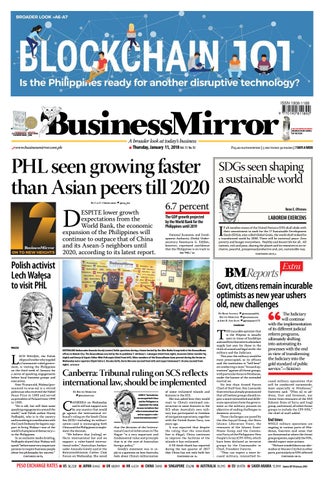
Australian Ambassador Amanda Gorely (center) fields questions during a forum hosted by the Aliw Media Group held at the BusinessMirror offices in Makati City. The BusinessMirror was led by the its publisher T. Anthony C. Cabangon (third from right), Associate Editor Jennifer Ng (right) and Envoys & Expats Editor Mike Policarpio (third from left). Other members of the BusinessMirror team present during the forum on Wednesday were reporters Elijah Felice E. Rosales (left), Recto Mercene (second from left) and Jasper Emmanuel Y. Arcalas (second from right). ALYSA SALEN
Canberra: Tribunal ruling on SCS reflects international law, should be implemented By Recto Mercene
C
@rectomercene
anberra on Wednesday said it will not support acts by any country that would go against the international tribunal’s ruling on the South China Sea (SCS)—including its militarization—and is encouraging both China and the Philippines to implement the decision. “We believe that [ruling] reflects international law and we support a rules-based international order,” Australian Ambassador Amanda Gorely said at the BusinessMirror Coffee Club Forum on Wednesday. She noted
PESO exchange rates n US 50.2320
GorEly: “Australia has encouraged both China and the Philippines to implement the ruling because we believe that reflects international law and we support a rulesbased international order.”
that the decision of the International Court of Arbitration in The Hague “is a very important and fundamental value and principle that is at the core of Australian foreign policy.” Gorely’s statement was in reply to a question on how Australia feels about China’s militarization
of some reclaimed islands and features in the SCS. She was asked how they would react to China’s continued construction in some features in the SCS when Australia’s own military has participated in freedom of navigation operations, together with the United States Navy, two years ago. It was reported that despite the ruling that the nine-dash line is illegal, China continues to improve the facilities of the islands it has reclaimed. A US think thank has reported during the last quarter of 2017 that China has not only built but Continued on A2
Conclusion
HE incurable optimist that is the Filipino is usually seen in times of hardships and conflicts that were in abundant supply last year for those in the thick of armed and legal strife: the military and the Judiciary. This year the military would be more preoccupied, as its officers said the institution is “hell-bent” on conducting a more “focused operations” against all threat groups, with particular focus in Mindanao, under the banner of the extended martial aw. No less than Armed Forces Chief of Staff Gen. Rey Leonardo Guerrero has already pronounced that all lawless groups should expect a more intensified and deliberate operations from the government as the military pursues its objective of ending challenges to domestic security. These challenges are posed by the Abu Sayyaf Group, the Moro Islamic Liberation Front, the remnants of the Islamic StateMaute Group and the Communist Party of the Philippines-New People’s Army (CPP-NPA), which have been declared as terrorist groups by the Commander in Chief, President Duterte. “They can expect a more focused military, intensified fo-
The Judiciary will continue with the implementation of its different judicial reform programs, ultimately shifting into automating its processes with the end in view of transforming the Judiciary into the gold standard of public service.”—Sereno cused military operations that will be conducted nationwide, most especially in Mindanao,” Guerrero said. “[This is] to address, first and foremost, our threat from remnants of the ISIS [Islamic State of Syria and Iraq] group, and second, all other threat groups to include the CPP-NPA,” the chief of staff added.
End times
WHILE military operations are ongoing in various parts of Mindanao, Guerrero said areas that are threatened or where the threat groups operate, especially the NPA, should expect more actions. “We have winded down our skirmishes in Marawi City but in other parts, particularly in NPA-affected
n japan 0.4462 n UK 68.0141 n HK 6.4234 n CHINA 7.6943 n singapore 37.6298 n australia 39.2915 n EU 59.9770 n SAUDI arabia 13.3941
Continued on A2
Source: BSP (10 January 2018 )
BMReports BusinessMirror
A2 Thursday, January 11, 2018
Govt, citizens remain incurable optimists as new year ushers old, new challenges Continued from A1
areas, they can expect more of the actions that are now being taken by the military, probably more intensified in terms of scope and coverage,” Guerrero said. As a prelude to the more deliberate operations, the military has already moved or realigned its forces from Western Mindanao to Eastern Mindanao, where nearly half of the total forces of the NPA is currently based and operating. “With the upsurge of atrocities in parts of Eastern Mindanao, we have started to put in more of our forces in Eastern Mindanao for us to be able to address this problem [insurgency] and, similarly, in other parts like Sulu and Basilan, and even in Luzon and the Visayas,” the chief of staff said. In Compostela Valley, which is under the operational jurisdiction of the Armed Forces Eastern Mindanao Command, Maj. Gen. Noel Clement said they would pursue the rebels in the province who have been dwelling on support from mining companies. The same operations will be carried out against the guerillas in Davao provinces. “So that we can finally put a stop to their atrocities and extortion,” said Clement, who is the commander of the Army’s 10th Infantry Division. “Now is the best time to end this problem and let our country develop and improve lives of the people,” he added.
Korea jitters
OUTSIDE the country’s borders is another conflict whose burden falls on the shoulder of those outside the military. In case of an outbreak of war between the Democratic People’s Republic of Korea and the US, including allies South Korea and Japan, the Philippine government must contend with a significant number of souls. In Seoul, South Korea alone,
PHL. . .
Continued from A1
achieve its development targets by 2022. In its Global Economic Prospects report, the Washington-based lender projected that the Philippines’s GDP would grow 6.7 percent until 2019 and 6.5 percent in 2020. Only Vietnam is expected to match the Philippines’s economic growth of 6.5 percent in 2020. “The Philippines will continue to be the fastest-growing economy
Filipinos number 63,000, which represents 0.1 percent of South Korea’s total population of 51 million. The BusinessMirror asked Foreign Secretary Alan Peter S. Cayetano about the outlook for this large number of evacuees in case war escalates or breaks out. Surprisingly, he said there is a plan in place to address what could be a dire scenario. “Our Ambassador [Executive Secretary Leo] Herrera is very good. He briefed me privately on the plans,” Cayetano said. “There’s a point in time when there are many tests, and he had to come out with plans so Filipino leaders there are assig ned numbers and contacts of [our] kababayans, and there are assigned ports and everything. But it’s not without difficulty.” According to Cayetano, the easiest route to evacuate, “aside from going to the other side of Korea” is Japan. “But, the problem is, North Korea also targets Japan,” he said.
being done.” “And we are also monitoring western countries and many other nationals in this area and were monitoring also what are their instructions to their own nationals.” In other words, Cayetano, in the absence of a direct word from the US or its allies, would have to monitor the movement of other nationalities in the Korean Peninsula. “But it’s always advisable to avoid war, and we will always rely on prevention.”
Legal battle
ACCORDING to Cayetano, “although Pyongyang tells the Philippines that we are friends, we tell them back, ‘Yes, but if you target our region, it will affect us all.’” “So, even if there’s no Filipino in this other country, the impact of war in our region is really devastating to our economy, and more people will go hungry,” Cayetano added. A ccord i n g to t he fore i g n affairs chief, he cannot take out the fact that there are hundreds of thousands and maybe millions of Filipinos across the Association of Southeast Asian Nations region. “Any country that they attack with [an] ICBM [intercontinental ballistic missile], some Filipinos would be hit,” Cayetano said. “So, really, the best plan is to prevent hostilities from happening.” According to him, preparations for the effects of an intense conflict in the Korean Peninsula “are
A nonmilitary battle, on the other hand, grips the Judiciary. But, while the prospect of being removed from her post through impeachment is not remote, Chief Justice Maria Lourdes A. Sereno still found some reasons to remain positive for the Judiciary for the year 2018. Before say ing good-bye to 2017, Sereno bragged about the many accomplishments and reforms that took place during the past several years since she assumed office, as the country’s top magistrate in 2010. Among these were the introduction of “e-courts,” or electronic courts, and the continuous trials which helped the courts swiftly resolve pending cases. “This is a time of rejoicing because we have so much accomplishments that we can [back] with enough proof. We can face everyone with pride, with honor, with dignity,” Sereno said in her speech during the yearly Christmas gathering of court employees. Sereno expressed hope that the said reforms would be imitated by the other parties in the justice sector like the Integrated Bar of the Philippines, prosecution and the defense. The chief magistrate expressed belief that the future of the judiciary remains bright despite the ongoing impeachment proceedings against her.
in the Asean, despite some stabilization of investment growth,” the World Bank said. These projections are below the country’s 7 percent to 8 percent GDP growth targets between 2018 and 2022. The bank’s forecast for 2017 is within the government’s 6.5 percent to 7.5-percent growth target. The government aims to increase GDP by 7 percent to 8 percent every year starting this year until 2022. These growth targets were included in the Philippine Development Plan (PDP) to help attain AmBisyon2040 and even
the countr y’s commitment to meet the Sustainable Development Goals by 2030. “The World Bank probably considered our current capacity to grow. But that is exactly what the PDP lays out—strategies to increase physical capacity, improve quality of human capital and reduce unnecessary regulatory burden,” Edillon told BusinessMirror. “The policy-reform agenda is especially important.” The World Bank said risks to the growth outlook remain on the downside. An abrupt tightening of
Preventive acts
She noted that the reform agenda being implemented by the SC would be strong enough to withstand political maneuverings and change in leadership. “Meaningful changes take deep roots and survive leadership turnovers in the judiciary,” she stressed in a recent public speech.
Main goal
FOR 2018, Sereno said judicial programs for transparency and efficiency would continue until the Judiciary achieves its main goal, which is to make the institution as the “gold standard for public service.” “In the long term, the measured performance and the public perception of personnel in the Judiciary should become the gold standard for public service,” she explained. “The people can be proud of our Judiciary. We work with pride, with honor, with dignity.” The Chief Justice vowed to continue reform efforts aimed to speed up the trial system in the country and to make the courts transparent and closer to the public. “We look forward to more things to report to the nation,” she said. Sereno indicated that the formula to improve services of the Judiciary and address corruption in courts have already been laid down by the High Court, and all that’s left is to make sure the programs will be implemented well. “The Judiciary will continue with the implementation of its different judicial-reform programs, ultimately shifting into automating its processes with the end in view of transforming the Judiciary into the gold standard of public service,” she assured. And, if these words still fail to make many believe the deep well of optimism the Filipino people scoop from, there are no other words left in the world to describe the unflagging spirit of the people in this archipelago. global financing conditions could derail growth. Further, escalating trade restrictions and rising geopolitical tensions could dampen confidence and activity. However, stronger-than-anticipated growth could also materialize in several large economies, further extending the global upturn. “With unemployment rates returning to precrisis levels and the economic picture brighter in advanced economies and the developing world alike, policy-makers will need to consider new approaches to sustain the growth momentum,” said World Bank Development Economics Prospects Director Ayhan Kose. “Specifically, productivity-enhancing reforms have become urgent as the pressures on potentia l g row th from ag ing populations intensify.” Growth in emerging markets and developing economies as a whole is projected to strengthen to 4.5 percent in 2018, as activity in commodity exporters continues to recover. In advanced economies, growth is expected to moderate slightly to 2.2 percent in 2018, as central banks gradually remove their postcrisis accommodation and as an upturn in investment levels off. “The broad-based recovery in global growth is encouraging, but this is no time for complacency,” World Bank Group President Jim Yong-kim said. “This is a great opportunity to invest in human and physical capital. If policymakers around the world focus on these key investments, they can increase their countries’ productivity, boost work-force participation and move closer to the goals of ending extreme poverty and boosting shared prosperity.”
www.businessmirror.com.ph
Canberra: Tribunal ruling on SCS reflects international law, should be implemented Continued from A1
has added new military facilities, such as missile installations and radar-antenna arrays on islands in the SCS. The Asia Maritime Transparency Initiative, part of Washington’s Center for Strategic and International Studies, said new satellite images show missile shelters and radar and communications facilities being built on the Fiery Cross, Mischief and Subi Reefs in the Spratly Islands. The US has criticized China’s buildup of military facilities on the artificial islands and is concerned they could be used to restrict free movement through the SCS, an important route where an estimated $5.3 trillion worth of global trade passes. “Aust ra l ia has encouraged both China and the Philippines to implement the ruling because we believe that reflects international law, and we support a rules-based international order,” Gorely said, adding: “It is a very important and fundamental value and principle that is at the core of Australian foreign policy.” Asked if Australia is not threatened by China’s expansive claims in the SCS, Gorely said: “I think if those installations add to the tension in the region or in any way prevent passage into the South China Sea, then, yes, I think Australia and many other countries will be affected.” She stressed that, although Aust ra l i a is not one of t he claimant-states, it still has a very big stake in the “security of this region and the adherence to international law of all states.” Gorely said Australia’s approach and policy toward SCS has been very consistent over a long period of time. “Australia is not a claimantstate, but we do have a significant interest in freedom of navigation through the SCS. I think about 70 percent of our trade goes through the SCS. We’re the biggest trading partner of China, including Japan and South Korea, and so we have a lot of Australian products going through that region, and we very much believe freedom of navigation is established in international law and respected.” “We oppose any militarization of the SCS, and we’ve been quite firm in our statements on that,” she added, noting that Australia’s Prime Minister and Foreign Minister regularly explain Australia’s position on the militarization of the SCS. However, Gorely hastily added
that she does not think the Philippines has to make a choice regarding its relations with the US and China. “Australia is exactly the same as the Philippines in the way we have our alliances with the United States. Our treaties were signed two days after the Philippines’s treaty and very, very similar in attainment and commitments.” Australia, she added, also has very strong bilateral relations with China. “We are the no. 1 trading partner, we have regular ministerial meetings in both directions, we have strategic partnerships with China and a very respectable relationship.” “I don’t see why the Philippines can’t be the same. All countries need to exchange views in friendly and respectful ways, and that’s why having international law as the benchmark is very useful, because that is the basis to resolve disputes, and I think that is what the Philippines is trying to do to,” she added. Asked whether Australia has not communicated its concerns in the SCS to President Duterte, who seems to have been enamored of China that Manila has ceased reminding Beijing of the Philippines’s victory in the arbitration, this is what Gorely said: “We generally make our views publicly known, and we are opposed to further land reclamation and militarization in the SCS. That is our position, and that will continue to be our position. “On the other hand, we don’t tell other countries how they should operate their own foreign policy. We work in a constructive way; we had forums like the East Asia summit, the Asean summit, where we get to discuss these things in a constructive forum. “We have bilateral meetings where we talk strategic issues and challenges in the region and does not stand in the way of a res pec t f u l sovereig nt y ; that’s the only way you can build international relations.” By way of example, Gorely said they have just settled their territorial dispute with Timor Leste through a conciliation process. “I think that provides a very good example for countries to resolve territorial disputes and, I’d say too, China and the Asean have negotiated a code of conduct (COC), in the SCS. We believe that should be legally binding. Asked if the COC would be discussed during the coming Australia-Asean summit from March 16 to 18, Gorely replied: “That is not in the agenda.”
Meralco bills to see P0.526/kWh drop this month Continued from a12
On the other hand, charges from the independent power producers (IPPs) increased by P0.3808 per kWh due to lower average plant dispatch. The share of IPP purchases to Meralco’s total requirement this month was at 41 percent. Meanwhile, the National Electrification Administration (NEA) said electricity consumers in the provinces who are being supplied by different electric cooperatives (ECs) need not worry about the new excise tax imposed on coal, saying the impact on power rates is only “minimal.” NEA Administrator Edgardo Masongsong said the price adjustments, which will be reflected starting in March, will be nominal because not all distribution utilities and ECs derive their energy sources from coal. “On the average, those who consume 136 kilowatt hours will
be charged about P680 to P700. The impact of excise tax on them will be about 70 centavos only,” Masongsong said. Out of the 121 ECs operating in the country, 74 are purchasing energy from coal-fired power plants, of which only 47 are using more than 50 percent for their electricity requirement. He attributed this to the fact that a lot of power cooperatives are gradually making their transition into renewable energy, such as solar, hydro, wind or even biomass, in line with the thrust of the government. Still, Masongsong said, his office will remain on the watch for ECs that might take advantage of the higher coal-excise tax to jack up electricity rates, considering that 30 percent to 35 percent of their baseload comes from this fossil-fuel source.
www.businessmirror.com.ph
The Nation BusinessMirror
Senator presses DBM review of government pay increase scheme By Butch Fernandez @butchfBM
A
N opposition stalwart on Wednesday backed President Duterte’s directive to increase the salaries of publicschool teachers. In addition, Senate Minority Leader Franklin M. Drilon also asked the Department of Budget and Management to review the government’s pay scheme. Drilon endorsed Malacañang’s recent order directing the DBM to find ways to raise public-school teachers’ take-home pay, but sug gested that the sa lar y increases should also be extended to cover other government employees, “including nurses and other professionals.” In a news statement, Drilon pressed for a review of current government salary structure, saying this was “made necessary by the increase in the basic salary of the military and uniformed personnel (MUP).” T he senator c lar if ied that while he lauds the Palace directive doubling the salaries for the Armed Forces and the police, he voiced concern this “would result in serious discrepancies in the current salary scheme in the government.” “It is impor tant that a review of the compensation package for the civ ilian personnel is undertaken in order to avoid wage distortion and inequalit y and make the sa lar y of gover nment professiona ls on a par w ith their counter par ts in the militar y and the police,” Drilon said. He added that currently, a Teacher 1 receives P21,000, while a policeman receives P40,000. “Shouldn’t the teacher, shouldn’t the health worker, shouldn’t the entry-level lawyer in the Department of Justice be the same with
everybody?” he wondered. To address the discrepancy, the senator asked his fellow lawmakers, “particularly the House of Representatives, to adopt Senate Resolution 575,” coauthored by Drilon and Senate Majority Leader Vicente C. Sotto III, which was already approved by the Senate last year. Resolution 575 tasked the DBM to recompute and readjust the base pay of civilian personnel below and above Salary Grade 11 to ensure that the compensation of civilian personnel are proportional to that of their MUP counterparts. According to Drilon, a longawaited review of the current pay structure “ is necessary to avoid the demoralization among civilian employees.” He added that the DrilonSotto resolution would “address the possible wage distortion by adjusting the Compensation and Position Classification System and Base Pay Schedule of civilian personnel.” Drilon said their Resolution 575 further specified that “the base pay of civilian personnel who may be affected by the disturbance of wage structure by reason of Senate Joint Resolution 11, series of 2017, shall be adjusted in order to cure salary distortion and inequity.” At the same time, the resolution likewise aims to “eliminate overlaps among salary-grade allocations of government personnel” taking into consideration differences in duties, responsibilities, length of service, and other logical bases of differentiation of the positions. Moreover, Drilon said their proposal provides the new base-pay rates for the civilian personnel “shall take effect six months after the increase in the base pay of MUP takes effect.”
Editor: Vittorio V. Vitug • Thursday, January 11, 2018 A3
House leaders renew push for federal shift, Palace term extension for Duterte By Jovee Marie N. dela Cruz
T
@joveemarie
he leadership of the House of Representatives has urged the public to support the shift to a federal form of government. Speaker Pantaleon D. Alvarez issued the statement amid a proposal calling for the extension of President Duterte’s term and efforts of Congress to convene itself as a constituent assembly (Con-ass). “This year, 2018, we will revise our constitution for a shift to a federal form of government. Let us unite and support this initiative of the President,” Alvarez told his constituents in Davao del Norte. Alvarez said a federalism type of government is needed to “effect the change,” and this will be done by moving for the convening of Congress into a Con-ass to revise the 1987 Constitution. He said convening Congress into a Con-ass to propose Charter amendments and shift to federalism is the top priority of the House of Representatives when session resumes on January 15. Alvarez added the 17th Congress could convene into a Con-ass this January and the proposed new federal charter could be submitted for referendum simultaneously with the barangay elections on May 14, 2018. Under Con-ass, it’s the sitting l aw ma kers t hemselves— congressmen and senators—who will serve as the delegates.
Not enough
Meanwhile, Rep. Robert Ace S. Barbers of the Second District of Surigao del Norte, chairman of the House Committee on Dangerous Drugs, backed the proposal for a possible term extension for Duterte “if it guarantees profit for the country.”
“It is about time that we grab the bull by its horns, so to speak,” Barbers said, in reference to the proposed Charter change and term extension for President Duterte. “I have never seen someone who fits the bill better than our very own President Digong. He rules with an iron[-clad] fist and never hides his intentions. What you see is what you get, no double-talk, no- nonsense kind of leadership. Just exactly what we need to discipline an undisciplined people, someone who can make us swallow the bitter pill and make us realize that it is for our own good,” Barbers said. “Duterte is the only President who talked the talk and walked the walk. He carried our fight against illegal drugs and corruption, personally and made it his own battle,” he added. According to Barbers, having to enjoy these benefits has its own downside and that the President does not have time on his side. “While we see where these are all going, we may not see its full fruition in the remaining time of the President’s term. If it were only up to me, I would give him an extension of another term. A good president, like President Duterte, needs more
time to implement his projects and advocacies, and fulfill our people’s dreams,” Barbers added. For his part, Rep. Luis Raymund F. Villafuerte Jr. of the Second District of Camarines Sur said President Duterte will continue to sustain in 2018 and onward the high public satisfaction ratings of his leadership as a result of his “no-nonsense campaign against official corruption, his concrete anti-poverty initiatives and his game-changing move to shift the country’s foreign policy focus to Asia.” “Despite what a noisy few have been saying against him, it can’t be denied that Mr. Duterte has indeed been instrumental in bringing about real positive change among us Filipinos—as what he had promised during the presidential campaign,” Villafuerte said.
Opposition
Bayan Muna Party-list Chairman and former lawmaker Neri Colmenares, meanwhile, expressed opposition to efforts of Congress to convene itself as a Con-ass because many provisions in the proposed Constitution will benefit its members. He also exposed the insertion of a provision exempting President Duterte and members of Congress from paying income tax. “The proposed Cha-cha [Charter change] will benefit members of Congress and they cannot convene [as] a constituent assembly which will draft a self-serving Constitution. We ask Congress not to push through with its planned Con-ass,” Colmenares said. “This Cha-cha could cancel the
This year, 2018, we will revise our constitution for a shift to a federal form of government. Let us unite and support this initiative of the President.”—Alvarez
elections in 2019 and extend the terms of members of Congress, even the three termers, and it is absurd for Congress members to be given the power to decide on their own term extension. In fact, once they convene into a constituent assembly, they can insert any provision even deleting term limits,” he said. Under Article VII Section 10 of the current Constitution, Congress is not even allowed to pass a law increasing the salaries of those who approved the law. “Extending your own term is worse than increasing your salary,” Colmenares added. He also said that under the House Resolution of Both Houses 8 (RBH 8), congressmen have also exempted themselves from income-tax payment. Under Section 15, Article XVII of the new Constitution of RBH 8, the former lawmaker said congressmen, senators, even President Duterte are exempted from paying income tax. “I do not think anyone can argue that this is not self-serving. While ordinary tax payers have to struggle for years to lower income tax, members of Congress did not just lower, but exempted themselves from paying income tax in one fell swoop. Why should high-salaried top officials be exempted from income tax while ordinary people pay taxes. They cannot convene themselves into a Con-ass and exempt themselves from paying income tax. The people will not accept Con-ass,” the progressive leader said. Article XVII Section 15 of RBH 8 provides until the Federal Congress provides otherwise, the President, Vice President, Senate President, Speaker of the House, the Chief Justice, the senators and members of the House of Representatives, Justices of the Supreme Court, chairmen of the Constitutional Commissions shall continue to receive the annual salaries that they are presently receiving at the time of the ratification of the Constitution without any income-tax deductions.
SC orders government to answer petition for free post-Dengvaxia vaccination medical services By Joel R. San Juan
T
@jrsanjuan1573
HE Supreme Court (SC) on Wednesday directed the government to answer the petition for mandamus filed by the Gabriela party-list and 70 mothers and children seeking to compel certain public officials to provide free medical services and treatment to children injected with the controversial anti-dengue Dengvaxia vaccine. At a press briefing, SC spokesman Theodore Te said the directive was issued during the regular en banc session by the magistrates. Te said the Court gave respondents Health Secretary Francisco T. Duque III, former Local Government Acting Secretary Catalino S. Cuy and Education Secretary Leonor M. Briones 10 days to comment on the petition. Other respondents also included in the list are Department of Health (DOH)-National Center for Disease Prevention and Control program director Dr. Lyndon Lee Suy and Food and Drug Administrative Director General Nela Charade Puno. In their petition, Gabriela, the Association for the Rights of Children in Southeast Asia, together with 70 mothers and their children administered with the vaccine, are demanding the government to provide free services, including, but not limited to, medical checkups, consultations, medical treatment and blood tests to those vaccinated. They added that these free medical services should continue until it would have been determined and
declared by competent medical and/ or scientific experts that the threats brought by the Dengvaxia vaccine have been minimized or eliminated. The petitioners also asked the SC to direct the DOH, Department of Education and the Department of the Interior and Local Government to create a registry of children who were administered with the vaccine to facilitate the delivery of free healthcare services. The petitioners explained that the Dengvaxia issue is “of transcendental importance,” and that the SC must compel key government agencies to provide free medical services and treatment for those who might suffer from severe dengue or any of the determined side effects of the antidengue vaccine. “The horrors and risks being posed right now by the vaccine, which has been haphazardly administered to around 800,000 children, should be enough for the justices to act with urgency on our petition,” the petitioners said. Aside from these, the petitioners are asking the Court to compel the respondents to publicly disseminate on a regular basis the report of the task force created and designated to monitor and review the school-based immunization program involving Dengvaxia and submit the same to the House of Representatives and Senate Committees on Health for monitoring. The petitioners said the government agencies should monitor children in all villages and regions who were injected with the vaccine.
Signature pose
President Duterte does his signature pose with Communist Party of China Central Committee Member Meng Xiangfeng and Chinese Ambassador to the Philippines Zhao Jianhua following their meeting at the Malacañan Palace on Tuesday. Also in the photo are Senate President Aquilino L. Pimentel III, Energy Secretary Alfonso G. Cusi, Foreign Affairs Undersecretary Ernesto C. Abella and Special Assistant to the President Christopher Lawrence T. Go, among others. Toto Lozano/Presidential Photo
DND scrambles to verify influx of foreign terrorists in Mindanao
T
he Department of National Defense (DND) is now confirming reports that there are foreign terrorists operating in Mindanao. This was the statement issued by Defense Secretary Delfin N. Lorenzana during the New Year’s Call in Camp Aguinaldo, Quezon City, on Tuesday. “’Yun ang hinahanap namin ngayon. [We had
embarked on a search.] We are trying to confirm reports that there are foreign terrorists inside the country, especially in Mindanao,” he said. The reports, which came from Malaysia and Indonesia, claimed an increase of foreign terrorists coming through the Philippines’s backdoor. “We are trying to verify that, up to now wala pa kaming nako-confirm, [We haven’t confirmed
anything just yet.]” the DND chief added. And when asked on the possible ISIS presence in the south, Lorenzana said efforts were under way to check on this. “It is ongoing. We are intensifying our monitoring there in south and, as of now, we cannot confirm the presence of foreign terrorists but there are homegrown terrorists, there in the south. We are sure of that,” he added.
Economy
A4 Thursday, January 11, 2018 • Editors: Vittorio V. Vitug and Max V. de Leon
Manufacturing rebound likely in 2018, Neda chief Pernia says
BusinessMirror
Senators to probe multibillion peso Malampaya Fund anomaly
S
By Butch Fernandez
@butchfBM
enate probers are poised to open a full-blown inquiry into allegedly anomalous multibillionpeso disbursements of the Malampaya Fund during the Aquino and Arroyo administrations, Sen. Sherwin T. Gatchalian said on Wednesday.
PERNIA By Cai U. Ordinario
@cuo_bm
D
espite the dismal performance of the country’s manufacturing output the previous year, the National Economic and Development Authority (Neda) remains optimistic that the sector will recover in 2018. The country’s Volume of Production Index (VoPI) posted its third consecutive month of decline in November 2017 at a contraction of 8.1 percent. The Value of Production Index (VaPI), likewise, decreased by 9.3 percent, leaving a three-month moving average of VoPI and VaPI of 2.5 percent and 1.5 percent, respectively. “Despite the recent performance of the manufacturing sector, we remain optimistic given strong domestic and external demand. There are also considerable public and private investments in the country,” Socioeconomic Planning Secretary Ernesto M. Pernia said. He added the manufacturing sector can benefit from the country’s investment-grade status or “good quality” credit rating that can lower the cost of financing projects. He also said initiatives to spur and foster industry innovation must be prioritized. This will help firms develop sustainable production practices and ensure their competitiveness under deeper regional integration. The Neda secretary added the key to the recovery of manufacturing is the earnest efforts of the government to reduce unnecessary regulatory burden. “To support the growth of the sector, we must continue to address long-standing issues of high power and shipping costs, dependence on imported raw materials and inter-
mediate goods, incidence of illicit trade and the lack of adequate support infrastructure,” Pernia said. Further, he noted, domestic demand for manufactured products may be higher in 2018 due to the country’s infrastructure development with the Duterte administration’s “Build, Build, Build” program, as well as a higher take-home pay of Filipinos due to the tax-reform law. The Neda said the decrease in production volume may be due to the lower production of tobacco following the implementation of the first package of the Tax Reform for Acceleration and Inclusion Act, which imposes additional excise tax on tobacco products beginning this January. Production volume and value of manufactured food also declined last November, due to decreases in the production value of milk and dairy products, milled and refined sugar, bakery products and processed fruits and vegetables. Meanwhile, the average capacity utilization rate in November 2017 for total manufacturing was recorded at 83.9 percent. The Philippine Statistics Authority said 55 percent, or 11 of the 20 major industries, operated at 80 percent and above capacity utilization rates. The proportion of establishments that operated at full capacity, or 90 percent to 100 percent, was recorded at more than one-fourth of the total number of establishments (27.1 percent) in November 2017. About 53.7 percent of the total establishments operated at 70 percent to 89 percent capacity, while almost one-fifth of the total establishments (19.2 percent) operated below 70 percent capacity.
www.businessmirror.com.ph
Gatchalian, Senate Committee on Energy chairman, on Tuesday filed Senate Resolution 579, paving the way for the inquiry into “the release of the Malampaya Fund by the Department of Budget and Management [DBM] without complete documentary requirements” in violation of existing laws. The senator cited Presidential Decree 910, Series of 1976; Executive Order 683, Series of 2007; DBM- Department of Energ y (DOE)-DOF (Department of Finance) Joint Circular 3, Series of 2008, and other relevant laws and
rules and regulations as specified in the Commission on Audit’s (COA) Special Report 2017-04. He noted that the Malampaya Fund, coming from the government’s profit share from the exploitation of natural-gas resources in the Camago-Malampaya Reservoir under Service Contract 38, already accrued P173.280 billion from its operations between January 2002 and June 2013. These funds, the lawmaker said, were collected by the DOE and managed by the Bureau of the Treasury for the exploration and development of energy resources.
Gatchalian recalled that in 2007, the DBM was authorized to release money from the fund, according to certain guidelines. However, he got hold of a 2017 COA special report that revealed special allotment release orders and notices of cash allocations were issued with “incomplete documentary requirements,” such as the lack of project proposals, requests for funds from the implementing agencies, proof of DBM evaluation/or approval by the President. “As of May 21, 2012, a total of P38.8 billion of public funds has been released by the DBM to various non-governmental agencies, government-owned and -controlled corporations, and the provincial
Their [Malampaya funds] usage for other purposes, and without following the clear procedural requirements concerning their disbursement, is a serious cause for concern that must be looked into by the government.”—Gatchalian
With oil-price hike, more fishermen to fall prey to ‘loan sharks’–group By Jonathan L. Mayuga
W
Gadgets galore
A stall keeper of an electronics gadget store in Raon, Manila, presents her wide-ranging inventory of imported gadgets just in time for the expected surge of customers with the celebration of the Feast of the Black Nazarene that drew a crowd of devotees of more than a million at the nearby Quiapo Church on Tuesday. Nonie Reyes
Congress to expedite passage of measure creating Department of Disaster Resilience
C
ongress will likely prioritize and expedite the passage of the pending bill that seeks to create the proposed Department of Disaster Resilience (DDR), and President Duterte may likely highlight the importance of such agency in his next State of the Nation Address. The DDR will be a well-structured agency designed to manage a broad climate-disaster program of governance, as the country confronts more and more calamities of greater frequency and magnitude. Rep. Joey S. Salceda of the Second District of Albay, a noted economist and disaster-resilience advocate who authored the principal DDR bill (House Bill [HB] 6075), noted that, “Now, more than ever, we feel the need to create a supergovernment agency, seeing the devastations around us every time disasters strike.” He said the new agency will be “tasked to carry out a continuous, consistent and fortified calamitydefense program and ensure the country’s sustainable development and inclusive growth.” The Philippines marked the first day of 2018 with Typhoon Agaton storming Mindanao. A total of 22 calamitous weather disturbances, aside from man-made disasters, ravaged the country in 2017, claimed
hundreds of lives, and damaged crops, properties and infrastructure worth billions of pesos. Typhoons Urduja and Vinta hit the Visayas and Mindanao in December 2017 in close succession with deadly results; flash floods and landslides, more than 200 casualties and thousands of evacuees and costly damages. Salceda said that, to face the onslaught of disasters, the country needs “strategic and systematic approaches to disaster prevention, mitigation, preparedness, response and the effective programs on rehabilitation and recovery” handled by an agency with its own mandate. He heads the technical working group tasked to consolidate the 43 related legislative proposals on disaster response in the Lower House similar to his HB 6075. He added a really strong disaster agency is “essential to a sensible economic blueprint and, since disastrous typhoons were noted to have been getting stronger and broader in impact in recent years, the creation of the DDR is an urgent agenda of Congress.” The country’s situation, he said, is critical since the Philippines ranks third among 171 countries worldwide considered “most exposed and vulnerable to natural calamities,” and is listed as 13th in the Climate Change Vulnerability
government of Palawan,” Gatchalian said, citing the report. The senator asserted that these funds were “meant to finance the development of energy resources.” “Their usage for other purposes, and without following the clear procedural requirements concerning their disbursement, is a serious cause for concern that must be looked into by the government,” Gatchalian said. He added that, given the fact that this involves a huge amount of public funds, “an immediate inquiry is necessary to hold erring public officers responsible for the irregular release of these funds, and to prevent future illegal exploitation of these funds.” With Lenie Lectura
Index. Almost 74 percent of the country’s population and 80 percent of its land area have been identified as vulnerable to disasters, with Manila marked as “in extreme risk,” added Salceda, a multiawarded official in disaster-risk reduction and climate-change adaptation. With an initial budget of P10 billion, the agency will be accountable and responsible for overseeing, coordinating and implementing a comprehensive disaster risk and vulnerability reduction and management programs and redirecting policy drifts, among other agencies handling such tasks. Salceda’s proposed DDR aims to take in at least four government entities critical to an effective disaster planning and operation—the Philippine Atmospheric, Geophysical and Astronomical Services Administration and the Philippine Institute of Volcanology and Seismology under the Department of Science and Technology; the Geoscience Bureau of the Department of Environment and Natural Resources; and the Bureau of Fire Protection under the Department of the Interior and Local Government. He said the idea is akin to the United States Department of Homeland Security that has under its
operational control major federal agencies to effectively confront security issues and threats in many areas. Salceda added HB 6075 is a result of “action research, sharing of experiences and dynamic discussions among various stakeholders from national and local government agencies, organizations and communities, and is a product of comparable international experiences.” The bill also seeks to amend the eight-year-old Republic Act 10121, which created the National Disaster Risk and Reduction Framework, a landmark legislation but which falls short in creating “an institution that is sufficiently in a high position to oversee the implementation of streamlined disaster-risk reduction and management policies nationwide. It will have the necessary authority, mandate and resources to lead and coordinate efforts of various stakeholders toward a more resilient nation.” Under the concept, the DDR will be separate from the Office of Civil Defense, which will continue to perform its original mandate, particularly its duty to administer a comprehensive national civil defense and civil assistance program, training of community volunteers for civil defense and assistance and other mechanisms for community preparedness. PNA
@jonlmayuga
ith the expected increase in the price of fuel and other petroleum products, small fishermen, considered among the poorest of the poor in the Philippines, may be left with no choice but to apply for a loan from so-called loan sharks. According to the Pambansang Lakas ng Kilusang Mamamalakaya ng Pilipinas (Pamalakaya), this early, fishermen in Navotas are already feeling the brunt of the oil-price hike and are complaining of the additional burden on the domino effect to the price of basic commodities. Pamalakaya said municipal fishermen need the government’s help and support in the form of production subsidy, whether in cash or in kind, to cope with the expected increase in cost of production. The group fears that the impact of the Tax Reform for Acceleration and Inclusion (TRAIN) Act will be unbearable, especially to small fishermen, who regularly consume gasoline or diesel for their fishing operations. Based on the group’s initial investigation, the price of gasoline as of January 4 has surged to P49.20 per liter, from P43 per liter even before the new tax reform has been implemented. This means small fishermen who regularly consume 12 liters of gasoline per fishing trip have to prepare at least P600, from P516, for the gasoline alone. Pamalakaya said the cost of petroleum products eats up almost 80 percent of their production trip. Other production costs include food needs of the boat owner and its companion, which costs P150, and the tricycle fare to buy gasoline in the market that costs P40. With the oil-price increase, a total of P790, from P706, is needed to cover the production cost per fishing trip of six to eight hours. In a news statement, Fernando Hicap, national chairman of Pamalakaya, lamented that the output of every fishing trip does not usually guarantee a profit. Sometimes, the group said, the amount spent during fishing trips barely breaks even because of the dwindling fish catch. The average fish catch of municipal fishermen ranges from 2 to 5 kilos. “Because they can’t even earn the cost of production, fishermen have to borrow money with excessive interest rates to cover the production costs of their next fishing operation, making them buried in debt,” he said. “The fishermen are already battered by numerous issues besetting the fishing sector; namely, the fish-catch depletion due to the corporate plunder of marine resources, the anti-fisherfolk law that allows commercial fishing fleets to exploit municipal waters, and the government’s lack of support to our sector. Now, the skyrocketing prices of oil products under the new tax-reform law will exacerbate the miserable condition of the country’s poorest of the poor,” Hicap said. “Because of TRAIN’s oil-price hike, fishermen have to cut their fishing trip from the regular six to eight hours to four to six hours. They also have to reduce their fishing days from the average of four to five days a week to three days a week. This also means a diminution of their already small income and days of starvation,” he added. “We want to remind President Duterte that the small-scale fishers do not have a regular income, so the decrease of income tax is actually worthless to us, but whether we like it or not, we would be bearing the brunt of unbridled increase of basic commodities and oil products,” Hicap said. The group calls for the scrapping of TRAIN, which, it said, is a burden not only to the fishing sector, but to all the hardworking Filipino people. “We don’t need a new tax-reform law that will only worsen the condition of the poor, working Filipino people, but affordable basic commodities and social services that will make us more productive citizens,” he said.
A6
TheBroa
Business
Thursday, January 11, 2018
T
By Rizal Raoul Reyes | Correspondent
HE digital age has brought hope to peoples and countries to enable them to pursue greater transparency and better governance. Moreover, the development of the Internet has opened many possibilities to make life easier for people in almost every facet of their lives. Twenty-plus years later, blockchain came into the picture. How it can impact the Philippines and businesses, like the Internet, remains a conundrum. Blockchain technologies are in the early stages of a 20-year, if not a 50-year, adoption and maturation cycle. Many compare blockchain today with 1995 when Tim BernersLee gave the world the Web. “[The] Internet at that time was more decentralized than it is today and built primarily with open source,” Brian Behlendorf, executive director of Hyperledger, told the BusinessMirror. “The technology is ripe with promise.” Hyperledger (or the Hyperledger Project) is an umbrella project of open-source blockchains and related tools, started in December 2015 by the Linux Foundation, to support the collaborative development of blockchain-based distributed ledgers, according to a Wikipedia entry.
Formidability
BLOCKCHAIN became a byword among techies (persons considered experts in or enthusiastic about technology, especially computing) because it is often discussed in similar context with cryptocurrencies, such as Bitcoin and Ethereum. “However, they [blockchain and cryptocurrencies] are not one and the same,” Behlendorf explained. “Distributed ledgers do not require a cryptocurrency to work. A cryptocurrency is an application that sits on top of a blockchain and not the other way around.” Currently, there are wide adoptions of blockchain technology in commercial applications and production. Blockchain, also known as “distributed ledger,” can be used to record promises, trades, transactions or simple items that need to be preserved. To ensure the records do not disappear, the data are mirrored or encoded across all nodes in a given network. This allows everyone in an ecosystem to keep a copy of the common system of record. “Nothing can ever be erased or edited,” Behlendorf said. Being a multiparty database, he said a distributed ledger has no central trusted authority. This means that when transactions are processed in blocks according to an ordering of a blockchain, this will form a distributed ledger.
Bitcoins
Community
CARLOS KORTEN, the CEO of Pasig-Hudson Consulting, said a blockchain operates on a network of independently owned computers that are joined together to form a trustless community, where every node serves as the watchdog for the others. Korten points out that the fierce independence of each processing node is critical to the security and reliability of the blockchain network. By design, none of these computer nodes is “the hub”. He adds the community is designed as a voluntary collection of independent peers in a decentralized network that may grow or shrink in size, as members join and drop from the coalition. Together, the University of Chicago-educated Korten said, the network establishes a “record of truth” through consensus within the community—formally, “truth” is defined by whatever 51 percent of the network agrees to be true. For Bitcoin, a cryptocurrency launched in 2009, the first and
Is the Philippines ready for an
most famous implementation of blockchain, he said the computing power of the network is provided by companies and individuals (called “miners” in Bitcoin lingo), who receive a financial incentive for participating. Other blockchain networks may be “private”, where the computing power is supplied on a voluntary basis by the members of the community who have an interest in overseeing the integrity of the blockchain— banks, institutions, businesses or even private individuals. DEVELOPED to be a formidable system, Korten said blockchain technology uses advanced cryptography to prove that every document is an honest and true representation of the original. Blockchain holds an advantage over paper contracts because it can be stored on the nodes: paper contracts can be altered, lost or destroyed. Moreover, each document is encrypted, time-stamped and locked using a digital signature. “Next, blockchain uses a decentralized data storage scheme instead of a single data repository,” Korten said. “This means that to alter the ‘record of truth’, a hacker would need to simultaneously attack the network at multiple processing nodes scattered all across the country and around the world.” If a criminal element decides to enter and hack the information on the blockchain, Korten said the “bad guy will need strong [computing] power to corrupt a well-implemented blockchain.” “In structure, the blockchain can be imagined to be a massive encrypted ledger: a comprehensive list of all transactions that have ever occurred in the history of the community, stored in a long linked chain,” he explained. “Every node of the network stores and maintains [its] own copy of the ledger.” When there is a new transaction to be registered on the blockchain—say, the transfer of digital money from one account to another, or the transfer of ownership of a land title from one individual to another, or the execution of a legal contract between two parties—Korten said one node of the network formats and encrypts the transaction into the required layout of the blockchain. It then broadcasts the details of that transaction to the network.
Applications
BLOCKCH
ACCORDING to Korten, multiple transactions from across the community are bundled together into a “block”. This block is appended to the end of the ledger as the next link on the long chain. The new block is encoded with a signature key, a “cryptographic hash”, which ensures that the transactions in that block can never be altered, and also serves to permanently secure the sequence of that block within the chain. Once encrypted and signed, Korten said the new block is published to all nodes of the network. Furthermore, the other nodes each verify that the new block is well formatted, correctly encrypted and consistent with their own version of the digital ledger. In case two or more network nodes disagree which valid block should come next on the chain or which transactions should be included in that block, Korten said the community finds a way to arbitrate within itself. As far as the Bitcoin commu-
nity is concerned, it uses what is essentially a random lottery, called a “proof of work” (POW), to select which node of the network will have the priority and privilege to publish the next block onto the chain. Other blockchain implementations have replaced the POW with their own solutions to assign prerogatives between peers.
Verification
ONCE 51 percent of the nodes have verified and registered the new block onto their version of the blockchain, the transactions within that block are considered “posted” and become part of the permanent record. That block is now an immutable fact, unanimously agreed to by the full community. In case somebody wants to research the history of a document or account stored on the blockchain, Korten said a searcher just needs to scan the ledger for the complete lifecycle of that object. He assures that all users are guaranteed that the record they will get is complete, accurate and incorruptible. In the business arena, Behlendorf said majority of enterprise blockchain applications depend
upon real-world trust relationships, which seeks to form a group of participants in an ecosystem that guarantees the boundaries are going to be flexible to bring in more participants in the future. Furthermore, participants are going to be known to one another and therefore have a built-in interest in joining the consensusmaking process. According to Behlendorf, the community of participants can now share data with a greater degree of security. Without requiring them to run POW mechanisms, Behlendorf told the BusinessMirror participants can resolve quicker problems than on a public cryptocurrency blockchain.
Trust
TRUST is the key component of the blockchain technology. According to a survey of 33,000 people in 28 countries, the majority of people’s trust in major institutions, such as business, government, non-government organizations and media, experienced a sharp decline in 2016. Called the Edelman Trust Barometer, the 2017 survey showed a phenomenon not monitored since
the group began tracking the level of trust in 2012. The advent of globalization and technological change contributed to the loss of confidence of the people in institutions. Respondents said these institutions failed to protect them from the impact these changes wrought. In the survey, 10 of 28 countries surveyed combined an aboveaverage lack of belief that the system is working with multiple fears—the same hotspots of recent populist actions: France, Italy, Mexico, South Africa, Spain, Brazil, Colombia, the United Kingdom, Australia and the United States. “Without trust, the system fails,” Behlendorf said. “The onus is on businesses to prove that it is possible to act in the interest of shareholders and society alike and show that free markets can succeed for all if businesses work with the people.”
Governance
KORTEN believes blockchain technology is going to be an effective tool to achieve better governance. “Blockchain is an important public-policy tool because it is de-
signed to create trust in a trustless environment,” Korten explained. “Governments can apply blockchain technology to create certainty and confidence in the eye of the people, the private sector and the global community.” Korten, a Filipino-American technopreneur based in Manila and New York, emphasized that blockchain is quite important, especially for governments working to eliminate a reputation for corruption or inefficiency. “Blockchain offers a solution that can promote commerce, attract investment and create wealth by implementing infrastructure with unimpeachable security, transparency and reliability. What makes a blockchain-based architecture different and superior to other digital solutions is the fact that the encrypted data is stored redundantly across many independent processing nodes,” Korten, a holder of an economics degree from the University of Chicago and masters in computers from Harvard University, explained. “It is not possible for an agent to alter a blockchain document in any single database, because other copies of the same document exist
aderLook
sMirror
www.businessmirror.com.ph | Thursday, January 11, 2018
HAIN 101
companies, land developers, plus private individuals at large) could join forces by unanimous consent, to form a “trustless community”, to launch and operate their own private title registry service using blockchain technology as the governing backbone. In short, the people can countercheck all data to determine if there is corruption or fraud in a government agency. Whether this title service is endorsed by the government or not, Korten said the “private” blockchain becomes the most complete, reliable and trusted clearinghouse for titles in the community, trusted by the public at large. “Then the elected office of title registrar can be eliminated outright, in recognition of the fact that the community has become self-governing.”
nother disruptive technology?
‘Uber-ized’
KORTEN added that “practical, legal, financial, legislative and regulatory implications notwithstanding, the underpinnings of blockchain technology should strike any attentive bureaucrat to his or her bones: the institution of centralized government is at risk of being ‘Uber-ized’.” Ian Yip, chief technology officer for Asia Pacific of McAfee, concurs with Korten that blockchain is an important tool for governance. As a digitized, decentralized public ledger, a blockchain is a specialized form of a distributed database that creates a permanent record that cannot be erased or altered. “The authenticity of the transaction can be verified by the entire community using the blockchain, instead of having to answer to any single authority,” Yip said. Within this distributed database, Yip said trust is established through mass collaboration, computer code and the laws of mathematics, rather than through a powerful institution granted the sole power to authenticate and settle these transactions. While cryptocurrencies and financial transactions dominate the headlines in their usage of blockchain, Yip told the BusinessMirror that other industries have begun to explore the applicability of blockchain for their needs.
BOYDZ1980 | DREAMSTIME.COM
Industries
across the network and any falsification would be quickly identified and superseded,” he added. Since blockchain has an impregnable memory, it develops trust and confidence in the eyes of the community. Therefore, Korten said, there can be no proposition of corruption on the blockchain as part of the immutable public record.
Appliers
KORTEN said Sweden, Honduras and the Republic of Georgia have already announced plans to implement a title registry for their countries using blockchain technology. He said many governments are expected to follow. An article published in digitally native news outlet “Quartz” said that Sweden is testing blockchain technology in its land registry program. Lantmäteriet, as the registry is called in Sweden, could generate savings for the average Swedish taxpayer over €100 million annually by eliminating paperwork, reducing fraud and speeding up transactions, according to an estimate by the consultancy Kairos Future, which is also involved in the project.
Meanwhile, Honduras, an underdeveloped country in Latin America, decided to use blockchain technology to solve its land title fraud cases. In February last year, major global provider of blockchain technology Bitfury Group was selected by Georgia’s National Agency of Public Registry (NAPR) for its land titling and registration program. The move reaped a good result as the country was cited by the World Bank in its “Doing Business” survey as one of the top three countries for ease of property registration. Georgia was also among the top 20 countries for ease of conducting business, due to its transparent and user-friendly property and business registration systems. Economist Hernando de Soto, an advisor and supporter of the Georgia land-titling project, pointed out that “by pioneering blockchain technology, we bring the systems that 5 billion people use into the global economy.”
Philippines
KORTEN said blockchain also provides the solution to digitize notary services, to issue digital passports, birth certificates, driver’s licenses
and other government-issued documents, into a secure format that can be stored on an individual’s phone or on a flash drive. He added that blockchain can be used to create digital keys for your car, to issue digital security badges for an office building, to distribute manufacturer’s discount coupons over nonsecure channels like e-mail—the breadth and variety of applications for blockchain is breathtaking. Since blockchain is a new concept in public policy landscape in the Philippines, Korten thinks it will take a bit of time for the Philippine government to embrace blockchain technology. A source from a government agency told they are initially discussing the potentials of blockchain in government operations. “In 2018 we will further push the discourse on blockchain and invite experts to enlighten us more on this technology,” he said. “But observers already believe the introduction of blockchain could be as profound for society as the invention of the printing press, or the launching of the Internet— events which forever altered the balance of power and toppled gov-
ernments, each in their own time,” Korten adds. At its core, Korten said blockchain challenges a government’s historical privilege as the seat of centralized authority. “This is done postulating a governance framework where there is no central authority, to be replaced with a network of peers operating within a fixed framework, with unanimous consent, under protocols agreed to by its members and encoded into software,” Korten said.
Empowerment
KORTEN said blockchain technology is a tool of empowerment. When government agencies and public officials perform below their expectations, the people can call their attention by citing the records or data to gauge their performance. To expound, Korten cites a hypothetical case of a corrupt title registry service. Assuming the public perceives that the elected office of title registry is abusive or negligent, and an impediment to business and social progress, Korten said a private coalition of interested parties (e.g., banks, real-estate
AN emerging area of interest in the application of blockchain is in supply-chain management. Blockchain helps in establishing trust between producer and consumer in the supply chain, and all the intermediaries in-between, that has drawn the interest of industries like agriculture and retail. Examples range from tracking cattle from farm through to the grocery aisles to ensure the authenticity of claims in terms of the origin of the meat and its grade and quality; to ensuring the supply chain and movement of diamonds can be authenticated and does not include any unethical sources and practices (e.g., blood diamonds). Aside from being a distributed ledger platform, Yip said blockchain technology has other potential applications and technologies that will only become clear over time through exploration and experimentation. As such, they hold much unrealized promise for the future of society. “Therein lies the excitement and activity around blockchain. At its core, the blockchain’s value is in its ability to serve as a platform of truth and trust,” he said. “It has huge potential for disruption.” Yip said blockchain is deployed within industries to help establish trust, accountability, integrity, transparency and availability of data among organizations and their partners while ensuring no single party has complete control over the data set and related operations. At this stage, he said any applicability to the cybersecurity domain is tied to scenarios where these attributes are important. This could change as more work is done and we find new creative ways to use distributed ledgers.
Cybersecurity
AT present, Yip said security functions and operations that rely on absolute trust in the data stored
A7
and referenced have the most to gain from the use of blockchain. For example, domain name server (DNS) records can sometimes be fraudulently altered, sending website visitors to a rogue webpage controlled by an attacker. “If one has absolute trust in DNS records, we can say with near certainty that the intended website we are visiting is the genuine article. In other words, storing DNS records on a blockchain will significantly reduce the risk of visiting rogue websites,” Yip explained. Another benefit is in helping to improve resilience, particularly in ensuring the availability of the resource you are trying to access, be it an application or data. Its decentralized nature makes it that much more difficult for an attacker to compromise the availability of resources stored on a blockchain. Nevertheless, Yip said this does not mean the requirements cannot be met by current methods, which is why the applicability of blockchain to problems needs to be properly evaluated. “Blockchain is not the solution to all your security problems,” he said.
Definitions
IF an organization or government wishes to set up a blockchain, Yip said it would first have to define what the distributed ledger of transactions (e.g., blockchain) would be used for. Furthermore, they would also need to have the technical knowledge and talent to code and build a blockchain. For other options, there are commercial solutions available to build their own blockchain instance. “If an organization or government were to build their own blockchain, it would not be considered decentralized, unlike a regular blockchain,” Yip said. “However, it would still be immutable and offer a degree of transparency to transactions.” For McAfee, Yip said the company often engages discussions with organizations about blockchain and its applicability to certain situations. “As our focus is on cybersecurity, most conversations at this stage are in an advisory capacity and in the context of the blockchain’s potential to improve cyber resilience in the future,” he said.
Bandwagon
IN response to the growing demand for blockchain technology, software giant Oracle recently announced Oracle Blockchain Cloud Service. “Blockchain holds the promise to fundamentally transform how business is done, making businessto-business interactions more secure, transparent and efficient,” Oracle Senior Vice President Amit Zavery said in his address to the annual Oracle Open World conference in the US. The service provides enterprise-grade blockchain capabilities and is able to accelerate innovation for on-premises enterprise resource planning and cloud-based software-as-a-service and platform-as-a-service customers. To help in promoting blockchain, Oracle recently joined Hyperledger. Hosted by the Linux Foundation, Hyperledger is an open-source collaborative effort created to advance crossindustry blockchain technologies. By leveraging open sources and maintaining interoperability with open standards, Oracle enables customers to benefit from all open-source innovations, and avoid vendor lock-in. Meanwhile, PLDT Inc., which is re-presenting itself as a technology company, is still studying the application of blockchain in its operation. According to PLDT Executive Vice President and Chief Revenue Officer Enrico Alberto, the listed company is measuring the implications and impact of the technology. As far as Hyperledger is concerned, Behlendorf said it offers varying applications on blockchain technology such as cross-border payments, diamond supply chain, health-care records, ethical food supply, interstate medical licensing, real-estate title, music and media rights and renewable energy.
Banking&Finance
A8 Thursday, January 11, 2018 • Editor: Jun B. Vallecera
BusinessMirror
www.businessmirror.com.ph
Seven-day money is all the rage for now
N
By Bianca Cuaresma
Funa throws the book at BFPMBAI
@BcuaresmaBM
one of the banks and financial institutions wanted to part with their funds longer than a week on Wednesday when the Bangko Sentral ng Pilipinas (BSP) opened up for subscription up to only P40 billion worth of seven-day term deposits.
T
Diwa
This was a decision the monetary authorities would not live to regret as bids for the facility proved more than triple that number to P127 billion instead, and a validation of the reluctance of the local financial community to go long haul at the moment. This developed just a day after the Bureau of the Treasury thwarted an attempt by government securities eligible dealers or GSEDs to turbo charge the 10-year bond rate to as high as 6.5 percent. National Treasurer Rosalia V. de Leon would have none of that, of course, and rejected all P18.7 billion worth of bids that fell short of the P20 billion the Treasury needed to make an award anyway. Were the government desperate for money, the 10-year rate would have rocketed 54.6 basis points higher to 5.461
percent, the Treasury said on Tuesday. All these point to the inescapable conclusion the financial community have their eyes clearly on the US Federal Reserve whose anticipated interest-rate adjustment, the first of three such adjustments expected this year, was seen happening over the short horizon. The high demand for shorter-term term deposits pushed rates lower during the week, as the weighted average accepted yield hit 3.223 percent, from the 3.3654 percent in the previous week. The oversubscription also compares higher than the oversubscription on January 3, when the bids aggregated P95.55 billion. This is as the BSP opted not to open its 28-day special deposit window in the wake of persistent undersubscription. Earlier this year, BSP Deputy Governor
for the Monetary Stability Sector Diwa C. Guinigundo said they zeroed out the 28-day window because “banks have alternative use for their money, instead of just putting them here with the BSP.” The Central Bank has not offered the 28-day term deposit facility (TDF) for four consecutive weeks already. In its latest auction schedule, the BSP also said it was zeroing out yet again the 28-day TDF at next week’s auction, January 24. Guinigundo added said the BSP is also exploring the idea of another special deposit window—one between the current shortand long-term TDF. “Based on our initial discussion with the banks—these are initial, preliminary discussions—they prefer a third tenor, probably a cross.
‘No contribution hike sans SSS charter amendment’
T
he Social Security System (SSS) on Wednesday said there can be no increase in member contribution to the pension firm in the absence of an amendment to its primary franchise or charter. According to SSS President and CEO Emmanuel F. Dooc, before the state-run pension fund can increase the rate, the proposed amendments to the SSS charter must first muster Congress as there is no provision under the current charter giving the Social Security Commission (SSC)
the power to adjust the rate. “If the increase in contribution rate will be initiated by SSS itself, we need the passage of the SSS charter amendment. The proposed amendment will give the SSC the power to increase the rate of contribution,” Dooc said through a text message. The SSS emphasized the member-contribution rate remains at 11 percent and that no changes have been made, clarifying they have not increased the member-contribution rate of 1.5 percent that equal to
12.5 percent of the monthly salary credit. According to Dooc, the SSS Charter Amendment bill already approved by the House of Representatives has yet to gain approval from the Senate. “While the bill has been approved by the HOR, it is still pending with the Senate,” Dooc said. SSC Chairman Amado D. Valdez also said the SSC and SSS management tend to the development of its properties to ensure recurring income for the state-run pension fund in the coming years. Rea Cu
PHL signs loan packages with ADB
T
he Philippines and the Asian Development Bank (ADB) signed on Wednesday a loan agreement meant to improve Mindanao’s links to international trade corridors and formalized the exchange of documents on sustaining reforms in the country’s capital markets, in support of the high—and inclusive—growth agenda of the government, according to Finance Secretary Carlos G. Dominguez III. Dominguez, this year’s chairman of the ADB board of governors, and ADB President Takehiko Nakao signed at the ADB headquarters the $380-million loan agreement for the Improving Growth Corridors in Mindanao Road Sector Project (IGCMRSP) and led the official exchange of documents on the $300-million Encouraging Investment Through Capital Market Reforms (EICMR) Program-Subprogram 2. The former involves the construction of some 280 kilometers of national primary, secondary and tertiary roads and bridges in the Zamboanga Peninsula and Tawi-Tawi in Mindanao, while the latter should help accelerate investments in infrastructure by establishing a framework to diversify and broaden available funding sources, particularly private-sector financing. “Modernization of our capital markets and infrastructure backbone are the two main tasks the Duterte administration seeks to accomplish over the next five years. These two loan packages fall squarely into the national priorities we have identified,” Dominguez said. He said the $300-million loan program to finance continuing capital market reforms in the country is “vital to encouraging investments in the economy and broadening public participation in the capital market.” The loan program for Mindanao, meanwhile, will help in rapidly developing the southern Philippines and realize its growth potentials, which are key elements “in helping us achieve peace and prosperity
for the region,” Dominguez said. According to Dominguez, “The projects funded by this loan cohere with the comprehensive logistics improvement pursued under the Duterte administration. This is part of our ‘Build, Build, Build’ program.” “Mindanao is an important component of ADB’s work in the Philippines,” Nakao said. “This project, ADB’s first Mindanaospecific loan in 16 years, builds on our strong partnership with the government over the last five decades to develop the infrastructure and economy of the country’s second-largest island. We are pleased to support the Philippines in its effort to improve the lives and livelihood of people in southwestern Mindanao through this road project.” Dominguez said: “As with all of ADB’s financing packages, the programs covered by these new loans have been thoroughly studied and evaluated. They have passed the tests of suitability and sustainability. These are good loan-financing programs whose economic returns far exceed the financing costs.” The finance chief said implementing reforms in the country’s capital markets will open new avenues for private investments in infrastructure. Investments in infrastructure, in turn, will attract more investments, ease the movements of people and goods, widen access by producers to markets, boost the competitiveness of tourism and exports, reduce production costs and create more job opportunities, which are all indispensable factors to achieving inclusive growth for all Filipinos, Dominguez added. “Although we have improved fiscal capacity to fund the infrastructure program through tax reforms, private investments will carry a major part of the load. By making our financial markets more efficient and more accessible to all citizens, by encouraging long-term savings and increased capital aggregation, we will ensure continuous financial flows towards modernizing our infrastructure backbone and our
national logistics system,” he said. The finance chief also took the opportunity to thank the ADB for its strong support for the Philippine economy over the past five decades and for its confidence in the Duterte administration’s economic management underscored by the signing of the two loan programs. “We look forward to more areas of cooperation in the coming days as the Philippines emerges to meet the challenges of development,” Dominguez said. The Philippine government was able to secure the $300-million EICMR loan for Subprogram 2 of the project following the successful implementation of reforms committed under Subprogram 1, among them, the launching of the modern National Registry of Scripless Securities, the Government Securities Repurchase Agreement Program and the enhanced Government Securities Eligible Dealers Program; the implementation of the Personal Equity and Retirement Account; and the issuance of a Code of Corporate Governance for publicly listed companies. T hrough these achievements and the reforms to be implemented under EICMR Subprogram 2, infrastructure investments are expected to be better managed and efficiently implemented, including the project for Mindanao under the IGCMRSP. The $380-million IGCMRSP, which is ADB’s biggest infrastructure investment in the Philippines approved in 2017, will require a government counterpart of $123 million. Construction and improvements of roads and bridges under this program will incorporate innovations in structural design, such as climate-change adaptation features. The program also aims to strengthen the institutional capacity of the Department of Public Works and Highways to more efficiently manage and operate the transport sector both in Mindanao and nationwide.
he Insurance Commission (IC) has thrown the book at a mutual benefit association (MBA) and shut down its operations for engaging in insurance activities without a license. According to Insurance Commissioner Dennis B. Funa, the agency has zero tolerance for illegal activities and bore down on the operations of the Bureau of Fire Protection Mutual Aid Beneficiary Association Inc. (BFPMBAI), a business proven engaged in unlicensed insurance activities in the country. “The commission is of the adamant position that BFPMBAI is a mutual benefit association doing an insurance business, as defined under Section 403 of the Insurance Code. Accordingly, we have no recourse but to enforce prompt corrective action by placing BFPMBAI under conservatorship in order to protect the interests of its members and creditors,” Funa said. In an order issued last December, Funa placed BFPMBAI under conservatorship on the ground that the entity is in a state of continuing inability or unwillingness to maintain a condition of solvency or liquidity deemed adequate to protect the interest of policyholders and creditors. After proving that BFPMBAI was operating as a MBA without the necessary secondary license from the IC, Funa issued a decision in February last year ordering the BFPMBAI to immediately cease and desist from continuing in its operations and to pay a P200,000 fine. The order stemmed from the administrative complaint filed against BFPMBAI by Fire Services Mutual Benefit Association Inc. (FSMBAI), a duly licensed MBA whose primary purpose is provide for the payment of benefits exclusively to its members and their dependents.
The members of FSMBAI are officers, employees and retirees of the Bureau of Fire Protection and personnel of the Department of the Interior and Local Government. The February 2017 decision was later affirmed also by the IC in a resolution dated September of the same year. “After the issuance of the September 2017 resolution and prior to the placing of the entity under conservatorship, the IC gave BFPMBAI an opportunity to explain and show cause why it should not be placed under conservatorship,” he said. In an explanation submitted by BFPMBAI, through its counsel Ponce Enrile Reyes and Manalastas Law Offices, the entity alleged that any IC attempt to enforce its cease-and-desist order was premature considering that the resolution is now the subject of BFPMBAI’s appeal to the secretary of finance. “The Commission cannot be deprived of its regulatory powers under the Insurance Code by reason of the pendency of an appeal taken from the commission’s decision, order, or ruling issued in the exercise of its adjudicatory powers, unless enjoined by a court of competent jurisdiction or directed by the secretary of finance,” he said. The IC is advising the public to verify the identity of an entity before procuring any insurance, preneed or health maintenance product and check whether the entity is licensed to do business “The IC has zero tolerance for unlicensed insurance activity in the country, thus we are advising the public to report any fraudulent entity and activities to our office so we can immediately conduct an investigation to prevent further harm to the public,” he reiterated. Rea Cu
Community as a strategy
H
appy New Year! Since January is usually the time for “organizational reflection,” I’d like to share with you the principle upon which we have built our organization, the Philippine Council of Associations and Association Executives (PCAAE). It’s about using “community” as a strategy. In the publication by the American Society of Association Executives, entitled “Take the Pulse of Your Membership: Community as a Driver for Organizational Success,” Sara C. Wedeman, PhD, president of the US-based Behavioral Economics Consulting Group, argues that members’ sense of community is the essential driver in an association’s success. It is no longer enough to say that you know community when you see it. Instead, you need to know not only what it is, but also how to measure it, and how to foster it among your members. Based on their research findings, and particularly on the work of communit y psyc holog ists, t he fol lowing constitute the working definition of community: Community is a social and emotional “glue” that provides the stickiness and connection that motivate people to help one another. Commu nit y is a web of soc i a l relationships,some formal and some invisible. Community is much more than a physical or virtual grouping based on a set of knowable attributes. It provides a foundation, a social infrastructure that brings together and supports such groups. In this regard, the experience of community has four central elements: Membership—a feeling of belonging or sharing one’s presence or potential relatedness. Associations provide a space for people to connect around shared identity and relatedness. Influence—a sense that one matters and that one does makes a difference. Associations enact this as voice in the form of lobbying, advertising and advocacy. Members want to know they have influence in the association, too, and that their leaders will listen to, and value what they have to say. Integration and fulfillment of needs—a confidence that membership in the group will fulfill needs and expectations. Associations accomplish this
Association World Octavio Peralta by providing members with venues for learning, advocacy and interpersonal exchange. Shared emotional connection—a trust on the part of members that they have shared and will share history or experiences. Although people do not typically join associations with friendship as a primary goal, the association membership saves them the trouble, and the risk of screening colleagues, assuring the member that another member is “one of us.” For PCAAE, we positioned it as an inclusive community of like-minded and same-purposed institutions and individuals, helping each other solve problems, sharing knowledge and information and building cooperation and partnerships for growth and sustainability of their associations. For associations, community is truly a strategy. Community is present throughout your association whether you recognize it. It is there in the form of special interest groups, sections, online and offline networks, friendships and collegial relationships between members. It is consistently true that, whether virtual or in person, ad hoc or structured, connection with an association offers a loose-but-powerful structure within which one can meet one’s fundamental need for communication with, learning from and helping others. Associations that focus on one’s interests and facilitate such experiences will attract members. If they do not, their members will go elsewhere. The column contributor, Octavio “Bobby” Peralta, is concurrently the secretary-general of the Association of Development Financing Institutions in Asia and the Pacific (Adfiap) and CEO of the Philippine Council of Associations and Association Executives. PCAAE enjoys the support of Adfiap, the Tourism Promotions Board, and the Philippine International Convention Center. E-mail: obp@adfiap.org.
Agriculture/Commodities BusinessMirror
www.businessmirror.com.ph
Editor: Jennifer A. Ng • Thursday, January 11, 2018
A9
Australia ready to help PHL banana exporters By Jasper Emmanuel Y. Arcalas
C
@jearcalas
anberra is willing to assist banana exporters comply with its animal health and plant regulations so they can again access the Australian market, which has been closed to Philippine bananas for more than two decades.
Australian Ambassador to the Philippines Amanda Gorely said, however, that no Philippine exporter has approached Canberra and has signified interest to ship bananas to Australia. “The Philippines is the only country in the world for which Australia has agreed [that] bananas could be exported. But for that to happen, the Philippines need
to meet some risk-management measures, because Australia has its own banana industry and we have some issues around disease control,” Gorely said at the BusinessMirror Coffee Club forum held in Makati City on Wednesday. “My view is that Philippine banana producers are not that interested in the Australian market. I repeatedly say, if a Philippine com-
pany wants to export to Australia, come and tell me and we will work with them,” she added. Gorely said Filipino exporters prioritize Asian markets, such as Japan and South Korea, where they have a bigger share, compared to Australia where banana production is sufficient to meet domestic demand. “If companies come to me and are interested in exporting to Australia, I’m sure we can work with them to meet the SPS,” she said. “No [Philippine] company has done that.” Gorely added there are opportunities for Filipino exporters to ship bananas to Australia. She noted that there were years when Australians were forced to pay more for bananas after plantations in North Queensland were destroyed by cyclones. The price of banana reached as high as $15 per kilogram in 2006 and 2011, when cyclones ravaged most of Australia’s banana plantations.
Last year Finance Secretary Carlos G. Dominguez III and Trade Secretary Ramon M. Lopez urged Canberra to allow the entry of Philippine bananas, which have been barred from Australia since 1995. In October 2002 Manila filed a complaint against Australia at the World Trade Organization (WTO) for its de facto ban on Philippine bananas. Manila argued that Philippine bananas were no threat to Australian bananas because it does not intend to fill Australia’s entire demand for bananas. To date, the dispute has yet to be resolved. Gorely also encouraged Philippine mango exporters to expand their shipments to Australia. In November 2016 Canberra allowed the shipment of Philippine mangoes to Australia, except those from Palawan, which are not yet free from mango seed weevil. Philippine banana and mango companies, Gorely said, are big international firms that are capable of meeting Canberra’s animal and plant health regulations.
Be wary of fake rice-import permits, NFA tells traders
T
he National Food Authority (NFA) on Wednesday revealed that three fake import permits for the 2017 minimum access volume (MAV) private-sector rice import scheme were sold to local traders and importers. NFA Administrator Jason L.Y. Aquino said the Philippine International Trading Corp. (PITC) brought to his attention the three import permits supposedly issued by the food agency to the PITC. The PITC, a government-owned and -controlled corporation (GOCC) under the Department of Trade and Industry, wrote to the NFA last December 22 to verify the veracity of the import permits. “The PITC has not applied for any rice-import permits with the NFA and neither authorized any party to apply for and in behalf of the PITC for such permits for 2017,” the GOCC
said in its letter to the NFA. Upon verification, Aquino said the three import permits were, indeed, spurious. In a letter-reply dated December 27, the NFA assured the PITC that an investigation on the matter will be conducted. The three import permits covered a total of 42,000 metric tons (MT) of rice and were issued last August 24 and October 10. The ports of discharge were Davao for the 5,000 MT of imported rice and Cebu for the 7,000 MT. The third fake import permits for 30,000 MT of rice did not specify the port of discharge. Aside from the fact that the NFA did not issue any of three import permits under the 2017 MAV riceimportation program, the agency also clarified that the scheduled arrival of rice imports under Phase 1 of the 2017 MAV was set for December 20, 2017 to February 28,
and for Phase 2 imports should arrive between June 1 and August 31. “Also, based on the NFA Councilapproved guidelines, the import permit under the 2017 MAV riceimportation program has a validity period of only 15 calendar days from the date of issuance and not for one year as specified in the spurious import permits,” the NFA said in a statement. The PITC said the fake import permits are being offered or sold by unscrupulous parties to traders and importers. Republic Act 10845 (RA), or the “Anti-Agricultural Smuggling Act of 2016,” classifies under Section 3 large-scale agricultural smuggling as economic sabotage. This includes “rice, with a minimum amount of P10 million, as valued by the Bureau of Customs, committed through any of the following acts:
(a) Importing or bringing into the Philippines without the required import permit from the regulatory agencies; (b) Using import permits of persons, natural or juridical, other than those specifically named in the permit; and (c) Using fake, fictitious or fraudulent import permits or shipping documents.” Under the section on penalties, Section 4 of RA 10845 specifies the penalty of life imprisonment and fine of twice the value of the smuggled agricultural product in addition to payment of taxes, duties and other charges against anyone found guilty of economic sabotage. Any person or entity found guilty under the anti-agricultural smuggling law shall also suffer the penalty of perpetual absolute disqualification to engage in any business involving importation. Jasper Emmanuel Y. Arcalas
DA to spend P500M for expansion of rice-corn blend project T
he Department of Agriculture (DA) will shell out at least P500 million next year to sustain the rice-corn (RiCo) blend project, which seeks to improve the country’s food security and cut its dependence on rice imports. “Part of what we need to support PhilMaize [Philippine Maize Federation Inc.] will be included in the GAA [General Appropriations Act] of 2019. It will be around half a billion,” Agriculture Secretary Emmanuel F. Piñol told reporters in a recent interview. Piñol said the DA will help the PhilMaize to consolidate corn produced by farmers for the RiCo blend project, which is starting this year. For this, he added, he committed an initial P50 million to kickstart the program. The DA chief disclosed that RiCo blends would be commercially sold in the market starting the second quarter. “Perhaps, we will sell first the pure corn grits and the 50-50 blend, which is easier to mix [than other blends].” The 50-50 RiCo blend is a ricecorn mix that consists of 50 percent white rice and 50 percent yellow or white corn. The RiCo project, which was spearheaded by PhilMaize, is now supported by the DA and the National Food Authority. Under the project, the NFA is tasked to handle the initial marketing of the RiCo blend in Metro Manila. “We have engaged SM, Rustans, Robinsons and big supermarkets. We will also be penetrating big supermarkets in Cebu and palengkes [wet markets],” Piñol said. He added the government wants to encourage the private
sector to invest in the RiCo project. “We would be encouraging private-sector participation. Since we have established the link with the NFA and supermarkets, then we could allow the private sector to enter and participate in this program.” “Under the project, we would buy directly from farmers and engage private groups, who will deal with the NFA, who, in turn, would be responsible for the mixing and marketing of the products,” Piñol added. Earlier, National Corn Competitiveness Board Executive Chairman and PhilMaize Chairman Emeritus Roderico R. Bioco said corn growers are targeting to sell 30,000 metric tons (MT) of RiCo this year to determine the product’s acceptability. PhilMaize has decided to go into selling the RiCo blend to complement efforts of the government to achieve rice self-sufficiency and reduce the country’s reliance on imports. Earlier the DA chief said the consumption of rice-corn blend could wipe out the country’s ricesupply shortfall by 2019. “[RiCo] would end the country’s rice-supply shortfall with the infusion in 2019 of about 500,000 MT of corn grits and 1 million MT in 2020, thus effectively achieving food-staple sufficiency for only the second time in the history of the country,” Piñol said. Piñol added the RiCo blend will be affordable because it will be sold at around P35 per kilogram, lower than the P50 per kg consumers spend for white rice. Jasper Emmanuel Y. Arcalas
Weather-weather lang ’yan: How nanoparticles can boost food supply despite climate change
I
were launched in 2016: anti-thermal n one of my previous columns coating and a nano-gel that will help (https://businessmirror.com.ph/ soil absorb more water. old-and-new-technologies-supOf the two, Tan told me that it’s port-climate-smart-agriculture), I disthe anti-thermal coating which is now cussed how old and new technologies available and has gained are promoting climate-smart agriPrime Sarmiento commercially interest not only in Singapore but in culture (CSA). This farming system, other countries like Hong Kong and Jawhich is espoused by the Food and pan. Applying anti-thermal coating on Agriculture Organization (FAO), is a greenhouse’s roof can block about 90 not a novel concept as traditional percent of the heat and still allow light to pass through farming practices like crop rotation and rainwater and help plants to grow and thrive. harvesting can be considered climate-smart, which, This coating is a product of a research project that in this case, can refer to any practice and technology started in 2013 and is in response to the university’s that can cut emissions while simultaneously raising staff request to make the school atrium cooler. But yields and building farmers’ resilience. the research team, which is composed of scientists Farmers are long used to changing weather patterns and researchers of NTU’s Energy Research Institute and have since adjusted their life and livelihood to caand the School of Materials Science and Engineering, ter to these changes. Who else but a farmer (and, of didn’t only end up with a paint additive that could course, an influence peddler) can understand the many cool the university atrium but also has the potential layers of meaning encapsulated in that catchphrase to help farms adapt to a warmer temperature brought “weather-weather lang ’yan”? But climate change is a by climate change. relatively new phenomenon and it has brought extreme “If these changes in temperature are expected to weather events such as a more severe dry spell, stronworsen over the next 30 years, then understanding the ger typhoons and heavy flooding that don’t only hurt potential impacts on the plant growth and developfarmers but all of us who have to live with declining ment, as well as finding ways to overcome this issue, food production. The Intergovernmental Panel on Cliwill help develop adaptation strategies to offset these mate Change said crop yields will decline by as much impacts,” NTU senior scientist Dr. Goh Chin Foo said as 25 percent by 2050 owing to climate change. The in an e-mail interview with the BusinessMirror. FAO said extreme weather events can also cause more Goh, who led the team that developed the anfrequent and intense plant pest and disease outbreaks, ti-thermal coating, said the coating is based on as was the case during the desert locust outbreaks nanoparticles that can be mixed with any paint. in Northwest Africa and in Yemen in late-2015 and The final coating, when applied to any roof, could early-2016. It also doesn’t help that the agriculture control the amount of light that can be transmitsector itself is a major carbon emitter, accounting for ted or reflected through the greenhouse’s roof. The at least 20 percent of total greenhouse-gas emissions. team validated its findings by applying the coating This is why it’s important too to explore novel techon the roof of a greenhouse owned by Oh Chin Huat nologies that have been developed in recent years to hydrophonic farm in March 2017. address these new challenges. As Matthew Tan, co“Results showed that the solar reflective addichairman of the Apec Partnership on Food Security, tive coated set blocked more than 20 percent of solar said in my recent interview with him, farmers need to radiation energy and led to better growth of plants learn to embrace new technology to make agriculture when compared to the uncoated one,” he said. Goh sustainable. Tan, who also serves as adjunct associate showed me photos of butterhead lettuce to illustrate professor of the Nanyang Technological University his point. After one month of raising butterhead let(NTU), cited two climate-farming technologies that tuce in separate greenhouses, the NTU team learned the Singapore-based university has developed and
prime commodities
Photograph of butterhead lettuce harvested after one month in a normal greenhouse
Photograph of butterhead lettuce harvested after one month in a greenhouse with anti-thermal coating
that those grown in a greenhouse with anti-thermal coating are heavier, with 10 samples of lettuce weighing 98 grams, while those raised without the coating weighed 78.6 grams. Another technology, this time developed by NTU together with the National Parks Board, is a nano-gel—a water-absorbent nano-molecule that has soil-conditioning capabilities. When one sprays the solution on the soil, the soil can become a minireservoir—it can lock in excess water and release it during a prolonged period of drought. The nano-gel is not yet commercially available but is now being tested in the plants being grown by the National Parks Board and at the greenhouse of the National Institute of Education. Apart from NTU, several key research agencies
and universities have been developing climate-smart farm technologies in respond to these challenges. Not far from home is the Los Baños-based International Rice Research Institute. Together with local partners, the IRRI has developed the alternate wetting and drying (AWD) technology that has been introduced to several countries, such as Thailand, Vietnam and the Philippines. Farmers using AWD alternately flood and dry their rice fields and can reduce a rice farm’s water consumption by 30 percent and methane emission by 50 percent. The IRRI has also developed climate-ready rice varieties that can tolerate climate stresses like drought, heat, salinity and flooding. At the New Zealand Agricultural Greenhouse Gas Research Centre, scientists are developing a vaccine to purge cow stomachs of methanogens—the microbes that convert hydrogen into methane—and reduce the methane emitted by burping cows and ruminants. In India nonprofit farm tech start-up Kheyti is developing a low-cost modular greenhouse that can reduce heat stress and boost crop yield. But such technologies will only be effective in promoting climate-smart agriculture if they will be widely adopted by farmers, specifically the 500 million smallholders who account for more than 80 percent of the world’s farming communities. The FAO said most smallholders still have limited access to the innovations, technology, knowledge and information owing to a decline in public-sector extension services. But Tan said price might deter farmers from adopting new technology. But he’s confident that government subsidies and the fact that the cost of technology goes down in the future can help farmers use these new technologies. A separate statement issued by the IRRI noted that, while these technologies are scalable, that does not necessarily mean that they propagate by themselves without further inputs. This is why the IRRI regularly conducts training sessions to promote the new technologies that the agency has developed. More important, any technology and practices will need to be customized to fit the specific needs of a local farming community in order for it to be scalable.
A10 Thursday, January 11, 2018 • Editor: Angel R. Calso
Opinion
BusinessMirror
www.businessmirror.com.ph
editorial
Grading Duterte’s job performance
A
fter more than a year in office, President Duterte still gets high grades from the people who see him performing his job well. The latest Social Weather Stations (SWS) survey last December showed that the majority of Filipinos believe Duterte is doing better than his predecessor, Benigno S. Aquino III. The SWS poll showed 70 percent of respondents believe Duterte is better than Aquino, while 8 percent said the former president was better than his successor. Meanwhile, 22 percent said it’s a tie.
The SWS asked respondents in the survey: “Comparing the performance of President Rodrigo Roa Duterte [PRRD] from July 2016 to former President Benigno ‘PNoy’ Aquino’s from July 2010 to June 2016, would you say PRRD is better, the same, PNoy is better?” Across geographic areas, Duterte enjoyed the highest approval from respondents in Mindanao at 86 percent, followed by Metro Manila at 73 percent, the Visayas at 64 percent and Luzon, 63 percent. The SWS survey also found a majority of Filipinos (69 percent) claiming that Duterte’s actions are appropriate for his position as President. The question was, “Overall, are the actions of Duterte appropriate for his position as President?” One in 10, or 13 percent of those surveyed, were undecided, while 18 percent said his actions were inappropriate. The poll result is a clear vote of confidence for the President, which should encourage him to push through with his ambitious agenda for the country and take aggressive action to implement his “Build, Build, Build” program. The survey also reflects Duterte’s great leadership and pro-people stance, according to an administration lawmaker, who said Filipinos continue to appreciate the President’s consistency when it comes to decisive action, implementing the right policies and proper economic management. People appreciate that in a short period of time, Duterte has delivered on his campaign promises: aggressively dealing with the drug menace, redefining our foreign policy as a sovereign nation, improving the county’s GDP, doubling the salary of military and uniformed personnel, lowering income-tax rates for ordinary workers, and green-lighting a free collegeeducation program. People form their own perception based on what they hear and see. If Duterte is perceived as doing better than his predecessor, that’s because he delivers on his campaign promises as he constantly communicates his intention to solve the big concerns of ordinary people: Illegal drugs, law and order, corruption, the economy and public services. To top it all, his Build, Build, Build program is being rolled out at the most opportune time. After years of underspending and slow infrastructure development, Filipinos are now seeing their taxes properly spent. The government has earlier announced it is planning to spend at least P8 trillion until 2022 to usher in the “golden age of infrastructure.” If Duterte’s language distracts people from the work he has so far done, there’s no doubt that his actions speak louder than his words. After he signed into law the Tax Reform for Acceleration and Inclusion, which is expected to generate funds for infrastructure development and poverty alleviation, the President said this is part of his campaign promise to institute fiscal reform that will be felt by more than 100 million Filipinos. Indeed, Duterte wants to bring positive change in our society and to make the Philippines a better country for future generations.
Since 2005
BusinessMirror A broader look at today’s business
PSE: Bang and boom John Mangun
OUTSIDE THE BOX
T
he new year 2018 started with a bang and a boom on the Philippine Stock Exchange (PSE). During the first three days of trading, the Philippine Stock Exchange Composite Index (PSEi) gained 2.47 percent, reaching another historic high. JG Summit Holdings and Universal Robina share prices gained over 8 percent. San Miguel shares rose 7.5 percent. Ayala Corp., GT Capital Holdings, Metrobank, BPI and SM Prime Holdings went up in the 5-percent range. However, the first three trading days of 2018, in a sense, illustrate everything that is both right and wrong with the local stock market. With that kind of price movement, there should have been dancing in the streets. But there was none because the local stock market is like the 1980 movie The Blue Lagoon with Brooke Shields. Two young children are marooned on a tropical island. As they grow older, they are faced
Trouble in Cairo Cecilio T. Arillo
✝ Ambassador Antonio L. Cabangon Chua
database
Founder Publisher
T. Anthony C. Cabangon
Editor in Chief
Jun B. Vallecera
Managing Editor Associate Editor News Editor
Max V. de Leon Jennifer A. Ng Vittorio V. Vitug
Senior Editors
Lorenzo M. Lomibao Jr., Gerard S. Ramos Lyn B. Resurreccion, Efleda P. Campos Dennis D. Estopace
Online Editor Social Media Editor
Ruben M. Cruz Jr. Angel R. Calso
Creative Director Chief Photographer
Eduardo A. Davad Nonilon G. Reyes
Chairman of the Board & Ombudsman President VP-Finance VP Advertising Sales Advertising Sales Manager Group Circulation Manager VP HR and Admin
Judge Pedro T. Santiago (Ret.) Benjamin V. Ramos Adebelo D. Gasmin Marvin Nisperos Estigoy Aldwin Maralit Tolosa Rolando M. Manangan Loida S. Virtudazo
BusinessMirror is published daily by the Philippine Business Daily Mirror Publishing, Inc., with offices on the 3rd floor of Dominga Building III 2113 Chino Roces Avenue corner De La Rosa Street, Makati City, Philippines. Tel. Nos. (Editorial) 817-9467; 813-0725. Fax line: 813-7025. (Advertising Sales) 893-2019; 817-1351, 817-2807. (Circulation) 893-1662; 814-0134 to 36. E-mail: news@businessmirror.com.ph.
www.businessmirror.com.ph
Printed by brown madonna Press, Inc.–San Valley Drive KM-15, South Superhighway, Parañaque, Metro Manila MEMBER OF
with menstruation and erections but have no idea what these experiences mean because they never learned the facts of life. I trade the stock market because my father did and his father before him. My sons learned of the market from watching my daily market television show when they were practically still in diapers. Knowledge of stock-market investing skipped nearly two generations in the Philippines from the 1970s—when mostly only insiders made money—and the Filipino millennials are just now trying to catch up. Most people are as ignorant about the stock market as a 6-year-old child is about where babies come from.
T
HE interesting story in my column last Tuesday did not end with my exclusive interview with the late Libyan President Muammar Qaddafi and his unique and everlasting watch.
It had a troublesome sequel that began after I left Tripoli, Libya, and reached the immigration counter of the Cairo International Airport in Egypt at 9:10 in the morning of December 28 to take my connecting flights to Beirut, Bangkok and Manila. Unaware that passengers entering Egypt from Libya were on strict scrutiny, an immigration officer, after examining my passport, immediately ordered me to a smelly room packed with other incoming passengers, and then transferred me to an investigation room where I was fingerprinted, photographed and held like a spy for the next 15 hours. I was very lucky Dave Baquiren, a former colleague in the Times-MirrorTaliba chain of newspaper, who was to meet me at the airport, spotted me right away while I was walking toward the immigration counter. Dave, who joined the foreign service after he left the Times and became a senior assistant to Philippine Ambassador to Egypt JV Cruz, knew
I was on that flight from Tripoli as I earlier gave him a call for assistance on my lengthy transit passage at the Cairo airport. Dave knew that my connecting flight to Lebanon was at 3:30 p.m. that day, and he suggested we have lunch outside as soon as I cleared the airport before we go back for my connecting flight, but fate intervened. Worried after a long time that I had not emerged from the room, Dave immediately contacted Ambassador Cruz, who told him he was traveling with some friends to the scenic pyramids at the outskirts of Cairo and won’t be back until 3 p.m. Meantime, a bearded immigration officer opened my luggage, meticulously examined my portable typewriter, emptied my shoulder bag and turned to the Qaddafi watch as if he found a spy gadget, thoroughly checked it and then impolitely asked incoherently: “What was your business in Libya? Why you traveled there several times already? What is your purpose in Egypt? Who are
There is some very general knowledge, but that is all. Commentators, such as stock-brokerage analysts, are better versed but must keep it simple, imparting wisdom on the same level as “You were born from Mommy’s belly.” The stock-price takeoff was almost a sure bet. Just before Christmas, net buying by foreign-held stock accounts jumped on one day to nearly P2 billion. That is a big deal. Before the New Year, there were two consecutive days of net buying in excess of P1 billion. That is a bigger deal. You never saw that mentioned in the local press or media, and yet that is what clearly predicted the first week’s PSEi advance. Having said all that, our local stock market is great because it substantiates the fact that money is never wrong. Forget all that nonsense about the local market being manipulated. “Crooked” price movements happen because there are crooks meeting sometimescareless victims. Which should we ban: riding in jeepneys or wearing jewelry because a snatcher grabs a necklace? Money is always right in its search for profit. Should you have followed the money and bought
your companions? Why do you have cameras and especially this watch, which,” raising his voice, “is strictly a banned item here?” When I politely answered him, he zeroed in on the watch, so I told him I interviewed President Qaddafi, and he gave the watch to me as a gift. He stood up and shouted at me: “Who the hell are you trying to fool?” Apparently, he did not believe I met President Qaddafi, considering his tight security and reclusiveness. At that point, I remembered that Qaddafi and Egyptian President Anwar Sadat were at odds. “With this watch, you’re a high-risk person,” the immigration officer said. I told him I do not understand him and reasoned out that it was not my concern if the two presidents are quarreling. The officer just ignored me and continued asking ridiculous questions. When I told him he was inordinately holding me and violating my right as a legitimate transit passenger, he blurted out: “Fuck you!” Unexpectedly, Dave Baquerin entered the room with another immigration officer who inquired in Arabic what was happening. Thinking I got a relief, the two officers instead told them about the watch and that they could not release me because of it. While figuring out what to do next, Ambassador Cruz arrived with a high-ranking Egyptian diplomat and a Customs official. After discussing my case, the diplomat told me that I was going to be released and the Qaddafi watch returned to me on one condition: “I will
Bitcoin at $1,000? Of course. Should you have also bought at $19,000? Also, of course. But what a person should have done is follow the money leaving Bitcoin at the $19,788 high. Notice also how money ignores “common wisdom.” Over the past weeks and months, we have been bombarded by these “truths”: “The PSE is too expensive.” “The market will go down because Duterte is probably the devil.” “The increased stock-transaction tax will scare investment away.” “Philippine inflation is going to skyrocket because of the new tax laws.” Who knows? Maybe all of these are true. However, for the moment, money—both foreign and local—is rushing into local stocks. If and when —and for whatever reason—money starts flowing out, it will be obvious if you know what to look for. In the meantime, not investing in local blue-chip issues is the financial equivalent of shooting yourself in the foot. Enjoy and profit.
E-mail me at mangun@gmail.com. Visit my web site at www.mangunonmarkets.com. Follow me on Twitter @mangunonmarkets. PSE stockmarket information and technical analysis tools provided by the COL Financial Group Inc.
remain under the immigration cell at the airport until my exit flight, and the watch will be released to me when I am already on board the plane.” Ambassador Cruz asked the diplomat and officers if it’s possible to put me in his custody in his office instead of at the immigration detention cell at the airport. After evaluating my case, they agreed, and off we went with two immigration guards who stayed with us until we returned to the airport at 1:45 a.m. the next day for my connecting flights. Over a late dinner and a bottle of premium scotch, I told them about the meeting in Libya between the Barbero panel and the Moro National Liberation Front group that led to the successful signing of the Tripoli Agreement, my exclusive interview with President Qaddafi and how I got it. On my long flight back to Manila, I wrote seven articles on the Tripoli meeting, about my interview with Qaddafi and exclusively submitted my series to the Times Journal. Surprisingly, my editors told me that other major dailies would also publish my story. I suspected Mrs. Marcos and JV Cruz had a hand in it. Looking back, I thought how the everlasting watch already outlived its original owner for 42 years, and how it nearly landed me in jail in Egypt, some 9,172 kilometers away from home when I was just 34 years old then, like the Libyan President. To reach the writer, e-mail cecilio.arillo@ gmail.com.
Opinion
BusinessMirror
www.businessmirror.com.ph
SMC’s ₧700-billion airport project in Bulacan nears takeoff Val A. Villanueva
Businesswise
T
oday we will know if San Miguel Corp.’s pitch to build an airport in Bulacan will get the government’s blessing. If things go as scheduled, the National Economic and Development Authority’s Investment Coordination Committee (Neda-ICC) will resolve with finality whether SMC will be given the right to construct the airport under the buildoperate-transfer (BOT) scheme. Under SMC’s proposal, it plans to run the airport for 50 years before it turns over its operations to the government. The conglomerate is sweetening the pot by building an expressway linking the airport to the North Luzon Expressway via Marilao, Bulacan. But, as in any BOT undertaking, SMC’s proposal will go through the so-called Swiss challenge in which the government will entertain other bidders. But SMC, as the original proponent, has the right to match an offered bid higher than its proposed project cost. The ICC has been assessing the planned project: a P700-billion “aerotropolis” spanning 1,168 hectares; exclusive of a city complex to be built at a 2,500-hectare site along Manila Bay in Bulacan town. It will have six parallel runways with an estimated primary yearly volume of 100 million passengers, or more than three times that of the Ninoy Aquino International Airport (Naia). “We have an ICC technical board meeting on January 11 [today]. Before that, we will be able to ascertain if it is ready. In other words, is there new information that would lead us to sharpen our analysis? [Today] is a critical day,” according to Neda Undersecretary Rolando G. Tungpalan. The government, however, is still open to accepting the tender of seven of the country’s largest corporations to rehabilitate the Naia. A “super consortium” of Aboitiz Equity Ventures Inc., Andrew Tan’s Alliance Globe Group Inc., Ayala Corp., Gotianun-led Filinvest Development Corp., Gokongwei-led JG Summit Holdings Inc., Lucio Tan’s LT Group and Manuel V. Pangilinanled Metro Pacific Investments Corp. would join forces to rehabilitate the country’s main gateway. Serving 42 million passengers a year, the Naia reels from deterioration. Its four passenger terminals simply could not cope, dismally serving just over 40 percent of its designed passenger traffic capacity. Even if SMC gets the nod, the government still considers the improvement of the Naia as a priority, in conjunction with the expansion of the Clark International Airport as the country’s second major airport by 2020. Through the years, only one domestic and three international terminals have been built at the Naia, with the frequency of plane arrivals and departures at only 40 an hour. It has only one long runway, crossed by a shorter one. Building another runway is now a daunting task because the airport’s peripheral areas have been converted to residential areas. There is simply no more space for growth on its 6.7 hectares of land. The best time for every single major new airport construction, from conceptualization to first flight, is seven years. Conceding that an airport’s location could be anywhere anyone wants to build it, it will never see the first landing for a minimum of another seven, or more likely, 10 years. So, what is to be done over the next seven to 10 years? The year-old Duterte administration, no matter how aggressively it pursues the construction of a new
airport, will find it impossible to build one. The promotion and expanded use of Clark (and the ports of Subic and Batangas) to get the northbound traffic from the Naia, as well as the trucks bound for the port of Manila totally off Edsa, is really a no-brainer. Our country needs more airports. Most of the world’s major cities today have two, even three or more, major airports actively servicing its people. Even with Clark and/ or another new airport in the south, the Naia should continue to operate. What we are saying here is that it doesn’t mean that the government should focus on the Clark Freeport alone. The country still needs the Naia and the airport SMC is set to build. In this respect, I believe that the proposal of SMC to construct another airport is very much welcome. The move to privatize stateowned airports is gradually sweeping across the world. France, for example, first turned over management of their state-owned airports to local authorities, and now to private entities. In Japan 30- to 40-year concessions to run some of its airports are being sold by the government. Compared to other major infrastructure investments, airports present a good risk profile to the private sector because they offer a wide range of income sources, including landing fees, airline contracts and other aviation-specific sales, as well as retail, shopping and hotels. It is not surprising that, with the continually growing demand for aviation, local conglomerates see airport operations as a good business investment, as shown by the level of interest for the rehabilitation bid of the Naia. Its upgrade would entail a huge initial investment, but profitability prospects in the long term are promising. Not only is the private sector more equipped for long-term planning for more efficient operations and maintenance of Naia’s four terminals, company owners and executives look at a 20- to even a 50-year horizon, while government appointees have only short terms. What dampens the willingness of the private sector to make such investments, however, is the lack of a stable environment. The current month-to-month contract renewal of all service or concessionaire contracts at the Naia is sending the wrong signals to would-be investors. These suppliers are less able to invest and build value for the long term since there is no assurance that their contracts will be renewed. Moreover, the employees of a Naia service provider or concessionaire without a long-term engagement contract become disengaged themselves. Engaged workers are the key to a more profitable and more productive business because of the reduced employee turnover. It’ll be a win-win situation, not only for local and international air travelers, but also for the Naia to secure private investment. The time to ensure a stable regulatory environment for our premier gateway is now. For comments and suggestions, e-mail me at mvala.v@gmail.com.
Thursday, January 11, 2018 A11
The encounter and call that transform Msgr. Sabino A. Vengco Jr.
Alálaong Bagá
T
he coming of Jesus to the world in view of His mission means the call to discipleship issued to all types of people invited to a new way of life (John 1:35-42). Receiving the call and following His invitation is to be open to whatever God will ask of us.
The discovery John the Baptizer, the proto-witness of Jesus, was literally standing there with his own personal experience and deepening discovery of Jesus. He started with his not knowing Jesus (1:31.33), but he knew that the one coming after him ranks ahead of him because this existed before him (1:30) and is the one on whom, he was told by the one who sent him, he would see the Spirit come down and who would baptize with the Holy Spirit (1:33). About himself, John knew that he was sent to baptize with water so that this one might be made known to Israel (1:31). Now John could say: “I have seen and testified that He is the Son of God” (1:34). The divine voice within him led John personally to discover Jesus and to interpret what he saw and experienced.
Now, the revealing voice is through John in his human witnessing to Jesus. In the presence of two of his disciples, John expresses the divine truth about Jesus and interprets Him in the image of a lamb, which as sacrificed atones for the sins of the people and reunites them to God. John calls the attention of his disciples to behold the one who overcomes human alienation from God. Interested through John’s instigation, the two begin to follow Jesus. But Jesus turns to them Himself and engages them personally, asking them about their desires. They want to know more about Jesus, where He is “staying,” what He is all about. “Come and see”—Jesus invites them to a personal knowledge of Him. And they accept—they “see and remain,” receiving into the core of their being
People need to find out for themselves what is really about Jesus, who He really is and how it really is to be with Him and for Him. There is no substitute to a personal encounter with Jesus whether at first directly or indirectly, in order to establish a personal relationship with Him for life.
His revelation to them. The grace of their discovery is noted to be about four in the afternoon, the time of temple worship, as Jesus the new “lamb of God” unites them to God.
The transforming call
The pattern of evangelization is set. John, through an inner guidance, sees the divine truth about Jesus and witnesses to it. He inspires and encourages his two disciples to follow the lead. These two disciples personally experience the truth about Jesus, and one of them, Andrew, immediately witnesses to it and brings his brother to Jesus. People need to find out for themselves what is really about Jesus, who He really is and how it really is to be with Him and for Him. There is no substitute to a personal encounter with Jesus whether at first directly or indirectly, in order to establish a personal relationship with Him for life. Jesus renames Simon to Peter.
SDGs seen shaping a sustainable world Dr. Rene E. Ofreneo
LABOREM EXERCENS Continued from A1
T
hus, instead of issuing a new year “red alert” to warn countries on the divisions and tensions the world is now facing, the UN secretary-general shall be waving a global olive branch to affirm that a “Global Partnership for Sustainable Development” is holding and transforming every region of the world. The SDG vision is clearly like no other in the scale of global aspirations for humanity. The SDGs seek to halt and reverse the unrelenting march of the world toward resource exhaustion and global warming, the exclusionary or unequal economic processes happening at the global and national levels, and the social divisions pitting peoples against peoples based on nationality, ethnicity, gender and so on. How can the SDGs do this? The framers of the 17 SDGs listed 169 “targets” that member-states must deliver. For example, to end poverty in all its forms under SDG 1, governments shall not allow anyone to live under extreme poverty, meaning living at less than $1.25 a day. Another target under the same SDG states that there should be ample coverage of the poor under the social-protection scheme of a country, “including floors.” The “floors” here refer to the new consensus in the International Labour Organization that every country can afford to have a comprehensive social-protection system that covers everyone, rich and poor alike, and provides minimum basic benefits, such as universal health insurance and protection against various risks in life. In the case of the Philippines, this means a review of the coverage and services of Philippine Health Insurance Corp. is necessary to determine if PhilHealth is able to provide truly universal coverage and minimum ample protection to the disadvantaged segments of society. Also, there is a need to come up with policy measures to supplement the Social Security System-Government Service Insurance System social insurance system with social-protection schemes for those incapable of making social insurance premium contributions because they happen to be jobless or earning marginal in-
comes, such as those in the farming, fishery and informal sectors. The challenge clearly is how to develop the capacity of each country to meet all the 17 SDGs and 169 targets. One simple approach is to list down all these SDGs and targets and come up with a matrix of what governments are already doing and see what can be done further. Doing a matrix is obviously unavoidable given the numerous concerns of the government. However, reducing SDG compliance to a “checklist” matrix approach alone can be narrow and can even subvert the spirit of the SDGs. For example, to ensure that no one lives at less than $1.25 a day, one simple solution offered is give the jobless and those earning very little with additional cash through the conditional-cash transfer (CCT). It then becomes a question of budgetary allocations. However, if this is the only solution given, important issues, such as social and economic reforms (for example, access to land and other economic opportunities) and the quality of growth which is benefiting only a few may be sidelined, ignored and forgotten. A good alternative proposed by some non-governmental organization is to retain CCT as a transition measure while the social-economic reforms that are being developed are not yet bearing fruits. The point is that CCT should only be made part of a broad anti-poverty package, which includes programs empowering the poor and raising their capacity to get decent jobs and earn decent incomes. Ultimately, the ideal is for the CCT to become part of the social welfare museum by 2030. This brings us then to a difficult target under SDG 1, which can spawn more policy and economic debates: “Create sound policy frameworks at the national, regional and international levels, based on pro-poor
The challenge clearly is how to develop the capacity of each country to meet all the 17 SDGs and 169 targets. One simple approach is to list down all these SDGs and targets and come up with a matrix of what governments are already doing and see what can be done further.
and gender-sensitive development strategies, to support accelerated investment in poverty-eradication actions.” Are these not the frameworks that have divided the world since the 1980s and 1990s with the ascendancy of neo-liberal economics or Washington Consensus ideology in market-oriented economies? Recently, the World Trade Organization (WTO) Ministerial Conference in Argentina collapsed because agriculture officials from developing countries, the Philippines included, could not accept the terms of the developed countries, which continue to ignore the Doha development targets (2000) to provide developing countries more elbow room in global trade, such as the special safeguard mechanisms (SSMs) that is being pushed by our own Department of Agriculture. The United States also insists on maintaining subsidy protection for their rich country farmers while asking poorer countries to open up their food and agricultural markets. If the American trade negotiators will see the targets under SDG 2, they will be appalled to see SDG 2 giving special attention on “small-scale producers, in particular women, indigenous peoples, family farmers, pastoralists and fishers” and even asking governments to correct “distortions in world agricultural markets” and eliminate “all forms of agricultural export subsidies.” The latter happen to contradict the practice of the US and the European Union (EU), which provide billions of support to their rich farmers. The foregoing are just samples of the numerous issues that a serious implementation of the SDGs would entail. Clearly, so much has to be done, beyond the listing of the SDG targets and checklist doables. For the Philippines, there is a need to review the 17 SDGs and 169 targets in relation to the new Philippine Development Plan (PDP) 2017-2022 and the Ambisyon 2040 crafted by National Economic and Development Authority (Neda). Do they blend? Do the development strategies match?
This highlights the reality that close fellowship with Jesus is lifechanging. To be identified with Him is to be transformed into someone like him, somehow to be “Christified.” To be a “rock” (Cephas), is to be constant and firm in imitation of Jesus, to be durable and reliable in the service of others just like Jesus who is the original rock and foundation of our communion with God and with one another. Alálaong bagá, the birth of the Son of God among us makes the difference to us when we personally encounter Him and enter into an interpersonal relationship with Him. This intimacy to the point of identifying with and imitating Jesus is a discipleship that we are invited to, a grace given. It comes when God calls us whether in the innocence of childhood, in young adulthood or in the wisdom of years, and whether through an inner call and inspiration, or attracted by a witness or an event beckoning us to investigate further. It needs discernment to discover our Christian vocation and a radical transformation to be true to it. To be part of the mission of Jesus Christ is to belong to the reign of God. Join me in meditating on the Word of God every Sunday, from 5 to 6 a.m. on DWIZ 882, or by audio streaming on www.dwiz882.com.
The reality is that the 17 SDGs, 169 targets (not including yet the proposed monitoring indicators of over 300), PDP 2017-2022 and Ambisyon 2040 are all heavy reading materials and cannot be absorbed in one or two sittings. Translating them into coherent development programs is another challenge, especially for policy-makers who are crafting programs on federalism that is not even reflected in the Neda blueprints. If approved, the federal system of government will affect everything in the SDG/target checklist, not to mention what the Neda has already drawn up for implementation. For the UN system, the SDG translation challenges are even more numerous and forbidding. The global trading system needs an overhaul in the light of the ill-functioning WTO, weakening of some regional trade pacts, such as North American Free Trade Agreement and EU (think of Brexit) and the general loss of working people’s confidence or trust on economic globalization processes. As it is, it is mainly the Davos World Economic Forum, run by an elite from the corporate world, that is trying to define the terms of the economic debates and the directions of economic development the world must follow. There are other difficult areas: limited progress of the world in addressing climate change because of the filibustering done by America in the Conference of Parties and the lack of dedicated efforts by a number of UN member-states to pursue allaround environmental renewal and protection. In global politics, the situation is even murkier, as correctly pointed out by UN Secretary-General Antonio Guterres. The deadly Islamic State of Iraq and Syria global network is still in place despite reverses in Syria and Iraq, genocides or ethnocides are still happening, xenophobia and racism are on the rise in many places, threats of war (even nuclear) are being flagged by the mass media, and border and resource sharing disputes are pitting countries against one another. It is abundantly clear that so much strategizing needs to be done by the UN and its development arm, the United Nations Development Programme, to make SDGs—based on the framework of economic, environmental and social sustainability—work. By 2030, humanity might witness either of two possible scenarios—an era of SDG civilization or an era of more economic, environmental and social uncertainty.
2nd Front Page BusinessMirror
A12 Thursday, January 11, 2018
FDI up 200% in October
L
By Bianca Cuaresma
@BcuaresmaBM
ong-term foreign investments surged to $2 billion in October 2017, boosting Bangko Sentral ng Pilipinas’s (BSP) confidence in its latest foreign direct investment (FDI) projection for the year. On Wednesday the BSP reported that FDI—or the nonresidents’ investment to the Philippines in search for longer-term yield—hit $2.02 billion in October 2017 alone, growing by about 200 percent, from the $670 million seen in the same month in 2016. The month ’s inf low is also
significantly higher than September’s $754 million. “The upswing in FDI reflects continued investor confidence in the country’s strong macroeconomic fundamentals and growth prospects,” the BSP said in a statement. The strong performance of the Philippines in terms of FDI during
$7.86B The total foreign direct investments from January to October, just $140 million shy of the government’s 2017 full-year target
the month also pushed the country’s total 10-month FDI nearer the government’s projection for the entire 2017. The FDI inflows to the Philippines from January to October hit $7.86 billion, only $140 million shy of the BSP’s $8-billion projected foreign-investment yield by end2017. The 10-month FDI for 2017 was also 20.5 percent higher than
the same January-to-October period in 2016, which was then at $6.52 billion. Broken down, more than threefourths of the FDI net inflows were in the form of equity capital, with gross placements rising to $1.6 billion in 2017, from the $84 million in the previous year. During the month, the BSP said the top country sources of FDI were the Netherlands, Singapore, Kuwait, the United States and Germany. Investment in debt instruments, or the so-called intracompany borrowings between foreign direct investors and their subsidiaries in the Philippines, amounted to $431 million, 22 percent lower from 2016. Reinvestment of ear nings, meanwhile, hit $57 million, unchanged from the 2016 level.
Meralco bills to see ₧0.526/kWh drop this month
By Lenie Lectura
P
@llectura
ower rates this month will go down by P0.5260 per kilowatt-hour (kWh), the second consecutive month of decrease in overall electricity rates. The Manila Electric Co. (Meralco) said on Wednesday overall power rates for January is at P8.7227 per kWh from last month’s P9.2487 per kWh. The rate decrease this month amounts
to around P105 reduction in the total bill of a typical residential customer consuming 200 kWh. The lower January rate is mainly due to a P0.5277-per-kWh reduction in the generation charge, which decreased from P4.6045 per kWh in December last year to P4.0768 per kWh in January this year, primarily due to lower power-supply agreements (PSA) and Wholesale Electricity Spot Market (WESM) charges.
Charges from PSAs registered a decrease of P0.9810 per kWh. The lower PSA charges were brought about by a reduction in capacity fees as a result of the annual reconciliation of outage allowances done at the end of each year under the PSAs approved by the Energy Regulatory Commission. The reduction in capacity fees of generator companies represents savings immediately passed on to consumers by way of lower electricity rates. The
capacity fees from PSAs will return to normal levels after the downward adjustment this month. PSAs provided 40 percent of Meralco’s total energy requirement. Charges from the WESM also decreased by P1.6943 per kWh due to lower spot prices resulting from a reduction in power demand in the Luzon grid. The share of WESM purchases to Meralco’s total requirement this month was 19 percent. Continued on A2
www.businessmirror.com.ph
PHL trade deficit reached highest level in November By Cai U. Ordinario @cuo_bm
T
he country’s trade deficit continued to widen last November and reached $3.78 billion, the highest on record, according to the Philippine Statistics Authority (PSA). D a t a r e l e a s e d o n We d n e s day showed the trade deficit ballooned last November because of the slow growth in export earnings at 1.6 percent, the slowest since November 2016, when it posted a contraction of 4.5 percent. Export earnings only reached to $4.96 billion in November 2017, from $4.89 billion in the same month of the previous year. “Agro-based products and manufactures recorded declines [in export earnings], offsetting gains in mineral, forest, and petroleum products,” the National Economic and Development Authority said in a statement. O n to p o f t h e s l ow e x p o r t earnings per formance, impor ts posted growth of 18.5 percent, as all commodity groups registered positive growth rates, most notably Electronic Products. In November 2017 electronic products accounted for 27.7 percent of the total import bill valued at $2.42 billion. It increased by 23.4 percent from the $1.96 billion posted during the same month of the previous year. However, Socioeconomic Planning Secretary Ernesto M. Pernia said overall trade performance showed
faster expansion compared to the 9.4-percent year-on-year growth in November 2016. “Exports to Asean and EU look promising. Gathering of market intelligence, such as market profiles and emerging in-demand exports, as well as information dissemination to exporters, should be further strengthened to boost trade, especially exports to East Asia,” Pernia said. He added the Department of Trade and Industry’s Export Assistant Network, which provides exporters access to relevant information, and Tradeline Philippines, an online database service that contains product and market profiles, will likely play important roles in growing export performance this year. Pernia said the country’s economy is seen continuing its upward trajectory in 2018, especially with the “Build, Build, Build” program, providing additional impetus to positive growth prospects. The country’s top 3 export markets last November were Hong Kong with $765.95 million, or 15.4 percent of total exports; Japan, $751.27 million, or 15.1 percent; and the United States with $690.47 million, or 13.9 percent of the total. The Philippines’s top 3 import sources last November were China with $1.69 billion or 19.4 percent of total imports; Japan, $946.39 million, or 10.8 percent of the total; and Korea, $907.45 million, or 10.4 percent of the total.