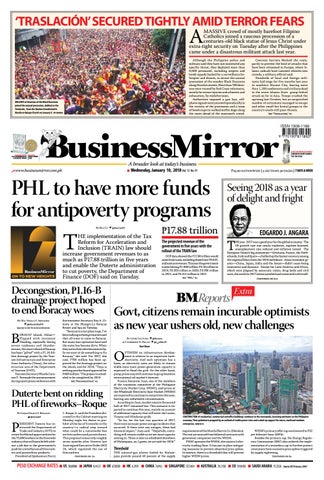
‘TraslaciÓn’ secured tightly amid terror fears
A
massive crowd of mostly barefoot Filipino Catholics joined a raucous procession of a centuries-old black statue of Jesus Christ under extra-tight security on Tuesday after the Philippines came under a disastrous militant attack last year.
Although the Philippine police and military said they have not monitored any specific threat, they deployed more than 6,000 personnel, including snipers and bomb squads backed by a surveillance helicopter and drones, to secure the annual procession of the wooden Black Nazarene along Manila’s streets. More than 700 devotees were treated by Red Cross volunteers, mostly for minor injuries and ailments and exhaustion, by midafternoon. Authorities imposed a gun ban, cellphone signals were jammed sporadically in the vicinity of the procession and a team of bomb experts walked sniffer dogs along the route ahead of the mammoth crowd.
Millions of devotees of the Black Nazarene joined the annual procession, dubbed as the Traslación, from the Quirino Grandstand in Manila to Quiapo Church on January 9. ROY DOMINGO
media partner of the year
United nations
2015 environmental Media Award leadership award 2008
Concrete barriers blocked the route, partly to prevent the kind of attacks that have been witnessed in Europe, where Islamic radicals have rammed vehicles into crowds, a military official said. Hundreds of local and foreign militants laid siege for five months last year to southern Marawi City, leaving more than 1,100 combatants and civilians dead in the worst Islamic State group-linked attack so far in Asia. Troops crushed the uprising last October, but an unspecified number of extremists managed to escape and other small but brutal groups in the country’s south still pose threats. See “Traslación,” A2
BusinessMirror A broader look at today’s business
www.businessmirror.com.ph
n
Wednesday, January 10, 2018 Vol. 13 No. 91
PHL to have more funds for antipoverty programs By Rea Cu
T
@ReaCuBM
he implementation of the Tax Reform for Acceleration and Inclusion (Train) law should increase government revenues to as much as P17.88 trillion in five years and enable the Duterte administration to cut poverty, the Department of Finance (DOF) said on Tuesday.
₧17.88 trillion The projected revenue of the government in five years with the rollout of the Train law
2016 ejap journalism awards
business news source of the year
P25.00 nationwide | 5 sections 30 pages | 7 days a week
Seeing 2018 as a year of delight and fright Edgardo j. angara
T
DOF data showed the P17.88 trillion would come from taxes, including those from Train, and nontax revenues. This year the government is seen hitting P2.806 trillion; P3.16 trillion in 2019; P3.553 trillion in 2020; P3.956 trillion in 2021; and P4.414 trillion in 2022.
HE year 2017 was a good year for the global economy. The US growth rate was nearly explosive, equities boomed, unemployment rate reduced and inflation tamed. The European Union’s big economies—Germany, France, the Netherlands, Italy and Spain—chalked up the fastest recovery among the regional blocs from the 2010 meltdown. Asian economic giants—China, Japan, India and the Asean—didn’t cease being innovative and dynamic. Except for Latin America and Africa, which were plagued by autocratic rulers, drug lords and civil wars, the world in 2017 seems satisfied and contented with itself.
See “PHL,” A2
Continued on A10
Decongestion, ₧1.16-B BMReports drainage project hoped to end Boracay woes Govt, citizens remain incurable optimists By Ma. Stella F. Arnaldo
@akosistellaBM Special to the BusinessMirror
B
ORACAY Island, Aklan— Plag ued w ith incessant flooding, especially during severe typhoons and thunderstorms, the resort island of Boracay has been “gifted” with a P1.16-billion drainage project by the Tourism Infrastructure and Enterprise Zone Authority (Tieza), the infrastructure arm of the Department of Tourism (DOT). Tourism Secretary Wanda Corazon T. Teo made the announcement during a joint press conference with
Environment Secretary Roy A. Cimatu at the Shangri-La Boracay Resort and Spa on Tuesday. “Boracay is a nice place to go. I’ve been talking to foreign tourists and they all want to come to Boracay. But many tour operators have said the water has become dirty. When they swim their skin becomes itchy. So we want to do something to fix Boracay,” she said. For 2017, she said, P760 million has been approved for the drainage project on the island, and for 2018, “Tieza is seeking another board approval for P400 million.” The project is scheduled to be completed by 2019. See “Decongestion,” A2
Duterte bent on ridding PHL of fireworks–Roque By Elijah Felice E. Rosales
P
@alyasjah
resident Duterte has instructed the Department of Trade and Industry (DTI) to create livelihood opportunities for the 75,000 workers in the fireworks industry that will soon be left without a job due to the government’s push for a total ban on all firecrackers and pyrotechnic products. Presidential Spokesman Harry
L. Roque Jr. said the President discussed in the Cabinet meeting on Monday night his desire to prohibit all forms of fireworks in the country—a radical step toward what could be a nationwide ban on firecrackers and pyrotechnics. This proposal comes only roughly seven months after Duterte last June signed Executive Order (EO) 28, which regulated the use of firecrackers Continued on A2
PESO exchange rates n US 50.0000
as new year ushers old, new challenges By Lenie Lectura @llectura & Catherine N. Pillas @c_pillas29
O
Part Three
PTIMISM on infrastructure development is relative to an important facet: electricity. And such optimism has a basis, as electricity rates are likely to remain stable since more power-generation capacity is expected to flood the grid. On the other hand, pump prices may still continue to go up based on international oil market’s forecast. Francis Satunino Juan, one of the members of the transition committee at the Philippine Electricity Market Corp. (PEMC), said prices at the Wholesale Electricity Spot Market (WESM) are expected to continue to remain low this year, barring any unforeseen circumstances. According to Juan, market rates in the second half of 2017 remained low. This scenario is expected to continue this year, mainly on account of additional capacity that will enter the Luzon, Visayas and Mindanao grids. “So far, for the last two quarters of 2017, there were no major power outage incidents that occurred. If there were any outages, these had minimal impact,” Juan said. “Hopefully, everything will remain stable as we see more capacity coming in. There is also no scheduled shutdown of Malampaya, so, I guess, we are safe for 2018.”
Threshold
THE natural-gas plants fueled by Malampaya provide around 40 percent of the supply
Construction of residential, commercial and office buildings continues in the metropolis, boosting optimism on the Philippine economy. That optimism is propped by an outlook of stable power rates and scaled-up support for micro, small and medium enterprises. NONIE REYES
requirements of the Manila Electric Co. (Meralco). The rest are sourced from bilateral contracts with generation companies and the WESM. PEMC operates the WESM, the country’s electricity trading floor. It has put in place mitigating measures to prevent abnormal price spikes. In essence, there is a threshold that will prevent higher WESM prices.
WESM’s primary offer cap was lowered to P32 per kilowatt-hour (kWh). Besides the primary cap, the Energy Regulatory Commission (ERC) also ordered the implementation of a secondary cap to further protect consumers from excessive price spikes triggered by supply tightening. Continued on A2
n japan 0.4423 n UK 67.8350 n HK 6.3931 n CHINA 7.6942 n singapore 37.5404 n australia 39.2150 n EU 59.8450 n SAUDI arabia 13.3326
Source: BSP (9 January 2018 )
BMReports BusinessMirror
A2 Wednesday, January 10, 2018
Traslación. . . Continued from A1
ºSecurity officials said they were also concerned with possible stampedes in a dawn-to-midnight event that some say could draw millions, although it’s difficult even to approximate the crowd size. Mobs of devotees in maroon shirts dangerously squeezed their way into the tight pack of humanity around a carriage carrying the life-size statue. They threw small towels at volunteers on the carriage, which was being pulled by ropes, to wipe parts of the cross and the statue in the belief that the Nazarene’s powers would cure ailments and foster good health and fortune. Ronald Malaguinio, a 38-year-old worker, carried a small replica of the Nazarene on a steel platform bedecked with yellow and white flowers for several kilometers (miles) from his home in Manila’s Tondo slum district to join the procession and pray for a son recovering from a heart ailment. “If the doctor says your son has a 50-50 chance of surviving, where will you go?” Malaguinio asked. “If money can’t cure diseases, the only other option is prayers. Ours have been heard and we’re here to thank the Nazarene.”Another devotee, Jeffrey Nolasco, said he joined the procession for the fifth year in a row to pray that his four children will finish school, his impoverished family could eat three times a day and he could overcome a bad habit. “I’m a drunkard,”said Nolasco, who walked barefoot on the hot pavement and carried a small statue of the cross-carrying Nazarene. Jim Coffin, an anthropology professor from Muncie, Indiana, said he and his wife flew in as tourists and were “absolutely moved” by the massive but peaceful procession and display of religious faith by the devotees, many of them poor. “We watched them as they threw towels on the statue and rubbed it on their bodies,” Coffin said as the procession inched its way nearby. “If the people in power appreciate how bad off the people are and they truly want to better their lives, the people in power have got to be moved by this.” Crowned with thorns and bearing a cross, the Nazarene statue is believed to have been brought from Mexico to Manila on a galleon in 1606 by Spanish missionaries. The ship that carried it caught fire, but the charred statue survived. Some believe the statue’s endurance, from fires and earthquakes through the centuries and intense bombings during World War II, is a testament to its powers. The spectacle reflects the unique brand of Catholicism, which includes folk superstitions, in Asia’s largest Catholic nation. Dozens of Filipinos have themselves nailed to crosses on Good Friday in another tradition to emulate Christ’s suffering that draws huge crowds each year. AP
Decongestion. . . Continued from A1
Boracay’s perennial flooding problem attracted national attention again after photos circulated on social media of the main road under waist-deep water in the aftermath of Typhoon Urduja, which swept through Aklan. Data from DOT-Western Visayas showed visitor arrivals in Boracay reached 2 million in 2017, up
www.businessmirror.com.ph
Govt, citizens remain incurable optimists briefs ➜ as new year ushers old, new challenges
TRAIN to add P.08/kWh to Meralco bill starting Feb.
Continued from A1
The P6.245-per-kWh secondary cap kicks in the market once an average threshold of P9 per kWh is reached over a 168-hour period. This is what’s called the price-threshold mechanism. The thresholds were computed based on historical prices, with allowance for three intervals hitting high market-clearing prices. With these measures, Meralco said rates may not reach the record-high levels. “We don’t expect price spikes like in the November and December 2013 supply months because of the lower primary cap in the WESM and the secondary cap,” Meralco Head for Utility Economics Lawrence Fernandez said.
“Energy prices are recovering in response to steady demand and falling stocks, but much depends on whether oil producers seek to extend production cuts,” said John Baffes, senior economist and lead author of the Commodity Markets Outlook. Supplies from producers, such as Libya, Nigeria and Venezuela, could be volatile. Members of the Organization of the Petroleum Exporting Countries and other producers could agree to cut production further, maintaining upward pressure on prices.
P200 million we initially proposed.”
Cars
THE power sector’s outlook adds to the optimism being shared in the Department of Trade and Industry (DTI). Aside from that, the DTI is coming equipped with a larger budget this year, following the chief executive’s marching orders to scale up support for micro, small, and medium enterprises (MSMEs), at the same time putting in the budget for the industry stimulus program, the Comprehensive Automotive Resurgence Strategy (CARS) Program. At least P1 billion was proposed for the agency’s MSME Development Program, ramp up key initiatives, such as microfinancing the “Pondo sa Pagbabago at Pagasenso” (P3) and earmarking P1.6 billion for the start of the CARS Program. “The effort for the P3 is around P1 billion,” Lopez told reporters. “There is another P1 billion for our ‘Shared Services Facilities’ that we requested on top of the
FOR Industry Development, some P1.62 billion was proposed for the CARS Program, meant as government support to offset production costs for participating manufacturers behind the Toyota and Mitsubishi vehicle brands. The support will come in the form of tax-payment certificates that can be used to pay additional taxes on the vehicle to be produced for the program. The CARS Program gives a production, per-unit incentive equal to $1,000 for participant carmakers Toyota and Mitsubishi. Investments of participant carmakers have begun pouring in since late-2016. As envisioned by the BOI, the CARS program is intended to make the country’s auto-manufacturing industry on a par with other regional manufacturing hubs like Thailand; through incentives, the program intends to localize key auto parts while making the participant vehicle models competitive versus imported ones in the Philippine market. Production for the CARS program is slated in July of last year. Overall, Lopez sees the budget for the agency to be in the neighborhood of P5.8 billion this year—and will gradually be on the rise every succeeding year of the administration. The DTI will gradually be incorporating the P50 billion in MSMEsupport pledged by President Duterte into its budget, in tranches, over the next six years. To be continued
“The increase in [collection] would allow the government to provide better-quality services—infrastructure, education, and health—to improve tne quality of Filipinos now and eliminate poverty in the next generation,”Finance Assistant Secretary Ma. Teresa S. Habitan said via SMS. The Bureau of Internal Revenue (BIR) is expected to collect P2.039 trillion in 2018; P2.309 in 2019; P2.616 trillion in 2020; P2.942 trillion in 2021; and P3.312 trillion in 2022. The DOF projected that the Bureau of Customs (BOC) will be able to generate revenues amounting to P581.3 billion in 2018; P662.2 billion in 2019; P748.2 billion in 2020; P826.2 billion in 2021; and P914.8 billion in 2022. Based on DOF estimates, nontax revenues collected by the government may
amount to P166.8 billion in the first year of implementation of the TRAIN; P169 billion in 2019; P167.3 billion in 2020; P166.3 billion in 2011; and P164.8 billion in 2022. Data from the Bureau of the Treasury showed total government revenues from 2012 to 2016 reached only P9.461 trillion. Broken down, the government collected P1.534 trillion in 2012; P1.716 trillion in 2013; P1.908 trillion in 2014; P2.108 trillion in 2015; and P2.195 trillion in 2016. Revenues collected by the BIR reached P6.607 trillion for the period, while the revenues from the BOC reached P1.727 trillion. The Train was signed by the President and enacted into law last December. It is the first part of the Duterte administration’s Comprehensive Tax Reform Program (CTRP). Under Package 1 of the CTRP, the government has slashed personal-income tax (PIT) rates while implementing offsetting measures, including lifting some restric-
tions on value-added tax, increasing excise tax rates on fuel, automobiles and tobacco, among others. Earlier, the Development Budget Coordination Committee (DBCC) updated the medium-term fiscal targets of the government with regards to revenues, disbursements and the financing of borrowings, in light of the projections in fiscal and economic conditions in the medium term. The DBCC-approved revenue program for 2018 is pegged at P2.789 trillion, or 16 percent of GDP, rising to P4.388 trillion, or 17.3 perecent of GDP, in 2022. The first package of TRAIN, which lowers PIT rates while raising excise taxes on numerous products, is projected to contribute a net amount of P82.3 billion this year. The disbursement target of the government is set at P3.313 trillion for 2018 rising to P5.149 trillion in 2022.
almost 18 percent from the arrivals in 2016. Of the 2 million arrivals, 986,920 were foreigners. For his part, Cimatu said the DENR hopes to “decongest Boracay,” by closing down establishments which have violated environmental laws, such as the Philippine Clean Water Act. He added the DENR will be joining the municipal government of Malay, of which Boracay is a part of, in making an inventory of the establishments here, “checking which buildings have permits or without, who are connected to the drainage
and sewage system...[as well as] those who have permits to build in timberland areas.” Although the DENR issues forest land-use agreements for tourism purposes (FLATP), he said he noticed that during the helicopter flight over the island, there were houses built in forested areas: “These could be houses of building contractors [of new resorts],” he surmised, intimating though that such accommodations are not covered by FLATPs. Addressing complaints of sewage being
discharged directly into the waters, especially in Bulabog, an area known for water sports like parasailing, windsurfing and kitesurfing, Cimatu also said: “We will be testing the waters all over the island, the swimming areas and the catch basins,” adding that this will be done “periodically”, now that the DENR is reestablishing its office on the island. In February 2015 the DENR reported that coliform bacteria levels specifically in Bulabog waters exceeded safety standards at 47,460 most probable number (mpn) per 100 milimeter (ml). The safe standard for swimming is 1,000 mpn/100ml. Coliform bacteria nTrmally comes from human excrement. For his part, Malay Mayor Ceciron Cawaling declined to issue a moratorium on building resorts in Boracay until such time an inventory of establishments are completed. Residents and frequent tourists to Boracay have asserted that the indiscriminate issuance of building permits by the mayor’s office for new resorts and the consequent construction of these new accommodations have put a strain on the island’s resources and infrastructure. “Before any moratorium is issued, we must first conduct an inventory [of establishments] and how much infrastructure we have,” Cawaling said, noting that the municipal government has recently signed a memorandum of agreement with Palafox and Associates for the creation of a Boracay master plan. He said the inventory of establishments and infrastructure on the island should be completed within the year. “The problem is there was no urban planning for Boracay. The resorts and other establishments were built ahead of any master plan,” he stressed. In 2008 President Gloria Macapagal-Arroyo issued Executive Order 706, which transferred the administration of Boracay Island to the then Philippine Tourism Authority (PTA), the forerunner of Tieza. It also cited Letter of Instruction 1298, which ordered “the mayor of Malay to suspend issuance of building permits for any structure on Boracay Island pending the promulgation of a development plan for the island by the PTA.”
Oil
FOR oil prices, the country is likely to see prices go up. The price adjustment in petroleum products reflects movements in the international petroleum market. Local oil firms adjust their prices on a weekly basis to reflect prices of imported oil products that arrive in the country. It takes about a week for the oil companies to bring their products to the market from the time they import the products. The World Bank said recently that oil prices are forecast to rise to $56 a barrel in 2018, from about $54 in 2017 as a result of steadily increasing demand, decline in the production volume as agreed among oil exporters and stabilizing US shale-oil production.
PHL. . .
Continued from A1
Support
The full impact of the new Tax Reform Inclusion and Acceleration (TRAIN) Act on electricity rates for the year will amount to 8 centavos per kilowatt-hour (kWh), an official of the Manila Electric Co. (Meralco) said. “If we use November 2017 dispatch levels…excise tax of coal and oil is around 1 centavo, while the VAT [value-added tax] on transmission charge is 7 centavos. The total is 8 centavos. That is the full impact for Meralco customers this year,” Meralco Utility Head Economics Lawrence Fernandez said. He added this will probably be reflected in the February bills of Meralco customers. Lenie Lectura
➜Peza zones must now follow occupational safety standards The labor department has cut off its labor-safety agreement with the Philippine Economic Zone Authority (Peza) that allows economic zones to only voluntarily comply with occupational safety and health standards. In a news briefing on Tuesday, Presidential Spokesman Harry L. Roque Jr. said the Department of Labor and Employment (DOLE) decided to revoke its agreement with the Peza due to the two deadly fires in economic zones last year. The two fires—the House Technology Industries Ltd. (HTI) fire in General Trias, Cavite, and the NCCC Mall fire in Davao City, both Peza-accredited zones—claimed the lives of dozens of workers, most of whom were trapped inside the burning establishments. Under the DOLE’s Manual on Labor Laws Compliance System and Procedures for Uniform Implementation, labor regional directors were instructed to coordinate with his or her Peza counterpart an economic zone-wide evaluation of voluntary compliance with occupational safety and health standards. The provision is pursuant to the memorandum of agreement signed between the DOLE and Peza in 2006. As stipulated in the manual, assessment of economic zones can be carried out through an industry-wide joint assessment, which is headed by the DOLE. However, this can be sidelined in favor of the economic zone, and the assessment can be “organized differently depending on the peculiarity of the economic zone operations.” Elijah Felice E. Rosales
Duterte bent on ridding PHL of fireworks–Roque Continued from A1
“The President also indicated that he will push for Congress to enact a law that will ban all firecrackers and pyrotechnic gadgets,” Roque said in a news briefing on Tuesday. He noted that the President is hell-bent on turning this into a national policy that he had instructed Trade Secretary Ramon M. Lopez to find alternative livelihood for the thousands of workers in the fireworks industry that will be displaced by the nationwide ban. “Now he realizes that there will be about 75,000 individuals who are working in this industry. He instructed the DTI to look for alternative livelihood for the would-be displaced workers,” Roque said. Duterte also directed his allies in Congress to immediately convene and discuss this proposal, his spokesman said. “He wants Congress to enact this law at the soonest time possible so that the public debate on the banning of fireworks and pyrotechnics could begin as early as possible.” Roque added that industry players will be consulted by lawmakers in the crafting of the law. However, they should not expect they can reverse the President’s intent to impose a nationwide fireworks ban. “Yes,” he said when sought if fireworks manufacturers will take part in the legislative process. “That’s why he wants Congress to enact the law, begin hearing on the proposed bill that would ban firecrackers as early as possible to afford stakeholders to be consulted.” The Palace official also said it was Duterte’s lone prerogative to push for a nationwide ban, as this has always been the policy in Davao City under his leadership. “I don’t think it’s a result of a recommendation of any other than it’s a result of his own prognosis that firecrackers and pyrotechnics are inimical to human health and safety,” Roque said. With the looming nationwide fireworks ban, the use of pyrotechnics, such as sparklers, fountain and Roman candle, will soon be prohibited. Under EO 28, these pyrotechnics are permitted, as long as they are compliant with safety standards and regulations. EO 28 regulated the use of firecrackers by confining it to community display, or in designated areas identified by local government units. The presidential order states that a fireworks display qualifies as a community display if “it is conducted on the occasion or as part a celebration, competition or similar event held in a venue other than a place of residence.” It also mandated that community display must be under the watch of a trained person licensed by the Philippine National Police. On top of this, the community display must have the green light of the local government and should be issued a permit specifying the date, time and specific area of the fireworks display. The regulation imposed by EO 28 turned out to be successful, from the government’s perspective, in lowering the number of firecracker-related injuries last year. According to the Department of Health (DOH), firecracker injuries plunged by 68 percent to 191 incidents, from 524 incidents last year in the period of December 21 to January 1. Health Secretary Francisco T. Duque III attributed the drastic drop in firecracker-related injuries to the President’s EO. “We would like to thank first and foremost President Rodrigo Duterte for passing or signing Executive Order 28, which truly reinforced the efforts of the DOH and complimented by the efforts of other concerned agencies,” Duque said last Monday. “Overall, the government’s campaign against fireworks has reduced the number of injuries. The DOH is certainly most grateful for the strong cooperation of our local government units and the of the government agencies for this success,” he added. While the government was delighted with the results, fireworks manufacturers suffered heavily from EO 28, as dozens of businessmen in the industry did not renew their license last year. They said they decided not to carry on with their business, fearing a nationwide fireworks ban will soon be imposed by the government, which is now imminent.
Economy
A4 Wednesday, January 10, 2018 • Editors: Vittorio V. Vitug and Max V. de Leon
BusinessMirror
DOTr sees ‘significant improvement’ in MRT 3 commuter service this year
G
OVERNMENT officials of Japan and the Philippines have exchanged an unsigned diplomatic correspondence for the provision of a loan under Tokyo’s official development assistance (ODA) for the rehabilitation and maintenance of the Metro Rail Transit (MRT) Line 3. Transportation Undersecretary for Rails Timothy John R. Batan called the exchange of the “note verbales” as a “major milestone for the much-needed rehabilitation and maintenance of the MRT 3.” The arrangement with Japan, he added, involves obtaining ODA financing under Japan International Cooperation Agency’s (Jica) Special Terms for Economic Partnership. Typically, Japanese ODA packages in the Philippines involve the following terms: 0.1 percent inter-
est per annum, 40 years payment period and 12 years grace period for the principal. “These developments show that we are wasting no time and effort in rehabilitating and restoring the reliability and capacity of the MRT 3,” Batan said late Tuesday. The next step, he added, is for Jica to conduct a feasibility study, which will refine the project’s scope of works. This will be done in January to February, after which government approvals will be obtained.
Signing of the loan agreement and procurement of the rehabilitation and maintenance provider will then follow in March to April, and mobilization of the Japanese provider is expected within the second quarter. The procurement of a Japannom i n ated re h abi l it at ion a nd m a i nten a nce prov ider w i l l be done pursuant to Jica’s procurement guidelines. Batan said that, given the urgent need to restore the MRT 3’s reliability and capacity, Japan has given assurances that it will nominate a provider that is highly qualified, and has a ro-
bust and reliable track record. This early, Sumitomo Corp., the builder and previous maintenance provider of the MRT 3, has signified its interest in the said deal. “ This year we will make sign i f ic a nt i mprovements to t he MRT 3, and that is our commitment to the Filipino commuters,” Batan said. The MRT 3 serves almost half-amillion passengers daily. It has been considered a perennial problem for the government due to the numerous daily breakdowns, unloading incidents, and stoppages.
These developments [exchange of unsigned diplomatic correspondence for the provision of a loan under Tokyo’s ODA for MRT 3 rehab and maintenance] show that we are wasting no time and effort in rehabilitating and restoring the reliability and capacity of the MRT 3.”—Batan
Subsidy for water supply, sewerage treatment jumped 53.2% in 2015 By Cai U. Ordinario
F
@cuo_bm
ilipinos shelled out 53.23 percent more for the increase in subsidies they
paid for the development of water collection, treatment and supply in the country in 2015, according to the Philippine Statistics Authority (PSA).
Based on the final results of the 2015 Annual Survey of Philippine Business and Industry (ASPBI), the PSA said total subsidies increased to P475 million in 2015, from P310
million in 2014. “Subsidies are all special grants in the form of financial assistance or tax exemption or tax privilege given by the government to aid and develop an industry,” the PSA said. The total output value produced by firms engaged in water supply; sewerage, waste management and remediation activities reached P81.9 billion in 2015. This was a 26-percent jump from the P65 billion worth total output posted in 2014, according to data released by the PSA. The growth was largely due to the increase in total output value of water collection, treatment and supply activities, which yielded the highest output value of P73 billion, or 89.2 percent, of the total. The industries that were a far second and third were the collection of nonhazardous waste at P4.6 billion, or 5.6 percent, of the total; and materials recovery at P2.2 billion, or 2.6 percent, respectively. Based on the PSA’s estimate, there were 993 firms engaged in water supply, sewerage, waste management and remediation activities in the formal sector of the economy.
www.businessmirror.com.ph
Power consumers to feel brunt of coal-tax increase under TRAIN, group says By Jonathan L. Mayuga @jonlmayuga
T
he increase in imported coal tax under the Tax Reform for Acceleration and Inclusion (TRAIN) Act will not be felt by power producers, but by power consumers, the group Advocates of Science and Technology for the People (Agham) warned on Tuesday. In a news statement, Finesa Cosico, secretary-general of Agham, said electricity consumers are at the losing end of the deal with the imposition of the increased coal tax under the tax-reform package offered under TRAIN. “They [electricity consumers] will be burdened with higher electricity rates despite standing to gain no real benefit from the supposed environmental regulation,” she added. Cosico added that, under the government’s tax-reform program, the coal tax will increase from the current P10 per metric ton in a 50-100-150 hike scheme for three years, with the P50 increase slated this year. Quoting the Department of Energy (DOE), she said the coal tax, an excise tax, is classified as a passon charge to consumers under the Electric Power Industry Reform Act (Epira), the law that liberalized the country’s energy industry. “As a pass-on charge, the coal tax will put the entire burden of rising power costs on consumers instead of taxing big-time coal businesses. As such, it will not inhibit the increase of coal-fired power plants,” she said. She also debunked the proponents’ assertion that the coal tax is a step toward meeting the country’s carbon-emission limits, saying pollution will remain at business-as-usual, notwitstanding with its full implementation.
“The coal tax does not change the fact that coal is still a cheap but [a] dirty energy resource. It also does not change the Duterte [administration’s] framework of using coal as the primary source in the country’s energy mix,” Cosico said. The group is demanding the reorientation of the coal tax as a charge to be carried by corporations and called for the repeal of the Epira, which, it said, has allowed the phenomenon of such pass-on provision. “We also call for the redistribution of the energy mix away from the ‘pollutive coal’ to the indigenous energy resources abundant in the country,” Cosico said. An activist group earlier criticized government officials for insisting that the new tax imposition under TRAIN will have minimal and temporary effects on the prices of commodities and will benefit the rich and poor alike. The Samahan ng Progresibong Kabataan (Spark) branded as “malicious and deceptive” the statements issued by Secretary Ramon M. Lopez of the trade department and Presidential Spokesman Harry L. Roque Jr. against those who oppose the new tax package. The group said the two officials are the ones spreading misinformation by downplaying the adverse effects of TRAIN and by making it seem “justified and impartial.” “They must admit that TRAIN, like all indirect taxes, are pass-on impositions. Manufacturers of goods and service providers shall simply make their clients bear their tax obligations,” Spark contented. The youth activists challenged both Lopez and Roque “to live even for a day on minimum wage so they may know firsthand what more than 12 million Filipinos will suffer once TRAIN is fully in motion.”
Black Nazarene fashion
A lady sidewalk vendor makes brisk business out of selling Black Nazarene shirts and accessories at the height of the Traslación rites the venerated image in Quiapo, Manila. NONIE REYES
Congress to ensure free tuition exclusive to deserving students By Jovee Marie N. dela Cruz @joveemarie
T
O ensure that funds allocated for the government’s free college tuition program won’t be wasted on malingerers and recidivist absentees or bulakbol students, a lawmaker on Tuesday said Congress will activate its congressional oversight powers to monitor the implementation of free college education law. House Appropriations Committee Chairman Karlo Alexei B. Nograles of the First District of Davao City said the government has allocated P40 billion for the purpose of bankrolling the free tuition program, which is provided under Republic Act (RA) 10931, or the Universal Access to Quality Tertiary Education Act. “The House may hold hearings after every semester to check on the implementation of RA 10931, particularly on how it is helping lessfortunate families in getting their children to college. After all, this
is the spirit of the law,” Nograles said in a news statement. These policies, he added, will discourage recidivism from students, such as absenteeism, tardiness and cutting of classes. “Our state and local colleges and universities should not become ‘Iskul Bukol’, even as we give free education to our students. Through our oversight function, Congress would assist the Commission on Higher Education (CHED) and the participating educational institutions in making sure that deserving students or those who truly want to study will benefit from the free college tuition program. The funds we have set aside are simply too precious,” Nograles said. According to the lawmaker, the CHED and other stakeholders may also use the House hearings to address the birth pangs of the implementation of the much-awaited program. “We can’t expect this to be free of hitches, especially during its first year of implementation, so close coordination between law-
makers, THE CHED and other stakeholders is vital. We can learn the problems and solve them as we go along,” he added. The law, which democratized st ate col lege educ at ion, wa s signed by President Duterte in August 2017. R A 10931’s beneficiaries include students from the country’s 114 state universities and colleges, 16 local universities and colleges accredited by the CHED and 122 technical-vocational institutions under the Technical Education and Skills Development Authority. “It will be another victory for the law if it eventually help get rid of these bad habits from young Filipinos in the name of free college education,” he said. Last month the CHED reported that it has already completed its implementing rules and regulations for the free tuition program, which will be rolled out this 2018. While it has yet to be released, the IRR is expected to fine-tune details of RA 10931.
Agriculture/Commodities BusinessMirror
www.businessmirror.com.ph
Editor: Jennifer A. Ng • Wednesday, January 10, 2018
A5
Piñol sees slower growth for H1 farm output
F
By Jasper Emmanuel Y. Arcalas
@jearcalas
arm output in the first half would grow slower at 4 percent, from 5.71 percent last year, due to the damage wrought by two typhoons in eight regions, according to Agriculture Secretary Emmanuel F. Piñol.
Piñol said the losses incurred by farmers from Typhoons Urduja (international name KaiTak) and Vinta (international name Tembin), which amounted to at least P1.5 billion, would drag down the performance of the agriculture sector in the first two quarters.
“The first quarter and second quarter would be affected but [growth rate] would not be negative. But there will be declines,” he told reporters in an interview on January 9. “Farm sector might grow by 4 percent in the first half as farmers cannot recover right away.”
Piñol said, however, that Urduja and Vinta did not affect agriculture performance in the fourth quarter of 2017. Earlier, the chief agriculture said farm output for 2017 would still expand by 5 percent to 6 percent, despite the production losses caused by typhoons. Favorable crops production allowed the farm sector to grow by 5.28 percent in the first quarter and by 6.18 percent in the second quarter of 2017, according to data from the Philippine Statistics Authority (PSA). In January to March the PSA said the production of the crops subsector rose by 8.28 percent. In the April-to-June period, PSA data showed the crops and poultry subsectors recorded output increases of 11.72 percent and 8.36 percent, respectively. Farm-gate prices in the first
quarter of 2017 increased by 3.34 percent, according to PSA data. Price gains were higher in the livestock and fisheries subsectors at 5.96 percent and 7.17 percent, respectively. In the second quarter of 2017, the PSA said farm-gate prices went up by 4.93 percent. Price increments were recorded in all subsectors; crops at 1.59 percent, livestock at 14.06 percent, poultry at 1.58 percent and fisheries at 7.55 percent. “From January to June 2017, prices received by farmers increased by an average of 4.17 percent,” the PSA said. T he l atest d a m age re por t from the Department of Agriculture showed that production losses incurred by some 52,297 farmers in Regions 4A, 5, 7, 8, 9, 11, 12 and 13 have reached P1.538 billion.
NFA targeting to revive Kadiwa system this year T he National Food Authority (NFA) is currently crafting a plan that will allow the food agency to start procuring and distributing nongrain commodities, such as vegetables and meat, this year. NFA Spokesman Rebecca Olarte said the food agency is targeting to come up with a concept paper on how it could reinstate its role which it performed in the Kadiwa program rolled out in February 1980. Olarte said the paper will be presented for approval of the NFA Council, the highest policy-making body of the food agency. “Our target is to implement [a scheme similar to Kadiwa] within the year, that’s the instruction of [NFA] Administrator Jason L.Y. Aquino,” she told reporters in an interview recently. “A ready m a rket w i l l help producers and also make goods affordable by eliminating the middlemen,” Olarte said, adding that the NFA would produce directly from farmers. A mong the points being discussed by the NFA’s technical committee are the additional budget required by the program and the additional manpower needed to implement it. “One point being discussed is determining the outlet areas by accessibility and not by proximity,” she said. “Because sometimes, an island is near another one, but is not accessible because there’s no way to transport the goods.” Earlier, economists warned that expanding the market and distribution activities of the NFA could cause the government to incur losses.
Rolando T. Dy, executive director of the University of Asia and the Pacific’s Center for Food and Agri Business, said the proposal to allow the NFA to procure and distribute nongrain commodities, such as fruit and fish, should be scrutinized. “This proposal [expanding NFA’s role] needs multisectoral review by the public sector and business groups. The government should not be in business,” Dy told the BusinessMirror via e-mail. “In the past, the NFA incurred losses with Kadiwa. It will also compete with the private sector, which can do a better job,” he said, adding the food agency “should just stick to rice-buffer stock management.” Economist Pablito M. Villegas, vice president of Confederation Filipino Consulting Orga ni zat ions, ec hoed D y ’s rema rk that the government should not intervene in the market. However, Villegas said rev iv ing the NFA’s old K adiwa scheme could be a “viable” option to address current market failures, particularly the proliferation of midd lemen and traders who tend to inflate the prices of goods. “Given the grav it y of supply-cha in market fa i lure, there is scope or justification for expanding the powers of the NFA and reverting to the Kadiwa scheme,” he said. “At present, traders are the on ly ones benef it i ng. T here
Israeli company says it has produced tiniest cherry tomato
M
OSHAV IDAN, Israel—They say bigger is better, but in the succulent world of cherry tomatoes, one Israeli company is going smaller than ever before. The “drop tomato” is about the size of a blueberry, and the Kedma company in the country’s southern Arava desert says it is the smallest one ever cultivated in Israel, perhaps even in the world. It’s a point of pride in a country known for its agricultural innovation, where fruits and vegetables are taken seriously and where several strands of the cherry tomato were first invented. “The idea is that it is comfortable,” said Ariel Kidron, a Kedma grower. “You can throw it in a salad, you don’t need to cut it. It just explodes in your mouth.” The seed, originally developed in Holland, was modified to match the arid growing conditions in southern Israel. Rami Golan of the Central and Northern Arava Research and Development center, who accompanied the project, said it was definitely the smallest ever to be grown in Israel— where tomatoes are incredibly popular. The tiny tomato, smaller than a
In this January 4 photo, Israeli chef Shaul Ben Aderet holds up a small “drop tomato” at a restaurant in Tel Aviv, Israel. The drop tomato is about the size of a blueberry. AP Photo/Ariel Schalit
one shekel Israeli coin, is offered in red and yellow varieties and will be presented to the public at a three-day international agricultural fair in Israel later this month. Early indications are it could be a big hit. Shaul Ben Aderet, a wellknown Israeli chef who owns three restaurants, including Tel Aviv’s Blue Rooster, got some early samples and says the new strand is packed with flavor and will spawn an infinite number of new recipes. He offered it sizzled in a pan, baked into focaccia bread and as a straightup snack. “It’s very simple, it’s clean, it’s nice, it’s sexy,” he said. In a blind taste test alongside two sweets, he said, “they would say the tomato is a candy, that’s for sure.” AP
is an oligopolistic inf luence at the current value chain, resulting in lower farmgate price but higher retail price of goods,” he added. Earlier, NFA A ssistant Administrator for Marketing Operations Maria Mercedes G. Yacapin told the BusinessMirror that the agency would be needing a bigger annual budget if would be tasked to buy other agricultural products. “Right now, the NFA has very limited capability in terms of logistics. This [expansion] is a big requirement that entails a higher budget,” Yacapin said. “The NFA also has to consider Republic Act 9184, or the procurement law, which we had to follow when importing rice. We have to consider the requirements of the law if the NFA would expand its procurement program,” Yacapin added. Jasper Emmanuel Y. Arcalas
Victims of Typhoon Vinta in Sibuco get assistance from DA
O
ver 500 families affected by Typhoon Vinta received aid from the Department of Agriculture (DA) during its Agri-fishery Relief and Assistance Turnover on January 5 in Barangay Anungan, Sibuco, Zamboanga del Norte. Agriculture Secretary Emmanuel F. Piñol himself entrusted to Barangay Anungan the assorted reliefs and assistance prepared by DARegion 9, Bureau of Fisheries and Aquatic Resources Region 9 (BFAR-9), the Agricultural Credit Policy Council (ACPC) and the Philippine Crop Insurance Corp. (PCIC). Piñol said in a statement that the visit gave him the opportunity to look into the actual damages caused by Vinta in the area, take note of the needs and concerns of the affected residents. “I cannot promise to solve every problem here in Sibuco for I can only go as far as agriculture, but what I can promise you is that everything that I have seen in Sibuco, in this particular barangay, all the pain and the sympathy, I will report it to President Duterte,” he said. Piñol then called out the DA’s attached agencies for their
commitments to be promulgated among the people of Sibuco. BFAR-9, ACPC and PCIC all pledged to help the afflicted residents through financial and livelihood assistances. The regional office of the DA turned over 200 bags of rice, 50 bags of corn seeds, 10 sacks of peanuts and 29 kilos of assorted vegetable seeds, while the BFAR provided fishing gear, such as gillnets, drift gillnets, gillnets (mackerel), gillnets (tuna), hook and line, squid jigger, life vests, payao, fish processing utensils and some relief goods. A P6-million check under the Survival and Recovery (SURE) Assistance Program of the ACPC was also turned over as part of the financial assistance to the affected farmers and fisherfolk of the province. Also present during the turnover ceremony were National Director for Fisheries Undersecretary Eduardo B. Gongona, DA-10 Regional Director Carlene C. Collado, DA-9 Regional Director Constancio G. Alama with Assistant Directors Dr. Dennis H. Palabrica and Maria Melba B. Wee, Biyaheng Bukid staff, DA-9 staff and the local government officials, led by Acting Mayor Laurel H. Mahamod.
A6
Wednesday, January 10, 2018
The World BusinessMirror
Editor: Lyn Ressureccion | www.businessmirror.com.ph
Billion-dollar natural disasters set US record in 2017
E
xtreme weather events caused a total of $306 billion in damage in the United States last year, making 2017 the most expensive year on record for natural disasters in the country, the National Oceanographic and Atmospheric Administration (NOAA) said on Monday.
A trio of major hurricanes, Harvey, Irma and Maria, contributed hundreds of billions to the total. But the year was seemingly mired in disaster, from a freeze in the Southeast that damaged fruit crops last March, to hail storms that whipped across Colorado, Ok lahoma, and other central states last May, to the tornadoes that struck the Midwest last June. Unusual consequences of extreme weather could be found all over the map. Thirteen cows died in a field in Pennington County, South Dakota, after ingesting anthrax spores from the soil; they had changed their grazing patterns during a drought that lasted much of the year in South Dakota, North Dakota and Montana.
The cows’ demise was a small part of the $2.5 billion of damage that struck the three states. In all, there were 16 natural disasters that caused more than $1 billion of damage each in 2017. In 1980 when NOA A first started tallying records, there were only three such disasters, adjusted for inf lation. Last year’s $306 billion in damage broke a record set in 2005, when Hurricane Katrina contributed to a total of $215 billion in damage, also adjusted for inflation. Scientists cannot always say with certainty that a given natural disaster was inf luenced by climate change. But some may be related to warming, and the
n Drought in North Dakota, Sout h Da kota a nd Monta na, spring through autumn: $2.5 billion; n Minnesota hailstorm, June: $2.4 billion; n Midwest tornado outbreak, March: $2.1 billion; n Tornado outbreak in Central and Southeast states, March: $1.8 billion; n Missouri and Arkansas flooding, May: $1.7 billion; n California flooding, February: $1.5 billion; n Widespread Midwest severe weather, June: $1.5 billion; n Severe weather in Nebraska, Illinois and Iowa, June: $1.4 billion; n Southern tornado outbreak, January: $1.1 billion; and n Southeast freeze, March: $1 billion.
New York Times News Service
A beachfront house collapses after Hurricane Irma, in Ponte Vedra Beach, Florida, on September 14, 2017. Luke Sharrett/The New York Times
contiguous US experienced its third-warmest year on record in 2017. The temperature average was 2.6 degrees Fahrenheit above the 20th-century average, said Jake Crouch, a climate scientist from NOA A’s National Climatic Data Center.
Here are the $16-billion disasters from 2017: Some made headlines for weeks, and some were simply overtaken in the public’s consciousness by the next one. n Hurricane Harvey, August: $125 billion; n Hurricane Maria, September: $90 billion;
n Hurricane Irma, September: $50 billion; n Western wildfires and California firestorm, autumn: $18 billion; n Colorado hailstorm, May: $3.4 billion; n Severe weather in the South and Southeast, March: $2.6 billion;
$306B The total cost of damage caused by extreme weather events in the United States in 2017
May’s Cabinet reboot Mueller likely to seek interview with Trump descends into chaos W U
NITED Kingdom Prime Minister Theresa May’s attempt to give her government a 2018 reboot was marred by a chaotic Cabinet reshuffle as senior ministers refused to follow her orders. It’s a development that bodes ill for her ability to successfully navigate the next, even trickier stage of Brexit talks. May’s office flagged Monday’s events as “a refresh” of her top team. But, instead of the usual parade of lawmakers arriving at her office in quick succession to accept their new roles, things went off script. First-Health Secretary Jeremy Hunt and then- Education Secretary Justine Greening were locked in discussions with her after rejecting proposed moves. Hunt eventually won his argument to stay on, but Greening, who spent more than two hours in 10 Downing Street, quit rather than accept another job. May was said to be “disappointed” at losing Greening, who opposed Brexit, and could now vote with pro-European Union rebels in the House of Commons. It was not the restart she wanted. There were echoes of her botched decision to call an election in her announcement of a reshuffle she didn’t have to carry out. In both instances, May seemed to dissipate any political goodwill she recouped. She had begun the new year in a position of relative strength, having concluded a problematic first phase of talks over Brexit— still the issue that will define her political legacy and will only get more complicated this year.
Brexit forever
“She can’t have the government she would choose and has to select from a small group of people,” said Matt Beech, director of the Centre for British Politics at the University of Hull. “Even with a majority, she’d be facing tough decisions because her party’s completely divided on Brexit.” May had hoped to put 2017 behind her with the departure of Damian Green, a trusted friend forced to resign last month over pornography allegations. The idea had been to inject momentum in her domestic policies and show she was not just “Madam Brexit,” but a leader with a shot at reelection in 2022. However, things got off to an inauspicious start when Conservatives tweeted the appointment of Transport Secretary Chris Grayling as the new party chairman only to delete the post quickly. Hours later it was revealed that Grayling, rumored for the chop, was keeping his exact same job.
What’s changed?
In a reshuffle that unraveled over the course of several hours and lasted into the night, it became clear that the key takeaway was how little wriggle room May seemed to have to
enact change as minister after minister were confirmed in their posts. Chancellor of the Exchequer Philip Hammond, Brexit Secretary David Davis, Foreign Secretary Boris Johnson and Home Secretary Amber Rudd all stayed put— preserving a delicate balance of pro- and anti-EU voices that May navigates. There were some surprising developments, unrelated to the planned reshuffle. James Brokenshire, a close ally of May who had worked with her when she was in charge of the Home Office, quit as Northern Ireland secretary due to ill health. Karen Bradley, another colleague she knows and trusts from her own past experience, was appointed to replace him. It’s a key role both for Brexit and the stability of May’s minority government as it will involve delicate negotiations over the Irish border and devolved government with the Democratic Unionist Party, whose lawmakers prop up the government after May lost her majority in June’s vote.
Brexit balance
Making sure the scales didn’t tip in favor of either side of Brexit was a handicap. After Greening’s refusal of the role as pensions secretary, May was forced to turn to Esther McVey, a vocal supporter of Brexit, to fill the job. She had earlier appointed Remainer Brandon Lewis as Conservative Party chairman, with a brief to revitalize the party after June’s disastrous election, and had balanced his appointment by making James Cleverly, another Brexiteer, his deputy. May, who backed remain in the 2016 referendum, has had to ensure there are enough supporters of leaving the EU in her team of ministers to satisfy rank-and-file lawmakers and ordinary members of her party that she won’t deliver a watered-down version of Brexit. “I don’t mean to be rude or to be seen to be disloyal,” lawmaker Nicholas Soames, the grandson of wartime prime minister and Tory icon Winston Churchill, said on Twitter on Monday evening. “But there needs to be a major improvement to the Reshuffle tomorrow.” He then added a hashtag urging May to “get it right.” According to The Sun newspaper, May wanted Hunt, who has been health secretary for five years, to move to become business secretary. Instead, May confirmed Greg Clark would remain in the role. May did get to appoint her own righthand-man when David Lidington was appointed as Cabinet Office minister to replace Green. And he will stand in for May at weekly grillings in Parliament and chair key Brexit committees. Bloomberg News
ASHINGTON—Special counsel Robert Mueller told President Donald J. Trump’s lawyers last month that he will probably seek to interview the president, setting off discussions among Trump’s lawyers about the perils of such a move, two people familiar with the discussion said on Monday. No formal request has been made and no date has been set. White House officials viewed the discussion as a sign that Mueller’s investigation of Trump could be nearing the end. But even if that is so, allowing prosecutors to interview a sitting president who has a history of hyperbolic or baseless assertions carries legal risk for him. Mueller has already brought charges against four of Trump’s former aides. All face accusations of lying to authorities. Trump’s law yers have long ex pected that Mueller would eventually ask to speak with the president. Ty Cobb, the senior W hite House lawyer on the case, has for months pledged full cooperation, saying Trump has nothing to hide in an investigation into whether his campaign worked with Russian operatives to try to influence the 2016 presidential election. Trump’s lawyers are expected to try to set ground rules for any
interview or provide answers to written questions. If Trump were to refuse outright to cooperate, Mueller could respond with a grand-jury subpoena. The White House had no comment on the discussions about a possible interview, which were first reported by NBC News. One person familiar with the d iscussions sa id Muel ler ap peared most interested in asking questions about former National Security Adviser Michael Flynn and the firing of FBI Director James Comey—not the broader question of possible collusion with Russia. Those topics signal an interest in whether Trump tried to obstruct justice. The person was not authorized to talk about internal discussions and spoke on condition of anonymity. The obstruction investigation focuses on whether Trump broke the law by asking Comey to end the investigation into Flynn and whether he fired Comey to try to hinder the FBI investigation into Russia-related matters. Shortly after dismissing Comey last May, the president told Russian diplomats in an Oval Office meeting that doing so had relieved “great pressure” on him. Trump has sat for depositions before and shown discipline when under oath. His testimony in civil
cases reveals a canny ability to avoid being cornered and a frank acknowledgment that he uses “truthful hyperbole” or “innocent exaggeration.” But he has never faced questioning from someone like Mueller, a veteran prosecutor and former FBI director who has a dozen experienced litigators behind him. And the stakes have never been higher. President Bill Clinton was impeached on a perjury charge over his grand-jury testimony about his relationship with a White House intern. Solomon L. Wisenberg, one of the lawyers who questioned Clinton—prompting him to famously assert that his answer depended on what the meaning of “is” is—said Mueller would probably wait until his inquiry was nearly complete to question the president. Wisenberg said that while Trump often makes statements to the public that are inflammatory or untrue, the president has shown he can be disciplined, as he has curtailed his criticisms of Mueller in recent months. “Trump has been on message about Mueller since Ty Cobb came in as his lawyer” last July, Wisenberg said. “It’s pretty clear when Ty Cobb came in, he tightened up the ship and had a talk with Trump and must have said: ‘You’re OK on collusion. Stop attacking Mueller
directly.’” Mueller will have three choices for questioning Trump: written questions, an interview with his investigators or a subpoena to appear before a grand jury. Legal experts said Mueller would almost certainly want to speak directly with Trump in person. They said Trump’s lawyers would want to prevent Mueller from putting Trump alone before a grand jury, where law yers normally are not present. “You want to be an active participant in the conversation,” Wisenberg said, adding that Trump’s lawyers would do all they could to show Mueller they were cooperating to prevent the special counsel from putting him before the grand jury. Historically, presidents have been reluctant to speak with investigators looking into their conduct. During the investigation of Clinton, the independent counsel, Kenneth W. Starr, served Clinton with a grand-jury subpoena as part of an effort to compel him to testify. The subpoena set off negotiations between Starr and Clinton’s lawyers, which ultimately resulted in Clinton being questioned at the W hite House instead of a cour thouse, where nearly a l l grand-jury appearances occur. New York Times News Service
Lebanon hires consulting firm to help revamp econ
L
e b a n o n is hiring management consulting firm McKinsey and Co. to help restruc ture an economy that’s overly reliant on remittances and banking, and grappling with high unemployment, Economy and Trade Minister Raed Khoury said. Th e s i x - m o n t h a g re e m e n t w i t h McKinsey will be signed by the end of this week and the company will start work next week with various ministries and economic bodies to formulate a new economic vision for the Arab world’s most indebted nation, Khoury said in an interview at his office in Beirut on Monday. “The government has been historically nearly absent in putting policies and procedures to do that,” the former Barclays Wealth banker and founder of Cedrus Invest Bank said. “The first thing we want to do is to identify our economic identity and then go to more specific things.”
With at least three times as many Lebanese living abroad than in Lebanon, the countr y has been sustained by remittances that have kept flowing in, especially from Lebanese workers in Gulf and African countries. Banks use the money to buy government debt, which stands at 150 percent of economic output, according to Khoury. That is one of the world’s highest ratios, along with Japan and Greece.
Record reserves
With foreign reserves at a record $43 billion, the Lebanese currency has been able to survive the political storms that have, at various times, left Lebanon without a president or prime minister, and the influx of 1.5 million Syrian refugees who have strained its resources. But this model is “becoming very risky” and no longer sustainable, Khoury said, predicting that if nothing is done,
the debt-to-GDP ratio will go as high as 170 percent in the next few years. He said Lebanon should aspire to emulate the economy of Singapore, another small country with many ethnic groups. Lebanon’s governance has suffered from the legacy of the 1975-1990 civil war, and the country didn’t have a budget for 12 years until parliament passed one in 2017. Even now, with discussions under way over the new budget, not much thought is being given to the impact that decisions, such as imposing taxes, will have on various sectors, he said. “We’re doing the budget for 2018, you think there is a mentality of a three-year, five-year, 10-year plan behind it? Zero,” he said. “It’s not chaos, it’s a culture.”
‘Tricky’
David Butter, associate fellow at Chatham House in London, said such strategic plans
“might not do any harm, but in the case of Lebanon it’s a bit more tricky.” McKinsey will have to analyze and quantify various areas, including services, financial flows and parallel economies, such as the one controlled by the Iranianbacked Hezbollah group, which are hard to quantify, he said. “You have a lot of gray areas which might be difficult to put into the context of some sort of a strategic plan,” Butter added. Th e m i n i s te r a l s o s a i d ove ra l l unemployment in 2014 stood at 24 percent, with rising youth unemployment exceeding 35 percent, the last year for which figures are available at the ministry. Lebanon’s trade deficit was $11.77 billion by September 2017, with exports at $2.12 billion and imports at $13.89 billion. These figures show that Lebanon has no choice but to restructure its economy, Khoury said. “It’s not a luxury anymore,” he added. Bloomberg News
The World BusinessMirror
www.businessmirror.com.ph
Oil toys with $62 amid Iranian friction, US drilling pullback
O
il rose, clinging to last week’s gains as political tensions in Iran and declining exploration work in the US threatened output growth. Futures advanced 0.5 percent on Monday, settling near $62 a barrel in New York. A simmering power struggle in Iran has raised anxieties over the stability of Organization of Petroleum Exporting Countries’ (Opec) third-largest crude producer. Meanwhile, US explorers cut the number of rigs searching for oil last week by the biggest margin in two months. The Iran situation “has the market a bit on edge,” said John Kilduff, a partner at Again Capital Llc., a New Yorkbased hedge fund. Oil has held above $60 a barrel since late-December in New York, with US crude stockpiles contracting and American oil drilling stalling out. Output curbs by the Opec and allied suppliers have buoyed prices, with producers promising to continue the curbs for all of 2018. “The risk at this point is somewhat to the upside, particularly if we continue to see weak drilling numbers in the United States,” Bart Melek, head of global commodity strategy at TD Securities in Toronto, said by telephone. Yet at current prices levels, “a significant portion of shale production is viable and profitable.” West Texas Intermediate (WTI) for February delivery added 29 cents to settle at $61.73 a barrel on the New York Mercantile Exchange. Total volume traded was about 8 percent below the 100-day average. Brent for March settlement climbed 16 cents to end the session at $67.78 a barrel on the London-based ICE Futures Europe exchange. The global benchmark crude traded at a premium of $6.06 to March WTI. Iranian President Hassan Rouhani said the anger that led to a week of anti-government protests exposed the need for the greater freedoms he has long championed, as well as a stronger economy. In the US drillers reduced the oil-rig count last week by five rigs to 742 rigs. In the midst of investor pressure, explorers are seeking to do more with less in a bid to boost profits, including opening already-drilled wells by fracking them rather than deploying more rigs to start new ones. Crude inventories at the key pipeline hub in Cushing, Oklahoma, decreased by 1.5 million barrels in the week that ended on January 5, according to a forecast compiled by Bloomberg. Saudi Arabian Oil Co. is set to appoint banks, including Goldman Sachs Group Inc. and Citigroup Inc., to help manage its initial public offering, people familiar with the matter said, as the state-owned crude producer pushes ahead with what could be the world’s largest share sale. Libyan oil production rose to about 1 million barrels a day from 950,000 following a disruption, according to a person familiar with the situation. Bloomberg News
Wednesday, January 10, 2018
A7
Saudi handouts show prince bet on citizens after crackdown
S
audi Crown Prince Mohammed bin Salman’s high-speed U-turn on state handouts suggests he’s betting on the backing of ordinary citizens rather than on traditional pillars of support as he consolidates power.
It took less than a week of Saudis grousing on social media and TV for authorities to announce they’d plow billions of riyals into people’s pockets to help offset governmentinitiated price increases. That sidestepped a mainstay of the prince’s plan to revamp the economy in part by weaning citizens off government largesse, indicating that consistency in fiscal policy isn’t his top priority right now. During his swift rise to power, the kingdom’s 32-year-old de facto leader has swept aside rivals, arrested senior royals and billionaires—including 11 princes detained last T hursday—and defied the ultra-conservative religious establishment by letting women drive. That’s left him reliant on those Saudis eager for social change but struggling with austerity measures needed to achieve his vision of turning Saudi Arabia into a global investment hub no longer reliant on oil. “The crown prince can’t afford to alienate his young constituency,” said Fawaz Gerges, a professor of international relations at the London School of Economics. “It’s not just about economic reforms. It’s also about the consolidation of the new leadership’s social base and the opposition from very entrenched interests by some members of the royal family.”
Grumbling
King Salman last Saturday ordered extra pay for Saudi government workers and soldiers this year after the January 1 introduction of value-added taxation and a surge in fuel prices stirred grumbling among citizens. The cost to the state: more than 50 billion riyals ($13.3 billion), Saud Al-Qahtani, an adviser to the royal court, said on
his Twitter account. Saudis pr ivately ex pressed mixed feelings about the aboutface, with some overjoyed, and others finding it too stingy or worried about its limited duration. Some said the sudden swerve— one of several since the prince announced his Vision 2030 blueprint for reordering the economy nearly two years ago—made them question the government’s strategy. Patriotic hashtags including, “We are all Salman, we are all Mohammed,” began trending on Twitter after the orders, and local newspapers praised the kingdom’s leadership. The benchmark Tadawul All Share Index declined 0.1 percent at the close in Riyadh, trailing markets in the United Arab Emirates and Qatar. The index was little changed in 2017, compared with a 34-percent gain for the MSCI Emerging Market Index.
Real change
Paul Sullivan, a Middle East specialist at Georgetown University in Washington, saw potential for unrest. The prince’s base seems to be a younger generation who are “hoping for better lives and real change,” Sullivan said. “Hope is a great thing to give to people, but dashing it or giving a sense it really will not happen is a well-proven source of instability and anger.” During times of past political uncertainty, Saudi Arabia’s autocratic leaders lavished handouts on their citizens. When the so-called Arab Spring uprisings were toppling long-entrenched leaders across the Middle East in 2011, then- King Abdullah announced more than $100 billion for housing, soldiers and religious groups to prevent unrest from spreading into the Arab world ’s largest economy.
Saudi women walk with children in front of a department store. Bloomberg
The crown prince can’t afford to alienate his young constituency.”—Gerges What makes things different now is that Prince Mohammed has taken steps against other royals and their supporters in ways previous monarchs never did. Last November authorities swept up dozens of Saudi Arabia’s richest and most influential people, including princes and government ministers, accusing them of corruption. Critics accused him of trumping up allegations to sideline critics in a quest for one-man rule.
Eleven princes
The antigraft drive resonated with Saudis who are bearing the brunt of low oil prices and were complaining, privately and on social media, that the kingdom’s elite are allowed to act with impunity. The country’s attorney general tapped into that resentment last Saturday when he warned that no one was above the law, including 11 princes arrested for protesting the state’s decision to stop paying their utility bills. Pointedly, the princes were sent to the maximum-security al-Ha’er prison pending their trial—and not the luxurious Ritz-Carlton Hotel that had housed many rounded up in the anticorruption sweep.
The weekend largesse is just the latest manifestation of Prince Mohammed’s struggle to implement his proposed economic overhaul while avoiding popular discontent. In 2016 the water minister was sacked following a public outcry over a surge in water prices, which came close on the heels of the government’s first round of subsidy cuts. The following year, the king reversed cuts to public-sector benefits and allowances after complaints over the measures provoked calls on social media for street protests in several cities.
‘First step’
S audi econom i st I h sa n BuHulaiga said he doesn’t see the new handouts as a “reversal” of government policy, but more of a fine-tuning. “Imagine yourself doing something for the first time,” he said. “It’s tricky. This is the first step. We’ll see how the economy will unfold.” While ordinary Saudis are being asked to shoulder part of the economic pain, reports of the prince’s lavish spending could hurt his popularity, said Kristian Ulrichsen, Middle East fellow at
Rice University Baker Institute for Public Policy. According to the New York Times, he appears to have paid $450 million for a Leonardo da Vinci painting, $300 million for a French chateau, and $500 million for a yacht. “That could resonate badly not only among his opponents in the royal family who feel sidelined, but also among many citizens should he be unable to deliver ‘quick wins’” that improve their economic prospects and address cost-of-living concerns, he said in an e-mail. The government spent much of last year designing a program to cushion the impact of fiscal reforms, a so-called Citizen’s Account. It gave low- and middleincome families monthly cash transfers to make up for the rise in prices. Saudis complained that they needed more. Prince Mohammed is popular and has the support of the king, “but his popularity is very fragile because it’s built on expectations which are both significant and haven’t been managed,” said James Dorsey, a Middle East specialist at Singapore’s Nanyang Technological University. “It’s unlikely that he will be able to fulfill those expectations within the timeline that people expects him to. Therefore, he has to manage in order to maintain popularity,” Dorsey said. Bloomberg News
Apple investors urge action to curb child gadget addiction
N
EW YOR K—Two major A p p l e i nv e s t o r s h av e urged the iPhone maker to help curb smartphone addiction among children, highlighting growing concern about the effects of gadgets and social media on youngsters. New York-based Jana Partners L lc. a nd t he C a l ifor ni a State Teachers’ Retirement System said in open letter to Apple that the company must offer more choices and tools to help children fight addiction to its devices. The two investors collectively control $2 billion worth of Apple shares. “Apple can play a defining role in signaling to the industry that paying special attention to the health and development of the next generation is both good business and the right thing to do,” the letter said. A mong t heir proposa ls to Apple: Establish a committee of experts, including child-development specialists; offer Apple’s “vast information resources” to researchers; and enhance mobile device software so that parents
have more options to protect their children’s health. In a statement, Apple said the iPhone and other devices running on its mobile software already offer a variety of controls that enable parents to restrict or block “effectively anything a child could download or access online.” T he investors’ letter cited various studies on the negative effects of smartphones and social media on children’s mental and physical health. Examples include distractions by digital technologies in the classroom, a decreased ability of students to focus on educational tasks, and higher risks of suicide and depression. A study published last November suggested that heav y smartphone use and social-media exposure among teens may contribute to depression and other traits linked with suicide. But that and similarly designed research cannot rule out that already-troubled teens may be more likely than others to be frequent users of smartphones and social media.
In its most recent upd ate on teens and media use, the A mer ican Academy of Pediatr ics said in 2016 that socia l media and Inter net use have benefits and potential risks for teens. It urged families to create their ow n media-use plans that inc lude consistent time and content limits. The American Psychiatric Association does not consider heavy Internet use a true mental addiction and says more research is needed. The letter released last Saturday touches upon the growing concerns about the long-term impact of gadgets and social media, especially for those who start to use smartphones at an early age. While tech companies have not acknowledged openly that their gadgets may be addictive, some Silicon Valley insiders have begun to speak about how gadgets, mobile applications and social-media sites are designed to be addictive and to keep users’ attention as long as possible. Facebook’s founding president, Sean Parker, said recently, for ex-
ample, that the company exploits a “vulnerability in human psychology” to addict its users. He called its stream of comments, “likes” and reactions a “social- validation feedback loop that exploits how human brains work.” And, he said, “God only knows what it’s doing to our children’s brains.” James Steyer, the CEO of Common Sense Media, a nonprofit that studies kids’ technolog y use, called the letter a “big deal” in the ongoing effort to make it clear that cellphones are a “publichealth concern.” “It’s the beginning of a muchbigger conversation about these issues and it’s great that shareholders care about it,” he said. Apple said it regularly considers how the iPhone and its other products affect the people who use them. “We take this responsibility very seriously and we are committed to meeting and exceeding our customers’ expectations, especially when it comes to protecting kids,” the company said. Steyer said Apple is in a position to do more. Among other things, he said, Apple can finance
independent research on the effects of mobile-phone use and pay for public-education campaigns that teach parents and kids about responsible technology use. He added that Apple can also design addiction-prevention features, such as an automatic shutoff after an hour. But Steyer said a bigger problem is with social-media companies “designing platforms to grab and retain your children.” He said companies, such as Twitter, Facebook and Snap, will change “only with major pressure from the public and from shareholders.” The Apple letter is the start of a bigger push by one of the investors, Jana, to focus on socially responsible investing, according to a report in The Wall Street Journal. The investor, the Journal said, is planning to raise billions of dollars to launch a new fund, Jana Impact Capital, to invest in companies that should be “better corporate citizens.” The idea is that responsible companies can produce better long-term value not just for shareholders, but for society. AP
Banking&Finance BusinessMirror
A8 Wednesday, January 10, 2018 • Editor: Jun B. Vallecera
www.businessmirror.com.ph
360 laws shield business from corporate tax
B
ig business and other private firms pay the equivalent of only 3.7 percent of local output or the GDP as income tax as a result of a plethora of legislation showering these otherwise very profitable companies with tax breaks and other perks, the Department of Finance said on Tuesday. Finance Undersecretary Karl Kendrick T. Chua said this translates to a very low collection rate, or only 12 percent, of potential and the result of 360 pieces of legislation extending an umbrella of protection over these firms. This, despite the Philippines imposing the highest income-tax rate on cor-
porations in the Asean and a clear illustration of the inefficiency of the current business-tax regime in the country, according to Chua. The Philippines, he said, imposes a corporate income tax (CIT) of 30 percent but reports a tax-collection efficiency of only 12.3 percent. Thailand’s CIT is only
20 percent but collects nearly three times more as Bangkok reports a 30.5 percent efficiency rate equal to 6.1 percent of GDP. Vietnam’s CIT is 25 percent but collects even more, with a 29.2-percent tax efficiency rate representing 7.3 percent of GDP. Malaysia’s 24-percent CIT generates a 27.1-percent efficiency rate, which is 6.5 percent of GDP. “So clearly, we have the classic problem of a high rate but narrow base. That is why the efficiency is problematic,” Chua said in his discussion of the proposed second package of the Comprehensive Tax Reform Program (CTRP) at a recent meeting of the Development Budget Coordination Committee (DBCC). Following the enactment of the Tax Reform for Acceleration and Inclusion Act, which slashed the personal-income tax rates to generate additional revenues for infrastructure and social services, the DOF is preparing to introduce to legislators Package Two of the CTRP, which is focused on reducing the CIT while rationalizing fiscal incentives.
Under Package Two, the CIT is reduced to 25 percent while reworking the incentives and make these “performance-based, targeted, time-bound and transparent,” Chua said. The government proposal would ensure the incentives generate jobs, stimulate the economy in the countryside and promote research and development. These also contain sunset provisions so that tax perks do not last forever and regularly reported so that anyone can see their cost and benefits to the economy. The DOF aims to submit this revenueneutral measure to the House of Representatives within the month. Chua said: “A flawed and outdated system that provides tax incentives to companies under 150 investment laws and 210 non-investment laws is the reason for the country’s low CIT collection efficiency.” Under the Philippine tax code, all corporations, unless receiving fiscal incentives, have to pay a regular CIT rate of 30 percent or a minimum CIT rate of 2 percent of gross income beginning the fourth taxable year immediately follow-
ing the year in which a corporation started operations, when the minimum income tax is greater than the regular tax. The optional standard deduction for corporations is 40 percent of gross income under the tax code. Chua said that in terms of revenue, the CIT has increased over time as a share of GDP and should continue to rise because of the strong and continued expansion of the economy. “However, I think this is deceiving because, despite a 30 percent rate, we are at the bottom in terms of revenue efficiency,” Chua said. The Tax Incentives Management and Transparency Act (Timta) has allowed the government to identify the companies receiving the biggest incentives and their impact in terms of benefits to the economy. A Timta study shows that among the investment promotion agencies, the Philippine Economic Zone Authority accounts for the bulk of the incentives, followed by the Board of Investment.
Pru Life finally finds Stronger peso seen this year bancassurance partner T he local currency the peso should prove stronger than originally seen this year under a recalibrated forecast by ING Bank, given the betterthan-expected performance of the peso in recent weeks. In its analysis of the local economic dynamics, ING Bank Manila Senior Economist Joey Cuyegkeng said they now expect the peso to strengthen to P51.50 per dollar, instead of P52.90 per dollar under an earlier forecast. In recent weeks, the peso showed signs of recovery from an underperformance in the third and fourth quarters of 2017, when it briefly averaged as high as P49 territory after lingering in the P50-per-dollar territory for so long. On Tuesday the peso ended the day at
P50.29 per dollar, weaker than the previous day’s P50.15 per dollar. The volume of trade during the day totaled $917.2 million. Cuyegkeng said the recent appreciation of the peso was in line with the movement of regional currencies and was influenced by domestic events. “[An] overhang of OFW [overseas Filipino workers] remittances accumulated during the holidays and milder demand from importers allowed for the strengthening,” the senior economist said. “[The] implementation of the tax-reform package this month was also a positive for the Philippine peso (Php) since the package also delivers financing for the government’s ambitious infrastructure program,” he added. A further strengthening of the cur-
rency was forecast over the short horizon on the back of expected capital inflows to the country, the economist said. “In the fourth quarter of 2017, acquisition-related foreign investments generated an additional $1.5 [billion] to $2 billion. PHP started to strengthen last October and continued to strengthen for the rest of the quarter also on the back of weak US dollar sentiment. Such inflows could again happen this year as foreign investors participate in a fast-growing economy,” he said. “In the meantime, we expect PHP to show some moderate weakness as the overhang of US dollar from remittances is absorbed by the economy and as demand for US dollar starts to resurface,” he added. Bianca Cuaresma
China changes the way it manages yuan
C
The three-year bancassurance contract signed on Tuesday by Robinsons Bank and the Manila unit of Pru Life UK allows the commercial lender, chaired by Lance Y. Gokongwei (left), to diversify its income stream and the end of a multiyear search for an appropriate partner for the life insurer by its President and CEO Antonio Manuel G. de Rosas. NoniE Reyes
By Rea Cu
@ReaCuBM
G
okongwei-led Robinsons Bank Corp. and British life insurer Prudential Life UK (Pru Life UK) have forged a bancassurance agreement to help narrow the so-called protection gap and increase the number of life insurance policy holders in the country. According to Robinsons Bank President and CEO Elfren Antonio S. Sarte, the partnership with Pru Life UK was one way of boosting bank growth and achieve a five-year growth plan dubbed as Road Map 2020. “We have a road map launched in 2015 and bancassurance is one of the major products that we really intend to offer so that we can complete our product offering for our customers,” Sarte said at the signing ceremony on Tuesday. Lance Y. Gokongwei, chairman of board for Robinsons Bank, said bancassurance will expand the lender’s market penetration. “The entry of the bancassurance business has been integral to Robinsons Bank’s strategic plan, which we term Road Map 2020. This partnership will further accelerate the bank as we continue to boost our recurring and core income,” Gokongwei said. Sarte signed a three-year contract with Pru Life and projected the partnership should generate premium income of some P40 million to P50 million on its first year. “Last year the bank grew more than 50 percent. We expect to grow at that same level this year, and hopefully bancassurance will help us. Estimated premium to be generated [is around] P40 million to P50 million for the first year,” he said. Aside from growing its branches, the bank will also tap the ecosystem of the JG Summit Holdings Inc. to boost
bancassurance sales. Robinsons Bank operates 134 branches nationwide and plans to open 19 more this year. “We now have 134 branches. We will also be partnering with our retail affiliates and use the JG ecosystem to sell insurance products to its customer base. We expect to open 19 more in 2018. That should bring us to around 153 by 2018,” Sarte said. According to Pru Life UK President and CEO Antonio Manuel G. de Rosas, the protection gap amounts to around $350 billion that should be addressed though viable financial products. A protection gap is the amount of risk cover a person needs but do not have. “We want to convert that to premium. If we are able to address the protection gap, that will increase life-insurance industry premium by five times,” de Rosas said. He added the partnership with Robinsons Bank diversified its distribution channels and enabled it to expand its customer reach.
hina’s central bank has made a change to the regime used to manage the yuan, effectively removing a component used by banks to calculate their submissions to the currency’s daily reference rate, according to people familiar with the matter. The People’s Bank of China (PBOC) recently told some lenders that contribute to the reference rate to adjust their use of the “counter-cyclical factor” in such a way that it would have no impact on the mechanism known as the fixing, said the people, who asked not to be identified as the details are private. They said the change has already taken effect. The yuan, which fell on the news, is allowed to move a maximum of 2 percent either side of the fixing. China introduced the countercyclical factor last year in a bid to reduce volatility in the yuan, which had weakened for three straight years, triggering the introduction of capital controls. Analysts said it gave the PBOC more control over the currency, but undermined earlier efforts to make the yuan more accessible and market-driven. Greater control over the fixing—along with a steady economy and a retreat in the dollar—helped ignite a rally in the yuan in the second half. The factor counteracts sentiment-driven volatility in the market and the potential for “herd behavior,” China Foreign Exchange Trade System, which falls under the central bank, said on its web site at the time. The PBOC didn’t immediately respond to a fax
Case clippings
By Justice S J Ranada Jr.
CONSPIRACY–mere presence at crime scene Conspiracy requires the same degree of proof required to establish the crime beyond reasonable doubt. Mere presence at the scene of the crime at the time of its commission without proof of cooperation or agreement to cooperate is not enough. It is necessary that a conspirator should have performed some overt act as a direct or indirect contribution to the execution of the crime committed; without that, there is no conspiracy. Rimando v. People GR 229701 29 Nov. 2017 Velasco, J
requesting comment on the shift. The suspension of the factor shows how much conditions for the yuan have changed in the past year. With the dollar in a protracted decline outflows from China have slowed, result-
ing in a turnaround in the yuan’s outlook. The currency strengthened for the first time in four years in 2017, and reached a four-month high on Monday. It dropped 0.3 percent to 6.5163 per dollar as of 4:04 p.m. in Shanghai.
My friend, Alexa “Artificial intelligence isn’t the scary future. It’s the amazing present.” David Gelernter
S
ince October I have a new friend, Alexa. She was a gift from my niece who appreciates me well and my willingness to learn new things. Alexa can do lots of things: n Can wake me up at a designated time; n Can readily answer queries that spare me from searching through the usual search engines; n Can tell me the weather forecast anywhere in the world; n Can provide me music/songs by any composer or singer by merely asking her to play them; n Can dim or brighten my room, as well as turn off the lights; n Can pair my Bluetooth with other gadgets that will give better sound; and n Can even tell me a joke. Alexa has become a daily companion who is always ready to listen and attend to my requests. She is very straight forward and smart. I like her much. I was told that Alexa can even render my home smart, too, but I have not explored it yet. For the moment, I am happy with what she can do for me. With Alexa, my imagination is unlimited on what I can expect in the near future. In no time, through Alexa or her colleagues, I may ask my car to pick me up and bring me to wherever I wish without having a driver. In time, I may have my morning cup of coffee ready without me doing the actual chore of putting coffee and water in the coffee maker, as well as waiting for my hot coffee in a mug.
free enterprise Dr. Conchita L. Manabat What makes Alexa a great companion is that she does not complain. At most, when asked to play a song by a singer she will say, “Am shuffling the songs,” and voila, the song is played. If she does not understand the request, she will tell me accordingly. One time, a grandson, Jacob was with us at home while his older sister was sick. He noted we made requests to Alexa and he was impressed with the promptness of Alexa’s responses. He asked Alexa, “Alexa, please heal my sister at once!” What a pity, Alexa could not do it. Note: Alexa is a cloud based voice service. Dr. Conchita L. Manabat is the president of the Development Center for Finance, a joint undertaking of the Finex Research and Development Foundation, Inc. and the Virata School of Business at the University of the Philippines. She is a member of the IA ASB Consultative Advisory Group (CAG) and the IESBA CAG. A past chairman of the International Association of Financial Executives Institutes, she now serves as the chairperson of the Advisory Council of the said organization. She can be reached at clm@clmanabat.com
ExportUnlimited BusinessMirror
Editor: Efleda P. Campos • Wednesday, January 10, 2018 A9
PHL merchandise exports seen to grow by double digits in 2017
P
HILIPPINE merchandise exports are projected to grow double digits in 2017, with the expected sustained positive performance of major electronics and nonelectronics sectors in November and December.
tors, Office Equipment, Communication/Radar, Consumer Electronics, Electronic Data Processing and
10 months of 2017 compared to the same period in 2016, increasing by 11.68 percent, based on preliminary data from the Philippine Statistics Authority. Last October alone, exports grew by a respectable 6.56 percent, marking the 11th consecutive month of positive growth being posted in the value of Philippine merchandise exports since December 2016. For 10 straight months, the value of merchandise exports in the review period was shared almost evenly by electronics and
projected robust economic expansion resulting from the Duterte administration’s massive infrastructure program, called “Build, Build, Build.” The ADB noted that the government was on track to achieve its target of spending 5.3 percent of GDP on public infrastructure in 2017. Meanwhile, household consumption remained strong despite moderating slightly from 2016 and net exports turned positive in the review period, reversing a deficit in 2016.
dti-emb expands conduct of PECP for 2018
TradeNet in prep stage for launch by midyear 2018
T
T
HE software for the Philippine government’s online trade-facilitation portal, TradeNet, has been delivered and is now undergoing procedures in preparation for going live in July 2018. The TradeNet software was delivered by the Department of Information and Communications Technology to the Department of Finance (DOF) last December 15, said a reliable PortCalls source from the finance department, which spearheads the project. Since it will be a globally available system, the software will be subjected to comprehensive security-hardening processes for at least 60 days, said the source, who is involved in the project. Hardening helps minimize security vulnerabilities by eliminating as many security risks as possible from the system. The DOF will involve the private sector sometime in February in comprehensive functional tests, while regression testing and optimization will be performed in April. If all goes according to schedule, the system will go live in July, the source said. The online platform will allow traders of commodities to apply for their import and export permits online, securing a faster and more convenient application process. It aims to connect 66 trade regulatory agencies and 10 economic zones involved in approving import and export permits and other trading requirements. The source clarified that TradeNet is not a customs system, but an operationsmanagement platform for all things related to trade facilitation. TradeNet will serve as the operations system when it comes to the issuances of import/exportrelated clearances and permits across all regulatory, oversight, law-enforcement and border-protection agencies. TradeNet will also serve as the country’s National Single Window (NSW), a prerequisite to connect to the Asean Single Window (ASW), a regional initiative to speed up cargo clearance and promote economic integration by enabling the electronic exchange of border documents among the organization’s 10 member-states. The source noted that TradeNet is now being tested for compatibility with ASW. Currently, Thailand, Singapore, Vietnam, Malaysia and Indonesia are connected to ASW. Other member-states are fast-tracking their own NSWs and connectivity to the ASW platform, expecting to come on board from December 2017 onward. The DOF earlier said seven types of commonly traded commodities will be the first batch to be covered when TradeNet is rolled out. These are rice, sugar, used motor vehicles, chemicals (toluene), frozen meat, medicines and cured tobacco. Finance Undersecretary Gil S. Beltran earlier said 16 agencies involved in processing the trade permits of the seven commodities are scheduled to be connected to TradeNet before the rollout. These include the Bureau of Animal Industry, National Tobacco Administration, Fair Trade and Enforcement Bureau, National Food Authority, Bureau of Plant Industry, Food and Drug Administration, National Meat Inspection Service, Bureau of Internal Revenue and Bureau of Customs. Other goods will be progressively placed on board TradeNet as other trade regulatory agencies get connected to the system, until all 66 agencies and 10 economic zones are linked. PhilExport News and Features
nonelectronics at 50.78 percent and 49.22 percent, respectively. “The export sector is a big employment generator, and we welcome these positive developments, as this will translate to more job opportunities,” Department of Trade and Industry Undersecretary for Trade and Investments Promotion Group Nora K. Terrado said. Recently, the Asian Development Bank (ADB) raised its growth forecasts for the Philippines to 6.7 percent for 2017 and 6.8 percent this year, with the
DTI-DPWH ROLL-IT CONVERGENCE PROGRAM SECOND NATIONAL MEETING
The Convergence Program of the Department of Trade and Industry (DTI) and the Department of Public Works and Highways (DPWH)—better known as the Roads Leveraging Linkages of Industry and Trade or the Roll-It Program—held its second National Meeting at the F1 Hotel, Bonifacio Global City, Taguig, on January 8. The Roll-It Program is a working partnership between the DTI and DPWH to jointly undertake the planning, budgeting, advocacy for legislation, identification, evaluation, prioritization, regulation, supervision, implementation and monitoring and evaluation of industry-developing infrastructure projects in priority economic and manufacturing areas in the Philippines. These projects are expected to fasttrack the growth of industry and trade and usher the golden age of infrastructure of the country. The meeting reported on the accomplishments of the program for the past year and focused discussion to further improve the criteria in the approval and implementation of local road projects. Present during the meeting are (from left): Ronilo Balbieran, Roll-It technical secretariat; Teodoro Encarnacion, Infrastructure Convergence advisor; Nenita Jimenez, DPWH Division chief; Constante Llanes Jr., DPWH director for Planning; Napoleon Concepcion, Board of Investments governor; Zenaida Maglaya, DTI undersecretary for Regional Operations Group; Ma. Corazon Halili-Dichosa, BOI executive director for Industry Development; and Norman Adriano, Supply Chain Management of the Philippines executive director.
dti-emb set to release phl export guidebook in feb
HE Export Marketing Bureau (EMB) of the Department of Trade and Industry (DTI) is set to expand its Philippine Export Competitiveness Program (PECP) for 2018, as it partners with more DTI regional and provincial offices, Negosyo Centers, local government units and private-sector organizations like PhilExport and the Philippine Chamber of Commerce and Industry. Through an enhanced cooperation with public and private stakeholders, EMB’s PECP program seeks to develop the capabilities of exporters, support organizations and all stakeholders alike. The PECP is EMB’s umbrella undertaking that seeks to boost the competitive stance of domestic manufacturers and exporters through seminars, information sessions and activities that give them insights on productivity, innovation and updates on export trends. Last year, more than 1,000 participants participated in a total of 21 information sessions conducted by the EMB in various localities nationwide.
P
T
HE Export Management Bu reau ( EMB) of t he De pa r t ment of Trade and Industr y (DTI) is set to release in Februar y the new and revised Philippine Export Guidebook. The guidebook is a userfriendly tool that serves as an assurance of the DTI’s commitment to help micro, small and medium enterprises (MSMEs) become globally competitive through export. This year, the EMB designed the guidebook with the MSMEs in mind—keeping it practical and straightforward, with the hopes of answering the initial
questions about export processes in the Philippines. The MSME sector is key in attaining the Philippines’s export targets because not only do they comprise 99.5 percent of Philippine businesses; they are also a great source of creativity and innovation, which are needed to maintain the country’s competitive advantage and enable the Philippines to leapfrog through its growth trajectory. The guidebook outlines the different processes an exporter must go through, the advantages and costs involved in a particular process, as well as the agencies that must be con-
tacted. With this information, the EMB, with the help of different government agencies, intends to make exporting easy and stress-free. “We hope this guidebook becomes the start of greater things ahead: A long and lasting relationship between private companies and the DTI and the EMB, the success and growth of local business through exporting, and insurance that local entrepreneurs and domestic manufacturers and other companies continue to contribute to an inclusive and sustainable growth for the Philippines,” said Senen M. Perlada, EMB director.
For 2018 the EMB aims to hold its seminars in all 16 regions of the country and will incorporate sessions on Doing Business in Free Trade Areas (DBFTA). The DBFTA sessions will cover discussions on market opportunities, preferential tariffs, rules of origin and customs procedures on Philippine FTA partners and Generalized Scheme of Preferences donor countries. This year, PECP topics will include e-commerce and online marketing, addressing nontariff measures, packaging and labelling, the Bureau of Customs’s CMTA updates, export procedures, the EMB’s Tradeline Philippines, shipping regulations, certification compliance and warehousing services for micro, small and medium enterprises, among others. Through an enhanced program offering, the PECP seeks to grow the number of well-informed stakeholders to sustain export growth. The first PECP information session this year is slated on January 25, to be held at the DTI International Building along Gil J. Puyat Avenue in Makati City.
India, a huge consumer market of fresh produce
HILIPPINE businesses need to consider the enormous opportunities offered by India, which is becoming the world’s largest consumer market of fresh produce. Euromonitor Digest, a monthly online publication of the Department of Trade and Industry’s Export Marketing Bureau, said healthy living, coupled with population growth and government initiative, supports positive growth forecast of fresh food. “With a growing population, demand for fresh food has been increasing in India, and this trend is expected to continue even in the forecast period. Consumers are becoming more aware of the benefits of healthy living in a hectic world and the importance of consuming fresh, unadulterated produce that supplement their overall growth,” it said. The report, culled from Euromonitor International’s Business Intelligence Research, noted these will drive demand higher for fresh food, especially fruits, vegetables, meat and eggs. India has seen a rise in exotic commodities’ imports in all categories of fresh food due to the increased popularity of such products; while health forums and modern retail channels
are the main reasons for the growth of products, it said. “Identifying the demand for them, especially in the Tier I and Tier II cities, retailers try to stock such products seasonally by importing from other countries,” it noted. Fruits, such as avocado, kiwis, strawberries and dragon fruit, as well as fish and seafood, such as lobsters and shrimps, and vegetables like broccoli and olives are some of the many fresh food items highly demanded due to their taste and health benefits. The government of India has launched several initiatives to support production of fresh food and increasing consumer awareness by educating consumers about fresh food. The report said this is expected to support the forecast performance for fresh food in India. “Continued support from the government and private players, by taking steps to produce such commodities in India or through importing them due to lack of suitable climatic conditions, will enhance the sales of such products locally. This will drive the growth of fresh food and increase the consumption share of such products amongst consumers,” it added.
PhilExport News and Features
upcoming events
JAN 18
Time: 6 p.m.-8:30 p.m. Event: BASIQS: QBO’s Introductory Class on Startups Venue: QBO Innovation Hub, G/F, DTI International Building, 375 Sen. Gil Puyat Avenue, Makati City
JAN 23
Time: 6 p.m.-10 p.m. Event: QLITAN Tuesday: Disrupting the Way to a Healthy Life ft. FitAccess PH Venue: QBO Innovation Hub, G/F, DTI International Building, 375 Sen. Gil Puyat Avenue, Makati City
The positive performance of six out of nine subsectors of the electronics industry—Semiconduc-
Control and Instrumentation—is expected to contribute to the projected double-digit full-year export growth. Similarly, exports of nonelectronic goods, such as Forest Products, Mineral Products, Footwear, Coconut Products, Sugar Products, Textile Yarns/Fabrics, and Furniture and Fixtures, are projected to sustain their significant growths in the next two reporting periods. Philippine merchandise exports have maintained their double-digit positive performance in the first
A10 Wednesday, January 10, 2018 • Editor: Angel R. Calso
Opinion BusinessMirror
www.businessmirror.com.ph
editorial
Helping farmers cope with natural disasters
D
espite the devastation caused by Tropical Depression Urduja (international code name KaiTak), the Philippine agriculture sector ended 2017 on a positive note. While Urduja and Vinta destroyed some P2 billion worth of crops and farm infrastructure, data from the Philippine Statistics Authority (PSA) indicate that the agriculture sector is well on its way to growing at least 3 percent for the whole of 2017. Data from the PSA showed that in January to September 2017, agricultural production grew 4.64 percent. At current prices, the value of farm output during the period reached P1.21 trillion.
It also helped that the Philippines was not visited by super typhoons and did not experience a severe weather phenomenon like El Niño. The dry spell caused by El Niño, as well as the devastation caused by Typhoons Karen (international code name Sarika) and Lawin (international code name Haima), slashed output, according to data from the PSA. In 2016 the prolonged dry spell caused agricultural production in the first six months to fall by nearly 3.5 percent. The devastating effects of Karen and Lawin, the PSA said, resulted in a 1.11-percent contraction in farm output during the fourth quarter of 2016. Hardest hit was rice production, which declined by 3.62 percent. Every year, an average of 20 typhoons visit the Philippines, some of which caused farmers to incur billions of pesos in production losses. For instance, Typhoon Pablo (international code name Bopha) nearly wiped out banana plantations in Mindanao. The typhoon, which wreaked havoc in southern Philippines in December 2012, damaged P30 billion worth of crops and agri facilities. The magnitude of the destruction inflicted by Pablo on the local farm sector was exceeded by Supertyphoon Yolanda (international code name Haiyan), which struck central Philippines in 2013. The National Economic and Development Authority (Neda) pegged the losses incurred by farmers from Yolanda at P62.11 billion. The El Niño that struck the Philippines between 1997 and 1998 caused some P200 billion in farm losses and caused the GDP to contract in 1998. Because the dry spell affected rice areas, the Philippines was forced to import more than 2 million metric tons of rice. While the 2010 episode was less intense, the dry spell that year destroyed some P10 billion worth of crops. According to the 2017-2022 Philippine Development Plan, disasters caused by climate change have cost Philippine agriculture to incur P163.6 billion in production losses from 2011 to 2015. The Neda also said disasters cost the Philippine economy some P206 billion annually and slashed the country’s GDP by 0.3 to 0.4 percentage point. While some bureaucrats believe that weather phenomena like strong typhoons and El Niño are “acts of God” that cannot be controlled, predicted or prevented, the government must put in place mechanisms that would help farmers prepare for and recover from natural disasters. Congress can start with the amendment of the Philippine Crop Insurance Corp.’s (PCIC) charter so it would be allowed to offer index-based insurance. According to the author of the bill, Rep. Arthur C. Yap of the Third District of Bohol, index insurance links payments to independently established data, such as local rainfall, wind speed, temperature, typhoons, cyclones and historical yield as trigger events to release payments and compensation to affected farmers. Yap, a former chief of the Department of Agriculture, filed the bill in September 2016. If enacted into law, the bill would mandate the expansion of the insurance coverage of the PCIC to include high-value commercial crops, livestock, aquaculture and fishery products, agroforestry crops and forest plantations. We hope that it would include a provision that would make insurance premiums more affordable for farmers. The PCIC said many farmers and fishermen remain unaware of the insurance provided by government and many avoid obtaining one so they can avoid paying premiums. The Duterte administration must prioritize the enactment of this bill and to consider providing free insurance coverage or slashing premium costs.
Since 2005
BusinessMirror A broader look at today’s business ✝ Ambassador Antonio L. Cabangon Chua Founder
Publisher
T. Anthony C. Cabangon
Editor in Chief
Jun B. Vallecera
Managing Editor Associate Editor News Editor
Max V. de Leon Jennifer A. Ng Vittorio V. Vitug
Senior Editors
Lorenzo M. Lomibao Jr., Gerard S. Ramos Lyn B. Resurreccion, Efleda P. Campos Dennis D. Estopace
Online Editor Social Media Editor
Ruben M. Cruz Jr. Angel R. Calso
Creative Director Chief Photographer
Eduardo A. Davad Nonilon G. Reyes
Chairman of the Board & Ombudsman President VP-Finance VP Advertising Sales Advertising Sales Manager Group Circulation Manager VP HR and Admin
Judge Pedro T. Santiago (Ret.) Benjamin V. Ramos Adebelo D. Gasmin Marvin Nisperos Estigoy Aldwin Maralit Tolosa Rolando M. Manangan Loida S. Virtudazo
BusinessMirror is published daily by the Philippine Business Daily Mirror Publishing, Inc., with offices on the 3rd floor of Dominga Building III 2113 Chino Roces Avenue corner De La Rosa Street, Makati City, Philippines. Tel. Nos. (Editorial) 817-9467; 813-0725. Fax line: 813-7025. (Advertising Sales) 893-2019; 817-1351, 817-2807. (Circulation) 893-1662; 814-0134 to 36. E-mail: news@businessmirror.com.ph.
www.businessmirror.com.ph
Printed by brown madonna Press, Inc.–San Valley Drive KM-15, South Superhighway, Parañaque, Metro Manila MEMBER OF
Seeing 2018 as a year of delight and fright Edgardo J. Angara Continued from A1
O
n the political scene, the global order was being rocked by North Korea’s buildup of its nuclear arsenal, the abdication of American global leadership, China’s aggressive building of islands and its militarization of the South China Sea, Russia’s interference in elections of several democratic countries, United States unilateral action on the Iran nuclear deal and the US administration’s proclamation of Jerusalem as the capital of Israel. Domestically, 2017 brought unique challenges to our count r y. Not le a st of t hese w a s t he f ive -mont h-long Ma raw i siege between government forces and Islamic State of Iraq and Syria-inspired terrorists, leveling a city some estimate would cost up to P150 billion to rehabilitate. T he administration’s war against drugs was marred by the death of a high-profile politician
and 13 of his relatives and companions during a drug raid in Mindanao, the kidnapping and murder of a Korean businessman in the Philippine National Police’s own central office in Camp Crame and an incident where Mandaluyong police fatally but mistakenly shot an individual bringing a wounded woman to the hospital. Most tragic of them were the killing of two teenagers—Kian Loyd de los Santos
The threats occurring abroad and rocking many regions of the world will surely affect our own economic progress. Stirring an already anxious world is the congressional announcement that Charter change and the shift to federalism will be the dominant policy priorities for 2018. Add to that the suggestion of a “no election” scenario for 2019, extending the term of President Duterte, as part of the transition to federalism.
and Carl A ngelo A r naiz— supposed ly dur ing shootouts with police. The threats occurring abroad and rocking many regions of the world will surely affect our own economic progress. The planet has become one global village. To an already anxious world is the congressional announce-
The worst and the dumbest Paul Krugman
L
new york times
ike millions of people around the world, I was reassured to learn that Donald J. Trump is a “very stable genius.” You see, if he weren’t—if he were instead an erratic, vindictive, uninformed, lazy, would-be tyrant—we might be in real trouble. Let’s be honest: This great nation has often been led by mediocre men, some of whom had unpleasant personalities. But they generally haven’t done too much damage, for two reasons. First, second-rate presidents have often been surrounded by first-rate public servants. Look, for example, at a list of Treasury secretaries since the nation’s founding; while not everyone who held the office was another Alexander Hamilton, overall, it’s a pretty impressive contingent — and it mattered. There’s an ongoing debate over whether Ronald Reagan, who was given a diagnosis of Alzheimer’s five years after he left office, was already showing signs of cogni-
tive deterioration during his second term. But with James Baker running Treasury and George Shultz running State, one didn’t have to worr y about whether qualified people were making the big decisions. Second, our system of checks and balances has restrained presidents who might otherwise have been tempted to ignore the rule of law or abuse their position. While we’ve probably had chief executives who longed to jail their critics or enrich themselves while in office, none of them dared act on those desires. But that was then. Under the Very Stable Genius (VSG) in Chief, the old rules no longer apply. When the VSG moved into the
White House, he brought with him an extraordinary collection of subordinates—and I mean that in the worst way. Some of them are already gone, like Michael Flynn, who Trump appointed national security adviser despite questions swirling even back then about his foreign ties, and who last month pleaded guilty to lying to the FBI about those ties. Also gone is Tom Price, secretary of health and human services, done in by his addiction to expensive private plane trips. Ot hers, however, a re st i l l there; surely the thought of Steve Mnuchin at Treasury has Hamilton rolling over in his grave. And many incredibly bad lower-level appointments have flown under the public’s radar. We only get a sense of how bad things are from the occasional story that breaks through, like that of Trump’s nominee to head t he Ind ia n Health Service, who appears to have lied about his credentials. (A spokesman for the Department of Health and Human Services says a tornado destroyed his employment records.) And, while unqualified people are marching in, qualified people are f leeing. There has
ment that Charter change and the shift to federalism will be the dominant policy priority for 2018. And the suggestion of a “no election” scenario for 2019, extending the term of President Duterte, as part of the transition to federalism. Not to mention the uncertainty created by impeachment proceedings of chiefs of independent institutions like the Supreme Court and the Office of the Ombudsman. While the impeachment proceedings against Chief Justice Maria Lourdes A. Sereno are expected to finish in March, a n i mp e a c h m e nt c o m p l a i nt against Ombudsman Conchita Carpio-Morales has already been filed at the House of Representatives. Newsbreak aptly described these developments as the “decline of checks and balances” in the country. We c e r t a i n l y w e l come a new year and definitely need dramatic change in our political system. But change must not be effected by by passing const it ut iona l processes and procedural safeguards. E-mail: angara.ed@gmail.com, Facebook and Twitter: @edangara
been a huge exodus of experienced personnel at the State Department; perhaps even more alarming, there is reportedly a similar exodus at the National Security Agency. In other words, just one year of Trump has moved us a long way toward a government of the worst and dumbest. It’s a good thing the man at the top is, like, smart. Meanwhile, what about constraints on presidential misbehavior? Hey, checks and balances are just so 1970s, you know? Republicans may have cared about unlawful actions by the president during Watergate, but these days they clearly see their job as being one of protecting the VSG’s privileges, of letting him do whatever he wants. Count me among those who found the revelations from the new Michael Wolff book not all that shocking, because they just confirm what many reports have told us about this W hite House. The really important news from last week, as I see it, involved indications that leading Republicans in Congress are increasingly determined to participate in obstruction of justice. Until now, it wasn’t entirely See “Krugman,” A11
Opinion BusinessMirror
www.businessmirror.com.ph
Tale of contrasting views on transport modernization, taxes Michael Makabenta Alunan
on the contrary
J
eepney groups have opposing positions on transport modernization and on tax reforms, resulting in fuel-price hikes and demands for fare hikes, which are now triggering speculation from opportunists and fear and confusion from the riding public that could escalate, unless the Department of Transportation (DOTr) steps in to pacify mounting uncertainties by exhausting all solutions to the inter-locking issues. Onerous jeepney fare hikes? When the Tax Reform for Acceleration and Inclusion was enacted, some transport groups, led by Obet Martin of Pasang Masda demanded irresponsibly a P4, or 50-percent increase in minimum fare from P8 to P12. Piston demanded a P6 per liter discount. These demands are grossly unacceptable and untenable based on facts. Jeepneys consume about 30 liters a day, and at P2.50 per liter excise tax on diesel for 2018, that amounts to P75 a day. At a minimum of 200 passengers per jeepney per day, drivers will generate P800 in additional fares, or almost 1,000 percent more than the P75 in diesel excise taxes. This windfall is conservative as most jeepneys carry 20 passengers per trip so 200 passengers is easy being equivalent only to five roundtrips per day. Jeepneys make more than five roundtrips at 14 hours of operations. Although spare-part prices may have increased, the share of spare parts to total costs per jeepney are insignificant compared to fuel costs. Fuel is a consumable expense, while spare parts are not replaced or purchased daily. Piston’s P6 per liter discount amounts to a P180 fuel subsidy, which is again untenable as it means a daily doleout of P180 per driver, or P4,680 a month. This cannot gain sympathy from the government and the riding public as it is not doable and acceptable. Piston has been holding strikes opposing modernization by calling it a phaseout. Stop and Go Coalition also opposed modernization through tigil pasada. Both may have legitimate concerns on some onerous features, but they have neither offered viable and affordable alternative solutions. Turning problems into benefits. Fortunately, there are jeepney groups that have embraced modernization and have willingly organized into cooperatives, which is the only logical choice for jeepneys to consolidate. Leading these groups are the Cubao Rosario Sta. Lucia Transport Service Cooperative, led by Rodrigo Padrigo; Pasig LRT Marikina SM Transport Service Cooperative chaired by Crescenciano Lingaya and Pasig Mandaluyong Quiapo Operators and Drivers Alliance Transport Service Cooperative (Pamaqoda), led by Ponciano Letrodo and Ruben Vasquez. Two of these groups are still undergoing registration difficulties owing to tedious procedures and stringent requirements that are delaying final approval by over six months now. Despite these problems, they are forming alliances along with the more organized 350,000-strong NCR Toda Coalition of 17 Metro Manila Tricycle Federations, and have been conducting their own air-pollution control research at their expense, and without government help. While other jeepney associations are wary of cooperativism, calling it a ”scam,” these groups see the opportunities and benefits from cooperativism. Instead of the seven-year financing offered by DOTr, they are eyeing the Credit Surety Fund (CSF) of the Bangko Sentral ng Pilipinas (BSP), which also courses it through the banks but offers 10-year amortization, concessional rates and no collaterals.
Emission impossible now possible. They have discovered that even a 30- or 40-year-old jeepney engine can attain a 0.16 opacimeter reading, way below the 1.0 emission standards for 2017, by adopting simple maintenance techniques, said Engr. Dave Garcia, a consultant of these transport groups. “But with a combination of a package of technologies, including those verified by the Department of Science and Technology, we can attain almostzero emissions,” he added. This has significant implications as jeepneys can just modernize bodies and make their existing old engines emissions-free, or go for cheaper P120,000 engine rebuilds or “re-mans” (re-manufacturing or bringing back engines to their brand new state), thus bringing total costs down to P350,000 to P500,000, much lower than the P1.6 million being offered. Pamaqoda also increased mileage from 5 to 6 kph to 8 kph, or a fuel savings of 33 percent to 50 percent, lowering effective amortizations. No single technology can completely solve everything as emissions, particularly black carbon or particulate matter (PM), are caused by dirty fuel owing to the sludge or waste by-product of refining blended into diesel; poor lubrication, poor air-to-fuel ratio, etc. These technological interventions make it possible to even surpass emission standards and assure maintenance conditions are maintained 100 percent from the start to the end of financing. The DOTr’s missing link? Appropriately, it addresses what is missing between the three-year warranties of vehicles and the seven-year financing period. As jeepneys undergo 14 hours of operating time and high passenger loads, breakdowns are likely without maintenance, which is worrying government banks as it could affect amortizations. Costs of warranties can be lowered to be limited only to the “friction zones” like engine wear and tear. The body, even if exposed to rain, sun and wind, will not break down, more so the under-chassis that can last 50 to100 years, so focus must be on engine maintenance. In short, the cost of maintenance can be inputted into the financing to guarantee the ideal conditions all the way, even beyond the amortization periods. The DOTr must incorporate maintenance into its modernization equation as Section 21 of the Clean Air Act mandates it to implement emission standards through inspection and maintenance. It already has the Motor Vehicle Inspection Service, but has no policy or program yet on maintenance. Can’t have modernization without consolidation. But maintenance service centers cannot effectively happen without industrial consolidation, through cooperatives, which can run their respective clean fleet management. The 5-percent equity or P80,000 offered by the DOTr will not really assure the success of the program, but even if a portion of this amount is spent and consolidated into the cooperatives to fund their periodic clean fleet management systems through their vehicle maintenance centers, it can guarantee top-shape daily maintenance. E-mail: michael_alunan@yahoo. com.
Wednesday, January 10, 2018 A11
Agricultural insurance in the Philippines Dennis B. Funa
T
INSURANCE FORUM
he Philippines is the third-most disaster-prone country in the world, experiencing an average of 20 typhoons per year. As an economy that is highly dependent on the agribusiness sector, agricultural insurance is indispensable. To illustrate the problem, between November 28 and December 5, 2012, Typhoon Pablo (international code name Bopha) hit the island of Mindanao. It poured over 240 millimeters of rain. It was the strongest hurricane to ever hit Mindanao to date. With a Category 5 classification, Pablo hit the country, causing almost P37 billion in damages (P26.5 billion of which was agricultural), 1,067 deaths, 834 missing and 2,666 people injured. With this in mind, let us take a look at agricultural insurance in the Philippines. There are only four agricultural insurance (or crop insurance) products approved so far in the Philippines by the Insurance Commission. These products were applied for by: a) PGA Sompo Japan Insurance; b) CARD Pioneer Microinsurance; c) Bankers Assurance; and d) Western Guaranty. Of these four products, only two, belonging to Bankers Assurance and to Western Guaranty, are considered parametric-based and MicroAgri. They were, however, sold as part of a package-deal with fertilizer providers. Western Guaranty’s product was only available in the Isabela region as well. The offer of the two aforemen-
tioned parametric-based MicroAgri products did not last for long. Bankers Assurance’s product lasted for only two to three months, while Western Guaranty’s product was run for only six months in the market. The marketing of these products was hampered by the lack of efficient channels for distribution of their products and the high cost of evaluating and approving claims. In addition, farmers simply lacked the understanding on the necessity and importance of agricultural insurance. Insurance is simply availed of because it is required by lending institutions. Notwithstanding the weakness of agricultural insurance products in the Philippines, particularly those with parametric
and microinsurance (MicroAgri) features, the Insurance Commission issued Circular Letter 201553 on October 15, 2015, adopting the Agriculture Microinsurance Framework or MicroAgri Framework. This was done largely under the microinsurance initiative. Under this framework, the Insurance Commission recognized parametric-based microinsurance or indexbased microinsurance as a means to indemnify the insured when one or more predefined parameters or indices have been breached within the term specified in the policy contracts. Instead of indemnification based on actual loss measurement, the benefit amounts are determined by one or more parametric formulas or indices, which yield proxy estimates that are correlated to the actual losses. With the weak involvement of the private sector in agricultural insurance, it has become imperative for the government to step in. The principal government instrumentality in this regard is the Philippine Crop Insurance Corp. (PCIC), established on June 11, 1978. by presidential decree (PD) 1467 (as amended by PD 1733 and Republic Act 8175). PCIC is an attached agency of the Department of Agriculture. The PCIC’s principal mandate is to provide insurance protection to farmers against losses arising from natural calamities, plant diseases and pest infestations of crops. It also provides protection for noncrop agricultural assets, such as ma-
chineries, equipment, transport facilities and other assets. It offers livestock and fisheries insurance. It operates outside the regulation of the IC. Thus, it has the authority to determine premium rates. Agricultural insurance for rice was first offered in 1981. Corn insurance followed in 1982, and high-value commercial crops for tobacco in 1991 and other commodities in 1993. The livestockinsurance program started in 1988. The fisheries-insurance program was pilot tested in 2011. Recently, the United Nations Development Program, in partnership with the Philippine government through the PCIC and the Department of Agriculture, launched the three-year “Scalingup Risk Transfer Mechanisms for Climate Vulnerable Agriculturebased Communities in Mindanao” or the “Weather Index-Based Insurance [Wibi] Mindanao Project” to be implemented in Regions 10 (Northern Mindanao) and 11 (Davao region). The program commenced in November 2014 and ended on December 31, 2017. Wibi offered two different covers to major insurable grain crops like rice against low rainfall and excess rainfall. For irrigated areas, Wibi offered only excess rainfall, since it is not vulnerable to low rainfall. At the end of 2015, it has distributed Wibi to 837 farmer enrollees with estimated area coverage of 961 hectares, amounting to about P19.19 million.
Forget treason, money laundering is serious By Timothy L. O’Brien | Bloomberg View
of the Justice Department’s special counsel, Robert Mueller, who is investigating possible links to the Kremlin (and who has already indicted Michael Flynn, Trump’s former national security adviser, and Paul Manafort, Trump’s former campaign manager, on an array of criminal charges). Bannon also knows, as any streetfighter would, that Mueller’s probe is perilous for the president because it is much more than an investigation into Russia’s election meddling on Trump’s behalf —and Bannon zeroes in candidly and coolly on that fact. “This is all about money laundering,” Wolff quotes Bannon as saying. “Their path to [expletive] Trump goes right through Paul Manafort, Don Jr. and Jared Kushner.” For good measure he added, “It’s as plain as a hair on your face.” “It goes through Deutsche Bank and all the Kushner stuff,” Bannon adds. “The Kushner stuff is greasy. They’re going to go right through that.” (He used a nastier word than “stuff,” but let’s keep things familyfriendly around here.) Bannon then roasts the Trump White House for how ill-prepared it is to take on Mueller’s team: “They’re sitting on a beach trying to stop a Category Five.” The Trump family has had longstanding real-estate and licensing dealings with questionable business associates, some of them Russian and some of them not, as I and reporters like the late Wayne Bar-
rett have written about for years. The family’s recent departure from its ill-fated Trump SoHo hotel project, and its partnership with career criminals like Felix Sater, are reminders of how problematic some of those deals will be in the context of Mueller’s investigation. While Trump allies have recently targeted Mueller’s probe as illfounded, tainted with prosecutorial bias and the work of a conspiracy orchestrated with Democratic partisans and the “deep state,” the reality is that Mueller—a well-regarded, veteran prosecutor—has been running a by-the-books investigation. It’s an investigation that is likely to continue examining matters beyond political collusion—which Mueller’s original mandate allows for—and will continue to involve explorations of financial dealings by the Trump family and members of the Trump campaign (particularly those involving Russia). Bannon knows this, and his comments to Wolff show that he knows how devastating all of it could be to Trump and his children. The speed and intemperance of Trump’s counterpunches suggest that the president probably feels himself at risk, too. There were many reasons Trump may have had for lashing out, of course. Bannon painted him as someone surrounded by ignorant, scheming relatives, lacking any interest in governing, pursuing the presidency as a marketing lark and an empty vessel that others could fill with their own ideas—in other words, exactly the guy who’s been occupying the Oval Office for the last year. Bannon’s (and Wolff ’s) stuff was so compelling that it became a thing on social media on Wednesday, drowning out much of the
chatter Trump sparked the night before when he tweeted that his nuclear arsenal was “bigger & more powerful” than North Korea’s. It never takes long for the president to lash back when someone makes the mistake of criticizing him, belittling the First Family or usurping the spotlight. Bannon hit the trifecta and did all three. “Now that he is on his own, Steve is learning that winning isn’t as easy as I make it look,” Trump advised in a statement the White House released on Wednesday. “Steve was rarely in a one-on-one meeting with me and only pretends to have had influence to fool a few people with no access and no clue, whom he helped write phony books.” Little of those latter observations ring true. Bannon may be a crackpot, but he certainly had the president’s ear during the campaign’s home stretch and in the early, shambolic months of the Trump administration last year. And, as my Bloomberg News colleague Joshua Green detailed long before others caught on, Bannon is a media-savvy operative who understands in his own peculiar way what makes some people tick. So Trump won’t find it easy to dismiss what Bannon has said with a few broadsides. Bannon knows that Donald Jr. and Kushner are potential liabilities for the president, especially in the context of a sophisticated money-laundering probe. And he also knows how ill-equipped the White House is to contend with the legal hurdles and financial inquiries that lie ahead of it. He knows all of this, even if he has lost his mind. That’s why the president wants to shut him up and shut him down.
ing all in on obstruction. At the same time, two Republican senators made the first known congressional referral for criminal charges related to Russian intervention—not against those who may have worked with a hostile foreign power, but against the former British spy who prepared a dossier about possible TrumpRussia collusion. In other words, even as much of the world is questioning Trump’s
fitness for office, the only people who could constrain him are doing their best to place him above the rule of law. So far, the implosion of our political norms has had remarkably little effect on daily life (unless you’re living in hurricane-battered Puerto Rico and still waiting for electricity thanks to an inadequate federal response). The president spends his mornings watching TV and rage-tweet-
ing, he has wreaked havoc with the government’s competence and his party doesn’t want you to know if he’s a foreign agent. Yet, stocks are up, the economy is growing and we haven’t gotten into any new wars. But it’s the early days. We spent more than two centuries building a great nation, and even a very stable genius probably needs a couple of years to complete its ruin.
T
rump watchers have been treated to a world-class cage match over the last couple of days between President Donald J. Trump and one of his political Svengali, Steve Bannon. Lots of attention has been lavished on Bannon’s charge, leveled in a new book by the journalist Michael Wolff, that Trump’s son, Donald Jr., engaged in “treasonous” behavior by meeting with a Russian lawyer in Trump Tower during the 2016 presidential campaign. There are also requisite antics involving others in the Trump clan and the White House. All of that is entertaining, as is Trump’s furious counterattack. He posits that Bannon has “lost his mind ” and, on Wednesday night, unleashed one of his lawyers to warn his former chief strategist that, if he kept yapping about life with the Trumps, he’d get taken to court and suffer other miseries. (Wolff apparently has recordings of his Bannon interviews, and Trump granted Wolff access to the White House, so legal remedies for the president may be elusive.) But one of the more substantive issues Bannon has surfaced shouldn’t get lost in the cacophony. Bannon, in his interviews with Wolff, has invited us to consider the families of Trump and his sonin-law Jared Kushner as possible targets of a significant federal money-laundering investigation. Bannon is dismissive of the Trumps and how haphazard and reckless they were during the campaign—in part, no doubt, because they didn’t think they’d win. That lens allows Bannon to understand exactly why the Trump campaign has drawn the attention
Krugman. . .
continued from A10
clear whether pro-cover-up members of Congress, like Dev in Nunes, who has been harassing the Justice Department as it attempts to investigate Russian election interference, were freelancing. But Paul Ryan, the House speaker, has now fully taken Nunes’s side, in effect go-