Solons score US action in Venezuela; DFA watching
S
EVERAL lawmakers on Sunday condemned what they described as the United States’ bombing of Venezuela and the abduction of President Nicolás Maduro, warning that such actions—if true— would undermine international law, embolden superpower aggression, and complicate the Philippines’ own security and foreign policy posture. The volatile situation in Venezuela, an oil-producing country, also poses geopolitical risks that could impact petroleum prices, a local industry leader said. Story in A2, “Mixed oil prices this week, but risks from Venezuela seen.” Deputy Minority Leader and Mamamayang Liberal (ML) Party-list Rep. Leila de Lima said the reported US military action against Venezu-
EXPLAINER » B4
INSIDE THE TAKEDOWN An Associated Press investigation reconstructs how months of US
military pressure, intelligence surveillance, and precision strikes led to the capture of Venezuelan President Nicolás Maduro.
ROTARY CLUB OF MANILA JOURNALISM AWARDS
2006 National Newspaper of the Year 2011 National Newspaper of the Year 2013 Business Newspaper of the Year 2017 Business Newspaper of the Year 2019 Business Newspaper of the Year 2021 Pro Patria Award PHILIPPINE STATISTICS AUTHORITY 2018 Data Champion
ela represents a “regression into an aggressor state,” eroding the rulesbased international order built since the end of World War II. “As a US ally, this leaves the Philippines with a compromised moral ascendancy in condemning aggression by a superpower,” she said. “This reflects poorly on us as well, regardless of our own adherence to international law.” She called on Congress to initiate high-level consultations with the country’s defense, intelligence, security, and foreign affairs agencies to craft a comprehensive response— through executive policy and legislation—to the impact of superpower aggression on the Philippines’ security environment. Separately, members of the Maka-
bayan bloc—ACT Teachers Party-list Rep. Antonio Tinio, Gabriela Women’s Party Rep. Sarah Jane Elago, and Kabataan Party-list Rep. Atty. Renee Louise Co—issued a joint statement strongly condemning what they called “brazen US military aggression” against Venezuela. The bloc said the alleged bombing of civilian and military installations in Caracas and other areas would constitute a “flagrant violation of international law and the UN Charter,” accusing Washington of pursuing geopolitical dominance and access to Venezuela’s natural resources. “This military aggression exposes the true face of US foreign policy,” the bloc said, asserting that Venezuela’s refusal to submit to foreign dictates has made it a target of intervention.
Drawing parallels to Philippine history, the Makabayan bloc said Filipinos “know all too well” the effects of foreign intervention, citing periods of colonial and neocolonial control. They urged the Marcos administration to issue a clear condemnation and for the Department of Foreign Affairs to raise the issue in international fora, including the United Nations and Asean. The group also warned that existing military agreements such as the Enhanced Defense Cooperation Agreement (Edca) and the Visiting Forces Agreement (VFA) risk drawing the Philippines into conflicts “not of our making,” arguing that the alleged US action against Venezuela should serve as a cautionary tale.
BusinessMirror A broader look at today’s business
See “DFA,” A2
EJAP JOURNALISM AWARDS
BUSINESS NEWS SOURCE OF THE YEAR
(2017, 2018, 2019, 2020, 2021) DEPARTMENT OF SCIENCE AND TECHNOLOGY
2018 BANTOG MEDIA AWARDS
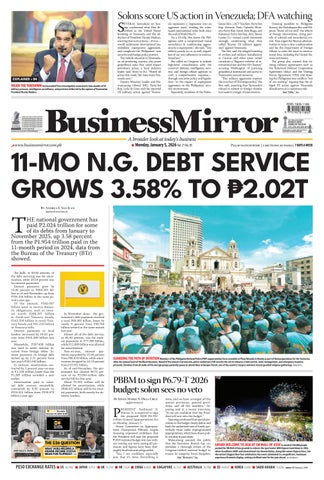
11-MO N.G. DEBT SERVICE GROWS 3.58% TO ₱2.02T www.businessmirror.com.ph
T
n
Monday, January 5, 2026 Vol. 21 No. 85
P25.00 nationwide | 2 sections 20 pages | 7 DAYS A WEEK
By Andrea E. San Juan @andreasanjuan
HE national government has paid P2.024 trillion for some of its debts from January to November 2025, up 3.58 percent from the P1.954 trillion paid in the 11-month period in 2024, data from the Bureau of the Treasury (BTr) showed.
The bulk, or 60.46 percent, of the debt servicing was for amortization, while 39.54 percent was for interest payments. Interest payments grew by 13.49 percent to P800.505 billion as of end-November, up from P705.334 billion in the same period a year ago. Of the amount, P593.067 billion went to service domestic obligations, such as interest worth P399.297 billion in fixed-rate Treasury bonds, P143.556 billion in retail Treasury bonds and P41.210 billion in Treasury bills. Interest payments to local lenders increased by 18.05 percent from P502.389 billion last year. Meanwhile, P207.438 billion was used to settle interest incurred from foreign debts. Interest payments on foreign debt inched up by 2.21 percent from last year’s P202.945 billion. In contrast, amortization contracted by 2 percent year-on-year to P 1.224 trillion, lower than the P1.249 trillion recorded a year earlier. Amortization paid to external debt sources, meanwhile, contracted by 6.95 percent to P214.915 billion from P230.973 billion a year ago.
In November alone, the government’s debt payments reached a total P89.969 billion, lower by nearly 4 percent from P93.704 billion settled in the same month last year. Almost all of the debt service, or 85.90 percent, was for interest payments at P77.289 billion, while P12.680 billion was allotted for amortization. Year-on-year, interest payments expanded by 15.96 percent from P66.653 billion, while amortization dropped by 53.13 percent from P27.051 billion. As of end-November, the government has cleared 98.73 percent of its P2.050-trillion debt service bill for this year. About P1.202 trillion will be allotted for amortization, while P848.031 billion will be for interest payments, both mostly for domestic lenders.
GUARDING THE PATH OF DEVOTION Members of the Philippine National Police (PNP) augmentation force assemble at Plaza Miranda in Manila as part of final preparations for the Traslacion 2026, the annual Feast of the Black Nazarene. Ahead of the January 9 procession, police conducted a full security dry run to rehearse crowd control, route management, and emergency response protocols. Devotees from all walks of life and age groups patiently queue to attend Mass at Quiapo Church, one of the country’s largest and most closely guarded religious gatherings. NONIE REYES
PBBM to sign ₧6.79-T 2026 budget; solon sees no veto By Jovee Marie N. Dela Cruz
P
» A12
@joveemarie
RESIDENT Ferdinand R. Marcos Jr. is expected to sign the proposed 2026 P6.793trillion General Appropriations Act on Monday, January 5. House Committee on Appropriations Chairperson Mikaela Angela Suansing expressed confidence that the President will sign the proposed P2026 national budget into law without vetoing any item, saying all provisions and figures have been thoroughly finalized and safeguarded. “Yes, I am confident, especially now that it’s done. Everything is
done, and we have arranged all the special provisions, general provisions, and all the numbers,” Suansing said in a recent interview, “So we are confident that the President will not veto the budget.” Suansing confirmed that special provisions in the budget clearly define and limit the authorized uses of funds, particularly those under unprogrammed appropriations, which have drawn public scrutiny in past years. Malacañang assured the public that the Executive Branch has undertaken a thorough review of the Congress-ratified national budget to ensure its integrity, fiscal discipline, See “Budget,” A9
GRAND WELCOME TO 2026 AT SM MALL OF ASIA! A crowd of 250,000 people packed the SM Mall of Asia grounds to witness the spectacular GMA Kapuso Countdown to 2026, where headliners AHOF and international star Bonnie Bailey, alongside various Kapuso Stars, led the nation’s biggest New Year celebration; the event culminated in a magnificent, maximumexperience fireworks display, setting a brilliant tone for the year ahead. SM SUPERMALLS
PESO EXCHANGE RATES n US 58.7900 n JAPAN 0.3753 n UK 79.2195 n HK 7.5524 n CHINA 8.4058 n SINGAPORE 45.7332 n AUSTRALIA 39.2188 n EU 69.0547 n KOREA 0.0407 n SAUDI ARABIA 15.6769 Source: BSP (January 2, 2026)
News
BusinessMirror
A2 Monday, January 5, 2026
DFA…
Continued from A1
The lawmakers called on progressive organizations and the public to express solidarity with the Venezuelan people and demanded an immediate cessation of hostilities and the withdrawal of US forces, reiterating their opposition to what they described as imperialist intervention.
DFA: Closely monitoring scene
THE Philippine government said it is closely monitoring the rapidly unfolding situation in Venezuela. “The Philippines urges concerned parties to resolve disputes through peaceful means, and to exercise restraint to prevent escalation of conflict,” the DFA said in a statement Sunday. The Philippine Embassy in Bogotá, Colombia—which serves as the nonresident mission for Venezuela—also issued a public advisory to Filipino citizens in Venezuela, emphasizing vigilance and preparedness amid the uncertainty. It urged Filipinos to remain vigilant, avoid risky situations, and identify safe spaces for refuge. It also called on citizens to monitor credible news sources, stay connected with fellow Filipinos through community channels such as the Filcom WhatsApp group, and ensure their updated contact details are submitted to the embassy for emergency coordination. The embassy provided emergency hotlines and email contacts for assistance, underscoring its readiness to extend support to the Filipino community. According to official records, 74 Filipinos are registered with the embassy in Venezuela, and the DFA assured that it stands ready to provide assistance as necessary to keep them out of harm’s way. Jovee Marie N. Dela Cruz, Malou Talosig Bartolome
www.businessmirror.com.ph
Mixed oil prices this week, but risks from Venezuela seen
M
By Lorenz S. Marasigan
OTORISTS may have to cough up more for petrol this week, with diesel expected to increase by P0.20 to P0.40 per liter while gasoline could see a rollback or a marginal uptick of up to P0.10 per liter, according to estimates from Jetti Petroleum. However, Leo Bellas, president of Jetti Petroleum, warned that actual price movements could exceed initial projections due to emerging geopolitical risks stemming from recent developments in Venezuela. “The geopolitical risks due to the
recent events in Venezuela could push premiums and freight rates higher, which may cause next week’s local oil prices to rise more than as initially estimated,” he said. The US launched military strikes on Venezuela over the weekend with
Investments…
Regime and Permitting Process, NonChina supply-chain. In the area of Renewable Energy, he said the government will keep an eye on implementation of the projects and ensure that there is ease of doing business. As for semiconductors and electronics, the BOI will keep an eye on workforce development and geopoliticsbased investment movement.
Continued from A12
The BOI managing head also divulged that the investment promotion agency has “focused interventions” per sector. For Mining and Mineral Processing, he said the BOI will prioritize Fiscal
American President Donald Trump announcing that the US will take control of Venezuela’s oil reserves, which is estimated to have reached 303 billion barrels of crude oil in 2023. Trump said the American oil companies will “spend billions of dollars, fix the badly broken infrastructure, the oil infrastructure” in Venezuela. “The suspension and paralysis of Venezuela’s oil export operations could support world oil prices due to worries of supply disruption,” Bellas said. Despite these concerns, Bellas noted that lingering global oversupply and increasing production from major refineries could temper price increases. Still, the Venezuela situation adds a new layer of volatility to oil
markets as traders assess the longer-term impact on global crude flows, he added. Diesel, he said, could see larger increases than initially forecast, while gasoline prices may also rise contrary to earlier estimates of a possible rollback. Price movements for the following week will largely depend on how market sentiment responds to the Venezuela developments. Last week, oil companies implemented price increases of P0.60 per liter for both diesel and kerosene, with no change in gasoline prices. For 2025, fuel prices recorded cumulative net increases of P20.50 per liter for gasoline, P21.05 per liter for diesel, and P5.75 per liter for kerosene.
The BOI will also monitor the domestic demand and infrastructure and minerals development under the pillar of Electric Vehicle (EV) components and assembly. For data centers, the government’s intervention will be through the Sovereign Data Localization Policy and the RE projects coming on-stream. For Tourism, the strategy is anchored on the Waiver of Visa Requirement for key markets and investments in national and regional infrastructure. Trade and Industry Secretary Cristina A. Roque who also chairs the BOI, highlighted “strong investment prospects” in renewable energy, electric vehicle components, semiconductors and electronics, smart manufacturing,
digital infrastructure, high-tech agriculture, and data center development. These sectors, the BOI noted, are “expected to anchor the country’s next phase of industrial growth.” According to Roque, “There are a number of big-ticket projects in the BOI pipeline and that we are actively assessing even through the very last days of 2025. Unfortunately, we need more time to complete the evaluation process especially as these precisely are large-scale and very strategic projects.” The Trade chief added: “Our focus moving forward is to ensure that these investments translate into quality jobs, technology transfer, and sustainable economic growth that benefits Filipinos nationwide.”
Tourism…
tional Park, a Unesco World Heritage Site where imposing limestone karst cliffs conceal dramatic caves you can explore via boat tours on an underground river.” She noted the expensive airfare from North America to the Philippines—layovers will be in Manila or Cebu—but “costs for accommodations and other expenses once you get there are often pretty affordable. Travelers with Hollywood-size budgets, though, can splash the cash for private island stays at luxury resorts such as the newly spruced-up Lagen Island.” The latter is operated by the Zobelled Ayala Land Hospitality.
Continued from A12
Expedia where it ranked Palawan at the top of the “set-jetting” travel category. It was where “The Last Resort”, a movie headlined by Daisy Ridley (Star Wars: The Force Awakens), was shot. The rom-com, which also includes Filipino-American actor Tia Carrere and comic Jo Koy, will be shown in cinemas in February. “Set-jetting” is a travel category where tourists visit popular film or streamer series locations like Dubrovnik (Game of Thrones), Switzerland (Crash Landing on You), New Zealand (Lord of the Rings), among others. Business Traveller’s list was topped by Okinawa, Japan, and bookended by Savoie, France. The Philippines was the only Southeast Asian destination on the magazine’s list.
Costly airfare, but cheap everything else
FOR its part, Frommer’s “Best Places to Go in 2026” likewise referenced the “The Last Resort” and its stars Ridley and Alden Ehrenreich (Solo: A Star Wars Story) as “creating a new star right here in this galaxy,” as it put Palawan on its to-go list. The new movie, said Frommer’s writer Tamara Hinson, “shines a Hollywood spotlight on this photogenic but up-to-now often overlooked province in the Philippines, [which] serves as the film’s backdrop, but don’t be surprised if the spectacular shooting locations upstage the cast.” She added that, Palawan “is made up of nearly 1,800 coralfringed isles and islets offering untold wonders for snorkelers, divers, beachgoers, spelunkers, and island hoppers. The province’s biggest island, also called Palawan, has plenty to see and do for all of those types of visitors, plus unique natural landmarks such as Puerto Princesa Subterranean River Na-
Jan-Nov 2025 arrivals dip 2.2%
OTHER travel publications and guides in the past like Travel + Leisure, TripAdvisor, Condé Nast Traveler, and National Geographic Traveler have named Palawan among their world’s best islands or top destinations in Asia. Meanwhile, visitor arrivals in January to November 2025 slipped by 2.16 percent to some 5.24 million year-on-year, as per DOT data. Of the total, foreign nationals accounted for 91 percent at 4.77 million (-3 percent, yoy), while the rest consisted of overseas Filipinos at 465,584 (+7.66 percent). The DOT is targeting to attract 6.7 million foreign visitors this year, still 19.3 percent less than the historic 8.3 million arrivals in prepandemic 2019. Congress has approved a P1-billion branding campaign budget for the government agency, to strengthen its promotion of the Philippines in key markets abroad. A tourism analyst also projected a slight increase in foreign visitors this year to 6.3 million, noting the rollout of the electronic visas in China and visa-free entry for Indian nationals, an improvement in airports, and an increase in international air routes to the Philippines. (See, “‘Easier entry, more air routes to lift PHL tourism in 2026,’” in the BusinessMirror, Dec. 12, 2025)
Budget…
Continued from A12
transparency and accountability of the Bicam process.” Raquiza said such actions “deepen the public trust deficit in government and intensify public cynicism toward the government’s commitment to uphold every Filipino’s right to a just and fair budget.” The budget watchdog said SWPflagged programs for veto are as follows: n P81.94 billion increase in the Basic Infrastructure Program (BIP) and the Sustainable Infrastructure Projects Alleviating Gaps (SIPAG) program under the Convergence and Special Support Program (CSSP) (Department of Public Works and Highways)—These overlap with various projects under existing DPWH programs. n P8.9B Farm-to-Market Roads (Department of Agriculture)—A last-minute adjustment requested during the bicam, which did not go through public scrutiny during the House and Senate hearings. n P10B Presidential Assistance for Farmers and Fisherfolk (DA)—This duplicates funding, as financial subsidies or assistance worth P8.55B are already spread across existing DA programs and projects. n P2.73B for the Tulong Dunong Program (Commission on Higher Education)—A duplication inserted by the House. CHED has already allocated P37.55 billion to cover the cost of universal access to tertiary education for all Filipino students enrolled in higher education institutions. n P15.33B Disaster Rehabilitation and Reconstruction Assistance Program for Local Government Units or LGUs (National Disaster Risk Reduction and Management Fund)—This overlaps with other regular programs of the NDRRMF. n P23.048M Philippine Pavilion at the 2026 United Nations Climate Conference (Climate Change Commission)—This is a bicam insertion, as it was not included in either the House or Senate versions; it is funded by unjustified cuts to the National Commission on Indigenous Peoples (NCIP) Region X regional office budget for Domain/Land Recognition, Management and Development Services, and IP Human Rights, Legal, and Basic Social Services. n P5.25B Confidential funds (various agencies[3])—As a general rule, civilian agencies must not engage in surveillance activities nor implement secret expenses. The President should lead by example by removing the confidential funds of his office. n P138B for social protection and assistance programs with questionable increases, composed of DOH Medical Assistance to Indigent and Financially Incapacitated Patients (P51.6B), DOLE’s Tulong Pangkabuhayan sa Ating Disadvantaged Workers (P22.4B), and DSWD’s Assistance to Individuals in Crisis Situations (P63.9B). n P56.873B Local Government Units assistance fund—The threefold increase by the bicam is prone to patronage and political discretion. For the P138B “ayuda funds” and the P56.873B LGU assistance fund, SWP has called on the president to pass a “supplemental budget immediately to revert the budget back to the National Expenditure Program levels of P63.4B and P6B, respectively.” The group also suggests a stronger “anti-epal” provision to stop all forms of political patronage and interference. Meanwhile, to address transparency issues surrounding the P243.4B Unprogrammed Appropriations (UA), the group proposes two options for the President. “First, retain all budget items except Budgetary Support to Government Corporations and the Revised Armed Forces of the Philippines [AFP] Modernization Program, as both already have dedicated budgets under special purpose funds,” the group said. This option, it noted, should impose “strict enforcement” of quarterly public reporting of UA releases through the Department of Budget and Management (DBM) and agency transparency seal portals. The second option is a total veto of all ten UA items, subject to a supplemental budget that clearly identifies funding sources and provides a breakdown of expenditure details, it also noted. (See related story: https://businessmirror. com.ph/2026/01/03/groups-urgepbbm-veto-pork-in-budget/) Andrea E. San Juan
www.businessmirror.com.ph
Monday, January 5, 2026
2026 natl govt budget has ₧2.9 billion for school-based mental health program By Butch Fernandez @butchfBM
S
EN. Sherwin Gatchalian on Sunday said P2.9 billion has been allocated in the 2026 national government budget for the mental health program in schools. The enrolled 2026 General Appropriations bill provides for the P2.9 billion needed for the rollout of the School-Based Mental Health program and the creation of the Learner Wellness Division, Gatchalian said. The allocation is consistent with the implementation of the Basic Education Mental Health and Well-Being Promotion Act or Republic Act 12080, which
Gatchalian authored. The law mandates the development and strengthening of the School-Based Mental Health Program to promote the well-being of learners. The program shall manage the mental health concerns of all learners, including the prevention of suicides in schools. “Kinikilala natin ang bigat at agarang pangangailangan na tugunan ang mga suliranin sa mental health ng mga kabataan. Kaya bahagi ng makasaysayang pondong inilaan natin para sa sektor ng edukasyon ang pagtaguyod sa mental health at kapakanan ng ating mga mag-aaral,” said Gatchalian, Chairman of the Senate Committee on Finance. See “Mental,” A4
A3
Furniture exporters see flat growth, seek govt support for intl promotion By Andrea San Juan
L
@andreasanjuan
OCAL furniture exporters see no growth in their outbound shipments this year with manufacturers’ production down by 50 percent, according to the Philippine Exporters Confederation Inc. (Philexport).
In a statement issued over the weekend, Myrna Bituin, trustee for the furniture sector of the Philexport, said exporters foresee a flat trajectory for 2026, similar to 2025, with manufacturers’ production down by 50 percent as the world is “not doing very well.” Bituin underscored that while the local market is performing well, the local furniture sector is in need of support from the government to promote furniture products in the global arena to boost export growth. “Some [exporters] say the local
market is very good… But the export [market] is different, that’s really our target. So I think it is something that we should be worried [about] and we are looking to the government aside from Philexport,” Bituin said in mixed English and Filipino. “We really need their help even only on the promotion. We’re not asking for help in our factories but promotion is very, very expensive because you have to be at the marketplace,” she added. See “Furniture,” A4
Aliling orders release of compliant applications for licenses in first 10 working days of 2026
H
OUSING Secretary Jose Ramon Aliling has ordered the release of all compliant applications for licenses and registrations of socialized housing projects with complete requirements under updated rules within the first 10 working days of 2026. The order is meant to sustain the positive momentum in the nationwide implementation of President Marcos’ Expanded Pambansang Pabahay Para sa Pilipino (4PH) Program and trigger
economic activities in the housing and real estate sector, Aliling said in a news release Sunday. Aliling directed Senior Supervising Undersecretar y Sharon Faith Paquiz, concerned bureaus, and all regional offices to expedite the processing of Certificate of Registration and License to Sell (CR/LS) to ensure the sustained production and sale of socialized housing projects under the f lagship Expanded 4PH Program.
“Natapos ng DHSUD ang taong 2025 na positibo, at bubuksan natin ang 2026 sa mas pinaigting na pagse-serbisyo sa ating mga stakeholders – mga home buyers at private developers, alinsunod sa utos ni Pangulong Marcos [DHSUD ended the year 2025 on a positive note and we will open 2026 with more intensified service to our stakeholders – home buyers and private developers, in accordance with the order of President Marcos],” Aliling said.
“Dahil sa episyenteng pagtugon sa mga application ng development permits, CR/LS, mas mapapabilis na ang pag-issue ng mga CR-LS, mas maraming socialized housing projects na ang magagawa ng private developers, kaya mas maraming pagpipilian para sa ating home buyers [Due to the efficient response to development permit applications, CR/LS, the issuance of CR-LS will be faster, more socialized housing projects can be done by private developers, so
there are more choices for our home buyers].” The DHSUD chief stressed that only application-compliant private developers, based on existing laws and rules, are covered by the order. “Asahan po ninyo ang mas pinaigting na pagsusumikap mula sa buong DHSUD upang mas mapabuti pa namin ang serbisyo pabahay sa 2026 [Please expect more intensified efforts from the entire DHSUD so that we can further
i mprove housi ng ser v ices i n 2026],” he said. Near the end of 2025, the DHSUD issued several updated policies on price ceiling; simplified application for tax exemption for socialized housing with the Department of Economy, Planning, and Development and the Department of Finance-Bureau of Internal Revenue, respectively; and streamlined processes in licensing and registration, among others. PNA
Monday, January 5, 2026
A4
www.businessmirror.com.ph
Legislator wants drones, refurbished decommissioned aircraft for military By Jovee Marie N. dela Cruz @joveemarie
A
LAWMAKER on Sunday appea led to President Marcos to endorse two proposed measures seeking a combined P15 billion to strengthen the Armed Forces (AFP) through drone acquisition and the rehabilitation of decommissioned but still serviceable military aircraft. House Deputy Majority Leader Luigi Villafuerte cited Marcos’ renewed commitment to AFP modernization, particularly amid escalating security concerns such as tensions in the West Philippine Sea (WPS), and expressed hope that the president would support the proposals when Congress resumes session on January 26. “President Marcos is spot on in pursuing the continued AFP modernization program amid national security threats like the escalating tensions in the WPS,” said Villafuerte, “and we hope our Commander-in-Chief could
support the long-term defense buildup by endorsing two pending bills on recommissioning old yet operational helicopters, plus other aircraft, and acquiring, and later on building our own, drones for surveillance, reconnaissance, combat and disaster-response, among others.” Both measures—House Bills 1362 and 1363—were principally authored by Villafuerte. HB 1362, also known as the Nationa l Defense Drone Act, proposes the establishment of the Philippine Unmanned Aerial System Program (PUASP) and the Strategic Defense Technology Transfer Program (SDTTP). The bill seeks to institutionalize the acquisition of drones for sur veil lance, reconnaissance, combat, disaster response, and medical evacuation, while laying the groundwork for a domestic unmanned aerial systems (UAS) industry through research and development. The measure earmarks an initial
P10 billion to be sourced from the national budget or the AFP modernization fund, or both, with future allocations to be included in the annual General Appropriations Act. Villafuerte said the program would help address not only military needs but also disaster response, environmental protection, border patrol, and search-and-rescue operations. Under HB 1362, PUASP would oversee drone acquisition, deployment, inter-agency protocols, data security compliance, and training of operators and technicians. The SDTTP, meanwhile, would provide tax incentives to encourage private sector participation in drone development and local manufacturing, reducing long-term procurement costs. Villafuerte said the urgency of the measure was underscored by statements from Defense Secretary Gilberto Teodoro and the acting National Police (PNP) Chief, Lt. Gen. Jose Melencio Nartatez Jr., who have both highlighted the need for tech-driven moderniza-
tion, including drone and counterdrone systems. “Our military, defense and police establishments should have the wherewithal to acquire, deploy and integrate—and later on build our own—UAVs or drones, to strengthen the combat, surveillance, medivac, patrol and disaster response, among others, of our military and police forces,” said Villafuerte. HB 1363, on the other hand, seeks the creation of a Military Air Asset Rehabilitation Program (MAARP) under the Department of National Defense. The program would conduct technical inspections and feasibility studies on decommissioned helicopters and other military aircraft for possible recommissioning, as well as a nationwide inventory of stored air assets in coordination with the AFP. The bill allocates an initial P5 billion for the program, to be sourced from unprogrammed funds or other available funding
sources, with subsequent funding to be included in the annual budget. Citing data from the European Union Aviation Safety Agency, Villafuerte noted that aircraft can have an average lifespan of 25 to 40 years, depending on type and usage. “As a cost-effective strategy, HB 1363 aims to recommission old yet operational aircraft to meet the military’s operational demands without heavy capital outlay,” he said. “This is especially important given the situation in the West Philippine Sea, where increased air presence is crucial.” Beyond restoring serviceable aircraft, the proposed MA ARP aims to reduce reliance on foreign procurement, support local aviation industries, enhance AFP combat and disaster response capabilities, promote cost-efficient defense modernization, and recycle parts from decommissioned air assets for upgrades and repairs.
DENR cancels firm’s seabed quarry permit in Ilocos Sur towns By Jonathan L. Mayuga @jonlmayuga
T
HE Department of Environment and Natural Resources (DENR) Regional Office 1 (DENR-RO1) has stopped the seabed quarry operation and subsequently cancelled a Memorandum of Agreement (MOA) with a quarry company for two Ilocos Sur towns. DENR R eg ion a l E xec ut ive Director for the Ilocos Region Crizaldy M. Barcelo issued the cancellation of the MOA with IVMDC,
which has been conducting seabed quarrying operations in Caoayan and Santa towns. The company has been the subject of numerous complaints by the communities for allegedly causing environmental damage which resulted in the loss of income and livelihood of many fishermen in the two towns. The national fishermen’s federation Kilusang Mamamalakaya ng Pilipinas (Pamalakaya) welcomed the decision. “We laud the fisherfolk, coastal residents, and environmentalists
who tirelessly held mass actions that led to the cancellation of the seabed quarry project in Ilocos Sur. This is an initial victory for the fisherfolk, their coastal communities, and fishing waters,” Ronnel Arambulo, Pamalakaya vice chairperson, said in a statement. “Coastal communities and environmentalists are demanding compensation for the loss of livelihood and irreversible damage to their coastal resources,” Arambulo said. Pamalakaya said that before the dredging project started in
2024, small fishermen were able to gather at least 100 cans (17 liters each) of ipon (a species of gobies) per trip. But nowadays, they often return with “empty nets” because the dredging operations have effectively disrupted and driven away the fish. “Tulad sa ibang lugar, ang epekto ng seabed quarrying sa Ilocos Sur ay pangmatagalan dahil sa sinira nitong bahura [coral reefs] at iba pang yamang-dagat. “Kaya hindi sapat na ipinatigil lamang ang operasyon ng seabed quarr ying dahil patuloy na
iniinda ng mga mangingisda ang pagbagsak ng kanilang kabuhayan dahil sa nasirang pangisdaan. Kailangan ang sapat na kompensasyon na katumbas ng arawang nawawalang kita ng mga mangingisda, at rehabilitasyon ng mga pook-pang isdaan at baybayin,” Arambulo added. The fishers’ group said that the DENR should immediately consult with the local fishing communities and environmentalists to assess the extent of the damage of the dredging to marine ecosystems and coastal resources.
Furniture. . . Continued from A3
Bituin said exporters must participate in an international trade fair at least three times to build trust, credibility, and market presence. The Philexport official also underscored the importance of “continuous product development.” “That’s the key. When the buyer comes, you have something new to show,” she said. “You have to always be aware of the market trends, that’s important. And then productivity level ng company – that’s the key.” In an earlier interview, Trade and Industry Secretary Cristina A. Roque said she advised local furniture makers to diversify and look for other markets to export to aside from the United States and Europe, the country’s top export destinations for furniture. Roque said this at the height of Washington’s imposition of tariffs against its trading partners last year during which the Philippines’ trade chief also had a trip to the United States to meet with the country’s furniture artisans. She said these furniture makers usually supply to hotels, houses, restaurants, cafes and retail stores. “So I discussed that with them. I can also link them to hotels, retailers and cafes,” said Roque, factoring in the proliferation of new cafes and concept stores which she said would need furniture. In an earlier social media post, the Department of Trade and Industry (DTI) said Roque’s message to the furniture makers was: unlock markets, clear bottlenecks, and use every DTI post as a launchpad for international success. Data from the Philippine Statistics Authority (PSA) showed that Philippine woodcraft and furniture exports to the US amounted to $338.41 million in 2024, 5.1 percent down from the $356.43 million export revenues in 2023. (See: https://businessmirror. com.ph/2025/05/08/phl-f urniture-makers-told-diversifyexport-markets/)
Almost 20K cops to secure Black Nazarene devotees Anti-red task force warns
T
HE acting National Police (PNP) Chief, Lt. Gen. Jose Melencio Nartatez Jr., on Sunday said police visibility and intelligence-monitoring activities were intensified in preparation for the coming Feast of the Black Nazarene on January 9. In a statement, Nartatez said these preparations are part of the PNP security transition after the Christmas and New Year festivities. He said that the Manila Police District is now finalizing the security protocols for Traslacion but said policemen were already deployed as early as Jan. 2 for the barangay visitation in Quiapo District and other scheduled activities that include blessing of replicas
of Jesus Nazareno, “Pabihis” and morning and fiesta masses. Nartatez also said the PNP has not monitored any specific or credible threat linked to the religious celebration but the police will still maintain a very strict watch to ensure the safety of millions of devotees expected to participate. “Every year has a different security challenge but the objective remains the same: to ensure the safety of the millions of devotees and to maintain peace and order at the span of the annual religious activity. Your PNP is ready but we still ask for vigilance and cooperation from the public to achieve our goal,” the acting PNP chief said. Almost 20,000 police personnel are scheduled for deployment
across the City of Manila and nearby areas for coming Black Nazarene procession and related activities. Nartatez said Metro Manila policemen will be reinforced by personnel from the Police Regional Office 3, or Central Luzon, and the Police Regional office 4A, or Calabarzon (Cavite, Laguna, Batangas, Rizal and Quezon). He said policemen will be tasked to secure the traditional procession route and other key gathering points to ensure that sufficient numbers of PNP personnel are available for both crowd control and emergency response. Nartatez also said coordination was already made as early as two months ago with all the stake-
holders, particularly the Manila City government and the Quiapo Church management while government agencies like the Metropolitan Manila Development Authority also committed assistance. “I have directed the strategic deployment of our personnel and other assets to secure and assist our kababayan who will take part in this yearly devotion,” Nartatez said. He also said that specialized assets and medical teams are already on standby as the PNP urged the public to cooperate with law enforcers on the ground to prevent accidents during the crowded procession. Devotees are also encouraged to follow all safety guidelines issued by the authorities. Rex Anthony Naval
Parañaque lawmaker files 60 socio-economic bills, facilitates delivery of natl govt programs
A
LEADER of the House of Representatives on Sunday committed to push for the passage of measures that will strengthen social protection, expand economic opportunities, and improve access to health care and education for vulnerable and underserved Filipinos across the country this year. Parañaque Rep. Brian Raymund S. Yamsuan said he has already filed 60 measures advancing these goals during his first six months as a member of the 20th Congress. Complementing his legislative work, Yamsuan also helped facilitate the delivery of national government programs to more than 100,000 beneficiaries, demonstrating how effective lawmaking can be paired with efficient program implementation on the ground. Yamsuan began advancing inclusive growth through initiatives aligned with national labor and livelihood objectives. His Bigay Negosyo
program—implemented in coordination with the Department of Labor and Employment (DOLE) – has so far assisted 1,148 beneficiaries, serving as a localized model for broader livelihood support efforts. “In 2026, we will further streamline the implementation of the Bigay Negosyo and other programs that will help ease access to quality healthcare, jobs, livelihood opportunities, and education for Parañaque residents. Our goal is to level the playing field for everyone and ensure that they directly benefit from these programs without any need for a padrino, a political sponsor, or any other form of middleman,” Yamsuan said. Yamsuan currently serves as vice chairperson of the Committees on Games and Amusements, on Public Information, and on Transportation, and is a member of the Committees on Labor and Employment, on Public Order and Safety, and on Youth and Sports Development.
To support this goal, Yamsuan pushed for digitalization and transparency in service delivery by shifting applications online and introducing the HOPE card system, which helps track and speed up access to government assistance—an approach consistent with national efforts to modernize public service delivery. At the House of Representatives, Yamsuan anchored his early legislative output on his HOPE agenda – Health, Opportunities and jobs, Peace and order, and Education—filing priority measures that address systemic gaps affecting millions of Filipinos. Among these are proposals to provide free annual medical checkups for all Filipinos (HB 2239); grant of maternity benefits to women workers in the informal economy (HB 2240); institutionalize a national jobs facilitation program for senior citizens and persons with disabilities (HB 2241); provide free
tuition for government employees pursuing graduate studies in State Universities and Colleges (HB 2242); and modernize crime investigation techniques of law enforcement agencies (HB 2244). Yamsuan also authored measures seeking to institutionalize student support through an annual education stipend (HB 2657); establish a magna carta for commuters (HB 2581) and barangay health workers (HB 3215); extend HMO benefits to public school teachers and non-teaching personnel (HB 2579); ensure regular funding for the DSWD’s Sustainable Livelihood Program (HB 2580); strengthen worker protection through financial literacy programs (HB 3218); and streamline Solo Parent ID applications via an online system (HB 4034). Yamsuan vowed to sustain legislative momentum and ensure that laws and programs enacted by Congress translate into tangible improvements in the lives of ordinary Filipinos.
vs synchronized CPP-NPA social media propaganda
T
HE National Task Force to End Local Communist Armed Conflict (NTF-Elcac) has warned the public against what it described as a “deliberate” and “synchronized” social media propaganda drive allegedly being carried out by the Communist Party of the Philippines–New People’s Army–National Democratic Front (CPP-NPA-NDF) and allied groups. NTF-Elcac Executive Director Ernesto Torres Jr. said dozens of interlinked pages and sectoral fronts have been pushing identical narratives, slogans, hashtags, visuals, and calls for action—signs, he said, of central direction rather than spontaneous activism. “This is neither coincidence nor spontaneity. This is central direction from the party,” Torres said in a statement. “The timing, language, framing, and cadence of these posts portray a party-imposed propaganda line—a textbook maneuver by a movement in decline attempting to manufacture an illusion of relevance and strength in the digital space.”
Mental. . . Continued from A3
The law’s implementing rules (IRR) also seek the creation of a Learner Wellness Division under
Torres said the content recycles calls for “armed struggle,” “revolutionary movement,” and “lightning rallies,” targeting students, urban poor communities, and other vulnerable sectors as the group shifts to online platforms amid waning support on the ground. “The truth is unmistakable: this is the behavior of an organization gasping for its last breath,” he said. “Unable to rebuild support through armed formations that are now fragmented, isolated, and rejected by communities, they have resorted to flooding socialmedia platforms with rage-bait, distortion, and incitement.” Torres said the campaign aims to stir anger, normalize violence as “activism,” and groom a new generation, but noted that public reaction has turned against the groups. “Dissent is protected in a democracy. Deception, grooming, and recruitment for political violence are not. They are acts of exploitation—especially when aimed at the youth,” he said. PNA the Bureau of Learner Support Services. The division is tasked with setting annual targets for the law’s implementation, including establishing school mental health offices and care centers, and filling required plantilla positions.
Monday, January 5, 2026
A5
PHL seen buying more wheat for animal feeds By Ada Pelonia
T
@adapelonia
HE Philippines is expected to import more wheat, a crop that it does not produce, due to its rising demand for animal feeds and wheat-based food products, such as bread and noodles. The United States Department of Agriculture-Foreign Agriculture Service (USDA-FAS Manila) said the Philippines’ w he at purchases in marketing year (MY) 2025/2026 will go up by 16.5 percent to 7.4 million metric tons (MMT) from the previous MY’s 6.35 MMT. The international agency has
adjusted upward its estimate for the country’s foreign wheat shipments. “[USDA-FAS Manila] raises its estimates for total wheat imports in MY 2025/26, driven by increased demand for feed wheat and milling wheat.” Citing trade data from July to October 2025, USDA-FAS noted the increase in milling and feed
Grains extend drop as South America outlook overshadows farm aid
G
RAINS extended December’s steep declines into the new year, with traders focused on weather in South America, while fresh details on United States farm aid provided little help to the markets. The US Department of Agriculture (USDA) earlier this week released eagerly-awaited payment rates that various crops can qualify for under the Trump administration’s $12 billion farm bailout, though many said the amounts were insufficient to turn around the ailing American agriculture economy. “Wheat growers are closing the books on a difficult year marked by extremely high input costs and stubbornly low wheat prices,” the National Association of Wheat Growers said following the USDA’s Wednesday announcement. They said the aid was appreciated even though the rates “do not come close to making wheat farmers whole for the per-acre losses experienced in 2025.” On Friday, the most-active futures for Chicago wheat fell as much as 1.1 percent, touching a new low for the contract. Corn slid as much as 0.7 percent, while soybeans dropped as much as 0.9 percent, to the lowest since October. US farmers remain under pressure as large crops are expected from agricultural rivals in South America, where the weather forecast remains favorable. “December--no issues. That’s a key month for a lot of corn in Argentina and soybeans in northern Brazil. So that has come and gone,” said Ben Buckner, grains and dairy analyst at AgResource Co. “There’s really not much time left to reduce supply in South America.” Elsewhere, raw sugar futures in New York dropped as much as 2.7 percent to 14.6 cents per pound on Friday, extending losses after finishing 2025 with the biggest annual drop since 2017. Markets are continuing to price in a large global surplus and “any new money in the market will only show up next week,” said Mike McDougall, an analyst at McDougall Global View.
The rebalancing of the Bloomberg Commodity Index will also start later next week.
Chile miners
THE main union at a Capstone Copper Corp.-operated mine in northern Chile began a strike Friday as members push for a bigger share of the windfall from record-high metal prices. More than 600 workers at the Mantoverde mine downed tools at 6 a.m. New York time after failing to reach a deal with management as part of Chile’s collective bargaining process. Some have set up tents just outside the mine site to further push their pay claims. “The union has enough resources to sustain a strike for at least two months, a period that could incur more than $160 million in lost cash flow,” it said in a statement. It’s the first work stoppage at a sizable mine in Chile since prices of copper surged to record highs amid stockpiling in the US ahead of possible tariffs and a series of operational disruptions around the world. While Mantoverde is dwarfed by top-tier mines in Chile such as Escondida and Collahuasi, the strike shows how surging prices can exacerbate labor tensions as companies grapple to keep costs in check in a cyclical business. The Mantoverde open-pit copper and gold mine in the Atacama region is 70 percent owned and operated by Capstone, with Mitsubishi holding the other 30 percent. Capstone’s Canada-listed shares were down 1.1 percent at 10:49 a.m., while copper futures were up 0.6 percent in London. Expanded production at Mantoverde is a key part of Capstone’s company-wide guidance. At current rates, the mine would account for roughly 0.5 percent of global mined copper. In a statement Thursday, Capstone said it expects to continue producing at as much as 30 percent of normal levels, with striking workers representing about half of Mantoverde employees. Bloomberg News
wheat imports, highlighting sustained demand from feed millers and food manufacturers. During this period, feed wheat accounted for the lion’s share of total shipments at 52 percent. This was followed by milling wheat at 45 percent and other wheat products (3 percent). “ The market share of feed wheat expanded relative to milling wheat, driven by declining import prices for feed wheat amidst elevated corn import prices from February to August 2025,” the USDA-FAS Manila said. “This shift reflects increased demand for feed wheat rather than a reduction in demand for milling wheat.” While the USDA-FAS Manila expects milling wheat shipments to rise in the current MY, this could be tempered by increasing costs of raw materials for pastries.
AN Acros combine harvester, manufactured by Rostselmash OJSC, drives through a wheat field during the summer harvest on a farm in Tersky village, near Stavropol, Russia, on Friday, July 9, 2021. BLOOMBERG
“Rising costs of raw materials for bread and bakery products are expected to temper this growth, moderating overall demand for milling wheat despite strong consumer demand and lower import prices for milling wheat.”
Meanwhile, the agency said the expected increase in feed wheat imports in MY 2025/26 was propelled by the “gradual, though slower paced, recovery of the swine industry and more favorable feed wheat prices” relative to corn
within the same MY. “Feed millers continue to partially substitute corn with feed wheat when prices for feed wheat are advantageous.” However, the agency said the expected rise in feed wheat imports in the current MY could be moderated by declining import prices for corn. “Industry sources report that feed wheat is typically used as a substitute for feed corn when price conditions for feed wheat are more favorable.” Citing trade data, the USDAFAS Manila noted that import prices for feed wheat from September to October 2025 exceeded those of corn by $6.46 and $10.11 per metric ton (MT), respectively. “Industry contacts emphasize that the relative pricing of feed wheat remains the primary factor influencing its use in feed mixes.”
Govt keen on intensifying local chili pepper production
T
HE Department of Agriculture (DA) is ramping up efforts to expand the production of chili pepper or sili and shield it from weather-related shocks which could cause price spikes. The agency made this pronouncement as quotations for chili pepper usually rise when heavy rains and typhoons damage crops, disrupting supply just as demand holds firm. Last September, the price of local siling labuyo skyrocketed to as much as P800 per kilo due to weather disturbances. For Agriculture Secretary Francisco Tiu Laurel Jr., this cycle should be changed by pairing “better” data with climate-resilient production. In recent meeting with DA officials, he urged for the establish-
ment of baseline numbers, including national and Metro Manila consumption, current output, and average yield per hectare. “We need to know how much we consume, how much we produce, and where the gaps are.” Those figures would serve as a guide on how many hectares should be planted and how fast production can scale, he added. Based on their meeting, the DA concluded that chili peppers are not a regional niche crop. Agriculture officials said it could be grown in most parts of the country and not solely in Bicol, widening the pool of potential growers under the DA’s High Value Crops (HVC) program. For 2026, the DA noted that chili is being lined up as a priority crop alongside munggo, or mung beans, albeit with differ-
ent aims: to lower prices for chili and reduce reliance on imports for mung beans. Despite this, the agency said the weather continues to pose the biggest risk to sili production. “Prices go up because crops are damaged by rain,” the DA chief said, adding the need for protected cultivation in strategically assigned locations. As such, the agency said it will be backing greenhouses using local materials and typhoon-resistant structures that can withstand strong storms to shield plants from floods and prolonged rainfall. This move is expected to stabilize supply even during typhoon season, according to the DA. Furthermore, access to clean planting materials such as siling labuyo, siling pansigang, and
grafted bell peppers will go “fullswing” through the its Gulayan sa Bayan program. This could strengthen agrientrepreneurship in 1,370 municipalities to address food inf lation with commercial highvalue crops farming and primary processing. The DA chief noted that a more stable chili pepper output means fewer price spikes for restaurants, food processors, and retailers, especially during peak demand periods. With this, he has ordered weekly public updates on prices and supply starting January, using articles and short-form videos, to reinforce transparency. “Typhoons may still cause disruptions, but the goal is to make them the exception—not the rule.” Ada Pelonia
Irri unveils new varieties under GNSR program By Manuel T. Cayon @awimailbox
T
HE International Rice Research Institute (Irri) and its global partners have introduced new varieties of the Green Nutritious Super Rice (GNSR), a new generation of cereal grains designed to address the twin challenges of global malnutrition and climate change, the International Service for the Acquisition of Agri-biotech Applications (ISAAA) said. Citing an Irri communication dispatch, the ISAAA said “building on the successful Green Super Rice [GSR] initiative launched in 2008, the GNSR program focuses on developing high-yielding, multi-stress-tolerant rice that is also nutrient-rich and environmentally sustainable.” “The prototype for GNSR is whole-grain black rice, which is being explored for its potential to unlock vital proteins, vitamins, minerals, and bioactive compounds, going far beyond basic calories. Irri emphasizes that even small increases in nutrient content can have a significant health impact on billions of people who rely on rice as a daily staple.” ISAAA said past GSR efforts already yielded 78 varieties released globally, covering 44 million hectares, “which show resilience to drought, flooding, and heat, while also performing
well with reduced applications of costly fertilizers and pesticides.” “As the world moves toward a population of nine billion, the challenge is no longer just producing enough food but ensuring it is nutritious and sustainably grown. With climate pressures increasing and agricultural lands becoming more limited, researchers continue to explore innovations that can help secure the future of rice-based food systems,” said Irri. Farmers growing these varieties have seen significant yield and income gains, the IRRI said. In the Philippines, the NSIC Rc 480 (GSR8), one of the country’s most widely adopted stress-tolerant rice varieties, is cultivated on over 0.7 million hectares. It can withstand drought, salinity, and flooding, with yields doubling from 4.4 t/ha up to 8.3 t/ha under rainfed lowland and irrigated conditions, respectively. Mestiso 120 is the world’s first low-methane hybrid and has been licensed to Tao Foods Company in the Philippines. Irri showcased the IR 173374H, a newly developed heat-tolerant hybrid that thrives at 38 degrees Celcius. Biofortified cultivars have reached 15 ppm iron and 30 ppm zinc, nearly double the conventional levels, while low-GI and low-methane varieties such as NSIC Rc 514 combine health benefits with environmental sustainability. Dr. Michael Quinn, Irri
research director for Rice Breeding Innovations, emphasized the potential of whole-grain rice as a prototype model for GNSR to unlock proteins, vitamins, minerals, fiber, and bioactive compounds that go far beyond calories. “Even small increases in nutrient content can have meaningful health impacts for billions who rely on rice daily. Realizing this vision requires collaboration across plant breeding, nutrition, food science, policy, and the private sector, alongside public education to encourage whole‑grain rice consumption.” The Green Super Rice (GSR) initiative was launched in 2008, and to boost the program, Irri engaged in a partnership with the Chinese Academy of Agricultural Sciences (CAAS) with support from the Chinese Government and the Gates Foundation (formerly Bill & Melinda Gates Foundation). Dr. Qifa Zhang, director of Hubei Hongshan Laboratory, highlighted the pressures of traditional rice production in China. “We produce over a third of the world’s rice on only 25 percent of the area, using just eight percent of arable land, but consuming 35 percent of fertilizers and pesticides. This intensive production created major sustainability challenges. GSR was a newsworthy science project that pioneered solutions for climate-resilient rice.”
Dr. Lizhong Xiong, Director of the National Key Laboratory of Crop Genetic Improvement at the Huazhong Agricultural University (HZAU), Wuhan, emphasized the need to strengthen the long-standing partnership between the two institutions. He urged “the need for renewed scientific collaboration with Irri on the GNSR and reaching millions of rice consumers globally.” HZAU has already developed and released a rice variety of Huamoxiang 3, the first prototype of GNSR in the form of whole grain black rice (WGBR). Dr. Jauhar Ali, Irri Principal Scientist and Research Leader for Hybrid Rice Technology, highlighted the key achievements of the GSR initiative. It has released 78 varieties globally, covering 44 million hectares cumulatively, including multi-stress-tolerant inbreds and hybrids that can withstand drought, flooding, salinity, and heat. Ali said rice is consumed by 55 percent of the global population. “The time is right. If we cannot act now, the opportunity may be lost. It is now or never. We are developing a new generation of whole-grain rice, including improved embryos, anthocyanins, and bioactive elements. These varieties will be evaluated, demonstrated, and released to ensure higher yields and income.”
The World BusinessMirror
A6 Monday, January 5, 2026
Editor: Angel R. Calso
Trump to temporarily run Venezuela and access vast oil reserves after operation to oust Maduro By Regina Garcia Cano, Konstantin Toropin & Eric Tucker
C
The Associated Press
ARACAS, Venezuela—Hours after an audacious military operation that plucked leader Nicolás Maduro from power and removed him from the country, President Donald Trump said Saturday that the United States would run Venezuela at least temporarily and tap its vast oil reserves to sell to other nations.
The dramatic action capped an intensive Trump administration pressure campaign on the South American nation and its autocratic leader and months of secret planning resulting in the most assertive American action to achieve regime change since the 2003 invasion of Iraq. Legal experts immediately raised questions about whether the operation was lawful. Venezuela’s vice president Delcy Rodríguez demanded in a speech that the US free Maduro and called him the country’s rightful leader, before Venezuela’s high court ordered her to assume the role of interim president. Speaking to reporters hours after Maduro’s capture, Trump revealed his plans to exploit the leadership void to “fix” the country’s oil infrastructure and sell “large amounts” of oil to other countries. Maduro and his wife, seized overnight from their home on a military base, were first taken aboard a US warship on their way to face prosecution for a Justice Department indictment accusing them of participating in a narco-terrorism conspiracy. A plane carrying the deposed leader
landed around 4:30 p.m. Saturday at an airport in New York City’s northern suburbs. Maduro was escorted off the jet, gingerly making his way down a stairway before being led across the tarmac surrounded by federal agents. Several agents filmed him on their phones as he walked. He was then flown by helicopter to Manhattan, where a convoy of law enforcement vehicles, including an armored car, was waiting to whisk him to a nearby US Drug Enforcement Administration office. A video posted on social media by a White House account showed Maduro, smiling, as he was escorted through that office by two DEA agents grasping his arms. He was expected to be detained while awaiting trial at a federal jail in Brooklyn. US officials didn’t immediately confirm Maduro was at the jail, but the same motorcade of vehicles that brought him to the DEA office from the heliport was seen arriving at the detention center Saturday evening.
Move lacks congressional approval THE legal authority for the incursion,
GOVERNMENT supporters rip an American flag in half during a protest in Caracas, Venezuela, Saturday, Jan. 3, 2026, after US President Donald Trump announced that US forces had captured President Nicolás Maduro and first lady Cilia Flores. AP PHOTO/ARIANA CUBILLOS done without congressional approval, was not immediately clear, but the Trump administration promoted the ouster as a step toward reducing the flow of dangerous drugs into the US. The president touted what he saw as other potential benefits, including a leadership stake in the country and greater control of oil. Trump claimed the US government would help run the country and was already doing so, though there were no immediate signs of that. Venezuelan state TV continued to air pro-Maduro propaganda, broadcasting live images of supporters taking to the streets in Caracas in protest. “We’re going to run the country until such time as we can do a safe, proper and judicious transition,” Trump said at a Mar-a-Lago news conference where he boasted that this “extremely successful operation should serve as warning to anyone who would threaten American sovereignty or endanger American lives.” Maduro and other Venezuelan officials were indicted in 2020 on “narco-terrorism” conspiracy charges, but the Justice Department released a new indictment Saturday of Maduro and his wife, Cilia Flores, that painted
China social media hails Trump’s Maduro move as Taiwan template By Bloomberg News
P
RESIDENT Donald Trump’s capture of Venezuelan leader Nicolas Maduro sparked widespread discussion on Chinese social media, with some users saying the operation offered a template for how Beijing could handle tensions with Taiwan. Trump’s operation against the Venezuelan strongman shot to the top of China’s Weibo late Saturday, with the topic gaining some 440 million views on the X-like platform. Many commentators were quick to make comparisons between the fate of the South American nation and that of the self-ruled democracy Beijing has vowed to claim. “I suggest using the same method to reclaim Taiwan in the future,” one user said in reply to a post with more than 700 likes. “Since the US doesn’t take international law seriously, why should we care about it?” said another user. “The US imperialists’ lightning raid on Venezuela to capture Maduro and his wife provides a perfect blueprint for our military to launch a surprise attack on Frog Island and seize Lai Ching-te,” wrote one person, using a derogatory term to refer to Taiwan. Lai is Taiwan’s president. China’s Foreign Ministry urged the US to release Maduro and his wife and to ensure their safety. The raid on Venezuela clearly violates international law and the basic norms governing international relations, as well as the purposes and principles of the UN Charter, it said in a statement. Earlier, the ministry condemned Trump’s strike, saying it was “deep-
NATIONAL Guard armored vehicles block an avenue leading to Miraflores presidential palace in Caracas, Venezuela, Saturday, Jan. 3, 2026. AP PHOTO/CRISTIAN HERNANDEZ ly shocked” by the “blatant use of force against a sovereign state.” Taiwan’s Foreign Ministry didn’t reply to a request for comment made outside working hours. President Xi Jinping has stepped up military pressure around Taiwan, most recently by conducting live-fire drills around the island—exercises that Trump downplayed. Beijing has refrained from using violence, however, preferring coercion tactics coupled with a diplomatic drive to isolate Taipei on the world stage. The outpouring of nationalist sentiment in China doesn’t mean Xi will change that strategy toward Taiwan, one of the biggest flashpoints between the world’s largest economies. But Trump’s strike could give Beijing space to ramp up military aggression in its own backyard. “I don’t expect today’s events in Venezuela will dramatically shift Beijing’s calculus on Taiwan,” Ryan Hass, a former US diplomat and senior fellow
at the Brookings Institution, wrote on X. “Beijing hasn’t refrained from kinetic or other actions on Taiwan out of deference to international law and norms.” “Privately, I expect Beijing will emphasize to Washington that it expects to be given the same latitude for great power exemptions to international law that the US takes for itself,” he added, citing China’s operations in the South China Sea, where it has territorial disputes with US allies and other regional neighbors. For decades, the US—Taiwan’s top weapons supplier—has been a restraining force on Chinese aggression, with the risk of sanctions and American military action looming over any invasion. The Chinese Communist Party leader also has to weigh domestic sentiment, military readiness and economic implications. See “China,” A9 Trump’s actions hand Xi another
the regime as a “corrupt, illegitimate government” fueled by a drug trafficking operation that flooded the US with cocaine. The US government does not recognize Maduro as the country’s leader. Trump posted a photo on social media showing Maduro wearing a sweatsuit and a blindfold on board the USS Iwo Jima.
Early morning attack THE operation followed a monthslong Trump administration effort to exert pressure on the Venezuelan leader, including a major buildup of American forces in the waters off South America and attacks on boats in the eastern Pacific and Caribbean accused of carrying drugs. Last week, the CIA was behind a drone strike at a docking area believed to have been used by Venezuelan drug cartels — the first known direct operation on Venezuelan soil since the US began strikes in September. Maduro had decried prior military operations as a thinly veiled effort to topple him from power. Taking place 36 years to the day after the 1990 surrender and seizure of Panama leader Manuel Antonio
Noriega following a US invasion, the Venezuela operation unfolded under the cover of darkness early Saturday as Trump said the US turned off “almost all of the lights” in the capital city of Caracas while forces moved in to extract Maduro and his wife. Gen. Dan Caine, the chairman of the Joint Chiefs of Staff, said US forces had rehearsed their maneuvers for months, learning everything about Maduro—where he was and what he ate, as well as details of his pets and his clothes. “We think, we develop, we train, we rehearse, we debrief, we rehearse again and again,” Caine said. “Not to get it right, but to ensure we cannot get it wrong.” Early Saturday, multiple explosions rang out and low-flying aircraft swept through Caracas. Maduro’s government accused the US of hitting civilian and military installations, calling it an “imperialist attack” and urging citizens to take to the streets. The assault lasted less than 30 minutes, and the explosions — at least seven blasts—sent people rushing into the streets, while others took to social media to report what they saw and heard. Some Venezuelan civilians and members of the military were killed, said Rodríguez, the country’s vice president, without giving a number. Trump said some US forces were injured but none were killed. Video obtained from Caracas and an unidentified coastal city showed tracers and smoke clouding the landscape as repeated muted explosions illuminated the night sky. Other footage showed cars passing on a highway as blasts illuminated the hills behind them. The videos were verified by The Associated Press. Smoke was seen rising from the hangar of a military base in Caracas, while another military installation in the capital was without electricity. Under Venezuelan law, Rodríguez
would take over from Maduro. Rodriguez, however, stressed during a Saturday appearance on state television that she did not plan to assume power, before Venezuela’s high court ordered that she assume the interim role. “There is only one president in Venezuela, and his name is Nicolás Maduro Moros,” Rodriguez said.
Some streets in Caracas fill up VENEZUELA’S ruling party has held power since 1999, when Maduro’s predecessor, Hugo Chávez, took office, promising to uplift poor people and later to implement a self-described socialist revolution. Maduro took over when Chávez died in 2013. His 2018 reelection was widely considered a sham because the main opposition parties were banned from participating. During the 2024 election, electoral authorities loyal to the ruling party declared him the winner hours after polls closed, but the opposition gathered overwhelming evidence that he lost by a more than 2-to-1 margin. In a demonstration of how polarizing a figure Maduro is, people variously took to the streets to protest his capture and celebrate it. At a protest in the Venezuelan capital, Caracas Mayor Carmen Meléndez joined a crowd demanding Maduro’s return. “Maduro, hold on, the people are rising up!” the crowd chanted. “We are here, Nicolás Maduro. If you can hear us, we are here!” Earlier, armed people and uniformed members of a civilian militia took to the streets of a Caracas neighborhood long considered a stronghold of the ruling party. In other parts of the city, the streets remained empty hours after the attack. Some areas remained without power, but vehicles moved freely. See “Venezuela,” A7
How cocaine, corruption led to the indictment of Maduro By Alanna Durkin Richer & Larry Neumeister The Associated Press
N
EW YORK—A newly unsealed US Justice Department indictment accuses captured Venezuelan President Nicolás Maduro of running a “corrupt, illegitimate government” fueled by an extensive drugtrafficking operation that flooded the US with thousands of tons of cocaine. The arrest of Maduro and his wife in a stunning military operation early Saturday in Venezuela sets the stage for a major test for US prosecutors as they seek to secure a conviction in a Manhattan courtroom against the longtime leader of the oil-rich South American nation. Attorney General Pam Bondi said in a post on X that Maduro and his wife “will soon face the full wrath of American justice on American soil in American courts.” Here’s a look at the accusations against Maduro and the charges he faces.
Maduro faces drugs and weapons charges M A DU RO i s c h a rged a longside his wife, his son and three others. Maduro is indicted on four counts: narco-terrorism conspiracy, cocaine importation conspiracy, possession of machine guns and destructive devices and conspiracy to possess machine guns and destructive devices. Maduro is facing the same charges as in an earlier indictment brought against him in Manhattan federal court in 2020, during the first Trump presidency. The new indictment unsealed on Saturday, which adds charges against Maduro’s wife, was filed under seal in the Southern District of New York just before Christmas. It was not immediately clear when
Maduro and his wife, Cilia Flores, would make their first appearance at the courthouse in Manhattan. A video posted Saturday night on social media by a White House account showed Maduro, smiling, as he was escorted through a US Drug Enforcement Administration office in New York by two federal agents grasping his arms. He was expected to be detained while awaiting trial at a federal jail in Brooklyn.
Maduro allowed ‘cocaine-fueled corruption to flourish,’ US says THE indictment accuses Maduro of partnering with “some of the most violent and prolific drug traffickers and narco-terrorists in the world” to allow for the shipment of thousands of tons of cocaine into the US. Authorities allege powerful and violent drug-trafficking organizations, such as the Sinaloa Cartel and Tren de Aragua gang, worked directly with the Venezuelan government and then sent profits to high-ranking officials who helped and protected them in exchange. Maduro allowed “cocaine-fueled corruption to flourish for his own benefit, for the benefit of members of his ruling regime, and for the benefit of his family members,” the indictment alleges. US authorities allege that Maduro and his family “provided law enforcement cover and logistical support” to cartels moving drugs throughout the region, resulting in as much as 250 tons of cocaine trafficked through Venezuela annually by 2020, according to the indictment. Drugs were moved on go-fast vessels, fishing boats and container ships or on planes from clandestine airstrips, the indictment says. “This cycle of narcotics-based corruption lines the pockets of Venezuelan
officials and their families while also benefiting violent narco-terrorists who operate with impunity on Venezuelan soil and who help produce, protect, and transport tons of cocaine to the United States,” the indictment says.
Allegations of bribes and orders of kidnappings and murders THE US accuses Maduro and his wife of ordering kidnappings, beatings and murders “against those who owed them drug money or otherwise undermined their drug trafficking operation.” That includes the killing of a local drug boss in Caracas, according to the indictment. Maduro’s wife is also accused of accepting hundreds of thousands of dollars in bribes in 2007 to arrange a meeting between “a large-scale drug trafficker” and the director of Venezuela’s National Anti-Drug Office. In a corrupt deal, the drug trafficker then agreed to pay a monthly bribe to the director of the anti-drug office as well as about $100,000 for each cocainecarrying flight “to ensure the flight’s safe passage.” Some of that money then went to Maduro’s wife, the indictment says. Nephews of Maduro’s wife were heard during recorded meetings with confidential US government sources in 2015 agreeing to send “multi-hundred-kilogram cocaine shipments” from Maduro’s “presidential hanger” at a Venezuelan airport. The nephews during the recorded meetings explained “that they were at ‘war’ with the United States,” the indictment alleges. They were both sentenced in 2017 to 18 years in prison for conspiring to send tons of cocaine into the US before being released in 2022 as part of a prisoner swap in exchange for seven imprisoned Americans. Richer reported from Washington.
The World BusinessMirror
www.businessmirror.com.ph
Monday, January 5, 2026 A7
Economic collapse and US threats fuel widening protests across Iran By Jon Gambrell
sessed that Iran has yet to begin a weapons program, but has “undertaken activities that better position it to produce a nuclear device, if it chooses to do so.” Iran recently said it was no longer enriching uranium at any site in the country, trying to signal to the West that it remains open to potential negotiations over its atomic program to ease sanctions. But there’s been no significant talks in the months since the June war.
The Associated Press
D
UBA I, United A rab Emirates—Widening protests in Iran sparked by the Islamic Republic’s ailing economy are putting new pressure on its theocracy. Tehran is still reeling from a 12-day war launched by Israel in June that saw the United States bomb nuclear sites in Iran. Economic pressure, intensified in September by the return of United Nations sanctions on the country over its atomic program, has put Iran’s rial currency into a free fall, now trading at some 1.4 million to $1. Meanwhile, Iran’s self-described “Axis of Resistance”—a coalition of countries and militant groups backed by Tehran—has been decimated in the years since the start of the IsraelHamas war in 2023. A new threat by US President Donald Trump warning Iran that if Tehran “violently kills peaceful protesters,” the US “will come to their rescue” has taken on new meaning after American troops captured Venezuelan President Nicolás Maduro, a longtime ally of Tehran. Here’s what to know about the protests and the challenges facing Iran’s government.
How widespread the protests are DEMONSTR ATIONS have reached over 170 locations in 25 of Iran’s 31 provinces, the US-based Human Rights Activists News Agency reported early Sunday. The death toll had reached at least 15 killed, it added, with more than 580 arrests. The group, which relies on an activist network inside of Iran for its reporting, has been accurate in past unrest. Understanding the scale of the protests has been difficult. Iranian state media has provided little information about the demonstrations. Online videos offer only brief, shaky glimpses of people in the streets or the sound of gunfire. Journalists in general in Iran also face limits on reporting such as requiring permission to travel around the country, as well as the threat of harassment or arrest by authorities. But the protests do not appear to be stopping, even after Supreme
Why relations between Iran and the US are so tense CURRENT and pre-revolution Iranian banknotes are displayed by a street money exchanger at Ferdowsi square, Tehran’s go-to venue for foreign currency exchange, in downtown Tehran, Iran, on Aug. 28, 2025. AP PHOTO/VAHID SALEMI Leader Ayatollah Ali Khamenei on Saturday said “rioters must be put in their place.”
Why the demonstrations started THE collapse of the rial has led to a widening economic crisis in Iran. Prices are up on meat, rice and other staples of the Iranian dinner table. The nation has been struggling with an annual inflation rate of some 40%. In December, Iran introduced a new pricing tier for its nationally subsidized gasoline, raising the price of some of the world’s cheapest gas and further pressuring the population. Tehran may seek steeper price increases in the future, as the government now will review prices every three months. The protests began first with merchants in Tehran before spreading. While initially focused on economic issues, the demonstrations soon saw protesters chanting anti-government statements as well. Anger has been simmering over the years, particularly after the 2022 death of 22-year-old Mahsa Amini in police custody that triggered nationwide demonstrations.
Iran’s alliances are weakened IRAN’S “Axis of Resistance,” which grew in prominence in the years after the 2003 US-led invasion and subsequent occupation of Iraq, is reeling. Israel has crushed Hamas in the devastating war in the Gaza Strip.
Hezbollah, the Shiite militant group in Lebanon, has seen its top leadership killed by Israel and has been struggling since. A lightning offensive in December 2024 overthrew Iran’s longtime stalwart ally and client in Syria, President Bashar Assad, after years of war there. Yemen’s Iranianbacked Houthi rebels also have been pounded by Israeli and US airstrikes. China meanwhile has remained a major buyer of Iranian crude oil, but hasn’t provided overt military support. Neither has Russia, which has relied on Iranian drones in its war on Ukraine.
The West worries about Iran’s nuclear program IRAN has insisted for decades that its nuclear program is peaceful. However, its officials have increasingly threatened to pursue a nuclear weapon. Iran had been enriching uranium to near weapons-grade levels prior to the US attack in June, making it the only country in the world without a nuclear weapons program to do so. Tehran also increasingly cut back its cooperation with the International Atomic Energy Agency, the U.N.’s nuclear watchdog, as tensions increased over its nuclear program in recent years. The IAEA’s director-general has warned Iran could build as many as 10 nuclear bombs, should it decide to weaponize its program. US intelligence agencies have as-
IR AN decades ago was one of the United States’ top allies in the Mideast under Shah Mohammad Reza Pahlavi, who purchased American military weapons and allowed CIA technicians to run secret listening posts monitoring the neighboring Soviet Union. The CIA fomented a 1953 coup that cemented the shah’s rule. But in January 1979, the shah, fatally ill with cancer, fled Iran as mass demonstrations swelled against his rule. Then came the Islamic Revolution led by Ayatollah Ruhollah Khomeini, which created Iran’s theocratic government. Later that year, university students overran the US Embassy in Tehran, seeking the shah’s extradition and sparking the 444-day hostage crisis that saw diplomatic relations between Iran and the US severed. During the Iran-Iraq war of the 1980s, the US backed Saddam Hussein. During that conflict, the US launched a one-day assault that crippled Iran at sea as part of the socalled “Tanker War,” and later shot down an Iranian commercial airliner that the US military said it mistook for a warplane. Iran and the US have seesawed between enmity and grudging diplomacy in the years since, and relations peaked with the 2015 nuclear deal, which saw Iran greatly limit its program in exchange for the lifting of sanctions. But Trump unilaterally withdrew America from the accord in 2018, sparking tensions in the Mideast that intensified after Hamas’ Oct. 7, 2023, attack on Israel.
International aid groups grapple with what Israel’s ban will mean for their work in Gaza By Sam Mednick & Julia Frankel The Associated Press
T
EL AVIV—Israel’s decision to revoke the licenses of more than three dozen humanitarian organizations this week has aid groups scrambling to grapple with what this means for their operations in Gaza and their ability to help tens of thousands of struggling Palestinians. The 37 groups represent some of the most prominent of the more than 100 independent nongovernmental organizations working in Gaza, alongside United Nations agencies. Those banned include Doctors Without Borders, the Norwegian Refugee Council, Oxfam and Medical Aid for Palestinians. The groups do everything from providing tents and water to supporting clinics and medical facilities. The overall impact, however, remains unclear. The most immediate impact of the license revocation is that Israel will no longer allow the groups to bring supplies into the Gaza Strip or send international staffers into the territory. Israel says all suspended groups have to halt their operations by March 1. Some groups have already been barred from bringing in aid. The Norwegian Refugee Council, for example, said it has not been allowed to bring in supplies in 10 months, leaving it distributing tents and aid brought in by other groups. Israel says the banned groups make up only a small part of aid operations in Gaza. But aid officials say they fulfill crucial
specific functions. In a joint statement Tuesday, the U.N. and leading NGOs said the organizations that are still licensed by Israel “are nowhere near the number required just to meet immediate and basic needs” in Gaza. The ban further strains aid operations even as Gaza’s over 2 million Palestinians still face a humanitarian crisis more than 12 weeks into a ceasefire. The U.N. says that although famine has been staved off, more than a quarter of families still eat only one meal a day and food prices remain out of reach for many; more than 1 million people need better tents as winter storms lash the territory.
Why were their licenses revoked?
EARLIER this year, Israel introduced strict new registration requirements for aid agencies working in Gaza. Most notably, it required groups to provide the names and personal details of local and international staff and said it would ban groups for a long list of criticisms of Israel. The registration process is overseen by Israel’s Ministry for Diaspora Affairs and Combating Antisemitism, led by a far-right member of the ruling Likud party. Israel says the rules aim to prevent Hamas and other militants from infiltrating the groups, something it has said was happening throughout the 2-year-old war. The U.N., which leads the massive aid program in Gaza, and independent groups deny the allegations and Israeli claims of major diversion of aid supplies by Hamas. Aid organizations say they did not com-
ply, in part, because they feared that handing over staff information could endanger them. More than 500 aid workers have been killed in Gaza during the war, according to the United Nations. Israel denies targeting aid workers. But the group say Israel has been vague about how it would use the data. The groups also said Israel was vague about how it would use the data. “Demanding staff lists as a condition for access to territory is an outrageous overreach,” Doctors Without Borders, known by its French acronym MSF, said Friday. It said Israeli officials had refused its attempts to find alternatives. A December report on MSF issued by an Israeli government team recommended rejection of the group’s license. It pointed primarily to statements by the group criticizing Israel, including referring to its campaign in Gaza as genocide and calling its monthslong ban on food entering the territory earlier this year as “a starvation tactic.” It said the statements violated neutrality and constituted “delegitimization of Israel.” The report also repeated claims that an MSF employee killed in by an Israeli airstrike in 2024 was an operative with the Islamic Jihad militant group. That, it said, suggested MSF “maintains connections with a terrorist group.” MSF on Friday denied the allegations, saying it would “never knowingly employ anyone involved in military activities.” It said that its statements cited by Israel simply described the destruction its teams witnessed in Gaza.
“The fault lies with those committing these atrocities, not with those who speak of them,” it said. Aid groups have a week from Dec. 31 to appeal the process.
Medical services could see biggest impact
INDEPENDENT NGOs play a major role in propping up Gaza’s health sector, devastated by two years of Israeli bombardment and restrictions on supplies. MSF said Israel’s decision would have a catastrophic impact on its work in Gaza, where it provides funding and international staff for six hospitals as well as running two field hospitals and eight primary health centers, clinics and medical points. It also runs two of Gaza’s five stabilization centers helping children with severe malnutrition. Its teams treated 100,000 trauma cases, performed surgeries on 10,000 patients and handled a third of Gaza’s births, the group says. It has 60 international staffers in the West Bank and Gaza and more than 1,200 local staff—most medical professionals. Since the ceasefire began in early October, MSF has brought in about 7% of the 2,239 tons (2,032 metric tons) of medical supplies that Israel has allowed into Gaza, according to a U.N. tracking dashboard. That makes it the largest provider of medical supplies after U.N. agencies and the Red Cross, according to the dashboard. Medecins du Monde, another group whose license is being halted, runs another four primary health clinics.
CHINESE President Xi Jinping, left, shakes hands with South Korean President Lee Jae Myung before their summit meeting at the Gyeongju National Museum in Gyeongju, South Korea, on Nov. 1, 2025. KIM DO-HUN/YONHAP VIA AP
South Korean president visits China following Beijing’s rising tensions with Japan over Taiwan By Kanis Leung & Hyung-Jin Kim The Associated Press
H
ONG KONG—South Korean President Lee Jae Myung arrived in China on Sunday as Beijing looks to deepen ties with the nearby country after heightened tensions between China and Japan over Taiwan, a self-ruled island it claims as its sovereign territory. Lee’s four-day trip is his first visit to China since taking office in June. It comes at a time of heightened tensions between China and Japan, after Japanese Prime Minister Sanae Takaichi said in November that her country’s military could get involved if China were to take action against Taiwan. China’s official news agency Xinhua reported on Sunday afternoon that Lee arrived in Beijing. During his stay, Lee will meet with his Chinese counterpart Xi Jinping, their second meeting in just two months.
Lee signals commitment to China’s ties AHEAD of his trip, Lee gave an interview to China’s state broadcaster CCTV at Seoul’s Cheong Wa Dae, the presidential office also known as the Blue House. Lee was quoted as saying that it was his first interview held in the presidential palace and that he hoped people would understand that his government cares about the relations between Beijing and Seoul. In the interview, he assured that South Korea consistently respects the “One-China” policy when it comes to Taiwan, CCTV reported Friday. He said the healthy development of BeijingSeoul relations depends on mutual respect. Lee also praised Xi as a “truly reliable neighbor.” Last week, China staged large-scale military drills around the island for two days to warn against separatist and “external interference” forces. At that time, the Chinese Foreign Ministry accused Taiwan’s ruling party of trying to seek independence through requesting US support. The US planned large-scale arms sales to Taiwan angered Beijing in December, leading to China sanctioning 20 US defense-related companies. Lee said Seoul’s cooperation with the US, its military ally, does not mean
Venezuela...
Continued from A6
“How do I feel? Scared, like everyone,” said Caracas resident Noris Prada, who sat on an empty avenue looking down at his phone. “Venezuelans woke up scared, many families couldn’t sleep.” In Doral, Florida, home to the largest Venezuelan community in the US, people wrapped themselves in Venezuelan flags, ate fried snacks and cheered as music played. At one point, the crowd chanted “Liberty! Liberty! Liberty!”
Questions of legality
SOME legal experts raised immediate concerns about the operation’s legality. The UN Security Council, acting on an emergency request from Colombia, planned to hold a meeting on US operations in Venezuela on Monday morning, according to a council diplomat, who spoke on the condition of anonymity to discuss a meeting not yet made public.
South Korea-China relations should move toward confrontation, CCTV reported. He acknowledged that past misunderstandings between his country and China had hindered bilateral relations. “This visit to China aims to minimize or eliminate these past misunderstandings or contradictions, to elevate and develop South Korea-China relations to a new stage,” CCTV quoted him as saying.
To discuss the Korean Peninsula and strengthen economic ties SOUTH Korea and the US have urged China, North Korea’s traditional ally and economic pipeline, to use its influence on its socialist neighbor to convince it to return to talks or abandon its nuclear program. But China has long been suspected of avoiding fully implementing U.N. sanctions on North Korea and sending clandestine aid shipments to help the North stay afloat and continue to serve as a bulwark against US influence on the Korean Peninsula. On Sunday, North Korea launched multiple ballistic missiles toward the sea, South Korea’s military said, the latest weapons demonstration by the North ahead of its upcoming ruling party congress. Lee’s visit is meant to strengthen bilateral ties and discuss ways to restore peace on the Korean Peninsula, South Korean officials said. During Monday’s summit, Lee and Xi are to hold “in-depth talks on substantive ways” to address security and economic issues facing the two countries, South Korea’s national security adviser Wi Sung-lac told a briefing Friday. On Tuesday, Lee is to meet Zhao Leji, chairman of the National People’s Congress, and Premier Li Qiang, Wi said. During Lee’s trip, South Korea will also request that China play “a constructive role” in efforts to promote peace on the Korean Peninsula, Wi said. In their November talks, Lee already asked Xi to make greater efforts to persuade North Korea to return to talks. South Korea would push for substantial achievements that could directly benefit ordinary citizens in both countries too, Wi said. Kim reported from Seoul, South Korea
Lawmakers from both political parties in Congress have raised reservations and flat-out objections to the US attacks on boats suspected of drug smuggling near the Venezuelan coast. Congress has not specifically approved an authorization for the use of military force for such operations in the region. Connecticut Rep. Jim Himes, the top Democrat on the House Intelligence Committee, said he had seen no evidence that would justify Trump striking Venezuela without approval from Congress and demanded an immediate briefing by the administration on “its plan to ensure stability in the region and its legal justification for this decision.” Toropin and Tucker reported from Washington. Associated Press writers Jorge Rueda in Caracas, Venezuela, Lisa Mascaro, Michelle L. Price, Seung Min Kim and Alanna Durkin Richer in Washington, Farnoush Amiri in New York and Larry Neumeister in South Amboy, New Jersey, contributed to this report.
The World BusinessMirror
A8 Monday, January 5, 2026
www.businessmirror.com.ph
Ukraine peace talks intensify: Allies meet in Kyiv, aim to finalize security guarantees By Volodymyr Yurchuk The Associated Press
K
YIV, Ukraine—National security advisers from Europe and other allies visited Kyiv on Saturday to discuss security guarantees and economic support as a USled diplomatic push to end the nearly 4-year-old war in Ukraine intensifies. President Volodymyr Zelenskyy, preparing to travel to Paris for a meeting with partners, said work on the peace proposals could now accelerate as Ukraine has shared all documents under discussion with the 18 national security advisers, including those on security guarantees. “We expect that this further work will now take place in the capitals of
European countries as well as Canada, Japan and other representatives of the Coalition of the Willing,” he said, referring to the approximately 30 countries who support Kyiv’s effort to end the war with Russia on acceptable terms. “We are not allocating a great deal of time for this process,” Zelenskyy added. He said representatives f rom Ukraine’s General Staff and military sector would meet on Monday in Paris, followed by a meeting Tuesday of European leaders, where he said he hoped documents on security guarantees would be finalized. He said there also would be meetings with US representatives in Paris. In a briefing earlier in the day, Ukrainian negotiator Oleksandr Bevz
said Kyiv is coordinating security guarantee plans with European partners that would include a multilateral framework agreement involving Ukrainian forces as the first line of defense, European-led troops deployed in Ukraine and US “backstop” support. Ukraine’s deputy prime minister, Taras Kachka, said international partners have reached consensus on an economic support package of about $800 billion for Ukraine over the next decade. The package, based on calculations by the World Bank, the International Monetary Fund and the European Union, would cover damage compensation, reconstruction, economic stability and a $200 billion growth “booster” and is tied to Ukraine’s EU
EUROPEAN countries’ national security advisers attend a security forum in Kyiv, Ukraine, Saturday, Jan. 3, 2026. AP PHOTO/DANYLO ANTONIUK
accession reforms. Specific funding sources have not been identified, economy minister Oleksii Sobolev said, though roughly $500 billion is expected from public grants and concessional loans, with details to be worked out over the next two weeks. Also on Saturday, Zelenskyy announced further changes to the government, saying he had proposed Denys Shmyhal to become energy minister and first deputy prime minister. Shmyhal, who served most recently as defense minister and formerly as Ukraine’s longest-serving prime minister, is well respected. His proposed replacement in defense is Mykhailo Fedorov, who is widely credited with leading the introduction of drone technology into the army in his role as digital transformation minister. Zelenskyy on Friday appointed the head of Ukraine’s military intelligence as his new chief of staff. The president framed the appointment of Gen. Kyrylo Budanov as part of an effort to sharpen the focus on security, defense development and diplomacy. Meanwhile, the death toll from a Russian missile attack on the city of Kharkiv on Friday increased to two, including a 3-year-old boy, Kharkiv regional head Oleh Syniehubov wrote on Telegram. An overnight Russian drone attack on the Mykolaiv region targeted critical infrastructure and left some communities without electricity, according to regional head Vitalii Kim. He said engineers spent the night working to restore power and there were no casualties reported.
After capturing Maduro, Trump commits himself to another foreign policy project By Aamer Madhani The Associated Press
W
ASHINGTON—President Donald Trump declared Saturday’s military operation that led to the ouster of Nicolás Maduro a major success as he offered a vague plan for his administration “to run” Venezuela until a transition of power can take place. While there are no visible signs of a US presence on the ground in Caracas, Trump was demonstrating chutzpah that’s become the trademark of his foreign policy approach. It’s one marked by a grand confidence that his will on the international stage is an immovable force. “This was one of the most stunning, effective and powerful displays of American military might and competence in American history,” Trump declared at a news conference at his Mar-a-Lago resort in Florida. The president strode into office with a promise to turn the page on America’s decades of foreign entanglements. But on Saturday, he committed the US to help Venezuela usher in a period of “peace” and “ justice” after decades of rule by strongmen. The president’s pledge to a Venezuela project comes as he finds himself struggling to bring about a permanent peace between Israel and Hamas in Gaza and find an endgame to Russia’s nearly four-year war in Ukraine. But the path ahead is treacherous. The White House will need to grapple with any power vacuum caused by Maduro’s ouster and inevitable complications of trying to maintain stability in a country that’s already endured years of hyperinf lation, food and medicine shortages and brain drain despite its vast oil wealth. It also remains to be seen what lessons US adversaries may take from Trump’s decision to demonstrate American might in its sphere of influence in the aftermath of Trump’s play in Caracas. China’s Xi Jinping has vowed to annex the self-ruled island of Taiwan and Russia’s Vladimir Putin has designs on neighbor Ukraine and diminishing NATO’s eastern flank. Yet Trump was unflinching in his confidence that the bad actors of the
old government will be pushed aside as he helps make Venezuela “great again.” He also sought to reassure American taxpayers that they won’t be on the hook for his plan to help out Caracas. “The money coming out of the ground is very substantial,” Trump said. “We’re going to get reimbursed for everything that we spend.” Trump hasn’t shied away from flexing US military might even as he has vowed to keep America out of war. He’s now twice used US forces to carry out risky operations against American adversaries. In June, he directed US strikes on key Iranian nuclear sites. Saturday’s action stirred fresh anxiety in capitals around the world that have sought to adjust to a new normal in Trump 2.0, where the idea of the US trying to find global consensus on issues of war and peace is now passe.
What’s next for Venezuela? EUROPEA N allies had expressed concern as Trump built up a massive presence of troops in the Caribbean in recent months and carried out dozens of lethal strikes on suspected drug smugglers—many that the administration claimed were effectively an arm of the Maduro government. Now the Trump administration’s dead-of-night extradition of Maduro and his wife and its plans to “run” the country, even temporarily, are raising stark new questions about the legality of the US moves under a broader campaign against the South American nation. Maduro was hardly viewed as a choir boy by the international community. His 2018 and 2024 elections were seen as riddled with irregularities and viewed as illegitimate. But many US allies greeted news of Maduro’s capture with a measure of trepidation. European Commission President António Costa said he had “great concern” about the situation in Venezuela following the US operation. France’s Foreign Minister Jean-Noël Barrot said “the military operation that led to the capture of Maduro infringes the principle of the non-use of force that underpins international law.” The criticism from some Democrats over Trump’s military action to
oust Maduro was immediate. “This war is illegal, it’s embarrassing that we went from the world cop to the world bully in less than one year.” Sen. Ruben Gallego of Arizona wrote on X. “There is no reason for us to be at war with Venezuela.” Russia’s foreign ministry condemned what it called a US “act of armed aggression” against Venezuela in a statement posted on its Telegram channel Saturday. The ouster of Maduro, who was backed by the Russians, comes as Trump is urging Putin to end his war on Ukraine. “Venezuela must be guaranteed the right to determine its own destiny without any destructive, let alone military, outside intervention,” the statement said. Similarly, China’s foreign ministry in a statement condemned the US operation, saying it violates international law and Venezuela’s sovereignty.
Capture follows months of pressure THE operation was the culmination of a push inside the administration led by Secretary of State Marco Rubio and other like-minded foes of Maduro who have been urging Trump to take action against the Venezuelan leader for years. In south Florida—the epicenter of the Venezuelan diaspora opposition to Maduro that has influenced Rubio’s thinking—Saturday’s operation was cheered as an era-changing moment for democracy. Rep. Carlos Gimenez, a Florida Republican, said he had spoken to Rubio and thanked Trump for having “changed the course of history in our hemisphere. Our country & the world are safer for it,” he wrote on X, comparing Maduro’s extradition to the fall of the Berlin Wall. Rubio took the moment to send a warning to Cuba, another US adversary in the Caribbean and ally of the Maduro government. “If I lived in Havana, and I was in the government, I’d be concerned—at least a little bit,” Rubio said.
Trump says Venezuela has no chance without his intervention MADURO had sought a pathway to
exit from power while saving face. Venezuel a n gover nment of f icials had f loated a plan in which Maduro would eventually leave office, The Associated Press reported in October. The proposal called for Maduro to step down in three years and hand over to his vice president, Delcy Rodriguez, who would complete Maduro’s six-year term that ends in January 2031. Rodriguez would not run for reelection under the plan. But the White House had rejected the proposal because the administration questioned the legitimacy of Maduro’s rule and accused him of overseeing a narco-terrorist state. Maduro earlier this week said Venezuela was open to negotiating an agreement with the United States to combat drug trafficking and work with Washington on promoting US further investment in the Venezuelan oil industry. Trump said Maduro was recently offered chances to surrender but declined. Rubio held a long phone conversation on Saturday with Rodriguez, Trump said. In an address to the nation, she demanded the US free Maduro but left open the possibility of dialogue with Trump. “If we just left, it has zero chance of ever coming back. We’ll run it properly. We’ll run it professionally,” Trump said. “We’ll have the greatest oil companies in the world going in, invest billions and billions of dollars. ... And the biggest beneficiaries are going to be the people of Venezuela.” Venezuela’s opposition says the rightful president is the exiled politician Edmundo González, an ally of opposition leader Maria Corina Machado. Trump said he wasn’t ready to commit to a certain leader but pledged his administration has to remain “very involved” in Venezuela. “We can’t take a chance of letting somebody else run it—just take over where (Maduro) left,” Trump said. AP writers Darlene Superville in Palm Beach, Fla., Matthew Lee in Washington, Kanis Leung in Hong Kong, Sylvie Corbet in Paris, and Elise Morton in London contributed reporting.
AN oil pumpjack on Lake Maracaibo in Cabimas, Zulia state, Venezuela. SOURCE: BLOOMBERG
Trump sees US oil producers spending billions in Venezuela By Kevin Crowley, Jennifer A. Dlouhy & Lucia Kassai
P
RESIDENT Donald Trump said US oil companies will spend billions of dollars to rebuild Venezuela’s crumbling energy infrastructure after a military operation that led to the capture of Nicolas Maduro, the country’s former leader. During a press conference Saturday at his Mar-a-Lago estate in Florida, Trump described an ambitious vision to use US financial resources and industry knowhow to restore the South American nation’s oil sector to its former glory. “We’re going to have our very large United States oil companies—the biggest anywhere in the world—go in, spend billions of dollars, fix the badly broken infrastructure—the oil infrastructure—and start making money for the country,” Trump said. “They will be reimbursed.” That kind of oil industry reconstruction would almost be without precedent, and Trump left many crucial questions unanswered. He didn’t commit to sending US troops to aid in a transition, saying only that his government would help ensure oil infrastructure was protected and improved. It’s unclear how willing oil giants like Exxon Mobil Corp., Chevron Corp., ConocoPhillips and others are to pour substantial sums of money into a country run by a temporary US-backed government without established legal and fiscal rules. Chevron continues to operate in Venezuela under a special license from the US, it said in a statement. ConocoPhillips said it’s monitoring developments in Venezuela and their potential implications for global energy supply and stability, adding it would be “premature to speculate on any future business activities or investments.” Exxon didn’t respond to a request for comment Saturday. Analysts and traders say it could easily take years for critical infrastructure to be fully repaired and for oil to freely flow out of Venezuela, which currently accounts for less than 1% of global supplies even though it has the world’s largest reserves. Venezuela offers abundant belowground oil potential, but it comes with substantial above-ground risks that haven’t disappeared following the US apprehension of Maduro, said an industry representative who asked for anonymity to speak candidly about the matter. Low oil prices are another deterrent, especially given the level of investment that could be required. Some of the concerns have been communicated to Trump administration officials, the person said. Trump’s plan for Venezuela is in line with his expansive vision of US energy dominance—with American companies not only driving record oil and gas production domestically but exerting their influence globally. The president has repeatedly said he prizes low oil and gasoline prices, as he seeks to tame inflation and address cost-of-living concerns that are set to be a factor in November’s midterm elections. Oil prices ended 2025 with the steepest annual loss since 2020 and the global benchmark has slumped toward $60 a barrel. Trump said the US will work with Venezuelan Vice President Delcy
Rodríguez to transition to a democratically elected government after Maduro’s capture, but she and other regime leaders have thus far appeared uncooperative. If Rodríguez is a willing partner, she could help the US ease a transition by maintaining stability with the current institutions in Venezuela. Still, the amount of rebuilding that would need to be done is extensive. “Just stabilizing existing production will require low single-digit billions of dollars for workovers, power, water handling and export infrastructure repairs,” said Bob McNally, president of Rapidan Energy Group.
Big oil CHEVRON is in pole position to help unlock more Venezuelan oil production as it already produces about 20% of the country’s oil, having operated under a sanctions waiver from the US government for most of the last decade. Exxon and ConocoPhillips also have experience operating in Venezuela but quit the country after their assets were nationalized by Maduro’s predecessor, Hugo Chavez, in the mid2000s. Exxon has previously said it would look at investing in Venezuela but only under the right conditions. “We’d have to see what the economics look like,” Exxon CEO Darren Woods said in November. “So I wouldn’t put it on the list or take it off the list.” Strong economics and higher oil prices over the coming years could also entice other companies that are on the sidelines to reconsider operations in Venezuela, if they can see signs of stability and are offered concessions, analysts said. Nearly every major oil company has been beguiled by the underground riches of Venezuela. Over the past century, they have discovered that there was a lot of money to be made, but also a lot to lose. Two waves of nationalization left a bad taste in the mouth of the likes of Shell Plc, Exxon and ConocoPhillips, with the latter two still due billions of dollars in compensation after their assets were seized. ConocoPhillips has “significant incentives to return” and collect the more than $10 billion it’s owed, said Francisco Monaldi, director of Latin American energy policy at Rice University in Houston. But “it’s highly unlikely that major Western oil companies will engage in talks until there is political stability that clarifies the key players and the legal framework.” The exception is Chevron, which currently pumps about 140,000 barrels a day from Venezuela and ships it to refineries on the Gulf Coast under special license from the US government. The Houston-based company negotiated a series of deals to stay in the country under Chavez and continued operating with US permission under both Republican and Democrat administrations. The company continues “to operate in full compliance with all relevant laws and regulations,” it said in a statement Saturday. Chevron is focused on the safety of its employees and the integrity of its assets, it said. Until now, Chevron’s focus has largely been on getting its own debts repaid rather than pumping fresh dollars into growing production. With assistance from David Wethe/ Bloomberg
The World BusinessMirror
www.businessmirror.com.ph
Venezuela in turmoil: After US ousts Maduro Venezuelans wonder who’s leading the nation By Regina Garcia Cano, Juan Arraez & Isabel Debre The Associated Press
C
AR AC AS, Venezuela—Venezuelans on Saturday scrambled to understand who was in charge of their country after the US military captured President Nicolás Maduro, ousting the strongman who had outlasted a botched coup attempt, several army mutinies, mass protests and economic sanctions in the vast nation of 29 million. “What will happen tomorrow?” asked Juan Pablo Petrone, a resident of Venezuela’s capital of Caracas. As fear gripped the city, streets quickly emptied save for long lines snaking from supermarkets and gas stations. “What will happen in the next hour?” President Donald Trump offered a shocking answer: The United States would take control of Venezuela, perhaps in coordination with one of Maduro’s most trusted aides. Delcy Rodríguez, who is next in the presidential line of succession, served as Maduro’s vice president since 2018, overseeing much of Venezuela’s oil-dependent economy as well as its feared intelligence service. On Saturday, Venezuela’s high court ordered her to assume the role of interim president. “She’s essentially willing to do what we think is necessary to make Venezuela great again,” Trump told reporters of Rodríguez, who faced US sanctions during Trump’s first administration for her role in undermining Venezuelan democracy. In a major snub, Trump said opposition leader Maria Corina Machado, who was awarded last year’s Nobel Peace Prize, didn’t have the support to run the country. Trump said Rodríguez had a long conversation with US Secretary of State Marco Rubio in which Trump claimed she said, “’We’ll do whatever you need.’” “I think she was quite gracious,” Trump added. “We can’t take a chance that somebody else takes over Venezuela that doesn’t have the good of the Venezuelan people in mind.”
Senior officials remain in place KEY Venezuelan officials appeared to have survived the military operation and held onto their jobs, at least for now. There was no imme-
Budget…
Continued from A1
and consistency with the priorities and needs of the Filipino people. Executive Secretary Ralph G. Recto said the Palace meticulously examined all budget allocations and provisions to account for any modifications from the originally submitted National Expenditure Program (NEP). The ratified 2026 national budget was transmitted to the Executive Branch on December 29, 2025. In the interim, the government is operating under a briefly reenacted budget. She stressed that unprogrammed appropriations are not new, pointing out that they have existed for decades, even prior to 2010, mainly to cover obligations such as foreignassisted projects that fail to meet the cutoff for inclusion in the NEP. “We cannot renege on our obligations with multilateral partners like JICA [Japan International Cooperation Agency] and the World Bank,” she said, explaining that negotiations for some foreign-assisted projects extend beyond the budget preparation timeline. Suansing said the enrolled copy of the GAB provides a detailed breakdown of unprogrammed appropriations, which include foreign-assisted projects, Armed Forces of the Philippines modernization, the Marawi Rehabilitation Compensation Fund, and other clearly identified items. She emphasized that the contro-
GOVERNMENT supporters rally in Caracas, Venezuela, Saturday, Jan. 3, 2026, after US President Donald Trump announced that US forces had captured President Nicolás Maduro and first lady Cilia Flores. AP PHOTO/MATIAS DELACROIX diate sign that the US was running Venezuela. Rodríguez tried to project strength and unity among the ruling party’s many factions, downplaying any hint of betrayal. In remarks on state television before the court decision, she demanded the immediate release of Maduro and his wife, Cilia Flores, and denounced the US operation as a flagrant violation of the United Nations charter. “There is only one president in this country, and his name is Nicolás Maduro,” Rodríguez said, surrounded by top civilian officials and military commanders. Seeking to assuage the jittery public, Venezuelan military officials struck a defiant tone in video messages, lashing out at Trump and vowing to stand up to US pressure. “They have attacked us but will not break us,” said Defense Minister Gen. Vladimir Padrino López, dressed in fatigues. Interior Minister Diosdado Cabello, among Maduro’s top enforcers, urged Venezuelans to “get out on the streets” to defend the country’s sovereignty. “These rats attacked and they will regret what they did,” he said of the US. Some Venezuelans heeded his call, rallying in support of the government and burning American flags in scattered gatherings across Caracas on Saturday.
versial Strengthening Assistance for Government Infrastructure and Social Programs (SAGIP), previously linked to flood control projects, has been completely removed from the 2026 budget. She also reiterated that the 2026 GAA contains no pork barrel, citing a key safeguard: a general provision titled Prohibition on Political Involvement in the Distribution of Cash, Aid, and Other Financial Assistance. “I have maintained this even immediately after we approved the GAB. There is no pork barrel in the 2026 GAA,” Suansing said. Under the provision, programs such as the Assistance to Individuals in Crisis Situation (AICS), Medical Assistance to Indigent Patients (MAIP), and Tulong Panghanapbuhay sa Ating Disadvantaged/Displaced Workers (TUPAD) are explicitly covered, barring political intervention in the distribution of aid. When asked whether this would prohibit lawmakers from issuing guarantee letters, Suansing said implementation guidelines would be crafted by the executive branch, as execution of the budget lies with government agencies. “The jurisdiction of the House and the Senate is limited to crafting the GAA and exercising oversight. The execution lies with the executive,” she said.
Guarantee letters SHE clarified that guarantee letters (GL) for medical assistance are issued
But most people stayed inside out of fear. “ W hat’s happening is unprecedented,” said Yanire Lucas, another Caracas resident, picking up pieces of glass from an explosion at a nearby military base that blew out the windows of her house. “We’re still on edge, and now we’re unsure what to do.”
No sign of a political transition TRUMP indicated that Rodríguez had been sworn in already as president of Venezuela, per the transfer of power outlined in the constitution. But state TV did not broadcast any swearing-in ceremony. Du r ing Rod r íg uez’s telev ised speech, a ticker at the bottom of the screen identified her as the vice president. She gave no sign that she would be cooperating with the US, and did not immediately respond to a request for comment. “What is being done to Venezuela is an atrocity that violates international law,” she said in her address. “History and justice will make the extremists who promoted this armed aggression pay.” The Venezuelan constitution also says a new election must be called within a month in the event of the president’s absence. But experts have been debating whether the succession scenario would apply here, given the government’s lack of popular legiti-
by the Department of Health (DOH), which also determines the internal procedures for communicating with government hospitals. “As it is, there is no political involvement in the issuance of GL codes by DOH directly to the hospitals,” Suansing said, adding that lawmakers and local officials merely help facilitate access to services for constituents, especially those needing urgent medical care. She said the administration’s broader goal, in line with President Marcos’ directive, is to move toward zero balance billing in government hospitals. “Our intent is very clear,” Suansing said. “What we can provide for in the GAA are safeguards. The rest—implementation and guidelines—will be up to the executive.”
Unprogrammed appropriations ACT Teachers Rep. and Deputy Minority Leader Antonio Tinio condemned the transfer of more than P43 billion in critical personnel benefits from guaranteed funding to the uncertain unprogrammed appropriations under the 2026 national budget. Tinio cited the ratified Bicameral Conference Committee report on the 2026 General Appropriations Bill (GAB), which shows that P10.77 billion for salary upgrades and P32.47 billion for retirement and terminal leave benefits—amounting to P43.24 billion—were moved out of the programmed Miscellaneous Personnel Benefits Fund (MPBF) and the Pension and Gratuity Fund (PGF). These
macy and the extraordinary US military intervention.
Strong ties with Wall Street A LAWYER educated in Britain and France, Rodríguez has a long history of representing the revolution started by the late Hugo Chávez on the world stage. She and her brother, Jorge Rodríguez, head of the Maduro-controlled National Assembly, have sterling leftist credentials born from tragedy. Their father was a socialist leader who died in police custody in the 1970s, a crime that shook many activists of the era, including a young Maduro. Unlike many in Maduro’s inner circle, the Rodríguez siblings have avoided criminal indictment in the US. Delcy Rodríguez developed strong ties with Republicans in the oil industry and on Wall Street who balked at the notion of US-led regime change. Among her past interlocutors were Blackwater founder Erik Prince and, more recently, Richard Grenell, a Trump special envoy who tried to negotiate a deal with Maduro for greater US influence in Venezuela.
Internal tensions could erupt FLUENT in English, Rodríguez is sometimes portrayed as a well-educated, market-friendly moderate in contrast to the military hard-liners who took up arms with Chávez against Venezuela’s democratically elected
amounts were consolidated into a new UA line item labeled “For Payment of Personnel Services Requirements.” According to Tinio, the transfer was made to accommodate additional insertions in lump-sum funds for local government units (LGUs), which increased by more than P63 billion. He added that while billions of pesos in new lump-sum allocations for LGUs are now guaranteed under the Local Government Support Fund, the rightful compensation and retirement security of public sector workers have been placed at risk. Tinio explained that shifting these mandatory benefits to unprogrammed appropriations makes their release dependent on excess government revenues or other uncertain funding conditions. Tinio reiterated his call for President Marcos to veto the Unprogrammed Appropriations in the 2026 GAB, coupled with a firm commitment from the Executive Branch.
De Lima’s concerns FOR her part, House Deputy Minority Leader and Mamamayang Liberal (ML) Party-list Rep. Leila de Lima cited persistent constitutional, transparency, and accountability concerns on the 2026 national budget, particularly the continued inclusion of UA. The bicam adopted the House version allocating P243 billion for unprogrammed appropriations, rejecting the Senate’s proposal to cut it down to P174.5 billion. For De Lima, however, the issue went beyond the amount.
president in the 1990s. Many of them, especially Cabello, are wanted in the US on drug trafficking charges and stand accused of serious human rights abuses. But they continue to hold sway over the armed forces, the traditional arbiter of political disputes in Venezuela. That presents major challenges to Rodríguez asserting authority. But some analysts said they expected Venezuela’s power brokers to close ranks, as they’ve done before. “These leaders have all seen the value of staying united. Cabello has always taken a second seat or third seat, knowing that his fate is tied up with Maduro’s, and now he very well might do that again,” said David Smilde, a sociology professor at Tulane University who has studied Venezuela’s political dynamics over the past three decades. Much depends on the state of Venezuela’s military after the US bombing raid, Smilde added. “If it doesn’t have much firepower anymore, they’re more vulnerable and diminished.”
A snub of the opposition SHORTLY before Trump’s press conference, Machado, the opposition leader, called on her ally Edmundo González—a retired diplomat widely considered to have won the country’s disputed 2024 presidential election— to “immediately assume his constitutional mandate and be recognized as commander-in-chief.” In a triumphant statement, Machado promised that her movement would “restore order, free political prisoners, build an exceptional country and bring our children back home.” She added: “Today we are prepared to assert our mandate and take power.” Trump seemed to throw cold water on those plans. Asked about Machado, Trump was blunt: “I think it would be very tough for (Machado) to be the leader,” he said, shocking many Venezuelan viewers who expected Trump’s talk of liberation to mean a swift democratic transition. “She doesn’t have the support or respect within the country.” Machado has not responded to Trump’s remarks. Associated Press reporter Joshua Goodman contributed to this report from Miami. DeBre reported from Buenos Aires, Argentina.
“UAs should not merely be reduced or zeroed; they should be removed entirely. UAs have no place in the GAA,” she said. She cited the separate concurring and dissenting opinion of Supreme Court Associate Justice Ramon Paul Hernando in the Pimentel et al. v. House of Representatives (PhilHealth consolidated cases), which described unprogrammed appropriations as constitutionally baseless for lacking definite revenue sources, bypassing safeguards, and effectively surrendering Congress’ power of the purse to the executive. De Lima also raised alarm over what she described as the expansion of discretionary or “soft pork” spending, noting that several patronage-prone programs were increased to levels even higher than those proposed by the House. Under the bicam report, allocations rose to P63.9 billion for Assistance to Individuals in Crisis Situation (AICS), P51 billion for medical assistance to indigent patients, and an estimated P22 billion for the Tulong Panghanapbuhay sa Ating Disadvantaged/Displaced Workers (TUPAD) program. While the 2026 GAA includes a general provision banning political involvement in the distribution of cash aid, De Lima questioned whether this safeguard would be effective. She added that while Congress waits to see whether the new prohibition truly curbs patronage, the continued expansion of these programs raises serious concerns.
Monday, January 5, 2026 A9
China...
Continued from A6
opportunity to portray China as a custodian of the international rulesbased order that the US helped to create, but is now increasingly veering away from. “What the US has done has completely ignored the constraints of international law, which has brought the world back to the colonial era of barbaric plunder,” Xinhua News Agency said in a commentary on Sunday. “The subsequent statement of the President of the United States completely tore off the hypocritical mask of the so-called ‘fighting drug terrorism’ and exposed the true face of resource imperialism.” Hours before his capture, a highlevel Chinese delegation met in Caracas with Maduro, who shared images of the group shaking hands on his Instagram page. It’s unclear whether the diplomats, including Special Representative of the Chinese Government on Latin American Affairs Qiu Xiaoqi, were in the country during the attack. China is well-positioned to engage with those currently holding the reins in Venezuela, said Margaret Myers, senior advisor of the Asia and Latin America Program at the Inter-American Dialogue. “Beijing has consistently pursued engagement with all viable political actors, regardless of ideology, and is likely to maintain what presence it can over the long term in light of its substantial investments and Venezuela’s strategic importance,” she added. China had warmed ties with Venezuela in recent years, offering Maduro a powerful ally and opportunity for oil sales. Venezuela has the largest known reserves in the world, but is subject to international sanctions. China is the country’s biggest customer for oil exports, which represent about 95% of Venezuela’s revenue. The Trump administration stepped up a pressure campaign against that trade in recent days, sanctioning companies based in Hong Kong and mainland China, along with related oil tankers it accused of evading restrictions. Trump’s operation to oust strongman Maduro follows months-long campaigns of airstrikes on boats purportedly carrying illegal drugs.
Great power politics TO Xi, Trump’s actions could be viewed as consistent with great powers intervening in neighboring countries in the name of national security, said Lyle Morris, a senior fellow at the Asia Society Policy Institute, noting this was how Beijing perceived Russia’s invasion of Ukraine. “A potential Chinese invasion of Taiwan could fall into the same bucket,” he added. “I don’t think it’s hyperbole to speculate that this opens the window for Xi to contemplate military action toward Taiwan, especially if the global response to the US action is muted,” said Morris. Others were skeptical Beijing has the military know-how for such an operation. The US strike was the result of months of intelligence work and carried out by more than 150 aircraft, Joint Chiefs Chairman General Dan Caine said at a Saturday briefing. A helicopter force approached Maduro’s compound shortly after 2 a.m. in Caracas, before taking fire, he added. Maduro and his wife then “gave up,” Caine said. US forces involved likely had extensive experience operating in hostile environments, according to Drew Thompson, a senior fellow at the S. Rajaratnam School of International Studies in Singapore. “I don’t think the PLA has any experience like that,” he said, referring to the People’s Liberation Army. “Beijing has other options for neutralizing Taiwan’s leader,” he added, claiming China would have a higher chance of success with assassinations. With assistance from Philip Glamann, Yian Lee, Josh Xiao and Shamim Adam / Bloomberg
A10 Monday, January 5, 2026 • Editor: Angel R. Calso
Opinion BusinessMirror
www.news.businessmirror@gmail.com
editorial
The $50 billion horizon: Navigating the future of PHL electronics exports
T
HE projections unveiled by the Semiconductor and Electronics Industries in the Philippines Foundation Inc. (Seipi) are more than just promising numbers; they represent a pivotal moment for the Philippine economy. President Dan Lachica's measured optimism—projecting $48 billion in electronics exports for 2026 with a chance to reach the historic $50 billion milestone— should serve as both a source of hope and a call to action for necessary measures. (Read the BusinessMirror story: “Semicon exports could near $50B in 2026—Seipi,” January 1, 2026).
The foundation for this optimism is undeniably solid. Electronics and semiconductor remain the undisputed engine of Philippine exports, commanding over half (53.2 percent) of the total export revenue in the first nine months of 2025 and showing robust 9.5 percent year-on-year growth. This dominance isn’t new; it’s the consistent backbone of our external trade. The ambition to surpass the sector’s peak of $49.5 billion achieved in 2022 is not mere wishful thinking but a tangible target, driven by the relentless global demand for the very technologies the Philippines helps produce: artificial intelligence, the Internet of Things, and the electrification of vehicles. However, Lachica’s repeated caveats—“I don’t have a crystal ball,” “There’s a possibility. I’m not saying we will,” and the warning about “reciprocal tariffs” —are crucial. They highlight the fragility of this potential success. The path to $50 billion is not paved solely by market forces; it requires a proactive and supportive national environment. The responsibility now rests firmly with the government and key stakeholders. First, the need for policy stability is crucial, as disruptive trade policies, such as reciprocal tariffs, pose a significant threat. The government must prioritize the preservation of existing trade advantages while actively negotiating new ones. We cannot afford the luxuries of policy flip-flops; therefore, regulatory frameworks need to be streamlined and future-proofed to attract high-value investments. Second, investing in the ecosystem is essential for reaching and maintaining high levels of exports. This involves more than just expanding factory floors; critical infrastructure such as reliable power, efficient ports, and robust digital connectivity remains a challenge. Accelerated investment in these areas is non-negotiable. Additionally, workforce development is paramount, requiring a steady pipeline of highly skilled engineers and technicians. This can only be achieved through closer collaboration among industry, government, and educational institutions to modernize curricula and expand specialized training programs. Finally, moving up the value chain is vital. Although assembly and testing are important, the long-term goal should be to attract more design, research and development, and advanced manufacturing activities. To achieve this, policy incentives and targeted investment promotions must aim to entice these higher-value segments to our shores, positioning the Philippines not just as a production hub but as a partner in innovation. The potential rewards are immense. Achieving $50 billion in electronics exports would be a monumental economic achievement, generating vast employment, significant foreign exchange, and elevating the country’s standing in the global tech supply chain. The optimism reflected in SEIPI’s projection must translate into actionable policies and strategies that embrace innovation while addressing potential risks. The Philippine electronics industry stands on the brink of a significant leap forward, and it is time for all stakeholders—government, industry, and academia—to unite for sustained growth and success. If managed wisely, the forthcoming years could herald an era of unprecedented growth for the country’s semiconductor and electronics exports.
Since 2005
BusinessMirror A broader look at today’s business
Trends and outlook for Philippine business in 2026 Atty. Jose Ferdinand M. Rojas II
RISING SUN
A
S the Philippines charts its economic course for 2026, business leaders anticipate a dynamic year of opportunities driven by digital transformation, resilient sectors, and policy momentum amid global and local challenges. The following highlights high-growth areas poised to propel the economy toward 5.4 percent to 6 percent GDP expansion, drawing from expert projections and sector analyses.
The IT-BPM sector is seen surging to $42 billion in exports with 1.97 million jobs via upskilling and CREATE MORE reforms, defying global slowdowns. This growth stems from the Philippines’ edge in business process outsourcing, where investments in training and tax incentives attract global firms despite worldwide economic pressures. GDP growth is also predicted to hit the 5.4 percent to 6 percent range, per the IMF, World Bank, and ADB, fueled by remittances and infrastructure spending. Remittances from
overseas Filipino workers provide steady inflows, while government infrastructure projects stimulate construction and related industries. Logistics may boom with foreign entries, tech integration, and resilience against typhoons. Foreign logistics giants are introducing advanced supply chain tech like automation and real-time tracking, enhancing efficiency for e-commerce and exports. As e-commerce expands as a highprofit venture, it leverages digital adoption and consumer shifts. Accelerated Internet penetration and
Fiscal realism: The growing call to reintroduce and regulate e-sabong
✝ Ambassador Antonio L. Cabangon Chua Founder Publisher Editor in Chief Associate Editor News Editor Senior Editors
Jennifer A. Ng Vittorio V. Vitug Lorenzo M. Lomibao Jr., Gerard S. Ramos Lyn B. Resurreccion, Dennis D. Estopace Angel R. Calso, Dionisio L. Pelayo
Online Editor
Ruben M. Cruz Jr.
Creative Director Chief Photographer
Eduardo A. Davad Nonilon G. Reyes
Chairman of the Board President Advertising Sales Manager Group Circulation Manager
D. Edgard A. Cabangon Benjamin V. Ramos Aldwin Maralit Tolosa Rolando M. Manangan
BusinessMirror is published daily by the Philippine Business Daily Mirror Publishing, Inc., with offices on the 3rd floor of Dominga Building III 2113 Chino Roces Avenue corner De La Rosa Street, Makati City, Philippines. Tel. Nos. (Editorial) 817-9467; 813-0725. Fax line: 813-7025. (Advertising Sales) 893-2019; 817-1351, 817-2807. (Circulation) 893-1662; 814-0134 to 36. E-mail: news.businessmirror@gmail.com
www.businessmirror.com.ph
Printed by BROWN MADONNA Press, Inc.–Sun Valley Drive KM-15, South Superhighway, Parañaque, Metro Manila MEMBER OF
LITO GAGNI
T. Anthony C. Cabangon Lourdes M. Fernandez
Publishers Association of the Philippines Inc.
smartphone use continue to drive platforms like Shopee and Lazada, enabling SMEs to reach wider markets with low overhead. Digital marketing firms are expected to thrive on SMEs’ and brands’ rising online needs. Businesses increasingly rely on social media and SEO to compete, creating demand for agencies and even independent workers specializing in platforms like TikTok, Instagram, and Google Ads. The agribusiness industry modernizes with sustainable practices, targeting export growth and food security. The adoption of precision farming, organic certification, and climate-smart crops can address soil degradation and meet export standards for major markets. Fintech and digital banking attract investments in payments and lending startups. Regulatory sandboxes and BSP initiatives enable innovations like GCash expansions and microloans for unbanked Filipinos, fostering financial inclusion. However, stubborn structural issues such as high power costs, red tape, and vulnerability to climate shocks could hold back some of these gains, especially for small
A
T a recent gathering at the SMX Convention Center, one could observe an economy operating without spreadsheets, algorithms, or formal regulation—and yet functioning with remarkable precision. Cockfighting aficionados moved from corner to corner, lifting birds gently, feeling the breast, studying stance, balance, and temperament. Prices were agreed upon without theatrics. A fighting cock could fetch P50,000—not because of branding, but because of embodied knowledge. No pitch decks. No dashboards. Just experience, memory, and touch. This is not merely sport. It is a cultural economy. Sabong is a regular fixture during fiestas in towns and cities across the Philippines, drawing aficionados from far-away places who come to “play,” place bets, and measure birds they themselves bred—or trust others to have bred well. Local government units have long raised funds through cockfighting events, a cultural phenomenon that inevitably collides with animal welfare concerns.
Inside the arena, there are rules foreigners often find confounding. Bets are placed by hand signals. Kristos accept wagers with a twist of fingers; losing bettors toss money across the pit to the winners. The man who fixes the spur—the tari— is expected to be honest to a fault. So central is this trust that some local politicians once built reputations, even electoral careers, on having been known as reliable spur fixers. Unwritten rules govern the pit; those who break them are quickly isolated. From Manila to Cavite, across the Visayas and Mindanao, and up north to Baguio, sabong has spawned a dense web of industries: breeders, trainers, cockpit staff, feed suppliers, equipment makers, food vendors. At SMX last December, some 250 outlets hawked everything from spurs to organic pellets to ready-to-fight
birds and their younger versions. On derby days, cockpits—often reached by dirt roads—are jampacked with vehicles. Official counts put more than 2,500 licensed cockfighting arenas across the country’s 7,100 islands, alongside unregulated venues that persist despite crackdowns. This persistence tells us something important. Markets endure when they fit human cognition. Sabong offers clarity. A bettor’s odds feel closer to even than in casinos where the house edge is explicit. Decisions are fast, outcomes visible, losses final. For many, that clarity—right or wrong—explains the appeal. During the pandemic, this economy migrated online. E-sabong turned cockfights into five-minute streams after introductions, ballooning into a billion-peso industry. Regulators grew alarmed—not least because of children entering via phones, sometimes their parents’. Public outcry followed, and the platforms were banned. Yet the shadow did not vanish. Unregulated sites proliferated; the government reports thousands taken down each year by agencies including the Department of Information and Communications Technology. Denial, it turned out, did not end demand. Today, calls to revisit e-sabong resurface—not as nostalgia, but as fiscal realism. With other revenue
and mid-sized firms outside Metro Manila. Persistent inflation risks, weat her -rel ated d isr upt ions, and uneven implementation of reforms may widen the gap between well-capitalized players and more fragile local enterprises that struggle to access finance and new technologies. Beyond these structural and market challenges, systemic corruption and political instability remain a serious issue that could derail 2026’s economic promise. Allegations of misuse of public funds, opaque procurement, and selective enforcement of rules erode investor confidence, distort competition, and weaken the impact of otherwise sound reforms. Unless governance and accountability are strengthened—from local government units to national agencies—even the most promising sectors risk underperforming. Philippine businesses entering 2026 must embrace agility in digital innovation and sustainable practices to stay ahead amid global uncertainties. By capitalizing on these forecasts, entrepreneurs can harness some of the abovementioned advantages to drive more inclusive growth.
sources gone, policymakers note that regulated platforms once generated substantial public funds. The Pitmaster Foundation, which oversaw a prior platform, cites donations of roughly P1 billion in ambulances to local governments. The question before the state is not whether sabong exists—it does—but whether visibility and control are preferable to blind spots and leakage. This is where restraint matters. Reintroduction, if ever considered, cannot be a shrug. It would require agegating, identity verification, spending limits, transparent accounting, strict enforcement, and clear earmarking of revenues for public goods—health, education, disaster response. The alternative is what we have now: a thriving informal market beyond oversight, with harms harder to contain and benefits harder to capture. It is in this context that the need for the e-sabong reintroduction is much needed as the proliferation of unregistered e-sabong platforms continues. In a sense, the government should rather allow esabong again and ensure that it is adequately policed due to what it can raise in funds for the LGUs, the treasury and even add new advocacies such as what Pitmaster Foundation brought forth. The P1 billion worth of patient transport vehicles that the foundaSee “Gagni,” A11
Opinion BusinessMirror
www.news.businessmirror@gmail.com
From ports to BIR It’s Opalite time administration: What Siegfred Bueno Mison, Esq. Mendoza and Baquiran THE PATRIOT must learn (and unlearn) Joel L. Tan-Torres
DEBIT CREDIT Second of three parts
T
HE appointment of Commissioner Charlito Mendoza and Deputy Commissioner Vener Baquiran marks a defining moment for the Bureau of Internal Revenue (BIR). Coming from the Bureau of Customs—an agency long associated with frontline enforcement, risk selectivity, and interdiction—they inherit a very different battlefield at the BIR. Here, power is exercised not at ports or checkpoints, but in audit rooms, assessment notices, and Letters of Authority (LOA) served on millions of taxpayers. Their challenge is not simply to transplant Customs-style enforcement into the BIR, but to discern what must be learned, what must be adapted, and what must be unlearned altogether if they are to rebuild trust, discipline discretion, and steer tax administration toward fairness, transparency, and effective compliance. So, what can the two new BIR officials concretely do? First, they must present a clear and credible program for the forthcoming Tax Filing and Payment Season, beginning January 2026 and culminating in the April 15 income tax deadline. This program must send an unmistakable message: the new BIR administration is serious about transforming tax enforcement—particularly the use of LOAs—while simultaneously enhancing taxpayer service, improving tax information dissemination, and simplifying compliance procedures. Early signals matter. How the BIR behaves during filing season will shape taxpayer perceptions for the rest of the years. Second, Commissioner Mendoza and Deputy Commissioner Baquiran should embark on an internal listening and learning tour, not a series of ceremonial visits and meetings. They should sit down with Large Taxpayers, regional audit groups, collections units, Legal Service, IT, and Internal Affairs— not to lecture, but to ask hard questions: Where are the bottlenecks? When do audits go wrong? Where do examiners and taxpayers collide? These conversations must be complemented by structured engagements with external stakeholders who can speak candidly about LOA abuse, arbitrary assessments, and, just as importantly, taxpayer misbehavior. Third, they must fully embrace data and analytics as the backbone of reform. At Customs, both officials worked with risk selectivity and profiling. At the BIR, this experience must translate into a bureau-wide risk model that guides LOA issuance, case prioritization, and sector and issue-based audit programs. This shift is critical if the BIR is to move away from quota-style, personalitydriven auditing toward programbased, risk-focused enforcement that is defensible, transparent, and consistent. Fourth, the new leadership must invest heavily in reforming the mindset and skills of BIR auditors. Training cannot be limited to implementing revenue issuances. It must cover how to conduct issuefocused, risk-based audits; how to write clear, well-reasoned PANs,
Gagni. . .
Continued from A10
tion raised before can morph into, say, other government social services such as the building of classrooms for the backlog that the Department of Education has to contend with every school year. What is needed is a clear mandate for LGUs to police the esabong platform and make sure that rules are adequately in place.
Commissioner Mendoza and Deputy Commissioner Baquiran should embark on an internal listening and learning tour, not a series of ceremonial visits and meetings. They should sit down with Large Taxpayers, regional audit groups, collections units, Legal Service, IT, and Internal Affairs—not to lecture, but to ask hard questions: Where are the bottlenecks? When do audits go wrong? Where do examiners and taxpayers collide? These conversations must be complemented by structured engagements with external stakeholders who can speak candidly about LOA abuse, arbitrary assessments, and, just as importantly, taxpayer misbehavior. FANs, and FDDAs grounded in facts and law; how to interact with taxpayers in a manner that is firm yet professional and transparent with the findings of the BIR examiners based on clear-cut evidence collected and not merely on arithmetical “calisthenics.” Technical competence and ethical conduct must be treated as inseparable. Commissioner Mendoza and Deputy Commissioner Baquiran cannot personally manage every audit, but they can set the tone, standards, and incentives that define the system. Ethical, well-documented work must be rewarded; shortcuts, “arrangements,” and poorly supported assessments must be penalized. I will discuss other key measures that the new BIR officials can pursue in my next column.
A
N opinion writer from a prominent US magazine said that Taylor Swift’s “Opalite” can be and should be the number one song in 2025. It has great lyrics about lessons in life and love—“life is a song, it ends when it ends” so “don’t you sweat it baby.” The same song has been used in oh so many TikTok videos to the point that I have been participating in some with family and friends, much to the amazement of my former law students. Well, the chorus of the song reflects on how the gem opalite symbolize calmness and clarity as well as new beginnings. The lyrics of the song and the gem itself can serve as a reminder to cultivate happiness, regardless of how life takes us. Retired Col. Hector (Tarzan) Tarrazona seems to be living the Opalite way these days. He is an 81-year-old former member of the eleven-man Ad Hoc Steering Committee of RAM (Reform the AFP Movement) in 1985-86. (RAM triggered the peaceful People Power Revolution in 1986).
One may debate the ethics of cockfighting—and many do. But to dismiss the ecosystem as primitive is to miss its deeper lesson: Filipinos possess sophisticated informal intelligence. Markets exist where trust, intuition, and community enforce discipline more effectively than contracts. The tragedy is not that such intelligence exists outside formal systems. The tragedy is that formal systems rarely learn from it.
letter to President BBM said: “With a projected P22.4 trillion national debt by June 30, 2028, it is imperative that the culture of plunder and kleptocracy be stopped immediately. After 60 years of plunder ASEAN countries, including Vietnam, have already overtaken us economically and in other aspects like tourism and education. To assuage the outrage of 117 million Filipinos, I strongly suggest that the 2026 GAA match the P4.932 trillion 2026 projected revenues. Without greed and with austere spending, it can be done.” Tarzan will no longer rise up in arms against the government but he will continue to write letters to the President and praying for the President to lead the country and lead his administration wisely. Through his many years of experience in the Army, Col. Tarrazona has shown that love can be a better tool than hate in terms of making changes. I too share that same sentiment, especially knowing that our God is in total control of everything under the sun. The Bible tells us that there is “a time to tear and a time to mend, a time to be silent and a time to speak, a time to love and a time to hate, a time for war and a time for peace.” (Ecclesiastes 3:7-8). As I am encouraged by my pastor-
mentor to stay patient and trust in the Lord, I continue to believe that the Philippines will bounce back from all of these terrible events that have haunted the country. I will be silent at times but will always be ready to speak with love against those people running the country to the ground. All these corrupt political dynasties will come to an end—“life is a song, it ends when it ends” just like what Taylor Swift has been saying in her Opalite song. I wish it would be sooner, or at least, in my lifetime. But the glory days of the Philippines will come back soon, in God’s perfect timing. There will be a better budget in the horizon, better leaders in government, and more educated voters in place, sooner or later. There is indeed a time for everything, just as God promised. Siegfred has a diversified set of education and experiences which has made him a game changer and a servant leader in organizations. His professional degrees came from the United States Military Academy at West Point in New York, Ateneo Law School, and University of Southern California, Los Angeles, USA. His corporate experiences include stints as general counsel for the country’s flag carrier, a food exporter with manufacturing plants in Davao and in Laguna, and a sports distributor company. Siegfred is a former soldier and a lawyer by profession, a teacher and inspirational speaker by passion, and a book author and a writer with a mission.
Flights to resume across Caribbean after US raid in Venezuela By Jim Wyss
T
HE US lifted airspace restrictions around the Caribbean after military operations in Venezuela upended travel in the region just as many vacationers are trying to get home from their winter breaks.
US Transportation Secretary Sean Duffy said on X that the original restrictions will expire at 12 a.m. Eastern time and airlines have been informed. Vacation hot spots such as Barbados, Aruba, Puerto Rico, Antigua and Barbuda, and Trinidad and Tobago saw hundreds of flight cancellations Saturday. Delta Air Lines Inc. said it expects to resume its normal Caribbean schedule on Sunday with possible adjustments. After months of military buildup in the southern Caribbean—purportedly to disrupt drug trafficking routes — the US announced Saturday morning that it had captured President Nicolas Maduro and his wife to stand trial in the US. Puerto Rico’s tourism authority said the island’s airspace was closed by the Federal Aviation Administra-
tion around 2 a.m. and more than 360 flights were canceled. Pablo José Hernández, who represents Puerto Rico in Congress, said thousands of travelers had been affected by delays at ports and the local airport. “We are pressing for transparency, timely updates, and the swift restoration of normal air and sea travel, while ensuring public safety remains the top priority,” he said. At the Luis Muñoz Marín airport in San Juan, hundreds of people were camped out around the terminal— sprawling on luggage and huddling around electrical outlets—wondering how and when they were going to get home. Some had been told that the travel restrictions might be lifted at 1 a.m. on Sunday, and so they were determined to wait. Irene Fernandez, 45, a chemical
engineer from Spain, was informed early Saturday that her 9 p.m. flight to Madrid had been canceled. The airline offered to rebook her on a flight Tuesday, meaning she’ll have to miss work. “We’ve had a great time here and this delay is not going to spoil that,” she said. “But right now, I’m pretty infuriated.” Christmas and New Year are peak times to visit the Caribbean, with US and European visitors flocking to warm weather and pristine beaches for the holidays. JetBlue Airways Corp. said Saturday that it had canceled about 215 flights systemwide as a result of airspace closures across the Caribbean. The carrier noted in an emailed statement that flights to the Dominican Republic and Jamaica aren’t affected by the government’s restrictions. Customers whose flights are canceled may rebook their travel or request a refund, JetBlue said. The carrier flies to the Caribbean from a variety of US cities including New York, Boston, Orlando and Fort Lauderdale, Florida. American Airlines Group Inc.
had canceled more than 160 flights and delayed another 500 across its whole network as of 3:52 p.m. New York time, according to FlightAware. Miami International Airport, home to many of American’s flights to the Caribbean, warned passengers about potential disruptions in a post on X. American said that it’s “adjusting its flight schedule for the region” as a result of the FAA-mandated airspace closures. “We recognize the disruption these restrictions have on our customers and are doing all we can to take care of them, including providing additional flexibility for customers whose travel is affected,” American said in a statement to Bloomberg News. The disruption isn’t limited to just passenger planes. Congresswoman Stacey E. Plaskett, who represents the Virgin Islands, said in a statement that the US Postal Service informed her that no inbound or outbound Priority and Priority Express packages will arrive or be delivered Saturday due to the airspace restriction. With assistance from Monique Mulima and Shamim Adam/Bloomberg
Open letter to MMDA General Manager MAIL
To be continued Joel L. Tan-Torres was a former Commissioner of the Bureau of Internal Revenue. He has also held various positions, including Dean of the University of the Philippines School of Business, Chairman of the Professional Regulatory Board of Accountancy, Tax partner of Reyes Tacandong & Co., and SyCipGorres and Velayo & Co., and director of various corporate boards. He is a Certified Public Accountant who ranked No. 1 in the CPA Board Examination of May 1979. He has his own tax and consultancy practice in JL2T Consulting and can be contacted at joeltantorres@yahoo.com.
In his own words, he said that 2026 is the time for all of us Filipinos to love and fear our God, and truly love our country and fellow Filipinos. Since he believes that this is the time to have God-fearing and patriotic leaders and followers, he keeps on sending open letters to President Bongbong Marcos (PBBM), the latest of which urges a veto on the 2026 national budget proposed by Congress. Tarzan reminded PBBM that “Congress is the Philippines’ biggest criminal syndicate,” according to BizNewsAsia in 2013. Moreover, Tarzan said that “the proposed 2026 budget is just a rehash of the 2025 GAA, called the worst budget in our history.” Excerpts of his January 3 open
Monday, January 5, 2026 A11
Gen. Nicolas Torre MMDA General Manager Dear Sir, We are among the countless people in and outside of the country that are inspired by your appointment as General Manager of MMDA. I humbly represent, toget her w it h severa l dozen members, dependents of Philippine military personnel. I am a member of the board of directors of the Sons and Daughters of the Defenders of Bataan & Corregidor (S&DDBC). As an army brat, sir, my kababata and I are proud, happy and hopeful of your success and future as an important management tool to address Metro Manila’s challenging issues. It is in this regard that we send you our best wishes for your success. We also herewith wish that you
and your able men can please focus on the following blights in Metro Manila that have been there seemingly unattended to for a long time. Everyone knows how bad MM’s traffic situation is and we know you are aware of that as among your primary concerns. So we choose to instead draw your attention, sir, to MM’s “unseen but strongly felt unsettling and disturbing issues.” Here are our thoughts: 1. Garbage—with all the money being reported squandered by unscrupulous elements in government and returned, we earnestly suggest, sir, that you look into (a) developing a modern and comprehensive garbage collection program that includes simple placement in strategic locations of large heavy metal disposal bins in city neighborhood areas and for contents to be collected weekly by modern mechanically operated garbage trucks that will be run by trained personnel. There are dozens of samples of this updated system in neighboring countries; (b) require ALL public places and interiors of malls to provide garbage cans that are visible to all and easily accessible; (c) with all the hoopla about restaurants, excellent Filipino food and specialty eating places, MMDA has as yet NO EFFORT to require setting up of public toilets with
all-hours of running water and flushable bowls to be available or accessible. Why? Modern cities all have these sanitary facilities! 2. Sanitation—Can the MMDA seek help/invite the Department of Health to jointly address a critical sanitation problem in the MM area? (d) Has the MMDA ever attempted to look into human waste disposal systems in the whole metro area? Are human waste exit pipes in the MM area inspected, maintained and updated? We urge MM government to specially focus on informal settlements, esteros and river banks. Needless to say, the health of city people is at stake and supervision of this is a must! Every time there is street flooding, we shudder to think how vulnerable MM folks are! Former Senator Trillanes grimly pointed out how children in his city neighborhood have died from infection after walking through filthy flooded city streets. 3. City Cemetery management systems—Please investigate how public cemeteries in MM have been silently invaded by informal settlers complete with electrical connections and mini stores. This is either a case of weak enforcement of laws or some MM government people are corrupted. 4. Illegal parking exists almost everywhere along private apart-
ment areas and interior streets. Fire trucks and ambulances responding to emergencies cannot get through such tight passages. 5. Sidewalk vendors set up wares everywhere and greatly affect pedestrian mobility. What MMDA agency is regulating this? 6. Public transportation pick up points and waiting areas along main roads are unsupervised. Observe that these sites with pedestrians and riders occupy whole lanes at peak hours, which contribute greatly to traffic congestion. 7. Sphagetti w ires—T hese ugly black strings hanging all over city streets and neighborhoods can contribute to fire hazards. Can MMDA work with Meralco and telephone companies to regulate these UNSUPERVISED overhead wire connections in city areas? They are clear signs of backward planning and MM management should consider underground placement instead as in other modern Asian cities. We respectfully submit these concerns to you, sir, with prayers and hope that you will be able to address them soon. Conrado N. Rigor, Jr. S&D-DBC Friends, Incorporated (Old) Fort Wm McKinley Taguig, Rizal
2nd Front Page BusinessMirror
A12 Monday, January 5, 2026
Social Watch weighs in on call for partial budget veto
A
BUDGET watchdog has asked President Ferdinand Marcos Jr. to veto several highly questionable items, totaling P319.04 billion in the ratified 2026 national budget bill, closely following a call by several groups for him to veto items they described as categories of “shadow, soft and hard” pork. In a statement issued over the weekend, Social Watch Philippines (SWP) slammed the bicam members’ “lastminute insertions and lump-sum appropriations as a return to the old pork barrel system,” which the group called “a highly discretionary practice that is opaque and prone to political favoritism—despite public outrage over corruption and wasteful spending.” Ma. Victoria Raquiza, Co-Convenor of Social Watch Philippines said the 2026 budget is not people-centered, despite what the Bicam Committee claims. “It is extremely disappointing how Congress ignores the public’s anger over unprecedented levels of corruption and the alarming use of public funds to promote patronage politics,” Raquiza said. What’s worse, she added: “Despite the Bicam livestreaming, numerous non-transparent side meetings and huddles took place, and major last-minute adjustments were undertaken outside of the public’s scrutiny, thereby undermining the vaunted See “Budget,” A2
www.businessmirror.com.ph
BOI-approved investments hit ₧1.56T, but miss target
I
By Andrea E. San Juan @andreasanjuan
NVESTMENTS approved by the Board of Investments (BOI) reached P1.56 trillion in 2025, falling short of the P1.75-trillion target set for last year.
Although it failed to hit the target in the previous year, the investment promotion agency attached to the Department of Trade and Industry (DTI) said this is the second highest level of investment approvals in the agency’s 58-year history. Looking ahead, the country’s Trade department highlighted “strong investment prospects” in EV components, semiconductors, and smart manufacturing in 2026 which are seen to “anchor on the country’s next phase of industrial growth.” According to the BOI, the approved projects in 2025 are expected to generate 40,175 jobs nationwide across 322 projects. Of the investment projects approved last year, the Energy sector attracted P970.09 billion, followed by Mass Housing with P241.65 billion, and Transportation Storage, which secured P230.06 billion. Completing the top five sectors were Manufacturing, with P62.16 billion
and Information and Communication at P26.56 billion in investments.
Stark difference
DATA provided by the BOI showed the stark difference between investments bagged from local investors and foreign investors. “Of the total approved investments, local investments accounted for P1.41 trillion,” the BOI noted, adding that foreign investments approved in 2025 amounted to P149.45 billion. In a Viber message sent to the BusinessMirror, BOI Managing Head Ceferino S. Rodolfo explained: “In general, for BOI projects mostly local groups are the ones registering.” Rodolfo also noted that foreign partners enter before commercialization. He added, for instance, the case of “MGEn of Meralco and entry of UK’s ACTIS in the Terra Solar project.” He explained further that foreign partners also come in as technology
partners especially as EPCs [Engineering, Procurement, and Construction].
Investment destinations
BOI said the National Capital Region (NCR) led the pack of regions that attracted investments, with P383.71 billion. This was followed by the Cordillera Administrative Region (CAR) with P373.39 billion, and Calabarzon (Region IV-A) at P257.83 billion, reflecting strong regional participation in large-scale and strategic projects. Meanwhile, the Bicol Region ranked fourth with P123.61 billion, while Central Luzon (Region III) completed the top five with P105.13 billion in approved investments. Of the P149.45 billion capital secured from foreign investors, Singapore contributed P80.37 billion in approved investments. This was followed by the Netherlands with P33.29 billion, while Thailand accounted for P7.75 billion. The United States ranked fourth, pouring in P6.91 billion investments, followed by Switzerland as it added P4.33 billion to the approved investments pie in 2025.
2026 investment prospects
LOOKING ahead, Rodolfo said: “For 2026, the focus of Promotion will be on Mining and Mineral Processing, Digital Infrastructure, etc.” See “Investments,” A2
HOMEBOUND AFTER THE HOLIDAYS Passengers fill Ninoy Aquino International Airport (NAIA) Terminal 1 in Pasay City as overseas Filipino workers and returning residents head back to their countries of work and residence following the Christmas and New Year holidays. The postholiday surge reflects the resumption of overseas employment and international travel as families bid farewell after the festive break. NONIE REYES
PALAWAN EMERGES AS PHL’S BIG TOURISM DRAW FOR 2026 By Ma. Stella F. Arnaldo Special to the BusinessMirror
M
AYBE 2026 can finally kickstart Philippine tourism’s comeback, as the Department of Tourism (DOT) and private travel stakeholders have hoped, with Palawan as the main attraction for foreign travelers. Popular UK-based magazine Business Traveller and the acclaimed US travel guide Frommer’s both named the province and its islands among their best destinations to go this year. In
a piece on “26 destinations for 2026,” published at the opening of the year, Business Traveller quotes well-known content creator Yulia Slavinskaya: “It seemed the days of island-hopping were over, but now it’s making a comeback.” Slavinskaya, who has 355,000 followers on Instagram (@thisisyules), added: “Its dramatic limestone cliffs and junglefringed coves make Palawan a top destination within the Philippine archipelago.” Business Traveller also cited See “Tourism,” A2
The US$26 Question: What Does Missing Freshly Brewed a Higher Income Status Mean for Filipinos?
T
By Francine Medina
Freshly Brewed
he Philippines narrowly missed becoming an Upper Middle-Income Country (UMIC) in 2025, falling short of the World Bank threshold by just US$26 per capita—or roughly P1,531. While the figure may seem insignificant, economists say the shortfall reflects deeper issues tied to governance, public trust, and the country’s long-term growth trajectory. Why does such a slim margin matter if the economy is growing? What held the country back, and what needs to change for the Philippines to finally move forward? These questions were tackled in the latest episode of BusinessMirror's digital show, “Freshly Brewed.” Economist and Philippine Institute for Development Studies (PIDS) research fellow John Paul Rivera talked about their recent findings to BusinessMirror multimedia content producer John Eiron Francisco. A PIDS study co-authored by Rivera, Mark Gerald C. Ruiz, and Ramona Maria L. Miral noted that the Philippines “missed UMIC status by only US$26,” adding that the milestone “remains within reach if the country sustains its momentum through strategic investments, targeted reforms, and a stable macroeconomic environment.” Beyond income thresholds, however, the study pointed to something more fundamental:
John Paolo Rivera, economist and research fellow of the Philippine Institute for Development Studies.
public trust, policy credibility, and governance.
Making Numbers Matter
RIVERA, an expert in development economics, said he chose the field because it allows him to translate numbers into stories that resonate with Filipinos, particularly on issues like governance and fiscal policy. “I’m very interested in numbers because they show how society and the economy really function,” Rivera said in Filipino. “They show where we’re doing well and where we fall short. Our job is to identify those gaps and find ways to close them so we can achieve the aspirations of Filipinos and the country as a whole.” When he learned that the Philippines fell short of UMIC status, Rivera said his first step was to examine the broader context behind the numbers. “UMIC status is based on per capita income—GDP divided by population—which represents the
John Eiron Francisco, BusinessMirror's Multimedia Content Producer.
John Paolo Rivera, economist and research fellow of the Philippine Institute for Development Studies, talks about why the Philippines missed Upper Middle-Income Country status with John Eiron Francisco, BusinessMirror's Multimedia Content Producer. average income of Filipinos,” he explained. “Missing the threshold by US$26 is disappointing, but it’s also a wake-up call. It tells us there’s still a lot of work to do.” Economic growth, he stressed, is not driven by numbers alone. “Growth also depends on governance and the systems that run the country,” Rivera said. “If those systems don’t work well, progress slows down.”
What UMIC Status Really Means
ACHIEVING UMIC status sends a strong signal to investors, Rivera said. It suggests stable employment, sound governance, and an economy mature enough to absorb sustained foreign investment. “At present, the Philippines is still classified as a middle-income country, which means there are areas of the economy that need to be strengthened,” he explained. “UMIC status tells investors that they will get their money’s worth.” While the private sector has played a role in pushing growth forward, Rivera emphasized that governance remains a decisive factor. “There’s a saying that political risks generate economic risks,” he said. “When political problems arise, the economy is often the first to feel the impact.” Macroeconomic fundamentals, Rivera noted, remain relatively strong. Inflation is manageable, the economy continues to grow, and jobs
are still being created. “But growth isn’t happening as fast as it could,” he said. “That’s why we need to look at where improvements can be made to accelerate progress.”
What Held the Country Back
ACCORDING to Rivera, a mix of policy challenges, governance issues, and institutional behavior slowed the country’s momentum. “The economy doesn’t run on numbers alone,” he said. “It also runs on policies. If governance fails to implement policies effectively, economic growth suffers.” Still, Rivera remains cautiously optimistic. “The constraints we’re facing are reversible,” he said. “There are governance issues, but these are things we can address.” The PIDS study observed that economic growth slowed during periods of political uncertainty, particularly when government spending decelerated due to investigations and institutional checks. In such cases, the economy often bears the brunt of the slowdown. Investor confidence, Rivera added, is influenced by more than inflation figures. “The peso’s decline to nearly P59 to the dollar affected investor decisions,” he said. “Governance concerns led some investors to hold back, resulting in capital flight and reduced purchasing power.” When asked about how
allegations of corruption affect markets, Rivera said investors naturally seek stability. “An investor will always protect their money,” he said. “If a country appears unstable or unreliable, investors will look elsewhere.” He cited unfinished or delayed flood control projects as an example of how governance failures can erode trust. “These projects affect public safety and damage the country’s reputation in terms of managing taxpayers’ money,” Rivera said. “Investors are also taxpayers. If they see funds being misused, confidence drops.” Corruption, he noted, is not new, but its persistence and visibility intensify public frustration. “What makes it more damaging is how widespread it is and how directly it affects people’s lives,” Rivera said.
Escaping the Middle-Income Trap
THE Philippines, Rivera said, risks falling into the so-called middle-income trap, a situation where countries reach middle-income status but struggle to sustain high growth due to limited innovation, weak institutions, and insufficient investment. “To avoid the trap, governance is key,” he stressed. “Strong governance allows good policies to translate into real economic benefits.” Rivera pointed out that other
countries have escaped the trap by sustaining investments and building a credible global image. “In a volatile and complex global economy, image and credibility become a form of currency,” he said. He also highlighted the importance of strengthening key sectors. Services, particularly information technology, remain major growth drivers, while tourism continues to generate employment and revenue. Agriculture, however, should not be overlooked. “Much of recent inflation came from food prices,” Rivera said. “If we improve food security, we can better manage inflation and protect consumers.”
Looking Ahead
WHETHER the Philippines achieves UMIC status in the near future, Rivera said, depends largely on how quickly reforms are implemented and governance issues addressed. “The economy will not wait for governance to get its act together,” he said. “The sooner we resolve these issues, the sooner the economy can respond.” On a personal note, Rivera said the study reinforced how sensitive the economy is to non-economic factors. “Political developments can easily shift forecasts,” he said. “But what’s clear is that the economy responds positively to good governance.” Despite the challenges, Rivera remains hopeful. “The economy is still growing despite corruption and political noise,” he said. “Imagine how much more we could achieve if good governance were firmly in place.” He closed with a message to both policymakers and the public: “To our leaders, the economy won’t wait; action is urgent. To my fellow Filipinos, your frustration is valid. But we must continue to demand accountability and respect for taxpayers’ money. A stronger economy depends on it.” • Watch the full conversation on BusinessMirror’s YouTube channel. Catch fresh episodes of “Freshly Brewed” every Monday at 10 a.m. on BusinessMirror’s YouTube, Facebook, and website.
Companies BusinessMirror
Editor: Jennifer A. Ng
Monday, January 5, 2026
B1
teams up with Meralco sets sights on more Globe Thai technology firm nuclear program milestones
T
By Lorenz S. Marasigan
@lorenzmarasigan
HE Manila Electric Co. (Meralco) is targeting the completion of key technical studies and site selection milestones next year as part of its nuclear energy program, signaling a shift from preliminary assessments to more concrete preparatory work. Ronnie Aperocho, Meralco’s chief operating officer, said the company’s Nuclear Energy Strategic Transition (NEST) targets for next year will be “to materially progress our nuclear program in active collaboration with the Philippine government.” At the project level, he said the company is aiming to complete a feasibility and technical study on small modular reactor adoption, conducted
with support from the United States Trade and Development Agency. Aperocho added that Meralco also plans to finalize a shortlist of potential sites for what it describes as a “nuclear pioneer plant,” which would be followed by consultations with the Philippine government. Separately, the utility intends to explore cooperation with South Korea on the possible rehabilitation
of the Bataan Nuclear Power Plant, which has remained idle since its construction in the 1980s. Furthermore, Aperocho added that Meralco plans to “take a leadership role” in promoting nuclear energy adoption and will support the government in drafting implementing rules and regulations (IRRs) for the proposed Philippine Atomic Energy bill. The distributor said it intends to work with lawmakers on the passage of complementary legislation, including a nuclear liability framework and a nuclear incentives act—both of which industry stakeholders have identified as critical to attracting investment and managing operational risks. Meralco is also looking to expand cooperation with the International Atomic Energy Agency and continue capacity-building programs aimed at developing a future nuclear workforce. The targets come as the govern-
ment renews interest in nuclear power as a potential baseload energy source to support security of supply and decarbonization objectives. The Philippines is aiming to integrate nuclear energy into the power mix with at least 1,200 megawatts of capacity by 2032. It plans to double it to 2,400 MW by 2045, and further expand it to 4,800 MW by 2050. Last October, Meralco reported that its consolidated core net income (CCNI) grew 14 percent to P40 billion in January to September from P35.1 billion in the same period last year. Consolidated reported net income went up by 9 percent to P36.8 billion from P33.8 billion. Consolidated revenues rose 5 percent to P371.8 billion, driven by higher pass-through generation and transmission charges, improved revenues from power generation’s participation in the reserve market, and increased sales volume from retail electricity.
Malaysia, France, India hit out at X E
LON Musk’s Grok is facing mounting criticism and threats of government action around the world after the artificial intelligence chatbot created sexualized images, including of minors, on the social media platform X in response to user prompts. Malaysian authorities said in a statement Saturday that they are investigating images produced by Grok after complaints about the misuse of AI to manipulate images of women and minors to produce indecent, grossly offensive, or otherwise harmful content. Creating or transmitting such harmful content is an offense under Malaysian law, the Communications and Multimedia Commission said in a statement Saturday. The media watchdog will investigate X users alleged to have violated the law and will summon representatives from
the company, it said. “While X is not presently a licensed service provider, it has the duty to prevent dissemination of harmful content on its platform,” according to the commission’s statement. Malaysia is the latest government to express growing concern over Grok. India on Friday wrote to X, ordering a comprehensive review of the AI chatbot to ensure it doesn’t generate content containing “nudity, sexualisation, sexually explicit or otherwise unlawful content.” Bloomberg has seen a copy of the letter dated January 2. The platform has to submit a report of action taken to India’s Ministry of Electronics and Information Technology within 72 hours and was warned of possible legal action under criminal and IT laws. The government said it may consider regula-
tions on social media platforms for inappropriate AI-generated content. “The Parliamentary Committee has recommended a strong law for regulating social media,” India’s Information Technology Minister Ashwini Vaishnaw said in an interview with CNBC-TV 18. “We are considering it.” France on Friday accused Grok of generating “clearly illegal” sexual content on X without people’s consent. The French government said in a statement that the Grok-created images potentially violate the European Union’s Digital Services Act. The regulation requires large platforms to mitigate the risk of illegal content spreading, according to the statement. The chatbot’s offending images are an apparent violation of its own acceptable-use policy, which prohibits the sexualization of children.
Some of the pictures images have been taken down. An emailed request for comment to xAI, the company that develops Grok and runs X, yielded the reply “Legacy Media Lies.” Over the past two weeks, an increasing number of users on the platform have requested Grok to create images and to morph photographs of women and children in a sexual context. The trend caught on globally after the platform introduced the edit-image feature ahead of Christmas. Grok generated a post on X in response to users’ questions on Friday that it had identified “lapses in safeg uards” that were being urgently fixed. Bloomberg News
Wall Street carries big expectations after best run since 2009
T
HE new year opened much as the last one ended, with markets rising, Wall Street confidence intact and little sign the forces that powered 2025 have run their course. What’s less clear is how long the cross-asset synchrony can last. Global stocks gained on January’s first session, extending a run that carried through much of last year as enthusiasm around artificial intelligence, easing inflation and supportive central banks overwhelmed trade disputes, geopolitical strain and stretched valuations. For investors, it reinforced a simple lesson: taking risk paid. What made the year unusual, however, wasn’t just the strength of the rally but its reach across asset classes. Stocks and bonds rose together. Credit spreads tightened again. Commodities advanced even as inflation pressures eased. Gains were broad, sustained and unusually well aligned. By yearend, financial conditions had eased close to their loosest levels of 2025, underscoring rising valuations and a convergence of investor expectations around growth and AI. Measured across global stocks, bonds, credit and commodities, 2025 delivered the strongest cross-asset performance since 2009—a year marked by crisis-level valuations and sweeping policy intervention. That alignment made diversification appear effortless—and in doing so, obscured how much depends on the forces that drove gains over the last 12 months remaining
the same. When assets meant to offset one another move in the same direction, portfolios become less protected than they appear. Returns accumulate, but the margin for error narrows. “We believe that 2025 has shown the risk of a diversification mirage,” said Jean Boivin, global head of the BlackRock Investment Institute. “This is not a story about diversification across these asset classes providing protection.” As markets move deeper into 2026, the concern is not that last year’s rally was irrational, but that it may be difficult to repeat. Wall Street’s outlooks remain anchored to the same drivers—heavy AI investment, resilient growth and policymakers able to ease without reigniting inflation. Forecasts compiled by Bloomberg News from more than 60 institutions show broad agreement that those forces remain in place. That optimism rests on a market that has already priced in a lot of good news. “We are assuming that the torrid pace of valuation expansion we have seen in some sectors is not sustainable nor repeatable,” said Carl Kaufman, a portfolio manager at Osterweis, referring to AI and nuclear-related stocks. “We are cautiously optimistic that we can avoid a major collapse, but fearful that future returns could be anemic.” The scale of last year’s rally helps explain why US stocks returned about 18 percent, marking a third consecutive year of doubledigit gains, while global equities delivered
roughly 23 percent. Government bonds also advanced, with global Treasuries up nearly 7 percent as the Federal Reserve cut interest rates three times. Volatility fell sharply and credit followed suit. Measures of US bond-market swings recorded their steepest annual decline since the aftermath of the financial crisis, while investment-grade spreads tightened for a third straight year, leaving average risk premiums below 80 basis points. Commodities joined the advance. A Bloomberg index tracking the sector rose about 11 percent, led by precious metals. Gold reached a series of record highs, supported by central-bank buying, easier US monetary policy and a weaker dollar. Inflation remains the fault line. While price pressures eased through much of 2025, some investors warn that energy markets or policy missteps could quickly reverse that progress. “The key risk for us is whether inflation finally returns,” said Mina Krishnan at Schroders. “We envision a domino of events that could lead to inflation, and we see the most probable path beginning with a rise in energy prices.” The tension is visible beyond markets. The world’s 500 richest people added a record $2.2 trillion to their collective fortunes last year, according to the Bloomberg Billionaires Index, even as US consumer confidence fell for a fifth consecutive month in December. Bloomberg News
PHOTO FROM WWW.GLOBE.COM.PH
G
LOBE Telecom Inc. has partnered with Thai tech company The Binary Holdings (TBH) Co. Ltd. to integrate OneWave into its GlobeOne super app, introducing a rewards system that allows subscribers to earn digital credits through everyday app activities rather than exclusively through spending. Darius Delgado, Globe’s chief commercial officer, said this is a shift from traditional telecommunications loyalty programs, which often only rewards users when they top up load credits. Under the new program, user engagement with games, content, shopping, and other in-app activities will also be rewarded. “Our partnership with TBH and OneWave helps us expand the ways we provide value and recognition to our customers. It supports deeper engagement and reinforces our goal of contributing to a more active and digitally empowered subscriber base,” Delgado said. The OneWave platform enables Globe subscribers to accumulate BNRY Digital Credits through various activities within the GlobeOne ecosystem. These digital loyalty
points are tracked on The Binary Network’s blockchain infrastructure and can be redeemed for goods and services available within the platform, with potential future expansion to Globe services and partner offerings. The system operates under a published treasury policy, with all transactions recorded on-chain for transparency and auditability, according to TBH CEO Manit Parikh. “OneWave gives everyone a chance to participate in a digital economy, no matter their spending tier,” he said. “A subscriber on a basic plan who actively uses the platform can earn just as much as a high-spending customer who doesn’t engage much.” TBH has operated similar integrations in other markets for over a year, reporting measurable increases in daily engagement, retention rates, and in-app activity. The company currently serves over 700 million users across multiple countries and has positioned itself as a digital infrastructure partner for central bank digital currency (CBDC) initiatives and state-owned digital currency programs in various emerging markets. Lorenz S. Marasigan
B2
Companies BusinessMirror
Monday, January 5, 2026
PSE STOCK QUOTATIONS
Jannuary 2, 2026
Net Foreign Stocks Bid Ask Open High Low Close Volume Value Trade (Peso) Buy (Sell) FINANCIALS
ASIA UNITED BDO UNIBANK BANK COMMERCE BANK PH ISLANDS CHINABANK CITYSTATE BANK EAST WEST BANK METROBANK PBCOM PHIL NATL BANK PSBANK PHILTRUST RCBC SECURITY BANK UNION BANK BRIGHT KINDLE COL FINANCIAL DOMINION HLDG FIRST ABACUS MEDCO HLDG NTL REINSURANCE PHIL STOCK EXCH SUN LIFE VANTAGE
38.5 138.9 9.2 117.7 58.45 15.36 11.6 69.15 16.72 55.5 55 100 25.8 66.9 26.8 0.61 1.41 1.38 0.62 0.094 0.75 208 3,400 0.92
39.1 139 9.24 118.6 58.65 17.5 11.64 69.2 16.74 55.7 57.45 105 25.95 67 26.9 0.65 1.42 1.39 0.66 0.098 0.77 209 3,510 0.94
39.05 136 9.2 117.1 57.1 17.06 11.6 68.5 16.84 54.4 57.25 120 26 66.25 26.6 0.65 1.35 1.39 0.66 0.091 0.76 206 3,400 0.94
39.1 139 9.24 118.6 58.75 17.06 11.66 69.35 16.88 55.75 57.8 120 26 67.6 26.9 0.65 1.42 1.39 0.66 0.1 0.77 208 3,508 0.96
38.5 135.8 9.16 117 57.1 17.06 11.5 68.4 16.74 54.4 54.25 120 25.8 66.25 26.6 0.65 1.35 1.38 0.65 0.091 0.75 206 3,400 0.9
38.5 139 9.2 118.6 58.45 17.06 11.64 69.2 16.74 55.7 55 120 25.8 67 26.9 0.65 1.42 1.39 0.65 0.094 0.77 208 3,508 0.92
12,200 3,043,090 55,800 970,420 184,990 600 84,000 941,200 9,100 277,410 2,340 70 2,900 226,150 35,900 1,000 125,000 8,000 16,000 200,000 959,000 27,940 885 688,000
475,530 419,964,536 512,644 114,498,431 10,757,249.50 10,236 976,622 64,971,282 152,526 15,255,730.50 134,255.50 8,400 74,855 15,245,588 963,820 650 172,870 11,080 10,550 18,830 727,110 5,796,242 3,079,190 641,750
101,300 149,278,291 -1,836 7,461,618 5,391,681.50 -3,412.00 16,227,043 629,685.50 6,598,889 -204,520 -85,050 -1,000 3,678,468 2,295,750 -
INDUSTRIAL
ACEN CORP 2.9 2.91 2.77 ALSONS CONS 0.47 0.46 0.47 0.83 0.84 0.85 ALTERNERGY HLDG 43.7 43.75 43.6 ABOITIZ POWER RASLAG 0.8 0.81 0.82 BASIC ENERGY 0.124 0.122 0.117 4.13 4.27 CITICORE RE 4.3 17.84 18.18 17.74 FIRST GEN FIRST PHIL HLDG 77.1 78.15 78 JOLLIVILLE HLDG 3.94 3.13 3.94 582 576 585 MERALCO 41.75 41.8 40.3 MANILA WATER MAYNILAD 17.26 17.28 16.9 2.48 2.48 PETRON 2.49 6.35 6.36 REPOWER ENERGY 6.75 SEMIRARA MINING 29.25 29.4 28.35 SYNERGY GRID 16.86 16.94 16.5 6.56 6.6 6.9 SHELL PILIPINAS 9.95 10.04 9.74 SPC POWER SP NEW ENERGY 1.16 1.17 1.16 TOP LINE 1.58 1.59 1.6 18.36 21.9 19.44 VIVANT AGRINURTURE 0.52 0.54 0.54 AXELUM 2.3 2.32 2.26 CNTRL AZUCARERA 10.18 10.16 10.18 38.85 39.4 CENTURY FOOD 39.5 DEL MONTE 4.69 4.89 4.7 4 DNL INDUS 3.97 3.86 16.1 16.12 16 EMPERADOR 55.25 55.3 55 SMC FOODANDBEV FIGARO GROUP 0.59 0.58 0.59 FRUITAS HLDG 0.64 0.65 0.64 294 295 299.8 GINEBRA 183.2 183.4 180 JOLLIBEE KEEPERS HLDG 2.44 2.45 2.48 LIBERTY FLOUR 34 33.8 33.8 2.37 2.44 2.45 MAXS GROUP 0.059 0.06 MG HLDG 0.06 MONDE NISSIN 5.85 5.86 5.8 6.8 6.99 6.8 SHAKEYS PIZZA 2.58 2.63 2.68 ROXAS AND CO RFM CORP 4.88 4.85 4.75 SWIFT FOODS 0.048 0.053 0.05 67.55 67.6 67.3 UNIV ROBINA 0.54 0.53 VITARICH 0.55 CONCRETE B 52.9 37.5 52.9 1.09 CONCREAT HLDG 1.07 1.09 0.28 0.285 0.265 EC VULCAN 2.68 2.79 2.84 EEI CORP MEGAWIDE 2.93 2.95 2.99 PHINMA 16.7 13.52 16.7 13.64 13.64 SUPERCITY TKC METALS 0.345 0.4 0.45 1.68 CROWN ASIA 1.64 1.68 1 1.01 EUROMED 1.07 13.24 13.24 PRYCE CORP 13.3 UNIHOLDINGS 134 106.8 116 13.94 CONCEPCION 13.62 13.6 0.175 0.18 0.181 GREENERGY 3.82 3.86 3.5 INTEGRATED MICR IONICS 1.04 1.02 1.05 PANASONIC 10.7 10.8 10.7 0.63 0.63 0.64 CIRTEK HLDG STENIEL 2.18 2.16 2.18
2.95 0.47 0.85 43.8 0.82 0.124 4.3 18.5 78.25 3.94 585 41.85 17.46 2.49 6.75 29.5 17.04 6.9 10.1 1.17 1.62 19.44 0.54 2.37 10.18 39.5 4.75 4 16.14 55.4 0.59 0.64 300 184.5 2.48 34 2.48 0.06 5.93 7 2.73 4.88 0.05 69 0.55 52.9 1.09 0.285 2.84 2.99 16.7 13.64 0.45 1.68 1.07 13.3 134 14 0.185 3.9 1.05 10.7 0.64 2.18
2.77 0.46 0.8 43.5 0.78 0.117 4.25 17.6 77 3.94 575 40.3 16.82 2.45 6.36 28.35 16.5 6.56 9.74 1.16 1.54 19.44 0.52 2.26 10.16 38.85 4.54 3.81 15.92 55 0.58 0.63 294.8 179 2.4 33.8 2.44 0.059 5.8 6.78 2.57 4.75 0.05 66 0.53 52.9 1.09 0.26 2.68 2.91 16.7 13.64 0.44 1.64 1 13.2 116 13.6 0.175 3.31 1 10.48 0.63 2.18
2.91 0.465 0.85 43.75 0.81 0.124 4.3 17.84 78.15 3.94 585 41.75 17.28 2.49 6.75 29.4 16.94 6.56 10.04 1.16 1.59 19.44 0.54 2.34 10.16 38.85 4.75 4 16.1 55.3 0.59 0.64 299.8 183.4 2.45 34 2.44 0.06 5.85 6.99 2.63 4.88 0.05 67.6 0.54 52.9 1.09 0.28 2.79 2.95 16.7 13.64 0.44 1.64 1.01 13.3 134 14 0.18 3.86 1.04 10.7 0.64 2.18
13,987,000 320,000 556,000 399,900 108,000 5,730,000 1,787,000 1,076,200 69,220 4,000 107,310 911,500 13,286,800 1,000,000 1,600 1,785,000 871,800 555,900 324,100 3,344,000 3,053,000 100 254,000 270,000 700 727,100 26,000 7,640,000 177,700 36,780 537,000 98,000 9,580 741,350 2,584,000 3,200 16,000 500,000 1,191,000 10,000 781,000 258,000 100,000 749,040 135,000 20 204,000 3,030,000 9,000 565,000 1,300 2,800 80,000 19,000 29,000 52,500 40 67,200 1,500,000 1,318,000 311,000 26,600 286,000 2,000
40,280,170 148,400 459,500 17,479,970 87,680 690,970 7,651,360 19,369,690 5,389,159 15,760 62,261,300 37,698,190 227,925,392 2,481,370 10,371 51,577,020 14,667,404 3,712,841 3,258,527 3,882,300 4,808,240 1,944 136,020 619,930 7,114 28,545,925 121,780 30,290,250 2,852,018 2,034,505 316,050 62,710 2,846,628 134,648,559 6,309,430 108,650 39,230 29,950 6,976,838 68,709 2,019,490 1,250,380 5,000 50,733,122 74,000 1,058 222,360 793,450 25,050 1,657,460 21,710 38,192 35,400 31,280 30,240 696,542 4,850 932,300 269,430 4,854,070 314,120 282,590 181,740 4,360
5,798,380 8,020 -287,010 23,780 213,630 -3,398,320 -4,245,740 3,881,280 -11,363,745 6,735,030 60,760,360 174,300 7,946,955 -1,339,654.00 -133,333 67,460 -1,100,630 -2,160 212,900 -6,096 -462,615 -1,979,370 987,064 -1,217,700 1,180 1,590,838 1,118,945 -2,451,680 34,000 -4,890 14,950 -1,073,412 678 69,740 -533,430 -5,000 -7,190,340.50 -207,100 -3,000.00 380,870 21,360 -11,660 -37,422 -83,200 -58,820 50,000 -
HOLDING & FRIMS
ABACORE CAPITAL 0.28 0.285 0.265 0.285 0.265 0.28 19,520,000 5,451,900 534,800 ASIABEST GROUP 18.72 19.1 18.78 19.98 18.78 19.1 1,100 21,142 473.2 473.6 464 473.8 460.2 473.6 155,430 72,803,134 5,179,800 AYALA CORP 28.2 28.25 28.05 28.25 27.75 28.2 776,600 21,792,935 -10,569,600 ABOITIZ EQUITY ALLIANCE GLOBAL 8.22 8.25 9.01 9.01 8.16 8.25 4,660,100 40,210,853 -4,214,749 ANSCOR 14.58 14.58 14.5 14.3 14.3 14.58 14,700 212,602 -1,430 0.71 0.73 0.7 0.73 0.7 0.71 442,000 312,500 ANGLO PHIL HLDG ATN HLDG A 0.495 0.54 0.495 0.495 0.495 0.495 30,000 14,850 ATN HLDG B 0.495 0.6 0.495 0.495 0.495 0.495 60,000 29,700 COSCO CAPITAL 7.11 7.12 7.05 7.11 7.05 7.11 360,300 2,545,674 1,668,874 10.66 10.56 10.52 10.68 1,166,500 12,392,292 3,281,288 DMCI HLDG 10.68 10.68 4.55 4.79 4.79 4.79 4.79 4.79 2,000 9,580 FILINVEST DEV FJ PRINCE A 2.24 2.63 2.63 2.63 2.63 2.63 4,000 10,520 605.5 612 600 614 600 612 107,160 65,240,540 29,288,510 GT CAPITAL 4.6 4.88 4.8 4.8 4.8 4.8 550,000 2,640,000 2,400,000 HOUSE OF INV JG SUMMIT 24.7 24.75 23.65 24.7 23.65 24.7 2,802,700 68,538,095 515,205 LODESTAR 0.355 0.355 0.335 0.355 0.355 0.355 40,000 14,200 3.76 3.8 3.75 3.78 3.75 3.78 162,000 609,620 -304,810 LOPEZ HLDG 14.74 14.76 14.78 14.9 14.68 14.76 2,079,100 30,754,600 10,435,378 LT GROUP MABUHAY HLDG 0.114 0.117 0.114 0.114 0.114 0.114 10,000 1,140 -1,140 PACIFICA HLDG 0.96 0.99 1 1 1 1 1,000 1,000 1.16 1.28 1.3 1.3 1.11 1.16 107,000 136,260 PRIME MEDIA REPUBLIC GLASS 2.3 3.2 3.2 3.2 1,000 3,200 3.2 3.2 SOLID GROUP 1.24 1,050,460 1.31 1.32 1.27 1.35 1.31 787,000 -47,190 SM INVESTMENTS 719.5 719.5 708.5 699.5 693 719.5 292,770 207,797,850 46,796,010 84.4 84.8 82 84.8 81.2 84.8 173,410 14,530,782.50 1,155,288.50 SAN MIGUEL CORP SEAFRONT RES 2.32 2.32 1.91 2.32 2.32 2.32 1,000 2,320 TOP FRONTIER 58 60.9 57 60.95 57 60.95 3,760 218,285.50 -57,000 0.067 0.073 0.067 0.067 0.067 0.067 10,000 670 ZEUS HLDG PROPERTY ARTHALAND CORP 0.415 0.425 0.425 0.425 0.415 0.415 30,000 12,600 AYALA LAND 22.5 22.55 22.45 22.6 22.2 22.55 2,961,300 66,550,855 17,130,850 1.32 1.34 1.31 1.34 1.31 1.32 96,000 126,760 -43,580 AYALA LAND LOG 8.4 8.5 8.4 8.4 8.4 8.4 100 840 ALTUS PROP ARANETA PROP 0.405 0.42 0.425 0.425 0.405 0.405 20,000 8,300 200 AREIT RT 43.55 43.85 43.75 44.05 43.5 43.55 616,200 27,008,580 -10,488,905 0.91 0.93 0.91 0.93 60,000 55,660 A BROWN 0.94 0.94 CITYLAND DEVT 0.58 0.59 0.58 0.58 45,000 26,720 -5,400 0.61 0.61 CROWN EQUITIES 0.073 0.078 0.071 0.073 0.071 0.073 590,000 42,480 2.35 2.35 CEB LANDMASTERS 2.34 2.35 2.33 2.35 63,000 148,020 18,800 0.68 0.69 0.7 0.71 0.68 0.68 1,154,000 805,370 CENTURY PROP CITICORE RT 3.57 3.58 3.59 3.6 3.57 3.58 1,323,000 4,736,390 -114,730 DOUBLEDRAGON 9.27 9.18 9.2 9.27 9.18 9.18 4,700 43,318 1.02 1.03 1.02 1.04 1.01 1.03 8,192,000 8,381,990 392,700 DDMP RT 4.6 5 5 5 6,000 30,000 DM WENCESLAO 5 5 EMPIRE EAST 0.103 0.104 0.105 0.105 0.104 0.104 1,190,000 124,050 FILINVEST RT 3.07 3.08 3.1 3.13 3.07 3.08 671,000 2,079,750 -1,087,870 0.78 0.77 0.77 0.78 1,637,000 1,276,260 -222,570 FILINVEST LAND 0.79 0.79 0.69 0.73 0.74 0.74 0.74 0.74 1,000 740 -740 GLOBAL ESTATE GOLDEN MV 951 997.5 1,000 1,000 935.5 997.5 85 82,097.50 PHIL INFRADEV 0.315 0.32 0.32 0.32 0.32 0.32 50,000 16,000 2.2 2.42 2.2 2.2 2.2 2.2 1,000 2,200 KEPPEL PROP CITY AND LAND 0.51 0.52 0.53 0.53 0.5 0.52 138,000 70,850 21,420 MEGAWORLD 2.11 2.12 2.1 2.12 2.09 2.11 9,281,000 19,542,060 8,358,580 MRC ALLIED 0.88 0.88 0.87 0.87 0.85 0.88 16,103,000 14,022,360 -900 13.98 14 14 14.06 13.96 14 740,800 10,372,168 407,298 MREIT RT PREMIERE RT 1.01 1.02 1.02 1.03 1.01 1.02 750,000 761,570 -100,980 PRIMEX CORP 1.18 1.25 1.28 1.28 1.16 1.16 9,000 10,560 7.97 7.98 8.02 8.02 7.96 7.98 8,637,000 69,022,206 31,393,329 RL COMM RT 16.3 16.36 16.24 16.4 16.24 16.3 351,200 5,731,246 2,621,774 ROBINSONS LAND 0.11 0.11 PHIL REALTY 0.108 0.11 0.11 0.11 20,000 2,200 1.95 ROCKWELL 1.83 1.9 1.93 1.85 1.9 296,000 567,050 50,160 3.53 3.53 3.5 3.53 107,000 376,600 38,530 3.54 3.54 SHANG PROP 2.41 2.55 2.58 2.58 2.58 2.58 5,000 12,900 STA LUCIA LAND SM PRIME HLDG 23.15 23.45 22.75 23.45 22.75 23.45 3,341,400 77,668,330 18,649,115 VISTAMALLS 1.25 1.17 1.23 1.25 1.23 1.23 9,000 11,120 0.7 0.72 0.75 0.75 0.7 0.72 512,000 361,020 9,940 SUNTRUST RESORT 1.22 1.25 1.05 1.26 1.05 1.22 7,082,000 8,231,640 1,449,560 VISTA LAND VISTAREIT RT 1.4 1.42 1.37 1.43 1.37 1.43 486,000 683,730 -2,220.00 SERVICES ABS CBN 4.28 4.3 4.21 4.32 4.21 4.28 199,000 848,980 GMA NETWORK 5.44 5.45 5.42 5.45 5.4 5.45 362,100 1,967,660 0.164 0.175 0.177 0.177 0.164 0.177 680,000 113,860 MANILA BULLETIN MLA BRDCASTING 7.04 6.99 6.99 7.04 4,600 32,844 7.5 7.5 GLOBE TELECOM 1,598 1,600 1,590 1,619 1,590 1,600 12,890 20,651,430 5,813,735 PLDT 1,265 1,263 1,247 1,270 1,245 1,265 31,040 39,221,165 5,170,890 0.005 0.0051 0.005 0.0051 0.0049 0.0051 57,000,000 285,000 APOLLO GLOBAL CONVERGE 15.46 15.4 15.18 15.48 1,567,600 24,090,522 13,209,610 15.48 15.48 DFNN INC 0.78 0.81 0.79 0.79 0.79 0.79 12,000 9,480 790 DITO CME HLDG 0.71 0.72 0.69 0.72 0.68 0.71 16,972,000 11,976,780 4,427,220 0.126 0.127 0.132 0.132 0.126 0.126 820,000 105,710 ISLAND INFO NOW CORP 0.68 0.68 0.67 0.7 272,000 186,640 -82,960 0.7 0.7 TRANSPACIFIC BR 0.133 0.133 0.131 0.133 0.133 0.133 10,000 1,330 34.5 34.5 34.5 34.5 97,900 3,377,630 -1,035,000 34.6 34.6 ASIAN TERMINALS 0.94 0.97 0.91 0.91 0.96 126,000 118,270 CHELSEA 0.96 CEBU AIR 32.3 32.3 32.25 32.2 32 32.25 26,700 859,310 -64,275 INTL CONTAINER 555.5 561.5 566.5 568.5 555 555.5 1,222,880 683,229,370 -259,269,600 8.73 8.79 8.8 8.8 8.79 8.79 300 2,639 LBC EXPRESS LORENZO SHIPPNG 0.61 0.64 0.61 0.61 0.61 0.61 1,000 610 MACROASIA 4.46 4.44 4.45 4.35 4.32 4.44 233,000 1,021,990 172,760 PAL HLDG 3.8 3.8 3.78 3.8 3.78 3.8 28,000 106,280 -102,480 0.58 0.59 0.58 0.6 53,000 31,560 HARBOR STAR 0.6 0.6 ACESITE HOTEL 1.2 1.4 1.2 1.2 1.2 1.2 1,000 1,200 BOULEVARD HLDG 0.038 0.04 0.039 0.042 0.039 0.04 6,400,000 252,200 DISCOVERY WORLD 1.08 1.13 1.12 1.12 1.12 1.12 1,000 1,120 15.72 15.98 15.7 15.78 15.7 15.72 20,700 325,332 31,440 CENTRO ESCOLAR FAR EASTERN U 800.5 814.5 814.5 814.5 814.5 814.5 10 8,145 8,145 IPEOPLE 6.26 6.26 6 6.25 6.25 6.26 200 1,251 1.4 1.42 1.4 1.4 1,792,000 2,523,300 7,050 1.42 1.42 STI HLDG 1.32 1.36 1.32 1.37 1.31 1.37 146,000 193,490 1,370 BELLE CORP BLOOMBERRY 2.64 2.58 2.59 2.56 2.56 2.59 5,015,000 13,012,750 1,966,590 PACIFIC ONLINE 1.79 1.79 1.69 1.79 1.69 1.79 56,000 95,720 -1,870 0.14 0.143 0.143 0.143 0.141 0.143 220,000 31,380 1,430.00 PH RESORTS GRP 16.2 16.22 17.1 16 16.2 9,154,700 151,017,734 15,238,860 DIGIPLUS 16.22 PHIL RACING 7 7 6.61 7 7 7 500 3,500 6.49 PHILWEB 6.27 6.3 6.2 6.2 6.27 1,314,300 8,381,449 602,093 0.033 0.032 0.032 0.035 5,900,000 201,100 ALLDAY 0.035 0.035 BERJAYA 6.62 9 9 9 200 1,800 9 9 ALLHOME 0.255 0.255 0.25 0.237 0.237 0.255 840,000 211,080 -22,950 38.4 38 38.5 38 38.4 368,800 14,156,690 650,815 PUREGOLD 38.45 33.15 33.25 33.35 33.7 33.05 33.25 363,800 12,103,475 -10,264,395.00 ROBINSONS RTL PHIL SEVEN CORP 37.2 37.5 37 37.65 37 37.5 266,000 10,013,655 52,500 SSI GROUP 2.65 2.65 2.56 2.63 2.62 2.63 288,000 761,920 638,130 0.7 0.71 0.69 0.71 0.69 0.71 21,000 14,880 2,130 UPSON INTL CORP 6.91 6.92 6.95 6.95 6.91 6.92 1,950,700 13,500,487 -966,725 WILCON DEPOT APC GROUP 0.111 0.112 0.106 0.112 0.106 0.112 1,080,000 119,530 -1,090 MEDILINES 0.26 0.26 0.245 0.255 0.25 0.26 210,000 53,500 0.233 0.239 0.24 0.242 0.232 0.239 370,000 86,650 -2,400 PRMIERE HORIZON MINING & OIL 2.1 2.1 ATOK 1.92 2.06 2.06 2.1 22,000 45,390 12.32 12.36 11.78 12.42 11.62 12.36 14,337,900 171,278,140 48,745,518 APEX MINING 6.16 6.5 5.98 6.5 5.97 6.5 1,355,600 8,455,985 3,237,650 ATLAS MINING BENGUET A 5.13 5.14 4.8 5.28 4.8 5.13 59,300 296,411 BENGUET B 4.85 5.25 4.84 5 4.84 5 26,000 127,450 2.29 2.3 2.3 2.32 30,000 69,300 32,480 2.32 2.32 CENTURY PEAK 5.3 5.4 5.1 5.5 4.7 5.3 50,700 265,652 -20,010 DIZON MINES FERRONICKEL 1.46 1.46 1.47 1.35 1.35 1.46 3,819,000 5,469,440 -41,350 GEOGRACE 0.089 0.089 0.086 0.087 0.087 0.089 330,000 28,830 0.181 0.182 0.18 0.183 0.177 0.182 40,380,000 7,262,280 LEPANTO A LEPANTO B 0.181 0.183 0.187 0.187 0.18 0.18 670,000 121,420 -8,550 MANILA MINING A 0.0071 0.0072 0.0073 0.0073 0.0072 0.0072 17,000,000 122,500 0.72 0.7 0.7 0.73 3,657,000 2,644,170 139,130 0.73 0.73 MARCVENTURES 0.315 0.33 0.315 0.315 0.315 30,000 9,450 -9,450 NIHAO 0.315 NICKEL ASIA 4.23 4.24 4 4.27 3.98 4.24 28,824,000 120,242,170 6,306,700 OCEANAGOLD 106,853,645 34.15 34.2 32 34.5 30.95 34.2 3,255,800 60,646,825 9.89 9.7 9.5 9.94 2,939,900 28,715,789 8,067,659.00 PX MINING 9.94 9.94 0.0053 0.0055 0.0054 0.0054 7,000,000 37,900 UNITED PARAGON 0.0055 0.0055 ENEX ENERGY 3.26 3.35 3.22 3.34 3.22 3.34 5,000 16,460 -6,680 ORNTL PETROL A 0.011 0.012 0.011 0.012 0.011 0.012 1,500,000 16,600 0.011 0.012 0.012 0.012 0.012 0.012 300,000 3,600 ORNTL PETROL B PHILODRILL 0.0086 0.0089 0.0087 0.0087 0.0088 9,000,000 78,800 0.0088 PXP ENERGY 2.39 2.4 2.4 2.4 2.39 2.39 99,000 236,850 97,990 PREFFERED ACEN PREF A 1,010 1,012 1,010 1,010 1,010 1,010 1,200 1,212,000 () ACEN PREF B 1,065 1,070 1,065 1,070 1,065 1,070 620 663,050 2,490 2,540 2,540 2,540 2,540 2,540 400 1,016,000 () AC PREF AR 2,000 2,016 2,014 2,014 2,014 2,014 125 251,750 AC PREF B3R AC PREF B4R 1,989 2,038 2,048 2,048 2,048 2,048 40 81,920 BRN PREF A 98 99.4 98 98 98 98 15,250 1,494,500 100.5 103 100.4 100.4 100.4 100.4 10 1,004 BRN PREF B BRN PREF C 103 105.5 102.1 102.1 102.1 102.1 30 3,063 CEB PREF 34.5 34.7 35 35 34.6 34.6 12,400 429,900 -221,500 CLI PREF A1 1,000 1,025 1,025 1,025 1,025 1,025 5 5,125 1,021 1,050 1,050 1,073 1,015 1,017 275 290,825 CLI PREF A2 DD PREF 96.1 96.4 96.95 96.95 96 96.45 45,910 4,430,365.50 -9,695 EEI PREF B 97.3 98.5 98.5 98.5 98.5 98.5 5,220 514,170 1,010 1,010 1,010 1,010 1,010 350 353,500 FDC PREF A FDC PREF B 1,009 1,020 1,009 1,010 1,009 1,010 775 782,360 MWIDE PREF 5 96.2 102.9 102.9 102.9 102.5 102.5 60 6,158 MWIDE PREF 6C 103.8 103.8 103.8 103.8 103.8 10 1,038 100.1 101 100.4 101 100.4 100.4 5,110 513,062 MWIDE PREF 7A MWIDE PREF 7B 104.1 104.8 105 105 105 105 10 1,050 PCOR PREF 3B 1,000 1,008 1,008 1,008 1,008 1,008 10 10,080 PCOR PREF 4A 981 1,005 1,005 1,005 1,005 1,005 1,000 1,005,000 () 998.5 1,000 998.5 1,000 998.5 1,000 110 109,985 PCOR PREF 4D SMC PREF 2I 74.5 75.05 74.5 75.15 74 75.15 13,640 1,014,421.50 SMC PREF 2L 79 79.1 77.65 79 77.65 79 56,800 4,472,191.50 () SMC PREF 2N 80 80.7 80.5 80.5 80 80 35,010 2,800,815 81 81.45 81 81.5 81 81 2,880 233,305 SMC PREF 2O SMC PREF 2P 75 77 77 77 77 77 120 9,240 SMC PREF 2Q 73.8 77.85 77.8 77.8 77.8 77.8 30 2,334 76 76.9 76.95 76.95 76.95 76.95 5,380 413,991 SMC PREF 2R SMC PREF 2S 75 75.05 77.8 77.8 75.05 75.05 27,050 2,030,370 -1,909,512 SMC PREF 2T 76.5 79.5 79.5 79.5 78.5 78.5 29,320 2,301,630 SMC PREF 2U 76.3 78.8 76 78.85 76 76.7 670 51,403.50 -49,855 12.22 13 13 13 12.12 12.18 1,700 21,840 TECH PREF B2C TECH PREF B2D 8.27 8.3 8.27 8.3 8.27 8.3 800 6,631 VLL PREF 2A 85.65 90 85.3 90 85.3 90 140 12,043 3,412 VLL PREF 2B 86.3 90 91.65 91.65 90 90 390 35,248.50 -
PHIL. DEPOSITARY RECEIPTS ABS HLDG PDR GMA HLDG PDR
WARRANTS
AGI WARRANT
4.1 4.46 4.1 4.1 4.1 4.1 1,000 4,100 5.13 5.28 5.29 5.29 5.29 5.29 500 2,645 1.13
SMALL, MEDIUM & EMERGING
BALAI FRUITAS CTS GLOBAL HAUS TALK ITALPINAS LFM PROP MERRYMART XURPAS NEXGEN ENERGY
0.33 0.38 1.04 0.85 0.04 0.4 0.25 3.04
1.16
1.17
1.23
1.13
1.17
1,802,000
2,122,670
-50,700
0.345 0.39 1.06 0.88 0.042 0.405 0.255 3.18
0.35 0.38 1.04 0.87 0.041 0.4 0.248 3.18
0.36 0.38 1.09 0.88 0.041 0.405 0.255 3.18
0.35 0.38 1.03 0.87 0.041 0.4 0.248 3.18
0.355 0.38 1.06 0.88 0.041 0.4 0.255 3.18
1,770,000 50,000 176,000 88,000 100,000 240,000 390,000 3,000
635,550 19,000 183,670 77,010 4,100 96,100 97,240 9,540
-7,600 -2,550 -
EXHANGE TRADE FUNDS FIRST METRO ETF
100.5
-
101
100.6 101 99.8 101 15,460 1,552,867 662,852
www.businessmirror.com.ph
Xiaomi rides EV success with ambitious ’26 delivery target
X
IAOMI Corp. is looking to build on a breakout year for its electric vehicle business, raising its delivery target to 550,000 units in 2026 as it seeks to boost its share of China’s fiercely competitive market and make inroads overseas. Billionaire founder Lei Jun announced the target, which is up 34 percent from last year’s sales of 410,000 vehicles, during a livestream on Saturday. Xiaomi said its push into EVs turned profitable in November, about 18 months after it launched its first electric sedan, less than half the
time it took Tesla Inc. to reach the milestone. Even so, Xiaomi was one of the worst performing tech stocks last year as investors worried about challenges facing China’s EV industry including overcapacity and weak demand. Two high profile accidents involving the Xiaomi SU7 spurred
STOCK-MARKET OUTLOOK LAST WEEK SHARE prices gained during the first trading day of 2026 last week, despite ending 2025 in negative territory. The benchmark Philippine Stock Exchange index (PSEi) rose 69.42 points to close the week at 6,135.06 points. The PSEi, however, was down by 475.37 points to 6,052.92 by the end of 2025 from the previous year’s close of 6,528.79. “The local market is coming off from a losing year under tepid trading and heavy net foreign selling. This reflects the low investor confidence towards the local bourse amid lingering issues and their effect on our economy’s performance. On a positive note, the local market has been holding its position above the 6,000 level,” Japhet Louis O. Tantiangco, senior research analyst at Philstocks Financials Inc., said. Trading, however, was low as it averaged only P3.91 billion for the two-day trading week. Foreign investors were net buyers at P345.06 million. Among the sub-indices, only the Services index closed lower, at 27.19 points to 2,354.53 points, while all others were in the green. The broader All Shares index increased by 52.39 points to 3,517.05, the Financials index was up 28.91 to 2,095.59, the Industrial rose 190.08 to 8,773.06, the Holding Firms gained 162.56 to 4,898.60, the Property index was up 7.84 to 2,308.84 and the Mining and Oil index surged 285.19 to 15,522.82. For the week, gainers led losers 152 to 61 and 38 shares were unchanged. Top gainers were Supercity Realty Development Corp., Manila Broadcasting Co., Philippine Racing Club Inc., TKC Metals Corp., Vista Land and Lifescapes Inc., Seafront Resources Corp. and Philippine Trust Co. Top losers, meanwhile, were Keppel Philippines Properties Inc., Jolliville Holdings Corp., Medco Holdings Inc., NiHAO Mineral Resources International Inc., Suntrust Resort Holdings Inc., United Paragon Mining Corp. and Philippine Savings Bank.
THIS WEEK SHARE prices may go up during the first full week of trading for the year, but this will still be mainly due to bargain hunting. Tantiangco said investors are also expected to look forward to the country’s upcoming inflation and labor market data. “A benign inflation print and strong labor market data are expected to give market sentiment a boost as they are seen to help in the local economy’s household consumption. Next week, investors are also expected to monitor the movement of the local currency.” PSE President and CEO Ramon S. Monzon said there are a lot of positives to look forward to in 2026. “Earnings of listed companies are poised to continue growing, making valuations and dividend yields quite attractive. Looming changes in REIT [real estate investment trust] rules and IPO [initial public offering] float requirements should result in more listings. If our government succeeds in its drive to hold the corrupt accountable and institute real and lasting improvements in transparency and governance, our market should be one of the best-performing markets in the region next year,” Monzon said. Abacus Securities Corp., meanwhile, said there will be fewer listed companies this year. “Broadly depressed valuations make it attractive to privatize, especially with lax PSE guidelines, and, at the same time, discourages new listings. Also, the SEC’s [Securities and Exchange Commission] new circular revising the reporting of beneficial ownership of entities under its jurisdiction might reveal that some listed firms are below the minimum public ownership level.” Tantiangco said the local market may test the 6,150 line next week. “If it gets past this, it may target next its 200-day exponential moving average. Support is still seen at 6,000.”
STOCK PICKS BROKER Regina Capital Development Corp. gave the trade-the-range advise on the stock of port operator International Container Terminal Services Inc. (ICTSI) after its stock price failed to sustain recent highs. The broker said its technical readings showed price action suggests consolidation within a defined range, favoring a range-trading approach until a clear breakout or breakdown occurs. ICTSI shares closed last week at P555.50 apiece. Meanwhile, it gave a buy-on-pullback rating on the stock of Andrew Tan’s holding firm Alliance Global Group Inc. as its share price closed higher following a high‑volume breakout above the moving averages. Its technical readings show accelerating momentum. The broker said its share price entered overbought territory, increasing the likelihood of a near‑term retest after the breakout. AGI shares closed Friday at P8.25 apiece. VG Cabuag
calls for heightened regulatory scrutiny. Last year, China started releasing a series of proposals or new standards regulating advanced driver assistance technology, the design of door handles and battery safety. Yet praise for Xiaomi’s EVs, including outside China, is paving the way for its planned global expansion in 2027. Former Volkswagen China CEO Karl-Thomas Neumann said the SU7 Ultra, a performance trim of the sedan, amounted to a “crying loud warning sign” to Western automakers. Tech critic Marques Brownlee gave a favorable review of the sedan, describing its software integration as “awesome.” Xiaomi also plans to expand its portfolio beyond the SU7 sedan and YU7 sport utility vehicle, and may
MUTUAL FUNDS
launch four new models and refreshes in 2026, including a five-seater and a seven-seater extended-range EV SUV, Chinese outlet 34Kr reported on December 30. Extended-range EVs contain a small gasoline engine that kicks in to recharge the battery when it runs out of juice, offering a long range. Xiaomi also is looking to break into chip production. In May, Lei unveiled the Xring O1 chip, designed to power a new generation of devices including the Tablet 7 Ultra. At 3 nanometers, the processor is aimed at matching Apple and Qualcomm Inc. chips. Xiaomi has warned of the impact of a shortfall in memory chips on its core smartphone business, forecasting a potential supply crunch this year that would raise the price of its mobile devices. Bloomberg News
Jannuary 2, 2026
NAV ONE YEARTHREE YEAR FIVE YEAR Y-T-D PER SHARE RETURN* RETURN STOCK FUNDS PRIMARILY INVESTED IN PESO SECURITIES (SHARES) ALFM GROWTH FUND, INC. -A214.11 -2.41% 0.89% -1.18% -1.38% -0.31% ATRAM ALPHA OPPORTUNITY FUND, INC. -A 2.1618 19.07% 17.16% 10.49% 6.32% 0.39% ATRAM PHILIPPINE EQUITY OPPORTUNITY FUND, INC. -A 2.8514 -4.46% -0.73% -1.87% -2.45%-0.34% CLIMBS SHARE CAPITAL EQUITY INVESTMENT FUND CORP. -A 0.7583 2.09% 2.74% -1.38% N.A0.64% FIRST METRO CONSUMER FUND, INC. -A 0.5559 -12.79% -5.01% -5.6% N.A 0.23% FIRST METRO SAVE AND LEARN EQUITY FUND, INC. -A 4.3731 -5.85% -2.03% -2.41% -1.86% -0.23% FIRST METRO SAVE AND LEARN PHILIPPINE INDEX FUND, INC. -A 0.6418 -7.32% -2.9% -3.74% N.A-0.23% MBG EQUITY INVESTMENT FUND, INC. -A 88.66 24.35% 5.59% -2.74% N.A 0.02% PAMI EQUITY INDEX FUND, INC. -A 41.3624 -5.41% -1.43% -2.46% -1.21% -0.22% PHILAM STRATEGIC GROWTH FUND, INC. -A 449.57 -2.77% 0.39% -1.66% -1.17% -0.34% PHILEQUITY DIVIDEND YIELD FUND, INC. -A 1.5614 11.97% 9.94% 5.97% 2.9% 0.48% PHILEQUITY FUND, INC. -A34.4339 -1.75% 1.13% -0.19% 0.19% -0.26% PHILEQUITY MSCI PHILIPPINE INDEX FUND, INC. -A 0.8877 0.15% 1.5% -0.56% N.A -0.72% PHILEQUITY PSE INDEX FUND, INC. -A 4.4692 -3.55% -0.2% -1.38% -0.31% -0.24% PHILIPPINE STOCK INDEX FUND CORP. -A735 -4.56% -0.62% -1.72% -0.53% -0.21% SOLDIVO STRATEGIC GROWTH FUND, INC. -A 0.7022 -1.49% 1.37% -0.47% -1.96% -0.35% SUN LIFE PROSPERITY PHILIPPINE EQUITY FUND, INC. -A 3.2099 -8.18% -1.64% -2.4% -1.73% -0.23% SUN LIFE PROSPERITY PHILIPPINE STOCK INDEX FUND, INC. -A 0.8241 -5.53% -1.1% -2.13% -0.79%-0.21% UNITED FUND, INC. -A3.28673.88% 2.04% -0.19% 0.49% 0.97% PRIMARILY INVESTED IN PESO SECURITIES (UNITS) COL EQUITY INDEX UNITIZED MUTUAL FUND, INC. -A 1.033 -4.54% -0.74% N.A N.A -0.22% COL STRATEGIC GROWTH EQUITY UNITIZED MUTUAL FUND, INC. -A 1.0436 -1.1% N.A N.A N.A -0.14% PHILEQUITY ALPHA ONE FUND, INC. -A 0.9445 -8.93% -3.36% -2.95% N.A -0.39% PHILIPPINE STOCK INDEX FUND CORP. -A886.52 -5.25% -0.85% N.A N.A -0.21% EXCHANGE TRADED FUND (SHARES) FIRST METRO PHIL. EQUITY EXCHANGE TRADED FUND, INC. -A,C 100.0116 -4.98% -0.37% -1.44% -0.02%-0.21% PRIMARILY INVESTED IN FOREIGN CURRENCY SECURITIES (SHARES) ATRAM ASIAPLUS EQUITY FUND, INC. -B $1.0219 21.44% 6.25% -3.21% 1.39% 1% SUN LIFE PROSPERITY WORLD VOYAGER FUND, INC. -A $2.218 14.05% 15.92% 5.8% N.A -0.01% BALANCED FUNDS PRIMARILY INVESTED IN PESO SECURITIES (SHARES) ATRAM PHILIPPINE BALANCED FUND, INC. -A 2.1405 0.55% -1.3% 0.4% 0.03% -0.24% ATRAM UNICAPITAL DIVERSIFIED GROWTH FUND, INC. -A 1.6382 4.76% 3.33% -0.37% -0.59%-0.13% FIRST METRO SAVE AND LEARN BALANCED FUND, INC. -A 2.4615 -2.15% -0.59% -1.29% -0.89%-0.08% FIRST METRO SAVE AND LEARN F.O.C.C.U.S. DYNAMIC FUND, INC. -A 0.2319 6.87% 6.22% 3.2% N.A 0.61% NCM MUTUAL FUND OF THE PHILS., INC. -A,1 2.0006 0.57% 1.97% 0.34% 1.13% -0.12% PAMI HORIZON FUND, INC. -A3.7892 2.58% 3.28% 0% 0.62% -0.15% PHILAM FUND, INC. -A16.0075-0.85% 1.87% -1.13% 0.01% -0.15% SOLIDARITAS FUND, INC. -A2.1024 -0.24% 1.91% 0.11% 0.51% -0.17% SUN LIFE OF CANADA PROSPERITY BALANCED FUND, INC. -A 3.4339 -1.74% 1.03% -0.79% -0.44%-0.21% SUN LIFE PROSPERITY DYNAMIC FUND, INC. -A 0.9108 -1.78% 1.2% 0.52% -0.17% -0.18% PRIMARILY INVESTED IN PESO SECURITIES (UNITS) SUN LIFE PROSPERITY ACHIEVER FUND 2028, INC. -A 0.9789 1.61% 2.27% -0.87% N.A -0.01% SUN LIFE PROSPERITY ACHIEVER FUND 2038, INC. -A 0.8422 -2.16% 0.26% -2.36% N.A -0.12% SUN LIFE PROSPERITY ACHIEVER FUND 2048, INC. -A 0.8113 -3.67% -0.46% -2.76% N.A -0.11% PRIMARILY INVESTED IN FOREIGN CURRENCY SECURITIES (SHARES) COCOLIFE DOLLAR FUND BUILDER, INC. -A $0.03434 6.28% 1.96% -2.56% -0.3% 0.09% 13.04% 1.43% 3.03% 0.8% PAMI ASIA BALANCED FUND, INC. -B $1.2132 24.53% SUN LIFE PROSPERITY DOLLAR ADVANTAGE FUND, INC. -A $5.3247 11.59% 11.45% 3.36% 5.52%-0.02% SUN LIFE PROSPERITY DOLLAR WELLSPRING FUND, INC. -A $1.1815 8.44% 6.74% 0.3% N.A -0.02% BOND FUNDS PRIMARILY INVESTED IN PESO SECURITIES (SHARES) ALFM PESO BOND FUND, INC. -A419.94 4.22% 3.57% 2.5% 2.66% 0.06% ATRAM CORPORATE BOND FUND, INC. -A 1.9584 2.75% 1.46% 0.6% 0.88% 0.02% COCOLIFE FIXED INCOME FUND, INC. -A 3.5791 3.24% 3.71% 2.17% 3.54% -0.06% EKKLESIA MUTUAL FUND, INC. -A 2.4539 3.82% 3.94% 1.32% 1.87% 0% FIRST METRO SAVE AND LEARN FIXED INCOME FUND, INC. -A 2.5686 3.12% 2.42% 0.92% 1.53%-0.04% PHILAM BOND FUND, INC. -A4.6082 3.87% 3.64% -0.09% 1.46% 0.02% PHILAM MANAGED INCOME FUND, INC. -A 1.5211 4.86% 4.85% 2.86% 2.79% -0.01% PHILEQUITY PESO BOND FUND, INC. -A 4.3146 3.71% 3.7% 1.52% 2.17% -0.03% SOLDIVO BOND FUND, INC. -A1.1205 4.08% 3.3% 1.43% 2.03% -0.03% SUN LIFE OF CANADA PROSPERITY BOND FUND, INC. -A 3.5498 3.81% 4.11% 2.06% 2.77% -0.05% SUN LIFE PROSPERITY GS FUND, INC. -A 1.8843 3.69% 3.58% 1.43% 2.14% -0.04% PRIMARILY INVESTED IN FOREIGN CURRENCY SECURITIES (SHARES) $528.97 3.69% 3.28% 1.79% 2.37% ALFM DOLLAR BOND FUND, INC. -A 0.04% ALFM EURO BOND FUND, INC. -AЄ223.67 2.14% 2.18% 0.4% 0.82% 0% ATRAM TOTAL RETURN DOLLAR BOND FUND, INC. -B $1.0753 3.81% 2.13% -3.42% -0.17% 0.02% FIRST METRO SAVE AND LEARN DOLLAR BOND FUND, INC. -A $0.0265 6% 3.79% -0.08% 0.87%0% PAMI GLOBAL BOND FUND, INC. -B $1.0594 22.81% 5.59% -0.57% 0.09% 0.01% PHILAM DOLLAR BOND FUND, INC. -A $2.4799 7.04% 4.39% -0.48% 1.63% 0.05% PHILEQUITY DOLLAR INCOME FUND, INC. -A $0.0644421 3.6% 2.58% 0.68% 1.51% 0.05% SUN LIFE PROSPERITY DOLLAR ABUNDANCE FUND, INC. -A $2.9331 6.98% 2.53% -1.87% 0.3%0.14% MONEY MARKET FUNDS PRIMARILY INVESTED IN PESO SECURITIES (SHARES) AIB MONEY MARKET MUTUAL FUND, INC. -A 1.1662 3.09% N.A N.A N.A 0.03% ALFM MONEY MARKET FUND, INC. -A 148.85 4.51% 3.76% 2.77% 2.68% 0.1% FIRST METRO SAVE AND LEARN MONEY MARKET FUND, INC. -A 1.1975 3.9% 3.71% 2.7% N.A 0.03% SUN LIFE PROSPERITY PESO STARTER FUND, INC. -A 1.4814 3.94% 3.44% 2.7% 2.66% 0.03% PRIMARILY INVESTED IN PESO SECURITIES (UNITS) ALFM MONEY MARKET FUND, INC. -A 113.92 4.36% 4.28% N.A N.A 0.05% PRIMARILY INVESTED IN FOREIGN CURRENCY SECURITIES (SHARES) SUN LIFE PROSPERITY DOLLAR STARTER FUND, INC. -A $1.1763 3.08% 3.23% 2.23% N.A 0.02% FEEDER FUNDS PRIMARILY INVESTED IN PESO SECURITIES (UNITS) ALFM GLOBAL MULTI-ASSET INCOME FUND, INC. -A 46.354 3.69% 2.79% N.A N.A 0.54% SUN LIFE PROSPERITY WORLD EQUITY INDEX FEEDER FUND, INC. -A 2.1673 21.81% 20.71% 13.92% N.A0.12% SUN LIFE PROSPERITY WORLD INCOME FUND, INC. -A 1.1104 5.27% N.A N.A N.A 0.12% PRIMARILY INVESTED IN FOREIGN CURRENCY SECURITIES (UNITS) ALFM GLOBAL MULTI-ASSET INCOME FUND, INC. -A $0.8191 2.39% 1.21% -3.52% N.A 0.4% A - NAVPS AS OF THE PREVIOUS BANKING DAY. B - NAVPS AS OF TWO BANKING DAYS AGO. C - LISTED IN THE PSE. 1 - EFFECTIVE OCTOBER 1, 2025, ITS FUND MANAGEMENT IS WITH BPI WEALTH. * THE FIRST TRANCHE (CORPORATE DEBT FUND 1) OF THE ATRAM UNITIZED CORPORATE DEBT VEHICLE, INC. MATURED ON MAY 25, 2025.
“While we endeavor to keep the information accurate, the Philippine Investment Funds Association (PIFA) and its members make no warranties as to the correctness of the newspaper’s publication and assume no liability or responsibility for any error or omissions. You may visit http://www.pifa.com.ph to see the latest NAVPS/NAVPU.”
www.news.businessmirror@gmail.com
Banking&Finance
Fed exec: Add’l rate cuts possible later this year
F
EDERAL Reserve Bank of Philadelphia President Anna Paulson said modest additional interest-rate cuts could be appropriate later in 2026, but conditioned that outcome on a benign outlook for the economy. “I see inflation moderating, the labor market stabilizing and growth coming in around 2 percent this year,” Paulson said in prepared remarks she’s scheduled to deliver Saturday at the American Economic Association’s annual meeting in Philadelphia. “If all of that happens, then some modest further adjustments to the funds rate would likely be appropriate later in the year.” The Philadelphia Fed chief said risks to the labor market remained elevated, with a deceleration in the demand for labor outpacing the supply drain stemming from the Trump administration’s crackdown on immigration. But, she noted, claims for unemployment insurance appear to have stabilized. “While the labor market is clearly bending, it is not breaking,” she said. Despite recent rate cuts, Paulson estimated that current policy remained “a little restrictive,” helping to keep downward pressure on inflation. “The combination of past and current monetary policy restrictiveness will help to bring inflation all the way to” the Fed’s 2-percent target, she said. Paulson acknowledged the impact of tariffs on goods prices would likely keep inflation elevated in the first half of 2026, but she expects goods inflation to moderate back to levels consistent with 2 percent in the second half of the year. Fed officials remain divided over how much to lower interest rates this year after cutting by three quarters
of a percentage point over their last three meetings. A growing number favor holding rates unchanged at least until they have more data on inflation and jobs. In forecasts for 2026, the median projection from policymakers was for one quarter-point reduction. Investors expect at least two.
Challenging outlook
POLICYMAKERS are facing a challenging economic outlook. The unemployment rate rose to a four-year high of 4.6 percent in November while underlying inflation improved. Data on growth was also surprisingly strong, showing the US economy expanded in the third quarter at an annualized pace of 4.3 percent. But the recent federal government shutdown, and its impact on data collection, “complicates the interpretation” of the state of the economy, Paulson said. Her outlook, which she noted doesn’t take signals from the most recent unemployment print, is one of “cautious optimism on inflation and wanting greater clarity on what is pushing growth up and employment down.” Paulson repeated earlier comments leaving open the possibility that AI will drive a meaningful boom in productivity. In such a scenario, the Fed wouldn’t have to worry about higher growth pushing up inflation. But, she added, officials won’t know in real time whether higher growth was due to elevated productivity. Earlier last Saturday, Paulson presented an essay she co-authored underscoring the importance of central bank credibility in reining in inflation spikes. “It appears that the inflation experience of the last five years has not left a lasting impact on long-run inflation expectations,” the essay said. Bloomberg
Long-maturity treasuries fall after market’s best year
THE US Treasury Department in Washington, DC, US, on December 15, 2025. PHOTOGRAPHER: AL DRAGO/BLOOMBERG
By Ye Xie, Ruth Carson & David Finnerty Bloomberg
L
ONG-maturity Treasuries began 2026 on the defensive following the market’s biggest annual gain in five years, as investors focused on the potential for additional Federal Reserve interest-rate cuts to stoke inflation. While the losses were limited, the 30-year’s yield was up by almost three basis points to 4.87 percent on Friday. The yield hit 4.88 percent earlier, the highest level since September. Shorter-maturity yields that are more closely tied to the interest rate set by the Fed were little changed to lower on the day. Those changes extended last year’s pattern, in which short-dated yields tumbled as the Fed made three quarter-point cuts to its target range for the federal funds rate beginning in September, while longer maturities declined less or increased. Besides the prospect of additional rate cuts by a Fed that’s expected to get new leadership, those yields faced upward pressure from the dire longterm fiscal outlook as well as signs of US economic resilience in both data and soaring stock prices.
Bond investors can expect market volatility to rebound from the lowest levels since 2021, said James Athey, a portfolio manager at Marlborough Investment Management. “We are going to see large moves at times as investors struggle to assess where exactly monetary policy is headed,” Athey said. At the same time, historically high valuations for US stocks are a compelling reason to hold bonds as a hedge, he said. In interest-rate derivatives, there’s been heavy demand in recent trading sessions for options offering protection against the lower bound of the Fed’s target range falling to 0 percent from 3.5 percent. By contrast, swap contracts anticipating Fed moves predict a lower bound closer to 3 percent by year-end. Yet the US economy has remained resilient—and inflation still exceeds the Fed’s 2 percent target—keeping upward pressure on bond yields that may endure as fiscal stimulus enacted last year filters through the economy. Data last week showed inflation expanded at the fastest pace in two years, complicating the case for further rate cuts in the near-term. As measured by the Bloomberg US Treasury index, the market returned more than 6 percent last year.
BusinessMirror
Editor: Dennis D. Estopace • Monday, January 5, 2026
B3
Labor group: Low wages sap people’s power to buy house By Bless Aubrey Ogerio
T
HE country’s housing shortage reflects deeper problems in wages, a labor group on Tuesday said, arguing that current income levels leave most workers unable to afford even state-supported housing.
According to the Sentro ng mga Nagkakaisa at Progresibong Manggagawa (Sentro), the government’s own acknowledgment that wages are no longer keeping pace with housing costs underscores what it described as a long-standing structural issue. “No amount of price ceilings, loan subsidies, or private-sector incentives can succeed when workers’ incomes are structurally too low to pay,” the group said in a statement. The group traced the problem to wage policies dating back decades, saying income suppression was used
as a tool to attract investment. “For decades, wages were deliberately suppressed to attract investment, consigning millions of workers to poverty pay,” Sentro said. “Today, that same policy has made decent housing unattainable for the majority.” The current minimum daily wage stands at up to P695, depending on the region. On the other hand, housing authorities rolled out measures aimed at accelerating the supply of socialized housing.
The Department of Human Settlements and Urban Development (DHSUD) said it will release licenses and registrations for socialized housing projects with complete requirements within the first 10 working days of 2026. Also, last year, DHSUD and the Department of Economy, Planning and Development issued a Joint Memorandum Circular setting a new price ceiling for socialized housing. The circular caps the maximum selling price of a house-and-lot package at P950,000, while condominium units are capped at P1.8 million. It also raises the minimum floor area for socialized housing units to 24 square meters. Such measures, Sentro said, would have limited impact without addressing wages, noting that the Philippine economy relies heavily on household consumption. “Suppressing wages weakens demand, discourages productive investment, and deepens poverty,” the group said. Inflation eased to 1.5 percent in November, down from 1.7 percent
in October and 2.5 percent a year earlier, according to data from the Philippine Statistics Authority. The labor group also pointed to the government’s revised housing targets under the Expanded Pambansang Pabahay para sa Pilipino (4PH) program. Last year, the housing agency dropped its earlier goal of building three million housing units by the end of the current administration. Under the Philippine Development Plan, only about 300,000 units are expected to be completed by 2028, far short of the estimated three million-unit housing backlog. Sentro argued that reliance on private developers has not closed the gap. It called for higher wages aligned with living standards, reforms to the regional wage-setting system, and a larger state-led public housing program. “You cannot build homes on poverty wages,” the group said. “No housing program will work without wage justice. Wage-led development is not radical—it is economically sound and socially necessary.”
AI spending, private credit growth fuel trading frenzy By Caleb Mutua & Isabelle Lee Bloomberg
A
RTIFICIAL intelligence spending and the growth of the private credit market aren’t just spurring companies to borrow more, they’re also helping to generate fresh records for corporate-bond trading. An average of $50 billion in investment-grade and high-yield bonds changed hands each trading day last year, according to Crisil Coalition Greenwich, a provider of research and data for the financial services industry. That marked a record level, up from $46 billion in 2024, the latest in a string of records as the market benefits from longer-term changes like growing electronic trading. A big chunk of trading comes from new bond sales, which often lead investors to sell a company’s older debt and buy fresh securities. Dealers including Morgan Stanley and JPMorgan Chase & Co. this year expect record issuance for high-grade US corporate debt, fueled in part by companies funding investments in artificial-intelligence infrastructure, like building data centers. Some of the borrowing for those investments is happening in private markets, as when Meta Platforms Inc. and Blue Owl Capital Inc. raised about $27 billion of high-grade debt for a data center in rural Louisiana last year. That in turn can spur more trading in private credit, where investors are increasingly looking for ways to sell out of positions, said Rehan Latif, global head of credit trading at Morgan Stanley. “I view it very much as the biggest single opportunity coming into 2026,” said Latif in an interview. “Every single time a new market is created, there is a little bit of a lag before the secondary market kicks off. The reality is this is the right time for it to happen.” The longer-dated bonds that tech companies and utilities often sell to help
fund investments tied to AI can also spur more trading, according to Sam Berberian, global head of credit trading at Citadel Securities, and Jeff Eason, head investment-grade desk analyst at the firm. Prices on these bonds tend to swing more as the yield curve shifts, making the securities more interesting to hedge funds and other investors that trade actively in the market. As companies borrow more for AI projects, investors are being forced to work harder to make sure they don’t have too much exposure to tech companies and utilities across their portfolios. Heightened concerns about a potential AI bubble are also expected to drive increased hedging activity in the credit default swap market, further boosting trading volumes, according to market makers. Trading volume has been growing for years thanks to shifts like portfolio trading, which allow investors to buy and sell large blocks of securities in one fell swoop. Traders are adopting innovations long familiar to equities—such as fixed-income exchangetraded funds, electronic execution and high-speed trading strategies. Ignoring other factors, a more active trading market should help pull spreads tighter, as the illiquidity premium on bonds shrinks. Investors are also shifting toward more macro-level strategies that use a wider range of instruments instead of focusing on single-name, idiosyncratic trades, according to Alex Finston, partner and co-head of US credit trading at Goldman Sachs. These changes have helped slash corporate-bond trading costs by as much as two-thirds in recent years, added Finston. “The scalability by which our clients are able to access liquidity has never been better and I would expect that that will continue to grow over time,” Finston said in an interview.
While market participants expect automated credit trading to continue to grow, voice trading still plays a critical role. Grant Nachman, founder and chief investment officer of credit firm Shorecliff Asset Management, says there are limits to how far electronic execution can go—particularly in less liquid parts of the market. Beyond execution, he adds buy-side firms also risk weakening their market standing if they shift too much volume away from voice trading. “There’s likely a ceiling on how much electronic trading there can be,” he said, pointing to the continued importance of allocations, research, market color and long-term partnerships. “It helps to be a relevant voice counterparty to get some of that.” Whatever the form, trading was active in 2025, and will probably continue to grow this year. Other related markets, including credit ETFs and credit derivatives, are also seeing more volume. “We expect trading activity to pick up in 2026,” said Citadel Securities’ Berberian.
What to watch
THE US investment-grade primary market is gearing up for a strong January, with firms seeing around $215 billion of issuance this month, according to an informal survey of underwriters. Estimates ranged from $200 billion to $225 billion—up from $186.4 billion sold in January 2025. In Europe, more than two thirds of respondents expect sales to exceed €30 billion equivalent while the remainder said sales would top €50 billion. In the US, the ISM Manufacturing Purchasing Managers’ Index will likely show incremental improvement in December, while remaining in contractionary territory, according to Bloomberg Economics. The data will be released on Jan. 5. The new year is likely to kick off with a slew of data showing that disinflation in
the euro-area continued at the end 2025, according to Bloomberg Economics. The economists add that they anticipate the big risk heading in to 2026 is that price pressure in the monetary union eases more swiftly than the European Central Bank expects.
Week in review
PRIVATE equity and private credit firms have been invading big banks’ turf for years, seizing underwriting and advisory business from them, but Wall Street banks now say the tide is turning and the regulatory and market environment is swinging back their way. That may be reflected in stock prices, where the six biggest US banks saw their shares surge last year, while the biggest alternative asset managers were collectively down. Saks Global Enterprises, the cashstrapped retailer, skipped an interest payment to bondholders totaling more than $100 million that was due Tuesday as it looks to negotiate a deal with creditors. Marc Metrick, the company’s chief executive officer is stepping down, to be replaced by Executive Chairman Richard Baker, who will hold both roles. First Brands creditors have hired a financial-investigations firm that probed fraud-tainted crypto exchange FTX to aid an examination of the off-balance sheet financing the auto-parts supplier relied on before filing bankruptcy. First Brands’ founder Patrick James said he’d likely plead his Fifth Amendment right against self-incrimination if compelled to answer questions from Jefferies Financial Group at an upcoming deposition, citing a federal criminal investigation into the bankrupt auto parts supplier. United Site Services Inc., a provider of portable toilets owned by private equity firm Platinum Equity, filed for bankruptcy with plans to wipe out $2.4 billion in debt and hand the company to senior lenders.
Saudis signal intention to ease up on bond sales
S
AUDI Arabia sees stable to lower international bond sales in 2026, signaling a possible halt to three years of rapid growth in borrowing activities that have made the kingdom one of the busiest sovereign issuers in global emerging markets. The Ministry of Finance approved borrowing plans for the year that equate to selling about $14 billion to $20 billion in international bond markets, according to the National Debt Management Center. That would be roughly on par with 2025 at the high end and the lowest since 2022 on the low end, should the kingdom make good on its targets.
The government often overshoots on its economic goals and borrowed in excess of its initial 2025 plan last year. Indeed, Goldman Sachs Group Inc. has predicted the Saudis will issue a record $25 billion of international debt this year, while Bank of America has said it sees stronger diversification of the funding mix into instruments such as syndicated loans. For 2026, Saudi Arabia said the focus will be on dollar-denominated debt, with flexibility to issue in other currencies. Still, net issuance in the greenback is expected to drop, it added.
Saudi Arabia has widely telegraphed plans to continue borrowing to plug a fiscal gap stemming from a combination of lower oil revenues and elevated spending on Crown Prince Mohammed bin Salman’s $2 trillion economic diversification agenda. But Finance Minister Mohammed Al-Jadaan hinted recently that the kingdom could take a more cautious stance on the pace of issuance, saying the sovereign is “very careful” not to oversupply the market. The kingdom’s financing needs grew in 2025, coinciding with a projected budget deficit of more than 5 percent of gross domestic prod-
uct. The fiscal shortfall this year is projected to contract to 3.3 percent of GDP. More than half of the 401 billion riyals ($107 billion) of total financing activities last year were done via private markets, while less than 20 percent was made up of international sales, according to the NDMC. The rest was via local public markets. Similarly for 2026, the government intends to tap private markets for as much as 50 percent of its total expected total financing needs of about $58 billion. The remainder will be financed through a mix of international and local markets. Bloomberg
Explainer BusinessMirror
B4 Monday, January 5, 2026
www.businessmirror.com.ph
How the US captured Venezuelan leader Nicolás Maduro By MEG KINNARD & MICHELLE L. PRICE
The Associated Press
F
OR months, the US military had been amassing a presence off Venezuela’s coast and conspicuously blowing up alleged drug trafficking boats and killing the occupants.
At the same time, U.S. intelligence agencies were carefully studying the country’s authoritarian President Nicolás Maduro, learning minute details such as his eating habits while special forces secretly rehearsed a plan to forcibly remove him. Months of covert planning led to the brazen operation overnight, when President Donald Trump gave an order authorizing Maduro’s capture. The US plunged the South American country’s capital into darkness, infiltrated Maduro’s home and whisked him to the United States, where the Trump administration planned to put him on trial. Trump, during a news conference Saturday at his Florida home, laid out the details of the strike, after which he said Maduro and his wife, Cilia Flores, were flown by helicopter to a US warship. The operation termed “Absolute Resolve” unfolded under the cover of darkness, with US forces holding fast in the region, awaiting the ideal weather conditions to give pilots clear routes into Caracas. The extensive planning included practice on a replica of the presidential compound, as well as US service members armed with what Trump said were “massive blowtorches” in the event the steel walls of a safe room needed to be cut open to extract the pair. “He didn’t get that space closed. He was trying to get into it, but he got bum-rushed right so fast that he didn’t get into that,” Trump said an interview earlier Saturday morning on “Fox & Friends Weekend.”
VENEZUELAN President Nicolas Maduro raises up his closed fists during a news conference at Miraflores presidential palace in Caracas, Venezuela, July 31, 2024, three days after his disputed reelection. AP/MATIAS DELACROIX
A carefully rehearsed mission GEN. Dan Caine, chairman of the Joint Chiefs of Staff, said at Trump’s news conference that US forces had rehearsed their maneuvers for months, learning everything about Maduro—where he was at certain hours as well as details of his pets and the clothes he wore. “We think, we develop, we train, we rehearse, we debrief, we rehearse again, and again,” Caine said, saying his forces were “set” by early December. “Not to get it right, but to ensure we cannot get it wrong.” Trump said on Fox that US forces had practiced their extraction on a replica building. “They actually built a house which was identical to the one they went into with all the same, all that steel all over the place,” Trump said.
Trump said in the television interview that U.S. forces held off on conducting the operation for days, waiting four days for cloud cover to pass. Caine said that on Friday night, “the weather broke just enough, clearing a path that only the most skilled aviators in the world could move through,” adding that helicopters flew low to the water to enter Venezuela and were covered above by protective US aircraft. Trump said the US operation “was dark and it was deadly,” adding that “the lights of Caracas were largely turned off due to a certain expertise that we have,” but giving no further details. The attack, which Defense Secretary Pete Hegseth described as part of “massive joint military and law enforcement raid,” lasted less than 30 minutes. At least seven explosions were heard in Caracas,
THIS satellite image provided by Vantor shows from left, the Fuerte Tiuna neighborhood of Caracas, Venezuela on Dec. 22, 2025 and Fuerte Tiuna neighborhood after U.S. strikes on Saturday, Jan. 3, 2026. VANTOR VIA AP
and Venezuela’s Vice President Delcy Rodríguez, who under law takes power, said some Venezuelan civilians and members of the military were killed. In a televised address later Saturday on state television, she demanded that the US free Maduro and called him the country’s rightful leader. But Rodríguez also left open the door for a dialogue with the US when she said, “We are willing to have respectful relations.” Yanire Lucas, a Caracas resident whose house sits pressed up next to a Venezuelan military base struck overnight, said she began to hear explosions next to her house around 1:50 in the morning. Trump said a few U.S. members in the operation were injured, but he believed no one was killed. Caine said one helicopter was struck by fire as it closed in on Maduro’s com-
pound but it was able to safely fly on its return.
Months of escalating actions TRUMP said Maduro and Flores were flown by helicopter to a U.S. warship and would go on to New York to face charges. He posted on Truth Social a photo of the Venezuelan leader, wearing a gray sweatsuit, protective headphones and blindfold. The raid was a dramatic escalation from a series of strikes the U.S. military has carried out on what Trump has said were drugcarrying boats in the Caribbean Sea and eastern Pacific Ocean since early September. On Dec. 29, Trump said the US struck a facility where boats accused of carrying drugs “load up.” The CIA was behind the drone strike at a docking area believed to have been used by Venezuelan drug cartels, the first
known direct operation on Venezuelan soil since the US began its strikes in September.
Few details about how the US will now run Venezuela THOUGH Trump had warned for months that the U.S. might conduct strikes in Venezuela, he gave little hint on Friday what was coming. He spent the morning posting on social media defending his health and complaining about the impact of wind turbines on birds before he went shopping for marble and onyx for the ballroom he’s building at the White House and a visit to his golf club. Privately, he was readying to give the go-ahead for a military mission that already has generated criticism in the US and abroad. Now, the president said the US will direct the path forward for Venezuela, as questions have emerged about the legality of both those plans and Maduro’s capture. Trump said at his news conference that the group of officials standing behind him, including Hegseth, Caine and Secretary of State Marco Rubio, will “be a team that’s working with the people of Venezuela.” The Republican president left open the possibility that US troops would have a presence in the country. “We’re not afraid of boots on the ground if we have to,” he said, adding, “We had boots on the ground last night.” The US will now “run” the country until a new leader can be chosen, Trump said. “We’re going to make sure that country is run properly. We’re not doing this in vain,” he said. “This is a very dangerous attack. This is an attack that could have gone very, very badly.” Kinnard reported from Chapin, South Carolina. Associated Press reporters Regina Garcia Cano and Juan Arraez in Caracas, Venezuela, contributed to this report.
Style
BusinessMirror
www.businessmirror.com.ph • businessmirror.lifestyle@gmail.com
Editor: Gerard S. Ramos • Monday, January 5, 2026
B5
Renee Salud: Style, culture, and care as a lasting national contribution
I
IMAGES of the COS campaign by Vito Fernicola
COS CAMPAIGN A STUDY OF VOLUME AND TACTILITY
GLOBAL fashion brand COS explores an interplay of shape, texture and proportion in its latest campaign, designed for the moments that define the season. Silhouettes move between structure and ease, where sculpted tailoring meets the softness of winter knits, and the tactile warmth of shearling anchors the season in timeless design. Strong shoulders, precise cuts and versatile knitwear shape womenswear, with volumes drawn from the 1980s expressed in a tuxedo dress and a tailored red suit, while a faux-fur shearling coat offers warmth in a sumptuous form. For men, layered dressing combines function and refinement. Woven shirts beneath Donegal-knit polos and heritage tailoring create a wardrobe defined by confidence and ease. Texture finds new expression through accessories. Shearling appears in matching hats, mittens and a sculptural bag, introducing subtle contrast and tactile appeal. Croceffect leather continues throughout the season, brought to life through structured forms to create a dialogue of contrast— soft and structured, matte and polished—reflecting the collection’s exploration of fabrication and form. Flashes of bright red punctuate a palette of deep neutrals and winter tones, infusing the collection with quiet confidence. From day to evening, gathering to gifting, the collection offers considered options that mark the rhythm of the season—dressing for moments of connection and reflection. The latest COS colection edit is available in-store at SM Aura Premier and online globally (www.cos.com).
BY TROI SANTOS
HAVE known Mama Renee Salud longer than I have known most designers’ names. I first wore his barong in the 1980s, at my graduation. I remember how the fabric settled on my shoulders, light but sure, formal without stiffness. It did not feel borrowed for the day. It felt like something I could grow into. Decades later, I am still wearing his work. Different rooms, different responsibilities, different versions of myself. The clothes have changed. The feeling has not. That continuity is not accidental. It is the quiet truth at the center of his work, and the clearest way to understand why he belongs in the lineage of Filipino National Artists in fashion. His designs do not chase attention. They wait. They return. They stay relevant not because they insist on it, but because they earn it. From the beginning, he designed with people in mind. His clothes were meant to be lived in, worn to work, to gatherings, to moments when respect mattered but ease could not be sacrificed. Even early on, you could sense it. This was fashion that trusted the wearer, and fashion that assumed you would come back. When he modernized the barong Tagalog, it never felt like a radical act. It felt like permission. Permission to wear it more often. Permission to stop treating it as fragile or ceremonial. A garment worn only on special days risks becoming distant, symbolic, untouchable. He understood that tradition survives through use. By making the barong comfortable and practical for daily professional and civic life, he kept it alive where it mattered most—in habit. The same care guided his use of Filipino fabric. He never treated indigenous textiles as relics. He treated them as living materials. Cloth meant to move, to be worn, to travel with you. He placed handwoven fabrics into garments meant for circulation, not display. In doing so, he sustained weaving traditions through demand rather than rhetoric. The fabric lived because people chose it. The weaver lived because the work continued. What distinguished his approach was consistency. There was no moment when he suddenly “discovered” heritage. He was doing the same thing then that he does now, respecting fabric, respecting labor, respecting the person wearing the clothes. He understood that every weave carries place, effort, and memory, and he let those qualities lead the design. I watched him take these fabrics around the world. Not as cultural statements that required explanation, but as clothes already at ease wherever they landed. The fabric traveled on bodies, not banners. It entered rooms where fashion was understood as current and global, and it held its own quietly. He trusted Filipino cloth to speak without translation. There is one particular design of his that I have worn repeatedly for nearly five years. In formal reporting, repetition is quietly discouraged. You are expected to rotate, to signal novelty. I did not. I kept wearing it because it felt right. Because it held. That same piece has taken me from Formula One red carpets to the United Nations, from Monaco to Milan to Venice, the Met events and even into the Oval Office. Every time, it blended naturally. It never tried to impress. It simply belonged. That is not trend. That is judgment, restraint, and care. But clothes alone do not explain why he matters so deeply to so many of us. His studio was never just about output. It was about people. Designers, models, and garment workers passed through and left with more than
ACCLAIMED designer Renee Salud
skills. They left with confidence. He gave chances when others would not. He demanded discipline, but he led with kindness. Many careers began in that space. That is legacy, too. There is also the way he lived his life. He never hid who he was. At a time when blending in was safer, he chose to be visible. Warm, open, steady. He never framed this as a statement, yet its impact was profound. For many, simply seeing him exist fully and successfully changed what felt possible. That sensibility remains today. If you follow him in social media, you see him at home, in simple house clothes. No staging. No performance. Just Renee. It feels right, because it is the same philosophy he has always lived by. Dignity does not need ceremony. Style does not need noise. Culture belongs in everyday life. To place him in context, it helps to look at the two designers already honored as National Artists in fashion, Ramon Valera and Pitoy Moreno. Valera gave Filipino fashion its formal language. Moreno gave it scale and projection. Renee Salud gave it something quieter and more enduring. He gave it habit. The truth is simple: people will continue wearing his clothes long after he is gone. Not out of obligation. Not because an institution tells them to. They will wear them because the clothes still make sense. Because they still feel right on the body. Because they still belong in rooms where life actually happens. It is fair to ask, without malice, whether the same can be said of Valera and Moreno. Their achievements are foundational, but they now live largely in memory, documentation, and formal reverence. Valera’s
ternos shaped national form. Moreno’s gowns carried the country onto global stages. They are studied, preserved, admired. But they are not worn in the same way. Renee Salud’s work is. It remains in circulation. It hangs in closets, not vitrines. It is chosen again and again, across decades, by people who are not trying to make a statement, only to move through the world with confidence and ease. His legacy does not depend on retrospectives or anniversaries. It depends on use. That distinction matters. Endurance through use is not lesser than endurance through reverence. It is harder to achieve. It means the work did not peak and fade. It means culture kept choosing it, quietly, without instruction. It means the clothes did not stop when the moment passed. I know this not as theory, but as lived experience. I wore his barong as a young man, unsure of who I would become. I wear his creations now, carrying years, memory and responsibility. The clothes still work. They do not lock me into who I was. They allow me to change. That is what timeless design really is. Not something frozen, but something that moves with you. National Artists are often remembered for monuments, milestones, and singular moments. Renee Salud’s legacy lives elsewhere. It lives in repetition. In trust. In clothes that stay with you long after the occasion ends. In the quiet confidence of knowing you belong, wherever you walk. That is why his work belongs not only in archives or ceremonies, but in the long memory of how Filipinos actually live.
out. I have only worn this at night and longevity was great at around five hours with only four spritzes. kate spade new york’s newest fragrance, called Pop Eau de Parfum, was launched in Summer 2025 so, yes, it will work well with our weather.
Created by perfumer Amandine Clerc-Marie, the floral, fruity woody composition offers an olfactive explosion of colorful notes. The fragrance opens with sparkling top notes of blood orange essence, mandarin Italy essence and a touch of raspberry. Pop’s notes are jasmine petal and lily of the valley. The dry down is a blend of cedarwood essence, white musks, and benjoin Siam resinoid. “I was inspired by the bright, pop colors of the kate spade universe. I wanted to create an irresistible explosion of color by working a colorful, juicy and playful fruit cocktail into a bright, joy-filled fragrance,” Clerc-Marie, who also created La Nuit Trésor for Lancôme, Aura Mugler for Mugler, and Voce Viva for Valentino. I did not expect to like Pop very much because I am not a person who’s into florals but I do love it. In fact, it was one of my most-worn scents in December 2025. It’s very fresh and can be layered well with other scents. Coach Gold and kate spade new york Pop are both distributed by Luxasia Philippines and available at Rustan’s Beauty Source.
Coach Gold and kate spade new york Pop
COACH and kate spade are brands normally associated with bags and small leather goods but they have a pretty decent collection of fragrances. Coach Gold Parfum is a fragrance with notes of vanilla, Ambrofix, and cedarwood mixed with pink peppercorn, apple accord, and bergamot essence. At its heart are almond blossom accord, rose water, and petalia. The spirit of Coach Gold is embodied by American actor and producer Storm Reid in a new campaign. The brand said the fragrance “evokes the rich glow of Coach’s hometown, New York City, on a sun-drenched day.” Coach Gold is inspired by the brand’s emblematic
hardware, a Signature C charm found on Coach handbags and fashion accessories. This new composition brings an unapologetic intensity and boldness to the line. The fragrance and packaging pay homage to Coach’s heritage and commitment to craftsmanship. “Brilliantly captured by Cass Bird, the Coach Gold campaign evokes the warmth that Storm Reid radiates so naturally. Her authentic approach to her craft and to life celebrates my vision that luxury isn’t rooted in the unattainable, but in something real,” said Coach creative director Stuart Vevers in a press release. Coach Gold was created by master perfumer Louise Turner, who co-created Carolina Herrera Good Girl. I would describe Coach Gold as an ambery floral although it is technically a gourmand. I love the almond blossom note as it reminds me of a Sol de Janeiro mist that I was obsessed with during the pandemic. I like how Coach Gold starts out strong and fades into a comforting ambery scent as the day goes on. This is a fragrance that even non-vanilla fans could wear for a night
KATE spade new york Pop (left) and Coach Gold PHOTO FROM LUXASIA PHILIPPINES
B6 Monday, January 5, 2026
SHOP N’ SNAP – Transform your receipts into amazing rewards
B
e a smart shopper. Turn everyday receipts into points for cashback rewards and a chance to win exciting raffle items with Shop N’ Snap, your friendly rewards platform and your next favorite site that will make you fall in love with grocery shopping all over again. That’s right, the lowly receipt you usually throw away almost immediately can just be the thing that pays for your next month’s grocery. Shop N’ Snap is a rewards platform designed to add value to every consumer purchase. By bridging the gap between physical and digital shopping, it ensures that “every receipt counts” through a seamless mobile-led experience. With Shop N’ Snap, you get to transform your receipts into a sea of possibilities in just three easy steps. First, shop at your convenience store of choice, your favorite neighborhood grocery or supermarket chain, or even on your preferred online store (Lazada, Shopee, or Tiktok); second, snap a
Eurotel Shines Bright in Its First Christmas Tree Lighting Ceremony
The Eurotel Bear represents warmth, generosity, and the spirit of giving.
E
photo of the digital or machine-printed receipt; and finally, upload the photo to the Shop N’ Snap site. What do you actually get from every uploaded photo of your receipt? Every receipt (worth at least P200) uploaded earns you 1 cashback point equivalent to P1.00. Upload more receipts, accumulate more cashback points and redeem the equivalent amount easily via GCash. It’s that easy. Some partner merchants would even offer higher points for purchases at their stores.
But the perks don’t end there. Every valid upload automatically generates a raffle entry for a chance to win amazing prizes in the weekly and monthly draws. The more valid uploads, the more chances of winning. Monthly raffle prizes can go as high as P50,000.00. Be a smart shopper today and get started on collecting rewards with Shop N’ Snap. Sign up and create your account at https:// shopnsnap.com.ph/. Upload your very first receipt and receive a welcome bonus of 25 points from your friends at Shop N’ Snap.
Post-MullenLowe, TREYNA marks a new chapter
UROTEL welcomed the holiday season by introducing a meaningful symbol of love and compassion, the Eurotel Bear for a Cause. More than just a plush toy, the Eurotel Bear was created to represent warmth, generosity, and the spirit of giving that defines Christmas. It serves as a reminder that even small acts of kindness can bring comfort to those who need it most. This special initiative was launched to support the Missionaries of the Poor Manila, an organization dedicated to caring for the elderly, abandoned, and impoverished communities. By purchasing the Eurotel Bear for P299, guests take part in uplifting lives and spreading hope. And to deepen the impact of every contribution, Eurotel committed to matching 100 percent of the total amount collected, ensuring that each bear purchased results in twice the support for the chosen beneficiary. Through this heartfelt project, Eurotel aims to show that the true essence of Christmas is not only found in celebration, but in compassion, solidarity, and the simple joy of giving. With this inspiring initiative as the highlight, Eurotel officially ushered in the holiday season during its 1st Christmas Tree Lighting Ceremony at Eurotel North EDSA. Organized under the Global Comfort Group Corporation (GCGC), the event marked the beginning of what will now be a treasured annual Christmas tradition for the brand. Guests, partners, community leaders, and media friends gathered to share in the festive evening.
Adding charm and vibrant energy to the celebration was Eygee De Vera, an accomplished singer and seasoned host admired for his warm personality and captivating stage presence. As beautifully expressed during the event: “When we share the light of kindness, Christmas becomes more than a celebration, it becomes a gift we give to one another.” The lighting of the grand Christmas tree illuminated this very message, symbolizing unity, generosity, and the enduring beauty of shared kindness. Leading the evening with pride and purpose was Eurotel’s leadership team: Christian Bona, Marketing Head for Hotels; Marlon Hermosa and Allen Valerio, both Senior Managers; Nelvie Cruz, Branch Manager of Eurotel North EDSA; Kristen Bitanga, Revenue Reservation Manager; Rhea Bombita, Sales Manager; and Cesar Canabal, Sales Head. Their presence reflected Eurotel’s commitment to hospitality that goes beyond service, hospitality that cares. The event was also honored by notable community leaders and partners who share Eurotel’s advocacy for compassion, including Sherilyn Corpuz, Barangay Chairman of Barangay Bungad; Fire Captain Inspector Marvin H. Mari, Chief of the Fire Safety Enforcement Section; Anna Leah “Poteet” Morales, Communications Head of SAICT under the Department of Transportation (DOTr); and Simplicio E.J. Hermogenes, Punong Barangay of Barangay Phil-Am, Quezon City. Eurotel expressed sincere gratitude to its copresenters, Jan Patrick International, Fly Ace Food Service, Alleogro Beverage, and Jacobs Audio Lights and Sounds, whose support made the celebration seamless, meaningful, and memorable. As the night ended with shimmering lights and hopeful hearts, Eurotel marked the beginning of a beautiful tradition, one that celebrates generosity, connection, and the timeless spirit of Filipino hospitality. This inaugural celebration sets the tone for the years ahead, ensuring that every Christmas with Eurotel remains meaningful and unforgettable. Because at Eurotel, every stay and every act of kindness is worth remembering.
PCCI supports decisive reforms to curb abuse of LOAs
T
MullenLowe TREYNA Chair Emeritus Leigh Reyes, Chairman & CEO Mike Trillana, Chief Creative Officer Abi Aquino.
F
OLLOWING the Omnicom-IPG merger, the agency formerly known as MullenLowe TREYNA will rebrand to TREYNA as the MullenLowe brand retires. Named after its founders and current leaders, TREYNA traces its roots to Lintas, headed by Francis B. Trillana, one of the industry’s OG mad men, in 1978. Over 47 years, the agency has consistently ranked among the Philippines’ top shops through names including SSC&B Lintas, Lintas: Manila, Ammirati Puris Lintas, Lowe Lintas, Lowe & Partners, and MullenLowe Philippines, creating iconic campaigns like Surf’s “Wais,” Selecta Cornetto’s “Hanggang Saan Aabot ang 20 Pesos Mo,” and Lucky Me! Pancit Canton’s “Ticnap Notnac.” The TREYNA Group, one of the largest and most progressive advertising agency groups in the Philippines, includes MARC (PR), Qairos (platforms and technology), Paradigm (production), and HOOK (brand experience and activation). MARC is a twotime Campaign Asia PR Agency of the Year winner, Paradigm ranks among Campaign Brief’s top 10 Asia-Pacific production companies, and TREYNA recently placed in One Show Asia’s top 10 Asia-Pacific agencies. TREYNA is also currently ranked #1 Most Creative and Most Effective network agency in the country by the 2025 WARC rankings and as the #1 Most Awarded Agency in the
MullenLowe TREYNA Group marks its 46th anniversary, celebrating major agency wins and the opening of an expanded office wing driven by sustained business growth. Philippines by the Drum 2025 World Creative Rankings. The agency remains majority-owned by local shareholders. Omnicom, inheriting IPG’s equity in the global merger, will continue to be a strategic shareholder of the agency. “We will continue investing in growth with the necessary resources and manpower. Recent major new business wins mean we’ll be hiring across multiple departments next year. We look forward to a new era of success with the local shareholders steering the future of the agency and Omnicom Advertising by our side,” says Michael O. Trillana, Chairman and CEO. The agency sustains strong momentum in the industry, helming award-winning advocacy campaigns: Scoliosis Philippines’ Stripes Fit Check and The Right to Care Card, which launched in partnership with the Quezon City Gender and Development Council. This is also evidenced by a series of new business wins across various sectors, including securing advertising campaigns for Surf2Sawa by Converge, MEGA Sardines, and Beetzee Play. The agency also saw significant expansion of its portfolio with Unilever’s brands, notably Creamsilk, Dove, and Rexona. In the digital realm, TREYNA launched the Cebuana Lhuillier Jewelry website and managed the digital campaign for UL Skin Sciences’ Myra Glow Radiance White, alongside PR services for Anlene Philippines.
Road To Creation: A collaboration between DJI, Li Auto in Antipolo
O
N December 13, 2025, DJI collaborated with Li Auto to host a Daytour Camping Workshop at Camp Morri Farm, Antipolo, Rizal. The event highlighted Li Auto’s new L9 model and showcased DJI Power 2000 and DJI Osmo Action 6, impressing media attendees with its versatility and reliability. Despite unpredictable weather, participants enjoyed an exclusive handson workshop that combined learning, exploration, and innovation, demonstrating how camping can be reimagined with modern technology, offering greater freedom and flexibility in outdoor adventures. Designed to meet the demands of the Philippine landscape, modern camping setups combine durable, weather-resistant materials with smart, modular design. Built to handle tropical heat, humidity, and changing terrain, these setups support seamless transitions from city drives to offgrid destinations. Paired with intelligent mobility and reliable power solutions, they enable confident exploration, whether along coastal routes, mountain roads, or remote camping sites. During the event, DJI showcased DJI
Power 2000 as a key enabler of the camping and road-trip setup, demonstrating how portable power plays a critical role in modern outdoor experiences. Designed for use in varied Philippine conditions, the power station supported essential equipment throughout the day—from lighting and cooking tools to mobile devices—highlighting its reliability in offgrid environments. Integrated into the camping area alongside Li Auto vehicles, DJI Power 2000 illustrated how intelligent mobility and portable energy work together seamlessly. Its flexible power output allowed multiple devices to run simultaneously, enabling a comfortable and well-organized campsite that transitioned smoothly from daytime activities to evening use. By featuring DJI Power 2000 in a real-world outdoor setup, the event emphasized its practicality not only for camping, but also for extended road trips and emergency preparedness. The demonstration reinforced DJI’s commitment to delivering smart power solutions that support exploration, creativity, and everyday reliability.
As part of the workshop program, DJI hosted a dedicated Q&A session centered on the DJI Action 6, featuring Giancarlo Viterbo of Gadget Pilipinas as the guest speaker. The discussion provided media and participants with deeper insights into the action camera’s design philosophy, target users, and real-world applications, particularly for outdoor and on-the-move scenarios. Giancarlo shared practical perspectives on how the DJI Action 6 performs in everyday use, highlighting features that matter most during travel, adventure, and content creation. The session allowed attendees to better understand how the camera adapts to different shooting conditions, from fast-paced movement to extended outdoor activities. Through this interactive exchange, the workshop emphasized DJI’s focus on listening to the creator community and engaging directly with media voices. The Q&A format reinforced the DJI Action 6 as a tool built not only for performance, but also for practical storytelling, supporting creators in capturing authentic experiences with confidence.
HE Philippine Chamber of Commerce and Industry (PCCI) has expressed its strong support for Finance Secretary Frederick Go’s initiative to take additional measures to curb the alleged abuse and misuse of Letters of Authority (LOAs) within the Bureau of Internal Revenue (BIR). PCCI said the move is a welcome and timely step toward strengthening taxpayer protection, restoring confidence in tax administration, and ensuring that enforcement powers are exercised fairly, transparently, and within the bounds of the law. “PCCI supports decisive reforms that will curb abuse affecting all types of taxpayers, individual or corporate,” said incumber PCCI President Enunina Mangio. “Tax enforcement must be firm, but it must also be fair. Any misuse of audit and investigation powers erodes trust, creates uncertainty for businesses, and discourages voluntary compliance.” The Chamber noted that businesses have long raised concerns over certain tax audit instruments, such as the LOAs and even Mission Orders (MOs) for activities that go beyond limited fact-finding, audits continuing beyond the validity or scope of issued authorities, overlapping or repeated audit notices for the same taxable periods, and the lack of transparency or traceability in the issuance and monitoring of audit authorities. These practices, when left unchecked, expose taxpayers to undue pressure and weaken confidence in the tax system. PCCI emphasized that while strong enforcement is essential to revenue generation, it must be balanced with clear safeguards to protect due process and ensure accountability on both sides. Properly issued, timebound, and digitally tracked audit authorities are critical
to maintaining a level playing field and preventing abuse. The Chamber further noted that these reforms have important implications for investment promotion, as they represent another step in protecting foreign investors from the abusive or arbitrary use of audit authorities. Clear rules, consistent enforcement, and strong safeguards against misuse of LOAs and MOs are essential to strengthening investor confidence and reinforcing the Philippines’ reputation as a fair, transparent, and predictable place to do business. “Protecting taxpayers from abuse is not antienforcement—it is pro-good governance,” Ferrer added. “The reforms Secretary Go are introducing are another important steps in protecting foreign investors from the abusive audit practices and in sending a clear signal that the Philippines values fairness, predictability, and investor confidence.” “We at the Chamber look forward that through the BIR-Private Multisectoral Group (BIR-PMSG), we will strengthen collaboration with our economic managers and the BIR to support reforms that promote transparency, accountability, and investor confidence”, Ferrer maintained. The BIR-Private Multisectoral Group (BIR-PMSG) is a coalition of business organizations coordinating with the BIR to work on tax issues and concerns.
Marketing BusinessMirror
www.businessmirror.com.ph
Monday, January 5, 2026 B7
2026 themes: Passion, purpose, presence
F
ROM nepo babies to corruption-ridden flood control projects to a former Philippine president detained in the International Criminal Court. Then we have the Saja Boys and Huntrix dominating global charts, Taylor Swift’s engagement, and a couple—not married to each other—caught (on the Jumbotron!) hugging at a Coldplay concert. To say that a lot of things happened in 2025 is an understatement. The past year flew by in a blur. It was as if time did not exist— at least that was how it felt for me. Irony of ironies though: 2025 also allowed me to gradually get to know my passion better and to live life with renewed purpose. Life—and a group of talented young musicians I am working with—also reminded me about the importance of being truly present in the here and now. SINCE joining my husband in Ikigai Philippines, his training and consulting company, I have had the privilege of co-facilitating and sometimes leading training and workshop sessions for many organizations from various industries and of different sizes and cultures. We have worked with diverse groups of participants: from high school and college students, to Gen Z corporate and agency employees, to middle managers, to executives, to retirees. We shared our flagship Ikigai Discovery Workshop to hundreds of people in 2025, helping them discover and reconnect with their "reason to wake up in the morning.” In the course of running those workshops and interacting with our attendees, I have also become better acquainted with a passion that I was never really able to focus on before: sharing years of relevant knowledge and experiences to others. As a people manager, developing people was part of my job description. However, it only formed a small part of my dayto-day grind, as there was always a long list of to-dos and too little time. Now as a freelance trainer, I have the privilege of crafting training modules and full programs that I can share with people to help them achieve
CANVA’S DESIGN TRENDS 2026 HIGHLIGHT A NEW CREATIVE EDGE FOR FILIPINO BRANDS MANILA, PHILIPPINES—The creative economy contributed an estimated 7.3 percent of the Philippines’ GDP in 2024 according to the Philip-
pine Statistics Authority to highlight the growing role of creativity in business and culture. Filipino brands and creators are challenged to adapt without losing the authenticity that resonates with local audiences as Artificial Intelligence (AI) rapidly transforms content creation. Canva recently unveiled the Design Trends 2026 that draws insights from its Design Advisory Board, a survey of 1,000 creators from the
FREEPIK.COM
Passion
what they want to achieve, whether in their careers or in their personal lives. No matter how tired I am or how little sleep I get the night before a workshop, I always feel energized when I am with our participants. I get so much fulfillment from seeing people engage with and learn from the things that we share and do in our sessions. My heart flutters and I get this warm feeling inside me as I stand before our attendees and interact with them. So this is how it feels to be passionate about one’s job. I have almost forgotten what that felt like.
Purpose NONE of our workshops are ever entirely the same, and this makes it fun and exciting each and every time. Each workshop is also a learning experience for me, as it is always enriching to listen to other people’s stories and points of view. While assisting with workshop activities or delivering lectures, I also end up learning something new. I have learned that the
US and Brazil, and behavior from over 260 million creators on Canva. A clear theme emerged: visual authenticity matters more than ever as AI becomes more embedded in creative work. This shift has given rise to a new creative standard dubbed Imperfect by Design where creators favor designs that feel human, expressive, and relatable over overly polished outputs. “AI is accelerating how Filipinos create, but it’s hu-
things we say we value often do not get the lion’s share of our time and energy. When we say we value our families the most, do we really spend enough quality time with them? When we say our health is important to us, do we really make time for exercise and exert the effort to eat healthy? Identifying our priority enables us to spend our time and energy more wisely. In effect, we live life more deliberately, more purposefully. As this happens, we gradually start to realize our purpose. No, it does not have to be something lofty or earth-shattering. But it is your reason to wake up in the morning, and that is important enough.
Presence ANOTHER thing I learned in 2025 and would like to continue carrying as one of my themes for this year is presence. Being present goes beyond the physical—it is even more important to be emotionally present, to be fully in the here and now. There is not much sense being physical-
man emotion that keeps the work meaningful. We’re seeing creators embrace designs that feel imperfect, expressive, and deeply personal and that’s becoming the new creative edge in 2026,” shared Angelo Cuyegkeng, Design Lead, Canva Philippines. AI is now a core part of creative workflows, with 49 percent using AI tools weekly and 30 percent daily, reinforcing its role as a creative collaborator. Among the key visual trends
ly there when the people you are with are only getting that physical shell of you, nothing more. I was reminded of the importance of being present by my daughter, who often says: “I don’t know why I feel so happy just being around you. I love just being with you.” The mom that she loves spending time with is the mom who plays with her, who talks with her, who dreams with her—not the mom slaving away all day, every day on her laptop. Presence for others also requires presence for one’s self: being kind to ourselves and loving ourselves, before sharing of ourselves to others. This is often difficult to achieve, as we are usually our own worst critics. I got such a reminder from the talented bunch of musicians that I work with, the folk-pop band Ben&Ben. Less than two months ago, we mounted an event that aimed to remind young people that it was essential to be kind to one’s self, to be “present with love.” This, the band said, entailed “being aware of our thoughts and emotions, and re-
for 2026 is Reality Warp, driven by AI and marked by bold, surreal visuals built to capture attention and amplify self-expression. Other key trends noted by the survey were Drama Club and Prompt Playground which reflects growing experimentation as creators use AI to transform technical formats into playful creative outputs. Searches tied to lo-fi, motion collage, and retro-tech aesthetics also rose to 48.9 percent per Canva.
sponding to the present moment with love and kindness.” I am sure that 2026 will not be without its share of challenges. But here’s hoping that we will be guided by our passion and purpose so we can weather whatever storms come our way, and be reminded of the importance of being present for ourselves, and then for others. PR Matters is a roundtable column by members of the local chapter of the United Kingdom-based International Public Relations Association (Ipra), the world’s premier organization for PR professionals around the world. Abigail L. Ho-Torres is the Chief Marketing Officer of Ikigai Philippines and an independent consultant and trainer, with more than two decades of experience in media, public relations, marketing, and customer experience. We are devoting a special column each month to answer our readers’ questions about public relations. Please send your questions or comments to askipraphil@ gmail.com.
On the other side of the fence, searches for “clean layout,” “serif,” and “simple branding” grew 54 percent year over year, reaching 45 million impressions on Canva. In an increasingly automated landscape, designs that feel real may be what stands out most as Filipino brands look to hinge on using AI with intention, while trying to keep human creativity, emotion, and authenticity at its core for success in 2026.
Sports BusinessMirror
B8 Monday, January 5, 2026
www.businessmirror.com.ph
Krevic, Maria bringing elite act to PHL Women’s Open
F
G
OLDEN boy Carlos Yulo and tennis darling Alex Eala are the major contenders for the 2025 Athlete of the Year for the Philippine Sportswriters Association Awards Night. The two young stars dazzled their way in the year just passed by reaching new heights in their respective fields in another memorable moments for Philippine sports. In a fitting follow up to his historic two-gold medal romp in the Paris 2024 Olympics, Yulo, 25, reasserted his niche as among the world’s top gymnasts today by copping the gold in vault during the 53rd FIG Artistic Gymnastics World Championships in Jakarta, where he also snared a bronze medal in floor exercise. Yulo was just as dominant in the continent as he also ruled the floor exercise of the Artistic Gymnastics Asian Championships in Jecheon, Korea and on top of that, he also bagged three bronze medals in the same competition. Eala, 20, scored a breakthrough year by becoming the first Filipina to reach the Top 50 in the Women’s Tennis Association (WTA) rankings following
CARLOS YULO validates his Paris Olympics gold medals with his success at the world championships while Alex Eala sets a Women’s Tennis Association record by breaking No. 50 in the world. AP
Athlete of the Year: Caloy? Alex? Or both? her memorable run in the semifinals of the Miami Open in March to winning a first ever WTA 125 title in Mexico and capping 2025 with the country’s first tennis gold in the Southeast Asian Games in Thailand after 26 years. Their respective feats gave Philippine sports a new high, putting them in top contention for the coveted Athlete of the Year honor handed out by the country’s oldest media organization during its annual gala slated this February 2 at the Diamond Hotel. Also crowding Eala and Yulo for the honor are golfer Miguel Tabue-
na, pool player Chezka Centeno and swimmer Kayla Sanchez. Tabuena topped the biggest golf tournament the country ever hosted—the International Series Philippines that featured the likes of Dustin Johnson and Patrick Reed and won the top prize of $360,000. Centeno, on the other hand, crowned herself as the World Pool Association Women’s 10-Ball world champion by beating Rubilen Amit in a thrilling all-Filipino finale. And Sanchez emerged as the most bemedalled Filipino athlete in the 33rd
edition of the SEA Games by claiming three golds and five silvers for a grand total of eight medals in her first ever stint in the biennial showcase. Also to be handed out by the PSA are the President’s Award, Lifetime Achievement Award, Executive of the Year and National Sports Association of the Year. There are also the Major Awards, Citations, Special Awards, Tony Siddayao Awards and the Milo Junior Athletes of the Year.
ORMER world No. 2 and Paris Olympic silver medalist Donna Krevic of Croatia and resurgent German veteran Tatjana Maria, ranked No. 45 in the world, head the impressive list of early entries in the inaugural Philippine Women’s Open kicking off January 26 at the newlyrefurbished Rizal Memorial Tennis Center. Both were on the provisional list of 24 players released over the weekend by the Women’s Tennis Association in the 32-player draw for the country’s first Women’s Tennis Association (WTA) 125 tournament. Ranked second in the WTA ratings at the turn of 2024, Krevic, 29, a 2024 French Open semifinalist, is now ranked No. 69 but still remains among the players to watch in the blue-ribbon competition organized by the Philippine Tennis Association and supported by the Philippine Sports Commission. PSC chairman Patrick Gregorio and Philippine Tennis Association (PHILTA) officials inspected the progress of the facility’s refurbishment on Friday. “We have 22 days to go before WTA 125. So no Christmas break, no New Year break. No holiday break. Everybody’s here,
Osaka feeling under the weather Down Under
P
ERTH, Australia—Four-time Grand Slam singles champion Naomi Osaka is feeling under the weather at the United Cup. After losing her first match for Japan against Greece’s Maria Sakkari on Friday, Osaka said she got “really sick” over the Christmas holiday period and wasn’t operating at 100 percent during the 6-4, 6-2 loss. Osaka was coughing at times during the match and appeared to lack energy. She said she likely caught an illness from her two-year-old daughter Shai. “I have been dealing with some health stuff, so I’m kind of just happy to be out here right now,” Osaka said. “It’s not serious but I’m not operating at the percent that I want to be operating at, which kind of sucks, because I had a really good offseason so I thought I was
going to do really well here.” Osaka, who advanced to the US Open semifinals last year, said she thinks she’s nearly finished with the illness. “I’m at the tail end of that but still not amazing,” she said. “I’m just trying to get better every day. I had a cough, a runny nose, like all that nasty stuff, so hopefully it goes away before the Australian Open.” The first Grand Slam event of the year starts in Melbourne on January 18. Stefanos Tsitsipas wrapped up victory in the match for Greece over Japan with a 6-3, 6-4 win against Shintaro Mochizuki. Stan Wawrinka’s 40-year-old legs didn’t let him down over three-plus hours in his first singles match of a 2026 farewell tour on Saturday.
Three-time Grand Slam singles champion Wawrinka beat Arthur Rinderknech of France, who is ranked 29th to Wawrinka’s 157th, 5-7, 7-6 (5), 7-6 (5). The match went three hours and 16 minutes. Wawrinka announced in December that this year would be his last on the ATP tour. “Today was a tough battle . . . it’s amazing to come here for the first time, to have so much support,” Wawrinka said Saturday. “Twenty years on tour, you kind of always play in the same place and tournaments. So for me it’s amazing to have this opportunity this year to play in Perth.” AP
Green ejected again, hikes season technicals total to 9
S
AN FRANCISCO—Golden State forward Draymond Green was ejected late in the first half of the Warriors’ 123-114 victory over the Utah Jazz on Saturday night after consecutive technical fouls for arguing with officials. Green apparently thought there should have been a 3-second call and DRAYMOND GREEN’S tossed for the second time in his last four home games. AP
was ejected with 2:25 left in the second quarter. He was tossed for the second time in his last four home games—he sat out Friday’s lopsided loss to Oklahoma City to rest. “We won the game, that’s all we care about, that’s all he cares about,” Stephen Curry said. “I know he’d rather be out there. I don’t know what he said to the ref but I didn’t think it was ... the consensus in the locker room was it wasn’t enough to get thrown out.” Also during this stretch, Green left the bench following a heated exchange with coach Steve Kerr during a thirdquarter timeout December 22 against Orlando and then went to the locker room on his own to cool down. Green now has nine technicals this season, and would receive an automatic one-game suspension upon reaching 16. He had eight points, three rebounds and two assists in 12 minutes of action. Kerr said he didn’t hear what Green said but called the ejection “a quick one,” saying it seemed official Kevin Cutler quickly decided to toss Green. “I assume it was something that Kevin just wasn’t going to listen to,” Kerr said. Kerr said the Warriors need Green to be smart with his emotions. “We need Draymond and I want him out there. I think he might be up to about nine techs,” Kerr said. “We’re not halfway through the season yet, so long way to go. We need him.”
PHILTA is here, [PSC] Commissioners, PSC people are here,” Gregorio said. “We’re all here just to make sure we transform Rizal Tennis [Center] as a showcase for the first-ever hosting of the WTA 125 in Manila,”he added. The right-handed Krevic is a product of the famed IMG Academy founded by noted American tennis instructor Nick Bolletieri that also produced the likes of Grand Slam champions Andre Agassi, Jim Courier, Maria Sharapova and Serena Williams, among others. Since turning pro at 17, the Croatian, who has four career titles, has earned a whopping $10,217,035 (around P601 million) over her career and does charity work in her hometown of Osijek , opening three public courts modelled after Grand Slam venues. Maria, 38, who reached a careerhigh of No. 36, showed that she has not lost her edge despite her age, achieving a stirring win at the Queen Club Championships in June last year for her fourth WTA Title. She outplayed fancied young American Amanda Asiminova, 23, 6-3, 6-4 in the women’s singles finals, becoming the oldest woman at 37 to win a WTA 500 singles plum. She was also among the oldest to be victorious on the WTA tour since Serena Wiliams did it in the ASB Classic in Auckland in 2020 at 38. Now with two children and handled by husband-coach Charles Maria, the tennis player also reached the 2022 Wimbledon semifinals and has four career titles under her belt. Krevic and Maria are among the 10 players in the WTA top 100 of the prestigious tournament sanctioned by the WTA and supported by the PSC. ‘The highest rated player in the main draw after Maria is China’s Xinxu Wang (No. 57), whose claim to fame was teaming up with Taiwanese doubles legend Hsieh Shu-Wei in clinching the 2023 French Open women’s doubles crown. Wang combined with Shu-wei brilliantly in coming from behind to stun the tandem of Fil-Canadian Leylah Fernandez and American Taylor Townsend 1-6, 7-6 (75), 6-1 in the finals. DONNA KREVIC is a silver medalist at the Paris Olympics while Tatjana Maria won last year’s Queen Club Championships. AP
NAOMI OSAKA gets “really sick” during the holidays. AP
A good way to start 2026
F
IRST and foremost … Happy New Year! Am starting off 2026 with my thoughts about several things that came up in the sports world in these last few days. While I can respect Jake Paul for doing what he is doing, I am also glad that Anthony Joshua knocked him out. I have always thought that his schtick of fighting over the hill fighters and taking mixed martial artists away from their strengths was a disservice. It was people in search of a huge payday over a joke of a fight. Oh, there was that Mike Tyson fight? Speaking of over the hill, I thought of that match between Billie Jean King and Bobby Riggs back in 1973. I will not use the argument that Riggs was 26 years older than King when he battled her in this match dubbed Battle of the Sexes because a few months earlier, he defeated Margaret Court who was 30 years of age during their meeting.
What irks me are the comments post-match between Aryna Sabalenka and Nick Kyrgios that was won by the latter, 6-3, 6-3. Comment one: How this match and the result hurts women’s sports drives for equality. Comment two: A rule change for a rematch where Sabalenka takes two serves to one. Comment three: Kyrgios had to work for his points. How is that equality? She already operates on a reduced court while Kyrgios plays in a full-sized one. Furthermore, the Australian was coming off a year where he hardly played. If you want equality, play the game the way men play it. No excuses. And there are no excuses for quarterback Philip Rivers and alpine ski racer Lindsey Vonn. Rivers returned to his last National Football League (NFL) team, the Indianapolis Colts for this past NFL season as they were short in the QB spot. Rivers played only three matches, didn’t win any, but had a 63% completion rate and threw for four touchdowns.
After the Colts did not make the postseason, Rivers retired and said he would go back to his coaching job. The 41-year-old Vonn won a World Cup race after coming out of retirement at age 41. Retirement is postponed as she prepares for the next Winter Olympics. What I loved about Vonn’s feat is how she made comments about her needing to see a psychologist for even attempting this to shame. And I thought that Italian alpine ski racer Sofia Goggia was funny and classy as she said post Vonn’s win, “Lindsey took us all to school and left us with a pacifier in our mouths.” The Italian posed for a photo the next day with Vonn with a pacifier in her mouth! With Rivers retired, representing men in their pursuit of defying age is Tiger Woods. Woods turned 50 last December 30. While golf is different from most sports as people can still play well in that advanced age, it would be interesting to see where Woods finished. He now has more injuries than
major championships. That’s 20 procedures including seven back surgeries versus 15 majors (five Masters, four PGAs, three US Opens, and three Open Championships). As the man said, his goal is to play as much as he can. While I must say that in spite of all his controversies that have greatly hurt his public image, I along with many still follow his athletic pursuits (let me just keep it to that). I’d love for Woods to win another major or two. That gives us older folks inspiration. We all know that saying about age being a number. I will be a senior citizen this coming November. Since I hit 50, I accepted my mid-age and getting old. I was no longer the “kid.” Very recently, an old classmate of mine tearfully shared how he has found it difficult to find employment after his company shut down. I can identify with that. Maybe it is because for much of my life, I kept trucking against all odds. No excuses. I used to make them, but no longer. So, this early January, I thank Kyrgios for showing up in spite of all of these handicaps. I thank Vonn, Rivers, and Woods for telling us that no one is over the hill until they truly are. That’s a good way to start 2026.