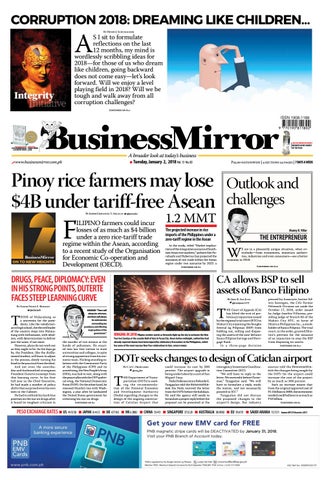
Corruption 2018: Dreaming like children…
A
By Henry J. Schumacher
s I sit to formulate reflections on the last 12 months, my mind is wordlessly scribbling ideas for 2018—for those of us who dream like children, going backward does not come easy—let’s look forward. Will we enjoy a level playing field in 2018? Will we be tough and walk away from all corruption challenges? Continued on A12
media partner of the year
United nations
2015 environmental Media Award leadership award 2008
BusinessMirror A broader look at today’s business
www.businessmirror.com.ph
n
Tuesday, January 2, 2018 Vol. 13 No. 83
F
@jearcalas
ilipino farmers could incur losses of as much as $4 billion under a zero rice-tariff trade regime within the Asean, according to a recent study of the Organisation for Economic Co-operation and Development (OECD).
The projected increase in rice imports of the Philippines under a zero-tariff regime in the Asean
T
hink of Malacañang as a university for the presidents. Like the valedictorian in high school, the elected leader of the country steps into Malacañang with enthusiasm, with idealism, with determination to deliver just the same, if not more. However, plans do not work out as they ought to be. As the days go by, the President, like the disillusioned student, will learn to adjust in the process, slowly turning his head to the practical from the ideal. And not even the unorthodox and foulmouthed strongman President Duterte is exempt from this learning curve. In his first full year as the Chief Executive, he had made a number of policy shifts that surprised even his own men in the Cabinet. He had to rethink his hard-line position on the war on drugs after it found its toughest criticism in
the murder of two minors at the hands of policemen. He enacted into law free tuition in state universities and colleges, in spite of strong opposition from his economic team. His long-standing relations with the Communist Party of the Philippines (CPP) and its armed wing, the New People’s Army (NPA), was laid to rest, along with the peace talks with the CPP’s political wing, the National Democratic Front (NDF). On the other hand, he renewed Manila’s ties with Washington, a year after he lambasted the United States government for criticizing his war on drugs. Continued on A2
PESO exchange rates n US 49.9230
Manny B. Villar
THE ENTREPRENEUR
In the study, titled “Market implications of the integration scenario of Southeast Asian rice markets,” authors Gen Furuhashi and Hubertus Gay projected the outcomes of rice trade within the Asean region under two scenarios by 2025: a
W
e are in a pleasantly unique situation, when everybody—from economists, monetary authorities, industries and even consumers—see a better economy in 2018. Continued on A10
Continued on A2
CA allows BSP to sell assets of Banco Filipino By Joel R. San Juan
By Elijah Felice E. Rosales ANDANAR: “There will always be criticisms, and there will always be controversies surrounding any presidency and affecting major policies of the government.”
Outlook and challenges
1.2 MMT
DRUGS, PEACE, DIPLOMACY: EVEN IN HIS STRONG POINTS, DUTERTE FACES STEEP LEARNING CURVE @alyasjah
business news source of the year
P25.00 nationwide | 4 sections 24 pages | 7 days a week
Pinoy rice farmers may lose $4B under tariff-free Asean By Jasper Emmanuel Y. Arcalas
2016 ejap journalism awards
T RINGING IN 2018 Filipino revelers watch as fireworks light up the sky to welcome the New Year last Sunday at the seaside Mall of Asia in Pasay City. Hours before midnight, authorities had already reported dozens have been injured by celebratory firecrackers in the Philippines, which has some of the most raucous New Year celebrations in Asia. AP/Bullit Marquez
@jrsanjuan1573
HE Court of Appeals (CA) has lifted the writ of preliminary injunction issued by the regional trial court (RTC) in Makati City enjoining the Bangko Sentral ng Pilipinas (BSP) from bidding out, selling and disposing the assets of the now-defunct Banco Filipino Savings and Mortgage Bank. I n a t h r e e - p a g e d e c i s i o n
penned by Associate Justice Edwin Sorongon, the CA’s Former Fifteenth Division set aside the October 17, 2016, order issued by Judge Joselito Villarosa, presiding judge of Branch 66 of the Makati City RTC, in favor of Ekistics Philippines Inc., a stockholder of Banco Filipino. The trial court, in the order, granted Ekistics’s petition for the issuance of an injunction to stop the BSP from disposing its assets. Continued on A12
DOTr seeks changes to design of Caticlan airport By Cai U. Ordinario
T
@cuo_bm
he Department of Transportation (DOTr) is seeki n g t he re com me nd a tion of the National Economic a nd D e ve lopme nt Aut hor it y (Neda) regarding changes to the design of the ongoing construction of Caticlan A irport that
could increase its cost by 300 percent. The airport upgrade is being undertaken by a unit of San Miguel Corp. Neda Undersecretary Rolando G. Tungpalan told the BusinessMirror the Neda received the letter from the DOTr before the holidays. He said the agency still needs to formulate a proper reply before the proposal can be presented at the
interagency Investment Coordination Committee (ICC). “We still have to reply to the letter. We received it before Christmas,” Tungpalan said. “We still have to formulate a reply, study the matter, and not necessarily proceed to ICC.” Tung palan did not discuss the proposed changes to the airport’s design. But industry
sources told the BusinessMirror the changes being sought by the DOTr for the airport could increase the cost of the project by as much as 300 percent. Such an increase means that from the original approved cost of P2.5 billion in 2008, the investment needed could balloon to as much as P10 billion.
n japan 0.4423 n UK 67.1165 n HK 6.3882 n CHINA 7.6413 n singapore 37.3228 n australia 38.9050 n EU 59.6131 n SAUDI arabia 13.3121
Continued on A2
Source: BSP (29 December 2017 )
BMReports BusinessMirror
A2 Tuesday, January 2, 2018
Pinoy rice farmers may lose $4B under tariff-free Asean Continued from A1
zero-tariff regime and a fully integrated market. The authors noted that, under a zero-tariff regime, rice farmers in the Philippines would incur production losses of at least $2.082 billion, while under a fully integrated market they could lose $3.966 billion. The value of the country’s rice production is estimated at $6 billion annually. The country is still importing rice, with the tariff imposed of on rice coming from other Asean member-countries set at 35 percent. “As expected, the main changes in the overall welfare for consumers and producers depend on the trade situation of the respective country. Producers in exporting countries and consumers in importing countries gain from tariff reduction and further integration,” the study read. “Conversely, consumers in exporting countries and producers in importing countries lose.” Under a zero-tariff regime, Asean membercountries would eliminate their tariffs, while a fully integrated market would entail both the removal of tariffs and nontariff measures. Under the second scenario, the differences between domestic prices and border prices of rice would be eliminated within the region. “The first [scenario] involves the elimination of tariffs within the region, while protection vis-à-vis countries outside the region remains unchanged,” the study read. “The second scenario involves closer price integration across the region, again with protection versus countries outside the region unchanged. This scenario reflects the elimination of not just tariffs but of all forms of nontariff forms of protection that cause prices to diverge across the region,” it added. The production losses would be due to the projected influx of cheaper rice imports from fellow Asean countries, according to the study. The OECD projected that the Philippines’s rice imports, which accounts for 40 percent of the total regional volume, would reach 2.251 million metric tons (MMT) by 2025. Of the volume,
94.62 percent, or about 2.13 MMT, would come from Asean member-countries. Under a zero-tariff regime, the Philippines’s rice imports would increase by 1.2 MMT, while a fully integrated Asean market would mean additional purchases of 2.6 MMT. “Any reduction in trade barriers for importing countries will inevitably lead to lower rates of national self-sufficiency. Those ratios are about 10 percent lower with full price integration in Indonesia and the Philippines,” the study read. “However, despite this, the majority of rice consumed in these countries will still be sourced from domestic production—pointing to a large and competitive domestic rice sector remaining post reforms,” it added. The OECD study concluded that the hike in rice imports would cut the Philippines’s selfsufficiency ratio to 80 percent under a zero-tariff regime and could fall to as much as 73 percent in a fully integrated market. The study noted that the Philippines has never achieved rice self-sufficiency. In 2016 the OECD estimated that Philippine rice production by 2025 would reach 13.67 MMT with a total rice consumption of 15.872 MMT. However, under a zero-tariff regime, the Philippines’s rice production would be cut by 441,500 metric tons (MT), or about 3 percent , while consumption would increase by 678,200 MT, or by 4 percent. Under a closer market integration, local rice production would decline by nearly 1 MMT, while consumption could increase by 1.577 MMT. This translates to an output reduction of about 7 percent and a consumption increment of 10 percent. The study also noted that, under the two scenarios, the producer price of rice in the Philippines would significantly fall, as a consequence of lower production volume and the influx of cheaper rice imports. “Under the baseline, domestic prices are 50 percent higher than adjusted border prices in Malaysia, implying a modest degree of protection beyond that provided by tariffs; but much
higher in the Philippines [over 100 percent] and Indonesia [nearly 100 percent]. Hence, a much bigger overall stimulus to regional trade would come from deeper price integration than from tariff reform alone,” the study read. “The dismantling of high rates of price protection across the region would naturally imply substantial national price effects. In the more radical scenario of full internal liberalization, producer prices in importing countries—Indonesia, the Philippines and Malaysia—would fall by 39.3 percent, 45 percent and 26.2 percent, respectively, relative to the baseline,” it added. However, under the two scenarios, the OECD study concluded that the change in the Philippines’s welfare would be positive, as increased rice consumption would outweigh the losses incurred by Filipino farmers. The OECD estimated that under a zero-tariff scenario rice consumption by 2025 would result in earnings of $2.51 billion and $5.01 billion under an integrated scenario. The overall change in welfare under a zero-tariff regime is pegged at $80.4 million and $697 million under an integrated market. “The Philippines accounts for about twothirds of the overall $125 million in gains most from the tariff reform scenario [due to reducing its own tariffs and the fact that it is the most important trader in the region]. Consumers gain approximately $2.5 billion from lower prices, while producers lose $2.1 billion,” the study read. “The total welfare gains are over 15 times higher with full price integration, at $2.2 billion, with gains of $700 million to the Philippines and the remaining gains spread more evenly across countries. In importing countries, lower prices would deliver approximately $6.4 billion and $5 billion of gains to consumers in Indonesia and the Philippines, respectively, with a large share of those gains coming at the expense of p roducers,” it added. Asean member-countries seek to create a fully integrated regional market by 2025, which includes improving food security, as stipulated under the Asean Economic Community Blueprint 2025.
DOTr seeks changes to design of Caticlan airport Continued from A1
In 2008 the Neda Board approved the unsolicited Build-Rehabilitate-Operate-Transfer proposal for the Caticlan Airport Development Project. This involved the rehabilitation of the existing Caticlan airport to accommodate the increasing passenger traffic bound for Boracay Island and other tourist destinations in Region 6. The project also aims to increase the capacity of the airport terminal for greater
(
passenger traffic, accommodate regional flights and larger aircraft and improve quality of service and passenger safety and security in the area. The Air Transportation Office will manage the airport until 2010, while the Caticlan International Airport and Development Corp., which is financing the project, will take over its operation until 2033. According to San Miguel, the airport in Caticlan, Aklan, is the major gateway to the world-famous Boracay. As part of the long-term
modernization and expansion project for Boracay Airport, a larger and more technologically advanced airport facility is currently being developed for international operations. “Its current concession holder is TransAire Development Holdings Corp. While some parts of the expansion have been completed, such as the runway extension, airfield-lighting works, rehabilitation of the old road and terminal construction, work is still ongoing on an additional passenger terminal and further extension of the runway.”
www.businessmirror.com.ph
DRUGS, PEACE, DIPLOMACY: EVEN IN HIS STRONG POINTS, DUTERTE FACES STEEP LEARNING CURVE Continued from A1
Duterte’s battery, mettle and position on issues were tested in 2017.
War on drugs
The President won the 2016 elections on the promise to combat the drug menace the most extreme way possible. Upon ascending to the seat of power, he wasted no time and launched a war on drugs that has instantly gained notoriety internationally. In spite of left and right condemnations from human-rights groups based here and abroad, Duterte was unfazed in carrying out his flagship program. No criticism has convinced him to rethink the manner by which the war on drugs is implemented, until the execution of Kian Loyd de los Santos and Carl Angelo Arnaiz happened. De los Santos was shot dead last August 16 by Caloocan policemen for allegedly resisting arrest on drug charges. The 17-year-old was accused of peddling illegal drugs in the community where he lived and, because of this, was a target of a one-time, big-time antinarcotics operation of the city police. However, witness accounts and security footage revealed that the alleged shootout with de los Santos was likely false, and he was helplessly killed by the arresting officers. It was also later found out the recovered pistol, cartridges and methamphetamine, locally known as shabu, in de los Santos’s possession was apparently planted. More than one week after de los Santos’s murder, Arnaiz’s corpse was found in a morgue in Caloocan City. The police reported that the 19-year-old former University of the Philippines student declared a robbery against a taxi driver, and engaged responding officers in a shootout. Forensics experts from the Public Attorney’s Office (PAO) claimed otherwise, and argued Arnaiz was in no shape to fight back, and there were indications he has been tortured before being shot. Forensics report from the PAO said Arnaiz sustained four bullet wounds in his chest and one at the back of his right arm, and there was no sign he resisted arrest. After one week, Arnaiz’s missing companion, 14-year- old Reynaldo de Guzman, was discovered in Gapan, Nueva Ecija. The young body of de Guzman sustained 30 stab wounds and his head was wrapped in packing tape. This prompted Malacañang to admit there is a need to review the procedure by which the war on drugs is being carried out. Then Presidential Spokesman Ernesto C. Abella said the Palace will not take the execution of minors sitting down, and vowed there will be restructuring in the Philippine National Police (PNP). It was in October when the President decided to withdraw the PNP from the war on drugs, designating the Philippine Drug Enforcement Agency (PDEA) as the sole agency in charge of all antinarcotics operations. This, according to Presidential Communications Secretary Martin M. Andanar, was a turning point for Duterte. Andanar said any flagship program is prone to criticisms and controversies, and the war on drugs is not exempt from that. He said the good thing about the President is that he did his assignment and took note of what went wrong in the process. “There will always be criticisms, and there will always be controversies surrounding any presidency and affecting major policies of the government. The policy of the President to rid this country of hard drugs is not exempted from those criticisms,” Andanar told the BusinessMirror. The Palace official said that, as much as the war on drugs was able to produce positive outcomes, such as the surrender of more than 1 million drug dependents and seizure of multibillions of pesos worth of drugs last year, it also has its share of bad light. This includes the murder of de los Santos, Arnaiz, de Guzman and other minors who fell victims to the brutal crackdown on illegal drugs. Andanar explained his principal gave his critics the benefit of the doubt when the PNP was pulled out from the conduct of antinarcotics operations. He tested the waters of the war on drugs with that decision, and assessed it was not working to the government’s advantage with an undermanned PDEA leading such a grand campaign. “And there will always be casualties,” Andanar said. “In any war, [may that be the war in] Marawi or [war] against illegal drugs, there will always be casualties.” Last December the President decided to bring the police back in the war on drugs, owing it to the reported resurgence in illegal drug activities and other crimes since the PNP and other law-enforcement agencies left the antinarcotics operations. The PNP can now join the PDEA in the war on drugs, but the latter remains to be on top of the campaign. According to Andanar, Duterte came with the decision to return the PNP to the war on drugs after careful evaluation. However, with what he had shown in the past, he said the public can expect the President to be fluid in implementing his flagship campaign, and will not hesitate to pull
out the PNP again should there be a need to.
Peace talks
Negotiations with the communists went from upbeat to off tune this year, as the peace talks with the NDF, in a span of seven months, collapsed. Following the fourth round of talks last April, the government and the NDF never returned to the negotiating table to carry on with their discussions on socioeconomic reforms and bilateral cease-fire. As the fifth round of talks is about to begin in May, Duterte directed the government panel to withdraw from the negotiations. This was mainly due to the CPP’s order to the NPA to heighten offensives against government troops in response to the martial-law declaration in Mindanao. However, as backdoor negotiations are conducted in a bid to resume the formal talks, NPA units and government troops go at it almost every day, especially in Mindanao. Last August the NPA ambushed a convoy of the Presidential Security Group in Arakan, Cotabato, killing five of the President’s security men and a militiaman. The ambush angered Duterte so much he started issuing statements that he will instruct the military to finish off the communists once the fight against Islamist extremists in Marawi City, Lanao del Sur, is over. This signaled the end of the talks, and the end of the President’s longstanding relations with the Left. Andanar said, it did not help activists troop to the streets and started branding the President a “fascist,” a label that Duterte first objected to, and later on accepted. The President told activist groups not to force him to resume the talks if they think he is an authoritarian leader. Andanar said, to be fair with the NDF negotiators, they did their part in trying to sustain the negotiations, but it is the situation on the ground that was deemed not conducive for the talks. While the NPA continues to ambush government troops in the countryside, activists in the city launched series of protests against the administration, and this did not fare well with the President, Andanar said. The collapse in peace talks eventually led to the termination of all negotiations with the NDF, and was later on followed by the inclusion of the CPP-NPA in the terrorist list. For Andanar, had the communists cooperated with the government, the year would not have ended with the death of the peace process. “The final instruction was to discontinue the peace talks until such further notice. The President has expected so much from and given so much to the communists, but they did not respond affirmatively to his call for a just and lasting peace,”Andanar said.
Renewed PHL-US ties
If in 2016 Duterte delighted anti-imperialist activists with his threats to abrogate the country’s military agreements with the US, in 2017, he was the total opposite. With the entry of US President Donald J. Trump to the White House, Andanar said the President has found a “good friend” in Washington. Unlike former US President Barack Obama, who had called on Manila to investigate the deaths under the war on drugs, Trump took the diplomatic stance of supporting Duterte in his flagship program. This, according to Andanar, was treated by the President as the United States counterpart’s “respect for sovereignty.” “Trump was the entire opposite of Obama. Since his first day in the White House, he vowed he will not shove in the throats of other nations the values of the United States, which means he will implement a policy of noninterference,” Andanar said. “So, overall, it was just a hiccup in the relations between the Philippines and the United States. It was just about six months that we had to question and challenge our bilateral relations with the United States,” he added. Trump supported Duterte’s brutal crackdown on illegal drugs and, in one occasion, even said his Philippine counterpart is “doing a good job” in addressing the country’s drug menace. This, however, did not sit well with US senators and congressmen, and has called on the White House to condemn the spate of killings in the country. During their bilateral meeting in November, Trump did not directly raise the issue of human rights to Duterte, nor did they delve on the reported killings under the war on drugs. Andanar said the President found this move by Trump diplomatic. However, the Palace official maintained the government is open to criticisms, and is not entirely against anyone who has a critical opinion on the war on drugs. It is just that the criticisms should not come with a price, he noted, like threatening to cancel aid and grants in the process due to the radical law and order measure of the President. “What the President wants is an independent foreign policy, a foreign policy that we do not serve as lapdogs to anyone. I believe this was achieved when US President Donald Trump assumed his position in the White House,” Andanar said.
The Nation BusinessMirror
www.businessmirror.com.ph
DOTr procures spare parts, indie MRT 3 consultant
T
O progressively address the issues beleaguering the Metro R ai l Transit Line 3 (MRT 3), the Department of Transportation MRT 3 team recently procured the f i rst batc h of v a r iou s spa re parts required for the system’s maintenance. Among those already procured by the DOTr MRT 3, through its Maintenance Transition Period Bids and Awards Committee (MTP BAC) over the last seven weeks, are spare parts for rolling stock, worth about P8.66 million; and spare parts for tracks, amounting to P7.33 million. The rolling stock spare parts contract had an approved budget for contract (ABC) of P8.89 million and was won by Linkers Enterprises, while the spare parts for tracks had an ABC of P7.97 million and was won by Nikka Trading. Notably, the contract for the independent audit and assessment (IA A) consultant of the entire MRT 3 system was also awarded to TUV Rheinland for P45.31 million. The contract had an ABC of P48 million, and offers from TUV SUD and Bureau Veritas were also received. The IAA will cover all subcomponents of MRT 3, including its signaling system, tracks and rolling stock. Both the current fleet of 73 Czechmade trains and the “unaccepted” 48 China-made trains will be covered by the IAA. The IAA consultant will make specific and actionable recommendations to address identified issues. To ensure qu a l it y a nd independence, the MRT 3 MTP BAC required a l l bidders for the IA A Consultancy to be ISO 17020:2012 and ISO 17065:2012 certified firms, and further required membership in the International Federation of Inspection Agencies (IFIA). Other contracts for trunk radio communications (P924,000), spare parts for power (P6.44 million), pantograph strips (P7.88 million), spare parts for overhead catenary system (P2.8 million), and various bearings (P1.98 million) were also awarded to various bidders. Assistant Secretary for Railways TJ Batan said the DOTr MRT 3 MTP BAC adjourned its 16th and last meeting for 2017 early Friday morning. The MTP BAC was created last November 9. “ The DOTr MRT 3 MTP BAC would sometimes start as early as 6 a.m., and on some days end as late as 12 midnight to ensure that the spare parts needed by ou r m a i nte n a nce t r a n s it ion team [MTT] are procured at the soonest possible time,” Batan said. The MRT 3 MTP BAC was created by the DOTr after terminating its maintenance service contract with Busan Universal Rail Inc. (Buri) last November 6 due to poor performance and breach of contractual obligations. “Deliveries of some spare parts have commenced, and will continue over the next 30 to 90 days. We got the commitment of all suppliers to exert best efforts to deliver earlier than the prescribed contractual lead times, and our MRT 3 team will focus on realizing this,” he said. With instruction and guidance from Secretary Arthur P. Tugade, Batan said the DOTr will continue procuring next year signaling spare parts and general overhaul services, among others. “I believe the entire MRT 3 organization and our DOTr Central Office representatives have truly stepped up and delivered on our service commitment to the public,” Batan added. PNA
Editor: Vittorio V. Vitug • Tuesday, January 2, 2018 A3
Health dept reports ‘substantial’ drop in firecracker-related injury By Claudeth Mocon-Ciriaco | Correspondent
T
he Department of Health (DOH) on Monday reported a total of 191 fireworks-related injuries from its “Iwas Paputok 2017” monitoring period from December 21, 2017 to January 1, 2018.
Candles of hope
Families from different walks of life start the New Year by going to church. This family heard Mass and offered candles at the Redemptorist Church in Baclaran on Monday, New Year’s day, to give thanks and pray for a good year ahead. NONIE REYES
Higher fuel-pump prices on Tuesday
O
il firms announced on Monday a price increase in petroleum products, which will take effect on Tuesday. In separate announcements, oil companies said they will jack up gasoline price by P0.20 per liter, diesel by P0.65 per liter and kerosene by P0.75 per liter. PTT Philippines and Seaoil said the price adjustment takes effect at 6 a.m. on January 2. This is the first oil-price increase for the year.
Other oil firms are expected to follow suit. Adjustments on petroleum products are implemented every Tuesday of the week. The Department of Energy, meanwhile, clarified that the implementation of excise tax and value-added tax for petroleum products under the Tax Reform for Acceleration and Inclusion does not apply to the old stocks of petroleum products.
Consequently, the retailers should not charge the new excise tax to the consumers. “The Oil Industry Management Bureau has issued an advisory to petroleum products stakeholders not to levy new excise-tax rates on old stocks, considering that excise taxes are levied upon importation and not at the point of sale to the consumers,” Energy Assistant Secretary Leonido J. Pulido III clarified. Lenie Lectura
Most of the injuries are from t he Nat ion a l C apit a l Reg ion (NCR) at 115, or 60 percent of the cases, followed by Western Visayas at 15 cases; Central Luzon, Region 4A and Bicol region all have 13 cases each. “We are relatively pleased. Relatively because there are still injuries. But pleased because of the substantial reduction or decrease on fireworks-related injuries from December 21, 2017 to January 1, 2018, compared to the same period of the previous year [which is] also 77 percent lower than the five-year2012-to2016 [period],” Health Secretary Francisco T. Duque III said. Manila had the most number at 63 cases; followed by Quezon City, 14; Pasig City, 11; and Valenzuela City, six. Piccolo remains as the top fireworks-causing injury at 94 cases, which accounts for 49 percent of the total cases, followed by kwitis at 14 cases or 7 percent, and unknown firecrackers at 6 percent. The majority, or 160, or 84 percent, of the cases were males. Age cases ranged from 11 months to 96 years old. About 64 percent, 123 cases, were active users and about 77 percent, 148 cases, occurred in the streets. The majority, or 162, or 85
77%
The percentage drop in firecracker-related injuries in 2017 versus a five-year average from 2012 to 2016
percent, of cases sustained blast injuries without amputation; 25 cases, or 13 percent, had eye injuries; and seven, or 4 percent, had blast injuries with amputation. Duque noted that, overall, t he go v e r n me nt ’s c a mp a i g n against fireworks had reduced the number of injuries. “The DOH is grateful for the strong cooperation of our local government units and other government agencies for this success,” the health chief said, as he also thanked President Duterte for signing Executive Order 28, which reinforced the efforts of the DOH and other concerned agencies, such as the Department of the Interior and Local Government, Bureau of Fire Protection and the Philippine National Police and EcoWaste Coalition, among others.
Productivity still has room for improvement–PIDS By Elijah Felice E. Rosales @alyasjah
T
O sustain its fast-paced economic growth this year, the government must throw in efforts to improve the country’s productivity that had seen steady progress in the past years, according to a study by the State’s think tank. The country recorded an increasing labor-productivity rate over the past two decades that had summed up to an average annual growth of 2.4 percent. From
P124,926 per worker in 1998, the country’s productivity ballooned to P198,996 per worker in 2016, registering a 59.3- percent hike. However, in a discussion paper by the Philippine Institute for Development Studies, researchers Maureen Ane D. Rosellon and Erlinda M. Medalla said much is to be done with the country’s productivity. “On the productivity side, performance is improving, but the rate of growth still needs a boost,” they said. They pointed to manufactur-
ing as in need of an upturn. The sector recorded labor-productivity growth at an annual average growth of 4.4 percent, well above the estimated 2-percent growth registered by agriculture, industry in total and services. For Rosellon and Medalla, if the government intends to sustain the country’s good economic performance, it must bring upon reforms directed toward the development of the country’s productivity, especially on manufacturing. This includes the innovation of a new industrial
strategy “that integrates industry/ manufacturing with agriculture and services, and identifies competition, innovation and productivity as the underlying framework.” They said the government should continue innovating the industries, as this is “placed at the heart of the industrial strategy.” Likewise, it must put a premium in developing new methods for the improvement of the government’s priority industries. “To boost growth and make these industries competitive and productive, several strategic ac-
tions/measures have also been identified, such as addressing supply-chain gaps, human-resource development and skills training, small and medium enterprises development, innovation and upgrading, intense investment promotion and addressing horizontal issues, among others,” they said. Nonetheless, Rosellon and Medalla said the country will be able to sustain its fast-paced economy this year and in the years to come, as long as the government keeps its eyes on improving labor productivity.
‘Trigger happy’ revelers face raps–NCRPO chief
P
ersons caught indiscriminately firing their weapons during the New Year’s Eve celebrations will be charged and meted with the stiffest possible sanctions ever. This, as National Capital Region Police Officer (NCRPO) Head Director Oscar Albayalde, in a news statement issued on Monday, assured the public that those caught firing their guns will be investigated thoroughly. “They must be liable to the law and to the victim. They must face the consequences and corresponding sanctions,” Albayalde said. Earlier, Taguig City Police Station operatives arrested retired Philippine Army Staff Sgt. Jamael Mindalano and Cpl. Richard John Quijan of the Light Reaction Regiment, Special Operations Command, for
indiscriminate firing, alarm and scandal, illegal possession of firearms and ammunition, physical injury, direct assault, resisting arrest and serious disobedience. Recovered from their possession were two .45 caliber pistols, a 9mm pistol, a .38 caliber revolver and assorted ammunition. Their illegal activities were reported to authorities by victim Jolly Moreno, who was hit by a ricocheting bullet fired by the suspects at the height of the New Year revelry. Meanwhile, Caloocan Police Station operatives arrested Isagani Ancheta, 38, resident of Block 11, Barangay 35, Sawata Maypajo, Caloocan City, who was allegedly responsible for the shooting incident that took place past 12 midnight on New Year’s Eve where three persons were hurt. PNA
Next big feast
Thousands of Black Nazarene devotees attend last Sunday’s thanksgiving procession in Quiapo, Manila. A radio report said dozens were hurt in the procession, which lasted for more than eight hours. The feast of the Black Nazarene is held every 9th of January. PNA/Avito C. Dalan
Economy
A4 Tuesday, January 2, 2018 • Editors: Vittorio V. Vitug and Max V. de Leon
BusinessMirror
House bill seeks LTA creation, abolition of LTO and LTFRB
H
By Jovee Marie N. dela Cruz
@joveemarie
ouse leaders are pushing for the passage of a measure that seeks to abolish the Land Transportation Franchising and Regulatory Board (LTFRB) and Land Transportation Office (LTO) and create the Land Transportation Authority (LTA). House Bill 6776 seeks to repeal Executive Order 202 and EO 226, which created LTFRB and LTO. The LTA shall be an attached agency of the Department of Transportation (DOTr) and shall absorb the powers and functions of the LTFRB and the LTO.
Legislative franchise
Under the measure, no person shall conduct the business of operating public transportation without first obtaining a congressional franchise. The bill said the holder of a legislative franchise issued should comply with the minimum amount of capitalization in order to ensure that only operators with adequate financial capacity are allowed to operate public transport: P30 million for publicutility bus (PUB) and P10 million for public-utility jeepney (PUJ), taxi and other similar services. The measure added the holder of such legislative franchise must comply with the constitutional and statutory requirements on maximum foreign ownership throughout the duration of the holder’s franchise. “To those holders which already have existing franchises, they are given a period of six months from the grant of legislative franchise within which to comply with the paid capital requirement,” the bill said. It also said the certificate of transportation network companies (TNC) accreditation shall be granted to TNCs providing Internet-based digital technology application or digital platform technology to facilitate transportation of passengers. The bill said a TNC, prior to its application for accreditation by the
LTA, must first secure a franchise from Congress. Aside from the LTO and LTFRB, the bill also proposes the abolition of the Traffic Enforcement Group of the Metropolitan Manila Development Authority. All properties, assets and liabilities, all powers, functions and duties, rights and courses of actions of these agencies will be transferred to the proposed LTA.
Development program
Moreover, the measure said the LTA shall prepare the National Land Transportation Development Program, which will provide a comprehensive road map for transport development initially covering Metro Manila, Metro Cebu, Metro Davao and other urbanized cities and municipalities through the following but not limited to: traffic management, construction of expressways, improvement of bus and jeepney services, rationalized route structure, improved terminals and interchange facilities and proposed feasibility studies to the viability of a suburban railway system and integration of the fare structure and ticketing system between routes, as well as modes. It said the LTA shall also evaluate and package projects and investment programs, and for this purpose, may call on any agency or organization, whether public or private, whose development plans include land transportation as an integral part thereof, to participate in the preparation and implementation of such programs. The bill added the authority shall formulate strategies toward vehicu-
lar modernization and the establishment of a sustainable transport system. The authority may grant incentives, such as the grant of discount to registration fees to vehicles that use electric, other emission free energy sources or other forms of sustainable transport. The LTA shall also enter into contract with domestic and foreign companies for services and products duly approved in the National Land Transportation Development Program, the measure said. The transportation authority shall also prescribe fines and regulate routes, economically viable capacities and zones or areas of operation of public land-transportation services provided by motorized vehicles in accordance with the public landtransportation development plans and programs approved by the DOTr. The bill said the authority’s overall directions and thrusts shall be provided and approved by the board of directors. The measure said the authority, in coordination with the National Economic and Development Authority, Department of the Interior and Local Government and other key stakeholders and associations shall conduct a land-transportation study to determine the actual need for public transportation in the various routes to objectively determine the actual number of public buses, jeeps, taxi and other public-utility vehicles, as well as transport network vehicles, needed by the public at a certain route, road, street, locality or area, which will serve as basis for the issuance of a legislative franchise.
Efficient
The authors of House Bill (HB) 6776, led by Speaker Pantaleon D. Alvarez, said an efficient transport system ensures the efficient movements of good and promote economic activity in both rural and urban areas, and encourages the flow of the investment that would surely enhance our country’s economic growth. The lawmakers said the vision for the Philippine transport system was initially drawn from the declaration of policy in the creation of the LTFRB and LTO in 1987. However, they said, important
considerations should be embarked upon to create a central office tasked to maintain land transportation law and order in the Philippines. The lawmakers said a more comprehensive transportation policy needs to take into account the varied and complex areas in the land-transportation industry, adding that existing policies affect transportation in different ways. Some policies are inadequate, ineffective and are already obsolete, they said. “As we move toward progress, we need an LTA that will address the challenges that we are facing today,” Alvarez said.
Anti-poor
Meanwhile, Party-list Reps. Ariel Casilao of Anakpawis and Carlos Isagani Zarate of Bayan Muna labeled as “anti-poor” HB 6776 as it requires transport operators to secure a franchise from Congress and should have a minimum capitalization of P10 million for jeepneys, taxis and similar vehicles, and P30 million for buses. Casilao warned the passage of the bill “will kill the livelihood of thousands of small and poor operators and drivers.” Casilao said the measure will leave thousands of small operators disenfranchised. “HB 6776 will give Congress power to approve a franchise, such power is likely to be abused and used for political and self-serving interest. Likewise, the LTO and LTFRB merging will not stop the corrupt practices of some of its officials and employees,” the Anakpawis lawmaker said. Casilao added the only beneficiaries of HB 6776 are transport groups who are willing to compromise and act like corporate dummies of big business groups capitalizing in public transport. “Obviously, it is giving bias to those who can afford to pay the minimum capital requirement, thus small operators are basically out of the picture,” Casilao said. The Makabayan bloc, for its part, said it will vehemently oppose the bill “because it only largely caters to the interests of big capitalists and corporations that can afford the required huge capitalization.”
BCDA raised record high P5B for AFP in 1st year of Duterte administration
T
he state-owned Bases Conversion and Development Authority (BCDA) remitted close to P5 billion to the Bureau of the Treasury in the first year of the Duterte administration—the highest amount generated by the BCDA for the Armed Forces of the Philippines (AFP) in its 25-year history. In line with the BCDA’s mandate to strengthen the military while building great cities, the state-owned corporation has raised a total of P36.6 billion for the AFP. Recently, Department of National Defense (DND) Public Affairs Office chief Arsenio Andolong announced that the Philippines would acquire six Super Tucano A-29 planes worth over P4.9 billion. He added these will augment or even replace the existing Rockwell OV-10 “Bronco” attack planes being used by the Philippine Air Force (PAF) in close air-support missions. Deliveries of the A-29s are expected to commence in 2019. These will be turned over and operated by the PAF’s 15th Strike Wing based in Sangley Point, Cavite City. Aside from this, Andolong said the PAF will soon receive AIM-9 “Sidewinder” air-to-air missiles, which will be used to augment the combat
Lucky print
Polka-dotted tops are displayed along a street in Baclaran, Parañaque City. Many Filipinos believe that wearing polka-dotted clothes will bring good luck for the coming year. ALYSA SALEN
capabilities of the existing 12 South Korean-made FA-50PH “Fighting Eagle” jets. With these, missiles air-to-air combat capabilities of the FA50PH are boosted, making it more capable of protecting the country’s airspace against airborne threats. These FA50 fighter jets and the Super Tucanos were among the aircraft used in combat during the fivemonth battle to liberate Marawi City
from the Maute terrorist group. The BCDA, under the Duterte administration, has committed to continuously raise more for the modernization of the AFP, as well as provide for the welfare of soldiers. The BCDA has also committed to assist the departments of Finance and Budget and Management in raising the necessary funds for the retirement benefits of men and women in uniform. Rene Acosta
www.businessmirror.com.ph
PEZA adjusts 2018 targets By Catherine N. Pillas @c_pillas29
T
he Philippine Economic Zone Authority (Peza) has downscaled its investment pledges target to a modest 10 percent for 2018, and is eyeing similar conservative targets for exports and employment. In a recent interview with media, Peza Director General Charito B. Plaza conceded of not having met the 300-percent growth eyed for 2017 in pledges due to prevailing uncertainties in the local and international political landscape. “The fighting target was hampered by the tax reform for the BPO [business-process outsourcing] firms, and the delay in the president ia l proc lamat ion of economic zones, and the protectionism of [US President Donald] Trump,” Plaza said. The existing problems, notwithstanding, Peza’s registered investment pledges rose 8.89 percent to P237.57 billion, over 2016’s pledges level of P218.176 billion. Plaza is hoping to secure a 10percent growth in investment pledges for 2018, on the back of
several programs, including the holding of the global ecozone convergence event in April, plus the completion of the Philippine economic zone map. No year-end figures for exports and employment have been given yet, but the investment-promotion agency is looking at a similar increase of 10 percent for employment and 8 percent for exports. Employment as of October 2017 in Peza-registered zones is now at 1.39 million, an increase of 5.79 percent over the same period’s 1.32 million. Exports, meanwhile, is at $42.38 billion from the January-to-October 2017 period, an increase of 8.91 percent over the comparable period’s shipment amount of $38.918 billion last year. To recall, Peza eyed for a tripledigit increase, specifically a jump of 300 percent, for 2017, after investments jumped by 51 percent in mid year. Uncertainty began to pile up, however, as the Department of Finance’s tax effort began to gain traction in the latter half of the year, and increasingly volatile business sentiment in the US affected domestic affairs.
₧2-B slash on DENR budget likely to affect E-NGP target By Jonathan L. Mayuga @jonlmayuga
T
he Department of Environment and Natural Resources (DENR) is cutting down by almost half its reforestation target, from 229,000 hectares to just 125,000 hectares, this year. The DENR’s approved budget for 2018 is P27.1 billion, which is P2 billion lower compared to the P29billion budget in 2017. The bulk of the DENR’s budget in the last six years goes to the massive reforestation program called the National Greening Program (NGP), which seeks to expand the country’s forest cover by 1.5 million hectares. From 2010 to 2016, over P25 billion was spent by the government, in effect, generating green jobs in upland areas while increasing the country’s forest cover by 1.5 million hectares. The program ended in 2016, but it was extended as early as 2015 through Executive Order (EO) 193 or the Expanded-National Greening Project (E-NGP). It aims to increase the country’s forest cover by another 7 million hectares until 2028. The budget cut this year is also expected to lead to the downsizing of the reforestation target. Director Nonito M. Tamayo of the DENR’s Forest Management Bureau (FMB) said downsizing this year’s target may also affect the countr y’s commitment u nder t he Pa r i s A g reement , which is to the reduce our carbon emission by 70 percent between 2020 and 2030. “In 2018, our target is lower because of the budget cut of P2billion. Our target from 229,000 is 125,000 hectares all over the country.… The P2-billion budget cut of the DENR was charged against the E-NGP,” he said. Tamayo added only the target for new plantations will be reduced because the maintenance of the more than 500,000 hectares in the last
three years from 2015 up to 2017 will continue. “Whether we like it or not, we must continue to protect the established plantations, that’s why the budget cut only affects our new plantation targets,” he said. The NGP and E-NGP are the flagship reforestation programs of the government for climate-change mitigation and adaptation, food security and job security program rolled into one. It was learned that as of September 2017, the E-NGP had a 116percent accomplishment rate in terms of the number of persons employed—55,805 from the target of 47,981. On the number of quality planting materials or seedlings, the program produced a total of 1.1 million, which is 14 percent higher than its target of 980,000. As of October, the government’s flagship reforestation program covered an area of 178,148 hectares, or 93 percent of the overall target. Meanwhile, Tamayo said the Duterte administration, particularly the Climate Change Commission (CCC), and the DENR will be conducting a review of the country’s commitment under the Paris Agreement. “We might reduce our target under the Paris Agreement because 70 percent is very ambitious. But it is not all DENR. The other government agencies will look i nto ou r com m it ment ,” Tamayo said. Under the Paris Agreement, 40 percent of the 70-percent carbon emission-reduction target is anchored on the projected expansion of the country’s carbon sink through a massive reforestation under the E-NGP. Other carbon emission-reduction goals will come from transportation and energy sectors. Tamayo said that, with the budget cut, the Duterte administration will have to find ways to come up with a more realistic target.
PVAO releases P9.06-B pension for war veterans’ kin last year
T
he Philippine Veterans Affairs Office (PVAO) disbursed P9.06 billion worth of pensions in 2017. This benefitted an average of 208,159 pension accounts, Department of National Defense Spokesman Arsenio Andolong said. He added that PVAO subsidized
various medical and health-care services availed of by Filipino veterans and their qualified dependents under the Veterans Hospitalization and Medical Care Program worth P85.05 million as part of efforts to recognize the services rendered by Filipino veterans. “This accomplishment leads PVAO to realizing its objective that no vet-
eran should pay for his own medicine,” Andolong said. PVAO provided educational benefits to 2,185 “Iskolar ng mga Bayani” as of the end of November for a total amount of P38.11 million. These beneficiaries are direct descendants of the country’s valiant defenders who fought in World War II, Korean War and Vietnam War. PNA
www.businessmirror.com.ph
Banking&Finance BusinessMirror
Editor: Jun B. Vallecera • Tuesday, January 2, 2018
A5
BSP on the pitfalls of virtual-currency transactions
T
By Bianca Cuaresma
@BcuaresmaBM
he Bangko Sentral ng Pilipinas (BSP) urged the public to exercise caution when transacting in so-called virtual currencies, such as the Bitcoin. In an advisory, the BSP said while virtual currencies potentially have benefits, financial consumers must bear in mind important security considerations. “While recognizing the potential benefits, the BSP is equally cognizant of the attendant risks, particularly, their propensity to be used in illicit activities, such as money laundering and terrorist financing,” the BSP said. “The BSP does not, in any way, endorse virtual currencies as legal tender, store of value or as an investment vehicle,” it quickly added. Virtual currencies—Bitcoins are its most popular—are a form of digital money not issued by any central bank. Unlike electronic money that is backed by cash for the entirety of its value, virtual
currencies are not backed by any commodity but by the ability of their holder to exchange them for goods. In the Philippines virtual currencies are gaining popularity as a medium of exchange due to their ability to move funds at a much faster, cheaper and more convenient way. “With the recent price surge of virtual currencies, such as Bitcoins, the BSP has observed that an increasing number of individuals or entities may be tempted to ‘ invest’ in virtual-currency pyramid schemes disguised as initial coin offerings or virtual-currency investment products,” the BSP said. “The public is, therefore, advised to exercise caution regarding the acquisition, possession, trading of virtual currencies
or dealing with virtual currency-related offers,” it added. The BSP reiterated that unlike stocks or debt notes, virtual currencies are not backed by any company or commodity and their price is purely dependent on market demand and supply. “As such, investing in virtual currencies presents a highly speculative and risky undertaking that might result into huge financial losses,” the BSP said. To minimize risks, the BSP urged existing and prospective virtual-currency users to deal only with BSP-registered virtual-currency exchanges and maintain only a sufficient amount of virtual currency enough to address transaction requirements. “Virtual-currency users should properly secure their virtual-currency holdings and observe security tips to protect the confidentiality and integrity of personal information and transaction details,” the BSP added. Since its conception, the BSP has warned the public of the pitfalls of involving oneself in virtual-currency transactions. Formal regulatory guidelines were adopted in early 2017 requiring virtual-currency exchanges or businesses engaged in the exchange of virtual currencies in the Philippines to register with the BSP as remittance and transfer companies.
NG debt nearly 15 percent lower in November to only P652.5B
T
he national government (NG) paid back obligations worth P652.504 billion as of end-November 2017, the bulk of it representing amortization payments rather than interest payments, Bureau of the Treasury (BTr) data show. According to the BTr, this was a contraction by 14.7 percent from the year before when this amounted to P765.043 billion. Interest payments over 11 months last year reached P289.987 billion, a slight increase of 1.6 percent, from only P285.381 billion in the same period in 2016. Broken down, domestic interest payments reached P194.435 billion, while payments made to offshore entities reached P95.552 billion. The government amortized debts totaling P362.517 billion, a contraction by 24.4 percent, from P479.662 billion recorded for the Januaryto-November period in 2016. The bulk of debt payments in 2017 pertained to domestic entities that received P228.817 billion, worth of payments, while foreign lending institutions were paid P133.700 billion. In November alone, the government spent P35.642 billion to pay maturing debt
obligations, or an increase of 24.5 percent, from P28.616 billion in the same in 2016, according to BTr data. Broken down, interest payments amounted to P20.583 billion, while amortization payments reached P15.059 billion. Earlier, the BTr said the outstanding debt of the NG improved to P6.437 trillion as of endNovember 2017, or a 1-percent decline, compared to the previous level of P6.501 trillion. “Net repayments and a stronger peso contributed in lowering the end-month value of the debt,” the BTr said. NG domestic debt amounted to P4.208 trillion, a 0.2-percent decrease from end-October of P4.216 trillion. “The reduction in domestic debt was due to net redemption of government securities amounting to P7.18 billion and diminution of the peso value of onshore dollar bonds amounting to P0.67 billion,” the BTr said. NG external debt amounted to P2.229 trillion, or a decrease of 2.5 percent, from P2.285 trillion in October 2017. Total NG guaranteed obligations totaled P478.79 billion, P10.30 billion or 2.1 percent lower than the end-October level of P489.088 billion. Rea Cu
will cut down on the documentary requirements,” Dulay said. The reduction was due to complaints received by Finance Secretary Carlos G. Dominguez III from MSME owners on the tedious process business owners undergo when renewing their BIR certificates of registration (COR) in the regional offices. “Let’s cut down on the documentary requirements,” Dominguez said. In renewing a business permit, one must secure a barangay clearance and a mayor’s business permit, including the original copy of the mayor’s permit the previous year, proof of payment for the permit, income statements, contract of lease, among others. Completing all the requirements takes about a week or two, according to the DOF. After obtaining the documents, appli-
cants proceed to the BIR to have the COR renewed with the payment of an annual registration fee for every separate or distinct establishment or place of business. At a recent forum, Dominguez said the government is instituting reforms further improving the ease of doing business in the country. The initiatives include setting up the online trading platform TradeNet to fully automate licensing, permit-issuing, clearance and certification systems. The interagency business-process interoperability program aims to simplify and harmonize import and export documentation. Last December the BIR said it was preparing for the implementation of Republic Act (RA) 10963, or the TRAIN. RA 10963 was signed into law by President Duterte in December but vetoed certain line items in the law. In anticipation of its implementation, the BIR will issue revenue regulations on income tax, withholding tax, value-added tax and excise tax on petroleum, automobiles, mineral products, tobacco, sugar-sweetened beverages and cosmetic procedures, as well as estate and donor’s tax percentage tax and documentary stamp tax. The issuances will also include a revenue memorandum order on the VAT refund system as well as implementing procedures on electronic sales and electronic reporting. According to the BIR, public consultations will be held on January 11 and 12, to help guide the drafters in coming up with the issuances, as well as internal briefings, which will be conducted from January 24 to 26. Rea Cu
Habits to cultivate in 2018 BIR begins simplifying business-permit renewal to achieve financial freedom
T
D
o you want to achieve financial freedom in 2018? Of course you do! Everyone dreams to get to this stage. I mean, who doesn’t love the thought of cash just rolling into their bank accounts? But there is more to it than just having money. The combination of right attitude plus the right habit is the perfect formula to achieve this. So the real question is, “Do you have what it takes to be successful in 2018?” Many of the big names you know today weren’t always financially free. So, how did they manage to get where they are now? Well, they do things differently from the majority. And if you look at them closely, you’d notice they all have something in common—their habits. Here are some habits you can learn from them this coming 2018 to have the best year ever.
Spend time to think
Great ideas make great people, which is why self-made millionaires do not hesitate to devote some time to just thinking. Financially free people consider thinking as a great investment. They spend the time to assess their performance and their life in general, and come up with better plans for the future.
Search out good mentors
Every wealthy person starts with the guidance of a mentor. A mentor is more than just an inspiration. Mentors make sure you don’t accidentally get derailed off the track to success. Find yourself a good mentor—one who can work with you and supplement your skill gaps so you could become someone better next year.
Diversify investments.
Financially free people know better than rely on a single source of income. They’re not satisfied with having only Plan B for their finances. Most of them have at least three sources of income— stock-market investments, real-estate rentals and a part-ownership side business—before making a passive income.
Look beyond the negatives
Successful people do not let their failures define who they are, nor do they allow their mistakes shape their future. They remain persistent and optimistic—classic trademarks of the wealthy. And because they do not dwell on the downside of things, they are in a better position to spot opportunities and come up with solutions to their challenges.
Don’t follow the crowd
These people are not afraid to stand out. Often, their ideas are considered weird, but it’s these ideas that revolutionize the way everyone else perceives things. So while these financially free people don’t follow the crowd, they draw a crowd
Richard Thaddeus Carvajal
personal finance after them. They set their own standards of success instead of letting others set the bar for them.
Help others achieve success
People who work hard to achieve financial freedom usually have a generous spirit. They do not forget how others have helped them reach the top and are willing to pay it forward by helping others achieve success as well. They realize that they can’t achieve lasting success on their own, and so they build their team by helping like-minded individuals realize their potentials.
Know what they want in life and work toward it
Financially free people know better than to chase other people’s dreams, and that’s what makes them successful. A lot of people make the mistake of letting others decide their lives for them, and they end up going about their daily activities mindlessly. They’re simply going through the motions, wondering why they’re still doing what they do.
Seek opportunities for growth
The wealthy are not content with how they are at present. With this, they are eager to accept feedback from others. They do not fear receiving criticism for their actions and take negative comments positively. Learn to view criticisms as stepping-stones toward your goal instead of stumbling blocks. Take every rejection and negativity in a stride and rise to the challenge they pose. So, who are the real financially free people? Are they simply those who have a lot of cash their bank accounts? No. A financially free life is lived by the principles of success. They are those who do not underestimate the power of daily habits in changing the course of their lives. They acknowledge that financial freedom is not a product of luck but the result of good habits. So let’s go back to the question: Do you have what it takes to be successful in 2018? Of course! Believe in yourself. Happy New Year, everyone. Richard Thaddeus Carvajal is a registered financial planner of RFP Philippines. He is also the CEO and president of Philgems Realty Corp. To learn more about personal-financial planning, attend the 67th RFP program this January. To inquire, e-mail info@rfp.ph or text <name><e-mail> <RFP> at 0917-9689774.
he Bureau of Internal Revenue (BIR) is minimizing the number of documentary requirements needed when applying or renewing for businesses permits. The reduction, the Department of Finance (DOF) said, followed the passage of the Tax Reform for Acceleration and Inclusion Act (TRAIN) that allows for more tax collection while ostensibly reducing taxpayer resentment. According to BIR Commissioner Caesar R. Dulay, the bureau is streamlining the registration processes for micro, small and medium enterprises (MSMEs) when renewing their business permits. “After the [tax-reform] package, we’ll go into that streamlining process although it’s an ongoing work being done by BIR. We
Case clippings
By Justice S J Ranada Jr.
QUALIFIED THEFT–duties of private complainant In a prosecution for qualified theft, the accused are entitled to acquittal where the complainant fails to promptly investigate supposed discrepancies in its inventory, and waits six months for another inventory. Prudent behavior would have prompted the complainant to immediately investigate and determine if it sustained any loss at the earliest opportunity, and if it indeed sustained any loss, and whether the accused were the perpetrators of the unlawful taking. Cruz v. People GR 206437 22 Nov. 2017 Del Castillo, J
FGen Insurance partners with Ibero for roadside assistance
M
otor vehicles insured with Fortune General Insurance (FGen Insurance) can now enjoy emergency roadside assistance as FGen partners with Ibero Asistencia, a company that renders travel-assistance service to vehicles. Ibero Asistencia is the Philippine branch office of Ibero Asistencia S. A. of Spain. Vehicle owners with valid comprehensive motor-car insurance from FGen can call Ibero Asistencia’s hot line should their vehicle break down and require towing services. FGen President Michael F. Rellosa said this service is FGen’s way of making sure its clients would have complete peace of mind whenever they are on the road. “We recognize Ibero’s expertise in emergency roadside assistance, and we know our clients are in good hands with them on our side,” he said. To avail yourself of the 24/7 emergency roadside assistance, just call (02) 459-4793 and provide the following details: n Name of owner of vehicle; n Vehicle’s plate number; n Contact number of owner of vehicle; n Location of vehicle; and n Nature of the assistance required; and If the vehicle would not start and would require towing, Ibero Asistencia would tow it to the nearest accredited repair facility. In the event of an accident and the vehicle
FGen President and COO Michael F. Rellosa (third from left) and Ibero Asistencia General Manager Antonio S. Toledano (second from left) shake hands after signing their partnership agreement to provide free emergency roadside assistance to owners of vehicles that are insured with FGen Insurance. With them are FGen Senior Vice President for Underwriting Redentor D. Magat and Ibero Assistant Commercial Manager Maria Cecilia V. Domingo. Behind them at the right is FGen Vice President for Marketing Manuel Maloles.
was totally wrecked, Ibero Asistencia will arrange to have the vehicle removed with the use of a crane and brought to the nearest accredited facility. FGen clients may also call the Ibero Asistencia hot line in cases where the vehicle runs out of fuel, its battery needs boosting, the key gets locked inside, or a tire needs replacing. In out-of-town emergencies, Ibero
Asistencia would even arrange for the transfer of the vehicle’s occupants to the place of destination or stay at a hotel, whichever is more feasible. Ibero Asistencia General Manager Antonio S. Toledano said they are proud to partner with FGen Insurance. “We are ready to serve FGen’s client base, and it is an honor for us to partner with an acknowledged authority in motor-car insurance,” he said.
A6
The World
Tuesday, January 2, 2018 • Editor: Lyn Resurreccion
BusinessMirror
California becomes largest state to offer legal recreational marijuana
L
Look before you light up
California voted to legalize in 2016. The goal is to tighten regulation of the state’s long-running medical pot sales while encouraging operators in the vast black market to enter the legal system. In general, California will treat cannabis like alcohol, allowing people 21 and older to possess up to an ounce of pot and grow six marijuana plants at home. The state last December began licensing businesses for the new economy, including retailers who will sell it and distributors who will move it from fields to storefronts.
Legal weed comes with a lot of restrictions, including where it can be smoked. First, there is no smoking in public, and state law has specific rules forbidding anyone from lighting up within 300 meters of a school or a day-care center when kids are around, or from smoking while driving. Another general rule: Don’t smoke anywhere where tobacco is prohibited. Local governments are free to set rules for smoking at sales shops, what some call cannabis cafés or lounges, but that will vary city to city.
Where to buy legal pot?
The state will impose a 15-percent excise tax on retail purchases of all cannabis and cannabis products, including medicinal cannabis. Cultivators will pay taxes on buds and leaves they sell, which is expected to be passed on to consumers at retail counters, too. Local governments can slap on additional taxes. In Los Angeles, for example, new taxes and fees could push up the retail cost for a small bag of marijuana by as much as 70 percent. Operators fear that hefty new taxes will drive consumers into the black market. The state expects to bring in $684 million in pot taxes next year, with that number increasing to $1 billion in several years. Los Angeles has
The availability of legal weed will come down to this: location. What’s emerged so far is a patchwork of local rules under which some cities will have legal cannabis on January 1, but others will not. Los Angeles has delayed accepting applications for legal sales until January 3, and it will be weeks before any shops open. Kern County is among the places that have banned all commercial cannabis activity. Other cities have postponed taking action, waiting to see how the new market rolls out. Santa Cruz, San Diego, Shasta Lake, San Jose and West Hollywood have authorized businesses for recreational sales.
The taxman cometh
A large marijuana joint is lit at Golden Gate Park in San Francisco in April 2010. AP/Marcio Jose Sanchez
predicted that it could pull in $50 million next year.
Why legal, why now?
Californians have gradually taken a more permissive attitude toward pot. Back in 1913, the state banned “loco-weed,” according to a history by a major pro-legalization group, the National Organization for the Reform of Marijuana Laws. In the 1970s felony possession of less than an ounce was downgraded to a misdemeanor, then state voters approved marijuana for medicinal purposes in 1996. The reason the state is moving into legal cannabis is voters wanted it, overwhelmingly. Proposition 64, which legalized the sale and cultivation of recreational pot for adults, passed in November 2016 with 57 percent of the vote.
There are other states with legal weed, including Washington and Colorado, but California will be the biggest by far. It is home to 1 in 8 Americans.
Legal and illegal at the same time?
Pot will be legal in California in January, but it remains illegal at the federal level. While Washington has kept its distance from medicinal pot in states where it is legal, Congress has yet to renew a little-noticed rule that shields state medical marijuana programs from federal intervention. Attorney General Jeff Sessions, an outspoken opponent of cannabis, has hinted at a possible crackdown. The state’s black market is vast: An estimated 15,000 illegal
cultivation sites exist in Humboldt County alone, a prized growing area in Northern California’s so-called Emerald Triangle.
Good-bye medical cannabis?
Not really. Medicinal sales are expected to shrink, but not go away. In Los Angeles medicinal buyers will pay a lower city tax rate, which could be an inducement to stay in that market. Others are likely to stick with medicinal products they know, such as for sleep problems or pain. One age group caught in a gap between medical and recreational marijuana are those 18 to 20 years old. You have to be at least 21 to buy recreational pot, but medicinal is legal for anyone 18 and older. Some in that age range are likely to continue seeking medicinal purchases. AP
Iran protests go on as social media application blocked, 2 killed
T
EHRAN, Iran—The largest protests to strike Iran in nearly a decade continued unabated last Sunday, despite a government move to block access to Instagram and a popular messaging application (app) used by activists to organize, with even President Hassan Rouhani acknowledging the public’s anger over the Islamic Republic’s flagging economy. Rouhani and other leaders made a point to warn that the government wouldn’t hesitate to crack down on those it considers lawbreakers amid the demonstrations, which began last Thursday over the economic woes plaguing Iran. “Those who misused cyberspace and spread violence are absolutely known to us and we will definitely confront them,” Iranian Interior Minister Abdolreza Rahmani Fazli said on state television. The outpouring of public discontent—the most widespread since protests following Iran’s disputed 2009 presidential election—have been fanned by messages sent on the Telegram messaging app, which authorities blocked last Sunday along with the photo-sharing app Instagram, which is owned by social media giant Facebook. Many of the country’s 80 million people are learning about the protests and sharing images of them through Telegram. Last Saturday Telegram shut down one channel of the service over Iranian government allegations that it encouraged violence, which its moderator denied. Last Sunday Telegram CEO Pavel
Durov wrote on Twitter that authorities had blocked all access to the app. “Iranian authorities are blocking access to Telegram for the majority of Iranians after our public refusal to shut down...peacefully protesting channels,” he wrote. Iran’s state TV news web site, iribnews.ir, said social media in Iran was being temporarily limited as a safety measure. “With a decision by the Supreme National Security Council, activities of Telegram and Instagram are temporarily limited,” the report said, without elaborating. Facebook, based in Menlo Park, California, declined to comment. Facebook itself has been banned in Iran since the 2009 protests that followed the reelection of hard-line President Mahmoud Ahmadinejad. However, some in Iran access it and other banned web sites using virtual private networks. Meanwhile, authorities acknowledged the first fatalities in the protests, during clashes late last Saturday in Doroud, some 325 kilometers southwest of Tehran in Lorestan province, where protesters had gathered for an unauthorized rally, said Habibollah Khojastepour, the security deputy of Lorestan’s governor. “The gathering was to be ended peacefully, but due to the presence of the [agitators], unfortunately, this happened,” Khojastepour said. He did not offer a cause of death for the two protesters, but said “no bullets were shot from police and security forces at the people.” However, the reformist Etemad newspaper quoted Hamid Reza
‘Fake news’ tops words banned for 2018
D
OS ANGELES—California on Monday becomes the nation’s largest state to offer legal recreational marijuana sales. Here’s a snapshot of how the market will work and how the state will regulate a pot economy estimated to be worth $7 billion: The basics
www.businessmirror.com.ph
A university student attends a protest inside Tehran University while a smoke grenade is thrown by antiriot Iranian police, in Tehran, Iran, last Saturday. AP
Kazemi, a Lorestan lawmaker, as saying police did open fire during the clashes. “If someone comes to the street and acts like a norm breaker, what would you do?” the newspaper quoted Kazemi as saying. Videos circulating on social media late last Saturday also appeared to show fallen protesters in Doroud as gunshots sounded in the background. The Associated Press could not immediately verify the footage. Thousands have taken to the streets of cities across Iran, beginning last Thursday in Mashhad, the country’s second-largest city and a holy site for Shiite pilgrims. The protests in the Iranian capital, as well as President Donald J. Trump tweeting in support of them, raised the stakes. It also apparently forced state television to break its silence about the unrest, acknowledging Saturday that it hadn’t reported on the protests on orders
from security officials. Trump, whose travel bans have blocked Iranians from getting US visas, in his latest tweets last Sunday showed support for the protesters and for their ability to communicate. “The people are finally getting wise as to how their money and wealth is being stolen and squandered on terrorism. Looks like they will not take it any longer,” Trump wrote. “The USA is watching very closely for human rights violations!” Rouhani criticized Trump in comments aired last Sunday night. “This guy in America who wants to sympathize with our people today has forgotten that he had called Iranian people ‘terrorists’ a few months ago,” Rouhani said. “This person who is against Iran from head to toe does not have the right to be sympathetic to Iranian people.” Several hundred protesters have been arrested so far, beginning with
over 50 in Mashhad last Thursday. The semi-official ILNA news agency reported last Sunday that authorities had arrested some 80 protesters in the city of Arak, some 280 kilometers south of Tehran, as well as another 200 in Tehran last Saturday night. State TV also has reported that some protesters invoked the name of the US-backed shah, who fled into exile just before Iran’s 1979 Islamic Revolution and later died. Iran’s economy has improved since its 2015 nuclear deal with world powers, which saw Iran limit its enrichment of uranium in exchange for the end of some international sanctions. Tehran now sells its oil on the global market and has signed deals to purchase tens of billions of dollars’ worth of Western aircraft. That improvement has not reached the average Iranian, however. Unemployment remains high, and official inflation has crept up to 10 percent again. A recent increase in egg and poultry prices by as much as 40 percent, which a government spokesman has blamed on a cull over avian flu fears, appears to have been the spark for the economic protests. While the protests have sparked clashes, Iran’s paramilitary Revolutionary Guard and its affiliates have not intervened as they have in other unauthorized demonstrations since the 2009 election. Some analysts outside of Iran have suggested that may be because the economic protests initially just put pressure on Rouhani, a relative moderate whose administration struck the nuclear deal. AP
ETROIT—Let me ask you this: Would a story that unpacks a list of tiresome words and phrases be impactful or a nothingburger? Worse, could it just be fake news? Northern Michigan’s Lake Superior State University last Sunday released its 43rd annual List of Words Banished from the Queen’s English for Misuse, Overuse and General Uselessness. The tongue-in-cheek, nonbinding list of 14 words or phrases comes from thousands of suggestions to the Sault Ste. Marie school. This year’s list includes “let me ask you this,” “unpack,” “impactful,” “nothingburger,” “tons,” “dish,” “drill down,” “let that sink in” and the top vote-getter, “fake news.” The others are “pre-owned,” “onboarding/off boarding,” “gig economy” and the redundant “hot water heater.” Also on the list is the Trumpian Twitter typo “covfefe.” While the list contains a little political flavor, Lake Superior State Spokesman John Shibley said he had expected more given the highly divisive 2016 election and a year of deepening divisions in government and the US electorate. “It wasn’t as focused on politics in a very dirty sense,” he said. “Most of the nominations were well thought through...considering how the year was.” As evidence, he points to “fake news,” which garnered between 500 and 600 votes. The phrase has been leveled against entirely fabricated reporting, stories that contain errors or inaccuracies, and those with a critical tone. It has even been wielded as a cudgel against entire news networks. It was also found to be the second most annoying word or phrase used by Americans in an annual Marist College poll, behind “whatever.” “I think a lot of people know fake news when they see it. It can be propaganda, it can be satire,” Shibley said. “It’s used deliberately to paint a certain story or notion as not being true.” While some words are perennial nominees, others really speak to a particular time and may soon lose relevance. “Covfefe”—which was contained in a fragmented Tweet sent from President Donald J. Trump’s account on May 31—became shorthand for a social-media mistake, Shibley said. “It’s the ‘pet rock’ of this year’s list,” Shibley said, referring to the fad product born and banished in the 1970s. Lake Superior State and Marist have company in tracking and trumpeting mass word usage. “Youthquake,” defined as “a significant cultural, political, or social change arising from the actions or influence of young people,” is Oxford Dictionaries’ word of the year. Oxford lexicographers said there was a fivefold increase in use of the term—coined a half-century ago by then-Vogue editor Diana Vreeland— between 2016 and 2017. The word has been used to describe youth support for Britain’s Labour Party and the election of 30-something leaders in France and New Zealand. Merriam-Webster’s 2017 word of the year is “feminism.” Lookups increased 70 percent over 2016 on Merriam-Webster.com and spiked several times after key events, such as the Women’s March on Washington last January. Another Michigan school takes the opposite approach: Detroit’s Wayne State University attempts through its Word Warriors campaign to exhume worthy words that have fallen out of favor. This year’s list included “blithering,” “gauche” and “mugwump,” which refers to a person who remains aloof or independent— especially from party politics. AP
www.businessmirror.com.ph
The World BusinessMirror
Singapore GDP grew 3.5 percent in 2017 S ingapore’s economy expanded 3.5 percent this year, more than double the initial government forecast as the country benefited from the global economic upswing, Prime Minister Lee Hsien Loong said in his New Year message last Sunday. Lee said the city-state would press on with economic restructuring and infrastructure projects, such as its fifth airport terminal, as well as review health-care policies to prepare for an aging population. “All these are essential investments in our future. They require time and resources, and will stretch way beyond this term of government. We have to plan well ahead for them,” Lee said in a statement released by his office. Singapore’s 2017 growth comes at the top end of the most recent trade ministry prediction of 3 percent to 3.5 percent and compares with the median 3.3-percent forecast in a Bloomberg survey. The government is due to release preliminary GDP figures for the fourth quarter on Janu-
ary 2, with a Bloomberg survey of economists predicting annualized growth of 1.6 percent from the previous three months. Steady growth in the export-reliant economy has raised the possibility of fiscal and monetary policy tightening in the coming year. The Monetary Authority of Singapore is forecasting growth of 1.5 percent to 3.5 percent in 2018. DBS economist Irvin Seah expects growth to moderate to 3 percent in 2018, but adds that this shouldn’t be seen as “a negative thing,” as it shows Singapore’s economy “shifting from a recovery to a normalized profile.” Lee also said Singapore’s external environment would remain uncertain in 2018, citing tensions on the Korean Peninsula, as well as terrorism and a United States foreignpolicy approach that remains “yet to be fully articulated.” “We hope to keep relations with our immediate neighbors steady as they gear up for elections—Malaysia this year, and Indonesia the next,” Lee said. Bloomberg News
Macron: 2018 ‘decisive year’ for Europe to get stronger
F
rance’s Emmanuel Macron declared 2018 “a decisive year” and said cooperation between France and Germany is necessary for Europe to become economically stronger and be a global leader on equal footing with China and the United States. “Europe is good for France, and France cannot succeed without a stronger Europe,” Macron said in a nationally televised address last Sunday. “Our dialogue with Germany is the necessary condition for Europe to move forward,” he added. Macron reiterated earlier calls to European voters to get involved in continent-wide parliamentary elections due in 2019. The French leader’s comments followed his German counterpart Angela Merkel’s address to the nation last Saturday—one in which the chancellor, now in her fourth term, said she’ll team up with France to hold the European Union (EU) together and pledged to form her next government “without delay.”
Merkel outlined a vision that includes an alliance with Macron to strengthen Europe’s economic clout and control migration, while upholding values of tolerance and pluralism within the EU and abroad. Macron called on European Union members to stand together and become more sovereign in the near future. “Europe can become this global power economically, socially, on the fight for climate, scientifically, that can face China and the US, with its own values.” The French leader also promised to press ahead with economic and social reforms at the same fast pace since his election in May, including a change in French laws to push toward more gender equality. He also said France would become more strict in its immigration policies with more controls, without providing details. Macron pledged to “listen and respect” the country’s political opposition, but he added that, “in the end, I will do what you are expecting me to.” Bloomberg News
New tax law offers carrot to gig workers
T
he new tax law is likely to accelerate a hotly disputed trend in the United States economy by rewarding workers who sever formal relationships with their employers and become contractors. Management consultants may soon strike out on their own, and stockbrokers may hang out their own shingle. More cable repairmen and delivery drivers, some of whom find work through gig economy apps like Uber, may also be lured into contracting arrangements. That’s because a provision in the tax law allows sole proprietors— along with owners of partnerships or other pass-through entities—to deduct 20 percent of their revenue from their taxable income. The tax savings, which could be around $15,000 per year for many affluent couples, may prove enticing to workers. “If you’re above the median but not at the very, very top, one would think you’d be thinking it through,” said David Kamin, a professor of tax
law at New York University. The provision may also turn out to be a boon for employers who are trying to reduce their payroll costs. Workers hired as contractors, who tend to be cheaper, may be less likely to complain about their status under the new tax law. “Firms currently have a lot of incentives to turn workers into independent contractors,” said Lawrence Katz, a labor economist at Harvard. “This reinforces the current trends.” But it could lead to an erosion of the protections that have long been a cornerstone of full-time work. Formal employment, after all, provides more than just income. Unlike independent contractors, employees have access to unemployment insurance if they lose their jobs and workers’ compensation if they are injured at work. They are protected by workplace antidiscrimination laws and have a federally backed right to form a union. Those protections do not generally apply to contractors. Nor do minimum-wage and overtime laws.
Tuesday, January 2, 2018 A7
Kim Jong Un: Nuclear button to hit US ‘always on my desk’
South Koreans watch a TV news program showing North Korean leader Kim Jong Un’s New Year’s address, at the Seoul Railway Station in Seoul, South Korea, on Monday. The part of letters on the bottom read “South Korea and US, Nuclear War exercise” and on top left, “Kim Jong Un delivers New Year’s address.” AP/Lee Jin-man
K
im Jong UN repeated claims that he could hit the United States with a nuclear weapon, saying that its deterrent is “irreversible” and would prevent President Donald J. Trump from starting a war. Kim also said he planned to send a delegation to the Winter Olympics in South Korea next
month, Yonhap News reported, even as he called for mass production of nuclear warheads.
South Korean television stations stopped broadcasting the speech before it ended. “It’s reality, not a threat, that the nuclear button is always on my desk,” Kim said in a televised New Year address on Monday. “The US can never start a war against myself and our nation now.” Kim’s January 1 speeches have previously set the direction for tensions on the Korean peninsula. A year ago, he said North Korea was in its “ last stage” of preparations to test fire an intercontinental
AN Uber driver maneuvers through the neighborhood of Crown Heights in New York, on January 30, 2015. The tax bill signed by President Donald J. Trump could let independent contractors like Uber drivers claim a 20-percent deduction on their earnings, but some labor advocates say the provision could ultimately hurt more workers than it helps. Sam Hodgson/The New York Times
“What you’re losing is the safety nets for those workers,” said Catherine Ruckelshaus of the National Employment Law Project, an advocacy group. Traditional full-time jobs also insulate workers against the peaks and troughs in the demand for their services. Consider, for instance, the erratic income of retail or fulfillmentcenter workers hired in the fall and let go after the holidays. And because companies have internal pay scales, the lowest-paid employees tend to make more than they would on the open market. “It used to be that companies like GM or the local bank or factory directly employed the janitor, the clerical worker,” Katz said, noting that their pay would rise along with other employees’ when the company was doing well. Unwinding employment relationships eliminates these benefits, increasing the volatility of workers’
incomes and magnifying pay disparities and inequality. It’s difficult to say how many workers would choose to become contractors as a result of the new provision, which, for couples, frequently begins to phase out at a taxable income above $315,000. Kamin said joint filers who make close to $315,000 and could transform most of these earnings into business income would find it most compelling to make the change. (It could be more compelling still if one spouse’s employer offered the couple health insurance, which many employers provide even though they aren’t required to.) On the other hand, many individuals fail to avail themselves of existing tax deductions, like the one that freelancers can take for their expenses, said Jamil Poonja of Stride Health, which helps self-employed workers buy health insurance. That may reflect the lack of access among
lower-earning workers to sophisticated tax advice. The tax benefit could also be offset in some cases by the need for contractors to pay both the employer and employee portion of the federal payroll tax. Many employers are already pushing the boundaries of who they treat as employees and who they treat as independent contractors. In theory, it is the nature of the job, and not the employer’s whim, that is supposed to determine the worker’s job status. If a company exerts sufficient control over workers by setting their schedules or how much they charge customers, and if workers largely depend on the company for their livelihood, the law typically considers those workers to be employees. True contractors are supposed to retain control over most aspects of their job and can typically gener-
ballistic missile, and he ended up firing three of them. Besides those tests, North Korea also detonated its sixth and most powerful nuclear device and fired more than a dozen rockets. South Korea assessed that the most recent launch lateNovember of a new Hwasong-15 ICBM—its largest yet—could potentially reach Washington, though additional analysis was needed to determine whether it was capable of reentry into the Earth’s atmosphere. Last year was also notable for a war of words between Kim and Trump, who repeatedly threatened military action to stop the rogue state’s nuclear program. Trump referred to Kim’s weight in one tweet, prompting the North Korean leader to call the US president a “dotard” and warning of the “highest level of hard-line countermeasure in history.” Even so, Trump has also floated the idea of friendship with Kim on occasion, and has called on him to “make a deal” on its nuclear and ballistic-missile programs. The United Nations Security Council last month approved its strongest sanctions yet on Nor t h Korea—a move t hat Pyong yang described as an “act of war.” In recent days, Trump has warned that alleged illicit Chinese oil sales to North Korea may jeopardize a peaceful resolution to the confrontation. China has denied the accusations.
ate income through entrepreneurial skill, and not just by working longer hours. In practice, however, many companies classify workers who are clearly employees as contractors, because they are usually much cheaper to use. And many labor advocates say the new tax deduction will encourage more employers to go that route by giving them an additional carrot to dangle in front of workers. “The risk presented by this provision is that employers can go to workers and say, ‘You know what, your taxes will go down, let me classify you as an independent contractor,’” said Seth Harris, a deputy labor secretary under former President Barack Obama. Anything that makes workers more likely to accept such an arrangement makes it harder to root out violations of the law. That is because the agencies responsible for policing misclassification—the Labor Department, the Internal Revenue Service, state labor and tax authorities—lack the resources to identify more than a fraction of the violations on their own. “Your chances of finding a worker that’s been misclassified if that worker has not complained are worse than your chances of finding a leprechaun riding a unicorn,” Harris said. David Weil, administrator of the Labor Department’s Wage and Hour Division under Obama, believes the change will add fuel to a trend that has been several decades in the making. During that time, as Weil documented in a book on the subject, The Fissured Workplace, employers have steadily pushed more work outside their organizations, paring the number of people they employ and engaging a rising number of contractors, temporary workers and freelancers. The tax law will accelerate the shift, he said, because employers who are already keen to reorganize in this way will recognize that even fewer workers are likely to object as a result of the tax benefits. New York Times News Service
A8
The Regions
Tuesday, January 2, 2018 • Editor: Efleda P. Campos
BusinessMirror
www.businessmirror.com.ph
Cavitex eyes 20% expansion in H2
T
By Lorenz S. Marasigan
@lorenzmarasigan
HE capacity of the ManilaCavite Toll Expressway (Cavitex) should increase by as much as 20 percent by the second half of 2018, once the ongoing expansion initiatives at the toll road have been completed.
Briones wants classes to reopen in Biliran after Urduja By Claudeth Mocon-Ciriaco Correspondent
O
N January 3 classes in Biliran should reopen after the devastation caused by Tropical Storm Urduja. This was declared by Education Secretary Leonor M. Briones as she stressed the significance of regaining normalcy in education in Biliran after Urduja hit Eastern Visayas. “Education must continue no matter what happens. On January 3 Biliran should resume normalcy in education,” Briones said. Recognizing the resiliency of Biliranons, Briones said, “Death of loved ones, loss of properties and livelihood are all painful. However, let us not pass the burden of fear, hopelessness, and the feeling of nothing to look forward to to our children. As fast as possible, let us bring them back to school. Let us give our children the sense of normalcy.” The education chief, along with other Department of Education (DepEd) officials, the governor of Biliran and representatives of various government sectors, informed the stakeholders about DepEd’s plans and recommendations following the tragedy that devastated the province and other areas in Eastern Visayas, during a news conference last December 28 at the Teachers’ Arena, Division of Biliran. Briones said DepEd is ready to build new schools for as long as the local government unit will provide safe school sites for the two schools affected by landslides. She said while budget and plans for the construction of new school buildings are being prepared, DepEd will provide temporary spaces for learning to continue. “Provision of education is not only through construction of school buildings. We need more learning materials, facilities and equipment, competent teachers and school heads to ensure quality education,” Briones added. Twelve schools in Biliran were severely damaged, with two considered totally damaged and need relocation. The estimated cost of damage in affected schools amounted to P39,578.188.40, based on the damage assessment conducted by the Schools Division Engineer. Of the total estimated cost of damage, P18,618,188.40 will be needed for construction of new school buildings and P20,960,000 for classroom repairs. To assist the Division of Biliran in its recovery and rehabilitation, DepEd Regional Office VIII orchestrated the spirit of bayanihan among the different education stakeholders and brought them together in one activity, dubbed as “Biliran: Bangon, Barug, Balik Eskwela.”
Metro Pacific Tollways South Corp. (MPT South) President Luigi Bautista said his group aims to complete two capacity-expansion initiatives in the expressway by the third quarter of 2018. He listed the two as the ongoing lane expansion from NIA Road to Zapote Interchange, and the construction of a flyover along the Southbound direction near Macapagal Boulevard. “That should be completed by the third quarter of 2018,” he said. “[That should increase traffic] by
15 percent to 20 percent.” The flyover will remove the stop-and-go traffic light system that affects the pass-through of vehicles in the intersection. The flyover will result in the continuous and fast travel for vehicles bound for Pacific Avenue or Macapagal during morning rush, and for those bound for Parañaque or Kawit during the evening peak. Traffic along the Cavitex as of December was at 135,000 vehicles per day. “We’re increasing from 6 per-
cent to 7 percent, which is quite high,” Bautista said. Cavitex is a 14-kilometer expressway along the coast of Bacoor Bay after south of Roxas Boulevard, which exits to Bacoor City and Kawit. It is included in the tollways portfolio of Metro Pacific Investments Corp., the largest expressway operator in the Philippines. The infrastructure holdings company also has interests in tollroad companies in Thailand and Vietnam.
Hedcor to supply Socoteco 20MW of power By Lenie Lectura
@llectura
A
SUBSIDI ARY of Aboitiz Power Corp. will supply 20 megawatts (MW) of electricity to South Cotabato II Electric Cooperative Inc. (Socoteco II). Hedcor Bukidnon signed a renewable-energy (RE) supply agreement with the electric cooperative, which serves General Santos City and surrounding areas. Power will be sourced from the 69-megawatt (MW) Manolo Fortich hydropower facility of Hedcor Bukidnon. With Hedcor’s 69-MW hydropower plant in Bukidnon wrapping up its construction, Socoteco II is looking forward to receiving their energy supply by 2018. “We are excited with this brandnew partnership with AboitizPower. For many years now, we have witnessed the company’s commitment in helping us provide the best service to our members-consumers,” Socoteco II General Manager Bong Sotelo said. Socoteco II is currently serving the municipalities of Sarangani, Tupi and Polomolok in South Cotabato and General Santos City. Socoteco II is the latest addition to the list of electric cooperatives in Mindanao that have chosen AboitizPower’s cleanergy supply, through its subsidiary Hedcor Bukidnon, and started their shift to a more balanced energy-supply mix. Hedcor Bukidnon also signed RE supply agreements with Zamboanga del Sur Electric Cooperatives 1 and 2, Zamboanga del Norte Electric Cooperative, Misamis Occidental I Electric Cooperative, Siargao Electric Cooperative, Bukidnon Second Electric Cooperative and Surigao del Sur 1 Electric Cooperative Inc.
AIRLINE PROVIDES SUPPORT FOR MARAWI RELIEF EFFORTS
Leading Philippine carrier Cebu Pacific (PSE: CEB) supports the #Ogop Marawi program of the Philippine Army, enabling the delivery of PureIt water purifying devices. The water purifiers, donated by Unilever, are to be used in relief operations for displaced residents of Marawi City. Ogop, the local word in Marawi for “help,” aims to help internally displaced residents and give moral support to soldiers deployed in Marawi. Photo shows a soldier arranging the boxes carried via Cebu Pacific Flight 5J379 from Manila to Cagayan de Oro. Since the conflict in Marawi broke out last May, Cebu Pacific has been providing airlift support for cargo of relief goods for affected Marawi residents, notably for the Department of Social Welfare and Development and the Philippine Business for Social Progress. Cebu Air Inc. is the largest carrier in the Philippine air-transportation industry, offering its low-cost services to more destinations and routes with higher flight frequency within the Philippines than any other airline. CEB currently offers flights to a total of 37 domestic and 25 international destinations, operating an extensive network across Asia, Australia, the Middle East and the United States. Its 62-strong fleet is comprised of two Airbus A319, 36 Airbus A320, eight Airbus A330, eight ATR 72-500 and eight ATR 72-600. Between 2017 and 2022, CEB expects delivery of seven brand-new Airbus A321ceo, 32 Airbus A321neo and eight ATR 72-600 aircraft.
Silay, NegOcc mayor leads ‘Aklat para sa Lahat’ for children
R
IZAL, Silay City, Negros Occidental—Silay City Mayor Mark Andrew Golez recently spearheaded a book-reading campaign supporting the local government’s program to empower the youth and provide a child-friendly environment for its constituents. Golez, together with Barangay Captain Berly Astronomo of Barangay Rizal, partnered with Silay Solar Power Inc. (SSPI) and Megawide Corporate Foundation Inc. (MCFI) last December 16, for the “Aklat Para sa Lahat” bookreading project.
During the program, Golez and Astronomo conducted a story-reading session for the 90 day-care kids of Barangay Rizal and Hacienda Maquina who attended the program. “We thank SSPI and MCFI for donating reading materials to the two day-care centers,” Astronomo said. “These will be used to enhance the reading skills of the children in Barangay Rizal.” “This is a very good program to teach the kids the value of reading. We are thankful that SSPI and MCFI are readily supporting the programs and projects of Silay
City,” Golez said. Astronomo noted that Barangay Rizal was recently awarded the Most Functional Barangay Council for the Protection of Children in Silay City. SSPI and MCFI gave five sets of Aklat para sa Lahat reading kits to two day-care centers, two elementary schools and a child-minding station, all in Silay City. The Aklat Para sa Lahat project aims to promote and encourage reading for children in public schools and day-care centers. SSPI is a renewable-energy com-
pany that owns and operates a 25-megawatt solar-power plant in Silay City, Negros Occidental. It is a wholly owned subsidiary of Citicore Power Inc. (CPI). CPI is a renewable- energ y company committed to reducing greenhouse-gas emissions through solar, wind, hydro and biomass projects across the Philippines and Asia. A subsidiary of Citicore Holdings Investment Inc., Citicore Power aims to partner with stakeholders to uplift the communities where it operates.
Devt of 38 -hectare Bacolod-Silay ecozone starts soon
B
ACOLOD CIT Y—The development of the 38-hectare economic zone (ecozone) in Silay City, Negros Occidental is expected to start early this year. Roberto Montelibano, president of Metro Bacolod Chamber of Commerce and Industry (MBCCI), said before the New Year, they are awaiting the final valuation for the site. The property was previously owned by Rolando Arnaiz, a member of the MBCCI. Montelibano said the ecozone is mainly for light manufacturing. It is now open to interested investors, he added. The property adjacent to the Bacolod-Silay airport in Negros Occidental has been registered by the Philippine Economic Zone Authority (Peza) as a special ecozone. D ubbed t he B acolod- Si l ay Ecozone and Technopark, the site in Barangay Bagtic has been acquired by the Golden Dragon Agri-Aqua Corp. The signing of the registration agreement was held last September between Peza Director General Charito Plaza and Golden Dragon Agri-Aqua Corp. President Eric Hernaez at the Peza office in Taguig City. The registration is provided under Proclamation 315 issued by President Duterte last September 14, pursuant to Republic Act 7916, or the Special Economic Zone Act of 1995. Jocelle Batapa-Sigue, executive director of the Bacolod-Negros Occidental Federation for Information and Communications Technology, who witnessed the signing had said the Bacolod-Silay Ecozone and Technopark is the 20th presidentially proclaimed ecozone in Bacolod City, and the first mixed-use zone in Negros Occidental. “The ecozone will now allow the province to attract various types of locators from the information technology, manufacturing, tourism, agro-industrial, retirement villages and other industries,” she said. Porferio Montesclaros, a trustee of the Mactan Export Processing Zone Chamber of Exporters and Manufacturers, then said the development would spread the economic boom of Silay City and Negros Occidental. Montescarlos said to make this happen, there should be a collaboration between the government and the private sector. For her part, Plaza thanked Hernaez for registering with Peza as she encouraged the firm’s top official to work hard in attracting investors to create jobs in the countryside, the news statement added. PNA
Mall management honors employee for heroism in Davao mall fire By Manuel T. Cayon
@awimailbox Mindanao Bureau Chief
D
AVAO CIT Y—The management of the burned New City Commercial Center (NCCC) shopping mall here honored an employee, who was not identified previously in the list of victims. It said the “NCCC Mall confirms the death of its firstresponder employee.” “ The NCCC Mall management confirmed the
death of one of its employees, Melvin Gaa, a safety officer of the mall who had brought Sample Survey International (SSI) employees to safety last Sunday,” mall Spokesman Thea Padua said. She said Gaa was identified by his wife, Rosela, four days after the Decembe 23 fire of the mall in Barangay Maa, 2 kilometers south of downtown. Two days later, the Bureau of Fire Protection (BFP) located and retrieved all the charred
bodies scattered near the stair and at outside the elevator of the fourth floor of the mall, where all, except Gaa, worked at the United States digital research firm SSI. Padua said Gaa was among 36 persons recovered by the BFP last Monday night near the lobby of the SSI offices in the mall ’s fourth f loor. “Melvin’s identification led SSI to revise its earlier estimate of the employees who died in the fire to 36 persons, from 37 persons earlier today,”
she added. Earlier reports said all the victims were SSI callcenter agents. Padua said the “NCCC Mall management expressed its deep sympathy and gratitude to the family of Melvin, who they said was a hero who had saved many victims and tried to rescue the remaining SSI employees.” Padua said Gaa was a member of the NCCC Emergency Action Team (NEAT) “who had helped bring down the 83 surviving SSI employees and an estimated
700 NCCC Mall personnel and visitors who were also brought out by NEAT and the mall ’s emergency fire brigade.” “Melvin had already brought down several SSI employees and was already seen having safely exited the building at the ground f loor. But, instead of remaining downstairs, he went upstairs again to try to save more people,” Padua said. “We offer his family our sympathies and recognize with the deepest gratitude Melvin’s sacrifice.”
Global Eye BusinessMirror
news.businessmirror.com.ph
Tuesday, January 2, 2018 A9
Nobody is ready for the rise of the killer robot
I
By Tobin Harshaw | Bloomberg View
T was another busy year for everybody’s favorite automotive-industry disruptor, space-travel visionary and potential James Bond villain Elon Musk.
Tesla surpassed Ford and General Motors in market capitalization; the Gigafactory began churning out lithium-ion batteries; his neighborhood roofing company began installing solar panels that aren’t crimes against architecture; he’s sending two rockets to Mars; he started digging a giant tunnel under Los Angeles; and he dissed President Donald J. Trump over the Paris Climate Accord. (OK, he had a few misses, too; just ask anybody on the Model 3 waiting list.) Given all this, you may have overlooked another of Musk’s 2017 initiatives: saving humanity. Last summer, he and a bunch of other tech-industry A-listers—including Google’s artificial-intelligence (AI) guru Mustafa Suleyman—wrote a letter to the United Nations urging a ban on killer robots. The future dystopia they anticipate would make you nostalgic for Skynet: Lethal autonomous weapons threaten to become the third revolution in warfare. Once developed, they will permit armed conflict to be fought at a scale greater than ever, and at timescales faster than humans can comprehend. These can be weapons of terror, weapons that despots and terrorists use against innocent populations, and weapons hacked to behave in undesirable ways. We do not have long to act. Once this Pandora’s Box is opened, it will be hard to close. Meanwhile, the Pentagon was also writing a letter—its 2018 budget request asking Congress for $13 billion in science and technology money and another $10 billion for space-based systems. With all respect to Mr. Hyperloop, he’s going to find the military-industrial complex a much tougher foe than the dinosaurs of Detroit. Nonetheless, as somebody who’s a tad nervous to be alone in the house with Alexa, I’d like to think there are folks involved with autonomous weaponry who share Musk’s concerns, if not his tired mythological metaphors. So this week I found one such person: Robert H. Latiff, the author of Future War: Preparing for the New Global Battlefield. Latiff retired from the Air Force as a major general in 2006, last serving as the director of advanced systems and technology at the National Reconnaissance Office. Since then, he has worked in the defense industry and as a lecturer at Notre Dame and
George Mason universities. Here is a lightly edited transcript of our discussion: Tobin Harshaw (TH): General, you left the military more than a decade ago, so why come out with this book now? Did your experiences in the private sector and academia inform your view of the “new global battlefield?” Robert Latiff (RL): Well, I’d actually been thinking of this since back around the time of the invasion of Iraq. When I saw some of the things that were going on, not the least of which was Abu Ghraib, they bothered me a lot. Then I went to work, as you might expect, as a defense contractor, and it was not a bad job. But neither there nor while I was in the military did I actually hear anyone ask whether we should be doing some of the research we were doing. You know, some of it was a little scary —I don’t know that it was necessarily unethical—but nobody ever asked the question. TH: Can you give an example or two? RL: Generally, some of the things that had to do with biology were a little frightening, things like synthetic biology where you don’t really know the ultimate implications. And some of the work with electromagnetics was a little scary, particularly as it had to do with humans and lethality. TH: Got it. So you spent some time in the private sector, and… RL: When I finally left and began teaching and doing consulting I had some time and these things were still bothering me, and I contacted the people at Notre Dame. They jumped at the chance of having me put together a course, which became hugely popular. Ultimately I was asked to write a book nominally but not totally based on the course I was teaching. TH: And how did the students at Notre Dame react to the material? RL: First of all, it frightened them a little bit. I think they were probably more surprised than anything else. Many of them had never had any exposure to the military at all. When you start talking to them about some of the newer weapons, it kind of blew their minds. For many of them the first response was, “Yeah, we’ve got to do this.” But when I started asking them to think about the ethical implications, they sort of stepped back from that, and I think
Lethal autonomous weapons threaten to become the third revolution in warfare. Scott Barbour/Getty Images
they really got a lot out of it. TH: As long as there’s been warfare, there have been arguments about the ethics of warfare. Thomas Aquinas’s “just war” theory is probably the most famous. As we look at today’s technologies, which ones raise the biggest questions for you viewed in that long tradition? RL: I think that AI and autonomy raise probably the most questions, and that is largely because humans are not involved. So if you go back to Aquinas and to Saint Augustine, they talk about things like “right intention.” Does the person who is doing the killing have right intention? Is he even authorized to do it? Are we doing things to protect the innocent? Are we doing things to prevent unnecessary suffering? And with autonomy and artificial intelligence, I don’t believe there’s anybody even in the business who can actually demonstrate that we can trust that those systems are doing what they should be doing. TH: Well, we know that a lot of people are worried about this. Last year a bunch of tech-industry bigshots wrote a letter to the UN urging a ban on killer robots. There was a group that held a meeting in November, under the authority of the Convention on Certain Conventional Weapons that tried to get the ball rolling on a global ban. To me, this honestly sounds like a lot of dogooder nonsense. But do you think an international effort can be made to limit the sort of apocalyptic level of things that people worry about? RL: I do think that there is, and there should be. Incidentally, the people who are supporting this weapons ban actually contacted me at one point. And my response to them was that, I don’t think it’s do-gooder nonsense. I think it’s the right intention
but it’s the wrong approach. And let me explain. First, I don’t think bans ever work. And second, I don’t believe developed nations are going to participate in a ban. And so whenever you ban something, pretty much it just goes underground and you can’t police it because in international law there’s no policing. I am a big fan of arms-control agreements and nonproliferation agreements. Countries like the United States and Russia and China, they’re going to do this regardless. And if we could create some kind of arms-control agreement where we could maybe limit the things that we do collectively and have some kind of verification regime—and more important, agree to try to at least contain the proliferation—that would be a step forward. Yes, places like North Korea and other rogue nations and Islamic State of Iraq and Syria, they’re ultimately going to get some of this stuff. But it would be a lot easier to police and verify an arms-control agreement than a ban. TH: I’m also a big fan of nuclear nonproliferation agreements. But with that, we’re talking about major hardware and a vast industrial base that you need to build the stuff, and then actual nuclear material that is hard to produce and hard to hide. Whereas with AI and cyber weapons, production is pretty easy to hide. How do you do verification? RL: Well, that is the question of the day, and I don’t have any pithy answers, other than to the extent that we can create some sort of verification agreements. The major powers are pretty good at that. With today’s agreements, we have overflights of Russia and they’ll overfly us, and we’ll take satellites over there and they’ll bring
satellites to look at us. So with new technologies, we’ll need to get some opportunity to just go into these laboratories and see what they’re doing, and we’re pretty good at projecting what their real capabilities are. I don’t know exactly what a regime would look like, but it would clearly be better than just having a ban and trying to find the needle in the haystack. TH: A few months ago I interviewed former Deputy Defense Secretary Bob Work, who oversaw the Barack Obama administration’s cutting-edge Pentagon modernization. He calls this initiative the “third offset,” and says it is necessary because our great-power competitors, Russia and China, are achieving parity with our “second-offset” guided munitions and integrated battle networks. Do you view the challenge of the future in that same way? RL: I do and I agree with the secretary that they really caught up with us. Just look at the recent demonstration of Russian cruise missiles in Syria—those were pretty good cruise missiles. With things like autonomy and AI and hypersonic weapons and electromagnetic weapons, if they have not achieved parity, they’re coming up really quite fast. So we won’t have the third offset for nearly as long as we had the second offset. TH: Right—the advantages of the first two offsets, first in nuclear technology and then in precision weapons, lasted decades. This one is probably more short- to mediumterm. So, given that, which of these new technologies should the Pentagon be focused on? RL: I think we still have an advantage in autonomy and cyber. I think the one that worries me more than any of the others, and it isn’t clear to me that we actually have an advan-
tage, is electronic warfare. I’m not necessarily talking just about huge nuclear electromagnetic pulses, I’m talking about everything from very small electronic warfare to great big electronic warfare. TH: Such as jamming systems? RL: Well, jamming systems is one. Or electronic pulses that could either destroy or interfere with some of our electronic systems. It’s a little bit like cyberwarfare, but it’s using electromagnetic pulses. And then battlefield weapons that incorporate microwaves and things like directed energy beams. TH: So, not just killer robots, but also Star Trek phasers. Speaking of which, we know that outer space is, under UN treaty, supposed to remain unweaponized. But I think it’s on the verge of getting weaponized pretty quickly. China, Russia and even countries like India are putting a lot of money into space. Do you think we need a space nonproliferation effort? RL: I would personally welcome a space nonproliferation effort. Again, I think the major powers are probably not anywhere near wanting to do that. When you say Star Wars or Star Trek, I don’t worry so much about that—battles going on in space. I even don’t worry about the stationing of weapons in space that might have an effect on the Earth. If you know anything about physics and orbital mechanics, that’s just way too expensive. What I do worry about is that the US—and increasingly China and Russia—is extraordinarily dependent on space systems. Everybody knows that. And so a ground-based anti-satellite system, or lasers or electromagnetics that might interfere with the functioning of our very critical space systems, or even onorbit systems that might interfere with or ultimately perhaps destroy one of our satellites—these are all extremely worrisome. TH: What else keeps you up at night? RL: The whole approach that the Department of Defense is taking to autonomy worries me a lot. I’ll explain: They came out with a policy in 2012 that a real human always has to be in the loop. Which was good. I am very much against lethal autonomy. But unlike most of these policies, there was never any implementing guidance. There was never any follow-up. A Defense Science Board report came out recently that didn’t make any recommendations on lethal autonomy. In all, they are unusually quiet about this. And frankly, I think that’s because any thinking person recognizes that autonomy is going to sneak up on us, and whether we agree that it’s happening or not, it will be happening. I kind of view it as a head-in-the-sand approach to the policies surrounding lethal autonomous weapons, and it cries out for some clarification.
Ray of hope, then deep hostility between United States and North Korea By Matthew Pennington Associated Press
W
ASHINGTON—In the first month of Donald J. Trump’s presidency, an American scholar quietly met with North Korean officials and relayed a message: The new administration in Washington appreciated an extended halt in the North’s nuclear and ballistic missile tests. It might just offer a ray of hope. North Korean officials responded defiantly. The nearly four-month period of quiet wasn’t a sign of conciliation, they retorted, insisting supreme leader Kim Jong Un would order tests whenever he wanted. As if to ram the point home, North Korea only two days later launched a new type of medium-range missile that ended Trump’s brief honeymoon. The February launch heralded a year of escalating tensions that have left the United States and North Korea closer to hostilities than at any time since the Korean War ended in 1953. The North is now at the brink of realizing its decades-
old goal of being able to strike anywhere in America with a nuclear weapon. And two leaders untested in the delicate diplomacy of deterrence have exchanged personal insults and warned of the other nation’s annihilation. “Pyongyang and Washington are caught in a vicious cycle of action and reaction,” Korea expert Duyeon Kim wrote in the Bulletin of Atomic Scientists. “If nothing happens to break the cycle, it will continue until one side either stands down, which is very unlikely, or, far worse, takes military action.” The exchanges at the unofficial US-North Korean talks 10 months ago hadn’t been reported before. They were recounted to The Associated Press by a participant who requested anonymity to describe them. No United States government officials took part. Although North Korea at that time signaled interest in talks with Washington, its uncompromising position made plain the challenges Trump faced as he entered the White House, promising to sort out the North Korean “mess” he
inherited. It also underscored how much difficulty the US has experienced gauging the North’s thinking. Before his inauguration, Trump blithely tweeted about the prospect of Kim having a nuclear-tipped missile that could strike America—“It won’t happen.” Almost a year later, and after an onslaught of new economic sanctions and US military threats, the nuclear menace from Pyongyang is far worse. And US strategy is muddled. Secretary of State Rex Tillerson recently offered unconditional talks with North Korea only to be quickly shot down by the White House, where not only Trump has talked up the possibility of military confrontation. National security adviser H.R. McMaster also has warned the potential for war is “increasing every day.” Shortly before Christmas, the administration unveiled a new security strategy that offered few answers. It vaguely spoke of “improving options” to get the inscrutable North to abandon its nuclear weapons. By the administration’s own admission, its official North
Korea policy of “maximum pressure and engagement” hasn’t to date included significant engagement. “The White House and the secretary of state seem unable to coordinate on even the most basic elements of a common strategy,” wrote Stephan Haggard, a North Korea expert at the University of California, San Diego. The US has scored successes in its international pressure on North Korea. It has won cooperation from the North’s traditional backers, such as China and Russia on restrictions that have put new strains on an economy Kim has promised to modernize in his half-decade as leader. The United States also says more than 20 countries have curtailed diplomatic ties with Pyongyang. But Trump this past week strongly criticized China for still allowing oil supplies to North Korea, highlighting the likely limits on Beijing’s willingness to put the squeeze on its unpredictable neighbor. So far, pressure hasn’t accomplished the stated goal: forcing the North to abandon its nuclear weapons program
or, at least, to enter negotiations over such a possibility. Kim has remained focused on developing a nuclear arsenal he views as guaranteeing regime survival. And his program advanced leaps and bounds during 2017. After a rash of failed missile tests last year, North Korea has conducted more than 20 missile launches since Trump came to office. It also tested what it described as a hydrogen bomb—an underground blast so big it registered as a 6.3 magnitude earthquake. Then late last November, it test-fired a new intercontinental missile in the clearest demonstration yet that all of America was within its striking range. Trump has compounded the world’s sense of alarm. While he has presented his own threats as proof of an America that won’t be intimidated, critics at home and abroad have argued that he has elevated the risk of nuclear conflict through his personal insults to Kim. Trump has called Kim “short and fat” and “a sick puppy.” At the UN last September, he lampooned Kim as
“Rocket Man...on a suicide mission for himself and for his regime.” Kim replied by calling Trump “mentally deranged” and a “dotard.” North Korea’s foreign minister then warned of a possible atmospheric nuclear test—done by no nation since 1980. Diplomacy isn’t dead, however. The Trump administration was quick to restore a back channel for talks between the State Department and North Korea that disappeared in President Barack Obama’s final months. The US envoy on North Korea, Joseph Yun, secretly met North Korean officials in Oslo in May to press for the release of Americans imprisoned in Pyongyang. Various officials have said that meeting could have augured more substantive US-North Korean talks. But the only release was college student Otto Warmbier, who had suffered brain damage in detention and died days after his return. Warmbier’s shocking condition ended any hopes of a thaw. Trump tweeted angrily and Pyongyang promptly stepped up its weapons tests. AP
A10 Tuesday, January 2, 2018 • Editor: Angel R. Calso
Opinion BusinessMirror
www.businessmirror.com.ph
editorial
Out in the open
W
hether it’s marriage equality or addressing other forms of discrimination, lesbian, gay, bisexual, transgender (LGBT) rights and issues are consistently controversial.
During the 7th LGBT gathering in Davao City last December, President Duterte said he saw no problem in same-sex marriage, a statement that was bound to perk up people’s ears regardless of which side of the issue they stand on. “I want same-sex marriage. The problem is, we’ll have to change the law, but we can change the law,” Duterte reportedly said in the gathering. Same-sex marriage is a recurring debate in a lot of countries, not only in the Philippines, which is one of only two predominantly Roman Catholic nations in Asia and the third-largest Roman Catholic country in the world. It is interesting to note, though, that many of the countries that have decided to make same-sex marriage legal are predominantly Roman Catholic, including Belgium, Canada, Spain, Argentina, Portugal, Brazil, France, Uruguay, Luxembourg and Ireland. Will the Philippines follow soon? Pending before the House Committee on Women and Gender Equality is House Bill (HB) 6595, “An Act Recognizing the Civil Partnership of Couples, Providing for their Rights and Obligations,” principally authored by Speaker Pantaleon D. Alvarez and the country’s first transgender lawmaker, Rep. Geraldine B. Roman of the First District of Bataan. It’s a proposal that seeks to change the Family Code’s definition of marriage in the country as a union only between a man and a woman, to allow couples to enter into a civil partnership whether they are of the opposite or of the same sex, and to provide civil rights, benefits and responsibilities to couples, previously unable to marry, by giving them due recognition and protection from the state. It’s interesting to see how the measure will play out in Congress. The previous pope, Benedict XVI, the former Joseph Ratzinger, once headed Vatican’s Sacred Congregation for the Doctrine of the Faith. He wrote in 2003 a document, entitled “Considerations regarding proposals to give legal recognition to unions between homosexual persons,” which, in no uncertain terms, told all Catholic politicians that supporting a law legalizing gay marriage would be contrary to their faith. It gave Catholic legislators clear marching orders: “When legislation in favor of recognition of homosexual unions is proposed for the first time in a legislative assembly, the Catholic lawmaker has a moral duty to express his opposition clearly and publicly and to vote against it. To vote in favor of a law so harmful to the common good is gravely immoral. “When legislation in favor of the recognition of homosexual unions is already in force, the Catholic politician must oppose it in ways that are possible for him and make his opposition known; it is his duty to witness to the truth. “Those who would move from tolerance to the legitimization of specific rights for cohabiting homosexual persons need to be reminded that approval or legalization of evil is something far different from the toleration of evil.” Pope Francis, when he was still Cardinal Jorge Mario Bergoglio, was also a strong and vocal opponent of same-sex-marriage legislation in Argentina and he wasn’t happy when it was passed. In a series of interviews with Dominique Wolton, a 70-year-old French sociologist and expert in media and political communication, Francis said by virtue of its very definition, marriage can only be between a man and a woman. “We cannot change it. This is the nature of things,” not just in the Church, but in human history, Francis said. His statements were published in the 417page book, Politique et Société (Politics and Society), excerpts of which appeared in the Catholic News Service online. Will this mean anything for Filipinos and specifically impact the votes of Catholic legislators in Congress? Who knows? God works in mysterious ways and a lot of strange things have happened not only in politics, but even in the evolution of the Catholic Church. At times, even defenders of the old order and tradition have become liberal reformers. Whatever happens, it is good to have this debate out in the open, to gauge the public’s sentiments on legalizing same-sex marriage.
Since 2005
BusinessMirror A broader look at today’s business ✝ Ambassador Antonio L. Cabangon Chua Founder Publisher
T. Anthony C. Cabangon
Editor in Chief
Jun B. Vallecera
Managing Editor Associate Editor News Editor
Max V. de Leon Jennifer A. Ng Vittorio V. Vitug
Senior Editors
Lorenzo M. Lomibao Jr., Gerard S. Ramos Lyn B. Resurreccion, Efleda P. Campos Dennis D. Estopace
Online Editor Social Media Editor
Ruben M. Cruz Jr. Angel R. Calso
Creative Director Chief Photographer
Eduardo A. Davad Nonilon G. Reyes
Chairman of the Board & Ombudsman President VP-Finance VP Advertising Sales Advertising Sales Manager Group Circulation Manager VP HR and Admin
Judge Pedro T. Santiago (Ret.) Benjamin V. Ramos Adebelo D. Gasmin Marvin Nisperos Estigoy Aldwin Maralit Tolosa Rolando M. Manangan Loida S. Virtudazo
BusinessMirror is published daily by the Philippine Business Daily Mirror Publishing, Inc., with offices on the 3rd floor of Dominga Building III 2113 Chino Roces Avenue corner De La Rosa Street, Makati City, Philippines. Tel. Nos. (Editorial) 817-9467; 813-0725. Fax line: 813-7025. (Advertising Sales) 893-2019; 817-1351, 817-2807. (Circulation) 893-1662; 814-0134 to 36. E-mail: news@businessmirror.com.ph.
www.businessmirror.com.ph
Printed by brown madonna Press, Inc.–San Valley Drive KM-15, South Superhighway, Parañaque, Metro Manila MEMBER OF
Outlook and challenges Manny B. Villar
THE Entrepreneur Continued from A1
A
survey conducted by the Social Weather Stations (SWS) on September 23 to 27 found that more Filipinos were optimistic that their quality of life and the economy would get better in 2018. Forty-seven percent of Filipino adults expect their lives to improve in the next 12 months against only 4 percent who expect it to get worse, yielding a net personal optimism of +42, classified by the SWS as “excellent.” SWS noted that net personal optimism had been excellent (+40 and above) since December 2015, except in March 2017, when it was a very high +36. The pollster attributed the twopoint rise in net personal optimism nationwide to increases in Mindanao, Metro Manila and the Visayas. It found 43 percent of Filipino adults who are optimistic that the general economy would get better next year, while 12 percent feel it would deteriorate, resulting in a net optimism score of +30, also classified as excellent. This was three points higher than the excellent +27 (39 percent optimistic about the economy, 12 percent pessimistic about the economy) in June. Net optimism about the economy had been excellent (+20 and above) in all eight surveys since December 2015.
In its latest meeting, the Bangko Sentral’s policy-making Monetary Board said foreign direct investments (FDI) are expected to reach $8.2 billion in 2018, in line with the sustained positive developments in the domestic economy, the expected improvement in global economic conditions relative to 2017, as well as the continued thrust toward fast-tracking and modernizing the country’s infrastructure. Exports, on the other hand, are seen to continue receiving a boost from broad-based economic recovery in both advanced and emerging market economies. Similarly, shipments of imported goods are expected to continue to grow by 10 percent, propelled by higher Philippine GDP growth prospects for 2018, the likely rise in crude oil and commodity prices, and the expected increase in imports of raw materials and manufactured goods, with the latter gaining from increased government investments in infrastructure consistent with its “Build, Build, Build” program. Inflows from overseas Filipino
remittances, business-process outsourcing and tourism receipts are seen to continue in 2018. By end-2018 the gross international reserves (GIR) level is projected to reach around $80 billion, which remains ample to cover more than seven months’ worth of imports of goods and payments of services and income. In the industry sector, the information technology-business process management (IT-BPM) is expected to continue expanding in 2018, resulting from reaffirmed relations between the Philippines and the United States, the comprehensive tax-reform law, which is friendly to the IT-BPM industry, and the recent upgrade of the Philippines’s credit rating. Metro Manila office take-up is projected at as high as 850,000 square meters next year, up from 750,000 sq m this year. The Asian Development Bank (ADB) has again raised its economic growth outlook for the Philippines in 2018 over accelerating infrastructure spending and robust consumption. In its December Asian Development Outlook Supplement, the regional lender now expects the country’s GDP growth to average 6.8 percent next year, from 6.5 percent and 6.7 percent estimates in its September ADO 2017 Update. The latest 2018 forecast was the second hike since a 6.6-percent estimate made in the April 2017 ADO. According to the ADB, its outlook for the Philippine economy assumes that growth in the government’s infrastructure program will accelerate, supported by improvements in budget execution, with more large investment
The PSE deserves more respect John Mangun
OUTSIDE THE BOX
A
merican stand-up comedian, actor, producer and screenwriter Rodney Dangerfield built his career on the catchphrase “I get no respect!” That could certainly apply to the Philippines in general, and the Philippine stock market in particular.
In an article about global celebrations bringing in the New Year, the Associated Press wrote this: “Scores of people were injured by celebratory firecrackers in the Philippines, which has some of the most raucous New Year’s celebrations in Asia. Despite
a reduction in the number of injuries from last year, due to a struggling economy and a government scare campaign, the figures remain alarming.” Seriously? The Philippines’s “struggling economy” posted through the third quarter of 2017
the 10th highest annual economic growth on the planet. On August 14, 2017, the headline read: “Asia’s worst-performing currency may get even weaker,” regarding the Philippine peso. By some miracle, perhaps of divine intervention, the peso ended 2017 down 0.56 percent from the end of 2016. While other currencies may have appreciated against the US dollar, a onehalf percent depreciation is hardly the end of the world. But never fear. Bloomberg writes: “Philippine Peso Seen as Asia’s Worst Performing Currency Next Year. Most bearish 2018 estimate calls for peso to hit 56 per US.” The next Bloomberg article was “Vietnam Surges, China Disappoints in Stellar Year for Asian Stocks.” Again...seriously? Vietnam’s Ho Chi Minh Stock Exchange trades an
projects under way. We really hit the ground running, but we cannot ignore the challenges that remain. Foreign relations, where President Duterte’s initiative pave the way for investments and better relations with the world’s super powers, will continue to be a balancing act. Some of the four other major issues that the President confronted at the beginning of his term will continue to be a tough problem to crack, like the drug problem. During a meeting in Malacañang last month, the President said he was still determined and hoping to end the drug problem. Drug trafficking is related to the peace-and-order problem, so if you solve the drug problem you solve the peace-andorder problem. The President has asked Congress to pass the proposed Bangsamoro basic law that is already in Congress, which is expected to end the Muslim insurgency in Mindanao. The negotiations with the communist rebels are at a standstill, but the government has made it clear that it would not give in to everything that the rebels demand. It is very important to address these problems because it would mean more investments. The “Build, Build, Build” program will continue to roll out projects, but will have to contend with problems like capacity problems with contractors, agreements previously entered into and right-ofway issues. All told, however, 2018 promises to be another good year for the economy. For comments, e-mail mbv.secretariat@gmail. com or visit www.mannyvillar.com.ph.
average daily volume of more than P10 million versus the Philippines’s volume of about P6.5 billion. The PSE market capitalization is more than three times as large as Vietnam’s. This is the reality. The Philippine stock market gained 25 percent in 2017. The performance of the other markets was Indonesia up 20 percent, Singapore 18 percent, Taiwan 15 percent, Thailand 14 percent and Malaysia 10 percent. Apparently, the Philippines’s “struggling economy” did not seem to hurt stock prices. In terms of specifics, the topperforming Composite Index issues were SM investments, up 51 percent; LT Group, 49 percent; International Container Terminals, 46 percent; BDO Unibank, 46 percent; Megaworld, 44 percent; Metrobank, 39 percent; Ayala Corp., 38 percent; See “Mangun,” A11
Opinion BusinessMirror
www.businessmirror.com.ph
Confessions of a columnist Martial-law extension By Ross Douthat
New York Times News Service
E
very year at this time, I join a growing number of journalistic flagellants in enumerating things that I got wrong in the previous annum’s worth of columns. When I started the practice, the annual audit sometimes felt a little bit too scrupulous, like picking nits with my own work. But the last two years have been different: As Donald J. Trump’s ascent turned all sorts of supposed wisdom into folly, I’ve found myself with a great deal of mistaken analysis to acknowledge and live down. I could write this year’s column in the same Trump-centric spirit, by focusing on my published fears about his presidency that have not yet been borne out—particularly the ripple effects I predicted for the economy, for social order and world peace, all of which are thus far less disturbed than I had feared. But focusing on Trump again would also reveal the limits of this yearly format, because the Trump era is not even close to over yet, and year-over-year developments are generally the wrong way to assess a presidency’s impact and the predictions that preceded it. So the Trump fans currently demanding that anti-Trump conservatives come over to their side because he’s appointed decent judges and crushed the Islamic State should keep their powder dry. Now is a good time for intellectual humility, and for reserving judgment on an administration whose ultimate effects on domestic tranquility and the Pax Americana remain uncertain. Instead, in the spirit of the longer view, I want to use this confessional column to reach back to the early Obama years, and the arguments I made then that assumed the urgency of deficit reduction, the pressing need for honest liberals to champion major tax increases and for honest conservatives to go all-in for major entitlement reform. I was not the fiercest of deficit hawks, not a hard-money type or an inflation-panicker. But as a noneconomist staring at Congressional Budget Office projections and at examples of fiscal crisis from Greece to California, it seemed reasonable to make deficit cutting a near-term priority from 2010 onward, to offset the surge of Great Recession spending with a period of belt-tightening. But now, I think this reasonable view was wrong. Not completely, in the sense that many of the deficit-reducing policies I supported—meanstesting entitlement programs, eliminating tax breaks for the wealthy and upper middle class—I still support, because I think the money involved is presently misspent. But I was wrong in the priority that I gave the deficit relative to other issues, wrong to discern a looming “fiscal precipice,” wrong in some of the criticism I leveled at both George W. Bush and Barack Obama for failing
Mangun. . .
continued from A10
Security Bank, 32 percent; and SM Prime Holdings, also up 32 percent. But supposedly the Philippine stock market is a bad investment because only about 1 percent of Filipinos are investors. Maybe that says more about the Filipino than it says about the Philippine Stock Exchange (PSE). As to why the PSE does not get the respect that I know it deserves, fingers can be pointed in many directions, starting with the government, which treats the stock market like that weird tito who shows up at family reunions but from whom you can always borrow money. The exchange has never been able to erase its “Old Boy’s Club” image. Its top management over the decades has ranged from highly competent to highly clueless. However, and more important, the PSE has always succeeded—with rare lapses—in
There are always real limits on what government spending or tax cuts can accomplish and how far they can go. A society only has so much productive capacity, dumb tax cuts can be hoarded and dumb spending used to enrich special interests or subsidize social pathology, and too much spending can eventually induce inflation.
to care enough about balancing the nation’s books. The best time to make deficit reduction a priority is when the inflation rate and the bond market give you some indication that you are headed for a dangerous inflationary spiral. Such indicators were conspicuously absent eight years ago, but many people I talked to (including people in the Obama White House) argued that it was important to reduce deficits preemptively, because the spiraling could happen too quickly for policy-makers to effectively respond. At that point, I believed them; now, I think they had overlearned lessons from the 1970s that did not apply in 2010. Instead, in hindsight, the most important economic argument of the early Obama years was between two schools of thought that agreed we should put more money into the economy and only disagreed about how to do it—the Keynesians who wanted massive government spending and the market monetarists who favored looser monetary policy. Today, both sides of that debate look far better than the strict fiscal and monetary hawks, and the endless arguments about Bowles-Simpson look like an interesting exercise that did not deserve so much swarming attention from politicians and the press. There are always real limits on what government spending or tax cuts can accomplish and how far they can go. A society only has so much productive capacity, dumb tax cuts can be hoarded and dumb spending used to enrich special interests or subsidize social pathology, and too much spending can eventually induce inflation. But those limits are not established by an arbitrary deficit target. Instead, a rich and powerful country with a stable government and control over its own currency (which is to say, not a prisoner of the euro) should be willing to live with a loose fiscal policy when wage growth is disappointing and inflation low, and it should debate tax and spending changes on their own terms—will this money be put to good use?—rather than pursuing a balanced budget for its own sake. That low-inflation, slow-growth context prevailed under Obama; to a lesser extent, it still prevails today. There will, doubtlessly, come a time when deficit scolds make essential arguments but, of late, they haven’t —and when I was one of them, I now believe, I was making a mistake. providing a credible and effective stock-trading environment. I make this assessment from nearly 30 years as a PSE investor and note that the last time I received a Christmas fruit basket from the PSE was never. Yes, there are vital improvements that need to be made, and I am not optimistic that the PSE management was the will to do so. The PSE must more strictly enforce regulations as to listed companies disclosure and transparency. Stockbrokerage companies are far too negligent in regulating their own employees as to protect and put clients’ interests first. Nonetheless, money-making opportunities will continue for stockmarket investors regardless of the unwarranted and prejudiced bashing of the local stock market. Onward and upward in 2018.
E-mail me at mangun@gmail.com. Visit my web site at www.mangunonmarkets.com. Follow me on Twitter @mangunonmarkets. PSE stockmarket information and technical analysis tools provided by the COL Financial Group Inc.
Ernesto M. Hilario
ABOUT TOWN
A
S expected, opposition lawmakers led by Rep. Edcel C. Lagman of the First District of Albay have filed a petition before the Supreme Court (SC) seeking to nullify the oneyear extension of martial law and the suspension of the privilege of the writ of habeas corpus in Mindanao. The petitioners said the extension is unnecessary, as there is no actual rebellion in Mindanao, and that the threat of communist rebels does not count as a constitutional basis due to the deletion of the ground for martial-law proclamation of “imminent danger” from the 1987 Constitution. The petitioners also accused Congress leaders of “unduly constricting” the time for deliberations on the extension and approving the President’s request “baselessly and with inordinate haste.” Moreover, they say, a series of extensions of a martial-law proclamation is unconstitutional, as it may lead to “extensions in perpetuity.” The SC has directed the leaders of Congress and other ranking government officials to comment within 10 days, or until early next week. While the opposition has every
right to question the constitutionality of martial-law extension in Mindanao, their petition to the SC appears to be an exercise in futility. For one thing, the extension was overwhelmingly approved by Congress in joint session. The ruling party has the numbers in the two chambers of the legislature. Another thing is that the SC had earlier vouched for the constitutionality of Duterte’s declaration of martial law for a period of 60 days over the entire island of Mindanao in May at the beginning of the fivemonth siege of Marawi City by the Islamic State of Iraq and Syria-inspired Maute Group. Will they vote against an extension? That’s not likely, as it is dominated by appointees of Duterte and Arroyo, who appear to vote along the same lines on certain issues. The SC could very well uphold the martial-law extension because, while
Tuesday, January 2, 2018 A11
the Mautes have been decimated in Marawi, the terror threat remains in Mindanao, as there are other groups, such as the Abu Sayyaf and the Bangsamoro Islamic Freedom Fighters, that have the capability to launch terrorist activities, such as bombings and kidnap-for-ransom. Another reality on the ground is the presence of the communist-led New People’s Army (NPA) in certain parts of Mindanao. The NPA has been launching offensives in various areas in the island, even as the National Democratic Front had been engaged in peace negotiations with the government. What would render irrelevant the need for martial law in Mindanao is the early passage by Congress of the new Bangsamoro basic law (BBL) proposed by the Bangsamoro Transition Council. If both the Moro Islamic Liberation Front and the Moro National Liberation Front led by Nur Misuari agree with the provisions of the new and improved BBL, we may be closer to achieving peace and development in our southern shores.
Worse traffic
Forewarned is forearmed. The Department of Transportation told us two weeks ago that traffic in Metro Manila is bound to get worse before it gets better. The warning is timely as the government is accelerating the implementation of various infrastructure
projects aimed at easing road congestion. Among the big-ticket projects scheduled to be implemented this year are the construction of several new bridges, the rehabilitation of Guadalupe Bridge, construction of a common station for the Metro’s three train systems, the Light Rail Transit (LRT) 1 extension, the Metro Manila subway system and the South Integrated Terminal. Ongoing are the LRT 2 extension, the Metro Rail Transit 7 and the Southwest Integrated Terminal Exchange. The Metropolitan Manila Development Authority (MMDA) has suggested carpooling as a band-aid solution to worsening traffic. But we think this would hardly make a dent in reducing traffic volume, as many motorists would prefer to use their vehicles to get to and from their work faster, as mass transport is woefully inadequate. We’re told by the MMDA that it will rely on technology to help it effectively manage traffic flow this year. It will roll out this month a scheme called “Catch-All” (Contactless Apprehension of Traffic Violators on a 24-Hour Basis and All Vehicle Direction System) that uses artificial intelligence to spot violators. With Catch-All, the MMDA need not deploy traffic enforcers to major thoroughfares, as the scheme is said to be very accurate in spotting violators. Is it really?
E-mail: ernhil@yahoo.com.
The US is becoming the world’s new tax haven
S
even years ago, the United States led an effort to address a problem facing governments everywhere. Each year, people manage to avoid paying an estimated $2.5 trillion in income tax—a giant sum that could be used to combat poverty, update infrastructure or lower tax rates for law-abiding citizens. Now, however, the US is becoming one of the world’s best places to hide money from the tax collector. It’s a distinction that the country would do well to shed. In 2009, amid growing budget deficits and a tax-fraud scandal at Swiss bank UBS AG, the Group of 20 developed, and developing nations came to an agreement: They would no longer tolerate the network of
havens, shell companies and secret accounts that had long abetted tax evasion. A year later, the US passed the Foreign Account Tax Compliance Act (Fatca), which required foreign financial institutions to report the identities and assets of potential US taxpayers to the Internal Revenue Service. Under threat of losing access to the US financial system, more than 100 countries—including such traditional havens as Bermuda and the Cayman Islands—are complying or have agreed to comply. The US was expected to reciprocate, by sharing data on the accounts of foreign taxpayers with their respective governments. Yet, Congress rejected the Obama administration’s repeated requests to make the
necessary changes to the tax code. As a result, the Treasury cannot compel US banks to reveal information such as account balances and names of beneficial owners. The US has also failed to adopt the so-called Common Reporting Standard, a global agreement under which more than 100 countries will automatically provide each other with even more data than Fatca requires. While the rest of the world provides the transparency that the US demanded, the US is rapidly becoming the new Switzerland. Financial institutions catering to the global elite, such as Rothschild & Co. and Trident Trust Co., have moved accounts from offshore havens to Nevada, Wyoming and South Dakota. New York lawyers are actively marketing the country as a
Progressives versus populists By Clive Crook Bloomberg View
T
he great political question of the moment is what to make of the rise of populism—both in the United States and in Europe. Few things matter more than containing and turning back this surge’s excesses, but doing so will be far more difficult if its causes go unexamined. Three books published this year made invaluable contributions to this essential endeavor. The populist campaigns that elected Donald J. Trump, started the countdown to Brexit, and put far-right political parties in or close to power in much of Europe are essentially protest movements—and in every case, the white working class has been the driving force. These movements, preoccupied with immigration, scoop up every narrow-minded xenophobe and outright racist. But there are far too few of those to explain what has happened. If bigotry were the whole story, populism couldn’t have scored so many victories. Why did millions of decent members of the white working class—hard workers, good neighbors, proud citizens —turn against centrist mainstream politics? The answer suggested by all three books is that Trump supporters, Brexiteers and the rest didn’t so much abandon centrist mainstream politics. Centrist mainstream politics abandoned them. In White Working Class: Overcoming Class Cluelessness in America, Joan C. Williams takes the country’s
professional-managerial elite (PME) to task for its moral complacency and failure to understand the values of the white working class. The book offers countless telling examples of this cultural blindness. For instance, the PME, as she calls it, is either perplexed or just amused by the fact that many working-class voters support tax cuts for the rich while opposing more generous benefits for the poor. How dumb can those suckers be? Well, many of them take the view that lower taxes are good for the economy, and that what’s good for the economy is good for jobs. They don’t resent rich people if they think their wealth has been earned—and they do resent paying benefits, financed out of their taxes, to people who won’t work. None of that is dumb. There’s a widening empathy gap, no doubt, between the PME and the white working class in both the United States and Europe, but Williams is right that the telling deficit is not in empathy but in respect. The elite is capable of empathizing with the working class—generously allowing that its pathologies are understandable under the circumstances—but it rarely any longer grants respect. The best the mainstream center-left can do is swallow its disgust now and then, and offer condescension instead. To many working-class voters, that’s worse. Hence, Trump. David Goodhart’s The Road to Somewhere: The New Tribes Shaping British Politics is mainly concerned with Europe and especially Brexit. Instead of Williams’s PME and white
working class, he looks at what he calls Anywheres and Somewheres, but the categories are closely aligned. Anywheres are well educated and economically mobile, with “portable, achieved identities.” Somewheres “are more rooted, and usually have ‘ascribed’ identities—Scottish farmer, working-class Geordie, Cornish housewife—based on group belonging and particular places.” Educated and affluent people, Goodhart observes, used to be more nationalistic than the rest, because they had a bigger stake in the country. Now, it’s the reverse. “The richer and better educated you are, the more global your attachments are likely to be.” So Anywheres feel less solidarity with Somewheres, their fellow citizens. In general, the Anywhere worldview has little time for citizenship. It’s universalist and post-nationalist— not much interested in borders. Mass immigration is an unalloyed blessing: The more the better. And you think it’s a problem that the European Court of Justice is the United Kingdom’s highest legal authority? I mean, did you go to university? The hardening of class and cultural divisions between the professional-managerial Anywheres and the working-class Somewheres is stressing democratic politics in much of the West. What’s the answer? Williams urges the elite to think harder and more open-mindedly about the values of decent working-class people. Goodhart calls for a new political settlement between Anywheres and Somewheres—a liberal agenda,
place to park assets. A Russian billionaire, for example, can put real-estate assets in a US trust and rest assured that neither the US tax authorities nor his home-country government will know anything about it. That’s a level of secrecy that not even Vanuatu can offer. From a certain perspective, all this might look pretty smart: Shut down foreign tax havens and then steal their business. That would be the kind of thinking that’s undermining America’s standing in so many areas, from trade to climate change. Instead of using its power to establish an equitable system of global governance, it’s demanding a standard from the rest of the world that it refuses to apply to itself. That isn’t leadership. Bloomberg View
but one that’s cautious on immigration and recognizes the centrality of citizenship. Both prescriptions are consistent with the advice of the third book, Mark Lilla’s The Once and Future Liberal: After Identity Politics. Lilla—like Williams and Goodhart, a progressive—emphasizes the role that identity politics has played in undermining support for the liberal project. First, he says, the current preoccupation with race, gender and sexuality has encouraged a style of politics that is less concerned with seizing power than with protesting it. Second, he argues that identity politics, as practiced lately, is apt to divide rather than unite people. This needn’t be so. And historically, it hasn’t been. The civil-rights movement was an identity-politics project—but it couched its demand for justice in terms of rights the US had promised to all its people. This approach presupposed the goal of a country united in justice, and that a demand expressed that way would have moral purchase. The current mode of identity politics often suggests that no such conversation is even possible. So what if we are fellow citizens? If I’m straight, I can have nothing useful to say about gay rights. If I’m white, I can have nothing useful to say about race. My role, it seems, is to shut up and feel ashamed. The protest vote that elected Trump, ejected Britain from Europe and advanced far-right politics in Germany and elsewhere was reckless and unwise. But these studies show why it should have come as no surprise.
2nd Front Page BusinessMirror
A12 Tuesday, January 2, 2018
www.businessmirror.com.ph
No veto override of 2018 budget–Senate
S
By Butch Fernandez @butchfBM & Jovee Marie N. dela Cruz @joveemarie
enate leaders are not inclined to challenge the presidential veto of four items in the Congress-approved 2018 national budget, ruling out any move to muster the two-thirds vote needed to override the Palace action deleting House-inserted riders in the annual money measure. “Congress can [override] but it won’t,” Senate President Pro Tempore Ralph G. Recto told the BusinessMirror over the weekend. Recto affirmed that the way is clear to implement public-works projects and state-sponsored programs funded under the P3.7-trillion budget law “effective January 1.” Senate Majority Leader Vicente C. Sotto III also allayed concerns that lawmakers may still opt to press Congress to override the Palace action when senators and congressmen reconvene regular sessions on January 15. “We can, but I don’t think we will,” Sotto, concurrent chairman of the Senate’s Rules Committee, said in a separate text message to the BusinessMirror. In a veto message sent to Congress before the year-end, President Duterte cited “rider provisions circumventing the Constitution” that he vowed would “never be countenanced” by his administration. These include fund-transfer provision authorizing the Department of Education to draw P22.8 million from the allocation for maintenance and other operation expenses for items classified as capital outlay to buy equipment and construct new facilities that Duterte frowned upon. The President said he also found other “provisions embraced in this budget that do not relate to some particular appropriation and introduced herein with the purpose of amending existing laws and rules
that have no place in the general appropriations bill.” Duterte thumbed down a separate provision authorizing the Energy Regulatory Commission (ERC) to tap ERC income for “operational requirements” and ordered the agency to instead “make efficient use” of its P413-million budget.
₧3.7T
The national budget approved by Congress for 2018
Asserting that government agencies “cannot be deprived of their inherent authority to assess reasonable fees in the provision of services,” he, likewise, vetoed a rider in the budget bill prohibiting collection of fees covering reacquisition of Philippine citizenship. Also vetoed by the President was a provision granting members of the Movie and Television Review and Classification Board monitoring expenses, saying MTRCB officers already receive honoraria under the Salary Standardization Act. Earlier, Sen. Loren B. Legarda, finance committee chairman, assured there is no need to impose new taxes to bankroll the P3.7-trillion
2018 national budget law. She, however, voiced lawmakers’ concerns over “underspending... because the funds are there for public projects as requested by the agencies during the budget calls for departments to submit their spending programs.”
TRAIN impact
Members of the House of Representatives have assured the public that the P3.7 trillion for 2018 has measures to cushion the impact of the Tax Reform for Acceleration and Inclusion (TRAIN) law. Bagong Henerasyon Rep. Bernadette Herrera-Dy, Iligan City Rep. Frederick Siao and 1-Pacman Rep. Michael Romero said there are specific provisions in the 2018 General Appropriations Act (GAA) aimed at “spurring economic growth.” “The Department of Social Welfare and Development [DSWD] has a P1.184-billion Tax Reform Cash Transfer Program allocation aside from the P89.4 billion for the 4Ps program, P19.26 billion for
Construction Boom A worker installs steel bars in a building being constructed on Macapagal Boulevard in Parañaque City. The rise of new skyscrapers in the Philippines is reflective of the increasing optimism of investors, according to experts. NONIE REYES
indigent seniors, P3.42 billion for supplemental feeding and P38.9 million for street children,” Dy said. She added that, aside from the state universities and colleges budgets, the Commission on Higher Education has P5.86 billion for Tulong-Dunong grants and incentives, plus P3.9 billion for college faculty taking masteral and doctoral studies as part of the K to 12 transition program. “Of the P106-billion budget of the Department of Health for 2018, P4.34 billion has been set aside for indigents while P15.5 billion for medicines and vaccines,” Dy said. Romero said the Land Bank of the Philippines (LandBank) has P24.488 billion for its tax reform cash-transfer project subsidy for which the bank and the DSWD will soon have guidelines on. “Between just these two agencies, the government has P25.672 billion for cushion versus consumer price impacts of the TRAIN Law,” Romero said. Accord ing to Romero, t he DSWD and the LandBank have been tasked in the 2018 GAA to issue the guidelines for the tax reform cash-transfer subsidy. Aside from these funds, he said, the LandBank and DBP also have P1.133 billion each for the PUV modernization program loans to PUV operators. Siao said the 2018 budget has at least P34 billion for tourism, which is expected to create new jobs. “There’s P3 billion for the DOT [Department of Tourism] and P31.97 billion for the Tourism Road Infrastructure Program,” said Siao, who is vice chairman of the House Committee on Tourism. “For workers in the tourism sector, the DOT has P160 million for tourism industry training. For the tourism entrepreneurs running hotels, resorts, restaurants and other establishments catering to tourists, the agency has P124 million for standards development and enforcement,” he added. Siao said the Department of Trade and Industry’s Negosyo Centers budget of P514.579 million and shared service facilities funds of P200 million would also have multiplier effects, which would benefit
the tourism sector. “Also favorable to the tourism sector is the National Greening Program of the Department of Environment and Natural Resources for which P2.787 billion was allocated, plus the various road and local infrastructure funds of the DPWH [Department of Public Works and Highways],” he said. Under the TRAIN, workers earning P250,000 will be exempted from paying personal income tax. The law also imposed excise tax on coal: P50 per metric ton for the first year, P100 for the second and P150 for the third. Under the TRAIN, taxes will be imposed on sugar-sweetened beverages: P6 per liter for juices and energy drinks and P12 per liter for beverages with high-fructose corn syrup. It also mandates the doubling of excise tax rates for all nonmetallic minerals and quarry resources and all metallic minerals, including copper, gold and chromite. Starting January 1, the government will collect a tax of 4 percent for vehicles up to P600,000; 10 percent for over P600,000 to P1 million; 20 percent for over P1 million up to P4 million; and 50 percent for over P4 million. For oil and petroleum, a tax of P3 for kerosene, P2.50 for diesel, P1 for LPG, while all petroleum products used as input, feedstock, raw materials for petrochem and refining or as replacement fuel are exempt. The law also eases the rates of estate and donor’s taxes by imposing a unitary tax rate of 6 percent. From January 1 to June 30, the tobacco excise tax will go up to P32.50 from the current P30; P35 effective July 1 to December 31, 2019; P37.50 effective 2020 to 2021; P40 effective 2022 to 2023; and a 4-percent annual increase thereafter. Cosmetic procedures, which include surgeries and body enhancement, will be taxed by 5 percent. For housing, the status quo will be maintained for three years. The TRAIN grants tax exemption for shelter units that fall under the definition of socialized-housing. The law defines socialized housing units as those constructed or sold at P2 million or less.
CA allows BSP to sell assets of Banco Filipino Corruption 2018: Dreaming Continued from A1
Court records showed that Banco Filipino was incorporated on June 25, 1964, with a term of 50 years, or until June 25, 2014. It was c losed in 1985 but was reopened nine years later, after the SC declared the closure illegal and directed the BSP to allow the bank to resume its business operations. But, on March 17, 2011, the Monet a r y Boa rd of t he BSP placed Banco Filipino under the receivership of the Philippine Deposit Insurance Corp. (PDIC) and then ordered its liquidation on October 27, 2011, after determining that it cannot continue its business without involving probable losses to its depositors and creditors. However, the trial court suspended the bank’s liquidation proceedings upon the petition filed by some of its stockholders. While the liquidation proceedings were suspended, the BSP published on its web site an invitation to bid for the sale of certain properties, which included those of Banco Filipino. Ekistics then sought the trial court’s issuance of a writ of injunction against the BSP’s move, which it granted. But the appellate court held that Villarosa committed grave abuse of discretion in issuing the injunction, considering that the requisites for
its issuance were not present. “We carefully studied the argument and evidence presented by the parties and found that Ekistics was not entitled to the grant of preliminary injunction for two reasons: first, the alleged right sought to be protected by it was not established; and second, the requirement of grave irreparable injury was absent,” the CA said in nullifying the trial court’s order. The CA explained that Ekistics has no clear and unmistakable right, since its claim to the corporate property of Banco Filipino as a stockholder is “inchoate.” It explained that the right of a stockholder to his share in the corporate property is “merely inchoate because it is contingent on the presence of remaining assets after the corporation has settled all debts and liabilities upon its liquidation.” T he C A further said there can be no distribution of assets among the stockholders without first paying corporate creditors in view of the trust-fund doctrine, which provides that “the capital stock, property and other assets of a corporation are regarded as equity in trust for the payment of corporate creditors.” “Therefore, Ekistics only possesses inchoate interest over the properties of Banco Filipino, a mere expectancy conditioned upon the
presence of remaining corporate assets upon its liquidation, which certainly falls short of the clear legal right requirement set by law before an injunctive writ may be issued. In the absence of a clear legal right, the issuance of the writ constitutes grave abuse of discretion,” the decision read. The CA also found as untenable the argument of Ekistics that the dissipation of the assets of Banco Filipino will certainly cause damage to it, since the issue on the propriety of the bank’s closure is still pending appeal. It noted that Ekistics failed to establish a clear and unmistakable right to be protected. “The possibility of irreparable damage without proof of an actual existing right is not a ground for injunction,” the appellate court stated. The CA noted said the injury feared by Ekistics entails the loss of its investments and incurring costs of the litigation, which it might be forced to commence to recover its investments in the event that its appeal would be granted. “Clearly, these claims are purely monetary, which are certainly capable of pecuniary estimation. All told, the issuance of a preliminary injunction is not warranted.” Concurring with the ruling were Associate Justices Ricardo Rosario and Maria Filomena Singh.
like children… Unfortunately, every loud proclamation that corruption—as we know it—is “dead” is followed by something new. Let’s agree that there is plenty of resourcefulness out there to redefine and reinvent corruption. Resourcefulness generates options—through creative and curious problem “creation,” especially in an environment of lacking accountability and supervision. As we said in one of our earlier columns: corruption enablers are created daily. But we are dreamers and dreams are not progress reports. In 2018, we are attempting to reach a business environment free from corruption, giving business the opportunity to fulfill their potential in an ethical environment. We are daring to dream higher and encouraging others to do the same, knowing, however, that we have to be aware of four situations that can shatter our dreams: The first condition necessary for the emergence and reemergence of corruption is that there be rents associated with a government’s regulatory powers. Plus the “opportunities” being created by a “Build, Build, Build” infrastructure investment drive. The second condition requires that corrupt bureaucracies be somewhat independent within the remaining (if honest) administrative structure of the government. External controls of the bureaucracy—whether imposed by the remainder of the administrative
Continued from a1
system or by society at large—must be weak. Let’s create strong Integrity Circles, composed of business and civil society and, hopefully, LGUs. The third condition requires the public institutions controlling corruption be weak and ineffective. These institutions include civic groups that exert moral pressures, political parties and the media that could expose the wrongdoing, and the legal system that would have the authority to prosecute and punish the guilty (in the Philippines, the poor have to go to jail but the rich can easily get away or delay processes). Without judicial reform, corruption will continue to blossom. Impunity is a close ally of corruption! The fourth condition is a lack of whistle-blower protection. It is obvious that strange deals between government and the private sector and private sector to private sector (price fixing, collusion in biddings, bribing technical and purchasing staff, etc.) will only become known if people inside those companies become whistle-blowers. This is the reason the Integrity Initiative advocates the approval of bills in both Houses of Congress that protect whistleblowers. At the present situation, I would not be courageous enough to be a whistle-blower. You? Measures of economic and social development seem to correlate very
strongly with a reduction in corruption, involving the type of legal system, colonial legacies and religion. While it is clear that the level of corruption in societies with well-developed political institutions is lower, it is difficult to establish the direction of causation. Does development (economic, political or social) cause corruption to decline or is development possible only when corruption declines? It’s time that companies and individuals sign the Integrity Pledge. Do it now and help create the Integrity Nation we all want. And, remember, Integrity starts with I—meaning YOU. Let me close by saying: You are the final authority. Not the government. Not the president. Not Mom or Dad. You. No community of philosophers, scientists, priests, academicians, politicians, or generals—no school, legislature, parliament, or court—can bear responsibility for your life, or your words, or your actions. This authority is yours and yours alone. You can neither get rid of it nor escape from it. To all of those that have been with us during the anticorruption journey, I say, it’s just the beginning, but progress toward the impossible dream makes us believe it could just be possible!! Comments are more than welcome— e-mail Schumacher@integrityinitiative.com .