media partner of the year
United nations
2015 environmental Media Award leadership award 2008
BusinessMirror A broader look at today’s business
www.businessmirror.com.ph
n
Monday, February 26, 2018 Vol. 13 No. 138
M
@jearcalas
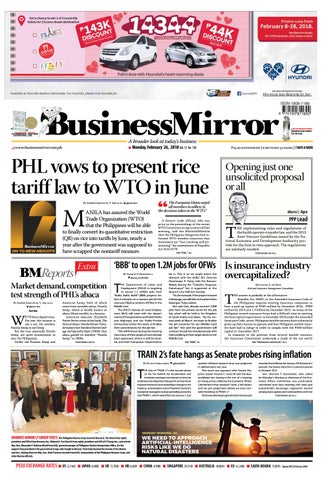
anila has assured the World Trade Organization (WTO) that the Philippines will be able to finally convert its quantitative restriction (QR) on rice into tariffs by June, nearly a year after the government was supposed to have scrapped the nontariff measure.
W
Part One
E’VE been duped twice. For one, the coconut is not a nut. For another, Manila hemp is not hemp. But the two, especially Manila hemp, are quite synonymous to one: the Philippines. Unlike the Russian hemp and
The European Union urged all members to adhere to the decisions taken in the WTO.” A Geneva trade official, who was privy to the proceedings of the recent WTO Committee on Agriculture (CoA) meeting, told the BusinessMirror that the Philippine delegation had informed WTO member-countries that lawmakers are “fast-tracking and prioritizing” the amendment of Republic Act (RA) 8178.
By Samuel P. Medenilla @sam_medenilla
Market demand, competition test strength of PHL’s abaca @jearcalas
Opening just one unsolicited proposal or all
See “PHL,” A2
Alberto C. Agra
ead
PPPC.LAgra Alberto
T
he implementing rules and regulations of the build-operate-transfer law and the 2013 Joint Venture Guidelines issued by the National Economic and Development Authority provide for the first in time approach. The regulations are similarly worded. Continued on A11
‘BBB’ to open 1.2M jobs for OFWs Is insurance industry
BMReports
By Jasper Emmanuel Y. Arcalas
business news source of the year
P25.00 nationwide | 6 sections 32 pages | 7 days a week
PHL vows to present rice tariff law to WTO in June By Jasper Emmanuel Y. Arcalas
2016 ejap journalism awards
American hemp, both of which come from cannabis sativa, Manila hemp, which is locally known as abaca (Musa textilis), is a banana. American educator Elizabeth Potter Siever wrote in her book, The Story of Abaca: Manila Hemp’s Transformation from Textile to Marine Cordage and Specialty Paper (2009), that abaca gained its moniker “Manila hemp,” in 1800s. Continued on A2
T
he Department of Labor and Employment (DOLE) is targeting to secure 1.2 million jobs from “Build, Build, Build” (BBB) projects before it embarks on a massive job fair for overseas Filipino workers (OFWs) in the Middle East. The DOLE’s Bureau of Local Employment (BLE) will meet with the departments of Transportation and Public Works and Highways and the Public-Private Partnership Center this week, to finalize their commitments for the job fair. “We will find out during the meeting how many of their projects have already been approved, where it will be located, and their manpower requirements
for it. This is so we could match the demand with the skills,” BLE Director Dominique R. Tutay told the B usiness M irror during the “Trabaho, Negosyo, Kabuhayan” fair it organized at the Quezon City Hall last Sunday. “So, for example, if the project is based in Batangas, we will refer to it workers from Batangas,” Tutay added. She said they already secured 7,000 jobs from the private sector for the job fair, which will be held in the Kingdom of Saudi Arabia and Qatar. “By the second week of March, we hope to finalize the job vacancies for our [Middle East] job fair.” She said the government will conduct the job fair simultaneously with their profiling of their target clients in the Middle East.
overcapitalized? Reynaldo A. de Dios
T
Risk and Insurance Management Consultant
he answer is probably in the affirmative. Republic Act 10607, or the Amended Insurance Code of the Philippines requires existing insurance companies to have a paid up capital of P550 million by December 2016, P900 million by 2019 and 1.3 billion by December 2022. As many of the Philippine owned insurance firms had a difficult time in meeting the first capital requirement in December 2016 under the Amended Insurance Code, seven Philippine nonlife insurers have voluntarily given up their license to operate and four Philippine nonlife insurers have had to merge in order to comply with the P550-million capital in December 2017. In response to the petition from several nonlife insurers, the Insurance Commission undertook a study of the net worth
See “BBB,” A2
See “Insurance industry,” A12
TRAIN 2’s fate hangs as Senate probes rising inflation By Butch Fernandez
T
@butchfBM
he fate of “TRAIN 2”—the second phase of the Tax Reform for Acceleration and Inclusion package envisioned to fund an ambitious development blueprint anchored on massive infrastructure spending—hangs in the balance, as lawmakers want President Duterte’s economic managers to ease spreading concerns that TRAIN 1, which took effect on January 1, has
sparked inflation beyond what was projected in deliberations last year. This much was apparent after Senate Majority Leader Vicente C. Sotto III told the B usi ness M irror last Sunday—the eve of a hearing on rising prices called by the Economic Affairs Committee—that senators “want a full report and not just projections before we even consider listening to TRAIN 2.” Sotto was referring to government data issued
recently that inflation for January 2018 stood at 4 percent, the fastest since the 4.3 percent posted in October 2014. Sen. Sherwin T. Gatchalian, who called for Monday’s hearing as chairman of the Economic Affairs Committee, was particularly concerned over data showing that food and nonalcoholic beverages registered second among basic goods and commodities with the Continued on A12
MARINES HONOR LT GROUP EXECS The Philippine Marine Corps honored Sharon G. Tan (third from right), president and COO of Asia Brewery Inc.; Michael G. Tan (fourth from right), president and COO of LT Group Inc.; and retired Maj. Gen. Alexander F. Balutan (third from left), general manager of Philippine Charity Sweepstakes Office, for the support they provided to the government troops who fought in Marawi. Their help boosted the morale of the Marine warriors. Joining them are Maj. Gen. Alvin Parenno (second from left), commandant of the Philippine Marines Corps, and other Marine officials.
PESO exchange rates n US 52.1160
n japan 0.4885 n UK 72.7018 n HK 6.6609 n CHINA 8.1988 n singapore 39.5148 n australia 40.8694 n EU 64.2486 n SAUDI arabia 13.8976
Source: BSP (23 February 2018 )
BMReports BusinessMirror
A2 Monday, February 26, 2018
Market demand, competition test strength of PHL’s abaca Continued from A1
By those times, according to Siever, abaca was utilized as a cordage fiber, or for rope-making, particularly those used in ships and boats. “Actually, all rope makers of the time made little distinction regarding the biological family of the fibers they chose to use, but instead called them all hemp and sometimes differentiated among them according to their country or port of origin,” Sievert said. “It seems likely that the traders and consumers of abaca had little concern for the botanical derivation of the fiber. Rather, they saw its importance only as one of a class of fibers [hemp] that could be spun into rope and would identify abaca the port from which they received it: Manila. Hence, the term, ‘manila hemp’ or simply, ‘manila,’” she added. Because of its high tensile strength and natural length, abaca became the widely used cordage fiber by navies since then.
Land area
THROUGH the years, land area dedicated to abaca farming has been constantly expanding to meet the growing demand for its fiber. In fact, in 2016, total land area planted with abaca rose to a decade high of 180,302 hectares, from the 141,711 hectares recorded in 2006. However, despite the increase in land area, the Philippine Fiber Development Authority (PhilFida) noted this hectarage level is considerably small compared to other endemic crops planted in the country. “The ratio of the total land area for abaca planting over the total
PHL. . .
Continued from A1
RA 8178, or the Agricultural Tariffication Act, had allowed the Philippines to continue imposing rice quotas even after the WTO waiver on the special treatment on rice had lapsed on June 30. The Philippine delegation said the government’s Executive branch “i s wo r k i n g c l o s e l y w i t h b o t h Houses of Congress in the final decision of the final bill,” according to the trade official. After approving their respective versions of the rice-tariffication bill, the Senate and the House of Representatives will transmit their bills to a bicameral conference committee to consolidate their versions and to discuss the divergent provisions of the measure.
land area of the country reveals that only a small portion of the country’s land area is utilized for growing abaca because abaca farms are concentrated in isolated and mountainous areas,” the PhilFida said in its newly crafted “Philippine Abaca Roadmap 2018 to 2022.” The PhilFida estimates the average abaca farm size in the country is only about 1.6 hectares per farmer. “Almost one third of the abaca areas can be found in Region 5 or the Bicol region, with 52,493 hectares. The land area is comparable to combined abaca areas of Regions 13, 11, 12 and 6,” it said. “Second to Bicol region is Eastern Visayas, with a total land area of 45,527 hectares. [The] Caraga and Davao regions ranked third and fourth with areas of 19,087 hectares and 15,880 hectares, respectively,” it added. In terms of yield, the Autonomous Region in Muslim Mindanao has the highest volume for the past 10 years, averaging at around 718 kilograms per hectare annually. This was followed by Davao region with 509 kilograms; Bicol region with 455 kilograms; and, Eastern Visayas with 358 kilograms.
Driven by favorable planting conditions, Philippine abaca output rose to a five-year high of about 72,000 MT in 2016. “From 2006 to 2008 Eastern Visayas had been the leading abacaproducing region with an average of 23,560 MT,” the PhilFida said. “The last six years, however, was dominated by the Bicol region, contributing an average of 20,082 MT, or 35 percent.” “Eastern Visayas followed with an average of 14,623 MT, or 25 percent, while Davao Region, [which] supplied 13 percent or an average of 4,376 MT, ranked third. Catanduanes consistently remained as the biggest abaca-producing province,” the PhilFida added.
Demand
DESPITE a size of farming of abaca of less than 200,000 hectares, the Philippines remains as the world’s top abaca producing country, accounting for at least 87.5 percent of global output. In the span of the past decade, from 2006 to 2016, the country’s production of abaca fiber averaged at 67,329 metric tons (MT), according to the PhilFida.
IN terms of demand, local processors use an average of 49,260 MT or 76.51 percent of the country’s average yearly production of abaca fiber during the past decade, the PhilFidA said. Abaca fiber is being processed locally into pulp, cordage and various fiber-craft items, including furniture. “The pulp sector consistently remained as the growth area of the abaca industry, utilizing an average of 37,043 MT, or 75.2 percent of the annual average local consumption and increasing at a minimal rate of 0.4 percent per annum,” the PhilFida said. “The pulp millers’ utilization level is highly dependent on the demand for pulp by the specialty paper manufacturers abroad as abaca pulp is the raw material used in meat and sausage casings, tea or coffee bags, k-cups, bags,
“Nevertheless, the Philippines is expecting that that the final bill will be enacted into law by the next regular session of the committee,” the official said. “While the enactment of the law has been delayed, it will be noted that the Philippines, through an executive order in April 2017, has been extending the rice concessions to all WTO members under the General Council decision on rice waiver WT/L/932 since its expiration on July 1, 2017. However, the continuation of the concessions shall finally cease once the tariffication law is enacted according to the executive order,” the official added. The next regular session of the CoA is tentatively scheduled on June 11 and 12, according to the Geneva trade official. The Philippine delegation made the statement after Canberra sought
for an update on Manila’s efforts to convert the QR into tariffs during the COA meeting on February 20. The Australian government has been keenly monitoring the country’s removal of rice QR, following the expiration of the Philippines’s waiver on the special treatment of rice on June 30, 2017. The Australian delegation to the WTO had also sought updates from the Philippines regarding its tariffication process during the CoA meeting last October. After the Philippine delegation delivered its statement, the trade official said the delegation from the European Union (EU) reminded the Philippines and other WTO member-countries that they are duty bound to fulfill their trade commitments. “After Philippines’s statement, the EU took the floor to thank the Philippines and expressed its systemic
Production
cigarette paper, currency paper, Nano cellulose [a material that enhances fiber strength], polyester and other specialty papers,” the PhilFida added. Abaca pulp are usually exported to Europe, the US, Japan and China, where processing facilities capable of manufacturing specialty papers are located. There has been no specialty paper-manufacturing facility in the Philippines to date. “The cordage sector, on the other hand, consumed an average of 8,493 MT of abaca fiber per annum, or about 17.2 percent of the yearly average usage of domestic manufacturers. Utilization decreased by 6.4 percent per year from 2006 to 2015,” the PhilFida said. “Cordage and allied products have continuously been facing stiff competition from synthetics and other cheaper natural materials. Major cordage companies in the Philippines are the Manila Cordage and Pacific Cordage,” it added. The PhilFida, an attached agency of the Department of Agriculture, said the country’s revenue from abaca exports from 2006 to 2016 averaged $100 million. “Some 87 percent, or an average of $87 million, came from abaca manufactures, such as pulp, cordage, yarns, fabrics and fiber crafts,” the PhilFida said. “The rest [13 percent] was from raw fiber exports with yearly average earnings of $12.94 million.” Some of the top buyers of the country include the United Kingdom, Germany, China, Japan and the United States. The same applies for exports of abaca pulp and other manufactures. To be continued interest in the subject. The EU urged all members to adhere to the decisions taken in the WTO,” the official said. On July 24, 2014, the WTO General Council approved the Philippines’s waiver on the special treatment on rice, allowing Manila to keep its QR on rice until June 30, 2017. The WTO General Council approved the waiver on the condition that the Philippines will subject its rice imports to ordinary custom duties starting July 1, 2017. “At the expiration of this waiver, and no later than June 30, 2017, the importation of rice shall be subject to ordinary customs duties in accordance with paragraph 10 of Annex 5, Section B, of the Agreement on Agriculture,” the WTO General Council decision read. Earlier, House Committee on Agriculture and Food Chairman Party-list Rep. Jose T. Panganiban Jr. of Anac IP told the BusinessMirror that the lower chamber remains committed to pass the bill abolishing the rice QR by March. Panganiban said the QR bill is under deliberation in the House Committee on Appropriations. After it passes the Committee on Apropariations, Panganiban said he expects the bill to be at the plenary level by early-March. The Senate is also targeting to pass its version of the rice tariff bill by March, according to Sen. Cynthia A. Villar, chairman of the Senate Committee on Agriculture and Food. The Philippines is under pressure to convert its QR into tariff after the waiver on the special treatment on rice expired last June 30. The expiration of the waiver meant that Manila can no longer impose the nontariff measure. To avoid possible trade disputes, President Duterte issued an executive order which retained the country’s rice concessions as “a sign of goodwill” to the country’s trade partners while RA 8178 is being amended. However, economists and government officials have noted that retaining the concessions is not a guarantee that trading partners will not file a complaint against the Philippines before the WTO for not converting the QR into tariffs.
www.businessmirror.com.ph
BBB. . .
Continued from A1
Manpower shortage
The DOLE earlier said the job fair aims to entice the thousands of displaced OFWs in the Middle East to return to the country and at the same time address the manpower shortage in the local construction industry. Tutay said the local construction industry is still in need of 100,000 workers. This comes even after employment in the construction industry rose by 6 percent to 3.53 million in 2017, from 3.33 million in 2016. The demand for construction workers is expected to reach the million mark in the coming months as the government starts to implement its big-ticket infrastructure projects. Currently, out of the 75 flagship infrastructure projects of the government, only the new airport in Clark has broken ground. Recruitment leader Lito Soriano lauded the initiative of the government to tap OFWs for the country’s construction boom. The president of LBS Recruitment Solutions, however, said the DOLE should only target displaced OFWs with the necessary skills. “This is applicable for Saudi and Qatar because there are many [construction] workers there. In Kuwait this is not applicable since 80 percent of OFWs there are household service workers,” Soriano said. In 2016 the DOLE reported at least 10,000 OFWs, mostly from Saudi-based construction firms, were displaced. Earlier this month, it also reported at least 600 OFWs from Qatar were displaced, while at least 2,000 distressed OFWs from Kuwait were already repatriated.
Challenges
Tutay acknowledged, however, that there may be difficulties in tapping displaced OFWs for government infrastructure projects. For one, she said, those who have worked in foreign construction firms would have to
Tourism. . .
Continued from A12
of calamity,” which he said could be “misconstrued from a marketing point of view, as it is a negative. While we support the intent and the reason, it is certainly hara-kiri —the desire or vacationers’ wish will suffer, maybe not immediately but the island will temporarily be off the radar screen for those planning to go. Cesspool na, “calamity” pa. The Task Force [Boracay] should just carry on with the hard work already spelled out for them.” Environment Secretary Roy A. Cimatu toured the world-famous resort island over the weekend, personally implementing the 30-meter easement or “no-build zone” that resorts and other establishments have to adhere to.
TRAIN 2’s. . . Continued from A12
However, proponents of the higher oil excise tax had described it as a “highly progressive tax, since those who consume more will pay more tax compared to those who consume less.” The DOF explained this argument with these data from its micro-analysis: “the top 10 percent of Filipino households [around 2 million households] who earn around P113,000 and above per month consume almost 51 percent of fuel.” Meanwhile, the top 1 percent of Filipino households [or 180,000 households] who earn P288,000 and above per month consume 13 percent of fuel, which is roughly equivalent already to what the poorest 50 percent consume, or 13.67 percent.
The other tax reforms
As first laid down by the DOF, Package 2 of the tax reforms was to cover the lowering of corporate-income tax and the reforms in fiscal incentives, meant to remove the perks from those sectors that have been enjoying them through the years with nothing to show for it. A comprehensive tax amnesty is also in the works, with the chairman of the Ways and Means Committee, Sen. Juan Edgardo M. Angara, earlier expressing hope to have it finished at committee level by end-January. Tackling the second-wave reforms is of urgency to the Duterte administration, which needs to fund the ambitious “Build Build, Build” flagship infrastructure program. When he signed the TRAIN law, or Republic Act 10963, into law last December 19, Duterte pointed out that this was just an initial part of the gains under the comprehensive tax-reform
settle for a big pay cut if they would like to stay in the Philippines for good. “The salaries for the workers in the local construction industry are usually paid a little bit above minimum [wage]. Of course, returnees would expect high salaries, which we cannot offer,” Tutay said. “This is why our profiling presents a challenge to us because we will ask [OFWs] to specify how low they can go in terms of wages and salaries,” she added. She noted, however, that some local construction firms are willing to pay higher, depending on the skills of an applicant. Based on the 2016 Occupational Wages Survey of the Philippine Statistics Authority (PSA), unskilled workers, including construction workers, are only paid P10,162 per month. This is way below the average salaries ranging from P20,400 to P61,200 given to OFWs in the Middle East. “Ordinary construction workers earn about $400 to $450. Those with higher skills like welders and plumbers earn about $500. Engineers could earn as high as $1,200,” recruitment consultant Emmanuel Geslani said. Aside from wage woes, Tutay said, displaced OFWs abroad would also have to contend with age discrimination. She added returning OFWs abroad are usually aged above 40, while local companies would prefer to hire younger workers. Despite these challenges, the DOLE maintained that offering OFWs local employment options is a must as some popular destination countries are cutting back on hiring Filipino construction workers. With fewer employment opportunities abroad, Labor Secretary Silvestre H. Bello III said some OFWs might finally decide to stay in the Philippines for good. “If their salaries would be the same or even slightly lower than what they earn abroad, they might decide to stay since this will also allow them to spend more time with their families,” Bello said in a previous media briefing. In a video posted on Facebook by the Boracay Informer, a media company island, Cimatu was seen measuring the length of the easement from the middle of the hightide and low-tide areas of the beach then marking where the 30-meter no-build zone should start. For resorts like Boracay Plaza Beach Resort on Station 1, whose wall Cimatu marked, this means more than half of its resort may have to be demolished. “[The President told me], ‘Demolish what needs to be demolished; preserve what needs to be preserved,’” he told journalists who accompanied him on his inspection tour of the island. He added that the Department of Public Works and Highways will likely be in charge of demolishing the structures that are in violation of easement rules. program. Congress has passed “two-thirds of the expected revenues from Package 1 of the TRAIN,” according to the DOF. The remaining one-third involves provisions on the estate-tax amnesty, a general-tax amnesty, the proposed adjustments in the Motor Vehicle Users Charge and amendments to the bank-secrecy law and automatic exchange of information, the DOF explained in a briefing statement. As first laid out by the DOF, Package 3 embraces the slew of property-valuation reforms. Package 4 dwells on capital income taxation (interest income, premium payments, dividends and capital gains). Package 5, seen to be just as controversial, revisits coal and mining taxes.
Invited resource persons
Invited to Monday’s hearing by the Gatchalian panel are National Economic and Development Authority (Neda) Director General Ernesto M. Pernia, Chua, as well as officials from the Bangko Sentral ng Pilipinas and the Department of Budget and Management. Members of academe were also invited: Ateneo de Manila University’s Economic Department Chairman Dr. Christina Bautista, Ateneo’s Center for Research and Development Chairman Dr. Alvin Ang, former Neda chief and now Ateneo-affiliated Dr. Cielito Habito, University of the Philippines (UP) School of Economics Dean Dr. Orville Solon, National Scientist Dr. Raul Fabella, UP School of Statistics Dean Dr. Mapa, University of Asia and the Pacific’s senior economist Dr. Victor Abola and Ronilo Balbieran, consultant for UA&P and EID Foundation Director. Susan Bulan from the Foundation for Economic Freedom and Action for Economic Reforms’ Joy Chavez and Mr. Karl Yu were also invited.
The Nation BusinessMirror
www.businessmirror.com.ph
Editor: Vittorio V. Vitug • Monday, February 26, 2018 A3
Roque: Palace taking ‘seriously’ PHL low corruption ranking By Bernadette D. Nicolas
M
@BNicolasBM
alacañang officials said they are taking the results of the Transparency International (TI) Corruption Perceptions Index 2017 “seriously” and underscored that “corruption is a problem that cannot be solved overnight.”
In the latest corruption index results reported by Transparency International, the Philippines slipped 10 notches to 111th place among 180 countries. The country ranked 101st out of 176 nations in 2016, and 95th of 168 countries in 2015. Presidential Spokesman Harry L. Roque Jr. reiterated the government’s efforts to curb corruption. “President Duterte, likewise, gave a stern warning to government officials and employees that he would not tolerate corruption during his watch,” Roque said. “The Chief Executive fired many government officials, including members of the Cabinet, once he heard even a whiff of corruption. He, likewise, issued Executive Order [EO] 43 creating the Presidential Anti-Corruption Commission and opened a citizens’ complaint hot line 8888.” But Roque noted that the government could not fight corruption alone.
The Palace then urged citizens to be vigilant and report any form of corruption. The index, which ranks countries and territories by their perceived levels of public-sector corruption according to experts and business people, uses a scale of zero to 100, where zero is highly corrupt and 100 is very clean. The country’s latest index score is 34, lower than last year’s 35. The Philippines also placed at the bottom end of the spectrum for the Asia-Pacific region, placing 21st out of 31 countries. This year New Zealand and Denmark rank highest with scores of 89 and 88, respectively, while Syria, South Sudan and Somalia rank lowest with scores of 14, 12 and 9, respectively. Western Europe was named as the best-performing region with an average score of 66, while SubSaharan Africa (average score 32), Eastern Europe and Central Asia
ROQUE: “Transparency International even cited that every week at least one journalist is killed in a country that is highly corrupt, which is not the case in the Philippines.
(average score 34) were the worstperforming regions. Roque also pointed out that TI factored in the protection of the press and non-governmental organizations (NGOs) in its ranking. In its regional analysis for countries in Asia Pacific, the group concluded that corruption in many countries is still strong, and even listed the Philippines as among the “worst regional offenders” for scoring “high for corruption” and having “fewer press freedoms and higher number of journalist deaths.” Transparency International analysis also showed that the countries with the least protection for mass media and NGOs also tend to have the worst rates of corruption. The analysis also incorporated data from the Committee to Protect Journalists (CPJ), which showed that more than nine out of 10 journalists were killed in countries that score 45 or less on the index. Data from CPJ showed that a total of 79 journalists in the Philippines were killed from 1992 and 2018. “Transparency International even cited that every week at least one journalist is killed in a coun-
try that is highly corrupt, which is not the case in the Philippines,” Roque said. He also pointed out that there is “no truth” that the country have fewer press freedom as what TI claimed in their report. “Our media are still able to broadcast and print or publish what they want—fake news included. Filipinos are free to air their grievances with the President even declaring an unprecedented Day of Protest,” he said, adding that President Duterte has acted swiftly with the creation of the Presidential Task Force on Media Security to ensure the protection of media practitioners. He also said that all murder cases involving journalists during the Duterte administration “have already been solved,” according to the record of the Task Force. “In addition, public officials who threatened media workers have been ‘red-flagged’ to show that we work without fear or favor,” he said. Dr. Ronald U. Mendoza, dean of the School of Government of the Ateneo de Manila University, agrees with the report that the state of the anticorruption efforts in the Philippines appears to have either “stalled or deteriorated.” “The reasons have to do with several high-profile corruption cases under the Duterte administration that were poorly resolved,” Mendoza said in an e-mail sent to the BusinessMirror. “Some of the corruption cases stem from the apparent abuse by some elements in the Philippine National Police of the government’s
strong-handed antidrugs campaign. This policy is in danger of spawning impunity among corrupt agents of the state. For instance, recently there have been some ‘tokhang-for-ransom’ practices exposed by media.” Mendoza cited the case of South Korean businessman Jee Ick-joo in late-2016 and the exposed extortion of some alleged drug suspects and their detention in a secret jail cell in a Manila precinct. “The detainees alleged that the police asked for bribes for their release,” he said. He added that the government’s antidrug war does not seem to have made a dent on the supply of illegal drugs from countries like China. He said the government’s anti-drugs agency exposed a P6.4billion shabu smuggling in May 2017, “ but the Department of Justice [DOJ] later dropped the smuggling charges against those officials and private-sector entities concerned.” This month, the DOJ refiled in the Regional Trial Court in Manila (RTC) the drug-smuggling case against alleged Customs fixer Mark Taguba and 11 others, including two foreigners and three John Does. Although Mendoza lauded the improvement in the country’s open index performance reported early in 2018, which tracks how open the budgeting process is, Mendoza said overall the Duterte administration has not yet emphasized any systematic effort to curb corruption. “Even the initial positive signal
Duterte skips Edsa rites for 2nd time
Ex-President Aquino, Abad expected at Dengvaxia hearing
P
resident Duterte for the second time has skipped the commemoration rites of the Edsa People Power Revolution last Sunday. The president did not attend the anniversary celebration last year. Thirty-two years ago, millions of Filipinos gathered along Edsa, to end President Ferdinand E. Marcos’s dictatorship. This momentous event was called the Edsa People Power Revolution. Presidential Spokesman Harry L. Roque Jr. said in a statement last Saturday that the “President will be in Davao” during the celebration. In a message, Duterte recalled how the People Power Revolution became an “enduring symbol of our determination to fight for what is right and to defend and uphold our cherished democratic values during the country’s most crucial and trying times.” “More than three decades ago, we have shown the world how a people’s courage and resolve can alter the course of our nation’s history,” the statement read. Duterte called on everyone to further enrich the country’s democracy by empowering citizenry, defending their rights and strengthening the institutions that safeguard their freedoms. “May this occasion foster unity and solidarity as we pursue our hopes and aspirations for our nation,” the statement said. Last year Duterte also skipped the anniversary rites at Camp Aguinaldo in Quezon City when he attended the relaunch of Comprehensive Agreement on the Bangsamoro in Davao City. Bernadette D. Nicolas
sent by EO 2 on Freedom of Information [FOI] has not yet been followed up with a strong push for legislating FOI. The exceptions in EO 2 are also quite critical—Congress and the local government units are not included in EO 2, for example,” he said, referring to EO 2 signed by the President in 2016. “One hopes the President goes beyond efforts to appoint new people in key agencies; and he, instead, pushes for deep institutional reforms that help to combat corruption even beyond his term,” he added. TI also called on the global community to take action to curb corruption. The group suggested the following steps: governments and businesses must do more to encourage free speech, independent media, political dissent and an open and engaged civil society. Governments should also minimize media regulations and ensure that journalists can work without fear of repression or violence; civil society and governments should promote laws that focus on access to information. It added that activists and governments should take advantage of United Nations Sustainable Development Goals to advocate and push for reforms at the national and international levels, and that governments and businesses should disclose relevant public-interest information, including budgets, company ownership, public procurement and political-party finances in data formats.
By Jovee Marie N. dela Cruz
F
Wetland park cleanup
Metropolitan Manila Development Authority Chairman Danilo D. Lim and Sen. Cynthia A. Villar lead the cleaning of the Las Piñas-Parañaque Wetland Park in celebration of the World Wetlands Day 2018. Villar says the park, as a tourism site, offers a unique experience, where visitors are encouraged to participate in volunteer activities, such as cleanups, tree planting and watering, while appreciating the wonders of the site. The 500 cleanup participants from different organizations also engaged in bird watching and nature walk. ROY DOMINGO
@joveemarie
ormer President Benigno S. Aquino III and former Budget Secretary Florencio B. Abad are expected to attend the joint House Committee on Good Government and Public Accountability and House Committee on Health hearing on the controversial Dengvaxia immunization program on Monday. Rep. Johnny T. Pimentel of the Second District of Surigao del Sur, the chairman of the Good Government Committee, said Aquino is expected to answer the question whether he authorized the realignment of P3.5-billion funds for the purchase of Dengvaxia vaccines from Sanofi in 2016. “Did he [Aquino] authorize the realignment of funds to buy Dengvaxia? [He should answer that],” Pimentel said in a statement. The lawmaker said also invited as resources persons are Budget Secretary Benjamin E. Diokno, Health Secretary Francisco T. Duque III, Education Secretary Leonor M. Briones, Interior and Local Government OIC Secretary Eduardo M. Año, Justice Secretary Vitaliano N. Aguirre II, Chief Public Attorney Persida V. Acosta and former Health Secretary Janet L. Garin. He added that representatives of Sanofi S.A., manufacturer of Dengvaxia, and Zuellig Pharma Holdings Pte. Ltd., distributor of the antidengue vaccine, have also been asked to appear at the hearing, along with officials from various divisions, bureaus and services of the Department of Health, Philippine General Hospital, University of the Philippines College of Medicine and the Philippine Children’s Medical Center, among others.
Economy
A4 Monday, February 26, 2018 • Editors: Vittorio V. Vitug and Max V. de Leon
BusinessMirror
www.businessmirror.com.ph
Arrest of employers of killed OFW to speed up lifting of deployment ban to Kuwait By Samuel P. Medenilla @sam_medenilla
T
HE Department of Labor and Employment (DOLE) said last Sunday the recent arrest of two suspects in the death of Filipino worker Joanna Demafelis will help speed up the lifting of the deployment ban in Kuwait. In a phone interview, Labor Secretary Silvestre H. Bello III lauded
the swift arrest of Demafelis’s employers—Mona Hassoun and Nader Essam Assaf—the main suspects in the abuse and killing of Demafelis. Last Saturday the Department of Foreign Affairs confirmed Hassoun is now being detained by authorities in Damascus, Syria. The day before, her husband Assaf was arrested by Lebanese authorities. The Kuwaiti government earlier said it coordinated with the Interpol
for the arrest of the couple after they fled to Kuwait. “It will now be up to the President to decide [on the lifting of the deployment ban],” Bello said. Last Thursday President Duterte said he would not order the lifting of the deployment ban until the suspects are arrested and the additional safeguards to protect overseas Filipino workers (OFWs) in Kuwait are assured.
Bello said they are now awaiting the Kuwaiti government to sign the Philippine-Kuwait memorandum of understanding (MOU), which has been pending for two years. “The MOU is very important because it will ensure the protection of OFWs. Once they are able to do that, the President could decide to lift the deployment ban,” Bello said. The DOLE said it is targeting the completion of the MOU by the sec-
ond week of March. Aspiring OFWs have been appealing for the lifting of the ban since it would prevent them from working in Kuwait. Duterte ordered the DOLE to issue the ban and the repatriation of all distressed OFWs in Kuwait on February 12 after Demafelis’s remains were found stuffed in a freezer at her employer’s home in Kuwait. In a related development, DOLE
Probe delay in rollout of e-trikes—DOE
T
By Lenie Lectura
@llectura
he Department of Energy (DOE) wants a committee established to probe the stalled rollout of thousands of e-tricycles (e-trikes).
“The secretary asked the ADB [Asian Development Bank], DOF [Department of Finance], Neda [National Economic and Development Authority] to create a committee that will investigate the whole process—how the e-trike project originated, who designed it, why where there problems encountered—and hopefully learn from it so as not to happen again,” Energy Assistant Secretary Leonido J. Pulido said. It can be recalled that the agency has scaled down its e-trike project, deploying only 3,000 units at a cost of P1.73 billion. Bemac Electric Transportation Philippines Inc. bagged the $30-million contract in 2016 for the supply of the 3,000 e-trikes. The original project scope of the project involves the deployment of 100,000 e-trike units nationwide with a total project cost of P21.672 billion that required various arrangements involving the government, the
private sector and ADB. However, there were very few takers for the units because the initial cost and maintenance was too steep for operators and charging stations in the targeted areas for deployment were still lacking. As such, the DOE decided to scale down the project, saying this was necessary in ensuring the viability of the project at a minimal cost to taxpayers. Each etrike was priced at P450,000. As there would be substantial changes in the project, the DOE commenced in securing amendments to the loan, Project Administration Manual and related documents with the ADB. The 3,00 units, however, have yet to be deployed. The agency awaits from ADB a no objection letter. “We are finalizing the criteria for the selection process. We will then submit to the secretary for approval and then submit the criteria to the ADB for
T
FULL TO THE ROOF
and 865 declaring July 27 of every year a special nonworking holiday to commemorate the founding anniversary of Iglesia ni Cristo. “It is understood that the said bills are well-intentioned. However, it raises the issue on necessity, as well as their heavy impact on labor productivity and cost of production inasmuch as they serve to further increase the number of nonworking days already provided by law,” they said in a letter to Escudero. The Senate has recently approved SB 1270, declaring the last Monday of January as National Bible Day, a special working holiday,
World-class water theme park now open in Clark
C
A man checks an electric tricycle parked at the lobby of the Net Park Building in Bonifacio Global City, Taguig during its launch on September 8, 2017. On February 24, the Department of Energy announced plans to create a team that would investigate how the e-trike project originated, who designed it and determine how problems related to the project arose. NONOY LACZA
the issuance of the no objection letter. The priority is rollout,” Pulido said. The DOE wants now to relax some of the restrictions. “First restriction is that only LGUs [local government
Business groups oppose measures seeking more holidays he business community is opposing measures seeking to increase the number of holidays in the country, saying these will have critical impact on labor productivity and cost on doing business. The Philippine Exporters Confederation Inc. (PhilExport), Employers Confederation of the Philippines and Philippine Chamber of Commerce and Industry expressed high concern over various holiday bills pending before the Senate Committee on Education, Arts and Culture, which is chaired by Sen. Francis G. Escudero. The business groups bewailed particularly Senate Bill (SB) 304, 404
Undersecretary Dominador R. Say said they are now anticipating more distressed OFWs in Kuwait will be repatriated within the next two months, after the Kuwaiti government decided to extend its amnesty program. “We are now coordinating with Philippine Airlines and Cebu Pacific to book the flights of the additional OFWs, who will be availing themselves of the repatriation,” Say said.
The groups pointed out that the country already enjoys 15 national nonworking days, apart from other paid leaves provided for by existing special laws, such as solo-parent leave, maternity leave, among others. Moreover, the law also grants the President discretionary power to proclaim additional regular and special days pursuant to Republic Act 9492 seeking to rationalize the celebration of national holidays in the country. The President, thus, has regularly proclaimed days as special holidays, such as Election day and Black Saturday. Philexport News & Features
An overloaded jeepney passes through a highway in Ilocos Sur, full of passengers up to the roof. It is a common sight in many rural barangays because of the dearth of public transportation. MAU VICTA
units] are the potential offtakers. We removed that. And then, there was a single deployment method, we’ve removed that and, instead, expanded it to several other deploy-
ment models,” he added. The agency is eyeing the rollout of 3,000 e-trikes by June this year, 100 to 150 of which will be deployed in Marawi City.
Citizen participation in environmental protection urged
E
nvironment Secretary Roy A. Cimatu has encouraged citizen participation in government initiatives toward environmental protection and sustainable development. “I must emphasize the need for the people’s support. The DENR [Department of Environment and Natural Resources] cannot be everywhere all of the time, particularly in environmentally critical areas,” he said last Tuesday in an environmental summit held in Cebu City. Cimatu underscored the importance of direct and mass participation of the citizenry in accelerating reforestation, in coastal cleanups, in conserving energy, as well as in popularizing lifestyles that will enable the country to reduce its carbon footprint and enhance resilience. He pointed out that the 429 forest-protection officers the department hired last year will “clearly not be enough” to cover every hectare of forest. The environment chief said each protected area, thus, has its own protected area management board so resident stakeholders can provide monitoring and regulatory services continuously. In places that are not declared as
protected areas, such as metropolitan or urbanized centers. Cimatu further said the DENR is also banking on the local government units (LGUs) at all levels to be more vigilant against violators of environmental laws, rules, regulations and ordinances. “But judging from the volume of plastic and other wastes that end up in our rivers, lakes and seas, we have not done enough. And so, perhaps, we must also consider enacting laws that will make manufacturers pay at least part of the cost of cleaning up the nonbiodegradable packaging that they use,” he added. Cimatu, in the same event, also highlighted the department’s major accomplishments last year, noting it surpassed targets in some priority programs, particularly in solid waste management and the management and protection of protected areas and ecotourism development. In its flagship National Greening Program (NGP), Cimatu said the DENR had planted 1.86 million hectares from year 2011 to 2017, or 113 percent of the target of 1.63 million hectares. He said the NGP has also generated about 4 million jobs during the last seven years.
I must emphasize the need for the people’s support. The DENR cannot be everywhere all of the time, particularly in environmentally critical areas.”—Cimatu
LARK, Pampanga—The biggest water theme park in Southeast Asia here has finally opened its gates to the public in time for summer season. Aqua Planet, the newest water theme park in the Philippines, has over 38 water slides and attractions on a 10-hectare property. The first of its kind in Pampanga and Central Luzon, Aqua Planet is seen attracting local and foreign tourists on its spiral ride, super bowl, flow rider, tornado, octopus racer, mermaid bay, lazy river and boogie bay, among others. Aside from its water attractions, Aqua Planet has eight shops and restaurants offering a wide array of foods and souvenir items for guests of all ages. Persons with disabilities (PWDs) are welcome as Aqua Planet designed its facilities to cater guests with a handicap. In an interview, Dr. Irineo Alvaro, chairman and president of the Bridges and Benevolent Initiatives (BBI) Foundation and general manager of Aqua Planet, said the world-class water theme park is committed to providing safe and enjoyable experience to guests because of exhilarating water rides, endless fun and adventure. Alvaro added from the structures and facilities Aqua Planet really wanted to give not only to the people of Central Luzon but to the Filipino people a real taste of the first and most modern water park in the country. He said Aqua Planet had passed the third-party certification for international standard and could accommodate up to 5,000 people per day. Meanwhile, Department of Tourism 3 Director Carolina Uy said Aqua Planet’s opening would entice both foreign and local visitors and a perfect alternative for Boracay, amid the controversy it is now facing. “Let us take advantage of this to promote this latest attraction to the Mindanao and Visayas region, as Clark has direct flights from this region available here through Cebu Pacific and AirAsia. This is a perfect destination for summer,” Uy said during the grand opening last Saturday. Others who attended the grand opening and ribbon cutting were Philippine Amusement and Gaming Corp. Chairman Andrea Domingo, Bases Conversion and Development Authority President Vince Dizon and Clark Development Corp. President Noel Manankil. Clark’s Aqua Planet is accessible via North Luzon Expressway (Nlex) and Subic Clark Tarlac Expressway (SCTEx). It only takes 15 minutes by car from Aqua Planet to the SM City Clark, 20 minutes to Angeles City Heritage Plaza and about 45 minutes to Subic Bay via SCTEx. PNA
Agriculture/Commodities BusinessMirror
www.businessmirror.com.ph
Editor: Jennifer A. Ng • Monday, February 26, 2018
A5
Govt lends ₧82-M to Iloilo onion farmers
T
By Jasper Emmanuel Y. Arcalas @jearcalas
he Department of Agriculture (DA) has extended P82 million in production loans to farmers in Iloilo as part of government efforts to expand onion plantation in the province to at least 1,000 hectares.
Agriculture Secretary Emmanuel F. Piñol said the Agricultural Credit Policy Council (ACPC), an attached agency of the DA, approved the loans under its Production Loan Easy Access (PLEA) program. “Under the Production Loan Easy Access program of the DAACPC, onion and garlic farmers are granted a P150,00 loan per hectare at 6 percent per annum, or 0.5 percent per month,” Piñol said in post published on his Facebook page recently. “The program is available to all onion and garlic famers all over the country. The program is expected to fill up the national requirements for onion by the end of the term of President Duterte,” he added. Citing DA Region 6 Director Remelyn Recoter, Piñol said hectarage planted with onion in four towns of Iloilo province has increased to 202 hectares this year, from just 47 hectares last year. “During a forum with the Oton Bulb Onion Growers Association, the farmers committed to increase their planted area in the town to 100 hectares,” he said. “Director Recoter said, for the whole province of Iloilo, the target expansion area is 1,000 hectares with an average production of 10 metric tons [MT] per hectare,” he added. The DA chief committed to provide another P10 million under the PLEA program for the onion farmers in Oton, Iloilo.
French firm gunning for big chunk of PHL’s animal-nutrition market
T
he Philippine subsidiary of French firm Neovia is targeting to become one of the top 5 providers of animalnutrition and health-care products in the country in the next three years, according to a company official. During the launch of its animal- and health-care products being marketed under the Wisium brand last week, Neovia Philippines said the increasing demand of Filipino consumers for animal protein presents business opportunities for the company. “We want to position ourselves as part of the top 5 big premix and additive players in the Philippines,” Michael Pasco, Neovia Philippines sales director, told reporters in a news briefing held in Pasay City last week. Pasco said the company is planning to tie up with 100 partners in the next three years to corner a significant market share in the Philippine premix and additives industry. He said Neovia has initially partnered with 10 clients. “Our customization approach will help us identify our major customers. So, we now have 10 solid customers. We recognize them as our key partners in developing Wisium in the Philippines,” he said. Pasco noted that, currently, there are about 110 premix suppliers, distributors and manufacturers in the Philippines. “I believe there is room [for Wisium] even if there are already 100 players. There’s a growing demand for animal protein from 103 million Filipinos. The country’s young population and the sustained growth of its economy are attractive to investors,” he said. “The Philippines is not a crowded market. It is also very receptive to new ideas and innovations,” Pasco added. On its web site, Neovia said it has been operating in the Philippines since 2014 and offers complete feed and aquaculture products. The company acquired a major player in animal nutrition in May 2016. The company has production sites in Cebu and Manila which mainly produce animal feeds for hogs, chicken, aquaculture and pets. Pasco noted the Wisium premix that will be sold in the Philippines would come from its production site in China. The company will be testing the waters for a year before it decides whether it will put up a premix plant in the Philippines. For over 60 years, Wisium delivers feeding-care products and services to address natural performance enhancement and alternatives to antibiotics as growth promotants and preventive medication, addressing sustainability, food safety and wellness, according to the documents provided by the company. The company has over 1,000 industrial customers worldwide, with 300 global experts for firm services operating in 50 countries producing 30 million metric tons of feeds annually, making it the fourth-largest premix provider and leading premix brand in the global market. Jasper Emmanuel Y. Arcalas
Piñol said the Philippines currently produces about 140,000 MT of bulb onion, which is 66,000 MT short of the estimated annual demand of 206,000 MT. He added that about 57 percent of the country’s onion output comes from Central Luzon, while Ilocos region accounts for 31 percent. “The total area planted to bulb onion all over the country is estimated at 16,000 hect-
ares. In Centra l Lu zon t he big gest onion producer is Nueva Ecija with 74,000 MT, or 99.99 percent of the region’s total output,” he said. “The emergence of Iloilo province as another potential major producer of bulb onions will rapidly increase the production of this controversial commodity, which has been the subject of many Senate investigations because of the
involvement of cartels and smuggling syndicates,” he added. In August 2017 Piñol committed to extend at least P200 million worth of assistance to onion and garlic farmers in the towns of Miagao, Tigbauan and Igbaras in Iloilo province. This is part of DA’s effort to achieve self-sufficiency in onion and reducing the country’s reliance on imports, according to Piñol.
The World
A4 Monday, February 26, 2018 • Editor: Lyn Resurreccion A6
BusinessMirror
6 months after attacks began, Rohingya see no end in sight
Rohingya Muslims travel on a raft made with plastic containers on which they crossed over the Naf River from Myanmar into Bangladesh, near Shah Porir Dwip, Bangladesh, on November 11, 2017. Six months after waves of attacks emptied Rohingya villages in Myanmar, sending 700,000 people fleeing into Bangladesh, there are few signs anyone is going home soon. AP/A.M. Ahad
D
HAKA, Bangladesh—Their houses are often made of plastic sheets. Much of their food comes from aid agencies. Jobs are few, and there is painfully little to do. The nightmares are relentless.
But six months after their horrors began, the Rohingya Muslims who fled army attacks in Myanmar for refuge in Bangladesh feel one immense consolation. “Nobody is coming to kill us, that’s for sure,” said Mohammed Amanullah, whose village was destroyed last year just before he left for Bangladesh with his wife and three children. They now live in the Kutupalong refugee camp outside the coastal city of Cox’s Bazar. “We have peace here.” On Auguat 25, 2017, Rohingya insurgents attacked several security
posts in Myanmar, killing at least 14 people. Within hours, waves of revenge attacks broke out, with the military and Buddhist mobs marauding through Rohingya villages in bloody pogroms, killing thousands, raping women and girls and burning houses and whole villages. The aid group Doctors Without Borders has estimated at least 6,700 Rohingya were killed in Myanmar in the first month of the violence, including at least 730 children younger than 5. The survivors flooded into Bangladesh.
Six months later, there are few signs the Rohingya are going home anytime soon. Myanmar and Bangladesh have signed an agreement to gradually repatriate Rohingya in “safety, security and dignity,” but the process has been opaque and the dangers remain. New satellite images have shown empty villages and hamlets leveled, erasing evidence of the Rohingyas’ former lives. And with 700,000 having fled Myanmar since August, more Rohingya continue to flee. So for now, the refugees wait.
“If they agree to send us back that’s fine, but is it that easy?” Amanullah asked. “Myanmar must give us citizenship. That is our home. Without citizenship they will torture us again. They will kill us again.” He said he would only return under the protection of United Nations peacekeepers: “ T hey must take care of us there. Otherwise it will not work.” Buddhist-majority Myanmar doesn’t recognize the Rohingya as an official ethnic group and they face intense discrimination and persecution. The children in the camps face a particularly difficult time. The UN estimates that children are the heads of 5,600 refugee families. A survey of children’s lives inside the camps showed they faced an array of terrors, from girls reporting concerns of harassments near the camp toilets to fears that elephants and snakes could attack them as they collect firewood. “We cannot expect Rohingya children to overcome the traumatic experiences they’ve suffered when exposed to further insecurity and fears of violence in the camps,” Mark Pierce, country director for Save the Children in Bangladesh, said in a statement. The study was prepared jointly by Save the Children, World Vision and Plan International. “The overwhelming message from these children is that they are afraid,” Pierce said. “This is no way for a child to live.” The situation will worsen soon. Seasonal monsoon rains will begin pounding the refugees’ plastic-andbamboo city in April. AP
If they agree to send us back that’s fine, but is it that easy? Myanmar must give us citizenship. That is our home. Without citizenship they will torture us again. They will kill us again.”—Amanullah
www.businessmirror.com.ph
Florida shooting survivors target NRA-linked firms
S
urvivors of a mass shooting at a Florida high school are hoping to expand the reach of their gun-control movement by seeking a boycott of companies doing business with the National Rifle Association (NRA) and urging tourists to boycott the Sunshine State. As the #BoycottNRA movement grew on Twitter, with petitions circulating against companies that offer discounts to NRA members, a growing number of those businesses announced they are cutting or reducing ties with the association. Both Delta and United said last Saturday that they will no longer offer discounted airfares to NRA members to attend their annual meetings, and both have asked the gun-rights group to remove any references to their companies from the NRA website. Car-rental company Hertz said it would no longer offer a discount program to NRA members and First National Bank of Omaha, one of the nation’s largest privately held banks, said it will not renew a cobranded Visa credit card it has with the NRA. In an e-mail last Saturday, the NRA called the companies’ actions “a shameful display of political and civic cowardice” and said the loss of corporate discounts and other perks “will neither scare nor distract” NRA members. “In time, these brands will be replaced by others who recognize that patriotism and determined commitment to constitutional freedoms are characteristics of a marketplace they very much want to serve,” the NRA statement said. The state of Florida also was facing some backlash. One of the survivors of the Florida school shooting suggested last Saturday on Twitter that tourists stay away from the state. He got an immediate response. “Let’s make a deal,” tweeted David Hogg, a Stoneman Douglas student who has been a major player in the #neveragain movement. “DO NOT come to Florida for spring break unless gun legislation is passed.” Wendy Glaab, 60, of Fonthill, Ontario, Canada, was among the first to respond. “I, like many Canadians, travel to Florida from time to time to escape our winter. I can’t speak for others but I will not be returning until meaningful gun control
legislation is in place.” Glaab told The Associated Press last Saturday that her sister owns property in Fort Lauderdale and she is able to visit any time she chooses. Members of the NRA have access to special offers from partner companies on its web site, ranging from life insurance to wine clubs. But the insurance company MetLife Inc. discontinued its discount program with the NRA last Friday. Symantec Corp., the software company that makes Norton Antivirus technology, did the same. Insurer Chubb Ltd. said it is ending its participation in the NRA’s gun-owner insurance program, but it provided notice three months ago. The program that provided coverage for people involved in gun-related incidents or accidents had been under scrutiny by regulators over marketing issues. Car-rental company Enterprise Holdings, which also owns Alamo and National, said it was cutting off discounts for NRA members, as did Hertz. Other companies, including Wyndham Hotels and Best Western hotels, have let social-media users know they are no longer affiliated with the NRA, though they did not make it clear when the partnerships ended. The swiftness of the corporate reaction against the NRA has differed from that of past shootings, including the 2012 Sandy Hook Elementary School massacre that claimed 26 lives, and the killing of 58 people in Las Vegas last fall, said Bob Spitzer, a political scientist at SUNY Cortland and a scholar on gun politics. Spitzer said the reaction was likely a reaction to the student mobilization that followed the Florida shooting, but he said it was too soon tell how significantly it will sway the country’s wider gun debate. NRA Executive Vice President Wayne LaPierre said last week at the Conservative Political Action Conference that those advocating for stricter gun control are exploiting the Florida shooting. President Donald J. Trump has aligned himself with the NRA, suggesting some teachers could be armed so that they could fire on any attacker. AP
UN unanimously demands 30-day cease-fire across Syria Violence mars Italy’s poll-campaign protests
U
NITED NATIONS—The UN Security Council unanimously approved a resolution last Saturday demanding a 30-day cease-fire across Syria “without delay” to deliver humanitarian aid to millions and evacuate the critically ill and wounded. UN humanitarian chief Mark Lowcock welcomed the vote, saying: “Words must now quickly become action—any cessation of hostilities must be real. Attacks must stop.” The vote was postponed for several days of lengthy and intense negotiations to try to get support from Russia, a key Syrian ally that said repeatedly an immediate ceasefire was unrealistic. Sponsors Kuwait and Sweden amended the resolution late last Friday in a last-minute attempt to satisfy Russia, dropping a demand that the cease-fire take effect in 72 hours. The effort worked, though United States Ambassador Nikki Haley was sharply critical of Russia for delaying the vote. “How many mothers lost their kids to the bombing and the shellings?” due to the delay, she asked. “How many more images did we need to see of fathers holding their dead children?” Sweden, Kuwait and many other countries had been pressing for an immediate cease-fire as deaths mount in a Syrian bombing campaign in the rebel-held suburbs of Damascus, known as eastern Ghouta, where the death toll in a week of bombardment has risen to 500. Earlier this week UN Secretary-
General Antonio Guterres urged an immediate suspension of “all war activities” in eastern Ghouta, where he said 400,000 people are living “in hell on Earth.” Guterres welcomed the resolution’s adoption and stressed his expectation that it will be “immediately implemented and sustained” so aid gets to the needy and sick, UN Spokesman Stephane Dujarric said. “The UN stands ready to do its part.” While the spotlight is on eastern Ghouta, the resolution expresses “grave distress” at the humanitarian situation there, as well as throughout the country including Idlib governorate, Northern Hama governorate, Rukhban and Raqqa. It states that urgent humanitarian assistance is now required by 13.1 million people in Syria, including 5.6 million people in 1,244 communities in “acute need.” That includes 2.9 million people in hardto-reach and besieged locations such as eastern Ghouta. The resolution calls on all parties to immediately lift the sieges of populated areas including eastern Ghouta, Yarmouk, Foua and Kefraya. On the key issue of a cease-fire, the resolution “demands that all parties cease hostilities without delay for at least 30 consecutive days throughout Syria for a durable humanitarian pause, to enable the immediate delivery of humanitarian aid and services and medical evacuations of the critically sick and wounded... and demands that all parties engage to this end.”
The resolution also demands that a cease-fire be followed immediately by access for humanitarian aid. Sweden’s UN Ambassador Olof Skoog told the council just before the vote that “the UN convoys and evacuation teams are ready to go.” Kuwait’s UN Ambassador Mansour Al-Otaiba, the current council president, said after the resolution’s adoption that “it cannot end the human suffering in Syria immediately.” “However, it is a positive sign sent by the Security Council—a sign that the council is united and showed solidarity to stop the humanitarian suffering and stop hostilities immediately,” he said. “Now we must implement this resolution to save the lives of Syrian people and to deliver humanitarian aid.” Since the Syrian conflict began nearly seven years ago, the Security Council has been deeply divided, with Russia backing President Bashar al-Assad’s government and the US, Britain and France supporting the opposition. The result has almost always been paralysis and inaction. Those divisions were evident last Saturday in the tough language from the United States ambassador and the reply from her Russian counterpart after the vote. “Every minute the council waited on Russia, the human suffering grew,” Haley said. “Getting to a vote became a moral responsibility for everyone, but not for Russia, not for Syria, not for Iran. I have to ask why? At least 19 health facilities have been bombed since Sunday” in eastern Ghouta. AP
R
OME —It a l i a ns demonstrated last Saturday against racism, revival of fascism, labor reforms, mandatory vaccines and other hotly debated issues, at some points clashing with police, as antagonism flared between far-left and far-right activists in a violence-marred election campaign. It was the last weekend for political rallies ahead of Italy’s March 4 national election, and protesters held at least a dozen marches or rallies in several Italian cities. In Milan far-left demonstrators clashed with police trying to block them from reaching a far-right rally. Police in riot gear wielded batons against the front line of protesters to drive them back. In Rome a march drawing Premier Paolo Gentiloni and other ministers in his center-left government deplored racism and revival of fascist ideology. Across town, another march protested government labor changes that made it easier to lay off workers. Justice Minister Andrea Orlando warned that fascism “is a danger in Italy and Europe.” “And also dangerous is the underestimation of this phenomenon,” he added. Still elsewhere in the Italian capital, protesters denounced the government’s decision to make several vaccines mandatory for schoolchildren, another issue inflaming campaign debate.
Campaigning officially ends on March 2. Opinion polls indicate a hung Parliament could result, with three blocs, each short of an absolute majority: the center-left, the center-right and the populist 5-Star Movement. Italy’s election campaign took a violent turn on February 3, when an Italian man in the central town of Macerata opened fire on African migrants, wounding six of them. The suspect, who once ran in a local election for the anti-migrant League party, has said he was avenging the death of an Italian woman allegedly murdered by African migrants. In Milan last Saturday, League leader and premier candidate, Matteo Salvini, denied that his followers advocate violence. Instead he denounced what he called “this angry anti-fascism” and declared fascism dead ideology. The Italian constitution bans the revival of fascism, the ideology of the dictator Benito Mussolini before and during World War II. League marchers held a banner with Salvini’s slogan “Italians first.” Opinion polls indicate many Italians blame migrants for crime. The League, along with the 5-Star Movement, contends that foreigners, by working for less pay, rob Italians of work. In Rome police stopped chartered buses br inging demonstrators to the cit y, opening
pa r t ic ipa nt s’ bac k pac k s a nd searching vehic les to ensure t hat c lubs or ot her weapons weren’t hidden. Three Milan subway stations were closed as a precaution near Salvini’s rally, near a rally by the far-right CasaPound group and near an anti-fascist gathering. A few blocks away from Rome’s anti-racism march, thousands of unemployed people from the south, metal workers, far-left youth social clubs and advocates for public housing marched to protest the government’s labor reforms. Tensions were high in Palermo, Sicily, where days earlier the local leader of the far-right Forza Nuova party was beaten up on a street. Some shops closed early last Saturday, fearing participants in an anti-fascist march would clash with those attending a Forza Nuova rally, but the anti-fascist march proceeded peacefully. Forza Nuova national leader Roberto Fiore, leading a campaign rally in Trieste, northeast Italy, blamed “this campaign of hatred” on far-left forces. Fiore rejects the label of neo-fascist, saying instead he is a fascist. In Florence 17-year-old boy was fined when police noticed him ripping off campaign posters on the right-wing candidate for premier, Giorgia Meloni. Just days ago, two youths were slashed when they were affixing posters for a tiny, far-left party. AP
The World BusinessMirror
www.businessmirror.com.ph
Monday, February 26, 2018 A7
If Trump rips up Nafta, Canada won’t mind
O
TTAWA, Ontario—Nothing has reshaped Canada’s modern economy more than free trade with the United States.
But that doesn’t mean the country is staring at economic ruin if the current negotiations over the future of the North American Free Trade Agreement (Nafta) collapse, and the agreement is scrapped. Prime Minister Justin Trudeau is just one among many Canadians who have suggested that the trade deal is far from critical to the country’s economic survival. “We will not be pushed into accepting any old deal, and no deal might very well be better for Canada than a bad deal,” Trudeau said in Chicago this month. His government supports Nafta, but it has rejected many of the demands put forth by the Trump administration as conditions for keeping the three-country trade pact, to which Mexico also belongs. The prime minister’s remarks may have been a negotiating tactic. But many trade experts say the changes to the world’s trading system that have come about since Canada and the US opened their mutual border in 1989 mean that an end to Nafta would not be
a devastating blow to the world’s 10th-largest economy. In fact, President Donald J. Trump’s threats to tear up the trade agreement, and his administration’s aggressive use of trade laws, may actually help prod export-dependent industries in Canada to finally look beyond the United States market to do business. “Canadian industries have tended to have a pretty comfortable ride with the largest economy in the world sitting on their doorstep,” said Laura Dawson, the director of the Canada Institute at the Wilson Center, a research organization in Washington. “So Canada has not been very aggressive about going after new markets. The current situation is certainly accelerating decisions about this.” Canada’s original decision to join the free-trade pact with the US divided the country. Trade policies dating back almost to Canada’s founding meant that, aside from automobile and car-part plants—which had been under a limited free-trade agree-
The parking lot of the former Hersey’s chocolate plant in Smiths Falls, Ontario, Canada, on May 13, 2014. With changes to the global trading system, an end to the North American Free Trade Agreement is unlikely to be devastating for Canada, and could even have positive effects. Dave Chan/The New York Times
ment since 1965—many Canadian factories were relatively small and inefficient. They largely owed their existence to the high tariffs that kept out imports from the United States and elsewhere. At the same time, tariffs in the US made Canadian exports a tough sell for many industries. As those tariffs disappeared under Nafta, so did many Canadian
PM May planning to blur key Brexit red line
P
rime Minister Theresa May is drafting plans to sign British businesses up to a clutch of regulators that will be overseen by the European Court of Justice (ECJ), a move likely to spark a fierce backlash from Brexit supporters in her party. Two people familiar with the matter said government documents propose placing industrial sectors, such as chemicals, under the jurisdiction of European regulators, which are, in turn, overseen by the ECJ. The move would be designed to help maintain the best possible access to the European Union (EU) single market after Brexit. Brexit campaigners already fear May is planning to water down their vision of a clean split with the bloc, with some Conservatives even prepared to oust her if she keeps the United Kingdom tied too closely to European rules. They see escaping the power of the ECJ as totemic. May’s senior Cabinet colleagues agreed last Thursday to align British regulations with those of the EU in some sectors, such as car-making, as they set out the negotiating position to take to Brussels when trade talks begin next month. The European Union has rejected what it’s seen of the UK position so far, in part because of May’s long-held red line on the role of EU judges. It also rejects the sector-by-sector ap-
proach as cherry-picking the best bits of the single market. European Union President Donald Tusk said last Friday that the United Kingdom position was “based on pure illusion.”
Debate goes on
One official said the issue was still being debated in strategy meetings among senior ministers, who cannot agree. The idea was drawn up by the Brexit negotiating team in the Cabinet Office and the Department for Exiting the European Union. A government spokesman said no final decisions have yet been made on the UK’s future relationship with the EU’s agencies and bodies after the country leaves. A senior Conservative Brexitbacker said the civil service seemed to believe that the United Kingdom had already opened the door to a long-term role for the ECJ when May agreed to give it a place in guaranteeing European Union citizens’ rights during the transition phase. May’s team continues to say in public that the ECJ won’t have jurisdiction in the UK after Brexit. The Brexit supporter said that, when the public finds out that the United Kingdom will remain under the authority of the ECJ in so many areas of trade, voters would react angrily. Breaking free from the rulings of European judges was a key part of the campaign to leave the EU in
2016, and May quickly made it a red line when she came to power. The prime minister promised to end the jurisdiction of the ECJ as part of her blueprint for a hard exit, leaving both the single market and customs union. “We will take back control of our laws and bring an end to the jurisdiction of the European Court of Justice in Britain,” May said in January last year. “Leaving the European Union will mean that our laws will be made in Westminster, Edinburgh, Cardiff and Belfast. And those laws will be interpreted by judges not in Luxembourg but in courts across this country—because we will not have truly left the European Union if we are not in control of our own laws.” May has already conceded that ECJ rulings will continue to apply to the UK during the transition period and, earlier this month, she suggested the court could still have a role in the future security partnership between the United Kingdom and the EU. One official also confirmed reports that May is considering abandoning her fight with the European Union on the rights of EU citizens to stay permanently in Britain if they arrive during the two-year transition period. The matter is not yet settled, but the European Union has pushed back very hard against May’s position, the person said. Bloomberg News
Saudis: Oil cuts easing in 2019 without hurting market
T
he Organization of Petroleum Exporting Countries (Opec) and its allies, including Russia, may next year ease the crude-output curbs that have helped prices recover from the worst crash in a generation, according to Saudi Arabia’s oil minister. With the market moving toward equilibrium and bloated inventories shrinking, the next step for global producers will be to phase out the reductions, Khalid Al-Falih told reporters in New Delhi last Saturday. The nations taking part in the supply curbs are currently studying what a crude rebalancing will entail, and will announce their next steps once that’s analyzed, he said. The production curbs may be eased “sometime in 2019, but we don’t know when and we don’t know how,” Al-Falih said. “What we know is that it’s going to be done in a way that it will not in any way disturb the balance and undo the
hard work since 2016.” A deal between the Opec and its partners aimed at shrinking a global glut began in 2017 and runs through the end of this year. With United States production booming and the International Energy Agency predicting that expanding supply from non-Opec countries may cover global demand growth for the next two years, speculation has increased over how long the cartel will have to curb supply.
US oil ‘welcome’
Al-Falih welcomed the rise in US production, saying that demand is seen remaining strong in 2018 and that the market will be able to absorb that supply. While America is pumping out record volumes, that’s being accompanied by a surge in exports, which has jumped to a four-month high. Even Saudi Arabia has considered shipping American crude abroad. The
demand for cargoes is helping drain the nation’s stockpiles, easing concern that Opec’s efforts to erode a glut will be undermined. While countries involved in the production cuts are considering how to extend their partnership in coming years, keeping output constrained could be a challenge as the deal has shown some signs of strain. Russian oil companies, eager to press on with new projects, have pushed for a swift end to the curbs, while Opec members like Iraq, Iran and Libya are keen to expand capacity after years of lost revenues amid sanctions and conflict. “The framework beyond 2018 is yet to be determined, but for sure from the Saudi and from the Opec standpoint, there is a determination to translate the success of 2017 and 2018, partial as it may be, into a lasting framework that allows us to avoid instability in the oil markets,” Al-Falih said. Bloomberg News
We will not be pushed into accepting any old deal, and no deal might very well be better for Canada than a bad deal.”—Trudeau businesses, and the jobs that went with them. Memories of those closings still
rankle many Canadians, even though many economists say that automation and other factors would have
doomed many of the jobs regardless of new trade rules. While much is unclear about exactly what would happen if Nafta comes to an end, there is universal agreement that the factories that closed—such as a Hershey chocolate plant that moved from Smiths Falls, Ontario, to Mexico after that country joined Nafta in 1994—are not coming back. Also not returning are the high tariffs that created and sustained many factories, both in the US and Canada. The agreement that created the World Trade Organization in 1995 means that, in the worst-case scenarios, Canadian companies would be facing duties of about 5 percent on shipments to United States customers, and closer to 3 percent on many auto parts. While those duties are not exactly negligible, Canadian companies have successfully dealt for years with much larger percentage swings in the exchange rate between the US and Canadian dollars. “There would be difficulties adjusting to the disappearance of Nafta, but it would not be a catastrophe,” said Lawrence L. Herman, a trade lawyer in Toronto and a former Canadian diplomat. “Canada would continue to do business with the United States—maybe just not as efficiently.” New York Times News Service
Green Monday BusinessMirror
A8 Monday, February 26, 2018
www.businessmirror.com.ph • Editor: Lyn Resurreccion
3 PHL cities among finalists in WWF’s city challenge
T
hree of the Philippine cities—Makati and Pasig in the National Capital Region, and San Carlos in Negros Occidental— have been selected as national finalists in the 2017 and 2018 run of the World Wide Fund for Nature’s (WWF) One Planet City Challenge (OPCC), the WWF announced. They have been selected with 40 other cities, which bested 133 cities from 23 countries for the OPCC, a biennial global challenge that recognizes cities for developing infrastructure, housing, transport and mobility solutions to power the global transition to a low-carbon, climate-resilient future, the W WF added in a news release. “Cities must cultivate their potential to directly improve the quality of life of their citizens while simultaneously reducing environmental impact. Offering smarter alternatives
for energy, transportation and building standards that affect a significant number of people is key in ensuring that we all thrive without pushing the limits of our shared home,” W WFPhilippines President and CEO Joel Palma said. Palma congratulated the three national finalists, as well as the qualifiers to the OPCC—namely the cities of Parañaque, Naga, Batangas, Catbalogan, Zamboanga and Tagum—for championing low-carbon solutions through progressive policies and actions. The three Philippine national
finalists will participate in the OPCC’s “We Love Cities” campaign that is aimed at inspiring and engaging their respective citizens for support, as well as sharing ideas for improvement, from May 7 to end of June. WWF said an international expert jury will review all finalist cities to select both national and a global winner, which will be announced in June/July 2018 and will be later celebrated in a global awards ceremony. OPCC was launched in 2011 as the Earth Hour City Challenge. It highlights the crucial role that cities play in the transition toward a low-carbon and sustainable future, W WF said. Since then, 420 countries from five continents have heeded the call to sustainably address fast
and large transformations in population, consumption patterns, resource use and waste management. This year’s OPCC is anchored on sustainable transport and mobility, which is a major environmental challenge for cities around the globe. Almost one-third of carbon emissions come from the transportation of people and goods. With the challenge, the cities have the great opportunity to capitalize on sustainable solutions like renewable energy and positive synergies to meet the demands of highly urbanized lifestyles without exhausting our planet’s ecological capacity, the WWF added. “Over half the world’s population now live in cities, and they generate over 70 percent of the world’s climate footprint,” the WWF web site said. But cities also offer an immense opportunity to create better places to live while contributing to a healthier planet in the process. “Through better transport, green buildings, harnessing the power of nature, wasting less and loving more, cities can lead the way to a climate-friendly future,” the web site added.
Butterflies do it A couple of
butterflies of the same color copulate on a Calamansi twig at an urban garden at the Dorothy Compound in Santiago City, Isabela. Incidentally, the name of the city’s festival, “Balamban,” means butterfly. LEONARDO PERANTE II
Indonesia mobilizes to combat health-damaging forest fires
J
A K A RTA , Indonesi a—Fou r Indonesian provinces have declared emergencies in anticipation of worsening forest fires that each year spread healthdamaging haze across much of Southeast Asia. The National Disaster Mitigation Agency said last Wednesday that emergency alerts in Riau and South Sumatra provinces on the island of Sumatra and West and Central Kalimantan on Borneo will make it easier to mobilize fire-fighting operations and support from the central government. T he agenc y sa id satel l ites have detected 90 “ hot spots” or fires across Indonesia, with the biggest numbers in West and Central Kalimantan. Pontianak, the capital of West
Kalimantan province, has been blanketed in smoke, it said. Record Indonesian forest fires in 2015 spread haze across a swath of Southeast Asia and, according to a study by Harvard and Columbia universities, hastened 100,000 deaths. Fires are often started by smallholders and plantation companies to clear land for planting. Many areas of Indonesia are prone to rapid burning because of the draining of swampy peatland forests for pulp wood and palm oil plantations. Pontianak resident Reinardo Sinaga said rain in the past few days reduced the choking smoke that had affected the city for the previous two weeks. He said haze from peat and forest fires shortened visibility in
the streets to around 20 meters to 25 meters and caused respiratory problems for many residents. “Thanks to heavy rains in the past days that helped us,” Sinaga said. “We hope authorities are able to crack down on the forest burners.” Disaster agency Spokesman Sutopo Purwo Nugroho said its personnel as well as soldiers, police, businesses and volunteers were involved in the fire-fighting effort. Indonesia has declared a moratorium on new development of peatlands and has a plan, still to be implemented, to restore drained peat swamps by “rewetting” them—a technical and expensive undertaking that involves damming the canals that were constructed to drain them. AP
A firefighter sprays water to extinguish a forest fire in Pekanbaru, Riau province, Indonesia, on February 21. AP/Rony Muharman
3M in Saint Paul, Minnesota Marlin Levison/Star Tribune via AP
3M to pay $850M to settle suit over chemical disposal
M
INNEAPOLIS—3M Co. has agreed to pay the state of Minnesota $850 million to settle a major case alleging the manufacturer damaged natural resources and contaminated groundwater by disposing of chemicals over decades, Minnesota’s attorney general announced last Tuesday. The state was seeking $5 billion from Maplewood, Minnesota-based 3M in a case that focused on the company’s disposal of chemicals once used to make Scotchgard fabric protector and other products. The lawsuit, filed in 2010, alleged 3M damaged Minnesota’s natural resources, including more than 100 miles of the Mississippi River. The state also said the chemicals contaminated drinking water, harmed wildlife and posed a threat to human health. The company denies it did anything wrong, insisting it was acting legally at the time. The settlement did not require an admission of liability, Attorney General Lori Swanson said. “We’re pleased with the settlement. We think the settlement will help solve a problem in Minnesota. It’s been a problem that has been a long time in the making for many decades,” Swanson added. “ These chemicals, as I mentioned, were put into the ground. And we are very hopeful the settlement can help fix that.” The settlement was announced last Tuesday after jury selection was halted as the trial was set to begin. Swanson said she believes it is the largest environmental case in state history. Swanson added that 3M would pay the state in one lump sum within the next 15 days. It will go into a fund dedicated to projects that will clean up and safeguard drinking water in the eastern suburbs of Saint Paul. Details on how the money will be used are still being worked out, but it could go to help homeowners with contaminated wel ls, or help municipa lities with sustainable drinking water and treatment plans. Funding would also go toward habitat restoration and recreation, such as fishing piers, trails or wetlands. The lawsuit was centered on 3M’s disposa l of per f luo-
rochemicals (PFCs) and their compounds. The company began producing PFCs in the 1950s and legally disposed of them in landfills for decades. Along with Scotchgard, the chemicals were used in fire retardants, paints, nonstick cookware and other products. The company stopped making PFCs in 2002 after negotiating with the Environmental Protection Agency, which said the chemicals could pose long-term risks to human health and the environment. But in 2004, trace amounts of the chemicals were found in groundwater at 3M dumping sites east of Saint Paul. The state and 3M reached a deal three years later requiring the company to spend millions to clean up landfills and provide clean drinking water to affected communities. But Minnesota sued in 2010, alleging 3M researched PFCs and knew the chemicals were getting into the environment and posing a threat to human health. In a statement last Tuesday, 3M Senior Vice President of Research and Development John Banovetz said the company is proud of its record of environmental stewardship and does not believe there is a PFC-related health issue. Since the Minnesota lawsuit w a s f i led i n 2010, concer ns over PFCs have grow n. T he Star Tr ibune repor ted t hat in 2016, t he EPA d ra st ic a l ly reduced t he recom mended m a x i mu m levels of PFC concent rat ions for d r in k ing water. As a result, about 15 million people learned their drinking water wasn’t considered safe for long-term consumption. The Star Tribune reported that the EPA’s advisory sent communities nationwide scrambling to install technology to treat water. Some of those communities have sued, and some are investigating to determine who or what produced the PFCs in their water, and what, if any, long-term effects they might face due to continued exposure. At least t wo - dozen l awsu its related to PFCs have been f iled aga inst 3M a rou nd t he cou nt r y, inc lud ing one f i led l a st week i n Ma ssac hu set ts over water cont a m inat ion bl a med on f iref ight ing foa m. AP
Biodiversity Monday BusinessMirror
Asean Champions of Biodiversity Media Category 2014
Monday, February 26, 2018 A13 A9
Editor: Lyn Resurreccion • www.businessmirror.com.ph
PHL marks InternatIonaL Year of tHe reef
Mission: Reduce threats to coral reefs
T
By Jonathan L. Mayuga @jonlmayuga
he Philippine coral-reef system is the second largest in Southeast Asia, next to Indonesia. It is estimated at 26,000 square kilometers (sq km). however, a recent coral-reef survey revealed that they are in a bad state. Amid this situation, the Philippines is joining the global celebration of the third International Year of the Reef (Iyor) with the call to strengthen the protection of the country’s precious marine and coastal ecosystems. As a strategy, the Department of Env ironment and Natura l Resources (DENR) is taking the path of reducing, if not totally eliminating, the various threats to the country’s network of marine ecosystems, including its vast coral-reef areas.
new coral-reef areas
T hE Ph i l ippines’s est im ated 26,000-sq-km coral-reef system does not include newly discovered coral-reef areas based on the results of explorations conducted in the last two years, and the Benham Rise is the shallowest portion of the 13-million hectare Philippine Rise is 250 km off the waters of Aurora province in the eastern part of Central Luzon. The Philippine Rise officially became part of the country’s territory in 2012 by virtue of the United Nations Convention of the Law of the Seas (Unclos). Since the allotment of a P500million budget for the rehabilitation of damaged coral reefs in 2016, DENR’s Biodiversity Management Bureau (BMB) Director Theresa Mundita S. Lim told the BusinessMirror last week in a telephone interview that new coral-reef areas were discovered which will add spice to the challenge of protecting the country’s reefs.
ICrI founding member
ThE Philippines is one of the founding members of the International Coral Reef Initiative (ICRI), a partnership between nations and organizations, which strive to conserve coral reefs and related ecosystems around the world. The partnership was founded in 1994 by eight governments: Australia, France, Japan, Jamaica, the Philippines, Sweden, the United Kingdom and the United States. It is currently supported by 60 countries. In the Philippines Lim said the DENR-BMB will take it as an opportune time to add to its database of coral reef around 4,000 sq km of newly discovered coral-reef areas as a result of a nationwide survey in the last two years. This would bring the country’s total coral-reef system to 30,000 sq km, still excluding Benham Bank, which has a perfect, or 100-percent coral cover, she added.
alarming status
howEvER, despite the discovery of new coral-reef areas, the country’s reefs are not getting any better. At a news conference on February 14 held at the Greenpeace flagship, the Rainbow Warrior docked in Pier 15 in Manila, scientists, environmental activists, conservation advocates and other stakeholders sounded the alarm on the impacts of climate change on the world’s oceans, starting with the country’s coral reefs.
The nationwide Philippine coral-reef survey revealed they are in bad state. Conducted from 2015 to 2017, the survey covered 166 coral sampling stations (108 in Luzon, 31 in the visayas and 27 in Mindanao) in 31 provinces. None of the coral stations were classified in the excellent category. Ninety percent were either “poor” or “fair”. Scientists explained that increasing carbon dioxide (Co 2) in the atmosphere drives the rise in atmospheric temperatures, resulting in extreme weather events, changes in rainfall patterns and warming of oceans. This lead to mass coral bleaching and sea-level rise from ice melt and expansion. “Increase in Co 2 in the atmosphere a lso means higher dissolution of carbon dioxide in the oceans, causing ocean acidification,” the Greenpeace statement said.
massive coral bleaching
ACCoRDING to the group Philippine Coral Bleaching watch, it has documented the impacts of mass coral bleaching at least three times in the last 20 years—in 1997 to 1998, 2010 and 2016 to 2017. “Coral-bleaching impact was sporadic across the country. The degree of bleaching severity was varied and occurred at different months. what we are not certain about is whether or not our [Philippine] coral reefs still have the capacity to recover from such acute events amid more chronic stressors, such as pollution, overfishing and sedimentation,” said Mags Quibilan, coordinator for Philippine Coral Bleaching watch, at the same news conference. The combined effects of human activities on marine coastal ecosystems and impacts of climate change will cause significant degradation and impede, or further delay the corals’ natural recovery. The group said that highly degraded marine coastal ecosystems would be compromised from delivering essential ecosystem goods and services to Filipinos, which are now valued at $966 billion.
Pollution, illegal fishing
ALREADY troubled by pollution, illegal fishing and destructive fishing have made the fisherfolk sector the poorest of the poor. “Now, as we face the devastating effects of climate change, we can see that this will aggravate the plight of our poor fishers, including fellow Filipinos reliant on a healthy sea for food, tourism and other forms of livelihood,” said Ruperto Aleroza, national chairman of Pambansang Katipunan ng mga Samahan sa Kanayunan, a national coalition of fishers and farmers in the Philippines, at the news conference. however, according to the group, despite all the threats on coral-reef ecosystems and on the plants and animals associated with them, the oceans still protect the people from the impacts of global warming.
A displAy of philippine coral-reef organisms at the California Academy of sciences WikiMedia CoMMons
Climate-change effects
ovER 90 percent of the excess heat trapped by greenhouse gases has been stored in the ocean. But the environmental groups warned that man-made pressure coupled with climate change are pushing ocean ecosystems to its limits. “The impact of climate change is far-reaching, and we need to address it at the root cause and extract accountability from carbon majors. our reefs, seagrass, mangroves and other organisms in our seas are feeling the heat. A healthy ocean is a solution to climate change, and we need to keep it that way by creating a large network of no-take marine-protected areas,” said vince Cinches, oceans Campaigner for Greenpeace Philippines, at the news conference. The establishment of an effective management of a network of marine-protected areas and ocean sanctuaries including not only coral reefs but also seagrass and mangrove areas are needed to safeguard and strengthen their natural climate-mitigation and adaptation capacity. This, coupled with better enforcement of fishery laws and the implementation of coastal, landand water-use plans, will help save the day for the country’s dying coral-reef system, they added. Being the epicenter of global marine biodiversity and the apex of the coral triangle, the Philippines is crucial to a healthy and resilient world ocean, said Dr. Perry Aliño, professor at the University of the Philippines-Marine Science Institute. “Even though massive bleaching has happened across the country, we can remain hopeful since there are coral-reef areas that did not bleach and are showing signs of recovery. while we need to better understand the
factors that make our coral reefs resilient, it is imperative that we improve our protection efforts and mitigation measures,” he said at the news conference.
rich marine biodiversity
ACCoRDING to the DENR, the vast expanse of the country’s coral-reef system makes the Philippines, which sits at the apex of the Coral Triangle, the center of the center of marine biodiversity. The country’s coral-reef system sits within 240 million hectares of water, which is home to some 468 species of scelactinian corals, also called stony or hard, over 50 soft corals, 1,755 reefassociated fishes, 648 mollusks and 27 marine mammals.
Important roles
LIM said this year’s Iyor celebration aims to ensure the protection of the countr y’s cora l reef ecosystem, underscor ing it s sig n i f ic a nce i n en su r i ng not only for food secur it y and food self-suf f icienc y, but its role in mitigating the impacts of climate change. “Coral reef is a spawning ground of commercially viable fish. on top of that, it acts as buffer to waves from the Pacific,” she explains, referring to the Philippine Rise.
raising awareness
LIM said that during the yearlong event, the DENR-BMB will step up the information drive to highlight the importance of corals and amplify the call for cooperation among stakeholders. She added that the agency would take the opportunity as it takes part in international events as part of the Coral Triangle Initiative and the East Asian Seas Congress. “This year [of Iyor] offers opportunities to raise awareness and appreciation for our coral-reef areas.
No matter what we do, as long as the threats are not reduced or eliminated, our reefs will always be at risk, and so are the communities who rely solely in our marine resources.”—Lim
Also, the campaign for ridge-toreef protection, which highlights direct and indirect threats to coral reefs, will be stronger,” she added. In l au nc h ing t he t h ird Iyor on Febr u a r y 12 at a hotel in Ma nd a luyong C it y, t he DENRBMB k ic k s of f t he yea r long ca mpa ig n to promote conser vat ion act ion a nd st reng t hen long-ter m col l aborat ions for cora l reef conser vat ion. In a statement issued on February 15, Environment Secretary Roy A. Cimatu said: “we have to recognize the fact that there is an urgent need to increase awareness and understanding of coral reefs and other associated ecosystems. Being an archipelagic nation, our coral reefs can be considered one of the lifelines of thousands of communities all over the region.” Through this celebration and the succeeding initiatives with our conser vation partners, he added, “we hope more Filipinos will have a better appreciation of t he benef its—bot h soc ia l and economic—the coral reefs provide to the people.” Titon Mitra, country director of United Nations Development Programme, said in a statement last week: “The Philippines is known to harbor more diversity of life per hectare than any other country in the world. This immense natural wealth—and this is a remarkable asset—however, faces significant risk.” Mitra added: “over exploitation and unsustainable practices, pollution, overfishing, poor land management and natural disasters exacerbated by climate change are contributing significantly to an alarming rate of biodiversity loss, particularly with coral reefs.” Underscoring this year’s theme in celebrating Iyor, “Together in Protecting our Reef,” Lim said getting the acts together to protect our coral reefs is imperative. “one of the main issues that we want to highlight is the reduction of threats on marine biodiversity,” she said. “No matter what we do, as long as the threats are not reduced or eliminated, our reefs will always be at risk, and so are the communities who rely solely in our marine resources,” Lim added.
Coffee beans are good for bIrds
B
irds are not as picky about their coffee as people are. although coffee snobs prefer arabica beans to robusta, a new study in india found that growing coffee does not interfere with biodiversity—no matter which bean the farmer chooses. in the Western Ghats region of india, a mountainous area parallel to the subcontinent’s western coast, both arabica and robusta beans are grown as bushes under larger trees—unlike in south america, where the coffee plants themselves grow as large as trees, said krithi karanth, who helped lead the study, published last Friday in the journal Scientific Reports. india is the seventh-largest producer of coffee in the world, according to the international Coffee organization, an intergovernmental organization. Most of the coffee grown in india is consumed there, said karanth, an associate conservation scientist with the Wildlife Conservation society, but the findings of her research could have implications for shade-grown coffee in other parts of the world. it’s the tree cover around the coffee plants that supports a wide range of animal species, she added. “Coffee farms are actually incredible habitats for all the small critters,” she said, including birds, butterflies and amphibians. arabica and robusta farms proved equally good for these creatures. “some birds do better with arabica than robusta, but overall, they’re both good for wildlife,” she explains. The difference is important, because data shows that more farmers in the area have been shifting to robusta in recent years, as prices rise for the variety, which is easier to grow. The researchers counted 106 species of birds on the coffee plantations, including at-risk species, such as the alexandrine Parakeet, the Greyheaded Bulbul and the nilgiri Woodpigeon. anand Mandyam osuri, a postdoctoral research scientist at Columbia University’s earth institute, who was not involved in the work, said it provided new insights into how changes to the coffee crop affect bird diversity. “even this seemingly subtle land transition can decrease the diversity of bird species that are important for conservation,” osuri said in an e-mail. New York Times News Service
A10 Monday, February 26, 2018 • Editor: Angel R. Calso
Opinion BusinessMirror
www.businessmirror.com.ph
editorial
Changing the system: A bad idea?
T
he past three presidential elections may be an indication of why a parliamentary system is not suitable for the Philippines. The system and form of government that a nation chooses to adopt provides a framework for governance. In other words, the question that needs to be answered is, “How can we best organize ourselves to get things accomplished?” Considering that even the annual remembrance of the events of February 1986 creates division, rather than unity, may be further proof of why a shift to a “parliament” rather than “president” is a lost cause. A parliamentary system requires that once the election is finished, a consensus must be built from the group of persons elected to become members of parliament. Although it does happen, it is assumed that one political party is not strong enough to win an outright majority of the seats of parliament from the results of the election. A coalition government must be formed. Germany’s long serving Prime Minister Angela Merkel needed to make political alliances previously unthought of to retain her position. Yet, in France, Emmanuel Macron and his newly formed political party won the election with a “supermajority” of 66 percent. Unless the parliament can come to agree preferably with a majority on specific issues, nothing happens. Belgium effectively did not have a government for two years from 2010 to 2011, when the political parties could not come together. In 2004 Gloria Macapagal-Arroyo of the Lakas Party was elected with 40 percent of the vote. But Fernando Poe Jr., with 37 percent, and Panfilo Lacson, with 11 percent, could have easily joined together to take control. However, the reaming percentage split between Raul Roco (6.5 percent) and Eddie Villanueva (6.2 percent) could have made either one a “king maker.” President Benigno S. Aquino III’s 42 percent of the vote seemed formidable in 2010, but he could have been overwhelmed by a “Coalition of the Opposition” in a parliament. A joining together of the parties of Secretary Manuel A. Roxas II and Sen. Grace Poe—which was certainly a possibility at the time—would have given one the reins of power. That is, unless Rodrigo R. Duterte and Jejomar Binay created an alliance. You can see how complicated things could become. More important, this question must be satisfactorily answered when considering a change to a parliamentary system. Would the will of the people actually be served? No system of government can fulfill all the expectations for good and effective governance. Therefore, priorities must be made and addressed. Are we going to change the constitution to avoid any chance of “strongman rule”? Is the purpose to retain a “good” leader longer and remove a “bad” leader sooner? Are we trying to bring more voices to the legislative table that may be unheard of under our presidential system? It is not so much of knowing and considering the advantages and disadvantage of the presidential and parliamentary systems. It is a matter of the context of what we are trying to accomplish with any changes to the system. So far, in the debates and discussions we have been hearing, the purposes for a shift to a parliament are not yet convincing. The idea that suddenly political divisions will end and our legislators will sit holding hands and working together is not persuasive. We want to hear more.
Why it’s important to remember Edsa Atty. Jose Ferdinand M. Rojas II
RISING SUN
E
ven if President Duterte is not taking part in the Edsa People Power celebrations this year in Manila, the government had welcomed the public actions that were scheduled to happen on February 25 to mark the 32nd anniversary of the historic peaceful revolution. Last year the President was also in Davao and could not attend the programs in Manila. But year in and year out, the Filipino people have been celebrating this important moment in our history, wherein we were able to peacefully topple a tyrannical regime and restore our freedom as a nation. This is not only relevant to the Philippines per se, but may be viewed as our
‘No to fat!’ Atty. Lorna Patajo-Kapunan
Since 2005
BusinessMirror A broader look at today’s business ✝ Ambassador Antonio L. Cabangon Chua Founder Publisher
T. Anthony C. Cabangon
Editor in Chief
Jun B. Vallecera
Managing Editor Associate Editor News Editor
Max V. de Leon Jennifer A. Ng Vittorio V. Vitug
Senior Editors
Lorenzo M. Lomibao Jr., Gerard S. Ramos Lyn B. Resurreccion, Efleda P. Campos Dennis D. Estopace
Online Editor Social Media Editor
Ruben M. Cruz Jr. Angel R. Calso
Creative Director Chief Photographer
Eduardo A. Davad Nonilon G. Reyes
Chairman of the Board & Ombudsman President VP-Finance VP Advertising Sales Advertising Sales Manager Group Circulation Manager VP HR and Admin
Judge Pedro T. Santiago (Ret.) Benjamin V. Ramos Adebelo D. Gasmin Marvin Nisperos Estigoy Aldwin Maralit Tolosa Rolando M. Manangan Loida S. Virtudazo
BusinessMirror is published daily by the Philippine Business Daily Mirror Publishing, Inc., with offices on the 3rd floor of Dominga Building III 2113 Chino Roces Avenue corner De La Rosa Street, Makati City, Philippines. Tel. Nos. (Editorial) 817-9467; 813-0725. Fax line: 813-7025. (Advertising Sales) 893-2019; 817-1351, 817-2807. (Circulation) 893-1662; 814-0134 to 36. E-mail: news@businessmirror.com.ph.
www.businessmirror.com.ph
Printed by brown madonna Press, Inc.–San Valley Drive KM-15, South Superhighway, Parañaque, Metro Manila MEMBER OF
contribution to the world, serving as a template for political change without violence and bloodshed. From the world arena to the national consciousness, this critical moment has definitely shaped our culture in so many ways. The changes can be seen in a smaller scale, as
legally speaking
A
rticle II, Section 26 of the 1987 Constitution provides that “the state shall guarantee equal access to opportunities for public service, and prohibit political dynasties as may be defined by law.” During the debates in the constitutional commission of 1986, Commissioner Rene Sarmiento explained the rationale of prohibiting political dynasties: “By including this provision, we widen the opportunities of competent, young and promising poor candidates to occupy important positions in the government. While it is true we have government officials who have ascended to power despite accident of birth, they are exemptions to the general rule. The economic standing of these officials would show that they come from powerful clans with vast economic fortunes.” Unfortunately, despite numerous attempts to introduce an anti-political dynasty law as early as the eighth Congress to effect electoral reforms and level the political landscape, Congress has failed to pass such a law. In the Seventeenth Congress, First Regular Session, three bills are worth noting: Senate Bill (SB) 1137 (Sen. Grace Poe), SB 49 (Sen. Panfilo N. Lacson Sr.) and House Bill (HB) 911 (then-Party-list Rep. Harry L. Roque Jr.), all seeking to define and prohibit the establishment of political dynasties.
In the Explanatory Note to HB 911, Roque summarizes the political/economic stronghold of political dynasties. Thus: “Today, the Philippines is now conceivably the world capital of political dynasties. The result of 26 years of deliberate inaction by legislators is that based on the 2010 elections, today there are 178 dominant political dynasties. At the House of Representatives, 74 percent, or 170 representatives, belong to political families. In the Senate, 80 percent of the current 23 senators are members of political families. In the party-list system, 91 percent, or 52 seats, are held by millionaires and multimillionaires. “The Philippines has 80 provinces. Of these, 94 percent, meaning 73 out of 80, have political dynasties. In every province, there are at least two political families. “Political dynasties who have ruled for more than 30 years include six families. Political dynasties who have ruled for more than 20 years include at least 61 families. On the other hand, political dynasties who have ruled 12 to 18 years include 53 political families. “Political dynasty is anathema
well, as personal lives have been changed by the revolution. Families were affected; individual beliefs and sentiments shifted, and hearts went through small and big changes. It was, indeed, a true revolution. Today, as we celebrate another anniversary of the People Power Revolution, I wish that the true essence of this event does not escape us: change. Some of us believe that change has come, yet we all know that, even after Edsa, we are still working toward the changes that we desire as a people. It is not easy to attain this, and we could conclude as much even after the work and attempts made by the series of administrations that followed Marcos’s regime. Change does not come when presidents change. As evidenced by the Edsa Revolution, change comes only when the whole nation moves in unity toward a certain goal.
The divisive arguments on social media, politicking, criticisms and propaganda, bickering and fighting are not going to bring about the change that we want. Real change will begin in our hearts, and it will manifest as collective action when we come together to reach for our dreams. Edsa 1 happened 32 years ago. Let this sink in for a while. The children born during that time are now in their early 30s. If we, who remember the events and know the relevance of these events, will not take the time and make effort to relive our victory as a people, and to teach the lessons of the revolution to our children, everything might be forgotten. If it happens, then history might repeat itself and our children may have to go through the same struggle. This is why we remember. This is why we celebrate.
in a democracy, because in one geographical area, one family controls power, corruption, the military, the police and illegal activities, such as illegal gambling, drug smuggling, gun smuggling and smuggling of various other objects banned by law. In this manner, political dynasties have become invulnerable and constitute an open defiance of our Constitution, thus blatantly undermining the rule of law. “Political dynasties are both results and manifestations of our failure to reform the electoral system, inability to create a sizable educated middle class, and the continuing success of the politics of personality. Political dynasties are also problematic for our democracy because they effectively disqualify otherwise highly qualified prospective public officers, create more opportunities for corruption and generate cynicism about public service.” To fight the evil brought about by the nondemocratization of power, the absence of checks-and-balances and the consolidation and concentration of political and economic power, Poe in SB 1137 lays down prohibition against those belonging to the same family from holding elective positons with overlapping “jurisdictions” or constituencies, as follows: “a) A relative intending to replace to succeed an incumbent; b) If the incumbent is an elective barangay official, the spouse and relatives within the second degree of consanguinity or affinity are prohibited to run simultaneously for any position in the same barangay, as well as in all the barangays in municipalities/cities within the same legislative district; c) If the incumbent is an elective official of the municipality/city,
legislative district and/or province, the spouse and relatives within the second degree of consanguinity or affinity are prohibited to run for or hold any elective local office simultaneously within the incumbent within the same municipality/city, legislative district and/or province. d) If the incumbent is a national elective official, the spouse and relative within the second degree of consanguinity or affinity are, likewise, prohibited to run simultaneously for any position in the national level or in the local level as mayor, governor or district representative in any part of the country. However, the spouse and said relatives may run for vice governor, vice mayor or any legislative councils at the provincial, city or municipality level. e) If the incumbent is a governor or district representative, the spouse and relatives within the second degree of consanguinity or affinity are also prohibited to run simultaneously for any position in the national level; or f) Persons who are not holding any public office shall, likewise, be prohibited from running in the same election if their election will result in a political dynasty relationship.” Similarly, SB 49 of Lacson seeks to prohibit the spouse or person related within the second degree of consanguinity or affinity whether legitimate or illegitimate, full or half blood, to an incumbent elective official seeking reelection, to hold or run for any elective office in the same city and/or province in the same election. At Sen. Francis N. Pangilinan’s Senate Committee Hearing on the proposed anti-dynasty law, Dean Ronald Mendoza of the Ateneo See “Kapunan,” A10
Opinion BusinessMirror
www.businessmirror.com.ph
Most frequently asked financial questions from start-ups
Opening just one unsolicited proposal or all By Alberto Agra
PPP Lead
Filbert Tsai
DEBIT CREDIT Part One
I
t’s been more than two months since I returned to the Philippines from a United Kingdom work to start my CFO consultancy practice with a focus on start-ups in the country. Through this consultancy, I’ve worked as the CFO for eight start-ups that operate in various industries.
There’s a lot of reasons for an earlystage start-up not to seek external funding. One with an inexperienced management team is likely to sell their company’s equity at a bargain or mumble some magic number that doesn’t make financial sense. Further, at the ideation stage, you need more advisors than sharp eyes looking for a quick exit.
Continued from A1
T
his approach becomes relevant when there is more than one unsolicited proposal (UP) submitted by private sector proponents (PSPs) for the same or similar project under a public-private partnership (PPP) arrangement. The build-operate-transfer law IRR provides that, “under this approach, the first complete proposal is evaluated and decided upon. The second complete proposal will only be entertained if the first one is rejected. Otherwise, the second proposal will be considered only if there is a failure in the negotiation of the first proposal or during the invitation for comparative proposals…xxx. Under the first in time approach, the head
of agency/LGU shall acknowledge the submission of other unsolicited proponent for the same or similar project concept, and advise the unsolicited proponent on existence of similar project concept and its rank/ position based on date of submission of unsolicited proposals.” The questions now are, does the rules strictly provide for a sequential approach, i.e., second or later UPs can only be opened by the
Here are my answers to a few questions that my clients frequently ask me, which might be relevant to your start-up. When should I seek funding? Hold off until you really need it. Early funding can take away a huge chunk of your company’s precious equity because of its poor valuation at the ideation or creation phase. There are loads of ways to seek funding when you need it. Here are a few recommendations: 1. Seek angel investors who are willing to get minimal shares. 2. Fund your operations with debts and IOUs from your angels. 3. Get a few prepaid purchase orders that allow you to fund your product with somewhat guaranteed customers. Angel investors are mostly family and friends who are willing to support your ambitions without expecting much in return. Prepaid purchase orders, on the other hand, can mean crowdfunding from sites like Indiegogo or Kickstarter. Most product-based startups who need funding go through this route to make sure that they have committed customers who’ve made down payments as early as possible. There’s a lot of reasons for an early-stage start-up not to seek external funding. One with an inexperienced management team is likely to sell their company’s equity at a bargain or mumble some magic number that doesn’t make financial sense. Further, at the ideation stage, you need more advisors than sharp eyes looking for a quick exit. Should I register my business now? Are you already incurring business expenses that amount to a month’s worth of salary? If the answer is yes, register your company.
(Remember that the expenses you incur before you incorporate your company cannot be claimed as an expense unless they are part of the cost to organize a business.) To register a business, understand the structure of your business first—sole proprietorship, a partnership or a corporation. Depending on the target structure, go to the proper regulator to start the process. In the Philippines, this will be the Department of Trade and Industry for sole proprietorship and the Securities and Exchange Commission for partnerships and corporations. Registering a business right now is easy and you should be able to do it yourself. Otherwise, hire someone experienced to save time and transportation costs. That’s it for now. Next week, I’ll share more of these frequently asked questions.
Kapunan. . .
What poisons are in your body?
continued from A11
School of Government distinguished between “fat” political dynasties, which should be banned, and “thin” political clans, which “are not related to most destructive patterns of bad governance. Fat political dynasties are so powerful that they can occupy up to more than 20 political positions in their provinces, all at the same time. Dean Mendoza cited provinces like Ilocos Sur, Bulacan, Batangas, Lanao del Sur, Lanao del Norte and Maguindanao. On the other hand, thin political dynasties are content with having members succeed each other in office (Inquirer.Net, posted by Philip C. Tubeza). Opponents of a Federal form of government are of the view that Federalism is a step toward institutionalizing dynasties instead of banning them. My view is that a public office is a public trust. It is not private property that can be bought, sold, bartered or inherited by succession, regardless of the form of government some may want to put in place. It is a service not a business that is concentrated in the hands of a few families. If change is really here, let us not only trim the fat, but truly abolish the pork and ban from public office the fat dynasties that survive and thrive on it.
Monday, February 26, 2018 A11
Filbert Tsai has his own consulting firm, the UpSmart Consulting Inc. His key areas of interests are start-ups and micro, small and medium enterprises (MSMEs). His blog and page, “Ask the Accounting Advisor,” provides relevant insight for start-ups and MSMEs in the Philippines. This column accepts contributions from accountants, especially articles that are of interest to the accountancy profession, in particular, and to the business community, in general. These can be e-mailed to boa.secretariat.@gmail.com.
What to do with a good pedigree Siegfred Bueno Mison, Esq.
THE PATRIOT
I
have often heard the mantra: “Never rest on your laurels.” I have a few friends who took up law and followed the footsteps of their parents. There are advantages to following the footsteps of our elders, especially when they were prominent or professionally established in their respective fields. We enjoy the prestige. We are expected to act and serve like them, if not better. But doing so presents its own problems. Whenever we aspire to be like our parents, the greatest challenge we face is to step beyond their shadows. We will be often compared to them and be pressured to match, if not exceed, their accomplishments.
In Philippine Airlines (PAL), I have encountered a pedigree of pilots while sitting on the panel interview tasked to select recipients of our PAL Star Awards. Capt. Enriquez, a candidate for the Captain of the Year Award, comes from a family of pilots. His parents’ passion for flying is reflected in their children’s names—Jumbo, Huey, and Cessna, to name a few. It was not difficult for Enriquez to enjoy flying and be one of the youngest pilots in the history of PAL because he was exposed to aviation at a very young age. On the other hand, Capt. Gutierrez, a female first officer flying the B-777, faced serious challenges in
Nicholas Kristof
new york times
B
efore I tell you about my urine, let me stress that it should have been clean. Almost a decade ago, I was shaken by my reporting on a class of toxic chemicals called endocrine disruptors. They are linked to cancer and obesity and also seemed to feminize males, so that male alligators developed stunted genitalia and male smallmouth bass produced eggs. In humans, endocrine disruptors were linked to two-headed sperm and declining sperm counts. They also were blamed for an increase in undescended testicles and in a birth defect called hypospadias, in which the urethra exits the side or base of the penis rather than the tip. Believe me, the scariest horror stories are found in urology journals. If you’re a man, you don’t wring your hands as you read; you clutch your crotch. So I’ve tried for years now to limit my exposure to endocrine-disrupting chemicals. Following the advice of the president’s cancer panel, I eat
gover nment implement ing agency (IA) if the first or subsequent UPs are rejected, or do the rules countenance a simultaneous approach, i.e., all UPs are opened to determine completeness, and the first complete, UP is the first/ only one considered for evaluation and possible acceptance? n The sequential approach. A plain reading of the rules provides that a second UP, in terms of time of submission, can only be opened by the IA if the first is rejected. Logically, a third UP can only be opened if the first and second UPs are rejected. If the first UP is ascertained to be complete, the second UP cannot be opened and evaluated. To allow the opening of subsequent UPs when earlier ones are not yet rejected would be violative of the rules and would amount to an amendment of the rules. The rule is clear and there is no need to interpret. After the determination of completeness of the first UP, acceptance follows for purposes of
organic to reduce exposure to endocrine disruptors in pesticides. I try to store leftover meals in glass containers, not plastic. I avoid handling ATM and gas-station receipts. I try to avoid flame-retardant furniture. Those are all common sources of toxic endocrine disruptors, so I figured that my urine would test pristine. Pure as a mountain creek. Silent Spring Institute near Boston, which studies chemical safety, offers a “Detox Me Action Kit” to help consumers determine what harmful substances are in their bodies. Following instructions, I froze two urine samples (warning my wife and
making her mark in a male-dominated industry. While her parents are also employed into aviation, Gutierrez works harder than her coworkers to prove that she deserves to be in the flight deck, not because of her pedigree, but due to her own work ethic. When asked what sets them apart from the other pilots in PAL, captains Enriquez and Gutierrez had similar replies. They refuse to stop learning. They refuse to stop improving. And they continue to learn by simply engaging their colleagues and their customers. They will never rest on their laurels—the name established by their parents in the aviation industry.
kids that day to be careful what food they grabbed from the freezer) and Fed-Exed them off for analysis. By the way, the testing is for women, too. Men may wince as they read about miniaturized alligator penises, but endocrine disruptors have also been linked to breast cancer and gynecological cancers. The American College of Obstetricians and Gynecologists warns women that endocrine disruptors can also cause miscarriages, fetal defects and much more. As I waited for the lab results, I continued to follow the latest research. Laura Vandenberg of the University of Massachusetts, Amherst, sent bizarre video of a mouse exposed to a common endocrine disruptor doing back flips nonstop, as a kind of nervous tick. Finally, I heard back from Silent Spring Institute. I figured this was a report card I had aced. I avoid all that harmful stuff. In my columns, I had advised readers how to avoid it. Sure enough, I had a low level of BPA, best known because plastic bottles now often boast “BPA Free.” But even a diligent student like me failed the test. Badly. I had high levels of a BPA substitute called BPF. Ruthann Rudel, a toxicologist who is the head of research at Silent Spring, explained that companies were switch-
negotiations. The PSP, upon acceptance, is conferred original proponent status. No other UP can be entertained post-acceptance unless negotiations fail. n T he simultaneous ap proach. The opening all UPs to determine completeness is an approach not specifically provided under the rules. It is, likewise, not prohibited. Opening the second and other subsequently submitted UPs to determine their respective completeness, especially if UPs are submitted under different modalities and rules, does not mean that the second UP will outrank the first. If the first and second UPs are complete, only the first will be evaluated for purposes of acceptance. The second UP can only be accepted for purposes of negotiation if the first is not accepted or if negotiations with it fail. Simultaneous here refers to simultaneous evaluation for completeness, not simultaneous negotiations with more than one PSP. The IA can only negotiate with one PSP.
In its 76-year history, PAL has accomplished many firsts, such as being the first airline in Asia. Despite these achievements, PAL refuses to stop improving. It continues to aspire for more, the latest of which being the first and only four-star airline in the country as rated by Skytrax. PAL passengers will now experience better products and services on ground and in flight due to its new Buong Pusong Alaga (BPA) or wholehearted service across all customer touch points. Within the year, PAL will be the first in the country to fly the fuel efficient Airbus 350 to routes in Europe and the United States. PAL will not stop until it gets the ultimate five-star rating by year 2020, and, even then, will continue to strive for bigger goals. PAL will never rest on its laurels—its corporate pedigree known for safety and innovation (remember the sky beds in B-747). It will, however, make use of 3Es—expenses, effort and an eternal perspective in order to relentlessly and successfully pursue whatever it takes to be a world-class, five-star airline. In terms of expenses, PAL has invested in technological innovations to procure state of the art flight entertainment and modernize the fleet. More aircraft deliveries are inbound, both from Airbus and Bombardier. In terms of effort, PAL employees will have to tirelessly prepare and
perform if only to satisfy and pass the scrutiny of the Skytrax auditors. BPA training will never cease until this kind of service becomes part of the company culture. Most importantly, PAL and its leaders must continue to adopt an eternal perspective with the belief that the quest to become a better airline is not only for PAL’s prestige, but also for the Filipino people and the Philippines. The quest for five stars is not just about PAL Chairman Lucio Tan’s legacy in our country; it is about showing no complacency on top of His blessings for His greater glory. In the Bible, Psalm 37:3-4 says, “Trust in the Lord and do good; dwell in the land and enjoy safe pasture. Take delight in the Lord, and he will give you the desires of your heart.” Whenever we believe that an excellent pedigree is a gift from above, family members, especially those who continue to exert earnest efforts in faith, shall ultimately receive the desires of their hearts. As the Bible tells us in James 2:26, “For just as the body without the spirit is dead, so also faith without works is dead.” Just like training a muscle, we have to keep on exercising our faith through all the good works we can do. This eternal perspective will keep us grounded in faith while doing the good works we can, not only for the sake of family, but also, and more importantly, for God and country.
ing to BPF even though it may actually be yet more harmful (it takes longer for the body to break it down). BPF is similar to that substance that made those mice do back flips. “These types of regrettable substitutions—when companies remove a chemical that has a widely known bad reputation and substitute a littleknown bad actor in its place—are all too common,” Rudel told me. “Sometimes we environmental scientists think we are playing a big game of whack-a-mole with the chemical companies.” Sigh. I thought I was being virtuous by avoiding plastics with BPA, but I may have been causing my body even more damage. My urine had an average level of an endocrine disruptor called triclosan, possibly from soap or toothpaste. Like most people, I also had chlorinated phenols (perhaps from mothballs in my closet). I had a high level of a flame retardant called triphenyl phosphate, possibly from a floor finish, which may be “neurotoxic.” Hmm. Whenever you see flaws in my columns, that’s just my neurotoxins at work. Will these endocrine disruptors give me cancer? Make me obese? Make my genitals fall off? Nobody really knows. At least I haven’t started doing random back flips yet.
The steps I took did help, and I recommend that others consult consumer guides at ewg.org to reduce their exposures to toxic chemicals. Likewise, if I had downloaded the Detox Me smartphone app, I would have known to get rid of those mothballs, along with air fresheners and scented candles. (Science lesson: A lessfragrant house means cleaner pee.) Yet, my takeaway is also that chemical-industry lobbyists have rigged the system so that we consumers just can’t protect ourselves adequately. “You should not have to be a PhD toxicologist to be safe from so many of the chemicals in use,” Dr. Richard Jackson of UCLA told me. “So much of what we are exposed to is poorly tested and even less regulated.” The Trump administration has magnified the problem by relaxing regulation of substances like chlorpyrifos, Dow Chemical’s nerve-gas pesticide. The swamp has won. So the saddest lesson is that, even if you understand the peril and try to protect yourself and your family— as I strongly suggest you do—your body may still be tainted. The chemical companies spend tens of millions of dollars lobbying and have gotten the lightest regulation that money can buy. They are running the show,
2nd Front Page BusinessMirror
A12 Monday, February 26, 2018
Tourism heritage law pushed to protect natural destinations By Ma. Stella F. Arnaldo
T
@akosistellaBM Special to the BusinessMirror
HE Department of Tourism (DOT) is batting for a tourism heritage law to protect and preserve islands and other natural destinations like Boracay Island. This developed as more Boracay business owners have come forward in support of the Department of the Interior and Local Government’s (DILG) proposed state of calamity declaration, which will enable the national government to take over the management of the island for six months, allowing it to push through with its rehabilitation. (See, “DILG: Place Boracay under state of calamity in the BusinessMirror,” February 22, 2018.) On Tuesday, the local government of Malay will be meeting with Boracay landowners and stakeholders to discuss “pressing environmental issues and concerns besetting the island and its entire tourism industry.” In a letter to the island’s stakeholders, a copy of which was obtained by the BusinessMirror, Mayor Ciceron Cawaling said the
local government will also “be presenting the proposed si xmonth action plan in response to the call of President Duterte, which needs your utmost attention and cooperation.” The meeting will be held at EcoVillage in Barangay Yapak, ahead of the March 2 Senate hearing on the island to discuss the local government units implementation of environmental laws. In a news statement, Tourism Secretary Wanda Corazon T. Teo said: “If enacted and implemented, a tourism heritage law will be more effective in ensuring the preservation and protection not only of Boracay Island and its seawaters but all of the country’s natural tourist destinations.” According to the latest findings of the Department of Environment and Natural Resources (DENR), about 300 resorts have been found
300 The number of establishments found violating easement rules on Boracay
in violation of easement rules, while the DOT found over 60 establishments, including five-star resorts, reportedly dumping untreated sewage water into the waters of Boracay. Meanwhile, resort owner Edd Fuentes welcomed the proposed declaration of the state of calamity on Boracay, “if that will correct the mistakes that have been made on the island. If it allows the national government to take over and rehabilitate the island, then so be it. It’s been a long time coming.” He added that having lived and operated resorts on the island for more than 20 years, “I’ve personally witnessed the environmental degradation, the overbuilding, the construction of resorts without permits and in forested lands. All these should stop. We need to save Boracay now.” Jove Schrottmann, owner of Mandala Spa and Resorts Villas, expressed hope that “this
temporary takeover of Boracay by the national government will yield long-term results, but it should not be at the cost of our livelihood. It was a combined mismanagement and corruption of more that one branch of government that led to the state of calamity that Boracay is in today.” He pointed out that the business owners on the island “invested billions into Boracay making it what it is today, whether for better or worse, we pay our taxes. We pay our employees. We pay for selling the island. And we paid for marketing it. And the whole time the government has been collecting money without reinvesting in our little island’s infrastructure and protection. So why do we businessmen, even the violators who were given the ability to wreck the island by those who were issuing permits, have to pay the price? Where is the government’s accountability?” For Jose Mari del Rosario, president of Phinma Microtel Hotels Inc., which owns a resort on Diniwid Beach, said the company “shares the concern for the environment. Serious business owners know their investments pay off best over the long term. No doubt, this government should be praised for its intentions.” But he expressed concern over the proposed declaration of a “state See “Tourism,” A2
Insurance industry. . .
Continued from A1
capitalization system within the Asean region. On initial finding s, it appears that the Philippines would have the highest net worth requiretRecognizing the plight of the majority of the Philippine owned insurers, the Insurance Commission is planning to introduce legislation to amend the present Insurance Code and they are working on a draft bill to implement this change within the year 2019. This is a clear indication that the Insurance Commission recognizes the plight of the Philippine owned Non-Life Insurers and for this, it should be commended for their plan of action to remedy the present situation. As of 29th June 2017, there are 4 Composite Insurers, 27 Life Insurers, 60 Non-Life Insurers and 1 Professional Reinsurer composing the Philippine Insurance Market.
remembering ‘people poweR’ Former President Fidel V. Ramos (center) waves to the crowd during the 32nd anniversary commemoration of the People Power Revolution that ousted the late dictator Ferdinand E. Marcos from his 20-year rule last Sunday, in suburban Mandaluyong City, northeast of Manila. The near-bloodless revolution saw hundreds of thousands of people trooping to military camps to protect the mutinous soldiers, led by Ramos, former Defense Secretary Juan Ponce Enrile and current Sen. Gregorio B. Honasan II and helped install the late President Corazon C. Aquino to power. President Duterte skipped the ceremony for the second straight year last Sunday. AP Photo/Bullit Marquez
www.businessmirror.com.ph
C.A. JUNKS PLEA TO STOP CONSTRUCTION OF POWER PLANT IN SUBIC FREEPORT By Joel R. San Juan
T
@jrsanjuan1573
HE Court of Appeals (CA) has dismissed the petition filed by the Subic Bay Freeport Chamber for Health and Environment Conservation (SBFCHC) seeking to stop the construction and operation of a coal plant inside the Subic Bay Freeport Zone. The petitioner cited aviation hazard and negative effects to the environment in blocking the coal plant. In a four-page decision penned by Associate Justice Myra Garcia-Fernandez, the CA’s Fourteenth Division held that aside from the petitioner’s failure to comply with the requirements under Sections 1 and 2 of Rule 65 of the Revised Rules of Court, they also failed to exhaust all other remedies before elevating the case to the appellate court. The provision provides that a petition for certiorari and prohibition must be accompanied by a certified true copy of the judgment, order or resolution subject thereof, as well as copies of all pleadings and documents relevant to the petition. It stressed that failure of the petitioner to comply with this provision is a sufficient ground for the dismissal of the petition. “Aside from the above-stated ground, petitioners failed to avail [themselves] of the remedy of appeal to the office of the President, which, under the law, is the plain, speedy and adequate remedy before going to the courts on a petition for certiorari under Rule 65 of the Revised Rules of Court,” the CA pointed out. In their petition, the SBFCHC, as well as the No to Coal Stakeholders Coalition of Subic Bay, sought the issuance of a temporary restraining order and/or a writ of preliminary injunction to stop all construction activities of Redondo Peninsula Energy Inc. (RPEI) related to the coal plant. Likewise, the petitioners sought a mandatory injunction to compel the Civil Aviation Authority of the Philippines (Caap) to cancel the high clearance permit (HCP) it issued in favor of RPEI. The petitioner said the structure is along Sitio Nalatore, Barangay Cawag, Subic, Zambales, which falls within the approach/ departure surface of Runway 07
of the Subic Bay International Airport. The petitioner said that aside from the threats of environmental degradation and dangers to health, there is also the safety issue. It noted that the smokestack is directly along the path of the approach of planes landing on the airport strip, which is less than 3 kilometers from the coal-fired power plant. The grant of permit to RPEI, according to the petitioner, also violated numerous laws in relation to the construction of the power plant with a smokestack of 150 meters above sea level. The petitioner said it first filed a complaint before the Caap in March of 2016, but it did not act on the complaint, prompting the group to elevate the matter before the CA. The petitioners claimed the Caap unlawfully gave RPEI the permit. They noted that the permit was issued despite violation on the land use and issues concerning the ancestral domain of the indigenous people in the area who did not give prior consent to the project. The CA, on the other hand, explained that under Section 24, Chapter V of RA 9497 (An Act Creating the Civil Aviation Authority of the Philippines), its board is mandated to exercise appellate powers on any decisions, findings and rulings of its director general. The board also can issue subpoena to compel submission of documents and testimonies of witnesses in any inquiry pending before it. Likewise, Section 28 of the said law provides that the board has the power to review, confirm, reverse or modify an appeal from a decision or order of the director. “Moreover, Section 1, Chapter 1, Title 1, Book III of Executive Order 292, in relation with Aritcle VII, Sections 1 and 17 of the Constitution provides that the ‘President shall have control of all the executive departments, bureaus and offices,’” the CA said. “These provisions signify that remedies internal to the executive branch exist before resorting to judicial remedies. Petitioners failed to question the ruling of the Caap on the issuance of the HCP first to the Office of the President,” the ruling added. Concurring with the ruling were Associate Justices Ramon Garcia and Germano Francisco Legaspi.
TRAIN 2’s fate hangs as Senate probes rising inflation biggest inflationary increase for the month at 4.47 percent. Sotto added: “For all you know, what we might need is a bill amending TRAIN 1 if the effects are not doing good as projected.” Gatchalian had served notice the panel will convene on February 26. The top economic managers of the government and members of academe will look into the effects of rising inflation. The objective: identify “immediate government actions that can be taken to mitigate the effects of rising prices on the wallets of Filipino consumers.” The hearing was set into motion by Senate Resolution 642, also filed by Gatchalian, which called on the Senate to look into the macroeconomic fundamentals of the country, particularly focusing on means to contain the rising inflation. “The biggest component of the inflation we are experiencing now involves food prices. This is a cause for concern because studies show that higher inflation, especially if driven by rising food prices, is
related to higher hunger incidence among the poor and working-class sectors. We need to identify and implement a strong plan-of-action to get this inflation under control and make sure our countrymen have enough food to put on the table for their families,” Gatchalian stressed. Gatchalian said recent inflation data had fanned alarm raised by worker groups and experts that TRAIN might end up doing more harm than good, if the rise in commodity prices cannot be reined in, while the vaunted revenue inflows from the tax-reform package might not be enough to offset the negative impact. The public hearing, Gatchalian added, will also include a discussion on the potential causes of inflation, such as rising oil prices, heightened consumer demand and a weakening peso.
Updates sought The Economic Affairs panel chief is asking the Duterte administration’s economic managers for updates on the effects of
the TRAIN Act “on the purchasing power of consumers, as well as any changes in consumer behavior that have already been observed.” The inquiry will, likewise, review the supposed cushions that the government pushed—and the lawmakers delivered in the law—to ease the impact of TRAIN’s inflationary effects on hard-hit sectors. Senators want to check the exact operational status of the expanded cash-transfer program that the Executive Branch promised to implement for the benefit of 10 million families. “Essentially, the aim of this hearing is to get a clear snapshot of the state of the Philippine economy at this moment, with special focus on gauging the effects of this administration’s economic reforms on Filipino consumers. This snapshot will be critical to the crafting of responsive strategies to keep the rising prices of goods and services under control,”Gatchalian explained.
DOF’s projections
At the height of deliberations on TRAIN
1 in Congress in 2017, the Department of Finance insisted (DOF) experience—as shown by data— dispels fears of inflation. Drawing from historical data and experience, the DOF projected the maximum impact of higher oil excise tax on inflation in year 2018—when Package 1 is envisioned to take effect—at only 0.9 percent. Transportation inflation was projected to be low also, at 2.8 percent. The transportation share in the consumer price index (CPI) is set at only 6 percent (in contrast to food, which accounts for a third), and calculated from the daily average of jeepney and bus operations in Metro Manila, based on National Tax Research Center computation, the DOF said. The agency quashed the argument that higher oil excise tax will impact food inflation, noting that “rice price is not driven by oil price.” The fears are simply overblown, DOF
Undersecretary Karl Kendrick T. Chua said when he conducted a briefing for the BusinessMirror on the nitty-gritty of the TRAIN 1. Inflation remained “low and stable despite significant increases in diesel prices in 2016,” the DOF briefing paper that pointed to inflation in January 2017 at a low 2.7 percent said, even though diesel prices posted a 75.9-percent increase year-on-year (January 2016 and January 2017), or from P18.25 a liter to P32.10 a liter. Diesel is normally used as barometer because it is used by most public utility vehicles that workers patronize.
Critics repeat warning LAST Sunday independent think tank IBON said the oil taxes should be scrapped for the benefit of millions of Filipinos who will otherwise continue to suffer the weight of TRAIN beyond 2018. The DOF had explained that not imposing excise levies has cost the gov-
Continued from a1
ernment some P140 billion in potential revenues per year. However, according to IBON, having to pay double taxes through excise taxes on top of valueadded tax (VAT) will inevitably affect the country’s more than 60 million people living on very low incomes. Oil products widely used in households, farms, fishing communities and transportation, such as liquefied petroleum gas (LPG), diesel and kerosene, are being slapped with excise taxes under TRAIN. IBON pointed out that the final increase in prices of petroleum products is even higher because the higher excise taxes are themselves also subject to 12-percent VAT. “The government is obliging both the rice farmer, who struggles to earn P5,000 every month, and the CEO of San Miguel Corp,, who earns almost P6 million every month, to pay the same tax per liter of diesel that they consume,” IBON said. See “TRAIN 2’s,” A2