BMReports PHL scales terrain of Swiss challenge and procurement By Rea Cu
R
United nations
2015 environmental Media Award leadership award 2008
Conclusion
EPUBLIC Act (RA) 9184, or the Government Procurement Reform Act, has created the Government Procurement Policy Board (GPPB) in line with further improving the implementing rules and regulations (IRR) of the law and making it more adaptable to the changing procurement environment of the country. According to GPPB-Technical Support Office (TSO) Executive Director V Dennis S. Santiago, the
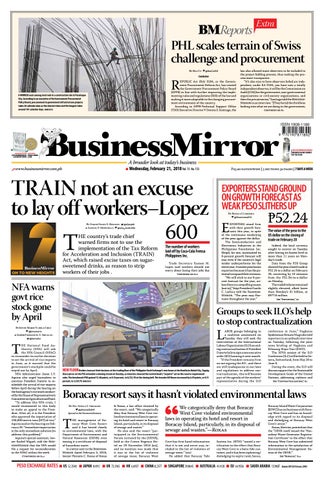
A worker seats among steel rods in a construction site in Parañaque City. According to an executive of the Government Procurement Policy Board, procurement in government infrastructure projects takes 26 calendar days as the shortest time and the longest takes around 141 calendar days. NONIE REYES
media partner of the year
@ReaCuBM
A broader look at today’s business
n
Wednesday, February 21, 2018 Vol. 13 No. 133
TRAIN not an excuse to lay off workers–Lopez 600
T
By Elijah Felice E. Rosales @alyasjah & Samuel P. Medenilla @sam_medenilla
he country’s trade chief warned firms not to use the implementation of the Tax Reform for Acceleration and Inclusion (TRAIN) Act, which raised excise taxes on sugarsweetened drinks, as reason to strip workers of their jobs .
The number of workers laid off by Coca-Cola Femsa Philippines Inc.
Trade Secretar y R amon M. Lopez said workers should not worry about losing their jobs due Continued on A12
NFA warns govt rice stock gone by April
business news source of the year
P25.00 nationwide | 5 sections 30 pages | 7 days a week
EXPORTERS STAND GROUND ON GROWTH FORECAST AS WEAK PESO SLITHERS UP By Bianca Cuaresma
E
@BcuaresmaBM
XPORTERS stood firm with their growth forecasts this year, in spite of the continuous weakening of the peso against the dollar. The Semiconductors and Electronics Industries in the Philippines Foundation Inc. (Seipi), for one, maintained its 6-percent growth forecast will stay even if the country’s legal tender underperforms for the entire year. A weaker peso favors exporters because it has the potential to expand their revenues. “We will stick to our 6-percent forecast for the year, unless there is a compelling reason [not to],” Seipi President Danilo C. Lachica told the BusinessMirror. “The peso may fluctuate throughout the year.”
L
@joveemarie
& Jasper Emmanuel Y. Arcalas @jearcalas
he Nationa l Food Authority (NFA) w ill ask the NFA Council (NFAC) to reconsider its earlier decision to set the arrival of rice imports in June, as it warned that the government’s stockpile could be wiped out by April. NFA Administrator Jason L.Y. Aquino also urged lawmakers to convince President Duterte to reschedule the arrival of rice imports before April during the hearing on the food agency’s rice stock conducted by the House of Representatives’s Committee on Agriculture and Food. “To address this NFA crisis, I would recommend to this body to make an appeal to the President. After all, it is the President who approved the importation of 250,000 metric tons [MT] of rice,” Aquino said at the hearing on February 20. “Immediate importation is the only immediate solution [to address this problem].” Aquino’s special assistant, lawyer Rachel Miguel, told the BusinessMirror that the NFA would file a request for reconsideration to the NFAC within the week.
2016 ejap journalism awards
₧52.24 The value of the peso to the US dollar on the closing of trade on February 20
Indeed, the local currency sought to recover on Tuesday after hitting its lowest level in more than 11 years on Monday’s trade. Data from the PDS Group showed the peso closed trade at P52.24 to a dollar on February 20, correcting by 10 centavos from the P52.34-to-a-dollar on Monday. The traded volume remained slightly elevated, albeit lower than Monday’s $1 billion, at $977.8 million. See “Exporters,” A2
Groups to seek ILO’s help to stop contractualization
By Jovee Marie N. dela Cruz
Ctontinued on A12
Continued on A2
BusinessMirror
www.businessmirror.com.ph
T
law also allowed more observers to be included in the project bidding process, thus making the process more transparent. “It’s also nice to have observers [who] are independent; under RA 9184, you have now a totally independent observer, it will be the Commission on Audit [COA] for the government, non-governmental organizations or civil-society organizations, and then the private sector,” Santiago told the BusinessMirror in an interview. “[They form] the third lens looking into what we are doing in the government;
NEW FLOOR Brokers transact their business at the trading floor of the Philippine Stock Exchange’s new home at the Bonifacio Global City, Taguig. Share prices on the PSE extended a winning streak on Tuesday, as investors cheered the Central Bank’s “surprise” cut on the reserve requirement ratio. The benchmark PSEi gained 12.48 points, or 0.14 percent, to 8,722.70 at the closing bell. The broader All Shares increased by 6.59 points, or 0.13 percent, to 5,129.79. NONIE REYES
abor groups belonging to a coalition announced on Tuesday they will seek the intervention of the International Labour Organization (ILO) on ending contractualization if President Duterte fails to sign a new executive order (EO) banning it next month. “If the President remains firm on not signing the EO...and there are still inadequacies in our laws and regulations to address contractualization, this will become part of the agenda of the workers’ representative during the ILO
conference in June,” Nagkaisa Spokesman Renato Magtubo told reporters in an ambush interview on Tuesday, following the joint news briefing of Nagkaisa and Kilusang Mayo Uno (KMU). The 107th session of the ILO Conference (ILC) will be held in Geneva, Switzerland, from May 28 to June 8. During the event, the ILO will discuss support for the Sustainable Development Goals of the United Nations; addressing violence and See “Contractualization,” A2
Boracay resort says it hasn’t violated environmental laws By Ma. Stella F. Arnaldo
@akosistellaBM Special to the BusinessMirror
T
HE management of Boracay West Cove Resort said it has hewed closely to environmental laws, with the Department of Environment and Natural Resources (DENR) even issuing it a certificate of disposal of hazardous waste. In a letter sent to the BusinessMirror dated February 5, 2018, lawyer Florante C. Roxas of Roxas
PESO exchange rates n US 52.3540
& Roxas, a law office retained by the resort, said: “We categorically deny that Boracay West Cove violated environmental laws in operating its hotel and resort in Boracay Island, particularly, in its disposal of sewage and wastes.” He also said the resort “participated in the Environmental Forum initiated by the [DENR], held at the Crown Regency Hotel on 29 November 2018 [sic], and no mention was made that it was in the list of violators of sewage mess; Boracay West
We categorically deny that Boracay West Cove violated environmental laws in operating its hotel and resort in Boracay Island, particularly, in its disposal of sewage and wastes.”—Roxas Cove has first hand information that it is not and never was, included in the list of violators of sewage mess.” (sic) He added that Boracay Tubi
System Inc. (BTSI) “issued a certification to the effect that Boracay West Cove is a bona fide customer, and it has been siphoning/ dislodging its septic tank; hence,
Boracay Island Water Corporation [BIWC] has no business with Boracay West Cove and has no knowledge with regard to its disposal and dislodging of Boracay West Cove’s sewer.” Roxas, likewise, pointed out that the “DENR itself issued the ‘Hazardous Waste Generator Registration Certificate’ to the effect that Boracay West Cove has submitted information to the satisfaction of Environmental Management Bureau of the DENR.” See “Boracay,” A12
n japan 0.4912 n UK 73.3165 n HK 6.6937 n CHINA 8.2577 n singapore 39.8645 n australia 41.4120 n EU 64.9556 n SAUDI arabia 13.9607
Source: BSP (20 February 2018 )
BMReports BusinessMirror
A2 Wednesday, February 21, 2018
www.businessmirror.com.ph
PHL scales terrain of Swiss challenge and procurement Continued from A1
so that procurement now becomes more accountable with the participation of these observers.” The procurement law had also abandoned the prequalification stage of the bidding process, which was explained to be time-consuming. The prequalification exercise was noted to be a separate process in terms of project bidding that was undergone by the government before that would take around two to three months. “The experience then was two to three months to do prequalification. This regime was abandoned by the procurement law, it was simplified and included in the bidding process,” added Santiago, who is also a lawyer. “So this is known as the simple eligibility checking. So you lessened the process by two to three months.”
Time requirement
UNDER the law, the shortest period for the procurement of goods takes 26 calendar days, while the longest is 136 calendar days. For infrastructure procurement, the shortest time is 26 calendar days and the longest takes around 141 calendar
TRAIN. . .
Continued from A12
Having said that, the Coca-Cola layoffs may be illustrative if it is established that TRAIN is among its proximate causes,” Africa told the BusinessMirror. Africa said “the economy is already vulnerable as it is,” citing the increase in the number of unemployed Filipinos in the recent labor-force survey. The jobless rate last October was at 5 percent. “ T he higher ta xes, especially on oil products, and the resulting inf lationary impulse cannot but exert a dampening effect on the economy, which the higher takehome pay for a few cannot compensate for. It is very possible as the Coca-Cola case might be showing, for the constriction in demand to pinch businesses and result in job losses,” Africa said.
days. If the prequalification exercise was added, the procurement process would take around seven months. “Transparency in the law and the IRR are all over,” Santiago said. “The law recognized a singular portal of information on all government procurement opportunities and that’s the PhilGEPS [Philippine Government Electronic Procurement System].” Santiago explained every procurement opportunity has to be posted at the PhilGEPS web site, as well as the procuring agency’s web site, and in conspicuous places in the workplace. At a certain budget threshold, of above P5 million, it has to be advertised in newspapers of general nationwide circulation, as among the posting requirement under the procurement law. “For consulting service, the rule now says if the budget is above P5 million, you advertise in the newspaper; for goods, it’s P10 million; for civil works, above P15 million,” Santiago added. “[If it’s] lower than those values, [there’s] no need to advertise in newspapers. But you still have the three posting requirements.”
Prebidding
A prebid conference is also undertaken
‘Union-busting’
Coca-Cola’s decision to trim its work force came shortly after President Duterte enacted into law the TRAIN last December. It slaps a tax of P12 per liter on beverages with high-fructose corn syrup and P6 per liter on drinks with caloric and noncaloric sweetener. In a statement last Friday CocaCola’s labor unions took a swipe at the firm for allegedly “hiding under the skirt of the TRAIN law.” “The [Coca-Cola] management uses the implementation of the TR AIN as a façade for their unionbusting, despite having no evidence yet of the decline in sales due to the excise tax on sugary and sweet beverages,” the statement read. The labor unions claimed they were not involved in the decision-making of the firm regarding the retrenchment of workers, and proof to that was the management’s reported nondisclosure of the plan during the meetings last
as part of transparency initiatives under the procurement law. The prebid conference is an avenue wherein the government and private sector collaborate for a smooth project-bidding process. “It’s an activity within the procurement process wherein we handhold the bidders. Bidders are given the opportunity to ask questions, clarify and maybe even suggest to the procuring entity what could be the more innovative equipment as opposed to what is being asked,” Santiago explained. “The Bids and Awards Committee will have to explain [some things] to the bidders.” If the approved budget for the project contract is at least P1 million, at least one prebid conference must be done. If it’s lower than P1 million, it is up to the procuring agency if it will hold a prebid conference. The notice of the conference must be posted in the three posting requirements 12 calendar days before the conference per se to give ample time to bidders. After the contract is awarded, the information must also be posted in the three posting requirements under the law. The notice of award and the notice to proceed should also be posted.
November and December. “The [management] only informed us of its plans on January 29 and 30 as it was issuing termination papers to the affected workers,” the statement read. In a media briefing on Tuesday Danny Fuentes, a member of the Nagkaisa labor coalition, said at least 15 laborunion officers were among those who were dismissed without prior notice. Fuentes said they are concerned Coca-Cola will continue to use TRAIN to dismiss more workers. Maglunsod assured that the DOLE is monitoring the impact of the TRAIN, amid the concerns aired by labor groups that it will be used for retrenching workers illegally. He said, however, that the agency has yet to record any incident of displacement attributed to TRAIN. The DOLE also assured that erring employers, who will be proven to have abused TRAIN, will face sanctions.
Standardization
STANDARDIZED bid documents—issued as a template by the GPPB board in 2005— also speed up the bidding process. The document is being used by both the procuring agency and the bidders. “It already has instructions for bidders, big data sheet, construction of the contract, special conditions of the contract, the parameters are all there to help guide the bidders as they move forward with the preparation of their bids,” he added. The inclusion of the concept of an approved budget for the contract is seen as a tool to strengthen the procuring system of the country as it prevents “bloated bids.” “There’s an A, B and C as ceilings for bid prices. So procuring agencies now will have to prepare a very good approved budget for the contract that is judiciously prepared by way of studying the market, doing feasibility studies, even peer reviews,” he said. “When we have that A, B, C [ceiling], it prevents bloated bids.” In the past, there was no concept of an approved budget for the contract, so bidders will bid more than the approved agency estimate. Now, any bid equal or lower than the A, B, C bid ceiling price will be accepted,
Contractualization. . . harassment against women and men in the world of work; and follow-up on ILO Declaration on Social Justice for a Fair Globalization. Magtubo said the forum will also allow them to inform the ILO and its member-countries about the plight of local workers and the proliferation of contractualization. “Nagkaisa has a representative there every year.” Nagkaisa and the KMU are set to meet with President Duterte on March 15 to discuss the possible signing of their draft EO. Under the proposed EO, contractualization will be banned except for professions to be determined by the National Tripartite Industrial Peace Council. The EO was supposed to have
while anything higher will disqualified, Santiago explained.
Simplicity
ACCORDING to Santiago, the absence of a “mechanism you call a pass or fail criterion, everything will be subjective.” “So that’s the point: to have a competitive and a level playing field,” he added. “That’s the purpose of regulating the exercise of discretion to have a level playing field under a competitive setup, wherein bidders will be incentivized to participate in this government opportunity.” According to Santiago, the only challenge seen in line with the procurement law would be the different agencies’ understanding of the law and how the bidding process works. “The law was basically explained in the IRR; in one to three readings, you’ll understand the procurement law. It’s very simple,” Santiago told the BusinessMirror. “The challenge, perhaps, is that some agencies are not studying it; some agencies are not looking at it with that degree of seriousness. It’s now the 15th year of the law and sometimes we still get questions that if you had just studied the law it’s very simple.”
Continued from A1`
been signed earlier this month during Duterte’s meeting with labor leaders, but the President asked for additional time to review its legality and its impact on foreign investors. Nagkaisa and the KMU were dismayed by the delay, but they said they are willing to give Duterte until next month to fulfill his campaign promise of ending widespread contractualization. “We, Filipino workers, strongly convey to President Duterte that signing anything less than the labor sector’s executive order against contractualization is unacceptable,” Magtubo said. KMU Vice President Lito Ustarez said they will hold mass actions and public forums start-
ing Friday up to March 15 to generate public support for their cause. “On February 23, there will be a simultaneous hanging of streamers and mass actions in the DOLE [Department of Labor and Employment] regional offices,” Ustarez said. He added this will culminate in a massive demonstration by Nagkaisa and KMU members in Mendiola on March 15. Federation of Free Workers (FFW), an affiliate of Nagkaisa, will also launch a signature campaign. “Starting from today [February 21] until March 12, we also plan to collect a million signatures through an online an printed petition calling on President Duterte to sign the labor sector EO versus contractualization,” FFW Vice President Julius Cainglet said. Samuel P. Medenilla
Exporters. . .
Continued from A1
Monday’s weakness was attributed to local developments, particularly the seeming dovish tone of the Bangko Sentral ng Pilipinas (BSP). The peso’s value on February 19 reflected its July 19, 2006, level when it hit P52.745 against the greenback. But Philippine Exporters Confederation Inc. President Sergio R. Ortiz-Luis said exporters should not get all too excited about the underperforming peso. “The exchange rate is not a big factor to exports growth,” he told the B usiness M irror. “It helps to provide some strength to the exports but it is not very material in relation to the entire growth.” Ortiz-Luis said as long as the peso plays within the range of P50 to P52, exporters will not feel the impact of its underperformance. However, if it underperforms in such a manner that it hits P54 to P56 without fluctuating in the process—which, he said, is impossible—that may push the exports industry to grow rapidly than expected. “A lot of people are putting too much weight on exchange rate as the one that will drive exports, but actually it is only one of those,” Ortiz-Luis said. “Its fluctuation is just one of the many movements driving change in the industry.” One of the drivers that changed the temperature, at least in the finance sector, was when the BSP pulled a surprise move last week to cut banks’ reserve requirement ratio by 1 percent, effectively releasing around P70 billion to P90 billion of liquidity from the BSP’s vaults into the local cash stream. Economists have said such move has been translated by markets as a dovish bias and that economic managers are tolerating a weaker peso amid rising inflation. With Elijah Felice E. Rosales
Single volcano. . . Continued from A12
the leaves and crops, due to its corrosive character,” she added. Acid rain can directly contribute to the acidity of the ground, thus, reduce the potential of beneficial microorganisms in the soil to thrive, and essential soil nutrients to be available, [diminishing] the overall fertility of the affected area,” Cayetano noted. With regard to fresh bodies of water, acid rain can also increase the alkalinity of lakes, rivers and even those dedicated to aquaculture, she said. “When the alkalinity is altered, the growth of phytoplankton necessary for feeding fish might be inhibited, thus, threaten the habitat of fish,” she explained.
The Nation BusinessMirror
www.businessmirror.com.ph
Editor: Vittorio V. Vitug • Wednesday, February 21, 2018 A3
Senators raise some questions on ₧18-B Navy frigate deal
S
By Butch Fernandez
@butchfBM
en. Joseph Victor G. Ejercito expressed disbelief over the insistence of a foreign supplier to dictate on a buyer what weapons system should be installed on two Navy frigates ordered by the Philippine government. “I still cannot take it that the Philippine Navy is the end-user, but the shipbuilder, Hanjin Heavy Industries, has the option on what combat management system [CMS] they will install,” the lawmaker said. The senator wondered why defense officials are not asserting the Navy’s initial choice on the CMS to be installed in the two newly acquired frigates. “How did that happen?” Ejercito asked. “Why was this allowed in the contract?” Ejercito bewailed that such an arrangement is “so disadvantageous for the Navy,” indicating that possible charges can be filed against public officials who allowed the one-sided provision. Under the anti-graft law, officials concerned can be held liable for entering into contracts found to be disadvantageous to the government. This developed as Senate President Pro Tempore Ralph G. Recto suggested that if the government can buy P18-billion Navy ships, it can also acquire Philippine-made Pasig River ferry boats, as well as hospital ships and ferry boats. Recto recommended that for a fraction of the P18-billion price tag of two Navy frigates, “the country can buy locally made Pasig River ferry boats, floating hospitals, environmental patrol boats and other ships needed by a disaster-prone archipelago where half of the towns lie along the coast.” In a news statement issued on Tuesday, Recto reminded authorities
SC sets aside ‘woman’s honor’ doctrine in resolving rape cases By Joel R. San Juan
A
@jrsanjuan1573
DIVISION of the Supreme Court (SC) has issued a ruling that set aside the 58-year-old “woman’s honor” doctrine in resolving rape cases. In a 20-page decision issued on January 17, 2017, and penned by Associate Justice Samuel Martires, the Court’s Third Division held that the doctrine which suggests a woman who is a victim of sexual abuse would not admit she had been abused, unless the incident is true, out of a “natural instinct to protect her honor” is a “misconception” in this present time. The Court, in the said ruling, reversed the guilty verdict issued by a Davao court in 2012 against Juvy Amarela and Junard Racho in a rape that supposedly took place in 2009. The two were earlier meted to suffer reclusion perpetua, or up to 40 years imprisonment, by the trial court with the decision also being affirmed by the Court of Appeals in 2016. In setting aside Amarela and Racho’s conviction, the Court held that the doctrine has put accused in rape cases at an unfair disadvantage and creates a “travesty of justice.” The woman’s honor doctrine surfaced in the Court’s jurisprudence sometime in 1960 in the case of People v. Tana. In the said case the Court affirmed the conviction of three armed robbers who took turns raping a woman. The Court, speaking through Justice Alejo Labrador, said: “It is a well-known fact that women, especially Filipinos, would not admit that they have been abused unless that abuse had actually happened.” It added that it is due to women’s natural instinct to protect their honor. But the new SC ruling said the doctrine is no longer applicable today and that the Court cannot be stuck to the “Maria Clara” stereotype of a demure and reserved Filipina. “More often than not, where the alleged victim survives to tell her story of sexual depredation, rape cases are solely decided based on the credibility of the testimony of the private complainant. In doing so, we have hinged on the impression that no young Filipina of decent repute would publicly admit that she was sexually abused, unless that is the truth, for it is her natural instinct to protect her honor,” the High Court stated. “We, should stay away from such mind-set and accept the realities of a woman’s dynamic role in society today; she who has over the years transformed into a strong and confidently intelligent and beautiful person, willing to fight for her rights. In this way, we can evaluate the testimony of a private complainant of rape without gender bias or cultural misconception,” the Court added. The SC said that for the Court to affirm a conviction of rape it should be based on credible, natural, convincing testimony of the victim which should also be consistent with human nature and not merely rely on the women’s honor doctrine. In the case of Amarela and Racho, the Court said the prosecution “miserably failed to present a clear story of what transpired and that whether the victim’s story is true or not. The Third Division said it found circumstances that cast doubt on the credibility of the testimony of the victim, including the gaps in her testimony, differences between her affidavit-complaint and court testimony, a supposed inability for her to have identified one of her assailants because the crime scene was ark and she allegedly saw him for the first time, a lack of material details on some events in the alleged rape incident, to medico-legal findings that raised questions on whether she had consented to sex after all. “Although we put a premium on the factual findings of the trial court, especially when they are affirmed by the appellate court, this rule is not absolute and admits exceptions, such as when some facts or circumstances of weight and substance have been overlooked, misapprehended and misinterpreted,” the SC declared.
concerned that the deficit in ships is not only in the Navy, but “also in civilian activities, such as Coast Guard patrol, calamity response and tapping Manila’s main waterway as an alternative to its car-choked streets.” He added: “If we were able to find the means to buy our Navy more ships, then we should also be that ‘resourceful’ in meeting the needs of other agencies for more floating assets.” Recto said the Duterte administration, in acquiring these ships, can opt to “buy Filipino[-made
vessels] by tapping the vibrant shipbuilding industry” in President Duterte’s home province of Cebu, as well as in Navotas and in Subic, where Duterte last month led the launch of a half-kilometer-long megaship which can carry 20,950 40-foot container vans. For i n s t a nc e , R e c to re c a l le d t he t w o Navotas-made research ships commissioned b y t he Bu reau of Fi sher ies a nd A qu at ic R esou rces — t he L a pu- L a pu a nd Franc is co D a goh o y — w h i c h h av e b e e n o n re s e a rc h
a nd enforcement pat rol since t heir l au nc h t wo yea rs ago, not ing t hat t wo sh ips cost t he gover nment “on ly P250 m i l l ion eac h or equ iva lent to t he dow n pay ment for t he Da l i a n t ra ins of MRT [Met ro R a i l Tra nsit Line 3] t hat is not being used.” Affirming that the Philippines is already recognized as the fourth-largest shipbuilder in the world, Recto asserts that “ if other nations find our ships exceptional, then we should, too.”
Economy
A4 Wednesday, February 21, 2018 • Editors: Vittorio V. Vitug and Max V. de Leon
BusinessMirror
Duterte admin focused on trade, war vs poverty, not disputes–Palace By Bernadette D. Nicolas @BNicolasBM
W
hile defending the country’s sovereign territory remains a priority, Malacañang has emphasized that the Duterte administration is now more focused on increasing trade to cut poverty incidence, especially in rural underdeveloped areas. President Duterte said in his speech on Monday in the 10th Biennial Convention and 20th Founding Anniversary Celebration of the Chinese-Filipino Business Club Inc.: “And if you look at it very closely, it would appear that there’s really a divide, the great divide now of ideological.... But we are all in the capitalist state. So the war now is on trade, not territory. That’s why I said geopolitics is always changing.” Asked to clarify on the President’s statement, Presidential Spokesman Harry L. Roque Jr. said in a briefing at the Palace that territorial issues are still important, but stated that “we need to improve the economic life of our people rather than waging war over territories.” “We are—the whole nation— not just the Philippines, concerned about uplifting the economic well-
being of its people through trade and investments,” he said. Prof. Rene Ofreneo, former labor undersecretary and dean of University of the PhilippineSchool of Labor and Industrial Relations, agreed that war now is on trade, which, he said, also requires a very coherent development framework to preserve and advance national interest not at the expense of other areas of the economy and society. “On one point, he is right in saying that trade is war [which also] requires cooperation and more important to us, it requires a very coherent development framework, on one hand to preserve our national interest, but on the other hand, to advance our national interest, and we should not [do it] at the expense of other areas of our economy and our society like…our right to our own boundaries,” Ofreneo said. Asked on whether the Duterte administration’s independent foreign policy is hindering the country from maximizing trade deals to earn more from exports, Ofreneo said the administration is trying to balance this by trying to reach out to China, but it should not be at the expense of existing trade relations with other countries. Like in any war, Ofreneo added,
the country needs to strengthen its domestic market to be able to win the war in globalization. He described globalization as another form of war and that the country should craft a strategy in taking advantage of globalization. He cited countries like Japan, Korea, Singapore and China that have a “continuous capacity building” on where they think they could win the war. “But moreover, it is also an opportunity for us to strengthen our local markets,” Ofreneo said. He even cited, for instance, the local agriculture industry, which was predicted to boom in 1994, but continued to shrink until now. “We joined World Trade Organization [back then] to liberalize and deregulate, but we don’t have have a program on how to wage the war,” he said. For Ma. Ella Oplas, economics professor of De La Salle University, trade is important in the age of globalization. “When you say the war is on trade and not territory, it means the war is about making one’s economy competitive to trade. Globalization is beyond territory. It is beyond borders. That’s why it’s trade liberalization,” Oplas said in a text message to the BusinessMirror.
www.businessmirror.com.ph
BPM to propel 21% demand hike for office space in 2018
R
By Leslie Gatpolintan | Philippines News Agency
eal-estate services firm Leechiu Property Consultants (LPC) expects the demand for office space in Metro Manila to grow by about 21 percent this year, mainly due to the sustained demand from business-process management (BPM) and online gaming segments.
It projected total demand rising to 937,000 square meters (sq m) by the end of the year, which is 20.9 percent higher than last year’s record high of 775,000 sq m. “The security and the renewed confidence in the Philippine government play a big part. And then companies globally will continue to move to drive down cost so by driving cost down, they will continue to bring jobs to the Philippines,” LPC CEO David Leechiu said in an interview on Monday. He added more and more multinational companies are expected to locate in the Philippines, thus, driving the rise in demand for office spaces.
Leechiu said that of this year’s 937,000-sq-m projected demand for office space in Metro Manila, some 415,000 sq m were already precommitted as early as January this year, the largest precommitment activity in history. He expects the BPM industry demand, which posted a 26-percent drop in take-up from 2016 to 2017, to bounce back to 485,000 sq m from 2017 to 2020. “BPM players already invested in the Philippines will continue to dominate the Metro Manila office sector,” Leechiu added. “In the meantime, they are also expanding to provincial locations, such as Clark in Pampanga, Cavite, Batangas,
937,000 sq m The total anticipated demand for office space this year in Metro Manila, mostly from BPM and online gaming segments Laguna and notably, Cebu City.” Citing an LPC Metro Manila absorption study, Leechiu said demand for office space from the offshore/ online gaming industry is expected to grow further to 269,000 sq m in 2018, 309,000 sq m in 2019 and 356,000 sq m in 2020. He added those from other industries is expected to reach 183,000 sq m over the next three years. Leechiu also expects growth in the Metro Manila office sector to continue with as much as 1.2 million sq m of office space forecasted to be added to the current inventory for this year. He also said the Philippine office supply would grow by 40 percent in the next five years. Pipeline supply is projected to reach 4.5 million sq m in 2018 to 2023, with 71 percent, or 3.2 million sq m of developments, will be in Metro Manila. Developments outside Metro Manila make up for the remaining 29 percent, he added.
Senator lauds approval of safer workplace bill on third reading By Catherine Joy L. Maglalang Correspondent
S
EN. Joel Villanueva, chairman of the Senate Committee on Labor, Employment, and Human Resources Development, welcomed on Monday the Senate’s approval on third and final reading of Senate Bill 1317, or “An Act Strengthening Compliance with Occupational Safety and Health Standards.” The Bulacan senator authored and sponsored the said bill. Voting 20-0, the senators approved the bill requiring compliance by employers to the Occupational Safety and Health Standards (OSHS), to promote the right of Filipino workers to a healthy and safe workplace. “This is great news for our workers who have been subjected to unsafe workplace. The passage of this bill is proof that the Senate is concerned on the well-being of every Filipino worker,” Villanueva said. “It is high time that we put high
premium on compliance with OSH standards. Losing so many precious lives as proven by the recent fire tragedy in Davao is unacceptable. One of those who died was Maryjoy Hope Daluro, our youth church leader in Jesus Is Lord Church. The pain and suffering caused by this tragedy is tormenting and should never happen again,” the senator added. According to Villanueva, the bill would amend the 41-year-old Labor Code to impose higher administrative penalties to employers who will not comply with requirements set under the OSHS. Under the proposed measure, any erring employer would be served a fine of up to P100,000 administrative penalty for every day of noncorrection of violation. The bill also guaranteed the payment of workers’ wages and income during work stoppage or suspension of operation due to imminent danger as a result of the employer’s violation or fault.
A survey conducted by the Philippine Statistics Authority in October 2015 showed that occupational diseases in establishments employing 20 or more workers doubled from 85,583 in 2011 to 171,787 in 2013. The Department of Labor and Employment also reported 199 fatal workplace accidents and 232 nonfatal accidents from January 2014 to October 2016. “We sincerely thank our colleagues for supporting this personal crusade, which we have been strongly pushing to give due justice to our workers and to assure a level playing field to establishments who comply to the OSH standards,” Villanueva said. “After four Congresses, this bill is now closer to becoming a law. We are hoping that the bicameral version of this important legislation will be ironed out and ready for the President’s signature before the last session day of Congress on March 21,” he added.
House urged to OK extended maternity-leave measure By Jovee Marie N. dela Cruz @joveemarie
A
lawmaker on Tuesday urged House leaders to immediately approve one of its priority bills seeking to increase the mandatory maternity leave for female workers from 60 to 100 days. Rep. Sajid G. Mangudadatu of the Second District of Maguindanao, one of the principal authors of the bill, said House Bill (HB) 4113 will grant working women expecting babies 100 days maternity leave, 40 days more than the current authorized leave with pay of 60 days. Mangudadatu, vice chairman of the House Committees on Muslim Affairs and Mindanao Affairs, said HB 4113 has been recommended for plenary approval by the House Committee on Women and Gender Equality. The bill, he added, consolidated 15 legislative proposals that included his bill. The bill, however, is currently pending before the plenary deliberations.
HB 4113 also allows the mother to extend the authorized leave of absence to another 30 days but without pay. Last week President Duterte lauded Mangudadatu’s programs for women and children in his congressional district in Maguindanao, saying that he can pursue a national action for their welfare. Mangudadatu is now included in the PDP-Laban senatorial candidates for 2019. Earlier, Deputy Speaker Pia S. Cayetano said the proposed 100-day maternity-leave law will allow women workers in the country to be at par with their counterparts in Southeast Asia, while also keeping up with global standards set by the International Labour Organization (ILO). Cayetano noted that the ILO, which recognizes the need to promote equality for women in the work force and guarantee the health and safety of mother and child, recommends the standard period of maternity leave at not less than 98 days. “In the Asean region, we lag behind
in terms of maternity-leave duration. Vietnam provides 120 to 180 days of maternity leave, depending on working conditions and nature of the work,” she said. “Singapore, on the other hand, provides 112 days of maternity leave. Both countries give beyond what the ILO prescribes. Cambodia, Indonesia, Lao PDR, Myanmar and Thailand all provide a maternity-leave period of 84 days,” she added. “[Meanwhile,] the Philippines provides only 60 days for normal delivery, while 78 days for caesarian delivery,” Cayetano noted. Party-list Rep. France L. Castro of ACT Teachers also urged her fellow members of the House of Representatives to immediately approve HB 4113, or the 100-day maternityleave law, saying that the government should ensure women workers and employees in the public and private sectors sufficient maternal protection through a longer paid maternity leave.
Agriculture/Commodities BusinessMirror
www.businessmirror.com.ph
Editor: Jennifer A. Ng • Wednesday, February 21, 2018
A5
PhilFida to revive PHL cotton industry
T
By Jasper Emmanuel Y. Arcalas
@jearcalas
he Philippine Fiber Development Authority (PhilFida) is targeting to plant cotton in at least 660 hectares across the country this year as part of government efforts to revitalize the local garments industry.
PhilFida Executive Director Kennedy T. Costales told the BusinessMirror that the attached agency of the Department of Agriculture (DA) received a P96-million budget from Sen. Loren B. Legarda for its cotton-development project. “We are reviving the cotton industry for our traditional weaving
industry and to give farmers an additional source of income,” Costales said in a recent interview. He added the PhilFida is planning to plant cotton in about 150 hectares in Tarlac, 160 hectares in Ilocos and another 350 hectares in Mindanao in the second half of the year. PhilFida Regional Director Edi-
son Riñen said the country’s cotton cropping season could start as early as September, while harvest may start in March. Riñen said the agency plans to plant cotton mostly in Sarangani province due to the availability of land and the suitability of its climate for cotton production. “It is the widest area right now in Mindanao with few competing crops in the area and the climate there is favorable for cotton,” he told the BusinessMirror in an interview.
Bt cotton
The PhilFida chief revealed that they are planning to plant the Bacillus thuringiensis (Bt) corn variety, which will be sourced from India. However, he said, the agency is still awaiting the Bureau of Plant Industry’s (BPI)
issuance of import permits to procure the seeds from India. “PhilFida submitted a memorandum to Agriculture Secretary Emmanuel F. Piñol and he has approved the importation of Bt cotton from India. So we will import the seeds and plant the variety this year, if it arrives early,” Costales said. Riñen also said the importation of Bt cotton from India is part of PhilFida’s application for the propagation of the GM crop in the country. However, should the importation be deferred by the BPI, then the PhilFida would use non-Bt cotton varieties for its cotton-development project this year, according to Riñen. These varieties, he said, are UPL C2 and NSIC CT11. “It is very important for us to import the Bt cotton seeds because
it has a built-in resistance to pests like bollworm, and cuts the use of pesticides. A reduction in pesticide use would be beneficial to farmers’ health and the environment,” he said. “Furthermore, the yield of Bt cotton is more than double the yield of local varieties. If local varieties yield an average of 1 metric ton, Bt cotton can produce around 2 MT to 3 MT and more,” Riñen added. He also expressed apprehension that the PhilFida may not be able to hit its target of planting cotton in 660 hectares this year if the agency will not be able to use Bt cotton. Riñen explained that the project is being done in partnership with identified farmers and cooperatives. These farmers, Riñen added, prefer Bt cotton as it is cheaper to cultivate. “Farmers want the Bt cotton
variety because they are forced to use pesticides on non-Bt cotton varieties. The Philippines is capable of producing the non-Bt cotton variant, but what will the government do if farmers do not want to plant it?” he said. Riñen said the PhilFida’s Bt cotton project has already passed the first two stages of the government’s approval process for genetically modified crops, which include direct usage and field trials. Costales said the PhilFida was only able to plant non-Bt cotton in about 19 hectares, out of its target of 26 hectares, in Luzon. He added these areas are expected to produce about 19 MT to 28.5 MT of cotton by March. The Philippines currently imports all of the cotton required by local garments manufacturers.
House okays bill banning conversion of irrigated lands on 3rd reading
T
he House of Representatives on Tuesday approved on third and final reading a measure prohibiting the conversion or causing the conversion of irrigated and irrigable lands. Voting 188-0, lawmakers approved House Bill (HB) 7115, which aims to address the threats to the country’s food security. The bill amends the Comprehensive
Agrarian Reform Law of 1988 (CARL), or Republic Act (RA) 6657. It is included in the priority measures of the 17th Congress. HB 7115 seeks to penalize the conversion or causing the conversion of irrigated and irrigable lands. The bill defines irrigated lands as “lands serviced by natural irrigation or irrigation facilities, as delineated by the Department
of Agriculture [DA] or the National Irrigation Administration [NIA] which includes lands where water is not readily available as existing irrigation facilities need rehabilitation or upgrading, or where irrigation water is not available year-round.” Irrigable lands are those lands “suitable for the conduct of agricultural activities which require irrigation and display physi-
cal features justifying the operation of an irrigation system.” Under the bill, actual physical or legal conversion or causing the physical or legal conversion of irrigated and irrigable lands are committed by the following: 1) any person who directly and indirectly participates in the conversion of irrigated and irrigable land; 2) any person who directly or indirectly
induces the landowner or farmworker in the conversion of irrigated and irrigable land; 3) any person who applies for and facilitates the application for conversion; 4) any person who facilitates the application and issuance of clearances and other documents necessary for conversion; 5) any person who approves and cause for the approval of the application for conversion; and 6) any person
who directly and indirectly benefited from the conversion. The bill amends Section 74 of R A 6657 so that any person who knowingly or willfully violates the provisions of the Act shall be punished by imprisonment of one month to three years or a fine of P1,000 to P15,000, or both, at the discretion of the court. Jovee Marie N. Dela Cruz
A6
Wednesday, February 21, 2018
The World BusinessMirror
Editor: Lyn Resurreccion • www.businessmirror.com.ph
As Saudis go nuclear, US seeks an edge over great-power rivals S
Ex-workers at Russian ‘troll factory’ trust US indictment
A
t a meeting of the International Atomic Energy Agency in Vienna last September, word spread that Saudi Arabia had identified a handful of countries that could build two nuclear reactors in the kingdom. The US wasn’t among them— until Energy Secretary Rick Perry buttonholed the Saudi delegates and told them America wanted in.
Within weeks, a mostly US consortium headed by Westinghouse Electric Co. had joined the race. Its executives have visited the kingdom. So has Perry, whose intervention was described by two people who attended the meeting. In the next few months, the Saudis are expected to narrow the field to two or three bidders. A glance at the current list of contenders shows the geopolitical perils that accompany this business opportunity. American allies South Korea and France are on it—and so are China and Russia, recently designated by the Pentagon as the main US threats. Reactor-building could become another arena of superpower rivalry.
‘What are we creating?’
For the Saudis, seeking the technical expertise to move beyond oil and compete with archrival Iran, the US is undoubtedly the main strategic partner. But unlike Washington, the kingdom also has cordial ties with the other two giants—and reasons to keep them sweet. China is its best customer, and Russia is increasingly its partner in policing world oil output. Both countries are improving ties with the kingdom and “sharpening their strategies,” according to Marc-Antoine Eyl-Mazzega, director of the energy center at the Institut Francais des Relations Internationales in Paris. The effect is to give the Saudis more options, he said: “Riyadh will try to levy that to reinforce its regional positions.” Meanwhile, President Donald J. Trump’s administration sees a chance to revive a moribund US nuclear industry. Some analysts question whether that’s worth the risks that will come with the expansion of nuclear technology through the world ’s most volatile region. “You’ve got Israel with nuclear weapons,” says Victor Gilinsky, a former commissioner of the Nuclear Regulatory Commission. “Turkey isn’t far behind. Iran has a nuclear program. Now they’re going to unleash Saudi Arabia? What are we creating here?” The expansion is happening
anyway. The United Arab Emirates (UAE) has its first reactor going online this year, with three more planned; Egypt has signed a construction deal with Russia, as have Jordan and Turkey; Saudi Arabia’s planned two are expected to grow to as many as 16.
‘Gold standard’
Nuclear energy is a far cry from nuclear weapons but there is overlap. Spent fuel, which can be reprocessed into plutonium for bombs, lasts for thousands of years; enriched uranium needed for the process holds special allure to terrorist groups. To prevent global proliferation, the US has strict standards for what technology can be sold abroad, and what the buyers can do with it. They must sign a so-called 123 agreement, named after a section of the US Atomic Energy Act. The one signed a decade ago by the UAE, whose Korean-built reactor will use some US parts, is stricter than any that went before and has become known as the “gold standard.” T he Gu lf nation promised there’d be no enrichment or reprocessing of uranium in-country. But Saudi Arabia has long rejected the gold standard. It has its own uranium underground and wants to be self-sufficient in nuclear fuel preparation over the long term. Moreover, the Saudis point out that their enemy, Iran, is permitted under the 2015 international accord signed by the US to enrich uranium for peaceful purposes. “We want to have the same rights as other countries,” Saudi Foreign Minister Adel al-Jubeir told CNBC last Sunday.
International Atomic Energy Agency Director General Yukiya Amano (left, back to camera) in discussion with Khalid A. Al-Falih (right), minister of Energy, Industry and Mineral Resources of Saudi Arabia. C. Brady/IAEA
‘Couldn’t be happier’
The United States is reluctantly preparing to offer the Saudis a deal that falls short of the gold standard, though officials say it would still be stricter than the terms any other potential builder would impose. Diplomats and intelligence officials are due in Riyadh for negotiations soon. It’ll be a balancing act: the US will be seeking the tightest restrictions it can get, while knowing that the Saudis have other options. The US nuclear industry, in the dumps for years, is thrilled. “I could not be happier with the support from this administration,” said Daniel Lipman, vice president of the Nuclear Energy Institute and a former Westinghouse executive, who recently returned from heading a delegation to Saudi Arabia. “There is a whole-of-government approach here. I haven’t seen anything like this before.” Westinghouse is in bankruptcy and in the process of being sold by its Japanese owners to Canada’s Brookfield Business Partners. The Saudi deal, in which Westinghouse is playing the role of lead negotiator, could be a lifesaver. Industry sources said the USbacked group also includes Fluor Corp., which will do the engineering, procurement and construction, and Exelon Corp., which will sell its operating model and train locals to run the plant. Exelon and Fluor declined to comment.
‘Catastrophic’
Any agreement they reach must be approved by Congress, which will have 90 days to weigh in. The process may not go smoothly. Any dilution of the gold standard would be “catastrophic,” Sen. Ed Markey, a Massachusetts Democrat on the
You’ve got Israel with nuclear weapons. Turkey isn’t far behind. Iran has a nuclear program. Now they’re going to unleash Saudi Arabia? What are we creating here?” —Gilinsky
Foreign Relations Committee, said in an interview last week. A wild card is Israel. Many members of Congress place special store by what the Israelis say about regional security. It has steadfastly opposed the introduction of nuclear energy into the Islamic world. But lately, Israel has cultivated ties with the Saudis as part of a Washington-sponsored alliance against Iran. So far, the Israeli gover nment has been notably silent. Experts say it has other priorities—including a possible war to its north and corruption allegations against its prime minister—but will likely get involved behind the scenes as a US-Saudi agreement shapes up. “We have an interest that the United States and not China or Russia enter the Saudi nuclear market,” said Yoel Guzansky, formerly an Israeli official who focused on nonproliferation, and now at the Institute for National Security Studies in Tel Aviv. “If Washington is inside, it will be better placed to monitor the program and to have leverage over the Saudis for a rainy day.”
‘Slow-motion proliferation’
“But, of course, you are opening up a slow-motion proliferation,” he added. “And Israel will have to deal with the consequences.” Still, a Saudi-American nuclear deal may tie in with efforts by Jared Kushner, Trump’s son-in-law, to negotiate an Israeli-Palestinian peace deal. His plan reportedly relies on a large Saudi contribution, so generous nuclear terms for Riyadh could help. Kushner’s a strong supporter of the Westinghouse bid, a US official said. Whoever wins the Saudi contract will be entrenched in the kingdom for the long term—one reason why nuclear power is so politically important. “From the time you shake hands, you have very close to a century-long relationship,” Lipman said. “From design and construction to operation, servicing, upgrading and then eventually decommissioning and waste management, you are working together. That’s why so much is at stake.” Bloomberg News
AINT PETERSBURG, Russia—While Russian officials scoff at a US indictment charging 13 Russians with meddling in the 2016 US presidential election, several people who worked at the same Saint Petersburg “troll factory” say they think the criminal charges are well-founded. Marat Mindiyarov, a former commenter at the innocuously named Internet Research Agency, says the organization’s Facebook department hired people with excellent English skills to sway US public opinion through an elaborate social-media campaign. His own experience at the agency makes him trust the US indictment, Mindiyarov told The Associated Press. “I believe that that’s how it was and that it was them,” he said. The federal indictment issued last Friday names a businessman linked to President Vladimir Putin and a dozen other Russians. It alleges that Yevgeny Prigozhin—a wealthy restaurateur dubbed “Putin’s Chef,” paid for the Internet operation that created fictitious social-media accounts and used them to spread tendentious messages. The aim of the factory’s work was either to influence voters or to undermine their faith in the US political system, the 37-page indictment states. Putin spokesman Dmitry Peskov told reporters on Monday that, while the indictment focuses on “Russian nationals,” it gives “no indication that the Russian government was involved in this in any way.” Peskov reasserted that Moscow did not interfere in the US election. Mindiyarov said he failed the language exam needed to get a job on the Internet Research Agency’s Facebook desk, where the pay was double than the domestic side of the factory. The sleek operation produced content that looked as if it were written by native English speakers, he said. “These were people with excellent language skills, interpreters, university graduates,” he said. “It’s very hard to tell it’s a foreigner writing because they master the language wonderfully.” T he En g l i sh te st he to ok a s k e d for a w r it i n g s a mpl e about Democ rat ic c a nd id ate Hi l l a r y C l i nton’s c h a nces of w inning t he US president ia l vote, Mindiyarov recalled. “I wrote that her chances were high and she could become the first female president,” he told the AP. Mindiyarov said he took a job at the troll factory in late 2014 because he was unemployed and curious. At the time, about 400 people occupied four f loors of an office building and worked 12-hour shifts, he said. Most of the operation focused on the separatist insurgency in eastern Ukraine and Western sanctions aga inst Russia, not pol it ica l races in the West, he said.
The factory had video and photo departments, Mindiyarov said. The trolls received their wages in cash and operated in teams as they tried to foment public interest with fake discussions, he said. “We worked in a group of three where one played the part of a scoundrel, the other one was a hero, and the third one kept a neutral position,” he said. “For instance, one could write that Putin was bad, the other one would say it was not so, and the third would confirm the position of the second while inserting some picture.” After only a couple of months, Mindiyarov quit. He said he hated the work. “The world in those comments was divided into black and white: America was bad, Putin was good,” he said. “They praised whatever had to do with Putin and criticized anything related to America, ‘gay’ Europe, and so on. That was the principle of the work.” Another former worker at the Saint Petersburg workshop, Lyudmila Savchuk, also described it as an efficient venture that churned out posts around the clock. Like Mindiyarov, Savchuk was employed in the domestic department of the “troll farm,” not the international division. Nevertheless, she said her experience there corresponds with what she knows of the allegations made by American authorities. “The posts and comments are made to form the opinion of Russian citizens regarding certain issues, and as we see it works for other countries, too,” Savchuk told the AP. Pa id t rol l s u sed c a ref u l ly crafted fake identities that made them come across like real people, she said. “The most important principle of the work is to have an account like a real person,” Savchuk said. “ T hey create real characters, choosing a gender, a name, a place of living and an occupation. Therefore, it’s hard to tell that the account was made for the propaganda.” Prigozhin, a.k.a. Putin’s Chef, owned restaurants and catering businesses that hosted the Russian leader’s dinners with foreign dignitaries. He used his relationship with Putin to expand his business to include services for the Russian military. “I’m not at all upset that I’m on this list,” Prigozhin said of the indictment in comments carried by Russia’s state RIA Novosti news agency. “If they want to see the devil, let them see him.” Along with producing social med i a suppor t i ng Don a ld J. Trump’s candidacy and disparaging Clinton, the Internet Research Agency purchased online advertisements using identities stolen from Americans and staged political rallies while posing as American political activists, the indictment alleges. The agency also paid people in the US to promote or ridicule the candidates, the document states. AP
U.S. says Indonesia is foregoing billions of dollar in investments I ndonesia is foregoing billions of dollars on offer from American companies eager to invest in Southeast Asia’s biggest economy, US Ambassador to Indonesia Joseph Donovan said. As the US tries to arrest a deteriorating trade balance with Indonesia, which last year found itself in President Donald J. Trump’s cross-hairs, Donovan has also rejected complaints of increasing American protectionism. Indonesia had made significant progress on macroeconomic stability, improving the business environment, education and infrastructure, yet more must be done to encourage trade as well as foreign investment, he said. “Those that caution the United States about being trade protectionist, I would
respectfully suggest that they look at their own markets and they might find a good deal of ingrained protectionism there,” he said in an interview on Febreuary 14 in Jakarta. Indonesian officials, such as Finance Minister Sri Mulyani Indrawati, have consistently criticized the protectionist tone sounded by Trump, who last year accused a host of nations, including Indonesia, of potentially abusing their trade relationship with the world’s biggest economy. Since then, the US trade deficit with Indonesia has worsened to $13.3 billion from $13.2 billion in 2016, according to the US Census Bureau. “The current protectionist language is definitely going to create concern about whether globally there will be a setback in
the progress that has been made over the past three decades,” Indrawati said in an interview on January 30. Oke Nurwan, director general of Foreign Trade at the Trade Ministry, did not respond to questions about protectionism. He said Indonesia had made progress in terms of ease of doing business and was seeking to better manage imports, as well as targeting export growth of 11 percent in 2018. Donovan said the US’s average tariff rate was less than 3 percent and half Indonesia’s average applied tariff rate. Despite the imbalance, he said trade in goods between the two nations had increased last year by about 7 percent to approximately $27 billion in bilateral terms, with US exports to Indonesia increasing about 14 percent.
Indonesia must do more to encourage foreign businesses to invest and trade, he said, adding that the US wants to see more access granted to American companies, particularly in the agriculture sector, including dairy, cotton, soybean, fruit and vegetables. “Indonesia is leaving billions of dollars on the table right now in the field of power generation by not following through on offers by American companies,” he said, declining to reveal any specifics.
It’s not about China
Ekoputro Adijayanto, the chief of the Indonesian Planning Ministry’s Centre for Private Investment, said a number of US private equity firms had shown interest in Indonesia, including one that’s “seriously
looking” to invest in greenfield power generation. But there also appeared to be a “Trump effect,” he said. “He’s trying to lure investors in the US to invest back in America, make America great again.” “China is a bit different from other countries,” Adijayanto said. “Instead of us going there, they are coming here. Many Chinese companies are coming to our office.” Figures show that in the space of three years, the US has lost significant ground to China in terms of foreign direct investment in Indonesia. Last year direct investment from the US was worth $2 billion, according to the Indonesia Investment Coordinating Board, while Chinese foreign direct investment was $3.4 billion.
“It’s not a competition between America and China,” Donovan said. “What I look for are opportunities for American businesses to compete on a level and fair trade ground here. Rather than look at China, what I’m interested in doing is helping American businesses to do more here.” Donovan said Indonesia must maintain the pace of economic reform established under President Joko Widodo and “stand up to protectionist voices who advocate for special interest under the guise of nationalism.” He cited Indonesia’s local content regulations— which saw Apple Inc.’s market access curbed before the company built a domestic research facility—as “a real deterrent” to foreign participation in the Indonesian economy. Bloomberg News
The World BusinessMirror
www.businessmirror.com.ph
Wednesday, February 21, 2018
A7
Trump signals he’s open to backing bill to alter gun background checks
W
EST PALM BEACH, Florida—President Donald J. Trump signaled on Monday that he was willing to join a discussion on gun restrictions, amid the national outcry led by teenagers who survived last week’s mass shooting at a Florida high school. Trump is open to improvements in federal background checks for prospective gun buyers, the White House press secretar y, Sarah Huckabee Sanders, said in a statement. She said the president also had spoken last Friday to Sen. John Cornyn of Texas about legislation to revamp the system that the senator helped introduce last fall. The White House stopped short of backing the bill, but the statement was a departure for a president who has focused on the mental health of gunmen and suspects rather than access to the firearms used in the attacks, after other mass shootings. “While discussions are ongoing and revisions are being considered,” Sanders said, “the president is supportive of efforts to improve the federal backgroundcheck system.” The proposed legislation—introduced by Cornyn, three other Republicans and four Democrats in the Senate—would make significant changes to the national instant criminal backgroundcheck system. The bill would hold federal agencies accountable for failing to add relevant information. It would also establish an initiative to better monitor gun buyers with records of domestic abuse. The bill was also backed by the National Rifle Association (NRA), which spent tens of millions of dollars on supporting Trump in the presidential campaign and against Hillary Clinton. But the legislation would have done little to stop the shooting last week at Marjory Stoneman Douglas High School in Parkland, Florida, that killed 17 people. The suspect, 19-year-old Nikolas Cruz, had no criminal record. He bought at least seven guns legally, including an AK-47 he had purchased in the past month, a federal law-enforcement official said on Monday. Cruz, who has confessed to investigators, appeared on Monday
in a Fort Lauderdale courtroom in shackles and a red jumpsuit as lawyers argued over whether a defense motion filed last week shou ld be kept conf ident ia l. Cruz did not look up during the brief hearing. Several other Republicans have expressed willingness since the shooting to discuss a change in gun laws, though they have given few specifics. On Monday Gov. Rick Scott of Florida announced he would hold meetings with state and local leaders, focusing on ways to improve school safety, expand mental health care and keep guns out of the hands of people with mental illness. Gov. John Kasich of Ohio said last Sunday that some “small steps” should be taken on gun control, addressing background checks and mental illness. Gov. Phil Scott of Vermont said in a statement that his administration would review its procedures and policies on gun safety. Neither suggested that change was imminent. Their remarks recalled other murmurings of change that ultimately fizzled. Congress has been marked by intransigence on gun legislation, including a failure last year to ban so-called bump stocks, an accessory that the gunman in the October shooting in Las Vegas used to transform his semiautomatic rifles to mimic automatic weapon fire. That shooting left 58 people dead and wounded hundreds. Students from Parkland and across the country have organized protests and marches to urge Trump and lawmakers to act. About 100 people gathered in front of the White House on Monday to rally for stricter gun control. Seventeen students, representing the number of people killed in Florida, lay on the ground in protest. Parents, teachers and friends joined them on the pavement, and high-school students stood in clusters in 40-degree temperatures,
Student demonstrators participate in a “lie-in” during a protest in favor of gun-control reform in front of the White House on February 19 in Washington. AP/Evan Vucci
chanting “Enough is enough!” and waving signs that read “Am I next?” “I’ve been afraid to go to school since the shooting in Florida,” said Maya Galanti, a 12-year-old from Bethesda, Maryland, who attended the rally with her mother and two siblings. “Those students thought they were having a normal day, and we have the same chances of getting shot as they did.” Students from the Parkland area have also lashed out at Trump on Twitter, and some were incensed when he suggested in a tweet that the shooting had occurred because the Federal Bureau of Investigation’s
(FBI) resources had been diverted to the Russia investigation. “Seventeen innocent people were brutally murdered at my school, a place where they should have felt safe,” one student wrote. “Their lives were gone in an instant. You are the president of the United States and you have the audacity to put this on Russia as an excuse.” The legislation last fall was considered a modest step toward a bipartisan compromise on gun safety. The lead senators behind the bill—Cornyn and Chris Murphy,
I’ve been afraid to go to school since the shooting in Florida. Those students thought they were having a normal day, and we have the same chances of getting shot as they did.”—Galanti
Democrat- Connect icut—have seen some of the worst mass shootings in US history unfold in their states. A shooting that killed 20 firstgraders and six adults at Sandy Hook Elementar y School last Newtown, Connecticut, in 2012 came near the start of Murphy’s time in office, and gun restrictions became a defining issue for him. The shooting deaths of over two dozen people at a church in Sutherland Springs, Texas last November prompted Cornyn to be a co-sponsor of the bill. After the Texas shooting, Attorney General Jeff Sessions asked the FBI to conduct an extensive review of the database because, as he said in a statement at the time, “relevant information may not be getting reported.” In a tweet on Monday, Murphy said that the bill alone would do little to stop what he called an “epidemic” of violence. The president, who has spoken favorably about gun rights over the years, has held wavering views on gun restrictions. He had a con-
cealed weapon permit in New York when Rudolph W. Giuliani was mayor, but it is not clear whether he maintained it. In 2000, as he considered an earlier run for president, Trump wrote in his book The America We Deserve that “I generally oppose gun control, but I support the ban on assault weapons and I also support a slightly longer waiting period to purchase a gun.” He added, “With today’s Internet technology we should be able to tell within 72 hours if a potential gun owner has a record.” In 2016 on CNN, Trump said guns should not be allowed in classrooms, and then followed up moments later by saying that some teachers should have access to firearms. “You look at some of our schools, unbelievable what’s going on, but I’m not advocating guns in the classroom,” Trump said at the time. “Remember in some cases, a lot of people admit this, trained teachers should be able to have guns in classrooms.” New York Times News Service
Singapore still open for foreign As ‘America First’ turns to steel, Canada looks to duck Trump ax business even as taxes to rise C
S
ingapore remains a competitive destination for businesses even though it’s raising taxes and maintaining some restrictions on foreign workers, Minister for Trade and Industry S. Iswaran said. “When you take into account the whole scheme of taxes, including corporate-tax regimes, personal-tax regimes, I think Singapore still remains a competitive destination in relative terms,” Iswaran said in an interview on Tuesday. “We never compete on the basis of tax or cost alone” but on value, he added. Singapore’s budget on Monday focused on future tax hikes to help boost revenue that has become more dependent in recent years on reserves to finance spending. With the threat of an aging population looming, the government is preparing to spend more on health care and pensions, while also allocating extra money for infrastructure and security. The lesson from the budget was the “Singaporean approach” of balancing the
financial burden over time, Iswaran said. “You draw on the past reserves, some of the benefits from the past,” he said. “You do what you can from your current generation, and then you also make sure that the future generation will have to do their part, but you don’t pass—if you can help it—an undue burden.”
New taxes
Among the tax announcements were an increase in the goods-and-services levy, property duties and a carbon tax. While businesses must still contend with a levy on foreign workers in some industries, those were left unchanged in the budget. “We have been very clear that Singapore remains open—open as an economy, not just in terms of trade flow or investment flows or capital flows, but also in terms of talent flow,” Iswaran said. “I want to disabuse anyone of the notion that somehow Singapore has closed its borders to flows of talent.” Bloomberg News
anada, the top steel and aluminum exporter to the United States, is hopeful of being left out of a Trump administration crackdown on foreign shipments. While the US Commerce Department didn’t recommend giving its northern neighbor a pass when it outlined possible tariffs and quotas last Friday, it did acknowledge Canada’s importance to the US aluminum industry. Canada accounts for about half of the US’s almost 5-million-metric-ton aluminum deficit, and domestic smelters couldn’t fill that kind of void quickly, ING Bank strategist Oliver Nugent wrote in a note to clients on Monday. For steel, options under consideration include a heavy-handed approach on shipments from 12 countries, including China and Russia, while allowing for exemptions for allies like Canada and Japan.
“If any country should be granted an exemption, I put my bet on Canada,” Aluminum Association of Canada President Jean Simard said by telephone. Canada and the US are key allies and partners, with steel and aluminum industries that are highly integrated and supportive of North American jobs and manufacturing supply chains, Adam Austen, a spokesman for Canada’s Foreign Affairs Minister Chrystia Freeland, said in e-mailed statement last Friday. Canada will vigorously stress the importance of that trading relationship as it awaits Trump’s final decision, Austen said. US aluminum producer Alcoa Corp. also said last Friday that Canadian metal should be exempt. Rio Tinto Group also sees room for Canada to be excused. Trump has until mid-April to
decide on any potential action and could still seek negotiations with producers. The president last year ordered the Commerce Department to probe whether imports of steel and aluminum imperil United States national security, invoking the seldom-used Section 232 of the 1962 Trade Act, which allows the president to impose tariffs without congressional approval. Imposing tariffs or quotas on metal imports comes amid North American Free Trade Agreement (Nafta) talks, in which the US and Canada have traded regular barbs, accusing each other of not being flexible. The next round of Nafta talks begins in Mexico next week. “Certainly, any amount of poison being injected by the system makes it a lot more difficult to have a healthy continental economy afterward,” Perrin Beatty,
head of the Canadian Chamber of Commerce, said by telephone last Friday. “Everyone loses” if those recommendations are put in place, he added. The aim of the tariffs is to boost US output to at least 80 percent of capacity by cutting steel imports by 13.3 million metric tons and aluminum imports by 669,000 tons. But that risks a chain effect under which restrictions on US imports encourage other nations to impose duties. Some US lawmakers and fabricators have warned that trade protections would push up costs for domestic manufacturers. “One hopes that the administration will look at this carefully and will recognize that it’s not in any body’s interest to precipitate tit-for-tat between Canada and the US on this,” Beatty said. Bloomberg News
Banking&Finance
A8 Wednesday, February 21, 2018 • Editor: Jun B. Vallecera
Sun Life paid P3.6 billion claims, maturities in 2017
BusinessMirror
‘Data breaches almost always self-inflicted’
T
S
un Life of Canada (Philippines), Inc. paid out a total of P3.6 billion in claims and maturities in 2017, a strong demonstration of its commitment to fulfill its obligations to its clients. Of the amount, P1.5 billion were for death and living benefit claims arising from individual life policies, while P2.1 billion were payments for matured individual life-insurance policies. “Our c lients’ tr ust is bui lt upon our ability to deliver on our promises—a definitive expression of which is the payment of claims and maturities. As always, it is our honor to fulfill our duty,” Sun Life President and Chief Agency Distribution Officer Alex Narciso said. Sun Life continues to have one of the fastest turnaround times in the lifeinsurance industry in terms of claims payment. Just recently, the company increased its t hreshold amount for
speedy death claims processing from P3 million to P5 million. This means that death-benefit checks are ready for release within three hours from receipt of claim request at the Bonifacio Global City head office for those with complete and satisfactory claim requirements and following set criteria for speedy death claims. Aside from speedy death claims, more process improvements have been undertaken to serve clients better, according to Narciso. Among these were the reduction of pages of the application forms, the creation of an e-official receipt system and the enhancement of Sun Life’s digital tools, such as its web site and Client Mobile App. “We strive to make it easy for our clients to do business with us,” Narciso said. “The challenge for us is to consistently offer excellent service, and Sun Life is very much willing to step up to the challenge.”
he National Privacy Commission (NPC) said more than half of all data breaches in local companies result from internal issues, and called on the businesses to overhaul their internal data-management practices. At the 15th Data Protection Officers Assembly (DPO15) on Tuesday, Deputy NPC Commissioner Leandro A ngelo Aguirre said of the data breaches, only 47 percent were caused by malicious or criminal attacks, such as hacking or phising. Aguirre said the other 53 percent were supposedly caused by internal factors. He explained that 24 percent were caused by human error and another 29 percent by a system glitch. He urged the various companies,
more particularly the financial sector, to remain vigilant and extend as much or even more urgency in managing risks, such as hacking and other cybercrimes. Just last year, one of the country’s top banks suffered from reputational and allied risks when accountholders began reporting unexplained and unauthorized debits to their savings accounts. The Bank of the Philippine Islands promptly investigated and corrected the matter in which “human error” was
AXA launched shared services center in Manila
Funa puts more teeth P on insurer regulation T he Insurance Commission (IC) has issued a circular letter redefining “unsafe” and “unsound” insurer practices and imposing penalties on these. “The broad definition under the existing law could easily be challenged if the commission would not clarify the definitions of prohibited acts that constitute violations of the law. A regulation clearly defining the same was issued to put more teeth in the regulation of the insurance industry,” Insurance Commissioner Dennis B. Funa said of Circular Letter 2017-59. The new regulation was issued after reviewing the unimplemented provision of the Insurance Code that empowered the agency to penalize insurance firms, their directors, officers and agents for conducting business in an unsafe or unsound manner. As defined under the new regulation, unfair business practices are broadly classified into: misrepresentation to the public, unfair discrimination, unfair claims management, misrepresentation in insurance applications or claims, failure to effectively control and supervise its agents and failure to respond to regulatory inquiries. “The definition provided under the circular letter only covers those arising from the contractual relationship of these entities with the insuring public. It
does not cover business practices likely to cause insolvency or substantial dissipation of assets or earnings of a covered entity or likely to weaken its financial condition,” he added. Other practices considered unsafe or unsound are: misrepresentation relating to terms and conditions of an insurance policy; misleading or making false representation or incomplete comparison of policies for the purpose of inducing or tending to induce a person to lapse, forfeit, or surrender his said insurance; failing to disclose all applicable charges; advertising an insurance product which has not been approved by the commission in a misleading manner; failing to promptly acknowledge receipt of claims, to adopt and implement reasonable standards for prompt investigation of an insurance claim; discriminating against a person solely because of his or her race; and failing to maintain reasonable standards of supervision and control over its insurance agents, and by such reason, an agent committed or was permitted to commit an act or omission prejudicial to the insuring public. The penalties imposed against any person found guilty of engaging in unsafe business practices include an order to cease and desist from engaging in such practices and to pay a fine ranging from P10,000 to P200,000, according to the IC. Rea Cu
Case clippings
By Justice S J Ranada Jr. SUBSIDIARY IMPRISONMENT–express provision needed Subsidiary imprisonment in case of insolvency must be expressly stated in the judgment of conviction. Thus, where the accused is found guilty of 8 counts of violation of B.P. 22 and is imposed a fine of P30,000 for each case, a Motion to Impose Subsidiary Penalty for failure of accused to pay the fine is correctly denied by the court. A contrary holding would violate article 78 of the Revised Penal Code. People v. Alapan GR 199527 10 Jan. 2018 Martires, J
www.businessmirror.com.ph
aris-based global insurer A X A has embarked on journey that will allow the insurer to stay at the forefront of industry innovation by establishing shared service centers in Asia. A X A recently launch two shared service hubs—one in Manila, Philippines, and another in Kuala Lumpur, Malaysia—which were designed to fulfill the company’s future-ready business strategy in the region. “Our vision is to enable business transformation and innovation by leveraging on technology in Asia,” said Marc Blottiere, A X A Asia regional COO. “These shared service centers are a testament to our long-term commitment toward investing in the region.” The new shared service centers will become the information-technology hubs for A X A in Asia, and later to Japan. They will later on stand as central hubs of actuarial expertise, serving as centers of excellence in technical subjects, including actuarial product pricing and valuation; providing guidance to the Asia entities on improvements to processes and methodologies. Up to 300 jobs were seen generated by the shared services center in Manila, bringing not just employment and career growth to the Filipino work force but also contribute to the thriving business-process outsourcing landscape in the Philippines.
“I am proud to note that A X A Philippines, through the launch of our shared services center, will help boost the domestic economy and take part even more ardently in nationbuilding,” said Rahul Hora, president and CEO of A X A Philippines. “With the support to be provided by this new business, we will be able to reach out to more customers and be able to empower them to live the life they choose.” A X A is a global leader in insurance and asset management. It operates in 64 countries and is ranked the No. 1 global insurance brand for nine consecutive years by global brand consultancy firm Interbrand. It serves over 107 million customers worldwide through three core business activities: property and casualty insurance; protection and health; and savings and asset management.
CEO ends HSBC tenure with rare profit miss on margins
S
tuart Gulliver’s seven-year reign as HSBC Holdings Plc. CEO ended with a rare failure to live up to analysts’ earnings estimates as lending margins narrowed and the bank booked loan charges related to two clients. Adjusted fourth-quarter pretax profit of $3.6 billion missed the lowest estimate among analysts surveyed by Bloomberg. HSBC on Tuesday highlighted a $188-million increase in loan-impairment charges for the period, “mainly driven” by two corporate borrowers. It was a rare miss for investors who had gotten used to Gulliver beating profit estimates, at least in the latter part of his tenure. The outgoing CEO delivered higher than forecast adjusted net income in six of the previous seven quarters, according to data compiled by Bloomberg. HSBC shares were down 2.2 percent in afternoon Hong Kong trading after the results announcement.
It was Gulliver’s last set of results before handing the reins to John Flint, an HSBC veteran who needs to maintain momentum as the bank tries to put years of restructuring and scandal behind it. Gulliver spent much of his tenure shrinking the lender’s far-flung global network, exiting almost 100 businesses and 18 countries. “As I prepare to pass on the stewardship of HSBC to my successor, I am proud of our achievements,” Gulliver said in a statement. “After the most extensive transformation program in HSBC’s 153year history, HSBC is simpler, stronger and more secure than it was in 2011, and better able to connect customers to opportunities in the world’s fastest growing regions.” The banks net interest margin in the fourth quarter fell from a year earlier. HSBC attributed the decrease to lower yields on customer lending and margin compression in Europe and Asia.
blamed as root cause of the resulting data chaos. NPC Chairman Raymund Liboro also urged local finance service providers to comply with the provisions of the Data Privacy Act of 2012 and emphasized the need to mitigate the risks as the sector becomes increasingly dependent on advances in technology. “Data-privacy compliance is a must for all organizations that collect and process data. Deter mining your responsibility in protecting such data from acquisition, storage and transfer, not only helps your clients have that sense of security, but also strengthens your brand as a company that puts their customers above all else,” Liboro said. Bianca Cuaresma
Deutsche Bank to cut at least 250 banker jobs
D
eutsche Bank AG has started cutting at least 250 jobs globally at its corporate and investment bank as Germany’s largest lender seeks to keep a lid on expenses amid a sustained slide in the securities unit, according to people with direct knowledge of the matter. The cuts are still taking place and could widen to more than 500, one person said. In the past two weeks, the bank trimmed senior and mid-level investment banking positions in locations including London and the United States, the people said, declining to be identified as the details are private. They include Marc Benton, who oversaw European energy investment banking, and Evans Haji-Touma, who focused on sovereign wealth and public pension funds, according to the people. Frankfurt-based Deutsche Bank is culling jobs as the investment bank is getting no closer to improving revenues and returns. Trading at the unit, headed by Marcus Schenck and Garth Ritchie, slumped 27 percent last quarter and fees from advising on deals and arranging debt and equity sales dipped 3 percent. The declines, coupled with bonus payments that CEO John Cryan said were on the “generous” side, helped push the business into the red. The corporate finance unit for Europe, the Middle East and Africa, led by Alasdair Warren, felt some of the cuts, the people said. The departures also include Andrew Tusa, cohead of the United Kingdom corporate broking and Jonathan Gold, a senior financial institutions banker in London, the people said. Tusa declined to comment, as did a spokesman for Deutsche Bank. Haji-Touma, Gold and Benton couldn’t be reached via phone. Deutsche Bank ’s corporate and investment bank employed 17,251 front office full-time staff at the end of last year. Many of the unit’s problems are in its trading business, with fixed-income revenue dropping 29 percent and equities declining 25 percent last quarter. Advisory is faring better. The lender ranked ninth in advising on mergers globally in 2017, up one position from the previous year, according to data compiled by Bloomberg. Cryan is trying to motivate and retain top investment banking staff, while keeping a lid on costs following three straight years of losses. But with revenue at a sevenyear low, even a relatively small increase in compensation can cause losses at the securities unit. CFO James von Moltke has urged a return to more disciplined cost management after the lender scrapped a target for this year. Bloomberg News
ExportUnlimited BusinessMirror
23 PHL firms showcase food products in Gulfood 2018
T
WENTY-THREE local companies are currently showcasing Philippine food products under FoodPhilippines in the 23rd edition of Gulfood or the Gulf Food Hotel and Equipment Exhibition and Salon Culinaire at Sheikh Rashid Hall in the Dubai World Trade Center, United Arab Emirates (UAE). The fair began on February 18 and runs until February 21. Known as the world’s biggest food and hospitality trade event, Gulfood is a one-stop platform for the latest tastes, trends and innovation in the international food industry. In 2017, the four-day event was participated in by around 5,000 companies and attended by 97,000 trade buyers all over the world. Led by the Department of Trade and Industry’s Center for International Trade Expositions and Missions (DTI-Citem), the Philippine delegation has on display the country’s top halal-certified, healthy and organic products, including fruits and vegetables, seafood and marine products, ethnic and gourmet selections and other func-
tional food and beverage products. “We have carefully primed a roster of 23 top exporting companies in a grand showcase of the Philippines’s best product selections in the world’s biggest trade platform for food and ingredients,” DTI-Citem Deputy Executive Director Ma. Lourdes Mediran said. Joining the delegation are Asia Brewery Inc., Brandexports Philippines Inc., Celebes Coconut Corp., Century Pacific Food Inc., Gem Foods International Inc., Krystle Exports Philippines Inc., Magic Melt Foods Inc., Mama Sita’s (Sandpiper Spices and Condiments Corp.), Marikina Food Corp., Market Reach International Resources, Mega Global Corp. and Miesto International Foods Corp.
Also exhibiting in the FoodPhilippines pavilion are Millennium Specialty Coco Products Inc., Philippine Grocers Food Exports Inc., Pixcel Transglobal Foods Inc., Profood International Corp., QPhil Products International, Roxas Sigma Agriventures Inc., Sagrex Foods Inc., San Miguel Purefoods Inc., Seatrade Canning Corp., SL Agritech Corp. and Super Q. “Backed with these firms, we are confident this country participation will hit our sales target and significantly boost the government’s high-impact export strategy to generate more buyer interest for halal Philippine products in the GCC [Gulf Cooperation Council] region,” Mediran saud. GCC refers to the political, social and economic alliance of six countries, namely Saudi Arabia, the UAE, Qatar, Kuwait, Oman and Bahrain. The Muslim-dominated region sits at the heart of the global halal-food market. Saudi Arabia remains the largest food-consuming GCC nation due to its large population base. The fastest growth rate for food consumption, however, is seen in Qatar and the UAE with an annual growth of about 5.5 percent and 4.8 percent, respectively. The UAE alone has a market outreach to about 1.5 billion people living in the Middle East, Central Asia, Africa and other Asian regions, making it
the world’s top 3 reexport center. In its upcoming participation, the DTI-Citem is looking to rake in at least $110-million export deals as the Philippines seeks to increase its 5-percent share of the international halal market, complementing the overall government’s effort to empower its halal‐certified local entrepreneurs and set up 10 halalaccreditation centers in 2018. The DTI seeks to increase the country’s exports of halal products to $1.4 billion by next year from its current average of about $800 million annually. In the World Halal Assembly held last January, the DTI forecasted the global halal market might reach a total of $10 trillion by 2030, from its current valuation of $3.2 million. Organized by Citem, the participation of FoodPhilippines in Gulfood 2018 was in partnership with the Philippine Trade and Investment Center in Dubai. It is among the DTI’s major efforts to intensify the promotion of Philippine specialty food products in overseas trade shows. Citem is committed to developing, nurturing and promoting globally competitive small and medium enterprises, exporters, designers and manufacturers by implementing an Integrated Approach to Export Marketing in partnership with other government and private entities.
UAE Al Maya Group visits PHL buyers
OBM SUCCESS STORY
Pinoy herbal H&B company captures Mid East market
THE founders of C and H Cosmetics Industry, Mary Jane Raca (left) and husband Henry Raca (second from left), join representatives of Aal Mir Trading Llc., a distributor in Dubai, the United Arab Emirates, during their contract signing. Also in photo are Saeed Vakshouri (center) VP of Aal Mir, Consular Attache Eric Elnar of Philippine Trade and Investment Center in Dubai and Ali Heidari (right), sales manager of Aal Mir. By Gina Yap
Senior Trade-Industry Development Specialist DTI-EMB
I
N November 2017 a Filipino company, C and H Cosmetics Industry, got its Municipal Permit in the United Arab Emirates (UAE) to distribute their products in the mainstream market and Filipino stores. This February, an initial order for P9 million worth of herbal whitening soap and cosmetics will be shipped to the UAE. This all happened after they joined the Outbound Business Matching Mission (OBM) to the Middle East organized by the Export Marketing Bureau (EMB) of the Department of Trade and Industry in November 2016. The company’s president, Henry Raca, is thankful to the EMB and to Eric Elnar, Philippine Commercial Attache based in the UAE, for the opportunity
to join the mission that led them to find a distributor in the UAE. He said, “We are very proud to be one of the small and medium enterprise [SME] manufacturers able to create Filipino products that can compete globally.” Mary Jane Raca, wife of Henry and the company’s vice president for Sales and Marketing, had a vision to have a small business of whitening soap since she is really fond of whitening her skin. This led to the establishment of C and H Cosmetics Industry in 2006. The husband and wife team produced their own brands called Allwhite Placenta, Allwhite Glutathione and Skinblend Kojic, Skinblend Kojic Glutha and Skinblend Carrot with coconut-based oil as the main ingredient. At present, C and H Cosmetics products are distributed in the US, Canada, Malaysia, Singapore, Brunei Darussalam and Taiwan.
DTI to promote investments and exports in Calabarzon
T
By Myrtle Faye Solina TIDS, DTI-EMB
T
HE Department of Trade and Industry’s Export Marketing Bureau (DTI-EMB), together with the Philippine Trade and Investment Center (PTIC) in Dubai, organized an inbound business matching mission (IBMM) with Al Maya Group at the DTI International Building in Makati City on January 24. Al Maya Group is a Dubai-based retail chain in the United Arab Emirates (UAE) and one of the biggest in its field in the Gulf region. Al Maya Group met 14 exporters from the health and wellness, cosmetic and food sectors, namely Nattural Quality Corp., La Carlota Food Enterprises, Monde Nissin Corp., Mama Sita’s, Magicmelt Foods Inc., United Laboratories, Century Pacific Food Inc., Mica by the Sea Co., Marikina Foods, LTH Food Industries, C and H Cosmetic Industry, Chocovron, Chemrez Technologies and Grand Alphatech International Corp. Present during the activity were DTI-EMB Assistant Director Anthony B. Rivera, Commercial
Editor: Efleda P. Campos • Wednesday, February 21, 2018 A9
ANTHONY B. Rivera (left), assistant director of the Department of Trade and Industry’s Export Marketing Bureau, speaks with Commercial Attaché Eric Elnar of the Philippine Trade and Investment Center in Dubai and Deepak Salwani and Laxman Harwani of Dubai-based Al Maya Group.
Attaché Eric C. Elnar, Division Chief Rose Marie G. Castillo and two representatives from Al Maya Group, Deepak Salwani and Laxman Harwani. Harwani said the activity was impactful for them as an importer, as they were able to connect with suppliers and assess firsthand their products of interest, as well as meet prospective suppliers for future requirements. Philippine exporters said the
activity was productive and a good learning experience, as well as, they get to be acquainted with the general export-regulatory requirements in the UAE, particularly labeling. They hope to undertake similar activities in the future. The activity was able to exceed its target, turning in a 314-percent sales performance. Last November an outbound bu s i ne s s m at c h i n g m i s s ion (OBMM) to Dubai and Abu Dhabi,
the UAE, Muscat, Oman and Jeddah, Kingdom of Saudi Arabia, was co-implemented by the EMB and PTIC-Dubai. The activity assisted 15 exporters through businessto-business meetings, meetings with the regulatory agencies, scoping activity and visited Al Maya Supermarket in Dubai. Secretary Abu Khayr Alonto of the Mindanao Development Authority and member of Philippine Halal Board also participated in the OBMM.
HE Department of Trade and Industry in Region 4A (DTI 4A) hosted on February 17 the Calabarzon Investment Forum and B2B Meetings with the Canada Inbound Mission delegates in Lucena City, Quezon, to promote investments and exports in the region. The forum was part of the program of activities of the Philippine Chamber of Commerce-Toronto (PCCT) Inbound Trade and Investment Mission to the Philippines, an offshoot of the Outbound Trade and Business Mission in Canada organized by the DTI 4A, in cooperation with the Department of Science and Technology Calabarzon, Philippine Coconut Research and Development Foundation Inc., and the local government of Alabat through the support of the DTIForeign Trade Services Corps Toronto in November 2017. “We in DTI want to improve the economic conditions at the grassroots level, targeting farmers and micro, small and medium enterprises, increase export of coconut products like makapuno not only to Canada but also to other parts of the world, promote organic production of an indigenous food product and develop as part of a bigger industry development
program,” DTI Calabarzon Director Marilou Toledo said. Toledo said the agency is promoting Philippine brands in consonance with the 7Ms strategy—mind-set change, mastery, mentoring, money, machine, market access and models of business—of entrepreneurship. Among the investment opportunities that will be tackled is the Philippine makapuno industry and agribusiness investment promotion in Alabat Island. PCCT has expressed serious interest in the program. Thus, the Canada delegates visiting the Philippines, together with other Canadianbased companies, such as iAdverTUBE, Canada Business Connections, Blueprint Canada, Accubooks, Montephil Inc., Boulevard, G&C Logistics and the Federation of Filipino Canadian Associations of Quebec, pursue and finalize talks about the joint-venture project and explore other business and investment opportunities. The forum sought to encourage investments and exports in Calabarzon and promote local products and services to the North American market, especially in the food and nonfood sector, business-process outsourcing, custom brokerage, education, construction and real-estate business.
Seminar on Mastering Import and Export Terminologies scheduled on March 9
I
F you do import and export trade transactions or the planning to trade goods, it’s a must to master Incoterms (International Commercial Terms used in shipping goods on land, air and sea). While the revised set of rules on Incoterms in all international trade transactions took effect globally seven years ago, many exporters and importers, traders, bankers, insurers, freight forwarders, carriers and the people handling such transactions, namely business owners, treasurers, CFOs, procurement officers, trade negotiators and many lawyers are still unaware of these changes. They
make mistakes in the use of these trade terminologies that jeopardize their businesses. It has cost them loss of business opportunities, delays in deliveries and receipt of products and additional legal costs to solve their problems. Understanding these revised rules and incorporating their use in sales contracts will eliminate the uncertainties, errors and costly mistakes in the interpretations created in trade transactions. These new rules have tremendous impact on trade documentation and critical implications for their businesses, especially in the carriage of
goods between seller and buyer, export and import clearance requirements, allocation of costs between seller and buyer, acquisition of cargo insurance, and assumption of risks for loss and damage. To educate the business community and the general public, the International Chamber of Commerce, in collaboration with the Center for Global Best Practices, will hold its special yearly seminar on the topic, entitled “Incoterms: Revised International Rules in the Interpretation of Trade Terms,” on Friday, March 9, at the Manila Marriott Hotel in Pasay City.
This revised set of Incoterms is a more concise version of the previous one and more relevant to business transactions and cargo-security issues, which are now at the forefront of the transportation agenda of all countries and governments. For details and all other seminars, including other international tradetraining seminars, such as Business’ Guide on How to Import Goods to the Philippines, Mastering the Use of Letters of Credit, Standby LCs, UCP 600 and ISBP 2013, Model Templates in International Sales Contracts, check www.cgbp.org or call Manila lines at (02) 842-7148/59;
556-8968/69; Cebu lines at (032) 512-3106 to 07. This special program will feature Singapore-based expert Victor Tan, an authority in the field of trading and banking, with 15 years of banking experience covering areas of international trade finance, remittances, guarantees, import and export. He has worked with various International banks since 1977, starting with Standard Chartered Bank, Amsterdam-Rotterdam Bank, Bangkok Bank, Royal Trust Merchant Bank and Barclays Bank, where he was deputy head, trade finance. He is the accredited trainer of
the International Chamber of Commerce in Southeast Asia. Since 1992 Tan has been conducting highly specialized training in Jakarta, Bangkok and Singapore, Malaysia and the Philippines, where he recently conducted this program at the Bangko Sentral ng Pilipinas and the American Embassy. He also holds a Master of Business Administration degree from University of Strathclyde, United Kingdom and is a qualified life associate member of the Chartered Institute of Bankers, London. He will teach everything one has to know on how to apply Incoterms for business advantage.
A10 Wednesday, February 21, 2018 • Editor: Angel R. Calso
Opinion BusinessMirror
www.businessmirror.com.ph
editorial
Raise NFA’s palay buying price for now
T
he National Food Authority had warned on Tuesday that, from now until June, governmentsubsidized rice would be missing from local stores. After sounding the alarm about its dwindling stockpile, the NFA was allowed to import rice, but only after the harvest season. Thus, low-income consumers would have no choice but to buy more expensive commercial rice varieties for four months, which is the time it would take to ship the rice imports to the Philippines. The food agency attached to the Office of the President buys local and imported rice to beef up its buffer stock. This is in keeping with its mandate of stabilizing rice prices and ensuring national food security. To prevent unscrupulous traders from hoarding the staple, particularly after natural calamities hit the country, the NFA distributes rice to government agencies and accredited retailers. The agency sells regular-milled and well-milled rice at P27 per kilogram and P32 per kg, respectively. With the decision to defer rice importation until June, the NFA has no choice but to rely on locally produced palay to replenish its stockpile. Unfortunately, for the food agency, private traders are edging them out by offering higher prices to farmers. It also does not help that farmers still do not have access to production loans carrying low interest rates. Growing rice is not cheap, particularly at this time when many businessmen have used the tax-reform program as an excuse to increase the prices of their goods and services. The NFA Council (NFAC) could consider Agriculture Secretary Emmanuel F. Piñol’s suggestion to raise the government’s palaybuying price by P3 per kg, at least until after the harvest season in May. Farmers in top rice-growing areas, such as Nueva Ecija, would begin harvesting their dry-season crop next month. It would at least give the food agency a fighting chance to buy more locally produced paddy. In 2008 when the global food price crisis reached the Philippines, the NFA raised its support price to P17 per kg, from P11.50 per kg. This allowed the food agency, then attached to the Department of Agriculture, to buy some 600,000 metric tons of paddy from farmers. The government spent around P12 billion to buy rice from farmers after exporters refused to sell stocks to the Philippines. Because Manila desperately needed rice, it was forced to cough up more money for imports. That year people had to line up for government-subsidized rice, which was sold for only P18 per kg. Raising the buying price for palay is something that the government can implement immediately, while it continues to grapple with the hard question of how it would fix the country’s rice sector. The NFAC can consider allowing the food agency to buy rice at a higher price during harvest season. It may also want to increase incentives to entice more farmers to sell to the NFA. Foot-dragging is no longer an option, unless the Duterte administration really does not mind being faced with the same problem year after year. Since 2005
BusinessMirror A broader look at today’s business ✝ Ambassador Antonio L. Cabangon Chua
WDLG: A stronger collection mechanism for SSS Art Amansec
All About Social Security
M
embers’ contributions are considered the lifeblood of the Social Security System, accounting for about 80 percent of total SSS revenues, while the remaining 20 percent come from earnings generated from SSS investments. It is no wonder, therefore, that the Social Security Commission (SSC) under the Duterte administration has always put contribution collection as its top priority. To challenge the current collection mechanisms takes an enormous level of creativity, persistence and strong dedication. The question is: Has the SSS utilized all ways available to fully collect all outstanding obligations to the pension fund? The answer is not yet. There is one program that the SSC focused on last year, and this is expected to have a significant impact on collecting outstanding obligations from delinquent employers. This program is stipulated in the law that created the SSS, Republic Act 8282, otherwise known as the Social Security Act of 1997, and will be implemented soon. Starting April the SSS will impose an additional mode of
collection dubbed as the Warrants of Distraint, Levy and Garnishment (WDLG). The program will cause the seizure and acquisition of personal and real properties and garnishment of bank accounts of delinquent employers to pay for the unpaid SSS contributions, including interest and penalty. With the WDLG, the SSS is hoping to collect P5.3 billion from delinquent employers on its pilot year. To date, about 60,000 employers have failed to comply with the statutory obligations to the pension fund either because they are experiencing financial constraints or they intentionally want to evade the law. WDLG is seen as a faster way to
The content of the GOP’s character
Founder Publisher
T. Anthony C. Cabangon
Editor in Chief
Jun B. Vallecera
Managing Editor Associate Editor News Editor
Max V. de Leon Jennifer A. Ng Vittorio V. Vitug
Senior Editors
Lorenzo M. Lomibao Jr., Gerard S. Ramos Lyn B. Resurreccion, Efleda P. Campos Dennis D. Estopace
Online Editor Social Media Editor
Ruben M. Cruz Jr. Angel R. Calso
Creative Director Chief Photographer
Eduardo A. Davad Nonilon G. Reyes
Chairman of the Board & Ombudsman President VP-Finance VP Advertising Sales Advertising Sales Manager Group Circulation Manager VP HR and Admin
Judge Pedro T. Santiago (Ret.) Benjamin V. Ramos Adebelo D. Gasmin Marvin Nisperos Estigoy Aldwin Maralit Tolosa Rolando M. Manangan Loida S. Virtudazo
BusinessMirror is published daily by the Philippine Business Daily Mirror Publishing, Inc., with offices on the 3rd floor of Dominga Building III 2113 Chino Roces Avenue corner De La Rosa Street, Makati City, Philippines. Tel. Nos. (Editorial) 817-9467; 813-0725. Fax line: 813-7025. (Advertising Sales) 893-2019; 817-1351, 817-2807. (Circulation) 893-1662; 814-0134 to 36. E-mail: news@businessmirror.com.ph.
www.businessmirror.com.ph
Printed by brown madonna Press, Inc.–San Valley Drive KM-15, South Superhighway, Parañaque, Metro Manila MEMBER OF
collect from delinquent employers, since the rigors of filing a case in court becomes an alternative collection mechanism. Decisions on court cases usually take several years, and employers dispose of their properties while the case is still pending or even go into hiding to avoid imprisonment. This will be a thing of the past. Based on guidelines of the WDLG, the SSS will issue a Letter of Authority and Preliminary Assessment Notice to the employer containing its total delinquency. After 15 days, a Final Notice Before Seizure (FNBS) will be sent to the employer and with instruction to pay the amount stated. The employer must file a protest, otherwise, the FNBS will become final and executory, and the SSS branch will issue the WDLG. However, the erring employers are not without recourse. They can file a Request for Reconsideration based on existing records within 15 days, or file a Request for Reconciliation based on newly discovered or additional evidence within 30 days from the date of receipt. The SSS has not less than 20 days to schedule for public sale the properties levied, seized and garnished. If the owner of the properties before sale will pay the total amount of delinquency, including other expenses, the warrants will be lifted and the
Paul Krugman
new york times
E
ven those who have long since accepted the premise that Donald J. Trump is corrupt, self-centered and dishonest seem a bit shocked by his tirades over the Presidents Day weekend. Using the Parkland, Florida, massacre as an excuse to attack the FBI for investigating Russian election intervention on his behalf—while lying about his own past denials that such intervention took place—took vileness to a new level, which is truly impressive given Trump’s previous record. Yet, if you step back a bit and think about it, Trump’s latest outbursts were very much in character—and I don’t just mean his personal character. When did you last see a member of the Trump administration or, for that matter, any prominent Republican, admit error or accept responsibility for problems? Don’t say that it has always been that way, that it’s just the way people are. On the contrary, taking responsibility for your actions—what my parents called being a mensch—used to be considered an essential virtue in politicians and adults in general. And in this, as in so many things, there’s a huge asymmetry between the parties. Of course, not all Democrats are honest and upstanding; but, as far as I can tell, there’s almost nobody left in the GOP willing to take
responsibility for, well, anything. And I don’t think this is an accident. The sad content of modern Republican character is a symptom of the corruption and hypocrisy that has afflicted half our body politic—a sickness of the soul that manifests itself in personal behavior, as well as policy. Before I talk about that sickness, consider a few non-Trump examples of the lack of character that pervades this administration. At the trivial but still telling end of the scale, we have the tale of Scott Pruitt, head of the Environmental Protection Agency, who keeps flying first class at taxpayers’ expense. The money isn’t the important issue here, although his spending violates federal guidelines. The revealing thing, instead, is the supposed reason he needs to fly premium—you
see, ordinary coach passengers have been known to say critical things to his face. Remember this story the next time someone talks about liberal “snowflakes.” More seriously, consider the behavior of John Kelly, Trump’s chief of staff, whose record of slandering critics and refusing to admit error is starting to rival his boss’s. Remember when Kelly made false accusations about Rep. Frederica Wilson and refused to retract those accusations even after video showed they were false? More recently, Kelly insisted that he didn’t know the full details about domestic-abuse allegations against Rob Porter until, a White House staff member said, “40 minutes before he threw him out”— a claim that seems at odds with everything we know about this story. Even if this claim were true, an apology for his obliviousness seems to be in order. But these guys don’t apologize. Oh, and by the way: Roy Moore still hasn’t conceded. So it’s not just Trump. And it didn’t start with Trump. In fact, way back in 2006, I wrote about the “mensch gap” in the Bush administration—the unwillingness of top officials to accept responsibility for the botched occupation of Iraq, the botched response to Hurricane Katrina and more. Nor, by the way, are we only talking about politicians. In my neck of the woods, I remain amazed by the unwillingness of right-leaning economists to admit that they were wrong in predicting that the Fed’s efforts to rescue the economy would cause runaway inflation. Being wrong is one thing—it happens to everyone, myself very much included.
properties will be restored to him. On the other hand, if the public sale pushed through, the amount will be applied to the amount owed to the SSS. However, if the proceeds of the sale are not enough to cover the obligation, the SSS can still run after the employer for the deficiency. Meanwhile, if the WDLG is not served either because the employer has no properties left or the employer already disposed of his properties, the case will be referred to the Legal Enforcement Group for filing of a criminal case in court. Thus, delinquent employers cannot escape their responsibilities under the law, since the SSS has more options now to run after them and collect the contributions due to SSS members. Under WDLG, members are assured that the SSS, as the custodian of their savings, will protect their money so that they can use it in times of contingencies. The implementation of the WDLG as an additional mode of collection was made possible through the efforts of the members of SSC, namely: Vice Chairman, President and CEO Emmanuel Dooc and Commissioners Gonzalo T. Duque, Michael G. Regino, Anita B. Quitain, Diana Pardo-Aguilar, Arthur Amansec and honorary member Labor Secretary Silvestre H. Bello III.
Refusing to admit and learn from error is something different. And let’s be clear: Personal responsibility isn’t dead everywhere. You can ask, for example, whether Hillary Clinton apologized sufficiently for her initial support of the Iraq War or her missteps in 2016—but she did admit to making mistakes, which nobody on the other side ever seems to do. So, what happened to the character of the GOP? I’m pretty sure that, in this case, the personal is, ultimately, political. The modern GOP is, to an extent never before seen in American history, a party built around bad faith, around pretending that its concerns and goals are very different from what they really are. Flag-waving claims of patriotism, pious invocations of morality and stern warnings about fiscal probity are all cover stories for an underlying agenda mainly concerned with making plutocrats even richer. And the character flaws of the party end up being echoed by the character flaws of its most prominent members. Are they bad people who chose their political affiliation because it fits their proclivities, or potentially good people corrupted by the company they keep? Probably some of both. In any case, let’s be clear: America in 2018 is not a place where we can disagree without being disagreeable, where there are good people and good ideas on both sides, or whatever other bipartisan homily you want to recite. We are, instead, living in a kakistocracy, a nation ruled by the worst, and we need to face up to that unpleasant reality.
Opinion BusinessMirror
www.businessmirror.com.ph
On managing chronic rice and fall of grains through ‘options’ Michael Makabenta Alunan
on the contrary
P
olicy conflicts over rice importations and increasing subsidies for farmer support prices through the National Food Authority (NFA) are now building up, causing confusion among policy-makers, which leads us to the idea of developing what I will call a “rice option,” an innovative form of insurance that commits or locks in future stocks for government buffer management. n Grain of truth? Traditionally, government loses in the NFA’s rice trading, resulting in accumulated outstanding debts of over P170 billion or so, only because the NFA buys at high farm prices, stores for long periods and sells at low retail prices. The NFA normally buys at support prices, much higher than market prices, although lately its P17-per-kilo support price is lower than prevailing prices at P18 to P20 per kilo, which is good as the NFA no longer needs prop up farm prices. Unfortunately, the NFA stands to run out of stocks as it cannot compete now against privatesector prices in buying palay for buffer stock and price management. Once it buys stocks, the NFA stores them at longer periods in its network of owned and leased warehouses, then sells them lower than market prices to help dampen retail prices. No matter how it tries to be efficient, the NFA inherently incurs losses. n Pointing fingers at each other? Meanwhile, tensions remain high between the NFA and the NFA Council over alleged collusions between NFA Administrator Lt. Col. Jason Aquino with the rice cartel syndicate, which Aquino decried as foul and baseless. Aquino allegedly defied and bypassed the 15-member NFA Council, composed of Cabinet Secretary Leoncio “Jun” Evasco Jr. as chairman, Executive Secretary Salvador Medialdea and other top officials like Finance Secretary Carlos G. Dominguez III, Bangko Sentral Governor Nestor A. Espenilla Jr., Neda chief Ernesto M. Pernia, Trade Secretary Ramon M. Lopez, Land Bank President Alex Buenaventura and Development Bank of the Philippines Chairman Albert G. Romulo, among others. Conflicts started in early-2017, when Aquino sought President Duterte’s approval to import 1.3 million metric tons (MT) of rice, starting with 250,000 MT and 1 million MT to follow. Apparently, Aquino wants direct government-to-government deals over private imports and rice brokens of 5 percent to 15 percent, instead of the cheaper 25 percent broken, to earn more by selling to high-end markets. The NFA Council believes more in private imports through biddings, costing government nothing, and even earn tariffs, but if the NFA imports rice, it adds burden to the government, be less transparent and brings back the NFA’s old monopoly. As both parties point fingers at each other, while squabbling about who must do the importation, they ignore even Duterte’s preference to buy from farmers. n Too little to matter? As the NFA and traders squabble over an institutionalized slice of the lucrative rice-import business, the Philippine Institute for Development Studies (PIDS) recommends scrapping the import quota called minimum access volume, thus liberalizing imports but slapping 35 percent tariffs, which it claims is better than a higher 50percent tariff protection that may encourage smuggling. Here, corruption from imports is stopped, but what happens to farmers? With imports out of its concern, PIDS claims the NFA need not bother about price stabilization, and return to its mandate to buy more from farmers.
However, the NFA’s budget is too little to even matter. Worse, it could not even compete with market prices. The government gave the NFA P7 billion for 2018 to procure 388,889 MT of palay, which is actually only 2 percent of total production of 19.4 MMT for 2017, up from 17.8 MMT in 2016, says Agriculture Secretary Emmanuel Piñol, claiming 96 percent self-sufficiency, but still short of the 100-percent target by 2020. At 2-percent market penetration or procurement rate, more so at low support prices, all this P7 billion will never make a dent, but may all go down to waste. However, the NFA, if it can ever buy, will have stocks it can use for stabilization. n Auctions to options. Apart from procuring palay stocks for milling and for sale later as the last resort, often at a loss; to stabilize prices, the NFA needs to bid out import quotas through auctions often dominated by alleged unscrupulous trader-importers even in collusion with farmer cooperatives for tax-free imports. Another viable alternative is what we call a “rice option,” which is a form of financial instrument or insurance granted to big farmer producers and trader-miller-wholesalers, who must be committed to deliver stocks when the NFA needs them for emergency and price stabilization. This system becomes all the more viable with modern systems like “just-in-time” management, which requires less warehousing inventory, and access to big data systems and analytics, Internet of Things, and faster decision-making through teleconferencing and iPhones. Rice options can, perhaps, be studied by PIDS and the Philippine Crop Insurance Corp. (PCIC), which is now in the forefront of many innovative reforms. Whatever it is, the NFA can later operate strictly to just manage stocks and prices through options without engaging in importation, procurement and retailing. Perhaps, it can run this jointly with PCIC. n Transform wastes to productive ways. Huge savings from the NFA’s old trading practices must be spent instead into physical investments where they will count most like catch basins and small irrigation facilities in rainfed and upland areas, thus increasing harvests from one crop to two to three crops a year. Build, too, on the over 1.3 million hectares of irrigable flatlands that are not yet irrigated. Former Agriculure Secretary William Dar of Inang Lupa says, “that at P11 to P12 per kilo production costs, we cannot compete against Vietnam’s P6 to P7 per kilo and Thailand’s P9 per kilo owing to their vast flatlands naturally irrigated by the Mekong River.” Our focus must be on food security and higher farmer incomes and not on self-sufficiency alone. Jesse Las Marias, an agriculture practitioner, claims better farming systems, like the System of Rice Intensification, can lower production costs to P4 to P6 per kilo, which are now comparable. With traditional spoilage as high as 11 percent to 37 percent, spending on postharvest facilities alone can generate 2.13 MMT of rice from minimum savings of 11 percent. Whatever it is, let’s try all options.
E-mail: mikealunan@yahoo.com
Wednesday, February 21, 2018 A11
Investments in income-producing real properties Dennis B. Funa
INSURANCE FORUM
‘T
he investment of its funds is an integral part of the life insurance business and of equal importance with the issuance of life insurance policies,” thus held in Prudential v. Richman in 1937. It is the legal framework, the Insurance Code, and the circular letters of the Insurance Commission that spell out the areas within which investments by insurance companies may be made. Our investment rules are highly influenced by American insurance laws, specifically by New York laws. The state of New York provides for the strictest investment laws in the United States and certainly has become the most influential than any other US state. Before the Armstrong or Hughes investigations of life insurance companies in 1905, insurance companies had been given wide latitude in the matter of investments. Subsequent legislations though have allowed and limited the areas of investments. Initially, investments in stocks and in income-producing real properties were not permitted. In the beginning, only real-estate mortgage loans was allowed and real estate acquired in satisfaction of debt had to be disposed of within five years from the time it was
acquired, unless extended on the ground of hardship. Soon, changes were made in the middle 1930s and the early-1940s. In the late-1930s, New York law allowed life insurance companies to acquire and construct housing projects “to promote and supplement public and private efforts to provide an adequate supply of decent, safe and sanitary dwelling accommodations for persons of low and moderate income and to assist in relieving the housing situation.” For the first time, investments in largescale rental housing projects for low- and moderate-income groups were allowed. This reform allowed direct ownership of housing projects rather than mere investments in public housing companies. More important, a 1942 Virginia statue allowed, for the first time, limited investments in income-producing real estate (also called “income real estate”). It excluded, though, real estate primarily for agriculture, ranch, mining and amusement purposes.
Lousy propagandists Florante S. Solmerin
FACT IS MIGHT!
E
fforts led by a notorious gambling lord and a jueteng bagwoman-turned-whistle-blower to paint a bad image for Philippine Charity Sweepstakes Office (PCSO) General Manager Alexander Balutan are doomed. Shamelessly, some media personalities are being used to vilify the former Marine general.
Balutan meritoriously earned his “Mandirigma” moniker in the Armed Forces of the Philippines (AFP) because of his exploits as commander of his troops in the battlefront. A member of the Philippine Military Academy (PMA) “Matikas” Class
of 1983, he retired as major general (two-star rank) from the Philippine Marine Corps (PMC) without a single bad record. In the media, he was known for exposing the celebrated case of the alleged 2004 presidential
In the Philippines, as provided in the Code, any insurance company, life or nonlife, may acquire, hold and own real properties to serve as its main place of business or as branch offices provided that such real properties shall not exceed 20 percent of its net worth.
Among other reforms, investments in common stocks was allowed for the first time. In the years 1945 (seven states), 1946 (three states) and 1947 (21 states), several states followed suit in allowing income real estate. During these periods, real estate values were generally considered to be high. Of course, there were varying limitations with states setting maximum amounts based on company assets which may be invested in income real estate. As observed in 1947, “the increasing need of life insurance companies for a broadening and modernization of their investment powers has been accompanied by a growing recognition by the states that certain types of real estate are, to a limited extent, proper for investment of funds of life insurance companies on a permanent basis.” In the Philippines, as provided in the Code, any insurance company, life or nonlife, may acquire, hold and own real properties to serve as its main place of business or as branch offices provided that such real properties shall not exceed 20 percent of its net worth (Section 206 [b], [1]; Section 210 [a]).
election fraud. Balutan defied his Commander-in-Chief not to testify in the Senate Blue Ribbon Committee. The soft-spoken general cannot be cowed by any vilification campaign like what Sandra Cam’s lousy propaganda about a “lavish” Christmas celebration. President Duterte has spoken and dismissed Cam’s politically-laced bickering. “Wala sa akin ’yan,” Duterte said in his speech during the launching of the “Malasakit” program at the Vicente Sotto Memorial Medical Center in Cebu City recently. The President went on praising and even thanking Balutan for leading PCSO’s operations and for always being ready to give aid to the poor, especially to victims of natural and man-made calamities. The President addressed the general “Sir” and requested him to stand up for the au-
In addition, life companies may also acquire real properties that produce income on the condition that the cost of each real property, including the estimated cost of the improvement or development, when added to the book value of all other income-producing real property shall not exceed 25 percent of its admitted assets, as of the 31st day of December next preceding (Section 208 [b]). Life companies may also acquire or construct housing projects provided the aggregate book value of the investments in such projects shall not exceed 25 percent of the total admitted assets of the company on the 31st day of December next preceding (Section 208 [a]). As for investments of nonlife companies in income-producing real properties, the Insurance Code is silent on the matter. This silence should not be interpreted as a prohibition. It is the position of the author that such investment may be allowed by regulation. While the interests of the nonlife companies in the insurance policies may be on a short-term basis, it should not entirely preclude investments in income-producing real estate. The insurance industry is in a continued search for new investment outlets that yield sufficient income. Finding new investment outlets has always been a pressing problem for the insurance industry.
Lawyer Dennis B. Funa is the current insurance commissioner. Funa was appointed by President Duterte as the new insurance commissioner in December 2016. E-mail: dennisfuna@yahoo.com.
dience to recognize him. The almost P53 billion revenue collection of PCSO in 2017 is a record high. It’s a fact. Out of the said amount, P15.7 billion came from the expanded Small Town Lottery (STL) from just P4.7 billion annual revenues from the two previous administrations. “I’m not used to acoustics war where battles are lost and won in the media,” Balutan said. Balutan said he was not born yesterday when it comes to adversarial media. He said he would never fall into the trap of the corrupt. He maintained his composure in facing the controversy and stood his ground with the truth. Anyway, public opinion is on the side of Balutan. FSSolmerin at fetad@yahoo.com.
How to test your favorite conspiracy theory
I
By Tyler Cowen | Bloomberg View
am of the view that incompetence, random error and sheer complexity explain most of the mistakes and strange events in our world, and that we shouldn’t readily jump to conspiracy theories. I’m pretty sure Neil Armstrong did walk on the moon, and still inclined to think (although not certain) that Lee Harvey Oswald acted alone, there is no Bigfoot and aliens have not recently visited humans on Earth.
This exercise is not merely to pile up arguments for what you believe, but also to consider how and where you might be wrong. I recently raised this question with a few friends: Which is the most underrated conspiracy theory? Even if you think conspiracy hypotheses are all likely to be false, which one is most plausible—at least relative to the probabilities assigned by the intellectual and media mainstream. To approach such an investigation, you might ask how much you believe improbable testimonies from witnesses who give every indication of being normal people. If you find sane witnesses persuasive, you might think there is some chance of UFO accounts being true (perhaps with a conspiracy-based cover-up). There have been a variety of sober accounts of UFO visitations, most notably the story of Betty and Barney Hill. Unfortunately for this nomination, psychological research on
self-deception and the literature on the unreliability of witness testimony suggest that our minds can talk us into believing all sorts of things happened that actually didn’t. So witnesses don’t sway me much. I notice also that UFO claims have plummeted since the advent of mobile phones with cameras (“Oh, did you get a photo of them?”). And so I must look elsewhere for the most plausible conspiracy theory. The Bigfoot and Yeti tales take a tumble for similar reasons, and I don’t think anyone actually saw Elvis or Jim Morrison walking around in the 1990s. Another way to search for true conspiracies is to scour history for deathbed confessions. Did any Cuban or Soviet agents, shortly before dying, blurt out that they knew the true story of President John Kennedy’s assassination? As far as I know, these admissions are hard to come by. That’s another reason for not believing in most conspiracy theories.
We might instead look for a very improbable series of events and decide there might be a conspiracy behind them. When I read about the disappearance of Malaysia Airlines Flight 370, the accounts boggle my mind and I can’t come up with a rational explanation of what happened. I am tempted to explore the notion of a conspiracy between the pilots and foreign powers, the likelihood of terrorists, or what cargo the plane was carrying, and so on. Still, improbable events only get me so far toward believing in an actual conspiracy. Precisely because the story of the flight is so complex, and the possible hypotheses so varied—plus I know relatively little about most matters of aviation—I don’t budge very far from my basic agnosticism on the matter. A truly plausible conspiracy theory ought to be relatively straightforward. Another set of candidates are claims that a semi-secret group actually is controlling the world, such as the Trilateral Commission was once believed to do. Yet, the most plausible versions of these views simply boil down to wealthy, well-connected people having a lot of influence. That just isn’t much of a secret. There’s no particular gain in plausibility from asserting that a specific cabalistic getaway, held on a particular weekend, is where the actual decisions are made.
So what then do I think is the most probable and most underrated conspiracy? It’s possible that the fixing of major sporting events might still be going on, and perhaps has been going on for a long time. If Volkswagen AG will doctor its emissions software, or Wells Fargo & Co. will create millions of phony accounts for profit, is it so implausible that a few major athletes—or better yet referees—throw games or at least influence the point spread, either for money or to neuter mob threats to their families? We’re learning all the time that insider trading and financial corruption are quite widespread. We’ve also learned how many athletes were willing to take steroids and other performance-enhancing drugs, even when that is explicitly against the rules. Barry Bonds and Roger Clemens, arguably the greatest hitter and pitcher of their era in baseball, are at least reputed to have been steroid rules violators. Is fixing sporting events such a complicated story? No. Does it have a clear motive? Yes. Would we expect many deathbed confessions from those athletes and gangsters who promulgated it? Probably not. Now let me get back to listening to some Paul McCartney songs, because he is very much alive…
2nd Front Page BusinessMirror
A12 Wednesday, February 21, 2018
NGCP, DICT to ink partnership on broadband development plan
T
By Lenie Lectura
@llectura
he National Grid Corp. of the Philippines (NGCP) Department of Information and Communications Technology (DICT) have agreed to partner for the development of the National Broadband Program (NBP) until the lapse of the grid operator’s concession.
Both parties reached a mutual decision in relation to NGCP’s fiberoptic capacity that will be made available for use of third parties in the implementation of the NBP. To seal this, an agreement would be signed soon.The decision was reached recently after NGCP President and CEO Henry Sy Jr. and the officer in charge of the DICT, Undersecretary Eliseo M. Rio Jr. met. Essentially, the DICT committed to partner with the NGCP on the use of transmission facilities as backbone for the NBP for the
duration of the grid operator’s concession, which expires in 2034. “NGCP will enter into the agreement up to the life of its concession, which is until 2034, provided that, in the event that the concession is extended, the bilateral agreement will also be extended,” the company said. The NGCP earlier reiterated that it is willing to enter into a bilateral agreement with the government for the lease of its available fiber-optic capacity for use of third parties at no cost. NGCP’s existing fiber optic cable
network enables real-time communication between transmission facilities, and with generators and distribution utilities. The fiberoptic capacity to be leased out by the company uses transmission facilities. Allowing government or third parties to “piggyback” on this transmission-communication backbone will be critical in the immediate implementation of the government’s NBP. “The core of the matter is who owns the dark fiber of NGCP/ Transco. When it is turned over to Transco [National Transmission Corp.], whatever agreement was done with NGCP may be modified, changed or reviewed by Transco,” Rio said. NGCP is a Filipino-led, privately owned company in charge of operating, maintaining and developing the country’s power grid, led by majority shareholders Sy and Robert Coyiuto Jr. It has been awarded a 25-year concession deal to operate and manage the transmission facilities. However, Transco still owns the assets. The DICT and Transco may opt
to enter into a separate agreement. NGCP said it will not object to it “for so long as the exclusive rights of the company in relation to transmission and related businesses for the entire duration of its concession are upheld.” “We are not interested in entering the telecommunications business. Transmission operation remains to be the primary business of NGCP. The lease of available fiber-optic capacity is specifically allowed under our concession as a ‘related business to maximize the utilization of its assets.’ Such lease agreement is contemplated by our concession and franchise and is not considered our primary mandate,” the company stressed.
NGCP’s available fiber-optic capacity can potentially support both the needs of the government and a private party. “Should the government use only a portion of the fiber-optic capacity available for use of third parties, NGCP may also enter into other bilateral contracts with interested telecommunication companies based on the contract with government, for the use of the remaining capacity. Under the Epira [Electric Power Industry Reform Act], 50 percent of the net income from these bilateral contracts will be used to reduce transmission rates. But priority use remains with NGCP’s internal communications purposes and the government’s NBP.”
NGCP will enter into the agreement up to the life of its concession, which is until 2034, provided that, in the event that the concession is extended, the bilateral agreement will also be extended.”—NGCP
A single volcano can change world’s atmosphere–expert By Jonathan L. Mayuga
A
@jonlmayuga
single volcano can change the world’s atmosphere, even permanently, depending on the intensity of the volcanic eruption, a pollution expert said. According to Mylene Cayetano, PhD, the head of the Environmental Pollution Studies Laboratory of the Institute of Environmental Science and Meteorology at University of the Philippines Diliman, on top of being a fiery spectacle of nature, volcanoes are a force to be reckoned with. “A single volcano has the ability to completely change the world’s entire atmosphere, maybe even permanently,” Cayetano said in statement. Cayetano issued the statement in light of the Philippine Institute of Volcanology and Seismology (Phivolcs) statement that Mayon’s restiveness is still far from the peak of explosion, which may come in the coming weks. According to Cayetano, Southeast Asia is one of the most geologically active regions, of the world, if not the most, and had been home to the most destructive and powerful volcanic eruptions in history. Mayon, one of the world’s renowned volcanoes because of its almostperfect conical shape, is the most active volcano in the Philippines. Some of the historic explosions in this region have made critical impacts in the atmosphere, she said. Among them is Tambora in Indonesia, 1815; Pinatubo, the Philippines, in 1991, which cooled the entire world by half a degree Celsius; Mount Samalas, Indonesia, in the 13th century, which may have plunged medieval Europe into a series of famines due to anomalous weather changes that ensued; and Krakatoa in 1883, also in Indonesia, which also cooled the entire world. While it is a common belief that volcanic eruptions has benefits, such as cooling effects and
replenishing the topsoil with volcanic minerals that, in the long term, boost soil fertility, Cayetano explained its effects, and what happens immediately after a volcanic eruption. “In the Philippines it is easy to feel the effects of a nag-aalburutong [rumbling] volcano, such as ashfall, including difficulty in breathing, or even crop failure. While we already know the longterm effects of volcanic eruptions to the atmosphere, it’s also important to take into account the finer details of its effects,” she said. She added adaptation to effects of volcanic eruption is normal for communities living near volcanoes in the Philippines, which sits at the western edge of the Pacific Ring of Fire. In the province of Albay, where Mayon Volcano, also called Mount Mayon, sits, people have learned to adapt to volcanic eruptions. According to Cayetano, increased activity of Mayon, which includes more lava flows and fountaining, and an increase in emission of volcanic gases like sulfur dioxide, is something to worry about because of its potential adverse impact to human health. Fine dust from pyroclastic density currents, due to its small size, can be suspended in the air, and may eventually reach residential areas outside the danger zone, she warned. “If not washed off by rain, [the fine dust] may spread farther. If inhaled, the dust may trigger premature asthma attacks, allergic rhinitis, throat irritation, runny nose or sore eyes,” Cayetano said. A chemist, Cayetano pointed out that the sulfur dioxide in the atmosphere may become acid rain in a matter of hours, which can injure the skin and damage crops and infrastructure, as well as disrupt bodies of water. “Acid rain may impact the surrounding vegetation by damaging See “Single volcano,” A2
TEMPLE TEMPER Tourists take in the view the Ankor Wat temple offers in the early morning at Siem Reap, Cambodia. Travel and tourism contributed to 12.2 percent of Cambodia’s GDP in 2016, according to the World Travel and Tourism Council’s latest report. The same report noted that travel and tourism contributed 19.7 percent of the Philippines’s GDP. NONIE REYES
www.businessmirror.com.ph
NFA warns govt rice stock gone by April Continued from A1
“The memorandum is being drafted and, within this week, it will be submitted to the Council. [The ideal time for the arrival of imports] definitely would be before April.” He revealed that the current stockpile of the NFA, which stands at around 1.1 million 50-kilogram bags, equivalent to 56,100 MT, would be depleted as early as end-March. The volume would last for only 1.7 days. Aquino said the NFA has further slashed its rice distribution to conserve its dwindling stockpile. “In about 31 to 32 days, the NFA’s rice stock would be gone. By April to May, the NFA will not have rice anymore, as the NFAC allowed imports to arrive in June.” Party-list Rep. Jose T. Panganiban Jr. of AnacIP, committee chairman, questioned the NFAC members present during the hearing regarding the timing of the arrival of rice imports. “Why should the imports arrive by June, and not March or April? What kind of policy does the NFA Council have?” Panganiban appealed to the NFAC to reschedule the arrival of rice imports. He said he would write a letter to Cabinet Secretary Leoncio B. Evasco Jr., who chairs the NFAC, to formalize his appeal. “The price of commercial rice would certainly increase further after [the NFA] admitted that, by April, there will be no more NFA rice. That’s the concern, that’s really the issue here,” he said. Agriculture Secretary Emmanuel F. Piñol, who also attended the hearing, said he does not oppose the idea of allowing rice imports to arrive during the harvest season. “Even if farmers are already harvesting rice, the Department of Agriculture [DA] will not oppose the importation of the NFA because of the situation right now. It will not affect the farm-gate prices of palay,” Piñol said. Piñol also said the importation of rice should be undertaken only by the NFA to stabilize prices and ensure the country’s food security.“It is always my position, our intention, that importing rice to provide Filipinos with rice at affordable price and to stabilize price in the market should be controlled by government.”Last week the NFAC approved the importation of 250,000 MT of rice to beef up the food agency’s depleted stockpile, after President Duterte gave his go signal. Aquino, however, assured that there is no rice shortage in the country, as the total national rice-stock inventory stood at around 2.242 million MT, which would last for 71 days. The panel chaired by Panganiban also approved a motion to summon in its next hearing 13 rice traders allegedly involved in manipulating rice prices in Metro Manila. During the committee hearing on the status of the country’s rice supply, Rep. Manuel Luis T. Lopez of the First District of Manila raised the motion to invite 13 rice traders located along Dagupan Street in Tondo, Manila. The lawmaker asked the NFA and the DA, as well as the Philippine National Police to inspect the warehouses of the 13 rice traders.
Boracay. . .
Continued from A1
TRAIN not an excuse to lay off workers–Lopez Continued from A1
to the recently enacted TRAIN, which was reportedly cited by Coca-Cola Femsa Philippines Inc. (CCFPI) as reason for downsizing its work force. The beverage bottler removed more than 600 workers this month, as the management decided to restructure after recent developments in the industry, as well as in the country’s business landscape. To this, Lopez said firms should not raise the TRAIN as a basis for removing its workers. “It is too early to cite [the] TRAIN as the reason [for the layoff],” he told the BusinessMirror. The TRAIN has a direct impact on sugar-sweetened beverages, but Lopez said its effect on supply and demand for SSBs has yet to be assessed. “It will depend now if demand [for SSBs] and their sales and income will be affected.” The Department of Labor and Employment (DOLE) agreed with Lopez, saying that the displace-
ment of CCFPI’s 600 workers is not directly related to the implementation of the TRAIN. The DOLE said the incident is “essentially” a measure by the CCFPI management to outsource its sales department to a third-party service provider as part of its attempt to change its business model. “The Coca-Cola management did not specify it is related to TRAIN,” Labor Undersecretary Joel B. Maglunsod said in a statement. Maglunsod added he met with representatives from the labor unions and management of CCFPI last month to discuss the layoff. He said the outsourced 600 workers will be added to the 4,000 contractual workers in the beverage giant. “Out of the 16,000 regular workers in Coca-Cola, 12,000 are regular workers, while the remaining 4,000 are contractuals,” Maglunsod said. The Employers Confederation of the Philippines said it does not see other beverage makers following suit.
“If they are wor r ied there might be other beverage firms that will downsize their workforce, we don’t see that coming,” Ecop President Donald G. Dee told the BusinessMirror. Dee also said no firm has informed them of an impending en masse removal of workers due to the TRAIN. However, he noted it is reasonable for firms to downsize if they need to. “Everything is but a market thing. If the demand for a certain product goes down, leading to loss of sales and profits, then it is justified for firms to downsize. They just adjust to what the markets demand,” Dee added. IBON Foundation Executive Director Jose Enrique A. Africa, however, disagrees with the statement of the government and the Ecop. “It’s extremely difficult, if not impossible, to attribute and much less predict specific job losses to specific macroeconomic policies. See “TRAIN,” A2
Boracay West Cove objected to the piece, “Big Boracay resorts face closure over sewage mess,” published on January 25, 2018. In said piece, the resort was included in a list of some 100 resorts that were not connected to the main sewer line of BIWC, but received discharge permits from the DENR. The BusinessMirror reported that the DENR would be validating said list submitted by BIWC, a utility company coowned by the Ayala Group and the Tourism Infrastructure and Enterprise Zone Authority, to the House Committee on Tourism on January 24. The Tieza is the infrastructure arm of the Department of Tourism (DOT), which brought the environmental and easement issues faced by Boracay to the attention of President Duterte. The piece also clarified that, while these resorts may not be connected to the island’s main sewer line, it could be because their area was still unserviced by BIWC, and may have their own septic tanks or sewage-treatment plants. The piece further stated that the DENR will have to check the quality of the sewage effluents of these resorts before these are discharged into the sea. DOT and DENR officials have pointed out that the water discharge should be “swimmingpool quality,” known as “Class SB” among utility and sewage firms. Duterte gave the DENR and the Department of the Interior and Local Government six months to fix the problems in Boracay.