media partner of the year
United nations
2015 environmental Media Award leadership award 2008
BusinessMirror A broader look at today’s business
www.businessmirror.com.ph
n
Monday, February 19, 2018 Vol. 13 No. 131
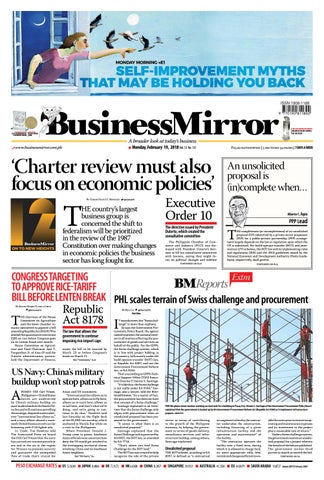
‘Charter review must also focus on economic policies’
T
By Elijah Felice E. Rosales
@alyasjah
he country’s largest business group is concerned the shift to federalism will be prioritized in the review of the 1987 Constitution over making changes in economic policies the business sector has long fought for.
Executive Order 10
The directive issued by President Duterte, which created the consultative committee
The Philippine Chamber of Commerce and Industry (PCCI) was dismayed with President Duterte’s decision to fill his consultative committee with lawyers, saying they might focus on political changes and sideline Continued on A16
2016 ejap journalism awards
business news source of the year
P25.00 nationwide | 5 sections 34 pages | 7 days a week
An unsolicited proposal is (in)complete when… Alberto C. Agra
ead
PPPC.LAgra Alberto
T
he completeness (or incompleteness) of an unsolicited proposal (UP) submitted by a private sector proponent (PSP) for a public-private partnership (PPP) arrangement largely depends on the law or regulation upon which the UP is submitted. For build-operate-transfer (BOT) and jointventure (JV) schemes, the BOT law and its implementing rules and regulations (IRR) and the 2013 guidelines issued by the National Economic and Development Authority (Neda Guidelines), respectively, shall govern. Continued on A15
CONGRESS TARGETING BMReports TO APPROVE RICE-TARIFF BILL BEFORE LENTEN BREAK PHL scales terrain of Swiss challenge and procurement Republic Act 8178 I T By Jovee Marie N. dela Cruz
By Rea Cu
@joveemarie
he chairman of the House Committee on Agriculture said the lower chamber remains committed to approve a bill amending Republic Act (RA) 8178 to abolish the quantitative restriction (QR) on rice before Congress goes on its Lenten break next month. House Committee on Agriculture and Food Chairman Jose T. Panganiban Jr. of Anac-IP said the Duterte administration, particularly the Department of Finance,
The law that allows the government to continue imposing rice-import caps
wants the bill to be enacted by March 23 or before Congress’s break on March 21. See “Congress,” A16
US Navy: China’s military buildup won’t stop patrols
A
BOARD USS Carl Vinson, Philippines—United States forces a re u ndeter red by China’s military buildup on man-made islands in the South China Sea and will continue patrolling the strategic, disputed waters wherever “international law allows us,” said a navy officer aboard a mammoth United States aircraft carrier brimming with F-18 fighter jets. Lt. Cmdr. Tim Hawkins told The Associated Press on board the USS Carl Vinson that the navy has carried out routine patrols at sea and in the air in the region for 70 years to promote security and guarantee the unimpeded flow of trade that’s crucial for
@ReaCuBM
Part One
Asian and US economies. “International law allows us to operate here, allows us to fly here, allows us to train here, allows us to sail here, and that’s what we’re doing, and we’re going to continue to do that,” Hawkins said last Saturday on the flight deck of the 95,000-ton warship, which anchored at Manila Bay while on a visit to the Philippines. W hen President Donald J. Trump came to power, Southeast Asian officials were uncertain how deep the US would get involved in the overlapping territorial claims involving China and its Southeast Asian neighbors. See “US Navy,” A2
PESO exchange rates n US 52.0240
T sounds sweet; but “Swiss challenge” is more than euphony. So says the Government Procurement Policy Board, the agency tasked to protect the national interest in all matters affecting the procurement of goods and services on behalf of the public. For the GPPB, the Swiss challenge system, which is in line with project bidding in the country, falls mainly under the build-operate-transfer (BOT) law, or Republic Act 6957, and not the Government Procurement Reform Act, or RA 9184. That is according to GPPB-Technical Support Office (TSO) Executive Director V Dennis S. Santiago. “It’s like this: the Swiss challenge is not really under RA 9184,” Santiago, also a lawyer, told the BusinessMirror. “As a matter of fact, the procurement law does not have that concept of a Swiss challenge.” Santiago explained in an interview that the Swiss challenge only aligns with procurement when an unsolicited proposal has been presented to the government. “It comes in when there is an unsolicited proposal.” Santiago explained that the Swiss Challenge tack is governed by RA 6957, the BOT law, as amended by RA 7718. “That’s where you find Swiss Challenge [in the BOT law].” The BOT law was created to help recognize the role of the private
This file photo shows workers working on steel rods for a building in Pasay City. Dennis S. Santiago of the Government Procurement Policy Board explained that the government is backed up by the Government Procurement Reform Act (Republic Act 9184) as it implements infrastructure projects. NONIE REYES
sector in terms of contributing to the growth of the Philippine economy, by helping the government in terms of goods delivery, consultancy services and infrastructure buildup, among others, Santiago explained.
Unsolicited proposal
THE BOT scheme, according to RA 6957, is defined as “a contractual
arrangement whereby the contractor undertakes the construction, including financing of a given infrastructure facility, and the operation and maintenance” of the facility. “The contractor operates the facility over a fixed term, during which it is allowed to charge facility users appropriate tolls, fees, rentals and charges sufficient to en-
able the contractor to recover its operating and maintenance expenses and its investment in the project plus a reasonable rate of return.” Under a Swiss challenge system, the government receives an unsolicited proposal for a project wherein the details of the bid are published. The government invites third parties to match or exceed the bid. Continued on A2
n japan 0.4866 n UK 72.9272 n HK 6.6508 n CHINA 8.2057 n singapore 39.5921 n australia 41.2550 n EU 64.8479 n SAUDI arabia 13.8727
Source: BSP (15 February 2018 )
BMReports BusinessMirror
A2 Monday, February 19, 2018
www.businessmirror.com.ph
PHL scales terrain of Swiss challenge and procurement Continued from A1
“In a situation where there is a Swiss challenge, there is no request from government to submit deeds or offers coming from bidders,” Santiago said. “Normally, it would be a bidder, consortium or joint venture, offering [or submitting to the] government [a project or proposal].” As for the complete details undertaken when the government receives an unsolicited proposal, Santiago said it would be the PublicPrivate Partnership (PPP) Center as the main entity knowledgeable about the complete process. “There’s a procedure actually, the PPP Center is the very relevant agency insofar as the BOT law is concerned,” he added. “So when the unsolicited proposal is offered to the government, it will be studied through the PPP Center. And when they see that it’s [the project is] okay, what they
US Navy. . .
Continued from A1
Trump’s predecessor, Barack Obama, was a vocal critic of China’s increasingly aggressive actions, including the construction of seven man-made islands equipped with troops, hangers, radar and missile stations and three long runways. China claims the South China Sea almost in its entirety and has challenged the US naval supremacy in the western Pacific. “We’re committed,”Hawkins told reporters. “We’re here.” The Trump administration has outlined
do after is they will now submit it for a Swiss challenge.”
The challenge
ACCORDING to Santiago, once the PPP Center gives the go-ahead for the proposed project, the original proponent’s proposal will be shown to other bidders to challenge. This, he said, is either for a chance to match the bid or submit a better bid for the proposal. The government is responsible for calling market operators that it deems may be able to challenge the original bid. Santiago told the BusinessMirror that when a bid from a challenger is received, the government will give time for the original proponent to counter the challenger’s bid. Doing so foster fairness or under the concept of fair play, he added. “That’s basically the Swiss challenge,” Santiago said. “But that a new security strategy that emphasized countering China’s rise and reinforcing the US presence in the Indo-Pacific region, where Beijing and Washington have accused each other of stoking a dangerous military buildup and fought for wider influence. Washington stakes no claims in the disputes but has declared that their peaceful resolution and the maintenance of freedom of navigation are in its national interest. US officials have said American warships will continue sailing close to Chinese-occupied features without prior notice, placing Washington in a continuing collision course with China’s interests. In January China accused the US of
entire regime is not in the Government Procurement Reform Act; it’s in the BOT law. If the question is ‘Do we have a Swiss challenge under RA 9184’?, [the answer is] we don’t. Because it [RA 9184] has a straightforward competition; we call it traditional procurement.” UNDER RA 9184, a traditional procurement entails for the government to prepare requirements for its various projects and then seek bids from market operators and bidders from the private sector. Government agencies procure goods, infrastructure and consultancy services to address their operational needs. “It’s [R A 9184] competitive in nature; all these bidders now will compete against each other. So in that competitive setup, one will become the winner,” Santiago said. “And that’s [the
winning bid] the lowest calculated responsive bidder if it is infrastructure. If it’s consultancy service, we call it highest-rated and responsive bid. If it’s for goods and works, we look at the lowest calculated and responsive bid. For services it’s the highest rated responsive bid.” The Government Procurement Reform Act streamlines processes in terms of the government’s purchase of goods, services and works. Goods include supplies or moveable materials, services include the purchase of either consultancy or expertise and works procurement include infrastructure or construction. The project is usually awarded to the company with the lowest bid. The Act applies to procurement regardless of source of funds, whether local of foreign, by all branches and instrumentalities of government, its departments, offices and
trespassing when the US guided missile destroyer USS Hopper sailed near the Chinese-guarded Scarborough Shoal, which Beijing wrestled from the Philippines in 2012, despite its proximity to the main northern island of Luzon. After voicing a strong protest, China said it would take “necessary measures” to protect its sovereignty. The nuclear-powered Carl Vinson patrolled the sea prior to its Manila visit but did not conduct a freedom of navigation operation, Hawkins said. “That’s not to say that we won’t or we can’t, but we have not, up to this point,”he said. There are reports that the Carl Vinson will also make a port call in Danang in Vietnam— another critical rival of China’s ambitions in
the South China Sea—as the first American aircraft carrier since the Vietnam War ended in 1975, but Hawkins declined to provide details of future trips. China has also opposed the Philippine military’s deployment of a Japanese-donated Beechcraft King Air patrol plane late-January to Scarborough, a Philippine official said on condition of anonymity because of a lack of authority to discuss the issue publicly. Chinese officials have relayed their objection to their Philippine counterparts, the official added. China and Japan have their own territorial rifts in the East China Sea. There was no immediate comment from Philippine military officials about China’s opposition to the
Procurement Act
agencies, including governmentowned and -controlled corporations and local government units.
Implementing rules
WHEN asked if RA 9184 should be reviewed, Santiago said the law was designed to adapt to the changing needs of the procurement environment. If changes have to be made, the government just revises the implementing rules and regulations (IRR), he said. The government only revised the IRR twice since these were issued in 2003. The first revision to the IRR was in 2009; the second in 2016. Santiago added he believes the major revisions on the IRR was done to help the law adapt to the more innovative ways the country’s procurement environment was changing. “ T he nice thing about the procurement law is that it has an IRR that you can change. The surveillance flights at Scarborough. US and Chinese officials have said they have no intention of going to war in the disputed sea, but their governments have projected their firepower and clout in a delicate play of gunboat diplomacy and deterrence. “We’re prepared to conduct a spectrum of operations, whether that’s providing humanitarian assistance, disaster relief in the time of an emergency, or whether we have to conduct operations that require us to send strike fighters ashore,” Hawkins said. “We don’t have to use that spectrum, but we’re ready to, in case we need to.” The US Navy invited journalists last Saturday onboard the 35-year-old Carl Vinson,
first IRR issued in 2003 was denominated as IRR-A. And then, eventually, in 2009 another IRR was issued, which we considered as the 2009 revised IRR,” Santiago said. “Now, because there are changes in the procurement environment, that is why you have to really update it, the last amendment was in 2016.” In January President Duterte said he wants to do away with the bidding process for public work projects and instead opt for the Swiss challenge scheme. Duterte said his idea could eliminate the chances of corruption and lessen chances of delay in terms of completing major projects. Santiago pointed out that for public biddings, the lowest-bid policy is not usually the route taken as the government awards the project to the company that complies with the technical requirements. To be continued
which was packed with 72 aircraft, including F-18 Hornets, helicopters and surveillance aircraft. President Duterte has tried to back down from what he said was a Philippine foreign policy that was steeply oriented toward the US, but has allowed considerable engagements with his country’s treaty ally to continue while reviving once-frosty ties with China in a bid to bolster trade and gain infrastructure funds. China, the Philippines, Vietnam, Taiwan, Malaysia and Brunei have long contested ownership of the South China Sea, where a bulk of the trade and oil that fuel Asia’s bullish economies passes through. AP
The Nation BusinessMirror
www.businessmirror.com.ph
Editor: Vittorio V. Vitug • Monday, February 19, 2018 A3
Go seen baring it all in Senate frigate-deal probe By Bernadette D. Nicolas
S
@BNicolasBM
pecial Assistant to the President Christopher Lawrence T. Go has “nothing to hide” and the public may expect him to “tell all” in Monday’s Senate probe on the controversial frigate deal.
“We look at Monday’s Senate investigation on the Philippine Navy acquisition project as a welcome opportunity for Special Assistant to the President [SAP] Christopher Go to shed light on this matter,” Presidential Spokesman Harry L. Roque Jr. said in a statement. “Expect Secretary Go to tell all, and as instructed by the President, he would likely demand for an open and transparent Senate inquiry to show that he—and the administration —has nothing to hide as he would squarely answer questions, in full view of the public.” Roque said the allegations against Go were just “fake news” being linked to the current administration, noting that it was the Aquino administration that selected the supplier of two frigates, including the combat management systems (CMS). “We reiterate that the allegations against SAP Go are untrue and unfounded. It was the Aquino administration that chose Hyundai Heavy Industries [HHI] as supplier of the two frigates, including the supply of the boat, the navigation, the communications and the combat-management systems. It was also during the previous administration that Hyundai was declared the responsive bidder and awarded the two frigates, including the CMS,” he said. “The whole truth would finally be known. Expect that the hearing would prove that allegations against SAP Go are just fake news being linked to the current administration,” Roque added. Aside from Go, Roque said he will be attending the hearing by the Senate Committee on National Defense and Security, together with Communications Secretary Martin M. Andanar and
PAF looking for new helicopter suppliers
M
ANILA—With the cancellation of the Bell 412 EPI contract from Bell Helicopter and Canadian Commercial Corp. (CCC), the Philippine Air Force (PAF) is now looking anew for suppliers of aircraft with similar capabilities. The possible suppliers and their respective countries would be determined by the research of the technical working group, PAF head Lt. Gen. Galileo Gerard R. Kintanar Jr. said last Saturday. This would follow the same procurement process instituted for the Bell 412 EPI contract, he added. “As of now we do not want to speculate. The [technical] working group will look into [for] any solution from the east and western countries,” Kintanar said. The Department of National Defense (DND) earlier issued a notice to CCC terminating the contract for the supply and delivery of 16 units of Bell 412 combat utility helicopters for the PAF. In a statement, DND Public Affairs Office chief Arsenio R. Andolong said this is in compliance with President Duterte’s directive and pursuant to the government procurement law (Republic Act 9184), which authorized contract termination for the convenience of the government. PNA
‘Whiff of corruption’ finished Duterte ally
P
resident Duterte sacked Social Security System (SSS) Commissioner Jose Gabriel La Viña for demanding a P26-million budget to fund his “social media” project, among other reasons. Presidential Spokesman Harry L. Roque Jr. revealed this in a statement released over the weekend, saying that La Viña also requested for a budget of P1.6 million per month for a media-advertising program. But Roque noted that both demands were denied. Aside from this, Roque said the former SSS commissioner also requested for the accreditation of seven brokers to handle SSS investments. However, these brokers could not meet the requirements, so the accreditation request was also denied. Roque added La Viña also embarked on a vilification campaign against four SSS executives who crossed his path, noting that there was a news conference where he spoke against these executives. Last year La Viña filed a complaint against the fund’s executive vice president for investments Rizaldy Capulong and three other officers whom he accused of “serious dishonesty and grave misconduct.” The officers included in the complaint were Social Security Commission Equities Investment Division chief Reginald Candelaria, Equities Product Development head Ernesto Francisco Jr. and Chief Actuary George Ongkeko Jr. “Two of the four executives resigned, and one is now a consultant of the secretary of finance,” Roque said. Last week Malacañang announced that the President had not renewed the appointments of La Viña and SSS Chairman Amado Valdez but gave no reasons for the decision. “The President has mentioned time and again that he will not tolerate even a whiff of corruption,” Roque said. La Viña, who is serving in a holdover capacity since July 2017, was a known Duterte ally and is the social-media manager during the President’s 2016 presidential campaign. Bernadette D. Nicolas
Justice Secretary Vitaliano N. Aguirre II. Asked whether President Duterte would likely watch Go’s testimony, Roque said in the briefing last Thursday: “I would think so. He would be very curious as to what will happen to that hearing.” Go, Duterte’s top aide, was dragged into the controversial deal to acquire P15.74 billion worth of frigates for the Philippine Navy because of allegations that he intervened by backing the South Korean firm as supplier. Go has previously denied his involvement with
the frigate deal and his denial was backed by Defense Secretary Delfin N. Lorenzana and former Navy Flag Officer in Command Vice Adm. Ronald Joseph Mercado. Lorenzana relieved Mercado from his post as Navy chief last December 18, citing loss of trust and confidence on the integrity and leadership of the naval officer, whom he had charged of insubordination for holding line for Thales Tacticos, which reportedly resulted in the project’s delay.
Mercado and the Navy’s technical working group members pushed for Thales Tacticos of the Netherlands as contractor for the CMS of the military’s frigate acquisition project while HHI, which bagged the contract for the delivery of two new frigates, selected Naval Shield of Hanwha Thales of South Korea as the CMS contractor. The Senate minority bloc filed a resolution calling for the inquiry into the implementation of the Armed Forces of the Philippines Modernization Act.
Economy
A4 Monday, February 19, 2018 • Editors: Vittorio V. Vitug and Max V. de Leon
BusinessMirror
www.businessmirror.com.ph
‘Lower system-loss caps to cut power bills’
T
By Butch Fernandez & Lenie Lectura
@butchfBM @llectura
he Energy Regulatory Commission’s (ERC) decision to lower the cap on the allowable rate of system losses that can be passed on to consumers will reduce electricity bills, Sen. Sherwin T. Gatchalian said over the weekend. System loss refers to unbilled power caused by pilferage and physical loss of energy when electricity
passes through distribution lines, which can be passed on to consumers as stated under Republic Act 7832,
or the Anti-Electricity and Electric Transmission Lines/Materials Pilferage Act of 1994. The ERC has mandated a staggered decrease in the maximum allowable pass-on charge, from 12 percent of total system losses in 2018 to 8.25 percent to12 percent in 2022 for electric cooperatives, and from 6.5 percent in 2018 to 5.5 percent in 2021 for private distribution utilities. “Lowering the recoverable system loss rate is a pro-consumer action that will reduce electricity rates and force electric companies to make their operations more efficient. I commend the ERC for making this move,” said Gatchalian, who is the chairman
of both the Senate Energy Committee and the Joint Congressional Power Commission. The system-loss caps set by the ERC are within the same neighborhood as those provided under Senate Bill (SB) 1623, otherwise known as the Recoverable System Loss Act, which was approved by the Senate on third and final reading last month. If passed into law, SB 1623 would set a standard cap of 10 percent for electric cooperatives, and 5 percent for private distribution utilities, respectively. Gatchalian, who is the principal sponsor of the Recoverable System Loss Act, said that the enactment of his bill into law would further strengthen the mandate of ERC to
closely monitor pass on system-loss charges and ensure accountability for noncompliance. SB 1623 mandates the ERC to conduct a periodic review every three years to determine whether the caps should be reduced further. This, the senator said, would compel ERC to safeguard consumer interests on a more regular basis, noting that it had been eight years since the body last lowered recoverable system-loss rates. Gatchalian’s bill would also require the ERC to conduct an annual review of system-loss charges to ensure that only allowable costs within the caps stipulated are being recovered. The review shall be based on the quarterly mandatory
Govt told: Reveal details of pending labor deal with Kuwait By Samuel P. Medenilla @sam_medenilla
A
mig r a n t a d v o c a t e group called on the government to disclose all the provisions of its pending labor bilateral agreement with Kuwait to protect overseas Filipino workers (OFWs). Migrante International expressed concern the new accord may still leave many OFWs in Kuwait vulnerable to abuse from their employers if it contains “insufficient protective provisions.” “We call on the Duterte administration to publicize the bilateral agreement it intends to sign with Kuwait with regards to the protection of Filipino workers and ensure that the voices of OFWs will be heard and their demands be included,” the group said in a statement. Last week Labor Secretary Silvestre H. Bello III said the bilateral agreement they are pursuing to be signed in Kuwait will focus on the protection of Filipino household service workers (HSW) in Kuwait. A bu l k of the estimated over 250,000 OFWs in Kuwait are HSWs. However, except for ensuring OFWs will not be forced to surrender their passports to their employers, Bello has yet to reveal the other provisions of the pending accord. T he labor chief said the signing of the new bilateral agreement will be among the conditions for the lifting of the existing deployment ban for aspiring OFWs, who are
bound for Kuwait. The Department of Labor and Employment (DOLE) imposed the ban as ordered by President Duterte after the remains of Joanna Demafelis, an OFW in Kuwait, was found in a freezer at her employers’ home. M i g r a nt e I nt e r n at io n a l blamed the administration for the death of Demafelis and other OFWs abroad for failing to address the “roots of forced migration.” “There’s still no let up to the ever-increasing number of brutal killings and executions perpetrated against OFWs in their host countr ies under Duter te’s watch,” Mig rante International said.
Government officials comfort Jessica Demafelis, center, sister of Joanna Demafelis, whose corpse was found in a freezer in Kuwait, as the wooden casket of Joanna's remains arrives at the Ninoy Aquino International Airport last Friday in Pasay City. The death of Joanna, allegedly in the hands of a couple in Kuwait, prompted the President Duterte to order the repatriation of overseas Filipino workers from the oil-rich nation in the Middle East. At left is Foreign Secretary Alan Peter S. Cayetano. AP/Bullit Marquez
to finish their contract with their employers, OFWs who will return to Kuwait for the new contract with the same employer, and seafarers who will travel to Kuwait to join their principals. The decision of the President for a total ban came following a series of alleged maltreatment cases against OFWs in Kuwait. Based on Memorandum Order 61, Mamondiong directed officials to prioritize the OFWs from Kuwait in their training programs
being offered by the TTIs. Mamondiong also ordered the regional-provincial-district directors and TTIs to seek out and contact the returning OFWs in their respective areas, in coordination with the Overseas Workers Welfare Administration so that they could receive immediate assistance. “ The beneficiaries shall be entitled to the following: free t r a i n i n g ; f r e e a s s e s s m e nt ; training support fund [TSF],”
Mamondiong said. The TSF provides food and transportation allowance worth P100 per training day. Apart from this, the agency has created programs for displaced OFWs based on the 17-point Reform and Development Agenda of Tesda under the Duterte administration. Based on its report, Tesda said up to 2,216 OFWs and their dependents have availed of its assistance. With Claudeth Mocon-Ciriaco
Report reveals emerging e-commerce trends in Southeast Asia
A
new report highlights the similarities and differences in online buying patterns in Southeast Asia’s e-commerce market, tracking mobile usage, conversion rate, basket size, and preferred payment method in six countries, including the Philippines. The white paper, entitled “State of eCommerce in Southeast Asia 2017,” published recently by iPrice, an online shopping aggregator, leveraged the company’s proprietary data from over 1,000 e-commerce players operating in the six largest Southeast Asian markets to unveil the online-shopping habits of their citizens. Aside from merchants from the Philippines, the report by the Kuala Lumpur-based firm also covers Indonesia, Malaysia, Singapore, Thailand and Vietnam. According to the paper, e-commerce in Southeast Asia in 2017 achieved a gross merchandise value of over $10 billion, up from $5.5 billion in 2015, with a stunning 41 percent compound annual growth rate over the past couple of years. A major finding is that the share of
mobile e-commerce traffic increased by an average of 19 percent over the past 12 month. The report said the increase was steepest in Vietnam (+26 percent) and slowest in Philippines (+15 percent), with Indonesia leading the pack with an 87 percent share of mobile traffic. “SEA eCommerce is a mobile-first economy, leapfrogging all the Western economies when it comes to the importance of mobile commerce in the traffic generated by each eCommerce operator,” the paper said. Improving the conversion ratethe percentage of web site visits that turn into a product purchasecan have a dramatic effect on the profitability of a business, the report also found. Vietnam merchants are leading the way with a conversion rate 30 percent higher than the average. Singapore displays the second highest conversion rate, closely tied with Indonesia. The Philippines and Thailand are tied in last place. Despite the meteoric rise of mobile traffic in the region, desktop still trumps mobile in conversion rate. Noted the report: “Vietnam
Improved infra, eased regulations to boost trade, investments in Asean
M
Tesda’s offer
TO help them upgrade their skills or give them expertise to help them reintegrate in the local economy, the Technical Education and Skills Development Authority (Tesda) will give assistance to returning overseas Filipino workers (OFWs) from Kuwait through its free technical-vocational (tech-voc) courses. Tesda Director General Guiling Mamondiong also directed all regional, provincial, district directors and administrators of Tesda Technology Institutions (TTI) to give retraining assistance to returning OFWs from Kuwait who will be affected by the total deployment ban of OFWs to Kuwait starting February 19. Exempted from the total ban are OFWs on vacation in the Philippines and will go back to Kuwait
report submissions by the distribution utilities to the ERC, which should contain their Segregated System Losses. Administrative sanctions shall also be handed down to ERC officials who failed to discharge their responsibilities or comply with the requirements detailed in the measure. “ The strict compliance and constant review mandated by the Recoverable System Loss Act will compel electric companies to improve their infrastructure in order to avoid further losses, thus making delivery of electricity across power lines more reliable and efficient. In the end, this will result in lower electricity rates for consumers,” Gatchalian said.
Consistently across countries, there is a dip between 5 p.m. and 7 p.m., [when] people typically commute and have dinner, before getting back into online shopping until 11 p.m.”—report
and Indonesia are above the average mobile conversion rate. Conversion rate for desktop is on average 1.7x times higher than the average mobile conversion rate. In terms of basket size, the metric that measures the average total
amount spent per order by customer over a defined period of time-Singapore’s merchants scored highest with a basket size of $91, or 3.7 times higher than their Vietnamese counterparts, with an average basket size of $23. This, said the report, indicates the correlation between GDP, as Singapore has the highest GDP per capita in the region, while Vietnam has the lowest among the six. Another finding is that basket size is consistently higher on desktop versus mobile, indicating that consumers prefer to finalize larger purchases on desktop. As to what time Southeast Asian consumers shop the most, the number of orders is highest between 9 a.m. and 5 p.m., when people are traditionally at work or school, with the exception of Singaporeans, whose shopping peaks at 10 p.m. “Consistently across countries, there is a dip between 5 p.m. and 7 p.m., [when] people typically commute and have dinner, before getting back into online shopping until 11pm,” the report said. Another consistent trend is the
peak conversion rate occurring on Wednesday, making this the best time for merchants to push their offers. In contrast, e-commerce merchants suffer a dip in conversion rate over the weekend. “The main factor contributing to the dip in conversion rate on the weekend is, not surprisingly, the large increase in the percentage of mobile usage,” the paper found. Finally, on payment solutions, merchants have had to offer a more diverse range of payment methods, as low credit card penetration, except for Singapore, precludes a one-sizefits-all approach. Cash on delivery is offered by more than 80 percent of the players in both Vietnam and Philippines. Bank transfer is very popular in Indonesia, Vietnam and Thailand, with 94 percent, 86 percent and 79 percent of merchants in these countries offering it. In Thailand and Vietnam, almost half of merchants offer offline point of sales, while paying by installment proves to be very popular in both Vietnam (47 percent of merchants) and Indonesia (42 percent). Philexport News & Features
ember-countries of the Association of Southeast Asian Nations need to improve physical infrastructures and streamline regulatory processes in an effort to facilitate trade and investments in the region, according to a report from state think tank Philippine Institute for Development Studies (Pids). In a report titled “Asean connectivity: The hows and whys,” Pids Information Officer Neille Gwen de la Cruz noted that connectivity is important to the region’s continued economic growth and an integral factor to realize the vision of an Asean Community by 2025. Asean leaders have adopted the Master Plan on Asean Connectivity 2025, which has the goal of achieving a “seamlessly and comprehensively connected and integrated Asean that will promote competitiveness, inclusiveness and a greater sense of Community” by the year 2025. “Right now, Asean is recognized as one of the world’s largest economic zones. Making it easier to transport goods and services, reducing cumbersome processes, or simply opening more ways for people to move around the region would help facilitate the growth of Asean SMEs (small and medium enterprises),” de la Cruz said. Citing an Asean Secretariat data, she said SMEs comprise 90 percent of companies in the region and contribute to, as much as 60 percent of the region’s GDP, making them the driving force of economic growth in the Asean. “One of the main advantages of having an integrated region is having a seamless trade. Once the means to move from one country to another has been provided, there would be a freer flow of goods, services and workers within and across the region, bolstering the perception that the region is an attractive market,” she added. The Pids report noted that an interconnected Asean is also envisioned to promote knowledge sharing and cultural exchange through improved physical infrastructure, streamlined regulatory processes and harmonized procedures and standards. These are expected to create significant positive impacts on the region’s SMEs, as well as tourism and human resources, among others, it said. “Promoting Asean connectivity will also boost tourism by capitalizing on the diverse history and culture of the region. Easing visa requirements across Asean would encourage greater mobility of people,” de la Cruz added. PNA
Agriculture/Commodities
www.businessmirror.com.ph
BusinessMirror
Editor: Jennifer A. Ng • Monday, Feburary 19, 2018
A5
PHL pork supply up 68.2% in January
T
he country’s pork inventory in January rose by 68.2 percent to 23,239.01 metric tons, from 13,815.59 MT a year ago, according to the latest data from the National Meat Inspection Service (NMIS).
Figures from the attached agency of the Department of Agriculture showed that the bulk, or nearly 95 percent of the January pork inventory consisted of imports. The volume of imported pork in cold storages reached 22,003.65 MT, higher than the previous year’s 12,291.35 MT. Of the total pork inventory, some 8,000 MT were stored in Region 3. The National Capital Region and Region 4 A accounted for 6,400 MT and 5,450 MT, respectively. Compared to the inventory in December, NMIS data showed pork in local cold storages during the period was lower by some 4,000 MT. The agency said its survey covered pork in accredited commercial and in-house cold storages, or those found in slaughterhouses and meat processing plants. It also included carcass, primal parts and specialty cuts. Data from the NMIS also indicated that the January chicken inventory rose by almost 4 percent to 17,242.22 MT, from 16,586.09 MT a year ago. Of the total chicken inventory, local poultry accounted for the bulk at 10,573.95 MT. Imports in cold storages reached 6,668.27 MT. Last year imports in cold storages amounted to 9,027.04 MT, higher than the inventory of local poultry at 7,559.05 MT, according to NMIS data. The agency said its survey covered only accredited facilities. It did not include fresh-chilled chicken and mechanically deboned meat and those already in distribution channels. The government allows traders to import pork and chicken via the so-called minimum access volume scheme of the World Trade Organization. Pork and chicken imports within MAV are slapped a tariff of 30 percent and 40 percent, respectively. Last year meat imports rose by nearly 7 percent to a recordhigh volume of 691,462.564 MT due to the growing demand of Filipino consumers for processed-meat products. Data from the Bureau of Animal Industry (BAI) indicated that pork accounted for 44.18 percent of meat imports. Last year pork imports expanded by 10.65 percent to 305,479.806 MT, from the 2016 record of 276,066.99 MT. “Pork cuts, bellies and deboned meat constituted about 30.19 percent or [92,234.802 MT], which are mostly used by meat processors, while the 69.81 percent equivalent [213,245.044 MT] are commonly imported by meat traders, which includes fats, rind/ skin and other products,” the BAI said. Data from the BAI also showed that total chicken imports last year grew by nearly 4 percent to 244,104.419 MT, from the previous year’s 234,742.766 MT.
Biggest commodity winner of 2018 rallies on drought in Argentina
T
o understand why soybean meal is the best-performing commodity so far this year, talk to Ariel Striglio, a 52-year-old farmer in Argentina’s Santa Fe province. Since January, his fields of soy and corn have received about 3.5 centimeters of rain (1.4 inches). That’s not even a fifth of what’s normal. Temperatures are also higher. “The heat is unbelievable—we’re using air conditioning all the time right now, which isn’t the norm,” Striglio said. “I’m looking at soy yield losses of 30 percent.” Soybeans are one of the world’s most common feed crops. The oilseeds are crushed to make high-protein meal that’s sold to livestock producers. The dry conditions gripping the heart of Argentina’s farming region are a key price driver because the country is the No. 1 exporter of meal. For meat producers like Tyson Foods Inc. and Sanderson Farms Inc., tighter supplies could end up raising feed costs at a time when Americans are projected to eat more meat than ever before. The drought has already pushed most active futures of soy meal up 19 percent in 2018. That’s the largest gain among the 22 raw materials tracked by the Bloomberg Commodity Index.
Shrinking crop prospects
The United States Department of Agriculture (USDA) on February 8 cut its outlook for Argentina’s soybean crop to 54 million metric tons from 56 million projected in January. Local estimates are even lower. The Buenos Aires Grain Exchange predicts 50 million, while AgriPac consultancy forecasts 47.2 million. If the last number becomes reality, it would be the smallest harvest since 2012, USDA figures show. The exchange said on February 15 that most beans are in poor or very poor condition. On the Chicago Board of Trade, soy meal for May delivery reached $381.20 per 2,000 pounds last Friday, a record for the futures contract that debuted in December 2015. Hedge funds are positioning for more gains. Money managers increased their net-long holding by 37 percent to 70,991 futures and options in the week ended February 13, according to US Commodity Futures Trading Commission data released last Friday. That’s the highest in almost a year. The figure measures the difference between bets on a price increase and wagers on a decline. Bloomberg News
A6
AseanMonday
Monday, February 19, 2018 • Editor: Max V. de Leon
BusinessMirror
Bangladesh gives to Myanmar official the names of refugees for repatriation
D
HAKA, Bangladesh—A Bangladesh Cabinet minister gave a list of 8,032 Rohingya refugees to his Myanmar counterpart to begin repatriations of the Muslim minority under a November agreement between the two countries. Bangladesh Home Minister Asaduzzaman Khan said last Friday the list contained the members of 1,673 Rohingya families. He did not explain how the names had been chosen. About 700,000 Rohingya Muslims have fled army-led violence in Buddhist-majority Myanmar since last August and are living in refugee camps in Bangladesh. The two countries originally agreed to begin the repatriations last month, but they were delayed by concerns among aid workers and Rohingya that they would be forced to return and face unsafe conditions in Myanmar. Hundreds of Rohingya were reportedly killed in the violence, and many houses and villages burned to the ground. UN refugee chief Filippo Grandi told the Security Council last Tuesday that conditions aren’t right for Rohingya to voluntarily return because Myanmar hasn’t addressed their exclusion and denial of rights. Grandi also said Rohingya are still fleeing Myanmar and thousands more are expected to leave. Khan said he presented the list to Myanmar Home Minister Lt. Gen. Kyaw Swe, who is visiting
8,032
The number of Rohingya refugees whose names were on the repatriation list Bangladesh Home Minister Asaduzzaman Khan gave to visiting Myanmar Home Minister Lt. Gen. Kyaw Swe Bangladesh’s capital, Dhaka, to discuss the repatriations and other border issues. “The Myanmar side cordially accepted the list, and they sought our help to make it happen,” Khan told reporters. Kyaw Swe did not speak to the reporters. Khan said officials in Myanmar would choose 6,500 people next Tuesday to be sent back in an initial phase. He would not say exactly when the repatriation would start. “They said they will take them all in three phases,” he said. “No specific timeframe has been decided yet when they will start returning.” Khan said Bangladesh expressed its desire for safe and secure condi-
Bangladesh Home Minister Asaduzzaman Khan (second from right) receives Myanmar Home Minister Kyaw Swe (left) in Dhaka, Bangladesh, on February 16. Kyaw Swe, on a three-day visit to Bangladesh, told the country’s president that Myanmar is ready to take back Rohingya Muslims who fled violence, though Bangladesh said it wanted the hundreds of thousands of refugees to have a safe and dignified return. AP
tions and a proper infrastructure for the refugees’ return. Impoverished Bangladesh has been overwhelmed by the refugee onslaught and is eager for them to return to Myanmar. Last Thursday Kyaw Swe told Bangladesh President Abdul Hamid that Myanmar is ready to take back displaced people, Presidential Spokesman Joynal Abedin said last Friday. Abedin also quoted Kyaw Swe as saying that Myanmar will implement the recommendations of a commis-
sion led by former UN SecretaryGeneral Kofi Annan to improve conditions in Rakhine state, where the refugees previously lived. The recent violence erupted after an underground insurgent group, the Arakan Rohingya Salvation Army, attacked security outposts in Rakhine in late-August last year. The military and Buddhist mobs launched retaliatory attacks on Rohingya that were termed “clearance operations.” Myanmar’s security forces have
been accused of atrocities against the Rohingya, including killing, rape and arson. The United Nations and the US have described the army crackdown as “ethnic cleansing.” The Rohingya have long been treated as outsiders in Myanmar, even though their families have lived in the country for generations. Nearly all have been denied citizenship since 1982, effectively rendering them stateless. They are denied freedom of movement and other basic rights. AP
www.businessmirror.com.ph
South Korea joins US, Thailand in military drill
S
ATTAHIP, Thailand—Troops from South Korea joined their Thai and US counterparts last Saturday in an amphibious vehicle landing drill as part of Southeast Asia’s largest multinational military exercise. The 300 soldiers from South Korea who joined 2,000 US Marines and Thai soldiers in eastern Thailand marked the highest numbers participating from the East Asian country since it joined the Cobra Gold exercise in 2010, and comes at a time when tensions are particularly high on the Korean Peninsula. Tensions in the Koreas primarily involve concerns over North Korea’s nuclear capability, which has led to saber-rattling declarations in Washington and Pyongyang. “Our friends in the Republic of Korea, South Koreans, we stand by them. We work with them,” said Gen. Robert Neller, commandant of the US Marine Corps. “We are allies. We continue to coordinate and keep pressure on. Hopefully, through diplomatic means, we would be able to come to some successful resolution of the problem.” Some 11,075 service members from 29 countries are taking part in this year’s exercise, with Thailand, the US, Singapore, Japan, South Korea, Indonesia and Malaysia being the seven main participants. There are 6,800 US troops attending the exercise. Ships taking part in Saturday’s exercise included the US amphibious assault ship USS Bonhomme Richard and the South Korean landing ship Cheon Ja Bong. The weeklong exercise, centered around the Sattahip Royal Thai Marine Corps Base in the eastern province of Chonburi, includes humanitarian components, such as evacuation drills, as well as traditional military exercises, such as the amphibious landing. AP
Malaysia’s ex-PM Mahathir aims to topple protégé; allies with former foes
P
ERAI, Malaysia—Mahathir Mohamad, who led Malaysia for decades with dagger-sharp rhetoric and increasingly autocratic ways, is 92 and in frail health. But he wants his old job back. To do it, Mahathir, one of the world’s most durable political survivors, has engaged in yet another act of reinvention. This time, he is allying himself with opposition figures he once repressed in the name of beating his former protégé, Najib Razak, whom he helped make prime minister in 2009. The man who defined much of Malaysia’s political history is, in effect, standing before both the country as a whole and the new opposition allies he once persecuted and asking them to ignore the past. But he is certainly not apologizing. “When it comes to the election, forget about everything and think only of winning,” Mahathir said at a recent campaign rally in Penang. “I know I’m not popular with all the people,” he said, continuing with a hint of sarcastic edge. “Remember, I am ‘cruel’ or a ‘pharaoh.’ That’s all right. In politics, you get called all types of names.”
Leader of the opposition
Mahathir is campaigning as the leader of the opposition coalition, Pakatan Harapan, and if he does rise to power again in parliamentary elections this year, he will become the oldest head of government in the world. But in vying for the post he left in 2003, when he was 78, Mahathir faces an uphill battle against Najib even though the prime minister stands accused of taking $731 million in government funds and depositing the money into his personal bank account. The incumbent has a formidable
grip on power, plentiful campaign funding and the advantage of parliamentary district lines that are skewed in his favor—in part because of the political system Mahathir helped establish. Najib heads the governing United Malays National Organization, Mahathir’s former party, which has held power since independence in 1957. “Mahathir’s candidacy is a kind of Hail Mary pass from the opposition that has spent the past three years beset by infighting,” said Ibrahim Suffian, director of the Merdeka Center, an independent polling agency.
Semitic comments, including calling Jews “arrogant” and accusing them of deliberately trying to wreck Malaysia’s economy. He also helped establish a strong central government that Najib has exploited to squelch any independent investigation of the money transfers to his personal account.
Lawsuits vs Najib
Running with foe’s wife
Running with him for deputy prime minister is Wan Azizah Wan Ismail, whose husband, opposition leader Anwar Ibrahim, was imprisoned under Mahathir for five years on corruption and sodomy charges. Now, Mahathir is urging members of the opposition to put aside their past enmity and unite behind his leadership. “This time, we are together to replace the government,” he said. “The government has been there for more than 60 years. It is time it goes.” A doctor before entering politics, Mahathir remains sharp, and his memory of people and events is exceptional. But he has a history of heart problems, and his aides carefully limit his daily schedule to conserve his strength. At a rally in the industrial town of Perai, he took the podium just before 11 p.m. and spoke for nearly 30 minutes without notes to a standingroom-only crowd of about 2,500 supporters. He was clear and forceful, despite coughing at times. But soon after his appearance, a planned interview with The New York Times was canceled because of a lingering respiratory ailment.
Former Malaysian Prime Minister Mahathir Mohamad addresses the General Assembly on September 25, 2003. Wikimedia Commons
On February 9 he was admitted to the National Heart Institute in Kuala Lumpur, Malaysia’s capital, for six days for treatment of a chest infection. The willingness of his onetime foes to line up behind Mahathir’s candidacy illustrates the weakness of an opposition that has never held power and is fragmented by ethnic divisions and personal rivalries. Without Mahathir, analysts say, the four-party opposition coalition has no leader who can unify its factions and appeal to rural, ethnically Malay voters, who make up a decisive voting bloc. “The reason Mahathir was named as the candidate for prime minister is quite straightforward: There is nobody else,” said Wan Saiful Wan Jan, chief executive of the Institute for Democracy and Economic Affairs in Kuala Lumpur.
August election
Najib, 64, who last faced voters in 2013, must call an election by August. Some predict the vote could come as early as April because it would ensure the absence of Anwar, 70, who was imprisoned three years ago under Najib after a second sodomy conviction. A skilled orator who nearly defeated Najib in 2013, Anwar is scheduled to be released from prison in June. His supporters say all the charges against him have been politically motivated.
Modernized Malaysia
AS prime minister from 1981 to 2003, Mahathir modernized the country’s economy and built landmark projects, including the Petronas towers in Kuala Lumpur, which at one point were the world’s tallest buildings. He occasionally set off international outrage with anti-
The US Justice Department is conducting a criminal inquiry into more than $3.5 billion missing from the investment fund known as One Malaysia Development Bhd., which Najib oversaw. The Justice Department also has filed numerous lawsuits to seize $1.7 billion in assets, including jewelry, real estate and Hollywood movie rights, that it says Najib’s family members and associates acquired with money from the fund and laundered through US financial institutions. Najib has denied any wrongdoing. And President Donald J. Trump greeted him warmly at the White House last September, despite the Justice Department’s corruption case.
Unhappy with Najib
When he stepped down in 2003, Mahathir chose Abdullah Ahmad Badawi to succeed him as prime minister and Najib as his deputy. But by 2009, he was unhappy with Abdullah’s performance and pushed him out, paving the way for Najib to take over. “Yes, I picked him,” Mahathir said in a 2016 interview with The Times. “I encouraged Badawi to pick Najib as his deputy, which means he would become the next prime minister. I was instrumental in the fall of Badawi also.” Mahathir broke with the governing United Malays National Organi-
zation two years ago because of his unhappiness with Najib. “This particular prime minister believes he can buy support,” Mahathir told The Times last September. “With money he can buy everybody. He needs to have money. So how does he get the money? He steals the money.” Under Najib, he said, Malaysia is no longer a democracy. “For us it is a dictatorship,” he added. “The rule of law is no longer enforced now.”
Role: Win the election
Mahathir will turn 93 in July, and there is little expectation he would serve out a full five-year term. In effect, he is serving as a stand-in for a future leader, but for whom is not entirely clear. “His role is to win the election and hold the position until someone else comes,” Wan Saiful said. Some in the opposition hope it would be Anwar. In the 1990s he was Mahathir’s deputy prime minister and likely successor. But the two had a falling out, and Anwar was sent to prison by a court widely seen as carrying out Mahathir’s wishes. Because of Anwar’s most recent conviction, he is barred from holding elective office for five years after his release. The ban could be reversed with a royal pardon or a successful appeal. This month Anwar appeared in court on his latest appeal. In a brief interview as he stood surrounded by more than a dozen guards, he said he accepted Mahathir’s candidacy because the former prime minister had embraced the goals of the opposition. “We are not supporting Mahathir as a person,” he said. “We are supporting the reform agenda he has committed to.” New York Times News Service
www.businessmirror.com.ph
The World BusinessMirror
Editor: Lyn Resurreccion • Monday, February 19, 2018 A7
China says it may retaliate if US imposes tariffs on steel, aluminum
C
hina said proposed United States tariffs on imported steel and aluminum products are groundless and that it reserves the right to retaliate if they are imposed.
The US recommendations, unveiled by the Commerce Department last Friday, aren’t consistent with the facts, Wang Hejun, chief of the trade remedy and investigation bureau at China’s Ministry of Commerce, said in a statement posted on its web site. Commerce Secretary Wilbur Ross said the United States may impose quotas on imports of aluminum and steel, including a tariff of at least 24 percent on steel imports from all countries. While it is the strongest indication yet that President Donald J. Trump’s administration is ready to take action on its protectionist agenda, Ross said “it wouldn’t surprise us” if the measures were challenged. The US already has excessive protections on domestic iron and steel products, according to Wang. “If the final decision impacts China’s interests, China will certainly take necessary measures to protect its own rights,” Wang said.
If the final decision impacts China’s interests, China will certainly take necessary measures to protect its own rights.” —Wang American steel companies and steelworker unions have been pushing Trump to follow through on his promise to protect the industry. China’s trade partners have complained for years that its industry unfairly benefits from state subsidies, and dumps its products at below-market prices. While China only accounts for about 1 percent of US steel imports, it could challenge United States
action at the World Trade Organization, a process that could take years. China has long been at the epicenter of global overproduction of steel. But the trade dynamics are shifting as aluminum exports take center stage. In January China boosted its shipments of the lightweight metal for a third month, as domestic supplies spill overseas, while steel cargoes shrank to the lowest in nearly five years as strong domestic growth mops up production and environmental curbs trim capacity. Rather than tariffs on all imports, Trump may opt for a more “surgical” approach, Ross suggested at a meeting with lawmakers last week. On steel, for example, the president could go with the recommended option that would levy a tariff of 53 percent on imports from 12 countries—a list that includes China, Russia, India and South Korea—but allow exemptions for allies, such as Japan, Germany and Canada. South Korea’s trade ministry met with local steelmakers last Saturday and later issued a statement saying it will reach out to the US before America makes a final decision on tariffs to minimize any impact on its exports. Japan is viewing this as more of a security issue, said Yasuji Komiyama, director of the metal-industries division at Japan’s
UK farmers also face confusion on Brexit
S
Ministry of Economy, Trade and Industry. The Commerce Department may invoke a seldom-used section of the 1962 Trade Act, which allows the president to impose tariffs without congressional approval. Komiyama said steel and aluminum shipped to the US from Japan don’t pose any threats to American security. “This an issue within the US government. Nothing has been decided and, therefore, the Japanese government doesn’t have any further comment,” he said. Still, Kobe Steel Ltd. warned there could be ramifications. “We need to look more closely into this, but if these measures are enacted, it would be difficult for the industry to avoid any impact,” an official for the steelmaker said. JFE Holdings Inc., Japan’s secondbiggest steelmaker, said it would discuss a response with related parties after looking more closely at the US announcement. India’s steel industry, which vies with Japan as the world’s No. 2 after China, probably won’t be hurt, according to KK Pahuja, president of the Indian Stainless Steel Development Association, in a report in the Business Standard. Stainless steel “is not a big-ticket item, since the quantity is not very high,” Pahuja told the newspaper. India itself imposes extensive trade barriers on Chinese steel.
pare a thought for British farmers after the country’s exit from the European Union (EU). “Brexit will inevitably introduce friction to trading routes,” the House of Commons’ Environment, Food and Rural Affairs Committee said in a report calling for more funding to help food producers prepare and adopt policies. Prime Minister Theresa May is running out of time to unite her Conservative Party around a plan for Brexit, with ministers split over how close the United Kingdom should remain aligned to the EU after it leaves the bloc in March 2019. Those seeking a complete break from European Union rules want the United Kingdom to be able to sign new trade deals with non-EU countries, though critics say that risks accepting lower standards in key industries including agriculture. The European Union is the UK’s biggest agricultural trading partner, accounting for 60 percent of Britain’s exports and 70 percent of its imports, according to the report. The United Kingdom’s food and farming industry generates more than £110 billion ($155 billion) a year and employs one in eight people, it said. If Britain leaves the EU without a free-trade agreement, its trade with the bloc would revert to World Trade Organization tariffs that are higher for agriculture than for other goods and services, the committee said. The committee warned against diluting standards to reach deals: “Brexit should be an opportunity to improve, not undermine, our global reputation for quality.” The committee also said setting tariffs too high would raise costs for consumers; removing them could put many farmers out of business. The government must say how it will ensure information-technology systems and infrastructure are ready for the smooth trade of agriculture produce.
Bloomberg News
Bloomberg News
The World BusinessMirror
A8 Monday, February 19, 2018
www.businessmirror.com.ph
US-Russia tension flares over nuke arms control
A
S tensions escalate between Russia and the United States, the nuclear-armed former Cold War rivals are risking the future of decades-old arms control agreements that have helped to keep a strategic balance and prevent the risk of accidental war. The conflict played out at a global security conference in Germany where Russia aired grievances about the US, and the Trump administration said a new nuclear doctrine unveiled this month doesn’t increase risks. Germany, caught in between, was among European countries voicing concern as both big powers modernize their nuclear arsenals. US National Security Adviser H.R. McMaster defended the US nuclear posture, which envisages building more low-yield bombs, and renewed accusations that Russia is violating a 1987 treaty that bans the deployment of intermediate-range missiles on land. “We will not allow Russia any of the power to hold the populations of Europe hostage,” he said last Saturday in Munich, appearing on stage moments after Russian Foreign Minister Sergei Lavrov listed a litany of complaints about US-led military expansion since the collapse of Communism.
Election meddling, Syria clash
Efforts to bridge the divide are stymied by a poisoned atmosphere as the US responds to alleged Russian meddling in the 2016 presidential vote, with 13 Russians indicted last Friday, including a businessman close to President Vladimir Putin. The two powers are also clashing in Syria, where US strikes killed more than 200 Russian mercenaries who attacked American-backed forces on February 7, according to people familiar with the matter. “In the US the animus is so tremendous that punishing Russia is
For not defending 2016 election result
Trump rebukes McMaster
P
We will not allow Russia any of the power to hold the populations of Europe hostage.” —McMaster the thing to do,” Dmitri Trenin, head of the Carnegie Moscow Center, said in an interview. “I see the demise of the entire arms control regime.” While the two countries have fulfilled the terms of another landmark nuclear weapons reduction treaty, New Strategic Arms Reduction Treaty (Start), that accord expires in 2021, and there’s political pressure on President Donald J. Trump to let it expire because of the alleged Russian noncompliance with the Intermediate-Range Nuclear Forces Treaty (INF) treaty. Moscow, in turn, accuses Washington of itself breaking the intermediate-range pact. So far, no formal negotiations are taking place on either issue.
European fears
Javier Solana, a Spaniard who served as North Atlantic Treaty Organization secretary-general, and Sigmar Gabriel, Germany’s acting foreign minister, expressed alarm. “The most likely theater for nuclear conflicts would once again be here, in the center of Europe,” Gabriel
H.R. McMaster, US national security adviser, speaks at the Security Conference in Munich, Germany, on February 17. Sven Hoppe/dpa via AP
told the conference. Graham Allison, a Pentagon adviser under former US President Ronald Reagan when the two superpowers were negotiating arms control, said he’s skeptical momentum would be found to revive Start and the INF. Arms control was developed primarily to prevent the “insane” possibility that Russia and the US would annihilate each other due to miscalculation or accident, despite not even wanting to go to war, said Allison, now a professor of government at Harvard University. “Those risks remain today.” That’s something the Russians can agree on. According to Sergei Karaganov, a former Kremlin foreign policy adviser, the situation could get “much more dangerous” than during the Cuban missile crisis in 1962, when the world was on the brink of nuclear war.
‘No limits’
Under New Start, which followed
from the 1991 Start treaty and was signed in 2010, the Russian and US arsenals are restricted to no more than 1,550 deployed strategic warheads on no more than 700 deployed strategic missiles and bombers. If that long-range missile pact isn’t prolonged and the INF collapses, “you have a situation where there are no limits on Russian and American nuclear forces,” said Steven Pifer, a former top State Department official and arms control expert. In addition, Russia and the US would stop exchanging data on each other’s nuclear arsenals and permitting regular inspections. “It would be less predictable, less secure, less stable,” Pifer said. Russia would respond to any US move to station land-based intermediate-range missiles in Europe by deploying similar missiles to target “all the bases where these weapons will be,” said Igor Korotchenko, director of the Center for Analysis of World Arms Trade in Moscow. “And the US
can’t stay safe over the ocean—we’ll create the same risk for the US as they do for us in Europe,” he said.
Losing sight
Sam Nunn, a former US senator and a prominent nonproliferation campaigner, says he’s increasingly concerned that “both countries can lose count of their strategic interests.’’ Some experts, such as Thomas Graham, ex-White House adviser under George W. Bush, believe Russia and the US will blink when faced with the prospect of stepping into a void without the security of arms control. Russia has proposed a five-year extension to New Start, to 2026, though it’s tying that to fixing complaints about the way the US has complied with the treaty, the Interfax news service reported on February 16. “The chances are diminishing every day,’’ said Konstantin Kosachyov, head of the foreign affairs committee of the Russian upper house of parliament. Bloomberg News
Coalition ties ‘very strong’ amid sex scandal–Turnbull
A
ustralian Prime Minister Malcolm Turnbull says he can “absolutely” continue working with his deputy after the pair met in a bid to avoid fracturing the coalition government, amid the fallout from Barnaby Joyce’s extramarital affair with a former staffer. “It’s always very important to meet, to work through the various challenges and issues that we face, but the important thing is Barnaby and I are working closely together as we always have,” Turnbull told reporters in Melbourne last Sunday. The nation’s two most senior lawmakers talked for more than an hour in Sydney last Saturday and agreed they need to work better together in the future. Turnbull said he and Joyce, who is the deputy prime minister and leader of the Nationals party, had a “frank and warm, friendly, good, constructive meeting.” “There are no issues between the Liberal and National parties at all,” Turnbull said, characterizing the relationship between the two factions as “the most enduring political alliance in Australian history and it will continue.” Turnbull lambasted Joyce last Thursday over an affair that ended his 24-year marriage and accused him of making a “shocking error of judgment.” Joyce, 50, who leads the junior party in the coalition, hit back last Friday, saying the criticism was “inept” and “unnecessary.” Turnbull said last Sunday he didn’t apologize to Joyce because “there’s nothing to apologize for.” Turnbull’s predecessor, former Prime Minister Tony Abbott, said last Saturday that if politicians wanted to give each other advice, they should do so by knocking on their door and picking up the phone to talk directly.
Australian Deputy Prime Minister Barnaby Joyce (right) listens to Prime Minister Malcolm Turnbull (center) during a session in the Australian Parliament in Canberra on February 15. AP/Rod McGuirk
“As a general rule, one party doesn’t give another party public advice,” the ABC quoted Abbott as saying. The war of words between the pair risks undermining the Liberal-National coalition, which already trails in opinion polls ahead of elections due by next year. While Turnbull’s Liberals are the dominant force in the partnership, the party relies on support from Joyce’s rural-based Nationals to govern. The saga has played out on the front pages of Australia’s newspapers for days, with Joyce confirming that his now partner Vikki Campion
is pregnant with his child. The revelations have damaged father-offour Joyce’s credibility as a family man and he’s also facing claims he allowed Campion to work in his and another ministerial office during the affair—potentially breaching the ministerial code of conduct. In a break with tradition, Turnbull last Thursday told parliament that Joyce wouldn’t serve as acting prime minister when he visits Washington this week for talks with President Donald J. Trump and would instead be taking leave to consider his position. He later heaped criticism on Joyce, saying
the affair had caused “terrible hurt and humiliation” to his family and new partner. The prime minister also announced an overhaul of the ministerial code and barred senior lawmakers from sexual relations with their staff. Joyce returned fire last Friday, saying the comments had “caused further harm” and signaled he’d resist any attempts to force his resignation as Nationals leader. Only a vote of his own lawmakers could oust Joyce and none of them have publicly asked for his resignation. Veterans Affairs Minister Michael McCormack—considered the most likely National lawmaker to replace Joyce—did not rule out a leadership challenge last Saturday but said he didn’t want to get “too far ahead of myself,” the Sun-Herald reported. Any challenge to Joyce would most likely happen at a party room meeting when parliament returns in just over a week. “There is nothing that we dislike more than implied intervention into the party processes of the National Party,” Joyce said last Friday. “We are an independent unit and make our own decisions.” Bill Shorten, the main opposition Labor Party leader, said the public squabbling showed the government was in disarray and challenged Turnbull to fire his deputy. The deputy prime minister position is traditionally given to the Nationals leader under long-standing arrangements between the parties. “This is an absolutely full-blown political crisis,” Shorten said. “If the No. 2 in the government says the No. 1 in the government is inept, we’ve got a big problem.” The spat risks returning Australia to political turmoil that voters had hoped was behind them. The nation has churned through six prime ministers since 2007, amid infighting in both the Liberals and Labor. Bloomberg News
resident Donald J. Trump rebuked his national security adviser, H.R. McMaster, last Saturday, saying in a tweet that his aide had neglected to defend his 2016 victory when discussing US claims that Russia meddled in the election. “General McMaster forgot to say that the results of the 2016 election were not impacted or changed by the Russians and that the only Collusion was between Russia and Crooked H, the DNC [Democratic National Committee] and the Dems,” Trump tweeted, using a derogatory epithet for Hillary Clinton. McMaster last Saturday told an audience at the Munich Security Conference that Russia engaged in a “sophisticated form of espionage” against the US in a futile attempt at disruption. He referred to Special Counsel Robert Mueller’s charges last week against 13 Russian nationals and a Saint Petersburg-based “troll farm,” accused of seeking to interfere in the US presidential election in 2016. “The evidence is now really incontrovertible and available in the public domain, whereas, in the past it was difficult to attribute,” McMaster said on a panel last Saturday. Russian attempts to influence politics in the US and elsewhere are “just not working,” McMaster said. Earlier last Saturday, Trump referenced posts by Rob Goldman, Facebook vice president of ad sales, that said the goal of the sophisticated Russian influence operation was to divide Americans and sow fear and hatred. Facebook verified the authenticity of Goldman’s posts. Among the evidence Goldman pointed to in a series of posts was that 56 percent of the Facebook ads bought by the indicted Russians were displayed after the November 8 election, while users still considering who to vote for would have seen only about 44 percent. In a follow-up tweet, Goldman attempted to soften his earlier comments by saying that “the Russian campaign was certainly in favor of Trump. The point is that the misinformation campaign is ongoing and must be addressed.” Trump also suggested that the Federal Bureau of Investigation (FBI) overlooked a warning about the February 14 shooting at a Florida high school that killed 17 people because the bureau was too busy investigating him. “Very sad that the FBI missed all of the many signals sent out by the Florida school shooter. This is not acceptable. They are spending too much time trying to prove Russian collusion with the Trump campaign—there is no collusion. Get back to the basics and make us all proud,” Trump tweeted. Bloomberg News
The World BusinessMirror
www.businessmirror.com.ph
Monday, February 19, 2018
A9
Even as markets shook, many investors held steady
N
EW YORK—This month’s sell-off for stocks marked the first big test of investors’ mettle in years. And many ended up doing exactly what the experts were recommending: hold steady.
Even as stock markets tumbled around the world, putting a halt to an unusually calm and strong ride upward, many investors resisted the urge to sell in a panic and lock in the losses. Others plugged even more cash into their trading accounts after seeing prices for S&P 500 index funds drop by 10 percent within a couple weeks. At Fidelity’s retail brokerage, for example, customers continued to put in more buy orders than sell orders after the S&P 500 began falling from its peak set on January 26. Younger investors led the charge into stocks. “Millennials and Gen Xers are definitely taking advantage of these prices and taking advantage of the sell-off,” said Scott Ignall, senior vice president and head of
online brokerage technology at Fidelity. Experts typically recommend that investors stay the course when stocks go through a bout of volatility. Stock prices can suddenly bounce up and down, as they did this month when the S&P 500 followed up its worst week in twoplus years with its best week in five years. But stocks aren’t supposed to be short-term holdings, and they’ve historically delivered better returns than other investments when held for the long term, such as a decade. Beyond that, many voices along Wall Street were encouraging investors to “buy this dip.” Worries about higher inflation and interest rates sparked the sell-off, but many analysts said they expected corporate
Millennials and Gen Xers are definitely taking advantage of these prices and taking advantage of the sell-off.”–Ignall
A woman walks through the front doors at the Fidelity Investments office on Congress Street as the ticker displays stock market numbers in Boston on February 6. AP/Stephan Savoia
earnings and the global economy to stay strong, which should help stock prices recover. The buying likely played a role in what’s been a quick rebound for stocks. As of Friday’s close on Wall Street, the index had roughly halved its loss and is down only 4.9 percent from the record. Consider what millennials customers were doing in their Fidelity brokerage accounts from January 26 through February 12, when the S&P 500 lost nearly 8 percent.
Of every $100 in new dollars and money getting reallocated, $87 went into stocks or stock funds. That indicates an even stronger appetite for stocks than millennials had shown in the placid, record-setting year before the sell-off, when $75 of every $100 went to stocks. Generation X investors showed an even more pronounced preference for stocks during the downturn, with stocks making up $86 of every $100 in new and reallocated dollars. That’s up from $67 in the prior year.
Older investors were also buying stocks, but at a lower rate than their younger counterparts, and at a lower rate than they had been buying at during the year before the downturn. Baby boomers instead put much more money into money markets and cash. “Every investor is different, with different goals and risk tolerance, so it’s hard to say whether their activity is right or wrong,” Ignall said. But “having a plan, sticking to it and being able to adapt to that plan is the most important thing for our clients, and I’m glad they’re able to do that through these market conditions.” Fidelity’s figures marry with data from others around the industry. Vanguard, for example, looked at how much trading individual investors and 401(k) participants were doing during the tumultuous run from February 2 through Feb-
ruary 9. Ninety-seven percent did nothing, with nary a trade. At TD Ameritrade, younger investors also led the way in buying as markets tumbled. Through the first week or so of February, millennials deposited 1.5 times more into their accounts than Generation X and five times more than baby boomers, said JJ Kinahan, chief market strategist at TD Ameritrade. All this comes with the caveat that many market watchers along Wall Street are warning of continued volatility. After their unusually calm 2017, markets are bound to be jumpier given that the Federal Reserve is raising interest rates and slowly winding down the stimulus it put in place after the Great Recession. Put another way: This sell-off may have been the first test for investors in a while, but more are coming. AP
President, or luxury towers? Either way, Trump is the rage in India
G
URGAON, India—When the Trump family jet lands in India, the family member taking a tour of the world’s largest democracy—with a Secret Service detail in tow—won’t be the president on a diplomatic mission. It will be his eldest son, Donald Trump Jr., on a sales trip. But Indians might be forgiven for not making much of the distinction. The visit by the younger Trump, intended to help sell more than $1 billion in luxury residential units being built by the Trumps and their local partners, has been promoted with newspaper advertisements that read: “Trump has arrived. Have you?” The younger Trump’s weeklong itinerary of cocktail parties, dinners and events with real-estate brokers, business leaders and prospective buyers comes as President Donald J. Trump is working to strengthen ties between the two countries. The president—who enjoys widespread popularity in India— was greeted by Prime Minister Narendra Modi with a bear hug in Washington last June, and the two leaders have frequently discussed greater military cooperation and ramping up trade. Trump has also taken a harder line toward Pakistan and China, two of India’s rivals. Two weeks ago, Trump phoned Modi pledging “to strengthen security and economic
cooperation” between India and the United States.
‘Bizarre’
The overlap in India between father and son creates a spectacle with few parallels in business and diplomacy. The younger Trump is scheduled to arrive on Monday on a Boeing 757 nicknamed Trump Force One, because the president crisscrossed the United States on the plane during the campaign. The Trump family earned as much as $3 million in royalties in 2016 from ventures in India, according to the president’s financial disclosure report. And Ivanka Trump made her own trip to India last November, in her capacity as a member of Trump administration, just as sales were about to start on some of the residential projects. “The idea that the president’s son would be going and shilling the president’s brand at same time Donald Trump is president and is managing strategic and foreign relations with India—that is just bizarre,” said Daniel S. Markey, who helped coordinate South Asia policy at the State Department during the George W. Bush administration. There are no formal federal rules that prohibit Trump Jr. from pursuing his business interests; he is a private citizen. And even though his father is still a beneficial owner of the family business, he is not subject to conflict of interest laws, as
the president is exempt. The White House, asked if Trump Jr.’s trip gave even an appearance of a conflict of interest, declined to comment on the matter.
Biggest international market
India is the Trump Organization’s biggest international market, with four real-estate projects underway. The largest is here in Gurgaon, a fast-growing city outside New Delhi with a litany of Fortune 500 companies and a skyline filled with skyscrapers. The Trump development encompasses two towers with a total of 254 “ultra luxury” units, according to the company, each selling for as much as $1.5 million. The luxury apartment buildings near the Trump development in Gurgaon have names like Palm Springs and Central Park, even as they overlook pothole-ridden highways. The Trumps and their partners are offering buyers the opportunity to become “members of the Trump family,” with the promise of exclusive amenities, such as an infinity swimming pool, a billiards room and valet services. The marketing materials, however, don’t mention the president—his name and image, as well as that of his daughter Ivanka, who joined his administration, were removed from brochures,
A Trump-branded complex is under construction in Guragon, a fast-growing city outside New Delhi on February 16. India is the Trump Organization’s biggest international market, with four real-estate projects underway. The Trumps and their partners pitch buyers the opportunity to become “members of the Trump family.” The New York Times
web sites and billboards.
Confusion among Indians
Still, confusion among Indians is evident. “I had no idea that Trump built property around the world before this development was launched,” said Hitesh Khanna, who is helping sell units at the Trump towers in Gurgaon through a local real-estate brokerage firm. “I just thought he was president.” Khanna’s boss, Rajiv Bansal, predicted the presidential connection would create enough buzz to entice buyers. Khanna was working out of a roadside tent near the construction site, with a tattered emerald
green felt carpet at its entrance. “Everyone in India knows who the US president is,” Bansal said. “It’s a status symbol. This is a big brand, the president of the United States’s name will be on it.”
A decade of cultivating relationship
Trump Jr., in an interview in New York last week, said he had spent nearly a decade “cultivating relationships in India,” and the company was “now seeing the response of that effort.” To that point, the newspaper advertisements in India featured large photographs of him, arms crossed and staring into the camera.
The younger Trump said his itinerary did not include interactions with government officials in an intentional effort to steer clear of politics. “We certainly won’t get involved in that,” he said, when asked if the company would seek concessions or incentives for the developments from Indian officials. “Not at all.” He is scheduled, nonetheless, to speak at the Global Business Summit in New Delhi, sponsored by a prominent Indian newspaper and a bank, who say the event will “showcase India’s rise in world affairs.” Trump Jr. is billed as a keynote speaker, along with Modi. New York Times News Service
A10 A4 Monday, February 19, 2018
The World BusinessMirror
www.businessmirror.com.ph
Calls for gun control grow louder after Florida shooting
P
ARKLAND, Florida—Pressure is growing for tougher gun-control laws after a mass shooting at a Florida high school, with thousands of angry protesters at state rallies demanding immediate action from lawmakers, and more demonstrations planned across the country in the weeks ahead.
Organizers behind the Women’s March, an anti-Trump and femaleempowerment protest, called for a 17-minute, nationwide walkout by teachers and students on March 14. The Network for Public Education, an advocacy organization for public schools, announced a day of walkouts, sit-ins and other events on school campuses on April 20, the anniversary of the 1999 shooting at Columbine High School in Colorado that left 12 students and one teacher dead. Plans for the protests circulated widely on social media last Saturday, as students, parents, teachers and neighbors gathered to express their grief over the fatal shooting of 14 students and three staff members at the Marjory Stoneman Douglas High School in Parkland. Hundreds showed up at rallies in
Fort Lauderdale, about 40 kilometers away, and in Saint Petersburg, 400 km northwest, to demand action on gun-control legislation. “The fact that we can’t go to school and feel safe every day, when we’re supposed to feel safe, is a problem,” said Fabiana Corsa, a Florida high-school student who attended the Fort Lauderdale gathering. Corsa said legislators were “sacrificing students” in order to get money from the National Rifle Association. The crowd at the rally chanted: “Vote them out!” and held signs calling for action. Some read: “#Never Again,” “#Do something now” and “Don’t Let My Friends Die.” The rallies were held as new details emerged about the suspect, Nikolas Cruz. Authorities say Cruz, 19, was a former student at Stoneman Doug-
Cathy Kuhns (right) hugs Ana Paula Lopez (left) as they stand on a street corner holding up anti-gun signs in Parkland, Florida, on February 17. As families begin burying their dead, authorities are questioning whether they could have prevented the attack at the high school where a gunman, Nikolas Cruz, took 17 lives. AP/Brynn Anderson
las who had been expelled, had mental-health issues and had been reported to law enforcement before he used a legally purchased semiautomatic rifle to take the lives of 17 people on Wednesday. From a mosaic of public records, interviews with friends and family and online interactions, it appears Cruz was unstable and violent to himself and those around him—
and that, when notified about his threatening behavior, law enforcement did little to stop it. Cruz’s mother died last November, and his father died years ago. He reportedly left a suburban Palm Beach County mobile home where he had been staying after his mother’s death because his benefactor gave him an ultimatum: you or the gun. The Sun-Sentinel reported that
Iraqi victories remain fragile as US reduces troops
US Army 1st Lt. Kyle Hagerty speaks to a shepherd in rural Anbar on a reconnaissance patrol near a coalition outpost in western Iraq on January 27. Thousands of United States troops and billions of dollars spent by Washington helped bring down the Islamic State group in Iraq, but many of the divisions and problems that helped fuel the extremists’ rise remain. AP/Susannah George
Q
AIM, Iraq—From their outpost on Iraq’s westernmost edge, United States 1st Lt. Kyle Hagerty and his troops watched civilians trickle into the area after American and Iraqi forces drove out the Islamic State (IS) group. They were, he believed, families returning to liberated homes, a hopeful sign of increasing stability. But when he interviewed them on a recent reconnaissance patrol, he discovered he was wrong. They were families looking for shelter after being driven from their homes in a nearby town. Those who pushed them out were forces from among their “liberators”—Shiite militiamen who seized control of the area after defeating the IS militants. It was a bitter sign of the mixed legacy from the US’s intervention in Iraq to help defeat the militants. American-backed military firepower brought down the IS “caliphate,” but many of the divisions and problems that helped fuel the extremists’ rise remain unresolved. The United States-led coalition, which launched its fight against the IS in August 2014, is now reducing the numbers of American troops in Iraq, after Baghdad declared victory over the extremists last December. Both Iraqi and US officials say the exact size of the drawdown has not yet been decided. The United States and Iraqi commanders here in western Iraq warn that victories over IS could be undercut easily by a large-scale withdrawal. Iraq’s regular military remains dependent on US support. Many within Iraq’s minority communities view the US presence as a buffer against the
Shiite-dominated central government. Still, Iranian-backed militias with strong voices in Baghdad are pushing for a complete US withdrawal, and some Iraqis liken any American presence to a form of occupation. That has left an uncomfortable limbo in this area that was the last battlefield against the extremists. Coalition commanders still work with Iraqi forces to develop long-term plans for stability even as a drawdown goes ahead with no one certain of its eventual extent.
Hearts and minds—again
“Let’s go win us some hearts and minds,” Sgt. Jonathan Cary, 23, joked as he and Hagerty and the patrol convoy set off from a base outside the town of Qaim, evoking a phrase used in American policy goals for Iraq ever since the 2003 US-led invasion that ousted Saddam Hussein. After just a few hours moving on foot across farmland and orchards to a cluster of modest houses, Hagerty realized the families he thought were returnees to the area were, in fact, newly displaced. Their homes in Qaim had been confiscated by the government-affiliated Popular Mobilization Forces (PMF), made up mainly of Shiite paramilitary fighters backed by Iran. “Our end goal is a stable Iraq, right?” Hagerty said later, back at the base. “But when you see stuff like that, it makes you wonder if they are ever going to be able to do it themselves.” After victories against IS, the PMF has built up a presence in many parts of Sunni-majority provinces, including western Anbar. It formally falls under the command of the prime minister,
but some Iraqi commanders accuse the PMF of being a rival to government power. PMF flags line highways crisscrossing Anbar. At a PMF checkpoint outside al-Asad airbase—a sprawling complex used by both Iraqi and coalition forces—US convoys are regularly stopped for hours while busloads of PMF fighters are waved through. US Marine Col. Seth Folsom works closely with the branches of Iraq’s security forces— Sunni tribal fighters and the Iraqi army—who are increasingly concerned about the rise in power of the PMF. Iran has given no indication of dialing back its support after the defeat of IS extremists. “The biggest question I get now is, ‘how long can we count on you being here?’” Folsom said of his conversations with Iraqi commanders and local politicians. That decision ultimately rests with Iraq’s political leadership, he said. “I guess some people could see that as a copout, but at the same time it’s not my place as a lowly colonel to define how long the US presence is going to be.”
‘Forward line of freedom’
For the senior officers leading the current fight against IS, decades of US military intervention in Iraq has defined their careers. The top US general in Iraq—Lt. Gen. Paul Funk—served in Iraq four times: in the Gulf war in 1991; in the 2003 invasion; in the surge when some 170,000 American troops were serving in Iraq in 2007; and most recently in the fight against IS. “It will definitely be positive,” Funk said of the legacy of the US role against IS in Iraq. “People see their young men and women out here defeating evil. That’s a positive thing.” On a recent flight from Baghdad to a small US outpost in northern Syria near Manbij—a trip that traversed the heart of the battlefield with IS for the past three-and-a-half years—Funk described the future of the fight as ideological and open-ended. “The problem is people believe it’s already over, and it’s not,” he said. “Beating the ideology, destroying the myth, that’s going to take time.” Touching down outside an orchard on the perimeter of the Manbij base, Funk exclaimed: “Welcome to the front line of freedom!” Funk predicts the ideological fight could take years and easily require US troop deployments elsewhere. He said that is one reason he believes it’s so important to visit US troops on the current front lines—to show them “the American people believe in their purpose.” “We have got to recruit the next generation,” he said. Many of the young US troops interviewed by The Associated Press said they didn’t know anything about the IS group when they enlisted. AP
Florida’s Department of Children and Families (DCF) investigated when Cruz posted a video on the social-media network Snapchat showing him cutting his arms in 2016. “Mr. Cruz has fresh cuts on both his arms,” the Florida DCF abuse hot line was told in August 2016, the paper reported. “Mr. Cruz stated he plans to go out and buy a gun. It is unknown what he is
buying the gun for.” According to the paper, DCF’s investigation was completed that on November12. The agency concluded Cruz had not been mistreated by his mother, was receiving adequate care from a mental health counselor and was attending school. At school, Cruz routinely fought with teachers, was accused of swearing at staff and was referred for a “threat assessment” in January 2017, two months after the DCF investigation concluded, The New York Times reported last Saturday, citing school disciplinary records it obtained. The records show he was suspended several times in the 20162017 school year and was frequently absent. They also show that Cruz attended at least six schools, including a school for students with emotional problems, the newspaper said. Cruz had been diagnosed with autism, a neurological disorder that often leads to social awkwardness and isolation, and attention deficit hyperactivity disorder. The Federal Bureau of Investigation said a person close to Cruz called the FBI’s tip line and provided information about Cruz’s weapons and his erratic behavior. The caller was concerned Cruz could attack a school. The agency acknowledged the tip should have been shared with the FBI’s Miami office and investigated, but it was not. AP
Military maneuvers prompt EU tug-of-war over development bank
A
S the European Union pushes for a new role in military matters, the bloc has thrust its development bank into the center of a policy struggle that reveals an old fissure over the very nature of the EU project. The European Investment Bank (EIB) is getting prodded to be bolder about lending to defense companies by a France-led group that faces resistance from some other European Union nations, including in Scandinavia, according to officials who spoke on the condition of anonymity because the deliberations are confidential. The standoff has forced the EIB, which is owned by EU governments, into a balancing act meant to boost support for security initiatives while stopping short of adding weapons and military equipment to the list of projects eligible for financing by the lender. “You have member-states who are adamantly against changing the list, and then you have member-states who are adamantly for changing the list,” Alexander Stubb, a vice president of the EIB and former Finnish prime minister, said in an interview in Brussels this month. “We have had to be quite prudent. It’s an area that is obviously at the core of national sovereignty.” The EIB does in Europe what the World Bank does around the globe: It funds small companies, infrastructure, environmental projects and innovation, to the tune of €78 billion ($97 billion) last year, in a bid to help stimulate economic growth. Now, faced with Russian aggression, Islamic terrorism and United States calls for stronger European defense capabilities, the bloc is also looking to the 60-year-old EIB to do more in the security field, where the lender’s support is limited to technologies with both civilian and military uses—so-called dualuse goods, such as radars and satellites. The push echoes attempts in the 1950s to establish a European Defense Community, which faltered and gave way to economic and monetary integration in Europe. France has an ally in the European Commission, the EU’s executive arm, which proposed in 2016 to loosen the rules so the EIB can also lend for actual defense projects. It is this initiative that has left EU governments deadlocked and the EIB searching for ways to squeeze more out its current lending remit for security. Since the commission proposal, the Luxembourg-based lender has made a €40-million loan to Avio SpA in Italy for the development of rocket motors. The
EIB is also evaluating lending €25 million to €30 million for apartment blocks in France that house the families of soldiers and a similar amount for a French military-civilian hospital. Another area where brainstormers at the EIB believe it can further exploit the scope for supporting dual-use technologies is cybersecurity, which has moved rapidly up the western political agenda because of a sharp rise in hacker attacks on computer systems.
Modern warfare
“The line between war and peace has been blurred,” Stubb said. “Cybersecurity, whether it’s linked to energy or banking or what have you, is a form of modern warfare, and that can be addressed. So we shouldn’t be old-fashioned.” As the EIB ventures into such new lending territory, European governments are pressing ahead with 17 projects that mark the first use of EU-treaty provisions on enhanced security and defense cooperation among member countries. The EIB is assessing whether support would be merited for any of these initiatives, which range from a “European Medical Command” to common armored vehicles. With a wide investor base and triple-A credit rating, the EIB may have a bottomline reason to avoid touching the lending criteria themselves: the risk that institutional investors, many of which have ethical codes, would stop buying the bank’s bonds. Its lending activities are funded mainly by bond sales, which are slated to total €60 billion this year. “We are staying outside of purely military affairs because we’re still a bank that has clear ethical standards and codes,” Stubb said. “We have the full trust of our institutional investors.” The body that oversees the ethical guidelines of Norway’s wealth fund, which held $2.1 billion of EIB bonds at the end of 2016, declined to comment on possible changes to the bank’s lending criteria. In an e-mailed response to questions this month, the Council on Ethics said its code of conduct “is intended only to prevent investments in companies producing certain types of weapons, not in all forms of weapons/ defense industry.” For those pressing for military projects to be added to the EIB’s eligibility list, Stubb has a clear message: “We’re serious about security and defense,” but “I don’t foresee the list being changed anytime soon.” Bloomberg News
www.businessmirror.com.ph
Banking&Finance BusinessMirror
Editor: Jun B. Vallecera • Monday, February 19, 2018 A11
E-commerce in PHL third largest in Southeast Asia
I
nternet commerce across Southeast Asia, also known as e-commerce, was worth $50 billion in 2017, according to a Google Temasek report. But a more detailed report published by the iprice Group operating out of Kuala Lumpur show the bulk of transactions exceeded $10 billion in gross merchandize value (GMV) and conducted over mobile platforms as opposed to desktop purchases. The GMV on firsthand goods of more than $10 billion represented compound annual growth rate of 41 percent, from only $5.5 billion in 2015, according to the Google Temasek report. Angela Marie Gratela, content marketing executive at iprice, said mobile e-commerce transactions demonstrated unstoppable growth during the period by expanding an average 19 percent over 12 months and accounting for 72 percent of all e-commerce traffic in the Internet. E-commerce transaction was largest in Indonesia, where it accounted for 87 percent, followed by Thailand, where it owns 79 percent of market. The Philippines was
third largest, where e-commerce owns 76 percent, Gratela said. In one of the countries surveyed was desktop-based purchases accounted for more than 30 percent of internet traffic, she quickly added. E-commerce conversion, indicating web site visits turning into actual purchases, was highest in Vietnam at 1.3 times and lowest in the Philippines where it stood at only 0.8 times. Vietnam’s conversion rate was higher than even Singapore’s 1.1 times. The numbers indicate the low level of correlation between the conversion rate and the level of maturity between each e-commerce market, Gratela said. Data from iprice also show that while e-commerce transactions were fastest in the mobile segment, the conversion rate was substantially higher in the desktop segment. According to iprice data, which used the average mobile conversion rate in Southeast Asia are reference, the conversion rate for desktop was
1.7 times higher than the average mobile conversion rate. In terms of basket size, indicating the average amount spent for each online purchase by a customer was highest in Singapore, followed by the Philippines, with Vietnam at the bottom of the rankings. “The basket size results to be closely correlated to the GDP per capita of each country. Singapore has the highest GDP per capita [$90,530], while Vietnam has the lowest GDP per capita [$6,880]. Relatively, Singapore’s merchants score highest with a basket size of $91, 3.7 times higher than their Vietnamese counterparts, with
BAP welcomes deposit-reserve cut
T
he reduction in the banks’ deposit reserves should soon translate to higher lending and a welcome move given the country’s multiyear infrastructure buildup program, the influential Bankers Association of the Philippines (BAP) said. “In a few weeks, we expect that BAP member-banks will be able to extend additional credit to consumers and enterprises that require adequate funds for their personal and business needs,” BAP Managing Director Benjamin Castillo said. The BAP is among the top financial associations in the country, with its members coming from the top universal, commercial and foreign lenders in the country. The association welcomed the
rather surprise move last Thursday that put an end to the long wait for changes in one of the highest reserve requirement ratios (RRR) in the region. The deposit ratio is that portion of the depositors’ balance that banks keep idle in the vaults of the Bangko Sentral ng Pilipinas (BSP) that may not be used for loans and investments. Just a week after the policy rates were kept frozen and unchanged, the seven-man Monetary Board of the BSP reduced the banks’ RRR by one percentage point, bringing it lower to 19 percent, from 20 percent at present. The reduction in the depositreserve ratios takes effect on the reser ve we e k b e g i n n i ng M a rc h 2. Bianca Cuaresma
an average basket size of $23,” the iprice said. Its data also show the average order value to be consistently higher on desktops than on mobile platforms ranging from 8-percent to 20-percent conversion rate in any country in Southeast Asia and an indication of consumer preference for completing larger purchases over desktops than on mobile. Such purchases typically also happen between 9 a.m. and 5 p.m. across all six Southeast Asian countries in the survey, except in Singapore, where online purchases peak at 10 p.m. “Considering the average number of order of the local country
as reference [100 percent], the number of orders is highest between 9 a.m. and 5 p.m., when people are traditionally at work or school, with the exception of Singaporeans, who seem to enjoy evening shopping more than other countries, peaking at 10 p.m. Consistently across countries, there is a dip between 5 p.m. and 7 p.m., were people typically commute and have dinner, before getting back into online shopping until 11 p.m.,” the iprice reported. Peak days were Wednesdays and the preferred mode of payment was cash on delivery 80 percent of the time in both the Philippines and Vietnam. The iprice said this
had “structural” reasons, chief among them the low credit-card penetration in Ho Chi Min City and Manila. “Bank transfer is another very popular payment method across SEA, with respectively 94 percent, 86 percent and 79 percent of merchants in Indonesia, Vietnam and Thailand offering it. In Thailand and Vietnam, almost 50 percent of merchants offer off-line point of sales [ie., 7 Eleven]. Pay me nt b y i n s t a l l me nt s proves to be very popular [and increasingly so] in both Vietnam [47 percent of merchants] and Indonesia [42 percent],” according to iprice. Jun B. Vallecera
Green Monday BusinessMirror
A12 Monday, February 19, 2018
www.businessmirror.com.ph • Editor: Lyn Resurreccion
Warming is accelerating sea-level rise
W
ASHINGTON—Melting ice sheets in Greenland and Antarctica are speeding up the already fast pace of sea-level rise, new satellite research shows.
A t t h e c u r r e nt r a t e , t h e world’s oceans on average will be at least 2 feet (61 centimeters) higher by the end of the century compared to today, according to researchers who published in Monday’s Proceedings of the National Academies of Sciences. Sea-level rise is caused by warming of the ocean and melting from glaciers and ice sheets. The research, based on 25 years of satellite data, shows that pace has quickened, mainly from the melting of massive ice sheets. It confirms scientists’ computer si mu l at ion s a nd i s i n line with predictions from the United Nations, which releases
regular climate-change reports. “It’s a big deal ” because the projected sea-level rise is a conservative estimate and it is likely to be higher, said lead author Steve Nerem of the University of Colorado. Outside scientists said even small changes in sea levels could lead to flooding and erosion. “Any flooding concerns that coastal communities have for 2100 may occur over the next few decades,” Oregon State University coastal flooding expert Katy Serafin said in an e-mail. Of the 3 inches of sea-level rise in the past quarter century, about 55 percent is from warmer water
The intersection of 8th Street and Atlantic Avenue is flooded in Ocean City, New Jersey, after the storm surge from Superstorm Sandy flooded much of the town on October 30, 2012. New satellite research shows that global warming is making seas rise at an ever-increasing rate. Scientists say melting ice sheets in Greenland and Antarctica is speeding up sea-level rise, so that by the year 2100 on average oceans will be 2 feet higher than today, probably even more. AP/Mel Evans
edited the study. Cazenave is one of the pioneers of space-based sealevel research. Global sea levels were stable for about 3,000 years until the 20th century when they rose and then accelerated due to global warming caused by the burning of coal, oil and natural gas, said climate scientist Stefan Rahmstorf of the Potsdam Institute in Germany, who wasn’t part of the study. Two feet of sea-level rise by the end of the century “would have big effects on places like Miami and New Orleans, but I don’t still view that as catastrophic” because those cities can survive—at great expense—that amount of rising seas under normal situations, Nerem said. But when a stor m h it s l i ke 2012’s Superstor m Sandy, sealevel r ise on top of stor m surge can lead to record-setting d a m a ges, resea rc hers s a id . Some scientists at the American Geophysical Union meeting last year said Antarctica may be melting faster than predicted by Monday’s study. Greenland has caused three times more sea-level rise than Antarctica so far, but ice melt on the southern continent is responsible for more of the acceleration. “Antarctica seems less stable than we thought a few years ago,” Rutgers climate scientist Robert Kopp said. AP
Any flooding concerns that coastal communities have for 2100 may occur over the next few decades.”—Serafin
expanding, and the rest is from melting ice. But the process is accelerating, and more than three quarters of that acceleration since 1993 is due to melting ice sheets in Greenland and Antarctica, the study shows. Li ke weat her and c limate,
US office to replace Obama rule on methane emissions
China’s coal country shivering for cleaner air
W
ASHINGTON—The Interior Department is replacing an Obamaera regulation aimed at restricting harmful methane emissions from oil and gas production on federal lands. A rule being published in the Federal Register this week will replace the 2016 rule with requirements similar to those in force before the Obama administration changed the regulation. The Interior Department had previously announced it was delaying the Obama-era rule until January 2019, arguing that it was overly burdensome to industry. Officials said then that the delay would give the federal Bureau of Land Management (BLM) time to review the earlier rule while avoiding tens of millions of dollars in compliance costs to industry. Methane—the main component of natural gas—is frequently wasted through leaks or intentional releases during drilling operations. An estimated $330 million a year in methane is wasted on federal lands, enough to power about 5 million homes a year. The new rule announced last Monday marks at least the fourth time the Trump administration has moved to delay, set aside or replace the Obama-era rule, which was finalized in late-2016. The rule forced energy companies to capture methane that’s burned off or “flared” at drilling sites because it pollutes the environment. Many companies consider the rule unnecessary and overly intrusive, but environmental groups warn that methane emissions from oil and gas operations are the second-largest industrial contributor to climate change in the United States. Methane is far more potent at trapping heat than carbon dioxide but does not stay in the air as long. Methane pollution also poses a risk to public health, especially to those who suffer from asthma or other breathing difficulties. The new rule comes after a
federal judge rejected a bid by the Trump administration to roll back the rule last fall. The Republican-controlled Senate upheld the Obama rule last May in a vote that surprised and angered many conservatives and delighted environmentalists. US Magistrate Judge Elizabeth Laporte of the United States District Court for the Northern District of California said in October that Interior had failed to give a “reasoned explanation” for changing the Obamaera rule and had not offered details on why an earlier analysis by the Obama administration was faulty. Laporte’s order reinstated the 2016 rule, but BLM later delayed the rule until 2019. The rule announced last Monday is intended to be a permanent replacement for the Obama rule. The public has 60 days to comment, with a final rule expected later this year. House Natural Resources Committee Chairman Rob Bishop hailed the latest proposal on how to handle methane emissions on federal lands. “ T he prev ious administration scorned domestic energy development and crafted the prior rule to deliberately stif le” energy production, said Bishop, Republican-Utah. The new rule will “promote investment in federal and tribal lands so that economies in the West can grow,” he said. Fred Krupp, president of the Environmental Defense Fund, said the Obama-era rule required oil and gas companies to “take common-sense and cost-effective measures to reduce preventable leaks and venting of methane” at drilling sites. The new proposal by Interior Secretary Ryan Zinke “would only serve to reward the least-responsible actors in industry at a time when other companies are moving forward to tackle methane waste,” Krupp said, citing a voluntary program by large energy companies to reduce methane emissions at drilling sites nationwide. AP
Q
IAOLI, China—A monument to China’s efforts to wean itself from coal rises on the outskirts of this village deep in the heart of the nation’s coal country. Scores of old coal stoves have been dumped in a lot, removed by government decree in recent months in favor of cleaner-burning natural-gas furnaces. “Defend blue sky and breathe together,” an exhortation painted on the brick wall surrounding the lot says. “Manage haze and work together.” China has long faced skepticism over its pledges to wage a “war on pollution” and end its unrestrained burning of coal. And indeed, demand for coal rose again last year after declining the previous three years.
Coal-stove graveyard
This coal-stove graveyard, however, is a manifestation of China’s ambitious effort this winter to all but end its dependence on coal for heating homes and businesses in hopes of clearing up the country’s eye-watering, throatscraping pollution. The central government has set specific targets and backed up its decrees with threats of fines and other punishments. What has happened here in the northern Chinese province of Shanxi, the country’s largest coal-producing region, and in other regions shows how far the government has gone in imposing its environmentalism from above. Eager to impress Beijing, officials in this province of 37 million people have moved so aggressively that, in some cases, they have created unintended consequences. Many coal stoves were removed before new furnaces were installed, leaving tens of thousands of people shivering without heat when winter’s first cold snap arrived earlier than normal. Then, with so many districts switching to natural gas at once, demand for the new source of fuel overwhelmed supplies, sending prices soaring and creating shortages.
there are two factors in sea-level rise: year-to-year small rises and falls that are caused by natural events, and larger long-term rising trends that are linked to manmade climate-change. Nerem’s team removed the natural effects of the 1991 Mount Pinatubo eruption that temporarily
Blue skies
The benefits of the government’s campaign are nonetheless being felt in the comparatively blue skies that have blessed Beijing and other cities that were a focus of officials’ efforts, including in Shanxi’s provincial capital, Taiyuan. Longer term, the impact could be felt globally, too, backing up President Xi Jinping’s pledge to put China in the “driving seat in international cooperation to respond to climate change” by reducing emissions at a time when the United States, under President Donald J. Trump, has treated the issue dismissively. “It’s definitely had a major impact on air quality already, and it’s going to have a major impact on coal production in the future,” said Lauri Myllyvirta, an energy analyst with Greenpeace in Beijing. “There’s a plan to carry out these policies over a much larger area,” he said, adding that the accomplishments thus far “took a huge amount of determination.” Household and commercial users of coal represent only about 6 percent of China’s total, but they do not have the filtering systems of bigger coal users, mainly government power plants. That means that reducing use of coal in homes and businesses has a disproportionately large effect in reducing coal-related emissions. “The emissions are much, much higher, so conversely, the air-pollution benefits are much greater,” Peter Fraser, the head of the gas, coal and power markets division of the International Energy Agency in Paris, said in an interview.
Bureaucratic shortcomings
China’s plan—announced last March and intensified last August—demonstrated not only the power of centralized authority but also the bureaucratic shortcomings in Beijing’s decrees. Greenpeace mapped thousands of complaints about heating from social-media posts. One photograph that circulated widely online before being censored showed a school in Hebei province, southwest of Beijing, holding classes
chilled Earth and the climate phenomena El Niño and La Niña, and found the accelerating trend. Sea-level rise, more than temperature, is a better gauge of climate change in action, said Anny Cazenave, director of Earth science at the International Space Science Institute in France, who
outside in the sun because the heating was not working inside. The outcry was such that the government took the unusual step of reversing a decree and easing the restrictions somewhat, allowing places with heating failures to resume using coal. In Beijing officia ls had to abandon, at least temporarily, a heavily promoted policy to end all municipal coal use, and restart a coal-fired power plant in the southeast suburbs. Hebei, the province that surrounds Beijing, has delayed a full transition from coal until 2020. Huang Miaoru, who follows China for Wood Mackenzie, the energy consultancy, said that China’s transition this winter was bedeviled by many factors. O verzea lous reg iona l of f icials—eager to impress their national superiors, or afraid of disappointing them—had teamed up with private energy companies to convert more homes than supply could meet. Nationally, natural gas demand surged 16 percent in 2017, according to a report by the Rhodium Group, a New York-based consultancy. Despite the setbacks, neither she nor others said they expected the government to retreat from its goal to reduce coal use after decades in which industrialization took precedence over the environment. Last month the Ministry of Environmental Protection announced plans to reduce pollution still further by 2020.
Public support
What is striking is the public support for the changes, which address nearly universal concerns in China about the impact of choking pollution on health and quality of life. A ban on coal appears welcome even here in coal country. The Coal Museum of China, in Taiyuan, celebrates the resource, declaring in an introductory film shown to visitors, “We should cherish this hard-won treasure.” Even so, the province shut 27 coal mines last year.
Taiyuan also banned the sale, transport or use of coal by individuals or small businesses. In Qiaoli, a small village surrounded by orchards and fields, yellow pipes to carr y natural gas now snake around old brick houses, fueling heaters that the local government installed at no expense to the residents. The village is on the outskirts of Linfen, an industrial city of 4.4 million that was once ranked among the world’s most heavily polluted cities, a consequence of the unregulated boom of steel and other industries locating factories close to their fuel source. Like much of northeastern China, even this region has enjoyed an unusual respite from the smog. Li Lihu, a retiree who lives in a second-floor apartment in an enclosed courtyard, called the shift from coal a sign of China’s progress. He said people in the area welcomed the relief from air pollution as much as, if not more than, residents in Beijing, where the smog was a national disgrace only a year ago.
Pollution dropped
According to Mylly virta of Greenpeace, the pol lution in Shanxi—as measured by the concentration of PM 2.5, or particulate matter of a size deemed especially harmful—dropped 20 percent in the last three months of 2017, after the start of the campaign to remove coal stoves, compared with the same period the year before. In Beijing the drop was nearly 54 percent for the same period. To be sure, many Shanxi residents complained that the cost of heating their homes with gas furnaces or electric heaters was now much higher. Often they did so while wearing winter coats, hats and scarves indoors. For some, the cost was prohibitively expensive. According to one shopkeeper, it now costs nearly as much to heat her place each month, about $400, as the average monthly wage in the province, one of China’s poorest, about $650. New York Times News Service
Biodiversity Monday BusinessMirror
Asean Champions of Biodiversity Media Category 2014
Monday, February 19, 2018 A13
Editor: Lyn Resurreccion • www.businessmirror.com.ph
PHL’s Verde Island Passage Marine Corridor and the Taal Volcano Protected Landscape
Asean officials learn about marine-protected areas
S
everal officials from environment offices of some Southeast Asian countries visited marine-protected areas (MPAs) in Batangas province in the Philippines early this month in order to observe and learn from the experiences of key stakeholders in protected area management. Te n o f f i c i a l s f r o m C a m bod i a, Indonesi a a nd Mya nma r v isited selected MPA s in Bat a ngas t hat a re w it h in t he Verde Isl a nd Passage Ma r ine Cor r idor a nd t he Ta a l Volca no Protected L a nd scape. T he Asean Centre for Biodiversity (ACB), with support from Germany’s Kreditanstalt für Wiederauf bau (Kf W or German Development Bank) through the Small Grants Programme, led the activity. T he Ex per ientia l Lear ning Programme (ELP) participants had discussions with the officers and members of the Bantay Dagat (sea patrol) and fisherfolk organizations of the municipalities of Mataas na Kahoy, Mabini, Tingloy and Calatagan in Batangas, where they learned the key elements of a successful community-based management of protected areas (PA), as well as the challenges and issues. T he par ticipants v isited the Ta a l L a ke Conser vat ion Center, t he Tw i n R oc k s Ma r i ne Sanctuar y in Mabini, Bata lang Bato Mar ine Sanctuar y in Tingloy a nd A ng P u lo Ma ng rove Conser vat ion in C a l at aga n. “This [ELP] is designed for us to learn from the local communities—how they value biodiversity
and how they are utilizing these natural resources in their daily lives. Let us get our shoes dirty and visit the communities. The real biodiversity champions are out there in the field,” ACB Executive Director Roberto Oliva said. Through interaction with key stakeholders, the Asean officials learned lessons on legal frameworks and governance systems as well as technical processes applied in PA establishment and management. They were also informed about sustainable management of PAs through multi-stakeholder engagement and how the income from such sources are managed, and utilization of income from payment for ecosystem services and other financing mechanisms. The Asean participants likewise learned about the most successful and applicable PA monitoring mechanism, and lessons and experiences in addressing issues on PA and in improving its management effectiveness. “During the 18th meeting of the Asean Working Group on Coastal and Marine Environment in May 2017 in Manila, Philippines, Cambodia expressed their need for a capacity building support for the establishment of their marine-protected area,
The fishermen in Taal, Batangas, use long bamboo perches called bantyaw as their “sniper towers,” where they catch freshwater fish using improvised airguns with spears connected to fishing lines. Martin Palis
The officials from environment offices from Cambodia, Indonesia and Myanmar with stakeholders from Verde Island Passage Marine Corridor and the Taal Volcano Protected Landscape and Asean Centre for Biodiversity staff. Martin Palis
which will be implemented by the newly established Department of Marine and Coastal Zone Conservation,” said Director Clarissa Arida of ACB Programme Development and Implementation Unit. “ This ELP is the Centre’s
DENR chief receives a love letter on Valentine’s Day
E
nvironment Secretary Roy A. Cimatu received a love letter on Valentine’s Day. However, it was not from his family. It was from environmentalists. The topic? The Philippine Rise. Led by four dancing shark m a scot s, env i ron ment a l i st s visited the Department of Environment and Natural Resources (DENR) to deliver a Valentine’s Day letter to Cimatu. The content of the card—to protect the Philippine Rise. The activity was supported by over 50 institutions and leaders nationwide to ask Cimatu to declare Benham Bank, the shallowest part of the Philippine Rise, as a “no-take” zone. Delivered along with the letter were over 9,000 signatures from Oceana’s online petition to protect the Philippine Rise. “The full protection and management of the entire 24-million hectare Philippine Rise might take months,” explained Oceana Benham Rise Campaign Team Leader Marianne Saniano. “However, there’s something Secretary Cimatu can do right now—and that is to have the 17,000-hectare Benham Bank declared as a ‘no-take’ zone.” Under Republic Act 7586, or the National Integrated Protected Areas System Act, the president can declare certain areas as protected with the endorsement of the environment secretary. T he declaration of B en h a m Ba n k a s a no -t a ke
zone trig gers legal protection of the pristine area from human activity. Spanning 17,000 hectares, it occupies less than 1 percent of the Philippine R ise. No -t a ke zones have been proven to work in other coral reefs and protected areas in the Philippines, such as Apo Reef in Mindoro and the famed Tubbataha Reefs in Palawan.
What is Benham Bank?
Benham Ba n k i s t he sh a llowest pa r t of t he Ph i l ippi ne R ise. Por tions of the area surve yed by m a r i ne sc ient ists i n 2014 a nd 2016 re vea led me sophot ic , or dee p - sea reefs w it h 10 0 percent l ive cora l co v e r — pr a c t ic a l l y u n he a rd of i n t he Ph i l ippi nes. Seaweed, such as Halimeda, which resembles under water cactus—were recorded to thrive in waters over 40 meters deep. It is recognized as part of the known spawning area for Pacific bluefin tuna, one of the most expensive fish on Earth. “ We e x pect t hat t he pr istine Phi lippine R ise harbors a var iet y of hea lt hy mar ine w i ld life popu lations, inc luding shark s and rays, dolphins and wha les and mar ine turt les. Wit h much of t he inner Ph i l i p p i n e S e a s d i s t u r b e d , over f ished and pol luted—the Phi lippine R ise is a sanctuar y for t hese t hreatened species. A ny t hing we do t here shou ld not be detr imenta l to t he e xistence of its mar ine w i ld life
populations,” Marine Wildlife Watch of t he Phi lippines Director A A Yaptinchay added. These findings of the u n iqueness a nd r ic hness of the biodiversit y in the area persuaded 196 State parties to the Convention on Biological Diversity to adopt the Philippine Rise as an ecologically and biologically significant area in December 2016. “We call on our government to immediately declare Benham Bank as a ‘no-take’ zone for the benefit of the Filipino people,” added Pangisda Natin Gawing Tama (Panagat), which is composed of Greenpeace, Oceana Philippines, the World Wide Fund for Nature, Tambuyog, non-gover nmenta l organizat ions for Fisher ies R efor m, Institute for Social Order, Pangisda and other groups. Panagat and other groups are celebrating the third International Year of the Reef w ith Benham Bank as one of its highlighted reefs. “ Wou ld it not be a per fect g i f t to t he n at ion a nd t he world i f P re s id e nt D ut e r t e i s s ue s a pre s id e nt i a l pro c l a mat ion dec l a r ing B en h a m Ba n k a s a ‘no -t a ke’ zone du r i ng t h i s yea r ’s obser va nce of t he Inter n at ion a l Yea r of t he R e e f ? ” O c e a n a Ph i l i p p i n e s V ice P resident At t y. Glor i a Esten zo R a mos sa id. “ We s h a l l e a g e r l y a w a i t t h is posit ive de ve lopment,” she added.
response to Cambodia’s request for a study visit in marine PAs,” Arida added. “We thank ACB for organizing this study tour. Our learnings from this activity will help us a lot to effectively manage our country’s
own marine PAs,” said Than Chantha, director of the Department of Marine and Coastal Zone Conservation of Cambodia’s Ministry of Environment of Cambodia. He a d d e d t h at C a m b o d i a has beg un to enhance its marine environment conser vation follow ing the establishment of the countr y’s first large-sca le Mar ine Fisher ies Management A rea in 2016, a 405 -square k ilometer protected area around the islands of Koh Rong and Koh Rong Sanloem. “ I ’v e l e a r ne d t h at com mu n it y p a r t ic ip at ion i s i mp or t a nt i n pa rk m a nagement. St r ic t enforcement a nd i mple me nt at ion of e nv i ron me nt a l pol ic ies a nd l aw s of bot h loc a l a nd n at ion a l gover n ment s a re a l s o v it a l t o t he s u s t a i n a b i l it y of t he p a r k ,” s h a re d A u n g S a n of My a n m a r. Covering 1.35 million hectares, the Verde Island Passage Marine
Corridor (VIPMC) is known as one of the world’s most productive ecosystems, earning its reputation as the “center of marine biodiveristy in the world.” With about 1,736 overlapping marine species in a 10 kilometer by 10 kilometer area, the VIPMC is known to have the largest concentration of recorded marine life. The Taal Volcano Protected Landscape (TVPL) is identified as one of the Key Biodiversity Areas in the Philippines. It sustains Taal Lake, the country’s third largest lake, and the Taal Volcano, the world’s smallest active volcano. The TVPL has a comprehensive 10-year (2010-2020) management plan emphasizing the need for community participation in protected area management. The ELP of the ACB was conceptualized in 2010 as a response to the capacity-building needs of senior and mid-level staff of protected areas in the Asean region. The learning approaches in ELP include the showcasing of different conservation practices that establish the effectiveness of protected areas through field visits or study tours, and interaction with key stakeholders in selected protected areas. The ELP is a useful platform that enables the Asean memberstates (AMS) to learn from and share experiences with counter parts in Asean on various issues related to biodiversity conservation and management. Established in 2005, the ACB is an intergovernmental organization that facilitates cooperation and coordination among the AMS and with regional and international organizations on the conser vation and sustainable use of biological diversity, and the fair and equitable sharing of benefits arising from the use of such natural treasures. It is the sole Asean center being hosted by the Philippines.
Ghostly spill menaces Asia’s richest fisheries
Z
HOUSHAN, China—A fiery collision that sank an Iranian tanker in the East China Sea a month ago has resulted in an environmental threat that experts say is unlike any before: an almost invisible type of petroleum has begun to contaminate some of the most important fishing grounds in Asia, from China to Japan and beyond. It is the largest oil spill in decades, but the disaster has unfolded outside the glare of international attention that big spills have previously attracted. That is because of its remote location on the high seas and also the type of petroleum involved: condensate, a toxic, liquid byproduct of natural-gas production. Unlike the crude oil in better-known disasters like the Exxon Valdez and the Deepwater Horizon, condensate does not clump into black globules that can be easily spotted or produce heart-wrenching images of animals mired in muck. There’s no visible slick that can be pumped out. Experts say the only real solution is to let it evaporate or dissolve. Absorbed into the water, it will remain toxic for a time, though it will also disperse more quickly into the ocean than crude oil. Experts say there has never been so large a spill of condensate; up to 111,000 metric tons has poured into the ocean. It has almost certainly already invaded an ecosystem that includes some of the world’s most bountiful fisheries off Zhoushan, the archipelago that rises where the Yangtze River flows into the East China Sea. The area produced 5 million tons of seafood of up to 4 dozen species for China alone last year, according to Greenpeace, including crab, squid, yellow croaker, mackerel and a local favorite, hairtail. If projections are correct, the toxins could soon make their way into equally abundant Japanese fisheries.
Unhealthy to humans; fatal
Exposure to condensate is extremely unhealthy to humans and potentially fatal. The effects of eating fish contaminated with it remain essentially untested, but experts strongly advise against doing so. “This is an oil spill of a type we haven’t seen before,” said Paul Johnston, a scientist at Greenpeace Research Laboratories at the University of Exeter in England. “Working out the impact is actually a huge task—probably next to impossible.” For China, the disaster has become a test of its ambitions as a global and regional steward of the seas, especially at a time when it is reinforcing its territorial claims, including disputed territories with Japan in these waters. Given its proximity, China has taken the lead in investigating the disaster and monitoring the spill, but it has faced some criticism for what some see as a slow and inadequate response thus far. Officials in Beijing announced on February 1 that samples of fish taken within four to five nautical miles of the sunken ship contained traces of petroleum hydrocarbons, suggesting possible condensate contamination; they pledged to expand the range of testing to 90 miles, and closely monitor fish coming into markets. The threat of contamination has raised anxiety in the ports that cling to the rugged coastlines of Zhoushan’s islands, though such fears are usually expressed with quiet resignation lest one offend the government. “The quality will go down because of the oil in the water,” Hai Tao, a fish wholesaler at the International Aquatic Produc t City in Putuo, a distric t on Zhoushan’s biggest island, said as he watched a ship unload hundreds of crates of mantis shrimp, a delicacy headed to restaurants across China.
Lack of visible devastation
The spill began on the evening of January 6, when the Sanchi, a Panamanian-flagged, Iranian-owned tanker, collided with a cargo ship in waters roughly 160 nautical miles east of Shanghai. The Sanchi exploded and burned for more than a week before sinking. All 32 crew members are presumed dead. Katya Popova, a senior research scientist at the National Oceanography Center in England, said there had not been a sufficiently coordinated international operation, and that was exacerbating the scale of the disaster. The lack of visible devastation has almost certainly dampened public reaction that might have galvanized a more vigorous response. “A much larger-scale operation is needed,” she said. “It hasn’t been monitored. It’s a mystery.”
Impact on fishery resources
In Beijing, officials have been eager to demonstrate that the government was doing everything possible first to respond to the disaster and then to protect the health of its economically and politically sensitive fishing industry, which employs 14 million people. They have issued regular statements and held briefings, showing video of efforts to clean up the condensate and to monitor the sunken wreck, which was located at a depth of 115 meters, or about 377 feet. It is believed to still be leaking condensate and other fuels. Han Xu, deputy director of the fisheries administration bureau of the Ministry of Agriculture, told reporters at a news conference in Beijing late last month that the accident had “a certain impact on the density of fishery resources”in the area, but that the government did not yet know the extent of the threat. “At present, the investigation and monitoring are still ongoing and we are awaiting results of investigations into pollution and successive fishery resource investigations,” he said. New York Times News Service
A14 Monday, February 19, 2018 • Editor: Angel R. Calso
Opinion BusinessMirror
www.businessmirror.com.ph
editorial
What’s in a name?
M
any are complaining about the Chinese naming several seamounts in an area that is part of the continental shelf of a country named after a king who died 420 years ago in a nation 11,000 kilometers away. This should win some sort of an award for irony.
Throughout history, the person—and by extension the home country—who “discovered” a place got the privilege of giving it a name, not unlike what we would do with a friendly stray cat that shows up on our doorway. Christmas Island—part of the Australian territory in the Indian Ocean—was named on Christmas Day in 1643 by English sea Capt. William Mynors of the East India Co. Interestingly, that is the only thing we know about Mynors. Christmas Island in the northern Line Islands, which is part of the Republic of Kiribati, was named by British Captain James Cook who visited it on Christmas Eve in 1777. This Christmas Island was actually discovered by a Spanish explorer, Hernando de Grijalva, in 1537, but he was not famous like Cook who went on to also “discover” eastern Australia, the Hawaiian Islands, and—more or less—New Zealand. It is good to be first, but maybe being more important helps with naming privileges, too. The current discussion about the seamount naming has, of course, turned a little ridiculous with some frivolous or serious—depending on your point of view—about a name change for the Chinese word siomai. Except that dumpling is also called shumai and in Mongolia from where this delicacy came, it is named hohhot after the city where it supposedly was first cooked. Names are important, though. In 1989 the military government officially changed the English translations of the country itself: “Burma” became “Myanmar.” Problem here is that many do not recognize the authority of the military government to do that because it took power by an armed coup d’état. In 2016 democratically elected leader, Aung San Suu Kyi said that foreigners could use either name as long as they came in with US dollars to spend. OK, we added that last part about the currency name of choice. India also became serious about using precolonial names for Bombay back to Mumbai, and Calcutta changed to Kolkata. However, this was not on the priority list since it took until 1995—48 years after independence—for the Mumbai name change and Kolkata was resurrected in 2001. Names are important. The disputed islands East China Sea are called the Senkaku Islands by Japan, Diaoyu Islands in China and the Diaoyutai Islands by the government of Taiwan. In the West, these rocks are called the Pinnacle Islands as a loose translation of the Japanese name. Again, it comes down to the idea that, if you own, you get to name it. Part of the current situation is that the Philippines does not legally “own” the Benham/Philippine Rise area as it does Manila Bay, for example. The Chinese mapped out the Jinghao Seamount and Tianbao Seamounts during a survey in 2004. The Philippine government did not lodge a claim on the area with the United Nations Commission on the Limits of the Continental Shelf until 2008. The claim was approved in 2012. But, of course, China is continuing its troublemaking and bullying in the region, claiming the Philippine Rise area as a so-called Chinese second-chain islands even if there are no islands within the Rise. However, the moment the claim was approved in 2012, the Philippine government should have acted and it failed to do so. It is hard to blame the thief if you are foolish enough to leave your front door unlocked. Since 2005
BusinessMirror A broader look at today’s business ✝ Ambassador Antonio L. Cabangon Chua Founder Publisher
T. Anthony C. Cabangon
Editor in Chief
Jun B. Vallecera
Managing Editor Associate Editor News Editor
Max V. de Leon Jennifer A. Ng Vittorio V. Vitug
Senior Editors
Ruben M. Cruz Jr. Angel R. Calso
Creative Director Chief Photographer
Eduardo A. Davad Nonilon G. Reyes Judge Pedro T. Santiago (Ret.) Benjamin V. Ramos Adebelo D. Gasmin Marvin Nisperos Estigoy Aldwin Maralit Tolosa Rolando M. Manangan Loida S. Virtudazo
BusinessMirror is published daily by the Philippine Business Daily Mirror Publishing, Inc., with offices on the 3rd floor of Dominga Building III 2113 Chino Roces Avenue corner De La Rosa Street, Makati City, Philippines. Tel. Nos. (Editorial) 817-9467; 813-0725. Fax line: 813-7025. (Advertising Sales) 893-2019; 817-1351, 817-2807. (Circulation) 893-1662; 814-0134 to 36. E-mail: news@businessmirror.com.ph.
www.businessmirror.com.ph
Printed by brown madonna Press, Inc.–San Valley Drive KM-15, South Superhighway, Parañaque, Metro Manila MEMBER OF
W
The digital age will allow the use of digital platforms to erase geographical boundaries, creating a tighter and stronger network of modern cities. Drawing from the lessons of the Industrial Revolution of the 1900s, we know that big changes will happen in the economy, labor, industry, technological world and in many other areas of modern living.
The reality now is that jobs involve long, tiring commutes and hard physical labor. In the Philippines, these efforts are “rewarded” with low wages and limited growth opportunity. For many workers, the daily grind goes hand in hand with a lack of personal fulfillment. The changes in the work environment brought about by the dawning of the digital age will certainly have a huge impact on the way people
systems to be able to catch up with the changing times. Two years from now, Generation C (Connected) will “come of age.” They are the generation that has been living their whole lives in the digital atmosphere. This new technological era will usher in new ways of working and will slowly set aside the old ways that we have been accustomed to. Mobility will be an important keyword in the near future. As technology and connectivity improve, workers and the work itself will become increasingly mobile. Experts predict that digitization will allow
Atty. Jose Ferdinand M. Rojas II
RISING SUN
henever one would pass through Edsa during the morning rush hour on a weekday, one wouldn’t miss the lengthy lines of Metro Rail Transit (MRT) commuters trying to get to work. Sometimes in the rain or sometimes under the harsh sun, they are consistently making the sacrifice of putting up with an inefficient public transport system just to try and make a living. work, and where. Currently, traditional managers and organizations are not receptive to the changes that the new age is bringing. As it is apparent in the long MRT queues, offices still require people to be at their desk for eight to nine hours a day, five to six days per week. We are looking at big changes happening in this aspect, as well, and traditional management setups will do well to embrace change and modernize their
Employment after 60 Atty. Lorna Patajo-Kapunan
Lorenzo M. Lomibao Jr., Gerard S. Ramos Lyn B. Resurreccion, Efleda P. Campos Dennis D. Estopace
Online Editor Social Media Editor
Chairman of the Board & Ombudsman President VP-Finance VP Advertising Sales Advertising Sales Manager Group Circulation Manager VP HR and Admin
A new way of working
legally speaking
I
t is the policy of the state to take care of the interest and welfare of senior citizens, to the extent of providing them adequate health care and employment opportunities so that they will maintain positive attitude toward their remaining years and contribute further to the good of society. To achieve this purpose, the state shall provide incentives to business firms and other organizations that will enable seniors to achieve a healthful and productive state during their remaining lives. Consistent with this state policy, Hon. Francisco G. Datol Jr., Representative—Senior Citizens Partylist filed in November of last year House Bill (HB) 6719 known as the “Seniors Employment Opportunities Act of 2017.” The intent and purpose of this Act is to provide more opportunities for seniors to get employed by private firms by granting such firms that employ senior citizens the same benefit that private firms that employ
persons with disabilities (PWDs) get as an incentive from the government in the form of allowance deduction from gross income equivalent to 25 percent of salaries and wages paid to PWDs under Republic Act (RA) 10524 (Section 4, HB 6719). To achieve this legislative intent and purpose, Section 5. Government Assistance, second paragraph of subsection (a) Employment, RA 9994, is proposed to be amended to read as follows:
Many senior citizens like me, I am certain, are still mentally alert, physically able and productive. H.B. 6719 recognizes that “the experiences of seniors accumulated through their work and expertise in specialized fields can still be harnessed for productive purposes that enable seniors to contribute to the economic well being of the community they serve and ultimately the country.” “Private entities that will employ senior citizens as employees, upon effectivity of this Act, shall be entitled to an additional deduction, equivalent to 25 percent of the total amount paid as salaries and wages to senior citizens, regardless of whether the income-tax return was filed under the itemizeddeduction or optional-deduction system: Provided, however, that such employment shall continue for a period at least six months: Provided, further, that the annual income of the senior citizen does not exceed the latest poverty
Generation C to be mobile “on their own terms.” The digital age will allow the use of digital platforms to erase geographical boundaries, creating a tighter and stronger network of modern cities. Drawing from the lessons of the Industrial Revolution of the 1900s, we know that big changes will happen in the economy, labor, industry, technological world and in many other areas of modern living. From what happened to workers and organizations during that time, today we could tell that it is crucial to define the new skill sets that will be in demand in the coming years. The individuals and the organizations they work for need to work double time to develop these skills to be able to match the new demands of the world of work. Change brings with it the opportunity to grow, to learn new skills, and to further develop the community and the world in general. Today, we are faced with this challenge, and rather than intimidate us, hopefully it would inspire us to adopt and find new avenues for growth.
threshold as determined by the National Statistical Coordination Board of the National Economic and Development Authority (Neda) for that year.” (Section 5, HB 6719) Private firms that employ seniors shall, likewise, provide senior employees medical care and attention the same health benefits as those provided to other employees through the Philippine Health Insurance Corp., to which they belong as lifetime member. (Section 6, HB 6719) I am proud to be 60 plus and enjoying the benefits of “seniority.” Many senior citizens like me, I am certain, are still mentally alert, physically able and productive. HB 6719 (Explanatory Notes) recognizes that “the experiences of seniors accumulated through their work and expertise in specialized fields can still be harnessed for productive purposes that enable seniors to contribute to the economic well-being of the community they serve and ultimately the country. Otherwise, if the seniors remain unemployed and idle, they deteriorate faster and become burdens to their family and the community.” Indeed, life begins at 60!
Opinion BusinessMirror
www.businessmirror.com.ph
Online CPD programs for CPAs
An unsolicited proposal is (in)complete when… By Alberto Agra
PPP Lead
Rossel Merca
DEBIT CREDIT
R
epublic Act 10912, or the Continuing Professional Development Law of 2016, and the various issuances of the Board of Accountancy (BOA) to implement the CPD Program for Certified Public Accountants have raised various issues and concerns among the professionals, including the CPAs. These include: n CPD is required to ensure that professionals have updated knowledge in their field; n The 120 CPD unit requirements for CPAs is part of the international standards set by the International Federation of Accountants; n CPD programs being offered by numerous CPD providers are expensive; and n Most CPD providers are in the cities hence professionals in the provinces and in far-flung areas are burdened in traveling to the CPD venues. To address the concern of accessibility and affordability of CPD, the offering of online CPD courses is one of the solutions. Online CPD courses can provide professionals in the provinces and in far-flung areas access through the Internet, without them being burdened in traveling, waking up in the wee hours of the morning, taking a leave of absence from their job and spending time and money in traveling to the CPD venues. Online CPD seminars can also substantially reduce the cost of the learning. On the part of the professional, he will no longer spend on fare and meals for participating in CPD seminars in the brick-andmortar world. On the part of the CPD provider, the cost for conducting the training will be lessened for the following: n No food to be given during the seminar. n No printed material to be provided. n No rent for the venue. n Minimal staff requirements. n Less overhead (no need to acquire speakers and microphones, multimedia projectors, tables and
chairs, other furniture and fixtures and office equipment). The online CPD provider merely will be incurring costs for web-site development and maintenance; rental of office space; hiring of at least one staff for every 300 monthly registrants; software for lecture recording and a video recorder. Under the BOA rules, the online CPD programs can be offered for a period of three months, unlike face-to-face seminars that are conducted only for a day. For a period of three months, online CPD programs can be marketed to more participants. The financial outcome of conducting CPD courses support the benefit and viability of this program. Let us assume that both programs (face-to-face and online) incurs a total cost of P100,000 in conducting an eightunit CPD course. For a one-day face-to-face seminar, the average number of attendees may number to 50 attendees. The provider will have to charge at least P2,000 to each participant to recover the costs and gain some profit. For an online CPD program, assuming that 10 persons register each week, there will be 120 registrants in the three months that this course will be offered online. The provider can just charge over P800 to recover the costs and gain some profits. Definitely, with these cost considerations, online CPD providers are able to provide online seminars at more affordable costs compared to the traditional face-to-face training. Rossel Merca is a CPA, a part-time accounting instructor and proprietor of R.T. Merca Online Accounting Review and Training Services.
You’re wrong! I’m right! Nicholas Kristof
new york times
W
E live in two Americas. In one America, a mentally unstable president selected partly by Russia lies daily and stirs up bigotry that tears our social fabric.
In another America, a can-do president tries to make America great again as lying journalists stir up hatred that tears our social fabric. The one thing we all agree on: Our social fabric is torn. In each America, people who inhabit the other are often perceived as not just obtuse but also dangerous. Half of Democrats and Republicans alike say in polls that they are literally afraid of the other political party. This is not to equate the two worldviews. I largely subscribe to the first, and I’m a villain in the second. But I do believe that, all of us, on both sides, frequently spend more time demonizing the other side than trying to understand it, and we all suffer a cognitive bias that makes us inclined to seek out news sources that confirm our worldview. A classic study offered free research to ordinary Democrats and Republicans. People on both sides were eager to get intelligent arguments reinforcing their views and somewhat interested in arguments for the other side that were so silly
they could be mocked and caricatured (it’s very satisfying to dismiss rivals as libtards or bigots). Neither Democrats nor Republicans were interested in intelligent arguments challenging their own views. Decades ago, a media expert at MIT named Nicholas Negroponte foresaw the emergence of a news product that he called The Daily Me, with information tailored to a user’s needs. Negroponte was thinking of local weather, sports, particular interests and so on, but what actually arrived with the Internet was a highly political version of The Daily Me. There’s not an exact parallel in the way the right and the left seek out like-minded news sources. The right has spawned conspiracy nuts like Alex Jones who believe that the Sandy Hook school shooting was faked, and one study found that the more people watched Fox News, the worse they did on a current events test. So I’m not advocating that you waste time on Breitbart propaganda any more
Monday, February 19, 2018 A15
Continued from A1
I
N a PPP, there are three levels of completeness—for the UP, for post-UP-acceptance-pre-award-negotiations and for postaward-pre-notice-to-proceed. The third level is more complete than the second, and the second more complete than the first. As the process progresses, more details are supplied, i.e., from assumptions, to secondary information, to negotiation-related materials and to primary data.
For a UP, the BOT law only provides three requirements referring to the technology, a negative list of government support and need for a challenge. There is no statutory provision that enumerates the contents for completeness. The
IRR, however, imposes four—cover letter; feasibility study, which should indicate relevant assumptions; company profile; and the draft contract. The Neda Guidelines, on the other hand, requires that the JV activity
Happy quest to be a star Siegfred Bueno Mison, Esq.
THE PATRIOT
D
uring a Thanksgiving Mass hosted by Philippine Airlines, Father Jerome gave one of the best homilies I have heard this year. As he congratulated PAL for being recently certified as a four-star airline, the first in the Philippines, he reminded all of us in PAL to relish the moment and to remain happy. It has been said that satisfaction is never about the destination but the journey. Father Jerome shared that, with or without the fouror even five-star rating by year 2020, all of us should choose to be happy in the process. I encourage my colleagues in PAL not to be fixated on the rating but cast our eyes on the Lord for giving us this particular blessing. In a response speech after mass, PAL President Jaime Bautista told us that, the moment he wakes up, he tells (or commands) himself to be happy, thankful and to stay positive. He asked all PAL employees to do the same. Mr. Bautista shared that the journey to four stars was not easy. But he considers this current rating a blessing and a victory for all. In the Bible, Ecclesiastes 5:19 tells us, “Moreover, when God gives someone wealth and possessions, and the ability to enjoy them, to accept their lot and
than I’m saying that it was worth listening to leftists in the 1970s who praised Chairman Mao. But, wherever we stand on the spectrum, there are sane, intelligent voices who disagree with us—and too often we plug our ears to them. On the left, there has been some outrage at conservative voices on the Times op-ed pages. But as a progressive myself, steeped in the liberal worldview, I must say that I often learn a lot—however painfully—from these conservatives with whom I utterly disagree, partly because they gleefully seize upon inconvenient facts that my side tends to ignore because they don’t fit our narrative. Moreover, there’s some experimental evidence that our biased approach to getting news actually makes us dumb. For example, one experiment asked 1,000 people to look at a simple data set and draw conclusions about a skin cream’s effectiveness. Not surprisingly, Democrats and Republicans were about equally good at calculating the math and determining how well it worked. But when the experiment offered the very same data set and said it referred to the effectiveness of a gun-control measure, Democrats and Republicans alike went to pieces. In one version, the numbers showed that a guncontrol measure worked—and Republicans kept flubbing the math. In another version, the gun-control measure was ineffective, and this time the Democrats couldn’t manage the calculations. The evidence on these biases is complex, studies sometimes haven’t been replicated well, and I don’t want to exhibit confirmation bias in my warnings of confirmation bias. Researchers also caution that it’s too glib to say we are all
be happy in their toil—this is a gift of God.” PAL employees, especially those connected with the Get That Star Program, such as Miah Juliano, tirelessly yet happily spent longer hours to plan and prepare for the Skytrax audit. Whenever I see Miah, I cannot tell whether he is tired or not, as he never fails to wear his brightest smile. Under the tutelage of his superior, Ms. Isca Abaya, Miah prepares any and all GTS materials, from the smallest update to the GTS Council up to the quarterly reports during our
locked in our echo chambers, for most Americans still are regularly challenged by dissonant information. But what does seem clear is that rigid ideological beliefs impair our cognitive functions. For many years, Philip Tetlock of the University of Pennsylvania has been running experiments measuring the ability of thousands of people to make sound predictions. The best forecasters, Tetlock finds, are not experts or even intelligence officials with classified information, not liberals and not conservatives, but rather those instinctively empirical, nonideological and willing to change their minds quite nimbly. The poorest marks go to those who are strongly loyal to a worldview. I wondered whether to write this column, for there are so many urgent—and progressive!—causes on the table that I want to thunder about: Dreamers, guns in American life, White House dismissiveness toward domestic violence and so on. But the Daily Me problem also undermines the capacity of liberals to win these arguments. When we stay within our own tribe, talking mostly to each other, it’s difficult to woo other tribes to achieve our aims. The ideological blinders may worsen because of our tendency to seek out like-minded people. A 2014 Pew survey found that half of consistent conservatives and 35 percent of consistent liberals say, “It’s important to me to live in a place where most people share my political views.” It should be possible both to believe deeply in the rightness of one’s own cause and to hear out the other side. Civility is not a sign of weakness, but of civilization.
must be consistent with the mandate of the government agency and is responsive to development goals, and the UP must be clear as to the arrangement and the technical, financial, economic and legal aspects. Thus, an incomplete or noncompliant UP may not be accepted by the Implementing Agency (IA). The next question is when—when should a UP be complete? Must it be complete on the day of filing or can subsequent submissions be admitted? Can a UP be supplemented or clarified after the day of submission of the original UP? There are two views—the finalon-the-date-of-submission (closed view) or the continuing or openuntil-rejected approach (open view). Under the closed view, the UP must be complete on day one. Subsequent submissions or modifications would mean that the UP initially submitted was incomplete and that the new date of the UP would be date of the last/latest submission.
Applying the open view, the date of original submission is not affected by additional submissions, clarifications and supplementations. The date of UP submission is immovable. What was submitted at the first instance and all submissions made thereafter are now parts of one whole, i.e., the UP, that shall be subjected to the first-level completeness test. Adherence to this view is not prohibited. There is no provision in the BOT law and its IRR, and the Neda Guidelines that would bar an IA from taking a flexible disposition toward UPs. What is proscribed under relevant laws and regulation is accepting a UP that is incomplete or noncompliant for level one purposes, and proceeding with negotiations. Verily, a UP can be modified only if the same has not been rejected. Any IA could forestall this situation if it rejects the UP within the timeframe given under the IRR and the Neda Guidelines, i.e., 30 and 60 days, respectively, to accept or reject.
PAL Town Hall meetings. And preparation for any task at hand requires hard work and foresight. During my Mount Pulag hike a few weeks ago, Christian, a lawyerbiker from PAL, is more physically fit than most lawyers I know. But it has been quite sometime since he did cardio workout. He did not prepare much for the hike, to the point of buying his gear last minute and studying the routes a few hours before the hike. He completed the hike, but never hid the fact that his body took a toll— joint pains, sore muscles and all. He shared to us that, whenever we fail to prepare, we should be prepared to fail or, at least, encounter unnecessary aches and pains. In business, preparation keeps forward-looking companies ahead of the competition. By pursuing this Skytrax rating, PAL did just that—preparing for a tough competition in a cutthroat aviation industry. It was and still is going to be a difficult process, yet I see most of my colleagues happily pursuing this star rating. The best lesson I got from my Mount Pulag hike came from my golfer friend and PAL colleague Renny. All throughout the trip, he was easygoing. He kept the group laughing with his outrageous jokes during the bonfire and the road trip! There was never a dull moment. But having
an up close and personal view of his life at home and at work, I know that Renny has had quite a few challenges. But he more often takes things in stride. Laughter keeps him level headed whenever things get rough. As he enjoys both his struggles and blessings, Renny chooses to be happy. In the Bible, Ecclesiastes 3:12 tells us, “I know that there is nothing better for people than to be happy and to do good while they live.” Renny never fails to remind me that life is too short to be unhappy. In life, happiness, as in love or hate, is not a feeling. It might appear to be a feeling, initially. But over time, happiness is a decision. It is a choice that we have to make every day, just like how my boss Mr. Bautista and Renny choose to do so, day in and day out, just like how Miah and Christian still manage to smile after a long day of work or a grueling hike. We have the inherent power to control or manage our feelings. Meditation helps. Mind control takes practice. Reading His Word is the best way to understand how we can be happy amid all the difficulties in life. Laughter, or happiness in the pursuit of all things, is the secret to shine and be a star. For questions and comments, please e-mail me at sbmison@gmail.com.
Take the State Department off the chopping block
P
resident Donald J. Trump’s latest proposal to eviscerate the State Department’s budget may already be dead on arrival in Congress. It’s nonetheless a reminder of how the administration’s failure to take diplomacy seriously is undermining its own strategic goals. Barely two months after warning in its new National Security Strategy of “growing political, economic and military competitions,” the White House has delivered a foreign-affairs budget that amounts to diplomatic disarmament. It calls for a 29-percent cut to US diplomatic and foreign aid spending next year—the most to any federal department. Among its ill-considered targets are democracy promotion, peacekeeping, and the fight against disease and climate change. Even worse, the Office of Management and Budget pegs the department’s outlays in 2023 as only 58 percent of this year’s. Such cleaver cuts may mostly be an empty love letter to Trump’s base, but the administration has already done lasting damage to US diplomacy. More than one-third of the State Department’s 150 positions requiring Senate confirmation remain empty. The US has no ambassador in Seoul to blunt North Korea’s recent charm offensive, nor in Egypt, Jordan, Turkey and numerous other hot spots. Secretary of State Rex Tillerson’s controversial restructuring of the State Department has driven away some of America’s best and brightest young officers. More broadly, the president’s erratic rhetoric has tainted global opinion of the US and threatens to turn a decline in
soft power into an outright deficit. On recent trips to the Middle East and Latin America, Tillerson’s effort to advance the fight against shared threats was undercut by Trump’s angry denunciations of US partners as “laughing at us” and US aid as a waste of money. For all its failings, the Trump team’s strategic vision isn’t completely off-base. The return of greater geopolitical competition is real and demands a smart, cost-effective approach. And the fact is, both in terms of personnel and spending as a percentage of federal outlays, the State Department at the end of the Barack Obama years was at historic highs. But lopping off nearly 30 percent of foreign-affairs spending in one blow makes no sense—especially if you think the world is so dangerous that defense spending must increase by 13 percent. Congress can use upcoming budget hearings to safeguard proven programs and encourage prudent investments in a more efficient State Department. Tillerson’s plans for improving information technology and unifying efforts to promote investment in developing countries are both good starts that deserve support. But Congress should also recognize that after more than a year in office, the Trump administration still needs stiff reminders of why diplomacy is a serious and worthwhile taxpayer investment. One way to deliver that message: Use its constitutional power to reject dubious political ambassadorial picks whose selection threatens to undermine US influence. With tight budgets, empty chairs and growing foreignpolicy challenges, every appointment must count. Bloomberg View
2nd Front Page BusinessMirror
A16 Monday, February 19, 2018
Closure of Boracay resorts to have minimal impact on PHL tourism By Ma. Stella F. Arnaldo
T
@akosistellaBM Special to the BusinessMirror
HE closure of resorts and other establishments in Boracay Island found violating environmental and easement laws will have “minimal impact” on the country’s tourism industry.
In a news conference over the weekend in Davao City, Tourism Secretary Wanda Corazon T. Teo said there were “no substantial cancellations from the big hotels and resorts” in the popular resort island, even after President Duterte threatened to close it down if relevant government agencies were unable to solve its problems. She said, “out of the 57 resorts called, only eight persons canceled at the Bamboo Beach Resort, while in Blue Marine Boracay, 22 room blockings were canceled. The cancellations were allegedly due to the president’s declaration. So the effect is limited.” In 2017 some 2 million tourists visited Boracay. The island also generates some P56 million in visitor
receipts for the economy. According to the Department of Tourism (DOT), there are about 600 resorts on Boracay, which has been consistently recognized as one of the most popular islands or beaches in the world by prominent travel publications and news blogs. This developed as she disclosed that President Duterte will be “issuing a directive requiring all resorts to have a water-treatment facility.” She said this will be applicable not just to Boracay but to resorts all over the country. She added that the DOT isn’t just focusing on Boracay but on many other destinations to ensure that they remain pristine and attractive to tourists. “We don’t want these destinations to be destroyed so we’re looking out
2 million The number of tourists who visited Boracay in 2017
for the other destinations.” The DOT recently completed a fact-finding mission on Siargao, and this week, will be checking on Coron in Palawan, as well. Nevertheless, Teo added, even if Boracay is indeed closed down, as the President had warned, there were other destinations in the country that tourists could go to, such as Siargao, Bohol and Coron. Yet she stressed, “not all resorts [in Boracay] will be closed; those will be only those who have violated the laws.” The DOT chief underscored that all her agency wants to do is to “protect the future of the next generation. It will be a pity if we can’t fix Boracay now. Now is the time to save Boracay.” For her part, DOT Undersecretary for Communication and Public Advocacy Katherine de Castro pointed out that the problematic area in Boracay is Bulabog Beach, where the kitesurfing and other wind sports activities are conducted, not the main white beach. “The waters of Bulabog Beach are
brown already. This is the one we want to fix with the help of the Department of Environment and Natural Resources and the private stakeholders.” She added that since the President issued the closure order of some 200 establishments on the island, the private stakeholders have been acting to clean up their mess. “According to our regional director [in Western Visayas], many private establishments are now fixing their sewage and water-treatment facility. So President Duterte’s words had an impact. And we all know when he gives a six-month deadline, he really means it.” Teo, citing news reports, said Environment Secretary Roy A. Cimatu issued notices of violations to 57 resorts out of the 200 identified in a list of violators on the island. She also reiterated some of the violations, which included connecting sewage pipes to a governmentowned drainage system meant only for rainwater. In response to a question on what other destinations like Bali can learn from Boracay, the DOT secretary said “it’s important that the private sector helps the government in safeguarding these destinations. The government can’t do everything; the private sector has to help.”
Oil firms roll back gas prices By Lenie Lectura
O
il companies last Sunday slashed the prices of various petroleum products, including gasoline and diesel, for the second consecutive week.
Price adjustments reflect movements in the international oil market.” PTT Philippines, Eastern Petroleum and Phoenix Petroleum have implemented price cuts on gasoline products by P1.05 per liter and P1.25 per liter for diesel. Their respective price adjustments took effect at 6 a.m. on February 18. Phoenix said separately that the price decrease was meant for motorists to take advantage of Phoenix fuels additized with the new Pulse Technology with advance cleaning and protection properties for enhanced power and acceleration. Seaoil Philippines, Pilipinas Shell and Petron Corp. will also implement the same price adjustment. In addition, they will cut kerosene prices by P1.20 per liter. “These [price adjustments] reflect movements in the international oil market,” they said. In February 13 oil firms reduced the prices of gasoline by P1 per liter, diesel by P1.30 per liter and kerosene by P0.85 per liter. Prior to the price rollbacks, local pump prices rose for the past six consecutive weeks brought about by higher imported fuel prices and excise tax.
C.A. junks administrative raps filed by CJHDEVCO vs. former BCDA execs By Joel R. San Juan @jrsanjuan1573
T
HE Court of Appeals (CA) has affirmed the resolution issued by the Ombudsman dismissing the administrative charges filed by Camp John Hay Development Corp. (CJHDevCo) against former officials of state-owned Bases Conversion and Development Authority (BCDA) in connection with the development of the 247-hectare rest and recreation site in Baguio City. In a 10-page decision penned by Associate Justice Renato Francisco, the CA’s Seventh Division, junked CJHDevCO’s petition seeking to set aside the Ombudsman’s joint resolution issued on January 15, 2016. In that resolution, the Ombudsman dismissed the complaint filed by CJHDevCo accusing the BCDA board of gross inexcusable negligence and of causing delays in the issuance of permits and clearances to CJHDevco. Cleared of any administrative liabilities were former BCDA chairmen Arnel Paciano Casanova and Felicito Payumo and former directors Zorayda Amelia Alonzo, Teresita Desierto, Ma. Aurora Geotina-Garcia, Ferdinand Golez, Elmar Gomez and Maximo Sangil. The Ombudsman held that CJHDevCo failed to sufficiently establish that the BCDA de layed and/or refused to perform their obligations under the Restructuring Memorandum of
CHILDREN WITH SPECIAL NEEDS Hans Sy, chairman of the Executive Committee of SM Prime Holdings Inc., and United States Ambassador to the Philippines Sung Kim (center) joined the Happy Walk for Down Syndrome held at the SMX Convention Center in Pasay City last Sunday. The Philippines celebrates the National Down Syndrome Consciousness Month every February. ROY DOMINGO
Congress. . . Continued from A1
Panganiban told the BusinessMirror that the QR bill is under deliberation in the House Committee on Appropriations. “The passage of the bill requires no appropriation but it still has to be submitted to the House Committee on Appropriations as part of the process.” “Initially, our schedule to hear the bill [at the appropriation committee] is February 27, but I am asking the committee chairman, Rep. [Karlo Alexei B.] Nograles [of the First District of Davao City] to prioritize the bill and pass it immediately,” he added. After the Appropriations Committee approves it, Panganiban said he expects the bill to be at the plenary level by early-March. The Senate has already committed to pass its version of the measure by March. Also, after approving their respective versions of the QR bill, the Senate and the House of Representatives will transmit their bills to bicameral conference committee to consolidate their versions and to discuss the divergent provisions of the measure. The passage of the law allowing the
tariffication of rice is included in the priority bills identified as urgent by the LegislativeExecutive Development Advisory Council. It is also one of the priority measures of Congress. The measure was supposed to be approved before the Congress’s Christmas break last December 13 as committed by Panganiban. But lawmakers had to prioritize the passage of the proposed P3.7-trillion national budget for 2018 and the tax-reform program. The House Committee on Agriculture and Food has set a bound tariff rate of 180 percent for rice imports outside the minimum access volume (MAV). Under the bill, the Philippines will impose a bound tariff rate of 35 percent for rice originating from the Asean region, regardless of its volume. Manila would also impose a 40-percent bound tariff most-favored nation (MFN) rate for in-quota rice imports from countries that do not belong to the Asean. Once the substitute bill is enacted into law, the country’s MAV for rice shall revert to its 2012 level of 350,000 metric tons (MT), from the current 805,200 MT. Earlier, Socioeconomic Planning Secretary Ernesto M. Pernia told the BusinessMirror that the President’s economic team would like Congress
to pass the law scrapping the QR by the end of the year so the country can start imposing rice tariffs by the first quarter of 2018. The authority to set bound tariffs is vested in Congress. But, under the Customs Modernization and Tariff Act, the President, upon the recommendation of the National Economic and Development Authority, has the power to modify the tariffs applied on Philippine imports. The Philippines is under pressure to convert its QR on rice into ordinary customs duties after its waiver on the special treatment on rice expired on June 30. The Wold Trade Organization (WTO) General Council approved the waiver, which allowed Manila to keep its rice QR until June 30, on the condition that the Philippines will subject its rice imports to ordinary custom duties by July 1. Last March the Philippines informed WTO members that it is facing delays in converting the QR because it has not amended RA 8178, which imposed the import caps on rice indefinitely. As a sign of “goodwill” to its trading partners, President Duterte signed Executive Order 23 last July to extend the concessions made by the Philippines in securing the waiver in 2014.
Agreement (RMOA). Under the RMOA, CJHDevCo agreed to settle its prior rental obligation to BCDA in the amount of P2.68 billion, while the latter warranted to maintain a One-Stop Action Center (Osac) with full authority to process and issue all permits, certificates and licenses of all government agencies and for Osac to issue them within 30 days from the complete submission of all required documents. The CA said there was no basis to reverse the Ombudsman ruling since this was supported by the evidence on record. It noted the dispute between CJHDevco and BCDA hinged on who actually defaulted on their contractual obligations under the RMOA. If there was a delay or refusal on the part of respondent officers, good faith and regularity in the performance of their official function is presumed and that the withholding of the issuance of permits, clearances and licenses were justified and rested in the respondents’ favor, the CA said. “As did the Ombudsman, this Court finds that petitioner miserably failed to sufficiently show that the refusal or withholding of the issuance of petitioner’s documents, if at all, was unjustified or for the purpose of securing material/pecuniary benefits or was resorted to discriminate petitioner within the ambit of the Act,” the CA said.
‘Charter review must also focus on economic policies’ Continued from A1
@llectura
www.businessmirror.com.ph
economic reforms in the process. PCCI Chairman George T. Barcelon decried the lack of “voice from the business sector” in the review of the Constitution. “I noticed all the members that were appointed or selected, [most of them are] lawyers. There should be more representatives from the business sector,” Barcelon told the BusinessMirror in an interview. With lawyers occupying almost every seat in the consultative panel, he said, “the way it looks,” the Charter change will be more of a political move to shift the Philippines to a federal form of government. “Having this review on the Constitution, is it going to be used as a basis to move into federalism? [If so,] that should be another area,” he argued. Barcelon believes the government is “aiming to hit two birds with one stone” by conducting a review that seeks not only to amend the highest law of the land, but also to shift to a federal form of government. He said he sees nothing wrong with it, but suggested the two reforms be done separately. “If we are going to go federal, then what would be the things that would be national? What would be the things that would be under the states,” Barcelon said, noting these are the things the panel might look at in the review. The PCCI chairman clarified that he “has no qualms about going federal,” and praised countries that have become successful under a federal type of government. However, at the end of the day, he said what is important is the substance of the leaders, not the form of the government. “We have promises. We have good governors. We have cities
with good mayors, like when the President used to rule Davao City. Substance is very important than the form. The other area of concern is that the government really needs to have more qualified and competent civil servants,” Barcelon said. Lawyer Susan U. Ordinario, who is the lone female member of the consultative committee, said the business sector has nothing to worry about, as the panel will review all aspects of the Constitution, not just its political provisions. “Well, the President wants the Philippines to become competitive, but the committee has to study what is best for the country,” she told the BusinessMirror. “We are reviewing the entire 1987 Constitution, so it would be safe to presume that all provisions relative to business and investments will be reviewed and proposals [will be] made to make the country competitive,” Ordinario added. She also said the committee will ensure all its proposals will be made public and will be discussed thoroughly. The President handpicked 19 people from different areas—majority are lawyers—to review the highest law of the land in a move to revise some, if not all, provisions of it. The move is part of the Duterte administration’s push for a Charter change eventually building up to the shift to a federal type of government. Duterte signed Executive Order 10, which created the consultative committee under the Office of the President last December. The committee is mandated to “study, conduct consultations and review the provisions of the 1987 Constitution including, but not limited to, the provisions on the structure and powers of the government, local governance and economic policies.”