BMReports
Govt banks on free education to get an ‘A’ in easing poverty By Jovee Marie N. dela Cruz @joveemarie & Butch Fernandez @butchfBM
Conclusion
R
EAFFIRMING support for the government’s tuitionfree policy in state universities and colleges (SUCs), senators unanimously voted to allocate P8 billion in the 2017 national budget to facilitate its implementation. Sen. Sherwin T. Gatchalian, who initiated the move to institutionalize the SUC subsidy when he was still serving as Valenzuela City congressman in 2015, refiled his original House Bill 5905 as Senate Bill 198, detailing his proposal to abolish tuitions in all SUCs. Once enacted into law, the Free Higher Education Act (Fhea) will “ensure universal access” to higher education, says Gatchalian, who sits as vice chairman of the Senate Committee on Education, Arts and Culture. Continued on A2
the Quezon Hall of the University of the Philippines (UP) in Diliman, Quezon City. No less than the 1987 Constitution provides that the State should ensure that quality education is made accessible to all citizens, especially to the poor and underprivileged. The majority of the total 51,605 people studying in UP are considered belonging to the latter. stephanie tumampos
media partner of the year
United nations
2015 environmental Media Award leadership award 2008
BusinessMirror A broader look at today’s business
www.businessmirror.com.ph
n
Wednesday, February 8, 2017 Vol. 12 No. 119
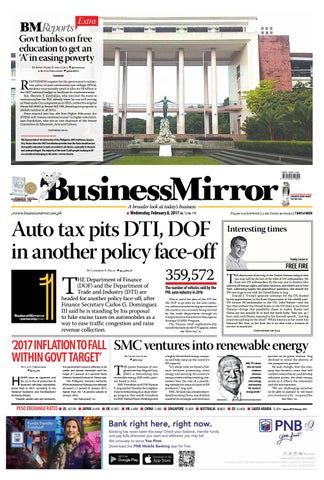
Auto tax pits DTI, DOF in another policy face-off
T
By Catherine N. Pillas
@c_pillas29
he Department of Finance (DOF) and the Department of Trade and Industry (DTI) are headed for another policy face-off, after Finance Secretary Carlos G. Dominguez III said he is standing by his proposal to hike excise taxes on automobiles as a way to ease traffic congestion and raise revenue collection.
This is amid the plea of the DTI for the DOF to go slow on the auto industry, whose manufacturing operations in the country are currently being revived by the trade department through its Comprehensive Automotive Resurgence Strategy (CARS) Program. The finance chief euphemistically turned his back on the DTI appeal, when See “Auto tax,” A2
business news source of the year
P25.00 nationwide | 5 sections 30 pages | 7 days a week
Interesting times Teddy Locsin Jr.
free fire
359,572 T The number of vehicles sold by the PHL auto industry in 2016
2016 ejap journalism awards
HE distinction of serving in the United Nations today is that you may well be the last of the tribe of UN ambassadors. We have two UN ambassadors, by the way; one in Geneva, who answers all human rights and labor concerns, and there’s me in New York, addressing largely the geopolitical questions, like should the UN vote to go to war with the United States in Iraq. Donald J. Trump’s ignorant contempt for the UN, backed by his appointment to the State Department of the rabidly antiUN former US ambassador to the UN, John Bolton—and the fact that without the United States in the UN there is no United Nations—brings that possibility closer to reality. Russia and China are not morally fit to lead the world body. They are, as I have said, and Obama repeated in his farewell speech, “just big countries picking on the small”. While America at her worst has behaved like that, at her best she is an idea with a mission of service to mankind. Continued on A10
‘2017 INFLATION TO FALL SMC ventures into renewable energy WITHIN GOVT TARGET’ T H By Lenie Lectura @llectura
By Cai U. Ordinario @cuo_bm
igher taxes on cigarettes and the cut in the oil production of exporters will keep commodity prices high in 2017, according to the National Economic and Development Authority (Neda). “Despite upside risks and pressures,
the government expects inflation to be stable and remain consistent with the target of 2 percent to 4 percent,” Neda Director General Ernesto M. Pernia said. The Philippine Statistics Authority (PSA) disclosed on Tuesday that inflation increased 2.7 percent in January 2017, higher than the 1.8 percent posted in January 2016. See “Inflation,” A2
PESO exchange rates n US 49.7290
he power business of conglomerate San Miguel Corp. (SMC) is diversifying into renewable energy (RE) with a partner based in Asia. SMC President and COO Ramon S. Ang said on Tuesday the conglomerate is embarking on a clean-energy program that would transform its SMC Global Power Holdings into
a highly diversified energy company and help ramp up the country’s RE capacity. “It’s about time we found a balance between promoting clean energy and securing the country’s energy needs without making consumers bear the cost of a punishing subsidy for years in favor of RE producers,” Ang said. SMC, he said, has already shortlisted two Asian firms, one of which could be its strategic and technical
ANG: “It’s about time we found a balance between promoting clean energy and securing the country’s energy needs.”
partner on its green venture. Ang declined to reveal the identity of the prospective partner. He said, though, that the company has formed a team that will conduct researches on, and develop solutions across, the clean-energy sector as it affects the consumers and the environment. “We are challenging ourselves to be able to operate in the most env i ronment a l ly responsible
n japan 0.4450 n UK 61.9872 n HK 6.4100 n CHINA 7.2450 n singapore 35.3039 n australia 38.0825 n EU 53.4636 n SAUDI arabia 13.2614
See “SMC,” A2
Source: BSP (7 February 2017 )
A2 Wednesday, February 8, 2017
BMReports BusinessMirror
Govt banks on free education to get an ‘A’ in easing poverty Continued from A1
Even as the Senate is still deliberating on his bill, Gatchalian reported his colleagues voted to increase the budget of the Commission on Higher Education (CHEd) in the Senate version of the 2017 General Appropriations Act (GAA), from P10.4 billion to P18.7 billion. He said the fund will cover not just the free-tuition plan in SUCs, but also provide additional incentives and other grants. He confirms that the funds, allocated by special provision as the Higher Education Support Fund (HESF), will be administered by guidelines and procedures to be issued by the CHEd and the Department of Budget and Management in consultation with SUCs.
Permanent reality
GATCHALIAN said he intends to “closely monitor the utilization of the HESF in order to hold the CHEd accountable for its legal duty under the 2017 GAA to use these funds in furtherance of the free-tuition policy.” The senator clarifies that Congress still needs to pass the FHEA to make the free-tuition policy in SUCs “a permanent reality for the millions of young learners who will depend on public education to get their college degree in the coming years.” In sponsoring SB 1304, also known as “An Act Providing for a Full Tuition Subsidy for Students Enrolled in State Universities and Colleges, and Appropriating Funds
SMC. . .
Continued from A12
manner, while taking into consideration energy security and affordability to the consumers. Initiatives to achieve this objective are under way and I’m proud to say, we are making good headway,” Ang added. SMC’s power plants mostly run on coal. SMC Global Power is currently the largest independent power producer in the country by installed capacity. The conglomerate’s plan to go into RE was wel-
Tax-amnesty. . . Continued from A12
estate taxpayers from the total deaths in 2013, Quimbo said data show that 94 percent did not file the required estate-tax return. Even if the estate is exempt from taxes, the filing of a return is still required under the NIRC, he said. Quimbo added the complicated
Thereof,” Gatchalian was joined by Sens. Bam Aquino IV, Joseph Victor E. Ejercito, Juan Edgardo M. Angara, Loren B. Legarda and Minority Leader Ralph G. Recto, as coauthors. “Free tuition in state universities and colleges is not a novel idea in the Philippines,” Gatchalian said. “It’s been around for decades, driven by the frustration of generations of student-activists who have taken to the streets to clamor for the government’s help in combatting gross inequality in educational access at the tertiary level.” The senator admitted “these courageous students inspired me to dig deeper into the possibility of instituting a tuition-free system in SUCs back when I was still a congressman, culminating in the filing of the original [FHEA] as HB 5905 on July 6, 2015, during the 16th Congress.”
spite the yearly increase from the national budget for education.” He added that the government budget allocated for it remained the lowest among the three and so has become a hindrance for some with insufficient family income to enter and finish college. “Education has a high impact on income and employment,” Vargas added. “A college graduate can be compensated twice or even thrice compared to a high-school graduate ,and this difference is a good reason to invest in tertiary education.”
Discouraging factor
MEANWHILE, authors of the full free tertiary education bills at the Lower House said educated people are the face of a progressive nation. Rep. Alfred D. Vargas of the Fifth District of Quezon City said a government that provides sustainable and quality education to its citizens leads the nation to a bright future, as it is the best weapon to fight the poverty. “The system of free public education in the Philippines has long been in existence, as established by the Malolos Constitution and RA 6655 for basic and secondary [education],” Vargas said. “However, tertiary education in SUCs has never been fully subsidized de-
REP. Vilma Santos-Recto of the Sixth District of Batangas said in 2014 the estimated annual government cost per student in an SUC is at an average of P21,000. Santos-Recto said the cost drives SUCs to internally generate their own income through the collection of tuition and through grants and donations, among others, to sustain the cost of their operations. She added that the income collected by 114 SUCs nationwide from tuition amounted to P7.9 billion, while other income collected from students totaled P4.7 billion. “Tuition that form part of students’ out-of-pocket expenses for their college education range from as low as P12 to as high as P1,000 per unit and are expected to increase further to adjust for inf lation,” Santos-Recto said. “These fees become one of the compelling reasons that discourage some students to pursue and finish tertiary education.”
comed by the Department of Energy. “It’s good. We welcome that for as long as they don’t ask for from feed-in-tariff [FiT],” Energy Secretary Alfonso G. Cusi said. Ang said earlier his company is not after the FiT subsidy. “We will put up a power facility even without any FiT.” The country’s FiT system guarantees compensation for RE producers through a long-term fixed price over a 20-year spread, a subsidy that is shouldered by power consumers. The Philippines has one of the
highest electricity rates in Asia, and with subsidies to renewables through FiT, the rates become even more expensive. “We have a responsibility as a major power producer to do our share in pushing for a sustainable clean-energy economy, but it has to be done in the most efficient way possible for the consumers. With critical mass and better technology, I believe we should be able to strike the perfect balance between renewable and non-renewable sources in terms of the country’s energy mix,” Ang said.
scheme of filing estate taxes is also seen as one of the reasons for taxpayers’ noncompliance. “It disincentives the heirs to comply. The failure in filing estate tax also subjects the taxpayer to penalties and interests under the NIRC,” he added. Meanwhile, House Committee on Ways and Means Chairman and PDP-Laban Rep. Dakila Carlo Cua of Quirino, principal author of HB 4815, said the mea-
sure seeks to reduce the existing estate-tax rates and ensure fair taxation.Cua said HB 4815 proposes a single tax rate of 6 percent on estates based on the value of the net estates. Under the existing law, if the net estate is P200,000, the heirs are exempted from estate tax. If the net estate is P10 million above, heirs will pay P1.2 million, plus 20 percent of the amount exceeding P10 million.
Progressive nation
Landmark legislation
GATCHALIAN recalls that during the 17th Congress, the idea of free tuition in SUCs has caught fire, with strong support in both houses of the legislature, noting that “in the House of Representatives, 18 congressmen have filed bills inspired by the idea of providing free college education to qualified students.” In the Senate, Gatchalian reported that senators were determined to push for an P8-billion “budget insertion” to fund the free-tuition plan. “And now, just seven short months into the First Regular Session, this worthy piece of legislation—which would institutionalize free SUC tuition once and for all— has already made it to the Senate floor after one-fourth of our membership filed bills pushing for free public college education.” Once passed into law, Gatchalian said the measure would be a landmark reform in higher education, which will give life to the Constitution’s lofty promise to “protect and promote the right of all citizens to quality education at all levels”. Gatcha lian cites estimates generated from the 2014 Annual Poverty Indicators Survey, which notes 54 percent of college-aged youth—from ages 16 to 21—are not in school. “Given population estimates extrapolated from the 2010 National Census, this figure translates to approximately 6.4 million youths,” he said. “If we look closer at the data, we can see that 29.77 percent of these youth disclosed that they are not in school because
Goat meat. . . Continued from A12
Tagaytay City. Antonio’s was the first Filipino restaurant to be listed among Asia’s Best 50 Restaurants, in 2015. “I made two vegetarian dishes using all local ingredients,” said Goco, such as kale, edamame, gooseberries, raspberries, butternut squash and local miso ginger. Aside from Goco, other chefs who created dishes using fresh produce supplied by local farms, like Earthbeat Farms, Teraoka and Earthflora Inc., etc., were Chef Miko Aspiras (Le Petit Souffle), who spoke at last year’s MFM, along with Chefs Josh Boutwood of The Test Kitchen, and Nicco Santos of Hey Handsome. In a news statement, Tourism Secretary Wanda Corazon T. Teo said the DOT is just warming up as it whets the appetite of the global audience to what is in store for the third serving of MFM from April 6 to 8, at the SMX Convention Center in Pasay City. “This is just an appetizer for the ‘next gastronomic sensation’awaiting at MFM’s third run,” she said, adding that among the DOT’s top priorities include selling the Philippines as a culinary destination. For her part, DOT Director for Market Development Verna Esmeralda Buensuceso said bringing Madrid Fusión to the Philippines “started the ball rolling for the country to be known for its cuisines and ingredients.” She said it helped that Madrid Fusion is an established gastronomic
Inflation. . .
Continued from A1
Inflation in January was the highest since December 2014, when inflation averaged 2.7 percent. In that year, inflation averaged 4.1 percent. Pernia also said other price pressures for the year include the 20-day maintenance shutdown of the Malampaya natural-gas facility. The shutdown, which began in January, could lead to an increase in electricity generation charge starting in March 2017. To prevent these pressures from increasing food prices, which is still one of the largest household expenses in the country, Pernia said there is a need to ensure farmers have access to financing. “To stabilize and manage food inflation, sustainable financing and access to insurance
of the high cost of education.”
Financial constraints
GATCHALIAN said an additional 23.99 percent indicated they are not in school because they are either employed or looking for work. “These figures suggest that as many as 3.4 million college-aged Filipinos were robbed of the opportunity to pursue further studies due to the prohibitively high cost of education,” he said. “Using estimates generated from Census 2010 and APIS 2014 data, we can see that as many as 3.4 million Filipinos aged 16 to 21 have dropped out of school because of financial constraints.”
Inalienable right
GATCHALIAN asserts that “as lawmakers and representatives of the people, we must take decisive action to uphold and defend the Filipinos’ inalienable right to pursue a college education.” He added “an underprivileged student’s right to education should not be made dependent upon the generosity of charitable individuals or the patronage of politicians. We must address the issue head-on by institutionalizing a mechanism which will ensure full access to higher education for all generations of Filipinos to come.” The Senator stressed the importance of ensuring full access to higher education, saying its potential to build greater equality within Philippine society, becomes even clearer once we observe the empirical relationship between educational and economic outcomes. brand, such that inviting world-renowned chefs, like Joan Roca, Elena Arzak and the others, became much easier. At lunch, Enzo Pinga of Earthbeat Farms proudly showcased his harvest that day and talked about the fast-growing farm-to-table business in the Philippines, along with fellow agri-entrepreneurs Raphael Teraoka of Teraoka Farms and Nicolo Aberasturi of Earthflora Inc. Pinga, who described himself as a reluctant farmer, sees the farm-to-table business becoming part of a growing “lifestyle movement” in the country in the next couple of years. International lifestyle columnist Daven Wu of DestinAsian had only good words to say about his first Philippine cuisine experience: “The restaurants we’ve been to and the chefs and farmers we’ve met are such an eye opener. Their commitment and enthusiasm are simply amazing.” Describing Philippine cuisine as “surprising,” Wu added that “while there is so much to discover in flavors and with culture influences so well developed,” people in the West and greater Asia still know little about Filipino dishes. Aside from Goco, other Filipino chefs who have joined the roster of presenters for this year’s MFM are Gene Gonzales of Café Ysabel and Jordy Navarro of Toyo Eatery. Madrid Fusión Manila (http://www. madridfusionmanila.com/) is a joint partnership between the DOT and its marketing arm, the Tourism Promotions Board, and Madrid Fusión organizers Foro de Debate and Arum.
facilities for the agriculture sector are needed. This will ensure availability of loans to farmers to keep their farm output stable, especially in times of climate-related shocks,” he said. In January the food alone index slowed to 3.4 percent, from the previous month’s 3.6 percent. The Neda said this is due to slower price adjustments in fruits, vegetables, meat, corn, sugar, jam, honey, chocolate and confectionery. However, higher price adjustments were recorded for fish, and oils and fats. There was also a slight uptick in the price of rice, which went up 1.8 percent in January, from 1.6 in the previous month. “The damage by typhoons Karen and Lando may have contributed to the lower supply of rice, which slightly raised rice prices. In some areas, like Cagayan Valley and Central Visayas, the planting calendar was delayed, which resulted in lower production in the fourth quarter,” Pernia said.
www.businessmirror.com.ph
Auto tax. . .
Continued from A1
he said the DOF will give the trade department’s suggestion a “good consideration”. Dominguez insisted that the proposal to increase the auto-excise tax will help relieve the worsening traffic congestion in Philippine megacities, due in part to the slow rollout of road networks in the past administration. “The objective of that [excise-tax hike] is to slow down, give us relief on the number of cars being put on the road. There were only 4 kilometers of new roads constructed in the last six years by the past administration,” Dominguez said on Wednesday evening. “You want to slow down because the cities are getting clogged. The worst traffic is in Cebu; Manila is terrible and Davao is fast catching up. So how are you going to deal with that, add more cars?” he added. This comes amid the proposal of the DTI to adjust the excise tax to only 1 percent to 2 percent for vehicles priced P1 million and below. This was a counterproposal to the DOF’s move to set the floor price to P600,000 and below with a rate of 4 percent, then a rate of 40 percent of the value in excess of P600,000 + P24,000 for those priced above P600,000 but not more than P1.1 million. The DTI believes that its counterproposal would already shield the models enrolled in its manufacturing-stimulus program for the automotive industry. This is because those to be covered by CARS are priced below its proposed threshold. Toyota Motor Philippines Corp. and Mitsubishi Motors Philippines Corp., the two participants in the government’s CARS, are banking on the fiscal support from the program, to increase production and help make the country a vehiclemanufacturing hub. These prospects, however, have been clouded by the sudden proposal of the new administration to increase excise taxes on vehicles as a revenue-offsetting measure to the lowering of personal and corporate income taxes. The two carmakers have already invested significantly in new facilities and equipment in complying with the CARS requirements. Reports from the Chamber of Automotive Manufacturers of the Philippines Inc. and Truck Manufacturers Association showed that the industry sold 359,572 units last year, up from the 288,609 units recorded in 2015.
Senate. . .
Continued from A12
drugs is actually a “war against the poor.” He noted that the AI also alleged the use of a mere “watch list”, which contents are based on hearsay, community rumor or rivalry, with little verification. Escudero also cited the AI report that “detailed the story of a police officer with the rank of Senior Police Officer 1, who served in the PNP for a decade and is currently part of the anti-illegal-drugs unit in Metro Manila.” “According to the source, the police paid per ‘encounter’—the term used to mask the extrajudicial killings as legitimate operations conducted by the authorities. The police officer claimed that the amount paid by the police ranges from P8,000 to P15,000 per person, per encounter,” the senator noted. “The logic it presents is that this money is coming from the government, that is a serious allegation that would immediately connect the state to what is happening outside the EJKs and that would mean it is already state-sponsored.” Escudero recalls reports that since the Duterte administration came into power, the PNP has conducted almost 41,000 drugrelated operations from July 2016 to January 2017. According to AI, more than 7,000 people have been killed in the drug war, with the police directly killing at least 2,500 alleged drug offenders.
news@businessmirror.com.ph
The Nation BusinessMirror
JBC accepts application for high Ombudsman post By Joel R. San Juan @jrsanjuan1573
T
HE Judicial and Bar Council (JBC) on Tuesday announced the reopening of the acceptance of applications or recommendations for the position of Special Prosecutor of the Office of the Ombudsman, which is set to be vacated by Special Prosecutor Wendell E. Barreras-Sulit, who will retire on March 11. The JBC said all applications or recommendations, together with complete set of documentary requirements, must be submitted to the council on or before the end of the month. It added that the date of actual receipt by the JBC of the applications and requirements shall be deemed as the date of filing. It can be recalled that on July 22, 2016, the Court of Appeals (CA) ordered the reinstatement of BarrerasSulit, who was dismissed by President Benigno S. Aquino III in 2013 for entering into a plea-bargaining agreement with the former Armed Forces comptroller, Maj. Gen. Carlos Garcia, who was charged with plunder and money-
laundering cases. The CA said the Office of the President committed an error when it dismissed Barreras-Sulit from the service, saying the pleabargaining agreement she entered into with Garcia is lawful, and “does not violate existing rules and jurisprudence”. The CA said BarrerasSulit entered into the pleabargaining agreement not on her own but under the direct supervision of thenOmbudsman Merceditas Gutierrez. Gutierrez resigned in 2011 before the Senate starts her impeachment trial, owing to her alleged underperformance and failure to act on several cases during the term of thenPresident Gloria MacapagalArroyo. Likewise, the CA said the Ombudsman is allowed to enter into a plea-bargaining agreement under Section 11 of the Ombudsman Act of 1989. The Court also noted that agreement was approved by the Office of the Solicitor General and the Anti-Money Laundering Council.
Editor: Dionisio L. Pelayo • Wednesday, February 8, 2017 A3
Senate sets investigation of AI report on summary executions
T
By Butch Fernandez
@butchfBM
he Senate Committee on Justice and Human Rights has been asked to conduct a full-blown inquiry into extrajudicial killings (EJKs) under the Duterte administration, as cited in an Amnesty International (AI) report on a still-growing list of casualties in the government’s war against illegal-drugs syndicates.
Sen. Francis G. Escudero has filed Resolution 282, calling for a Senate investigation on the allegations of AI that the killings related to President Duterte’s war against illegal drugs were “extrajudicial executions carried out by gunmen hired by police officers to kill and plant evidence”. Escudero, former chairman of the Committee on Justice and Human Rights, suggested that senators conduct an inquiry in aid of legislation, asserting that the summary killings “must not be simply set aside, as it raises serious allegations that can undermine
the Philippines’s reputation as a democratic country that fundamentally recognizes and upholds human rights”. “I found AI to be radical at times if you look into our history,” said Escudero, explaining that “the filing of a resolution is really not meant to give AI a platform. It is to allow AI to prove their allegations because by that report, they besmirched the reputation of the country”. He added the legislative inquiry would also be “an avenue to verify the accuracy of the report, and give the people and institutions involved an opportunity to
respond to the findings”. Escudero pointed out “it is not only a matter of necessity but public accountability, as well, that AI substantiate and present its evidence before the Senate for public scrutiny to confirm the report’s veracity and to hold, or otherwise clear, the Philippine government of any responsibility”. Escudero added: “Sure or not, they already besmirched the name of our country by saying that these violations are committed by the state itself.” He noted that, according to the report released by the international human-rights watchdog, “the police paid killers on their payroll, and unknown armed individuals have slain more than a thousand people a month under the guise of a national campaign to eradicate drugs,” adding the administration’s war on drugs is actually a “war against the poor”. Escudero noted AI also alleged the use of a mere “watch list”, whose contents are based on hearsay, community rumor or rivalry, with little verification. He also cited the AI report that “detailed the story of a police officer with the rank of Senior Police Officer 1, who served in the PNP for a decade and is currently part of the anti-illegal drugs unit
in Metro Manila”. “According to the source, the police paid per “encounter”—the term used to mask the extrajudicial killings as legitimate operations conducted by the authorities. The police officer claimed the amount paid by the police ranges from P8,000 to P15,000 per person, per encounter,” Escudero noted. “The logic it presents is that this money is coming from the government, that is a serious allegation that would immediately connect the state to what is happening outside the EJKs [extrajudicial killings], and that would mean it is already statesponsored. That is a very serious allegation, and AI cannot simply make that allegation and say, ‘Sorry all of our sources are confidential, we cannot reveal it’”. Escudero recalled reports that since the Duterte administration came into power, the National Police has conducted almost 41,000 drugrelated operations from July 2016 to January 2017. According to AI, more than 7,000 people have been killed in the drug war, with the police directly killing at least 2,500 alleged drug offenders. Moreover, Escudero cautioned the Duterte administration against “giving too much power to the police force and treating erring officers with kid gloves”.
Economy
A4 Wednesday, February 8, 2017 • Editors: Vittorio V. Vitug and Max V. de Leon
BusinessMirror
news@businessmirror.com.ph
NGCP assures power-supply sufficiency for Luzon grid amid Sual plant shutdown
T
By Lenie Lectura
@llectura
he Luzon grid was spared from power-outage incidents amid the sudden shutdown of the 1,294-megawatt (MW) Sual power plant in Pangasinan, the largest coalfired power plant in the Philippines.
The National Grid Corp. of the Philippines (NGCP), according to the Department of Energy (DOE), said “the grid is still
normal [at this time]”. Based on the most recent update of NGCP, the Luzon grid will have a net reserve of 1,089 MW
1,089 MW
The net reserve of the Luzon grid during the Tuesday afternoon peak hours during the afternoon peak today [Tuesday]”. Sual Unit 2 went online at 5:21 a.m., while Sual Unit 1 went offline at 10:15 a.m. of Monday, February 6, due to a possible condenser-tube leak, but the power situation in Luzon is still manageable, NGCP assured. Sual 2 (647 MW) went offline
due to condenser-tube leak for four days that ended on Monday, the same day Sual 1 went on emergency shutdown at 10:15 a.m. for the same reason. The emergency shutdown was necessary to prevent further boilertube failure and turbine damage, according to Team Energy. Team Energy also said Sual Unit 1 is expected to return online on February 13. It will provide the DOE periodic updates with regard to the plant conditions. The DOE has sent a team to the Sual facility. “We need to make Team Sual aware that we are checking on them and all the others,” Energy Secretary Alfonso G. Cusi said.
“Our goals are getting the correct reports and pushing them to a higher degree in doing their jobs,” Cusi said. “It’s not just them giving the right account of what’s going on. More important, it’s the higher standard we are after.” The energy chief said audit teams must push and convince p l a nt o p e r a t o r s t o p r o c u r e quality materials to achieve a higher level in performing their functions. Sual Unit 2 is now running at 647 MW, and Malaya Unit 2 will be utilized at minimum stable capacity of 130 MW to maintain normal system conditions, the agency said.
PHL to pay P800M for Laguna Lake project scrapped by Aquino admin By Marvyn N. Benaning Correspondent
T
HE International Center for the Settlement of Investment Disputes (ICSID) has ordered the Philippine government to pay P800 million to Baggerwerken Decloedt En Zoon (BDC) for scrapping the P18.7-billion Laguna Lake Rehabilitation Project (LLRP) in 2011. ICSID issued the award on January 23, 2017, six years after former President Benigno S. Aquino III junked the deal that was twice declared by thenJustice Secretary Leila M. de Lima as “legal and binding”. Former Justice Secretary Alberto Agra also issued a legal opinion affirming the validity of the contract entered into between BDC and the Arroyo administration through the Department of Environment and Natural Resources (DENR.) The BDC project was originally crafted to dredge the 94,900-hectare Laguna de Bay and deepen its average depth of 2.5 meters, and called for the creation of navigational channels in the waterway, which has Class C water quality deemed to be inappropriate for human consumption. The Laguna de Bay cannot be a source of water for purification, since its average depth is 2.5 meters, well below the global standard of a minimum of 2.8 meters depth for harvesting water for purification. A Belgian company, BDC had designed the project under the official development assistance (ODA) scheme of Brussels and supported by then-Belgian King Albert, but former President Aquino did not accede to the plea of the king to salvage the project, calling it as a project that calls for merely transferring the silt from one part of the lake to another. BDC also worked on securing 37.4 percent of the funding from a Belgian export agency to enable it to be covered by ODA and secured additional financing from BNP Paribas. Belgian executives calculated the P18.7-billion LLRP could be paid in nine years, if the Laguna de Bay is dredged, its water-holding capacity expanded, and measures are implemented to improve the quality of water flowing from 100 rivers and creeks from the Sierra Madre, Quezon, Rizal, Cavite and Laguna, with the revenues coming from Manila Water Co. Inc. and Maynilad Water Services Inc. ICSID took jurisdiction of the case, which was covered by an investment treaty among the Philippines, Belgium and Luxembourg signed in 1998, and invoked the applicable rules of the ICSID convention and arbitration rules on October 11, 2011. The ICSID tribunal was constituted on February 29, 2012, with Pierre Tercier of Switzerland appointed by the parties as president, Stanimir A. Alexandrov of Bulgaria as arbitrator named by BDC and J. Christopher Thomas of Canada, who was named
arbitrator by the respondent, the Philippine government. Allen & Overy of Hong Kong represented BDC as counsel, while the Office of the Solicitor General of the Philippines, retired Supreme Court Associate Justice Florentino P. Feliciano and the law firm White & Case of Washington also took the cudgels for the Aquino administration. The tribunal decided in favor of BDC, with Tercier concurring and Alexandrov issuing a separate opinion. ICSID said the tribunal was constituted in accordance with Article 37(2)(a) of the ICSID Convention and started its proceedings by compelling the parties to produce their documents, with the first session held via teleconference on April 30, 2012. BDC filed its memorial on the merits on June 25, 2012, with the Philippine government responding with a memorial of its own on October 17, 2012, along with a memorial on jurisdiction, including counter-claims and the filing of cost hearing briefs, the tribunal declared the proceedings closed on November 28, 2016, based on ICSID Arbitration Rule 38(1). On January 23, 2017, the tribunal agreed with BDC, and said the 150-year-old Belgain dredging company was the aggrieved party. BDC was compelled to sue the Aquino administration before ICSID in April 2011 for breaching its contract after all its efforts to push the project with Finance Secretary Cesar V. Purisima and President Aquino failed. The company sought at least P6 billion in damages from the Aquino administration. BDC officials said Aquino was wrong in tagging the project as “graft-ridden” and Sen. Franklin M. Drilon described dredging projects as a source of corruption during a year when Iloilo, his home province, had six dredging projects supported by state funds. Sen. Loren B. Legarda also described the dredging project as contributing to flooding, which floored BDC, its engineers and hydrologists. The Aquino administration then did not explain to the Belgian government why the LLRP was scuttled despite the Belgian counterpart’s plea to let the project proceed. In 2010 Dimitry Dutilleux, BDC’s North Asia manager, explained that under the 850-day LLRP, there was little chance for fishermen and settlers to be evicted from the lake region, since the principal concern of the project was to deepen the lake and allow boats to navigate from Laguna to Rizal and the National Capital Region and vice versa. BDC spent close to P400 million to undertake studies on the lake, including its water quality, its geology and geomorphology, the species still existing in the lake, and the social and economic impact of the LLRP.
Solid-waste recycling
Sen. Cynthia A. Villar tours booths showcasing products from recycled waste during the Environment Summit and Ecological Waste Management Exhibition, in line with the Department of Environment and Natural Resources’s celebration of Zero Waste Month and 17th anniversary of the Ecological Solid Waste Management Act of 2000. The senator has been advocating various ways to reduce, reuse and recycle solid waste, or the so-called 3Rs. Through Sipag, Villar has been actively implementing her own environmental programs using waste as raw materials. Also in photo is Eligio Ildefonso, secretariat executive director of the National Solid Waste Management Commission. PNA photo courtesy Office of Sen. Cynthia Villar
briefs deped grants p3.95-b senior high-school vouchers THE Department of Education (DepEd) has granted P3.95 billion worth of senior high-school vouchers as of December 31 last year, covering 75 percent of the P5.23-billion program. The amount benefits 607,208 Grade 11 students enrolled in non-DepEd schools, the department said in a news statement issued on Tuesday. The department said these vouchers are processed within two months after the school submits its billing statement, provided the documents required are complete. Schools could check the status of their submissions through their accounts in the voucher-management program, an online information system for schools participating in the voucher program. The voucher program is intended for incoming Grade 11 students who wish to enroll in non-DepEd senior high schools, such as private high schools, colleges and universities; local universities and colleges; state universities and colleges; and technical and vocational schools. The voucher enables a student to claim a “discount” or a deduction from tuition and other fees charged by a non-DepEd senior high school. The subsidy is not given to a student in the form of cash, but is disbursed by the DepEd to the senior high school. PNA
kidapawan city to tap solar irrigation for farming KIDAPAWAN CITY—City Mayor Joseph Evangelista has expressed interest in replicating the Department of Agriculture’s (DA) solar-powered irrigation facility recently inaugurated by President Duterte in New Janiuay, M’lang, North Cotabato. Evangelista on Tuesday said the city government could partner with the DA to set up the same project here to boost the local agriculture sector through free, cheap and environment-friendly irrigation facility. The city remains as a major agriculture hub in the province, but still has farmlands with no adequate irrigation for its wide rice fields mostly located in the upland areas where farmers depend mainly on rain. Evangelista said the solar technology could boost production and reduce expenses of farmers, as well as mitigate failure of harvests during long dry spells. “We are opening the possibility of putting this project here, particularly in the rain-fed agricultural areas, where famers have less assurance on how long rains would prevail to nourish their rice plants,” he said. The mayor is also open to the possibility of employing the project in vegetableproducing villages that can also support farmers during the dry season. Evangelista and DA officials have firm up ties in stepping up agriculture potentials and resources of the city through the implementation of suitable programs and interventions. PNA
GFI assistance in govt’s jeepney modernization program sought
T
he Land Transportation Franchising and Regulatory Board (LTFRB) is urging government financial institutions (GFIs) to provide assistance to jeepney operators and drivers, as the agency pursues the implementation of the jeepney-modernization program. LTFRB Board Member Aileen Lizada, in an interview, said the Land Bank of the Philippines and the Development Bank of the Philippines should develop a mechanism that will provide loans to support the development of public-utility jeepneys (PUJs) in the country. She reiterated it is important that financial aid must be provided to PUJ drivers to supplement their take-home pay and improve their living conditions. Lizada expressed support for the proposal of transport groups that the Pantawid Pasada, or fuelsubsidy cards for public-transport operators and drivers, be utilized as a seed fund to facilitate access on loans from banks and other financial institutions. Furthermore, she suggested that a financial-literacy program be established in order that PUJ operators and drivers are able to manage and further increase their income. “It is very important that we must empower them considering their contributions in our society,” Lizada added. PNA
COMP: Mining industry now fighting for its life By Jonathan L. Mayuga @jonlmayuga
M
iners on Tuesday said it now came to the point that the industr y is “fighting for its life” under the watch of Environment Secretary Regina Paz L. Lopez. The mining industry’s big players had given up on Lopez’s alleged “bias” against mining, and is now appealing to President Duterte and the Mining Industry Coordinating Council (MICC) “to save the industry”. Art Disini, chairman of the Chamber of Mines of the Philippines (COMP), said they have written a letter sent to the members of MICC, which is cochaired by Finance Secretary Carlos G. Dominguez III, hoping to reverse what they described as “the arbitrary closure and suspension order affecting 28 of the 41 operating mines in the country”. According to Disini, COMP will also ask the Department of Environment and Natural Resources (DENR) to reveal the mining-audit result, invoking the Freedom of Information executive order signed by Duterte. COMP also reminded Lopez that, as a Cabinet official, she is obliged to adhere to the Duterte administration’s policy of transparency in governance. “It will be absurd for us [COMP] to have to go to the court to ask for records that are supposed to be provided to us by the government, in the first place,” said Ronald Recidoro, vice president for policy and legal of COMP. “We are not saying that that’s what we are going to do, but that is a legal remedy we can avail [ourselves] of.” He added it is important for mining companies to know the basis of the closure or suspension order for them to correct whatever violations they have committed. Besides, Recidoro said, the DENR’s Administrative Order 2 Series of 2016, mandates transparency in governance. According to Carlo Pimentel, president of the Philippine Nickel Industry Association, at this juncture, the mining industry is fighting not only for its life, but for the lives of its stakeholders, as well. “What we would like is for the government to follow due process,” he said. “Many mining companies received show-cause orders, even though, sometimes, the orders are opposed or against the audit findings and recommendation,” he said. COMP earlier questioned the basis of Lopez’s actions and appealed to Dominguez to convene MICC to look into Lopez’s “actuations”. According to Disini, Dominguez had asked COMP to “enlighten” MICC over the potential economic impact of the closure and suspension orders handed down by Lopez on February 2. The order effectively closed 23 operating mines and suspended the operation of five other mines. The impact to nickel production alone would cause a 50-percent reduction in the country’s annual output. The Philippines is the single major exporter of nickel to China for nickel-raw materials for various steel products, such as stainless steel. Horacio Ramos, a former director of the Mines and Geosciences Bureau, said the closure order should not be taken lightly. “The industry is now fighting for its life,” Ramos said, who now works as a consultant to a mining company, adding that Lopez apparently failed to observe due process of law in closing and suspending mining operations. “There should be an investigation, a report, and the company is allowed to contest the findings. Whatever is the decision, it must be based on science, rather than conjuncture or suspicion of wrongdoing,” he said.
Agriculture/Commodities BusinessMirror
news@businessmirror.com.ph
Editor: Jennifer A. Ng • Wednesday, February 8, 2017 A5
‘Let farmers choose hybrid rice-seed variety’ Govt to begin construction of P160-M circumferential road project in Iloilo
T
he construction of the P160-million Agri-Tourism Road Project connecting barangays Bobon and Bulwang in the town of Leon to the so-called 7-cities in Alimodian, Iloilo will finally begin, according to the Department of Agriculture (DA). DA officials led the groundbreaking ceremonies for the project on January 31. It covers the concreting of roads and construction of bridges that will complete the 58-kilometer circumferential road from the two barangays Bobon to Alimodian, south of the province. Barangay Bucari in the town of Leon, 50 km from Iloilo City, is known as “Little Baguio” or the “Summer Capital” of the province, owing to its cool climate, uniquely grown pine trees, and various native agricultural and horticultural products. The 7-cities, meanwhile, pertain to the seven remote barangays of Cabacanan Rizal, Lico, Umingan, Dao, Manasa, Cabacanan Proper and Tabug, all found in the mountainous area of Alimodian, and famous for their cool climate, lush vegetation, wildlife and plants, such as wild berries, woodland, caves, waterfalls and rice terraces. Among the area’s tourist attractions are the Tinagong Danao, Agua Colonia, Umingan
Plateau, Ibagat Spring, Farm Terraces, Maslog Falls, Bato Dungok and Oyang Cave. These remote Alimodian villages are also known for producing high-value commercial crops, such as sayote, Baguio beans, carrots and cauliflowers, thus making Alimodian the “salad bowl” of Iloilo. Agriculture Undersecretary Evelyn G. Laviña recently visited the region to discuss with the Barangay Farmers Association further training on organicvegetable farming. DA Assistant Secretary for the Visayas Hansel O. Didulo, who already visited the area twice, expressed support for the project. He assured the local chief executives of assistance to programs that would benefit farmers in the area. Didulo told the local officials that considering President Duterte’s commitment for bigger funding for the DA beginning 2018, local officials should expect more farm-assistance programs, like farm mechanization, as well as postharvest facilities. Alimodian Mayor Geefre A. Alonsabe and Leon Mayor Rolito C. Cajilig proposed the construction of cold-storage facilities and abattoirs in their municipalities considering that both towns have their own “ bagsakan centers” and dynamic livestock markets.
T FILE Photo
he Department of Agriculture (DA) should allow farmers to choose the hybrid rice-seed variety they want to plant, according to a group of rice farmers from Agusan del Sur.
In a letter to Agriculture Secretary Emmanuel F. Piñol, the Awasian Irrigators Association (IA) pressed for a government policy that is “more liberal” in granting what farmers believe would produce the best yield. Farmers belonging to the Awa-
sian IA said they refused to accept the hybrid rice seeds given by the DA, saying they have already informed the regional office about their preference. “Before the DA’s procurement of seeds, we have already submitted a list of farmers with their preferred
seed variety,” said the Awasian IA, led by Jerson Cuenca. Farmers said they asked Piñol to grant them the right to choose their desired hybrid-seed variety. While they recognize that the government follows a procurement prescribed by law, farmers urged Piñol to consider their preference to ensure the success of the DA’s rice self-sufficiency program. The government policy on procurement, accepted to be “lowest bidder wins,” is based on the Government Procurement Reform Act of 2003, or Republic Act 9184. However, the Duterte administration has committed to change such policy, saying the existing system promotes corruption.
In Nueva Ecija Ricardo Buenaventura, president of Nagkakaisang Magsasaka Agricultural Primary Multipurpose Cooperative in Tabacalera, Nueva Ecija, asserted the DA’s seed procurement should not be made on the basis of price. “What if the free hybrid seed does not fit their soil? What if the farmer doesn’t want it? It will be a waste of government money. It should be farmers’ choice,” Buenaventura said in a statement. He also urged the government not only to encourage more hybridseed production but also to look at hybrid-seed producers’ after-sales service to farmers. “They should look at the presence of technicians to help farmers on how to use seeds. Not all seeds have technicians to help you,” Buenaventura said. “We have seen many types of hybrid seeds that had come out in the market, but not all have sustained supply. They come and go.” Hybrid rice-seed quality is based primarily on yield compared to inbreds, which produce anywhere from 3 to 5 metric tons. “All hybrids just need the same kind of care. All don’t do as well in the wet season. All get hit by diseases. Sometimes it’s even the inbreds that are hit heavily by diseases,” Buenaventura said. Glazeline E. Cosino, of Poblacion Prosperidad, Agusan del Sur, said not all hybrid seeds are suitable to the climate in Agusan del Sur, where flooding is prevalent. “They wanted us to convince our neighbors to go into hybrid, but we told our MAO [municipal agricultural officer] if you will give us seeds, you might as well give us what we have already proven to be good seeds because you might give us something not good for our soil,” Cosino said.
Tyson says SEC is investigating chicken-pricing allegations Officials to remove water hyacinth clogging A Maguindanao rivers ccusations of collusion that have dogged the American chicken industry in recent months took a new turn after Tyson Foods Inc., the country’s largest producer, said the US Securities and Exchange Commission (SEC) is investigating the allegations and sent it a subpoena. The company said on Monday in a filing that based upon the limited information it has, Tyson believes the investigation is related to the allegations contained in antitrust litigation involving broiler chickens. The Springdale, Arkansas-based company and its largest competitors have been named as defendants in a series of lawsuits in recent months that claim the industry colluded starting in 2008 to drive prices higher, allegations denied by Tyson and the other producers. Tyson said in the filing it’s cooperating with the investigation, which is at an early stage. CEO Tom Hayes, speaking on a conference call with reporters, declined to comment further except to say the company wants to defend itself in court. Tyson fell 3.5 percent to close at $63.13 in New York on Monday, while rival producers Sanderson Farms Inc. and Pilgrim’s Pride Corp. also declined. Poultry producers’ shares have fallen due to the scrutiny of industry pricing practices and the SEC’s subpoena, Zain Akbari, a Chicago-based analyst for Morningstar Investment Services Llc., said in a report. The charges in the recent lawsuits “are difficult to prove” but due to their gravity, “I suspect that there is indeed a valuation overhang on Tyson’s equity,” Ken Shea, a Bloomberg Intelligence analyst, said in an e-mail.
Pricing practices
Over several decades, the US chicken industry has transformed itself
C
bloomberg Photo
from being comprised mostly of family-owned farms into a heavily consolidated sector controlled by several multibillion-dollar companies. Per capita chicken consumption in the US has more than doubled in 40 years. Consumers spent about $90 billion on chicken products last year. As those companies’ market share and power has grown, they have drawn scrutiny for their production practices, such as their use of contract farming to raise birds for slaughter. There have been some changes to the chicken industry, amid the recent legal complaints. The Georgia Department of Agriculture, which gathered and disseminated the benchmark Georgia Dock prices that are the focus of some of those complaints, discontinued its widely used pricing index last December, citing the changes in the industry.
Starting this month, the department began collecting data for a new index, although a lack of contributions has delayed the publication of the new measure. Hayes said on a conference call with analysts that issues surrounding the Georgia Dock index are a “tempest in a teapot” and said the company hasn’t changed its pricing practices. Despite the chicken controversy, Tyson had record profit in its fiscal first quarter. Net income rose to $1.59 a share for the three months through December 31 from $1.15 a year earlier, beating the $1.27 average of 12 estimates compiled by Bloomberg. “We capitalized on favorable market conditions in our beef and pork segments and the cash generated is providing fuel for growth in our value-added chicken and prepared-foods segments,” Hayes said on a conference call. Earnings
excluding one-time items will be $4.90 to $5.05 a share in the 12 months through September, it said in a separate statement. That compares with a December forecast of profit at $4.70 to $4.85. The higher guidance is “primarily the result of this quarter’s far-stronger-thanexpected margin performance,” David Palmer, a New York-based analyst for RBC Capital Markets who has a sector perform rating on the shares, said in a report on Monday. The increase “suggests some degree of over-earning this quarter relative to the remaining three quarters”. Hayes said the company’s goal is for long-term earnings per share growth to be in high single digits as it invests back into its businesses. Tyson has in the past targeted growth above 10 percent, and in fiscal 2016, its adjusted earnings rose 39 percent. Bloomberg News
OTABATO CITY—Leaders of the Autonomous Region in Muslim Mindanao (ARMM), town mayors, military and police officials convened here on Tuesday to act on impending floods that may affect lowlying areas in Maguindanao and Cotabato City due to water hyacinth buildup in the Rio Grande de Mindanao. ARMM Executive Secretary Laisa M. Alamia convened the major stakeholders to come up with a joint action that will save communities from floods and prevent a repeat of previous floods that submerged huge parts of Maguindanao and Cotabato City due to clogged waterways. Alamia said short-term solutions to the problem must be ready since the buildup of water hyacinth was observed in the river waters between Sultan Kudarat town in Maguindanao and Cotabato City, as well as in the other parts of Rio Grande de Mindanao, particularly in the towns of Datu Piang in Maguindanao and Midsayap in North Cotabato. Water hyacinth has covered around 4 hectares on these waters and some have already formed into islets based on a report from the region’s Humanitarian and Emergency Action Response Team (HEART), ARMM’s emergency unit. Unless checked and removed immediately, the buildup will likely result in the rise of river water that could inundate nearby areas. James Mlok, Department of Public Works and Highways (DPWH) Maguindanao second District engineer, said his team has started to clear up parts of the river below Sajid Piang Bridge connecting Datu Piang and Midsayap as early as last week. As agreed upon during the meeting, DPWH will restart the removal of water hyacinth buildup in the Datu Piang-
Midsayap area of the river on Tuesday. Part of the clearing operation is Datu Piang local government unit’s (LGU) relocation of families living under the Sajid Piang Bridge to prevent casualties once the river water rises significantly. Alamia said the ARMM government is eyeing two long-term solutions to the recurring problem of flooding in Maguindanao and parts of Cotabato City, one of which is a project to be funded by the People’s Republic of China. It will be implemented within the year. Officials from ARMM-HEART, Office of Civil Defense, the Armed Forces of the Philippines’s 6th Infantry Division, Coordinating Committee on Cessation of Hostilities, the LGUs of Midsayap, Datu Piang, Sultan Kudarat and Cotabato City, as well as representatives from the Moro Islamic Liberation Front and the Moro National Liberation Front were present during the meeting. During the meeting, it was agreed that the military assigned upstream will monitor the water level and quickly alert its counterpart downstream so people will be informed of impending floods. Water hyacinth buildup has been monitored in the Quirino Bridge and Delta Bridge that connect Cotabato City and Sultan Kudarat town. Huge chunks of water lilies are also monitored along Tamontaka River that may threaten to clog under Tamontaka bridge if remained unchecked. The worst floods to hit Cotabato City was in 2011, when 30 of the city’s 37 villages were submerged by floodwaters for a week due to thick water hyacinth traveling downstream then blocked the smooth flow of river water to the Moro Gulf. Alamia said local leaders and stakeholders should be proactive in this case to save people’s lives and properties. PNA
A6
Wednesday, February 8, 2017
The World BusinessMirror
AI: At least 13,000 hanged in Syrian prison since 2011
B
EIRUT—Syrian authorities have killed at least 13,000 people since the start of the 2011 uprising in mass hangings at a prison north of Damascus known to detainees as “the slaughterhouse”, Amnesty International (AI) said on Tuesday. In a new repor t cover ing the per iod from 2011 to 2015, A mnest y said 20 to 50 people were hanged each week at Saydnaya Pr ison in k il lings author ized by senior Sy r ian officia ls, including deputies of President Bashar a l-A ssad, and car r ied out by militar y police. The report referred to the killings as a “calculated campaign of extrajudicial execution”. Amnesty has recorded at least 35 different methods of torture in Syria since the late-1980s, practices that only increased since 2011, said Lynn Maalouf, deputy director for research at Amnesty’s regional office in Beirut. O t her r ig ht s g roups h ave found evidence of massive torture leading to death in Syrian detention facilities. In a report last year, Amnesty found that more than 17,000 people have died of torture and ill-treatment in custody across Syria since 2011, an average rate of more than 300 deaths a month. Those figures are comparable to battlefield deaths in Aleppo, one of the fiercest war zones in Syria, where 21,000 were killed across the province since 2011. “The horrors depicted in this report reveal a hidden, monstrous campaign, authorized at the highest levels of the Syrian government, aimed at crushing any form of dissent within the Syrian population,” Maalouf said. While the most recent data is from 2015, Maalouf said there is no reason to believe the practice has stopped since then, with thousands more probably killed. “These executions take place after a sham trial that lasts over a minute or two minutes, but they
35
The number of methods of torture, which Amnesty International has recorded in Syria since the late-1980s
are authorized by the highest levels of authority,” including the Grand Mufti, a top religious authority in Syria, and the defense minister, she said. Syrian government officials rarely comment on allegations of torture and mass killings. In the past, they have denied reports of massacres documented by international human-rights groups, describing them as propaganda. The chilling accounts in Tuesday’s report came from interviews with 31 former detainees and over 50 other officials and experts, including former guards and judges. According to the findings, detainees were told they would be transferred to civilian detention centers but were taken instead to another building in the facility and hanged. “They walked in the ‘train’, so they had their heads down and were trying to catch the shirt of the person in front of them. The first time I saw them, I was horrified. They were being taken to the slaughterhouse,” Hamid, a former
In this combination of two photos of Omar Alshogre, a 21-year-old Syrian former detainee, now living in Stockholm, Sweden. The left picture of Alshogre was taken in January 2017 in Stockholm, Sweden. The right picture of Alshogre was taken in July 2015 in Antakya, Turkey, a month after he got out of Syria’s Saydnaya prison, near Damascus. While in detention, Alshogre said he heard men escorted to be hanged and had himself been called for “execution” but was spared after a brief trial. Handout by Omar Alshogre via AP
detainee, told Amnesty. A not her for mer det a i nee, Omar Alshogre, told The Associated Press the guards would come to h is cel l, somet imes three times a week, and call out detainees by name. Alshogre said a torture session would begin before midnight in nearby chambers that he could hear. “ Then the sound would stop, and we would hear a big vehicle come and take them away,” said Alshogre, who spent nine months in Saydnaya. Now 21, he lives in Sweden. Speaking in an interview from Stockholm via Skype, Alshogre described how he was forced to keep his eyes closed and his back to the guards while they abused or suffocated a cellmate. The body often would be left behind, or there would be a pool of blood in the cell for other prisoners to clean up. “We can tell from the sound of the prisoner as he dies behind us. He dies a meter away. I don’t see anything, but I see with my ears,” said Alshogre, who at age 17 moved among nearly 10 detention facilities in Syria for two years before he was taken to Saydnaya. Alshogre survived nine months in the prison, paying his way out in 2015—a common practice. He suffered from tuberculosis and his
weight fell to 35 kilograms. Two cousins detained with him in western Syria didn’t survive, dying a year apart in a military intelligence detention facility. The younger one died in Alshogre’s arms, deprived of food and so weak he was unable to walk to the bathroom on his own. Still, Alshogre said nothing could have prepared him for Saydnaya. At one point, Alshogre was called out by his guards “for execution”, he said. He was brought before a military trial and told not to raise his gaze at the judge, who asked him how many soldiers he had killed. When he said none, the judge spared him. Death in Saydnaya was always present, “like the air”, Alshogre said. Once when he was deprived of food for two days, a cellmate handed him his food ration—and died days later. “This is someone who gave me his life,” he said. Another cellmate died of diarrhea, also common in the prison. “Death is the simplest thing. It was the most hoped for because it would have spared us a lot: hunger, thirst, fear, pain, cold, thinking,” he added. “Thinking was so hard. It could also kill,” said Alshogre, who keeps a photo of one of his tormentors on the wall of his home. AP
www.businessmirror.com.ph • Editor: Lyn Resurreccionph
French prexy hopeful refuses to drop out despite probe
P
ARIS—François Fillon on Monday defiantly refused to drop out of the race to be France’s next president despite an investigation into whether wellpaid political jobs he gave his wife, son and daughter were genuine, a scandal that has knocked him from his perch as favorite in the April-May voting. The conservative politician who served as prime minister from 2007 to 2012, the chief workhorse under then-President Nicolas Sarkozy, has long had a reputation as low-key, reliable and standing for moral rectitude, making the corruption scandal particularly shocking to his party, supporters and the French as a whole. On Monday, two weeks after revelations first surfaced, he scrambled to save his candidacy. “I have nothing to hide,” Fillon told a news conference aimed at stanching the blood-letting and conspiring within his party about who might replace him as candidate. “All acts described [in the media] are legal and transparent.” Determined despite unending attacks, Fillon, stressing his 32 years in politics, vowed to stay in the race. “Nothing will turn me from my duty to be candidate in the presidential election,” he said. Fillon apologized for employing his wife, while noting that it is not illegal and he is not the only politician to have done so. “What was acceptable yesterday...is not today,” Fillon said. “It was a mistake. I deeply regret it and I present my excuses to the French.” French politicians are allowed to hire family members as aides as long as they actually do the jobs for which they are paid. Prosecutors are trying to determine whether Fillon’s family members did the jobs of parliamentary aides. The preliminary probe involves suspicions of embezzlement and misappropriation of public funds. As prime minister and in his presidential campaign, Fillon put the accent on cutting back on government spending. A key campaign promise this year is to slash half-a-million public-sector jobs. Fillon’s popularity has dropped in the past two weeks following allegations by the Canard Enchaine newspaper that his Welsh-born wife Penelope was paid €830,000 ($900,000) over 15 years without doing anything to earn the salary. The Paris prosecutor’s office last
Thursday expanded its investigation to include Fillon’s son and daughter. Some conservative lawmakers have pressed for him to step down to improve the party’s chances of winning the election. The first vote is on April 23, and the top two finishers compete in a runoff on May 7. If Fillon’s bid to win confidence while wading through a legal investigation fails to work, the election could become an unusual face-off without a strong right, or no right at all. Fil lon reiterated he wou ld withdraw if he were charged—but questioned whether the financial prosecutor’s office handling the case was the proper jurisdiction. A statement by the prosecutor’s office said it was competent. Officials of the far-right National Front party, including leader Marine Le Pen, also are under investigation for their use of aides in the European parliament. Fillon laid out for reporters in some detail his own facts about the accusations. “Yes, I employed my wife as an aide,” Fillon said. He said she was paid an average €3,677 per month over 15 years. “They call this job fictitious,” he said, laying out the ill-defined duties of parliamentary aides who work “in the shadows”. “Her salary was perfectly justified because her work was indispensable to my activities as an elected official,” he said. Fillon and his family live in an elegant manor in the Sarthe region southwest of Paris. To bolster his reputation he detailed the worth of the building—€750,000—and other holdings, and said he does not have to pay the tax on fortunes demanded of the wealthiest. Fillon said he was publishing his assets online on Monday night. Fillon said the scandal grew out of a political conspiracy to take him out of the race, and make it a face-off between far-right leader Marine Le Pen—whose family he blasted as “untouchable”—and Emmanuel Macron, an untested former banker and Socialist Party maverick whom Fillon called a “guru”. Fillon did not say who would be behind such a plot. “Nothing will change my mind” about running, Fillon said. To members of his own The Republicans party, he said twice, “I’m not the candidate of a party” but of the French people. AP
Israel passes law legalizing thousands of settlement homes J
ERUSALEM—The Israeli parliament’s adoption of a contentious law meant to retroactively legalize thousands of West Bank settlement homes built unlawfully on private Palestinian land is expected to trigger international outrage and a flurry of lawsuits against the measure. The explosive law, approved by lawmakers late on Monday, is the latest in a series of pro-settler steps taken by Israel’s hard-line government since the election of Donald J. Trump as US president. Trump is seen as more sympathetic to Israel’s settlement policies than his fiercely critical predecessor Barack Obama, and the Israeli government has approved plans to build thousands of new homes on occupied territory since Trump took office. “We are voting tonight on our right to the land,” Cabinet minister Ofir Akunis said during a stormy debate ahead of the vote. “We are voting tonight on the connection between the Jewish people and its land. This whole land is ours. All of it.” Cr it ics say t he leg isl at ion enshr ines into law the theft of Palestinian land, and it is expected to be challenged in
Israel ’s Supreme Court. According to the law, Palestinian landowners would be compensated either with money or alternative land, even if they did not agree to give up their property. The vote passed 60-52 in Israel’s 120-member Knesset following a raucous debate in which opposition lawmakers shouted from their seats at governing coalition lawmakers speaking in favor of the vote. Some legislators supportive of the law took pictures of the plenum during the vote, while some spectators in visitors’ seats raised a black cloth in apparent protest. Israeli Prime Minister Benjamin Netanyahu had voiced misgivings about the law in the lead-up to the vote, reportedly expressing concern that it could trigger international censure and saying he wanted to coordinate with the Trump administration before moving ahead on a vote. He told reporters on a trip to London that he had updated Washington and was ready to move ahead with the law. Netanyahu was on his way back from the trip and was not present for the vote. The White House’s immediate response was to refer to its statement last week that said the
Israeli police arrest a settler in the West Bank outpost of Amona on February 2. Israeli police say they are preparing to remove the last remaining Israeli protesters from the West Bank outpost of Amona, which forces are evacuating under court order. AP/Oded Balilty
construction of new settlements “may not be helpful” in achieving an Israeli-Palestinian peace. The State Department later said “the Trump administration will withhold comment on the legislation until the relevant court ruling.” David Harris, CEO of AJC, the global Jewish advocacy organization, said that “Israel’s High Court can and should reverse this misguided legislation” by Knesset ahead of Netanyahu’s meeting with Trump in February. The parliament’s action “ is misguided and likely to prove
counterproductive to Israel’s core national interests,” Harris said in a statement. Netanyahu’s attorney general has called the bill unconstitutional and said he won’t defend it in the Supreme Court. Critics have warned it could drag Israel into a legal battle at the International Criminal Court at The Hague, the Netherlands, which is already pursuing a preliminary examination into settlements. Among the law’s problematic elements is that the West Bank is not sovereign Israeli territory and that
Palestinians who live there are not citizens and do not have the right to vote for the government that imposed the law on them. Palestinians condemned the law. “This is an escalation that would only lead to more instability and chaos. It is unacceptable. It is denounced and the international community should act immediately,” said Nabil Abu Rdeneh, a spokesman for Palestinian President Mahmoud Abbas. Netanyahu faced intense pressure from within his nationalist coalition, especially from the pro-settler Jewish Home party, to press ahead with the vote following the court-ordered evacuation last week of the illegal Amona outpost found to have been built on private Palestinian land. Over 40 settler families were forced to leave the 20-yearold outpost, and on Monday construction vehicles demolished and removed the trailer homes that remained behind. Zehava Galon, leader of the dovish Meretz party, wrote on Facebook ahead of the vote that Netanyahu “declares that the legalization bill is dangerous for Israel and instead of standing on his hind legs to stop this shame-
ful law, he presses ahead with it.” A f ter yea rs of condem n ations from the Obama administration over sett lement constr uction, Israel ’s gover nment has ramped up sett lement initiatives since Tr ump took office, announcing plans for some 6,000 new homes in the West Bank and east Jer usa lem and promising to build a new settlement for the A mona evacuees. Trump has signaled a far more accepting approach to settlements, raising hopes in Netanyahu’s government that it will be able to step up construction. The W hite House said little as Net a nya hu a nnou nced pl a ns during Trump’s first two weeks in office to build over 6,000 new settler homes. But after Netanyahu announced his plan to establish a new settlement for the first time in two decades, Trump indicated that he, too, might have his limits. “While we don’t believe the existence of settlements is an impediment to peace, the construction of new settlements or the expansion of existing settlements beyond their current borders may not be helpful in achieving that goal,” the White House said. AP
Editor: Lyn Resurreccion • www.businessmirror.com.ph
The World BusinessMirror
Wednesday, February 8, 2017
A7
Tech employees, not execs, against Trump
I
n-late September a group of tech leaders started a well-publicized effort to raise $100,000 for Hillary Clinton. In flush Silicon Valley that is spare change. But by the time the election was over, the campaign had pulled in only $76,324.
For all its visceral dislike of President Donald J. Trump, the tech community did not worry too much about him being elected or, once in office, carrying through with his program. Lulled by favorable polls, distracted by its own destiny, Silicon Valley was above all else complacent. No longer. After Trump’s January 27 executive order (EO) restricting immigration, high-tech has gone full-tilt political. Companies are being pushed by their employees, by their customers and sometimes by their ideals. They are trying to go far enough without going too far. Nearly 130 companies, most of them in the technology field, filed an amicus brief late on Sunday in the 9th US Circuit Court of Appeals, which declined to reinstate the travel ban after a lower court blocked it. The brief, which was signed by an unusually broad coalition of large and small tech companies that included Apple, Facebook, Microsoft, Google, Tesla, Uber and Intel, said Trump’s order “violates the immigration laws and the Constitution.” “Silicon Valley is stepping up,” said Sam Altman, who runs the valley’s most prominent startup incubator, Y Combinator. “The companies are working on three fronts: They are vociferously objecting to the Trump policies they think are bad, they are trying to engage with him to influence his behavior, and they are developing new technology to work against policies and political discourse they don’t support.” It is an improvised and complicated strategy. The companies
130 The estimated number of companies, most of them in the technology field, that filed an amicus brief late on Sunday in the 9th US Circuit Court of Appeals against US President Donald J. Trump’s travel ban
are among the richest and most popular of US brands, which means they have a good deal of leverage. Yet they are also uniquely vulnerable—not only to presidential postings on Twitter and executive orders, but to the sentiments of their customers and employees, some of whom have more radical ideas in mind. Many of the companies initially placed their bets on engagement after an upbeat meeting with the president-elect in December. That modest approach, which even the most risk-averse executive can endorse, showed its limits last week. After widespread customer defections, Travis Kalanick, chief executive of Uber, was forced to step down from one of the administration’s advisory councils. “People voted with their feet, and Travis listened,” said Dave McClure, who runs the 500 Startups incubator and started the Nerdz 4 Hillary group that tried to raise the $100,000. “We need to hold the
A protest outside Google’s headquarters in Mountain View, California, on January 30. In a filing to a federal appeals court dated Sunday, nearly 100 technology companies, including Google, argued that President Donald J. Trump’s temporary ban on all visitors from seven predominantly Muslim countries would hurt their businesses and violate both immigration law and the United States Constitution. Jason Henry/The New York Times
other tech leaders accountable in the same way.” Resistance, McClure said, begins at home. “You don’t have a voice with the president if you didn’t vote for him,” he said. “But employees and customers have a voice with the tech companies. Silicon Valley should be demonstrating at the front doors of Google, Facebook and Twitter to make sure they share our values.” Several factors are propelling Silicon Valley to the front lines of opposition to Trump. Some have been w idely noted: T he companies are often founded by and run by immigrants, which made the EO on immigration offensive and a threat to their way of doing business. Tech companies frequent ly stress the importance of talent
from other countr ies to their businesses. Less remarked on has been the political homogeneity of tech workers. “It’s not like you have 60 percent of the employees on one side and 40 percent on the other,” said Ken Shotts, a professor of political economy at the Stanford Graduate School of Business. “They all have the same leanings.” Trump does have some support in Silicon Valley, most notably venture capitalist Peter Thiel. Yet another factor pushing the companies is the perennially tight job market in technology. Executives cannot afford to alienate a large bloc of workers. Beyond this, there is the mythology of Silicon Valley, which holds that the work being done there is building a better future. Google’s former slogan “Don’t be evil,” is
the most forceful expression of this. “If you go around making a lot of statements about your exalted role in society, at some point your employees might just make you follow through,” Shotts said. Since the EO was issued, the companies have struggled to keep on the same page with their employees. Microsoft, for instance, initially made relatively muted comments that mostly celebrated immigration. Twenty-four hours later, it was much blunter, calling the order “misguided and a fundamental step backwards”, and saying it would create “much collateral damage to the country’s reputation and values”. At an all-hands meeting at the beginning of the week with the chief executive, Satya Nadella, who was born in India, Microsoft
employees expressed their concern. The company did not file a formal declaration supporting Washington state’s effort to block the order the way Amazon and Expedia did, but its public comments assisted the effort, Bob Ferguson, the state attorney general, said. The immigration battle is in Microsoft’s self-interest. Seventy-six of its employees were affected by the order, the company said. Some in Silicon Valley have more expansive hopes for the tech companies there. “In 2016, we saw how technology could be used to polarize ourselves to extreme levels,” said Altman of Y Combinator. “The most important thing we could do is figure out how to use technology to depolarize the nation.” New York Times News Service
Trump’s travel ban hits close to home for corporate travelers M ark A. Boyer, executive director of the International Studies Association, would ordinarily spend this week pulling together the final details for his group’s annual convention, which usually draws about 6,500 social scientists and academics and kicks off in two weeks in Baltimore. But this is not an ordinary year. The Trump administration’s executive order (EO) on January 27 barring citizens of seven Muslim-majority nations from entering the United States has had diplomatic and legal reverberations. But the order hit much closer to home for the professionals who oversee and coordinate ever y thing from small board meetings to huge conventions in the increasingly global business of corporate travel. “An enormous number of the attendees at our convention are coming from outside North America,” Boyer said. “That obviously raises a lot of implications.” A l t h o u g h a f i r m nu m b e r w i l l not be c lear unti l t he d ays immed iately before t he event, Boyer sa id, he estimated t hat 100 or more attendees might decide not to attend. “ We’re rea l ly just tr y ing to get a hand le on that now, given that nobody is cer ta in how t his is going to be implemented,” he said. “But I t hink t here are a lot of ot her
fol k s who are bac k ing out out of fear.” The annual convention, he said, “is one of the three major revenue generators” for his association. He estimated that, “at minimum, we’re in jeopardy of a quarter to half a million dollars, and when we have only a $2.7 million budget, that’s a big hit.” Similar tales of disruption are being told across the country, though for now the order has been temporarily stayed by a federal judge. A quick survey by the Association of Corporate Travel Executives, conducted three days after the EO was issued, found that the repercussions in the business travel community were swift. Nearly four in 10 executives said the travel ban would curtail their company’s business travel. “People like certainty, travelers like certainty, companies like certainty,” said Greeley Koch, the group’s executive director. In the absence of that, he added, “they’ll just err on the side of caution and not take the trip.” Steve Rudner, founder and managing partner at Rudner Law Offices, a firm that represents hotels, said that one corporate group of about 40 scheduled to arrive last Friday at a Florida hotel he represents canceled at the last minute over concerns that the company’s CEO, a Canadian resident with dual Canadian-Iranian
citizenship, would not be able to enter the United States. “Anytime, as a country, we throw up a sign that says certain people are not welcome, certain people will be detained or denied entry, there are many groups who will not want to risk denial of entry,” Rudner said. He estimated the group could forfeit as much as $58,000 because of the last-minute cancellation. “Many groups will just look to move the meeting elsewhere,” he added. Michael W. McCormick, executive director and chief operating officer of the Global Business Travel Association, offered a similar prediction. “You’re dealing with a perception and whether people are going to postpone that trip or find another way in the near term to accomplish their business,” he said. A member survey conducted online early last week found that nearly a third of travel managers said their companies were cutting back on business travel in the immediate aftermath of the order. More than half expressed worry that there would be uncertainty in the future about whether a green card or approved visa would be considered valid for entry to the US, and more than one in four predicted the executive order would lead to a long-term reduction in business travel. “That’s a concern—you start
talking about that impact,” McCormick said. “What we’re seeing from companies is that there will be a short- and long-term impact and reduction in business travel.” For many meeting and convention organizers, t he long lead time they need for planning means that even events not taking place for months are stuck in a holding pattern. Debbie Baker, owner of an independent meeting planning company, said she was waiting to sign hotel contracts for a Las Vegas meeting scheduled for the fall. The client, a mining and generating company, has about 20 percent of its attendees coming from overseas. “Because they have offices in every country, they have VPs in every country as well,” she said. Baker said she was worried that she could lose the client’s business entirely. “If they canceled the meeting, it would be an astronomical amount of money I’d lose,” she said. “They might decide to hold it in Saudi Arabia or someplace like that, in which case I would lose the whole meeting.” The big question is what happens next. “As we talk about the economy and creating jobs, the last thing you want to do is put something in place that has the tendency to reduce travel,” Koch said. Joseph Parilla, a fellow at the Brookings Institution’s Metropolitan Policy Program, warned
that perceptions of either uncertainty or hostility—if not both— could be corrosive to the domestic travel industry. “If our foreign policy becomes more antagonistic, one could posit that would influence people’s decision to come to the United States,” he said. “If you don’t feel like you’re welcome, even if the policy isn’t directly targeting you, that may change your view of whether you’d feel comfortable traveling in that country,” a sentiment that meeting and event planners say they are hearing from worried constituents. “These policies are not helpful,” Parilla said, predicting that groups would gravitate to more welcoming destinations. “We’re not the only game in town,” he added. This has already started to happen. At the biennial conclave of the World Federation of Tourist Guide Associations in Tehran, Iran, last week, where about 300 to 400 professional tour guides from around the world gathered, a contingent from the Guides Association of New York City presented their group’s bid to bring the event to New York in 2019. “If the entire vote was based on that evening, we would ’ve had it in the bag,” said Matthew Baker, past president of the New York association and a member of the bid committee. “There was a
tremendous amount of good feedback from everyone, especially our Iranian hosts.” Then, word started trickling in about the travel ban, and the confidence turned to anxiety. “I started receiving reports from my colleagues around the world—ever yone was worried about getting a visa into the US,” Baker said. “One of our Iranian hosts was elected to the new executive board, so there was the concern about one of our executive board members not being able to attend a convention he was supposed to be organizing.” Ultimately, the roughly 50 delegates voting for the next convention site chose Tbilisi in the Republic of Georgia over New York. Mr. Baker said the Iranian tour guides at the convention sympathized with his delegation’s situation, noting their own challenges promoting their country as a tourist destination in the face of travel restrictions and sanctions. Even though a relatively small number of the participants were from the seven nations affected by the travel ban, delegates from other countries worried that this early signal from the new US administration foreshadowed potential trouble down the road. “If we can have a ban on seven countries now,” Baker said, “what can happen in the future?” New York Times News Service
A8
Wednesday, February 8, 2017
The World BusinessMirror
www.businessmirror.com.ph • Editor: Lyn Resurreccion
S. Korea to dispel ‘misunderstanding’ on US trade pact
S
outh Korea’s trade minister said his country would seek to explain the benefits of its free-trade agreement (FTA) with the United States to the Trump administration, as the pact enacted in 2012 comes under fresh scrutiny. US President Donald J. Trump has already ditched a broader Pacific pact that was not yet ratified by Congress and chided South Korea’s neighbors Japan and China for their trade policies, raising concern its agreement could come into his cross-hairs. Jap a ne s e P r i me M i n i s te r Shinzo Abe is meeting Trump in the US later this week in part to defuse tensions over trade. During his campaign, Trump called the accord with Seoul— the big gest for the US since the North American Free Trade Agreement (Nafta) took effect in 1994—a destroyer of US auto industry jobs. He hasn’t said if he plans to abolish the FTA outright. The countries can agree in writing to amend the deal, while terminating it would require a six-month notice period. South Korea will push back against protectionism, Minister
15% The percentage of increase of trading volume between the US and South Korea since 2011
Joo Hyung-hwan said in a statement on Tuesday announcing a new committee that will draft measures to help the auto industr y. T he gover nment “w il l dispel the US’s misunderstanding on the effectiveness of the US -Korea F TA by e x pla ining the growth of ex ports of US vehicles to Korea and job creation as a result of Korean companies’ investments,” he said.
Stacks of container vans in South Korean port Bloomberg News
Since 2011, when the agreement was ratified by lawmakers, trading volume between the nations increased by 15 percent, while global trading volume fell 10 percent, Joo said last November. The pact prompted Korean companies to invest more in the US, the minister said, adding Korean companies hired 45,000 US workers in 2015, up from 35,000 in 2011. The US was South Korea’s largest trading partner after China in 2015, with total trade of $116 billion, while South Korea was the US’s sixth-biggest trading partner, according to data compiled by Bloomberg. Despite the pact, the overall US trade in goods deficit with South Korea widened 60 percent to $26.5 billion in 2016, from $16.6 billion in 2012, according to the US Census Bureau. And the automotive sector, as in Japan, remains one of the biggest points of trade tension between the countries.
Walking away
South Korea argues that automobiles are a sma l l fraction of tota l ex por ts to A mer ica. T he countr y sent 964,432 vehicles there in 2016, down 9.5 percent from the previous year, according to the Korea Automobile
M a nu f a c t u re r s A s s o c i at io n . Impor ts of US cars rose 22 percent to 60,099 units, it said. I f Tr u m p w a n t s t o w a l k aw ay f rom t he pac t he c a n, sa id K im Jong-hoon, a for mer Korea t rade m inister who was a key negot i ator on t he dea l. St i l l, “ in rea l it y it ’s ha rd for a ny gover nment to push for amendments or ter mination of a t rade ag reement a lone w it hout bac k ing by l aw ma kers”. Data from the past five years show the deal helped both nations, he said, adding the US trade gap with Korea “isn’t even comparable” to that of countries like Mexico and China. In a preemptive move to address Trump’s criticism, Hyundai Motor Co. and affiliate Kia Motors Corp. announced last month an investment of $3.1 billion in the US over the next five years, about 50 percent more than the $2.1 billion they spent in the previous five-year period.
US factories
Automakers, including Toyota Motor Corp., Ford Motor Co. and Fiat Chrysler Automobiles NV, have said they’ll spend on US factories in response to pressure from Trump to create jobs in America. Toyota will invest $10 billion in the US over the
next five years, maintaining its pace of spending during the last half decade. South Korea’s largest automaker has warned of increasing uncertainties from protectionism and competition. Hyundai Motor will continue to monitor the policies of Trump’s administration, which are expected to put pressure on countries that have trade surpluses with the US, Koo Zayong, a vice president at the automaker, said on January 25, after the company reported a decline in quarterly earnings. If US tar iffs on Korean good s a re restored to pre -F TA levels, Korea could lose $13 bill ion in e x por ts to t he US a nd shed 127,0 0 0 jobs in t he t hree yea rs to 2020, accord ing to a Ja nu a r y repor t f rom Hy u nd a i Resea rc h Inst it ute. T he auto industr y committee, to be made up of gover nment of f icia ls, academics and representatives from loca l automa kers, w il l a lso address challenges, such as those brought by electric and autonomous vehicles, according to the statement. T he ministr y w il l offer incentives on electr ic vehicles and support research and development on autonomous dr iv ing technolog y, it said. Bloomberg News
PM May repels attempts to amend Brexit bill
P
rime Minister Theresa May overcame early efforts to amend the bill she’s trying to get through Parliament to allow her to begin Brexit negotiations. May’s Conser vative Party only has 329 seats so the results, which kept the House of Commons voting until after midnight, suggest lawmakers in her party largely stayed loyal. The House of Commons voted down two amendments by the main opposition party that required ministers to give Parliament regular Brexit updates. It also shot down attempts requiring May to work with the United K ingdom’s devolved governments in Scotland, Wales and Northern Ireland. “The bill does one simple thing: it gives the prime minister the lawful authority to start the
negotiation process,” Conservative lawmaker Mark Harper told the Commons as he argued against the first set of amendments. “The bill does not need to be improved or amended in any way.” Lawmakers from Wales and Scotland complained they were not given enough time to make their case in the three-hour debate on the role for their nations in the Brexit process. Most of those in Parliament who opposed Brexit have now said they will not attempt to block the beginning of exit talks, but this doesn’t mean they’ve given up the fight. Some hope to tie May’s hands by forcing her to give more details about her plans. Others are aiming to build in mechanisms whereby the decision could be reversed or slowed if
the public mood changes during the negotiating process. The premier says she wa nts to i nvoke t he Eu ro pean Union’s (EU) Article 50, the exit trigger, by the end of March. The debate and votes in the Commons will continue through Wednesday, after which the draft law will go to the upper, unelected House of Lords. A not her vote is pend ing on whether the government should guarantee the rights of 3 million EU nationals to stay in the UK after Brexit. May praised “the contribution to our society and economy” of EU migrants although she is against making them a promise until the rights of Britons living in the EU are similarly ensured. Eu ropea n leaders have not taken that step. Bloomberg News
ExportUnlimited BusinessMirror
Workshop on Web-based global trade-alert system aimed to equip MSMEs By Magnolia Uy
Permanent Mission of the Philippines to the WTO, Philippine Trade and Investment Center-Geneva
A
CCESSING relevant information on product requirements in export markets can be a huge challenge, especially for micro-, small- and medium-sized enterprises (MSMEs). Thus, a new Web-based alert system designed to help government agencies and MSMEs to receive the latest information on regulatory requirements in various markets was tackled during “Usapang Exports” last December. More than 50 Philippine exporters participated in the virtual training delivered through videoconference that was coorganized by the Philippine Investment CenterGeneva and the Export Marketing Bureau (EMB), in coordination with the World Trade Organization (WTO). The system, known as ePing, allows access to WTO members’ notifications of TBT and sanitary and phytosanitary (SPS) measures. It also facilitates dialogue among the public and private sectors in addressing potential trade
problems at an early stage. Users of ePing will be able to easily keep up to date with notifications affecting foreign markets and products of particular interest to them. The publicly accessible online tool is available at www.epingalert.org. Through a simple registration page, users can personalize the alerts regarding SPS and TBT notifications covering specific products or markets of interest to them. In addition, it offers an Enquiry Point Management Tool to facilitate domestic, as well as international, information sharing and discussion. The system helps users track, consult and comment on measures that are being developed and/or adapt as necessary to changing regulatory conditions. Each year, the WTO receives more than 3,500 TBT and SPS notifications proposing new measures that may affect international trade. Consequently, the need to comply with different foreign technical regulations and standards involves significant costs for producers and exporters. By improving access to this information, ePing will help avoid disruptions caused by these measures.
Doing FTAs with the European Union By Jose Antonio Buencamino | Commercial Counselor, Philippine Trade and Investment Center (PTIC)-Brussels and Jeoffrey Houvenaeghel | Trade Assistant, PTIC-Brussels
A
Conclusion
S an agreement with “mixed” competencies, the Ceta will be provisionally applied while all the 28 member-states (through their respective national parliaments, or regional parliaments in the case of Belgium) will have to ratify the agreement according to their national constitutional requirements. Some foresee this process taking two years or longer.
EU competences and mixed agreements
THE Ceta experience highlighted the EU’s competences and the phenomena of mixed-trade agreements. The EU and its member-states established a legal division of policy competences between each other. This catalogue of competences is divided into three categories: Exclusive (EU acts alone); shared (member-states and EU act together); and coordinated competences (member-states’ policies coordinated at an EU level). Exclusive competences are when the EU can act alone and legislate and adopt legally binding acts, such as for the common commercial policy and customs union. According to Geert De Baere, associate professor of EU law and international law at the KU Leuven (Catholic University of Leuven), a mixed agreement is when both the EU and its member-states share their competences within the scope of the agreement. It legally obligates the EU to include the member-states to participate within the negotiations and conclusion of the mixed agreement. The EU is well known for concluding many mixed agreements since the 1970s, as it is the general rule in the EU that external competences are usually shared with its memberstates so acting externally together is a very typical EU feature. De Baere asserted the EU can legally conclude international trade agreements by itself based on the EU’s exclusivity in the common commercial policy. But under the encouragement of its member-states, it still becomes a mixed agreement. The reasons are the member-states would like to represent themselves externally because foreign policy is a high-profile act of sovereignty, as well as it can be part of their own national interest to represent themselves in the negotiations. De Baere said member-states before the Lisbon treaty created a mixed agreement by simply adding “political
dialogue” to the agreement, because it falls under member-state competence, justifying its participation in international agreements that fall under EU exclusivity. But post-Lisbon treaty, memberstates cannot use political dialogue anymore to justify mixed agreements. Their current solution is to interpret article 218 of the Treaty on the Functioning of the European Union in such a way that allows member-states to act externally together with the EU. The member-states do not have to interpret it this way, but they want to.
Editor: Efleda P. Campos • Wednesday, February 8, 2017 A9
DTI-Citem seeks bigger PHL share of $2-T global halal food market
F
OODPHILIPPINES is eyeing to make $100 million in sales in the fast-growing halal food industry through its participation in the 22nd Gulfood, the world’s largest food fair, from February 26 to March 2.
Gulfood will be held at the Sheikh Rashid Hall (Booth Nos. R-140 and R-M4/N3) in the Dubai World Trade Center, United Arab Emirates (UAE). FoodPhilippines is a branding initiative of the Center for International Trade Expositions and Missions (Citem), the export-promotion arm of the Department of Trade and Industry (DTI), which unifies the efforts of the government in promoting the Philippines as a source of quality food products in the global market. Gulfood, or the Gulf Food Hotel and Equipment Exhibition and Salon Culinaire, is the biggest food and hospitality trade show attended by an annual average of 90,000 key industry players, decision-makers and trade buyers all over the world. “FoodPhilippines provides trade opportunities for local exporters to promote its products to global markets. Through this Gulfood participation, we hope to open more avenues for Philippine companies— sell halal-certified food products in a food fair that is held at one of the most Muslim-dominated regions in
the world,” said Rosvi Gaetos, Citem executive director. In its past participation, FoodPhilippines tallied a record-breaking $109 million worth of total sales, leveraging on some of the country’s premium export-food products, including coconut products and its by-products, rice, mangoes, canned fruits, noodles, canned seafood, and fermented marine products. Now with 26 Philippine companies, including 10 new participants, Citem aims to generate $110 million in sales under the FoodPhilippines brand, as it brings new innovative healthy options and distinct ready-to-eat (RTE) food and beverages, including instantcoffee blends, seasoned noodles and packed juice. “Our past Gulfood participation enabled Citem to strategically map out the growing demand for RTE products, such as coffee that compliments the fast, highly urbanized lifestyle of busy consumers in the GCC region,” Gaetos said. “FoodPhilippines is now keen on capturing this growing demand, as it will lead to more income and job opportunities
for our local coffee farmers.” GCC or the Gulf Cooperation Council, refers to the political, social and economic alliance of six countries, namely, Saudi Arabia, the United Arab Emirates (UAE), Qatar, Kuwait, Oman and Bahrain. The Muslim-domination region sits at the heart of the global halal-food market, which, as of 2016, has evolved into a $2-trillion industry—accounting for 17.7 percent of the world’s foodand-beverage market—based on the 2016 Global Islamic Economy Report by Thomson Reuters. The report indicated worldwide spending on global halal food and lifestyle products could potentially rise 10.8 percent a year until 2019 to create an international industry worth $3.7 trillion. With the rising income levels and rapid industrialization, GCC’s consumer spending on food alone is expected to reach $106 billion by 2017, a $23-billion rise or a more than 20-percent increase in 2012. Saudi Arabia remains the largest food-consuming GCC nation due to its large population base. The fastest growth rate for food consumption, however, is seen in Qatar and the UAE, with an annual growth of about 5.5 percent and 4.8 percent, respectively. In addition, the UAE alone has a market outreach of about 1.5 billion people living in the Middle East, CIS, Central Asia, Africa and other Asian regions— making it the world’s third top reexport center. “More supermarkets and grocery-store owners are selling Phil-
DTI chief urges entrepreneurs to go digital
Implications of mixed agreements
WITHIN the EU, there have been many discussions surrounding the issue of mixed agreements, especially as it is internally very unmanageable and time consuming as the EU needs the approval of every single parliament in every single member-state whose difficulty has been exemplified by the Wallonia-Ceta incident. The commission is currently waiting for a decision of the European Court of Justice (ECJ) in Luxembourg in regard to a clarification of a case it filed in November 2015, on the delineation of competences under the EU-Singapore FTA. Previously, the Council of the EU had disputed the EC’s interpretation the EU-Singapore FTA is an exclusive EU competence in regard to the specific areas of transport services, investments, sustainable development and IPRs. The ECJ may decide on this by early 2017. The clarification of the ECJ should answer the question whether the agreement falls entirely under the EU’s exclusive competences, or whether the member-states will also have to be involved, at least in certain aspects of the agreement (i.e., a situation of “mixed” competences). No one can predict how the ECJ will clarify the competences issues. The ECJ may, or may not, take a heavy cue from the concession the commission gave last September on Ceta. But the phenomenon of mixed competences is likely to continue within the EU. And the acceptance or ratification process of any FTA the commission will conclude will now take longer, and be at risk of serious challenges (if not total rejection) by individual EU memberstates. Indeed, the demonstration of competence—once savored—will always be sought.
ippine food products due to their recognition of its premium quality and their growing familiarity with the Philippine food culture brought about by our countrymen abroad,” Gaetos said. “Such trend plays to the advantage of this year’s Gulfood participants to penetrate and expand their trade scope, targeting the mainstream halal-food market in the Gulf region.” Included among the retail outlets selling Philippine food are Al Maya Supermarket, Lulu Supermarket, Carrefour and ZOOM Convenient Stores in Dubai, UAE. As of 2015, there were over 2.5 million Filipinos living in the Gulf region, based on a data from the Overseas Workers Welfare Administration. During the same year, around $200 million worth of Philippine food products have been exported to the GCC, wherein 50 percent goes to the UAE. FoodPhilippines’s participation in the Gulfood 2017 is organized by Citem, in partnership with the Philippine Trade and Investment Center in Dubai, United Arab Emirates, as one of the DTI’s major efforts to intensify the promotion of Philippine specialty food products in overseas trade shows. Citem is committed to developing, nurturing and promoting globally competitive small and medium enterprises, exporters, designers and manufacturers by implementing an integrated approach to export marketing in partnership with other government and private entities.
T
69TH ASEAN BUSINESS ADVISORY MEETING
The Asean Business Advisory Council (BAC) had its 69th Asean Business Advisory Meeting on January 25 and 26. This is the first meeting for the Philippine chairmanship. Asean BAC Chairman Joey Concepcion, together with fellow Asean BAC Philippines members Teresita Sy-Coson and George Barcelon, headed the discussion of programs and agenda for 2017. One of the projects highlighted was the Asean Mentors-Entrepreneurs Network, which will link Asean mentors to all entrepreneurs in the region and share with them necessary business skills and know-how. The council has also invited foreign business councils to engage in exclusive dialogues. The Asean BAC will contribute to the objective of bringing prosperity of all. In the front row are Lisa Ibrahim, Anangga Roosdiono, Tan Sri Dr. Mohd Munir Bin Adbul Majid, Dr. Robert Yap, Joey Concepcion, Oudet Souvannavong, Tessie Sy-Coson, George Barcelon, Petcharat Eaksangkul, Rozaimeriyanty Rahman and Kobsak Duangdee. In back row are Moe Kyaw, Dato Ramesh Kodammal, Phairush Burapachaisri, Robert Yap Min Choy, Jay Yuvallos and Gil Gonzales.
DTI proposes revision to Export Declaration form By Senen T. Briones
Senior Trade-Industry Development Specialist DTI-EMB, Emerging Products Division
I
N an effort to capture export data of halal, kosher, fair trade and organic-food sectors, the Department of Trade and Industry’s Export Marketing Bureau has formally proposed the revision of the Export Declaration (ED) form to introduce and include the sectors in the form. In a letter to the Interagency Committee on Trade Statistics, the EMB underscored the necessity to monitor the performance of these sectors that are either categorized as certificationenabled or culture-based certification on such products. The last revision of the ED form was back in 1998. Since then, global demographic, economic and lifestyle trends led to the increase in demand of halal, kosher, fair trade and organic
products. However, the ED form, which is the single administrative document in customs administration, does not capture the export information of said products. Essentially, amendment of this form aims to improve statistical data gathering and pave the way to create a baseline data of said products. This will provide support systems as well as a useful guide for promotion and policy reforms of DTI-EMB and its internal clients, existing and aspiring exporters, industry associations, and other export-related government agencies or bodies, such as the newly established Halal Export Industry Development and Promotion Board. The newly revised ED form could enhance the government’s advocacy to promote the Philippines as a leading exporter of certification-enabled products, which is in line with the PEDP 2015–2017 strategies.
RADE Secretary Ramon M. Lopez has called for digital empowerment in the Philippines to continue fueling the development of the country’s digital commerce (e-commerce), a key priority on the current trade agenda. “I urge our micro, small, and medium enterprises [MSMEs] to welcome digital integration,” said Lopez, adding now is the perfect timing to rally toward digital empowerment, as the Philippine economy experiences strong macroeconomic fundamentals, renewed investor confidence and good governance During the recent office opening of Google in Taguig, the trade chief said “digital integration is a great equalizer, as it allows MSMEs to gather product ideas and concepts, do market tests, and do promotions and selling at practically no cost.” He also said MSMEs can make use of programs in partnership with companies like Google, so that the sector “can take advantage of opportunities that go with going digital.” With vast interest infused in the demography of the Philippines as the world’s social-media capital and with 50 million Internet users, accounting for 50 percent of the country’s total population today, the Philippines can be a model country for digital empowerment, according to him. “I hope that more effective Web services, improved search experience and effective advertising platform will be delivered to all stakeholders. With Google officially in the country, we can only expect production of meaningful local contents,” he said. Citing Statista, it is projected that by 2021, 81 percent of the country’s population will be Internet users. For the Southeast Asian region alone, the country has the fastest-growing Internet audience at 22-percent growth rate, according to the 2014 Global Web Index, which also found Filipinos having the highest total screen time spent in social networking globally at 3.2 hours. Lopez also hoped digital companies can be more inclusive in its business operations and assured that the Department of Trade and Industry will support initiatives that proactively promote digital inclusion among Filipinos through digital literacy and digital accessibility. “I urge tech companies to spearhead programs that will empower Filipino consumers with skills to harness the benefits of technology to improve their quality of life,” he said, adding forging multistakeholder partnership among the government, the civil society, the private sector and academe is an urgent need.
A10 Wednesday, February 8, 2017 • Editor: Angel R. Calso
Opinion BusinessMirror
editorial
More investments in R&D needed
I
N the Global Competitiveness Report 2016-2017 published by the World Economic Forum (WEF), the Philippines was ranked 83rd out of 138 countries in terms of technological readiness. The WEF report assessed the competitiveness of countries based on a number of key indicators categorized under the so-called 12 pillars. For the ninth pillar, or “technological readiness”, the country’s ranking slid to 83rd in the latest edition of the WEF report, from 68th in the 2015-2016 edition. The Philippines’s ranking in the 11th pillar, or “innovation,” also declined to 62nd in the 2016-2017 edition, from 48th in the previous report. These numbers don’t bode well for a country aspiring to significantly increase the income of its citizens and reduce poverty. The National Economic and Development Authority (Neda) said investments in science and technology (S&T), including research and development (R&D), must expand to around 2 percent of the country’s GDP annually if the government is to pole-vault the Philippines into First-world status. Former Neda Secretary and now Philippine Competition Commission chief Arsenio M. Balisacan said 2 percent of the GDP would translate to around P240 billion annually. In making his case for higher S&T spending, Balisacan said technological change is what usually drives long-term economic development. Unfortunately, government data showed the country’s S&T spending is considered the lowest in Southeast Asia. Neighbors, like Thailand, Vietnam, and Indonesia, usually invest close to 2 percent of their GDP for their R&D efforts. Based on the report “Compendium of Science and Technology,” prepared by the Department of Science and Technology, the government said R&D expenditures of both the private and the public sectors have not even reached 1 percent. While the absolute values grew over the years, the equivalent shares to GDP remained constant at 0.14 percent. Among the countries in Asean, Singapore had the highest ratio of gross R&D expenditures (GERD) to GDP and number of researchers per million at 2.1 percent and 7,252 researchers, respectively. Malaysia came second with a GERD-to-GDP ratio of 1.13 percent and 2,593 researchers per million. The Duterte administration had earlier promised to include the promotion of science and technology in its economic agenda. While he did not disclose the amount the Duterte administration wants to allocate for R&D spending, Neda Secretary Ernesto M. Pernia said it is imperative for the Philippines to ensure expenditure for R&D activities should be raised at a level on a par with its Asean neighbors. Pernia said this is in keeping with the government’s goal of becoming an “active player” in the globalknowledge economy. But “business as usual” will not help the country’s bid to take full advantage of the opportunities presented by the global knowledge economy. The draft Investment Priorities Plan prepared by the Department of Trade and Industry had included “innovation drivers” (which include R&D activities) in preferred activities eligible for incentives. This is a good first step to encourage more companies to increase their R&D spending. The government, however, must also do its part to make the Philippines more conducive for R&D activities. For one, it should encourage innovation among Filipinos by helping inventors mass produce and promote their creation. The government should also take care of local scientists and researchers, especially those in state-run institutions, by providing them a compensation package that is on a par with the country’s Asean neighbors. The focus on S&T, coupled with an improvement in the country’s infrastructure, would help boost Philippine competitiveness and allow the government to attain its goal of wiping out poverty by 2040.
Interesting times Teddy Locsin Jr.
Free fire Continued from A1
O
ddly, the dissolution of the UN is not as oddball a position as it sounds and as the notion surely is today. It was deep wisdom when the UN and the North Atlantic Alliance or North Atlantic Treaty Organization (Nato) were formed after World War II. The maker of modern American strategy, George F. Kennan, opposed both. In his famous Long Telegram, signed just “X”—though everyone knew it was he, Kennan said the Soviet Union would collapse on itself from the growing weight of its self-contradictions—taking the notion from Marx no less as a kind
of backhanded compliment. All the free world had to do was wait, he counseled. But formal alliances, like Nato, with member-countries f lush against the borders of the Soviet Union—and the US member-countries all over the world, which was seen as beholden to America—would
BusinessMirror A broader look at today’s business
Leonid Bershidsky
BLOOMBERG VIEW
✝ Ambassador Antonio L. Cabangon Chua Publisher Editor in Chief
Managing Editor Associate Editor News Editor City & Assignments Editor Senior Editors
T. Anthony C. Cabangon Jun B. Vallecera Max V. de Leon Jennifer A. Ng Dionisio L. Pelayo Vittorio V. Vitug Lorenzo M. Lomibao Jr., Gerard S. Ramos Lyn B. Resurreccion, Efleda P. Campos
Online Editor Social Media Editor
Ruben M. Cruz Jr. Angel R. Calso
Creative Director Chief Photographer
Eduardo A. Davad Nonilon G. Reyes
Chairman of the Board & Ombudsman President VP-Finance VP Advertising Sales Advertising Sales Manager Group Circulation Manager
Judge Pedro T. Santiago (Ret.) Benjamin V. Ramos Adebelo D. Gasmin Marvin Nisperos Estigoy Aldwin Maralit Tolosa Dante S. Castro
BusinessMirror is published daily by the Philippine Business Daily Mirror
HOM
Publishing, Inc., with offices on the 3rd floor of Dominga Building III 2113 Chino Roces Avenue corner De La Rosa Street, Makati City, Philippines. Tel. Nos. (Editorial) 817-9467; 813-0725. Fax line: 813-7025. (Advertising Sales) 893-2019; 817-1351, 817-2807. (Circulation) 893-1662; 814-0134 to 36. E-mail: news@businessmirror.com.ph.
www.businessmirror.com.ph
Printed by brown madonna Press, Inc.–San Valley Drive KM-15, South Superhighway, Parañaque, Metro Manila MEMBER OF
Kennan’s original proposal after World War II demonstrated Russian military ferocity against all odds— Russia bore the brunt of crushing Nazi Germany, because it takes one totalitarian to know another, implied a world divided into spheres of influence. The US sphere was everything west of West Berlin across the Atlantic Ocean, the Latin American continent, across the Pacific to possibly Japan but certainly the Philippines as its anchor. The rest could go to hell or communism. Kennan famously opposed the Vietnam War not for any sentimental reasons, but simply because Vietnam was inconsequential. The Communist monolith in Asia, left to its devices, would split from the Soviet Union as even Communist China was starting to do and as Tito in Yugoslavia openly declared. But with the US today withdrawing from Asia, that would place all of us over here under China. A slave empire like the old American South in its day.
Tech’s fight against Trump’s travel ban is a matter of survival
Since 2005
Founder
make the Russians feel surrounded. That feeling, warned Kennan, a keen student of Russian history, always unleashes Russian aggression. In the event that did not happen, the UN became a talk shop, where hostile superpowers could talk off their anger rather than pour it all into a real war. Kennan took back his low regard for the UN toward the end of his life but time proved he was right about Nato. The end of the Soviet Union led to a pacific federation, which turned aggressive when Nato resumed adding adjacent former East Bloc countries, along with fragments of the broken Soviet Union. That tightened the encirclement of Russia right against her basic borders. Hence, Putin today and his ongoing attempt to reconquer Georgia, Ukraine, the Baltic states and the rest of it. So Donald J. Trump may get his wish since this time America is backing off from any global mission. But his notion is not without intellectual foundation. Interesting times.
F
ew tech workers come from the seven countries affected by President Donald J. Trump’s entry ban. But the 97 US companies, most of them from the tech sector, which lent their support to the state of Washington’s lawsuit aiming to block Trump’s executive order, have good reasons to fight it every step of the way. Iran, Iraq, Libya, Somalia, Sudan, Syria and Yemen aren’t huge sources of tech talent, at least according to the imperfect gauge provided by the H-1B visa statistics. This visa type is often used by tech companies to hire engineers. In 2015 only 254 people from the seven countries received such visas, and that number doesn’t include a single Somali or Yemeni citizen. Poland alone provided 252 H-1B workers that year, while India, the undisputed champion, sent almost 120,000 such workers to the US. Whatever problems Trump’s executive order created weren’t insurmountable for the likes of Apple, Google, Facebook, Netflix or PayPal, all signatories to the amicus brief in support of the Washington lawsuit. They could make arrangements for these workers and their families, applying for exceptions or relocating them to overseas subsidiaries. The companies, however, chose to fight the ban anyway, risking blowback from a mercurial president. The obvious reason is laid out in the brief:
The executive order came with no warning and created much confusion, so recruits everywhere—not just in those seven countries—would be justified in having misgivings about the US now. Business and employees have little incentive to go through the laborious process of sponsoring or obtaining a visa, and relocating to the US, if an employee may be unexpectedly halted at the border. According to the US Census Bureau, 24 percent of the science, technology, engineering and mathematics work force in computer-related occupations is foreign-born, compared with 16.7 percent of the general US work force. That’s only possible because the US is so strong in the international competition for tech talent. Last year Mikkel Barslund and Mathias Busse of the Center for European Policy Studies published a report on European information technology professionals’ mobility, based on data from LinkedIn. They found that in 2014, 70,000 such
workers left the European Union, (EU) and 31,000 of them went to the US—the biggest magnet for European information-technology (IT) talent. That same year, 19,000 USbased developers moved to the EU. In part, the outflow is explained by the high salaries good engineers command in the US The median earnings of a foreign-born worker in science, technology, engineering and mathematics (STEM), at $88,496, are significantly higher than a nativeborn American colleague, who makes $77,368 a year. But it wouldn’t take much to reverse the flow. Europe needs the talent badly. The European Commission estimates that the continent will have 750,000 unfilled IT jobs by 2020. European nations have already relaxed visa requirements for tech professionals. If the US moves in the opposite direction—and there are indications that Trump’s next move will make it more difficult to get H-1B visas—European companies and global employers with operations in the EU won’t even have to compete on pay. That’s one reason it makes sense for the tech companies to draw red lines early on, before the worst happens and they start losing in the competition for talent. There is, however, a less obvious reason the most innovative industry in the US must fight any entry bans, regardless of whether the countries on the ban list supply thousands of engineers or just a few. In their brief, the tech companies quoted Woodrow Wilson, who, in 1901, complained about what he considered the wrong kind of
immigration: “multitudes of men of the lowest class from the south of Italy and men of the meanest sort out of Hungary and Poland, men out of the ranks, where there was neither skill nor energy nor any initiative of quick intelligence.” Immigrant-haters say the same today about newcomers from Muslim countries. And yet, the positive effect of last century’s wave of arrivals did not show up for years. Ufuk Akcigit of the University of Chicago and two collaborators have just published a paper showing that in fields where foreign-born inventors were prevalent between 1880 and 1940, the number of US patents increased compared with others from 1940 to 2000. From 1880 to 1940, about 20 percent of inventors in the US were immigrants—some of them likely “out of the ranks”; today, their share is about 30 percent. That makes it likely that the fields in which they work will experience a disproportional innovation boom decades from now. Immigrant creativity is not just a resource for today; it’s what has created America’s innovation edge, and what will maintain it in the future. And one never knows where the people who lay the foundation of that future edge will come from. Keeping out one Iranian immigrant might cost the US eventual leadership in an entire field. Of course, the US has established immigration curbs in the past, too. But doing it now, when there’s plenty of eager competition for innovators and even for workers who are merely technically competent, is more harmful than it was in Wilson’s day.
Opinion BusinessMirror
opinion@businessmirror.com.ph
Oriental Life Insurance Seminars
Duterte must tap top students in anticorruption drive Michael Makabenta Alunan
on the contrary
Atty. Dennis B. Funa
INSURANCE FORUM
O
riental Life Insurance Cultural Development Center (OLICD Center) is another provider of insurance training for the Insurance Commission. It is also more popularly known for its program—the Oriental Life Insurance Seminars (Olis). It was established in 1967 by Dr. Saburo Kawai, with an objective “to contribute to the sound development of the life insurance business in Asia by deepening knowledge about life insurance and developing the capable personnel”. The OLICD Center hosts life-insurance seminars in Japan and other countries for both life-insurance companies and regulatory agencies. Kawai, president and founder (in 1947) of Kyoei Life Insurance Co. Ltd. (Kyoei Life), incorporated OLICD Center as a foundation, to commemorate Kyoei’s 20th anniversary. Kyoei would, in 2001, be succeeded by Gibraltar Life Insurance Co., Ltd. Three years later, in 1970, OLICD supported the first Actuarial Seminar of East Asia (Asea) organized by the Institute of Actuaries of Japan (IAJ). In 1973 it held the first Olis, which continues to this day. In 1981 it held its first onsite seminars in Thailand and Indonesia. In 1987 Kyoei Life contributed ¥300 million to OLICD Center in commemoration of its 40th anniversary. In 1990 Kawai contributed ¥1 billion to the foundation, and when he died on October 3, 1998, he left another ¥220 million to the foundation. Kyoei Insurance eventually collapsed in October 2000 and filed for protection from its creditors with ¥4.5 trillion ($41.6 billion) in liabilities. It was Japan’s 11th-largest insurer and the biggest insurer to file for bankruptcy in Japan at that time. Kyoei was acquired by Prudential Insurance Co. of the US. It has been renamed Gibraltar Life Insurance in 2001 and continues to be part of the Prudential Group. Kawai is regarded as an innovator
in Japan’s life-insurance industry. In 1965 his company created a system of in-kind benefits through its “annuity homes”. Under these plans, retirees pay a lump sum and receive a lifetime benefit in the form of a dwelling, food and medical services. Today OLICD Center offers scholarships on life-insurance collegiate education in Thailand, in partnership with the Thai Life Assurance Association. It also assists in the publication of books related to the life-insurance business. In 2011 Olis chose to support the book The Failure Without Management-Truths Behind the Seibo (Life Insurers) Crisis in the Heisei Era by Nobuyasu Uemura. It is a book about the failures of Japanese life insurers between the 1990s and 2000s. In 2013 Olis translated and published Dr. Keiichiro Oizumi’s Aging in Asia, in which Oizumi studied the aging society and the falling birth rate in Asia. In March 2015 Olis translated and published Tomoki Inoue’s Insurance Marketing: Consumer Behavior Approach. OLICD Center is at The Prudential Tower, 20F, 2-13-10 Nagata-cho, Chiyoda-ku, Tokyo 100-0014, Japan. Dennis B. Funa is currently the deputy in-
surance commissioner for Legal Services of the Insurance Commission. E-mail: dennisfuna@ yahoo.com.
A
S poor students can now get free college education at state universities and colleges (SUCs) with the government approving an additional P8.3-billion budget for the Commission on Higher Education’s (CHED) school year 20172018, it is wise if the Duterte administration also taps the brightest of, say, the top 5 percent to 10 percent of these schools to help in the government’s anticorruption drive.
n Justifying tuition subsidies. Mobilizing students somehow justifies the tuition subsidies they get. But more than this, it will trigger an upsurge in creativity, which is likely abundant among the youth, from whose ranks fresh ideas and new ways of thinking emanate. More so if they are given importance and motivated enough of their role in helping cleanse the bureaucracy and effecting reforms and social change, which will develop in them a deeper sense of patriotism and public service, and thus contribute to nation-building. As they are tasked to learn everything possible, they actually learn three times more, as learning goes beyond reading and the four walls of a classroom as it involves practice or actual on-the-job-training (OJT). n Fosters genuine dynamic learning. And more than learning mere theory and practice, they achieve Praxis, or the dynamic of ever increasing interaction between theory and practice, which is experiential learning of discovering and applying directly what they learn, making their involvement a truly dynamic and genuine form of learning. Upon engagement, the students will not simply be given the usual OJT of merely conforming to old practices, which will only perpetuate the traditional, convoluted and inefficient bureaucracy. Through an executive fiat from Malacañang for immediate implementation in the Executive branch,
China’s factories don’t fear Trump
P
resident Donald J. Trump seems determined to start a fight with China over trade. He’s appointed notable China skeptics to his economic team, badgered companies, like Apple Inc., to stop making products on the mainland, and threatened tariffs of 45 percent on Chinese goods. He hopes to get companies to move their manufacturing operations back home and create jobs in American factories. It won’t work. In fact, it’s likely to hurt the very voters he’s promised to protect. China’s factories now compete less on cheap labor and more on advanced technology. China has topnotch infrastructure, a skilled work force, and factories that thrive on process innovation—the ability to rethink how products are assembled to maximize efficiency and flexibility. They’re embedded in the vast supply chain known as Factory Asia, which means they can smoothly synthesize components and raw material from around the world and quickly respond to the fickle tastes of global consumers. Increasingly, they’re moving from assembly work to higher-value pursuits, such as engineering, design and branding. Outbound direct investment surged by 44 percent last year, as Chinese firms acquired technology companies overseas. Investment in automation has soared: China is now the world’s biggest market for industrial robots, with sales growing by about 20 percent a year. By and large, US manufacturers haven’t responded to this competition by becoming more innovative in their own right. One recent study found that, faced with rising Chinese imports, they’ve cut spending on research and development and filed far fewer patents. A bigger problem, as Apple’s Tim Cook recently noted, is that the US labor force lacks the skills required for large-scale advanced manufacturing. Conceivably, many Chinese factories could outcompete their American peers even with Trump’s tariffs in place. What production does return to American shores—as a result of tariffs, blandishments or threats —is more likely to be done by robots than by Trump voters, as
Wednesday, February 8, 2017 A11
Many Chinese factories could outcompete their American peers even with Trump’s tariffs in place. What production does return to American shores —as a result of tariffs, blandishments or threats—is more likely to be done by robots than by Trump voters, as automation continues its relentless advance. If the benefits of these policies are illusory, however, the drawbacks will be real. For a start, prices will rise and living standards will fall. automation continues its relentless advance. If the benefits of these policies are illusory, however, the drawbacks will be real. For a start, prices will rise and living standards will fall. By one estimate, the cost of making an iPhone would increase by $30 to $40 if Apple were made to assemble its devices in the US, and by $100 if it also tried to make the components domestically. When the Barack Obama administration placed a 35-percent tariff on Chinese tires in 2009, the result was $1.1 billion in added costs to consumers. The burden of such price increases falls most heavily on the poor, who have benefited hugely from cheap Chinese-made goods. Another consequence is that these policies are likely to invite retaliation. China has already suggested it might step up tax and antitrust scrutiny of US businesses, initiate antidumping investigations, or reduce government purchases of American goods. It could easily erect more tariffs of its own, on everything from airplanes to agriculture. US companies doing business there are rightly concerned. A better way to level the playing field is to push China to open more of its markets to US products and to protect intellectual property. A better way to boost American competitiveness is to invest in upgrading the work force for the age of automation. A larger lesson is that global trade isn’t a zero-sum affair—and that harming China’s economy, far from helping Americans, will only make everyone worse off. Bloomberg View
or by legislation for institutionalization and total coverage on all three branches of the government, these students can be required to make critical observations, identify policy gaps and barriers in all levels, study ways to simplify systems and bureaucratic procedures, and contribute to maximizing performance and effectiveness, while achieving savings and cost efficiency. n Institutionalize academe’s participation. The student teams can come up with their assessment reports, serving as their thesis, which they can present in forums subject to scrutiny by peers, mentors in academe and government officials themselves. The rules on this process can be defined clearly in the executive order or legislation, but what is important are three areas of concern that are broken down for better governance. For one, the stubborn bureaucracy is reformed faster through the Socratic culture of academe via open constructive discourse. Second, you break the ivorytower tendency of academe to speak condescendingly on others beyond reproach, without realizing what they tend to say are not only outlandish, but based solely on books and theories developed abroad with no practical local application. In fact, courses can be designed focusing solely on specific problemsolving cases on improving systems, administrative procedures, enhancing tax efficiency and revenue
generation, improving services, etc. Teachers can also help craft research and thesis ideas, plan surveys on government services and many more, which the students can then execute. Last, the students, who come mostly from low-income families or from the provinces, are empowered, as they are able to break their culture of subservience and discover their huge potentials. The probinsyano find initial difficulty in the first two years with their inferior complexes and provincial accents while competing with graduates from prestigious schools, like Ateneo or La Salle. But once they gain confidence, they tend to excel. More so, as they have the drive to bail out their families from poverty, while richer kids tend to stagnate being immersed more in parties, gimmicks, flashy cars and the latest gadgets. n Getting rid of bad “customs”. It is estimated that unpaid taxes at the Bureau of Customs amount to over P200 billion a year, and this is tolerated because corruption is already a custom. SGS used to check this in exchange for costly contracts of millions of dollars, which former President Joseph E. Erap rightfully scrapped only to be replaced by rampant corruption involving Customs people. An army of students can do SGS’s job by simply cross-checking export records from the countries of origin with the import manifests declared at Customs, and any difference in value, volume and specifications would serve as red-flag warnings. This must also be double-checked physically to correct misdeclarations and underdeclaration. Our embassies and foreign affairs offices, instead of spending more time on cocktails and socializing, could give serious attention to economic intelligence work, although this is becoming less of a problem with freer trade, but nuts and bolts on trade still need to be tightened. n Rewards, public participation can work. Thousands of reforms can be done, considering it still takes 193 hours for a
businessman in the Philippines to pay 36 kinds of fees and taxes per year, says a Pricewaterhouse Coopers (PwC) study. By increasing efficiency, business grows and creates jobs. The late Sen. Miriam Defensor-Santiago, as former head of the Bureau of Immigration, experimented doubling and tripling efficiency by retaining some revenues as incentives for her employees, in defiance of Commission on Audit rules, which were made up by resulting bigger revenues. She allowed travel agencies to help hasten work. In return, these agencies brought pizza and all sorts of food. And as efficiency increased with the extra hands, immigration employees could even afford to go “malling” as work was being done by the private sector. I don’t know if this is still practiced, but my friend Dave Garcia witnessed all this. n Pin hopes on Rizal’s words on the youth. While the trend is toward more public-private partnership, the government can add to the equation the role of academe, particularly the students who have the skills, the extra time and the idealism to help in Duterte’s anticorruption drive. While some bureaucrats sit on their jobs like barnacles, not doing anything significant, students will not gamble their bright future if they go wrong and be corrupt, as well. It is important that a parallel graft-proof oversight system, involving the students, be created that will put every government employee on their toes. It can be designed to be modular and flexible to allow students to take turns, unless some students are on full-semester practicum. They can also be tasked to upload their work on the web sites for transparency and to make everyone accountable. If President Duterte can indeed mobilize the students and succeed in his anticorruption drive, he will put to reality Dr. Jose P. Rizal’s famous words that the “youth is the hope of the future.”
E-mail: mikealunan@yahoo.com.
A new tool for the war on fake Rolexes By Zachary Hanlon | Bloomberg View
A
lmost any recent reader of the business press could attest to the near-constant reporting and commentary about bitcoin’s underlying technology, known as blockchain. The conversation has focused almost exclusively on how businesses in the financial-services industries could benefit. So far, most of these conversations have been of little relevance to the rest of the business world. That shouldn’t be the case, because blockchain, an independently validated, distributed and unalterable transaction ledger, has the potential to help all sorts of other industries, perhaps, none more than retailing and manufacturing. Let’s consider just one problem these businesses face: vulnerability to counterfeiting. Luxury goods, in particular, are a choice target, mainly because of their high prices and profit margins. The same is true of sophisticated machine parts, specialty chemicals and a host of other high-value manufactured goods. Because the decentralized nature of blockchains replaces transactional trust with objective verification, it could be the perfect tool for fighting the counterfeiting scourge. Imagine if there was a way for retailers and manufactures to document the location, manufacturing stage and ownership of any item at any time anywhere in the world. With simple tools, like embedded sensors or scannable tags, this functionality is now well within reach. Companies could scan each item as it progresses through the supply chain. Those transactions would be documented in the blockchain and visible online to any interested party. Once a product is purchased, the buyer can update the ownership status by scanning the tag, verifying through a phone app, or manually inputting the required data into a Web form. This won’t prevent all counterfeiting, but it would provide a mechanism for consumers and intermediate buyers to establish authenticity. For consumers, they would have
Imagine if there was a way for retailers and manufactures to document the location, manufacturing stage and ownership of any item at any time anywhere in the world. With simple tools, like embedded sensors or scannable tags, this functionality is now well within reach. Companies could scan each item as it progresses through the supply chain. Those transactions would be documented in the blockchain and visible online to any interested party. Once a product is purchased, the buyer can update the ownership status by scanning the tag, verifying through a phone app, or manually inputting the required data into a Web form.
confidence that their money is being spent on genuine merchandise. For sellers, they would have peace of mind that their brand equity is secure from poorly made fakes. According to a MarkMonitor survey, the financial impact of counterfeiting is real— 86 percent of retailers say their sales are hurt by phony goods. Unfortunately, quantifying that impact is difficult, since counterfeiters aren’t in the habit of touting the scale of their business successes. The Organisation for Economic Co-operation and Development and the European Union’s Intellectual Property Office say the annual value of counterfeit goods is as much as $500 billion, or about 2.5 percent of global imports. That number has increased from 1.9 percent since these organizations undertook a similar study in 2008, with US, French and Italian brands being most affected. Most counterfeiting isn’t happening on street corners in major cities. Instead, it largely takes place on online marketplaces operated by companies, such as Alibaba Group Holding Ltd., eBay Inc., and to a lesser extent Amazon.com Inc. Recently, the Office of the US Trade
Representative added the Alibaba Group marketplace Taobao.com to its list of “notorious marketplaces” for counterfeit goods. Alibaba, a huge online retailer with a market value of almost $250 billion, is the largest and best-known company with an entity on the list. During the past year it has worked to curb counterfeiting, but, so far, its efforts have yielded mixed results, and thus its placement on the Trade Representative’s list. To put Alibaba’s size in context, almost 80 percent of all Chinese internet transactions are through Alibaba online properties. Given that 63 percent of all fake goods originate in China, Alibaba has a big problem, one with global implications. Implementing blockchain technology across all its sellers, or even just those under suspicion, might help curb the counterfeiting practice. We shouldn’t fool ourselves, however: Robust counterfeit protections require legislative and corporate governance structures that, in many cases, are a long way off. A good example of such structures comes from none other than Alibaba. The group, in conjunction with 20 other manufactures, just announced an alliance to share data and resources to protect brands from intellectual-property theft and fight the sale of bogus goods. This problem also has a demand side; there is a share of the population that has become accustomed to buying seemingly legitimate goods at counterfeit prices. Breaking these consumers of their counterfeit pricing habit won’t be easy, but it would be a considerable source of profit for retailers and manufacturers. Justifying the cost of blockchain is something that each company would have to figure out on its own. That may not be as hard as it seems if you believe few assets are more valuable than brand. Considering that only 17 percent of buyers over age 55 trust online retailers, perhaps blockchain is the tool that will give those consumers enough confidence to shop a little more on the Internet. That alone might warrant the cost.
2nd Front Page BusinessMirror
A12
Wednesday, February 8, 2017
‘LOWLY’GOAT MEAT TAKES CENTER STAGE AT MADRID FUSIÓN By Ma. Stella F. Arnaldo
G
@akosistellaBM Special to the BusinessMirror
OAT meat, usually considered ordinary and a “lowly” food product consumed only by Filipino masses, is actually “the most consumed meat in the world”, according to one popular Filipino chef. In an interview with the BusinessMirror, Chef Robby Goco of Green Pastures said he will be presenting “all things goat” during his turn at this year’s International Gastronomy Congress at the Madrid Fusión Manila (MFM). Goco said he hopes this focus on goat meat will help expand the fledgling goat industry in the country. “The theme of this year’s MFM is ‘Our Sustainable Gastronomic Planet,’ and I was thinking of what are the most sustainable dishes in the Philippines. It happens to be also the most widely consumed meat in the world. Do you know what it is? It’s goat,” said Goco, whose other restaurants include Cyma and Charlie’s Grill, and is consultant to a number of local restaurants. He is one of the pioneers of the slow food and sustainable dining movements in the country. Goco said goat meat is usually relegated to pulutan, or bar chow, in the form of kinilaw or papaitan, and kaldereta, “but I’ll show a progression of goat dishes, like for instance, I’m making a goat meat prosciutto, and also show how Caribbean countries use goat in their dishes. I’m hoping that with this introduction to goat-meat, more local restaurants put it on their menu and, perhaps, revive our country’s goat industry.” According to the Philippine Statistics Authority (PSA), there were 3.66 million head of goat as of 2015, a slight drop of 0.30 percent from the 2014 inventory of 3.67 million head. “About 98.39 percent of the total inventory, or 3.6 million head, were raised in backyard farms,” according to the PSA. The local goat industry is concentrated in Western Visayas, Central Visayas, Central Luzon and Northern Mindanao. Goco was among the featured chefs in a lunch for foreign journalists last Sunday organized by the Department of Tourism (DOT), and hosted by Chef Tony Boy Escalante at his eponymous restaurant Antonio’s in See “Goat meat,” A2
www.businessmirror.com.ph
Estate tax-amnesty bill hurdles second reading T By Jovee Marie N. dela Cruz
@joveemarie
he House of Representatives has approved on second reading measures seeking to grant amnesty in the payment of estate tax and simplify the estate-tax rate. Voting through viva voce (orally), lawmakers approved House Bill (HB) 4814, or the proposed estate tax- amnesty law,” and HB 4815, or an Act Simplifying the Estate Tax Rate, Amending for the Purpose Section 84 of the National Internal Revenue Code (NIRC) of 1997,” on Monday night. The lower chamber is expected to approve the bills on third and final reading next week and immediately transmit them to the Senate for its own deliberations. Deputy Speaker and Liberal Party Rep. Romero S. Quimbo of Marikina, one of the principal authors of the bill, said HB 4814 seeks to promote the settlement of estates and, in turn,
QUIMBO: “The estate-tax amnesty instantly resolves the triple deadlock we now have in noncompliance, low tax collection and idle properties.”
free up properties of unsettled estates, with the end view of generating financial transactions and stimulating economic activity while increasing tax collection. The measure grants estate-tax amnesty within two years from the issu-
ance of its implementing rules and regulations at a rate of 6 percent of the decedent’s net estate. The bill also provides immunities and privileges to amnesty beneficiaries, including immunity from the payment of estate tax, and from civil, criminal or administrative penalties. It, however, exempts from coverage of the amnesty persons or cases that involve the jurisdiction of the Presidential Commission of Good Government, pending cases involving unexplained or unlawfully acquired wealth under the Anti-Graft and Corrupt Practices Act, pending cases filed in violation of the antimoney-laundering law, pending cases involving criminal offenses under Chapter II of Title X of the National Internal Revenue Code (NIRC) of 1997, as amended, and Chapter III and IV of Title VII of the Revised Penal Code, and tax cases subject to final and executory judgement by the courts. “The estate-tax amnesty instantly resolves the triple deadlock we now have in noncompliance, low tax collection and idle properties.
Even while dealing with bereavement, the heirs are faced with the obligations of complying with the filing of tax returns and substantial payments within a small window of time. This commonly results in noncompliance, which accordingly leads to idle properties and low tax collection,” Quimbo said. According to the lawmaker, the complicated scheme of filing the estate tax is also a disincentive for the heirs to comply. The failure in filing estate tax within a time frame also subjects the taxpayer to penalties and interests under the NIRC. “The current policy on estate taxes creates a double whammy: the government is not able to derive revenue from the decedent’s property due to the heirs’ nonpayment of taxes; and the heirs are not able to productively use it. Thus, the economy is at a losing end with diminutive tax collection and stagnant properties. It is a stalemate we want to immediately unlock through the proposed bill,” Quimbo said. After deducting the registered See “Tax-amnesty,” A2
RESOURCE MANAGEMENT (From lef) Engr. Eulogio F. Agatep II, president, Philippine Water Works Association (PWWA); Eliane van Doorn, business development director Asean, UMB Asia; and Erel B. Narida, president, Renewable Energy Association of the Philippines, brief members of the media during the Water Philippines 2017 Renewable Energy Philippines and Energy Efficiency 2017 news conference held at the PWWA office in Quezon City. NONOY LACZA
Senate to probe Amnesty International report on EJK By Butch Fernandez
T
@butchfBM
he Senate Committee on Justice and Human Rights has been asked to conduct a full-blown inquiry into extrajudicial killings (EJK) under the Duterte administration, as cited in an Amnesty International (AI) report on a still-growing list of casualties in the government’s war against illegal drugs. Sen.Francis G. Escudero has filed Resolution 282 calling for a Senate investigation into the allegations of AI that the killings related to President Duterte’s declared war against illegal drugs were “extrajudicial executions carried out by gunmen hired by police officers to kill and plant evidence.” Escudero, former chairman of the Committee on Justice and Human Rights, suggested that
senators conduct an inquiry, in aid of legislation, asserting that the EJKs “must not be simply set aside, as it raises serious allegations that can undermine the Philippines’s reputation as a democratic country that fundamentally recognizes and upholds human rights.” “I found AI to be radical at times if you look into our history,” said Escudero, explaining that “the filing of a resolution is really not meant to give AI a platform. It is to allow AI to prove their allegations because, by that report, they besmirched the reputation of the country.” The senator added that the legislative inquiry would also be “an avenue to verify the accuracy of the report and give the people and institutions involved an opportunity to respond to the findings.”
He pointed out that “it is not only a matter of necessity, but public accountability, as well, that AI substantiate and present its evidence before the Senate for public scrutiny to confirm the report’s veracity and to hold, or otherwise clear, the Philippine government of any responsibility.” Escudero added: “Sure or not, they already besmirched the name of our country by saying that these violations are committed by the state itself.” The senator noted that according to the AI report released by the international human-rights watchdog, “the police paid killers on their payroll, and unknown armed individuals have slain more than a thousand people a month under the guise of a national campaign to eradicate drugs,” adding that the administration’s war on See “Senate,” A2