DEPARTMENT OF SCIENCE & TECHNOLOGY
PHILIPPINE STATISTICS AUTHORITY
2018 BANTOG DATA MEDIA AWARDS CHAMPION
BusinessMirror
www.businessmirror.com.ph
A broader look at today’s business n
Sunday, December 30, 2018 Vol. 14 No. 81
2018 EJAP JOURNALISM AWARDS
BUSINESS NEWS SOURCE OF THE YEAR
P25.00 nationwide | 8 pages | 7 DAYS A WEEK
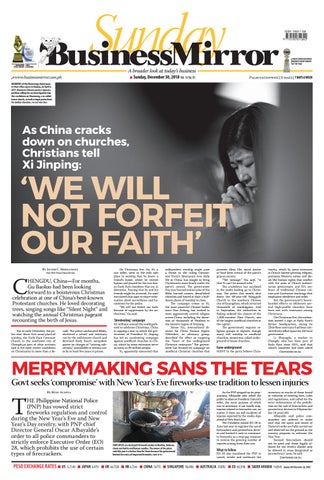
MEMBERS of the Shouwang church pray at their office space in Beijing, on April 6, 2011. Nineteen Chinese pastors signed a petition calling for an investigation into the crackdown on Shouwang, a so-called house church, as well as legal protections for similar churches. THE NEW YORK TIMES
As China cracks down on churches, Christians tell Xi Jinping:
‘WE WILL NOT FORFEIT OUR FAITH’ By Javier C. Hernández
C
New York Times News Service
HENGDU, China—For months, Gu Baoluo had been looking forward to a boisterous Christmas celebration at one of China’s best-known Protestant churches. He loved decorating trees, singing songs like “Silent Night” and watching the annual Christmas pageant recounting the birth of Jesus. But in early December, the police shut down Gu’s usual place of worship, the Early Rain Covenant Church in the southwest city of Chengdu,as part of what activists said is the most severe crackdown on Christianity in more than a de-
cade. The police confiscated Bibles, shuttered a school and seminary run by the well-known church and detained Early Rain’s outspoken pastor on charges of “inciting subversion,” punishable in serious cases by at least five years in prison.
On Christmas Eve, Gu, 31, a rice seller, went to the only safe place to worship that he knew: a friend’s home, where he recited hymns and prayed for the two dozen Early Rain members that are in detention. Fearing that he and his friends might be arrested, Gu used encrypted chat apps to share information about surveillance and harassment by the police. “We will not forfeit our faith because of suppression by the authorities,” Gu said.
‘Unrelenting’ campaign
AS millions around the world gathered to celebrate Christmas, China is capping a year in which the government of President Xi Jinping has led an unrelenting campaign against unofficial churches in China, which by some estimates serve as many as 30 million people. Xi, apparently concerned that
independent worship might pose a threat to the ruling Communist Party’s dominance over daily life in China, has sought to bring Christianity more firmly under the party’s control. The government this year banned online sales of the Bible, burned crosses, demolished churches and forced at least a halfdozen places of worship to close. The campaign comes as Xi, the most powerful Chinese leader since Mao Zedong, has worked to more aggressively control religion across China, including the detention of thousands of Muslims in the western region of Xinjiang. Renee Xia, international director for China Human Rights Defenders, an advocacy group, described the effort as targeting the “heart of the underground Christian resistance.” The government has focused its campaign on unofficial Christian churches that
promote ideas like social justice or have been critical of the party’s grip on society. “The message,” Xia said, “is that Xi can’t be messed with.” The crackdown has escalated in the weeks leading up to Christmas. The police this month shut down the 40-year-old Rongguili Church in the southern Chinese city of Guangzhou, which attracted thousands of worshippers. And in September, the authorities in Beijing ordered the closure of the 1,500-member Zion Church, one of the largest unofficial churches in the capital. The government requires religious groups to register, though many still worship in unofficial churches, sometimes called underground or house churches.
Gone underground
MANY in the party believe Chris-
tianity, which by some estimates is China’s fastest-growing religion, promotes Western values and ideals like human rights that conflict with the aims of China’s authoritarian government and Xi’s embrace of traditional Chinese culture and Confucian teachings that emphasize obedience and order. But the government’s heavyhanded efforts to obliterate several high-profile churches have been met with resistance among Christians. On Christmas Eve, the authorities posted a sign at Early Rain’s former headquarters, saying its 23rd-floor sanctuary had been converted into office space for the local government. Li Shuangde, a teacher in Chengdu who has been part of Early Rain since 2011, said that church members had been asked Continued on A2
MERRYMAKING SANS THE TEARS Govt seeks ‘compromise’ with New Year’s Eve fireworks-use tradition to lessen injuries
T
By Rene Acosta
HE Philippine National Police (PNP) has vowed strict fireworks regulation and control during the New Year’s Eve and New Year’s Day revelry, with PNP chief Director General Oscar Albayalde’s order to all police commanders to strictly enforce Executive Order (EO) 28, which prohibits the use of certain types of firecrackers. PESO EXCHANGE RATES n US 52.7240
EMPLOYEES at a backyard fireworks maker in Marilao, Bulacan, churn out Kwitis and Roman candles. The owner of the place said this year is a better time for them because the government limited the entry of imported fireworks. NONIE REYES
As the PNP stepped up its preparations, Albayalde also asked the public to observe President Duterte’s order, the main purpose of which was to minimize, if not totally stop, injuries related to firecracker use, no matter if there are still incidents of injuries reported by the media days ahead of New Year’s Eve. The President issued EO 28 in June last year to regulate the use of firecrackers and pyrotechnic devices and limited it only to community fireworks as a stop-gap measure to reverse the growing number of injuries arising from their use.
What to follow
EO 28 also mandated the PNP to cancel, revoke and confiscate the
inventory or stocks of those found in violation of existing laws, rules and regulations, and called for the strict enforcement of the prohibition on the sale of firecrackers and pyrotechnic devices to Filipinos below 18 years old. Albayalde said police commanders are ordered to make sure that the spirit and intent of Duterte’s order are fully carried out and observed on the ground as the country prepares to welcome the New Year. Banned firecrackers should not be used and those legally allowed for the revelry should only be allowed in areas designated as pyrotechnics’ zone, he said. Continued on A2
n JAPAN 0.4751 n UK 66.7328 n HK 6.7344 n CHINA 7.6773 n SINGAPORE 38.4706 n AUSTRALIA 37.0702 n EU 60.3110 n SAUDI ARABIA 14.0545
Source: BSP (December 28, 2018 )
NewsSunday BusinessMirror
A2 Sunday, December 30, 2018
www.businessmirror.com.ph
‘WE WILL NOT FORFEIT OUR FAITH’ Continued from A1
by the authorities to sign letters stating that they no longer believe in Christianity. He said Early Rain had no choice but continue to exist in secret. “We have moved underground,” he said. Members have continued to hold Sunday services, sometimes on the banks of a river near the church’s former headquarters in a downtown high-rise. They have called for the release of detained leaders, including Wang Yi, the pastor of Early Rain, and his wife, Jiang Rong. Wang, in a pre-written message released after his detention, spoke about the importance of disobedience. “The Communist regime’s persecution of the church is an extremely vicious crime,” he wrote. “As a pastor of the Christian church, I must strictly and publicly condemn such crimes.” Wang had been scheduled to deliver a Christmas Eve sermon at Early Rain, titled “The God Who Bestows Peace.” Instead, hundreds of Early Rain members on Monday scattered across Chengdu for services inside the homes of friends and relatives or at welcoming churches. At Chengdu Xishuipang Reformed Church, a Protestant church with close ties to Early Rain, more than 100 people gathered inside a worship hall on the 16th floor of an apartment building. A children’s choir sang “Silent Night,” and a small Christmas tree, decorated with snowflakes, was on
display near the lectern. The anxieties brought on by the recent arrests hung over the ceremony. “If you see the police, national security or community workers greet them with gentleness,” Wen Hongbin, an elder at Xishuipang, told the congregation. “If they try to grab the microphone, I ask the brothers sitting in the front row to please stop them.” While he did not explicitly mention Early Rain, Wen asked those in attendance to remember “those who are criminally detained.” Then he began a sermon about the meaning of Christmas and the sacrifice made by Jesus.
Under siege
SINCE Xi rose to power in 2012, the authorities have led a sustained campaign against unregistered churches. In one province, more than 1,500 crosses were removed from churches between 2014 and 2016, according to advocacy groups. This year, some Chinese cities have banned Christmas displays. But the government also allows some degree of celebration, in part to stimulate the economy. Here in Chengdu, the capital of Sichuan province, Christmas trees stand side by side on city streets with propaganda posters, and music from The Nutcracker plays in the background at malls. Officials in the United States have denounced the Chinese government’s efforts to limit the spread of Christianity. “China’s Christians and other
A PILE of rubble on a hillside is all that remains of the Sanjiang Church in Wenzhou, China, May 3, 2014. Citing violated zoning regulations, officials demolished the church on April 28, angering many in this city of nine million now at the center of a national battle being waged by a Communist Party increasingly suspicious of Christianity and the Western values it represents. SIM CHI YIN/THE NEW YORK TIMES
faith communities are under siege and treated as enemies of the state for daring to worship and peacefully live out their faith,” Sen. Marco Rubio of Florida and Rep. Chris Smith of New Jersey said in a joint statement condemning the recent detentions.
Vatican’s silence
BUT China’s growing influence in world affairs has shielded it from some criticism. One notably silent voice: the Vatican, which in September reached a provisional deal with the Chinese government to end a decades-old power struggle over the right to appoint bishops in China. The Vatican said it sent a delegation of leaders to China this month to work out details of the agreement, but declined to comment on the crackdown on Christian churches. Despite Xi’s efforts to expand the officially atheist party’s control of worship, religious life in China is flourishing. While official figures
are imprecise, experts believe there are about 60 million Christians in China, with roughly half worshipping at state-sanctioned churches and half at unofficial churches. Independent churches like Early Rain, with more than 500 members, have attracted large followings in recent years, especially among white-collar workers seeking an escape from rampant materialism at the center of modern Chinese life. While sermons at state-sanctioned churches are often tightly scripted, independent churches boom with searing indictments of corrupt officials and rousing calls to protect the rights of the poor. Early Rain, which Wang founded in 2008, was among the most daring. Wang called Xi a sinner, held prayer sessions each year to mark the brutal crackdown on pro-democracy demonstrations at Tiananmen Square in 1989, and organized a fund to support relatives of political prisoners in China.
Gu, the rice seller, began attending services at Early Rain two years ago after finding videos of Wang’s fiery sermons online. He felt Wang’s concern for the poor was in line with his own view that the government was abusing workers and violating human rights by destroying their homes to make way for expensive developments. Gu was baptized last year. “I saw injustices in society,” Gu said. “I saw that the government’s promotion of China as a just country that enforces laws in a civilized manner was all a lie.” Worried for his own safety, Gu recently closed his business, hoping to avoid government scrutiny. He said he has grown fearful as he has watched the police arrest his friends. Gu has turned to the Bible in recent days for support. Sometimes, he recites a verse from the Book of Proverbs: “The path of the righteous is like the morning sun, shining ever brighter till the full light of day.”
Merrymaking sans the tears Continued from A1
Inspections
IN Bulacan, the provincial police office has tightened its monitoring on the manufacture and sale of banned firecrackers and other pyrotechnic devices by visiting dealers and manufacturers, and subjecting these to inspections. Stronger police presence was also established, especially in Bocaue, the fireworks capital of the country, in order to ensure that dealers only sell firecrackers and fireworks that do not violate laws and regulations. The PNP has been making preparations for the New Year as early as last month, especially on how it could help the government scale down injuries that seriously mar the celebrations. Albayalde said that since last month, they have already suspended the processing of new licenses and permits for the manufacture, sale and distribution of firecrackers and pyrotechnic devices in response to the President’s Memorandum Order 31 issued in October.
Review order
THE President issued the memorandum suspending the issuance of new licenses and permits in or-
der to give way to a thorough review of all the existing licensees and check their compliance with laws, rules and regulations. The memorandum specifically mandated the PNP, in coordination with other concerned agencies and the local governments, to conduct inspections to ensure that manufacturers, distributors, retailers and users of firecrackers and pyrotechnic devices are in compliance with the government’s safety guidelines and regulations. In issuing the directive, Duterte wanted to end the presence of clandestine firecracker and pyrotechnics factories in Bulacan and other parts of the country, which have been blamed for a number of deadly accident explosions in the past. Albayalde said the PNP strictly implemented Duterte’s order and has ensured that the licensees followed existing laws, rules and regulations on firecrackers and pyrotechnic devices.
Products allowed
AS part of the effort to enforce Duterte’s orders and bring down injuries relating to the use of firecrackers and pyrotechnics, the Department of the Interior and Local Government has come up with a list of products that could be used
for the New Year revelry. These are the Baby Rocket; Bawang; El Diablo; Judas’s Belt; Paper Caps; “Pulling of strings”; Sky Rocket; and Small Triangulo. These, however, are only allowed to be used in designated firecracker zones, established by local officials in coordination with the police. Pyrotechnics, such as Butterly; Fountain (jumbo, regular and luces); Mabuhay; Roman candle; Sparklers; and Trompillo are allowed outside the designated revelry zones. On the other hand, those which are banned outright are watusi; piccolo; Super Lolo; Atomic Triangle; large Judas’s Belt; large Bawang; Pillbox; boga; Goodbye Philippines; Bin Laden; Mother Rockets; Lolo Thunder; Coke-inCan; Kwitom; Atomic Bomb; Five Star; pla-pla; Giant whistle bomb; and kabasi. One can only hazard a guess that when street sweepers clean up the streets of the revelry’s detritus on New Year’s morning, much of what will show up are parts of these banned products. Bad habits are hard to break in this country. Still, there’s no harm in hoping that good, safe practices will in time take root. And more and more people will realize that one can be merry without risking tragedy.
Faith www.businessmirror.com.ph • Editor: Lyn Resurreccion
FEAST OF THE HOLY FAMILY OF JESUS, MARY AND JOSEPH: ‘LUKE 2:41-52’
FAMILIES AND THE VOCATION TO SERVE GOD MSGR. JOSEFINO S. RAMIREZ SUNDAY GOSPEL IN OUR LIFE
O
N this feast of the Holy Family, the Church makes us consider that mysterious and isolated episode in the childhood of Jesus— the deliberate straying away from His parents and the subsequent search and finding that took place. It seems that this incident is the only significant
in Jesus’childhood. The meaning of this incident must have been engraved in the heart of Mary, who “kept all these things carefully in her heart”(Luke 2:51). She must have later narrated it to the evangelist Saint Luke, who was then inspired by the Holy Spirit as a permanent record of the event.
BLESSED VIRGIN MARY, MOTHER OF GOD By Corazon Damo-Santiago
First of two parts
J
ESUS, the Truth, the Life and the Way is Mary’s Son. She willed to be the Mother of the Redeemer, knew what it meant from the beginning and kept it all in her heart. She is Theotokos—the Greek word for “God-bearer”—Theos, meaning God, and tokos, meaning bearer, a title ascribed to Mary in the Council of Ephesus in 431 AD. There are four great dogmas of faith about the Blessed Virgin Mary. They are her Immaculate Conception, her Perpetual Virginity, her Divine Maternity and her Assumption into Heaven. The titles given her reflect her holiness, virtues and how she is loved. The Litany of the Blessed Virgin Mary ascribes her 50 titles, equivalent to the Hail Marys in the five decades of the rosary. Through the centuries, Christians have called Mary titles of virtues, holiness and devotion. Anthony F. Chiffolo published her titles in 100 Names of Mary: Stories and Prayers. Other Mariologists opined that if advocations, feasts and shrines in the world named after her are included, the list would never end. Below are some reflections from some members of the Secular Institute of the Two Hearts (SITH).
First Tabernacle
IN every church a prominent place most sacred to every Christian heart is found. If not in the middle of the main altar, it is in a place truly set apart solely for it, the tabernacle—where the Eucharist is retained. In the Old Testament, this tabernacle referred to the portable sanctuary the Israelites carried while they wandered in the wilderness after their exile from Egypt. They placed there the things they considered sacred. After reaching Jerusalem, they placed it in the temple, which King Solomon built (Exodus 25:27). And they continued to hope for the coming of the One who will save them, a mighty warrior with great power. Yet, God works in mysterious ways, too, far different from man’s own expectations. In fulfillment to what He had promised the Israelites, He had chosen the womb of the most blessed among all women to be the first to contain the Uncontainable. Such is a noble task carried out by Angel Gabriel to announce to the one whom God has found favor with—the Blessed Mother. It only took her one selfless “Yes” to be the first Tabernacle ever to contain the Holy of holies, the Bread of Life, our Lord Jesus Christ through the overshadowing of the Holy Spirit. God has created the best tabernacle to be the dwelling place of His Son. From being immaculately conceived, our Lady was filled with the fullness of grace. These graces have adorned her soul beautifully, making her also the Mother not only of the Savior but of all mankind. The Blessed Mother will always be our model in persevering in our obedience to the Most Holy Will of God. This is our assurance that the more we become close to her the more we experience God’s presence in our lives. We, too, are called to surrender our unselfish “yes” to the Lord each day. It is a calling to also be God’s tabernacle where He can dwell and be incarnated in our actions. We are with her as often as we come before every tabernacle of a Church and be close to God.—Sr. Mary Grace Bautista, SITH, Mother of the Church The most dramatic Gospel scene that shows the concern of Mary’s motherly heart is the wedding feast at Cana. “They have no more wine,” were words not only requesting for a miracle, but an ushering of Mary’s role to be the mother of all humanity. Jesus’ seemingly reluctant response implied if Mary was wiling to be transformed from being His Mother and be the mother of all He redeems too. For if He would go to make His first recorded miracle there, He would be proclaiming His Divinity—His being the new Adam—and inevitably it would also highlight her Mother’s role as the new Eve. Thus, it was not anymore a mother-son relationship, but also mother-humanity relationship. “Do whatever He tells you,” was Mary’s expression of faith. Jesus’ transformation of water into wine became his first recorded miracle. It was the beginning of Christ’s ministry, which reached its fullness on the cross. It was the beginning of Mary’s Motherhood for the whole Church, which was firmly established at the foot of the cross. As Christ utters His fifth word on the cross, “Behold your Mother,” Saint John Paul II interpreted it as a “special entrusting of humanity to the Mother of Christ.” Hence, he considers Mary’s motherhood as “man’s inheritance—a gift which Christ Himself bestowed to every individual.” Although, the title of Mary, Mother of the Church, was first used by Saint Ambrose of Milan in the 4th century, the title was the Blessed Mother by Pope Paul VI during the Second Vatican II in 1962 to 1965.—Mary Grace Bautista, SITH
First Disciple
BEING a disciple means having the conviction to follow a shepherd, like the frail sheep entrusting themselves to the One who reveals Himself as the Good Shepherd. Imagine a flock of sheep following its shepherd. Among them, somewhere in the end, is one limping and dragging its feet slowly with much difficulty. The rest are running behind the shepherd, but this one, though obedient, always, is the last in the herd. The shepherd calls them, and the rest run faithfully to him but the last sheep arrived much later than the others. Jesus knows the desires and frailties of each sheep—each of them. He knows the uniqueness of each of His sheep. Saint Therese said that if you want to walk in the path of the helpless sheep, you do not have to force yourself to be like an eagle. By imitating the attitude of the helpless sheep, you can be the highest model of sanctity—the one whose only desire is to be a servant-slave of the Lord. The Blessed Virgin Mary lived perfectly the likeness of the helpless sheep. She believes that with God, everything is possible. Her divine “yes” is like an “abyss of helplessness but also an abyss of trust in God.” When one begins to imitate Mary, realizing her limitations and weaknesses but trustfully yearn to be the Good Shepherd, one will be able to follow God with much perseverance. He shepherds each one, even the lost and the least. For every person is unique. And God loves everyone.—Sr. Fatima Zarsuel, SITH, Mother of Perpetual Help To be concluded
Why did Jesus do this? What is the significance of this unusual event for us now? “Did you not know that I must be about my Father’s business?” (Luke 2:49). Yet, after clarifying the order of priorities that He was following, Jesus obediently “went down with them to Nazareth, and was subject to them.” (Luke 2:51). In one full sweep, Jesus showed us the Christian attitude toward God and family, that should guide a person who wishes to dedicate his life to God. A Christian should love his family. The family is the basic cell of society. It is where the human being is born and, even more, it is where he grows up with the warmth, security and affection that all human beings need for the development of his
Sunday human personality. That is why the Church has always extolled the family and has vigorously defended its rights. The documents of the Church call the family the“domestic Church,” as if to emphasize that it is not only where man develops as a person, but also where he learns to be a true follower of Christ. Yet, important as it may be, the demands of God are of higher value and priority than the demands of the family. That is why the Child Jesus did not hesitate to be“about my Father’s business.”That is why later on, He would promise a hundredfold and life everlasting to all those who left “father, mother, brothers, sisters, lands and houses” for the Kingdom of Heaven. Just as “all fatherhood comes from God,” we
Sunday, December 30, 2018
can say that all families come from God. Just as the fatherhood of God is superior to any other kind of fatherhood, so the service to the family of God goes above any other kind of family service. The divine vocation (for example, to the priesthood, to the religious life or to some other form of dedication to God, even in the secular state) is more important than most family considerations. In fact, a truly Christian outlook should make heads of families pray to God that He design to choose His servants from within one’s family. There could be no greater honor. On the other hand, it would be a great failure of an allegedly “Christian” family, to put obstacles and snares along the way of a divine vocation. It
A3
would reveal, perhaps, an excessively materialistic attitude. At the very least, it would mean the failure to have a truly supernatural outlook regarding the mission of the family. If Jesus saw the need to illustrate His message with this incident, it must be because the temptation to oppose a divine vocation within a family can be something common. The parents, perhaps, had formed their own plans and expectations. They failed to see the workings of grace and the individual freedom of their children. As individuals, let us learn like Christ to have our set of priorities in the right order. And let parents also learn from the example of Mary and Joseph, by respecting and cooperating in the divine
A4
Sunday, December 30, 2018
The World BusinessMirror
Russia eyes charter change as Putin faces term limits
T
HE speaker of Russia’s parliament raised the possibility of changing the constitution as speculation grows that the Kremlin is considering ways to allow President Vladimir Putin to remain in power beyond the end of his current term, when current law requires him to step down. “This is about the transfer of power,” said Gleb Pavlovsky, a political analyst and former Kremlin aide. “Putin encourages this game, dropping ambiguous hints.” T h e c o m m e nt s f r o m V y acheslav Volodin, speaker of the State Duma and a top member of the ruling party, at a scripted Kremlin meeting with Putin late Tuesday were vague and didn’t mention succession. But analysts said they showed the authorities already are preparing the ground for changes before the end of Putin’s current term in 2024. “There are questions in society, esteemed Vladimir Vladimirovich,” Volodin said, addressing Putin in the respectful form, according to a Kremlin transcript. “This is the time when we could answer these questions, without in any way threatening the fundamental provisions” of the constitution, he added. “The law, even one like the Basic Law, isn’t dogma.”
Putin cautious
THE current constitution was drafted 25 years ago, Volodin
noted. “That was a very difficult time. A time when the state stood on the edge of collapse, when social obligations weren’t fulfilled, when our citizens lost faith in the authorities.” He proposed involving Constitutional Court judges and other legal experts in an effort to look at “how the Constitution and the norms of development of the Constitution suit the tenets that were passed.” The official transcript doesn’t include any mention of Putin’s response to Volodin’s proposal. The Kremlin’s tight control over the political system would make it easy to approve constitutional changes if Putin backed them. “There’s no position on this issue yet” at the Kremlin, presidential spokesman Dmitry Peskov said on Wednesday when asked about Volodin’s comments, adding that no work is under way on possible amendments at the moment. When he was reelected to his current six-year term in March, Putin said, “At present I don’t plan any constitutional reforms.” He brushed off a question about
VLADIMIR PUTIN ANDREY RUDAKOV/BLOOMBERG
whether he might run again in 2030, as allowed by current law. “What am I going to do, stay until I’m 100 years old? No.” But speculation over the possibility of amendments continues. Earlier this month, Putin said the constitution is “not some fossilized legal construct but a living, developing organism.” At his annual press conference last week, Putin said any changes to the Basic Law are “a matter for broad civic discussion,” though he wasn’t specifically asked about amendments to allow him to remain in power.
Term limits
POLITICAL analysts and government insiders have been discussing the possibility of constitutional changes for months as the focus on the end of Putin’s term grows. Putin, now 66 years old and apparently healthy, has suggested he doesn’t plan to stay beyond that time, but few see a suitable replacement for the
man who has ruled Russia virtually unchallenged for the last 18 years. “ The general sense is that there’s no one to replace Putin as the guarantor of the system,” said Valery Solovei, a political scientist at the Moscow State Institute for International Relations. “None of the potential candidates is in a position to maintain the ‘sacred ties’ to the people. So the best option is seen as a change in the configuration of the government to ensure Putin remains the center of decision making.” Among the hypothetical possibilities would be to elevate an advisory body called the State Council to become the supreme authority with Putin at its head, according to analysts. The presidency could remain, but stripped of many of its powers, Solovei said. Other options also are possible, he noted, saying the process of amending the constitution could begin in 2020. Bloomberg News
China holds secret trial for rights lawyer after 3 years in detention
B
Y years after Wang Quanzhang disappeared in China’s fierce offensive against human rights lawyers, he faced charges of subversion in a closed trial on Wednesday, capping a year when the Communist Party redoubled efforts to stifle political and religious dissent. Wang, 42, was the last to be prosecuted among the hundreds of rights lawyers and activists rounded up in a sweep that started on July 9, 2015. In a blaze of propaganda, the police accused him and other combative attorneys of disrupting trials, fanning discontent and plotting to overthrow the Communist Party. But while others detained in the crackdown were released with warnings, put on bail after making rehearsed confessions on television, or tried and sentenced, Wang remained held in secrecy. His trial was also swaddled in security to ward off protests. “This whole process has been illegal, so how could I expect an open and fair trial?” Wang’s wife, Li Wenzu, said in a telephone interview before the hearing. “But my demand is still that he be freed as not guilty, because that’s what he is.” The police and guards kept Li from leaving her apartment in Beijing to attend the trial in Tianjin, a port city about a hundred kilometers southeast from her home in the capital. During Wang’s detention, authorities rejected repeated attempts by her and a succession of attorneys to visit him or find out more about his status and health. The mobile phone of Liu Weiguo, the lawyer who represented Wang at the trial, was turned off on Wednesday evening, and it was unclear when the trial ended. But the Tianjin Second Intermediate People’s Court that heard the case said on its web site that a verdict would be announced at a later date. “Because state secrets were involved, the court decided under the law not to hold a public trial,” the statement said. “This will be a show trial, carefully censored and tightly controlled,” said Terence Halliday, a research professor at the American Bar Foundation in Chicago who studies Chinese defense lawyers. “Through Wang Quanzhang’s protracted disappearance, China’s state security and public security have been sending a chilling
PETER DAHLIN, who was detained and then deported from China, at his home office in Chiang Mai, Thailand, on May 13. ADAM DEAN/THE NEW YORK TIMES
message to activist lawyers—keep silent or this could be your fate too.” Still, one detail slipped out from the secret proceedings that suggested Wang remained unbowed. While in the courtroom, he dismissed his lawyer, Liu, who was not chosen by his family, Li said, citing a message from Liu. That step may have forced an adjournment in the trial, but Li had no further details. Wang’s c ase, though, has been ove r s h a d owe d t h i s ye a r by o t h e r controversies in China as Xi Jinping, the party leader and president, has sought to extinguish potential threats to party rule. Hundreds of thousands of Muslims in Xinjiang, a northwest region, have been detained in indoctrination camps where they are forced to renounce their religious beliefs and pledge loyalty to the party. Several independent Protestant churches have been shut down, and an outspoken pastor of one was detained. Two Canadians have been detained and accused of threatening national security in what supporters say was reprisal for a Chinese telecommunications executive’s arrest in Canada. The detentions of lawyers and advocates in 2015 were a turning point on the way to more hard-line policies, said experts and friends of Wang. His prolonged detention came to symbolize the Communist Party’s growing readiness to override promised legal protections if they got in the way
of silencing perceived threats, they said. “The mass detention and surveillance campaign and other persecution in Xinjiang are the worst examples we know of at the moment, but they are connected to what is going on more widely in China,” said Eva Pils, a professor of law at King’s College London who studies China’s human-rights lawyers and knows Wang. “Human-rights defenders are very openly characterized as enemies of the people, connected to other, outside enemies.” In the face of official pressure and rebuffs, Li and the families of other detained lawyers coalesced into a determined and creative resistance. They have protested using red buckets, attempted walking to the detention center where Wang was held, and this month they shaved their heads to protest what they said was judges’ failure to enforce Wang’s rights under Chinese law. (The Mandarin Chinese word for hair (fa) sounds similar to the word for law.) “In Chinese, having no hair sounds like having no law,” Li said. “We meant that we can do without our hair, but we can’t do without law.” The prosecutors’ allegations against Wang appeared to distill several themes that the government has used to attack China’s human rights lawyers as a whole. They accused him of “stirring up trouble” by calling together lawyers and supporters to
demand that detainees be freed; of maligning China’s legal system online while representing members of a banned spiritual movement, Falun Gong; and colluding with a foreignfunded group to “propagate methods and tricks for resisting the government,” according to a 2017 prosecutors’ document shared by Peter Dahlin, a Swedish rights advocate named in the allegations. Dahlin, who was detained in Beijing for 23 days in 2016 and deported from China for his work helping rights activists, said he was sure the document was authentic and rejected the claim that Wang’s activities amounted to “subversion of state power.” Wang was born in Shandong province, east China, and was drawn to activism even before he had graduated from law school. Like many other Chinese attorneys who take on contentious cases, his clients were mostly ordinary citizens in disputes with officials over land seizures, detentions and police abuses. Even more than most rights lawyers, he has a stubborn streak, his wife and friends said. His unbending personality probably “kept him going through years of abusive, incommunicado detention and given him the strength to refuse a forced confession,” Michael Caster, a human-rights advocate who formerly worked in Beijing with Wang, said by email. “He was never one to be intimidated by threats from judges or by the physical abuse of police.” When asked about Wang and others detained in the 2015 crackdown, Chinese officials have said that they have been given all their legal rights. But legal experts have said that his long, secretive confinement and lack of access to his own lawyers flouted China’s laws. In October, a United Nations Human Rights Council group condemned the secretive detention of Wang and two other Chinese advocates as a violation of international laws. Chinese courts come under the guidance of the Communist Party and rarely, if ever, find defendants innocent in politically charged cases. Some of his supporters said Wang could be given a suspended prison sentence like other some lawyers who were detained in 2015. But others were less hopeful of early release. New York Times News Service
www.businessmirror.com.ph
Trump unites the Left and Right, vs his plans in Syria, Afghanistan
W
ASHINGTON—President Donald Tr ump managed to do something remarkable with his abrupt order last week to withdraw all US troops from Syria and half from Afghanistan: unite the left and right against a plan to extract the United States from two long, costly and increasingly futile conflicts. So chaotic was Trump’s decisionmaking process, so transparent his appeal to his political base, and so lacking in a cogent explanation to allies or the public that the president’s move short-circuited a muchneeded national debate about the future of the United States’ wars. The case for pulling out, military analysts and diplomats said, is stronger in Afghanistan than in Syria, where the United States is abandoning its Kurdish allies, leaving a vacuum that could allow the Islamic State to regroup, and ceding a strategically vital country to Iran and Russia. Yet, even in Afghanistan, where US troops have fought a pitched battle for 17 years, those who believe the United States should get out are not speaking up. With the exception of a few vocal isolationists like Sen. Rand Paul, Republican-Kentucky, Trump’s handling of the issue has been condemned across the ideological spectrum. Trump issued the order to withdraw over the objections of military and civilian leaders, precipitating the resignations of Defense Secretary Jim Mattis and the special envoy to the coalition fighting the Islamic State, Brett H. McGurk. On a visit to the troops in Iraq on Wednesday, his first as president, Trump insisted that people “are going to come around to my way of thinking.” And he boasted of denying requests by US military officials to remain in Syria for an additional six months to help defeat the Islamic State, saying US troops had been there long enough. But the president’s crude defense of the decision—“we’re no longer the suckers, folks,” he told the troops at an air base in Iraq—seemed unlikely to provoke a serious debate over difficult questions like how best to combat terrorist threats in distant lands or the proper limits of the United States’ role as a global guarantor of security. “I hate to ever feel like I’m in the company of neocons, and I’m no proponent of a forever war in Afghanistan, but pulling troops out in this way is completely irresponsible and nonstrategic,” said Daniel F. Feldman, who served as special representative to Afghanistan and Pakistan when President Barack Obama ordered a troop drawdown. Some analysts said they believed Trump’s orders would not even be carried out—at least not on the 30day timetable he imposed for Syria. The Pentagon has slow-walked his orders before, and already there is talk of a more gradual withdrawal given the complications that would probably arise from a hasty pullout. Some former Trump advisers attributed the sudden nature of the announcement to Trump’s frustration with generals who resisted him at every turn when he tried to set a timetable for getting out of Syria and Afghanistan— something, his supporters point out, that he had promised to do during the 2016 campaign. “The apparatus slow-rolled him until he just said enough and did it himself,” said Stephen Bannon, who clashed with the generals over Afghanistan when he served as the president’s chief strategist in 2017. “Not pretty, but at least done.” Trump, he said, wanted to end these military campaigns so he could focus on the economic and geopolitical contest with China, which he views as the United States’ biggest foreign threat. “This is not about a return to isolationism,” Bannon said. “It’s the pivot away from the humanitarian expeditionary mentality of the internationalists.”
While Trump’s critics would shrink from that language, military analysts, former officials and diplomats acknowledge there is a case for withdrawing from both conflicts. Open-ended but limited troop deployments are not likely to alter the battlefield in either Afghanistan, where the Taliban now holds more ground than at any other time since 2001, or in Syria, where the Islamic State’s territorial grip has been broken and President Bashar Assad, with the help of Russia and Iran, has largely stymied the rebellion. Announcing troop withdrawals will force the United States to rethink long-term military commitments that have little public support and are no longer effective. It could also force the Afghans and Syrians to confront their own deep-rooted problems, without the presence of foreign soldiers who often delay the day of reckoning. “I, for one, think the decision to withdraw is sound and wise,” said Robert S. Ford, the last US ambassador to Syria. Keeping 2,000 Special Operations troops in eastern Syria, Ford said, will not prevent Russia and Iran from exerting influence. It will not stabilize or rebuild the parts of the country once held by Islamic State fighters. And it will do little to end Syria’s 6 1/2-year civil war. The presence of US troops has not made Assad any more amenable to a settlement than he was before the campaign against the Islamic State began in 2014. “Despite holding most of eastern Syria for two years, including the oil fields, the US and its Syrian allies have extracted exactly zero political concessions from Assad,” said Ford, who now teaches at Yale and is a senior fellow at the Middle East Institute. “Assad will wait us out.” The situation is even starker in Afghanistan. Last month, a year after Trump grudgingly authorized the deployment of nearly 4,000 troops, bringing the total number there to 14,000, the chairman of the Joint Chiefs of Staff, Gen. “If someone has a better idea than we have right now, which is to support the Afghans and put pressure on the terrorist groups in the region, I’m certainly open to dialogue on that,” Dunford said at a panel sponsored by The Washington Post earlier this month. Trump has ordered the number of troops cut in half, to roughly 7,000, which could be the precursor to a full withdrawal. His decision contributed to the resignation of Mattis, who told the president he deserved someone whose “views are better aligned with yours on these and other subjects.” Trump’s views, however, were hardly a mystery. “It is time to get out of Afghanistan,” he wrote on Twitter on Feb. 27, 2012, when he was already thinking about running for president. “We are building roads and schools for people that hate us. It is not in our national interests.” During a meeting in the Situation Room in July 2017, when Mattis and other advisers were pitching their plan to deploy more troops, an angry Trump lashed out. “We’re losing,” he declared, according to a person in the room. Those frustrations are widely held by NATO allies who have been the United States’ partners in Afghanistan. “It’s been getting increasingly harder to explain to European publics why we need to stay there,” said Tomas Valasek, a former NATO ambassador from Slovakia who is the director of Carnegie Europe. “Perhaps Trump’s tendency to disrupt things, including by withdrawing from Afghanistan, may not be such a bad idea after all.” In Afghanistan, the inevitability of a US withdrawal has been in the air since at least 2014, when Obama ordered a major troop reduction. Haroun Mir, an Afghan analyst, said it was understandable that Trump would be fed up, given the chaos on the ground and lack of progress in negotiating a political settlement. New York TImes News Service
www.businessmirror.com.ph
The World BusinessMirror
Sunday, December 30, 2018
A5
Japan says own whalers unhappy with plan to resume hunts
C
ount Japan’s own whalers among those unhappy with the government’s plan to resume commercial hunts—but not in the bountiful whaling grounds around Antarctica.
A Japanese foreign ministry official told reporters Thursday in Tokyo that whalers were also upset with the plan. The briefing came a day after Prime Minister Shinzo Abe’s government drew international criticism with its decision to withdraw from the International Whaling Commission and resume commercial hunts in its exclusive economic zone.
The move to end “scientific” hunts in near Antarctica was opposed by the local whaling industry, the foreign ministry official said, declining to be identified according to ministry policy. The official called the decision to end hunts in the Southern Ocean—where Japanese whalers have sometimes clashed with environmental activists—a “painful” one.
New Zealand Foreign Minister Winston Peters was among officials to object to the move Wednesday, calling whaling an “outdated and unnecessary practice.” Still, both New Zealand and Australia welcomed the end to the Southern Ocean hunting. Japan says it kills about 600 whales a year and the industry employs fewer than 300 people. Yet the issue has an out-sized presence in
the national psyche, which the foreign ministry official compared to matters like gun control and abortion in the US Norway and Iceland— both members of the whaling commission—also hunt commercially. Japan plans to use a method laid out by the commission to calculate a sustainable harvest. The first hunt is set to take place in July. Bloomberg News
A6
Science
Sunday, December 30, 2018
BusinessMirror
Sunday
Editor: Lyn Resurreccion • www.businessmirror.com.ph
healthy, indigenous DENR highlights efforts to protect PHL vegetables identified coastal and marine ecosystems L
T
By Jonathan L. Mayuga
HE Philippines has achieved significant milestones in protecting its coastal and marine ecosystems, an official of the Department of Environment and Natural Resources (DENR) said. A member of the Coral Triangle Initiative on Coral Reefs, Fisheries and Food Security (CTI-CFF), a six-nation partnership aimed at protecting the Coral Triangle, the Philippines made headway in effectively managing its marine protected areas (MPAs) and fisheries, Director Crisanta Marlene Rodriguez of the DENR’s Biodiversity Management Bureau (BMB) said. The CTI-CFF is a multilateral partnership of six countries— Indonesia, Malaysia, Papua New Guinea, Solomon Islands, TimorLeste and the Philippines—to sustain extraordinary marine and coastal resources in the region known as the “global center of marine biodiversity” by addressing crucial issues, such as food security and climate change. Rodriguez said the Philippines has delivered on its commitment to creating more MPAs with the enactment of Republic Act 11038,
or the Expanded National Integrated Protected Areas System (E-Nipas) Act, early this year. The E-Nipas law has brought to 43 the total number of nationally managed MPAs and 1,816 locally managed MPAs, all covering 1.4 percent of the country’s total sea area. MPAs are areas in seas and oceans where human activity is regulated for conservation and protection of the natural resources within them. “One of the milestones of the Philippines is the legislation of ad-
ditional 10 [nationally managed] MPAs under the [E-Nipas Act],” Rodriguez said. Rodriguez also reported the full implementation of the Coastal and Marine Ecosystems Management Program, which covered activities, such as habitat assessment for the Nipas MPAs, MPA networking technical assistance for local government units, support to 25 MPA networks and some 200 biodiversity-friendly enterprises, and the inclusion of ocean acidification baseline study in select MPAs. On the other hand, coastal stability assessment, mapping, impact monitoring, resiliency studies and updating of coral reef baseline data were successfully conducted in the West Philippine Sea and the Philippine Rise, formerly known as Benham Rise, she said. Other accomplishments of the countr y in MPA management include the establishment of a 2-million-hectare MPA in north-
One of the milestones of the Philippines is the legislation of additional 10 [nationally managed] MPAs under the [E-Nipas Act].” —Rodriguez
FISHERMEN in Tañon Strait. The Tañon Strait Protected Seascape is the Philippines’s largest marine protected area. GREGG YAN AND OCEANA
east Palawan, approval of MPA management plan for Davao Gulf and the creation of five-province MPA and MPA network within the Verde Island Passage, which has been dubbed as the “center of the center of marine shorefish biodiversity in the world.” The five provinces are Batangas, Marinduque, Romblon, Oriental Mindoro and Occidental Mindoro. Effective MPA management is one of the five targets under the country’s National Plan of Action (NPOA) for the CTI-CFF. “Among the NPOA goals, the MPA truly mirrors how much we have achieved in terms of implementation and regional cooperation,” Rodriguez pointed out. Other significant milestones are the adoption of the ecosystem approach to fisheries management (EAFM), another goal set by the Philippines in its NPOA. She said the country had intensified its effort to combat i l lega l f ishing nationw ide in order to improve food security and livelihood. To strengthen law enforcement on the country’s coastal waters, Rodriguez said a Committee on Illegal, Unregulated and Unreported Fishing was created through Executive Order 154. Of the 24 EAFM programs initiated, Rodriguez said six have been completed, while 18 are ongoing. The BMB chief said the Philippines also made progress on its three other NPOA goals, namely: establishment of seascapes, achieving climate change-adaptation measures and improved status of threatened species. The Philippines has successful hosted the CTI-CFF Ministerial Meetings and Senior Officials Meeting from December 9 to 15, which served as culminating activities for the country’s two-year chairmanship of CTI-CFF. Meanwhile, the BMB official acknowledged the important role played by the DENR’s various development projects. “We look forward to the continued support of our development partners as we embark on the progress of the next Regional Plan of Action. This then leads us to tackle issues on marine debris, nature-based ecotourism, blue carbon and sustained financing for the CTI-CFF goals,” Rodriguez said.
PHL, ROCKEFELLER UNIVERSITY LEAD IN RESEARCH ON V.C.O. ANTI-INFLAMMATORY PROPERTY
T
HE Philippines is leading a pioneering evidence -based research on the anti-inflammatory property of virgin coconut oil together with Rockefeller University. The study is envisioned to be a multinational program. It is expanding earlier research proving VCO’s potential to be a medically proven treatment for inflammation. “We’ll get help from India. They have dermatologists. They are very good in research. Thailand, Singapore maybe, Indonesia definitely, I can get their residents and anywhere else so that we have validity in numbers so we can now have multinational studies,” said Dr. Vermen M. Verallo-Rowell, entrepreneurial founder of VMV Hypoallergenics. Research such as this, much as other clinical researches pursued by VMV Skin Research Centre Clinics (VMV-SKRC), will make VCO more recognized as a medical treatment, according to Verallo-Rowell. “The best evidence-based studies that we doctors do is what we call randomized clinical trials,” Rowell said in “Interactive Lec ture on Lauric Monoglyceride in Dermatology Application.” The Philippines has introduced VCO to the world in 2000-2001 and remains to be the world’s number one VCO exporter. But scientific researches, sought for by opinionmaker doctors and consumers alike, should establish this leadership.
The other types of evidence-based research that medical experts recognize as the best evidence-type are called “doubleblinded randomized clinical trials” and “meta analysis,” a review/analysis of many researches. VMV-SKRC is completing a research on VCO’s anti-inflammatory trait that just proved VCO is far more anti-inflammatory compared to corn oil.In September 2016, VMV-SKRC made public its “Anti-inflammatory Diet Study” on VCO and corn oil. It was funded by the government-run Philippine Institute of Traditional Health Care and was carried out in collaboration with Rockefeller University-New York. It chose corn oil to represent long-chain fatty acids and coconut oil for medium-chain fatty acids. It aimed to study the oils when taken internally by patients as part of food. One set of patients took coconut oil as part of diet, and the other set took corn oil. It was a double-blinded type of clinical trial where neither the researchers nor the patients know what type they are taking. “We got regional biopsies at the beginning of the study and nonregional for control. I was stunned when we finally opened it. The amazing thing about coconut oil is that it is so much more anti-inflammatory than corn oil,” Verallo-Rowell said. Rockefeller University is also carrying out genetic studies called RNA sequencing
of these two sets of patients. Proving the anti-inflammatory quality of VCO may have numerous applications in medical treatment. “Inflammation is the key of mechanism whether it’s in the skin or psoriasis, or dermatology or even acne. All of that is given by inflammation. That same inflammation inside the body—diabetes, Alzheimer’s, depression and others,” Verallo-Rowell said. VMV has already been using coconut oil as treatment for psoriasis and other skin diseases as a far more effective cure than other treatments. For skin asthma or hika ng balat, coconut oil proved to be an excellent cure. “Coconut oil practically eradicated it. Olive oil is able to do it up to 50 percent,” Verallo-Rowell added. What is good about coconut oil is it has clinical or biological mechanism of action in treatment rather than enzymatic, which is how antibiotics work in the body—going against enzymes’ action. “Coconut oil is different. It’s mediumchain, and as such, carbon chain penetrates through the wall in the cell membrane,” she said. Besides, it has very light molecular weight of 256, compared to olive oil, 857, and sunflower oil, 876. The big fatty acids cannot penetrate into the skin. VMV-SKRC’s clinical researches on such skin treatment substantiated its claims.
OS BAÑOS, Laguna—There are many nutritious vegetables in the Philippines. And to increase the consumption of healthy and safe vegetables in the country, indigenous vegetables were documented in a project being implemented by the University of the Philippines Los Baños (UPLB). Among those identified were himbabao, pako, lubi-lubi, lagikway and gabi. A total of 104 indigenous vegetables have been documented in Ilocos Norte, Ilocos Sur, Capiz, Iloilo and South Cotobato, while another 55 plant species are for verification. Prof. Nestor C. Altoveros of the Institute of Crop Science, College of Agriculture and Food Science of UPLB, and his team documented the indigenous vegetables from the different parts of the country to discover how Filipinos utilize them as food. He also reported the intraspecific variation of roselle, amaranthus, lima bean and lupo in the provinces. Altoveros added that his team has collected 73 literatures from various sources and found that more than 208 species belonging to 100 genera are indigenous and are being utilized as food in the Philippines. Renelle C. Yebron, interim head of t he Mon itor ing a nd Evaluation Sub-Section of Crops Research Division of Philippine Council for Agriculture, Aquatic
Verallo-Rowell herself has published more than 150 articles in dermatology scientific journals. However, she pointed out the Philippines has to do more clinical trials on VCO. “The world is watching and reading people that are evidence-based,” she said. “In the Philippines, if we are to produce more understanding by the world that coconut oil is really quite safe internally and with food, we need to convince the doctors, the academics, because they are, after all, the opinion leaders. They are the ones who told the rest of the world in the 1950s, 1960s and onward that coconut oil back was not good for the diet,” VeralloRowell said. Growth Publishing for United Coconut Associations of the Phils
and Natural Resources Research and Development (PCA ARRD), congratulated the project team for the recent successful launching of the publications. To feature the project’s outputs and to showcase the different indigenous vegetables in the country, social-media accounts were launched. The collected information is stored in two database management systems developed by the team consisting of primary and secondary data in production, conservation, utilization, and national and local literatures on indigenous vegetables. The outputs of the project are expected to contribute to one of the goals of the Industry Strategic S&T Program to increase consumption of healthy and safe vegetables in the country. The project is funded by the Department of Science and Technology-PCAARRD. S&T Media Services
HOYA Meliflua Merr. Subsp. Escobinae Kloppenb. Conda, Buot and Pitargue DOST-FPRDI
Botanists discover new Hoya subspecies
K DR. Vermen M. VeralloRowell, VMV founder
ALTOVEROS
NOWN for its ball-like cluster of waxy flowers, t he Hoya plant is a favorite among many f lower enthusiasts, especially in Asia. And although there is already a great variety of officially recognized Hoya plants, a new subspecies was recently discovered by botanists from the Department of Science and Technology-Forest Products Research and Development Institute (DOST-FPRDI). Hoya meliflua Merr. subsp. escobinae Kloppenb. Conda, Buot and Pitargue was added to the International Plant Names Index (IPNI) in 2016. It was discovered by DOST-FPRDI’s For. Jennifer M. Conda, Fernando C. Pitargue Jr. and Dr. Ramiro S. Escobin. Conda explained the process of discovery: “Our team collected cuttings of the plant from the Quezon Protected Landscape in 2012. Immediately after the first f lowers bloomed, we sent samples for examination to Dr. Dale Kloppenburg, a renowned Hoya expert from the United States.” Onda added that K loppenburg “confirmed that it was a
new subspecies, which showed several similarities with Hoya melif lua Blanco ex Mer r. but with some notable differences. Results were published in Hoya New, a publication devoted to studies about Hoya, and listed in the IPNI.” According to her, the calyx lobes (sepals) of the new subspecies are tongue-like and long, as compared to the broadly oval to oblong of the Hoya meliflua Blanco ex Merr. Its corolla lobes (petals), meanwhile, are elongated and have serrated edge, in contrast to the latter’s broadly triangular lobes. “Of the 109 Hoya species recorded in the country, 39 species and three subspecies are found in Quezon province. It is no wonder that another subspecies was uncovered in the same area,” Conda explained. Also called wax plant, wax vine, wax flower or shooting star, Hoya is an Asian native plant that usually creeps or climbs. It has thick, waxy leaves and a cluster of flowers that holds up to 40 individual flowers firmly packed together. S&T Media Service
Tourism&Entertainment BusinessMirror
Editor: Carla Mortel-Baricaua
Sunday, December 30, 2018 A7
WHO ARE THE BUSHMEN?
San rock art: Imageries of an ancient people Story & photos By Bernard Joseph Esposo Guerrero
S
OME of the most fascinating places that I have been to in southern Africa are archaeological sites that tourists are not aware of most of the time. At these sites, one can have rare glimpses into the worldview of the region’s early inhabitants, and even appreciate priceless works that they have created. While they did not leave any written records, they left exemplary rock art. The San people, popularly known as Bushmen, have occupied this part of Africa long before any colonial power set foot in the continent. They received global attention when the movie The Gods must be Crazy was first released in 1980, provoking the world with questions as to who they are, where
they are and how they live. In South Africa, in 2016, it was in the Cederberg mountains where I first saw San rock paintings, and in the Richtersveld for San petroglyphs. This year’s visit in Namibia led me to see two more remarkable sites: Twyfelfontein (a.k.a., /Ui-// Aes) and Brandberg.
San rock paintings: The Cederberg and Brandberg
The rugged Cederberg in the Western Cape has one of the largest concentrations of rock paintings
in the world. Within the Cederberg Wilderness Area, a component of the Cape Floral Region Protected Areas and a UNESCO World Heritage Site (WHS), are various well-preserved San rock paintings. Among these are those along the Sevilla rock art trail. Staying overnight at the farm where these rock paintings are situated allows visitors to start their hike early. The trail is composed of nine rock sites, showcasing paintings estimated to be between 800 to 4,000 years old, and takes three hours to finish. One of the most interesting depictions here is that of a quagga, an animal last seen in the 1850s. Some rock panels also contain handprints, elands and men with exaggeratedly huge dangling genitals. Brandberg, on the other hand, is the highest mountain in Namibia. It houses one of the most iconic images in the country, the enigmatic White Lady. This rock painting was discovered in 1929 by a German surveyor, and it had,
BRANDBERG’S White Lady (center), one of the most famous and most intriguing of all San paintings
SAN rock art using hematite pigments found along the Sevilla trail in the Cederberg.
SAN rock engravings accurately depicting giraffes and rhinos in Twyfelfontein, Namibia
THE Richtersveld, the only arid biodiversity hot spot in the world, contains San petroglyphs like this one.
A KHWE San demonstrates traditional hunting during an immersion activity in !Khwa Ttu.
since then, puzzled the world as to what it represented. The earliest theory was that it was a portrait of a white person, possibly a woman, who might have reached Damara-
land long before the western colonists did. Nowadays, it has been a concession that it is a San shaman garbed in white fabric performing a ritual. The rock panel also includes various animals, most likely reflecting the ones commonly sighted in and around Brandberg then. During the hike, several indigenous trees and reptiles were encountered, as well as some footprints left behind by leopards the night before. In Fish Hoek, near Cape Town, my friend and I also managed to take a look at Peers cave. It houses the southernmost San rock paintings documented. Sadly, however, they are now in poor conditions and are impossible to recognize.
San petroglyphs: Twyfelfontein and the Richtersveld
THERE is no other way to reach Twyfelfontein than to go through bad gravel roads for hours. Halfway through the exhausting journey, my friend and I even considered retreating. However, the appeal to explore the site that has the highest density of coherent rock engravings in Africa (5,000+ figures) was too difficult to resist. Twyfelfontein is Namibia’s first declared WHS, and it contains the impressive image of the “Lion-Man.” This half-human-halfbeast is thought to be the avatar of a local shaman. The place also holds a lot of giraffe drawings, an animal that, for the San, was
closely associated with the rain. Some rock panels also include carvings of Cape fur seals, suggesting that the San also visited areas beside the Atlantic ocean 160 kilometers away. The rock engravings are dated to be between 2,000 to 6,000 years old. Twyfelfontein means “doubtful spring”, a most appropriate name for a desolate place with only one source of fresh water that is even unreliable. The Richtersveld, in the northwestern corner of South Africa, is one of the most unforgiving landscapes I have seen. Despite that, it remains to be one of the most cherished wilderness excursions I have done. It is, in fact, regarded as the only arid biodiversity hot spot in the world and is also a WHS for its cultural attributes. Aside from the traditional nomadic pastoral practices of the Nama people within the conservancy, the presence of an older group can also be seen on several basalt rocks. Various San petroglyphs, though less sophisticated than those in Twyfelfontein, also dot the Richtersveld. The images here are drawn in a pointillism manner. Most are believed to be maps of the area, while some are crude depictions of large mammals. Rock engravings are generally considered to be older than rock paintings.
“San spirit shared”
TWO visits to southern Africa have considerably exposed me to the San and their invaluable heritage. Their rock art are not just the results of their random creative juices flowing but they are, more importantly, enduring canvasses of their religious and spiritual expressions. They also portray images of endemic fauna that are already extinct. In my last visit, I also stayed for a couple of days at !Khwa Ttu, an educational center an hour away from Cape Town that is dedicated to the promotion of the San culture. Here, visitors can learn more about the different San groups (‡Khomani, !Xun, Khwe, |Xam, etc.) and their indigenous knowledge, as well as avail of various tours designed to bring them closer to the San’s ways of life. While I have seen numerous specimens of San rock art already, I will still be looking out for more next time around.
TAYSAN LAUNCHES 1ST TININDAG FESTIVAL
A food fest that serves everything on sticks Story & photos by Gelyka Ruth R. Dumaraos
W
HILE neighboring towns pride themselves on their natural wonders such as mountains and the seas, Taysan in Batangas presents its humble yet distinct product poised to be the next big thing in travel and food destination. On November 1, the first Tinindag Festival, the celebration of food products on sticks, was inaugurated and coincided with the town’s 100th founding anniversary. As a thanksgiving event for their thriving barbecue stickmaking industry, the food festival showcased an epicure of grilled pork and chicken barbecue, banana cue, camote cue, corn, quail eggs, siomai dumplings, hotdog, kebab, and grilled fish and squid— all served on barbecue sticks. According to Department of Tourism Region 4A Officer in Charge Maritess Castro, the Tinindag Festival is not only a travel and food event but it also showcases the best of Taysan. “Taysan could well be the Barbecue Stick Capital of World,” she
TAYSAN, Batangas celebrates its 100th Founding anniversary.
says. “The stick-making business has provided opportunities for small entrepreneurs, as well as employment to the townsfolk so they can support their families.” Castro adds that apart from the food event, one can revel in Taysan’s nature-adventure tourism and spiritual retreat amid its forests, rivers and churches. Among its leading tourism spots are the Bacao falls and old churches like the San Lorenzo Ruiz Parish Church in Barangay Dagatan.
Sustainable and inclusive tourism
CASTRO notes that Taysan’s barbecue stick-making industry fits
well in one of the DOT’s key focus of sustainable and inclusive tourism in countryside communities. Taysan’s industry undoubtedly generates jobs while preserving the environment, Castro adds. A second-class municipality in Batangas, Taysan is home to over 98,000 residents. The majority of the families is engaged in the barbecue stick-making business from its 20 barangays and supplying food to businesses in Lipa City, Batangas, Alabang, Muntinlupa City, Pasig City and other cities in Metro Manila. Taysan Mayor Grande P. Gutierrez says that, currently, local residents can produce P200,000
worth of sticks every week. Much as it is considered as business, Gutierrez says it is also a Taysan family tradition, as every member has their own role. The father will saw off the bamboo poles, while the mother cuts them into different sizes. The children do the finishing touches, making sure every stick is smooth before binding them. Leah Caguitla, 35, from Barangay Pinagbayanan, is one of the barbecue-stick exhibitors in the food fest. A home business that was passed on by her grandmother to her mother, she says that stick making was a big help for their family to make ends meet. “Natutunan ko po ang pagii-stick sa aking ina noong bata pa ako, mga 15 po ako noon. Ang mga magulang ko po ay napag-aral kaming anim na magkakapatid dahil dito [I learned barbecue-stick making from my mother when I was 15 years old. My parents were able to send the six of us siblings to school because of it].” Aside from barbecue sticks, Taysan also produces other bamboo products such as Nipa huts, cottages, baskets and bamboo furniture. Taysan locals are also into coconut, banana and vegetable farming.
AFTER binding, sticks are left to dry under the sun.
MOTHERS are generally in charge of cutting the bamboo sticks to different sizes.
LOCALS proudly display ears of corn on sticks.
A8 Sunday, December 30, 2018
Sports BusinessMirror
Editor: Jun Lomibao | mirror_sports@yahoo.com.ph
NO FEAR OSAKA US Open Champion Naomi
Osaka reacts while holding a 9-foot olive python at the Lone Pine Koala Sanctuary in Brisbane, Australia. Osaka is in Brisbane to play in the Brisbane International tournament, which starts on Sunday. AP
LOYOLA of Chicago’s Sister Jean shows off the Final Four ring she received before an NCAA college basketball game between Loyola of Chicago and Nevada in Chicago. AP
S
By Jim Litke
The Associated Press
PORTS contributed plenty of the same old agita this year—bad bets, empty boasts, taunts, tiffs and scuffles, plus the occasional riot—but its fair share of wry smiles, too. There were courageous losers, random acts of kindness and a handful of wins handled with such grace it made you want to get up and dance. Whoever called March mad never dreamed a 98-year-old nun would steal the show at the Final Four. In Mississippi, a homecoming queen swapped her tiara for a helmet and wound up kicking the game-winner for her high-school team. In Akron, Ohio, LeBron James went back to the future and unveiled a state-of-the-art school for atrisk kids, promising the kind of support he yearned for in the same town as a youngster himself. And as feel-good moments go, this might have been the most hopeful development of all: teddy-bear throwing became “a thing,” stretching from the west side of Canada to the heart of Europe. Here are some of the most heartwarming moments of 2018:
LOYOLA’S NOT-SECRET-FOR-LONG SECRET WEAPON
NEVER mind that Sister Jean Delores Schmidt arrived at the Final Four a few months shy of 99. Or that her last minute of playing time—for her girls’ high-school team—was chalked up in the late 1930s. Or that she’s listed in the
WHEN SPORTS MAKE YOU SMILE
team media guide (way too generously) at 5-foot, wearing custom-made maroon and gold-trimmed Nikes that would make any baller proud. Because every time little Loyola of Chicago sprung another upset on its improbable run to the Final Four, Coach Porter Moser and his Ramblers’ postgame interviews were just the opening act. If you really wanted to know how a small Jesuit university kept knocking over rivals twice its size—the tactics and the theology behind it—you stuck a microphone in front of Sister Jean. The team’s chaplain, unofficial scout and eternal optimist was a natural on TV. Rarely at a loss for words, she wasn’t shy about crediting faith for Loyola’s surprising basketball bounty, either. She had a wicked sense of humor to boot. As the season of Lent—46 days when Christians swear off worldly pleasures ahead of Easter—was nearing its end with the Ramblers still playing, a CBS reporter leaned in: “What did you give up for Lent?” she asked. Sister Jean smiled impishly. “Losing,” she said. A bobblehead was commissioned. The Today show came calling. After the Ramblers lost the semifinal, she spent the next few months recuperating from hip surgery, celebrating a birthday and collecting awards. But she was back in her office by the start of the new basketball season, updating scouting reports and tailoring pregame prayers. “When we came off the court after the Michigan loss, the players said to me, ‘Don’t worry Sister Jean, we’ll do it again next year,’” she recalled during a recent interview, then bowed her head, smiled and sighed.
BACK TO SCHOOL
LEBRON JAMES struggled just to get to school as a kid. He missed 82 days in fourth grade because his single mother, Gloria, didn’t have a car or another way to get him there. So even though he makes his living in Los Angeles these days, James made sure to be on hand and on time when the “I Promise School” opened this year. And not just because he was footing the bill. “I know the ups and downs,” James told the first class of third- and fourth-graders during the opening ceremony. “I know everything they dream about. I know all the nightmares they have because I’ve been there.” The school, a partnership between James’s family foundation and Akron City Schools, offers year-round programming, family development skills and days that begin at 9 a.m. and end at 5 p.m. It also provides parents of I Promise students with help to earn their GEDs or high-school diplomas. A planned expansion will include Grades 1 to 8 by 2020, but James is already seeing dividends from his efforts. He launched the “I Promise Program” in Akron in 2011 with a handful of community-based events. Young men and women who took part in those programs routinely approach him now to boast about where they’re going to college. “Half the battle,” James said, “is the kids just having someone that they are like, ‘Oh, this guy believes in us.’”
‘I DIDN’T THINK, I JUST RAN OVER THERE’
TY KOEHN and Jack Kocon were buddies dating back to Little League. In early June, in the ninth inning of a Minnesota highschool baseball sectional final, they stood 60 feet, 6 inches apart.
Koehn, on the mound, was putting the finishing touches on a 4-0 win for Mounds View High. Kocon, at the plate for Totino-Grace High, was the last out in his way. Three strikes later, Koehn’s teammates raced out of the dugout and began celebrating on the mound. But their star pitcher was somewhere else, standing at home plate with his arms around Kocon. “I told him I loved him,” Koehn said afterward, “and he’s my brother and our friendship will always last longer than this silly game and its silly outcome.” A video capturing that moment went viral, but no one who knew the young men was surprised. “He’s a tremendous competitor,” Mounds View coach Mark Downey said about Koehn, “but he understands there is a bigger picture.” Koehn’s teammates understood, too, even if it didn’t stop them from playfully stealing hugs in practice for the rest of Mounds View’s tournament run.
WHAT TO GET THE GIRL WHO HAS EVERYTHING
WINNING either contest would have provided Kaylee Foster with the memory of a lifetime. She had a good feeling about one, but not the other. “I was pretty sure I wasn’t going to be a homecoming queen,” the Ocean Springs senior recalled, “but I was pretty sure I was going to make that kick.” Foster notched both—thanks to years of preparation and one of the more unusual costume changes in sports. Moments after being crowned in a pregame ceremony, she handed off her tiara and flower bouquet, swapped her gown and heels for a jersey and cleats and wondered if her
in. Few Indian casinos have an enviable location like the Choctaw and many need state approval to add sports betting to their offerings. Indian casinos started small three decades ago, but they have grown to be an annual $32.4-billion segment of the US gambling industry. The roughly 475 casinos operated by nearly 240 tribes create jobs for tribal members and profits that help pay a variety of services, including health care and housing. Some casinos only have games like bingo or pull tabs that don’t need state approval. But the majority of them also have state-authorized slot machines, blackjack and other table games, according to the National Indian Gaming Commission. Many tribes share a portion of casino profits with state governments in exchange for exclusive rights to conduct gambling operations within their states. To offer sports betting, the majority of tribes would have to renegotiate compacts that vary widely in cycles and the issues covered, though some tribes believe their existing agreements already give them the right to offer the new wagers. “There’s a broad spectrum in Indian Country covering two extremes: Tribal nations that would not benefit at all, and on the other end, tribal nations that would significantly benefit,”
IT AIN’T OVER ‘TIL IT’S OVER
LINEO CHAKA of Lesotho was an afterthought as runners toed the line for the women’s 10,000-meter final at the Commonwealth Games last April in Australia. The 25-year-old had little experience at the distance and it soon became apparent she was struggling just to complete the race. For her last three laps, Chaka had the oval to herself. So the real surprise was not that she crossed the finish line five minutes behind the winner, Uganda’s Stella Chesang, or three minutes behind the 18th and next-to-last competitor, Scotland’s Beth Potter. It was the welcoming party waiting for her there. In a touching display of sportsmanship, Australian runners Celia Sullohern (who finished sixth), Madeline Hills (eighth) and Eloise Wellings (16th) lingered there, clapping and cheering Chaka on, then embraced her after she took her final strides. “I’d like to think,” Hills said, “that if I had that day, there would be someone standing on the track for me.”
RETALIATION VS. BAD REF
Indian casinos in US wary of betting on sports books L AS VEGAS—Two dozen large-screen TVs showing football and other sports line the walls. There’s beer on tap, bar top seating and leather chairs. Chicken wings are on the menu. And at this American Indian casino in the heart of college-football mad Mississippi, you can legally bet on the games. The sports book owned by the Mississippi Band of Choctaw Indians is the first to open on tribal lands outside of Nevada following a US Supreme Court ruling earlier this year, a no-brainer business decision given the sports fans among its gambling clientele. “We are basically two hours from Tuscaloosa, Alabama, and then, we are just an hour from Mississippi State. We have Ole Miss just to the north of that, and we have Southern Miss—they’re not SEC, but they are a player. We are not that far from Louisiana,” said Neal Atkinson, the tribe’s director of gaming. The book at Pearl River Resort is packed every college football on Saturday, but remains an outlier months after the high court opened the door for expanded sports gambling across the United States by striking down a federal ban. Tribes enthusiastically welcomed the decision in May but since then, the regulatory challenges and low-margin nature of the business have sunk
night could get any better. Then, with game in overtime and the score tied, 12-12— thanks to a pair of Foster field goals earlier in the game—she split the uprights with the decisive extra point. Afterward, she donned her tiara again and posed for photos wearing No. 15. Foster’s confidence on the field came as no surprise. She played soccer at Ocean Springs and had kicked for the varsity football team since her sophomore year. But her win in the pageant wasn’t such a long shot, either. Foster was a member of the homecoming court all four years.
B
UENA, New Jersey—A New Jersey school district says its wrestling team will no longer compete in events officiated by a referee who told a wrestler to lose his dreadlocks or forfeit his bout. The announcement came during an emergency meeting held on Wednesday with the Buena Regional school board and members of the community. The groups that assign referees have already said they wouldn’t assign the ref until further notice. Buena Regional High School
A PATRON checks the odds at the Pearl River Resort in Philadelphia, Mississippi. AP
commission chairman Jonodev Osceola Chaudhuri said. “Those are largely business decisions that each tribe will have to make given its own economic landscape and its unique market realities.” Some federal lawmakers have also proposed regulating sports gambling more widely, adding yet another layer to a complex debate already involving commercial casinos and lotteries, plus sports leagues themselves. So far, only the Santa Ana Pueblo near Albuquerque, New Mexico, has followed the
Choctaw’s effort into sports gambling. Neither tribe was required to obtain additional state approvals. Contrary to popular belief, sports betting is a low-profit business that requires highly skilled employees. In Nevada, sportsbooks last year contributed only 2.4 percent of the gambling revenue of casinos statewide—dwarfed by the proceeds from table games and slots. The limited payoff has tribal casinos balancing the allure of a Las Vegas-style amenity with the risks of opening compacts for negotiations. AP
wrestler Andrew Johnson had his dreadlocks cut minutes before the match on December 19. Johnson, who is black, had a cover over his hair, but referee Alan Maloney, who is white, said that wouldn’t do. Maloney didn’t respond to requests for comment. WCAU-TV reports the high school’s wrestling coach and athletic trainer discussed the incident with board members behind closed doors on Wednesday. AP
N.F.L. FAN GOES TO DISNEY
B
UFFALO, New York—An avid Buffalo Bills fan from Texas who’s battling cancer has been given a trip to Disney World, thanks to the efforts of a fan club known as the Bills Mafia. Ezra Castro is known as Pancho Billa for his game-day outfit that includes a sombrero and facemask in the National Football League (NFL) team’s red, white and blue colors. The 39-year-old mortician from
Dallas has attended numerous Bills games on the road and at New Era Field in Orchard Park, earning him the honor of being named the inaugural member of the Buffalo Fan Wall of Fame. Last Sunday while watching the Bills-Patriots game at a Dallas-area bar with other Buffalo fans, the Bills Mafia surprised him with an all-expensespaid trip to Disney World in Florida for him, his girlfriend and their two young children. AP