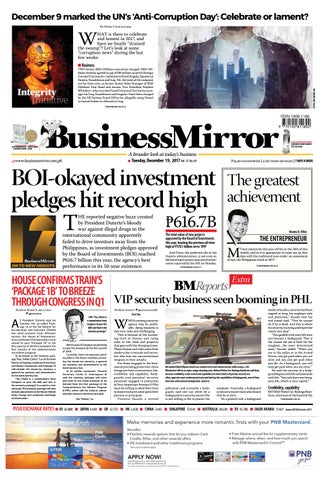
December 9 marked the UN’s ‘Anti-Corruption Day’: Celebrate or lament?
W
By: Henry J. Schumacher
hat is there to celebrate and lament in 2017, and have we finally “drained the swamp”? Let’s look at some “corruption news” during the last few weeks: ■ Business
KENTOH | DREAMSTIME.COM
Two former SBM Offshore executives charged: SBM Offshore recently agreed to pay $238 million to settle Foreign Corrupt Practices Act violations in Brazil Angola, Equatorial Guinea, Kazakhstan and Iraq. Yet, the woes of the company are far from over, as former Senior Sales Manager of SBM Offshore Paul Bond and former Vice President Stephen Whiteley—who was also Unaoil’s General Territories manager for Iraq, Kazakhstan and Angola—have been charged by the UK Serious Fraud Office for allegedly using Unaoil to funnel bribes to officials in Iraq. Continued on A12
media partner of the year
United nations
2015 environmental Media Award leadership award 2008
BusinessMirror A broader look at today’s business
www.businessmirror.com.ph
n
Tuesday, December 19, 2017 Vol. 13 No. 69
BOI-okayed investment pledges hit record high ₧616.7B T he reported negative buzz created by President Duterte’s bloody war against illegal drugs in the international community apparently failed to drive investors away from the Philippines, as investment pledges approved by the Board of Investments (BOI) reached P616.7 billion this year, the agency’s best performance in its 50-year existence.
The total value of new projects approved by the Board of Investments this year, beating the previous all-time high of P570.1 billion set in 1997
And China, the preferred ally of the Duterte administration, is not even on the list of top 5 country sources of investments reported by the BOI on Monday. Continued on A12
2016 ejap journalism awards
business news source of the year
P25.00 nationwide | 4 sections 26 pages | 7 days a week
The greatest achievement Manny B. Villar
THE ENTREPRENEUR
M
y last column for this year will be on the 26th of this month, and so it is appropriate to come out on that date with the traditional year-ender: an assessment of how the Philippines fared in 2017. Continued on A10
HOUSE CONFIRMS TRAIN’S BM Reports ‘PACKAGE 1B’ TO BREEZE THROUGH CONGRESS IN Q1 VIP security business seen booming in PHL By Jovee Marie N. dela Cruz
By Rene Acosta
@joveemarie
CUA: “Yes, [there is a commitment from Congress to pass the bill] and that is the amnesty package.”
A
s President Duterte sign on Tuesday the so-called Package 1A of the Tax Reform for Acceleration and Inclusion ( TRAIN) law amid protests from different sectors, the House of Representatives confirmed that lawmakers have vowed to pass “Package 1B” in the first quarter of 2018 to complete the first tranche of the administration tax-reform program. To be known as the “amnesty package,” Rep. Dakila Carlo E. Cua of the lone District of Quirino, chairman of the Ways and Means Committee, said Package 1B will include the estate-tax amnesty, a general tax amnesty and amendments to the bank-secrecy law. “Yes, [there is a commitment from Congress to pass the bill] and that is the amnesty package,” Cua said in a text message. The amnesty package will also include adjustments in the Motor Vehicle Users Charge and automatic exchange of information.
Both houses of Congress are planning to pass the measure by the first quarter of 2018. Currently, there are separate pending bills in the lower chamber providing the estate-tax amnesty, a general tax amnesty and amendments to the bank-secrecy law. In an earlier statement, Finance Secretary Carlos G. Dominguez III said the amnesty package will cover one-third of the initial revenues to be derived from the first package of the Comprehensive Tax Reform Program (CTRP), which will the Duterte administration massive infrastructure plan.
PESO exchange rates n US 50.4880
See “House,” A2
W
@reneacostaBM
Part Two
HILE running a security agency may be profitable, doing business is also very risky and challenging. This is because of the increasing level of threats and rising risks to life, limb and property that goes with the changing times. These threats and risks come from modern-day criminals and terrorists who now use unconventional weapons in their attacks. For those engaged in the business of providing protection, three things are their cornerstones: life, credibility and capability. Bodyguards and personal security personnel engaged in protection of Very Important Persons (VIPs) must be willing to shed their lives to ensure no harm come upon their patrons or principals. Vicencio Esca ler a retired
An unidentified Filipino-American combat instructor demonstrates skills using a .243 Winchester rifle in an open-range shooting area. Retired Police Col. Rodrigo Bonifacio said that, because credibility, track record and capability are what clients of private security are after, agencies must continuously train and beef up the capabilities of bodyguards, even if they have law-enforcement background. NONIE REYES
policeman and currently a bodyguard, said one can never be a bodyguard or a security escort if he is not willing to die to protect his
employer. Ironically, a bodyguard or security escort must also ensure that he is alive. “As a general rule, a bodyguard
needs to be alive, since he had been tapped to keep his employer safe and protected,” Escaler (not his real name) said. “This he cannot do if he is dead. And this is where his security training and expertise comes into play.” “You gamble with your life once you become a bodyguard. This is the reason the job is built for the toughest, the most determined ones,” Escaler added. “When you are in the police or in the Armed Forces, you get paid when you are alive and you also get paid when you die. As a bodyguard, you will only get paid when you are alive.” He said the journey of a bodyguard begins with life and also ends with life. “You only have one thing: your life, which is your capital.”
Credibility, capability
RETIRED Police Col. Rodrigo Bonifacio, chairman of the board of the Continued on A2
n japan 0.4481 n UK 67.2753 n HK 6.4638 n CHINA 7.6405 n singapore 37.4540 n australia 38.6284 n EU 59.2780 n SAUDI arabia 13.4631
Source: BSP (18 December 2017 )
BMReports BusinessMirror
A2 Tuesday, December 19, 2017
VIP security business seen booming in PHL Continued from A1
Utopia Security and Safety Solutions Inc., said the security business involves nothing but services. And, when you talked of services, you also deal and offer nothing but credibility and capability, Bonifacio told the BusinessMirror. With the cutthroat competition in the security market, which was borne by the continuously growing number of agencies joining the industry, a private security agency needs to be credible and capable in order to stay afloat in the business. Credibility, track record and capability are what clients and VIPS are after, according to him. Bonifacio said these are the reasons private security agencies like Utopia continuously train and beef up the capabilities of staff. He said his company go by the books and does not go for hasty deployment. We deploy blue guards only after they have already completed the required training, and even some higher training, if so
required, Bonifacio said. We are also very particular in equipment, he added. Likewise, Utopia gives premium to the background of its members, including those who will be tapped by the agency to do VIP protection. “We do not only subject them to background investigation when they apply, but continuously do so even when they are already doing their job for a client,” Bonifacio said. “This is to ensure that the client is assured of maximum protection and services.” He added industry members should keep this as the standard. “All the while, they are thinking that the bodyguards they have hired are doing their jobs, guarding the VIPs assigned to them,” Bonifacio said. “But it could turn out that these bodyguards are already selling their clients to the persons” aiming to harm or eliminate the client. He added the turncoat could “burn” the agency and make it and the people behind the firm less
Investment pledges. . . According to Trade Undersecretary and BOI Managing Head Ceferino S. Rodolfo Jr., the surge in investments for the year is mainly due to the designation of focused strategic sectors under the 2017 Investments Priorities Plan (IPP), particularly infrastructure and power projects. The strong growth of domestic demand was also a major driver. Power and energy projects remained as the top performing sectors, with P268.168 billion in approved investments, followed by infrastructure and PPP projects with P127.658 billion. This boost in infrastructure is credited to the ramping up of construction activity for the government’s “Build, Build, Build” program. For manufacturing, as listed in the 2017 IPP, investments were
Asean. . .
Continued from A12
Household debt in parts of the region could hold back faster consumption and the broadening out of expansion, according to Taimur Baig, chief economist at DBS Group Holdings Ltd. in Singapore. “The worst case is, there are some macro shocks and these households already saddled with high debt stop consuming in an exuberant manner, so you have a drag on consumption,” he said. Consumers in Singapore, Malaysia and Thailand have higher debt burdens compared to others in the region, with central banks in the latter two countries citing financial stability risks as a factor in deciding policy.
What our economists say
“ Economies in Southeast Asia picked up steam in the third quarter but, in most cases, private demand is not shouldering enough of the burden to worry about rate hikes into next
Continued from A12
channeled anew to key industries, such as cement, sugar and petrochemicals. Investments in the manufacturing sector increased almost three fold, or by 256 percent, to P96 billion in 2017, from only P27 billion in 2015. The figure is also 95 percent higher than the P 49.259 billion reported in 2016. The manufacturing sector is the third topperforming sector for the year. Real estate and mass-housing projects ranked fourth with P86 billion, while transportation and logistics came in fifth with P15.909 billion. Japan is the top source of BOI-approved foreign-investment projects for the year with P 8.864 billion, mainly in green ship recycling, chemicals and glass manufacturing, among others. This was followed by Singapore, with
year. Malaysia may be an exception though, with tightening possible as soon as the first quarter of 2018. Fading momentum in private consumption and investment is likely to keep the Philippine Central Bank on hold for now,” Tamara Henderson of Bloomberg Economics said.
Investment pickup Business investment will be the bigger story in 2018, said Chua Hak Bin, an economist at Maybank Kim Eng Research in Singapore. While this year’s big surprise was the upturn in trade, that trend typically means a boon for investment that’s been languishing, as executives change their minds about global demand prospects. Fledgling projects under China’s “Belt and Road” initiative could help boost those figures, he added.
Political risks
The threat of further North Korean military provocations and a series of elections add
credible. Hence, an agency should assess the compensation structure, he said. It’s true that, compared to ordinary blue guards, bodyguards or security escorts demand more fees and compensation, according to Bonifacio. However, both should be given their fair share from the company, he said. Security guards also perform their jobs, some even at the expense of their lives, according to Bonifacio. Thus, agencies should pay the blue guards with the required compensation and provide the benefits due to them, he added.
House. . .
www.businessmirror.com.ph
Continued from A1
The Department of Finance (DOF) said it is still computing the expected revenue gains from the amnesty package. The Package 1A of the TRAIN Act, which is the first of five tax packages of the Duterte administration, is targeting to raise P130 billion in revenues.
THE PNP reported last year that there were about 500,000 licensed security guards around the country. This number, however, does not include those who have been employed as bodyguards or security escorts. To note, this number is way above the memberships of the Philippine National Police (PNP) and the Armed
Forces of the Philippines combined. The regular presence of security guards in almost every nook and cranny of the country, especially in highly urbanized areas, has not escaped the attention of the PNP. The visibility of these guards prompted the PNP to tap them as force multipliers as the government grapples with crime. The PNP even acknowledged security guards as first responders in times of crimes. The role of the members of private security agencies was highlighted during the attack by a lone gunman of the Resorts World Manila in June this year, which also exposed vulnerabilities in guards or their employers. The attack, which claimed the lives of 38 people, prompted the PNP to order security agencies and establishments to regularly review and update their security regulations and procedures. It also directed security firms, businesses and offices to conduct regular security and emergency drills. To be concluded
P3.497 billion, Australia with P1.996 billion, British Virgin Islands with P1.084 billion—all in renewable energy—and The Netherlands with P1.074 billion (manufacturing). Per region, a decrease by 53 percent in investment approvals was noted in the National Capital Region (NCR). Region 4-A (Calabarzon) emerged as the top destination for BOI-registered investments with P 294.6 billion, or a 48-percent share in the total approved investments. Region 3 (Central Luzon) followed with P 123.3 billion, while NCR was only at third with P 44.3 billion. Significant investments were noted in Regions 1 (Ilocos Region) with P 39.6 billion and Region 7 (Central Visayas) with P 35.6 billion. As locational restriction was relaxed in the 2017 IPP, significant increases in investments were noted.“This validates business confidence in President Duterte’s economic programs to
ensure inclusive growth and shared prosperity for the country. The influx of investments is definitely steamrolling, as we are expecting sustained higher investments for the next five years,” Lopez said. The BOI only targeted P500 billion in fresh approvals this year. “But to blitz past the P600billion mark is something we are definitely ecstatic for, as this only proves the continuing confidence of the investors in making their business grow in the Philippines.” “The increase in infrastructure projects this year supports the BOI’s push for the growth in economic activities outside Metro Manila and the Build, Build, Build, or the massive infrastructure program of the administration,” Rodolfo noted. “While BOI incentives are directed for strategic domestic projects, a number of foreign-investment projects also registered with BOI.” Catherine N. Pillas
Bad for underground economy
DOT. . .
‘Use veto power’
Numbers
to uncertainty in the region. Malaysia is gearing up for a vote next year, with speculation mounting it will happen before the end of May. Prime Minister Najib Razak is facing a tough contest, but has bolstered his chances of reelection with a stimulus-packed budget in October. The timing may also have a bearing on when the central bank raises interest rates for the first time since 2014, with some economists suggesting a prevote hike is unlikely. Thailand’s military, which has held power since a coup in 2014, said it’s on course for an election in November, although doubts remain. That may influence investment decisions, with businesses remaining on the sidelines in recent years. Indonesia is set to hold regional elections next year, which may help to boost consumers’ purchasing power and provide a a lift to overall spending in the economy, which has disappointed this year. Bloomberg News
Continued from A12
Also present at the conference was Agriculture Secretary Emmanuel F. Piñol. Aside from cacao farms, the Davao region also includes nature parks and farm resorts, such as Eden’s Nature Park, Hijo Banana Resort, Gumamela Caverock Farm Resort and Pearl Farm, among others. In October the DOT launched its “It’s more fun on Philippine farms” program, which will be spearheaded by an interim Farm Tourism Development Board that includes representatives from the DOT, DA, DTI and the private sector. The board will formulate the National Farm Tourism Strategic Action Plan, and will be assisted by a technical working group from Agricultural Training Institute, Technical Education and Skills Development Authority, Department of Science and Technology and government financial institutions like Land Bank of the Philippines and Development Bank of the Philippines. The upcoming activities will also include the search for “Farm Tourism Ambassadors” among children and young adults, and the “Sunshine Tourism Awards,” which will honor best practices in farm tourism. The activities will culminate in a national event, “It’s More Fun on Philippine Farms Summit,” to be headed by the Farm Tourism Development Board in September 2018.
Ejercito. . .
Continued from A12
SB 1605,” the senator told the BusinessMirror on Monday. Ejercito admitted that he did not expect the DOF’s decision to junk the proposed higher tax rates imposed on harmful tobacco products. “Though disappointed with the inclusion of a very low rate of tobacco tax, which caught me by surprise, I intend to push for a higher rate for Package 2 [of the DOF’s TRAIN bill],” Ejercito added.
Signing
Cua said Duterte is expected to sign the Package 1A today in time for the January 1, 2018. implementation. “I will be there. I was informed that Tuesday is the signing.” Under the proposed TRAIN, workers earning P250,000 will be exempted from paying personal-income tax, while raising the 13th month pay’s tax-exempt ceiling to P90,000 from the current P82,000. It also imposed excise tax on coal: P50 per metric ton for the first year, P100 for the second and P150 for the third. The measure said the tax rates to be imposed on sugar-sweetened beverages are P6 tax per liter for juices and energy drinks and P12 tax per liter for beverages with highfructose corn syrup. It said the excise tax rates for all nonmetallic minerals and quarry resources and all metallic minerals, including copper, gold and chromite, will be doubled. For automotives, an excise tax of 4 percent will be levied on vehicles costing up to P600,000; 10 percent for over P600,000 to P1 million; 20 percent for over P1 million up to P4 million; and 50 percent for over P4 million. For oil and petroleum, the tax rates to be imposed are P3 for kerosene, P2.50 for diesel and P1 for LPG. All petroleum products that are being used as input, feedstock, raw materials for petrochem and refining, or as replacement fuel are exempt. The measure also eases the rates of estate and donor’s taxes by imposing a unitary tax rate of 6 percent. For tobacco, the excise tax will be raised from the current P30 to P32.50, effective from January 1, 2018, to June 30, 2018; to P35 effective July 1, 2018, to December 31, 2019; to P37.50 effective 2020 to 2021; to P40 effective 2022 to 2023; and 4-percent annual increase after. It said cosmetic procedures, which include surgeries and body enhancements, will be taxed by 5 percent. For housing, it will be status quo for three years, then the Senate version after. The Senate version defines socialized housing units as those constructed or sold at P2 million or less. With this, the TRAIN grants tax exemption for shelter units that fall under the definition of socialized housing. The Associated Labor Unions-Trade Union Congress of the Philippines (ALU-TUCP) said more than 15.6 million Filipinos in the underground economy are expected to suffer from additional taxes under the TRAIN. In a statement, ALU-TUCP said workers in the informal sector will take the hit in the new taxes on SSBs and excise taxes on petroleum products. The group noted these workers are those not covered by labor standards and without social-protection benefits. “Informal-sector workers working in the informal economy will be ran over by the TRAIN,” ALU-TUCP Spokesman Alan A. Tanjusay said. “Getting no direct benefits from the tax-reform package, these underground economy workers will fall further way below the poverty line.” He added the TRAIN will contribute to the poverty of informal workers, and this will manifest in many forms, such as incapability to purchase basic needs. Informal economy workers, according to the ALU-TUCP, “are those independent, self-employed, small-scale producers and distributors of goods and services”. These are mostly comprised of jeepney drivers, tricycle drivers, pedicab drivers, taxi drivers, sidewalk vendors, sales attendants, barbers, cooks, waiters, dishwashers in small-scale eateries, tailors, sewers, porters and street sweepers, among others. These workers, according to the group, are most vulnerable to the additional taxes imposed by the TRAIN.
HealthJustice Philippines, a think tank and advocacy group with expertise in tobacco control and health promotion, expressed dismay over the TRAIN and called on Duterte to exercise his veto power. “The incredibly low tobacco tax in TRAIN came as an unpleasant surprise. Clearly a handiwork of the tobacco industry, it appears to have been inserted at the last minute to forestall the efforts of advocates to push for a significantly higher tax rate, one that will truly be effective in discouraging tobacco consumption among the youth and low-income families,” said Dr. Jaime Galvez-Tan, board member of HealthJustice and former health secretary. “We call on President Duterte to line veto the incredibly low tobacco tax increase inserted at the last minute in the TRAIN [Package 1A] bill. Mr. President, this will not save lives as tobacco products will remain affordable to our youth and low-income families. If we allow this, debilitating diseases, such as lung and throat cancers, will continue to rise. We implore your better judgment and not allow this travesty to happen. The commercial and vested interests of tobacco industry should not be permitted to sabotage the lives and health of the Filipino people,” Galvez-Tan emphasized. Addressing the President, Galvez-Tan added, “As former mayor of Davao City, you were known for strictly implementing a smoking ban to protect the health of his constituents. You also openly condemned the dirty acts of the tobacco manufacturers, including their numerous attempts to bribe policy-makers and law enforcers with huge sums of money and extravagant gifts. We hope that this time, as President, you will demonstrate the same zeal in protecting the lives and health of the Filipino people by exercising your veto power to strike down the very low, ineffective and industry-sponsored tobacco tax rate in the TRAIN,” he added. Dominguez said the total potential revenue that can be collected by the government from increases in coal excise taxes can amount to as much as P2 billion in its first year of implementation. According to DOF Undersecretary Karl Kendrick T. Chua, excise tax collections on coal annually only amounts to around P300 million today. “[Excise tax collections on coal is] P300 million only, it’s small. It’s like P0.01 per kilogram...,” Chua told financial reporters. The increase to P50 per metric ton on coal excise taxes under the TRAIN will translate to a tax of P0.05 per kilogram, according to the finance chief. “And now it will be P0.05 per kilogram [with potential revenue at] P2 billion,” Dominguez said. The primary consumption of coal in the Philippines is for power generation, according to Chua. Broken down, 80 percent is for power generation, 15 percent to power cement plants and 5 percent consumed by the industry. The increase in coal excise tax was originally included in the fifth package of the CTRP.
With Rea Cu, Elijah Felice E. Rosales and Claudeth Mocon-Ciriaco
The Senate and the House of Representatives, however, adjourned sessions on December 16, after ratifying the final version of the TRAIN bill’s Package 1 seen to raise over P130 billion to bankroll the Duterte administration’s massive infrastructure plan under its “Build, Build, Build” scheme. TRAIN Package 1B is expected to be signed into law by President Duterte before the year-end to take effect by January 2018. While it mandated downward adjustments in income taxes, the soon-
to-be enforced TRAIN Package 1B will collect higher tax rates on tobacco, fuel, coal and mining operations. Its early enforcement, however, may be derailed by legal questions owing to lack of quorum when the House of Representatives voted to ratify the bicameral panel’s approved version of the awaited money measure. ACT Party-list Rep. Antonio L. Tinio of ACT questioned the quorum, noting only 10 of 294 House members were present at the session hall when the TRAIN bill was ratified by both chambers of Congress on December 13.
www.businessmirror.com.ph
The Nation BusinessMirror
Editor: Vittorio V. Vitug • Tuesday, December 19, 2017 A3
CA affirms murder verdict for road-rage shooter Jason Ivler
Duterte dangles urban-poor commission post to LGBT
T
resident Duterte has offered the lesbian, gay, bisexual and transgender (LGBT) community a seat in the urban-poor commission, which he overhauled last week.
By Joel R. San Juan
@jrsanjuan1573
HE Court of Appeals (CA) has upheld the reclusion perpetua decision handed down by the Regional Trial Court (RTC) in Quezon City against roadrage shooter Jason Ivler for the killing of a son of a former Palace official in 2009. In its decision, the CA 14th Division held that the prosecution has presented sufficient evidence to warrant the denial of Ivler’s appeal of the guilty verdict issued by Judge Luisito Cortez of the Quezon City RTC in Branch 84 on November 24, 2015. Ivler was charged with murder in connection with the death of Renato Ebarle Jr., son and namesake of former Presidential Chief of Staff Renato Ebarle Sr., who served under the Arroyo administration. “We uphold the accused-appellant’s conviction. Contrary to Ivler’s contention, the prosecution has proven all of the elements of murder,” the CA said. Ivler, nephew of singer Freddie Aguilar, shot Ebarle Jr. dead over a traffic altercation in Quezon City on November 18, 2009. He was arrested two months after by agents of the National Bureau of Investigation at the residence of his mother, Marlene Aguilar, in Quezon City. The trial court sentenced Ivler with reclusion perpetua, or a maximum jail term of 40
years, and was ordered to pay the Ebarle family a total of P9.373 million for civil damages. In its decision, the CA modified the damages set by the lower court by increasing the award of actual damages representing burial expenses from P143,890 to P616,590; the award of moral damages is increased from P75,000 to P100,000; the award of exemplary damages is increased from P30,000 to P100,000; and civil indemnity was ordered amounting to P100,000. The CA did not give credence to Ivler’s claim that Senior Police Officer 3 Edgar Tiodin and bystander Archie Castillo failed to positively identify him as the one who shot Ebarle Jr. The CA pointed out that the trial court correctly observed that eyewitnesses were only 3 to 5 meters away from where the shooting happened and that the place was well-lit making it “entirely possible” for them to identify Ivler as the gunman. The CA also backed the trial court’s finding that treachery aggravated the crime to murder. “Renato Ebarle Jr. was totally unaware that he would be treacherously shot in the comfort of his own car while waiting for the stoplight before him to turn green. He was unarmed and was not given any opportunity to defend himself or to escape from the deadly assault,” the ruling read.
P
By Elijah Felice E. Rosales
The President last Sunday asked the LGBT community to choose their representative to be seated as commissioner of the Presidential Commission for the Urban Poor (PCUP). All five commissioners of the PCUP were sacked by Duterte for allegedly going on unnecessary trips abroad. “Now find me the brightest dito sa Pilipinas.… Bigyan ninyo ako ng bright na tao [Now find me the brightest here in the country… Give me a bright person]. He might be gay, he might be lesbian. I’d like to nominate or appoint somebody upon…nomination,” he said during an LGBT festival in Davao City. “You nominate the representative from the LGBT sector [because] I fired the entire Commission [for] the Urban Poor, [including] the head for traveling so much in so short a time, as if he was using the money of the people like his own.... [So, I will have
@alyasjah
to appoint new commission heads],” the President added. He said gays and lesbians are honest and hardworking people, and he will appreciate if someone from the ranks of the LGBT community will take charge of the PCUP. “And I would like to show that [anyone, either gay or lesbian], can always work just like an ordinary human being,” he said. Duterte told the LGBT community he is giving them until the second week of January to nominate their representative in the urban-poor commission. He also said the sector to make sure their nominee is “bright and honest,” so as to highlight the virtue and commitment of the LGBT community. Aside from the would-be LGBT commissioner, the President is also considering to tap 2009 CNN Hero of the Year Efren Peñaflorida as head of the PCUP. Peñaflorida was
recognized internationally for his efforts to educate street children in Manila through his self-decorated “kariton classroom.”
You nominate the representative from the LGBT sector [because] I fired the entire Commission [for] the Urban Poor, [including] the head for traveling so much in so short a time, as if he was using the money of the people like his own.... [So, I will have to appoint new commission heads].”—Duterte
Economy
A4 Tuesday, December 19, 2017 • Editors: Vittorio V. Vitug and Max V. de Leon
COMP adopts TSM initiative By Jonathan L. Mayuga @jonlmayuga
T
he Chamber of Mines of the Philippines (COMP) has moved to formally and officially adopt Canada’s sustainable mining model. The adoption of Toward Sustainable Mining, or TSM initiative, a mining-sustainability standard developed by the Mining Association of Canada (MAC), is in response to President Duterte’s call to the industry to be more responsible in doing business. “There is so much that minerals development—done responsibly— can contribute to the economy of a nation and to the welfare of mining communities, as shown by numerous examples in the Philippines. The adoption of TSM by members of the Chamber of Mines is intended to institutionalize practices that secure these contributions for the long term,” Gerard H. Brimo, COMP chairman, president and CEO of the Nickel Asia Corp., said in a news statement. For his part, MAC President and CEO Pierre Gratton lauded COMP for its decision to partner with MAC and adopt its sustainable-mining model. “It is our privilege to share our tools and expertise in sustainablemining practices with the world. With the Philippines’s adoption of TSM, we’re proud to say that our made-in-Canada program is now in five countries on five continents. We applaud the Chamber of Mines of the Philippines for taking this important step forward as it works to enhance its industry’s environmental and social performance,” he said. The COMP and MAC are expected to make the partnership on the adoption of TSM official, along with a public announcement on Tuesday, with Environment Secretary Roy A. Cimatu attending the event, according to Ronald Recidoro, executive director of COMP. Mining-industry players are also expected to release the “Baguio Declaration” affirming their commitment to responsible mining in response to the challenge of the environment chief during the 64th Annual National Mine Safety and Environment Conference organized by the Philippine Mine Safety and Environment Association held in Baguio City in November. According to Recidoro, the COMP’s executive director, COMP’s adoption of the TSM initiative is a first for national mining association operating within the Southeast Asian region. The COMP, however, is the fourth national mining association outside of Canada to adopt TSM in the span of less than two years, underscoring the program’s growing global presence. The national mining associations of Finland (FinnMin), Argentina
(Cámara Argentina de Empresarios Mineros) and Botswana (Botswana Chamber of Mines) are currently implementing TSM. Launched by the MAC in 2004, the implementation of TSM is mandatory for all MAC members’ Canadian operations, but many voluntarily apply it to their international sites, Recidoro said. MAC freely shares TSM with other countries seeking tools to improve the environmental and social performance of their mining industries, including engagement with civil society and enhanced transparency and accountability. TSM requires mining companies to annually assess their facilities’ performance in key areas, including tailings management, community outreach, safety and health, biodiversity conservation, crisis management, energy use and greenhousegas emissions management. The results are freely available to the public and are externally verified every three years to ensure what has been reported is accurate. While COMP will tailor its performance areas so that they reflect the unique aspects of its domestic mining sector, they will strongly align with those of Canada’s. To ensure TSM reflects the expectations of civil society and industry stakeholders, it was designed and continues to be shaped by an independent, multiinterest advisory panel. As part of its implementation, COMP will implement a similar advisory body to provide this valuable oversight function. Meanwhile, antimining group Alyansa Tigil Mina (ATM) is not impressed by COMP’s adoption of the TSM model of Canadian mining companies. Sought for reaction, Jaybee Gargandera, national coordinator of ATM said the term “sustainable mining” itself has been discredited because minerals themselves are finite resources, and the link of minerals extraction to deliver sustainable development has never been established. “This is why the global mining industry had to fall back on the concept of “responsible mining,” he said. According to ATM, the TSM model is a weak framework, as compared to another world-class mining framework being developed—the Initiative for Responsible Mining Accounting Assurance (Irma). “Alyansa Tigil Mina would have been more pleasantly surprised if Irma was adopted by COMP. If the United Nations Environment Program report for 2017 is to be an objective basis, then the DENR [Department of Environment and Natural Resources] and the Duterte administration should be afraid once COMP formally adopted TSM. He cited a report, issued on October 27, which states that “Canada has Second Worst Mining Record in World: UN.”
BusinessMirror
www.businessmirror.com.ph
QR lifting to slash rice-retail price by ₧7, DOF exec says By Rea Cu
T
@ReaCuBM
he lifting of the quantitative restrictions (QR) on rice imports in favor of tariffs will deliver a range of benefits to the economy, including a P7 per kilo slash on the retail price of the food staple, the finance department said.
In an economic bulletin on the rice-sector reform, Finance Undersecretary Gil S. Beltran said a 35-percent import tariff on rice in lieu of restricting rice-import volumes would encourage private traders to bring in the staple into the country, which would allow the influx of cheaper rice in the domestic market. Citing a study from the National Economic and Development Authority, the Department of Finance (DOF) official said the reduction in rice prices would be beneficial to the majority of poor households that spend at least 20 percent of their budget for rice. According to Beltran, also the DOF’s chief economist, pulling down rice prices is crucial to poverty reduction because it is a major driver of inflation. The QR allows the country to limit the volume of rice imports entering the Philippines with a tariff of 35 percent. Importing outside
the volume restrictions will entail a higher import tariff. The World Trade Organization (WTO) granted the Philippines an extension of its QR on rice importation until June 30, 2017, to give local farmers more time to prepare for free trade. It first allowed the Philippines to impose a 10-year QR on rice imports in 1995. It was extended in 2004 until 2012, and then was renewed again in 2014. The economic managers of the Duterte administration earlier decided to allow the expiration of the QR without applying for another extension before the WTO. Beltran said that the proposed tariffication will generate P27.3 billion at an expected import rate of 35 percent, which the government can use to augment funding for social protection projects like cash transfers for the poorest families as well as for palay productivity programs. Finance Secretary Carlos G.
Dominguez III has bared that among the key objectives of the Duterte administration’s inclusive growth agenda is to transform the Philippines into an upper middle-income economy and cut the poverty rate from the current 21.6 percent to 14 percent by the time President Duterte leaves office in 2022. “The tariff revenues that will be generated from rice imports can augment the funds used for the government’s social-welfare programs for the poor and rice-productivity programs that will enhance efficiency. Tariff revenue is estimated at P27.3 billion annually from 2017 to 2023,” Beltran said. Instead of subsidizing imports, the national government could reallocate its funds to invest in public goods and services that directly benefit the farmers, including farm-to-market roads, irrigation and storage, which reduce production and marketing costs, according to Beltran. The National Food Authority is
mandated to import and regulate rice imports, and has so far received a total of P187 billion in tax subsidies for its imports of the grain from 2005 to 2015, or an average of P19 billion a year, according to the DOF. “The NFA can now reorganize and limit its function on proprietary activities, in particular, buffer stocking for food security and calamities, and local procurement. Note that in its present state, the NFA loses about P11 billion annually, [that], even after operating subsidy of P5 billion average per year from 2005 to 2015…[still] has an accumulated debt of P155.84 billion as of the end of September 2016,” he added. The Philippines ranks fourth compared to five other Asian countries, including Vietnam, Thailand, India, China and Indonesia, in terms of palay production cost. The country’s average cost in producing this staple is about 10 percent higher than those for these Asian countries and 48 percent higher than the least cost producer, according to Beltran.
The tariff revenues that will be generated from rice imports can augment the funds used for the government’s social-welfare programs for the poor and rice-productivity programs that will enhance efficiency. Tariff revenue is estimated at P27.3 billion annually from 2017 to 2023.”—Beltran
PHL runs risk of losing Japan poultry-export market sans bird-flu clearance By Jasper Emmanuel Y. Arcalas @jearcalas
T
he Philippines may lose its Japan export market for poultry products if the country will not be cleared from avian influenza (AI) at the soonest possible time, according to the Bureau of Animal Industry (BAI). Citing industr y reports, BAI Animal Health and Welfare Division Chief Dr. Arlyn Vytiaco said Japan may be forced to source its chicken imports from other countries next year to fill in the supply void left by the Philippines after it was banned from exporting poultry products to Tokyo. “The cold storages have been communicating with me, and they are saying that their problem is that if it takes us so long to be AI free, then we may lose our market for
yakitori,” Vytiaco told reporters in an interview on Monday. “It’s been since August that we are banned from exporting yakitori. And, if this remains for so long, then the countries could source imports from other markets, like Thailand,” Vytiaco added. Tokyo banned poultry and poultry products from Manila after the latter confirmed its first-ever case of AI in August. Vytiaco said Japan has been in constant communication with BAI to ask for updates and monitor the country’s bird-flu status. However, even before AI struck Central Luzon, Philippine chicken exports have been declining as government data indicated a double-digit drop in the volume of outbound shipments in the January-to-July period. Data from the BAI obtained by the
BusinessMirror showed the country’s chicken-meat exports during the seven-month period reached 2,609.374 metric tons (MT), 12.23 percent lower than last year’s 2,973.064 MT. BAI data indicated that Japan was the sole buyer of chicken products exported by the Philippines during the period. Last year the Philippines shipped 5,000.121 MT of chicken meat, the bulk of which, or 4,965.020 MT, was bought by Japan. However, exporters would have to wait until the first quarter of 2018 for the Philippines to regain its bird flufree status, after a new case of AI was discovered in Cabiao, Nueva Ecija. The discovery of AI in a layer farm in Cabiao, Nueva Ecija, reset the country’s countdown to bird flu-free status. Under the Terrestrial Animal Health Code of the World Organization for Animal Heath, or OIE, a country will
only be declared free from bird flu if it would not report any outbreak within 90 days after the final disinfection of the affected areas. Vytiaco said the Philippines may notify the OIE that it is bird flu-free as early as March next year. Vytiaco added that BAI is eyeing to finish the cleaning and disinfection in the AIaffected farm in Cabiao, Nueva Ecija before Christmas. “[We] are on track to finish the cleaning and disinfection before Christmas. So the earliest possible week for us to be bird flu-free is by third week of March,” she said. Earlier, BAI Officer in Charge Ronnie D. Domingo said the government wanted to notify the OIE that the Philippines is already bird flu-free by December 20, more than four months after the virus was discovered in San Luis, Pampanga.
Naia braces for 2M passenger arrivals this Christmas season By Recto Mercene @rectomercene
T
Unresolved issue
The advocacy group Anti-Trapo Movement (ATM) is contesting the reappointment of Health Secretary Francisco T. Duque III, citing the unresolved issue on the alleged illegal transfer of funds of the Overseas Workers Welfare Administration to the state-run Philippine Health Insurance Corp. during the 2004 midterm polls. ATM Founder Leon Peralta shows copy of a letter he submitted last Tuesday to Senate President Aquilino L. Pimentel III, strongly recommending the rejection of Duque’s nomination by the Commission on Appointments. Peralta questioned the propriety of appointing Duque to the same post for the second time, arguing that there was no evidence showing Duque did an exemplary job during his first tenure at the health department.
HE Ninoy Aquino International Airport (Naia) is expecting the arrival of some 2 million vacationing tourists, balikbayan and overseas Filipino workers (OFWs) from across the globe all within a month this Christmas holiday season. This is the forecast of Manila International Airport Authority General Manager Ed Monreal based on last year’s record arrival and this year’s anticipated 20-percent passenger arrival increase, even as he assured the public that the premier airport is ready to meet the deluge. The Department of Tourism is aiming for 6.4 million passengers to visit the country until the end of the year. In preparation for the expected surge of passengers and cargo, the Civil Aviation Authority of
the Philippines, The Bureau of Immigration (BI), Customs and the Philippine National Police Aviation Security Group said they are now ready for the coming cargo and passenger increase. Initially, immigration officials are having hard a time processing the hundreds of incoming OFWs, mostly from the Middle East countries and balikbayan around the globe, because they arrived in surges during the “peak hours.” Monreal, a former country manager of Cathay Pacific, said, normally, airlines have scheduled their arrival at any airport to be at the ideal time between 2 p.m. and 5 p.m. and between 7 p.m. and 9 p.m. until between 10 p.m. to 1 a.m. the next day. “This bundled arrivals creates long lines of arriving passengers, while airlines [are] hard put to deal with an overflow of luggage and cargo,” he added. Monreal said part of the mountains of luggage
accumulating at the arrival areas are bound to the provinces, and these pieces of luggage have to be transported by a special vehicle to Terminals 2, 3 and 4, where domestic flights originate. BI Port Operations Division Chief Red Mariñas said they canceled all vacation leaves of all immigration agents and were ordered to fill up the vacant immigration booths to assist in coming passengers. For the past days, hundreds of passengers in the four terminals were found crowding the luggage conveyor belts, while uniformed security personnel makes regular rounds, armed with highpowered weapons and assisted by bomb-sniffing K9s. They are out not only for the safety of the passengers, but also to make sure the premier airport is not infiltrated by would-be-terrorists or any form of troublemakers, Monreal said.
www.businessmirror.com.ph
Banking&Finance BusinessMirror
Few Filipinos bother with risk-protection services
O
By Cai U. Ordinario @cuo_bm
nly 13 percent of adults in Metro Manila, Luzon, the Visayas and Mindanao have risk-protection cover, according to a paper released by the Philippine Institute for Development Studies (PIDS). In a discussion paper, titled “What Determines Financial Inclusion in the Philippines? Evidence from a National Baseline Survey,” PIDS President Gilberto M. Llanto and Research Specialist Maureen Anne D. Rosellon said many Filipinos shy away from formal financial services, such as insurance, nationwide. “In all four geographic areas, only about 13 percent of adults have availed themselves of insurance products and services. The
low ta ke-up cou ld be due to nonavailability of insurance products, lack of information or lack of suitable insurance products, and other factors,” the research pair said. “The situation in the insurance sector merits a serious study because insurance equips households with ability to cope with exogenous shocks, which could sometimes be catastrophic, and to develop resilience to such shocks,” they added.
T he researchers said areas outside of Metro Manila or the National Capital Region usually do not have banks and other financial-services firms. This poses a logistics concern, especially for low-income households. The absence of formal financial services in these areas forces households to resort to informal sources of financing or credit, such as savings at home, forming informal group savings or borrowing funds from moneylenders. This, Llanto and Rosellon said, exposes households to consumerprotection issues presented by the absence of regulation of the informal financial-services providers. Unfortunately, these also affect household’s opportunity to access insurance services. The authors said insurance is a “potent instrument for inclusive finance, especially for poor households.” “The situation in the insurance sector merits a serious study because insurance equips households with ability to cope with exogenous shocks, which could sometimes be catastrophic, and to develop resilience to such shocks,” the authors said. The authors also added an-
other “ interesting finding” in their study showed females were more likely to engage the formal financial institutions than males. This includes owning savings accounts, as well as accessing credit and other financial products, including insurance. This, the authors said, was already an improvement from the previous study that showed women, rural households and young Filipinos experienced the most difficulties when accessing loans. “This may be an indication of the positive results of government and private-sector efforts to empower women with more meaningful participation i n econom ic ac t iv it ies. T h i s f ind ing is encou rag ing ,” t he authors said. The study focused on financial inclusion from transaction with formal financial institutions; ownership of savings account; access to credit; and access to insurance. The authors used data from the National Baseline Survey on Financial Inclusion, a national representative survey of Filipino adults on financial inclusion for the study.
Editor: Jun B. Vallecera • Tuesday, December 19, 2017
A5
BSP connects with Bank of Thailand
T
he Bangko Sentral ng Pilipinas (BSP) on Monday announced the signing of another bilateral agreement with Thailand, aiming to boost exchange of technical support in the two countries’ banking systems. BSP Governor Nestor A. Espenilla Jr. and Governor Veerathai Santiprabhob, his counterpart in the Bank of Thailand, signed in Bangkok, Thailand, a memorandum of understanding (MOU) on banking supervision. The BSP said the new MOU details the two authorities’ commitment to fostering information exchange and cooperation, particularly in the areas of licensing, on-site examinations, supervisory colleges and crisis management. “The MOU serves as a solid foundation for effective supervision of banking institutions operating in both countries in accordance with the principles set out in the Basel Core Principles for Effective Banking Supervision,” the BSP said in a statement. Earlier this year, the BSP also signed with Bank of Thailand a
Letter of Intent (LOI) to begin bilateral Asean Banking Integration Framework (Abif) discussions. About a month after the central bank’s agreement with Thailand, the BSP and Indonesia’s Otoritas Jasa Keuangan or Financial Services Authority also signed an LOI to formally start Abif negotiations ceremonies held in Jakarta, Indonesia. Deputy BSP Governor for the Supervision and Examination Sector Chuchi Fonacier said the BSP looks forward to completing bilateral discussions with Thailand next year. The Philippines has received praise for actively pushing forward its Abif commitments through the signing of bilateral commitments with counterparts in the region. Abif is a framework agreement among the Asean member-states facilitating the entry and operation of qualified Asean banks in other Asean countries. It promotes equal access and treatment among banks, thereby facilitating the expansion of intra-regional trade. Bianca Cuaresma
A6
Tuesday, December 19, 2017 • Editor: Lyn Resurreccion
The World BusinessMirror
www.businessmirror.com.ph
Cooperation fraying between White House and Mueller
W
ASHINGTON—For much of the seven months since Robert S. Mueller III was appointed special counsel, President Donald J. Trump’s lawyers have stressed their cooperation with him, believing that the more they work with his investigation, the sooner the president will have his name cleared.
But in recent weeks, as the investigation has reached deeper into Trump’s inner circle, that image of cooperation has begun to fracture. Trump’s lawyers and supporters have significantly increased their attacks on Mueller, especially as the Federal Bureau of Investigation (FBI) has handed them fresh ammunition to claim that the agents investigating the president may be biased. The most recent salvos came over the weekend, when a top Republican senator said Mueller needed to examine the political leanings of his team, and a lawyer for Trump sent a letter to lawmakers saying that the special counsel had improperly obtained e-mails from the presidential transition team. “Not looking good, it’s not looking good—it’s quite sad to see that, my people were very upset about it,” Trump said last Sunday when asked about the transition e-mails. “I can’t imagine there’s anything on them, frankly, because, as we’ve said, there’s no collusion, no collusion whatsoever.” While Trump also said he was not considering firing Mueller, the mounting attacks have fueled concerns among Democrats that he is preparing to do so anyway.
Eric H. Holder Jr., President Barack Obama’s first attorney general, said on Twitter last Sunday that any such move would be an “ABSOLUTE RED LINE.” Legal experts said there was no indication that Mueller, who has wide power to obtain documents through written requests, subpoenas and search warrants, improperly obtained the transition e-mails. But amid the barrage of criticism, Mueller’s office issued a rare statement last Sunday defending how the information had been obtained during the inquiry into Russian election meddling. “When we have obtained emails in the course of our ongoing criminal investigation, we have secured either the account ow ner’s consent or appropriate criminal process,” said Peter Carr, a spokesman for the special counsel’s office. A lawyer for Trump said in a letter to Congress last Saturday that the General Services Administration (GSA), the government agency that possessed the transition team’s e-mails, had handed over the materials to Mueller’s investigators in August without allowing lawyers for the transition team to review them. The documents, the lawyer
Robert S. Mueller III, the special counsel in the Russia investigation, leaves the Capitol in Washington on June 21. A lawyer for President Donald J. Trump accused Mueller of improperly obtaining e-mails and other records from Trump’s transition team, the latest in the mounting attacks by the president and his surrogates on Mueller’s investigation. Doug Mills/The New York Times
argued, should have been shielded by various privileges, like attorney-client privilege. The materials, said the lawyer, Kory Langhofer, were the property of the transition team and, therefore, it should have had the chance to decide what was given to investigators. The letter came days after the Justice Department took the unusual step of releasing to the media anti-Trump text messages that an agent overseeing the investigation had sent to a colleague. Although Mueller had moved quickly this past summer to remove the agent from the inquiry, Republicans seized on the disclosure to criticize Mueller and the FBI. One Trump adviser, Kellyanne
Conway, said it was evidence that “the fix was in against Donald Trump from the beginning.” White House officials sought to play down the significance of the letter about the transition emails, insisting it was an issue for the transition team, not the West Wing. They said the president had not changed his approach to cooperating with the special counsel, and that he had not discussed dismissing Mueller. “We have been cooperative and transparent with the special counsel’s office and will continue to be—we look forward to an expeditious conclusion to this matter,” said Jay Sekulow, a lawyer for Trump. Still, the letter to Congress f ro m L a n g ho f e r s ou nd e d a
Not looking good, it’s not looking good—it’s quite sad to see that, my people were very upset about it [obtained e-mails from the presidential transition team].” —Trump
discordant note. His assertion that the e-mails were privileged and should have been shielded stood in contrast to the stance of White House officials, who said that Trump’s lawyers had not invoked any such privilege on any White House documents that Mueller had requested. Among the materials obtained from the transition team by Mueller were e-mails, laptops and cell phones for nine members who worked on national security and policy matters, according to the letter. Mueller’s investigators have used the documents during interviews with transition team officials when questioning them about calls between Trump’s former national security adviser, Michael T. Flynn and the Russian ambassador in which they discussed United States sanctions. One of the e-mails shows that several transition officials were aware that Flynn was going to be speaking with the ambassador on December 29 after the Obama ad m in ist rat ion had imposed new sanctions on Russia for its election meddling. The e-mail showed, despite claims to the contrary, that top transition officials knew that Flynn was in contact with the ambassador. He pleaded guilty this month to lying to the FBI about his interactions with the Russian official. “The materials produced by the GSA to the special counsel’s office, therefore, included materials protected by the attorneyclient privilege, the deliberative process privilege and the presidential communications privilege,” Langhofer, the counsel to Trump for America, said in his letter, which was sent to the top Republican and Democrat on the Senate and House oversight committees. New York Times News Service
Japan prosecutors raid contractors Pope blows out birthday candle on extra-long pizza as probe into maglev widens
A
n investigation into Japan’s construction industry widened, as Tokyo prosecutors raided the headquarters of Kajima Corp. and Shimizu Corp. in a probe linked to a $80-billion magneticlevitation (maglev) rail line. Spokesmen for the two companies confirmed that their offices had been searched by the Tokyo District Public Prosecutors Office and Japan Fair Trade Commission, after local media reported overnight that the two, as well as Obayashi Corp. and Taisei Corp., would be raided over alleged anti-monopoly violations in contracts for the maglev project currently under construction. The contractors are suspected of coordinating their bids for the project, according to the Sankei newspaper. Managers from the four construction companies met once a month to discuss progress they were making on the project, a practice not usually observed, the report said. The ¥9-trillion ($80-billion)
maglev project, one of the centerpiece infrastructure projects in the country, is being developed by Central Japan Railway Co., with the first leg linking Tokyo to Nagoya scheduled to open in 2027. Transport Minister Keiichi Ishii last week declined to comment on the possibility the investigation would delay the project. Kajima Spokesman Atsushi Fujino said the company was fully cooperating with the investigation. Shimizu Spokesman Kiyoshi Maruyama said he had not confirmed the charges. Shares in Kajima fell as much as 4.6 percent, and Shimizu slipped as much as 3.7 percent, while the Nikkei 225 Stock Average climbed 1 percent. Maglev trains rely on magnetic power to float the cars above the ground, eliminating the friction of steel tracks. The trains start off running on wheels—the kind used on F-15 fighter jets—until they’re going fast enough for the magnets to kick in and create lift. Bloomberg News
V
ATICAN CITY—Pope Francis has blown out his birthday candle on an extra-long pizza at the Vatican to the delight of children. Francis, who turned 81 last Sunday, then told the children, who use a Vatican health service, to “eat all 4 meters [13 feet]” saying it will make them grow. Later, thousands of children in Saint Peter’s Square shouted birthday wishes to Francis. He replied from his window overlooking the square: “Thanks a lot, thanks a lot.” His birthday coincided with his weekly Sunday appearance to faithful. Pizza for parties in Italy is often baked in long form, instead of round pies, which are meant instead for individual portions. At the Vatican, rectangularshaped pieces of pi zza were stretched end to end on a table and a tall, white candle stuck in the middle. AP
Pope Francis blows a candle on the occasion of his 81st birthday during a private audience with children in the Paul VI hall at the Vatican last Sunday. L’Osservatore Romano/Pool Photo via AP
Old coal is still king even with renewables record in Germany
F
or all the new wind parks, solar farms and hydro plants that will help Europe’s biggest economy generate yet another renewable energy record this year, the world’s dirtiest power fuel still rules in Germany and sets the price for how much factories are paying for electricity. Wind turbines will this year, for the first time, produce more power than plants burning hard coal as the nation’s
unprecedented shift toward renewable energy has pushed output from solar and wind to more than a third of the nation’s total. Yet, it is coal prices at their highest level since 2013 that’s pushing up electricity rates for the first time in six years because of the way the market works. As coalition talks drag on a third month, Chancellor Angela Merkel’s bloc and its potential partners agree at least
on one thing: Coal power must be capped. Even after consumers have paid some €650 billion ($770 billion) in subsidies for everything from solar panels on roofs to offshore wind farms, grids and giant batteries, the nation is on course to miss its high-profile 2020 target for cutting carbon-dioxide emissions. W hile wind and solar power by law gets priority and enters the grid first, coal plants are sometimes last and
thereby set the price for the next unit of power needed to match demand. The average German dayahead power price is expected to rise this year for the first time since 2011, tracking a 28-percent increase in European coal prices. Industrial power prices are to a large extent linked to the wholesale market. “As long as we stay in coal and don’t shut down power plants, gas and coal are the
main influences on German power prices” said Steffen Gursinsky, a trader at Energieunion GmbH in Schwerin, Germany. “If the rising trend for coal continues next year, power prices will follow.” Renewables met a record 38 percent of Germany’s power demand this year through last Thursday, according to researcher Fraunhofer ISE’s web site. Among new plants this year pushing supplies to anoth-
er high are three giant wind parks in the German part of the North Sea with a combined capacity of a nuclear reactor. Brown coal is still the nation’s biggest individual source of power, with fossil fuels making up almost half of the total. Nuclear’s share has halved to 10 percent since Merkel’s decision to exit atomic energy after the Fukushima disaster in Japan in 2011. Bloomberg News
The World BusinessMirror
www.businessmirror.com.ph
Tuesday, December 19, 2017 A7
Vietnam upgrading areas in South China Sea
A
S China continues to transform disputed territory in the South China Sea into features capable of sustaining air and naval bases, Vietnam is also upgrading areas it occupies.
Images taken by DigitalGlobe satellites in September show new facilities—including a possible dry dock on West London Reef in the Spratly Island chain, around 680 kilometers (422 miles) southeast of Ho Chi Minh City, that could allow boats to stop for maintenance and patrol for longer periods. While the work is vastly outweighed by what China is doing, it suggests Hanoi wants to hold its ground over the contested waterway, even if it risks upsetting Beijing. In August Philippine President Duterte ordered a construction halt on a 500-square-meter sand bar in the area after a protest from China. “Maintaining and even consolidating a military and nonmilitary presence has been consistently one of the key approaches for Vietnam’s strategy for the South China Sea,” said Alexander Vuving, a political analyst at the AsiaPacific Center for Security Studies in Hawaii. Vietnam has reclaimed about 120 acres across 10 islets since 2014, according to the Washington, D.C.based Asia Maritime Transparency Initiative, extending runways and adding radar and patrol capabilities. By comparison, China has reclaimed more than 3,200 acres on seven features in the Spratlys, building ports, lighthouses and runways it says are mostly for civilian purposes or defense. China’s claims to more than 80 percent of the South China Sea, which
carries around $3.4 trillion worth of global trade a year, overlap with the Philippines, Brunei Darussalam, Malaysia, Taiwan and Vietnam. In the past year, Hanoi has become the most vocal defender against China’s assertions. Its latest upgrade to West London Reef comes after China reportedly pressured Vietnam to halt drilling in a contested area leased to Spain’s Repsol SA, said Bill Hayton, an associate fellow at Chatham House. “Vietnam’s response to the Repsol incident has been a modest expansion on its islands,” said Hayton, who wrote The South China Sea: The Struggle for Power in Asia. “Many of the decisions to expand the island facilities would have been taken before the drilling episode, but that is certainly giving some impetus.”
Code of Conduct
Another potential source of friction between Hanoi and Beijing is renewed talks over a Code of Conduct for the South China Sea between China and the 10-member Association of Southeast Asian Nations. Despite endorsing a one-page framework in August, which calls on parties to commit to the principles of the United Nations Convention on the Law of the Sea, China wants the code to be voluntary, whereas Vietnam wants it to be legally binding. “Vietnam would sign a legally binding Asean-China code of con-
Japan’s export recovery grew to 12th month in November
J
apan’s exports grew for a 12th straight month in November, topping economists’ expectations, as external demand continued to fuel the nation’s longest stretch of economic growth since the 1990s. The value of exports rose 16.2 percent from a year earlier (forecast 14.7 percent), the biggest gain since August. Imports increased 17.2 percent (forecast 18 percent). The trade surplus was ¥113.4 billion ($1 billion). The forecast was for a deficit of ¥40 billion. Export volumes rose 5.5 percent from a year earlier, accelerating from October. A yearlong recovery in exports has kicked Japan into higher gear, fueling record profits and rising capital spending during the longest economic expansion since the mid-1990s. Confidence among the nation’s large manufacturers has reached the highest level in a decade, while sentiment is rising even among smaller companies. The wage growth needed to drive a selfsustaining recovery remains elusive, though, even as the labor shortage intensifies, prompting the government to plan to offer tax benefits to encourage higher pay. “We can expect exports will remain strong enough to lead Japan’s economy, with solid demand from US [United States] and China,” said Norio Miyagawa, a senior economist at Mizuho Securities Co., who cited global demand for semiconductors and information technology-related goods. “Without any sign of weakening in exports, Japan’s economy will probably keep recovering gradually,” Miyagawa said. “The BOJ (Bank of Japan) must be gaining confidence in the economy with today’s export data.” The November data confirmed the strength of global demand after signs of softening in October, said Atsushi Takeda, an economist at Itochu Corp. in Tokyo. “The general trend hasn’t shifted a great deal from last month, but the positive aspects are clearer with this month’s data,” he said. Japan’s adjusted trade balance showed a surplus of ¥364.1 billion (forecast ¥265 billion). Exports to China, Japan’s largest trading partner, rose 25.1 percent from a year earlier. Those to the US rose 13 percent. Shipments to the European Union rose 13.3 percent. Exports of semiconductor machinery rose almost 55 percent. Bloomberg News
A Vietnam flag flutters atop a government building. Bloomberg
Maintaining and even consolidating a military and nonmilitary presence has been consistently one of the key approaches for Vietnam’s strategy for the South China Sea.”—Vuving duct if it brings it and other countries benefit,” according to Rear Admiral Le Ke Lam, a former Vietnam Naval Academy director. “But China would
never sign it.” Vietnam’s Foreign Ministry did not respond to e-mailed questions about the land reclamation or
whether the Code of Conduct should be legally binding. Le said Vietnam’s South China Sea infrastructure program was confined to minor reclamation on existing islands. Vietnam suffered a setback last year after the new Philippine president chose not to pursue further an international court ruling that dismissed Beijing’s South China Sea claims. The case, brought by Duterte’s predecessor, Benigno S. Aquino III, was supported by Vietnam. In the absence of support from
May risks Brexit row over trade and migration during transition
U
nited Kingdom Prime Minister Theresa May will set out her plan for how a proposed Brexit transition period will work, stoking a potential new row with the European Union (EU) as she tries to keep different factions inside the Conservative Party on her side. May will address Parliament around 3.30 p.m. London time on Monday, saying that after March 2019 she wants Britain to leave the EU’s single market and customs union while retaining most of the benefits of membership. While the European Union has said this will mean abiding by its rules, the prime minister will propose a diverging course in at least two areas. “During this period we intend to register new arrivals from the EU as preparation for our future immigration system,” May will say, according to her office. “And we will prepare for our future independent trade policy by negotiating—and where possible signing—trade deals with third countries, which could come into force after the conclusion of the implementation period.”
He said the UK must strike a trade deal that gives it the power to discard EU laws, and that failure to do so would render Britain a “vassal state” of Brussels. That’s the same phrase that Tory lawmaker Jacob ReesMogg used last Friday to attack the European Union’s proposals for the transition period. It may be a concession to those who oppose the form of transition that May’s proposing. But May doesn’t only have to deal with Conservatives who want to get as far away from the EU as possible. Last week she suffered her first defeat in Parliament after proEuropean Tories rebelled over the level of scrutiny Parliament will get of the final Brexit deal. Last Friday she seemed to have found a way to avert another defeat with a compromise over whether the date of Brexit can be changed. The Guardian reported last Sunday that some of these rebels have urged May to form an alliance with Labour Party lawmakers to vote down those in her party who want a so-called hard Brexit.
Difficult meetings
Ignition point
Both of those are likely to be points of disagreement in the upcoming negotiations with the EU. But, at least, that difficulty won’t come until talks resume in 2018. Before then, May faces a difficult series of meetings at home. On Monday the Cabinet’s Brexit subcommittee is due to discuss for the first time the desired goal for the negotiations; then the whole Cabinet will ponder the same question on Tuesday. May has so far managed to keep her party and her Cabinet united by not addressing the question of where she’s like the Brexit talks to end up. The Cabinet is split between those, such as Chancellor of the Exchequer Philip Hammond and Home Secretary Amber Rudd, who argue that Britain needs to stay close to the EU—its major trading partner—and others, including Foreign Secretary Boris Johnson and Environment Secretary Michael Gove, who say that the country’s best hope lies in setting its own regulations, even if that means tougher trading restrictions.
No ‘vassal state’
Johnson fired a fresh salvo over the weekend, using an interview with the Sunday Times to call for a “liberal Brexit.” He said the advantages of leaving the European Union haven’t been properly outlined to the public.
A new possible ignition point for the row within the Conservative Party is a proposal—reported in Sunday newspapers to have been made by Gove—to abolish the limits on the hours people can be required to work that were brought in as part of Britain’s European Union membership. That would break a promise the Tories made at this year’s election. Labour’s Brexit Spokesman Keir Starmer said it revealed the real goal of those who want maximum distance from the EU. “No one supports ‘divergence’ to raise standards; only to deregulate,” he wrote on Twitter. “Showing their true colors.” Even if the Cabinet can agree on the kind of Brexit it wants, it still has to persuade the European Union to agree. Michel Barnier, the chief European negotiator on Brexit, in an interview with Prospect magazine conducted in the days before last week’s summit, repeated that the EU won’t agree to a more favorable deal with the UK than it has with any other countries. “They have to realize there won’t be any cherry-picking,” he said. “We won’t mix up the various scenarios to create a specific one and accommodate their wishes—mixing, for instance, the advantages of the Norwegian model, member of the single market, with the simple requirements of the Canadian one. No way. They have to face the consequences of their own decision.” Bloomberg News
the Philippines, Vietnam has sought to improve ties with Indonesia, which has shown signs of pushing back against Chinese encroachment near the Natuna Islands that Beijing claims are part of its traditional fishing grounds. In June 2016 President Joko Widodo held a Cabinet meeting on a warship near the islands, and Indonesia later renamed the northern reaches of its exclusive economic zone in the South China Sea as the North Natuna Sea.
Bloomberg News
Oil holds gains near $57 as U.S. drillers trim crude rig count
O
il held gains near $57 a barrel as United States drillers targeting crude reduced the rig count for the first time in four weeks. Futures were little changed in New York after rising 0.5 percent last Friday. Shale explorers trimmed the number of rigs by four to 747 last week, according to Baker Hughes data. Hedge funds have boosted bets on rising prices to a record for Brent crude and to near a nine-month high for West Texas Intermediate (WTI), exchange and government data showed last week. Oil is set for a second yearly gain as the Organization of Petroleum Exporting Countries (Opec) and its allies trim production to drain a global glut. While the group has extended cuts through the end of 2018, it faces rising output from the US, which is forecast to surge next year to a record 10 million barrels a day. “Oil should remain a little bit stronger going into the end of the year,” said David Lennox, a commodity analyst at Fat Prophets in Sydney. “Key things to watch in 2018 are Opec compliance and better demand across the globe. The only headwind is US production—that’s going to keep the oil price in check.” WTI for January delivery, which expires on Tuesday, rose 9 cents to $57.39 a barrel on the New York Mercantile Exchange as of 11:20 a.m. in Hong Kong. Total volume traded was about 49 percent below the 100-day average. Prices gained 26 cents last Friday, trimming the third weekly loss to 0.1 percent. Brent for February settlement was up 13 cents at $63.36 a barrel on the London-based ICE Futures Europe exchange. Prices fell 0.3 percent last week. The global benchmark traded at a premium of $5.97 to February WTI. The Brent net-long position—the difference between bets on a price increase and wagers on a drop— rose 1.8 percent to a record 544,051 contracts, according to data from ICE Futures Europe. Money managers cut their WTI net-long position by 0.4 percent to 390,874 futures and options in the week ended on December 12, the US Commodity Futures Trading Commission said last Friday. Bloomberg News
A8
Global Eye BusinessMirror
Tuesday, December 19, 2017 • Editor: Angel Calso
A crucial Christmas in store for 3 besieged UK retailers
www.businessmirror.com.ph
How batteries sparked cobalt frenzy and what could happen in the future
Mineral deposits are seen on core samples displayed at a First Cobalt Corp. facility outside of Cobalt, Ontario, Canada. Global demand for cobalt, a component in batteries used to power electric cars for automakers from Tesla Inc. to Volkswagen AG, is changing the importance of the metal. Cobalt, both the town and the metal, are attracting renewed attention as a buffer to rising political risks in the Democratic Republic of Congo. Bloomberg
By Mark Burton | Bloomberg
C
obalt left other metals in the dust this year, driven by demand from electric carmakers like Tesla Inc. But with new supply coming online and high prices likely to spur substitution and recycling, the market for the key battery component could prove choppier next year. Here are five themes that will capture the market’s attention in 2018.
Record prices
A red post box, double-decker bus and bauble decorations hang from a Christmas tree inside a branch of Marks & Spencer Group Plc. in London, United Kingdom. Brexit uncertainty and an increase in interest rates have rattled consumers, but recent wage and inflation data suggest the tide may be turning for household incomes and next year may be better. Bloomberg
By Sam Chambers & Tom Beardsworth | Bloomberg
A
fter a year to forget for British retailers, investors are betting some of the United Kingdom’s major chains now face a make-or-break holiday shopping season. Among those with the most at stake are department-store operators Debenhams Plc. and House of Fraser Ltd., as well as fashion retailer New Look Retail Group Ltd., owned by embattled billionaire Christo Wiese. Despite Black Friday promotions having been spread over two weeks in November, all three retailers are among the few still discounting by as much as 50 percent. The weekend of December 9 and 10, widespread snowfall across the UK caused a 9.1 percent drop in the number of shoppers at British retail destinations, according to researcher Springboard, leaving retailers hoping for a glut of pent-up demand to materialize before Christmas. That’s adding to the strain wrought by soaring labor and sourcing costs exacerbated by the Brexitinduced weakness of the pound, as well as a squeeze on Britons’ disposable incomes. Last month Next Plc.
CEO Simon Wolfson said consumer behavior was subdued, and he didn’t expect that trend to change over the peak shopping season. Then there’s the rise of e-commerce, which is sucking demand away from physical stores and leaving them struggling to adapt. Such concerns helped to prompt UnibailRodamco SE’s $15.8-billion acquisition of shopping-center operator Westfield Corp. this week. “Historically, Christmas trading has kept the wolf from the door for a lot of struggling retailers, but I’m not sure that’s going to be the case this time around,” independent analyst Richard Hyman said by phone. “The golden quarter isn’t looking so golden.” The tough conditions have already claimed several victims. Austin Reed, once tailor to Winston Churchill, collapsed last year. That was quickly followed by the demise of BHS, which put
11,000 people out of work. This year a clutch of smaller retailers— including fashion chain Jaeger and furniture seller Multiyork—have buckled under the pressure from rising costs and weak demand.
Direct International Plc. Founder and CEO Mike Ashley holds a 21-percent stake in the company. Spokesmen for Debenhams, House of Fraser and New Look declined to comment for this article.
Debenhams
New look
Debenhams, a mid-market department-store chain that traces its roots to an 18th-century London fabric store, isn’t yet under the financial stress of New Look or House of Fraser. But, while the business generates cash and net debt is stable, demand isn’t: Like-for-like sales in UK stores have fallen for 10 consecutive years, according to Deutsche Bank estimates. Short selling of the company’s shares has surged to the highest level since the financial crisis. “Debenhams has operating profits only just ahead of their rents, rates and utility bills. It’s a race between them and House of Fraser as to who will go down first,” according to Crispin Odey, whose hedge fund Odey Asset Management holds a short position worth £21 million, equivalent to 5.1 percent of the company’s outstanding shares. “The real trouble will come in January.” Investec analyst Kate Calvert upgraded Debenhams to a hold rating this week, saying the shares had fallen to a level where a takeover offer is becoming more likely. Sports
In November, Brait SE—an investment vehicle of South African billionaire Wiese, who’s also the biggest shareholder in troubled Steinhoff International Holdings NV—wrote off the value of its £780-million ($1billion) investment in value fashion retailer New Look after just two years of ownership. After the departure of New Look CEO Anders Kristiansen in September and an 8.6-percent decline in comparable sales in the first half, Brait has been trying to stabilize the retailer’s performance. A tranche of £700 million of New Look bonds fell to a record-low 40 pence on the pound on Thursday, according to data compiled by Bloomberg. Its unsecured bonds are quoted at less than 21 pence on the pound. The debt was quoted near face value at the beginning of the year, but losses for creditors are now likely following an “implosion of profitability,” according to CreditSights analyst Helen Rodriguez. The accounting scandal at Steinhoff has wiped more than $2 billion from Wiese’s wealth and is another unhelpful development for New Look, Rodriguez said.
After prices more than tripled in the past two years, cobalt has become a valuable prize for the handful of miners producing it at scale. The global market has increased from about $4 billion a year at the end of 2016, to about $8 billion now, and is roughly equal in size to the tin market. But cobalt could be set to level out in 2018. BMO Capital Markets sees prices averaging about $68,200 a ton, from about $72,000 now, as Glencore Plc. and Eurasian Resources Group ramp up major new projects in 2018 and 2019.
New supply
Because cobalt’s mainly mined as a by-product of copper and nickel, higher prices don’t tend to stimulate new supply in the way they would in other commodity markets. But with cobalt delivering major windfalls, producers are doing their best to ramp up output. The larger-than-expected expansion at Glencore’s Katanga project, in particular, looks set to delay the onset of a shortage that many analysts see emerging as usage in electric vehicles starts to spike toward the end of the decade. “Katanga changes our view on cobalt over the medium term,” George Heppel, a consultant at CRU Group, said by phone from London. The researcher has changed its forecast for 2019 from a market deficit to a surplus. At the same time, few greenfield projects are likely to make it to production in the foreseeable future. “We’ve got a database tracking about 400 potential cobalt projects, but,
at this stage, there are only about three that we’re taking seriously,” Heppel said.
Supply contracts
That ’s likely to leave cobalt consumers nervous about longterm supplies. Glencore boss Ivan Glasenberg confirmed the miner’s already in talks with buyers including Tesla and Volkswagen AG, and those negotiations are likely to progress with urgency next year as the automakers move forward with ambitious plans to roll out massmarket electric vehicles. Demand from automakers in China also looks set to rise amid a surge in electric-vehicle sales. Orders for battery-powered automobiles were up 51 percent at 609,000 in the first 11 months of the year, and Bloomberg New Energy Finance says sales could surpass 1 million next year, almost equal to this year’s global total. Carmakers hunting long-term supplies may be more willing to link sales to floating spot prices. Volkswagen asked producers to supply cobalt at a fixed price in a long-term tender in September, but has since relaxed its demand, according to people familiar with the matter. Easing sales constraints may help bridge the divide between consumers wanting long-term supply and miners worried about leaving money on the table. “There are a lot of customers who want to lock in a supply, but, naturally, we will keep the price floating,” Glasenberg said on an investor call this week. The year 2018 could also be a critical year for the London Metal Exchange (LME) as it seeks to tap the boom in electric cars to boost usage of its contracts. Trading volumes are growing, but so are concerns about the provenance of cobalt in its global warehouse network. The LME has asked suppliers to detail their efforts to avoid exposure to cobalt from artisanal mines in the Democratic Republic of Congo that often rely on child labor. The impoverished African nation supplies about two-thirds of the world’s cobalt.
China’s $189-billion giant of finance reveals ambitious bet on technology
T
hese days, every big finance company worth its salt is finding ways to boost its bottom line with technology. Few are going quite as far as Ping An Insurance (Group) Co. Over the past decade, the Chinese behemoth has invested billions in technology to make its insurance, lending and asset management businesses more competitive. In recent years, it started selling that tech—everything from online banking platforms to facial-recognition systems—to other financial firms in China and around the world. But only now is the scope of Ping An’s ambition coming into focus: The company wants to eventually generate half its earnings from technology, up from almost nothing today. The target, spelled out for the first time by Deputy CEO Jessica Tan in an interview with Bloomberg, could spur investors to rethink how they value a stock that’s nearly 70-percent cheaper than counterparts in the
Chinese tech industry. “Our long-term goal is to drive our business on the two wheels of capital and technology,” Tan said, without being more specific about when the company plans to reach its earnings target. “From the standpoint of the group, we hope the two are balanced in terms of revenue and profit—equally important.” Ping An is betting a less capital-intensive business model will keep its shares climbing after a 99-percent surge this year propelled its market value to $189 billion—third behind Tencent Holdings Ltd. and Alibaba Group Holding Ltd. among China’s non-state controlled companies. Jason Yao, Ping An CEO, has repeatedly argued that investors undervalue the company’s tech prowess, saying as recently as last month that the stock had room to rise. Shifting to a new growth strategy won’t be easy for Ping An. The company not only faces increasing competition from Chinese Internet giants like Ten-
cent, it also risks eroding its edge in the insurance, banking and asset-management industries as it supplies more of its technology to rivals. “Forecasting the upside does require a leap of faith,” CLSA Ltd. analysts, led by Patricia Cheng, wrote in a report last month. Bulls see plenty of reasons to be optimistic. For one, Ping An has a history of delivering on its plans. The company has recorded annualized profit growth of 24 percent over the past seven years, and it’s starting to develop a track record of success when it comes to tech-focused businesses. Its Internet units, including online lending platform Lufax and health-care portal Ping An Good Doctor, have lured 400 million users in just a few years and are said to have attracted interest from SoftBank Group Corp.’s $97-billion technology investment fund. The company’s OneConnect division, its main vehicle for selling technology to the financial-services industry, already
boasts more than 2,400 clients. Tan says almost all of them have stuck around after one year. Ping An’s tech offerings can cut the time it takes a Chinese lender to build an Internet banking platform from two years to six weeks, confirm customers’ identities by their voices and analyze facial expressions to determine when borrowers are lying. For the auto insurance industry, Ping An offers claims-processing technology that can estimate repair costs from uploaded videos of accident sites and automatically guide drivers to nearby auto shops. The software has helped Ping An cut more than 3 billion yuan ($454 million) of costs and boost its auto underwriting margin to 2.8 percentage points above the industry average. Smaller insurers should be keen customers for such technology, assuming it’s attractively priced, according to Eunice Tan, a Hong Kong-based analyst at S&P Global Ratings.
‘Just icing’
Many investors aren’t yet prepared to value Ping An the way they would Tencent or Alibaba, given that tech products are still a small slice of its overall business. In the first nine months of 2017, Ping An got more than 70 percent of its earnings from insurance, with banking and asset management each contributing about 15 percent. Profit from its financial-technology units amounted to 1 percent of the group’s total, a proportion that Bloomberg Intelligence analyst Steven Lam estimates could increase to 3 percent to 5 percent in five years. “Technology is just the icing on the cake,” said Alan Wang, head of Greater China equities at Principal Global Investors (Hong Kong) Ltd. One risk for Ping An is that China’s tech companies are building their own financial-services ecosystems. Alibaba and Tencent already dominate the online
payments industry and are expanding rapidly into areas like asset management, lending and insurance. “The tech giants are much closer to the daily-life scenarios of the Chinese, and their wallets,” Sanford C. Bernstein analysts, led by Linda Sun-Mattison, wrote in a November 22 report. Ping An’s Tan argues that the company’s massive cache of financial data (it has nine petabytes of the stuff), combined with its offline resources, make the company’s products “fairly difficult” to replicate. Most analysts seem to agree. After Ping An promoted its tech strategy in a series of presentations in Shenzhen last month, brokerages from Deutsche Bank AG to Nomura Holdings Inc. raised their price targets on the stock. The average estimate for Ping An’s Hong Kong-listed shares now implies a gain of about 18 percent over the next 12 months, according to data compiled by Bloomberg.
Bloomberg News
Global Eye BusinessMirror
www.businessmirror.com.ph
Tuesday, December 19, 2017 A9
Global chocolate industry giants take advantage of Asia’s changing tastes
I
By Paul Geitner | Bloomberg
N a country long renowned for its cocoa beans, it’s a little ironic that until recently, Indonesia’s inhabitants haven’t had much of a taste for chocolate.
The average Indonesian eats just 300 grams (0.7 pounds) of chocolate annually, a sliver of the 9 pounds or so put away by the average American, according to Euromonitor. But as incomes rise, tastes are slowly changing and global industry giants are positioning themselves to take full advantage of the sugar rush to come. At the same time, the country’s cocoa industry is slipping. While Indonesians tend to indulge their sweet tooth with traditional treats like fried bananas and flavored sticky rice, Asia’s demand for chocolate is forecast to grow at nearly twice the global pace, according to market surveys. To serve that growing appetite, Zurich-based Barry Callebaut AG opened its first chocolate factory in Indonesia last year. US rival Cargill Inc. opened a $100-million cocoa-processing facility in East Java, its first in Asia, three years ago. And, in 2011, Tulip Chocolate—whose products sell to businesses in Asia and the Middle East — opened its Chocolate School. “We felt it was in our interests to help people understand the full
potential and opportunities of creating quality chocolate products,” William Chuang, CEO of Tulip owner PT Freyabadi Indotama, wrote in an e-mail. Freyabadi is a privately held partnership between Fuji Oil Holdings Inc., the world’s largest producer of edible fats, and McKeeson Investment Pte. Ltd., an arm of Singapore-listed Delfi Ltd., a regional confectionary business. Most locally made commercial chocolate uses “compound,” in which vegetable fat substitutes for the cocoa butter found in higherquality “couverture.” Compound is a lot cheaper and resists the tropical heat better, but has a waxier taste. Tulip sells both kinds, but its Chocolate School is attempting to raise the bar. On the third floor of a Jakarta shopping arcade, students carefully work molten chocolate on a marble counter to achieve the right temperature and crystal structure. They fill plastic molds, then leave the bars to cool as they move on to other things: blending a passion-fruit ganache, hand-painting and filling trays
Cocoa pods hang from a cocoa tree at a plantation in South Sulawesi, Indonesia. Bloomberg
of pralines, lunch. Finally, the moment of truth, as a freshly-minted bar is popped out of its mold. Its lustrous shine shows the chocolate is well-tempered and the texture will be smooth. But chef Nanang Priatna, leaning in for closer inspection, points to a couple of tiny gaps in the edges between the bar’s segments. That means trapped air bubbles, despite the best efforts of the novice chocolatier. “It’s OK, it’s not bad,” Nanang says charitably. “It’s a first try.”
Nanang, who honed his skills at some of Jakarta’s top hotels and in the chocolate capital of Brussels, is a fervent evangelist for the “food of the gods.” About 2,000 students from around Asia have taken the Chocolate School’s classes in Indonesian and English, where tools ranging from toothpicks to spraypaint guns are deployed to form and decorate bars, pralines, hollow figurines and more. Legend has it two Spanish ships brought cocoa beans to Indonesia from the New World in the mid-16th
century. By 1720, the Dutch had established cocoa plantations around what is now Jakarta. The sector boomed after World War II but production has been declining lately in part due to aging trees, disease, flooding and the like. Many small farmers, who dominate production here, have switched to commodities, such as palm oil and rubber, which are easier to grow and potentially more lucrative. Despite the government’s revitalization efforts, the cocoa industry today is running at only 49-percent
capacity, generating about $1.4 billion, according to data from the Ministry of Industry. As in colonial days, most of the beans are shipped abroad. “Traditionally, this has been a place where things are grown and exported but not consumed,” said Albert Taylor, an Australian who recently graduated from the Chocolate School, along with his wife and daughter. They produce premium coffee from a plantation in north Sumatra and are considering making their own chocolate too, targeted mainly at international travelers passing through duty-free shops. Most of the school’s students have been entrepreneurs looking to “get in on the chocolate boom,” principal Mervyn Pereira said. Not all have been successful. “We warn them that just because you take a few courses in the Chocolate School doesn’t mean they are ready to open their own business.” Celcys Leman, a 26-year-old hospitality school graduate, is starting an online bakery from her home. “Cake is my passion,” Leman said. She took the two-day, 3.25-million rupiah ($240) chocolatier course to learn garnishing and decorating skills. “You can’t go wrong with chocolate,” she added. The Chocolate School has offered marketing lectures, but focuses more on proselytizing than profit. “The school is not self-sustaining. It was never meant to be,” Chuang said. “However as the interest in chocolate grows…we hope the school will be able to stand on its own feet.”
As Venezuela collapses, thousands of poor children are dying of hunger By Meridith Kohut & Isayen Herrera The New York Times
S
AN CASIMIRO, Venezuela— Kenyerber Aquino Merchán was 17 months old when he starved to death. His father left before dawn to bring him home from the hospital morgue. He carried Kenyerber’s skeletal frame into the kitchen and handed it to a mortuary worker who makes house calls for Venezuelan families with no money for funerals. Kenyerber’s spine and rib cage protruded as the embalming chemicals were injected. Relatives cut out a pair of cardboard wings from one of the empty white ration boxes that families increasingly depend on, amid the food shortages and soaring food prices throttling the nation. They gently placed the tiny wings on top of Kenyerber’s coffin to help his soul reach heaven—a tradition when a baby dies in Venezuela. When Kenyerber’s body was finally ready for viewing, his father, Carlos Aquino, a 37-year-old construction worker, began to weep uncontrollably. “How can this be?” he cried. Hunger has stalked Venezuela for years. Now, it is killing the nation’s children at an alarming rate, doctors in the country’s public hospitals say. Venezuela has been shuddering since its economy began to collapse in 2014. Riots and protests over the lack of affordable food, excruciating long lines for basic provisions, soldiers posted outside bakeries and angry crowds ransacking grocery stores have rattled cities, providing a public display of the depths of the crisis. But deaths from malnutrition have remained a closely guarded secret by the Venezuelan government. In a five-month investigation by The New York Times, doctors at 21 public hospitals in 17 states across the country said that their emergency rooms were being overwhelmed by children with severe malnutrition—a condi-
tion they had rarely encountered before the economic crisis began. Parents like Kenyerber’s mother go days without eating, shriveling to the weight of children themselves. Women line up at sterilization clinics to avoid having children they cannot feed. Young boys leave home and join street gangs to scavenge for scraps, their bodies bearing the scars of knife fights with competitors. Crowds of adults storm dumpsters after restaurants close. Babies die because it is hard to find or afford infant formula, even in emergency rooms. “Sometimes they die in your arms just from dehydration,” Dr. Milagros Hernández said in the emergency room of a children’s hospital in the northern city of Barquisimeto. As the economic crisis began to intensify in 2015 and 2016, the number of cases of severe malnutrition at the nation’s leading pediatric health center in the capital more than tripled, doctors say. This year looks even worse. In Venezuela extreme malnutrition “is directly related to the shortages and inflation,” said Dr. Ingrid Soto de Sanabria, chief of the hospital’s nutrition, growth and development department. The Venezuelan government has tried to cover up the extent of the crisis by enforcing a near-total blackout of health statistics, and by creating a culture in which doctors are often afraid to register cases and deaths that may be associated with the government’s failures. But the statistics that have come out are staggering. In the Ministry of Health’s 2015 annual report, the mortality rate for children younger than 4 weeks old had increased a hundredfold, from 0.02 percent in 2012 to just over 2 percent. Maternal mortality had increased nearly fivefold in the same period. For almost two years, the government did not publish a single epidemiological bulletin tracking statistics like infant mortality. Then in April, a link suddenly appeared
Children carry the coffin of 3-month-old Kleiver Enrique Hernández, a journey of over two and a half hours, over hills and through shallow streams, to the cemetery from his home in Urdaneta, Venezuela. Kleiver had suffered an incredibly painful death, his doctors said—one that they said could have been avoided had infant formula been available. The New York Times
on the Health Ministry’s official web site, leading to the unpublished bulletins. They showed that 11,446 children younger than 1 had died in 2016—a 30-percent increase in one year—as the economic crisis accelerated. The new findings made national and international headlines before the government declared that the web site had been hacked, and the reports were swiftly removed. The health minister was fired and the military was put in charge of monitoring the bulletins. No reports have been released since. Doctors are censored in hospitals, too, often warned not to include malnutrition in children’s medical records. But doctors interviewed by The Times at nine of the 21 public hospitals said they encountered nearly 2,800 cases of child malnutrition in the last year alone. Nearly 400 of the children died, the doctors added. President Nicolás Maduro has acknowledged that people are hungry in Venezuela, but he has refused to accept international aid, often saying
that Venezuela’s economic problems are caused by foreign adversaries like the United States, which he says is waging an economic war against his country. Venezuela has the largest proven oil reserves in the world. But many economists contend that years of economic mismanagement set the stage for the current disaster. The damage was masked when oil prices were high, giving the government large resources. But when oil prices began a steep fall at the end of 2014, scarcities became common and food prices skyrocketed. Inflation could reach 2,300 percent next year, the International Monetary Fund warned in October. The Health Ministry and the National Institute of Nutrition did not respond to requests for interviews or official health reports.
Formula shortages
Kenyerber was born healthy: 6 pounds 7 ounces. But his mother, María Carolina Merchán, 29, was bitten by a mosquito and infected with a severe case of the Zika virus when Kenyerber was 3 months
old. Doctors instructed her to stop breast-feeding because of serious complications from her illness. Unable to find or afford infant formula, the family improvised with whatever they could find: bottles of cream of rice or cornstarch, mixed with whole milk. At 9 months, his father found him listless in bed, with blood running from his nose. He rushed him to the overcrowded pediatric emergency room at Dr. Domingo Luciani hospital in the capital, Caracas. Kleiver Enrique Hernández, 3 months old, was being treated for severe malnutrition a few beds down from Kenyerber. In online inventory searches of Locatel, one of the largest pharmacy chains in Venezuela, The Times found that only one of its 64 locations across the country reported having the infant formula doctors had prescribed for Kleiver in stock. And the 2016 National Survey of Hospitals found that 96 percent of Venezuelan hospitals reported not having all of the infant formula they needed to attend to patients. More than 63 percent reported having no formula at all.
Look at your children
Oriana Caraballo, 29, waited in line for hours with her three children—Brayner, 8; Rayman, 6; and Sofia, 22 months—to enter a crowded soup kitchen run by a local Roman Catholic Church in Los Teques. Aside from drinking water, they had not eaten for three days. Before the crisis, Caraballo fed her children using the wages from her job at a restaurant. Now, Caraballo could not bear the pain of watching her children go hungry. She said she had taken them outside her home, while her baby daughter was sleeping, then went back inside and shut the door. She hung a cable and wrapped it around her neck, she said. When she was just about to hang herself, she heard her daughter start to cry. “I heard a voice tell me, ‘Do it, do
it, do it,’” she added. “Then in my other ear I heard, ‘Don’t do it, don’t do it —look at your children.’” Her son called to her, telling her to open the door. She became overcome with guilt and decided against suicide. In soup kitchens around the country visited by The Times, many of the parents who brought their children had full-time jobs. But hyperinflation had destroyed their salaries and savings. A 2016 survey by three Venezuelan universities found that nine out of 10 households had become “food insecure” in Venezuela.
Skipping meals so her children can eat
Six weeks after cutting out angel wings from the food rations box to bury Kenyerber, his family was still battling hunger. His mother, María Carolina Merchán, said she had wilted to 66 pounds from skipping meals so that her four surviving children had a little more to eat. The family has gone as long as five days at a time without consuming anything besides water. The suffering of Venezuelan families is expected to worsen next year. Beyond the International Monetary Fund’s warning that inflation could surpass 2,300 percent, observers worry that the leftist government will continue to refuse international aid for political reasons. The Venezuelan government has used food to keep the Socialists in power, critics say. Before recent elections, people living in government housing projects said they were visited by representatives of their local Socialist community councils —the government-aligned groups that organize the delivery of boxes of cheap food—and threatened with being cut off if they did not vote for the government. Kenyerber’s relatives fear that another child in the family may die as well. “I worry about it day and night,” said his aunt, Andreína del Valle Merchán, 25.
A10 Tuesday, December 19, 2017 • Editor: Angel R. Calso
Opinion BusinessMirror
www.businessmirror.com.ph
editorial
Saving a little can mean a lot
C
hristmas is usually the time employers thank workers for the contributions they have made to their respective businesses and workplaces the last 12 months by giving them the mandatory 13th-month pay, as well as other perks, allowances, bonuses and incentives, assuming they had a good year. Just going by the swarms in the malls in Metro Manila and other urban centers, one can see that Filipinos are really celebrating Christmas and spending the fruits of their labor. But please heed at least some of the advice of the registered financial planners of RFP (Registered Financial Planner) Philippines, who write the regular Personal Finance columns in this paper’s Banking and Finance section: Save some, if not a lot, of your extra cash every Christmas. Do this and it can mean your survival, or at least make your cash-flow worries disappear the rest of next year. We need to replace the habit of spending with the habit of saving. The Philippines has one of the lowest savings rates in Southeast Asia, according to the Bangko Sentral ng Pilipinas. Even our oversease Filipino workers save way below their counterparts in other countries. Filipinos, in general, love to splurge during the holidays. Indeed, nothing brings in impulse buying and spending like Filipino Christmases. Although it’s good for the economy, in the end our families would benefit more if we can save even a little part of our extra holiday income. Let us think about the rest of next year, when a good part of our earnings will be spent on food, our children’s education, utilities and other household needs, medical and emergency expenses and debt payments. Let us first take care of our needs before we spend on our wants. Let us spend our income on more productive and necessary expenses before buying the latest gadgets and appliances. Pay our bills first. Pay off those credit-card debts that charge an arm and a leg in accumulated interests every month. If you’ve got car and house mortgages, you can pay more than the usual monthly payment to lessen the debt. Accrued interests in these loans are about three times higher than the original loan amount so the sooner we pay for them the better. Let’s think about the incoming semester and save a portion of our income to paying our children’s tuition. Those who don’t have kids yet might want to invest in additional training to add to their knowledge and skills, which would, in turn, make them more employable or qualified for higher salaries. Our personal finance columnists want Filipinos not only to save more but to allocate a good chunk of remittances and earnings to investments, not just in bank deposits (whose measly returns are easily wiped out by inflation and taxes) but other financial instruments. Banks, insurance firms and other financial institutions now have other investment instruments or products they offer to the public. We have a retirement savings program in the form of the Personal Equity and Retirement Account; we have unit investment trust funds, a type of pooled funds managed by banks; mutual funds, another type of pooled fund that is managed by investment companies; and variable unit linked funds, which are administered by insurance companies. Workers can also choose to invest in small franchises and other small businesses, or invest in the stock market on their own. The Philippine Stock Exchange has been broadening public participation in the stock exchange. It has expanded its trading hours and now has an Internet-based trading platform to draw more retail investors and boost volume trading. It has also been conducting seminars and workshops for ordinary investors, for people with some money to invest but know little or nothing about the stock exchange. In short, workers now have better ways of investing their savings to secure a future nest egg. But, of course, we have to save to begin with, and what better time than now, because we can still have meaningful Yuletide celebrations without blowing our bonuses.
Since 2005
BusinessMirror A broader look at today’s business ✝ Ambassador Antonio L. Cabangon Chua Founder Publisher
T. Anthony C. Cabangon
Editor in Chief
Jun B. Vallecera
Managing Editor Associate Editor City & Assignments Editor
Max V. de Leon Jennifer A. Ng Vittorio V. Vitug
Senior Editors
Lorenzo M. Lomibao Jr., Gerard S. Ramos Lyn B. Resurreccion, Efleda P. Campos Dennis D. Estopace
Online Editor Social Media Editor
Ruben M. Cruz Jr. Angel R. Calso
Creative Director Chief Photographer
Eduardo A. Davad Nonilon G. Reyes
Chairman of the Board & Ombudsman President VP-Finance VP Advertising Sales Advertising Sales Manager Group Circulation Manager
Judge Pedro T. Santiago (Ret.) Benjamin V. Ramos Adebelo D. Gasmin Marvin Nisperos Estigoy Aldwin Maralit Tolosa Rolando M. Manangan
BusinessMirror is published daily by the Philippine Business Daily Mirror Publishing, Inc., with offices on the 3rd floor of Dominga Building III 2113 Chino Roces Avenue corner De La Rosa Street, Makati City, Philippines. Tel. Nos. (Editorial) 817-9467; 813-0725. Fax line: 813-7025. (Advertising Sales) 893-2019; 817-1351, 817-2807. (Circulation) 893-1662; 814-0134 to 36. E-mail: news@businessmirror.com.ph.
www.businessmirror.com.ph
Printed by brown madonna Press, Inc.–San Valley Drive KM-15, South Superhighway, Parañaque, Metro Manila MEMBER OF
The greatest achievement Manny B. Villar
THE Entrepreneur Continued from A1
D
ifferent publications and media groups, as well as government agencies, may already be coming out with their respective year-end reports, which I expect will include accomplishments and failures of President Rodrigo Roa Duterte’s administration. President Duterte has done a lot during his first 18 months in office, but I want to talk about what I consider as his greatest achievement. I am referring to his initiative on foreign relations, and I can summarize his foremost accomplishment in this area in one word: Respect. When President Duterte announced during his early months in office that he was adopting an independent foreign policy, skeptics and critics promptly raised a howl, some even pointing out the former city mayor’s lack of experience in diplomacy. It seemed the primary concern of those who opposed his policy move was fear that the Philippines would lose its decades-long ally, the United States, and throw the emerging economy at the mercy of America’s rivals in global politics. Now we know the fear was unfounded. We did not lose a friend
and, instead, we gained more. Let me tell you why. Contrary to criticism, our country’s foreign policy did not drive a wedge between the Philippines and the US. In line with their long partnership in the security area, the US military provided intelligence and other forms of support to the Armed Forces of the Philippines during the retaking of Marawi City from the hands of Islamic State of Iraq and Syria-linked Maute terrorist group. President Donald J. Trump arrived in the Philippines on November 12 to attend the 31st Association of Southeast Asian Nations Summit and met with regional leaders. He left on November 14, after a bilateral meeting with Duterte. It may be trivial to some people, but I think it is significant to note that Trump’s visit was the longest a US president stayed in the Philip-
pines in recent history. President Duterte went on a state visit to Moscow in May, but had to cut the visit short because of the Marawi siege. It would have meant the cancellation of his meeting with Russian President Vladimir Putin, but the leader of the US’s top rival in global military dominance broke protocol to accommodate the Philippine president. Russia also sent 5,000 pieces of the world-famous Kalashnikov assault rifles and 20 military trucks to support the Philippine forces battling the Maute Group. As part of his independent foreign policy thrust, President Duterte made several trips to China and met with leaders, led by President Xi Jinping. On the first day of the visit to Beijing in October, the Chinese government lifted the ban on travel to the Philippines. The move opened the world’s largest market to the Philippine tourism industry, and improved its chances of reaching the elusive 10-million tourist arrivals target. China also eased restrictions on Philippine agricultural exports, particularly fruits and vegetables, and it also provided weapons to Filipino soldiers fighting in Marawi. In a meeting with visiting Chinese Premier Li Kequiang last month, Duterte said Maute leader Isnilon Hapilon, the Islamic State’s emir in Asia, was killed by one of the weapons donated by China. To this day, we continue to reap the benefits of our renewed relations with China in the form of investments and grants. For example,
Stock market down on ‘bargain hunting’ John Mangun
OUTSIDE THE BOX
W
ith every transaction that involves a negotiated contract, the buyer always determines the price and seller always determines if the transaction will take place. That is true for the stock market also. Look at this actual offer to sell taken from the Internet on a local online marketplace. “Hyundai Grand Starex Gold Limited VGT 2015, 2.5Liters Turbo Diesel, Top Condition, P1.598M Negotiable.” When we see the word “negotiable,” do we assume that the final price will be higher or will it be lower than P1.598 million? If the transaction pushes through at P1.4 million, then the final price was determined by the buyer’s bargain hunting. If the price was determined by “profit taking,” the seller would have said “nonnegotiable.” The seller determines if the transaction will take place, but the buyer
determines what the price will be. In the aftermath of the 1997 Asian financial crisis, bids to buy new condominiums were about 30 percent lower than the asking price. Most sellers decided that the transactions would not take place at that lower price. But any sales transactions that were completed were done at the buyer’s price, not the seller’s. Last week the Philippine Stock Exchange Composite Index (PSEi) was up 102 points last Thursday at 8,461. The next day—Friday— the PSEi was down 124 points at 8,337. The PSEi was down on bargain hunting not profit taking. When prices go lower, it is because
buyers are not willing to pay a higher price. If profit taking moved prices, then all sellers would ask P2,000 per share for every issue and buyers would have the choice to “take it or leave it.” You may say that sellers decided to “take profit” down at PSEi 8,337 and you might be correct. However, that 8,337 price was determined by the fact that that was the price buyers were willing to pay. This past Friday, bargain hunting took the stock market down. Ayala Land Inc. (ALI) was the most active issue trading with P92 million and closing at P42.40 down 2.08 percent. ALI contributed 14 points to the 124 PSEi fall. Here is where the bargain hunting comes in. Forty-two percent of all the trading on ALI came at a price of P42.40 in the last 10 minutes of trading. SM Prime Holdings Inc. accounted for 35 points of the 124 and closed at the low of the day at P36, down 4.76 percent. That price accounted for 65 percent of all transactions and again took place in the last 10 minutes. SM Investments Corp. did not close at the low of the day but was still down 2.24 percent at P974.50
China is financing, through a grant, the construction of two bridges that would help ease traffic congestion across the Pasig River. Japan has also shown keen interest in strengthening ties with the Philippines. The President and Japanese Prime Minister Shinzo Abe had met several times, both in Japan and in the Philippines. Here’s another historical milestone. During his visit in January this year, Abe, leader of the world’s second-largest economy, went to President Duterte’s private home in Davao City, where he received a tour of the house and joined his host for a breakfast of local delicacies. The statements and actions by the leaders of the world’s most powerful and richest nations are not simple gestures based on a “big brother-little brother” relationship, like the one we were used to under our isolationist foreign policy. These leaders speak to us as their equal in the community of nations, according us respect and giving recognition to our sovereignty. We have always been viewed as a subservient ally, but Duterte has established a clear independent policy. To me, the investments that are coming in as a result of the new foreign policy are just gravy. What is important is the respect that we receive from even the most powerful nations, something that we never had before. So, congratulations, Mr. President. For comments, e-mail mbv.secretariat@gmail. com or visit www.mannyvillar.com.ph.
and dropped the PSEi by 25 points. Sixty-four percent of the trading occurred in the last 10 minutes at P974.50. Bank of the Philippine Islands was down 3.2 percent at P103 and the PSEi lost 14 points because of that move. Do I need to say that 67 percent of the trading happened at P103 in the last 10 minutes? In a negotiated sale—which describes the stock market—the seller wants the transaction more than a particular price. The buyer wants the “price” more than the transaction. That is the reason for the word negotiable. Have you ever sold something for a lower price than you wanted? Have you ever passed on buying something because you did not like the price? Do you think that department stores want to do their profit taking at “70-percent off on selected items”? They are just accommodating the bargain hunters just like on the PSE. E-mail me at mangun@gmail.com. Visit my web site at www.mangunonmarkets.com. Follow me on Twitter @mangunonmarkets. PSE stockmarket information and technical analysis tools provided by the COL Financial Group Inc.
Opinion BusinessMirror
www.businessmirror.com.ph
A quick solution to the anti-dengue scandal
Not so fast, please Ernesto M. Hilario
Cecilio T. Arillo
database
W
HY worry about the anti-dengue multibillion-peso scandal now spreading faster than the speed of light in the press and cyberspace when there’s a quick and simple solution?
Dengvaxia, the heart of the problem that is now causing so much tension, is a preventive drug, according to French Pharmaceutical Company Sanofi Pasteur AsiaPacific head Thomas Triomphe. Indeed, Triomphe issued an official statement at the joint congressional hearing, thus: “The fact that other nations from all over the world are not taking Dengvaxia off the shelve would prove that Sanofi Pasteur is telling the truth that the vaccine is safe.” “Your honors, it is an inescapable truth that, in the Philippines dengue is not just a risk. It is a reality. It is not isolated or just here and there. It is endemic. It is everywhere. As such, the Philippines stands to benefit most from Dengvaxia,” Triomphe told lawmakers. Earlier, Health Secretary Francisco T. Duque III accused Sanofi of “mental dishonesty” for allegedly not disclosing all the risks behind the anti-dengue vaccine Dengvaxia. “You could have been forthright from the very beginning,” Duque told Sanofi Pasteur representatives led by Thriomphe at the joint hearing of the Senate Blue Ribbon and Health and Demography Committees. “My index of suspicion is so high,” Duque said, stressing that Sanofi did not disclose sufficient details regarding Dengvaxia. “I am pregnant with doubt. We’re talking about the lives of people here. We’re talking of children,” Duque said. At the joint hearing last Thursday, former President Benigno S. Aquino III said his decision to approve the purchase of the P3.5billion controversial vaccine in December 2015 was based on experts’ initial advice. “It was my belief at that time, all the experts that we had consulted, it was safe,” Aquino said in a briefing after attending the Senate probe. Sen. Richard J. Gordon, Senate Blue Ribbon Committee chairman, questioned the unusual speed with which the vaccination program was funded, less than 30 days and after Aquino had met with Sanofi Pasteur officials in Paris, France on December 1, 2015. Gordon said immediately after the Paris meeting, a Special Allotment Release Order was received by the Philippine Children Medical Center, and the fund was later given by Malacanang. Over 830,000 grade schoolers and other people were injected with the drug, including 15,000 policemen, who got the injection, too.
In my column earlier, I reported that the Senate is just tasked, in aid of legislation, to investigate wrongdoings of government officials and attached agencies, including government-owned and -controlled corporations, and suggest new laws and propose amendments to existing laws. The primary task of determining criminal and civil liabilities are with the state’s executive and judicial branches, as well as the constitutional commissions: Ombudsman, Commission on Audit, Civil Service Commission and the Commission on Human Rights. Curiously, the four constitutional bodies tasked by the Constitution to strictly observe and enforce the Code of Ethical Standard for Public Officials and Employees (Republic Act 6713), which was approved on February 20, 1989 by former President Corazon C. Aquino, have not created even just a whimper of concern for the protection of the victims. So let me, therefore, offer this quick solution to at least lessen the tension and dispel some doubts over the safety of the drug, which is now the main issue worrying the land that can turn its psychological effect on the victims into physical violence, considering the number of affected children, parents, relatives, friends and supporters that can rapidly multiply into millions and form a formidable united front of angry people: 1. Inject with the vaccine those who are defending its safety beginning with the Sanofi Pasteur representatives, former President Benigno S. Aquino III, former Finance Secretary Cesar V. Purisima, former Budget Secretary Florencio B. Abad, former Health Secretary Janette Garin and others. 2. Include also the senators, congressmen and lawyers defending them, as well as trolls and public relations men obfuscating and manipulating issues in the press and the social media. 3. Have the four constitutional bodies closely monitor the process of injecting the vaccine. The best venue for this is in the session hall of the Senate with full live media coverage. This will automatically dispel any doubt that Dengvaxia is risky and its purchase illegal. It will also stop the usual practice of finger pointing and scapegoating among government officials involved in the controversy. Simple and doable, isn’t it? To reach the writer, e-mail cecilio.arillo@ gmail.com.
Pakistan’s perpetual crisis By Mihir Sharma Bloomberg View
L
ike much else about Pakistan, it’s often infuriatingly difficult to determine whether its economy is on the brink of disaster. This week, as the Pakistani rupee lost 5 percent of its value in just three days, it looked like trouble was brewing. And sure, this might be a sign of the economy slipping toward a balance-of-payments crisis. But, then again, it might not. Pakistan doesn’t just live on the edge, it seems altogether nonchalant about being there. The immediate cause of the rupee’s slide appeared to be a decision by the State Bank of Pakistan to stop supporting its value. For months, the rupee had
held steady even as Pakistan’s foreignexchange reserves dwindled; the country’s stock of dollars shrunk by almost 30 percent between January and October, before it went to the market in November to sell $2.5 billion of dollar-denominated bonds. The Central Bank appears not to want to play defense any more. Perhaps, that’s wise. Pakistan’s exports have fallen for three years straight; in October its Commerce Ministry largely blamed the plunge on an overvalued currency. Many of Pakistan’s exporters are in particularly price-sensitive sectors, such as cotton. A cheaper currency could help them become competitive again. T hank s in par t to wea k e xports, Pakistan has been running a
ABOUT TOWN
W
hile Congress strongly supports President Duterte’s socioeconomic program, it is also the same institution that could pave the way for the administration’s failure to deliver on its promises. This is clearly shown in the way the House of Representatives ratified the bicameral version of the Tax Reform for Acceleration and Inclusion (Train) program. The passage of the well-intentioned Train program is questionable—there were only 10 legislators present in the halls of Congress, while another 137 were dancing the night away at Sofitel Plaza Hotel. A tax measure, in its final form, being reviewed by only 10 elected representatives, yet will affect every person in the 7,107 islands of this country, seems to be out of turn. The rules of the House of Representatives require 147 members to be present for a quorum to be called, but only 10 were present and deemed sufficient. This threw the rules out of the window. Party-list Rep. Antonio L. Tinio of ACT slammed the lack of quorum during the ratification of the bicameral version of Train. Senators cried foul over the
insertion of several provisions that were different from what had been initially agreed upon by the bicameral committee. The hallways of the Senate are filled with hushed whispers of two alleged bicameral committee reports circulating—one containing what was agreed upon while the other reflected the midnight insertions made by several lawmakers. While the current administration enjoys strong support from all sectors—from Congress to every socioeconomic bracket of the population—one can’t help but wonder why it had to discard with all the legalities and thrust its landmark tax-reform program in serious doubt. Will Duterte, who claims to be pro-poor, actually sign into law a tax measure that will affect every single Filipino, living and yet to be born,
What do bubbles mean?
Tuesday, December 19, 2017 A11
that blatantly disregarded the law? The Train is not just any law; it is a law that will affect all Filipinos. With people’s livelihood at stake, the Filipino people deserve a tax-reform program that has been carefully reviewed and studied by the very people they elected to be their representatives. Filipinos deserve better. Instead of rushing it, the deep and long-term ramifications of this tax reform demands that more time be allowed for more deliberate study and analysis. Experts must be consulted for their views and, most important, a thorough hearing of the opinions and concerns of all the affected sectors.
Faster, cheaper Internet
Can we expect relief from slow and outrageously priced Internet service? The good news is that, the government has already initiated talks with a Chinese telecommunications company that’s said to become the third player in the country, thus breaking the duopoly that has dominated the industry for a long time now. That’s China Telecom, one of the largest telecommunications firm in that country. It is described as “a large-scale and leading integrated information service operator in the world, providing wireline and mobile telecommunications services, Internet-access services, information
A bubble requires an asset price to be above its fundamental value. This is difficult to define because investors will argue about what fundamental value is. Economists still argue passionately about the fundamental value in Dutch tulip bulb prices during the early 17th century (economists do not get out very much). A bubble generally involves novelty. Dutch tulips, 18th century canals, 19th century railways, 20th century radios and turn of the century Internet stocks were all new. Cryptocurrencies today are new. Alternatively it can be financial innovation that is the novelty. Cashsettled futures contracts on Dutch tulip bulbs were new. Novelty matters because it makes valuing future fundamentals difficult. Novelty allows the dread phrase “this time it is different” to be spoken. There has to be a reason investors forget the rational lessons of history. Novelty helps. A bubble must promise real-world returns at some distant date. If realworld returns are expected quickly, the failure to realize those returns quickly will be obvious quickly. The
gap between selling financial assets and achieving the real-world returns lets irrationality build. The asset price continues to rise because bubble buyers believe that returns will come pouring in if only they wait long enough. The final characteristic of a bubble is that a bubble bursts. It is the bursting of a bubble that is of most interest to the economist. This conclusive signal comes too late for the bubble buyer, of course. Bubbles in financial assets make for exciting media headlines, but what do they mean for the real economy? A bubble transfers money from one group in society (asset buyers) to another group in society (asset sellers). Wealth is redistributed. Bubbles often involve a large numbers of buyers giving wealth to a smaller number of sellers. The 1929 equity-market bubble sucked in the general population as buyers. A smaller group sold out in time. Cryptocurrency buyers are larger in number than cryptocurrency miners today. The large number of losers and the small number of winners from a bubble concentrates wealth
in an economy. If building and bursting a bubble concentrates wealth, consumption patterns change. Wealthy people buy different things from less wealthy people. It is also generally true that wealthy people spend less of their income than less wealthy people. Shifting spending power from the losers of a bubble to the winners will probably reduce overall consumer spending. Bubble buyers will experience a negative wealth effect when a bubble bursts. The decline in the value of their assets will cause bubble buyers to increase their savings. This is a negative impact for the economy. The loss of wealth is made worse by a behavioral economic concept, called “loss aversion.” People dislike the loss of something more than they like gaining something. It is a very ancient survival mechanism, forcing people to run away from danger. Research suggests a loss is twice as important as a gain. We run away from the sabre tooth tiger twice as fast as we run towards a potential meal. Even though the size of bubble losers’ losses will equal the size of bubble winners’ gains when a bubble bursts, the losses will be more important economically. Direct experience of building and bursting a bubble may make investors more risk averse in the future. Rising risk aversion can change an economy’s future investment and innovation. This hurts the trend rate of growth. While a bubble builds, money is diverted from useful economic activity into less useful economic activity. Because asset prices exceed fundamental value, investing in a bubble is “bad” investment (economically speaking). That means that parts
worryingly high current-account deficit—4 percent of GDP in the last financial year, which in Pakistan ends in June. And the problem’s getting worse: Between June and October of this year, the current account deficit was more than twice what it had been in the same period in 2016. These are the kind of numbers that are causing people to mutter that Pakistan might have to go again, hat in hand, to the International Monetary Fund (IMF). The country just got done borrowing $6.7 billion dollars from the IMF last year. Of course, weak exports are only half the problem. The other half stems from consistently high imports—chief among them the capital goods being imported from China as part of the much-heralded China Pakistan Economic Corridor
(CPEC). Half of Pakistan’s imports from China are capital goods, and their value rose by 30 percent between 2015 and 2016. Few in Pakistan have a bad word to say about the CPEC, but it certainly seems to be creating problems for the country’s economy. The IMF is right to be “appalled” at the implications for Pakistan of having to pay back billions of dollars in expensive loans to China with no export recovery in sight. But nobody seems terribly alarmed. The government has made calming noises; senior Pakistani officials are reassured by the country’s robust growth. And, certainly, the Pakistani private sector seems bullish, enthused perhaps by the restoration of a degree of law and order to Karachi, the country’s economic hub, over the past few years, together
with an easing of its chronic power crisis. If Pakistan’s businessmen seem eager to invest in its economy, things surely couldn’t be that bad. But the problem, as always in Pakistan, is politics. It was politics that inflated the rupee for longer than was sensible. (It’s almost an iron rule that countries with powerful elites who earn cash locally to spend in Knightsbridge tend to keep their currencies overvalued.) After the rupee’s value dipped a bit in July this year, the finance minister personally intervened to change the head of the Central Bank. Now that finance minister’s gone, too—another casualty of the corruption allegations that have decimated Pakistan’s government—and the rupee’s behavior has shifted alongside the political changes in Islamabad.
Paul Donovan
B
ubble risks are back. There is no clear economic definition of what makes an asset price bubble. The term is controversial. In broad terms a bubble has four characteristics.
services and other value-added telecommunications services primarily in the People’s Republic of China.” The company claims to have about 215 million broadband subscribers as of the end of 2016. But before China Telecom can come in, it has to find a local partner since the 1987 Constitution limits foreign ownership of a public utility to 40 percent. Nevertheless, the entry of a Chinese firm would be a big step forward in government efforts to break the duopoly in the telecommunication industry. But exactly how long do we have to wait before we can have faster and cheaper Internet is a valid question. At the very least, it would probably take several years for a new telco to set up the necessary facilities and begin commercial operations. With one new telco coming into the picture, the two others would have to offer better services and perhaps even lower rates. Our telecommunications industry has made quantum leaps in the past two decades. But the growth of the industry and the advent of new technologies and innovations have not resulted in faster and cheaper Internet that we expect. Can the third incoming player lead us to deliverance from our lousy Internet service?
E-mail: ernhil@yahoo.com.
of the economy that should be getting investment (“good” investment) lose out. Bursting the bubble may help restore the balance—but risk aversion may lower investment (and growth) overall. Does a bursting bubble have to have negative economic consequences? It is likely, but not certain. If a small group of people in a country participate in a bubble, then the economic consequences of the bubble and of the bubble bursting are limited. This is particularly true if the financial sector has remained aloof from the bubble. Policy-makers can limit the damage. Seventeenth century Dutch officials allowed tulip futures contracts to be terminated by bubble buyers at a fraction of the cost— limiting the worst of the wealth transfers. The United States Federal Reserve offered help after the 1987 equity correction. Clearly, bubbles are unlikely to disappear from financial markets. The changes of the fourth industrial revolution may produce more of the novelty that can fuel bubble creation. Looking for signs that a bubble is building and understanding the real-world consequences are likely to matter more. Paul Donovan is the managing director and
deputy head of global economics of Zurich-headquartered UBS. He is responsible for formulating and presenting the UBS Investment Research global economic view, drawing on the bank’s worldwide resources. Donovan took up philosophy, politics and economics at Oxford University. He holds an MSc in financial economics from the University of London. In the Philippines his column will appear exclusively once a month in the BusinessMirror.
And it is politics that keeps the economy from reforming itself to take advantage of export markets—and, for that matter, to benefit from whatever Chinese investment does eventually materialize. Power tariffs and subsidies have to be rationalized if the sector is to continue to improve. Tax collection has to be made more efficient. Tariffs that disadvantage domestic producers have to be straightened out. A politics dominated by feudal overlords, oligarchs and the military has led to Pakistan becoming, in the words of the Pakistan Business Council, “a nation of import-reliant traders.” Only with sustained, export-oriented and private-sector-friendly reform will Pakistan break out of its cycle of overconsumption, balance-of-payments stress and foreign bailouts.
2nd Front Page BusinessMirror
A12 Tuesday, December 19, 2017
DOT to start promoting Davao as ‘Cacao Capital’
I
By Ma. Stella F. Arnaldo
@akosistellaBM Special to the BusinessMirror
T’S more fun on Philippine farms, especially while eating chocolates.
The Department of Tourism (DOT) is promoting Davao City as the “Cacao Capital of the Philippines,” and hatching farm tours that will showcase the cacao farms and producers. In a news statement, Tourism Assistant Secretary for Mindanao Eden Josephine L. David said: “We believe in the perfect marriage of farm and tourism as showcased by the sweet success our cocoa growers and chocolate producers, like the Malagos chocolate.” She noted that the Malagos chocolates, produced from a selfsustaining 12-hectare cacao farm and resort in Malagos, Davao City, was among the top 50 awardees of the Salon de Chocolat held in Paris
recently. David made the statements on behalf of Tourism Secretary Wanda Corazon T. Teo, at last week’s gathering of over 2,000 cacao growers and entrepreneurs from all over the country, dubbed “Kakao Konek.” Held at the SMX Lanang in Davao City, the cacao/chocolates conference and expo was an opportunity for Mayor Sara DuterteCarpio and DOT officials to launch the new farm tour product called “Chocolate Tour Overload.” In her speech, Duterte-Carpio said: “Accounting for 90 percent of the local cacao production, the spotlight is now on Mindanao with Davao as the country’s chocolate capital, even as the farmers face
100,000 MT
The target cacao output set by industry leaders in Mindanao by 2020 the challenge to meet the growing demand for Philippine cacao, indicating international recognition of its quality.” The city mayor welcomed the participants to the two-day event, which was sponsored by 26 agroindustrial firms and 10 government agencies, including the DOT, and the departments of Agriculture (DA) and Trade (DTI). “I am full of optimism that our micro and macro farmers and entrepreneurs will gain more insights in optimizing their productivity and in giving them an upper hand in the market,” Duterte-Carpio said. Cacao industry leaders said they are looking to produce 100,000 metric tons (MT) of cacao by 2020. “This can only be achieved with both private and government sectors working together,” said Dante Muyco,
president of the Cacao Industry Development Association of Mindanao, the event’s main sponsor. Also at the event was Sen. Cynthia A. Villar, principal author of Republic Act 10816, or the Farm Tourism Development Act. The law mandates the promotion of tourism at agricultural destinations through partnership with the private stakeholders. This led to the DOT to create a unique position, possibly the only one in the world, called undersecretary for garm tourism. At present, the position is held by Silvino Q. Tejada, who also oversees ecotourism and faith tourism. Last year alone, the DOT accredited 14 agritourism farms across the country, many of which are in the Calabarzon. In her keynote address, Villar said: “Farm tourism in the country has thrived on the best practices and growth of cocoa industry.” Close to 50 percent of the country’s total land area is devoted to agriculture, which employs over 17 million Filipinos, or 25 percent of the Philipines’s total work force. See “DOT,” A2
Ejercito to seek higher tobacco tax in TRAIN’s ‘Package 1B’ @butchfBM
S
enator Joseph Victor G. Ejercito is bent on refiling Senate Bill (SB) 1605 for inclusion in “Package 1B” of the TRAIN bill when Congress reconvenes in mid-January. Ejercito indicated he need not wait for the Department of Finance’s (DOF) version of the second TRAIN bill to push passage of his earlier proposal providing upward adjustments in taxes imposed on tobacco and alcohol products, also known as “sin taxes.” “I intend to pursue imposition of higher tobacco tax as a health and revenue-generating measure through See “Ejercito,” A2
GROWTH-BLESSED ASEAN HAS MORE TO CHEER ABOUT IN 2018
S
outheast Asian nations are riding a global trade boom that’s set to underpin solid economic growth next year, supporting the region as it embarks on monetary policy tightening and braces for a spate of elections. The Philippines and Vietnam will remain the star performers in 2018, with economic growth projected to exceed 6 percent again, according to the median forecasts of economists surveyed by Bloomberg. Most of the region’s top 6 economies are set to sustain 2017 momentum, with growth in Indonesia seen mildly firmer at 5.3 percent next year, while Singapore and Malaysia will probably moderate. Export-reliant Southeast Asia is ending 2017 on a high note, counter to fears at the start of the year that a United States-China trade war could blow up supply chains and send the region into disarray. Malaysia, Thailand and Singapore all posted third-quarter GDP growth that was faster than at any time since 2014 and earlier. While growth may ease from this year’s breakneck pace, the expansion that’s been concentrated in trade-dominated industries, such as manufacturing, should broaden out to other sectors in the economy. Combined with a benign inflation outlook, that’s set to support a gradual pace of monetary policy tightening across the region. Here’s a rundown of what to watch for in the region next year:
Davao City Mayor Sara Duterte-Carpio (front row, third from left) leads the launching of the Department of Tourism’s “City Chocolate Tours Overload,” featuring Davao City as the “Chocolate Capital of the Philippines.”
Monetary policy
Central banks in the Philippines and Malaysia are seen as the two most likely to raise interest rates next year, while Singapore may also move away from its neutral policy stance. It’s less clear what Indonesia and Thailand will do. Morgan Stanley economists predict the Bank of Thailand will probably stay on hold in 2018, with Bank Indonesia raising rates. It’s vice versa for Credit Suisse Group AG economists, who predict Indonesia will stay on hold and turn to macroprudential measures to spur lending, while Thailand is seen hiking.
Fiscal plans
Governments across the region—particularly in the Philippines and Indonesia, where economies are more reliant on domestic sources of growth than exports—are spending more on road, rail and port projects to expand capacity, helping to underpin growth. To keep their budget deficits in check, authorities are pushing to boost revenue from taxes. Philippine lawmakers last week ratified a tax bill that cuts some income taxes while raising levies on coal, vehicles and other goods. Indonesia is clamping down on tax dodgers, while Singapore is considering adjustments in its budget next year. Consumer recovery? See “Asean,” A2
BOI-okayed investment pledges hit record high Continued from A1
By Butch Fernandez
www.businessmirror.com.ph
Trade Secretary and BOI Chairman Ramon M. Lopez said the cumulative cost of the fresh projects registered with the investment-promotion agency for fullyear 2017 surpassed the previous administration’s biggest haul of P466.03 billion and 1997’s P570.1 billion, the previous all-time high. “The BOI’s previous highest approved investment level was in 1997, recording P570.1 billion mainly from investments due to the privatization and deregulation of public utilities [water supply and telecommunications] at the time,” Lopez told reporters. The 2017 figure is 39.5 percent higher than the P442 billion registered in 2016. Earlier in the year, the BOI projected investments to reach P500 billion in line with its 50th founding anniversary this year. The number of approved new
ventures this year—426 projects— beat last year’s 378 projects by 13 percent. The BOI-approved new projects are expected to generate around 76,065 jobs when they go into full operations, up 12.5 percent from last year’s 67,634 expected employment opportunities created. “ T he moment u m of ou r 6.9-percent GDP growth in the third quarter and 6.7-percent overall growth for the first nine months has definitely carried over in the fourth quarter investment-wise, and further boosted with the frenzied economic activity given the holiday season,” Lopez said in a statement. Duterte, since the onset of his administration last year, has been receiving rebuke from the international community because of his war against illegal drugs, which already resulted in the death of thousands of drug couriers, although branded by many as extrajudicial killings. See “Investment pledges,” A2
December 9 marked the UN’s ‘Anti-Corruption Day’: Celebrate or lament? Continued from A1
Sediver SAS debarred due to corrupt misconduct: The World Bank debarred Sediver SAS, a Paris-based manufacturer of powertransmission line insulators, for two years for sanctionable misconduct under the Southern Africa Power Market Project in the Democratic Republic of the Congo (DRC). The debarment period was reached through a negotiated resolution, which also imposed on Sediver SAS the payment of “a financial remedy” of $8 million. HSBC reached deferred prosecution agreement with French authorities: France’s first deferred prosecution agreement— also known as convention judiciaire d’intérêt public—under the newly enacted Sapin II law, was recently entered into by the Genevabased private banking unit of HSBC and the French National Financial Prosecutor. The bank agreed to pay $356 million to resolve violations, which, according to the DPA, included money laundering and the evasion of local taxes by the bank’s
French clients. J.P. Morgan fined for due diligence failures: The Financial Industry Regulatory Authority (Finra) fined J.P. Morgan $1.25 million for failing to conduct proper background checks on 8,600 new employees starting from 2009 until May 2017. According to federal securities laws, broker-dealers are required to fingerprint employees working in a nonregistered capacity to identify whether a person has any past convictions disqualifying them from being associated with a firm. Reportedly, 95 percent of J.P. Morgan’s nonregistered employees were not subjected to adequate due diligence. Indonesia’s antigraft agency brings indictment against powerful politician: Setya Novanto, one of Indonesia’s most influential politicians, was indicted on December 13 for his alleged role in what investigators say is a $170-million corruption scandal.
■ Government
Several settlements reached with Saudi prosecutors: Accord-
ing to the Saudi prosecutor, 320 persons detained in the sweeping anticorruption campaign, led by Crown Prince Mohammed bin Salman, have reached a settlement and are thereby spared prosecution. All settlements were reached after the individuals were subpoenaed to provide information about alleged corruption, kickbacks, extortion and bribery. A remaining 152 people have not agreed on an outcome and could face several months in detention; some of them have been referred for judicial action. Three men charged in the murder of Maltese anticorruption journalist: Vince Muscat and brothers Alfred and George Degiorgio have been charged by a Maltese magistrate with the murder of anticorruption journalist Daphne Caruana Galizia. Galizia, one of the leading figures in the Panama Papers investigations and eloquent critic of high-level corruption, including Prime Minister Joseph Muscat, was killed in a car-bomb near her home. It was not established whether the three men had acted on their own or were hit men
working for others. Her passing sent shock waves through Malta and raised concerns in the European Union about enforcement in the country. Israelis protest corruption in government: Thousands of demonstrators took to the streets of Tel Aviv to protest government corruption and Prime Minister Benjamin Netanyahu, who has recently been under scrutiny over corruption allegations. The protests were triggered by a draft law that, if passed, could be used to keep the police from disclosing its findings in the investigations targeting Netanyahu. The prime minister has been embroiled in two corruption cases; one involves receiving gifts from powerful businessmen, while the second case is related to a deal Netanyahu allegedly struck with the owner of an Israeli newspaper to curtail a rival daily in return for positive coverage of the prime minister. Netanyahu denies any wrongdoing. Romanians protest government plans to weaken judiciary: Romanians took to the streets yet
again this year to protest a plan introduced by the ruling Social Democrats to overhaul the judicial system, thus placing it under political control and potentially undermining anticorruption efforts. Among the demonstrators was Romania’s former prime minister who opposed the plan which he believed “would serve certain political leaders who have judicial problems.” Earlier this year, demonstrators also took to the streets to protest governmental initiatives to decriminalize official misconduct. The plan was watered down after two weeks of daily demonstrations. Chinese officials under corruption investigation commit suicide: The Chinese general, Zhang Yang, was under investigation for unspecified corruption charges when he was found dead after allegedly committing suicide at his home. Zhang was questioned over links to two high-ranking army commanders Guo Boxiong and Xu Caihou, also netted in the anticorruption crackdown. W h i le t hese setbac k s a re
unfortunate, there are reasons for being optimistic. Let’s focus on the bigger picture: Despite these setbacks, extractive transpa renc y cont i nues to m a ke unstoppable progress. Another step forward for the fight against corruption in 2017, of course, were the Paradise Papers. As often nowadays, a group of investigative journalists blew open the many ways the businesses try to hide how—and where—their money moves. Another year ends. Some corruption was prevented. Some was discovered. Secretive business lobbies—some might call it the swamp —continue to fight back. And countless more communities, activists, journalists, experts and business and political leaders reject the status quo. They choose to stand on the side of transparency. We at the Integrity Initiative are proud to stand with them. Nothing can stop the push toward transparency. Comments are more than welcome— contact me at Schumacher@integrityinitiative.com.