media partner of the year
United nations
2015 environmental Media Award leadership award 2008
BusinessMirror A broader look at today’s business
www.businessmirror.com.ph
n
Monday, December 18, 2017 Vol. 13 No. 68
T
@joveemarie
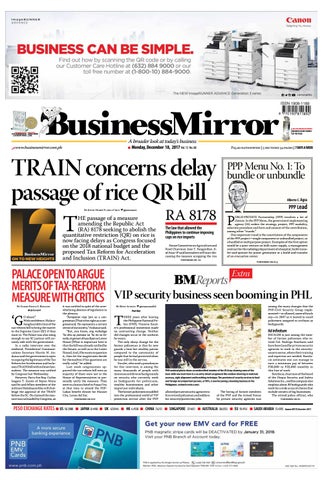
he passage of a measure amending the Republic Act (RA) 8178 seeking to abolish the quantitative restriction (QR) on rice is now facing delays as Congress focused on the 2018 national budget and the proposed Tax Reform for Acceleration and Inclusion (TRAIN) Act.
business news source of the year
P25.00 nationwide | 5 sections 34 pages | 7 days a week
TRAIN concerns delay passage of rice QR bill By Jovee Marie N. dela Cruz
2016 ejap journalism awards
PPP Menu No. 1: To bundle or unbundle Alberto C. Agra
ead
PPPC.LAgra Alberto
RA 8178 P The law that allowed the Philippines to continue imposing caps on rice imports
House Committee on Agriculture and Food Chairman Jose T. Panganiban Jr. of Anac-IP said lawmakers will start discussing the measure scrapping the rice Continued on A2
ublic-Private Partnership (PPP) involves a lot of choices. In the PPP Menu, the government implementing agency (IA) orders the strategy, project, PPP modality, selection procedure and form and amount of the contribution, among other “viands.” One important viand is the constitution of the components of the PPP project—single component or unbundled project, or a bundled or multipurpose project. Examples of the first option would be a joint venture on bulk water supply, a management contract for the radiology department of a hospital, build-transfer-and-operate for power generation or a build-and-transfer of an evacuation center. Continued on A15
PALACE OPEN TO ARGUE BM Reports MERITS OF TAX-REFORM MEASURE WITH CRITICS VIP security business seen booming in PHL By Elijah Felice E. Rosales @alyasjah
‘G
O ahead.” With confidence, Malacañang has told critics of the tax-reform bill to bring the matter to the Supreme Court (SC) if they want to. The Palace was also smug enough to say SC justices will certainly side with the government. In a radio interview over the weekend, Presidential Communications Secretary Martin M. Andanar said the government is open to arguing the legitimacy of the Tax Reform for Acceleration and Inclusion (TRAIN) bill with militant lawmakers. The measure was ratified by Congress last Wednesday. However, Party-list Rep. Carlos Isagani T. Zarate of Bayan Muna said he and fellow members of the militant Makabayan bloc will challenge the approval of the Train before the SC. He claimed the measure was railroaded by Congress, as
it was ratified in spite of the overwhelming absence of legislators in the plenary. “Karapatan niya ’yan as a congressman [That is his right as a congressman]. He represents a certain sector of our society,” Andanar said. “But, you know, ang mahalaga ’ho dito ay pumasa na ’ho ito sa Senado, at ganoon din po diyan sa Lower House [What is important here is that the bill was already ratified by the Senate, as well as in the Lower House]. And, if he wants to question it, then let the magistrates decide for themselves if his questions are really valid,” he added. Last week congressmen approved the tax-reform bill even as majority of them were not in the House of Representatives to personally ratify the measure. They were in a luxury hotel in Pasay City at that time to attend the PDPLaban benefit dinner for Marawi City, Lanao del Sur.
PESO exchange rates n US 50.3980
Continued on A16
By Rene Acosta
T
among the many changes that the PNP-Civil Security Group implemented—or allowed, some officials say—in 2007 as it moved to recall policemen assigned to civilians as bodyguards.
@reneacostaBM
Part One
HREE years after leaving the Philippine National Police (PNP), Vicencio Escaler’s professional immersion made no contrasting change. Neither did changes occur in the uniform he wears. The only sharp change for the former policeman is that he now guards a lone but wealthy patron compared to the community of people that he had protected when he was still in the service. Escaler, who used a pseudonym for this interview, is among the many thousands of people with immense and diverse backgrounds on security who currently work as bodyguards for politicians, wealthy businessmen and other important individuals. The former policemen straddled into the professional world of VIP protection service after the PNP
Ad infinitum
This undated photo shows an unidentified member of the US Army showing some of the basic skills one must have in a security-detail assignment like outdoor shooting to maintain accuracy, sight alignment and breathing technique. The provision of security services to local and foreign very important persons, or VIPs, is now becoming a booming business in the Philippines. Contributed Photo: JG NUNEZ
allowed private security agencies to hire retired policemen and soldiers for security/protection jobs.
The hiring of former members of the PNP and the Armed Forces by private security agencies was
ESCALER is just among the number of former policemen who retired Col. Rodrigo Bonifacio said have been lured by private security agencies to work in the securityescorts sector, where their training and expertise are needed. Bonifacio estimates one can manage to earn a minimum pay of between P30,000 to P35,000 monthly in this line of work. Bonifacio, chairman of the board of the Utopia Security and Safety Solutions Inc., said his company also employs about 30 bodyguards who work for a wide array of clients that include owners of big businesses. The retired police official, who Continued on A2
n japan 0.4490 n UK 67.6946 n HK 6.4550 n CHINA 7.6251 n singapore 37.4651 n australia 38.6553 n EU 59.4192 n SAUDI arabia 13.4395
Source: BSP (15 December 2017 )
BMReports BusinessMirror
A2 Monday, December 18, 2017
www.businessmirror.com.ph
VIP security business seen booming in PHL Continued from A1
had worked with the PNP-Supervisory Office for Security and Investigation Agencies (Sosia) before forming his own private security firm, said security escorts or bodyguards make up the hundreds of thousands of the private security business’s work force. Bonifacio said, in 2000, the country’s private security industry already counts 700,000 up to a million members. But this number is not definite. “[There could be more], but it is really hard to determine the exact number. This is why we called it [the sector] ‘ad infinitum,’” he said.
Multibillion-peso business
WHILE the private security industry is a big business, the PNP however does not have the exact figure on the number of hired hands.
Even the Sosia, which is supposed to be the unit regulating the prime movers of the industry, doesn’t have the figures, apparently. The BusinessMirror attempted to get a report on the private security industry from the PNP through its spokesman, Chief Supt. Dionardo Carlos. However, Carlos did not return the requests for interview. His office did not also act on the request of the BusinessMirror to ask Sosia officials, other than asking the request to be put on paper for supposed clearance purposes. Since becoming the spokesman of the PNP, Carlos has imposed a “dictatorial” rule that any request to interview officials of the PNP must come through him. But in most cases, requests are not acted upon, thus alienating the whole PNP to the people. Although documents from the PNP are
not available, an earlier report from the Philippine Association of Detective and Protective Agency Operators (Padpao) showed that the private security industry was already at P40 billion in terms of gross revenue in 2014. The industry, the association said, employed more than 600,000 security guards, including bodyguards, up to that year. However the Padpao, which is an association of security agencies, has already become inactive in the wake of the more active regulation of the industry by the PNP through its Sosia. The latter has ordered that membership with Padpao is no longer mandatory for businesses in the security classification. Through the years, the private security industry was believed to have even grown and became bigger as the country’s security is continuously challenged, with politicians,
businesses and their owners, and other important persons seeing the need to protect themselves and their interests. According to Padpao, mining companies, malls and other establishments where the public regularly converge are among the top clients of the private security industry.
Ever-growing
ACCORDING to Bonifacio, the business of security has grown and expanded over the years due to the onslaught of technology, which also made personal security a more complicated thing to handle. Before, security agencies only hire for “blue guard” service and VIP protection service for both establishments and important individuals. Now, security firms already deploy K-9 services and cybersecurity protection. Bonifacio said these latest additions,
which his company also offers, are already a necessity, as threats and hazards have evolved. From traditional threats to conventional security risks, there are now combinations of both. “It is already a combination of personal security and information or data security [cybercrime],” he said. “This is also the reason the Sosia is modernizing.” He added that the evolving security challenges, which private security agencies needed to dealt with for their patrons and clients, forced the Sosia to also modernize as the industry’s regulatory office. Bonifacio said it is no longer only the elected public officials, wealthy businessmen, other important persons and even business and commercial interests that now needed guarding and securing from threats and attacks, but even data and information. To be continued
TRAIN concerns delay passage of rice QR bill Continued from A1
QR and converting it into tariffs at the plenary next year. “The discussion and the passage of the measure will be next year,” Panganiban told the BusinessMirror. The passage of the bill allowing the tariffication of rice is included in the priority bills earlier identified as urgent by the Legislative-Executive Development Advisory Council. The House Committee on Ways and Means and the House Committee on Agriculture and Food have
already endorsed the measure for plenary approval before Congress went on a Christmas break last week. Panganiban had wanted Congress to approve the measure before its Christmas break on December 13. But discussion on the bill had to be deferred as lawmakers prioritized the passage of the proposed P3.7-trillion national budget for 2018 and the tax-reform program. Contentious provisions in the TR AIN measure forced lawmakers in the congressional bicameral conference committee to
work overtime so they can finalize and ratify the bill before their Christmas break. The House Committee on Agriculture and Food has set the bound tariff rate for rice imports outside the minimum access volume (MAV) at 180 percent. Under the bill, the Philippines will impose a bound tariff rate of 35 percent for rice originating from the Association of Southeast Asian Nations region, regardless of its volume. Manila would also impose a 40-percent bound tariff mostfavored nation rate for in-quota
rice imports from countries that do not belong to the Asean. Once the substitute bill is enacted into law, the country’s MAV for rice shall revert to its 2012 level at 350,000 metric tons (MT), from the current 805,000 MT. Earlier, Socioeconomic Planning Secretary Ernesto M. Pernia told the BusinessMirror that the President’s economic team would like Congress to pass the law scrapping the QR by the end of the year so the country can start imposing rice tariffs by the first quarter of 2018. The authority to set bound
tariffs is vested in Congress. But, under the Customs Modernization and Tariff Act, the President, upon the recommendation of the National Economic and Development Authority, has the power to modify the tariffs applied on Philippine imports. The Philippines is under pressure to convert its QR on rice into ordinary customs duties after its waiver on the special treatment on rice expired on June 30. The World Trade Organization (WTO) General Council approved the waiver, which allowed Manila to
keep its rice QR until June 30, on the condition that the Philippines will subject its rice imports to ordinary custom duties by July 1. In March the Philippines informed WTO members that it is facing delays in converting the QR because it has not amended RA 8178, which imposed the import caps on rice indefinitely. As a sign of “goodwill” to its trading partners, President Duterte signed Executive Order 23 in July to extend the concessions made by the Philippines in securing the waiver in 2014.
Economy
A4 Monday, December 18, 2017 • Editors: Vittorio V. Vitug and Max V. de Leon
BusinessMirror
www.businessmirror.com.ph
$100-M facility to help PHL roll out more infra projects
T
By Cai U. Ordinario
@cuo_bm
he Philippines is looking to jumpstart more infrastructure projects next year through facilities under the Project Monitoring Facilitation and Innovation (PMFI), such as the latest technical assistance loan from the Asian Development Bank (ADB). National Economic and Development Authority (Neda) Assistant Secretary Jonathan L. Uy recently told reporters the list of projects to be financed by the $100-million Infrastructure Preparation and Innovation Facility (IPIF) now covers 21 projects from the indicative list of 19 projects. The list now includes eight road and bridge projects; six water projects; and six rail, public transport, port and airport projects. “There are a lot of projects actually that we’re preparing, especially with the support of multilateral and bilateral donors,” Uy said. “We have a lot cooking right now, so hopefully this will move forward with the PMFI and be successfully implemented.” The eight road and bridge projects now include the North East-
ern Luzon Expressway Project; Laguna Lakeshore project; and the Nationwide island provinces link bridges to connect Leyte with Surigao and another one to link Sorsogon and Samar. The list also includes the long span bridge to link the PanayGuimaras-Negros Islands; Samal Island-Davao City connector bridge; Cebu-Negros Link bridge; and Bataan-Cavite bridge. In terms of water projects, the list includes the Apayao-Abulug; Abra; Jalaur; Buayan-Malungon; Agus; and Tagum-Libangon river basins. The transport projects include the Philippine National Railways South Commuter and Long Haul; Mindanao Railway, particularly the Tagum-Davao City-Digos segment; M’lang airport; New Cebu International Container Port; and
The 14.82-kilometer, six-lane Metro Manila Skyway Stage Three is one of the infrastructure projects rolled out under the public-private partnership scheme. The government is banking on the use of aid from foreign donors to hasten the implementation of more projects under the Duterte administration’s “Build, Build, Build” program. NONIE REYES
the National Intelligent Transport Center. Uy said the list includes the National Greenways and Non-Motorized Transport Development plan— the government’s overall program for green and more sustainable transport nationwide. “The IPIF is a facility we hope to
Senate probers eye malversation raps in ₧3.5-billion vaccine mess By Butch Fernandez
A
@butchfBM
ranking member of the joint Senate inquiry into the dengue-vaccine mess said top Aquino Cabinet officials will face technical malversation charges for realigning, without congressional approval, P3.5 billion “savings” from an entirely different expense account, for a massive immunization program done with “undue haste” weeks before the 2016 elections. Sen. Joseph Victor Ejercito, chairman of the Health Committee, which held two joint hearings with the Senate Blue Ribbon into the Dengvaxia fiasco, said last Sunday “it was very clear there was no item to buy dengue vaccine under the 2015 General Appropriations Act (GAA).” Ejercito recalled former Budget Secretary Florencio B. Abad telling senators during a hearing on December 14 that funding for the dengue vaccine “was in the 2015 GAA” because it was “housed” under the Expanded Program on Immunization (EPI), which is under the GAA, “I took his word for it then.” However, the senator added that “when I did my own research later, I discovered that there really is no mention of Dengvaxia under the EPI,” which lists nine immunization programs of the government against top killer diseases. Ejercito found it amiss that P3.5 billion would be hastily realigned for just one vaccine class, an amount exceeding the total for the EPI, which lists nine other diseases. “They said [at the hearing] there was no approval yet for the dengue vaccine when the 2015 budget was crafted, that’s why it was not included,” the senator said. But he noted that Abad had told senators on December 14— when Ejercito asked him why Dengvaxia was sourced from the miscellaneous personnel benefit fund (MPBF) when it was not even in the 2015 GAA—that the dengue vaccine was “housed” in the mother program provided for in the GAA, or the EPI. It turned out, said Ejercito, that dengue was nowhere in the EPI. “That is still technical malversation because it had no approval of Congress [through the budget law],” he added. The senator also recalled that Abad had noted in his testimony that Aquino had the prerogative to realign funds from savings at year-end, but Ejercito adds that “in my view, it should still be realigned to items that are in the GAA.” Dengvaxia, he added, was not in the 2015 GAA. “We really have questions on how the Dengvaxia vaccine was obtained for such a huge amount of public funds when the 2015 budget made no mention of buying vaccines for dengue,” he said.
Ejercito also said it was premature to say if former President Aquino, who faced Senate probers at last week’s inquiry, was already off the hook. “If you look at command responsibility, he [Aquino] may have some liability because, at least, he should have conducted due diligence. He assumed all the papers [on Dengvaxia] were in order,” the senator said adding the bigger liability rests on “his underlings who should have done due diligence,” referring to Abad and Health Secretary Janette P. Garin. Asked about allegations that Abad circumvented the process by going around Congress to fund the drug deal, the senator said: “I don’t think anybody from Congress was aware of this transaction. The savings they used came from MPBF—which is really completely detached from a vaccine program. That [P3.5-billlion] is too big an amount to realign,” Ejercito explained. Ejercito also bared plans to “get medical experts and/or academe to validate the figures” given to Senate probers by Aquino officials to justify the fast-tracked purchase, citing the supposed galloping rise of dengue cases, projected to rise up to 2.8 million if there was no vaccination program. He did not rule out the possibility of conducting further hearings by the Health Committee but said the panel would first consult medical experts and/ or academe on whether they should “conduct separate inquiry.” “It is possible there may be a separate hearing,” Ejercito said, but added “our immediate concern is the 830,000 children vaccinated with Dengvaxia. Even my own son, a 17-yearold boy, was injected.” The senator added he saw enough indications from the December 11 and 14 Senate hearings “that it [Dengvaxia purchase] was really, inordinately rushed.” “There was unprecedented speed by which this transaction was done,” Ejercito added as he traced the quick series of events from December 1, 2015, when former President Aquino met with Sanofi Pasteur officials in Paris, until December 29, when Abad caused a Saro to be produced. Ejerctio also recalled that during Aquino’s December 14 testimony, the former president had admitted they really rushed it to avoid election ban, and because they worried it would not be pursued by the next administration. Aquino told senators he just wanted to “save lives” when he had the chance to. To Ejercito, however, this presidential explanation “clearly shows there was undue haste.” The senator added all signatories, chiefly Abad and then Garin, could be liable for technical malversation.
use in the feasibility assessment. Essentially feasibility studies will be done by the departments but the IPIF is supposed to provide further technical validation and improvement, particularly in your roll out implementation. It includes institutional capacity assessment,” Uy added.
In August the ADB said the total cost of the facility is $164.06 million, with the Philippine government contributing $64.06 million. The project is expected to be completed in the second quarter of 2021. T he new loa n, a long w it h the recently approved $5-mil-
lion technical assistance grant, serves as a catalyst for the government’s project management and monitoring system. The list of projects that the facility can finance is about $3.8 billion. Initially, the loan for the facility is good for five years but the IPIF can receive additional loans from the ADB, depending on the implementation of the projects and the need for additional resources by the national government. Also, while the facility is still limited to financing projects from the Department of Public Works and Highways and the Department of Transportation, the facility can later on be used for other projects, such as those for agriculture, health and education. The government’s infrastructure investments in national roads, railways, bridges, flood control, ports and airports will add as much as $10 billion to the country’s GDP between 2019 and 2024. T he A DB sa id t he “ Bu i ld , Build, Build ” program, the centerpiece of President Duterte’s 10-point Socioeconomic Agenda, aims to increase public investment and accelerate infrastructure delivery. Public spending on infrastructure is expected to reach 7.4 percent of GDP by 2022, up from 5.3 percent in 2017 and less than 3 percent from 20102016.
Coal tax to help PHL meet emission targets–group By Jonathan L. Mayuga
@jonlmayuga
T
he Institute for Climate and Sustainable Cities (ICSC) said the approval of the tax hike on coal will allow the Philippines to inch closer to achieving environmental sustainability, as it will help correct market outcomes and inject a degree of parity in a playing field “incredibly in favor of coal.” Renato R. Constantino, executive director of ICSC said four decades virtually free from taxes has made coal “artificially cheap.” “Coal subsidies are staggering and now the dominance of coal has begun to erode,” he said. Constantino added that the approval of the bicameral conference committee to increase taxes in coal from P10 per ton to P50 in 2018, P100 in 2018 and P150 in 2020, only means the Philippines is set to transition itself from “dirty” coal to clean, renewable energy sources. Further, he said the coal tax sends a strong policy signal to all investors. “The Duterte government is set to tran-
sition to more affordable, more reliable and certainly truly cleaner energy. It means more jobs and a more modern economy and a future defined by real competition. The public wins,” he said. The ICSC believes that the carbon-tax approach will help the country achieve its COP21 commitment—which is to reduce the country’s carbon emission by 70 percent—between 2020 to 2030. While not a major emitter of carbon, the Philippines made the conditional promise to reduce carbon emission, which is anchored on a number of climate-change actions, including the expansion of forests to enhance its carbon-absorption capacity and promote electricity-powered vehicles, including bus, jeepney and tricycles, which all run on gasoline or diesel. More important, however, Constantino said the carbon tax is a “corrective initiative” that levels the playing field and promotes real competition. “The ultimate goal must be an energysecure economy that is more efficiently and more reliably powered by clean en-
ergy. Keeping to the Paris Agreement is a cobenefit that will be achieved as a result,” he added. Constantino also lauded Sens. Joel Villanueva, Miguel Zubiri and Loren B. Legarda for their leadership. “Due to the might of the industry, the passage of the coal tax was a long shot. But we won this battle with the help of the urban poor, homeowners association members, mining communities and economists,” he said. Constantino said the increase in tax on coal will have minimal impact to the consumers compared to that of fuel products. “Four decades virtually with zero taxes and now it’s P0.15 per kilogram (kg). This is nothing compared to the P2.00 per liter increase they want to slap on diesel and the P1.00 increase per kg of LPG,” he said. However, he said that the government, particularly the Climate Change Commission led by Secretary Emmanuel de Guzman has to work more closely with Congress to ensure the transition to clean, renewable energy sources is realized.
Report reveals top global packaging trends for 2018
F
ilipino exporters are advised to focus on packaging that actively minimizes food and product waste, enhances the online-shopping experience and helps de-clog oceans and landfills of plastic, three of the biggest packaging developments that will emerge in 2018. Global marketing intelligence agency Mintel in its latest report, entitled “Global Packaging Trends 2018” said t hat r ising issues over food waste, heightened environmental consciousness and the boom in e-commerce are reshaping packaging concepts and influencing consumers’ perception of products and their purchasing preferences. Amid worldwide concern about the growing mountain of waste and seeing the cost of this waste on their wallets, today’s shoppers are increasingly regarding packaging as a way to preserve food and products for as long as possible. “ T he throwaway culture of today will evolve into one that understands and embraces the role of packaging as a primary means to reduce global food and product waste,” stressed Benjamin Punchard, global packaging insights director at Mintel. People now react positively to package innovations that extend food freshness, preserve ingredient fortification and ensure safe delivery, said the report.
“Brands need to act now, exploiting onpack communication tools to educate consumers to the benefits packaging can bring, from extending shelf life of food to providing efficient and safe access to essential products in developed and underserved regions of the world.” At the same time, as more and more consumers embrace online shopping, “packaging will play a pivotal role in brands and consumers’ e-commerce experiences,” Mintel predicts. E-commerce sales are forecast to reach $4 trillion globally by 2020, representing nearly 15 percent of total global retail sales. Much of the popularity of e-commerce stems from convenience, Mintel says, noting that over half of surveyed Chinese consumers aged 20-49 who shop online say it is fast and saves time. Companies should ensure that they design their packaging to be viewed online, as the report notes that “poor quality e-commerce packaging can lead to a disappointing first interaction with the product.” Eco-friendly packaging is also expected to become a major deciding factor for consumers. The market research provider notes that in Australia, some 36 percent of those polled say they prefer products that are sold in ecofriendly packaging. Spurred by warnings that there will be more plastic in the sea than fish by 2050,
The throwaway culture of today will evolve into one that understands and embraces the role of packaging as a primary means to reduce global food and product waste.” —Benjamin shoppers are in search of packaging that is less likely to add to the immense plastic dumping in oceans or at dumpsites. “Committing to the use of recycled content in all packaging can help drive the circular economy, reducing ocean plastic by ensuring an efficient route for packaging from the consumer back to the producer,” the report says. As an example, it cites Coca-Cola’s announcement this year that it will increase the amount of recycled plastic in its bottles to 50 percent by 2020. Philexport News & Features
The Nation BusinessMirror
www.businessmirror.com.ph
Editor: Vittorio V. Vitug • Monday, December 18, 2017 A5
CA affirms indictment of arms suppliers involved in sale of guns used in Maguindanao massacre
T
By Joel R. San Juan
@jrsanjuan1573
HE Court of Appeals (CA) has affirmed the resolution issued by the Department of Justice (DOJ), which ordered the indictment of four officers of a firearm manufacturing company for the unlawful sale of ammunitions that were used in the killing of 58 people, including 32 journalists, in November 2009, also known as the Maguindanao massacre.
Facing trial for the violation of Section 1 of the Presidential Decree (PD) 1866, as amended by Republic Act 8294, the law governing illegal possession of firearms and ammunition, are Victor Karunungan, Eduardo Santos, Lyn Demartin Justo and Melva Valdez Libao of the Arms Corp. of the Philippines (Armscor). Karunungan is the vice president and chief financial officer of Armscor, while Libao is the company’s accounting supervisor. Justo is employed as the bookkeeper of Armscor while Santos acts
as its sales representative. In a nine-page decision penned by Associate Justice Eduardo Peralta Jr., the CA’s Special 17th Division dismissed their petition for their failure to show that the DOJ erred in finding probable cause to indict them for violation of the provisions of PD 1866. “While we are in unison toward the conclusion for the jettison of the petition, an assessment of petitioners’ supplication before us did not perforce mean that the cart was placed ahead of the horse, so to speak.
Neither did we pronounce a premature determination of petitioners’ culpability,” the ruling said. “Far from such knee-jerk reactions, we simply relayed that, as a general rule, if the information is legally efficacious on its face, and there is no showing of manifest error, nor wanton exercise of the faculty conferred upon the public prosecutor, courts should not dismiss it for want of evidence because factdiscovery and evidence presentation may still unfold at the appropriate forum,” it added. Concurring with the ruling were Associate Justices Priscilla BaltazarPadilla and Nina Antonio Valenzuela. In opposing the petition, the DOJ through the Office of the Solicitor General, noted that after a series of raids conducted by the police following the massacre, it was discovered that some of the firearms used by the perpetrators and others that were dug up in Maguindanao belonged to the Philippine National Police (PNP). The discovery prompted thenPNP Chief Jesus Versoza to form an investigation team that conducted the accounting of the PNP equipment at certain pieces of real estate in Maguindanao. Several police operations yielded numerous ammunition in Maguindanao and the said ammunition were identified through their lot numbers,
which appeared to be that of Armscor. Investigation further revealed that, there were two illegal procurements, which involved Armscor and the PNP on August 21, 2008 and April 10, 2009. The investigation disclosed that it was Police Supt. Bahnarin Kamaong, then-group director of the 15th Regional Mobile Group, Police Regional Office of Autonomous Region of Muslim Mindanao (PRO-ARMM), who instructed SPO4 Nicasio Ardaniel to procure the 5.56mm ammunition intended for PRO-ARMM. For the purchase, Ardaniel coordinated with Santos for the purchase of 500,000 rounds of cartridge ball 5.56mm full metal jacket combat ammunition on August 21, 2008. On the other hand, the April 10, 2009 transaction covered an equal quantity of ammunition. The deal was executed by the petitioners and approved its legality without verifying whether the police officials, whom they were transacting with, have on permit to purchase the ammunition. Eventually, the Firearms and Explosives Division issued a certification on January 15, 2010 which attested that the office had not issued a permit to purchase ammunition to PRO-ARMM. Thus, the charges were filed against petitioners based on the recommendation of the PNP.
lawmaker: PHL must have Department of Climate Change
C
ongress needs to prioritize the passage of a measure creating a new department that would focus on disaster response, according to a House leader. Vice Chairman of the House Committee on Appropriations Luis Raymund F. Villafuerte of Camarnes Sur, in a statement, said a recent call by a United Nations global council for countries across the globe to institute long-term measures to reduce risks from natural disasters should provide the government a strong impetus to unify efforts in addressing these economic disruptions. “This can be done by way of creating the Department of Climate Change [DCC] and subsuming the functions of all other existing offices under this proposed central agency,” he said. Villafuerte said creating the DCC would entail the abolition of the Office of Civil Defense and the Climate Change Commission, along with other agencies performing disaster-risk reduction and management-related func-
tions, so that these could all be integrated under the new agency. Citing a recent study, he said much of the population of Southeast Asia, where the Philippines is situated, live along 81,000 miles of low-lying coastlines, further heightening the region’s vulnerability to extreme weather events. “Statistics show that 62 percent of Filipinos live in 1,490 coastal municipalities, with 50 percent or half of them vulnerable to storms and typhoons, and over 13 million people at risk of losing homes because of rising sea levels,” he said. “We need a Department of Climate Change not next year nor tomorrow, but now. Our country may be one of Asia’s fastest-growing economies, but this rapid growth rate can only be sustained if our country and our people are prepared to meet the challenges brought about by climate change and learn to adapt and respond quickly to its destructive effects on various facets of our lives,” Villafuerte said. Jovee Marie N. dela Cruz
Agriculture/Commodities
Monday, December 18, 2017 • Editor: Jennifer A. Ng
A6
BusinessMirror
www.businessmirror.com.ph
Typhoons, pests to cut Q4 rice output By Jasper Emmanuel Y. Arcalas
P
@jearcalas
addy production in the fourth quarter would be lower than 7.45 million metric tons (MMT) due to the onslaught of typhoons and pests, according to the Philippine Statistics Authority (PSA). In its report, titled “Updates on October-December 2017 Palay and Corn Forecasts,” which was published recently, the PSA revised downward its projection for unmilled rice production in the fourth quarter due to the losses incurred by the palay sector in
recent months. From its initial forecast of 7.45 MMT for the Octoberto-December period, the PSA now sees output at 7.4 MMT. “The probable decrement in palay production may be attributed to: effects of continuous rains during reproductive and maturing stages
of the crop which resulted to lodging of crop in Mindoro Occidental, Isabela, Kalinga, Rizal, Aurora and Quirino; damaged brought by Typhoon Odette and aggravated monsoon rains in Cagayan,” the report read. “Harvest area may decline by 0.1 percent, from 1.86 million hectares. Likewise, yield per hectare may decline to 3.97 metric tons [MT] from 3.99 MT,” it added. The PSA said typhoons Maring, Paolo and Ramil cut palay output in the provinces of Laguna, Quezon, Zamboanga Norte and Mindoro Oriental. Rice-bug and stem-borer infestations in Iloilo and Sultan Kudarat, as well as the occurrence of bacterial-blight blast and deadheart diseases in Iloilo contributed to the downward revision of palay forecast in the fourth quarter, ac-
cording to the PSA. “About 1.19 million hectares, or 64.2 percent, of the updated standing crop have been harvested,” it added. The PSA said 345,170 hectares, or 29.9 percent, of the farmers’ planting intentions for the first quarter of 2018 have already materialized.
In the October round of its report, titled “Rice and Corn Situation Outlook,” the PSA said paddy output in the fourth quarter would reach 7.45 MMT. “Probable palay production for the October-to-December period may surpass the 2016 level by 6.26 percent. The anticipated increment in output may be attributed to increase in yield resulting from sustained use of high-yielding varieties coupled with sufficient water supply during the early stages of crop development,” the PSA report read. Despite the contraction in harvest area to 1.86 million hectares, from last year’s record of 1.88 million hectares, the report noted that yield per hectare may improve by nearly 6 percent to 3.99 MT, from 3.73 MT last year.
The PSA also revised downward its projection for corn production in the fourth quarter to 1.62 MMT, from 1.63 MMT. “[It] may be 6.2 percent below than previous year’s level of 1.73 million MT,” the PSA report read. “Harvest area may remain at 568,480 hectares. Yield may lessen to 2.85 MT per hectare from 2.88 MT level.” The PSA said the revision in its forecast was brought about by damages caused by flash floods and typhoons in corn areas of Isabela, Zamboanga City, South Cotabato and Zamboanga Norte. It added that continuous rain in Quirino, Cebu, Batangas, Kalinga, Bohol and rat infestations in Bukidnon, Sarangani and South Cotabato would affect the country’s total corn output in the Octoberto-December period.
Vitarich wants to focus on domestic market Lawsuit challenges cancellation of farmer fair-practice rule
L
isted animal-feed manufacturer and poultry producer Vitarich Corp. (Vitarich) would rather focus on supplying chicken to Filipino consumers than export its products, as it sees more growth opportunities in the domestic market. Vitarich President and CEO Ricardo Manuel Sarmiento said the company wants to help wipe out the annual shortfall in Philippine poultry production, which it pegged at around 20 percent. “Our estimate is out of the total requirement of the Philippines, 20 percent is still imported so there’s a lot of room to grow in terms of producing chicken, which would also benefit Filipino farmers,” Sarmiento told reporters in a news briefing on December 12. “I have dreams of tapping the export market but local supply is not enough. So, our focus is to supply the local market,” he added. The country’s meat imports rose to its highest in 2016 at 646,503.7 metric tons (MT), 10.28 percent higher than 586,263.9 MT recorded in 2015, according to the latest data from the Bureau of Animal Industry (BAI). Data from the BAI showed the country’s chicken imports expanded by 18.44 percent last year. Purchases reached 234,742.76 MT, higher than the 2015 record of 198,193.29 MT. Sarmiento said the company is also looking into hog raising instead of selling products abroad should it decide to expand its business in the future. “We are developing more chicken-based products, that’s our main focus now. Of course, in the future, I would like to go into producing hogs and other fish products,” he said.
D
Bloomberg
The Vitarich CEO said he expects the company’s market share for poultry products to reach 30 percent this year. The company’s net income in January to September reached P107 million, 21 times higher than the P5 million it recorded in the same period last year. Sarmiento projected that the company’s income would expand by at least 30 percent next year on the back of higher production. “We are making sure that we will sustain our momentum next year,” Sarmiento said. “As I’ve said, we have new facilities with higher
capacities to sustain our growth and these will all be ready by 2018.” This year, Vitarich inaugurated a P250-million state-of-the-art feed mill in Panacan, Davao City, which has a capacity of 100,000 bags per month. The company also completed the expansion and automation of its feed mills in Iloilo, increasing capacity to 187,200 bags per month, from the current 93,600 bags per month. Vitarich has expanded its Davao dressing plant, which will effectively double capacity to 942,000 heads a month.
The war on poverty (3)
L
et’s look at data made available during the last few days:
n Agriculture accounting for 25 percent of the country’s total employment shed around 1.4 million jobs, reducing employment by 12.1 percent. n Poverty in the Philippines remains concentrated in the countryside. Two-thirds of the poor are in rural areas depending on jobs and incomes from farming and fishing. Poverty incidence among farmers was recorded at 34.3 percent; fishers at 34 percent and children at 31.4 percent. n Among industries, agriculture has the most potential for “inclusive business”(IB); agriculture also tops other sectors in terms of the global market
share of jobs.
What, then, needs to be done?
We need to deliver support services to farmers and fishermen, such as financing, incentives, technology, irrigation, postharvest facilities, farm-to-market roads, improved logistics and integration in the supply chain to fully develop the potential of the agricultural industry to develop rural areas and the countryside. As a consequence, some 20 million rural Filipinos can be lifted out of poverty. And the children of farmers will stop moving from rural areas to urban centers or become overseas Filipino workers. Isn’t this what the 10-point socioeconomic agenda of the Duterte administration has in mind? Fighting poverty in agriculture?
Henry J. Schumacher
europe Beat But how high is agriculture on their agenda? Only 11 of the administration’s 75 flagship projects are for the agriculture sector! Rightfully, the Business Mirror in its editorial on October 11 said: “It takes money to make money in agri.” However, it is worth remembering also, that the agriculture does not stop at the farm. Very much part of the agricultural system are the agricultural processing enterprises,
Sarmiento said Vitarich is planning to break ground for a P400million feed mill in Central Luzon with a capacity of 20 metric tons per hour by mid-2018. The mill would be up and running 14 months after groundbreaking. The company allocated about P130 million as capital expenditure (capex) for 2018. T he amount is 62.5 percent higher than its P80 million capex this year. Sarmiento said the bulk of the company’s capex for next year would be used to support its warehouses and feed mills. Jasper
Emmanuel Y. Arcalas
the packaging industry, the agricultural input manufacturers and importers, and the trade, storage (including cold storage) and transportation (including refrigerated containers) sectors. The effective integration of these various elements of the agricultural system within a competitive market environment continues to loom large in the country’s unfinished agenda. If we want to achieve change, we have to focus on the agri-food supply and value chains. We may have to take inspiration from Vietnamese farmers who view agriculture not just as a job to produce food for the population but consider agriculture as a serious business. Their success is amazing: Vietnamese far mers are ex-
ES MOINES, Iowa—Farmers in Alabama and Nebraska joined with a Nebraska-based fair-trade group last Thursday to sue the United States Department of Agriculture (USDA) over the agency’s cancellation of an Obama-era plan that would have made it easier for farmers to demand better treatment when they contract with meatpacking companies. The lawsuit seeks to reverse the USDA’s October decision to vacate the Farmer Fair Practices Rule —regulations that would have, among other things, reduced the burden of proof farmers face to sue over contracts and practices they believe are unfair, discriminatory or deceptive. “We know from decades of evidence that massive agribusiness companies don’t hesitate to use their power to abuse these farmers and the Farmer Fair Practices Rule was a crucial step to restoring fairness in the market,” said Anne Harkavy, executive director of nonprofit legal group Democracy Forward, which filed the lawsuit on behalf of Lincoln, Nebraskabased Organization for Competitive Markets, Nebraska farmer James Dinklage and Alabama farm couple Jonathan and Connie Buttram. “It should be restored either by USDA, or by the court.” USDA Spokesman Jake Wilkins declined to comment, saying the agency doesn’t discuss pending litigation. The rules were first proposed by the USDA in 2010 but were not released until last December in the final days of former President Barack Obama’s administra-
porting rice, coffee and fish in substantial volumes. In contrast to the Philippines, Association of Southeast Asian Nations neighbors reduced poverty in agriculture remarkably. Thailand pumped massive resources into this sector, reducing the poverty from 67 percent in 1986 to 7.2 percent in 2014; Indonesia reduced poverty to 13.7 percent in 2014; Malaysia from 8.4 percent in 2009 to zero now. But seizing the opportunities in agriculture entails not only creativeness and daring on the part of the private investor; it also involves a great deal of political will—both national and local— to effect long-needed changes in the sector’s institutions, from access to finance to access to extension work, from mechaniza-
tion. They were scheduled to take effect on April 22, but President Donald J. Trump’s administration delayed them for six months before the USDA announced in October that it would not implement them. The suit, filed in the 8th US Circuit Court of Appeals, alleges Agriculture Secretary Sonny Perdue ignored thousands of comments in public hearings and submitted in writing and unlawfully sidestepped directives in the 2008 farm bill mandating some of the rules be enacted. Trade groups for the meatpacking industry, including the National Chicken Council and the National Pork Producers Council, had complained that the rules would lead to costly lawsuits and would reduce competition. Some companies, such as Tyson Foods and Pilgrim’s Pride, require chicken and pork producers to enter into contracts that farmers say set their compensation at unprofitably low levels and force them deeply into debt. Several court rulings have interpreted federal law as saying a farmer must prove a company’s actions harm competition in the entire industry before a lawsuit can move forward. The rules would have eased that high burden of proof. The elimination of the rules has helped large multinational corporations get the upper hand on farmers, said Joe Maxwell, a Missouri hog farmer and executive director of the Organization for Competitive Markets, a non profit think tank focused on antitrust, trade policy and competitive markets. AP
tion to land titles, from allowing land-reform beneficiaries to consolidate their small land holdings into viable land sizes that will allow competitive agri production. We will have to think in terms of trading and buying stations close to farmers; we have to look at intercropping (coconut-cacao/ coconut-coffee) and severe reductions in post-harvest losses. In other words, there is plenty of work to do, preparing for increased production and trade of agri-food products, allowing the farmers to create income that will keep their children on the farm rather than moving into urban centers. Comments are welcome; you can contact me under Schumacher@ mcasia.org
BMReports BusinessMirror
www.businessmirror.com.ph
Monday, December 18, 2017
A7
The grand Budapest adventure
I
Story and Photos By Ma. Stella F. Arnaldo Special to the BusinessMirror
F there’s any one thing that I will remember about my recent trip to Budapest, the capital of Hungary, it is the music.
For one full day, we managed to listen to a classically trained opera singer sing two arias as we stood, besotted by her strong and lyrical voice at the Hungarian State Opera, or listened to the powerful tune hammered out by a young Japanese pianist, Ason, at the Frederic Lizst Academy of Music, followed by the graceful piano stirrings of Panni Hotzi, a graduate of the academy. Of course, that’s not to say, it was a classical music diet the entire time. As we cruised on a speedboat down the Danube, it certainly wasn’t Johann Strauss’s “Blue Danube Waltz” playing, but AC/DC’s “Highway to Hell” blaring over the boat’s speakers. Then by the evening, as we ate our dinner, we were serenaded by Sinatra, which the resident pianist tinkled out on his keys, then followed it up with show tunes. Young or old, gregarious or graceful, classic or modern—the music that surrounded us, tickled us and enthralled us is a story of Budapest itself. It is a heritage city teeming with Unesco sites but is able to blend their age-old wisdom with the new and efficient. It is a city respectful of the tradition, heirloom arts and culture, but knows that modern science will help push the economy to the next levels of prosperity. It has a quick,
uncrowded mass-transport system that thunder out of antiquated but still properly maintained terminals, historic thermal spas that bring modern therapeutic relief to old-folk ailments, and traditional food delicacies like the kürtőskalács (chimney cake) and sausages that exist alongside excellent fine-dining cuisine in restaurants listed on the Michelin guide. As beautiful and breathtaking as Budapest is, it is impossible to list everything that contributes to the city being one of the most popular in Europe these days. But here are things to do if one has 48 hours with the Magyars: n Danube River Cruise—If one doesn’t have time to go on foot and travel around the city, a trip by speedboat down this most important of European rivers, is an excellent way to see the sights. A 15 to 20 minute ride will bring visitors up close to the underbelly of the Chain Bridge, one of the oldest suspension bridges; the Parliament building, considered one of the most beautiful in the world; and a tinny view of the Liberty Statue, built after the Russians liberated Hungary from the Germans; among others. (For trips, https://dunarama.hu/) n House of Parliament—Erected over 17 years beginning 1885, the
Parliament building’s façade evokes Gothic touches, its interiors, including the ceiling was designed in the Renaissance style. The Hungarian National Assembly continues to use the building for its meetings. n The Great Market Hall (Nagycsarnok)—Built in 1897, this most beautiful of all Budapest market halls continues to hum and buzz with activity, attracting locals and tourists alike to its stalls teeming with Hungarian paprika/pepper spread, whole goose and duck livers, sausages, wines, chocolates and souvenirs. It is incredibly inexpensive—a 600-gram fresh goose liver is just €17 (P1,020), which is enough to serve about 10 to 12 slices of foie gras for flash-frying. n Hungarian State Opera— Even if you’re not a fan of opera, a visit to this building is a must. Designed by Miklos Ybl, a leading figure in Hungarian architecture, the neorenaissance building has interesting pockets of spaces, such as elegant rooms for socializing, dark furtive corridors where lovers in a bygone age would meet and kiss, a balcony with chubby cherubs who look out into the city. But if you are an opera nut, check out http://www.opera.hu/programme for their schedule. n Szechenyi Bath—Two underground springs feed into the 18 pools that are located all over this largest of spas in Budapest. It was freezing when I visited the spa, but a 15-minute dip into one of its steaming pools, helped kick up my energy level for the day. The spa’s waters are considered therapeutic, with physicians actually prescribing regular dips to patients suffering all sorts of ailments from rheumatism, arthritis, orthopedic conditions and the like. On its own, the spa is an architectural marvel in the neobaroque design.
The House of Parliament is considered one of the most beautiful in the world. It is used by the Hungarian National Assembly.
n Saint Stephen’s Basilica— Named after the Hungary’s first king, Stephen, whose right hand supposedly rests in its premises, the basilica features two bell towers. The structure was completed in 1905 and designed in the neoclassical style by Ybl, the same architect of the Hungarian State Opera. At the time of my visit, the square across the basilica featured a Christmas fair, which featured a unique array of yuletide décor handcrafted by local artisans. n Pierrot Café—I felt so at home in this restaurant, which was cozy and intimate, and has a Budapest waitstaff who could speak Filipino. (The guy worked on a cruise ship and had many Pinoy friends so he mouthed off: “Kumusta, pare?” “Pagulong lang, pare!” once he found out four of us were from the Philippines.) The restaurant has reportedly been a major culinary landmark for 35 years, offering contemporary dishes based on Hungarian traditional cuisine, and is consistently on the Michelin Red Guide. I was quite happy digging into my duck leg confit, quietly humming to the Sinatra tunes being played by the resident pianist. Other top-notch dining options are the Urban Betyar restaurant, which has a gallery downstairs (https://www.urbanbetyar.com/ en/), the Alabardos Restaurant in Buda Castle (http://alabardos. hu/?lang=en) and the Gundel restaurant, with its Hungarian specialties (https://gundel.hu/en). Budapest is everything I wish Manila would be. A city that cares for its traditions, but not content to be clinging to the past, it drives continuously forward to more progress and development. Because for a city to truly power into its future, it needs to look into its past for inspiration and courage.
The Liberty Statue is a memorial to the Hungarian lives lost in the fight against the German occupation forces in World War II. It was constructed in 1947 after Hungary’s liberation by the Russian allied troops.
The steaming waters of the Széchenyi Thermal Bath is the largest and oldest in Budapest, with two underground springs feeding 18 pools.
The World
A8 Monday, December 18, 2017 • Editor: Lyn Resurreccion
BusinessMirror
www.businessmirror.com.ph
Satellites reshaping tracking of commodities
A
lump of coal is scooped onto a truck bed in Australia, driven to a port, loaded on a ship, piloted across the ocean to a dock in China, piled into a train car and delivered to a power plant. And it would all happen under the watchful eyes of coal traders, if a fleet of new satellite tracking firms can deliver on ambitious promises.
Companies like Ursa Space Systems Inc. and Orbital Insight Inc. are using satellites to try to shed light on tightly held secrets in the commodity trading world, from coal-mine productivity to crude-oil storage. While doubts remain around the accuracy and consistency of the data, there could come a day when traders can track supply and demand of raw materials, the operations of producers and consumers and even the output of entire economies in near real time. “If you look out a few years, what we see is the ability to objectively track all major supply chains from the point of basic raw-material production, whether its farms or mines, all the way through to various steps of refining, whether that’s steel plants or oil refineries or consumption in factories,” Orbital founder James
Crawford said by phone. Merchants and traders for centuries have sought an edge with information. William Shakespeare even tapped into it, with news of wrecked cargoes of spice and silk driving the plot of The Merchant of Venice. In more recent years, seamen tracking oil exports used binoculars to count tankers, helicopters with infrared cameras flew over crude storage tanks and pump heat was used to assess pipeline flows. Satellites are the next step and have already been adopted to measure the depth of shadows on floating roofs of oil-storage tanks to estimate how much crude is in them. In the United States traders use the data to get an advance peak at changes in crude inventories in the key hub of Cushing, Oklahoma, before weekly government
releases of stockpile levels. Lower costs have allowed companies and governments to launch 310 satellites this year through the end of August, compared to 169 for all of last year, according to the Union of Concerned Scientists. Some of these, from operators like Planet Labs Inc. and Iridium Communications Inc., form low-orbit fleets that can see almost the entire Earth. Firms like Orbital then use artificial intelligence to scan millions of those images and translate them into useful data. For example, a coal trader may want to know when demand is going to exceed supply, driving up prices. Satellite images could measure the piles of coal outside power plants to see when they’re getting low and need to be refilled. They can count trains and track ocean tankers carrying supplies. They can measure ground levels, pile heights and truck activities at mines to deduce production. Put it all together and the data could paint a picture of who needs extra coal and who has surplus to sell, in near real time, giving traders leverage to negotiate sales and purchase agreements and create arbitrage opportunities. “It’s a trader’s dream,” said Tom James, a Singapore-based partner at energy consultant Navitas Resources. “It’s like having a direct line to the CIA [Central Intelligence Agency]. If it does what it says it can do, it looks pretty amazing.” “If ” is the big question. While satellite data is
used to gauge United States oil stockpiles, the reliability of the data in other corners of the commodity world is less clear. In China satellite data can add value because the country doesn’t regularly report strategic petroleum reserve levels, but the technology also has drawbacks, according to Jefferies Group Llc. analyst Laban Yu. “China is building out some amount of underground storage, which is invisible to satellites,” Yu said in an e-mail. “I suspect that if China really wanted to, it could paint its tanker roofs black or some weird pattern making the shadow method inaccurate.” For example, attempts at tracking China crude-storage levels—the holy grail for some oil traders—rely on different technologies and methodologies and offer varying results. Ursa, which uses a technology known as Synthetic Aperture Radar (SAR) to penetrate clouds, assessed China’s inventories at about 827 million barrels by the end of October. Orbital, which uses a combination of visual satellite data and SAR, estimated they were at 639 million barrels. Mountain View, California-based Orbital has received past funding from Bloomberg Beta, a venturecapital unit of Bloomberg LP. And difficulties persist for some commodities like natural gas, which isn’t visible from the air, or the amount of grain in enclosed storage, according to Orbital’s Chief Business Officer Kevin O’Brien. “You can use geospatial analytics to help establish supply-chain links,
but it also requires good old-fashioned, hard-core research to facilitate that,” O’Brien said in an interview in Tokyo. “You can’t see inside a silo but you can see the number of trucks parked right next to it.” Still, the possibilities are exciting. Spire Global Inc., which uses its own satellite constellation system to track the location of ships, followed a handful of vessels off the coast of New England and found their activity, along with water temperatures, may offer a proxy for lobster price fluctuations. San Francisco-based SpaceKnow Inc. measures activity at more than 80 coal mines in China and also has coal indexes for Australia, South Africa, Chile and India. In some cases satellite imagery analysis may offer more insight than government data, particularly in places where that information comes sporadically or not at all. Barclays Plc. analysts citing data from Ursa said in an October report that if satellite findings are accurate and reflect broader activity in the Chinese oil sector, then the nation’s crude demand may be underestimated and the global supply-demand balance is tighter than thought. “In places like China and India, data can be inaccurate or very slow to come out, so it’s not actionable intelligence,” James said. “Now you’re getting ahead of the curve in terms of when the official data comes out. It’s more than just a level playing field, it’s a global advantage to anyone who’s able to process this data.” Bloomberg News
China, Britain agree on econ cooperation
B
EIJING—Britain and China pledged last Saturday to promote London as a center for offshore use of Beijing’s currency and cooperate in clean-energy research and promoting trade as the United Kingdom prepares to leave the European Union (EU). Officials announced the agreements following an economic dialogue led by Britain’s finance minister, Philip Hammond and a senior Chinese economic official, Vice Premier Ma Kai. The event was attended by a delegation of British business leaders and economic officials. British leaders are looking to China for trade and investment, as they try to fashion a new global role and offset reduced access to the other 27 nations of the European common market. The two sides agreed to promote international use of China’s tightly controlled yuan and develop yuanbased business in London. That could help to shore up the British capital’s status as a global financial center outside the EU. “The two sides will discuss future trade arrangements and push for the conclusion of a China-EU investment agreement,” Ma said at a joint news conference. AP
www.businessmirror.com.ph
The World BusinessMirror
Monday, December 18, 2017
A9
A Christmas gift? Winners, losers in US tax bill
P
resident Donald J. Trump has called the $1.5-trillion tax cut that Republican lawmakers are on the verge of passing a Christmas present for the entire nation. But the fine print reveals that some will get a much nicer gift than others, the benefits will change over time and some will be left out in the cold. Real-estate developers and technology companies could see big tax cuts, while low-income households and people buying health insurance could lose out. With the bill finally headed to a vote this coming week, taxpayers are scrambling to determine whether the legislation renders them winners or losers.
Winners
Trump and his family: Numerous industries will benefit from the Republican tax overhaul, but perhaps none as dramatically as the industry where Trump earned his riches: commercial real estate. Trump, along with his son-in-law Jared Kushner, who is part owner of his own real-estate firm, will benefit from lower taxes on “pass-through” income, which is money earned by partnerships and other types of businesses whose income is passed through to its owner and taxed at the individual tax rate. Trump and Kushner benefit since they own properties through limited liability companies and other similar vehicles. Under current law, that income is taxed at rates as high as 39.6 percent. Under the bill, much of that income could
be taxed at a rate as low as 29.6 percent, subject to some limitations. Real estate also avoided new limits on interest deductions and retained its ability to defer taxes on the exchange of similar kinds of properties. The benefits of lower rates on passthrough income will extend to Trump and Kushner’s partners at real-estate investment trusts, as well. At the last minute, lawmakers added language to make it easier for real-estate owners to avoid some of the pass-through provision’s restrictions and maximize the tax benefits even more. Big corporations: Industries like big retailers will benefit from the new corporate rate of 21 percent, since those companies pay relatively close to the full 35-percent rate. Other aspects of the corporate tax cuts will be enjoyed by an array of multinational industries, particularly technology and pharmaceutical companies, like Google, Facebook, Apple, Johnson and Johnson and Pfizer. Such multinational companies have accumulated nearly $3-trillion offshore, mostly in tax-haven subsidiaries, untouched by the United States taxman. The tax bill will force those companies to gradually bring that money home, but it will be taxed at rates ranging from 8 percent to 15.5 percent. That’s far lower than
the current 35-percent tax rate on corporate profits and even lower than the new 21-percent rate. Plus, US companies will no longer owe full corporate taxes on future profits they say they earn abroad, providing more incentive to push income into tax-haven subsidiaries. The law even includes provisions that could encourage companies to move workers abroad, despite pledges to do the opposite. Multimillionaires: An exemption for estates that owe what Republicans call the “death tax” was lifted to $22 million, from $11 million. That doesn’t matter much to billionaires like Charles Koch, but means a big tax cut for people with estates worth tens of millions of dollars. Plus, the top rate applying to wages and interest income would be cut to 37 percent, from 39.6 percent. Private equity managers: During the campaign, Trump railed against wealthy investment managers who, thanks to the carried interest loophole, pay taxes on the majority of their pay at a lower capital gains rates. But the purported reform to this tax provision will affect few if any private equity managers, leaving the loophole intact. Private schools and the people who can afford them: Parents would be eligible to use a type of tax-preferred savings plan—known as a 529 plan—to save for their children’s elementary and secondary education. Right now, those savings plans are only eligible for college. But they would be expanded to allow for up to $10,000 a year for tuition at private and religious schools. Liquor business: Excise taxes for small brewers and distillers are reduced in the final agreement. Those industries are dominated by entrepreneurial small businesses often based in rural areas.
They also have strong lobbyists, and many are based in states with powerful senators like Sen. Rob Portman of Ohio. Portman, who tucked a provision to help craft brewers into the Senate legislation, was part of the small team of lawmakers who merged the two bills into a final version. Architects and engineers: They were originally restricted in how much they could benefit from the new passthrough provision. If they structure their businesses a certain way, the final version will let them benefit fully. Tax accountants and lawyers: Trump once said his “dream” was to put tax-preparation services out of business by simplifying the tax code. But the rushed legislation will probably have the opposite effect, as individuals try and make sense of the complicated new provisions, staggered dates and new rates. The uncertainty and confusion will probably create numerous new opportunities to game the system: Tax preparers are sure to see a boom in business advising clients on how to restructure their employment and compensation arrangements to take advantage of the lower tax rates on income reported by corporations and pass-through entities.
Losers
People buying health insurance: With the repeal of the individual mandate, some people, who currently buy health insurance because they are required by law to do so, are expected to go without coverage. According to the Congressional Budget Office, healthier people are more likely to drop their insurance, leaving insurers stuck with more people who are older and ailing. This is expected to make average insurance premiums on the individual market go up by about
10 percent. All told, 13 million fewer Americans are projected to have health coverage CBO says. Individual taxpayers in the future: To stay under the $1.5-trillion limit for new deficits lawmakers set for themselves, they opted to make the cuts for individuals and families temporary, expiring at the end of 2025—even as the corporate tax cuts will be permanent. Republicans are counting on a future Congress to extend the lower rates, as has happened in the past. But there are no guarantees, and that could mean a big tax increase down the road. What is more, the use of a different, less generous measure of inflation would push taxpayers into higher tax brackets more quickly. The elderly: A 2010 law requires that any legislation that adds to the federal deficit be paid for by spending cuts, increases in revenue or other offsets. Some cuts would be automatic, and the biggest program to be affected is Medicare, the health-insurance program for the elderly and disabled. Dozens of other programs are likely to be cut, as well, but Medicare, which would face a 4-percent cut, is by far the biggest. Republicans say this rule will be waived and the cuts will be averted, but that will take a bipartisan deal. Low-income families: Low-income families who claim the earned incometax credit will lose out on at least $19 billion over the coming decade under the bill because of the change in the way inflation is calculated. And a new requirement that families claiming the child-tax credit provide a Social Security number is projected to mean a big reduction in the families claiming it, since those who are not in the United States legally would be prohibited, even if their children were born in the US.
Owners of high-end homes: Under current law, the interest on mortgages for first and second homes is deductible for the first $1 million of the loan. The overhaul would cut that to the first $750,000 and eliminate the owner’s ability in the current law to deduct the interest on a home-equity loan up to $100,000. This could drive down home prices in some high-end markets; good for prospective buyers but bad for prospective sellers. People in high property tax, highincome states: Homeowners in high-tax states like New York, New Jersey and California could be big losers, particularly if they have high property taxes. Their ability to deduct their local property taxes and state and local income taxes from their federal tax bills is now capped at $10,000. In some cases, that could be offset by the lower tax rates that all taxpayers will owe on their ordinary income. Puerto Rico: Puerto Rico had sought an exemption from new taxes, citing the frail state of its economy nearly three months after Hurricane Maria. But no such luck. The tax bill treats affiliates of US companies on the island as if Puerto Rico were a foreign country and imposes a 12.5 percent tax on intellectual property. Gov. Ricardo A. Rosselló of Puerto Rico said the tax would hurt the biomedical and technology affiliates that make up about a third of Puerto Rico’s tax base. Internal Revenue Service: The taxcollection agency has been underfunded and understaffed for years. Now, it will have a raft of new tax rules to deal with that will require upgrading its software, printing new manuals and explaining to confused taxpayers how things work. All this is expected to take place while the commission is working under the supervision of an interim commissioner, who is expected to be replaced sometime next year. New York Times News Service
The World BusinessMirror
A10 A4 Monday, December 18, 2017
www.businessmirror.com.ph
The mansions of Oprah Winfrey, Ellen DeGeneres, other celebrities are in the area
Flames reach wealthy California enclave
M
ONTECITO, California— Residents piled into cars and fled last Saturday, turning downtown Santa Barbara into “a ghost town” as surging winds drove one of the biggest fires in California’s history toward the city and the nearby wealthy enclave of Montecito.
The mandatory evacuations around Montecito and neighboring Summerland came as winds that had eased a day earlier roared back at around 30 mph (48 kph), with gusts to about 60 mph (97 kph). Firefighters sprayed water onto hot spots sparked by wind-blown embers. Firefighters also drove to the historic San Ysidro Ranch in yellow fire trucks as heavy smoke rose from the coastal hills, blotting out the blue skies. A portion of Santa Barbara was under mandatory evacuation. At the city’s zoo, workers began putting some animals into crates and kennels, to ready them for possible evacuation. In downtown Santa Barbara, Maya Schoop-Rutten, owner of Chocolate Maya, said she saw through the window of her chocolate shop smoke suddenly appear after strong winds blew through. “It was absolutely incredible,” she said. “There was a huge mushroom of smoke that happened in just a matter of a few minutes.” Restaurants and small stores on normally bustling State Street were shuttered. “It’s a ghost town. Everything is shut down,” Schoop-Rutten said. “It’s
700
The number of homes that were burned
very, very eerie.” The northbound lanes of US Highway 101, coming up the coast from Los Angeles, were closed for a few hours south of Santa Barbara, with cars stopped on the freeway. T h e 4 0 4 - s q u a r e - m i l e (1,046-square kilometer) blaze called the Thomas fire was moving rapidly westward and crested Montecito Peak, just north of Montecito. Known for its star power, the enclave boasts the mansions of Oprah Winfrey, Ellen DeGeneres and many other celebrities. “It is right above the homes,” fire spokesman Jude Olivas said. Winfrey expressed her dismay on her Twitter account. “Still praying for our little town. Winds picked up this morning creating a perfect storm of bad for firefighters,” Winfrey tweeted. It was not
A firefighter takes a cell-phone picture during a wildfire last Saturday in Montecito, California. The so-called Thomas Fire is now the thirdlargest in California history. AP/Chris Carlson
clear if the former talk show host was in Montecito. Pierre Henry, owner of the Bree’osh Bakery in Montecito, said he got a text to evacuate last Saturday morning as the fire approached homes. “The worst was the smoke,” Henry said. “You couldn’t breathe at all and it became worse when the wind started. All the ashes and the dust on the street were in the air. It was very, very frightening.” The morning passed with no homes damaged or destroyed as firefighters dealt with “extreme and erratic” fire behavior, Olivas said. Schoop-Rutten said the fire is taking an economic toll, even if it
Suspicious deaths of billionaire Canada couple investigated
C
anadian police continue to weigh whether or not to open a homicide investigation after the deaths of billionaire pharmaceutical executive Bernard “Barry” Sherman and his wife shocked the country’s corporate and political worlds. The bodies of the 75-year-old founder of Apotex Pharmaceutical Holdings Inc. and his wife, Honey Sherman, were found in their home in the Toronto neighborhood of North York last Friday under what police called suspicious circumstances. Tributes poured in from prominent Canadians, including Prime Minister Justin Trudeau. As media reports citing anonymous sources surfaced last Saturday, the Shermans’ children issued a statement calling for a full criminal investigation and criticizing the police and the media. “We are shocked and think it’s irresponsible that police sources have reportedly advised the media of a theory which neither their family, their friends nor their colleagues believe to be true,” the Shermans’ children said. They derided rumors about the circumstances of the parents’ deaths, adding that the pair “shared an enthusiasm for life.”
‘Tragic deaths’
“WE urge the Toronto Police Service to conduct a thorough, intensive and objective criminal investigation, and urge the media to refrain from further reporting as to the cause of these tragic deaths until the investigation is completed,” the family said in the statement. The Toronto police were waiting on autopsy results, which were expected last Saturday, before determining if the service’s homicide unit would take over the case. “We are treating the deaths as suspicious,” Toronto Police Constable David Hopkinson said in a phone interview. Investigators aren’t searching for any suspects at this time, he said. Tributes flooded in as news of the Shermans’ deaths spread. “Our condolences to their family & friends, and to everyone
touched by their vision and spirit,” Trudeau wrote on Twitter.
‘Singular purpose’
IN a statement last Saturday, Apotex hailed Sherman’s role in growing the company from a two-person firm in 1974 to a global giant— one of the world’s largest generic drug makers, employing some 11,000 people including more than 6,000 in Canada. Sherman “gave his life to the singular purpose of our organization—innovating for patient affordability,” Apotex said in the statement. “Patients around the world live healthier and more fulfilled lives thanks to his life’s work.” Sherman, who had a PhD in astrophysics from MIT, was chairman of the closely held Canadian generic-drug maker and formerly chair of Cangene Corp., a Canadian biotechnology firm. He was ranked recently by Forbes as Canada’s 12th-richest person with a net worth of about $3 billion. The billionaire held a fundraiser for Prime Minister Trudeau in August 2015, shortly before his Liberals won the election, that was later reportedly investigated by the country’s lobbying watchdog.
‘Beyond words’
Linda Frum, a Canadian senator who recently awarded a medal to Honey Sherman for community service, was among those paying tribute to someone she described as one of the most beloved members of Canada’s Jewish community. “I am gutted by the loss of Honey and Barry Sherman. Our community is steeped in grief. I am heartbroken,” she said on Twitter. Eric Hoskins, health minister of Ontario province, described the couple as “incredible philanthropists” and said he was “beyond words right now.” Brad Duguid, Ontario’s minister for economic development, said he was “deeply shocked and saddened.” Bloomberg News
doesn’t invade the city. “It’s tragic for businesses at this time of the year because this is when we make the money,” she said. “Imagine all the restaurants, all the Christmas parties have been cancelled. People lost a ton of revenue in the past few days.” There was a spot of good news down the coast. Emergency officials announced that the same fire that was burning about 25 miles (40 km) southeast of Montecito was 40 percent contained. Evacuation orders for the city of Ventura were lifted. As the northerly “sundowner” wind was driving the fire south and west, firefighters could only hope it would calm back down.
“When the sundowners surface in that area and the fire starts running down slopes, you are not going to stop it,” Mark Brown, of the California Department of Forestry and Fire Protection, told a news conference. “And we are not going to stand in front of it and put firefighters in untenable situations.” Olives said 400 fire engines were sent to protect homes in the area. The fire is now the third-largest in California history. It has burned more than 700 homes and killed a state firefighter. There were no new reports of damage to homes last Saturday and Olivas said firefighters manage to prevent thousands of homes from being consumed. Winds were expected
to ease somewhat last Sunday with gusts of up to 35 mph (56 kph) but Olivas said winds of those intensity are still extremely dangerous. “It will go down a little bit, hopefully we can do the same job that we did today,” he said. T h e f i r e f i g h t e r w h o w a s killed, Cory Iverson, 32, died of burns and smoke inhalation, according to autopsy results announced last Saturday. Since the fire began on December 4, about 95,000 people have been placed under mandatory evacuation. The evacuation zone near Santa Barbara last Saturday was 17 miles (27 km) long and up to 5 miles (8 km) wide and the new expansion encompassed about 3,300 people. The Santa Barbara Zoo has about 150 species of animals, including a pair of Amur leopards, a critically endangered species. Workers began putting vultures, California condors and some smaller animals into crates and kennels in case the fire approached. “Everything is fine right now. The wind has shifted in our favor,” spokesman Dean Noble said. “However, we just don’t want to get caught by something unexpected.” Other zoos are ready to accept the evacuated animals, he said. The Fresno zoo has an incubator available for a baby giant anteater, and the San Diego zoo is prepared to accept the Amur leopards and other cats, Noble said. Everything about the fire has been massive, from the sheer scale of destruction that cremated entire neighborhoods to the legions attacking it: about 8,300 firefighters from nearly a dozen states, aided by 78 bulldozers and 29 helicopters. The cause remains under investigation. So far, firefighting costs have surpassed $100 million. AP
Austria’s new right-wing govt offers assurance to Europe A
ustria’s new right-wing government sought to dispel concerns over its future in Europe, pledging to remain an “integral part” of the European Union (EU) and the euro currency and ruling out a Brexit-like vote for the public. Chancellor-designate Sebastian Kurz, 31, of the conservative People’s Party, told journalists in Vienna last Saturday that he’d like to “remove worries” abroad about the course of his coalition with the nationalist Freedom Party, which in the past has toyed with the idea of a referendum on Austria’s EU membership. “This is a coalition of two parties who want to actively shape European policy,” Kurz explained in a hotel on a hill overlooking the capital. “EU law is in force 100 percent, we’ll fight for our interests, for our views, in the EU but we will respect decisions.” Kurz is set to be sworn in as chancellor by President Alexander Van der Bellen on Monday after forming a government with the help of the Freedom Party. Two months ago, he won an election amid public discontent about immigration and border control. The new administration vows to harden immigration policy, give Austrian voters more say on policy through referendums, cut taxes and provide greater incentives to businesses. Freedom Party leader Heinz-Christian Strache, who will be vice chancellor after leading his populist movement into government after 12 years as the opposition, said that he agreed to exclude EU membership from possible referendums even as his group was aggressively pushing to make it easier to let the public vote on laws, bypassing parliament. “It was a very important demand of the People’s Party that the exit from the EU should be exempted, and we agreed to that,” Strache said, standing alongside
Kurz. “We could have imagined to keep it broader but that’s something one has to accept in a partnership.” Austria’s drift to the right is part of Europe’s shifting politics after a year of populist challenges at the polls, including an anti-immigration party that drew voters away from Angela Merkel. The German chancellor called the Freedom Party’s strong showing in October a “major challenge” after the election in neighboring Austria.
Immigration, taxes
The Freedom Party’s return into government will lead Austria to further tighten immigration policy and heralds tax cuts, looser labor laws and more conservative social policies. Even without going on a path to leave the EU or abandon the euro, the new government will try to restrict the EU to fewer policy areas, Kurz said. “We want a stronger EU in the areas where cooperation is needed —protection of the outer borders, currency and economic policy —but also an EU that retreats in areas where national rules exist,” he said. The government’s program presentation took place at the Kahlenberg, a hill that was the scene of the 1683 Battle of Vienna that helped end the second Turkish siege, a historical event still very present in Austria’s national mythology. Kurz said he hadn’t picked the location and mostly liked it because of its formidable views.
Commitment to EU
The European commitment had been a key request of Van der Bellen, who defeated a Freedom Party candidate in a runoff last year. Kurz and Strache presented highlights from a 182-page work program titled “Together: For our Austria,” which lists policies for the government’s five-year
term, including: Looser labor laws, including the possibility of working up to 12 hours a day, an issue that’s potentially divisive for the Freedom Party with its working-class base. Scrapping a smoking ban in restau-
rants and bars that was due to take full effect next year. It’s a nod to Strache, who’s a smoker.
Cutting the share of income and social-security taxes to 40 percent of economic output from 43 percent, while keeping the budget balanced. The program still didn’t list many detailed measures except saying that low and middle incomes should see the most relief Austria plans to hold an EU summit to “solve the migration problem” during the Austrian EU presidency in the second half of next year. The government plans to combine financial watchdog FMA with the Austrian central bank. The government plans new measures against “political Islam,” including stricter enforcement of rules that ban foreign support for religious associations. Kurd’s party, one of two that governed Austria for most of the time since World War II, is retaining the finance and economy ministries as well as control of EU policy which will be assigned directly to Kurz. Uniqa Insurance Group AG manager Hart wig Loeger will become finance minister, Kurz said, while a former manager of Telekom Austria AG will be economy minister. The Freedom Party will name academic Karin Kneissl as foreign minister, Herbert Kickl as interior minister and Mario Kunasek as defense minister, taking control of all arms-carrying forces in the country and of key departments for domestic security and border control, Strache said. Bloomberg News
www.businessmirror.com.ph
Banking&Finance BusinessMirror
Editor: Jun B. Vallecera • Monday, December 18, 2017 A11
With TRAIN approval, infra-buildup program good to go
T
By Rea Cu
@ReaCuBM
he Department of Finance (DOF) last Friday welcomed the ratified version of the Tax Reform for Acceleration and Inclusion Act (TRAIN), saying this will allow the government to finance its multibillionpeso infrastructure-buildup program over the medium horizon. Finance Secretary Carlos G. Dominguez III said the measures under the ratified bill should generate around twothirds of the incremental revenues needed to underwrite the ambitious program.
“Congress has passed two-thirds of the needed revenue this year and is expected to pass the balance [or the remaining one-third] in early 2018. In the coming months, we shall be proposing to Congress the next installment,” Dominguez told financial reporters. According to Finance Undersecretary Karl Kendrick T. Chua, the remaining one-third or Package 1B includes provisions for a general tax amnesty,
including an estate-tax amnesty and proposed adjustments to the motor-vehicle users charge. “The legislature has committed to pass the second part of the tax package, part B of tax package 1, by the first quarter of next year. That will involve the tax amnesty, as well as motor-vehicle tax and lifting the bank secrecy in criminal cases,” Dominguez said. According to him, 70 percent of the
incremental revenues from the entire TRAIN package will fund the government’s infrastructure projects and the rest will fund the various social services. “Seventy percent of the incremental revenues will go to infrastructure and BBB programs, while the balance will go to social services. Included in the infrastructure program is the strengthening of our military and law-enforcement capabilities, because that is part of the infrastructure of the country,” Dominguez added. Measures inserted in the final TRAIN bill at the bicameral conference committee level include the increase in coal excise tax, minerals, tobacco products and the inclusion of a tax on cosmetic procedures. The increase in coal excise tax, which was originally included in the fifth package of the CTRP, was raised from the current P10 per metric ton (MT) to P50 per MT in the first year of implementation, then ramped up to P100 the following year and P150 in the succeeding years. The doubling of the tax rate for all nonmetallic minerals and quarry resources, as well as metallic minerals, including copper, gold and chromite to 4 percent were similarly included. There are also increases in tobacco excise-tax rates from the current P30 per pack to P32.5 in the first half of next
year and to P35 starting from July 2018 to December 2019. A 5-percent tax was also slapped on procedures involving invasive cosmetic procedures, surgeries and body enhancements. According to DOF estimates, the final version of the whole TRAIN bill were to yield the government net revenues estimated at P130 billion on its first year of implementation. “As you know already, the tax reform Package 1 was ratified and it is an important milestone in our history. It’s the first time we have done a tax reform without any pressure from the outside,” he said. The ratified TRAIN bill exempts those earning an annual taxable income of P250,000 and below from paying the personal income tax (PIT) and raised the tax exemption for 13th month pay and other bonuses to P90,000. Further PIT reductions will be implemented starting 2023. Apart from adjusting the excise tax on fuel and automobiles and broadening the value-added tax base (VAT), the final ratified version also included tax administration reforms, such as a mandatory fuel marking and monitoring program and a system enabling the Bureau of Internal Revenue to check in real time the financial submissions of the large taxpaying public, mostly corporations.
Coal excise tax hike to snag industry, export resurgence, solon warns
T
he manufacturing and export sectors may see their recovery and competitiveness impaired if the increase in the coal excise tax is approved as part of the tax-reform package in the Philippines, according to a lawmaker. Sen. Sherwin T. Gatchalian, in a presentation at the recent National Export Congress, said that businesses in the country, including micro-, small- and medium-sized enterprises, will see their electricity bills skyrocket, should the proposed hike in coal tax pass into law. Under the Tax Reform for Acceleration and Inclusion (TRAIN) bill, the current P10 per metric ton in excise tax on coal will be raised to P300 per ton, resulting in a 3,000-percent increase, said the solon. This means that for households and enterprises that consume about 200 kilowatts of electricity a month at 50-percent coal power, they will see a P15.344 increase in their electricity bill each month. For those that consume 100-percent coal power, on the other hand, they will see a P31.36 hike in their monthly bill for every 200 kilowatts of electricity consumed.
If we want to boost our exports, if we want to boost our manufacturing industry, we need competitive electricity prices.” —Gatchalian
Gatchalian, who is the chairman of the Senate energy committee, stressed that the 10-percent projected growth in the manufacturing sector is imperiled if the proposed excise tax on coal is approved. “I’m afraid that with this unfair imposition, we might see a slowdown in the manufacturing sector, especially since our manufacturing sector is so dependent on electricity,” he said. “If we want to boost our exports,
Eternal Plans Inc. formalizes partnership with Curis Holistic Link
if we want to boost our manufacturing industr y, we need competitive electricity prices.” He said the solution lies in fast-tracking the implementation of the Retail Competition and Open Access (RCOA) circular to mitigate the effects of the projected electricity rate hike if the higher excise tax on coal is green-lit. The circular, which seeks to finally implement the RCOA provision of the 16-year-old Electric Power Industry Reform Act of 2001, is expected to foster
Case clippings
By Justice S J Ranada Jr.
ADMINISTRATIVE LAW–appeal by disciplinary authority Parties adversely affected by a decision in an administrative case who may appeal shall include the disciplining authority whose decision is overturned or modified. Thus, the Public Attorney’s Office (PAO) has the right to appeal a CSC decision, which modifies the penalty originally meted against erring government personnel. If it were otherwise, the government would be deprived of its right to weed out undeserving public servants. Recto-Sambajon v. PAO 06 Sept. 2017
E
E
information-technology systems. Leading the signing are Eternal Plans Inc. Senior Assistant Vice President for Corporate Events, Investment and Actuary Jumer B. Lecetivo and President and CEO Elmer M. Lorica (seated, second and third from left, respectively); Curis Holistic Link President Dra. Geraldine Emperador and Executive Vice President for Operations Rogelio S. Miranda (seated, 2nd from right and rightmost, respectively). Also present as witnesses were the officers and staff from the two companies.
GR 197745 Martires, J
T
he Department of Finance (DOF) said it submitted to the Governance Commission for government-owned or–controlled corporations (GCG) the staffing pattern for the Philippine Tax Academy (PTA) seen started by January next year. According to the DOF, it has reviewed the implementing rules and regulations of the tax academy and submitted to the GCG the organizational structure and staffing pattern of the academy for approval. DOF Undersecretary Gil S. Beltran said the GCG will review the organizational and staff structure of the proposed PTA, which will serve as a training institution to provide revenue officials and staff continuing professional education on tax-collection competence, efficiency and integrity. Beltran, who is also the DOF’s chief economist, also said the Department of Budget and Management has mandated that the academy “must be a GCG-covered entity per Republic Act [RA] 10143,” and that its initial funding would be sourced from the annual budget, or the General Appropriations Act (GAA). Under the 2017 GAA, the budgetary support for GOCCs stood at P138.2 billion, and another P189 billion under the 2018 spending program, or an increase by 36.8 percent. RA 10143, which was signed during the 14th Congress, empowers the DOF to set up a tax academy for the continuing training and education of revenue and customs personnel. In October the DOF eyed a grant from the United State government for the establishment of the PTA. Dominguez said the tax academy would not involve the construction of new buildings but would focus on training revenue and customs officers to improve their efficiency and competencies on tax matters.
MWSS, water firms outline quake recovery plan
A
proposed Water Service Recovery Plan in the event of a 7.2-magnitude earthquake will occur in Metro Manila has been prepared by the Metropolitan Waterworks and Sewerage System (MWSS) in collaboration with Manila Water, Maynilad, DENR, DILG, Phivolcs and other government agencies. MWSS Administrator Reynaldo V. Velasco said that together with its two concessionaires Manila Water and Maynilad, a Disaster Preparedness and Contingency Management Plan has been put in place in the event a major disaster strikes like the dreaded 7.2-magnitude earthquake. Both water companies also conduct company-wide regular earthquake drills.
Perspectives Seizing the open-banking advantage
A fast-changing, disrupted market
ter na l Plans Inc. and Cur is Holistic Link (CHL), a managed health-care company, recently signed a memorandum of agreement to formalize their partnership to provide enhanced health-care services to micro pre-need life planholders of Eternal Plans. Under the agreement, CHL shall provide tele-health services to Eternal Plans members like tele-consultation, electronic medical-record banking, access to health professionals, pharmacies and diagnostic medical clinics using advanced
competition among electricity suppliers by giving consumers the freedom to select what kind of electricity to use and where to purchase it. This is expected to drive down electricity costs and promote transparency in the energy sector. “With the coal tax in place, all the more that we need to implement RCOA to democratize our power sector. T he RCOA w i l l help lower costs to protect consumers from the inf lationar y effects of the coal ta x,” Gatchalian added.
First ever tax academy seen established by January
uropean banks have their hands full preparing for the European revised Payment Services Directive (PSD2) and the United Kingdom’s open-banking standard. Compliance is clearly a top priority, to ensure they give third parties access to customers, while maintaining data privacy and cybersecurity and preventing fraud and financial crime. In such circumstances, it is, perhaps, understandable that we have heard relatively little about how banks plan to defend their market positions, and even less about their strategies for launching new products and acquiring new customers.
Responding to the competitive threat
Many types of new entrants could conceivably emerge, like peers, challenger banks, retailers, fintech start-ups and established technology companies. Banks should be aware of the key risks and carry out a robust competitive analysis, identifying the main emerging players, their likely products and tactics, and the customers they are most likely to target. It is important to gain a clear picture
of the various segments within the bank’s customer base, to understand their behavior and motivation, run scenarios based upon their anticipated responses to open banking and the bank’s products, and fine-tune products and marketing.
ing may take away this advantage, but also brings a unique opportunity to know even more about customers. With a renewed focus on relationships and service, banks could build on their traditional role as guardians of consumers’ finances.
Innovating for success
Three steps banks should consider
It isn’t just about being defensive: There are a host of potential new opportunities arising from open banking. Open access to banking information lets banks find out more about their own customers’ spend with other banks and credit cards. This information can be used as part of a “digital-wallet” service, where customers use a single, bank-branded smartphone app to access all their different accounts. Rather than do it alone, banks may well choose to partner with fintech startups and/or invest in incubators to get services quickly into the market.
Toward a new type of customer relationship
Historically, banks have had complete control over customers’ transactions and spend information. PSD2 and open bank-
Comply: Create and implement a regulatory action plan Compete: Defend your ground against new and existing challengers to avoid large-scale customer disintermediation Innovate: Gain a competitive edge by seizing new market opportunities—aligning your operating model and technology. The article “Seizing the open-banking advantage” by John Hallsworth, KPMG in the United Kingdom was taken from KPMG’s publication, entitled Frontiers in Finance. © 2017 R.G. Manabat & Co., a Philippine partnership and a member-firm of the KPMG network of independent memberfirms affiliated with KPMG International Cooperative (“KPMG International”), a Swiss entity. All rights reserved. For more information on KPMG in the Philippines, you may visit www.kpmg.com.ph.
Green Monday BusinessMirror
A12 Monday, December 18, 2017
www.businessmirror.com.ph • Editor: Lyn Resurreccion
Bais: The home of dolphins and whales
L
ike a sports team before a big game, we clasped our hands and bowed our heads in prayer— except that we were in the middle of the sea—and we were surrounded by sweaty boatmen.
sadly, still occurs in remote parts of the country. “Charismatic creatures like dolphins bring in millions of pesos from ecotourism, enriching the lives of the people of Bais and other coastal areas. Together with our allies, we work to conserve fisheries in the Tañon Strait by looking at the no-nonsense implementation of our fisheries and environmental laws to protect marine ecosystems and resources. This ensures that our beloved dolphins will always have food to eat, while protecting the livelihoods of our coastal residents. When done right, tourism is solid proof that many animals are worth more alive than dead,” noted lawyer Gloria Estenzo-Ramos, head of Oceana in the Philippines.
Special treat
Indo-pacific bottlenose dolphins are among the friendliest creatures in Bais. Photos by Gregg Yan
Capt. Ricardo Reynaldo finished his prayer and gestured to the water that was strangely calm that morning. “The Tañon Strait is famous for its dolphins and whales. Each has its own personality: bottlenose dolphins stay near the shallows, while acrobatic spinner dolphins ply open waters. Larger Risso’s dolphins like to float upside down, tails sticking out of the water—but the rarest creature of all is the pygmy sperm whale. It is very shy and only passes through our waters. It has been three months since I saw one. But, perhaps,” Reynaldo smiled, “someone down there heard our prayers.” Aboard the M/Bca Ezrha, our sea squad sailed from Bais to the center of the Tañon Strait to come face-to-face with dolphins.
The Pod
Thirt y minutes on, we were swapping tales and eating breakfast on the boat, eyes occasionally scanning the horizon for our quarry. I was talking with a Marine Corps officer about his adventures in Mindanao when the grizzled boat captain pointed to a seemingly empty patch of sea, abuzz with red-necked phalaropes.
Bottlenose dolphins cavort in the shallows.
“There! Look at the birds!” A league off, blue water begins to churn under the circling phalaropes. In seconds half-a-dozen people were scrambling for their SLRs and compact cameras. Breakfast was swiftly forgotten. Our boat approached the site— a roiling, bubbling mass, seabirds squawking overhead. “It is a bait ball, a giant school of sardines or other small fish driven up from the depths,” explained one of our boatmen. By its fringes, I noted dark, triangular dorsal fins. Dolphins—dozens of them! Suddenly, they started jumping. “Ooohs” and “Ahhhs” filled the air—along with claps and cheers. I grinned as I catch myself clapping along with everyone else. I’ve been watching dolphins for years, and it’s like this every time.
Whales and dolphins of the Philippines
Cetaceans include about 90 species of whales, dolphins and porpoises. They’re mammals— not fish. About 30 cetacean species inhabit or pass through Philippine waters, ranging from the 2.5-meter Irrawaddy dolphin to the 30-meter blue whale. The Tañon Strait, a 161-kilometer channel dividing Cebu and
30
The estimated number of cetacean species—which are mammals—that inhabit or pass through Philippine waters
Negros, is home to 14 types of cetaceans, most of which can be seen around Bais City, a quaint coastal town near Dumaguete in Negros Oriental. “Cet acea ns a re e x t remely impor t a nt for t he ma r ine eco s y s t e m ,” s a id M a r i ne W i ld l ife Watc h of t he Ph i l ippines Director Dr. A A Yapt inc h ay. “ Most a re ape x or top -le ve l pred ators t hat reg u l ate pop u l at ions of f ish a nd squ id— thereby keeping the ecosystem ba lanced to promote diversit y. T he big ger wha les, espec i a l ly f i lter - feeders, cont r ibute to
This playful spinner dolphin love to bowride beside our boat. Many cetaceans bowride as a form of play.
nut r ient d ist r ibut ion i n t he sea t hrough a ‘wha le pu mp’— thereby fer ti lizing the sea sur face w ith their poop, which encourages pl an kton g row t h.” Yaptinchay and his Marine Wildlife Watch crew have been working to conserve cetaceans and other charismatic species for years. Once hunted and slaughtered for their meat and blubber, all cetaceans are now protected in the
Philippines by the amended Fisheries Code. Still, many die because of accidental entanglement in fishing gear, which can cause the airbreathing mammals to suffocate or drown. Known as bycatch, this causes t he de at h s of over 3 0 0,0 0 0 whales, dolphins and porpoises globally every year. Other threats include marine debris and plastic pollution, habitat destruction, overfishing and hunting, which,
Back on the boat, we observed the Tañon Strait’s stars in action. They are the spinner dolphins, distinguished by their elongated snouts and crazy, acrobatic leaps. S ome s om me r s au lt e d , s ome did lay-outs and some—just to show off—did complicated corkscrews, spinning thrice before landing. T hey’re best v iewed here—in the wild, which is not comparable to animals performing and suffering in captive entertainment facilities. A f ter a few f ren zied m inutes, Capta in Rey na ldo shouted t he t hree word s we’ve been wa it ing for a l l mor ning. “P ygmy sper m wha les! ” Draw n to the commotion, a pair have come to snap up what the dolphins have missed. We did not approach, stay ing the presc r ibed 10 0 meters f rom larger wha les. I snapped shots as fast as I cou ld, but they’re too far out. Remember ing my favorite scene from Walter Mitt y, I ex ha led and—reluctant ly at first—lowered my camera. I took in the moment and rea lized that, often, the best life memor ies shou ld be recorded w it h one’s eyes—not a lens. A fter a mag ica l minute, they were gone. Soon, more boats arrived and we headed back to Bais to let other visitors enjoy. Captain Reynaldo unleashed the coup de grâce—cold drinks and frozen watermelons. We laughed and dived in. As the dolphins and whales had their breakfast, so did we. Gregg Yan
Maynilad offers desludging ‘Superbacteria’ could soon be eating China’s industrial waste service this December I
W
est Zone concessionaire Maynilad Water Services Inc. (Maynilad) is offering—at no extra cost— septic-tank cleaning ser vices to its residential and semibusiness customers in select par ts of Caloocan, Manila, Makati, Malabon, Muntinlupa, Navotas, Parañaque, Quezon City and Valenzuela this December. M ay n i l a d c u s to m e r s re s i d i n g i n Barangays 20 to 23, 160 to 167, 170, 172, 174, 176 and 178 in Caloocan; Barangays 587 to 636 in Sampaloc, Manila; Palanan and San Isidro in Makati; Acacia, Longos, Potrero, Tinajeros and Tugatog in Malabon; North Bay Boulevard-South, San Rafael Village and Tanza in Navotas; Baesa, Bahay Toro, Payatas, Santa Monica, Sauyo, Talipapa and Tandang Sora in Quezon City; and Gen. T. de Leon and Ugong in Valenzuela may avail themselves of this cleaning service, which normally costs around P4,000 per truck. Customers in the south may also avail themselves of this service, particularly those from: Cupang, Putatan and Tunasan in Muntinlupa; BF Homes, Don Bosco, Merville, Multinational Village and Sun Valley in Parañaque; and Queens Row Central, Queens Row East and Queens Row West in Bacoor, Cavite.
Maynilad President and CEO Ramoncito S. Fernandez said that Maynilad’s sanitation program is part of the effort to lessen pollution loading into our river systems. “We ask our customers to avail themselves of this service to protect community health and the environment.” Maynilad customers interested in availing themselves of the company’s septic-tank cleaning service may call the Maynilad hot line 1626 to determine the requirements and procedures. Additional information are also available in the company’s web site, www.mayniladwater. com.ph, and social-media accounts (Twitter: @maynilad, Facebook: MayniladWater). Maynilad is the largest private-water concessionaire in the Philippines in terms of customer base. It is the agent and contrac tor of the Metropolitan Waterworks and Sewerage System for the West Zone of the Greater Manila Area. It is composed of the cities of Manila (certain portions), Quezon City (certain portions), Makati (west of South Super Highway), Caloocan, Pasay, Parañaque, Las Piñas, Muntinlupa, Valenzuela, Navotas and Malabon, all in Metro Manila; the cities of Cavite, Bacoor and Imus; and the towns of Kawit, Noveleta and Rosario, all in Cavite province.
n a laboratory in Hong Kong, researchers at a textile company are looking for a special ingredient to improve the company’s production process: bacteria. The facility is owned by TAL Apparel Ltd., one of the world’s largest cloth manufacturers, with factories in mainland China and Southeast Asia, and the researchers are trying to identify bacteria that can clean up its vast quantities of wastewater more efficiently. It’s one of hundreds of efforts by China’s private and state-owned companies to fix a problem that could end up rewriting the playbook of the global fashion industry. After decades of almost unbridled industrial growth that left China with a legacy of rampant pollution, shrinking aquifers and soaring water prices, the government is cracking down on big industrial users, and the textile industry is in the frontline. Cloth-making ranks third in China for the amount of wastewater it discharges—3 billion tons a year—after chemicals and paper, according to a 2015 report by New York-based nonprofit group Natural Resources Defense Council, which has an office in Beijing. The price of ensuring a sustainable water supply in China is yet another expense for factories that are already being squeezed by higher land and labor costs. And while automation and overseas production offer some respite, China’s companies are turning to other technologies to preserve operating margins that, even for major players, such as
Crystal International Group Ltd., can be less than 10 percent. In 2015 the government released its Water Ten Plan, ushering in stricter wastewater regulations. It sets out 10 general measures to control pollution discharge, promote technology and strengthen water management, with a 2020 deadline to meet its goals. The stricter water rules are part of China’s actions to increase enforcement in environmental measures. Penalties for environmental violations by the country’s manufacturers rose 34 percent in 2015, from the previous year, according to China Water Risk, a Hong Kong-based nonprofit organization focusing on disclosing risks related to China’s water resources.
Fast fashion
The cleanup goes to the heart of an industry that leveraged decades of cheap labor and capital, and a unique close-knit supply chain of cloth, dyeing, sewing, fasteners, trimmings, labels and logistics, to deliver so-called fast fashion—rapidly shifting style from the catwalk to the mass market at prices that make garments almost a disposable commodity. “Customers are happy because clothes are even cheaper than a decade ago, and retailers can benefit from low costs,” said Felix Chung, a Hong Kong legislator representing the textile industry. “But the result is massive
waste—and the brands will need to pay for it in the future.” With that model coming under fire for its environmental record, top brands like H&M Hennes and Mauritz AB, Target Corp. and Gap Inc. have adopted water-quality standards for their suppliers and monitor them to protect their reputation with consumers. Owners of brands including H&M, Zara, Nike and Adidas are among those that have committed to achieve zero discharge of hazardous chemicals in production by 2020. The problem is how to achieve better environment and labor standards without raising prices for consumers who have become addicted to cheap fashion. “We talk about social responsibility, but people are not willing to pay for it,” TAL Chairman Harry Lee said. “Stricter regulation requires manufacturers to upgrade their facilities. It’s good, but it requires capital.”
Dead bacteria
TAL, which opened its first factory in mainland China in 1994, had been buying bacteria from other labs to treat water used in washing cloth. Using bacteria instead of chemicals to digest organic compounds can cut the amount of waste sludge generated by as much as 80 percent and enables 100 percent of the water to be recycled in the plant. During a production halt during the weeklong Chinese New Year break this year, the bacteria in its system died, so TAL set up
a research team that is using DNA sequencing to find a “superbacteria” that would be cheaper and more efficient, Lee said. But researching and upgrading technology is expensive. For many smaller suppliers on wafer-thin margins, it’s money they don’t have. In a June-July survey of 85 Chinese textile manufacturers by China Water Risk, more than half of those polled said they have invested at least 2 million yuan to upgrade their factories—equivalent to almost 40 percent of the average annual profit for a small textile company in 2012. More than a quarter of the suppliers said the effort had increased operating costs by between 20 percent and 40 percent. Fourteen percent felt they might face the risk of having to shut down. The day is coming when retailers will have to adjust their retail prices, as manufacturers cannot continue to absorb the costs of compliance. “There are clear questions around the long-term business model, especially around potential cost-sharing by brands and consumers,”said Dawn McGregor, a Hong-Kong based manager at China Water Risk. “We’ve already seen manufacturers shutting down and consolidating, which means less choice and higher prices for brands.” The big retail brands are also playing a part in trying to develop techniques that would cut costs and allow the industry to be less wasteful. Bloomberg News
Biodiversity Monday BusinessMirror
Asean Champions of Biodiversity Media Category 2014
Monday, December 18, 2017 A13
Editor: Lyn Resurreccion • www.businessmirror.com.ph
PLANT, ANIMAL GENETIC RESOURCES
‘More precious than gold’
I
By Jonathan L. Mayuga @jonlmayuga
“We are now refining the draft EO to integrate the recommendations of the TWG,” Lim said. O nce sig ned , t he EO w i l l strengthen the nationa l polic y on access and benefit shar ing that will ensure not only access for bioprospec t i ng , but a l so protection against biopirac y.
n imposing antimining policies during her short stint as the country’s top environment official, Regina Paz L. Lopez aptly described biodiversity as more precious than gold.
Lopez, hence, moved to include biodiversity consideration among the criteria of the mine audit she ordered last year. More than two dozen mining projects were recommended for closure or suspension for failing to meet environmental standards. “Biodiversit y is gold,” Lopez dec l a red as she u nderscored t he impor t a nce of protect ing a nd conser v ing t he cou nt r y ’s rich biodiversit y from destr uct ive development projects be fore her appoint ment as env ironment c h ief was rejected by t he power f u l Comm ission on Appoint ments in May.
High endemism
While the Philippines is endowed with rich mineral deposits, it is also rich in biodiversity and very high endemism. Being an island archipelago comprised of 7,641 islands, according to the latest inventory conducted by the National Mapping and Resource Information Authority (Namria), more than half of the over 52,000 species found in the Philippines are endemic. As such, the Philippines has huge potential for the use of its genetic resources, environment Undersecretary for Climate Change Service Analiza R. Teh said. She serves as head of the secretariat of the Climate Change Adaptation, Mitigation and Disaster Risk Reduction (CC AM-DRR) Cabinet Cluster tasked to pursue the crafting of a national policy and guideline on access and benefit sharing in the utilization of genetic resources.
Stronger policy
The Duterte administration is now a step closer to strengthening the national policy through an executive order (EO), putting in place stricter guidelines that will ensure fair and equitable benefits from collection, conduct of scientific research and product development and commercialization. Rep. Josephine Y. RamirezSato of the Lone District of Occidental Mindoro, one of the biodiversity champions in the House of Representatives, is working with the current Department of Environment and Natural Resources (DENR) secretary, Roy A. Cimatu, for a stronger national policy in the form the proposed executive order. The Philippines’s weak policy on access and benefit sharing on biodiversity allowed the exploitation of the country’s genetic resources with zero or no substantial benefits to the national and local government or the community where they were found. While the current law allows access for the purpose of academic and scientific research, including those for commercial purposes, the Philippines is not getting its fair share from the deal with those with business interests.
Pirated resources
In her presentation before a meeting of members and representatives of the CCAM-DRR Cabinet Cluster in October, Teh, who also acts as head of the secretariat of the Cabinet cluster,
State policy
The draft EO, a copy of which was obtained by the BusinessM i r ror , d e c l a re s t he s t at e policy to secure the fair and equitable sharing of benefits arising from the utilization of all genetic resources in the country for the purpose of wealth generation and poverty alleviation. It is also the policy of the state to pursue strategic programs and initiatives on conservation and sustainable use of biodiversity. The EO will promote the conduct of scientific research and enable faster regulatory approvals from key agencies. It is expected to facilitate mapping and conducting inventory of the country’s genetic resources to pave the way for local economic development, spur local employment and generate income for individuals, businesses and even the government. Ultimately, incomes generated from genetic-resource utilization can contribute to financing biodiversity protection and conservation plans, programs and projects.
said the Philippines has much to gain in putting in place the guideline on access and benefit sharing—and everything to lose in case of inaction. The lack of protection against biopiracy has resulted in the piracy of genetic resources, she said. These include the famous nata de coco, a by-product of Philippine coconut which has been patented by Japan; the bitter gourd, or locally known as ampalaya, which has been patented by the US as a vitamin A-rich vegetable. The Cromatic Research Inc. in New Jersey USA also patented ampalaya, with eggplant, as cure for diabetes. The Philippine yew tree has been patented by the University of Philadelphia as a source of a cancer-curing substance called taxol. The ylang-ylang oil extract has been patented by perfume maker YSL, while banaba, a medicinal plant used for the treatment of fever and diarrhea, is now patented by a Japanese company Itoen KK. Another plant discovered with active ingredients with potentially high commercial value is saluyot, which was patented by a Japanese firm for an anti-stress tablet. Various Japanese companies have patented sambong, lagundi and takip-kuhol.
Use it or lose it
Traditional uses
Most of these genetic resources, whether from plants or animals, have long been used in Philippine rural communities as sources of natural medicine. Nowadays, big foreign companies, which have gained access to these genetic resources, have developed and benefited from some of the products and by-products, unfortunately leaving out indigenous cultural communities, who first learned to use them, whether for food, medicine or for health and well-being. Long before western medicines were introduced, many plant species were known to cure illnesses—an indigenous knowledge that was passed on from generation to generation. Access to these genetic resources—mostly herbs or plant with high active ingredients and potential high commercial value if and when developed into lifesaving medicine, as a miracle cure to certain illnesses, beauty products, vitamins or food additives— is not strictly monitored because of lack of appropriate guidelines or regulatory processes.
Market trends
According to Teh, there is a huge economic potential in bioprospecting. Allowing access to Philippine genetic resources, with fair and equitable benefits, is a potential revenue-earning endeavor, for the public and private sector, citing market trends and potentials from genetic resources. Global industries show great potentials if fair and equitable benefit-sharing agreements are made from the use of genetic resources. A Convention on Biological Diversity Technical Paper, titled “Access and Benefit Sharing in Practice: Trends in Partnerships across Sectors”, lists the industries and financial potentials from
An illustration of ampalaya (bitter gourd) fruit and leaves from the Flora de Filipinas Atlas by Francisco Manuel Blanco (OSA). Wikimedia Commons
their market values that run up to billions of dollars. In the global pharmaceutical industry alone, it is estimated that the value of genetic resources used is a whopping $643 billion. For healthy foods, which include functional foods, natural and organic foods, the estimate runs up to $120 billion. For biotechnology, which partly includes pharmaceutical, agriculture and industrial-process technology, the estimate is $70 billion; for seed, crop and plant biotechnolog y, the estimated
value of genetic resources used is $30 billion.
Proposed measure
R A MIR EZ-Sato has filed during the cur rent 17th Congress t he House Bi l l 2163 for t he pur pose of institutiona lizing access, as wel l as a fair share f rom t he de ve lopment a nd c o m m e rc i a l i z at io n o f t h e s e resources, ta k ing note of the huge potentia l economic benefits of sustainably manag ing the countr y’s natura l wea lth. The lawmaker underscored
We need to invest in the conduct of the inventory of our natural resources…. We don’t want to lose these resources to biopiracy or threats that lead to their extinction or biodiversity loss.”—Lim
the urgency of putting in place a national policy through an executive order emanating from the highest official of the land pending the enactment of her proposed bill. In her statement released to the media, R amirez-Sato said: “An executive order can serve as guidelines on bioprospecting, where investors and the state, which owns these resources, and the communities as its protectors, can fairly and equitably share the benefits.” According to Teh, the target is to come up w ith the fina l draft EO, which Cimatu w il l present to members of CC A MDR R Cabinet C luster and f ina l ly, to President Duter te for fina l approva l and sig ning. Director Theresa Mundita S. Lim of the DENR’s Biodiversity Management Bureau (BMB) said the draft EO solicited comments and inputs from members of the technical working group for integration and har monization with existing policies of every concerned agency to be headed by the DENR.
Lim said upon refining the EO, an endorsement letter w il l be crafted for sig ning by the environment chief, justif ying the need for a stronger nationa l polic y that w il l ma ke use of these genetic resources. “[The EO] is undergoing complete staff work. Secretary Cimatu has approved in principle to endorse the draft EO but we need to refine it,” Lim added. In throw ing her suppor t behind the signing of the EO, Lim said: “[It] aims to harness the genetic resources from our biological diversit y. We need to firm up the benefits we can derive from the utilization of t hese genet ic resou rces a nd k now wh at tec h nolog ies a re appropriate for ever y genetic material,” Lim said. However, she added conducting an inventory of plant or animal genetic resources with potential commercial value would require huge investment. “We need to invest in the conduct of the inventory of our natural resources. There is really no problem in investing money if we know the potential returns. We don’t want to lose these resources to biopiracy or threats that lead to their extinction or biodiversity loss,” Lim noted. She added that another key to lur ing investment in bio prospect i ng is t he potent i a l to develop and score scientific bre a k t h rou g h s for e f fe c t ive fighting tools that will combat climate-change impacts. The BMB chief said the conduct of inventory of genetic resources would not start from scratch, noting that there are protected a reas whose pl a nt and genetic resources have been recorded by the BMB and other research institutions. Plants and animal species that are resilient to climate change can be developed through biotechnology and come up with by-products that are useful in developing pest-resistant, highyielding crops and, more important, agricultural products and by-products that are resilient to flood or drought, she added.
A14 Monday, December 18, 2017 • Editor: Angel R. Calso
Opinion BusinessMirror
www.businessmirror.com.ph
editorial
Politics of ‘petty’
T
he dictionary defines “petty” as: of little importance, characterized by an undue concern for trivial matters, especially in a small-minded or spiteful way. We might add to that definition “something that is a big deal for people that have way too much time on the hands.” Isabelle Duterte, the daughter of Davao City Vice Mayor Paolo Duterte and granddaughter of President Duterte, had a pre-debut photo shoot in Malacañang. Pictures posted on the Internet showed her posing before the Seal of the President. Another photo was of the presidential granddaughter at the hallway leading to Rizal Hall. A third photo showed her in a floral dress before the fountain at the Palace grounds. Malacañan Palace is the official residence and principal workplace of the President of the Philippines. As such, we should expect the occupants of Malacañang to do what every one else does in their “official residence,” and that includes having pictures taken of a granddaughter in a party dress. Instead, it was front-page news in most papers, and social media exploded. “Legal experts” went ballistic with the fact that pictures were taken in front of the Presidential Seal as if invited guests to Malacañang have never had their picture taken in the same setting. Should the President’s granddaughter have avoided “party pictures” in front of the Presidential Seal? Probably. Given another opportunity, a Malacañang protocol officer should have been present to give instructions to avoid this controversy. However, this is another piece of a troubling pattern of pettiness. At the inauguration of Duterte, a picture was taken of the new president and former President Benigno S. Aquino III. Duterte was wearing a Philippine flag pin on his barong while Aquino sported his trademark yellow ribbon. Of course, there was a controversy from both sides as if what the former and current presidents wore on their lapel is going to feed a hungry child tonight. During the last election, presidential sister Kris Aquino was soundly criticized for being on the Malacañang helicopter to travel to a campaign sortie for candidate Manuel A. Roxas II. Aquino responded, “I don’t see what they’re criticizing. My question: I guess all of them know that my sister is among the biggest individual taxpayers.” Actually, we think the bigger question is, why are taxpayers even paying for the president to use the official helicopter for partisan politics? Isabelle Duterte having debut pictures in front of the Presidential Seal is not going to destroy the nation. Using Presidential transportation for campaign trips is not going to bankrupt the Treasury. The mayor and vice mayor of Asingan town in Pangasinan province were suspended by the Office of the Ombudsman for imprinting their faces and names on the side of the town ambulance. While relatively insignificant in the bigger scheme of things, all of these incidents show a quality that is lacking on our political stage. Julius Caesar married his second wife Pompeia in 67 BC. In 62 BC Pompeia hosted the festival of the Bona Dea, which no man was permitted to attend. A young patrician managed to gain admittance disguised as a woman, apparently for the purpose of seducing Pompeia. He was caught and prosecuted for sacrilege, but was acquitted. Nevertheless, Caesar divorced Pompeia, saying: “My wife ought not even to be under suspicion.” The same should be true for all elected officials.
Growth and its inevitable challenges Atty. Jose Ferdinand M. Rojas II
RISING SUN
A
fter the Association of Southeast Asian Nations event in the country and in light of major tax reforms, new agreements on economic cooperation and improved government services, we don’t only look at news reports or rely on personal observations to have a fair perspective on the state of our country’s economic health. We would look at figures and data to be able to create our own informed opinions and decisions. As we approach the end of year 2017, it would be good to note that the National Economic and Development Authority (Neda) has pegged the country’s economic growth between 6.7 percent and 6.9 percent. Even the World Bank upgraded its growth projection for the country this year from 6.6 percent (October) to 6.7 percent (current projection).
The Neda credits the growth to “higher infrastructure spending, sustained growth in exports, strong household consumption and recovery in the agriculture sector.” The World Bank, on the other hand, cited “growth in exports due to global economic recovery” as the main reason for the upturn. The growth in the export market translates to stronger
‘Human Rights 101’
Since 2005
BusinessMirror A broader look at today’s business
Atty. Lorna Patajo-Kapunan
legally speaking
✝ Ambassador Antonio L. Cabangon Chua Founder Publisher
T. Anthony C. Cabangon
Editor in Chief
Jun B. Vallecera
Managing Editor Associate Editor City & Assignments Editor
Max V. de Leon Jennifer A. Ng Vittorio V. Vitug
Senior Editors
Online Editor Social Media Editor Creative Director Chief Photographer Chairman of the Board & Ombudsman President VP-Finance VP Advertising Sales Advertising Sales Manager Group Circulation Manager
Lorenzo M. Lomibao Jr., Gerard S. Ramos Lyn B. Resurreccion, Efleda P. Campos Dennis D. Estopace Ruben M. Cruz Jr. Angel R. Calso Eduardo A. Davad Nonilon G. Reyes Judge Pedro T. Santiago (Ret.) Benjamin V. Ramos Adebelo D. Gasmin Marvin Nisperos Estigoy Aldwin Maralit Tolosa Rolando M. Manangan
BusinessMirror is published daily by the Philippine Business Daily Mirror Publishing, Inc., with offices on the 3rd floor of Dominga Building III 2113 Chino Roces Avenue corner De La Rosa Street, Makati City, Philippines. Tel. Nos. (Editorial) 817-9467; 813-0725. Fax line: 813-7025. (Advertising Sales) 893-2019; 817-1351, 817-2807. (Circulation) 893-1662; 814-0134 to 36. E-mail: news@businessmirror.com.ph.
www.businessmirror.com.ph
Printed by brown madonna Press, Inc.–San Valley Drive KM-15, South Superhighway, Parañaque, Metro Manila MEMBER OF
T
he Universal Declaration of Human Rights (UDHR) in its Preamble mentions the “inherent dignity and the equal and inalienable rights of all members of the human family.” Human rights are not granted by the government, nor do they arise from citizenship in a country. Human rights are rights, which necessarily spring from being a member of the human species. It is universal, inherent, equal and inalienable. The State is not the giver of human rights but it is its guarantor. As such, the State may be held accountable when people are deprived of their rights by its action or inaction. The people, on the other hand, must know their human rights, which include not only the relationship between the people and the government, but also the civil, political, economic, social and cultural rights and the right to development and a peaceful and clean environment. The Homebook on International and Philippine Human Rights Laws, authored by Pepita Jane A. Petraba, (2013 Edition), provides an excellent summary of Philippine Jurisprudence on Human Rights, which includes the following: The Philippine Constitution— contains the Bill of Rights; lays down the bases for all the civil, political, economic, social and cultural rights of persons.
Rights of the child REPUBLIC Act (RA) 9344—Juvenile Justice and Welfare Act of 2006 RA 7610—Law Against Child Abuse RA 9231—Elimination of the Worst Forms of Child Labor RA 9775—Law Against Child Pornography R A 8044—Youth in NationBuilding Act RA 6972—Act Establishing Day Care Centers in Every Barangay Presidential Decrees (PD) 603— The Child and Youth Welfare Code
Rights of women
RA 9262—Anti-Violence Against Women and Their Children RA 10364—The Expanded AntiTrafficking in Persons Act of 2012 RA 9710—Magna Carta of Women RA 7877—Law Against Sexual Harassment Act 4112—Women Suffrage Act PD 633, as amended—Creating
trading relationships with the Philippines’s main partners like the United States, Japan and Europe. The Philippine Statistics Authority provides data showing that the country’s export earnings grew by 11.7 percent from last year’s figures. Earnings from January to October 2017 were at $53.11 billion, compared to $47.55 billion during the same period last year. Complementing the projection on general economic development is the increase in personal remittances from overseas Filipinos, which went up by 9.7 percent to $2.55 billion in October, compared to $2.33 billion in the same month last year. According to the Bangko Sentral ng Pilipinas, the major sources of cash remittances include the United Arab Emirates and the US. This was the fastest growth in seven months, happening in the midst of a steady demand for skilled workers overseas. The numbers may be looking good but it does not hide the fact
the National Commission on the Role of Filipino Women Executive Order (EO) 273—Philippine Plan for Gender-Responsive Development Pres. Proc. 1172—Campaign to End Violence Against Women R A 6955—Act Against Mail Order Brides
that there are upcoming challenges in various areas of the economy, as well as different industry challenges like the one being faced by the outsourcing industry. The market has opened up for new and emerging players and this is leading to increased competition in the field and the likelihood that the industry may have a difficult time meeting its target for year 2022. It is looking like we’re in for a new year of fresh opportunities, especially for those who are able to cope with the fast changes in both local and global landscapes. nnn
ON December 10, the Philippine Charity Sweepstakes Office Presidential Gold Cup Race was held at the Metro Manila Turf Club Inc. The race winners were: Dewey Boulevard (with jockey Pat R. Dilema) at first place, followed by Bite My Dust (with JB Guce), Messi (Val R. Dilema) and at fourth place, Seppouizteen (JA Guce). Warm congratulations to all the winners!
vance of the National Disability Prevention and Rehabilitation Week
Rights of Workers and Laborers
Ang Ladlad v. Comelec, April 8, 2010
PD 442, as amended—Labor Code of the Philippines, incorporating the New Labor Relations Law and the Prohibition of Discrimination Against Women RA 8024—Migrant Workers Act RA 10022—Law amending the Migrant Workers Act RA 8187—Paternity Leave Act
Rights of Senior Citizens
Right to social security
Rights of Lesbian, Gay, Bisexual and Transgender Persons (LGBT)
RA 7432—Senior Citizen’s Act R A 7876 — Sen ior C it i zen Center Act R A 9994—Expanded Senior Citizen Act
Rights of Disabled Persons
BATAS Pambasa 344—An Act to Enable The Mobility of Disabled Persons RA 7277—Magna Carta of Disabled Persons RA 9442—Law Amending the Magna Carta of Disabled Persons RA 10070—Act requiring the creation of Persons with Disability Affairs Office by local government units Department of the Interior and Local Government Memoramdum Circular (DILG MC) 2009-37—On issuance of identification cards and purchase booklets for PWDs DILG MC 2009-29—On community-based programs for children with disability Adm. 35—Directing departments, bureaus, agencies and educational institutions to conduct activities during the annual obser-
RA 8282, amending RA 1161—The Social Security Law R A 8291—The Government Service Insurance System Act
Right to Health
R A 7875 — Nat ion a l He a lt h Insurance Act Pres. Proc. 46—Child and Mother Immunization Project
Right to a healthy environment
Oposa v. Factoran, July 30, 1993
Right to privacy
SUPREME Court A.M. 08-1-16SC—The Rule on Habeas Data RA 9995—Anti-Photo and Video Voyeurism Act RA 10173—ata Privacy Act of 2012
Right to life, liberty and security
The Anti-Enforced or Involuntary Disappearance Act of 2012 RA 9745—Anti-Torture Act The Rule on the Writ of Amparo Administrative Order (AO) 181— See “Kapunan,” A15
www.businessmirror.com.ph
Opinion
Homecoming
PPP Menu No. 1: To bundle or unbundle
BusinessMirror
By Alberto Agra
Filbert Tsai
PPP Lead
DEBIT CREDIT Part One
Continued from A1
am now back in the Philippines, raring to pursue my entrepreneurial and professional career. It’s been over three years since I left to start my United Kingdom career in 2014. It sounds cliché, but I still think it was just yesterday when I decided to accept an offer to move to the UK.
he reasons to unbundle projects, and not to bundle, are varied. One, the project may involve large capitalization and splitting the components would be more acceptable. Two, the market may be ready or is untested. Three, combining with other components may be unattractive for private-sector proponents (PSPs) or there might a dearth of qualified PSPs. Four, the IA has a limited mandate. Five, there could be political, human resource and social sensitivities if other components are included at the onset. Six, the law requires unbundling, like in the power sector.
I
I have been asked several times to share my experience working overseas. It’s quite difficult for me to share my experience since I have pre-decided that my move to the UK is not my long-term goal; it’s a stepping-stone for my wider ambition. It was in August 2014 when I signed my offer sheet to work for a global professional firm. It took me more than two months to decide since I was almost sure that I got the job after my final interview—it’s not an easy decision. Back in the Philippines at that time, I’ve gotten fantastic offers, which pay far more than what I’m signing for since I can speak in Mandarin, and I’ve got quite a good industry profile. It was a challenging decision due to several factors. Let me share some of the more substantive factors, which I considered then. Back in the Philippines, in the auditing firm where I worked, I had a pretty good profile and my superiors trusted that I can deliver. Moving to another country would mean that I would need to reestablish my credentials and build my profile. I was quite sure then that I would likely had been promoted to manager in the auditing firm where I was working if I had stayed for a couple
of more months. Moving overseas would mean that career advancement will likely take some more time since I would have to establish anew my baseline performance, plus adjust to my new environment in the UK. I have never really considered moving overseas—not until I fancied applying for an overseas job for the fun of it. It was a challenging decision to leave all the networks that I have in the Philippines—from colleagues to partner to clients. They’re all important to me. It was challenging to take a massive leap of faith when I have a promising career back home. It was uncertain if I will be able to do well outside the Philippines. So what made me decide to sign the contract?
Bloomberg View
D
onald J. Trump’s first year in office seems to have been marked, above all, by his verbal incontinence. America’s tweeter in chief kept several continents rapt with his early-morning offerings. In his lack of inhibition and tact, Trump is the opposite of Barack Obama. At the same time, Obama’s decorum managed to conceal many unpleasant realities, which we would have had to confront sooner or later. Trump has expedited this confrontation—and, hopefully, inaugurated a new age of progressivism. For one thing, it’s now clear that the election of a black man as United States president didn’t usher in a “post-racial” age. Obama’s own tenure, punctuated by police shootings of unarmed African Americans, revealed the insidious tenacity of racism: How it remains entrenched in institutions and policies decades after the end of formal segregation. With Trump in the White House, the potency of white supremacism can no longer be hidden. The gains of the feminist movement never seemed as secure as under Obama, who appointed women to several important positions and anointed Hillary Clinton as his putative successor. It was easy to believe that as Margaret Thatcher put it, “the battle for women’s rights has been largely won” and that women in the workplace only needed to “lean in” a bit more. The systemic oppression of women seemed a problem for backward Muslims to resolve. The election of a self-confessed groper to the White House, and his advocacy of similar offenders in politics, has helped bring to light a squalid netherworld in which even well-educated and affluent women find their dignity under perpetual assault. On climate change, Obama undid some of the damage caused by the Bush administration’s refusal to sign the Kyoto Protocol. Trump has reversed these small gains by pulling the US out of the Paris Agreement and appointing a notorious climate science denier as head of the Environmental Protection Agency. The struggle for a sustainable future now appears as formidable as it
A bundled project presents a combination or integration of several components or projects into one. There shall be multiple parts, embodied in one contract, offering several benefits to the public and more gains to the government, whereby one PSP,
Filbert Tsai has his own consulting firm, the UpSmart Consulting Inc. His key areas of interests are start-ups and micro, small and medium enterprises (MSMEs). His blog and page, “Ask the Accounting Advisor,” provides relevant insights for start-ups and MSMEs in the Philippines. This column accepts contributions from accountants, especially articles that are of interest to the accountancy profession, in particular, and to the business community, in general. These can be e-mailed to boa.secretariat.@gmail.com.
always was before being clouded by the premature euphoria generated by Paris. Trump’s election also showed that the rising tide of globalization had not only failed to lift all boats, it had concentrated wealth in a small minority. The results confirmed what even the financial crisis of 2008 had failed to highlight: that unregulated markets were prone to dysfunction. “There really is,” Ronald Reagan said in 1982, “something magic about the marketplace when it’s free to operate.” Such unexamined ideological faith in free markets and trickle-down economics has shaped too much of mainstream journalism, as well as politics and business in recent decades. It may once have been possible to dismiss inequality as the pet obsession of a few left-leaning economists, such as Thomas Piketty, and street agitators like those involved in the Occupy movement. With Trump, the terrible political consequences of inequality stare us in the face, along with the challenges of generating broadly beneficial economic growth. Most important, a volatile man’s proximity to the nuclear button, and his promise to unleash “fire and fury like the world has never seen,” underline the perils of an imperial presidency, of concentrating in an individual the power to destroy life on earth. Trump’s Twitter outbursts appear to freeze time. One day is like the rest in its quantity of provocation and outrage. But time is actually running out, and it is best to look beyond Trump’s socialmedia antics and build on his rare and strange achievement. For he is the man who has taken off the presidential disguise Obama wore too well; he is the vital saboteur who is unmasking a social, political and economic system in an advanced stage of decay. Trump is also making clear with his ineptitude that it’s up to concerned citizens to come together and fix this system. Other public figures, such as mayors, have already assumed political leadership on the issue of climate change. Trump’s opponents, on both the right and the left, are developing more creative and effective strategies. Feminism, broadly defined as a project against male domination, is again becoming a vigorous movement.
or a consortium, is selected through a competitive process. This presupposes that the IA has the mandate to pursue all the components/projects, and the PSP is eligible to undertake all the parts. Bundling is viewed as one way
of making a project more viable or making an unfeasible project feasible. Bundling can also expedite the realization of the multitude of benefits since all the projects are packaged into one and pursued in one get-go. Further, combining soft with hard projects would facilitate a cross-subsidy scenario whereby the revenue-raising activity will support the nonrevenue-raising component. Bundling a soft (e.g. socialized housing) with hard (e.g. reclamation) could make the hard more acceptable for the people or end-users. Here are five examples of bundled projects: (1) Integrated Water Development. In the spectrum of possible water projects, there could be seven parts—supply, distribution, reduction of nonrevenue water, irrigation, septage, sewerage and hydropower. These can be undertaken singly, 3-in1 or all-in-1 project. (2) Reclamation Plus. Horizontal development, as in land reclamation, can incorporate vertical development. On new land,
airports, seaports, monorail systems can be established (hard), together with socialized housing, evacuation centers and government facilities (soft). (3) Market Redevelopment. Rather than just rehabilitating an existing public/wet market, market redevelopment can accommodate so much more. A PPP on this can include a terminal, sports complex, parking, which can double as an evacuation and commercial spaces. (4) Access Facilities and Real Estate. Roads, bridges and monorail projects, while relying on volume of commuters, could be more viable if coupled with add ons. The additional components could be commercial spaces and residential units. (5) Waste-to-Energy (WTE). Another trend in bundling is the mingling of solid-waste management with power generation. For WTEs, two governmental mandates and obligations are accomplished. Bundling therefore offers more for less.
us in our journey. As I walk in my life’s journey with faith, I am glad to have met my pastor friends Niels, Gary and Ernie, all of whom take the time and effort to guide me in my readings. While the Bible is not the easiest reference to understand, there is a suggested way of doing it. Similar to Siggi’s site, the Bible is where believers discover anything and everything about their destination. Its readers can opt to have a dedicated tour guide (a priest or pastor), join a tour bus (a parish or congregation), or take a self-guided tour (self Bible study). I learned a lot by just opening the book every chance I got. But I think I learned more about the Word by actually going through an ongoing and transformational experience: driving through life’s bumpy roads amid hope and sadness, savoring life’s little blessings in moments of bliss and pleasure and appreciating how circumstances, providential as they may seem, manage to help us survive toward our destination—not death, but of salvation. We live in an imperfect world, one where happiness can be elusive. But in one of the recent sermons of Pope Francis, he said: “But use the tears to irrigate tolerance. Use your losses
to train patience. Use your mistakes to sculpt serenity. Use pain to plaster pleasure. Use obstacles to open windows of intelligence.” In Iceland, especially during the winter months, people can easily become melancholic as the weather offers barely four hours of sunshine. Seeing a glimpse of what it would be like to live in Iceland, I can honestly say that it would be difficult for me to live in Iceland alone. Similarly, as we take our journey in life, some of us will struggle with work, family or love, but it is important to remember that we are never alone. I know this because Romans 14:7-8 says, “For none of us lives for ourselves alone, and none of us dies for ourselves alone. If we live, we live for the Lord; and if we die, we die for the Lord. So, whether we live or die, we belong to the Lord.” Pope Francis ended his message by saying, “Never give up on people who love you. Never give up on happiness, for life is an incredible show.” I know there are a few people who love me. Whether their love is true or, otherwise, I will not give up on them. The show has just begun.
Guide to Iceland Siegfred Bueno Mison, Esq.
THE PATRIOT
To be continued
Thank goodness for Donald Trump By Pankaj Mishra
T
Monday, December 18, 2017 A15
I
recently had the chance to visit the city of Reykjavik—Iceland’s clean and beautiful capital—as well as its surrounding landscapes. My traveling companions (Renny and Elaine) and I decided to embark on a self-guided tour of the country using the web site “Guide to Iceland,” conceptualized and managed by Travelshift CEO Siggi Gudbrandsson.
The web site itself is a wealth of information for tourists like us; we found everything from tour packages, local guides, car rentals, hotel partners and tour information without having to speak to someone over the phone. Gisli Eyland, the business development officer of Travelshift, shared that more partners, including airlines, are interested in placing their products on their web site, allowing people to access a hub of information about Iceland—in six different languages, to boot. Over the course of five days, I was able to talk to Icelandic people. Indeed, aside from being one of the safest places here on earth, Iceland
has some of the friendliest people around. Even though Iceland is now off my bucket list, I would love to come back someday, perhaps during the more comfortable summer months. While I learned a lot about Iceland through several web sites, I think I learned more by just talking to locals and actually going through the Icelandic experience: driving its scenic roads in snowy and windy conditions, savoring its langoustine lobster and Viking beer, and appreciating the grandeur of its Geysir, Gulfoss and Glacier lagoon. In traveling to any destination, it would be best if we are familiar with the little things that can help
For questions and comments, please e-mail me at sbmison@gmail.com.
GSIS upholds transparency in all business transactions MAIL
This refers to the column (About Town: “Something is rotten in the state of the fund”) of Ernesto M. Hilario that was published by BusinessMirror on December 5. The Government Service Insurance System (GSIS) has always upheld transparency in its business transactions, including reinsurance,
Kapunan. . .
continued from A14
Investigation and Prosecution of Political and Media Killings AO 197—Enforced Disappearances and Killings
Remedies of unjustly arrested and/or detained persons
RA 7309—Law Creating the Board of Claims Rule 102, Rules of Court—the Rule on Habeas Corpus
through a fair, open and competitive bidding process in full compliance with the Government Procurement Law (Republic Act 9184). A GSIS Insurance-Bids and Awards Committee oversees the procurement of reinsurance support for GSIS accounts to ensure compliance with the said law. The Invitations-to-Bid, Bid Bulletins and Notices of Award are posted on the GSIS web site and bulletin boards. During pre-bid conferences and opening of bids, representatives from the Commission on Audit, the Philippine Insurers and Reinsurers Association, the Coalition Against Corruption, the Philippine Chamber of Commerce and Industry and the GSIS Internal Audit Services Office are invited. Opening of bids for big ticket accounts (those with approved budget contract of
more than P1 million) is also recorded and covered by video for documentation purposes. No accounts were ever bid out in the absence of a bidding process since 2010, including the procurement of the 2018 GSIS Property and Engineering Combined Risk and Catastrophe Excess Loss Treaty. Said bidding was conducted aboveboard, where Malayan Insurance Co. Inc. was declared with the lowest calculated bid. More insurance companies are now participating in the public bidding as a result of the open and transparent process in procurement. Since 2011, the government realized more than P4 billion in savings from lower premiums compared to 2010 levels. Savings in reinsurance premiums paid out by GSIS to reinsurers were
generated as well, which reached P321.9 million in 2017 alone. GSIS welcomes any investigation on the matter and assures its full cooperation. As an Island of Good Governance, our more than 2 million members and pensioners are assured that their pension fund continues to uphold transparency and good governance in every aspect of its operations for their greater interest. In principle and practice, these time-honored values are at the heart of our vision and mission. Thank you for giving GSIS the opportunity to clarify the concerns of Hilario. Atty. Jesus Clint Aranas President and General Manager Government Service Insurance System
Rule 9439—Law Against Hospital Detention RA 10368—Human Rights Victims Reparation and Recognition Act of 2013 Rights of accused, victims and witnesses of crimes RA 8505—Rape Victims Assistance Act RA 6981—Witness Protection Act RA 999—Free Legal Assistance Act RA 9346—Law Abolishing Death Penalty
Bill of Rights, Philippine Constitution
Social Services With the extension of Martial Law in Mindanao for another year, there is fear that martial law will be extended to the whole country. And with martial law, apprehension that a dictator will rear its ugly head and human rights violations will necessarily follow. The only way to check abuse of power is to know your human rights and to resort to judicial remedies when aggrieved. After all, we still follow a rule of law, despite those in high places who believe that power comes from the barrel of a gun.
Rule 115, Revised Rules of Court
Other human rights violations penalized
Act 3815—Revised Penal Code of the Philippines
Human Rights mechanisms
EO 163—Creating the Commission on Human Rights R A 9201—National Human Rights Consciousness Week PD 4 43 — O n De l iver y of
2nd Front Page BusinessMirror
A16 Monday, December 18, 2017
‘Collapse of WTO talks makes regional, bilateral pacts more attractive’ By Jasper Emmanuel Y. Arcalas
T
@jearcalas
he breakdown of negotiations for a new agriculture agreement at the recent World Trade Organization (WTO) ministerial meeting in Argentina would push countries, including the Philippines, to forge more bilateral and regional pacts to expand trade.
As agriculture negotiations at the 11th WTO Ministerial Conference (MC11) ended in deadlock, Philippine Institute for Development Studies senior research fellow Roehlano M. Briones this would encourage both rich and poor countries to push their trade agendas in bilateral or regional agreements. “This could push more countries to forge bilateral and regional agreements to seek any progress in trade integration. Because, unlike in the WTO, where there are more than 100 countries, in regional agreements like the RCEP [Regional Comprehensive Economic Partnership] there are only few selected countries, which makes it come up with a concrete agreement,” Briones told the BusinessMirror. “This could result in a greater interest in bilateral deals for the Philippines. The failure of talks at the WTO may renew [parties’] energy to really finish the RCEP in the succeeding rounds of talks,” he added. WTO Director General Roberto Azevêdo said the 164 membercountries failed to come up with a “firm” ministerial decision on agriculture at MC11, as they expressed divergent views on issues, such as special safeguard mechanism (SSM) and public stockholding. “I think there was clearly no outcome here on agriculture. Those are very, very difficult issues; we knew that from the very beginning,” Azevêdo said in a news briefing on December 14 (Philippine time). The Philippines had been pushing for the special safeguard mechanism that would protect its farm products from import surges but this did not merit a draft decision. In a statement dated December 12, the Philippines said that it is “deeply regretful and disappointed” that there was no draft decision on SSM, despite the priority
accorded to it under the Nairobi Declaration of 2015. At the same time, the Philippines stood firm on its decision to reject any substantive decision on agriculture sans the SSM. “The Philippines reiterates that it could not join any consensus for adopting any draft substantive decision in the absence of a solution on SSM or through an improved SSG [special safeguard]. There simply is no sufficient political basis for us to do so,” the statement read. The Philippines emphasized that the approval of SSM is vital for its farm sector, as the present SSG “proves to be inefficient and ineffective” to protect its small-scale framers from import surges and price depressions.
BRIONES: “The breakdown of talks at the WTO could push more countries to forge bilateral and regional agreements to seek any progress in trade integration.”
Manila said the Philippines’s current trigger price for corn is 5 cents per kilogram (kg), but the import price for the last three years average 31 cents. Another example, it noted, is that the trigger price for pork imports is pegged at $36 per kg compared to $1.65 per kg average price in the past three years. “The Philippines, therefore, is in dire need of this special dispensation to be able to cushion the impacts of import surges and price declines especially for our very vulnerable sensitive products that are constantly bombarded by exports of highly subsidized products,” the Philippines said. Azevêdo noted that membercountries have expressed interest to continue talks on agriculture issues in Geneva as MC11 ends. There’s a clear decision by members that reflected in the outcomes of MC that those negotiations will continue. It couldn’t be any other way because these are very important issues, and they cannot be ignored and left aside,” he said. “[As] other issues are also
popping up, it doesn’t mean [agriculture issues] lose importance. They are still very important and are priority for large number of WTO members,” Azevêdo added. Azevêdo urged WTO membercountries to show some “flexibility” in order to come up with new agreements on issues affecting the global trade, especially in those that were mandated by previous ministerial conferences. “It is disappointing that, in some areas, particularly where we have a mandate, we could not get that outcome. We have to continue, we have to persist, and the only way to get an outcome in these very difficult issues is that every side shows flexibility,” he said. “You cannot expect to get everything you want. You have to engage and have two sides working together trying to, in good faith, get a common ground in an outcome,” he added. The International Centre for Trade and Sustainable Development (ICTSD) said agriculture talks stumbled as the United States expressed opposition to issues and proposals being pushed by developing countries for agriculture. “Ministers failed to agree consensus language on future work on agriculture, following US objections to a draft text which delegates had said was initially agreed midmorning. Sources said that the US had objected to three main areas,” ICTSD said.
THE LAST JEDI Workers transport a Storm Trooper mannequin to a Pasay City cinema to promote the movie, Star Wars: The Last Jedi. It is now showing in Philippine cinemas. NONIE REYES
Satellites are reshaping how traders track earthly commodities
A
lump of coal is scooped onto a truck bed in Australia, driven to a port, loaded on a ship, piloted across the ocean to a dock in China, piled into a train car and delivered to power plant. And it would all happen under the watchful eyes of coal traders, if a fleet of new satellite tracking firms can deliver on ambitious promises. Companies like Ursa Space Systems Inc. and Orbital Insight Inc. are using satellites to try to shed light on tightly held secrets in the commodity trading world, from coal mine productivity to crude oil storage. While doubts remain around the accuracy and consistency of the data, there could come a day when traders can track supply and demand of raw materials, the operations of producers and consumers and even the output of
entire economies in near-real time. “If you look out a few years, what we see is the ability to objectively track all major supply chains from the point of basic raw material production, whether its farms or mines, all the way through to various steps of refining, whether that’s steel plants or oil refineries or consumption in factories,” Orbital founder James Crawford said by phone. Merchants and traders for centuries have sought an edge with information. William Shakespeare even tapped into it, with news of wrecked cargoes of spice and silk driving the plot of “The Merchant of Venice.” In more recent years, seamen tracking oil exports used binoculars to count tankers, helicopters with infrared cameras flew over crude storage tanks and pump heat was used to assess pipeline flows.
Satellites are the next step and have already been adopted to measure the depth of shadows on floating roofs of oil storage tanks to estimate how much crude is in them. In the US, traders use the data to get an advance peak at changes in crude inventories in the key hub of Cushing, Oklahoma, before weekly government releases of stockpile levels. Lower costs have allowed companies and governments to launch 310 satellites this year through the end of August, compared to 169 for all of last year, according to the Union of Concerned Scientists. Some of these, from operators like Planet Labs Inc. and Iridium Communications Inc., form low-orbit fleets that can see almost the entire Earth. Firms like Orbital then use artificial intelligence to scan millions of those images and translate them into useful data. Bloomberg New
www.businessmirror.com.ph
STIFF COMPETITION AMONG RECRUITERS OF FILIPINO MAIDS T By Recto Mercene
@rectomercene
he deployment of Household Service Workers (HSW) across the globe continues to rise, reaching 275,093 domestic workers in 2016 despite the slowdown of some economies. The figure represents an increase of 70 percent over 2015 figures of 194,973, according to recruitment consultant Manny Geslani. There are approximately 11 million overseas Filipino workers (OFWs) deployed in 170 countries, with 2.5 million in the Middle East (ME), led by Saudi Arabia with 1 million OFWs, followed by Japan, Hong Kong, the United Arab Emirates and Taiwan. Citing Philippine Overseas Employment Agency (POEA) figures, Geslani said demand remains very strong in the Middle East. The top ME destinations are Saudi Arabia, with 107,298 job openings; followed by Kuwait, 57,726; and Qatar with 27,877. There was a noticeable demand surge in Hong Kong with 41,925 HSW hired in 2016 compared to 27,148 in 2015, or an increase of 65 percent. Geslani said there is strong suspicion that Hong Kong travel agencies are trafficking some of the Filipino maids to China. Meanwhile, total deployment of domestic workers from 1992 to 2016 has reached a total of more than 2 million, based on the record of LBS Recruitment Solutions. Geslani said the number of hired domestic workers from 2009 to 2015 has reached 1.6 million. The combined total for 2015 and 2016 has reached 1,278,186 HSW. On the other hand, foreign-owned recruitment agencies using Filipino dummies are easing out Filipino-owned agencies with their wide contacts in the Middle East, thus capturing most of the available applicants in Mindanao through the use of illegal agents. Geslani said these foreign-owned agencies have recruited many applicants in Mindanao by using illegal agents who control many Muslim applicants. The agents reportedly get paid $500 for every applicant they recruit. He added one agency is “buying” HSW applicants with passports at the rate of P20,000 to P30,000 per head, which is why they get many of the available Muslim women. Geslani said local recruitment agencies have urged Labor Secretary Silvestre H. Bello III to order an investigation. They also asked the POEA Officer in Charge Bernard Olalia to look into the proliferation of local agencies with foreign ownership connection. It was revealed that the foreign backers who are mostly Middle East personalities control these agencies. Some of the operators have reportedly married Filipino nationals to gain permanent residency and continue doing their lucrative business.
Foreign-owned recruitment agencies using Filipino dummies are easing out Filipino-owned agencies with their wide contacts in the Middle East, thus capturing most of the available applicants in Mindanao through the use of illegal agents. These foreign-owned agencies have recruited many applicants in Mindanao by using illegal agents who control many Muslim applicants. The agents reportedly get paid $500 for every applicant they recruit.”—Geslani
Palace open to argue merits of tax-reform measure with critics Continued from A1
Zarate said it is just right to challenge the legitimacy of the Train in the high court. He argued the House violated its own rules on quorum when it ratified the measure without the attendance of lawmakers. “There were only fewer than 20 members present when the wrecker TRAIN was railroaded. This is a blatant violation of our rules, which provide that the measure shall be ratified by a majority vote of the members of the House present, there being a quorum,” the lawmaker said. The TRAIN is the first package of the Duterte administration’s comprehensive tax-reform program. The bicameral version of the bill exempts workers earning P250,000 and lower from paying personalincome tax.
On the other hand, it will impose taxes on sugar-sweetened beverages (SSB) at P6 per liter for those with caloric and noncaloric sweeteners, and P12 per for those with highfructose corn syrup. Milk and 3-in-1 coffee are exempted from the SSB tax. The TRAIN will also impose increasing excise taxes per year on petroleum products. As for liquified petroleum gas, diesel and gasoline, which are used mostly by households, minimal increases will be applied. The value-added tax (VAT) threshold was also expanded from P1.9 million to P3 million to benefit those in the micro, small and medium enterprises. VAT exemptions are retained for senior citizens, persons with disabilities, cooperative and zerorating for renewable energy, tourism and business-process outsourcing in special economic zones.