media partner of the year
United nations
2015 environmental Media Award leadership award 2008
BusinessMirror A broader look at today’s business
www.businessmirror.com.ph
n
Friday, December 15, 2017 Vol. 13 No. 65
T
@cuo_bm
he government’s rollout of 12 big-ticket infrastructure projects, which would create more jobs and spur consumption, would allow Philippine GDP to expand by 7 percent next year, the National Economic and Development Authority (Neda) said on Thursday.
business news source of the year
P25.00 nationwide | 5 sections 30 pages | 7 days a week
Govt infra push to boost GDP growth for next year By Cai U. Ordinario
2016 ejap journalism awards
‘MARTIAL-LAW EXTENSION NO CAUSE FOR CONCERN’ By Cai U. Ordinario & Catherine N. Pillas
@cuo_bm @c_pillas29
T
In a news briefing, Socioeconomic Planning Secretary Ernesto M. Pernia said these 12 projects include the
he country’s economic managers and local businessmen are unfazed by the decision of Congress to approve President Duterte’s request for a one-year extension of martial law in Mindanao. Socioeconomic Planning Secretary Ernesto M. Pernia told reporters in a news briefing on Thursday that, if the previous experience of Mindanao with martial law is any indication of how an extension will impact the economy, the country “has nothing to worry about.” Pernia said the National Economic and Development Authority (Neda) assessed the impact of martial law before and after its imposition in Mindanao and found that, apart from low prices, investments increased. “I think, if we go by the experience in Marawi, it’s probably going to be neutral at worst. So it could boost investor confidence. What happened up to the end of the year seems to be well managed and, as already mentioned, it was more positive than negative, really,” Pernia said. “With martial law, it’s easier to move things because they are really safer from attacks.”
Continued on A2
See “Martial law,” A2
12
The number of big-ticket infrastructure projects that the government is targeting to implement next year
BSP sees no compelling reason to hike policy rates Guinigundo: “The Monetary Board’s decision is based on its assessment that the outlook for the inflation environment has been broadly unchanged.”
By Bianca Cuaresma
increased by 80 percent to P15.92 billion in 2013, the proportion of the country’s R&D to GDP stood at only 0.14 percent. This is way below the 1-percent benchmark recommended by the United Nations Educational, Scientific and Cultural Organization and the global average of 2.04 percent, the DOST official said. The Philippine expenditure for R&D is still behind compared with its neighbors in Southeast
nflation expectations seen stabilizing over the next two years helped cement the decision by the Bangko Sentral ng Pilipinas (BSP) to keep the monetary-policy settings unchanged across the board on Thursday. At the final rate-setting meeting of the Monetary Board for 2017, the BSP kept its borrowing rate, or the overnight reverse repurchase rate, at 3 percent, with the overnight lending and deposit rates similarly unchanged. The much-anticipated adjustment to the banks’ deposit reserves was also kept steady at 20 percent. The BSP similarly kept the forecast inflation unchanged from their last meeting, at 3.2 percent for this year, 3.4 percent for 2018 and 3.2 percent for 2019. These numbers are all within the 2-percent to 4-percent target range for the period. “The Monetary Board’s decision is based on its assessment that the outlook for the inflation environment has been broadly unchanged. This is indicated by the latest baseline forecasts remaining within the target range of [2 to 4] percentage points for 2018 to 2019,” BSP
See “DOST,” A2
See “BSP,” A2
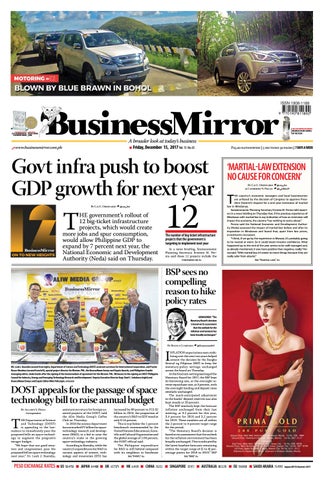
Dr. Leah J. Buendia (second from right), Department of Science and Technology (DOST) assistant secretary for International Cooperation, and Psyche Roxas-Mendoza (second from left), special project director for Mission: PHL, the BusinessMirror Envoys and Expats Awards, and Philippines Graphic managing editor, shake hands after the signing of the memorandum of agreement for the Mission: PHL. Witnesses to the signing are DOST-Philippine Council for Industry, Energy and Emerging Technology Research and Development Deputy Executive Director Engr. Raul C. Sabularse (right) and BusinessMirror Envoys and Expats Editor Mike Policarpio. ALYSA SALEN
DOST appeals for the passage of space technology bill to raise annual budget By Alladin S. Diega
T
Correspondent
he Department of Science and Technology (DOST) is appealing to the lawmakers to immediately pass the proposed bills on space technology to augment the program’s meager budget. “We hope that our good senators and congressmen pass the proposed bill on space technology next year,” Dr. Leah J. Buendia,
assistant secretary for foreign assisted projects of the DOST, told the Aliw Media Group’s Coffee Club on Thursday. In 2016 the science department has earmarked P1 billion for spacetechnology research and development (R&D), in a bid to raise the country’s stake in the growing space-technology industry. According to Buendia, while the country’s expenditures for R&D in various aspects of science, technology and innovation (STI) has
PESO exchange rates n US 50.4750
I
@BcuaresmaBM
n japan 0.4488 n UK 67.7375 n HK 6.4676 n CHINA 7.6252 n singapore 37.472 n australia 38.5276 n EU 59.6968 n SAUDI arabia 13.4593
Source: BSP (14 December 2017 )
BMReports BusinessMirror
A2 Friday, December 15, 2017
www.businessmirror.com.ph
DOT hopes for ₧5B in receipts from Indian tourists By Ma. Stella F. Arnaldo
T
@akosistellaBM Special to the BusinessMirror
HE Department of Tourism (DOT) is looking forward to higher visitor receipts from India, with arrivals projected to hit 100,000 by year-end.
In a news statement, Tourism Undersecretary Benito C. Bengzon Jr. said: “An Indian tourist, on the average spent at least $1,000 [in the Philippines]; just imagine if we are able to meet the 100,000 mark of Indian tourist arrivals?” At P51 to $1, this would mean at least P5.1 billion in tourism earnings for the Philippine economy. He made this statement as the DOT signed on Tuesday a memorandum of agreement with Singapore Airlines (SIA).
Bengzon said under the oneyear partnership, the DOT and SIA will implement joint marketing activities to promote the Philippines to the Indian market. These marketing activities will be carried out through social media, familiarization tours for media and travel agencies, and road shows, to name a few. “This is a milestone for the Philippines. The India market is growing at a very fast rate. In fact, we are expecting to reach 100,000
arrivals by end of 2017. This joint agreement is envisioned to sustain and further strengthen this growth in the next years,” Bengzon said. From January to October 2017, arrivals from India jumped by some 20.3 percent to 88,832, making it the second-fastest growing market after China. Bengzon and SIA Senior Vice President Sales and Marketing Campbell Wilson signed the agreement at the Makati Diamond Residences. Also present were DOT regional directors. For his part, Wilson said the agreement with the DOT is a significant step in expanding the Philippines’s tourism industry. “We are confident we can increase visitor arrivals; it is an honor to bring our passengers anywhere in the Philippines,” he said. SIA is the primary carrier connecting India to the Philippines. The DOT added that SIA and its sister company, SilkAir, also agreed to bring tourists not only
to Manila but also to secondary destinations, in keeping with Tourism Secretary Wanda Corazon T. Teo’s policy of encouraging tourists to visit key destinations outside Metro Manila. “The end result that we are really looking for is a wider dispersal of tourist traffic across the country and spread the benefits of tourism to communities,” Bengzon said. He added that part of the DOT’s marketing strategy to is “to make the Indian tourists stay longer on the Philippines by developing new products that would meet their needs.” Last year the DOT held promotional road shows in Kolkata, Mumbai, Bengaluru and Chennai. “The four Indian cities we targeted are important feeder markets, hence, we are working on strengthening our relations with their local travel partners to assure sustainable growth,” Teo said then. She noted that increased Indian
visitor arrivals in the Philippines are facilitated by the visa-free entry privilege extended to Indian nationals who already have visas from the United States, Japan, Australia, Canada, Schengen, Singapore and the United Kingdom. However, the DOT has been appealing to the Department of Justice to grant a visa-on-arrival privilege to Indian tourists, as well. India has the second-largest population in Asia, after China. Francesca Alberto, vice president for domestic sales and marketing of Ark Travel Express, said of last year’s road show: “The market has high potential for luxury and honeymooners. The quality of agents in India are good and they are gaining more knowledge about the Philippines.” T he Phi lippines and Ind ia have long historical, cultural and trade ties. A rcheological evidence indicate trade between both countries running as far back as the ninth century BC.
Govt infra push to boost GDP growth for next year Continued from A1
Clark International Airport Expansion Project, which will be breaking ground on December 20; the Metro Manila Subway Project; and the Mindanao Railway Project Phase 1 Tagum-Davao-Digos Segment. The last time Philippine GDP reached 7 percent was in 2013, when GDP expanded by 7.1 percent. This was largely due to the 7.9-percent growth in the second quarter of 2013 and the 7.6 percent posted in the first quarter of that year. “I think we will enter the 7 [percent] territory next year,” Pernia said. “If the global economy will stay buoyant, that will be a plus to our exports and then government spending will surely be ramped up.” The 12 projects are part of the 36 approved policies and projects by the National Economic and Development Authority (Neda) this year. Of the 36 approvals, around 20 were considered “hard infrastructure projects.” Pernia said the Neda expects the Neda Board, the highest
DOST . .
Continued from A1
Asia. Vietnam, for instance, has 0.19-percent allocation, Thailand has 0.36 percent, Malaysia has 1.09 percent and Singapore has 2.0 percent of its GDP-budget allocation, she added. Buendia explained that the country’s low ranking in
policy-making body of the agency which is chaired by the President, to approve another 15 hard infrastructure projects in 2018. During the briefing, Neda Assistant Secretary Jonathan L. Uy said the interagency Investment Coordination Committee (ICC) Cabinet Committee (Cabcom) has proposed to the Neda Board six other projects for approval this year or early next year. Of the six projects, three are new—the P20.313-billion Safe Philippines Project; the P11.369billion Bridge Construction and Acceleration Project for Socioeconomic Development project; and a project to improve the capacity of the Philippine Coastguard. The Safe Philippines project entails the construction of 18 integrated operations and command centers that are complete with video surveillance systems and a remote backup data center. The Bridge Construction and Acceleration Project involves the construction of five iconic and 25 truss bridges. These will be constructed in nine regions of the
country and will be completed by 2022 and have a collective length of 2,848 lineal meters. The project to improve the capacity of the Philippine Coast Guard involve the acquisition of six helicopters that will be used for marine disaster response. “We are moving forward to complement the Philippine Coast Guard not only in terms of seabased coastguard operations but air. There are about six operational areas in the entire Philippines that will be supported,” Uy said. Apart from these three projects, the ICC Cabcom also approved the changes in cost for the new Bohol-Panglao International Airport project; the Samar Pacific Coastal Road; and the second stage of the Jalaur River Multi-purpose Project, encountered implementation delays. The Bohol airport project is expected to be completed by June 2018. The project is funded by the Japan International Cooperation Agency, which provided a P5.77 billion worth loan for the project. The project was approved in
September 2012. The Samar road project is a 109.3-kilometer road under the Arterial Road Network, which will link towns facing the Pacific and eventually complete the circumferential loop for Samar Island. The JRMP involves the constr uction of dam and ir r igation facilities, including a high dam and reservoir with afterbay and catch dams in Iloilo and its neighboring towns. For 2017 Pernia said Philippine economy is projected to grow between 6.7 percent and 6.9 percent. Growth drivers for this year were government spending, export earnings growth and strong consumer spending. He added agriculture performance was not significantly affected by issues, such as bird flu. Pernia said the Philippines is considered one of the fastest-growing economies in Asia. Philippine GDP growth is the second fastest after Vietnam as of the third quarter this year. The Neda chief said GDP growth in January to September averaged
the Global Innovation Index was pulled down by weaknesses in human capital and R&D, with a score of 22.7 out of 100, ranking only 95th from 128 countries. The reason, she added, is the low public and private expenditures on education and R&D. She said there is a need for a national law for space technology “which would innovate every ma-
jor sphere of our economy, such as commercial production, medicine, land use and marine ecology.” According to Engr. Raul C. Sabularse, deputy executive director of the DOST’s Philippine Council for Industry, Energy and Emerging Technology Research and Development (PCIEERD), the government has invested around P800 million for the Philippine microsatellite
program that led to the successful development and launch into orbit of Diwata 1 last year, and the eventual launch of Diwata 2 in 2018. “This first microsatellite, designed and built by Filipinos with technological assistance from Japan, and deployed into orbit from the International Space Station on April 27, 2016, was the first not only for us, but even for the Japanese who realized that this downscaled satellite can be launched this way and served specific needs,” Sabularse said. The downside, according to PCIEERD, is that Diwata 1 is orbiting only at a height of 400 kilometers from land and it would only last up to 2018, or roughly 20 months. Early after its launch, the satellite shot images of Isabela province, the island of Luzon and parts of Northern Japan. It has captured images of the coastlines of Palawan, showing signs of siltation on certain parts of the province. House Bill 3637 and Senate Bill 1211, filed in September last year, both aim to establish a Philippine space-development program, and the creation of a Philippine Space Agency. The Senate bill was introduced by Sen. Paolo Benigno A. Aquino IV, while its House version was filed by Rep. Seth Frederick P. Jalosjos of the First District of Zamboanga del Norte and Rep. Erico Aristotle C. Aumentado of the Second District of Bohol. Sens. Loren B. Legarda and Vicente C. Sotto III have also filed their versions of space bills.
6.7 percent. He added the Asian Development Bank projects a fullyear growth of 6.7 percent vis-à-vis Vietnam’s 6.5 percent, China’s 6.4 percent and India’s 7.4 percent. “It is with pride that we close this year strong, seeing a string of successes, especially lately,” Pernia said. “We’ve seen robust domestic consumption and government spending, and there has been recovery in external demand. With this, we can say that we are well on the way to reaching our full-year growth target of 6.5 [percent] to 7.5 percent,” he added. Apart from these, Pernia said the country’s hosting of the 31st Asean Summit and Related Meetings, contributed to the country’s stellar year. He added that the government’s economic briefings abroad seemed well-received and fruitful. The briefings allowed the government to introduce its economic blueprint, dubbed as “Philippine Development Plan 2017-2022,” and its ambitious infrastructure program called “Build, Build, Build.”
BSP. . .
Continued from A1
Governor Nestor A. Espenilla Jr. said in a statement read by Deputy Governor for the Monetary Stability Sector Diwa C. Guinigundo. Risks to the outlook were seen remaining tilted to the upside as higher inflation pressures from the pending tax-reform program was seen tempered by proposed reforms on rice imports down the line. Guinigundo also reiterated that local monetary policy crafting, while cognizant of external economic events, has goals all its own and independent from more recent guidance from the US Federal Reserve (the Fed), which favors a tightening bias at the moment. Guinigundo, in particular, said the BSP does not have to match the tightening moves of the US Fed. The deputy governor added the BSP has factored in the expected interest-rate hikes by the US Fed and the within-target inflation rates up until 2019, indicating ample monetary policy space for the BSP to respond to risks as and when needed. The BSP also said geopolitical tensions and lingering uncertainty over macroeconomic policies in advanced economies continue to pose downside risks to the near-term prospects for global economic growth. Nevertheless, Guinigundo said prospects for domestic economic activity were likely to remain firm on account of strong consumer and business sentiment and ample liquidity in the system.
M a ny I nd i a n s, mo s t ly f rom Chennai (formerly Madras) who came with British troops during the brief occupation of Manila, decided to stay in the Philippines. More waves of Indian set t lers fol lowed du r ing t he American occupation, and the separation of India and Pakistan in 1947. While there are no recent statistics on the number of Filipinos of Indian descent, many of them are said to be residing in Cainta in Rizal, Metro Manila, Isabela and Negros Occidental. They are largely of Sindhi, Punjabi and Tamil stock. There have been a number of Filipino-Indians who have become part of the social and political fabric of the country. Among them are Bb. Pilipinas-Universe 2010 Venus Raj, former Manila Mayor Ramon Bagatsing, former Pangasinan Vice Gov. Ranjit Shahani and radio DJ Sam YG, to name a few.
Martial law. . . Continued from A1
In terms of investments, Neda Undersecretary Rosemarie G. Edillon said there was even a slight uptick after martial law was imposed in May, but this was mainly due to the investments that poured in the Davao region. “We also looked at the business expectation survey [BES] and the consumer expectation survey [CES]. And, in fact, for the fourth quarter, there was actually an uptick in both CES and more defined in terms of the BES. And the martial-law declaration was not listed among the issues that consumers and businesses identified,” Edillon said. “We’re hoping it will be maintained through out this extension. It’s really important that the government and military maintain the high moral ground even if martial law is [in effect],” she added.
‘Martial law still needed’
George T. Barcelon, president of the Philippine Chamber of Commerce and Industry, said the implementation of martial law in May was “instrumental” in the government’s bid to liberate Marawi City from Islamic State of Iraq and Syria-inspired terrorists. “Now that Marawi city’s rebuilding is about to start, military intelligence and keepers of peace are order presence are still needed. As such to give assurance, extending martial law is in order,” Barcelon said. “We trust the pronouncement of President Duterte that human rights will be upheld in the whole exercise. I believe investors are likely to have more confidence when there is the assurance of peace and safety,” he added. Perry Pe of the Management Association of the Philippines said the extension of martial law would not scare away foreign investors. “What will spook business is if we do nothing. The Fitch upgrade on Philippine bonds is a vote of confidence,” Pe said.
‘Business as usual’
Trade and business will go as usual in Mindanao in spite of the extension of martial law for a year in the island, according to the Mindanao Development Authority (MinDA). MinDA Secretary Datu Abul Khayr Alonto said the agency supports the extension of military rule in southern Philippines. Congress on Wednesday approved President Duterte’s appeal to continue the imposition of martial law in Mindanao for the entire 2018. “We believe in the pure intent of the President to maintain the high security level in Mindanao, and to prevent another Marawi conflict from happening. It is worth noting that the decisive action of the President to end terrorism in Mindanao once and for all is gradually yielding positive results for the islandregion,” Alonto said in a statement. He added said trade and business remain upbeat in the island in spite of the tight security protocol implemented by government troops. Alonto said a number of businessmen expressed interest to invest in Mindanao.
The Nation BusinessMirror
www.businessmirror.com.ph
Editor: Vittorio V. Vitug • Friday, December 15, 2017 A3
Aquino confirms Paris meeting with Sanofi execs over vaccine supply
F
By Butch Fernandez
@butchfBM
ormer President Benigno S. Aquino III, under questioning by Senate probers on Thursday, confirmed meeting with officials of the Sanofi pharmaceutical company that supplied the P3.5-billion antidengue Dengvaxia vaccine during a 2014 presidential visit to France.
Facing the Senate Blue Ribbon Committee, chaired by Sen. Richard J. Gordon, Aquino disclosed that he met the Sanofi officials in Paris in 2014 “at their request” coursed through the Department of Health (DOH). Asked by Gordon if he was provided a background by DOH officials about Sanofi’s record, Aquino replied he was “not informed” after Gordon cited reports that Sanofi was linked to an alleged bribery case. “I am not aware of those cases [against Sanofi],” Aquino told Senate probers. Gordon virtually cleared Aquino, but explained he needed to
Be vigilant, brace for renewed NPA guerilla attacks–Palace By Elijah Felice E. Rosales
T
@alyasjah
he government is expecting intensified attacks from communist-led New People’s Army (NPA) guerrillas with the extension of martial law in Mindanao, and has warned the public to be more vigilant in the wake of these anticipated offensives, Malacañang said on Thursday. “Well, I think the reality is with the halt of the peace talks, there would be more military encounters between the Armed Forces and the New People’s Army. So we need to be more vigilant,” Presidential Spokesman Harry L. Roque Jr. said at a news briefing. He added government troops were instructed to do everything in their power to quell terrorism in the southern third of the country. “So what else can be done? Well, more of the same. We just need to be able to deal with threats as they happen,” he said. Congress voted overwhelmingly in favor of martial-law extension in Mindanao on Wednesday, approving President Duterte’s appeal to continue imposing military rule in the island for another year from January 1, 2018, to December 31, 2018. The President appealed to lawmakers to grant his request to allow government troops to neutralize the Islamic State and the NPA in Mindanao. In his letter to Senate President Aquilino L. Pimentel III and House Speaker Pantaleon D. Alvarez, Duterte said he is adhering to the recommendation of his defense chief to prolong martial law in Mindanao. Defense Secretary Delfin N. Lorenzana advised the President to extend military rule in the island to “ensure the total eradication of Daesh-inspired Da’awatul Islamiyah Waliyatul Masriq, other like-minded local and foreign terrorist groups and armed lawless groups, and the communist terrorists and their coddlers, supporters and financiers.” With Congress’s approval of the extension, Duterte became the first President in the post-Marcos era to declare martial law due to the communist insurgency. The late strongman Ferdinand E. Marcos declared a nationwide martial law in 1972, which has resulted to thousands of cases of human-rights violation. Roque said the public need not worry of a possible repetition of history with the martial-law extension in Mindanao. “I think we have shown for the entire period that martial law has been imposed in Mindanao, that this is not the same martial law that we had in 1972. Courts remain functioning [and] Congress remains existing. The Bill of Rights and the Constitution is enforced,” he said. “So I don’t think there’s been any legal basis for the fears of many that there will be the return of dictatorial rule, neither has there been any systematic or gross violations of human rights so far,” the Palace official added. He said it is just that for the time being, military rule reigns supreme over civilian rule in Mindanao. On top of this, Roque said, Malacañang has not received any complaints of human-rights violation from the local government unit of Marawi City, Lanao del Sur. “We are not exactly exploiting that and local government unit has actually complained, even in Marawi that they fear that their mandates have been violated,” he said. Roque warned the public should be more vigilant on intensified NPA attacks in the face of the cancellation of the peace talks and the extension of martial law in Mindanao. The NPA and its ideological arm, the Communist Party of the Philippines (CPP), are strongly opposed to military rule in the island. With the extension, the CPP vowed to face martial law with force and declared it will not back down in confronting government forces in the southern third of the country. “That this will result in unmitigated death and destruction goes without saying, that this came after his declaration of the CPP and NPA as terrorists and simple criminals and his unbridled hostility to the legal democratic movement, speaks loudly and clearly of his intention to impose nationwide martial law. With barely concealed steps, Duterte is setting up his fascist dictatorship to perpetuate himself in power,” the CPP said. “The people and the revolutionary movement are ready to defend themselves and will meet him head-on,” the CPP added.
ask questions to get to the bottom of the P3.5-billion Dengvaxia vaccine-supply controversy. This developed as Thomas Triomphe, who heads of Sanofi Pasteur for the Asia-Pacific region, assured the public there is no cause for alarm over the use of Dengvaxia for the Philippines’s dengue immunization program because the vaccine continues to be safe and effective in providing persistent protection against the dengue infection. Facing Senate probers, Triomphe affirmed before
the joint inquiry on Thursday of Blue Ribbon Committee and the committee on health that there is no “worldwide” scare over the Dengvaxia vaccine, adding it continues to be marketed and used in 10 other countries. “It is important for the public to understand that the vaccine continues to be good, effective and safe,” Triomphe assured the senators, adding “there is no reason for public panic.” Triomphe also assured that Sanofi Pasteur is
ready to “collaborate and reengage” with the DOH in contributing to the investigations to be done by the task forces on the review of the government’s dengue immunization program. “Your honor, I understand the question and the concerns. I want to make sure that people understand that we have been a long-term partner of the Philippines’s DOH, and we want to remain a long-term partner of the Philippines’s DOH as we are with the various departments of health all over the world,” he said.
Economy
A4 Friday, December 15, 2017 • Editors: Vittorio V. Vitug and Max V. de Leon
BusinessMirror
Investment pledges decline 9.9% from January to September–PSA
T
By Cai U. Ordinario
@cuo_bm
he country’s foreign investment pledges a registered 9.9-percent contraction as of the third quarter of the year, according to data released by the Philippine Statistics Authority (PSA).
PSA data obtained from the country’s seven investment promotion agencies (IPAs) showed total approved foreign investments only amounted to P84.1 billion in the January-to-September period, from P93.3 billion in 2016. This, despite foreign investment approvals amounting to P43 billion in the third quarter, a 61.1-percent growth from P26.7 billion in the same period last year. Meanwhile, total approved investments of foreign and Filipino nationals grew 52.3 percent to
P626.24 billion in the January-toSeptember period, from P411.17 billion in 2016. This was largely due to the 217percent growth in foreign and Filipino investments in Calabarzon or Region 4A, which accounted for 32 percent of the total investments in the country this year. This was followed by the 171.4percent growth posted by Cagayan Valley; 145.7 percent, Autonomous Region in Muslim Mindanao (ARMM);132.9 percent, Caraga; and 118 percent, Central Luzon.
Data showed that regions like the National Capital Region, or Metro Manila, which accounted for 15.9 percent of total foreign and Filipino approved investments saw a 12-percent decline in its investments to only P99.59 billion in January to September, from P113.19 billion in 2016. The PSA said the approved investments of foreign and Filipino nationals reached P274.4 billion in the third quarter of 2017, more than double compared with P133.8 billion in the previous year. “Filipino nationals continued to dominate the investments approved during the quarter, sharing 84.3 percent, or P231.3 billion worth of pledges,” PSA said.
Meanwhile, the top 3 prospective investing countries for the third quarter of 2017 include Japan, Taiwan and Australia. Japan committed P 21.4 billion, or 49.7-percent share, of the total investments during the quarter. Taiwan and Australia pledged P8.9 billion and P2.8 billion, or 20.6 percent and 6.4 percent of the total approved foreign investments, respectively. The seven IPAs are the Board of Investments (BOI), Clark Development Corp., Philippine Economic Zone Authority and Subic Bay Metropolitan Authority. Also included are the Authority of the Freeport Area of Bataan, BOI-ARMM and Cagayan Economic Zone Authority.
Filipino nationals continued to dominate the investments approved during the quarter, sharing 84.3 percent, or P231.3 billion worth of pledges.”—PSA data
Palace suspends govt work on Dec. 26 and Jan. 2, 2018
M
alacañang has suspended government work on December 26 and January 2, 2018, to give state employees the opportunity to celebrate the Yuletide season with their families and loved ones. Through Memorandum Circular 37, Executive Secretary Salvador C. Medialdea called off government work on December 26 and January 2, 2018, in order to allow employees to spend the holidays with their families and loved ones. The work suspension covers government employees in all agencies, including government-owned and -controlled corporations, government financial institutions, state universities and colleges, local government units and other instrumentalities of the government. The memorandum, however, does not apply to those whose functions cover the delivery of basic and health services, preparedness and response to disasters and calamities and performance of other vital services. On the other hand, Malacañang left to the respective management of private companies the discretion to suspend work. The same instruction was given to independent bodies of the government. Elijah Felice E. Rosales
SMX sale Holiday shoppers flock to the SM stores bodega (warehouse) sale at the SMX Convention Center in Pasay City, where bags, shoes, clothing and other items are on sale at discounted prices. NONIE REYES
DOE targets release of revised CSP guidelines by next year By Lenie Lectura
T
@llectura
he Department of Energy (DOE) is targeting next year the release of a revised set of guidelines on Competitive Selection Process (CSP), a policy which requires distribution utilities (DUs) to hold competitive bidding for their supply requirements as against securing power deals via bilateral contracts. “CSP process itself will be changed. We hope to issue new policy guidelines next year,” Energy Undersecretary Jesus Cristino P. Posadas said. The CSP, through existing Department Circular 2015-06-0008, mandates competitive bidding between DUs and generation companies (gencos) in the sale of electricity through the mediation of a third-party expert. Under the CSP, a distribution utility can only enter into a power-supply agreement with a genco after complying with the requirements of the process. The requirement is for a DU to openly call for and receive at least two qualified bids from gencOs. The DU is not barred from entering into a contract for power supply. The CSP further requires that direct negotiations with other power suppliers be entered into only after at least two failed CSPs. Posadas said that the agency proposes “to cluster the power requirements” to reflect a more transparent manner of auction, similar to a policy being implemented in South America. “The DOE will guide the DUs and gencos by area to determine how many megawatts are needed in a particular area. It’s like clustering,” Posadas said. The details of the plan on CSP revision is yet to be finalized, but, Posadas said, the DOE’s thrust is “to implement a more objective platform for sourcing electricity in a given area.” This move, he added, will open up the base load, mid-merit and peaking requirement for an area serviced by a DU, or electric cooperative. “It’s a reversed auction of sort as buyers will be the ones that will now look for suppliers,” Posadas added.
www.businessmirror.com.ph
DFA says OFWs in Iraq can come home for Yuletide By Recto Mercene @rectomercene
F
ilipino migrant workers in parts of war-ravaged Iraq can now spend their Christmas in the Philippines after the Department of Foreign Affairs (DFA) approved a proposal that would finally allow them to fly home to visit their loved ones, and then return to their jobs after the homecoming Fore ig n A f f a i rs S e c ret a r y Alan Peter S. Cayetano said in a news statement he has approved the proposal of the Philippine Embassy in Baghdad to allow Filipinos working in Iraq to be covered under the Balik Manggagawa (workers’ homecoming) program, as long as their employers could guarantee their safety and security. “After more than three years of waiting, our kababayan [countrymen] in Iraq will now have the opportunity to be reunited with their families in the Philippines without having to worry about not being able to return to their jobs in Baghdad, Basra and other safe locations there,” Cayetano said after signing the letter formally endorsing the proposal for the approval of Labor Secretary Silvestre H. Bello III. Cayetano said the Department of Labor and Employment (DOLE), through Bello, had expressed full support for the selective Balik Manggagawa coverage for Filipino workers in Iraq, when the foreign secretary discussed the proposal with his DOLE counterpart in Manila a few weeks ago. The move is expected to benefit some of the estimated 1,000 Filipinos working in Baghdad, Basra and other areas who, unlike workers in Afghanistan and Libya, have not been able to return to the Philippines since 2014 when Manila placed Iraq under Crisis Alert Level 4 (mandatory repatriation) and suspended the deployment of new workers after the Islamic State (IS) captured Mosul and other key cities and threatened to overrun Baghdad and Erbil. “Our decision to approve the request of our kababayan in Iraq is based largely on humanitarian grounds and is similar to what has been granted to our other kababayan working in Afghanistan and Libya,” Cayetano added. He, however, clarified that the move does not lift the current ban on the deployment of new workers nor will it lower the current alert level for Iraq. In approving the recommendation, Cayetano said he took note of the reports not just of the embassy but also of the assessment team from the Office of Migrant Workers Affairs and the Office of Middle East and Africa Affairs that visited Iraq on the improved security situation in Baghdad and other parts of the
country as a result of the recent victories by the Iraqi government against the IS. Cayetano added the proposed exemption will cover Filipinos who are registered with the Embassy in Baghdad and who are employed by Filipino, foreign and Iraqi companies with existing contracts with the Iraqi government; the United States government and those of member-states of the International Coalition; and the United Nations, other international organizations and non-governmental organizations. It will also cover those employed as private staff by foreign diplomats assigned in Baghdad and ranking officials of the Iraqi government provided that such employers have no pending laborrelated cases as certified by the Philippine Embassy. Embassy Chargé d’Affaires Elmer G. Cato, who initiated the proposal, said the exemption will benefit Filipinos working and living in secured compounds in the provinces of Babil, Baghdad, Basra, Dhiqar, Karbala, Maysan, Muthanna, Najaf, Qadisiyah, Saladin, Wasit and other areas that are certified as safe by the embassy. “One of the conditions before a Filipino can avail himself of Balik Manggagawa coverage is for his employer to bring him to the nearest airport and back to their premises using secured nonpublic transportation,” Cato said. Filipino workers who meet this requirements must submit an official letter from the employer to the embassy containing information about the employee and requesting that said employee be included in the coverage of the Balik Manggagawa program, along with the following documents: Signed employment contract in English; Employee and next of kin information sheet; Copy of employee’s passport and Iqama; Certificate from Ministry of Labor and Social Affairs that employer has been paying employee’s social security contributions; Certificate of no pending laborrelated case from the embassy; Certificate of undertaking for demobilization, evacuation and repatriation of Filipino employee and provision of direct and secured transportation from working premises to or from the nearest airport; and Payment of certification, authentication, and other fees. The embassy shall provide the Philippine Overseas Employment Administration (POEA) on a regular basis with the list of Filipino workers who have applied for Balik Manggagawa coverage. In order to travel back to Iraq, Filipino workers covered by the exemption are required to submit to the POEA a certificate of exemption from the embassy.
DOTr orders heightened security in transport hubs for Christmas
T
he Department of Transportation (DOTr) has directed the railways, road, maritime and aviation sectors to reinforce their security measures in preparation for the influx of passengers trooping to the provinces for the holiday season. “May I once again reiterate the great importance of maintaining and assuring the safety, security and comfort of the riding passengers and the public,” Transportation Secretary Arthur P. Tugade said in a news statement issued on Thursday. “Accordingly, please continue implementing and improving our security and safety measures to protect people, facility, struc-
tures, equipment and the like,” he added. Tugade also said that both the government and commuting public “must be proactive, alert and vigilant,” share information and maintain close coordination among stakeholders to further improve the security safety nets in the transport sector. The transport sector had activated its “Oplan Biyaheng Ayos” to ensure the security and safety of the thousands of commuters who flocked to bus terminals, seaports, airports and train stations for the traditional exodus to the provinces during last month’s observance of All Saints’ and All Souls’ Day. PNA
Agriculture/ Commodities
www.businessmirror.com.ph
BusinessMirror
A5
Editor: Jennifer A. Ng • Friday, December 15, 2017
PHL bid against import surge fails to fly at WTO
T
By Jasper Emmanuel Y. Arcalas
@jearcalas
HE Philippines’s request for a scheme that would protect agriculture from harmful import surges did not merit a draft decision from the World Trade Organization (WTO), effectively sending home the country’s negotiators from Argentina empty-handed. As the 11th WTO Ministerial Conference (MC11) reached its conclusion, 164 member-countries failed to come up with a firm ministerial decision on agriculture as they expressed divergent views on issues, such as special safeguard mechanism (SSM) and public stockholding (PSH). “I think there was clearly no outcome here on agriculture. Those are very, very difficult issues; we knew that from the very beginning,” WTO Director General Roberto Azevêdo said in a news briefing on December
14 (Philippine time). Azevêdo recalled that previous ministerial conferences—in Bali, Indonesia and Nairobi, Kenya—made breakthroughoutcomesonagriculture, including a temporary solution on PSH and elimination of export subsidies. In a statement dated December 12, the Philippines said that it is “deeply regretful and disappointed” that there was no draft decision on SSM, despite the priority accorded to it under the Nairobi Declaration of 2015. At the same time, the Phil-
ippines stood firm on its decision to reject any substantive decision on agriculture sans the SSM. “The Philippines reiterates that it could not join any consensus for adopting any draft substantive decision in the absence of a solution on SSM or through an improved SSG [special safeguard]. There simply is no sufficient political basis for us to do so,” the statement read. The Philippines emphasized that the approval of SSM is vital for its farm sector as the present SSG proves to be inefficient and ineffective to protect its small-scale framers from import surges and price depressions. It explained that the country’s current trigger price for corn is 5 cents per kilogram (kg), but the import price for the last three years average 31 cents. Another example, it noted, is that the trigger price for pork imports is pegged at $36 per kg compared to $1.65 per kg average price in the past three years.
Agri exports up 19.3% in Jan-Oct—PSA
T
he country’s export earnings from agro-based products in January to October grew by 19.3 percent to $2.984 billion, from $2.501 billion recorded in the same period last year, according to the Philippine Statistics Authority (PSA). The latest trade data from the PSA showed the bulk of revenues from shipments of agricultural products, or nearly 45 percent, came from coconut products. Shipments of coconut products during the 10-month period reached $1.614 billion, 43.9 percent higher than the $1.121 billion recorded in the same period last year.
Earnings from coconut oil expanded by 48.8 percent to $1.331 billion, from $894.954 million recorded last year. Coconut oil accounted for 82.46 percent of the total coconut products exported during the period. PSA data also showed the value of fruits and vegetables shipped by the Philippines declined by 4.3 percent to $1.220 billion, from $1.275 billion a year ago. Export receipt for bananas, which accounted for 48.52 percent of total earnings, reached $592.194 million, 2.9 percent higher than last year’s $575.762 million.
According to PSA data, earnings from other agro-based products, including seafood, reached reached $775.745 million, 12.5 percent higher than the $689.681 million recorded last year. During the period, the country earned $398.023 million from shipments of fish, fresh or preserved shrimps, which was 6.3 percent higher than last year’s $374.597 million. It accounted for 51.31 percent of revenues from the export of other agro-based products. Earnings from shipments of sugar products expanded by 43 percent to $149.012 million, from last year’s $104.226 million. Jasper Emmanuel Y . Arcalas
A6
The World BusinessMirror
Friday, December 15, 2017
Biggest biometric database grows in India amid doubt
P
rime Minister Narendra Modi is pushing Indians to link their digital IDs to a host of services, such as credit cards and cell phones, even as the Supreme Court (SC) will hear petitions on Thursday seeking to limit the scope of the world’s largest biometric database.
Almost 1 billion people had signed up for the program before a landmark privacy ruling in August strengthened the case against making the Aadhaar ID mandatory. The court will now decide on the validity of the government’s order to meet specified deadlines. Last month it told banks and utilities to stop scaring customers after people complained about a barrage of e-mails and text messages warning of frozen accounts and invalidated SIM cards if they failed to comply with the government’s push. To be sure, the court’s immediate hearing will only pertain to the deadlines, with more detailed arguments on overall legality probably next year. While officials say Aadhaar is saving the government billions of dollars by better targeting beneficiaries of subsidized food and cash transfers, critics point to unfair exclusions and data leaks. “Instances of the exclusion of genuine benef iciar ies and the public disclosure of Aadhaar numbers make it clear that significant room exists for instituting more substantive privacy protections and grievance redressal
Japan plans carrot-and-stick tax changes to drive wage gains
J
apan will adopt a carrot-and-stick approach to boost pay for workers by providing tax benefits to companies that increase spending on wages and investment while clamping down on benefits for firms that don’t. Companies that raise pay by at least 3 percent a year or invest in their human capital through skills training will be able to reduce their corporate income tax, according to documents from the ruling coalition obtained by Bloomberg News. The changes will be in place from fiscal year 2018 to 2020, and may see some small and medium companies reduce their tax bills by up to 20 percent, according to the document. Firms that don’t invest or increase pay will no longer be able to use existing deductions to cut their tax burdens, such as those for research and development. The changes should help encourage m o re i nve s t m e nt a n d i n c re a s e s i n bonuses, but because it’s only a temporary measure and is unlikely to drive sustained gains in base wages, according to Koya Miyamae, senior fiscal policy analyst at SMBC Nikko Securities. These measures are complex and difficult for companies to take advantage of, so cutting the corporate tax rate would have more effectively increased international competitiveness, he said.
Income-tax shifts
The changes are expected to be announced by the ruling coalition’s tax panel before going to the Cabinet for formal approval. They will then be approved by parliament, where the coalition has a majority in both houses. A vote is likely before the start of the fiscal year beginning on April 1, 2018. Bloomberg News
mechanisms,” said Saksham Khosla, an analyst at Carnegie India. “The Supreme Court can mandate critical safeguards.” Aadhaar is a unique 12-digit number assigned to Indian residents, backed by their fingerprints, iris scans and certain demographic details. Some lawyers and activists, such as Shyam Divan, say that, once linked to various services, it will offer the government a web of information about each individual that will violate the person’s privacy.
Surveillance state
“ The Aadhaar Act purports to provide legal sanction to a program that lays the framework for real-time surveillance of every Indian,” Divan said. Hearings are due to start at 11:30 a.m. in
Almost 1 billion Indians had signed up for the biometric ID program. Bloomberg
New Delhi on Thursday. Indians are mandated to link their Aadhaar to: governmentissued Permanant Account Numbers, which help track tax filings, bank accounts, credit cards, insurance policies, mutual funds, pension plans; social-welfare benefits, such as cooking gas subsidies; and mobile numbers Enrollments to Aadhaar have increased by about 80 million over the past year—roughly the entire population of Germany—as pressure built on citizens to either link or forfeit these services. Modi had rejected Aadhaar while in opposition, terming it a threat to national security. However, he has since embraced and
The Aadhaar Act purports to provide legal sanction to a program that lays the framework for real-time surveillance of every Indian.”—Divan
extended its scope far beyond what was envisioned earlier.
Data leaks
The program is also plagued by allegations of data leaks, where personal details of users were made public on government web sites. The Unique Identification Authority of India, which administers Aadhaar, has denied database vulnerabilities. Meanwhile, newspapers continue to carry reports about poor or disabled Indians—such as leprosy patients—who are denied food and pensions because they either lack an Aadhaar number or the fingerprints and iris scans needed to apply for one. Privacy experts and lawyers suggest the SC’s ruling this August that Indians have a fundamental right to privacy could be a setback to the government’s push. A right to privacy, activists say, means the government can’t force Indian citizens to hand over their unique biometric data to the government in order to receive basic government services. Bloomberg News
Bombing underscores New York subway system’s vulnerability
N
EW YORK—The crude pipe bomb that exploded beneath the streets of New York this week served as a chilling reminder of the vulnerability of the city’s subway system, a 24-hour-aday operation with 472 stations and more than 5 million daily riders. While police say the nation’s largest subway system has some of the tightest security possible that still allows busy New Yorkers to get where they’re going, they acknowledge they can’t be everywhere or anticipate every kind of attack, particularly in this era of lone-wolf terrorism. “It’s very difficult, and it’s getting harder,” John Miller, the New York Police Department deputy commissioner of intelligence and counterterrorism, said on CBS’s This Morning. “This is not the alQaeda model, where a cell of people who are communicating with a base are an intelligence problem.” Instead, he added, the threat is coming from people “where the conspiracy is within the confines of their own mind.” Investigators say that appears to be what happened on Monday, when a Bangladeshi immigrant indoctrinated into terrorism through Internet videos strapped a bomb to his body and set it off in a busy passageway. He was the only one seriously hurt, suffering burns on his hands and torso. Akayed Ullah, who’s 27, was charged with federal terrorism-related offenses punishable by up to life in prison and was informed of the charges via video on Wednesday
as he lay in his hospital bed. He did not enter a plea and said little during the hearing, which lasted a little over 10 minutes. It was the second lone-wolf terror attack on the city in six weeks. On October 31 a man in a rented truck mowed down cyclists and pedestrians on a crowded bike path near the World Trade Center, killing eight people. But the blast this week was the first bombing on the subway in 23 years, a streak police attribute in part to a multilayered security approach that begins with 3,000 officers underground every day, patrolling trains and platforms. That’s bolstered by hundreds of security cameras, including one that captured detailed pictures of Monday’s explosion, and roving teams of officers with heavy weapons and dogs to sweep subway stations and trains. Officers are outfitted with pager-size radiation detectors to guard against a radioactive dirty bomb. Police also conduct tens of thousands of random bag searches in the system each year. Yet, those officers are confronted daily with thousands of people of every background, from every corner of the globe, carrying big backpacks, suitcases and large boxes, with no easy way of knowing whether any of those items contain a bomb. The police have to rely on riders as their eyes and ears, constantly reminding them, “If you see something, say something.” “Look up from your phones. Look up from your books now and
then. Take your earphones out. You can’t say something when you see something if you don’t look at it,” Joseph Fox, chief of the New York Police Department transit bureau, urged New Yorkers after the attack. But the see-something, saysomething system didn’t work on Monday. Authorities said Ullah boarded a subway train deep in Brooklyn with a bomb strapped to his torso, spent nearly an hour riding into Manhattan, changing trains along the way, and walked through one of the most heavily patrolled subway stations before triggering the device in front of a security camera. “We’re considering spending millions [of dollars] to erect a border wall, maybe we should be thinking about using the money to better secure rail and transit lines,” said James Norton, a former homeland security official and professor at Johns Hopkins University. He suggested more screening of bags and passengers before people get on a train. The police and politicians have repeatedly said that measures, such as adding metal detectors and bag checks to all stations, could bring the system to a crawl. “You can’t have a police person on every block at every moment— that would be impractical,” Gov. Andrew Cuomo, a Democrat, said in a TV interview this week. “But in terms of the sophistication of our security system, it’s second to none on the planet.” Only about six crimes are reported per day in the sprawling subway system. AP
Editor: Lyn Ressureccion | www.businessmirror.com.ph
May heads to Brussels after a defeat in Brexit vote at home on Wed
U
nited Kingdom Prime Minister Theresa May heads to a European summit that was set to be a celebration of the breakt h roug h v ic tor y i n Bre x it talks she clinched last week. Instead, she arr ived hours after a serious defeat at the hands of her own party. Lawmakers voted 309 to 305 on Wednesday evening to change her government’s planned legislation so that it guarantees they will get a “meaningful vote” on the final deal to leave the European Union (EU) at the end of negotiations in 2019. And rather than the Brexit hardliners who have so often undermined her, this time it was pro-Europeans who defected. The embarrassing reversal for the beleaguered British leader raises questions about whether she can muster enough backing for her vision of Brexit, whose convulsions have dominated UK politics for 18 months. While the recent focus was on striking a palatable agreement with the EU on the initial terms of the divorce, the greater challenge has always been on the home front. Lawmakers in the House of Commons will now have the power to veto the withdrawal treaty before the UK leaves the EU if they don’t like the terms. Another defeat looms next week over an amendment that could attract even more rebel backing. “She has come back to earth with a bump after her success of last week,” said Mij Rahman, a political analyst at Eurasia Group in London. “This vote increases the prospect of the Commons rejecting May’s deal next October or November.” May made a personal plea in parliament for colleagues to support her. Ministers spent the day proposing concessions aimed at buying off rebels, including a last-minute offer to come back with a new text. That was met with cries of “too late” in the chamber, before her authority took another knock. The pound pared earlier gains after the vote.
Softer option
Few people expect May to lose her job. What becomes more likely is that the UK will leave the EU in less dramatic fashion than some of May’s ministers wanted and company executives had warned about, the no-deal or “cliff edge” scenario. It points more toward a socalled soft Brexit that keeps Britain more in step with the EU, albeit with more twists and turns to come. The country voted 52 percent to 48 percent in June 2016 to abandon the bloc it joined in 1973, but a majority of lawmakers wanted to remain. They acknowledged the popular will by passing the motion to trigger the legal mechanism to leave, though exactly how to do it became the focal point of the argument. The legislation May wanted to push through wou ld have g iven her gover nment s we e pi ng powers to st a r t implementing Brexit w ithout parliamentar y approval. May had arg ued that anyt hing else wou ld t hreaten t he “orderly a nd smoot h ” Brexit she wants. W h i le Guy Verhofst adt, t he E u r o p e a n Pa r l i a m e nt c h ie f Bre x it ne got i ator, pra ised Br it ish democrac y, Ju st ice M i n i ste r Dom i n ic
R aab called it a “ fairly minor setbac k.” He told t he BBC t hat “ it won’t f r ust rate t he Bre x it process.”
Divorce deal
May defied expectations last week and brought home a divorce deal after managing negotiations on the apparently intractable issue of the open border between the UK province of Northern Ireland and the Republic of Ireland. An agreement was reached on the divorce bill and the rights of EU citizens so that talks could move on to a future trading relationship. Her team even boasted of winning concessions on the role of the European Court of Justice, which is toxic to euroskeptics. May will call on European Union leaders on Thursday to agree a quick transition deal for Brexit, a senior UK government official said. Britain wants the EU to agree that trading rules won’t change during a two-year phase lasting until 2021.
‘Blank check’
But then she must return to parliament. The latest amendment to the Brexit law was put forward by former Attorney General Dominic Grieve, a hitherto loyal Conservative and a former Cabinet colleague of May. He argued the bill gave the government too much power and shut parliament out. “We run the risk of losing sight of the fact that 48 percent of the electorate did not wish for the policy that we are currently pursuing and have deep concerns about,” Grieve said during the seven-hour debate. “We run serious risks of badly letting them down—all of them, collectively—by enacting bad legislation and taking very foolish decisions. The government’s bill would otherwise give May “a blank check” to take Britain out of the EU on terms that are not yet clear, he added. T he Conser vat ive Pa r t y has long been divided over Europe and the referendum on Brexit aimed to settle the argument. Instead, it’s more divided than ever, with some of those who campaigned to stay in the EU taking the government to task on a regular basis and those keen to leave often criticizing the approach to negotiations. May sought to st reng t hen her ha nd by ca l l ing a n elect ion for Ju ne, on ly to shoc k ingly lose her pa rl i ament a r y major it y. It ’s lef t her v u lnerable to rebel l ions by law makers who reject her pol ic y of leav ing Eu rope’s si ng le m a rket a nd re l i a nt on a pa r t y f rom Nor t her n Irel a nd to pass leg isl at ion. Stephen Hammond, a lawma ker in May’s Conser vatives, was fired as the party’s vice chairman after voting in favor of the amendment, according to a person familiar with the matter. He said he had “put countr y and constituency before party.” “It’s a reminder that May is not in control of the ship, but there is no successor who commands broad suppor t,” said Wy n Grant, professor of politics at War w ick Universit y in centra l England. “It gives remainers greater confidence and pushes the possibilit y of a no-deal scenario even f ur ther away.” Bloomberg News
www.businessmirror.com.ph
The World BusinessMirror
Friday, December 15, 2017 A7
Fed: Tax cut to give US economy ‘a modest lift’
W
ASHINGTON—The Federal Reserve, (the Fed) buoyed by a steadily strengthening economy, raised interest rates for a fifth time since the financial crisis and predicted that a proposed tax cut moving through Congress would modestly increase economic growth for the next few years without stoking inflation.
As a result, the Fed said on Wednesday that it did not expect the legislation, which President Donald J. Trump has called “rocket fuel” for the economy, to accelerate the Fed’s plans to raise interest rates in 2018 and indicated it remains on track for three rate increases next year. The Fed’s highly anticipated economic assessment, delivered after a two-day meeting of its policy-making committee, amounted to a lukewarm endorsement of the Trump administration’s top economic priority. Trump has suggested the $1.5-trillion tax cut could nearly double economic growth to as much as 6 percent, a level far greater than most economists think likely. “My colleagues and I are in line with the general expectation among most economists,” said Janet Yellen, the Fed’s chairman. She added they expected the bill to provide “a modest lift.” Yellen spoke at a news conference after the Fed announced a widely expected decision to increase its benchmark interest rate by a quarter of a percentage point, to a range of 1.25 percent to 1.5 percent. The increase continues the Fed’s gradual march toward higher rates, which were cut to near zero during the financial crisis. Wednesday’s increase is the third time this year that the Fed has raised rates, reflecting its confidence that the economy is in good health. The Fed and Congress are moving in opposite directions. The Fed, in raising rates, is reducing the support it has provided to the economy since the financial crisis. Congressional Republicans, meanwhile, are preparing a $1.5-trillion tax cut for businesses and individuals with the aim of stimulating economic growth. Some Fed officials, including Yellen, cautioned earlier this year that tax cuts could push the pace of growth to an unsustainable level, resulting in higher inflation, and that the Fed might respond by raising interest rates more quickly, to restrain growth and keep a lid on inflation. After seeing the details of the tax plan, however, Fed officials have concluded that there is no need to raise rates more quickly. A quarterly update of the Fed’s economic forecast showed that officials still expect to raise rates three times next year—unchanged from the last economic forecast. “We continue to think that a gradual path of rate increases remains appropriate, even with almost all participants factoring in their assessment of the tax policy,” Yellen said on Wednesday. In part, the Fed has concluded the tax plan doesn’t pack a large punch. Fed officials predicted the economy would grow at a 2.5percent pace next year; the previous forecast was 2.1 percent. Trump has predicted that the tax plan could deliver 4-percent growth or more. Apprised of those comments by a reporter, Yellen responded: “I wouldn’t want to rule anything out. It is challenging, however, to achieve growth of the levels that you mentioned.” The Fed also has learned that it’s not so easy to increase inflation, which has remained persistently low despite a tightening labor market and strengthening economy. The Fed aims to keep prices rising by 2 percent a year; it is on pace to undershoot that goal for the sixth straight year, and Fed officials on Wednesday predicted a seventh consecutive failure in 2018. But the Fed’s outlook is also politically convenient, even if some analysts described it as overly optimistic. Republicans argue that the tax cuts will deliver a lasting boost to economic growth by encouraging investment. They do not want the Fed to get in the way by raising rates. Ian Shepherdson, chief economist at Pantheon Macroeconomics, described the Fed’s forecast as “hopelessly unrealistic.” He noted that the Fed was predicting that growth would be stronger than it expected, and unemployment would decline further, but without any increase in inflation. “In short, the Fed forecasts an endless expansion, with minimal inflation pressure,” he said. It would be relatively easy for the Fed to respond if inflation does begin to climb. A thornier problem is the concern voiced by a minority of Fed officials that the central bank is already raising rates too quickly. Two Fed officials voted against Wednesday’s rate increase: Charles L. Evans, president of the Federal Reserve Bank of Chicago, and Neel Kashkari, president of the Federal Reserve Bank of Minneapolis. Evans has argued that the Fed may be holding down inflation by undermining public confidence that it will raise inflation back up to 2 percent. The Fed’s rate increases have had little impact on financial markets, which have also shrugged off the Fed’s efforts to tighten borrowing conditions. Rates on many loans have declined since the Fed’s most recent rate increase, in June, and credit terms have loosened. Lee Ferridge, head of North American macro strategy for State Street Global Markets, said Wednesday’s decision was “a bit of a nonevent, quite honestly.” Asset prices, which have climbed strongly this year even as the Fed has raised rates, were largely unchanged on Wednesday. The Standard & Poor’s 500 index dropped 0.1 percent, closing at 2,662.85. The yield on the bench mark 10-year Treasury fell to 2.34 percent, from 2.4 percent on Tuesday.
Ferridge said the ongoing stimulus campaigns by other central banks, notably the European Central Bank and the Bank of Japan, were offsetting the effect of the Fed’s retreat. “You’ve still got huge amounts of liquidity coming into the system, and that’s what’s driving markets,” he added.
“You’ve got the Fed tightening, but you’ve got global policy loosening.” Some economists see the lack of tightening in financial markets as a reason for the Fed to raise rates more quickly, to prevent the formation of bubbles that could cause economic disruptions. Yellen played down such concerns on
Wednesday. She said the Fed saw little evidence that a fall in asset prices would cause broader pain. The use of borrowed money, for example, remains relatively modest by historical standards. “When we look at other indicators of financialstability risks, there’s nothing flashing red there or possibly even orange,” she
added. The Fed’s rate increases also haven’t had much impact on the domestic economy. The average interest rate on a 30-year mortgage loan, at 3.94 percent last week, was lower than the 4.13 percent average rate at the same time last year, according to Freddie Mac. New York Times News Service
A8
Banking&Finance
Friday, December 15, 2017 • Editor: Jun B. Vallecera
BusinessMirror
www.businessmirror.com.ph
BELTRAN:“Core inflation of 3.3 percent suggests that in the foreseeable short term, inflation will be manageable.”
Mastercard program includes blockchain, digital identity and health-care fintechs
Near-term inflation seen manageable
T
he Department of Finance (DOF) on Thursday forecasted the inflation rate remaining at a manageable level in the short term given consumer prices having eased to 3.3 percent in November, from a peak of 3.5 percent in October.
The inflation rate in the first 11 months of the year averaged only 3.2 percent, which was slightly higher than the midpoint of the target range of 2 percent to 4 percent this year by the Bangko Sentral ng Pilipinas. Finance Undersecretary Gil S. Beltran said the January-to-November inflation rate was well within the government target range of 3.2 percent. “Core inflation of 3.3 percent suggests that in the foreseeable short term, inflation will be manageable,” said Beltran, chief economist at the DOF. Data show price increases in food and nonalcoholic beverages in November eased to 3.2 percent, from 3.6 percent the month before.
Other commodity groups that posted lower price increases include rice at 1.0 percent, from 1.1 percent in October; alcoholic beverages and tobacco at 6.1 percent, from 6.8 percent; clothing and footwear at 1.8 percent, from 1.9 percent; and education at 2.2 percent, from 2.3 percent. The commodities that posted higher price increases were housing, utilities and fuels at 4.2 percent, from 4 percent; electricity, gas and other fuels at 9.7 percent, from 9.1 percent; transport at 4.4 percent, from 4.2 percent; recreation and culture at 1.6 percent from 1.5 percent; and restaurants and miscellaneous services at 2.9 percent from 2.6 percent.
The commodity groups that kept prices even during the month were furnishings and household equipment at 1.8 percent; health with 2.2 percent; and communication at 0.4 percent. Electricity rate per kilowatt-hour for households consuming 200 kilowatt in November increased to P9.63, from P9.28 in October, the price of diesel per liter in the National Capital Region increased to P35.46, from P34.51 and gasoline also increased to P48.48, from P46.89 in October. The DOF said the inflation rate in November slowed to 3.2 percent, from its intra-year high of 3.5 percent in October, owing mainly to more stable food prices after the previous month’s weather disturbance. Rea Cu
M
a sterc a rd recent ly announced its largest and most diverse class to enter the Mastercard Start Path program—the company’s global effort to support later-stage financial technology and tech start-ups. The 11 selected companies from across five countries are working on the largest array of innovations the program has seen to date. They are developing new ways to use blockchain, protect digital identity, digitize donations and manage health-care data, among other solutions. Of the new class, India-based Zeta Optima is a new way to manage employee claims, fuel card, medical allowance and other tax-saving benefits. Mastercard launched Start Path in early-2014 to provide operational support, commercial access and strategic investment for start-ups who are building innovative solutions in financial services and commerce. Since launch, the Start Path team has engaged more than 150 start-ups across the globe. “The diversity of Start Path proves how quickly the pace of innovation is happening in so many areas, providing a range of companies with the resources and introductions they need to scale allows us to enable new ways to build the future of commerce together,” said Amy Neale, vice president
at Mastercard Start Path. These and other startups in the program will connect with a host of global Mastercard executives and partners from banks, digital giants and retailers at the third annual Start Path Summit 2017. A substantial number of companies in attendance engaged in active pilots as a result of the program. One of these companies was NetPlusDotCom that joined the program in April 2016 and recently collaborated with Mastercard to design an e-commerce solution for Nigerians to increase their confidence in online shopping. To participate, consumers must preauthorize their payments to the e-tailer, but payments are not processed until the consumer confirms they are happy with the goods after delivery. “We joined Start Path because we were excited about the possibility of collaborating with a leading global payment technology company, but we got much more out of the program,” said Wole Faroun, founder and CEO of NetPlusDotCom. “Being exposed to international markets and receiving mentorship by top professionals in our industry allowed us to launch a joint solution within months of being in the program,” he quickly added.
Bridging the infrastructure gap in Asia and beyond
D
elegates at the seventh Executive Board Meeting of China-Asean Inter-Bank Association recently met to share their views on the different topics underpinning the meeting’s overall theme, titled “Enhancing Financing Cooperation between China and Asean within the context of Belt and Road Initiative.” BDO Unibank Inc., the country’s largest bank, cohosted the event. Among the delegates include (from left) Syed Alwi Alkaff, senior executive officer and acting head of the international banking group of Bank Islam Brunei Darussalam Berhad (Middle East) Ltd. of Brunei Darussalam; Charles Chuon Vann, executive board member for the board of directors, executive vice president and head, corporate affairs, Canadia Bank Plc. of Cambodia; Kartini Sally, member of the board of directors, PT Bank Mandiri (Persero) Tbk of Indonesia; Nalinh Silavongsith, deputy managing director of Lao Development Bank of Lao PDR; Thomas
Tan Kok Kiong, senior managing director and global head for Treasury Sales and FX, CIMB Group SDN BHD of Malaysia; Hu Huaibang, chairman of China Development Bank of the People’s Republic of China; Ke Yousheng, counsellor of the mission of the People’s Republic of China to Asean; Carlos G. Dominguez III, secretary of finance of the Republic of the Philippines; Teresita Sy-Coson, chairman of BDO Unibank, Inc. of the Republic of the Philippines; Khin Ommar Aye, general manager of the international banking department, Myanmar Foreign Trade Bank of Myanmar; Soh Kian Tiong, managing director and global head, financial institutions group, institutional banking group of DBS Bank Ltd. of Singapore; Kin Chong Choi, senior vice president, world business group, Kasikornbank Public Co. Ltd. of Thailand; and Le Thi Kim Khuyen, Member of the board of directors, Joint Stock Commercial Bank for Investment and Development of Vietnam.
Dulay reshuffles 15 revenue personnel
T
he Bureau of Internal Revenue (BIR) has reassigned 15 of its personnel in a bid to address the exigencies of the revenue service. Under Revenue Travel Assignment Order 183-2017 approved on December 7, the 15 BIR personnel included former Regional Director Arnel SD. Guballa, whose redeployment took effect immediately, according to BIR Commissioner Caesar R. Dulay. “The exigencies of the revenue service so requiring, the following personnel are hereby relieved of their present duties and directed to report to their new assignments,” he said. Aside from Guballa, the other BIR officials given new designations included
Teresita M. Angeles, Teresita M. Dizon and Magdalena A. Ancheta. Guballa is now the officer in charge of operations. He was last posted as Regional Director of Revenue Region 6 in Manila. Guballa has been with the BIR for more than 20 years and carries with him a list of accomplishments in terms of improving the operations and processes of the BIR. In 2014, under his leadership as revenue director of revenue Region 1 in Pangasinan, the branch ranked first out of 19 revenue regions in the performance scorecard of the Department of Finance. It ranked first in terms of taxpayer satisfaction and compliance, as well as in improved assistance, compliance and enforcement processes. Rea Cu
A10 Friday, December 15, 2017 • Editor: Angel R. Calso
Opinion BusinessMirror
www.businessmirror.com.ph
editorial
Should children be allowed online?
O
ne of the greatest challenges facing parents in the 21st century is the Internet. In the “good old days”, parents could protect children from unwanted media content by switching channels on the television or checking in the closet for “bold” magazines. Now, we have 24/7 connectivity through computers and smartphones. Schoolbooks made of paper and ink are being replaced by “Chromebooks.” Homework is delivered by e-mail instead of placed on the teacher’s desk. Our morning routine is often “shower, brush, check Facebook.” Being online is an inescapable part of our lives. Chamath Palihapitiya, a former Facebook executive and the CEO of venturecapital firm Social Capital, said in a November interview that social media is damaging society. He added he would not let his own children use Facebook. However, like every tool from the automobile to the pocketknife, they all are double-edged swords that offer benefits and detriments. But the Internet is unique because the dangers are often hidden and difficult to control, especially with children. The State of the World’s Children report, entitled “Children in a Digital World,” published by the United Nations Children’s Fund (Unicef), reveals some fascinating statistics. The youth (ages 15–24) is the most connected age group. Worldwide, at least 71 percent are online compared with 48 percent of the total population. African youth are the least connected. Around 60 percent are not online, compared with just 4 percent in Europe. In 2015 age 10 was found to be the common age for a child to first own a mobile phone in the Philippines. There is no question that the Internet is the greatest information tool in human history available at the push of a button. Nonetheless, there are dangers that are real and immediate. Unicef Country Representative Lotta Sylwander said, “Child pornography is a billion-dollar industry, and Filipino children are the ones being traded and exploited online.” But online sexual abuse, exploitation and cyberbullying, for example, are only some of the issues. The positives of being online were also highlighted. Digital technologies are bringing opportunities for learning and education to children, especially in remote regions. It allows children to access information on issues that affect their communities and can give them a role in helping to solve them. This technology can deliver economic opportunity by providing young people with training opportunities and job-matching services, and by creating new kinds of work. But the report also spoke of “privacy invasion” of young people and a “bedroom culture,” with online access for many children becoming more personal, more private, and less supervised. Ultimately, the responsibility for the interaction of children and the online world is the parents’s. The reality, though, is sometimes parents are not there for their kids and are not as aware as they should be even in more developed countries. Social-media platforms like Facebook have been slow and reluctant to address their role in the situation. Now, the government may be stepping in. All French children under the age of 16 will have to seek parental approval to open an account on Facebook or any other social-media network under legislation presented this past week. The requirement is part of a French bill that seeks to adopt data-privacy regulations. The danger, of course, is that this could easily become just another step in government controlling and censoring online communication. However, children must be protected from the harms from the Internet. The question that we face is, how do we do it?
Since 2005
BusinessMirror A broader look at today’s business ✝ Ambassador Antonio L. Cabangon Chua Founder Publisher
T. Anthony C. Cabangon
Editor in Chief
Jun B. Vallecera
Managing Editor Associate Editor City & Assignments Editor
Max V. de Leon Jennifer A. Ng Vittorio V. Vitug
Senior Editors
Lorenzo M. Lomibao Jr., Gerard S. Ramos Lyn B. Resurreccion, Efleda P. Campos Dennis D. Estopace
Online Editor Social Media Editor
Ruben M. Cruz Jr. Angel R. Calso
Creative Director Chief Photographer
Eduardo A. Davad Nonilon G. Reyes
Chairman of the Board & Ombudsman President VP-Finance VP Advertising Sales Advertising Sales Manager Group Circulation Manager
Judge Pedro T. Santiago (Ret.) Benjamin V. Ramos Adebelo D. Gasmin Marvin Nisperos Estigoy Aldwin Maralit Tolosa Rolando M. Manangan
BusinessMirror is published daily by the Philippine Business Daily Mirror Publishing, Inc., with offices on the 3rd floor of Dominga Building III 2113 Chino Roces Avenue corner De La Rosa Street, Makati City, Philippines. Tel. Nos. (Editorial) 817-9467; 813-0725. Fax line: 813-7025. (Advertising Sales) 893-2019; 817-1351, 817-2807. (Circulation) 893-1662; 814-0134 to 36. E-mail: news@businessmirror.com.ph.
www.businessmirror.com.ph
Printed by brown madonna Press, Inc.–San Valley Drive KM-15, South Superhighway, Parañaque, Metro Manila MEMBER OF
Legitimizing premature campaigning James Jimenez
spox
H
ouse Bill (HB) 6604, which passed third reading in the House of Representatives this week, has the potential to change the political landscape in a massive way. Going by the news reports about the passage of the bill, which was introduced by no fewer than 24 representatives, you would think that all it does is mandate a 50-percent discount “for political propaganda on television, radio and print,” during the campaign period, while also declaring that “in no case shall rates charged to registered political parties and bona fide candidates be higher than rates charged to regular advertisers.” This, however, isn’t the only thing HB 6604 does. Surprisingly, flying under the radar thus far is the fact that the bill also grants the Commission on Elections (Comelec) “the power to regulate the rates of political propaganda and prevent media outlets from increasing the rates to more than the average rates charged to regular advertisers one year prior to the start of the campaign period.” Which, among other things, means
that the effect of this legislation may be felt as early as February 2018. Leaving aside the complexities of advertisement pricing for the moment, the clear and obvious implication of this provision is that it, first and foremost, effectively “legitimizes” what most people have always commonly referred to as premature campaigning—those ads that prominently feature a politician or public figure in the most flattering
light possible without them actually asking for votes. To be very clear, airing these ads before the start of the campaign period is technically legal, but it is skating on the very thin ice of public perception—for the most part, public sentiment does lean toward deeming it an unfair practice at the very least. If HB 6604 becomes a law, and Comelec exercises the authority to intervene in the pricing of these ads, thereby creating a very hospitable environment for the practice, then the Comelec may well be considered to have given this kind of “premature campaigning” the green light. Interestingly, there exists no clear legal standard for what constitutes “political propaganda,” outside the campaign period. Within the boundaries of the campaign period, advertisements are considered political when they tend to bolster a candidate’s chances of electoral victory or defeat; a candidate is defined as a person who has filed a certificate of candidacy and has not had that certificate of candidacy in any way invalidated or voided at the start of the campaign period. Therefore, prior to the start of the campaign period—more so during
the one-year period immediately preceding—there are technically no candidates to speak of. This is the reason the Comelec has never brought any legal action against all those advertisements—much to the distaste of the general public. The electoral-management body, quite simply, doesn’t have the power to interfere with what is essentially an act of free speech. HB 6604, however, changes that and actually gives the Comelec the authority to exercise a bit of regulatory muscle even before the start of the election period, but only for the purpose of benefiting the moneyed political propagandists. Of course, the argument can be made that more ads by potential candidates means a greater opportunity for the voting public to pick and choose who they will support on election day, but— as the Constitutional Commission tasked with ensuring a level playing field for all candidates (not just those with deep war chests)—the Comelec must also consider how this will affect the smaller players, i.e., those who don’t have too much money to spend. And, to be perfectly frank, that concern is just the tip of the iceberg.
Retailers still haven’t caught up to millennials
L
By Barry Ritholtz | Bloomberg View
ast month I wrote up my annual tirade about the National Retail Federation (NRF) holiday sales forecast. The NRF’s track record—it uses a deeply flawed methodology—is terrible. The group makes a silly prediction, I make fun of it, they call me a Grinch, a good time is had by all.
Except for the retailers. Retail stores are on the front lines of an industry undergoing enormous and wrenching change amid huge shifts in consumer behavior. The simple complaint that online retailers are stealing sales from brickand-mortar stores is unsatisfying. Online shopping may be convenient, offer an endless array of products, make price comparison easy, provide fast and cheap or even free delivery and so on. Yet, despite these advantages, online sales amount to but 10 percent of all retail sales. What is really going on? American society has undergone a titanic secular transformation. Retail stores are the first to suffer the effects of this economic disruption. Generational change is affecting how consumers behave; not just how America shops, but for what, and for how much and even why. Two broad economic trends set the backdrop: too much retail and too little gain in wages. America has built way too many stores and malls. Second, wages adjusted for inflation have been little changed for three decades; this has squeezed the middle class, especially when it comes to
discretionary spending. But the behavioral changes taking place are for all retailers, and not just for those occupying real estate. This also has implications for shoppers, landlords, lenders and workers. Let’s consider these secular shifts:
Millennials versus boomers
For most of their lives, baby boomers were the biggest demographic-age cohort in United States history. The generation born in the years after World War II had an enormous impact on the development of United States retail, from specialty stores and malls to big box stores and discounters. Alas, the prime spending years of the boomers are now behind them. They have purchased their homes and vacation properties, furnished them, bought sports utility vehicles and luxury cars. Now in their 60s and 70s, thousands of them retire every day. Their next big purchases are more likely to be travel or health care. The new shopping kings are the millennials who passed the boomers in size last year, although they are a smaller share of the total US population than boomers were at their peak. This demographic, still
in their prime spending years, is coveted by advertisers. Yet, retailers still don’t seem to understand how this group behaves as consumers.
Experiences versus materialism
The fall of materialism and the emergence of the experience economy explain some of retail’s woes. Credit or blame millennials, along with an assist from technology. Why collect CDs or DVDs when you can stream anything you want? Who needs to pay for a car, auto insurance and parking, when Uber and Lyft can take you anywhere you want to go? Why buy a house, which requires a mortgage and a traditional paycheck, when you have a gig? That raises all sorts of questions for that icon of American retailing, the shopping mall. Many of them have been repainted and renovated, but the business model is still the same: people drive to the mall, park the car, spend a few hours buying stuff, take their packages home. It isn’t very all that different from the way it was in the 1970s or 1980s. Sure, the food court has been updated to be hipper and healthier. But the mall as a social center where you could escape parental oversight and meet other kids isn’t what it was. Teenagers and those in their 20s and 30s simply do not engage in “sportshopping” or “retail therapy” to the same degree as their parents. Retailers stuck in that paradigm have not done especially well.
Service versus products What does this experience economy look like? On Long Island’s North Shore, where I live, local towns have been changing. From Huntington to Glen Cove to Port Washington to Great Neck, it has been out with retail stores, and in with services businesses. Gone are the antique shops, toy stores and clothing boutiques. In their place on inventory-free services: hot yoga, dance instruction, tutors/test prep, massage, spin classes, karate, nail salons and (my personal favorite) Korean foot massage. This isn’t unique to my backyard; similar changes are taking place in cities as varied as Sarasota, Florida, Chicago and San Francisco. The trend: toward service businesses and away from the sale of physical goods.
Private equity as retail landlords
Private-equity funds have become involved in retail as developers and landlords. In an era of low interest rates, a business model predicated on higher, steady returns is an attractive use of capital. However, what works on a spreadsheet for distressed businesses doesn’t always translate into the commercial real-estate space. Storefront businesses are limited to the rent they can afford based on the revenue they generate. Lease renewals with increases of as much as 100 percent from new private equity-funded landlords do not work. If the rent increase can’t be supported by the retailer’s revenues, they fold the tent up.
Opinion BusinessMirror
www.businessmirror.com.ph
History of money and Bitcoin
‘Sin pecado’ Tito Genova Valiente
annotations
Alvin Ang
EAGLE WATCH Part Two
B
itcoin’s value hit $18,180.80 on December 8 and is currently at $16,452.20 as of this writing on December 14. This was after it was officially added in futures trading. Futures trading allows buyers and sellers to agree to a price of an asset in the future. This future valuation is now introduced into the asset or commodity, such as crude oil, livestock and even financial assets, such as stocks and bonds. Apparently, this has helped “tame” the behavior of Bitcoin valuation. Nonetheless, our purpose in this column is to understand the basis of why Bitcoin or cryptocurrency emerged and not its valuation. We will have valuation as a future topic. Recall that cryptocurrencies aim to be the currency of the future—facilitating transactions and removing intermediation costs. The role of central banks around the world is to regulate the supply of fiat money by printing what is estimated to be the need of the economy. If the businesses are producing better output, they will lead to lower prices of goods and services and thereby lower inflation, but businesses will need more money to produce more goods and services. Consider what happens in the kitchen when frying a chicken. If chicken is the economic output and oil is money, you need the right amount of oil to fry the chicken. Too much oil is like inflation and less oil will not cook the chicken. Central banks are basically balancing the oil or money requirements. However, beyond central banks are hundreds of banks—private and government owned—also functioning like small central banks directly to their clients. Banks make money through intermediation or as the middle system between borrowers and lenders, either through adding interest rates or charging certain fees for transactions they do. Quite recently, we have been moving toward cashless economy by going electronic. But note that there is still intermediation in the system. What cryptocurrencies attempt to accomplish is to allow direct financial transactions between two people—effectively doing away with banks. Unlike fiat money that needs to be printed by central banks, cryptocurrencies are created by using complicated computer-system generation. Very much akin to its metal predecessors, cryptocurrencies need to be “mined” and its supply is limited. This cryptocurrency mining allows anyone with a high processing computer to “mint” his or her own coin. This system within the technology called blockchain is the security and verification process that is complex and is unlikely to fail if it becomes acceptable. The process is expensive and is not worth counterfeiting unlike paper money or gold coins. In short, cryptocurrencies have given the power to create money to people away from the banking system. Just like fiat money, cryptocurrencies can be used to purchase goods and services or saved for future use.
But unlike fiat money, it is completely unregulated and completely decentralized. It will depend a lot on its acceptability and ease of access for everybody for it to become the currency of acceptance. Each cryptocurrency is stored in what is known as blockchain and is unique to each individual user. If one remember the peer-to-peer file sharing of recent past (e.g., Bittorrent, Kazaa), cryptocurrencies work in similar fashion but with incredible technological security. It is digitally confirmable but without need for a personal name attached to it, making it purely anonymous. Nonetheless, the use of each blockchain or digital wallet is historically traceable so one would know how it was used even if you do not know who owns it. This makes it susceptible for use by blackmarketers and other illegal activities. At the moment, people are not concerned with these points that are being discussed because most are attracted to the valuation and not its use. However, these are the more important points. Consider these other challenges of cryptocurrencies at the moment. First, confirmation process of coins—since anyone can mine a coin, it must be verified first if one’s coin really exists. The process to verify, however, takes a lot of take at present, making multiple transactions on a single coin possible. This makes currently electronic banking faster and convenient. Second, lack of protection, even if the system itself is secured, it is not completely protected from theft and hacking yet. As the cryptocurrencies reach more accessibility and acceptance, it will be like normal money subject to evil desires to covet and steal. Finally, it’s decentralized and completely free from regulation system, which makes it incompatible for insurance. For everyone wanting to join the Bitcoin bandwagon, one must be ready to go beyond its valuation but look into its original purpose and intent. As of the moment, it is far from accomplishing its objective of eventually becoming the currency of the future. It seems that its technological requirements will make it highly imbalanced toward the rich as of yet. When it becomes acceptable and accessible to people of all walks of life, then we could say that, indeed, cryptocurrency has arrived.
E
ven violence has a ceremonial beginning. The Japanese formally bombed the Philippines the day the Catholic country was commemorating the birth of a woman who was conceived without sin. O Maria sin pecado concebida (O Mary conceived without sin). That day in 1941 was the feast of the Immaculate Conception. Warriors belong to a different order of beings; to attack a country in prayer would be sublime. Were the Japanese aware of that day when they flew their planes with the red sun for their own god? The question is not about religion but about fate, which is as sacral as any set of beliefs. The war came to Filipinos unaware of what they were going into. Were we fighting for our sovereignty or were we fighting side by side with a country whose sovereignty we felt we shared? Religion would run like the thread of destiny across the narrative of the war and the Japanese occupation of the Philippines. The three long years of Japanese presence were called the three years without God. As mothers looked at their infants being bayoneted by the Japanese soldiers, they prayed and asked why God had abandoned them. Sources are now abundant about the war and the country. Contrary to the old notion of the world not aware of the doomsday, the historical accounts indicate the consciousness of war as everpresent in the American mind, or at least, in the minds of those who ran the empire. There are accounts of the Filipino soldiers being organized into an army that was promised support from the United
A
settlement shouldn’t fool anybody: Even now, avoiding an exit that wounds Europe and cripples the UK won’t be easy. Tentative agreement has been reached on the settlement of UK liabilities, the status of European Union citizens in Britain, and the future of Ireland’s border with Northern Ireland. That last question, in particular, is by no means solved, but EU negotiators have rightly decided not to let it hold things up any further. This suggests a softening of Europe’s approach to the talks— marked up to now by a calculated, and tactically shrewd, lack of flexibility. The UK should reciprocate
after only weeks of use. We know, however, the rest of the facts and the fiction about this recent past. In many accounts, the battle of the Philippines is listed as happening only for a year, after which the Japanese Imperial forces occupied the entire country. The entirety of that invasion is presently being explained as not possible given the many islands in the Philippines. There is another story that belongs to the guerilla forces that held on till the return of another emperor, Douglas McArthur. The story of the Second World War in the Philippines is a tragic myth of how the entire nation— not a company or battalion of soldiers—was conscripted. We were pawn in the battle of the gods and we did not know it. We were there in the battlefield not knowing whether it was a sin to fight or fight to die. Our fathers, brothers, grandfathers and grandmothers were good soldiers. They
were loyal to the end. When the Angel of Liberation descended upon them, he, in his radiant armor and sword, expressed his mighty gratitude. Blessed art thou among Asians, you were asked to fight for the war of the Americans and you did not even complain. Blessed will the fruits of your courage and fidelity for our God will always be beside your God and your land will always be bountiful, if not supplied by fruits and dairies and gold from our land. Of course, we know the story, the rest of the story. It is already a week after the Feast of Immaculate Conception and a God who will be man will be born among us. I pray Mary had it easier when an Angel came down and conscripted her into the eternal war between Evil and Good and be the Mother of God.
E-mail: titovaliente@yahoo.com.
The renewal of the Church requires the renewal of the Clergy and Consecrated Persons
Clergy and Consecrated Persons, and for this, we take inspiration and example from the tender scene of Jesus washing the disciples’ feet. The Year of the Clergy and Consecrated Persons is the sixth of the nine-year spiritual journey that will culminate on March 16, 2021, the fifth centenary of the coming of Christianity in the Philippines. The yearlong observance began on December 3, the first Sunday of Advent, and will close on November 25, 2018, the Solemnity of Christ the King.
truly an evangelized and evangelizing community of disciples. Yet, they are not immune to the twin errors of a dichotomy of faith and inadequate discipleship of Christ,” Valles said. Furthermore, he also called on the priests and consecrated persons
to follow the example of the Good Shepherd, and become servantleaders who care most especially for the least, the lost and the last. “It will be a year, too, of revisiting ways of seminary and religious formation and the collaboration with the laity in the work of mission and ministry.” While recognizing that there are occasions of frailty and scandals brought about by some of our Clergy and Consecrated Persons themselves, Valles also encourages them especially during their moments of weakness and woundedness to continue to serve and guide fellow sinners with the joy of the Gospel that leads to the fullness of life. “Jesus himself encourages us with His words: ‘In the world you have tribulation; but take courage, I have overcome the world’ (John 16:33).” He said that the renewal of the Church requires the renewal of the
the opposition on the need for parliamentary approval of an eventual Brexit deal, resulting in her first big legislative defeat. Despite her political frailty, she needs to lead, rallying the country behind a transition that lets UK businesses continue to operate as usual, until a long-term arrangement can be concluded. Therein lies the greatest challenge. Britain would like to establish the closest possible trade relationship with the EU—covering services (especially financial services) and not just goods—while separating itself from the European Union system of governance. That is not an absurd thing to want, but it will be a very
difficult thing to achieve, because the EU has bound its economic and constitutional arrangements closely together. There’s no template for what Britain wants. Its current trade relations with Europe are virtually seamless, going far beyond what even the most ambitious bilateral free-trade deals have achieved. On the most optimistic assessment, any trade deal Britain might reach with the EU will fall short of what it currently has. And working through the details of a new accord is an enormous task. Nonetheless, an ambitious deal is worth the effort—for the EU, as well as Britain. Europe knows
from experience the benefits of unfettered international commerce. And its leaders needn’t worry too much that a successful Brexit would encourage other countries to leave the union, because even a relatively successful Brexit is bound to fall short of Leavers’ hopes. Perhaps, the declaration of “sufficient progress” on the divorce settlement will lead to a more productive phase in this unfortunate process. If both sides keep in mind the benefits of liberal trade and the importance of close cooperation in defense and other matters of mutual interest, they can avoid the calamity of an angry and disorderly split. Bloomberg View
Rev. Fr. Antonio Cecilio T. Pascual
SERVANT LEADER
A
S we prepare for the coming of our savior Jesus Christ in this Advent season, we also enter the Year of the Clergy and Consecrated Persons as declared by the Catholic Bishops’ Conference of the Philippines (CBCP). This year we reflect and deepen our understanding our priests and consecrated persons’ role as instruments of God in evangelizing communities.
CBCP President and Davao Archbishop Romulo Valles, DD, stated on his first pastoral exhortation that although they comprise just a small portion of the Church, yet they are fulfilling a vital role in her mission. “In our culture, they are greatly instrumental for the lay to become
How to avoid the worst possible Brexit
T a European Union (EU) summit this week, the bloc’s leaders are expected to formally declare that the Brexit talks can move forward. Not a moment too soon. Britain and the EU have spent 18 months since the United Kingdom’s decision to quit avoiding the main issues—namely, their future trading relationship and a plan for getting from here to there. With Brexit scheduled for March 2019, no further delay is affordable. The topics now confronting the negotiators are more complicated than the ones that have occupied them so far. Last week’s supposed “breakthrough” over the divorce
States. There are accounts of ships carrying tons and tons of food, uniform and artillery meant to beef up the Philippine army. There are also historical documents relating how the ships bearing goods for the Philippines was sent instead to Hawaii. I stumbled upon tales of inferior guns supplied to the Filipino soldiers when war was already looming over the Pacific. There were sad stories about rubber shoes that cracked
Friday, December 15, 2017 A11
with less vacillation and a new willingness to make specific workable proposals. The next stage of the talks is likely to concentrate on the transitional arrangements that will come into effect in 2019. These should be kept as simple as possible—meaning, in effect, that the UK should conform in full to EU rules for a minimum of two years, even though it will give up any say in what those rules may be. Presenting this unpalatable prospect to voters will be a severe political test for Prime Minister Theresa May and her government. May’s weakness was underlined this week when members of her own party voted with
To know more about Caritas Manila, visit www. caritasmanila.org.ph. For your donations, please call our DonorCare lines 563-9311, 564-0205, 0999-7943455, 0905-4285001 and 0929-8343857. Make it a habit to listen to Radio Veritas 846 in the AM band, or through live streaming at www. veritas846.ph and follow its twitter and instragram accounts @veritasph and YouTube at veritas846.ph. For comments, e-mail veritas846pr@gmail.com.