DEPARTMENT OF SCIENCE & TECHNOLOGY
PHILIPPINE STATISTICS AUTHORITY
2018 BANTOG DATA MEDIA AWARDS CHAMPION
BusinessMirror A broader look at today’s business
www.businessmirror.com.ph
Sunday, December 9, 2018 Vol. 14 No. 60
2018 EJAP JOURNALISM AWARDS
BUSINESS NEWS SOURCE OF THE YEAR
P25.00 nationwide | 2 sections 16 pages | 7 DAYS A WEEK
GOOGLE’S n
NEW SEARCH
TECH GIANT’S PARENT FIRM IS ON AN AMAZING NEW ENDEAVOR: TRACKING HIDEOUTS OF KILLER MOSQUITOES AROUND THE WORLD AND ELIMINATING THEM.
S
By Kristen V Brown | Bloomberg
ILICON Valley researchers are attacking flying bloodsuckers in California’s Fresno County. It’s the first salvo in an unlikely war for Google parent Alphabet Inc.: eradicating mosquito-borne diseases around the world.
A white high-top Mercedes van winds its way through the suburban sprawl and strip malls as a swarm of male Aedes aegypti
mosquitoes shoot out of a black plastic tube on the passenger-side window. These pests are tiny and, with a wingspan of just a few mil-
limeters, all but invisible. “You hear that little beating sound?” says Kathleen Parkes, a spokesperson for Verily Life Sciences, a unit of Alphabet. She’s trailing the van in her car, the windows down. “Like a duh-duhduh? That’s the release of the mosquitoes.” Jacob Crawford, a Verily senior scientist riding with Parkes, begins describing a mosquito-control technique with dazzling potential. These particular vermin, he explains, were bred in the ultrahigh-tech surroundings of Verily’s automated mosquito rearing system, 200 miles away in South
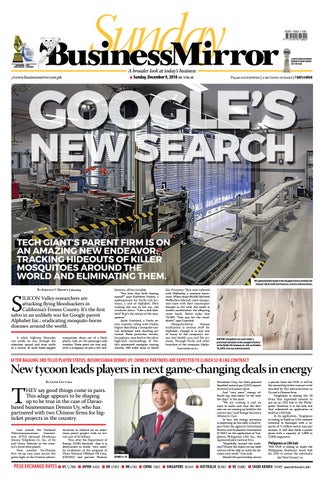
AN automated lab stands in the mosquito factory at Verily Life Sciences’ lab in South San Francisco. DAVID PAUL MORRIS/BLOOMBERG
San Francisco. They were infected with Wolbachia, a common bacterium. When those 80,000 lab-bred Wolbachia-infected, male mosquitoes mate with their counterpart females in the wild, the result is stealth annihilation: the offspring never hatch. Better make that 79,999. “One just hit the windshield,” says Crawford. Mosquito-borne disease eradication is serious stuff for Alphabet, though it is just one of many of the company’s forays into health care and life sciences. Through Verily and other branches of the company, AlphaContinued on A2
MATURE mosquitoes are seen inside a protected container in the mosquito factory at the Verily Life Sciences Llc. lab, on October 18, 2018. DAVID PAUL MORRIS/BLOOMBERG
AFTER BAGGING 3RD TELCO PLAYER STATUS, BUSINESSMAN DENNIS UY, CHINESE PARTNERS ARE EXPECTED TO CLINCH $2-B LNG CONTRACT
New tycoon leads players in next game-changing deals in energy
T
By Lenie Lectura
HEY say good things come in pairs. This adage appears to be shaping up to be true in the case of Davaobased businessman Dennis Uy, who has partnered with two Chinese firms for bigticket projects in the country.
Last month the National Telecommunications Commission (NTC) declared Mindanao Islamic Telephone Co. Inc. of Uy and China Telecom as the country’s third telco player. Now, another Uy-Chinese firm tie-up may soon secure the green light of the Duterte admin-
istration to embark on an ambitious power project with an initial cost of $2 billion. This, after the Department of Energy (DOE) declared that it is determined to finish “very soon” its evaluation of the proposal of China National Offshore Oil Corp. (CNOOC) and partner Phoenix
PESO EXCHANGE RATES n US 52.7060
DENNIS A. UY
Petroleum Corp. for their planned liquefied natural gas (LNG) import terminal and power plant. And “very soon,” energy officials say, may mean “in the next few days” at the most. “We are rushing it and we want to make sure that the decision we are coming up [with] is the correct one,” said Energy Secretary Alfonso G. Cusi. In fact, the energy secretary is expecting on his table a final report from the agency’s Centralized Review and Evaluation Committee (C-REC) on the application of Tanglawan Philippines LNG Inc., the registered joint-venture firm. “Hopefully, toward the weekend I'll have the report on my table and we will be able to make the decision next week,” Cusi said. Should the partnership secure
a permit from the DOE, it will be the second big-ticket contract to be awarded by this administration to Uy and a Chinese firm. Tanglawan is among the 23 firms that expressed interest to put up an LNG hub in the Philippines. However, it is the only one that submitted an application to build an LNG hub. In its application, Tanglawan is eyeing to build an LNG onshore terminal in Batangas with a capacity of 5 million metric tons per annum. It will also build a power plant with a capacity of 1,000 to 2,000 megawatts.
Philippines as LNG hub
THE DOE is eyeing to make the Philippines Southeast Asia’s hub for LNG to ensure the continuity See “New Tycoon,” A2
n JAPAN 0.4655 n UK 67.1053 n HK 6.7465 n CHINA 7.6853 n SINGAPORE 38.5644 n AUSTRALIA 38.3067 n EU 59.8002 n SAUDI ARABIA 14.0493
Source: BSP (December 6, 2018 )
NewsSunday BusinessMirror
A2 Sunday, December 9, 2018
www.businessmirror.com.ph
GOOGLE’S NEW SEARCH Continued from A1
bet is investigating smart contact lenses, artificial intelligence applications for health care and the molecular mechanisms of aging. Just this month, Google hired Geisinger Health Chief Executive Officer David Feinberg to oversee its many health-care initiatives. Verily guards its technology closely. But it stands to reason that if it succeeds in making mosquito control easy and cheap enough, it could have a lucrative offering on its hands: Many governments and businesses around the globe might be glad to pay for a solution to their mosquito problems. In the arid climate of California’s Central Valley, A. aegypti are detested for their vicious bite. But there, at least, they don’t typically transmit disease. Other places aren’t so lucky. The mosquito species is among the world’s deadliest, spreading diseases such as dengue fever and chikungunya in the tropics and subtropics. The diseases its bite carries kill tens of thousands of people every year and infect millions more. Releasing Wolbachiainfected mosquitoes into the wild may eventually wipe out entire populations of deadly mosquitoes and the diseases they carry. At least that’s the plan if the field tests pan out in California. Every morning during mosquito season—which runs from April to November—the van, emblazoned with “Debug Fresno,” cruises through leafy housing tracks full of multistory homes. At predetermined locations, an algorithm automatically releases carefully calculated numbers of mosquitoes, counting each individual insect with the help of a laser as it exits the van.
World without mosquitoes
AS the efforts to wipe out mosquito-borne diseases have ramped up,
a few different approaches to the problem have emerged. Bill Gates alone has pledged more than $1 billion for technologies that may help wipe out malaria, including controversial efforts to genetically modify mosquitoes. Verily’s approach relies on a variation of a very old strategy known as sterile insect technique, in which a population is gradually killed off by interfering with the ability to reproduce. It’s unclear what would happen if the world’s disease-causing mosquitoes were done away with. The ecological role that mosquitoes play hasn’t been thoroughly studied, though some scientists suggest we might be just fine without them. But it’s clear that A. aegypti has no business in Fresno County. Native to warmer, wetter climes, no one knows where they came from when they first showed up in 2013. All that’s certain is that they have spread extremely rapidly. “After we detected it, we did a massive and extensive effort to prevent the mosquito from establishing and eliminate it,” says Jodi Holeman, the scientific services director for Fresno County’s Consolidated Mosquito Abatement District. “We were not successful, in any way, shape, or form.” The county went from having not much of a mosquito problem at all to having one that made residents avoid their backyards and porches. Unlike most mosquitoes, A. aegypti lives and breeds in places inhabited by people, laying its eggs in, say, the few droplets of stagnant water at the bottom of a wine glass left on a balcony, then hiding under beds and in closets, biting legs and ankles. This makes it much harder to fight. Going door-to-door and begging residents to dump out standing water wasn’t cutting it, so in 2016, Fresno teamed up with a scientist named Stephen Dobson and his company, MosquitoMate.
It was Dobson’s lab that figured out how to infect mosquitoes with a form of Wolbachia that’s different from the type of the bacteria that mosquitoes usually carry. That’s what makes the eggs unviable. MosquitoMate makes two species of mosquitoes infected with Wolbachia, A. aegypti and Aedes albopictus. Fresno became one of its test sites. The initial Fresno trials were the first time male A. aegypti infected with the bacteria had ever been released in the US. The next year, Verily stepped in to help scale those efforts up, bringing more advanced technologies to the breeding and release process that would, they hoped, eventually make fighting mosquitoes massively scalable. It seems to be working. This year, Verily signed on for a second season of releases. Two Verily trucks ply four different neighborhoods, hitting more than 3,000 homes. Over six months, the company released more than 15 million mosquitoes. Results from 2017 suggested the population of biting female mosquitoes dropped by two-thirds. This year, tweaks to the program have cut the mosquito population by a whopping 95 percent. A second project by Verily in Innisfail, Australia, that concluded in June reduced the mosquito population by 80 percent. This bodes well for eventually bringing the technology to other parts of the world—regions ravaged not just by itchy ankles but by deadly disease. At first, Verily executives were worried about community resistance to fighting bugs with more bugs. So the company set up an outreach booth, complete with a cage full of male mosquitoes that people could stick their hands in to learn that males don’t bite. (Only female mosquitoes bite, which is why this and similar projects are careful to only release males.)
AN employee of Verily Life Sciences Llc. inspects a tray of mosquito larvae in the mosquito factory at the Verily Life Sciences Llc. lab in South San Francisco. DAVID PAUL MORRIS/BLOOMBERG
“We really appreciate you being here,” Clifford Lopes, a resident, told the company. “I brag to people about how I can sit on my porch now and not get bit.” In videos of the original trials, you can see Holeman, the Fresno County scientist, gingerly blowing the mosquitoes out of a tube. The release van is now filled with proprietary technology, including software that determines exactly what areas of a neighborhood mosquitoes should be released in and a laser sensitive enough to count every single one as it exits, generating loads of data that can later be
used to fine-tune the process.
Robots handle mosquitoes
AT Verily’s headquarters, the “factory” where the mosquitoes are bred incorporates even more automation. Once the eggs are laid, robots rear the mosquitoes to adulthood, packaging them in containers filled with water and air, feeding them, and keeping them warm. Still other robots sort them by sex, first by size (females are bigger) and then optically, using proprietary technology. Mosquitoes are all given a digital identifier that makes it possible to follow them from egg
New tycoon… of power supply from natural gasfired power plants in anticipation of the eventual depletion of the Malampaya gas field. Currently, the Philippines only relies on the Malampaya gas field, where 98 percent of total production is used for power generation—supplying fuel to five natural gas plants in Batangas, namely, Ilijan, Santa Rita, San Lorenzo, San Gabriel and Avion with a total installed capacity of 3,211 MW that provide the electricity requirement of Luzon and even the Visayas. “The Philippines has already failed in being the aviation hub despite our geographical advantage, also in maritime. This is a dream. We want to give it a shot,” Cusi said. The LNG project is also vital to ensure the country’s energy security. The energy chief also stressed that the long-planned import terminal will help temper electricity rates, especially when the Malampaya gas facility undergoes a scheduled maintenance shutdown. Cusi said LNG can provide the demand from base-load, mid-merit and peaking requirements and can compete with other fuel sources that can address the least-cost optimal electricity from such demand centers. “Around 3,200 MW of power is dependent on the natural gas and the LNG [terminal that] should have been done a long time ago because when the Malampaya undergoes maintenance shutdown, it’s costing…consumers a lot as we have power plants dependent on natural gas, which would have to switch to more expensive fuel adjustment,” he said. “We could have avoided that if we have our LNG terminal.”
PNOC role
THE state-run Philippine National Oil Co. (PNOC) was once very active and vocal in its pursuit to put up its LNG facility with a partner. But its search for a partner is taking too long and the DOE could no longer wait for PNOC to conclude its search. According to DOE Undersecretary Donito Marcos, the PNOC may have “slowed down” with its
state to the specific GPS coordinate where they’re released. With this year’s season wrapping up, the company has yet to decide whether it will further expand the program next year. Verily wouldn’t say how much it costs to manufacture and release tens of thousands of mosquitoes every day, but it’s a safe bet that it’s still an expensive proposition. “The key part is trying to be able to do a program like this in a very affordable and efficient way,” Crawford, the Verily scientist, says, “so that we can go to places where there isn’t a lot of money.”
Continued from A1
process. But according to Cusi, PNOC could still be a partner in this LNG project to be spearheaded by the CNOOC-Phoenix partnership, noting that it is important for the government to be present in such a big-ticket project. “PNOC’s presence is important because it will represent the government. Its participation in the LNG project will be discussed among themselves so the decision lies among the stakeholders in this project,” explained Cusi.
First Gen’s LNG project
ANOTHER eager company in the LNG space is the Lopez-led First Gen Corp. Even before the DOE announced its intention to transform the country into an LNG hub, First Gen has declared it will put up its own LNG terminal within the Lopez-led company’s power-generation complex in Batangas City. It recently signed a joint development agreement (JDA) with Tokyo Gas Co. Ltd. to build the said LNG terminal. Tokyo Gas will take a 20-percent participating interest in the LNG project and provide support in development work to achieve a final investment decision. Upon reaching that decision under the JDA, the parties will enter into a definitive agreement to proceed with the construction of the project, First Gen said. “We [First Gen and Tokyo Gas] both share the vision of the Department of Energy in the implementation of LNG projects in the Philippines. First Gen and Tokyo Gas intend to cooperate with all relevant stakeholders who share the same vision to participate in making LNG viable for the Philippines,” said First Gen President and COO Francis Giles B. Puno. First Gen has around 2,000 MW in operating gas-powered plants, namely: the 1,000-MW Santa Rita power plant, the 500MW San Lorenzo power plant, the 414-MW San Gabriel power plant and the 97-MW Avion power plant. The DOE said it is not discour-
aging other firms from putting up their own LNG facility even if this will be located in Batangas, which is where Tanglawan’s planned LNG project would be put up. However, the agency has warned them of the risks involved since this may affect the project’s viability. “Why sell the same thing in the same area? The sellers, of course, would want to ensure their investment will grow. To ensure that, they must have customers who will buy what they sell. This is where careful planning comes into play,” Marcos said.
LNG law
LAWMAKERS and the DOE are working together to craft a law on LNG that will include, among others, an improved energy mix meant to entice private-sector investment. “We are now in the process of working with the DOE in coming up with a comprehensive LNG law that will become the ultimate framework of the LNG industry,” said Sen. Sherwin T. Gatchalian, chairman of the Senate Energy Committee. He said a law is needed to “make sure the future of LNG will be viable and sustainable” because a department circular issued by the DOE may not be enough. “The DOE is agreeable to the creation of a law because we don’t have a law now that governs LNG. It’s just a circular now. We will have a framework to regulate the importation of LNG, the terminal activities of LNG, and also the liquefaction of LNG,” said Gatchalian. Interested LNG investors have been saying that a capitalintensive project, such as LNG, would require a clear direction from the government since investment in LNG is estimated to cost at least $1 billion. Gatchalian said the LNG law must also require the presence of off-takers to ensure the long-term viability of the gas resource. The DOE agrees. It said a law is needed to be created to ensure the success of the Philippine downstream natural gas rules crafted by the agency.
www.businessmirror.com.ph
The World BusinessMirror
Sunday, December 9, 2018
A3
US plays catch-up for an edge in quantum computers S
AN FRANCISCO—The world’s leading technology companies, from Google to Alibaba in China, are racing to build the first quantum computer, a machine that would be far more powerful than today’s computers. T his dev ice cou ld brea k the encr y ption that protects dig ital information, putting at risk ever ything from the billions of dol lars spent on e-commerce to nationa l secrets stored in gover nment databases. An answer? Encryption that relies on the same concepts from the world of physics. Just as some scientists are working on quantum computers, others are working on quantum security techniques that could thwart the code-breaking abilities of these machines of the future. It is a race with national security implications, and while building quantum computers is still anyone’s game, China has a clear lead in quantum encryption. As it has with other cutting-edge technologies, like artificial intelligence, the Chinese government has made different kinds of quantum research a priority. “China has a very deliberate strategy to own this technology,” said Duncan Earl, a former researcher at Oak Ridge National Laboratory
who is president and chief technology officer of Qubitekk, a company that is exploring quantum encryption. “If we think we can wait five or 10 years before jumping on this technology, it is going to be too late.” Quantum computing is based on quantum mechanics, the science that explains the strange behavior exhibited by extremely small particles of matter. With traditional computers, transistors store “bits” of information, and each bit is either a 1 or a 0. Those are the fundamental slices of data that tell a computer what to do. When some types of matter are extremely small or extremely cold, they behave differently. That difference allows a quantum bit, or qubit, to store a combination of 1 and 0. Two qubits can hold four values at once. As the number of qubits grows, a quantum computer becomes exponentially more powerful. L i ke qu a nt u m comput i ng , quantum encryption relies on the nonintuitive behavior of very small objects. The codes that keep data secret are sent by photons, the tiniest particle of light. With the right equipment, it is easy to tell if they have been tampered with, not unlike the seal on an aspirin bottle. If carried out properly, the technique could be unbreakable.
There is no guarantee that a viable quantum encryption network could be built over long distances. But if it does happen, China’s willingness to experiment and put the government, academic and commercial resources behind the effort could have a big payoff. The country has invested tens of millions of dollars building networks that can transmit data using quantum encryption. Last year, a Chinese satellite named Micius, after an ancient philosopher, managed a video call between Beijing and Vienna using quantum encryption. A dedicated quantum communication network between Beijing and Shanghai was also put into operation last year, after four years of planning and construction. For now, quantum encryption works only over a limited distance. The satellite link between Beijing and Vienna stretched this limit to a record 4,630 miles. On the ground, using optical fiber lines, the ceiling is about 150 miles. Among China’s investments in quantum encryption, the Micius satellite has received the most attention. The University of Science and Technology of China, the government-backed university that helped launch Micius, led t he constr uction
of the ground network, which spans about 1,200 miles—perhaps a hint of aspirations for drastic improvement. The governments of Anhui and Shandong provinces, through which the fiber-optic network passes, together invested $80 million in the project. Like all major infrastructure projects in China, the plans have had high-level support from the Chinese government. This main line is being extended to other cities and regions. The goal by 2030 is a Chinesebuilt network for sharing quantum encryption keys across the globe. Some security experts question the effectiveness of quantum encryption. Because it is so new, it has not been put through anywhere close to the rigorous testing that would give it a stamp of approval from skeptical cryptographers. But Chao-Yang Lu, a professor of physics at the University of Science and Technology of China, said the Beijing-Shanghai quantum network was a significant upgrade. With communications sent by traditional means, eavesdroppers can intercept the data stream at every point along a fiber-optic line. A government could tap that line just about anywhere. Quantum encryption cut the number of vulnerable
spots in the Beijing-Shanghai line to just a few dozen across 1,200 miles, Lu said. “We admit that it’s an intermediate solution,” he said. “It’s not the final solution. But it’s already a huge improvement in terms of security.” In the United States the government and industry have viewed quantum encr y ption as little more than a science experiment. Instead, researchers have focused on using ordinary mathematics to build new forms of encryption that can stand up to a quantum computer. This technology would not require new infrastructure. But now, spurred by activity in China and recent advances in quantum research, some in the United States are playing catch-up. Qubitekk, a Southern California start-up, is working to secure power grids in Tennessee using the technology. A second startup, Quantum Xchange, is building a quantum encryption network in the Northeast, hoping to serve Wall Street banks and other businesses. Researchers at Stony Brook University on Long Island are preparing a third venture. Small start-ups like Qubitekk are unlikely to match the millions of dollars in infrastructure already created in China for quan-
tum encryption. But many experts believe the more important work will happen in research labs, and the Department of Energy is funding a test network in Chicago that could eclipse the kind of systems deployed in China. The Los Alamos and Oak Ridge national laboratories are working with Qubitekk to secure power grids with quantum technology, and Quantum Xchange is moving equipment into 60 Hudson Street, the old Western Union telegraph hub, which now serves as an Internet hub for lower Manhattan. Quantum Xchange is building a quantum encryption link between Manhattan and Newark, New Jersey, with plans to connect big banks operating in the two cities. Eventually, it hopes to extend this network up and down the East Coast. At places like the University of Chicago, researchers hope to go a step further, exploring what are called quantum repeaters—devices that could extend the range of quantum encryption. “We’re not there yet,” said David Awschalom, a professor at the University of Chicago who oversees much of the university’s quantum research. “But I am confident this will happen in the next couple of years.” New York Times News Service
A4
Sunday, December 9, 2018
The World BusinessMirror
Trump weaponizes uncertainty in trade war, and finds its limits H
www.businessmirror.com.ph
HONG KONG FEARS TRUMP WILL TRIGGER END TO SPECIAL TRADING STATUS
P
RESIDENT Donald J. Trump has used tariffs as one of his most powerful tools for fighting his trade wars, but he’s also wielding leverage with another weapon: uncertainty. Through his trade threats and the doubts he has raised about the future of even America’s longestterm economic relationships, Trump has created what could easily be called an uncertainty economy. And it is one that has baffled leading economists. “I can’t think of when we’ve seen this approach before,” Maurice Obstfeld, the International Monetary Fund’s outgoing chief economist, said in an interview. The dominant view has long been that doubt is bad for growth, impedes investment and unnerves financial markets, Obstfeld pointed out. “No president should want to purposely inject more uncertainty into the decision process of private sector actors,” he said. Trump’s stated intention has been to use uncertainty as yet another disincentive for companies to invest outside the US and to destabilize the economies of the countries he is negotiating with. Don’t like
uncertainty? Build your factory here and help Make America Great Again.
Few results
THERE is little proof so far that approach is paying broad dividends. There is also some evidence that the president is encountering the shortcomings of the tactic. The most dramatic proof of that came Tuesday with a more than 3-percent fall in US equities that was partly a reaction to questions about the details of the trade truce Trump brought home from his Buenos Aires dinner with Chinese President Xi Jinping. But beyond Wall Street, a lack of certainty driven in part by Trump has emerged as a drag on business investment decisions from farm states hit by Chinese retaliatory tariffs to industrial hubs. Not all of it, to be fair, is due to Trump or trade. In its Beige Book on Wednesday the Federal Reserve added the impact of rising interest
rates and labor market constraints to trade as reasons for what it called a waning optimism among businesses around the country. “Multiple contacts have reported putting capital spending plans on hold due to uncertainty in their outlooks” with trade a prominent concern, the Federal Reserve Bank of Minneapolis reported. “There are dangers and harms from Trump’s use of uncertainty as a tool in trade wars,” said Steven Davis, a professor at the University of Chicago Booth School of Business who helped develop an economic policy uncertainty index. “I’m not aware of another US president trying to weaponize uncertainty. And for good reason—it harms American interests as well as foreign ones.” One effect has been a drop in foreign direct investment into the US. In 2017 the long-term capital allocated to the US by foreign investors was 40 percent less than the year before. In the second quarter of this year FDI into the US was actually negative for only the sixth time since the current official data series began in 1982, according to Nancy McLernon, who leads the Organization for International Investment, which represents foreign companies investing in the US. Trump’s threats have prompted some foreign companies to pledge
increased investment. Following a meeting at the White House this week to discuss Trump’s looming threat to impose tariffs on imported cars, Volkswagen AG’s CEO Herbert Diess said the company was mulling a second plant in the US.
Opposite effect
BUT McLernon said most of her membercompanies were putting investment decisions on hold rather than rushing to make new ones. That was particularly the case if they were using US-based factories to export to China or other countries caught up in Trump’s trade wars. “The trade tensions are having the exact opposite effect of what the intention is,” she said. The trend has been evident with companies like Harley Davidson, which shifted its manufacturing for the European market out of the US because of retaliatory tariffs imposed by the EU. Likewise, BMW has seen exports to China from a South Carolina plant— its largest in the world—hit hard by retaliatory tariffs that took effect in July. Bloomberg News
ONG KONG business groups are starting to worry the Trump administration will open the door to ending the financial hub’s preferential trade status, rendering it “just another Chinese city” as its government gets closer to Beijing. The US-China Economic and Security Review Commission stoked fears last month with a recommendation that Congress reassess Hong Kong’s special trading status for some sensitive US technology imports. It said Beijing’s statements and legislative actions “continue to run counter to China’s promise to uphold Hong Kong’s autonomy.” I f P re s i d e n t D o n a l d Tr u m p a c t s o n t h e recommendation, it would only impac t dualuse technology with consumer and militar y applications—like carbon fiber used to make both golf clubs and missile components—that represent about 2 percent of US exports to Hong Kong. But the blow to the city’s image may be irreparable. “It would have a ripple effect—the door would be open and it might not close,” said Felix Chung, who represents the textile and garments industries as a pro-establishment member of Hong Kong’s legislature. “The Western community would look at Hong Kong with different eyes and may not even trust Hong Kong. The business sector cannot take this kind of risk.” Under the terms of the United States-Hong Kong Policy Act of 1992, the US agreed to treat the former British colony as fully autonomous for trade and economic matters even after China took control in 1997. That means Hong Kong is exempt from Trump’s punitive tariffs on China and enjoys US support its participation in international bodies like the World Trade Organization. While the US State Department said earlier this year it sees no reason to scrap Hong Kong’s special status, one clause in the law particularly worries the city’s business elites: The US president can issue an executive order suspending privileges in a particular area if he determines it isn’t sufficiently autonomous from Beijing.
‘It’s Trump’
“IF it was the Obama administration I wouldn’t worry,” Chung said. “But because it’s Trump you never know what he’s going to do.” The US Consulate in Hong Kong declined to comment when asked whether Trump was considering any action against the city. It pointed to a statement last month from Consul General Kurt Tong, who said “we are quite focused on the importance of the ‘one country, two systems’ framework” that allows Hong Kong to maintain a distinct economic, legal and political system. In its annual May report on the city’s autonomy, the US consulate said “certain actions” by China were inconsistent with its commitment to allow Hong Kong to exercise a high degree of self-governance. But it found that the city “generally” maintains a high degree of autonomy, “more than sufficient to justify continued special treatment.”
‘Think twice’
SO far, Hong Kong’s government has dismissed concerns the “one country, two systems” framework is under attack. Chief Executive Carrie Lam last month cautioned the US to “think twice” before changing Hong Kong’s status and harming its own interests. She also borrowed a phrase from Beijing, accusing the US commission of seeing things through a “colored lens.” Asked about the US trade privileges in the
legislature on Wednesday, Commerce Secretary Edward Yau downplayed the commission report and said Hong Kong “will continue to maintain our robust trade control system” to prevent unauthorized exports to the mainland. He said Hong Kong would “always respect, abide by and uphold ‘one country, two systems,’” calling it the “cornerstone” of the city’s economic success. Hong Kong’s status as a separate customs territory from China is set out in the city’s charter, he said. The US has a substantial interest in Hong Kong staying autonomous. Some 85,000 US citizens live in the city, and 1,400 US firms that use the territory as a platform to do business in China. They prize the territory for its rule of law, free flow of capital, independent judiciary, access to information and protections of personal and press freedoms. Still, Beijing-backed efforts to restrict dissent have fueled concerns of China’s growing influence. The commission’s report cited a litany of examples, including Hong Kong’s moves to ban pro-independence politicians and heed a request from mainland authorities to not hand over a fugitive to the US. Jack Lange, chairman of the American Chamber of Commerce in Hong Kong, called on the Hong Kong administration to “engage” with the US to ensure that sensitive technologies don’t end up in China given the city’s increasing economic integration with the mainland. “People are concerned about the autonomy issues and the consequences that could come out of them,” Lange said. Still, he added, Hong Kong citizens enjoy substantial liberties: “Nobody has any problem googling anything they want in Hong Kong. That’s not true across the border.” Hong Kong’s business community has long fostered ties with Beijing, a relationship that helped the city become a gateway to China. Since the 1997 handover the economy has grown by some 50 percent to more than $341 billion—larger than countries like Singapore, Malaysia and the Philippines. But as Beijing exerts its authority, business is suffering from the perception Hong Kong is in China’s pocket.
Deal rejected
IN November, Australia rejected a A$13-billion ($9.4-billion) gas project bid by Hong Kong tycoon Victor Li’s CK Infrastructure Holdings Ltd., calling it contrary to national interest. The decision followed a torrent of criticism in Australia that Hong Kong companies were just as susceptible to Beijing’s influence as those on the mainland. On a September visit to Washington, a Hong Kong business delegation that included commerce secretary Yau found widespread misunderstanding about the city’s special status. “We realized that many people in the US were not fully aware of ‘one country, two systems,’” Cathay Pacific Airways Ltd. Chairman John Slosar, a vice-chairman of the Hong Kong General Chamber of Commerce, said in a report issued by the group. He declined to comment further when contacted. While any US moves to change Hong Kong’s status would be a reputational blow, other Western countries might not follow suit if they view it as part of a wider competition between the world’s biggest economies, according to Paul Serfaty, a director of investment bank Asian Capital Partners Group who has lived in Hong Kong for three decades. Bloomberg News
Faith www.businessmirror.com.ph • Editor: Lyn Resurreccion
2ND SUNDAY OF ADVENT: ‘LUKE 1:1-6’
Being a precursor of Christ MSGR. JOSEFINO S. RAMIREZ SUNDAY GOSPEL IN OUR LIFE
T
HE Gospel is very precise about the time when John the Baptist began to preach—the 15th year of the reign of Tiberius, when Pontius Pilate was the governor of Judea, etc. (cf. Luke 3:1 ff.). The message of John the Baptist was simple and straightforward—do penance and repent, because the Lord is coming. Thus, the gospel reading is perfectly fitted to this liturgical season of advent, when we prepare for the coming of Christ. John the Baptist is said to be the “precursor” of Christ. In this computer age, many people are familiar with the term “cursor.” A cursor is a kind of indicator or pointer. Saint John the Baptist had the task of pointing out the Messiah who was to come. And we know that he did a wonderful work of preparation. Besides the multitude whom he encouraged to repent, and who, therefore, became more receptive to the message of Christ, he also pointed out Christ to those who would be the closest collaborators of Christ. It was John the Baptist who was directly responsible for the vocation to the apostolate of John the Evangelist and Andrew. They, in turn, brought their respective brothers, James and Simon, who would be renamed Peter. And then they brought their other friends, like Nathaniel. How effective was John the Baptist’s work of preparation! As followers of Christ, each of us also has the responsibility of being the “precursor.” Through each one’s life and words, other people, like relatives and friends, should be prepared for their encounter with Christ. But in order to do that effectively, we need to emulate other qualities of John the Baptist.
The Sacred Scripture emphasizes two important qualities of the precursor. In the first place, his own life was a witness to his message. While he preached penance, he himself practiced penance. He was not a man who lived a soft and comfortable existence, while telling people to repent. He would not lie in bed, stuff himself with delightful food, and take it easy. No. He would stay in the desert, clothed in camel’s hair, and thrive on locusts and wild honey of the desert. This does not mean that the ordinary Christian should also live in the desert. Saint John had a special vocation to be a witness, something akin to the religious vocation. But the ordinary Christian, while living in the middle of the world, cannot live a worldly and comfort-living life. Only by being strong, self-sacrificing and consistent, can a Christian be a true witness and a precursor of Christ for his fellow men. In the second place, John the Baptist did not compromise with the truth. Although what he had to say was difficult, he did not hesitate to tell his listeners where they had to improve and how to do so. In order to help people in their encounter with Christ, we may have to say things that are“unpopular” and even risk being branded as “behind the times.” There is a story of the famous Cure of Ars. A man went to listen to his sermon out of curiosity. At the end of it, that man was a very moved. He said something like this: “When I hear a good preacher I normally leave quite pleased with him. But this is different. After the sermon, I leave displeased with myself.” That “displeasure” with oneself is the seed and the beginning of the true conversation, which has to precede any encounter with Christ.
Sunday
IMMACULATE CONCEPTION By Corazon Dam0-Santiago
O
N December 8, 1854, the Immaculate Conception of the Blessed Virgin Mary was declared a dogma, although the Holy Mother was acknowledged as the most holy of person on earth by the early Church. Pope Pius IX stated with finality that the Blessed Mother was conceived free from original sin because she was destined to be Mother of God. Ineffabilis Deus, (Latin for “Ineffable God”), a dogma that binds all the faithful to believe this truth. “He [God] attended her with such great love, more than all other creatures, that in her alone He took singular pleasure.... He wonderfully filled her, more than all angelic spirits and all the saints, with an abundance of all heavenly gifts taken from the treasury of the divinity, that she, always free from absolutely every stain of sin and completely beautiful and perfect, presented such a fullness of innocence and holiness that none greater under God can be thought of, and no one but God can comprehend it.”
Mary in the early Church
We fly to thy protection, O Holy Mother of God. Do not despise our petitions In our necessities, O Glorious and Blessed Virgin. Amen. S u b Tu u m P ra e s i d i u m ( B e n e at h t hy Protection) is the oldest Christian hymn and prayer to the Blessed Mother, the Theotokos. Written in Slavonic, in Egyptian papyrus, this was discovered in the third century. Devotees of Mary sing this hymn with Salve Regina in Roman, Eastern and Orthodox Church rituals until now. The early fathers of the Church were devoted to Mary. She was venerated in a truly historical perspective—the holiest of all her role in salvation endeared her to Christians. Cyril of Alexandria called her Mother of God, Saint Gregory of Nyssa acknowledged in her the
“fullness of Godhead.” Saint Epiphanius wrote against the 80 heresies on Mary and called her Mother of the Living. Ambrose of Milan defended the doctrine of her perpetual virginity. Marian devotion was promoted through Ephraim and John Damascene of Syria. During the third Ecumenical Council 431 at Ephesus, the council debated on the title that should be attributed to her. Is it Theotokos (God bearer, Mother of God) or Christotokos (Christ bearer, Mother of the Messiah)? After deliberations, the council affirmed Theotokos, “Jesus undivided divinity and humanity.”
Venerated through centuries
THE Doctrine of the Immaculate Conception was first formulated by Eadmer (1060-1126) of Canterbury, Benedictine monk, historian and theologian companion and biographer of Saint Anselm Archbishop of Canterbury (1033-1109), which was continued to be espoused by Anselm the younger, a nephew of the saint. Eadmer, monk of Christ Church Canterbury, contended that if Saint John was sanctified from his birth, Mary, who enjoys supremacy over all creatures, should not be brought down to man’s level of original sin. If God preserved angels from sin, shouldn’t Mary, the Queen of all angels, be more entitled too? Anthony of Padua (1195-1231) supported the Immaculate Conception in his Mariological Sermons and members of the Franciscan followed his passion even after his death. During the Renaissance, Marian Art by Botticelli Raphael and Leonardo da Vinci, among other artists, decorated Italian, Dutch, German, French and Spanish churches. Martin Luther, a German monk and theologian, protested against some beliefs and practices of the Catholic Church. The protest started in Germany in 1517. Veneration of Mary was considered “competition
Sunday, December 9, 2018
to the divine role of Jesus.” Images of the Virgin Mary and saints were destroyed. Orthodox monks fled to the West with icons of Mary and Child when Constantinople fell in 1453. The Ottoman wars in Europe against Turkey was fought under the banner of Mary in the Battle of Lepanto in 1571. In 1567 Pope Pius V condemned the error of Michael Baius, a Belgian theologian who declared that Blessed Virgin was subject to original sin. On December 6, 1708, Nobis Divinitus by Pope Clement XI decreed the feast of the Immaculate Conception on December 8 and was declared a holiday of obligation. On November 27, 1830, Catherine Laboure fell asleep while praying and asking Saint Vincent de Paul to intercede for her to see a vision of the Blessed Mother. She was awake by a little boy who told her to go to the chapel since someone wanted to see her. An oval framed the Blessed Virgin with gold letters, “O Mary conceived without sin, pray for us who have recourse to thee,” was given to Catherine Laboure by the Blessed Mother. It was given by Mary herself to the Sisters of Charity Congregation on November 27, 1830. Mark Miravalle in Intro to Marian Theology wrote that Pope Pius IX was encouraged with the vision. On May 13, 1846, the bishops of the United States entrusted the country to the Blessed Mother under the title of Immaculate Conception. The decree which was approved by Pope Pius IX on February 7, 1847, read: “With enthusiastic acclaim and with unanimous approval and consent, the Fathers [of the Baltimore Council] have chosen the Blessed Virgin Mary, conceived without sin, as the Patroness of the United States of America.”
All men have sinned
“THEREFORE, just as through one person sin entered the world, and through sin, death, and thus death came to all, in as much as all sinned” (Romans 5:12). Since Jesus came to save the entire human race, Mary’s Immaculate Conception is inconsistent with the church teaching of Jesus as the Universal Redeemer, some early Fathers said. They could not reconcile Immaculate
A5
Conception with “Universal Redemption through Christ.” Mary needed redemption from original sin as a child of Adam. Didn’t Saint Paul say: “All men have sinned in Adam”? (Romans 5:12). The concept of Immaculate Conception was unacceptable to Saint Bernard of Clairvaux, and even Saint Thomas Aquinas, who authored Summa Theologica. Stephen Beale, in How Dogma of Immaculate Conception Was Defined, wrote that Saint Bernard of Clairvaux believed that “Mary could have been sanctified soon after the moment of conception but not her conception.” While Saint Aquinas affirms that the “Blessed Virgin was sanctified in the womb but the inclination to sin due to original sin was fettered in her person.” John Duns Scotus (1266-1308), a Franciscan theologian from Oxford University, explained that the formula of the Scholastics is potuit, decuit, ergo fecit (Latin for “He could do it, it was fitting that He do it, therefore, He did it) solved the controversy. This principle that “God could have made her free from original sin, was fitting for God to do so, therefore, God must have done so.” Scotus cited the freedom of the divine will and the freedom of the human will within an order freely chosen by God (Encyclopedia.com on Theological Beliefs). This Franciscan realist philosopher and theologian who pioneered the classical defense of Immaculate Conception died on November 8, 1308. He was beatified on March 20, 1993, by Pope John Paul II. However, some philosopher theologians contend that this was a principle originally formulated by Saint Anselm, Bishop and Doctor of the church. He provided the “conceptual clarification” of the Immaculate Conception for Scotus, which the early Fathers could not explain “in full harmony with the need for universal redemption” (missionmagazine.com). J. Isaac Goff, in Mary in the Writings of the Saints, explained that Anselm provided very clear concepts of “human nature, original justice, original sin and the conferral and transmission of original justice and sin.”
A6
Science
Sunday, December 9, 2018
BusinessMirror
Sunday
Greenhouse-gas emissions rise like a ‘speeding freight train’ in 2018
G
REENHOUSE-GAS emissions worldwide are growing at an accelerating pace this year, researchers said a few days ago, putting the world on track to face some of the most severe consequences of global warming sooner than expected.
A FLAME emits from a chimney at the BASF chemical company in Ludwigshafen, Germany. AP/MICHAEL PROBST
Scientists described the quickening rate of carbon-dioxide emissions in stark terms, comparing it to a “speeding freight train” and laying part of the blame on an unexpected surge in the appetite for oil as people around the world not only buy more cars but also drive them farther than in the past—more than offsetting any gains from the spread of electric vehicles. “We’ve seen oil use go up five years in a row,” said Rob Jackson, a professor of Earth system science at Stanford University and an author of one of two studies published on Wednesday. “That’s really surprising.” Worldwide, carbon emissions are expected to increase by 2.7 percent in 2018, according to the new research, which was published by the Global Carbon Project, a group of 100 scientists from more than 50 academic and research institutions and one of the few organizations to comprehensively examine global emissions numbers. Emissions rose 1.6 percent last year, the researchers said, ending a three-year plateau. Reducing carbon emissions is central to stopping global warming. Three years ago, nearly 200
nations hammered out the Paris Agreement with a goal of holding warming below 3.6 degrees Fahrenheit (2 degrees Celsius) over preindustrial levels. Avoiding that threshold—already considered challenging—is viewed as a way to stave off some of the worst effects of climate change, like melting polar ice caps and rising sea levels. For the Paris goals to be met, scientists say, global emissions from power plants, factories, cars and trucks, as well as those from deforestation, would need to swiftly begin declining to zero. President Donald J. Trump, however, has vowed to pull the United States out of the accord and has moved to roll back Obama-era regulations designed to limit emissions from vehicle tailpipes and power-plant smokestacks. On Tuesday he wrote on Twitter that the Paris Agreement was “ fatally f lawed ” because its system of voluntary pledges let other countries off the hook, adding that “American taxpayers—and American workers— shouldn’t pay to clean up others countries’ pollution.” A US withdrawal would represent a serious blow to the pact.
The United States, one of the wealthiest nations in the world, is responsible for a third of all human-caused carbon emissions to date, more than any other country. China is now the largest emitter of heat-trapping gases. The new report comes as delegates from nearly 200 countries are meeting in Poland to debate their next steps under the Paris climate agreement. Many nations haven’t been meeting their selfimposed targets. The new assessment is the third major scientific report in recent months to send a message that the world is failing to make sufficient progress to avoid the worst effects of climate change. Last month the White House published findings by 13 federal agencies predicting that global warming could knock hundreds of billions of dollars off the size of the US economy by century’s end, particularly by disrupting trade and agriculture. In October, the Intergovernmental Panel on Climate Change, a UN scientific group, issued an alarming report warning that emissions are rising at a rate that will open the door to widespread food shortages, wildfires, coastal flooding and population displacement by 2040. As part of the latest report, scientists wrote on Wednesday in the journal Nature that the recent rise in global emissions, combined with other factors—such as natural temperature fluctuations, could bring those dire consequences a decade sooner, by 2030. “For those of us that work in this space, seeing the rates of emissions accelerate is deeply dismaying, and it confirms the very clear lack of systemic action and change that we’re seeing across many lines of state, national and global organization,” said Sarah E. Myhre, a research associate at the University of Washington who was not involved in the studies. “It just means that the problem will be harder to fix down the line,” she said. “We’re continuing to buck-pass this problem to our kids and our future selves.” The analysis found that the world is on pace to release a record 37.1 gigatons of planetwarming emissions in 2018, led in large part by China, the US and India. That is roughly 100,000 times the weight of the Empire State Building. Even as coal has fallen out of favor in some markets, the rise in emissions has been driven by stronger demand for natural gas and oil, scientists said.
And even as the use of renewable energy like solar and wind power has expanded exponentially, it has not been enough to offset the increased use of fossil fuels. “ We t hou g ht oi l u s e h a d peaked in the US and Europe 15 years ago,” Jackson said. “The cheap gasoline prices, bigger cars and people driving more miles are boosting oil use at rates that none of us expected.” More investment will be needed in the transportation sector to cut pollution, said Corinne Le Quéré, a professor of climate change science and policy at the University of East Anglia and lead author of one of the new studies. “We have electric cars, but we need charging points, we need to lower the costs of electric vehicles,” she said. China produces 27 percent of global emissions, according to the report. The United States accounts for 15 percent of emissions, the European Union 10 percent and India 7 percent. China’s emissions are projected to rise 4.7 percent in 2018, the report said. The country is stimulating manufacturing to counterbalance its slowing economy, allowing more coal-based manufacturing that it had avoided in the past, Jackson said. China is investing heavily in renewable energy, but it is also building new coal-fired power plants at home and planning others in new markets such as subSaharan Africa. US emissions are expected to rise 2.5 percent this year after several years of declines, and despite a shift away from coal toward cleaner sources of energy. Jackson attributed part of the increase this year to a colder-thannormal winter in some parts of the country and a hotter summer in other parts, which inflated demand for heating and cooling. In India, a projected emissions increase of 6.3 percent is linked to the country’s effort to provide electricity to 300 million people who currently lack it. Last year, extreme weather disasters cost the United States a record $306 billion. Jackson said the new report was “not good news,” but added that it still contained “some glimmers of hope,” particularly about air pollution associated with the burning of coal for fuel. “Coal use has dropped 40 percent in the United States, replaced by natural gas and renewables,” he said. “That’s saving lives as well as helping the climate problem.” New York Times News Service
High-value rubberwood goods available soon in Zamboanga Sibugay
H
IGH-VALUE products will soon be produced from old and unproductive rubberwood trees in Naga, Zamboanga Sibugay, with the launching of a processing plant early last month. Science Secretary Fortunato T. de la Peña led the inaugural ceremonies of the processing plant attended by heads of other stakeholder-agencies. The rubberwood processing plant was installed with various woodworking equipment that will be used in making furniture, mouldings, finger-jointed lumber and joinery products. The equipment include—portable sawmill, thickness planer, single end tenoner, pin router, shaper, boring machine, table saw, dust collector and other ancillary and specialized equipment—to process the rubberwood into furniture products.
SCIENCE Secretary Fortunato T. de la Peña (fifth from left) leads the ribbon-cutting during the inauguration of Tarbemco Rubberwood Processing Plant. Also in photo are Rev. Fr. Francisco G. Baguio, Undersecretary Carol M. Yorobe, Mayor Rino O. de los Reyes, Dr. Romulo T. Aggangan, Engr. Romel Duran and Dir. Martin A. Wee. FPRDI PHOTO
In Zamboanga Sibugay, r ub b e r wo o d t re e s a re u s e d for low-v a lue produc t s, suc h a s f r u it c rates, pa l let s, f i rewood a nd c h a rcoa l. With 210 hectares of old rubberwood trees, the Tambanan Agrarian Reform Beneficiaries Cooperative (Tarbemco) plantations
are expected to yield 31,500 cubic meters of good lumber for use in high-value applications. The Tarbemco Rubber wood Processing Plant is the first rubberwood processing facility established by the Department of Science and Technology-Forest Products Research and Develop-
ment Institute’s (DOST-FPRDI) project. On the pipeline are the pressure method wood treatment plant and the 5,000-board-footcapacity furnace-ty pe lumber dryer. The project costs P57 million and is funded by the DOSTGrants in Aid. After completion, this set of facilities will become the Innovation Center for Rubberwood Processing in the Philippines. Those who attended the inauguration of the processing plant include DOST-FPRDI Director Dr. Romulo T. Aggangan, Science Undersecretary for Scientific and Technical Services Dr. Carol M. Yorobe, DOST-Zamboanga Peninsula Director Martin A. Wee, Chairman Petronilo G. Licudan of Tarbemco, Naga Mayor Rino O. de los Reyes and Engr. Romel Duran from the Office of the Governor of Zamboanga Sibugay. S&T Media Service
Editor: Lyn Resurreccion • www.businessmirror.com.ph
PHL science documentaries win in Indie-Siyensya filmmaking contest
JUDGES, organizers and winners of the third Indie-Siyensya Youth Category with DOST-SEI Director Josette Biyo (right). S&T MEDIA SERVICE
S
EVEN films earned the nod of judges and viewers in the third IndieSiyensya Filmmaking Competition during the awarding ceremony, held on November 28 at the Philippine International Convention Center in Pasay City. The winning films, from 300 film concept proposals to 45 entries, captured the role of science and technology (S&T) in addressing some of the most pressing national and community issues. The winners in the Open Category are Hector Badis of Cordillera Philippine Council for Agriculture, Aquatic and Natural Resources Research and Development for the film Dagem (third place); Brian Sulicipan of Ambag-Ambagan Collective for The Land Will Grow, The Food We’ll Eat (second place); and Edward Laurence Opena of Cebu Normal University for Sugbuanong Alibangbang (first place). Dagem and The Land Will Grow, the Food We’ll Eat tackled agriculture, environment and food-security issues. The former features S&T interventions that help Benguet farmers mitigate climatechange hazards in vegetable farm terraces, while the latter follows a small research team on permaculture practice in the Philippines. Sugbuanong Alibangbang is a film on the Jumalon Butterfly Sanctuary, where the Jumalon family fights butterfly extinction in the province of Cebu. In the Youth Categor y, the group of Angelo Cruz from Rizal National Science High School won third place for their film Akuwakultura while junior high-school students Cyah Angela Somblingo, Johan Villanueva and Norie Bautista from Cavite National High School students won the second place for their film Lambat. Akuwakultura shows the importance of aquaculture in Laguna Lake while Lambat documents water pollution in Cavite. Patr ick Pimentel, a sen ior h igh- sc hool st udent also from Cavite National High School, bagged the top prize for his film Manglares [Buhay at Peligro] a film on disaster mitigation. The winners earned trophies and cash prizes amounting to P100,000 for the Best Film, P50,000 for the second place and P25,000 for the third place. Bakas, a film by Kiano Bacolod from the Philippine Science High School-Central Luzon Campus (PSHS-CLC), got the highest number of votes during the film screenings of Indie-Siyensya. The film
earned the Viewer’s Choice Award, a trophy and P10,000 cash prize for its depiction of the use of forensic science in solving crimes. Indie-Siyensya, a science filmmaking competition organized by the Department of Science and TechnologyScience Education Institute (DOST-SEI) in partnership with the Film Development Council of the Philippines (FDCP) aims to promote a culture of science in the country using film as a medium. The contest is also the agency’s response to the growing field of science communication in the country. “ This is a big contribution to science communication which is among those being championed by DOSTSEI,” said DOST-SEI Director Dr. Josette Biyo in Filipino. “Your film entries, whether they win or not, contributed to the promotion of science communication in our country. Congratulations to all of your creative work.” Also present in the event were previous Indie-Siyensya winner Justin Parel from the PSHS-CLC who shared his experiences in joining Indie-Siyensya, FDCP representative Karol Ramirez and Indie-Siyensya judges Prof. Garry Jay Montemayor and Seymour Sanchez. Montemayor, chairman of the Department of Science Communication, College of Development Communication, University of the Philippines (UP) Los Baños and Sanchez, an advocacy filmmaker and educator from the De La Salle-College of Saint Benilde Digital Filmmaking prog ram and Far Easter n University Department of Communication, screened the film concept proposals. With them were fellow judges Prof. Patrick Campos, director of the UP Film Institute; Dr. Mudjekeewis “Mudjie” Santos, father and founder of the Genetic Fingerprinting Laboratory under the Department of Agriculture-National Fisheries Research and Development Institute; and astrophysicist and data scientist Dr. Reinabelle “Reina” Reyes, known as “the Filipina who proved Einstein right” with her work on his theory of relativity. Biyo encouraged all qualified individuals and groups to join next year’s IndieSiyensya and to continue using film to develop understanding on the role of science in solving many of the countr y’s problems. The awarding ceremony was attended by more than a hundred students, teachers, science professiona ls and filmmakers. S&T Media Service
Tourism&Entertainment BusinessMirror
Editor: Carla Mortel-Baricaua
Sunday, December 9, 2018 A7
OCCIDENTAL MINDORO GEARS UP FOR MORE LOCAL TOURISTS
Mamburao shines in 4th Mimaropa Festival
F
By Carla Mortel-Baricaua Photos by Teddy Pelaez
ROM November 15 to 18, Mamburao, the capital city of Occidental Mindoro, became the center of activities of this year’s Mimaropa festival.
PRETTY lasses of Mimaropa
STREET dancing grand champion, Occidental Mindoro takes home P100,000 cash prize
AGRI and tourism fair feature the region’s products
Celebrating the unity and progress of the five island-provinces of Occidental Mindoro, Oriental Mindoro, Marinduque, Romblon and Palawan (Mimaropa), the fourth edition of the annual festival gave opportunities for further economic, social and cultural development of the region. Occidental Mindoro Gov. Mario Gene J. Mendiola said, “It is our honor to host the Fourth Mimaropa Festival. I believe this is the only regional festival in the country and we even have a unity dance for the celebration. We hope that all guests will bring home happy memories of the festival just like us. We are very happy to witness the customs, history, culture and traditional practices from other provinces. We would like to host the Mimaropa festival once again.” The Fourth Mimaropa Festival held its grand opening at the Provincial Capitol compound in Mamburao. It was also marked by an investment forum that tackled the region’s requirements for a steady power supply, as well as the immediate improvement of accessibility
within the provinces. “We are also focusing on sustainable tourism,” said Maria Luisa S. Diploma, DOT Mimaropa regional director. She revealed that the regional tourism office will be promoting not just the provinces’ natural attractions, but destinations known for their green practices, as well. But, mostly, “we want to be remembered for our hospitality,” she added. The highlights of the four-day festival included the agri-trade, tourism night, the coronation of Ginoo & Binibining Mimaropa 2018, and the grand street dance parade and competition. This year’s Binibining Mimaropa title was bagged by Reyna Michelle Ruhen of Palawan while the Ginoong Mimaropa title went to Janvert Rodriguez of Occidental Mindoro. For the street dance competition, defending champions Occidental Mindoro was judged as the grand winner with their depiction of the Mangyan culture in a snappy song-and-dance routine. The contingent won its third grand championship. The Palawan contingent was first runner-up while Puerto
PALAWAN contingent bags first runner up
Princesa came in second, Calapan City in third, Oriental Mindoro in fourth and Romblon in fifth place. The contingent from Palawan garnered the Best in Costume award, Occidental Mindoro the Best in Musicality and Puerto Princesa the Best in Street Dance. The festival was capped by a fireworks display and send-off party featuring a mini concert by six Cyclemind. In view of the concluded festival, Occidental Mindoro Rep. Josephine Y. Ramirez-Sato said, “It’s great working with other provinces, we never felt so united before. We never experienced this kind of pride for Mimaropa, that’s the best thing that happened in the festival.” The representative also highly anticipates the region’s growth, particularly with the development of several tourism
PUERTO Princesa settles for second runner up
projects in Occidental Mindoro. “There’s going to be a world-class hotel in Mamburao. We are also going to have [leisure] yacht cruises in routes connecting all the provinces. The plans are in place but we’re still finalizing details. We would like to address first the local market, improve and build on it, since we have a lot to offer.” Occidental Mindoro is famous for its underwater paradise, the Apo Reef Natural Park, in the town of Sablayan. It is the largest atolllike reef in Asia and the second largest in the world, next to Australia’s Great Barrier Reef. Next year, the Apo Reef Tuna sports fishing competition will be launched. Thus, infrastructure projects, such as fish ports, cold storage and blast freezing facilities, are being constructed and developed in the towns of Sa-
blayan, Paluan, Rizal and San Jose. The Rizal municipality is also known for the tamaraws, the wild buffaloes endemic to the island province of Mindoro. As the national symbol, tamaraws are considered attractions in their natural habitat, but due to their dwindling number, the 543 tamaraws are on the critically endangered list. To assist the townspeople in their effort to preserve and protect the tamaraws, an international conference was recently held and the creation of a national research center, in cooperation with the Department of Science and Technology, is under way. “We would have implemented a tourism program earlier but we wanted to put in the necessary infrastructure [first]. That’s the reason why we went slow with our tourism projects. We want to attract
A PUMPING RIDE IN THE FAMED RIVER AWAITS YOU
Wrap up the week with Makati Diamond Residences’s Celebrations Buffet
Chasing white waters in Cagayan de Oro Story by Gelyka Ruth Dumaraos Photos by Chuckie Dreyfus & Mae Ilagan
I
F there is one thing Cagayan de Oro (CdO) has been known for when it comes to chasing the great outdoors, its white water rafting adventure definitely tops the list. For years, the gateway to Northern Mindanao continues to welcome visitors, local and international alike, who are up to try the thrilling rapids of the Cagayan de Oro River. Originally named as the Kalambaguasasahan River, Cagayan de Oro River’s headwaters come from Kalatungan Mountain Range and Kitanglad Mountain Range of Bukidnon and traverses down from the river’s 7,500-feet elevation. Passing through the municipalities of Bukidnon, it finally flows to Misamis Oriental’s Macajalar Bay. The river also serves as a natural boundary between Iligan and Bukidnon, as well as Bukidnon and CdO. Back in the mid-90s, people of CdO were using bamboo and banana trunks, or inflated tire tubes as they raft through the river. While it’s a popular local practice, it evolved into CdO’s famed outdoor quest thanks to professional groups who unlocked the river’s tourism potential. Today, CdO has a number of adventure groups whose local guides are trained by the Red Cross, Department of Tourism (DOT) and
Coast Guards, and are ready to welcome thrillseekers for their next exciting ride. Though first-timers and nonswimmers are all welcome to join the fun, white water rafting is not for the faint-hearted. The activity requires a disciplined, ready-for-adventure attitude and the focused attention to follow instructions whatever it takes. Beginners can start off with a three-hour river run, consisting of 14 rapids. The longest one is about four hours with 24 rapids to deal with, but this one is best for advanced takers. As the raft tackles the rapids, the fear will likely be replaced with exhilaration. Each time the raft encounters white rapids, the water velocity increases and so this pushes every rafter to match it with unbounded energy to finish the pounding ride, and to paddle harder if needed. Amid the pumping adventure also comes the opportunity to commune with nature. These white waters are separated with long and silent river flow with only the chirping of birds and occasional exciting screams of rafters as the only other sounds you can hear. There’s also a timeout from every thrilling rapid ride that gives the rafters some moments to swim and enjoy its cool waters, or break for some rest before tackling another one. The rafting adventure can also be complemented with side trips of cave exploration and river trekking.
Gateway to Northern Mindanao
ASIDE from well-known CdO activities such as rafting, paragliding caving and trekking, the Northern Mindanao is nothing sort of a regular tourist spot. According to DOT Regional Director Marie Elaine Unchuan, local and international tourists are becoming more aware of Northern Mindanao and its nature adventures in Camiguin, Bukidnon, Misamis Oriental, Lanao del Norte and Misamis Occidental. Unchuan added that the DOT regional office is hoping for more visitor arrivals to prove that Mindanao is not a dangerous place after all. “Since the Marawi crisis, some say it’s dangerous to go to Mindanao but that impression is fading,” she says. “More and more people are coming and so myth on safety is being dispelled.” Moreover, what was once considered as an underrated destination, Northern Mindanao is slowly taking on the dare of being a rising tourism destination, thanks to a development in travel options. AirAsia recently launched its flights from Manila to Laguindingan International Airport, as well as routes from Cagayan de Oro to Clark and Cebu. The main airport now serves the cities in Northern Mindanao, such as Cagayan de Oro and Iligan and its provinces Misamis Oriental, Lanao del Norte and Bukidnon.
the right tourists, so must offer the right kind of tourism. We want to give our best,” added Ramirez-Sato. Ahead of the Mimaropa festival, the annual Arawatan festivities took place from November 8 to 14. Arawatan, a Mangyan Hanunoo word meaning “cooperation” and “helping each other,” is Occidental Mindoro’s province-wide festival that showcases the different municipalities’ rural way of life, and the culture and tradition of the Mangyan communities. Activities for this year’s Arawatan festival mainly took place at the Mamburao Capitol Plaza compound. The province of Occidental Mindoro is composed of the municipalities of Lubang, Looc, Abra de Ilog, Paluan, Mamburao, Santa Cruz, Sablayan, Calintaan, Rizal, San Jose and Magsaysay.
T THERE are over 24 rapids one needs to pass through for a four-hour river run.
PART of the rafting adventure is a cave exploration.
HERE’S more to a memorable Christmas get together than just a picturesque backdrop or the endless conversations. When you come to Makati Diamond Residences and avail yourselves of its Celebrations Buffet, you get so much more at Alfred. Everything is laid out for you to devour starting off with a healthy plate of Grilled Romaine Salad, and Shrimp and Vegetable Crudites or if you prefer it, dive in straight for the hors d’oeuvres of Shrimp and Cheese Croquettes, Salmon Rillettes with Caviar on Toast, Jalapeño Poppers and Egg Sabayon with Potato Mousse and Chorizo. Indulge in a helping of Roast Beef with Green Peppercorn Sauce, Rigatoni Amatriciana with Braised Octopus and Bone Marrow, Jamon Serrano and Raclette. In between meals, we’ll make sure to keep the drinks coming. Enjoy unlimited fill of local beer, red and white wines, champagnes with choice of Jean Vesselle Brut Reserve, Jean Vesselle Oeil de Perdrix and Delamotte Brut NV. There’s also the gin and tonic buffet with choices of Beefeater, Bombay Sapphire, Boodles, Ginebra San Miguel Premium Gin, J.J. Whitley, Elderflower, Sirena and Tanqueray. And better make room for dessert, its homemade ice cream is the perfect way to end the night. Celebrations Buffet is priced at P2,500 net per person and available every Friday night until December 14.
A8 Sunday, December 9, 2018
Sports BusinessMirror
Editor: Jun Lomibao | mirror_sports@yahoo.com.ph
Runner relinquishes claim to record in New Zealand
W NATHAN CHEN is the youngest world champion since Russia’s Evgeni Plushenko in 2001. AP
BALANCING LIFE, SKATING GLORY By Dave Skretta The Associated Press
N
ATHAN CHEN mostly goes unnoticed when he strolls through the picturesque campus of Yale, and the few times he can recall being recognized happened months ago during his freshman orientation. That’s because just about everyone who attends the prestigious Ivy League school is exceptional in some way, whether they happen to be brilliant at science, a mathematical whiz or handy with words. Or in Chen’s case, a world-class athlete. “It’s actually been really low-key,” Chen said in a phone interview with The Associated Press from Vancouver, British Colombia, where he will defend his Grand
Prix Final title. “What I’ve done is pretty cool,” Chen said, “but everyone at Yale has done something cool.” Maybe so. But just look at what the 19-year-old from Salt Lake City has accomplished over the past year: Chen followed his Grand Prix Final triumph with a national championship, then helped the US win team gold at the Pyeongchang Olympics. After a disappointing short program in the individual competition, he proceeded to land five clean quads in his free skate to vault to a fifth-place finish. Then he headed to Italy, where he won both the short and free programs while becoming only the second skater behind twotime and reigning Olympic champion Yuzuru Hanyu to eclipse to 320 total points. Chen was the youngest world champion
since Russia’s Evgeni Plushenko in 2001, and was the first American to win the world championship since Evan Lysacek accomplished the feat in 2009. His margin of victory over Japan’s Shoma Uno was among the highest in history. After that kind of grueling schedule, nobody would have faulted Chen for taking a break. In fact, many skaters targeting the 2022 Beijing Games decided to take this year off. But all along, Chen knew he wanted to start college in the fall—he spent most of his downtime last season writing entrance essays. Ultimately he decided to move all the way across country,
from his longtime Coach Rafael Arutyunyan and his training base in California to the Yale campus in New Haven, Connecticut, where he began knocking out prerequisite coursework while keeping up with his skating. “It’s been a lot to try to figure out,” Chen explained, “but as each competition goes,
ELLINGTON, New Zealand—A longdistance runner has relinquished his claim to have run the length of New Zealand in a record time after admitting he was driven for parts of the route. When 64-year-old Perry Newburn arrived in the southern town of Bluff two weeks ago, he and his
supporters said he’d run the 2,100-kilometer journey in 18 days and eight hours, just beating a record set more than 40 years ago. But in a Facebook post last week, Newburn said that after reflecting on his effort, he didn’t want to claim the record. “There were parts of the run where road/ bridge conditions were totally unsafe to run and therefore I made the call to be driven through these parts—these decisions were my decisions,” he wrote. Newburn said stormy conditions and sleep deprivation had also added to his problems toward the end of his run. He said he’d succeeded in his main aim of raising money for an autism charity, and that nearly 200 people had donated over 7,000 New Zealand
dollars ($4,800). In September, Newburn was the fourth man to finish a six-day endurance run in Adelaide, Australia, clocking up 573 kms (356 miles), according to race records. Not a typical endurance athlete, Newburn ate hash browns and drank chocolate milkshakes during his effort in New Zealand. People who responded to Newburn’s Facebook post were generally supportive of him, writing that they appreciated his candor and his efforts for charity. The record for the run was set in 1975 by Siegfried (Siggy) Bauer.
PERRY NEWBURN runs on State Highway 1 near Raumati, New Zealand. AP
Football weekend turns to tragedy
M
I’ve been better able to balance the two. I’m still learning. I’m still not doing as well as I want with either of them, figure skating or school.” Well, the figure-skating part has still been exceptional. Chen began his Grand Prix season at Skate America in Washington, where he easily won both segments to defend his title. Then he rebounded from a shaky short program that included a fall on his quad flip to win the Internationauxde France—his fifth consecutive Grand Prix gold medal. Now, Chen will try to defend another title at the Grand Prix Final. Hanyu, his biggest rival, announced last week that he was withdrawing following an injury to his right leg. That means Uno, the Olympic silver medalist, figures to give Chen the toughest competition in a field that also includes Russia’s Sergei Voronov and the Czech Republic’s Michal Brezina. “It’s going to be a good competition regardless if Hanyu is here,” Chen said. “He’s a big aspect in figure skating, but I just have to focus on myself. I can only control what I can control.” Whether that happens to be schoolwork or figure skating.
EMPHIS, Tennessee—It was a fun and competitive weekend for a young group of all-stars as they visited Texas and represented Memphis, Tennessee, in a weekend football tournament. The players, some venturing outside of Memphis for the first time in their lives, built bonds on the field and off, says one of their coaches, Matt King. “They had a blast,” said King. But the glow of a successful tournament turned to tragedy when the charter bus carrying players and coaches rolled off an interstate and overturned in Arkansas in the early morning darkness on Monday. Authorities are investigating what caused the crash, which occurred in clear, dry weather. The elementary school-aged children from 10 Orange Mound Youth Association football teams were returning home after playing in the Dallas area. A coroner confirmed that nine-year-old Kameron Johnson was killed. Forty-five other players and coaches were injured in the crash along Interstate 30 near Benton in Central Arkansas. Most have been released from Arkansas hospitals. King coaches the Tipton County Crush, which is part of the association. He had two players, ages 11 and 12, on the bus. The 12-year-old suffered a cracked skull and stitches on his face and head, while the 11-year-old received cuts and bruises. King had already driven his own car home. Hearing about the crash was “the worst feeling ever,” he said. “The league was just trying to take those kids out of town and do something different,” said the 31-year-old heavy machinery operator.
“A lot of those kids will probably never be able to do something like that again.” The bus driver, 65-year-old Eula Jarrett of Tennessee, told state police that she lost control. The heavily damaged bus came to a stop after tumbling down a steep embankment next to the crook of a sharp bend on an off-ramp around 2:40 a.m., police said. One of the adults on the bus, Damous Hailey, told The Commercial Appeal newspaper that the bus swerved and then flipped “about 15 or 20 times” before landing on its side. The bus was operated by Scott Shuttle Service, based in Somerville, Tennessee. Federal Motor Carrier Safety Administration records show that the company had a “satisfactory” safety rating. Records also showed one of the company’s buses was involved in a crash in wet surface conditions in Jackson, Tennessee, in November 2017. No injuries or deaths were reported. The 59-year-old driver did not receive a citation, the federal records showed. The company also was fined in May for knowingly allowing an employee to operate a commercial motor vehicle without the proper licensing. Scott Shuttle Service officials did not return a call seeking comment on the crash. Officials from two school districts in Memphis said students from several of their schools were hurt. Aspire Public Schools, which runs charter schools in Memphis, said the child who died had attended one of its schools. The crash has shaken the low-income community of Orange Mound, a historic, mostly African-American neighborhood that takes pride in its youth athletic programs. Shelby County Schools is helping to gather money for the children and their families. Funds also are being raised online. “For some of the inner-city kids, that’s all they really have, they live to play football,” said King. “They don’t have Xbox Ones. They go outside to play football.” King said he doesn’t think the “freak accident” will discourage the kids from playing football or participating on traveling teams. “Those kids were having a blast out of town,” King said. “They were all smiles. It was awesome. It just sucks it had to happen at the end of it.” AP
EMPLOYEES from a wrecker service work to remove a charter bus from a roadside ditch in Benton, Arkansas. AP
RAWPIXELIMAGES | DREAMSTIME.COM
Study bares Filipinos are digital native leaders regionally, globally 1
2
3
4
5
6
KEY FINDINGS
Gen Z wants to work with cutting-edge technology and is eager to share its knowledge
1
77%
98%
97%
91%
80%
want to work with cuttingedge technology in their future careers
are willing to be technology mentors to others on the job
have used technology as part of their formal education
say technology literacy matters
say the technology offered by an employer would be a factor in choosing among similar job offers
believe technology and automation will create a more equitable work environment
1
2
3
4
3
4
5
6
2
3
4
5
6
Great technology will entice Gen Z job candidates
80%
KEY FINDINGS
2
5
6
KEY FINDINGS
1
Gen Z cares about data security, but is unsure how to address it
Gen Zers are confident about their tech skills, but that doesn’t equate to workforce readiness
73%
31%
95%
73%
52%
57%
94%
rank data security as a high priority
say they are doing everything they can to protect their data
are careful about what they post to social media because it could impact their future career
rank their technology literacy as good or excellent
are more confident they have the technology skills employers want than non-tech skills
rank their education as good or excellent at preparing them for their future career
have concerns about starting work
By Rizal Raoul Reyes
A
STUDY commissioned by Dell EMC Inc. reveals that members belonging to the Generation Z, or Gen Z, who are entering the work force are bringing with them a technology-first mentality. This mentality will propel business further into the digital era while potentially deepening the divide among five generations in the workplace, a statement by Dell EMC said.
The research considers Gen Z as the post-millennials—those born after 1996, and have a deep, universal understanding of technology and its potential to transform how we work and live. The study found that Filipino Gen Zs have the most confidence in their technology skills among their peers in Southeast Asia (SEA) and
globally: Philippines, 68 percent; SEA, 62 percent; and, global, 52 percent. These Gen Z Filipinos are optimistic that they have the technology skills employers need. “While digital transformation journey in the country is unique for every business, this survey shows that Filipino youth are ready to be part of and shape that journey,” Dell EMC Philippines Country General Manager Ronnie Latinazo was quoted in a statement. “It is a very encouraging development but also creating challenges for these businesses as they need to have the right strategy and technology to invite the right talents, while at the same time find common ground for multigeneration workers in the workplace.” The study was undertaken by independent research firm Dimensional Research from August to September. The firm conducted an online survey of students attending secondary and post-secondary school in 17 countries around the globe. The survey was translated into 12 languages and more than 12,000 individuals aged 16 to 23 completed the survey. According to Dell EMC, the study is one of the largest of its kind to gather hard data on current attitudes and opinions on technology and the workplace among Gen Z students who will be entering the work force in the coming years.
Philippines ACCORDING to Dell EMC, the study looked into 730 Filipino high-school and college
2 BusinessMirror
KEY FINDINGS
1
2
3
4
5
6
Gen Z wants more than just money for its work
38%
50%
45%
want to work for a socially or environmentally responsible organization
want the ability to learn new skills and have new experiences
want work that has meaning and purpose beyond just getting paid
students. Globally, more than 12,000 highschool and college students in 17 countries were interviewed. A total of 4,331 students across six Southeast Asian countries like the Philippines, Indonesia, Vietnam, Thailand, Singapore and Malaysia also participated in this study. The study revealed young Filipinos ranked the highest in almost all of the study’s research categories: • 88 percent want to work with cuttingedge technology; (SEA: 90 percent; global: 80 percent); • 40 percent are interested in IT careers (SEA: 43 percent; global: 38 percent); • 60 percent aspire to be involved in technology research and development (SEA: 53 percent; Global: 46 percent); • 97 percent say the technology offered
DECEMBER 9, 2018
by an employer would be a factor in choosing between similar job offers; and, • 100 percent have used technology as part of their formal education.
Mentality THE Gen Z research revealed the Philippines is one out of two countries that implemented technology as part of formal education, with 76 percent of Filipino students rating their education as “good” or “excellent” in preparing them for the workplace. “It’s almost a given that this new pool of talents has advanced technology and data science skills, but what is surprising is the level of digital maturity they are bringing to the workplace,” Pang Yee Beng, senior vice president, Commercial Business, Continued on Page 7
DELL TECHNOLOGIES
KEY FINDINGS
PAGE
5
SOUNDSTRIP reflects on the life and times of Banyuhay’s Heber Bartolome, and the kind of stuff, he says, that separates stars from legends...
BusinessMirror
MUSIC
TEXT FROM JAMES D. ROSA’S BLOG (HTTPS://PELIKULAATBP.BLOGSPOT.COM/2012/06/HEBER-BARTOLOME-ROCKING-BOAT-WHO.HTML)
4
Sound BusinessMirror
DECEMBER 9, 2018 | soundstrip.businessmirror@gmail.com
MUS
HEBER BARTOLO
ON BEING ORIGINAL, T by Darwin Fernandez
B
EFORE art can mean something, the artist must find that same meaning in himself first. The band Banyuhay, with its lead Heber Bartolome, has withstood the test of time by staying true to their ideals, despite how much of time has changed. Early in life, Bartolome said, in an exclusive interview with SoundStrip, that he was molded by “places, people and circumstances.” Along with his brothers Levi and Jesse who formed the band with him, Bartolome grew up in a household of six children. Their parents did not have a steady stream of income. “Walang trabaho parents ko. Lumaki kami sa church, yung ministry ng tatay ko. Dinadalaw niya yung kanyang congregation sa mga bahay-bahay. Wala kaming sweldo, kaya kung bibigyan kami isang kabang bigas, isang buwan kami kakain. Bahala na kami sa ulam...” More than the love of music he inherited from his parents who would play hymns for their ministry, the Banyuhay band leader spent a lot of his childhood years moving from one city to the next because of his father’s duties to the said congregation. He relayed he was born in Nueva Ecija, then moved to Bataan, to Quezon City, then to Bulacan—all before he reached high school. It reached a point where he had enough of the kind of life he was living; nonetheless, he endured, persevered and understood his circumstances. “Dati, nung bata ako, kinakausap ko yung Diyos kung bakit niya ako pinapahirapan. Eh yun pala, mapapakinabangan ko [para sa] mga sinulat ko... Na kung ‘di ko naranasan yung hirap, di ako makakasulat [ng ganun].” From choir set-ups, Bartolome and his (band of) brothers followed the call of music. They eventually displayed
their homegrown talents to the crowds of the University of the Philippines (UP) campus in Diliman. It was around 1969, in a diner called the Butterfly Restaurant inside the former UP golf course, that Bartolome first clasped a microphone as a folk singer. During the Martial Law years, they publishedamagazinecalled“Banyuhay,” thecopiesofwhichtheyconcealed,infear that it would be considered as subversive material. The title lingered and stayed with them when they banded together, literally. Bartolome claimed that its meaning conjures the concept of “a new form of life.”
Inspiration, influences
WE tried to dig dipper as to why he chose the kind of music that he and Banyuhay concentrated in. “Influence ko, mga karanasan ko. Lumaki ako sa bokya... sa tabing tubig. Kung sino mga kalaro ko, yun ang buhay ko.Lahatngmgasinulatko,karanasanko.” Putting focus on the artists he found similarity in themes, he mentioned those who were advocates for peace: Victor Jara and and John Lennon. “Pero kung ikukumpara ko yung kay Lennon sa mga karanasan ko, siguro mas matindi yung akin—kasi hindi naman siya namundok…”
All-in-one
SEVERAL years into his craft, Bartolome seems to have mastered all forms of expressions: from his songs, literature, to paintings. And his love for music has
made him know the art through and through. “Ako lang sa amin yung nag-visual arts. Sila puro College of Music. Pero ako, kahit nag-fine arts, naging composer and arranger. Ako lang yung folk singer na ako rin nag-arrange ng violin parts at flute.” “I’ve got nothing compared to veteran arrangers,” he admitted. “But [my songs] are original;thatwasonewayofsavingmoney.”
Creating a legacy
“PINOY” music could be heard everywhere, regularly. But more than carrying catchy tunes, what makes OPM special, are the elements captured in the “O.” Back in the day, Bartolome narrated: “Basta ‘original’ ka, mapapansin ka. ‘Di naman kami mga gwapo, pero dahil ‘orig’ mga kanta namin at tumutungkol sa lipunan, diyan kami napansin.” He dished out specimens: “Kami nila Florante, ni Mike Hanopol, Pepe Smith. Kung wala kami, walang OPM.”
Observations, principles
BEING there when the scene started, Bartolome shared his insights on what he
sees in OPM artists today. “Nasa limelight [nga sila], pero artists sila na hawak ng isang management company. ‘Pag binitawan sila, wala na sila…” “Kasi ang nagdadala lang sa kanila eh yung management. Di gaya namin: wala kaming manager.” It’s not just important that a musician has songs with value, but that s/he him/ herself practices what s/he preaches in the material. Bartolome sees this as a flaw that a lot of artists bare. “‘Di ko nakikita yung sinseridad sa mga kanta nila,” was his blunt observation. “Mas totoo pa yung mga kanta nila kesa sa kanilang pagkatao. Maganda yung mga kantang nasulat nila, pero hindi sila yun.” His two-cents for aspiring artists: “Dun ka sa kung anumang prinsipyong meron ka. ‘Di yung kung sino ang [nasa] kapangyarihan, o [saan] andun ang pera, o andun ang maraming gigs. Siyempre tatanda ka rin, mawawala yung pulitikong kinampihan mo. ‘Pag wala na yung pulitikong kinampihan mo, wala ka na rin. Sira ka pa sa prinsipyo mo.”
Shift in perspective
BARTOLOME’S idealistic side did not
d trip
SIC ON PRINT
OME
TRUE
waiver in his art, though there were occasions when he learned something new, and led to a shift in perspective. Case in point: His 1987 hit “Payag ka ba?,” which represented the Philippines in Germany’s Festival Des Politischen Liedes. The song was against the use of nuclear energy, but as he gained more knowledge on the subject, he had since come to terms with the topic—though he said he won’t make a song that will contradict whatever he had written before. As a musician, composer, writer, painter, teacher, and the creator of classics like “Pasahero,” “Inutil na Gising” and the famous patriotic ditty “Tayo’y Mga Pinoy,” one would wonder which one of these he would prefer to be associated with. “Maaalala nila ako base sa mga nagawa ko,” he declared. “Puwede nila akong husgahan sa mga yun.” (To stay updated with the band, follow them and like their Facebook page: Banyuhay ni Heber.)
soundstrip.businessmirror@gmail.com | DECEMBER 9, 2018
5
6
DECEMBER 9, 2018 | soundstrip.businessmirror@gmail.com
Sound trip BusinessMirror
MUSIC ON PRINT
Save the Prophet: Preaching perseverance by Darwin Fernandez
B
EFORE a musician could ever win the praise of an audience, work starts outside the stage behind the mic as well as cameras, and before any gigs have been settled. Band members first “wake-up,” not to put up with paparazzi, but to see the rest of the band. Like many musicians, the work of indie-band Save the Prophet (STP) starts within themselves. Started by singer Brian Salvador, (former member of 90’s band Anointed Cherubs,) the quintet has been playing together since 2015. They are made up of Ivan Gutierrez (guitars), Ryan Protacio (drums), Sherwin Gonzales (guitars), Sam Maribbay (bass) and Australian-musician Andrew Jarick (guitars and vocals). Jarick shares their experience as a band, and what it takes to stay together in an unpredictable industry... Showing up THE band lead started to relate their journey thus far. Jarick said that before being lost in stardom, musicians should recognize where they currently are. “Support the community that supports you,” he encouraged. “It saddens us to see bands show up, play and leave,” Jarick continued. “[There are those who] complain about a timeslot,
or members who lack commitment to even arrive at their show within the time they agreed to show up.” The value of humility also serves true for the band in finding support for their music. Hailing south of Manila in Las Piñas, STP testifies that stardom only comes to those who first have their feet on the ground. “Support the venue that is gracious enough to let you play,” Jarick said. “How could you expect to survive if you actively take part in the destruction of the very industry that supports you? Sure, being in a band has its moments of ecstasy, but there are aspects that aren’t so glamorous.” Much like their 2016 EP “Live and Drunk,” the creation of their music has been because of, and is dedicated to, those that have been there throughout their short history. A lot of it will be evident on their upcoming album.
Diwata
SET to launch on December 28 at the Handlebar Bar and Grill in Makati City, the album is a compilation of the band’s experiences and shared thoughts they have formed from music making. Being from the era of the ‘80s and ‘90s, the band takes inspiration from rock and grunge bands such as Alice in Chains, Stone Temple Pilots, Pearl Jam, Nirvana, Soundgarden, and also the psychedelic
stylings of Pink Floyd and Frank Zappa. Mixed with Salvador’s lyricism, it is a fusion of veteran OPM and classicalnostalgic sound that serve best the fans that have been with them for so long. “The album is a comprehensive archive of our history. There are songs that our fans will know, and there are some new ones we’ve been working on,” Jarick gleamed. “The album opens with Invocation, an opening to our Mass, a celebration to our beliefs, and commemoration to the beloved prophetic artists that have inspired us. Throughout the album, there are many different musical styles: rock, grunge, blues, samba, hymns, [and] even metal to a degree. We have hidden a few ‘Easter eggs’ in our album for our fans to find.” Being resourceful BEING indie, many bands have only the members to rely on in the process of finalizing their work. For STP, the tedious task goes to Jarick who acts as the producer and recording engineer for all the tracks in their album. As opposed to what they say that old dogs can’t be taught new tricks, Jarick, despite the difficulty of the task, has advanced technology on his side—enough to benefit the band’s music. “In terms of recording a demo, EP or album, we always thought that recording would be an extremely expensive and difficult process. With the emergence of musical technology getting cheaper, this is not really the case anymore,” he assured. “You can get great results at home with a basic setup. We recorded this album at our [own] Mudhoney Studios in Las Piñas. We used an eight-track USB audio interface and one of our laptops to record. Mixing is a very subjective process; however, this can also be done yourself with a little know-how.”
The Aussie shared how YouTube helped them in learning new ways of mixing, and that anything can be learned with the proper dedication, as knowledge is simply “a click away.” Brotherly camaraderie LOOKING up at legends and the stories of iconic musicians, there have been countless times where members come-and-go, and replacements put-in repeatedly. To any group, time seems to be a constant obstacle. “The hardest thing for a band to overcome is actually staying together,” Jarick pointed out. “What appears to set us apart, at least so far, is a brotherly camaraderie between members. We all have input. No one is cut out of a musical decision.” To the band, the music doesn’t stop on stage, but continues as they leave the spotlight in the form of genuine friendship. (To be one of the “prophets,” watch out for their album launch at the Handlebar Bar and Grill, or stay tuned via their Facebook page: @savetheprophet.)
Globe Telecom’s “Piracy vs Piracy” campaign shortlisted in Spikes Asia Awards and Boomerang Awards 2018
G
LOBE Telecom’s Piracy vs Piracy campaign has been shortlisted in the Digital Content Placement category of Spikes Asia Awards 2018; and the Tech and Telecommunications Campaign category of Boomerang Awards 2018. Spikes Asia Awards is Asia Pacific’s accolade for excellence in creative communications, celebrating the very best in creativity across the region. On the other hand, the Internet and Mobile Marketing Association of the Philippines created Boomerang Awards in 2008 to honor Philippine advertisers and agencies whose campaigns and programs exemplified digital marketing effectiveness. Through Publicis JimenezBasic, the creative agency behind the campaign, Globe successfully curated appropriate content and utilized innovative ways to demonstrate its antipiracy stance with the help of social-media platforms. “This recognition shows that we are on the right track in our education campaign to protect our customers, our partners, and our network from illegal content consumption and the dangers that come with it,” said Yoly Crisanto, Globe senior vice president for Corporate Communications. “As we lead the digital transformation in the Philippines, we want to help stop the practice of illegal streaming and downloading of videos and other content forms, which hurt the entertainment industry and may also hurt the public through malicious software attacks.”
The Piracy vs Piracy campaign hijacked platforms used for piracy and turned them into tools versus piracy. Globe released 10 local films as illegal downloads and streams on torrent sites, and free movie pages and streaming at the Metro Manila Film Festival, where incidences of local film piracy usually increases. The Piracy vs Piracy campaign is part of the #PlayItRight advocacy campaign of Globe to encourage its customers and the public to play content from legal sources and protect the copyright of its global partners while the network, products and services are ensured safe.
Study bares Filipinos are digital native leaders regionally, globally South Asia & Korea, Dell EMC, said. “Yet we haven’t raised a generation of robots. Gen Z sees technology not only as a tool for enabling human progress; but also as a means for leveling the information empowerment playing field. Their combination of vision and optimism is remarkable.” Gen Z Filipinos have a technology-first mentality but also seek more than just money for their work. About 84 percent of respondents believe technology and automation will create a more equitable work environment by preventing bias and discrimination. Sixty percent want jobs that allow them to use technology to help others or the environment, the study revealed. About 67 percent believe their work must give them refreshed skill sets and new experiences on the job. The study revealed that 53 percent want to work for an organization that is socially and environmentally responsible.
Ex-machina RATHER than being replaced by machines, an overwhelming 94 percent of Filipino respondents recognize that we are entering the age of human-machine partnerships. About 35 percent of Filipino youth believe that humans and machines will work as integrated teams, while 59 percent see machines as tools for humans to use as needed. “In the age of human-machine partnerships, all businesses must come up with strategies to seamlessly integrate humans and technologies to thrive,” Latinazo said. “Organizations must adopt an approach that can harness the tremendous potential of emerging technologies, increased connectivity and processing power, with the ability to manage and protect vast amounts of data. This technology must go hand-in-hand with a digitally adept and highly able work force in order to fully realize digital transformation.” Although they have interacted with electronic devices practically since birth and grown up with social media, Filipino Gen Zers still yearn for human interaction in the workplace. • Interpersonal communication and collaboration are very important for Filipino Gen Z-ers with 77 percent expecting to learn on the job from coworkers or other people— not online. • 53 percent said in-person communication is the preferred method for communicating with coworkers, compared to phone (18 percent) or messaging apps and texting (10 percent). • 91 percent say that social media can be a valuable tool in the workplace.
• 60 percent prefer to go to a workplace versus working from home, and 74 percent prefer to work as part of team rather than independently. “Today’s young professionals grew up in a collaborative educational environment, and they are bringing those same expectations to the workplace,” Pang said. “Though face-to-face communication isn’t always possible in today’s modern workplace, immersive technologies are enabling all types of workers to collaborate in both the physical and virtual worlds.”
Rifts DESPITE Filipino Gen Z-ers being the region’s most confident respondents in their technology skills, they are also the most worried about their employability (96 percent). Sixty percent of respondents said they lack the working experience employers look for. About 68 percent are confident they have the technological skills that employers want but not necessarily the nontech skills. At the same time and by contrast, senior professionals are concerned they are being outpaced and that a majority of leadership roles in the future will be filled by digital natives. With up to five generations now in the workplace, businesses must help workers find a common ground while they push to create a digital-first culture. “When it comes to welcoming Generation Z to the workplace, organizations need to rise to the challenge of creating a digitalfirst environment—from the hiring process, to onboarding, to the daily work experience,” Pang said. “Understanding the skills that this generation possesses can open up new opportunities for businesses—and especially if those skills can be successfully democratized across the work force, narrowing the digital divide among employees and strengthening technological capabilities overall.” Among the Filipino youth respondents, 86 percent would be willing to mentor an older coworker who was not as comfortable with technology. Up to five generations are now in the workplace and businesses must help workers find a common ground as they push to create a digital-first culture. With Gen Z willing to be tech ambassadors, organizations can create cross-functional teams with complementary skill sets to encourage knowledge exchange and initiate a fresh approach to problem-solving. Internships, rotation programs and other early-career development opportunities can help young professionals gain experience and develop soft skills on the job. And reverse mentorship programs can enhance technical competencies throughout an organization, with Gen Z leading the way.
7 BusinessMirror
ARE YOU READY FOR GEN Z? By 2020, Gen Z could represent
20% of the workforce As organizations welcome these digital natives, they must bridge the deepening digital divide across multiple generations in the workplace. Dell Technologies surveyed 12,000 high school and college students from around the globe about their views on technology and future careers
OUR KEY FINDINGS
Gen Z is entering the workforce with a deep understanding of technology and its potential to transform how we work and live
80%
Say the technology offered by an employer would be a factor in choosing among similar job offers
91%
Want to work with cutting-edge technology and more than one-third are interested in IT careers, including cybersecurity
80% Believe technology and automation will create a more equitable work environment
BRIDGING THE DIGITAL DIVIDE
COMPANIES SHOULD TAKE A TECH-FIRST APPROACH TO APPEAL TO GEN Z
While Gen Zers are confident about their technical skills, they worry about having the right skills and experience for the workforce
77%
Are willing to be technology mentors to others on the job
52%
Are more confident they have the technology skills employers want than non-tech skills
BRIDGING THE DIGITAL DIVIDE
INTERNSHIPS, ROTATION PROGRAMS AND OTHER DEVELOPMENT OPPORTUNITIES WILL ALLOW GEN Z TO GAIN EXPERIENCE, BUILD CONFIDENCE AND DEVELOP SOFT SKILLS
Gen Z yearns for more human connection
75% Expect to learn on the job from coworkers or other people – not online
43% In-person communication is the preferred method for connecting with coworkers, followed by phone; messaging apps and texting ranked last
53% Prefer to go to a workplace vs. working from home
BRIDGING THE DIGITAL DIVIDE
FLEXIBLE WORK ENVIRONMENTS CAN ENABLE TEAMS TO BETTER CONNECT, COLLABORATE AND LEARN IN THE MOMENT Survey conducted by Dimensional Research on behalf of Dell Technologies from August to September 2018.
LEARN MORE AT DELLTECHNOLOGIES.COM/GENZ #GenZ DELL TECHNOLOGIES
Continued from Page 2
The future has arrived
DECEMBER 9, 2018
Facebook uses ‘WhatsApp Phones’ to tap next emerging market
O
NE recent afternoon in the Indian city of Pune, a 35-year-old mason named Om Prakash Gaekwad gets a crash course in technology. He watches a streetcorner skit explaining the virtues of Whats App’s messaging service and Reliance Jio’s wireless network. He then climbs aboard a truck to find out how to set them up. Half an hour later, he’s made up his mind: He’ll upgrade to a new phone so he can negotiate masonry rates on WhatsApp—and let his six-yearold play mobile games. Such pitches—part tutorial, part kitsch—are boosting web adoption in what is already the world’s fastest-growing major internet market. Facebook Inc., Whats App’s parent, and India’s richest man, who started Reliance Jio, are teaming up to draw hordes of customers with cheap phones, rock-bottom rates and handy messaging services. Facebook’s role in all this is so central that, in rural regions, handsets with Net access are dubbed “WhatsApp phones.”
User base THE two companies are building a massive user base that will boost their own fortunes. At the same time, they’re creating the foundation on which business like online retail, digital payments and food delivery can be built. Reliance Jio and WhatsApp wouldn’t comment directly on future plans, but experts see more collaboration as inevitable. “It’s a natural alliance because it gives WhatsApp access to tens of millions of new customers through Reliance Jio,” Nandan Nilekani, technology investor and co-founder of tech outsourcing giant Infosys Ltd. said. In turn, Reliance gets a lift because millions of neophytes see WhatsApp as the first step in entering the rest of the Internet. India already has 480 million internet users—about 75 percent more than the US and second only to China. That figure is projected to grow to 737 million by 2022, according to Forrester Research Inc. “The next 500 million users are yet to be captured,” Satish Meena, a forecast analyst at Forrester, said.
Promising opportunity FACEBOOK, reeling from crisis after crisis in the US, faces challenges in Asia too, such as criticism that it hasn’t done enough to combat the spread of violence in Myanmar. In India, its Free Basics, which offers a minimalist web for emerging markets, was banned for violating net neutrality, while WhatsApp has been used to circulate fake
TRAVELING performers dressed in green WhatsApp T-shirts reprise skits supporting proper use of technology. BLOOMBERG NEWS SERVICE videos and rumors that have led to dozens of lynching. The government has threatened legal action if the company doesn’t do more to clean up the problems. The scandals have Facebook’s stock on pace for its worst annual performance since 2012, the year it made its public debut. Yet India is evolving into perhaps its most promising opportunity. The country is already WhatsApp’s biggest market, with more than 200 million users—so important that Chris Daniels has visited twice since becoming CEO in May. The messaging service is free to use, but Facebook charges businesses to communicate on the platform and is expected to introduce advertising. WhatsApp will become more crucial to Facebook’s bottom line as the social network matures. “A lot of our growth is coming from markets in Asia; our top growth countries were India, Indonesia and the Philippines,” David Wehner, chief financial officer, said on the most recent earnings call.
Big stir FACEBOOK’S recent momentum in India stems from its alliance with Mukesh Ambani, chief of the conglomerate Reliance Industries. In a seismic shake-up of the telecom industry, Ambani invested $35 billion to launch the country’s most advanced wireless network two years ago. He offered free voice calls and bargainbasement digital connectivity through inexpensive feature phones across India, appealing to those fazed by smartphones. Millions of impoverished Indians were yanked into the digital age almost overnight. Most of Ambani’s rivals—including his own brother— were quickly driven into irrelevance. In just two years, his network has grown to more than 250 million subscribers, more
8 BusinessMirror
than AT&T Inc. or Verizon Communications Inc. Ambani has aspirations to use this sprawling base to build his digital empire: He’s piloting a digital payments bank, moving into television and movies and exhibiting Bezos-like ambitions to dominate all aspects of e-commerce. The pitch in Pune shows how Facebook and Reliance Jio operate. In the city’s teeming Kondhwa Market, traveling performers dressed in green WhatsApp T-shirts reprise their skit throughout the day. It opens with a rowdy game of cricket, then friends share the excitement of taking selfies and creating WhatsApp friends’ groups. “Dhoom macha rakhi hai,” WhatsApp has created a big stir, said one performer.
Dark side THERE is a dark side, another points out. Forwarded videos can incite fear and hatred, shattering social unity. The performers warn about identifying fake messages, and quitting groups created by strangers. After government criticism, WhatsApp limits forwarding to five people per message. Then this week, WhatsApp unveiled its first-ever, pan India TV campaign, “Share Joy, Not Rumors,” in English and nine Indian languages. It’s a stepped-up effort to address misinformation. The three 60-second films convey reallife scenarios when rumors spread in family and school WhatsApp groups. The film teaches people to use WhatsApp controls such as blocking senders, and leaving groups where rumors circulate. As the skit nears its end, Mitesh Patil stands inside the open truck, ready to field questions from visitors. The chatty 19-year-old is taking a break from college to work as a “WhatsApp ambassador.” Aside DECEMBER 9, 2018
from queries on how to download Whats App, he is asked about the JioPhone’s price and whether an old feature phone can be exchanged for new device. He directs them to Reliance stores nearby. “Many people who can’t read and have no idea how an internet-ready phone works came here asking to buy one and download WhatsApp,” Patil said. “An internet-connected mobile phone has become a basic necessity in India.”
Respect, honor AS the sun sets over Pune, the crew takes their role-playing tutorial across the city to Handewadi Road, a busy warren of streets lined with middle-class homes. Within minutes, a crowd descends on the van. Among them is Sunita Kamble, a beautician who provides doorstep service. She’s been on the Jio network for 18 months, watching YouTube videos on body polishing, haircuts and makeup on her battered Oppo phone. “I saved 50,000 rupees by learning via the internet instead of taking a make-up course,” says the 37-year-old, with tunic pants, salwar kameez and a traditional bindi dot on her forehead. Kamble is now ready for a big step: learning English and brushing up her cooking skills on a new JioPhone she intends to buy. “I can message my clients and schedule all my appointments on WhatsApp,” she said. Still, there’s a note of caution in the air. Many customers leap from poverty and isolation to a digital age where messages can inflame religious and cast prejudices. That afternoon, the skit ends with a message in Hindi that plays on the word Jio, which means “to live,” and urges “respect and honor.” Bloomberg News Service