ROTARY CLUB OF MANILA JOURNALISM AWARDS
2006 National Newspaper of the Year 2011 National Newspaper of the Year 2013 Business Newspaper of the Year 2017 Business Newspaper of the Year 2019 Business Newspaper of the Year
BusinessMirror
www.businessmirror.com.ph
A broader look at today’s business n
Saturday, August 31, 2019 Vol. 14 No. 325
2018 EJAP JOURNALISM AWARDS
BUSINESS NEWS SOURCE OF THE YEAR
DEPARTMENT OF SCIENCE AND TECHNOLOGY
2018 BANTOG MEDIA AWARDS PHILIPPINE STATISTICS AUTHORITY
DATA CHAMPION
P25.00 nationwide | 26 pages | 7 DAYS A WEEK
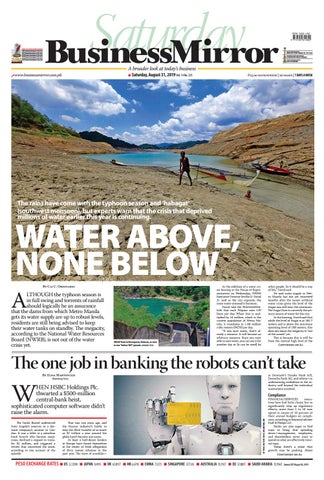
The rains have come with the typhoon season and ‘habagat’ (southwest monsoon), but experts warn that the crisis that deprived millions of water earlier this year is continuing.
WATER ABOVE, NONE BELOW A
By Cai U. Ordinario
LTHOUGH the typhoon season is in full swing and torrents of rainfall should logically be an assurance that the dams from which Metro Manila gets its water supply are up to robust levels, residents are still being advised to keep their water tanks on standby. The megacity, according to the National Water Resources Board (NWRB), is not out of the water crisis yet.
ANGAT Dam in Norzagaray, Bulacan, as seen in one “below-180” episode. BERNARD TESTA
At the sidelines of a water crisis hearing at the House of Representatives on Wednesday, NWRB Executive Director Sevillo D. David Jr. said as the city expands, the more water-stressed it becomes. David told the BusinessMirror that each Filipino uses 120 liters per day. When this is multiplied by 14 million, which is the current population of Metro Manila, it translates to 1.68 million cubic meters (MCM) per day. “If you save water, that’s already a resource. It will become an arbitrary resource. Since you were able to save water, you can use it for another day or [it can be used] by
other people. So it should be a way of life,” David said. He said water supply in Metro Manila has not yet recovered months after the recent artificial water crisis given the level of the Angat was still near the minimum. The Angat Dam is currently the primary source of water for the city. In the hearing, David said that while the level of Angat is at 181.7 meters and is above the minimum operating level of 180 meters, this does not mean the megacity is “out of the woods” yet. This is because this is still far from the normal high level of the Continued on A2
The one job in banking the robots can’t take
W
By Elisa Martinuzzi
at Denmark’s Danske Bank A/S, Deutsche Bank AG, and others—is undermining confidence in the industry well beyond the individual institutions involved.
Bloomberg News
HEN HSBC Holdings Plc. thwarted a $500-million central-bank heist, sophisticated computer software didn’t raise the alarm. That was two years ago, and the finance industry’s battle to stop the illicit transfer of as much as $2 trillion a year around the globe hasn’t become any easier. At least a half-dozen lenders in Europe have found themselves at the center of fresh allegations of dirty money schemes in the past year. The wave of scandals—
PESO EXCHANGE RATES n US 52.3390
KITTIPONG JIRASUKHANONT | DREAMSTIME.COM
The funds flowed undetected from Angola’s reserves to a dormant company’s account in London. It was a teller at a suburban bank branch who became suspicious, declined a request to transfer $2 million, and triggered a review that uncovered the scam, according to one account of the episode.
Compliance
FINANCIAL-SERVICES executives have had little choice but to significantly step up regulatory efforts; more than 1 in 10 now spend in excess of 10 percent of their annual budgets on compliance, according to financial adviser Duff & Phelps LLC. Banks are also eager to find ways to bring that spending down—management, employees, and shareholders never want to spend on what are effectively internal cops. Today there’s a sense that growth may be peaking. About Continued on A2
n JAPAN 0.4915 n UK 63.8117 n HK 6.6710 n CHINA 7.3273 n SINGAPORE 37.7245 n AUSTRALIA 35.1927 n EU 57.8817 n SAUDI ARABIA 13.9563
Source: BSP (August 30, 2019 )
News Water above, none below BusinessMirror
A2 Saturday, August 31, 2019
Continued from a1
Angat, which is around 210 to 220 meters. In fact, David said, the normal water level of Angat of 180 meters has been breached more frequently in the past 5 to 10 years. David said the lowest level reached by Angat in the last 10 years was in 2010 when it reached 157.55 meters and the second lowest was recorded this year at 157.96 meters. “For the last five years, at least 10 years, the breaching of the 180 meters has become more frequent; the minimum operating level is 180 but that’s often breached, below 180. I think we can attribute that to the Angat accounting for almost 96 percent of the water supply of Metro Manila,” David said in a mix of English and Filipino. “For the last 10 years, the population and development of Metro Manila continued and yet you only have one source. Demand is increasing. When populations double or triple, the demand for water is higher, sometimes five times or six times more,” he added. David said this is why the government should now seriously consider tapping another water resource for Metro Manila.
Laguna Lake
REP. Rozzano Rufino B. Biazon of the lone district of Muntinlupa said one option is to tap the Lagu-
na Lake which is also proximate to Metro Manila. While the quality of the water is not that high, Biazon believes it may be time to address this given the need for an additional water source for Metro Manila. Biazon said Laguna Lake holds a lot of potential, not only for water but also for transportation and ecotourism. He said currently, the lake only benefits a few. For its part, in a position paper read at the hearing, the Laguna Lake Development Authority (LLDA) said issues on the use of the lake can be addressed through a master plan. This plan will include, among others, dredging to reduce the silt in the lake. LLDA said it is “exploring” various financing options including Public Private Partnerships (PPP) and joint-venture agreements to undertake this project. It may be noted that in 2009, the National Economic and Development Authority (Neda) Board approved the P18.5-billion Laguna de Bay Rehabilitation Project, which involves the dredging of Laguna Lake navigational lane and the entire 8-kilometer stretch of the Napindan Channel and developing a transport system, including the development of Laguna Ferry Systems and service repair centers. Under that plan, around 12 ferry stations shall be constructed at the proposed sites and lakeshore
LAGUNA de Baý, the largest lake in the Philippines.
CCKDECENA | DREAMSTIME.COM
areas reclaimed for wastewater treatment facilities; ports and marinas will be developed. Five areas are proposed for reclamation and four Sewage Treatment Plants (STPs) are proposed to be established at the site. About P15.3 billion of the total project cost shall be funded by the Belgian government’s Super Subsidy Facility, while commercial loans coming from Belgian banks
based on partial prepayment guarantees offered by the Belgian Export Credit Agency will be tapped for the remaining P3.2 billion. The project will be implemented from 2010 to 2012. The project was canceled by the Aquino administration in 2012. “With the renewed effort to clean up our different water bodies, including Manila Bay and Laguna Lake, it is hoped that Congress finds merit in our proposal to prioritize dredging of the lake and that necessary funds be allocated for the purpose,” the LLDA said in its position paper. One major water project that is deemed to help supply Metro Manila with water is the P18.724-bil-
www.businessmirror.com.ph
lion New Centennial Water SourceKaliwa Dam Project. The project is located in Barangay Pagsangahan, General Nakar, Quezon, and Barangay Magsaysay, Infanta, Quezon. The project is funded through Official Development Assistance (ODA) from the Chinese government. Other projects include the the Wawa Bulk Water Supply Project, which will assure Metro Manila of an initial 80 million liters per day (MLD) of water. Apart from these, there are other water projects to be implemented during the Duterte administration, such as the 150 MLD Putatan; 100 MLD Cardona; 188 MLD Sumag River Diversion Pro-
Banking robots… two-thirds of institutions considered systemically important on a global level, a leading indicator for the industry, expect the size of their compliance teams to remain unchanged or shrink, according to a Thomson Reuters Regulatory Intelligence report. The largest companies want to adapt their teams to grow or scale back as necessary, the report said.
by a Dutch prosecutor into alleged money laundering and other corrupt practices. Even though the bank uses machine learning to filter out false alerts on potential bad actors, the lender has had to ramp up the number of individuals handling KYC procedures. It’s tripled compliance personnel in the Netherlands over eight years; staff dedicated to KYC account for 5 percent of total employees.
AI shift
Hurdles
Continued from a1
THAT’S led to buzz that banks are deploying artificial intelligence to replace surveillance staff. HSBC last year started using artificial intelligence (AI) to screen transactions, and the two biggest Nordic banks have said they’re replacing compliance staff with algorithms. Online banking startups such as Revolut Ltd., which rely on computerized efficiency to compete with established lenders, are finding compliance a challenge they need to address. So far, machines are confined to simple know-your-customer (KYC) applications and are far from ready to replace humans, says Tom Kirchmaier, a visiting fellow at the London School of Economics’ Centre for Economic Performance. He’s not optimistic that a major advance is afoot, either. “There’s a lot of talk but no action,” he says. Take ING Groep NV, which last year paid €775 million ($869 million) to settle an investigation
BANKS and tech companies need to overcome a number of obstacles for AI to succeed in tackling money laundering. For starters, they need better customer data, which is often neither current nor consistent, especially when a bank spans multiple jurisdictions. Enhancing the quality and frequency of data gathering is a crucial first step. Banks are also constrained in their ability to detect bad behavior, with or without computers, because competitors and national law enforcement agencies won’t share data. Across Europe, for example, regulation and enforcement are split along national borders. Lenders would benefit from a common European anti-money-laundering regulator, data sharing among banks, and a more open dialogue with bank supervisors, Citigroup Inc. analysts wrote in a note to clients in June. When banks do share information, it’s often unhelpful. They tend to over-report suspicious activity to the relevant agencies to shed responsibility, but enforcement authorities typically don’t provide their findings to the financial companies.
Cat and mouse game
WHAT’S more, banks, wanting to shield bigger clients from unnecessary scrutiny, often under-report activity they should be flagging, ac-
gram; 80 MLD Kalawis; 50 MLD Rizal Wellfield; 250 MLD Lower Ipo-Unutilized Water from AngatNorzagaray Phase 1; 100 MLD Poblacion Muntinlupa Water Treatment Plant 4-Laguna Lake; and 600 MLD Kaliwa Dam-Quezon Province. Beyond the term of the administration, other projects include the 550 MLD Lower Ipo Unutilized Water from Angat-Norzagaray Phase 2; 420 MLD Wawa Dam; 750 MLD; Sierra Madre; 350 MLD Bayabas Dam; 1,800 MLD Kanan River Phase 1; and 250 MLD East Bay Laguna Lake. Also being considered are 2000 MLD Kanan River Phase 2, and 6000 MLD Laguna Lake.
cording to the LSE’s Kirchmaier. That leads to potentially suspicious transactions being classified as normal. The algorithms learn to replicate those types of decisions. In short, the historical dataset available to train the machines is misleading, complicating their ability to learn detection. Criminals, by contrast, are constantly adapting their ways, finding new routes for their cash when existing ones are blocked off. Catching tomorrow’s money launderers requires anticipating where they’ll move next. Will they trade gold or crypto assets? When parameters change even slightly, AI struggles to stay ahead of the criminals. Trust in financial services after the 2008 crisis is taking a very long time to rebuild. Banks are wary that they risk teaching machines to stereotype customers based on where they come from or where they do business. “Ethical concerns associated with AI are rightfully restraining banks’ full embrace of machine learning,” says Alexon Bell, chief product officer at Quantexa, a London-based data analytics company that counts HSBC among its customers. Regulators, frustrated with the slow speed of change, have encouraged banks to deploy more technology. In December, the US Treasury Department’s Financial Crimes Enforcement Network, jointly with the Federal Reserve and other US agencies, called on banks to try new approaches to meet anti-money-laundering requirements, including AI, and have offered leniency if the tools uncover deficiencies in existing systems. One thing seems clear: Compliance spending at banks may be shifting away from employing humans to adopting new software. But for now, those living and breathing internal cops are here to stay.
News
Saturday, August 31, 2019
Duterte raises arbitral ruling on WPS, but Xi says China still won’t heed it
PHILIPPINE President Rodrigo Duterte (left) and Chinese President Xi Jinping (right) meet at the Diaoyutai State Guesthouse in Beijing on Thursday. AP
P
By Bernadette D. Nicolas
RESIDENT Duterte finally made good on his promise to directly raise the arbitral ruling favoring the country in issues it raised against Beijing’s excessive claims in the West Philippine Sea, but China’s leader stood pat on his government’s position to ignore the 2016 decision. During the meeting of Duterte and Chinese President Xi Jinping in Beijing, Malacañang said on Friday, Duterte was “steadfast” in raising the arbitral ruling before his Chinese counterpart. “President Duterte was also steadfast in raising with President Xi concerns central to the Philippines’s claim in the West Philippine Sea [WPS], which include the ruling held by the Permanent Court of Arbitration in the Hague. He said that the arbitral award is final, binding and not subject to appeal,” said Presidential Spokesman and Chief Presidential Legal Counsel Salvador S. Panelo. “In response, President Xi reiterated his government’s position of not recognizing the arbitral ruling as well as not budging from its position,” Panelo added. Nonetheless, Duterte and Xi agreed that there is a need for the expeditious formulation of a Code of Conduct and that this should be done within President Duterte’s term which ends in mid-2022. “With the Philippines as the designated country coordinator of the Asean-China Dialogue Relations, the Filipino head of state articulated his firm belief that the Code of Conduct would contribute in the resolution of numerous conflicts in the disputed areas of the South China Sea,” according to Panelo. Both leaders agreed to work together, on the basis of mutual trust and good faith, to manage the South China Sea issue, and to continue to dialogue peacefully in resolving the conflict, he added. Duterte and Xi also agreed on the importance of self-restraint and respect for freedom of navigation in—and overflight above—the South China Sea. On the June 9 Recto Bank incident, the President also expressed appreciation that China is ready to provide compensation to the 22 Filipino fishermen who almost lost their lives. The fishermen on board F/B Gem-ver1 nearly drowned after their boat was struck by a Chinese fishing vessel. They were subsequently abandoned by the Chinese ship’s crew even though they had to struggle in the water, and were saved by fishermen from
a nearby Vietnamese vessel. “PRRD took note of the fact that the China side has recognized and confirmed the responsibility of the Chinese fishing crew,” Panelo said. President Duterte likewise raised the possible joint exploration between the Philippines and China in the West Philippine Sea. For President Xi, the steering committee created for that purpose should prepare a substantive program on the matter. Moreover, the Philippines and China also signed six bilateral agreements for cooperative measures and assistance to the key areas of education, science and technology, and economic growth, These include the Preferential Buyer’s Credit Loan Agreement of Project Management Consultancy of the Philippine National Railways South Long Haul Project (between the Philippine DOF and the Export-Import Bank of China), as well as the Exchange of Notes on Cooperation Procedure for the Availment and Utilization of Concessional Loan under a Renminbi-denominated Loan Facility (between the Philippine DFA and the China International Development Cooperation Agency).
The other agreements include: n The Memorandum of
Understanding on Cooperation in the Field of Higher Education from 2019 to 2024 (between the Philippine CHED and Chinese Ministry of Education); n Memorandum of Understanding on Scientific and Technological Cooperation (between the Philippine DOST and Chinese Ministry of Science and Technology); n Cooperative Arrangement on the Implementation of the Intergovernmental Agreement Regarding Cooperation and Mutual Assistance in Customs Matters (between the Philippine DOF/BOC and the Chinese General Administration of Customs); and n Implementation Contract on Project of China-Aid Container Inspection Equipment (between the Philippine DOF/BOC and the Chinese Ministry of Commerce).
A3
A4 Saturday, August 31, 2019
ExportUnlimited BusinessMirror
Mindanao firms up biz, trade mission to Papua New Guinea T
Philexport sees tourism boosting service exports
D
By Manuel T. Cayon | Mindanao Bureau Chief
AVAO CITY—A business and trade mission has been firmed up next week for Papua New Guinea following a meeting with the Mindanao Development Authority (MinDA) and a PNG envoy here. The Mindanao trade and business mission was slated from September 3 to 5, according to a MinDA statement issued on Wednesday. The mission was finalized by MinDA Secretary Emmanuel Piñol, and PNG Ambassador to the Philippines Betty Palaso and Vice Minister Manasseh Makiba “for potential ex-
port of Mindanao premium rice and other areas of partnerships.” “I invited our friends from Papua New Guinea because one of the first projects that we will undertake is to initially export premium Mindanao rice to Papua New Guinea,” Piñol said during his assumption of office as MinDA secretary last week.
Piñol added that he was also looking at Solomon Islands and Singapore as country destinations of Mindanao’s high-quality premium rice from Banaybanay in Davao Oriental, North Cotabato, Zamboanga del Sur and Zamboanga Sibugay. “We aim to open potential trade link between Mindanao and Papua New Guinea through our quality rice and other premium agricultural products,” according to Piñol, who previously served as agriculture secretary. Piñol said the trade mission would include an investment forum and business-to-business networking with PNG’s key private sector players. “Possible importation of timber from Papua New Guinea to Mindanao is also another discussion during the mission to cater the needs of Mindanao construction and real-estate
industries,” the MinDA said. Aside from timber, Mindanao sources out tuna and other fishery products in the area, the MinDA added. Some Mindanao vegetables and poultry products were included in the list of Piñol’s priority agriproducts to be exported to Papua New Guinea. MinDA said the trade mission was one of the international business roadshows to be conducted with other national agencies to promote Mindanao’s economic potentials in the larger international market. “MinDA will also eye the possibility of spearheading establishment of a direct flight between Davao and Port Morseby, Papua New Guinea, as one of the agenda in the mission once trade link materializes and [found to be] sustainable,” Piñol said.
HE country’s umbrella organization of exporters is banking on tourism growth as the country ramps up its service exports amid slower merchandise trade volume. “We are also rooting for tourism. Though based only on its growth rate in 2016 to 2017, tourism-related services exports surged at 35 percent twice that of BPO [business process outsourcing] [though from a lower base], emphasizing its potential,” said Philippine Exporters Confederation Inc. (Philexport) President Sergio Ortiz-Luis Jr. Ortiz-Luis noted that tourism has been identified by the administration as a “low-lying fruit,” the reason that also encouraged his group to add tourism in its sectors. He also recalled the leap in services performance that started in 2015, boosted by the growing information technology/BPO sector which alone generated 1.2 million jobs and revenue reaching $22 billion.
BSP chief details various financial inclusion measures for MSME devt
NegOcc producers eyeing access to Canadian market
B
B
ANGKO Sentral ng Pilipinas (BSP) Governor Benjamin E. Diokno says the Central Bank recognizes the role of micro, small, and medium enterprises (MSMEs) in a sustainable economy and is pursuing various financial inclusion initiatives to unlock their immense potential. In his keynote speech at the recent Philippine Exporters Confederation’s general membership meeting, Diokno said BSP is currently spearheading and developing a host of financial inclusion initiatives with MSMEs and agriculture as identified priority sectors. These programs will help improve the access of these groups, including MSME exporters, to financial services, consequently enhancing the country’s export competitiveness. “This is because we recognize the immense potential and unique challenges of MSMEs,” Diokno said. Together with agriculture, MSMEs form the backbone of the Philippine economy, accounting for 99.6 percent (911,768) of the country’s enterprises and generating 61.6 percent of employment. But he also noted that “the lack of access to credit remains a fundamental obstacle to further development and sustainability of our MSMEs.” Despite providing livelihood for millions of Filipinos, MSMEs account for only 3.32 percent of the country’s gross domestic product, while their gross value added sits at 35.7%. Capital investment remains low, with MSME loans in the banking system accounting for 6.2 percent and share in total business loans at 9.2 percent, he continued. To address these challenges, Diokno said the BSP is working with the Credit Information Corp. in building a strong and reliable credit information system and with the Japanese government in establishing a credit risk database, with the aim to help SMEs improve access to finance through risk-based lending and to lessen the dependence of banks on collateral.
With a projected annual growth of 15 percent to 18 percent, the Philexport chief said the IT/BPO sector is poised to overtake overseas Filipino workers (OFW) remittances. According to the Philippine Export Development Plan (PEDP), tourism and trade could be “rising services exports” simultaneously contributing to the larger povertyreducing inclusive growth, along with the government’s thrust in promoting the country as a tourist destination. Apart from tourism and trade, five other services groups accounted for 83.2 percent of 2016 services exports amounting to $26 billion. These included other business services, computer/information services, freight, construction and audio-visual. Ortiz-Luis earlier attributed slower merchandise trade volume to the trade spat between the United States and China, and other worldwide problems.
YOUNG COCO EXPORT
In this BusinessMirror file photo, a young coconut vendor in Malate, Manila classifies a bunch of young coconuts for local customers. A recent report said Filipino coconut farmers could now export nuts to United States to ease the persisting glut in domestic supply after Washington opened up its domestic market to the Philippine commodity. NONIE REYES
The Central Bank also supports laws on financial inclusion. These include the Philippine Identification System Act passed in August 2018, which will help overcome the problem of the lack of verifiable identity documents faced by many Filipinos. The Personal Property Security Act, also passed in August of last year, will enhance the access of MSMEs to business and consumer credit by enabling the use of alternative collateral, such as equipment, inventory, and warehouse receipts. At the same time, the BSP is supporting the passage of a new Warehouse Receipts law, as well as the review and amendment of the Agri-Agra Reform Credit Act of 2009.
“The introduction of updated and more flexible provisions in these laws would help MSMEs, especially those that are agriculture-oriented, to gain access to credit; leverage innovative models; and induce banks to venture into MSME and agriculture financing with better terms and standards for compliance,” he said. In addition, the BSP implements the Credit Surety Fund (CSF) together with the Cooperative Development Authority to enable cooperatives, businessmen, and MSMEs to boost their credit worthiness by providing surety cover of up to 80 percent for bank loans. As of September 2018, there are 54 CSFs throughout the country with over 17,000 loan beneficiaries, said Diokno.
ACOLOD CITY—Negrense producers engaged in export are eyeing access to the Canadian market, which patronizes and purchases goods from countries in Southeast Asia, including the Philippines. This was noted by Mary Ann Colmenares, chairman of the Provincial Small and Medium Enterprise Development (SMED) Council of Negros Occidental, after the Canadian Chamber of Commerce (CanCham) in the Philippines President Julian Payne presented export opportunities in his country before local manufacturers here earlier this week. “The presentation was very informative. We have not saturated the export market in Canada. We have yet to build access to it,” Colmenares said on Friday (August 23, 2019). She added that the presentation will help them gain access to Canada for products from Negros Occidental. The market will be a good match for the capacities the Negrense small medium enterprises have at present, she said. Colmenares pointed out that the CanCham official presented a well-defined analysis of the products that Canadians patronize and buy specifically from the Philippines and the Asean in general. In his presentation, Payne also outlined the profiles of markets within Canada, including the distribution and socioeconomic profile of the population and major urban centers and markets. “You have to know the market in every part of Canada if you’re looking for the sizeable portion of its population. Do not think Canada as a single market,” he added. Between 2016 and 2018, the Philippines’ top exports included coconut oil, fresh and dried bananas, preparations of fruits, preserved fish, coconuts, pineapples, avocados, mangoes, vegetable extracts, tobacco products, fruit and vegetable juices, and frozen fish. The top Canadian imports are grape wines, bread and pastries, protein concentrates, coffee, chocolate, animal feed preparations, berries, waters, preparations of fruits and mushrooms. The activity, organized by the Provincial SMED Council and the Bacolod-Negros Occidental Federation for Information and Communications Technology (BNEFIT), was attended by food manufacturers, and gifts, décors and housewares producers. PNA
OurTime BusinessMirror
www.businessmirror.com.ph
Tales from the LRT
courtesy coach
By Nick Tayag
MY SIXTY-ZEN’S WORTH
T
HE LRT Line 2 train runs from Santolan station in Pasig City to Recto Avenue station in downtown Manila and back. In every LRT train, the first coach, called “Courtesy Coach” is reserved for senior citizens, physically disabled and pregnant women. Many times, I have boarded that coach. The train ride takes quite a short while from end to end, so one has time to observe unobtrusively the old men and women who pack the compartment. The bodies are often withered and shriveled. When they enter or get out, they shamble or shuffle, dragging one foot along, wobbling, needing to hold on to something to steady themselves. Many of the faces look haggard, daunt, hollow-eyed, forlorn. It is easy to imagine that each one is either fighting a personal battle, enduring a chronic or terminal sickness, lamenting an indiscretion, nursing a hurt or bearing a heavy burden, trying to forget a great disappointment and so on. During those brief rides, I have overheard snatches of conversation, audible because seniors often speak loudly usually because of defective hearing that’s common to old folks. I enjoy the cheery chatter and the breezy banter, noticeably much more animated when everyone is bound for home in Antipolo, Marikina, Cainta or any other town located in the east. When there is an available space, I sit down and strike a conversation with those beside me. Surprisingly, when you have exchanged smiles and broken the ice, all are only too open to tell you his or her own unique story, as if on cue. One such seatmate was Mang D. A white-haired widower (I estimated he was in his mid-sixties). He narrated how he was visiting his son and family in a condominium in Sta. Mesa. While there, a pet dog of his grand kid escaped from the unit and feeling guilty, Mang D. looked everywhere for the dog in vain. That night, he felt shunned by the coldness of his son and wife, because his grandson was inconsolable. The day I met him at the coach, he was going to ride a bus bound for the North to go back to the farm he left. His last words to me : “Mahirap dito sa Maynila. At ayaw ko nang tumira sa hindi ko sariling bahay. [It is difficult here in Manila. I no longer want to live in a house that is not mine.]” His plight caused me to recall the film “Tokyo Story” by Yasujiro Ozu. It depicts the plight of visiting parents who are treated as an ” inconvenience” by their sons and daughters living in the big city and too busy to pay much attention to them. Soon the mother dies, and the widowed father becomes resigned to the solitude he must endure in his home in the old town. A poignant story that still happens in our so-called enlightened present society. Once I met a former acquaintance of mine, named Larry, an ad executive. I learned he was going home after a long day. In his 60s, he looked drained and tired. From our conversation, I gathered that he and his old-time colleague had just pitched to retain an old account to the new young brand manager who replaced the old manager who just retired. They were competing with another ad agency staffed with youthful go-getters. My friend’s team made their pitch but my friend had resigned himself to the fact that they would surely lose the account. I tried buoying up his hopes, but it was a perfunctory gesture . Business is cruel and brutal to old people. More specially the advertising business, which prizes young, fresh-looking faces, because it is assumed that the young are sharper and smarter. There is no courtesy coach for advertising people who have reached age 60 (if you manage to last that long.) On another train ride, I happened to hear a heartbreaking story that still haunts me. The coach was sparsely occupied. So I had the luxury of sitting down. Seated at the bench opposite mine were a man and woman, I reckoned maybe in their 70s. I could sense that the woman, most probably his wife, looked pale and limp. When I came into the coach, the other seatmates were already engaging the husband in a conversation (the wife appeared too weak to take part.) Putting together the snatches from the exchange, I surmised that she was sick of cancer (lung or stomach, it wasn’t clear to me). They were coming back from treatment. And the husband revealed that his wife cannot take the chemo treatment anymore and they have decided to stop the treatment. They would just prepare themselves for what the future holds for the wife. Of course, others in the coach dispensed all kinds of unsolicited advice. Some talked about new medicines that alleviate the bad side effects of chemo therapy. One mentioned the name of a doctor who uses only natural medicines. But the couple just listened quietly, slightly smiling. “Dasal na lang [Prayers only],” was the husband’s subdued response, politely dismissing the well-meaning suggestions of other people. At that moment, I realized that the couple have already made up their minds. His tone was that of an exhausted acceptance. This was, in a sense, their “last trip.” I don’t know what others think but I feel that when faced with serious illness, being able to make decisions about the way you want to be treated is one of the most life-affirming things you can do. It’s a way of saying: I am alive, and it’s still my right to choose what’s best for me. If one can’t walk into the same river twice, then the same goes for the train ride at the LRT Line 2. Every ride brings in a new rush of old folks who, in their own different ways, are bearing so much in their daily lives. If only the walls of that coach could talk, how many more fascinating, engrossing and heartbreaking human stories they would probably tell. And each story, as someone said, is a great unwritten novel.
Saturday, August 31, 2019
A5
Poverty in old age haunts millions of Asia’s elderly
M
By Cai U. Ordinario
ILLIONS of informal workers in Asia are at risk of living out their golden years in poverty—unless countries act swiftly. In an Asian Development Blog, Asian Development Bank (ADB) Sustainable Development and Climate Change Department Principal Social Development Specialist Sri Wening Handayani said vendors, day laborers, and others are being left out of the national pension system. Handayani said nearly 10 percent of the population of the Asia and Pacific region are above the age of 60. By 2050, nearly a quarter of the region’s population would be deemed “seniors.” “Rising life expectancy indicates that large numbers of people in the region are living beyond the age normally associated with retiring from the labor force. Unfortunately, pension systems in the region are limited in scope and appear incapable, without further refinement, of addressing the coverage gaps that are emerging now and in the future,” Handayani said. This is the reason the Philippines is also being proactive. Given the size of the informal sector in the country, the government could not sit idly by waiting for something to happen. In 2017, the Philippine Statistics Authority (PSA) said the unorganized or informal sector accounted for more than a third of the country’s total GDP of P14.48 trillion last year. Using current prices, PSA Assistant National Statistician Vivian Illarina pegged the contribution of the informal sector to the country’s economy in 2016 at P5.013 trillion. Illarina said the informal
5 arrested for stealing millions from elderly, disabled vets
S
A N A N T ON IO — Fe d e r a l prosecutors say five people have been arrested on charges they obtained socia l security and other identifying information to steal millions of dollars from mostly elderly and disabled veterans. Authorities say the five face several charges, including aggravated identity theft, wire fraud and conspiracy. Robert Wayne Boling Jr. is identified in an indictment unsealed on Wednesday in San Antonio as the scheme‘s mastermind. Boling is a US citizen who was arrested in the Philippines along with two others. Another suspect was arrested in Las Vegas and the fifth in San Diego. The indictment says the scheme began when one defendant, who was a civilian employee at a US Army installation, stole identifying information for thousands of military service personnel that was used to access benefits and steal from bank accounts. It‘s not clear whether Boling has an attorney. AP
sectors in agriculture, hunting, fishery and forestry contributed P1.35 trillion of GDP in 2016; industry, P1.4 trillion; and services, P2.28 trillion.
Modest pensions
NATIONAL Economic and Development Authority (Neda) Undersecretary for Policy and Planning Rosemarie G. Edillon told BusinessMirror that in order to cover the needs of informal sector workers, the government has a modest social pension and the Social Security System (SSS) has its own AlkanSSSya program. Edillon said the country’s modest social pension is not significant simply because of the premise that the elderly in the Philippines all have families to take care of them. What the government is doing now is ensuring that the current generation is able to see higher incomes that would enable them to provide for the elderly in their families. “In the case of Filipino families, it’s always been the family that takes care of the elderly. But we have elderly persons (enrolled in) the social pension program. Of course it’s not much but ultimately,
what we want to happen is that this current generation (will be able to see an) improvement (in) their incomes (so) they can care for their (loved ones),” Edillon said. Meanwhile, the AlkanSSSya program enables the self-employed and the informal sector, specifically the self-employed in the services sector, to support their needs, including pensions, through staggered payments. The AlkanSSSya program can protect informal sector workers from income losses due to sickness, maternity, death, disability, old age, and other similar events. The SSS said the monthly premiums for members of the informal sector now depends on the amount of the daily earnings of the informal sector worker. If workers earn P3,000 or $60 (P50=$1) per month, the monthly contribution reaches P360 or $7.2 per month or P12 or $0.24 per day.
AlkanSSSya’s take: P685M
ACCORDING to the Development Academy of the Philippines, the AlkanSSSya Program has collected up to P685.12 million as of the end of April 2018. This means a monthly average of P13.74 million. “There are a lot of SSS programs on that (pension for informal workers). They have the AlkanSSSya which allows informal workers to make super easy payments. It (payment) doesn’t have to be a one-time thing. This one (AlkanSSSya) allows staggered payments,” Edillon said. Handayani said these are among the strategies being employed by countries across the region. One example in the region,
P685.12M The collection from the AlkanSSSya Program, a pension plan for informal workers, as of the end of April 2018. This means a monthly average of P13.74 million.
she said, is the flat noncontributory pension which is “suitably low” for affordability. These kinds of pensions are “growing rapidly” in countries such as Bangladesh, Nepal, the Philippines and Thailand. “The flat rate pension should be suitably low, for example at a level intended to achieve a minimal survival benefit among the elderly. Alternatively, benefits might be restricted to ages much higher than the official retirement age, as in Myanmar and Nepal,” Handayani said.
Increasing retirement age
OTHER strategies to help the elderly cope in the twilight of their years is increasing retirement age to allow older workers to continue working to support their needs. Handayani also said providing tax benefits for a portion of the time spent in raising children, or training for re-entry into the labor force can be used to shore up retirement contributions. She added that voluntary mechanisms such as a “micro pension” that are specifically tailored to individuals with low income and infrequent earnings is also being used in the region. The main challenge, Handayani said, is in ensuring the safety of funds and instill financial literacy among potential contributors. She added that it is also crucial that these mechanisms do not create “unrealistic expectations” that these micro-pensions will be a sufficient source of income for the elderly. “Given their low income, it is unlikely that such individuals can be attracted to contributory schemes with tax benefits (deductions) associated with them,” Handayani said. “Rather, the emphasis will have to be on products that are easy to understand and convenient, such as those accepting low and infrequent contributions, that reach remote areas, and involve low fees,” she added.
DSWD-12 delists 111,504 ineligible social pensioners G ENERAL SANTOS CITY— The Department of Social Welfare and Development (DSWD) has delisted at least 111,504 social pension beneficiaries in Soccsksargen due to eligibility and records-related concerns, an official said last week. Cesario Joel Espejo, DSWDSoccsksargen director, said the move is in line with the “cleansing” recently ordered by President Duterte on the beneficiary database of the Social Pension Program for Indigent Senior Citizens. He said their validation showed that there are beneficiaries in the region who have duplicate or double entries in their database. Some were found ineligible as they are already receiving pension from other social security agencies, he said. “This is part of our efforts
to ensure that the program will benefit the rightful and eligible senior citizens or those who are really in need,” Espejo said in a media forum. As of the end of 2018, the DSWD-Soccsksargen listed a total of 264,358 elderly, or senior citizens, who are receiving the P500 monthly social pension. Following the delisting process, the agency said the total number of beneficiaries in the region has decreased to 152,854. As part of the “cleansing,” Espejo said their personnel scrutinized the list of beneficiaries provided by local government units, through the social welfare units and the offices of senior citizens affairs. He said they immediately removed the duplicate names as well as beneficiaries who already passed away.
Espejo said they also crossmatched their list with the pensioners’ records of the Social Security System, Government Service Insurance System, and the Philippine Veterans Affairs Office. Citing the program’s guidelines, those eligible to receive the social pension are elderly who are frail and weak, not receiving pension from other agencies and not getting any support from their children and relatives, he said. Espejo said the delisted beneficiaries were no longer included in the semestral payout of the social pension starting in the first semester of 2019. He said they started in the last week of June the release of the P500 monthly social pension or a total of P3,000 per semester to beneficiaries in the region. Allen Estabillo/PNA
A6
Saturday, August 31, 2019 | Editor: Mike Besa
MASTERS’ FACELIFT IS ALMOST COMPLETE
THE BEST GETS BETTER THE 7th green is one of the last greens to see renovation.
CALLAWAY APEX 19 IRONS
The total package T
HE Callaway Apex Forged iron is Callaway’s flagship franchise. Its origins date back to the original Japan-only Callaway Black Series irons which did very well in its home market, but its premium price kept it from achieving commercial success in other markets. It was revered by club geeks worldwide. It was instrumental in making Henrik Stenson the 145th Champion Golfer of the year. Callaway then brought the Black Series Irons to the rest of the world when they rebadged them as the Diablo Forged iron in 2011. It was wildly successful, especially with the Internet golf community, myself among them. I was so enamored with my Diablo Forged irons that I acquired a backup set, lest anything happen to my gamer. The Diablo Forged irons stayed on the market for almost five years before being refined, technically updated and rebranded as Apex. Built on the bones of the Diablo Forged iron, the Apex Forged 16 was a formidable iron. Improving on it wasn’t going to be easy but just as all things, improvements in CAD, finite element analysis and manufacturing drove the refinements to the Apex iron. The fact that it took three years for Callaway to improve on it speaks to just how good an iron it is. Presenting the Apex 19 irons. In recent years, past few years Callaway has led the way in advancing players irons through technology. With the new Apex 19 iron, Callaway engineers have continued the tradition, making exceptional progress at infusing serious performance technologies into a small, forged 1025 carbon steel clubhead. The result is a multipiece, multi-material iron that’s easier to launch and promotes more distance without sacrificing the size, shape and feel that better players demand in this category of iron. Apex 19 employs Callaway’s proven Face Cup technology, which promotes faster ball speed on both center and off-center hits for more distance. Callaway engineers brought two additional, proven technologies to Apex 19 for the first time in this type of iron-MIM’d tungsten weighting for precision CG positioning to optimize flight in the long
and middle irons, and urethane microsphere technology, to improve sound and feel. MIM stands for Metal-Injection Molding, a process that results in a dense, precisely shaped, precisely weighted piece of tungsten. Using this process gives Callaway engineers precise control over the CG position in each individual iron, promoting easier launch in the long and middle irons, and a lower, more controllable flight in the short irons. Urethane microsphere technology was introduced last year in Callaway’s Rogue irons. It involves a pocket of an especially formulated urethane, infused with approximately 500,000 miniscule “microspheres,” positioned behind the clubface, touching the back of the face. This microsphereinfused urethane flattens under pressure, allowing the urethane to behave in a porous manner, permitting it to compress and “give” with relative ease. That allows the urethane to absorb undesirable vibration at impact without slowing the face’s speed. Arriving at the precise shape and positioning of the urethane to achieve maximum benefit in each iron required extensive experimentation and computer modeling. The benefit of urethane microsphere technology is significantly better sound and feel without sacrificing ball speed and distance. Purists will bristle at the thought of using any material to attenuate feel in a forged iron, but the results are transparent to the golfer. Apex 19 also features Callaway’s Spin Control VFT (Variable Face Thickness) technology, wherein the face thickness is thinner and thicker in strategic areas to promote less spin off the long irons for more distance and more spin off the short irons for increased control. Together, these technologies—Face Cup, MIM’d tungsten weighting, urethane-infused with microspheres and VFT spin-control—makes the Apex 19 easy to launch, delivers a soft and agreeable sound and feel, promotes fast ball speed, and promotes better spin characteristics throughout the set. All of that makes Apex 19 a great option for golfers who typically game Player’s irons, but it’s also brought this category within reach of golfers who love the look, feel and performance
APEX Forged 19
of this type of club but don’t think they’re good enough to game it. The technologies that promote more speed, easier launch and fantastic feel has made it possible for a much wider range of golfers to play this type of iron. It’s interesting that Callaway has resisted going with a hollow bodied design and has opted to stay with a more traditional construction. It’s clear that the aforementioned technologies work holistically to provide the desired results without resorting to a hollow build. The Apex 19 irons look to be a tad on the small side for a player’s distance iron. But don’t let that scare you. This club packs a ton of forgiveness in a small package. If you’re the sort that needs the assistance this club brings to the table but longs for the look of a blade, the Apex Forged 19 takes you most of the way there. True, there’s a bit of offset; totally understandable in this type of iron and really, barely noticeable into the middle of the round. The topline is a bit chunky, but the dividend is in the results. The Apex 19 feels sublime at impact. Gone is any hint of harshness from the high-speed steel face. These feel as good as almost any other iron on the market. Mizuno and Miura blades might feel a smidge better, but without hitting them back to back, it’s impossible to tell. That small head size pays dividends when you need to play out of the rough. It cuts through long grass much easier than a larger one. The sole design is admittedly biased toward the better player but still offers plenty of usability; it’s not a butter knife by any means. What drew me to the Apex 19 irons was the insane consistency from each iron from shot to shot. With other players’ distance irons, the occasional flyer was a fact of life. Not so with the Apex 19. On the launch monitor, the only discerning factor for distance was the quality of the strike. Good hits were within a yard of each other, and the dispersion was tight. These results were echoed in field trials. Coming from another iron in the same category, the switch to the Apex 19 was seamless. The clubs came ready to play. The lofts and lies were perfect—completely
www.pinoygolfer.com | Saturday, August 31, 2019
T
Story & photos by Mike Besa
HE Masters Course at the Manila Southwoods Golf and Country Club is one of the great golf courses in the country. It has been the site of the Philippine Open, the Eisenhower Cup and many professional tournaments both foreign and local. One of just three signature golf courses of golf great Jack Nicklaus, it is his championship course, it was meant to test the best players in the game. Ingeniously designed on what is essentially a flat piece of rice land, the Masters twists and turns into the prevailing wind. As such, the wind comes from a different direction on each successive hole adding an unseen hazard to your game. The golf course is up to par by modern standards at just over 7,300 yards from the gold tees. It’s on the long side from amateurs at just under 6,900 yards from the blue and close to 6,500 yards from the whites. In spite of its length, thoughtful placement is required as you make your way through the former rice paddy. The greens are set at oblique angles to the fairway, putting a lot of pressure on the accuracy of the tee shot. The greens are usually quick and roll the golf ball almost flawlessly.
But there is the fly in the ointment. The only thing wrong with that is the Legends Course on the other side of the property has better greens than its more celebrated sibling. The Legends is the easier, more enjoyable of the two Southwoods tracks and its greens are better and less troublesome to care for in the bargain. The club has long recognized this but fought to keep the standard of the greens on the Masters Course to as high a level with what they had to work with. Eventually, the tifdwarf greens on the Masters course fell victim to indigenous invasive species. The turfgrass on some greens started to mutate, which was the sign that it was time for a comprehensive renovation. The work began right after the final Resorts World Manila Masters in 2017. Four greens at a time were renovated so as not to unduly upset the playing membership. It’s taken two full years, but the end is in sight with only four greens left to complete. The club took the opportunity to address other issues, such as shrinkage or unwanted settling of the green complexes. Some adjustments were made to enhance playability, as well. All the changes were made under the watchful eye of former Nicklaus consultant Arch. John Cope. Cope has an interesting relationship
with both of the golf courses at Manila Southwoods—he was Nicklaus’s supervising architect on the ground while both courses were being built. Cope now lives on the property and serves the club by using his intimate knowledge of the golf courses to care for them day to day. He kept his hand in golf architecture by keeping busy with other renovations such as the one at the Alabang Country Club and the redesign and rebuilding of the 18th green at Forest Hills Golf and Country Club’s Nicklaus Course. It’s been a labor of love for John and the move to tifeagle on the Masters’ greens should make his life much easier. It’s so much easier to prep a surface for play when the grass is healthy. If it isn’t, efforts revolve around keeping it alive and not preparing it for play. Tifeagle has a very good track record in the country. It sees duty in Sta. Elena, Ayala Greenfield Estates and Anvaya Cove just to name a few golf courses that swear by the micro bermuda. Many other golf courses are switching to tifeagle in the desire to provide better playing conditions at their respective properties. We’ve had the privilege of seeing the club’s progress with the Masters over the two intervening years. We are impressed with the
results thus far. Some of the new greens are larger, others have more undulations than before. Even when the remaining four greens return to play, it will be another two years or so before the root system is deep enough to receive a golf ball and allow it to hold. Only then will the years of work have been worth it. It will be worth the wait. The Masters is the complete package—it’s a golf course that will challenge anyone. Its beauty and quality are obvious to all that walk its fairways. The golf course has seen some of the most exciting finishes in the annals of Philippine golf. Each of the four closing holes is a scoring opportunity ensuing such exciting finishes. It’s no surprise then that two of the five Resorts World Manila Masters tournaments were decided in playoffs. We wait with bated breath for the renovation to wind down to completion and look forward to hacking it around on one of the best golf courses in the country. Manila Southwoods’s Masters Course has been one of the best golf courses since it opened for business some 25 years ago. It’s greens always ranked very highly but were always admittedly just a slight step down from the country’s very best. All that is about to change and we can’t wait.
FIFTEEN is one of the most beautiful golf holes in the country.
identical to the Srixon 545. Swing weight was perfect through the set. Amazing to see this level of quality directly from the manufacturer. The only thing that needed doing was to have the grips built up and it was good to go. On course, as in every other area, there were no surprises. The clubs performed exactly the way they were supposed to. The long irons were particularly impressive. They were extremely easy to hit and a joy to hit shots. Shaping shots isn’t the specialty of a head such as this, but it is possible. If that’s a priority, then you should turn your attention to the Apex Pro 19, a pro-style cavity back iron that packs most of the tech found in its slightly larger, more forgiving sibling. Switching from one set of irons to another is usually difficult and requires rethinking the distances you get from each club. It is made even more difficult when you’ve had as much success as I have with my Srixons. The Callaway Apex 19 does its part by being extremely predictable and consistent from club to club. Despite the lofts being identical on both sets of irons, the Apex 19 hits the ball further at full trot, but distance is easy to moderate when you need to hit a specific number. Then there’s the consistency of that distance from shot to shot. It’s an utterly gorgeous iron and that does much to ease the transition. You can tell Callaway designers took pains to get the look just right. Yes, the topline is still on the chubby side, but the shape of the toe and the (lack of) offset are beautiful in the eyes of the Apex 19’s target golfer. It is the total package. The Apex 19’s biggest competition for the space in my bag was the Apex Pro 19 which offered incredible playability for an iron of this type. It is extremely accessible for an iron of this type and will suit golfers with handicaps into the low teens. But it was the Apex 19 with its length, ease of use and wonderfully soft feel that won the day. Hit them both. Your mileage may vary. The Apex 19 comes locally with either Nippon Steel Modus shafts in both 105 and 120-gram weights, as well as the Fujikura Speeder graphite iron shafts and is now available at all Transview Philippines stores in Podium, Solaire and at the Wack Wack Golf and Country Club proshop. Mike Besa
M
ELBOURNE, Victoria, Australia—International Team Captain Ernie Els has kept the door open for Asian stars to earn a potential captain’s pick for the Presidents Cup against the United States Team at The Royal Melbourne Golf Club, Australia, from December 9 to 15. Els said he will keep close tabs on Thai duo Kiradech Aphibarnrat and Jazz Janewattananond, and Korea’s Sungjae Im and Byeong Hun An before he determines his four captain’s selections in early November. After the first top-8 players were finalized through a one-year qualifying process last week, the South African legend said he would not hesitate to call up more rookies to fill his team’s roster despite already having four debutants— Haotong Li of China, CT Pan of Chinese Taipei, Mexican Abraham Ancer and Australia’s Cameron Smith—through automatic selection. “I’ve said to the guys in the meetings that I’m not scared to choose rookies. If I see a rookie playing really good golf and he’s up for it, then I’ll go for him,” said Els in a media teleconference earlier today to discuss his team’s preparation for the prestigious team match play showpiece. “But they’ve got to really show me something to go down the list that far, because I’ve got guys knocking on the door like Jason [Day] and I’ve got Justin Harding and I’ve got Jazz [Janewattananond], who won twice on the Asian Tour this year. I’ve got Sungjae Im, who’s played 34 events on the PGA Tour and made it to the
A7
ODYSSEY Stroke Lab Marxman S Putter
ODYSSEY STROKE LAB PUTTERS
Tech of the year for the greens
O
DYSSEY is the No. 1 putter manufacturer on the world’s professional tours, as well as in the retail space with sales in the range of $90 million. That, my friends, is a heck of a lot of putters. Their success is legend, but 2019 is going to be a really good year for Callaway. They’ve broken through this year with a piece of technology that is sure to shake up the world of putters. This is the year that Odyssey rethinks the putter’s shaft. Putters’ shafts seem to have gotten little attention from engineers over the years. Developments have centered on making the ball roll better off the clubface and to varying degrees, allowing golfers to aim their putts better. By rethinking the putter’s shaft, Odyssey has happened on a technology that will help us putt better. The genesis of the Stroke Lab shaft began as Odyssey engineers noticed that putter weights were getting unmanageable for many golfers. Faster greens require heavier putter heads for better control and with the rise in popularity of ultra-lightweight grips have meant that swing weights have progressed from D1 in the mid 80s to F2 in 2018. If you weren’t counting, that’s a 21-swing weight point increase, making the putter unmanageably head-heavy. The Stroke Lab shaft is steel at the tip and graphite the rest of the way. This technology is hardly new. The Stability Shaft made a bit of a splash with its launch last year, and UST has offered their Frequency Filtered putter shaft for years. The Stroke Lab shaft design differs from the others. The Stroke Lab shaft is a full 40 grams lighter, made possible by an innovative new multimaterial shaft design that combines a graphite body with a steel tip to net out at just 75 g, with most of the mass concentrated in the tip. Odyssey engineers redistributed that saved weight by adding 10 g to the head in the form of two sole weights and adding 30 g to the grip-end via a 10 g lighter grip and 40 g end-weight. Counterbalancing, by itself, isn’t a new technology either. Adding weights to balance the ever-heavier heads has been done for a very long time now. But by employing counterbalancing while reducing the shaft’s weight is unique to Odyssey. The lower shaft weight keeps the putter’s overall weight under control and makes the putter easier to swing. It’s hard to put the sensation of using a
Stroke Lab putter into words. Most golfers have a difficult time articulating what makes it special. Words like smooth, stable, balanced are used. Everyone can feel the difference and nothing bad has ever been said about it. They endow you with a delicacy on the greens not easily found with most modern putters. Odyssey is so bullish on the shaft that it will see duty on all Odyssey putters this year. Of course, Odyssey didn’t stop with just the shaft. A redesigned version of the Microhinge insert found in the O-works line is used on all Stroke Lab and Exo putters. The Whitehot Microhinge gets the ball rolling almost immediately but feels noticeably firmer than the original, addressing complaints that the original Microhinge insert was on the soft side. The heads are adorned in a refined version of Odyssey’s Versa technology. In case you’ve forgotten, Versa is Odyssey’s high contrast aiming technology. This latest version is the most subtle application we’ve seen but seems to be every bit as effective. The Stroke Lab Marxman we tested is the very definition of “easy to aim.” It inspires confidence when standing over the golf ball. The one con about the Stroke Lab putters is the price. Odyssey is charging a premium for the Stroke Lab putters. Which brings us to the other change with Odyssey in 2019, they’re bumping up the quality of their putters making them all more premium. They’re a bit more money to acquire, but we’re getting a better product for the money. One thing for sure—you won’t have any trouble finding a Stroke Lab putter that fits your eye. All told, there are ten different head styles; six mallets and four blades. Odyssey ups the ante by offering two neck styles for all the mallets and some of the blades. This makes 18 models from which to choose. Stroke Lab has been a hit on the world’s professional golf tours. Odyssey led the putter count at all the majors and has won six of the last 14. The putter also has over 50 wins all over the world, so to say that the pros have embraced the new technology is a bit of an understatement. In the end Odyssey’s Stroke Lab putters take all refined versions of the company’s technologies and have combined them with the Stroke Lab shaft to produce the most technologically significant putter line of 2019. Stroke Lab putters are available at Transview Solaire, Podium and at the Wack Wack Golf and Country Club proshop. Mike Besa
CAPTAIN ELS EYES ASIAN STARS AS CAPTAIN’S PICKS
ERNIE ELS GETTY IMAGES
Tour Championship as a rookie. I’ll speak to the top 8 and we’re going to have a lot of discussion about who their new four friends are going to be because they’re going to have to play together and blend as a team.” The highly talented Jazz, 23, missed out on automatic selection by two rungs on the team’s points list while a knee injury scuppered Kiradech’s fight to gain a top-8 spot despite safely keeping his PGA Tour
card through three top-5 finishes, including twice at World Golf Championships events. The Korean trio of An, a former US Amateur champion, 21-yearold Im, who has enjoyed a strong rookie season on the PGA Tour by qualifying for the FedExCup Playoffs Finale, the Tour Championship, and Sung Kang, who claimed a first PGA Tour win in May, are also very much on Els’s radar. “You know, Sungjae has been
playing on the PGA Tour, he played 34 events. He won the Korn Ferry Tour last year...hopefully Sungjae keeps playing good and he gets himself on the team. I’m definitely looking at him,” said Els. “Sung Kang was playing really well, won in Dallas, and was looking really good. His form has slipped a little bit. I love his attitude toward the game. I even look at Ben An, his game is really great. He almost won in Greensboro this year, and he
had some really great finishes. He’s one of the supreme ball strikers around the world, which I really love and which you need to do in Melbourne. Those two guys I’m definitely looking at, especially Ben An. He’s on kind of my favorite list. “A lot of these guys are going to be playing the big events in the next couple of weeks and months. You know, from Asian players, Kiradech Aphibarnrat, he kept his card very comfortably—here in the US—To keep your card on this Tour is tough, especially as a rookie, and a lot of these guys have had that pressure on them this year. So Kiradech has done very well. Jazz is having a great year. I played golf with him in Malaysia this year, saw his game from close by. He’d be great around Royal Melbourne.” Els keeps emphasizing to his team members that the Presidents Cup could be a life-changing experience, especially when the International Team has won the event only once previously against the US Team. The lone victory came at the 1998 edition at Royal Melbourne. “I really hit it right to them that this could be a real—one of the biggest events of their lifetimes because—just because we are such a diverse team from right around the world. We have huge following. We have people from Asia, from Mexico now, we’ve got possibly Canada. We have an audience of billions of people if you look at the countries’ numbers,” said Els.
Sports BusinessMirror
A8 Saturday, August 31, 2019
mirror_sports@yahoo.com.ph • Editor: Jun Lomibao
ALDRENER IGOT JR. is unstoppable with the bow and arrow as Zion Dalariay performs her routine in wushu.
“This is just the beginning, I promise.”—Gauff
AP
BusinessMirror
Editor: Gerard S. Ramos • lifestylebusinessmirror@gmail.com
/
GILAS Pilipinas with Head Coach Yeng Guiao, Manny V. Pangilinan, and SBP Head and Smart President Al S. Panlilio
Stream the Fiba World Cup 2019 games with Smart YouTube freebie FILIPINO basketball fans can watch and express their support, using their smartphones and mobile devices, for the Gilas Pilipinas national basketball team in the much-anticipated Fiba World Cup 2019 to be held in China starting August 31. With Smart’s Free YouTube For All promo, Filipinos can watch and cheer as Gilas players fight for flag and country—against all the odds—wherever they are. As we cheer from the opening tip off of the first game to the closing buzzer of the last, following Gilas’s journey on YouTube will allow us to live up to the recognition of being the best basketball fans in the world. Dial *123# to avail yourself of Free YouTube for All to keep up with the Fiba World Cup games live. Join the #PilipinasGotGame campaign as the national team battle it out with Italy, Serbia and Angola in the Group D elimination round of the Fiba World Cup 2019. Gilas will play Italy on August 31, Serbia on September 2 and Angola on September 4. The games will be aired live on ESPN5 and its YouTube channel. “Smart has been a passionate supporter of the country’s sports programs, particularly basketball. We are eager to watch every play, every highlight and cheer for Gilas Pilipinas in every game,” said Oscar Reyes Jr., head of consumer business, Smart. He added, “We are happy to be able to bring the Fiba Gilas Pilipinas action straight to the smartphones of millions of our Filipino customers with Free YouTube for All.”
Saturday, August 31, 2019 A9
PHOTOS: GLOBE TELECOM
Concert trends from ticket selling to the day a�ter PRIMETIME
DINNA CHAN VASQUEZ @dinnachanvasquez luckydinna@gmail.com
T
O date, perhaps, no other concert in the Philippines was as talked about this year as Planet #5: The EXplOration, which featured six out of nine members of the Korean boy group EXO. From ticketing to the fan projects to concert day to postconcert days, #EXplOrationinManila was trending on Twitter and Facebook. For the August 4 ticketing day, fans started lining up outside the Mall of Asia Arena as early as July 31. A ticket to the concert, which started from P13,000, became the hottest item in town.
“Who is EXO?” asked bewildered parents of teenagers whose children asked for these tickets as combined birthday and Christmas gifts. An estimated 20,000 EXO-Ls filled the Mall of Asia Arena to watch EXO’s The EXplOration concerts for two days (August 23 and 24). Local promoter Pulp had to add an extra day (August 23) because not all fans could be accommodated on the original date. Manila was the third stop of the tour after Seoul and Hong Kong. The last EXO concert in Manila was The ElyXiOn, on April 28, 2018. Chanyeol, Suho, Sehun, Kai, Chen, and Baekhyun opened the concert with the triple treat “Tempo,” “Transformer” and “Gravity.” Baekhyun took to the stage for his solo spot “UN Village,” the carrier single of his first solo mini-album City Lights released last July. EXO, minus two members who are in the military (Xiumin and DO) and another member in China (Lay), performed more than 20 songs that also included “24/7,” “Love Shot,” “Ooh La La La,” “Monster,” “Oasis,” “Falling for You,” “Wait,” “Power,” “Bad Dream,” Damage,” “Growl,” “Overdose,” “Call Me Baby,”
“Unfair,” “On The Snow” and “Smile on My Face.” For the solo stages, Suho performed “Been Through,” Kai did “Confession” and both numbers were a hit with the ladies. Chen performed his “Lights Out” while EXO-SC, composed of Sehun and Chanyeol, performed “What a Life” and “Closer to You.” “Thank you for your unending, unchanging love. Do you guys know that you are like vitamins to us, EXO? Are we like vitamins to you also?” said Suho, the group’s leader. “I hope you guys keep these memories forever. I love you, Philippines. Originally, we’re supposed to have only one day but thanks to you guys, we’re able to do two days. I want to thank our EXO-L fans for filling this arena for two days. We’ll come back with the new sounds of EXO. Thank you, Manila,” said Chen. Before the end of the concert, Suho made a promise. “This will not be our last moment together. We’ll be back soon with a new album and new concert. Manila, Philippines, mahal kita.” EXO Planet #5: EXplOration in Manila was presented by Pulp Live World, SM Entertainment and Dream Maker Entertainment, and powered by Globe. ■
Survey finds new auto technology can annoy drivers DETROIT—Alerts from new driver assist systems can be so annoying that some motorists are turning the features off, according to a new survey. The 2019 JD Power Tech Experience Index study also found that frustrated drivers may avoid the systems in future vehicle purchases. That’s a problem for automakers who want to sell the technology and prepare people for fully automated vehicles, the company said. “Automakers are spending lots of money on advanced technology development, but the constant alerts can confuse and frustrate
drivers,” said Kristin Kolodge, JD Power’s executive director of driver interaction and human-machine interface. “The technology can’t come across as a nagging parent. No one wants to be constantly told they aren’t driving correctly.” For example, systems that keep vehicles centered or within their lanes were problematic for owners, the study found. An average of 23 percent of drivers with the systems view the alerts as annoying. The results vary by brand, with up to 30 percent finding the alerts bothersome. Of drivers who don’t like the alerts, 61
percent sometimes disable the systems. A spokesman said JD Power would not identify the brands. Collision protection systems such as automatic emergency braking fared the best in six categories covered by the survey. Smartphone mirroring was second, followed by comfort and convenience features such as voice recognition and climate controls. Entertainment and connectivity such as linking phones and Bluetooth placed fourth, followed by driving assistance, such as blind spot detection or lane keeping systems. Navigation finished last, JD Power said in a
statement on Tuesday. The survey also found that 69 percent of owners have Apple CarPlay and/or Google’s Android Auto in their vehicles. The phone mirroring systems are starting to jeopardize sales of the automakers’ factory installed navigation systems, the survey found. The company’s survey included over 16,400 responses from people who bought or leased a 2019 vehicle in the past 90 days. The new vehicles had to have been all-new or redesigned within the past three years. The survey was conducted from February through July. AP
High-speed monochrome printer launched EPSON (www.epson.com.ph) announced the launch of its high-speed line head multifunction monochrome inkjet printer for enterprise printing, the environmental-friendly WorkForce Enterprise WF-M20590 that prints at ultra-fast speeds of 100 pages per minute (ppm) while reducing impact to the environment when compared to laser printers. Driven by Epson’s PrecisionCore linehead technology, the WF-M20590 delivers a fast first page-out time of 6.2 seconds with minimal warm-up time. High capacity ink cartridges yield up to 120,000 pages of high-quality prints, enabling continuous printing with uninterrupted downtime and a lower total cost of ownership. Designed to meet the high-volume printing needs of businesses, the printer can handle print volume of 20,000 to 100,000 pages per month. As inkjet printers do not use heat in the printing process, they consume far less power than laser printers. The
WorkForce Enterprise printers consume up to 85 percent less energy than a similar-speed laser printer, which can amount to significant cost savings in the office. Inkjet printers also produce up to 85 percent less carbon dioxide than those of comparable laser printers. This means that for every eight cedar trees required to absorb the amount of carbon dioxide because of using a laser printer, an Epson inkjet printer requires only one cedar tree. In terms of waste generation, the WorkForce Enterprise printers come with fewer components that need replacing, making them more convenient to operate as they require only changing of the ink cartridges and maintenance box as compared to the toner, drum, developer, fusers and more components for laser models. This translates to 59 percent less replacement parts compared to laser printers, significantly reducing the
amount of waste generated and impact on the environment over the lifetime of a printer. With this, downtime is greatly reduced, with much less maintenance for the printer needed over its lifetime. “Following the success of the WF-C20590, we are introducing the monochrome WF-M20590 for black and white printing. The WF-M20590 provides an eco-friendly alternative to laser printers while delivering on its 100ppm speed and productivity. As Epson’s inkjet technology does not use heat for printing, the benefits that this brings are manifold—reduced maintenance and downtime, no warm-up time required for first print out, ability to print on a wide variety of paper types, and, of course, a much-reduced impact to the environment in terms of energy consumption and waste generated,” said Eduardo Bonoan, general manager for marketing, Epson Philippines.
BusinessMirror
A10 Saturday, August 31, 2019
www.businessmirror.com.ph
APPLE APOLOGIZES FOR USE OF CONTRACTORS TO EAVESDROP ON SIRI
SAN FRANCISCO—Apple is apologizing for allowing outsiders to listen to snippets of people’s recorded conversations with its digital assistant Siri, a practice that undermined its attempts to position itself as a trusted steward of privacy. As part of the apology posted Wednesday, Apple reiterated an earlier pledge to stop keeping audio recorded through Siri unless consumers give their permission. When permission is granted, Apple said only its own employees will be allowed to review audio to help improve the service. Previously, the company hired contractors to listen to some recordings. “We realize we haven’t been fully living up to our high ideals, and for that we apologize,” Apple said. Apple would not say how it will seek permission. In the past, the Cupertino, California, company has typically requested permissions through prompts during software update installations. In recent months, Facebook, Google, Amazon, Microsoft and Apple have all acknowledged that people have been reviewing users’ interactions with artificial-intelligence assistants in order to improve the services. But users aren’t typically aware that humans and not just computers are reviewing audio. The use of humans to listen to audio recordings is particularly troubling to privacy experts because it increases the chances that a rogue employee or contractor could leak details of what is being said, including parts of sensitive conversations. The backlash to the industry practice prompted Facebook and Google to stop relying on people to transcribe recorded conversations. Amazon is continuing the practice unless users of its digital assistant Alexa explicitly demand that humans be blocked from listening. Microsoft also is still doing it, too, contending it has adequate privacy safeguards in place for the Cortana digital assistant. Apple intends to continue to rely upon computer-generated transcripts of what’s being said to Siri as part of effort to improve services, even if a user hasn’t explicitly granted permission, or opted in. Unlike Facebook, Google and Amazon, which track what people are doing and where they are going to sell ads and merchandise, Apple has conspicuously emphasized that it has no interest in peering into its customers’ lives. CEO Tim Cook repeatedly has declared the company’s belief that “privacy is a fundamental human right,” a phrase that cropped up again in Apple’s apology. AP
BRITISH AIRPORTS TO INTRODUCE 3D SCREENING FOR CARRY-ON BAGS LONDON—Putting small containers of liquids in plastic bags could soon be a thing of the past for airline passengers in Britain after the government announced plans on Sunday to introduce 3D screening equipment for carry-on luggage at all major airports. Transport Secretary Grant Shapps said in a statement that the new technology will improve security and could also mean “an end to passengers having to use plastic bags or rationing what they take away with them.” Under current security restrictions, passengers are not allowed to bring containers carrying more than 100 milliliters (3.38 fluid ounces) of liquids in their carry-on luggage and the containers have to be in a clear plastic bag. That could come to an end under the new screening regime and passengers may also be able to keep electrical equipment, such as their laptops in their cabin bags. The screeners already are being used in trials at London’s Heathrow Airport and they will progressively be rolled out to other British airports by December 1, 2022, the government said. Heathrow CEO John Holland-Kaye says the technology “will transform the passenger experience, making air travel simple, streamlined and more secure through the UK’s only hub airport.” AP
Why streaming services are the new credit-card rewards binge
W
BY SARA RATHNER The Associated Press
HEN it comes to credit-card rewards, it’s not all about gas, groceries and restaurants anymore. Issuers are moving beyond suburban staples to include millennial-friendly categories, such as transit and streaming subscriptions. The trend toward streaming rewards, in particular, is hard to miss, with cards from American Express (Amex), Chase and Wells Fargo now featuring streaming as a bonus category. But what’s behind this explosion? For starters, streaming is wildly popular. As of 2017, more than half of US households subscribed to paid video-streaming services, according to Deloitte’s digital media trends survey. But experts say it’s also about issuers forging early connections with younger consumers and ensuring that they remain customers. “The strategy is simple: If a consumer opens a credit card when young, the [issuer] can build a longterm relationship with the consumer,” says Logan Allec, a CPA and founder of the financial blog Money Done Right.
MEETING PEOPLE WHERE THEY’RE SPENDING THE Deloitte study notes the percentage of US households subscribing to a paid streaming video service grew from 10 percent in 2009 to 55 percent in 2017—a 450-percent increase. Consumers subscribe to an average of three such services.
Issuers have taken notice. Wells Fargo made a splash last summer, revamping the Wells Fargo Propel American Express, which now earns triple points back per dollar spent on eligible streaming services. In May 2019, the Blue Cash Preferred Card from Amex underwent a makeover, adding select US streaming services as a 6-percent cashback category. The following month, the Chase Freedom entered the streaming fray. The card earns 5-percent cashback in bonus categories that rotate each quarter, on up to $1,500 in spending per quarter. (You must opt in to the bonus categories each quarter; all other purchases earn 1 percent back.) From July 1 to September 30, 2019, one of those bonus categories is select streaming services. Kunal Madhok, vice president of US consumer lending and acquisition at American Express, noted via e-mail that Amex research found that a segment of millennials were spending more on “day-to-day” costs like commuting and streaming compared with five years ago. So the Blue Cash Preferred was reworked to reward cardholders more heavily for these types of costs. “The card is designed to give people the most cashback on the things they value and spend frequently on, now including quality time at home streaming their favorite show,” Madhok said. Of course, your monthly Netflix bill likely represents only a fraction of your household budget, so don’t expect a boatload of rewards from this category alone. Say your family spends $15.99 per month on Netflix Premium, $14.99 per month on a Spotify Family plan and $5.99 per month on Hulu, for a total of $443.64 per year. If you earn 6-percent cashback
on these services by paying for them with the Blue Cash Preferred Card from Amex, that’s just $26.62 in rewards per year. And that doesn’t take into account the card’s $95 annual fee. When choosing any rewards card, look for categories that match your spending enough to offset that cost.
BUILDING RELATIONSHIPS WITH YOUNGER SPENDERS PER the Deloitte survey, 70 percent of Gen Z households (ages 14 to 20) had a streaming subscription in 2017, as did 68 percent of millennial households (ages 21 to 34). Experts say credit-card issuers see an opportunity here to lure customers while they’re young, rewarding them for the spending they’re doing anyway while also converting them into long-term cardholders. “As the consumer gets older, and presumably begins to spend more, the credit-card company has already secured their business,” Allec says. Subscription services can give these relationships staying power, too, because they’re typically “set it and forget it” transactions. If an issuer can get you to use its card as your automated payment method each month, you’re more likely to keep it—even if you never take the card out of your wallet. “Credit-card companies want consumers to choose their cards for subscriptions as it’s a regular—often monthly—recurring transaction that they can rely on as a base of card spend,” says Derek Szeto, cofounder of Butter, a tool that helps consumers track and manage subscriptions. “Active cards are sticky cards.” ■
Carousell celebrates 7th anniversary with brand-new visual identity, milestones CAROUSELL (www.carousell.com), one of the world’s largest and fastest-growing classifieds, celebrated its seventh anniversary with the launch of a new visual identity, together with milestones including reaching its 250th million listing and fourfold revenue growth in 2018. This visual identity refresh signifies the brand’s progression and growth, while putting a spotlight on its core purpose of enabling shared possibilities among users of the online marketplace. Throughout the years, Carousell has been harnessing mutually beneficial opportunities to empower users, and celebrated numerous success stories of users who turned their passions into livelihoods. Cofounder and CEO Quek Siu Rui epitomized Carousell’s win-win opportunities when he sold his MacBook on Carousell to a father with a young daughter. The father wanted his daughter to learn about
the Internet but could not afford a brand-new computer. He turned to Carousell, and this made Siu Rui realize that Carousell was a platform that would enable possibilities for users with each transaction. “Our mission has not changed since day one. We want to inspire every person in the world to start selling. Seven years ago, we saw that there was no easy way to sell stuff online and existing platforms were tedious and uninspiring to use. So we launched a mobile app that made selling as easy as taking a photo, buying as simple as chatting, and we made it social. It really set the standard for what mobile classifieds should be. Now, we’ve grown our presence to six markets, expanded from general classifieds to properties and automobiles, and recorded over 250 million listings,” shared Siu Rui. “This proves Carousell is serving a real need, and is more relevant than ever in today’s marketplace, where consumption has
grown rapidly and sustainability has become a huge focus. In Southeast Asia, there’s a population of over 640 million people, twothirds of which are still just coming online and experiencing the magic of the Internet. The refreshed visual identity showcases Carousell’s uniqueness where transactions go way beyond dollars and cents; where friendships are forged, stories are shared and interests get discovered.” To further showcase the win-win experiences enabled by Carousell, a special “Match and Win-win” card was given to all visitors of Carouselland at the anniversary celebration. Visitors then searched for the person holding a matching card through the Carousell app and social media. Each successful pair got to redeem their prizes at the redemption booth. Carouselland 2019 was recently held at Marina Bay Sands Expo and Convention Halls in Singapore.
BusinessMirror
www.businessmirror.com.ph
GCash vows to boost e-commerce through 2022 BY RIZAL RAOUL S. REYES MAJOR digital wallet GCash aims to play a key role in the development of e-commerce in the Philippines, according to its key official. “As a strong government partner, we will continue to improve our products and services to achieve our two-pronged goal—enabling the financially underserved and create a cashless culture in the Philippines,” GCash President Anthony Thomas said in a press statement. “We, at GCash, believe that the e-commerce industry will help fuel the Philippine economy, just like how it has been helping Indonesia grow its local output. With our secure and reliable payments platform GCash, we will be able to help drive the projected growth rates and aid in shaping the future of the country,” added Thomas. With the contribution of the e-commerce industry, the local economy is expected to increase by 50 percent by 2022, Thomas pointed out that’s GCash will support the government programs and provide the needed mechanisms and technology to spur and promote online shopping in the country. With the expected surge in users and usage, GCash aims to spearhead the charge for the development of the e-commerce space by providing Filipinos with a digital wallet, which they can use for online transactions. According to research think tank Statista, the e-commerce sector is expected to grow to a $1.32 billion industry, a 58-percent jump from $835 million in 2018. Moreover, the Department of Trade and Industry (DTI) is confident the industry’s contribution to the country’s gross domestic product (GDP) will, likewise, be increased by half. Thomas said digital wallets like GCash are expected to account for the lion’s share of the payments type at 39 percent after three years. This will be followed by bank transfers at 31 percent, card payments at 28 percent, and cash on delivery at 2 percent. Currently, e-wallets only account for 21 percent of the transaction, with cards, cash-on delivery and bank transfers taking the top 3 places for payment options. GCash has been a strong and long working relationship with the government in promoting digital transactions in the country for many years now. Aside from partnering with government and small and medium enterprises, GCash has formed a tie-up with e-commerce platform Lazada to provide Filipinos with a more convenient way of paying for their purchases. Users simply have to link their GCash accounts to their Lazada profiles, select GCash as their payment option, and check out. “We are always open to partnering with e-commerce platforms to help the government achieve its goal of increasing the contribution of the e-commerce industry by 2022,” Thomas said.
Saturday, August 31, 2019 A11
Examining a video’s changes over time helps �lag deepfakes
I
BY WAEL ABD-ALMAGEED University of Southern California
T used to be that only Hollywood production companies with deep pockets and teams of skilled artists and technicians could make deepfake videos, realistic fabrications appearing to show people doing and saying things they never actually did or said. Not anymore— software freely available online lets anyone with a computer and some time on their hands create convincing fake videos. Whether used for personal revenge, to harass celebrities or to influence public opinion, deepfakes render untrue the age-old axiom that “seeing is believing.” My research team and I at the University of Southern California Information Sciences Institute are developing ways to tell the difference between realistic-looking fakes and genuine videos that show actual events as they happened. Our recent research has found a new and apparently more accurate way to detect deepfake videos.
FINDING THE FLAWS GENERALLY speaking, various deepfake algorithms work by using machine learning techniques to analyze images of the target, identifying key elements
KEVIN GAMBOA (from left), Cito Mendoza, Jason Santos, Lexi Gancayco and Rafa Laperal
of facial expressions like the nose, corners of the mouth, locations of the eyes and so on. They use that information to synthesize new images of that person’s face and put them together to create a video of the target that looks realistic but is fake. Most current methods of detecting deepfakes involve looking at each frame of a video separately, either manually or using a detection algorithm, to spot tiny flaws left by the image-fabrication process. If there is enough evidence of tampering in enough frames, the video is considered fake. However, deepfake creators have begun to use large amounts of image and video compression to blur their results, hiding any artifacts that might reveal their falsehood.
LOOKING AT SEQUENCES, NOT SINGLE FRAMES OUR method seeks to get around that deception by taking a different approach. We extract all the frames from a video and identify the areas that show the target’s face. Then we, in effect, stack all those face images on top of each other, making sure the nose, eyes and mouth are all aligned between every frame. This eliminates the effects of head movements or camera-angle shifts in the video. Then, rather than looking at each face image individually, we look for inconsistencies in how
different parts of the face move from frame to frame over time. It’s sort of like setting up a kids’ flip-book and then watching for weird jumps in the sequence. We have found that this method is more accurate, in part because we can identify more evidence of falsehood than when looking at each frame alone. Specifically, we detected deepfakes 96 percent of the time, even when the images and videos are significantly compressed. So far we have found that level of accuracy only on the only large-scale database available to academic researchers for evaluating their deepfake detection techniques, which is called FaceForensics++. That data set contains videos from three of the most prominent deepfake-generation algorithms, Face2Face, FaceSwap and DeepFake, though fakers are always improving their methods. Deepfake detection is an arms race, in which fakers and truth-seekers will keep advancing their respective technologies. Therefore, the job of limiting their effects on society as a whole can’t fall only to researchers. Scholars and experimenters must keep working, of course, but that’s not all. I believe social networking platforms should also work to develop software and policies that slow the spread of misinformation of all types—whether manipulating a person’s face or showing their whole body moving in ways they never could. AP
YANNA COWPER (from left), Kurt Ley and Martina Velasco enjoying Bumble BFF Retro night's colorful drinks
SAM CORRALES feeling the 1990s vibes at the Bumble BFF Retro Night
Bumble celebrates International Friendship Day with a BFF Retro Night FRIDAY, August 13: As we go through the journey called life, we always need those people who will have our backs no matter what, the ones we can call when we’re looking for a pick-me-up, or the ones who can share our excitement over the same things. And what better way to celebrate the people we call friends than a throwback themed party on International Friendship Day? Bumble, the women-first online connection platform that empowers all women to make the first move when it comes to relationships, including friendship, hosted a BFF Retro Night, a pop-up held simultaneously with other Bumble users in New Zealand and Australia. Over 250 guests, including Bumble Philippines Ambassadors Vani Vergara, Sam Corrales, Yanna Cowper, Debbie Then, Lexi Gancayco, and their respective partners in crime, were in attendance at the Mess Hall for a night that was all about shining the spotlight on the ones who
get us the most, with dancing, free flowing drinks, giveaways and reminiscing. Open to all Bumble users who simply had to show their profile at the door, the event was filled with key photo moments styled by Moss Manila to bring out everyone’s nostalgia. Guests were able to get their content game on with friends old and new in front of the holographic photowall, accented with old-school boomboxes and disco balls. The more adventurous attendees also dove into the BFF ball pit to pose for the camera. Attendees also got all dolled up at the Retro Glam Stations, where they could get their hair styled and braided with glitter sprays, 1990s style butterfly clips and bejeweled hairpins and barrettes. Glitter and temporary tattoo services also gave guests that extra sparkle for the rest of the event. While dancing the night away to remixes of funky old school classics by DJ Rei Ka, guests also got buzzed with
especially crafted cocktails named after Bumble slang. On the menu were The First Move, a tequila-based concoction with triple sec and calamansi juice; Your New Match, gin and lime soda mixed with cherry blossom syrup for a special kick; Bestie Buzz, a fruity gin mix of lime, honey, green apple and blue curacao; and the signature Queen Bee, a lemon-infused gin-based drink with a dash of honey for that perfect amount of sweetness. Partygoers also helped themselves to Moment Group favorites 8Cuts Skinny Fries and Mo Cookies. At the end of the night, each guest was able to take home their own personalized tote, which they could customize with Bumble patches and letters, and fill with special branded merch, including fans, umbrellas, pop sockets and stickers. The whole night was filled with good vibes and smiles, as guests interacted and made new Bumble BFF’s IRL. To download the app, visit the App Store or Google Play, or go to www.bumble.com.
Editor: Gerard S. Ramos • lifestylebusinessmirror@gmail.com
BusinessMirror
Saturday, August 31, 2019 A12
RUSSIAN CAPSULE CARRYING ROBOT FAILS SPACE STATION DOCKING MOSCOW—A Russian space capsule carrying a humanoid robot has failed to dock as planned with the International Space Station (ISS). A statement from the Russian space agency Roscosmos said the failure on Saturday was because of problems in the docking system. It said the space station itself and the six-person crew are safe. Roscosmos head Dmitry Rogozin said on Twitter that a new docking attempt would be made on Tuesday. The capsule was launched on Thursday as part of tests of a new rocket that is expected to replace the Soyuz-FG next year. It is carrying a robot called Fedor, which will perform two weeks of tests aboard the space station. Vladimir Solovyev, flight director for the Russian segment of the ISS, said the robot had not been taught how to manually conduct a docking. AP
Do you note? TECHNIVORE ED UY
whereiseduy@gmail.com
W
HEN Samsung first launched its Galaxy Note flagship series in 2011, it was actually mocked due to the sheer size of the device, and very few people expected it to become so popular. At the time, people perceived phones with 4.3-inch displays as being way too big for everyday use, and companies were actually trying to make their phones smaller and more compact. So when the Galaxy Note came out with a 5.3-inch display, it not only defied expectations but also created a new device category, called the “phablet”—bigger than a phone but smaller than a tablet. Eight “notes” later, Samsung is once again trying to set a new trend by introducing not just one but two versions of its flagship series with the Galaxy Note10 and Note10+. Don’t be confused by the name, as its only ninth phone in the series, since Samsung decided to skip “6” in order to align with the branding of its Galaxy S phone series. Samsung launched its newest flagship in the Philippines last August 14 at the Grand Hyatt Manila in Bonifacio Global City, where guests witnessed first-hand what makes the Galaxy Note 10 the right phone for this new generation of multi-hyphenates. As mentioned, the Galaxy Note 10 comes in two sizes, so consumers can find the Note that best fits them and feels best in their hands. People who always wanted to get a Note but were turned off because of the size now have an option—the standard Galaxy Note 10 with a 6.3-inch Cinematic Infinity Display, or the Galaxy Note 10+ with a bigger 6.8-inch screen. The Galaxy Note10 is wrapped in an edge-to-edge and near bezel-less Infinity-O Display for uninterrupted viewing. The in-display cutout for the front camera is discreetly positioned, allowing for Samsung’s most immersive and seamless display complemented by the award-winning Dynamic AMOLED Display, enabling a cinematic experience in the palm of the user’s hand. The HDR10+ certification and Dynamic Tone Mapping technology present photos and videos the way it was intended to be seen, resulting in stunning and vivid content. Note users put a premium on productivity, and the Galaxy Note 10 features new technologies, enhanced capabilities and powerful integrations all in service of giving users the freedom to work in the way that makes them the most productive.
THE S PEN MADE MIGHTIER
THE S Pen is also redesigned to further enable productivity.
Handwritten notes can now be instantly converted to digital text and exported to different formats, including Microsoft Word. Additionally, users can drag and drop files between the Galaxy Note 10 and other devices through Samsung DeX. Those using Windows 10 PCs can integrate their smartphone and see notifications, send and receive messages, and view photos without having to lift their smartphone. Building on the Bluetooth low energy-enabled S Pen capabilities introduced on the Galaxy Note 9, Samsung has added Air actions, allowing you to control certain aspects of the device using gestures with the S Pen, like changing camera modes or switching from back to front camera.
PRO-GRADE CAMERA
THE Galaxy Note10 and Note10+ boasts of a new camera system with pro-grade movie technology. The smartphone comes with a triple camera that guarantees professionallooking shots even for beginners. Its lenses include a 16MP Ultra Wide, a 12MP Wide-Angle, and a 12MP Telephoto camera. The front camera beautifully improves selfies, even in low light situations. Both the Galaxy Note10 and Note10+ are equipped with a full professional studio that allows users to shoot and edit instantly. Footage can be furthered enhanced with Live Focus video for a movie-like depth of field similar to bokeh, Zoom-In Mic to control surrounding sound, and the upgraded Super Steady feature to reduce shaky recordings. Every video showcases vivid colors and details with 4K UHD technology. Editing becomes a breeze, especially when used with the S Pen. Other new camera features include a screen recorder for gamers who want to add some personality to their streams, or vloggers who want to enhance their tutorials; AR Doodle and 3D Scanner; and Night Mode both for the back and front cameras.
NOTEWORTHY PERFORMANCE
THE multi-device offers unmatched performance perfect for the new work tribe millennials who juggle tasks all the time—from work-related tasks to content creation for social media, to cultivating their passions. The Note10 is powered by the Samsung Exynos 9825 7nm 2.7GHz octa-core processor to let you experience the fastest speeds while multitasking on various apps without experiencing any lags. The new Note series comes with a big battery, featuring 3,500mAh for the Galaxy Note10 and 4,300mAh for the Galaxy Note10+. The Super Fast Charging feature means that a 30-minute power-up can last the whole day. Additionally, Wireless Power Share allows users to share the Galaxy Note 10’s battery with Qi-compatible devices by placing them against the smartphone. We will do a full review of the Samsung Note10 in the coming weeks.
VLOGGING ESSENTIALS FROM CANON
ASK any successful YouTuber or vlogger about their secret and they’d always tell you to get a good camera. That is why Canon recently unveiled the newest iteration of its flagship
compacts, the PowerShot G7 X Mark III and the PowerShot G5 X Mark II, touted as the ultimate pocketable vlogger camera ideal for content creators seeking a powerful yet userfriendly device. These latest flagship compact models features a stellar combination of DSLR speed, quality and lightweight handling with its 20.1MP, 1-inch stacked CMOS sensor, and wide aperture of f/1.8-f/2.8 with optical zoom of 5X for the PowerShot G5 X Mark II and 4.2X for the PowerShot G7 X Mark III. Powered by Canon’s pioneering DIGIC 8 Processor, both the PowerShot G5 X Mark II and the PowerShot G7 X Mark III are equipped with a new 1.0-inch stacked CMOS image sensor and an expanded ISO range of up to 25,600 which enhances the cameras’ performance with faster autofocus to produce crisp, clear shots in almost any light. The PowerShot G5 X Mark II features a 5x optical zoom with its newly designed f/1.8-2.8 lens with 24-120mm focal range, while the PowerShot G7 X Mark III offers 4.2x zoom with its 24-100mm focal range, ideal for handling shooting portraits to macro close-ups of 0.47x magnification and is excellent for creating shallow depth of field effects. Both products are capable of up to 30 frames per second (fps) high-speed continuous shooting in RAW burst mode (and 20 fps in jpeg), allowing users to capture fast-moving subjects and never miss a moment. Perfect for keeping foreground subject in focus for landscape shots, the cameras’ enhanced focus bracketing feature also takes images with focus precision. The PowerShot G5 X Mark II and PowerShot G7 X Mark III record in 4K 25p/30p with no crop which lets users take full advantage of lenses to shoot grand landscape videos in stunning definition. With 4K movies recorded in motion jpeg, frame grabs are possible, allowing users to review footage and at any given point, extract a moment from the video and save it as a highquality 8MP jpeg on the camera. What makes the PowerShot G7 X Mark III the perfect vlogger companion is its YouTube livestreaming function which supports Full HD video streaming direct from the camera. To use this feature, the user simply needs to register on Canon iMAGE Gateway and have a minimum of 1,000 channel subscribers in accordance with YouTube guidelines. Both cameras are packed with connectivity features such as USB charging, Wi-Fi, and Bluetooth Low Energy (BLE) to effortlessly connect with compatible smart devices with one single tap. The G7X Mark III Package A comes with Free 24/7 Vlogger Service Support that includes pickup and delivery in case of repairs, a service unit usage, a three-year standard warranty, and a lens and accessories loan program. The G7X Mark III Package B comes with the Vlogger Service Support and a Vlogger’s Kit which includes an Ulanzi bracket with cold shoe (microphone mount plate), a LensGo L322 multifunction desktop tripod, and a Boya BY-MM1 universal cardioid microphone. Meanwhile, the higher-end G5X Mark III preselling package comes with Free 24/7 Vlogger Service Support. ■
Globe at Home Prepaid WiFi now at discounted price TO connect more Filipino homes to high-speed and affordable Internet, Globe At Home Prepaid WiFi gets a price cut from P1,999 to just P1,499 this month. Customers can now get their hands on the device that is 2x faster, with 2x stronger signal and 2x wider coverage than your usual pocket Wi-Fi for the whole family to enjoy watching and streaming their favorite videos, movies, and TV shows. Every purchase of the prepaid Wi-Fi device also comes with free 10 GB of data. Afterwards, customers can easily score additional data with very affordable promos starting at P15 for 1 GB for an entire day of surfing for Nanay’s online business and Bunso’s assignments, video calls with Tatay and Bunso, video streaming and uploading for Ate, and all the family’s other favorite online activities. Managing and monitoring data usage of your Home Prepaid WiFi is also hassle-free. Just download the free Globe At Home app via the App Store or Google Play Store, setup your app profile, and easily activate freebies or load more data for uninterrupted connectivity. Now, the entire family can experience a whole new Internet experience at home with a more affordable Globe at Home Prepaid WiFi. Get yours now at a lower price of P1,499 until November 16 via all Globe stores nationwide. You can also order online via shop.globe. com.ph, Lazada, Shopee, Home Credit and Akulaku. More information is available at bit.ly/2MLB6Vx.
www.businessmirror.com.ph
BusinessMirror
Saturday, August 31, 2019 A13
A14 Saturday, August 31, 2019
BusinessMirror
www.businessmirror.com.ph
www.businessmirror.com.ph
BusinessMirror
Saturday, August 31, 2019 A15
A16 Saturday, August 31, 2019
BusinessMirror
www.businessmirror.com.ph
www.businessmirror.com.ph
BusinessMirror
Saturday, August 31, 2019 A17
A18 Saturday, August 31, 2019
BusinessMirror
www.businessmirror.com.ph
www.businessmirror.com.ph
BusinessMirror
Saturday, August 31, 2019 A19
A20 Saturday, August 31, 2019
BusinessMirror
www.businessmirror.com.ph
www.businessmirror.com.ph
BusinessMirror
Saturday, August 31, 2019 A21
A22 Saturday, August 31, 2019
BusinessMirror
www.businessmirror.com.ph
www.businessmirror.com.ph
BusinessMirror
Saturday, August 31, 2019 A23
A24 Saturday, August 31, 2019
BusinessMirror
www.businessmirror.com.ph
www.businessmirror.com.ph
BusinessMirror
Saturday, August 31, 2019 A25
In the ad material of Notice of filing of Application for Alien Employment Permits published on August 1, 2019, the Company name and address of Mr. Peng, Xianglai should have been read as PRANCING DESEN TECHNOLOGY SERVICES INC. located at Unit 1620, Burgundy Trans Pacific Place Taft Ave., Malate, 079, Brgy. 727, City of Manila, Metro Manila not as published. If you have any information / objection to the above mentioned application/s, please communicate with the Regional Director thru Employment Promotion and Workers Welfare (EPWW) Division with Telephone No. 400-6011.
ATTY. SARAH BUENA S. MIRASOL REGIONAL DIRECTOR
A26 Saturday, August 31, 2019
New tribe of creatives form branding alliance for Belt and Road
A
GROUP of creative-oriented professionals and thought leaders have formed the Philippine Branding Alliance for the Belt and Road (PBABR), dubbed ‘The Alliance’, which held its first Assembly at Makati City. The Alliance encompasses the broad field of branding, advertising, arts, design, music, culinary, and architecture; and aims to forge partnerships with China and the countries of the Belt and Road to propel the creative industries underlying cultural understanding as well as peopleto-people relations. “The economic rise of China and the Belt and Road countries is a growing reality…Our relationship and public discourse on China has always been political. We feel it’s an important issue to continue resolving; but in areas where we can already cooperate, we feel that working together is best for everybody.” — JC Valenzuela, CEO of Propel Manila and a founding member of The Alliance.
He pointed out that the Philippines and all Filipinos can benefit from the massive economic opportunities arising from the continuing drive to spur economic integration and peopleto-people connectivity across Europe, Russia, South, Southeast, and Central Asia by land (the “Road”); and connecting China’s coastal regions with South and Southeast Asia, the South Pacific, the Middle East, Eastern Africa, and Europe, by sea (the “Belt”). Earlier in May this year, Valenzuela held exploratory talks with the President of the China Council for Brand Development, Mr. Liu Pingjun, in Beijing where the latter expressed his support for the PBABR to pursue partnerships among the 70 belt and road countries that account for about 65% of the world’s population and around a third of the world’s Gross Domestic Product (GDP). The PBABR also aims to play a role in actively consolidating Philippine brands under a national brand strategy to push
more quality goods, services and tourism destinations in the global market. Interested parties can learn more about it on their social media pages (@ BrandAlliancePH). In the photo are, from left: Bernadette Lindres, Business Development Manager for Design for Tomorrow, Shao Trinidad, Director for Sales & Marketing at Elite Model Management Manila and Vice President of Artists & Co Manila, Anthony L. Go,Director of Propel Manila and President of Paradigm Development Corp. of the Philippines, Marlon Rivera, Chairman of The Alliance, JC Valenzuela, CEO and President of Propel Manila, Silvestre Afable, Chairman of Propel Manila, Quark Henares, Head of Globe Studios, Kim Marvilla-Abrigo, Business Director at Elevation Partners, Raymund Sison, Creative Chief and Partner of Propel Manila, and Arch. Jason Buensalido, Chief Design Ambassador and Principal Architect at Buensalido Architects.
Wedding bells and good vibes at Winford Manila The Winford Manila Resort & Casino boasts a luxurious 700-seater ballroom on the hotel’s fourth floor to comfortably accommodate big weddings, parties, and MICE events. Operated by the Manila Jockey Club (MJC) Investment Corporation, WMRC is a 22-story casino hotel that offers luxurious accommodation and world-class entertainment with 128 well-appointed rooms, a threelevel gaming area, outdoor heated swimming pool, gym and spa, fine dining, and retail outlets. More than offering a ballroom that is both spacious and luxurious, Winford Manila has also proven to be an auspicious venue for starry-eyed couples to tie the knot. Expert celebrity feng shui master Hanz Cua recently performed a ritual at WMRC, particularly in the ballroom, appealing to the benevolent entities to give their approval of future activities conducted within Winford Manila. “The floral chandelier in the ballroom is the ‘flower of romance’ and signifies love throughout a
blissful relationship and marriage,” explained Master Hanz. “The same goes for the ballroom’s gold carpet which symbolizes ‘wealth’ and also the ‘Fú’ character beside the Winford Manila logo which is a symbol of good luck in Chinese.” With the ballroom’s energy found to be positive by Master Hanz, WMRC
has developed wedding packages and will be hosting the first ever “Winford Weddings” in September—a showcase of not only bridal fashion but also what is in vogue for grooms as well—all within the confines of its grand ballroom. For more on WMRC, visit www. winfordmanila.com or call the Guest Services Hotline at (632) 528-3600.
“P
A
TRIPARTITE partnership was forged recently by fintech trailblazers Multisys, EON and Eplayment that will enable the growing base of gamers and esports enthusiasts to play and pay in one platform. This signals a more serious look into the Philippine gaming space which has been regarded as pop culture in the past years. The partnership among fintech mavericks was initially brought forward by Admadz CEO Homer Nievera in line with Multisys and EON’s interest to support Eplayment’s “Liga Adarna”, the first allfemale esports tournament in the country. Liga Adarna is being marketed by Admadz. Seeing a common interest in building the fintech side of gaming, Nievera, who is also Eplayment’s Chief of Strategy brought together the three top honchos of Multisys, EON and Eplayment to establish an end-toend fintech solution for gamers. Multisys is the exclusive technology partner of Eplayment in establishing a multi-platform for the gaming and esports community. It includes a marketplace and
payment gateway that will connect gamers to the Eplayment account powered by EON. In addition to the Eplayment account, EON will be providing Eplayment members with access to financial services tailor-fitted to the needs of the esports community. EON will initially launch co-branded cards for Liga Adarna players which will be extended to gamers and esports enthusiasts within the Eplayment network. This project pushes EON closer into achieving its vision of becoming the preferred bank for the broader mass market. Currently, EON offers a suite of deposits, loans, and payment products, digitally through its website and app, complemented by co-branding partnerships and agent branches nationwide, backed by the strength and stability of Union Bank of the Philippines. In photo are, from left: David Almirol, Jr. (Multisys CEO), Paolo Baltao (UnionBank SVP and EON Banking Group Head), Karlos Naidas (Eplayment CEO) and Homer Nievera (Eplayment Chief of Strategy and Admadz CEO).
SM Cinema exclusively offers ‘Good Boys’ at its 64 branches nationwide
G
OOD Boys, a candid and slightly naughty depiction of coming-ofage and everything in between, comes alive into the big screen beginning August 28. Imagine three 12-year-old boys cursing and exploring toys not applicable for their age embarking on a misadventure that brings them to a realization that indeed they are transitioning from kids to teenagers. A film co-produced by Seth Rogen is a relatable yet funny telling of how we all entered into adolescence. Excited to attend their very first ‘kissing party,’ the boys’ eagerness to research on how
to pucker up brings pushes them to skip school and embark on adventures and misadventures that brings them to a handful of encounters with “adult stuff.” Moviegoers will surely go back to their own childhood’s adventures and explorations in a hilarious and fun manner with Good Boys, SM Cinema’s exclusively to its 64 branches nationwide including Director’s Club Cinema. And with a wide variety of cinema friendly munchies from Snack Time including popcorn, hotdog sandwiches and burgers, going to the movies becomes even more enjoyable. Follow /SnackTimeOfficial on Facebook for more information.
HSBC named Asia’s best bank for sustainable finance two years running
Marriott Iloilo’s HR Manager shares what it’s like to work for an international hotel ASSION, discipline, grit,” lists Frances Carmen O. Siongco, Human Resources Manager of the Courtyard by Marriott Iloilo, relating some of the qualities necessary in someone that wants to excel in the competitive hospitality industry. The first international brand hotel in the city, the Courtyard by Marriott Iloilo stands as fertile ground for the development of the region’s young and fledgling career hoteliers. The self-professed cheerleader of the Courtyard’s 161-strong workforce, you’ll often find Miss Carmen hyping up her charge and spurring their energy during pep rallies and the hotel’s numerous team building activities. With over 30 years of management experience in a diverse slate of fields and now as president of Iloilo chapters People
Fintech mavericks Multisys, EON & Eplayment partner for gaming multi-platform
Management Association of the Philippines (PMAP), the 56-year-old HR exec sees the hospitality industry as her “last stop” of sorts in her storied career – owing to her love of the hotel profession. "We are the first international brand hotel in Iloilo, and we are very proud of that. Marriott has policies and programs that potential associates will really want to find out about. We want to mold and be able to transform you into somebody at the forefront in the field of hospitality, there are so many opportunities for growth here," she said. The Marriott working environment is very professional, but still very much grounded on the spirit of motivation. "We invest in our people in terms of trainings: we have local trainings, we have online trainings, we have webinars, we have conferences
outside of the Philippines, name it." The Courtyard also cater to the physical and mental well-being, through activities that will build bonds and camaraderie: Zumba, Reflexology, Photo and Sketching classes, huddles about de-stressing and depression, and so much more –undertakings that will wholly develop the hotel's associates as wellrounded people. “At Marriott, we provide two things: opportunity and empowerment. There are many Marriott brand hotels in the pipeline, at least ten to be opened in the Philippines in the next three years. We have to build a very strong Marriot brand – whether its Courtyard, Sheraton, Fairfield, JW Marriott, or Ritz Carlton. How do we do that? Through the strengths and efforts of our valued associates," Carmen said.
H
SBC has been named Asia’s Best Bank for Sustainable Finance for the second year, in the Euromoney1 Awards for Excellence 2019. It was also named the World’s Best Bank for Sustainable Finance and the Best Bank for Sustainable Finance in the Middle East & North Africa (MENA). If there is one bank that is bringing the urgency of getting capital working for the planet, it is HSBC,” said Euromoney in its coverage of the awards. “The bank dominates in green bonds and green loans, and as a trusted bank in the sector, HBSC nearly always appears with firsts.” Daniel Klier, Global Head of Sustainable Finance at HSBC, said: ‘‘We are honored that Euromoney have recognized our achievements to date. HSBC is proud of its work in Sustainable Finance, which is key to our long term strategy.” Euromoney noted that in Asia, HSBC has been ‘working across the entire region across the spectrum – helping improve livelihoods and helping companies with their low carbon transition’. The award highlighted HSBC as ‘the green structuring agent on more than half of the green, social or sustainability deals in the time period reviewed’. HSBC has acted as Green Structuring Advisor2 on over half of the bond deals
where the bank was a bookrunner, covering more currencies and for more markets than any other bookrunner. HSBC was the leading bookrunner2 in the Green/Social/ Sustainable (GSS) league table in Asia (excluding China) with nearly USD3 billion worth of deals. HSBC has delivered a range of sustainable finance transactions in Australia, mainland China, Hong Kong, India, Indonesia, Japan, Malaysia, Philippines, Singapore and South Korea. Graham FitzGerald, President and CEO at HSBC, said: “ASEAN is among the world’s fastestgrowing and highly populous regions, and most countries here present unique challenges and opportunities in the transition to a low carbon economy. At HSBC Philippines, we work closely with our clients to help them understand the impact of climate change on their businesses and use our expertise in financing, investments and supply chain solutions to meet their needs. We want to play our role in ensuring the region’s development is environmentally and socially sustainable, by driving a transformation of the financial system that underpins it. Our goal is to mainstream sustainable finance across all sectors.”