media partner of the year
United nations
2015 environmental Media Award leadership award 2008
BusinessMirror A broader look at today’s business
www.businessmirror.com.ph
n
Friday, August 17, 2018 Vol. 13 No. 307
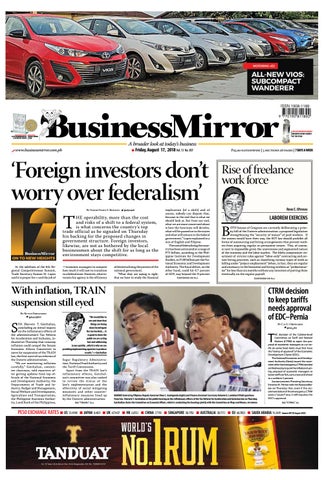
‘Foreign investors don’t worry over federalism’ T
By Elijah Felice E. Rosales
@alyasjah
HE operability, more than the cost and risks of a shift to a federal system, is what concerns the country’s top trade official as he signaled on Thursday his backing for the proposed changes in government structure. Foreign investors, likewise, are not as bothered by the local businessmen about the shift for as long as the environment stays competitive. At the sidelines of the 6th Regional Competitiveness Summit, Trade Secretary Ramon M. Lopez said it is proper for—and the job of
—economic managers to compute how much it will cost to transition to a federal state. However, what interests his agency is the efficiency
of decentralizing the powers of the national government. “What they are saying is right, that we have to study the financial
implication [of a shift] and of course, nobody can dispute that, because in the end that is what we should look at. But from our end, what we are more concerned about is how the functions will devolve, what will be passed on to the states and what will remain in the federal government,” Lopez explained in a mix of English and Filipino. The cost of federalizing the country has been estimated at a range of P72 billion, according to the Philippine Institute for Development Studies, to P130 billion per the National Economic and Development Authority. The fiscal deficit, on the other hand, could hit 6.7 percent of GDP, way beyond the 3-percent Continued on A12
@butchfBM
S
EN. Sherwin T. Gatchalian, concluding an initial inquiry on the inflationary effects of the administration’s Tax Reform for Acceleration and Inclusion, indicated on Thursday that runaway inflation could compel the Senate Economic Affairs Committee to move for suspension of the TRAIN law, the first wave of tax reforms of the Duterte administration. “We are monitoring inflation carefully,” Gatchalian, committee chairman, told reporters after getting updates from top officials of the National Economic and Development Authority, the Departments of Trade and Industry, Budget and Management, Social Welfare and Development, Agriculture and Transportation, the Philippine Statistics Authority, Land Bank of the Philippines,
Rise of freelance work force Rene E. Ofreneo
laborem exercens
B
oth houses of Congress are currently deliberating a priority bill of the Duterte administration: a proposed legislation strengthening the “security of tenure” of paid workers. If the unions would have their way, the SOT law should prohibit all forms of outsourcing and hiring arrangements that prevent workers from acquiring regular or permanent tenure. This, of course, is next to impossible given the unevenness and segmented nature of the economy and the labor market. The likely compromise: enactment of stricter rules against “labor-only” contracting and certain hiring practices, such as classifying various types of work as falling under “project employment” (when, in fact, they are regular and necessary to the business) and hiring workers as “probationaries” for less than six months without any intention of putting them eventually on the regular payroll. Continued on A11
CTRM decision to keep tariffs needs approval of EDC–Pernia
“We would like to see and show that things are being done [to mitigate the tax burden].... It is good to show the public we are acting fast and addressing issues quickly...which is why we are prodding implementing agencies to produce results.”—Gatchalian
Sugar Regulatory Administration, National Food Authority and the Tariff Commission. Apart from the TR AIN law’s inf lationar y effects, Gatchalian’s committee was also tasked to re v ie w t he st at u s of t he law’s implementation and the effectivity of social mitigating measures and other counterinflationary measures lined up by the Duterte administration. See “TRAIN,” A12
PESO exchange rates n US 53.4990
business news source of the year
P25.00 nationwide | 5 sections 28 pages | 7 days a week
With inflation, TRAIN suspension still eyed By Butch Fernandez
2016 ejap journalism awards
By Cai U. Ordinario @cuo_bm
T
Bangko Sentral ng Pilipinas Deputy Governor Diwa C. Guinigundo (right) and Finance Assistant Secretary Antonio G. Lambino II field questions from Sen. Sherwin T. Gatchalian at the public hearing on the inflationary effects of the Tax Reform for Acceleration and Inclusion law on Thursday. Gatchalian chairs the Committee on Economic Affairs, which is conducting the hearings jointly with the Committee on Ways and Means. ROY DOMINGO
HE decision of the Cabinet-level Committee on Tariff and Related Matters (CTRM) to reject the proposal of economic managers to cut tariffs on some food items must first have the “stamp of approval” of the Economic Development Cluster (EDC). The National Economic and Development Authority (Neda) issued the statement after the interagency CTRM decided on Wednesday to junk the inflation-busting proposal of economic managers to lower tariffs on fish, corn, meat and wheat to a uniform 5 percent. Socioeconomic Planning Secretary Ernesto M. Pernia told the B usiness M ir ror on Thursday that, even if the recommendation of the interagency CTRM were a “sound” one, it still requires the EDC’s approval.
n japan 0.4831 n UK 67.9437 n HK 6.8152 n CHINA 7.7155 n singapore 38.7702 n australia 38.7172 n EU 60.7053 n SAUDI arabia 14.2649
See “CTRM,” A2
Source: BSP (16 August 2018 )
News
BusinessMirror
A2 Friday, August 17, 2018
Aspirants for Chief Justice post undergo JBC grilling By Joel R. San Juan
T
@jrsanjuan1573
HE Judicial and Bar Council (JBC) on Thursday quizzed aspirants for the Chief Justice position on their financial and real-property assets, their views on judicial independence and current issues, as well as the programs they intend to implement in the Judiciary if appointed. The public interview of the candidates—Supreme Court Associate Justices Teresita Leonardo-de Castro, Diosdado Peralta, Lucas Bersamin, Andres Reyes Jr., and Regional Trial Court of Tagum City, Davao del Norte Branch 1 Presiding Judge Virginia Tejano-Ang —is a prerequisite before the JBC can come up with a shortlist of nominees for the post, for submission to President Duterte for consideration. The post of Chief Justice became vacant after the Supreme Court ruled on May 11 to grant the quo warranto petition filed by the Office of the Solicitor General, seeking to nullify the appointment of Maria Lourdes
A. Sereno to the post in 2012. The SC decision ousting Sereno became final on June 19, 2018. The President has 90 days to fill up vacancies in the Judiciary under the Constitution. The members of the seven-man JBC panel who attended the public interview were Sen. Richard J. Gordon, who represents the Legislative department; retired Supreme Court Associate Justice Jose Catral Mendoza, who represents the retired justices; retired Judge Toribio Ilao, who represents the private sector; and lawyer Milagros FernanCayosa, who represents the Integrated Bar of the Philippines (IBP). Also members of the panel, but absent during the interview, were Acting Chief Justice Antonio T. Carpio as ex-officio chairman; and Justice Secretary Menardo I. Guevarra, an ex-officio member. The JBC is constitutionally mandated to screen and vet the nominees to the President for vacant posts in the Judiciary and the offices of the Ombudsman and Deputy Ombudsman.
De Castro: 2-month stint no problem
Associate Justice de Castro, during the public interview, was asked on whether she would be able to make a difference in terms of reforms in the Judiciary considering that she only has two months left before she retires from her post. De Castro said she has embarked on several judicial reform programs since 2007, which she hoped to continue if she gets appointed as Chief Justice. She retires in October 2018, when she reaches the mandatory retirement age of 70. “I believe it [impending retirement] will not pose any problem because I’ve been working with my colleagues
since 2007.... I’m optimistic that whatever proposal I will make in this short period of time will get the support of my colleagues,” she added. If appointed, de Castro said she intends to review the case management information system, which allows parties to track the status of their cases. She also plans to reorganize the ethics and ethical standard committee of the SC, which was organized during the time of the late Chief Justice Renato C. Corona but ceased to operate during the term of Sereno. De Castro was also asked about her supposed real-estate properties in Manila, Laguna and Baguio, which she all denied. She said her only properties are in Parañaque and Katarungan Village in Muntinlupa. Her husband is engaged in the business of leasing out real properties. Before the SC, de Castro served as a law clerk in the SC, state counsel for the Department of Justice (DOJ), and presiding justice of the Sandiganbayan. She penned the ruling convicting former President Joseph E. Estrada for plunder during her stint in the Sandiganbayan. In the SC, she penned the decision that declared Estrada eligible to run as mayor of Manila in 2015 after being pardoned by then-President and now House Speaker Gloria Macapagal-Arroyo.
Bersamin: SC to stay independent
Justice Bersamin told the JBC panel that the SC has remained independent despite being considered a “political agency or body” for issuing policy statements that affect the country. “There will always be pressure in the sense that we may be concerned about how the other branches of government would react to our decisions, but that is personal on the part of justices,” he added. Bersamin brushed aside accusations he lacks delicadeza when he accepted the nomination for the CJ post despite being one of those who voted for Sereno’s ouster. “The problem about delicadeza is that it has no definite rules. Even if I joined with the majority in granting the quo warranto, if I should inhibit from applying for this post, it is also but appropriate for those who voted in favor of Serento to also inhibit. It would not be fair if only those who came out against her would inhibit from this selection process,” Bersamin said. However, Bersamin noted that none of those who voted in favor of Sereno applied for the post. Bersamin answered questions on the increase in his income based on his Statement of Assets, Liabilities and Net worth (SALN). The JBC noted that Bersamin’s SALN has a “remarkable increase” of P2 million from 2014 to 2015; and P3 million from 2016 to 2017. Bersamin said his SALN was a joint declaration with his wife. “The jump in my SALN was caused by the cash deposit made by my wife,” Bersamin said.He said his wife is a businesswoman engaged in the sales and importation of high-end movie-making equipment. His wife also invested in properties and she bought a condominium unit, which he only included in his SALN after it was fully paid. Bersamin said his SALN included the allowances he received as member of the electoral tribunal and remuneration when he served as chairman of the Bar Committee in 2017.
Peralta: Marcos burial
The issue on the burial of the late strongman Ferdinand E. Marcos Sr. at the Libingan ng mga Bayani cropped up during the JBC’s interview with Justice Peralta, who wrote the decision allowing Marcos’s burial at the LNMB over the objections of victims of human-rights violations. Asked by the panel whether the decision has really put closure between the Marcoses and the martiallaw victims, Peralta replied: “I hope that issue has really been buried your honor, because if we do not bury that issue then we cannot move on and I still believe that whatever is the past, we have to move on. We will not improve as a nation if we don’t do that,” he said. The JBC also questioned Peralta on the steady increase of his income based on his SALN. His SALN increased by more than P5 million from 2015 to 2017. Peralta replied that his SALN was a joint declaration with his wife, Court of Appeals Associate Justice Fernanda Lampas-Peralta. His SALN also reflected the allowances he received as member of the electoral tribunal, and as chairman of the Bar Examination Committee in 2014. Peralta said his declared income increased further when he received a lumpsum pension of more than P1 million from the Social Security System (SSS) after he reached the age of 65, for his work as a lawyer in the private sector and a law professor before joining the Judiciary.
www.businessmirror.com.ph
Palace issues complete list of 2019 holidays By Bernadette D. Nicolas
@BNicolasBM
M
ALACAÑANG released on Thursday the list of regular holidays and special non-working days for 2019. Based on Proclamation 555 signed by the President on August 15, there will be 10 regular holidays and nine special nonworking days. Proclamations declaring national holidays for the observance of Eid’l Fitr and Eid’l Adha shall be issued after the approximate dates of the Islamic holidays have been determined in accordance with the Islamic calendar or the lunar calendar, or upon Islamic astronomical calculations, whichever is possible or convenient. The implementing guidelines for Proclamation 555, which shall take effect immediately, shall be promulgated by the Department of Labor and Employment. Regular holidays next year include New Year’s Day (January 1, Tuesday), Araw ng Kagitingan (April 9, Tuesday), Maundy Thursday (April 18), Good Friday (April 19), Labor Day (May 1, Wednesday) Independence Day (June 12, Wednesday), National Heroes Day (August 26, Last Monday of August), Bonifacio Day (November 30, Saturday), Christmas Day (December 25, Wednesday) and Rizal Day (December 30, Monday). Special nonworking days include Chinese New Year (February 5, Tuesday), Edsa People Power Revolution Anniversary (February 25, Monday), Black Saturday (April 20), Ninoy Aquino Day (August 21, Wednesday), All Saints’ Day (November 1, Friday), Feast of the Immaculate Conception (December 8, Sunday), last day of the year (December 31, Tuesday) and additional special nonworking days on November 2 (Saturday) and December 24 (Tuesday). The National Commission on Muslim Filipinos shall inform the Office of the President of the actual dates on which the Muslim holidays shall respectively fall.
CTRM. . .
Continued from A1
Based on Executive Order 43, the EDC is tasked to “focus on the promotion of rapid, inclusive, and sustained economic growth.”It is chaired by the Department of Finance and its 10 members include the Neda, Department of Budget and Management, Department of Trade and Industry and the Department of Agriculture, among others. “The CTRM’s decision seems sound and makes good sense,” Pernia said via SMS on Thursday. “[But it] depends on [the] economic cluster.” Instead of tariff cuts, the CTRM pitched for the removal of the special safeguard duty (SSG) on poultry products, maximizing the minimum access volume, and the importation of at least 17,000 metric tons of roundscad (galunggong) for Metro Manila to ease inflation. Former Tariff Commissioner George Manzano said these measures can bring down prices because these will have a direct impact on import costs and supply. As to when consumers will start getting a reprieve from high prices will depend on the level of inventory of the food items. “At the moment cutting tariffs has a lot of dimensions. If the objective is to reduce prices, then cutting tariffs is one way except that cutting tariffs are multidimensional because of social issues, in terms of livelihood, especially if the sector is weak and vulnerable and they have no alternative, they will lose their incomes,” Manzano said. Philippine Institute for Development Studies Senior Research Fellow Roehlano Briones told the BusinessMirror that even if there was no actual cut in tariffs, the CTRM’s recommendations are still aimed at expanding access of imports to the Philippine market. Briones also said it would be better for the CTRM to simplify the country’s tariffs and not have any MAV, or quotas. He said this will be a “better measure” to combat inflation than cutting tariffs or tweaking nontariff measures (NTMs). “Why don’t you go all the way if your objective is to combat inflation? Because certainly reducing tariffs might have minimal effect, less than what you expect,” he said. Briones also said the ideal situation is to ensure that any importation made is a business decision and not due to “political exigency.”This, he said, will have a greater impact on commodity prices in the long run. “In the end, there are only two measures they can do—liberalize trade, which they can do quickly but because of the political fallout they will refuse to do. The other is really more productive and can lower the cost of domestic production,” he said. Whether high prices persist, Ateneo EagleWatch Senior Fellow Leonardo A. Lanzona Jr. said there is a need to cut tariffs or tweak the NTMs. But before putting in place these measures, Lanzona said the government must ensure that there are safety nets that would cushion the impact of lower tariffs and modified NTMs on local producers. The Ateneo economist also said the agriculture sector’s productivity must be boosted and this can be done by encouraging the planting of crops that the Philippines can produce competitively. This means that the government must raise worker skills so that part of the agricultural labor force can be transferred to industry, he said. “It seems to me that we need to do both measures regardless of inflation. If NTMs are easier, then we should do it as soon as possible. But it does not mean that we should maintain the tariffs high,” Lanzona said.
Natl ID. . .
Continued from A12
registrations’ a global priority,” Melhem said. “Assuring the unique identification of citizens and residents was an important symbol of reintegration and reconciliation, especially for those with no identity documents. As a result of this commitment, Peru has accomplished near universal ID coverage today,” she added. Peru’s quest to provide universal identification has led the government to scale the Amazon river on army boats, providing civil registry services to remote communities. By so doing, the government of Peru was able to give focus to the country’s cultural diversity, preserve indigenous languages and promote cultural diversity. Melhem added that Peru also followed the naming practices of their ethnic groups and preserve their country’s cultural heritage.
www.businessmirror.com.ph
The Nation BusinessMirror
Groups laud DENR order to stop quarry ops in Rizal By Jonathan L. Mayuga @jonlmayuga
E
nvironmental groups on Thursday welcomed the plan to stop quarry operations in Rizal province,which,theysaid,isamajorcause of environmental degradation that trigger landslides and flashfloods in the area. Noli Abinales, chairman of Buklod Tao, a community group based in San Mateo, Rizal, supported the call of Marikina Mayor Marcelino Teodoro to stop all quarry operations, particularly in the Upper Marikina River Basin Protected Landscape and its surrounding areas. The group issued the statement after Environment Secretary Roy A. Cimatu ordered to suspend all quarrying activities in Rodriguez and San Mateo, after Ondoy-like floods hit these disaster-prone towns in Rizal, and the nearby city of Marikina. “We have again witnessed nature’s wrath as raging waters damaged homes and besieged communities with mud and garbage. The Ondoy-like tragedy came as no surprise given the steady obliteration of the Marikina watershed and the Sierra Madre by quarrying and other detrimental activities such as waste dumping,” Abinales said in a news statement. “Stopping quarrying operations
is a critical policy that has to be enforced. This has to be supplemented by other measures that will disallow reckless land conversion that is eating up farms and forests in this bastion of biodiversity,” he added. Martin Francisco, chairman of the Save Sierra Madre Environmental Institute (SSMEI), for his part, said all destructive activities in Sierra Madre should be stopped. He said what happened in Rizal, Bulacan and Metro Manila should be a reminder of what can happen when Ondoy struck in 2009. Fr. Pete Montallana, chairman of the Save Sierra Madre Network Alliance (SSMNA), meanwhile, pressed for the protection of the fragile forests of the Sierra Madre to enable the biodiversityrich mountain range to protect Luzon from severe weather disturbances. “Sier ra Madre’s capacit y to shield our communities from storms, rains and floods have been weakened by damaging human activities. To enable her to protect us, decisive action is needed to put an end to activities that defile and destroy the Sierra Madre such as the unchecked logging and quarrying, as well as projects that destroy the forest biodiversity and violate the indigenous people’s rights,” he said.
Editor: Vittorio V. Vitug • Friday, August 17, 2018 A3
Lawmaker calls for coordination, info sharing vs drug smugglers
I
By Jovee Marie N. dela Cruz
@joveemarie
nternational and local syndicates are now adopting innovative ways to sneak illegal drugs into the country, the chairman of the House Committee on Dangerous Drugs on Thursday revealed. Surigao del Norte Rep. Robert Ace S. Barbers, the panel chairman, said the drug scourge has become so dangerous and complicated, notwithstanding the bloody two-year antidrug war being waged by the Duterte administration. Barbers issued the statement after hearing the testimonies of officials from the Bureau of Customs (BOC) and the Philippine Drug Enforcement Agency during the initial committee hearing on what the PDEA alleged was a shipment of P6.8 billion worth of methamphetamine hydrochloride, or shabu, that slipped through the Customs. Barbers also said lack of coordination on intelligence information shar-
ing between government agencies, particularly the BOC and PDEA, contributed to the entry of illegal drugs. According to Barbers, drug syndicates tried to mislead and confuse BOC and other law-enforcement officials by using multiple routes, like Taiwan, and Hong Kong, and different consignees for their shipments that led to the same address. He cited the case of an abandoned shipment with P2.4 billion worth of shabu seized on August 7 at the Manila International Container Port (MICP), and another shipment in Cavite discovered on August 9 by the PDEA, which they
claimed that circumstantial evidence pointed to shabu. The shipment containing the four magnetic scrap lifters that were discovered in Cavite arrived at the MICP from Taiwan, but other reports indicated it actually came from Vietnam. “The syndicates are really trying to outsmart us. They really analyzed how to confuse us and [put] one over on us,” Barbers said. He added the only way to address the drug scourge was through close collaboration among the relevant parties. The PDEA admitted to having received an earlier intelligence report about the possible entry of a shabu shipment. PDEA officials said the ones found in a Cavite warehouse resembled the intelligence report. But during a recent lower chamber hearing, the four magnetic lifters were tested negative for illegal drugs, while the PDEA maintained that the equipment had traces of shabu.
Procedure
Meanwhile, officials of the BOCMICP said they merely followed procedures in releasing a shipment, which the PDEA claimed to have contained
P6.8 billion worth of shabu. The BOC told lawmakers that MICP officials were not remiss in their duties in releasing the said shipment, which the PDEA insisted was part of the P2.4-billion abandoned shabu shipment seized at the MICP. The abandoned shabu shipment with magnetic lifters arrived at the MICP from Taiwan, China. It was consigned to SMYD Trading with address at 6/F Suite 605A Victoria Building, 429 UN Avenue, Manila, with principal officer/manager Marina D. Signapan. The shipment, with assessed duties and taxes totaling P157,673, was tagged “RED” in the BOC’s Selectivity System, thus it underwent x-ray inspection. The x-ray results, however, yielded “no suspect” or no suspicious image, thus, the subject shipment was not physically examined in accordance with Customs Commissioner Isidro S. Lapeña’s memorandum dated September 26, 2017. The memorandum states that “all shipments tagged RED are not required to undergo 100 percent xray Inspection and only those with suspiscious images shall forthwith be physically examined.”
A4 Friday, August 17, 2018 • Editor: Vittorio V. Vitug
Economy BusinessMirror
www.businessmirror.com.ph
Labor strike notices grew 18.7% in H1–DOLE data By Samuel P. Medenilla
M
@sam_medenilla
ore workers threatened to hold work stoppage in the first half of the year due to disputes with their management, the Department of Labor and Employment (DOLE) reported.
In a document obtained by the BusinessMirror, the DOLE’s National Conciliation and Me
diation Board (NCMB) reported the number of notice of strikes (NOS) from January to July this
year have reached 155. This is 18.7 percent higher compared to the 126 NOS figures during the same period last year. The bulk, or 86, of the NOS cases filed to the DOLE this year stemmed from unfair labor practice (ULP), while the remaining 30 was due to deadlocks because in collective bargaining deadlock (CBD). Only eight cases could be attributed to both ULP and CBD. Despite the surge in number of NOS, few of the said cases escalated to a full blown labor strike. During the first six months of 2018, NCMB said, it only handled five labor strikes nationwide. One
155 The number of NOS filed with the DOLE from January to July this year
of the said cases was even classified as a “wildcat strike” since the involved workers who did not comply with the NOS requirement. The five labor strike cases were
from Goodyear Steel Pipe Corp., Ateneo de Manila University, Middleby Philippines Inc., NutriAsia Inc. and Valencia Rubbertex Inc. Except for the case of Valencia Rubbertex Inc., all of the said cases were successfully resolved by the NCMB. Compared to the 13 labor strikes during the same period last year, this was significantly lower. In a news statement, the Bukluran ng Manggagawang Pilipino (BMP) attributed the “emerging labor unrest” to the “ambiguous” government policy on contractualization, particularly DOLE’s Department Order (DO) 174.
The labor group claimed DO 174 exposed contractual workers to the retaliatory attack of employers, instead of improving their welfare. DO 174 contained stricter policies for the registration of service contractors, as well as stricter definition of illegal forms of contractualization. BMP President Luke Espiritu said “employers abruptly terminated their workers after being discovered [by DOLE] to have violated multiple labor standards including DO 174.” He urged the DOLE to addressed the “loopholes” in its policies on contractualization to eliminate the “litiguous nature” of its regularization orders.
Workers to get double pay NEA to assume mgmt of Zambo City power co-op on Tuesday’s twin holidays T
E
mployees can expect to get more than double their daily pay if they report for work during the unprecedented two holidays in a single day this coming Tuesday, August 21. In an advisory, Labor Secretary Silvestre H. Bello III confirmed that pay rules for a both a regular and a special holiday will be in effect on Tuesday, which will commemorate the Ninoy Aquino Day and the Muslim celebration of Eid’l Adha. The labor chief issued the clarification amid confusion on which pay rules to follow during the unprecedented twin celebrations. On the said date, employees, who will be on duty will be paid twice their daily pay with costand-living allowance and another 30 percent of
the said rate (0.30 [daily rate x 200 percent]). They will also be entitled to an additional 30 percent of their basic hourly rate if they will work overtime and 50 percent of their daily rate if the holiday will fall during their rest day. Workers will still receive 100 percent of their salary on that date if they opt to spend it on a vacation. Usually, only Ninoy Aquino Day, which is a special nonworking holiday, is observed every August 21 to honor the contribution of the late Sen. Benigno “Ninoy” Aquino. However, this year, the date will also coincide with the Muslim celebration of Eid’l Adha, which changes date depending on the Islamic lunar calendar. Samuel P. Medenilla
he National Electrification Administration (NEA) has announced that it plans to partially and temporarily take over the management of the Zamboanga City Electric Cooperative (Zamcelco) in order to help resolve key issues besetting the power co-op. The impending NEA takeover is also primarily meant to ensure a smooth, orderly, timely and transparent process for the selection of a credible and experienced power distributor that will undertake the operations and management of Zamcelco under an investment management contract (IMC). Zamcelco is reeling from a systems loss level of 23 percent and more than P2 billion in liabilities that includes
over P1.3 billion in outstanding debt to power suppliers. NEA Administrator Edgardo Masongsong made the announcement at the end of a power stakeholders summit presided over by NEA in Zamboanga City last Friday. The summit, which was initiated by Zamboanga City Rep. Celso L. Lobregat, brought together the city’s various stakeholder segments, including consumer and industry groups, local and national government officials, as well as community and religious leaders. Masongsong stated that NEA would undertake the partial and temporary takeover of Zamcelco in response to a unanimous clamor from stakeholders
attending the summit for NEA to intervene and ensure a timely and transparent process for the selection of an IMC contractor. Among the attendees were Zamboanga City Mayor Maria Isabelle Climaco-Salazar and the city’s two Congressional representatives. Masongsong said he expected to receive approval from the NEA board within the week of August 13. There are currently five interested bidders for the Zamcelco IMC contract including the Manila Electric Co., the country’s largest power distributor through its subsidiary Comstech Integrated Alliance Inc., and AboitizPower subsidiary Davao Light and Power Co. Jovee Marie N. dela Cruz
Agriculture/Commodities BusinessMirror
www.businessmirror.com.ph
DA ‘confident’ of hitting production goals in 2019 By Jasper Emmanuel Y. Arcalas
D
@jearcalas
espite the double-digit cut in its allocation for 2019, the Department of Agriculture (DA) said it remains confident that it would be able to achieve its production targets for next year. File photo
Agriculture Secretary Emmanuel F. Piñol also said the removal of “nonessential” programs would free up resources that could be used for the more important initiatives of the department. “Yes, I am confident,” Piñol told the BusinessMirror in an interview last week when asked if he is confident that the allocation received by the DA would enable the agency to help boost farm sector performance next year. “We have made very drastic reforms on the way we will use our budget. We will do away with the nonessential programs that have been in the budget line for so long, such as the distribution of
wheelbarrows,” he added. Under the national expenditure program for 2019, the DA received an allocation of P49.804 billion, 10.54 percent lower than its budget of P55.671 billion for this year. Documents provided by the DA during a budget hearing at the House of Representatives showed that the agency is spending at least P10.507 billion for the rice industry. The agency is targeting to grow unmilled rice production by 3.07 percent to 20.47 million metric tons, from the estimated 19.86 MMT output this year. One of the DA’s strategies to boost rice output next year is to hike average yield to 4.28 metric ton (MT)
per hectare, from this year’s 4.14 MT per hectare. Documents also showed that the DA allocated P2.548 billion to increase output by 4.81 percent to 8.861 MMT next year, from the projected production of 8.454 MMT this year. To help boost local livestock and poultry production, the DA will spend at least P3.81 billion next year. The agency is aiming to hike hog output to 2.185 MMT, 1.3 percent higher than this year’s projected output of 2.157 MMT. For chicken production, the DA is seeking to expand it by 2.9 percent to 1.845 MMT in 2019, from the target output of 1.793 MMT
this year. The DA also aims to produce 81 MT of goats, 25 MT of dairy and 499 MT of chicken eggs. Documents also showed that the DA would spend P4.663 billion to improve high-value crops yield next year. For banana, the DA’s target yield is 22.9 MT per hectare; mango, 5.18 MT per hectare; and pineapple, 42.75 MT per hectare. Data from the Philippine Statistics Authority showed that t he fa r m sector’s g ross output expanded by 3.95 percent year-on-year in 2017. The crops subsector, which accounted for half of farm production last year, recorded a 6.69-percent hike in output.
Editor: Jennifer A. Ng • Friday, August 17, 2018
A5
Good weather allows commercial fishers to hike catch in Q2–PSA
T
he country’s fisheries output in the second quarter rose by 2.6 percent to 1.133 million metric tons, from 1.104 MMT a year ago, according to the Philippine Statistics Authority (PSA). The PSA attributed the increase to favorable weather conditions and higher unloading volume by fishermen. “Of the three subsectors, commercial fisheries and aquaculture pulled up its output, while municipal fisheries subsector displayed downtrend,” the PSA said in its report, titled “Fisheries Situation Report,” published recently. Commercial fisheries catch during the period went up by 2.27 percent to 287,682.04 MT, f rom 281,302.65 MT recorded du r ing t he Apr i l-to -Ju ne period of 2017. “The increment was attributed to more unloading of skipjack for canneries in General Santos City Fish Port in Soccsksargen,” the PSA said. “Likewise, there were more unloading of fish species in Navotas Fish Port as a result of conservation measures previously implemented in Visayan Sea and Zamboanga Peninsula fishing grounds,” it added. Aquacu lture production ex panded by 5.81 percent to 550,014.1 MT, from 519,801.6 MT recorded last year due to
government interventions and good weather. “Growth rates were achieved in Central Luzon and Mimaropa through various interventions of the Bureau of Fisheries and Aquatic Resources and local government units, which include the distribution of fingerlings and other planting materials,” the PSA said. “Favorable weather conditions also prevailed during the period.” The production of the municipal fisheries subsector during the second quarter declined by 2.46 percent to 295,641.27 MT, from the previous year’s 303,091.36 MT. Marine fisheries output, which accounted for 86.4 percent of the total municipal fisheries catch, reached 255,446.55 MT. The volume was 3.44 percent lower than the 264,558.77 MT recorded volume during the Aprilto-June period of 2017. T he rem a i n i ng volu me of the municipal fisheries output came from inland fishing, which posted a 4.32-percent increment in production during the period. Inland fishing production reached 40,194.72 MT compared to the 38,531.59 MT recorded a year ago. “The decline was due to less fishing efforts brought about weather disturbances that prevailed during the period,” the PSA said. Jasper Emmanuel Y. Arcalas
The World A6
Friday, August 17, 2018
Editor: Angel R. Calso
China-US to resume low-level talks in bid to resolve trade war
C
hina will dispatch Vice Commerce Minister Wang Shouwen to the United States for low-level trade talks in late-August, the first official exchanges since earlier negotiations broke down two months ago. The Chinese delegation led by Wang will meet with an American group led by David Malpass, under secretary for international affairs at the Department of the Treasury, at the invitation of the US, China’s Ministry of Commerce said in a statement on its web site on Thursday. The news buoyed risk sentiment in Asian trading, with futures on the S&P 500 Index rallying as much as 0.4 percent. The offshore yuan gained against the dollar for the first time in seven days. “This will be ‘talks about trade talks,’” said Gai Xinzhe, an analyst at the Bank of China’s Institute of International Finance in Beijing. “Lower-level officials will meet and haggle and see if there is a possibility for higher-level talks.” China’s equity market has suffered declines and the yuan has been on a losing streak for more than a month. Chinese authorities, bracing for an economic fallout, have introduced measures to support growth ranging from shifting toward a more accommodative monetary policy to boosting fiscal spending. The two nations had appeared to have reached a deal in May after Chinese Vice Premier Liu He—President Xi Jinping’s top economic adviser— led a group of officials to Washington. But Trump backed away from the agreement soon afterward, and ever since the two sides have been locked in a trade standoff as they slapped
tariffs on billions of dollars of each other’s goods. The commerce ministry reiterated in the statement that China is against trade protectionism and won’t accept any unilateral trade restrictions. “China welcomes communications and dialogue on the basis of reciprocity, equality and integrity,” it said. The Trump administration imposed duties on $34 billion of Chinese goods last month, a move that also prompted immediate retaliation from Beijing. Another $16 billion in levies will be effective later in August. Earlier this month, China announced a list of $60 billion worth of US imports it plans to apply tariffs on, after Trump ordered officials to consider imposing a 25-percent tax on $200 billion worth of Chinese goods, up from an initial 10-percent rate. Wang, who is the key official leading China’s trade talks worldwide, led an advance team to Washington in May. In a July interview, he told Bloomberg that he didn’t understand why the US quickly reversed its course. “Good faith negotiation is required,” Wang said then. “For any talk to be successful, no party should point a gun at the other party.” Economists weren’t expecting much from the planned talks. “Malpass has no trade authority,” said Derek Scissors, chief economist at the China Beige Book. “But nice for Chinese stocks.” Bloomberg News
U.S. media to Trump: We’re not enemies of the people
N
EW YORK—The nation’s newsrooms are pushing back against President Donald J. Trump with a coordinated series of newspaper editorials condemning his attacks on “fake news” and suggestion that journalists are the enemy. The Boston Globe invited newspapers across the countr y to stand up for the press with editorials on Thursday, and several began appearing online a day earlier. Nearly 350 news organizations have pledged to par ticipate, according to Marjorie Pritchard, op - ed editor at the Globe. In S aint Louis the Post-Dispatch called journalists “the truest of patriots.” The Chicago Sun-Times said it believed most Americans know that Trump is talking nonsense. The Fayetteville N.C. Observer said it hoped Trump would stop, “but we’re not holding our breath.” “Rather, we hope all the president’s supporters will recognize what he’s doing— manipulating reality to get what he wants,” the North Carolina newspaper said. Some newspapers used histor y lessons to state their case. The Elizabethtown Advocate in Elizabethtown, Pennsylvania, for instance, compared free press in the United States to such rights promised but not delivered in the former Soviet Union.
‘The New York Times’ added a pitch
“If you haven’t already, please subscribe to your local papers,” said the Times, whose opinion section also summarized other editorials across the country. “Praise them when you think they’ve done a good job and criticize them when you think they could do better. We’re all in this together.” That last sentiment made some journalists skittish. The Wall Street Journal, which said it was not participating, noted in a column by James Freeman that the Globe’s effort ran
counter to the independence that editorial boards claim to seek. Freeman wrote that Trump has the right to free speech as much as his media adversaries. “While we agree that labeling journalists the ‘enemy of the American p e o p l e’ a n d j o u r n a l i s m ‘f a ke n e w s’ i s not only damaging to our industr y but destructive to our democracy, a coordinated response from independent— dare we say ‘mainstream’—news organizations feeds a narrative that we’re somehow aligned against this Republican president,” the Baltimore Sun wrote. Still, the Sun supported the effort and also noted the deaths of five Capital Gazette staff members at the hands of a gunman in nearby Annapolis, Maryland. Th e R a d i o Te l e v i s i o n D i g i t a l Ne w s Association, which represents more than 1,200 broadcasters and web sites, is also asking its members to point out that journalists are friends and neighbors doing important work holding government accountable. “I want to make sure that it is positive,” said Dan Shelley, the group’s executive director. “We’re shooting ourselves in the foot if we make this about attacking the president or attacking his supporters.” It remains unclear how much sway the effort will have. Newspaper editorial boards overwhelmingly opposed Trump’s election in 2016. Polls show Republicans have grown more negative toward the news media in recent years: Pew Research Center said 85 percent of Republicans and Republicanleaning independents said in June 2017 that the news media has a negative effect on the country, up from 68 percent in 2010. Still, newsrooms are trying to convince them otherwise. “We are not the enemy,” declared the Mercury News in San Jose, California. AP
Editor: Angel R. Calso | www.businessmirror.com.ph
The World BusinessMirror
US says Turkey tariffs to stay; Qatar comes to Erdogan’s aid
T
he United States and Turkey remained locked in a stalemate that has jolted global markets, as the White House said new tariffs on Turkish goods would remain and President Recep Tayyip Erdogan received a financial lifeline from Qatar that should buy him time in the standoff.
The Trump administration said on Wednesday that Erdogan’s imposition of retaliatory tariffs against the US were “a step in the wrong direction.” In a sign the conflict is far from over, White House Spokesman Sarah Sanders said US tariffs announced last week will stay in place regardless of whether an American pastor detained in Turkey is freed. As Erdogan sought to cushion the impact of the crisis on Turkey’s economy, he reached out to German Chancellor Angela Merkel for possible assistance and won a promise from Qatar’s emir to invest $15 billion. The plight of the American pastor, Andrew Brunson, has dominated the Trump administration’s strategy toward its the North Atlantic Treaty Organization ally, even as the dispute roiled currency markets. Brunson, who Turkish officials say had links to a failed 2016 coup, is being held under house arrest. A lower court earlier on Wednesday turned down his lawyer’s request to free him, and the US—which rejects Turkey’s accusations— has said it won’t negotiate until he’s released. Administration officials said the US doesn’t currently have any meetings scheduled with Turkish officials to discuss Brunson’s case.
‘National security’
“The tariffs that are in place on steel won’t be removed with the release of Pastor Brunson,” Sanders said, because they were imposed on “national security” grounds. As the dispute festers, Turkey announced on Wednesday a string of new tariffs ranging from 50 percent to 140 percent on rice, alcohol and cars from the US in retaliation for President Donald J. Trump’s move to double tariffs on Turkish steel and aluminum imports last week. The punitive steps come after Erdogan called on Turks to boycott American electronics, such as Apple Inc.’s iPhone, which have in any case become more expensive as the lira lost almost 40 percent of its value this year. Nevertheless, Erdogan won a reprieve on Wednesday after Qatar’s emir promised to invest $15 billion in the country. That followed a string of urgent steps Erdogan has taken to protect Turkey’s economy, which was already under strain before the latest US tariffs and sanctions were announced. Yet the Qatari announcement won’t solve Erdogan’s fundamental economic problems. The currency meltdown this month has already made it much more costly for businesses to refinance at least $16 billion in bonds denominated in foreign currencies that are due by year-end, according to calculations by Bloomberg. In total, companies in Turkey have $217 billion in net foreign-exchange debt, equal to about a quarter of gross domestic product, according to central bank data. While officially the bad debt ratio at Turkey’s banks is just 3 percent, lenders are in the process of renegotiating upwards of $20 billion of loans to try to prevent them from going into default.
Regulator’s moves
The International Monetary Fund urged Turkey to adopt sound economic policies to promote stability and reduce imbalances at a time of market volatility, Reuters reported, citing comments on Wednesday by an unidentified spokesman for the agency. The spokeman said that Turkish authorities had so far given no indication that they intended to seek IMF assistance, according to the report. The nation’s banking regulator said late Tuesday that lenders can now extend maturities on or refinance loans, issue new debt to help troubled companies, and seek new collateral to protect themselves. They can also demand debtors sell assets to repay loans. Erdogan also moved to strengthen ties with Germany, Turkey’s biggest economic partner by far, accounting for about €37 billion ($42 billion) in bilateral trade last year. Relations between the two countries had deteriorated as Erdogan consolidated power after the failed coup, prompting disputes that led Germany to withdraw troops from Turkey and a long-running diplomatic standoff over a jailed German journalist. Nevertheless, Germany wants Turkey to avoid a financial meltdown and can’t allow the country
to descend into chaos, according to a person familiar with Merkel’s thinking who asked not to be identified discussing government deliberations. In an overture that signals normalizing relations after a series of diplomatic clashes, Germany plans to host Erdogan for a state visit on September 28. “No one has an interest in the economic destabilization of Turkey,” Merkel said in Berlin this week. But support from Qatar and Germany can’t fix Erdogan’s problems, and the US has signaled it’s unfazed by Erdogan’s retaliations.
“Any help that Germany could give right now would be small compared to the problems at hand,” Holger Schmieding, chief economist at Berenberg Bank, said by phone. While Erdogan can buy time, it’s not clear how the standoff with the US can be resolved so long as Turkey continues to detain the pastor. The US president believes Erdogan reneged on an earlier deal to free Brunson, while Erdogan has his own set of grievances—including a demand that the United States extradite a former ally he blames for the failed coup—that predate the latest crisis. Bloomberg News
Friday, August 17, 2018
A7
Euro’s prospects grim as Turkey turmoil sets up further sell-off
T
he euro’s bad year could be about to get worse. The common currency has fallen more than 5 percent in 2018, and analysts see the downward trend continuing even if the market turmoil in Turkey eases. As euro-area growth slows and rate differentials lead investors to unwind bullish euro positions from earlier in the year, Deutsche Bank AG and Nomura International Plc. see a possibility the currency will drop as low as $1.10. “I think $1.10 is the next stop, and we are underweight the euro,” said Alessio de Longis, an OppenheimerFunds money manager, in an interview on Bloomberg TV. “It’s this confluence of factors of weakening growth and rising credit risks that makes this a bit of a vulnerable situation.” The common currency has been knocked in recent months by the European Central Bank signaling it sees interest rates staying at current levels through the summer of
2019, with a revision lower to euro-area inflation last month reinforcing the case. As the Federal Reserve continues on its hiking path, the two-year yield differential between US Treasuries and German bonds is near the widest since data began.
Turkey catalyst
The euro touched a 13-month low at $1.1301 Wednesday, having slid from above $1.25 early in 2018. It was little changed at $1.1349 as of 4:47 p.m. in New York. Options markets show strong demand for longer-term downside exposure, with one-year risk reversals moving to as much as 139 basis points in favor of euro puts, the most bearish sentiment since April 2017. Turkey hasn’t helped, spurring a selloff in European bank stocks as data from the Bank for International Settlements indicates Spanish lenders are among the most exposed. Bloomberg News
A8
Friday, August 17, 2018
Banking&Finance BusinessMirror
Finex pitches resort to fintech
T
By Rea Cu
@ReaCuBM
O promote financial inclusion in the country, the government, as well as the private sector, will need to tap financial technology (fintech), which is increasingly becoming more accessible now with digitization, to reach more Filipinos, the Financial Executives Institute of the Philippines (Finex) said. “We all recognize that if we use technology then we can reach out to a greater population, we can reach out to Filipinos located in places where there are no banks or financial institutions. Yes, we do support that [using fintech], even the BSP [Bangko Sentral ng Pilipinas] is pushing for that as well,” Finex President Ma. Victoria C. Españo told the BusinessMirror at the sidelines of the Ayala-Finex Finance Summit on Wednesday at the Fairmont Hotel in Makati City. She said one of the advocacies of Finex is furthering financial inclusion in the Philippines, and this is why it supports the call of the government for companies—especially micro, small and medium enterprises (MSMEs)—to tap fintech tools for their businesses. KPMG Australia Associate Director for Data and Analytics Advisory Team, Ahsan Mehmood, who was also the keynote speaker during the summit, told the BusinessMirror that there is potential for the Philippines to be a regional hub for fintech-related activities, so long as it
pushes forward in adapting to technological advancements presented by the region, as well as the world. “There are some neighbors that can be looked at such as Vietnam. They have invested heavily in fintech-related start-ups and are seeing tremendous growth. I think the Philippines can definitely adopt a similar strategy and to grow in that sector and provide a regional hub for fintech-related activities and investments,” Mehmood said. When asked whether the Philippine government’s move to encourage businesses to tap fintech is a step in the right direction, Mehmood explained that it posts a positive sign for the country since fintech is seen to be the future. “And looking at the Asian market, there’s massive improvement in the amount of money that is spent on fintech, and the way the industry ecosystems are evolving, fintech is the future. And I think that’s definitely a positive sign,” he added. Local business, he pointed out, would get a lot of value from the use of fintech, blockchain or even arti-
ficial intelligence, as it is one way of combating disruptions presented by the external environment. “I think it would definitely be relevant considering the impact of regional or global industry reforms on the country itself. I think as an enabling technology, there is a lot of potential and a lot of value that businesses can achieve by using capabilities such as artificial intelligence... With the disruptive environment that we live in, if we don’t adapt these enabling technologies, then I think you face the threat of putting your business at risk. The message is quite simple: be it artificial intelligence, blockchain or automation, the message is, you need to have that right strategy to integrate or otherwise risk disruption,” he said. Españo explained, meanwhile, that the Philippines has yet to fully adapt the use of artificial intelligence, for instance, since she sees that only a few big companies are open to using the said technology since it requires a lot of data. “I think for the conglomerates, artificial intelligence is possible when you have data to analyze and gain insights. I think Philippine companies are still doing things on a manual basis. Maybe the big ones yes they are into it, because as I pointed out if you don’t have data in a structured way or capture it in a way that would be easily accessible then that’s going to be a challenge,” she said.
DOF’s pitch
Last month the Department of Finance (DOF) urged MSMEs to utilize electronic commerce (e-commerce) more, as the Duterte administration
increases its efforts to put in place fintech tools to foster economic inclusion in the country. Finance Secretary Carlos G. Dominguez III said the new fintech tools pitched by the government open a wide horizon of business opportunities for MSMEs, including peer-to-peer lending, equity crowdfunding, merchant and e-commerce finance and invoice finance. Also during the same month, the Cagayan Economic Zone Authority (Ceza) reported that it is eyeing to bring in P3.6 billion of investments from fintech firms after the first blockchain operator in the region was granted a license to operate. Ceza Senior Deputy Administrator Raymundo T. Roquero said the agency has given the green light to three fintech firms to operate in Cagayan’s economic zone (ecozone). The Ceza is allowing only 25 fintech companies to do business in the region for the year, and the first to be handed a license was the Golden Millennial Quickpay Inc. Ltd. Golden Millennial was said to have invested $1 million in the Ceza for its start-up, along with two other firms engaged in cryptocurrency, or digital money. Its operations, he added, will require 5,000 workers. In May the Monetary Board of the BSP approved the creation of a regulatory subsector for fintech companies as part of the broader goal to bring them into line as the economic landscape changes. BSP Deputy Governor Chuchi G. Fonacier said the country’s central monetary authority seeks only to ensure a level and safe playing field for the fintech firms given their growing influence in the banking scene.
www.businessmirror.com.ph
The 3 Rs of association management
O
N August 8, 2018, the Philippine Council of Associations and Association Executives (PCAAE), the “association of associations” in the country, and EventBank, a leading cloud-based engagement management technology company, jointly held a panel session on “Best Practices in Membership Management” at the Philippine International Convention Center. The event was attended by over a hundred participants from associations, chambers of commerce, and other membership and service organizations. The panel was composed of myself; Mr. Charlie Villasenor, chairman of the Procurement & Supply Institute of Asia; Mr. Ebb Hinchliffe, executive director of the American Chamber of Commerce of the Philippines; and Eloisa M. Acosta, chief operating officer of the Institute of Internal Auditors Philippines. It was moderated by Eric L. Schmidt, cofounder and CEO of EventBank. The panel discussed wide-ranging topics on membership engagement practices and challenges, member retention rates, key performance indicators for associations, data protection issues, social media, technology adoption and other related subjects. During the panel discussion, I shared three mutually reinforcing factors that would make or break an association. I called them the “3 Rs” of association management, adapting it from the 3 Rs that we learn in grade school which refer to the foundations of a basic skills-oriented education program: reading, (w)riting, and (a)rithmetic (as discussed in my August 10, 2016, column entitled, “Are Associations Headed for Extinction?”). According to Wikipedia, the phrase 3 Rs came from a speech given by Sir William Curtis, a member of Parliament, in about 1795.Since its original creation, many others have used the term to describe other “sets of three things.” So, here is my adaptation of the 3 Rs in association management which I learned from experience: Relevance—This goes back to the fundamental adherence of an association to its purpose and mission and, consequently to the value proposition it provides to its members. In the 7 Measures of Success: What Remarkable Associations Do that Others Don’t, published by the American Society of Association Executives (ASAE), successful associations have kept their products and services aligned with their mission even in
Association World Octavio Peralta the midst of changes in the external environment. Relationship—This relates to the engagement of the association, first and foremost, with its members and then with other stakeholders, e.g., partners, donors, regulators, etc. Effective member engagement plays a crucial role in promoting an association’s core values and message. Engaged members act as “brand ambassadors” and become a key asset able to transform passive members into “multipliers,” according to the Geneva-based MCI Group, a global research and consulting organization (please refer to my column on September 27, 2017, entitled “Effective Member Engagement for Associations.”) Building and nurturing relationships is an essential part of an association’s DNA. Resources—This refers to human, financial, and collaboration resources that an association needs to develop, maintain, and increase for growth and sustainability. First, the quality of an association depends on the quality of its people. Second, associations need financial resources (and ample reserve funds) to operate and sustain their work and advocacies. And third, associations have to take advantage of what partnership and collaboration opportunities additionally bring to their benefit. The column contributor, Octavio Peralta, is concurrently the secretary-general of the Association of Development Financing Institutions in Asia and the Pacific (ADFIAP) and CEO and founder of the Philippine Council of Associations and Association Executives (PCAAE). PCAAE is holding its Sixth Associations Summit on November 23 and 24, at the Subic Bay Exhibition and Convention Center (SBECC). The event is hosted by the Subic Bay Metropolitan Authority (SBMA) and supported by the Tourism Promotions Board (TPB). PCAAE enjoys the support of ADFIAP, TPB, and the Philippine International Convention Center. E-mail obp@adfiap.org
BOTcoin plans on saving Pasig River with blockchain tech F ILIPINO entrepreneur and environmentalist Mariano Jose Diaz Villafuerte IV, CEO of CypherOdin Inc. and cryptocurrency BOTcoin, wants to clean up the world’s rivers and seas with blockchain, a distributed ledger platform (DLT). Villafuerte has identified the 27-kilometer-long Pasig River, as his firm’s first proof of concept (POC). The river is one
of the dirtiest and most heavily polluted rivers of the Philippines. “We first came up with the idea of showcasing how blockchain technology can solve real-world problems and clean up the environment specifically, using Boracay Island [a worldfamous tourist resort island in central Philippines] as an example. However, the government shut the island down in April, so we looked at
the Pasig River instead as the next most important body of water in the country,” Villafuerte said. He explained how his company plans to install Internet of Things (IoT) devices on the river and underwater (IOUT) to monitor water quality or tide levels and other relevant data to track and monitor their progress in real time. This will enable them to generate and analyze the data produced that will
serve to create the impact they are looking for toward solving the plastic and garbage problem that silts the river. For even more utility, he said CypherOdin would be using drones to map the plastic using Lidar on a microscopic level. “We will collect all the data we gather from these IoT and process them so we will have comprehensive information on where the plastics and garbage are com-
ing from, how they are moving, among others. This would allow us to analyze and come up with recommendations on how to best cleanup the rivers of this debris,” he added. But as part of its holistic approach, Villafuerte said they also plan on launching a massive information drive, particularly to communities along the riverbanks and near the river about the
importance of proper garbage disposal and how to protect the environment. The communities, he said, would be incentivized with BOTcoin cryptocurrency for a certain amount of garbage they collected on the river and for not throwing plastics on it. BOTcoin is the first digital currency which aims to create a world free of waste and restored to its pristine state
www.businessmirror.com.ph
The Regions BusinessMirror
Editor: Dennis D. Estopace • Friday, August 17, 2018
A9
Militants slam DENR’s Boracay wetlands rehab
M
ILITANTS belonging to the Pambansang Lakas ng Kilusang Mamamalakaya ng Pilipinas (Pamalakaya) slammed the Department of Environment and Natural Resources for what they call the DENR’s “pseudo-revival” of wetlands on Boracay Island.
Pamalakaya Chairman Fernando Hicap lamented the DENR’s move to allow big-time companies to “adopt” wetlands situated in the shuttered resort island. DENR officials on Tuesday signed separate memorandum of agreements (MOA) with two companies. Aboitiz Equity Ventures Inc. Chief Operating Officer Sabin Aboitiz and Aboitiz Foundation Inc. head Maribet Marasigan represented the corporate group adopting Wetland 4. Energy Development Corp. President and COO Ricardo Tantoco and EDC Senior Manager for Corporate Social Responsibility and Watershed Management Allan Barcena signed on behalf of the Lopez-owned company for the adoption of Wetland 2.
The partnership aims to allow the private company to rehabilitate and subsequently invest in and transform their adopted wetland into an ecological or nature park. “The motive behind the closure of Boracay has been finally revealed with the permission of the DENR to big-time companies to interfere in the rehabilitation of the island under the guise of ‘reviving’ its wetlands,” Hicap said. The DENR has decided to partner with private firms to revive six of the nine wetlands of Boracay Island through the government’s “adopt a wetland” program. Closed for six months, Boracay Island, the country’s top tourist destination situated in Malay, Ak-
This August 15 photo shows a handful of people walking along the stretch of Boracay beach after it was closed to tourists on April 26. Tourism Regional Director Helen Catalbas told reporters the reopening of Boracay six months after its closure wouldn’t be grand. “We [in the DOT] expect that the reopening of Boracay would be simple. Expect no fireworks,” Catalbas said. Jun N. Aguirre
lan, is currently undergoing massive rehabilitation. Among the problems identified by the Boracay Interagency Task Force is the encroachment by businesses and informal settlers of what should have been “no-build zones” like forest and wetlands on Boracay. They said something is fishy about the closure of Boracay, which started on April 26 because members of humanitarian
Proposed law to expand banks in towns sought for House OK
I
N step with the government’s goal of financial inclusion for all Filipinos, the House Committee on Banks and Financial Intermediaries has endorsed for plenary approval a measure creating “Bangko sa Baryo.” Rep. Luis Raymund F. Villafuerte Jr. of Camarines Sur, principal author of the bill, said House Bill 5629, or “Bangko sa Baryo Act,” seeks to widen the access of the country’s unbanked sectors to financial services. The HB 5629 authorizes “cash agents” to help serve the banking needs of people living in faraway places without banks. According to the bill, authorized cash agents “should be able to assist in performing a broad range of bank services, including forwarding account opening applications, cashin and cash-out services, and initial customer identity verification—especially for anti-money laundering and combating financing of terrorism efforts.” Under the measure, cash agents will have to undergo rigid screening procedures by the contracting bank and the Bangko Sentral ng Pilipinas
(BSP) before they can be authorized to perform such functions. The bill also aims to increase citizen’s financial literacy and capability so they understand different financial services. Villafuerte, a member of the House Committee on Banks and Financial Intermediaries, said local government units (LGUs) are the key to the success of his proposed Bangko sa Baryo law. Under the bill, LGUs will directly assess the necessity for a banking presence in their respective localities and provide incentives to cash agents to encourage them to set up their facilities wherever needed. The LGUs are also tasked under the bill to hold financial literacy and capability programs in their respective barangays to increase the understanding of the public about the financial services and products that banks offer and their benefits, Villafuerte said. HB 5629 also seeks to help encourage saving and investing among Filipinos, of whom 60 percent remain unbanked, according to World Bank estimates.
Villafuerte said more than 36 percent of all municipalities in the country have no banks. “Soon, an average barrio folk will be able to make sound financial decisions and put his hard-earned money to beneficial use with the assistance of these authorized cash agents,” Villafuerte said. Citing Asian Development Bank studies, Villafuerte said only 28 percent of Filipino adults own a bank account and only about 15 percent save money with a formal financial institution over a 12-month period, while only 10 percent borrow money from formal institutions over a similar timeframe. Villafuerte, meanwhile, urged the House leadership to pass House Bill 5629 soon enough in support of the government’s stepped-up drive for financial inclusion. According to the lawmaker, his measure would now be easier to implement with the National ID system that the government is about to put in place, following its signing into law of the Philippine Identification System Act by President Duterte on August 6. Jovee Marie N. dela Cruz
Ilocos Sur farmers get equipment from DAR
V
ARIOUS farmers’ organizations recently received farm machines and equipment worth P17 million from the Department of Agrarian Reform (DAR). A total of 13 agrarian reform beneficiaries’ organizations (Arbos) in Ilocos Sur benefited from the DAR’s various projects. DAR Assistant Secretary for Support Services Teresita Vistro,
Ilocos Sur Vice Gov. Jeremias Singson and Caoayan, Ilocos Sur, Mayor Juan Paolo Ancheta witnessed the turnover ceremony held this week at the NSCC Industrial park in Caoayan, Ilocos Sur. DAR Regional Director Judita Tungol said the equipment package includes 13 farm tractors and two units of combined harvesters. Tungol added the farm equip-
ment was turned over to five different Arbos based in Ilocos Sur’s First District and Second District. The farm machines were given as “equipment grant,” which will be operated by the farmers’ organization as business assets, where user fees would be collected and utilized for the operation and maintenance of the farm equipment. Jonathan L. Mayuga
and fact-finding missions were prevented by authorities from entering the remote island. “We knew it from the start; the cleanup drive of Boracay is actually a farce. Shutting down small and medium structures and displacing some residents as a precursor to the
entry of big businesses and investors to further privatize the island,” added Hicap, who formerly represented the Anakpawis Party-list in the House of Representatives. “We don’t buy the idea that these companies notorious for raking profit from environmental exploitation
will help rehabilitate Boracay out of benevolence; there have to be covert negotiations with [Secretary Roy A.] Cimatu that the public doesn’t know about.” The Pamalakaya national leader also expressed fears the famous tourist island would be converted into a world-class integrated commercial and ecotourism hub at the expense of small and local establishments. Citing Pamalakaya documentation, Hicap said the firms that signed these MOAs are the same ones that operate coal power plants in coastal areas of Calaca, Batangas, Pagbilao, Quezon and Limay, Bataan, that gravely affect the livelihood of fishermen and endanger the lives of coastal residents. “Cimatu is obviously in cahoots with these known environmental plunderers. We call on the people of Boracay and other environmental advocates to collectively resist this total privatization of one of our pristine natural resources and call for a genuine rehabilitation of Boracay that will benefit the Filipino people and the fishermen,” Hicap said. Jonathan L. Mayuga
A10 Friday, August 17, 2018 • Editor: Angel R. Calso
Opinion BusinessMirror
www.businessmirror.com.ph
editorial
The best Christmas gift for all Filipinos
I
n his recent State of the Nation Address, President Duterte pledged to bring in a new telco player to stir up competition and ensure that the country’s telecommunications services are reliable and inexpensive. The President said: “A draft terms of reference for the entry of a major industry player is at hand. The terms will be fair, reasonable and comprehensive. It will be inclusive, so it will be open to all interested private parties, both foreign and local. The only condition is that the chosen entity must provide the best possible services at reasonably accessible prices.” The Department of Information and Communications Technology and the National Telecommunications Commission (NTC) are currently working hard to fulfill the mandate given by the President who wanted a third telco player named by December. The DICT said it has adopted the highest committed level of service as the mode of selection for the new telco player. This means the prospective participant with the highest points gained on the basis of coverage (40 percent), speed (20 percent) and financial capability (40 percent) in the next five years would be named as the new telco player. With the removal of a big stumbling block, the selection process can now smoothly proceed, according to NTC Commissioner Gamaliel Cordoba, who reported that the problem over the 3G frequency won by Bayan Telecommunications Inc. in 2005, contested by the other players, has been settled after the contenders for that frequency have agreed to withdraw their petition. The NTC, an attached agency of the DICT, exercises jurisdiction over the supervision, adjudication and control over all telecommunications services in the Philippines. To pave the way for the entry of a third telco player, it reduced the interconnection rates for both short messaging services and voice calls. This means telcos will now charge 50 centavos per minute for voice calls from P2.50 per minute, while the new rate for text messaging will be at 5 centavos per text message from 15 centavos, according to NTC Memorandum 05-07-2018 dated July 19, 2018. The order is in compliance with Department Order 002-2018 of the DICT, which directed the NTC to craft measures that will ensure lower interconnection rates for both mobile voice and SMS being offered by telcos. Cordoba, who also worked for the extension of the expiration period of prepaid loads to one year in cooperation with the DICT and the Department of Trade and Industry, said they are trying to solve other barriers that could discourage the entry of a new telco player, which include long processing time of permits from local government units and the lack of uniformity in processing fees among LGUs. With the President’s backing, however, he is optimistic that a third telco player will soon be chosen to buoy competition, and thus drive significant improvements in cost and quality of service. President Duterte said he wanted a new telco player to compete with incumbent players to provide more options and better services to consumers. And the DICT and NTC are acting expeditiously on the matter. The selection of a third telco in December will be a good Christmas gift by the Duterte administration to 100 million Filipino customers who feel the incumbent telcos have done too little to address network issues, especially on Internet speed and quality. Since 2005
BusinessMirror A broader look at today’s business ✝ Ambassador Antonio L. Cabangon Chua
Myths and monsters James Jimenez
spox
W
hen the automation of elections was first conceived of, and the needed legislation passed, the Commission on Elections (Comelec) was fully onboard with the idea. It was the consensus in the election management community that human intervention was the overarching weakness of the entire manual electoral process: from the wildly varying legibility of handwritten ballots, to the lack of any discernible standard in interpreting ballots during manual counting; from the error-prone vote recording technique of using stick marks, to the ease with which handwritten election returns could be fraudulently manufactured, the manual electoral process was so full of holes, everyone agreed that a drastic change had to happen.
And it did. With the automation of the national and local elections in 2010, human intervention was reduced to a minimum. The problem of illegible ballots was solved by having the ballots contain the preprinted names of the candidates; the inconsistency and uncertainty in ballot appreciation was replaced with machine accuracy and reliability; and there was no longer any point in manufacturing fake election returns because the results were immediately publicly known.
Equally important, automation took a great deal of pressure off of the public school teachers who serve on electoral boards. With manual elections, teachers had to decide how to interpret the voters’ intent for every single ballot they counted. This meant that in many cases, teachers actually had to guess at who the voter wanted to vote for. Teachers, in other words, were in the position to grant or deny votes to candidates. This made them primary targets for intimidation,
Editor in Chief Associate Editor News Editor Senior Editors
T. Anthony C. Cabangon
Lorenzo M. Lomibao Jr., Gerard S. Ramos Lyn B. Resurreccion, Efleda P. Campos Dennis D. Estopace
Online Editor Social Media Editor
Ruben M. Cruz Jr. Angel R. Calso
Creative Director Chief Photographer
Eduardo A. Davad Nonilon G. Reyes
Chairman of the Board & Ombudsman President VP-Finance VP Advertising Sales Advertising Sales Manager Group Circulation Manager
Judge Pedro T. Santiago (Ret.) Benjamin V. Ramos Adebelo D. Gasmin Marvin Nisperos Estigoy Aldwin Maralit Tolosa Rolando M. Manangan
BusinessMirror is published daily by the Philippine Business Daily Mirror Publishing, Inc., with offices on the 3rd floor of Dominga Building III 2113 Chino Roces Avenue corner De La Rosa Street, Makati City, Philippines. Tel. Nos. (Editorial) 817-9467; 813-0725. Fax line: 813-7025. (Advertising Sales) 893-2019; 817-1351, 817-2807. (Circulation) 893-1662; 814-0134 to 36. E-mail: news@businessmirror.com.ph.
www.businessmirror.com.ph
Printed by brown madonna Press, Inc.–San Valley Drive KM-15, South Superhighway, Parañaque, Metro Manila MEMBER OF
Florante S. Solmerin
Lourdes M. Fernandez Jennifer A. Ng Vittorio V. Vitug
corruption and deadly retribution. With automation, however, this human cost no longer had to be paid. Since teachers didn’t have the authority to decide who got the vote, they ceased becoming targets. On top of that, teachers have also been relieved of the burden of having to prepare election returns—a massively exhausting undertaking pre-2010. Today, a return to that same pre2010 manual electoral process is once again at the forefront of public discussion. And yes, that is where this notion of “reverting back to manual” should be: directly under the glare of critical, public, and even academic examination, rather than as a mere talking point for press conferences. Sometimes, even really good ideas have to be systematically relitigated, if only to minimize the possibility
of truly momentous decisions being made on the strength of bad suppositions, malicious misrepresentations and fear-mongering. nnn
In the meantime, however, that a reasoned and reasonable discussion on whether automation should be abandoned isn’t happening yet, let me veer tangentially off into one of my sort-of-advocacies. In response to a tweet asking him to write about Filipino myths, acclaimed author Neil Gaiman tweeted: “I really LOVE the myths and monsters of the Philippines. But you also have many terrific writers there who can do a better job of telling those stories than I can.” I agree on both counts: Yes, we do have awesome myths and monsters in our folklore; and yes, we do have many terrific writers. Sadly, only very rarely do the twain meet and produce a novel. There are some really noteworthy comics out there —although, to be honest, many of those tend to resemble western comics or manga so much that they almost feel like nothing more than an exercise in literary brown-face. Maybe it’s time for local authors to spread their wings more determinedly into the realms of myths and monsters, eh? And hopefully, with adult audiences squarely in mind, as well.
Resolving the Nationwide Online Lottery System controversy
Founder Publisher
Equally important, automation took a great deal of pressure off of the public school teachers who serve on electoral boards. With manual elections, teachers had to decide how to interpret the voters’ intent for every single ballot they counted. This meant that in many cases, teachers actually had to guess at who the voter wanted to vote for. Teachers, in other words, were in the position to grant or deny votes to candidates.
FACT IS MIGHT!
C
alling a one-year contract extension for a lotto online system provider of the Philippine Charity Sweepstakes Office (PCSO) a “sweetheart deal” or “anomalous” without getting the side of the concerned agency is plain disrespect. There are some members of the press who are very unprofessional, showing their true colors and intentions that destroy the image of other people who are working hard and practicing good reporting to inform the public. What’s worse is challenging one PCSO official to destroy other officials for his benefit, so he can destroy or tarnish the reputation of the other person. Dirty journalism! It’s sad that these people who are supposed to help make the public understand the need of the contract extension are the ones who are ignoring the issue, saying they will come to pass. These people are either ignorant, plotting to destroy the other person, or initiating scandals by leaking
sensitive information. Based on information from the office of PCSO Chairman Anselmo Simeon Pinili and General Manager Alexander Balutan, the contract of Pacific Online Systems Corp. (POSC) was extended to give time to the agency to open the public bidding, which was hindered by the P10.9billion Nationwide Online Lottery System (NOLS) project. The contract was approved by the board of directors, based on Board Resolution 0229, Series of 2018. So I don’t really know where this columnist got the guts to entice one member of the Board to question the Board’s decision when he was one of the signatories of the resolution. Isn’t this ignorance? This is a one-sided attack by a PR-man-turned-columnist.
If the PCSO will stop the POSC operations, the agency will lose P89 million every day or P2.7 billion a month in revenues. It will also stop the operations of 8,614 national Lotto outlets and many people will lose their jobs. There will be no more revenues generated to pay for free hospitalization bills, dialysis and chemotherapy treatments, implants and transplants, and other medical needs of poor patients. Apart from that, the Board will not approve a resolution if it doesn’t have enough basis such as an authorization from the Government Commission for Government-Owned and Controlled Corporations, Government Procurement Policy Board and Office of the Government Corporate Counsel. If the PCSO will stop the POSC operations, the agency will lose P89 million every day or P2.7 billion a month in revenues. It will also stop the operations of 8,614 national Lotto outlets and many people will lose their jobs. There will be no more revenues generated to pay for free hospitalization bills, dialysis and chemotherapy treatments, implants and transplants, and other needs of poor patients.
Good thing is, the PCSO was able to lower POSC’s Lease Agreement from 7.7 percent to only 6 percent. For the information of everyone, NOLS would have been operational now if the Makati City Regional Trial Court didn’t issue a temporary restraining order and writ of injunction favorable to Philippine Gaming and Management Corp. (PGMC), another lotto online system provider of the PCSO. The arbitration case reached the International Chamber of Commerce, International Court of Arbitration (ICC-ICA) to resolve the limited issue of “exclusivity” and all related matters. Subsequently, a Final Award dated February 20, 2018, was issued in ICC-ICA 20105 CYK/PTA finding that PGMC has no exclusive right to supply online lottery terminals and equipment in Luzon, which Arbitral Award was confirmed by the Regional Trial Court in Makati City, Branch 143. Well, like one PCSO official said, the P10.9-billion NOLS bidding cannot be done in haste as the agency has to go back to zero due to the legal case. The bidding and preparation will take another six to 12 months to fully set up the NOLS. E-mail: fetad@yahoo.com
Opinion BusinessMirror
www.businessmirror.com.ph
Friday, August 17, 2018 A11
Rise of freelance work force The day the flood came Dr. Rene E. Ofreneo
Tito Genova Valiente
LABOREM EXERCENS Continued from A1
B
ut even if passed, the SOT law shall not be able to benefit the majority or the most numerous in the labor market. These are the informal-sector workers (e.g., vendors, homebased producers, transport workers, landless rural poor, fisherfolk, etc.) whose rights to associate and form organizations of their own are limited because there no enabling laws for the recognition and exercise of such rights. A proposed remedy for this has been languishing in the legislature since the 13th Congress. This is the proposed “Magna Carta for Workers in the Informal Economy” or MCWIE. Hopefully, Speaker Gloria Macapagal-Arroyo and Senate President Tito Sotto shall have the political will to mobilize Congress in support of the MCWIE bill, in order to give life to the provision of the Constitution that all workers, regardless of tenure and livelihood, should be able to enjoy the same right to freely form their association and press collectively for the advancement and protection of their interests. It is time to abandon an old and narrow legal assumption: that unions are formed only for the specific purpose of concluding a collective bargaining agreement. As it is, statistics show that out of the total 43 million labor force in 2017, only around 200,000 workers were covered by the CBA system. There are other major segments of the labor force that the SOT law (and the existing provisions of the Labor Code) shall not be able to cover. One big group is the growing army of “online freelancers.” As a backgrounder, freelancing is not a new economic activity. It has always been part of the workings of the capitalist system. A freelancer is a person who sells work or service without any regular salary, because he or she is as an “independent” contractor. Some do freelancing full-time, others part-time, that is, to augment income one gets from a regular paid job. A few register as consultants of a professional association that offers the services of these consultants to a bigger market. However, many of the freelancers are simply on their own and market their services by relying on the reputation and network they are able to develop through the years, for example, as expert tax accountant for some individuals or companies. Of course, given the nature of freelancing, government tax people have difficulty monitoring the work and income of the freelancers, particularly those who work from home or render service to clients without issuing any official receipt because these freelancers are not formally registered as “business enterprises.” In this sense, many freelancers are part of the informal economy. Now what is new is the spectacular growth of the army of online freelancers based in the country. According to Kimberly Tabuga, in a study done for the UP School of Labor and Industrial Relations, the Philippines is No. 3 in the world, after the United States and India, in online freelancing. Tabuga gave 1.5 million as the estimated number of Filipino online freelancers based on a study by one global researcher. In comparison, the United States had 57.3 million freelancers in 2017. Accordingly, the majority of the American workers would be doing freelancing by 2027. Why the upsurge in online freelancing? The answer is obvious: The Internet has opened up many freelance opportunities, such as Web designing, copy editing and writing, providing customer service, doing e-marketing, consulting, engineering and architecture, data analytics, accounting, IT networking and so on. The above estimate for the Philippines is huge because the researcher apparently included a big number of those working in the call center/BPO sector, which,
officially, has generated a million jobs. However, the 2016 registry of Upwork, America’s leading agency matching freelancers and clients online, had listed over 300,000 Filipino freelancers. Tabuga also mentioned that OnlineJobs.ph, the Philippine version of Upwork, has now 250,000 members. Freelance associations based on skills or knowhow are also emerging. An association of freelance English writers has 11,000 Facebook “members.” The members include FilipinoAmerican, Filipino-Australian and Filipino-European writers. However, in the general assemblies that the association organizes, only around 500 appear to be active. One big problem facing freelancers is the lack of standards on contracts, fees and work metrics. Practices vary and change over time. Some do not get paid, which is the added reason why Upwork and OnlineJobs.ph become important mediating institutions. The majority of online freelancers, in America and in the Philippines, are women. Some do freelancing to pursue personal passions, such as creative designing, which they are not able to do in regular office work. Many freelancers come from different backgrounds and work experiences. Some are displaced employees, while others are college graduates who are unable to find quality jobs. A number of enterprising students are into freelancing because it is a source of extra allowance. Freelancing provides high income and work satisfaction for those with good reputation and are able to have good-paying clients. A group called “Work From Home Roadmap” claims that freelancers get an average income P39,000 monthly, usually in dollars. However, some of the interviewees of Tabuga assert that the majority do not get more than P30,000 a month. The reality is that freelance work is still casual work and can be precarious too. There is no job security, no health insurance, no paid holidays, no retirement benefits, etc. Very often, freelancers also compete with one another to get the same clients, resulting in a virtual race to the bottom in pricing and output. There are, of course, success stories. On the web sites of different freelance matching institutions, Filipinos who have become VAs, or “virtual assistants,” of some rich clients overseas give glowing testimonies on how the welfare of their families has improved due to online freelancing. The VAs are joined by the accountants, adjunct professors, English tutors, coders, financial analysts, IT programmers, managerial consultants and media specialists. Overall, the rise of online freelancing raises new issues on economic and employment planning and the needed labor policies and regulations. Online freelancing has developed with virtually no monitoring, assessment and intervention by the government. Is this the way this emerging sector should be treated? Or, are there new policy doables that should be crafted for the sector by those who are now rushing the SOT law for the declining formal sector of the labor market?
annotations
A
Seeress by the name of Sylph Morningstar predicted it – the flood. Over cinnamon and talks of myths, the writing witch talked of the flood that one day will bring down the cruel king. Sylph has always been known for her unwavering energy hidden in her love for ellipses. Her followers tracked her reading of nature, i.e., rains and storms, and culture, i.e., dynasties and dynamics, which were flashed onto clouds that were always bidding good-bye. It was a requirement therefore for her followers to be fast, to be critics of the cryptic, to be expert of the elusive. The followers knew that there was something else about the “flood.” One day, thus, the flood came. The water rose above the consciousness and limited point of view of the cruel king and his supporters, who are known for their infinitely crude mind and obtuse though shifty manner of answering any accusations hurled at the king they so loved and adored. The water covered all seats of learning. No school or lyceum or academy was spared. If you were the kind of teacher who taught about freedom and freedom of speech, the flood swamped over your podium and ruined your lesson plans. If you were the kind of lecturer who did not believe in the freedom of students and pupils to talk back and question lessons about histories and humanities, the flood still came to wet and flood your toga and your concept of togetherness. The churches of all denominations were not spared from the water that first gurgled and then gurgled some more until all faith and pretensions became wet and sticky. It was as though some gods were making fun of those who were using them to fool people, or at least, earn something from telling stories about them, the gods. Remember, these were divinities who lived far, who did not hear us and did not listen to us. The kind of god that can easily be manipulated because they used
silence in a wily way. The gods had patent on religion and woe to those who dared breach the contract and use their products like love for others, selflessness and sacrifice, without giving the necessary payment, the mandatory sacrifice. This cruel king became like those gods. He sought refuge in silences. As the metropolis became flooded, the cruel king was nowhere to be seen. His supporters were waiting for him to make an appearance. They were waiting for him to speak, to spit out venom, although he was no snake. His ways always made many of his supporters happy. They knew that, if he came, they would forget about the flood. The supporters of the cruel king belonged to the Tribe of ForeverLaughter. They laughed when they were happy; they laughed when they were sad; they laughed when someone was born; they laughed when someone died. They were ready to laugh when the flood came. The whole world praised them for that laughter. When the Gathering of Nations met to come up with indicators about growth and development, they looked to these people of Forever-Laughter for inspiration. From that meeting, they came up with the decision to
quantitatively define the evolution and civilization of the human groups using Laughter as Index. When the flood came, the people tried to laugh first. Then, a young woman named Romana of the Cross from the small Tribe of TerrificGripes, had the strength to question the laughter. She had attended some academies in the West, and there she was taught how cruel kings can cause people to stop thinking. This woman who came from the Tribe of Books-We-Love-to-Read started to move around the big city. She commandeered a big boat, loaded it with books and started to distribute it with the help of Christian the Good Shepherd, a young writer who once was part of the Discalced Disorder of Priests. “Read!” Romana of the Cross screamed at the flooded towns and cities. The pearls from her neck trembled with her tremulous voice. “Read! Read!” Christian the Good Shepherd shouted with all his might, the verses in his soft voice threatening to make poetry of dirty politics. People became afraid for the life of these two crusaders. Maybe, the cruel king will sing a song to them and then kill them (for the myth spoke of that, the king’s soldiers would play the flute and lull you to death). Those, however, who followed the path and tongue of Sylph the Morningstar knew better. No one would touch these two crusaders. Not the cruel king, not the fouled flood. The flood was something else.
Communicating the 500 years of faith Rev. Fr. Antonio Cecilio T. Pascual
SERVANT LEADER
A
s we embark on our journey toward our celebration of 500 years of Christianity in our country, we should prepare ourselves by strengthening and deepening our faith to our Lord Jesus Christ. Through Him, we will be reunited with Almighty Father, as “He is the way, and the truth, and the life. No one comes to the Father, except through Him” (John 14:6). As children of God, it is our responsibility to communicate with Him through our prayers. Our Lord Jesus Christ, as our good shepherd who guides us in our way to the Kingdom, is calling us to remain faithful and trust Him in spite of the challenges that we face. As we speak about communication with God, we at Radio Veritas846
found the crucial role of media in delivering the good news of God. As a member of the media community and a premier Catholic Media Institution, we aim to expand the ministry of the Church in multimedia and establish a strategic hub for information and communication. Through our mission, we found the power of media as an important
tool of communication in order to call the attention of all Catholics to unite and stand for our faith as we prepare ourselves for the coming of 500 years of Christianity in our country. Recognizing the importance of communication of God and the crucial role of media, Veritas846 is inviting all the members of media to join us in our thanksgiving AgapeSymposium with the theme “#FaithNews: Communicating the 500 Years of Faith” on August 30 that will be held at the Function Hall, 4th Floor, Arzobispado Building, #121 Arzobispado Street, Intramuros, Manila. As Catholic Media, we commit ourselves to do pastoral care to our fellow media practitioners. Through this event, we will introduce our programs and services as our way of preparation in the celebration of 500 years of Christianity in the Philippines in 2021. This event will also serve as a collaboration of media entities for the advocacy of the Church and in
Indeed, as people started to read the books, and as they began to question the wisdom of laughter—laughing when there was storm, laughing when there was murder, laughing when there was violence, laughing when love was being annihilated — the sun started to shine upon the head of the people. With the flood, and the sun, the people came to the wisest decision, the very first time these people started thinking seriously and thinking about thinking. They would stop laughing. They would start thinking. This made the cruel king also think. Not the flood but the thinking. The king became deathly scared that the people he ruled were beginning to think. Thinking is always dangerous, his ministers told him. The flood made the people think. The flood was not really a surge of water, but a surge of serious thinking. Thinking can kill. The flood had subsided as I write this part of the epic. The cruel king, as far as I know, is nowhere to be seen or heard. Like the gods. Divine apathia, divine athambia, was how the Poet of Absurd-Life put it. Presently, the people who love predictions and oracles are quiet. It is an eerie silence before the storm. I, the self-appointed bard, pause at this point. Meanwhile, Sylph Morningstar is contemplating cinnamon and myths, a combination that I told her is legal and lethal.
E-mail: titovaliente@yahoo.com.
strengthening the power of media in our country. It is our way of delivering the truth to the people, as we are public servants and watchdogs of society whose main responsibility is to deliver fair information to the public. My dear brothers and sisters in Christ, let us all take this opportunity to unite as one. Let us all stand for our faith and become a tool of spreading the truth and the good news of God. May the Almighty Father guide us on this journey toward Him and New Evangelization. To know more about Caritas Manila, visits follow us on Facebook: CaritasManilaInc. For your donations, please call our DonorCare lines 563-9311, 564-0205, 0999-7943455, 09054285001, and 09298343857. Make it a habit to listen to Radio Veritas 946 in the AM band, or through live streaming at www.veritas846.ph and follow its Twitter and Instagram accounts @veritasph and YouTube at veritas846.ph. For your comments, e-mail veritas846pr@gmail.com.
Taiwan is not the origin of illegal drugs to PHL MAIL
I am writing in response to your article, titled “House panel, NBI open parallel probes into P6.8-billion shabu smuggling,” published online by the BusinessMirror on August 13, 2018. The article alleged that “last
August 10, PDEA [Philippine Drug Enforcement Agency] Director General Aaron Aquino said that about 1 ton of shabu from Taiwan worth around P6.8 billion slipped past the BOC and other law-enforcement authorities and could already be circulating around the country.” I would like to clarify that Taiwan is not the origin country of the more or less 500 kilos of illegal drugs (shabu) seized by the PDEA last week. Without presenting any convincing and verified evidence by the Philippine authorities, it is therefore totally inappropriate to make groundless allegation and accusation against Taiwan for being the “source” of the illegal drugs in the Philippines.
As a matter of fact, Taiwan has been jointly fighting against transnational trafficking of illegal drugs with the Philippines. Through collaborative efforts, Philippine authorities have been able to resolve many illegal-drug cases. In the past four years, the Philippine authorities have been able to seize a lot of shabu and material to produce the substance. The market value of the confiscated illegal drugs is around P2 billion. The Philippine authorities have been grateful for Taiwan’s unreserved assistance and cooperation in cracking down on illegal drugs. We are all aware that cross-border illegal drugs have become a global and regional concern, which requires
all countries involved to work in partnership to combat drug trafficking. I am therefore calling on the Philippine government to share with Taiwan any information that may lead to the apprehension and arrest of illegal-drugs criminals. Finally, I would like to reiterate that Taiwan is definitely not the country that exports illegal drugs to the Philippines. On the contrary, Taiwan is a trustworthy partner in the Philippines’s endeavor in fighting transnational illegal drugs. Jerry Chuang Director Taipei Economic and Cultural Office in the Philippines
2nd Front Page BusinessMirror
A12 Friday, August 17, 2018
www.businessmirror.com.ph
‘Duterte may resign if Bongbong wins protest’
P
By Bernadette D. Nicolas
@BNicolasBM
RESIDENT Duterte may step down if defeated vice presidential candidate and former Sen. Ferdinand R. “Bongbong” Marcos Jr. wins his electoral protest against Vice President Maria Leonor G. Robredo, according to Malacañan Palace.
Presidential Spokesman Harry L. Roque Jr. said in a briefing on Thursday that the President’s statement on Tuesday was a “real statement of exasperation and a real genuine wish to step down if there’s a better leader.” “And he has said that he thinks Senator Bongbong Marcos is one of the better qualified leaders to succeed him. If there’s a development and he will win the protest and he becomes vice president, yes, he will make true his word,” Roque added. He was referring to remarks made by Duterte on Tuesday night during a dinner with Kapisanan
ng mga Brodkaster ng Pilipinas, where the President said he prefers the likes of Marcos and Sen. Francis G. Escudero to succeed him as he believes that Vice President Robredo can’t do the job. Robredo is facing an electoral protest before the Presidential Electoral Tribunal following Marcos’s accusation that the vice president cheated him in 2016 vice presidential election. Marcos is the son and namesake of the late Philippine dictator Ferdinand E. Marcos Sr., who ruled for nearly two decades, nine years of which was under martial law. Roque said the President is
Attn Mocha: PCOO memo tells staff to mind social media posts
T
HE Presidential Communications Operations Office (PCOO) released a memorandum on Thursday reminding all of its officials and employees, including Assistant Secretar y Mocha Uson, that they should be “mindful of the content they post or share” on their social-media accounts, as well as other publications and press releases their office may publish. In a memorandum dated August 13, PCOO Undersecretary for New Media and External Affairs Lorraine Marie T. Badoy reminded all PCOO officials and employees of their role in creating a positive impact toward gender issues and portrayal of women in the media
TRAIN. . .
Continued from A1
“What we are expecting at the minimum is the deliver y of social mitigating measures,” the senator said, citing the
since “we play a crucial role in raising public awareness and shape public opinion.” The signed memorandum came a week after Uson’s disastrous effort to promote federalism through a controversial video featuring a lewd “pepedederalismo” jingle, which earned disgust and ire from the netizens, including government officials, especially senators. In that video, an amused Uson stood by approvingly as her blogger friend Drew Olivar performed a quick song-and-dance spiel on federalism, touching his chest and his groin. Pepe is a lewd Tagalog slang for vagina and dede stands for the breast. Badoy, who also chairs PCOO’s
Gender and Development, stressed that all public officials and employees are bound by the provisions of Republic Act 6713, Section 4 of which covers norms of conduct and professionalism. Paragraph A of said section states that: “Every public official and employee shall observe the following standards of personal conduct in the discharge and execution of official duties.” In addition, paragraph B states that: “Public officials and employees shall perform and discharge their duties with the highest degree of excellence, professionalism, intelligence, and skill. They shall enter public service with utmost devotion and dedication to duty.
They shall endeavor to discourage wrong perceptions of their roles as dispensers or peddlers of undue patronage. Uson, who runs the “Mocha Uson Blog,” has been bashed and called out for spreading “fake news” on social media on several occasions. In January Uson trended on social media because she said that Mayon Volcano is in Naga City in Camarines Sur. Mayon Volcano is in Albay. Con-com spokesman Ding Generoso earlier said that it would be a big help if Uson can promote federalism since she has many followers. As of press time, Mocha Uson Blog has 5.69 million followers on Facebook. Bernadette D. Nicolas
National Food Authority’s rice supply discount coupons, as well as transport fare discounts for daily commuters. “Let us also look at lowering tariffs outside of TRAIN,” the senator suggested. In addition, Gatchalian indicated they are keen to review an estimated P120 billion
worth of other TRAIN mitigating measures even as he observed that, “no one is putting it together.” This prompted Sen. Paolo Benigno A. Aquino IV to press for closer Senate scrutiny of the status of measures to mitigate higher tax impositions under the TRAIN law.
“I will look at it in the national budget deliberations,” Aquino vowed, prompting finance officials to assure senators they are already “working on it.” Gatchalian told reporters the committee plans to conduct “more hearings on inflation and and mitigating measures inside and outside of the TRAIN law.” “We would like to see and show that things are being done [to mitigate the tax burden],” said Gatchalian, adding, “It is good to show the public we are acting fast and addressing issues quickly...which is why we are prodding implementing agencies to produce results.” Economic managers had earlier defended the TRAIN law amid the barrage of criticism as inflation steadily climbed the past months, exceeding government targets and prompting the Central Bank to deliver the third policy rate cut hike this year, the latest, a 50-basis-point increase. Finance officials insisted TRAIN alone was not to blame for inflation, as other factors triggered the sharp and steady climb in prices—notably, the global oil price hikes that compounded the higher excise fuel tax mandated in TRAIN, and the rice supply issues that jacked up prices of the staple in the local market. Lawmakers in both chambers have started deliberations on the next-wave tax reforms after the Executive assured them that this new package does not impose taxes, but cuts the corporate income tax and rationalizes fiscal incentives. A tax amnesty is also being discussed. G atchalian lamented that other mitigating measures were not being implemented on time. “On top of that, [I have not heard of any new] mitigating measures [because] Pantawid Pasada [was also] delayed. It can only be fully implemented in September. The conditional cash transfer is also greatly delayed and will take till September to complete. So [this is one of the dismaying issues, because we’ve been discussing this since] last year. So [everything is] delayed.” Gatchalian said the committee will conduct a thorough review of TRAIN “to assess if we will still continue the second tranche in 2019.” The senator also warned that implementing government agencies that failed to deliver mitigating measures may be held liable. “[They have a] liability in terms of performance, because that’s in the law. But that’s why, we are holding these hearings regularly so we can push and remind them that there are mitigating measures mandated by law,” he said in a mix of English and Filipino.
“worried” that if the constitutional succession will be followed, then the successor may not be qualified. According to the 1987 Constitution, the Vice President shall become the President in case of death, permanent disability, removal from office or resignation of the President. Nevertheless, Roque stressed that the President has no plans of resigning and even took a swipe at one of Robredo’s lawyers. “As of now, he remains. So Barry Gutierrez, sorry. He remains president,” he said. I n a s e p a r at e s p e e c h o n Tuesday night in a gathering of
diplomats and business leaders, including Manny V. Pangilinan, Jaime Augusto Zobel de Ayala and Lucio Tan in Malacañang, Duterte said he was thinking of resigning because he is “tired.” In July Malacañang said the President will be stepping down as early as 2019 once the Constitution was ratified through a plebiscite and a transition leader has been elected. At that time, Roque said among the reasons the President made the request to the President’s Consultative Committee to change the transitory provisions is that the President is “tired.”
NATL I.D. BOOSTS BID TO MEET SUSTAINABLE DEVT GOALS–EXPERT By Cai U. Ordinario @cuo_bm
I
NST I T U T IONA LIZING identification systems will help countries like the Philippines meet the Sustainable Development Goals (SDGs), according to an expert from the World Bank. In a World Bank Blog, Samia Melhem, the global lead for the Digital Development Community of Practice at the World Bank, said Peru is one of the countries that have had a long
experience with identification, long before the SDGs. One of the indicators under SDG Goal 16, which aims to promote peaceful and inclusive societies, is that by 2030, countries should provide legal identity for all, including birth registration. “Peru has continued to prioritize identification, and the uniqueness of each person— long before the Sustainable Development Goals made ‘legal identity for all and free birth See “NATL ID,” A2
‘Foreign investors don’t worry over federalism’ Continued from A1
target of economic managers—a limit apparently also observed by members of the European Union. Lopez also said he cannot afford to hop on the “bandwagon” of critics just because local business groups have been urging lawmakers to weigh the cost and risks of shifting. “On the financial feasibility of it, I will concur [in] what the exercise will do—the review of the financial. I am there and I will not refute that because that is really needed before we shift. That is the overarching condition,” Lopez added. “But I will not jump on the issue [because] it is a given, it will be taken up and it was already raised. I do not have to join the bandwagon,” he stressed. Lopez was referring to the string of statements issued by local business groups calling on legislators to carefully review the financial burden of federalizing the country. The trade chief said only domestic investors are resistant to federalism, noting that their foreign counterparts are apparently amenable to it. “Foreign investors do not have anything to say about it, [and] we do not discuss it,” Lopez added.
Foreign investors neutral on shift
“All foreign investors do not care about the system, the shift. They do not raise it at all. They do not even ask what is [my] position [on it]. They do not even ask what is the status of the shift to federalism. They do not even say they are concerned about it. [It is the] business environment that they are looking at,” he said. Lopez believes local business groups are just scared of the grand changes a shift will bring to the country. He also thinks they simply
hopped on the questions raised by the economic team, who last week warned legislators of the consequences of federalizing the country. “Their fear is the fear of change, fear of the unknown. That is the thing there. I will respect their views, their fear of change and the unknown. They [foreign investors] never ask, not even one [of them],” Lopez said. For him, the plan to decentralize will put local governments on their feet to raise the ante in terms of competitiveness. “Our thinking is that they will compete among each other just like what we see in other states. They can even lower their local taxes, they can provide other incentives so that [at times] you will really think [about] locating in this country because the taxes—corporate and personal income—are lower. The federal system has that flexibility favorable to each [federated region]. I am looking at the operability rather than the risks and cost because that is the job of the finance guys,” Lopez said. Business and economic groups have recently advised legislators against railroading the shift to a federal system. They rallied behind economic managers who warned of the monumental cost the government will be needing in transitioning, as well as the fiscal deficit the country might incur in the process. Business groups have long been critical of federalism, as it might allow local governments to increase taxes at will and spend their budget in risky ways. They also argued only a handful of the proposed federated regions have the capacity to independently maintain strong production and trade; therefore for them it is illogical to equalize the budget allocation among regions.