media partner of the year
United nations
2015 environmental Media Award leadership award 2008
BusinessMirror
www.businessmirror.com.ph
A broader look at today’s business n
Monday, August 13, 2018 Vol. 13 No. 303
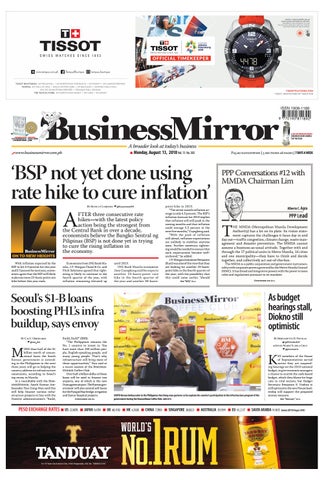
‘BSP not yet done using rate hike to cure inflation’ A By Bianca Cuaresma
@BcuaresmaBM
FTER three consecutive rate hikes—with the latest policy action being the strongest from the Central Bank in over a decade, economists believe the Bangko Sentral ng Pilipinas (BSP) is not done yet in trying to cure the rising inflation in the economy.
With inflation expected by the BSP to hit 4.9 percent for this year and 3.7 percent for next year, economists agree that the BSP will likely make one more 25-basis-point rate hike before this year ends.
Economists from ING Bank Manila, J.P. Morgan Chase & Co. and Fitch Solutions agreed that tightening is likely to continue in the fourth quarter of the year, with inflation remaining elevated up
until 2019. ING Bank Manila economist Joey Cuyegkeng said he expects a not her 25 - ba si s - poi nt r ate hike in the fourth quarter of the year and another 50 -basis-
point hike in 2019. “The seven-month inflation average is only 4.5 percent. The BSP’s inflation forecast for 2018 implies that inflation will still peak in the coming months and that inflation could average 5.5 percent in the next five months,” Cuyegkeng said. “With the peak of inflation still ahead, inflation expectations are unlikely to stabilize anytime soon. Further monetary tightening would be needed to ensure that such expectations become wellanchored,” he added. J.P. Morgan economist Benjamin Shatil was also of the view that they are looking for another 25-basispoint hike in the fourth quarter of the year, with the possibility that this could come earlier “should See “BSP,” A12
@cuo_bm
M
ORE than half of the $1 billion worth of concessional loans the South Korean government is extending to the Philippines in the next three years will go to helping the country address its infrastructure constraints, according to Seoul’s top envoy to Manila. In a roundtable with the BusinessMirror, South Korean Ambassador Han Dong-Man said this will help finance various infrastructure projects in line with the Duterte administration’s “Build,
Build, Build” (BBB). “The Philippines remains the No. 1 country to invest in. You have more than 100 million people, English-speaking people, and many young people. That’s why infrastructure will bring more of these opportunities,” Han said at a recent session of the BusinessMirror Coffee Club. Over half a billion dollar of these loans will be used to finance two airports, one of which is the new Dumaguete airport. The Korean government will also extend soft loans for the Panguil Bay bridge, irrigation and Samar hospital projects. Continued on A2
PESO exchange rates n US 53.1070
business news source of the year
P25.00 nationwide | 5 sections 28 pages | 7 days a week
PPP Conversations #12 with MMDA Chairman Lim Alberto C. Agra
ead
L AlbertoPPP C. Agra
T
he MMDA (Metropolitan Manila Development Authority) has a lot on its plate. Its vision statement captures the challenges it faces day in and day out—traffic congestion, climate change, waste management and disaster prevention. The MMDA cannot assume a business-as-usual attitude. Together with and through the 17 political units in Metro Manila, 16 cities and one municipality—they have to think and decide together, and collectively act out-of-the-box.
The MMDA is a public corporation and government instrumentality with corporate powers governed by the Metro Manila Council (MMC). It has broad and integrative powers with the power to issue rules and regulations pursuant to its mandate. Continued on A11
Seoul’s $1-B loans boosting PHL’s infra buildup, says envoy By Cai U. Ordinario
2016 ejap journalism awards
As budget hearings stall, Diokno still optimistic By Bernadette D. Nicolas @BNicolasBM
& Jovee Marie N. dela Cruz
K South Korean Ambassador to the Philippines Han Dong-man gestures as he explains his country’s participation in the infrastructure program of the government during the BusinessMirror Coffee Club. NONIE REYES
@joveemarie
EY members of the House of Representatives served notice they are suspending hearings on the 2019 national budget, to give economic managers a chance to scuttle the cash-based budget, which they blame for huge cuts in vital sectors, but Budget Secretary Benjamin E. Diokno is still optimistic the new House leadership will support the proposed money measure.
n japan 0.4781 n UK 68.1150 n HK 6.7658 n CHINA 7.7893 n singapore 38.8323 n australia 39.1399 n EU 61.2217 n SAUDI arabia 14.1615
See “Budget,” A12
Source: BSP (10 August 2018 )
News
BusinessMirror
A2 Monday, August 13, 2018
www.businessmirror.com.ph
‘Halt to TRAIN, not food tariff cuts, will curb inflation’
E
By Elijah Felice E. Rosales
@alyasjah
CONOMIC managers are missing the point on inflation, consumer groups have argued, as they proposed yet again the suspension of the Tax Reform for Acceleration and Inclusion (TRAIN) law to stabilize prices of goods and services.
Seoul’s $1-B loans boosting PHL’s infra buildup, says envoy Continued from a1
Apart from the loans, the South Korean government is also extending $21 million to $25 million worth of grant financing to the Philippine government, Han said. These are in keeping with the long history of cooperation between South Korea and the Philippines. When Supertyphoon Yolanda struck Tacloban, Leyte, Han said the Korea International Cooperation Agency (Koica) financed the $4-million construction of the new Visayas State University. Han added that around 500 South Korean soldiers were sent to the Philippines to help during the rehabilitation and reconstruction efforts in the province, as he noted his country’s debt to Filipinos who helped it during the Korean War.
Invest, invest, invest
The ambassador said he also encourages South Korean businessmen to participate in public-private partnerships (PPPs) together with local businessmen and the government. “Whenever I meet [South] Korean businessmen, I ask them to ‘Invest, Invest, Invest’ in the Philippines in accordance with President Duterte’s Build, Build, Build,” Han said. Han said the development of South Korea followed a similar path as that of the Philippines. Between the 1960s and 1980s, with World Bank assistance, South Korea invested heavily in infrastructure. It invested in highways and airports, including the Incheon airport, which is con-
Meat. . .
Continued from A12
spend more of their income on food, at 35 percent, compared to Americans who spend less than 10 percent. “A reduction or realignment of tariff rates can be the first step to grant such relief,” the paper read. Mita noted that no further tariff liberalization nor tariff reductions were implemented since 1996 when the current minimum access volumes and tariff rates were agreed upon at the World Trade Organization (WTO). The group said the next wave of import liberalization and tariff reduction was supposed to have taken place in 2005, but this did not happen because negotiations bogged down.
SOUTH Korean Ambassador to the Philippines Han Dong-man (third from left) is seen with D. Edgard A. Cabangon (second from left), chairman of the Aliw Media Group; T. Anthony C. Cabangon (second from right), BusinessMirror publisher; and, from left, Engr. Feorelio Bote, Britney Kang and Atty. Tirso Peralta, Planbank director, after the latest edition of the BM Coffee Club Forum in Makati City. RUDY ESPERAS
sidered one of, if not the best, airports in the world today. “Infrastructure is very important [ to pave the] road to prosperity,” Han said.
ODA source
As of December 2017, data from the National Economic and Development Authority (Neda) listed South Korea as the country’s
‘Unfair’
During the hearing, United Broiler Raisers Association (Ubra) President Elias Jose Inciong said there is no need to touch the tariffs on chicken nor the special safeguard duty because of the ongoing trade war between China and the United States. “I doubt if China will buy substantively. There will be some oversupply there in the US, it would be cheap, it would come in. We will be throwing away revenues,” Inciong said. Before slashing tariffs, the Ubra official said the government must first create a special unit that will monitor or create data before it rolls out initiatives will affect the farm sector. Edwin Chen, president of the Pork Producers Federation of the Philippines Inc., said solving high food prices by reducing tariffs is
sixth-largest source of official development assistance (ODA). It extended a total ODA of $570.60 million—of which $480.74 million are in concessional loans and $89.86 million in grants. In 2017 the Philippines received a total ODA of $15.45 billion. This is composed of $13.03-billion ODA loans and $2.42-billion grants. “unfair” for farmers as there are many other factors behind the acceleration of inflation. “Reducing prices but not addressing production [issues] could harm producers,” Chen said in a mix of English and Filipino. Raul Montemayor, national business manager and program officer of the Federation of Free Farmers, said reducing tariff rates on farm products, such as corn, will not have much of an impact in slowing inflation. Data from the Philippine Statistics Authority showed that inflation rate in July accelerated to a five-year high of 5.7 percent. It is also faster than the 5.2 percent recorded in June. The Development Budget Coordination Committee earlier revised its 2018 inflation forecast from 2 percent to 4 percent to 4 percent to 4.5 percent. Year-to-date inflation is already at 4.5 percent.
In interviews with the BusinessMirror, consumer groups said reducing tariffs on certain food products can only do so much in weathering prices. They urged the administration’s economic team to review policies and control what it can control, such as the excise taxes imposed by the TRAIN. “It is the TRAIN. Slashing import duties could mean worsening the situation, especially for the poor and small producers who cannot compete given the entry of imported products,” said Louie C. Montemar, coconvenor of Bantay Konsyumer, Kuryente at Kalsada. “Taxation is the cause and now nontaxation of foreign products is the solution? We have a warped governance approach,” he added. Montemar was referring to the government’s plan to lower to 5-percent import duties on fish, corn, meat, particularly chicken, and wheat. Economic managers made the pitch to President Duterte last week as part of efforts to moderate inflation, or the general increase in commodity prices, which has been ticking upward month after month since January. July inflation was at 5.7 percent, the highest in five years, putting year-to-date inflation at 4.5 percent, well above the Central Bank’s target ambit of 2 percent to 4 percent. Laban Konsyumer Inc. President Victorio A. Dimagiba specified excise tax on oil as one of the TRAIN law’s provisions that must be reviewed. He said the logistical cost of transporting food from farms to markets have certainly gone up, even if global petrol prices are stable, because the TRAIN imposed duty on oil. “In a supply chain that is lengthy, all of them [from producers to traders to distributors to retailers] have transportation costs. All of those take impact from the excise tax, [and] that is the direct impact of the TRAIN,” Dimagiba explained in a mix of English and Filipino. Under the fiscal law, oil was slapped with an excise tax of P6 over the next three years: P1 this year, P2 next year and P3 in 2020. Lower rates, on the other hand, were applied on essential petroleum products, including diesel, kerosene and LPG. Further, Dimagiba argued the TRAIN implanted in businesses the perception that they must increase prices to cope with rising production cost. “The indirect impact of the TRAIN, which the government prefers to evade, is when you reform your tax policy and impose additional duties, there will really be a perception to businesses that they should increase their prices,” he said. “Their expectation is that prices should go up, [and] that is what we call profiteering,” Dimagiba added. Montemar and Dimagiba also pressed the government to become more proactive in engaging the private sector. Montemar said suspending the TRAIN law might not necessarily result in a decrease in prices, unless businesses are put to task by authorities. “Even if the government suspends the TRAIN—and I wish it would—prices may not readily respond. We need a political solution. The government needs to mobilize its agencies to ensure quick action on stimulating local production and controlling prices. The private sector needs to be made more cooperative,” the consumer group leader said. For his part, Dimagiba appealed to authorities to do their part in going after profiteers, hoarders and cartels. He,
however, maintained the review of the TRAIN law and its suspension must be considered by the government as top option to control price surges. “Whatever their reason is—[lack of] raw materials, [weak] foreign exchange, among others—what the government cannot deny is that prices are higher now. That is what the TRAIN has given us,” the former trade official and now consumer rights activist said. Laban Konsyumer has advised the Department of Trade and Industry to implement mitigating measures in response to the 5.7-percent inflation recorded in July. Among these measures was the implementation of a moratorium on any price hikes on items with suggested retail prices (SRP) until first quarter of next year. The group said the country is about to enter the holiday season, a period when another round of price increases is to be expected out of pressure on demand and supply.
Easy-open but costly
On top of this, the group urged trade officials to discourage manufacturers from making use of easy-open lid for canned goods. Removal of this feature will apparently translate to savings of a minimum of P0.50 per can. Business leaders, on the other hand, dismissed the sentiment of consumer groups. They told the BusinessMirror they prefer tariffs on several products to be brought down—even if it will be to the detriment of local livestock raisers and fishermen—than to suspend the TRAIN law. “Concerned sectors have to pay the price for solutions like this. It is always the long and the short of it, [there are] pros and cons, [and] legislators see this move as timely to earn a few votes of confidence given consumers’ woes,” said Steven T. Cua, president of the Philippine Amalgamated Supermarkets Association Inc. He also said consumers have to understand fiscal reforms, such as the TRAIN, are needed to fund the government’s infrastructure projects and social programs. “Excise tax [on] oil has its merits in hopefully minimizing unnecessary trips leading to a more livable traffic situation, aside from all the economic gains it provides the government. Concerns of consumers regarding increasing prices of course [are] valid, but tax decisions are part of the price to pay for progress assuming that the government gets to accomplish what it sets out to do,” Cua added. The TRAIN is estimated to beef up the national treasury by P121.2 billion, or 0.7 percent of the country’s GDP. At least 70 percent of the tax law’s revenue stream is allocated for public infrastructure listed under the “Build, Build, Build” program, while the other 30 percent is penciled for social services. George T. Barcelon, chairman of the Philippine Chamber of Commerce and Industry, agreed with Cua, and argued it is futile to suspend the TR AIN law’s provision on petrol tax. For him, the excise tax has little to no effect on fuel prices, as higher duties are only scheduled to be applied over the next two years. “The excise tax on oil has minor impact [on inflation] because that is a threeyear adjustment. The first year has little impact, [so] I do not know whether that [suspending the provision] would amount to anything,” Barcelon said in a mix of English and Filipino.
The Nation BusinessMirror
www.businessmirror.com.ph
PHL ‘won’t be left out now’ in space program By Lyn Resurreccion
‘W
E [the Philippines] do not want to be left out...we want to build our space technology capability” in order for the country to benefit from it, Science Secretary Fortunato T. de la Peña declared after Maya-1 cube satellite (CubeSat), the second Philippine satellite, was deployed from the International Space Station on the afternoon of August 10. De la Peña, University of the Philippines President Danilo Concepcion, UP Diliman Chancellor Michael Tan, Japanese Embassy and Japan Aerospace Exploration Agency officials witnessed—from the UP Electrical and Electronic Engineering (UP EEE) Institute—the deployment of Maya-1 through live streaming. The CubeSats of Bhutan and Malaysia were deployed together with Maya-1 through the Japanese Experimental Module Small Satellite Orbital Deployer in the module, the same one used to deploy the Philippines’s Diwata-1 two years ago. At a briefing after Maya-1’s deployment, the DOST chief said the bill in Congress on the development of the country’s space agency is a top priority of the Department of Science and Technology (DOST). “We are trying to build our own capability in building satellites because we foresee that we really need a go for this. We are also going to the next higher levels,” de la Peña said. “This is just the start. Actually this is part of our long-term sustainability program for our space technology development agenda and we look forward to a continuation of this,” he said as he congratulated the DOST, UP and Japanese experts for the successful deployment of Maya-1. The Philippines is the sixth among the 10 Asean countries which have space programs. The other Asean countries which have long developed their space agencies or have deployed satellites in space are Indonesia,
The exact replica of the 10 cubic centimeter Maya-1 cube satellite displayed at University of the Philippines Diliman Electrical and Electronics Engineering Institute in Quezon City during the CubeSat’s deployment into orbit from the International Space Station on August 10. Lyn Resurreccion Malaysia, Singapore, Vietnam and Thailand, according to Seasia.co. While Maya-1 was just deployed, Maya-2 is already in the drawing board. Research Engineer Israel Bautista told the BusinessMirror he will be bound for Japan next month to prepare for Maya-2. De la Peña explained: “Capability building is very important. We cannot learn it by reading books or listening to lectures. We really have to do it. So this aspect of doing it [making the CubeSat in Japan] and launching it is a very important step.”
Applications HE added: “This space tech program has many components. We have statistics, interpreting the messages, educational aspect, human-resource development, we have the industry development, because there can be industries that can come out of the space tech program.” He said different outputs from the data that will be released or taken from the
satellites may be used by government agencies, with beneficial uses for the country. Possible applications of Maya-1’s radios, including the Store and Forward (S&F) system, are collecting data to generate early warnings for landslides and flash floods, complementing systems for monitoring health conditions of people in remote areas, and systems for tracking endangered species like the Philippine eagle, and fishing vessels. Dr. Joel Joseph Marciano Jr., program leader of Philippine Scientific Earth Observation Microsatellite Program (PHL-Microsat) and director of DOST-Advance Science and Technology Institute, said the CubeSat development is still an experimental platform, but with the radios it is carrying, can store data and relay them when it passes over the mission control in Quezon City. In monitoring floods, Marciano said, “If we can develop sensors that are compatible, we can transmit the data as long as it is within the capacity of the CubeSat.” Maya-1, being part of an academic program, costs less than others at about $0.25 million, Marciano said. It will remain in orbit for one year. The Maya-1 experts may get data from the CubeSat within next month. “We will first establish contact [at 8:01 p.m. on August 10] to receive the signal to know that it is [working]. Then we will start turning on different systems on how they perform,” Marciano said. He said Maya-1 is on the second phase of the PHL-Microsat, named “State Support for Space tech and applications, mastery, innovation and advancement,” or “Stamina for Space.” “We need that [stamina] for the country if we want to sustain the gains we have in the [space] program. It is not the end of the journey, it is just the beginning. All promises of the technology will just be realized.... We will try to maximize the learnings we will get,” Marciano explained.
Editor: Vittorio V. Vitug • Monday, August 13, 2018 A3
Andaya: House, Palace in talks over slashed budget for health dept
A
By Jovee Marie N. dela Cruz
@joveemarie
leader of the House of Representatives on Sunday said the Palace and the House of Representatives are now in talks on how the government will restore or lessen the deep slash in the proposed health budget for next year. Majority Leader Rolando Andaya Jr. said that from P109 billion this year, the government has allocated to the Department of Health next year about P74 billion, which is P35 billion lower than the DOH budget for this year. “It [the budget cut] is so deep that it hits a major artery of government service,” Andaya said. The virtual cancellation of the Health Facilities Enhancement Program (HFEP) from the 2018 level of P30.3 billion to P100 million next year accounted for bulk of the cuts. If the DOH and the Department of Budget and Management are saying they want to pause the implementation of the HFEP because “we’re suffering from budget indigestion” and the backlog is long, “and most of these are infrastructure in nature, then we might buy their reasoning,” Andaya said. Began during the Aquino administration, the HFEP is a multiyear program to improve health
facilities, such as hospitals and barangay health stations, but was recently mired in controversies with regards to alleged irregularities in its implementation. “But how about the other needs of the DOH such as medicine, equipment and other fastmoving expenditures? There are also hospitals in need of building expansion. The health system needs an infusion of funds, not a cutback,” Andaya said. “Or can we not give assistance to patients in charity wards because whatever they can get from PhilHealth will not be enough to defray the cost of treating life-threatening illnesses?” Andaya said one downside of the proposed DOH budget cut is the possible displacement of medical professionals under its health deployment program where doctors, nurses, midwives, dentists are sent to rural areas and urban centers with high poverty incidence.
A4 Monday, August 13, 2018 • Editors: Vittorio V. Vitug
Economy BusinessMirror
www.businessmirror.com.ph
‘BBB’ seen benefiting retail, services sectors
T
By Lorenz S. Marasigan
@lorenzmarasigan
he “Build, Build, Build” (BBB) program, touted as the most ambitious infrastructure development scheme of the Duterte administration, will not only generate jobs during the construction of vital facilities in the Philippines, but will also create employment after it, and spawn more of indirect ones.
Transportation Secretary Arthur P. Tugade said this is the contribution of the infrastructure program in combating unemployment across the three main islands of the country. “There are different aspects to employment—while the infrastructure projects are being built, we will need project based employees. Then there are jobs to be created for the operations and maintenance of these infrastructure,” he said. Tugade added that this will also generate more jobs in the retail industry, as construction of much-needed infrastructure will also cause more businesses to sprout, thereby generating more jobs in the retail and services sectors. “There is an overriding and multiplying effect once these infrastructure
projects are completed,” Tugade said. Sunday saw the BBB team organizing job caravan in Pasay City, wherein 40 employers accepted résumés and application papers, conducted interviews, and hired people for vacancies on engineering, architecture and other construction-related segments, such as accounting, tech and customer service. “We can help boost the economy with this program as we will create jobs and new businesses,” Tugade said. Labor Secretary Silvestre H. Bello III said economic managers estimate that the whole BBB program will generate as many as 1.2 million jobs each year. It can hit up to as much as 2 million, given the need for more jobs for the repatriated Filipinos from the Middle East.
The construction of Pigalo Bridge in Cagayan Valley is one of the projects included in the “Build, Build, Build” program of the government. Costing P437.06 million, the project connects two municipalities—Angadanan, Northeast Isabela, and San Guillermo, Isabela. Photo taken from the web site of the BBB program
“The jobs that will be created will no only be created by the BBB program, but also as a result of the program,” Bello said. However, the Philippines is in the midst of a labor shortage. In 2017 jobs in the construction sector reached 3.59 million workers, or about
158,000 more than the 3.31 million construction workers in 2016. Labor shortage that year was at 120,000 employees.
‘Upper middle-class economy’
Finance Secretary Carlos G. Dominguez III noted that the initiative will help propel the Phil-
ippines into an upper-middle economy by the end of the Duterte administration, as it closes the infrastructure gap—that for former economic managers then tagged as a crisis—in the country. “The Duterte administration is pursuing a Comprehensive Tax Reform Program to modernize
Philippine taxation and further sharpen the country’s competitiveness while putting in place a steady revenue stream to fund BBB along with socioeconomic programs to reduce poverty to 14 percent over the medium term,” he said. Infrastructure spending, according to Budget Secretary Benjamin E. Diokno, will be accelerated to 7.3 percent in 2022 to address the “dismal state” of Philippine infrastructure “Accordingly, we have committed to spend P8 trillion to P9 trillion for the BBB program until 2022,” he said. “This ‘golden age of infrastructure’ will not only build better road networks, airports and bridges, but it will also build better lives for Filipinos now and in the future.” This, according to Socioeconomic Planning Secretary Ernesto M. Pernia, will result in more economic opportunities, noting that job creation will help improve the country’s economic standing. “As the government increases spending on infrastructure, we are expecting additional employment of around 1.8 million by 2022,” he said. “We will continue to pursue programs that will give Filipinos the chance to realize their long-term aspirations.” The BBB program lists 70 priority infrastructure projects that are aimed—more or less—to be completed before President Duterte bows out of office in 2022.
DOLE seeks funds to hire more labor inspectors By Samuel P. Medenilla
D
@sam_medenilla
espite its need for additional labor inspectors for its campaign against illegal contractualization next year, the Department of Labor and Employment (DOLE) said the request remains unfunded for now. Labor Secretary Silvestre H. Bello III disclosed in an interview with reporters that hiring more labor law compliance officers (LLCO) is not included in the DOLE’s P13-billion budget under the 2019 National Expenditure Program. Instead, he said, the recruitment of more LLCOs will be included in the agency’s P2-billion supplemental budget. “We already made a proposal
on this but we are not sure if it will be adopted by the Department of Budget and Management [DBM],” Bello said in an ambush interview during the “Jobs, Jobs, Jobs” Caravan at the SMX Convention Center in Pasay City on Sunday. The DOLE earlier said it is targeting to hire an additional 2,000 LLCOs this year to augment its existing 500 labor inspectors. He said this is necessary since their inspectors are tasked to regularly assess over 900,000 companies nationwide. Aside from hiring LLCOs, the labor chief said the P2 billion will also be used for the repatriation of overseas Filipino workers (OFW) in case the need for it arises. “We never know when there will be a need to repatriate OFWs. We cannot always rely on
the generosity of the host country,” Bello said. For this year, Bello noted the country was “very lucky” that the host government of thousands of distressed OFWs in Kuwait and the Kingdom of Saudi Arabia (KSA) decided to help in their repatriation. “But what will happen if they do not [help with the repatriation anymore]?” he said. The DOLE currently is among the government agencies with the lowest fund allocation for 2019 after the DBM only approved P13 billion of its P17-billion budget proposal. Bello said the agency is ready to work with the DBM-approved budget, although he said he still hopes that the DBM will reconsider and approve their request for a higher budget for next year.
Health and wellness industry top earner in 2016—PSA By Cai U.Ordinario
F
@cuo_bm
ilipinos remain conscious about their health and wellness as companies engaged in these activities earned the most among industries under the Other Service Activities Sector of the economy, according to the Philippine Statistics Authority (PSA). Based on the preliminary results of the 2016 Annual Survey of Philippine Business and Industry (ASPBI), personal services for wellness, except sports activities, contributed the highest income of P7.9 billion, or 58.5 percent of the total income for the sector. PSA data showed that income generated by the Other Service Activities Sector for establishments with total employment (TE) of 20 and over reached P13.6 billion in 2016. “Income or Revenue refers to cash received and receivables for goods/products and by-products sold and services rendered. Valuation is at producer prices [ex-
establishment] net of discounts and allowances, including duties and taxes but excluding subsidies,” the PSA said. This was followed by income generated by the industry on repair of computers and communications equipment with P1.7 billion, or 12.4 percent. However, the industry composed of firms engaged in other personal service activities generated the lowest income of P62.2 million, or 0.5 percent of the total. PSA data also showed that the personal and wellness industry also incurred the most expense at P7 billion, or 58 percent of the total expense of the sector. PSA data showed that the expenses of Other Service Activities Sector reached as much as P12.1 billion in 2016. Apart from personal services, the repair of computers and communications equipment was the second-highest spender at P1.6 billion, or 12.9 percent of the total. Other personal service activities, the PSA said, incurred the least expense at P52.2 million,
or only 0.4 percent of the total. Based on the data, there were a total of 417 establishments with TE of 20 and over in the formal sector of the economy that were engaged in Other Service Activities. Among industries, personal services for wellness, except sports activities, recorded the highest number of establishments at 296, or 71 percent of the total. This was followed by repair of personal and household goods and funeral and related activities with 45 establishments at 10.8 percent and 33 establishments, or 7.9 percent, respectively. The 2016 ASPBI data was collected from the survey which provides information on the levels, structure, performance and trends of economic activities of the formal sector in the entire country for the year 2016. The survey was conducted nationwide in 2017 with the year 2016 as the reference period, except for employment where the reference period is November 15, 2016.
The Regions BusinessMirror
www.businessmirror.com.ph
Chemical firm starts expansion of Batangas manufacturing hub
C
By VG Cabuag
@villygc
HEMICAL firm D and L Industries Inc. (DNL) started building the structures that would expand its manufacturing capacity in Batangas. At the same time, its parent company Jadel Holdings Co. Inc. has broken ground for a new research and development facility in Quezon City to explore new products beneficial for the listed company.
Company President Alvin D. Lao said they have yet to finalize the cost and timeline of the new manufacturing facilities to be built at the First Industrial Township in Batangas. “Because of its size, we have not yet completed the plans. The bulk of
this expansion should be operating by 2021,” Lao said adding the facility’s current capacity utilization rate is about 65 percent. “This expansion can easily be financed by our cash flow and debt since we have a lot of room in our bal-
ance sheet to borrow,” he said. On the other hand, Jadel Holdings, the holding company of the Lao family and the parent company of DNL, is planning to build the Jadel Research Center. The said facility will house new research initiatives in areas that are outside DNL’s current fields of research, which currently are mostly for its clients and existing products. Lao said the new research facility will be exploring new fields and ensuring DNL’s long-term growth by creating a new pipeline technologies and products.“We are very excited to embark on this strategic project. We recognize that R and D is at the core of our business and represents the biggest source of earnings growth and margin expansion,” he said. “This investment represents our family’s steadfast commitment to both R and D and innovation, allowing us to achieve sustainable growth in new
and existing businesses and increase our relevance to customers.” The new facility will be in an eightstory LEED-certified building in Quezon City and Jadel will shoulder 100 percent of the capital expenditures for the center. Start of operations is expected to be in 2021. The unit is meant to be a research platform that will allow the Lao group to explore potential growth areas without DNL taking significant risks, the company said. The listed firm is positioned to benefit from JRC’s research initiatives in areas that may complement its existing business segments. DNL has the option to be the licensee for customized products and technologies that are relevant and complementary to its existing business segments, while noncomplementary products and technologies may be licensed to other companies outside of the listed company.
Panay, Guimaras environment practices recorded in new book
E
NVIRONMENT Secretary Roy A. Cimatu recently led the launch of a book highlighting the traditional environmental management practices of the people of Panay and Guimaras Islands. The book, titled From Seas to the Mountains (Kadagatan Tubtub Kabukidan): Traditional Knowledge Practices of
Panay and Guimaras, shows how traditional knowledge systems and practices promoted cultural resiliency and sustainable development in the two Visayan Islands. In a statement, Cimatu said the book is inspired by the “tried and tested” environmental management methods employed by the indigenous
peoples that have made coastal and upland communities of Panay and Guimaras resilient over the years. During the launch at the University of the Philippines-Visayas in Iloilo City last week Cimatu described the book as “a work of art” and “a written and visual record of environmental practices of the people of Panay and Guimaras.”
“The adaptive and survival instincts of the ancestors of Panay and Guimaras have honed their traditional knowledge systems and have become their effective mechanisms to protect the environment,” he said in his speech. Cimatu said the book is a story of resilience from which there is much to learn. Jonathan L. Mayuga
Editor: Dennis D. Estopace • Monday, August 13, 2018
A5
Co-ops perplexed over Cusi rejection of more funds for sitio electrification
L
EADERS of the Philippine Rural Electric Cooperatives Association (Philreca) and National Association of General Managers of Electric Cooperatives (Nagmec) are perplexed when Energy Secretary Alfonso G. Cusi rejected an offer for additional funding for the sitio electrification budget of the National Electrification Administration (NEA). “Cusi said he wants to collaborate with the NEA and Napocor, yet he substantially slashes the budget of NEA, the government agency tasked by law to bring electrification to the countryside. Remote sitios and barangays will benefit from government funds,” Nagmec President Sergio C. Dagooc said in a statement. “Bakit ayaw niyang tanggapin ang libreng pondo ng gobyerno [Why won’t he accept government funds]?” NEA’s budget had been slashed by P654 million, from P1.817 billion in 2018 to P1.163 billion in 2019. “Cusi obviously wants to cripple the NEA and its rural electrification efforts by reducing its budget. When that happens, it would provide justification to open the door for private business interests to enter,” Dagooc said. He added Cusi’s “biases are already becoming obvious.” “He doesn’t support the decadeslong electrification program based on people’s orgs at the grassroots level. He wants for-profit private sector entities to take over rural electrification,” Dagooc said. “The big questions are why, and what’s in it for him?” NEA currently supervises 121
electric cooperatives providing electricity services to 12.447 million households nationwide as of June 30, 2018. Philreca President Presley de Jesus explained that the privatization scheme Cusi intends to implement was a red herring; one that would “create more problems than solutions.” “When you allow for-profit ventures to enter rural electrification, two things will happen,” de Jesus explained. “First, electricity prices will rise because these private sector PDUs [power distribution utilities] will want to recover every centavo they invest so they can make a profit. To do this, they will recoup their funds from our rural electricity consumers as pass-on charges like the Stranded Costs in our electricity bills.” He added that “private PDUs will not engage in public service missionary electrification programs, meaning they will not go to isolated places or areas of conflict, calamity or disaster danger zones where the poorest of the poor live and have no financial capacity to pay, and where there are no jobs or livelihood—because these are very remote and far from the main distribution arteries.” “There’s just no economic viability for these profit-based entities to operate in these areas,” de Jesus said. “Instead, these private investors will choose areas with sufficient paying capacity, the very same areas where ECs already operate. There will be redundancies, overlaps.” Lenie Lectura
The World BusinessMirror
A6 Monday, August 13, 2018 • Editor: Angel R. Calso
www.businessmirror.com.ph
US sanctions on Iran give China lead in world’s biggest gas field
C
hina National Petroleum Corp. (CNPC) is expected to take the lead on a $5-billion project to develop Iran’s share of the world’s biggest gas deposit, taking over from France’s Total SA, which halted operations after US President Donald J. Trump reimposed sanctions on the Islamic Republic. State-owned CNPC, which had joined an original consortium involving Total and Iran’s Petropars Ltd. in 2016 to develop Phase 11 of the South Pars Gas field in the Persian Gulf, is set to increase its stake
in the project from the current 30 percent. Total had originally agreed to take a 50.1-percent stake in the development. CNPC will become lead operating partner in the project, state-
Erdogan: With US waging ‘economic war’against Turkey, we will look for new allies
I
STANBUL—Turkey’s president on Saturday blamed the country’s economic downturn on the United States and other nations that he claims are waging “war” against his country. Speaking in the northeastern province of Rize, President Recep Tayyip Erdogan said that dollars, euros and gold were now “the bullets, cannonballs and missiles of the economic war being waged against our country.” Erdogan promised supporters that Turkey was taking the necessary precautions to protect its economy but added “the most important thing is breaking the hands firing these weapons.” Turkey was hit by a financial shockwave this week as its currency nosedived over concerns about the government’s economic policies and a trade dispute with the United States. The lira tumbled 14 percent on Friday, to 6.51 per dollar, a massive move for a currency that will make Turkish residents poorer and further erode international investors’ confidence in the country. The currency drop is particularly painful for Turkey because it finances a lot of its economic growth with foreign money. The currency’s drop—41 percent so far this year—is a gauge of fear over a country coming to terms with years of high debt, international concern over Erdogan’s push to amass power, and a souring in relations with allies like the US. In an opinion piece published in The New York Times on Friday, Erdogan criticized the tensions with the US, saying a “failure to reverse this trend of unilateralism and disrespect will require us to start looking for new friends and allies.” Among the issues, Turkey has arrested an American pastor and put him on trial for espionage and
terror-related charges linked to a failed coup attempt in the country two years ago. The pastor has proclaimed his innocence. The US responded by slapping sanctions on Turkey and threatening more. The sides held talks in Washington this week but failed to resolve the spat. President Donald J. Trump on Friday tweeted that he had authorized the doubling of steel and aluminum tariffs on Turkey. He said the tariffs on aluminum imports would be increased to 20 percent and those on steel to 50 percent as the Turkish lira “slides rapidly downward against our very strong Dollar!” “Our relations with Turkey are not good at this time!” he wrote. The United States is the biggest destination for Turkish steel exports, with 11 percent of the Turkish export volume. The lira fell further after Trump’s tweet. Turkey later said Erdogan had held a phone call with Russian President Vladimir Putin to discuss economic ties. It did not disclose details, but the move suggests Turkey might gravitate further from its North Atlantic Treaty Organization allies toward cooperation with Russia, whose relations with the West are at their lowest point since the Cold War. Turkey’s woes have been aggravated by investor worries about the economic policies of Erdogan, who won a new term in office in June with sweeping new powers. Erdogan has been putting pressure on Turkey’s central bank to not raise interest rates in order to keep fueling economic growth. He claims higher rates lead to higher inflation—the opposite of what standard economic theory says. Independent analysts argue the central bank should instead raise rates to tame inflation and support the currency. AP
Turkey’s President Recep Tayyip Erdogan addresses his supporters in Ordu, Turkey, on August 11. AP
run Islamic Republic News Agency said, citing Mohammad Mostafavi, National Iranian Oil Co. investments and business head. Terms of the contract have not yet officially changed, according to Shana, the oil ministry’s official news site. Calls to CNPC went unanswered on Sunday and a company spokesman didn’t immediately respond to a Bloomberg News e-mail requesting comment. Total, which finalized its agreement with Iran in July 2017, had already spent some €40 million ($45.7 million) on the project when Trump announced in May that the US would exit the 2015 nuclear deal, formally known as the Joint Comprehensive Plan of Action, and reimpose sanctions on Tehran lifted after the accord was signed. The first round of US sanctions
was put back into place this week, with more to come in November, greatly complicating efforts by companies that rushed into Iran after the 2015 nuclear accord was signed by Iran, the US and five other countries plus the European Union. Under the deal, Iran agreed to take steps to limit its nuclear program, and to submit to verification by the International Atomic Energy Agency in return for economic sanctions relief. Scores of European companies, including Total, have withdrawn their operations and investments from the oil-rich Persian Gulf country since the US reversal. Trump marked the return of sanctions with a tweet on August 7: “Anyone doing business with Iran will NOT be doing business with the United States.”
Iran, which holds the world’s largest gas reserves, shares South Pars, also known as the North Dome field, with neighboring Qatar. Total had previously withdrawn from South Pars in 2009 because of sanctions. It planned an initial investment of $1 billion for Phase 11, with the aim of eventually producing 2 billion cubic feet a day, or 400,000 barrels of oil equivalent a day including condensate, the company said in a statement in July 2017. At the time, Total said the contract had a 20-year duration. CNPC has been active in Iran since 2004, operating in oil, gas and oil field services, according to the company’s web site. In 2006 it was awarded a three-year contract to provide offshore well-logging and other services at South Pars. Bloomberg News
Crews make progress battling Southern California wildfire
Homes destroyed by a wildfire are seen from an aerial view in the Keswick neighborhood of Redding, California, on August 10. Fire crews have made progress against the biggest blaze in California history but officials say the fire won’t be fully contained until September. AP
L
AKE ELSINORE, California—Firefighters made significant progress trying to tamp down a wildfire that threatened homes and has been raging for days south of Los Angeles, officials said on Saturday. Aircraft have been making flight after flight, dumping water and bright pink retardant to protect Lake Elsinore and other foothill communities as the fire sweeps through the dense, bone-dry brush of the Cleveland National Forest. The Holy Fire—named for Holy Jim Canyon, where it began on Monday—grew to nearly 33 square miles (85 square kilometers) by Saturday morning. But firefighters also made progress, with containment rising from 10 percent to 29 percent. High temperatures and dry grass and brush have made it difficult for firefighters to get a handle on the blaze. Some hillsides were being allowed to burn under the watchful eyes of firefighters as a way to reduce fuel and make it harder for flames to jump roadways into communities if winds pick up again. Although the fire burned a dozen forest cabins early on, only one
home was lost on Thursday as fire crews managed to fend off flames that stalked downhill and came right up to yards. On Saturday officials allowed some residents to return to their homes in Lake Elsinore, but others still remained under evacuation orders. The man accused of deliberately starting the fire appeared in court on Friday, but his arraignment was postponed. Forrest Clark, 51, made several outbursts, claiming his life was being threatened and saying the arson charge against him was a lie. A court commissioner ordered his bail to remain at $1 million. The Holy Fire was one of nearly 20 blazes across California, which is seeing earlier, longer and more destructive wildfire seasons because of drought, warmer weather attributed to climate change and home construction deeper into forests. A fire that broke out near the communities of Fairfield and Vacaville had destroyed a home and two other structures, according to the Vacaville Fire Department. A firefighter suffered a minor injury battling
the blaze, which grew to about 2.6 square miles (6.9 square kilometers) and was 70 percent contained by Saturday afternoon, officials said. The largest fire ever recorded in California—the Mendocino Complex—is burning north of Sacramento and has destroyed 119 homes but none in recent days. The fire had reached 508 square miles (1,315 square kilometers) and was 67 percent contained by Saturday. The two-week-old Carr Fire that killed eight people and burned more than 1,000 homes was 55 percent contained. Elsewhere in the West, a firefighter was injured on Saturday and residents in parts of two Washington state cities were told to evacuate due to a growing wildfire. Authorities say the Grass Valley fire started on Saturday morning and windy conditions helped it grow to 1.5 square miles (3.8 square kilometers). The fire is burning in grass and timber. Grant County Sheriff’s Office Spokesman Kyle Foreman tells the Spokesman-Review that the injured firefighter was flown to Seattle’s Harborview Medical Center. AP
Trump embraces market pain with no concern of contagion
P
resident Donald J. Trump is embracing financial-market pain to get what he wants around the world, showing again the penchant for turmoil that is his trademark in US politics. His decision on Friday to double steel and aluminum tariffs on a Turkish economy already reeling from a currency crisis came just days after imposing new sanctions on Russia, creating market havoc in both countries. Most Asian markets ended down for the week amid the USChina tariff war. Rather than worrying about US markets becoming infected by sell-offs elsewhere, Trump is cheering on the economic losses suffered by the targets of American tariffs and sanctions. Turkey’s lira is sliding “rapidly downward against our very strong Dollar!” Trump said on Twitter on Friday as he ratcheted up tariffs on its metals exports. Just a week ago he said on the same platform that duties he imposed on China were “working far better than anyone ever anticipated,” celebrating a decline in the Chinese market while adding that the US “market is stronger than ever.” The broadsides suggest Trump is unfazed by disorder in overseas markets and hopes the routs force foreign capitals to bend to his will. Reinforcing his approach are Trump’s favorite benchmarks—the US stock market and employment figures—which continue to boom. Despite some spillover, the Standard & Poor’s 500 Index remains close to an all-time high set earlier this year. Turkish President Recep Tayyip Erdogan pledged that the American economic actions wouldn’t shape Turkey’s actions in a New York Times op-ed published on Friday, saying his country “established time and again that it will take care of its own business if the United States refuses to listen” and that Trump’s unilateral actions would only undermine American security interests. “Before it is too late, Washington must give up the misguided notion that our relationship can be asymmetrical and come to terms with the fact that Turkey has alternatives,” Erdogan wrote. “Failure to reverse this trend of unilateralism and disrespect will require us to start looking for new friends and allies.” Trump has ushered in the exact kind of disruption he likes to cultivate. Yet economists question whether the strategy will achieve durable results. “He likes brinkmanship. He likes to push people to the edge of their comfort,” said Douglas Holtz-Eakin, the former chief economist for President George W. Bush’s Council of Economic Advisers who is now president of the American Action Forum. “There are big risks with this approach.” Disturbances from Trump’s strongarm tactics could spread between markets. Coupled with the possibility of economically driven political instability and retaliation against American businesses, Trump is engaged in a highstakes gamble. Turkey’s meltdown sent shock waves through other emerging markets and Europe. The euro sank as much as 1.2 percent to the weakest in more than a year after a Financial Times report that the European Central Bank raised concern about the region’s banks’ exposure to Turkey. The threat of financial crisis hasn’t loomed as large in the formative early months of the Trump administration as his recent predecessors. Barack Obama came into office confronting the worst economic downturn since the Great Depression after a global market collapse started by mortgage-backed securities. George W. Bush began his administration with a recession triggered by the bursting of the tech bubble. Bill Clinton was elected during a recession that included a banking crisis and real-estate downturn. Trump, on the other hand, entered office with the US economy already well into one of its longest expansions in history. If the president or his top economic advisers are worried about financial contagion, they haven’t shown it. National Economic Council Director Larry Kudlow mocked China over retaliatory actions earlier this week, saying he viewed their response as “weak” and warning that the Chinese “better not underestimate President Trump’s determination to follow through.” Bloomberg News
www.businessmirror.com.ph
Banking&Finance BusinessMirror
TRAIN-boosted NG revenues rise 19.9% to ₧1.410 trillion in H1–DOF P
Monday, August 13, 2018
A7
PSBank 1st half 2018 net income registers 15% growth
D
By Rea Cu
@ReaCuBM
ESPITE the blame heaped on it for being an inflation trigger, the Tax Reform for Acceleration and Inclusion (TRAIN) law, along with an improved tax administration, got credit for expanding the country’s fiscal space, which the Department of Finance (DOF) said had enabled the government to boost investments and growth in the first semester of the year. Based on the latest DOF economic bulletin on the government’s revenue performance, national government (NG) revenues rose by 19.9 percent to P1.410 trillion in the first semester of 2018 as the first phase of TRAIN took effect. Revenue for the first half of 2017 was recorded at P1.176 trillion. “Fiscal space expanded by TRAIN 1 and tax administration enabled the government to boost investments and growth in the first semester. In the first semester of 2018, NG capital outlays expanded by 42.4 percent in nominal terms, boosting GDP growth by almost a percentage point, while the government current expenditures rose 26.6 percent, contributing incremental 1.16 percentage points to growth,” the DOF said. Tax revenues grew by 17.4 percent to P1.254 trillion from P1.069 trillion, in the same period for 2017.
Bureau of Internal Revenue (BIR) collections rose by 13.7 percent to reach P964 billion, and Bureau of Customs (BOC) collections also increased by 32.9 percent at P279.4 billion, with both agencies exceeding the 9.6-percent nominal GDP growth. Nontax revenues rose by 45.1 percent, amounting to P155.7 billion, due to higher collections of dividend remittances on NG shares of stocks, guarantee fees, and share in the profit of the Philippine Amusement and Gaming Corp. (Pagcor). Nontax revenues for the first half of 2017 reached P107.3 billion. Higher collections from other offices also contributed to the increase, notably the one-off transfer of P13.5 billion in bond proceeds from the United Coconut Planters Bank (UCPB) for the Coconut Indus-
try Investment Fund. Excluding the transfer, this would still show improved collection from other offices. Expenditures grew by 20.5 percent, reaching P1.603 trillion from P1.330 trillion in 2017, also outstripping the 9.6-percent nominal GDP growth due to the 42.4-percent increase in capital outlays. Revenue effort rose by 1.47 percentage points to 17.12 percent from 15.6 percent, the highest ever achieved during the first semester, according to the DOF. Tax effort also rose by 1.01 percentage points, from 14.22 percent to 15.23 percent, similarly the highest first-semester tax effort ever achieved. “Almost half or 0.4 percentage point is due to TRAIN and the rest or 0.61 percentage points to tax administration improvements,” the DOF added. Expenditure effort rose by 1.77 percentage point to 19.47 percent, from 17.7 percent last year, the highest first-semester expenditure effort since 2003, thus boosting its contribution to GDP growth. “Strong macroeconomic fundamentals backed by tax reforms and the ‘Build, Build, Build’ program will continue to boost economic growth as the competitiveness of the economy rises and more jobs are created,” the DOF said. The NG deficit settled at 2.34 percent of GDP in the first half of the year, lower than the target as well as that of last year’s deficit of 2.05 percent in the same period. Last week the country registered
a GDP of 6 percent for the second quarter of the year, lower than the 6.6 percent recorded in the first quarter of the year as well as that of the 6.7 percent recorded in second quarter of 2017, based on data from the Philippine Statistics Authority (PSA). “The government is keeping its eye on the bigger picture, that is, that growth, if it is to remain sustainably high, should be driven by investment. Public construction has accelerated to 22.1 percent in the first semester of 2018, more than double the 2017 first half growth of 9.3 percent. Private construction is also picking up,” the DOF said in a separate economic bulletin on the country’s second quarter GDP issued on Friday. The DOF pointed out that the economy took a breather in the second quarter as real GDP growth decelerated to 6 percent, from 6.6 percent in the first quarter, with the main drivers for the contraction being a slowdown in manufacturing to 5.6 percent, from 7.6 percent in the first quarter; as well as in agriculture to 0.2 percent, from 1.1 percent in the first quarter. “The government should keep its focus on enhancing the country’s long-term prospects by increasing the economy’s productive capacity through infrastructure and social services while maintaining macroeconomic stability. While CPI [consumer price index] inflation has remained elevated, the broader GDP deflator-based inflation shows a 3.1-percent price increase for all consumer and investment goods,” the DOF added.
B.I.R. AWARDEES The Bureau of Internal Revenue’s RDO 43 Pasig, led by Revenue District Officer Rufo Ranario (fifth from left), received a plaque of appreciation from Regional Director Marina de Guzman (seventh from right) during the recent 114th BIR Anniversary Regional Celebration in Quezon City. Top 4 awardees are Michelle de la Torre, Marlin Gampon, Wilvie Polancos and Sally Jesalva. RUDY ESPERAS
Maybank MOVE paves the way in offering refined digital conveniences
M
AYBANKPhilippinesrecently launched Maybank MOVE (Mobile Optimized Virtual Experiences), a first-in-the-industry fully integrated digital offering which aims to enhance and simplify the process of performing financial services via its new straight-through banking processes. Maybank MOVE will allow customers to open an online-only savings account called iSave, using the Maybank2U PH App. All forms and documentary requirements can also be submitted online through the app. The iSave account will be the fully digital account opening facility in the Philippines, also allowing customers to access their accounts and enjoy free Interbank withdrawals via any ATM nationwide. The new straight-through-processing capabilities (STP) will also allow customers to apply for credit cards and automobile financing from the comfort of their homes or even on the go, beyond banking hours. The Maybank MOVE offering was introduced in support of Bangko Sentral ng Pilipinas’s (BSP) financial inclusion agenda, which is to make banking accessible to more Filipinos. “For Maybank, MOVE is about enriching our offerings through digital banking which is in line with our commitment to leverage on cutting edge technology as well as our strategic objective of being the digital bank of choice in the region,” said Choong Wai Hong, Maybank Philippines president and chief executive officer. “Our digital approach is centered on four key areas: enriching our customer offerings, investing in strategic capabilities, exploring broadly and understanding deeply the landscape, and building and participating in the digital ecosystem, which includes engaging with regulators, fintech companies and global leaders to build truly differentiated digital offerings for our customers.”
HILIPPINE Savings Bank (PSBank), the consumer banking arm of the Metrobank Group, reported a net income of P1.35 billion in the first half of 2018, up 14.7 percent from P1.18 billion in the same period last year. The bank’s strong performance is on the back of robust revenues driven by net interest income and service fees. Net interest income improved to P5.85 billion, up 8.8 percent from P5.38 billion a year earlier. PSBank’s total loan portfolio in the first half of the year showed double-digit growth of 10.7 percent to P151.62 billion, from P137.01 billion in 2017. Resources reached a total P234.76 billion, up 7.4 percent from the same period last year, while deposits rose 9 percent to P200.09 billion. The Bank’s earnings translated to a return on equity of 11.83 percent. Common Equity Tier 1 Ratio was at 11.0 percent and Capital Adequacy Ratio was at 13.7 percent. Both ratios are above the minimum required level set by the Bangko Sentral ng Pilipinas (BSP). “Our first half performance is a
Perspectives $14-B Ant Financial deal propels fintech investment in Asia to massive record high
A
NT Financial’s record-shattering $14-billion Series C funding round in the second quarter lifted Asia’s midyear fintech investment to a massive $16.8 billion compared to $5.4 billion in all of 2017. The single deal accounted for over half of the $23 billion in VC fintech funding seen globally during the six-month period. Excluding this massive outlier deal, Asia still saw strong fintech investment, with quarter-overquarter increases in overall fintech investment in India, Australia and Singapore from the first to the second quarter of 2018. The number of deals in Asia also rose at each deal stage during both the first and the second quarters.
Fintech market in China thriving
Fintech investment in China strengthened in the first half of 2018 compared to the end of 2017. In addition to Ant Financial’s massive deal, China saw four other $100 million+ megarounds—including $290 million to Dianrong, $160 million to WeCash, $130 million to Meili Jinrong and $100 million to Tiantian Paiche. The majority of banks in China have been expanding their focus to digital and developing transformation strategies. This has led to an increase in B2B focused fintechs able to enable banking transformation. Banks have invested in myriad areas, including blockchain, big data and AI.
SE Asia target for fintech growth and global expansion
MPI’s Senior officers, led by Choong Wai Hong with its partners during the media launch of Maybank Move. (From left) Dexter Go; James Perez, Idea Lab Information Technology Solutions general manager; Guillaume Danielou, Fintq Digital Transformation leader; Choong Wai Hong; Christie Dana Tan and Monica San Juan of AirAsia BIG Loyalty; Abigail del Rosario, Maybank retail business group head and Bernardo Talimban Jr., Maybank chief information technology officer.
Dexter Go, MPI virtual banking head
Head of Virtual Banking Maybank Philippines, Dexter Go added, “In 2019 we envision the Bank to continue enhancing our services for existing and prospective clients. Rest assured that we will revolutionize our customers’ banking experience to keep abreast of the constantly evolving trends in the market which are all inclined to digital adaptability.” Following the launch of this new
offering, Maybank Philippines said it will be introducing the Maybank MOVE store, a mobile pop-up store that will travel across the Philippines to introduce the new STP products and processes, promotions and activities. The MOVE store is another innovative, hip and fun initiative to showcase the array of digital conveniences which Maybank offers to the people of Philippines. Maybank Philippines Inc. (MPI) currently has 74 branches nationwide, making it the most accessible foreign bank in the Philippines. This proposition will be expanded further as the Bank embraces the ever-changing standards and requisites of the digital realm. “In this day and age where everything is ultra-fast-paced, banks need to empower and encourage their loyal and future customers by giving them
the flexibility of time and opportunities to MOVE —to do more of what they need to do. Maybank is answering this need by providing its clients good, fast and efficient services, lifestyle rewards and all other perks that the digital world has to offer,” added Go. MPI is a member of the Maybank Group, Asia’s leading banking group and Southeast Asia’s fourth-largest bank by assets. The Maybank Group has an international network of over 2,200 offices in 18 countries, including the 10 Asean members. The Group offers an extensive range of products and services, which includes consumer and corporate banking, investment banking, Islamic banking, stock broking, insurance and takaful and asset management. It has over 43,000 employees worldwide.
continuous realization of our institutional strategy which focuses on the strength of our brand promise of consistently providing exceptional end-to-end customer experience. We have, likewise, tapped on the latest available digital technology to improve on process efficiencies to bring the cost of operations down while maximizing the full potential of our sales distribution channels in generating more business for the bank,” PSBank President Jose Vicente Alde said. PSBank was recently bestowed the BSP 2018 Pagtugon Award, its third in four years, as recognition for its excellence in responding and addressing issues or concerns of clients referred to the Bank by the Central Bank. PSBank also won the award in 2016 and 2015. The Bank also won a PANATA 2018 Bronze Award for Excellence in Brand Positioning for its “Techie Campaign” in the recently held Annual PANATA Awards of the Philippine Association of National Advertisers. PSBank currently has 250 branches and over 600 ATMs strategically located nationwide.
After achieving success domestically, a number of large fintechs— primarily from China—have set their sights on countries within Southeast Asia as the next step in their growth agenda. With a large population, relatively similar macroeconomics, large underbanked populations and a significant number of Chinese people overseas, the region is seen as a strong stepping stone to further global expansion. At the same time, a number of China’s biggest companies are already making investments globally. In the first half of 2018, for example, Tencent invested in German challenger bank N26. Within Southeast Asia, Singapore continued to drive regional collaboration—including the development of a regional fintech innovation sandbox. The MAS continued to focus on financial inclusion, but also started to intensify its focus on encouraging insurtech innovation.
Financial services regulations continuing to evolve in Asia
During the first half of the year, China’s central government an-
nounced plans to combine the banking and insurance regulators into a single entity. This new authority will take ownership of much of the oversight related to alternative financing and microlending, which previously had been managed provincially. Because of the changes, the government has delayed the deadline for P2P regulatory filings until the end of the year. Hong Kong (SAR) also saw some changes during the first half of the year, particularly in the area of IPO exits as a result of new regulations allowing for different shareholder rights. The changes pave the way for more companies to qualify for an IPO on the HKSE. Poor performance of China’s stock exchanges in recent months, however, could temper IPO activity somewhat.
Regtech slowly gaining traction in Asia
During the first half of 2018, regtech continued to gain slow traction in Asia, particularly in Australia and Singapore where regulators have been strongly supportive of fintech innovation and in India where technologies are required to enable the shift to a primarily cashless society. Much of the regtech focus in Asia has been around KYC and fraud prevention. One of the more mature regtechs — 6-year-old Australia-based KYC company Encompass expanded into Hong Kong early in 2018. While India has seen the introduction of a number of KYC-focused companies, such as SIGNZY—an AI-driven real-time authentication platform, it has also seen a number of more traditional regtech start-ups, including Fintellix—which leverages existing data infrastructure to address local regulatory reporting requirements. From a regulatory standpoint, in February, Commonwealth Bank of Australia reported on the success of a regtech pilot project it conducted in collaboration with ING. The UK’s Financial Conduct Authority acted as an observer on the project in order to gain greater understanding of how AI and regtech can be used to help organizations with managing compliance. The excerpt was taken from the publication entitled The Pulse of Fintech 2018: Biannual global analysis of investment in fintech. © 2018 R.G. Manabat & Co., a Philippine partnership and a member-firm of the KPMG network of independent member-firms affiliated with KPMG International Cooperative (“KPMG International”), a Swiss entity. All rights reserved. Printed in the Philippines For more information on KPMG in the Philippines, you may visitwww.kpmg.com.ph.
Green Monday BusinessMirror
A8 Monday, August 13, 2018
www.businessmirror.com.ph • Editor: Lyn Resurreccion
Forest monitor lizard
A unique prey for a unique predator
‘Y
By Jonathan L. Mayuga @jonlmayuga
By Manuel T. Cayon
ou are what you eat.” Besides applying to humans, this saying is also true with the iconic Philippine eagle, a unique species and prolific hunter with a distinct diet.
A critically endangered species, with only about 400 pairs left in the wild, the Philippine eagle continues to survive and thrive in the wild despite the continuing destruction of their natural habitats. This underscores the importance of protecting the country’s remaining virgin forests, rehabilitating open, degraded and denuded forest, to allow the country’s rich biodiversity to thrive and take care of its own, including the Philippine eagle, the country’s National Bird.
Verified report
Experts studying the iconic Philippine eagle, under the auspices of the Philippine Eagle Foundation (PEF), recently discovered the existence of possibly a thriving population of forest monitor lizards in Apayao province in the Cordillera Administrative Region in Luzon. The accidental discovery of the Varanus bitatawa, a fruit-eating forest monitor lizard, came after a Philippine eagle brought home its prey to its nest in the forest of Apayao province. Scientists confirmed the prey to be the carcass of the unique monitor lizard, or the Northern Sierra Madre forest monitor lizard. The Philippine eagle nest in Apayao is some 80 kilometers away from the Northern Sierra Madre ranges in Cagayan, the closes part, where the monitor lizard is known only to exist and nowhere else in the region. This report appeared in the paper, authored by Tatiana AbanoSarigumba, Jayson Ibanez, Rafe M. Brown and Luke J. Welton which was published in the Herpetological Review, the official bulletin of the Society for the Study of Amphibians and Reptiles in June 2018.
Unique prey
“As the country’s top carnivore of the forest canopy, it [Philippine eagle] is an important component of the Philippine forest food web. Indeed, our national bird maintains a complex relationship with the equally unique animals that it shares its forest habitat with. And through patient eagle research, we are discovering the occurrences of other mysterious forest creatures,” Dennis I. Salvador, PEF executive director, said in an e-mailed message to the BusinessMirror on July 31. The forest monitor lizard was first detected in the Cordillera in 2015 during another diet-behavior study of a nesting pair of Philippine eagles in the mountain of Calanasan, according to the study. “One of the adults delivered a disarticulated limb of a varanid lizard to the eaglet on the nest,” the report said. Besides the forest monitor lizard, the adult eagles have brought, on six different occasions, Philippine water monitor lizards, the report added. The second encounter of the forest monitor lizard was in 2016 during monthly forest patrols by local “Green Guard” volunteers organized by the PEF and the municipality of Calanasan. “Finding the bitatawa and the nesting of the Philippine eagles in the range, both species of
which are forest specialists, indicate that the forest ecosystem is thriving well and that it is able to support the needs both of the prey and predator populations,” said Abano-Sarigumba, the senior biologist for the Luzon Conservation Program of PEF at the time of the study. Abano - Sar ig umba documented the prey during nest observations and later had the prey photos examined by expert herpetologists.
Definitive evidence
Welton, the collection manager of the Kansas University Biodiversity Institute and Natural History Museum, said the paper documented the first definitive evidence of the presence of frugivorous monitor lizards in northwestern Luzon. Welton, who also wrote scientific papers extensively about the lizards in the Philippines, including the discovery of the new species Varanus bitatawa, said the discovery highlights the uniqueness and conservation priority of the Cordillera faunal region. “Forest obligates, like frugivorous monitors and Philippine eagles, require large tracts of intact and healthy forest, and so the presence of both in the northern Cordillera is a good sign about the health of that ecosystem. I think the biggest question that remains is whether this occurrence of Varanus bitatawa represents an isolated population in the northern Cordillera, or if the species, in fact, occurs throughout the entire Cordillera Mountain Range. Hopefully, additional surveys and biodiversity monitoring will be able to answer these questions,” he said.
Fruit-eating lizard
The Varanus bitatawa, Welton said, is unique because it is a fruit-eating lizard. He added that from the few studies that have been done on fecal samples and gut contents, it is known that the primary fruiting trees consumed by frugivorous monitors are Pandanus and Canarium. “During the description of bitatawa, we examined the stomach contents of the adult male holotype from Casiguran. This individual had partially digested husks of Pandanus fruits, as well as shell fragments from what looked like a giant land snail,” Welton said. He said Filipino colleagues from University of the Philippines-Los Baños found similar contents in the stomachs of animals in Isabela, as well. “To date, there hasn’t been any specific study on the dietary preferences of bitatawa. Apparently, the third species of frugivore, Varanus mabitang from Panay, has a higher preference for fruit than either of the other two species,” he said.
Elusive bird
Asked through e-mail if there was an official record of a Philippine eagle nest in Northern Sierra Madre, Jayson Ibanez, PEF director for research and conservation, said there is an abandoned or inactive eagle nest in San Mariano, Isabela, that was
Davao City launches project to treat wastewater Mindanao Bureau Chief
D
One of the first photographs in life of the newly discovered (Welton et al. 2010) forest monitor lizard, Varanus bitatawa from Barangay Dibuluan, San Mariano, Isabela Wikimedia Commons
discovered in the 1990s. A juvenile Philippine eagle and its parents were also spotted somewhere in the Northern Sierra Madre Natural Park in Isabela between 2003 and 2004, leading to the conclusion that Philippine eagles are naturally found within the Sierra Madres. Howe ver, he s a id no active nest—which means w ith an eg g, chick or young—were ever found. “So they are there, but their nests are difficult to find,” he said.
Elusive lizard
The forest monitor lizard, on the other hand, is equally elusive. No official record of this species have ever been made outside its known habitat. Before the discovery, its population is previously thought to be restricted in that part of the Sierra Madre. According to the paper, titled “Records of Northern Sierra Madre Forest Monitor Varanus bitatawa from Northern Cordillera Mountain Range of Luzon Island, Philippines,” the specimen of this lizard have been obtained only from the Sierra Madre range, particularly within the provinces of Cagayan, Isabela and Aurora. In 2012 there was a scratch mark of what believed to be of the same species found on a Pandanus tree in Pagudpud, Ilocos Norte, indicating its presence beyond its documented range. Because of lack of sufficient data, the conservation status of the forest monitor lizard remained unknown.
Prolific hunter
The Philippine eagle is a prolific hunter. Ibañez said that it is possible that the bitatawa was caught by the eagle while the lizard was warming itself under the sun. “Since lizards are cold-blooded, they needed to sunbathe to warm themselves during early morning or after prolonged cold rains. Exposed, the lizard was an easy prey,” he explained. According to Ibañez, the eagle pair was observed to feed on 12 types of animals, and the bitatawa was one of them. “The availability of the bitatawa as eagle prey helps fulfill the food needs of a growing eaglet. As an alternate prey, the eagles can shift to hunting bitatawa when there are more of them and less of the other prey species. Its existence, therefore, ensures the survival of both the adult eagles and their growing young,” he added.
Thriving secretly
Accor ding to I ba ñez, forest mon itor l i z a rd s, pa r t ic u l a rly the Varanus bitatawa, may have been thr iv ing in Norther n Cord i l lera a l l a long. “Apparently, it has been there all along. The locals, or indigenous Isnag of Apayao, have a local name for it. They call it lopi. The fact that it has a specific local name also means it has been there since time immemorial,” he said.
Moreover, he said the regular bayawak (monitor lizard), commonly seen on the ground, on the other hand, is locally called banyas—another proof that locals recognize the tree-dwelling bitatawa is very different from the mostly ground-dwelling banyas. According to Ibanez, the only way a Philippine eagle can bring home a prey is when they exist or occur within the eagles’ range or territory. “We don’t think it [bitatawa] mig rated. A ga in, apparent ly, you have a resident population of the bitatawa in Apayao, and most probably also in Pagudpud,” he said. He said it is also not possible for the eagles to have gone beyond its range to hunt to bring home prey to feed its young. “This is not possible. Adult eagles do not migrate. They maintain a territory of their own. The Calanasan, Apayao, eagle pair, therefore, only hunts within its territory in Calanasan,” he said.
Significant discovery
Accor ding to I ba ñe z , t he significance of the paper is its having found the evidence that the bitatawa and the Philippine eagles maintain an important ecological relationship. “The eagle feeds on the bitatawa. Thus, it’s a necessary prey/ food species for the eagles. If we are to conserve the rarest and most endangered eagle in the world, we must also conserve and protect the bitatawa. The eagle, in turn, is a predator/hunter of the bitatawa,” he explained. He said the science of ecology tells us that predators feed mostly on the sickly and weaklings of its prey or food animals. “Therefore, by feeding on the animals that are less fit, the eagles naturally cull those that are unhealthy or are genetic rejects. Doing so maintains a healthy and fit population of bitatawa,” he said. Brow n, c u rator - i n- c h a rge, Herpetology Division, Kansas University Biodiversity Institute and professor at the Department of Ecology and Evolution, Natural History Museum, said, “A healthy bitatawa population necessitates protected-area establishment, public education a i me d at l o c a l u nd e r s t a nd ing and appreciation of these unique lizards, enforcement of a nt i- poac h i ng /smug gl i ng for pet trade, legislation and heavy penalties for hunting bitatawa.” According to Ibanez, it now appears that the bitatawa is a normal part of the diet of the Philippine eagle. “Apart from the bitatawa, Luzon eagles also eat the grounddwelling bayawak. Thus, monitor lizards appear to be a normal part of their diet. Eagles on Mindanao island also feed on monitor lizards,” he said.
Lesson on interconnectivity
According to Brown, the study also demonstrated by example how biodiversity conservation must
involve coordinated networks of people and protected areas, such that information-sharing, data and technology transcend single sites or individual national parks and protected areas. “For example, to understand and appreciate the diet of eagle populations in the Cordillera, we may need to know something about herpetological species diversity in the Sierra Madre, where eagles may fly to hunt— or even other islands. The bottom line: integrating fundamental baseline data across protected areas, islands or political boundaries is often the key to understanding predator-prey relations and biodiversity—because animals and plants don’t adhere to the artificial land use constructs of mankind,” he said. Ibanez added that the forests of Calanasan, which is part of the bigger Apayao lowland forest Key Biodiversity Area, are an important habitat of the bitatawa. “The bitatawa is also a highly unique species of monitor lizard, which is found so far only in Northern Luzon. Being restricted only in Northern Luzon means its population numbers are relatively low, making it vulnerable to extinction,” he said. “It also proves that our endemic species maintain close and complex relationships, which is the very foundation of a healthy Philippine forest ecosystem. The predator-prey relationship between the eagles and the bitatawa is a concrete example of that profound ecological ties,” he said. The authors of the study recommended that the public should support biodiversity research and monitoring, including collaborative researches between local or indigenous people communities and biologists. “The monitoring work by local citizens like the indigenous Green Guards of Calanasan, for instance, are indispensable to conser vation. T he Ca lanasan Green Guards helped locate the nesting eagles in Calanasan and assisted in the documentation of their nesting behavior and food habits. Through their local knowledge of flora and fauna and patient monthly foot patrols of indigenous protected areas, they also found and photographed a live specimen of the bitatawa. The bitatawa case is just one example of the scientific contribution that local citizen scientists can make to research and conservation,” Ibanez explained. “It’s also worth mentioning that the initial scientific description of Varanus bitatawa was only a ‘discovery’ to western scientists…. But, in fact, the species was well known to local indigenous peoples’ groups living in and around the Casiguran, Aurora, where it was first reported in 2010. Clearly, local knowledge in the forests of the northern Philippines has much to teach western science,” Ibañez added.
AVAO CITY—This city is planning to control the discharge of untreated waste water from illegal settlements along the Davao River basin, the city’s largest waterway and Mindanao’s third largest. The ambitious project would be undertaken by a newly created organization called HELP Davao Network, which has conducted a research showing an “alarming number of Davao riverbank illegal settlements without primary wastewater treatment, discharging waste directly on surface water.” “To address this gap, the SaniEmbankment project is developed to introduce a low-cost, nature-based solution, thus improving wastewater management in Davao River,” the regional Department of Science and Technology (DOST) here said. The DOST said the project would be a collaborative effort of its regional office in the city, the Dutch government “and private entities with the objective of establishing a cleaner way of discharging wastewater in Davao City and developing a floodprevention technology.” The project would install the treatment plant in Barangay Bucana. The project is designed to treat the wastewater coming from estimated 3,500 households, which produce a waste load of approximately 420,000 liters. The waste load is discharged into the river 1.13 kilometers long, 15 meters wide and 3.5 meters deep. The project would use locally sourced materials and technology, the DOST said. “To efficiently treat wastewater, a helophyte filter will be used, which is composed of a sand filter planted with common reeds. The treatment of the water is done by bacteria living in the roots. The filter is 10 times less expensive than any other small-scale wastewater-treatment system,” it added. The treatment facility could treat half a million liters of wastewater and could last for 20 to 25 years, the DOST said. It said the houses must be attached to a provided wastewater well, where wastewater would be separated from the rainwater. “This creates a simplified sewage system, which utilizes the existing channels provided by the Department of Public Works and Highways,” the DOST added. The Davao River is the largest of Davao City’s nine principal watersheds that include Lasang, Bunawan, Panacan, Matina, Davao, Talomo, Lipadas, and portions of Inawayan and Sibulan. “Unfortunately, Davao River is also exposed to pressures due to poor wastewater-treatment system of residences and business establishments along the river banks,” the DOST said. The DOST said the HELP Davao Network would provide technical and infrastructure support and area preparation. The DOST Davao Region would be the monitoring institution to supervise the project implementation and compliance of the work plan. Sanifyt would serve as the developer of the technology and administer the project funds in accordance with the work plan and timetable. The project is targeted to begin on the third quarter of 2018, the DOST said. An ordinance giving authority to Davao City Mayor Sara DuterteCarpio to enter into a memorandum of agreement (MOA) for the proposed wastewater-management project was passed last year. The MOA signing gave a go signal for the city to enter into an agreement with Help Davao, DOST Davao Region and Sanifyt to improve the city’s wastewater.
Biodiversity Monday BusinessMirror
Asean Champions of Biodiversity Media Category 2014
Editor: Lyn Resurreccion • www.businessmirror.com.ph
Monday, August 13, 2018
A9
IPs: Vanguards of world’s biodiversity By Dr. Michael A. Bengwayan | Special to the BusinessMirror
T
he United Nations has set August 9 as the International Day of Indigenous Peoples but to most IPs worldwide, it is just another day of facing complex threats to their survival as distinct peoples. Not only are they confronted with dispossession of their lands and physical persecution, they are also faced with appropriation of natural resources and their collective knowledge of this, which they developed through the ages. Their traditional knowledge of food crops, medicinal plants and survival are being taken by multinational companies and commercialized.
IPs for only 15 crops contribute more than $50 million annually in US alone. About 60 percent of the germplasm collected in gene banks of members of the International Agricultural Research Centers worldwide came from crops nurtured by IPs for centuries, CBD said. These include thousands of varieties of rice, corn, wheat, potato, beans and root crops.
IP knowledge on agricultural biodiversity
IPR regimes threatening IPs’ biodiversity
In the early-1980s agricultural scientists from the United Nat ions Food a nd A g r ic u lture Organization discovered t h at A zol l a , a n a lgae, cou ld f i x nitrogen f rom the atmos phere a nd he lp fer t i l i z e r ice c rops. A r med w it h t h is k now - how, t he y t r ave le d to Mountain Prov ince of the Cord i l lera reg ion of t he Phi l ip pines, intending to introduce the technolog y. To their surprise, they found out that farmers in that province have, for hundreds of years, been integrating Azolla in their rice paddies because, through ancient observation, they have realized that their rice crops grew better when grown with Azolla. M a ny b e ne f i c i a l f a r m i n g practices exist today that have emerged from IPs’ ingenuity— terrace farming, agroforestry, organic gardening principles, to name a few. Many food crops as well exist today because they owe their genetic continuity to IPS. The Convention of Biodiversity (CBD) says the systematic collection of IPs’ agricultural genetic diversity contributed considerable economic benefits to the world. Genes from crops grown by
T he toi l of i nd igenou s a nd tribal peoples in domesticating, breeding and conserving biodiversity over the centuries is being endangered by the demand of bioprospecting corporations to apply intellectual-property right (IPR) regimes. IPR regimes are rights to ideas and information, which are used in new inventions or processes. These rights enable the holder to exclude other users from using or marketing such process or invention. In short, IPRs is, therefore, a monopoly over commercial exploitation. T he existing IPR regimes today fail to recog nize the r ights of ind igenous and tr iba l peo ples to t heir ow n k nowledge and innovation. In my book Intellectual and Cultural Property Rights of Indigenous and Tribal Peoples of Asia, I argued that multinationals from the industrial world exploit IPs’ biological wealth and then sell the patented products back to them at excessive prices. The growth of biotechnology industries, combined with the loss of biodiversity worldwide, has focused the attention of governments, corporations and others on access to and control of genetic
An Ifugao man from Banaue sits in front of the world-famous rice terraces. Wikimedia Commons
resources—mainly because of the tremendous potential for generating commercial profits, I wrote in the book. T he food crops, medicina l plants, other biogenetic resources, as well as traditional knowledge on these, have become commodities, to be bought, sold and traded, I added.
Commodifying the world’s most consumed crop: Rice
In 2008 I was a speaker at International Rice Research Institute’s (IRRI) scientific congress, and brought to tour its high-tech gene bank that could withstand earthquakes, floods, bombs and fire for the purpose of protecting thousands of rice varieties of seeds and ensure that these be grown by future generations. The seedbank, holds all the world’s rice, many of which are indigenous varieties that now have disappeared in farmers’ fields. IRRI scientists said the seedbank intends to prevent monopoly of commercial plant breeding in the hands of a few transnational companies that now control significant gene banks. However, such claim is misleading because today, the value of IRRI’s contribution to the rice production of developed countries
Ifugao rep hails passage of E-Nipas Act increasing biodiversity protected areas
I
fugao Rep. Teodoro Brawner Baguilat Jr. hailed the pa ssage of t he E x pa nded National Integrated Protected Areas System (E-Nipas) Act of 2018 under Republic Act 11038 after many years of struggle, especially by indigenous peoples (IPs) and civil society. E-Nipas empowers local communities and ensures the protection of the rights of IPs, particularly with the sustainable management of their own ancestral domains, argued Baguilat. He also underscored that good governance and the right political culture enable policies that promote biodiversity conservation; thus, besides empowering communities, the people must also empower leaders who are public servants concerned with the greater good rather than their own, limited partisan and personal interests. In his keynote address during the recent Small Grants Program (SGP) National Conference in San Mateo, Rizal, Baguilat said that “communities are key to the effective and sustainable biodiversity conservation.”
T he four-day biod iversit yfocused conference aims to encourage and sustain interaction among local stakeholders, especially civil society, and help forge partnerships on technological and information exchanges, skills enhancement and policy development. This event was co-organized by the Biodiversity Management Bureau (BMB) of the Department of Environment and Natural Resources (DENR) and the SGP of the Global Environment Facility and the United Nations Development Programme. The conference has brought together about 250 representatives from national government agencies and local government units, nongovernment organizations, national and international development agencies, media, academia, the business sector, and peoples and indigenous peoples to coordinate and further strengthen biodiversity conservation efforts supported by the Fifth Operational Phase of SGP. Accord ing to t he BMB DENR, the Philippines is one of the only 17 megadiverse countries
in the world hosting more than 52,177 described species of which more than half is found nowhere else in the world. But it also has the highest concent rat ion of t h reatened species per unit a rea in t he world, making it a global biodiversity hot spot. More than 400 animal species, including the iconic Philippine eagle and the tamaraw, are included in the Red List of Threatened species of the International Union for the Conser vation of Nature. Climate change further exacerbates the problem of damaged landscapes and seascapes. SGP5 supports 55 projects in 135 communities in Palawan, Samar Island and the Sierra Madre Mountain Range, covering a total of 168,231.49 hectares of community protected areas that are newly established or whose management has been enhanced. SGP5 projects are also largely responsible for mainstreaming social inclusion in biodiversity conser vation work, especially the empowerment of women, indigenous peoples, and artisanal fishers and farmers.
runs to millions of US dollars every year, based on the production of US semi-dwarf rice crop developed on the basis of IRRI material, some traits of which came from rice, originally grown by IPs. Thousands of indigenous rice varieties in Asia and Africa have been lost through the years as genetically tinkered rice. As a rule, rice farmers save some of their crops to use as seed the following year. But with many IPR regimes controlling rice now, farmers would have to pay royalties on the rice seeds from patented seeds and even where farmers were the source of original stocks, they would not be allowed to use or market them under GATT rules. As it is now, 70 percent of developing countries rice varieties are from IRRI. This means the rice seeds are not in farmers’ fields and control. As such, it also places farmers at the mercy of inorganic fertilizer and pesticide multinational companies.
Pharmaceutical biodiversity
According to the Rural Advancement Fund International (RAFI), 80 percent of the world’s population is dependent on traditional medicine and medicinal plants for their health security.
T he conser vation of many of these pharmaceutical biodiversity lies in the hands of IPs, R A FI said. Two -t h i rd s of t he world ’s plant species—35,000 of which have med icina l va lues—have in one time or another used by IPs in developing cou nt r ies, R A FI added. But it lamented that so many of these plants, which are communal properties, are now controlled by the pharmaceutical industry that earn millions of dollars annually through drug development, much of the raw materials of which are exported by Third World countries to developed nations. The US National Cancer Institute alone collected 23,000 plant samples from 7,000 plant species in Southeast Asia from 1980 to 1995. Already, about 7,000 medical compounds that make up the Western pharmacopeia came from plants associate with indigenous peoples using these as medicine, RAFI said.
IPs struggle against biopiracy
The extraction of biodiversity resources to supply resources for the biotechnology industry is alarming many IPs. IPs’ organizations say this
threatens their access to and control of their collective property and their collective knowledge of t he t rad it iona l uses of exotic and endemic plants, which they have been using as food and medicine for centuries. On the global level, international nongovernment organizations, such as RAFI, Genetic Resources Action International and the Third World Network have been joining local NGOs to raise awareness on the biopiracy problem. They are keeping watch over patent applications in various patent and trademark offices worldwide. In 1995 they with 200 organizations worldwide from 35 countries petitioned the US Trademark Office to revoke a patent given to R. Grace Co. to use a pesticidal extract from neem, an endemic tree of India. The petitioners said the company was usurping age-old biological processes of India’s IPs. On February 1995 Asian IPs organizations protested to the European Union and United Nations against all forms of genetic manipulation and destruction, and criticized Western efforts to “negate the complexity of any life form by isolating and reducing it to its minute parts…. and thereby alter its relationship to the natural order.” IPs’ representatives also figured prominently in negotiating for the adoption of a Biosafety Protocol in the CBD. Adopted in 2000, the Biosafety Protocol “regulates the transboundar y transfer of genetically modified organism across national borders.” The struggle by IPs to protect their biodiversity resources remains relevant. On the other hand, some are too focused on the international arena that they do not feel the impact to what is happening on the ground. It is t ime to ret h in k t h is position. Bengwayan has a masters degree and PhD in Development Studies and Environmental Resource Management from University College Dublin, Ireland, as a European Union fellow. He is currently a fellow of Echoing Green Foundation in New York.
Asean, India: Protected areas needed in addressing S.D.G.
M
ost, if not all, of the Asean member-states (AMS) have taken the necessary actions toward the achievement of Aichi Biodiversity Target 11 on the conservation of protected areas, according to the second edition of the Asean Biodiversity Outlook (ABO 2) of the Asean Centre for Biodiversity (ACB). Aichi Biodiversity Target 11 states that, “By 2020 at least 17 percent of terrestrial and inland water areas and 10 percent of coastal and marine areas, especially areas of particular importance for biodiversity and ecosystem services, are conserved through effectively and equitably managed, ecologically representative and wellconnected systems of protected areas and other effective area-based conservation measures, and integrated into the wider landscape and seascape.” The Aichi Biodiversity Targets is a set of 20 measurable and time-bound global targets under the Strategic Plan for Biodiversity 2011-2020. They were formulated during the 10th meeting of the Conference of the Parties Convention (CBD) on Biological Diversity held in Nagoya, Aichi Prefecture, Japan, in October 2010. “We still have over 24 months until 2020. There is still time to complete our tasks and do some more. Since 2015 there have been efforts for contracting parties of the CBD, globally, toward enhancing efforts for the fulfillment of Target 11,” ACB Executive Director Dr. Theresa Mundita S. Lim shared in her opening speech during the “Regional Workshop on the Implementation of Aichi
Target 11 in the Asean Region.” The workshop was held on July 30 and 31 in Manila to gather updates on the implementation of Aichi Biodiversity Target 11 and to identify ways on how the AMS, nongovernment organizations (NGOs) and other relevant groups in the Asean region can work together to achieve this target. The ACB, with support from the National Biodiversity Authority (NBA) of India and the Secretariat of CBD, organized the workshop. “Here in Southeast Asia, we have been doing our part. According to our ABO 2, out of Asean’s total land area of 4, 586,015 sq km, terrestrial protected area is 595,061 sq km or 13 percent; so just 4 percent shy of the 17-percent Aichi target. As to coastal and marine, we have more gaps to address, with only about 2-percent coverage,” Lim said. “The CBD has looked at our collective efforts and as reported in the information document for SBSTTA 22 [22nd meeting of the Subsidiary Body on Scientific, Technical and Technological Advice] for protected areas, the progress from 2016 up to May 2018 shows that terrestrial protected area global coverage increased from 14.7 percent to 14.8 percent, while marine protected area global coverage increased from 4.12 percent to 7.26 percent,” she added. L i m a l s o s a i d t h at i n te n s i f y i n g protected area conservation could have the potential to protect a significant part of the world’s biodiversity, and to provide more benefits to the people within and beyond the Asean region. “Achieving Target 11 is also achieving
multiple benefits, including various Sustainable Development Goals [SDGs] and puts us toward the path of easily fulfilling other Aichi Targets, as well. In addition to that, parties to the CBD will also be in a position to fulfill other comments to other multilateral environmental agreements [MEAs], not limited to the United Nations Framework Convention on Climate Change [UNFCCC], but also UNFCCC and Paris Agreement, Convention on the Conservation of Migratory Species of Wild Animals, Convention on International Trade in Endangered Species of Wild Fauna and Flora and Ramsar Conventions,” she said. NGOs and other conser vation organizations working on these areas were also invited to provide more details on these key elements of Target 11, aiming also to foster collaboration among these groups with AMS for scaled-up implementation up to 2020 of Target 11 measures. Dr. B. Meenakumari, chairman of NBA India, shared her country’s efforts in achieving Target 11. The sixth National Biodiversity Target (NBT 6) of India on protected areas states that: “Ecologically representative areas under terrestrial and inland water, and also coastal and marine zones, especially those of particular importance for species, biodiversity and ecosystem services, are conserved effectively and equitably, based on protected area designation and management and other area-based conservation measures and are integrated into the wider landscapes and seascapes, covering over 20 percent of the geographic area of the country, by 2020.”
A10 Monday, August 13, 2018 • Editor: Angel R. Calso
Opinion BusinessMirror
www.businessmirror.com.ph
editorial
The proposed Dept of Disaster Management
P
resident Duterte called for the creation of a Department of Disaster Management (DDM) in his State of the Nation Address on July 23. Less than three weeks later, Metro Manila experienced widespread flooding. Is Mother Nature trying to tell us something?
The President said: “I am calling [on] both houses of Congress to expeditiously craft a law establishing a new authority or department that is responsive to the prevailing 21st-century conditions and empowered to best deliver [an] enhanced disaster resiliency and quick disaster response.” That idea seems straightforward. The country faces a variety of natural disasters every year that require close coordination between the national and local governments, a variety of different responses based on particular needs, and a comprehensive and holistic planning approach. Preparations and plans must be made for what should be accomplished before, during and after a major event like what the Supertyphoon Yolanda experience taught us. While the details are still being discussed, the proposed DDM should obviously have Cabinet level status. “Disaster management” directly affects the lives of all Filipinos. Currently, efforts to minimize risks against disasters are handled by the National Disaster Risk Reduction and Management Council (NDRRMC), an agency enacted into law in 2010. It “is a working group of various government, non-government, civil sector and private sector organizations, administered by the Office of Civil Defense under the Department of National Defense.” The functions of the NDRRMC are: “to plan and lead the guiding activities in the field of communication, warning signals, emergency, transportation, evacuation, rescue, engineering, health and rehabilitation, public education and auxiliary services such as fire fighting and the police in the country.” However, if you look at the organizational structure of the NDRRMC, it is amazing it gets anything done at all. The chairman is the defense secretary, with the secretaries of Interior and Local Government, Department of Social Welfare and Development, Department of Science and Technology, and the director general of the National Economic and Development Authority as vice chairmen. Further, there are 40 members of the NDRRMC from the president of the Social Security System to the secretary of the Department of Tourism. All of them may have important inputs, but remember the old saying that “a camel is a horse designed by a committee.” The past performance of the current NDRRMC is not the issue. It is a matter of improving the government response from the highest to the local level. The NDRRMC is not an independent organization as it ultimately answers to the Department of National Defense. Since its establishment, the NDRRMC has laid a good foundation for the government’s disaster response, and now the next step must be taken by elevating and broadening its authority. The Department of Disaster Management needs to be a top priority for Congress and the usual political bickering over who gets the credit should be put aside. The people deserve better services from their elected officials. Of course, the issues raised by the critics of the proposed DDM are worth considering, especially those coming from Sen. Richard J. Gordon, who is not only Red Cross chairman but a veteran action man in many disasters and crises in the nation’s life. Gordon said the proposed department requires more taxpayers’ money, and the focus on “disaster management” alone is “defensive.” The thrust must be “disaster risk reduction,” like what the agencies comprising NDRRMC are tasked to do. Congress must also carefully weigh the consequences of transferring the Philippine Atmospheric, Geophysical and Astronomical Services Administration (Pagasa) and the Philippine Institute of Volcanology and Seismology (Phivolcs) to the proposed DDM from the Department of Science and Technology. The DOST, for all its meager resources, has in the past several years built up these two vital agencies into well-functioning, indispensable units in the overall disaster risk reduction and management system.
Since 2005
BusinessMirror A broader look at today’s business
What will it take to revive the economy? Atty. Jose Ferdinand M. Rojas II
RISING SUN
O
ur economic growth has slowed down, based on recent figures released by the National Economic and Development Authority (Neda). The second quarter of the year registered a 6-percent growth, lower than the first quarter’s 6.6 percent and last year’s figure. Inflation in July was high at 5.7 percent (highest in five years), prices of food and utilities continue to increase, and the poor among us continue to suffer the effects of a slow economy. Oil prices are higher, rice is expensive, the peso is weak, and we are all reeling from the effects of the tax-reform law (although some would argue that the TRAIN law is not to be blamed for any of this). Neda Director General Ernesto M.
Pernia said that it is partly caused by “policy decisions undertaken that are expected to promote sustainable and resilient development.” These decisions include the closure and rehabilitation of Boracay from April to October this year, the closure of several mining pits, the imposition of excise taxes on nonmetallic and metallic minerals and the stricter enforcement of aquaculture regulations in Laguna de Bay, which
Male birth control
✝ Ambassador Antonio L. Cabangon Chua Founder Publisher Editor in Chief Associate Editor News Editor Senior Editors
Jennifer A. Ng Vittorio V. Vitug Lorenzo M. Lomibao Jr., Gerard S. Ramos Lyn B. Resurreccion, Efleda P. Campos Dennis D. Estopace Ruben M. Cruz Jr. Angel R. Calso
Creative Director Chief Photographer
Eduardo A. Davad Nonilon G. Reyes Judge Pedro T. Santiago (Ret.) Benjamin V. Ramos Adebelo D. Gasmin Marvin Nisperos Estigoy Aldwin Maralit Tolosa Rolando M. Manangan
BusinessMirror is published daily by the Philippine Business Daily Mirror Publishing, Inc., with offices on the 3rd floor of Dominga Building III 2113 Chino Roces Avenue corner De La Rosa Street, Makati City, Philippines. Tel. Nos. (Editorial) 817-9467; 813-0725. Fax line: 813-7025. (Advertising Sales) 893-2019; 817-1351, 817-2807. (Circulation) 893-1662; 814-0134 to 36. E-mail: news@businessmirror.com.ph.
www.businessmirror.com.ph
Printed by brown madonna Press, Inc.–San Valley Drive KM-15, South Superhighway, Parañaque, Metro Manila MEMBER OF
legally speaking
Lourdes M. Fernandez
Online Editor Social Media Editor
Chairman of the Board & Ombudsman President VP-Finance VP Advertising Sales Advertising Sales Manager Group Circulation Manager
Atty. Lorna Patajo-Kapunan
T. Anthony C. Cabangon
F
emale birth-control methods have not solved the increasing world population and the rise in unplanned pregnancies. Although the arrival of the birth-control pill in the 1960s started a sexual revolution and helped women level the playing field, it is still women, not men, who today bear the greatest responsibility for preventing pregnancy. Women today have myriad options for birth control, including long-term solutions like the IUD implant and short-term strategies like the diaphragm and vaginal ring, all these have side effects and women have to cycle through these multiple types to find a method with the least downside effects, which include mood swings, depression, acne, strokes, low libido, blood clots and more. For the men, there seems to be only two options: the condom (with a reported failure rate of 20 percent) and the vasectomy, which men hardly favor as this involves surgery (albeit minor) and is irreversible. The good news is that there appears to be a breakthrough, thanks to new clinical trials in the United States and shifting perceptions of
gender responsibilities, including those in the bedroom. The results from a trial published in 2016 in the Journal of Clinical Endocrinology and Metabolism (published in TIME Magazine, June 18, 2018, issue) are enlightening. The study, which began 10 years ago, was one of the largest male contraceptive trials and launched in 10 study sites around the globe with support from groups like the World Health Organization (WHO) and UN Development Programme. On paper, the trial results showed that the contraceptive—which used a combination of a long-acting testosterone and a derivative of the female hormonal progesterone—was an early success. A total of 320 men, with the consent of their female partners,
resulted in a drop in freshwater fish catch. The closure of Boracay is affecting our tourism sector and has, in fact, caused service exports to dive from 16.4 percent in the first quarter to 9.6 percent in the second quarter. Pernia assured the nation, however, that these “measures should ensure sustainable and long-run growth for the economy,” and that these policy decisions were “prudent and judicious.” He also said that despite the dip, our economy is still one of the best-performing economies in Asia. But what will it take to revive the economy? The positive outlook is always welcome, but I do hope the government is taking active measures to make sure Filipinos can still afford to live decent lives during these economically trying times.
I would like to invite everyone to the second exhibition of the fourman painting group QUARTET, of
which I am part. The other members are art critic Cid Reyes, designer Boysie Villavicencio and Dr. Jose Duran. The group was formed under the auspices of The Artologist Gallery last year, and has been selected for the privilege of being the gallery’s fifth anniversary exhibition this year. I will be showcasing three works in the said exhibition. Collectively called Time After Time, these artworks serve to bridge my “profession as lawyer, passion as a painter, and love for country.” I am grateful to The Artologist Gallery, the other members of our painting group and our friends in the art community for their support and encouragement. I hope that you, my dear readers, can come by and view the show. The exhibit, Quartet: The Second Time Around, opened on August 11, but you can still catch it until the 21st of this month. The Artologist Gallery is at the ground floor of the Shangri-La Plaza, East Wing Activity Center.
agreed to undergo injections every two months of the hormones, which were designed to substantially lower their sperm count, and then use that method as their primary form of birth control. The findings were stunning: hormonal injections given to the men were 96-percent effective at suppressing their sperm and preventing pregnancy, and the vast majority of men said they would use it if it came to market (likely in pill form). Sadly, an independent panel of the WHO argued that the side effects experienced by the men, including mood swings, and depression, were “unsafe” and the trials were ended. The reproductive health community countered that women regularly deal with these same side effects and more. Certain nonprofit foundations and researchers in some countries have not given up on trials for male birth control. (Ibid, pp. 32-33) In India, a polymer gel method called RISUG (reversible inhibition of sperm under guidance) blocks sperm when injected into the vas deferens. It was 98-percent effective in trials and is awaiting government approval. This trial has inspired similar versions in the United States by the nonprofit Parsemces Foundation, Contraline (a start-up in Charlottesville, Virginia). But it seems that the future of
male birth control lies in pharmaceutical companies who have not been quick to invest in bringing male contraceptives to market. Creating a male method is an onerous process. Female birth control works largely by preventing the ovulation of one egg, once a month. But men produce millions of sperm every day, and bringing that number down to zero involves careful experimentation with various hormones, dosing and intervals, and it takes a while to get it right. Regulators and legislators should also weigh in as the state has the positive duty to protect the family as a basic social institution. Planned parenthood and pregnancy must be a joint responsibility of the couple as burden of pregnancy should not belong to the woman alone. Although abstinence and the rhythm method are the only options sanctioned by the Catholic Church, legislators who are bold enough to incur the ire of the Catholic Church may want to consider incentives for pharmaceutical companies to do research on contraception options for men (whether hormonal or nonhormonal) that would safely and effectively lower men’s fertility. While the debate on contraception continues, including male birth control, let all men be reminded that when a woman says “no” in the bedroom, it means NO!!!
An invitation to my group art exhibit
www.businessmirror.com.ph
Opinion
Stick to who you are
PPP Conversations #12 with MMDA Chairman Lim
BusinessMirror
By Alberto Agra
Siegfred Bueno Mison, Esq.
PPP Lead
THE PATRIOT
I
was once asked by a friend, “how do you see yourself in the next 10 or 20 years?” It made me think long and hard. I started out in government service as a soldier for 12 years, then shifted gears. For the next 12 years, I was a practicing lawyer before returning to public service at the Bureau of Immigration. Now I serve as general counsel in the private sector. I guess it is one of the frequently asked questions (FAQ) for people my age. After all, those born in the so-called generation X should have enough life experiences to fully understand who they are and discover the things they are passionate about.
Same thing with companies, which
are founded on a vision that needs to be changed when circumstances change. Most companies are confused and suffer a corporate identity crisis whenever competition gets ahead or when leaders are replaced. Some companies find it difficult to solidify a company brand and sustain it. Before, a company’s brand only included the logo representing its corporate identity and some internally ingrained business activities that customers will associate the logo with. But in this day in age, brand encompasses anything physical, mental, behavioral or habitual that will reflect company culture. However, at times, the physical representations of the brand are misaligned. For instance, a company that identifies itself and represents to its customers to be proudly Filipino would have the colors of the flag in its logo but the music and language used in its marketing material are very much westernized. Its amenities are hardly Filipino made; the look and feel are not necessarily of the Philippines. Instead of carving out a market where customers would loyally reward this company by patronizing its uniquely Filipino products and services, this company seems to chase after every trend in the market or whatever its competitors adopt. By virtue of identity confusion, the company loses its core advantages in the industry. One way to avoid or minimize identity crisis is to first create a compelling yet simple vision. For individuals, I suggest the book of Laurie Beth Jones—The Path—for them to discover what makes them tick as they formulate a personal vision statement. Individuals need to know on a daily and long-term basis what activities they do better than most and where their passion lies. In the Bible, Proverbs 29:18 tells us, “when there is no vision, the people perish.” One law-school classmate of mine never drifted away from his vision. In school, he knew he wanted to become not just any kind of lawyer but a litigator. He enjoys intelligent debate and the ambience of courtroom battle where litigants argue positions using words instead of swords, logic instead of rifles. Knowing his talents and passion, he stuck to who he is. He tried teaching a few years back, but he realized soon enough that such activity is not aligned with his personal identity. He stuck to his core identity, before and after law school, to the point that he joined law firms only with extensive litigation practice until he became a partner in one. I can surmise that most of my classmates would recognize Raymond de Castro as one of our batch luminaries in the field of litigation. He’s not just competent but he is also passionate in protecting the interests of his clients. And most important, he is enjoying what he is doing while earning a decent living. For companies, it is not as complicated. There will always be divergence in terms of the vision of those who founded it, especially for familyowned businesses. But the corporate vision should be short, simple, and shared by everyone in the company, from the highest corporate executive to the lowest ranking maintenance guy. Companies must at the onset formulate what makes them different from others and must discover where their passion lies in terms of developing products and services. This vision will dictate its identity. For instance, Disney Inc. was founded on a vision to make people happy. As
such, Disney executives find little difficulty in arriving at any business decision. If the activity, procedure or investment in question makes people happy, then the answer is a simple yes. So no matter how the world turns, leaders in Disney stick to this core identity and vision. If the business climate changes, business decisions are easy to make if companies stick to who they are. If doing or changing things does not align with what the company stands for, leaders should just say no. Sticking with the vision will build a loyal following of customers who understand and embrace the brand. Confusion in corporate identity happens from time to time. But with each decision that deviates from the vision, executives need to check their anchor so that future decisions moving forward will put the identity back on track. But it does not mean that we should not allow disruptive activities to change our direction. There are times when companies may change its entire business model or face extinction, as in the case of Blockbuster Inc. There was a time when this company was lord and master of the video rental business in the United States. But when it refused to change its course out of fear of losing its corporate identity, it disappeared as an entity after suffering irreversible losses. On the other hand, and at a personal level, I have seen people born and raised under one set of values, spiritual beliefs included. Their identities are predicated upon parental and societal influences. Somehow, they struggle as to their identity and purpose in life as they encounter different people and events. I see a few of my classmates change career in their forties. Some relocated to the provinces and some migrated to another country in their 50s. Change, or what most people nowadays call as disruption, is acceptable, necessary, and, at times, indispensable. But how often do we need to change courses? People sometimes change not necessarily for survival but perhaps for personal contentment. I have seen people born under one roof with the same set of parents and educated in the same schools, change their political affiliations, apply for different citizenships and even convert to other religious faith. They change their core identity at birth due to the ever-changing circumstances around them. And in recent years, I have seen quite a few of my Catholic friends convert to another religion. In the Bible, 2 Corinthians 5:17 tells us, “Therefore, if anyone is in Christ, the new creation has come: The old has gone, the new is here!” For some, the transformation leads to a drastic identity change as their perspectives about good works are drastically changed. And so my answer to that FAQ of how I see myself in the future has been with me all along. I am not confused as to my core identity despite changing employers. Whether it is telling bedtime stories to my children or teaching intelligence subjects in the Army or inspiring/intimidating my law students to learn the law, I have been a messenger of stories and lessons. I know that my passion and talents lie in sharing stories, spoken or written, inspiring or otherwise, formal discussions or informal conversations. So, 10 or 20 years from now, I still see myself teaching, realizing that this gift was given to me for a purpose by Him whose call I cannot ignore. We can never go wrong if we stick to who we really are.
T
Continued from A1
o be responsive and to achieve “decent quality of life for Metro Manilans,” the MMDA has to be proactive, dynamic and not be risk averse. Aside from partnering with the 17, it also has to work with private sector proponents (PSPs) in order to fulfill its “I will Act” rallying slogan.
The MMC answered this call for public-private partnership (PPP) when it approved unanimously on
August 7 the MMDA Alternative PPP Guidelines presented by the MMDA’s tireless and driven chairman, Hon.
A great journey Joel L. Tan-Torres
DEBIT CREDIT
T
he journey started over four years ago. On May 15, 2014, I was sworn in as the chairman of the Professional Regulatory Board of Accountancy (BOA) with my appointment to that position by the then-President of the Philippines, Benigno Aquino III. Thereafter, the great journey started. On June 14, 2014, the “Expanding Horizons” (EH) initiative of the BOA was launched. The EH initiative represents the various undertakings and plans of BOA to pursue the various mandates prescribed in the Accountancy Law (Republic Act 9298) to supervise and regulate the practice of accountancy. Subsequently, the Six-point Expanding Horizons Plan was formulated with the vision of upgrading the profession and the Filipino accounting professional to levels higher than that of global standards. With the EH initiative as the road map, I proceeded with the journey of leading the institution of many reforms in the accountancy profession. A main focus of the EH journey was the reform of the educational and board licensure system. It was necessary that the accountancy education and the professional qualification process be upgraded to meet the requirements of the stakeholders and the demands of the changing times. The main achievements of this initiative was the formulation of the Commission on Higher Education Memorandum Orders (CMO) 27 to 30 and
the BOA Resolutions 215, 262, 275 , 275, all under Series of 2015, and 114 of them under Series 2016. The CMO issuances provided additional accountancy programs that can be offered by the more than 500 accountancy schools in the Philippines that will address the specialized requirements of the industry and the profession. The BOA resolutions rationalized and upgraded the process for qualification of the CPAs. The regulation of the profession was also given expanded attention. Major regulatory programs on the Quality Assurance Program, accreditation of CPAs in the various sectors, the imposition of the Compilation guidelines, and inspection of establishments were implemented. There were closer collaboration with the other government regulators, including the Commission on Audit, Securities and Exchange Commission, Bureau of Internal Revenue, Anti-Money Laundering Council, Bangko Sentral ng Pilipinas and other agencies. A number of the measures adopted by the BOA were disputed in the judicial courts. There were five cases filed in Judiciary, and all were resolved in favor of the BOA.
Monday, August 13, 2018 A11
Danny D. Lim. The Guidelines offer four additional modalities—lease, lease-to-own, real-property swap and design-finance-build—whereby the PSPs shall be selected either through open bidding or unsolicited proposals. Chairman Lim in this PPP Conversation shares with us his views on MMDA’s PPP and his call for all of us to be part of the solution. n What is your concept of PPP? PPP is a collaboration between the government and private sector for the improvement in the delivery of basic services which the government may not have the necessary funds for the purpose. n What makes PPP a viable and preferred development strategy for MMDA? MMDA has a limited budget and we have enormous tasks specifically managing the traffic and minimizing floods. We also have other mandates like planning, environment and health, all of which entail cost and consume our budget. Big-ticket projects may be funded by the private sector through PPPs.
n What are the possible PPP projects for MMDA? We have a couple of properties and we have received offers for them. We also have IT projects and we have also received offers for companies, some foreign, for them to finance these. n What are the challenges and risks of the PPPs? The risks are minimized by MMDA’s PPP Guidelines, which we recently adopted. We just have to be careful in studying proposals to make sure that these are not disadvantageous to the government and the people we serve. n What is your message to the public? Help us in fulfilling our mandates. Government cannot do it alone. Just like PPP Projects, the success of the country rests not only on the shoulder of government but equally with each and every Filipino. We have been called to action. Metro Manilans, let us act together with a purpose. MMDA is not the only stakeholder and duty-holder.
A perfect success attainment, which affirms the legitimacy of the regulatory proceedings of the BOA. There were major inroads in the globalization thrust of the EH initiative. The accountancy profession of the Philippines was given more recognition by the major global accountancy bodies, including the International Federation of Accountants and its various boards, the Asian Development Bank, Accountancy Europe, European Federation of Accountants and Auditors for SMEs, the Centre for Financial Reporting Reform, the UNCTAD International Standards Accounting and Reporting, ACCA, CPA Canada, the Institute of Management Accountant and other organizations. Engagements with these institutions include their invitations for the BOA to participate in the major activities, and conversely their participation in the BOA activities in the Philippines. The Asean Mutual Recognition for Accountancy Services was signed in November 2014. Bilateral negotiations for mutual accountancy recognition with Australia have been agreed upon paving the way for discussions with CPA Australia. Talks with the National Association of State Boards of the United States are ongoing for the initiation of bilateral mutual recognition negotiations. The World Bank released in 2017 the Reports on the Observance of Standards and Codes for the Philippines. Governance and ethics were important concerns of the EH initiatives. Major accomplishments include the institutionalization of the Integrity Pledge during the oathtaking of new CPAs, the adoption of the Code of Ethics with the “Responding to Non-compliance with Laws and Regulations” standard, and the landmark awards on the Perfor-
mance Governance Systems given by the Institute for Solidarity Asia to the accountancy profession. The stakeholders of the profession are communicating more with each other. The BOA has been proactive in implementing interactive initiatives such as the “Let your voice be heard” survey project, the social network and web site of BOA, the “Debit Credit” column in the BusinessMirror, the Highest Standards Technical Journal and News Ledger publications, and the involvement of the BOA in the various activities and events of the various professional accountancy organizations. The 95th anniversary celebration, the accounting case development project, the Small Medium Practice empowerment, “I am Accountant” movement, and the proposed revisions of the Accountancy Law are in the pipeline . Once these are completed, these will further enhance the capability and image of the profession. Recalling all these events and experiences over the past years has been very pleasant. I will turn over the chairmanship of the BOA to Dr. Noe Quinanola, knowing that I did my part in enhancing our beloved accountancy profession. It has been a wonderful journey.
Joel L. Tan-Torres is the chairman of the Professional Regulatory Board of Accountancy. His term expires on August 14 with the turnover of chairmanship. He is a Certified Public Accountant who placed No. 1 in the May 1979 CPA Board Examinations. He is concurrently a tax partner of Reyes Tacandong & Co., CPAs. He served as commissioner of the Bureau of Internal Revenue from 2009 to 2010. This column accepts contributions from accountants, especially articles that are of interest to the accountancy profession, in particular, and to the business community, in general. These can be e-mailed to boa.secretariat.@gmail.com
A US-China divorce would be awfully messy By Michael Schuman Bloomberg Opinion
A
financial adviser I know, Frank Astorino, says nothing destroys wealth like divorce. That’s a warning China and the US should keep in mind as they intensify their trade war. If they continue down the road they’re on, an economic separation between the world’s two largest economies is a very real possibility. And the costs would likely exceed any marital spat in history. Sure, there’s always a chance that Donald J. Trump and Xi Jinping could renew their friendship and hash out a deal. But if they follow through on their threats—which they so far have—practically all products traded between the two countries would face punitive tariffs. Meanwhile, Washington is finalizing tighter restrictions on foreign investment, obviously aimed at blocking Chinese firms from US acquisitions. Add in China’s existing barriers to foreign business, which could well increase amid the dispute, and what you get is something that was unthinkable only a few months ago: China and the US could dissolve the bonds of trade and
investment that have made them highly intertwined and interdependent for so many years. The world hasn’t seen a divorce of such global consequence since Henry VIII. Some might say the marriage was an unhappy one to begin with. Many Americans see China as an unreliable partner who cheats and steals. And many Chinese policy-makers—who have lately embarked on a grand quest to replace foreign products and technology with local substitutes—think close ties with the US have outlived their usefulness. But both countries will undoubtedly find that breaking up is hard to do. Open access to the US market has been a cornerstone of China’s growth since the 1980s. It’s true that China’s domestic market is now so large that exports are less critical, but the US economy is still $7 trillion larger than China’s—a difference equivalent to the national output of Brazil, France and India combined. No ambitious Chinese company could claim to be truly global without a US presence. That’s why Chinese automaker Zhejiang Geely Holding Group Co. recently opened a Volvo factory in South Carolina, even
though it has ample opportunities to sell sedans at home. A good chunk of what China exports to the US is assembled locally, with the purpose of shipping finished products (such as iPhones) to American consumers. Restricted access to the US would force Chinese and foreign companies to reorder their supply chains in a host of sectors, from electronics to clothing to toys, dealing a serious blow to Chinese manufacturing. It would also dent China’s hopes of becoming a global hub for cutting-edge products. Without competitive access to the American market, at least some of the capacity that could’ve been built in China would have to be located elsewhere. The costs would be high for the US, too. Homi Kharas of the Brookings Institution projects that by 2030, China will account for 22 percent of global consumer spending by the middle class, compared to just 7 percent for the US. Those new Chinese shoppers might be lost to European, Japanese or local brands if US companies face stiffer barriers to doing business in China than they already do. The US could also forfeit investment. As China’s major companies ex-
pand globally, they’ll become far bigger investors overseas (much as Japanese firms did in the 1980s). Facing a hostile environment in the US, Chinese businesses would likely direct that capital elsewhere. According to the American Enterprise Institute (AEI), Chinese investment in the US plunged by half in 2017 from the year before; AEI scholar Derek Scissors blames a combination of a state-driven reduction of certain Chinese outbound spending and tougher scrutiny of Chinese deals by the US. The biggest danger of a US-China split, however, might not be economic. Arguably, one reason China’s rise has so far been generally peaceful is that its economy is so integrated with the world’s preeminent military, political and economic power. If those ties wither, outright conflict could become more likely. Of course, any separation may not be final. Starbucks Corp. is probably in China to stay. But over the past four decades, the two countries have built a life together that has brought untold benefits to consumers, households and shareholders. Recklessly spiraling toward divorce puts all that at risk. Recovering the lost wealth could take a lifetime.
2nd Front Page BusinessMirror
A12 Monday, August 13, 2018
Meat importers, traders back 50% tariff cuts on food
T
By Bernadette D. Nicolas
@BNicolasBM
HE Meat Importers and Traders Association (Mita) is backing at least a 50-percent reduction of tariff rates on imports of meat, poultry, seafood and vegetables, not temporarily but permanently.
While meat importers are also in favor of zero duty, Mita President Jesus C. Cham told the BusinessMirror that scrapping the tariff may be “too abrupt.” “Hence, a 50-percent phased reduction will do, as well,” Cham said via SMS, noting that tariffs on most fish products and vegetables under free-trade agreements are already at zero percent. Mita presented its proposal to permanently reduce tariffs on some food items in its position paper addressed to the Tariff Commission and Socioeconomic Planning Secretary Ernesto M. Pernia. “We hereby signify our support to permanently reduce the tariff rates on meat, poultry, seafood and
Budget. . .
Continued from A1
Sought for comment on the House move to suspend the budget briefings until further notice in line with their position against the shift due to “budget cuts,” Diokno told the BusinessMirror the revolutionary shift from obligation-based budgeting to cash-based budgeting is necessary to fast-track the completion of projects.
vegetables,” Mita said in its position paper, a copy of which was obtained by the BusinessMirror. The group drafted a position paper following the hearing on Friday at the Tariff Commission in Quezon City, where food producers were consulted on the government’s plan to slash tariffs for certain food items to ease inflation. Under Republic Act 10863, or the Customs Modernization and Tariff Act, the President has the power to increase or decrease rates of import duty. This power must, however, be exercised by the President when Congress is not in session and that power may be withdrawn or terminated by Congress through a resolution. “We’re hoping that the new House leadership will see the light and support the proposed 2019 President’s budget and his agenda of reform,”he said in a message. “If they are true allies of the President, they should embrace rather than fight his agenda of real reforms.” However, Rep. Karlo Alexei B. Nograles of Davao City, the head of the House appropriations panel which steers budget deliberations, legislators crossed party lines because they agree“that cashbased budgeting is not feasible, impracticable, and inimical to the interests of our constituents.”
SOUTHWEST MONSOON AFFECTING LUZON AND VISAYAS as of 5:00 am - August 12, 2018
Congress is on recess from August 16 to 27.
Savings
Mita said cutting tariffs on meat products by 50 percent would result in savings of as much as P10 per kilogram for imported pork and chicken and P15 per kg for imported beef. At zero tariffs, these savings will be doubled. Tariffs imposed by the Philippines on meat products range from 10 percent to 40 percent. “These savings or cost reductions are easily realized at the wholesale level. Additionally as discussed during the consultation, we recognize that the retailers impose a very high profit margin. However, we believe that the producers’ businesses are also quite lucrative; both are in good positions to reduce their margins,” Mita’s position paper read. In defending its position, Mita said “consumers need a respite from high food prices that have plagued them for decades,” noting that based on the Social Weather Station survey results, the poor would spend more than 50 percent on food, yet still remain malnourished and underfed. Owing to the limitations of a cash-based system, the 2019 budget is P10 billion lower in absolute terms compared to the 2018 General Appropriations Act (GAA), which reached P3.767 trillion, the lawmaker said. “Since the House position is to revert to obligation-based budgeting, we will give time to the DBCC to make the necessary changes,” Nograles said.
Reenacted budget?
Diokno, who also chairs the interagency
The lack of affordable meat and fish turns the consumers to starchy and sugary foods for their caloric requirements, nicotine and caffeine for their energy boosts, which then lead to health issues that add to the social burdens of our country.”—Mita paper submitted to Tariff Commission “The lack of affordable meat and fish turns the consumers to starchy and sugary foods for their caloric requirements, nicotine and caffeine for their energy boosts, which then lead to health issues that add to the social burdens of our country,” the paper read. The group added that Filipinos See “Meat,” A2
Development Budget Coordination Committee (DBCC), meanwhile, revealed that they are “exploring” their options, including a reenacted 2018 budget. Senate President Pro Tempore Ralph G. Recto pointed out, however, that while the 2018 year-end deadline for Congress to pass a new budget law is barely four-and-a-half months away, “any speculation of a reenacted budget is premature.” In a statement, Recto prodded the Senate to “continue with its parallel hearings on the 2019 budget because only through this rigorous examination of agency budgets will we be able to discover their flaws and faults and apply the remedial measures.” Recto recalled that the continuation of parallel Senate budget hearings simultaneous with the House of Representatives“actually give us the opportunity to discover and inquire from agencies if their proposed budget for 2019 is at the level that will allow them to fulfill their mandates.” Still, he acknowledged “the prerogative of the House” to suspend hearings on the Palaceproposed 2019 national budget. “We can only hope that after this pause, they [House] can fast-forward their review so that the budget will arrive in the Senate as scheduled and will not jeopardize the traditional timetable of an enacted budget by the end of the year,” Recto said over the weekend. The Senate leader affirmed that “the 2019 budget is crucial” as it is the expenditure program post-TRAIN, adding that “this must be reflective of the promised boost in social services and infrastructure spending on which TRAIN was premised.”
Shift needed: Diokno
Diokno said it is also possible that the 2019 actual spending would still be higher than actual 2018 spending because a lot of 2017 and 2018 projects are still to be obligated and disbursed. “The shift from obligation budget system to cash-based budget system is basic if we want projects to be implemented faster, their benefits enjoyed by beneficiaries [schoolchildren, the sick, farmers, commuters and others] sooner, and suppliers and contractors paid earlier,” he said. Diokno reiterated the big difference between obligations and disbursements. “Obligations are intentions; disbursements, on the other hand, mean that projects have been completed and that public goods and services have been delivered,” he added. “In sum, there’s a monumental difference between obligation-based budgeting and cash-based budgeting.” At the House Appropriations Committee hearing with the DBCC, lawmakers fretted over the “slashed budgets” of key agencies and noted the proposed 2019 cash-based national budget at P3.757 trillion was P10 billion“lower”than the current P3.767-trillion General Appropriations Act for 2018. With Butch Fernandez
www.businessmirror.com.ph
Senators set scrutiny of federalism’s economic impact By Butch Fernandez @butchfBM
T
HE Senate is determined to conduct further scrutiny of the proposed federal government’s economic impact after four senior Cabinet officials urged caution against hastily passing any measure to fast-track the shift to federalism during the Duterte administration. Sen. Sherwin T. Gatchalian, chairman of the Senate Committee on Economc Affairs, said at the weekend the panel is poised to conduct hearings to “take an in-depth look into the potential impact” the proposed shift to federalism would have on the Philippine economy. Gatchalian earlier filed Senate Resolution 823, authorizing the committee to open an inquiry into the economic effects a shift to a federal system of government would bring, “including the economic risks and opportunities, impact on regional economic growth, additional fiscal costs of the shift to federalism, effects on investments due to emerging issues on the imposition of additional taxes, administration of incentives, and repercussions on ease of doing business in the country.” He cited the divergence of opinion between, on one hand, government economic managers and other experts voicing concern that the country is “not yet ready for a change in the system of government” and, on the other hand, Malacañan Palace officials insisting the federal shift would have “no adverse effect on the economy.” Gatchalian recalled Socioeconomic Planning Secretary Ernesto M. Pernia’s warning that “at this point, the regions in the country are not ready for federalism, that the momentum of infrastructure improvement in the regions is going to be disrupted, and that the shift to federalism would entail immense expenditures, which may increase the fiscal deficit to GDP [gross domestic product] ratio.” At the same time, the senator noted, members of academe such as University of Asia and the Pacific senior economists Victor Abola and Bernardo Villegas also fretted the country might experience hyperinflation as it shifts to federalism. “Moody’s Investors Service has similarly opined that the shift to federalism, accompanied by the ‘prospective changes to governance frameworks, could have negative implications for public finances’ and could be a risk for the country’s institutional and fiscal profile,” he added. Gatchalian quoted business groups, including the Philippine Chamber of Commerce and Industry, Makati Business Club, Management Association of the Philippines, Financial Executives Institute of the Philippines, Semiconductor and Electronics Industries of the Philippines Foundation Inc., and Cebu Business Club, also worrying that the proposed federal shift may spawn uncertainty among investors. Senate President Vicente C. Sotto III over the weekend allayed concerns that Congress is poised to railroad approval
BSP. . .
Continued from A1
price pressures remain elevated against the baseline expectation of some moderation.” “The ongoing combination of firm demand, broadening price pressures and thinning external buffers suggests the potential for further monetary-policy tightening this year. We look for another 25-basis-point hike in the fourth quarter of the year,” Shatil said. “In this context, the CPI inflation data will be key in guiding the policy outlook over the next several months,” the economist added. Fitch Solutions—the research arm of the Fitch Group—further said the local economic growth, de-
of initial funding to pave the way for a federal transition before Congress adjourns sessions anew late this week. “Not likely [malabo],” Sotto III said. “They have not even considered the cost of new parliaments per region, Supreme Courts per region, etc, etc, etc,” the Senate leader told the BusinessMirror. Also at the weekend, Senate President Pro tempore Ralph G. Recto took up the cudgels for Duterte’s economic managers, saying they are “integral and indispensable to the national conversation on federalism.” In a statement issued on Sunday, Recto reminded: “You don’t shut them out of the discussions; you bring them in—because the cost of federalism is front and center of the issue.” The senator added: “Before we communicate what federalism is, can we not first calculate what its cost will be?” Every proposal “has a cost,” Recto stressed, adding: Scratch the surface of every provision of a bill, and there is a price tag underneath. We are often told the benefits of a project but not the price,” Recto said, even as he admitted that while he himself does not often see eye to eye with the views of the economic managers on many issues, “I listen to them, value their views, and appreciate where they’re coming from. Because at the end of the day, it is they who will raise the revenues in implementing proposals we politicians love to sponsor.” Recto noted, for instance, that in the case of Finance Secretary Carlos G. Dominguez III, “he must raise P10 billion a day to finance the operations, the programs of this government. And collecting this P10 billion daily quota from the people is a thankless job.” Last week at least four senior Cabinet members cited the need to go slow in pursuing the federal shift unless substantive issues, especially about the fiscal impact—simultaneous with the difficult tax reforms and an ambitious infrastructure buildup—on the economy is resolved. Dominguez, facing senators in a committee hearing, clarified he was not totally opposing federalism as it is, but could not endorse the federal road map in its present form, based on the draft shown to him, citing its “adverse impact on fiscal space.” Other ranking Cabinet officials who separately conveyed reservations over the federalism plan as proposed were: Neda Director General Pernia, Budget Secretary Benjamin E. Diokno and Defense Secretary Delfin N. Lorenzana, who suggested that the government needs to conduct comprehensive public information drive to let the people know what federalism is all about. Dominguez told senators the country’s positive credit rating may be put at risk if its proponents fail to address the fiscal issues related to the proposed shift to federalism, warning that rushing the transition to a federal setup without addressing fiscal issues may end in a large deficit and imperil country’s credit rating resulting in higher interest rates.
spite slumping to 6 percent in the second quarter of the year, is still strong enough to absorb another rate hike for the year. “Given that the Central Bank maintained its hawkish tone in spite of the lackluster economic performance, stating that ‘favorable conditions arising from sustained domestic growth also suggest that the economy can accommodate a further tightening of monetarypolicy settings,’ we have revised our forecast for the Central Bank to tighten its policy rate by a further 25 basis points to 4.25 percent before end-2018,” Fitch Solutions said. The BSP is expected to meet again on September 27 for its sixth monetary-policy meeting for the year.