MEDIA PARTNER OF THE YEAR
UNITED NATIONS
2015 ENVIRONMENTAL MEDIA AWARD LEADERSHIP AWARD 2008
BusinessMirror
www.businessmirror.com.ph
A broader look at today’s business n
Sunday, August 12, 2018 Vol. 13 No. 302
2016 EJAP JOURNALISM AWARDS
BUSINESS NEWS SOURCE OF THE YEAR
P25.00 nationwide | 2 sections 18 pages | 7 DAYS A WEEK
SEPARATING THE GOOD FROM BAD THROUGH A NATIONAL I.D. SYSTEM
Will this be a tool for genuine inclusion, or the much-needed ‘spice’ for the peace and security drive?
M
By Rene Acosta
UCH has been said by government officials on the social and development benefits to be reaped with the recent enactment of the Philippine Identification System (PhilSys) law.
Underhanded maneuver
FOR one, rights group Karapatan expressed fears that the law would constrict privacy rights and freedom of movement, and would expose Filipinos to surveillance while impinging on their rights to unhampered and nondiscriminatory provision of social services. “The national ID system will be an underhanded maneuver to screen and monitor people. This law will be very much prone to abuse, considering that our bureaucracy is already littered with militarists and ex-generals who have proven their contempt for people’s rights,” it said.
With the narrative coming from groups such as Karapatan, the military through its spokesman Col. Edgard Arevalo echoed the statement of President Duterte in signing the law—that only those with criminal intents abhor the national ID system, which they insist had long been needed by Filipinos. “The law is a bane to criminals, terrorists and unscrupulous persons and groups, while it is a boon to law-abiding citizens and well-meaning individuals,” Arevalo said.
Shot in the arm
THE military described the law as a much-needed shot in its arm as it carries on with its campaign against terrorism, insurgency and against groups that it has categorized as threats to national security. “It will promote a peaceful and secure environment where terrorists, criminals and other unscrupulous individuals will have a difficulty coping to pursue their evil designs and nefarious activities,” Arevalo said. In the area of counterterrorism and anti-insurgency, military public affairs office chief Col. Noel Detoyato said that the PhilSys will expose and unmask terrorists and rebels, and will restrict their movements. “It isolates them and gives them nowhere to hide,” he said. Arevalo noted that in the case of the New People’s Army, rebels carry aliases or are basically
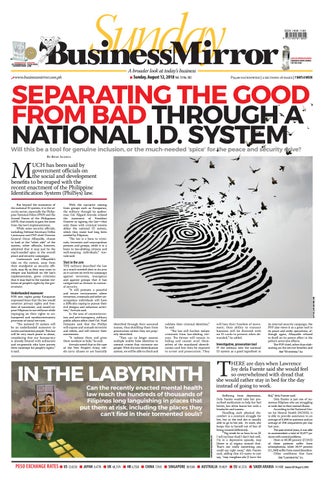
SKYPIXEL | DREAMSTIME.COM
But beyond the economics of the national ID system, it is the security sector, especially the Philippine National Police (PNP) and the Armed Forces of the Philippines (AFP), that stands to gain the most from the law’s implementation. While some security officials, including Defense Secretary Delfin Lorenzana and PNP chief Director General Oscar Albayalde, choose to look at the “other side” of the system, other officials, however, admitted that it may just be the much-needed spice in the overall peace and security campaigns. Lorenzana’s and Albayalde’s take on the system, away from their standpoint as security officials, may fly as they may want to temper any backlash on the law’s implementation, given criticisms that it may lead to the wanton violation of people’s rights by the government.
identified through their assumed names, thus shielding them from prosecution unless they are properly identified. “They can no longer assume multiple and/or false identities to commit crimes that victimize our people. With the new identification system, we will be able to check and
validate their criminal identities,” he said. “The law will further isolate criminals from law-abiding citizens. The former will remain in hiding and cannot avail themselves of the mandated identification card lest they be exposed to arrest and prosecution. They
will lose their freedom of movement; their ability to transact business will be divested with no ID cards to present when demanded,” he added.
Investigative, prosecution tool
IF the military sees the national ID system as a good ingredient in
its internal security campaign, the PNP also views it as a great tool in its peace and order operations, although again, Albayalde refused to dwell on its potent effect in the police’s anticrime efforts. The PNP chief, other than elaborating on the service benefits and See “ID system,” A2
T IN THE LABYRINTH
HERE are days when Lawrence Joy dela Fuente said she would feel so overwhelmed with dread that she would rather stay in bed for the day instead of going to work.
NUVOLANEVICATA | DREAMSTIME.COM
Can the recently enacted mental health law reach the hundreds of thousands of Filipinos long languishing in places that put them at risk, including the places they can’t find in their tormented souls?
PESO EXCHANGE RATES n US 53.0250
Suffering from depression, Dela Fuente would take her prescribed medication to help her feel better, but often leaves her with a headache and nausea. Handling such physical discomfort is a constant struggle for her, but in the end she is usually able to go to her job. At work, she keeps this to herself out of fear of being treated differently. “’Pag sinabi ko sa boss ko na [If I tell my boss that] I don’t feel well, I’m in a depressive episode, may [there is a] stigma around that. That’s not really something you could say right away,” dela Fuente said, adding that it’s easier to just say, “may trangkaso ako [I have the
flu],” dela Fuente said. Dela Fuente is just one of numerous Filipinos who are struggling at work due to their mental illness. According to the National Center for Mental Health (NCMH), it is able to provide assistance to an average of 3,466 in-patients and an average of 266 outpatients per day last year. The past several years, it was able to accommodate a total of 41,677 patients with mental problems. Most or 66.98 percent (27,915) of these patients suffer from schizophrenia, while 26.97 percent (11,240) suffer from mood disorders. Other conditions that have See “Labyrinth,” A2
n JAPAN 0.4778 n UK 68.3174 n HK 6.7558 n CHINA 7.7615 n SINGAPORE 38.9260 n AUSTRALIA 39.4029 n EU 61.5726 n SAUDI ARABIA 14.1400
Source: BSP (August 9, 2018 )
NewsSunday BusinessMirror
A2 Sunday, August 12, 2018
ID system... privileges offered by the PhilSys, merely said that the national ID system would allow them to share their crime information and clearance systems with other government agencies through a national database that would be put up under the law. A ranking police official said that for those who have criminal records or in the case of people who are wanted by the law, the ID system could work as a “locator” for law enforcement officers. “Once they use their IDs, then it pinpoints where they are and who they are,” he said. The official said that since the law mandates or honors only a single identification system, then criminals have no option but to expose themselves, otherwise they should opt out of being listed in the national ID system. “But then again, the law will leave you no choice, since if you will not avail yourself of the system, then it means you are hiding something or your record is questionable,” he said. “As President Duterte has said, only those who have criminal records or those who are hiding something are afraid of the law,” he added. At the extreme, the national ID should serve as a walking monitor for those who have transgressed the law since it is used in every transaction that requires proof of identity.
Getting it right this time
PRESIDENT Duterte signed into law on August 6 the measure seeking to establish the Philippine Identification System (PhilSys), and, in a speech, allayed fears about the violation of privacy rights and other individual freedoms. He and Palace officials insisted that, unlike its doomed predecessors—there were several attempts across previous administrations to have one such system—this measure will meet the test of constitutionality even if critics or lawmakers make good on a vow to bring it to court. Once the Philippine Identification System Act is signed into law, all citizens and resident aliens of the country will soon be provided with a valid proof of identify as a means of simplifying public and private transactions.
Continued from A1
One year after the effectivity of the Act, every citizen or resident alien shall register personally in the registration centers. The law also aims to eliminate the need to present other forms of identification when transacting with government and the private sector, subject to appropriate authentication measures based on a biometric identification system. The Philippine ID shall contain the following information: the PhilSys number, full name, sex, blood type, marital status (optional), place of birth, photograph, date of birth and address. The PhilSys number is a randomly generated, unique and permanent identification number that will be assigned to every citizen or resident alien upon birth or registration by the Philippine Statistics Authority (PSA), which is also the primary implementing agency to carry out the provisions of the measure. For data privacy and security, the ID shall contain a QR code which contains some fingerprint information and other security measures, such as iris scan. Any information obtained as a result of unlawful disclosure under the Act shall be inadmissible in any judicial, quasijudicial or administrative proceedings. The Department of Budget and Management also said in March that it has allocated a P2-billion budget to the PSA for the implementation of the Philippine ID system. The Philippines has a Unified-Multi-Purpose ID (UMID) system in place, but National Statistician and Civil Registrar General of PSA Lisa Bersales earlier said that the proposed Philippine ID is different from UMID. According to Bersales, UMID is a “functional ID” while the proposed Philippine ID is a “foundational ID.” She said functional IDs are ID cards, numbers, or other systems created for specific government services, such as driver’s licenses and voter cards. On the other hand, foundational IDs are not linked to special services but serve as a legal proof of identity for multiple purposes, for example, unique ID cards.
www.businessmirror.com.ph
Labyrinth... prompted people to seek consultation at the NCMH were organic mental disorders (1,495 cases), mental retardation (591) and mental/behavioral disorders due to psychoactive substance use (436). The NCMH is a special training center and hospital of the Department of Health (DOH), which primarily caters to patients with mental illness.
Workplace setting
DESPITE the apparent large number of Filipinos suffering from mental illness, the issue is rarely raised especially in the workplaces. Federation of Free Workers (FFW) Vice President Julius Cainglet said misconception and lack of information about mental illness and health are still prevalent in a work setting. “For others, if you talk about mental health you would be ostracized,” Cainglet said in an interview. He blamed this mind-set for trend why practices harmful to mental health, such as bullying from one’s boss or peers, still persist. “If you can’t handle being shouted at by your boss, you are the one who is lacking, because you’re supposed to be mentally ready for any shouts or insults hurled at you,” Cainglet said. No less than Bureau of Working Condition (BWC) Director Ma. Teresita Cucueco admitted there is still much to be desired in the inclusion of mental health in the government’s existing occupational safety and health (OSH) policies. “It is stipulated there in the [OSH] that companies should promote mental health, but it is very broad,” Cucueco said. She said mental issues tend to be scattered in the OSH modules related to workplace abuse, bullying and stress management, and there is no one organized document. The overall guidelines for mental health promotion in the
Continued from A1
workplace have yet to be crafted by the government.
Cost of mental illness
DR. Marita Sales-Aganon, a psychiatrist, said addressing these unhealthy practices as well as promoting healthy mental practice like stress orientation could actually boost the productivity and efficiency of workers. She said this could be included in the annual physical examinations of employees. The measure will not only boost morale of workers, but also minimize their risk of being absent from work often. While there is still no study about the cost of mental illness in the Philippines, the World Health Organization (WHO) cited research in 2003 estimating that in the United States alone, total mental health care costs around $85.3 billion in 1997.
Mental health law, finally
REALIZING the importance of addressing mental health problems, the current administration implemented several policies to promote mental health. This includes the DOH allocating P1 billion of its budget for use in boosting its mental health programs. The fund was used to procure antipsychotic drugs and improve the DOH’s mental health facilities, including the NCMF. Recently, Republic Act 11036, or the Mental Health Law, was also passed with the support of President Duterte. The landmark legislation aims to mainstream the issue of mental health and provide better care for those with mental illness.
New guidelines
ANOTHER salient point of the law is it mandates the Department of Labor and
Employment (DOLE) and the Civil Service Commission (CSC) to develop guidelines and appropriate standards, and evidence-based mental health programs, for the workplace. The law states that workers are entitled to “receive evidence-based treatment of the same standard and quality, regardless of age, sex, socioeconomic status, race, ethnicity, sexual orientation… Access affordable essential health and social services for the purpose of achieving the highest attainable standard of mental health.” The DOH said it is still developing the guidelines on mental health for the workplace. It said the implementing rules and regulations of the mental health law should be in effect 120 days after the law is implemented and is expected to come out in November. Dela Fuente, who became the cofounder of the online campaign MentalHealthPH, said she hopes the new DOLE-CSC guidelines will encourage companies to have in-house counselors. “It would have been easier for me if I had someone to talk to… [So] I can explain that this is my situation, it’s a physical thing. I can actually feel my body reacting to the medicine. This is the side effect, one thing you have to consider [in] having mental health problems or mental health illness, and if there is a way I can work out schedules,” dela Fuente said. MentalHealthPH aims to create a safe community for people with mental health problems by advocating mental health awareness through social media. The passage of the long-awaited law is just the start of a long journey to help people similarly situated as dela Fuente. With estimates of those completely undiagnosed, receiving marginal care or are misdiagnosed, or even just at serious risk of mental health problems on account of their conditions running in the hundreds of thousands, the challenge to give flesh to the law is indeed daunting. Reports from Karl Patrick Marcos and Samuel P. Medenilla
www.businessmirror.com.ph
The World BusinessMirror
Sunday, August 12, 2018
A3
Ending Venezuela ‘hyperinflation’ could be both so easy and so hard
I
nflation is so bad in Venezuela that the country will knock five zeros off the bolivar this month in a vain effort to restore its buying power. Is there any way to stop hyperinflation?Yes, actually. But President Nicolas Maduro almost certainly won’t resort to it.
The surefire weapon is the US dollar. Maduro could replace the bolivar with the greenback. Venezuelans would turn in all their nearworthless national currency, which would be destroyed, exchanging it for dollars from the government’s remaining stash at approximately today’s unofficial exchange rate. That would end hoarding and restore incentives to save and invest. There are precedents. Ecuador dollarized in 2000 and quickly extinguished hyperinflation—defined as inflation of 50 percent a
month or more. Prices soar because the government keeps printing money. Deprive it of the printing press, and nobody can raise prices, because there’s no fresh money to pay more for things. Johns Hopkins University professor Steve Hanke, a go-to economist for countries looking to stabilize their currencies (past clients include Argentina, Russia and Zimbabwe) and a long-time proponent of dollarization, argues Venezuela should make the move right away. “There are thousands of things
that have to be done,” he says. “But the one thing that must be done to repair Venezuela’s economy immediately is to establish stability. Whoever does that will be a national hero.” Francisco Rodriguez, an adviser to Henri Falcon, Maduro’s challenger in May’s presidential election, concurs. “Dollarization immediately gives you credibility” in the fight against hyperinflation, says Rodriguez, chief economist at Torino Capital Llc. in New York. So why won’t Maduro do it? For one thing, it would mean ditching a currency named after Venezu-
ela’s liberator and replacing it with that of its most potent foe. Maduro railed against the idea when Falcon raised it on the campaign trail, equating it with a surrender of sovereignty. Venezuela could also end hyperinflation by switching to another stable currency such as the euro. But that would still force the country to surrender control over monetary and exchange rate policy. So if, for example, prices for Venezuela’s type of crude oil fell sharply, authorities couldn’t cushion the blow by cutting interest rates or depreciating the currency.
There are thousands of things that have to be done [to repair Venezuela’s economy]. But the one thing that must be done immediately is to establish stability. Whoever does that will be a national hero.”—Hanke
The loss of flexibility is a problem for Ecuador and other nations that have adopted the dollar, including El Salvador and Panama, as well as for the disparate nations in the euro zone yoked to the onesize-fits-all monetary policy of the European Central Bank. Dollarization would “slow down our capacity for growth, because it would reduce competitiveness,” says Asdrubal Oliveros, director of Ecoanalitica, a consulting firm in Caracas. Ending hyperinflation wouldn’t make it easier for Venezuela to pay for imports of food, medicines, and other crucial items. It wouldn’t lighten the crushing foreign debt burden. And it wouldn’t ease the feverish tension in the once-prosperous nation, where an attack by explosive-laden drones during a military parade in earlyAugust wounded officers but left Maduro unharmed. Economist Ricardo Hausmann, a fierce critic of Maduro who was Venezuela’s planning minister in the 1990s, calls dollarization a “mirage.” He says the priorities should be loosening the state’s grip on the
economy and securing debt relief and foreign aid. Hausmann says dollarization shouldn’t be considered until aid is in place. But Hanke argues that lenders and donors won’t step in to help as long as inflation is out of control. Neither strategy may be possible as long as Maduro clings to the presidency. “You can’t work out crises like these with those culpable in power,” says Jeffrey Sachs, a Columbia University economist who helped Bolivia overcome hyper-inflation in the 1980s. (Sachs says his comments should not be construed as an endorsement of “US-led regime change.”) The dollar is already an unofficial pricing benchmark in Venezuela and is used illegally for many transactions. On August 2 the government repealed some currency controls, enabling businesses and individuals to swap money at designated trading houses and increasing access to hard currency. But it’s too little, too late, Hausmann says. “He has a chasm in front of him. And you cannot cross a chasm step by step.” Bloomberg News
A4
Sunday, August 12, 2018
The World BusinessMirror
Turkey curbs growth goals in bid to stem market rout
I
n their first response to the market rout in the past week, Turkish policy-makers said they’d curb economic growth ambitions to reduce borrowing. The government has set a growth target of less than 4 percent, down from 5.5 percent originally, Treasury and Finance Minister Berat Albayrak’s office said. Th e m e a s u re s a re Al b ay ra k ’s f i r s t whack at fixing the $880-billion economy’s vulnerabilities since the most recent market rout was triggered by last week ’s U S sanctions. The penalties on two ministers i n Pre s i d e nt R e ce p Tay y i p E rd o g a n’s government were imposed over Turkey’s co nt i n u e d d e te nt i o n o f a n Am e r i c a n pastor, sending lira assets to record lows
and sparking fears that what began as a markets meltdown might spill over into the rest of the economy. Although it’s good news that Turkey’s new economy czar finally spoke about his plan, investors are skeptical, according to Tim Ash, a senior emerging-market strategist at BlueBay Asset Management Llc. in London. “It’s a case of seeing is believing in terms of delivery,” Ash said. “Albayrak needs to be specific in terms of how exactly he is going to cut the budget deficit this year. It’s great having nice targets, but let’s not forget the Turkish central bank has a 5-percent inflation target and has not met it over the past decade.” Bloomberg News
Indonesia’s Jokowi picks cleric in bid for 2nd term
I
n d o n e s i a n President Joko Widodo picked Ma’ruf Amin, the head of the nation’s influential clerics’ council, as his running mate for next year’s election, ending months of speculation and lobbying from coalition partners. Amin was chosen for his vast experience in religious and political affairs, Widodo, known as Jokowi, told reporters in Jakarta o n Th u r s d ay. Th e d u o w i l l f i l e t h e i r nominations at the General Elec tions Commission on Friday. Widodo is bidding for a second term in what is likely to be a rerun of the 2014 race in which he defeated Prabowo Subianto,
who leads Indonesia’s main opposition party Gerindra. While the nominations closed on Friday, official campaigning will begin in September with voting scheduled for April 17. Subianto has yet to announce who he will pair with in the polls. Jokowi has gained endorsements from at least six major parties, including his Indonesian Democratic Party of Struggle and former ruling party Golkar. The 57-year-old has worked hard at maintaining an image as the “people’s president” that helped catapult him to the top job. His alliance also controls more than 60 percent of parliament. Bloomberg News
www.businessmirror.com.ph
US oil vanishing from China tariffs reveals American clout
T
he removal of US crude from goods targeted by Chinese tariffs is a sign that America has become too big to ignore in the oil market.
Less than two months after threatening to impose levies on imports of US crude, the world’s biggest oil buyer has now spared the commodity. Only fuels such as diesel, gasoline propane will be hit with duties on August 23, according to China’s commerce ministry. That’s after the nation’s buyers, including top refiner Sinopec, began shunning American supplies to avoid the risk of tariffs. China’s original plan to target US crude came at an inopportune time for the country’s buyers. Sinopec’s trading unit, Unipec, was embroiled in a dispute with Saudi Arabia, saying the producer’s prices were costly and cutting purchases just as it was boosting American imports. Two months on, refiners were faced with the risk of supply disruptions from Iran to Venezuela and paying more to take advantage of booming US output.
“The US has been and will remain the main source of incremental crude production globally,” said Den Syahril, an analyst at industry consultant FGE. “With several new refineries starting up over the next couple of years, China would thus be wary of taking a decision that could end up severely hurting its domestic refining industry.” Before the tariff kerfuffle, US crude exports to China had risen to 15 million barrels in June, the highest volume in data going back to 1996, according to US Census Bureau and Energy Information Administration data. That made the Asian country the biggest buyer of American supply. The shale boom, meanwhile, lifted US output to an unprecedented 11 million barrels a day last month, establishing it in the ranks of other top producers Russia and Saudi Arabia. The increase has also weakened the cost of American supply relative to Middle East benchmark Dubai and Atlantic Basin marker Brent, raising the allure of US shipments to Asia—the world’s biggest oil consuming region.
Rival Purchases
W hile C h i n a’s Si nopec wa s
avoiding purchases, regional rivals including Indian Oil Corp., Thailand’s PTT Pcl, Taiwan’s Formosa Petrochemical Corp., South Korea’s GS Caltex Corp. and SK Innovation Co. have been buying up American crude cargoes for delivery in the coming months. Wednesday’s decision to omit crude will give Unipec the chance to bring crude cargoes loading from the United States in June and July into China without incurring additional costs, Michal Meidan, an analyst at industry consultant Energy Aspects Ltd., wrote in an e-mailed note on August 8. However, she cautioned that refiners in the Asian nation may still be wary of boosting American oil purchases because it may yet be targeted with tariffs if tensions escalate. The Chinese government decided to change the list of tariffs after consulting with industry associations and corporations to protect the interests of domestic consumers and companies, according to a statement posted on the Ministr y of Finance’s web site.
Rising costs
A decline in operations at China’s independent refiners has raised prices of some fuels in the nation, according to Li Li, an analyst with Shanghai-based commodities researcher ICIS China. “If major refiners, who are US oil buyers, incur a deficit, it’s possible the domestic market will face a fuel shortage as well as rising crude feedstock costs,” Li said. American sanctions that will
target oil exports from Iran starting in November are another risk. Concern is growing that US President Donald J. Trump’s measures will curb the Organization of Petroleum Exporting Countries producer’s shipments at a time when production from another group member, Venezuela, is also dwindling in the midst of an economic meltdown. Both the producers are suppliers to China. “With oil from Iran and Venezuela at risk, US crude is offering Chinese refiners a good and abundant alternative,” said Sophie Shi, a Beijing-based analyst with consultant IHS Markit Ltd. “Imagine if this ideal resource was cut off. That would leave China solely dependent on Saudi Arabia, which seems too risky.”
Energy security
In fact, President Xi Jinping is urging China’s state-owned energy giants to boost domestic oil and gas output as the country’s dependence on imports grows. The nation’s plans to establish its own crude benchmark have faltered. West Texas Intermediate futures, the US benchmark, traded unchanged at $66.94 a barrel at 5:44 a.m. in New York. Brent crude, the marker for more than half the world’s oil, was little changed at $72.36 in London. Daniel Hynes, a Sydney-based analyst at Australia & New Zealand Banking Group Ltd., said he believes China will apply tariffs on American crude only as a last resort in the trade war between the world’s two biggest economies. Bloomberg News
Science
BusinessMirror
Editor: Lyn Resurreccion • www.businessmirror.com.ph
Sunday
Sunday, August 12, 2018
A5
Filipino engineers in Japan’s Tohoku, Hokkaido, Kyushu universities up to the challenge
Diwata-2 microsatellite nears completion, handover to Jaxa
Dr. Remedios Flamiano shows her banana tissue culture products.
Best D.O.S.T. S.e.t.u.p. adoptor
How a banana tissue culture is now helping the industry
D
Story & photo by Stephanie Tumampos
r. Remedios Flamiano’s now multimillion banana tissue c ulture business, an application of plant biotechnology, was initially a failure, out of her frustration from being a low-paid instructor at a state university. With no money on hand, and only the support of her husband, who agreed to turn their bedroom in General Santos City into a laboratory for her banana tissue culture, the award-winning scientist-turned-entrepreneur can now grow and culture her banana tissues in her P5-million laboratory after she received support from the Department of Science and Technology’s (DOST) Small Enterprises Technology Upgrading Program (Setup) in 2014.
Banana tissue-culture research, successful biz
In her banana plant-tissue culture, Flamiano clones an exact copy of the parent source. “We would need plant hormones in a gel-like substance inside a culture medium with the sucker planted inside,” she explained. The hormones would initiate the fast proliferation of the plant tissues, which accelerates production. Within three to five months, the sucker would then clone itself to a thousand fold with the same characteristics as that of the parent. The cloned seedlings will then be put in pots and placed in the nursery for another two months. They are sold at P15 a piece. Flamiano shared to the BusinessMirror that this kind of agricultural business is the future of the industry. Not only that each seedling is free from diseases. It also provides uniform growth and shorter growth period, giving farmers a chance to reduce labor costs. She also shared that she has already helped hundreds of farmers through this business, including the banana companies in Mindanao like Del Monte, which has hundreds of thousands of hectares of banana farm. “I serve 20 percent of this [Del Monte] company’s banana plantation,” she said. Each hectare of land would need about 2,000 seedlings which is very easy for Flamiano to produce, given the efficiency of the plant-tissue technology she has developed.
Plant biotechnology application
“The technology we’re using on planttissue culture is the most advanced technology right now, where we can propagate high-value crops like banana,” Flamiano said. This is also the same technology that can produce disease-free seedlings and quality planting materials for farmers. The process, however, is not new in any
laboratory around the world for commercial application. In the early-20th century, German botanist Gottlieb Haberlandt conceived the cell-culture concept. In a 2007 published article in the Molecular Biotechnology journal, Trevor Thorpe said, “The period between the 1940s and the 1960s was marked by the development of new techniques and the improvement of those that were already in use.” Thorpe explained that the availability of these techniques paved the way in the 1960s for the application of tissue culture on cell behavior, plant modification and improvement, pathogen-free plants and germplasm storage, clonal propagation and product formation. The in vitro technologies and further studies in plant propagation have given major breakthroughs in molecular biology and agricultural biotechnology. “The aseptic techniques used are the same advanced technology we’re using to produce disease-free seedlings and quality planting materials for farmers,” Flamiano said, referring to the method of banana tissue culture. It is making use of skills on aseptic techniques, such as sterility. It’s a delicate process in the laboratory that needs practice. “When we do tissue culture, we aim for no contaminations because if there are, the plants won’t grow and propagate, which is why we have to get rid of microbial contaminations in the lab to successfully grow the plant tissues,” she said.
Winning the best DOST Setup adopter
In her speech when she received the best Setup Adopter Award during the 2018 National Science and Technology Week at the World Trade Center in Pasay City in July, Flamiano shared how she journeyed toward the success she is experiencing right now while helping farmers around her community in Davao. “I can truly say the DOST is really close to my heart because it made me realize my dream not just as a teacher but as an entrepreneur,” Flaminiano said. She recalled how, back in 2014, she tried her luck in applying for the DOST Setup grant. The grant gave her an upgrade in laboratory equipment, such as digital balance, laminar flow, autoclave, distilling apparatus and pH meter. “I know I have great responsibility for being a champion for the best Setup [enterprise],” she added. She shared that she is giving her sincere dedication to help uplift the lives of the people in the countryside through the provision of quality materials to poor farmers, and help improve their lives.
Mangrove crab hatchery facility to provide reliable seed stock in Northern Luzon
T
he Philippine Council for Agriculture, Aquatic and Natural Resources Research and Development of the Department of Science and Technology (DOST-PCAARRD) awarded a P4.5-million facilities development grant to Pangasinan State University-Binmaley Campus (PSUBC) for the upgrade of its mangrove crab hatchery facility. The improved hatchery facility in PSUBC is expected to produce at least 480,000 crablets per year. Crablets at PSU-BC are being sourced from outside the province, such as from Bicol, Cagayan and the Visayas. The availability of reliable seed stock has been a major challenge that hampered the expansion of the mangrove crab industry in the region. “As one of our valued partners in the region, PSU’s strength in fisheries research and development [R&D] is highly recognized by DOST-PCAARRD. As such, we shall
continue this partnership not only in R&D activities but also in its capacity-building initiatives,” said Dr. Juanito T. Batalon, former Institution Development Division (IDD) director of DOST-PCAARRD during the recent groundbreaking ceremonies of the PCAARRD-PSU Mangrove Crab Hatchery Project in Binmaley, Pangasinan. Also present during the ceremonies were PSU Vice President for Research and Extension Dr. Virgilio C. Barongan; PSU-BC Executive Director Dr. Jessica J. Jimenez; PSU Director for Special Projects Dr. Rolando B. Cerezo; and PCAARRD-IDD Facilities Development and Management Unit Head Engr. Ruel Carlo L. Tanqueco. Through the support of DOST-PCAARRD, PSU-BS has adopted and refined the technology on commercial scale mangrove crab hatchery system developed by the Southeast Asian Fisheries Development Center. S&T Media Services
I
By Edd K. Usman | Special to the BusinessMirror
n case some still doubt that the Philippines has already sent its first eye in the sky into space, maybe a second microsatellite would make them believe it is so. Another 50-kilogram satellite shall soon be sent into orbit by the Department of Science and Technology (DOST) through its partner, Japan Aerospace Exploration Agency (Jaxa). It should be recalled that the DOST had the Philippines’s first microsatellite—the maiden Diwata-1 that was designed, developed and assembled in Japan by nine pioneering Filipino engineers and scientists along with their “sensei” (instructors) from the Tohoku University (TU) and Hokkaido University (HU). Diwata-1 was launched into the International Space Station onboard the Orbital ATK’s Cygnus spacecraft on March 23, 2016. It was deployed from the ISS into her orbit on April 27 by the Japanese Ex per imenta l Module (JEM)— ”Kibo” or Hope—around 400 km above Earth’s surface. Now, two years and four months later, the government is about to unveil the second iteration of Diwata-1—named Diwata-2. Would there be a Diwata-3? Obviously, that’s the plan of the DOST and its attached agencies, especially the Advanced Science and Technology Institute (DOST-Asti) and the Philippine Council for Industry, Energy and Emerging Technology Research and Development (DOST-PCIEERD). The name of the DOST spacerelated undertaking is the Philippine Scientific and Earth Observation Microsatellite (PHL-Microsat), along with a ground receiving station dubbed the Philippine Earth Data Resources Observation (Pedro), a two-year program. PHL-Microsat is being put into motion by the University of the Philippines (UP) Diliman in Quezon City.
Early-September
Thus, it should surprise no one that DOST is about to add to its list of groundbreaking technological innovations designed to benefit every Juan and Juana. Diwata-2 is targeted for launching onboard Jaxa’s H-IIA rocket from Tanegashima Island in Japan, and direct into her orbit before the Year of the Dog sounds off its last bark, probably in the fourth quarter. In an exclusive interview, via Facebook ’s Messenger, A r iston Gonzalez, one of the nine Diwata-1 pioneers, now a researcher/lead research and development engineer for PHL-Microsat at DOST-Asti, gave updates on status of Diwata-2, whose design, development, and assembly immediately followed Diwata-1’s successful history-making launch and deployment. Gonzalez, one of the leaders of the “Magnificent 9,” so-called for being the pioneer Filipino satellite builders, relayed to the BusinessMirror that “the completion of Diwata-2 is near. She will be delivered to Jaxa by early-September.” Gonzalez said what remains to be done in the building of Diwata-2 are “the final electrical tests and vibration tests of the flight model.”
Amateur radio module
He confirmed that the Philippines’s second microsatellite would carry an amateur radio module through which communication can be made using ham radios.
For the uninitiated like this journalist, “amateur radio [or ham radio] is a popular hobby and service that brings people, electronics and communication together.” “People use ham radio to talk across town, around the world or even into space,” ARRL.org said. Another Internet source said it uses “radio frequency spectrum.” T he Diwata-1 and Diwata-2 builder said what is called amateur or ham radio handsets are like the walkie-talkies used for talking between individuals, more so the police and Red Cross personnel. He said the National Disaster Risk Reduction and Management Council (NDRRMC) has access to such handheld radio devices. Sounds great for a country like the Philippines that suffers at least 20 typhoons a year that like Supertyphoon Yolanda (international code name Haiyan) in 2013 Eastern Visayas lost totally all communications infrastructures and facilities for a few days. It was when communication was nonexistent in Leyte province, the hardest hit. Gonzalez said the “target use for ham radio [of Diwata-2] is for emergency situations wherein all commercial communications are down.”
Enhanced camera, with ‘wings’
On the other hand, he said the second microsatellite would have mostly the same mission with the first eye in the sky. The difference is the addition of an enhanced resolution camera (ERC) and a wider field-of-view or coverage of her other cameras, the multispectral imaging camera, the high-precision telescope, wide field camera and middle field camera. Those are not the only enhancements, though. “In the satellite BUS system, Diwata-2 has a deployable solar array panels. She will look like Diwata-1 but with wings,” Gonzalez said, adding that the solar panels were aimed at increasing her solar power charging capability.
Relay station between space and Earth
Gonzalez explained that Diwata-2’s amateur radio facility would serve as a relay station in space between and among people on Earth.
The scale model of Diwata-2 microsatellite, which was exhibited at the National Science and Technology Week in World Trade Center in Pasay City in July. Lyn Resurreccion
As it is in space, the microsatellite’s ham radio will function even when there is no communications facility on Earth as a result of disasters. (He invited Filipinos to follow for updates on Diwata-1 and Diwata-2 on https://www.Facebook.com/PHLMicrosat.) “All one has to do is tune in [a ham radio] to the frequency of Diwata-2 to send voice messages while the other party stands by to receive the voice message,” he said. “What Diwata-2 does is to serve as a relay or connecting point for two persons communicating with each other,” he pointed out. A voice call will not be included in the amateur radio function, he said. Diwata-2’s amateur radio will serve as a temporary replacement for the fallen communications towers, he added. One can also store messages on Diwata-2 that can be broadcasted repeatedly across and over the Philippines, such as prerecorded emergency messages in times of disasters, calamities and other kinds of emergency. In connecting to the microsatellite’s ham radio, nothing special has to be done, only tune in to the official frequencies.
Good for weather stations, flood monitoring
Gonzalez hastened to add that communicating with Diwata-2 has limitations, saying there are specific time windows when it is available, which will be determined and set once she is in her orbit, which is going to be higher than Diwata-1’s. “We are also planning to activate with Diwata-2 what we call ‘Storeand-Forward mechanism,’” he said. This means the mechanism will collect data from floating buoy sensors deployed offshore by the DOST, a safe and better alternative than sending people to manually collect the data specially when the weather is not conducive. “So, instead of people going directly to the buoy to collect the data [on weather, etc.], it could be that there is one buoy sensor that will automatically collect the data from nearby nearby sensors, and the [buoy sensor collecting the data] will upload it to Diwata-2. “Then, when Diwata-2 passes over DOST-Asti’s Pedro ground receiving station, we can just download the data and distribute it to stakeholders,” said the Filipino engineer. He said the Store-and-Forward mechanism is not limited to just specific sensors. “We can modify even the existing one on the field so they can have the capability to upload data to Diwata-2.” This is good with weather stations with certain kind of sensors, such as
flood monitoring sensors. They can upload directly to Diwata-2, which is very useful, especially when the sensors are in remote location.
Sustain space development, technology
He said there is no definite plans yet about Diwata-3. “But we definitely want to sustain the stamina we have for space development and technology. What we want to pursue in the immediate feature is to see the growth of the local industries sector; more active involvement and augmented capabilities.” Gonzalez emphasized that there is no intent to cut the umbilical cord that links the PHL-Microsat to foreign technology when they will build the next iteration of the satellites. “But we definitely want to leverage the capability we already have in the Philippines, and cultivate new ones.”
Data is the ‘new oil’
He noted the importance of the DOST’s space technology development program, citing data transformation as the new oil. “I think, in a general sense, when we send out satellites into space, what we are primarily getting is data. And I think it’s getting to a point now that data is becoming the new oil. Data is now a resource that can drive a country forward. Be it in economy, security, sustainability and many others, data is now playing an important role. “Secondarily, delving in space technology does not mean we only have impact when we send out things in space. In fact, when we delve with space technology, we drive industries and create products that trickle down to other relevant industries/sectors. For example, in automotive, electronics, manufacturing and many others.” The “trickle down,” he said, could be in the form of the socalled attitude or orientation control that is being implemented in satellites, saying they are important in pointing the cameras of the satellite into a specific target on Earth. “This technology can be used on automated vehicles on the ground and in the air. Unmanned aerial vehicles, or self-driving cars, etc.” These are something to ponder on. Usman is a freelance journalist who is on science, information technology, current events, etc. He won the “Best Science Feature Story” in the first University of the Philippines Science Journalism Award 2018 on February 17, and the DOST-PCIEERD “Kabalikat Award” for Print Media on June 27, 2014.
Faith A6 Sunday, August 12, 2018
Sunday
Chinese Christians fight for spiritual awakening
N
ANYANG, China—The 62-year-old Chinese shopkeeper had waited nearly his entire adult life to see his dream of building a church come true—a brick house with a sunny courtyard and spacious hall with room for 200 believers. But in March, about a dozen police officers and local officials suddenly showed up at the church on his property and made the frightened congregants disperse. They ordered that the cross, a painting of the Last Supper and Bible verse calligraphy be taken down. And they demanded that all services stop until each person, along with the church itself, was registered with the government, said the shopkeeper, Guo. Without warning, Guo and his neighbors in China’s Christian heartland province of Henan had found themselves on the front lines of an ambitious new effort by the officially atheist ruling Communist Party to dictate—and in some cases displace—the practice of faith in the country. “I’ve always prayed for our country’s leaders, for our country to get stronger,” said Guo, who gave only his last name out of fear of government retribution. “They were never this severe before, not since I started going to church in the 1980s. Why are they telling us to stop now?” Under President Xi Jinping, China’s most powerful leader since Mao Zedong, believers are seeing their freedoms shrink dramatically even as the country undergoes a religious revival. Experts and activists say that as he consolidates his power, Xi is waging the most severe systematic suppression of Christianity in the country since religious freedom was written into the Chinese constitution in 1982. The crackdown on Christianity is part of a broader push by Xi to “sinicize” all the nation’s religions by infusing them with “Chinese characteristics,” such as loyalty to the Communist Party. Islamic crescents and domes have been stripped from mosques, and a campaign was launched to “reeducate” tens of thousands of Uighur Muslims. Tibetan children have been moved from Buddhist temples to schools and banned from religious activities during their summer holidays, state-run media report. This spring, a five-year plan to sinicize Christianity in particular was introduced, along with new rules on religious affairs. Over the last several months, local governments across the country have shut down hundreds of private Christian “house churches.” A statement last week from 47 in Beijing alone said they had faced “unprecedented” harassment since February. Authorities have also seized Bibles, while major e-commerce retailers JD.com and Taobao pulled them off their sites. Children and communist party members are banned from churches in some areas, and at least one township has encouraged Christians to replace posters of Jesus with portraits of Xi. Some Christians have resorted to holding services in secret. A dozen Chinese Protestants interviewed by the Associated Press
described gatherings that were raided, interrogations and surveillance, and one pastor said hundreds of his congregants were questioned individually about their faith. Like Guo, the majority requested that their names be partly or fully withheld because they feared punishment from authorities. After reporters visited Henan in June, some interviewees said they were contacted by police or local officials who urged them not to discuss any new measures around Christianity. The party has long been wary of Christianity because of its affiliation with Western political values. Several Chinese human-rights lawyers jailed for their work, including Jiang Tianyong and Li Heping, are outspoken Christians. So too are many Hong Kong pro-democracy activists, not least among them 2014 protest leader Joshua Wong. “Chinese leaders have always been suspicious of the political challenge or threat that Christianity poses to the Communist regime,” said Xi Lian, a scholar of Christianity in China at Duke University. “Under Xi, this fear of Western infiltration has intensified and gained a prominence that we haven’t seen for a long time.” Guo, who keeps a small storefront selling ornate doors in a riverside district, once had eyesight so poor that he could not distinguish the sky from the earth. But after finding God at 27 years old, he made a seemingly miraculous recovery that he attributes to his faith. For decades, he, like many Christians in China, shuttled from one unregistered house church to another, where folding chairs served as pews and coffee tables as lecterns. Two years ago, he and 10 other Christians pooled their money to erect a permanent church on his property. They are part of what experts describe as a spiritual awakening in China. The number of Chinese believers of all faiths has doubled in two decades to an estimated 200 million, by official count, as the hold of the Communist party has weakened. Among them are an estimated 67 million Christians, including Catholics—a number that is expected to swell to become the world’s largest Christian population in a matter of decades. This rapid growth has reinvigorated the party’s longtime mission to domesticate a religion traditionally aligned with the West. Historians believe that Christianity was known to China as early as the seventh centur y, and was later propagated by Jesuit missionaries starting in the 1500s. In recent decades the religion has faced by turns heavy persecution and tacit acceptance. During the Cultural Revolution, when Mao sought to eradicate all religions, Christians were jailed, tortured and publicly humiliated. But they survived by operating covertly and grew steadily in number after Mao’s death in 1976, when a populace disillusioned with the Communist Party began to seek
A worker alights from a truck parked in front of a church and the Chinese national flag near the city of Pingdingshan in central China’s Henan province on June 2. Under President Xi Jinping, China’s most powerful leader since Mao Zedong, believers are seeing their freedoms shrink dramatically even as the country undergoes a religious revival. Experts and activists say that, as he consolidates his power, Xi is waging the most severe systematic suppression of Christianity in the country since religious freedom was written into the Chinese constitution in 1982. AP/Ng Han Guan
moral guidance elsewhere. Chinese Christians say the Bible gives them a sense of right versus wrong and the strength to endure in a country where power often trumps justice. While China’s rapid growth has brought prosperity to many, others despair at what they see as a deterioration of public morals. The deaths of children in scandals involving tainted infant formula and shoddily built schools in recent years have led to the sense that modern China was in the midst of an ethical crisis. “After the ‘collapse’ of communist ideology, no value system has been in place to fill the spiritual vacuum,” said writer Zhang Lijia. “China has witnessed a religious revival in recent decades precisely because of this vacuum and relaxed control.” Officials once largely tolerated the unregistered Protestant house churches that sprang up independent of the official Christian Council, clamping down on some while allowing others to grow. But this year they have taken a tougher approach that relies partly on “thought reform”—a phrase for political indoctrination. Last November Christian residents of a rural township in southeast Jiangxi province were persuaded to replace posters of the cross and Jesus Christ inside their homes with portraits of Xi, a local official said. “Through our thought reform, they’ve voluntarily done it,” Qi Yan, a member of the township party committee, told the Associated Press by phone. “The move is aimed at Christian families in poverty, and we educated them to believe in science and not in superstition, making them believe in the party.” The poster campaign appears to symbolize what analysts see as the underlying force driving the change in the party’s approach to religion: the ascendance of Xi. “Xi is a closet Maoist—he is very anxious about thought control,” said Willy Lam, a Chinese politics expert at the Chinese University of Hong Kong. “He definitely does not want people to be faithful members of the church, because then people would profess their allegiance to the church rather than to the party, or more exactly, to Xi himself.” Various state and local officials declined repeated requests to comment. But, in 2016, Xi explicitly warned against the perceived foreign threats tied to faith, telling a religion conference: “We must resolutely guard against overseas infiltrations via religious means.” And in April, the religious affairs department published an article saying that churches must endorse the party’s leadership as part of
sinicization. “Only sinicized churches can obtain God’s love,” the article stated. The state-backed Chinese Catholic church at recent conferences has also stressed the need to remain independent of the Vatican and to sinicize itself. Along with thought reform, the government is cracking down on Christians more aggressively through legal means. In March a prominent Chinese house church leader with US permanent residency was sentenced to seven years in prison after he built Christian schools in Myanmar. And half a dozen Christians were sentenced last month to up to 13 years in jail for involvement in a “cult,” according to US-based Christian nonprofit ChinaAid. The pressure has pushed several dozen pastors and their families to flee to the United States in recent years, ChinaAid says. The wife of one pastor under house arrest left for Midland, Texas, about a year ago, after authorities warned that their children might have trouble getting an education in China. She said members of their church in China were barred from being baptized, and even a simple Christmas service was interrupted. “The government says that we have religious freedom, but really there is no freedom at all,” said the pastor’s wife, who asked to remain anonymous for her husband’s safety. “Many of our Christian brothers and sisters are upset and fearful.” Those who resist pay the price. After Jin Mingri, a prominent pastor who leads Zion Church in Beijing, refused local authorities’ request to install sur veillance cameras inside his house church, police individually questioned hundreds of members of the 1,500 -person congregation, he said. The congregants faced veiled threats, Jin said, and many were asked to sign a pledge promising to leave Zion, which the government agents called illegal, politically incorrect and a cult. Some people lost their jobs or were evicted from rented apartments because police intimidated their bosses and landlords. For 11 years, the church has been housed on one floor of an office building, but the property management informed Jin in May that they would have to move out at the end of the summer. Jin said the management admitted to being influenced by external “pressures.” “A lot of our flock are terrified by the pressure that the government is putting on them,” he said. “It’s painful to think that in our own country’s capital, we must pay so dearly just to practice our faith.” AP
www.businessmirror.com.ph • Editor: Lyn Resurreccion
19th Sunday in Ordinary Time: ‘John 6:41-51’
I am the Bread of Life Msgr. Josefino S. Ramirez SUNDAY GOSPEL IN OUR LIFE
I
n today’s gospel, Jesus talks about bread in a way we have known all our lives: “This is the bread that comes down from heaven, so that one may eat of it and not die. I am the living bread that came down from heaven. Whoever eats of this bread will live forever.” Jesus talks about Himself in those words. The amount of joy we receive when we believe and abide in Him. When we consume Him, He becomes a part of us and us a part of Him. And when He claims that He is the Bread of Life, He also states that the bread He gives is His own flesh, which He gives for the life of the world. He shares with us that coming to Him, and believing in Him is the same as partaking of His flesh and drinking His blood. He is not saying that by partaking of communion or the Lord’s Supper we are saved, but by believing into Him and who He is: The Bread, which has come down out of heaven. As surely as the people of Israel died eating “manna,” we will die if we only partake of the physical bread of life.
There are times when we become consumed by the desire for material things— earthly desires that make us think they are the only means to fulfillment of our lives. More often than not, it only leads us to heartache and pain. The hunger for things or food alone will never satisfy. So we must reflect on what satisfies our hunger. What are we hungry for? Where did we go to satisfy those hungers, and where did we end up? When we are faced with situations that require wisdom, strength and perseverance, do the things we used to satisfy our hunger matter in nourishing our entire being? God satisfies our hunger through Jesus. Believe that He is the Bread of Life, the one and only who can satisfy our spiritual hunger. When we partake in the Holy Eucharist, we not only unite with Jesus but with all who believe that this spiritual sustenance is a glimpse of the feast that we will one day enjoy in God’s loving arms when we enter our eternal home.
Saint Jane Frances de Chantal, cofoundress of religious order By Corazon Damo-Santiago
H
aving pledged themselves and all concerns to God, many people think that religious and spiritual people do not experience spiritual dryness and inclinations to sinful ways. On the contrary, Satan and his cohorts exert more effort to tempt them to rebel and displease God, according to theologians. Before he died, Christophe de Rabutin Baron de Chantal, forgave the man who accidentally killed him in a hunting accident. He told the man, “Don’t commit the sin of hating yourself when you have done nothing wrong,” noted the Franciscan Media in a blog. Indeed, the baron forgave his killer. But, not Jane, who was in anguish and broken hearted after the death of her mother, sister, stepmother and two children in succession. “Good-hearted” Jane, as she was fondly called with a “deep faith installed by her father,” was not ready to forgive.
Life of joy and sorrow
Born as Jeane Frances Fremot in Dijon, France, to a wealthy family on January 28, 1572, her father was the royalist president of the parliament of Dijon. Her mother died when she was 18 month old and her father cared for her to have a good education and deep faith in God. She grew up as a woman of beauty and refinement with a lively and cheerful disposition. Good hearted, it is said that even a stupid joke became hilarious if she retold it. She married Baron de Chantal when she was 21. They had a happy life for eight years, although three of their seven children died during infancy. She was still in sorrow when her husband died. She returned to her family’s home to nurse a deep feeling of dejection. Her 75-yearold father-in-law, a vain and extravagant man, threatened to disinherit her children if she does not return home. She did after four months. In her own admonition, she “replaced selfscrutiny.” In meekness, she extended a “pure and simple glance of God’s goodness.”And “that is all the doing you have to worry about.” She struggled for a long time to forgive the man who caused her great sorrow. She started by greeting him during street encounters. Then, she invited him to her house for longer conversations. And finally she was able to forgive him completely and became the godmother of his child.
Woman of profound faith
In 1604 she heard a Lenten sermon about the love of God in Dijon Chapel. It was delivered by Bishop Francis de Sales of Geneva. He presented a spiritual life on Earth. They became good friends, and he became her spiritual director. She desired to be a nun, but the bishop told her to defer her decision. Then, she planned to start an order for women who are rejected by other
Saint Jane Frances de Chantal Wikimedia Commons
congregations due to old age or poor health. Her married daughters approved of her plan but her 15-year-old-son, Celse-Benigne, resisted it. Robert Ellsberg in All Saints disclosed a “melodramatic test for which Jeanne is especially remembered.” Celse laid “across the threshold of their home” and implored that she forget her plan. Without hesitation, Jeanne “stepped over him” and left. The order was canonically established on June 6, 1610. It accepted women who desired to enter religious life but were rejected due to health or are too old to hurdle the rigors of cloistered life and strict ascetic way of existence. For the first eight years, the Visitation Order of Mary, so named to exemplify the virtues of the Blessed Mother, was involved in public outreach projects that were not done by other congregations. Her excellent administrative skills and deep spirituality attracted women of aristocracy who visited her and contributed generously to the order. Later, Bishop Francis was obliged to make it a cloistered order following the rule of Saint Augustine. He wrote his treatise on the love of God for them. Her son died in war in 1622, and also the cofounder of the congregation, Saint Frances Sales, in 1622. A woman of “profound instinct for spiritual life,” she wrote: “No matter what happens, be gentle to yourself.” Saint Vincent de Paul, a holy friend, wrote: “She was full of faith.... But for all that suffering, her face never lost its serenity, nor did she once relax in the fidelity God asked of her. And so I regard her as one of the holiest souls I have ever met on this Earth.” She died on December 13, 1641, in Moulins, France. At the time of her death, the order had 86 houses in different countries. She was beatified on November 21, 1751, by Pope Benedict XIV and canonized on July 16, 1767, by Pope Clement XIII. Her feast day is August 12. Damo-Santiago is a former regional director of the Department of Education National Capital Region. She is currently a faculty member of Mater Redemptoris Collegium in Calauan, Laguna, and of Mater Redemptoris College in San Jose City, Nueva Ecija.
Sports BusinessMirror
Editor: Jun Lomibao | mirror_sports@yahoo.com.ph
A7
Sunday, August 12, 2018
TALK ABOUT HEART
UN won’t grant North Korea sports exemption
L
AUSANNE, Switzerland—International Olympic Committee (IOC) President Thomas Bach says he is disappointed the United Nations will not allow sports equipment to be sent to North Korea. The IOC’s request was rejected by the UN Security Council Sanctions Committee. Bach says “this makes it more difficult for the IOC to accomplish its mission to bring athletes from all over the world together to promote understanding and friendship regardless of political background or any other differences.” In a statement, Bach added that “it is all the more disappointing because the exemption asked for the easing of restrictions on sporting equipment only for a very limited number of athletes.” The IOC played a key role in allowing North Korea to participate in the Pyeongchang Olympics in South Korea this year. Bach says the IOC will “continue to contribute to peace and reconciliation on the Korean peninsula and beyond through sport.” AP
AUSTRIAN CHARGE
Austria’s Verena Preiner competes in heptathlon’s 100-meter hurdles at the European Athletics Championships at the Olympic Stadium in Berlin, Germany, recently. AP
Indians unveil guitar logo for ’19 All-Star Game
C
LEVELAND—Cleveland’s rock ‘n’ roll roots will be on display for the 2019 All-Star Game. Inspired by the city’s deep musical history, the team unveiled the logo for next year’s game—a red-white-and-blue guitar with a body bordered with baseball stitching. The blending of baseball and music is a not-so-subtle reminder to the rest of the country that Cleveland rocks. The Indians are hosting the annual mid-season event on July 9 for a record sixth time. And next year’s game coincides with the 25th anniversary of Progressive Field, which was known as Jacobs Field when it hosted the 1997 game. Owner Paul Dolan, Major League Baseball (MLB) Deputy Commissioner Tony Petitti, Cleveland Mayor Frank Jackson and Indians Manager Terry Francona, All-Star shortstop Francisco Lindor and first-base Coach Sandy Alomar, who hit the game-winning home run for the American League in 1997, attended Tuesday’s ceremony that officially begins the countdown to next year’s game. Plans for the logo began shortly after the team was awarded the game. “We ask them what do they want to
do with their mission, and what they wanted to do was celebrate Cleveland as the birthplace and spiritual home of rock and roll,” said Anne Occi, MLB’s vice president of design, who has been involved in creating All-Star logos for 28 years. “They wanted to talk us through the game and the experience and how the idea of baseball and rock and roll go together within the central part of Cleveland culture.” Occi said one of the biggest challenges in designing a logo that can be used across a variety of platforms— from merchandise to uniform patches to being painted on the field. She’s especially proud of the 2019 logo, which she described as “unique.” It’s certainly not divisive. Under pressure from MLB and others, the Indians will no longer wear the contentious Chief Wahoo on their caps and jerseys starting next season. And while there has been speculation that Cleveland conceded to the move in order to host the All-Star Game, the team has insisted the
timing was just coincidental. Dolan said there was no discussion about Chief Wahoo in designing the All-Star logo. “That wasn’t even on our radar,” he said. “One, we did this a long time ago. The typical All-Star logo is the skyline of the city, maybe with the ballpark in the background, and we said we would like to do something different and we would like to draw on music as being a theme, and that was the extent of our instruction.” Cleveland, which also hosted All-Star Games in 1935, 1954, 1963 and 1981, has long been considered the birthplace of rock after local disc jockey Alan Freed coined the term “rock and roll.”The Rock & Roll Hall of Fame opened one year after Jacobs Field, and the two structures have been linked to the city’s downtown rebirth. The Indians and MLB officials have met with the Rock Hall about being incorporated into festivities around next year’s game. “You can see from the logo what we think the tie-in should be in Cleveland,” Petitti said. “We try to do something unique in every market we’re in, so music is what you can expect to see in 2019.” AP
THE blending of baseball and music is a not-so-subtle reminder to the rest of the country that Cleveland rocks. AP
Diaz taps Mexican boxing legend as adviser in first world title fight
M
EXICAN contender Iran “MagnifiKO” Diaz receives an invaluable assistance from a famous boxing legend as he prepares for his scheduled 12-round encounter with World Boxing Council Super Flyweight World Champion Srisaket Sor Rungvisai. Both men are slated to lock horns for the green-laced strap in the main event of ONE: Kingdom of Heroes, which takes place at the Impact Arena in Bangkok on October 6. Hailing from Ciudad Obregon, Sonora, Diaz has acquired the services of four-division world champion Juan Manuel Marquez, who accepts the role as the aforementioned boxer’s adviser. “Juan Manuel Marquez is a legend of the sport. All Mexican boxers look up to him as an inspiration and a role model. I am so elated to have him as I gear up for my first world title fight of my boxing career. It’s an honor to learn
from the best,” Diaz said of Marquez. In a professional career that spanned over twenty years, Marquez was known for being a highly technical pugilist who was exceptionally skilled at combinations and counterpunches, yet also willing to engage in slugfests with his opponents. The 44-year-old Mexico City native was, likewise, credited for his toughness, as he never lost an in-ring contest by stoppage. Marquez’s most noteworthy outings inside the squared-circle include his four-match saga with Filipino superstar Manny Pacquiao and the grueling clash against compatriot Marco Antonio Barrera in March 2007. Having held nine world championships in four different weight classes, Marquez is recognized by most sporting news publications and boxing web sites as one of the greatest Mexican boxers of all time.
“We consider this to be a great opportunity for Iran to face one of the best super flyweights in the world today. It’s his first world title fight. With Juan Manuel Marquez extending his helping hand, it’s huge for us”, Diaz’s trainer Ernesto Salgado said. “There is so much at stake in this fight. We will need all the help we can get to win,” the boxing coach added. One of the fastest rising talents in Mexican boxing, Diaz holds a record of 14-2-3 with six knockouts to his name. Diaz’s most notable victories have come at the expense of dangerous former world champions Hernan “Tyson” Marquez and Luis Concepcion. Sharing the ring with a hometown hero like Rungvisai, who has beaten the likes of Roman “Chocolatito” Gonzalez and Juan Francisco Estrada, Diaz is confident that he could pull off the improbable upset on October 6. AP
Dr. Sanjay Sharma leads a study that finds procedures that can help identify athletes who are at risk for heart problems. AP
By Lauran Neergaard The Associated Press
W
ASHINGTON—What kind of heart check up do young athletes need to make the team? A large study of teenage soccer players in England found in-depth screening didn’t detect signs of trouble in some athletes who later died—yet allowed others at risk to get treated and back in the game. At issue is cardiac arrest, when the heart abruptly stops beating. It is rare in young people, especially athletes thought to be at the peak of health. But sometimes the strenuous exertion triggers an underlying heart problem and how to find the young athletes most at risk before a collapse is hotly debated: Do they need routine EKGs added to their pre-sports check ups? The American Heart Association doesn’t recommend it, but European guidelines do. British researchers tracked how players fared in a costly screening program—and found no easy answers. The English Football Association requires cardiac screening for top teen soccer players that includes both an EKG, or electrocardiogram, which measures the heart’s electrical activity, and an echocardiogram that shows its structure. Between 1996 and 2016, 11,168 athletes were tested around age 16. Researchers examined those medical records and then tracked how many players who stuck with the soccer organization have died so far. As expected, the vast majority of the teen players were healthy. But one in 266 were found to have silent heart disorders that put them at risk of sudden cardiac arrest, researchers reported Wednesday in The New England Journal of Medicine. The good news: More than two-thirds of the 42 high-risk players had conditions that were fixed with surgery so they could safely return to play, said Dr. Sanjay Sharma, a cardiology professor at Saint George’s University of London, who led the work. But eight of the originally screened players eventually died of cardiac arrest, within an average of about seven years. And only two of those deaths were players whose screenings had identified them as at risk. They refused to give up soccer. For the other six, that one-time screening
found no signs of trouble. To Sharma, that’s no reason to avoid EKGs. Most of the deaths involved heart-muscle disorders that can develop over time, and there’s no magic age when they appear. So, he said the British soccer program will start rechecking players’ hearts at ages 18, 20 and 25. The risk equates to 6.8 deaths per 100,000 athletes, Sharma’s team calculated. The numbers may be small, but “it seems like if it’s potentially preventable, we should probably be doing that,” said University of Washington sports medicine specialist Dr. Kimberly Harmon, who wasn’t involved with the British research. “I don’t want my athletes to die on me. If they have something that makes them more likely to die than the next guy, I want to know about it,” added Harmon, who has studied sudden cardiac arrest in National Collegiate Athletic Association athletes and supports EKG screening for both college and high-school players. But extra screening can be costly—more than $4 million for the relatively small British program—and that helps determine access. The American Heart Association recommends a thorough physical exam and detailed family and personal medical history for every athlete, but not an automatic EKG. The idea is to look for red flags—like fainting episodes, a heart murmur or whether a relative died young of a heart problem—that would prompt further cardiac testing. At a cost of $25 to $100, automatic EKGs aren’t practical for millions of high-school and college athletes, especially since false alarms can require pricier further exams, said Dr. Douglas Zipes of Indiana University, who coauthored the heart association guidelines. Then there’s the ethical question of testing only athletes when youths not in organized sports sometimes die of these same heart conditions. Still, US college sports programs increasingly use EKGs and parent organizations sponsor community screenings around the country. Screening aside, health authorities agree that defibrillators need to be within easy reach at sports practices and games and other public venues “so that when an individual—athlete or not—goes down, we have the capability to resuscitate,” Zipes stressed.
A8
BusinessMirror
Sunday, August 12, 2018
www.businessmirror.com.ph
The
‘W Under the Mangrove Trees by Sarah Ang Shu En
The mangrove trees cradle boughs laden with leaves close to their chests. Below, their unborn fruit lie forgotten, studding salt-encrusted sands. An underworld of leaf litter carpets their remains. Light dapples the surface of warm pools, where sea-cow children frolic, raise their flippers to the sky, saluting innocence. Schools of snapper whisk by in swathes of liquid silver, chased by otters gambolling in a deadly dance of scale and claw. Nearby, a heron slouches in wilful insouciance. Its feathers are a palette mixed with cloud and sky. I slip your ashes under the water’s bare skin, reel myself in like a fishing rod. Behind me, the heron spreads its wings, carves an archway out of longing. Sarah Ang is a nineteen-year-old writer from the tropical city-state of Singapore. She has won multiple international awards for her writing, including first place in the IGGY and Litro Young Writer’s Prize, second place in the Blue Mountain Arts Poetry Contest, and third place in the Ledbury Poetry Competition for Young People. Her work has also been featured in publications such as Alexandria Quarterly, Medusa’s Laugh Press, the Claremont Review, Page & Spine and the Forest for the Trees Journal, among others.
By Aziz Amirudin
hat we eat defines who we are,” Abah often said. “The essence of food will grow into body, mingle with belly, and harmonize with mind.” Unfortunately, good meal sometimes needs good money. Our family inherited a small field from my grandpa, but nothing more. It was a healthy soil stretched from the end road of the neighbor village down to the river. The yields never failed us, but nobody wanted to pay a high price for the rice, so he sold it anywhere as long as he got money for us to eat. Sometimes we got nothing to eat, though, except with the rice he planted and some vegetables, topped with salt or soya sauce.
I was inseparable from food my whole life. In the morning, I had to get water from the nearest well. Some of the water was for drink, some for boiling the food. Then I had to help Umi to cook for breakfast and lunch. Before the sun reached the top of our head, my job was to bring the lunch in a stacked lunchbox to the field where Abah worked. Before sunset, after I played, I initiated myself to gather some fruits or freshwater snails to get additional foods for dinner. I did the chores to get food so I could have the energy to get food again the next day. It was a neverending cycle. Still, living in the chain of food, I hadn’t been able to define who I am. *** Today I skipped a lunch. The grey lines on the cloud told a story of upcoming rain. If I didn’t go earlier, I would come to Abah with soaking wet. I left our rattanand-bamboo house in haste, the place was about one mile from our house. Soft soil tickled my bare feet as I walked. Sometimes grass or puddle got in the way. If there were things in life I didn’t regret, walking was one of them. When I moved my muddy feet, I could enjoy the serenity and think. Nature was like my mother making her chilli grind and gado-gado, you had to feel the elements mixed to taste a perfect taste. Now green leaves, fresh wind, earthy odor, and water sound mixed through my body. Nature could make my mind wandered around. This time it brought me to the past. I passed an open ground covered with palm trees that used to be the ‘basecamp’ where my friends and I played. The basecamp would be moved to the yard of the elementary school near the main street as by the next
week they would be enrolled there. I didn’t. Little by little the drops of water damped the ground. Then I thought what Abah always said. About food that shapes who we are. Was it true? Because if it was, then it would be unfair as people with a lot of money and food could be anything. The rain started faster than I thought. If what he said was true, could possibly be any food that made me be able to get into the school like the others? I was walking on the small, long patch of soil between the rice fields and a slope near the water. The ground was all wet. Then my feet slipped, and I fell. *** In the middle of the field, there was a small shelter made from woods for the farmers to take a rest. Abah used to eat lunch here some of his friends, so Umi added extra portions for those who didn’t bring food. However, there’s only Abah in a haze solitude. “The food is safe,” I showed him the lunchbox covered with plastic. There were small wounds from the fall, invisible because of mud, but I was fine. “You could get a fever,” he looked at my wet and muddy body. “Have you eaten?” He didn’t need the answer, then gestured a hand to a space beside him. I washed my hands and feet then squeezed the clothes while it was still clinging to my body. No need to take other sick precautions. For me, eating is a shield from fever and coldness. “Let us look what my little girl brings,” said Abah as he reached for the food. The lunch box was not really a box, but a stacked of five red, round plates with tall sides. The
BusinessMirror
www.businessmirror.com.ph
Sunday, August 12 , 2018
A9
e Lunchbox plate of the upper side was filled with a set of raw vegetables that we called lalapan. Our mix today consisted of sliced cucumber, lettuce, bean, and carrot. Lalapan is a must companion in our every meal. Chilli grinds—or what we called Sambal, flooded the second plate. Seemed like lava of spices, its aroma tempted our stomachs. In the third plate was fried anchovy in the portion of four, maybe five. Its strong salty taste matched with the bittersweet of lalapan to create a balanced deliciousness. Two meals were put in one place on the fourth plate. Tofu and tempe—fermented soybean cake. Both were highprotein foods, so my parents encouraged me to always eat them because we couldn’t afford meat. The food were still warm even though it was in the middle of the rain. The last plate was full with rice. It’s the heaviest food Abah could provide for the family. Rice was the source of energy; we had to eat rice a lot, day and night. I took papaya leaves for two people and wiped it with tissues,
then distributed the food above. We prayed with two hands rised above the chest before we dig in. We were allowed to talk when we eat, but for the first minutes, we said nothing. “This tastes good. We have to be grateful for what we get,” finally Abah spoke, even though the words were still in correlation with the prayer. “Alhamdulillah,” I answered. It means Praise the Lord. Silence again. The sound of raindrops became the music background of our lunch. Our mouth were full with the combination of salty, bitter, spicy, sour. Even the rice tasted slightly sweet. After I swallowed, I braced myself to say what I thought on the way here. “Abah, is there any food around here that can make me go into school?” “Ah, that again. The school stuff,” Abah replied. “You mourn for your condition a minute after you pray? Not good.” The taste of the food shifted as though my mouth was poured by the pepper of his words. It was less enjoyable now. “Have I told you about the meaning behind lalapan?” Abah
pointed to the greens in front of him. “Eating lalab is a tradition of our Sundanese ancestors. However, it is just a complimentary food. Do you understand what I am saying?” I silenced myself in confusion. “We are like those lalapan, just the complimentary in this life,” said Abah. “It is who we are.” Not only displeasing, the food suddenly felt so bitter. His words didn’t sound right, didn’t make any sense. Why are we praying and working hard just to be a living side dish? “I know you detest it. I don’t like it as well. But everyone has a role in this world. The school, the city is for them, the village is for ours. That is why they eat those expensive foods for their brains.” I found my voice again. “I have brain, too. I can—“ “You will be a good girl. Helping your family, marry Sarmat when the time comes, and cook for him and your children. Like your Umi did.” My appetite had gone. I didn’t really understand about marriage, but talking about it this way made me chilled. Not to mention that boy Abah talked
about used to be called the Stupid Sarmat. “I don’t think I want that.” Abah lifted up his head, stared right to me. “I don’t think I want that,” I repeat. “If that’s the way, I will stop eating lalapan. I just want to go to school, Abah.” He was about to blurt out his reprimand, but then he kept his flame into a cold anger. I took my chance. “I heard a word called ‘scholarship.’ Its magic can get me to school without paying. And... and... Pak Usman said he wants to help any child to go to school. You know he’s rich, Abah,” I tried as hard as I could to explain. “I can read and do math, too.” Abah stiffened. For a moment no one said anything. I covered my unfinished meal and assembled the stacked lunchbox.
“You do not understand, my little girl. Life out there is full of bitter and sour,” Abah spoke again, but his eyes gone sad. “When I was your age, I was... I wished....” But I had been decided. “I will go to Pak Usman.” Abah sighed. “Just promise me. Don’t eat haram foods. It is forbidden.” “I promise. Wish me luck, Abah.” I kissed the back of his hand, and left. *** The house of our village headman was not too far from here. I ran between the fields as the rain had stopped. The thought of the future haunted me, but just like food, I had to taste every taste to be complete. I wished the tastes would help me to find the definition of me. Food is the part of us. It grows
into body, mingles with belly, and harmonizes with mind. Food could define who we are, but in more magical ways that even Abah might not understand. Pak Usman stood in the porch of his house. He lifted his hand to his eyebrows and squinted to see who was coming. “Pak Usman! Pak Usman!” My body filled with the surge of excitement, every step made me closer, more visible. Then he called my name. Aziz Amirudin was born in Bogor, Indonesia on September 1995. He is a graduate of University of Indonesia majoring English Literature. One of his published works is the short story Garis Putih (White Lines) in Kata Mitos Anthology (2013). Aziz can be reached via e-mail at zizamirudin@ gmail.com.
Tourism&Entertainment BusinessMirror
A10 Sunday, August 12, 2018
Editor: Carla Mortel-Baricaua
Visit the cool and sacred Ubud Monkey Forest
To be playful with primates and prayerful at the holy temples
A
Story and photos by Marky Ramone Go
primate habitat known as the Mandala Wisata Wanara Wana or otherwise referred to as the Ubud Monkey Forest is another popular tourist destination in Bali.
long-tailed macaques
Home to more than 700 longtailed macaques, it is tucked deep in the forest covering approximately 10 hectares with a labyrinth composed of zigzagging water streams, hilly slopes, towering trees of around 115 different species, and three sacred Hindu temples.
Banana crazy welcoming party
As soon I walked inside the complex, I heard a Caucasian woman let out a surprised scream—as a macaque climbed over her head. Her male companion was telling her, “It will be alright, just move slowly and raise your hand,” to which she obeyed by lifting her hand holding a banana. The monkey snatched the fruit quickly and leaped back to the ground as the other primates followed suit and they all disappeared into the forest. As I surveyed the place and took photographs of the first temple, I saw other the macaques chilling. Some are casually seated over statues and plant boxes, rubbing their bellies and armpits, while the others went around being playfully with the tourists. I opted not to interact with the macaques, opting not to buy bananas from the vendors. They seem pudgy and already over-fed to me, so I just avoided eye-contact because I read that some would take it a sign of aggression or playfulness. After watching the long-tailed creatures make fun of the horde of visitors, I turned my attention to
the sacred temples housed inside the Ubud Monkey Forest.
14th-century Hindu temples
According to the Pura Purana, a holy book made from the leaves of palm trees, the three temples inside the Ubud Monkey Forest were built in the 14th century at the height of the Pejeng Dynasty. Found on the southwestern part of the complex is the Pura Dalem Agung Padangtegal Temple or the Great Temple of Death. In this temple, the Hindus worship the God HyangWidhi or Acintya—the Supreme God of Indonesian Hinduism, who they believe is characterizing Shiva the Recycler. In the northwestern part of the Monkey Forest, the Pura Beji Holy Spring Temple is where the God Hyang Widhi personifies the Goddess Gangga. Hindu faithfuls come here to conduct the ritual of purification and spiritual cleansing. Completing the troika of Hindu temples is the Prajapati Temple, situated at the northeastern part of the park. This is used to worship the God Hyang Widhi as Prajapati—a creator God. A cemetery is near the temple, which at that time I was unaware of. This cemetery is where the bodies of the departed Hindus are taken for temporary burial before they are sent to a proper mass cremation ceremony—something that is held once in five years. Had I known this, I would definitely have checked it out.
Family of macaques wait for treats from tourists.
Garden statue covered in moss
Lost in the playful presence of the monkeys are the significant roles of the temples that contribute to the continuous refinement of the local community’s spiritual life. I later learned that, setting aside the attraction of the long-tailed macaques, the religious, artistic and cultural impact of the Ubud Monkey Forest is one of more enthralling topics one must learn when visiting this place. As I inched my way toward the exit, I passed by four macaques
One of the 14th century Hindu temples inside Ubud Monkey forest
huddled together in a corner. I noticed what appeared to be the mother nursing her baby while the father coolly embraces them.
Despite of their goofiness and bouncy attitude, these creatures also make sure to spend some quality family time with each oth-
er. I found the scene a very heartwarming one—and just like that, I sort of felt rejuvenated as I exited the Ubud Monkey Forest.
Belmont Hotel undergoes SGS certification
BELMONT Hotel Manila
Emirates treats partner travel agencies Recently, Emirates held a movie block screening of Mission: Impossible—Fallout for its partner travel agencies in the Philippines as a way of saying “thank you” for their continuous support for the airline. Shown in the photo are Emirates Philippine Sales Manager Barbie Gonzales (second from left) together with Emirates team members during the screening at the Power Plant Mall Cinema in Makati City.
B
elmont Hotel Manila became the world’s first hotel to forge an agreement with SGS, the global leading inspection, verification, testing and certification company, on its Hospitality Experience (HX) certification program.
Launched in November last year, the certification program has been designed specifically for the hospitality industry to meet a variety of needs and provide solutions to issues encountered by the industry. Located at the Newport
City in Pasay City, the 480room, four-star hotel is part of the Resorts World Manila integrated leisure complex and is connected to the Ninoy Aquino International Airport Terminal 3 via Runway Manila, an overhead airconditioned walkway. “SGS is known for assuring the quality and safety in brands. Belmont strongly believes that our patrons deserve nothing less than that level of quality for their money’s worth. That is why we engaged SGS Philippines to be certified under the SGS Hospitality Experience [HX], a program that infused international hospitality standards to various areas of hotel operations,” said Belmont Hotel Manila General Manager Lorenzo Tang.
The SGS HX certification consists of four modules— risk, sustainability, corporate social responsibility and quality of service experience. SGS Philippines Inc., the local affiliate of the Genevabased SGS, will be conducting the certification audits and other requirements under the program. “We believe in providing and maintaining a high quality of service experience for our guests and a certification from SGS will confirm our commitment in doing this,” Tang added. SGS is recognized as the international benchmark for quality and integrity, with more than 95,000 employees and operating a network of over 2,400 offices and laboratories around the world.