MEDIA PARTNER OF THE YEAR
UNITED NATIONS
2015 ENVIRONMENTAL MEDIA AWARD LEADERSHIP AWARD 2008
BusinessMirror
www.businessmirror.com.ph
A broader look at today’s business n
Sunday, August 5, 2018 Vol. 13 No. 295
2016 EJAP JOURNALISM AWARDS
BUSINESS NEWS SOURCE OF THE YEAR
P25.00 nationwide | 2 sections 16 pages | 7 DAYS A WEEK
Cheers to health, happiness, a good life WHY WE SHOULD ALL CARE ABOUT THE UNIVERSAL HEALTH CARE BILL AND WHAT OUR LEADERS ARE DOING
A
MONG the more than a dozen legislative priorities pitched by President Duterte in his third State of the Nation Address (Sona) on July 23 is one that—unlike the conditional cash transfers that still split public opinion, with many quarters claiming they encourage sloth—truly resonates among all sectors: an ambitious universal healthcare system that is seen to end one of the most serious facets of poverty. Heading into the weekend, civil society group Action for Economic Reforms (AER), which has supported the comprehensive tax-reform package, especially the higher sin tax rates to boost health funds, sought the swift passage of Universal Health Care (UHC) in the Senate. The AER gladly noted that the health-reform bill has gained “significant support from most of the members of the chamber.” “The increasing support for UHC is a welcome development, and we laud Sen. JV Ejercito for
spearheading the submission of the Committee on Health report to the plenary immediately after President Rodrigo Duterte announced the inclusion of UHC as among the urgent measures. This represents a landmark reform for the country, and passing the bill would help address many of the problems our health system is currently faced with,” said Jo-Ann Diosana, AER’s fiscal policy coordinator. The Senate Committee on Health chairman, Ejercito, sponsored Senate Bill 1896, the substi-
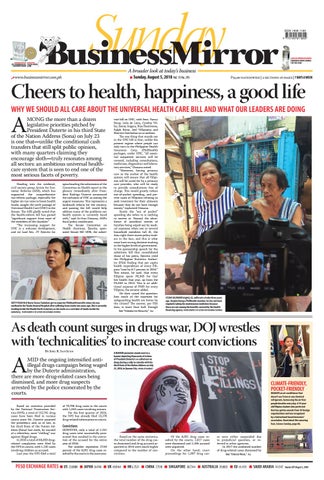
SIXTY-YEAR-OLD Maria Teresa Taidolom got to enjoy her PhilHealth benefits when she was confined in the Tondo General Hospital after suffering from stroke two years ago. She is currently residing inside the Manila North Cemetery as she works as a caretaker of tombs inside the cemetery. PHOTO COURTESY OF ACTION FOR ECONOMIC REFORMS
tute bill on UHC, with Sens. Nancy Binay, Leila de Lima, Cynthia Villar, Sonny Angara, Risa Hontiveros, Ralph Recto, Joel Villanueva and Sherwin Gatchalian as co-authors. The one thing that stands out in the UHC bill is that, unlike the present regime where people can only turn to the Philippine Health Insurance Corp. (PhilHealth) packages, under UHC, “all essential outpatient services will be covered, including consultations, medicines, diagnostics and laboratory services,” Diosana noted. “Moreover, having primary care as the anchor of the health system will ensure that all Filipinos will be cared for by a primary care provider, who will be ready to provide consultations free of charge. This would greatly reduce out-of-pocket spending, and prevent cases of Filipinos refusing to seek treatment for their ailments because they do not have enough money,” explained Diosana. Surely the “out of pocket” spending she refers to is nothing to sneeze at. Beyond the abundance of anecdotal stories of families being wiped out by medical expenses when one or several household members fall ill, the data right there stares policy-makers in the face, and this is what must have swung decision-making in the higher levels of government. In his sponsorship speech for the substitute bill that consolidated those of his peers, Ejercito cited the Philippine Statistics Authority (PSA) finding that per capita health expenditure of every Filipino “rose by 8.7 percent in 2016.” This meant, he said, that every Filipino spent P6,345 for his/ her health that year, up from the P5,840 in 2015. This is an additional expense of P505 for every Filipino, the senator added. He then raised the question: how much of the expenses for safeguarding health are borne by the citizen? The answer, per PSA data, is more than half. Enough See “Cheers to Health,” A2
CESAR SALVADOR (right), 63, suffered a stroke three years ago. Despite being a PhilHealth member, he has not been regularly taking his maintenance medicines because these are not among the benefits covered by the health financing agency. PHOTO COURTESY OF ACTION FOR ECONOMIC REFORMS
As death count surges in drugs war, DOJ wrestles with ‘technicalities’ to increase court convictions
A
By Joel R. San Juan
MID the ongoing intensified antiillegal drugs campaign being waged by the Duterte administration, there are more drug-related cases being dismissed, and more drug suspects arrested by the police exonerated by the courts.
Based on statistics provided by the National Prosecution Service (NPS), a total of 152,741 drug cases have been filed in various courts since Mr. Duterte assumed the presidency and, as of late, in his third State of the Nation Address (Sona) last week, he warned of a relentless, more “chilling” war against illegal drugs. In 2016 a total of 68,859 drugrelated complaints were filed by the NPS in courts, with 1,132 cases involving children as accused. Last year the NPS filed a total
A MASKED protester stands next to a banner depicting thousands of victims of President Duterte’s so-called war on drugs during a rally to coincide with his third State of the Nation Address on July 23, 2018, in Quezon City. AP/BULLIT MARQUEZ
CLIMATE-FRIENDLY, POCKET-FRIENDLY
IMAGINE an air-conditioner that doesn’t use Freon or any chemical refrigerant, harnessing the air that people breathe every day. A 19-yearold Filipino student who perfected that has gotten awards from 10 foreign organizations and was recognized by a Switzerland-based inventors’ association. Read about this amazing feat, Science Sunday, page A6.
of 70,706 drug cases in the courts with 1,645 cases involving minors. For the first quarter of 2018, the NPS has already filed 13,176 drug-related information in courts.
Convictions
HOWEVER, only a total of 2,241 drug cases were successfully prosecuted that resulted in the conviction of the accused for the entire year of 2016. The number represents 27.84 percent of the 8,051 drug cases resolved by the courts in the same year.
PESO EXCHANGE RATES n US 53.0080
Based on the same statistics, the total number of the drug cases dismissed and drug accused acquitted in 2016 were much higher compared to the number of convictions.
Of the 8,051 drug cases resolved by the courts, 2,617 cases were dismissed and 2,186 accused were acquitted. On the other hand, court proceedings for 1,007 drug cas-
es were either suspended due to prejudicial question, or referred to other agencies. In 2017 the combined number of drug-related cases dismissed by See “Drugs War,” A2
n JAPAN 0.4748 n UK 69.0164 n HK 6.7531 n CHINA 7.7518 n SINGAPORE 38.7344 n AUSTRALIA 39.0033 n EU 61.4151 n SAUDI ARABIA 14.1347
Source: BSP (August 3, 2018 )
NewsSunday BusinessMirror
A2 Sunday, August 5, 2018
Drugs war…
the courts and drug accused being freed was higher compared to the number of convictions. Based on the record, out of the 21,383 drug cases that were resolved by the courts, only 32.79 percent or 7,011 resulted in conviction. A total of 5,270 drug cases were dismissed and 6,353 drug accused were acquitted by the courts for the same period. On the other hand, proceedings for 2,749 drug cases were either suspended due to prejudicial question, or, again referred to other agencies. For the first quarter of 2018, there were already 9,030 drug cases resolved by the courts. Out of 9,030 cases, 5,693 resulted in conviction, while 1,060 cases were dismissed and 1,713 drug accused acquitted. The unofficial count on the number of deaths in the course of the anti-drugs campaign has breached the 4,000 level. Various human-rights groups, academics and media outlets have placed the deaths at anywhere from 4,000 to over 20,000, however. Most of them involve poor people.
‘Technical’
Justice Secretary Menardo Guevarra has admitted being concerned about the high rate of dismissal of drug cases being filed in court. “Often, the main reason for dismissal is technical, i.e., failure to observe procedural requirements, particularly in the chain of custody of the drugs seized,” Guevarra said. “The DOJ [Department of Justice] has to collaborate more closely with law enforcers to ensure that dismissals based on technicalities are reduced. Maybe the new guidelines on plea bargaining in drug cases can also speed up the disposition of drug cases and increase the
continued from A1
rate of convictions without going to trial,” he added.
The Boratong case
THIS developed as the Court of Appeals (CA) has affirmed its ruling that ordered the Regional Trial Court in Pasig City and the Regional Trial Court in Malolos City, Bulacan, to hear and resolve the money-laundering cases against shabu tiangge operator Amin Imam Boratong, his wife Memie and several others. The appellate court denied the motions for reconsideration filed by the Boratongs of its January 29, 2018, decisions that reversed the rulings issued by the Pasig RTC on May 28, 2013, and by the Malolos RTC on December 3, 2013, dismissing the money-laundering cases. In its January 29 decision, the CA held that the said lower courts violated the right of the prosecutors to due process when they prematurely dismissed the cases. It explained that in the conduct of the criminal proceedings, “the prosecutor has discretionary power to control the conduct of the presentation of the prosecution evidence, part of which is the option to choose what evidence to present or who to call as witness.” Thus, the CA said, by not giving the state the opportunity to present its evidence in court or to amend the information, the said trial courts have effectively curtailed the state’s right to due process. In denying the Boratongs’ motion for reconsideration, the CA held that the respondents failed to raise new arguments that would warrant the reversal of its decision. “Substantially, the issues proffered by the private respondents were already addressed, sufficiently passed upon and resolved in the assailed decision. Hence, we find no cogent reason to warrant recon-
sideration or modification of our decision,” the CA’s former Special Second Division said in a five-page resolution penned by Associate Justice Carmelita Salandanan Manahan. It may be recalled that on February 10, 2006, agents of the AntiIllegal Drugs Special Operations Task Force swooped down on the shabu market allegedly owned by the Boratong couple in Pasig. The shabu tiangge was found on Boratong’s 2,000-square-meter compound along F. Soriano Street in Barangay Santo Tomas in Pasig. During the raid, anti-illegal drugs operatives arrested hundreds of drug users and seized a large amount of shabu and numerous shabu paraphernalia. The raid was a stunner owing to revelations of the massive, brazen drug operations that had apparently existed for years, in a busy urban area right under the nose of authorities.
‘Chilling’
MEANWHILE, the “recalibrated” war on drugs will be relentless and chilling, as President Duterte promised, but will properly observe the rule of law, Malacañang has assured. Presidential Spokesman Harry L. Roque Jr. made this clear in reaction to Philippine National Police Chief Director General Oscar Albayalde’s statement that the PNP is “recalibrating” the drug war to be in sync with national policy. Albayalde added that the drug war will also be “relentless” in monitoring the whereabouts of drug users, street pushers and surrenderers. He said it will send a strong message “about the certainty of punishment to high-value targets, their protectors and patrons” who help those involved in the illegal-
drugs trade. “Coming from General Albayalde who has committed himself, and has proven himself to be operating within the rule of law, I welcome that remark,” Roque said in a recent Palace briefing. “It will be relentless, but it will be within the rule of law. Obviously, I’m a big fan of General Albayalde,” he added. Roque also pointed out that only criminals, not law-abiding citizens, should be afraid of the President’s warning.
www.businessmirror.com.ph Oplan Tokhang is a program of the PNP, which involves visits by local police to known drug addicts to urge them to undergo rehabilitation. “So criminals, there’s reason for you to be chilled. But for lawabiding individuals, you’re secure in your life, liberty and papers,” Roque said. In his third Sona on July 23, Duterte had declared that his war on drugs is “far from over.” “Let me begin by putting it bluntly: the war against illegal
drugs is far from over. Where before, the war resulted in the seizure of illegal drugs worth millions of pesos, today, they run [into] billions in peso value,” Duterte said. The President added that protests from human-rights groups and the Church would not deter him from continuing his drug war. “If you think that I can be dissuaded from continuing this fight because of [your] demonstrations, your protests, which I find, by the way, misdirected, then you got it all wrong,” he said. With PNA
Cheers to health... Continued from A1
to gouge the average household’s income and not just wipe away savings but often even force families to give up some vital expenditures such as for schooling, or home repairs or even for the health maintenance of some members deemed less at risk of major ailments than a family member struck with catastrophic illness or requiring hospitalization. According to PSA data, of the entire financing scheme for current health expenditures, the household out-of-pocket payment has the biggest percentage at 54.2 percent, or P342 billion. The government only accounted for 34.2 percent, or P216 billion, added Ejercito. In pushing for having the UHC bill make the final hurdle through Congress, AER’s Diosana cited the case of 63-year-old Cesar Salvador, who suffered a stroke in 2015 that left him with slurred speech and a need for regular maintenance medicines. “However, despite being a member of PhilHealth, Cesar has not been able to regularly take his medicines because these are not covered by the health financing agency,” AER pointed out. In an interview with Cesar’s wife, Carmelita Salvador, 53, the couple complained about the high cost of medicines and follow-up consultation with his doctor, taking away the budget intended for the food of their family on the table. Cesar was the only income earner and the family has depended on his salaries until he got sick, according to AER. “PhilHealth does not help provide the medicines that he needs. Because we do not always have extra money to spare, we aren’t always able to buy the needed maintenance drugs,” AER quoted Carmelita saying in a mix of English and Filipino. According to Carmelita, her husband had always been hypertensive, which increased his risk of having a stroke. “Sometimes, his blood pressure reaches as high as 200-over120. Our doctor said that his risk of having a stroke increases because of this. We hoped we have prevented it but consulting a doctor is expensive. And it’s difficult when you don’t have money because you are not given enough attention,” added Carmelita. The proposed UHC bills, AER stressed, aim to address the ongoing issues of access to health care of Filipinos, particularly the poor. Backers of the legislation hope to achieve this by reforming PhilHealth and expanding its benefits coverage to more outpatient services, among others. AER cited Exhibit No. 2: Maria Teresa Taidolom, 60, who got to enjoy her PhilHealth benefits when she was confined in the Tondo General Hospital after suffering from stroke two years ago. She is currently residing inside the Manila North Cemetery as she works as a caretaker of tombs inside the cemetery. “I don’t have the means to pay for my PhilHealth but Congressman Yul Servo took care of it so it can cover the expenses of my confinement,” Taidolom told AER. However, sustaining her maintenance requirements is uncertain: “I have not paid for the monthly premium after I got out of the hospital so I am not sure if I can still avail
myself of the PhilHealth benefits in case something happens to me.” According to Diosana, this is a common predicament among the poor who are not recipients of the Pantawid Pamilyang Pilipino Program (4P) and are thus not getting government subsidy for the PhilHealth premium.
How to fund it?
THE UHC as endorsed by Ejercito et al. appears to be a blessing, indeed, to millions of Filipinos impoverished by their health requirements, or at risk of not being able to fend for themselves should they fall ill. However, ambitious as it is, it requires a major, sustainable source of funding. In her earlier sponsorship speech, one of those who backed the UHC, Hontiveros pointed to the provision on the pooling of the health assistance funds of different government agencies as a means to fund UHC. Additionally, Ejercito proposed to include his Senate Bill 1605 proposing to increase the excise tax rates on tobacco products as one of the funding sources. This will be part of the next-round tax reforms now being pushed in Congress. “Without the proper funding, the Filipino people will struggle to reap the benefits that UHC should bring. We therefore agree that pooling of the funds from the Philippine Charity Sweepstakes Office (PCSO) and the Philippine Gaming and Amusement Corp., and passing Senator Ejercito’s bill on tobacco tax are necessary in order to ensure that we have the sufficient budget,” added Diosana. In endorsing the Report of the Committee on Health and Demography on the Universal Healthcare Bill, Ejercito had said the goal is to have a system that is “efficient, adequate and affordable.” The committee, Ejercito reported, conducted five hearings and a series of consultations and technical working group sessions before coming out with the present version of our proposed UHC bill. “The committee strived to reach the major cities in Northern and Southern Luzon, the Visayas and Mindanao,” he added. “We reached the cities of Cebu, Davao and Legazpi, Albay, and the municipality of Lingayen in Pangasinan to learn from our people of their true needs. We had a productive series of consultations because when we returned to Manila, we brought back valuable insights from our people, as well as personal experience that proved helpful in crafting the committee’s final version of the bill,” said Ejercito. The senator noted that, besides empowering households with enough funding for health, the UHC bill takes a hard look at the state of government hospitals: mostly congested, in disrepair or poorly ventilated. He cited a Department of Helath (DOH) report that 42,000 beds are needed to attain the ideal ratio of one bed to 800 population (1:800). The required budget to do this is P228 billion. The current bed-to-population ratio is at 1:1,121, and only Metro Manila and Region 10 or Northern Mindanao region have reached the minimum standard. The disparity between regions is most appalling: Metro Manila has a ratio of 1:591, and the ARMM languishes with a 1:4,200 bed-to-population ratio.
Ejercito said his committee’s visits to state hospitals around the country opened his eyes to the urgency of pushing the UHC bill as soon as possible. Thus, the bill, he noted, also seeks to address other raging health-care issues: n ensuring equal access to quality and affordable health goods and services for every Filipino; n reviewing the mandates of relevant agencies like PhilHealth, DOH, and the local government units—both to avoid overlaps or, conversely, the fragmentation of the health-care system. Moreover, each Filipino is automatically covered or included in a National Health Insurance Program as a direct or indirect contributor. The service coverage has been expanded, and the preventive and promotive aspects of health care boosted. Under the UHC bill, a National Health Workforce Support System is championed to strengthen the publicly owned or -led service delivery networks and resolve shortages in the health work force, such as through better compensation and more plantilla positions. The measure mandates the establishment of service delivery networks or SDNs—a mechanism that allows a contracted SDN comprising public or private or a public-private mixed enterprise to deliver services. This improves the gatekeeping in the disposition of cases, to prevent the undue swelling of cases in tertiary hospitals that could be handled in polyclinics or health centers. A Health Technology Assessment (HTA) mechanism will improve policy making by constantly reviewing programs, regulations and systems. With this in place, tragic episodes such as the Dengvaxia fiasco, where hundreds of thousands of schoolchildren were needlessly exposed to a serious dengue strain, will be avoided. An HTA Council or unit will be formed with experts who can validate and develop policies and recommend such to the DOH and PhilHealth. For the funding aspect, the bill gives PhilHealth the responsibility to preside over a pool of funds meant for health provision or assistance from various government agencies. This pool comprises contributions and subsidies, as well as appropriations that the government has set aside for health operations, and other sources like the health assistance funds of the PCSO and the Pagcor, medical assistance programs of DOH, administrative fines, donations and grants-in-aid, among others. Ejercito committed, meanwhile, to “personally push” for the measure to raise the excise tax on tobacco products as a health and revenue measure. Under Senate Bill 1605 that he authored, the excise tax will rise to P90 per pack and will be adjusted by 9 percent each year thereafter. With this, Ejercito is confident enough funds can be generated to provide for the ambitious requirements of the UHC. Indeed, the UHC may seem a tall order, but to people like Teresa Taidolom and Cesar Salvador, it may well be the one important lifeline they need, not just to climb out of poverty, but enjoy a healthy life.
The World BusinessMirror
www.businessmirror.com.ph
Sunday, August 5, 2018
A3
China’s money empire reshapes lives across the New Silk Road C hina is building a very 21st century empire—one where trade and debt lead the way, not armadas and boots on the ground. If President Xi Jinping’s ambitions become a reality, Beijing will cement its position at the center of a new world economic order spanning more than half the globe. Already, China has extended its influence far beyond that of the Tang Dynasty’s golden age more than a millennium ago.
The most tangible manifestation of Xi’s designs is the new Silk Road he first proposed in 2013. The enterprise morphed into the “Belt and Road” initiative, a mix of foreign policy, economic strategy and charm offensive that, nurtured by a torrent of Chinese money, is rebalancing global political and economic alliances. Xi calls the grand initiative “a road for peace.” Other world powers, such as Japan and the US, remain skeptical about its stated aims, and even more worried about unspoken ones, especially those hinting at military expansion. To assess the reality of Belt and Road from the ground up, Bloomberg Markets deployed a team of reporters to five cities on three continents at the forefront of China’s grand plan. What emerges is a picture of mostly poor nations—laggards during the past half-century of global growth—that jumped at the promise of Chinesefinanced projects they hoped would help them catch up. And yet as some high-profile ones falter and the cost of their Chinese funding rises, would-be beneficiaries from Hambantota, Sri Lanka, to Piraeus, Greece, are questioning the long-term price. In Malaysia, one of the biggest recipients of Chinese investment in Southeast Asia, newly installed Prime Minister Mahathir Mohamad is pushing back. Expressing concerns about loan conditions and the use of Chinese labor that limit benefits to the local economy, he’s put billions of dollars of Chinese-f unded rail and pipeline projects on hold. Xi intends a century-long enterprise. China has already outspent the post-World War II US Marshall Plan, measured in today’s dollars. Within a decade, according to Morgan Stanley estimates, China and its local partners will spend as much as $1.3 trillion on railways, roads, ports and power grids. “Economic clout is diplomacy by other means,” says Nadège Rolland, Washington-based senior fellow for political and security affairs at the National Bureau of Asian Research. “It’s not for today. It’s for mid-21st century China.” Belt and Road is very much about politics at home, too. With the government and stateowned enterprises investing vast sums outside China, Xi is encouraging Chinese companies to channel their spending into domestic projects that will directly benefit the economy and, incidentally, the popularity of
his regime. Businesses aren’t exactly def y ing X i, but they’ve adjusted their plans to fit his. With the Belt and Road project enshrined in the Communist Party’s constitution as of last year, Chinese companies are using it to help them navigate X i ’s restrictions on foreign investment and capital outf lows. Many are shelter ing their overseas projects under the umbrella of Xi’s pet project to get the state’s blessing. Belt and Road, says Michael Every, head of financial markets research for Rabobank Group in Hong Kong, is “a political special sauce.... If you drizzle it on anything, it tastes better.” At first, the sauce whetted t he appet ites of m a ny developing countries in Asia and Africa. As the notion of a modern Silk Road gained traction, Belt and Road meandered into places that had never had any connection with ancient caravans. This year it reached South America, the Caribbean, and even the Arctic. In June it rocketed into space: Beijing announced that Belt and Road-participating countries w i l l be a mong t he f irst in line to plug into China’s new satellite-navigation ser vices. Most of the proposed plans are infrastructure-based, such as a new deep-sea port in Myanmar and power lines in the M aldives. But almost any overseas investment gets tagged as being part of the initiative: a freight train carrying Chinese sunflower seeds to Tehran, a new courthouse in Papua New Guinea, an irrigation system in the Philippines. T he grow ing web of trade rout e s , i nc lud i n g t he Si l k Road Economic Belt and the Maritime Silk Road Initiative, now extends into at least 76 countries, mostly developing nations in Asia, A frica and Latin A merica, together w ith a handful of countries on the eastern edge of Europe. With most global trade mov ing by sea, it’s no surprise that many of the first places to lock up major Chinese investments were ports along w ith pipel i ne s a nd ot he r t r a n s p or t links that connect shipping to markets. China’s plans to build or rebuild dozens of seaports, especially around the Indian Ocean, have sounded alarm bells in Washington and New Delhi: How many of those docks will end up hosting Chinese warships? Just as mighty navies
and global networks of military bases helped support trading empires for Britain in the 19th century and the US in the 20th century, so China is building a fleet of submarines, aircraft carriers, and warships that will rival US power. China has said it has no intention of using Belt and Road to exert undue political or military influence and that the initiative is designed only to enhance economic and cultural understanding between nations. “In pursuing the Belt and Road initiative,” Xi said in 2015, “we should focus on the fundamental issue of development, release the growth potential of various countries and achieve economic integration.” If that’s the case, Xi will need to change the perceptions of people who live along the length and breadth of his latter-day Silk Road. And that can only happen in the towns and cities that are being transformed by China’s empire of money.
—Adam Majendie, with Sheridan Prasso
Yiwu, China
Nestled in the mountains of Zhejiang province, Yiwu is the embodiment of “Made in China.” The market here is unlike any other. A vast complex of five-story buildings houses 75,000 booths selling 1.8 million kinds of goods across an expanse the size of 650 soccer f ields. If you’ve pic ked up cheap jewelry and toys in District 1, you may need to hop onto a motorcycle taxi to reach auto parts in District 5. Most of those thousands upon thousands of stalls specialize in single items—scissors, for example: scores and scores of different kinds of scissors. A n ancient market tow n about 180 miles southwest of Shanghai that’s grown into a city of 1.2 million people, Yiwu got a big boost from Belt and Road. People from Beirut to Seoul and beyond have come to start businesses. Some 13,000 traders from around the world now live here. More are arriving every day, says Mohanad A li Moh ’d Shalabi, a Jordanian businessman who owns the Beyti Turkish restaurant in the center of the city and a company that exports goods to the Middle East. “In my restaurant,” he says, “I have met people from countries I have never known of.” It wasn’t always like this. When Bloomberg reporters visited in early 2014, business was so slow that bored shopkeepers played computer games, read newspapers, or slumped over in their chairs, asleep. Janey Zhang, whose Zhejiang X ingbao Umbrella Co. employs about 200 workers, remembers the bad old days. In 2013 t he va st, l aby r i nthine halls of Yiwu—a legacy of 1978, when it became one of Communist China’s first wholesale markets—were almost deserted. W holesalers and producers struggled with soaring manufacturing costs and the rise of online marketplaces such as A libaba. T hen came a glimmer of hope. On socia l media and television, Zhang started seeing reports about a new freight train that would roll west for thousands of miles, crossing China into Central Asia and on into Europe. This was part
of the Xi government’s “New Eurasian Land Bridge,” a seemingly endless skein of stacked container wagons replicating ancient Silk Road camel caravans. “The impact of the railway was huge,” Zhang says. “I remember seeing pictures of it piled high with cargo. After the service started, our sales and customers quickly increased.” The first Europe-bound train pulled out of here in November 2014 , head i ng to K a z a k h st a n and Russia, then through Eastern Europe and on to Madrid—an 8,000-mile journey that supplanted the Trans-Siberian Railway as the world’s longest freight-train route. Since then, more routes have opened to destinations including London, Amsterdam, and Tehran. Zhang’s dream is for her Real Star brand to become the Hermès of umbrellas. Europe has long been her biggest market. Since the new freight trains came to Yiwu, she’s picked up customers all along the route, from Kazakhstan to Russia to Iran. Trains have cut the time to Europe by a third or more compared with ships. The return journeys bring European goods such as wine, olive oil, vitamin pills, and whiskey. China Railway Express Co. said the value of outbound freight from Yiwu in the first four months of 2018 jumped 79 percent from a year earlier, to 1.8 billion yuan ($268 million), while imports tripled to 470 million yuan. Even so, rail freight accounts for less than 1 percent of China’s overall exports. While it can
shorten journey times to Europe, it’s more expensive than seaborne trade and slower and less flexible than air cargo. But for cities such as Yiwu, and especially for those in western China even farther away from seaports, the train that Xi built has injected new life into their economies.
—Kevin Hamlin and Miao Han
Hambantota, Sri Lanka
In a southern Sri Lankan jungle, Dharmasena Hettiarchchi plucks green chile peppers that grow in the shade of banana trees. His grandfather tended the same patch of land when this island was the British colony of Ceylon. Hettiarchchi takes a break from the heat under a teak tree, removes his wide-brimmed hat, and says, “If a jeep with Chinese characters comes down the road, the whole village will gather in protest.” Hettiarchchi’s village and the surrounding town of Hambantota have become a cautionary tale for Xi’s Belt and Road aspirations. The idea was to take an inconsequential harbor visited by fewer than one ship a month on average and turn it into a modern, bustling seaport adorning a southern Belt and Road maritime route. It hasn’t turned out so well. After Sri Lanka elected Hambantota native Mahinda Rajapaksa as president in 2005, he began sprinkling development projects across the region, one of the least-developed parts of this nation of 21 million people. Even long before Belt and Road was officially embedded in Chinese government policy, Bei-
jing was eager to lend a hand, and Chinese loans financed Rajapaksa’s munificence. Hambantota (population at the time 11,200) got a new port, an international conference center, a cricket stadium, and an airport that, despite all the staff on show, doesn’t service a single scheduled flight. To fund the projects here and others all across Sri Lanka, the Rajapaksa government fell deep into debt. The port at Hambantota, for example, was partly funded during the Rajapaksa administration by a loan from the Export-Import Bank of China. By the time Rajapaksa was voted out of office in 2015, more than 90 percent of Sri Lanka’s government revenue was going toward servicing debt. Last year, with Xi’s Belt and Road plan in full flow, a new Sri Lankan government moved to ease the debt. In return for $1.1 billion, it basically handed the seaport over to China. Under a 99-year lease agreement, the government gave 70 percent ownership of the port to China Merchants Group, a state-owned company with revenue bigger than Sri Lanka’s economy. China Merchants has promised to revive the port and turn it into a major regional trading hub. But some local people have had enough of promises. “All these huge projects are a waste,” says Sisira Kumara Wahalathanthri, a local politician who opposes the current Sri Lanka government. “No ships are coming to the port. No f lights are coming to the airport.” Continued on A4
The World BusinessMirror
Sunday, August 5, 2018
A4
Oil tanker owners scrap the most ships in decades O
il t a n ker ow ners a re giving up. A 19-month curtailment of Organization of the Petroleum Exporting Countries’ (Opec) cargoes, and environmental regulations that are proving uneconomical to comply with, have got owners purging the supertanker fleet at the fastest pace since the 1980s, according to Global Marketing Systems Inc., one of the world’s top buyers of obsolete ships for scrap. While the demolition surge— sending vessels to be ripped apart on the beaches of India and Bangladesh—reflects the worst charter rates for owners in decades, scrapping often helps set the stage for market recoveries. Morgan Stanley estimates that the global fleet of so-called very large crude carriers (VLCC) could lack 100 million barrels of transportation capacity by late 2020. “It prolongs the period of profitability after the turnaround,” said Fotis Giannakoulis, a New York-based shipping analyst at the bank. “The more you scrap, the more you bring the recovery forward and accelerate its speed. The market will strengthen with high scrapping even with smallest
growth in demand.” Average earnings for 2 million barrel-hauling VLCCs fell by 65 percent to $6,159 a day so far this year, the lowest since at least 2009, according to data from Clarkson Research Services Ltd., a unit of the world’s biggest shipbroker. They were $17,794 for all of last year, $41,488 for 2016 and $64,846 in 2015. The number of tankers demolished in the first half of 2018 rose to 110, higher than any full year since 2013, according to Clarkson data. A total of 102 tankers were scrapped last year, 112 in 2013 and as many as 210 in 2010 and 230 in 1983. Owners have been hurt by a pact among members of the Opec and allies led by Russia, to restrict crude output by 1.8 million barrels a day since the start of last year. About 20 million barrels, or 10 cargoes, get loaded every day onto or VLCCs, the industry’s biggest tankers, according to Clarkson data.
Spiraling costs
The industry also faces a sharp escalation in costs. In 2020, most merchant ships will start using
fuel with a maximum sulfur content of 0.5 percent, down from the current 3.5-percent limit in most places, according to a regulation set in October 2016 by the International Maritime Organization, a United Nations agency. Sulfur emissions are linked to acid rain and medical conditions such as asthma. To comply, owners can either burn fuel that’s going to cost a lot more, or they can fit vessel engines with expensive exhaust cleaning systems — known as scrubbers— and continue using high sulfur fuel that’s cheaper. There are also rules about how to deal with the water ships take on as ballast when they don’t have cargoes. A scrubber and a new ballast water system cost $5 million to $6 million combined, according to Poten & Partners. On top of that, mandatory surveys when ships are 15 years and 17 1/2 years old cost $4 million to $5 million. With scrap steel prices surging, it’s little wonder there’s been a pick up in demolition.
Scrap that
“Incoming regulations are raising costs for all ship owners mak-
ing high scrap price relatively more attractive,” said Brian Gallagher, head of investor relations at Euronav NV, an Antwerp-based operator of supertankers. “Elevated price of steel means high recycling prices for tankers.” Global steelmakers are enjoying the best market conditions in years, with demand in almost every major market forecast to grow this year. Older vessels currently fetch as much as $18 million—a record—because the demolition yards are competing to win them, according to Anil Sharma, the chief executive officer of GMS. That’s because other classes of shipping are faring better. “ Tanker scrapping in 2010 was one at of the highest levels in many decades and we believe the total number in 2018 will most likely be higher than that,” Sharma said. Pressure on older large tankers increases as utilization after 15 years of age reduces materially, according to Euronav’s Gallagher. “This is reflected in even lower rates for this section of market compared to other age categories.” Bloomberg News
www.businessmirror.com.ph
Who is Q? A conspiracy theory emerges at Donald Trump rallies
T
AMPA, Florida—Amid the “Trump 2020” placards, the “Women for Trump” signs and the “CNN SUCKS” T-shirts, the most inscrutable message that came out of Donald J. Trump’s Tampa rally on Tuesday evening was a letter.
Q.
People wore T-shirts with the letter emblazoned on the front. Others carried signs containing the letter: “Q WWG1WGA Trump 2020 Keep America Great! MSM is the enemy.” Another held a dogeared and slightly crumpled piece of paper in the air. It said, simply, “We are Q.”
Q who?
The entire, loose movement has been called everything from “a deranged conspiracy cult” (The Washington Post) to a grassroots movement “about the covert battles being waged between the deep state and President Trump” (according to Tyler, a guy at the Tampa rally who held a metal coin emblazoned with the letter and showed it to WPLG, a TV station from Miami). Here’s a look at the trend that’s sweeping certain dark corners of the Internet:
Who is Q?
In late October 2017, an anonymous user posted on 4chan, a shadowy site known for, among other things, cruel hoaxes and political extremism. Under the title “The Calm Before the Storm,” the poster claimed to have a high-level government security clearance—Q clearance to be exact—and referred to Donald Trump, Hillary Clinton, George Soros, political parties and former President Barack Obama. Q gives readers “breadcrumbs” so they can
ferret out details on their own. There’s other lingo, as well. Bakers are amateur sleuths who follow the crumbs. Anyone who tries to debunk Q is “a clown.” (This includes CIA agents, shadowy operatives and most likely reporters, although there’s separate terminology for them). Like Tyler, the man at the Tuesday rally in Tampa, many believe the mainstream media is lying to them. Other 4chan users have pointed out that “Q’’ uses the plural “we.” Keep in mind, users can, and often do, post anonymously on 4chan.
Everybody on the interwebs talks about Trump, Clinton, Obama and Soros. What makes Q different?
M a ny o n 4 c h a n s e e m e d to e n j oy discussing the cryptic posts and the clues, and Q spread like wildfire. Terminology was born. Inside jokes and theories blossomed. Q subreddits swelled to 30,000 followers. Q’s Twitter account has 80,000 followers. A YouTube video posted by “prayingmedic” on July 28, titled, “Something Big is About to Drop,” has 275,000 views. It is an hour and eight minutes long. It is unclear if anything actually dropped. Joseph Uscinski, a University of Miami professor who coauthored the boo American Conspiracy Theories, said Q “is just hitting the right audience at the right time given the right circumstance.” Q’s topics appeal to many who already are inclined to believe conspiracy theories, Uscinski said. Those conspiracy-minded folks have always been around in the country. “There is no way to know if it’s an embedded deep state operative or if it’s a prankster,” he added. AP
China’s money empire reshapes lives across the New Silk Road Continued from A3
After 30 years of civil war, many Sri Lankans are glad to see investment, any investment. At the port and in a surrounding industrial zone, construction work continues, presaging change. Displaced from their normal habitats, wild elephants regularly trample the port’s perimeter fence. At a nearby ancient Buddhist temple, head monk Beragama Wimala Buddhi Thero says he began attending protests because the area’s way of life is under threat. While his temple will be spared, the nearby farms won’t, leaving him and his fellow saffron-robed monks without worshipers. “It’s becoming a Chinese colony,” he says of Hambantota. In a darkened hall, reclining on a wooden throne decorated with elaborately carved lions and flowers, he complains that China has already despoiled its own rivers in the name of progress. “If that kind of pollution comes here,” he says, “it doesn’t matter if we’re developed.” The chile farmer Hettiarchchi is wary of the surveyors who’ve begun to appear in his neighborhood, making measurements and leaving their telltale markers behind. He says the plan is for him to be relocated to a part of eastern Sri Lanka to make way for development. It’s all happening so fast, and what Hettiarchchi could be losing can’t be replaced easily or quickly. Gesturing to the towering teak above him, the 52-year-old says, “A tree like this cannot grow within my lifetime.” —Iain Marlow, with Sheridan Prasso
Gwadar, Pakistan
Surrounded by desert in southwest Pakistan there’s a stone arch bearing a single name, Al-Noor. Farther along a desolate road, a black shipping container has been painted to tell you where you are: Gwadar Creek Arena. Al-Noor and Gwadar Creek are planned housing d evelopments—emphasis on “planned.” There’s nothing here yet. The same goes for White Pearl City, Canadian City, Sun Silver City and other residential tracts on the drawing boards. What you see are billboards, lots of them, as speculators and developers carve out future projects on the sun-blasted outskirts of an old fishing village named Gwadar. Gwadar is a city of dreams made in China. Beijing is pouring money into highways and roads, a hospital, a coal-fired power plant, a new airport, a special economic zone along the lines of Shenzhen, and, crucially, the port. The chain of events that led to Chinese involvement here fits a pattern repeated up and down Belt and Road routes: Local or national efforts to expand a port stumble;
China comes in and saves the day. In the case of Gwadar, a redevelopment project begun in the 2000s under thenmilitary ruler Pervez Musharraf foundered. In 2013 the Chinese arrived. A deep-water port here would be a natural southern terminus for a key binational project started that year, the $60-billion China-Pakistan Economic Corridor, as well as an important component of Belt and Road. To that end, Beijing is financing the lion’s share of the $1 billion in spending on the port and infrastructure development elsewhere in Gwadar. Gwadar, across the Arabian Sea from Oman, is so remote that its electricity comes from Iran, 60 miles down the coast. In recent years, the village has become a city of 100,000 or so. Although still mostly a gigantic building site flanked by highways and crisscrossed by roads, signs of change abound. Ghulam Hussain, 40, is a shopkeeper. Every month, he gets six to eight truckloads of rice, flour, sugar and other groceries delivered to him from Karachi, an eight-hour drive to the east. Five years ago three loads a month met his needs. “There was nothing in Gwadar before,” he says. “It was deserted. We were really backward. Since the Chinese came, our businesses are booming.” Even so, it’s hard to imagine Gwadar as the sea terminus of a road-and-rail trade link stretching 3,000 miles to eastern China. Most of the route would traverse some of the world’s most i nhospitable—and economically barren—mountains and deserts. A rail line, says Andrew Small, a senior transatlantic fellow at the German Marshall Fund of the United States, a Washington-based public-policy think tank, “makes no economic sense in the foreseeable future. The economy of Pakistan and the economy of western China would need to look quite different.” Some say that military expansion is the real driver of the activity in and around Gwadar. “The Gwadar Port shows that there is a close link to the Chinese military ambitions,” US Congressman Ted Yoho (Republican-Florida) said during Foreign Affairs Committee hearings on US-Pakistan relations in February. Zahid Ali, who used to run a small business topping up credit on mobile phones in Sindh province in eastern Pakistan, sees things very differently. Desperate to find a way to pay off 800,000 rupees ($6,300) in debts, he asked a client if there was any job in Pakistan that paid 50,000 rupees a month. Go to Gwadar, the customer replied. That’s what Ali did. He started as a laborer, learned steel work, and was soon earning 55,000 rupees a month. Now, having learned a little Chinese, he’s been promoted to supervisor. “We’re getting good money, so people are coming from far away,” he says
during his work shift on the six-lane East Bay Expressway. “It’s good that the Chinese came here. A lot of people have gotten jobs who were jobless.” The Chinese who came here to work don’t mix much with the locals. Some of the 150 or so of them live in a guarded and gated compound where green shipping containers have been converted into living spaces. One of the first things a visitor to Gwadar notes is that there are more soldiers on the streets than police—an added precaution against the threat of terrorism across Pakistan. Security is tight because Chinese wouldn’t come otherwise, says a Pakistani army officer who declined to be named because he’s not authorized to talk to the news media. He says there are checkpoints on all the roads leading into the city. Good, says Naseem Ahmed, 25, who works for the provincial government. “Security is great here,” he says as he warms up before taking part in a soccer game at a local stadium. “You can be out at 3 a.m. in the morning, and there is no fear.” —Faseeh Mangi, with Chris Kay
Mombasa, Kenya
Astride his boda boda, or motorcycle taxi, at a crossroads in Mombasa, Simon Agina is counting containers on a passing train that’s heading to Nairobi: “… 82, 83, 84.” There are plenty of freight containers back where those came from—and much more besides. The port of Mombasa, Kenya’s import lifeline, is a heaving mass of traffic of all sorts. Trucks line up quayside to move shipping containers from the docks to the railway. Three-wheeled tuk-tuks weave dangerously between other vehicles through hot, dusty streets filled with noise and litter. Kenya’s largest port is also its oldest. So in 2011, with the ancient British colonialera Mombasa-to-Nairobi narrow-gauge railway falling into disrepair and Beijing in the market for African investments, Kenya made its move. It agreed to let China finance and build a standard-gauge railway at a cost of $3.8 billion. The Mombasa-Nairobi SGR, as it’s called, is the nation’s largest infrastructure project since independence from Britain in 1963. Atanas Maina, managing director of Kenya Railways, says more than 30,000 Kenyans were employed directly on the project, which was run by China Road and Bridge Corp.; an additional 8,000 worked for subcontractors. The first paying passengers rode the line in June last year. Along its 293-mile journey, the SGR rumbles across almost 100 bridges and viaducts, many designed to allow the lions, zebras and other wildlife that inhabit two national parks, Tsavo East and Tsavo West,
to cross under the tracks. Freight trains like the one Agina saw from his boda boda began running in January. “Those are 84 trucks off the road,” he says as the containers whiz by. The railway cuts the Mombasa-Nairobi trip to five hours, down from more than eight by truck. Five freight trains a day were making the journey during spring. The number could eventually increase to 12, removing as many as 1,700 of the 3,000 trucks that currently ply the route. Like any major infrastructure project, the rail line has its detractors. The economist and government critic David Ndii says it’s not commercially viable, while a Kenyan newspaper, the Standard, accused China Road and Bridge of “neo-colonialism, racism and blatant discrimination”in its treatment of local employees; Kenya Railways subsequently said it would investigate the allegations. Environmental activists tried without success to block the SGR from going through Tsavo parkland and have taken legal action to try to stop the next phase of railway construction, which would run the line through Nairobi National Park on the edge of the capital. Trucking companies, whose business grew steadily as the old railway decayed, are now worried about the loss of customers. Vanessa Evans, managing director of Rongai Workshop & Transport Ltd., says the SGR could have been a plus for the Kenyan economy in the long run, but poor coordination at the Mombasa and Nairobi rail terminals causes cargo backups and delays. The new rail line, she says, “has nearly destroyed our business because the turnaround time varies between not good and awful. We have been in agony for the past five months.” The train that pulls out of Nairobi Railway Station each morning at 8 o’clock, with noteworthy punctuality, is called the Madaraka Express. In Swahili, madaraka means power or responsibility; Madaraka Day, a national holiday, celebrates self-rule. If the old railway was a relic of Kenya’s British colonial past, the new one, built with Beijing’s money, could be seen as a harbinger of a new kind of imperial reach. It’s a blue-suited Chinese instructor who makes sure the female train attendants— uniformed in the colors of the Kenyan flag—are standing in a nice straight line as passengers board. China financed 90 percent of the SGR’s $3.8-billion cost. And the giant Chinese Communications Construction Co. will operate the rail line for its first decade. The area around the station thrums with activity as construction pushes ahead on houses, container yards, and warehouses. Along the route to Mombasa, gleaming steeland-glass stations stand out against clusters
of tiny houses with rusty corrugated iron roofs and mud walls; the contrast encourages the locals “to dream big,” says Maina. Michael Ndungu, 21, a student who studies in Mombasa and visits the capital on weekends, used to take the bus. “The SGR has made my life much better,” he says. “It is faster and definitely safer.” In Mombasa the surge in passengers—1.3 million during the first six months of the year—has been good for the economy. “Business is good,” says Stephen Kazungu, a 26-year-old taxi driver. The newly laid track, the trains, the stations—“You don’t see that kind of infrastructure development in this part of the country,” says Agina, the 22-year-old boda boda driver, as the freight train fades into the distance. “This is amazing.” —Samuel Gebre
Piraeus, Greece
It was the spring of 2016. Greece was in the vise-grip of the European sovereign debt crisis. Its neighbors and creditors were pressuring the government to enforce austerity. So Greece sold control of Piraeus, the storied seaport once connected to Athens by fortified walls, to China Cosco Shipping Corp., a Chinese state-owned enterprise. The deal bears many of the hallmarks of China’s biggest Belt and Road projects. It began years before Xi’s signature project was announced—in 2009, Cosco won a contract to run part of Piraeus’s container business—and was then handily folded into the initiative; it was geared largely toward enhancing the reach of China’s maritime trade; and it involved a host nation desperate for investment. But unlike many of China’s high-priced Belt and Road investments, this isn’t a remote greenfield construction project in a developing nation. The port deal marked China’s gradual takeover of one of Europe’s oldest and most important sea gateways. Piraeus has been Athens’s port and shipyard for about 2,500 years, a perch on the Mediterranean that helped Athens become a naval superpower. From his office, Ioannis Kordatos, managing director of the Hellenic Welding Association, can see the wall of containers stacked high at Pier II, Cosco’s original beachhead here. “If Cosco magically disappeared tomorrow, it would be a huge loss,” says Kordatos. “What matters isn’t that they are Chinese but that they are a private company doing serious business in the area.” Very serious business. The 2016 deal gave Cosco a 67 percent share of Piraeus Port Authority SA for €368.5 million ($429.5 million). During PPA’s first full year under Chinese control, its net income jumped 69 percent, to €11.3 million, as revenue from its container terminal rose 53 percent. Since Cosco first became involved, Piraeus has risen
to be Europe’s seventh-busiest container port; 10 years ago, it wasn’t in Europe’s top 15. Piraeus is a bustling city in its own right. Marinas here are filled with Athenians’ yachts ready for weekend sailing. Passenger ferries dock near the town center to carry locals and tourists to Aegean islands. Farther west, in the repair yards, workers mend boats. Above all, giant gantry cranes loom over shipping containers. These days, whether you arrive here by sea, by metro, or by road, you’re bound to run into construction, with chunks of the city boarded up as bulldozers work on a new subway station and public transportation connections. In the heart of Piraeus, Cosco plans to upgrade the ferry and cruise ship terminals, adding a shopping mall and new hotels. Farther out, around the Gulf of Elefsina, Cosco’s investments could help revive Greece’s rust-belt industrial heartland in the Thriasio Plain west of Athens. There, a planned logistics center, linked to the port by rail, could become a staging area for goods headed north through the Balkans. Not everybody in Piraeus shares Kordatos’s warm feeling toward Cosco’s purchase of PPA. “If I had the money, I’d buy it myself rather than let it go to foreigners,” says Evlampia Kavvatha, who owns a store selling shelving in the town center. Perhaps Cosco’s presence here is a case of desperate times calling for desperate measures. Like the rest of the country, Piraeus has been hit by a depression that’s wiped out a quarter of the nation’s economic output since the sovereign debt crisis. Away from the main shopping district street, Piraeus suffers from the blight of empty storefronts that afflicts cities across Greece. Giorgos Gogos, general secretary of the Piraeus Dockworkers Union, says he’s worried about the impact of a Chinese state-owned enterprise on labor relations and the local community. “We think it’s a mistake for infrastructure like this to leave the state,” he says. “The Chinese have their own way of operating. [Cosco is] a state colossus backed by capital of the Chinese state. It has the characteristic of Chinese state capitalism.” For all the concern about the potentially corrosive effects on Greece’s economy and sovereignty—and about Beijing’s ulterior motives—Cosco’s incursion into Piraeus has something in common with other investments by Beijing along the vast and meandering Belt and Road: China put its money where others wouldn’t. —Marcus Bensasson Majendie is a senior editor in Singapore. Hamlin and Han cover the economy in Beijing. Marlow covers government in New Delhi. Mangi covers companies in Karachi. Gebre covers news in Nairobi. Bensasson covers the economy in Athens. Bloomberg News
Science
Sunday
Sunday, August 5, 2018 BusinessMirror switzerland-based inventors’ group recognizes pinay’s feat after 10 groups give her awards Editor: Lyn Resurreccion • www.businessmirror.com.ph
A5
PSHS teener invents air-con with air as medium
I
Story & photos by Edd K. Usman
magine an air-conditioner that harnesses the air that people breathe every day as cooling medium, and is environment-friendly because it does not use freon, or any chemical refrigerant. How cool (no pun intended) is that? Anyway, this is the 21st century and with enough bright minds, every thing is possible. Like harnessing air, which is practically limitless, infinite, inexhaustible! This time, it is one mind inside the head of a teenager then at the Philippine Science High School in Naga, Camarines Sur, in the Bicol region. Now, she’s in her 19th summer, a “Pisay” (PSHS’s popular name) alumna, and about to enter college at a De La Salle University (DLSU) to take up mechanical engineering. The PSHS is under the Department of Science and Technology (DOST). Meet Maria Yzabell Angel V. Palma, the young girl behind the AirDisc Air Conditioning Technology, which she developed in 2016 and perfected after one-a -half years while she was still at PSHS-Naga Campus. She’s been recognized for her feat by the International Federation of Inventors’ Association (IFIA), which even invited her to Switzerland in February, but she failed to go because she was then graduating. IFIA got her under its radar after 10 foreign organizations gave her awards for her AirDisc Air Conditioning Technology. Her most immediate goal is not money, she said; it is helping people and the environment through her brainchild. She estimated that her unit would cost from P25,000 to P40,000. It can be used at home, at offices, or company buildings and other venues. “I want to help those who cannot afford an air-conditioner,” she said told the BusinessMirror in an interview on July 30 during a news conference with PSHS leaders at a hotel in Quezon City. T hat ’s where she sees her invention’s significance, recalling that in 2016 more than 100
million units of air conditioners were produced globally but not everybody could afford one, she said. “This AirDisc will be very affordable to everyone specially the less fortunate. And it is significant to Filipinos. We know it is very hot,there is global warming and it is getting worse every year. “This cooling system will be a means so the poor, not just the rich, will be able to buy an airconditioner,” Palma said. The AirDisc may still be currently quite expensive because it is still new and the production is still limited, but with expected increasing demand and more production its price could go down soon, Palma explained. She said that loans or installment facilities will be made available to consumers, or it could even be given free of charge, based on the consumer’s economic status. She added that in the long-run the consumers could save with the use of AirDisc because its electric consumption is low at 150 watts compared to commercial air conditioners which consume 1,200 watts, Palma explained.
No chemical refrigerant
Palma said the air-conditioning technology that she invented does not use a chemical refrigerant. She noted that commercial airconditioners in homes and cars use hydrofluorocarbon (HFC) chemical refrigerants that are harmful to people and the environment. She said her design does not use freon and it uses much less electricity. One vital aspect of her invention is its ability to harness air molecules, which, certainly, is abundant, an understatement, to say the least. “What it will only use as cooling medium is air— the air we breathe,” the young inventor said.
Maria Yzabell Angel V. Palma (left), Philippine Science High School (PSHS)-Bicol region campus alumna and inventor of AirDisc Air Conditioning Technology, talks about her brainchild. Listening to her are PSHS System Executive Director Lilia T. Habacon (right) and PSHS System Deputy Executive Director Dr. Rod Allan A. de Lara. Edd K. Usman
Her invention, she pointed out, uses a new compressor, or more precisely, a centr if uga l compressor, wh ic h does not build up air moisture inside the compressor and, thus, creates no water residue. Since AirDisc does not use a chemical refrigerant, she said it will not contribute to greenhouse gases that cause global warming. The United Nations has mandated the phase out of chemical refrigerants so the use of AirDisc is timely, she explained. It should be noted that 1 kg of HFC is equivalent to 20,000 kg of carbon dioxide which is detrimental to the environment and to people’s health.
Open for partnership
Palma, who got help from her father, a mechanical engineer, said they are finalizing a commercial prototype that is expected to be completed late this year or early-2019, then start manufacturing the AirDisc air-conditioner. “We are still open for partnership,” the young inventor said, pointing out that at least five companies have already approached her family. Palma prefers that there will be a manufacturer in every region, like Asia, the United States, and others, “so there will be no monopoly and [that the product will be] well distributed.”
Proverbial light bulb
She reca l led how she got t he proverbia l “ light bu lb ” in her head lighted up and got the idea for a freon-less cooling system. It was in her project, a cooking equipment simi lar to an oven she and her classmates were researching in 2016. She said she noticed “cold air” coming out of the device and then decided to continue a research
on it. She consulted her father, of course. Palma saw in one of her researches in the Internet a study by Japan’s Refrigerant and Air Conditioning Industry that in Africa, one of the hottest places on Earth, has the lowest demand for air-conditioners. The reason: prices of air-conditioners in African countries are not affordable to the majority of the people, unless one has a stable job. “Here in the Philippines, my family is not well-off. Every time I turned on the air-condition my mom would tell me to switch it off. As a child, I was asking, ‘why mom does not like to switch the air-condition on,’” said the PSHS alumna. She now realized the reason why: high cost of electricity. Now, she wants others to benefit from her invention. “I wish this project will take off because my goal is to help other people, not just for profit or make money. If we can have a big manufacturing company many people will be employed and raise the Philippines’s employment rate,” Palma said. She also wants to have a manufacturing plant in the Philippines. The patent for her AirDisc Air Conditioning Technology is pending in the United States and in the Philippines.
Awards
The 10 awards Palma received for her AirDisc aircon technology: n Leading Innovator Award from International Intellectual Property Network Forum; n International Leadership Award from Eurobusiness, Haller, Polland; n International Leadership Award from China Association of Invention, China; n Leadership Excellence Award
Image of the AirDisc Air Conditioning Technology Angel Palma
from MyRis, Malaysia; n Leading Student Award from National Research Council of Thailand; n Leading Innovator Award from Indonesian Innovation and Invention Promotion Association, Indonesia; n International Leadership Award from World Invention Intellectual Property Associations (WIIPA), Taiwan; n Best Invention Award from WIIPA, Taiwan; n Special Citation for the Best Invention from MyRIS, Malaysia; and n International Best Young Inventor from Romanian Inventors Forum, Romania.
Low budget
Palma was one of the PSHS alumni and students from some of the science school system’s various campuses across the country who were presented by the PSHS in the media briefing. The PSHS System management, led by Executive Director Lilia T. Habacon and by her Deputy Executive Director Dr. Rod Allan A. de Lara and other officia ls, as wel l as Director Richard P. Burgos of the Science and Technology Information Institute (DOST-STII) campaigned for the school ’s 2018 National Competitive Examination. De Lara said the 16 PSHS campuses are populated by around 8,000 students (all scholars), and has a current year budget of P4 billion. With that budget, which he conceded is already high but can stand an increase for equipment and laboratory facilities, the “budget per student [of PSHS] is around P200,000 per year.” The budget is much higher than that of the Department of
Education (DepEd) per student at P25,000 every year, he noted. But compared to international standards, like in Singapore, PSHS’s budget is low, he pointed out. De Lara said the PSHS Campus in Palo, Leyte, Eastern Visayas, got a DNA testing equipment worth $100,000 (around P53 million) only after one of its students, Hillary Diane Andales, won a global science competition that gave her P20 million ($400,000) worth of prizes. The DNA testing equipment was part of Andales’s prizes. It was donated to her school by the organizers of the Breakthrough Junior Challenge, which is about communicating science as understandable as possible. De Lara said the PSHS System needs more laboratory facilities and equipment. He cited the PSHS students’ consistent winning performances in international contests, recalling, for instance, their five-year successive overall championship feats in 2013 in the Asean Plus Three Junior Science Odyssey competition. Habacon and de Lara said, “we have the brightest students in the Philippines.” They have the numerous awards to back it up. The awards the PSHS scholars have reaped included those from the Olympiad mathematics competitions, such as two gold (Malaysia, April 2017), gold and silver (Singapore, July 2017) and silver (Brazil, July 2017). Burgos encouraged the PSHS System to initiate a stronger infor mat ion ca mpa ig n about its students’ achievements and other activities to attract more youths into science as well as let Filipinos know about the 16 campuses of the school in the country’s 16 regions.
PHL STUDENT TEAMS WIN MEDALS IN MATH OLYMPIADS IN ROMANIA, SINGAPORE another gold in Intl Math Olympiad IN ROMANIA
T
h e Philippines wins its historic third gold medal in the prestigious 58th International Mathematical Olympiad (IMO). The Philippines won a gold, a silver and two bronze medals, and two honorable mentions in the 59th IMO held in ClujNapoca, Romania, from July 3 to 14. The IMO is the world championship mathematics competition for high-school students, making it the most prestigious and the most difficult high-school mathematics competition in the world. Albert John Patupat of De La Salle University (DLSU) Integrated School led the way in capturing the country’s third gold medal in what is branded as “the Olympics of math competitions.” Previous IMO Gold Medalist Kyle Patrick Dulay of Philippine Science High SchoolMain Campus scored a silver medal this year. IMO first-timer Emmanuel Osbert Cajayon of Emilio Aguinaldo College, along with veteran Shaquille Wyan Que of Grace Christian College, both secured bronze Medals. Andres Rico Gonzales III of DLSU Integrated School, and Sean Anderson Ty of Zamboanga Chong Hua High School, each won an honorable mention award. The Philippines ranked 38th in the competition
126 medals in Singapore math competition
T The Philippine International Mathematical Olympiad Team arrives in the Ninoy Aquino International Airport from their historic competition in Romania on July 15. From left are Carlo Francisco Adajar (trainer), Dr. Christian Paul Chan Shio (deputy team leader), Emmanuel Osbert Cajayon (bronze medal), Shaquille Wyan Que (bronze medal), Albert John Patupat (gold medal), Kyle Patrick Dulay (silver medal), Andres Rico Gonzales III (honorable mention), Sean Anderson Ty (honorable mention) and Dr. Richard Eden (team leader). Mathematical Society of the Philippines
participated by 107 countries. The team was headed by leader Dr. Richard Eden and Deputy Leader Dr. Christian Paul Chan Shio, both of Ateneo de Manila University. They were joined in Romania by trainer Carlo Francisco Adajar of University of the Philippines-Diliman. The team participated through the efforts of the Mathematical Society of the Philippines (MSP), with support from major sponsors Hyundai Asia Resources Inc. Foundation and Manulife Business Processing Services, and in partnership with
the Department of Science and TechnologyScience Education Institute (DOST-SEI). D O S T- S E I D i re c to r J o s e t te B i yo congratulated the team and lauded the MSP for tirelessly pursuing a stronger presence for the country in international mathematics competitions. “Our young math wizards made us proud today. I hope the claps and cheers for them in the future would come from Filipinos they’ve helped improve lives through their outstanding mathematical abilities,” Biyo added. S&T Media Service
he Philippine Team collected 126 medals in the fourth Singapore International Mathematics Olympiad held in Singapore on July 7 and 8. The Simoc is a unique concept of mathematics competition, which, according to its web site, not only tests the ability to solve mathematical problems but also tests the ability to work as a team to play interactive mathematical games and solve puzzles. The Philippine team, composed of 116 Grade 2 to 11 students from various schools in the country, joined through the efforts of the Asian MathSci League Inc. (Amsli). They won 14 gold medals, 43 silver medals, and 69 bronze medals, with some students receiving multiple medals across three different categories. Sixteen countries, including the Philippines, participated in the competition. During the competition, the Simoc group, headed by Executive Director Henry Ong, kept the teacher-coaches busy with a daylong training
The Philippine Team at the Singapore International Mathematics Olympiad Challenge Cecile Kasilag
aimed to improve the teaching of mathematics. Invited representatives from the Department of Education and the Department of Science and Technology-Science Education Institute (DOST-SEI), likewise, attended mathematics-related seminars conducted by professors from the National Institute of Education of Singapore. DOST-SEI Director Josette Biyo congratulated all the winners and thanked Amsli for introducing young Filipinos to international math and science competitions. “Here’s a fresh crop of math champions that we eagerly look
forward to welcoming in the science community. At an early age, they have made the country proud. We hope the Simoc competition ignited their passion and talent for mathematics in as much as it instilled in them the value of collaboration, hard work and patriotism,” Biyo said. The awarding ceremony was held on July 8 at the National University of Singapore Cultural Centre Theatre. Among those who attended the ceremony are Amsli President Rechilda Villame and Philippine Ambassador to Singapore Joseph del Mar Yap. S&T Media Service
Faith
Sunday
www.businessmirror.com.ph • Editor: Lyn Resurreccion
A6 Sunday, August 5, 2018
18th Sunday in Ordinary Time: ‘John 6:24-35’
Receiving the bread of life Msgr. Josefino S. Ramirez SUNDAY GOSPEL IN OUR LIFE
W
hen Christ first told the Jews that He was “the bread of life” (John 6:35), they did not understand what He meant. The institution of the sacrament of the Holy Eucharist would come much later, and the Christians would then understand how true those words were. “He who comes to Me will never be hungry; he who believes in Me will never thirst” (John 6:35). Such is the power of the sacrament of the Body and Blood of Our Lord, that it should satisfy all the needs and yearnings of our soul on this Earth. Unfortunately, we fail to achieve all the good that we can from it because of our own lack of preparation or appreciation for this Sacrament of Love. Jesus Christ has remained for us in the form of food and drink—in the form of nourishment. Saint Thomas Aquinas has explained an analogy here. Whatever material food does for the body, that is what the “bread of life” does for the soul. What does food do? It does not require a nutritionist to know this. We all have our common sense experience. In the first place, nourishment gives us strength and energy. A hungry person is often sluggish and weak. He does not have the strength to undertake difficult tasks, and he finds it difficult to perform even normal tasks.
Secondly nourishment makes it possible for us to repair our bodies. A sick or wounded person has to be nourished well in order to recover. If necessary, he may have to be force-fed, or nourishment has to be provided by dextrose bottles. Finally, good nourishment provides delight for a healthy person. The satisfaction one derives from a good meal is something wholesome—it forms part of God’s plan for man, who has to subdue the Earth for his needs. Something similar takes place with our spiritual food. Communion gives us strength so that our spiritual life will not be weak and sluggish. A person with a strong spiritual life can perform difficult tasks and can do normal tasks well. He can practice the demands of the Christian life with ease and facility. He can overcome the temptations to sin that are always present in life. If he should fall, the spiritual food will help him to recover more easily. He will more promptly repent of his sins and recover the grace of God. In fact, venial sins and imperfections can be overcome through fervent communion. Finally, Holy Communion gives delight to the soul. The closeness of Christ and the power of grace can give the person many consolations, which can spur him on to more fervor.
Basilica of Saint Mary Major By Corazon Damo-Santiago
S
aint Mary Major is a fifthcentury basilica in Liberiana 27 in the upper town of Bergamo, Northern Italy. It is dedicated to the Blessed Mother of God. The word major indicates its importance and historical rarity. It is called a patriarchal cathedral to emphasize that it is one of the three great churches in Vatican, headed by a patriarch, the pope of Rome. Liturgical ceremonies on the high altar are reserved for the pope on certain occasions notably on the Assumption of the Blessed Virgin Mary to Heaven. It was a local feast until the 14th century. This feast was included in the Roman calendar in 1586.
Because of a dream
The church on the summit of Esquiline Hill, one of the seven hills in Rome, was built because of a dream. John and his wife, a wealthy childless couple, often prayed to the Virgin Mary on how their wealth could be put to good use. The Blessed Mother appeared in a dream one summer night in August, requesting that a church be built on a spot identified by heaps of snow. Pope Liberius also dreamt of the site. So, it was built and it was named Liberian Basilica, after the pope who was head of the church in 352-366. Saint Pope Sixtus III (432-440) in 435 reconstructed and restored the basilica. On August 5 it was dedicated to the Virgin Mary as Mother of God, “the first, and for many years, the only church to be so dedicated in Rome,” according to Fr. Nil Guillemette, SJ, in Stars Forever. The event was significant since the pope took office after the Council of Ephesus in 431, which approved that Mary is the Mother of God, or Theotokos, as used in the Eastern Orthodox Church as a title of the Virgin Mary. It negated Nestorianism, the doctrine that there were two separate persons, one human and one divine, in Christ. Nestorianism believes that “Jesus was not God: therefore Mary could not be called Theotokos, Mother of God.”
Magnificent center of worship
The basilica is 246 feet high and 302 feet in width, with a bell tower of 240 feet in height, the highest in Rome. It h a s m i r ac u lou s ly ret a i ne d it s or i g i n a l s t r uc t u re — t r ad i t ion a l l y R om a n a nd c l a s s ic a l w it h f if t h-centur y mosa ics d e s pit e t he 1 3 4 8 e a r t hqu a k e.
The basilica enshrines Salus Populi Romani (Salvation of the Roman People), a famous icon of the Blessed Virgin Mary, perhaps the oldest Marian image. It was painted by Saint Luke, the Evangelist, using a wooden table in Nazareth. The crystal reliquary of the Holy Crib of the Infant Jesus is also in the Basilica. Designed by Guiseppe Valadier, the Bethlehem crypt, a relic of the manger which consists of five boards of sycamore wood is believed to have been brought to the church during the papacy of Theodore I (642-649). Marian advocates call it Santa Maria ad Praesepem because of the manger. B ec au se of t he legend , t he c hurc h was a lso na med Our L ady of Snows f rom 1568 -1969. On t he feast d ay of Our L ady of Snows on Aug ust 5, rose peta ls f rom t he dome are d ropped. T he cof fered cei l ing is g i lded w it h Inca gold f rom K ing Ferd inand and Queen Isabela of Spain. T he semicircu l ar vau lted apse of t he c hurc h depicts t he coro nat ion of t he Blessed Mot her, a 1925 art work of Jacopo Torr itti, a Franciscan f r iar. T he nave of t he basi l ica rep resents stor ies in t he Exodus, where Moses was str i k ing t he waters of t he Red Sea, and t he E g y p t i a n s o l d i e r s w it h t he i r horses d row ned in t he sea. Saint Jerome, one of the four original Doctors of the Church, was buried in the basilica. He translated the Bible from the original Hebrew and Greek into Latin, which became known as the Vulgate. T he basi l ica has a lso a muse um, whic h was opened by Sa int Pope John Pau l II in 20 01. L o cated underground, it is accessed t hrough t he Sa int Mic hael Chapel. T he col lections inc lude e xcavated par ts of t he ancient basi l ica, l it urg ica l items, rel iq u a r i e s , v e s t m e nt s p i c t u r e s , manuscr ipts and musical scores. T he Un ited Nat ions Educ at iona l, Scient if ic and Cu lt ura l Organization declared the Basilica of Sa int Mar y Major a World Her itage Site in 1980. It has t he stat us of a foreig n embassy and g uarded by t he po l ice of t he Vat ican Cit y State. Damo-Santiago is a former regional director of the Department of Education National Capital Region. She is currently a faculty member of Mater Redemptoris Collegium in Calauan, Laguna, and of Mater Redemptoris College in San Jose City, Nueva Ecija.
Reliving the miracles at Lourdes
A
Story & photos by Recto Mercene
bout 200 years ago, in a remote corner of France, in a rented stone-and-wood house that could be reached from the street by a narrow, cobbled, winding road, lived a grain miller, François Soubirous.
Pilgrims fill bottles with the healing water oozing near the grotto.
The Underground Basilica at Lourdes, which is capable of holding 25,000 worshippers.
A plastic cover protects the original spring that Saint Bernadette dug with her hand.
He attended to his water-powered mill to eke out a hardscrabble life. His house was by the fast-flowing Gave de Pau River, and a diverted part streams underneath, turning a turbine. It was linked to a pestle that effortlessly pounds the wheat into powdery flour. François sold the product, although most of it was loaned to relatives, neighbors and friends. It was under this trying circumstance that Bernadette Soubirous— the future saint—was born on February 11, 1858. Her birth was followed in succession by seven other siblings—five brothers and two sisters. Many of them died young, either from malnutrition or from fatal diseases, like cholera. The youngest brother, Pierre, died stillborn. François’s borrowers, living at the foot of the Pyrenees Mountains, where there was not much source of income, were deadbeats. “If they could not pay, he asked them to come back the following week or month, but they never did,” revealed our French guide, Suzanne, a thin woman, wearing a nun’s coif, well-informed if stern, patient and highly inspired. I imagined that she would give the same narration to visitors like us, Manila journalists, everyday of every week. “Then gradually, the business went down and down, and they were only tenants here,” she added. Suzanne told this tale to some members of the Manila-based journalists, who were in France, courtesy of four-star Philippine Airlines (PAL), to fetch its new A350-900XWB from its factory in Toulouse. As a sidelight to the trip, PAL and Airbus took us journalists on a two-hour trip to Lourdes, France. This gave us the chance to view the countryside. Here and there were rolls of hay standing in freshly harvested fields of wheat, ready to be collected for fodder. There were wide patches of beaming sunflowers, signaling the start of summer. “A few weeks from now, the whole countryside would be ablaze with the golden blossoms,” said Akila, the Airbus guide. Less than an hour away from our destination, we passed by an airfield parked with planes from around the world. They were filled with pilgrims and tourists bound for the same destination. Suzanne herded us into the Soubirous’s old house. In 1854, when Bernadette was 10 years old, her father was unable to pay the rent. “ T hey were ev icted, they were thrown out, and they went to a smaller, cheaper mill at the top of
the town.” When Bernadette was 14, when she was out gathering firewood with her sister Marie and a friend near a cavern, which the locals call grotto, she experienced her first vision. The grotto is across the Gave de Paul River and is much closer then to the cavern than it is now. “Bernadette was the only one who saw the Virgin Mary,” Suzanne volunteered, pointing to a niche where stands a small statue of the Virgin. “That’s approximately where [the Lady] appeared to Bernadette.” On the ninth apparition, “our Lady asked them to go and drink and bath in the water, but they didn’t want to. Bernadette got inside the grotto, she scraped the soil on the ground, and the spring appeared.” During the first few sightings, incredulous neighbors spread the word of the apparition that soon caught the tiny town in a frenzy. This reached the ear of the chief of police, the town mayor, the local doctor and the bishop. The police interrogated Bernadette for apparently causing public scandal. Suzanne referred to her as the “sheriff ” in charge of questioning Bernadette. During the next five months, Bernadette was taken many times to the police station and questioned on what she saw, who she saw in the grotto and what the Lady said to her. “She was threatened with imprisonment. She was told ‘If you continue to go to the grotto, we’ll put you and your family in prison.’ She and her family were accused of causing disorder.” “She stood by her words and soon, the ‘Lord town Mayor’ was brought into the new ballgame,” Suzanne added. E x pec t i ng a w i nd f a l l f rom the surge of tourists, the mayor broached the idea of making the town a spa center, “until the financial reality of financing such a harebrained idea set in and the project died a natural death.” Suzanne showed us a photograph of the original house where Bernadette was born. Part of the house and most of the furnishings were knockoff. “Remember, the apparition happened 300 years ago and many of the originals have been worn out,” she reminded us. “About that time, her family was the poorest family in the town of Lourdes,” Suzanne narrated, “and the population at the time were following her down to the grotto.” Bernadette, suffering her unexpected stardom, fled to a hospice
at age 16, where she stayed until she was 22. “This was where she received her schooling because up until the apparition, she never went to school,” Suzanne revealed. “She didn’t know how to write or speak French, our Lady spoke to her language. She spoke in her local dialect, patois, because that is the only language she spoke,” Suzanne explained. At the hospice, she said Bernadette was shielded from the inquisitive crowd. “People came from everywhere to see her, and she didn’t like the big novelty, she wanted to be unnoticed, very discreet, very humble.” “She took the [Holy] Communion between the 17th and 18th apparitions on the 3rd of June. It was something the Lady suggested to her because until then she hasn’t received Holy Communion.” From February 11, 1858, until July 16, 1858, the Virgin Mary appeared before Bernadette 18 times and “during those months several messages, several requests from our Lady, some for the parish priest were relayed.” “She said she didn’t know it was the Virgin Mary who was appearing [before her], until our Lady gave her identity on the 25th of March, the 16th apparition,” Suzanne said. She added: “She made a promise to our Lady, who asked her to come to the grotto every day for two weeks. On that day she made a promise. And this is was he reply to the police officer. That she made a promise to the Lady. So she continued [visiting the grotto].” The wall of their house was filled with huge photographs of Bernadette’s family tree, including the town elders that took part in the unraveling of her unbelievable story. “This was the bishop at the time during the apparition. This was the parish priest, the person that Bernadette went to see often during the apparition,” Suzanne identified the images in the photos. The town doctor was brought to check the miraculous healing quality of the water. “The local doctor was quite skeptical, he didn’t believe what was going on until the 17th apparition,” Suzanne said. The doctor examined the first people who settled in Lourdes. “Apparently in one year, he examined about 100 people, and said they were healed from the water.” At that time the town of Lourdes has a population of 4,000, which grew to today’s 15,000. In 1858 there were two small hotels in the area, which became a
popular accommodation. Suzanne said at the start of the pilgrimages the local people opened their houses to welcome the first visitors. Out of the Soubirous house and into the heat of Gallic summer, Suzanne led us toward the grotto, directing us to the paved road, which was once bare earth. She said in the course of two centuries, the river changed its course three times. “Gave de Pau is a mountain torrent, that overflowed on the 13th of June this year. The whole grotto area was flooded and the shrine was closed for 48 hours, the second time we had serious flooding.” During our visit, wheelchair bound persons with disability made a long line, pushed from behind by their caretakers. A total of 67 miraculous healings have been recognized at Lourdes since 1858. However, there have only been four miracles since 1978, the most recent was last year when an Italian woman was said to have been healed of acute rheumatism. “Today, we have about 220 hotels here. Lourdes is the second-biggest town in the hotel industry after Paris,” Suzanne said. The spot in the grotto, where Bernadette once summoned forth a spring of clear water, is now protected by plastic cover. Flowers and bouquets are neatly arranged since it is the spring that draws pilgrims for its miraculous cures. Two cathedrals were built on top of another over the grotto, leaving a small patch where the apparition occurred. Pilgrims fill their bottles with the holy water seeping through the rocks. Several faucets sunk into the side of the cave speed up the filling process since there are long queues most of the time. Eventually three more churches were built in the vicinity to accommodate the 6 million—once 9 million—pilgrims, to Lourdes every year. An “Underground Basilica,” dug a hundred feet down to the water table, could seat 25,000 worshippers. This is the Basilica of Saint Pius X, part of the Sanctuary of Our Lady of Lourdes. It was completed in 1958 in anticipation of the enormous crowds expected in Lourdes for the centenary of the Apparitions. In 1866, at age 22, Bernadette left her family to enter a convent. Her mother died of tuberculosis at 41, and the daughter traveled three days to see her for the last time. “She lived the last 13 years of her life in the convent, refusing any financial help for her family,” Suzanne volunteered.
Tourism&Entertainment Editor: Carla Mortel-Baricaua
BusinessMirror
Sunday, August 5, 2018
A7
Sports BusinessMirror
A8 Sunday, August 5, 2018
Editor: Jun Lomibao | mirror_sports@yahoo.com.ph
SECOND FASTEST MAN IN TRACK O
N June 7, 2015, Bradley Wiggins laid down a tough challenge to anyone wishing to become the fastest rider over one hour—at the Olympic velodrome in London, the British rider covered 54.526 kilometers in 60 minutes to claim the International Cycling Union Hour Record. Since then, despite rumors of attempts being planned by various high-profile cyclists, nobody has come forward to challenge the Briton’s record. That is, until Denmark’s Martin Toft Madsen declared he was ready to pit his strength against the clock. After months of preparation, including equipment testing and high-altitude training, the 33-year-old took to the Velodromo Bicentenario in Aguascalientes, Mexico, last July 26 in a bid to better Wiggins’s record. During an hour of intense effort, Madsen covered 53.630 km, falling short of the record by 896 meters. On paper, he was unsuccessful. But, in fact, he is now the second fastest man in the world over one hour, and thrashed his own national record of 52.324 km.
KAI SOTTO brings his act on the Asian stage.
MIXED EMOTIONS
LESS than a week after his effort, as he prepares for the start of the Tour of Denmark, Madsen is still deciding whether he is pleased or disappointed with his attempt. “A little bit of both,” he concluded. “I obviously went after the record, but I’m pleased that I didn’t give up. After all, it is the second fastest ride in the world. “Around 30 minutes in I figured it would be next to impossible to get the speed up enough to beat the record. Then it obviously becomes very hard, and you have to change your mindset to find some other reason to keep going. But I knew I couldn’t stop with all the help I’ve had, and I could see I could still do a pretty good distance. A member of the UCI Continental Team BHS-Almeborg Bornholm, Madsen this year won the Danish time trial National Championships for the third consecutive year. Despite solid time trial performances at the UCI Road World Championships (13th in 2016 and 21st in 2017) he has not made any major impact on the international scene until now.
“After taking the Danish Hour Record in January, I decided I really wanted to go for the UCI Hour Record,” said the lithe (1.84 meters for 68 kg) athlete. The qualified physicist and nanotechnology engineer left no stone unturned in preparing his bid: “I did a lot of riding on the track, testing a lot of track-specific equipment, from bike and wheels to suits and helmets. The last month of preparation was mainly altitude training and, of course, riding on the actual track I used.” For a future attempt he thinks he could improve his buildup by simplifying logistics, not least reducing travel the month beforehand. “There’s a good chance I will make another attempt. I rate the UCI Hour Record close to the UCI World Championships time trial. And then you have the added historical angle...it gives the Hour Record something extra that is really cool to be part of.”
BATANG GILAS VIE IN ASIAN U18 T HE promising combo of Kai Sotto and Ej Edu will be tested as the Batang Gilas squad plunge into action against Lebanon at the start of the International Basketball Federation Under-18 Asian Championship today in Nonthaburi, Thailand. Towering at 7-foot-1 and 6-foot-10, respectively, Sotto and Edu take their act to the continental stage for a chance to tow the national team to a trip to the Under-19 World Cup. Together with the best local players in their age group, the duo will try to drag the team to a good finish in the
elimination phase. Batang Gilas and Lebanon are in Group B with China and the United Arab Emirates. If they push through the playoffs, they need to land at least at fourth place to secure a seat in the World Cup. Joining the frontcourt of one of the tallest teams ever assembled are 6-foot-8 Geo Chiu, 6-foot-7 Carl Tamayo and 6-foot-7 Raven Cortez. Manning the backcourt are Miguel Andre Oczon, Dalph Panopio, Gerry Abadiano and Xyrus Torres, and completing the
S
Denmark’s Martin Toft Madsen is now the secondfastest man in the world over one hour on a velodrome.
In the meantime, the next attempt on Wiggins’s UCI Hour Record timed by Tissot will be made by Dutch rider Dion Beukeboom (the Netherlands) on August 22. The 29-year-old individual pursuit specialist has also chosen the velodrome in Aguascalientes, situated 1,800 meters above sea level, for his record attempt. UCI News roster are Joshua Ramirez, Rhayyan Amsali and Sean Dave Ildefonso. The team is coached by Josh Reyes. Fresh from finishing 13th overall in the Under-17 World Cup in Argentina last month, Batang Gilas is expected to rely on its speed and its unlikely tall ceiling. Sotto made noise in Argentina, where he averaged 16.4 points, 10.6 rebounds and 2.3 blocks. His impressive numbers have drawn interest from US NCAA Division 1 scouts, according to a report from Fiba.com. The Filipino-Nigerian Edu, meanwhile, played in England in his early basketball years. He had worn the national colors once during the Fiba 3x3 Under-18 World Cup, where the country finished seventh. Ramon Rafael Bonilla
Australians getting tough on doping, match-fixing
YDNEY—Athletes who pass information to bookmakers may be jailed and matchfixing will become a federal crime if the recommendations of a report into sports integrity in Australia are accepted. The report, released on Wednesday after a review led by a prominent lawyer, recommends the establishment of a national integrity commission that will have powers to initiate criminal proceedings. The commission will particularly target match-fixing and doping across all sports. Major sporting organizations, such as rugby league and cricket which already have integrity arms, will be able to opt out of membership but the anticorruption body will have the power to investigate offending within those sports. In an address to the National Press Club on Wednesday, Sports Minister Bridget McKenzie said, “This report presents Australia with an opportunity to safeguard our sport for decades to come.” The report recommends the establishment of a national sports tribunal that would have sweeping new powers. Suspected drug cheats would be stripped of protection from self-incrimination and witnesses would be compelled to give evidence to the tribunal, which would have the powers of a Royal commission. Senator McKenzie said the report had been with the government for three months and it had yet to decide which of the 52 recommendations it will enact. “It is a complex area and I’m taking advice from right across government,” she said. The review found links between organized crime and sports betting and said risks will grow as the betting markets continue to develop. The Australian Olympic Committee has backed the report, which AOC President John Coates called the most comprehensive national response of its kind. Coates urged the government to act on a recommendation for Australia to sign up to the Macolin Convention, a European agreement on match-fixing. AP