ROTARY CLUB OF MANILA JOURNALISM AWARDS
2006 National Newspaper of the Year 2011 National Newspaper of the Year 2013 Business Newspaper of the Year 2017 Business Newspaper of the Year 2019 Business Newspaper of the Year
BusinessMirror
www.businessmirror.com.ph
A broader look at today’s business n
Saturday, August 3, 2019 Vol. 14 No. 297
2018 EJAP JOURNALISM AWARDS
BUSINESS NEWS SOURCE OF THE YEAR
DEPARTMENT OF SCIENCE AND TECHNOLOGY
2018 BANTOG MEDIA AWARDS PHILIPPINE STATISTICS AUTHORITY
DATA CHAMPION
P25.00 nationwide | 12 pages | 7 DAYS A WEEK
THE NATIONAL FIREFIGHTER
What makes the Philippine Red Cross tick? And how can everyone, from government to private sector to household, respond to every problem or crisis the “Red Cross way”? Chairman Richard J. Gordon shares some insights.
FIGHTING A FIRE LIT BY PRRD: NO PROBLEM, SAYS GORDON
AS we were going to press, Senator and Philippine Red Cross Chairman Richard J. Gordon was fighting yet another “fire,” this time directly lit under him by President Duterte, who appeared stung by Gordon’s statement on Thursday and his remarks at the BM Coffee Club. Responding to a question on observations of a rising number of ex-military and ex-police officers in the Cabinet and key government agencies, Gordon had agreed with the observation about the abundance of ex-uniformed men in government. He offered, as one possible explanation, the President’s having come directly from Davao before ascending the national stage, adding that perhaps, he had a “shallow bench,” or his network was limited. Also on Thursday, Gordon was quoted saying the appointment of too many uniformed men could be “dangerous.” Hours later, appearing before the Bureau of Fire Protection’s founding anniversary, Duterte lashed out at Gordon, likening the senator’s belly to a butete (tadpole), owing to his robust middle. The body shaming did not faze Gordon, who simply drew attention to his track record in fighting for bigger budgets for the Armed Forces, both for personnel benefits and the modernization program. Gordon’s statement, sent to media past midnight Friday: HE statements I made yesterday were made in good faith and out of concern for our country and the President, whom I consider a friend. We have known each other since we were both mayors and believe that we have mutual respect. I also have great respect for the military and the Armed Forces because they are the protector of the people and the State. However, at the same time, we want to assure the public that we are not militarizing the government. In the Senate and in my entire career, my record speaks for itself. I have always supported a strong military, with a credible Air Force, Navy and Coast Guard. I will continue to do so because I believe that we need to strengthen the military in order to protect our country, especially during these challenging times. During my first term as senator, we authored and passed RA 6948, or the Act Standardizing and Upgrading the Benefits for Military Veterans and their Dependents. We even pushed for a higher budget for the military and defense. In fact, during the deliberations of the TRAIN law, we proposed that 15 percent of the collections from it be earmarked for military modernization and it passed the Senate. When it was later removed, I threatened to filibuster until the President called and assured me that the Executive would ensure that it would be implemented. I take no offense at the President’s comments. As I have said, everyone is entitled to an opinion, and we cannot be onion skinned about such things. I will continue to focus on working hard to serve the country and the people. Our goal as public servants is not any higher office, but to remain steadfast in service to ensure that we uplift the lives of our people, and that is what I try to do every day. I am happy that President is concerned about my waistline, but he need not worry about that. My wife has seen to it that I have reduced it significantly of late. But I appreciate that he is concerned about my health as I am about his.
T
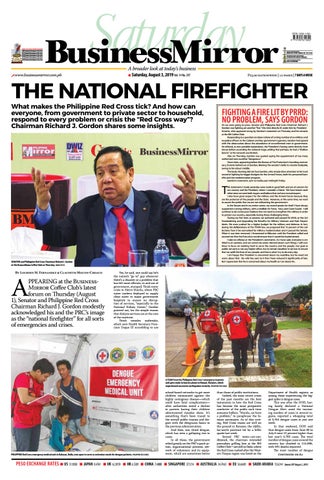
SENATOR and Philippine Red Cross Chairman Richard J. Gordon at the BusinessMirror Coffee Club on Thursday. NONIE REYES
By Lourdes M. Fernandez & Claudeth Mocon-Ciriaco
A
PPEARING at the Business Mirror Coffee Club’s latest forum on Thursday (August 1), Senator and Philippine Red Cross Chairman Richard J. Gordon modestly acknowledged his and the PRC’s image as the “national firefighter” for all sorts of emergencies and crises.
Yes, he said, one could say he’s the nation’s “go to” guy whenever there’s a disaster or a problem that has left most officials, in and out of government, stumped. Think water crisis in Metro Manila, where PRC water tankers deployed to supply clean water to major government hospitals to ensure no disruption of services, “especially to the National Kidney Center,” Gordon pointed out, for the simple reason that dialysis services are at the core of the institute. Think measles outbreaks, which sent Health Secretary Francisco Duque III scrambling to use
A TEAM from the Philippine Red Cross’ emergency response unit gets ready to board a plane to Itbayat, Batanes, which experienced successive earthquakes recently. PHILIPPINE RED CROSS
PHILIPPINE Red Cross emergency medical unit in Balasan, Iloilo, now open to serve as extension wards for dengue patients. PHILIPPINE RED CROSS
PESO EXCHANGE RATES n US 51.1050
school-based networks to get more children immunized against the highly contagious disease—which could have fatal complications— after authorities noted a decline in parents having their children administered measles shots. It’s something that’s been traced to the overall public trauma and disgust with the dengvaxia fiasco in the previous administration. And then, too, think dengue, which has seen a galloping rise in cases. In all these, the government relied greatly on the PRC’s quick action, organizational prowess, network of volunteers and its equipment, which are sometimes better
than those of public institutions. Indeed, the most recent crises of the past months are the best testaments to how the Red Cross has become the most peripatetic comforter of the public each time someone hollers, “Manila, we have a problem,” to paraphrase the famous astronauts. As of this writing, Red Cross teams are still on the ground in Batanes, the idyllic, far-north province hit by a killer quake last week. Several PRC tents—air-conditioned, the chairman reminded journalists grilling him at the BM Coffee Club—are still in Iloilo, where the Red Cross rushed after the Western Visayas region was listed on the
Department of Health registry as among those experiencing the biggest spike in dengue cases. This was after the DOH, having barely declared a National Dengue Alert amid the increasing number of cases in several regions, reported a whopping total of 5,744 dengue cases in just one week. In that weekend, DOH said that dengue cases from June 30 to July 6 were 22 percent higher than last year’s 4,703 cases. The total number of dengue cases around the country has climbed to 115,986, with 491 deaths reported. The most number of dengue Continued on A2
n JAPAN 0.4761 n UK 62.0159 n HK 6.5301 n CHINA 7.4088 n SINGAPORE 37.1214 n AUSTRALIA 34.7463 n EU 56.6601 n SAUDI ARABIA 13.6244
Source: BSP (August 2, 2019 )
News
BusinessMirror
A2 Saturday, August 3, 2019
www.businessmirror.com.ph
THE NATIONAL FIREFIGHTER Continued from a1
cases were recorded in Western Visayas region with 15,826; followed by Calabarzon with 12,780 cases; Soccsksargen with 9,572 cases; Northern Mindanao with 9,354 cases; and Central Visayas with 9,259 cases. In response to the DOH declaration of a national alert, Gordon ordered the immediate deployment of emergency medical tents to accommodate in the overflow of patients in Iloilo, amid the province’s rising dengue cases. Four sets of emergency medical tents were deployed from the PRC warehouse in Subic and brought to Iloilo via ferry, while another four sets were deployed via a C130. “PRC’s medical tents will help decongest the overloaded wards and provide comfort to the patients and their families. Similar to how we addressed the measles crisis earlier this year, we will continue to work with DOH to identify and fill the needs in the most affected communities,” Gordon said in an earlier briefing. Meanwhile, the Red Cross also ensured the availability of blood for dengue patients in its blood center in Iloilo and nearby blood service facilities. PRC ambulances and welfare desks were prepositioned. PRC’s community health volunteers also intensified their information dissemination drives to encourage Filipino families to do the “4S” of dengue prevention—
search and destroy, self-protect, seek early consultation and say yes to fogging. “Dengue destruction should be done before it started. Let’s observe proper personal hygiene and keep our surroundings clean to steer away from these diseases,” Gordon added.
No buckshot vaccination
ON Thursday, at the BM Coffee Club, Gordon stressed this dengue prevention message anew: public health education on a constant, massive cleanup and good hygiene practices is the key. He added: the dengue surge cannot be used to justify another mass immunization with dengvaxia, as what happened in 2016 when the Aquino administration, on the prodding of then-Health Secretary Janette Garin, had over 800,000 children administered the vaccine. The current surge had prompted a statement from Presidential Spokesman Salvador Panelo on Wednesday that the Palace might reconsider the ban on dengvaxia from the market. To which, Gordon replied, using a vaccine like dengvaxia should never be applied in “buckshot fashion” but instead, the Philippines could follow the example of Singapore, which had approved dengvaxia at about the same time as the Philippines, but did not resort to mass vaccination. Instead, it gave strict protocols for doctors to follow so that each candidate for vaccination is well assessed before being given the shot. In contrast, many of the 800,000plus young Filipinos given dengvaxia were not definitively assessed as to whether they are those who never had dengue, or are being vaccinated against a repeat of the mosquito-borne disease. That distinction was crucial, it turned out, when the French pharmaceutical Sanofi-Pasteur belatedly admitted that dengvaxia was not advisable for the first group, because those who never had dengue and are given the vaccine were at risk from suffering a “severe disease” or a far stronger, possibly fatal, strain of dengue.
More blood stations
MEANWHILE, its involvement in helping put out the latest public health “fire” from dengue gave the Red Cross an opportunity to highlight one of its core advocacies, i.e., encourage people to donate blood, and help those in dire need of blood to have safe, adequate supply. (PRC launched more blood service facilities outside Metro Manila as part of the recent celebration of the 2019 World Blood Donors Day [WBDD], with Chairman Gordon announcing that the organization opened new blood collection units/ blood stations in Albay, Bogo, Mountain Province and Calamba.) “In PRC, we aim to create more blood banks and blood centers for accessibility of blood supply. We want to reach the most vulnerable communities in the rural areas in our country to ensure that there is safe blood for all,” Gordon said in a press conference on June 10. This year’s WBDD celebration carried the theme “Safe Blood for All,” a call to expand access to safe and quality blood and the crucial role of voluntary blood donation in the Universal Health Care. The humanitarian organization currently has 93 blood service facilities, including 27 blood centers, 66 blood collecting units/blood stations, and 11 apheresis centers. This year, PRC is eyeing new
PRC National Headquarters partnered with the Armed Forces of the Philippines to deploy resources for in-depth assessments in Batanes. Among the items deployed are radio equipment, satellite phones, and water purification assets, composed of bladders, treatment units and storage. PHILIPPINE RED CROSS
blood facilities in Marikina City; San Carlos in Pangasinan; San Rafael, San Jose del Monte and Bocaue in Bulacan; Imus and Bacoor in Cavite; Sorsogon; Mindoro Oriental; Romblon; Batanes; Coron, Palawan; Malay, Aklan; Biliran, Eastern Samar; Basilan; and TawiTawi. Gordon repeated PRC’s appeal to the public to help save lives by regularly donating blood. “Everyone should try and encourage everyone to donate blood [because every day, thousands of people need blood around the country]. Everyday should be World Blood Donor’s Day,” Gordon said. As a major provider of blood needs in the country, PRC served a total of 205,772 individuals in 2018. Worth noting is the fact that PRC’s National Blood Center also earned the international standard on quality management systems (ISO 9001:2015), making PRC the first blood center in Southeast Asia and the only nonhospital blood service facility in the Philippines to receive the certification.
Disaster, emergency response
GORDON was asked at the BM Coffee Club if he supported setting up a separate Department for Disaster Resilience, and his reply was a big no.
He believes it will just cause needless public spending for more bureaucracy, without solving the oft-repeated problems of coordination during crises. He is a firm believer, he said, in “continually building up capability” of everyone, in or out of government, institutuon or individual, to deal with emergencies or disasters from their end. This is why he takes pride in the PRC’s network of volunteers (12,000), and the way the Red Cross Operations Center (Op Cen) in Mandaluyong City, on Edsa, can readily determine who are the volunteers nearest ground zero of a disaster or emergency who can be deployed for first aid and rescue work. He recently pitched for ensuring there’s a trained first aider in every home, at work, or in a public place, and mobilized its staff and volunteers to conduct a mass cardiopulmonary resuscitation (CPR) demonstration to equip Filipino families with this lifesaving skill. Last month, PRC went to schools, offices and public places to teach Filipinos how to conduct a hands-only CPR, in cooperation with the DOH, the Philippine Heart Association, and the American Heart Association. “We have our volunteers nationwide, but no first responder can respond as quickly as a neighbor, a family member and a coworker. When that person knows first aid, further injuries and loss of lives can be averted,” Gordon said.
A4 Saturday, August 3, 2019
BusinessMirror
www.businessmirror.com.ph
www.businessmirror.com.ph
BusinessMirror
Saturday, August 3, 2019 A5
If you have any information / objection to the above mentioned application/s, please communicate with the Regional Director thru Employment Promotion and Workers Welfare (EPWW) Division with Telephone No. 400-6011.
ATTY. SARAH BUENA S. MIRASOL REGIONAL DIRECTOR
Saturday, August 3, 2019 | Editor: Mike Besa
A6
Magcalayo Captures AJGA (Open) Massachusetts title By Bobbet Bruce
J
olo Magcalayo scored his first major win in the American Junior Golf Association by winning the Boys Championship at the AJGA Junior at Chicopee Presented by John D. Mineck Foundation last July 24 to 26, 2019, at the Chicopee Country Club in Chicopee, Massachusetts. His three-day score nineunder 204 bested more than 60 competitors in the limited field elite AJGA open event that required 11 Performance Stars to gain entry and book the first AJGA open event win by a Filipino golfer in almost a decade. Magcalayo started first day at three-under par 68 for a tie for third and trail joint leaders Charlie Beridge of NY and Jeffrey Fang of Ontario, Canada by one. He climbed up to solo second at the end of the second day with a two-under par 69 but with a bigger deficit behind Beridge who booked a three-under par 68 to remain two up going to the last day of play. Magcalayo quickly took the provisional lead with three straight pars against the three straight bogeys of Beridge right out of the first corner. They would match scores as they both birdied three of the last six holes to end the front 9. Beridge would tie the score with a birdie on 13 and then take the lead outright with Magcalayo’s first bogey of the day at hole 14. Matching birdies on the par 5 hole 15, Magcalayo will level on 16 with a par against the American’s bogey and then take a three stroke lead on the par 5 penultimate hole as his birdie was answered by Beridge’s disastrous double. Not even Jolo’s second bogey of the day on 18th mattered as he still kept a two stroke three day lead to
Back from th Puerto Azul
Jolo Magcalayo holds form to win the AJGA Open. AJGA
nail his maiden AJGA Open crown. Magcalayo has been on a tear this summer with consistent outstanding performances in almost every tournament he has played. He won an AJGA Open event qualifier in Ohio, placed second by a stroke at an AJGA Open event in Kentucky, qualified for the US 72nd Junior Championship becoming the first Filipino boy to qualify through sectionals twice, placed second at the prestigious 41st North and South Junior Championship in Pinehurst, NC, qualified as an alternate to the 119th US Amateur and won the NJ sectional qualifiers to gain a special exemption as a nonresident to the 45th Jr PGA Boys Championships this week. His consistent play in the past two summers in the US has firmly placed him in the recruitment radar for the class of 2021 with more than 20 schools already going after the rising junior from De La Salle Zobel.
The Iconic 17th green
B
Story & photos by Mike Besa
ack in the late 70s and early 80s, there was no golf property more glamorous than Puerto Azul Golf and Country Club in Ternate, Cavite. It was the height of the popularity of the golf in the country then and out golfers were the best in Asia. Puerto Azul Golf and Country Club was a lush pleasure destination where people from around the world came to enjoy its tropical amenities and its world-class golf course. During its heyday, Puerto Azul was known as “Asia’s paradise resort” and boasted some 340 hotel rooms arranged in 17 clusters forming a series of small villages spread throughout the property. The club had abundant facilities for nongolfers. The Puerto Azul Beach Club had a large clubhouse with a gigantic swimming pool, while sprawled along Caysubic Beach were cottages, reserved exclusively for the use of its members. But the golf course was Puerto Azul’s crown jewel. Designed by golf legend South African Gary Player and developed by the Ternate Development Corp. back in 1980, the golf course was, at the time, heralded as the most beautiful in Asia. The opening nine meandered through the lush tropical rainforest, while the inward nine flirted with the ocean. The signature holes, 17 and 18, brought the ocean into play to finish off a very memorable round of golf. There are few golf courses in the world with holes as scenic as this. It was the weekend playground of the country’s elite, as well as the globe trotting super rich. It was surrounded by an air of opulence and exclusivity that drew golf tourists from all over the globe. The golf course drew the game’s
best players of the day to the Philippines, Gary Player and Bernhard Langer were early visitors, as were George Archer and the great Sam Snead. Puerto Azul hosted the Philippine Open on three different occasions before financial troubles, and the changing tastes and trends slowed the flow of tourists to a trickle. Other resorts and golfing options opened up in the region, drawing away the customer base and making Puerto Azul seem dated. The resort also encountered legal problems and eventually, parts of the resort had to be closed off to the public. The property eventually closed completely. Existing facilities fell quickly into disrepair. The rainforest reclaimed many of the facilities and most of the golf holes. Several groups showed interest in rehabilitating the vast property, but none progressed beyond the initial press releases, and so the property continued its slide into oblivion. Then the improbable happened. On September 27, 2017, businessman Salvador Zamora II signed a deal with Boulevard Holdings Inc. Chairman Jose Marcel Panlilio to redevelop the 70-hectare Puerto Azul Golf and Country Club and build a 300-room hotel in Ternate, Cavite. The deal was that Zamora was to lease the 18-hole Puerto Azul Golf and Country Club for 23 years starting on the date of the press conference. This was announced at the same time that Zamora announced the Rory McIlroy versus Jason Day (who was later substituted by then-world number two Dustin Johnson) at Pradera Verde. When that fell through due to a contract dispute, doubts were cast on the fate of Puerto Azul, as well. The doubters were wrong. In the intervening years since the press conference,
Why Golf Tourism? A fter the piece titled,“Why Can’t Golf Tourism Take Hold in the Philippines?” ran, reactions were quite mixed. Some agreed with the need to develop the industry, others saw no value in it. Why should a private club open its fairways to tourists in the first place? Won’t that inconvenience the members and compromise the club’s exclusivity? Others say that our golf courses just aren’t good enough to compete with our neighbors in the region. So why bother? There are many reasons to do so. The most significant is to allow the clubs to earn more income from tourist traffic. We aren’t suggesting that they just throw their doors open and allow tourists unlimited access. All clubs have tee times that aren’t popular with the members. All clubs have slow days when few members are even at the club. Why not convert that potential into realized income? Each club will have their own policy as to how much access to allow and that’s perfectly acceptable. There’s a large trickle-down effect to having tourists at the club. The club earns additional revenue from food and beverage, golf cart rentals and proshop sales. Many clubs mandate a one-guest, one-cart policy and a F&B minimum as part of access to the club. Most tourists will tip their caddies generously if they are well served and want a souvenir from the proshop of their visit to the club. Once the clubs recognize the revenue potential of the property, they can, and most likely will, improve their golf courses’ condition to further increase its appeal to foreign pa-
trons. Better playing conditions will most assuredly find favor with club members, especially if they don’t have to pay for it. One of the trends of the last decade around the world are the growing investments in golf to increase the number of foreign visitors and enhance tourism revenue earned. This has seen the spread of golf globally and the number of world-class golf courses has been steadily rising over the years, as well. The real-estate sector has also been drawn into the lucrative golf tourism industry. This has seen the emergence of exquisite golf resorts around the world each trying to stand out as the one that offers the ultimate golfing experience. Although many of the best golf courses in the world are in the United States, Europe, Africa and Asia have built many worldclass destinations in turn. Each continent is striving to set itself apart from the rest to increase revenue from golf tourism. Golf now contributes about $20 billion annually, and by itself, or as a secondary motivator attracts millions of holidaymakers across the world. Approximately 56 million people play golf worldwide with 26.7 million of these residing in the United States, 5.5 million in Europe, 5 million in Canada, 14 million in Japan and 3.8 million in the United Kingdom. Among them about 5 to 10 percent travel worldwide with the sole purpose of playing golf. This number has been steadily increasing over the years as more countries embrace golf tourism as a key source of foreign exchange. It is estimated that the demand and supply of golf is rising at a steady rate of 12 percent annually. This has seen an increase in golf resorts
Zamora’s crew has been hard at work, clearing the golf course, redesigning and rerouting it to bring the old girl up to world-class standards. We were invited to Ternate to observe the work done thus far and were honestly quite surprised to find the golf course in such an advanced stage of completion. The old layout was short by today’s standards—it measured just 6,591-yards from the tips. Hardly a test for the modern golf professional. Zamora’s plans for the Puerto Azul Golf and Country Club include hosting a European Tour event so part of the rehabilitation would be to find additional length for the club to challenge the best golfers in the world. The European Tour submitted a design proposal for the golf course, but if failed to find favor with Zamora. Serendipitously, he entrusted the completion of the rehabilitation to his son, Bodie. A young man in his early forties, Bodie Zamora is a certified golf nut and a successful entrepreneur but had little experience designing golf courses. Although he was untrained for the task before him, his savvy as a golfer and his love for the game stood him in good stead. He enlisted Paolo and Christian Santiago, who operate BGC Philbuilders Inc. to assist him with the golf course and manage the grunt work. Although not a household name, the brothers have years of experience in the golf course industry. They built most of the golf courses in the new Clark megacity save for Mimosa, as well as other golf courses scattered around the country. Paolo, the older brother used to work as an assistant golf professional in Massachusetts. They would need every bit of their combined experience to do this property justice. After touring the property, it is apparent that the men
and related employment opportunities. The governments of various countries are extending support for the growth and development of golf tourism in their countries. The penetration of golf tourism in developing countries is also increasing with the popularity of the game in these countries, improved living standards, increased interest in golf, and enhancement of sports facilities are driving the popularity of the game in the world. Developing countries have recognized that golf tourists tend to outspend average tourists and thus have invested heav-
Philippine golf courses compare favorably with some of the best in the world.
www.pinoygolfer.com | Saturday, August 3, 2019
he Dead l lives!
did an amazing job. Today the golf course stretches out to just under 7,300 yards from the championship tees, just the right length to host a world-class professional golf tournament. They did what they could with the current layout, but wound up changing most of the golf course save for the two closing holes. The 17th and 18th holes at Puerto Azul are among the most beautiful holes in the country, and the younger Zamora felt it important to keep them as such. They did push the tees back and made minor changes to improve playability, but the holes are essentially as they were when the course was built back in 1980s. Zamora decided to use a variety of paspalum called Platinum TE from tee to green. The onegrass solution is a smart move in this case because of the golf course’s proximity to the ocean. This is paspalum’s natural habitat and care and feeding of the course should be straightforward and more economical. The best compliment we can bestow on the new Puerto Azul golf course is that, although new and not even ready for play, the golf course looks like it’s been there for years. The ambience is unparalleled in Philippine golf. It is spectacular. Playability is somewhat difficult to judge since the course isn’t quite ready for play, but the holes are intelligently designed and make the most of the land. It’s early days still, but on paper and from what we have seen, it’s going to be the best golf course in the country.
It’s a long way down to the ninth green.
ily to reap the benefits of extra foreign revenue. This has been supported by a recent report by the International Association of Golf Tour Operators (IAGTO) which showed that operators in Africa posted a 20-per cent increase in sales on average. In Africa, the rise has been attributed to the increasing investments made into golf tourism by developing countries. Kenya, for example, has over the years invested in eight ”export-ready” golf courses which are meant to be appropriate for international golf travelers. These are Muthaiga, Karen, Limuru, Windsor, Sigona, Nyali, Vipingo and Great Rift Val-
ley. This saw the country in 2009 voted as the “undiscovered golf destination of the year” by IAGTO, a title also bestowed on the Philippines at the IAGTO’s Asia Golf Tourism Convention last year. Kenya has made it work; we’ve squandered our opportunity. What needs to happen is that the government, through the Department of Tourism, needs to prioritize the development of golf tourism and move positively to incentivize the clubs to cooperate and to share their fairways, even if just in a limited capacity, with tourists. One scenario is that government grant tax incentives for equipment and other inputs to help improve the golf courses’ conditions.This would give the clubs enough savings to improve the conditions of their golf courses to make their memembers happy and increase their appeal to golf tourists. Longer term, if the program succeeds, perhaps further incentives can be made available to construct other world class facilities. There are already several very impressive upscale, public access golf courses in the country that will make the most of increased tourist traffic. Sun Valley in Antipolo is already one of the best golf courses in the country. Pradera Verde Golf and Country Club is a perfect resort course and the new Puerto Azul Golf and Country Club looks set to follow this trend. The Korean golf courses are also available and can accept added tourist traffic. All that remains is a coordinated effort to ease tourist access into the country. Everyone wins if we pursue this path. We enjoy better golf courses and don’t have to pay out of our noses for it, our caddies will make a better living, more foreign exchange makes it into the government’s system. Spas, restaurants and hotels all benefit. The people of the Philippines benefit. The country benefits. Mike Besa
A7
Ultimate August I
By Chuah Choo Chiang
t’s being billed as “Ultimate August,” with an eye-popping $15 million awaiting the new FedExCup champion. For someone like man-of-the hour Brooks Koepka, it could mean collecting an eye-popping $18 million in bonuses alone by the time the dust settles down. Welcome to the conclusion of PGA Tour’s 2018-19 season where every stroke matters, and every missed shot could mean disaster. The stars know they have everything to fight for as one of the richest prizes and most prestigious accolades in sports await the FedExCup champion. Four tournaments remain out of the 46 this season which have seen the Tour’s bandwagon traversing the United States, Latin America and Asia in the past 11 months highlighting another epic season which has cemented a golf legend’s stature, established new superstars and heralded the exciting arrival of a new generation of young champions. Presently, the all-powerful Koepka looks poised to be the season’s biggest winner. Following a third victory of the season at the World Golf Championships-FedEx St. Jude Invitational last weekend, he picked up a cool $2-million bonus for winning the Wyndham Rewards Top 10 with one event to spare. This week’s Wyndham Championship will conclude the regular season. The 29-year-old American has also all but wrapped up the Aon Risk Reward Challenge, another new and innovative competition that highlights golf’s best strategic decision-makers. In short, that’s another $1 million in the bank for Koepka. After this week, the top 125 golfers on the FedExCup points list qualify for the make-or-break FedExCup Playoffs, comprising The Northern Trust, the top 70 will get through to the BMW Championship and the playoffs finale, Tour Championship will feature the best 30, and use a stroke-based system to determine the 2019 FedExCup champion. This season’s $15-million payout to the FedExCup champion is $5 million more than what England’s Justin Rose earned as the 2018 winner, thanks to a cash boost from FedEx who topped up the overall bonus pool by $25 million to $60 million. Koepka, who also won The CJ Cup at Nine Bridges in South Korea and PGA Championship this season, is geared up for a strong finish as he enters the playoffs as the No. 1 ranked player on the points list. “It’s incredible. To look at what I’ve done this year, just show consistency, try to take my game to a new level and I’ve done that. To be up there in the FedExCup with a chance in Atlanta, that’s incredible,” Koepka said. Other glory seekers like Rory McIlroy, who is trying to emulate Tiger Woods as the only two-time FedExCup champion, will be aiming to pull the rug from beneath Koepka’s feet. “You want to be as high up in the rankings as you possibly can. Obviously, there’s a lot to play for. Every year, the FedExCup is getting bigger and bigger, and it’s more of a target on all the guys’ radar. There’s a lot to play for in August,” he added. Why August is being billed as the ultimate in professional golf has very much been due to the vision of PGA Tour Commissioner Jay Monahan, who has advocated strategic changes to the Tour Schedule and pushed for greater rewards to capture and expand the imagination of players, fans, TV and mobile viewers.
As previous FedExCup champions include current greats such as Tiger Woods, Rory McIlroy, Jordan Spieth, Henrik Stenson, Justin Rose and Vijay Singh, winning the season-long competition has become a priority for the new generation of golfers. In short, the FedExCup is now woven as part of the modern game fabric. The 25-year-old Xander Schauffele encapsulates the importance of the playoffs succinctly. The reigning WGC-HSBC Champions and Sentry Tournament of Champions winner said: “We have so much to play for—the Wyndham Rewards and FedExCup. Everything’s on the table. It’s just as big as a major championship. I’ll go to sleep thinking about those things.” Rose, the first Englishman to taste FedExCup glory last year, added: “Obviously the playoffs are all about volatility and bringing your game when you really, really need it. We’ve all bought in and love that concept.” Asia will have keen interest in the playoffs with Korean rookie Sungjae Im currently ranked as the highest Asian on the points list in 25th position, followed by countryman Sung Kang in 28th place, and Japanese star, Hideki Matsuyama in 29th place. Chinese Taipei’s CT Pan sits in 34th position, another Korean Si-woo Kim is 53rd, while Thailand’s Kiradech Aphibarnrat lies 74th. Kiradech, whose recent form has been affected by a niggling knee injury, said he will take it one week at a time during the playoffs. “I don’t look at the money, just look at it week after week. I’m always trying to win one event which is the goal...winning the FedExCup is the dream.” For many, getting to the Tour Championship means a shot at winning the FedExCup, the ultimate prize on the PGA Tour. Note: Chuah Choo Chiang is senior director, communications, PGA Tour and is based in Kuala Lumpur.
Kiradech Aphibarnrat Getty Images
Brooks Koepka Getty Images
Sports BusinessMirror
A8
Saturday, August 3, 2019
FORMER Olympic skater Ashley Wagner says she was sexually assaulted by John Coughlin in 2008. AP
The three-time national champion wrote in USA Today on Thursday that John Coughlin climbed into her bed after a party at a skating camp and began kissing and groping her. Coughlin was 22 at the time and took his life in January at 33.
VALTTERI BOTTAS’S future at Mercedes will be settled during Formula One’s summer break. AP
Editor: Jun Lomibao • mirror_sports@yahoo.com.ph
RYDER Cup player Thorbjorn Olesen is intoxicated as he flies home from the World Golf Championships. AP
Editor: Gerard S. Ramos • lifestylebusinessmirror@gmail.com
BusinessMirror
Dr. Margie Holmes is back with a new show PRIMETIME
DINNA CHAN VASQUEZ @dinnachanvasquez luckydinna@gmail.com
I
N the 1990s, when Dr. Margarita “Margie” Holmes first shot to national fame, many people considered her words and the work that she did to be scandalous. It is now 2019 and Dr. Holmes is doing the same thing. Her words and work are no longer considered scandalous. Time has changed things and people. “I must admit the millennials are wala nang pasikotsikot, paligoy-ligoy. Most of them are sort of straight to the point. A lot of them are still guilty of the same issues. Or maybe I’m just distracted because ’pag magtanong sila diretso,” said Holmes during the launch of her show Sex Talks with Dr. Holmes on HOOQ. The show featuring the sex therapist, best-selling author, clinical psychologist and columnist is HOOQ Philippines’s second original offering from the Philippines, the first one being HOOQ’s coproduced movie with Viva Films, titled Ulan, starring Nadine Lustre and Carlo Aquino. Dr. Holmes is a professor of psychology at undergraduate and graduate levels, and has taught at universities in the Philippines and the United States. Dr. Holmes has written 20 books, the best known of which are Life Love Lust, the first book written on love and sex in the Philippines, and Down to 1: Depression Stories, the first book written about clinical depression in the country. Her most recent books include Love Triangles and Imported Love, which she coauthored with her husband, Jeremy Baer. Every episode includes a funny personal short film depicting real-life dilemmas and questions sent to Dr. Holmes. Through creative reenactments, animations, and straight-to-camera conversations, Dr. Holmes offers her own form of candid and expert advice. The series has a raw and natural feel to it, based on the themes of these real-life stories. For the first episode, which aired last Friday, July 26, Dr. Holmes tackled the issue of how big is big
enough. In the episode, she compared the penis to a sheet of paper and how it fits an envelope (the vagina). “One of the goals for HOOQ and its original productions is to push the boundaries when it comes to video entertainment. We are very excited that our first infotainment HOOQ Original features Dr. Margie Holmes, who has been pushing these boundaries for many years to provide much-needed and frank discussions on taboo topics like sex in the Philippines,” said HOOQ Philippines Country Manager Sheila Paul. In addition to launching Sex Talks with Dr. Holmes, HOOQ has top-billed content on sex, love, and games, streaming now on HOOQ Free Play. These include the HOOQ Original Movie Ulan, Boy Abunda’s Originals like A Love Story in the Time of HIV and Young Love; Sine Tula: Lust, as well as the latest Whatoplay gamers’
videos, just to name a few. Those who want full access to HOOQ’s vast catalogue of the latest HOOQ Originals, the hottest Hollywood, local and regional series and movies, including Krypton, John Wick, La La Land and Marvel’s The Avengers, as well as Korean dramas like Jewel in the Palace and Winter Sonata can sign-up to a HOOQ VIP plan on www.hooq.tv. For those ready to enter a new world of entertainment, HOOQ offers 12-month subscriptions at 50 percent when you download and pay via Google Play. HOOQ can now be enjoyed on more devices like Google Chromecast, Samsung Smart TVs, Android TV, Apple TV, Globe Streamwatch powered by Roku, and the new Globe Streamwatch Xtreme Prepaid. Catch Sex Talks with Dr. Holmes only on HOOQ with episodes dropping weekly every Friday. ■
Saturday, August 3, 2019 A9
ALIBABA CLOUD, FORTINET SECURITY FABRIC PARTNER TO SECURE CLOUD MIGRATION ALIBABA Cloud, the data intelligence backbone of Alibaba Group, and Fortinet, a global leader in broad, integrated and automated cyber-security solutions, have announced the expansion of its Fortinet Security Fabric offerings and new automation capabilities for Alibaba Cloud to provide streamlined and consistent security for organizations with hybrid cloud infrastructures. The combination of Alibaba Cloud and the Fortinet Security Fabric provide organizations with the ability to extend security visibility and control from the data center to the cloud, and the ability to ensure that organizations employ consistent security policies no matter where their applications are deployed. By implementing the Fortinet Security Fabric on Alibaba Cloud, customers can apply consistent security policies throughout their hybrid infrastructures, and realize multilayer security protection and operational benefits for running applications on Alibaba Cloud. Sodexo and Fung Group are among the global customers leveraging Fortinet’s cloud native integration with Alibaba Cloud to secure its hybrid cloud environment. Sodexo is using Fortinet’s FortiGate-VM to deploy secure VPC on Alibaba Cloud, effectively aggregating and securing its globally distributed infrastructure. Fung Group is also taking advantage of the integration with the deployment of the FortiGate-VM on Alibaba Cloud, which enables consistent visibility and security management across its cloud environments. As organizations move workloads and applications to the cloud, the digital attack surface is expanding and making it harder to ensure robust, consistent security across clouds and data centers. Organizations are looking to take advantage of the agility and scalability that cloud environments offer without compromising security. Alibaba Cloud’s extended collaboration with Fortinet addresses this concern as it leverages Fortinet’s breadth of cloud security offerings that are part of the Fortinet Security Fabric. “Fortinet is committed to helping customers make their journey to the cloud even more secure by integrating more tightly with Alibaba Cloud and supporting additional cloud security use cases. To further support resource-constrained teams, today’s announcement is helping our joint customers automate additional security processes and more seamlessly integrate into their application life cycle,” John Maddison, EVP of products and solutions at Fortinet. Fortinet’s cloud security solutions are available on Alibaba Cloud Marketplace, or can be purchased from a Fortinet channel partner providing customers with the flexability of purchasing only on demand or owning a license that is transferrable across platforms.
Australia considers more regulation of Google and Facebook BY ROD MCGUIRK The Associated Press CANBERRA, Australia—The Australian government released a report Friday recommending tighter oversight over multinational digital platforms including Google and Facebook, to ensure fairness for other media businesses and give people more control over how their data is used. The Australian Competition and Consumer Commission, the nation’s fair trade watchdog, spent 18 months investigating the impact of digital search engines, social-media platforms, and digital content aggregators on competition in the media and advertising services markets. For every $100 spent by advertisers online in Australia—excluding classified ads—$47 goes to Google, $24 to Facebook and $29 to other players, it said. Treasurer Josh Frydenberg agreed that regulations need to be strengthened. The government will respond by the year’s end after three months of consultations on the 600-page report’s 23 recommendations. “Make no mistake, these companies are among the most powerful and valuable in the world and they need to be held to account and their activities need to be more transparent,” Frydenberg told reporters. Google and Facebook said they would discuss the recommendations with the government. “The final report examines important topics in relation to Australia’s changing media and advertising industry, and we have engaged closely with the ACCC throughout the process,” a Google statement said. Facebook Regional General Manager Will Easton said in a statement: “It is important to get the rules for
AUSTRALIAN Treasurer Josh Frydenberg speaks to the media during a press conference in Sydney on July 26. The Australian government released a report that recommends more regulation on the market power of multinational digital platforms including Google and Facebook. AP
digital news distribution right, as they could impact the 16 million Australians who use our services to
connect, share, and build community, as well as the hundreds of thousands of small businesses that use our free tools to grow, thrive and create jobs.” The ACCC found an “imbalance of bargaining power” in media businesses’ dealings with Google and Facebook. “Whether it be print, radio or television, content generated by journalists and owned by media companies is being displayed on social media and search engines, often without a negotiated agreement covering how data and content is monetized and shared,” Frydenberg said. The ACCC recommended codes of conduct be developed and ratified by regulators to ensure businesses have access to the platforms on “a fair, consistent and transparent basis.” The ACCC also recommends a code of conduct for digital platforms so consumers can know and control what data is collected and how it is used. An ombudsman would be appointed to resolve complaints. The ACCC would also establish its own specialized digital markets branch to deal with the platforms. “At the heart of this important ACCC report is a focus on delivering better consumer and commercial outcomes,” Frydenberg said. “And ensuring a viable media landscape, because news and journalism is a public good.” Australia’s moves follow the US Federal Trade Commission’s decision this week to fine Facebook a record $5 billion for privacy violations. The report found that more than 98 percent of online searches on mobile devices in Australia are with Google. Among Australia’s population of 25 million, Facebook has 17 million users who use it on average 30 minutes a day. Facebook had largely been trusted to regulate
itself and keep its 2.4-billion users’ interests at heart. That was before Russian meddling in the 2016 US presidential election, fake news and the scandal over improper use of personal data of as many as 87 million users by data mining firm Cambridge Analytica, which was affiliated with President Donald J. Trump’s 2016 presidential campaign. Regulators in Australia, Europe and the US took notice. Facebook now faces the prospect of not only billions of dollars in additional fines, but also new restrictions around the world. Laws enacted in Australia in April could lead to the imprisonment of social media executives if their platforms stream real violence such as the New Zealand mosque shootings. The government introduced the bills after the March 15 attacks in Christchurch, where an Australian white supremacist apparently used a helmet-mounted camera to broadcast live on Facebook as he shot worshippers in the two mosques, killing 51 people. New Australian laws also require Facebook, Google and other global technology companies to help police by unscrambling encrypted messages sent by criminals. Those laws have led some tech companies to consider abandoning Australia because of its relatively small market and the increased costs of complying with local regulations. The Australian Industry Group, a leading business advocate, on Friday urged the government to consider the costs as well as benefits of proposed changes. “We are particularly mindful of the risks of unintended consequences for businesses and the community as seen with the recent anti-encryption legislation,” group chief executive Innes Willox said.
A10 Saturday, August 3, 2019
BusinessMirror
Huawei says sales up 23% despite US controls
/
IN this June 26 photo, visitors tour the Huawei pavilion at the Mobile World Congress in Shanghai, China. Chinese tech giant Huawei said Tuesday its global sales rose by double digits in the first half of this year despite being placed on a US security blacklist but said it will face tougher conditions.
CHINATOPIX VIA AP
B
BY JOE MCDONALD The Associated Press
EIJING—Huawei’s sales rose by double digits in the first half of this year despite being blacklisted by Washington and its chairman, saying US pressure has “galvanized our people,” expressed confidence Tuesday the Chinese tech giant will “enter a new period of growth.” Huawei Technologies Ltd., the biggest maker of network gear for phone companies and the No. 2 smartphone brand, is scrambling to preserve its business after the Trump administration blocked access to US components and technology in May on security grounds. Sales have suffered “some impact” but Huawei avoided disruption in shipments to customers, Liang Hua said at a news conference at its headquarters in Shenzhen, near Hong Kong. He said Huawei is reviewing its product lineup to make sure it can fill orders without US components if necessary. American pressure “has galvanized our people and reinvigorated the company,” Liang said. “We believe we will get through the difficulties and challenges in
the short term and enter into a new period of growth.” Washington says Huawei is a security risk, an accusation the company denies. American officials also see Huawei as a competitive threat and a recipient of official Chinese support for technology development they say is based on improper subsidies and stealing or pressuring foreign companies to hand over know-how. Sales in the six months through June rose 23.2 percent over a year earlier to 401.3 billion yuan ($58.3 billion), according to Liang. That was up from 2018’s full-year growth rate of 19.5 percent, but Liang warned Huawei will “face difficulties” in the second half. Smartphone shipments rose 24 percent from a year ago to 118 million handsets, he said. Liang declined to give a forecast of second-half sales, but said, “I am very confident in our full-year growth.” At the start of his presentation, a photo of a fighter plane in flight despite being hit by gunfire was projected onto a screen beside Liang. He said, “like this airplane riddled with bullet holes, we stayed the course.” Huawei’s resilience reflects its financial and technological strength compared with its smaller Chinese rival, ZTE Corp., which was nearly driven
into bankruptcy last year by a ban on access to US technology over its sales to Iran and North Korea. President Donald J. Trump restored access after ZTE paid a $1 billion fine and replaced its executive team. Huawei has developed its own low-end chips for use in entry-level smartphones and servers but still needs US chips and other components for its most advanced products. Liang said Huawei plans to increase this year’s research and development spending to 120 billion yuan ($17 billion). That would be a 20-percent increase over 2018 spending, which already was among the highest for any global company. Washington’s decision to add Huawei to an “entity list” of foreign companies that require official permission to buy technology sent shock waves through US industry. Huawei is one of the biggest buyers of chips and other components, and paid American suppliers some $12 billion last year. Trump agreed to allow vendors to sell widely available technologies to Huawei. But Liang said “we have not seen a resumption of supplies” of components needed for its core products. Trump has suggested he might lift controls on Huawei if Washington and Beijing reach a deal to end a tariff war over American complaints about China’s trade surplus and technology ambitions. American and Chinese trade negotiators were due to meet this week in Shanghai. Huawei, with 180,000 employees, has for a decade fought US accusations it might facilitate Chinese spying. The company denies suggestions it might install “backdoors” in equipment to permit eavesdropping. Its founder, Ren Zhengfei, a former military engineer, told reporters earlier this year he would reject Chinese government demands to disclose his foreign customers’ secrets. The US export curbs threatened Huawei’s smartphone sales by disrupting access to the Android operating system supplied by Alphabet Inc.’s Google unit. Huawei can use the basic system, which Google provides for free, but lost access to maps and other services that require the US company’s support. Ren, the company founder, said earlier smartphones sales plunged 40 percent following the ban. Liang said Tuesday sales had recovered to 80 percent of their previous level. Liang said Huawei can develop its own operating system if necessary, based on its Hongmen system created for Internet-linked cars, factory equipment and other devices. “Using Android is always our preference,” he said. “But if the United States doesn’t let us use it, we have the capability to develop our own OS and ecosystem.” Liang said the US curbs had no effect on Huawei’s sales of next generation, or 5G, telecoms technology. Huawei is, along with Sweden’s LM Ericsson and Nokia Corp. of Finland, a top developer of 5G networks that are meant to expand support to Internet-linked cars, factories and other devices. Huawei has signed 11 commercial contracts with foreign carriers since the May ban was imposed and has shipped a total of 150,000 base stations, according to Liang. ■
www.businessmirror.com.ph
FROM left: Jack Zheng, CFO; Albert Lau, SVP for Network Management; Jane Luo, Board Supervisor; Joe, CEO and Founder; Steven Yan, Country Head; Lucy Kong, Senior Consultant; and Winter, Director of Network Management
IKGLOBAL INC. OPENS FIRST PHILIPPINE OFFICE
HONG KONG-based Internet service provider Internet Keeper Global Inc. (IKGlobal Inc.) opens its first office in the Philippines and the 10th worldwide this month, adding to its roster of cities that include Los Angeles, San Jose, Beijing, Shenzhen and Chongqing. The company welcomes the Philippines to its growing business venture with a team having more than a decade of operations and maintenance experience, plus 24/7 business operations. IKGlobal Inc. covers global data-center resources, global network lines, Internet bandwidth, IP addresses, network security and defense, cleaning-center services, cloud computing and data acceleration, blockchain and professional consulting, and project implementation. The company has already deployed multiple data and network-switching centers in the America, Asia and Europe, providing customers with high-quality network services and expanding network coverage globally. Aside from technical support, IKGlobal Inc. customers can receive corresponding financing services for industrialchain upstream and downstream, thus securing a developing ecological environment on the company’s part and a strong support systems for clients on the other hand. IKGlobal Inc. is a global strategic partner of China Telecom International Co. Ltd.
APPLE BUYS INTEL’S SMARTPHONE MODEM DIVISION FOR $1 BILLION
SAN FRANCISCO, CALIFORNIA—Apple is paying Intel $1 billion for the chipmaker’s smartphone modem division in a deal driven by the upcoming transition to the next generation of wireless technology. The agreement, announced on Thursday, comes three months after Apple ended a long-running dispute with one of Intel’s rivals, Qualcomm. That ensured Apple would have a pipeline of chips it needs for future iPhones to work on ultrafast wireless networks known as 5G. The Apple-Qualcomm truce prompted Intel to abandon its attempts to make chips for 5G modems, effectively putting that part of its business up for grabs. Once the sale is completed later this year, Apple will be picking up about 2,200 Intel employees and 17,000 wireless technology patents. Barring any complications, the deal is expected to close sometime between October and December. Apple’s purchase of Intel’s smartphone modem patents and other technology could bolster its attempt to build its own line 5G chips and lessen its dependence on Qualcomm. The Cupertino, California-based company has hammered out a licensing agreement with Qualcomm that carries through April 2025, with an option to extend for an additional two years after that. Qualcomm is a pivotal supplier in the rollout of 5G, particularly in the US. That’s because President Donald J. Trump’s administration has blacklisted another key 5G supplier, Huawei, as part of its trade war with China. Apple isn’t expected to release an iPhone that works on 5G networks until September 2020, putting it behind rivals, such as Huawei and Samsung, which already make handsets that work with the faster wireless technology.
Web-based lender eyeing to lend P110 million to borrowers this year BY RODERICK L. ABAD Contributor ONLINE credit provider Advance is bullish to achieve its goal of providing more loan assistance to the local labor market this year on the back of its flexible ondemand lending products. “Right now we are on target to reach about P110 million in loan book by end of the year, even for such a young company,” Advance Cofounder Addi Guevara told BUSINESSMIRROR after the official launch of their platform held recently in Makati. “And we’re able to do that because we have partnerships already with some of the biggest banks like PNB and AUB.” Advance is a financial technology, or fintech, company that had its soft kickoff last October. It has a mission to help workers without access to basic credit services and are unable to rely on their employers for financial assistance. “We allow employees to access their salaries anytime, on-demand. And we really built Advance so that we could adjust the paycheck-to-paycheck
problem that over 80 percent of Filipinos go through on a regular basis. So we created something that would alleviate the pressure they go through every month of trying to figure out how to make ends meets,” said Jaime de los Angeles, CEO and cofounder of Advance. In the Philippines, not everyone has access to salary loan programs through banks or traditional online credit providers. If they do, it wouldn’t be as fast as what Advance offers due many physical requirements and complex manual processes. Furthermore, it’s uncertain if the loan will be granted or approved, and credit amounts are usually much larger and for longer tenors. With Advance, regular employees of partner-firms are already preapproved. It’s up to them if they will use the credit line of up to 50 percent of their monthly salary or not. Employees can request from P1,000 up to their max credit limit, as often as they need, until they fully utilize their line. “So it is really built to service the ‘sachet’ financing,” he said of the mentality of Filipinos to
consume products or services in small amounts suited to their limited means. “Because we know that for a lot of our borrowers, it’s for their daily needs only. We’re very conscious about making sure that employees have enough take home pay, and when they use us, it’s not to get over leverage.” The country’s only online on-demand credit platform aims to provide workers with the “peace of mind” that, at any time, they’re able to access their salary and get funds instantly sent to their bank account. Since it’s Web-based, no need to fill out an application form or sign any document. For less than 10 seconds, it’s all done through a mobile phone and the loaned amount is reflected on a payroll account real-time, ready for immediate withdrawal. Compared to other online lenders who charge as much as 80 percent per month, Advance doesn’t charge any interest (zero percent), and only issues a small processing fee which is added to the repayment amount. Terms of payment are either one, two or four deductions to the borrower’s salary.
According to Guevara, Advance has so far lent around P50 million to about 500,000 employees of its 25 partner-companies nationwide. Loans are usually used by borrowers for bills payment, medical emergencies or remittance. “It’s an underserved market right now. So I think it’s a good opportunity for us to enter the space,” he said of their offering of flexible revolving line of credit. “There’s a lot of opportunity here in the Philippines to really service more than the 500,000 employees we have access to today. There’s over 40 million employees here that we want to help,” added Angeles. While the newly established company now focuses on the domestic market, the CEO bared their plan to also penetrate other emerging markets in Southeast Asia that share similar characteristics with the Philippines. “We’re targeting end of 2020 [to expand in the region], but it might happen sooner. We’re already getting some inquiries from some companies abroad,” he said.
www.businessmirror.com.ph
BusinessMirror
Saturday, August 3, 2019 A11
Girls are bearing the brunt of a rise in cyberbullying
S
BY SALLY HO The Associated Press
EATTLE—Rachel Whalen remembers feeling gutted in high school when a former friend would mock her online postings, threaten to unfollow or unfriend her on social media and post inside jokes about her to others online. The cyberbullying was so distressing that Whalen said she contemplated suicide. Once she got help, she decided to limit her time on social media. It helps to take a break from it for perspective, said Whalen, now a 19-year-old college student in Utah. There’s a rise in cyberbullying nationwide, with three times as many girls reporting being harassed online or by text message than boys, according to the National Center for Education Statistics. The US Department of Education’s research and data arm this month released its latest survey, which shows an uptick in online abuse, though the overall number of students who report being bullied stayed the same. “There’s just some pressure in that competitive atmosphere that is all about attention,” Whalen said. “This social-media acceptance—it just makes sense to me that it’s more predominant among girls.” Many school systems that once had a hands-off approach to dealing with off-campus student behavior are now making cyberbullying rules, outlining punishments, such as suspension or expulsion, according to Bryan Joffe, director of education and youth development at AASA, a national school superintendents association. That change partly came along with broader cyberbullying laws, which have been adopted in states like Texas and California in recent years. The survey showed about 20 percent, or one in five students, reported being bullied, ranging from rumors or being excluded to threats and physical attacks in the 2016-2017 school year. That’s unchanged from the previous survey done in 2014-15. But in that two-year span, cyberbullying reports increased significantly, from 11.5 percent to 15.3 percent. Broken down by gender, 21 percent of girls in middle and high school reported being bullied online or by text message in the 2016-17 school year, compared with less than 7 percent of boys. That’s up from the previous survey in 2014-15, the first time cyberbullying data was collected this specifically. Back then, about 16 percent of girls between 12 and 18 said they were bullied online, compared with 6 percent of boys. The survey does not address who the aggressors are, though girls were more likely to note that their bullies were perceived to have the ability to influence others. Lauren Paul, founder of the Kind Campaign, said 90 percent of the stories she hears while working in schools are of girls bullied by other girls. The California-based nonprofit launched a decade ago to focus on “girl against girl” bullying through free educational programming that reaches about 300 schools a year.
RACHEL WHALEN looks at her phone at her home in Draper, Utah. Whalen remembers feeling gutted in high school when a former friend would mock her online postings, threaten to unfollow or unfriend her on social media and post inside jokes about her to others online. The cyberbullying was so distressing that Whalen even contemplated suicide. AP
GCash, Starbucks introduce new mobile payment option
Paul recalls meeting one girl who was obsessive about her social-media accounts because a group of girls excluded her if she did not get enough likes or follows in any given week. She went so far as to painstakingly create fake profiles just to meet her quota. “Most of the time—if not almost all the time—it’s about what’s going on with other girls,” Paul said. “It’s this longing to be accepted by their female peers specifically and feeling broken if they don’t.” Though Paul primarily hosts assemblies and workshop exercises at middle and high schools, she said there’s been more demand to help younger and older students in recent years. The Kind Campaign has gotten more requests for elementary-school presentations and now also regularly gets called to universities to work with sororities. The latest national data may spark new conversations about “Mean Girls” behavior, Joffe said, referring to 2004 movie starring Lindsay Lohan. “It’s a school issue, but it’s just a reflection of broader societal issues,” Joffe said. “I’m not sure schools have any better answer than say, the Twitter company or Facebook. They’re also trying to find answers to what to do about abuses online.”
Some tech companies also are taking a stab at what seems like an intractable problem. Instagram unveiled its latest feature this month that uses artificial intelligence to try to stop abuse. Users typing a potentially offensive comment on a photo or video will get a notification that reads: “Are you sure you want to post this?” Many school districts, meanwhile, are beefing up social-emotional learning curriculum beyond just teaching children how to share and express their feelings in the early grades. That’s something Manuela Slye, a Seattle mother with three teenagers, says is a must to prevent cyberbullying. The president of the Seattle Council Parent Teacher Student Association called on her school district to expand its “soft skills” lessons through high school, as is done in a neighboring school district. Seattle Public Schools is working to expand such offerings, though a district spokesman said there hasn’t been a noted rise in cyberbullying among its students. “There needs to be social-emotional development teaching before it goes to cyberbullying, before it goes to doing something online and anonymously, and before you have a problem with someone,” Slye said. ■
GETTING a cup of our favorite Starbucks handcrafted beverage is now easier with GCash, the leading mobile wallet in the Philippines. With the new Scan to Pay (STP) with GCash QR, a QR scanner integrated into the coffee shop’s point of sale (POS) scans the GCash customer’s generated QR code. This creates a convenient payment process by eliminating multiple steps and adding to a more positive customer experience. “Starbucks offers locally relevant digital payment options to its customers, and GCash complements the experience in every Starbucks store through the convenience and features of our mobile wallet. Further enabling Starbucks to create positive customer experience is also exactly what we envisioned for this partnership,” said Anthony Thomas, chief executive officer and president of Mynt. To use GCash’s STP via QR scanner, Starbucks customers need to generate a QR code through their GCash app when the barista completes taking their orders. The customer will scan the QR code to the QR scanner and will receive notification of payment via SMS while the barista will receive payment via the POS. There is no need for a QR key card or handset to receive a GCash reference number as proof of transaction. Furthermore, Starbucks customers do not have to input the amount due for payment in their GCash app because it will be automatically deducted from their account. As of September 2018, Starbucks had 373 licensed stores nationwide. It opened its first branch in the Philippines in 1997 at the 6750 Ayala Building in Makati City, making the Philippines the third overseas market for Starbucks. “As a fintech company, our goal is to promote a cashless lifestyle that will make financial transactions less complicated for more people. Just as Starbucks is committed to innovative digital experiences, we too are committed to bringing convenience with mobile innovations like our STP via QR scanner,” Thomas said. GCash’s partnership with Starbucks comes at the heels of the mobile wallet app’s partnership with Asia United Bank. AUB and GCash will collaborate to enable more than a million traditional and nontraditional merchants in the Philippines to accept QR payments.
the Android Q operating system, users will receive two years of OS upgrades and three years of monthly security updates, ensuring access to all the latest innovations from Android. Koa said the Nokia 3.2 combines the biggest HD+ display with its signature two-day battery life powered by the latest Android 9 Pie experience which manages background applications using AI, learning from user behavior to know when to throttle or
increase power for specific apps or processes. It also features an impressive 6.26” HD+ display so a user will have an easier time to watch his or her favorite movies, TV shows and streams onscreen. Powered by the Snapdragon 710 Mobile Platform, Koa said the Nokia 8.1 guarantees smooth usage of up to two days on a single charge. She added it has 35 percent faster graphics processing and 20 percent higher performance than the previous generation.
Nokia aims to reconnect with local market BY RIZAL RAOUL S. REYES JUST like in the 1990s, Nokia wants to establish once again a strong connection with Filipinos hoping to gain a sizeable share of the local market. “We value our relationship with the Filipino Nokia mobile fans. This is why we offer them only the best smartphones with accelerated performance, designs made with precision and the highest standards, and the latest AI advances, including fast access to Google Assistant. Running on pure, secure and up-to-date Android 9 Pie reinforced with Android One, these smartphones uphold HMD Global’s commitment to phones that just keep getting better, made accessible through our online retail partners at irresistible price points,” Sancho Chak, HMD Global, general manager for Philippines, Hong Kong and Macau, said during the recent launch of the company’s mobile phone models at Bonifacio Global City. HMD Global, the home of Nokia phones, launched the Nokia 2.2, Nokia 3.2 and Nokia 8.1 for its Filipino fans through exclusive offers on Lazada and Shopee. Chak said it is a special moment for Nokia to be in the mobile phone market as it is the only European brand competing mainly against Chinese brands.
Despite tough market competition, Chak said Nokia is doing an impressive showing by being the fifth top brand in mobile phones worldwide. Moreover, Chak said the Nokia product line keeps on improving with the new lineup of smartphones carrying cutting-edge technologies. For instance, the Nokia 2.2 has a sophisticated AI-powered low-light imaging and fast-access Google Assistant at the lowest price point, yet. Meanwhile, the Nokia 3.2 has a massive screen and two-day battery life in an affordable yet premium package. The Nokia 8.1, the flagship model, has topcalibre imaging with ZEISS Optics, PureDisplay screen technology and accelerated performance. Charlotte Koa, HMD senior global for the Philippines, said Nokia sees a big opportunity in the P4,500 to P7,000 market segment because this group is emphasizing on value for money. “Consumers belonging in this group are being forced to buy outdated smartphones that are powered by Android technology,” she stressed. She said all the latest Nokia models are powered by the latest Android operating system, For instance, Koa said the Nokia 2.2 provides the latest full Android experience on a modern 5.7inch screen with a discreet selfie-notch. Powered by
/
NOKIA 8.1, Nokia 3.2 and Nokia 2.2
Editor: Gerard S. Ramos • lifestylebusinessmirror@gmail.com
/
THE Vivo Apex 2019
BusinessMirror
Saturday, August 3, 2019 A12
Taiwan, the land of milk (tea) and IoT TECHNIVORE ED UY
whereiseduy@gmail.com
HOW VIVO TECHNOLOGY HELPS SHAPE SMARTPHONES, INDUSTRY
EVER since man used scientific knowledge to create machines and processes to solve problems and create new products, the development and harnessing of technology have always played a vital role in how industries would evolve and progress. In the smartphone manufacturing industry, Vivo (www. vivoglobal.ph) has built a reputation of being a leading global technology company by investing in hardware and software development, to bring the latest cutting-edge handset features to a whole new level, or introduce new technologies altogether. It is a commitment that has enabled the brand to not only commercially produce some of the most advanced and powerful handsets in its class or price range, but also offer game-changing technology that set the trend for competitors to follow, ultimately driving the growth of the industry further. Vivo’s journey to innovating global technology and industries started in 2012 when it introduced the Vivo X1. At that time, it became the world’s thinnest smartphone at 6.65 mm. It was also the world’s first smartphone to have a dedicated Hi-Fi quality audio chip courtesy of the Cirrus Logic CS4398 digital-analog converter plus a CS8422 sample-rate converter. Showing no letup in innovation, Vivo this year, once again made the Mobile World Congress in Shanghai, China, its platform to introduce the Apex 2019, its firstever 5G smartphone which sports a Super Unibody Design that eliminates the bezel, notch, all physical buttons, ports and speakers. The latest Vivo concept smartphone also features a full display fingerprint scanner to mark an innovation on a technology that the company launched just a year before. While the 5G mobile network capability ensures faster connectivity, all-new features—Touch Sense technology, a MagPort for battery charging and data transfer, and Body SoundCasting technology that turns the truly FullView display into a speaker—make the Apex 2019 a preview of what consumers can expect from the leading global technology company next year, or perhaps even just in the next few months.
T
HROUGHOUT our school lives, we meet around a hundred different teachers or so, with most of them becoming barely a face you can’t even remember. But there are a few of them that stand out, not only because we learned a lot from their classes, but because they made an impact in our lives even outside the classroom. They say travel is the best teacher. You may learn a lot from reading books, but travel goes beyond learning. Travel is a force for good: It broadens our mind, develops cultural empathy, and gives us a better understanding of the world. We travel with our children because we believe these experiences not only improve their social skills but are key to helping them become decent global citizens. For a lot of Filipinos, their travel map usually begins with Hong Kong and Singapore followed by another Asian country, maybe Thailand, Malaysia or maybe even Cambodia. But since Taiwan granted visa-free entry to Philippine tourists in 2017, it has quickly become one of the must-visit destination for Pinoys. Philippine tourism arrivals in Taiwan increased 44 percent in 2018 and the Taiwan Tourism Bureau said it expects the number of Pinoy tourists to reach 500,000 this year, especially with the extension of its visa-free policy until July 31,2020. And with or without a new Mikey Bustos jingle, it’s easy to fall in love with Taiwan with all sorts of food you can try, places to visit and things do. But more than just a cultural haven for travelers, Taiwan is also a place where a lot of technological innovations take place. Taiwan is also a big trading partner of the Philippines, and is our eighth-largest trading partner, 10th-largest export market, eighth-biggest source of imports in 2017, as well as the eighth-biggest foreign direct investor in 2018. In recent years, the world has seen Taiwan transition into becoming the global powerhouse it is today with great, innovative value for countless consumers, and cutting-edge products that are proudly Taiwan made.
It has proven its prowess in life-changing technology—from healthcare to education and mobility and, as I discovered recently, in iformation and communications yechnology (ICT), artificial intelligence (AI) and Internet of Things (IoT). Taiwan has been the pivot of the global economy of ICT since the 1980s, with huge partnerships among IT giants such as Apple, Google and Microsoft, to name a few. The country has become one of the world’s largest sources of semiconductors, personal computing, mobile devices, broadband appliances and display markets, which have provided for 16 percent of their gross domestic product. In the rise of AI and IoT, Taiwan has widened its integrity beyond modern manufacturing chain, now as an inventive economy of intellectual property and innovators. This overall competitiveness includes first rate talent, prolific value chain, and resilient entrepreneurial capability, ready to drive new industries of the future worldwide. Over 95 percent of Taiwanese companies are small- and medium-sized enterprises (SMEs) which
Trump refuses to shield Apple’s Mac Pros from China tariffs SAN FRANCISCO—President Donald J. Trump has vowed to slap tariffs on Apple’s Mac Pros if the company shifts production of the computer from Texas to China. The pledge made in a Friday tweet rebuffs Apple’s attempt to shield its products from taxes being imposed on goods made in China as part of Trump administration’s trade war with the world’s most populous country. Apple recently sent a letter to the Trump administration warning that the US economy and its ability to compete will hurt if its products are hit with the tariffs. The Cupertino, California, company has been assembling its Mac Pros in Austin, Texas, since 2013, but a report surfaced last month that Apple plans to shift production to a factory near Shanghai. Apple is reportedly moving Mac Pro production because it is having trouble finding enough skilled labor
to assemble the computer in Texas. Apple didn’t immediately respond to a request for comment Friday, but has previously said the Mac Pro will continue to be designed and engineered in California. The company hasn’t said where the computer will be assembled in the future though. Trump demanded in his tweet that they continue to be made in the US if Apple doesn’t want to be exposed to a 25-percent tariff on electronics made in China. Just hours later, Trump once again asserted the US should have first dibs over the companies headquartered here. In a tweet, he vowed to retaliate against France for the new digital tax the country is imposing on big tech companies that sell online advertising. If anyone taxes the companies, Trump wrote in a tweet , it should be the US. He stuck in a dig about French wine, writing “I’ve always said American wine is better
than French wine!” Investors appeared unfazed by Trump’s sparring with one of the world’s biggest and most powerful companies. Apple’s stock edged up $1.22 to $208.24 in Friday’s midday trading. The reaction probably would have been different had Trump made it clear that the tariffs will be applied to Apple’s top-selling product, the iPhone, which has long been assembled in China. Mac computers, on the other hand, now represent a relatively small part of Apple’s business, unlike the company’s early years when the computers were its marquee products. Mac computers held a 6-percent share of the worldwide personal computer market during the second quarter of this year, ranking well behind China’s Lenovo, as well as HP and Dell in the US, according to the research firm Gartner Inc. AP
have adapted ICT applications and domain knowledge in the sectors of manufacturing, services, education, healthcare, transportation, logistics, e-commerce, smart living, green energy, and public services. This new entrepreneurial culture is a best practice in driving the progress of the Philippines’s SME-driven economy. Thus, last July 24 and 25, Taiwan Excellence, organized by Bureau of Foreign Trade and Taiwan External Trade Development Council, was at the forefront of the Asia IoT Business Platform in Manila Marriott Hotel. “We see progress in the Philippines’s ICT sector and Taiwan will be happy to contribute to this growth and help Filipino enterprises further succeed in their operations,” said Wen-Chung Chang, director of the Economic Division of the Taipei Economic and Cultural Office in the Philippines. Taiwan is determined to advocate for innovation, improve employment and income distribution, and to create a more balanced regional development, by leveraging the immense momentum of many markets at present. ■