PHL-CHINA FRAMEWORK DEAL ON HYDROCARBONS NEARS COMPLETION–D.F.A.
By Recto Mercene
@rectomercene
T
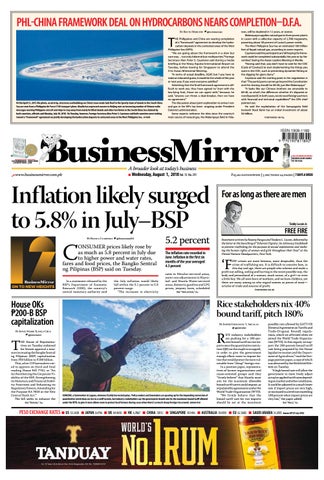
In this April 21, 2017, file photo, an airstrip, structures and buildings on China’s man-made Subi Reef in the Spratly chain of islands in the South China Sea are seen from a Philippine Air Force C-130 transport plane. Manila has expressed concern to Beijing over an increasing number of Chinese radio messages warning Philippine aircraft and ships to stay away from newly fortified islands and other territories in the South China Sea claimed by both countries, officials said Monday, July 30, 2018. On Tuesday, however, Foreign Secretary Alan Peter S. Cayetano said both countries were inching toward a “framework” agreement on jointly developing the hydrocarbon deposits in contested areas in the West Philippine Sea. AP Photo
media partner of the year
United nations
2015 environmental Media Award leadership award 2008
HE Philippines and China are nearing completion of a “framework” agreement to develop the hydrocarbon deposits in the contested areas of the West Philippine Sea (WPS). “We are going about the framework in a slow but sure way…not only bilateral but multiparties,” Foreign Secretary Alan Peter S. Cayetano said during a media briefing at the Ninoy Aquino International Airport on Tuesday, before leaving for Singapore to attend the 51st Asean Ministerial Meeting. “In terms of actual deadline, ASAP, but f you have to make an educated guess, it would be the whole of this year or next year, if you want everyone satisfied.” Admitting that the final framework agreement is difficult to work out, they have agreed to “start with the low-lying fruit, those we can agree with,” because, he said, “anyone can throw a deal-breaker, then we have no agreement.” The discussion about joint exploration to extract natural gas in the WPs has been ongoing under President Duterte’s administration. Some experts welcome the idea since the country’s main source of natural gas, the Malampaya field in Pala-
A broader look at today’s business
n
Wednesday, August 1, 2018 Vol. 13 No. 291
Inflation likely surged to 5.8% in July–BSP C
By Bianca Cuaresma
@BcuaresmaBM
ONSUMER prices likely rose by as much as 5.8 percent in July due to higher power and water rates, fares and food prices, the Bangko Sentral ng Pilipinas (BSP) said on Tuesday. In a statement released by the BSP’s Department of Economic Research (DER), the country’s central monetary authority said
the July inflation would likely fall within the 5.1 percent to 5.8 percent range. “The increases in electricity
5.2 percent The inflation rate recorded in June. Inflation in the first six months of the year averaged 4.3 percent
rates in Meralco-serviced areas, water rate adjustments in Maynilad- and Manila Water-serviced areas, domestic gasoline and LPG prices, jeepney fares, scheduled
business news source of the year
For as long as there are men Teddy Locsin Jr.
free fire Statement written by Roseny Fangco and Teodoro L. Locsin, delivered by the latter at the launching of “Inherent Dignity: An Advocacy Guidebook to prevent trafficking for the purpose of sexual exploitation and realizing the human rights of women and girls throughout their lives” at the United Nations Headquarters, New York.
‘F
EW crimes are more heinous, more despicable, than the crime of trafficking sex. It is difficult to conceive how, in this day and age, there are people who scheme and make a profit out selling, soiling and hurting in the worst possible way, the body and personhood of a woman, much worse, of a girl—or even a little boy. We all were born of mothers, and we have children, yet there are many among us who regard women as pieces of meat— articles of trade and sources of profit. Continued on A6
Rice stakeholders nix 40% bound tariff, pitch 180% By Jasper Emmanuel Y. Arcalas
By Jovee Marie N. dela Cruz
R
@joveemarie
HE House of Representatives on Tuesday endorsed for Senate approval a measure increasing the Bangko Sentral ng Pilipinas (BSP) capitalization from P50 billion to P200 billion. This, after 219 lawmakers voted to approve on third and final reading House Bill 7742, or “An Act Reinforcing the Corporate Viability of the BSP, Strengthening its Monetary and Financial Stability Functions and Enhancing its Regulatory Powers, Amending for the Purpose RA 7653 or the New Central Bank Act.” The bill seeks to enhance the
2016 ejap journalism awards
P25.00 nationwide | 5 sections 24 pages | 7 days a week
See “Inflation,” A2
House OKs P200-B BSP capitalization
See “House,” A3
Continued on A3
BusinessMirror
www.businessmirror.com.ph
T
wan, will be depleted in 12 years, or sooner. Malampaya supplies natural gas to three power plants in Luzon with a collective capacity of 2,700 megawatts, powering about 50 percent of Luzon’s power needs. The West Philippine Sea has an estimated 190 trillion feet of liquid natural gas, according to some experts. Cayetano said the participants are“all hoping the framework could be completed substantially this year or by November,” during the Asean Leaders Meeting in Manila. “Having said that, you don’t have to wait for the COC [Code of Conduct] to start implementing the things you want in the COC, such as preventing dynamite fishing or the digging for giant clams.” Cayetano said the starting point in the negotiation is that: “The participants cannot go beyond the Constitution and the sharing should be 60-40, just like Malampaya.” “It looks like our Chinese brothers are amenable to 60-40, so what’s the difference whether it’s disputed or nondisputed if, in both cases, we do need foreign partners with financial and technical capabilities?” the DFA chief pointed out. He said the exploitation of the Sampaguita field beneath Reed Bank has an initial investment of about $6 billion.
Corazon, a farmworker in Laguna, winnows freshly harvested palay. Policy-makers and lawmakers are gearing up for the impending conversion of quantitative restrictions on rice to a tariff system, but industry stakeholders say the government should aim for the maximum bound tariff allowed under the WTO, to give it more elbow room to protect local farmers during cases when there’s so much cheap foreign rice around. BERNARD TESTA
PESO exchange rates n US 53.2630
@jearcalas
ICE industry stakeholders are pushing for a 180-percent bound tariff on rice imports once the quantitative restriction (QR) on the staple is scrapped, in order to give the government enough elbow room to impose duties that would protect farmers vulnerable from “cheap” foreign rice. In a position paper, representatives of farmer organizations and cause-oriented groups said they “firmly believe” that Manila must aim for the maximum allowable bound tariff rate it could impose, as stipulated by agreements under the World Trade Organization (WTO). “We firmly believe that the bound tariff rate for rice imports should be set at the maximum
possible rate allowed by GATT-UR [General Agreement on Tariffs and Trade-Uruguay Round] regulations, which we affirmed when we joined the World Trade Organization [WTO]. In this regard, we support the 180-percent bound tariff rate being proposed by the House legislative version and the Department of Agriculture,” read the fivepage position paper, a copy of which was obtained by the BusinessMirror on Tuesday. “A high bound rate will allow the government to more freely adjust actual or applied tariff rates depending on market and other conditions. It could be adjusted to a much lower rate if import prices are very high, or increased to a level not exceeding 180 percent when import prices are very low,” the paper added.
n japan 0.4796 n UK 69.9610 n HK 6.7867 n CHINA 7.8112 n singapore 39.1496 n australia 39.4359 n EU 62.3603 n SAUDI arabia 14.2035
See “Rice,” A2
Source: BSP (31 July 2018 )
News
BusinessMirror
A2 Wednesday, August 1, 2018
Senators eyeing hybrid manual and automated election system
S
ENATORS are mulling over the possibility of having the Commission on Elections (Comelec) adopt a “hybrid manual-and-automated” system in future elections to avert a repeat of poll irregularities and snafus attending the last automated electoral exercise.
At Tuesday’s hearing of the Senate Electoral Reforms Committee chaired by Sen. Aquilino L. Pimentel III, Senate President Vicente C. Sotto III suggested
Inflation. . . Continued from A1
increase of the tobacco excise tax, and prices of rice and other agricultural commodities could lead to upward price pressures during the month,” the DER statement read. This means inflation remained elevated during the month, despite the slight decline in domestic diesel prices. Inflation in the first six months of the year averaged 4.3 percent. The highest rate was recorded in June at 5.2 percent. Should inflation in July hit the lower end of the BSP’s forecast for the month, the average
that the Comelec take time to study the possibility of adopting this option, even if not in next year’s mid-term elections. “Ever y thing is possible in price growth in seven months would reach 4.4 percent. An inflation rate of 5.8 percent would bring the seven-month average to 4.5 percent.The latest forecast of the BSP breaches the 2 percentto-4 percent target of the government for the year. In their June policy meeting, BSP officials agreed to scale down their average inflation forecast for the year, from 4.6 percent down to 4.5 percent, taking into account the lower-than-expected inflation outturn in May. The BSP monetary board will reassess this in their meeting on August 9.
Ready to act
In its statement on Tuesday, the
politics,” Pimentel said in endorsing Sotto’s suggestion that the Comelec consider shifting to a “ hybrid manual and automated electoral system,” as the Senate committee hearing went through various electionreform measures, including a bill providing local absentee voting for senior citizens and persons with disabilities. Pimentel promptly ruled out early adoption of the “hybrid manual and automated elections,” conceding there is “no more time” for the Comelec to implement it in the 2019 polls. Still, the senator indicated that,
if next year’s fully automated electoral exercise is still attended by irregularities “[Kung meron pang kapalpakan], we have no choice but abandon it and go hybrid.” “Why should we continue to implement a law that does not level the playing field?,” asked Pimentel, adding that the Senate committee is also taking note of suggestions to “look into [the possibility of allowing] online voting.” He, however, clarified the committee is still “far from moving to enact a law implementing it,” but adds that “if any one can show us” how it can be done, they are willing to listen. Butch Fernandez
BSP reiterated its preparedness to take action to control inflationary pressures, even after it hiked rates twice. “The BSP will continue to keep a watchful eye on the risks to the inflation outlook and will take necessary action to help ensure that inflation expectations remain firmly anchored to the target,” the BSP said. In previous weeks, BSP Governor Nestor A. Espenilla Jr. made stronger monetary-policy hints for the Central Bank’s next move. “The BSP continues to maintain a close watch on domestic and external factors affecting prices. Elevated inf lation this year is mainly due to supply-side
pressures. However, inflation is expected to return to the target range of 2 [percent] to 4 percent by 2019,” Espenilla said. “The BSP is ready to take follow-through actions to the policy rate hikes done in May and June to further anchor inflation expectations and address any brewing demand-side pressures,” he added. T he B SP mone t a r y b o a rd a l ready de l ivered a tot a l of 50 -basis-point increase in the c o u nt r y ’s m o n e t a r y p o l i c y, putting the BSP ’s main polic y rate at 4 percent. T he hikes were made in t wo consecutive 25-basis point tranches, one in May and one in June.
Rice. . .
Continued from A1
The rice industry stakeholders said setting a “very low” bound rate, such as 40 percent—as proposed by the economic managers—would limit the government’s policy space in protecting local farmers from “cheap” imports. “If the bound rate is set to a very low level, such as 40 percent as proposed by some of our economic managers, the government will not be able to impose a tariff higher than 40 percent even if the situation warrants it,” the paper said. “Further, if and when the WTO members eventually agree to further reduce tariff rates, we will be forced to start our reduction from a relatively low tariff level. This will increasingly restrict our ability to protect our local farmers from cheap imports,” it added. The groups said the government has “nothing to lose” by setting the bound tariff at 180 percent. “We therefore urge the government and legislators to adopt a prudent and judicious strategy of employing the highest possible bound rate so that it can preserve its policy space to react effectively to future and emerging marketing conditions.” Furthermore, the groups urged the government to review its committed 35-percent tariff rate on rice imports under the Asean Trade in Goods Agreement in order to have a higher protection level for farmers. The groups noted the majority of the country’s rice imports come from Asean member-countries, particularly Thailand and Vietnam. “We urge the government to review this commitment and, if deemed necessary, negotiate for an adjustment in our tariff on rice imports,” the paper read. “It is worth noting that countries like Japan and South Korea, which are much more economically advanced than the Philippines, have set their rice tariffs to very high levels of 778 percent and 513 percent, respectively,” the paper added. The groups are also pushing for the implementation of an “effective” trade remedy system that would allow the country to impose
www.businessmirror.com.ph
Rice tariff bill slated for second-reading approval By Jovee Marie N. dela Cruz HE Duterte administration’s rice tariffication bill is now moving closer to getting approval at the House of Representatives. This, after House Committee on Agriculture Chairman Jose T. Panganiban Jr. of Anac-IP delivered his sponsorship speech on Tuesday and called for the immediate passage of House Bill 7735, or the proposed “Revised Agricultural Tariffication Act.” Government officials earlier disclosed that they are eyeing to present the rice tariffication law to the World Trade Organization in September. “ We will approve this tomorrow [Wednesday] on second reading. . . We can no longer postpone [the passage of ] the rice tariffication bill,” Panganiban told the BusinessMirror. “The bill seeks to put in place the safety nets for Filipinos rice producers and rice consumers by imposing tariffs in lieu of quantitative restrictions on rice imports,” he added. The lower house has set the bound tariff rate for rice imports outside the minimum access volume (MAV) at 180 percent. Under the bill, the Philippines will impose a bound tariff rate of 35 percent for rice originating from the Association of Southeast Asian Nations region, regardless of volume. Manila would also impose a 40-percent bound tariff most-favored nation rate for in-quota rice imports from countries that do not belong to the Association of Southeast Asian Nations. Once the bill is enacted into law, the country’s MAV for rice shall revert to its 2012 level of 350,000 metric tons, from
the current 805,000 MT. The bill mandates the National Food Authority (NFA) as the sole authority to undertake the direct importation of rice, only for the purpose of ensuring food security and maintaining sufficient national buffer stocks. The measure defines buffer stock in the NFA rice inventory as reserve equivalent to 15 days’ national consumption requirement and maintained by the NFA at any given time to address calamities, and most important, for price stabilization. It also authorizes the NFA to allocate import permits among certified and licensed importers for importation other than maintaining buffer stocks, while mandating the NFA to issue guidelines for the exportation of rice and corn by certified and licensed exporters. It also provides for the composition of the NFA Council, to be chaired by the secretary of Department of Agriculture, cochaired by the NFA administrator with these members: Bangko Sentral ng Pilipinas governor, secretaries of Department of Finance, Department of Trade and Industry, Department of Social Welfare and Development, Department of the Interior and Local Government, chairman of National Disaster Risk Reduction and Management Council, executive secretary of Office of the President and two farmers’ representatives. The bill also empowers the President, when necessary, to adjust the applied rate; regulate rice exports, impose temporary regulations or restrictions on the volume of imports of rice, and enter into trade negotiations or renegotiations relating to the bound or maximum rates committed to or to be committed by the Philippine in relation to rice.
additional measures when rice imports are deemed unfair and too detrimental to the local sector. “We also support moves to designate rice as a special safeguard [SSG] product in the WTO so that we will have the option to impose additional remedial tariffs on rice imports in the event of an abnormal surge in imports or a major depression in import prices,” it said. “We further urge the government to put in place an effective trade remedy system that will allow us to impose countervailing duties on subsidized imports or antidumping duties on exports of foreign companies that sell rice below the price they normally charge in their home market,” it added. SSG is a trade measure that allows countries to impose additional tariffs when the value of an imported product is below the trigger price. The groups said they “fully support” the establishment of a rice competitiveness enhancement fund (RCEF), made up of the tariffs collected from rice imports. The RCEF would provide the DA with additional resources “to expand and intensify their programs to improve the competitiveness and profitability of rice farmers as the rice market is liberalized,” according to them. Furthermore, the groups said the RCEF could be used “to provide farmers with safety nets in the event of natural calamities, market disruptions and personal emergencies.” The groups proposed that 80 percent of RCEF be pre-allocated to fund key programs for the rice sector, while the remaining 20 percent could be used to augment program budgets “when deemed necessar y.” “We are well aware of the problems that continue to hound the Agr icultura l Competitiveness Enhancement Fund, and we understand the reasons why some legislators have opted to pre-allocate specific percentages of RCEF for specified support activities, or limit the amounts that can be accessed by individual farmers or farmer organizations,” they said. “On the other hand, we also feel that sufficient f lexibility should be allowed for RCEF usage so that the fund can adequately
fill up budgetary gaps or respond to changing priorities as they emerge,” they added. The groups said they support the proposals to use the RCEF to fund credit programs, farm mechanization, postharvest facilities, and research and development and extension. The groups further proposed that the RCEF be used for: 1) common service facilities; 2) social protection programs; 3) subsidized crop insurance and loan guarantees; and 4) crop diversification programs. “We believe that the RCEP, together with the earmarking of rice import tariffs, should be retained for as long as necessary and until such time that local rice farmers can compete with imports on a sustainable basis,” it said. “An initial 10-year life span for RCEP could be adopted, with the understanding that a thorough review will be conducted before its expiry, and with the option to extend its life span if deemed necessary after the review,” it added The groups also support the idea of entr usting the RCEF with the DA, through the agriculture chief, “who shall formulate the guidelines and policies for the usage of the fund in consultation with the private stakeholders through the Philippine Council for Agriculture and Fisheries.” They proposed to create a special PC AF committee that would oversee the utilization of RCEF. “We support proposals to immediately augment the budget of the DA to fast-track important competitiveness-enhancing programs while the RCEP is still being set up and tariff collections have yet to be accumulated,” they said. There is no reason, the groups said, “the government should wait for QRs to be lifted before acting on the threats that farmers face from cheaper imports.” The position paper was signed by representatives of the Federation of Free Farmers, Centro Saka, Alyansa Agrikultura, Rice Watch Action Network, ParagosPilipinas, National Union of Rural Based Organizations, Pambansang Katipunan ng Kababaihan sa Kanayunan, Ka Tribu Ug and Lasang Foundation, and Cacao/ Coffee Alliance.
@joveemarie
T
The Nation BusinessMirror
www.businessmirror.com.ph
Editor: Vittorio V. Vitug • Wednesday, August 1, 2018 A3
Deadly Basilan car blast kills 11, wounds 5 By Bernadette D. Nicolas
M
@BNicolasBM
alacañang condemned on Tuesday the deadly car-bomb explosion in Basilan City that left 11 people dead and five others injured. In a Palace briefing, Presidential Spokesman Harry L. Roque Jr. described the explosion as a “terrorist attack” that constitutes a “war crime.” “We condemn in the strongest possible terms the latest terrorist attack in Basilan perpetrated in violation of our laws,” Roque said
in a news statement. “Authorities are now investigating the incident, even as we vow to bring the perpetrators of this brazen attack to justice,” he added.
Suicide bombing?
Eleven people, including a foreign-looking individual suspect-
ed to be a “suicide bomber,” were killed, while five others were wounded in a car- bomb explosion early Tuesday in Lamitan City, Basilan province, officials said. Lt. Col. Montano Almodovar, the Army’s 3rd Scout Ranger Battalion commander, said over RMN Zamboanga that the explosion happened around 5:50 a.m. at the Magkawit Detachment, along the boundaries of Barangays Bulanting, Colonia and Maganda, in Lamitan City. City Vice Mayor Roderick Furigay said the intersection of the three barangays serves as the main thoroughfare to the nearby towns of Akbar and Mohammad Ajul. Almodovar said that, prior to the incident, the troops flagged down a
white van that was traveling toward Lamitan City proper for inspection. Citing witnesses, he said, the van suddenly exploded when the troops requested its driver to disembark from the vehicle. The driver was a foreign-looking person and could not speak any of the local dialect, including Filipino, he said. Among the fatalities were a soldier, five militiamen and four civilians who were militia dependents. An Army Scout Ranger junior officer, an enlisted man and three militiamen were among those injured and were airlifted to the Camp Navarro General Hospital in this city. The explosion wrecked the van, as well as the checkpoint and a motorcycle
‘Indiscriminate’
Asked why he branded the incident as a war crime, Roque cited the “indiscriminate” nature of the attack. “Well, it’s a fact that Basilan, of course, is an area with a noninternational armed conflict, and there is already a domestic law on International Humanitarian Law. So under IHL, you must limit your attacks pursuant to military objectives; you must limit it to military targets, and you must avoid protected individuals, including civilians,” he said. Considering that the attack happened at the time that the martial law is still being implemented in Mindanao, Roque ad-
SC upholds finding to indict Jinggoy for plunder, graft for PDAF misuse By Joel R. San Juan @jrsanjuan1573
T
HE Supreme Court on Tuesday affirmed the Office of the Ombudsman’s finding of probable cause to indict former Sen. Jinggoy Estrada for the crime of g raf t and plunder for a lleged ly poc ket i ng mu lt i m i llion k ic kbac k s f rom his Pr iority Development Assistance Fu nd (PDA F) or pork-ba r rel fund allotment. At a news briefing on Tuesday, SC Spokesman Theodore O. Te said the High Tribunal voted 6-4 against Estrada, paving the way for the trial of case before the Sandiganbayan to proceed. Four associate justices abstained from participating in the deliberations. However, the High Court has yet to release copies of the deci-
sion and identities of the concurring and dissenting justices. Estrada, son of former president and now Manila Mayor Joseph E. Estrada, was allowed by the Sandiganbayan, which is handling the cases against him, to post a P1.33-million bail for his temporary liberty in September last year. Aside from plunder, Estrada also faces 11 counts of graft for allegedly pocketing some P183 million in kickbacks from his pork-barrel allocations, which was coursed through bogus NGOs established by alleged pork-barrel scam mastermind Janet Lim-Napoles. A resolution issued by the Sandiganbayan Special Fifth Division said it granted Estrada’s bail petition because the evidence, so far, did not point to him as a “main plunderer.”
PHL-China framework deal on hydrocarbons nears completion DFA continued from a1 “So tell me, what Philippine conglomerate, even if they have the money, [will take it out], even if they have businesses, and put it there?” he added. Cayetano emphasized that, if the country wants to harvest the hydrocarbon deposits, it will need “partners with the financial and the technical capabilities to back them up,” and added, “That’s the reality at this point in time.” To allay fears that the country is ceding its rights in the WPS, Cayetano explained that, “we’re very serious about the protection and enjoyment of our sovereign rights, but territorial rights is not divisible.” He said the exploration and development of the WPS through cooperation is one mechanism for dealing with areas of dispute. He said the country wanted to do it since other countries have done it before, because “they have a simple framework; let’s not talk about whose territory it is, let’s talk about protecting or enjoying those resources.” Cayetano continued:“The update is that were already looking at the agreement line by line, we haven’t exchanged yet, so that we can get their comments, and they can get our comments.” “But we’ve exchanged basic principles. The next step in our level is for me, the DOE, [Department of Energy], Forum Energy to sit down and to map out any legal issues.” The country’s top diplomat revealed that the DFA is getting advice from three groups of lawyers and experts on Constitutional Law, the UN Convention on the Law of the Sea (Unclos), and on oil and gas.“They’re from different fields of expertise to advise us. I’m sure, on the Chinese side, they’ll have experts looking at their side.” Cayetano said the idea of joint exploration is “very much doable; we just don’t want to damage our entitlement, our claims if it passes scrutiny of the Supreme Court.” He added, “We exchanged principles, [there is] no formal exchange of draft yet; [but] hopefully this August or September...we can exchange drafts.” However, he cautioned that, even if there is an exchange of drafts, “it would be reviewed by the Executive Secretary, the Office of the President.” He said they are rushing the agreement
“because Filipinos only have a one-term presidency, “and if you want it done, the best way to do it is in the first four years, as the last two” years are usually spent “thinking of the next election.”
Reply to critics
Cayetano, meanwhile, replied to critics who say that Duterte-era officials have gone soft on China. He said these people simply want the current administration to adopt their previous strategy in the WPS. “I’m not judging them on that, but their problem is, they want to impose their strategy on this administration, and the problem is their strategy was not working.” He quoted Albert Einstein as defining stupidity as the act of “someone who keeps doing the same thing and expecting a different result.” Leading critics of the Duterte policy on the maritime row are former President Benigno S. Aquino III, Acting Chief Justice Antonio T. Carpio, and former Foreign Secretary Albert del Rosario. They were one in suggesting that the Duterte administration should require China to respect the Permanent Court of Arbitration’s ruling and refrain from occupying any of the reefs and features in the WPS. China has excavated and turned seven of those features into islands and militarized some of them with missiles and radar systems. Cayetano appeared stung by accusations that the DFA had refused to confront China to demand implementation of the UN arbitral tribunal’s July 2016 ruling. “ Have they explained why Scarborough Shoal used to be under Philippine jurisdiction but, after the [April 2013] standoff, it was in the control of China?” Cayetano said, until now, the critics have been silent on who ordered the withdrawal of Philippine ships from Scarborough Shoal during the standoff. Under the previous administration, Filipino fishermen were prevented from fishing in what they call Bajo de Masinloc.“After the arbitration award, there’s a finding it’s [Scarborough] a traditional fishing ground for Vietnamese, Chinese and Filipino” fishermen, he said.
mitted he still does not know why the attack happened and who were those behind it. “But what I’m saying is, illegal acts will happen whether or not we have intelligence communities. But perhaps one thing that the military and security establishment must look into, is their intelligence capability,” the Palace spokesman said. The bombing incident happened a few days after President Duterte offered to talk peace with the Abu Sayyaf Group, and less than a week after he signed the Bangsamoro Organic Law wherein the Moro Islamic Liberation Front said it would isolate terrorists and would stop terrorism in Mindanao. With Rene Acosta and PNA
Pampanga gov pitches for bigger infrastructure support for SUCs By Ashley Manabat Correspondent
M
E-gate test
Bureau of Immigration (BI) technicians conduct a test on the newly installed e-gates at the Ninoy Aquino International Airport (Naia) Terminal 3 early this week. Upon full activation, the e-gates, which were also installed in other international aviation gateways like the Naia 1 and 2, Clark and Mactan-Cebu International airports, assure faster clearance entry for incoming Filipino passengers, complete with passport scan, biometrics and photo capture, all in just 12 to 15 seconds, the BI assures. Foreign passport holders, however, would still have to go through the conventional immigration counters. NONIE REYES
Juan effect . . . continued from a8 PET [polyethylene terephthalate] bottles a day,” he said. Under his initiative, all towns in Siargao will soon penalize tourists bringing in PET water bottles. The initiative is currently in place in two towns on the island. He said one of Siargao’s immediate needs is a mechanized materials recovery facility “to separate the plastic, the food waste and the bottles,” to reduce the garbage at the landfill. Meanwhile, Gokongwei noted the shift of CEB, and its subsidiary Cebgo, to more eco-friendly materials for its inflight meals and refreshments as part of the airline’s push for sustainability and reduction of in-flight waste. “Part of the Juan Effect program is looking at the way we do things at Cebu Pacific. We want to cut down on our use of nonrecyclable plastic to only what is necessary, and are committed to rolling out more initiatives to help protect our planet and ensure that we operate sustainably,” he averred.
No more plastic cutlery
According to CEB, the group flies 400 times a day to 37 domestic and 26 international destinations. Said flights use approximately 18,500 pieces of plastic spoons and forks,
plastic cups and plastic stirrers daily. These plastic utensils will be replaced by bio-compostable cutlery made from polylactic acid (PLA) derived from corn starch. The material is molded the same way as conventional plastic, but breaks down into harmless biomass or organic matter. The plastic cups will be replaced with biodegradable paper cups, while plastic stirrers for coffee or tea will be changed to compostable wood stirrers. For her part, Tourism Secretary Bernadette Fatima Romulo Puyat lauded CEB’s sustainable tourism program, noting that Batanes and Palawan will also be covered by the initiative. Citing her visit to the Hungduan Rice Terraces last weekend, she said, “Taking the Ifugaos’ example, we can emulate their best practices as we take on our mission to protect and preserve our local destinations for the future.” She said the environmental mess in Boracay, which led to its closure and rehabilitation “is an ultimate lesson in balancing development and protecting the environment. Other tourist destinations are now being evaluated, and shall receive equal attention from the [DOT], so that they will not suffer the same fate as this island.”
House . . . continued from a1 administration of the country’s monetary, credit and banking system. It also aims to strengthen the supervisory, regulatory and examination powers of the BSP. To strengthen the Bangko Sentral’s prudential supervision functions, the bill proposes to expand the entities under its supervision to include other categories of financial institutions, and grant authority to impose sanctions on transfers and acquisitions of substantial shares of banks and quasi banks without BSP approval. Besides the additional capitalization, the measure seeks to restore the
BSP’s tax-exempt status, especially on its governmental functions. The amendments also include the grant to the BSP of authority to establish adequate loss allowances and reserve buffers for the BSP to better manage its operational risks. The bill seeks to achieve and maintain monetary stability, important to preserve the purchasing power of the Filipinos and ensure the convertibility of the peso in goods or services, by authorizing the BSP to issue its own securities, as well as to obtain information from nonbank private sector. The bill also removes the thresholds
Budget continued from a8 contracts for projects, programs intended to be implemented for the fiscal year should be fully delivered, inspected and accepted by the end of the fiscal year. Payment should also be done within the fiscal year and up to a three-month Extended Payment period after the fiscal year for goods and services accepted by December 31 of the fiscal year. On the other hand, under obligation-based budgeting system, contracts awarded within the fiscal year can be delivered even after the end of the year; and the inspection, verification and payment is done within and beyond the fiscal year. Thus, Diokno argued, this shift is necessary so as to promote discipline among agencies.Itraisesthecredibilityofthegovernmentwithitssuppliersandcontractors, supports the government’s expansionary policy by addressing underspending and modernizes the country’s budget system and raises it to international standards. Cash appropriations will revert to the Treasury and will need to be re-appropriated if the agencies fail to complete the projects intended to be implemented within the fiscal year.
in the growth of monetary aggregates and credit as guiding principles in monetary administration. Also, the measure provides legal protection for BSP officials and staff when performing official duties similar to that provided to officers and employees of the PDIC. The measure will enhance credit operations by granting tax exemption from court processes relating to collateral obtained from banks similar to that enjoyed by the Land Bank of the Philippines, and authority to deputize legal staff in extrajudicial foreclosure of mortgaged properties.
AGALANG, Pampanga— Gov. Lilia G. Pineda on Tuesday said she wants more infrastructure support for state universities and colleges (SUCs) as she led the inauguration of a P20-million building at the Pampanga State Agricultural University (PSAU) campus here. In her speech, Pineda said there is now a need to support the government’s initiative for free college education for all by giving more infrastructure projects that can accommodate more classrooms and students. Pineda issued the remark as she addressed Commission on Higher Education (CHED) Commissioner Prospero E. de Vera III who represented Speaker Gloria Macapagal-Arroyo in the event. “Commissioner, I laud the recent approval into law of the free tuition bill, which should also go hand in hand with the construction of more classrooms on a nationwide scale. We should anticipate a rise in student population count with the implementation of the new tuition law,” Pineda said The governor also said she was assured by Speaker Arroyo that funds for the building of more infrastructure for SUCs will be included in next year’s budget. De Vera announced that under RA 10931, the CHED has added 78 local universities and colleges that are now ready to provide free tuition and miscellaneous fees, including local universities in Mabalacat and Angeles cities starting June of this year. For his part, Dr. Honorio M. Sor iano Jr., PSAU president, said the new building is part of the university’s effort to achieve entrepreneurial agriculture as a driver for exclusive economic growth in the communities. “We have to make agriculture as an enterprise…and that is why we are making agriculture as an active economic driver to achieve inclusive growth in our rural communities,” he said. “So this will serve as legacy of our beloved governor because she is passionate in agriculture,” Soriano added. He also thanked Pineda for authorizing PSAU to prepare an agricultural modernization program for the province of Pampanga, which was already approved by the provincial board and now ready for implementation. Soriano said that under the Pampanga Agricultural Modernization Program, “we were able to come up with this platform of modernization because we realize Pampanga is one of the leading provinces because of its strategic location.”
A4
Wednesday, August 1, 2018
BusinessMirror
www.businessmirror.com.ph
Editor: Angel R. Calso
The World BusinessMirror
Wednesday, August 1, 2018 A5
Partnership with US, Japan does not challenge China–Australian minister
C
ANBERRA, Australia—An Australian minister said on Tuesday a new infrastructure partnership with the United States and Japan did not challenge growing Chinese investment in the Indo-Pacific region. The US Overseas Private Investment Corp., the Japan Bank for Investment Cooperation and the Australian government announced on Monday a trilateral partnership to invest in infrastructure in the IndoPacific region. The move comes amid growing concerns about an increase in Chinese influence through the country’s “One Belt, One Road” infrastructure program. Trade Minister Steve Ciobo denied the three-way initiative was a chal-
lenge to China, saying it only added to various regional programs already under way. “It’s wrong to view these things as either/or. The fact is we can participate in and be part of all of the initiatives in the region,” Ciobo told Sky News television. “All of this, this broad sweep of initiatives in the region, is all about addressing the huge unmet demand for the provision of infrastructure throughout the Indo-Pacific region,”
he added. Ciobo said he did not expect backlash from China. “The fact is that we demonstrate consistently that Australia is very focused on making sure that we can help the least-developed economies in our region to get on to a more economically sustainable footing,” he said. Without making specific reference to China, US Secretary of State Mike Pompeo said on Monday the United States were seeking “partners, not domination” in the region. The three partners said in a joint statement that good investments stem from transparency, open competition, sustainability, adhering to robust global standards, employing the local work force and avoiding unsustainable debt burdens. “We will uphold these principles as we mobilize investment in infrastructure, such as energy, transportation, tourism, and technology that will
help stabilize economies, enhance connectivity and provide lasting benefits throughout the region,” the statement said. Australia and New Zealand said last month they were set to seal a new security agreement with their Pacific island neighbors as China increases its influence in the region. The agreement was expected to be signed at the 18-nation Pacific Islands Forum in September, New Zealand’s Ministry of Foreign Affairs and Trade said, describing the Pacific as an “increasingly contested strategic environment.” China protested in January when Australian Minister for International Development and the Pacific Concetta Fierravanti-Wells said Chinese aid programs in poor Pacific island countries were creating “white elephants” that threatened economic stability without delivering benefits. AP
Oil stages biggest rally amid global supply risks
O
il held an advance near $70 a barrel as the threat of production disruptions from the UK to Saudi Arabia loomed over global supplies. Futures in New York were little changed after climbing 2.1 percent on Monday, the biggest gain in more than a month. Workers in three oil fields in the North Sea started shutting down output before industrial action planned for Monday, while some tankers altered course after Saudi Arabia suspended crude shipments through a key Red Sea transit route.
Although trade tensions between the US and China pushed oil lower for much of this month, Barclays Plc warned of “ significant upside risk” for prices in the fourth quarter as sanctions begin to bite Iranian exports. The bank estimated US measures against the Islamic Republic will crimp Iranian shipments by about 700,000 barrels a day. “A strike in the North Sea, along with persisting concerns of supply disruptions from Libya and Venezuela to Iran, is one of the factors boosting oil prices,” said Satoru Yo-
shida, commodity analyst at Rakuten Securities Inc. in Tokyo. “While we have some bearish factors, including rising US oil production, a trade war between the US and China isn’t drastically escalating, and that sense of relief is supporting prices.” West Texas Intermediate (WTI) crude for September delivery traded at $70.12 a barrel on the New York Mercantile Exchange, down 1 cent, at 9:48 a.m. in Tokyo. The contract climbed $1.44 to $70.13 on Monday. Total volume traded was about 72 percent below the 100-day average.
Brent for September settlement, which expires on Tuesday, lost 3 cents to $74.94 a barrel on the Londonbased ICE Futures Europe exchange. The contract on Monday added 68 cents to $74.97. The more-actively traded October contract was little changed at $75.51. The global benchmark traded at a $4.82 premium to September WTI. Futures for September delivery climbed 0.8 percent to 514 yuan a barrel on the Shanghai International Energy Exchange. The contract added 0.6 percent on Monday. Bloomberg News
Trump willing to meet with Iran’s Rouhani without preconditions
D
onald J. Trump said he would be willing to meet Iranian President Hassan Rouhani with “no preconditions” as tensions between the two countries climb following the US president’s decision to withdraw from a 2015 nuclear deal. “I would certainly meet with Iran if they wanted to meet,” Trump said on Monday during a joint press conference at the White House with Italian Prime Minister Giuseppe Conte. “I don’t know if they’re ready. They’re having a hard time.” Hours later the White House appeared to walk back those comments. “If the Iranian regime changes its behavior in the ways we’ve identified, the United States is prepared to take actions to end sanctions, reestablish full diplomatic and commercial relations, permit Iran to have advanced technology, and support the reintegration of the Iranian economy into the international economic system,” Garrett Marquis, a National Security Council spokesman, said late Monday afternoon. Secretary of State Michael Pompeo has laid out a list of demands addressing everything from Iran’s ballisticmissile program to its involvement in the war in Yemen, as requirements for Iran to become a “normal country.” He reiterated those preconditions to talks in an interview on Monday on CNBC. “If the Iranians demonstrate a commitment to make fundamental changes in how they treat their own
Rouhani
people, reduce their malign behavior, can agree that it’s worthwhile to enter into a nuclear agreement that actually prevents proliferation, then the president said he’s prepared to sit down and have the conversation with them,” Pompeo said. A White House official said the administration doesn’t expect Iran to seek a meeting. An Iranian official said the US would need to show that it respects Iran and is returning to the nuclear deal that Trump rejected. Such steps “would pave the current bumpy road of talks,” Hamid Aboutalebi, an adviser to Rouhani, said in a tweet.
During his news conference, Trump cited his experience meeting with North Korean leader Kim Jong Un in Singapore last month as a sign of his willingness to help address concerns of war and peace. Trump has said the summit—the first ever between the leaders of the US and North Korea— has fostered his goal of denuclearizing North Korea, though its unclear if Kim shares that commitment. When discussing critical issues, “you meet,” Trump said on Monday. “There’s nothing wrong with meeting.” One possible opportunity would be during the annual United Nations General Assembly in late-September.
Rouhani typically attends the meetings in New York. Trump began ramping up the public pressure on Iran about a week ago, saying on Twitter that the US won’t tolerate Iran’s “DEMENTED WORDS OF VIOLENCE & DEATH”—a response to a warning that Iran’s leader made to Trump. The tweet followed a speech by Pompeo labeling Iranian leaders “hypocritical holy men” and calling out many by name for alleged corruption. Iran’s Foreign Minister Mohammad Javad Zarif responded to Trump’s tweet last week, posting on Twitter, “color us unimpressed.” He added that “the world heard even harsher bluster a few months ago” and “We’ve been around for millennia & seen fall of empires, incl our own, which lasted more than the life of some countries. BE CAUTIOUS!” Trump’s tough public line echoes the one he used against North Korea last year—warning of “fire and fury” he could rain down on Pyongyang—provoking fears of a military conflict that eased when the two leaders agreed to meet. The US president was an opponent of the 2015 nuclear deal—which eased some economic sanctions in exchange for specific curbs on Iran’s nuclear program—for years, calling the accord the “worst deal ever.” His withdrawal from the agreement prompted widespread international criticism, including from allies France, the UK and Germany. Bloomberg News
U.S. Treasury bills rates rise to highest level since 2008
W
ASHINGTON—Interest rates on short-term Treasury bills rose in Monday’s auction to their highest levels in more than a decade. The Treasury Department auctioned $51 billion in three-month bills at a discount rate of 2.000 percent, up from 1.97 percent last week. Another $45 bil-
lion in six-month bills was auctioned at a discount rate of 2.160 percent, up from 2.140 percent last week. The three-month rate was the highest since those bills averaged 2.050 percent on June 16, 2008. The six-month rate was the highest since those bills averaged 2.255 percent on June 23, 2008.
The discount rates reflect that the bills sell for less than face value. For a $10,000 bill, the three-month price was $9,949.44, while a six-month bill sold for $9,890.80. That would equal an annualized rate of 2.038 percent for the three-month bills and 2.214 percent for the six-month bills.
Separately, the Federal Reserve said on Monday that the average yield for one-year Treasury bills, a popular index for making changes in adjustable rate mortgages, stood at 2.43 percent on Friday, up slightly from the beginning of last week when the yield was 2.42 percent on July 23. AP
A6 Wednesday, August 1, 2018 • Editor: Angel R. Calso
Opinion BusinessMirror
www.businessmirror.com.ph
editorial
Countering threats to PHL abaca sector
A
world leader for the longest time, the Philippine abaca sector was brought down to its knees by viruses about two decades ago. When the deadly mosaic, bract mosaic and bunchy top viruses ravaged thousands of hectares of abaca plantations in the Bicol region and in Eastern Visayas in 1999, production collapsed. As output from the top 2 major abaca-producing regions drastically went down, the Philippines could hardly comply with the volume requirements of global buyers. This sad chapter notwithstanding, the government, private sector and farmers worked together to find a way to deliver the requirements of the world market. The Philippines remains as the top producer and supplier of Manila hemp. Currently, the country accounts for some 85 percent of global abaca output. Our status as the world’s top abaca producer and supplier, however, is being threatened by Indonesia and Costa Rica, according to the Philippine Fiber Industry Development Authority (PhilFida). The PhilFida said these countries are now into plantation-type farming, which would allow them to hike their abaca output. This could pose a problem to Filipino farmers because our abaca is only intercropped with coconut, falcata, rubber and fruit trees. The PhilFida, an attached agency of the Department of Agriculture, has crafted the Philippine Abaca Roadmap 2018-2022, which outlines strategies that will enable the Philippines to remain competitive. Under its blueprint, the PhilFida is targeting to expand abaca plantations to 239,666 hectares in the next four years, from the current 180,302 hectares. From 2018 to 2019, the PhilFida said it intends to undertake “extensive” abaca expansion and rehabilitation efforts in Regions 5, 8 and areas in Mindanao to meet the targeted total abaca areas by 2022. To expand abaca plantations, the fiber agency will establish more nurseries per region and encourage local nursery operators and local government units to go into the production of abaca seedlings. Currently, the PhilFida can only produce 500,000 seedlings, far below the 146.28 million seedlings required by farmers. Efforts to prop up output, however, will come to naught if it can’t eradicate the viruses that ravaged abaca plantations 19 years ago. All these programs and interventions are aimed at hiking abaca output to as much as 221,238 metric tons by 2022, from the current annual average of 70,000 MT. The volume of production is just one challenge for the Philippines. A problem that requires urgent attention, the PhilFida said recently, is the declining quality of the country’s abaca exports. (See “Clear and present danger” in the BusinessMirror, July 28, 2018). The fiber agency attributed this to the loose observance of the classification system, resulting in shipments with low-quality abaca. The industry has been able to get away with the so-called all-in system for many years. Now more than ever, there’s a need to retrain traders and farmers to observe the classification system put in place in 1999. Interventions aimed at hiking output alone would cost P5.63 billion, according to the PhilFida. Considering the country’s earnings from abaca exports, the amount being sought by the fiber agency from the national government is hardly adequate. Data from the PhilFida showed that in 2015 and 2016, earnings from outbound shipments of abaca reached $245.232 million. At an exchange rate of 50 to the greenback, total earnings in two years reached about P12.3 billion. The government would do well to remember that abaca farmers mostly come from regions with high poverty incidence. One of the top abaca-producing regions is the Autonomous Region in Muslim Mindanao, where poverty incidence is the highest in the country. The Duterte administration should channel more funds to abaca farmers who help earn dollars for the Philippines, instead of pumping money into government agencies that can hardly justify their usefulness.
Since 2005
BusinessMirror A broader look at today’s business ✝ Ambassador Antonio L. Cabangon Chua Founder Publisher Editor in Chief Associate Editor News Editor Senior Editors
T. Anthony C. Cabangon Lourdes M. Fernandez Jennifer A. Ng Vittorio V. Vitug Lorenzo M. Lomibao Jr., Gerard S. Ramos Lyn B. Resurreccion, Efleda P. Campos Dennis D. Estopace
Online Editor Social Media Editor
Ruben M. Cruz Jr. Angel R. Calso
Creative Director Chief Photographer
Eduardo A. Davad Nonilon G. Reyes
Chairman of the Board & Ombudsman President VP-Finance VP Advertising Sales Advertising Sales Manager Group Circulation Manager
Judge Pedro T. Santiago (Ret.) Benjamin V. Ramos Adebelo D. Gasmin Marvin Nisperos Estigoy Aldwin Maralit Tolosa Rolando M. Manangan
BusinessMirror is published daily by the Philippine Business Daily Mirror Publishing, Inc., with offices on the 3rd floor of Dominga Building III 2113 Chino Roces Avenue corner De La Rosa Street, Makati City, Philippines. Tel. Nos. (Editorial) 817-9467; 813-0725. Fax line: 813-7025. (Advertising Sales) 893-2019; 817-1351, 817-2807. (Circulation) 893-1662; 814-0134 to 36. E-mail: news@businessmirror.com.ph.
www.businessmirror.com.ph
Printed by brown madonna Press, Inc.–San Valley Drive KM-15, South Superhighway, Parañaque, Metro Manila MEMBER OF
For as long as there are men Teddy Locsin Jr.
Free fire Continued from A1
‘W
E shudder at the thought of slavery, but sex trafficking is worse than slavery! Slaves were valued for their strength and skills, even the likes of Andromache and her Trojan court, servants in the households of victorious Greeks. But a trafficked woman is not even valued; she is merely priced every time she is sold; first into a brothel and then to scores of men who do to them what they dare not to the mothers of their children. Every bestial instinct and craving is indulged on a trafficked woman who is then cast away for the night or finally and often fatally when she has lost all shred of womanly attraction. She has lost not only her liberty and her choices; she has been robbed—no, not of her humanity but her sense of it with regard to herself and her abusers. It is her traffickers, the brothel owners, and their customers who have really lost all humanity.
“Repulsive as it is, trafficking yet persists in all societies; and in bad economic times—like that induced by the Wall Street Global Financial Crisis—it thrives. In political turmoil the sex trade booms as the most vulnerable flee from violence into the arms of sex traffickers; never to escape them even in the midst of civilized societies that pretend it does not exist. It is a wonder how a trade in articles so difficult to conceal as full-sized human beings unlike packets of drugs, yet seem to elude law enforcement. And the reason is plain: for as long as law enforcement, indeed governments are run by men, sex trafficking will continue and thrive. This is an evil we can trust only women to fight and suppress. “But in my country, we elected a president who, though a man of rough speech, had the common sense as mayor to turn over the handling of sex-related crimes and women suspects and victims exclusively to female law enforcers. Another mayor in the capital city had a habit of flinging European pedophiles down the stairs of the lofts where they indulged their perversions; even as he gave foreign gang members visiting our country an iron taste of what it was like to be one of their female victims. Not a single diplomatic protest was lodged out of shame. But it was all hit and miss, anecdotal so to speak, in dealing with a problem that was widely spread and tightly organized—catering to the vice most cherished by men in any position of the smallest power or none—finding in the abuse of helpless women and girls the manliness that otherwise eludes them. “Today my country has declared all-out war against sex trafficking. I wish it to be as coldly relentless as the war on drugs but that remains to be seen. We are still governed by men; and only twice did women
govern us with the greatest benefit to the nation. “We have started by acknowledging the scale of a problem whose reality we were too polite to admit. We are revisiting legislation to broaden its scope and sharpen its responses. We are establishing interagency action, getting all the relevant agencies involved—foreign affairs, justice, social welfare, interior and local government, education and the police at the frontlines. The offices of immigration, anti-money laundering, youth, overseas Filipinos and the military are involved. But it still seemed inadequate. So we elevated the fight and took a whole-of-society approach as we say here at the UN, engaging civil society, nongovernment organizations [NGOs], faith-based groups, the transport industry, and even informal gatherings like Zumba groups. The more the merrier; and since the focus was sharp, and everyone faced in the same direction of the crime, the criminals and their victims the great numbers did not get in each other’s way to frustrate the desired result. “We are proud to have attained a level of success such that by 2016, the Philippines achieved Tier 1 ranking in the US Trafficking in Persons Report—the first in Southeast Asia to have attained that ranking which we have kept up to the present. “We have done it through preventive efforts, protection of victims, prosecution of offenders and partnerships with foreign organizations. Our government’s tireless effort to be one step ahead of the syndicates resulted in 12,802 victims rescued and 316 persons convicted since 2012. We have conducted awarenessraising trainings for government workers, NGOs, local communities and persons applying for work overseas. Since an army marches on its stomach, the agencies fighting trafficking are mandated to prioritize it
in their appropriations. “The fight continues; we might say we are winning it; the figures show that. We are fighting it at home and abroad, from our embassies and consulates. At the UN, we champion the cause. We collaborate with other governments through forums like the Bali and Colombo Process. We are happy to find an ally in Mercy International Association in a fight that is simple really; except that war against sex trafficking has many fronts including, the UNICEF says, the parents of the victims. But since I am standing here I must speak for myself, as well. The figures seem to me small. While I can cite no statistics of my own, I base my sense of a wider evil on two facts, both deriving from the nature of men. Men are limited in achieving good but their capacity for evil is infinite, particularly in matters of sex. It must be the Catholic in me. “Meanwhile the stories of trafficking must be told; the voices of victims need to be heard, if not directly from them, then from the mouths of their rescuers and from those who dig their used-up bodies out of the graves into which they were cast like used tissue. “It is by the telling of these stories that people cannot pretend they are unaware of what their husbands and sons are doing. It is from these stories that the rage, the imperative rage is fueled and the fight goes on until—to borrow melodramatic words of the French Revolution—the last trafficker is strangled with the entrails of the last customer of the sex trade. Thank you.” The event was organized by Mercy International Association with panelists Ms. Jane Connors, ASG, Victims’ Right Advocate for the UN; Sr. Angela Reed, secondary author of the guidebook and coordinator of Mercy International; Winifred Doherty, NGO representative to the UN Congregation of Our Lady of Charity of the Good Shepherd. I had three remarks to make to their presentations. The first was that I disagree that it is a demand and supply problem, the supply being the girls and the demand being, of course, the animals, which is to say men. And that the answer must be “holistic”—(a term that means nothing aside from being a crime worse than trafficking, which is to say it is pretentious, like calling a development a paradigm shift, which is a term of art in the philosophy of philosophy originating with Thomas Kuhn). But I do understand the argument that to dry up the supply we should work for the long-term economic improvement of the class from which most of victims are abducted and enticed. But that will take too long and that perspective excludes girls trafficked in conflict situations. No, I said, the girls have nothing to do with the supply-demand situation. The supply is the suppliers, the sex traffickers who abduct or entice girls.
And while it will take a long time to raise living standards all around, it will take a far shorter time taking out the suppliers (I made the index finger-raised thumb-other three fingers-curled gesture symbolizing a pistol.) Those in the audience were only mildly put out. I think the sisters understand the necessity sometimes of erasures, so to speak. One panelist said that she did not have so “glum” a view of the role of men in suppressing trafficking. I asked her if spreading respect for human rights to trafficked victims is a solution, when expanding the definition of human-rights violations to include non-state actors might help the victims even more. Right now there is a misconception that human-rights violations can be committed only by state actors, and the vaunted “responsibility to protect” is limited to the state’s responsibility to restrain and stop its security forces from violating human rights. This makes states recoil at the notion of human rights. She responded that she cannot understand the states’ recoiling reaction. Well it makes states feel under the gun all the time. For example, in the United States, which is the only guardian of world freedom and therefore the only acceptable world hegemon and not emerging circus states, cops tend to shoot anyone who is black, fat and therefore slow to run and easy to pick off with a pistol. This must stop, of course, but wouldn’t it be better for cops to be told that they have the responsibility to use what they are best at—the application of violence—to stop human-rights abuses by expanding the definition of violators to include the classes guilty of most human-rights violations in most of the world today: non-state actors which is to say terrorists and crime syndicates. She said there is a school of thought that argues as I did but mainstream human-rights thinking prefers to hold only states accountable for human-rights violations. But imagine if you will, enlisting the efficient brutality of state agents in the suppression of human-rights violations; how much fewer violations would be. Let’s face it, security forces do like suppressing and are rather good at it. And to the Good Shepherd nun I said that when things came to a head in the Philippines when a woman had gone head-to-head against the dictator, and a fragment of the military mutinied raising the prospect of a nationwide crackdown that would scoop her up, she was informed that the US 7th Fleet had a battleship nearby and Marines to escort her on board. But she chose to take refuge in a Good Shepherd convent to the dismay of us, her male supporters. She made the right choice, said one of the panelists. Laughter all around and much appreciation for the anecdote.
www.businessmirror.com.ph
Opinion
Big and special
Tricycle group offers govt better solution to transport woes
BusinessMirror
Michael Makabenta Alunan
Stella Luz A. Quimbo, PhD
Competition Matters
on the contrary
t the recent Competition Law Asia conference held in Singapore, the conference chairman reminded participants what Spider-Man once said: with great power comes great responsibility. By “power”, the conference chairman was, of course, referring to market power, rather than the abilities of a superhero.
ricycles are the poorest and most marginalized among transport groups, but the sector’s leading organization, NCR Toda Coalition, with over 500,000 members organized under 17 Metro Manila federations of Tricycle Operators and Drivers Associations (Todas), may offer better solutions to lessen the impact of fuel prices, toxic emissions and costs of transport modernization.
A
Market power is what competition law seeks to address. It is what gives businesses the ability to profitably increase prices above the competitive level. Big businesses, because they have a large share of the market, are thought to have market power and can dictate prices. Nothing in the Philippine Competition Act (PCA) suggests that monopolies are prohibited. Bigness, per se, is not unlawful. Bigness can lead to good outcomes, especially when the business exhibits economies of scale, such that operating at a larger scale can reduce production costs. What is unlawful is if such bigness is used in a way that harms market competition in a significant way. If bigness is used by firms to “foreclose markets”—e.g., preventing smaller firms from accessing essential inputs or preventing customers from purchasing from small rival firms— then such bigness can be unlawful. According to jurisprudence, a big or dominant firm has a special responsibility “not to allow its conduct to impair genuine undistorted competition on the common market” (Michelin NV v. European Commission). This has been interpreted as a negative responsibility: There are certain behaviors that dominant firms must abstain from, including those that will cause prices to substantially increase or quality to significantly deteriorate. Under the PCA, a firm that has a market share of at least 50 percent is considered “dominant,” although this presumption is rebuttable. The firm can argue and show proof to the contrary despite having this market share. Similarly, the Philippine Competition Commission (PCC) can deem a firm “dominant” despite a market share lower than 50 percent. The PCA deals with competition concerns arising from dominance in two general ways. One way is through Section 15, which prohibits abuse by dominant firms. This includes predatory pricing, i.e., temporarily lowering prices to a level that brings losses to the firm, with the intent of driving away competitors, whether actual or potential. The other way is an ex ante approach by way of merger control, which is the subject of Sections 16 to 23 of the law. When firms come together to merge, and (i) when the size of the transaction is sufficiently large (i.e., P2 billion in assets or revenues) and (ii) when the size of either party is sufficiently large (i.e., P5 billion in assets or revenues), these firms are subject to a compulsory notification requirement. This means that they
are not allowed to consummate the transaction until after the PCC has reviewed and cleared it. Clearance is granted when the PCC assesses that the transaction—which results in the creation of a larger firm—would not strengthen the market power of the merged firm in a way that substantially increases prices, reduces quality or limits consumer choices. In a recent decision, the PCC found that the proposed acquisition by Chelsea Logistics of 2Go could result in a significant increase in market power and, hence, a substantial lessening of competition. The merging parties are both involved in the business of supplying roll-on/rolloff passenger and cargo-shipping services, and directly competing in several legs, for example, CebuCagayan de Oro, Cebu-Ozamis, etc. Each of these legs is considered a relevant geographic market, and PCC found that, in some of these legs, the merger will result in the creation of a dominant supplier, with market shares exceeding 50 percent. Last April the PCC initiated a motu proprio review of Grab’s acquisition of Uber, largely because the transaction puts Grab in a position of dominance in the market for on-demand private transportation online booking services. With the acquisition by Grab, Uber exited the market, causing Grab’s market share to increase to over 90 percent. The PCC suspended its review after Grab offered voluntary commitments to address the competition concerns raised by the government agency. The PCC and Grab are in talks, which, if fruitful, will result in PCC accepting the commitments. Dominance is a nice thing. It can be a badge of honor, if dominance was arrived at by eliminating rivals through innovation and efficient operations. It can be a virtue, if dominance is used to facilitate activities that improve overall market efficiency. However, it can also be a dangerous weapon to exploit or exclude, making the playing field less even. Bigness can be special, but it comes with special responsibility and, hence, invokes special attention from regulators. Commissioner Stella Luz Quimbo is an academician who served as a professor and the department chairman of the University of the Philippines School of Economics prior to her appointment in the Philippine Competition Commission. She was also Prince Claus professorial chair holder at Erasmus University of Rotterdam in the Netherlands from 2011 to 2013. Commissioner Quimbo has an extensive research portfolio in the field of health economics, industrial organization, microeconomics, education, poverty, and public policy and regulation.
T
n When dole-out turns dull? Government offers jeepney drivers a dole-out called “Pantawid Pasada” through debit cards with P5,000 per jeepney in the first year, but computations show that, while it will cost government P1 billion for 200,000 jeepney drivers, the dole-out won’t make much dent. Some P977 million is allocated this year, while P3.86 billion is earmarked reportedly for 2019 as subsidies for jeepney drivers. At P5,000 subsidy a year alone on a consumption of 30 liters/day on 300 days a year or 9,000 liters, this translates to P0.55/liter (P5,000/9000 liters), insignificant enough and lower than the P1 to P2/ liter already given by oil firms. n From cash to support in kind. Ace Sevilla, NCR Toda Coalition head, said giving out cash through individual debit cards will not create an impact, as the money may be spent on cigarettes, alcohol, lottery or gambling. Sevilla suggests the Pantawid Pasada be invested in-
FACT IS MIGHT!
A
mong Authorized Agent Corporations (AACs) that are playing the Small Town Lottery (STL) of the Philippine Charity Sweepstakes Office (PCSO), the Batangas Enhanced Technology Systems Inc. (BETS) has been consistently posting the highest remittances or Presumptive Monthly Retail Receipt (PMRR).
BETS is also one of the AACs that never misses in its PMRR remittances.
Due to its record performance, BETS, along with the citizens of Batangas who patronize the game,
who said they spend on their own experiments. Their experiments, called Tricyclean, reduced hydrocarbon emissions from 10,043 parts per million to 120 ppm, or a hefty 98.8-percent drop. At 120 ppm, this is already 880 percent better than the 1,000-ppm Emission Standards for tricycles and motorcycles beyond July 1, 2017, as provided under Department of Environment and Natural Resources Administrative Order No. 4 (DAO 4) of 2015 issued on March 24, 2015. Carbon-monoxide levels were also reduced by 99.967 percent, from 6.09 percent to 0.002 percent, which is 124,900 percent better than the allowable emission standards of 2.5 percent under the same DAO 4 of 2015. Sevilla said that, by shifting to much-improved four-stroke engines coupled with super maintenance systems that could double mileage, this results in 50-percent fuel savings. n Why not mandate cooperatives? Sevilla, who heads Pasay’s transport cooperative Pambokoop, appealed for a fast-track registration program for transport associations. Cooperative Development Authority Administrator Buddy Santos welcomes the idea. After all, Memorandum Order 116 issued by former President Gloria Macapagal-Arroyo encourages tricycle drivers to form cooperatives. More legislation and support are needed, but definitely cooperatives are the only choice for transport and the government. After all, past government financing with transport cooperatives enjoy repayments of 97 percent. Transport cooperatives
Salary loans as investments for insurers
has been providing P800,000 monthly charity fund to the PCSO Branch Office in Batangas to help patients seeking financial assistance for hospitalization, chemotherapy, radiation or dialysis sessions, transplant or implant, and other medical services under the Individual Medical Assistance Program, the flagship project of PCSO. We can also give the same positive review for Suncove Corp.-STL in Pampanga and Lake Tahoe Gaming and Amusement Corp. of Angeles City who are both working hard to help PCSO raise funds to help indigents or the poor who need medical services, especially under the “malasakit” program of President Rodrigo Duterte.
E-mail: mikealunan@yahoo.com.
Salary loans to public-school teachers
Of course, the success of BETS is not possible without the support of the citizenry, local government units and law-enforcement agencies like the Philippine National Police and the National Bureau of Investigation, including the military. If memory serves me right, BETS has more or less 15,000 employees, the majority of whom are former jueteng cobradores and rebisadores. These people switched to the PCSO legal games with the help of BETS management. Unlike during their “jueteng days,” BETS employees now enjoy peace of mind. That’s because the police are no longer going after them when they are on the streets collecting STL bets from citizens.
Most of the employees working for BETS are those who didn’t pass muster at regular job fairs because they either lack education or are low-skilled. Some of them, by the way, are differently abled but proud employees. At present, they are earning up to P8,000 a month, receiving benefits from the corporation, aside from the incentives they get when their clients or customers win in the lottery. BETS, like the other AAC-STLs, conducts three draws per day under the supervision of the PCSO Branch Office. STL draws are being conducted at draw courts where there are machines and selected people or known personality who have the integrity to ensure fair
STL draws, unlike jueteng draws that are being conducted in undisclosed locations. What sets BETS apart from the rest is the fact that it has its own charity program called “Anak Kalusugan,” which conducts medical and dental missions for the poorest of the poor. Anak Kalusugan plans to go around the country to extend charity and medical services to those in need. BETS employees who established Anak Kalusugan are true philanthropists who are worthy of emulation. “We will give back the blessings we received from STL to our countrymen who are in need through charity under the Anak Kalusugan, not just in Batangas but all over the country,” they said.
S
ection 202 (j) of the Amended Insurance Code recognizes investments in salary loans as allowable and admitted assets for insurance companies and mutual benefit associations (MBAs). This is reflected in Circular Letter (CL) 2016-65 (Adoption of New Financial Reporting Framework), 2014-17 (List of Admitted Assets under the Amended Insurance Code) and 201542 (Salary Loans Extended to Department of Education Teachers). Four or five insurance companies have exposures in salary loans extended to public-school teachers.
The most prominent of these salary loan programs are those extended to public school teachers. For insurers, this is specifically covered by CL No. 2015-42, which limits the aggregate amount of loans to not exceed 20 percent of the total assets of life companies and MBAs or 20 percent of the net worth of nonlife companies. Moreover, the salary loan program must be covered by a memorandum of agreement between the insurance company or MBA and the Department of Education. Correspondingly, the DepEd has issued several directives setting in place an accreditation program for insurers and MBAs. This accreditation program seeks to prevent excessive charging of rates and
provided in Section 48 of the General Provisions of the 2018 General Appropriations Act. It also recognized that MBAs and insurance companies may be accredited under the program subject to an order of preference. Furthermore, it imposed ceilings on interest and noninterest rates on loans, as well as a service fee in favor of the DepEd Provident Fund.
INSURANCE FORUM
Salary loans by public-school teachers
enjoy tax exemptions, thus a 12-percent value-added tax exemption alone translates to an additional savings of P6.48/liter against the P54/liter price. n Try Tricyclean program. Sevilla said, “If the government can give money easily to jeepneys, they must fairly support our Tricyclean program, which involves education and maintenance, more so as we have shown viable proof of its effectiveness. “Tricycle drivers deserve all the support from the government, as they were bullied into poverty and were victims of the dumping of various technologies like Retrofit technology of Colorado and the LPG conversion kits, which all failed without after-sales support, but rammed down their throats anyway. They were forced to junk their old twostroke engines to purchase new fourstroke engines, and are again offered electric tricycles [E-trikes], costing P350,000 to P450,000 each, which would raise amortizations to P480/ day, more than the P200 a day boundary income of operators, Sevilla said. “Thus, we were forced to launch ‘Tricyclean’ to seek solutions to emissions and create livelihood programs,” Sevilla said. Even if marginalized, the sector contributes so much to the economy owing to its huge members who drive the most ubiquitous public transportation. At 2 million tricycles nationwide, including “colorums,” easily about 2 million breadwinners depend on the industry, thus making them a political force to reckon with come election time.
has become a social issue. Specifically, it is the payment of these loans through salary deductions, leaving the teachers with meager income, that has become the issue. At some point, the Alliance of Concerned Teachers (ACT) has denounced what they termed as “arbitrary deductions” after deductions have left some teachers with a take-home pay of as low as P200. Salary deductions have been authorized under Section 47 of the General Appropriations Act of 2017. The DepEd issued Department Order 12, s. of 2017, directing school divisions to implement the P4,000 net take-home pay. In a subsequent DO No. 38, s. 2017, however, the DepEd directed: “Notwithstanding the new threshold limit on NTHP, deductions already incorporated in the payroll, shall be continued, even if this effectively reduces the NTHP to lower than the P4,000 threshold.” The reason given for this is the nonimpairment of the obligations of contracts. Later, due to objections to DO No. 38, DO No. 55 s. 2017 was issued, guaranteeing that teachers will receive no less than P4,000 for their NTHP even if payments for their loans will be deducted from their salaries. It also prioritized loans to the GSIS, Home Development Mutual Fund, Bureau of Internal Revenue, and the Philippine Health Insurance Corp. Before this prioritization, the DepEd adopted the “first in, first served” rule. On April 11, 2018, DO No. 18, s. 2018, the current prevailing regulation, was issued. It provides the current monthly NTHP of P5,000, as
Dennis B. Funa
BETS of Batangas, leading STL! Florante S. Solmerin
stead on maintenance and education. Apart from financing for Jeepney modernization, what must be included in the financing equation is funding for a maintenance program per association or cooperative. Perhaps, the Pantawid Pasada and the P80,000 equity subsidy per jeepney replacement can be consolidated to fund maintenance centers. Section 3 of the Clean Air Act calls for “Pollution Prevention than Control” and “Information and Education.” Section 11 mandates the government to make available information on best practices on maintenance, techniques and technologies to prevent air pollution. n Left out, but doing right? Although tricycles are excluded from the Pantawid Pasada, even if they pay higher for gasoline at P54/ liter and are poorer with operators earning only P150 to P250 and drivers a few hundred pesos a day, the government must learn from the NCR Toda Coalition led by Sevilla,
Wednesday, August 1, 2018 A7
other unscrupulous practices. As of 2018 estimates, 562,090 out of the 689,365 (or 81 percent) public- school teachers in the Philippines have secured loans from various lending institutions. The reported loan exposure of private lending institutions is P163 billion as of end of August 2017, while outstanding loans from the Government Service Insurance System amounted to around P122 billion. Total teachers’ loans have thus reached around P300 billion (or $5.8 billion). The default rate on GSIS salary loans is at a high 40 percent. The GSIS has, in fact, threatened to sue for the unpaid loans.
Salary deductions
Insurance premia
It also recognized insurance programs by insurance companies and MBAs for accreditation. Accredited insurance companies and MBAs will be assigned an Automatic Payroll Deduction System code for its exclusive use for billing purposes.
Possible solutions
Some sectors have identified the root of the problem as “overborrowing” on the part of the teachers. According to a study by the Philippine Institute for Developmental Studies, public-school teachers borrow 50 percent more compared to other employees of the government. Some of the loans would include those borrowed from the GSIS and the Home Development Mutual Fund (or Pag-Ibig Fund). Indeed, some teachers have outstanding loans from seven lending institutions. Hence, a proposal has been made to promote financial literacy among our teachers.
Dennis B. Funa is the current insurance commissioner. Funa was appointed by President Duterte as the new insurance commissioner in December 2016. E-mail: dennisfuna@yahoo.com.
2nd Front Page BusinessMirror
A8 Wednesday, August 1, 2018
www.businessmirror.com.ph
Govt may miss poverty incidence, unemployment goals
T
By Cai U. Ordinario
@cuo_bm
HE government may miss its poverty incidence and unemployment targets in the medium term, according to the National Economic and Development Authority (Neda). In a presentation at the House of Representatives on Tuesday, Socioeconomic Planning Secretary Ernesto M. Pernia said the country’s target of cutting poverty incidence nationwide may be missed if inflationary pressures are not addressed. The government intends to cut poverty incidence to anywhere from 13 percent to 15 percent by 2022, from 21.6 percent in 2015; rural poverty to 20 percent from
29.8 percent; and subsistence incidence, 5 percent from 8.1 percent. “We are hopeful that [Family Income and Expenditure Survey] results would be encouraging given the sustained economic growth and the moderate food inflation in 2016 [1.7 percent] and 2017 [3.2 percent]. However, this target may be at risk in 2018 if inflationary pressures are not addressed effectively and immediately,” Pernia said. Pernia said cutting unemploy-
ment and underemployment targets have already been missed given the high youth unemployment and low job generation. Under the Philippine Development Plan (PDP) 2017-2022, the government intends to reduce unemployment to 3 -5 percent by 2022, from 5.4 percent posted in 2016. However, the actual unemployment rate was 5.7 percent in 2017, which is higher than the 5.1 to 5.4 percent target. In the first semester of this year, unemployment was at 5.4 percent, or above the 4.7 to 5.3 percent fullyear target for 2018. Unemployment is expected to be reduced further to 4.3 to-5.3 percent in 2019; 3.8-5.2 percent in 2020; and 3.4 to 5.1 percent in 2021. In terms of employment generation, as of 2017, only 663,243 jobs were created. As of the first semester of this year, around 1.5 million jobs were created.
The number of jobs created last year was below the annual target of 0.9 million to 1.1 million new jobs created, while those created this year already exceeded the target for 2018. Pernia said, however, that youth unemployment was at 11.9 percent as of October 2017 and even increased to 14.1 percent in the first semester of 2018. This is higher than the baseline of 11.5 percent in October 2016 and the targets for the medium term, which aim to bring down youth unemployment to single digit. The government intends to reduce youth unemployment from 11 percent in 2017 to 8 percent in 2022. By 2019, the government aimed to see the rate reduced to single digit to 9.8 percent. Underemployment, which is an indicator for the level of quality of jobs, averaged 17.1 percent in 2017. It increased to 18.8 percent as of the first semester of 2018. The government intended to re-
‘Cuts’ as a result of shift to cash-based budget under 2019 confuses solons By Bernadette D. Nicolas
L
@BNicolasBM
AWMAKERS questioned on Tuesday the “budget cuts” in the proposed 2019 national budget, including that of the Department of Health (DOH), Department of Education (DepEd) and Department of Public Works and Highways (DPWH), and said this will hurt the delivery of projects. At the start of hearings on the proposed 2019 national budget, House Appropriations Committee
Chairman Davao City Rep. Karlo Alexei B. Nograles led congressmen who expressed concern over the “slashed budgets” of key agencies. They were dismayed that the proposed 2019 cash-based national budget at P3.757 trillion was P10 billion “lower” than the current P3.767-trillion General Appropriations Act for 2018. Nograles also noted that he was even expecting a higher budget of at least P3.9 trillion. “Let’s address the elephant in the room. You are coming to ask a
budget that’s P10 billion lower in absolute terms. All of us here are concerned with the reductions in various departments and agencies, namely, the DOH, DepEd and DPWH,” Nograles told Budget Secretary Benjamin E. Diokno, chairman of the Development Budget Coordination Committee (DBCC). “For 2019, it is hard to explain to Filipinos that we reduced classrooms, reduced barangay health units, reduced roads since we are shifting to cash-based [budget],” he said. “All of these concerns could
have been addressed if the DBCC came to us with a bigger budget.” Nograles noted that the DOH budget decreased by P35 billion, the DepEd’s budget by P77 billion and the DPWH’s budget, by P95 billion. Meanwhile, the Department of Social Welfare and Development and Commission on Elections also received budget reductions at P5 billion.
duce underemployment from 16.518.5 percent to 16 to 18 percent in 2021; 16.9 to 18.9 percent in 2020; 17.4 to 19.4 percent, 2019; 17.8 to 19.8 percent, 2018; and 18.3 to 20.3 percent in 2017. “Our unemployment rate was at 5.7 percent in 2017, exceeding the 5.1 to 5.4 percent target. This seems to be due mostly to a reduction in unpaid, underemployed, youth workers in agriculture, who have dropped out of the labor force, likely to go back to school, probably as a result of the CCT [Conditional Cash Transfer],” Pernia said. In order to address these shortfalls in the government’s targets, Pernia said there is a need to implement 13 policy reforms. He said there is a need to improve government processes dealing with business; ease restrictions on foreign investments; pursue tax reform toward a simple and equitable tax system; ensure the timely execution of the budget; and seek out new export markets to diversify
export destinations. Pernia added there is a need to lift the quantitative restrictions on rice; diversify high-value crops; invest in disaster resiliency; and ensure the restoration of “normalcy” in affected areas in Mindanao. Other reforms that need to be implemented include efforts to sustain and enhance programs for vulnerable population; strengthen S&T and Innovation Ecosystem to Face up to Disruptive Technologies; implement a National ID System; and accelerate infrastructure development. “We remain upbeat regarding our country’s economic performance. Our growth forecasts for 2018 till the end of this Administration’s term in 2022 are guided by the PDP 2017-2022, with which financing and budgeting are aligned. We do hope that our economy’s performance will help ensure that Filipinos will gradually achieve their aspiration of a Matatag, Maginhawa at Panatag na Buhay,” Pernia said.
‘JUAN EFFECT’: AIRLINE PRODS TRAVELERS TO USE REUSABLE WATER BOTTLES, ECO BAGS
‘Revolutionary’ shift
However, Diokno defended the “revolutionary” shift of the country to cash-based budgeting, saying that it is “misleading” to compare the proposed 2019 cash-based budget with the 2018 obligationbased budget. On the budget reductions, especially on the DOH, DPWH and DepEd, Diokno said that the cashbased budget of agencies were based on the agency’s absorptive capacity and the readiness of their targeted programs or projects to be implemented within the fiscal year. However, data from the briefer on the proposed 2019 national budget given by the Department of Budget and Management showed a different picture, particularly for the budgets of the DPWH and DSWD, because the DBM presented the cash-based equivalent of the 2018 budget and compared it with the 2019 National Expenditure Program (NEP). Based on the DBM’s computations, the DPWH’s cash-based budget increased by 25.8 percent, or P113.9 billion to P555.7 billion, from P441.8 billion. Also, the DSWD’s budget went up by 5.4 percent, or P8.9 billion to P173.3 billion, from P164.4 billion. The proposed budget for the DOH, meanwhile, was reduced by 8 percent or 12.3 billion to P141.4 billion from P153.7 billion. Diokno repeatedly told lawmakers that the correct, or apples-to-apples comparison, is to view the 2019 budget vis-à-vis the cash-based equivalent of the 2018 budget. Diokno reiterated that the 2019 cash-based budget is even 13 percent higher compared to the 2018 cash-based equivalent at P3.324 trillion. Prior to the shift, the country was practicing obligationsbased budgeting. The two types differ in terms of time horizon or period of implementation and period of payment. Under the new kind of budgeting to be followed by the government, See “Budget,” A3
Tourism Secretary Bernadette Fatima Romulo Puyat is flanked by CEB President and CEO Lance Y. Gokongwei (left) and Environment Undersecretary Sherwin Rigor at the launch of “Juan Effect,” the low-cost carrier leader’s initiative to help save the environment by, among others, asking passengers to bring their own reusable water bottle and eco bags. Nonie Reyes By Ma. Stella F. Arnaldo
@akosistellaBM Special to the BusinessMirror
E
VERY “Juan” can make a difference. This is the theme of flag carrier Cebu Pacific Air’s (CEB) newest program to encourage the public to protect the environment by bringing their own reusable water bottles and eco bags, and dispose of their trash properly while on vacation. The program, dubbed the “Juan Effect,” was launched on Tuesday in partnership with the Department of Tourism (DOT), and support from the Department of Environment and Natural Resources and the Department of the Interior and Local Government. Under the program, CEB collaborates with local tourism stakeholders and local government units to help conserve the environment through various projects. It entails CEB shifting to recyclable, eco-friendly utensils starting October 1. In a speech at the launch, CEB President and Chief Operating Officer Lance Y. Gokongwei said, “As Cebu Pacific aims to fly 22 million passengers in 2018, we recognize sustainable tourism as a key priority for the airline. The Juan Effect program is a call for all stakeholders to come together, collaborate and cooperate toward concerted efforts, to ensure that the tourism progresses sustainably.” “Sustainable tourism,” according to the United Nations World Tourism Organization, “takes full account of its current and future economic, social, and environmental impacts, addressing the needs of visitors, the industry, the environment and host communities.” CEB Vice President for Marketing and Distribution Candice A. Iyog noted that passengers on a 78-seater ATR plane are estimated to consume 18 bottles per person on vacation. This means 500,000 plastic bottles thrown away every year on an island with no proper waste disposal system. “If we can encourage our passengers to bring reusable water bottles when they travel,” she stressed, “it can have a big impact on the destination.” She also noted that about 1 trillion plastic shopping bags are used annually worldwide, and for not more than 15 minutes. Using reusable eco bags will minimize the waste. The airline will pilot-test its Juan Effect module at the local level in Siargao Island, the surfing capital of southern Philippines, by spurring tourists to throw their trash properly. “We will be working more closely with local government so that we can find ways to educate the people, the travelers how they can be more responsible in proper waste disposal,” said Iyog. According to Rep. Bingo Matugas of the First District of Siargao, the island experienced a “surge in garbage” due to the influx of domestic tourists. He noted that the Miss University beauty pageant in 2017, which featured the island, as well as the closure of Boracay, boosted the number of local tourists. “The local government was not prepared to receive that many visitors because for so many years, we catered to surfers. Now with the influx of so many flights, we have 12 flights a day...the vacationers consume so many See “Juan effect,” A3