media partner of the year
United nations
2015 environmental Media Award leadership award 2008
BusinessMirror
www.businessmirror.com.ph
A broader look at today’s business n
Saturday, April 7, 2018 Vol. 13 No. 175
2016 ejap journalism awards
business news source of the year
P25.00 nationwide | 2 sections 20 pages | 7 days a week
NEW BREED OF PMA GRADUATES SHEDDING ‘MYSTERIOUSLY QUIET, BY THE BOOK’ IMAGE OF THEIR OLDER ‘MISTAHS’
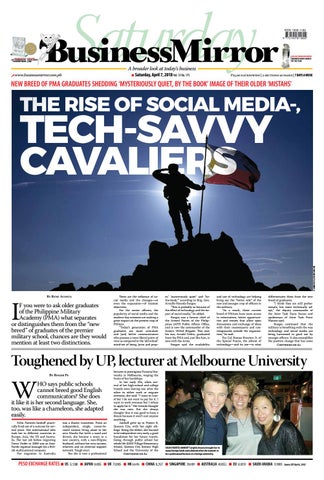
The rise of social media-,
Vladimirfloyd | Dreamstime.com
tech-savvy Cavaliers
I
By Rene Acosta
f you were to ask older graduates of the Philippine Military Academy (PMA) what separates or distinguishes them from the “new breed” of graduates of the premier military school, chances are they would mention at least two distinctions.
These are the influence of social media and the changes—or even the expansion—of mission objectives. For the senior officers, the popularity of social media and the modern-day missions are making a great impact on the present crop of PMAers. “Today’s generation of PMA graduates are more articulate and [are] better communicators who possess a more liberal point of view as compared to the ‘old school’ mind-set of being ‘prim and prop-
er,’ ‘mysteriously quiet’ and ‘bythe-book,’” according to Brig. Gen. Arnulfo Marcelo Burgos. “This is probably so because of the effect of technology and the impact of social media,” he added. Burgos was a former chief of the Armed Forces of the Philippines (AFP) Public Affairs Office, and is now the commander of the Army’s 102nd Brigade. This year his son, Arnold Cedric, graduated from the PMA and, just like him, is now with the Army. Burgos said the availability
and use of technology are helping bring out the “better side” of the new and younger crop of officers in the military. “As a result, these current breed of PMAers have more access to information, better opportunities and venues that allow open discussions and exchange of ideas with their counterparts and contemporaries outside the organization,” he said. For Col. Romeo Brawner Jr. of the Special Forces, the advent of technology—and its use—is what
differentiates them from the new breed of graduates. “I think they are still professionals, but more technically adept,” the deputy commander of the Joint Task Force Ranao and spokesman of Joint Task Force Marawi said. Burgos continued that the military is benefiting with the way technology and social media are being harnessed to good use by younger officers. It also exemplifies the positive change that has come Continued on A2
Toughened by UP, lecturer at Melbourne University
W
By Roger Pe
ho says public schools cannot breed good English communicators? She does it like it is her second language. She, too, was like a chameleon, she adapted easily. Evlin Fuentes-Jankoff practically lived out of a suitcase for several years. Her international jobs took her to different countries in Europe, Asia, the US and Australia. Her last job before migrating Down Under in 2003 was as AsiaPacific regional manager for a British multinational company. Her migration to Australia
was a drastic transition. From an independent, single, career-focused woman living alone in her own Manila flat (with a maid and driver), she became a mum in a new country, with a non-Filipino husband, without her own income, relatives and no external support network. Tough start. But she is now a professional
PESO exchange rates n US 52.1280
lecturer at prestigious Victoria University in Melbourne, reaping the fruits of her hardships. In her early 20s, when several of her high-school and college friends were leaving one after the other to either work or migrate overseas, she said: “I want to travel but I do not want to pay for it. I want to work overseas but I refuse to apply for it.” Her friends thought she was nuts. But she always thought that it was good to have a dream because it won’t cost anyone anything. Jankoff grew up in Project 8, Quezon City, with her eight siblings. Being the eldest, she learned to be independent very early, a good foundation for her future travels. Going through public school her whole life (GSIS Village Elementary School, Quezon City Science High School and the University of the Continued on A2
Evlin Fuentes-Jankoff’s (right) dreams brought her to many foreign lands and achieved what she wanted: to be a professional lecturer at a foreign university.
n japan 0.4855 n UK 73.0105 n HK 6.6416 n CHINA 8.2927 n singapore 39.6109 n australia 40.0552 n EU 63.8151 n SAUDI arabia 13.9005
Source: BSP (April 6, 2018 )
News
BusinessMirror
A2 Saturday, April 7, 2018
www.businessmirror.com.ph
The rise of social media-, tech-savvy Cavaliers Continued from a1
into the institution. “I believe that such is a positive and relevant change in the military culture, which will help the AFP as an organization to make it responsive and dynamic to the everchanging needs of the operational environment,” Burgos said. For Col. edgard Arevalo, the current assistant deputy chief of staff for Civil Military Operations (J7) of the AFP, modern-day gradu-
ates of the premier military institution are being presented with new challenges. “The contemporary military milieu demands a new breed of PMA graduates. Cavaliers who graduated at the turn of the 20th century, when the PMA was founded in 1905 [or 1898 by a later account], were not facing the same challenges as those who graduated at the turn of the millennium,” he said. Arevalo, a lawyer who had also served as spokesman of the mili-
tary and chief of the public affairs office, noted that younger officers are confronted with modern-day warfare. “Modern-day PMAers [have] found themselves involved in warfare that has immensely advanced, not only in terms of weaponry but also in dimension. Leaders are no longer mounted on horses and ordinary soldiers wielding muskets. Present-day PMA graduates fight a war where the dimension has transcended surface to subsurface, to
cyberspace,” he said. “They are engaged in a hybrid warfare that employs not only humans but also unmanned systems; not only weapons of incredible power and impact but also data,” he added. Arevalo also believes that younger products of the academy are more professionally challenged. “Old Cavaliers attest that, in the past, being a PMAer is sufficient to have a promising career in the profession of arms. But nowa-
days PMA graduates must prove themselves better not only to non-PMA graduates but to fellow PMAers, as well,” he said. “The skills demanded of PMAers at the turn of the 1990s, for example, are not only leadership skills but also managerial acumen to deal with VUCA [or volatile, uncertain, complex and ambiguous] situations either in the garrison or in the frontline,” he added. According to Arevalo, “The increasingly becoming complex
battlefield requires different attributes of PMA graduates: expertise not only with military tactics and strategy, but proficiency in domestic and international laws, protocols and conventions. They must possess a thorough understanding that a tactical move may have strategic or geopolitical repercussions in the realm of information operation.” “Present-day PMA graduates therefore must either evolve or be left out in the cold,” he said.
Toughened by UP, lecturer at Melbourne University Continued from a1
Philippines) perhaps toughened her up. As a little girl, she wanted to be a brain surgeon and a fashion model. Her dream to become a surgeon got quickly nipped in the bud by her father, who reminded her that they do not have unlimited funds to send them all to college. “My having a boyfriend then did not help as Tatay was scared I may end up eloping before I even finish my studies,” she said. As for modeling, she did not grow tall and skinny enough, (she was too voluptuous) to be one. Jankoff initially got into accountancy course at UP Diliman, though her first love was economics. She decided to shift to Hotel and Restaurant Administration. “Why HRA? My friends in engineering asked. I said ‘it’s the only degree in campus where you are legally allowed to organize parties and drink alcohol, and get marks for it.’” Jankoff’s first taste of travel and independence was her internships at the then-Hyatt Terraces Baguio. “There were five of us students from UP. When we met at the bus station in Baguio, little did we know that we all gave our parents the same assurance—yes, we have a place to stay, all organized. We looked at each other and realized we all told a lie,” she happily remembered.
Starting a career
JANKOFF was among those in the pioneer team when the West Villa
chain of restaurants opened. She then worked at Cebu Plaza Hotel, where, she said “there was never really a dull moment in the hospitality industry. There was always something happening. I met a lot of fantastic people but did not like the work hours.” She moved out of the industry and worked at the Asian Institute of Management (AIM) after. She got along well with her boss while working at AIM, but the latter would soon receive an offer to work in Jakarta. “I was sad that she left. What to do? I enrolled in the MBA program at Ateneo. As I was about to start the course, my former boss convinced me to come over for a holiday and stay with her.” Jankoff withdrew from the MBA program, got her money and packed her bags. Little did she know, she would be staying for five years at the AIM representative office in the Indonesian capital. It was one big adventure for her where she met wonderful people and great friends. The job also took her traveling on a regular basis and did not have to pay for it. “My first year living as an expat came with a dose of culture shock. I was lucky to quickly learn to speak Bahasa Indonesia within three months. Good enough to convince a taxi driver to take me to Tanah Abang [like our Divisoria] from my landlady’s place in Menteng [like our Forbes] and get to practice my haggling skills in time. My adventure scared the wits out of my landlady, who discouraged
me from doing it again.” Life as an expat can be as easy or difficult depending on how one wants it to be, according to Jankoff. “The most punishing part for me was learning to eat spicy food. I was able to get over it with a lot of bravery and tears,” she said. Learning the local language was the best thing that worked for Jankoff. It helped her better understand the local culture and how the locals think. “I was curious about why the Indonesians do things the way they do them. I respected the difference and made it work for me in my dealings with the locals. Having great support from my fellow expat Filipino friends was extremely helpful, especially when we share our day-to-day experiences and learn from each other’s mistakes and wins. I was lucky that my job allowed me to regularly visit my family in Manila,” she reminisced.
Good-bye, Jakarta
BeFORe Jankoff left Jakarta for good, she went on a holiday to Sydney and Melbourne with two Indonesian female friends. “We all stayed with a classmate of mine from UP who was based in Sydney. I did not realize that my friend had plans of breast enlargement surgery while I was there, so I ended up looking after her, which I did not mind. I did not expect the shock in her mother’s and brother’s eyes when they got home from a holiday: I looked like the accomplice in crime!” Other than her brief “nursing” stint, Jankoff found Australia
a place that she could live. “I love the culture and art scene of Melbourne than Sydney that I actually declared to my friend, ‘I would like to live in Melbourne,’ while we were staying at her brother’s place in Yarraville.” Jankoff then tried to check all immigration possibilities to move to Melbourne but couldn’t get to pass the required “points test” to migrate. Back in Manila, she started to focus back on balancing career and single life. “I was happy to be back home. My stint as an expat opened doors for me to get roles that required frequent international travel.” In one of her work assignments, she was sent to her company’s regional office in New York for a few meetings. On her first stop was a meeting in Albany before she headed off to her World Trade Centre office on September 12, 2001. “That was a close call. It was scary being in New York watching the September 11 disaster unfold and our office building collapsing. I felt so alone, shaken and did not know where to go. That was my first US trip and had not been there since,” she remembered.
Hello, Australia
THROUGH work, Jankoff met her future husband Cyril. They were both working with the same British multinational company. He was based in Melbourne but was sent to Jankoff’s office in Manila for training and orientation. “It was a long-distance office romance. We finally spent more time together
after he left the company. On my first visit to see him in Melbourne, I felt it was surreal that Cyril actually lived in Yarraville, a few blocks away from where I declared I wanted to live in Melbourne a couple of years back!” Goosebumps. “Cyril loved Manila and he did not mind settling down in the Philippines. After a long and thorough decision process, we decided to move to Melbourne where his elderly mum is based. We got married in Melbourne and we now have two children, Carl and erika,” Jankoff said. Jankoff added she did not expect being a new mum in Australia could be tough and challenging. She arrived in Melbourne with her 5-month-old erika. “One day I had a full-time nanny looking after her and the support of my family, the next day I was on my own looking after a baby in a new country. I felt alone. I thought being an english speaker, having worked internationally and been an expat would have given me an advantage in having an easier transition to my new life in Australia. Wrong. Being a migrant mother in Australia requires a different skill set–driver, nanny, cleaner, housekeeper, gardener, etc.” Australians love their english slang. “When baby erika cried, Cyril said: ‘Give her the dummy.’ I wondered what dummy he was talking about. He could not figure out why I gave him a blank stare when he asked me to ‘put the jumper in the boot.’ I also did not quickly get it when the nurse said ‘Your baby’s cot looked like a dog’s breakfast.’ When I asked an Aussie friend how she manages to juggle work and motherhood, she says she usually just ‘chuck a sickie’ whenever she has to attend school events.” Jankoff’s impressive credentials did not fail her. She was very lucky to land a job within five months of migrating to Melbourne. “I got a sessional lecturing job at a local university teaching international students. It was great to get the mind working again after singing too much nursery songs and watching an overload of the Wiggles, Playschool and Sesame Street.” But work and motherhood do not come easy in Australia. As her mother said when she came to help her out when her youngest was born, “the quality of life of the poor people in the Philippines is better than yours here.” “Ouch. She was right. I barely had time to scratch myself. even my maid in Manila before, who had her young children staying with her in my household, had time to rest and relax.” With all demands on working moms and minimal support compared to what they get in the Philippines, many women experience postnatal depression, according to Jankoff. It is not uncommon for new migrant moms to just want to go back home with their babies. “You have to reach out for help and support at a time when you feel alone and may not want to reach out.”
Australian culture
HOW does she describe Australians? Australians are very indi-
vidualistic in contrast to Filipinos and other Asians whose culture is very enmeshed, according to Jankoff. “People are polite and are happy to extend a hand. But life is just so busy that you have to make it a point to reach out and connect, otherwise it can feel so isolating, especially if you do not have your relatives around,” she said. Multitasking in Australia is common and the people take on other roles all the time, at work and at home, she observed. “You can be left out if you do not reach out. My family regularly attends the St. Albans Filipino Uniting Church. It feels good to be connected to fellow Filipinos and for our children to learn more about the Filipino culture. The congregation has also been very supportive to newly arrived migrants,” Jankoff added. How is it like living far from home? Jankoff said raising children in a different country with a non-Filipino partner has its own challenges. “erika and Carl [her young daughter and son] have a good understanding of the difference between their Filipino and Australian heritage. Cyril and I agreed that we should raise the children by taking the best out of the children—Filipino and Australian culture—keeping in mind the children will grow up in a multicultural world.” In recent years there are more skilled Filipino migrants arriving in Australia, mostly in the healthcare and aged-care industries. “I think, generally, Filipinos are very adaptable, which makes it easy for us to blend in with other cultures. Having the Spanish, American and Asian mix in us makes us very western and, at the same time, eastern in our mind-sets.” Jankoff has also not heard of many negative remarks among locals now that their calls are handled by Filipino call-center operators, compared to all the angry complaints when the calls were handled in another country prior. When she first arrived, she thought she could work at Victoria University, which was ust walking distance from her home. She went over to one of their offices and asked if she can apply to be a sessional lecturer. “I got the job and I now work as a full-time lecturer in Supply Chain and Logistics at the university. I am lucky to be working in a very multicultural environment that embraces diversity. Like in any country in the world, discrimination can happen in Australian workplaces. It is up to us how we handle it. The best lesson that we Filipinos may have to learn is to be assertive, learn how to say ‘no’ and stand our ground in a nice way,” she said. Planning to migrate or work overseas? Jankoff gives some valuable advice: “Be adaptable. Be open to learn about the local culture and connect with the locals. There is nothing like establishing friendships with the locals who can be able to guide around local practices, and where and how to get support. Understand the thinking behind why they do certain things. Last, being adaptable does not mean that you have to compromise your own belief system. It is about establishing mutual respect.”
News
BusinessMirror
www.businessmirror.com.ph
10 months after DOJ directive, retired police pensions still deducted by PNP
I
n recent times, many Philippine National Police (PNP) retirees have had the unfortunate experience of opening their pension accounts only to discover that the PNP and its accredited loan providers have deducted a significant amount from their pensions. Nearly all savings and loan associations (SLAs) and multipurpose cooperatives (MPCs) accredited by the PNP collect their loan amortizations through the PNP’s automatic deduction system. Privately owned entities, such as the SLAs and MPCs, use the PNP’s auto-deduct system to collect monthly loan payments from thousands of PNP borrowers (members and retirees) all over the Philippines. Only after the automatic deduction does the PNP member or retiree gain access to the remaining cash balance. Despite a June 2017 opinion penned by the Department of Justice (DOJ) prohibiting automatic pension deductions of loan payments by PNP retirees, the prac tice is still being implemented by the PNP to the benefit of accreditted loan providers. The DOJ opinion emphasized that government agencies, such as the PNP, should not be used as loan- collecting agencies for the benefit of private entities. It also reinstates the long-standing rule observed by the PNP prior to 2014— that PNP retirees’ pensions should not be subject to automatic deduction. At present, there are at least nine MPCs catering to PNP uniformed and nonuniformed personnel in Camp Crame, with six of them currently being investigated by the PNP Directorate for Comptrollership and the PNP Finance Service for alleged conflict
of interest. Certain SLAs have also received complaints for instances of misuse of the automatic deduction system in relation to PNP retirees. Af f e c te d re t i re e s h ave s t ro n g l y assailed automatic deductions, saying t h a t, w h i l e t h e p r a c t i c e p ro v i d e s collecting efficiency for loan lenders, it cuts off a PNP retiree’s ability to maintain a living wage to support themselves or their families. For retirees who rely solely on their pension, this often has serious and life-changing consequences. Due to a number of retirees complaining about the excessive interest rates and automatic deductions, National Police Chief Director General Ronald dela Rosa has assailed the practice of automatic deduction and has recommended that loan providers and their borrowers should deal directly, rather than use the PNP finance services, for questionable loan collections. Following this directive, the PNP chief, likewise, instructed the PNP Committee on Accreditation and Automatic Deduction to continuously conduct the inventory of PNP personnel’s complaints and urged the committee to draft a working solution. Dela Rosa further assured that the PNP will impose appropriate sanctions against financial institutions that engage in “loan sharking” activities, as well as those that take advantage of the PNP Finance Service’s computerized system to collect exorbitant payment from their debtors. “I am reiterating my instruction to all PNP unit commanders to look upon the welfare of their personnel and ensure that no PNP personnel will be aggrieved by these loan sharks,” he underscored.
SM Prime to build Ikea’s first PHL store
S
M Prime Holdings Inc., the largest Philippine shoppingmall developer, will build Ikea’s first store in the country within its retail complex, with plans for similar arrangement with the Swedish furniture company at its other properties. The store will be built within SM Prime’s Mall of Asia complex in Manila, located between its convention center and sports arena, said Alex Pomento, vice president at the Philippine mall builder, by phone. Ikea will lease the property for the long term, he said.
“While we don’t have exclusivity, there are talks to have similar arrangements for our properties in other parts of the Philippines,” Pomento said. “Ikea is a unique retailer and it’s the kind of global brands we want to locate in our properties.” Ikea will be a big crowd drawer for Mall of Asia, which has a foot traffic of at least 200,000 per day, said Mia Respicio, analyst at AP Securities. SM Prime’s malls nationwide attract 3.5 million customers per day, she said. Bloomberg News
Manila port operators seek hike in cargo-handling tariff
P
ORT operators Asian Terminals Inc. (ATI) and International Container Terminal Services Inc. (ICTSI) have filed petitions with the Philippine Ports Authority (PPA) for cargo-handling rate increases at Manila South Harbor and Manila International Container Terminal (MICT), respectively. ATI is requesting an 8.7-percent increase in cargo-handling tariff for containerized and noncontainerized cargoes at Manila South Harbor, and ICTSI an 8.72-percent hike in cargo-handling tariff at MICT. Under their contracts with the PPA, both terminal operators are allowed to file for a rate increase every two years. The last cargo-handling tariff rate adjustment was in 2015, when the PPA granted an 8-percent rate increase. For ATI, the proposal would translate to roughly P780 in additional charge for a twenty-foot equivalent unit (TEU) import for both stevedoring and arrastre, ATI Assistant Vice President for Business Development Edward Ian Baking said in a public hearing presentation on March 20. For MICT, the proposed rates are $107.15 for a full TEU from the current $98.56; $90.07 per empty TEU from the current $82.85; P4,375.98 for a TEU of full container load (FCL) from the current P4,025 per TEU of FCL; and P3,572.54 per TEU of less than container load (LCL) from the current P3,286. Baking said ATI had filed for a petition for a rate increase in December 2017, but filed it again early this year following the issuance of PPA Administrative Order (AO) 02-2018. The AO prescribes new standard and uniform formula and procedures for cargo-handling tariff adjustment. ICTSI filed its petition in November last year and again on March 8. New formula for adjustment Under AO
02-2018, which took effect on March 8, the cargo-handling and/or terminal operator may apply for a cargo-handling tariff adjustment if the consumer price index (CPI) has increased by at least 5 percent within a three-year period. The CPI, computed and provided by the Philippine Statistics Authority (PSA), is a statistical measure of the average retail pricing of goods and services commonly purchased by a particular group of people in a particular area. The PPA said AO 02-2018 was issued to ensure integrity and accuracy in the application of adjustment of cargohandling tariff, as well as transparency and comprehensive deliberation during the conduct of public hearings. Both ATI and ICTSI said CPI had increased during the 2014-2017 period. Voltaire Wycoco, MICT management services and government affairs director, in a presentation during the public hearing, said CPI (all items) in the Philippines increased 7.54 percent from P140.50 in December 2014 to P151.10 in December 2017. CPI (all items) for National Capital Region, likewise, rose 8.72 percent from P130.70 in December 2014 to P142.10 in December 2017, he added. Both terminal operators said they are eligible for tariff adjustment after having complied with the requirements of AO 02-2018. The AO states the cargo-handling/ terminal operator must have fully complied with its contractual commitments; have no outstanding obligation due to the PPA; have fully complied with the cargo-handling compliance report; and have complete and timely submission of the engineering, operational and audited financial reports.
Saturday, April 7, 2018
A3
PHL most at risk in Asean from China-US trade war
T
HE Philippines could be the most at risk in Southeast Asia from the worsening trade conflict between China and the United States. About 16.9 percent of the Philippines’s shipments abroad are part of China’s value chain; goods that serve as inputs to China’s
exports, RHB Bank Bhd. said. That compares with 11.4 percent for Malaysia and just 2.2 percent for Vietnam.
US President Donald J. Trump on Thursday ordered his administration to consider imposing tariffs on an additional $100 billion in Chinese imports, dashing optimism that trade tensions could ease. Policy-makers across Southeast Asia are focusing on bolstering domestic markets to cushion the fallout should the situation worsen. The sectors likely to be hit badly are electronics, electrical machinery such as computers, and industrial goods, RHB said
in a note on Wednesday before the announcement of possible new US tariffs. China is the biggest trading pa r t ner for m a ny Sout hea st Asian economies and an important source of investment and tourism in the region. W hile large domestic markets in Indonesia and the Philippines help to shelter those economies from a trade war, others in the region, like Singapore, Malaysia and Thailand, are more reliant on exports. Bloomberg News
Drainage audit, ‘structures’ dismantling top Boracay priorities
W
ITH Boracay Island ’s closure date on April 26, the national government is now preparing its “big ticket” rehabilitation works in the island, which include drainage audit and dismantling of illegal infrastructure that violate environmental laws. Tourism Assistant Secretary Frederick Alegre said Aklan Gov. Florencio Miraflores already reaffirmed his commitment to this effort, including some Boracay stakeholders who have initiated the demolition of their own structures. “Si x mont hs is rea l ly not enough, but these are big-ticket items that can be done within the first six months,” Alegre said in a press briefing in Malacañang. This is based on the draft timeline by the interagency task force, composed of the departments of Tourism (DOT), the Interior and Local Government (DILG), and of Environment and Natural Resources (DENR). In an initial report, at least 190 establishments within easement areas and 937 illegal infrastructure within forestlands and wetlands were identified by the interagency group. With this number of illegal establishments, “there’s a lot of illegal connections on the drainage,” which causes wastewater discharge in the sea, DILG Assistant Secretary Epimaco Densing III said. A working conference with stakeholders, local government units and officials from the DILG, DOT and DENR is set next Tuesday. “We hope to get a clearer picture before Tuesday, but as it is
TOURISM Assistant Secretary Frederick Alegre and Interior and Local Government Assistant Secretary Epimaco Densing III speak during the press briefing in Malacañang on Thursday. Presidential Photo
we are still discovering pipes that have been hidden from us all these years,” Alegre said. At the Cabinet meeting, Presidential Spokesman Harry Roque Jr. said validation on which resort owners are in compliance with rules and regulation of the island were recommended. Densing said this was readily conducted within the day. “We found out that some establishments saying they are compliant end up not to be compliant at all,” Densing said. In one instance, Crown Regency Prince, a hotel on the island, claimed they were compliant vis-a-vis the sewerage treatment plant (STP). “We found out that they don’t even have a sanitary permit or a functioning STP, that’s why the hotel had to be closed,” he added. “Based on the recommendation
we’ve made just yesterday, during the period of closure from May until August, we are going to validate and do an environmental compliance audit for each establishment whether they say they are compliant or not,” he added. Government lawyers are now drafting “potential administrative case” against individuals responsible for the polluted state of the island. “We have finished now our evidence gathering, we’re finishing our case buildup activity; right now, our lawyers are drafting a potential administrative case,” Densing said, adding that their target filing date is on or before April 14. When asked how many officials were included, no figures were revealed but Densing said the standard procedure is to investigate “all local officials who
are managing the island.” Technically, Boracay is only closed to foreign and local tourists, Densing and Alegre said. This, given that the government cannot close it without due process. “First of all, the government and its agencies cannot arbitrarily close institutions without due process,” the DILG official added. Since the major issue of pollutants come from the market, which are the visitors coming into the island, Densing said it’s for the best they keep Boracay tourist-free temporarily, “so that while doing the rest of the rehabilitation, there will be no additional pollutants that can come into the island.” To circumvent impending labor crisis in the island, some of the affected residents and workers are hoped to join the Boracay restoration works. The shutdown was supposed to be at a later date, or during the off-peak season starting June, as confirmed by Tourism Secretary Wanda Corazon T. Teo. With the initiatives of the local government to cancel tourist activities, such as the popular LaBoracay, on top of the rising level of pollution in the island, the interagency task force decided to move the shutdown at an earlier date. “The local government unit decided to cancel LaBoracay, now that it’s canceled, there’s more reason to execute the rehabilitation on an earlier date,” Alegre said. President Duterte on Wednesday approved the recommendation to close the island for six months starting April 26. PNA
‘Pawikan’ eggs hatched and released during Holy Week in the Cleanergy Park Ma n ager Fer m i n Ed i l lon, to transfer the eggs to Cleanergy Park. Davao Light Team and the barangay officials, in the presence of Department of Environment and Natural ResourcesCommunity Environment and Natural Resources Office representatives, transfer red the eggs to the Cleanergy Park on February 21. “ We are ver y glad that the eg gs stil l hatched w ith a good hatching rate, especia l ly that they were transported quite far from where they were laid. A nd we are happier that the Clean-
Releasing of the ‘pawikan’ hatchlings. The pawikan eggs discovered in the public beach in Barangay 76-A and were transferred in the Cleanergy Park finally hatched and were released on March 28. Guests were excited to see the little creatures start their journey to the sea.
O
n M a rc h 2 8 , a Ho l y Wednesday, Davao Light and Power Co. gladly welcomed and released new baby sea turtles in the coastline of the Cleanergy Park at Sitio Punta Dumalag, Matina Aplaya, Davao City. A total of 77 hatchlings, which were believed to be Olive Ridley sea turtles, were released out of the 86 eggs found.
The nest was discovered in a public beach of Barangay 76A, exposing it to threats from men and animals alike. Having been laid also very close to the sea, the nest constantly gets wet from the water brought by waves. This prompted Barangay Captain Rolando T. Trajera to request assistance from Davao Light, through its Community Relations
erg y Park is indeed know n to be a paw ik an sanctuar y and a place to br ing in rescued paw ik ans and their eg gs. It is a lso wonder f u l to note the involvement of nearby barangays, as they are great par tners in our conser vation effor ts. With the community’s awareness, we can save more of these endangered species,” Edil lon said. Present dur ing the releasing were Trajera, Kagawad Allan Linao of Barangay 76, Davao Light employees, and some other guests from different organizations and the community.
A4
The World BusinessMirror
Saturday, April 7, 2018
Editor: Lyn Ressureccion | www.businessmirror.com.ph
warrant issued for former China vows to fight Trump tariffs Arrest Brazilian President 'Lula' da Silva ‘to the end’ as tension remains S
C
HINA said it would counter United States protectionism “to the end, and at any cost,” as a war of words over President Donald J. Trump’s proposed tariffs on Chinese imports escalated.
declaration with a statement of his own stressing that none of the tariffs would take immediate effect. The administration hasn’t said when any of the proposed tariffs would go into force. He said that any additional tariffs first would be subject to a 60-day public comment period, as would the penalties announced earlier in the week. “No tariffs will go into effect until the respective process is complete,” Lighthizer said. Trump’s newly installed chief economic adviser, Larry Kudlow, and other administration officials have spent the past two days trying to tamp down fears of a trade war. “I think we’re going to come to agreements,” Kudlow told Fox News on Wednesday. “I believe that the Chinese will back down and will play ball.” Ye t , Tr u m p s i g n a l e d a harder line in a speech earlier T hursday, say ing it was time to stop C h i n a f rom “t a k i ng advantage” of A mer ica. “You have to go after the people who aren’t treating you right,” Trump said in West Virginia. “We’re going to have a fantastic rel at ionsh ip long ter m w it h China, but we have to get this straightened out. We have to have some balance.” Kudlow on Thursday said the administration was involved in “delicate negotiations” that might forestall the need for tariffs. He said the US could still hammer out a deal with Beijing, in part by persuading other major economies to call out the Asian nation for unfair trading practices. T he Tr u mp t h reat “ra i ses the possibility of an alarming escalation in the trade conflict between the world’s two biggest economies,” Tom Orlik, Bloomberg Economics chief economist, wrote in a note. “It’s difficult to tell the difference between a rhetorical flourish from a president known
for bombastic remarks and a meaningful shift in policy.” The US decision to use tariffs as a means of addressing trade g r ie v a nc e s i s re v e r b e r at i n g beyond the relationship with China. South Korea on Friday threatened to impose tariffs on imports from the US in retaliation for a previous decision by the Trump government to impose safeguard tariffs on washing machines and solar panels. C h i n a cou nte re d Tr u mp’s pl a n a n nou nced on Tuesd ay to slap tariffs on 1,333 of the cou nt r y ’s produc t s — suc h a s sem iconduc tors a nd l it h iu m batteries—by announcing duties on a v a r ie t y of a g r ic u lt u re products, including soybeans, the second-most-valuable US crop. The US shipped $14.6 billion of soybeans to China, its biggest buyer, in the last marketing year— more than a third of the entire crop. Agriculture is one of the few sectors of the American economy that runs a trade surplus. T hat wou ld hit US far mers hard at a time they are a lready dea l ing w it h depressed crop p r i c e s a n d s t a g n a nt v a lu e s for their land. Concer n about a potentia l trade war a lready had been r ippling through farm states, which are a crucial par t of Tr ump’s politica l base a nd a p o we r f u l vot i n g blo c in November’s cong ressiona l elections. “Essentially, President Trump is playing hard ball to force China to the negotiating table at the WTO to work out a new agreement w it h t he U S o n t e c h nol o g y licensing requirements,” said Rajiv Biswas, Asia-Pacific chief economist at HIS Markit Ltd. in Singapore. “If a new dea l can be reached between the US and China through talks at the WTO, it is quite possible that the proposed US Section 301 tar iffs on China may not be implemented.” Bloomberg News
ãO PAULO—A Brazilian judge issued an arrest warrant on Thursday for former President Luiz Inacio Lula da Silva, dealing a major blow to the once wildly popular leader who was trying to mount a political comeback ahead of October’s elections. The warrant came several hours after the country’s top body, the Supreme Federal Tribunal, voted 6-5 to deny a request by da Silva to stay out of prison while he appealed a corruption conviction that he contends was simply a way to keep him off the ballot. Federal judge Sergio Moro gave Brazil’s former president 24 hours to present himself to police in the southern city of Curitiba. In a statement, Moro said he was giving da Silva the opportunity to come in of his own accord because he had been president of the nation. Last year Moro convicted da Silva of trading favors with a construction company in exchange for the promise of a beachfront apartment. That conviction was upheld by an appeals court in January. The speed with which Moro issued the warrant surprised many, as legal observers said there were technicalities from da Silva’s upheld appeal that would not be sorted out until next week. Such technicalities “were simply a pathology that should be eliminated from the judicial world,” Moro said in his statement. Minutes after Moro issued the warrant, a fight broke out in front of the Lula Institute in Sao Paulo between hecklers and supporters of the former president universally known here as “Lula.” One heckler was punched in the face and subsequently got hit by a passing vehicle as he was falling. He was taken to nearby hospital and police arrived. “I’ve never seen this kind of hatred before,” said Mariella Sanches, who was selling ice cream where the fight broke out. “Why can’t people get along?” Da Silva’s upcoming arrest will mark a colossal fall from grace for the man who led Latin America’s most populous nation between 2003 and 2010, and left office with approval ratings over 80 percent. Former US President Barack Obama once called da Silva the “most popular politician on Earth.” Since leaving office, things have steadily gotten worse for da Silva, who has been charged in several corruption cases. He has always maintained his innocence while continuing to campaign across the country
the past year. Despite his legal troubles, he still leads preference polls to return to office—if by some chance he is allowed to run. Earlier Thursday, the head of Brazil’s Workers’ Party warned that jailing da Silva would turn Latin America’s largest nation into a “banana republic.” His lawyers put out several statements saying they were filing injunctions in hopes of keeping him out of prison. “We consider this to be a political imprisonment, an imprisonment that will expose Brazil before the world,” said Gleisi Hoffmann, chairman of the Workers’ Party. “We will become a banana republic.” Hoffmann also insisted that da Silva, 72, would be the party’s candidate in October. The ex-president has not spoken since the ruling. Like so much in a nation that has become deeply polarized, the reality that the oncepopular leader would be jailed was being interpreted differently by supporters and detractors. “Brazil scored a goal against impunity and corruption,” said Congressman Jair Bolsonaro, a right-leaning former army captain who is second in the polls after da Silva. Mariana Setra, a da Silva supporter in Sao Paulo, called the top court’s decision “ridiculous.” “It was applied to only one person,” she said. “As if Lula were the only thief in this country.” Da Silva is the latest of many high-profile people to be ensnared in possibly the largest corruption scandal in Latin American history. Over the last four years, Brazilians have experienced near weekly police operations and arrests of elite, from top politicians to businessmen like former Odebrecht CEO Marcelo Odebrecht. Investigators uncovered a major scheme in which construction companies essentially formed a cartel that doled out inflated contracts from state oil company Petrobras, paying billions in kickbacks to politicians and businessmen. Moro, who oversees cases in the so-called Operation Car Wash, is hailed as a hero by many Brazilians. Others, particularly on the left, see him as a partisan hit man out to get da Silva and the Workers’ Party. Still, the list of targets in the scandal include people across the spectrum, including President Michel Temer. Temer took power in 2016 after da Silva’s successor and protégé, Dilma Rousseff, was impeached and ousted from office. AP
A f te r Tr u mp orde re d h i s administration to consider tariffs on an additional $100 billion in Chinese goods on Thursday, sending US stock futures tumbling, China’s Commerce Ministry said in a statement in Beijing on Friday that the nation doesn’t want a trade war, but is ready to fight one. Tr u mp’s u ne x pected move t hreatens to unravel ef for ts by top US and Chinese trade officials to lower the heat and reach an agreement that could stave off an escalating conflict, after the release of a list of tariff targets earlier this week prompted immediate threats of retaliation from Beijing. US stock futures dropped on Trump’s latest trade directive to the US Trade Representative. S&P 500 Index futures slid as much as 1.6 percent, after the underlying gauge ended up 0.7 percent on Thursday. Asian equities were mixed, while the yen rose before retracing most of the move. “In light of China’s unfair retaliation, I have instructed the USTR to consider whether $100 billion of additional tariffs would be appropriate under section 301 and, if so, to identify the products upon wh ic h to i mpose suc h tariffs,” Trump said in a statement issued by the White House. A White House official later said the $100 billion figure Trump used in the statement referred to the value of the imports that would be covered by the additional tariffs, not the total amount of tax that
would be charged on the products. “ The Chinese side will follow s u it to t he e nd a nd at a ny cost, and w i l l f ir mly attack, using new comprehensive c ou nt e r me a s u re s , t o f i r m l y defend the interest of the nation and its people,” the Commerce Ministr y said in a statement on its web site, without further detailing any planned measures. “This is starting to feel like the beginnings of a trade war, if simply each proposal is matched with retaliation,” said Patrick Bennett, a Hong Kong-based strategist at Canadian Imperial Bank of Commerce. “The US risks isolating itself from global trade in this process and we think the US, US dollar and US asset markets have more to lose.” China on Wednesday said it would levy a 25-percent tariff on about $50 billion of US imports, including soybeans, automobiles, chemicals and aircraft. That was in response to the release by the US of a list of proposed tariffs a day earlier, covering $50 billion in Chinese products. Were China to want to match Trump’s latest threat in kind, it wouldn’t have enough American goods imports to target. It could still take other measures—like curbing package tours or student transfers to the US, or steps against A merican companies’ operations in China. US Trade Representative Robert Lighthizer quickly followed up on Trump’s Thursday evening
German court orders Catalan ex-leader’s release on bail
Ex-S. Korean leader Park gets 24-year prison term
B
ERLIN—A German court ruled on Thursday that former Catalan leader Carles Puigdemont can be released on bail pending a decision on his extradition to Spain, finding that the most serious accusation against him isn’t punishable under German law. The state court in the northern town of Schleswig said it set conditions including a €75,000 ($92,000) payment for the 55-yearold to leave prison. It wasn’t immediately clear when he would be released, though it appeared unlikely before Friday morning. “We will see each other tomorrow. Thank you all!” a message posted on his Twitter feed read. Puigdemont was detained on a European arrest warrant shortly after entering Germany on March 25. He was trying to drive from Finland to Belgium, where has been living since fleeing to escape arrest in Spain. He has been held at a prison in Neumunster. Spanish authorities accuse Puigdemont of rebellion and misuse of public funds in organizing an unauthorized referendum last year on Catalonia’s independence from Spain. German prosecutors argued earlier this week that the main charge of rebellion is equivalent to Germany’s criminal offense of treason. German law calls for prison sentences for anyone who “undertakes, by force or through threat of force” to undermine the republic’s existence or change its constitutional order. However, the cour t disagreed on Thursday, saying Puigdemont can’t be extradited for rebellion. It found that the accusations against Puigdemont don’t satisfy the precedents set by previous German rulings, which call for a use or threat of force sufficient to bend the will of authorities. AP
S
EOUL, South Korea—Former South Korean President Park Geun-hye was formally convicted and sentenced to 24 years in prison on Friday, a year after she was driven from office and arrested over a corruption scandal that saw months of massive street rallies calling for her ouster. The conviction, which she can appeal, is the latest hit in a dramatic fall for South Korea’s first female president. Once seen as the darling of South Korean conservatives, she was dubbed “Queen of Elections” by local media for her track record of leading her party to victory in tight races and still has a small group of fierce supporters who regularly stage rallies calling for her release. Park maintains she’s a victim of “political revenge” and has been refusing to attend court sessions since October. She didn’t attend Friday’s verdict, citing a sickness that wasn’t specified publicly. In a nationally televised verdict, the Seoul Central District Court convicted Park of bribery, extortion, abuse of power and other charges. “It’s inevitable that the defendant should be held strictly responsible for her crimes, if only to prevent the unfortunate event of [a president] abusing the power given by the people and causing chaos in state affairs,” chief judge Kim Se-yun said. Along with the prison sentence, Park was also fined 18 billion won ($16.8 million), Kim said. Both Park and the prosecutors have one week to appeal. Park has previously maintained her innocence; prosecutors in February demanded a 30-year prison term. The Seoul court convicted Park of colluding with longtime confidante Choi Soon-sil to pressure 18 business groups to donate a total of 77.4 billion won ($72.3 million) for the launch of two foundations controlled by Choi.
IN this October 10, 2017, file photo, former South Korean President Park Geun-hye (left) arrives to attend a hearing on the extension of her detention at the Seoul Central District Court in Seoul, South Korea. A South Korea court sentenced her to 24 years in prison on Friday, April 6, over a corruption scandal. Park has been held at a detention center near Seoul since her arrest in March 2017, after she was removed from office on a landmark court ruling. Prosecutors have requested a 30-year prison term on her. AP/Ahn Young-joon, File
The two women were also convicted of taking bribes from some of those companies, including more than 7 billion won ($6.5 million) alone from Samsung in return for government support for a smooth companyleadership transition. The court said Park colluded with senior government officials to blacklist artists critical of Park’s government to deny them state-assistance programs. Park was also convicted of passing on presidential documents with sensitive information to Choi via one of her presidential aides. The scandal has already led to the arrests, indictments and convictions of dozens of high-profile government officials and business leaders. Choi i s s e r v i n g a 2 0 - ye a r p r i s o n t e r m ;
Samsung scion Lee Jae-yong was initially sentenced to five years in prison before his sentence was suspended on appeal; and Lotte Chairman Shin Dong-bin was given two-and-a-half years in prison. Hundreds of Park’s supporters gathered near the southern Seoul court hours before the ruling, swinging South Korean and US flags under signs and banners that read, among other things, “Immediately release innocent President Park Geun-hye” and “Stop murderous political revenge.” “Long live President Park Geun-hye! Long live the Republic of Korea!” protester Choi Hyung-suk screamed into a microphone, referring to South Korea by its formal name. Park’s conservative supporters—most of them middle aged and elderly—have
been passionately rallying near the court and other parts of the city over the past year, although their gatherings have been much smaller than the earlier ones calling for Park’s ouster. The protests show how deeply South Koreans are split along ideological and generational lines, the result of decadeslong tension with rival North Korea and the lingering fallout from the conservative military dictatorships that ran the country until the late-1980s. Park is the daughter of a deeply divisive dictator, Park Chung-hee, who is revered by supporters as a hero who spearheaded South Korea’s rapid economic rise in the 1960s to the 1970s. But he’s also remembered for imprisoning and torturing dissidents. During her father’s 18-year rule, Park Geun-hye served as first lady after her mother was killed in an assassination attempt targeting her father in 1974. She left the presidential mansion in 1979 after her father was gunned down by his own intelligence chief during a late-night drinking party. After years of seclusion, Park Geunhye returned to politics by winning a parliamentary seat in the late-1990s, during a burst of nostalgia for her father after South Korea’s economy was devastated by a foreign-exchange crisis. In 2012 she won the presidential election by defeating her liberal rival and current President Moon Jae-in, riding a wave of support by conservatives who wanted to see her repeat her father’s charismatic economic revival. Park’s friendships with Choi, 61, began in the mid-1970s when Choi’s late father served as Park’s mentor after her mother’s assassination. Park once described Choi as someone who helped her when she had difficulties. But her relations with the Choi family have long haunted her political career. Media reports say that Choi’s father
was a cult leader and allegedly used his ties with Park to take bribes from government officials and businessmen. Park has previously insisted that she only got help from Choi on public relations and to edit some presidential speeches. Pa r k ’s fo u r ye a r s i n o f f i ce we re marred by rising animosity with rival North Korea over its advancing nuclear program, a 2014 ferry disaster that killed more than 300 people, mostly teenagers on a school trip, and criticism that she curbed free speech and didn’t manage things transparently. The final scandal touched off months of Saturday rallies, during which millions gathered at a Seoul plaza and elsewhere around the country calling for her ouster. Park was impeached by lawmakers in December 2016 and removed from office by a Constitutional Court ruling in March 2017. In a subsequent presidential by-election triggered by Park’s early exit, Moon won an easy victory against wounded conservatives. Park’s saga is only the latest addition to a long line of tarnished South Korean presidential legacies. Her conser vative predecessor, Lee Myung-bak, who governed from 20082013, was arrested and jailed last month over a separate corruption scandal. Lee’s liberal successor Roh Moo-hyum jumped to his death in 2009, amid a corruption investigation of his family. Park Chung-hee’s successors, Chun Doo-hwan and Roh Tae-woo, both ex-army generals, spent time in jail for bribery, treason, munity and other charges after leaving office. Kim Young-sam and Kim Dae-jung, both former opposition leaders who fought against the dictatorships of Park Chung-hee and Chun, left office in disgrace after their sons and close associates were arrested or embroiled in scandals. AP
Sports BusinessMirror
Editor: Jun Lomibao | mirror_sports@yahoo.com.ph
Saturday, April 7, 2018
A5
COMPETITORS dive into the water at the start of the men’s triathlon event at Southport Broadwater Parklands in Gold Coast, Australia, on Thursday. AP
COMMONWEALTH GAMES BLUNDER
WHERE’S LONDON? G
By John Pye
The Associated Press
OLD COAST, Australia—In an accidental case of the old empire striking back, Commonwealth Games organizers have listed England as part of Africa in the official program. The colorful souvenir edition lists the English capital as Banjul (instead of London), locates it in the Africa region and notes its population as slightly more than 2 million. That mirrors the details listed—correctly—for Gambia, only recently restored to the Commonwealth Games, directly underneath on Page 97. Hours before Prince Charles was expected to open the games on Wednesday, Gold Coast 2018 Chief Executive Mark Peters explained the blunder as an “overprint” as organizers rushed to accommodate Gambia’s reinclusion just weeks ago. The African nation did not compete at the 2014 Glasgow Games after withdrawing from the Commonwealth in 2013. A change of prime minister in 2016 led to the readmission of Gambia last month, and the country has six athletes competing on the Gold Coast. “We already had everything ready to push the button to print [and] had to do a lot of fast footwork,” Peters said, explaining on Wednesday that the error was noticed 10 days ago. “We went and spoke to England and said ‘Congratulations, the Commonwealth is changing and it has since Brexit. A part of you is now part of Africa.’ Luckily the Gambia is all good.” Peters said organizers went to England officials and offered to pulp the print run and start again, and even considered putting stickers over the incorrect information in every program.
“They were emphatic that end of the day, they’re so pleased to be here and everything else that has been organized, they implored us not to do that,” Peters said. “We’re doing a special reprint of 500 to give to the English and the CGF to make sure that in terms of the records, that’s done correctly.” At least some African competitors didn’t mind having some reinforcements. “Yes, we happily do,” Nafisatu Umaru, captain of Ghana’s women’s hockey team, told a news conference called to discuss the opening ceremony later Wednesday. “England has made a great impact for us.” She was referring to England’s four-year commitment to helping her hockey team qualify for the Gold Coat tournament. Comment was being sought from Gambia. And while England may have been listed as an African nation in the official program, as far as the Gold Coast’s international student population is concerned—they’re one big human rainbow. More than 200 students representing the 130 nationalities gathered on the sands of Kurrawa Beach at 7 a.m. in a show of cultural diversity—none caring about the program blunder. Among them were Jamaican Celia Innerarity, 44, and Zimbabwe’s Jermaine Rusike, 21, who simply did not care. “There are so many things that people use to tear us apart...but at the end of the day we are all the same and this is what we should be celebrating...this is what the Games and community is about,” Innerarity said. Innerarity, a former masseuse with the Jamaican track team, is now studying nutrition and dietetics on the Gold Coast. For Rusike, the Games, which bring 71 countries and territories of the British Commonwealth together, are a chance to celebrate the city’s multicultural community. “I am from Zimbabwe but this feels like home,” said Rusike,
who is studying law and is among the 25,000 international students in the region. “The Coast has a great vibe and the Commonwealth Games are about celebrating diversity—and when the Games start, nothing else will matter.” World champion Ben Proud, meanwhile, was disqualified from the 50-meter butterfly at the Commonwealth Games on Thursday and lost an appeal against the decision. Proud, who is also the reigning Commonwealth champion in the 50 butterfly and 50 freestyle, won his preliminary heat by nearly a body length but that was annulled after a referee disqualified the Englishman for movement on the starting blocks. Proud challenged the decision but it was upheld by an independent appeals board. “I am in the shape of my life and am gutted to miss out on the opportunity to show what I can do,” Proud said. He blamed over-eagerness in wanting to make an early impression at the Gold Coast Aquatic Centre. “Coming into the competition there is always apprehension ahead of the first race,” he said. “With fans in the crowd, I wanted to give them something to cheer about by delivering a fast time. “Unfortunately before the start signal I was judged to have moved my leg and the referee deemed this enough for a disqualification.” Even Proud’s rivals were sympathetic. “That is a shame for the competition,” Australian swim Coach Jacco Verhaeren said. “It’s not the same [without Proud] because he showed a world-class time there, but rules are rules.” South Africa’s Chad le Clos ended qualifying with the fastest time. “I would prefer to have Ben in the race and come second to somebody who is competitive with me,” le Clos said.
A
semifinals, despite losing to Ateneo, 22-25, 25-20, 25-16, 17-25, 9-15. The Lady Maroons face a Lady Eagles side that is unbeaten in five games in the second round. But UP Head Coach Godfrey Okumu refused to back down. “We will keep on fighting until the end,” said Okumu, who is pinning his hopes on Tots Carlos and Isa Molde against the tall Ateneo team led by co-skippers Maddie Madayag and Kat Tolentino. The Lady Falcons, on the other hand, are also not giving up. They have a better chance to steal fourth place from NU compared to UP and UST.
LADY ARCHERS RETAIN UAAP FOOTBALL TITLE
K
YLA INQUIG produced a brace as De La Salle nipped University of Santo Tomas (UST), 2-1, to retain the University Athletic Association of the Philippines Season 80 women’s football crown on Thursday night at the Rizal Memorial Stadium. An 80th-minute screamer by Inquig, who was named the season Most Valuable Player, followed by several
Struggling Djokovic splits with Agassi, Stepanek N
“It’s extremely difficult. We’ve been trying to approach every game like it is a Final Four match,” Adamson University Head Coach Air Padda said. A win by Far Eastern University, meanwhile, would guarantee the Lady Tamaraws a playoff berth for the last semifinals slot. But Lady Tamaraws Head Coach George Pascua’s marching order is to sweep their last three games for a shot at a twice-to-beat advantage in the next round. In men’s action, Ateneo (9-2) tries to force a share of lead with idle NU (10-2) as it battles fifth placer UST (5-6) at 8 a.m., while De La Salle (4-8) fights for survival against ousted UP (3-9) at 10 a.m. Lance Agcaoili
ovak Djokovic is done working with Andre Agassi and Radek Stepanek after the latest in a series of coaching changes for the 12-time major champion who has gone nearly two full years without winning a Grand Slam title. Djokovic announced on Wednesday on his web site that he has split from Agassi after less than a year and from Stepanek after less than six months. The 30-year-old Serb has lost his past three matches. “The private relationship with Stepanek was and will remain great, and Novak has enjoyed working with him and learning from him,” the posting on the web site says. “He remains grateful and appreciative of all the support he has received from Radek during the last period.” The only mention of Agassi comes in the final sentence, which reads simply: “The cooperation between Novak and Andre Agassi has also ended.” Djokovic has struggled on the court this season as he deals with a right-elbow problem that just won’t seem to go away, even though he took the second half of last year off and then had a medical procedure in February. His latest setback was a straight-set loss in his opening match last month at the Miami Open, a tournament he has won six times. Earlier in March, Djokovic dropped his opener at Indian Wells, where he has won five titles, to Taro Daniel, a qualifier ranked outside the top 100. Before that, Djokovic lost in the fourth round at the Australian Open.
“Novak remains focused and eager to come back stronger and more resilient from [the] long injury break that has affected his confidence and game,” the web site posting says. “He is continuously and passionately looking for new and different ways to regain winning form.” He began working with eight-time major champion Agassi on a part-time basis before last year’s French Open in May. He added Stepanek, who just retired as a player, to his team at the end of November. Djokovic stopped working with Boris Becker in December 2016, then fired longtime Coach Marian Vajda shortly before bringing aboard Agassi. All of this followed the most successful stretch of Djokovic’s career, which included a run of four consecutive Grand Slam titles that concluded at the French Open in June 2016. That made him the first man in nearly a half-century to hold all four major trophies at the same time, as well as the eighth man in tennis history with a career Grand Slam. It also capped a span in which Djokovic reached the finals at 10 of 12 majors, winning six. His total of 12 such titles trails only Roger Federer (20), Rafael Nadal (16) and Pete Sampras (14). He also has finished four years at No. 1 in the ATP rankings. But over the past seven Grand Slam tournaments, Djokovic has zero titles and one runner-up finish. He is ranked 13th this week. The next major, the French Open, begins in Paris on May 27. AP
key saves by goalkeeper Tashka Lacson sealed the Lady Archers’ back-to-back title romp. De La Salle is now tied with Far Eastern University for the most number of women’s football crowns with 10. Inquig’s free kick in the 12th minute opened scoring for the Lady Archers before Shelah Cadag found the back of the net 10 minutes later for the Tigresses to level.
It was a painful loss for UST, which beat De La Salle twice in the eliminations but failed to bag it all in the ultimate match. Reigning MVP Jarvey Gayoso also netted a brace as men’s titleholder Ateneo joined University of the Philippines in the semifinals with a 4-0 victory over University of the East.
Maintaining a clean sheet for the fifth straight match in the second round, the Blue Eagles rose to 28 points, off the Fighting Maroons. Rookie Fidel Tacardon netted a hat-trick in the first half as University of the Philippines overpowered winless Adamson University, 5-1, in the other men’s match.
Adamson U, UP in crucial UAAP elimination games damson University and University of the Philippines (UP) resume their fight for survival when they take on separate foes in Season 80 University Athletic Association of the Philippines women’s volleyball action today at the Mall of Asia Arena in Pasay City. The Lady Falcons, fifth with a 5-6 win-loss record, try to tie idle fourth placer National University (6-6) when they take on third-running Far Eastern University (7-4) at 2 p.m. The Lady Maroons, running sixth with a 4-8 card, battle Final Four-bound Ateneo Lady Eagles (9-3) at 4 p.m. UP came to life after stunning NU, 25-18, 25-22, 25-20, on Wednesday, a victory that also helped joint sixth-placer University of Santo Tomas (UST) to stay in contention for the
Novak Djokovic’s coaches—Radek Stepanek (right) and Andre Agassi—watch Djokovic play Donald Young in the first round at the Australian Open in Melbourne in January. AP
BusinessMi
A6 Saturday, April 7, 2018 | Editor: Jun Lomibao | mirror_sports@yahoo.com.ph
REAL NEWS OR CORYN RIVERA’S (second from left) defense didn’t pan out how she might have hoped, with a 34th-placed finish in the Tour of Flanders.
RIVERA: I DIDN’T HAVE THE LEGS
D
EFENDING a title is a notoriously difficult challenge, as Coryn Rivera (Team Sunweb) has learned over the last few weeks. Rivera lined up in a wet Oudenaarde last Sunday morning for the start of the Tour of Flanders with the number one on her back, as she had done two weeks previously at the Trofeo Alfredo Binda. Her defense didn’t pan out how she might have hoped, with a 34th-placed finish last Sunday. Her Sunweb teammate Ellen van Dijk finished seventh from the bunch sprint behind winner Anna van der Breggen (Boels Dolmans). However, Rivera wouldn’t cross the line for another minute after being dropped on the final run of climbs. Despite the team missing out on a podium place, Rivera was upbeat as she looked forward to the coming races. “Ellen tried her best to be up there and the idea was that I would be up there to back her up as a sprinter, but I honestly couldn’t have made it. It was a hard day, as usual. That’s just how it is,” she said as she rode back to her team bus in Oudenaarde. “For me, I think it was just a bit more of the legs. It’s a long season and, like I keep saying, no two seasons can ever be the same. I’ll always do my best and try to be in top shape for this part of the season, but sometimes it just doesn’t work out. “We did our best. We put everything on the line today
and sometimes there are people that are better. As long as you know that you did everything that you could have done, there is another race next weekend or in two weeks.” Rivera could so easily not have finished the day at all, after scraping through a huge crash ahead of the Muur van Geraardsbergen just over 60 kilometers from the finish. With slick roads from the rain, a fall at the front of the bunch sparked a chain reaction behind. In the incident, Roxane Fournier was propelled off her bike and between a wall and a lamppost. Rivera was not too far behind the crash and her back wheel slid out as she braked. A rider next to her was taken out by a tumbling bike, but she somehow picked her way through the carnage. “That was a pretty crazy crash. I feel pretty lucky to have made it through and I hope that everyone is ok, because it seemed pretty bad. I was just in the middle of it and I’m not really sure how I made it through. It was slippery,” she said, adding that the subsequent chase may have harmed her later on. “I had to do a little bit of extra effort in the chase behind, but I got back on by the bottom of the descent. It wasn’t super huge and we got back together. Not too much but every ounce of energy matters. In the end, maybe it did.” Rivera will now enjoy a two-week break from racing before picking things up again at the Amstel Gold Race on April 15. Cyclingnews.com
Nibali relishes ‘difficult but beautiful’ Tour of Flanders debut
F
AMY PIETERS is right on track.
Pieters new Women’s WorldTour leader
A
MY PIETERS has replaced Jolien D’Hoore at the top of the individual Women’s WorldTour rankings after her second-place finish at the Tour of Flanders. Pieters now leads Boels-Dolmans teammate and Tour of Flanders winner, Anna van der Breggen, 440 to 405 points. Pieters is the fourth leader of the rankings after six races, joining D’Hoore, van der Breggen and Katarzyna Niewiadoma in pulling on the purple jersey. The Ronde van Drenthe winner in March, Pieters’s fifth place at GentWevelgem has also assisted in elevating the 26-year-old to top of the rankings. A total of 112 riders have now scored points in the Women’s WorldTour rankings. Sitting fifth on the individual standings is Marta Bastianelli (AléCipollini) with world champion Chantal Blaak (BoelsDolmans) in sixth on 338 points. In the young rider classification, Sofia Bertizzolo (Astana) retains her lead with Elisa Balsamo (Valcar– PBM) second, four points in arrears to her tally of 14. Third of the 12 riders to have scored points is Jeanne Korevaar (WaowDeals Pro Cycling) while Susanne Andersen is fourth. In the team rankings, Boels-Dolmans has a mammoth 4,051 points after the opening six events. In second place is Mitchelton-Scott on 3,480 points, while third place is currently held by Sunweb on 3,074 points. The next event on the Women’s WorldTour calendar is the April 15 Amstel Gold Race to begin the Ardennes week, followed by La Flèche Wallonne Féminine and Liège-Bastogne-Liège. In 2017 van der Breggen won all three Ardennes classics with teammate Lizzie Deignan taking second place. Cyclingnews.com
OR more than six hours, he was bumped and jostled from all sides. All day long, there was scarcely room to turn and barely a lull in which to compose himself. Then, just as he was finding his feet in this alien terrain, he was dropped by the winner after attacking on a climb. And still, Vicenzo Nibali (Bahrain-Merida) reached Oudenaarde with the air of a man who had relished his first experience of the Tour of Flanders. “It was like being in a washing machine,” Nibali smiled on wheeling to a halt after crossing the line in 24th place, 1:18 behind winner Niki Terpstra (Quick-Step Floors). “There wasn’t a moment to catch your breath because the speed was so high all day. I didn’t
make any specific preparations for this race, so I think it went quite well. I’m very happy. I think it was a nice race, very particular. I’d never experienced anything like it before.” Nibali is, perhaps, the most complete rider in the contemporary peloton, and he was never likely to pass unnoticed in his maiden participation at the Tour of Flanders, not least given the form and brio that carried him to a stunning victory at Milan-San Remo two weeks ago. His expedition to Flanders was no mere test mission ahead of the Tour de France’s trek over the cobbles this July, but rather a genuine investigation into his own possibilities of winning on this kind of terrain at some point in the future. His first tilt at the Ronde, which included an attack on the Kruisberg that sparked Terpstra’s winning move, suggested that this experiment is worth repeating. For the first two hours after leaving the start in Antwerp, however, Nibali must have wondered what he had signed up for. Spitting rain made for treacherous roads, and low, drooping clouds gave the day a claustrophobic feel. The early intensity was such that the Sicilian had the sense he was chasing the race as much as he was participating in it. “Quick-Step wouldn’t let any break go early on, so the average speed was high,” Nibali said. “I didn’t know what I was facing, because this was a race I’d only ever seen on television up to now. It was a way, a battle from the first kilometer. I was expecting a calmer pace in the first part, but instead, it was lively from start to finish.”
SAGAN TRIUMPHS
In his prerace news conference on Friday, Nibali bashfully confessed that he didn’t know all the names of the crucial hellingen, but he picked up the rudiments of the secret language of the cobbles and hills quickly enough as the afternoon progressed. Immersion is often the best teacher. Nibali was present and correct on the first major shakeup on the Koppenberg, cresting the summit with men like Terpstra, Peter Sagan and Philippe Gilbert, and he remained in the same august company after Greg van Avermaet’s onslaught over the Taaienberg. Come the Kruisberg, Nibali was sufficiently emboldened as to put in a stinging acceleration that briefly carried him clear of the favorites with 26 km remaining. Terpstra zoomed across the gap shortly afterward, however, and then set such a relentless pace that even Nibali had to yield. “I was a bit afraid to attack but I wanted to have a go,” Nibali said. “That was a stretch where the road was climbing gradually. We’d spoken about anticipating the attacks, sometimes they can work out well, but when Terpstra came up to me, all I could do was try to stay on his wheel because, honestly, he was riding at a really very high rhythm. Then my legs said no.” Much as Bahrain-Merida directeur sportif Rik Verbrugghe had suggested to Cyclingnews last week, Nibali was able to compete with the best on the steeper climbs, but the superior power of Terpstra et al. exacted a toll on the approach to each ascent. “These are very fast and explosive riders. They were already doing a big sprint before the climbs just to get there in the first positions,” said Nibali, who was due to board an 8:30 p.m. flight from Brussels to Bilbao to participate in the Tour of the Basque Country, which gets under way on Monday. Nibali will return to Belgium at the end of the month to compete at Liège-Bastogne-Liège, and La Doyenne is undoubtedly a more realistic target for the Italian at this point in time. Even in the moments after crossing the line last Sunday, however, he seemed to be warming to the idea of returning to the Ronde. “I’d need to make a more tailored buildup for a race like this, and I’d need to do all of the races leading up to it. I came here a bit out of the blue, so I knew I could do well but I also knew I could struggle. That’s normal,” said Nibali, who was still smiling as he pedalled off toward his team bus. Cyclingnews.com
Slovakia’s Peter Sagan (left) from the Bora-Hansgrohe team edges Italy’s Elia Viviani (center) from the Group AMA to take first place in the GentWevelgem race in Wevelgem, Belgium, recently. AP
irror CYCLING
Saturday, April 7, 2018 A7
OR FAKE NEWS? C
HRIS FROOME (Team Sky) described reports that his salbutamol case has been sent to the International Cycling Union’s (UCI) AntiDoping Tribunal as “fake news,” only to delete the twitter message a few hours later. The French newspaper Le Monde reported on Friday that Froome’s case had been transferred from the UCI Legal Anti-Doping Services (LADS) to its Anti-Doping Tribunal, suggesting that the UCI LADS had rejected Froome’s explanations as to why his level of salbutamol was double the 1,000ng/ml permitted level. Froome’s urine sample from an anti-doping control, taken after Stage 18 of the 2017 Vuelta a España, was found to have exceeded the permitted limit of the asthma drug salbutamol. The 32-year-old has always denied any wrongdoing and says he is a long-term asthma sufferer. He insists that he knows the rules and has never taken more salbutamol than he is allowed. A few hours after the Le Monde story was published and reported by French news agency AFP, Froome tweeted: “Fake news making the rounds again this evening. What journalists and publications won’t do for a couple of clicks…” That tweet garnered both support and criticism but was later deleted. The latest posts on Froome’s official Twitter account are now a retweet of the official Tour de France account announcing 100 days to the start of this year’s race and a scan image of the baby Chris and his wife Michelle are expecting in August.
CASE LIKELY TO BE RESOLVED AFTER TOUR DE FRANCE
LAST week Froome did a reconnaissance ride on the cobbles that will be covered during the Tour de France and is now believed to be training at altitude on Mount Teide with several of his Team Sky teammates. He is expected to ride the Tour of Alps (April 16 to 20) as his final race before the Giro d’Italia (May 4 to 27). Le Monde’s detailed report suggested that the UCI’s LADS considered that there was no objective data to lead to a dismissal in Froome’s case, hence it being transferred to the UCI Anti-doping Tribunal. A source close to the proceedings said the case will
LE TOUR DE LANGKAWI
Cyclists move past Malaysia’s landmark Petronas Twin Towers during the final stage of Le Tour de Langkawi in Kuala Lumpur last Sunday. The 23rd edition of Le Tour de Langkawi covered more than 1,200 km over eighth stages and classed as a 2HC race in the Asia Tour Circuit. AP
ON the fourth and final day of competition, home athlete Lauro Cesar Chaman takes the C4-5 world title at the end of a nail-biting 15-kilometer Scratch Race.
HOME CROWD CELEBRATES BRAZILIAN GOLD
T
he 2018 International Cycling Union (UCI) Para-cycling Track World Championships could not have finished on more positive note for the local crowd in Rio: with a gold medal for Brazil. On the fourth and final day of competition, home athlete Lauro Cesar Chaman took the C4-5 world title at the end of a nail-biting 15-kilometer Scratch Race. The local athlete was in the thick of the action from the outset, staying with all the moves before powering round the last lap in a neck and neck battle with Australia’s Alistair Donohoe. There were a few moments of uncertainty at the end until Chaman was announced winner and the crowd in the Velodromo Municipal do Rio erupted. “The plan was to come into this competition strong and go with the fastest athletes who had big teams,” explained the new UCI world champion, who won the bronze medal in the specialty in Los Angeles last year. “The last lap was very exciting for me and I was carried along by the energy of the public and my family. I wasn’t totally sure I had won, but I had a feeling the victory was mine.” The Brazilian’s performance was witnessed by his extended family: “My family is my foundation and I am so glad they saw me win gold. My grandmother took a plane for the first time in her life to come and watch. Until now Chaman has considered himself a road
specialist—at Rio 2016 he won Paralympic silver in the road race and bronze in the road time trial—but he plans to work on his track cycling with a view to the Tokyo 2020 Paralympics. Joining Chaman and Donohoe on the podium was thirdplaced Daniel Abraham Gebru, of the Netherlands. In the MC1-3 Scratch Race, Colombia’s Alejandro Perea Arango continued to impress with his second gold medal of the Championships after the time trial on Friday. The young athlete finished a lap ahead of the rest of the field, which was led by Australian Darren Hicks (2nd) and Canadian Tristen Chernove (3rd).
BRITISH DOMINATION IN TANDEM RACING
THE 200-meter qualifications got off to a flying start in the morning with the Australian women’s tandem of Jessica Gallagher and Madison Janssen breaking the world record. However, their reign as world’s fastest was short-lived as Great Britain’s Sophie Thornhill and Helen Scott took to the track and lowered the mark still further: to 10.891. After their second world record in as many days—they set a world record yesterday in the 1-km time trial—the dream continued for the British pair, who went on to win the sprint final in two straight heats against Australia. “It’s really more than we thought,” exclaimed a delighted Helen ‘Scottie’. “We’d never beaten Australia in a match sprint
and they pushed us all the way.” Celebrations will have to wait, as the British team had just a few hours to pack up their bikes for a flight to Australia, where the two tandems will cross paths again at the Commonwealth Games on the Gold Coast next month. The Netherlands (Griet Hoet and Anneleen Monsieur) beat Ireland in two straight heats to claim the Women’s sprint bronze medal. The British men’s tandem of Neil Fachie and pilot Matthew Rotherham had a similarly clear passage through to the rainbow jersey, winning their final match sprint against the Netherlands (Tristan Bangma and Patrick Bos) in two heats. “We won the first race from the back and came around them quite comfortably but we didn’t rest on our laurels,” explained Rotherham. “We felt confident we could win but anything can happen in a race,” Fachie added. In the bronze-medal final another British tandem (James Ball and Peter Mitchell) beat Australia into third.
MIXED TEAM SPRINT: SENSE OF RELIEF FOR WINNERS
Great Britain also celebrated gold in the C1-5 team sprint over 750 meters. After morning qualifications, the trio of Louis Rolfe, Jon-Allan Butterworth and Jody Cundy were up against the Chinese team of Zhangyu Li, Guoping Wei and Shanzhang Lai. The British team, which had set the world record on the same velodrome during the Rio 2016 Paralympics, took a clear win to claim the rainbow jersey. “Obviously we’re really happy but it’s also a relief,” lead-out man Louis Rolfe said afterward. “We came here wanting to replicate our performance from Rio 2016, but you never know how it will pan out.” The bronze-medal final was more closely fought, with Spain and the USA crossing the line in the same time of 51.181. Having clocked the fastest final lap, Spain was awarded the bronze medal. UCI News
CHRIS FROOME’S tweet garners both support and criticism but was later deleted.
likely take some time to conclude, most likely after the Tour de France. “It will not be done before the Giro. There is a small chance that this is the case before the Tour,” Le Monde reported its source as saying. The tribunal will reportedly be led by German arbitrator Ulrich Haas, a notable anti-doping legal expert who served on the Court of Arbitration for Sport (CAS) panel that reviewed a similar case involving Alessandro Petacchi that led to the Italian receiving a 12-month ban. Haas also sat on the CAS panel that ruled on Alberto Contador’s clenbuterol case. The Spaniard was eventually given a two-year ban. To avoid the risk of a ban, Froome would have to convince the UCI Anti-Doping Tribunal that he did not exceed the maximum permitted dose of salbutamol and that he did not use a prohibited method of administration (oral and injectable uses of salbutamol are banned in and out of competition). According to L’Equipe, Froome’s lawyers have tried several unconventional arguments, including requesting B-sample analyses of samples taken in the days before Stage 18. The request was denied. Froome’s defense could still include suggestions that his kidneys somehow retained a quantity of salbutamol and then released it on the day of the test. According to Le Monde, Froome’s legal team could be preparing to call into question the salbutamol test and the 1,000ng/ml urine limit, taking on the Wada Code itself. “They are looking for all the elements that would allow them to challenge the test itself, to convince that it is not valid scientifically,” according to another Le Monde source. However, it appears that Wada is ready to defend its salbutamol procedure. “Wada is already in contact with the UCI on these issues,” said Olivier Niggli, Wada managing director. “We will provide the UCI with all the elements they need concerning the test itself.” Wada scientific director Olivier Rabin doubts that the salbutamol threshold could be successfully questioned. “The rule has been established for a long time, the threshold has not changed and has already passed before the Court of Arbitration for Sport.” Cyclingnews.com
COMMONWEALTH GAMES OFFER MEDAL QUALITY
G
OLD COAST, Australia—For Commonwealth Games organizers, the Gold Coast presents a case for all things being equal. Gold Coast 2018 Chairman Peter Beattie previewed the games, which start on Wednesday, by promoting the 50-50l gender balance for the medals on offer at the 21st edition of the Commonwealth Games. “This is the first multisport event ever where there will be the same number of medals for women as for men—it has not happened at the Commonwealth Games before or the Olympic Games,” Beattie said. “So we are going to make history. There are 133 women’s and 133 men’s events, and nine mixed open events, for example, in shooting and lawn bowls. That is why we are very proud of this.” At Glasgow four years ago, women were competing for 48.5 percent of the medals. With three additional events in cycle, three in boxing and one in weightlifting, organizers say parity has been achieved. Anna Meares, a multiple Olympic and world champion cyclist, won gold medals at the 2006, 2010 and 2014
Rowe says commissaires were wrong to disqualify him from Tour of Flanders
L
UKE ROWE (Team Sky) has called the commissaires’ decision to disqualify him from the Tour of Flanders for riding on a bike path “heart-wrenching” and wrong. While he acknowledged that he must accept the decision, Rowe said it was particularly hard to take after fighting to recover from the broken leg he suffered in August last year. The initial prognosis was that he would have to sit out the entire Classics campaign. “I was seeing the light at the end of the tunnel,” Rowe told journalists after the race. “To be in the front, feeling good and then to be told to pull out of the race, I’m absolutely gutted and it’s heart-wrenching. I could see the commissaires seen the video and seen me in the bunch of pedestrians and made a decision, and I’ve got to live with that. “The reason I was there in the first place was through no fault of my own,” Rowe said. “There was a big flick in the line and I ended up there. The commissaires are the bosses, they made the decision and as soon as they say that, you’re out of the race.” Rowe said he pulled out of the race within 60 seconds of hearing about the decision over his radio. “I think they made a wrong decision, I’ll say that, but at the same time, they made a decision and I’ll have to live with that,” he said. “Essentially, it’s gut-wrenching to be in the front with 30 guys at the final of Flanders. After what I’ve been through to get here, I put myself through hell to be here. I’m just really gutted. You have to live with it.” Rowe had been with the main peloton with 58 kilometers to go as they approached the Oude Kwaremont for the second time. As the peloton moved to the right momentarily, Rowe moved into the bike path on the right side of the road to avoid some road furniture. A gap to move back into the road was closed off when two spectators, who had been right alongside the road, stepped back. Ultimately, Rowe carried along the path and found himself in the middle of a crowd of spectators before eventually extricating himself. “There’s nobody to blame. It’s just wrong place, wrong time,” he said. “There was absolutely no benefit to be there. As soon as I ended up here, I thought, ‘F_ _ k, I’m in a mess here. I want to get off this bike path as soon as possible.’ I was coming at speed and I was braking and braking. As soon as it was safe and possible, I did it [moved back onto the road-ed]. “I was there through no fault of my own, and I’d never choose to use the bike path. They made a decision, they’re the bosses and I have to live it.” In the end, Dylan van Baarle was Team Sky’s best finisher in 12th place. Rowe tried to take some positives out of the performance while looking forward to the final cobbled Classics of the spring, Paris-Roubaix. “I know the legs are good and it just fuels the fire,” he said. “It’s in one week’s time, I’m ready, I know the legs are good. I just want to go there and have a nice race and a good battle and hopefully salvage something. It’s hard to really talk about it. I’m gutted. I’m really gutted.” Cyclingnews.com
Commonwealth Games after kicking off her career with a bronze at the 2002 edition in Manchester. “From an athlete’s perspective, what I have achieved over 16 years at four Commonwealth Games, women today can do in two,” Meares said. “That speaks volumes for the opportunity being given to our female athletes. “It is wonderful to be part of this generation and to be part of the change and inclusion.” Kaye Scott, the only member of Australia’s boxing team for 2018 who competed at Glasgow four years ago, said the increase from three to six weight divisions for women was “a wonderful move in the right direction for equality in female sport. “Eventually I’d love to see the full 10 weight divisions offered.” As well as the extra events in cycling and boxing, another big boost to women’s participation was the inclusion of of women’s rugby sevens. The condensed version of the sport made its Olympic debut in Rio de Janeiro, where Australia beat New Zealand for the first women’s gold medal and Fiji won the inaugural men’s title. The Australian women’s team remains a medal favorite now on home soil. Commonwealth Games Federation chief executive David Grevemberg said gender equality has been at the forefront of the organization’s work. “This is just the beginning of a major shift,” he said. “We have come a long way. In the Hamilton 1930 Empire Games [in Canada] we had seven events for women and only 12 percent of the total medals. “We have also moved the dial on opportunities for women to officiate. In Gold Coast 2018, for the first time we have some of our federations reaching 50-50 for the number of men and women technical officials. “We have made enormous jumps.” AP
AUSTRALIA’S Anna Meares pedals on the way to winning the cycling track women’s 500-meter Time Trial Final at the Commonwealth Games in Melbourne in 2006. AP
A8 Saturday, April 7, 2018 • Editor: Efleda P. Campos
OurTime BusinessMirror
Older people help promote Ilocos Norte’s ‘culture tourism’
L
AOAG CITY—At least 30 senior citizens have joined the first batch of 300 newly hired tourism ambassadors who will assist tourists visiting Ilocos Norte’s major tourism destinations this summer.
Xavier Ruiz of Ilocos Norte’s tourism office shared this development on Tuesday, saying the province has become the first in the country to
implement this special employment program for senior citizens who are raring to work and share their insights with the younger generation.
Under the provincial government’s tourism employment program, Ruiz said seniors will take part in the promotion of “culture tourism,” such as in manning museums and other heritage buildings. Since 2012 it has been hiring students and unemployed individuals during summer for the expected influx of both foreign and domestic tourists. In 2017 Gov. Ma. Imelda Josefa Marcos opened employment opportunities for senior citizens and retirees, saying they have a deeper knowledge and richer experience
in terms of sharing Ilocos Norte’s history to visitors. The seniors’ inclusion as tourist aides, according to 64-year-old Henry Yaplito, is a “sign of compassionate leadership.” Yaplito, a former medical overseas worker, said he is grateful for the opportunity to serve as a museum guide as he would be able to impart his knowledge of the rich Ilocano culture and traditions. For this year, the seniors were deployed in at least nine museums and churches in Ilocos Norte. PNA
1,482 poor Calambeños benefit from SM medical mission
C
ALAMBA CITY, Laguna—Some 1,482 Calambeños, comprising the indigent sector, benefited from the SM Foundation’s medical mission at the Terminal 1 of SM mall here on March 20. Karen Christine H. Tiqui, SM City public relations officer, told the Philippine News Agency the free medical and health-service activities successfully served the urban poor and the marginalized rural folks with mostly mothers and their children and senior citizens. Tiqui said the indigent beneficiaries patiently waited in line to avail themselves of the free medical and dental services as early as 7 a.m. at the mall’s transport terminal. “Beneficiaries were able to consult with doctors, as well as have tooth extraction services free of charge from
Francisco Balagtas to be ‘buried’ on his 230th birthday
T
AN INSPIRATION Dra. Myrna T. Librodo delivers her inspirational message to the senior citizens of Tigbauan, Iloilo, during the Senior Citizens Charter Day on March 15. In her speech, Librodo, a dentist by profession, narrated how she raised two daughters by herself after she was widowed two years after she got married. She said that during the in-between years, she worked, fended for her two daughters, sent them to school and witnessed them become professionals and responsible adults. Librodo says she now enjoys watching over her five grandchildren.
In Germany, the power of art in the twilight of life
D
UISBURG, Germany—As a private tour of the museum’s contemporary art exhibition began, there was little to differentiate the elderly visitors from others. Gazing up at a copper sculpture of a large tree, a former housewife murmured, “That’s nice!” “Beautiful,” a retired industrial mechanic agreed. “Maybe it will shake.” Walking around the room, another woman pointed to the copper cones that capped the tree’s long, twisting branches. Did they play music? The former housewife drew up close to one, to say hello. These visitors came from many walks of life, but most were residents of a local adult-care home for dementia patients in Essen. And they were at the museum participating in a program for people with dementia. Sybille Kastner, who runs educational programs at the Lehmbruck Museum here in Duisberg and is a pioneer in programs for people with dementia, gently brought the group together. She pressed a button, and the tree shook. As the room filled with murmuring voices, Kastner explained that each of the copper cones played a different story of sorrow. Kastner paused to let this sink in. Then she told the group the work was titled Turtle Sighing Tree. What did they think? There was silence. Finally, Gertrud Schnauz, who is a day patient at the home, spoke up. “You need time to tell a story,” she said. Yes, Kastner agreed, it takes time to listen to another person’s sorrows. “Also, when you’re happy,” Schnauz countered. “Listening takes time.” In Germany, which has the largest number of people over age 65 in Europe and a robust system of publicly financed local museums, tours like this one are increasingly common—found in major museums in Berlin, as well as more obscure institutions in provincial communities. New York Times News Service
HE Komisyon sa Wikang Filipino (KWF), the government agency tasked to promote the Philippines’s national language, will mark Philippine literary giant Francisco “Balagtas” Baltazar’s 230th birth anniversary next month by leading the interment of his “remains” in Bataan province. The symbolic interment on Monday morning in Orion town in Bataan province was part of the celebration of Baltazar’s life and works, aside from highlighting his writings’ relevance to the modern times, KWF senior language researcher Roy Rene Cagalingan said. Baltazar’s work includes “Florante at Laura,” the epic that champions nationalism and is among the Philippines’s literary masterpieces, Cagalingan added. “We believe Baltazar truly deserves being recognized as a national hero of our country,” he said. Heroes need not always express their nationalism through armed struggle, he added. Available information shows the late politician, writer and acknowledged father of Filipino grammar, Lope K. Santos, also believed that Baltazar should have received recognition as a national hero long before others did. Citing “Florante at Laura” as an example, Santos said Baltazar harnessed the pen’s might to advocate nationalism. Baltazar was born on April 2, 1788, in Bigaa town in Bulacan province. He was the youngest of four children of Juan Balagtas and Juana de la Cruz. Baltazar attended school and eventually learned to write poetry under the guidance of Tondo’s famous poet, Jose de la Cruz, whose nom de plume or pen name was “Huseng Sisiw.” Philippine literary pieces were mostly written in Spanish then, but this didn’t dissuade Baltazar from writing his poems in Tagalog, a local language.
www.businessmirror.com.ph
“Francisco Balagtas” was the pen name Baltazar chose for his work. He then moved to Bataan, married Juana Tiambeng in July 1842, and continued writing poetry until his death there on February 20, 1862. Cagalingan said Baltazar’s symbolic interment would also kick off the annual young writers’ conference called “Pambansang Kampong Balagtas,” which the KWF will hold on April 2 to 4 this year in Orion, Bataan. Orion was chosen for the interment since Baltazar died there, Cagalingan said. He added the agency would inter, as Baltazar’s remains soil that it would gather from the cemetery behind Orion’s San Miguel Church. The KWF will bury the remains at the pedestal of Baltazar’s statue, which it had put up in Orion with the National Commission for Culture and the Arts. Proclamation 964 series of 1997 declared April 2 of every year as Francisco “Balagtas” Baltazar Day. The proclamation directs the KWF and the Department of Education to conduct activities and programs for its yearly commemoration. Cagalingan said records at the San Miguel Church and the cemetery behind it were destroyed during World War II. Accounts that several relatives of Baltazar were buried in that cemetery had reinforced the assumption that Baltazar was buried there, too, he said. Cagalingan added that Hermenegildo Cruz’s book about Balagtas also cites a document saying an elderly man named Francisco Baltazar and married to Juana Tiambeng of Orion was buried there on February 21, 1862. In modern-day Philippines Baltazar remains a popular literary figure. His “Florante at Laura” continues to be discussed in schools and performed onstage. PNA
the SM Foundation’s team of physicians through its medical mission, dubbed ‘Gamot Para sa Kapwa’ [free medicine for the people],” Tiqui said. Aside from the medical consultations, especially at the “Vital Signs” area and dental services, the health services also included x-ray, ECG, sugar, uric and cholesterol tests. “Medicines and reading glasses were also given for free, much to the delight of the patientbeneficiaries,” she added. SM Foundation and SM City Calamba management also expressed their appreciation to the Calamba City Health Office, University of Perpetual Help Medical Center-Biñan, Ideal Vision Center—SM City Calamba branch, Philippine National Police, GMA 7’s “Kapwa Ko, Mahal Ko and other volunteers. PNA
Senior citizens in Iloilo undergo disaster training
I
LOILO CITY—Some 40 senior citizens in this city underwent a one-day training on disaster risk reduction and management (DRRM) on March 23, which was mainly aimed at preparing them for calamities. The training, led by the Office of Civil Defense Western Visayas (OCD-6), was attended by presidents and members of the various federations of senior citizens in this city. Melissa Banias, chief of the Capability Building Section of OCD-6, said the training mainly focused on the inputs of Republic Act 10121, otherwise known as the Philippine Disaster Reduction and Management Act of 2010. Banias added the training enhanced the knowledge and understanding of senior citizens on DRRM. It also helped increase community support and participation in DRRM efforts. Different topics were discussed, such as weather hazards, hazard awareness, disaster preparedness and response, disaster rehabilitation and recovery, legal basis and key concepts on climate change, among others. Speakers from the Philippine Atmospheric Geophysical and Astronomical Services Administration, Bureau of Fire Protection, Mines and Geosciences Bureau and Armed Forces of the Philippines, among others, were invited to discuss the topics. In line with the goal to achieve a safer, adaptive and resilient Filipino communities, Banias said that the training for the senior citizens is part of the OCD’s effort to provide DRRM training to the basic society sectors identified by the National AntiPoverty Commission. Banias added the senior citizens were really “active” and “participative” during the training. “It seems like they did not feel tired. Retired but not tired and we really feel that the spirit of volunteerism is still alive in them,” she said. PNA
The black evangelist who opposed MLK E
LDER Lightfoot Solomon Michaux was a pioneering evangelist. The preacher launched a radio show, The Radio Church of God, in 1929 to national acclaim. About two decades later he became the first minister with a weekly television show. He spread a gospel of individual salvation, saying that converting people to Christianity would help cure the evils and injustices of the world. He also did something that, until recently, remained virtually unknown to the public: Michaux, an African-American, worked with J. Edgar Hoover’s Federal Bureau of Investigation (FBI) to publicly discredit the Rev. Martin Luther King Jr. and give the bureau cover for its intrusive surveillance of the civil rights leader. That revelation was made in a paper, written by Prof. Lerone A. Martin and published in February in the Religion and American Culture journal. It was already known that Michaux (mi-SHAW) was a fierce critic of King. But Martin’s research was the first to find that Michaux’s criticisms were part of a coordinated effort with the FBI. Martin, of Washington University in Saint Louis, discovered the collaboration between Michaux and the FBI when he was working on a book on religious broadcasters. He obtained 230 pages of FBI files on Michaux and discovered that Hoover would send the elder memos full of praise. Martin learned that there was more to the relation-
ship. Here are excerpts from the interview. Why did you file Freedom of Information Act requests on Elder Michaux? Ferguson happened here in Saint Louis, where I live and, of course, the FBI was involved with that, and I knew the FBI was sort of interested in the role of faith communities, that were playing in Ferguson. So I thought, “Well, I’m sure the FBI probably had this concern in the 1920s, 1930s and 1940s as it relates to preachers, as well.” What did you discover? He was what the FBI at the time called a special correspondent, which meant that he was someone the FBI reached out to and had very cordial relationships with, and very cooperative relationships with for the majority of his broadcasting career. That included, of course, his cooperation with the FBI to discredit Martin Luther King. What specific things did he do to discredit King? In collaboration with the FBI, he laundered some of their counterintelligence for them. So for example, the FBI would pass along some information to him on King about, perhaps, King being a communist, and then Michaux would, of course, scrub that intelligence and present it in some of his broadcasts or sermons. In all, what he does is he colludes with the FBI to preach sermons that discredit Martin Luther King and also even engage in a protest of Martin Luther King that was cleared by the FBI. What were some lines of attack that
Elder Michaux took against King? On the same day that the FBI writes a memo that says that King is the most dangerous Negro in the world,on that same day they reach out to Michaux and he preaches a sermon against the March on Washington. So the March on Washington has already occurred and, about a month later, Michaux preaches a sermon criticizing the March on Washington and questioning King’s religious commitments. The sermon basically says that King, his religious commitments are questionable, and this whole entire dream that Martin Luther King has will never ever happen and will never come about by marching and protesting. But it will only come about by sort of seeking the Christian conversion of individuals in America. And it questioned his motivations, right? The sermon says that King is being motivated not by the Bible, not by religion, but by something else. And of course the FBI is distributing throughout Washington that King is a communist. And so the sermon is sort of used to sort of provide air cover for the kind of counterintelligence the FBI is engaging in as it relates to Martin Luther King. Were there other times when Elder Michaux was used to further criticize or delegitimize King? A second moment is when Martin Luther King and J. Edgar Hoover have a public
spat. King tells a New York Times reporter that the FBI cannot sort of investigate segregation if the FBI has segregationists in it. He questions the FBI and their commitments to racial justice and equality. Eventually, Hoover responds by saying that Martin Luther King is the most notorious liar in the country and that King should not be trusted. So when they have this public spat, the FBI reaches out to Michaux and, again, he obliges and helps them. He writes an open letter, releases it to the media, to the newswires at the time, saying that it was Martin Luther King’s fault, and that Hoover is a good Christian servant who is working to ensure the morality of the nation. He has help from the FBI in constructing this letter. He’s given information illegally by the FBI, inserts it into the letter, sort of vouching for the FBI’s efforts in racial justice. And finally in 1965 he engages in a protest. Martin Luther King is fresh from the march at Selma. He is then in Baltimore with the Southern Christian Leadership Conference, planning their summer plans, and Michaux reaches out to the FBI, lets them know that he’s going to be protesting outside the hotel. So about 100 members of his congregation—between 100, 125, according to The New York Times—are outside marching, protesting King with signs, such as “Communist termites are inside” and “God save America.” New York Times News Service
BusinessMirror
Editor: Gerard S. Ramos • lifestylebusinessmirror@gmail.com
Saturday, April 7, 2018 A9
APPLE CEO Tim Cook (left) speaks on the new Apple campus in September 2017, in Cupertino, California, and Facebook CEO Mark Zuckerberg speaks at the F8 Facebook Developer Conference in April 2016 in San Francisco. On March 28 Cook said his company wouldn’t be in the situation that Facebook finds itself in because it doesn’t sell ads based on customer data like Facebook does. Zuckerberg responded in a podcast on April 2, saying that the idea that Facebook doesn’t care about its customers is “extremely glib.” AP
Facebook CEO defends advertising-supported business model NEW YORK—The CEO of Facebook is defending its advertising-supported business model. Mark Zuckerberg’s defense comes after Apple CEO Tim Cook said his company wouldn’t be in Facebook’s situation because Apple doesn’t sell ads based on customer data the way Facebook does. Zuckerberg responded on Monday that an advertising-supported business model is the only way that the service can survive because not everyone would be able to pay for Facebook if it charged a fee. He says the idea that Facebook doesn’t care about its customers is “extremely glib.” The social-media platform is facing scrutiny over its data collection following allegations that political consulting firm Cambridge Analytica obtained data on tens of millions of Facebook users to try to influence elections. Zuckerberg spoke with Vox, while Cook talked with Recode last week. AP
SMART will provide connectivity support to Nokia drones, which will be used by the Philippine Red Cross for their humanitarian efforts.
Using the drone system during disasters can save more lives PRIMETIME
DINNA CHAN VASQUEZ @dinnachanvasquez luckydinna@gmail.com
D NEW SAMSUNG QLED CURVED MONITOR TAKES AIM AT GAMERS
CONSUMER electronics giant Samsung (samsung.com/ph) is touting the ultimate visual experience with the 49” QLED Curved Gaming Monitor. Equipped with the powerful High Dynamic Range (HDR) picture-enhancement technology, a feature typically reserved for televisions, the monitor sports a groundbreaking ultra-wide design and quantum dot composition, producing realistic images with crisper colors and sharper contrast. “Gamers love vivid and immersive adventures, whether they’re exploring magical worlds or fighting in an all-out war,” says Angelo Mendoza, Samsung Philippines Display Solutions product manager. “The Curved Gaming Monitor is the gateway to the heart of exciting action, providing intense gameplay that engages the senses and broadens horizons.” The brand claims the monitor surpasses industry standards, with the Curved Gaming Monitor expanding the playing field with its 32:9 aspect ratio and 3,840x1,080 double full HD (DFHD) resolution across a 49-inch screen— Samsung’s widest gaming monitor to date. It also unlocks new perspectives with its stunning 1800R screen curvature and an ultra-wide 178-degree viewing angle, allowing players to keep watch on allies and enemies from any vantage point. Sporting an exceptionally extensive color range, the Curved Gaming Monitor’s QLED quantum dot technology delivers a new metal core, supporting approximately 125 percent of the sRGB color spectrum and 95 percent of the Digital Cinema Initiatives (DCI-P3) motion-picture standard. A game wizard’s spells become more vivid and lifelike. It’s as if they pierce through the monitor as they strike opponents. The Curved Gaming Monitor keeps up with heartstopping and adrenaline-filled action with its accelerated refresh rate (144Hz) and 1ms motion picture response time (MPRT), minimizing blur and producing more consistent pictures across the entire screen. This is ideal for first-person shooting, racing, flight simulation and action-heavy games. “Our newest QLED monitor redefines the future of casual and competitive gaming, providing the most stunning visuals and realistic content,” Mendoza says. “Our latest product solidifies our commitment to refine and introduce more game-changing innovations to meet the needs of players, developers and partners in the coming years.”
RONES are controversial in certain sectors, like the military and intelligence, but they’re popular among younger people, particularly in the creative field. These are aerial vehicles that can fly without human intervention. People control the drones from the ground. Drones, which come in all shapes, sizes and price points, aren’t just for spying or taking aerial photographs and videos. They have other purposes, too. For instance, the National Aeronautics and Space Administration (Nasa) Global Hawk carries the sensors that provide data to support and augment Nasa spaceborne missions. They are used for highaltitude, long-duration Earth science missions. Drones are also used in oil-rig operations and even for agricultural purposes. After a disaster, a drone can be used to assess the extent of damage in affected areas. PLDT wireless unit Smart Communications will provide high-speed connectivity to a drone system that will help improve the disaster-response efforts of the Philippine Red Cross (PRC). The drone system, which will operate on Smart’s frequencies during times of emergency, is part of Nokia Saving Lives, which aims to provide communications technology and technical assistance to emergency-response teams. This initiative was showcased in Barcelona, Spain, at the recent Mobile World Congress organized by GSMA, an organization of nearly 800 operators and more than 300 mobile companies all over the world. Nokia Saving Lives is a nonprofit corporate initiative that provides innovative communications technology and technical-expert assistance to emergency response teams. Yes, it uses drones and real-time applications like video streaming, gas sensing, mapping and analytics, all of which help rescuers rapidly gain situational awareness so they can provide the fastest possible response. The system consists of drones, a portable data center, a mobile broadband network, and such applications previously mentioned. Red Cross responders can use these tools to assess current status of lifelines and analyze immediate needs and gaps. This will help the Red Cross to provide emergency assistance to communities in more timely, effective and efficient ways. Using Smart’s high-speed LTE connectivity and Nokia’s portable Ultra Compact Network, the system can also create a secure communication between
REPRESENTATIVES of the Philippine Red Cross (PRC), Smart Communications and Nokia meet for the drone project. From left are PRC Disaster Response and Chapter Support Unit Head Archieval Molos, Operations Center Manager May Carol Layugan, Finnish Red Cross Country Delegate Juan Daniel Reyes, Smart Community Partnerships Joyce Panaligan and Mary Jane Francisco, PRC Disaster Management Services Manager Resty Lou Talamayan, Smart Community Partnerships Senior Manager Nova Concepcion, Nokia Philippines Chief Technology Officer Timothy Senathirajah and Nokia Manila Technology Center’s Lawrence Madriaga and Kenneth Pingca.
drones, other equipment and rescue-team members. The drone can be equipped with different types of cameras, sensors and speakers, and can also be used to carry first-aid kits. Meanwhile, the portable data center is a computing and storage unit that can be used for immediate data analysis. “Nokia is committed to using technology to make people’s lives better. With our Nokia Manila Technology Center, we’re honored to collaborate with Smart and the Philippine Red Cross in this disaster management enhancement project utilizing LTE connected drones in Philippines, helping the country improve emergency response and save lives,” said Nicolas Bouverot, Nokia head of market unit in Asia South. “We’re happy to be part of this project by providing vital communications support for the operations of the drones. This project is in line with our commitment to deploy tech innovations for the benefit of communities, particularly during times of disasters,” PLDT and Smart Public Affairs Head Ramon R. Isberto said. Smart is one of the three founding signatories of GSMA’s Human Connectivity Charter (HCC). The charter, which was signed in 2015, aims to provide increased access to communication and information for those affected by calamities, helping reduce loss of lives and contribute to humanitarian response. The charter has grown to include over 100 mobileoperator members and six humanitarian partners across more than 75 countries. HCC was launched to enable network operators and industry partners to formalize their commitments to enhance their capacity to mitigate, prepare for and respond to disasters through mobile technology. Smart’s disaster-preparedness programs were cited in GSMA HCC’s annual report in 2016. These
programs include Smart’s Emergency Cell Broadcast System (ECBS), which sends out location- and hazard-specific alerts; its ICT Bayanihan series of regional summits to institutionalize emergency telecommunications teams; and the Batingaw disaster-management app, which has been replicated in the Horn of Africa. In 2017 the report said Smart had sent SMS and ECBS disaster alerts to 10 million people. Smart has also been a partner of the PRC for disaster response efforts and blood-donation drives. It has extended support to Red Cross chapters all over the country on various occasions and in times of calamities by providing communications facilities and helping set up first-aid stations, among other activities. Smart’s support to the PRC and commitment to HCC are part of the company’s #SafePH advocacy, which aims to help build resilient communities and reduce disaster-related casualties through technology. I’ve been fortunate enough to be included in some Smart visits to disaster-prone areas. The telco has really taken the lead in helping the Red Cross and local government units in disaster preparedness and response with a number of worthy initiatives. Last year Smart rolled out its TNT Tropang Ready Caravan learning series to state universities from Northern Luzon to Mindanao in order to empower the youth in mobilizing their communities in times of disasters. I remember spending a birthday somewhere in Batangas for one of these caravans. Smart also enhanced the capability of the National Disaster Risk Reduction and Management Council by turning over to the agency the Emergency Cell Broadcast System. This system issues quick locationand hazard-specific alerts using a channel separate from that used by calls and text messages, which may get congested in times of calamities. ■
BusinessMirror
A10 Saturday, April 7, 2018
How you’re tracked online–and what you can do about it BY ANICK JESDANUN | The Associated Press
N
EW YORK—Though Facebook gets the attention because of a recent privacy gaffe, the social network is far from alone in collecting massive amounts of data on you to help marketers sell you stuff. Google, for one, also does extensive tracking to power its advertising engines. And many other web sites and apps run ads sold by Facebook and Google, and exchange data with them. Beyond that, plenty of services, including Uber and Amazon, keep detailed histories on you. Here are some of the ways to block or minimize such tracking—but they come with trade-offs.
TRACKING IDs WEB sites have long used unique IDs in “cookies”— data files stored in your browser—to know it’s you when you return a week later. Cookies also let advertising networks run by the likes of Facebook and Google connect you as you visit multiple web sites. Phones and tablets have a device advertising ID that apps can use to track you. ■ COMBATTING THIS: You can reset the cookie ID by clearing cookies periodically. Most browsers also have a private mode to limit tracking through cookies, though it’s not foolproof. Companies can still link you if you’ve signed in, for instance. As for the device ID, you can reset that or tell advertisers not to target ads through the phone’s settings. Many browsers also let you install add-ons that block ad trackers. Notable add-ons include Ghostery or the Electronic Frontier Foundation’s Privacy Badger.
/
ACCELER8 CEO Mikko Barranda (left) and UnionSPACE CEO Albert Gho
■ THE TRADE-OFFS: You’ll still get ads, just not targeted ones. And clearing cookies makes your browser forget who you are, so you’ll have to sign back into any site that was saving your login. Tracker blockers can sometimes prevent web sites from displaying or working properly.
LOCATION SERVICES MANY apps need your location to work. Mapping apps, for instance, can’t tell you when to turn without knowing where you are. Video services typically have rights only in certain countries and need to verify your location. But location can be used for much more. Google, for instance, keeps a fairly detailed account of your whereabouts through a feature called Timeline. ■ COMBATTING THIS: You can turn off location services in the phone’s settings, though, for apps to work property, it’s better to turn them off for specific services that don’t really need them. As for Timeline, you can pause or delete location history in Google settings. ■ THE TRADE-OFFS: Some apps won’t work without your location. Others, such as weather apps, will require you enter your location manually. And you might miss out on recommendations, such as better commuting routes via apps like Waze.
SIGNING IN SIGNING into an online account gives services a surefire way of tracking you. Facebook won’t work at all without an account; Google merely works better with one. And you’ll generally need an account with any service that charges you, although sometimes you can sign in with your Facebook or Google ID instead.
■ COMBATTING THIS: Resist creating an account or signing whenever you can—such as when you’re merely browsing rather than buying. Avoid using Facebook or Google IDs whenever possible, as those companies could then track you. You can also use a different e-mail address for each account to frustrate efforts to connect you across services, although it can be a major pain. ■ THE TRADE-OFFS: Some services require signing in, and creating accounts on each service means more passwords to remember (though you might consider using a password manager). Whatever you do, don’t reuse the same passwords across service; that makes them easy to hack.
IP ADDRESS THE Internet Protocol address lists where your phone or computer lives on the Internet; it’s how you get messages and load web sites. But IP addresses can also help companies remember who you are and link the various devices you use, since most homes use a single IP address for the whole network. Databases can also map IP addresses to physical locations. ■ COMBATTING THIS: You can mask your IP address by using a secure intermediary. Virtual private network (VPN) services, common in corporate settings, will route your traffic through a separate IP address; a secure Web browser called Tor automatically sends traffic through multiple third parties. You still need to avoid signing in. ■ THE TRADE-OFFS: Tor can slow down performance, particularly with high-data tasks, such as videos. And with VPNs, you need to trust the VPN operator, whether that’s your boss or a private service. ■
www.businessmirror.com.ph
MYNT President and CEO Anthony Thomas (from left) together with Toys ‘R’ Us General Manager Celina Chua and Toys ‘R’ Us Operations Manager Dennis Ramon Navato
Toys ‘R’ Us joins GCash revolution TOYS ‘R’ Us partners with GCash to provide its customers with a cashless payment system in all its stores. With over 400 brick-and-mortar stores and eight web stores that span across Brunei Darussalam, China, Hong Kong, Japan, Macau, Malaysia, the Philippines, Singapore, Taiwan and Thailand, Toys ‘R’ Us is the first toy store to accept GCash Scan to Pay nationwide. A subsidiary of Robinsons Retail Holdings Inc., Toys ‘R’ Us initially adapted the cashless payment through GCash in its Galleria and Glorietta branches on March 1. By end of March, all branches of Toys ‘R’ Us have begun accepting GCash Scan to Pay. “Toys ‘R’ Us offers a differentiated shopping experience through its family of private labels and popular toy brands. With the introduction of GCash cashless payment scheme in our stores, we hope to deliver a truly unique toy shopping experience to families and kids,” says Celina N. Chua, general manager of Toys ‘R’ Us. To use the GCash scan-to-pay feature, Toys ‘R’ Us customers only need to download or update to the latest version of the GCash App in their iPhone or Android smartphone, register an account and fund it through the GCash wallet at any of over 12,000 GCash Partner Outlets nationwide, including Robinsons Business Centers. Once done, the customer just needs to tap on Scan QR, point the phone’s camera at the QR code at the Toys ‘R’ Us counter, and pay. Operated by Mynt, which is owned by Globe Telecom, Ant Financial and Ayala Corp., Gcash (www. gcash.com), a pioneer in electronic payments using QR codes, has been advocating the cashless payment movement in the country.
Acclere8 joins UnionSpace brand, seeks expansion in Asean BY RIZAL RAOUL S. REYES PHILIPPINE coworking space provider Acceler8 has joined the UnionSpace brand, a partnership which is expected to give them a bigger footprint in the market. Mikko Barranda, cofounder of Acceler8, told BUSINESSMIRROR in a recent phone interview that the rebranding and alliance of Acceler8 with UnionSpace enables Acceler8 to open a portal for its clients to UnionSpace’s Southeast Asian reach. “As we started this venture back in 2015, we are proud to be one of the only Filipino coworking operators to expand regionally taking us to the next level. Since we began, we’ve been consistently promoting Acceler8’s campaign, called “Creating Real Connections,” and with this milestone, we’re truly able to help companies expand their business across South East Asia,” Barranda said. He added the Acceler8 brand will retained in the Philippines. He said Acceler8 will open one facility in Kuala Lumpur and one in Jakarta. He added there’s a plan to open a center in Bangkok, Thailand, in the second quarter of 2018. “Thailand is slowly becoming the center of digital
nomads, start-ups and entrepreneurs, and we want to be at the forefront in helping them grow their business,” Barranda explained. “We will build some opportunities in our alliance with UnionSpace,” he said. Barranda believes there are lots of opportunities in the coworking space market, as more companies allow their staff to work to telecommute because of the worsening traffic situation in Metro Manila Albert Goh, cofounder of UnionSpace, said in a press statement that the company plans to establish more than 20 centers in the latter part of 2018. “At the moment, we operate five centers in Indonesia, Malaysia and the Philippines,” Goh said. He added the main objective of UnionSpace is to develop the startup ecosystems in Southeast Asian countries. UnionSpace is backed by Kejora Ventures and Gan Konsulido. Kejora Ventures, a distinguished startup investor for companies like Investree, Cekaja. com, Qareer and Pawoon, recently invested $100 million to Southeast Asian start-ups, while Gan Konsulido is currently administrating Plug and Play Accelerator Program from Silicon Valley and was also appointed by President Joko Widodo during his last
visit to the United States. Acceler8 currently operates two centers in the Philippines and is now among the 20-plus locations of UnionSpace. It was launched and formalized in Jakarta, Indonesia, in January with nearly 200 attendees of mostly investors, start-ups and SMEs. They reiterated their goal to support all thriving start-ups and entrepreneurs in tapping business partners both locally and abroad that will lead to massive growth in business collaboration. Since Acceler8 started, the team has been proactive in growing their network through its community and technology. “The flexibility and functionality of our space organically attracts businesses to come in and meet the Acceler8 community. They also developed an online platform, called Entreprenity, that allows UnionSpace members to share their business activities, innovations and collaborations,” Barranda explained. The platform is also designed to reserve facilities of UnionSpace centers in Southeast Asia, providing more exciting opportunities provided by the networks in Entreprenity.
BusinessMirror
www.businessmirror.com.ph
Saturday, April 7, 2018 A11
9 reasons the V9 is Vivo’s current best THE TECHNIVORE ED UY
whereiseduy@gmail.com
D
ID you know that in the ancient times, an assassin is someone who is “addicted to hashish,” while the word “addict” referred to broke folk given as slaves to the people they owed money to? Just like the words “nice” (which used to mean “silly, foolish, simple”), “silly” (which described something worthy or blessed), “awful” (used to be worthy of awe, instead of something terrible) or “naughty” (from naught or nothing to badly behaved), a term that’s quickly adopting a new meaning is the word “Notch.” Thanks to the iPhone X, most people now know the “notch” as that small space on the top screen, instead of its traditional meaning of being a cut, or groove, a level, or, in the case of gamers, the alias of Markus Persson (one of the founders of Mojang and creator of Minecraft). If dual cameras were the trend last year, it seems 2018 is going to be the year of the notch as most other smartphone makers like Huawei, Asus, Oppo, Vivo, etc. have adopted the notch design on their upcoming devices. And as much as they deny copying Apple’s design, and reason out that “it’s the trend” and “what users want,” the truth is the average person who sees you taking out your notched phone is going to assume it’s an iPhone X—and that’s deliberate. A couple of weeks ago Vivo launched its newest flagship, the Vivo V9, and you’d be blind not to notice how it looks almost like the iPhone X. But notch and dual rear camera’s aside, we found out there’s a lot more to like about the V9 than just making people think you ditched Android and went to the Apple side. ■ SLEEK AND ATTRACTIVE DESIGN: Like I mentioned, whether deliberate or not, the Vivo V9 really looks like the iPhone X, which is actually a good thing for a lot of people. And the fact remains that you can’t deny how good its 6.3-inch screen and bezel-less display looks in real life. Vivo has added plastic caps on the top and bottom on the device with a metallic finish to disguise them as metal. The notch on top of the houses a speaker grill, a 24-MP front camera and the proximity sensor. There are no physical buttons on the front of the device, which means that Vivo has opted for onscreen navigation buttons. On the back you’ll find the vertically stacked dual-camera module and in place of the Apple logo is the phone’s fingerprint sensor. Overall, the Vivo V9 scores high on design and it fits snug in the palm of your hands despite the screen size, and it is also surprisingly light. It comes in two colors, gold and the shiny pearl black which I absolutely love. ■ BOUNDLESS FULL VIEW DISPLAY: Vivo is wise to highlight its Full View display as it is, indeed, the most interesting feature of V9. Without sacrificing its compact design, the V9 features a 6.3-inch screen with a 19:9 aspect ratio. Its screen size is 5.2 percent higher than the previous flagship smartphone, the V7+. It also reduced the side bezels by 19 percent to a mere 1.75mm, which translates to a higher screen-to-body ratio of almost 90 percent for an unparalleled viewing experience. With its Full-HD+ (1080x2280 pixels) display and an IPS LCD screen that produces bright
and vibrant colors, the V9 provides an immersive Web browsing, viewing and gaming experience. ■ EXTRAORDINARY A.I. FACE BEAUTY: Vivo is known for putting its best cameras in front, making theirs the true selfie-centric phone of choice. This time Vivo equips the V9 with a 24-MP shooter (F/2.0 aperture) and artificial intelligence (AI) features that result to crisp and more detailed selfies in ideal light conditions. The company claims that its AI Face Beauty can automatically detect the gender, age, skin tone, texture using a database of almost 1 million facial images from all over the world to automatically adjust the settings of the camera, and make your selfies look even better. The result, as long as you don’t max out the sliders, is a more youthful you with the blemishes and lines reduced but without making you look like a wax statue. ■ DUAL REAR CAMERAS FOR THAT “BOKEH” EFFECT: The dual rear camera setup of the V9 consists of a 16-MP primary and a 5-MP secondary camera, which allows you take those bokeh shots and give your photos a more “artistic look,” thanks to the blurred background. The bokeh effect works best when there’s a sufficient space of at least 2 meters between the subject and the background. You can even shoot first and change the focus after the shot. The V9 also features several camera modes, such as Panorama, Face Beauty, AR stickers, AI HDR, Live Photo, Ultra HD, PPT mode, Slow Motion, Time-Lapse and a Professional Mode that lets you make further adjustments. Image quality is good with sharp details, especially in bright conditions. ■ FACE UNLOCK: While I still prefer using the fingerprint sensor to unlock the phone, its worth mentioning that a lot of young people will use and enjoy the face-recognition feature. The V9 Face ID is quick and easy to setup and is bit faster than the V7+ ■ UPGRADED GAME MODE: Known for being a gamer-friendly smartphone, Vivo has upgraded its Game Mode features that will allow gamers to block background notifications, reject calls, among other capabilities. Along with its Smart Engine, which intelligently allocates and optimizes processing resources according to your needs, the V9 ensures smooth and seamless experiences for gamers. The AI Game Mode of the Vivo V9 also allows gamers to talk to people while they are still playing their favorite gaming applications as long as they are connected to the Wi-Fi. It even has a Picture-In-Picture feature that allows gamers to use social messaging applications even in the middle of a play. It can run most of the top games smoothly and without lag. ■ SMOOTH OPERATOR: The Vivo V9 is powered by a Qualcomm Snapdragon 626 octa-core processor, 4GB RAM and 64 ROM, and runs the latest Android 8.1 OS, ensuring smooth transitions and UI navigation, apps launching fast. Juggling between multiple apps in the background isn’t a problem for the V9. ■ EASY-TO-CUSTOMIZE LOOK: If you love to play with your smartphone’s look, the Funtouch OS, as well as the Touchpal keyboard, gives you tons of options, so you can tweak the kind of fonts, wallpapers, icons, keyboard and a lot more. ■ REASONABLY PRICED: For all these neat features, it’s a good thing that the Vivo V9 remains very competitively priced at P17,990. It will be available nationwide starting April 13.
XIAOMI’S SECOND STORE AS expected, there was a long line of people who patiently waited for their turn to shop at Xiaomi’s flagship store in SM Megamall. As expected, there were the loyal fans and the very early birds who were there as early as before 5 am— more than five hours before the mall’s opening.
And as expected, there were a lot of discounted items on sale, from phones, accessories, bags, powerbanks, etc., which people crammed in their shopping baskets as if there was no tomorrow. What I didn’t expect to see was Mother Lily doing some shopping at the Xiaomi store. Yes. Mother Lily Monteverde, the famous movie producer. It turns out the Regal Films matriarch has an eye not just for talent but also for good deals, which is what Xiaomi is all about. Following the success of the opening if the first authorized Xiaomi store in Trinoma in February, Grimalkin Corp., Xiaomi’s official partner in the Philippines, opened the Xiaomi Flagship Store at the fourth level of SM Megamall in Ortigas Center. Mi fans flocked to witness the flagship store opening and get first dibs on top-of-the-line-yetcompetitively-priced Mi products. The company has a robust product range that includes Mi and Redmi smartphones, Mi TVs and set-top boxes, Mi routers, and Mi Ecosystem products including smart home products, wearables and other accessories. The Xiaomi Megamall Flagship Store offers consumers bigger space and a wider array of Xiaomi products, ranging from the popular smartphones, such as the recently unveiled RedMi 5A and Redmi 5 Plus, state-of-the-art home appliances and technology-driven wearables. Like their Trinoma store, the flagship branch features a range of Xiaomi’s smartphones, including: ■ XIAOMI REDMI 5. This 5.7-inch phone features 18:9 HD+ display at 720 x 1440 pixels, Qualcomm Snapdragon 450 1.8Ghz octa-core CPU, Adreno 506 GPU, 3GB RAM. 16GB or 32GB internal storage. 12-MP rear camera with 1.25-micron pixel sensor and LED flash, 5-MP front camera with soft-light LED. 4G LTE. Price: P7,790. ■ XIAOMI REDMI 5A. A bit smaller than the Redmi 5 at 5 inches, the 5A has an HD, IPS Display, 1.4 GHz Qualcomm Snapdragon 425 Quad Core. Adreno 308 GPU, 2GB RAM, 16GB storage. 4G LTE, 3,000 mAH battery, Miui 9 (based on Android 7.1 Nougat). Available in Champagne Gold, Rose Gold and Grey. Price: P4,590. ■ XIAOMI REDMI 5 PLUS. 5.99-inch 18:9 FHD+ display at 1080x2160 pixels. Qualcomm Snapdragon 625 2.0Ghz octa-core CPU. Adreno 506 GPU, 3GB or 4GB RAM. 32GB or 64GB internal storage. 12-MP rear camera with 1.25-micron pixel sensor and dual-LED Flash. 5-MP front camera with soft-light LED. 4G LTE. Price: P9,990. ■ MI A1. A flagship dual camera created by Xiaomi and powered by Google. Packed with 2x 12-MP wideangle/telephoto dual camera, 5.5-inch FHD display, octa-core Snapdragon 625, 4GB RAM plus 64GB storage and all-day 3080mAh battery. Price P10,990.
■ MI MIX. With a beautiful, distinctive and minimalist design, the Mi Mix features a premium crafted 6.4-inch immersive full display and full body ceramic body designed by world-renowned industrial designer Philippe Starck. Packed with Qualcomm Snapdragon 821 plus 6GB RAM and 256GB memory and 16-MP PDAF camera. Price: P25,500. The Xiaomi Flagship store opening was attended by Grimalkin Corp. President, Terence Chua and representatives from Xiaomi, including John Chen, Xiaomi director for Southeast Asia. Chen said they were very pleased with how the Filipinos welcomed Xiaomi back, and adding that they plan to open a few more Mi Authorized Stores this year to ensure that their local fans will get access to their latest products and smartphones at the same time as other markets.
THE SHOPEE MALL IS NOW OPEN SHOPEE officially launched the “Shopee Mall,” a new dedicated portal featuring thousands of products sold by leading brands and Shopee’s top sellers. Shopee Mall will give users direct access to a variety of prominent brands, such as Nestle, Colgate Palmolive, Xiaomi, Abbot, The SM Store and many more. All products on Shopee Mall come with seven-days return policy, 100-percent authenticity guarantee, free shipping and cash on delivery nationwide. Terence Pang, COO of Shopee, said, “Following the tremendous growth of Shopee in the Philippines, the company has taken a major step to officially launch Shopee Mall as a way to cement our position as the one-stop shopping platform of choice in the market. Moving forward, Shopee will continue to establish more strategic partnerships with leading brands to expand and diversify our product assortment to a wider range of demographics, and to drive forward the growth of Philippines’s e-commerce industry.” Shopee Mall was conceptualized to solve shoppers’ concerns about authenticity, a major concern among buyers when shopping online. The newly launched portal caters to the demands of Filipino shoppers by allowing users to shop for their favorite brands on an integrated and secure platform. Additionally, with more local brands embracing e-commerce, Shopee Mall provides a platform for traditional brands and retailers to expand their digital presence, reflecting Shopee’s commitment to constantly innovate and enhance its platform, features and services to best meet the needs of users. To identify Shopee Mall product listings, shoppers can look out for the distinctive red “Mall” label while browsing. Users can shop the “Only on Shopee” collection, featuring a delightful range of branded bundles and promotions that are only available on Shopee. ■
Editor: Gerard S. Ramos • lifestylebusinessmirror@gmail.com
BusinessMirror
Saturday, April 7, 2018 A12
P is for Paris... and the Huawei P20 series BY GERARD S. RAMOS Lifestyle and Entertainment Editor
‘W
E’LL always have Paris.” So says Humphrey Bogart’s Rick Blaine to Ingrid Bergman’s Ilsa Lund, as the star-crossed lovers part for the last time in the 1942 American film classic Casablanca. The capital and most populous city in France, Paris had been in our bucket list of historic cities to visit, and never mind if we’d never bothered creating such a list before. We imagine it also figures in the list of many other people. Paris, after all, is replete with important museums and architectural landmarks. There’s the Louvre, of course, cited as the most-visited art museum in the world, no doubt because of Da Vinci’s Mona Lisa; and the Musée d’Orsay and Musée de l’Orangerie, repositories of French Impressionist art. There’s the Arc de Triomphe on the ChampsÉlysées, and the Cathedral of Notre Dame de Paris in the historical district along the Seine. The Grand Palais and Petit Palais, built for the Paris Universal Exposition of 1900, in the 8th Arrondissement. And then there’s the Eiffel Tower, constructed for the Paris Universal Exposition of 1889, the architectural marvel that has become the visual shorthand for France for the rest of the world. We only got to visit only some of these historic, world-famous landmarks in the very brief period that we were in Paris (only four days, including air travel time)—and that was for the launch of WHAT. IS. THE. BEST. SMARTPHONE. ON. THE. PLANET. OK, make that a trifecta of the best smartphones on the planet. On March 27 the global wireless communications behemoth Huawei flew in media from around the world to Paris, and we all gathered at the the iconic Grand Palais for the unveiling of the hotly anticipated Huawei P20 and Huawei P20 Pro, the latter featuring the world’s first Leica triple camera, with both devices boasting of what the company calls “unprecedented AI [artificial intelligence] advances [and the combination] of technology and art to bring to life a groundbreaking smartphone experience.” “We look for inspiration from artists to continuously evolve our approach to design and innovation,” Richard Yu, CEO of Huawei Consumer Business Group, said during the launch. “The Huawei P20 Series builds on the legacy of our collaboration with Leica. With a breakthrough triple camera on the Huawei P20 Pro, an advanced dual camera on the Huawei P20 and powerful artificial intelligence on both, today’s most vibrant consumers can capture and share the brilliance of the world around them.” With evident and well-deserved pride, Yu cited the
very high marks DxOMark gave to the Huawei P20 Series that packs what the company calls “advanced, intelligent camera systems, which bring consumers features that ultimately enhance every part of the smartphone-photography experience.” Touted as the “leading source of independent image-quality measurements and ratings for smartphone, camera and lens since 2008,” DxOMark put the Huawei’s new flagships through rounds of testing and gave the series the highest overall scores, particularly for the P20 Pro. DxOMark gave the Huawei P20 Pro a score of 109 points, 10 points more than what Samsung’s recentlyreleased Galaxy S9+ earned, 11 points more than the Google Pixel 2’s and 12 points ahead of the score earned by the iPhone X. As Yu cited the high scores and imaging smarts of the P20 Pro in slide after presentation slide, one particular slide earned cheers from the crowd. It was of snow-capped mountains with nighttime creeping in. Huawei’s new flagship smartphone captured the mountainscape in beautiful detail, and the Samsung Galaxy S9+ showed...nothing but blackness and a smattering of white dots for the stars. According to the product literature provided by the company, the Huawei P20 Pro “features a Leica triple camera with the highest total pixel count on a smartphone available in the market. The camera configuration is comprised of a 40MP RGB sensor, a 20MP monochrome sensor and an 8MP sensor with telephoto lens. It also features a color temperature sensor for better color reproduction. With f/1.8, f/1.6 and f/2.4 wide aperture to capture crisp, clear details, the P20 Pro also includes a brand-new Leica 3x telephoto lens for long-range photography of up to 5x Hybrid Zoom. Its highly sensitive image sensor captures low light photos with up to ISO 102400.” Meanwhile, the Huawei P20 “builds on its predecessor’s foundation with a Leica dual camera featuring a 12MP lens with a pixel size as high as 1.55 µm, and a 20MP monochrome lens, enhancing the Huawei P20’s ability to capture photos in low-light settings. “The Huawei P20 Series devices support six-axis stabilization and 960fps super slow motion, which is 4x higher than the standard 240fps and captures details that cannot be seen with the naked eye. With Ultra Snapshot mode, the devices can capture an image in as little as 0.3 seconds by just double-clicking the down volume button, even from an off screen.” In plainspeak, the images we captured of Paris during our time with the Huawei P20 Pro after the launch, some of which are included in the collage, were incredible and incredibly dazzling in their clarity and color reproduction. We’ll write more about our experience with the P20 Pro in an upcoming review. The Huawei P20 Series is defined by an
aesthetic that stirs the senses and the spirit. Most notably, the company’s new flagships come in allnew, exclusive, fashionable colors: Twilight and Pink Gold. No doubt destined to become the most coveted iterations, the gradient finish of these was achieved, Huawei reveals, by applying several layers of NCVM optical coatings underneath the glass back. When light hits the surface, the phone gradually takes on different but altogther vivid hues. Besides these variants, the P20 and P20 Pro are also available in Black and Midnight Blue. “The 5.8-inch screen Huawei P20 and 6.1-inch screen Huawei P20 Pro feature ultra-thin bezels and impressive screen-to-body ratios for better viewing experiences with more on-screen information, whether reading or gaming. The FullView Display seamlessly blends with rounded edges, making the device comfortable to hold.” And, yes, they both have that notch (but not in that in-you-face way of the Apple iPhone X’s), which plays host to the frontfacing 24MP camera and a circular earpiece—and which you could make disappear with some built-in software trickery. Huawei also unveiled the Porsche Design Huawei Mate RS (Race Sport). Continuing its collaboration with the exclusive luxury brand, the Mate RS features Porsche Design’s signature functional design language and Huawei’s cuttingedge technology and craftsmanship. Not unlike the
Huawei P20 Pro, the Mate RS features a Leica triple camera. Yu also highlighted it being the world’s first smartphone equipped with microcapsule PCM, an aerospace cooling technology for maintaining a safe temperature. In addition, the Mate RS, with a 6-inch OLED 2K curved screen, “features an innovative inscreen fingerprint sensor, which allows consumers to wake up the device by floating their finger above the display, while touching the sensor to unlock the device is lightning fast. The back fingerprint sensor can also be used to unlock the device or to access a second, secure space.” It is available in Black and, of course, in the eye-catching signature Red of the Porsche. Meanwhile, we leave you here with some key features of the Huawei P20 Series. ■ An advanced camera system to capture more light, more details and more beauty, featuring a revolutionary Leica triple camera and 5x Hybrid Zoom on the Huawei P20 Pro, and a Leica dual camera on the Huawei P20; ■ Innovative photography features, including Master AI with AI-driven professional photography and Huawei AIS (AI Image Stabilization), a powerful AI-stabilization technology; ■ A timeless design with barely-there bezels and all-new gradient colors; and ■ Ultimate performance, featuring the NPU on Kirin 970 and EMUI 8.1 based on Android 8.1 for a premium and smooth user experience. ■