MSME SECTOR GETTING MUCH-NEEDED SUPPORT
S
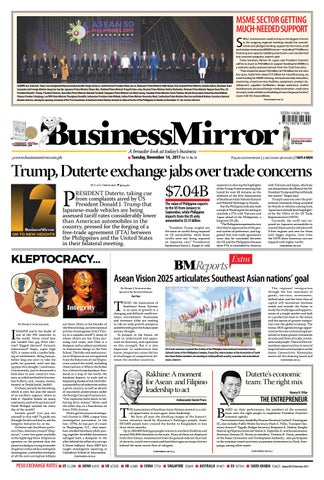
Leaders are, from left, Timor Leste designated Representative Aurélio Sérgio Gutteres, South Korean President Moon Jae-in, Malaysian Prime Minister Najib Razak, New Zealand Prime Minister Jacinda Ardern, Myanmar State Counselor and Foreign Minister Aung San Suu Kyi, Japanese Prime Minister Shinzo Abe, Thailand Prime Minister Prayuth Chan-ocha, Russian Prime Minister Dmitry Medvedev, Vietnam Prime Minister Nguyen Xuan Phuc, US President Donald J. Trump, President Duterte, Australian Prime Minister Malcolm Turnbull, Singapore Prime Minister Lee Hsien Loong, Canadian Prime Minister Justin Trudeau, Brunei Darussalam Sultan Hassanal Bolkiah, Chinese Premier Li Keqiang, Lao PDR Prime Minister Thongloun Sisoulith, Indonesian President Joko Widodo, Indian Prime Minister Narendra Modi, Cambodian Prime Minister Hun Sen and United Nations Secretary-General Antonio Guterres, during the opening ceremony of the 31st Association of Southeast Asian Nations Summit in Cultural Center of the Philippines in Manila on November 13. Noel Celis/Pool Photo via AP
media partner of the year
United nations
2015 environmental Media Award leadership award 2008
mall businessmen could end up as the biggest winners in the ongoing regional meetings should the commitments and pledged funding support for the micro, small and medium enterprise (MSME) sector—including P75 billion in financing and capacity-building seed funds—are transformed into concrete programs, experts said. Trade Secretary Ramon M. Lopez said President Duterte’s call for as much as P50 billion in support funding for MSMEs is a welcome policy pronouncement from the Chief Executive. “That should be about P40 billion to P50 billion for the next few years. Aside from about P25 billion for microfinancing, we need funding for MSME training, entrepreneurship education, mentoring, shared-services facilities, equipment, product development, suppliers facilitation, design assistance, market development, local and foreign market promotion, retail-store concepts, trade exhibits and building of more Negosyo Centers,” Lopez told the BusinessMirror. Continued on A2
BusinessMirror A broader look at today’s business
www.businessmirror.com.ph
n
Tuesday, November 14, 2017 Vol. 13 No. 34
2016 ejap journalism awards
business news source of the year
P25.00 nationwide | 5 sections 36 pages | 7 days a week
Trump, Duterte exchange jabs over trade concerns $7.04B
P
By Cai U. Ordinario
@cuo_bm
resident Duterte, taking cue from complaints aired by US President Donald J. Trump that Japanese-made vehicles are being assessed tariff rates considerably lower than American automobiles in the country, pressed for the forging of a free-trade agreement (FTA) between the Philippines and the United States in their bilateral meeting.
Kleptocracy…
The value of Philippine exports to the US from January to September, while Philippine imports from the US only amounted to $5.15 billion
“President Trump singled out the issue on tariffs being imposed on US automobiles, while these tariffs were not being imposed on Japanese cars,” Presidential Spokesman Harry L. Roque Jr. told
reporters in sharing the highlights of the Trump-Duterte meeting that lasted for over 40 minutes on the sidelines of the 31st Associations of Southeast Asian Nations Summit and Related Meetings in Manila. But the Philippine side also took a swipe at Washington for opting to conclude a FTA with Vietnam and Japan ahead of the Philippines, a longtime US ally. “The Philippines expressed a view that they’re appreciative of the general system of preference, and suggested that free-trade agreements must also be concluded between the US and the Philippines because their FTA is concluded by America
with Vietnam and Japan, who have not always been the allies of the US. President Trump said they will study the matter,” Roque said. Trump’s concerns over the preferential treatment being accorded by Manila to vehicles coming from Japan have already been highlighted by the Office of the US Trade Representative (USTR). Currently, the tariff rate imposed on Japanese automobiles is around 20 percent for vehicles with 3-liter engines and zero for those with bigger engines. Data from the USTR show American cars are slapped with higher tariffs. Continued on A16
BMReports
Asean Vision 2025 articulates Southeast Asian nations’ goal By Henry J. Schumacher
Special to the BusinessMirror
T I
By Henry J. Schumacher
magine you’re the leader of one of the 195 countries in the world. Never mind how you landed that gig (Free election? Rigged election? Dynastic inheritance? Super, super high IQ?), it comes with a jumbo helping of entitlement. Being human, before long you start to take the perks for granted, until one day up pops this thought: I need more. Conveniently, you’ve discovered a back door to your country’s treasury, or a slick method for frictionless bribery, and...money, money, money! or (build,build, build!). It’s there, not only for the taking, which is nice, but also the source of an ancillary urgency: where to hide it. Opulent homes on many continents, each with a private zoo? Patek Philippe watches for every day of the month? Sounds good? Can you see yourself in that role? To guide you through the do’s and don’ts, ask the Integrity Initiative Inc. or me. Or better ask Jim Mintz and Irwin Chen, who have created“ Kleptocrat,” a new free game available in the Apple App Store. Kleptocrat operates on the premise that the player is a bad guy trying to launder ill-gotten riches while evading the investigator, a relentless exemplar of all the anti-corruption killjoys
out there. Mintz is the founder of the Mintz Group, an international private-investigation firm (“Clarity in a complex world”), many of whose clients are law firms pursuing civil cases, and Chen is a designer and an adjunct professor in interaction design at the New School. The hide-and-seek scenarios in Kleptocrat are extrapolated from the behaviors of real kleptocrats around the world, including those laid out in Where the Bribes Are, a Mintz Group database. Rendered as a map of the world, the database depicts, to scale and in deepening shades of red, the bribesusceptibility of industries within a given country, as well as details of successful prosecutions under the Foreign Corrupt Practices Act. “Our expertise boils down to following dirty money,” Mintz said the other day, in a boardroom on lower Fifth Avenue. Mintz got his private investigator’s license in 1980, a segue from investigative journalism. In the late- 1970s, he was part of a team in Washington, D.C., that somehow avoided blindness while piecing together shredded documents salvaged from a dumpster in the alley behind the office of a corrupt K Street lobbyist. Since 2007 he’s taught investigative reporting at Columbia’s School of Journalism.
Part Two
ODAY, the Association of Southeast Asian Nations is an oasis of growth in a changing and difficult world economic environment. Businesses and investors alike are seeking to ride on wide growth prospects and definitely give the Asean some serious thought. To prosper in the Asean, we need to understand and appreciate its diversity, and capitalize on this strength. But it is also important to understand that Asean integration raises the bar of challenges of competition between the member-countries.
A K-9 unit continues to patrol the vicinity of the Philippine International Convention Center, Cultural Center of the Philippines Complex, Pasay City, where leaders of the Association of South East Asian Nation members are meeting to tackle political-security, economic and sociocultural issues. NONIE REYES
Manny B. Villar
THE ENTREPRENEUR
Ambassador Daniel Pruce
A T
he celebrated Associationsplaywright of Southeasand Asian coincidentally Nations summit oneis of a critithe cal founders opportunity of London to once School again of Economics show leadership. and Political Science (LSE), We have George all seen Bernard theShaw shocking once famously images ofquipped, the humani“If all economists tarian situation were laid faced end to byend, Myanmar’s they would Rohingya not reachpeople. a conclusion.” Some Economics 607,000 people as ahave fieldcrossed has beenthe characterized border to Bangladesh by a number in of disless agreements. than three months. One only has to look at the epic debate between Friedrich Up Hayek to 200,000 and John Rohingya Maynard people Keynes remain to realize in northern this. Even Rakhine expresand around sions associated 350,000 elsewhere with the field, in the such state. as “two Manysides of them of the aresame displaced coin” from and “there their homes. are many Assessments ways to skinfrom a cat,” theconnote ground aindicate certainthat sense lack of of ambivalence. security, travel Indeed, restrictions economists andoften food shortages “agree to disagree.” are major drivers behind the most recent flow of refugees. Continued on A13
Continued on A2
Duterte’s economic team: The right mix
Rakhine: A moment for Asean and Filipino leadership to act Agree to disagree
T he re g ion a l i nt e g r at ion through the free movement of good s, ser v ices, invest ment, skilled labor and the freer flow of capital will necessitate business inside and outside the Asean to study the challenges and opportunities of a single market and look at a production base in the Asean and the option of greater integration into the global economy. The Asean 2025 agenda brings opportunities for new and existing businesses to enjoy greater economies of scale and flows of trade, investment and people. There will be tremendous opportunities in several large infrastructure projects as the Asean Connectivity Masterplan moves off the drawing board and
B
ased on their performance, the members of the economic team were the right people to implement President Duterte’s economic agenda. The economic team, headed by Finance Secretary Carlos G. Dominguez III, also includes Public Works Secretary Mark A. Villar, Transport Secretary Arturo P. Tugade, Budget Secretary Benjamin E. Diokno, Bangko Sentral ng Pilipinas Governor Nestor A. Espenilla Jr. and Socioeconomic Secretary Ernesto M. Pernia as members. Vivencio B. Dizon, president of the Bases Conversion and Development Authority , also participates in the economic team’s activities to promote investments in Clark, Pampanga, among other assets. Continued on A12
Continued on A16
PESO exchange rates n US 51.2390
n japan 0.4513 n UK 67.5535 n HK 6.5683 n CHINA 7.7154 n singapore 37.6619 n australia 39.1671 n EU 59.7344 n SAUDI arabia 13.6623
Source: BSP (13 November 2017 )
BMReports BusinessMirror
A2 Tuesday, November 14, 2017
www.businessmirror.com.ph
Asean Vision 2025 articulates Southeast Asian nations’ goal Continued from A1
into reality, with roads, rail, power and shipping becoming more integrated across the region. Local and foreign investors are appreciating that in Asean, they will quickly find people who understand you and your business needs. The Asean region’s track record in profiting from its diversity means that cross-cultural trade and investment are second nature. The Asean region’s 600 million people are playing a growing role in our interconnected-global economy. The Asean is starting to shine on the global stage because its unparalleled diversity means, its people are open to new ideas and should
manage differences without resorting to conflict. Rapid economic growth and an abundance of natural resources across the region have attracted significant investments. The Asean offers a wide range of opportunities for investment and collaborations. What stands out is the region’s ability to manage and leverage its diversity, and to integrate outside investment and ideas. The Asean promotes regional integration through the free movement of goods, services, investment, skilled labor and the freer flow of capital. This will necessitate business inside and outside the Asean to study the challenges and
Asean banking on China-led AIIB to plug infra gaps By Elijah Felice E. Rosales
T
@alyasjah
he Association of Southeast Asian Nations is keen on taking advantage of financing opportunities presented by the Asian Infrastructure Investment Bank (AIIB) to address infrastructure gaps in the region. In a draft common statement obtained by the BusinessMirror, Asean said China’s initiatives could help accelerate infrastructure development in the region. “We look forward to greater cooperation through Asian Infrastructure Investment Bank and the Silk Road Fund to enhance regional infrastructure development,” the statement read. The Asean aims to build multiple connections from within and outside Asean through its Master Plan on Connectivity. One of its major projects, the roll-on, roll-off (Roro) cargo shipping, was launched in April after the 30th Asean Summit. The Roro, an initiative of Manila and Jakarta, connects Davao and General cities with Bitung City in Indonesia, using cargo-carrying vessels. In the same draft common statement, Asean and China have “welcomed ongoing efforts to explore synergies between Asean’s Master Plan on Connectivity and China’s Belt and Road initiative.” The Master Plan on Connectivity includes the establishment of land, maritime, air, information and communications technology and energy infrastructure. According to the Asian Development Bank (ADB), the Asean needs at least $100 billion every year to complete its needs in roads, railways, power, clean water supply and other critical infrastructure. The ADB also claimed the Asean only spends about $50 billion annually for infrastructure development, leading to “infrastructure bottlenecks.” It added the key to meeting Asean’s infrastructure finance challenge is by making use of the region’s private savings and the $700 billion it holds in foreign exchange reserves. The AIIB is seen by other multilateral development banks as a “welcome addition” given that the infrastructure needs of the region are significant. In a report this year, the ADB said countries in Southeast Asia need to invest around $2.17 trillion, or $145 billion a year, from 2016 to 2030 to address its infrastructure deficit. Without the AIIB, multilateral institutions, such as the ADB, World Bank, International Finance Corporation and other existing organizations, could only provide, at the most, $50 billion a year. This leaves around $750 billion worth of infrastructure projects unfunded in this decade.
opportunities of a single market, the need to look at a productionbase in the Asean, and the option of greater integration into the global economy. This is clearly recognized by both the European Union and the United States of America. For the Asean, regional economic integration cannot stop at policy measures. Integration cannot end at cutting tariffs, removing nontariff barriers, reducing obstacles to investment and easing restrictions on trade in services. Economic integration must also mean binding Asean members through infrastructure in energy, transport and communications. Integrating a regional infrastruc-
ture is one of Asean’s toughest goals, because the region is geographically diverse and its economies are at different levels of development. For example, several of its members, such as Thailand, Myanmar, Vietnam, Lao PDR and Cambodia form a landmass. This geographic characteristic means that infrastructure links among them – connecting roads, rail, communication and power lines across national boundaries—could be relatively easy to set up. However, it is not the case when some of these boundaries are mountain ranges and rivers. Other Asean members, including the Philippines, are separated by deep sea, making linkages between them
expensive. Despite these difficulties, the Asean has made the development of infrastructure linkages one of its primary goals. To expand the much-needed infrastructure development, Asean countries must assess the magnitude of national infrastructure financing needs and financing gaps within key sectors, such as transport, energy, telecommunication, water and sanitation. To demonstrate how slow infrastructure development and integration is, let’s look at energy. Asean initiatives on energy interconnection date back to the Asean Cooperation Project on Interconnection, which started in 1982.
This was aimed at linking the power systems of neighboring Asean countries. In 1986 Asean member countries signed the Agreement on Asean Energy Cooperation, calling for cooperation in the efficient development and use of all forms of energy, whether commercial and noncommercial, renewable or nonrenewable. As Asean promotes regional infrastructure development, it is important for it to ensure that the region follows a green path. Asean countries have a critical responsibility in this area because the region is contributing ever more carbondioxide emissions. To be concluded
Msme sector getting much-needed support Continued from A1
During his keynote message closing the launch of the Asean Mentors for Entrepreneurship Network at the Asean Business and Investment Summit last Sunday, Duterte brought up increased funding for MSMEs, which constitute 99.6 percent of all businesses in the country. The chief executive suggested an amount of P50 billion to MSMEs, which, the trade secretary, said should be spread out in the next few years. As the main agency tasked to promote business growth and creation, the Department of Trade and Industry (DTI) has already enacted several new programs, as well as continued programs carried over from the previous administration. The Pondo Para sa Pagbabago at Asenso, for instance, is a P1-billion financing program initiated by Lopez intended to give MSMEs better access to finance, and to reduce their cost of borrowing. The fund gives priority to the country’s 30 poorest provinces, and intends to replace the“5-6”(20-percent interest) money-lending system. The DTI has earmarked P5.1 billion in its budget proposal to the House of Representatives for general programs. MSME Development corners the second-biggest share of 27 percent—or some P 1.3 billion—of the total Programs budget.
MSMEs in global value chains
The Duterte administration also used the Asia Pacific and Asean meetings as platforms to promote MSMEs in global value chains (GVCs). According to Foreign Assistant Secretary Leo Herrera-Lim, Duterte was able to persuade leaders of the AsiaPacific Economic Cooperation (Apec) member-economies to provide the MSME sector the backing it needs to flourish in the international market. Lim said the President made sure the outcome declaration of Apec leaders
will promote MSMEs in GVCs. “The leaders adopted a statement that endorses concerted action on advancing economic, financial and social inclusion, and to give priority reskilling and [human-resource development] to help MSMEs adopt to the fourth industrial revolution and the digital age. The same statement underscored the leaders’ support for MSMEs in GVCs,” Lim told the BusinessMirror. “Several initiatives in the Apec platform are oriented toward helping MSMEs innovation capacities, improving their access to digital infrastructure, assisting them in enhancing their digital capabilities and toward an establishment of a business ecosystem that supports start-ups,” Lim added. Apec leaders have expressed in their declaration the need to implement policies that will allow MSMEs to “take full advantage of global value chains.” “We encourage further actions to enable better participation, greater value added and upward mobility of developing economies and MSMEs in GVCs. We appreciate initiatives, such as Asia-Pacific Model E-port Network and Apec Green Supply Chain Network, and their positive contribution to supply-chain connectivity,” the leaders said. As a resolve, Apec member-economies have vowed to bolster MSMEs innovation capacities that will facilitate access to finance, technology and capacity building, especially for women and youth-led businesses. They also pledged to “create an enabling environment for MSMEs, including by promoting business ethics.” “We commit to…support start-ups through establishing an innovative start-up ecosystem, with conducive regulatory frameworks, that promote a business-friendly environment, ensuring access to resources and building start-up networks and partnership,” the leaders added. As a follow-up to his campaign in the Apec summit in Da Nang, Vietnam, Duterte also called on his fellow leaders in the Asean to espouse the same attitude toward MSMEs. In a speech last Sunday, the President told small businessmen he is willing to allocate “maybe a few billions here and there” to the MSME sector. “Well, [I will really allot] capital because we found out in our meetings with Apec that the basic unit of the economy has always been moved by MSMEs,” Duterte said. “Next year, I would like to make some late changes in the [General Ap-
Intramuros. . . Continued from A16
The completion of the Intramuros Museum (P100 million) and the Maestranza Chambers (P84 million) are among the priority projects for the IA. Also, other projects include the lighting of the monuments (P10 million), completion of Casa Azul, where the Spanish Cultural Center will be located (P7 million), and improvement of the drainage in the city, which IA hopes will be undertaken by the Department of Public Works and Highways (DPWH).
propriations Act], the annual budget. I would like to pour more money on this medium, small and micro enterprise,” the President added. Duterte said he understands the role and contribution of MSMEs to the Philippine economy—“the small guy down there that contributes a lot to what is really happening before our rise, and it’s improving the economy.” In 2015 the Philippine Statistics Authority reported 99.5 percent, or 896,839, of the 900,914 establishments in the country are MSMEs. While large businesses employed a total of 2.98 million workers, MSMEs were able to generate 4.78 million jobs.
Experts weigh in
of the Land Bank of the Philippines (LBP) and Development Bank of the Philippines (DBP). In a phone interview, Ofreneo said the DBP is supposed to help new industries and new enterprises, while the LBP was tasked to help agriculture entrepreneurs. He said what the government should do, even before talking about finances, is to review and evaluate the funds and other efforts exerted to help MSMEs in the past. One such program, Ofreneo said, is the SME Unified Lending Program for National Growth (Sulong) established under the term of former President Gloria Macapagal-Arroyo. The program, based on the former president-turned-Pampanga representative’s website aims to “lower the effective cost of borrowing by SMEs and liberalize requirements, create a wider financing system that will give SMEs better access to shortand long-term funds and standardize lending procedures.” “The government should review existing programs and harmonize them. The One Town One Product is a good program, as well as the planned One Barangay One Product, but there are no updates regarding these efforts,” Ofreneo said. For his part, Trade Undersecretary Rafaelita M. Aldaba said credit policy is different for microenterprises and SMEs, because these businesses have different characteristics and, therefore, needs. For one, based on a 2012 Philippine Institute for Development Studies (PIDS) study of Aldaba, the assets of microenterprises reach P3 million or less, while small businesses have assets worth P3 million to P15 million and medium, P15 million to P100 million. Further, the PIDS study stated that micro enterprises have less than 10 employees; small enterprises, 10 to 99 employees; and medium, 100 to 199 workers. “My view here is that credit policy must be distinguished between micro and SME. They have very distinct needs. The latter also needs more funding, while the former even gets funding and credit from international donors. SMEs have greater job-generation potential than micro enterprises, too,” Aldaba said. “I also think microcredit is more related to poverty and social protection while SME credit is more for macroeconomic growth and job generation,” she added. Cai U. Ordinario, Elijah Felice E.
University of Asia and the Pacific (UA&P) School of Economics Dean Cid Terosa told the BusinessMirror that the amount pledged by the Duterte administration can be used as seed money for an “MSME bank”, similar to the overseas Filipino workers (OFW) bank placed under the Land Bank of the Philippines. On top of the fund, Terosa said the DTI, University of the Philippines (UP) and other similar institutions must extend financial education and training to MSMEs. “The government should allocate at least P10 billion for this effort. The money should be used as initial capital for a bank solely dedicate for this purpose. DTI, UP and related institutions can be mobilized to set up education and training programs to complement funding support, assistance, or subsidies,” Terosa said. Terosa added the bank can extend loans to MSMEs, as well as other financial programs, such as asset investments and management tailored to their needs. This will reduce MSMEs’ reliance on informal financing schemes. The lack of funds usually sends MSMEs to the doorsteps of loan sharks who lend them funds at a high cost. In a 2016 working paper, the Asian Development Bank Institute (Adbi) said the interest can often reach 20 percent. In the country the ADBI said this is known as “5-6 financing,” which means that for every $5 borrowed over a one week period, borrowers need to pay $6. The $1 interest is equivalent to an interest rate of 20 percent. However, economists like former Labor Undersecretary Rene E. Ofreneo and Ateneo de Manila University School of Social Sciences Dean Fernando T. Aldaba said creating a bank is not needed, given the existence
Rosales and Catherine N. Pillas
“The regional director of the DPWH has already instructed his staff to inspect the drainage system of Intramuros,” Asido said. The National Commission has provided the funds for the completion of the Intramuros Musuem for Culture and the Arts, he added. In April the IA, an attached agency of the DOT, unveiled the newly renovated Paseo Soledad and Plaza Moriones in Fort Santiago. Plaza Moriones, the area leading to the iconic Fort Santiago, has been spruced up with flowering trees and a colorful fountain at the center. At the Paseo de Soledad, a portion of the linear park built along
the banks of Pasig River is now accessible through the river gate called Postigo Nuestra Señora de Soledad. The DOT, through its infrastructure arm, the Tourism Infrastructure and Enterprise Zone Authority, allotted P230 million for the renovation of Fort Santiago. Asido said more areas, such as Rajah Soliman Theater, reception venues, and the dungeons will be opened to the public once the rehabilitation is completed by the end of the year. “We are looking at the completion of the first phase of the Intramuros Museum and the Maestranza Chambers this year,” he said.
www.businessmirror.com.ph
The Nation BusinessMirror
Editor: Vittorio V. Vitug • Tuesday, November 14, 2017 A3
Senators welcome Trump offer to mediate sea dispute
S
enators welcomed on Monday the offer of United States President Donald J. Trump to mediate a settlement of conflicting territorial claims in the West Philippine Sea.
“Sure,” Senate Majority Leader Vicente C. Sotto III on Monday said when asked if the Philippine government should accept Trump’s offer made earlier at the sidelines of the Asia-Pacific Economic Cooperation in Vietnam. “Anything to help,” Sotto
told the BusinessMirror. Sen. Gregorio B. Honasan II, chairman of the Senate Committee on National Defense and Security, agreed the Philippines needs all the help it can get from other countries.
“Consistent with our foreign economic and security policy, resolution of conflicts through diplomacy and peaceful means, we need all the help we can get, especially from powerful nations like the US who share the same objectives of peace and development, not only for the region but for the global community,” Honasan said in a separate text message to the BusinessMirror. Tr u mp h ad re iter ate d h i s readiness to be of help to Asian allies on his way to attend the Association of Southeast Asian Nat ion s L eader ’s Su m m it i n Manila, where Trump was to
attend bilateral talks scheduled between the Asean and it’s dialogue partners. Senate Minority Leader Franklin M. Drilon also concurred with the idea to tap Trump as mediator. “Yes,” Drilon replied, when asked if the Duterte administration should accept Trump’s offer. Besides the United States, the Asean will also meet with eight other dialogue partners from various governments, as well as two multilateral organizations, the United Nations and the European Council. Top US officials have repeatedly voiced concern on the need
to maintain freedom navigation in the South China Sea, where at least four countries have competing claims on remote islands straddling the West Philippine Sea. But Foreign Secretary Alan Peter S. Cayetano indicated Philippine officials are still awaiting the response of other claimant countries to Trump’s offer to mediate a settlement. Aside from the Philippines and China, other Asian claimants include Brunei Darussalam and Malaysia. In an earlier interview, Cayetano confirmed the Duterte administration was also thankful for the
offer, crediting Trump’s record as “a good mediator.” “We thank him [Trump] for it. It’s a very kind, generous offer because he is a good mediator,” Cayetano told reporters. W h i le Ma n i l a apprec i ates Trump’s “honest” offer, Cayetano said claimant countries in the contested waters must first give their take on the proposal. “ O f c ou r s e , t he c l a i m a nt countries have to answer as a group or individually, and not one countr y can just give an instant reply because mediation involves all of the claimants and nonclaimants,” he said.
Duterte opens Asean Summit with calls against terrorism, drugs By Elijah Felice E. Rosales @alyasjah
P
resident Duterte on Tuesday made no hesitation in listing terrorism and illegaldrug trade on top of the agenda of the 31st Association of Southeast Asian Nations summit, urging the region to face and resolve these issues once and for all. As the countr y approaches the last phase of its chairmanship of the Asean, the President called on its leaders and dialogue
partners to address the growing threat of Islamist extremism in the region, along with other security threats. “Terrorism and violent extremism endanger the peace, stability and security of our region because these threats know no boundaries,” Duterte said. “Piracy and armed robbery in the seas put a dent on our growth and disrupt the stability of both regional and global commerce. The menace of illegal drug trade continues to endanger the very fabric of
our societies,” the President added. “These and other issues are high on the agenda of our meetings, along with the other nontraditional security issues that challenge the prosperity of our economies, the integrity of our institutions and, more important, the safety of our people,” Duterte said. The President told Asean leaders to make use of the summit as an avenue to come up with strategies on how to address the Islamic State creeping toward Southeast Asia.
S p e a k i n g b y e x p e r i e n c e , Duterte recalled how government forces had to combat Daeshinspired Maute Group terrorists in Marawi City, Lanao del Sur. The fighting took five months to finish, claimed more than 1,000 lives in the process and displaced about 300,000 people. “Less than a month ago, Philippine government forces liberated the city of Marawi from terrorist groups who pledged allegiance to the Islamic State. Resolute, we are now in the process of help-
ing people back on their feet to reclaim their lives,” the Chief Executive said. “I only want to emphasize that our meetings for the next two days present an excellent opportunity for us to engage in meaningful discussion on matters of regional and international importance,” the President added. Aside from addressing security issues, Duterte said other outcome documents are also expected to be signed during the summit, which will conclude on Tuesday.
This includes the Asean Consensus on the Protection and Promotion of Rights of Migrant Workers, which will serve as the implementing rules and regulations to the Asean Declaration on the Protection and Promotion of the Rights of Migrants Workers signed in 2007. “I will be joining other Asean leaders [on Tuesday] in signing this landmark document that would strengthen social protection, access to justice, humane and fair treatment and access to health services for our people,” the President said.
Economy
A4 Tuesday, November 14, 2017 • Editors: Vittorio V. Vitug and Max V. de Leon
BusinessMirror
Lawmakers push ‘absolute’ tax exemption for MSMEs By Jovee Marie N. dela Cruz
T
@joveemarie
O help micro-, small- and medium-scale enterprises (MSMEs), a deputy speaker of the House of Representatives said Congress should pass a law providing them an “absolute” tax exemption.
Deputy Speaker Romero S. Quimbo of Marikina said no additional fund is needed if the government will exempt MSMEs from paying taxes. “What they need is absolute tax exemption. Under the proposed tax reform from the DOF [Department of Finance], they potentially will be taxed,” Quimbo told the BusinessMirror. Under House Bill 5636, workers earning P250,000 will be exempted from paying personal income taxes, while Senate Bill 1592 said the first P150,000 annual taxable income will be exempted with maximum P100,000 additional exemption for up to four dependents. The Senate ways and means committee has also endorsed adjustment on the excise tax rates on petroleum and sugar-sweetened beverages (SSBs). Unlike House version’s “3-2-1 formula,” spread out at P3 on the first year starting 2018, the senators opted to reverse the P6 tax-hike schedule, as follows, P1.75 in the first year, P2 for the second year and P2.25 by the third year. Senators also retained the tax exemptions for kerosene. Also, under the House version, beverages containing purely locally produced sugar shall be levied an excise tax of P10, while P20 to other sweeteners. On the other hand, Senate subjected the SSBs to two-tiered tax scheme: Drinks with caloric sweeteners will be taxed at P5 per liter, while those with noncaloric sweeteners will be taxed at P3 per
liter in the first two years. The lower chamber’s version also provides new schedules and brackets for auto excise tax in the package. Under the proposal the excise will be implemented in two schedules. For the lower bracket, if the net manufacturer’s price/importer’s selling price is P600,000, the excise tax will be 3 percent by 2018, and it will increase to 4 percent by 2019. For the higher bracket, if the net manufacturer’s price/importer’s selling price is over P3.1, the excise will be P1,468,000 plus 90 percent of the value in excess of P3.1 million in 2018. For 2019 if the net manufacturer’s price/importer’s selling price is over P3.1, the excise will be P1,824,000 plus 120 percent of the value in excess of P3.1 million.
Funds
IN his speech at the Association of Southeast Asian Nations Business and Investment Summit and the launch of the Asean Mentors for Entrepreneurship Network, President Duterte vowed to allocate more funds to support the MSMEs in the 2018 national budget. For his part, House Committee on Appropriations Chairman Karlo Alexei B. Nograles of Davao City said the government has allocated P3.2 billion for MSMEs for 2018. “In the 2018 budget, we have allotted about P1 billion for micro financing and another P1 billion for equipment and another P1.2 billion for other programs,” he said.
“[However] in order for us to really support SMSEs [small- and mediumscale enterprises], we need to push for programs for MSMEs’ training and education for entrepreneurs, mentoring, product development, design assistance, market development, market promotion, retail-store concepts, trade exhibits and build up negosyo centers complete with business counselors,” Nograles said. House Committee on Appropriations Vice Chairman Luis Raymund F. Villafuerte said the growth of MSMEs will help the President achieve his vision of inclusive growth, considering that these small businesses account for 99.6 percent of total registered enterprises, and employ 62 percent of the labor force. “As an entrepreneur myself prior to joining electoral politics, I know the perennial challenges facing SMEs, two of which are the lack of capital and the cumbersome government procedures that they have to go through in doing their businesses,” Villafuerte said. The lawmaker said local executives should also help SME thrive by cutting the red tape in their cities or municipalities. “I believe there is more reason for LGU [local government unit] officials to do so now after the President no less has called on the DILG [Department of the Interior and Local Government] to possibly suspend elective officials responsible for undue delays in the opening of new businesses in their respective localities,” he added. Villafuerte also urged the country’s economic managers to fasttrack the completion of the Philippine Business Data Bank to clear the way to the online processing of business permits of local govern-
ment units, which is one way to cut red tape and deter corruption in the processing of local business papers. To address the tight credit squeeze saddling MSMEs, he said, the Bangko Sentral ng Pilipinas (BSP) should ease lending regulations to make it easier for small businesses to borrow money from the banking sector. “Hence, the BSP could review the implementing rules and regulations of the magna carta for MSMEs along this line,” he added. Villafuerte also said Budget Secretary Benjamin E. Diokno and the other economic managers can work out with lawmakers the additional funding for MSMEs in the final congressional deliberations on the proposed 2018 General Appropriations Act, which is now pending for Senate approval. House Committee on Economic Affairs Chairman Arthur C. Yap of Bohol said there are 896,000 MSME institutions “and if a guarantee program for backing up loans to them is established, maybe P2 billion as the start of a guarantee fund is enough because there are other micro-finance programs available from the private and public sectors.” House Committee on Ways and Means Chairman Dakila Karlo E. Cua of Quirino said MSMEs should have access to credit and technology for them to compete. “Funding assistance with low interest loans, or government assistance for technology investment, or even government investments in physical or IT [information-technology] infrastructure, as well as human capital-improvement programs, such as trainings and scholarships to develop expertise, are big help for our MSMEs,” he said.
What they [MSMEs] need is absolute tax exemption. Under the proposed tax reform from the DOF, they potentially will be taxed.”—Quimbo
www.businessmirror.com.ph
Japan firms keen on partnership with local ICT start-ups–Jetro By Jasper Emmanuel Y. Arcalas @jearcalas
J
apanese firms are keen on partnering with Philippine businesses to put up startup companies, especially in the field of information and communications technology (ICT), according to a Japan External Trade Organization (Jetro) official. Shuichi Hirano, Jetro’s Business Development Support Department director in charge of Asian cooperation, told the BusinessMirror that the Philippines has a high potential in developing ICT-related companies due to the Filipinos’ high competency and skill level. “[The] Philippines has good resources to develop software. It has a long history to develop software in the field of ICT,” Hirano said in an interview on the sidelines of Asean-Japan Fair on Monday at Solaire Resort and Casino. “I think there a lot of good human resources in the Philippines,” Hirano added. The Jetro has embarked in a new partnership project which seeks to collaborate Japanese firms with local companies, particularly in the field of ICT, according to Hirano. He added that Jetro has supported 10 pilot collaboration projects between Southeast Asian firms and Japanese businesses. Of the total, three projects are partnered with Philippine firms and will be implemented locally, according to Hirano. “The Philippines has a lot of social challenges, making it a good go-to environment to pilot or try out projects,” he added. These projects, which are all technology related, are collaborations between PLDT Inc. and Global Mobility Serice Inc., Informatix Inc. and Philippine National IT Standards Foundation, and Liquid Inc. and Touch Media Supply & Service Corp. Naotaka Nishimaya,
[The] Philippines has good resources to develop software. It has a long history to develop software in the field of ICT.” —Hirano regional head of Asia, Deoilette Thomatsu Venture Support Co. Ltd., said Japanese firms are venturing to the Southeast Asian countries as people in the region are highly skilled, especially on technologyrelated jobs. “We are a big and growing market, but we need a local partner who knows how to do business in these markets for several reasons. With digitalization, needless to say, the economy is rapidly changing to digital era,” Nishimaya said. “And we do not have enough software knowledge and experience in Japan, unlike here in Southeast Asia,” Nishimaya added. Trade Undersecretar y Nora K. Terrado said they are open for new partnerships with Japanese firms as this would help the Philippines develop a conducive business environment for technolog y companies. “We are partners not only in the development of our industries, but also—by being connected by the global value chain—we are partners in sharing our resources when it comes to mutually beneficial endeavors,” Terrado said. “The sharing and access of information and of technology and exchange of capacitybuilding resources are very important in developing the ecosystem where the innovation will thrive,” she added.
Expert seeks govt assurance of ample frequency for free Internet connectivity By Lorenz S. Marasigan @lorenzmarasigan
T
he government must ensure that it will have ample radio frequencies once it starts pursuing its ambitious initiative of providing free Internet connectivity in the country, according to an alliance of stakeholders in the broadband sector. Better Broadband Coalition Convener Mary Grace Mirandilla-Santos, in a position paper on the implementing rules and regulations (IRRs) for the Free Internet Access in Public Places Act, said the government must guarantee the availability of spectrum for the rollout of its free Wi-fi program. The position paper, which listed key business chambers and tech groups, was sent to the Department of Information and Communications Technology (DICT) Officer in Charge Eliseo M. Rio late last week. “The IRRs should already identify the spectrum to be assigned to the DICT in order to guide private-sector partners in the technology and equipment they can invest in, accordingly, and guarantee that there will indeed be enough and available spectrum for the seamless rollout of the free Wi-fi program in the coming years,” Mirandilla-Santos said. The plan, under the law, is to bid out contracts for Intermet-connectivity services to private Internet service providers (ISPs), which will then provide free wireless Internet connectiv-
ity in areas in the Philippines. Spectrum is the real estate on which telecommunications operators develop their respective network to deliver services to customers. The amount of spectrum assigned to a telecommunications company has an impact on the cost the build capacity, overall network performance, ability to offer new multimedia services and general customer experience of wireless services. Spectrum is a finite natural resource that is necessary in providing wireless Internet connection. This includes mobile cellular, fixed wireless and satellite connections. “The recent spectrum audit shows that most spectrum bands for broadband wireless access have been allocated to private telecommunications companies or telcos,” MirandillaSantos added. Data from the National Telecommunications Commission (NTC) showed that existing telcos hold majority of the said real estate to date. PLDT Inc. holds 400 MHz of the total holdings, while Globe Telecom Inc. has rights to 325 MHz. What remains for budding telecom players is a mere 140-MHz frequencies in the 700-MHz, 850MHz, 2,100-MHz, 2,500-MHz and 3,500-MHz spectrums. “Spectrum is a crucial resource for the implementation of the free Internet access/Wi-fi program of the government,” Mirandilla-Santos said.
She added that aside from defining the specific spectrum holdings to be assigned to private partners for the free Wi-fi program, she signaled that the telco regulator must be open to reallocate spectrum to different players should the need arise. “This should not stop the NTC, however, from assigning other or additional frequencies in the future that may be necessary for use by the DICT and the private-sector participants of the program,” MirandillaSantos said. She added that there are certain technicalities to technology that might cause the need for the refarming of the frequencies, and reallocating them to the players. “ISPs and other private-sector partners may also apply for other spectrum that are appropriate for their own technological solutions, in relation to the free Internet access/Wi-fi program of the government,” she said. Roughly two months back, President Duterte signed the free Internet access law or Republic Act 10929, which provides for the deployment of free Internet access in public spaces, such as schools, transportation terminals, plazas, hospitals and government offices. The law is expected to help bridge the so-called digital divide, which is basically a gap between those who have access to the Internet and those who don’t. Such a divide has resulted in striking gaps in three areas: education, information and communication and finance.
Lingerie talk
An enterprising woman launches her sidewalk stall in Divisoria, Manila, where she sells a range of reasonably priced brassieres, ahead of the anticipated Christmas-shopping rush in December. NONIE REYES
Medvedev sees improving Russia, Asean economic ties
T
By Catherine N. Pillas
@c_pillas29
he head of state of one of the world’s largest energy producer, the Russian Federation, sees increased cooperation with Association of Southeast Asian Nations nations in various areas, including energy transfer, agriculture, navigation and financial services, amid modest trade and investment between the two parties. During the Asean Business and Investment Summit (Abis) 2017 on Monday at the Solaire Resort and Casino, Russian Prime Minister Dmitry Medvedev said there are numerous areas of high interest for Russian businesses. “We see a true interest of the business community in our country in terms of cooperation in energy transfer, agriculture, satellite navigation, financialservices technology, so practically in all important sectors. This is indeed logical as today, Asean in terms of growth, is sixth economy in the world and third in Asia,” Medvedev told leaders of industries and heads of state. Medvedev added Russia is ready to be involved in Asean initiatives
relating to energy transfer, information infrastructure and especially in transit/transport development “It’s important for business to develop sea and airport development in the Russian Far East [region]. The main goal of all these efforts [is] to make the transit between Asia and Europe as fast as possible, and to establish the Russian Far East as a powerful industrial hub to satisfy the needs of the Asia-Pacific region,” he added. The prime minister added that this improved cooperation is foreseeable, even as trade and investment numbers have been modest due to improving Russian economy surpassing 2 percent, and increasing interest from Asia. According to the Asean foreign direct investment (FDI) database, Asean’s FDI inflows from Russia has had a mixed performance in the course of five years. From $189 million in 2012, this grew to $607 million the following year only to dip to negative $113.25 million in 2014. In 2015 FDI was again in the negative territory, at $28.9 million. Last year FDI inflow into Asean from the Russian Federation is at $56.7 million.
Agriculture/Commodities BusinessMirror
www.businessmirror.com.ph
Editor: Jennifer A. Ng • Tuesday, November 14, 2017
A5
Cassava output to exceed 2.8 MMT–report By Jasper Emmanuel Y. Arcalas
P
@jearcalas
hilippine cassava production this year could expand by 2.54 percent to 2.825 million metric tons (MMT), from last year’s 2.755 MMT, according to the latest report of the United Nation’s Food and Agriculture Organization (FAO). In the November round of its biannual report on global food markets, titled “Food Outlook,” the FAO attributed the increase in production to growing demand for the crop as Filipinos substitute it for rice. “In the Philippines, based on the pace of the harvest for the first six months of the year, cassava output is expected to reach 2.8 MMT in 2017, marginally above the level of 2016,” the FAO said in
the report, which was published recently. “By contrast, in Indonesia and the Philippines, cassava is more important for food security than for industry. Dietary diversification programs in the two countries have targeted cassava as a substitute for rice, which both countries import heavily,” it added. Data from the Philippine Statistics Authority (PSA) showed
DAR wants to revitalize garlic, onion industry in Ilocos region
G
arlic and onion farmers in Ilocos region will soon be getting the much-needed boost to reduce the country’s dependence on imported garlic and onion following a dialogue facilitated by the Department of Agrarian Reform (DAR), which sought to address their production and marketing concerns. The public dialogue was held on November 9 in San Juan town in La Union among agrarian-reform beneficiaries engaged in garlic and onion production. During the dialogue, officials of the DAR received reports of the steep drop in the domestic production of onion and garlic in the area. In a statement, DAR Regional Director Virgilio L. Acuña said data provided to his department in the region indicated that the decline in onion and garlic production in Ilocos resulted in the importation of onion and garlic from other countries. Acuña said latest numbers showed that 94 percent of the supply of garlic and 60 percent of onion in the Philippines are already imported. He also enumerated various problems faced by the onion and garlic industry in the area, which includes plant diseases and the lack of quality seedlings, which severely reduces the quality and volume of production, the entry of cheap imports and smuggled garlic and onions. The massive inflow of imported and smuggled onions and garlic caused prices to drop steeply and farmers to incur huge losses. Acuna also took note of the lack of new production technology available to local garlic and onions producers as among the factors behind the decline in the output of the two farm products. He added that the dialogue also aimed to directly identify from the farmers their “present status and predicament.” “From there, we would determine the possible types of assistance that can be provided to the farmers by the government, local government of units and private sectors, such as technical assistance, inputs, production and postharvest facilities, support infrastructures, credit, farm types of machinery and assured market support, among others,” Acuña said. DAR Head Executive Assistant Shiela Enciso delivered a message in behalf of Officer in Charge Secretary Rosalina Bistoyong, who threw her support behind the onion and garlic industry in the country. The other factors behind the drop in the production of onion in the region were also presented by Provincial Agrarian Reform Program Officer (Parpo) II Maria Ana B. Francisco during the dialogue. These factors, Francisco said, include the prolonged rainy seasons in recent years and “severe fungus attack”. Acuña was joined by Rep. DV B. Savellano, DAR Region 11 Director Joseph H. Orilla, Vice Gov. Aureo Nisce who represented Gov.Pacoy Ortega, Benito S. Andaya of the Bureau of Plant Industry, Ruby Ann L. Matutino from the Office of Sen. Cynthia A. Villar, Parpo II Christianne Suguitan, Parpo II Vic M. Ines and Parpo II lawyer Raul C. Laluan. Farmers from the provinces of Ilocos Norte, Ilocos Sur, La Union and Pangasinan participated in the activity. Jonathan L. Mayuga
National Biotechnology Week kicks off on November 20
N
ational Biotechnology Week (NBW) will kicks off on November 20, at the Expo Hall 1 fourth floor, Fisher Mall, Quezon City. Themed “Bioteknolohiya para sa Kalikasan, Kalusugan, Kagandahan, Kabuhayan, at Kaunlaran:Lamang ang Masa at Magsasaka sa Limang ‘K’ ng Bioteknolohiya!” activities will run through until November 24. This year’s weeklong celebration highlights the beneficial application of biotechnology in food and agriculture, health, environment and industry. It will showcase the applications of biotechnology in food production, health and wellness, and environmental conservation through technology exhibits, trade fair, seminars and forums for teachers, students, farmers and consumers. Also part of the celebration are the Jose G. Burgos Jr. Awards for Biotechnology Journalism and the recognition of this year’s “Filipino Faces of Biotechnology.” In 2007 Presidential Proclamation 1414 was issued declaring every last week of November of every year as NBW. An interagency committee composed of the departments of Agriculture, Education, Environment, Health, Interior, Science and Trade was formed to integrate and harmonize respective activities of participating agencies and organizations to yield a meaningful celebration of the NBW. The Department of Agriculture is this year’s chairman. For more information, contact the NBW Secretariat at nbwphilbiotech@ gmail.com or through www. facebook.com/nbwphilippines.
Photo taken from Wikimedia
that the country produced 1.407 MMT of cassava in the first half, 2.69 percent higher than the 1.37 MMT recorded during the
January-to-June period of 2016. “The sustained demand for food, feeds and industrial uses of cassava resulted in the increase
in harvested areas in Bukidnon,” the PSA said. “There were also increases in harvested areas in the provinces
of Isabela and Quirino as a result of technical, financial and marketing assistance from the San Miguel Cor p. to cassava farmers,” it added. Last year the Philippines produced 2.755 MMT of cassava, 1.5 percent higher than the 2.714 MMT recorded in 2015. The FAO report also projected that global cassava production would decline this year by 1 MMT to 278 MMT. “Hitherto, cassava held the status of being one of the fastest expanding staple crops at the global level, registering annual average growth well above 3 percent over the past decade, but a combination of policy changes, depressed root prices and adverse weather in the major producing countries was behind lower plantings and consequently lower harvest prospects for 2017,” the report read. In the same report, the FAO estimated that Philippine pineapple production t his year would reach a record high of 2.651 MMT. The figure is 2.78 percent higher than last year’s 2.612 MMT.
Banking&Finance BusinessMirror
www.businessmirror.com.ph
Editor: Jun B. Vallecera • Tuesday, November 14, 2017
A6
‘Economy needs higher interest rates’
T
By Bianca Cuaresma @BcuaresmaBM
here is a growing consensus for the Bangko Sentral ng Pilipinas (BSP) to begin reining in the policy rates or, at the very least, signal a tightening bias, as the economy needs the stabilizing hand of the Central Bank in the months ahead. Following the decision to keep the policy rates frozen yet again at last week’s final monetary board meeting for the year, analysts at ING Bank Manila and BMI Research said the BSP should tighten its grip on the policy rates soon to complement developments in the economy. BMI Research, the research arm of the Fitch Group, for instance, said rate adjustments help ensure macro stability across the Philippines. “Although inflation is still within the Central Bank’s target band of [2 percent to 4 percent], we note that price pressures have been mounting, and current interest rates are insufficient for an economy that is growing at around 10 percent in nominal terms,” BMI said.
“The risk is that, if interest rates are kept too low for too long, malinvestment may start to accumulate in the economy. We continue to expect the BSP to hike interest rates by 50 basis points over the coming months, as inflation continues to trend higher and as the US Fed remains on the path to interest-rate normalization,” Fitch Rating’s research unit said. The BSP last tweaked the policy rates in September 2014 when the policy-making Monetary Board raised the rate at which it borrows from or lends to banks by 25 basis points to keep inflation from shooting past the target range. So-called operational adjustments were adopted in mid-2016 as the BSP embraced a new system of monetary-policy
implementation in the form of an interest-rate corridor that helped push the policy rate to where it is at present. “We are of the view that the current low interest and inflation environment is unsustainable and, eventually, one or the other will have to rise,” BMI analysts said. “With interest rates likely to head higher in the US, which could result in capital outflows, we believe that the BSP will likely look to hike interest rates preemptively to prevent further peso weakness, which is already one of the worstperforming currencies in Asia year-todate,” the analysts quickly added. In a separate commentary, the senior economist at ING Bank Manila also stressed the need for a tightening action, particularly in 2018. “We fear that higher prices may generate instability in inflation expectations, requiring some tightening action from the BSP in 2018. We are in line with the consensus forecast of two 25 basis pointrate hikes in 2018. We believe the BSP may hike rates in the second quarter and in the fourth quarter,” Joey Cuyegkeng said. At the rate-setting meeting of the Monetary Board on November 9, BSP Deputy Governor for the Monetary Stability Sector Diwa C. Guinigundo told reporters there is very little to no reason to change
BLGF told to strengthen LGU fiscal autonomy
T
monetary policy at this point, no matter the tightening bias of other central banks, particularly the US Federal Reserve (the Fed). “We have difference economic and business cycles, and adjustments in monetary policy by the US Fed does not necessarily warrant a corresponding response of monetary policy from the BSP,” Guinigundo said, adding quickly the BSP only makes monetary-policy adjustments on the basis of the outlook on inflation, the extent of domestic demand, as well as credit and liquidity conditions.
he Department of Finance (DOF) has challenged the unit overseeing local treasury financing and revenue administration to continue developing innovative programs to strengthen the fiscal autonomy of local government units (LGUs) and further wean them off their dependence on the national government for fund support. Finance Undersecretary Antonette Tionko said the Bureau of Local Government Finance (BLGF) should remain at the forefront of efforts to promote fiscal decentralization, given that, in some cases, LGUs rely on the internal revenue allotment to fund 99 percent of their operations and programs. According to Tionko, local revenues, on the average, only account for less than 1 percent of the country’s GDP. “There is a much-needed balance here: LGUs must build their revenue base to fund their projects, and the effect on the national government’s fiscal space as a result of continued dependence of LGUs on national transfers,” Tionko said at the 30th anniversary of the bureau. An attached agency to the DOF, the BGLF is mandated to assist LGUs in formulating fund-management policies and programs to improve collection-enforcement mechanisms and credit-utilization schemes.
Three things that you should never waste
W
e all know it’s bad to be wasteful of anything, because almost everything has a limit. We conserve water because there’s only so much fresh water on our planet. In fact, while the earth is 70 percent water, only less than 1 percent of it is fresh and usable by humans. It’s also for the same reason why we should recycle paper—we don’t want to lose all our trees to reckless overconsumption of the commodity. But, aside from these, there are three things we should be extra conscious of to never, ever squander.
Never waste money that you worked for
Never waste money—especially the income that you worked for. You exchanged time and energy for it, so don’t spend it on stuff that will not add value to your life. Avoid unnecessary wants that provide superficial and short-term pleasure. Instead, focus on what you need and on what can make you sincerely happy.
Never waste free time that you have
We’re all busy with work, and many now consider finding extra time a luxury. So when you do find yourself some free time, how do you typically spend it? Unfortunately, a lot of people waste time on doing things that, again, don’t add value to their lives. If you ask me, I recommend taking a rest or spending time with your loved ones. You can also learn something new, pursue a hobby, do volunteer work or, perhaps, find ways to earn extra income. Gossiping about celebrities isn’t really productive, and so is trolling around social media. Moreover, when you catch yourself just sitting and worrying about the future—you have to stop and find something useful to do.
Fitz Gerard Villafuerte personal finance Never waste knowledge that you learned
If you know how the stock market works but you don’t invest, then you’re worse than someone who knows nothing about it at all. Why? Because it’s like being a doctor who does nothing to save the life of someone having a heart attack in front of them. You’ve spent time, energy (and money) on learning something, but you choose to waste all that knowledge by not using it to improve your life. I’ve met too many people who invested in financial education and, yet, remain poor because they lack application and execution of their financial knowledge. Don’t be like those people.
Life is finite
You cannot work forever. Don’t waste your income. Spend your money on things that add value to your life. You cannot turn back time. Don’t waste your days. Make each moment productive and meaningful. We all die someday. Apply what you know so that others learn from you. Life is finite. Don’t waste it. Fitz Villafuerte is a registered financial planner of RFP Philippines. Learn more about personal f inancial planning at the 66th R FP prog ram this November 2017. To inquire, e-mail info@rfp.ph or text <name><e-mail> <RFP> at 0917-9689774.
Case clippings
By Justice S J Ranada Jr. DANGEROUS DRUGS–basis for acquittal Where there is uncertainty regarding the person who had custody of the sachets when they were brought to the police station, and no attempt to reconcile such inconsistency is made by the prosecution, so that the identity and integrity of the items marked at the police station are placed in serious doubt, and there is doubt as to the number of confiscated sachets containing a white crystalline substance, the accused should be acquitted. People v. Del Mundo 20 Sept 2017
GR 208095 Martires, J
GOVERNANCE TOP DOG SIX YEARS IN A ROW
China Banking Corp. earns a special citation from the Bell Awards for topping in governance from 2012 to 2017. In photo (from left) are William C. Whang, president; Alexander C. Escucha, senior vice president for corporate and investor relations; Hans T. Sy, chairman; and Ricardo R. Chua, advisor to the board and former president.
9-month BSP income weaker than last year
T
he Bangko Sentral ng Pilipinas (BSP) reported net profits in the first nine months weaker than profits reported in the same period last year. Data show BSP net income totaling P9.97 billion in the January-to-September period. This was 29 percent lower than the P13.99 billion net profit reported in the same period last year.
Revenues totaling P45.18 billion far outstripped expenses on the back of strong interest income. This was, however, 15.7 percent lower than last year’s revenues of P57.12 billion. The bulk of revenues came from interest income totaling P42.35 billion and another P5.8 billion came from miscellaneous sources. The BSP also reported fewer ex-
penses, which was down 1.7 percent this year. In the January-to-September period, expenses aggregated only P50.93 billion, of which P28.01 billion were interest expenses. The BSP also posted gains in foreignexchange fluctuations totaling P12.79 billion. The BSP reported net gains since last year after six years of persistent losses. Bianca Cuaresma
AUB income grows 19.3 percent over nine months
A
sia United Bank (AUB) posted double-digit growth in net income over nine months this year, the result of its drive to get to the top 10 performing financial institutions in the country. In a disclosure on Monday, AUB reported a 19.3-percent income growth in the first nine-months that pushed its net income to P2.2 billions, from only P1.8 billion in the same January-to-September period last year. The bank attributed the performance to the expansion of its lending activities as well as to its ability to generate deposits from its branch network during the period. “We will continue to pursue our ambition to become one of the top 10 banks in
the Philippines even under a new leadership,” said Abraham T. Co, who will give up his post as AUB president and be chairman effective January 1, 2018. Incumbent chairman Jacinto L. Ng Sr., who founded the bank 20 years ago with Asian partners, will be AUB chairman emeritus. Data from the Bangko Sentral ng Pilipinas show AUB as the 14th largest bank in the country in terms of assets as of endJune this year. The AUB Group, composed of publicly listed universal bank AUB and two rural bank units, booked loans of P116.2 billion during the period or 21.3 percent higher than last year when it booked only P95.8 billion. As a result, interest income from loans
rose 15.8 percent to nearly P5 billion. Asset of P198 billion was 25.6 percent higher than last year. AUB net interest income, meanwhile, showed a 15.1-percent increase to P4.8 billion from P4.2 billion despite the sluggish growth in trading and investment in securities during the period. The bank also generated P158.6 billion in deposits during the period, up 30.6 percent from P121.5 billion a year ago. “The group reached out to more customers through its consolidated distribution network of 250 branches, including those of its subsidiaries, the Rural Bank of Pampanga and thrift bank arm Cavite United Rural Bank,” the bank said. Bianca Cuaresma
AseanTuesday BusinessMirror
www.businessmirror.com.ph
Premier Li’s visit buoys up spirit of local businessmen
C
hina Prime Minister Li Keqiang is in the Philippines attending the 31st Asean Summit and East Asian meeting, primarily to push Chinese diplomacy among its neighbors in the region. Local businessmen, however, see Li’s visit as attaining a higher level in Philippines-China ties, thus, opening the doors to an even vibrant and productive trade relations with the country’s giant neighbor. Businessman George Siy, president of the Integrated Development Studies Institute, said “many aspects of the Philippines‘s economic relations with China directly benefit the average Filipino— both producers and consumers—thus, contributing to more inclusive growth.” Siy noted that the local business community is happy that Li noted on his arrival that since the turnaround of Philippines-China relations in October last year, some 20 cooperation documents at the governmental or departmental levels have been signed by both sides. The prime minister also said a number of priority infrastructure projects have been identified and are making progress. “The first 10 months of this year saw China become the Philippines’s biggest trading partner, on the back of a surge in Philippine exports to China. Between October last year and end of June this year, China imported 420,000 tons of tropical fruits from the Philippines worth over $200 million. Your bananas, durians and avocados are increasing popular in China,” Li said. Also, Li’s visit to Manila is expected to hasten the process of approval and actual implementation of the various Chinese projects in the pipeline for the Philippines. The Chinese leader is expected to check on the status of two bridges in Metro Manila, which the China is donating to the administration of President Duterte. The first is the P4.61-billion Intramuros-Binondo Bridge, a 807-linear meter iconic bridge that will connect Solano Street in Intramuros to San Fernando Street in Binondo. The second is the upgrading of the Estrella-Pantaleon Bridge connecting Makati with Barangay Barangka, Mandaluyong, costing P1.376 billion. Both grants are expected to ease traffic in the National Capital Region, provide savings of time and money, thus boosting the economy further. The Department of Public Works and Highways has announced that 10 more bridges in Marikina River, Pasig River and Manggahan Floodway are being considered for repairs and upgrading using Chinese technology and funding. These include Marikina, Manggahan in Pasig, and Lambingan bridge in Santa Ana, Manila. Other Chinese projects in the pipeline are the Bicol railway system, waterpower facilities in Kaliwa dam, the Mindanao train system and the Chico River irrigation project. National Economic Development Authority Public Investment Staff Director Hazel Baliatan pointed out in a recent forum the advantages of partnering with China compared to most other donors.
Tuesday, November 14, 2017 A7
Asean got 20% less FDI in 2016–report
I
nflows of foreign direct investments (FDI) to Association of Southeast Asian Nations dropped by 20 percent in 2016 to $96.7 billion, according to the Asean Investment Report 2017 released during the Asean Business and Investment Summit on Monday.
In the report, the Philippines received the fourth-highest FDI in Asean—jumping by two spots
from 2015—at $7.9 billion in 2016 from $5.6 billion in 2015. The Philippines recorded the highest
percentage jump year-on-year at 41.6 percent. According to the report released by the Asean Secretariat, the fall in inflows in two memberstates—credited to “one-off ” factors—was the reason for the dip, although it also noted a general decline in inflows to developing economies. Significant double-digit drops year-on-year on FDI inflows were observed for Brunei Darussalam, Indonesia and Thailand. Lao PDR and Singapore registered slight declines in FDI inflows, as well. “Inflows to Indonesia and Singapore together declined by about
$22 billion, which significantly depressed FDI in the region,” the report noted. Other gainers apart from the Philippines include Cambodia, Myanmar, Malaysia and Vietnam. Significantly, the report underlined the contraction of some $28 billion in FDI from Asean’s non-dialogue partners in 2016. “On the supply side, this is the main contributor to the decline in FDI in 2016,” the report noted. Other reasons for the regional decline were divestment effects brought about by significant acquisitions by Indonesian and Singaporean companies of foreign assets in
their home countries. Despite the 20-percent decline, some positive developments in 2016 were noted, such as the 12.2-percent increase in intra-Asean investment and hike in inflow from major sourcecountries, such as the European Union (EU) and China. Intra-Asean trade in 2016 was estimated at $23.9 billion form $ 21.3 billion the year before. FDI flows from the EU rose by 46 percent to $30.5 billion. FDI from China rose by 44 percent to $9.2 billion, those from South Korea rose by 3 percent to $6.0 billion and those from Australia rose by 77 percent to $3.4 billion. Catherine N. Pillas
Trump thanks Duterte for his hospitality, ducks human-rights issue
U
NITED States President Donald J. Trump repeatedly thanked President Duterte for hosting world leaders at the annual Association of Southeast Asian Nations (Asean) summit and did his best to avoid questions on humanrights issues, which made the Philippine leader “infamous” globally due to the war on drugs. Trump told the leaders of Asean member-nations gathered in Manila that he’s “here to advance peace, to promote security and to work with you to achieve a truly free and open Indo-Pacific.” Trump said Duterte provided “incredible hospitality” to the leaders during their visit, including entertainment at a dinner last Sunday night that reportedly featured Duterte singing Trump a song. Trump is also once again touting US economic gains since the election, saying the country has been moving ahead “brilliantly.” After Trump’s remarks, Duterte instructed “the media to leave us alone.” Trump ignored questions about human-rights abuses as he met with the President of the Philippines. Trump said he and Duterte have “had a great relationship.” He’s also applauding the Philippines on their staging of the conference. “We very much appreciated the great treatment you’ve given.” Duterte has come under fierce criticism from human-rights groups for overseeing a violent drug war complete with extrajudicial killings. Trump has previously praised Duterte’s handling of his nation’s drug problems. Trump did not respond to shouted questions about whether he’d raise the issue. Duterte said their bilateral meeting was not a news conference. Trump said he’ll be delivering a “major statement” on Wednesday when he’s back in Washington to discuss what he’s accomplished on his big Asia trip. “We are your ally,” Duterte said to Trump. “We are an important ally.” Presidential Spokesman Harry
‘Very good mediator’
UNITED States President Donald J. Trump (left), accompanied by Philippine President Duterte, speaks during a bilateral meeting at the Asean summit at the Philippine International Convention Center on November 13, in Manila, Philippines. AP
L. Roque told reporters afterward that the issue of human rights didn’t arise during their 40-minute meeting. Duterte informed Trump of the drug menace in the Philippines, and the US president “appeared sympathetic,” Roque said. Trump asked why US cars face higher tariffs than Japanese automobiles, Roque added, and said he would study a potential bilateral-trade deal with the Philippines. US Press Secretary Sarah Huckabee Sanders told reporters that human rights came up briefly in the context of Duterte’s fight against illegal drugs. The conversation also focused on the Islamic State and trade, she said. The bonhomie between the leaders stands in contrast to a year ago, when Duterte cursed out former President Barack Obama for criticizing his war on drugs that has left thousands dead. He subsequently pivoted toward China, de-escalating tensions with Beijing over their competing South China Sea claims
and winning $24 billion worth of Chinese loans and investment into the Philippines. Ties with the US, a longstanding Philippine security ally, improved after Trump took office. Following an April phone call between Trump and Duterte, the White House said the Philippines is “fighting very hard to rid its country of drugs.” The tough-talking Duterte, famed for his profanity-riddled outbursts, has spoken warmly of Trump, saying this month that their mouths move “in the same cadence.” At a gala dinner last Sunday night, Duterte sang a Filipino love song “upon the orders of the commander in chief of the United States,” according to a video posted on Twitter by a Philippine government official. While the meeting between Trump and Duterte wouldn’t solve all the problems between the nations, it will “move our relationship forward,” Foreign Secretary Alan Peter S. Cayetano told reporters last Sunday.
Relationship ‘repaired’ “There is no doubt that there were some ill feelings, there were some hills and valleys in our relationship with the US, especially at the latter end of the Obama administration,” Cayetano said. “But it’s been repaired and strengthened by President Trump.” Trump on Monday held a threeway meeting with Australian Prime Minister Malcolm Turnbull and Japanese Prime Minister Shinzo Abe, both US allies. Trump said he has made “big progress” on trade during the trip, and would make a statement on North Korea and trade when he returns to the US. Last Sunday Trump offered to help resolve territorial disputes in the South China Sea involving the Philippines, Vietnam, China and other claimants. He has primarily focused his attention on North Korea’s nuclear program, a shift from the Obama administration’s more aggressive stance against China’s activities in the South China Sea.
“I am a very good mediator and a very good arbitrator,” Trump said last Sunday in Hanoi ahead of a meeting with Vietnamese President Tran Dai Quang. “If I can be of help in any way, let me know.” Vietnam’s Quang didn’t answer directly when asked about Trump’s offer at a news briefing, while Cayetano from the Philippines said any effort would need to be coordinated among other countries in the region. China opposes US involvement in resolving the disputes, preferring to settle them through one-on-one talks with other nations. It’s a “very kind and generous offer because he is a good mediator,” Cayetano said of Trump. “He is the master of the art of the deal.” Both the Philippines and Vietnam have recently seen China disrupt oil-and-gas exploration in contested areas of the South China Sea. While the US doesn’t take a position on territorial disputes, it has criticized China for land reclamation and other moves to assert control over areas also claimed in part by Southeast Asian countries. Duterte warned last Sunday that a war over the waterway would devastate the region. He said that Chinese President Xi Jinping told him last Saturday that he also didn’t want to “waste the lives of my countrymen for a useless war that cannot be won by anyone.” “The South China Sea is better left untouched,” Duterte said. “Nobody can afford to go to war.” The 10-nation Asean is set to announce on Monday the start of negotiations with China on a code of conduct for the South China Sea, the Philippines said in a statement. The talks have made little progress since the nations agreed formally to work toward a code in 2002. Asean and China on Monday plan to tout “positive developments” in the waters, according to a draft joint statement seen by reporters. “While the situation is calmer now, we cannot take the current progress for granted,” parties to say,” the draft says. AP, Bloomberg News
Myanmar’s Suu Kyi now benefits from Southeast Asia’s silence on Rohingya
W
hen Aung San Suu Kyi led the fight for democracy against Myanmar’s despotic military rulers two decades ago, she bristled at the collective reluctance of Southeast Asian governments to intervene in her nation’s plight. In a newspaper editorial published in 1999, the former opposition leader slammed the 10-member Association of Southeast Asian Nation, saying its “policy of noninterference is just an excuse for not helping.” “In this day and age,” she wrote in an editorial in Thailand’s The Nation newspaper on July 13 of that year, “you cannot avoid interference in the matters of other countries.” Today, Suu Kyi leads Myanmar. And when she attended the Asean summit in Manila on Monday, she was likely to be counting on the bloc to keep silent while her government engages in a crackdown on Rohingya
Muslims using tactics the United Nation has described as ethnic cleansing to force them to leave the Buddhistmajority country. It’s unclear whether the crisis will be on Asean’s official agenda, although Malaysia and Indonesia are likely to bring it up in talks on the meeting’s sidelines. Bangladesh, where more than 600,000 Rohingya have arrived since late August, is not part of Asean. But little is expected to be done. “Asean summits are not designed to actually construct policy responses to major human-rights issues that affect the whole region,” said David Mathieson, a former human-rights researcher who is now an independent analyst based in Myanmar. “Right now, Suu Kyi’s government is benefiting from Asean’s culture of inaction.” The refugee crisis began on August 25 after Rohingya insurgents attacked several Myanmar police posts in northern Rakhine state. Se-
curity forces responded with brutal “clearance operations” that humanrights groups say killed hundreds of people and left hundreds of Rohingya villages burned to the ground. Survivors have described arson, rape and shootings by Myanmar soldiers and Buddhist mobs for the purpose of forcing Rohinya to leave. Myanmar has long denied them citizenship and most people insist the Rohingya are illegal immigrants though they’ve lived in Myanmar for generations. Suu Kyi was awarded the 1991 Nobel Peace Prize for her “nonviolent struggle for democracy and human rights,” in the words of the Nobel committee, but has been reluctant to defend the Rohingya. In a September speech, Suu Kyi asked for patience from the international community and suggested the refugees were partly responsible for the crisis. She also tried to play down the gravity of the exodus, saying more than half of
the Rohingya villages in Myanmar had not been destroyed. Though Suu Kyi has been the de facto head of Myanmar’s civilian government since her party swept elections in 2015, she is limited in her control of the country by a constitution written by the military junta that ruled Myanmar for decades. The military is in charge of the operations in northern Rakhine, and ending them is not up to Suu Kyi. Still, her government has staunchly defended the army’s actions. When the UN Security Council last week called for Myanmar to “end the excessive military force and intercommunal violence that had devastated the Rohingya community,” Suu Kyi’s office responded that it regretted the council’s statement. In an apparent reference to China, which has backed Myanmar, the government praised Security Council members who “upheld the principle
of noninterference in the internal affairs of sovereign countries.” Noninterference has long been a bedrock of Asean, which celebrates its 50th anniversary this year. Myanmar Presidential Spokesman Zaw Htay said he did not know what would be discussed at the summit this week, so “we can’t say how we are going to respond to it.” Chandra Widya Yudha, director of the Asean political and security cooperation at Indonesia’s Foreign Ministry, told The Associated Press that his government would address the Rohingya crisis at the meeting. “We cannot keep silent because we have to help them,” Yudha said. Malaysia, in particular, has been critical of Myanmar’s disproportionate use of force. Earlier this month the predominantly Muslim country dissociated itself from an Asean statement expressing concern over the crisis because it said
the statement misrepresented the reality of the situation, omitted reference to Rohingya Muslims as one of the affected communities, and was not based on consensus. Khin Zaw Win, a Yangon-based political analyst, said that both Myanmar’s previous military junta and Suu Kyi’s government have benefited from Asean’s reticence, but that the bloc should “take a firmer position” on the Rohingya issue. “It has to be taken up if Asean is to remain credible,” he said. Writing in The Nation in 1999, Suu Kyi said that when Asean invokes the principle of noninterference, it does so “not with a clear conscience.” “They are afraid that there may be some aspects of their countries that might invite criticism,” she added. “Our position is that if they have problems that invite legitimate criticism, let there be criticism. If not, they have nothing to fear.” AP
A8
The World
Tuesday, November 14, 2017 • Editor: Lyn Resurreccion
BusinessMirror
www.businessmirror.com.ph
‘Saudi king will not relinquish throne’
K
Pro-independence for Catalonia supporters demonstrate near the European Union quarter in Brussels last Sunday. Eight members of the now-defunct Catalan government remain jailed for their alleged roles in promoting an illegal declaration of independence, while Spanish Prime Minister Mariano Rajoy is urging the Catalan people to oust separatists from their regional parliament in an early election he has called for on December 21. AP/Olivier Matthys
Spanish PM urges Catalans to defeat separatists at polls
B
ARCELONA, Spain—Spanish Prime Minister Mariano Rajoy urged voters in Catalonia last Sunday to defeat the separatists who led the region’s recent drive for independence when they go to the polls in an early election next month. Rajoy, who used previously untapped constitutional authority to call the December 21 regional election, told members of his conservative Popular Party at a Barcelona hotel that “we want a massive turnout to open up a new period of normalcy” in Catalonia. Rajoy’s visit to Barcelona, Catalonia’s main city, was his first to the region since he used the constitutional powers to stifle the secession push led by the regional government. After Catalonia’s Parliament voted on October 27 in favor of declaring independence, Rajoy responded by firing top government officials, dissolving the Parliament and ordering the early election. Spain’s Constitution says the
nation is “indivisible.” “It’s urgent to return a sense of normality to Catalonia and do so as soon as possible to lower the social and economic tensions,” Rajoy said last Sunday. “The threat of the separatists is destructive, sad and agonizing. Secessionism has created insecurity and uncertainty.” Polls show a tight race between Catalan separatists and politicians who want the region to remain a part of Spain. In Brussels last Sunday, those favoring independence for Catalonia rallied near the European Union (EU) quarter. Rajoy’s party has won three national elections since 2011, but secured less than 10 percent of the vote in Catalonia’s 2015 regional election. The Popular
Party continues to poll behind several other parties in the region, including the pro-business Citizens and the Socialists, which both oppose secession. The far-left separatist CUP, or Popular Unity Candidacy party, decided last Sunday to participate in the December elections. The CUP is one of three pro-secession parties in the region. Rajoy defended his decision to temporarily take over running Catalonia under a section of the Spain Constitution that allows central authorities to intervene in regions where officials act outside the law. Catalonia’s separatists, and even some moderates, have criticized the measures as heavy-handed. “Exceptional measures can only be taken when there is no other option, and we adopted them to stop the increasing attacks to peaceful coexistence,” Rajoy said.
Apart from the government takeover, 10 Catalan separatist leaders have been jailed while their roles in promoting secession are under investigation. Catalonia’s deposed president and four former members of his Cabinet fled to Brussels and plan to fight extradition to Spain. Rajoy linked the continued economic recovery of Spain, and especially Catalonia, to the removal of pro-independence parties from power. Over 2,000 companies have relocated their headquarters from Catalonia due to fears of being cast out of the EU’s common market in the case of secession. Employment numbers also showed that Catalonia fell behind other parts of Spain in October. “But I say that the recovery of legality and normalcy will help reactivate the economy,” the prime minister said. AP
It’s urgent to return a sense of normality to Catalonia and do so as soon as possible to lower the social and economic tensions.” —Rajoy
Lebanon Hariri’s TV interview full of odd moments
W
hen Lebanon’s Prime Minister Saad Hariri announced his resignation in a televised speech from Saudi Arabia last weekend, it stunned his country and created a mystery that lasted for more than a week. Last Sunday, another TV appearance by Hariri was filled with bizarre moments. T he November 4 resig n a tion triggered a political crisis in Lebanon, along with rumors about whether Hariri was under house arrest or being coerced to quit. Although he met with various ambassadors in the Saudi capital of Riyadh in the days that followed, no one in Lebanon was really sure what was happening to him. A much-awaited live interview was done with Hariri last Sunday night by Future TV, a channel associated with his political party. It sought to dispel those rumors, but also raised some new questions.
The man in the back of the room
Tired and near tears
At one point during the interview, Hariri’s eyes were wide open, moving to the back of the room. The camera caught a man in the back corner, behind the interviewer, who was holding what appeared to be a rolled paper. The man, whose face was outside the frame, soon disappeared, but not before the camera moved back to Hariri, who was staring toward him with an angry and disgusted look. On Twitter, some Lebanese shared clips of the video and wondered if the man in the back had some kind of message for Hariri, fueling reports that the prime minister was being held against his will. Hariri and the interviewer, Paula Yacoubian, realized the moment was caught on camera. Hariri explained after the break that the man was one of his staff, telling him of the latest developments in Lebanon.
After a belligerent resignation speech on November 4, Hariri looked sad and tired last Sunday, at times holding back tears in the interview that went on for over an hour. He repeatedly drank water, finishing his glass and asking for more, prompting Yacoubian to hand him her own glass of water. He pleaded with her to finish the questioning after an hour has passed. “You made me tired,” he said. He repeatedly said he was ready to die for Lebanon—his father, former Prime Minister Rafik Hariri, was killed by a car bomb in Beirut in 2005—but he added that he didn’t want his children to go through that kind of ordeal. W hen asked about reports that he is not communicative and doesn’t use his phone much, he said: “I am in a reflective state,” adding that he didn’t want any distractions amid a very busy schedule. His demeanor triggered a new
hashtag, #UnderPressure, reflecting that people were unconvinced he was a free man.
Keeping it real
The Future TV channel had asked its viewers to share questions for Hariri under the hashtag #AskthePM in an attempt to dispel reports that the interview was prerecorded. “I would never say it was live, if it was a recorded episode,” Yacoubian said near the end of the interview. Throughout the interview, Yacoubian went to great lengths to prove the interview was live. She first read the time from her phone and then reported to Hariri developments in Lebanon, including protests. She also read a British Foreign Office statement on the air. Then, when an earthquake was reported in Iraq and Iran, she referenced it, telling Hariri it was to make sure people believed the interview was live. AP
ing Salman isn’t planning to abdicate in favor of his son, a senior Saudi official said, dismissing mounting speculation that Crown Prince Mohammed bin Salman will soon ascend to the throne. “There is no possibility whatsoever that the king will abdicate,” the official said in response to written questions. Saudi kings usually stay in power even when bad health prevents them from carrying out their job, the official said on condition of anonymity. He noted the example of King Fahd, who stayed on as monarch until his death in 2005 despite being gravely ill in the last few years of his reign. Abdication is unthinkable, especially since King Salman, 81, enjoys “perfect” physical and mental powers, the official said. Those who suggest otherwise “do not understand royal customs and traditions in Saudi Arabia,” the official said. King Salman has already sidelined senior princes as his son rose to power. Prince Mohammed, 32, was named heir to the throne in June after replacing his cousin. Last week Prince Miteb bin Abdullah was also dismissed from his post as head of the National Guard as part of what authorities described as a sweeping anti-corruption drive, reinforcing speculation that the crown prince was on the cusp of becoming king.
The government will have difficulty credibly denying that speculation “because no one expects them to acknowledge it as a possibility before it happens,” said Graham Griffiths, an analyst at consultancy Control Risks in Dubai. “As a result, rumor and speculation will continue to abound.” There is one precedent of a Saudi monarch stepping down while still alive. King Saud bin Abdulaziz abdicated in favor of his brother and heir, Prince Faisal, in the mid-1960s after pressure from ruling family members. The prince had already claimed broad powers to counter a financial crisis that engulfed the kingdom at the time. Eurasia Group in September said the royal palace was finalizing plans to transfer power allowing “the father to oversee the transition and prevent dissent from other powerful members of the ruling family.” Prince Mohammed already controls almost all levers of government. He oversees defense, oil and economic policies. He has vowed to wean the Saudi economy off its reliance on oil and return to a more moderate form of Islam. While all signs now point to an orderly succession in a few years’ time, discontent with Prince Mohammed’s domestic-reform program and foreign-policy initiatives “could increase the family’s willingness to challenge him,” Griffiths said. Bloomberg News
Hundreds in Hollywood march vs sexual harassment
L
OS ANGELES—Armed with signs, catchy phrases and a motivation to take #MeToo beyond the Internet and into real life, a few hundred women, men and children gathered last Sunday among the sex shops and tourist traps of Hollywood Boulevard to protest sexual harassment. The Take Back the Workplace March and the #MeToo Survivors March joined forces in the heart of Hollywood, near the entrance to the Dolby Theater where the Academy Awards take place. They walked side by side past the tour ists, costume shops, strip clubs and a man wearing a “Whiskey Made Me Do It” t-shirt to gather for a rally of rousing speeches from the likes of Harvey Weinstein accuser Lauren Sivan and Oscar-winning producer Cathy Schulman. “Not in pots, not in plants, keep your junk inside your pants,” the crowd chanted for a few minutes, before shifting gears to: “Harvey Weinstein is a joke, women workers just got woke.” Other chants included, “Survivors united, we’ll never be divided” and “Whatever we wear, wherever we go, ‘yes’ means ‘yes’ and ‘no’ means ‘no.’” Some came with their families, some came with friends and attendees ranged in age from 4 to over 68. Aislinn Russell, a 15-yearold Los Angeles high-school student came with two peers and signs railing against terms like “friend zone” and “slut.” “Seeing the #MeToo movement growing and seeing all these people telling their stories, I have my own stories too,” Russell said. “I want to join in with that and not be silent with everything going on.” Her sign, drawn in pink and purple block letters read: “‘Slut’ is attacking women for their right to say yes.” Her friend’s read: “‘Friend Zone’ is attacking women for their right to say no.” Another attendee, Nancy Allen, a 52-year-old woman from Los Angeles, carried a sign that read, “I was 7.”
“We’ve been silent too long,” Allen said. “A lot of people have kept this inside us for years and years.” Howard Kim, a 68-year-old Los Angeles resident, came out to support the march. “I’m just a little sorry there aren’t more people out here,” Kim said. “I was hoping there would be.” Event organizers estimated there were about 200 to 300 attendees. But they also acknowledged that it was “difficult to tell” with the normal Hollywood Boulevard crowds. The crowd walked about a mile to the corner of Sunset Boulevard and Cole, the site of CNN headquarters, where a podium was set up for the Take Back the Workplace rally. Sivan, a TV journalist who alleged sexual harassment from Weinstein and served as the “celebrity chairman” of the Take Back the Workplace event, said that the time is ripe for a reordering of power. “We want our daughters and sons to be able to go to a workplace and never have to take a meeting with a dude in a bathrobe,” Sivan said. “They will never have to choose to put out or keep their job.” Schulman, who presides over the advocacy group Women in Film, told the crowd that the sexual harassment problem can’t be fixed by just weeding out sex criminals. Women, she said, have to be protected from prejudice and abuse. Schulman called for diversifying workplaces and reforming human-resources departments. Although there were not many celebrity attendees on site, some supported the marches from afar. “To all my sisters and brothers out there marching today in L.A Sending you love and support from thousands of miles away!” said Patricia Arquette on Twitter last Sunday. Claire Forlani, another Weinstein accuser, also tweeted: “To the women and men marching in Hollywood today #metoomarch I am there in spirit. #Solidarity.” AP
www.businessmirror.com.ph
The World BusinessMirror
Editor: Lyn Resurreccion • Tuesday, November 14, 2017
A9
Republicans search for proof their tax plans will pay for themselves
W
ASHINGTON— Republican leaders keep insisting that their plans to cut taxes by $1.5 trillion over the next decade will not add to the national debt—yet economic analyses of the Senate and House proposals keep predicting that the plans will do just that. The disconnect is prompting House and Senate Republican leaders and the Trump administration to hunt down—and promote—more optimistic forecasts, even if they exclude large parts of the tax bills from their analyses or assume growthboosting features that are not, in fact, in the bills. “When you’re in a political organization, you’re constantly model shopping,” said Kent Smetters, a former economic adviser in President George W. Bush’s administration, who is now faculty director of the Penn Wharton Budget Model at the University of Pennsylvania. Republican leaders have said the tax cuts they are planning will essentially pay for themselves. Lawmakers gave themselves, via their 2018 budget resolution, space for $1.5 trillion in revenue losses from tax cuts, but they have promised those losses will be offset by increased economic growth spurred by the tax overhaul. Finding a model that supports the ambitious economic growth projections is critical to their ability to pass a tax cut along party lines. The House and Senate bills have been introduced and amended at a rapid clip, and economists are only now beginning to plug their details into sophisticated models that predict how much additional growth the cuts might produce. So far, every dynamic analysis that scrutinizes the full details of the bills and factors in economic growth finds that those plans would add at least $500 billion and as much as $1.7 trillion to the deficit. In an interview last Friday, Sen. Mitch McConnell of Kentucky, the majority leader, said “we’re confident that the $1.5-trillion gap would be filled” by economic growth. McConnell added the tax bill would add 0.4 percentage points to annual economic growth, though he did not cite a specific analysis suggesting that assertion. “So we believe this is a responsible budget and a responsible tax reform,” he said. Speaker Paul D. Ryan of Wisconsin insisted last week that the House bill would not add to the deficit, even after an analysis by the independent Tax Foundation, which uses a model that tends to find large growth effects from tax cuts, found that the bill would add $1 trillion to deficits over a decade. “We believe that we’re going to be fine on that,” Ryan said. “We believe that when you look at other analysis, whether it’s going to be Treasury or the rest, that we’re right there in the sweet spot, with economic growth that gives us more revenue with where we need to be.” The House is preparing to vote on a tax-overhaul bill this week, while the Senate Finance Committee begins amending a companion version, as part of a whirlwind push to deliver tax legislation to President Donald J. Trump’s desk by Christmas. The Treasury department has not yet released any economic analysis of the congressional plans. Economists at Goldman Sachs said last month that they expect tax cuts to generate enough additional growth to offset about a fifth of their revenue losses. That means $1 trillion of net tax cuts would lose $800 billion on a dynamic basis. Dynamic scoring is inexact in the best of circumstances. Under the compressed congressional schedule this fall, it is even more difficult, said Alan J. Auerbach, a University of California, Berkeley, economist who is widely considered a godfather of modern dynamic scoring models. As a result, only a few models have churned out consistent dynamic analyses that attempt to account for all the provisions of the House and Senate bills. The Tax Foundation has one. Smetters and his Penn Wharton team have another. Perhaps the most important scorekeeper on that front, the congressional Joint Committee on Taxation, is due to weigh in this week, with an analysis of the bill pending in the House. Ironically, the models that have produced the least optimistic forecasts for the Republican plan are the ones that most closely track the assumptions conservatives have long espoused about the economy: that racking up deficits and debt will hold back growth. That is the case with the Penn Wharton model, which finds that the House bill would lose between $1 trillion and $1.7 trillion over a decade in revenue, after accounting for growth, depending on various assumptions about the flow of investment dollars in the global economy and the growth-stoking power of tax cuts. The Tax Foundation’s more optimistic model projects the Senate bill would lose $500 billion in revenue after growth effects.
$1 trillion
The amount that would be added to the deficit over the decade as a result of the tax cuts, Speaker Paul D. Ryan said
Other economists have produced optimistic effects based on approximations of a bill Congress might eventually agree upon. Last Friday Douglas Holtz-Eakin and Gordon Gray of the conservative American Action Forum released an analysis that attempts to mirror the joint committee’s methodology, but that models a bill with smaller net tax cuts than in the Republican plans. It found such a plan could cost as little as $310 billion over a decade. The one model to suggest that the bills could fully pay for themselves comes from a Boston University economist, Laurence J. Kotlikoff, who employs what he calls a more comprehensive view of the global economy’s dynamics than other economists do. Kotlikoff’s analysis finds large growth effects from the House and Senate’s plans to cut top corporate-tax rates to 20 percent from 35 percent today. It makes some growth-boosting assumptions that differ from the bills as drafted, and it essentially ex-
cludes the impacts of personal income-tax changes on the economy; other models find those changes would affect growth and revenue. Kotlikoff’s approach has been criticized by several liberal economists, including Jason Furman, a former top economist for former President Barack Obama, who gives slideshow presentations on what he calls the “seven deadly sins of overly optimistic dynamic scoring.” Kotlikoff’s model commits several of those sins, Furman said, including Sin No. 2: “Use estimates from ‘similar’ tax plans that are not similar.” Last week Kotlikoff was on the phone with a reporter, explaining the intricacies of his model, when a call came in on the other line from a staff member of the House Ways and Means Committee. “They’re interested because it supports their view, right?” Kotlikoff said, referring to the Ways and Means staff member. He then resumed explaining why that should be the case—why his model was better than others at predicting the path of growth. Auerbach, who has teamed up with Kotlikoff on past tax studies, but not the current effort, said he was skeptical that the Republican plans would generate enough growth and revenue to pay for themselves. “To say that it might happen is one thing,” he said. “To say you expect it to happen is quite different.” Auerbach cautioned that he was speaking from informed opinion—and not from the results of any modeling. New York Times News Service
Powerful quake on Iran-Iraq border kills 207 people
T
EHRAN, Iran—A powerful earthquake shook the Iran-Iraq border late Sunday, killing 207 people and injuring 1,686 in the mountainous region of Iran alone, Iranian state media said. The Baghdad government did not immediately give word on casualties in that country, though Prime Minister Haider al-Abadi issued a directive for the country’s civil-defense teams and “related institutions” to respond to the natural disaster. The 7.3-magnitude quake was centered 31 kilometers outside the eastern Iraqi city of Halabja, according to the most recent measurements from the US Geological Survey. It struck at a depth of 23.2 kilometers, a shallow depth that can have broader damage. Magnitude 7 earthquakes on their own are capable of widespread, heavy damage. The quake was felt as far west as the Mediterranean coast. Its worst damage appeared to be in Iran’s western Kermanshah province, which sits in the Zagros Mountains that divide Iran and Iraq. Residents in the rural area rely mainly on farming to make a living. Iranian social media and news agencies showed images and videos of people fleeing their homes into the night. Some 50 aftershocks followed. Iran’s state-run television reported the increase in casualties early on Monday and said rescue work was continuing overnight and would accelerate during the daytime. Iran’s Supreme Leader Ayatollah Ali Khamenei offered his condolences on Monday morning and urged rescuers and all government agencies to do all they could to help those affected, state media reported. The semiofficial Ilna news agency said at least 14 provinces in Iran had been affected by the earthquake. AP
A12 Tuesday, November 14, 2017 • Editor: Angel R. Calso
Opinion BusinessMirror
www.businessmirror.com.ph
editorial
Banks need to know what they are doing
‘K
now thyself,” goes the Delphic maxim. You might think it’s a superfluous advice for the world’s biggest banks—that the executives responsible for global finance would insist on a complete picture of the risks they’re running. Yet, the crash almost a decade ago showed they didn’t know enough. And even now, their investment in selfawareness falls short. When financial markets came under stress, the banks lacked timely and reliable information on their exposures to major counterparties. As a result, neither they nor regulators could fully understand the risks posed by the Lehman Brothers bankruptcy, or the extent to which the financial system was linked to a single London-based unit of United States insurer AIG. Since then, global regulators have been striving to put this right. In 2013 the Basel Committee on Banking Supervision published a set of standards: Systemically important banks should be able to collect timely, complete and accurate data on their risk exposures at an enterprise-wide level, and provide concise reports to executives and supervisors. On the face of it, that was like telling a pilot to keep an eye on the controls. Did it really need saying? Apparently, yes—because almost five years on, most banks still can’t do it. Earlier this year, the Basel committee reported that only one of 33 banks had fully complied. A separate survey by McKinsey and the Institute of International Finance found that, on average, they were actually slipping behind. Notable weak spots include bad data entry and a lack of buy-in at the very top. Many data systems are incompatible, especially at institutions that have merged. Different units of the same bank might have different codes for the same client, or work with subsidiaries they don’t recognize as part of the same company. That’s the state of affairs within individual banks. Add to that the regulatory challenge of compiling and making sense of international data. If, for example, a large European bank were heavily exposed to China via investments in a number of third countries, how would anyone be able to see the whole picture? Years of low interest rates have encouraged a buildup of risks worldwide, making an effective early warning system all the more necessary. Regulators already have the powers they need to compel progress. They can bar noncompliant banks from paying dividends to shareholders, for instance. In extreme cases, they could break institutions into smaller, more manageable entities—though it should never have to come to that. Ultimately, better data management would benefit the banks themselves, and not only by averting disasters. Consolidating information would help identify opportunities and speed up lending. In this case, patience is no virtue. Regulators shouldn’t have to wait for the next crisis to expose the risks in the financial system. They should act now to ensure that they and the banks know what’s going on. Bloomberg editorial Since 2005
BusinessMirror A broader look at today’s business ✝ Ambassador Antonio L. Cabangon Chua Founder Publisher
T. Anthony C. Cabangon
Editor in Chief
Jun B. Vallecera
Managing Editor Associate Editor City & Assignments Editor
Max V. de Leon Jennifer A. Ng Vittorio V. Vitug
Senior Editors
Lorenzo M. Lomibao Jr., Gerard S. Ramos Lyn B. Resurreccion, Efleda P. Campos Dennis D. Estopace
Online Editor Social Media Editor
Ruben M. Cruz Jr. Angel R. Calso
Creative Director Chief Photographer
Eduardo A. Davad Nonilon G. Reyes
Chairman of the Board & Ombudsman President VP-Finance VP Advertising Sales Advertising Sales Manager Group Circulation Manager
Judge Pedro T. Santiago (Ret.) Benjamin V. Ramos Adebelo D. Gasmin Marvin Nisperos Estigoy Aldwin Maralit Tolosa Rolando M. Manangan
BusinessMirror is published daily by the Philippine Business Daily Mirror Publishing, Inc., with offices on the 3rd floor of Dominga Building III 2113 Chino Roces Avenue corner De La Rosa Street, Makati City, Philippines. Tel. Nos. (Editorial) 817-9467; 813-0725. Fax line: 813-7025. (Advertising Sales) 893-2019; 817-1351, 817-2807. (Circulation) 893-1662; 814-0134 to 36. E-mail: news@businessmirror.com.ph.
www.businessmirror.com.ph
Printed by brown madonna Press, Inc.–San Valley Drive KM-15, South Superhighway, Parañaque, Metro Manila MEMBER OF
Duterte’s economic team: The right mix Manny B. Villar
THE Entrepreneur Continued from A1
W
ith the administration now five months into its second year, the team has proven to be the right mix of dedicated and competent professionals—each handling his own area of responsibility, but all working together with the same goal set by the President: To improve the lives of Filipinos. They run different organizations with pools of experts in dissimilar specializations like finance, engineering, budgeting, economic planning and banking, yet each organization complements and supports each other like the components of a well-oiled machine. After the President’s successful engagements with the leaders and businessmen of China, Japan and Russia, it was the economic team’s turn not only to present the government’s economic programs to foreign investors but also to showcase the investment opportunities in the Philippines, now one of the
fastest-growing economies in Asia. The presentations also include the economic prospects of the Philippines and the government’s efforts to improve the business climate as part of the mission to attract more investments in the country. The team conducted road shows in four overseas destinations, beginning with Singapore on August 15. The second stop was Tokyo, Japan, where the team conducted an economic briefing for Japanese corporate giants on September 26, before heading to China the following day for a similar event. With the theme “We are allies
for progress,” the team held its latest overseas economic briefing on October 11. I want to discuss the individual presentations made by the economic managers, in particular Finance Secretary Carlos G. Dominguez III, Bangko Sentral Governor Nestor A. Espenilla Jr., Budget Secretary Benjamin E. Diokno and Socioeconomic Planning Secretary Ernesto M. Pernia, all of which have impressed their foreign audiences. Both foreign governments and investors have shown keen interest, and some have taken the first steps toward participating in the government’s infrastructure program or investing in private ventures here. Actually, I already talked about the DPWH and its head last week, including the reforms and innovations it has adopted to undertake the infrastructure projects under the flagship “Build, Build, Build” program. Secretary Villar, the youngest member of the Duterte Cabinet, heads a department whose work force includes about 10,000 engineers. According to the former member of the House of Representatives, no other organization, public or private, has a comparable engineering staff.
The Middle East: Pay attention John Mangun
OUTSIDE THE BOX
I
n the history books, we know the event as “World War II” but, in fact, it was “Two Regional Wars.” Nazi Germany went to war to control the political power and resources of Europe, and Imperial Japan wanted the same in East Asia. Since the end of World War II, there has been only one major war for regional control. There have been a series of proxy wars to test the resources and battle readiness and subsequent “battle fatigue” between the old USSR and the United States. But the one regional war was between Iran and Iraq from 1980 to 1988. That conflict was the precursor to what is happening today. From a simplistic political viewpoint, there is a profound practical difference between Sunni and Shiite Muslims. Shiites want the government to be run by the clergy, as in Iran. Sunnis prefer a “king.” A comparison might be made by looking
at the monarchies of Europe, who were usually crowned—and given a divine right to rule—by the head of the Church. But for centuries, there was a battle over who had or should have the most political authority— the king or the pope. Today, Shiite Iran is ruled by the clergy. Sunni Saudi Arabia (KSA) is governed by the king. Both nations have been jockeying to be the predominant force in the Middle East politically and economically. For nearly a decade, Iran has been pushing for a pipeline to transport its oil and natural gas through Syria to Europe. Saudi Arabia wants its own pipeline to also go through Syria.
While Syria is 75-percent Sunni Muslim, its leader Bashar al-Assad supported the Iranian pipeline in part because KSA—along with the US and Israel—supported the overthrow of his government. But this pipeline is not the root cause of the current situation. It is merely an excuse. While some commentators would like to call this Shiite-Sunni conflict as being part of deep-seated and long differences in religious belief, it’s more about 21st century regional political and economic power. Now we come to the “friend of my enemy” problem. The US and KSA have been in a close and secret alliance since the 1970s. Saudi demands payment for oil in dollars, and then recycles the money back to the US. This keeps the dollar as the global reserve currency. The US sells billions of dollars of military hardware to KSA, keeping its government protracted. Being a next-door neighbor, Russia wants to be good friends—and a major supplier of everything—to Iran. Also, this balances US influence in the region. China wants in, too, and has been filling the US void in KSA that occurred under former
I just want to reiterate one of the policy innovations that Secretary Villar introduced in the department, which I expect to become a standard for implementing infrastructure projects even for succeeding administrations. He set a maximum limit of five years for the completion of projects, to ensure that these will be completed within the President’s six-year term. This is a significant change in the policies of the DPWH, which, in the past, left unfinished projects for succeeding administrations. Often, projects were not continued by the new administration so as not to give credit to the predecessor and, instead, launched new sets of projects, resulting in the waste of precious time and taxpayers’ money. Under this new policy alone, the Duterte administration will likely post a record in the most infrastructure projects implemented during its term. Financing is an essential component of the massive infrastructure program, so it is logical that Dominguez and his presentation be the focus of our discussion next week. For comments, e-mail mbv.secretariat@gmail. com or visit www.mannyvillar.com.ph.
President Barack Obama. Based on the recent economic deals, as one commentator said, if KSA and China were dating, they’d be talking about moving in together. Further, China needs to buy KSA oil; the US less so. To make matters more complicated, Russia needs cooperation from KSA with regards global oil production and price. The recent political chaos in KSA is about moving the kingdom into a more independent foreign and economic policy, as the old guard is firmly US-centered. While this change takes place, Crown Prince—and nominal leader—Mohammed Bin Salman has no intention of letting Iran take advantage of the internal power dynamics in KSA. So, we have Iran and KSA battling for regional control with the US, Russia and China battling and balancing their own interests in the region and the world. With all these nations involved, it would not take much for the region to erupt in war.
E-mail me at mangun@gmail.com. Visit my web site at www.mangunonmarkets.com. Follow me on Twitter @mangunonmarkets. PSE stockmarket information and technical analysis tools provided by the COL Financial Group Inc.
Opinion BusinessMirror
www.businessmirror.com.ph
Rakhine: A moment for Asean and Filipino leadership to act
Pivot to Russia Ernesto M. Hilario
Ambassador Daniel Pruce Continued from A1
T
hose assessments also show that, while humanitarian assistance is getting into Bangladesh, the level of assistance getting into Rakhine State is simply inadequate. The key obstacle is the reluctance of the Myanmar authorities to grant access to humanitarian agencies. The international community must take more action urgently. The situation is desperate, and the time for bold leadership is now. In New York, the United Nations Security Council has just issued a first Presidential Statement on Myanmar—the first in more than 10 years. The UN Security Council expressed “grave concern over reports of human-rights violations and abuses in Rakhine State, including...the systematic use of force and intimidation, killing of men, women and children, sexual violence and including the destruction and burning of homes and property”. This is an important moment for the Asean. As I recall, the Asean played a critical role after Cyclone Nargis in 2008. Then—as today—Myanmar was reluctant to allow international humanitarian agencies to deliver aid. The Asean, including the Philippines, stepped in to find a solution. They negotiated a tripartite approach with the Government of Myanmar and the UN to oversee humanitarian operations in-country. This allowed agencies with the right capability and expertise to get assistance to those in desperate need. Asean leadership saved thousands of lives. As mandated previously by Asean Foreign Ministers, the Asean Humanitarian Assistance (AHA) Center has begun to deliver assistance. At present, the volumes are small, and the supplies are being handed over to the Myanmar government for delivery in Rakhine. But many of those in most desperate need do not trust the government. This approach cannot avert the humanitarian crisis. The AHA Center could further capitalize on the trust the Asean has fostered, and play a crucial role in getting more aid directly to those who need it most. Asean leaders should expand the AHA Center’s mandate so that it can play an umbrella role as the Asean did so successfully during Cyclone Nargis. the Asean can catalyze the international community by generating access for bodies, such as the UN. The UN is the only body that can operate at the scale needed. An AHA Center “umbrella” looks like the right option. The AHA Center has the credibility to work with the international community and the government of Myanmar. The Asean and Filipino leadership can also help to find solutions to the longer-term crisis. The Advisory Commission on Rakhine State led by former UN Secretary-General Kofi Annan has made sensible recommendations to achieve
As mandated previously by Asean Foreign Ministers, the Asean Humanitarian Assistance Center has begun to deliver assistance. At present, the volumes are small, and the supplies are being handed over to the Myanmar government for delivery in Rakhine. But many of those in most desperate need do not trust the government. This approach cannot avert the humanitarian crisis. a peaceful and fair future for the people of Rakhine State. These include the need to establish impartial rule of law, provide public services—such as health care—impartially, and to lift restrictions on movements. The recommendations are essential to address some of the underlying causes of the crisis. A serious investigation of human-rights violations will also be needed in the long term to avoid the risk of impunity. A solution will be needed to create the conditions for the safe and dignified return of refugees. The Annan recommendations are supported by the UK and others across the international community. Asean endorsement and support for the Annan Report would send a clear and important signal about the way ahead. The UK—along with other members of the UN Security Council—is deeply committed to Myanmar’s democratic transition. We are actively supporting this through development cooperation to benefit all the people of Myanmar. But the crisis in Rakhine State undermines democratic principles and needs to be addressed. Alongside our work with the international community in New York, we have sent a clear signal by reducing military-to-military cooperation with Myanmar. But we have also significantly committed to support humanitarian assistance in Rakhine State and Bangladesh. We will continue to support and work with Filipino and Asean leaders as they seek solutions to the Rakhine crisis. Sensible diplomacy, behind the scenes where necessary, has begun to make a difference. A regional solution to this regional crisis remains the best hope. The desperate people in those images on our televisions and in our newspapers deserve our urgent help. They will be hoping that the ongoing Asean summit delivers a little bit of good news. Daniel Pruce is the UK Ambassador to the Philippines.
ABOUT TOWN
W
e basically kept our distance from the Soviet Union throughout the Cold War era from the 1950s up to its disintegration in 1991, as we focused on our “special relations” with the United States. From 1991 to 2016, we maintained nominal diplomatic and economic ties with Russia but, on the whole, we still cold-shouldered the Russians, fixated as we were with keeping our friendship with the Americans and their allies in Western Europe. Until, of course, President Duterte assumed office in mid2016. After then-US President Barack Obama expressed concern over the rising death toll and human-rights violations in his war on drugs, that’s when Duterte began sidling up to Russia. The decision to enhance ties with Russia and President Vladimir Putin is part and parcel of Duterte’s move to pursue an independent foreign policy and to strengthen relations with nontraditional allies.
This pivot to nontraditional allies, such as Russia and China, is not new as the 1987 Constitution explicitly states that we should pursue an independent foreign policy that asserts national sovereignty, territorial integrity, national interest and the right to self-determination. But it represents a big step forward since, for the longest time, we had cast our lot with the socalled “free world” because of our close ties with the US and looked at the former socialist bloc led by
Tuesday, November 14, 2017 A13
the Soviet Union as “enemies,” or at least as countries to be shunned or avoided as we considered them “totalitarian.” After Duterte made an official visit to Russia in May this year— although a very brief one as he had to attend to the outbreak of armed conflict in Marawi—and his meeting on November 10 with Putin on the sidelines of the Asia-Pacific Economic Cooperation leaders’ summit in Vietnam, bilateral ties have vastly improved, especially in the areas of trade and investments, as well as defense cooperation. Enhanced economic cooperation with Russia is on the horizon, with Russian corporations said to be very much interested in investing in the energy and transportation sectors in the Philippines. The Russians have suggested building a light railway system between Baguio and La Trinidad in the Cordillera region. They also want to establish a repair facility for Russian ships here. Russian firms are also keen on exporting grain and meat to the Philippines, and would like to import fish and other marine products, as well as fruits. Duterte told Putin that we are
Cities can cut greenhouse-gas emissions far beyond their urban borders Cecilio T. Arillo
database
G
REENHOUSE-gas emissions caused by urban households’ purchases of goods and services from beyond city limits are much bigger than previously thought. These upstream emissions may occur anywhere in the world and are roughly equal in size to the total emissions originating from a city’s own territory, a recent study by the Potsdam Institute for Climate Impact Research (PIK) shared to Database showed. “This is not bad news but, in fact, offers local policy-makers more leverage to tackle climate change, the authors argued in view of the UN climate summit COP23 that just started. They calculated the first internationally comparable greenhouse-gas footprints for four cities from developed and developing countries: Berlin, New York, Mexico City and Delhi,” PIK explained. Contrary to common beliefs, consumer goods like computers or sneakers that people buy are not most relevant, but housing and transport —sectors that cities can substantially govern. “It turns out that the same activities that cause most local emissions of urban households—housing and transport—are also responsible for the majority of upstream emissions elsewhere along the supply chain,” said PIK lead author PeterPaul Pichler. “People often think that mayors cannot do much about climate change, since their power is
restricted to city limits, but their actions can have far-reaching impacts. The planned emission reductions presented so far by national governments at the United Nation summit are clearly insufficient to limit global warming to well below 2 degrees Celsius, the target agreed by 190 countries, including the Philippines. Therefore, additional efforts are needed,” Pichler said.
Housing and transport cause most city emissions
PIK said: “Cement and steel used for buildings take a huge amount of energy—typically from fossil fuels—to be produced, for instance. If a city instead chooses to foster low-carbon construction materials, this can drastically reduce its indirect CO2 emissions. Even things that cities are already doing can affect far-away emissions. Raising insulation standards for buildings, for example, certainly slashes local emissions by reducing heating
fuel demand. Yet, it can also turn down the need for electric cooling in summer, which reduces power generation and, hence, greenhousegas emissions in some power plant beyond city borders.” In transport, expanding public facilities can minimize local emissions from car traffic. This reduces the number of cars that need to be built somewhere else, using loads of energy. So this is a win-win. But, again, more can be done. Cities can decide from which sources they procure the power needed to run, for instance, their subway trains or electric buses. By choosing energy from solar or wind, city governments could, in fact, close down far-away coal-fired power plants, PIK researchers said.
Comparison of New York, Berlin, Mexico City, Delhi–applicable to cities across the world
“Interestingly,” PIK researchers said, “while the greenhouse-gas footprint in the four cities that the scientists scrutinized range from 1.9 tons (Delhi) to 10.6 tons (New York) of CO2 equivalent per person per year, the proportions of local to upstream household emissions, as well as the relative climate relevance of housing and transport, turn out to be roughly the same.” The international reach of upstream emissions is vast, but varies. In terms of emissions, Berlin’s global hinterland is largest, with more than half of its upstream emissions occurring outside of Germany, mostly in Russia, China and across the European Union. But also, around 20 percent of Mexico City’s considerably smaller upstream emissions occur outside Mexico, mainly in the
In a changing world, Asia and Europe need to deepen ties
I
By Donald Tusk
N the end, it is simple. Europe needs Asia, and Asia needs Europe. Not only as trading partners, but as friends and allies in a world where the geopolitical realities are changing fast, and where global threats and challenges endanger Asians and Europeans alike. This is what is on my mind as I prepare for the European Union (EU)-Association of Southeast Asian Nation summit and the East Asia Summit in Manila. After Britain’s referendum last year, rumors of the demise of the EU were greatly exaggerated. Paradoxically, EU public approval ratings have sharply increased since. Brexit shows the benefits of EU membership more
clearly than any public-relations campaign ever could. The EU27 are conducting exit negotiations in a unified and well-organized manner, in a spirit of fairness toward Britain. Whatever the outcome, the European Union economy will continue expanding strongly, as it already is. A raft of ambitious new trade deals is being concluded with key partners, including with Singapore, Vietnam and Japan. In December EU countries will cross the Rubicon in defense with a major new initiative on capabilities, security research and force projection. And we already have brought under control a migration crisis far greater in scale than the Vietnamese Boat Crisis over 30 years ago. The EU now looks outward and to
the future with a renewed sense of confidence and optimism. Central to this is our desire for a strategic partnership with Asia, in particular with the Asean, a sister organization committed—like us—to peace and regional integration, and with which we are proudly celebrating 40 years of relations. The EU is Asean’s second-largest trading partner and largest foreign investor. We seek to further open up trade and investment, year by year, eventually agreeing an ambitious interregional framework that can set trading standards globally. Few emerging economies are growing so fast as those of the Asean. Europeans want to do what we can to ensure this impressive achievement is sustained long into the future
and helps as many people as possible. That is why the EU is doubling development-cooperation funds to support Asean integration and also devotes over €2 billion in bilateral cooperation with all Asean countries. EU countries also want to widen and deepen our relationship with the Asean, based on mutual respect, common interests and shared values. Unfortunately, the world has become a more dangerous and unpredictable place in recent years. Rapidly evolving international realities require us to take counsel together and cooperate. Our leaders should talk more, and more frankly, and meet more often. A credible rules-based international order is vital for us both, whether we talk about trade, regional security or issues like climate change.
The Asean and the EU are rightly expanding our security cooperation already from preventive diplomacy to conflict mediation and crisis management, from maritime security to transnational crime and counterterrorism. This is sorely needed. Forty years ago, Asian and European leaders took the prescient decision to establish the Asean-EU friendship. At the time, very few people understood that the EU would become the world’s largest market, or the Asean its fastestgrowing group of economies. And almost no one foresaw threats like climate change, today’s brand of violent extremism, hybrid war or cybercrime. Yet, the maturing Asean-EU relationship can now be used as a tool to help us tackle such
interested in purchasing military equipment from Russia, a leading arms manufacturer in the world. Moscow has offered a wide range of goods, including high-speed boats and helicopters, and even invited our military personnel to avail themselves of training in Russia, especially in counterterrorism. Russia recently donated 5,000 AK47 assault rifles and 20 heavy-duty military trucks to assist our troops in defeating the Maute terrorist group that had pledged allegiance to the Islamic State. Duterte and Putin also agreed to exchange military attaches and appoint a special envoy for military affairs. Who would have thought that Manila would forge warm relations with Russia after many years of keeping it at arm’s length? Our enhanced bilateral ties presents opportunities for the two countries to build upon the gains already achieved in the diplomatic sphere, as well as in economic and defense cooperation in past years and to further strengthen our ties for mutual benefit and mutual advantage in the future.
E-mail: ernhil@yahoo.com.
United States and China. “Measuring indirect emissions of urban populations so far has often been considered to be unfeasible, at least in a way that makes it possible to compare different cities,” said Helga Weisz, senior author of the study and a research domain cochairman at PIK. Weisz added: “We show that it is possible, but you have to invest the effort to actually do it.” Her team analyzed huge amounts of existing data on economic input and output of different regions and successfully combined these with data on emission intensity of production in a lot of different sectors. The methodology that the scientists put together is, in principle, applicable in any place, enabling more effective collaboration between cities to reduce greenhouse gasemission footprints. “The power of cities, open interconnected systems of great density, to tackle climate change even in times of uncertainty on the national and international level has been underestimated by both many local decision-makers and most of the international community,” Weisz argued. “Cities must be encouraged and enabled to focus on their full emission spectrum—local and upstream—as they continue to develop their climate-mitigation plans,” she concluded. With Pichler and Weisz in the research team are Timm Zwickel, Abel Chavez, Tino Kretschmer and Jessica Seddon. Their report is titled “Reducing Urban Greenhouse Gas Footprints.” To reach the writer, e-mail cecilio.arillo@ gmail.com.
challenges together. It can also help us both reap the huge opportunities that are also there in our rapidly changing world. To that end, I am confident we will be celebrating soon the benefits of a working strategic partnership that fulfills the potential of our already rich political, security and economic relations and people-topeople contacts between our societies. I look forward to discussing this ambition in depth in Manila, and to marking the significant milestone of four decades of productive and positive relations. Long may it continue. Donald Tusk is the president of the European Council, the highest decision-making body of the European Union.
Global Eye BusinessMirror
A14 Tuesday, November 14, 2017 • Editor: Angel Calso
Oil drilling in Arctic under attack as Norway govt dragged to court
A
By Mikael Holter | Bloomberg
group of activists is trying to put a stop to Norway’s Arctic oil exploration and forcing the country to defend itself in the first court case of its kind.
Greenpeace and a Norwegian group, Nature and Youth, say Norway’s decision to award 10 Barents Sea exploration licenses in 2016 to Statoil ASA, Lundin Petroleum AB, Chevron Corp. and others, breaches the country’s constitution. Drilling in these areas, which include new acreage bordering Russian waters, is incompatible with Norway’s commitment to fight climate change under the 2015 Paris Agreement and poses a threat to the environment, the plaintiffs say.
Norway’s government says the plaintiffs are misreading the law—or at least its intention. Representatives from the two sides meet in court in Oslo on Tuesday. The lawsuit is the first of its kind in Norway. But it marks part of a growing global trend of legal challenges brought against governments and companies for falling short on climate change. W hile experts doubt this particular suit will be successful, it could pave the way for more legal fights.
The battle will also force Norway to confront its split status as a nation trying to promote green policies while relying on fossil fuels for economic growth. Norway is trying to wean itself off oil and gas reliance, but it remains Western Europe’s biggest producer. “We will see more of this, in Norway and other countries,” Catherine Banet, an associate professor at the University of Oslo, said in a phone interview. “It’s definitely interesting—it addresses an issue that affects many and goes straight to the dilemma of Norway’s petroleum and energy policy.”
First test
The lawsuit is the first test of an article added in 2014 to Norway’s Constitution to ensure people have a right to a healthy, productive and diverse environment, and that natural resources are managed in a way that protects that right for future generations. The case is also the first
to challenge oil and gas activity based on the Paris Agreement, according to Greenpeace. Norway is pushing exploration in the Barents, which may hold half the country’s undiscovered oil and gas, to create a new production hub as North Sea output declines. The government says the plaintiffs’ interpretation of Article 112 is too broad, and rejects claims of procedural shortcomings. The responsibility for greenhousegas emissions lies with the consumer of fossil fuels, not their producer, the attorney general said in court documents. What’s more, a ruling in favor of the plaintiffs might have consequences that go far beyond just the petroleum projects in Arctic waters, government lawyers said. Both Banet and Oystein Jensen, a senior research fellow at the Fridtjof Nansen Institute, said it would be difficult for the plaintiffs to win the case. “It’s important regardless,” Jensen said. “The climate problem can’t
be solved in the courts anyway. It requires a political solution.”
Oil debate
While drilling opponents ended up with limited gains in this year’s Norwegian election, the campaign showed voters are increasingly questioning whether it makes sense to look for more oil, especially in sensitive Arctic areas. An August poll showed 44 percent of Norwegian people, among the planet’s richest thanks to oil, would be willing to leave resources in the ground if it helps cut emissions. Meanwhile, adding production in the Barents Sea faces other hurdles with the area’s first oil platform, Eni SpA’s Goliat, under scrutiny on both its finances and safety. Proceedings in the Oslo District Court are scheduled to run from November 14 to 22. It’s too early to say when a ruling is expected, a court spokesman said. The case’s docket number is 16-166674TVI-OTIR/06.
MiFID raises surprisingly basic questions for Danish regulator By Frances Schwartzkopff Bloomberg
T
he countdown to the January adoption of a new set of regulations for Europe’s financial markets has started. But in Denmark, it’s still raising some fundamental questions. What constitutes marketing? Is putting an investment product on a Web-based platform, along with hundreds of others, the same as actively selling it? How do you estimate cost? Does recommending a mortgage backed by a bond constitute investment advice? These are some of the issues Denmark’s Financial Supervisory Authority (FSA) is tussling with just weeks before a revision of Europe’s Markets in Financial Instruments Directive (MiFID) is to be implemented. In fact, the Copenhagen-based agency says MiFID II has unleashed the most requests for clarification ever to the European authorities ultimately responsible for it. The answers could fundamentally reshape the industry. “I tried to count Q&As on MiFID and I gave up,” Birgitte Holm, deputy director and the person responsible for MiFID at Denmark’s FSA, said in an interview in Copenhagen. “It’s
in the hundreds and it will probably continue after January 1.” The agency plans to take a “pragmatic approach” in assessing compliance because of MiFID II’s complexity. Among the issues the FSA is still trying to resolve are these:
the amount transacted. (They already have to say how much a transaction costs, but after the fact.) Arriving at a formula for calculating cost that the entire industry can use is proving difficult. “It sounds very simple. It’s a cost. It’s four numbers,” Holm said. “But from a practical point of view, there is a lot of discussion about exactly how to design this and make sure that it’s comparable across producers and across products. There’s a lot of focus from both Esma, our side and the industry.”
What is marketing?
“The key word here is marketing and how to define marketing and selling,” Holm said. It seems straightforward but the problem is this: Banks offer on their web sites an array of investment products, with some lists topping 1,000. If the FSA concludes that listing products constitutes marketing, banks will have to provide full product and cost information for each. That’ll drive up expenses and probably lead banks to drop the products. Denmark’s financial industry is urging the agency to consider a more limited definition of marketing so that doesn’t happen. “We’re asking the Danish supervisory authority to define ‘marketed and recommended’ in a way that it does not limit consumers’ ability to invest in an investment fund of their own choosing,” said Anders Klinkby Madsen, director of investing at Finance Denmark, which represents the financial industry. Denmark
When a bond isn’t an investment IN this file photo, residential and commercial buildings stand on the city skyline seen from the “Vor Frue Kirch” Church tower in Copenhagen, Denmark. Bloomberg
should maintain its so-called open architecture, at least until the European Securities and Markets Authority (Esma) says otherwise, he said. Holm says she takes the industry’s point. “If you sit in front of your adviser and he says, ‘You should buy this,’ then there’s no doubt that the rules kick in,” she said. “But if you go to the Web bank and you find it in the basement, the interpretation is more unclear. Is that marketing/ selling in legal terms?” The agency is likely to decide that some products will be subject to full MiFID requirements. The issue is
where to stop, Holm added. “Products on the top of the list in the Web bank should be linked to the rules on marketing and selling, because customers will have a tendency to buy these,” she said. “But where exactly to draw the line between which products should be linked to the rules and which should not is more difficult.”
What’s the cost?
Another question relates to charges and costs. Under MiFID II, banks will have to tell customers in advance how much a trade will cost, both in absolute terms and as a percentage of
One issue that’s dogged Denmark, in particular, is whether a bank offering a particular mortgage is giving investment advice. That’s because of the country’s system for financing home loans: Borrowers work through banks to sell bonds into the market to fund purchases. So if a lender suggests a 30-year loan with a fixed rate, is it also recommending a bond? The FSA settled that question by deciding it’s advice only if borrowers directly hold the bond, which the vast majority don’t, Holm said. “Questions like this arise every day all over Europe,” she said. “I could provide a list of maybe 100 for Denmark only and it’s only the most difficult, political ones that I see.”
Citizenship fiasco threatens economic confidence in Australia By Michael Heath & Jason Scott Bloomberg
P
olitical turmoil in Australia risks undermining fragile economic confidence as the loss of another lawmaker in the dual-citizenship fiasco left Prime Minister Malcolm Turnbull leading a minority government. John Alexander, 66, became the second government member in the lower house to resign, when he acknowledged last Saturday he likely inherited British citizenship through his father. While the government will survive with the support of independent lawmakers as Alexander and former Deputy Prime Minister Barnaby Joyce recontest their seats, the saga is a major distraction and threatens to stall Turnbull’s legislative agenda. “As the Australian economy balances the risks of a housing correction, record household debt and persistently low growth, the last thing we need is a crisis of political confidence that undermines economic confidence,” said Andrew Charlton, director of consultancy AlphaBeta
Australia’s economy is struggling to gain traction as record household debt and record-low wage growth discourage spending and hurt consumer confidence. BLOOMBERG
in Sydney. “We don’t have the fiscal or monetary policy firepower to deal with a negative shock.” Australia’s parliament has been gripped by turmoil since two Greens senators in July discovered they held dual citizenship, in contravention of the constitution, and resigned. The fiasco engulfed the government last month when Joyce, who inherited his New Zealand citizenship from his father, and four other lawmakers were told by the High Court they were ineligible to sit in parliament. That ruling cost Turnbull his one-
seat majority, and with Alexander’s resignation, he is now in an even more tenuous position in parliament. Joyce, who has since renounced his New Zealand citizenship, is seeking to regain his seat in a special election on December 2, which he’s expected to win. Alexander also stands a good chance of reclaiming his seat on December 16. Nevertheless, the issue appears set to drag on into 2018, amid questions about the origins of several other lawmakers—distracting the government and making it harder to
pass legislation, including company tax cuts. It risks tipping Australia into further political chaos after a decade in which no prime minister has served a full three-year term due to infighting and leadership challenges. The turmoil is helping to turn voters off the government, with Labor increasing its lead over the coalition by 2 percentage points, 55 percent to 45 percent, according to a Newspoll published by the Australian newspaper on Monday. Turnbull’s handling of the crisis is also under the spotlight, with his standing as preferred prime minister falling 5 percentage points to 36 percent—the lowest level since he claimed a razor-thin election victory in July 2016. The ruling Liberal Party’s leader in the Senate, Stephen Parry, quit parliament on November 1 after it was confirmed he was a British citizen. Two independent senators, Rebekha Sharkie and Jacqui Lambie, have also said they’re looking into whether they could be dual citizens. Adding to the sense of chaos, a senator on Monday quit his party only hours after being sworn in. Fraser Anning resigned from anti-Muslim immigration party One Nation
to become an independent, leaving leader Pauline Hanson with three upper house seats, down from four. “The ever deepening Australian citizenship crisis and associated rise in political uncertainty risks impacting Australia’s share market and the Australian dollar,” said Shane Oliver, head of investment strategy at AMP Capital Investors in Sydney. “I had hoped the High Court decision was the end of it, but that’s clearly not so.” Australia’s economy is struggling to gain traction as record household debt and record-low wage growth discourage spending and hurt consumer confidence. That’s left retailers struggling, particularly as they confront foreign competitors that are driving down prices and leaving the economy with weak inflation. While hiring has been strong and unemployment has fallen, a lot of the jobs are in lower-paid sectors. The Liberals and the main opposition Labor party on Monday agreed to require lawmakers to publicly disclose their citizenship history and whether they believe they may be dual nationals by December 1. Those under a cloud would then be referred to the High Court.
www.businessmirror.com.ph
Netanyahu rival Avi Gabbay makes $18-B case for peace By David Wainer & Michael S. Arnold Bloomberg
M
uch like United States President Donald J. Trump, Israel’s Labor leader Avi Gabbay wants to use his business acumen to solve the IsraeliPalestinian conflict. The former CEO of Israel’s largest telecommunications company even has a number for how much a peace deal would benefit Israel’s economy: 63 billion shekels ($18 billion) per year to the state’s coffers. “We are a technology power, but there’s still lots of countries and sectors that won’t do business with Israel because of the absence of a deal,” Gabbay, the former CEO of Bezeq Israeli Telecommunication Corp., said in an interview in Labor’s Tel Aviv headquarters. Gabbay says the estimate, which is based on the premise that a peace deal would drive more investments and trade, as well as cutting the amount of money needed to spend on security, was calculated by the pro-peace Israeli Regional Initiative group, which he was part of before joining politics. “A peace deal would attract these investments,” he said. Just don’t ask Gabbay how he’d reach a deal; he won’t discuss his positions on the conflict, saying details should be negotiated during talks with the Palestinians. That didn’t stop him from stirring up controversy recently when he said Jewish settlers wouldn’t need to be uprooted from the West Bank in a future peace accord. Gabbay seeks to portray himself as a reformer with business credentials who transcends traditional leftright politics, in the mold of French President Emmanuel Macron. He says he favors peace with the Palestinians but, after growing up in a home that voted for Prime Minister Benjamin Netanyahu’s conservative Likud Party, his stances on the conflict are closer to Israel’s traditional right wing. The key difference between him and Netanyahu, Gabbay says, is that he actually wants to reach a two-state solution.
No talking
“There needs to be dialogue between the two sides, which are only a 45-minute drive away from each other,” Gabbay said, criticizing the limited communication between Netanyahu and Palestinian Authority President Mahmoud Abbas. “I come from the world of business. You don’t do deals if there is no talking between two sides.” Recent polls show Gabbay running neck and neck with Yesh Atid Party legislator Yair Lapid for leadership of the center-left bloc. But Gabbay’s path to leadership will be complicated, with key members of Netanyahu’s coalition, including Moshe Kahlon—whose party Gabbay left before joining Labor—saying they wouldn’t join a government he led. Gabbay’s policies contrast more sharply with Netanyahu’s on economics. Inequality and poor public services are key problems in Israeli society, which Gabbay said his business experience would help address. He would stop cutting corporate taxes, something he says doesn’t stimulate the economy with interest rates already near zero, and instead support tax cuts for working families and streamline bureaucracy and regulation. Gabbay served for a year as Netanyahu’s environment minister, clashing with the premier over a national gas framework that allows explorers to export the fuel. The agreement drew thousands of protesters to the streets, where they argued that Israeli consumers were paying too much for gas. Gabbay said he wouldn’t cancel the framework but would work to fix the “high prices” embedded in it.
Global Eye BusinessMirror
www.businessmirror.com.ph
Tuesday, November 14, 2017 A15
Alibaba’s rise creates more billionaires J By Venus Feng | Bloomberg
company in a race with Amazon.com Inc. in market value. China’s Singles’ Day, promoted as a day of sales every year on November 11, last year beat Amazon’s single-day tally on both “Black Friday” and “Cyber Monday.” This year, Singles’ Day sales were almost 40 percent higher than last year, exceeding $25 billion. “Both Amazon and Alibaba are transforming commerce and media, retail and beyond, but Jack Ma has a more instinctive feel for business driven by his experience on the street as a merchant,” said Clark, the former Alibaba adviser. “Jeff Bezos went to Princeton, worked on Wall Street, identified books as a sector based on detailed analysis. Jack Ma is more driven by gut feel, not analytics.”
ack Ma, who launched China’s largest e-commerce company two decades ago and rode it to a $47.6billion fortune, turns out to have created billions of dollars of wealth for at least 10 others—a total of almost $100 billion. By investing directly in or partnering with companies that provide services for his online-buying platforms—from payment systems to delivery companies—Ma and his Alibaba Group Holding Ltd. have minted a network of people whose combined fortunes total more than $52 billion, according to the Bloomberg Billionaires Index. With Ma’s wealth included, the collective net worth is larger than the economies of 136 countries. “Jack is a long-term visionary,” said Duncan Clark, author of the book Alibaba: The House That Jack Ma Built and an early adviser to the company. The network of companies all feeding Alibaba at the center “is something Jack Ma envisioned and planned from a long time ago.” The fortunes have emerged from Alibaba’s supporting industries— e-payments and insurance, delivery companies and complementary retailers, such as supermarkets. At least two billionaires have emerged this year from the financial technology world supporting Alibaba. One of them is Ou Yafei, of ZhongAn Online P&C Insurance Co., which offers customers shippingreturn insurance through a click of a button for purchases on Alibaba’s Taobao online mall. The company, which counts Alibaba’s online-payments business, Ant Financial, as its
largest shareholder, had an initial public offering (IPO) in Hong Kong in September. Min Luo from Qudian Inc., which provides credit loans to online shoppers in partnership with Ant Financial, had an IPO in the United States in October. Parcel delivery has also created six billionaires. Wang Wei, who started China’s largest parcel-delivery company by revenue, SF Express, added more than $15.4 billion to his net worth this year after his SF Holdings Co. became publicly traded on the Shenzhen Stock Exchange.
Delivering goods
The company has primarily made its money shipping A libaba’s goods, as have the delivery companies of ZTO Express Cayman Inc., STO Express, Yunda Holding Co.— and YTO Express Group Co., which has an 11-percent ownership stake from Alibaba. The companies also cooperate in a logistics network called Cainiao Smart Logistics Network Ltd., which is majority owned by Alibaba. “Alibaba’s e-commerce business is a more open system, connecting different parties from the supply chains,” said John Wu, Alibaba’s former group chief technology officer and cofounder of Singapore-based venture-capital firm and hedge fund FengHe Fund Management.
Growth ahead Jack Ma, chairman of Alibaba Group Holding Ltd. Bloomberg
He compared Alibaba with Tencent Holdings Ltd., China’s biggest operator of online games, which along with Alibaba and Baidu Inc. dominate China’s tech industry. Tencent “relies on a gaming business that follows a closed production circle of engineers’ design and development,” Wu said. Alibaba cofounder and Vice Chairman Joseph Tsai, is the secondrichest person to come from the Hangzhou-based company, with a net worth of $11.5 billion, according to the Bloomberg index. He recently agreed to buy a stake in the Brooklyn Nets after earlier buying a lacrosse team in California.
Ant Financial
IN addition to the 10 billionaires, Ant Financial created more than a dozen more, based on Bloomberg reporting from 2015, when Ant was valued at $50 billion. The company’s shareholder structure has
changed since then and ownership details aren’t clear—and may not be until its planned IPO—meaning that it’s unknown how many people associated with Ant Financial are billionaires. Alibaba has the right to acquire as much as 33 percent of Ant, which was valued at $60 billion in its last funding round, subject to regulatory approval. Ma started Alibaba in 1999 at his home in Hangzhou, creating the “Alibaba Partnership.” According to the company’s 2014 prospectus, it includes five executives from Ant Financial, and one from deliveryplatform China Smart Logistics. The members of the partnership control 350 million shares that, once fully vested, are valued at $65.2 billion today. Ma and Tsai have stakes valued at $38.9 billion. A spokesman for Alibaba and Ant Financial declined to comment on the wealth creation. Representatives of YTO, STO, Yunda, SF Express,
ZhongAn and Qudian declined to discuss the wealth of their founders or primary shareholders. An external investor-relations representative of ZTO, Christian Arnell said, “Neither company would be able to grow at the rapid rates that they do would the other not exist.”
Mutual success
“The company often makes sure that management of their affiliates and partners have proper alignment of incentive to have the best chance of mutual success,” Rob Sanderson, managing director at MKM Partners Llc., in Stamford, Connecticut, said by e-mail. “The scale of the ecosystem often makes successful ventures very large companies. This can sometimes make individuals involved very wealthy.” Mostly because of Alibaba’s Tmall and Taobao shopping sites, China has evolved into the world’s largest e-commerce market—putting the
Big insurers brace for perilous future as climate risks escalate By Jessica Shankleman
provinces susceptible to typhoons to buy coverage on their mobile phones, eliminating administration costs. If a storm strikes, they need to only upload a photo of the damage to trigger payment. US insurers have been slower to adjust in part because the issue is so politicized, according to Cynthia McHale, director of insurance at Ceres, a sustainability advocacy group in Boston. President Donald Trump denies climate change exists and has pulled America out of the Paris climate accord. That attitude needs to change if the
Bloomberg
A
fter one of the worst Atlantic hurricane seasons in history, the world’s biggest insurers say the industry needs to get its act together if it wants to survive climate change. Insuring against weather natural disasters could reach unaffordable levels for households and companies, while the potential damage is so unpredictable, it may be impossible to model —an unacceptable risk to insurers. “Sometime in the future there will be the situation where people cannot afford any longer to buy catastrophe insurance—this is what we want to avoid,” Ernst Rauch, head of the Corporate Climate Centre at Munich Re said. The world’s largest reinsurer suffered a €1.4-billion ($1.63-billion) loss after hurricanes Harvey, Irma and Maria sent claims soaring. Contrary to Warren Buffett’s view that climate change will spur demand for coverage, and boost profit at his insurance companies, the risk is the opposite unfolds as shifting weather patterns render disaster-prone areas uninsurable. Finding ways to prevent this is on the agenda of United Nations-backed climate talks in Bonn, Germany this week. The onus of bearing the expense of rebuilding after hurricanes, floods and earthquakes already falls disproportionately on governments. Insurers are on the hook for only about 10 percent of $75 billion of damage in Texas caused by flooding after Hurricane Harvey, according to AIR Worldwide, which pioneered the catastrophe modeling industry. That’s because most standard United States home-insurance policies don’t cover flooding covered by most policies. It’s a similar story in Fiji, hit last year by its worst cyclone ever, where less than 1 in 10 people own insurance. “It’s a big concern of Swiss Re that
IN this file photo, residential property sits beside a frozen waterway in Reykjavik, Iceland. Bloomberg
Bloomberg
I
Becoming ‘obsolete’
Climate change is causing temperatures to get warmer, sea levels to rise and natural disasters to get more severe, trends that are set to worsen as the planet keeps heating up, according to scientists at the International Panel on Climate Change. Insurers haven’t kept up with the shifting tides because they still assess future risk based on what’s happened in the past, according to Tom Herbstein, who runs an industry backed insurance project called ClimateWise at the University of Cambridge. As conventional insurance gets pricier, communities may opt to invest in risk mitigation instead, he said. “We’re living in a world where risk is growing exponentially,” Herbstein said. “Climate change fundamentally challenges the existing insurancebusiness model because it is rendering actuary analysis in many places obsolete.” Steps to adapt to the new normal are under way. At this week’s
Iceland house prices soar 56%, but $1-billion fund keeps buying
By Ragnhildur Sigurdardottir
there’s such a huge gap between the economic losses and what is insured,” said Peter Zimmerli, the head of atmospheric perils at Swiss Re, the secondbiggest reinsurer. “Some of the signals of global warming are just there—they can’t be debated any more.”
talks in Germany, the G-7 will discuss a plan to increase access to direct and indirect insurance coverage against climate change to as many as 400 million people in developing countries by 2020. Swiss Re’s Zimmerli pointed to parametric insurance, which pay out predetermined sums in the event of disasters, as a way of making catastrophe policies more widely accessible. Swiss Re backed such a plan in China that allows people living in coastal
industry wants to be ready for the likelihood that climate change will cause more frequent super storms, according to Rauch at Munich Re. “Those who deny something is changing in our atmosphere will have a bigger problem in the future because they don’t see the need for adaptation,” he said. “Our American clients understand the numbers. Maybe they don’t want to hear about climate change, but they look at the numbers and the numbers speak for themselves.”
China’s online shoppers spent an average of 11,404 yuan ($1,718) each last year, a number forecast to grow 17 percent by 2019, according to a report from iResearch consultancy. The online-retail market’s size is projected to double to $1.7 trillion by 2020, according to a February report from Goldman Sachs Group Inc. The boom is due to what’s known as consumption upgrade, where China’s consumers continue to improve the quality of products they buy and their living standards, due to rising disposable incomes. They’ve risen 30 percent in the 2013-2016 period. Meanwhile, Ma has said he hopes to continue driving innovation—a goal that will surely continue to carry along others. “I don’t want to make our company a machine of making money,” Ma said in a panel discussion in October, according to a video posted by the Philippines’s De La Salle University, where Ma was presented an honorary degree. “We should be the engine of the innovation of the world for this century.”
celand’s housing market has soared 56 percent since its 2009 crash. But one of the island’s biggest property investors said there’s more to come, and is adding to its exposure. “There is a growing demand, and the market is going to be supported by a lack of supply for the next few years,” said Gisli Haukksson cofounder and CEO of Gamma Capital Management Ltd., an investment fund that manages more than $1 billion in assets. He said lower interest rates will also help. “Both real and nominal interest rates have been dropping quite fast in Iceland,” Haukksson said in an interview in Reykjavik. The central bank is due to announce its next rate decision on Wednesday. It cut the benchmark seven-day term-deposit rate by a quarter of a percentage point, to 4.25 percent, last month. After its 2008 economic meltdown, real-house prices in Iceland fell by a third in the space of two years.
But the island’s meteoric recovery has drawn investors’ attention, especially since the central bank exited capital controls this year. After contracting about 7 percent in 2009, the economy grew more than 7 percent in 2016. Booms in tourism and construction are driving growth. In the housing market, the central bank said Airbnb Inc. is helping drive prices higher. It recently cited a “surge in short-term private rentals,” with the number of listed flats in August up almost 65 percent from a year earlier. The central bank said house prices are unlikely to drop as long as the lack of supply continues. “The outlook is for a continued housing shortage for a while yet, although it could subside in the next two years,” it said last month. “Most signs indicate that demand will continue to grow, which will contribute to further price increases, other things being equal.” Haukksson said Gamma has recently bought a developer for residential housing, and plans to build around 4,000 houses over the next half decade. He wants to list the company on the stock exchange next year.
2nd Front Page BusinessMirror
A16 Tuesday, November 14, 2017
Further delays in forging of mega trade deal costly for Asean, experts warn
T
By Cai U. Ordinario
@cuo_bm
he Association of Southeast Asian Nations must fast-track the conclusion of the Regional Cooperation Economic Partnership (RCEP), which could serve as a buffer against potential headwinds from global uncertainties, according to an economist of the Asian Development Bank (ADB).
In an Asian Development Blog, ADB Economic Research and Regional Cooperation Department Principal Economist Jong Woo Kang said that while trade in the region has recovered, it remains “fragile,” exposing economies to trade-policy shocks. Kang said Asia’s intraregional trade share out of its total trade increased to a record high of 57.3 percent in 2016, from 56.9 percent in 2015. This was also higher than the 55.9 percent average recorded from 2010 to 2015. “Robust intraregional trade offers a buffer against potential headwinds from global trade policy uncertainties. To further speed up regional trade integration, it’s time to finalize regional trade deals, such as the RCEP,” Kang said. “Once concluded, this mega trade deal is expected to further boost trade and investment within the region,” he added. However, local economists are not confident that the RCEP can be concluded this year. Apart from the sensitive nature of trade in services, Philippine Institute for Development Studies President Gilbert Llanto said politics in the Asean hamper efforts to conclude the mega trade deal. In an e-mail to the BusinessMirror, Llanto said Asean leaders are “distracted by parochial concerns” that prevents them from focusing on forging a trade agreement like the RCEP. Llanto said Japanese Prime Mister Shinzo Abe, Chinese President Xi Jinping, Indonesian President Joko Widodo and Malaysian Prime Minister Najib Razak are preoccupied by consolidating “their own power grip.” “RCEP is negotiated by trade experts, lawyers and, perhaps, economists. But it’s the political
leadership that decides,” Llanto said. He added that if the RCEP will not push through, the Philippines and other Asean countries have “much to lose.”
It’s time to finalize regional trade deals, such as the RCEP.”—Kang
“What is important is to seize the negotiating momentum for RCEP now before it falters and conclude it as soon as possible. Hopefully it can be concluded at the latest by the middle of next year so the region can continue the robust momentum of trade growth into next year and beyond,” Kang told the BusinessMirror in an e-mail. Apart from concluding the RCEP,
punitive for exporting firms. He added that antidumping measures harm domestic industries, particularly those using imported goods in their inputs. “Policy-makers must now take proactive steps to turn a nascent upturn into a sustained boom. Otherwise, a missed opportunity would turn out to be not only a lost momentum, but also result in sizable economic costs for the region and globally,” Kang said. The RCEP negotiations were launched by the 10-member Asean and China, India, Japan, South Korea and New Zealand during the 21st Asean Summit and Related Summits in Phnom Penh, Cambodia in November 2012. The 16 RCEP participating countries account for almost half of the world’s population, contribute
An effigy that looks like US President Donald J. Trump is set along a road in Manila, which is a block away from a convention center where Trump and other leaders of the Association of Southeast Asian Nations member-countries began meeting on sociopolitical and trade issues. The effigy made of wood represented the view of protesters of the Trump and United States interest in longtime Asean ally, the Philippines. ALYSA SALEN
However, Kang said if Asean leaders are experiencing a difficult time in arriving at a consensus, especially when it comes to sensitive matters in the agreement, he said the leaders should focus on “practical goals” and common interests. Kang added this entails accommodating f lexibilities and “longer-term liberalization plans” that will allow members to adapt to the agreements in “installment s,” de pend i ng on t he i r government’s priorities.
Kang said Asian economies must also exert efforts to reduce tariff and nontariff trade barriers. This includes the proliferation of nontariff measures, such as sanitary and phytosanitary measures, and “cumbersome customs procedures” which continue to hamper trade in the region. Kang said leaders in the region also need to address antidumping measures. While these measures aim to protect domestic industries against predatory practices and uphold fair trade, these can be
about 30 pe cent of global GDP and over a quarter of world exports. Asean countries, including the Philippines, and multilateral institutions like the ADB, are hopeful that the agreement is concluded soon as it will not only boost trade and investment, but also address problems created by the so-called noodle-bowl effect. The noodle-bowl effect stems from the intertwining of free-trade agreements in Asia and the havoc these have wreaked on rules of origin and standards.
Trump, Duterte exchange jabs over trade concerns Continued from A1
The USTR said the Philippines applies a 30-percent tariff on passenger cars; 20 percent to 30 percent on vehicles for the transport of goods; and 15 percent to 20 percent on vehicles for the transport of persons, depending on vehicle weight. “Asean countries and Japan enjoy preferential import tariffs on new vehicle imports under the Asean Free Trade Agreement and the Japan-Philippines Economic Partnership Agreement, respectively,” the USTR stated in a document. Aside from the issue on automobile tariffs, Roque said Trump and Duterte also touched on the
gaping disparity in trade numbers between the US and the Philippines, with Manila having the advantage. Trump also ranted over the imbalance in US trade with other countries—including with Japan and China—in his other official visits. This is consistent with his “Make America Great Again” campaign. “They will probably think of a way to reduce the trade surplus between the Philippines and the United States. Well, the deficit because the Philippines, according to the US, has a trade deficit with China, and they will work out something to reduce the deficit of trade between the Philippines and China, and, at the same time, improving
trade relations with the United States,” Roque said. Data from the Philippine Statistics Authority showed that in the January-to-September period, exports to the US reached $7.04 billion, a 5.2-percent growth from $6.69 billion in the same period in 2016. Imports from the US, meanwhile, amounted to only $5.15 billion in the January-to-September period, a 7.3-percent decline from $5.55 billion in 2016. A US-Philippines FTA has been raised in previous administrations. In 2006 Philippine Institute for Development Studies researchers, including senior fellow Erlinda M. Medalla, said pursuing a
US-Philippines FTA will only lead to 0.1-percent increase in GDP. The study also stated that a US FTA would reduce poverty incidence, especially in Metro Manila, where industries are based. On the whole, the reduction in poverty, using all three indices, across categories, is 1.1 percent for head count, 1.3 percent for poverty gap and 1.6 percent for poverty severity. The study stated that the FTA talks between the US and the Philippines formally began when Senator Richard Lugar of the United States Congress presented Senate Bill 2004 on March 11, 2002. The bill authorized the American president to negotiate and conclude an FTA with the Philippines.
www.businessmirror.com.ph
INTRAMUROS IS TOP DRAW FOR CHINESE TOURISTS–I.A.
Foreign Affairs Minister of Timor Leste Dr. Aurélio Sérgio Guterres (center) takes a tour of Fort Santiago on Monday. Guterres said he was very happy with the tour and was touched by the history of the nation’s hero Dr. Jose P. Rizal and of the Philippines. He also expressed pleasure over the professionalism and depth of knowledge of the tour guides, according to the Intramuros Administration. Photo courtesy I.A. By Ma. Stella F. Arnaldo
@akosistellaBM Special to the BusinessMirror
C
HINESE tourists are the largest group of foreign visitors to the walled city of Intramuros. In an interview with the B usi ness M irror, lawyer Guiller Asido, administrator of Intramuros, said, “We have recorded a 64-percent increase among Chinese visitors in Fort Santiago from January to October this year, compared to the same period last year.” He added an average of 2,202 Chinese tourists have visited Fort Santiago on a monthly basis, or 73 visitors daily from January to October 2017. “Yes, compared to previous years, the Chinese are the number one tourists in Fort Santiago,” he said. Asido explained that at Fort Santiago, when visitors pay the entrance fee, the guards usually ask the nationality of the foreigners. This information is written down in the visitor’s logbook. In the first eight months of 2017, visitor arrivals from China increased by some 32 percent to 641,412, ranking third among the top source markets for tourists for the Philippines. The Beijing government has promised to send 1 million tourists to the Philippines this year, which raised the country’s visitor arrivals target to 7 million to 7.5 million, from the earlier 6.5-million target. Intramuros is also busy hosting
several Association of Southeast Asian Nations officials and some leaders’ spouses this week, disclosed Asido. On Monday visitors included the Minister of Manpower of Singapore Lim Swee Say; Kim Suk-hee, the spouse of South Korean Prime Minister Lee Nakyeon; and East Timor’s Foreign Affairs Secretary Aurélio Sérgio Guterres. Asido said there were 150 delegates from Asean meetings who visited on Monday as well, adding that there were 30 tours by Asean delegates in Intramuros from January to October this year. Data from the Intramuros Administration (IA) showed 406,061 visited the heritage city from January to September this year. Of this number, 152,225 were foreign tourists, while 253,836 were domestic tourists. Also, the data showed about 108,000 or close to 30 percent of the 361,235 visitors to Fort Santiago alone, were foreigners. Some 500,000 tourists visited Fort Santiago in 2016. Asido said in an earlier interview that IA was aiming for a significant increase in visitors to Fort Santiago this year by extending the park’s operation hours until 9 p.m. and with entrance fees remaining at P75 for adults and P50 for students. The Department of Tourism (DOT) last year initiated an “Intramuros Revival Project,” which seeks to renovate and rehabilitate key areas in the walled city. See “Intramuros,” A2
Kleptocracy… Continued from A1
His habitual aversion to publicity was tested in the 1990s, when he wound up in the tabloids for suing Ivana Trump in a fee dispute, after she allegedly stiffed him for work he did during her divorce from Donald of the same last name. T he archet y pal k leptocrat, Mintz says, “may be good at running a country or a business, but he’s terrible at hiding money.” One recent weekend, a reporter in late middle age spent several hours validating that dictum on his iPhone, playing Kleptocrat over and over without coming close to beating the investigator. Each game begins with a bribe (keeping a casino open in exchange for free chips; arranging a government contract “for the mobile-phone company that just hired your 16-year-old daughter as a ‘consultant’;” a kickback on a contract to deliver defibrillators to army hospitals). Hiding and laundering the money often requires a network of devious offshore lawyers (“expert in exotic island banks, sleazy accountants,
pirate tax havens, fake charities, backdated registrations”), corrupt military officers, wellconnected mistresses, obliv ious front men or the occasional Liechtenstein foundation. Eventually, the money is meant to be enjoyed—a private fleet of jets and helicopters; a Hong Kong shopping spree with sequentially numbered credit cards for each of your in-laws; a rare-game safari; Elvis Presley’s starburst jumpsuit. The fun lasts as long as you can evade the investigator—that is, until your buddy’s coked-up girlfriend flips on you, or your wife’s gym-rat cousins get clipped moving suitcases of cash through customs. You win if you accumulate a certain amount of swag before getting busted. In the event of the latter, it’s game over and you, a prisoner of your ravenous avarice, tap Play and try again. Are you game? Willing to play a game in which players must launder their ill-gotten riches without getting caught? Get the app…at the App Store for free. I thank The New Yorker for alerting me to this new game.