MEDIA PARTNER OF THE YEAR
UNITED NATIONS
2015 ENVIRONMENTAL MEDIA AWARD LEADERSHIP AWARD 2008
BusinessMirror
www.businessmirror.com.ph
A broader look at today’s business n
Sunday, November 12, 2017 Vol. 13 No. 32
2016 EJAP JOURNALISM AWARDS
BUSINESS NEWS SOURCE OF THE YEAR
P25.00 nationwide | 2 sections 14 pages | 7 DAYS A WEEK
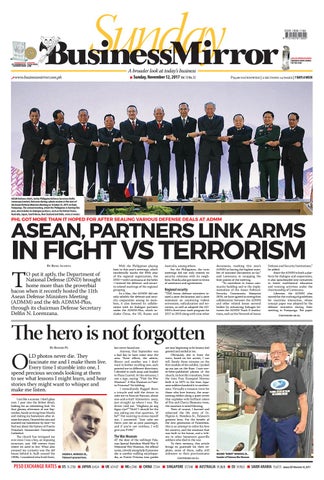
ASEAN Defense chiefs, led by Philippine Defense Secretary Delfin Lorenzana (center), link arms during a photo session at the start of the Asean Defense Ministers Meeting on October 23, 2017, in Clark, Pampanga. The annual meeting, which the Philippines is hosting this year, also includes its dialogue partners, such as the United States, Australia, Japan, South Korea, New Zealand and India. AP/BULLIT MARQUEZ
PHL GOT MORE THAN IT HOPED FOR AFTER SEALING VARIOUS DEFENSE DEALS AT ADMM
ASEAN, PARTNERS LINK ARMS
IN FIGHT VS TERRORISM T
By Rene Acosta
O put it aptly, the Department of National Defense (DND) brought home more than the proverbial bacon when it recently hosted the 11th Asean Defense Ministers Meeting (ADMM) and the 4th ADMM-Plus, through its chairman Defense Secretary Delfin N. Lorenzana.
With the Philippines playing host to this year’s meetings, which incidentally marks the 50th year of the regional organization, the DND—with Lorenzana at the helm —steered the defense- and security-related meetings of the regional grouping. As a bloc, the ADMM did not only solidify the defense and security cooperation among its members, it also fostered its collaboration with its dialogue partners under the ADMM-Plus, which includes China, the US, Russia and
Australia, among others. For the Philippines, the twin meetings did not only cement its security relations with its neighbors, Manila also got more in terms of assistance and agreements.
Regional security
“THE Asean defense ministers issued a joint declaration and a joint statement on countering violent extremism, radicalization and terrorism, as well as adopted the ADMM’s three-year work program for 2017 to 2019 along with nine other
documents, marking this year’s ADMM as having the highest number of outcome documents so far,” said Lorenzana in recapping the finer points of the meeting. “To contribute to Asean community building and to the implementation of the Asean PoliticalSecurity Community blueprint 2025, we have agreed to strengthen collaboration between the ADMM and other related Asean sectoral bodies by enhancing linkages between the ADMM Track II institutions, such as the Network of Asean
Defense and Security Institutions,” he added. Since the ADMM is both a platform for dialogue and cooperation, it also spearheaded new initiatives to foster multilateral education and training activities under the chairmanship of Lorenzana. Likewise, the ADMM also moved for the crafting of guidelines for maritime interaction, whose concept paper was adopted by the defense ministers during their meeting in Pampanga. The paper Continued on A2
The hero is not forgotten
O
By Roger Pe
LD photos never die. They fascinate me and I make them live. Every time I stumble into one, I spend precious seconds looking at them to see what lessons I might learn, and hear stories they might want to whisper and make me listen. I am like a scanner. I don’t gloss over. I peer into the littlest detail, looking for an interesting find. On that gloomy afternoon of one September, barely arriving from Manila and visiting my hometown after almost five years, I braved the rain and scanned my hometown by foot—to find out about the history of Puerto Princesa’s Immaculate Conception Cathedral. The church has intrigued me ever since I was a boy, an imposing structure, just 100 meters from where we used to live. What also aroused my curiosity was the old house behind it, built around the 1900s. I wondered who lived there,
but never found out. Anyway, that September was a bad day to have come near the area. Three offices, the admin, library and another one I don’t want to bother recalling now, each pointed me to different directions. I decided to walk away and headed to Plaza Cuartel. At the entrance, I saw a sign, saying: “Visit the War Museum”. A War Museum in Puerto Princesa? No kidding. I immediately flagged down a tricycle and told the driver to take me to Bancao-Bancao, about one-and-a-half kilometers away, just straight up where I was. The driver told me: “Magkano po ang bigay n’yo?”“Huh? I should be the one asking you that question, ’di ba?” Not wanting to stress myself out, I answered: “Just take me there, just me as your passenger, and if you’re not reckless, I will give you P100.”
The War Museum
HIGINIO A. MENDOZA SR., Palawan’s greatest hero.
PESO EXCHANGE RATES n US 51.2730
AT the door of the well-kept Palawan Special Battalion World War II Memorial War Museum, the official name, a lovely young lady (I presume she is another walking encyclopaedia, as Puerto Princesa tour guides
are now beginning to be known for) greeted and smiled at me. Obviously, she is from the town, based on her accent, I can tell. Barely three minutes on the first module of the exhibit, I picked up my jaw on the floor. I saw never-been-published photos of the church, its horrific transition, from the time Fray Exzequiel Moreno built it in 1872 to the time Japanese soldiers bombed it to smithereens. Virtually a treasure trove for those who love history, the unassuming edifice along a quiet street that explodes with brilliant colors of Fire and Cherry Blossoms trees, the museum is mind-blowing. Then of course, I learned and relearned the life story of Dr. Higinio A. Mendoza Sr., Palawan’s greatest hero. For the benefit of the new generation of Palaweños, this is an attempt to relive his love for country, and the museum that was built in his honor, and a tribute to other hometown guerrilla soldiers who died in the war. To their memory, this article brings its gratitude for their exploits, some of them, sadly, still unknown to their provincemates Continued on A2
HIGINIO “BUDDY” MENDOZA JR., founder of Palawan War Museum
n JAPAN 0.4524 n UK 67.4137 n HK 6.5740 n CHINA 7.7244 n SINGAPORE 37.7340 n AUSTRALIA 39.3828 n EU 59.7023 n SAUDI ARABIA 13.6725
Source: BSP (November 10, 2017 )
NewsSunday BusinessMirror
A2 Sunday, November 12, 2017
www.businessmirror.com.ph
Asean, partners link arms in fight vs terrorism Continued from A1
seeks to avoid untoward incidents at sea due to miscalculations. “The guidelines shall be based on Asean principles of transparency and mutual trust and shall be in accordance with all relevant national laws, rules and regulations and international law. It shall uphold all existing maritime arrangements to include the United Nations Convention on the Law of the Sea and the CUES [Code for Unplanned Encounters at Sea] and shall reaffirm Asean memberstates’ commitment to resolve disputes through peaceful means without resorting to the threat or use of force in accordance with international law,” Lorenzana said. At the ADMM-Plus, the Asean defense ministers and their dialogue partners also agreed at the necessity to keep the South China Sea open to international navigation and overflight, a position that China did not even contest. “A majority of countries declared to continue to use the South China Sea, the waters and air, as they have been using it in the past decades, without interference from anybody,” Lorenzana said, adding that “even China did not oppose all of those statements. So I think it’s okay for China, because it’s supposed to be an open water.” Another achievement during the twin meetings was the launching of the defense chiefs of the Asean Direct Communications Infrastructure (ADI), which would allow them to communicate and interact immediately through a secure hotline in times of crises and emergency situations, especially in the area of maritime operations.
Cooperation, agreements and training
WHILE the defense ministers tackled the tricky issue of the South China Sea, they, however, gave emphasis on the problem of terrorism—as it currently threatens the whole region—and how they could fight it as a single force. “Terrorism actually cuts across every country. Every country is so much concerned of terrorism because everybody is vulnerable to terrorism,” said Lorenzana, adding the defense ministers have noted the level of destruction that the problem has brought about in Marawi City. At the sidelines and even at the center of the ADMM and the
ADMM-Plus, Lorenzana sealed defense and security-cooperation agreements with Vietnam, China, Russia and Australia. With Hanoi, Lorenzana and Vietnamese Defense Minister Ngo Xuan Lich agreed to take the defense relations between Vietnam and the Philippines to new heights by stepping up their naval cooperation and collaboration. Both also agreed to put up concrete mechanisms between the two countries’ navies to prevent a repeat of a recent incident in Pangasinan wherein two Vietnamese fishermen were killed in an antipoaching operation by the Philippine Navy. “Our defense cooperation with Vietnam has been very positive, and we intend to build on those successes,” Lorenzana said. The defense secretary said the Armed Forces may even consider tapping Hanoi in developing the Philippine defense industry, as he noted how Vietnam has built and improved its own defense landscape. Lorenzana and Lich also agreed to explore the possibility of increasing the existing opportunities for exchange of senior and junior officers, information and intelligence exchange, joint training; and addressing nontraditional security challenges, such as humanitarian assistance and disaster response, piracy, illegal drugs and terrorism. On the day Lorenzana opened up the ADMM gathering, he and Russian Defense Minister General Sergey Shoygu signed two agreements, one for military-technical cooperation between Manila and Moscow, and second, for the procurement of defense articles from Rosoboronexport, a Russian stateowned company. Lorenzana and Rosoboronexport Director-General Alexander A. Mikheev signed the second agreement. The following day at the sidelines of the ADMM, Lorenzana and Australian Defense Minister Marise Payne announced the decision of Canberra for Australian forces to train Filipino soldiers in urban warfare. The training was among the assistances that both countries have arrived at following discussions between Lorenzana and Payne. “In addition, Australia has already offered to provide trainings based on the Philippines’ needs
and Australia’s capabilities. At the outset, this includes airspace coordination, urban warfare and maritime operations, among others,” Lorenzana said. Payne said the urban-warfare training for the Philippine military forms part of Australia’s efforts to curb the spread of the Islamic State. “The spread of Daesh is a threat to regional security, including the security of Australia. We recognize that no single country can address the threat of terrorism on its own,” she said. Lorenzana separately met later with his Chinese counterpart Gen. Chang Wanquan at Camp Aguinaldo, wherein both have agreed to increase Manila and Bei-
jing’s security engagements in the coming months. During their meeting, the two officials discussed the enhancement of cooperation in the fight against terrorism and violent extremism that focuses on intelligence sharing, joint counterterrorism exercises and other specialized training. They also explored the possibility of enhancing maritime cooperation, with particular focus on humanitarian assistance and disaster response (HADR), and antipiracy operations in Mindanao’s waters. They have agreed to increase visits of naval vessels as a sign of goodwill and friendship between Beijing and Manila.
Agreeing that it will be to the best interest of both countries, Lorenzana and Chang decided to increase the military-to-military personnel exchanges between junior and field-grade officers of both armed forces. “Riding on the improvement of our defense relations, it is only proper for us to move forward,” Lorenzana declared. The meeting gave Lorenzana the opportunity to personally thank Chang over China’s support to the counterterrorism terrorism operations in Marawi, saying that its earlier donations of rifles and ammunition “helped a lot in our fight against the terrorists in Marawi.”
In return, Chang hinted that China plans to donate another batch of weapons and equipment later this year or early next year.
Military aid
JUST a day after Lorenzana notched military cooperation agreements with Russia, Moscow handed over to the Philippine military 5,000 units of AK-47M Kalashnikov rifles, 20 multipurpose vehicles, 1 million pieces of ammunition and 5,000 steel helmets. The turning over of the donations was witnessed by Lorenzana and Shoygu, President Duterte, Foreign Affairs Secretary Alan Peter Cayetano and Russian Ambassador to the Philippines Igor Khovaev.
The hero is not forgotten Continued from A1
to this very day. Without much ado, here is Higinio A. Mendoza Sr.’s story, based on my personal interview with his second eldest son, Higinio “Buddy” Mendoza Jr.:
Higinio Mendoza Sr.
FATE was unkind to Dr. Higinio A. Mendoza Sr. He was born during the Spanish-American War, one of the most turbulent chapters in Philippine history, and grew to his adulthood when World War II was breaking out. He was thrown in a war everyone did not like, and when it was time for him to serve his motherland, he was captured by the Japanese Imperial Army and met his grisly death. To add more sadness, Philippine history books are profuse in mentioning Bataan, Corregidor, Cavite, Cabanatuan, Malinta, Manila, Lingayen, Leyte, etc. None had mentioned the strategic importance of Palawan and Puerto Princesa Airport in the bigger picture—in stark contrast to the recognition accorded to the latter by the Americans during the war, and in the way both are exalted in the Hall of Heroes of the American War Memorial in Bonifacio Global City today. At the outbreak of war, Palawan was one of few Philippine provinces closest to most Southeast Asian countries where the Japanese had also attacked. In the Invasion of Palawan book, a highranking American official, General Eichelberger, said: “It was important that aircraft based in Palawan intercept missions as far as Indochina, cut off Japanese sea lanes in the South China Sea, and also reach Japanese oil installations in Borneo.” That was the reason he chose the 41st Infantry Division of Maj. Gen. Jens Doe to conduct the Palawan, Zamboanga and Sulu operations. And now that we have all seen the military significance of the main island of Palawan, based on Eichelberger’s words, let’s all go back in time. To know Higinio Sr. much better, and why you and I should commemorate his death.
Early life of a hero
THE fifth of six children of Agustin Mendoza and Juana Acosta, life was not easy for the young Higinio Sr. As a kid, he and older brother Bernardino would sing and dance for some townsfolk and sell vegetables on the street. They all did this to earn a few centavos for their school baon. But, alas, the boy who started his elementary schooling in Puerto Princesa, and early years in Palawan High School (when it was still located in Cuyo), was already showing sterling leadership qualities. He even astounded everyone by becoming a cadet captain, member of a champion debating team and president of his 1919 graduating class. It was not customary for Palaweños to take collegiate studies in Manila in those days, much more
enrol in an expensive course, medicine. Where would he get money to finance a mainstream course? But Higinio was different. He had thought that if he only worked hard and strived for what he wanted, he would get it. Higinio ignited his ambition and fired it till he became a doctor. Why? He had seen how hard life was in a seemingly God-forsaken province, a land almost totally forgotten by national government officials, where development was painstakingly slow, and malaria always took people’s lives away from their loved ones. His dream was not driven by a selfish desire, but because his community has not seen a doctor for ages. And so, with a leap of faith, armed with prayers provided by his loving parents in his suitcase, Higinio crossed the big wide Pacific, boarded a Russian ship and studied in Iowa State University and University of Indiana. He then enrolled at Hahnemann Medical College to obtain a Doctor of Medicine degree, and finished in 1928. As an intern at a children’s homeopathic hospital and in Saint Luke, Philadelphia, Higinio founded a Filipino students’ club in Iowa State University, eventually becoming chairman of the university’s foreign students association. In between, he worked as an elevator boy, janitor, dishwasher, helper, and did many other odd jobs to keep body and soul together. He also pursued many other extra-curricular activities to enrich himself mentally, even becoming associate editor of The Medic, the Hahnemann Medical College Yearbook, an outstanding achievement for a little-known Palaweño then. After staying in the US for 11 years, Higinio arrived in the Philippines. As a full-fledged doctor, Palaweños in Manila gave him a warm welcome and a banquet, rejoicing in the exemplary achievement of a kababayan who had made good. His gift of gab also made him a most sought-after speaker. The ensuing events would also thrust him into the political arena. Higinio was elected governor in 1931, winning by a landslide, was reelected in 1934, but lost on his third bid when Cuyo and the rest of the Calamianes island voters opted to vote for his opponent. It was an offshoot of his decision to move Palawan High School from Cuyo to mainland Palawan, an act that angered people of the northern island group. Higinio stuck to his belief, saying: “The only provincial high school should be in the mainland where it could be more accessed by many young people.” Now on private medical practice, he continued to serve the needy, giving free medical service and medicines to his constituents. He underwent further training as a medical and reserve officer in the Philippine Army Medical Corps. During that time, war was brewing and the brave man that he was, already anticipated what was going to be the worst scenario: Fight the enemy to the end.
With that, he organized the first guerrilla force in Palawan.
The Japanese invasion
IT was the worst of times. People would often gather in front of Higinio’s house every day, to get news about the looming war. He had a radio, a gadget that gave him updated news from the outside world. He would tell his people not to despair, but unite, resist the enemy, and that America would “liberate the country soon”. A few days before the Japanese invaded Puerto Princesa, he made sure that everyone left town, including his family, whom he relocated to barrio Babuyan. When the Japanese came, he was the last to leave. Prior to the mass evacuation of people out of Puerto Princesa, Higinio attended a meeting organized by then Gov. Gaudencio Abordo to decide on a course of action. With provincial officials and leading citizens attending, and him dominating that meeting, everyone unanimously voted for a “Free Palawan Government”, a de facto form of governance by Palaweños at some safe place in the jungles in the north. This made Palawan one of only three provinces in the entire country to establish a free government, with its own currency (“Script”) to boot. Higinio’s guerrilla unit was designated as Company A of Palawan Special Battalion, the raison d’être for the existence of the Free Palawan Government. Its main role was to ambush Japanese patrols as an offensive and defensive force, focusing on jungle warfare. His resistance movement eventually grew in number and became a formidable force each day, frightening local collaborators in the town. They knew that with him orchestrating the movement, they will all be wiped out. In retaliation, the traitors made an appeal to the Japanese to hunt him, dead or alive.
Mendoza’s capture
AS in many stories of trust, treachery and deception, one of Higinio’s men, a soldier named Namia, fell into Japanese hands. Egged on to divulge what he knew about the former’s whereabouts, Namia eventually volunteered to guide the enemy to Higinio’s hiding place in Roxas. Soon after, two barges with an army of Japanese soldiers were launched and made him fall into the dragnet. At dawn, in sitio Jolo, Tinitian, Roxas, just as he was about to take his breakfast, a gunshot rang out in the air. Running to the bedroom to check on his family, Higinio was met by several Japanese soldiers who immediately pointed guns at him. He was led away from his family, roughly manhandled and tied with a rope. Trinidad, his wife, cried and cried but was kicked in the abdomen by Japanese soldiers. Higinio told him calmly, “Be brave, we can die for our country.” He went under heavy questioning and, by afternoon, the Japanese soldiers decided that he
would be taken to Puerto Princesa. At that very moment, he knew that it would be the last time that he would see his family. Many people traveled far to see him. His sister Agustina walked with her sons from Aborlan to comfort him. Meanwhile, his enemies had a heyday celebrating his capture. Higinio was allowed to make a speech in public, though. In one of those instances, he said: “It’s good that they chanced upon me in the house with my family. Had I been in the camp with my soldiers, there would be much bloodshed and I would never surrender.” In the morning of January 24, 1944, Higinio was executed before a firing squad inside his father-inlaw’s (John Clark) coconut plantation in Canigaran, Puerto Princesa. Tagbanua natives who were working in the area heard rifle shots but never revealed the killing site until 1947 for fear of the Japanese. After a series of long searches, a group of civilians found his remains but his skull was not in the grave. They are now interred in a memorial marker at Mendoza Park, the city’s main plaza.
No retreat, no surrender
HIGINIO would have escaped execution had he accepted allegiance to the Japanese flag. But he refused not to serve in the puppet government. He chose to face death rather than betray his country. Before he died, he left these words to his family: “Do not be afraid, don’t be sad. Not many are given the privilege to die for his country.” During the interview, Higinio’s second son, Philippine Coast Guard Auxiliary and VADM Higinio C. Mendoza Jr., was misty-eyed as he quoted the same line. “Buddy,” as he is often called by Palaweños in Puerto Princesa, founded the Palawan Special Battalion WW-II Museum and financed it on its own to honor his father. It was inaugurated on December 5, 2011, and was officially opened to the public on the day of Pearl Harbor bombing on December 7. It is located along Rizal Avenue Extension, barangay BancaoBancao, Puerto Princesa City. The museum is also in honor of the Palawan Fighting 1000 Guerrilla and American soldiers who sacrificed their lives in defense of their freedom. Among those on display: A historic typewriter used by the Free Palawan Government in printing Palawan Script Money during WWII, a WW2-era Willy’s jeep, .50-caliber guns, rifles, pistols and photos that chronicle the war era and that of the Palawan POWs. It also has the most complete collection of bayonets and helmets used in the war. The museum brings to life memorabilia items which many people today have not seen. Artifacts from the American-Muslim conflict in the early 1900s and a 1957 Buick are also on display. One of Buddy’s sons is Matthew Mendoza, currently City Councilor of Puerto Princesa.
www.businessmirror.com.ph
The World BusinessMirror
Sunday, November 12, 2017
A3
Here’s how far the world is from meeting its climate goals
T
wo years after countries signed a landmark climate agreement in Paris, the world remains far off course from preventing drastic global warming in the decades ahead. On Monday the latest round of post-Paris international climate talks began in Bonn, Germany, to discuss how to step up efforts.
Under the Paris deal, each country put forward a proposal to curtail its greenhouse-gas em i ssions bet ween now a nd 2030. But no major industrialized country is on track to fulfill its pledge, according to data from the Climate Action Tracker. Not the European Union. Not Canada. Not Japan. A nd not the United States, which under President Donald J. Trump is still planning to leave the Paris agreement by 2020. Worse, even if governments do take further steps to meet their individual pledges, the world will still be on pace to warm well in excess of 2 degrees Celsius over preindustrial levels (3.6 degrees Fahrenheit), the threshold that world leaders vowed to avoid in
Paris because they deemed it unacceptably risky. “One year after the Paris Agreement entered into force, we still find ourselves in a situation where we are not doing nearly enough to save hundreds of millions of people from a miserable future,” said Erik Solheim, head of the UN Environment Program (Unep). Even before Trump’s election, the goal set by former President Barack Obama of slashing US emissions 26 percent to 28 percent from 2005 levels by 2025 would have been difficult to hit. While emissions from the US power sector are falling rapidly—as hundreds of coal-fired plants are retired in favor of cleaner natural gas, wind and solar—other sectors, like transportation and
heavy industry, have proved harder to clean up. Trump, for his part, has disavowed his predecessor’s pledge and is dismantling Obama-era regulations designed to push dow n emissions further, such as the Clean Power Plan. A nd while states like New York and Ca l ifor nia are sti l l pursu ing their own policies on renewable energ y and electr ic vehicles, they may not prove sufficient to close the gap. For now, analysts think the United States will fall well short of its Par is pledge. T hat, in turn, could make it harder for future administrations to pursue the deeper emissions cuts by mid-centur y needed to help keep the world below 2 degrees of global warming. Climate Action Tracker provides a rough estimate of the cuts each country will need to make to avoid 2 degrees Celsius of warming, with wealthier nations expected to do more. How to divide the burden remains a major debate within climate talks. The EU may fall slightly short of its promise to cut emissions 40 percent by 2030, compared with 1990 levels. While European officials have created a continentwide cap-and-trade system to curb emissions from electricity and heavy industry, that regulation leaves out sectors like transportation and agriculture.
Progress among individual European countries has been mixed: Over the past two years, Britain has been rapidly phasing out coal power, aided by a national carbon tax and cheap natural gas. But Germany is expected to miss its near-term emissions goals, as recent rapid growth in renewables has been partly offset by the closure of nuclear power plants. Outside experts say that China crafted a Paris pledge that was relatively easy to meet: Overall emissions would peak around 2030 and the country would get 20 percent of its energy from non-fossil sources. Several recent studies suggest that China’s emissions could peak years ahead of schedule as the country’s once-insatiable demand for energy slows (although other analysts have questioned the accuracy of China’s emissions reporting). The central government has already canceled plans for 100 coal plants and is investing heavily in cleaner sources like solar, wind and nuclear. The country also plans to sell millions of electric vehicles in the years ahead. Yet, keeping the world below 2 degrees of warming would likely require China’s coal emissions not just to f latten but to fall sharply by 2030. Because India is still relatively poor, with 240 million of its citizens lacking access to electricity,
the nation has long argued that wealthier countries should take the lead on cutting emissions. As such, India’s pledge was less restrictive than pledges from Europe and the United States. The country vowed to install more clean energy and improve its carbon intensity—the amount of carbon dioxide emitted per unit of gross domestic product—while still allowing total emissions to rise between now and 2030. India’s per-capita emissions would likely remain below those of China or the United States. Some recent studies have suggested that India can achieve those modest goals, as the falling cost of renewables and shifting market conditions have allowed the country to scale back its plans for new coal plants after 2022. A recent report from the Unep argued that India had “ample room” to strengthen its emission pledges—as would likely be necessary to help keep the world below 2 degrees of warming. But the Indian government has asked for aid from wealthier countries to do so.
What happens next in climate talks?
N egotiator s a re me et i ng in Bonn this month to discuss guidelines for making national pledges and policies more transparent, so outsiders can gauge individual countries’ progress (or lack thereof ) more precisely.
In 2018, climate negotiators plan to embark on a major effort to assess the world ’s progress on climate change and measure it against the 2-degree goa l. Countries can then revise their individual climate pledges accordingly—and do so every five years thereafter. Right now, many of the Paris pledges remain fairly opaque, and most nations have been vague on what specific policies they w ill implement to meet them. There is no official mechanism for quantifying progress. As a result, groups like Climate Action Tracker have had to make rough estimates as to whether nations are on pace to meet their pledges—and how much further each country will need to go for the world to stay below 2 degrees of global warming. Increasing the transparency of pledges would make it easier for countries to pressure each other to do more, which is how the Paris Agreement was designed, said David Victor, a professor of international relations at the University of California, San Diego. “Countries could come back and say, ‘Here’s what has worked, what didn’t, what our progress is and what other countries can learn,’” Victor said. “We know from other areas of international cooperation that that dynamic actually works pretty well.” The New York Times
A4
Sunday, November 12, 2017
The World BusinessMirror
www.businessmirror.com.ph
Saudi foreign ministry urges citizens to leave Lebanon as Iran tension rises
S
AN employee removes Fiat Chrysler Automobiles NV (FCA) side panels from a press at FCA’s Sterling Stamping Plant in Sterling Heights, Michigan, on August 26, 2016. FCA US announced that it would invest $166 million to install the new presses to increase the stamping capacity at the plant. BLOOMBERG
US factory workers are falling out of love with Donald J. Trump
D
onald J. Trump’s honeymoon with US factory workers may be over after his trip to China, if the views of a manufacturers and labor group are any indication. “We are bitterly disappointed with the president’s failure to demand systemic reforms in our economic relationship with China,” Scott Paul of the Alliance for American Manufacturing said in a statement on Thursday. “This trip was all for show.” The group, a Washington-based nonprofit partnership of producers and the United Steelworkers union, demanded that Trump complete trade investigations on
steel and aluminum as soon as he returns to the US. More than 60 steelworkers spoke to US lawmakers and their staff in September about the need to address global steel overcapacity, with the intention of pushing the Trump administration to finish an investigation into whether imports threaten national security. Later the same week, Commerce Secretary Wilbur Ross said the government was postponing
a decision on steel tariffs until a tax bill is passed. The manufacturers group’s comments on Thursday come after the President called out China for unfair trade practices, but blamed his predecessors rather than China. “While Trump is not wrong in pointing the finger of blame back to the United States for negotiating poor agreements and providing lax enforcement, that finger
is now pointed at him,” Paul said. “There has been no tangible progress in reducing China’s mammoth industrial overcapacity in sectors such as steel, aluminum and semiconductors.” Paul, who is president of the group, quit a Trump advisory council earlier this year in the wake of the Republican’s initial reluctance to condemn white supremacist violence in Charlottesville, Virginia. Bloomberg News
We are bitterly disappointed with the president’s failure to demand systemic reforms in our economic relationship with China. This trip was all for show.”—Paul
audi Arabia has advised its nationals to leave Lebanon, further fueling fears of a heated confrontation with Iran in a country long known for being a battleground for proxy wars in the Middle East. The guidance was due to the “situation” in Lebanon, the official Saudi Press Agency cited the foreign ministry as saying, without giving details. It comes five days after Lebanese Prime Minister Sa ad Har ir i une xpectedly resigned in a speech from Saudi Arabia. Kuwait said it also called on its nationals to leave. Lebanon is in the crosshairs of the esca lating tension between Sunni-led Saudi A rabia and Shiite-led Iran, who are on opposite ends of conf licts across the Midd le East. Iranbacked Houthi rebels in Yemen which launched a missile at the inter nationa l airport in Riyadh—an attack Saudi officials said could be an Iranian “act of war.” That day, Lebanon’s Prime Minister Saad Hariri—a pro-Saudi politician—abruptly resigned, issuing a statement in Riyadh blaming Iran for meddling in Lebanon’s affairs via its proxy, Hezbollah. Iran denied supplying Houthi fighters with missiles, and accused Saudi Arabia of trying to escalate tensions. “ T he sa fet y net L eba non h ad is no longer i n pl ace,” Sami Nader, head of the Beir ut - ba se d L e v a nt I n st it ute for Strateg ic A ffairs, said by phone, adding that Lebanon may face the same kind of economic sanctions imposed by a Saudi-led a l liance on Qatar since June. “We should expect further escalation from Saudi A rabia against Lebanon.” After Hariri ’s resignation, Saudi Arabia warned the Lebanese government of the dangers of Hezbol lah, accusing the group, which is part of the Lebanese government, of being involved in every terrorist attack that threatens the kingdom. It has denied forcing Hariri to resign.
Warning
“We won’t accept Lebanon taking part in a war against Saudi Arabia,” State Minister for Gulf affairs Thamer al-Sabhan said in an interview with al-Arabiya television. “The Saudis will take
all political measures and more to confront Hezbollah.” French President Emmanuel Macron said he will make a stopover in R iyadh Thursday night on his way back to Paris from Dubai, to discuss re g ion a l i s s ues w it h S aud i Crown Prince Mohammed bin Sa lman. Topics w il l include the political crisis in Lebanon, wars in Yemen and Syria, and tensions with Iran. The “stability and security” of Lebanon is France’s priority, Macron said. The president said he had “informal contacts” with Hariri, declining to comment on his decision to resign. Other Gulf nations are rallying around Saudi Arabia against Iran. Anwar Gargash, the United Arab Emirates minister of state for foreign affairs, called for Iran’s ballistic program to be tackled as “an urgent priority” after the Houthi attack on Riyadh’s airport.
Embargo
Iran is also central to the Saudi-led embargo on Qatar. The alliance accused it of sponsoring terrorism and cozying up to Iran, charges the Gulf nation has repeatedly denied. Hariri stepped down at a time when Iran and its allies are widely seen to have won the proxy war against Sunni powers in neighboring Syria. Lebanon, a battleground of proxy wars during its 1975199 0 c iv i l wa r, h a s l a rgely avoided the sectarian massacres that ravaged its larger neighbor for more than six years. Even so, the conflict has weighed on Lebanon’s economy, cutting major trade routes and bringing more than 1 million refugees into the country. The instability has rattled financial markets. Lebanon’s $1.54-billion euro bonds due 2022 tumbled, sending the yield up 40 basis points to 8.31 percent as of 4:16 p.m. in London, according to data compiled by Bloomberg. Lebanon’s President Michel Aoun said this week that markets are stable and that there was no run on the country’s banks. In a news statement issued on T hursday, Har ir i ’s Future Movement ca l led for the former pr ime minister’s retur n to L eba non, say i ng t h at it wou ld uppor t him regard less of circumstances. Bloomberg News
US-trained economist Liu poised for key role in China debt cleanup
L
iu He, a key adviser to Chinese President Xi Jinping known for guiding economic policy behind the scenes, appears destined to occupy more of the spotlight. The 65-year-old Cultural Revolution survivor turned Harvard-educated technocrat rose to prominence by doing a series of crucial jobs quietly. Now, analysts say the stage is set for him to become Xi’s key lieutenant tasked with preventing a financial meltdown. On Wednesday, it was announced that a new committee charged with corralling China’s disparate financial regulators into concerted action was led by 71-year-old Vice Premier Ma Kai. According to Communist Party conventions, Ma is due to retire soon, leaving Liu—freshly appointed to the Politburo—the obvious choice for the role. “Liu will be like a Chinese version combining both Larr y Summers and Ben Bernanke, plus the chairman of the president’s economic council,” according to Shen Jianguang, chief Asia economist at Mizuho Securities Asia Ltd. in Hong Kong. “He will not only oversee overall financial markets including monetary policy and financial supervision, but also the relevant fiscal and reform policy.” Shen described Liu as “the brain” behind supply-side reform efforts to cut overcapacity and boost the role of market forces and said he’ll be a key figure in shaping China’s economic blueprint for the next five years.
A fax to the People’s Bank of China, which hosts the executive office of the State Council Financial Stability and Development Committee, went unanswered Thursday.
Debt challenge
W i th an economy-wide debt level approaching three times annual output, comprised mostly of a complex web of corporate and household borrowing, China must ease its addiction to credit without creating a collapse in asset values that would seriously hamper the economy. A member of Xi’s inner circle, Liu has played a behind-the-scenes role as director of the Communist Party’s general office of the Central Leading Small Group for Financial and Economic Affairs, which is chaired by Xi himself. He’s also been vice chairman of the National Development and Reform Commission (NDRC), the government’s top economic planning body. “It’s clear that Liu He is going to be powerful in setting economic strategy, whether as vice premier or whatever title he is given,” said James Stent, author of “China’s Banking Transformation: The Untold Story” who spent more than a decade serving on the boards of Chinese lenders. Referencing a book that Liu wrote comparing the 1929 and 2008 crises in the US, Stent says he understands financial crises well. “He will move to deal with the problems in
the system, but in a way that does not shock the system unnecessarily,” he said. While Liu has avoided the spotlight, many economists regard him as the voice behind an anonymous missive on debt published in the People’s Daily in May 2016. The Communist Party newspaper published the comments from an unnamed “authoritative person,” who said China must face up to its nonperforming loans and other risks associated with soaring debt.
Authoritative person
“It’s widely understood in the industry Liu is the person,” said Xia Chun, a visiting professor at the University of Hong Kong. “His comments on the economy are accurate and constructive. What’s even more commendable is that he never shies away from the problems and difficulties in China’s economy.” In China’s opaque policy world, there’s no guarantee Liu will be appointed to lead the new oversight body. But Xia, like Mizuho’s Shen, says he’s likely to lead the panel. Last December, when Xi convened the party’s annual Central Economic Work Conference to review progress and map out the plan for 2017, top policy makers emerged saying that they would prioritize preventing and controlling financial risk to avoid asset bubbles. They also set out a “prudent and neutral” monetary policy, which top officials have echoed this year.
Liu entered Beijing’s Renmin University in the late 1970s, earning a degree in industrial economy, according to a biography published last month by the official Xinhua News Agency. He studied business at Seton Hall University in South Orange, New Jersey, from 1992 to 1993 and the following year began studies at Harvard’s Kennedy School of Government, earning a master’s degree in public administration in 1995. A former soldier and factory worker who was sent to the northeast in the midst of the country’s 1966-1976 Cultural Revolution, Liu helped draft the five-year plans that underpinned the economy. Liu spent much of his career in the State Planning Commission, the predecessor of the NDRC that formerly set prices for everything from bicycles to grain.
Global role
The economist has played an important role in the relationship between the two largest economies. As global markets cratered during the US financial crisis, then-Treasury Secretary Timothy Geithner and National Economic Council Director Summers separately made time for Liu, a link to top leaders in Beijing, Bloomberg News reported at the time. While Liu can be a smart and thoughtful expert, he ultimately remains a servant of Xi, according to George Magnus, an associate at Oxford University’s China Centre and former adviser at UBS Group AG. Bloomberg News
Science
BusinessMirror
www.businessmirror.com.ph • Editor: Lyn Resurreccion
Sunday
Sunday, November 12, 2017
Transforming PHL into a global supplier of prefab housing materials
T
By Rizal Raoul Reyes
@brownindio
he Department of Science and Technology (DOST), in partnership with Revolutionary Precrafted, has a lofty objective: to revolutionize the housing industry and transform the Philippines into a global housing materials prefabrication center. “ The entire idea of this partnership is to make the countr y a supplier of housing materials in the global market,” Carlos Primo David, executive director of the DOST ’s Philippine Counci l for Industr y, Energ y and Emerging Technolog y Research and Development (PCIEERD), said in a press briefing recently after the signing of the memorandum of agreement with the $1-billion company. For his part, Revolution Precrafted CEO Robbie Antonio said his company will eye the low-cost housing market not only in the Philippines but overseas because housing shortage is one of the major problems in the world. The DOST and Revolution Precrafted plan to build houses in response to the critical need for shelter, especially for the people in the marginalized sector. David and Antonio agree that the setup is perfect for a disasterprone country like the Philippines.
“We need to build relief centers and emergency shelters in the fastest possible time,” Antonio pointed out. David said the DOST will lead the research and development component in the project, as it will guide and share its experience in the development of a particular project. He also pointed out that the initial project will be a test case for the two parties. “If it provides values to Revolution Precrafted, it will showcase our research and development capability not only in real estate but in other areas, as well,” David added. For the initial stage of the tieup, the objective is to establish “small and quick wins.” Moreover, the researchers of the DOST will evaluate what products are needed by the market and streamline them for possible commercialization. Asked why a global company with huge financial resources
Executive Director Carlos Primo David of the Philippine Council for Industry, Energy and Emerging Technology Research and Development of the Department of Science and Technology, and Revolution Precrafted CEO Robbie Antonio sign a memorandum of agreement for the research and development and production of prefabricated housing materials for low-cost houses. Roy Domingo
opted to partner with a government agency, Antonio said they need the smartest minds to solve complex problems. “ We a lso need them to work in developing sustainability solutions for the env ironment,” he ex plained.
In the first six months, David said engineers of Revolution Precrafted and the DOST will conduct researches on how to develop the technology for lowcost prefabricated homes. Since it has huge exposure in constructing homes in the local
We missed the boat in the technology revolution on the Internet and the rapid developments on mobile phones. This time, we must be in the forefront of this development [as lead supplier of prefabricated housing materials].”—David
and foreign markets, Antonio said his company can focus on developing curve cement boards and straight slabs. Meanwhile, David said he has found out that plywood can be developed w ith minimal cost by using spent tea leaves a commercial drink manufactured by a local conglomerate. “It is perfect for the manufacturing of plywood, one of the most expensive components of low-cost housing,” he said. Antonio said there should be more efforts in technology transfer to the developer from the scientist to push the development of low-cost housing. He also pointed out that the Philippines has a great potential in prefabricated housing because it is a fragmented industry. “Our partnership w ith R e v olut ion P re c r a f t e d i s a n id e a l s e t up, a s w e a re goi n g t o m a k e l o c a l p r o du c t s . A t t he s a me t i me , w e a re o p e n t o out s ou rc i n g ,” D av id s a id . Antonio added that robotics and artificial intelligence can make the manufacturing of the materials more affordable. David pointed out that the Philippines should seize this big opportunity in the prefabricated industry, as it has the brains and materials to become a global leader. “We missed the boat in the technology revolution on the Internet and the rapid developments on mobile phones. This time, we must be in the forefront of this development,” David added.
Simple, accurate coffee moisture meter
N Students watch a film at the Science Film Festival. Photo from the Facebook page of Science Film Festival
Science and film merge anew in fest S
cience a nd f i lm merge again in this year’s Science Film Festival and with it comes 29 f i lms that capture science concepts in the most imaginative stor ytelling. The Department of Science and Technology-Science Education Institute (DOST-SEI) is glad to lend a hand to Goethe Institut in bringing the annual Science Film Festival to the Philippines. The festival, which is organized in the country for the eighth straight time, has been delighting audience since November 6 through an opening ceremony and film screening at the Imax Cinema of SM North Edsa. Students, educators, science professionals and film enthusiasts participated in the event. Besides the screening of select science films, the audience took part in exciting games and handson experiments that are tied-up to the films and meant to enrich the viewing experience. This year’s theme, “Anthropocene: Welcome to the Age of Humans,” is a timely take on human imprint on earth. The films explore mankind’s role in geological changes through topics, such as urbanization, mobility, nature,
evolution, food and human-machine interaction. In a message, DOST-SEI Director Dr. Josette Biyo said the DOST-SEI shares Goethe Institut’s vision of a science-attuned global community. “We acknowledge the potential of using films in successfully communicating complex scientific concepts,” she added. SEI, in fact, has its own science film competition and festival in Indie-Siyensya, which is now on its sophomore run. Select films were screened on November 7 at the University of the Philippines Diliman College of Mass Communication Auditorium, and on November 20 at the National Biotech Week Celebration at Brentwood Suites in Quezon City. The films will also reach students from various parts of the country through SEI’s Science Explorer. The Science Explorer is the country’s first and only mobile learning facility that caters especially to schools that have no science laboratory. The 2017 Science Film Festival is celebrated in 23 countries all over Southeast Asia, Africa, South Asia and the Middle East.
ow there is a simple, inexpensive yet accurate coffee moisture meter for green coffee beans and coffee parchment. Thanks to the project funded by the Philippine Council for Agriculture, Aquatic and Natural Resources Research and Development of the Department of Science and Technology (DOSTPCAARRD). Phi l ippine cof fee far mers, buyers and processors need not employ the traditional, subjective, slow, destructive and costly way of moisture content measurement. Researchers from the Philippine Center for Postharvest Development and Mechanization (PhilMech) have developed a better alternative, through
the PC A ARRD-funded project “Development of nondestructive moisture meter for green coffee beans and parchment coffee.” The research team, led by Engr. Arlene C. Joaquin of PhilMech, in partnership with a local electronic company, made a prototype unit coffee moisture meter using a capacitive sensor oscillator circuit for both green coffee beans and coffee parchments. Joaquin, in a project report, indicated that the protot y pe moisture meter is sufficiently accurate for three coffee varieties: Coffea arabica, Coffea liberica and Coffea canephora for both green coffee beans and coffee parchments. This was the result of calibration experiments
and validation tests conducted at PhilMech, Nueva Ecija. It is important to know the amount of moisture content in coffee parchment and beans to maintain high cupping quality. Green coffee bean with high moisture content (greater than 12 percent wet basis) can deteriorate due to bacteria, mold and yeast. On the other hand, coffee beans with less than 9-percent moisture will shrink and become distorted, making them appear as low quality beans. To ensure the best quality in coffee, monitoring its moisture content at all times after it is dried is necessary to command a better price at the time of sale. S&T Media Service
Lab chimps are moving to sanctuaries, but slowly
B
LUE RIDGE, Georgia—On the 16-hour ride from Louisiana, Bo looked out the window, took in the scenery, dozed and relaxed. He was traveling with five other male chimps from the New Iberia Research Center in Lafayette, Louisiana, where they had been members of a colony of nearly 200 animals kept for biomedical and other research. During the ride, some of the other chimps hooted, restless and unsettled. Not Bo. “He’s the best,” said the driver of the truck. The animals arrived at Project Chimps, a sanctuary at the southern end of the Blue Ridge Mountains about 100 miles north of Atlanta, at 6:30 a.m. one day last spring. As the sanctuary staff began to open the truck and move the chimps’ cages inside the facility, the occupants hooted and screamed, anxious and uncertain about what was going on. The first cage was opened into a sort of antechamber, and a chimp named Jason was first to explore his new home, rushing with what seemed like nervous energy through a small door into the large habitat. Called a villa, the enclosed space is built like an extremely large metal cage, about
1,500 square feet and two stories high with metal platforms at different levels. Jabari, the second arrival, slowly joined Jason to explore the new enclosure, but they kept their distance from each other. Lance was third in line, hesitant to leave the small antechamber. The staff waited about a half-hour for him to build up his nerve. Then, hoping to encourage Lance, they decided to let in Bo, the group’s dominant chimp. Bo knuckle-walked, casually and confidently—knuckle-swaggered, you might say—into the large enclosure. Lance followed immediately. And then the group hugs began. Eddie and Stirlene, the last two chimps, came through the entrance to more hugs. The group’s relief and happiness was so infectious that all the humans smiled. The chimps lipsmacked and held one another’s genitals. “That’s normal reassuring behavior,” Jen Feuerstein, the top administrator at the sanctuary, told me. Bo was in the house, and all was well. It probably will stay that way in the long run: The era of biomedical research on chimpanzees in the United States is effectively
over. Given the nearly 100-year history of experimenting on chimps, the changes seemed to come fairly quickly once they began. In 2011 the director of the National Institutes of Health (NIH), Francis Collins, declared that the NIH would fund no new biomedical research using chimps, which he described as “our closest relatives in the animal kingdom” deserving of “special consideration and respect.” His comments were both stunning and obvious. Jane Goodall, the famed primatologist, and others had shown the world the richness of chimp intelligence and social life; molecular biology had revealed that humans and chimps share 98 percent of their DNA. But the biomedical scientific establishment has long emphasized the importance of animal research. Collins’s decision reflected ethical concerns among scientists about the treatment of such social, intelligent animals. But on a practical level, the care of chimps is costly, and they aren’t always a good model in which to study human diseases. They’re also a magnet for public concern. New York times News Service
A5
Nipa sap is source of healthy and natural sweetener
C
ool a nd zest y energ y d r i n k , s we e t ye t sou r wine, brown penuche, or drizzled as golden granules over hot and steamy suman (sticky rice delicacy wrapped in banana or coconut leaves). These are a few of the comprehensive, wide-angle views of this delicate sap—from the simplest tuba (palm wine) recipe to potential feedstock for ethanol production. Meant to be sampled and appreciated over the years, greenhorns can pick up and make something right away, while skilled cooks will find plenty of wiggle room for innovation.
From where it came
N ipa , c o m mo n l y k no w n a s the nipa palm, is a species of palm local to coastlines and brackish habitats. As the only palm considered adapted to marshy ground with its trunk or stem under the mud while its leaves project upward, its uniqueness is exceeded only by the manifold uses one can explore from it. Consider these products— roof thatch, mats, baskets and other household items, wine, vinegar, instant energy drink, tea, golden syrup or liquid sugar, penuche or coarse grade sugar, feedstock for ethanol production—and recently low glycemic index (GI) granulated sugar—all from nipa and its sap. The cornucopia of nipa products has evolved through a complex interaction of its natural environment and different cultural trends. A 177-year-old tradition passed down through generations and authenticity are the recipe ingredients for the popularity of some of these products. Essential yet lesser-known, some of these have yet to be tried, still others may never make it into any booklist, if at all.
Low GI alternative sugar from nipa sap
At the Industrial Technology Development Institute (ITDI) of the Department of Science and Technology, its Food Processing Division (FPD) has successfully developed an improved collection system for nipa sap. The new method uses transparent flexible pouches. Using this system minimizes deterioration of quality and inversion of sugar in the sap. In addition, one can obtain clear nipa sap during an entire eight-hour collection period. To evaporate moisture from the collected sap, FPD designed a double-jacketed kettle. This innovation prevents scorching while cooking.
Sweetness at its healthiest
What makes this indigenous sugar substitute a great alternative to commercially sold white sugar is its relatively low glycemix index at 60. Glycemix index is a number associated with the carbohydrates in a particular type of food that indicates the effect of these carbohydrates on a person’s blood glucose or blood sugar level. A value of 100 represents the standard, an equivalent amount of pure glucose. With this, nipa sap can be effectively used to replace table sugar and artificial synthetic sweeteners. It can also be used as a food ingredient in native kakanin (delicacies), confectionaries and pastries. Classified in food materials as food additive that duplicates the effects of sugar in taste with less food energy or calories, sugar from nipa sap is rich in minerals, which provides some health benefits that can reduce and regulate blood sugar level, as well as boost the immune system. Easy to digest, these golden brown crystals can also help to elevate moods without some of the disadvantages of table sugar. S&T Media Service
Faith A6 Sunday, November 12, 2017
Sunday
www.businessmirror.com.ph • Editor: Lyn Resurreccion
Lives of anxiety: Immigrants seek sanctuary in US churches
N
EW YORK—Amanda Morales sees her children off to school each day from the entrance of a gothic church, but she won’t even venture onto the sidewalk for fear of what may happen if she leaves the building where she has been a virtual prisoner for more than two months.
Morales has been living in two small rooms of the Holyrood Episcopal Church at the northern edge of Manhattan since August, shortly after immigration authorities ordered her deported to her homeland of Guatemala. She says she cannot go back to her country and does not want to leave her three kids, who are all United States citizens by birth, so she sought sanctuary at a house of worship. “Being cooped up like this is starting to drive me crazy,” the 33-year-old said on a recent morning as her two oldest children headed off to school escorted by a volunteer, and she stayed behind with her youngest. “Some nights I hardly sleep.” At least t wo dozen immigrants have sought sanctuary at US churches since the Immigration and Customs Enforcement (ICE) agency stepped up arrests by 40 percent under President Donald J. Trump. Morales provided a glimpse of her experience to The Associated Press, describing a life of constant anxiety that involves staying hidden all day, except for a few furtive trips to a nearby dentist and occasional appearances on the church steps. She has reason to be anxious. As a fugitive, she could be arrested at any moment, though the agency considers churches to be “sensitive locations” and generally does not pursue people inside. Morales stays close to the doorway as her kids head off to school, holding her toddler son’s bottle as he plays in the wooden pews. It is the only glimpse of sunlight she will get all day. Most of her life revolves around a small church library where there are two bunk beds for the family of four to share and an adjacent room with a refrigerator, small table, a few chairs and a microwave oven. They eat simple meals, a lot of macaroni and cheese or chicharron and yuca. The stately church is empty on a weekday morning. Morales spends much of the day chatting
97,000
The estimated number of immigrants living illegally in the US who were detained over the first eight months of 2017, a 43-percent increase over the same period in 2016
with parishioners who come from the mostly Latino neighborhood. Three days a week, while her daughters are at school, volunteers give her English language classes while 2-year-old David watches cartoons on her phone. The older girls—10-year-old Dulce and 8-year-old Daniela— come back in the afternoon with their escort, and the family tries their best to pass the time inside. “I never thought this would happen to me,” Morales said at one point, shaking her head sadly. Since 2014 at least 50 publicly known cases have emerged of people seeking sanctuary in churches for immigration-related reasons, according to Rev. Noel Anderson, a coordinator for the Church World Service, a New York organization that supports the sanctuary efforts. Of those, 30 have come up since Trump took office in January and pledged a harder line on immigration. Eighteen of the 50 eventually won legal reprieves, and their deportation orders were canceled. More than half are still waiting in limbo like Morales and fearing that they could be picked up suddenly, just as several immigrants in Virginia were when they got arrested in February while leaving a homeless shelter at a Methodist church. It was hardly a surprise that Morales would turn to a religious organization for help. Back in her small Guatemalan hometown, the local Catholic
In this October 26 photo, Amanda Morales, 33, poses for a photograph in the sanctuary of the Holyrood Episcopal Church, northern Manhattan. Morales has been living in the gothic church since August after immigration authorities ordered her deported to Guatemala. AP/Kathy Willens
church was one of the largest buildings and the center of community life. She grew up not far from the border with Mexico, in a landscape known for Mayan ruins scattered through the deep green forest. But while aesthetically beautiful, the area was desperately poor, with few jobs. Like many Guatemalans, she turned north to raise money to send back to her family. She was detained crossing the US-Mexico border in Texas in 2004 and released with an order to appear before an immigration judge, who issued a removal, or deportation, order four months later. Mora les stayed in the US, living first in Mar yland with a sister who died in an accident in 2006 and then on Long Island, New York, in a neighborhood that has filled in recent years with Central Americans f leeing the poverty and gang violence of their home countries. She worked at a dry cleaner, among other under-the-table jobs, and had her children with a father who she would not discuss. In 2012 she was in a car accident, and immigration authorities rediscovered her. She checked in regularly as required while she sought some way to stay in the US. This past summer, she came to her appointment and was told to come back with a one-way ticket to Guatemala. At that point, she f led to the church with the help of a New Sanctuar y Coalition, an interfaith group that helps immigrants. Trump has said that anyone in the US illegally is subject to deportation, unlike under President Barack Obama, who said immigrants with long-standing ties to the US and clean records were
not a priority. More than 97,000 immigrants who live illegally in the US were detained over the first eight months of this year, a 43-percent increase over the same period in 2016, according to ICE data. Morales is afraid of being part of those statistics, so she tries to stay calm and upbeat for David, who hardly leaves her side and plays in her lap, pulling her long, curly dark hair, kissing her and tickling her ears, laughing. She says taking the kids back to Guatemala is out of the question. “It would be taking the future away from my kids if they go to Guatemala,” she said. While Dulce and Daniela attend an after-school program at the church, Morales puts David down for a nap and watches Spanishlanguage TV at low volume. Throughout the day, she often looks at the photos and videos on her phone of her kids’ birthday piñata parties in her Long Island yard and talks with excitement about her big family and the most recent job she had at an instrument-strings factory. The church pastor, the Rev. Luis Barrios, said she will be there as long as needed, which for some immigrants in church sanctuary has meant a few days, weeks or many months, usually until the government grants a temporary stay of the deportation. On a recent evening, the girls and David sat on the f loor and tried to put together a toy volcano. Morales complained because Daniela ate only a hard-boiled egg and some mango for dinner. The girls did some homework and read in bed. “I tell myself,” Morales said, “this is going to end one day.” AP
Saint Josaphat Kunseyvc, bishop and martyr By Corazon Damo-Santiago
O
rthodox is derived from the Greek word Orthodoxia, which means the right opinion or adherence to correct or accepted creeds. The Orthodox Church, founded by Jesus Christ and his apostles on Pentecost Sunday of 33 AD, witnessed the descent of the Holy Spirit. For decades the Church has been divided between the Latin-speaking West with Rome as its center, and the Greek-speaking East with Constantinople as its seat. Through the centuries, there were political, cultural and religious differences between and among Christian leaders in the East and the West, which resulted in tensions, hostilities and difficult relationships in both groups. After the 1054 Great Schism, both Western and Eastern churches considered themselves Orthodox and Catholic. I t is the western churches, though, which continued to be uniquely orthodox and Catholic through the years. Today, Western or Eastern churches refer not to geographical locations but to historical origins and differences in liturgy. Saint Josaphat Kunseyvc lived to deal with the tensions, misunderstandings and hostilities between Orthodox Christians and the Uniates.
Ordained as Uniates
John Kunseyvc was born of noble parents in 1580 in Vladimir, Ukraine. His father, an Orthodox, is burgess for a wealthy family. A talented teen, he spent time praying, and learned almost the entire breviary, then studied ecclesiastical law. In 1595 and 1596 five Orthodox bishops decided to commit millions of Christians under them to the care of Rome in the Synod of Brest Litovsk. They were called Uniates because an agreement was concluded in the city of Brest, which was then part of Poland. Millions of Orthodox Christians considered the Uniates traitors to their traditions because of their desire to become Romanized. The rift caused misunderstandings and violence among the Uniates and Orthodox adherents. John saw martyrs died on both sides. Although raised as Orthodox, John joined the Uniate Ruthenian Church. He severed his partnership with a wealthy merchant and his daughter in marriage, and entered the Monastery of Holy Trinity in Vilna. He became a good friend of Benjamin Rutsky, who joined the Byzantine Rite on the orders of Pope Clement VIII, after converting from Calvanism. Together, they made plans to work together to reunite the people with Rome. But assigned to different places after ordination, plans did not materialize. John, who took the name Josaphat,
was assigned in Kiev. He found out that his superior, Samuel, never accepted unity with Rome. A dissident, he was seeking ways to fight the Roman Catholic Church, so John informed Rome about the problem. The Archbishop of Kiev removed Samuel, and Josaphat was assigned to replace him.
For the supremacy of Saint Peter
Priests during his time did not teach catechism and seldom preached. Josaphat published a new cathechism and exerted indefatigable zeal preaching, hearing confessions in hospitals, churches and even in open fields. He lived a life of mortification, fasting and abstinence. He slept on the floor and practiced an austere life. How he lived and the synods he conducted proved helpful to reform the clergy. People admired his examples on how to love God and others. He bowed with deep “reverence, his head almost touching the floor to say: Jesus Christ, Son of God, have mercy on me, a poor sinner.” An eloquent speaker, Josaphat was able to encourage many Orthodox to join the Uniates. A dissident group of Schismatics and Ruthenian nobilities were alarmed. They preferred their national rite and feared being Romanized. Anxieties were heightened when a relative of the Greek emperor and the patriarch of Moscow were coverted by Josaphat. Josaphat would say: “I am ready to die for holy union with Rome and for supremacy of Saint Peter,” when he was reminded of his advocacy. He was cautioned of a possible danger on a scheduled pastoral visit in Vitebsk, but disregarded the advise. A mob forced their way to his residence and one struck him on the head. Then he was shot, and his body thrown into the river. H is death brought a steady rise of conversion to Catholicism, which included his murderers. After the par tition of Poland, the Ruthenians joined the Russian Or thodox church. Josaphat died on November 12, 1623. He was beatified on May 16, 1643, by Pope Urban VIII, and was canonized on June 29, 1867, by Pope Pius IX in Rome. In 1923, on the third centenary of his death, Pope Pius XI declared him the Patron of Reunion between Orthodox and Catholics. During the Second Vatican Council, his body was laid to rest in the altar of Saint Basil in Saint Peter’s Basilica on November 25, 1963. Santiago is a former regional director of the Department of Education National Capital Region. She is currently a faculty member of Mater Redemptoris Collegium in Calauan, Laguna, and of Mater Redemptoris College in San Jose City, Nueva Ecija.
In Iraqi town, Muslims, Jews and Christians coexist, in theory A
MADIYA, Iraq—This once-pretty picture postcard town, on its own 4,000-foot high mesa nestling between a pair of much higher mountain ranges, is in a bad neighborhood when it comes to tolerance. So the mystery of the Jewish holy figure Hazana, who is revered here by people of all the local faiths, is even more profound than it might otherwise be. Amadiya is in the semiautonomous province of Kurdistan, which is the target of a crackdown by Baghdad after aiming to achieve independence from Iraq. This part of northern Iraq has been convulsed by violence since the advance of the Islamic State, which sent Christians fleeing, enslaved Yazidi women and killed Shiites on sight, until finally being wiped out in the area last month. Today Amadiya’s population of 9,000 is overwhelmingly Kurdish
Muslim. But in the early 20th century there were said to be about two-thirds that many people, about evenly divided among Muslims, Christians and Jews—although there were 10 mosques compared with two Christian churches and two synagogues. Everyone was packed into a circumference of a mile and a half. Amadiya’s Jews all left after the creation of Israel in 1948. And so many Christians have left amid successive regional upheavals that the remaining 20 or 30 families can no longer sustain both churches. All three faiths here are brought together by a long-standing reverence for Hazana, a Jewish religious figure of unknown antiquity—variously described as a son of David, the grandson of Joseph or just a little-known prophet — whose tomb is in Amadiya. “All the religions are going to that
grave to pray,” said Muhammad Abdullah, a local teacher and amateur historian. “For all three religions, it’s a sacred place. Each of them thinks he belongs to them.” Hazana’s biography is so hazy that he defeats a Google search. Locals don’t have much to add. He was “a really great guy, a pure person,” said Bzhar Ahmad, 55, a retired government worker who had just emerged from noon prayers at the town’s Amadi Grand Mosque, with a group of other Muslim worshippers nodding agreement. None of the men found it strange that Muslims and Christians also prayed at Hazana’s tomb. “The Jews were always our friends,” Ahmad said. “We never thought about what we were, we were just people living together.” Directions given by locals to find
Hazana’s tomb varied, but all ended up in a crooked lane narrow enough that in Amadiya’s heyday there were footbridges connecting roofs from one side to the other so that residents could use their rooftops to go to the mosque while avoiding the visitors in the overcrowded lanes below. Or so they say. On the way, opposite a chicken coop with a roof festooned in flowering potted plants, Saran Sabah stood with her 18-year-old daughter, Amal. In the side alley leading to her house was a huge pile of firewood, ready for the coming winter. A Sunni Muslim, Sabah had prayed to Hazana, and it had worked, she said; there was a daughter to prove it. The men hadn’t mentioned that Hazana’s popularity rested on his ability to bring fertility to supplicants, but later confirmed it. Borhan Said, a local
Muslim resident and retired government worker, said people asked for other things as well. “He was a religious man who was so clear and so devout,” he said. It almost sounded as if they had met, but it turned out that Said was not even sure what epoch Hazana came from. “He was before my father’s father, that’s all I know,” he said. Said pointed out the nondescript red metal gate of what had been the old synagogue, unlocked and unguarded, and said visitors were welcome. Inside was a garden of fig trees and pomegranates, trumpet creepers and hibiscus, unkempt but well-watered. Purple and blue prayer cloths, used by those who came to ask Hazana’s help, were hanging on some of the bushes. Here and there were piles of rubble, old stone building blocks
and sections of walls—the remains of the synagogue itself. Cut into the earth was a stone staircase leading to an underground tomb. On the plastered walls inside the tomb was some fairly recent graffiti in Hebrew script, the verses of a religious song, along with an emoji-like smiley face, plus a Star of David sketched over Hazana’s plain rectangular sarcophagus. Just what accounts for the town’s communal tolerance, people say they’re not sure, except that it has always been so. “We grew up like this,” Said said. “My father always taught me to be like this, and I teach my son the same.” Partly, the town benefits from its remoteness; even when Kurds engaged in civil war from 1994 to 1997, fighting never arrived here, though both warring factions were present.
New York Times News Service
Sports BusinessMirror
Editor: Jun Lomibao | mirror_sports@yahoo.com.ph
Sunday, November 12, 2017
A7
CUSTODY DISPUTE FORCES AZARENKA AWAY FROM FED CUP
ANDY MURRAY hasn’t played since the Wimbledon quarterfinals, where he limped out with a hip injury. AP
VICTORIA AZARENKA says it is heartbreaking for her to not have a chance to play and help Belarus in the final. AP
F
ORMER No. 1 Victoria Azarenka says she’ll sit out the Fed Cup final between Belarus and the United States because of an ongoing custody dispute with her baby’s father. Azarenka tweeted about her absence from Belarus’s team recently. “It is heartbreaking for me to not have a chance to play and help Belarus in the final, but unfortunately, my current custody situation is keeping me in California,” the two-time Australian Open champion wrote. “Even though I will not be in Minsk for the final, my heart is always with my country and my team and I will cheer for them from afar.” She added: “While it has been a tough year for me, I am already looking forward to 2018 and playing before my fans very soon.” The 28-year-old Azarenka gave birth to her first child last December and returned to the Women’s Tennis Association tour in June. But she only played six matches this season and is currently ranked 208th. She hasn’t competed anywhere since Wimbledon, where she lost to Simona Halep in the fourth round on July 10. Azarenka has said that she separated from her son’s father shortly after that. She cited the custody dispute when she pulled out of the US Open in August, saying then that it wasn’t possible for her child to travel with her to New York for the Grand Slam tournament. Belarus hosts the United States in the best-offive match final at an indoor hard court in Minsk on Saturday and Sunday. Without Azarenka, the hosts will rely on Aryna Sabalenka, a 19-year-old ranked 78th, and Aliaksandra Sasnovich, who is ranked 87th. Belarus never has won a Fed Cup championship. US Open champion Sloane Stephens, who is ranked 13th, leads the American team, along with No. 10 CoCo Vandeweghe, a two-time Grand Slam semifinalist. Shelby Rogers and Alison Riske are the other members of US captain Kathy Rinaldi’s roster. The US is in its first Fed Cup final since losing to Italy in 2010. The Americans won the last of their record 17 titles in 2000. AP
ATENEO GUNS FOR SWEEP D
EFENDING champion De La Salle gets the chance at spoiling Ateneo de Manila’s sweep bid for an automatic entry to the Finals as the archrivals clash to end the eliminations of the Season 80 University Athletic Association of the Philippines men’s basketball tournament at the Smart Araneta Coliseum. The Blue Eagles-Green Archers showdown is set at 4 p.m. The Green Archers are running second with an 11-2 won-lost card and their victory would result to a normal Final Four format. If the Blue Eagles sweep, a stepladder semifinals will be played. Adamson University is already assured as the No. 3 seed in the semifinals. If Ateneo aims for a sweep, University of Santo Tomas (UST) tries to end the season with a solitary victory as the Tigers face the University of the East Red Warriors (3-10) at 12 noon. For Ateneo coaches Tab Baldwin and Sandy Arespocochaga, the strategy remains the same—one game at a time. “The mere fact that it’s an Ateneo-La Salle, we’re going to focus on [not necessarily] the sweep. An AteneoLa Salle game is big enough already,” Arespocochaga said. “Our record, what we’ve done in the past, doesn’t matter right now. What matters is the next game.” Ateneo won their first-round encounter, 76-75, with guard Matt Nieto emerging hero after he broke a crucial
De La Salle inbounds, drew a foul and nailed two crucial free throws. Nieto said they were just lucky the last time, but he promised that his team will do better this time. “We’ll take it one possession at a time, make it our own pace,” Nieto said. “So for me, I’ll just do my job. We know our specific jobs and we just have to do it.” Kib Montalbo, who turned the ball over in that crucial inbounds play, vowed to bounce back from his mistake. “No team is unbeatable, once we see their flaws, hopefully we’ll win the game,” Montalbo said. “The standings don’t matter, this is rivalry, when we take the floor, we’ll go hard.” Lance
Agcaoili
KIB MONTALBO vows not to repeat his mistake in the first round.
Murray: I’ll be ready for 2018 tour G
LASGOW, Scotland—Andy Murray believes he will be fit and ready to return to the Association of Tennis Professionals (ATP) Tour by December 31 at the Brisbane International. He also thinks results will not come quickly, and aiming for the Australian Open title might be too ambitious. But he’s sure he’ll be challenging for major honors next year. Murray hasn’t played since the Wimbledon quarterfinals, where he limped out with a hip injury. “When I get back on the court next year and start playing again, it might not come immediately at the beginning of the year,” he said on Tuesday before a charity match against Roger Federer in Glasgow. “I have been hitting the ball very well in practice—it’s just that there is a difference between that 75-percent to 80-percent practice and going flat out at 100 percent two-and-a-half or three hours on the match court. Until I do that I can’t say for certain, but I’ll be able to come back just fine.” The two-time Wimbledon champion plans on getting to Australia early to acclimatize in a bid to offset his lack of sharpness, but he will not feel compelled to play if he is not totally fit. “Things have been going pretty well so far in the rehab, but you just never know,” said Murray, whose medical team chose rest and recovery instead of surgery. “I’ve been training for a few weeks now. Some days I’ve felt great and some days not so good. I probably made a bit of a mistake trying to get ready for the US Open, but it was the last major of the year and I wanted to give it a go. I’ll come back when I’m ready.” Federer reinforced that message. He had a similar layoff last year after struggling with knee problems and came back rejuvenated, winning his first Grand Slam event for five years at Wimbledon and following it up with a US Open triumph. He told Murray: “Take your time, however long it takes. When you come back you want to be at 100 percent, otherwise the problem is you feel you just can’t beat the best at the big tournaments, so it’s wise and worthwhile to take the extra week, extra month maybe. “I’m sure Andy is going to have a lot of years left, so he shouldn’t hurry, but as a professional athlete you always want to come back as quick as possible. You need to have goals, but sometimes they need to be postponed.” AP
Samoa rugby fans pledge funds for embattled nation
S
AMOA rugby fans have rallied to the aid of their team after warnings that the Samoa Rugby Union is insolvent and players may go unpaid for tests in Europe this month. A combined radio and telethon in Samoa on Wednesday raised 354,000 Tala ($150,000) in a nation which has a population of less than 200,000 and an average annual household income of around $15,000. The national appeal followed a dire warning from Prime Minister Tuilaepa Sailele Malielegaoi that the Samoa Rugby Union is unable to meet its debts or pay player wages. Samoa’s tests against Scotland on Saturday and England and Romania over the following two weeks will go ahead as scheduled. The Samoa players and Coach Fuimaono Timitaea Tafua are likely to be fully paid following the fund-raising drive. The England Rugby Union has also indicated it will make a goodwill payment of £75,000 (almost $100,000) to Samoa to help meet players’ match fees. England’s Rugby Football Union offered a similar “goodwill” amount to Fiji ahead of a test at Twickenham last year from which it received an estimated £10 million ($13.1 million), despite being under no obligation to share with the visiting team. Rugby’s revenue-sharing system, which
allows major nations such as England to retain all revenues from home matches, has been strongly criticized by Samoa and other Pacific Island nations. Because those nations rarely play at home and generate little income when they do—a result of small stadiums and necessarily low ticket prices, lack of broadcasting rights and consequent sponsorship—there is a significant wealth gap between rugby’s richest and poorest national unions. Samoa has been known in the past for its ability to compete on the field with top-tier nations: it qualified for every Rugby World Cup bar the first in 1987, beating Wales in pool play in 1991. But it has been eliminated in the pool stages of every Cup since 2003 and its individual test results in recent years have been poor. In opening the radiothon on Wednesday, the prime minister said he understood fans are disappointed with the team’s recent form, but added that for financial and other reasons Samoa increasingly struggles to compete at test level. Almost all of its top players are based in Australia, New Zealand, Japan, Britain or Europe and their availability for test matches is often constrained by the demands of their clubs. At the same time, many young Samoan players make themselves available to represent the All Blacks, England or
other teams because the financial rewards are much greater. “Compared to powerful and resourceful rugby nations with their financial capacities, complemented by millions of players to select for their national sides, Samoa’s meager population of a little over 180,000 cannot compete,” Tuilaepa said. “On that note, I commend our overseasbased players who have put country before money by committing to play and represent Samoa not only in rugby, but in rugby league and other sports disciplines.” Tuilaepa said despite current financial problems the Samoa union was pressing ahead with plans to increase payments to players, and he called on Samoans to put aside past animosities to support the national team. World Rugby replied to implied criticism of its own commitment to Samoan rugby by confirming that it meets all costs of player insurance, air travel and training camps for the European tour through its £1.5-million ($2-million) contribution to the SRU high-performance program. Former Samoa players have called for a fairer deal for the Island nation. AP
Spain’s World Cup jersey sparks controversy
M
ADRID—Spain’s jersey for the World Cup has sparked controversy after being linked to the Republican flag of the 1930s. The jersey has the colors red, yellow and blue. Some say that from afar the blue appears to have the same purple tone of the Republican flag used from 1931-1939. The flag is still used by those who oppose the Spanish monarch. Apparel maker adidas said there were no political implications in the jersey, and the design was agreed upon with the Spanish Football Federation a long time ago. “The current design represents the courage and the
fury of our national team, with graphics of red, yellow and blue diamonds, which represent the best qualities of this team: Speed, energy and its renowned style of play,” the company said in a statement on Tuesday. Federation officials also said that there was no intended link to the Republican flag. The jersey is a throwback to the one used by Spain at the 1994 World Cup, with a side pattern mixing the three colors. Its main color remains red. The shorts will be blue and the socks black. Spain is in the midst of a political crisis after Catalonia pushed for independence from the rest of the country. AP
A8
Cyn’s BusinessMirror
Sunday, November 12, 2017
T After all those years, you think she never looked at you the way she’s looking at you right now.
By Wayne Benitez Castillo
he Fēilbīn was among the 12 Inner Colonies that adopted the Treaty on the Prohibition of Human Transplantation and Reconfiguration, affirming its stand to eliminate practices that involves altering and transferring human memories.
“We can only go so far as a race—this is where the madness stops. As a signatory, we will be ready to contribute to the work ahead,” Bioscience Secretary Agatha Sebastian said. Sebastian’s daughter, Alexis, died 5 years ago after the rebels who kidnapped her transplanted her consciousness to a dog. The Archipelago Times, 2117 W.B. Castillo Cloud Path, Manila 3 7:25PM Sasha and Cyn sit at the back while you are sitting beside their Auto-aide, which is driving the Isuzu mobile into the cloud path. The rain keeps pouring, tapping the window of the car—inquisitive of what’s inside your mind as
you hold on to a vintage 21st century revolver beneath your floral skirt. All you can think of is how it feels cold against your skin. The rain pours heavier as you traverse a long and winding billow of clouds. All three of you in immense anticipation of what’s going to happen next, wondering who’s going to fall off the boat first. Earlier in Café June 6:28PM Cyn looks at you with eyes filled with terror, as if seeing a ghost for the very first time. After all those years, you think she never looked at you the way she’s looking at you right now. “Is it that unthinkable, unimaginable?” You witness her bewilderment
from the opposite side of the table. You notice how she possesses an alluring body, probably better than from the time you first met twenty years ago. Cyn’s now trying to control her shaking. You think she wants to move away from you, but your confession freezes her, mouth wide open. Impatient with her silence, you take a deep breath and said, “You know, to be in this position, sitting in front of you, wearing this skirt—it’s not easy at all. It’s been fifteen years since that so-called accident. Don’t even think of lying to me now. You might think that I have a lot of questions which need answers, but I don’t. I know exactly what happened. You can’t keep me in the dark anymore.” “I have no idea what you’re talking about,” her words are trembling as if the entire castle of lies she built around your death is about to crumble any moment. You think you got her exactly where you want her to be. “I really had no idea back then. If somebody told me that my wife and my business partner are secretly meeting, conniving to kill me, I’d say they’re out of their mind. But I was a little
www.businessmirror.com.ph
slow-witted not to see your deception and murderous intent— or maybe I did see it coming but turned a blind eye, because I thought it’s better to wake up every morning to that smile on your face than to think that you had been unfaithful.” Cyn does not say anything. You think she’s trying to remain calm amidst the weight of your revelation. She’s about to drink her coffee but decides to put the cup back on the table. She raises it again, and now she’s looking inside the cup, giving it a nice stir as if reconstructing her thoughts carefully, knowing that she can’t say anything logically sound to defend herself. She understands that you got her cornered – you’ve caught her hands smeared with your blood, shackled her with the truth. “I’m not surprised you pulled this off. You’re smarter than you think you are. You’re cunning— very calculating,” Cyn conceded but went on, “However, what you’ve done is illegal. All I need is to alarm the authorities, and you’ll be dead before my very eyes. They won’t bother to ask you any questions. You should know copying your memories and implanting it to somebody else is an atrocity of divine proportions.”
“I know exactly what happened. You can’t keep me in the dark anymore.”
“Says the person who got a clone of her twenty year old self?” Cyn’s trying to take the higher ground and shake you off with society’s legal boundaries and mec hanisms. In t his rea l it y, you are simply one of Sasha’s employees, while she is a noble member of the upper class. If there’s anyone who will be dead, it should be you. You sip your coffee and continue. “You look stunning, I must admit—really makes me feel nostalgic. But I bet Sasha thinks this body means much more to her.” Her eyes grow wide. Now she’s stunned and you got her attention. “Why do you think she seldom had sex with you for the past few months or so?” She brings her face closer to you and whispers loathingly, “Don’t you have any shame?” “Shame is something I abandoned a long time ago,” you say, fixing your gaze on her and taking another sip of your coffee, as if taunting her. “I needed her to trust me. How do you think I got a copy of all these information if she didn’t allow me to take a peek in her memory archives?” You think she wanted to ask you how you did it—how you got this body and how you were able to unlock all the combinations of their intricate scheme. What it is that you want, is it revenge, retribution, satisfaction from inflicting suffering to her and
Dream BusinessMirror
www.businessmirror.com.ph
Sasha. But she doesn’t say anything; she just stares at you with a disgusted look in her eyes. “I hate to be so blunt about this, but I want the two of you dead.” “Are you really saying that with a straight face? Good luck with that.” “No, I don’t need luck. What I need is to get in the mobile with you for a bit, pretend it’s another meeting like in any normal day. The only difference is that she won’t make it there to expound the ideas of her great brain because it will be scattered in the car seat.” “Jesus Christ. You’ve completely lost it, haven’t you.” Her phone rings. It’s a notification that Sasha is five minutes away. You bring out your lipstick and paint your lips, pull your floral skirt a little higher— you were thinking of swapping it with something more formal, the dark blue skirt you purchased last weekend perhaps? Then you remember that you forgot to upload it before leaving your suite earlier. She’s just staring at you all this time, either appalled or amazed of the spectacle that you have become. You’ve waited for this, for the grandiose moment of revelation, the disbelief and astonishment smeared on her face. You’ve rehearsed this for a long time, like a magic trick that nobody can figure out, but the trick is on you and you know it. You wonder if this is
how it’s going to end, with the rain pouring outside, people going on with their inconsequential lives. Yes, this is what you have become – a whore and a prisoner of his past. You consume the remains of your coffee, close your eyes for a brief second, letting Thanatos’ If I Can’t be Yours lead you to the doors of your inevitable predicament. “Now that’s a fitting melody for the final act of this comedy.” You wink at her as you clip a cigarette between your lips. There is only silence as you’re now standing across Cyn inside a glass elevator to 58th f loor where Sasha is waiting. She’s looking below at the enormous city as you stare at her back. That very same back that you caressed a long time ago now belongs to a stranger. You would like to ask yourself how it all ended up like this for the two of you. How she could betray you when all those years, everything you did was for her. Is it that unthinkable, unimaginable? No, you still have a lot of questions and answers that need explanation. You want justification for a crime she committed against your body and soul. But you know exactly how it goes: Two acquaintances who never really get to talk to each other but cordially respect each other’s status and spouses accidentally meet in a book fair. They greet
“I thought it’s better to wake up every morning to that smile on your face than to think that you had been unfaithful.” each other—nothing suspicious about that. Three days later and they meet in a science expo, they speak more than three sentences with each other and both think it means something—he invites her to a friend ’s art exhibit next week and both start worrying about what to wear and being on time. The next time they meet, it’s with you in a company event—they never mention their fortuitous meetings with you; they spend the whole night with awkward glances, suppressed glow in their faces and both illusioned that that they are each other’s savior in each other’s miserable marriage. “It has been fifteen years. You could have started a new life, start anew, live in the Outer Colonies. But you chose to go back to your past to hunt us down. Now you’re standing behind me, wearing a skirt and a cigarette in your lips
looking like a whore, convincing yourself that it was all worth it.” “You’re a murderer. You have no right to lecture me about my humanity.” “And now you’re about to turn into one.” Cyn glances at you over her shoulder, probing for any reaction. “Don’t take me seriously. My life, our lives—you see all those people down there? None of us matter. Think of all this as part of a game, and our task is to play it. We all would like to think to ourselves that there is a purpose, a raison d’etre amidst all the unnecessary noise and trivialities but there is none.” You stand beside Cyn, looking down at the bustling metropolis. “Death is the only liberation. Is that what you’re saying?” “Think of our plight as blisters you’ve sustained from the shoes you’ve been excruciatingly
She brings her face closer to you and whispers loathingly, “Don’t you have any shame?”
Sunday, November 12, 2017
wearing all day at work. Think of finally being able to go home to your tiny room and untie yourself from such pointless constraints.” “I get your point. But it depends what size and kind of shoes you’re wearing—if it’s becoming too uncomfortable, then maybe you need a new pair...” “Not all of us can afford that luxury.” Cyn reaches out for your hand. You want to move your hand away, but you do not resist. You did not anticipate this part where a brief touch of her skin slightly disorganizes the script you’ve been following all this time. The words almost seep out through the walls of your emotional fortress but they freeze upon reaching the tip of your tongue. “Do whatever you came here to do. I won’t stop you. I don’t mind if you kill us both. I recognize the price of the sins I committed, and the pay ment for it is long overdue. There is no reason to prolong this burden. However, don’t even think about doing to me what you’ve done to yourself.” She shifts her grip to your arms. Her warmth is about to melt the glaciers confining your memories. This murderer. This person you loved all these years. You know where her intentions lay and where she’s leading you to at this point. Are you going to turn a blind eye again?
A9
You remind yourself of the betrayal, your pain and misery trying to amplify the purpose of this meeting. A tear drops from your eye. Must be the dust, you tell yourself, denying what it could have meant. C y n cont i nues l ay i n g he r int r icate t rap: “I dreamed of the three of us very often back in our college days. I’m talking about real dreams. I couldn’t make up her face. At times that I did, I would forget them when I woke up— what remained is just a hazy familiar face—I had no idea it was her. In the dream, we were in a boat at sea, and you were steering the oars while we were just sitting quietly with our both hands in our laps, that scene made me really uncomfortable, somehow.” “Well, I guess that I’ll be throwing both of you off my boat.” You laugh, as if mocking her dream. You hold her hand tightly but she lets go as you approach the floor where Sasha is waiting. “Do whatever you need to do. Fulfill your purpose.” Cyn said. Outside, the wind dances with the heavy rain. The sea like flood mirrors the neon lit buildings, the dreary heavens filling every nook of the city. You think you wanted to smell the wet earth for one last time, be part of its dirt and dust once again, far from the complexity of human relationships and life’s absurdities.
Tourism&Entertainment A10 Sunday November 12, 2017
BusinessMirror
Editor: Carla Mortel-Baricaua
Counting Secluded Strides in San Vicente’s Long Beach Story & photos by Marky Ramone Go
M
y step count must have numbered in the hundreds when I paused to survey my surroundings. I saw the fisherman who greeted me earlier as he was fixing his fishing net, appearing like a small dot from far away. I turned my head and saw no one else within yelling distance—except for a couple of dogs who were following me. For a few minutes I sat on a protruding branch of a fallen tree, and just wrapped my mind at the solitary vibe of the spot. I started to wonder how such stunning place remains uncrowded in an afternoon showered with the riveting golden rays of the sun. It was like having the whole stretch of oceanfront all to myself. The waves, suddenly became an orchestra humming a chorus of splashing sounds, as it crashes on cue like well-executed drum beats, into the fine white sands. I crossed a small stream connecting the sea to a small river, and into the second cove of the combined more than 14-kilometer white sand beach of San Vicente. I have a long way to go If ever I have any reason or desire to tick off “walking the whole stretch of San Vicente beach” from my life’s to-do-list. I have no such yearning to complete such a task, though, my mission became clear to me that moment; to relish and feel the reigning solitude—something I usually find elusive in the big city. I smelled the air and sensed the burgeoning strong winds as the sky started to darken and threatened to rain. Back in my mind, I imagined how San Vicente would look like—five, seven, 10 years from now. The idea concerned me so I resorted back to being the solitary figure, walking barefoot over such fantastic nature setting.
Tourism development master plan
Looking several years into the
future might shock anyone who has experienced the almost selfcontained environment of San Vicente’s long beach. Especially, if one gets wind of the Integrated Tourism Master Plan drawn out by architectural planning giant—Palafox Associates, which was awarded by the Tourism Infrastructure and Enterprise Zone Authority (TIEZA), to design the development plan for San Vicente, Palawan. Like many, who heard about it initially, I became worried about the proposed tourism development plan, as reminders of Boracay and Puerto Galera came to mind. The good news, however, is that the minds behind the master plan have drafted a set of measures to safeguard the natural environment of San Vicente’s long beach. The guidelines include having shorter man-made structure heights, a further setback zone from the high-tide water mark, and the protection of natural vegetation among others—all of these and other strategies are aimed to steer the San Vicente tourism master plan into a pro-environment and sustainable program.
Reveling at the present San Vicente Long Beach
While the tourism master plan is still years away from being fully implemented, I felt fortunate to have the opportunity of relishing the present-day state of San Vicente’s long beach. It took me another kilometer or so of slow strides, to chance upon another small resort comprising of a few small nipa huts. I told myself “This is how Boracay looked like in the early 1980’s”—a time when massive development was just knocking on its doorsteps. Exhibiting bipolar tendencies,
from New Agutaya to Alimangoan and beyond, one sees small resorts far and in between with the exception of the plush Agutaya Resort.
the writer found time for some silly jump shot because nobody else can see him.
Nothing but the long beach and coconut trees
Even from atop a hill, you can only see half of San Vicente's long white sand beach.
the sky, which was in full golden glow earlier, became covered with dark clouds, and the rain started to drop, forcing me to sprint into a line of towering coconut trees. My first day ended as I waited for the sky to clear up and felt a bit short-changed by the intrusive weather—so I made up for it by spending the next three full days exploring various sections of San Vicente’s long beach. San Vicente’s 14-kilometer stretch of white sand beach— which is said to be the longest strip of its kind in the Philippines, doesn’t form one unobstructed path. It is actually divided into six coves with edges of limestone cliffs dominating the hills, surrounding the long beach.
I consumed the duration of my four-day solo-backpacking trip by interchanging my exploration methods; I explored the beach on foot, toured the countryside aboard a habal-habal, and swam on the shallow parts of the beach. During the entirety, I only encountered a few people. Aside from interacting with a group of fishermen one morning, and being invited to an intimate feast by the beach by a family celebrating a reunion, on my last day I came across a handful of young students hanging out by the shore, calling me out for a shot of Tanduay rum—I politely declined. I sensed a world of remoteness —without exhibiting a feeling of loneliness, but rather, it injected moments of blissful thinking, like
Your favorite getaway spot in Antipolo L
uljetta’s Place—Hanging Gardens Spa and Garden Suites, meticulously and beautifully carved along Antipolo ridges, offers the spectacular views of Laguna de Bay, Antipolo and Metro Manila. Since its establishment, Luljetta’s had become the newest and the most up-todate tourist spot in Antipolo. This exclusive resort promises a blissful relaxation, simple yet fun, comfortable and secured accommodation. Established in 2013 by the matriarch of Loreland Reality & Development Corp., the property is part of the 8-hectare Loreland Farm Resort in Antipolo. However, as a game changer, the company developed the Luljetta’s Place, Hanging Gardens Spa and Garden Suites to cater to a broader range of market, banking on the health and wellness offerings of the resort. Known for its picturesque view of the mountain, its carefully planned landscape and design puts the company once again on the map of the most visited and most recognized resorts in the district. Perfect for a simple relaxation, business stay, and a simple and fast getaway, this ‘secret’ garden is just an hour drive away from Manila. Luljetta’s Place, Hanging Gardens Spa offers a holistic approach on health and well-being. Its very relaxing ambiance is brought by the lush greeneries that sur-
round the resort, while the different functional pools and spa are strategically positioned for one to fully enjoy the stunning views and soothing atmosphere. Every spot in the resort has been just right for unwinding or soaking into the natural beauty that one can easily find around the property. With its serene and exclusive feel, the resort is also best for social functions, such as wedding, debut, private parties and corporate occasions. Aside from the breathtaking views to its contemporary facilities and amenities, the company believes that their people is one of the keys to their success. Luljetta’s Place, Hanging Gardens and Spa’s well-trained, skilled
and knowledgeable staff is always ready to be of service to its clients. As part of a progressive district of Antipolo, Luljetta’s Place is con-
stantly improving and evolving to cater to the needs of every traveler, while contributing to the community and tourism industry.
how poetry will the mind beautifully into developing bursts of inspirations. The charm of the place has that over-all effect on me. There is really splendor in detachment from the congested world. As I stand atop a hill on the furthest cove where—as my habal-habal driver points to me “this is the rock of ning-ning,” referring to a local television series that was shot on that very same spot, I looked down on the vast stretch of San Vicente’s long beach. I saw a jaw-dropping scenery dotted with pockets of small fishing villages and trails of fine white sand leading from one cove to the next. I imagined how their world might turn topsy-turvy with the impending tourism development—
both for good and hopefully, never for ill. I can only put my trust to the powers that may be—that the master plan will be implemented rightfully, so as to lessen its impact to the beautifully-untouched appearance of San Vicente’s long beach. Because in the end, as much as we want to elevate this place to lure more visitors and usher a booming local economy, we don’t want this place to become the next Boracay, do we? This trip is part of my Traveloka solo-backpacking series all over the Philippines. The Traveloka is a mobile app and web site that makes travel simpler by letting you experience the easiest and fastest way of booking cheap flights and hotels in less than a minute.
Tourists from Philippines and Asia visit Las Vegas in record numbers
T
By Mabou Diokno
here has been a noticeable increase in visitors from tourists from the Philippines and Asia to the downtown area of Las Vegas, which has become an attractive, vibrant and diverse destination with an authentic Las Vegas experience. Downtown Las Vegas Alliance is transforming downtown Las Vegas. Downtown Las Vegas Alliance, founded in 2008, is a nonprofit organization which aims to develop the downtown Las Vegas area, championing the future by focusing on urban development and tourism. There has been a conscious effort to really bring out the beauty of downtown Las Vegas, with the location now being perfectly safe and enjoyable for the public. Tourists searching for a unique Las Vegas experience, particularly tourists from the Philippines and Asia, have themselves a viable option. With the explosion of Las Vegas tourism in recent years, the city’s residents have focused on showcasing what makes downtown such a special place to visit. Asian tourists looking for an authentic Las Vegas experience flock from the other side of the globe to visit the downtown area for its diverse offerings, safe and clean streets and beautiful and engaging public spaces. While Macau continues to be the gaming capital of Asia, more and more Asian tourists are arriving in droves to the mecca of gaming, to experience firsthand the allure of Las Vegas culture. The popular Container Park, a massive dining and shopping sprawl in the heart of Las Vegas, is one prime example of the constant development of the downtown. The venue provides incredible food and beverage haunts, as well as live entertainment for residents and visitors alike. This is in addition to the lively Fremont Street experience, which encases the gaming district of
downtown Las Vegas with vibrant casinos and resorts. The boom has also seen amazing local businesses flourish, such as Eat Downtown Las Vegas, Carson’s Kitchen, Gold Spike and Donut Bar Las Vegas, among others. While most flights from Asia pass through Los Angeles, Sin City is a mere hours away from the city of angels. In addition, there has been an increase of direct flights to Las Vegas, due to the influx of visitors traveling from the Asian region, particularly visitors from China, who are not only coming to Las Vegas to see the sights, but also to invest in real estate and business. Aside from nonstop flights to Las Vegas, there are also a few Asian-themed casinos in the pipeline to add to Sin City’s amazing skyline, such as the popular Lucky Dragon, as well as Asianthemed hotels like the in-development Resorts World Las Vegas, which is a familiar luxury hospitality and gaming brand in Asia, something that Asian tourists will be able to easily recognize as soon as they arrive. Another major factor in the increase of business coming from Asia is a little-known government program called EB-5, which grants foreign investors with green cards. Chinese investors, particularly those with Chinese-American relatives already in the mainland United States are beginning to migrate to quiet neighborhoods of the downtown Las Vegas area. The Chinese population is really putting a lot of time and resources into the development of downtown Las Vegas. The Downtown Las Vegas Alliance continues to do incredible work in building awareness that downtown is an authentic Las Vegas experience, and now the organization is looking to keep this momentum going to keep up with the massive demand. For tourists from the Asian region, this is highly-impactful as a worthwhile visit to the blossoming downtown area that offers a unique experience.