BMReports
Customs bureau wrestles with multifaceted issues By Rea Cu
C
United nations
2015 environmental Media Award leadership award 2008
Conclusion
AN the country survive without a Bureau of Customs (BoC)? Politicians now wrestle with this probability as a panel on the House of Representatives has recommended on October 3 the dissolution of the BOC into two agencies. The panel proposed the BoC be broken down into the Bureau of Customs Service (BCS) and the Bureau of Security Control (BSC). The recommendations are contained
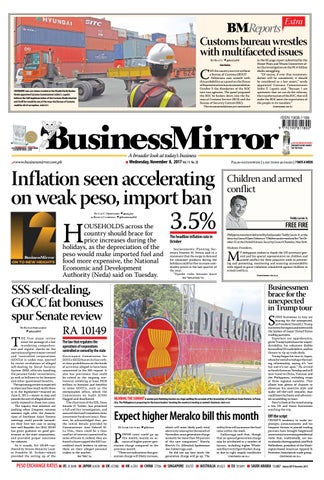
Container vans are shown stacked at the Manila North Harbor. Newly appointed Customs Commissioner Isidro S. Lapeña believes the full implementation of the Customs Modernization and Tariff Act would be one of the ways the Bureau of Customs could be rid of corruption. NONIE REYES
media partner of the year
@ReaCuBM
in the 82-page report submitted by the House Ways and Means Committee after the investigation on the P6.4-billion shabu smuggling. “Of course, if ever that recommendation will be considered, it should be considered as a last resort,” newly appointed Customs Commissioner Isidro S. Lapeña said. “Because I am optimistic that we can do the reforms, the transformation of the BOC, that will make the BOC meet the expectation of the people in its mandate.” Continued on A2
BusinessMirror A broader look at today’s business
www.businessmirror.com.ph
n
Wednesday, November 8, 2017 Vol. 13 No. 28
Inflation seen accelerating on weak peso, import ban
h
By Cai U. Ordinario @cuo_bm & Bianca Cuaresma @BcuaresmaBM
ouseholds across the country should brace for price increases during the holidays, as the depreciation of the peso would make imported fuel and food more expensive, the National Economic and Development Authority (Neda) said on Tuesday.
3.5%
T
@butchfBM
he f irst major rev iew since the passage of a law mandating comprehensive and regular checks on the operations of government-owned and -control led cor porations (GOCCs) is under way, spurred by recent revelations of alleged self-dealing by Social Security System (SSS) officials handling the pension funds’ investments, as well as billions in fat bonuses and other questioned benefits. The upcoming review is expected to show just how much teeth there is in the legislation—enacted on June 6, 2011—meant to stop and punish the sort of alleged abuse recently exposed in these two cases. The inquiry that senators are pushing when Congress resumes sessions right after the Associations of Southeast Asian Nations meetings could provide lawmakers their first test case in seeing how well Republic Act (RA) 10149 has given guidance on good governance to the state corporations, and provided proper sanctions for violators. As it stands, RA 10149—authored by Senate Minority Leader Franklin M. Drilon—which provided the setting up of the
Children and armed conflict Teddy Locsin Jr.
free fire
The headline inflation rate in October
Philippine statement delivered by Ambassador Teddy Locsin Jr. at the Security Council Open Debate on “Children and armed conflict’”on October 31 at the United Nations Security Council Chamber, New York.
Socioeconomic Planning Secretary Ernesto M. Pernia said in a statement that the surge in demand for consumer products during the holidays could further increase commodity prices in the last quarter of the year. “ Upside r isk s become more
Madame President,
M
y delegation wishes to thank the UN secretary-general and his special representative on children and armed conflict for their proactive work in preventing and promoting, monitoring and ensuring accountability with regard to grave violations committed against children in armed conflicts. Continued on A10
See “Inflation,” A2
Businessmen brace for the unexpected in Trump tour
S
RA 10149 The law that regulates the operations of corporations controlled or owned by the state
Gover n a nce Com m i ssion for GOCCs (GCG) has on its face rather clear prohibitions on the kinds of activities alleged to have been committed in the SSS exposé. It also has provisions that could be raised in the ongoing controversy involving at least P620 million in bonuses and benefits in some GOCCs, such as the sweepstakes office, which the Comm ission on Aud it (COA) flagged and disallowed. The chairman of the SSS, Dean Amado O. Valdez, has promised a full and fair investigation, and assured the fund’s members their investment funds are intact. However, he acknowledged that, per the initial details provided by Commissioner Jose Gabriel M. La Viña, there could be a clear conflict of interest committed by some officials if, indeed, they are found to have tapped the SSS’s accredited stock brokers to advise them on their alleged personal trades in the market.
PESO exchange rates n US 51.3040
See “SSS,” A2
business news source of the year
P25.00 nationwide | 5 sections 30 pages | 7 days a week
SSS self-dealing, GOCC fat bonuses spur Senate review By Butch Fernandez
2016 ejap journalism awards
NEARING THE SUMMIT A worker puts finishing touches on a logo spelling the acronym of the Association of Southeast Asian Nations in Pasay City. The Philippines is preparing for the Asean leaders’ meeting the country is hosting as summit chairman. NONOY LACZA
Expect higher Meralco bill this month By Lenie Lectura
P
@llectura
ower rates could go up this month, mainly on account of higher power-generation charge compared to the previous month. “There are indications that generation charge will likely increase,
which will most likely push total electricity rates up for the month of November, since generation charge accounts for more than 50 percent of the rate component,” Manila Electric Co. (Meralco) Spokesman Joe Zaldarriaga said. He did not say how much the generation charge will go up. The
ome businesses in Asia are bracing for the unexpected, as President Donald J. Trump traverses the region and meets with the leaders of major United States trading partners. Exporters are apprehensive, given Trump’s penchant for unpredictability, his vehement dislike for swollen US trade deficit, and his threats to rip up trade deals. Trump began his tour in Japan, where he vowed to reshape the trading relationship, saying it’s “not fair and it’s not open.” He arrived in South Korea on Tuesday and will next travel to China, Vietnam and the Philippines, including stops at three regional summits. That allows him plenty of chances to showcase his assertive style and make off-the-cuff remarks that could leave his hosts and adversaries scrambling to react. Here’s a look at the mood among a few US and Asian businesses watching the trip.
Off the script
utility firm will announce the final rates within the week. Zaldarriaga said that, though that an upward generation charge may be attributed to a number of factors, including higher Wholesale Electricity Spot Market charges due to tight supply conditions
Trump’s tendency to make impromptu announcements and his frequent threats to punish trading partners have brought heightened uncertainty to overseas presidential visits that, traditionally, are meticulously choreographed, said Rick Helfenbein, president of the Washington-based American Apparel & Footwear Association trade group.
Continued on A12
Continued on A12
n japan 0.4510 n UK 67.5982 n HK 6.5761 n CHINA 7.7336 n singapore 37.6737 n australia 39.4323 n EU 59.5691 n SAUDI arabia 13.6807
Source: BSP (7 November 2017 )
BMReports BusinessMirror
A2 Wednesday, November 8, 2017
Customs bureau wrestles with multifaceted issues Continued from A1
According to the House committee, the government lost P43.8 billion in revenues from July 2016 to July 2017 due to corruption, incompetence of the bureau and manipulation of the system.
Preparatory acts HOUSE Ways and Means Committee Chairman Rep. Dakila Carlo E. Cua pointed out that a national emergency may be considered when the BOC, which is considered to be the country’s first line of defense, has been compromised because of the bureau’s corruption and incompetence in protecting and securing the country’s borders from the entry of illegal drugs. “Well, it’s true, there are a lot of things that have to be done in the BOC, and I have started doing the preparatory efforts that have to be done,” Cua said. “We have a problem of corruption that is the tara system. And the marching orders of the President to me, before my assumption, were to stop corruption and improve revenue collection.” The House panel recommends the BCS be placed under the Department of Finance, while the BSC is placed under the Department of Interior and Local Government. The committee also recommended the two new bureaus only hire highly qualified, competent and experienced personnel with proven integrity. “And so, in conformity with that marching order, during my assumption, I gave the guidance to stop the tara, ‘no take no gift no pasalubong’ policy,” he
said. “And I have also mentioned to stop the benchmarking, and instead it should be based on correct valuation.”
Lifestyle checks ACCORDING to Lapeña, BOC officials and employees will also be subjected to lifestyle checks. He also called for the full implementation of the Customs Modernization and Tariff Act (CMTA), to relocate bureau offices and improve the bureau’s infrastructures and facilities to ensure transparency, consider expanding the coverage of the port-load survey to containerized cargoes, review the process of accreditation to eliminate the use of consignees-for-hire and revisit the Attrition Act of 2005. “We are also doing other activities to further improve revenue collections, such as trade facilitation, to ensure that contraband goods do not enter the Philippines, just like the shabu,” Lapeña added. According to Natalio C. Ecarma III, deputy commissioner for the bureau’s Revenue Collection Monitoring Group, the BOC has also implemented measures to cut red tape in the bureau, including the fast-tracking of the issuance of the CMTA’s implementing rules and regulations (IRR) while ensuring a fair playing field for all BOC stakeholders. Other measures Ecarma cited is the full automation of systems to reduce face-to-face transactions, revising the rules for the accreditation of importers and licensed brokers, modifying the BoC green lane, submitting daily an updated list of newly accredited
Inflation. . .
Continued from A1
prominent as the holiday season approaches. This warrants close monitoring of the rising prices in domestic petroleum, as well as utility rates,” Pernia said. “Upbeat consumer spending this holiday season is also expected to push prices up. Within the near term, higher utility rates, increasing domestic fuel prices and the depreciation of the peso may further exert upward pressures on inflation,” he added. Consumers already saw a sneak preview of the expected higher inflation, as commodity
INTERTROPICAL CONVERGENCE ZONE AFFECTING PALAWAN AND MINDANAO NORTHEAST MONSOON AFFECTING NORTHERN AND CENTRAL LUZON (As of 4:00 PM - November 7, 2017)
importers, trimming to three to five working days the approval of accreditation of importers and inspection of alerted shipments to be done within 48 hours, among others.
Better collection ACCORDING to Ecarma, the new set of BoC officials plan “to curb corruption the soonest.” “BoC officials and employees should not thrive on the practice of tara, bribery and red tape,” Ecarma said. “All these practices must be swept from BoC culture.” Meanwhile, the BOC reported that it posted more than P3 billion in collections for two consecutive days based on the Financial Service’s preliminary collection report, a first in the agency’s history. According to Lapeña, the BOC collected on September 28 and 29 a total of P3.316 billion and P3.193 billion, respectively. The 3-billion figure is the first in the collection performance history of the bureau, the country’s second-largest revenue-generating agency. According to data from the BOC, it has also achieved a total cash collection of P39.545 billion for September, regarded as the highest cash collection achieved for a month. The customs chief bared the improvement of the collection performance is attributed to the 20.92-percent increase in valuation compared to last year of the same period. The bureau was able to collect duties and taxes for September based on the total dutiable value of imports amounting to P420 million compared to the assessed dutiable value of P347
prices increased 3.5 percent in October, the highest since November 2014 when inflation reached 3.7 percent. Pernia said, however, that the inflation rate in October is still within the 2-percent to 4-percent target of the Bangko Sentral ng Pilipinas (BSP) for the year. He added it was also within the BSP’s 3.2-percent to 3.7-percent expectations for October, as well as median market expectations of 3.5 percent. The Neda chief said the government needs to be “consistently on the watch” for developments in climate conditions, considering that weather patterns and events have a direct impact on food supply and prices. “We must also ensure a stable and sufficient level
million of the same month in 2016, despite the higher percentage of nondutiable of 84.5 percent, from the 81.2 percent in 2016. September figures also indicate a yearon-year increase of 14.71 percent in terms of volume of imports. In September last year, there was a total of 8,504,422 kilograms of imports, while current volume posted 9,755,082 kg.
Still optimistic THE Tax Expenditure Fund is the revenue collected from government importations and are not paid in actual cash by the agencies but instead credited by the BoC from the budget of agencies. Preliminary collection report showed that, despite the three nonworking holidays in S eptember, the BOC achieved 96 percent of the total collection, collecting P40.150 billion against the monthly target of P41.753 billion based on Budget of Expenditures and Sources of Financing (BESF) target. It was previously reported that the BoC needs to achieve the monthly target of P50.1 billion from September to December in order to hit the full-year BESF target of P467.896 billion. “We hope to hit our target. We were given a target of P50.1 billion per month up to December,” Lapeña said. “I am optimistic that we will be hitting our target [this October].” With such figures, the newly appointed customs chief believes the correct valuation is now working, and he is determined to implement such method in the coming months.
of the country’s rice stock. This is an important policy concern given that rice comprises a sizable portion of the consumer price-index basket,” Pernia said. “Deciding the appropriate timing of rice importation is vital to avoid supply disruptions. There is also a need to amend domestic laws to end the quantitative restrictions on rice,” he added. University of Asia and the Pacific School of Economics Dean Cid Terosa told the BusinessMirror the weak peso could be the “culprit” for the increase in prices. However, Terosa said, he expects full-year inflation to remain within target this year despite expectations that there will be an uptick in commodity prices during the holidays. “Rising petroleum prices and weak peso are the causes. Inflation will be between 3 [percent] to 4 percent [this year]. The 4-percent upper limit won’t be breached,” Terosa said. Neda Undersecretary Rosemarie G. Edillon told reporters at the sidelines of a news briefing on Tuesday that one of the reasons for the recent increase in prices is the ban on Brazilian meat imports imposed by the Department of Agriculture (DA). The DA imposed a temporary ban on all meat imports from Brazil after salmonella was detected in some of the shipments from the Latin American country in July. “With respect to the food, we’re seeing supply-induced inflation. First, with respect to the meat, it’s the ban on Brazilian meat, and then, with respect to corn and some grains, the typhoons,” Edillon said. For the food subgroup, inflation accelerated to 3.8 percent, from 3.7 percent the previous month, because of faster increases in the price of corn, meat and vegetables. Nonfood inflation reached 3.2 percent in October, from 3.1 percent the previous month, and from 1.5 percent a year ago. This is due to the surge in the prices of liquefied petroleum gas (26 percent), diesel (22.8 percent) and kerosene (13.2 percent). Pernia also said crude oil prices may go up in the near term due to the continuing increase in global oil demand. Based on the “October 2017 Commodity Markets Outlook” report of the World Bank, energy prices are projected to rise by 4 percent in 2018.
‘Still manageable’
The BSP said the recent uptick in consumer prices is no cause for alarm as the October inflation rate is still within the government’s target range for the year. BSP Governor Nestor Espenilla Jr. said the central bank expects inflation to remain manageable over the policy horizon after taking into account the latest assessment of price levels in October. “Inflation is projected to settle near the midpoint of the national government’s target range of [2 to 4] percentage points in 2017 to 2019,” Espenilla said. “Firm domestic economic activity, ample liquidity and well-anchored inflation expectations continue to support within-target inflation,” he added. In its latest monetary policy meeting, the BSP said it projects inflation to average 3.2 percent for the year. The next monetary policy meeting of the BSP will be on Thursday. Espenilla said despite their confidence that inflation will be within target for the year, the BSP will remain vigilant against any risks to the inflation outlook to ensure that the monetary policy stance remains “consistent with the mandate of preserving price stability conducive to economic growth.”
www.businessmirror.com.ph
SSS. . .
Continued from A1
La Viña, in his administrative complaint, accused SSS Executive Vice President for Investments Rizaldy Capulong and three others of serious dishonesty and grave misconduct. The others are: Equities Division Chief Reginald Candelaria, Equities Product Development Head Ernesto Francisco and Chief Actuary George Ongkeko Jr. Capulong, Candelaria and Francisco allegedly acted on the advice given by the SSS-accredited stock brokers and used the information for personal trades, i.e., to buy and sell stocks and earn profits using information that otherwise should have been used to grow the SSS investments. Ongkeko was included by La Viña for his alleged neglect in keeping records of the trades allegedly done by the three others.
Funds not stolen, but SSS income opportunity lost While no SSS money was stolen, the alleged acts could represent substantial opportunity loss for the state-run pension fund of private workers, according to those pushing the investigation. The point being that the officials took advantage of insider information given to them as SSS officials by an accredited SSS broker to reap personal profits from initial public offerings of five companies to sell shares in the stock market. La Viña said earlier Candelaria and Francisco obtained the information from the SSS stock broker who conducts monthly briefings to inform the Social Security Commission what stocks to buy to earn profits for the SSS but, instead, earned profits for themselves using insider information.
GCG law on GOCCs: Fiduciary duty sacred Under RA 10149, authored by Drilon, government officials can be held liable for violating their fiduciary duty. The Drilon law that created the GCG imposes a penalty of one year imprisonment for taking advantage of insider information for personal profit and requires the erring official to provide restitution to the government—in the equivalent of what was wrongly earned— within 30 days of notice. The provision mandating restitution states that, “where a member of the board or an officer acquires or receives for oneself a benefit or profit, of whatever kind or nature, including, but not limited to, the acquisition of shares in corporations where the GOCC has an interest, using the properties of the GOCC for their own benefit, receiving commission on contracts from the GOCC’s assets, or taking advantage of corporate opportunities of the GOCC, all such profits or benefits shall be subject to restitution under Section 24 of this Act, without prejudice to any administrative, civil or criminal action against members of the Board of Directors/ Trustees or Officers”. It further specified that “this provision shall be applicable, notwithstanding the fact that such member of the board or officer risked one’s own funds in the venture.” Meanwhile, Section 24 on Restitution could also be revisited in the upcoming Senate review, in the context of the COA’s disallowance of the billions in bonuses and allowances received by officials and employees in dozens of GOCCs led by the Philippine Charity Sweepstakes Office (PCSO). Section 24 states that, “Upon the determination and report of the Commission on Audit that properties or monies belonging to the GOCC are in the possession of a member of the board or officer without authority, or that profits are earned by the member of the board or officer in violation of the fiduciary duty, or the aggregate per diems, allowances and incentives received in a particular year are in excess of he limits provided under the Act, the member of the board or officer, receiving such properties or monies, shall return the same to the GOCC.” It adds that “Failure to make the restitution within 30 days after a written demand has been served shall, after trial and final judgment, be punished by an imprisonment of one year and a fine equivalent to twice the amount to be restituted, and in the discretion of the court of competent jurisdiction, disqualification to hold public office.” Moreover, Section 20 of the same law included provisions on Trustee Relation to the Properties, Interests and Monies of the GOCC, which states, thus: “Except for the per diem received for the actual attendance in board meetings and the reimbursement for actual and reasonable expenses and incentives as authorized by the GCG, any and all realized and unrealized profits
and/or benefits including, but not limited to, the share in the profits, incentives of members of the board or officers in excess of the authorized by the GCG, stock options, dividends and other similar offers or grants from corporations, where the GOCC is a stockholder or investor, and any benefit from the performance of members of the board or officers of the corporation acting for and in behalf of the GOCC in dealing with its properties, investments in other corporations, management of subsidiaries and other interest, are to be held in trust by such member of the board or officer for the exclusive benefit of the GOCC represented.”
‘Care, diligence, skill’ The Drilon law, likewise, included a separate provision on Care, Diligence and skill in the conduct of the business of the GOCC where “members of the board and the officers must exercise extraordinary diligence in the conduct of the business and in dealing with the properties of the GOCC. Such a degree of diligence requires using the utmost diligence of every cautious person with due regard for all circumstances.”
Poe: Unconscionable grant of bonuses Besides the GCG law’s author (Drilon), expected to take a strong role in the upcoming review is Sen. Grace Poe, who recently described as “unconscionable” the grant of certain GOCCs of bonuses, allowances and other benefits to employees “without legal basis.” The amount, totaling around P620 million, could have been used to supplement worthwhile government programs and projects, like additional capital outlay for 60 public hospitals, additional subsidy for the public-utility vehicles modernization project, or additional funding for the feeding program for schoolchildren, Poe pointed out. “The aggregate bonuses of these GOCCs is three times larger than the First 1,000 Days program, which was a measly P269 million,” the senator said. Poe wants to know “what have the PCSO, Small Business Corp., or NEA [National Electrification Administration] done to merit these allowances?” She added: “PCSO, the biggest culprit in this scam against the use of government funds, would allow hazard pay for non-public health workers and even issue a weekly draw allowance, both of which have no basis in law and are unjustifiable by common sense.” In Poe’s view, such acts can only have been impelled by“impertinence, hubris, or even plain ignorance of the law,” and those responsible should be held accountable. The senator’s tack by way of revisiting the provisions of the Drilon GCG law is to instead use the budget process for redressing the alleged wrongdoing. “Although the deadline of our written submission for amendments to the national budget has already passed, I will suggest to my colleagues to review the budget of these GOCCs and have their budget realigned, if necessary,” to more deserving programs.
Half a billion for PCSO
THE COA, in its repor t, tagged the sweepstakes office as the source of the biggest unauthorized bonuses and other benefits in 2016. The COA said that of the PCSO’s P518.314-million grants to its officials and employees, P503.667 million was for “payments of allowances, bonuses and other benefits that were not supported by sufficient legal basis.” The rest, or P14.647 million, “pertains to payments of allowances that were in excess of prescribed rates.” The COA’s 2016 Annual Financial Report on GOCCs, released on October 26, listed seven other state firms besides the PCSO, that granted bonuses and perks without “sufficient legal basis.”In all, the COA said the total disallowances for GOCCs was P619.771 million. The Small Business Corp., an attached agency of the Department of Trade and Industry, mandated to provide technical and financial assistance to small and medium entrepreneurs, was second to the PCSO (P46.448 million in unauthorized allowances and bonuses granted in 2016). The third was the NEA (P23.683 million). Also on the COA’s list are: the Philippine Coconut Authority (P11.475 million), the National Food Authority (P10.097 million), Apo Production Unit Inc. (P7.45 million), Human Settlements Development Corp. (P2.085 million), Intercontinental Broadcasting Corp., or IBC-13 (P219,000). The COA told the identified erring GOCCs to secure approval from the Office of the President or the GCG regarding their questioned compensation grants. The GOCCs were, likewise, told to “submit justification as to why the payment of incentives should not be disallowed in audit” and “to discontinue/stop the payment of compensation/allowances/benefits/ incentives in the absence of legal basis/ authority to grant the same.”
The Nation BusinessMirror
www.businessmirror.com.ph
Editor: Vittorio V. Vitug • Wednesday, November 8, 2017 A3
House panel widens probe into Yolanda housing mess
F
By Jovee Marie N. dela Cruz
@joveemarie
our years since Supertyphoon Yolanda devastated the Visayas in 2013, the chairman of the House Committee on Housing and Urban Development on Tuesday said thousands of victims are still living either in temporary housing facilities or in danger zones. Panel chairman Rep. Alfredo B. Benitez of the Third District of Negros Occidental lamented that, “It appears that for many times, the tragedy continues,” even as he urged the Duterte administration to fasttrack the implementation of Yolanda housing projects. “Four years [after the devastation]… we see little progress. I am hoping that it would not take yet another four years to fulfill the promise of adequate housing for Yolanda survivors. We will not let rest until Yolanda-affected families will finally have a safe and decent house to live in,” he said. Benitez’s committee is currently investigating the snail-paced implementation of Yolanda housing projects. The committee had uncovered substantial information that aside from delays in the construction, substandard materials were used in the Yolanda housing project in Balangiga, Eastern Samar. The committee’s inspection team has uncovered that the size of the reinforcing steel bars used for the housing units aver-
aged only at 8 millimeters, while it also discovered that the contractor also used undersized bars of 12 millimeters, which is below the requirement of 16 millimeters. Benitez said his committee will ensure that officials and contractors who profited from Yolanda housing projects will be held accountable and charged in court. Moreover, Benitez said his committee will expand the investigation to other housing projects for typhoon victims to ensure that these were constructed according to government standard. “With this evidence that we’ve uncovered, we will expand our investigation to other housing projects of Yolanda not just in Eastern Samar. We will also expand our probe to other contractors because I think this might just be the tip of the iceberg,” the lawmaker said. “There are more housing projects in other areas, we have to ensure that they have not been done inappropriately,” he added. Provinces with housing need under the government’s Yolanda permanent housing
projects include: Palawan of 8,760 housingneed target, only 780 units were finished; Masbate of 102 housing-need target, no unit was constructed; Aklan of 15,948, only 5,881 units were accomplished; Antique of 18,177, only 10,410 units were accomplished; Capiz of 12,036, only 9,442 units were finished; and Ilolilo of 43,987, only 34,153 units were accomplished. In Negros Occidental out of 27,055 housing-target needs, only 24,747 were accomplished; Cebu, 2,791 out of 22,423; Tacloban, 10,677 out of 14,433, Leyte 12,190 out of 16,199; Eastern Samar, 4,149 out of 7,573; Samar, 5,236 out of 8,900; Southern Leyte, zero out of 130; Biliran, 4,629, out of 8,905; and Dinagat Island, zero out of 500 housing-need target. The government has allocated P56 billion for the implementation of the said housing and resettlement program for Yolanda victims. Also only 23,414 of the projected 205,128 housing units under the government’s resettlement program for the typhoon victims are being occupied. Benitez said substandard construction of Yolanda housing projects is the main reason the occupancy rate is low with a meager 11.4 percent. “Among the issues in resettlement areas for Yolanda victims [that the committee has identified] include: size of housing is inadequate; structure is of substandard quality, lack of livelihood opportunities in resettlement sites, lack of potable water supply in resettlement sites and lack of power line in the area,” Benitez added. Citing the report of the National Housing Authority as of February, Benitez said that, out of the projected 205,128 housing
units under the government’s resettlement program for the victims of Yolanda, only 67,754 units or 37 percent were actually constructed, with only 23,414 units or 11 percent being occupied. The lawmaker said 74,286 units are currently under construction.
Permanent homes
Meanwhile, Rep. Yedda Marie K. Romualdez of the First District of Leyte vowed to remain steadfast in making permanent homes and sustainable livelihood for the survivors. “Now we have seen so much progress that has been achieved in building back our communities even better, and we have to thank the help of our Filipino and foreign friends, as well as our national and local government for their continued leadership and support in helping us,” Romualdez said. “We are happy to hear the commitment of President [Duterte] to hold accountable the parties involved in the anomalies uncovered by the panel chaired by Benitez. Since it involves people’s money. We really need to get to the bottom of these controversies,” she added. For his part, Philippine Constitution Association President Ferdinand Martin Romualdez, former House Independent Bloc leader, said the local government is still doing its best to put an end to the struggle of Yolanda survivors. “We know how extensive the damage was, but I believe the previous government could have done better had funding for the reconstruction effort was released quickly, and sources for the needed money were prioritized and clearly identified,” the former lawmaker said.
Palace banks on China’s ‘good faith’ it won’t dredge on disputed territories
M
alacañang on Tuesday said the Philippines would have to rely on good faith that China would not use its largest dredging vessel to build on disputed islands in the West Philippine Sea (South China Sea). At a Palace briefing, Presidential Spokesman Harry Roque said President Duterte recognizes the principle of good faith in international relations. “China has told the President that they do not intend to reclaim Scarborough, and we leave it at that. We need to rely on good faith because, otherwise, there would be no predictability in international relations,” he said. His comments were issued amid concerns that China may use its newly launched Tian Kun Hao, dubbed by its designer as a “magic island maker,” to create artificial islands in the South China Sea. The giant dredger, which measures 140 meters long and 28 meters wide, is reported to be capable of dredging up to 6,000 cubic meters an hour and can dig as deep as 35 meters under the sea floor. It is the most powerful vessel of its type in Asia. In March Duterte announced that China gave its word not to build on the disputed Scarborough Shoal (Panatag Shoal) in the South China Sea. The President said the assurance was made out of deference to the warming relationship between the Philippines and China. Meanwhile, Roque said that the Philippines is not only relying on China’s assurance but also on the fact that the Philippines had secured a decision from a tribunal at the Permanent Court of Arbitration. “We’re not just trusting. We have a decision. And, the last time I checked, that decision remains unchanged,” Roque said. The Hague Tribunal found out that China’s claims of historic rights within the nine-dash line, which Beijing uses to demarcate its claims in the South China Sea, were without legal foundation. The panel also concluded that Beijing’s activities within the Philippines’s 200-nautical-mile exclusive economic zone, such as illegal fishing and environmentally ruinous artificial island construction, infringed on Manila’s sovereign rights. China has disputed the tribunal’s findings. But while supporters of the Hague decision were urging Duterte to enforce the decision, the President chose to pursue peaceful means to resolve the issue in order to avoid confrontation with China, vowing, however, to raise it at the right time. PNA
Economy
A4 Wednesday, November 8, 2017 • Editors: Vittorio V. Vitug and Max V. de Leon
BusinessMirror
Japan aid pledge provides impetus to BBB infra program–lawmaker By Jovee Marie N. dela Cruz @joveemarie
T
he vice chairman of the House Committee on Appropriations on Tuesday said the Duterte administration’s “Build, Build, Build,” or BBB infrastructure program, is now expected to shift to higher gear f ollowing Japan’s reaffirmation to provide ¥1 trillion in aid and investments to the Philippines. Party-list Rep. Luis Raymund F. Villafuerte of Camarines Sur said the “solid” reaffirmation of Japan’s earlier pledge to provide ¥1 trillion is clear proof that the Philippines is starting to reap the fruits of its unique foreign policy rebalancing since President Duterte took over the reins of government last year. “President Duterte’s bold move
to shift the Philippines’s economicdiplomacy priority toward our Asean neighbors and regional superpowers like Japan, China and South Korea is one example of his nontraditional leadership style that has endeared him to the Filipino masses as shown by the public’s continued, overwhelming support for him,” Villafuerte said in a news statement. The lawmaker, citing a joint statement released by the governments of the Philippines and Japan after Duterte’s three-day official visit to Tokyo, said areas of infrastructure cooperation over the next five years will include the construction and operation of a subway system in metropolitan Manila, increasing connectivity between regions through the construction of roads and bridges, and reinforcing rivers
President Duterte’s bold move to shift the Philippines’s economicdiplomacy priority toward our Asean neighbors and regional superpowers like Japan, China and South Korea is one example of his nontraditional leadership style that has endeared him to the Filipino masses as shown by the public’s continued, overwhelming support for him.”—Villafuerte
to manage the risk of flooding. Earlier, Duterte said he and Japanese Prime Minister Shinzo Abe talked of “concrete, time-bound and specific ways to further intensify bilateral cooperation” which is highlighted by Japan’s support for the Philippines’s “Build, Build, Build” program. The BBB infrastructure program is the centerpiece of the Duterte administration’s high and inclusive growth agenda. The government plans to line up several projects, including the P37.76-billion Metro Manila Bus Rapid Transit (BRT) Line 2 for financing assistance from South Korea. “Apparently, President Duterte’s remarkable prescience in his foreign policy rebalancing has proven him right in making the crucial pivot to Asia, considering US President Trump’s victory on the back of his ‘America First’ campaign battlecry and the recent events in Europe that strongly indicate a return to trade protectionism by Western economic powers,” Villafuerte added. The lawmaker earlier said the President’s popular support will continue “given that Malacañang has apparently been pursuing without letup his ambitious BBB infrastructure program complemented by increasing investments in education, health and other social services, both of which are to be funded in part by the first tax-reform package that Duterte himself has endorsed for congressional approval.”
www.businessmirror.com.ph
DOT urged to renew focus on tourism ‘big spenders’
A
By Recto Mercene
@rectomercene
N academic official of the Asian Institute of Management (AIM) is urging the tourism department to shift its focus to tourism “big spenders,” owing in part to the country’s infrastructure inadequacy to absorb a larger number of incoming tourists.
“The country [does not] want the numbers, but we want those who actually spend in the country,” said Dr. John Paolo Rivera, associate director of the AIM Center for Tourism during a Philippine-China Economic Forum in Makati on Monday. “Even if we only have a few million tourists, if these tourists spend millions of pesos, then I think that’s the game,” he added. According to the Department of Tourism (DOT), the big spenders are from Korea, China, US, Japan, Taiwan, Malaysia and Singapore. The estimated visitor receipts for 2017 is P212 billion, an increase of 29.27 percent over the P164 billion figure in 2016. “Unlike the current strategy of overseas employment, tourism can match the revenue potential of remittances without a single Filipino having to leave the country to look for jobs,” Rivera said during a PowerPoint presentation. “Unlike manufacturing, tourism can provide employment to a wide variety of educational preparation and skills,” he added. Asia takes a big chunk of visitor’s arrival in 2017, taking 62 percent, followed by the Americas at 18 percent and Europe at 10.41 percent. The rest is shared by Australia/Pacific, Middle East, Africa, overseas Filipinos and others. Rivera said that as far as the Philippines is concerned, we can sell our country as an ecotourism destination because ecotourists are those that actually spend more than regular backpackers. Ecotourists, he said, spend more than regular tourists do because they are the types who spend longer time in the country compared to those who go to Thailand, where they can easily transfer to another country, either by land or by air. Those types of tourists will actually come from the developed countries like Europe or United States. However, Rivera said, “We can still tap Korea, Japan and
China because they can see us as a cheaper alternative compared to other island destinations.” However, he said, the country has to position itself when it comes to promotions because until now, “We have yet to provide a definite market for Philippine tourism because, as my observation, the Philippines really caters to local and western tourists.” Rivera made the comment after it was revealed that although China has promised to send 2 million tourists last year, so far, only more than 600,000 have made it this year. Chinese Ambassador Zhao Jianhua said there could be a total of one million of his compatriots from the mainland that will come to the Philippines at the end of the year, adding a million more will follow in the coming years. A Chinese official told the BusinessMirror that the country’s resorts and hotels are not ready to accommodate Chinese tourists who demand Chinese breakfast, Chinese movies in their room and Chinese entertainment. Michelle Wang, an executive of the Communication University of China, who was in the country recently to observe Philippine-style journalism, said many Chinese are lactose intolerants, and prefer a variety of soy milk, tofu and lots of vegetables in their diet. “We eat a variety of bread during breakfast, drink lot of fruit juices, eat plenty of fruits, and are not really fond of the greasy stuff like bacon and hot dogs,” Wang said. “That’s the problem, we promote the Philippines, but we’re not yet definite about our positioning. We must target specific tourists that we want to invite. Are they millennials, Chinese, Europeans, Americans?” Rivera, for his part, said. He added that with the changes in the DOT’s current campaign, “Slowly we can start introducing products that would cater to the Japanese, Chinese, Koreans and Americans.”
Right now, Rivera said the demographic characteristic of Chinese tourists is that they spend so much on luxury items, and other high-end products. “They are luxury spenders, they are the best tourists when it comes to spending.” He said most well-to-do Chinese don’t want beaches and mountains, but prefer shopping malls and dutyfree shops where they can buy luxury bags and other consumables. According to a McKinsey study, presented by Rivera, many wealthy Chinese consumers shop overseas, and prefer official channels or dutyfree stores. The study said 41 percent of Chinese tourists shop in downtown duty-free stores, and 26 percent buy at airport duty-free shops. Only 15 percent patronizes department stores and 9 percent go to free standing brand stores, while 7 percent buy their needs at shopping mall brand stores. Rivera also mentioned that many Chinese tourists who cannot be accommodated in Hong Kong or Singapore have chosen to come to the Philippines instead, where luxury items are sold lower prices. Told of the country’s lack of capacity to absorb millions more, Rivera said, “That’s the mismatch, when we promote, we don’t have yet the infrastructure that we need to develop first. Infrastructure before promotions, but what’s happening [here]. Promotion first before infrastructure.” The tourism department said 6 million tourists visited the Philippines in 2017, surpassing the 5.9-million target set it has set for the year, and proving that the country is on its way to becoming a favored and emerging tourist destination. Rivera said “we must change the promotional strategy from internal development first. Let us establish the infrastructure, the connectivity, like roads, subway networks before we go heavy on promotions.” Noting that the current DOT campaigns seem to promote both, Rivera agreed, saying the Philippines has already lost a lot of time “when we did not invest heavily on infrastructure, 10 or 20 years ago.” “That’s why we can’t afford to lose time because the government seems to be doing these two things together. It’s the best move for now because tourism now is on a boom. If the Philippines will not promote now, other Asean countries will promote theirs, like Thailand and Malaysia.” Rivera concluded that there’s a need for a new airport, but conceded that such “is more a political decision.”
Salceda welcomes ₧6-B addl budget for free college, tech-voc education
L
EGAZPI CITY—Rep. Joey S. Salceda of the Second District of Albay has welcomed the recent Malacañang announcement of an additional P6-billion fund for the Universal Access to Quality Tertiary Education Act, from a recent debt settlement by the Philippine Airlines (PAL) with the government. Republic Act (R A) 10931, the free tuition law signed by President Duterte, was principally authored in the lower house by Salceda. Doubts on whether the government can fund the program were doused after Congress realigned and allotted some P41 billion from the 2018 budget, a month after the new law was enacted. Malacañang has announced that the P6-billion settlement by PAL for debts the country’s flag carrier incurred, from the 1970s to July 31, will fund the education of students in local universities and colleges (LUC) and
state universities and colleges (SUC) under RA 10931. This clearly shows that the Duterte administration sincerely wants Universal Access to Quality Tertiary Education Act to start off on the right foot next year, Salceda said, adding that RA 10931 will usher in the Duterte administration’s “next wave social revolution in building a more egalitarian society” and “a most vital social legislation, second only to the Tax Reform for Acceleration and Inclusion bill in terms of significance and permanence.” Free tuitions and miscellaneous fees in government run colleges and accredited technical vocational (techvoc) schools are no longer a dream, the lawmaker said. Salceda is also senior vice chairman of the committee on appropriations, which ironed out the 2018 budget for the new law. RA 10931 provides for free tuition and miscellaneous expenses in SUCs
and LUCs , tech-voc schools under the Technical Education and Skills Development Authority (Tesda) and local government unit-run Technical Vocational Education and Trainings. At the state-ran Bicol University in Albay’s second district, which Salceda represents, some 28,000 students stand to benefit from the measure with a subsidy of about P480 million per year. There are 114 SUCs and 16 LUCs accredited by the Commission on Higher Education and 122 tech- voc institutions accredited by Tesda in the country. Salceda said he filed his version of the universal access to education bill, House Bill 2771, in July last year “to solve the continuing paradox that while college education helps us to escape poverty, Filipinos have to be rich to afford one.” The measure was merged with the bills filed by Partylist Reps. Antonio L. Tinio of ACT and Sarah Jane J. Elago of Kabataan.
Agriculture/Commodities BusinessMirror
www.businessmirror.com.ph
Editor: Jennifer A. Ng • Wednesday, November 8, 2017
A5
PHL may import US dairy goats in 2019 By Jasper Emmanuel Y. Arcalas
T
@jearcalas
HE Department of Agriculture (DA) is planning to import some 8,000 dairy goats from the United States in 2019 in line with its goal of increasing Philippine milk production. Agriculture Secretary Emmanuel F. Piñol said the DA will tap the remaining P1.5 billion in the US food-aid program under Washington’s Public Law (PL) 480 for the importation of dairy goats.
“We will roll out a four-year dairy goat program starting 2019, and it will involve the importation of about 8,000 dairy goats with superior genes,” Piñol told reporters in an interview on Monday.
He disclosed that he has presented the DA’s dairy program to Ralph Bean, agricultural counselor of the US Department of Agriculture Foreign Agricultural Service in Manila, during a recent meeting. He added that Bean is keen on the DA’s dairy goat-importation program. The DA chief said he had also asked Bean to help him connect with American dairy goat raisers. “ T he prev ious goat-importation program was a poorly planned project. They bidded out the project but American dairy goat raisers were not prepared for the program,” Piñol said. “ W hat happened was t hat they bought old and sick goats that were not meant for dairy
production. Since the dairy program will start by 2019, I told Bean maybe we could meet the American dairy goat raisers next year,” he added. Piñol said meeting the US - ba sed d a i r y goat ra i sers would also help them calibrate their production so they could meet the demands of the DA’s program. The importation of dairy goats from the US is part of the DA’s plan to ramp up local milk production to meet at least 10 percent of annual domestic requirement by 2022 and reduce the country’s reliance on imports. Aside from importing dairy goats, Piñol said the DA will also procure animals with superior
genes from local breeders. Enacted in 1954, the PL 480, which is also known as the Agricultural Trade Development and Assistance Act, mandates the US to use its agricultural productivity to enhance the food security of developing countries and the determination of the importing country’s capacity of improving its food security. The DA has previously engaged in the importation of live animals using funding assistance from PL 480, such as the Bureau of Animal Industry’s (BAI) Goat Production Project for an Accelerated Hunger Mitigation Program (GPP-AHMP), which cost around P475 million. Through the GPPAHMP, the BAI imported and
distributed at least 1,430 goats (1,300 does and 130 bucks). T he gover n ment h ad a l so tapped the PL480 for a P399.9million program dubbed as the “Accelerating the Genetic Resource Improvement Program for Beef Cattle and Small Ruminants.” Piñol said the DA is now consolidating the government’s dairyrelated programs. He added that a National Dairy Council (NDC) will be established to oversee the implementation of the government’s dairy program. The NDC will to be headed by Piñol and will also be comprised of representatives from the Philippine Carabao Center, National Dairy Authority and the BAI.
Abaca output up 5.3 percent in January-August–PhilFida P HILIPPINE abaca production in January to August expanded by 5.3 percent to 42,775.3 metric tons (MT), from 40,606.2 MT recorded in the same period last year, according to the Philippine Fiber Development Authority (PhilFida). Data from the PhilFida, an attached agency of the Department of Agriculture, showed the Bicol region remained as the top abacaproducing province, contributing 38.4 percent of country’s total output during the eight-month period. The region’s production rose by 6.8 percent to 16,407.4 MT, from 15,357.5 MT a year ago. Central Luzon region posted the highest hike in abaca production during the reference period. Its output expanded by a whopping 678.6 percent on an annual basis. PhilFida data also showed export receipts from abaca in the first
quarter reached $35.536 million, 12.8 percent higher than the $31.51 million recorded a year ago. Abaca pulp accounted for the lion’s share of the earnings during the period at 69.5 percent. Export receipt from abaca pulp grew 24 percent to $24.68 million, from $19.897 million a year ago. The United Kingdom and Germany remained the top 2 importers of local abaca pulp, accounting for 40.5 percent and 23.6 percent of shipments, respectively. Abaca pulp exports to the UK grew by 20 percent to 2,388.414 MT, from 1,909.928 MT recorded in the same period last year. Local abaca pulp bought by Germany in the three-month period expanded by 31.2 percent to 1,391.478 MT, from 956.887 MT recorded a year ago. The PhilFida also revealed that revenues from abaca fiber ex-
ports in the January-to-March period expanded by 23.2 percent to $8.251 million, from $6 million a year ago. In terms of volume, the Philippines exported 29 percent more raw abaca fiber abroad in first quarter. Shipments went up to 4,303.6 MT, from last year’s 3,336 MT. Spain was the top importer of local abaca fiber during the period, accounting for 33.7 percent of total volume. Philippine abaca exports to Spain jumped to 1,448.8 MT, from 240 MT recorded a year ago. Japan was the second top importer of abaca fiber accounting for 31.3 percent of total shipments. Exports of local abaca fiber to Japan increased by 3 percent to 1,346.5 MT, from 1,307.5 MT recorded a year ago. The Philippines produces about 85 percent of the world abaca supply, which is globally known as Manila hemp. Jasper Emmanuel Y. Arcalas
FILE PHOTO
1.25 million face starvation Coco-fiber exporter gets fiscal perks from BOI in war-torn South Sudan By Catherine N. Pillas
T
IN this April 5 file photo, Adel Bol, 20, cradles her 10-month-old daughter Akir Mayen at a food-distribution site in Malualkuel, in the Northern Bahr el Ghazal region of South Sudan. AP PHOTO, FILE
J
UBA, South Sudan—In war-torn South Sudan 1.25 million people are facing starvation, double the number from the same time last year, according to a report by the United Nations and the government released on Monday. This country could once again plunge into famine in 2018, humanitarian groups and the government warn. “ The widespread and extreme foodconsumption gaps...should make us all extremely concerned about the worst-case scenario of famine in many locations across South Sudan in 2018,” said Katie Rickard, country coordinator for REACH, a humanitarian research initiative that provided data for the report. Humanitarian organizations blame the worsening situation on South Sudan’s continuing conflict, which is nearing its fifth year and has killed more than 50,000 people. In February the world’s youngest nation declared famine in two counties in Unity State, the world’s first formal famine declaration since Somalia in 2011. In South Sudan’s two counties, 100,000
people were on the brink of starvation but thanks to early detection and a rapid response, catastrophe was avoided, the World Food Program said. However, the latest food and security analysis update by the UN and South Sudan’s National Bureau of Statistics is grim. As of September, 6 million people—56 percent of the population—were experiencing severe hunger, with 25,000 South Sudanese in humanitarian catastrophe in Ayod and Greater Baggari counties. South Sudan’s widening war has made food production impossible and delivery of aid dangerous and difficult. Both Ayod and Baggari are rebel-held areas and locals say the situation in the two counties is dire. “We ran out because of the hunger,” said a resident of Baggari who recently fled with his family to the nearby town of Wau because they didn’t have any food. He spoke on condition of anonymity for his safety. The 52-year-old father of four told The Associated Press by phone that people are “dying of hunger” and, in the last year and, a half, he only saw humanitarians enter Baggari town three times. AP
@c_pillas29
HE Board of Investments (BOI) has approved the grant of incentives to coconut fiber producer All Bright Resources International Inc. for its P30-million export project. The BOI said the company qualified for incentives under the 2017 Investment Priorities Plan (IPP) as it is into the production and manufacture of export products. The government keen on increasing shipments of nontraditional coconut products, such as coco peat and coco fiber. “We are already one of the world’s leading exporters of coconut products, despite the dip in production last year due to bad weather, but I am confident that with favorable weather conditions, the industry will have a resurgence this year,” BOI Governor Napoleon Concepcion said in a statement. All Bright is expected to produce up to 6,327 metric tons (MT) of coco fiber and 5,062 MT of coco peat annually in its plant in Santa Maria, Davao del Sur. The firm is expected to export all of its production output to China, Korea, Japan and other neighboring countries. Its operations already began in September with 124 personnel on board. The company said raw materials will be sourced from the farmers in Malita, Santa Maria, Kidapawan a nd ot he r mu n i c i p a l it ie s of Davao del Sur. Coco fiber or more commonly known as coco coir is a product made from the outer shell of a coconut. Coco peat is a natural fiber made out of coconut husks. According to the Philippine Coconut Authority (PCA), coconut production in copra terms reached 2.26 million metric tons (MMT) in 2015.
The United Coconut Association of the Philippines Inc. (Ucap) estimated that production in 2016 reached 2.05 MMT. With favorable weather conditions, the Ucap expects production to increase to 2.24 MMT this year. Export figures from the Philippine Statistics Authority showed shipments of coconut products in January to July reached $1.09 billion, up 58 percent from $683 million in the same period last year.
A6
Wednesday, November 8, 2017
Trump says tougher gun laws not answer after Texas shooting
S
EOUL, South Korea—President Donald J. Trump says tougher gun laws would not have prevented a mass shooting at a south Texas church, arguing that more restrictions might have led to more casualties. Trump spoke at a news conference in South Korea on Tuesday, where he was asked about “extreme vetting” for gun purchases. Trump said: “If you did what you’re suggesting, there would have been no difference three days ago and you might not have had that very brave person who happens to have a gun or a rifle in his trunk.” As he did following last month’s Las Vegas massacre of 58 people, Trump pushed back against the question, calling it a “situation that probably shouldn’t be discussed too much” and noted that he was “in the heart of South Korea.” Trump added that if the Good Samaritan didn’t have a gun, “instead of having 26 dead, you would have had hundreds more dead.” Authorities say Devin Patrick Kelley fired at least 450 rounds of ammunition at worshippers in Sunday’s attack at the First Baptist Church in Sutherland Springs. The dead ranged in age from 18 months to 77 years old. Trump’s more muted response to gun violence contrasts with his swift call for legislative and military action following the October 31 truck attack in New York City. Within hours of a rental truck ramming through a crowded bicycle path and into a school bus, Trump called for Congress to “immediately” repeal the diversity visa lottery program that suspect Sayfullo Saipov, an Uzbekistan citizen, used to enter the country in 2010. After the Las Vegas shooting, Trump and aides said it was inappropriate to consider a policy response while people were still grieving. Despite days later suggesting openness to outlawing the bump stock device that allowed Las Vegas shooter Stephen Paddock to fire at near-automatic rates, the Trump administration has shown no signs of urgency. Trump, who supported gun control before reversing his position to enter the Republican presidential primary, courted the National Rifle Association’s endorsement in 2016, and earlier this year became the first president in three decades to speak at the gun group’s annual convention. AP
Bono among figures named in tax-haven documents leak
L
ONDON—Leaked papers revealing investments in tax havens by the world’s wealthy suggest U2 frontman Bono used a company based in low-tax Malta to buy part of a shopping mall in Lithuania. The Guardian newspaper said on Monday that the “Paradise Papers” document trove, obtained by it and other news organizations, reveals that the singer was an investor in Maltese company Nude Estates, which bought the Ausra shopping center in 2007. Bono’s spokesman told the paper that the rocker, whose real name is Paul Hewson, was a “passive minority investor in Nude Estates Malta Ltd., a company that was legally registered in Malta until it was voluntarily wound up in 2015.” The Irish band, well known for its poverty-fighting efforts, has faced past criticism over its tax arrangements. U2 was heavily criticized in 2006 for moving its corporate base from Ireland to the Netherlands, where royalties on music incur virtually no tax. In 2011 protesters inflated a giant balloon reading “U Pay Tax 2?” during U2’s set at the Glastonbury Festival. The Ausra shopping center is in the town of Utena, some 100 kilometers north of Lithuania’s capital, Vilnius. The 3,700-squaremeter mall was built in 2006 and sold to unknown foreign investors in 2007. Its management has told reporters they were not aware Bono’s involvement in the property’s ownership. Tax officials in Lithuania said on Monday they’ve started to investigate papers and documents belonging to UAB Nude Estates 2, a Lithuanian registered company owned by Nude Estates Malta Ltd. and listed as the mall’s owner. Ruta Asadauskaite, spokeswoman for Lithuania’s state tax inspectorate, declined to provide further details. AP
The World BusinessMirror
www.businessmirror.com.ph
Air Force admits fault in reporting Texas church shooter’s past crimes
S
UTHERLAND Springs, Texas— The gunman who killed 26 people at a small-town Texas church had a history of domestic violence that spanned years before the attack, and was able to buy weapons because the Air Force did not submit his criminal history to the FBI as required by military rules.
If the past offenses by Devin Patrick Kelley—who fired at least 450 rounds at helpless worshippers last Sunday morning—had been properly shared, they would have prevented him from buying a gun, the Air Force acknowledged on Monday. Investigators also revealed that Kelley had sent threatening text messages to his mother-in-law, a member of First Baptist, before the attack, and that sheriff ’s deputies had responded to a domestic violence call in 2014 at his home, involving a girlfriend who became his second wife. Later that year he was formally ousted from the Air Force for a 2012 assault on his ex-wife in which he choked her and struck her son hard enough to fracture his skull. At a news conference in South Korea, President Donald J. Trump was asked if he would support “extreme vetting” for gun purchases like he’s called for “extreme vetting” for people entering the country. Trump responded by saying st r ic te r g u n - cont rol me a s u re s might have led to more deaths in the shooting because a bystander who shot at the gunman would not have been armed.
Grieving town
“IF he didn’t have a g un, instead of h av i ng 26 dead , you wou ld have had hundreds more dead,” Tr ump said. In the tiny tow n of Sutherland Springs, population 400, grieving tow nspeople were reeling from t he i r losses. T he de ad r a nged from 18 months to 77 years old, and included mu ltiple members of some families. “Our church was not comprised of members or parishioners. We were a very close family,” said the pastor’s wife Sherri Pomeroy, who, like her husband, was out of town when the attack happened. “Now most of our church family is gone.” The couple’s 14-year-old daughter, Annabelle Pomeroy, was among those killed. Kelley’s mother-in-law sometimes attended services there, but the sheriff said she was not at church that Sunday. The massacre appeared to stem from a domestic situation and was not racially or religiously motivated, Texas Department of Public Safety Regional Director Freeman Martin said. He did not elaborate. Based on evidence at the scene, investigators believe Kelley died of
a self-inflicted gunshot wound after he was chased by bystanders, one of whom was armed, and crashed his car. The 26-year-old shooter also used his cellphone to tell his father he had been shot, and did not think he would survive, authorities said.
Bad conduct
WHILE in the military, Kelley served in logistics readiness at Holloman Air Force Base in New Mexico from 2010 until his 2014 discharge, Air Force spokeswoman Ann Stefanek said. He was discharged for the assault involving his previous wife and her child, and had served a year of confinement after a courtmartial. Under Pentagon rules, information about convictions of military personnel for crimes, such as assault should be submitted to the FBI’s Criminal Justice Investigation Services Division. Stefanek said the service is launching a review of its handling of the case, and taking a comprehensive look at its databases to ensure other cases have been reported correctly. A few months before he rece ived t he bad- conduc t d i s charge, sheriff ’s deputies went to his home to check out the domestic violence complaint involving him and his then-girlfriend. People in the house said there was no problem, and no arrests were made. Kelley married the girlfriend two months later. Also in 2014 he was charged with misdemeanor animal cruelty in Colorado after a neighbor reported him for beating a dog. Kelley initially refused to speak with officers about the incident. He denied abusing the animal but complied with an order to pay almost $370 in restitution. He was also the focus of a protective order issued in Colorado in 2015. AP
The World BusinessMirror
www.businessmirror.com.ph
Wednesday, November 8, 2017
A7
Trump calls for North Korea to ‘make a deal’
S
EOUL, South Korea—President Donald J. Trump, on his first day on the Korean Peninsula, signaled a willingness to negotiate with North Korea to end its nuclear-weapons program, urging Pyongyang to “come to the table” and “make a deal.” In a notable shift from his aggressive rhetoric toward North Korea, Trump took a more optimistic tone Tuesday, suggesting that, “ultimately, it’ ll all work out.” And while he said the United States would use military force if needed, he expressed his strongest inclination yet to deal with rising tensions with Pyongyang through diplomacy. “It makes sense for North Korea to come to the table and make a deal that is good for the people of North Korea and for the world,” Trump said during a news conference alongside South Korean President Moon Jae-in. “I do see certain movement.” Trump said he’s seen “a lot of progress” in dealing with North Korea, though he stopped short of saying whether he wanted direct diplomatic talks. Trump also underlined the US’s military options, noting
that three aircraft-carrier groups and a nuclear submarine had been deployed to the region. But he said “we hope to God we never have to use” the military options.
Temperature lowered
DURING his first day in South Korea, Trump lowered the temperature on his previously incendiary language about North Korea. There were no threats of unleashing “ fire and fury” on the North, as Trump previously warned, nor did the president revive his derisive nickname for North Korean dictator Kim Jong Un, “Little Rocket Man.” But he did decree that the dictator is “threatening mi llions and millions of lives so needlessly,” and highlighted one of the central missions of his first lengthy Asia trip: to enlist many nations in the region, including China and Russia, to
cut off Pyong yang’s economic lifeblood and pressure it into giving up its nuclear program. Moon, who has been eager to solidify a friendship with Trump, said he hoped the president’s visit would be a moment of inflection in the stand-off with North Korea and said the two leaders had “agreed to resolve the North Korea nuclear issue in peaceful manner” that would “bring permanent peace” to the peninsula. “I know that you have put this issue at the top of your security agenda,” Moon said. “So I hope that your visit to Korea and to the Asia-Pacific region will serve as an opportunity to relieve some of the anxiety that the Korean people have due to North Korea’s provocations and also serve as a turning point in resolving the North Korean nuclear issue.”
He began with a visit to Camp Humphreys, a joint US-Korean military base, but even as he walked among the weapons of war, he struck a hopeful note, saying: “It always works out.” Much like he did in his visit to Japan, Trump indicated he wou ld place the interlock ing issues of security and trade at the heart of his visit. He praised S out h K ore a for si g n i f ic a nt purchases of A mer ican mi litar y equipment and urged the two nations to have more equitable trade relationship. Moon said the two agreed on lifting the warhead payload limits on South Korean ballistic missiles and cooperating on strengthening South Korea’s defense capabilities through the acquisition or development of adva nced weapons systems.
Hopeful note
Burden sharing
WHEN presidents travel overseas, every word is parsed and every action studied. That scrutiny will be intensified in South Korea, Trump’s second stop on his lengthy Asia trip, where he will try to reassure Seoul while risking antagonizing Pyongyang. Trump has suggested that, even while in range of Pynogyang’s missiles, he will not change his inf lammator y rhetoric, which has included deriding Kim as “Little Rocket Man.”
TRUMP also pushed his economic agenda, saying that the current US-Korea trade agreement was “not successful and not ver y good for the US.” But he said that he had a “terrific” meeting schedu led on trade, adding, “ hopefully, that’ll start working out, and working out so that we create lots of jobs in the US, which is one of the ver y important reasons I’m here.” At Camp Humphreys, Trump shook hands with American and
Korean service members and sat with troops for lunch in a large mess hall, US and South Korean officials have said the base visit was meant to underscore the countries’ ties and South Korea’s commitment to contributing to its own defense. Burden sharing is a theme Trump has stressed ever since his presidential campaign. But Trump is skipping the customary trip to the demilitarized zone separating north and south—a pilgrimage made by every US president except one since Ronald Reagan as a demonstration of solidarity with the South. Trump has not ruled out a military strike, and backed up his strong words about North Korea by sending a budget request to Capitol Hill on Monday for $4 billion to support “additional efforts to detect, defeat and defend against any North Korean use of ballistic missiles against the US, its deployed forces, allies or partners.”
Other question
THE other question looming over the visit is Trump’s relationship with Moon, with whom he does not nearly share the close friendship he has with Abe. Tr ump and Moon agree on the need to pressure the Nor th w ith sanctions and other deter rence measures. But Tr ump has threatened to “tota l ly destroy” the Nor th, if necessar y, re p e ate d ly i n s i ste d t h at a l l options are on the table and sug gested that Moon was being too lenient on the nor th. Moon, meanwhile, favors dialog ue as the best strateg y for
def using the nuclear tension, and vehemently opposes a potential military clash that could cause enormous casualties in South Korea. But Moon played the gracious host on Tuesday. Following the example set by Japan and other countries that have welcomed Trump with lavish greetings, Moon rolled out an elaborate greeting for the president, including an elaborate ceremony featuring colorful costumes and f lags at South Korea’s stately presidential residence known as the Blue House. And he made a point of saluting the recent gains of the US stock market, a favorite Trump talking point, and congratulating the president ahead of the one-year anniversary of his election. Trump smiled broadly. AP
$4B
The amount United States President Donald J. Trump requested from Capitol Hill to support “additional efforts to detect defeat and defend against any North Korean use of ballistic missiles against the US, its deployed forces, allies or partners.”
A8
Banking&Finance BusinessMirror
Wednesday, November 8, 2017 • Editor: Jun B. Vallecera
www.businessmirror.com.ph
Increased bond offer attracted only half the expected volume
T
By Rea Cu
@ReaCuBM
reasury officials on Tuesday sold bonds only half of what they intended to sell at this time of the year, when they need to ramp up government borrowings and have funds to underwrite the various government activities now just for now but for much longer. Instead of selling at least P20 billion in 10-year bonds as planned, the Bureau of the Treasury (BTr) sold only a little over P10 billion no matter that the instrument attracted P32.599 billion in tenders. This developed on the week the Treasury ramped up the volume of offering from P15 billion to P20 billion
The BTr sold only P10.213 billion at the auction on Tuesday in transactions the auction committee said was aligning the rates with that of the R1 and R2 market rates. The jargon pertains to morning and afternoon bond rates in the secondary market. According to National Treasurer Rosalia V. de Leon, the BTr decided to sell only
Case clippings
By Justice S J Ranada Jr.
DANGEROUS DRUGS–chain of custody rule The identity of the dangerous drug must be established with moral certainty. Apart from showing that the elements of possession or sale are present, the fact that the dangerous drug illegally possessed and sold is the same drug offered in court as exhibit must likewise be established with the same degree of certitude as that needed to sustain a guilty verdict. Conviction cannot be sustained if doubt exists on the identity of said drugs. People v. Del Mundo GR 208095 20 Sep 2017 Martires, J
Team-based hiring–a new trend?
A
n interesting trend now is for big companies either to buy startups and acquire their talents as a package, or a new CEO brings along his team and outsource the requirement to a third party. It has also been a practice to hire individuals and place them in an environment where the culture has been established and to expect that individual to conform, which is almost next to impossible. The new hire will take several months to embrace the existing culture and even if they do not agree with the existing structure are forced to adopt them, and lose their own creativity. An article in the Wall Street Journal dated October 29 by Sydney Finkelstein outlines the benefits of hiring a team over individuals. One downside of hiring an individual is the likelihood that the person is not actually the performer he is perceived to be. Biases and prejudices come into play during the interview, with the interviewer likely hiring people like him or who come from the same background or religion or beliefs. Tests are also not accurate to screen qualified individuals. Attitudes, emotional intelligence, people relationships can only be tested when the person starts working with the company. And even if the person is qualified, envy and apathy from old employees can discourage the new hiree and may even prevent him from using his full potential in his work. On the other hand, when teams come in, they already have a previous working relationship and have adjusted to each other. Their talents are harmonized and a certain system has already been established. If ever there is competition, it will be healthy and for the good of the group. In cases where it is not possible to hire a team or buy a start-up and acquiring its talents or outsource its services to a third party, one alternative is for the company to hire individuals who complement each other’s skills and have a common background and perspective. Bonding will be easier, and as a group, there is a special sense of being part of a group that was carefully handpicked to perform specific tasks.
FINEX free enterprise Wilma C. Inventor-Miranda New hires will easily feel as part of a group rather than as outsiders and it will be easier for them to collaborate with other colleagues in other teams. However, in instances where it is costly or not possible to hire several individuals simultaneously, the decision to outsource can be an alternative. But one should also make sure that the third-party outsourcing provider has a proven track record and has the talent and skill to provide the specific service that a company is looking for. T hird-part y outsourcing prov iders have to deliver the services on the premise that the provider is known for offering such services to other companies. The team members are presumed to have worked together before in certain projects and have established a bond and an efficient way of doing their job. Even if the members of the team hired by the provider are new hires, each should not feel as newcomers because they come as a team and already have a sense of belonging. The company, on the other hand, is not be stuck with hirees who are not qualified and cannot adapt to the new culture or environment. If the company or the adopter does not find the team effective in providing the services, they can request the provision of a more effective team. Furthermore, they are able to save on training cost since the provider is the one responsible for the training of the team. Wilma Miranda is the managing partner of Inventor, Miranda & Associates, CPAs, Member, Board of Directors-KPS Outsourcing Inc. and the treasurer of Negros Outsourcing Services Inc. The views expressed herein do not necessarily ref lect the opinion of these institutions.
de Leon P10.213 billion of the P20 billion on offer. “We just aligned the rates with the R1, the P50 million transacted this morning. Otherwise, it’s really a significant increase, not only from the last auction but in terms of where we are in the R1 and R2,” de Leon told financial reporters. R1 rates stayed at the 4.917-percent level, while R2 rates reached 4.950 percent. “We are saying that we have a very healthy cash buffer that would also allow us to meet our requirements till the end of the year, and even going forward. So the P10 billion is something that is adequate for us,” she quickly added. Total tenders for the IOUs reached P32.599 billion, with the committee
rejecting P22.386 billion. The 10-year Treasury bond (T-bond) rate now averages 4.915 percent, or 26.8 basis points higher than previous when it averaged 4.647 percent. The change in 10-year money also has bearing on the anticipated rate-setting meeting of the Monetary Board of the Bangko Sentral ng Pilipinas (BSP) this Thursday when the rates at which they lend to or borrow from banks was seen steady. “And even with the 3.5-percent [headline] inflation, I don’t think that should be a cause for significant increase in the offerings today,” de Leon said. The offering of more T-bonds by P5 billion from previous threshold of just P15 billion was meant to make up for previously canceled auctions. “We increased the volume because we’re trying to make up for the auctions that we have canceled, not for reasons that we are trying to siphon liquidity from the system,” she reiterated. Apart from the BSP’s term-deposit facility (TDF) auction on Thursday, the anticipated rate hike by the US Federal Reserve System (the Fed) “may have also influenced the decision of the market in terms of their bids,” de Leon said. “There is already a very high chance that the Fed will do a rate hike with the changing of the chairmanship [from Janet Yellen] to Jerome Powell. I think those
We are saying that we have a very healthy cash buffer that would also allow us to meet our requirements till the end of the year, and even going forward. So the P10 billion is something that is adequate for us.” –de Leon were the factors that influenced them. But even at the secondary [market], we also saw the 4.9 [-percent bond rate]. So that is a significant increase already. But I don’t think we should go beyond the secondary market,” she added. The immediate past auction of 10-year paper was in September, when the auction committee awarded the full P15 billion, with tenders totaling P26.287 billion and rejecting another P11.287 billion. The 10-year bond rate stood at 4.647 percent in September.
Rising protectionism, the top risk to growth–PECC survey D
a Nang, Vietnam—Increasing protectionism was seen as the top risk to growth of the Asia-Pacific region, according to the Pacific Economic Cooperation Council (PECC) annual survey of opinion leaders released on Tuesday, as 21 economies gather in Da Nang this week for the Asia-Pacific Economic Cooperation (Apec) summit. Lack of political leadership and slowdown in the Chinese economy were second and third risks to growth. “Against the backdrop of concerns over rising protectionism, arguments for regional economic integration efforts and emphasis on pathways to achieving the Free Trade Area of the Asia Pacific [FTAAP] and support for the multilateral trading system become even more pertinent. They provide stability, certainty, and a sense of forward momentum,” PECC Cochairman Don Campbells aid. Despite the United States pulling out of the Trans-Pacific Partnership (TPP), according to the economic modeling studies mentioned in the report, the implementation of the TPP-11 (TPP without the US) could boost the output or GDP of the 11 remaining economies by 3 percent. In comparison, estimates suggest that the Regional Comprehensive Economic Partnership (RCEP) could raise the real average GDP of the participating economies by 1.9 percent, should all import tariffs be eliminated. However, particularly for the smaller economies in the region, the real gains will happen less through the improved access to
external markets and more significantly by reducing the nontariff measures (NTMs) and by addressing domestic regulation reforms, according to the report. About 65 percent of the Asia-Pacific policy community surveyed thought that RCEP would likely be completed in two to five years. About 49 percent thought that TPP-11 would be completed in two to five years, while 21 percent said it would never materialize, and another 21 percent remained uncertain. On the likelihood of the US rejoining the TPP, 20 percent said yes, while 26 percent said not likely. Over 51 percent of North American respondents thought that the US would rejoin the TPP under a different name. “FTAAP is a strategic choice for longterm prosperity of the Asia-Pacific region. It will provide institutional guarantee for our region’s open economy. There are several pathways and initiatives underway that can effectively complement each other toward eventual realization of an FTAAP,” said Amb. Tang Guoqiang, cochairman of PECC. “In addition to the TPP and RCEP, the Belt and Road Initiative, which links the two ends of the vast Eurasian continent, will contribute to keeping up the momentum on globalization. These regional economic integration efforts will help each economy maximize their own growth potentials while the entire Asia-Pacific region would essentially benefit,”he added. The “State of the Region 2017-2018” report of PECC was released on Tuesday on the sidelines of Apec Senior Official and
Ministerial Meetings ahead of the summit. The report includes the results of a survey of over 700 regional policy experts on key developments and challenges that the Asia Pacific as a region is facing. The survey panelists were selected based on their expertise and direct involvement or influence on regional policy-making, coming from government, business and civil society. According to the PECC survey, the top 5 priorities that the Apec leaders should address in Da Nang are: n Promoting sustainable, innovative and inclusive growth through the Apec growth strategy; n The emergence of anti-globalization and anti-trade sentiments; n Progress toward the Bogor Goals and the FTAAP; n Improving economic financial and social inclusion in the region; and n Climate-change cooperation. Apec can address the emergence of doubts about the benefits of globalization by complementing its work on trade with an equally robust work on social policies, such as education, social safety nets and labor-market policies. “As the Bogor Goals expire in 2020, Apec is expected to continue taking on broader range of agenda in addition to the traditional trade-focused approach. Going forward, it is crucial that Apec priorities be more peoplefocused and stay well aligned to the global Sustainable Development Goals,” said Eduardo Pedrosa, secretary-general of PECC and coordinator of the report.
BancNet implements stricter account-holder verification
M
ultichannel electronic payments network BancNet has equipped its online banking portal with a stricter account-holder verification system for more secure transactions on the Internet. Its Web portal www. bancnetonline.com now has a two-factor authentication system, called 2FA for short. The 2FA system is an added layer of security on top of the automated teller machine (ATM) personal identification number (PIN) that requires the keying in of other information that only the cardholder knows. These are his username, password and one-time PIN. With 2FA as added security, even if the cardholder’s card data and his ATM PIN are skimmed at a machine, his account cannot be accessed by the thief on the BancNet Web portal. The 2FA ensures that the person transacting is the real owner of the account. “With this implementation, we enable our member-banks to deliver not only
convenient but also highly secure online banking services to their customers. These services include balance inquiry, fund transfer, bills payment and payment for purchases,” BancNet General Manager Aristeo Zafra Jr. said. To be able to transact online, cardholders of participating BancNet member -banks need to register their personal and contact information and enroll their ATM and other debit cards on www.bancnetonline.com. The one-time registration and card enrollment are easy and are also free of charge. All it takes are a few simple steps after clicking “Register Now” on the home page. After registration, a randomly generated one-time PIN will be sent to the cardholder for every session with his bank. It will be sent through either SMS or e-mail or generated from the BancNet mobile application. The free app is available for download at Google Playstore and soon at the Apple App Store.
Initially, the banks participating in this security enhancement are Asia United Bank, BPI Direct BanKO, Citystate Savings Bank, DBP, CTBC Bank, Enterprise Bank, Entrepreneur Bank, Equicom Savings Bank, MASS-SPECC, Pacific Ace Savings Bank, Postal Bank, Sterling Bank, Sun Savings Bank, Tiaong Rural Bank and Veterans Bank. The Bangko Sentral ng Pilipinas requires banks to implement multifactor authentication for sensitive transactions on online channels, such as enrollment in transactional e-services, payments, remittance and fund transfers. This is to fend off unauthorized access to a bank account when an ATM or payment card is not present, which is the case with online channels. Such fraudulent attempts are expected as more ATM and payment cards are equipped with chip technology, which makes card skimming at machines where these are used extremely difficult, if not impossible.
ExportUnlimited BusinessMirror
Editor: Efleda P. Campos • Wednesday, November 8, 2017 A9
DTI-EMB gears up for 2017 National Export Congress By Kristina Andaya | Trade-Industry Development Specialist, DTI-EMB
T
HE Department of Trade and Industry-Export Marketing Bureau (DTI-EMB), together with the Philippine Exporters Confederation Inc. (PhilExport) and the Export Development Council, will once again spearhead the National Export Congress (NEC), the highlight of the weeklong celebration of the National Exporter’s Week (NEW). This year’s theme, “Innovate. Collaborate. Export!” aims to encourage exporters to enhance their entrepreneurial capabilities through innovation and collaboration.
“With the rise of changing global standards and various tec hnolog ic a l adva ncements, more than ever, exporters face tremendous challenges in various fronts. Hence, the Philippine export community is aggressively gearing up to hold the NEC. The community expects to mark another milestone for Filipino exporters,” EMB Director Senen M. Perlada said. Over 700 delegates, including exporters, business support organizations, policy-makers and academe will convene at the Philippine International Convention Center, Pasay, Manila, on December 5 for the annual NEC. This year’s NEC aims to promote a business environment that will inspire exporters to do more innovation and collaboration to reinforce their entrepreneurial capabilities. The congress will be the perfect venue of innovation initiatives from the government and private sector
to grow exports and promote collaboration among enterprises. The event aims to: Provide support mechanisms of innovation for start-ups and micro, small and medium enterprises (MSMEs). Promote a culture of collaboration to encourage creative thinking and knowledge creation and dissemination toward expanding and maintaining economic competitiveness; and St reng t hen a nd dee pen interactions and partnerships among the public and private sector, academe, MSMEs, research and development institutions and communities toward promoting inclusive growth and improving the growth of exports through innovation. The event will also have panel discussions on various topics, such as expansion of the global market through innovation and addressing industry challenges through collaboration.
The NEW is an annual event as stipulated under Presidential Proclamation 931, series of 1996 and House Resolution 33, declaring the first week of December as National Exporters’ Week. It targets to obtain the full commitment of the government and the private sector to continuously work together to sustain and maintain export promotion and development. Over the years, the NEW grew into a significant national event. Different DTI regional offices, PhilExport and academe will be celebrating the event with different activities in line with this year’s chosen theme. A lso part of the week long NEW celebration is the conduct of Usapang Ex ports, an information session under the DTI-EMB’s Philippine Ex port Compet it iveness Prog ra m i n Cebu ( November 21), Dav ao (November 23) and Makati City (December 6).
Proudly IP, export-quality creations displayed at Sikat Pinoy Story and photos by Efleda P. Campos Senior Editor
F
ORTY indigenous craftsmen and artisans proudly joined over 200 mainstream master-handicraft makers from all over the country to display one-of-a-kind creations, mostly handwoven fabrics, to feature their native designs and symbols. The number of participating indigenous artisans was unprecedented, said Rex de la Peña, Enterprise Development Officer of NonTimber Forest Products Exchange Program Philippines, which assisted the indigenous people (IP) exhibitors participate in the Sikat Pinoy National Arts and Crafts Fair held at Halls 1 to 3 of SM Megamall in Ortigas Center, Mandaluyong City, from October 26 to 29. De la Peña said in previous craft fairs, only a handful of IP exhibitors—four to five—joined. “The participation of more IP craftsmen is indicative of several things. One is their desire to show the world their creations, made the traditional way, using organic materials and age-old techniques,” he said. “Another is the recognition of the need to inculcate in the younger generation the desire and the pride to continue their culture and traditions through their native craft,” de la Peña added. The fair was organized by the Department of Trade and Industry’s (DTI) Bureau of Domestic Trade Promotion, assisted by the Office of Sen. Loren B. Legarda, who provided support funds to subsidize the travel, display and other incidental expenses of the exhibitors. Among Legarda’s advocacies is keeping the age-old traditions of the country’s IP groups alive and thriving. The exhibitors, totaling 265, came from as far north as the Cordillera Administrative Region and as far south as Tawi-Tawi. Proudly displayed were hand-woven shawls, scarves, skirts, embroidered blouses, blankets, accessories like bracelets and necklaces made of colorful beads, table runners, vests, ponchos, crocheted shawls, backpacks made from jute (saluyot leaves and fiber), decorative and functional baskets, and a myriad of other household products and housewares. The artisans came from the Philippines’s various tribal and ethnic groupings, prominently Muslim, Kalinga, Ibanag and Ilocano. Also shown were traditional handloomweaving implements used by the artisans in their work centers, many from the comfort of their homes. The four-day fair was visited by several thousand walk-in buyers, both locals and foreigners, who purchased items for personal use and commercial purposes. There were also inspirational speakers, including the exhibitors themselves, who narrated their experiences in keeping their traditions and culture alive by sharing their knowledge and skills with the younger members of their tribes. Also sharing their expertise were food exhibitors, who discussed T’boli cooking demonstrations; the history of Philippine coffee; Mindanao cuisine and halal-food preparation; financing micro, small and medium enterprises; proudly Pinoy coffee by Goldfish Café; music and the performing arts; and a mini concert. The underlying mission of the exhibit was
ACCESSORIES handcrafted by Muslim artisans.
embodied by the School of Living Traditions (SLT) to teach tradition and culture, “the olden ways,” to younger people of the tribe, including children. The web site of the National Commission for Culture and the Arts (NCCA) said the SLT continues through the efforts “of a living master, culture bearer or culture specialist who teaches skills and techniques of doing a traditional art or craft. The mode of teaching is usually nonformal, oral and with practical demonstrations. The site may be the house of the living master, a community social hall or a center constructed for the purpose.” Ellenora C. Aliguyon, NCCA cluster head, said she is continuing what Manuel Dulawan, an Ifugao, began in 2000: Teaching the younger generation of Ifugaos the arts and culture of their tribe. “This includes teaching the younger ones our craft and traditions—chanting, singing, dancing, playing traditional musical instruments and hand-weaving fabrics,” she said. Lily B. Luglug, also an Ifugao, said she proudly embraced the propagation of the Ifugao culture during college, some 50 years ago, when she diligently learned the traditional ways of handweaving, and immersed herself in the family business of manufacturing and selling traditional Ifugao handwoven products—their hinabi blankets, shawls, runners, skirts, blouses—in their traditional vibrant colors, dyed organically. Today, she heads two weavers’ organizations in Banaue, Ifugao, helping keep their native crafts and culture alive by collaborating with the DTI and the Design Center Philippines to continuously upgrade their designs, keep their traditional skills sharp and up to date and incorporate new designs without sacrificing their centuries-old ways. “I am proud to say our weaver-members are not only women; we have recruited and are training two young men who want to practice our traditional handweaving techniques,” she said, beaming proudly.
LILY Luglug at her booth
FERNANDO Buhle with his Ifugao ikat products
A MODERN version of a handloom-weaving implement
SANIG Crafts and its backpacks made of abaca
Her two weavers’ organizations have at least 50 active members, working in their community center or from their homes. Fernando Buhle, another exhibitor from Ifugao, said he learned to weave after he got married, learning the craft from his motherin-law. “Ikat weaving is a tedious process,” he said. “You must really love what you do to want to continue the tradition. Fortunately, my son Sammy is very much involved in the production and selling of our products.” Buhle said it takes one weaver a whole month to make a medium-sized blanket, which he sells for between P5,000 and P7,000. His other
products include shawls, ponchos, bags, table runners, wall decorations and the native skirt tapis. Incorporated in the design of the products are symbols of peace, prosperity, and strength, mainly symbolized by animal figures revered in the Ifugao culture. His products had been sold at SM Makati Tesoros in and the Gaisano Mall in Davao; and had been purchased by foreign visitors who trek to his home and workplace in Lugo, O-ong, Hingyong, Ifugao. The variety and quality of the various products sold at the Sikat Pinoy fair indicate the renaissance and staying power of indigenous arts and crafts in the Philippines.
Philippine game devt sector to participate at G-Star in S. Korea By Gliceria N. Cademia
Trade and Industry Development Specialist DTI-EMB
T
HE Department of Trade and Industry-Export Marketing Bureau (DTI-EMB), together with the Asean-Korea Center and the Game Development Association of the Philippines (GDAP), is organizing the participation of the country’s game-development sector in the Asean Services Exhibition: Global Game Exhibition G-Star 2017 from November 13 to 19 at Bexco in Busan, South Korea. The mission is part of an Association of Southeast Asian Nations-wide program organized by the Asean Korea Center under the Asean-ROK plan of Action 20162020. This is to be participated in by the 10 Asean member-states’ Trade Promotion Organizations as partner organizations. The Philippines got the most number of companies (six) that qualified to participate from among the nominated participants in 10 countries with subsidized funding from Asean-Korea Center. The EMB’s major participation in this Outbound Business Matching Mission (OBMM) is the conduct of the business-matching activities between Philippine and South Korean counterparts. The mission aims to showcase Asean game-development services, better understand the Korean games industry, market trends and explore opportunities and network building between business communities of the Asean and Korea. Hopes are high that the Philippines can become the next prime destination for animation and gaming-related development services, given the vast talent resources and competitive potential of Filipino animators and game developers to excel. Industry groups, including the Animation Council of the Philippines Inc. and the GDAP both have expressed faith about the large potential of the country’s animation and game-services sector to bring sustained growth to the information technology and business-process outsourcing sector. The gaming and animation sector of both the Philippines and South Korea are similar in some ways. Both employ Western-style animation, having had decades of experience in Western production projects. The Korean experience, which grew at a staggeringly high level through the creation of original content, could teach the Philippines about carving out a niche in the global animation-suppliers market. The OBMM will include activities like Asean-Korea business forum, business-matching activity, visit to companies, exhibition and business meetings and market sensing of companies to Busan. The business area located at exhibition center of Bexco confirmed its position as the best game- business exhibition in Asia. Particularly, paid trade visitors recorded 1,902 registrations, an increase of 6.8 percent from 2015, which had 1,781 registrations, resulting in lively gamebusiness consultations and was attended by 217,365 visitors in 2016. The Asean-Korea Center sponsored the participation of each representative of six game-development companies, namely Xurpas Inc., Top Peg Animation and Creative Studio Inc., Audacity Studio, Indigo Entertainment, Inqenuity Global Consulting Inc. and Synergy 88, Digital Inc.
A10 Wednesday, November 8, 2017 • Editor: Angel R. Calso
Opinion BusinessMirror
www.businessmirror.com.ph
editorial
Rethink plan to hike meat-inspection fees
T
he National Meat Inspection Service (NMIS) is a specialized regulatory agency of the Department of Agriculture, which is the country’s sole controlling authority on all matters pertaining to meat inspection and hygiene. Its services include the accreditation of slaughterhouses, poultrydressing plants, meat-processing plants, meat-transport vehicles and equipment fabricators; and the evaluation of cold storages. The NMIS is also in charge of the accreditation of meat and meat-product importers/exporters, distributors, wholesalers, retailers, meat handlers and meat brokers and the registration of locally manufactured and imported meat products. The agency is allowed to charge fees for its various services. Because the rates had been in place since 1993, the NMIS wants to hike its fees and charges “to keep pace with the changes in economic conditions.” The proposed fees are contained in a draft administrative circular the NMIS had posted on its web site. According to the draft administrative circular, the NMIS wants to implement a 10-fold hike in its meat-inspection fees. Antemortem fees will increase to P50 per head, from P5 for cattle, carabao, buffalo and horse; P30 per head from P3 for sow, boar and finishers with live weight of 31 kilograms (kg) and above; P15 per head from P1.50 for goat, sheep and deer; and P1.50 per head from P0.15 for poultry. For postmortem inspection, the NMIS is proposing to increase the fee to P2.50 per kg, from P0.25 per kg for the carcasses of all food animals. The agency also wants to charge P2.50 per kg for the postmortem inspection of all edible offal and miscellaneous edible parts of food animals that are intended for public consumption. These parts include heart, liver, lungs, kidneys, stomach, small and large intestines, cecum, head, feet, tail, blood, and trimmings, such as muscles and fats. According the NMIS web site, interested parties were given until October 30 to give their comments about the draft administrative circular. Hog raisers belonging to the Pork Producers Federation of the Philippines had complained that they did not know about the proposed hike in fees because they were not notified by the NMIS. ProPork President Edwin G. Chen complained that they only found out about the draft administrative circular from other stakeholders in the livestock and poultry sector. It has always been the case that when government increases its fees for its services, businessmen usually pass these on to consumers. If approved, higher meat-inspection fees would mean more expensive pork and chicken meat for consumers. As it is, the poor can no longer afford to purchase these two food items so they resort to purchasing cheaper sources of protein, such as instant noodles and rice. Increasing meat-inspection fees could put these two food items beyond the reach of poor Filipinos. More expensive meat would also mean more expensive food items sold in carinderias, restaurants and groceries. While it is true that there is a need to update the fees being charged by the NMIS, the agency should first consult with stakeholders in the livestock and poultry sector. Obviously, any increase in government fees would not sit well with those who will be directly affected, but this does not mean that businessmen are unreasonable. Since 2005
BusinessMirror A broader look at today’s business ✝ Ambassador Antonio L. Cabangon Chua
Children and armed conflict Teddy Locsin Jr.
Free fire Continued from A1
T
he 2016 report of the United Nation special representative of the secretary-general (SRSG) brings to light the tragic effects of armed conflict on children, while highlighting the good practices and headways made. The Philippines is heartened to note the delisting of the Moro Islamic Liberation Front (MILF) group from the report for finally stopping the recruitment of children in armed conflict. A total of 1,869 children identified by the MILF as associated with its armed wing were released from combat duty in a process that culminated early this year. Despite existing pockets of conflict in the country, including the recently ended Marawi siege, the State, as duty-bearer of human rights, continues to prioritize the welfare of children and to discourage insurgencies from using children as warriors for a dubious and disgraceful advantage. In the Philippines, children are regarded as zones of peace, in accordance with the law on the Special Protection of Children Against Abuse, Exploitation and Discrimination. This means that children shall not be exposed to attack by using them as combatants. They are entitled to special respect and protection. Of paramount importance is the
protection of children from any form of threat, assault, torture or other cruel, inhumane and degrading treatment. The delivery of social services for children, regardless of the situation they are in, must also be unhampered. No military advantage can possibly be gained by leaving them hurt, exposed and unattended. Education should continue in war and peace. In line with this policy, schools are also declared zones of peace. The Philippine state— which enjoys the distinction of maintaining one of the best public education systems in the developing world—has urged all schools to adhere to the Department of Education’s basic curriculum and
pedagogy. And while the state hath not the wherewithal to offer classes in Marxism-Leninism—to reserve that subject for home schooling if that is their desire. The military has, from the start, been at the forefront of protecting the welfare of children in armed conflict. In February 2016 the Armed Forces issued a circular— “Child Protection In Armed Conflict Situations”—which serves as policy guide for the armed forces in preventing the commission of Grave Child Rights Violations. It sets the procedures for monitoring, reporting and responding to violations committed by state or nonstate actors. More protective laws, circulars and policy statements are in the works. But, like yourselves, we prefer to measure success by results rather than the good intentions with which the road to war is paved. This is why accuracy and objectivity in reporting is imperative. It can make or break the sincere desire to continue the endeavor to protect children in conflict. The Philippines will continue to help in the work of the UN in-country toward the protection of children in armed conflict and to support the publication of its annual report in line with its adherence to the highest standards of international law and the principles of transparency and accountability. Madame President, in my meeting with the SRSG, her office expressed the desire to maintain a continuous engagement with member-states on
these issues. I welcome this initiative because it addresses two concerns that, in my government’s experience, pose a challenge to achieving fair and balanced reporting on the part of the SRSG. Namely: the brevity of time within which a member-state must provide comments to a draft report; and second, the lack of clarity and details of some cases cited in reports, which make it difficult for the concerned governments to validate—making the work not unlike boxing with shadows. We have no need nor desire to hide abuses. We want and we have an army that fights to win conflicts—as Marawi demonstrated with distinction—and not to create new conflicts by committing abuses, especially against children. That is the dubious distinction of insurgents. We are proud, not ashamed, of our army. I have myself observed the care and caution of the army to avoid civilian casualties as a TV journalist covering the battlefield for ABS-CBN News. We do not know how insurgents regard the practices we all abhor. It is my government’s hope that establishing and nurturing a wellfunctioning relationship with the office of the SRSG will facilitate the issuance of timely, accurate and balanced reports—that will pave the way to stamping out violence against children in the wars that member-states still sadly wage to protect their people from enemies and their countries from dismemberment. Thank you.
Founder Publisher
T. Anthony C. Cabangon
Editor in Chief
Jun B. Vallecera
Managing Editor Associate Editor City & Assignments Editor
Max V. de Leon Jennifer A. Ng Vittorio V. Vitug
Senior Editors
Lorenzo M. Lomibao Jr., Gerard S. Ramos Lyn B. Resurreccion, Efleda P. Campos Dennis D. Estopace
Online Editor Social Media Editor
Ruben M. Cruz Jr. Angel R. Calso
Creative Director Chief Photographer
Eduardo A. Davad Nonilon G. Reyes
Chairman of the Board & Ombudsman President VP-Finance VP Advertising Sales Advertising Sales Manager Group Circulation Manager
Judge Pedro T. Santiago (Ret.) Benjamin V. Ramos Adebelo D. Gasmin Marvin Nisperos Estigoy Aldwin Maralit Tolosa Rolando M. Manangan
BusinessMirror is published daily by the Philippine Business Daily Mirror Publishing, Inc., with offices on the 3rd floor of Dominga Building III 2113 Chino Roces Avenue corner De La Rosa Street, Makati City, Philippines. Tel. Nos. (Editorial) 817-9467; 813-0725. Fax line: 813-7025. (Advertising Sales) 893-2019; 817-1351, 817-2807. (Circulation) 893-1662; 814-0134 to 36. E-mail: news@businessmirror.com.ph.
www.businessmirror.com.ph
Printed by brown madonna Press, Inc.–San Valley Drive KM-15, South Superhighway, Parañaque, Metro Manila MEMBER OF
China reinvents literature (profitably)
S
By Adam Minter | Bloomberg View
martphones may be killing print in China, but they’re revolutionizing literature. Last year 333 million Chinese read fiction written for their phones and other devices, according to government data. Some are written by hobbyists and some by professionals. Increasingly, though, it’s hard to tell the difference, as China’s “online literature” morphs into a $1.3billion industry. Investors have taken note. On Wednesday, China Literature Ltd., the country’s biggest online publisher, will go public in Hong Kong, with a market value expected to exceed $6 billion. Its success should put the rest of the publishing industry on notice that the future of the book is being written in China—and it looks nothing like the past. For decades, China’s publishing industry was dominated by government-owned companies that steered clear of subject matter that might cause controversy. Politics was just the most obvious topic. But sex, romance and violence—the stuff of so much popular entertainment—were also generally discouraged. Good books still managed to get published, but formal and informal restrictions
severely inhibited creative expression. Then the Internet offered a back channel. In the late -1990s, authors began posting serialized novels to online forums and bulletin boards. It was an informal and largely uncensored way to publish, and some of the early books— especially romances—became sensations. Among other factors turning these early serials into hits were the online forums themselves. They were the social media of their time, and parallel commentaries and discussions organically sprung up around this new literature, becoming as much a part of the experience of reading as the story itself. In many cases, these commentaries influenced how the authors wrote and, thereby, drew in even more readers eager to be a part of the story-making process.
With the rise of social networks and the rapid proliferation of mobile phones in China, online serials became a full-blown phenomenon. In 2011 two well-regarded serials, Empress in the Palace, which recounts life in China’s imperial harem, and Scarlet Heart, a time-traveling drama, became national hits. Since 2012 the online literature market has been growing by more than 20 percent a year. For all their popularity, though, the serials didn’t immediately make much money. Some publishers tried paywalls. Others tried selling advertising and accepting micropayments. None were quite successful. In recent years, though, some entrepreneurs have hit on a new way of thinking about serials—as an entertainment industrial chain that happens to start online. That chain now includes films, television, games...and even printed books. In 2015 The Journey of Flower, a martial-arts fantasy serial by Fresh Guo Guo, was spun off into a hit video game and online TV series. Another serial, The Ghouls, became the ninth highest-grossing film in Chinese history, having been read millions of times online and in print. Since
then, storylines from the series have inspired other films and a popular TV mini-series. Zhang Wei, China’s best-selling online author, made $16.8 million in 2015—only 2 percent or 3 percent of which came from people paying directly for his online literature. Investors are betting on more successes ahead. China’s biggest technology companies—including Alibaba Group Holding Ltd., Baidu Inc. and Tencent Holdings Ltd.—have all invested in platforms intended to attract talented writers and turn their work into multimedia franchises. Zhang, who started out writing for free online, put it succinctly in an interview last year: “My goal is to make a big franchise like Disney. Disney has a lot of characters whose popularity is reinforced through movies and cartoons.” China’s entertainment companies are hoping that, sooner or later, someone now writing free stories for smartphones will become the Chinese J.K. Rowling. And with 6.4 million authors and 9.6 million works on offer, China Literature is a good place to start looking. That makes it the rare opportunity to bet on China’s grassroots directly. For authors and investors alike, that’s almost certainly a future best seller.
Opinion BusinessMirror
www.businessmirror.com.ph
The Trump’s tightrope balancing act in Asia
Nuclear bomb: Mutually assured destruction Edgardo J. Angara
Michael Makabenta Alunan
on the contrary
A
slew of contradictions besets United States President Donald J. Trump as he traipses his way through his controversial historic trip to Asia in a tightrope-balancing act amid tensions with North Korea, continuous barbs against him from home, or being compared with former President Obama’s “Pivot to Asia,” while sealing his plans of finally joining China’s “One Belt, One Road” in his separate meetings with Xi Ji Ping and Russia’s Vladimir Putin that could possibly end the decades-old geopolitical cold war. n Trump’s card vs Obama’s pivot. President Trump does not mince words when he talks tough, saying “the era of strategic patience is over. It is not the time for dialogue, but we need maximum pressure,” although he admits willingness to sit down later with Kim Jong Un. Trump’s loud foul mouth is reinforcing tensions, in contrast to Obama’s soft-spoken cool calibrated pronouncements, but both their actions convey contrary messages. Trump appears dangerously aggressive and detested, but Obama’s realpolitik turned out more insidious and incendiary but cloaked behind a façade. Ironically, while Trump is more combative against cooler Obama, he wants peace doing business with cold-war enemies China and Russia as opposed to Obama’s Pivot to Asia that heated up tension in the region; forced South Korea to install Terminal High Altitude Area Defense missiles, not really aimed at North Korea, but at China and Russia; influenced Japan to reconsider military-neutral constitution and for former President Benigno S. Aquino III to sign the controversial Extended Defense Cooperation Agreement and filing charges against China. Obama’s overtures forced China to encroach further as a forward defense move, which dangerously triggered fears of the “Thucydides Trap,” referring to the 27-year Peloponnesian war that led to the fall of the Greek civilization only because of pride and hubris among Greek leaders, which can happen anew with China and US at each other’s necks. n Trump’s sorrows over Soros? Despite Trump’s obnoxious character and loose lips, his obsession for business as expressed in his book The Art of the Deal made him to deal with arch enemies Russia and China, thus the frantic reaction to sabotage his Asian trip, by neoconservative hawks representing the industrial-military complex, which wants perpetual wars and revolutions. For two decades, the Bush and Obama administrations fueled wars globally, some triggered by George Soros’s color revolutions hiding behind legitimate issues (i.e., Ukraine’s 2004 Orange revolution, Georgia’s Rose Revolution, Russia’s failed White Revolution, Hong Kong’s Yellow Umbrella Revolution, Arab Spring and the recent Purple revolution, combining colors of blueDemocrats and red-Republicans against Trump linking his victory to Russian intervention, which turns out to be a hoax. Trump knows these wars cost US over $6 trillion the past 15 years, hundreds of thousands of lives and millions of refugees. He wants to cut costs by doing business instead with traditional enemies Russia and China. He wants North Atlantic Treaty Organizations, a remnant of the cold war, scrapped and can’t forget when Obama sent 4,000 troops to Poland only two weeks before he took office, provoking Russia and disrespecting his incoming presidency. Meanwhile, Trump’s crass threat on North Korea is causing nervousness, but “hawks” and deep state military factions, who want war, are rejoicing as it justifies the
deployment of 7 of America’s 11 aircraft carriers near Korea. n Trump’s card giving way to China? Let’s hope Trump’s hubris and hot temper don’t trigger a nuclear war wiping out civilization in an hour, instead let his desire to do business prevail as he grabs China’s and Russia’s offer for a win-win development agenda. China alone plans six major development corridors: 1) China to Central and Western Asia, extending through Iraq, Syria, Turkey, into Europe and into Africa; 2) China to Western Europe all the way to Hamburg, Rotterdam and Madrid; 3) Mongolia-China-Russia involving 32 large projects; 4) China-Pakistan Economic Corridor, with China investing $46 billion and creating 700,000 new jobs in Pakistan; 5) Bangladesh-China-India-Myanmar corridor; and 6) China-Indochina Peninsular corridor. It is building railways, water systems and bus assembly plants (not exporting buses) to various countries in Africa, thus, reversing centuries of poverty and ignorance. It is also building Kra Canal in Thailand to the Indian Ocean, shortening travel by 1,200 kilometers and bypassing Singapore, but creating 3 million jobs. Another project is the $49-billion 173-mile Nicaragua Canal that’s nearer, wider and 3.5 times longer than Panama Canal. With Russia, it plans linking Siberia and Alaska at the Bering Straits, followed by massive projects all the way to South America, but needs US participation. Trump promised America $1 trillion in infrastructure over 10 years, but China experts say $8 trilllion is needed. Jack Ma of Alibaba even offered a platform for another $1 trillion for Chinese investors in America. Trump can’t refuse China’s offer as it owes China $1.4 trillion in US Treasuries, which can serve as collateral for more infrastructure investments. n Casus belli over breaking Wall Street? Recently, former Goldman Sachs chief and Treasury Secretary Hank Paulson, representing Wall Street, was cited in Washington Post demanding Trump to insist that China’s financial markets open up to Wall Street’s investment bank/ hedge funds to lengthen the life of its financial markets now facing another potential bubble. But Trump has long declared reviving Franklin Roosevelt’s 1933 Glass-Steagall Act separating commercial and investment banking, that will break down Wall Street and the financial oligarchs, who consider it a “casus belli,” or justification for war. Wall Street opposes regulation and wants freer financial markets, which, unfortunately, led to ballooning derivatives and fictitious debts to over $708 trillion in 2016 alone, bigger than the global GDP of $70 trillion a year. Ironically, while big banks were bailed out, small banks lending to small businesses that create real physical wealth were forced into bankruptcy. From 2007 to 2012 alone, scores of small American banks closed shop. How Trump plays his card will determine the world economy and politics ahead.
E-mail: mikealunan@yahoo.com.
Wednesday, November 8, 2017 A11
B
y Wednesday United States President Donald J. Trump would be on the fourth day of his long 10-day trip to Japan, South Korea, Vietnam and the Philippines—the longest any sitting US president has made to the region in a quarter century.
At the top of his agenda is the peril of a nuclear attack by North Korea against the US or any of its allies. Fear has increased because of mutual exchanges of fiery rhetorical cannons. For months, President Trump has been trying to get the international community, including
North Korea’s ally China, to impose heavy sanctions on North Korea if it continues building up its nuclear arsenal. And the United Nation Security Council imposed the sanctions without any dissent. On the other hand, North Korea’s leader Kim Jong Un has
Separate variable accounts Dennis B. Funa
INSURANCE FORUM
T
here are, as of the end of 2016, 18 life-insurance companies out the total 30 life companies that sell variable lifeinsurance policies. These are: Allianz PNB Life Insurance, Inc.; AsianLife and General Assurance Corp.; AXA Philippines Life Insurance Corp.; BDO Life Assurance Co. Inc.; BPI Philam Life Insurance Corp.; First Life Financial Co. Inc.; FWD Life Insurance Corp.; Insular Life Insurance Corp.; Manufacturers Life Insurance Co. (Phils.) Inc.; Manulife China Bank Life Assurance Corp.; Philam Equitable Life Assurance Co. Inc.; Philippine American Life and General Insurance Corp.; Philippine Life Financial Assurance Corp.; Pioneer Life Inc.; Prulife Insurance Corp. of UK; Sun Life of Canada (Phils.) Inc.; Sunlife Grepa Financial Inc.; and United Coconut Planters Life Assurance Corp. When a policyholder procures a variable life insurance, the policyholder contributes to a separate fund set up by the life-insurance company called the separate account. Usually, out of the total amount given by the policyholder for the life-insurance policy, only 2 percent to 5 percent goes to premium payments. The rest of the amount goes to the separate account. Sections 243, 244 and 245 provide for the regulation of the separate accounts established for variable contracts, and are known as the Separate Variable Accounts. Under Section 243, all amounts received by the company under a variable contract and “which are required by
the terms thereof, to be allocated or applied to one or more designated separate variable accounts shall be placed in such designated accounts or accounts.” These separate variable accounts shall, at all times, “be clearly identifiable and distinguishable from the assets and liabilities in all other accounts of the company.” More important, the assets in such accounts “shall not be chargeable with liabilities arising out of any other business the company may conduct but shall be held and applied exclusively for the benefit of the owners or beneficiaries of the variable contracts.” The life insurer merely acts as the fund manager and such funds cannot be commingled with
vowed to push through with his country’s missile launches in a bid to reach “equilibrium of real force with the US.” CNN lists 15 North Korean missile launches this year, with two in June using intercontinental ballistic missiles (ICBM) capable of reaching the US. Scott D. Sagan, a senior fellow at Stanford University’s Center for International Security and Cooperation, wrote in a recent Foreign Affairs article that, at this point, the US government needs to admit it has failed to prevent North Korea from acquiring nuclear weapons and ICBMs. According to Sagan, a change of tactic is therefore needed, considering that North Korea “no longer poses a nonproliferation problem,” but instead a nuclear deterrence problem, which one international relations scholar lik-
ened to the Cuban missile crisis of October 1962, but in slow motion. Throughout the cold war, the threat of mutually assured destruction was what stopped the US and the Soviet Union from unleashing their respective nuclear arsenals on each other. Many have said that such nuclear deterrence helped prevent the outbreak of a World War III. Sagan argues that something similar could work with the looming North Korean nuclear crisis, but cautioned that “accidents, misperceptions and volatile leaders could all too easily cause disaster [emphasis provided].” Would a strategy of nuclear deterrence that has been effective in the past work with the current crisis?
the other funds of the insurer. The insurer does not share in the income earned by the fund from the investments, instead its income is derived by charging management fees. The income from these investments is then distributed to the policyholders upon surrender or redemption of the units of shares. The insurance company has the duty to see that the value of the separate variable account grows. Thus, the pooled funds are invested in stocks, securities, debt instruments and other passive investments. And for this reason, it may invest it in accordance with the investment rules laid down in the Amended Insurance Code (sections 204, 206, 207 and 208) subject to the limitations in said sections and under Section 244. The investment income from these variable accounts (VUL) would include interests on bonds, dividend income, interest on deposits and interest on loans. The amount of investment income derived from the variable life-insurance business has increased by 32.78 percent in 2015, from P3.75 billion in 2014 to P4.97 billion in 2015. The investment income further grew to P5.78 billion in 2016, which is 16.26 percent higher than the P4.97 billion in 2015. The total assets in this separate account are collectively called the Separate Account Assets, and they represent the amount of investment fund for the variable life-insurance business. The fair value of the fund of each variable life-insurance policy is monitored through the designation
of outstanding units for each policy, which is net of deductions (e.g., cost of insurance, withdrawal charges, etc.). Hence, the fair value of the fund of each unit-linked policy is equal to its total number of outstanding units multiplied by the net assets value per unit (NAVPU). NAVPU is the market value of the fund divided by its total number of outstanding units. As of 2016, the Separate Account Assets totaled P476.53 billion, an increase of 15.05 percent (P62.33 billion) from P414.2 billion in 2015. Notably, out of the total premium income of P530.29 billion from 2014 to 2016, P378 billion, or 71.28 percent, came from the variable life business. This is an indication that the variable life-insurance business is the main driver of growth for the life-insurance industry. In terms of total policies in force at the end of 2016, out of the total 4,710,218 policies in force, 39.58 percent, or 1,864,227, came from the variable life business, while 60.42 percent, or 2,934,940, policies came from the traditional life insurance business. The variable life business grew from its 33.89-percent market share in 2015 to 39.58 percent in 2016. In terms of new business generated, however, there was a decrease from 2015 to 2016, from 476,711 new business in 2015 to 335,016 new business in 2016.
Democracy and political power
T
By Leonardo A. Lanzona Jr.
he election of Rodrigo R. Duterte from local mayor to the country’s highest position was founded on the notion of change. With assurances that he will solve the nation’s problems at the quickest time possible, he was able to garner the votes and trust of the majority. However, as the second year of his presidency approaches, the significant changes he promised to fulfill at the shortest period of time has not been fully accomplished. From the traffic gridlock to the most controversial war on drugs, the problems seem to have even gotten worse. Today, as he is confronted with lower trust ratings, particularly among the poor, and the ire of the international community, Duterte has raised the possibility of a revolutionary government. As concerned citizens, we now ask what has brought us to this situation. Implicit in Duterte’s administration was the idea that the state institutions have failed the country. While the economy was much improved, the gains of the administration of former President Benigno S. Aquino III were not felt by the majority. In fact, Duterte seems focused on denigrating institutions, starting from the Aquino administration to the church. In the campaign, Duterte positioned himself as the “last card” for change. Recently, the government has accused indepen-
dent constitutional bodies, including the Commission on Human Rights (CHR) and the Ombudsman, as disruptive of progress. President Duterte and his loyal associates have initiated threats to weaken these institutions and consequently incline the state toward a dictatorial regime. Consider the case of opposition Sen. Leila M. de Lima. Based on information that may have been fabricated, the Supreme Court (SC) through a vote of 9-6 upheld the warrant of her arrest issued by a regional trial court (RTC). While the law presumably protects citizens from mere allegations and while cases in the nature of bribery fall mainly under the jurisdiction of the Sandigan, not the RTCs, the majority of the SC justices, through its force of numbers, maintains the legality of de Lima’s detention without privilege of bail. This is only one of many cases where de facto political power debunks de jure political power. Other cases include the extrajudicial killings from the war on drugs, the impeachment initiative on Chief Justice Maria Lourdes A. Sereno
and the Marcos burial. Under this system, the only protection a dissenting or an accused citizen could hope for is dependent on governmental whims, not laws. (At the local level, suspects were at the mercy of the local police.) In fact, political parties, except the one in power, have limited influence. The rule of law is replaced by the rule of lawyers, or to be exact, the rule of the majority SC justices. These conditions undoubtedly existed even before Duterte’s presidency. Throughout history, the state has the power to capture rents that emerge from any social transaction. Our experience under the Marcos regime is replete with cases of state corruption and violence. Constraining the state from exploiting social conditions—sometimes even using violent means—is precisely the reason common law has been established. For this reason, the constitution organized the structure and functions of independent agencies like the Ombudsman and the CHR. However, even after martial law, despite the efforts of these institutions, the state remained corrupt as the elite and those in power used their positions to intervene in various private and public transactions. As Stanford economist Avner Greif argues, if public institutions reveal information about the location and amount of private wealth, the state (or its functionaries)
E-mail: angara.ed@gmail.com, Facebook and Twitter: @edangara
Lawyer Dennis B. Funa is the current insurance commissioner. Funa was appointed by President Duterte as the new insurance commissioner in December 2016. E-mail: dennisfuna@yahoo.com.
may be tempted to steal it. Under the Duterte administration, the use of de facto political power has been blatant as political will is the basis of his governance program, reflective of the strongman image he projects. From our history, we know from the outset of its bad consequences. Nevertheless, it was forced into our lives with so much grief and horror. The chief weakness of the Duterte program is its strict defiance of our human nature, particularly our sense of justice and fairness. Surely, Duterte’s followers consciously knew the contradiction almost at once; but their response was to ignore it and change their true nature. Paraphrasing English novelist Martin Amis, this is what “totalitarianism” really means: On their followers such regimes require a total surrender, and on the state a total claim on their citizens. As the abuses of the Duterte’s program, particularly the war on drugs, escalated, the CHR and the Ombudsman have been relentless in restoring order. For many of us, this is the normal function of a democratic state, but for Duterte and his followers, these moves are part of destabilization, hence their call for a revolutionary government. If this trend continues, we will realize the destruction of our democracy sooner than we think. Leonardo A. Lanzona Jr. is a professor of Economics at the Ateneo de Manila University.
2nd Front Page BusinessMirror
A12 Wednesday, November 8, 2017
www.businessmirror.com.ph
DOT underscores growing interest in PHL as a cruising destination By Ma. Stella F. Arnaldo
S
@akosistellaBM Special to the BusinessMirror
OME 1,400 tourists disembarked at the South Harbor, Port of Manila on Tuesday for a day tour of Metro Manila and the island of Corregidor, before resuming their cruise of Asia. The cruise ship MS Volendam was the latest foreign cruise ship to call in the Philippines, as the Department of Tourism (DOT) positions the country as a major cruise destination in Asia. In a statement to the BusinessMirror, Tourism Secretary Wanda Corazon T. Teo said: “The continued influx of international cruise ships into the Philippines only goes to show that we’ve gained global recognition as an attractive and safe tourist destination.” She added that about 191 ship calls in major ports of the country are projected for 2018, up from expected 105 port calls this year.
According to the Cruise Lines International Association report in 2016, demand for cruising has increased 68 percent from 2006 to 2016, w ith 700,000 alone coming from China, and 1 million from Australia—both close neighbors of the Philippines. As of 2015, Asia has a 2.2-million passenger capacity for ships deployed in the area. Meanwhile, DOT Director Czarina Loyola said the MS Volendam, owned by the Holland America Line (HAL), came from Taiwan and arrived at 7:30 a.m. on Tuesday. The passengers then went on a tour of the walled city of Intramuros and
Some 1,400 tourists aboard Holland America Line’s MS Volendam, disembarked in Manila’s South Harbor on Tuesday for a day trip of Intramuros, the American Cemetery in Makati and Corregidor Island. They are currently on a 28-night cruise from Yokohama to Hong Kong. The passengers were warmly welcomed by ati-atihan performers and musicians using bamboo instruments. photo courtesy DOT
Rizal Park, as well as the American Cemetery in Makati. Others went to visit Corregidor, which has figured prominently in the SpanishAmerican and World War II. She added that Volendam’s
passengers were mostly Americans, Australians, Europeans, Chinese and Indians. As per the web site Cruise Mapper, MS Volendam is on a 28-night, one-way cruise from Yokohama, Japan to Hong
Expect higher Meralco bill this month
IMF RETAINS GROWTH FORECAST FOR PHL, BUT FLAGS RISING LOAN LEVEL
Continued from A1
last month when a number of plants went on longer unscheduled outages. Likewise, the peso depreciation strongly affects generationcharge movement. In October the peso weakened further against the US dollar, influencing generation prices in the process. Last month Meralco announced an increase for October rates, amounting to P0.0345 per kWh for a typical residential household. This brought overall rate from September’s P9.2491 per kWh to P9.2836 per kWh in October. The slight rate increase in October amounted to a P6.91 increase in the total bill of a typical residential household consuming 200 kWh. The October rate increase is mainly due to the P0.1777 per kWh increase in generation charge, which was offset by the reduction in other charges.
T FOODIES CROSSING Spoons, forks, wine glasses and bottles replaced the drab white lines in pedestrian lanes at the Araneta Center in Cubao, Quezon City. Araneta Center is increasingly becoming popular among foodies as it features a number of restaurants. ALYSA SALEN
‘BELEN’ CAPITAL A giant Belen (Nativity scene) handcrafted by members of the Philippine Army, 7th Infantry Division, Mechanized Infantry Division and the Philippine National Police Regional Office 3 is one of the attractions in this year’s “Belenismo sa Tarlac.” Soldiers and police made use of old wooden platforms, used lights, discarded tarpaulins and other recyclable materials to create the giant Belen. Now on its 10th year, the annual festival enabled the province of Tarlac to gain recognition as the “Belen Capital of the Philippines.” NONIE REYES
Businessmen brace for the unexpected in Trump tour Continued from A1
“We have an unscripted president going into an unscripted environment, so you never know what he’s going to do,” he said. Trump may announce some big deals by US companies selling to China to help lower the trade deficit, said Jake Parker, vice president of the US-China Business Council in Beijing, a group seeking fair access to China’s market. Or he might opt for a harder line, such as trade investigations that could invite retaliation. “Our companies are frankly concerned about the types of retaliation that would come along with a more assertive China strategy,” Parker said. There are fears any Chinese government retaliation “would be very visible, and would target high-profile US brands that are operating in China.” “Our companies frankly don’t want to be caught in that kind of cross fire,” he said.
Supply chains
Export manufacturers already are on “high
Kong. The cruise, called “Japan, China and South Korean Collector Cruise,” started in Yokohama, with the ship leaving on October 13 and sailing through Shimizu, Osaka, Cheju (South Korea), Seoul,
Beijing (China), Qingdao, Shanghai, Fukuoka (Japan), Nagasaki, Naha, Ishigaki, Keelung (Taiwan), and Kaoshiung (Taiwan) Manila is the second to the last destination of MS Volendam, and left for Hong Kong at 6 p.m., also on Tuesday. Built in 1999, the 237-meter MS Volendam has 716 cabins, with 10 decks, and has a crew of some 650. It can carry a maximum of 1,718 passengers, and runs at a speed of 43 kilometers per hour. It is the second Rotterdam (R-class) of HAL, which is now owned by Carnival Corp. and Cruises Plc. The passengers were warmly welcomed by performances by The Aegis of Zeus Tribe from Pandacan, Manila and the Banda Kawayan Phillippines. The Duterte administration is currently drawing up plans to build a cruise port and terminal in Manila, at the back of the Cultural Center of the Philippines Complex, which would accommodate large international cruise ships that can ferry more than 2,000 passengers. Under its National Tourism Development Plan for 2016-2022, the Duterte administration is targeting cruise passengers to reach 456,164 via 402 ship calls.
alert” over possible disruptions to their global supply chains because of stalled talks with Canada and Mexico on revising the North American Free Trade Agreement (Nafta), Helfenbein said. Trump has blasted Nafta as a job killer and wants it revamped or else he may pull out. That’s left companies in North America looking for alternative manufacturing locations, Helfenbein added. “Right now what looks stable to them is Asia,” Helfenbein said. “If Asia gets disrupted by this president’s trip then, oh my God. What are these companies going to do? Because that’s part of their strategic planning and strategic thinking.” For some manufacturers, like Hong Kong LED-bulb maker Keyart Industries Ltd., there’s little to do but wait and see what happens. “It’s out of our control,” General Manager Brian Lau said. “We’re worried but there’s nothing we can do about it.” He said hopefully the “trade is going be there” no matter who is the president. Keyart’s joint-venture plant in southern
China’s factory heartland of Guangdong province exports to the US and Europe. For electronic and electrical goods makers, moving operations would be difficult because of China’s vast and intricate supplier network. “Americans don’t really make these lamps, so where are you going to buy them from?” Lau said. If the US slaps tariffs on Chinese-made goods, “the cost is ultimately going to be put back on customers.”
Bigger worries
Other manufactures shrugged off Trump’s threats, saying they have bigger concerns, such as brutal competition from local rivals. “What can he do about it? Business, it recognizes only profit,”said Shaun Cai of Ceeport Samaf, a Guangdong toilet maker that exports to the US, Australia, Southeast Asia and the Middle East. Exchange rates, specifically the dollar’s weakness against the Chinese yuan over the past year, are another headache. “When the rate comes down we get less [yuan from dollars] and we’re losing money,”
Cai said. “If it goes down too far we have to ask the client to pay more. We need to raise the price for them and that’s not good because they won’t be happy.”
Korean jitters
Businesses in South Korea are watching for remarks by Trump about the South Korea and US free-trade agreement, dubbed Korus. The two sides are negotiating adjustments to the deal, and South Korean companies fret their industries might be singled out. “There are worries among some sectors with big exports to the US, such as autos, while steel and consumer electronics are more concerned over regulations on imports,” said Lee Jongmyoung, a director at the Korea Chamber of Commerce and Industry. Trump’s other main goal on this trip is mustering support to pressure North Korea to abandon its nuclear program. That raises the chance he and North Korean leader Kim Jong Un could resume trading insults and threats, escalating tensions and possibly scaring off overseas investors. AP
he International Monetary Fund (IMF) reiterated its confidence in the Philippine economy’s strength and ability to withstand upcoming global headwinds for the year and the next. In the conclusion of its 2017 Article IV Consultation with the Philippines, the global monetary authority said the local economy continued to perform well in 2017, giving it the confidence to retain its 6.6-percent growth projection for the country for the year. The Article IV Consultation is an annual health check for the IMF’s country-partners worldw ide to a ssess eco nomic progress, as well as to spot potential problems for a particular economy. “The strong performance of the economy has continued, with rapid economic growth and low inflation. Economic growth is projected to remain high, supported by robust domestic demand, while inflation is expected to remain near the center of the target band,” the IMF said. The IMF also expressed support to the government’s initiatives to expand the productive capacity of the economy, including its ramped up infrastructure spending, as well as the pending approval of the tax-reform package. “Staff supports ongoing reforms aimed at lowering poverty and maximizing the demographic dividend. The authorities are appropriately focusing on investing in infrastructure and human c apit a l , reduc i ng reg ion al disparities, eliminating quantitative restrictions in rice imports and improving access to finance, including
High credit growth, especially to the real-estate and household sectors, merit continued monitoring.” —IMF through capital-market development,” the IMF said. However, while painting a rosy picture of the Philippine economy, the IMF warned of certain sectors that may stall the country’s growth down the line. Among these areas of concern include the ongoing high credit growth and loan concentration in the country. “High credit growth, especially to the real-estate and household sectors, merit continued monitoring. In addition, some conglomerates and real-estate developers have leveraged significantly, while shadow-banking activities have expanded,” the IMF said. “The conglomerate structure and data gaps generate challenges to measure concentration, but capital-market development could help reduce bank-loan concentration by diversifying the sources of funding for large conglomerates. Staff supports the authorities’ efforts to have legal access to information on conglomerates’ finances,” it added. Bianca Cuaresma