TOYOTA TOAST Toyota Motor Philippines Corp. (TMPC) incoming President Satoru Suzuki (fifth from left) offers a toast to outgoing President Michinobu Sugata (third from left) during turnover ceremonies on Wednesday at a hotel in Makati City. Finance Secretary Cesar Purisima (sixth from left) and Trade Secretary Adrian S. Cristobal Jr. (second from left), TMPC Managing Officer and COO Hiromichi Yogi-Mitsui (left), Embassy of Japan Minister of Economic Affairs Makoto Iyori (fourth from left), Toyota Motor Corp. Managing Officer Kyoichi Tanada (seventh from left) and TMPC Vice Chairman Alfred Ty joined the toast. Story on B1. ROY DOMINGO
MEDIA PARTNER OF THE YEAR
BusinessMirror
UNITED NATIONS
2015 ENVIRONMENTAL MEDIA AWARD LEADERSHIP AWARD 2008
A broader look at today’s business Monday 2014 Vol. No. 40 Vol. 11 No. 99 Friday,18, January 15,102016
www.businessmirror.com.ph
P. | | 7 DAYS A WEEK
n n
‘Senators–not P-Noy–killed the bill raising SSS pension’ JAPAN’S BTMU ACQUIRES Govt ready to entertain 20% OF SECURITY BANK T applicants IN P37B BUYIN DEAL B J M N. C B F
HE senators whined, said they felt dejected, and even lamented as “most unfortunate” President Aquino’s last-minute veto of the Congress-approved measure set to lapse into law today (Friday) granting P2,000 additional pension for members of the Social Security System (SSS).
INSIDE
JENNIFER LOPEZ G
Life
This festive table
OD of glory, a blazing star made manifest in all the blessings we receive each day, the mystery of Your Word made flesh. In His sacred name, we ask You to bless this festive table, and to make the brightness of Your holiness shine upon us. In every meal we partake with our family members, we feel Your presence, love and mercy. We continue to ask Your guidance so that we can lead a life that is clean and holy to be worthy children of God. Amen. GIVE US THIS DAY, FR. MICHAEL K. BR. D REINHARDT, AND LOUIE M. LACSON, HFL Word&Life Publications • teacherlouie1965@yahoo.com
THE WEEKEND MAVEN: THE HIGHS AND LOWS OF 2016 IN ‘FENG SHUI’ »D4
BusinessMirror
Editor: Gerard S. Ramos • lifestylebusinessmirror@gmail.com
Friday, January 15, 2016
D1
Jennifer Lopez gladly drops the glamour B M B Los Angeles Times
N
EW YORK—Amid all the hustle and bustle on the corner of 150th Street and Frederick Douglass Boulevard in Harlem, hardly anyone notices the woman checking her reflection in a car window. Only when the paparazzi arrive do passersby begin to realize that Jennifer Lopez—yes, JLo herself—is in their midst, looking surprisingly approachable in jeans, tousled bob and a white T-shirt with a troubling brown stain. The actress-dancer-singer-producer whose name has become synonymous with blinged-out glamour is filming a scene for her new series, Shades of Blue, and has just wrestled a perp to the ground, rolling in (simulated) dog poop in the process. Much has been made of Lopez’s make-under in the new NBC drama. As she says later in her plush trailer, “I wanted to change my look completely and be like the antithesis of what people are used to seeing me as.” Getting dirty on a muggy August morning is just one more way she’s bringing verisimilitude to Harlee Santos, the mildly corrupt Brooklyn cop she plays. “We knew from the very beginning she was only interested in playing this character authentically,” says NBC Entertainment President Jennifer Salke. “The kind of sexy glamorous thing was never really part of her definition of the character, although she can’t avoid being sexy and beautiful.” In many ways, Shades of Blue isn’t so much a departure for the actress, raised just a few stops away on the 6 Train in the Bronx, as it is a return to form. It’s easy to forget the former Fly Girl and star of frothy romantic comedies Maid in Manhattan and The Wedding Planner made her name playing tough girls in stylish crime capers such as Steven Soderbergh’s Out of
Sight and Oliver Stone’s U-Turn. For NBC, Shades of Blue, whose two-hour premiere was directed by Oscar-winner Barry Levinson, allows the broadcast network to dabble in the kind of morally ambiguous tales more often found on cable. A struggling single mom with a teenage daughter, Lopez’s character is perfectly willing to accept kickbacks to supplement her income. She and her fellow detectives are enabled by their boss, the quietly terrifying Matt Wozniak (Ray Liotta), who uses the mantra “the greater good” to justify a wide array of malfeasance. But when Harlee is caught soliciting a bribe, the Federal Bureau of Investigation pressures her into becoming an informant, pitting her against her work family. Opening with a scene in which Harlee’s partner accidentally shoots and kills an unarmed man, Shades of Blue also asks difficult but timely questions about police misconduct. NBC is betting that a glossy megastar— albeit one sporting sneakers and the odd dog-doo stain—will help attract viewers to this darker fare. “You’re competing with cable, and cable is so gritty. There’s great stuff on network television, but TV has such a high bar right now,” Lopez says in her trailer as the fourth hour of Today plays silently on a flat-screen TV. “It’s a character piece about human nature. Good people do questionable things. We’re all trying to do our best, but we all make dumb choices at times.” The show is the first regular series role for Lopez, who had guest spots on such dramas as South Central early in her career before moving into film and music. It’s also just one of three major projects she’s launching this month, in addition to her judging gig on American Idol, which began its final season on January 6, and a residency at Planet Hollywood in Las Vegas beginning January 20. “I have to approach this like I’m going into the biggest marathon race of my life and I’m going to win.
That’s the mentality that I have to have, I can’t get nervous or scared,” Lopez says of her intense schedule, adding, “but I’m overwhelmed most of the time.” As if on cue, Lopez’s 7-year-old twins bound noisily into the trailer and enthusiastically greet their mother. Bypassing the traditional pilot process, NBC ordered Shades of Blue directly to series in February 2014, but filming did not commence until mid-2015 in order to accommodate Lopez’s jampacked schedule. This created minor setbacks—for instance, the network had no clips to show advertisers at its upfront presentation in May—but it allowed show runner Jack Orman and his staff time to write most of the 13 episodes before filming began, a luxury rarely afforded in broadcast television. “It was worth it in the end to be able to let the show have a process that was more thoughtful,” Salke says. In a show of confidence, the network has given Shades of Blue a spot following The Blacklist on Thursday nights, where it will settle into its regular 10 pm time slot on January 14. Lopez’s producing partner, Elaine GoldsmithThomas, first read the pilot script written by Adi Hasak (3 Days to Kill) three years ago and was struck by “how complicated the characters were,” she says. “I couldn’t decide if they were good or bad, and I realized what they were was human.” Lopez was at first involved only as a producer, and it took some effort to get her to play Harlee. “I said, ‘Don’t look at the medium—look at the role,’” GoldsmithThomas recalls. “The best movies are on television, the best characters, the best writers.” Despite the show’s cable-ish themes, the team brought it to NBC first. “The truth is, if you’re going to do it, why not take it to a place where you can get the widest audience?” says Goldsmith-Thomas, noting the “very cable mentality” of
the network’s chairman, Bob Greenblatt. The series works on network television because of its high-stakes plot and thriller pacing, Salke says. “It’s not a slow burn, which sometimes you can indulge in in cable without the pressure of ratings. There is an urgency and a tension to the show.” Of course, it also helps to have a major star at the center. Still, going directly to series is risky for NBC, which like its broadcast rivals, hasn’t had great luck with shows developed with this model. The network bought 22 episodes of The Michael J. Fox Show sight unseen only to cancel it after 15 aired. Meanwhile, it sold Unbreakable Kimmy Schmidt, cocreated by Tina Fey, to Netflix where it earned seven Emmy nominations for its first season. Shades of Blue gets a pedigree boost from the involvement of Liotta and Drea de Matteo, who plays a fellow cop. Both actors are best known for their work in acclaimed mob dramas—Liotta as the gangster turned “average nobody” Henry Hill in Martin Scorsese’s Goodfellas, De Matteo as the ill-fated Adriana in The Sopranos. “They wanted somebody who could bring a legitimate edginess to the thing,” Liotta says. The actor says he was excited by the opportunity to reach a broader audience after years starring in “independent movies that nobody got to see” but admits to some initial apprehension about Lopez. “She was the question mark. All I really knew about her of late was her singing.... My biggest fear was I’m just going to be in the JLo show. She’s just going to be the main person, and I’m just going to give her orders from behind the desk.” Assured the drama would play like a genuine twohander, Liotta said yes and has been impressed by Lopez’s work ethic and unflinching commitment to the gritty material. “She’s a frigging machine,” he says. “I was the diva.” n
LIFE
D1
2016 ‘FENG SHUI’ D4
Relationships BusinessMirror
Friday, January 15, 2016
INVITE the four Celestial Guardians into your home for good health, wealth, success and career luck.
TO activate the Prosperity Star, place a Quan Yin on Phoenix in the east.
PLACE a Pagoda with Mantra to suppress the Misfortune Star.
www.businessmirror.com.ph
A BLUE Rhino placed in the north will counteract the Burglary Star.
ALLEN has books with detailed advice for the individual signs.
The highs and lows of 2016 in ‘feng shui’ THE WEEKEND MAVEN GIANNA G. MANIEGO
theweekendmaven@gmail.com
T
HE start of a new year always makes me curious. What lies ahead for me, for us, for the country? After a year rife with disaster and violence, can we look forward to a kinder, gentler year ahead? Will elections make life complicated for the citizenry, or will it make systems run more smoothly? The possibilities are endless. Those who subscribe to feng shui know enough to pay attention to the annual predictions. For example, if the experts say your sign will have health issues, better strap on a Wu Lou on your person real quick. In cases like these, it is better to be safe than sorry (you never know, you might fall from the bed and suffer from back injuries—believe me, I speak from experience). As things go, the coming Year of the Fire Monkey is ripe with possibilities. According to feng shui expert Marites Allen, the year, which starts on February 8, will be fraught with obstructions and challenges, with people (not necessarily politicians) looking for opportunities and advantages—much like the monkey, who is known for his “scheming tactics.” “Everybody will be looking out for themselves, especially financially,” Allen says. The feng shui master hosted her 11th Feng Shui Convention at the Marco Polo
Hotel in Ortigas at the start of the year. The elections will be largely peaceful but marred by conflict, and the next president, whoever that may be, will naturally have to deal with a lot of politicking and challenges. She refuses to predict who will win the polls without a thorough look at the candidates’ charts. She did say most of the candidates were born in the Year of the Rooster (so expect a cockfight, figuratively, when elections come.) Allen also warns against air, shipping or land disasters during the year. Traffic will become a major issue. Also, since there is no lap chun or spring this year, she recommends filling the house with flowers on February 4 (which is the start of spring) to start the year on the right foot. OH TO BE A MONKEY OR A SHEEP ON a positive note, those born in the years of the Sheep and Monkey will be financially blessed this year. “The number 8 [Wealth Star] flies to the Southwest this year. This is the corner of the Sheep and the Monkey, so they will enjoy the benefits of the Wealth Star throughout the year,” Allen says. “What’s more there will be two months during the year that the number 8 doubles up. So tumaya na kayo sa lotto,” she advises, not totally in jest. Other lucky signs of the year include the Rabbit (prosperity), the Dragon and Snake (victory luck), Horse (windfall) and Rooster (romance luck). Not so lucky are those born in the years of the Dog and Boar, who will have to deal with a lot of arguments because of the Conflict Star. Likewise, those born in the Year of the Rat will have to contend with the Robbery Star. Most unlucky are those born in the Year of the Tiger and the Ox, who will have to deal with the Misfortune Star. Those born in the Year of the Horse will also contend with the three Killings Star in the south. “The Tiger will have to be especially careful
because in addition to being the enemy of the Monkey, it has to contend with the Misfortune Star,” the feng shui master says. All of us have to look after our health, though, as the Illness Star flies to the center of the chart. Additionally, she says loud noises must be toned down in the southwest corner because of the Tai Sui, the god of the year, which sits in that corner this year. “Do not sit facing this corner to avoid angering the Tai Sui. Do not make any noise, if you have any TVs or radios move them to another area. Above all, do not make any renovations,” she warns. No radios and TVs as well should be placed in the northwest to avoid activating the Argument Star. Lucky colors are blue, black or grey—water colors— to fill in for the missing element of the year. “The year is hot, with three fire elements. There are also three metal elements, one wood and one earth. What is missing is water,” Allen says. WOMEN POWER THE absence of water does not bode well for those in positions of authority like CEOs, heads of state and heads of the family. “Water symbolizes authority. This means, because there is an absence of water in the charts, the authority of the patriarch is weakened. What’s more, since the Conflict or Argument Star flies to the northwest [the corner of the patriarchs] this year, they will be disgruntled [masungit] and may have to deal with challenges to their authority. On the other hand, things look great for the matriarch because of the auspicious stars that are this year in the southwest corner, which is the corner of the matriarch. Ladies will rule this year, so the men will have to be careful,” she said. GOOD YEAR FOR BEAUTY INDUSTRIES SHE says it will be a bullish year for the stock market, especially in the second half, while those in the beauty
or personal development businesses will experience “great success.” Those in the metal industry, like pawnshops, will experience “fantastic” growth. Those in the wood industries—retail, publishing, agriculture— not so much. CURES AND ENHANCEMENTS ALTHOUGH the outlook may look bleak for some of the signs, she says all is not lost, as there are cures that may be put in place to mitigate the harmful effects of these stars. Put a Wu Lou in the middle of your home to offset the effects of the Illness Star (the elderly should place a crystal Wu Lou by the bed), put a blue rhino or antiburglary totem in the north to tone down the Burglary Star, and a five-element pagoda with seed symbol to counter the effects of the dreaded five Yellow Star. This is advisable not only for the afflicted signs but for everybody. She also suggests putting or wearing enhancers to activate the lucky stars, like a double eight home display in the southwest to activate the Wealth Star, a Quan Yin on a Phoenix for the Prosperity Star in the east, etc. Those looking for romance would do well to activate the western corner of their house (put a pair of mandarin ducks, or place a double happiness symbol). Allen has created several sets of cures and enhancers under her Frigga brand, which she sells in her shops in various malls across the country. The event, which was cohosted by Boy Abunda, was not just about the year’s predictions however. Afternoon highlights included a performance from Gerphil Flores, one of the runners-up in Asia’s Got Talent and a fashion show showcasing Frederick Peralta’s collection under the Frigga label. Using feng shui-patterned fabric, the collection featured casual dresses and lounge wear appropriate for the country’s climate and fast-paced lifestyle. n
How to maintain a long-distance friendship B L D Chicago Tribune THE last time I saw my best friend was roughly a year and a half ago. It was her 16th birthday, and without her knowledge, I flew hundreds of miles from Chicago to Katy, Texas. It was a total movie moment: She came into the apartment, and while her back was turned, I popped out of the closet and screamed, “Happy Birthday, Bailey!” Cue tears. As someone who’s had a lot of practice maintaining a long-distance friendship, I thought I’d share. If flying miles and miles and popping out of closets doesn’t seem like your thing, I’ve got you covered. Stick with me, and I’ll try not to make this sound too much like a Wiki-how article. 1. Video chat. Let’s do the obvious one first: FaceTime. (Other excellent video conferencing options for non-iOS users include Google Hangout, Viber and Line.—Ed.) I assume that seeing your bestie’s face is a necessity you don’t really need me to point out, but talking to your friends keeps the friendship going! News flash, I know. On nights you don’t have a lot to share, watch a movie. Pick a film and hit play at the same time—stay on
the line to hyperventilate over Zac Efron’s abs together. If the phone call isn’t riddled with deep conversation, that’s fine. Sometimes friendship is just knowing someone’s on the other line. 2. Keep sharing everything. Spare no details, no matter how insignificant. Despite the thousand-mile stretch between my best friend and me, she knows everything about the crushes I’ve had and the assignments that have kept me up past 3 am. It takes me 10 seconds to send a text, and half the time I’m not really even expecting a reply. It’s a lot easier to pretend your bestie is there with you if you share the same random things you would share in person. 3. Be there for them. Here’s the deal: Life happens. While you probably won’t be able to be there for your friend as much as you used to, losing an hour of sleep is worth it for those crucial moments. You don’t have to be your friend’s therapist every night, but sometimes it’s worth it to play the role of Dr. Phil and consume a carton of ice cream. 4. Space is also ok. While longdistance friendships might require a little more work to maintain, going for a
bit without talking doesn’t have to be a huge deal. People need space, and that’s fine. If the friendship is strong enough, going without talking for a little while won’t mean anything besides an extrainteresting video call when you do get a chance to catch up. 5. Presents! This is a fun one and a definite must. Take a minute to admire the efficiency of the postal system or an online store and send your friend a gift. It’ll make your day picking it out and his or her day getting it. It’s always the thought that counts, and the thought doesn’t have to vanish if the miles between you grow. If anything, this will help the distance feel even less significant. 6. Be ready for growth. Realize that people change and that your friends won’t stay the same no matter how much you want them to. People evolve as they discover parts of themselves that may have been dormant before, and though your friend might start to seem more and more like a different person, criticism won’t help strengthen your friendship. Give advice and help him or her keep a level head, but realize that going with the flow might occasionally work in your favor. Odds are, you’re evolving, as well.
RELATIONSHIPS DAISO Industries Ltd. Japan Founder and President Hirotake Yano was in the country recently as one of the speakers of the 17th Asia-Pacific Retailers Convention and Exhibition (APRCE) Manila 2015 held at the SMX Convention Center. Yano, along with other well-respected speakers from different countries, shared their insights on how to face the latest challenges and issues that the region’s retailers face and help them deliver greater value to consumers. Yano also visited Daiso Japan stores in the Philippines and met with Robinsons Retail Holdings Inc. (RRHI) officials Robina GokongweiPe, Wilfred Co and Katherine Michelle Yu. RRHI is the appointed franchisee in the Philippines of Daiso Industries Inc. Yano reaffirmed the strong and exclusive partnership between the two companies. During the meeting, Yano expressed his satisfaction
over the Supreme Court’s final ruling last June 2015, preventing Japan Home Center (JHC) from using the trademark Daiso. He reiterated that RRH Inc. is their only authorized and licensed partner in the Philippines. It will be recalled that Daiso Industries Co. Ltd. filed a complaint with the Intellectual Property Office against JHC in 2009. Hence, Daiso Japan stores should not be confused with any other establishments bearing a cunningly similar concept. Yano said that he is very happy with the growth of Daiso Japan in the Philippines. “I first came here four years ago and observed that it was experiencing a very competitive growth, one that was comparable to Daiso in Japan. I am actually quite proud of this development.” There are now 44 Daiso Japan stores in the Philippines and over 2,400 stores in 30 countries around the world.
D4
Sports C1
| FRIDAY, JANUARY 15, 2016
mirror_sports@yahoo.com.ph sports@businessmirror.com.ph Editor: Jun Lomibao Asst. Editor: Joel Orellana
I
Missouri admits hoops violations, vacates 2013 wins
T
NUGGETS DOWN WARRIORS DENVER HANDS GOLDEN STATE ITS THIRD LOSS
ENVER—Stephen Curry was just about unstoppable in the fourth quarter, except near the very end. Curry scored 20 of his 38 points in the final period but lost the ball under defensive pressure from Danilo Gallinari in the last moments, allowing the Denver
Nuggets to hang on to hand the Golden State Warriors their third loss of the season, 112110, on Wednesday night. “It was a great opportunity to try to tie the game or take the lead,” Curry said about the last of his eight turnovers. “Got stuck between looking for the open man and handling the ball, and one little
1.9M
Number of SSS members who will not get the P2,000 pension increase because of the presidential veto of its members, saying, “this is very important to prevent the SSS from going bankrupt as a result of the pension increase.”
THIS January 14 photo shows Security Bank Corp. Chairman Alberto Villarosa (left) in a huddle with Go Watanabe, managing executive officer and CEO for Asia and Oceania of the Bank of Tokyo-Mitsubishi UFJ, during Security Bank’s New Year news conference on strategic directions and milestone for 2016. ROY DOMINGO
mishandle and Gallinari got it.” The defending National Basketball Association (NBA) champion Warriors (36-3) had won seven straight since their previous defeat, 114-91 at Dallas last December 30. Gallinari led the Nuggets with 28 points but it was his defense at the game’s critical moment that made the difference, Nuggets Coach Michael Malone said. “Gallo has proven this year he can guard most players on the floor,” Malone said. “And he did a great job. He got into a stance, forced a deflection, was first
NEW York Knicks’ Robin Lopez (8) and his brother Brooklyn Nets’ Brook Lopez (11) fight for position during the first half of their match in New York. The Nets won, 110-104. AP
to the floor and comes out with the loose ball. Those are winning plays. Those are what separate teams and we had enough winning plays tonight where we were able to withstand the furious comeback that they made.” Will Barton added 21 points for the Nuggets, who snapped a four-game losing streak to the Warriors despite being outscored 37-29 in the final period.
The Clippers improved to 10 straight wins with a 104-90 victory over the Heat with backup center Cole Aldrich scoring 19 points and making seven rebounds in place of ailing DeAndre Jordan, who was sidelined because of pneumonia, ending the NBA’s longest active consecutive games played streak at 360. At Oklahoma Kevin Durant had 29 points and 10 rebounds as the Thunder romped to a 108-89 win against a Dallas lineup missing its usual starters. Thunder star Russell Westbrook was ejected in the second quarter after getting his second technical foul following skirmishes with J.J. Barea. Westbrook went scoreless. The Mavericks played the second night of a backto-back after an overtime loss to Cleveland and Coach Rick Carlisle chose not to use his
HE University of Missouri admitted National Collegiate Athletic Association (NCAA) violations in its men’s basketball program dating to 2011 and banned itself on Wednesday from the postseason this year and vacated all 23 wins from the 2013-2014 season. The NCAA is still investigating and Missouri said it was working with the organization in hopes of limiting the punishment to its self-imposed sanctions, which includes the Southeastern Conference (SEC) tournament. “We have faced this issue head-on,” Athletic Director Mack Rhoades said. “These are not decisions we took lightly. We really felt like it was the right thing to do, and it will help put us in position to move this program forward.” Missouri was 23-12 in 2013-2014, Frank Haith’s final season. Haith left for Tulsa not long after the school received a verbal notice of inquiry from the NCAA in April 2014. The Tigers won just nine games last season under new coach Kim Anderson and are 8-8 this season, coming off the worst loss in Mizzou Arena history—a 94-61 setback to Arkansas on Tuesday that Anderson said made him “embarrassed.” “A lot of things run through your head,” Anderson said. “I’m disappointed that the actions of a few individuals have put our program in this type of situation.” Anderson said he wasn’t aware of the investigation when he was hired and felt bad for forward Ryan Rosburg, the lone senior on the team. Rhoades said he was aware last March when he replaced AD Mike Alden and said he has “worked extensively from Day 1 to resolve this.” The school hopes the issue will be resolved this spring. “Every kid’s goal is to go the NCAA Tournament, so obviously when that’s taken away there’s disappointment,” Anderson said. “I think we did the right thing. We felt like it was best to do it now and then move forward and put it behind us.” Haith was suspended for five games by the NCAA at the start of the 2013-2014 season for inadequately monitoring former assistants’ interactions with a disgraced Miami booster and then trying to cover up a five-figure hush-money payment to keep potential violations hidden. The investigation found that Haith and Miami Assistant Coach Jake Morton paid Nevin Shapiro $10,000 after he threatened to expose previous improper contact with high-school recruits and amateur coaches. Haith’s attorney, Scott Tompsett, said his client did not learn about the NCAA investigation last February, when the NCAA contacted Tulsa to inform the school of it. Tompsett said Haith cooperated fully with the NCAA and has been informed that he will not be charged with any violations or wrongdoing. “It has been Coach Haith’s position throughout this investigation that he acted appropriately at all times and that he monitored his program and promoted an atmosphere of compliance,” Tompsett said. “The fact that the enforcement staff has not charged Coach Haith with any violations validates our position.” The Tigers didn’t practice on Wednesday and Anderson said he told players to “reset your goals.” He also said there was no need to “sugarcoat” the message. “Who knows whether we would qualify for the postseason?” Anderson said. “Today, I would say I don’t know.” Besides the postseason ban, the school has stripped itself of one scholarship this season and a second scholarship no later than the 2017-2018 season, plus has restricted recruiting through 2016-2017. It also said it would pay a $5,000 fine. The school permanently banned one unidentified donor who the NCAA said provided impermissible benefits to three players and one recruit in 2013-2014. The benefits included compensation for work not done at a business through a summer intern program, along with housing, $520 cash, local transportation, iPads, meals and use of a local gym. “It is clear from our collaborative investigation with the NCAA that a former member of our athletics staff and members of our donor-community violated NCAA bylaws, and we take those actions seriously,” Chancellor Hank Foley said. AP
SPORTS
five regular starters—Dirk Nowitzki, Wesley Matthews, Chandler Parsons, Deron Williams and Zaza Pachulia. The Celtics ended a four-game losing streak with a 103-94 win over the Pacers, with Isaiah Thomas scoring 28 points and Jae Crowder matching his career high with 25. In New York Brook Lopez scored 20 points, Thaddeus Young had 19 points and 11 rebounds, and Brooklyn ended its 10-game home losing streak with a 110-1o4 victory over the Knicks. Elsewhere, the Wizards beat the Bucks, 106-101; the Rockets had a 107-104 win over the Timberwolves; the Hornets beat the Hawks, 107-84; the Trail Blazers won, 99-85, against the Jazz; and the Pelicans tied a team record with 16 three-pointers in a 109-97 victory against the Kings. AP
C1
FERRARI 488 GTB
MOTORING
E1
CTING on fears aired by sugar millers that Senate Bill (SB) 2987 exempting raw sugar and raw cane sugar from the value-added tax (VAT) could be open to “misinterpretations” by the Bureau of Internal Revenue (BIR) and still lead to VAT imposition on these products, Sen. Sergio R. Osmeña III assured their concerns would be tackled by senators in a meeting with BIR officials next week. “We will work that out on Monday,” Osmeña told the BM. Osmeña confirmed that the senators will tweak the pertinent provisions of the “no VAT on sugar” bill to prevent misinterpretations by the BIR, as feared by sugar millers. The BM reported the concerns of the sugar millers on SB 2987 on Thursday. “Yes, we will reword [the bill’s provisions] w ith the assistance of the BIR,” Osmeña added. Local millers earlier sought lawmakers to help ensure that the definition of
PESO EXCHANGE RATES n US 47.4570
HE Department of Trade and Industry (DTI) has issued the memorandum circular officially opening the Comprehensive Automotive Resurgence Strategy (CARS) to application from auto firms that wish to avail themselves of the P27 billion worth of fiscal perks available under the program. And while Toyota Motor Philippines Corp. (TMPC) and Mitsubishi Motors Philippines Corp. (MMPC) are still evading questions if they would participate in the program or not, local parts makers are already looking forward to significantly boost employment through the scheme.
C A
Osmeña vows to address concerns of sugar millers
A
BusinessMirror
GOLDEN State Warriors guard Stephen Curry, left, fights for control of a loose ball with Denver Nuggets forward Will Barton. AP
Detroit Free Press
D
T
DAISO JAPAN PARTNERS WITH ROBINSONS RETAIL HOLDINGS INC.
B B M SIAH THOMAS and Magic Johnson faced off in many memorable battles during the 1980s. Johnson remembers performances, such as Game Six of the 1988 National Basketball Association (NBA) finals, when Thomas dropped 25 points in a single quarter on the Los Angeles Lakers despite hobbling on one leg. Though the Detroit Pistons eventually fell in that game and the series, Johnson remembers how good his old friend Thomas and the “Bad Boys” were. And he took to Twitter on Wednesday to vehemently disagree with ESPN’s #NBArank of the Top 10 point guards of all time, where Thomas ranked No. 5, below the likes of the Golden State Warriors’ Stephen Curry and the Utah Jazz’s John Stockton. “ESPN ranked the Top 10 PGs of all time & they have @iamisiahthomas ranked 5th. There’s no way Stockton & Curry are better than Isiah. “I love John Stockton, the NBA’s All-Time Assist Leader.... I love @StephenCurry30, the best shooter we’ve ever seen, but he’s not better than Isiah, at least not yet.” Johnson has a point. Curry and Stockton are both great players and, once Curry’s career is over, both will likely remain among the consensus Top 10 point guards of all time. But Stockton, despite an absurd 15,806 career assists (more than 3,000 ahead of No. 2 on the all-time list, Jason Kidd) and 3,265 career steals, never won a championship with the Jazz and averaged just 13.1 points per game. Curry, 27, might go down as the best shooter of all time and already has a Most Valuable Player and NBA championship. But his career isn’t over yet and has just six-plus career seasons to work with. Thomas won two championships during an era of the NBA that featured Johnson, Larry Bird and Michael Jordan. On top of that, he averaged 19.2 points, 9.3 assists and 1.9 steals per game, was a 12-time All-Star (in 13 seasons) and five-time All-NBA selection. He was a multifaceted star player in arguably the most competitive era of basketball. Though Thomas wasn’t universally well-liked during his playing career with the “Bad Boys” and had been embroiled in a sexual-harassment lawsuit from 2007 with the New York Knicks, there’s no denying the impact he made as a player on the court— which Johnson recognized. Thomas thanked Johnson following his series of tweets. Note: In ESPN’s justreleased ranking of shooting guards, former Piston Allen Iverson is No. 6, and former Eastern Michigan star George Gervin is No. 7.
B C N P
DAISO Japan General Manager Katherine Michelle Yu (from left); Daiso Industries Ltd. Japan General Manager for East Asia District Koji Nishigaya; Robinsons Retail Holdings Inc. COO Robina Gokongwei-Pe; Daiso Industries Ltd. Japan Founder and President Hirotake Yano; and Daiso Philippines Vice Chairman Wilfred Co
NUGGETS DOWN WARRIORS Magic: ‘No way’ Curry is better than Thomas
They’ve probably forgotten—or plainly ignored the fact—that they are partly to blame for the presidential veto, because they failed to pass a “sister bill” that seeks to give the SSS board the power to raise premiums to ensure the fund’s viability, or at least this is the view of their counterparts in the House of Representatives. House Majority Floor Leader and Liberal Party Rep. Neptali M. Gonzales II of Mandaluyong City said there should have been no problem in passing the bill into law, if only the Senate approved the accompanying measure that authorized the SSS board to increase the premiums
for CARS
OSMEÑA: “Yes, we will reword [the bill’s provisions] with the assistance of the BIR.”
raw sugar and raw cane sugar would not be misinterpreted by the BIR and result in reimposition of VAT on exempted products. Francisco D. Varua, president of Philippine Sugar Millers Association, said the technical definition of raw sugar and raw cane sugar, as worded in the bill, could result in VAT impositions. “The definition of the Senate version is that raw sugar has a polarity of 99.5 degrees and below,” Varua said, noting that it also came up with another statement that “raw sugar is based on simple process. That is correct, too; but that could lead to another misinterpretation later on the part of BIR.” Butch Fernandez
B B C
S
ECURITY Bank Corp. signed on Thursday a landmark partnership deal with the Bank of Tokyo-Mitsubishi UFJ (BTMU), Japan’s largest bank, that completes a P37-billion buy-in equal to 20 percent of the local lender. Once completed in the second quarter this year, the transaction will go down as the largest equity investment by a foreign investor in any Philippine financial institution. BTMU, the commercial banking arm of the Mitsubishi UFJ Financial Group, agreed to buy 150.7 million newly issued common shares of Security Bank at P245 per share. The price represents a premium of 81 percent on Security Bank shares worth P135 a share at the close of trading on Wednesday at the Philippine Stock Exchange. BTMU is also buying 200 million preferred Security Bank shares at P0.10 each. The P36.943-billion, or $782-million transaction, allowed Security Bank to be ranked fifth largest in the country in terms of capital, next only to the Philippine National Bank. The transaction also raised the local bank’s capital base by 70 percent to P89.3 billion, from P52.4 billion as of September 2015, on a pro-forma post-transaction basis. At 20 percent of the local bank, Japan’s financial services giant is now the second-largest Security Bank stakeholder. The Dy Group will remain the local lender’s biggest shareholder, with majority voting control. The same stake also entitles BTMU two of the 11 seats at the bank’s board of directors. Security Bank officials said the partnership will enhance shareholder value by leveraging on the capital infusion and the new technologies and strategies brought in by BTMU to accelerate its own growth strategy in the Philippines—including the expansion of its branch network and increasing its penetration C A
200,000 New jobs expected to be generated by the Comprehensive Automotive Resurgence Strategy
Trade Secretary Adrian S. Cristobal said that, with the scheduled publication of the circular today (Friday), players in the auto industry now have until March 15 to comply with the CARS’s application requirements. The applications will then be reviewed by an interagency committee—composed of the the departments of Finance, Transportation and Communication and Science and Technology; Technical Education and Skills Development Authority; Industry Development Council; and the National Competitiveness Council—for a month. The decisions of the committee would be announced before June. “We’ve been discussing with the
n JAPAN 0.4034 n UK 68.4425 n HK 6.1160 n CHINA 7.2185 n SINGAPORE 33.0389 n AUSTRALIA 33.2192 n EU 51.6759 n SAUDI ARABIA 12.6434
S “CARS,” A
Source: BSP (14 January 2016 )
BMReports BusinessMirror
A2 Friday, January 15, 2016
‘Senators–not P-Noy–killed the bill raising SSS pension’… C
“W hen we approved the bill that increased the pension benefits by P2,000, we, likewise, approved an accompanying bill that authorized the SSS board to increase the premiums of its members. While the Senate approved the pension increase, it failed to approve the accompanying bill. Thus, the President opted not to play politics and, instead, was forced to veto the bill to prevent the SSS from being bankrupt,” he said. Speaker Feliciano Belmonte Jr. agreed. “The House passed a sister bill giving the SSS board powers similar to that of the GSIS [Government Service Insurance System] board to increase premiums, but it was not yet approved by the Senate. P-Noy [President Aquino] chose to be a fiscally responsible leader, and not just one driven by current politics.” The President, Belmonte said, had no choice, as the SSS could not afford the pension hike. Now, the senators and congressmen are resigned to the fact that Congress will not be able to turn the tide. “[I don’t think we have the] capability to override President’s veto,” Belmonte said, a statement echoed by Gonzales.
Executive action
SEN. Ralph Recto recommended that Mr. Aquino, on his own, “take executive action” and still increase SSS pensions without waiting for legislation. “Raising [SSS] pension is not just via the legislative route,” he said. “It can also be done by the President exerting influence on the SSS.” Recto recalled that Congress only stepped in with the measure “because the SSS froze pension amelioration measures.” According to him, more direct executive action remains an available option. “The SSS law allows him to do so,” Recto said in an e-mail to Senate reporters. “For the sake of the pensioners, it should not be a choice between meron o wala. There should be a compromise amount, which can be effected through executive action.” Recto suggested that if Mr. Aquino
finds the P2,000 per SSS pensioner “too high, then my unsolicited advice to him is to recommend an amount which he thinks is suitable, and supportable by SSS finances; then convey this to the SSS board—whose members are his appointees—for possible implementation.” Recto added: “If P2,000 is too expensive, P-Noy may consider P1,000 per pensioner. That’s only half. SSS income is enough for half.” The senator said the increase can be enforced by an SSS board resolution. “It’s about time we increase pensions of SSS pensioners. Congress may override the President’s veto but it will be difficult to get a two-thirds vote,” said Recto, who also authored an SSS pension-increase bill in the Senate, filed in July 2013.
P-Noy’s prerogative
SENATE President Frank Drilon said he respects Mr. Aquino’s decision to exercise his veto power over the proposed measure granting a P2,000 across-the-board increase in the monthly pension for SSS members. Drilon conceded it is “within [Aquino’s] prerogative as President to do so and this is part of the system of check and balance that is a critical component of our democracy.” He added that if Mr. Aquino, after a thorough review of the bill, believed that the enactment of the measure would, in the long run, negatively impact on the agency’s fund life and ability to provide a meaningful social-security protection to its members and beneficiaries, “then we fully respect his judgment.” The Senate President pointed out that they “may have a different opinion with the President on this particular matter, but I am confident that the Executive branch is looking into other alternatives that will help the pensioners, without compromising the viability of the SSS as an institution tasked by the state to establish, develop, promote and perfect a sound and viable tax-exempt social security system suitable to the needs of the people.” Despite the setback, Drilon assured that
the Senate “will continue to legislate measures that it believes are critical and will be effective in uplifting the lives and welfare of our people. The Senate will not be hindered by this veto. We will look at it again and we will work hard to perfect the bill and finally give the people what it so deserve.”
Most unfortunate
SEN. Cynthia Villar lamented as “most unfortunate” the presidential veto on the bill that would have benefited 1.9 million SSS pensioners. She pointed out that the elderly and retired sector have been eagerly awaiting the enactment of this bill. “It is very sad that the merit of the bill and the help it intends to bring were overlooked and will no longer be enjoyed by the pensioners.” Villar griped that the Committee on Government Corporations and Public Enterprises, which she chairs, “worked tediously and studied this bill carefully.” “It remains my position that the additional P2,000 can be given without putting the stability of the SSS fund in jeopardy,” she added. “Nonetheless, we will try to look for alternative ways to help the pensioners. If unable, we will prioritize the passage of the same bill next Congress.”
‘Cross party lines’
PARTYLIST Rep. Neri Colmenares of Bayan Muna said the P2,000 pension hike is very reasonable and is badly needed by the 1.9 million pensioners and their dependents. “This is patently anti-pensioner, antipoor and anti-worker. I am now calling on the members of the House of Representatives and the Senate to side with the people and override the Aquino veto. We are also calling on LP [Liberal Party] congressmen to cross party lines and help us override this,” he said. In vetoing the proposal, the Palace said President Aquino was worried that the SSS would be compromised if he would allow the pension hike. Around P3.8 billion a
month is needed for the said proposal. “This meager pension is a far cry from the actual budgetary needs of seniors to live decently according to their needs. The SSS has more than enough funds to provide an increase in pension, both the Senate and House have already discussed and sort out this issue of bankruptcy,” Colmenares said.
Two-thirds vote
UNDER Article VI, Section 27 of the 1987 Constitution, the Congress could pass a bill into law despite the President’s veto if twothirds of the members of each chamber vote for its approval. At least 191 of the 287 remaining House members would have to vote to approve a vetoed measure to overturn the President’s opposition to it. Nationalist People’s Coalition (NPC) Rep. Sherwin Gatchalian of Valenzuela said the bill went through a rigorous process of debate and discussions in both chambers, saying both houses found merit and justification for the additional pension. “I think the better solution is finding a common ground and formula instead of killing the hopes of the senior citizenpensioners,” he said. Liberal Party Rep. Alfred Vargas of Quezon City, meanwhile, said the measure can still be passed by the next Congress. “It’s unfortunate that this has happened as our senior citizens and retirees heavily rely on their pensions, especially those who have no other source of income, and those who continue to have dependents. However, whatever solutions we make for people’s welfare must not be half-baked or be shortlived in this case, and possibly have future retirees with no pensions at all. I hope all three branches of government can find a middle ground,” he said. NPC Rep. Rodolfo Albano III of Isabela said the decision of President Aquino to veto the bill increasing SSS members’ pension might have repercussions on the popularity of LP standard-bearer Manuel A. Roxas II.
Japan’s BTMU acquires 20% of Security Bank in P37-B buy-in deal. . . of the domestic retail market. Security Bank Chairman Alberto Villarosa told reporters they are looking at growing their physical network to more than 500 by 2020. Currently, Security Bank remains “under-represented” in certain areas of the country with only 262
branches nationwide. “The transaction will position Security Bank as a large independent bank supporting the growth of the Philippines’s economy, with the strength and capabilities to compete with other larger financial institutions,” Villarosa said.
For the foreign bank, BTMU looks forward to expanding its business platform and its presence in the region. BTMU Asia and Oceania region CEO Go Watanabe said they chose to invest in the Philippines due to its relative strength and importance in the region. The
Japanese executive cited the country’s robust gross domestic product (GDP) numbers and its rather young demographics. Watanabe also said they see more companies from Japan and others in the region wanting to invest in the Philippines, making
C A
them in a position to service these companies’ financing needs. “The strategic partnership with Security Bank reinforces our Asia strategy and enables both parties to offer a more comprehensive financial service to a wider range of customers in the Philippines,” the Japanese CEO said. Through the partnership, BTMU looks to establish a comprehensive financial service platform, including retail banking service, that meet its clients’ needs in the Philippines. The BTMU has adopted such an equity alliance business model in several countries in Asia, including Vietnam. T he Ja p a ne s e l e nd e r i s known for its retail and SME business capabilities that are new business areas for BTMU in the Philippines. Watanabe said: “BTMU has been focusing on Asia as one of its core markets for growth. It is a strategic intent for the bank to identify the right partner in the higher growth markets like the Philippines, to deepen our presence, including through inorganic means.” “This strategic partnership with Security Bank reinforces our Asia strategy and enables both parties to offer a more comprehensive financial services to a wider range of customers in the Philippines. We believe in Security Bank’s growth strategy and are keen to play a role and be part of its transformational journey,” he added. “We are elated to have BTMU as a strategic shareholder and business partner. The transaction will position Security Bank as a large independent bank supporting the growth of the Philippines’s economy, with the strength and capabilities to compete with other larger financial institutions,” Villarosa said.
news@businessmirror.com.ph
CARS. . .
C A
DTI the mechanics, and it’s just a matter of formalizing it. But from the very start, we’ve been working with the government on how to go about it,” said Rommel Gutierrez, first vice president of TMPC. Dante Santos, first vice president for Sales and Marketing at MMPC, refused to categorically say they are applying. But if it opts to participate in the program, he said their candidate model would be the Mitsubishi Mirage. Only the TMPC and MMPC are seen as viable candidates, considering the challenging 200,000-unit production hurdle that the program will require in return for the fiscal and nonfiscal perks.
Third slot
The CARS Program allocates P9 billion in government support for the three slots it is offering to participanting carmakers. But with only two likely candidates, questions have been raised on what the government would do to entice a third player. Cristobal said they are mulling over the possibility of opening up the third slot to a “specific type of vehicle model.” “We’re considering, depending on the evaluation, the third slot for a certain model or type; we don’t know yet. We might [specify a vehicle type], but we don’t want to second guess the market,” Cristobal said. But a ranking trade official said the vehicle type for the third slot may “possibly be a people-carrier, or a mini-van like those used as public-utility vehicles.”
Parts makers bullish
FOR parts makers, however, the CARS Program has already produced results, as a Japanese firm has inked a deal with a local player to establish a facility in the country for the manufacture of large pressed parts. “For the parts makers, we finally got the first fruit of the program. We have a new foreign parts maker who is establishing their presence in the Philippines and going into a JV [joint venture] with a local partner. We cannot divulge [who the foreign player] is right now but they are in the business of pressed parts, big metal body parts. That’s the first JV we’ve had and our association is targeting at least 31 JVs, or technical agreements, under the CARS,” said Ferdinand Raquelsantos, president of the Philippine Parts Maker Association Inc. The signing of the joint venture will be on January 26, but the details of deal cannot be disclosed until then, Raquelsantos said. The manufacture of key auto parts that are currently not made in the Philippines at original equipment manufacturer standards is one of the goals of the CARS Program. Among the other objectives of the manufacturing-stimulus program is to entice foreign companies to partner with local enterprises and invest in parts production to boost the local automotive-production chain. While the possible investment figure for the 31 technical agreements cannot be estimated yet, parts makers are already seeing a significant jump in the industry’s employment. “With this CARS Program, we’re looking at a 60-percent to 70-percent increase in our current manpower. Right now, for our association, we have 70,000 employees. As soon as we capture the 200,000 units [in the CARS Program], we will realize that,” Raquelsantos noted. “In 2014 we did 88,000 completely knocked down kits, or those locally assembled. With the CARS, it’s 100,000 additional units a year. That would entail a great increase in manpower and investment.” The increase in employment would be seen in two years, given that car manufacturers would first be investing in capital equipment to reach the 200,000-unit hurdle set in the CARS Program. In addition to boosting employment, the program would encourage local parts makers to operate at efficient levels, as their installed capacity now is underutilized, he said. The CARS Program (Executive Order 182), signed into law by President Aquino in May last year, provides fiscal support for investments in the manufacture of whole body large plastic parts and other strategic parts that are not currently produced locally, as well as provides variable incentives to induce both volume production and logistics efficiency. The CARS Program targets to generate 200,000 new jobs, bring in fresh investments worth $1.2 billion, stimulate local demand by increasing vehicle sales to $9.2 billion, and effectively implement industry regulations that will revitalize the Philippine automotive industry. The program is anchored on the resurgence of the automotive manufacturing industry and in priming the country as a regional automotive manufacturing hub.
BMReports BusinessMirror
www.businessmirror.com.ph
Friday, January 15, 2016 A3
OFWs wail against government’s failure to refund ₧700-million terminal fees
T
B R M
HE Manila International Airport Authority (Miaa) on Thursday said a Malacañang technical working group (TWG) is still trying to determine how much unclaimed terminal fee the premier airport has in its hand. However, the recruitment sector estimates that some P700 million had been put into the premier airport’s coffers based on the 1.3 million overseas Filipino workers (OFWs) deployed last year. “Malacañang has a technical working group focused on getting that done,” said Miaa Spokesman David de Castro, when asked how much money remains unrefunded to OFWs. “The TWG is still coming up with the technology solution. This will help especially in allowing automatic exemptions for OFWs. At the moment, [there’s] no way of determining which fees are from the OFWs, as collections are not necessarily labeled,” de Castro added. He said unrefunded terminal fees are set aside by the Miaa and OFWs can still ask for refund upon their arrival in Manila or on their next scheduled departure. “As per our memo on the IPSC [International Passenger Service Charge], OFWs may opt to have their terminal fee refunded anytime, even after many years,” de Castro said. He said there is no expiration period for refunds but the OFWs are required to present the pertinent documents as stipulated in the Miaa memo. OFWs advocate Susan “Toots” Ople told the BusinessMirror that she has no figures on the amount that had accrued with the Miaa from the OFW terminal fee. She said this amount should be available from Miaa Manager Jose Angel A. Honrado. “Ask him how much has been
1.3M Overseas Filipino workers deployed in 2015
collected from OFWs who bought tickets online and overseas. Then ask how much was refunded,” Ople replied in a text message. At the same time, Ople slammed the “relentless violation” of the Migrant Workers Act by the integration of airport terminal fees in plane tickets. “There is a continuing injustice going on when OFWs are forced to line up for a refund of the P550 they are not even supposed to pay under our law,” Ople said. She said many OFWs do not bother to collect the fee on fear of missing their flights. The OFWs are exempted by law from paying terminal fees or the IPSC. However, the Miaa adopted a new IPSC scheme, requiring that terminal fees be paid with tickets when they book online and abroad, saying that the integration is meant to ease congestion at the Ninoy Aquino International Airport (Naia).
PASSENGERS, including departing overseas Filipino workers (OFWs), wait for their flight at the Ninoy Aquino International Airport Terminal 1. Most of our OFWs do not bother to get their terminal fee refund because of the bureaucracy at the premier airport. NONIE REYES
Ople, former labor undersecretary who is running for senator, is part of a coalition of OFW groups that filed a case before the Regional Trial Court in Pasay City calling for a permanent injunction against the Miaa’s Memorandum Circular (MC) 8, Series of 2014, which established in 2015 the refund system for OFWs. She said a memorandum cannot amend a law that has been in effect for 19 years. “What happens to the nonrefunded OFW-paid terminal fees? How much in nonrefunded terminal fees have been raised since MC 8 took effect? Millions of OFWs around the world deserve to know these answers,” said Ople, who heads the Blas F. Ople Policy Center and Training Institute. In 2015 both houses of Congress passed a resolution, urging the Miaa to temporarily stop the merging of terminal fees in airline tickets. The recruitment agencies,
US economy expands while wages stay flat–Beige Book
T
HE US economy expanded across most of the country in the past six weeks, as the job market showed strength that’s failing to stoke broad wage pressures, a Federal Reserve (the Fed) survey showed. The central bank’s Beige Book economic survey, which is based on reports from late November to early January by regional Fed banks, showed that two of the 12 Fed districts posted “moderate” growth and seven described the expansion as “modest”. Boston contacts were described as “upbeat,” while the New York and Kansas City Fed districts reported “essentially flat” economic activity. The report released on Wednesday in Washington underscores the challenge facing Fed policy-makers heading into their meeting later this month: The labor market is strengthening without triggering signs of higher wages or inflation more broadly. Few market participants and economists expect an interest-rate
change at the January 26 and 27 meeting, but the anecdotes could help to color policy-makers’ reading of the economy as they move toward a potential increase in March. “Labor markets continued to improve, with employment increases evident in reports from seven districts,” according to the Beige Book. “Districts reported little overall change in wage and price pressures, with wage increases running from flat to moderate, while price increases tended to be minimal.” Last December the Fed raised interest rates for the first time since 2006. Policy-makers are looking for continued job growth, and anticipated and actual pressure in inflation, as they gauge how fast to tighten. Unemployment has fallen to 5 percent, half of its recession- era high of 10 percent in 2009, but widespread pay gains and higher inflation have yet to materialize. “Just two districts—New York and San Francisco—indicated
some acceleration in upward wage pressures,” the report said. Six districts cited a boost to pay from state minimum-wage increases and from labor shortages or turnover among entry-level positions in banking, retail and hospitality. Meanwhile, “nearly all districts reported that overall price pressures were minimal,” the report stated. Based on the Fed’s preferred gauge, US consumer prices climbed 0.4 percent in November from a year earlier, well below the Fed’s 2-percent goal. Core inflation—which strips out volatile food and energy costs—is also below the Fed’s goal at 1.3 percent. Falling oil is holding down inflation and hurting US energy producers. “Suppliers to the oil and gas exploration sector reported weak, and sometimes deteriorating, demand” in several districts, according to the Beige Book, which later said that “most segments of the energy sector struggled further.” Bloomberg News
on the other hand, said the close to 1.3 million OFWs that were deployed last year represent those hired by principals, shipping lines and recruitment agencies, who were forced to pay the P550 terminal fee in behalf of the OFWs. “Based on estimates for 2015 deployment, it is safe to say that last year, 1.3 million OFWs were deployed, a bit lower than 2014,” Spokesman Manny Geslani said. He added that the total terminal fee collection last year would amount to P700 million. Since the 2015 figures are not yet available, Geslani provided a comparison by releasing the 2014 data that shows: nNewHires(landbased)-487,176 n Rehires (land based)-943,666 n Seabased workers-401,826 Total deployment: 1,832.668. He said legislators, led by Rep. Carlo Nograles of the First District of Davao, have questioned Honrado under what authority the Miaa was
able to keep the private funds of OFWs who have paid for the IPSC. “What will happen to the funds if they are not refunded? Where will the unrefunded funds be kept?” Nograles asked. Migrant group Migrante-Middle East also renewed its call for the Aquino administration and the Department of Transportation and Communications to stop the Miaa from collecting terminal fees from OFWs. Jonnix Sebastian, who left on Tuesday, said he was trying to get a refund but was told by the bank to get the ticket-fare breakdown at the airline at the predeparture lounge near boarding gates. He was told to come back to get his refund after his papers are signed by airline representatives. He left without getting the refund. The BusinessMirror interviewed Joseph Almenanza, the Land Bank of the Philippines teller
assigned at the refund counter, who said that his office requires three documents to be presented before a refund is given: An Overseas Employment Certificate, a printed copy of any documents clearly showing payment of terminal fee and presentation of boarding passes. He said long lines would form almost every day during the afternoon flights where three Middle East carriers are scheduled to depart within 30 minutes. He said many OFWs simply abandon their quest for a refund, bored at the long wait or fearing that they will miss their flight. Many of the OFWs complained of “red tape” at the airport’s refund counters, saying the personnel on duty at the booths are asking too many requirements. In 2014 the Miaa claimed that the merging of terminal fees and airfares would ease congestion at the Naia terminals.
Pimentel rejects Palace request as DOJ ends Mamasapano probe J R. S J B F
T
HAT was what Sen. Aquilino Pimentel III told Malacañang on a request to send in advance the questions for Palace officials summoned to testify at the resumption of the inquiry into the death of police commandos in Mamasapano, Maguindanao, last year. Pimentel rejected the request the day the five-man Department of Justice (DOJ) panel concluded its preliminary investigation into the complaint for complex crime of direct assault with murder filed by the National Bureau of Investigation (NBI) against 90 Muslim armed rebels in connection with the deaths on January 25, 2015. Called massacre, 35 of the 44 elite commandos of the Special Action Force-Philippine National Police (SAF-PNP) were slain during an operation in the southern Philippine province.
The Senate Rules Committee has granted Sen. Juan Ponce Enrile’s motion to allow senators to reopen the probe to hear new testimonies that will help clarify earlier findings on the massacre. Pimentel pointed out that the list of advance questions sought by Communications Secretary Herminio B. Coloma Jr. on behalf of Cabinet officials summoned to testify at the reopening of the Mamasapano probe was “not applicable” in this case. The officials would be asked during the “question hour,” Pimentel said in Tagalog, adding that is why the request is not applicable. “In the first place, this is a continuation of the hearings held in the past. So [why would the] rules [change]?” Pimentel was also perplexed why the Palace is requesting for questions be sent in advance. “They never asked for questions before, why should they ask for questions now? Hindi nagbago
’yung nature ng hearings eh. This is an investigation; this is not a question hour.” According to Pimentel, the resumption of the Mamasapano inquiry is simply a continuation of the hearings of the Senate Committee on Public Order. “Same ang nature. Bakit magbabago ang rules, ang attitude ng Executive branch? So sila ang magpaliwanag why all of a sudden nagbabago ang kanilang attitude toward the continuation of the hearing.”
DOJ resolution
AT Thursday’s news briefing, DOJ Spokesman Emmanuel Caparas said a resolution on whether there is a probable cause to put the respondents on trial before the court is expected soon. “We should have a resolution soon after [the preliminary investigation]. Unless something earthshaking happens at Senate, we will continue,” Caparas said.
BMReports BusinessMirror
A4 Friday, January 15, 2016
www.businessmirror.com.ph
China’s economic slump to pull down growth of PHL, exporting countries
T
B C U. O
HE slowdown in demand for various commodities by China will likely pull down the GDP growth of exporting countries like the Philippines, according to the latest report of the United Nations Economic and Social Commission for Asia and the Pacific (Unescap). In its flagship publication Economic and Social Survey of Asia and the Pacific 2015: Year-End Update, the Unescap cut its growth forecast for the Philippines to 6.3 percent this year, from the initial estimate of 6.4 percent it made prior to December 15, 2015. The lackluster public spending in 2015, the Unescap added, will cause Philippine GDP growth to slow down to 5.9 percent, compared to the UN agency’s previous estimate of 6.5 percent. “For economies exporting manufactures while also importing commodities, the impact of China’s
slowdown has led to a lower advance in their trade balances despite the lower commodity prices, thus providing them with only a weaker boost to economic growth,” the report said. “This was the case with Singapore, the Philippines, Indonesia and Taiwan Province of China in the first half of 2015, where the decline in nonoil exports exceeded the decline in the value of oil imports, with the Republic of Korea being only slightly better off under this measure,” it added. The Unescap also said inflation will increase by 3.2 percent in 2016, the same rate it forecasted prior to
3.2%
Philippine inflation rate in 2016, based on Unescap forecast
December 2015. This is within the Bangko Sentral ng Pilipinas (BSP) target of 2 percent to 4 percent. In 2015 the government disclosed that the country’s average full-year inflation rate was 1.4 percent. This was lower than the Unescap estimate of 1.8 percent in the report. Unescap Executive Secretary Shamshad Akhtar said the recent decision of the United States Federal Reserve to hike interest rates, however, could increase domestic financing costs in the region. “This poses particular challenges for countries which have accumulated significant household and corporate debt through external financing and with significant exposure to the real-estate sector,” Akhtar explained. The report asked governments to increase public expenditures on education, health care and infrastructure. These will help strengthen productivity, which augurs well for efforts to achieve the 2030 Agenda for Sustainable Development.
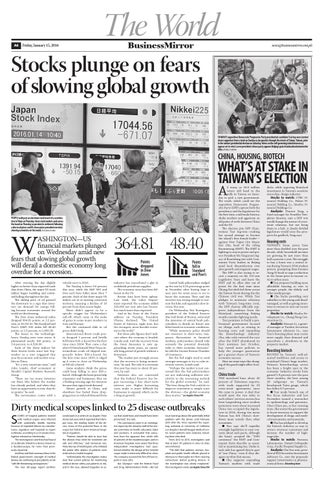
ABOUT 70 percent of Philippine exports consist of semiconductor and electronic products. China’s cooling economy casts a long shadow on the Philippine manufacturing sector.
Meeting the Sustainable Development Goals, or the Global Agenda, also means addressing income and opportunity inequalities in the region. In the Philipines, using 2012 data, the Philippine Statistics Authority said the country’s Gini coefficient—a measure of income inequality—remains high at 0.46. The Gini coefficient ranges from 0 to 1, with 0 indicating perfect income equality among families, and 1 indicating absolute income inequality. “The adoption of the 2030 Agenda comes at a time when the
global policy-makers are still struggling to revive economic growth despite taking extraordinary measures. While the 2030 Agenda promotes a broader concept of human welfare, robust growth is important for creating jobs and improving overall development outcomes,” Akhtar said. “The slowdown in the region’s economic growth is raising doubts about Asia and Pacific’s continued ability to lead the way forward to global economic recovery,” she added. The Asia-Pacific region grew by an estimated 4.5 percent in 2015, the
lowest since 2009, as private consumption and investment slowed down while exports remained sluggish. A modest rebound to 5-percent growth is forecast for 2016, compared to an average 9.4-percent growth in 2005 to 2007 before the global financial and economic crisis. Other than weak external demand, domestic factors such as weak productivity and wage growth, infrastructure bottlenecks, and slower implementation of reform measures are holding back the growth potential of the region.
ABAYA PROMISES MRT LINE 3 GLITCHES TO END BY AUGUST G
LITCHES experienced by the Metro Rail Transit (MRT) Line 3—some even causing minor injuries to passengers— are expected to be minimized by August, at least according to the transport chief, as the government has already moved to spend almost a billion pesos to replace the train facility’s “already obsolete” signaling system. The plan, Transportation Secretary Joseph Emilio A. Abaya said, is to improve the train line’s signaling system in both the short and the long term. The first phase of the improvement involves the P56-million replacement of the signaling’s operating system. “It is very technical, but in layman’s term, we’re replacing the CPU itself. We have signed a contract with Bombardier to upgrade the signaling system,” he said in an interview on Thursday. According to an audit conducted by France-based railway transport engineering consultancy Systra in 2010, the MRT’s signaling system has already reached its obsolescence, requiring the operator and the owner of the train line to replace the said component. The 2014 evaluation conducted by MTR Corp. Ltd., which runs Hong Kong’s train system, also showed the same observation. Still, the government only moved to procure a replacement in 2015. The signaling system for a train line is crucial to prevent the trains from colliding. It maintains safe distances between trains and controls their speed: issues with its components may result in less operating trains and in slower travel. Hence, train coaches cannot move forward without it.
“The signaling system should be addressed because it’s already intermittent—this causes sudden stoppages of trains that had led to minor injuries to passengers. So in the best interest of the public, we decided to ensure to upgrade the service by talking to Bombardier,” Abaya said. The notice to award was issued to Bombardier in September 2015, and the contract signing was held three months after. The notice to proceed—which requires several approvals from different agencies due to the direct procurement’s nature—is expected to be issued sometime this month. This allows Bombardier to start working on the said component as early as the latter part of this month. It has seven month to complete the contract. “So by August, we will have replaced the signaling system’s CPU,” Abaya said. He explained that the operating system is just one basic part of the signaling component of a train line. The government has also moved to replace the railway’s communications system by 2018. Under the agreement signed by the government and the Busan Transportation Corp.-led consortium, the state will pay P900 million to the Filipino-Korean joint venture to replace the whole signaling system of the MRT. This means that while Bombardier is working on the replacement of the operating system of the train line’s signaling component, the Busan consortium will also work to install the new communications system on the MRT. “There will be an overlap, but what is important is to capture the
timeline. The quickest solution to the obsolescence upgrading is two years’ time, if we will rely on Busan. If we didn’t do the Bombardier upgrade, it will be obsolete for two years,” Abaya said. The MRT, rail experts said, is in a chronic state of decay, with the 16-year-old trains already maxed out of their rated capacities and the rails already experiencing difficulties in handling almost 560,000 passengers per day. Several projects were launched by the government in the past two years to augment this sorry reality, including the procurement of new trains. This deal, however, was also delayed. Dalian Locomotive and Rolling Stock Co. won the project in 2013, and was supposed to deliver 48 new cars starting end-2015. The staggered delivery of the actual coaches, however, was slowed down by a quarter. Once the 48 new train cars come in, MRT 3’s trips per hour will increase from 20 to 24, which will translate to a 60-percent rise in the number of passengers per hour per direction. This means that there will be 37,824 passengers who can avail themselves of the rail service every hour heading toward one direction. Currently, only about 23,640 people ride an MRT service per way every hour. But that number still depends on how many trains are running that day. This is just one of the P9.7-billion program that the transport department launched two years ago. Several private groups are also willing to help the government improve the train line, but the government has turned a cold shoulder to them. Lorenz S. Marasigan
AseanFriday BusinessMirror
news@businessmirror.com.ph
Asean burns up ranks of global polluters
227%
Surge in carbondioxide emissions from fossil in Southeast Asia between 1990 and 2010
A
S Southeast Asian economies boomed last decade, so did their pollution. The region’s emissions of carbon dioxide grew more rapidly between 1990 and 2010 than any other part of the world, with the Asian Development Bank (ADB) warning the associated global warming could trigger floods, water shortages and economic losses. Carbon-dioxide emissions from fossil fuels surged 227 percent in Southeast Asia in the 20-year period, compared with 181 percent in South Asia and 12 percent in North America, the ADB said, citing World Bank data. Southeast Asia’s emissions in metric tons per capita increased 157 percent in the period, also the fastest in the world, according to World Bank data compiled by Bloomberg. “The region has experienced rapid economic growth in recent years, and regional greenhouse gas [GHG] emissions have rapidly increased, at nearly 5 percent per year over the last two decades,” the ADB said this week. “In the absence of climate action, the region will be increasingly exposed to hotter temperatures, more destructive storms, greater flooding in some areas, and more droughts in others.” Still, Indonesia was the only Southeast Asian nation ranked among the top 10 greenhouse-gas emitters in the world in 2011. China was the worst, followed by the US and the European Union, according to the ADB report. World leaders converged on Paris last month and agreed to make an unprecedented push for climatechange action, with 187 nations pledging voluntary commitments to limit pollution from 2020. The ADB estimated last December that economic losses from climate change in Southeast Asia could reduce the region’s GDP by as much as 11 percent by 2100. The bank’s report raised urgency for fast-tracking Southeast Asia’s GHG emission reduction, warning limited impacts of climate change arising from these discharges can already reach some 11 percent of the region’s GDP by 2100. The report, titled “Southeast Asia and the Economics of Global Climate Stabilization,” highlights need to mitigate GHGs, as it cites the region as among areas most v ulnerable to climate change due to geographic, demographic, economic and other conditions prevailing in Asean. The report also said Southeast Asia registered—at nearly 5 percent annually between 1990 and 2010— the fastest relative growth in emission of carbon dioxide, one of the climate change-driving GHGs. “It finds that mitigation is in the region’s economic interest,” ADB Knowledge Management and Sustainable Development Vice President Bambang Susantono said at the report’s launch. He noted adapting energy-efficient (EE) measures and addressing deforestation are among mitigation activities for significantly reducing Southeast Asia’s GHG emissions. “EE is the largest source of potential emission reduction while addressing deforestation is critical to mitigation especially in the medium term,” he said. Bloomberg News
Friday, January 15, 2016 A5
Jakarta rocked by series of terror attacks; rupiah, stocks plunge
A
T least three suicide bombers exploded themselves in a Starbucks café in downtown Jakarta on Thursday, while two gunmen attacked a police post nearby, a witness told The Associated Press (AP). TVOne, a local television network, reported three other explosions in other parts of the city. Indonesia’s rupiah and stocks fell after the attacks. The currency fell 0.9 percent to 13,958 a dollar as of 12:09 p.m. local time, prices from local banks show. In the offshore market, one-month nondeliverable forwards weakened 1.1 percent to 14,085. The Jakarta Composite Index of shares dropped 1.7 percent. Sovereign bonds erased gains, with the 10-year yield little changed at 8.58 percent, according to prices from the Inter Dealer Market Association. Bank Indonesia’s scheduled monthly interest-rate review would still take place this afternoon, said Arbonas Hutabarat, a spokesman at the central bank. “The rupiah has sold off on the breaking developments in Jakarta, which is unnerving markets, said Khoon Goh, a senior foreign-exchange analyst at Australia & New Zealand Banking Group Ltd. in Singapore. “We still don’t know what is happening yet, but investors do not like uncertainty, and this just adds to it.” Indonesia has been battling violent Islamist extremists since at least 2000, but the last major attack was in 2009 when twin suicide bombings killed seven people at two Jakarta luxury hotels. Police and security analysts have warned that Indonesians traveling to join the Islamic State in Iraq and Syria posed a threat to Indonesia. “We still don’t have much information, which makes it hard to make any prediction,” said Masakatsu Fukaya, a trader on the Asia and emerging-market team at Mizuho Bank Ltd. in Tokyo. “But if this is not
a long-lasting incident, the impact on the economy may be limited as unlike Thailand, Indonesia doesn’t depend much on tourism revenue.” At least one policeman was killed in addition to the bombers. The first explosion appeared to have triggered a gun-battle between the attackers and antiterror police squads, and gunfire could be heard more than 1 1/2 hours later. Tri Seranto, a bank security guard, told AP he saw at least five attackers, including three suicide bombers who exploded themselves in the Starbucks. He said he was out on the street when he saw the three men entering Starbucks and saw them blowing themselves up one by one. He said the other two attackers, carrying handguns, entered a police post from where he heard gunfire. He said he later saw one policeman dead and three seriously wounded. He said he was not wounded in the explosions as he was a little distance away, but close enough to witness the attack at 10.30 a.m. (0230 GMT). He said the two gunmen ran away with police chasing them. No one has claimed responsibility for the attacks. Gunshots were heard after the midmorning explosion in front of the Sarinah shopping mall and a police station. The area also has many luxury hotels, and offices and embassies, including the French. The other set of explosions were in neighborhoods where the embassies of Turkey and Pakistan are located. Tweets from the account of Jeremy Douglas, regional representative of the United Nations Office on
IN this photo released by China’s Xinhua News Agency, an unidentified man with a gun walks in the street as people run in the background on Thamrin street near Sarinah shopping mall in Jakarta, Indonesia, on Thursday. Suicide bombers exploded themselves in downtown Jakarta on Thursday, while gunmen attacked a police post nearby, a witness told The Associated Press. Local television reported more explosions in other parts of the city. AP
Didn’t experience this in 3.5 years in #Pakistan.”—Tweet from account of Jeremy Douglas, regional representative of the UN Office on Drugs and Crime for Southeast Asia and the Pacific. Drugs and Crime for Southeast Asia and the Pacific, described a bomb and “serious” exchanges of gunfire on the street outside his Jakarta office. “Didn’t experience this in 3.5 years in #Pakistan,” he wrote. “A massive #bomb went off in front of our new #Indonesia office as @collie_brown & I exit car. Chaos & we’re going into lock-down,” he wrote. And three minutes later: “Apparent #suicidebomber literally 100m from the office and my hotel. Now gunfire.” About 30 minutes after his first post about the bombing, he posted that things were “quiet. Not comfortable quiet.” Indonesia has been a victim of several bombing attacks in the past,
claimed by Islamic militant groups. Last month antiterror police arrested nine men and said the group had wanted to “perform a ‘concert’ to attract international news coverage of their existence here.” Police cited a document seized from the group that described the planned attacks as a “concert.” The country has been on high alert after authorities said they had foiled a plot by Islamic militants to attack government officials, foreigners and others. About 150,000 police officers and soldiers were deployed during New Year’s Eve to guard churches, airports and other public places. More than 9,000 police were also deployed in Bali, the site of
Indonesia’s deadliest terror attack, which killed 202 people in 2002. National Police Spokesman Maj. Gen. Anton Charliyan said security is focused on anticipating attacks in vulnerable regions, including Jakarta. On Tuesday the jailed radical Islamic cleric Abu Bakar Bashir appealed to an Indonesia court to have his conviction for funding a terror training camp overturned, arguing that his support for the camp was an act of worship. The 77-year-old leader of the Jemaah Islamiyah militant network filed a judicial review of his 2011 conviction, when he was sentenced to 15 years in jail for setting up the camp in Aceh province. A higher court later cut the sentence to nine years. Indonesia, the world’s most populous Muslim nation, has suffered a spate of deadly attacks by the Jemaah Islamiyah network in the past. But strikes in recent years have been smaller and less deadly, and have targeted government authorities, mainly police and antiterrorism forces. AP, Bloomberg News
Post-TPP outlook bright for Vietnam’s economy, experts say
A
BRIGHTER outlook is forecast for the Vietnamese economy this year and the following years amid difficulties and challenges, according to economic expert Nguyen Quynh Nga. Nga, deputy head of the Multilateral Trade Policy Department under the Ministry of Industry and Trade, told participants at a seminar on Vietnam’s Socio Economy in 2015 and Opportunity—Challenges held on Wednesday in Hanoi, that the TransPacific Partnership (TPP) was expected to be signed on February 4 in New Zealand, and added that the relevant Vietnamese agencies were preparing a document for the occasion. Nga said signing free-trade agreements (FTAs) with big partners including the US, Japan, the European Union would help Vietnam to expand its trade relations with countries and boost exports, as well as enhance participating regional value chains and service development. Vietnam has renewed its economic mechanism, boosted renovation and improved the business climate with a view to attracting more foreign investors. In addition, challenges facing the country include the reduction in the State budget from import tax and the pressure on competition from
10%
Projected GDP growth of Vietnam once Trans-Pacific Partnership is in force
foreign service and goods, even as human resource and high-tech quality remain poor. Can Van Luc, director of BIDV Training School at the Bank for Investment and Development of Vietnam, said Vietnam would enjoy much more benefits from the TPP once it become effective after two years. The World Bank predicted that Vietnam’s economic growth may increase a further 10 percent after it joins the TPP. Luc said Vietnam and Cambodia would become the largest beneficiaries after the establishment of the Asean Economic Community (AEC) in 2015. The country’s GDP would grow a further 3.5 percent thanks to the AEC and it could increase a further 10 percent after Vietnam joins the TPP.
ENEMIES before, Hanoi and Washington are now partners in the US-led Trans-Pacific Partnership economic bloc, which is seen to ramp up Vietnam’s growth to 10 percent. In this 1966 file photo, water-filled bomb craters from B-52 strikes against the Viet Cong mark the rice paddies and orchards, west of Saigon, Vietnam. B-52s were one arm of the nuclear deterrent force during the Cold War and were used in the carpet-bombings of North Vietnam. AP
According to Luc, all sectors can benefit from the TPP such as textiles, fisheries, infrastructure and logistics, apart from real estate, steel and timber products, and drugs. Meanwhile, the sectors facing difficulties are automobile, ports, beef and sugar, in addition to consumer goods, processed foods, and foodstuff and alcohol. Concerning the outlook for 2016, Associate Professor Trung Thanh of the National Economic University said world economic growth tended to improve thanks to the developed countries such as the US. This year, Vietnam’s economy will continue to recover as the world economy bounces back stronger than before in which foreign direct investment plays an important role, Thanh said. Vietnam will participate in the global value chain and receive numerous opportunities from the FTAs so as to increase exports and attract more investment capital. Thanh predicted that in 2016, monetary policy would be narrowed and the exchange rate can be adjusted. Prices of some commodities would become higher. The increased pressure on public debt and limited participation of private companies due to their poor finance and abilities would influence the country’s economy. PNA
A6
The World BusinessMirror
Friday, January 15, 2016
news@businessmirror.com.ph
Stocks plunge on fears of slowing global growth
TAIWAN’S opposition Democratic Progressive Party presidential candidate Tsai Ing-wen (center) cheers supporters from a truck on Sunday as she parades through the streets of Tainan, Taiwan, prior to the nation’s presidential election on Saturday. Voters on the self-governing island democracy appear set to elect a new president whose party opposes Beijing’s goal of unification between the sides. AP/WALLY SANTANA
CHINA, HOUSING, BIOTECH
WHAT’S AT STAKE IN TAIWAN’S ELECTION A
PEOPLE walk past an electronic stock board of a securities firm in Tokyo on Thursday. Asian stock markets sank across the board on Thursday as pessimistic sentiment following a dive in oil prices and US-share prices prevailed over data showing economies on the mend. AP/EUGENE HOSHIKO
W
ASHINGTON—US financial markets plunged on Wednesday amid new fears that slowing global growth will derail a domestic economy long overdue for a recession.
After starting the day slightly higher on better-than-expected trade data from China, the major US stock indices began tumbling and continued falling throughout the day. The sliding price of oil greased the downturn in a sign that investors see demand for energy falling because economies around the world are decelerating. The Dow Jones industrial index dropped 364.81 points, or 2.2 percent, to 16,151.41. The Standard and Poor’s (S&P) 500 index fell 48.40 points, or 2.5 percent, to 1,890.28. The losses in the technologyheavy Nasdaq were even worse. It plummeted nearly 160 points, or 3.4 percent, to 4,526.06. Each of the three indices hit their lowest levels since late September in a rout triggered this year by economic and market troubles in China. “It’s a very uncertain time,” said John Lonski, chief economist at Moody’s Capital Markets Research Group. “There are too many investors out there who believe the market has already peaked, and when they have an opportunity to exit, they do so pronto,” he said. The nervousness comes with a
volatile start to 2016. The Nasdaq is down 9.6 percent this year, while the S&P 500 and Dow each have fallen more than 7 percent. Each of the three major US indices are in or nearing correction territory, meaning a decline of 10 percent from their recent highs. There didn’t appear to be a specific trigger for Wednesday’s sell-off, which came in the wake of gains in some major markets in Asia and Europe. But the continued slide in oil prices didn’t help. International Brent crude prices dropped 2 percent and briefly fell below $30-a-barrel for the first time since 2004. That came a day after US benchmark West Texas intermediate crude oil slipped temporarily below $30-a-barrel for the first time since 2003; it edged up 4 cents to close on Wednesday at $30.42 a barrel. Some analysts think the prices could keep falling to near $20-abarrel. Although the lower prices help consumers and businesses, they are a flashing warning sign for investors because they signal weak demand. Slower growth in China and elsewhere has fueled those dropping prices as reduced demand from
364.81 48.40 Points dropped in Dow Jones industry has exacerbated a glut in worldwide petroleum supplies. The economic story has been different in the US. Recent data have been upbeat. Last week, the Labor Department reported the economy added 292,000 net new jobs last December, much more than expected. And in his State of the Union address on Tuesday, President Obama declared: “The United States of America, right now, has the strongest, most durable economy in the world.” But those jobs figures don’t indicate where the economy is headed, Lonski said. And the recovery from the Great Recession is now approaching seven years, an unusually long period of growth without a downturn. “The market just strongly senses that the recovery is losing momentum,” he said. The risk of a recession this year has risen to about 20 percent, he said. Investors also are concerned that the Federal Reserve has begun increasing a key short-term interest rate. Higher borrowing costs make it more difficult for businesses to expand, which can be a drag on growth.
Points fell in Standard and Poor’s Central bank policymakers nudged up the rate by 0.25 percentage point in December after having kept it near zero for seven years to try to boost the economy. They said the recovery was strong enough to warrant the hike and signaled a slow increase this year. On Wednesday, Eric Rosengren, president of the Federal Reserve (the Fed) Bank of Boston, reiterated the intention of central bank policymakers to decide on future rate hikes based on economic conditions. “While monetary policy should not overreact to short-term, temporary fluctuations in financial markets, policymakers should take seriously the potential downside risks to their economic forecasts,” he told the Greater Boston Chamber of Commerce. But the Fed might need to send stronger messages to try to calm investors’ nerves, Lonski said. “Perhaps the market is just concerned that the Fed policymakers are not indicating sufficient sensitivity to the worsening outlook for the global economy,” he said. “The best thing the Fed could do to improve sentiment is simply state the obvious—the global economy does matter.” Los Angeles Times/TNS
Dirty medical scopes linked to 25 disease outbreaks
S
CORES of hospital patients treated with medical scopes were infected with potentially deadly bacteria because of repeated failures by manufacturers, regulators and hospitals to report outbreaks, according to a US Senate investigation released on Wednesday. The investigators said they had found 25 outbreaks linked to a device known as a duodenoscope, far more than previously reported. And they said that numerous flaws in the federal government’s oversight of medical devices are continuing to put patients at risk “with life-threatening consequences.” The new 301-page report confirms
conclusions in a series of Los Angeles Times stories last year, which reported that Olympus Corp., the leading maker of the device, knew of the potential flaws in the scope but failed to alert American hospitals or regulators. “Patients should be able to trust that the devices they need for treatment are safe and effective,” said Democrat Sen. Patty Murray of Washington, who initiated the probe after dozens of patients were sickened at a Seattle hospital. “Unfortunately this investigation makes clear that current policies for monitoring medical device safety put patients at risk, and in this case, allowed tragedies to oc-
cur that could have, and should have, been prevented,” she said. The conclusions came in an investigative report by the minority staff of the Senate committee on health, education, labor and pensions. It concluded that executives from the Japanese firm, which sells 85 percent of the duodenoscopes used in American hospitals, were aware that three independent investigations had questioned whether the design of the $40,000 scope made it extremely difficult to clean. The company received the first of those reports in June 2012. But Olympus—and the federal Food and Drug Administration (FDA)—did not
issue warnings about the potentially lethal problem with the device until February 2015 after the Times reported the superbug outbreak at University of California Los Angeles’s Ronald Reagan Medical Center. Seven patients were sickened, including three who died. From 2012 to 2015, investigators said that at least 141 patients in nine US cities were infected. “The faith that patients, doctors, hospitals and public health officials placed in Olympus to thoroughly test their cleaning instructions before putting devices in the marketplace was clearly misplaced,” the investigators wrote. Los Angeles Times/TNS
S many as 18.8 million voters will head to the polls in Taiwan on Saturday to pick a new government. The result, which could see the opposition Democratic Progressive Party (DPP) capture both the presidency and the legislature for the first time, could make history, shake markets and aggravate an old point of strife between China and the US. The election pits DPP Chairwoman Tsai Ing-wen—making her second attempt to become the island’s first female leader— against New Taipei City Mayor Eric Chu, head of the ruling Kuomintang (KMT). The KMT is fighting to stay in power and protect President Ma Ying-jeou’s legacy of flourishing ties with Communist Party leaders in Beijing amid local dissatisfaction over slow growth and stagnant wages. The DPP is also trying to secure a majority on the 113-seat Legislative Yuan and leave the KMT and its allies shut out of power for the first time since Chiang Kai-shek led them across the Taiwan Strait during the the Chinese civil war. While Tsai pledges to maintain relations with Taiwan’s long-time rival, the DPP charter officially supports independence from the Mainland, something Beijing would consider fighting words. Tsai promises to build a professional government focused on things such as reining in housing costs and expanding the biotechnology industry. Chu, who only entered the race after the KMT abandoned its first nominee last October, has vowed more policies to help the younger generation get a greater share of Taiwan’s economic success. Here are some ways this changing of the guard might affect business:
China trade
THE mainland buys about 40 percent of Taiwanese exports, with trade supported by 23 cross-strait agreements since Ma came to power. A deal that would open the two sides to each others’ services sectors has been languishing since student protesters wary about increased China ties occupied the legislature in 2014. Strong ties mean Taiwan has felt China’s slowdown more acutely than other economies. ■ Tsai says she’ll expedite oversight legislation to ease concerns about such pacts, although she hasn’t accepted the “1992 consensus” the KMT and Communist Party describe as essential to maintaining ties. Under it, each side has agreed they’re part of “one China,” even if they disagree on what that means. ■ Chu supports expanding Taiwan’s markets with trade
deals, while opposing Mainland investment in Taiwan’s sensitive microchip- design industry. Stocks to watch: CTBC Financial Holding Co., Fubon Financial Holding Co., SinoPac Financial Holdings Co. Analysis: Vincent Yang, a fund manager for Franklin Templeton SinoAm, says a DPP win would change the nature of crossstrait relations, but not bring them to a halt. A closely divided legislature would raise the prospects for gridlock, Yang says.
Housing costs
TAIWAN’S home prices have more than doubled over the past decade, while household incomes are growing by just more than half a percent a year. The struggle to buy a home was a central issue during Taiwan’s 2014 student protest, prompting then-Premier Jiang Yi-huah to urge a reduction in the home-price-to-income ratio in urban areas. ■ Tsai proposes building more affordable housing to rent to younger people, the elderly and other needy groups. ■ Chu backs providing rent subsidies to the young and disadvantaged, as well as giving incentives to owners to rent out vacant properties. Stocks to watch: Huaku Development Co., Chong Hong Construction Co. Analysis: Masson Li, a general manager at Taishin Securities Investment Advisory Co., says Tsai’s housing plans may create more supply than demand and exacerbate a slowdown in the property market.
Boosting biotech
BUOYED by Taiwan’s well-educated workforce and access to mainland China’s huge market, Taiwan’s biotechnology sector has been a bright spot in the economy. Industry stocks have gained 1.9 percent over the past three months, the best among 28 subgroups on Taiwan’s benchmark Taiex gauge, which has fallen 8.7 percent. ■ Tsai made biotech one of five focus industries and last November named a researcher in epidemiology and genomics, Chen Chien-jen, as her running mate. She wants the government to boost resources to support the development of drugs and medical instruments and materials. ■ Chu has pledged to develop the biotech industry as way to attract overseas consumers and increase the number of highwage jobs. Stocks to watch: Formosa Laboratories, United Orthopedic Corp., Pacific Hospital Supply Co. Analysis: Chu Yen-min, president of KGI Securities Investment Advisory Co., says the proposals support investments in pharmaceutical firms. Bloomberg News
The World BusinessMirror
news@businessmirror.com.ph
Friday, January 15, 2016
A7
STATE OF THE UNION
5 things that might happen, 5 that won’t
W
ASHINGTON—Not much is expected in the final year of a presidential administration, especially one marked by partisan gridlock.
But President Barack Obama in his annual State of the Union address on Tuesday night said that he and the Republican Congress “just might surprise the cynics again” in 2016 just as they did in 2015— one of the most productive years of Obama’s tenure. In briefings with reporters earlier in the day, Senate leaders of both parties said they would aim for the same. Still, as Obama went through his list of policy proposals during his 59-minute speech, there were far more obvious nonstarters than easy wins. In fact, of the proposals around which there is bipartisan agreement, plenty of uncertainty remains. Here are the five most likely to get done—if everything went Obama’s way—followed by five that likely never will, so long as Obama is president and Republicans control the House and Senate:
Five maybes
New climate-change regulations: Obama pledged to continue working toward “solving urgent challenges like climate change.” He’s not going to get any help from Congress. Indeed, many Republican lawmakers deny the phenomenon is even happening. But the outlook for solving climate change depends most on Obama’s executive actions, especially his regulations targeting carbon emissions from power plants. States, trade groups and some utilities are trying to block them in court, but if they pass muster there, Obama will leave office with a substantial environmental legacy. Republican lawmakers have tried to scuttle Obama’s regulatory agenda, but the president and Democrats in Congress blocked riders in the yearend omnibus spending bill. Obama vetoed resolutions passed under the Congressional Review Act that would have nullified carbon emission restrictions on new and existing power plants. Curing cancer: Obama challenged lawmakers to “make America the country that cures cancer once and for all.” That’s a high bar, but he’ll at least have Congress’s support. In a strong bipartisan vote, the House passed the so-called 21st Century Cures bill last summer to spur
the development of new drugs and revitalize research at the National Institutes of Health (NIH), with the Senate Health, Education, Labor and Pensions Committee expected to release its version this year. Then last month Congress provided the NIH with a $2-billion boost in funding in the fiscal 2016 omnibus. Fighting heroin-abuse: Obama mentioned “helping people who are battling prescription-drug abuse and heroin abuse” as one of the bipartisan issues on which he expects progress in 2016. And, indeed, lawmakers of both parties are concerned about rising heroin-abuse rates. Senate Majority Leader Mitch McConnell, Republican-Kentucky, sponsored a measure—which was signed into law last year, after it was advanced unanimously by both chambers—to help treat infants who are exposed to opioids in the womb. Republican Rob Portman of Ohio and Democrat Sheldon Whitehouse of Rhode Island have teamed up on a wide-ranging package that would expand educational and prevention efforts and increase access to drugs that can reverse the effects of overdose. And the omnibus provided $25 million to expand services that address prescription-drug abuse and heroin use in high-risk communities. Overhaul of criminal sentencing: Obama called “criminal justice reform” a bipartisan priority and he’s right. Lawmakers of both parties have coalesced around legislation that would provide more leniency for nonviolent drug offenders serving long sentences. A key lawmaker on the issue, Republican-House Judiciary Chairman Robert W. Goodlatte of Virginia, expressed optimism on Tuesday before Obama’s address, for instance: “I believe that this has support in our leadership,” he said. Sen. Charles E. Grassley, Republican-Iowa, has used his considerable power as Senate Judiciary chairman to shape a compromise bill that has the support of many of the most powerful senators. Raising fees to use federal land: Businesses that extract oil and coal on federal land should watch out. Fees are going up. Obama said he wants the rates to “better reflect the
VICE President Joe Biden, House Speaker Paul Ryan of Wisconsin and other US officials listen during President Barack Obama’s State of the Union address before a joint session of Congress on Capitol Hill in Washington, on Tuesday. AP/SUSAN WALSH
$2B
The amount Congress provided for cancer cure in 2016
costs they impose on taxpayers and our planet.” Republicans in Congress will object, but they probably can’t stop him. The Interior Department last year took comment in advance of a formal rulemaking to raise prices for oil and natural gas and held forums on how it should “modernize” its coal program to ensure taxpayers are getting a fair return.
Five no ways
Authorize force against the Islamic State (IS): McConnell began his pre-State of the Union briefing saying he wanted to know what Obama planned
to do about the IS—the terrorist group that’s overrun parts of Iraq and inspired attacks inside the US and in Europe. But the prospects of Congress approving the use of force against the group, as Obama requested in his State of the Union, are nil. A wide chasm separates the parties, with Republicans favoring an open-ended authorization and Democrats calling for one that limits the deployment of US ground forces. Republican Senate Foreign Relations Chairman Bob Corker of Tennessee, says he’d rather not do an authorization that passes on party lines and, for his part, McConnell—who controls the Senate floor—last month said he did not want an authorization of force until the next president takes office. Lifting the Cuba embargo: Congressional Republicans said Obama overstepped when he restored diplomatic ties with Cuba, so they aren’t going to take up his call in the State of the Union to lift the trade embargo that Congress codified in 1996. It’s true that the business wing of the party favors economic engagement with the Cuban regime but it
is up against a deep well of animosity in the party toward dictator Fidel Castro and his brother Raul, who’s now running the country, as well as Cuban-American lawmakers for whom the preservation of the embargo is of vital importance. Overhauling campaign finance rules: Obama tried to appeal to lawmakers’ self-interest, arguing that none enjoys raising campaign money. But Congress is unlikely to advance campaign finance legislation to make it more difficult for the wealthy and corporations to spend money on politics. That’s because Republicans like the system the way it is and have, in fact, pushed for more deregulation. They view the Supreme Court’s 2010 decision allowing the wealthy to set up loosely regulated political action committees as a boon to them, while most Democrats say they want to get rid of the super Political action committees. Closing Guantànamo: Obama in his 2008 campaign said he wanted to close the terrorist prison camp at the US military base in Guantànamo Bay, Cuba. It’s proven an impossible promise to keep. That will remain so in 2016. A provision in the fiscal
2016 omnibus prohibits funds from being used to close the Guantànamo prison or to construct or renovate a facility in the US to take detainees currently held at Guantànamo. That follows myriad congressional restrictions on detainee transfers since 2010. Education funding: Obama restated some goals from past State of the Unions when he proposed universal pre-K and free community college for all. The result will be the same: No dice. Republicans gave Democrats a compromise on pre-K funding in the Elementary and Secondary Education Act reauthorization late last year, including a $250-million authorization for federal pre-K programs. However, Republicans are hesitant to add another year to the K to 12 enterprise, which they say isn’t serving the children it has well enough. Republicans favor targeted-funding approaches, such as competitive grants, that give state- and local-education authorities flexibility over how to use the money. Republicans say the same goes for community college: Let the states decide how to spend their federal education funds. TNS
US decries violence in Central America but to continue deportations
W
ASHINGTON—The United States is growing increasingly concerned about rising violence in Central America even as it launches a large-scale effort to round up Central American families and deport them to their home countries. Twice in recent days, senior US officials, including President Barack Obama during his State of the Union address on Tuesday, have listed Central America as an area of concern for the coming year, and on Monday, the US suspended the Peace Corps program in El Salvador, citing security concerns. But the US Department of Homeland Security insists it will continue to conduct immigration raids aimed at Central Americans. On Wednesday Secretary of State John F. Kerry said that the US has asked the United Nations to set up refugee screening centers in Central America and will expand the refugee program it offers vulnerable migrants from El Salvador, Guatemala and Honduras. Kerry called the plan for UN screening in Central America a “safe and legal alternative” to the “dangerous journey many are currently tempted to begin” on their way to the US.
“That is who we are. That is what we do,” Kerry said at an address at the National Defense University. President Barack Obama has authorized spending up to $70 million to meet the “unexpected urgent refugee and migration needs related to the US Refugee Admissions Program.” The US already plans to admit 85,000 refugees from around the world this year, which is 15,000 more than last year. That money is largely expected to be used for up to 10,000 Syrian refugees, but could as many as 3,000 Central Americans referred by the United Nations High Commissioner for Refugees, which will help screen and determine whether migrants are eligible. El Salvador, Honduras and Guatemala are three of the most violent countries in the world. More than 900 people were murdered in El Salvador—a country roughly the size of Massachusetts—in August, according to that country’s Institute of Legal Medicine. That’s an average of more than 30 a day. The worsening violence led the Peace Corps to announce on Monday that it was suspending the program in El Salvador “due to the ongoing
security environment.” The Peace Corps suspended its Honduras program in 2012, also for safety reasons. Last week Kerry cited Central America as one of the challenges the US will have to confront in 2016 in one of his first public talks this year. The administration worked with Congress last year to secure $750 million to help El Salvador, Guatemala and Honduras fight poverty and violence, as well as reform their governments. Vice President Joe Biden will travel to Guatemala on Thursday for the inauguration of Guatemalan President-elect Jimmy Morales. Biden is also expected to meet with presidents of El Salvador and Honduras to discuss where they can best expend those resources and what money they will contribute. While rising violence is a major factor, it is not the only issue that must be addressed, said an administration official knowledgeable about the trip but not authorized to speak publicly. “It’s a series of chronic problems that run the gambit from nature to economic efficiency, to criminality and poor governance, that are coming together at the moment to cause people to be leaving in increasing
numbers,” the official said. Yet, the US Department of Homeland Security continues to deport families—many of whom have requested asylum because of the violence—to those same countries. More than 121 people were apprehended during immigration raids over the New Year’s holiday. The far-reaching operation focused on Central American adults and their children who arrived in the US during the recent two-year surge of tens of thousands of migrants fleeing poverty and violence in Central America. Last year US Customs and Border Protection apprehended 337,117 people. Of those, 43,564 were from El Salvador; 57,160 from Guatemala and 33,848 nationals from Honduras. The administration said they will honor humanitarian claims, but migrants who can not demonstrate through the legal process that they deserve humanitarian relief should expect to be returned. Cecilia Muñoz, director of the White House Domestic Policy Council, said the enforcement actions were consistent with priorities established by the US Department of Homeland Security in November 2014. Talking
to reporters before the State of the Union address, Muñoz said priorities focus on removing people convicted of serious crimes and recent arrivals. She said they all had gone through the legal system and a judge had ordered their removal. “Those are the priorities from which the agency is focusing on,” she said on Tuesday night. But the raids have infuriated Democratic lawmakers and advocates who say picking up mothers and children late at night and early in the morning has generated widespread fear and panic across immigrant communities. Democrat Sen. Robert Menendez of New Jersey, applauded the idea of opening of a refugee-processing center in Central America as an important step toward recognizing the humanitarian crisis merits a comprehensive approach. “At the same time, we must immediately halt domestic immigration raids that fast-track the deportations of the very same families we are hoping to aid with today’s announcement, especially if they have not been granted access to legal counsel or meaningful due process,” he said. It’s not just Democrats who are concerned.
Rep. Carlos Curbelo, RepublicanFlorida, said the US has always afforded refuge to those fleeing oppression and persecution. “Victims of violence and organized crime in Central America should certainly be considered for our refugee program,” Curbelo said. “Regrettably, the administration is sending mixed messages by at the same time deporting families to the region.” Advocates pointed to the apparent contradiction. On the one hand, it’s positive that the administration recognized the refugee crisis due to widespread violence in Central America, said Frank Sharry, executive director of Washington-based advocacy group America’s Voice. “However, it is contradictory that the same administration is defending home raids and deportation for those already in America who are fleeing the same death, threats and sexual violence,” Sharry said. On Wednesday Kerry said the country can maintain the highest security standards and live up to American traditions by welcoming those in need. He did not say how many Central American refugees would be accepted or when the program would begin.TNS
A8
The World BusinessMirror
Friday, January 15, 2016
briefs CARBOMB ATTACK AT TURKISH POLICE STATION KILLS FIVE ANKARA, Turkey—Kurdish rebels detonated a car bomb at a police station in southeastern Turkey, then attacked it with rocket launchers and firearms, killing five people, including civilians, the governor’s office said on Thursday. Thirty-nine other people were injured. The attack late on Wednesday targeted the police station in the town of Cinar, in the mostly Kurdish Diyarbakir province, and police lodgings at the compound, the Diyarbakir governor’s office said. The force of the blast caused a house close to the police station to collapse. The attack killed two people at the police lodgings and three people died inside the collapsed house. The attack came a day after a suicide bomber detonated a bomb in Istanbul’s main tourist district, killing 10 Germans. Turkish officials say the bomber was affiliated with the Islamic State group. AP
WINNING LOTTERY TICKET SOLD IN L.A. LOS ANGELES—A winning ticket in Wednesday night’s record $1.5-billion Powerball jackpot was sold in suburban Los Angeles, a spokesman for the California lottery says. It could take several hours before officials know whether any winning tickets were sold elsewhere. The winning numbers were 4-8-19-27-34 and Powerball 10. One winning ticket was sold at a 7-Eleven in Chino Hills, California, said Alex Traverso, a spokesman for that state’s lottery. The identity of the winner is not yet known. The store and its surrounding strip mall immediately became a wildly popular gathering spot in the usually quiet Los Angeles County suburb. Dozens of people, from TV news crews to gawkers, crowded the store and spilled into its parking lot. The store where the winner bought the ticket will get a $1-million bonus for selling it, Traverso said. AP
BORDER PATROL REUNITES SEPARATED MOTHER AND BABY TUCSON, Arizona—A mother and her young child were reunited by US Border Patrol agents after they were separated by a smuggler while trying to cross into the United States illegally, officials said on Wednesday. The reunion occurred after agents near Douglas apprehended a Guatemalan woman who was carrying a baby boy about 15 months old who wasn’t hers. About two hours later, the agents found a Mexican woman who said she was looking for her child after they were separated while trying to scale a border fence 4 miles east of Douglas. The woman told agents she had fallen off the fence on the Mexico side and injured herself. A smuggler took the child and told her to keep quiet and the Border Patrol would take care of him, Border Patrol Spokesman Matthew Eisenhauer said. The mother and son were in good health and returned to Mexico, Eisenhauer said. AP
FREED EXPERUVIAN DRUG TRAFFICKER CRITICIZES FUJIMORIS LIMA, Peru—A former top Peruvian drug trafficker has waded into presidential politics after being released from prison. The man, best known as “Vaticano,” said it would be dreadful if Keiko Fujimori won the presidency in this year’s elections. The daughter of jailed former President Alberto Fujimori is the current front-runner. Vaticano called Alberto Fujimori’s 1990 to 2000 government a narcostate as he was released on Wednesday after serving 22 years. He said he paid $50,000 a month to the imprisoned former president’s spy chief, Vladimiro Montesinos. Montesinos is also in prison, but for crimes other than drug trafficking. AP
news@businessmirror.com.ph
Iran releases US Navy sailors unharmed in less than a day
10
US Navy sailors detained in Iran were released within a day.
THIS picture released by the Iranian state-run Irib news agency on Wednesday shows the detention of American Navy sailors by the Iranian Revolutionary Guards in the Persian Gulf, Iran. Iranian state television is reporting that all 10 US sailors detained by Iran after entering its territorial waters have been released. SEPAHNEWS VIA AP
D
UBAI, United Arab Emirates—It turned out to be the international crisis that wasn’t. Less than a day after 10 US Navy sailors were detained in Iran when their boats drifted into Iranian waters, they and their vessels were back safely on Wednesday with the American fleet. US Secretary of State John Kerry tapped the personal relationship he has formed with Iranian Foreign Minister Mohammad Javad Zarif in the three years of negotiations over Iran’s nuclear program, speaking with him at least five times by telephone. Kerry credited the quick resolution to the “critical role diplomacy plays in keeping our country secure and strong.” US Defense Secretary Ash Carter thanked Kerry after the sailors’ release and couched the incident in humanitarian terms, noting that “the US Navy routinely provides assistance to foreign sailors in distress.” For Tehran, the Americans’ swift release was a way to neutralize a potential new flash-point days before it was expected to meet the terms of last summer’s nuclear deal, which will give Iran significant relief from painful economic sanctions.
It is likely that Supreme Leader Ayatollah Ali Khamenei, who has the final say on all matters of state, would have had to approve the release, given the immense political sensitivities. But the rapid resolution was also a victory for moderate President Hassan Rouhani, who has promoted greater openness with the outside world despite strident opposition from deeply entrenched hard-liners at home. “Rouhani’s policy of interaction is working,” Iranian political analyst Saeed Leilaz said. “Iran and the US have gone a long way in reducing tensions, but still have a long way to go in improving their contacts. It was a big step forward.” The nine men and one woman were detained on Tuesday after at least one of their boats suffered mechanical problems off of Farsi Island, an outpost in the middle of the Persian Gulf that has been used as a base for Revolutionary Guard speedboats since the 1980s. The Americans’ small Riverine boats were sailing between Kuwait
and Bahrain on a training mission when the US lost contact. The sailors left the island at 0843 GMT (3:43 a.m. EST) on Wednesday aboard their boats, the Navy said. They were picked up by Navy aircraft, and other sailors took control of the vessels for the return voyage to Bahrain, where the US 5th Fleet is based. Cmdr. Kevin Stephens, a 5th Fleet spokesman, said the priority now would be determining “how exactly these sailors found themselves in Iran.” He declined to say where they were going or give details on their identities, but a senior defense official said they were heading to a US military facility in Qatar. The official, who was not authorized to discuss the matter publicly, said they are being debriefed and getting medical exams but were not harmed. In Washington a defense official said the Navy has ruled out engine or propulsion failure as the reason the boats entered Iranian waters. Navigation problems, due either to human or mechanical failure, could not be ruled out, said the official, who was not authorized to discuss details of the incident and so spoke on condition of anonymity. The sailors were part of Riverine Squadron 1, based in San Diego, US officials said. When the US lost contact with the boats, ships attached to the USS Harry S Truman
aircraft carrier strike group began a search, as did aircraft from the Truman. The officials also spoke on condition of anonymity because they were not authorized to discuss the incident publicly. The Revolutionary Guard released images of the US sailors before their release, showing them sitting on the floor of a room. They looked mostly bored or annoyed, although one appeared to be smiling. The woman had her hair covered by a brown cloth. The pictures also showed what appeared to be their two boats. State TV later released more video and photos of the Americans apparently surrendering on their knees, their hands behind their head. It also showed machine guns and ammunition they had onboard. “After determining that their entry into Iran’s territorial waters was not intentional and their apology, the detained American sailors were released in international waters,” the Guard said. US Navy Cmdr. Gary Ross, a Pentagon spokesman, said the incident remained under investigation. Vice President Joe Biden, speaking later to CBS This Morning, said the US government had not issued an apology. “There’s nothing to apologize for,” Biden said. “When you have a problem with the boat, you apologize the boat had a problem? No, and there was no looking for any apology. This was just standard nautical practice.” Iranian TV ran video of one of the sailors apologizing for the intrusion into Iranian waters. “It was a mistake. That was our fault and we apologize for our mistake,” the unidentified sailor is shown saying in English. AP
Drug lord was interested in Mexican actress, not Penn
M
EXICO CITY—Drug lord Joaquin “El Chapo” Guzman was eager to set up a face-to-face meeting with Mexican actress Kate del Castillo, and had apparently never heard of Sean Penn, according to transcripts of over a month of text messages exchanged between the two. The transcripts published on Wednesday by the newspaper Milenio—and confirmed as authentic by a federal official—showed that Guzman’s was less interested in making a movie about his life than he was in flirting with the actress. “What’s that actor’s name?” the account identified as Guzman’s writes in one message to del Castillo. He later asks his lawyers to tell him what movies Penn has appeared in. Even when Guzman dedicated a video statement as an exclusive for del Castillo and Penn, the drug lord stumbles over Penn’s first name, pronouncing it “Say-ahn.” Penn has acknowledged that he tagged along for the controversial October 2 meeting at a mountain hideout originally set up by del Castillo. The US actor wrote a lengthy article for Rolling Stone magazine that recounted the secret trip to meet Guzman, who was recaptured by Mexican marines on Friday after six months on the run. The federal official, who spoke on condition of anonymity because he or she was not authorized to be quoted by name, said the dozens of texts were authentic. Many expressed admiration and a longing for the next meeting,
MEXICAN actress Kate del Castillo
AP/REED SAXON
more than concern about the purported movie project. “I’ll tell you, I am more excited about you than the [movie] script,” Guzman wrote to del Castillo. He identified her in his chat or text account as “ermoza,” a misspelling of the Spanish word for beautiful. ‘’I’ll take care of you,” he adds. Another text from the drug lord reads: “How is the best and most intelligent woman in the world, who I admire a lot?” At one point, Guzman—who is reportedly married to former beauty queen Emma Coronel, and has had children with her and several other women—writes, “My mother wants to meet you. I told her about you.” “I want you with all my heart,” he wrote. Del Castillo responds in kind. “Apart
from our [movie] project, I am very excited about seeing you eye to eye, in person,” she wrote, adding later “we will embrace each other soon!” Asked about the text messages at a public event on Wednesday, Interior Minister Miguel Angel Osorio Chong declined to say anything about them and said the Attorney General’s Office would comment on the matter soon. Del Castillo’s representatives did not respond to e-mail requests to comment on the texts. But on Wednesday evening, via her Twitter account, she thanked people for their support in recent days. “Not surprisingly, many have chosen to make up items they think will make good stories and that aren’t truthful. I look forward to sharing my story with you,” she wrote. In the messages, even Guzman recognizes that Mexican or US intelligence officials were probably following or monitoring many of the people who knew him. The drug lord tells one of his lawyers in another chat, “the DEA [Drug Emforcement Administration] has all her devices tapped, and at her house the DEA has cameras to see who visits her,” apparently referring to a women who was to meet with the actress. In light of that, it is surprising that Guzman, who spent years evading capture, would have continued in such constant contact with the actress. While authorities narrowly missed capturing Guzman when they raided the hideout where the meeting took place last Octo-
ber, they finally got him on Friday. Mexican federal officials have confirmed that the drug lord appears to have been infatuated with the actress. And when Mexican marines raided the house where he had been hiding, they found injectable testosterone, a treatment sometimes used to boost the male libido. It was unclear, however, if the medication belonged to Guzman or one of his associates. The explanation might simply have been infatuation—something that would not be out of character for Guzman. “What’s new about this? That Guzman has a weakness for women? He has 18 children, he’s married to a woman 30 years younger than him,” said Alejandro Hope, a security analyst in Mexico City. “What’s new about that?” Hope cautioned that having leaked the transcripts might give Guzman’s lawyers ammunition to argue the government had violated legal requirements to keep evidence in criminal cases confidential. “They are giving El Chapo some magnificent grounds to appeal,” Hope said. In the end, whether it was his interest in the actress or the movie project, it appeared to be all about Guzman’s ego. Federal officials also said they had detected recent efforts to register “El Chapo Guzman” as a commercial trademark, possibly by the drug lord’s lawyers. “It was an ego project, to make the movie or meet Kate del Castillo,” Hope noted. AP
Pentagon lays out plan to retake Mosul, Raqqa
F
ORT CAMPBELL, Kentucky— Defense Secretary Ash Carter laid out broad plans on Wednesday to defeat Islamic State (IS) militants and retake the group’s key power centers in Iraq and Syria. And he announced that a special commando force has now arrived in Iraq. Speaking to troops from the 101st Airborne Division who will soon deploy to Iraq, Carter also said he would meet in Paris next week with his defense counterparts, mainly from Europe, and will challenge them to bring more capabilities to the fight. He said he will be meeting with defense leaders from France, Australia, Germany, Italy, the Netherlands and the United Kingdom, and “will not hesitate to engage and challenge” them to get them to do more. “Each of these nations has a significant stake in completing the destruction of this evil organization, and we must include all of the capabilities they can bring to the field,” he said. Some contributions the US has requested already are special operations forces, fighter jet and reconnaissance aircraft, weapons and munitions, training and other combat support. Carter’s broader message signaled the completion of a military plan to help Iraqi and Kurdish Peshmerga forces retake Mosul in northern Iraq and to assist the Syrian moderate forces oust IS militants from their headquarters in Raqqa. He described operations that would send Iraqi forces from the south and Peshmerga forces from the north to encircle and cut off Mosul. But he warned that taking it back will not be quick or easy, and he offered no timelines. Carter announced last December that the US would deploy about 200 special operations forces to Iraq to better capitalize on intelligence and put more pressure on the enemy. “The specialized expeditionary targeting force I announced in December is now in place and is preparing to work with the Iraqis to begin going after IS’s fighters and commanders, killing or capturing them wherever we find them, along with other key targets,” he said. Carter’s speech offered an upbeat assessment of the anti-IS campaign, saying that coalitionbacked forces supported by the air strikes are taking back territory and going after the groups finances. This week air strikes hit an IS cash center in Mosul. Military leaders have said that the militants have lost 40 percent of the territory they once held in Iraq, and 20 percent of their territory in Syria. The effort has been aided by strong support from Kurdish troops in northern Iraq, as the US worked to build up Iraqi Army forces. The Iraqi forces struggled for months to retake Ramadi, but backed by air strikes and other logistical support, they were finally able to drive IS from the city last month. His remarks came a day after President Barack Obama’s State of the Union speech, expanding on the message that the US must build and work with local forces in Iraq and Syria to have lasting success. He said the US must not “Americanize” the conflicts because that would allow militants to accuse the West of occupying the country. The ongoing US effort, however, has come under fire from members of Congress and critics who say it’s a failed strategy that isn’t aggressive enough and should involve a more robust military presence to both defeat IS and protect fleeing refugees, particularly along the Turkey and Syria border. AP
news@businessmirror.com.ph
The World BusinessMirror
Editor: Lyn Resurreccion • Friday, January 15, 2016
A9
US, Iran forge new ties as nuke deal advances
W
ASHINGTON—For diplomats from countries without diplomatic relations, Secretary of State John Kerry and Iranian Foreign Minister Mohammad Javad Zarif sure are doing a lot of diplomacy. Related story on A8.
As Iran races to satisfy the terms of last summer’s nuclear deal and the US prepares to suspend sanctions on Tehran as early as Friday, Kerry is talking to Zarif more than any other foreign leader. Those talks included several emergency calls on Tuesday to secure the release of 10 US sailors, after Iran detained them in the Persian Gulf. Since the beginning of the year, Kerry and Zarif have spoken by phone at least 11 times, according to the State Department. They’ve focused on nuclear matters, Iran’s worsening rivalry with Saudi Arabia and peace efforts in Syria. By contrast, America’s top diplomat has talked to Saudi Foreign Minister Adel al-Jubeir only twice. He has consulted once each with Saudi Deputy Crown Prince Mohammed bin Salman, Jordan’s King Abdullah and the foreign ministers of Britain, Egypt, France, Germany, Russia and the European Union. Kerry is departing on Wednesday evening to meet al-Jubeir in London. He may extend the trip to see Zarif, too, elsewhere in Europe. Not everyone is happy with the new friendship between the once hostile foes. But the White House, Pentagon, Kerry and Zarif are all crediting the relationship forged over two-and-a-half years of nuclear negotiations with quickly resolving the detention of the sailors, which could have been a new crisis just as President Barack Obama delivered his final State of
11
Times US Secretary of State John Kerry and Iranian Foreign Minister Mohammad Javad Zarif spoke by phone the Union speech to Congress. “We can all imagine how a similar situation might have played out three or four years ago, and the fact that today this kind of issue can be resolved peacefully and efficiently is a testament to the critical role diplomacy plays in keeping our country safe, secure and strong,” Kerry said on Wednesday. Denis McDonough, the White House chief of staff, said the open lines between Kerry and Zarif are “extraordinarily important.” Defense Secretary Ash Carter thanked Kerry for his efforts. And in Tehran, Zarif tweeted that he was “happy to see dialogue and respect, not
SECRETARY of State John Kerry (left) meets with Iranian Foreign Minister Mohammad Javad Zarif at United Nations headquarters in this photo taken on September 26, 2015. AP /CRAIG RUTTLE
threats and impetuousness, swiftly resolved the sailors episode. Let’s learn from this latest example.” For the Obama administration, the budding Kerry-Zarif relationship offers opportunities and pitfalls. As negotiations with Tehran accelerated in 2013, US officials insisted the diplomacy concerned only ending the threat of a nuclear-armed Iran and shouldn’t signal a strategic realignment that would forsake long-standing US allies like Israel or the Gulf state Sunni monarchies. As the deal came together last July, Obama and his top aides vowed to “double down” on Iran’s
China faces nuclear-energy choice: Reprocess or not?
W
ASHINGTON—China is coming to a crossroads, as it hurriedly increases nuclear-power production to cope with rising electricity demand and cut carbon emissions: Should it reprocess its nuclear waste or store it? Nonproliferation advocates warn that recycling waste would generate weapons-usable plutonium, posing a security risk and potentially stirring a nuclear rivalry in East Asia. A new Harvard University study, coauthored by a senior Chinese nuclear engineer, gives another reason against reprocessing— that it doesn’t make economic sense. The study says China could save tens of billions of dollars by storing the spent fuel, and the savings could be spent on research and on building nuclear reactors. It recommends postponing major investments in reprocessing and so-called breeder reactors that produce more plutonium than they consume. “China has the luxury of time, as it has access to plenty of uranium to fuel its nuclear growth for decades to come, and dry casks can provide a safe, secure and cost-effective way of managing spent fuel for decades to come, leaving all options open for the future,” the study says. China has aimed for a “closed” nuclear cycle—recycling reactor fuel instead of using it just once and disposing of it—since the early 1980s. The State Administration of Science, Technology and Industry for National Defense told The Associated Press that remained China’s policy, to enhance its use of uranium resources and to cut production of nuclear waste. But the numbers of countries that do reprocessing has dwindled, because of the high costs, technical difficulties involved and the growing availability of uranium on world markets. While reprocessing reduces the level of radioactivity in nuclear waste, The Union of Concerned Scientists—an advocacy
group that was founded by scientists and students at the Massachusetts Institute of Technology—says it does not reduce the need for storage and secure disposal of waste. Some within China’s own nuclear establishment are also questioning the merits of reprocessing as the nation mulls huge capital investments in the sector, US-based experts say. One of the three authors of the Harvard study is Li Kang, who works within the China National Nuclear Corp. that oversees civilian and military nuclear programs. The preface says Li’s contribution was primarily in making cost estimates based on China’s experience and that he should not be held responsible for arguments in other sections of the study—which, for example, highlight the costly experience of nations such as Japan in pursuing reprocessing. The other authors are Matthew Bunn, a former White House adviser and expert at Harvard’s Kennedy School of Government; and Hui Zhang, who heads the school’s research initiative on China’s nuclear policies. Henry Sokolski, executive director of the Washington-based Nonproliferation Policy Education Center, said that Chinese nuclear experts who “care about making sure China’s nuclear-power program stays on schedule and safe are genuinely concerned about how financially, technically and diplomatically risky recycling plutonium is.” Sokolski, a former US defense official, has written extensively on the risks of rising stocks of fissile material in East Asia. China already has the world’s fastest-growing nuclear-energy program, as it strives to double current atomic-power output from the current level within five years—a key element of its commitment to produce 20 percent of its energy from low-carbon sources by 2030.
China has some experience with reprocessing. It previously produced plutonium for military uses, and in 2010 completed an experimental reprocessing facility for its civilian program at an adjacent site. The facility ran for just 10 days before shutting down because of technical problems. According to Zhang, China has started site preparation for a new reprocessing facility using its own technology, and is considering a separate, much larger $21.7 billion reprocessing plant with the French state-run nuclear company Areva. China is also considering taking a minority stake in the company. China is an important market for the world’s nuclear industry giants, including the United States. The US last year eased restrictions on its civilian nuclear cooperation with China to allow the reprocessing of fuel from USdesigned reactors for nonmilitary purposes—similar to the arrangement the US has with its close ally Japan. Some US lawmakers say that could lead to spiraling quantities of fissile material in the region. China itself has strongly criticized Japan, which opposes nuclear weapons, for stockpiling enough separated plutonium in-country for more than 1,300 bombs. Japan has many tons more of plutonium stored overseas. China may want to note Japan’s experience with reprocessing. Its plant, built with Areva, has been more than 20 years in the making and has been plagued by delays and cost overruns. The Harvard study also notes that in the wake of the Fukushima Dai-ichi reactor meltdown in Japan in 2011, “Chinese citizens are increasingly in favor of renewable energy.” Japan’s reactors have been offline since the accident. It recently postponed until 2018 the reprocessing plant’s opening to allow for more safety upgrades and inspections. AP
activities, like its support for Syrian leader Bashar al-Assad’s government, and anti-Israel and anti-US groups, like Hamas and Hezbollah. The record, however, has been mixed. The US has modestly expanded sanctions on Hezbollah, but hasn’t followed through on pledges to impose penalties after a recent ballistic missile test by Iran that violated a UN Security Council ban. Washington also offered no response to an Iranian navy rocket fired near a US warship in the Strait of Hormuz. At the same time, the US has expanded outreach efforts to Iran. The
Obama administration included the Iranians for the first time in international mediation efforts to secure a cease-fire between Assad’s government and rebel groups. Echoing Saudi and Israeli concerns, Republican lawmakers say they’re unsettled by the warming ties. They say the nuclear deal that they opposed is preventing Obama from dealing assertively with Iran, because he is more concerned with protecting his signature foreignpolicy achievement. Conscious of these perceptions, the administration moved warily into the Saudi-Iran spat that erupt-
ed over New Year’s weekend. The US did not want to play mediator between a longtime ally in Riyadh and a government that, at least officially, remains hostile to the US some three-and-a-half decades after the 1979 Islamic Revolution and US Embassy hostage crisis. But the US has a lot at stake in calming tensions. Saudi Arabia and Iran already are backing opposing sides in Syria and refusing to cooperate against the Islamic State. They’re trading accusations over the war in Yemen, where a Saudi-led intervention hasn’t uprooted the Iran-backed Houthi rebels. AP
Iowa poll: Cruz against Trump in home stretch C
HICAGO—Less than three weeks before Iowa caucusgoers cast the first votes of the 2016 presidential election, the Republican contest in the crucial first heat has boiled down to two neck-and-neck races, one between Sen. Ted Cruz of Texas and Donald Trump, and another between Sen. Marco Rubio of Florida and retired neurosurgeon Ben Carson. A new Bloomberg Politics/Des Moines Register Iowa Poll shows Cruz and Trump, the two fiercest antiestablishment candidates, locked in a tight race for first place, well ahead of the rest of the pack. Following at a distance are Rubio and Carson, battling for third place. None of the other contenders can muster more than a 5-percent support from likely Republican caucusgoers. A number of those candidates, including former Florida Gov. Jeb Bush, New Jersey Gov. Chris Christie and Ohio Gov. John Kasich, have given relatively short shrift to Iowa, as they focused their efforts on New Hampshire, which holds the nation’s first presidential primary eight days after the Iowa caucuses. The survey, conducted from January 7 to 10 by Selzer and Co. of West Des Moines, Iowa, included 500 likely Republican caucus participants. It has a margin of error of plus or minus 4.4 percentage points. Cruz has the support of 25 percent of those likely to attend the Republican caucuses on February 1, closely followed by the billionaire real-estate mogul at 22 percent. The poll indicates that while Trump’s supporters are more committed, the firebrand junior senator from Texas appears to
have more room to grow his support. Still, Trump’s ability to close the 10-point gap that Cruz had opened up over him a month ago is more due to Cruz losing altitude than Trump gaining it: Trump is up 1 percentage point since the poll was last taken in early December; Cruz has dropped 6 points during a period when he was under almost constant attack from Trump and other rivals, as well as Iowa’s powerful corn-based ethanol industry. In the last two weeks, Trump has aired 2,324 ads in Iowa, far more than any of his rivals, according to data compiled by the media tracking company Kantar/CMAG. The race for third place in Iowa is equally tight, with Rubio distancing himself from other establishment candidates at 12 percent, closely followed by Carson at 11 percent. In a presidential race that has been unpredictable from its start, the Iowa contest seems to be coming into some clarity, with Trump and Cruz currently the only candidates positioned to win. The intensity has increased in recent days, with both men boosting their personal appearances and advertising. “It’s hard to say Donald Trump is back, because his support grew only 1 point,” said J. Ann Selzer, founder of Selzer and Co. “It seems more a matter of slippage for Cruz. He has upside potential, for sure. But so does Trump, just in different ways.” Trump’s most recent line of attack against Cruz—questioning his legal eligibility for the presidency because he was born in Canada to an American mother—doesn’t appear to have much punch. Just 15 percent of likely
Republican caucus participants say they’re bothered that Cruz was born outside the US, with about half of those being Trump’s own supporters. When first and second choices are combined, Cruz leads Trump 48 percent to 33 percent. That means he has a higher potential ceiling of support, if he can convince those backing other candidates to shift his way and also if he isn’t diminished further by attacks from Trump and others. Rubio, who has long been a popular second choice, is at 28 percent when first and second choices are combined, followed by Carson at 19 percent. Half of Rubio’s supporters say they’re backing someone they consider an establishment candidate, while 27 percent say they’re supporting an antiestablishment one. So far, Cruz hasn’t responded to Trump by directly attacking him, and the poll suggests that avoiding head-on confrontations with Trump is strategically sound: 47 percent of Trump supporters say Cruz is their second choice. Trump is the second choice of just 25 percent of Cruz backers, though, so the businessman isn’t likely to gain a massive number of new votes by knocking down his top challenger. The former reality-television star leads Cruz by the highest margins among those who say disrupting government is their top or major consideration (31 percent to 26 percent); Catholics (28 percent to 20 percent); first-time caucus-goers (26 percent to 19 percent); and those with household incomes of $100,000 or more (25 percent to 20 percent). Bloomberg News/TNS
A10 Friday, January 15, 2016 • Editor: Angel R. Calso
Opinion BusinessMirror
editorial
Why the stock market matters
P
HILIPPINE politics, particularly during the campaign season, has always been about voicing the strongest populist views possible. Populism—appealing to the interests, hopes and fears of the general population—is a proven political tactic. It works.
This technique is based on a pushback against the status quo that has “failed the people.” Even as the anointed of the outgoing administration, there is always something to criticize to enhance a candidate’s chances of gaining more votes. Either past elected officials have not put in place a vitally needed program or that program needs to be expanded. But the specifics are always a little fuzzy. Voters will easily buy into arguments that there is a need for greater childhood nutrition programs. With unemployment and underemployment a continuing problem in the Philippines, a candidate must emphasize that he or she is concerned about this issue. But a populist platform with an emphasis on the so-called past performance works best with the lower economic groups and those that have been, or think they have been, marginalized. However, these people make up the bulk of Filipino voters. The voting “intelligence” of this group is always demeaned by the elite that always think they know what is best for the nation. But these people are only sometimes ignorant, not dumb. They, too, see the multimillion-peso fast-food restaurant in their neighborhood—where they might not afford to eat at—and wonder how one could achieve the goal of ownership. The populist politician, though, tells them that their goals are only achievable through the government. However, we know that no person was ever given the opportunity to own a Jollibee store because of the government and the politicians. But that is all that the poorer classes are given as a lifeline to hang on to, and that is a disgrace. What you will rarely, if ever—and never to the “poor”—hear our populist candidates talk about is where actual job creation comes from—and it is not from the government. The Philippine stock market is in trouble right now and not a single candidate has mentioned what is going on in the global financial markets. Of course, they have no control over stock prices. However, the capital markets —debt and equity—are critical for companies to raise funds for expansion. If capital expenditures for 2016 are reduced, then job creation and economic growth will also go down. The next president—whoever that person might be—better start preparing for what the government will do to make up the potential shortfall in private- sector spending through the rest of 2016. The stock market is like an inverse blood-pressure test. The lower the stock market goes, the less healthy private-sector spending will be. If you want more jobs and economic growth, the government must do whatever it can to keep the private sector healthy.
011516
The turning of the tide James Jimenez
SPOX
E
VERY three years, we sit up and take notice of politicians, enthralled by their rhetoric. Unfortunately, we hardly ever realize that we are only hearing their voices echoing in the empty chamber of contextualized public discourse; and as anyone who has ever belted out a song in the shower can tell you, any voice ringing out in an empty space can easily sound golden. Doesn’t mean it’s actually any good, though, does it? Well, the debates are on, and I believe those days of being mesmerized by politician promises are numbered. On Wednesday the Commission on Elections (Comelec) signed a memorandum of agreement (MOA) with the Kapisanan ng mga Brodkaster ng Pilipinas and the major television networks, together with their respective print partners, for the staging of the first Comelecspearheaded presidential debates since before the turn of the century. Forgive me if I sound a little giddy. The last such showdown happened in 1992, more than two decades ago. There are, literally, people who were born and had gotten old enough to vote without ever having witnessed a Comelec-led presidential debate. In a sense, however, this is coming at just the right time. Take, for instance, the matter of generating questions for the debate. Back in 1992, a team of Comelec officials had to go around the country soliciting
questions from stakeholders and the general public. Interestingly, current Commissioner Luie Tito F. Guia was one of those officials. Today, however, crowdsourcing questions has become a much more efficient undertaking. With the use of modern communications technology, particularly social media, a hashtag alone can bring a veritable flood of questions from the public. This is exactly what happened this past week when, two days before the MOA signing, the Comelec announced the hashtag #PiliPinasDebates2016. Within hours, a broad spectrum of netizens—from declared partisans to people whose twitter feeds showed hardly any trace of political involvement—had responded with questions for the candidates. Even a quick sampling of the questions would reveal insights into what our netizens feel strongly about. Several, for instance, have asked what the candidates’ priority programs
are going to be. Science and technology? Transportation? Poverty alleviation? Many have shown concern for the power situation in the country. One asked for a “long-term solution for the power crisis in Mindanao,” and another wondered, “What is your stand on renewable energy and what do you propose to accomplish in meeting #COP21 goals?” And more than a few have shown that they consider foreign policy to be key. One example: “How will you address the increasing Chinese incursion in the West Phil Sea and will you consider foreign military aid?” The breadth of the questions being received by the Comelec, less than a week into its crowd-sourcing enterprise, shows that, first, public interest in the debates is high, and second, that the candidates really have to be in top form when they step out on that stage. It is difficult to imagine motherhood statements still satisfying a voter who asks a question like, “What will be your strategic plans to eradicate corruption?” Apart from it being easier now to get questions from the general population than it used to be, the availability of modern distribution channels has also effectively unshackled the power of debates to engage the people, in a way such events never could back in 1992. In those days, television and radio were the only ways people could witness the unfolding of the debates, short of being there themselves. Video recordings rarely found their way into the homes of the electorate who, as a result, could only wait for reruns if they missed the first airing. It was far too easy, therefore, to simply ignore the debates.
Today, however, social media plays the role of game changer. Live streaming makes the debates potentially available to every screen and every device capable of connecting to the Internet. A person could be on the bus, stuck in traffic, and still see and hear the candidates expounding on their plans for the nation. And if you really want to go meta, imagine being stuck in Edsa while watching a candidate telling the audience how he’s going to solve gridlock. In a situation like that, where the debate isn’t just being experienced intellectually but viscerally, it evolves from something merely informative into something with a tangible power to shape election-day decisions. And because videos of the debate are embedded on web sites, they can actually be watched at any time, eliminating the need to wait for reruns, while establishing a virtual library of voter education material that any voter educator can refer to time and time again. This 24/7 availability, coupled with the ubiquity possible with smartphones, can only serve to further fuel the electorate’s appetite for information about the candidates and their platforms in a way that wasn’t possible even just five years ago. With the thirst for information comes the desire for action and transformation, which forms the solid foundation of active and principled election participation. So, yeah, forgive me for being giddy. It’s not every day that you can be present at the turning of the tide. James Arthur B. Jimenez is director of the Commission on Elections’s Education and Information Department.
Opinion BusinessMirror
opinion@businessmirror.com.ph
Friday, January 15, 2016 A11
Why the next administration Those tricky, tacky campaign ads needs to continue the Conditional Cash-Transfer Program Tito Genova Valiente ANNOTATIONS
Fernando T. Aldaba
EAGLE WATCH
T
HE Aquino administration’s main achievement is a higher level of economic growth, which was the result of a muchimproved governance and reduced corruption. This has led to higher investments and expanded economic activities in the domestic economy fueling an average GDP growth of more than 6 percent in the last five years. A major consequence of this high growth is the availability of more resources for the improvement of social services—education and health, and also for reforming programs like social protection.
While poverty incidence and unemployment have been reduced in the past five-and-a-half years, much still has to be done to reach levels achieved by Asean neighbors, like Thailand and Malaysia. The most recent official data on poverty incidence was at 25.8 percent of the population in the first semester of 2014. The Aquino government has improved, albeit gradually, employment creation, with the recent unemployment rate in October 2015 plunging to 5.6 percent, from last year’s 6 percent. But what is alarming is the double-digit underemployment rate, which continually confront the labor force. The recent estimate of 17.7 percent slightly changed from last year’s 18.7 percent, suggesting that many Filipinos have jobs that earn relatively small incomes, are highly insecure and of low quality. The highest contributor to employment is still the services sector, which includes a large portion of informal workers. Poverty is a multiheaded monster, and can only be slain by a multipronged strategy. A comprehensive poverty-reduction strategy can only be successful if the following are realized: First is increasing incomes of the poor, which will only be possible through the generation of quality employment. Only through increased production in various sectors, especially industry and manufacturing, will there be increasing demand for labor. Sustained production and increasing labor productivity eventually increase workers’ wages. Second is asset-capacity buildup —households will be able to benefit from economic growth and job opportunities, only if they possess adequate human and physical capital. Third is the need to empower poor people. Government will respond positively to the demands of disadvantaged groups if the latter is organized or if the government itself provides avenues for citizen participation. The government must support communities and people’s organizations of poor and marginalized sectors and develop mechanisms for their involvement in the design and implementation of poverty programs and policies. Fourth is making public institutions more effective and responsive to the needs of the poor. Last is the need to protect households from risks and vulnerability. A poor family typically lives in an environment where there are risks and shocks that can negatively impact on their livelihoods and endanger their
participation in the labor market and the economy, in general. They should be covered by social-protection programs. The Conditional Cash Transfer (CCT) Program is a pillar of social protection, as it is a hybrid social welfare and safety net program to prevent the poor from further falling into a poverty trap and, at the same time, to pull some of them out of such hole. It is a safety net program, because it is a fungible grant that will most likely reduce hunger incidence among the poor. As a social-welfare program, it targets children so that they are better shielded from health risks and vulnerabilities through immunization and better nutrition. But it also contributes to asset and capacity buildup in the sense that the program is conditional for human-capital development—better education and health. In the long run, the program will contribute to a more educated work force, which, in turn, will capacitate children to access better-quality jobs and earn higher incomes when they become adults. In other words, they will become active contributors to economic growth and, thus, make the latter genuinely inclusive. Last, by organizing and training its beneficiaries, the CCT Program, in partnership with non-governmental organizations, contributes to the empowerment of the poor and marginalized. In the long run, economic well-being will eventually lead to better participation of the poor in the democratic processes as they will also be able to articulate their interests. The current program itself has family development seminars, which train the beneficiaries in important skills and raise their awareness on various social issues. CCT has also spawned new leaders among them. Thus, it is ironic that people ignorant of the program criticize it as a doleout. In essence, CCT is a program that helps the poor survive in their present predicament and even pull some out of a poverty rut, reduce their vulnerability to risks and shocks, and build their human capital for the future. It is, thus, a major ingredient to sustain the nation’s economic growth and make it more inclusive. The next administration must continue and sustain it. The author is dean and professor of Economics of the School of Social Sciences, Ateneo de Manila University. He is also senior fellow of Eagle Watch. The Ateneo Eagle Watch 2016 Briefing will be held on February 2 at the Ateneo Rockwell campus. As seats are limited, please reserve your seats by e-mail, eaglewatch.soss@ateneo. edu, or call 426-5661 (Riz Jao).
Mexico’s soda tax success
O
NE of the world’s highest soda taxes appears to be working. After just one year, purchases of sugary drinks in Mexico are down 12 percent, a new study shows. Even better, the biggest reductions have occurred among the poor, who can least afford health care. Other governments—including in the US— should be encouraged to impose similar taxes and take other strong actions to curb soda drinking. Sugary drinks are among the primary drivers of obesity, and Mexico’s
obesity rate is the second-highest in the developed world, trailing only the US. But, increasingly, obesity is becoming a global epidemic—and it’s catching governments flat-footed. Some have encouraged children to exercise and eat healthy foods— which is worthwhile advice. Others have conducted weight-loss competitions. Yet, the epidemic worsens. Without bolder actions, the spread of diabetes and other weight-related diseases will continue. If current trends keep up, in 15 years, half of
T
HE camera surveys the street pelted by rains. Two figures are walking. In front of a bar with the name Benito’s La Italia, one of the two persons stops to shake hands with one guarding the doorway. Inside, a party is going on. One man is sniffing what looks like cocain, unless he is addicted to white sugar. A messenger arrives with a bag of cash, and everyone rejoices. The next scene shows the three top syndicate heads step out. From afar, they see this figure with umbrella. She walks slowly first but soon picks up the pace and hurries close to the three shaking with fear and guilt. The woman’s face gets a close-up shot. It’s Leila de Lima and, goodness, she does deserve the closeup. The woman knows how to work the camera, making the others look like extras. She then grabs a chain from nowhere and brings down a huge cage, trapping the three ruthless, mean, evil forces. And no due process needed. Is that a smirk or a smile on the face of the justice secretary? Whatever it is, people are talking about the newest campaign ad, and the deadliest. It is not Rodrigo Duterte or Jejomar Binay who throws a wallop, but de Lima. The campaign ad is called “Justice Without Fear or Favor.” It could aso be called “Injustice Without Fear of Favor.” It is Coppola’s The Godfather meets Casablanca meets James Bond and X-44. The message: Be very afraid of Leila. Welcome to the campaign season. Welcome to the world of tricky, tacky, terrific, terrible advertisements. At the other end of the ad campaigns are people expected to respond. That response should trans-
late into vote or, at least, a feeling of approval. The campaign ads and the makers behind them assume there is a dumb, uncritical population out there. Where the social media has not made significant inroads, the irritation brought about by, well, irritating ads can be transformed into an awareness, and an approval. There is a big debate about this but, for the moment, it is to our advantage to examine the content of these ads. The Grace Poe ads are withering due to the citizenship issue. The foundling controversy is a film waiting to happen, but it is also a social accident waiting to take place. The problem, perhaps, is that the Poe camp has camped out too soon. The shadow of FPJ could work, and it is now being shamelessly exploited. The ad begins by talking about how Grace Poe has been disqualified but is soon clarified as not being true. The Supreme Court, after all, has decided in favor of Poe. Another character soon butts in and talks about how the same information distortion was used against her father, FPJ, when he ran for president. Comes the punch line: Like in the film of FPJ, he allows first to be mauled and beaten only to win at the end. Election and winning borrows the metaphor and symbols of a bakbakan (action) film made famous by
Grace Poe’s father. The woman noted for reason is now using the elements of a violent film. The contradiction scintillates even more, because Poe used to head the Movie and Television Review and Classification Board, whose mandate covers the management of sex (humping) and violence (punching) onscreen. In the meantime, the Roxas camp has a pedigree and memory of political heritage to look back into. The question, though, is how acute is the remembrance of the Filipino people with regard to President Manuel A. Roxas II and, for that matter, the former Sen. Gerry Roxas? Leni Robredo seems to be winning sides by recalling the shadow of her husband, Jesse Robredo. This is different from the case of Roxas, because Jesse’s demise is fairly recent. The Binay camp has been exploiting his skin color by bringing back the “Nognog” label. The reference is to the komiks character of a boy who has all the features of an African boy. The urban dictionary does not mention the provenance of the label, but talks about the name as derogatory Filipino label for Africans or black persons. The dictionary mentions how Filipinos are scared of black
people and “are overtly racist toward them.” The Binay camp, or those who favor Binay, twists this attitude and underscores how a Nognog has helped many people and contributed them to well-being. The latest ad stretches the politics of complexion by embracing or calling everyone to embrace Nognog as all Filipinos who labor under the sun or who work as overseas Filipino worker. It is an exaggeration, but I shake in fear because it will work. Campaigns during elections do partake of show business. This is not original but I will say it, nevertheless: politicians during election want to be like actors, and actors want to run for political positions. Expect more campaign ads that are like bad short films. At this point, I wish I could tell these politicians to listen to the old words of a forgotten politician, Adlai F. Stevenson, who said: “I’m not an old, experienced hand at politics. But I am now seasoned enough to have learned that the hardest thing about any political campaign is how to win without proving that you are unworthy of winning.” E-mail: titovaliente@yahoo.com
China isn’t the first to fumble a stock panic B S M | Bloomberg View
China has been roundly criticized for its hit-or-miss approach to keeping excessive volatility in check. Yet, it may be worth recalling that similar mechanisms to halt trading when share prices drop or rise too precipitously are in place in many countries, including the US, and were developed over more than a century of trial and error. The current system, which briefly suspends trading on the New York Stock Exchange in the event of swings between 7 percent and 13 percent and shuts the market for the day when the swings reach 20 percent, resulted from the so-called Black Monday crash of 1987. Before then, closures of the stock exchange took place, but in a more adhoc fashion: the five-day hiatus in 1933, imposed alongside Franklin Roosevelt’s famous bank holiday during the depths of the Great Depression; and the lengthy closure throughout the fall of 1914 at the outbreak of World War I. Those circumstances, however, differ from the recent turmoil in China, because the suspensions and shutdowns were triggered by events unrelated to normal day-to-day trading (for 1987, a
computer glitch and, in the other two cases, political, economic and foreign crises). Instead, the best parallel for the China meltdown is the very first closing of the New York Stock Exchange during the panic of 1873. That incident, like the one in China, took place against the backdrop of huge overinvestment in infrastructure (mostly railroads, heavily subsidized by the federal government) and a highly leveraged financial sector. In the summer of 1873, a few ominous tidings had snowballed into a more serious panic on Wall Street. Still, until September of that year, most market watchers remained confident that a crisis could be averted. Then came the collapse of Jay Cooke and Co., one of the leading investment banks. When news reached the floor of the New York Stock Exchange, the traders became unhinged. The New York Tribune reported that “a monstrous yell went up and seemed to literally shake the building in which all these mad brokers were confined.” The trading f loor became the backdrop for scenes of desperation,
as stocks found no buyers and prices plummeted. Still, most traders resisted closing the exchange: a broker who floated the idea on Friday, September 19, was “hooted at and reviled” by his fellows, the Tribune reported. By the next day (the stock exchange operated on Saturday during this era) the mood had shifted. A delegation of brokers went to Vice Chairman M.A. Wheelock, demanding that he halt trading. He demurred, arguing that only the Governing Committee could shutter the exchange. Traders then took matters in their own hands. They huddled around a large oval table and passed a resolution that declared the exchange closed, giving authority to the Governing Committee to reopen it. Faced with this rebellion, the committee officially halted trading—for the first time in the history of the exchange. The closure was controversial. But many observers thought there was no other option. Indeed, after shuttering the exchange, Wheelock told a reporter that he believed it should have been closed a day earlier: “If it had been done, the majority of the firms that suspended this morning would have been rescued from ruin, and millions of dollars saved.” President Ulysses S. Grant arrived in New York a few hours after the closing, as did Secretary of the Treasury William Richardson. The city’s leading financiers begged the federal government to intervene, and it did: Richardson began
American adults will be obese. The results of the Mexico study (which was funded, in part, by Bloomberg Philanthropies) are encouraging, but not surprising. Raising the price of alcohol and tobacco through so-called sin taxes, which nearly all governments do, has proven to be an effective way to discourage their use. More study of Mexico’s tax is still needed—correlation is not causation—particularly about what impact, if any, the decline in soda sales has had on obesity. But the initial
evidence should lead other governments to seriously consider adopting similar taxes. Berkeley, California, became the first US municipality to adopt a tax on sugary drinks in 2014. (Michael Bloomberg, majority owner of Bloomberg LP, supported the referendum.) Other cities and states should follow. And they should take up other strategies, as well. They could start by eliminating sugary drinks from the federal food-stamps program. Every dollar a family spends on cola
is a dollar that can’t be spent on carrots—or even cookies. Cookies at least have some nutritional value and help fill the stomach. Sugary drinks are the very definition of empty calories, providing no sustenance and doing nothing to alleviate hunger. A taxpayer-financed nutrition program shouldn’t leave people both hungry and sick. Unfortunately, the Obama administration has, thus far, refused to allow cities and states to adopt this restriction. If they want to be
T
HE Chinese authorities’ seemingly capricious decision last week to trigger circuit breakers, and then to rapidly remove them, added to the chaos in the country’s stock exchanges, and intensified unease about the world’s second-largest economy and its commitment to free markets.
buying federal bonds on Monday to inject liquidity into the market. For most market observers, pragmatism trumped idealism. The New York Times, for example, argued that the only way to halt the panic was to shut the site of the brokers’ “suicidal struggle” until the storm had passed. “It is not necessary now to discuss the question of whether the remedy was not worse than the disease, or whether the evil would have not cured itself, had it been allowed.” In any case, the remedy worked. On Monday the Times reported that the panic had begun to subside “in consequence of the wise expedient of closing the Stock Exchange, and of the favorable results following the actions of the government.” The exchange reopened on Tuesday, September 30, and prices moved upward. The makeshift circuit breaker had worked, though stock prices would decline again in the ensuing weeks, but without the same level of hysteria that had accompanied the original panic. There’s a coda to the story that should give pause to anyone who believes that circuit breakers, whether old school or new school, can avert disaster. In 1873 the stock-market panic subsided. On the other hand, the larger economy, burdened by massive overinvestment in railroads and other industrial ventures and dangerous levels of debt, slipped into one of the worst depressions the country had ever endured. It lasted until 1879.
serious about reducing obesity, both the president and Congress will need to be more open to such ideas. New federal dietary guidelines suggest Americans should consume less sugar, but the agency that wrote them has ignored advice from its own panel of doctors, which encouraged action on a drinks tax like Mexico’s. It’s true that people need to eat more peas and broccoli and consume far less sugar, but they’ll have more success in doing that if sugary drinks are taxed rather than subsidized. Bloomberg View
Now in the Philippines BusinessMirror
Turning Points: Global Agenda 2016 is a year-end package of opinion pieces and features, photos and cartoons covering events and trends in 2015 that will influence 2016 and beyond.