Journeys | Spring 2025

Page 1


JOURNEYS

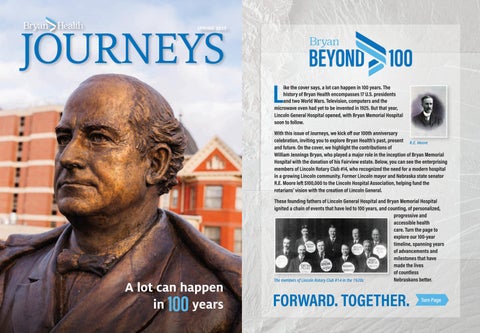
Like the cover says, a lot can happen in 100 years. The history of Bryan Health encompasses 17 U.S. presidents and two World Wars. Television, computers and the microwave oven had yet to be invented in 1925. But that year, Lincoln General Hospital opened, with Bryan Memorial Hospital soon to follow.

With this issue of Journeys, we kick off our 100th anniversary celebration, inviting you to explore Bryan Health’s past, present and future. On the cover, we highlight the contributions of William Jennings Bryan, who played a major role in the inception of Bryan Memorial Hospital with the donation of his Fairview estate. Below, you can see the enterprising members of Lincoln Rotary Club #14, who recognized the need for a modern hospital in a growing Lincoln community. Former Lincoln mayor and Nebraska state senator R.E. Moore left $100,000 to the Lincoln Hospital Association, helping fund the rotarians’ vision with the creation of Lincoln General.

These founding fathers of Lincoln General Hospital and Bryan Memorial Hospital ignited a chain of events that have led to 100 years, and counting, of personalized, progressive and accessible health care. Turn the page to explore our 100-year timeline, spanning years of advancements and milestones that have made the lives of countless Nebraskans better.

Turn Page

A group of ministers and laymen meet at Grace Methodist Church to plan for a new, Protestant hospital.

Robert Emmett (R.E.) Moore, a former mayor of Lincoln and Nebraska Senator and lieutenant governor, dies, leaving $100,000 to the Lincoln Hospital Association. Bond sales and private fund raising generated the remaining funds for Lincoln General Hospital.

Lincoln Rotary Club #14 conceives of Lincoln General Hospital and leads public campaign for funding, raising $100,000 to match an amount from the City of Lincoln.

William Jennings Bryan, a Nebraska businessman and politician, donates his Fairview home and surrounding farmland to the Lincoln Methodist Association for the site of a new hospital, later named in his honor.

Lincoln General Hospital and Bryan Memorial Hospital,

and

respectively, open.
First nursing students graduate from Lincoln General
Bryan Schools of Nursing, respectively.
Lincoln General cancer clinic installs world’s most powerful X-ray generating apparatus, using funds from the John L. Teeters trust.
First lung transplant in the state (two in 24 hours) performed at Bryan Memorial Hospital.
Bryan Medical Plaza opens, offering a new way to package outpatient services.
Bryan Memorial and Lincoln General hospitals merge to form BryanLGH.
BryanLGH Heart Institute, now known as Bryan Heart, begins. Pine Lake Medical Plaza opens.
A new $10 million Crete Area Medical Center opens.
BryanLGH Physician Network begins –today, we have over 200 Bryan Physician Network physicians.
Women and Children’s Tower opens, later including a new NICU.
Joint venture of Bryan, Bryan College of Health Sciences and Southeast Community College creates Simulation Center.
We become Bryan Health. Kearney Regional Medical Center opens.
Bryan Telemedicine begins. Grand Island Regional Medical Center opens.

Want to learn more about Bryan Health’s history? View a comprehensive timeline by scanning this QR code.

Lincoln General becomes the first general hospital in America to provide acute adult psychiatric inpatient services.

Trauma team at Lincoln General and Dr. Paul Collicott pioneer Advanced Trauma Life Support (ATLS) course. The following year, the American College of Surgeons adopts the ATLS program as the national trauma education program for physicians.

Bryan Memorial Hospital begins earning reputation as “Lincoln’s Heart Hospital.” It is the first hospital in Lincoln to establish a “Code Charlie” system in its Intensive Care and Coronary Care Units. Bryan doctors implant Lincoln’s first pacemaker.

1939 2020 1978 1946 2022 1971 1965 2024 1966

20th anniversary of Bryan Memorial Hospital is celebrated by burning the original mortgage.

First open-heart surgery at Bryan and in Lincoln.

New $27 million Merrick Medical Center opens.

April Sampson Cancer Center opens on Bryan’s new, 30-acre South Campus, bringing comprehensive cancer care under one roof.

Independence Center opens at Lincoln General.
COVID-19 pandemic begins.

JOURNEYS

more about Bryan programs and services, visit us online at bryanhealth.org.

Russ Gronewold President & CEO, Bryan Health

John Woodrich

Executive Vice President

COO, Bryan Health, Interim President & CEO, Bryan Medical Center

Robert Oakes, MD Chief of Staff,

Bob Ravenscroft

Kevin Rummel, MD

“Remember to celebrate milestones as you prepare for the road ahead.”

– Nelson Mandela

In July of 1922, William Jennings Bryan donated his home and the surrounding land for the purposes of building a new, Protestant hospital. Around the same time, the contributions of R.E. Moore and the members of Lincoln Rotary Club #14 gave way to a city-run hospital.

Could they have imagined what these acts of service would give Nebraska in the 100 years since?

Lincoln General Hospital opened in 1925 during a period of rapid development in the city. A year later, Bryan Memorial Hospital began treating patients on the grounds where Bryan’s house, Fairview, still stands.

From the merger of these two hospitals in 1997 to the expansion to Central City, Crete, Kearney and Grand Island over the last 25 years, Bryan Health’s footprint has intentionally grown to serve an increasing number of Nebraskans and our neighbors in Iowa, Kansas and Missouri.

“As much as Nebraska and the rest of the world has changed in the last 100 years, our values have stayed the same.”

As much as Nebraska and the rest of the world have changed in the last 100 years, our values have stayed the same. Our commitment to provide excellent care to all who walk through our doors. Our stewardship to the communities we serve. Our dedication to you, whether you are a patient, provider, student, staff member or volunteer. All of these, and more, are our tethers to a rich past and our north stars to a bright future.

It’s with this lens that we begin a yearlong celebration of Bryan Health’s 100th anniversary. Extending across 2025 and 2026, we acknowledge the openings of both Lincoln General and Bryan Memorial 100 years prior. In this magazine, explore the important moments, people and themes that have led us to the organization we are today. Additionally, learn more about our anniversary celebration and the exciting present and future we envision for Bryan. We have so much in store, and I can’t wait to celebrate with you.

How Lincoln General and Bryan Memorial Hospitals Began

How do two hospitals become one? Before the merger of Lincoln General and Bryan Memorial hospitals in 1997, each institution had its own rich history of service supported by shared values. This foundation dates back to the 1920s, a time when Lincoln, Nebraska, was a still-developing state capital. As the city grew, a few key leaders saw the need for improved health care for the community.

Lincoln General Origins

In 1920, the members of Lincoln Rotary Club #14 conceived of Lincoln General Hospital. The nine rotarians were Ralph Tyler, Keo Soukup, Edward Walt, Burton George, Nathan Lieberman, Walter Ludwig, Fred Putney, Walter Kirkbride and James Allen.

The group spearheaded a campaign to raise $100,000 for the hospital to match City of Lincoln funds and a donation from the estate of Robert Emmett (R.E.) Moore, who shared a bit in common with William Jennings Bryan. Like Bryan, Moore was a successful businessman in Lincoln as an attorney, banker, real estate

broker and benefactor. He, too, moved to Lincoln— although in the 1870s—to establish a law practice and was soon elected as a police judge. Moore and two of his brothers created the Security Investment Co. in 1877, dealing in real estate, farm loans and investments. Throughout his career, he also served as mayor of Lincoln, Nebraska state senator and lieutenant governor.

Moore died a year after the rotary club first conceived of LGH, leaving $100,000 to the Lincoln Hospital Association. His generous donation, along with the rotarians’ vision, funded the construction of LGH.

William Jennings Bryan

Bryan was born in Salem, Illinois, on March 19, 1860. Throughout his life, he wore many hats, making him one of the most influential men of his time in both Nebraska and the developing country. He arrived in Lincoln in 1887 as a blossoming lawyer, having earned his law degree from the Union College of Law in Chicago in 1883. Along with his wife, Mary Baird Bryan, who passed the Nebraska Bar to partner with her husband, Bryan established a thriving law practice in Lincoln.

The members of Lincoln Rotary Club #14 in the 1920s
Lincoln General
William Jennings Bryan

Like his father, Silas, Bryan soon turned to politics. He was elected to the House of Representatives in 1890, just when he had turned 30 years old. He made a name for himself by appealing to farmers, shopkeepers and other less wealthy voters, leading to his nickname as “The Great Commoner.” Three separate times, Bryan ran for president as the Democratic nominee,

Fairview and the Bryan Family

Mary and the couples’ first of three children, Ruth, joined Bryan in Lincoln in 1888. For their first decade in Lincoln, they lived at a house on D Street After years of steadily buying land, they broke ground on the Fairview farm, a large family estate that Bryan hoped to establish as the center of his political career. He often referred to it as “the Monticello of the West,” a reference to Thomas Jefferson’s home. He invited politicians and diplomats to visit him there during his career.

The Bryans lived in the Fairview house from 19021921, when they moved permanently to their Florida winter home, Villa Serena. Mary Baird Bryan was suffering from an arthritic condition, prompting their move south.

The next year, William Jennings Bryan donated the family home and its surrounding farmland to the Lincoln Methodist Association for purposes of building a new hospital.

Two Hospitals are Built

After funds and land were procured for both hospitals, a few years passed before the original buildings opened. Lincoln General Hospital was the first to open in 1925.

That same year, on July 26, William Jennings Bryan died suddenly at the age of 65 following the famous “Scopes Monkey” trial.

Before his death, the hospital built on the grounds of Fairview was to be named “Fairview Methodist Hospital.”

Upon his passing, the hospital’s Board of Trustees said that “because of his outstanding contribution and his universally recognized religious character and standing, and as a testimony to his great service to humanity… the name of the Fairview Methodist Hospital should be changed to Bryan Memorial Hospital” to remember “our chief benefactor.”

Bryan Memorial officially opened in the summer of 1926.

100 years later, the grounds of both original buildings are still dedicated to exceptional patient care. But now, they operate under one name: Bryan Medical Center.

The Sights, Scenes and Science of Health Care

Walking into a Bryan Health facility to receive care today, you would see a much different landscape than just 20 years ago, let alone 100. Medical science has made major advances in the last century, and we have been on the leading edge at every turn.

Through archival pictures, let’s take a look at a few ways health care at Bryan has evolved since 1925.

Fairview
William Jennings Bryan
Mobile Screening Vehicles
These two vehicles have been used at various points in our history to provide mobile screening around Nebraska.

Mobile Heart Care

We have also extended our cardiac care out into the community through efforts like the Mobile Heart Team. The bright red car was a staple around Lincoln back in the day, with emergency crews ready to go at a moment’s notice. The team also had a regular station at Memorial Stadium during Husker Football games.

NICU – Angel Eyes, Mobile Transport and Cool Cap

The care of newborn babies has taken great strides since the opening of the Bryan NICU in 2008. The Angel Eye camera system provides a live video stream so parents and loved ones can view their baby around the clock. Cooling caps can prevent brain damage in babies who are deprived of oxygen during birth. The NICU transport team uses a mobile incubator unit to help transport tiny patients in emergency situations.

1970s Bryan Uniform Guide

The fashion of health care has also greatly changed over the last century. A snapshot of our uniform standards from 1970 provides a glimpse into the past. Our volunteers no longer wear coral pink jumpers, nor do our nurses wear white caps and skirts. No matter the uniform, Bryan staff have remained dedicated to their profession.

Out of this world! In 2024, Dr. Michael Jobst, a colorectal surgeon on the Bryan medical staff, used the tiny surgical robot spaceMIRA to operate remotely on simulated tissue orbiting on the International Space Station 250 miles above Earth. At Bryan Health, we have incorporated robotics into patient care for more than two decades, including a Bryanowned MIRA robot at Bryan Medical Center. Bryan was also the first hospital in the state to use the new DaVinci 5 robot, pictured below.

Robotics

Lab Automation Line

Once a much more labor-intensive task, a new machine at the lab on Bryan West Campus helps technicians process samples with fewer touchpoints and more efficient patient communication.

Artisight

The full effect of artificial intelligence on health care is yet to be felt, but the Artisight system is one way AI is revolutionizing inpatient care at Bryan.

Artisight is currently in use in almost 400 patient rooms across Bryan Health, letting a team of nurses observe patients remotely. The system can currently track patient fall risks and alert security if staff are in danger. It will be expanded to fulfill other tasks in the future, including remote consultations. Tools like Artisight are helping Bryan reimagine how to address staffing shortages and other challenges in the present and future.

Teaching the Next Generation of Caregivers

When Lincoln General and Bryan Memorial hospitals opened in 1925 and 1926, respectively, they both immediately began schools of nursing. Most hospitals around Nebraska had their own schools at the time, primarily to guarantee enough staff for the hospitals. Few still do.

100 years at Bryan means a century of continued investment in healthcare education, one which will continue to stretch into our next 100 years.

The Early Days

Like most elements of health care, education looked much different a century ago than it does today. There were around 1,600 licensed nurses in Nebraska at the time the two schools opened. There was no tuition for students, and free room, board and laundry were included.

Largely out of necessity, students were quickly thrown into the deep end of nursing. Students lived and breathed their education and future profession; when they weren’t attending classes, they were helping to staff the hospital on nights and weekends.

Gladys Smits was the first director of Lincoln General Hospital School of Nursing, and she served until 1937. A partnership with the University of Nebraska began in 1932. LGH students would receive part of their general education at the University of Nebraska while finishing their degree at LGH.

On July 6, 1925, Alveretta Van Engen was the first student enrolled at Bryan School of Nursing. Students were housed in the Fairview house from the school’s inception and were required to attend a chapel service every morning at 6 a.m.

Through an affiliation with Nebraska Wesleyan University, students received instruction in basic sciences that could be applied toward a Bachelor of Science degree.

Lucy Austin was the first director of the Bryan school, although she resigned after six months and Myrtle Dean, a nurse who served overseas for over five years, took over. Dean would hold the position for 11 years. There have been 12 presidents of the School of Nursing and five presidents of Bryan College of Health Sciences.

The first graduates of each school came in 1927 at LGH and 1929 at BMH.

The Evolution of Education

As the two hospitals changed over the years, so did their respective schools. Expansion in healthcare services and local population led to an increased need for nursing. Both schools eventually built dormitories for their growing student bodies.

Both hospitals, and their schools, survived trying times during the Great Depression. In the 1940s, students answered the call to serve as nursing cadets during World War II. Due to growing student needs, Bryan School of Nursing completed a brand-new building for classes and student activities in 1961.

A group of Bryan School of Nursing students on the steps of Bryan Memorial Hospital.
Lincoln General, Bryan schools of nursing part of education legacy

Throughout the 20th century, both schools continued to evolve their curriculum to account for new advances in medical practice and technology. Sherry Koenigsman, EdD, who has been teaching at Bryan since 1981, remembers the days when she taught from an overhead projector while students took handwritten notes. Forty years before, the classroom looked much different, as it does today, 40 years after.

Today, the college offers a wide array of bachelor’s, master’s and doctoral programs, including nursing, sonography, biomedical sciences and healthcare education.

A Bright Future for Healthcare Education

Though almost 50 years have passed since LGH’s School of Nursing closed, its memory is kept alive through dedicated alumni. Similarly, alumni from the original Bryan School of Nursing are proud of what they achieved.

Dr. Anderson and college administration established four goals for their 2025-28 strategic plan:

Life Cycle Enrollment: Engage with students from recruitment all the way through graduation and alumni status.

college opened a nannying program to keep all the faculty employed, Dr. Koenigsman said. Through it all, the school found a way to endure.

Bryan School of Nursing faced several challenges to its existence over the years. Phylis Hollamon, MSN, a former student and president of the school, said there were a few occasions where the school could have closed due to low enrollment and other external factors. At a time with a particularly low number of students, the

Lincoln General Hospital School of Nursing experienced similar challenges as a diploma school. In May 1976, the last LGH class graduated, and the school was closed. Afterward, though, the hospital continued to provide clinical experiences for students at the University of Nebraska nursing education program.

A Name Change

To stay relevant into the 21st century, hospital and school administration knew the Bryan School of Nursing needed to become a degree-granting institution. Hollamon, Dr. Koenigsman and Marcia Kube, EdD, were all part of that effort.

Two major steps in this process included updating curriculum and preparing faculty. Dr. Kube said she and other faculty consulted other colleges who had changed from diploma to bachelor’s programs, going on site visits to see what a successful transition looked like.

“There are a number of doctoral faculty now on staff who were a part of that original group,” Hollamon said. “They decided to stay with it and get their advanced degrees. I think they all have the appreciation for the hard work it takes to achieve your professional goals.”

At the time of accreditation, Hollamon said there remained pessimism about the school’s future. But through the efforts of a dedicated faculty and a capital project to expand the school’s space, the school was approved to become a degree-granting institution in 2001. To reflect this, its name was changed to Bryan College of Health Sciences.

The school started phasing out the diploma program while starting its baccalaureate program. Dr. Kube said there was one spring where the school had its final diploma graduates and its first bachelor’s graduates.

“The students who were graduating from the phasedout program never felt diminished or like they were getting less of a product,” Dr. Kube said. “That was really important to us.”

Their history lives on in the halls of the modern college facility, where old nursing uniforms, equipment and other artifacts adorn the walls. As students and faculty go about their day, they are reminded of the legacy they carry on and the constant goal of creating a bright future for healthcare education.

That future now is in the hands of Kelsi Anderson, PhD, who assumed the role of college president in July 2024 after eight years on the faculty—six as provost.

She said her first year so far as president has been about establishing connections with staff, students, alumni and donors.

• Comprehensive Support: Provide aid to students on a variety of needs, including academics, mental health and food insecurity.

• Build the Workforce: Bolster the healthcare workforce at Bryan Health and in Nebraska.

• Connect with Alumni: Re-establish relationships with alumni, increasing their engagement with the student body.

“It’s great to be part of an organization that has had such a huge impact in the past, and I’m excited to be here for many years into the future,” Dr. Anderson said. “Health care and education are changing at a rapid pace, so making sure we’re preparing our future graduates to enter the workforce ready to tackle these challenges is a focus of ours for the next century.”

Present-day students prepare for their futures in a healthcare career.

Through recent ventures such as the Medical Sciences Focus Program, which provides students at Lincoln Northwest High School the opportunity to earn college credit, continued investments have been made in the Bryan and Nebraska workforce.

Dr. Koenigsman tells her students that so much has changed in health care and at the college over her 40 years on the faculty. She’s seen an increase in variety of students’ backgrounds and a shift to a more digital learning process. The college opened a Simulation Center in 2010, offering students the ability to learn in a controlled clinical environment.

“Once I decided I wanted to become a nurse I knew the college would be the place for me,” said sophomore nursing student Kali Staples. “The excellent education I am receiving will prepare me for my future career.”

Junior nursing student Jentry Schell agrees, calling the college “one of the biggest blessings in my life.”

“Every lab, lecture and exam are worth it,” Schell said. “I’m so thankful to be in the position I am today.”

Into its next century, Bryan College of Health Sciences will continue its mission of innovation and education.

“I can still find William Jennings Bryan’s statue here on campus, but otherwise the whole footprint of what our space is and what we do have changed a lot,” Dr. Koenigsman said.

Past College Presidents Reflect on Legacies

As we look back on 100 years of healthcare education at Bryan, three past presidents of the Bryan College of Health Sciences remember their tenures:

Phylis Hollamon, RN, MSN

Hollamon was born in Idaho, moving to Nebraska as a child and spending most of her life here. Her parents were from Nebraska, so they returned home after her father was discharged from the military following World War II. She was the first person in her family to go to college, enrolling at the Bryan School of Nursing in 1960. She joined the faculty in 1968, filling various instructor and administrative roles before becoming president in 1991.

From working as a clinical instructor to an associate director, teaching classes across many disciplines, Hollamon wore countless hats during her career at the school. Out of all her roles, though, she said she was at her happiest when she could work closely with students.

Hollamon said the school was established with a focus on clinical practice—a concept she carried with her throughout her time as a student, educator and administrator. Today, the college provides students with the most clinical hours of any school in the state.

“I still think the clinical experience is the heart and soul of the profession,” she said. “It’s a hands-on career that requires hands-on education. I don’t think all nursing schools provide that, and it’s a disservice to the students and their patients.”

“I’m grateful that I had a small part in planting those seeds.”
Phylis Hollamon, RN, MSN

To ensure the school’s survival, Hollamon said there was a need to transition into a degree-granting institution with a baccalaureate program. This goal was a major part of Hollamon’s career, with the school eventually achieving this status in 2001.

When she finished her tenure, Hollamon had spent over 40 years at the school. She saw immense change in the student experience and healthcare education structures during this period.

“The thing that has really been a godsend is the technology,” Hollamon said. “It really has supported the high level of education that they need.”

She dedicated her professional life to improving healthcare education in the state and remains proud of the college’s continued commitment toward that goal.

“I was a little wistful as I toured the college last year, because it has so many of the things I had dreamed of,” she said. “I’m grateful that I had a small part in planting those seeds.”

Dr. Moore has been involved with education all her life. Along with her time as the college’s president from 2012-2016, she also served as associate superintendent for Lincoln Public Schools for 25 years. She began her career as a middle school teacher, and a Lincoln middle school now bears her name.

Moore did not have any clinical background in health care before taking on the college presidency for four years. The core tenet of the position, though, was perfect for her background: supporting students and educators while maintaining high-quality curriculum.

While president, the college welcomed its first master’s degree students and strengthened student support services like mental health and financial aid. She also taught classes in the education doctorate program during her presidency.

Dr. Moore has been involved with the college and Bryan Health in various board roles over the years. She said Bryan as an institution has managed to separate itself through strong community values and leading-edge, high-touch care.

“Bryan has focused on the spirit of its patients and community,” Dr. Moore said.

Dr. Lloyd brought two worlds together while president of Bryan College of Health Sciences. He had deep ties to Hastings College, graduating there in 1985 and working on the faculty from 19902012. His father, Darrel, was a beloved faculty member there for 36 years.

In 2020, Hastings College and Bryan College of Health Sciences were exploring opportunities for a partnership. At the same time, Hastings College was looking for a new leader. Dr. Lloyd, who had started as president of the Bryan college in 2016, was the missing piece of both puzzles. Dr. Lloyd was president of both institutions for almost four years, leaving the Bryan college presidency in summer 2024. During that time, Bryan College of Health Sciences established a Bachelor of Science in Nursing program at Hastings College.

“Bryan had such a strong college when I arrived,” said Dr. Lloyd, who remains president of Hastings College. “At the time, my dad told me to not make a mess of it.”

Outside of the partnership with Hastings College, Dr. Lloyd’s tenure was also marked with growth in other programs. To help address workforce shortages and better prepare students for a future in health care, the college established the Medical Sciences Focus Program at Lincoln Northwest High School. Starting in 2022, students can receive early college credit through the program and get a taste of a healthcare career.

Marilyn Moore, EdD
Rich Lloyd, PhD

New Nurses Innovate Care for Postpartum Moms

Sometimes, it doesn’t take that long to make a profound change for the better. Three new nurses, Danielle Neels, Lexus Robinson and Maddie Schmidt, embodied this idea through a groundbreaking nurse residency project. New Bryan Medical Center nurses with fewer than six months of experience are automatically enrolled in the nurse residency program. They meet once a month for four-hour sessions for a year, starting work on a group project halfway through the program.

The three nurses began their residency in February 2023. Neels and Robinson work in the mother and baby unit, and Schmidt is a labor and delivery nurse. The trio

wanted to develop a project that would apply to both units. They quickly saw a need to address pelvic floor dysfunction, which many women experience after giving birth. This condition can cause problems with using the bathroom and pelvic pain.

At the end of March 2025, the trio presented their research poster at the Vizient/AACN Nurse Residency Program Conference in Orlando, Florida.

Beckie Trevino, a clinical educator at Bryan, said the goal of the nurse residency program is to build on—not repeat—nursing school curriculum. The program also focuses on wellness and professional development, with nurses setting goals for their career.

“It’s all about teaching you how to take on this new role and fall in love with your job rather than just show up to work,” Neels said.

The groups get to pick their project topic, though Trevino said they are encouraged to consider something relevant to their unit that would improve workflow and/or patient outcomes. The nurses work on their projects for the last six months of the program, culminating in a poster presentation.

“We tell them they are making dinner, not solving world hunger,” Trevino said. “We don’t expect a huge project, just something they think could be done better.”

The three nurses identified that pelvic floor dysfunction is often an unaddressed aspect of pregnancy and should be talked about before, during and after delivery. To narrow the focus of their project, they decided to prioritize postpartum research and development.

Rising Stars:

More recent graduates carve their paths

The nurses created a postpartum teaching sheet for women about symptoms of and exercises for pelvic floor dysfunction. The sheet, now included in a folder for all postpartum patients, raises awareness about the condition and tips for prevention and treatment.

Ultimately, the group strove to break stigmas around the topic.

“A lot of women are having problems with this, and it’s something that nobody is talking about,” Robinson said. “So we really wanted to break down the door and do something about this.”

While the trio worked on their project, a physical therapy group was also working to establish a physical therapist on the mother and baby unit. The groups met to discuss how to make this dream a reality.

“We came together and said, ‘OK, here’s the nursing side, and here’s the physical therapist side of this,’ and that further demonstrated the demand,” Robinson said. “We as nurses saw a problem, but then you have physical therapists confirming the need for this.”

Today, there are two full-time therapists working on the unit. They work with patients after delivery on stretches to prevent or address pelvic floor issues in the months following childbirth. They can also refer patients to a therapist to visit outside the hospital.

Trevino said she is proud of what the trio were able to accomplish and the impact they have already had as new Bryan Health nurses.

“It just gives me goosebumps every time I talk about it,” she said. “They took an idea and affected a change that has improved outcomes for their patients.”

until her dad was hospitalized at Bryan Medical Center, though, that she was inspired to make it her career.

“I was so thankful for the incredible care he received and wanted to be a part of that.”

Her mom graduated from the Bryan School of Nursing in the 1980s, so Taylor knew Bryan was for her. She said she is proud to work within a system that has a strong community presence.

“Everyone I’ve talked to who has worked at Bryan and other facilities says that Bryan is the best. It’s unique; you don’t hear that about every organization.”

Brady Langemeier Bryan College of Health Sciences 2022 graduate, cardiovascular sonographer Nobody in Brady’s family had previous healthcare experience. Growing up, he simply knew he wanted to help people. That longing eventually turned into a career as a cardiovascular sonographer.

At Bryan Heart, Brady said he feels a standard to achieve excellence, which is present all around him.

“I know I can refer my family and friends here, and they are going to receive quality care,” he said.

As Bryan celebrates its 100th anniversary, Brady said he takes inspiration from how the organization has adapted throughout its history.

“Not every health system lasts 100 years,” he said. 2022 graduate, BPN

Danielle Neels, Lexus Robinson and Maddie Schmidt
“What makes you proud to be a part of Bryan Health?”

Teri Johnson, customer care assistant and volunteer:

“Our strong reputation and our willingness to help surrounding communities. Since I’ve been here, the mission has stayed the same and been enhanced despite so many changes.”

Melissa Davis-Schmit, patient: “I received such compassionate care this year during the treatment and removal of a tumor on my spine. I’m so proud my daughter is now entering into that culture as a new nurse.”

Kim Russel, former president and CEO of Bryan Health: “I am most proud of the people who ARE Bryan Health because of the dedication and expertise they bring to our patients 24/7. The commitment of the Bryan Health team makes our communities and our state better, safer and healthier.”

Jolyn Merry, interim pharmacy director: “We have been a part of so much innovation as an organization. We should look to that legacy to help guide the future of innovation and care.”

Dave Miers, Behavioral Health Services senior director: “We were the first general hospital to provide behavioral health services. I believe we still provide the largest continuum for mental health services in the country.”

Gabriel Jefferson, PA-C:

“I am proud to work for Bryan Health, a company that offers comprehensive, quality care to its numerous patients. As a medical provider, I am grateful for the resources Bryan Health offers so we can help patients succeed in their health goals.”

Christina Nickel, lab director: “During COVID, we were able to keep caring for patients. We were thrust into a leadership role for different hospitals around Nebraska.”

Kim Dierks, nurse manager in pediatrics: “I see the quality and integrity this organization has upheld. I’ve been given so many opportunities to grow within Bryan and have been supported along the way.”

Bill Kulwicki, maintenance technician: “You can honestly say proudly that you work at Bryan in the public. It’s not going to work; it’s going to see your family. When I call my wife during the day and say my next stop is home, she knows I mean I’m going home to West. Bryan is my home, and I don’t think I will ever retire.”

Kenneth Gross, MD, Associated Anesthesiologists, P.C.: “Bryan has been on the leading-edge of health care since the beginning. We have world-class care available here, even if people may not know and appreciate that.”

Roger Jorgenson, former vice president: “High quality health care and the way the system has been able to evolve to provide top level of care.”

Bob and Gayle Saffer, patients: “It is a phenomenal hospital. The people truly care.”

Rachael Cook, guest and nutrition services manager at MMC: “Pride comes from working on things we care about and from working with people we care about! Bryan has always felt like a big family, and I am proud to be a part of this family.”

Gert Stromberg, wife of former Lincoln General Hospital administrator Arlan Stromberg: “Arlan would be so proud of where things are today. The dedication to trauma, the new Independence Center and focusing on behavioral health are just a few of those reasons.

Pam Edwards, daughter of former Bryan Health president Gene Edwards: “Thinking back, Dad and Mom had tremendous gratitude and respect for the dedicated, talented and wonderful folks of Bryan Memorial Hospital and Bryan School of Nursing. Bryan is a family with deep roots from yesterday and today whose superb total care for the patient and each other makes Bryan the healthcare leader positioned for a remarkable tomorrow.“

John Green, customer care assistant: “Anybody who comes in here as a patient doesn’t want to be here. It’s our job to give them quality care and respect and make their time here as pleasant and efficient as possible.”

Tori Seberger, laboratory manager at KRMC: “I went into the laboratory field to be able to have a positive impact on patient care, and I know with Bryan the high-quality care for our patients is at the center of all the things we do.”

Lynn Wilson, former president and CEO of Bryan Health: “After working in different medical centers, Bryan is unique because it values the communities it serves. Nebraska is a special place with strong values, great schools and compassion for our neighbors. Bryan is a family that mirrors those same qualities. We have fun together, we cry together, we accept and respect each other.”

Melissa Carpenter, employee experience director: “In the early 1900s, my grandmother was a violin prodigy. When William Jennings Bryan would have lawn parties, as he was gearing up for his presidential campaign, my greatgrandmother would play her violin on the porch of Fairview. So, whenever I walk by Fairview, I always think of my mom, my grandmother and my greatgrandmother. It’s just a very cool feeling.”

Sarah Maddox, radiology manager at GIRMC “The teams at GIRMC are like family. We have built a sense of trust among one another and work together to assure the best outcomes for our patients.”

Nikki Mader, bariatric program coordinator at GIRMC “I am proud to work for Bryan Health and bring health and wellness resources close to home. Supporting patients in improving their lives brings so much joy.”

Blake Cover, MD, CMO of MMC: “Merrick Medical Center is thrilled to celebrate 100 years of Bryan Health! We have been able to expand our services and enhance the level of care we provide—directly affecting the health and wellbeing of our community.”

Wendy Linares, interpreter at CAMC “Our healthcare professionals embrace the diversity in Crete and help patients feel valued and respected. Their dedication and willingness to learn and understand each patient’s needs is what makes me proud to be a part of Bryan Health.”

Todd Tessendorf, MD, Bryan Heart cardiologist: “It has been my privilege to work at Bryan Heart for the last 18 years alongside some of the best physicians, advanced practice providers, nurses and support staff. I have seen tremendous growth of our cardiovascular services in Nebraska and the surrounding states, as we travel to many outreach locations across the region.”

The ’14 14: Med School Classmates Make Bryan Their Home

After completing his residency and fellowship at The Ohio State University, Grant Wallace, MD, wasn’t sure about his next move. He strongly considered staying in Ohio to begin his career in cardiology and electrophysiology, but he also looked around his home state of Nebraska for opportunities.

Some of his best friends from his time at the University of Nebraska College of Medicine, Jeremy Hosein, MD, and Rajeev Anchan, MD, were among those who convinced him to choose Bryan Health. As of February 2025, 14 classmates from that same 2014 medical school graduating class call Bryan home.

The other 11 “’14 14” medical school mates are Drs. Meghen and Michael Bokemper, Thomas Brush, Bryce Hansen, Matthew Maslonka, Logan McGuffey, Adam Rasmussen, Ryan Santin, Erin Schmitz, Kelsey Shaver and Quinn Willet.

“Nebraska has a way of bringing you back,” Dr. Maslonka said. “Most of us went out to different academic institutions across the nation, and then to have everybody back working together 10 years later is kind of surreal. It speaks volumes about Bryan’s ability to attract people from all kinds of specialties and get them under one roof.”

Drs. Anchan and Wallace remember meeting on the first day of anatomy lab in med school. For the next three months, they worked in the same group and formed a bond.

Dr. Wallace said he still stays in touch with his close friends from med school, and he is glad to have some of them with him at Bryan. The nature of medical school leads to strong bonds, he said, as everybody is going through the same exhausting workloads.

“There’s a bit of a shared trauma experience,” Dr. Wallace said. “You've got this group of around 120 people who are all going through the same things. It creates this bond that is just different from anything else.”

The physicians remembered the relief of finishing their rigorous tests, which would occur on Saturdays. As they put down their pencils and walked out the door, they were handed a large packet of the next round of material they would have to start learning on Monday. Until then, though, they were free to unwind, which they often did in groups.

“It was so overwhelming most of the time on those tests, but there were so many memories that came from going out afterward and celebrating together,” Dr. Shaver said.

At last year’s 10-year reunion, many of the class members got together to reminisce about their days at UNMC and reflect on their differing paths. For the 14 classmates now at Bryan, they said it’s nice to see familiar faces around the system, even if they don’t directly work with each other.

“You just pick up where you left off,” Dr. Wallace said. “It’s been a decade, and it feels like nothing has changed except some of us are married and have kids. The connection is still the same.”

Dr. Anchan similarly left Nebraska after graduation, pursuing his fellowship at University of Chicago Medical Center. After completing his training, he realized he wanted to be closer to family and work in a supportive environment and familiar community. Bryan Health provided him with this opportunity.

“Bryan is a place where many people have returned to work together,” Dr. Anchan said. “You’re not just off on your own—there’s a real sense of collaboration. Having several former classmates here creates a strong bond. We

“Bryan is a place where many people have returned to work together. You’re not just off on your own—there’s a real sense of collaboration.”
– Rajeev Anchan, MD.

trained together, developed a broad variety of expertise, but ultimately we enjoy working together and it makes Bryan an exciting place to be.”

Many factors have contributed to recruiting these physicians and convincing them to stay—including Bryan’s goal to stay proactive on emerging treatments and include physicians in system decisions.

“Especially during the pandemic, Bryan was an institution that constantly was asking us for input,” said Dr. Maslonka, who joined Bryan weeks before COVID hit Lincoln. “Leadership was boots-on-the ground, they were with us every day. It was that time that really showed me the integrity of this place.”

Today, the 14 classmates see each other from time to time in the hallways of Bryan facilities. When they do, they reflect on their time in medical school and their divergent paths that led them all to the same destination.

“Whether it’s from the healthcare system or just the community at large, the relationships are very positive,” Dr. Wallace said. “We’re able to provide high-quality care in a way that is keeping with our goals and values. It’s a rewarding place to work.”

A class composite from the 2014 University of Nebraska College of Medicine featuring the “’14 14.” Courtesy of Matthew Maslonka, MD
Dr. Matthew Maslonka
Dr. Kelsey Shaver
Dr. Grant Wallace
Dr. Rajeev Anchan

‘Leap of Faith’ Leads to Thriving NICU, Strong Infant Care

When Albert Owusu-Ansah, MD, joined Bryan Health in 2007, he arrived as a pilot tasked with flying a not-yet-finished plane. Brought in to be the leading neonatologist for the new Bryan Health NICU, he was joining a program that was still being built, including its eventual home in the women and children’s tower on Bryan East Campus.

Born in Ghana, Dr. Ansah attended medical school there. He spent a year beginning his pediatrics training before coming to the United States to complete his residency at Cook County Hospital in Chicago. He spent seven years training there and stayed on as an attending neonatologist for six additional years.

One day, he got the call from Bryan administration asking for his interest in starting the NICU program.

“I was fascinated by the idea of being a part of the group starting it,” he said. “It doesn’t happen often. You go through your whole medical career and that might never happen.”

impact on countless lives since he arrived at Bryan in 2007.

He said after several visits to Lincoln, he came away impressed with administration and staff. But it wasn’t an easy decision to leave his job in a lively metropolis and uproot his family. Ultimately, the people in the administration and staff, as well as the infrastructure built up across the system, were enough to seal the deal.

“There was something that made me feel like this was going to work,” he said. “They weren’t throwing things at the wall to see what would stick. I thought that the foundation was there to make this successful.”

Before the NICU was established, the number of deliveries at Bryan Medical Center was “rather low,”

Dr. Ansah said. That’s because the facilities were not equipped or allowed to treat babies with even the slightest of complications. Instead of having to send families to another hospital in town or even up to Omaha, staff were excited by the idea of treating more new children in house.

While the tower was under construction, Dr. Ansah worked behind the scenes to get to know Bryan and Lincoln. He credits Laurie Ketterl, a former Bryan labor and delivery nurse, with getting him acclimated.

Ketterl started working at Bryan right around the merger of Bryan Memorial and Lincoln General hospitals in 1997. She had prior NICU experience before moving to Lincoln, making her well-equipped to help develop the new program.

“I was seen as one of the people here who had those extra baby skills,” she said. “I loved labor and delivery, but I think the NICU was where my heart truly was.”

With the idea for a Bryan NICU long in the works, Ketterl, then an assistant nurse manager, was part of a team sent to a conference about NICU development and construction.

“We knew we could do it, but we had to do it right,” Ketterl said. “It wasn’t one of those things that I was ever afraid to do. We just had to put one foot in front of the other.”

From there, the NICU development team drew up plans for their space within the women and children’s tower, secured funding and hired people like Dr. Ansah to operate the NICU once it was up and running. Ketterl said some major goals for the developing program were to prioritize high-level patient care and modern amenities. She said that creating a comfortable, supportive environment for the parents was almost as important as the care given to their babies.

Ketterl helped to interview neonatologist candidates to lead the NICU. Dr. Ansah was one of the last doctors they met.

“The minute we met him, we knew he was the one,” Ketterl said. “The smile, the kindness, he was the whole package.”

What was a premature delivery like before modern NICUs? Just ask Barb and Carol Dunklau.

Carol gave birth to Barb at Lincoln General Hospital in 1962 at around 24 weeks gestation. Even now, the survival rate for 24 weeks is roughly 40%, according to the National Institutes of Health. Back then, it was much smaller.

Carol remembers noticing blood that day, prompting her family to call an ambulance. She laid down flat on the ground and waited to be picked up.

She was brought to Lincoln General, where Barb was born. She was over three months premature.

“I remember crying because I didn’t think she would live,” Carol said. “But the doctor reassured me that it was possible. He said that if her organs could support her body, she would have a chance.”

Barb spent three months in a small incubator from that period. She had to be resuscitated multiple times during feedings because she couldn’t breathe and eat at the same time. Carol remembers tickling her tiny feet to prompt her to start breathing again.

With the care of LGH doctors and nurses, and a determined mother, Barb survived her premature birth and has gone on to live a happy, healthy life.

The NICU officially welcomed its first patients in 2008. The early days of the NICU included gradually scaling care from most stable to least stable newborns. Dr. Ansah and his team examined their capabilities in two-week intervals; if they could provide comprehensive for a baby born at 38 weeks, then they could go to 36 and 34 and so on. In 2021, the NICU cared for and successfully sent home a baby born under 23 weeks’ gestation, the youngest-born surviving infant in Nebraska hospital history. At the time, the Bryan NICU was only the seventh facility in the U.S. to discharge a baby born below this threshold.

Dr. Ansah has made an
Dr. Ansah and Laurie Ketterl, seen here visiting the construction site of the women and children’s tower.

Lincoln General at the Movies:

A Look Back at ‘Terms of Endearment’

It’s the moment that might have singlehandedly given Shirley MacLaine her first and only Academy Award. Toward the end of the movie “Terms of Endearment,” the star actress delivers a scene for the ages.

Over 15 years since the NICU opened on Bryan East Campus, the program is going strong. NICU leaders continue to add leadingedge technology, including the cold cap and neonatal transport unit. Dr. Ansah was the only neonatologist in the NICU for almost two years. Now, he is joined by a team of neonatologists, nurses and nurse practitioners.

Moving forward, Dr. Ansah wants to see the NICU continue to evolve to serve an increasing number of families in the area. 2024 was the first year of the NICU Patient Family Advisory Council, a group comprising NICU staff and current and former families who went through the NICU. The group met quarterly to discuss improvements that could be implemented in the NICU, including updates to the visitation policy and the parent snack station.

Looking back on his leap of faith in deciding to come to Bryan, Dr. Ansah said he loves where he works. Lincoln has become his home, and he feels that Bryan shares the qualities that make Nebraska a great place to live and work.

“This was only the second place I had lived in the United States, after years in Chicago,” he said. “Bryan is such an excellent place. The relationships between providers and the administration, you don’t see that everywhere. It’s not a given, and sometimes we forget that it’s a unique and special place.”

“She’s in pain! My daughter is in pain!” she cries as she circles a nursing station, pleading with nurses to act. “Give her the shot, you understand me? Give my daughter the shot!”

That last line punctuates an iconic, tense 30-second scene that has become the lasting moment from this movie. If you’re a Lincolnite, or just a movie buff, you probably know that MacLaine performed her Oscar-winning scene inside the walls of Lincoln General Hospital.

“Terms” is jam-packed with Hollywood stars such as MacLaine, Debra Winger, Jack Nicholson, Danny DeVito, Jeff Daniels and John Lithgow. It follows a mother and daughter over several years of their lives, exploring their complex relationship and how to love somebody who is different from you.

A smash hit, grossing more than $100 million worldwide, it also earned 11 Oscar nominations and took home five awards, including one for Best Picture.

The first-ever NICU Patient Family Advisory Council, which met throughout 2024.

Fun Fact: While filming in Lincoln, Debra Winger met then-governor of Nebraska Bob Kerrey. The pair dated for two years. “What can I say? She swept me off my foot,” the governor said to reporters, alluding to a war injury he sustained in Vietnam.

Director James L. Brooks and the rest of the Paramount film crew arrived on the doorstep of Lincoln General on May 11, 1983, after coming to an agreement with hospital administration. The production was looking for a real hospital to shoot scenes from toward the end of the movie, which is partially set in Nebraska.

Many LGH staff were involved with the filming of scenes at the hospital. More than 300 employees and volunteers applied for parts in the movie. Over 100 of them were included as extras, including Shelley Nielsen, a head oncology nurse who has a speaking part in the film.

During the roughly two weeks of filming at LGH, the camera was often followed by clusters of curious spectators. Scenes were shot in an unoccupied wing of the hospital, as well as the courtyard, front lobby and cafeteria.

Crew even altered two locations within the hospital to pass for a hotel. To save the trouble of moving equipment out of the building, set designers transformed a room in the Professional Office Building into a Holiday Inn hotel room. The hospital’s dismissal desk also briefly became the lobby of the hotel.

photos from the filming of “Terms of Endearment”

Another employee with a notable role was Sheila Exstrom, a nursing administrator at LGH who served as medical advisor to the crew. She was always on set during filming at the hospital, advising on the authenticity of medical dialogue and scenes.

Exstrom also informed people when they were cast as extras, which she said was a rewarding experience. Just as rewarding was knowing that others were working to keep the hospital operating.

“I think we held well to our premise that patient care comes first,” Exstrom said. “I’m proud of the employees who kept the hospital running.”

“There was chaos, but it was controlled chaos,” assistant administrator Dave Okerlund added at the time. “Paramount was overwhelmed by our cooperation and courtesy. Many of them commented that we provided the most congenial environment they had ever worked in.”

Bill Kulwicki, a maintenance technician with Bryan Medical Center, remembers his small role in the production while he was working at Lincoln General. He was responsible for shipping samples of paint colors and wallpaper back to Hollywood after filming, just in case the production had to rebuild parts of the hospital on a soundstage for reshoots.

LGH earned around $40,000 for allowing the film crew to shoot at the facility. The sum went into the “Terms of Endearment Fund,” which has grown over the years through additional gifts and earnings to over $1 million. These funds are designated for cancer programmatic support.

Set
at Lincoln General Hospital, including crew playing cribbage with employees and then-governor of Nebraska Bob Kerrey visiting the set.
“The hospital was as important as anything in the movie.”

–Director James L. Brooks via phone to an audience at the film’s premiere in Lincoln.

The film includes numerous other locations around Lincoln, including its airport and the University of Nebraska-Lincoln campus. According to the World-Herald, the filming brought more than $1.5 million to the local economy.

After filming, the movie was released later that year in November. A premiere event was held in Lincoln on November 22, after an initial premiere in New York City, with a full red-carpet treatment at the Stuart Theatre (now known as the Rococo Theatre). Proceeds from the showing went to Lincoln General Hospital.

Although the interior of Bryan West Campus now looks entirely different than it did as Lincoln General Hospital in the 1980s, that moment is frozen in time in the movie. If you’d like a look back at Lincoln General and the surrounding city during this period, look to the silver screen.

“It’s interesting to watch it and see people from the past, and the building as it was back then,” Kulwicki said. “You see the changes and you go, ‘oh my goodness.’ It was an interesting time.”

Welcome these physicians to the Bryan medical community

Over 1600 providers across the state have privileges at a Bryan facility. Join us in celebrating new additions to the system!

Jeffrey Ant, DDS, MD, Nebraska Oral and Facial Surgery

Specialty: Oral Surgery

Medical Education: University of Washington School of Dentistry, Seattle; Georgetown University, Washington, D.C.

Residency: National Capital Consortium, Bethesda, Maryland

Fellowship: Cosmetic Surgery Center, Little Rock, Arkansas

Joshua Bradford, DO, Associated with Inpatient Physician Associates

Specialty: Hospitalist

Medical Education: Rocky Vista University College of Osteopathic Medicine, Parker, Colorado

Residency: Walter Reed Army Medical Center, Bethesda, Maryland

Fellowship: Creighton University School of Medicine

Benjamin Brennan, DO, Inpatient Physician Associates

Specialty: Hospitalist

Medical Education: Des Moines University, Iowa

Residency: University of Kansas School of Medicine, Kansas City

John Burt, MD, Advanced Radiology

Specialty: Interventional and Vascular

Radiology

Medical Education: University of Nebraska Medical Center

Residency: University of Nebraska Medical Center

Fellowship: University of Nebraska Medical Center

Morgan Carson, MD, Grand Island Clinic

Specialty: Pediatrics

Medical Education: Creighton University School of Medicine

Residency: University of Oklahoma Health Sciences Center

Kim Coleman, MD, Lincoln Radiology Group

Specialty: Radiology

Medical Education: University of Nebraska Medical Center

Residency: University of Nebraska

Medical Center

Fellowship: Wake Forest University

Baptist Medical Center, Winston-Salem, North Carolina

Michael Dancer, MD, Associated Anesthesiologists, P.C.

Specialty: Anesthesiology

Medical Education: University of North Dakota School of Medicine, Grand Forks

Residency: University of Nebraska Medical Center

Fellowship: University of Nebraska Medical Center

Erin Dennis, MD, Bryan Neurology, part of Bryan Physician Network

Specialty: Neurology

Medical Education: University of North Dakota School of Medicine, Grand Forks

Residency: University of Nebraska

Medical Center

Fellowship: University of Nebraska Medical Center

Magi Dickinson, MD, Lincoln Pediatric Hospitalists

Specialty: Pediatrics

Medical Education: University of California, Riverside

Residency: Stanford School of Medicine, Lucile Packard Children’s Hospital, Palo Alto, California

Fellowship: Nicklaus Children’s Hospital, Miami, Florida

Adam Dziacky, MD, Children First Pediatrics

Specialty: Pediatrics

Medical Education: Masarykova

Univerzita Lekarska Fakulta, Czechia

Residency: Johns Hopkins Medicine

All Children’s Hospital, St. Petersburg, Florida

Crista Few, MD, Bryan Primary Care, part of Bryan Physician Network

Specialty: Family Practice

Medical Education: Loma Linda

University Medical Center, California

Residency: Rapid City Regional Hospital, South Dakota

Emily Franzen, DO, Holmes Lake Family Medicine, part of Bryan Physician Network

Specialty: Family Practice

Medical Education: Des Moines

University Osteopathic Medical Center, Iowa

Residency: Lincoln Medical Education Partnership

Matthew Freeman, MD, Nebraska Orthopaedic Center

Specialty: Orthopedics

Medical Education: University of Nebraska Medical Center

Residency: University of Nebraska College of Medicine

Fellowship: Kansas University Medical Center, Kansas City

Chrissy Guidry, DO, Bryan Trauma and Acute Care Surgery, part of Bryan Physician Network

Specialty: Trauma

Medical Education: Des Moines University

Osteopathic Medical Center, Iowa

Residency: Akron General Medical Center, Ohio

Fellowship: University of Southern California, Los Angeles

Joel Hachiya, MD, Associated Anesthesiologists, P.C.

Specialty: Anesthesiology

Medical Education: University of Nebraska Medical Center

Residency: University of Nebraska Medical Center

Kayla Heidinger, MD, Bryan Plaza Family Medicine, part of Bryan Physician Network

Specialty: Family Practice

Medical Education: University of Nebraska College of Medicine

Residency: Mayo Clinic College of Medicine & Science, Rochester, Minnesota

Thomas Helms, DO, Lincoln Pediatric Group

Specialty: Pediatrics

Medical Education: Marian University

College of Osteopathic Medicine, Indianapolis

Residency: University of Nebraska Medical Center

Ryan Houghton, MD, Nebraska Emergency Medicine

Specialty: Emergency Medicine

Medical Education: Creighton University

Residency: University of Nebraska Medical Center

Oliver Knoell, MD, Surgical Associates, PC

Specialty: General Surgery

Medical Education: University of Toledo College of Medicine, Ohio

Residency: Allegheny Health Network

Medical Education Consortium, Pittsburgh

Fellowship: Advanced Laparoscopic

Surgical Associates, Fresno, California

Sophia Knoell, MD, Lincoln Nephrology and Hypertension

Specialty: Nephrology

Medical Education: Medical College of Ohio, Toledo

Residency: University of Pittsburgh Medical Center

Fellowship: University of Pittsburgh

Alejandro Luis, MD, Bryan Trauma and Acute Care Surgery, part of Bryan Physician Network

Specialty: Trauma

Medical Education: UCIMED, Costa Rica

Residency: Palmetto Health Richland, Columbia, South Carolina

Fellowship: Palmetto Health Richland

Alexis Malaterre, MD, associated with Lincoln Pediatric Hospitalists

Specialty: Pediatrics

Medical Education: University of North Dakota School of Medicine, Grand Forks

Residency: University of Nebraska Medical Center

Melissa Moutray, DDS, MD, Nebraska Oral and Facial Surgery

Specialty: Oral Surgery

Medical Education: University of Nebraska Medical Center College of Dentistry and College of Medicine

Residency: University of Nebraska Medical Center College of Medicine

Bailey Neville, DDS, Countryside Pediatric Dentistry

Specialty: Pediatric Dentistry

Medical Education: University of Nebraska Medical Center College of Dentistry

Residency: Children’s Nebraska

Danika Peterson, MD, Platte Valley Medical Clinic

Specialty: Family Practice

Medical Education: Creighton University

School of Medicine

Residency: University of Nebraska Medical Center

Keri Philpot, MD, Platte Valley Specialty Clinic

Specialty: Gynecology

Medical Education: University of Nebraska Medical Center

Mark Pickeral, MD, Nebraska Emergency Medicine

Specialty: Emergency Medicine

Medical Education: University of Nebraska Medical Center

Residency: University of Nebraska Medical Center

Andrew Pohlmeier, MD, Family Practice of Grand Island, P.C.

Specialty: Family Practice

Medical Education: University of Nebraska Medical Center

Residency: University of Nebraska Medical Center

Kendra Reilly, MD, associated with Lincoln Pediatric Hospitalists

Specialty: Pediatrics

Medical Education: Creighton University

School of Medicine

Residency: University of Nebraska Medical Center

Shradha Samuel, MD, Bryan Heart Vascular Surgery

Specialty: Vascular Surgery

Medical Education: Creighton University

School of Medicine

Residency: University of Nebraska

Medical Center College of Medicine

Fellowship: University of Missouri –Columbia

Alexis Sandman, DDS, Lincolnshire Pediatric Dentistry

Specialty: Pediatric Dentistry

Medical Education: University of Nebraska Medical Center College of Dentistry

Residency: University of Nebraska Medical Center

Travis Sayer, DO, Kearney Regional Medical Center

Specialty: Anesthesiology

Medical Education: Des Moines

University Osteopathic Medical Center, Iowa

Residency: McLaren Greater Lansing

Michael Schulte, MD, Holy Family Medical Associates

Specialty: Family Practice

Medical Education: University of Nebraska Medical Center

Residency: University of Nebraska Medical Center

Katherine Ternent, DPM, Prairie Orthopaedic and Plastic Surgery

Specialty: Podiatry

Medical Education: Des Moines

University, Iowa

Residency: St. Mary Mercy Hospital, Livonia, Michigan

Danielle Thiessen, DO, Lincoln Pediatric Hospitalists

Specialty: Pediatrics

Medical Education: Des Moines University

Osteopathic Medical Center, Iowa

Residency: University of Iowa, Iowa City

Welcome these Advanced Practice Providers

These APPs are working within the Bryan Health system:

Stephen Allen, CRNA, Associated Anesthesiologists, P.C.

Kristin Beck, APRN-NP, Bryan Trauma and Acute Care Surgery, part of Bryan Physician Network

Nickolas Van Roekel, MD, Nebraska Orthopaedic Center

Specialty: Orthopedics

Medical Education: University of Nebraska

Medical Center College of Medicine

Residency: University of Buffalo, New York

Fellowship: University of Minnesota, Minneapolis

Sindri Viktorsson, MD, Bryan Trauma and Acute Care Surgery, part of Bryan Physician Network

Specialty: Trauma

Medical Education: University of Iceland

Residency: University of Virginia, Charlottesville

Fellowship: Barnes-Jewish Hospital, St. Louis

Amy Whittle, MD,

Family Medicine of Ashland, part of Bryan Physician Network

Specialty: Family Practice

Medical Education: University of Cincinnati College of Medicine

Residency: University of Nebraska Medical Center

Adam Zobel, DO, Associated Anesthesiologists, P.C.

Specialty: Anesthesiology

Medical Education: Des Moines

University

Residency: University of Nebraska Medical Center

Connor Bliss, PA-C, Platte Valley Medical Clinic

Lexie Bown, APRN-NP, Bryan Heart

Rachael Burger, PA-C, Kearney Regional Medical Center

Michaela Dean, APRN-NP, Nebraska Hematology Oncology

Brenda DeLeon, APRN, Platte Valley Medical Clinic

Allison Everman, APRN-NP, Bryan Heart

Sarah Gunlikson, PA-C, Bryan Orthopedic Trauma, part of Bryan Physician Network

Joslyn Hansen, PA-C, Bryan Trauma and Acute Care Surgery, part of Bryan Physician Network

Paige Hron, PA-C, Bryan Heart

Benjamin Huls, CRNA, Associated Anesthesiologists, P.C.

In Loving Memory

Kendall Kelly, PA-C, Bryan Orthopedic Trauma, part of Bryan Physician Network

Kristen Klein, APRN-NP, Nebraska Orthopaedic Center

Diane Kocovsky, APRN-NP, Lincoln Pediatric Hospitalists

Sarah Langan, CRNA, Associated Anesthesiologists, P.C.

Lillie Lueke, APRN-NP, Nebraska Urology

Molly Oertwig, APRN, Kearney Regional Medical Center

Elise Schumacher, PA-C, Nebraska Orthopaedic Center

Ethan Seyer, CRNA, Associated Anesthesiologists, P.C.

Sara Theoharis, CRNA, Associated Anesthesiologists, P.C.

Isabella Walker, PA-C, Bryan Heart Vascular Surgery

Eric Wessels, APRN-NP, Nebraska Emergency Medicine

Nicole Wilford, APRN, CAMC Emergency Department

Seth Williams, APRN-NP, Bryan Heart

Brittany Wray, APRN-NP, Nebraska Hematology Oncology

Throughout our 100-year history, our medical staffs have demonstrated incredible commitment to the health of our communities. We remember these long-time Bryan physicians.

Timothy Lieske

Timothy Lieske, MD, died October 14, 2024, at age 72. Born in Nebraska, he attended Nebraska Wesleyan University and earned his medical degree at University of Nebraska Medical Center.

Dr. Lieske moved to Lincoln with his family in 1984, starting Lincoln Pulmonary and Critical Care Associates. He also served in leadership positions at Lincoln General Hospital and Bryan Medical Center, including Chief of Staff and Credentials Chair for BryanLGH Medical Center.

Dr. Lieske is survived by his wife, Brenda, four children and 11 grandchildren.

Ann Lott

Ann Lott, MD, died December 20, 2024, at age 79. For 37 years, she practiced dermatology in Lincoln at her private practice, Cosmetic Dermatology & Laser Center, and later at Bryan LifePointe MedSpa.

She attended University of Nebraska-Lincoln for her undergraduate degree, where she met her future husband, Roger. She received her medical degree from University of Nebraska Medical Center.

Dr. Lott is survived by Roger, their daughter Susan and three grandchildren.

Timothy Lieske
Ann Lott

James W. Peck

James W. Peck, MD, died May 23, 2023, at age 88. A Falls City, Nebraska, native, he graduated from University of Nebraska-Lincoln and completed his medical degree at University of Nebraska Omaha in 1962.

Dr. Peck ran a family practice in Kearney from 1962-1976, later moving to Lincoln to practice urology. He was a part of Nebraska Urology from 1980-1995.

Dr. Peck is survived by his high school sweetheart, Marilyn, and their four children.

Elliott L. Rustad

Elliott Rustad, MD, died March 3 at age 91 after five years with lung cancer. After graduating from St. Olaf College in 1956, he earned his medical degree from University of Minnesota.

A dermatologist, he established his private practice, Rustad Dermatology, in Lincoln in 1965. Soon after, he was drafted during the Vietnam War. He served for two years as a medical officer at the Pentagon. In the 1990s, he became involved in Nebraska politics, running for Lieutenant Governor and the U.S. Senate.

Dr. Rustad is survived by three children, four grandchildren and his former wife Carol.

Richard Stitcher

Richard Stitcher, MD, died January 31 at age 68 after battling glioblastoma. He graduated University of Nebraska Medical School, going into gastroenterology.

Dr. Stitcher practiced in Lincoln as part of Gastroenterology Specialties, P.C., serving the city and its surrounding communities.

He is survived by his wife, Patricia, two sons, five grandchildren and three siblings.

Along with Bryan’s 100th anniversary, Crete Area Medical Center is celebrating its 75th anniversary this year. Originally named Crete City Hospital, it opened in 1950, serving patients for almost 50 years.

Near the turn of the century, the facility was aging, facing the reality of major renovations if it was going to keep operating. In 1999, Crete Municipal Hospital Board approved a merger with BryanLGH, leading to the construction of a new, Bryanrun medical center. The current Crete Area Medical Center facility opened in 2003.

Lloyd “Bud” Tenney

Lloyd “Bud” Tenney, MD, died Nov. 3, 2024, at age 96. After receiving his undergraduate degree from Iowa State University, he attended the University of Iowa Medical School.

Dr. Tenney served in the Air Force as a flight surgeon before moving to Lincoln for his medical residency at the VA hospital. He co-founded Lincoln Surgical Associates in the early 1970s and was a general surgeon for 40 years.

After retiring, he enjoyed traveling, landscaping and spending time with his family. He is survived by four children, 20 grandchildren and 19 great-grandchildren.

Irving Weston

Irving Weston, MD, died Nov. 2, 2024, at age 93. He attended Nebraska Wesleyan University and received his medical degree from the University of Nebraska. He served as a flight surgeon in the Air Force.

For three decades, Dr. Weston practiced family medicine in Lincoln before doing the same in Phoenix, Arizona, for several more years.

He is survived by his wife of 37 years, Bobbi McGinn, three children, three step-children, eight grandchildren, seven great-grandchildren and two sisters.

This year, for the second year in a row, CAMC was named as a Top 100 Critical Access Hospital in the nation by The Chartis Center for Rural Health. We are proud to celebrate 75 years of hospital care in Crete in tandem with 100 years of Bryan.

Congratulations, Crete Team!
Elliott L. Rustad
James W. Peck
Richard Stitcher
Lloyd “Bud” Tenney
Irving Edwin Weston

Our 100th Anniversary Celebration: What’s Next

We are thrilled to kick off our anniversary celebration this spring! What can you expect to see over the next year?

100 Acts of Kindness

Ten years ago, our 90 Acts of Kindness made a big impact. We are expanding to 100 Acts of Kindness throughout the next year across the state. From food drives to blood drives to park cleanings, our staff will be giving back.

Time Capsule

Did you know that there has been a time capsule in the walls of Bryan East Campus for almost 40 years? In 1986, Bryan Memorial Hospital leaders placed the capsule in an exterior wall, which is now located inside the hospital near administrative offices. This fall, the capsule will finally be removed, and a new one will be placed in the same spot in Summer 2026.

JOURNEYS

Future Journeys Issues

We will publish two more 100th anniversaryedition issues of the Journeys magazine – one in Fall 2025 and the other in Spring/Summer 2026. Those issues will celebrate our patients and staff, highlighting stories of multi-generational Bryan families and key figures from our history. You’ll also learn more about the future of Bryan Health, charting our goals and initiatives as we continue into the next 100 years.

Fairview Tours

Take a trip into the past by visiting Fairview, the former home of the Bryan family! The house, completed in 1903, was the home of William Jennings Bryan and his family for almost 20 years and is in the National Register of Historic Places. Explore the Bryan Museum on the lower level of the house, which includes authentic displays and recordings about the history of the house.

To schedule a tour, call Volunteers and Customer Care at 402-481-3032. Please call at least 48 hours in advance. Tours are scheduled from 9 a.m. and 3 p.m. Monday through Friday.

New this summer! From May 15 through September 4, the home will be open 1-4 p.m. on Thursdays, dependent upon volunteer availability.

To assure that tours are happening, please call before arriving.

Signage

From Pinnacle Bank Arena, to Haymarket Park, from pedicabs to Bryan’s mobile fleet, you’ll see our Bryan Beyond 100 presence all over.

Digital Timeline

Please take time to enjoy our digital timeline created by our partners and 100th Anniversary sponsors, Swanson Russell.

And Much More!!!

Be part of Bryan’s next 100 years. To find out about volunteer opportunities in your community, call: Volunteers and Customer Care at 402-481-3032 (Lincoln)

Crete Area Medical Center at 402-826-6581

Turn static files into dynamic content formats.

Create a flipbook
Issuu converts static files into: digital portfolios, online yearbooks, online catalogs, digital photo albums and more. Sign up and create your flipbook.
Journeys | Spring 2025 by Bryan Health - Issuu