SINCE 1891
THE BROWN DAILY HERALD WEDNESDAY, FEBRUARY 12, 2020
VOLUME CLV, ISSUE 16
BROWNDAILYHERALD.COM
UNIVERSITY NEWS
METRO
creation of academic centers
Before Sanders win, students travel to NH to support their candidates
Corp. extends Paxson’s term as president U. students canvass in Decision took into NH Democratic primary account 10-year plan, BY CAELYN PENDER SENIOR STAFF WRITER The Corporation, the University’s highest governing body, unanimously voted to extend President Christina Paxson’s P’19 appointment by three years — until June 30, 2025. Paxson, who is currently serving in her eighth year as president, was already set to serve in the role for another two years. The Corporation decided to extend her second five-year term early because the members have “absolute and unqualified confidence in her leadership” and believe the best way to “ensure the University’s continued momentum and success” is through Paxson’s leadership, Corporation Chancellor Samuel Mencoff wrote in a press release. Mencoff described Paxson in the statement as a leader with “extraordinary ability, enormous energy, unshakeable values and boundless passion.” “I am honored that Brown’s trustees and fellows continue to entrust me with the leadership of this exceptional institution,” Paxson wrote in a statement to The Herald. “I have come to love
BY OLIVIA GEORGE METRO EDITOR
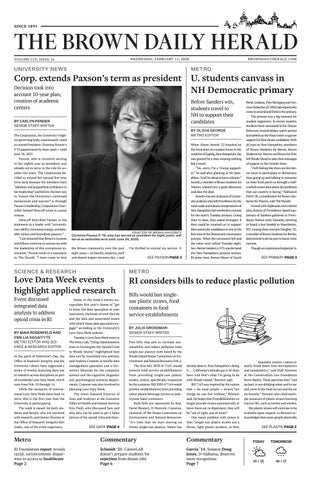
COURTESY OF BROWN UNIVERSITY
Christina Paxson P ’19, who has served as president for eight years, will serve an extended term until June 30, 2025. the Brown community over the past eight years — its faculty, students, staff and alumni inspire me every day — and
SCIENCE & RESEARCH
Love Data Week events highlight applied research Event discussed integrated data analysis to address opioid crisis in RI BY MAIA ROSENFELD AND EMILIJA SAGAITYTE METRO EDITOR AND SCIENCE & RESEARCH EDITOR In the spirit of Valentine’s Day, the Office of Research Integrity and the University Library have organized a series of events featuring data use in research across disciplines as part of worldwide Love Data Week, which runs from Feb. 10 through 14. While the inception of international Love Data Week dates back to 2016, this is the first year that the University is participating. The week is meant for both students and faculty who are involved with research, said Senior Director at the Office of Research Integrity Keri Godin, one of the event organizers.
Many of the week’s events encapsulate this year’s theme of “get to know the data specialists at your institution, the kinds of work they do and the data and associated issues with which these data specialists engage,” according to the University’s Love Data Week website. Tuesday’s Love Data Week event at The Policy Lab, “Using Administrative Data to Investigate the Opioid Crisis in Rhode Island,” highlighted how data can be translated into policies, said Andrew Creamer, scientific data management specialist and a University librarian for the computer science and the cognitive, linguistic and psychological sciences departments. Creamer was also involved in planning Love Data Week. The event featured Director of Data and Analytics at the Executive Office of Health and Human Services Kim Paull, who discussed how and why data can be used to get a fuller picture of the opioid crisis and chan-
SEE DATA PAGE 4
I’m thrilled to extend my service. It
SEE PAXSON PAGE 3
When Alison Swinth ’22 knocked on the front door of a modest home in the outskirts of Epping, New Hampshire, she was greeted by a man wearing nothing but a towel. “No, sorry, I’m a Trump supporter,” he said after glancing at her pamphlets. “And I’m about to have a shower.” Swinth, a member of Brown Students for Warren, wished him a good afternoon and shut the door. Swinth was one of dozens of University students who left Providence for the rural roads and subzero temperatures of New Hampshire last weekend to canvass for the state’s Tuesday primary. Going door to door, they asked strangers if they could be counted on to support their particular candidates in one of the first tests of the Democratic nomination process. When the canvassers left and the votes were tallied Tuesday night, Sen. Bernie Sanders (I-VT) was declared the New Hampshire primary winner. By press time, former Mayor of South
Bend, Indiana, Pete Buttigieg and Sen. Amy Klobuchar (D-MN) had respectively come in second and third in the primary. The primary was a big moment for student organizers. In recent months, students have canvassed in the Sharpe Refectory, hosted debate watch parties and tabled on the Main Green to garner support for their choice candidates. With all eyes on New Hampshire, members of Brown Students for Bernie, Brown Students for Warren and Bruno for Pete left Rhode Island to take their messages of support to the Granite State. “I left feeling like there are few better ways to participate in democracy than going up and talking to someone on their front porch or through a halfcracked screen door about the problems that our country is facing,” Nathaniel Pettit ’20, a coordinator for Brown Students for Warren, told The Herald. Armed with clipboards and colorful pins, dozens of Providence-based supporters of Sanders gathered at Providence Station early Saturday morning to board a bus headed to Manchester, NH. Among them was Jack Doughty ’22, a member of Brown Students for Bernie, determined to do his part to boost voter turnout. Though an experienced organizer in
SEE PRIMARY PAGE 3
METRO
RI considers bills to reduce plastic pollution Bills would ban singleuse plastic straws, food containers in food service establishments BY JULIA GROSSMAN SENIOR STAFF WRITER Two bills that aim to increase sustainability and reduce pollution from single-use plastics were heard by the Rhode Island House Committee on Environment and Natural Resources Feb. 6. The first bill, 2020-H 7163, would prevent food service establishments from providing single-use plastic straws, unless specifically requested by the customer. Bill 2020-H 7164 would prevent establishments from providing either plastic beverage stirrers or polystyrene foam containers. Both bills are sponsored by Rep. David Bennett, D-Warwick, Cranston, chairman of the House Committee on Environment and Natural Resources. “It’s time that we start moving on (from) single-use plastics. Maine has
already done it. New Hampshire’s doing it. … California’s already got it on their laws. And that’s what I’m going to do with Rhode Island,” Bennett said. Bill 7163 was inspired by the notion that — for most people — straws “are things we can live without,” Bennett said. He hopes that if establishments no longer provide straws automatically or leave them out in dispensers, they will be “out of sight, out of mind.” One major problem with straws is that “single-use plastic straws are a flimsy, light plastic product, so they
Metro
Commentary
Commentary
RI Foundation report reveals racial, socioeconomic disparities in access to healthcare Page 2
Schmidt ’21: CareerLAB doesn’t prepare students for rejection from dream jobs Page 6
Garcia ‘14: Senator Doug Jones, D-Alabama, deserves more recognition Page 7
SUMMER ZHANG / HERALD
easily break down into microplastics and nanoplastics,” said Staff Attorney at the Conservation Law Foundation Kevin Budris. These particles then “end up back in our drinking water and in our soil, even in the food we eat and the air we breathe.” Bennett also cited multiple instances of plastic straws harming marine life, such as turtles and whales. But plastic straws will continue to be available upon request, as Bennett acknowledges that some people physically
SEE PLASTIC PAGE 2
TODAY
TOMORROW
45 / 35
46 / 27
2
THE BROWN DAILY HERALD | NEWS
WEDNESDAY, FEBRUARY 12, 2020
METRO
R.I. Foundation unveils 10-year plan to address healthcare inequity Report promotes holistic approach to healthcare to address disparities BY COREY GELB-BICKNELL SENIOR STAFF WRITER Last month, the Rhode Island Foundation — the largest philanthropic organization in Rhode Island — revealed their ambitious 10-year vision to close the health disparity gap and make Rhode Island “the healthiest state in the nation,” according to President and CEO Neil Steinberg ’75. Soon, he said, the plan will be presented at the Rhode Island State House. The report, titled Health in Rhode Island: A Long-Term Vision, states that “medical care determines just 20 percent of health outcomes; 80 percent are determined by the interplay of genetics and social, economic and environmental factors.” R.I. Department of Health Director Dr. Nicole Alexander-Scott MPH ’11 believes the report “broadens the conversation about health” by recognizing that health outcomes depend on
PLASTIC FROM PAGE 1 need straws in order to comfortably drink. “We’re not going to take (straws) away from people that need straws,” Bennett said. Advocacy Coordinator at Save the Bay Jed Thorp described the bill as “not a ban of straws, but … an ‘ask first’ policy.” This point is extremely important to Mycala McKay, communications lead for Sunrise Providence. “Instead of just outright banning (straws), they’ve taken steps to ensure that they’ll still be available if requested,” McKay said, “which is really important for people who still need them.” Bill 7164 would prohibit establishments from processing, preparing, selling or providing food or beverages in disposable containers made from polystyrene foam. Polystyrene is the overarching category of polymers used by trademarked brands such as Styrofoam. “Polystyrene food containers are a significant waste item,” Budris said. “According to the latest Rhode Island waste characterization, we as a state are
more than just healthcare. “Most of the things that affect our health happen outside the clinic and inside our homes, schools, jobs and communities,” she wrote in an email to The Herald. “It’s just not right that there are people that have insurance but can’t get to the doctor because they can’t get transportation, or they get to the doctor and can’t afford the copay or the prescription,” Steinberg said. “We need to close those gaps: housing, food security, transportation.” The long-term vision “is not an implementation plan” — instead, Steinberg believes it will pressure the government and community organizations to take further action. The R.I. Foundation plans to donate $1 million of its $1.1 billion endowment to kickstart the process, he added. But Ira Wilson, professor and chair of health services, policy and practice at the University, said it will be difficult to execute this vision in the face of opposition from competing interests, such as hospitals which may lobby against the reduction of facility-based care. The report’s planning committee brought together doctors, insurers, corporations, university leaders and members of government, such as the
president and CEO of Tufts Health Plan and the dean of the School of Public Health at Brown. This senior-level representation across industries which usually work more independently was the “key” to the multifaceted approach of the plan, Steinberg said. In order to minimize competing interests between members, the committee had two rules: “Look long-term and leave your stripes at the door,” Steinberg said. The report calls attention to health disparities in Rhode Island, such as the fact that “the infant mortality rate for Black and African-American Rhode Islanders is 2.6 times that of whites,” and that “Hispanic and Asian residents are far more likely to go without a primary source of care.” According to Pol Tavarez, a member of the city’s Racial and Environmental Justice Committee, health inequities in the Ocean State go far beyond the statistics mentioned in the report. “Seventy percent of the asthma-related issues in emergency rooms and hospitals are coming from our low-income community,” he Tavarez, adding that “childhood lead rates are huge in the city for those living in lower-income neighborhoods and neighborhoods that are primarily
people of color, Black and indigenous.” Steinberg said the planning committee also worked with the nonprofit Healthcentric Advisors to establish an “Evaluation Framework,” which Alexander-Scott believes will “hold (R.I.) accountable” by “tracking our progress toward achieving health equity.” The framework will track direct measurements of health such as obesity rates and alcohol-related deaths, as well as factors that affect health indirectly, such as housing cost burden and diploma completion rates. This
data will allow the planning committee to compare these rates to those in other states, according to an email from the Foundation’s Senior Communications and Marketing Officer Chris Barnett. Steinberg said the committee will continue to convene a few times a year and release updated data for the Evaluation Framework annually. “Our goal was to have it be inspirational and aspirational,” he said. “We want to set the bar high … and make significant strides.”
putting about 4,000 tons of polystyrene foam into our landfills every single year … and polystyrene is a light material, so this is a lot of foam food containers.” Polystyrene breaks apart into very small particles, which can travel far and easily disperse into waterways, he added. This bill would also prohibit food service establishments from distributing disposable plastic stirrers. At the committee hearing Thursday, both Save the Bay and Conservation Law Foundation testified in support of the bills. Additionally, “The American Chemistry Council, which typically fights any kind of legislation to limit plastics, testified … actually in support of the straw bill,” Thorp said. According to Thorp, the next step in the legislative process is to hold the bills for further study. After the testimonial last night, “hopefully … at some point, maybe next week, maybe a month from now, the committee will put those bills up for consideration,” Thorp said. If the bills are released from committee, they will be voted on by the entire Rhode Island House of Representatives — and if successful,
they will pass on to the Rhode Island State Senate and be signed into law by Governor Gina Raimondo. Bennett is hopeful about the bills’ passage. Thorp added that “usually if the leadership in the House doesn’t want a bill to pass, they won’t even bring it to a vote in committee.” Since the bill was already considered in committee, “it’s a pretty good sign that it’ll probably pass on the floor as well.” But nothing is yet guaranteed. According to Thorp, the polystyrene bill may not receive as much support as the straw bill because “there are certainly people in the industries — business owners and the people who own the companies that make the polystyrene containers — who will be talking to the Speaker and the House leadership to try to fight those bills behind closed doors.” Many are optimistic, but at this stage, it can be difficult to “speak to the chances of passage,” said Budris. “But … they are important pieces of legislation, and we are hopeful that they’ll pass as written.”
Bennett, McKay, Budris and Thorp all agree that these measures are an important next step in limiting plastic pollution in and around Rhode Island. Bennett cited new bans on several types of single-use plastics in the town of Barrington, R.I. “Their litter is going down, their trash is going down. The town is saving money on the weight … of the garbage, and the landfills are going to benefit.” If the bills pass, some food service establishments may have to make packaging changes. For instance, Starbucks on Thayer Street is “working on getting rid of our plastic straws, but we do use them currently,” said Starbucks Shift Supervisor Amanda Gelinas. For about a year, Starbucks has used some strawless lids upon request, as “a lot of customers prefer this strawless lid anyways because of the plastic.” If these bills were to be signed into law, “I’m sure that we would probably switch to all strawless lids, but … we would probably still keep a stash (of straws) behind the counter or somewhere,” Gelinas said. Additionally, Blue State Coffee on
Thayer switched to strawless lids about a year ago. “We were one of the first companies in the area to adopt these kinds of lids,” said Blue State Coffee General Manager Chelsea Burnett. “Our company mission is to use environmentally sustainable practices, so we really want to connect to that in our cafes.” Other stores that currently use polystyrene foam packaging and rely on plastic straws would need to make adjustments if these bills are passed. But the goal of these bills is “to educate … not to punish,” Bennett said. “It’s going to be an honor system,” starting with a verbal and a written warning if businesses are not complying, he added. But “if (everybody’s) just ignoring the law, then ... the judiciary will impose fines.” Overall, with these bills, Bennett wants to educate people about the dangers of pollution and the importance of taking care of the environment. He believes that part of his “job is to make (our environment) better than when I got (elected). ... (Our) children’s grandchildren should not be smothered in the plastic that we gave them.”
SUMMER ZHANG / HERALD
WEDNESDAY, FEBRUARY 12, 2020
THE BROWN DAILY HERALD | NEWS
UNIVERSITY NEWS
Conference features award-winning films Conference features award-winning films “Out in the Dark,” “Personal Affairs” BY KARLOS BAUTISTA SENIOR STAFF WRITER The Program in Judaic Studies and the Center for Middle East Studies collaborated on a film conference in order to add a more personal dimension to campus discussions of the Israeli-Palestinian conflict. The “Gender in Israeli and Palestinian Film” conference comprised screenings and discussions of Israeli filmmaker Michael Mayer’s “Out in the Dark” on Sunday, and Palestinian filmmaker Maha Haj’s “Personal Affairs” on Monday. The films focused on romantic and familial relationships against the backdrop of the conflict. “Out in the Dark” Mayer was joined by Sa’ed Atshan, assistant professor of Peace and Conflict Studies at Swarthmore College, and Ruth Ben-Artzi, associate professor of Political Science at Providence College, in a panel to discuss “Out in the Dark” after the screening. The film premiered at the Toronto International Film Festival in 2012; since then, it has won 27 awards and been shown in more than 40 countries at 125 film festivals. The film is a romantic drama which explores the same-sex relationship between a Palestinian psychology student and an Israeli lawyer in Tel Aviv. Mayer was inspired by the true story of
an 18-year-old Palestinian man who escaped Israeli persecution by being smuggled into France. Atshan said that the film’s plot rings true in the context of homophobia in Palestine. “Exile is a reality for a lot of LGBTQ Palestinians who feel that they have no choice but to leave the country,” he said. While Mayer chose to focus on the artistic process of his filmmaking, other panelists spoke about the film’s representation of asymmetrical power dynamics between Israel and Palestine. Atshan said the film could be criticized for “attracting attention to Israeli queer rights and detracting attention away from violations of Palestinian human rights.” Michael Aloni, one of the stars of the film, joined the conference by Skype. He described wanting to help create a film that focused more on a “believable” love story than on conflicts centered on sexuality and politics. The film was produced in part by the state-sponsored Israel Film Fund. Mayer said he made a concerted effort to include as many Palestinians in the production process as possible. “Personal Affairs” On Monday afternoon, the conference continued with a screening of slice-of-life comedy “Personal Affairs.” This film marked the directorial debut for a feature film of Nazareth-born Palestinian filmmaker Maha Haj, who was slated to attend the conference, but was absent due to scheduling conflicts. “Personal Affairs” focuses on three generations of a Palestinian family as
they navigate the changing dynamics of the Israeli occupation. The film was released in the 2016 Cannes Film Festival and was also shown at the 2016 Haifa International Film Festival where it won the Haifa Cultural Foundation Award for Best Feature Film. Professor of International Studies, Anthropology and Middle East Studies Nadje Al-Ali and independent scholar of women in Palestinian cinema Lema Malek Salem served as panelists in a discussion following the screening. Rami Younis, a fellow at Harvard Divinity School and close friend of Haj, joined the panel to represent her. Katharina Galor, a visiting assistant professor at the Program in Judaic Studies who co-organized the conference, opened the discussion by putting “Personal Affairs” in the context of the conference’s focus on gender and female representation in filmmaking. “When it comes to gender parity in filmmaking, the Middle East seems to be putting Hollywood to shame,” Galor said. She cited a Northwestern University study conducted in Qatar, which found that 26 percent of independent Middle Eastern directors were women. Like “Out in the Dark,” Haj’s film was also funded by the Israel Film Fund. Younis discussed “institutionalized censorship” of the Israeli Film Fund and noted the “lack of infrastructure” and funding for Palestinian filmmakers, musicians and artists. Al-Ali praised the film’s “devastating, intimate depiction of dysfunctional family life” in Palestine and the “tremendous” effort the film made to “humanize Palestinians.”
3
PAXSON FROM PAGE 1 truly is a privilege to be part of this community.” At the Corporation’s winter meeting, its Committee on Senior Administration — which consists of the chancellor, vice chancellor, secretary and treasurer of the Corporation — first made a recommendation to lengthen Paxson’s term. The recommendation was then approved by the full Corporation body, Vice President for Communications Cass Cliatt wrote in an email to The Herald. In their decision to extend Paxson’s tenure, the Corporation considered accomplishments such as the addition of 90 new faculty members, the investment of $528 million toward capital projects and the dedication
of $927 million toward scholarship aid through the ten-year Building on Distinction plan. They also recognized the creation of academic centers such as the Institute at Brown for Environment and Society and the Native American and Indigenous Studies Initiative, the launch of the Pathways to Diversity and Inclusion plan and establishing the University as a no-loan university as contributions toward her successful presidency in the announcement of Paxon’s appointment extension. “The resounding success of President Paxson’s service to Brown is driving the University toward fulfilling the ambitious vision established early in her presidency,” Mencoff wrote.
COURTESY OF JOSHUA NERONHA
Members of Brown Students for Bernie, Brown Students for Warren and Bruno for Pete traveled to NH last weekend to support their candidates.
PRIMARY FROM PAGE 1
HERALD FILE PHOTO
Panelists discussed the two films shown during the conference “Gender in Israeli and Palestinian Film,” held this Sunday and Monday.
Rhode Island, Saturday was Doughty’s first time canvassing in New Hampshire. Ten hours and some 80 doors later, Doughty headed back to College Hill feeling as dedicated to the Sanders campaign as ever. “It was an incredible experience,” he said. “It solidified my commitment to doing everything I can.” The canvassing experience also gave students the opportunity to understand voter support outside the college campus environment. “I came back yesterday definitely understanding more the true working class support that Bernie has, ” he said, and the “motivations for supporting his policies and what brought (Sanders’ supporters) to want these kind of things of out a government.” Conversations with people who had never voted before but were planning to turn out to the polls to cast their ballot for Sanders were particularly inspiring, he added. Rhode Island for Bernie had also sent full buses of volunteers to New Hampshire’s streets on Sunday and Tuesday, said Doughty. Manchester also hosted a handful of University students campaigning for Buttigieg. Despite leaving campus at 7:30 a.m. and returning home after midnight, Joshua Neronha ’22, a Bruno for Pete member, insisted that the day had been
more energizing than exhausting. “Living in a state like Rhode Island where the primary is so late,” Neronha said that the opportunity to see “such intensity and enthusiasm” firsthand on the ground in New Hampshire was thrilling. “Talking to voters about their concerns, hearing what they found valuable in a candidate,” was a meaningful experience, regardless of who the voter supported. For Neronha, the highlight of the day came with the second-to-last door knock. Noticing no car parked in the driveway, he was about to assume no one was home but decided to double-check — just in case. After a sturdy knock, a 97-year-old woman cracked open the front door. “She really liked Pete and was really supportive of him and excited about what he could bring to our country,” Neronha said. But Neronha soon learned that she had no way of getting to the polls. The canvassers were able to connect her with campaign staff in the area who agreed to drive her to the poll location Tuesday. “It was a really special moment for me because I think that, so often, we leave people out of the electoral process,” Neronha said. “There is so much attention (on) polls that it is easy to forget that elections are about people.”
4
DATA FROM PAGE 1 nel energy and resources into effective solutions. Paull got involved in state efforts to combat the opioid crisis when Governor Gina Raimondo’s Overdose Prevention and Intervention Task Force asked her to help coordinate the metrics for their strategic plan, she said at the event. As she learned more about the communities involved in this struggle, she realized that there are many metrics for success, and that linking data from diverse agencies could yield information that matches the complexity of the issue at hand. “With integrated data, we tell a more complete story,” Paull said. After the event, Paull told The Herald that this data is most useful in situations in which many different agencies want to tackle a problem, but don’t know how to help. “Linked administrative data helps us say, ‘Here’s the complete picture, and here’s how you all relate to each other … here’s how you can be most helpful,’” she added. Integrated data analysis is particularly well-suited to tackling the opioid crisis because the cycle of addiction and recovery is “a very human process,” Paull said. “What’s happening is a confluence of external and internal factors,
THE BROWN DAILY HERALD | NEWS
and … those things don’t live with one agency.” She added that “we have to bring as much data as we can to bear if we’re going to even attempt to tell the story and to help people in a way that meets them where they are.” In an effort to tell this human story, Paull’s team linked Medicaid data for those with a diagnosed opioid use disorder (OUD) or overdose (OD) with other key data sets, including earned wages, state benefits and interactions with Corrections, to understand which factors correlate with enrollment in medication-assisted treatment (MAT) within six months of that signal event. While MAT is considered “the gold standard path to recovery,” Paull added, this is not the only path. Paull and her team found that people often did not initiate or continue treatment due to bias, fear and discrimination, stemming from “a pernicious stigma” against OUD. They also found that factors such as anxiety, back pain and alcohol use disorder played a role in keeping people out of treatment. “The biggest thing we can do … is to make sure that people who are responding at the point of overdose … support medication-assisted treatment,” Paull said, adding that the state has established “a number of programs supporting MAT-focused peers and em-
powering provider champions to say, ‘In my organization, this is important to me. We should be doing this.’” Paull added that the Governor’s task force’s bold new initiatives required bold new metrics, which necessitated linked data that didn’t previously exist. “No one dataset is going to tell the full story, and we have to respect the fact that humans are complex organisms, and if we’re not trying to connect the data, we’re not trying hard enough,” Paull told The Herald. “If we attempt to tell stories based on one dataset, we’re missing something pretty significant.” Matthew Santacroce, chief of staff at The Policy Lab, emphasized the importance of Paull’s work to both governmental and non-governmental audiences. He called her team’s linked data analysis “an enormously valuable asset in the public policy conversation here in this state, both to folks in government — administering programs and making funding decisions — (and to) folks in academia.” Santacroce added that this work will continue to shape the conversations around “pressing issues that are facing the state of Rhode Island, from the opioid overdose crisis to how we’re doing with workforce training and job development, to any number of things that we haven’t really even contem-
WEDNESDAY, FEBRUARY 12, 2020
plated yet.” Paull hopes event attendees came away from her talk thinking about how they could help in the fight against the opioid crisis in Rhode Island. “If you want to help, there’s a way to help, and it’s asking the right questions, and it’s caring enough to know that the folks that are suffering are complex individuals who are a hair’s breath away from where I stand right now,” Paull said. Tom MacMullen ’20 attended Paull’s talk after taking a Wintersession class on the opioid crisis, which made him curious about potential solutions. “I want to know about how data can be applied to this issue,” he said. Expanding on Paull’s answer to this question, Wednesday’s panel “Leveraging Big Data to Improve the Public’s Health,” featuring Associate Professor of Epidemiology Brandon Marshall’s research group, will further discuss the applications of big data to public health and the efficacy of resulting policies and interventions, including those relating to the opioid epidemic, Creamer said. Through Love Data Week’s other events, the community can learn how to properly record, share and present data, Godin said. But a lack of knowledge about how people should use their data and po-
tential unwillingness to disclose all data could present a barrier, Creamer added. Love Data Week therefore aims to introduce the University community to the numerous available resources that can help researchers follow data use guidelines. “Given our focus in the coming years on really starting to be more proactive about use of data and sharing of data, (Love Data Week) was a natural extension of that vision,” Godin said. Creamer also hopes that having experts speak about their experiences using data could motivate others to follow in their footsteps. Love Data Week will conclude Friday, but its organizers hope to make it an annual celebration at the University and have groups volunteer to participate and promote knowledge on data in research, Godin said. “What we’re trying to do is demonstrate a true institutional commitment to research integrity,” Godin added. “We’re not just conducting research at Brown to get the most publications, to get the most funding. … We’re doing it because we are really committed to the conduct of research at Brown with the highest degree of integrity … because we want to have the most global impact.”
WEDNESDAY, FEBRUARY 12, 2020
THE BROWN DAILY HERALD | TODAY
5
CA L E NDA R TODAY
FEBRUARY S
M
Tu
W
Th
F
S 1
2
3
4
5
6
7
10
11
12
13
14
15
16
17
18
19
20
21
22
24
25
S U D O KU
26
27
28
A Conversation with Documentary Filmmaker Emily Kassie ’14 1:00 P.M. 111 Thayer Street
Global Public Health Information Session 3:00 P.M. School of Public Health, 3rd Floor
Brown Community Gathering 5:00 P.M. Stephen Robert ‘62 Campus Center
8
9
23
Coffee with CAPS 11:00 A.M. The Underground Coffee Shop
29
TOMORROW Student of Color Lunch 12:00 P.M. 121 South Main Street, 375
Perception & Action Seminar Series 12:00 P.M. Metcalf Research Building, 305
Data Bytes Love Data Week Event 12:00 P.M. Rockefeller Library Digital Studio
A Conversation from Space with Jessica Meir ’99 2:30 P.M. Salomon Center for Teaching, 101
Q U OTE OF TH E DAY
“There is so much attention (on) polls that it is easy to forget that elections are about people.”
—Joshua Neronha ’22 SEE PRIMARY PAGE 1
WHAT WI L L TH E B OX RECEI VE? CR O S SWO R D
ROSLYN CORIZ / HERALD
The petite, gently painted cardboard box asks students to give up their belongings. What does this mysterious box want from students? Who put it there? What are things? Will we ever know?
6
THE BROWN DAILY HERALD | COMMENTARY
WEDNESDAY, FEBRUARY 12, 2020
I Just Got Rejected From an Internship. Now What? BY RACHAEL SCHMIDT ’21 STAFF COLUMNIST
The internship and summer opportunity application seasons are now in full swing. Students are either hearing back from employers that they applied to in the fall or still working diligently on finding the perfect way to spend the summer. Undoubtedly, a lot of Brunonians turn to the CareerLAB during this time of year for support in all steps of the job and internship application processes. The center provides extensive support through one-on-one meetings with Career Counselors and access to databases for internships, post-graduation jobs, fellowships and more. While the CareerLAB’s breadth and depth of assistance are impressive, the center does not provide as much useful information in navigating the worst-case-scenario of any professional search – getting rejected from a dream job. Making this kind of advice accessible to a broad audience online would go a long way in normalizing rejection in a success-centered environment like Brown. It would reassure students who are early in their careers and help advise them on the next steps after rejection. This does not by any means suggest that the CareerLAB’s collection of resources is lacking. It boasts how-to guides on navigating the career fairs on campus and selling oneself by crafting the perfect resume. Every potential question about these topics can almost certainly be answered by a quick visit to the center’s web page to view their cover letter templates, tips on how
to write professional emails and more. It has every resource imaginable – assuming Brown students will be successful at their internship search and application process. On the CareerLAB website under “Databases and Resources,” the advice stops at negotiating offers and funding internships through LINK awards. Meanwhile, there is nothing on what to do after rejection from a dream position.
“While the CareerLAB’s breadth and depth of assistance are impressive, the center does not provide as much useful information in navigating the worst-case-scenario of any professional search – getting rejected from a dream job.”
While a rejection letter from a perfect summer opportunity is not the end, most often people handle it as such. This single event can lead to a cascade of self-doubt and a cease in the search for positions. Assuming Brown students have no questions about what to do after receiving a rejection letter perpetuates the idea that they should be successful in all of their endeavors and that rejection is abnormal. When I was a first-year, getting my first rejection letter was a crushing experience.
SINCE 1891
THE BROWN DAILY HERALD Editorial Leadership Editor-in-Chief Colleen Cronin Managing Editors Sophie Culpepper Allie Reed Senior Editors Elise Ryan Alex Smolar post- magazine Editor-in-Chief Amanda Ngo
Sections Arts & Culture Editors Katherine Ok Emily Teng
Special Projects Coordinators Jacob Lockwood Melanie Pincus
Metro Editors Henry Dawson Olivia George Isabel Inadomi Maia Rosenfeld
Commentary Opinions Editors Jordan Allums James Flynn Krista Stapleford
News Editors Olivia Burdette Daniel Goldberg Li Goldstein Kayla Guo Kamran King Spencer Schultz
Editorial Page Board Amanda Brynn Riley Pestorius Vicky Phan Krista Stapleford Dylan Tian
Science & Research Editors Emilija Sagaityte Cate Ryan Sports Editor Ryan Handel
Because I was in an environment like Brown where it seemed like my peers were thriving, I felt like rejection was a colossal failure. The more no’s that came in, the more discouraged I became, and I wondered if continuing to apply was even worth it. Speaking with some fellow Brown students, I know I was not alone in feeling this way. Guidance on how to persist in a job search in the face of countless
Multimedia/Production Design Editors Bilal Ismail Ahmed Keelin Lyons Head Photo Editors Rebecca Ho Victoria Yin
Copy Desk Chief Vicky Phan Illustrations Editor Summer Zhang Graphics Editor Usha Bhalla Immersive Editor Michael Bass Business General Managers Nicholas Fabrizio Mariel Jackson Office Manager Diane Silvia Directors Rey Blandon Shreya Das Arman Lateef Michael Wang
@the_herald
facebook.com/browndailyherald
@browndailyherald
youtube.com/browndailyherald
195 Angell St., Providence, RI (401) 351-3372 www.browndailyherald.com Editorial: herald@browndailyherald.com Advertising: advertising@browndailyherald.com
no’s would not only normalize rejection for students like me in a competitive environment, but also reassure students that tend to internalize imposter syndrome from getting brushed off by employers. It might be especially helpful for Brown students that are applying for prestigious programs and competitive positions, or for first-years who might be getting their first taste of rejection on a professional level. Perhaps it is possible to schedule an ap-
pointment with a Career Counselor to discuss rejection, but having an online tip sheet for rejection do’s and don’ts would make this information more accessible. Localizing this advice on the CareerLAB’s website would be useful for some students that may have trouble admitting to rejection or may feel embarrassed by it even though it is, in fact, both commonplace at Brown and beneficial for personal growth. The truth is, we cannot always get what we want. At some point in our careers, regardless of our extensive experience or accomplishments, we will not get the job we were most looking forward to. For a Brown student who hears about all of the offers their friends have, this rejection can be confusing and a significant damper on morale. The CareerLAB has the opportunity to step in and become a beacon of hope and direction in seemingly dark times, but it can only do so by focusing on providing support online and in-person in all steps of the job and internship application process. For example, in some cases, it is okay to respond to a job rejection by asking a recruiter for feedback. This kind of knowledge can be invaluable for Brown students of all levels looking to strengthen themselves as professional candidates at any stage of their career preparation. Yes, the CareerLAB is thorough, but advising on the rejection process can be the extra step that takes their already-extensive services above and beyond. Rachael Schmidt ’21 can be reached at rachael_schmidt@brown.edu. Please send responses to this opinion to letters@browndailyherald.com and op-eds to opinions@ browndailyherald.com.
Submissions: The Brown Daily Herald publishes submissions in the form of op-eds and letters to the editor. Op-eds are typically between 750 and 1000 words, though we will consider submissions between 500 and 1200 words. Letters to the editor should be around 250 words. While letters to the editor respond to an article or column that has appeared in The Herald, op-eds usually prompt new discussions on campus or frame new arguments about current discourse. All submissions to The Herald cannot have been previously published elsewhere (in print or online — including personal blogs and social media), and they must be exclusive to The Herald. Submissions must include no more than two individual authors. If there are more than two original authors, The Herald can acknowledge the authors in a statement at the end of the letter or op-ed, but the byline can only include up to two names. The Herald will not publish submissions authored by groups. The Herald does not publish anonymous submissions. If you feel your circumstances prevent you from submitting an op-ed or letter with your name, please email herald@browndailyherald.com to explain your situation. You can submit op-eds to opinions@browndailyherald.com and letters to letters@browndailyherald. com. When you email your submission, please include (1) your full name, (2) an evening or mobile phone number in case your submission is chosen for publication and (3) any affiliation with Brown University or any institution or organization relevant to the content of your submission. Please send in submissions at least 24 hours in advance of your desired publication date. The Herald only publishes submissions while it is in print. The Herald reserves the right to edit all submissions. If your piece is considered for publication, an editor will contact you to discuss potential changes to your submission. Commentary: The editorial is the majority opinion of the editorial page board of The Brown Daily Herald. The editorial viewpoint does not necessarily reflect the views of The Brown Daily Herald, Inc. Columns, letters and comics reflect the opinions of their authors only. Corrections: The Brown Daily Herald is committed to providing the Brown University community with the most accurate information possible. Corrections may be submitted up to seven calendar days after publication. Periodicals postage paid at Providence, R.I. Postmaster: Please send corrections to P.O. Box 2538, Providence, RI 02906. Advertising: The Brown Daily Herald, Inc. reserves the right to accept or decline any advertisement at its discretion.
The Brown Daily Herald, Inc. is a financially independent, nonprofit media organization bringing you The Brown Daily Herald and Post- Magazine. The Brown Daily Herald has served the Brown University community daily since 1891. It is published Monday through Friday during the academic year, excluding vacations, once during Commencement and once during Orientation by The Brown Daily Herald, Inc. Single copy free for each member of the community. Subscription prices: $200 one year daily, $100 one semester daily. Copyright 2019 by The Brown Daily Herald, Inc. All rights reserved.
WEDNESDAY, FEBRUARY 12, 2020
THE BROWN DAILY HERALD | COMMENTARY
7
Don’t forget about Doug Jones BY WALTER GARCÍA ’14 OP-ED CONTRIBUTOR
Last Wednesday, Sen. Mitt Romney (R-UT) shocked the world by standing up to President Trump. Of that, there’s no doubt. Unfortunately, we have grown accustomed to Republican Party members who support and defend their leader at any and all costs — either because they fear his fury, or because, as imperfect as he may be, the ends justify the means: They love what he is doing for the conservative cause. And so, for voting to convict Mr. Trump on one article of impeachment (abuse of power), I readily admit that Mr. Romney deserves much praise. However, when the history books are written, we would do well to remember another name: Sen. Doug Jones. Just three years ago, Mr. Jones, a Democrat, did the improbable and won Alabama’s special Senate election. He is now up for re-election, and in one of the most conservative states in the nation, it is no surprise that he is facing an uphill battle. In spite of such circumstances, Mr. Jones voted to convict Mr. Trump on both articles of impeachment (abuse of power and obstruction of Congress). In explaining his decision, Mr. Jones said, in part: “I will vote to convict the President on both articles of impeachment. In doing so, I am mindful that in a democracy, there is nothing more sacred than the right to vote and respecting the will of the people. But I’m also mindful that when our founders wrote the Constitution, they envisioned a time, or at least a possibility, that our democracy would be more
damaged if we failed to impeach and remove a president, such as the moment in history that we face today … I am mindful, Mr. President, that I am standing at a desk that once was used by John F. Kennedy, who famously wrote
showed he is tough. Because Mr. Jones showed he is unafraid. Because Mr. Jones showed he has integrity. In this day and age, the type of courage displayed by Mr. Jones is a rarity. The fact
“If we, too, are confronted with a Trump-like figure — whether in a professional environment or otherwise — do we follow the example set by Mr. Jones, or that set by today’s Republican Party?”
‘Profiles in Courage,’ and there will be so many who will simply look at what I’m doing today and say it is a profile in courage. It is not. It is simply a matter of right and wrong. Doing right is not a courageous act. It is simply following your oath.” After hearing those words from Mr. Jones, I immediately visited his campaign’s website and made a small donation. Because Mr. Jones
is, too many elected officials seem to think that they must do whatever is necessary to keep their jobs; to them, doing the politically convenient thing is good enough because it means that they can continue to be in power. But that could not be more false. We are all mortals. We can all perish from this planet at any given second. Why not do what is right? In 2018, Andrew Yang ’96 told The Herald,
“Brown instilled in me a deep sense of both social responsibility and also possibility. … This confidence that I could make a difference and make great things happen if I was well-(intentioned) and committed, and willing to put my heart and soul into it.” Mr. Yang hit the nail right on the head. During my time at Brown, I took advantage of the open curriculum and enrolled in classes that piqued my interest, like Professor Evelyn Hu-Dehart’s “The Border/La Frontera” and Professor Wendy Schiller’s “The American Presidency.” Through them, I learned that becoming a true leader is a journey often riddled with trials and tribulations, but that speaking truth to power always matters in the long term. Former Attorney General Jeff Sessions will likely be Mr. Jones’ foe this November. Between the two, Alabamans will have a choice to make: vote for Mr. Sessions, who Mr. Trump himself has called “an embarrassment to the great state of Alabama,” or vote for Mr. Jones, a man for the ages. But, beyond just this November, there’s an important choice that we Brunonians will almost certainly have to make at some point in our lives. If we, too, are confronted with a Trump-like figure — whether in a professional environment or otherwise — do we follow the example set by Mr. Jones, or that by today’s Republican Party? I pray it’s the former. Walter García ’14 can be reached at waltergarcia2021@nlaw.northwestern.edu. Please send responses to this opinion to letters@ browndailyherald.com and op-eds to opinions@browndailyherald.com.
Opinions pieces published in The Herald — which include columns, op-eds , letters to the editor and editorials — are written independently of news coverage.
STAY UP-TO-DATE. FOLLOW US ON FACEBOOK. FACEBOOK.COM/BROWNDAILYHERALD
8
THE BROWN DAILY HERALD | NEWS
WEDNESDAY, FEBRUARY 12, 2020
UNIVERSITY NEWS
Beverly Tatum discusses racial psychology at MLK Lecture President emerita of Spelman College, acclaimed author, discusses race BY WILL KUBZANSKY SENIOR STAFF WRITER Dr. Beverly Daniel Tatum visited the University Tuesday night for the 2020 Martin Luther King Jr. lecture, discussing at length what it means to be a person of color in America, both historically and today. Tatum, the former president of Spelman College — a historically Black college for women in Atlanta, Georgia — spoke in the Salomon Center with Vice President for Institutional Equity and Diversity Shontay Delalue. Tatum also authored the acclaimed 1997 book “Why Are All the Black Kids Sitting Together in the Cafeteria?: And Other Conversations About Race.” In her discussion, Tatum touched on issues ranging from what it means to be a Black student in a predominantly white school — which she covered in her 1987 book “Assimilation Blues” — to who claims different identities. The night began with a callback to Martin Luther King Jr.’s 1967 book, “Where Do We Go From Here: Chaos Or Community?”, as Delalue contrasted its discussion of education with what Tatum wrote in “Why Are All the Black Kids Sitting Together in the Cafeteria?” “They’re describing the same thing, which is systemic inequity within the state of our education,” Tatum said at the lecture. “Many people are surprised to learn our schools are almost as segregated today as they were back then. What we can say for sure is that hyper-segregated schools that have very few white students are predictably under-resourced.” Tatum said that the existence of hyper-segregation makes engaging students who are different from one another even more important for the
world of higher education. “College represents an opportunity to be in a diverse learning environment, more diverse than the one (students) grew up in,” Tatum said in an interview with The Herald. Tatum also told The Herald that court cases threatening to end race-conscious admissions could hinder engagement of students on diverse campuses, pointing to the effects that occurred within the University of California system when the state ended the practice. “What we saw in California was a dramatic drop in the number of Black, Latinx and Native American students who were admitted. I think you would probably see a similar drop if there was no similar consideration of race (at other universities), which would be unfortunate,” Tatum said, noting that the commonly proposed alternative of paying attention to socioeconomic diversity alone could not “guarantee racial diversity.” “Some of what people are needing to learn,” Tatum said at the lecture, “is how to engage with people whose life experience isn’t the same as your own.” Tatum’s first teaching job in academia was closely tied to this type of engagement: On stage, she described teaching “Group Exploration of Racism” at UC Santa Barbara. “At the end of the semester, my students wrote on course evaluations things like: ‘This course has changed my life. Why is it that I had to wait until I was a senior in college to have these discussions?’ It really became clear to me that there was a need for something like this in the curriculum.” During the lecture, Tatum also discussed questions of identity in a country becoming increasingly diverse. “Young adults are asking questions about ‘who am I?’” Tatum said. “I sometimes ask people to fill in the sentence, ‘I am … fill in the blank.’” The identities in which people “feel
COURTESY OF BROWN UNIVERSITY
Tatum, author of “Why Are All the Black Kids Sitting Together in the Cafeteria?”, emphasized that ending race-conscious admissions would threaten critical engagements between students. marginalized,” Tatum said, are often the ones that get put down. “How we think about who we are is not just in our own heads. It has to do with our interactions with other people and the feedback that we are getting,” she said. “If you write down ‘I’m pretty,’ it’s likely that it’s because someone gave you that feedback from childhood on.” Tatum ended the night on a note of hope, prompted by a question from a high school student regarding whether or not institutional racism and discrimination would ever end.
“Looking at the Brown motto, ‘In God we hope,’ it made me think about a quote from (lawyer and author of “Just Mercy”) Bryan Stevenson,” Tatum said. “He says it’s necessary to be hopeful: Injustice persists when hopelessness prevails. Because you have to feel hopeful to work against injustice.” Celia Browning, a first-year student at St. John’s University in Queens, New York, said that the diverse makeup of the crowd helped her believe Tatum’s closing remarks. “I’m so happy this crowd included so many different people,” Browning
said. “Being here, it’s easy to maintain hope that conversations will happen and more inclusivity will happen in the future of our country.” Domingo Lora, a junior at the University of Rhode Island, said he thought Tatum’s lecture was “insightful” regarding the current education system in America and “the interconnection between our current forms and old forms of segregation.” He also noted that people, especially white people, have to take responsibility regarding “modern segregation.”