SINCE 1891
THE BROWN DAILY HERALD Wednesday, September 8, 2021
VOLUME CLVI, ISSUE XI
BROWNDAILYHERALD.COM
SPORTS
UNIVERSITY NEWS
Women’s soccer takes 2-1 victory over Oklahoma State
In-person Convocation welcomes class of 2025
Win over Cowgirls brings team to 3-1 on season before pivotal road trip
Chair of Africana Studies Noliwe Rooks delivers keynote address
BY PETER SWOPE SENIOR STAFF WRITER The women’s soccer team (3-1) defeated the Oklahoma State University Cowgirls (3-2) in a highly-contested match at Stevenson-Pincince Field Sunday morning. The victory over a Cowgirls team that advanced to the Sweet 16 in the NCAA Tournament last year was a coup for the Bears, who have now won their last three games following a season-opening loss to Hofstra University. Goalkeeper Kayla Thompson ’22 recorded five saves, and midfielder Rebecca Rosen ’22 and forward Ava Seelenfreud ’23 each scored goals. The game was an intense contest between the two talented teams from start to finish. The Cowgirls had the clear advantage in corner kicks (10 vs. the Bears’ four), but the Bears compensated with their advantages in shots on goal (11 vs. Oklahoma State’s nine) and saves (Thompson’s five vs. three from the Cowgirls’ Evie Vitali). It seemed as though the Bears had struck early with a goal off a free kick in the opening minutes of the game, but the score was nullified by
BY JACK WALKER UNIVERSITY NEWS EDITOR
an offsides call. The first goal of the game came in the 27th minute on an unassisted 30-yard rocket of a shot by Oklahoma State’s Mollie Breiner, giving the Cowgirls a 1-0 lead. Brown responded quickly and aggressively, nearly scoring on multiple occasions. The Bears finally got on the board in the 42nd minute, tying the game at one a piece when Rosen headed in a free kick from midfielder Kayla Duran ’22, who was credited with an assist. The
U. shuts OMAC testing site
BY BEN GLICKMAN METRO EDITOR The Olney-Margolies Athletic Center, which has been the primary asymptomatic COVID-19 testing site for students since they returned to campus last fall, closed yesterday. Two new sites — one in the lower level of Alumnae Hall on Pembroke campus and one in the former health services building, Andrews House, located at 13 Brown Street — will take its place starting today, according to an Aug. 26 community-wide email from Executive Vice President for Planning and Policy Russell Carey ’91 MA’06. The testing site at One Davol Square in the Jewelry District, which is meant to accommodate community members living at River House, will
SEE SOCCER PAGE 5
SEE CONVOCATION PAGE 8
COURTESY OF BROWN ATHLETICS
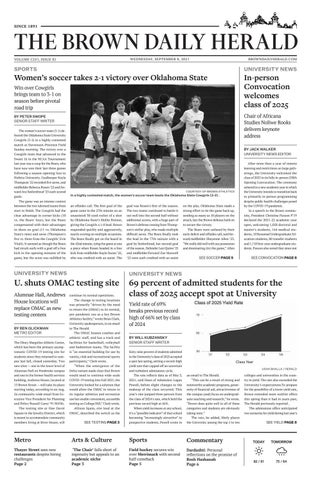
In a highly contested match, the women’s soccer team beats the Oklahoma State Cowgirls (3-2) .
UNIVERSITY NEWS
Alumnae Hall, Andrews House locations will replace OMAC as new testing centers
on the play. Oklahoma State made a strong effort to tie the game back up, sending as many as 10 players on the attack, but the Brown defense held on to secure the victory. The Bears were unfazed by their early deficit and offsides call, said forward/midfielder Sheyenne Allen ’23. “We really did well with our possession and dominating (in) the game,” Allen
After more than a year of remote learning and restrictions on large gatherings, the University welcomed the class of 2025 in its fully in-person 258th Opening Convocation. The ceremony ushered in a new academic year in which the University intends to transition back to primarily in-person programming despite public health challenges posed by the COVID-19 pandemic. In a speech to the Brown community, President Christina Paxson P’19 declared the 2021-22 academic year open, welcoming 1,058 doctoral and master’s students, 144 medical students, 10 Resumed Undergraduate Education students, 80 transfer students and 1,710 first-year undergraduate students. Paxson also noted that since not
continue its normal operations. The change in testing locations was primarily “driven by the need to return the (OMAC) to its normal, pre-pandemic use as a key Brown Athletics facility,” wrote Brian Clark, University spokesperson, in an email to The Herald. The OMAC houses coaches and athletic staff, and has a track and facilities for basketball, volleyball and badminton teams. The facility is “an essential building for use by varsity, club and recreational sports participants,” Clark wrote. “When the emergence of the Delta variant made clear that Brown would need to continue wide-scale COVID-19 testing into Fall 2021, the University looked for a solution that would allow the OMAC to return to its regular athletics and recreation use but enable convenient, accessible testing on College Hill,” Clark wrote. Allison Spain, site lead at the OMAC, described the switch as the
SEE TESTING PAGE 3
goal was Rosen’s first of the season. The two teams continued to battle it out well into the second half without additional scores, with a huge part of Brown’s defense coming from Thompson’s stellar play, who made multiple difficult saves. The Bears finally took the lead in the 77th minute with a goal by Seelenfreud, her second goal of the season. Defender Lexi Quinn ’25 and midfielder/forward Zoe Maxwell ’22 were each credited with an assist
UNIVERSITY NEWS
69 percent of admitted students for the class of 2025 accept spot at University Yield rate of 69% breaks previous record high of 66% set by class of 2024 BY WILL KUBZANSKY SENIOR STAFF WRITER Sixty-nine percent of students admitted to the University’s class of 2025 accepted a spot last spring, setting a record-high yield rate that capped off an uncertain and turbulent admissions cycle. The rate reflects data as of May 3, 2021, said Dean of Admission Logan Powell, before slight changes to the makeup of the class occurred. This year’s rate jumped three percent from the class of 2024’s rate, which held the previous record high at 66%. When yield increases at any school, it’s a “possible indicator” of that school becoming “increasingly attractive” to prospective students, Powell wrote in
an email to The Herald. “This can be a result of strong and noteworthy academic programs, generosity of financial aid, attractiveness of the campus (and) focus on undergraduate teaching and research,” he wrote. “Brown does quite well in all of these categories and students are obviously taking note.” The rate, he added, likely places the University among the top 5 to ten
USHA BHALLA / HERALD
Metro
Arts & Culture
Sports
Commentary
Thayer Street sees new restaurants despite hiring challenges Page 2
‘The Chair’ falls short of ingenuity but appeals to an academic niche Page 3
Field hockey secures win over Merrimack with second half comeback Page 5
Dardashti: Personal reflections on the promise of Rosh Hashanah Page 6
colleges and universities in the country in yield. The rate also exceeded the University’s expectations.To prepare for the possibility of a lower yield rate, Brown extended more waitlist offers this spring than it had in years past, The Herald previously reported . The admissions office anticipated two scenarios for yield during last year’s
SEE YIELD PAGE 8
TODAY
TOMORROW
82 / 61
75 / 64
2
THE BROWN DAILY HERALD | NEWS
Wednesday, September 8, 2021
METRO
On Thayer, restaurants fill vacancies despite hiring challenges
Thayer Street stores like Army Navy Surplus and Durk’s Bar-B-Q closed in 2020; local retailers plan to utilize the vacancies.
Owners cite lack of applicants for staff shortages, express optimism for future BY KATY PICKENS SENIOR STAFF WRITER Despite increased demand for dining and shopping as students return to campus and COVID-19 restrictions ease, many storefronts on Thayer Street are struggling to hire enough employees to fill their shifts. The Army Navy Surplus Store closed permanently Dec. 15, 2020, The Herald previously reported. The building will next be demolished and replaced with new storefronts. Mike Boutros, owner of Mike’s Calzones and Chinatown On Thayer, purchased the lot the same day it closed and plans to use the space for “two
restaurants most likely,” and potentially retail and residential space in the upper levels. Boutros estimates this new development will take about a year. He plans to open a pizza restaurant called Mighty Mike’s Pizza in the coming months, which will occupy the original location of Chinatown that underwent an expansion in June 2021. Chinatown is currently operating in two lots: its former storefront and the space formerly occupied by Durk’s Bar-B-Q. Chinatown will continue to occupy the former Durk’s storefront. Off of Thayer, East Side Mini Mart will close this month to make room for a new University dormitory on Brook Street. Demolition of the current building, as well as neighboring store Bagel Gourmet, is set to happen sometime in October, according to a sign in the Mini Mart window. Ceremony Tea, a popular cafe among Brown students, has relocated
from Thayer Street to the ground floor of the apartment complex on 21 Euclid Ave. A soft opening for the new location is slated for Sept. 10, according to a post on the shop’s Instagram account. Vegan restaurant by CHLOE is now called Beatnic as a result of a recent rebranding from the chain’s corporate office, according to its website. Beatnic will continue serving the same menu. Aroma Joe’s, a new coffee shop, has moved into 257 Thayer St. and is hiring for its upcoming opening, the date of which has not yet been released. A Bank of America location will also open at 271 Thayer St. Ayame Hibachi Express opened at 269 Thayer St. Aug. 30, filling the vacancy left by B.Good, which closed last May. Joey Ghoe, manager and owner of the new restaurant, explained that while the business was doing well, he has faced difficulty in hiring people to fill shifts. “We can’t hire anybody,” Ghoe said.
“It’s not easy to open a restaurant right now.” Ghoe has been relying on friends and family to help out at the restaurant due to these hiring difficulties. Ayame Hibachi Express has to close at 9:30 p.m. instead of midnight, which Ghoe would prefer, because they are short-staffed, he said. He believes that the pandemic may have permanently changed people’s habits and preferences when it comes to work. Potential staff “don’t want to come back to work in a restaurant” when they could work from home, Ghoe said. Several storefronts and restaurants on Thayer, including Shaking Crab, Ten One Tea House and bb.q chicken + Soban Korean Eatery, are currently looking for workers, based on signs in each store’s windows and posts on social media. Berks, a retail and shoe store, has seen increased demand from customers and fewer people looking to work at the store.
KATY PICKENS / HERALD
Berks “is significantly busier than it was this time last year,” said Jocelyn Donald, an employee at the store. Eased capacity limits and social distancing requirements in Rhode Island have helped business, they said. But there are times where Berks is understaffed, creating difficulties for the store. “We are definitely thin of people who can work all the hours we need,” Donald said. Boutros agreed that finding new staff members has presented a challenge for his businesses. “Hiring has been the worst,” he said. “It’s been difficult to find help.” He expects that the expiration of pandemic-related unemployment payments on Sept. 4 will incentivize workers to return to restaurants and stores. Boutros is hopeful for the future as vaccination rates increase and pandemic restrictions ease. “We’re hoping that everything goes back to normal, like we were in 2019,” he said.
Wednesday, September 8, 2021
THE BROWN DAILY HERALD | NEWS
ARTS & CULTURE
‘The Chair’ is Netflix’s love story in disguise
TESTING FROM PAGE 1 OMAC “dissolving into two sites.” “We’ve got a lot to do,” Spain said Tuesday as she carried boxes full of test kits, personal protective equipment and tubes out of the OMAC. The process of moving supplies has been ongoing, but it’s still a challenge. “This entire pandemic has been an exercise in doing the best we can,” Spain said. Alex LaBeef, a team lead at the OMAC, said Alumnae Hall would be like “the new OMAC,” in that it would take the majority of the testing burden. The site will accommodate more tests because it has more space and staff, Spain said. Still, LaBeef acknowledged that much of the on-campus student body
3
is housed closer to Andrews House. “We’re going to get overflow” of students at the Andrews House site, he said. “That will be an obstacle.” But the testing staff has experienced adjustments like this before, LaBeef added. They had to adjust when One Davol Square and Health Services began offering asymptomatic testing last year. Because the University’s campus is no longer de-densified, as it was for much of the pandemic, more students and faculty are enrolled in the testing program than ever before — 9,200 were tested last week, according to Clark. But because vaccinated community members are no longer tested as frequently — just once per week, compared to twice per week for their unvaccinated counterparts — the
University is conducting fewer tests than it was earlier in the pandemic. Clark wrote that 97.4% of students and 95% of faculty and staff are vaccinated. The University conducted around 14,000 tests weekly during the spring 2021 semester but conducted only 10,201 tests over the past week, according to the COVID-19 dashboard as of Tuesday. Clark emphasized that it remains important for students and staff to visit testing sites at the times and locations of their appointments to avoid crowding and long lines. But, besides the change in testing location, there are “no other significant changes to the asymptomatic testing program in terms of the test administered, testing supplies, staffing or process,” Clark wrote.
COURTESY OF NETFLIX
“The Chair” is propelled by culture wars on the fictional college’s campus, but it fails to truly grapple with these complex issues.
New Netflix series appeals to a niche, but does so with little innovation or critical examination BY CECILIA BARRON SENIOR STAFF WRITER By now, you should have heard of “The Chair.” Starring a blazer-clad Sandra Oh, the Netflix original released Aug. 20 caters to the bookish, academic, higher ed-obsessed niche of the American population. If you’ve heard a lot about it, chances are you fit into that niche. And if you fit into that niche, you’ll probably like “The Chair.” Taking place on the fictional Pembroke University campus (sound familiar?), the show follows a dying English Department at an Ivy-ish institution in the throes of financial cuts and cultural upheaval. The chair herself, Jin-Yoon (Oh), is a powerhouse professor-turned-administrator who enters into the position just as the department begins to crumble. In the first episode, Bill Dobson (Jay Duplass), a widower and possible love interest for Jin-Yoon, goes viral after drunkenly doing the Nazi salute in a poorly executed joke during a class on fascism and modernism. The show is propelled by the encroachment of “culture wars” on Pembroke’s campus: Bill faces off against the students who once loved him; the rising star, a Black female professor, argues with the jaded white male professor; the second wave feminist chides the Title IX coordinator’s short shorts. The juxtapositions of these divides manifest on many college campuses, but there is little critical investigation into them on “The Chair.” Instead of grappling with these complex issues, “The Chair” plays to the viewer’s shallow sympathy for the protagonists. It also counts on the viewer’s disdain for the stereotypical liberal arts student. Bill’s salute is taken out of context, and with his disheveled hair and his poor widowed eyes, you have to feel bad for the guy. The students asking for his resignation only come up with poster-like platitudes such as “No Nazis at Pembroke” and “Hate has no home here.” “The Chair” makes you root for the alcoholic, shameless, inappropriate professor because the alternative — the reductive Social Justice Warrior students who would rather rap about Moby
Dick than read it — are made out to be even more unbearable. “The Chair”’s politics fall apart under scrutiny, but to disregard the entire project over this failure would be unfair: the show isn’t a political piece, though it may dress up as one. Cloaked in academia’s crimson cloth, “The Chair” masquerades as clever political takes for those invested in the goings-on of higher ed. But really, “The Chair” is just a love-story-sitcom for those nestled in the niche of academia. The paradox of streaming services is that while more television is being produced than ever before, the offerings are often formulaic reproductions of the same show. “The Chair” is an academic “Friends,” or “Seinfeld,” or to make it more modern, “How I Met Your Mother.” There’s the jester, Joan Hambling (Holland Taylor), who enters the scene for a punchline. There’s the troubled protagonist, Jin-Yoon, who can’t seem to catch a break and will occasionally fall off a chair for laughs. There’s the protagonist’s even-more-troubled love interest, Bill, who we love in theory, and who grows more endearing because of his mistakes. Producers funnel shows through this beloved format and then douse them in cultural buzzwords to make the work seem catered especially to someone like you: someone with your interests, your profession, your peers, your lifestyle. So when The Alabama Shakes play during a scene in “Fleabag” or when “Master of None” takes you to Italy or when you watch Jin-Yoon quote Emily Dickinson, you know that this show is speaking to you; it’s different, it’s special, it’s enjoyable and lighthearted while also touching all aspects of your less enjoyable and lighthearted life. But what makes these shows enjoyable is that, boiled down, they’re love stories. They’re full of jokes and humor. The characters make mistakes that can be undone. The ending of “The Chair” is lovely: a climactic faculty meeting leads Bill to tell the administration off, Joan assumes her rightful place as the new chair after decades of disregard, there’s newfound hope for Jin-Yoon and Bill. The ending of a more realistic show, one that would appeal to the same demographic, would be more sinister as university budgets are slashed and humanities classes are drained of students. But that show wouldn’t be successful. Jin-Yoon, the charming intellectual herself, would rather watch “The Chair.” So would I.
AREEZ KHAN / HERALD
The OMAC has been returned to its pre-pandemic function as an athletic center for usage in the new school year, as new testing sites have been opened in Andrews House and Alumnae Hall.
Find Post- magazine on Facebook! facebook.com/postmagazinebdh
4
THE BROWN DAILY HERALD | NEWS
Wednesday, September 8, 2021
SPORTS
Field hockey edges Merrimack College 2-1, improves to 2-0
COURTESY OF BROWN ATHLETICS
Bruno opened its season with a 2-1 win against Merrimack College, dominating offensively and putting 18 out of 23 shots on goal. After losing a season to the COVID-19 pandemic, the Bears must navigate new dynamics shaped by a majority of the team’s recent arrival to the collegiate athletics scene. The field hockey team will face its next match Sept. 10.
Rothkopf, Rosen each score to spark second half comeback in weekend homestand BY GABRIELLA SARTORI SENIOR STAFF WRITER The field hockey team (2-0-0) defeated the Merrimack College Warriors (00-4) by a score of 2-1 to cap off their opening weekend homestand. The Bears dominated offensively the entire game, outshooting the Warriors 23-2 and putting 18 of those shots on goal, but Merrimack’s stout defensive approach kept the game close. Brown had a slow start after the Warriors capitalized on a quick tip in
off a cross in front of the net in the 18th minute of the game. But this would be the last shot that goalkeeper Jodi Brine ’23 and the Bears would allow for the rest of the game. Bruno built up momentum in the second half with a dominant midfield presence from captain Dani Van Rootselaar ’22 as she continued to push through the Warrior defense with a game high 11 shots on net. Brown unleashed eight shots in the third quarter and finally broke through with an equalizer in the 39th minute off a corner attempt. Midfielder Lindsey Ross ’23 placed a ball to Mikayla Walsh ’25 who touched a pass to Rothkopf ’25, shooting from the top of the circle to tie the game at 1-1. Rothkopf said that all the shots, including her own goal, can be attributed to the
change in pace that the Bears brought onto the field in the second half. “This was an important win, we showed how tough we were coming from behind,” Rothkopf said. “We played fast and took chances after our first half frustrations.” The Bears racked up five more shots in the final three minutes of the period, continuing to keep their foot on the gas. Bruno came out in the 53rd minute of the game with Walsh making her presence known once again as she assisted a ball towards the front of the goal where midfielder Emma Rosen ’22 knocked it past the goaltender. This gave the Bears a 2-1 lead that the Warriors could not budge for the remainder of the game. The team dynamic is different this year coming off the absence of a season,
Rootselaar said, as the majority of the team is still feeling out the collegiate experience. “I think the success of this year more than any of the years prior is really dependent on leading by example,” Rootselaar said. “Half of the team is inexperienced and unaware of what it’s like to play a game. The more we play like this, the better our team chemistry will continue to be.” Head Coach Jill Reeves said the mixed experience of the team allows more room for in-game improvements, which is what led to the second half momentum switch. “We are a passing team,” Reeves said. “The second half everything clicked and the fluidity of our game was seen in the finished passes and capitalizing off our looks that weren’t there in the first half. We were rushing our looks
CA L E N DA R
in the beginning which was an easy correction to make, helping us see a difference in energy.” Brown’s undefeated start to the 2021 season has generated excitement amongst the field hockey players, including midfielder Ana Claire Piacentini ’23. “Our team culture is so positive right now, and I know that’s cliche,” Piacentini said. “We wanted it so much more in the second half, but the crowd really does make an impact. This was our opening weekend and Brown Athletics as well as the surrounding Brown community coming out to support us is really all we could ask for.” The Bears will return to action Friday, Sept. 10 with a home matchup against cross-state rival Bryant University. Faceoff is at 4 p.m. and the game will be streamed live on ESPN+.
COVID -19 AT BROWN LAST 7 DAYS*
SEPTEMBER S
5
M
6
Tu
7
Completed Tests
People Tested
W
Th
F
S
10,201
9,205
1
2
3
4
Confirmed Positives
Positivity Rates
31
0.3 %
8
9
10
11 SINCE AUGUST 24, 2020*
12
13
14
15
16
17
18
19
20
21
22
23
24
25
26
27
28
29
30
Completed Tests
People Tested
471,506
16,410
Total Cases
Prevalence
643
3.9 %
*AS OF SEP 7.
Wednesday, September 8, 2021
THE BROWN DAILY HERALD | NEWS
5
ARTS & CULTURE
Despite best efforts, ‘Brooklyn Nine-Nine’ return misses the mark Premiere tries to address systemic racism, shed “copaganda,” falls short BY PETER SWOPE SENIOR STAFF WRITER “Brooklyn Nine-Nine,” a sitcom created by Michael Schur and Dan Goor centering around the lives of the detectives of Brooklyn’s 99th NYPD precinct, has always tried to be a “progressive” show. The show works to portray diversity and address social issues for a younger, more socially progressive audience. It boasts a diverse set of characters and cast members: gay Black police captain Raymond Holt (Andre Braugher), Black sergeant Terry Jeffords (Terry Crews), bisexual Latina detective Rosa Diaz (Stephanie Beatriz) and Latina sergeant Amy Santiago (Melissa Fumero), with white detectives Jake Peralta (Andy Samberg) and Charles Boyle (Joe Lo Truglio) rounding out the core cast. The show has previously dealt with issues of race, gender and sexuality in the policing realm, but its first seven seasons ultimately failed to question the institution of policing itself. In the wake of the murder of George Floyd and the subsequent resurgence of the Black Lives Matter movement in summer 2020, shows like “Brooklyn Nine-Nine” have been called “copaganda” and accused of glorifying law enforcement while glossing over its systemic issues. The premiere of the show’s eighth and final season subsequently tries to tackle the issues facing American policing head on. The show’s first episode since April 2020, titled “The Good Ones,” aired Aug. 12. It begins with the revelation that Rosa quit the NYPD under the belief that the policing system is incapable of reform. She becomes a private investigator aiding victims of police brutality — a job which she sees as a more ethical, impactful form of law enforcement. The episode’s primary plotline revolves around Jake and Rosa working together to get justice for a Black woman who was harassed and wrongfully arrested by racist police officers. Their efforts to do so are hindered by noncooperative police leaders, destroyed body cam footage and belligerent union representatives; their client ultimately having her charges dropped while the officers go unpunished is a result far from justice. At the episode’s core is the tenuous relationship between Rosa and Jake. Jake tries to justify his decision to remain a detective and prove to Rosa that the system is capable of good, both of which he can’t completely achieve. The episode’s efforts to be selfaware are, however, undermined by its attempts to differentiate between
SOCCER FROM PAGE 1 said. “Regardless of (The Cowgirls) scoring first, we were most definitely the better team and we didn’t let their status as a Big 12 school scare us.” Rosen echoed that sentiment. “We took a second to reset, came in as a team and worked to our strengths” after the Oklahoma State goal, she said. While the team was proud of the victory, they acknowledged that their play was not perfect. “One thing we could have improved upon was creating more run of play
COURTESY OF WIKIMEDIA COMMONS
In an effort to stay true to its socially progressive audience, the season premier of “Brooklyn Nine-Nine” attempts to tackle issues like racism in policing head-on; but that doesn’t change the fact that the show feels inevitably out of place in 2021. the core cast of detectives and the broader population of uniformed police officers. This was not entirely new: “Brooklyn Nine-Nine” already drew a flimsy line between what it considers clever, commendable detectives and the more mundane uniformed officers. But it is during the season eight premiere that the show leans into this distinction, as it dangerously and erroneously acts as though racism in policing is perpetuated only by uniformed officers in the streets, but not its core cast members. The show introduces two new characters, union representative Frank O’Sullivan and Captain Lamazar, each of whom embody different systemic issues of policing. O’Sullivan, with his slicked-back hair and pressed suit, is a caricature of the “corrupt police union rep”: He is unapologetic in his support of the NYPD and his criticism of “rioting and looting,” tampers with body cam footage to protect racist officers and bemoans “reverse racism.” Other “bad” officers don Oakley shades and camouflage baseball hats — the show parodies an officer after 2020’s viral “Late McMuffin” incident, in which a police officer’s emotional response to a lost McDonald’s order was met with internet ridicule. Nothing is subtle about O’Sullivan: He is established as a villain who serves as the show’s face of corrupt, racist policing. While O’Sullivan is written as an embodiment of the most visible elements of systemic racism in policing, Lamazar embodies its less visible, more deeply-rooted bureaucratic forms. Lamazar is a former colleague of Jake’s, leading him to hope that she can help address Rosa’s client’s mistreatment. Lamazar initially tells them that she
needs more proof of the officers’ misconduct before she can do anything. She deletes the body cam footage when she gets the proof, prompting Jake, defeated, to exclaim, “Oh, no. You’re a villain!” What follows is a lengthy conversation wherein Lamazar talks about how all she can do is get Rosa’s client’s charges dropped and discusses how internal police bureaucracy, the legal system, the power of the police unions and other structures like qualified immunity make it incredibly difficult to hold police accountable for misconduct and police brutality. She concludes by saying that the end result would be the firing of one of the NYPD’s only female police captains who is genuinely “one of the good ones.” Lamazar’s embodiment of the flaws of policing is nowhere near O’Sullivan’s in-your-face racism, but its more subtle nature makes it all the more sinister. She is the episode’s most scathing criticism of the institution of policing: Her actions demonstrate that it is impossible to be “one of the good ones,” as she watches injustice take place and makes an active effort to ignore it. The episode’s subplots similarly explore broader issues of systemic racism, though their impact feels less profound than that of the main Jake/Rosa plot. Charles takes on the role of a performative white ally who quotes podcasts about antiracism. His allyship begins to irk Black sergeant Terry, who grows increasingly annoyed as Charles visits his barbershop as a way to support Black businesses, makes over-the-top listening noises whenever Terry speaks and pays off a $10,000 reparations payment that was meant to be $100 as an example of just how serious his allyship is. At the end of the episode, Terry finally
explains to Charles that his activism should be based around his genuine desire to be anti-racist, rather than just to impress Terry. The fundamental question driving the episode, and in many ways driving conversations about policing more broadly, is whether “the good ones” even exist. “Brooklyn Nine-Nine” seems to arrive at an answer: Such a question about individuals is unproductive and ultimately futile, because regardless of the intentions of certain individuals, the system is fundamentally flawed. The final scene played over the credits isn’t one of the show’s usual brief, lighthearted bits. It is a serious conversation between Jake and Rosa that serves to unpack and summarize the issues raised earlier in the episode. Jake, like the show more broadly, leaves the episode not knowing where he stands. He says, “I’d like to think I’ve done a lot of good as a detective and that I can continue to do that, but maybe I am part of the problem.” The scene ends with a striking and powerful moment of uncomfortable silence, underscoring the fact that the show does not consider this a resolution of all its underlying tensions. Aside from the fact that this season has been announced as the final one, the episode doesn’t leave a clear impression as to where the show will go from here. The season’s second episode, titled “The Lake House,” has nothing to do with policing whatsoever. Despite airing immediately after “The Good Ones,” “The Lake House” makes no mention of the events of the previous episodes, hardly relating to policing at all. This episode feels as though it could have come from any other season of the show or, for that matter, from
any season of any sitcom, regardless of whether its central characters were Brooklyn detectives. It remains to be seen how the rest of the season will play out, but “The Lake House” reminds viewers of the difficulty of enjoying a lighthearted sitcom when the systemic issues of policing constantly pervade the show’s premise. The show’s season premiere is well aware of the political implications of airing a cop-comedy during a national call to re-examine policing institutions. It is upfront about its goal of finding a way to integrate itself into a social climate more actively conscious of the ways in which racism and policing are historically and systemically intertwined. It’s difficult to accuse “Brooklyn Nine-Nine” of running away from the foundational issues it faces; it tackles these issues head-on and does its best to unpack them, at least to the extent that such unpacking is possible in a 25-minute network sitcom episode. But this doesn’t change the fact that “Brooklyn Nine-Nine” feels out of place in 2021. Every lighthearted or humorous interruption is ultimately overpowered by the nagging feeling that something about a cop-themed sitcom to enjoy and laugh at is fundamentally wrong. The show’s season eight premiere deserves credit for its self-awareness and its willingness to engage in conversations about systemic racism, both in policing and more generally. The show remains well-written and the quality of the acting remains as high as ever. But despite the show’s best efforts, there’s an unshakeable sense of wrong in watching a cop show that tries to be lighthearted and funny in the wake of continued police brutality against Black people in America.
offensive opportunities,” Allen said. “There were many times where we passed and could’ve dribbled to open up other players.” Overall, the team’s reaction was extremely positive. “This was a great game for us and once we do a bit of fine-tuning, we can have even better games in the future,” Allen added. “We are definitely a force to be reckoned with and this win absolutely proved that.” The victory reflected the team’s upward trajectory, according to Head Coach Kia McNeill. “For us, we’re just trying to get better and better every
game, and (over) our last three games you can see us incrementally getting better,” McNeill said. “This was a good test (Sunday), and I think it just showed our team that we should have the confidence that we can play with anyone.” For Rosen, the game reinforced that the Bears have become a team to be reckoned with. “This win means a lot. We’ve gotten better and better each game. We know the quality of our game. We know that we’re (at) the top of Division I, and this just goes to prove it,” she said. “Everyone (stepped) up and (fulfilled) their role and we came out
with the win today.” The Bears have a tough road ahead, with their upcoming three games against the University of Connecticut, the University of Notre Dame and Providence College. But the team’s spirits are high after the victory, according to McNeill. “Any time you get a win against a top team like that you boost your confidence,” she said. “We need to get some rest these next couple of days and just get ready for UConn on Thursday.” Rosen agreed that the team is ready for whatever challenges lie ahead.
“We’re just gonna ride the momentum,” she said. “We’ve got a couple big games coming up, and we’ll just keep executing (and) keep finishing leading into the Ivy season.” For now, the team is enjoying their massive victory against an opponent that entered the year ranked in the top 25 nationally. “Our team is incredible. We can play with anybody,” McNeill said. “I’ve known that from the beginning, but I told my team, ‘I can’t have more belief in you than you have in yourselves,’ and I think today they showed the belief in themselves.”
THE BROWN DAILY HERALD | COMMENTARY
Wednesday, September 8, 2021
Dardashti: Rosh Hashanah’s promise tells us, ‘you’ve got this.’ RABBI MICHELLE DARDASHTI OP-ED CONTRIBUTOR Elijah is my favorite biblical prophet; he’s got fire and he’s got pain — like all of us. When his fears threaten to snuff out his fire, he runs away — like we sometimes do. God finds him hiding in a cave and, quite literally, calls him out (if you’ve got God hang-ups or anthropomorphism isn’t your thing, please try and stick with me anyway; as I wrote elsewhere , God is a spectrum!). “What are you doing here, Elijah?” God asks. Elijah doesn’t have a convincing answer and even God’s voice doesn’t move him. The truth is that he’s filled with self-doubt; he’s lost touch with how powerful he is and how many blessings he has. We can relate. To wrench Elijah from his funk, God pulls out all the stops. The Book of Kings describes it this way: “There was a great and mighty wind, splitting mountains and shattering rocks by the power of God; but God was not in the wind. After the wind, an earthquake; but God was not in the earthquake. After the earthquake, fire; but God was not in the fire. And after the fire, a still, small, voice. And when Elijah heard it, he wrapped his face in his mantle and went out, and stood in the entrance to the cave.” We too have faced, or seen images of, devastating winds, earthquakes and fires of late. We know there’s something terribly wrong on our planet. But these natural disasters aren’t necessarily stirring us to meaningful action. Why not? Because they’re a bit too much to bear. Our hearts and senses are so overwhelmed with the magnitude of the suffering around us that many of us go numb.
This is where the shofar (ram’s horn) comes in. We hear its blasts on each day of the month leading up to Rosh Hashanah and 100 times on the holiday itself. Its piercing notes are meant to shake us out of our stupor. But like with Elijah, it’s not the dramatic sounds themselves that will catalyze or comfort us, but rather what comes next. This is why an allusion to Elijah’s story appears at the climax of the Rosh HaShanah and Yom Kippur liturgy, in the prayer known as the Unetane Tokef (the “who shall live and who shall die” prayer). Just before listing off all the terrifying fates
three things that will help get us through any challenge or hardship we face in the coming year: teshuva, tefliah and tzedakah, commonly translated as “repentance,” “prayer” and “charity.” I translate teshuva (with its Hebrew root, lashuv, “to return”) as “returning to oneself” and I understand it as about reaching inward. I translate tzedakah (with the root tzedek, meaning “justice”) as “acts of justice” and I understand it as about reaching out to others. Tefilah, the word meaning prayer, is sandwiched between teshuva and tzedakah, because it is the key to moving from one to the other. Tefilah
“There are three things that will help get us through any challenge or hardship we face in the coming year: teshuva, tefliah and tzedakah.”
that may await us in the coming year, the prayer proclaims that “a great shofar will be sounded and a still small voice will be heard.” It seems the answer to the question of “what you are doing here” — of how we can overcome our self-doubt and most meaningfully realize our blessings — resides in the still small voice. Not in the whirlwinds, but inside us. Great, you might be saying, but how do we access that voice? The prayer offers an answer to this too. The prayer’s author declares that there are
is what allows us to move from being inwardly focused (teshuva) to outwardly focused (tzedakah). It’s about reaching for “The Beyond,” whether that be God, the universe, the power that makes for salvation, whatever gives life meaning. While prayer might feel like merely moving our lips, if it manages to rouse our hearts, prayer can help us to change both ourselves and the world. Does any of this help? Does it make you feel you can take on the coming year? If not, let me
say it another way. These three tools, offered by the prayer as walking staffs for courageously navigating what’s to come, can also be powerfully mapped onto the three relationships at the core of our existence: our relationship with ourselves, our relationship with “The Beyond” and our relationship with fellow human beings. The shofar — and the entire season for which it affords the soundtrack — is meant to trigger the still soft voice inside of each of us, whispering: You’ve got this, someone or something’s got you and we’ve got each other. Elijah’s story in the Book of Kings concludes with God telling him to lekh shuv l’darkekha, get back to your path. The sounds and stories we hear on these Days of Awe are designed to help us do the same, to live bravely into our destinies by returning to faith in ourselves and turning to one another as well. I hope we’ll all find time and quiet during these days to hear the soft but insistent voice reminding us that: We’re already amazing and have got what it takes to make an impact on the world in unique ways; that we are held and loved in ways that we’ll never be able to understand, but can hopefully be blessed to feel; and that we’re in this together. We’re all we’ve got. And we’re a lot. Rabbi Michelle Dardashti is in her ninth year as associate University chaplain for the Jewish Community at Brown University and Rabbi at Brown RISD Hillel. She can be reached at rabbi@brown.edu, in her office at Paige Robinson or at Hillel. Please send responses to this opinion to letters@browndailyherald.com and op-eds to opinions@ browndailyherald.com.
STAY UP-TO-DATE. FOLLOW US ON FACEBOOK. FACEBOOK.COM/BROWNDAILYHERALD
SINCE 1891
THE BROWN DAILY HERALD Editorial Leadership Editor-in-Chief Kayla Guo Managing Editors Henry Dawson Li Goldstein Senior Editors Kate Ok Kamran King Emily Teng Emilija Sagaityte Editorial Page Editor Johnny Ren post-magazine Editor-in-Chief Olivia Howe Sections Arts & Culture Editors Irene Chou Nicholas Michael
Metro Editors Ben Glickman Ben Pollard Julia Grossman Katie Chen Liza Mullett Victoria Yin News Editors Caroline Nash Caelyn Pender Gaya Gupta Jack Borris Livia Gimenes Science & Research Editors Rahma Ibrahim Marlene Goetz Sports Editor Ryan Handel Commentary Opinions Editors Augustus Bayard
Jaehyun Hong Matt Walsh Clara Gutman-Argemí Johnny Ren Multimedia/Production Design Editors Anya Semizhova Keelin Lyons Lena He Raphael Li Head Photo Editors Areez Khan Nicole Kim Copy Desk Chief Catherine Healy Assistant Copy Desk Chief Lily Lustig Illustrations Head Loki Olin
Graphics Editor Usha Bhalla Podcast Ben Glickman Corey Gelb-Bicknell Olivia Burdette Business General Managers Michael Wang Noah Colón Office Manager Chelsey Barton-Keenes Directors Sales: Annika Sigfstead Finance: Andrew Willwerth Digital Director of Technology Jed Fox
@the_herald
facebook.com/browndailyherald
@browndailyherald
youtube.com/browndailyherald
88 Benevolent St., Providence, RI (401) 351-3372 www.browndailyherald.com Editorial: herald@browndailyherald.com Advertising: advertising@browndailyherald.com
Submissions: The Brown Daily Herald publishes submissions in the form of op-eds and letters to the editor. Op-eds are typically between 750 and 1000 words, though we will consider submissions between 500 and 1200 words. Letters to the editor should be around 250 words. While letters to the editor respond to an article or column that has appeared in The Herald, op-eds usually prompt new discussions on campus or frame new arguments about current discourse. All submissions to The Herald cannot have been previously published elsewhere (in print or online — including personal blogs and social media), and they must be exclusive to The Herald. Submissions must include no more than two individual authors. If there are more than two original authors, The Herald can acknowledge the authors in a statement at the end of the letter or op-ed, but the byline can only include up to two names. The Herald will not publish submissions authored by groups. The Herald does not publish anonymous submissions. If you feel your circumstances prevent you from submitting an op-ed or letter with your name, please email herald@browndailyherald.com to explain your situation. You can submit op-eds to opinions@browndailyherald.com and letters to letters@browndailyherald. com. When you email your submission, please include (1) your full name, (2) an evening or mobile phone number in case your submission is chosen for publication and (3) any affiliation with Brown University or any institution or organization relevant to the content of your submission. Please send in submissions at least 24 hours in advance of your desired publication date. The Herald only publishes submissions while it is in print. The Herald reserves the right to edit all submissions. If your piece is considered for publication, an editor will contact you to discuss potential changes to your submission. Commentary: The editorial is the majority opinion of the editorial page board of The Brown Daily Herald. The editorial viewpoint does not necessarily reflect the views of The Brown Daily Herald, Inc. Columns, letters and comics reflect the opinions of their authors only. Corrections: The Brown Daily Herald is committed to providing the Brown University community with the most accurate information possible. Corrections may be submitted up to seven calendar days after publication. Periodicals postage paid at Providence, R.I. Postmaster: Please send corrections to P.O. Box 2538, Providence, RI 02906. Advertising: The Brown Daily Herald, Inc. reserves the right to accept or decline any advertisement at its discretion.
The Brown Daily Herald, Inc. is a financially independent, nonprofit media organization bringing you The Brown Daily Herald and Post- Magazine. The Brown Daily Herald has served the Brown University community daily since 1891. It is published Monday through Friday during the academic year, excluding vacations, once during Commencement and once during Orientation by The Brown Daily Herald, Inc. Single copy free for each member of the community. Subscription prices: $200 one year daily, $100 one semester daily. Copyright 2021 by The Brown Daily Herald, Inc. All rights reserved.
Wednesday, September 8, 2021
THE BROWN DAILY HERALD | COMMENTARY
7
Fleischmann ’22: The pandemic isolated us. Now, we can choose how to reconnect. WILL FLEISCHMANN STAFF COLUMNIST Most people, I expect, can feel the buzz around campus. Months after the first vaccines rolled out, the fog of COVID is finally lifting before the promise of a somewhat normal year. I moved into my apartment a few days ago and was shocked by what seemed like a universal willingness to socialize. Freshmen mingle on the Main Green, meeting new friends and jabbering with excitement visible on their unmasked smiles. I see whole families helping move students back onto campus and a packed Blue Room almost resembling what it was two falls ago. Brown is nearly back to normal and the thirst for social interaction is palpable. A year and a half ago, right as we were sent home from campus, I remember watching newsreels flip through the same stories and spew the same speculative jargon. Reporters would belch about the momentary sacrifice of a two-week lockdown or the expected V-shaped recovery that was bound to begin any day. Underlying the media narrative was a sense that the pandemic was a blessing in disguise: a painful episode that would bind the country in common experience, make us crave the type of intimacy social media can’t provide and push us into a social renaissance of sorts. But months later, these ideas, which painted the pandemic as a transitory inconvenience, became failed predictions and came to represent the depressing monotony of the news
cycle. At the time, I filed this theory of a social renaissance into the rubbish heap of other lofty, ratings-driven predictions; I completely forgot about it — that is, until this past week. The enthusiasm with which the student body jumped back into life on campus has given credence to this prediction. More than ever, it seems people are willing to try new things, meet new people and dedicate more time to
we allow social media to isolate us the way the pandemic separated us physically. Our generation’s social skills are inextricably tied to a dependence on social media. But getting caught up in this dopamine fix might keep us from pushing through the normal early awkwardness of a new friendship, and leave us feeling lonely despite the newly unmasked and eager faces around us.
ate the joys of life. Now, more than ever, the pandemic feels less dire. At last, we are emerging — many of us vaccinated — from our dark, desolate dorm rooms with a thirst for real connection. We’ve reached a communal low and now maybe we can appreciate a new high. I’m not a foolish optimist. The pandemic was terrible and did far more harm than good, but
“We face a unique opportunity to be the architects of a new milieu. For many, including myself, the pandemic offered a brief reflection on what’s important in life.”
the aspects of life we took for granted before the pandemic: We face a unique opportunity to be the architects of a new milieu. For many, including myself, the pandemic offered a brief reflection on what’s important in life, and frankly, what makes people happy. Isolation made me appreciate even the most mundane of physical interactions. Watching lectures from bed made me crave walking to class each morning, and eating prepackaged meals alone in my dorm made me miss the cacophonous lunchtime rush at the Ratty. That said, I’m hesitant that our social reawakening will fulfill our own expectations if
If we can put down our phones, we may find ourselves more receptive to the joys of life having experienced the pain prompted by the pandemic, and better able to reimagine what our social life could look like. A recent psychological study measured perceived lifetime happiness against the amount of adversity an individual had experienced. Those who experienced either overwhelming or minimal amounts of adversity reported lower levels of happiness, while those who had experienced a moderate amount tended to be happier. In short, exposure to some amount of pain and struggle allowed individuals to better appreci-
the silver lining might be a push toward more meaningful interactions and a thirst for social exploration. From everything I’ve seen in my first days back at Brown, we seem to be reaping the reward. So, here’s to hopes of an almost ordinary school year and, if we’re lucky, some extra ordinary and responsible social development. Will Fleischmann ’22 can be reached at william_fleischmann@brown.edu. Please send responses to this opinion to letters@browndailyherald.com and op-eds to opinions@ browndailyherald.com.
Simon ’25: A start to college more tentative than usual BY ALISSA SIMON OP-ED CONTRIBUTOR
The last night before I left home felt biblical. In the days leading up to my departure for my freshman year of college, my hometown was hit by the remnants of Hurricane Ida blowing up the East Coast. I remember winds and claps of thunder so loud they chased away sleep but felt dreamlike all the same. Lying in my childhood bed, lightning flashing strange shapes onto my ceiling, I didn’t feel any of the anxiety or excitement of the previous weeks. Instead, I felt alone and entirely out of my skin. It was fitting, in a way. That storm and that out-of-body sensation marked the beginning of my time at Brown. It was then that I realized how strange the year in front of me was — but strange in a way it was never supposed to be. For students at colleges and universities across the world, the coronavirus’ arrival onto the scene not only presented a public health crisis, but also disrupted one of the defining experiences of a young person’s life. But, for the class of 2025, COVID-19 has permanently altered what that experience will be. And it’s more than likely that, as methods to contain the virus become routine, classes of freshmen far into the future will inherit a version of college that is distinctly different from anything known before. This new reality isn’t helped by the fact that American culture in particular has a singular vision of what the college experience should look like. It’s intellectually rigorous, somewhat debauched and deeply formative. But, above all, it’s communal. Academic and extracurricular pursuits are defined not just by problem sets and publications, but rather by the relationships between friends, peers and professors. Even looking beyond just the undergraduate experience, networking is one of
the most important skills in the professional world. Despite the classic image of a solitary college student sequestered away in the library, the nature of modern academia is overwhelmingly one of physical presence and human connection. The consequences of severing those connections have been felt deeply over the past eighteen months in terms of both academic and personal well-being. A survey from Inside Higher Ed found that 52% of students felt they learned less in 2020 compared to preCOVID years. Another recent study from the National Institute of Health found that 71% of undergraduate students surveyed were experiencing “increased levels of stress, anxiety and depressive thoughts” as they tried to maintain their grades and relationships through laptop screens.
in the fall. The summer was long and languid, consisting of hours spent in my room, farewells to high school friends and strolls around my neighborhood. It was also punctuated by sporadic emails from Brown. There was information on how to shop for courses, logistics around housing and deadlines for meal plan registration. But there were also updates on COVID guidelines. First, the announcement on reaching the vaccination threshold — a return to so-called normalcy. Then, as the Delta variant arrived and more and more breakthrough infections began to be reported, updates on masking requirements, weekly testing and air purifiers arrived in my inbox. Like so many times over the past 18 months, I felt the attitude shift from hopeful to cautious to fearful and back again so subtly I hardly realized I was
But, signing up for my weekly COVID test, I’m reminded of how fragile the whole endeavor is. The concept of regularly attending classes in person again, let alone sitting in a lecture hall with hundreds of other students feels as strange to me, if not stranger, as living 400 miles from home. The initial period of uncertainty is beginning to settle into an uncertainty that feels more routine. The pandemic isn’t leaving any time soon and I have to wonder: What comes next? Will we be afraid to study abroad? To expand our social circles or explore the community outside of campus? Will we be able to feel the absence of the things that are supposed to shape our adult lives, or will we be able to make something new and different in their place that will allow us to connect with each other?
“For the classes of ’24 and ’25, there’s a different sort of struggle, a question that remains open: What, really, will it mean to be a college student in the wake of a global pandemic?”
Upperclassmen are well aware of what the coronavirus has taken from their college years, but for the classes of ’24 and ’25, there’s a different sort of struggle, a question that remains open: What, really, will it mean to be a college student in the wake of a global pandemic? I spent a solitary and anxious year asking myself that same question, trying through student group chats and countless video tours to figure out first what kind of school I wanted to attend, and then what kind of community I would be entering when I stepped onto Brown’s campus
holding my breath. Finally arriving on campus for orientation, I’ve still yet to fully exhale. There are feelings and experiences that are the same as they once were, at least I think so. But everything is covered in an additional layer of COVID-related uncertainty. The past couple days have been a blur of hundreds of faces, only discernible from the nose up and giving muffled names through their masks. It feels tentative. We’re all craving the friendships, the nights out, the kind of togetherness that the movies have promised us.
I’m holding these anxieties in a different bed now, waiting for the sound of rain to come. I’m six days into my time at Brown; I’ve received a negative result for my first of many COVID tests to come. Anything beyond that feels impossible to know. Alissa Simon ’25 can be reached at alissa_ simon@brown.edu. Please send responses to this opinion to letters@browndailyherald. com and other op-eds to opinions@browndailyherald.com.
Wednesday, September 8, 2021
CONVOCATION FROM PAGE 1 all members of the class of 2024 were able to walk through the Van Wickle Gates during last year’s convocation, those who had not yet done so joined the class of 2025 in passing through the gates this year. During the ceremony, Paxson highlighted a section of the University’s charter titled “No Religious Tests,” which grants complete religious freedom and “liberty of conscience” to the student body and was amended in 1926 and 1942 to allow the president and all faculty members to openly practice religions other than Protestantism. “We take it for granted today that Brown is open to all faiths. That’s nothing exceptional now,” Paxson said. “But, in 1764, the notion that an institution of higher education would not only accept students from all religions but would openly embrace the idea of ‘liberty of conscience’ was radical.” While the University was not initially open to all people — explicitly barring Black people, Native Americans, women and atheists from be-
THE BROWN DAILY HERALD | NEWS
coming students — “that initial seed of an idea, that embrace of intellectual openness and diversity, that’s grown stronger over time,” Paxson said. “It’s become a defining part of our institutional culture,” despite scrutiny from the media saying that institutions of higher education “engage in indoctrinating students.” Noliwe Rooks, department chair and professor of Africana Studies, delivered a keynote address at the ceremony titled “Finding Joy in the Journey: Memory Laws and The Battle to Remember.” Rooks, an author and interdisciplinary scholar, came to the University this year from Cornell. According to the University website, her work focuses on “how race and gender both impact and are impacted by popular culture, social history and political life in the United States.” Rooks’ speech highlighted the importance of the 2006 “Report of the Brown University Steering Committee on Slavery and Justice,” which was assigned as a first-year reading for incoming students for the second consecutive year. The report was created
by Brown faculty, students and administrators to “pursue steady progress in confronting issues of racism, discrimination and inequity,” according to the Office of Institutional Equity and Diversity’s website. “This is a document rooted in truth, truth telling and the belief that the truth about history matters to us today. It makes clear that genocide and racism and immorality and greed and a universe of crimes that offend humanity form the bedrock upon which rests this University, this state, this nation, these places that, for a time at least, we will all call home,” Rooks said. The report reveals “willful omissions” in depictions of American history that ignore the presence of slavery throughout the nation’s past. Rooks also discussed recent legislative efforts to bar discussions of “critical race theory” from classrooms. She contrasted what she called selective forgetting of the role of racism in our nation’s history to “memory laws” used to ensure the remembrance of stories concerning human rights abuses in Europe, namely the Holocaust.
American “memory laws” banning discussions of critical race theory “forbid illumination,” she explained. “They call for shadows, darkness or erasure. They would suppress or ban what Brown University has asked you to gauge and grapple with. Accordingly, for me, in this moment, this communal reading is a declaration of the principles on which Brown rests.” With this year’s convocation and in-person programming, the University welcomed a new class of students. “I came early for the pre-orientation Third World Transition Program, and that was honestly a great experience,” said Amaya Allen ’25. “I got to get acclimated to the campus before everyone else got here, which was nice, so when everyone else moved in I was already settled.” Jason Wu ’25 expressed enthusiasm about returning to in-person events, following a year where many school activities and extracurriculars remained virtual in accordance with public health guidelines. “Here with people that I can actually talk to (in person) ... I’ve been having a lot of
8 fun.” For many incoming students, the arrival on campus comes with a sense of normalcy, embodied by the gathering of hundreds of individuals together on the Main Green for convocation — the sort of event that has been banned throughout the pandemic. “It’s surreal,” Allen said. “To see this many people in one area safely is really amazing.” And, for some, finding normalcy fosters excitement, as students eagerly await exploring the University in the years ahead with renewed freedom. Coming together as a class in person is “really exciting,” Ethan Bove ’25 said. “I feel bad for (the class of 2024) because they never really had these (large, in-person) class events. But you can already feel the spirit of the class coming together ... as the class of 2025 we’re just excited to get going.” “I just hope to get the opportunity to explore all my passions and my interests in a new way,” Allen said. “That’s why I chose Brown, that’s why I’m here — to really find what I love.”
AREEZ KHAN / HERALD
The class of 2025 walked through the Van WIckle gates during this year’s Convocation, along with members of the class of 2024 who could not participate in the tradition last year.
YIELD FROM PAGE 1 admissions cycle, according to Powell. In the first, highly selective colleges could all see “roughly the same applicants and admit the same amazing group.” That, he explained, would in turn lead to lower yields at highly selective institutions and increased waitlist activity. The second, he explained, was a scenario in which highly selective colleges would see “different applicants” or “not admit the same students,” leading to higher yield. “I believe we may have shared many of the same applicants across our peer institutions,” he wrote. “But because we each have slightly different institutional priorities, we selected different groups of admitted students.” Nancy Griesemer, a private college counselor in Fairfax County, Virginia, noted that she had expected colleges to admit students from their waitlists. “We sat here and waited,” she said. “The entire situation was so insecure
and crazy … We kept waiting, and nothing happened. We waited and we waited and they finally shrugged and said we’re not going to the waitlist so much.” The University only accepted 34 students off its waitlist. In recent years, ithas accepted between two and 300 students off of the waitlist, The Herald previously reported. Test-optional policies, Griesemer said, may have played a role in increased yield: Colleges may have used different criteria to evaluate students who “possibly would not have gotten in other times” due to low test scores. Such students may have matriculated at a high rate, she said. “There was an element of taking a chance and throwing in an application because, why not, and it’s hard to say no,” she said. The University has not released statistics on its acceptance or yield rates for test-optional applicants, nor has any other Ivy League school except Penn. But Powell wrote that yield went up “across the board” at the University, adding that the test-optional policy was not a “major driver” of yield.
The Herald spoke to three students who were admitted through the regular decision process. Aside from the open curriculum — a factor all three mentioned in their decision-making — they said online programming, geography, the makeup of the student body and a number of other factors played into their choice. Prospective students nearly universally enjoyed the University’s post-admission outreach, Powell wrote, citing surveys that showed 95% of admitted students rating their interactions with current students as good, very good or excellent. Ninety-six percent said the same about their contact with the Office of Admission, and 98% about social media outreach. “Our general post-admission outreach was very successful,” he added. “Schools really did an amazing job of making staff accessible and having much-upgraded virtual information sessions,” said Griesemer. “That’s one of the long-term outcomes of the pandemic. … I agree that it was upgraded and
really good. Was that what accounted for the increase in yield? I don’t know.” Still, Evan Ren ’25 credited a Zoom with President Christina Paxson P’19 with helping convince him that the University was the right school for him. “It was something (she) said,” he noted. “Though Brown is situated in a big city, it maintains that community feel.” The pool at the Nelson Fitness Center also contributed to his decision. “I’m a swimmer, and the pool’s really attractive,” he noted, “so that definitely added some points.” In the case of Lily Johnson ’25, unofficial “speed dating” on Zoom run by incoming students proved to be a factor. “I was talking to a lot of ED (early decision) kids. They were talking about why they had chosen Brown,” she said. “That was a big factor in deciding.” In her choice between Brown and the University of California, Los Angeles, Merzia Jilani ’25 said she aimed to find a student-friendly environment that wouldn’t create “unnecessary pres-
sure,” something she felt in high school. “I felt like Brown is way more student-oriented,” she said, adding that she was attracted to the University encouraging students to “speak up for what they believe in.” “Brown is totally okay with you criticizing Brown,” she said. Her choice came quickly, she added, as she ultimately went on “just a feeling.” Johnson’s final options were Brown and the University of Notre Dame . Location played a role in her decision: Providence, with more to explore nearby, appealed to her over South Bend, Indiana, she said. The makeup of the student body further drew her to College Hill. “The diversity at Brown, along with how happy and genuine all the Brown students were, that pushed it over the top,” she said. “I think my class is awesome. Everyone is so excited to be at Brown,” she added. “Nobody’s walking around like it was their fifth choice.”