SINCE 1891
THE BROWN DAILY HERALD WEDNESDAY, SEPTEMBER 4, 2019
VOLUME CLIV, ISSUE 1
BROWNDAILYHERALD.COM
UNIVERSITY NEWS
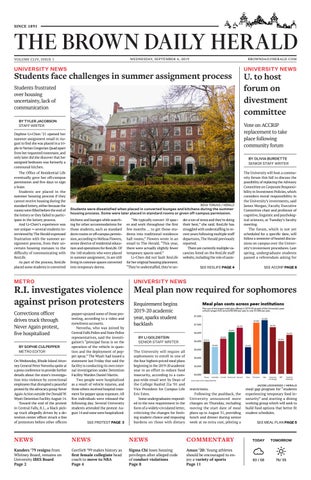
Students face challenges in summer assignment process Students frustrated over housing uncertainty, lack of communication BY TYLER JACOBSON STAFF WRITER
U. to host forum on divestment committee Vote on ACCRIP replacement to take place following community forum
Daphne Li-Chen ’21 opened her summer assignment email in August to find she was placed in a triple in Vartan Gregorian Quad apart from her requested roommate, and only later did she discover that her assigned bedroom was formerly a communal kitchen. The Office of Residential Life eventually gave her off-campus permission and five days to sign a lease. Students are placed in the summer housing process if they cannot receive housing during the standard lottery, either because the rooms were filled before the end of the lottery or they failed to participate in the lottery process. And Li-Chen’s experience was not unique — several students interviewed by The Herald expressed frustration with the summer assignment process, from their uncertain housing statuses to the difficulty of communicating with ResLife. As part of the process, ResLife placed some students in converted
UNIVERSITY NEWS
BY OLIVIA BURDETTE SENIOR STAFF WRITER
der a ton of stress and they’re doing their best,” she said. ResLife has struggled with understaffing in recent years following multiple staff departures, The Herald previously reported. There are currently multiple vacancies listed on the ResLife staff website, including the role of assis-
The University will host a community forum this fall to discuss the possibility of replacing the Advisory Committee on Corporate Responsibility in Investment Policies, which considers moral responsibility in the University’s investments, said James Morgan, Faculty Executive Committee chair and professor of cognitive, linguistic and psychological sciences, at Tuesday’s faculty meeting. The forum, which is not yet scheduled for a specific date, will follow a semester of heated discussions on campus over the University’s investment procedures. Last spring, undergraduate students passed a referendum asking for
SEE RESLIFE PAGE 4
SEE ACCRIP PAGE 8
BENJI TORUNO / HERALD
Students were dissatisfied when placed in converted lounges and kitchens during the summer housing process. Some were later placed in standard rooms or given off-campus permission. kitchens and lounges while searching for other accommodations for those students, such as standard dorm rooms or off-campus permission, according to Melissa Flowers, senior director of residential education and operations for ResLife. Of the 160 students who were placed in summer assignment, 16 are still living in common spaces converted into temporary dorms.
METRO
“We typically convert 10 spaces and work throughout the first few months … to get those students into traditional residence hall rooms,” Flowers wrote in an email to The Herald. “This year, there were actually slightly fewer temporary spaces used.” Li-Chen did not fault ResLife for her original housing placement. “They’re understaffed, they’re un-
UNIVERSITY NEWS
R.I. investigates violence Meal plan now required for sophomores against prison protesters Requirement begins Corrections officer drives truck through Never Again protest, five hospitalized BY SOPHIE CULPEPPER METRO EDITOR On Wednesday, Rhode Island Attorney General Peter Neronha spoke at a press conference to provide further details about the state’s investigation into violence by correctional employees that disrupted a peaceful protest by the advocacy group Never Again Action outside the Donald W. Wyatt Detention Facility August 14. Toward the end of the protest in Central Falls, R.I., a black pickup truck allegedly driven by a detention center officer struck a line of protestors before other officers
pepper-sprayed some of those protesting, according to a video and eyewitness accounts. Neronha, who was joined by Central Falls Police and State Police representatives, said the investigation’s “principal focus is on the operation of the vehicle in question and the deployment of pepper spray.” The Wyatt had issued a statement last Friday that said the facility is conducting its own internal investigation under Detention Facility Warden Daniel Martin. Two people were hospitalized as a result of vehicle injuries, and three others received hospital treatment for pepper spray exposure. All five individuals were released the following day. Several University students attended the protest August 14 and none were hospitalized. SEE PROTEST PAGE 3
2019-20 academic year, sparks student backlash
BY LI GOLDSTEIN SENIOR STAFF WRITER The University will require all sophomores to enroll in one of the four highest-priced meal plans beginning in the 2019-20 academic year in an effort to reduce food insecurity, according to a campus-wide email sent by Dean of the College Rashid Zia ’01 and Vice President for Campus Life Eric Estes. Some undergraduates responded to the new requirement in the form of a widely-circulated letter, criticizing the changes for limiting student choice and imposing burdens on those with dietary
restrictions. Following the pushback, the University announced more changes on Thursday, including moving the start date of meal plans up to August 31, providing lunch and dinner during senior week at no extra cost, piloting a
NEWS
NEWS
NEWS
COMMENTARY
Kanders ’79 resigns from Whitney Board, remains on University IBES Board Page 2
Gorrlieb ’99 makes history as first female collegiate head coach to move to NBA Page 4
Sigma Chi loses housing privileges after alleged code of conduct violations Page 8
Aman ’20: Young athletes should be encouraged to enjoy a variety of sports Page 11
JACOB LOCKWOOD / HERALD
meal gap program for “students experiencing temporary food insecurity” and starting a dining working group which will seek to build food options that better fit student schedules. SEE MEAL PLAN PAGE 5
TODAY
TOMORROW
83 / 58
76/ 55
2
THE BROWN DAILY HERALD | NEWS
WEDNESDAY, SEPTEMBER 4, 2019
UNIVERSITY NEWS
Warren Kanders ’79 resigns from Whitney Museum amid protests, remains on advisory council at University
SAM BERUBE / HERALD
The student collective, “Warren Kanders Must Go,” dropped stacks of flyers in the Granoff Center and held a “teach-in” about Safariland. Kanders and his wife have supported a Brown Arts Initiative lecture series since 2017.
Kanders’ Safariland sold tear gas used on migrants crossing USMexico border BY MELANIE PINCUS AND KAMRAN KING UNIVERSITY NEWS EDITOR AND SENIOR STAFF WRITER Warren Kanders ’79, a member of the advisory council for the Institute at Brown for Environment and Society, stepped down as vice chairman of the Whitney Museum of American Art on Thursday over protests about his company’s sale of tear gas. Activists flocked to the Whitney for months to protest Kanders’ role at the museum, demanding his removal from its leadership. His company, Safariland Group, sells tear gas that law enforcement officials have reportedly used on migrants crossing the U.S.-Mexico border, among other incidents worldwide.
“The targeted campaign of attacks against me and my company that has been waged these past several months has threatened to undermine the important work of the Whitney,” Kanders wrote in his resignation letter obtained by The New York Times. “I joined this board to help the museum prosper. I do not wish to play a role, however inadvertent, in its demise.” Kanders could not be reached for comment by press time. While protests at the Whitney escalated over the past month — eight artists withdrew from the Whitney Biennial exhibition last week over Kanders’ position at the museum — many University faculty, students and alums have long called for the University to cut all ties with Kanders. In addition to his position on IBES, an institute that explores the relationship between the natural world and sustainability in human society, he and his wife, Allison Kanders, have supported a Brown Arts Initiative lecture series since 2017. Allison
Kanders also resigned from her position as co-chairwoman of the museum’s painting and sculpture committee on Thursday. “The call for the removal of Kanders cannot stop at the Whitney,” wrote Professor of Comparative Literature and Modern Culture and Media Ariella Azoulay in an email to The Herald. “We as a community should expect the University to stand behind its explicit promise in its report on Slavery and Justice to ‘uphold a strict procedure for the ethical review of gifts,’ and to avoid profiting from money earned through the destruction of life.” Azoulay, Associate Professor of History Vazira Fazila-Yacoobali Zamindar and Postdoctoral Research Associate in History of Art and Architecture Lindsay Caplan signed an open letter released April 5 calling for Kanders’ removal from the Whitney board. Over 100 other artists and intellectuals also signed on in support. On College Hill, students have
mobilized against Kanders’ involvement with the University for over a year. In the spring, student collective “Warren Kanders Must Go” dropped stacks of flyers in the Granoff Center for the Creative Arts with information on Kanders’ ties to the University. The group also led a “teach-in” about Kanders and Safariland alongside the Brown Immigrant Rights Coalition and student coalition Brown Divest. Brown Divest lists Safariland among the nine companies it has identified as allegedly complicit in human rights abuses against Palestinians. Anchita Dasgupta ’21, who said she was involved in Brown Divest last spring, hopes Kanders’ resignation from the Whitney will inspire similar change at the University. “I hope that this is a first step to getting the Brown administration to agree to the ‘Warren Kanders Must Go’ campaign’s demands that he and his wife should not be involved with the arts initiative and IBES,” Dasgupta said.
Kanders defended his company in a letter to the editor in February 2018, where he responded to an oped that condemned the University for its relationship with Kanders. Kanders wrote that Safariland, which manufactures supplies for law enforcement and military use, has helped save lives with products like bulletproof vests and should not be held responsible for every use of its equipment. “Our less lethal products are designed to give law enforcement crowd control options in dangerous situations, for which we work closely with first responders and provide extensive training,” Kanders wrote. “As with any product, ultimate responsibility for its use falls on the individuals involved in their use.” Director of News and Editorial Development Brian Clark declined to comment on Kanders’ resignation from the Whitney and his position at the University, referring to the news as “not specific to Brown.”
WEDNESDAY, SEPTEMBER 4, 2019
PROTEST FROM PAGE 1 The investigation has interviewed 31 witnesses to date and plans to interview at least 20 more. From these interviews, Neronha said they found “some conflicting reports as to the extent of the injuries,” adding that “to the extent that we consider charges, the injuries are highly significant.” Neronha anticipates the investigation will conclude in several weeks, he said at the press conference. Neronha’s statement follows the resignation of Captain Thomas Woodworth last Friday. Woodworth, who was placed on administrative leave the day before his resignation, allegedly drove the pickup truck into the group of assembled protestors, according to witnesses. While the Wyatt did not directly confirm the identity of Woodworth as the driver, his name can be heard in video recordings of the protests, according to the Providence Journal. The Herald could not reach Woodworth, and he has not given any statements at this time. A peaceful gathering turns violent The incident under investigation marks the first case of violence at any of the dozens of Never Again Action protests organized across the country this summer. The protest last week was the second to be organized by Never Again Action outside the Wyatt this summer. On July 2, Never Again Action organized a protest of over 200 people outside the Wyatt and 18 protestors were arrested for civil disobedience, the Providence Journal reported. Three of the protestors arrested were Brown University students, wrote Tal Frieden ’19.5, a Never Again Action and R.I. protest organizer, in an email to The Herald. Never Again Action describes itself as “a mass mobilization of Jews who are organizing to shut down ICE and hold the political establishment accountable for enabling both the deportation machine that has separated immigrant families across the U.S. for decades and the current crisis at the border.” On August 14, immigration activists organized by a local chapter of Never Again Action gathered outside the Wyatt to protest the facility’s contract with Immigration and Customs Enforcement and to call for the center’s closure. They also protested broader issues such as the detention and deportation of asylum-seeking refugees and undocumented immigrants across the country. The Wyatt, a publicly owned and privately operated prison run by the Central Falls Detention Facility Corporation, renewed its contract with ICE earlier this year. ICE had previously terminated its contract with the Wyatt in 2008, after an immigrant detainee died while in the center’s custody. The Wyatt began housing 133 detainees in March, The Herald previously reported. As of July 8, the facility holds 139 detainees. “Unfortunately, recent testimonies by folks released reveal that the conditions are worse than we could have imagined. Rhode Island is hosting a concentration camp in our state,” Frieden wrote. Frieden added that state officials
THE BROWN DAILY HERALD | NEWS
should also “ban private prisons” and “advocate for dignity and permanent protection for all undocumented people in Rhode Island and the U.S.” About 500 people were present at the protest August 14, according to the Providence Journal, including community advocacy groups such as Alliance to Mobilize Our Resistance (AMOR), Progreso Latino and Fuerza Laboral, according to video footage of speakers at the protest. Protestors walked from Jenks Park in Central Falls to the Wyatt, where Christian Andrade, Aaron Regunberg ’12, a former state representative and candidate for lieutenant governor, and Emily Titon delivered a list of demands for greater transparency about detainment conditions and better treatment for ICE detainees within the center. When the demands went unmet, protestors remained outside the facility for hours. “We have not received any comment on the initial demands we have presented, and which AMOR and others have been advancing for months,” Frieden wrote. During the protest, attendees received encouragement from detainees inside the facility, said Ben Bienstock ’20, adding that they “were slamming on the windows, were waving, flickering their lights on and off; people put signs up in their windows that said ‘Shut Down the Wyatt.’” Protestors first blocked the prison’s larger two entrances and later moved to block the employee entrance around 9 p.m, according to the Boston Globe. Shortly before 10 p.m., a black pickup truck driven by a Wyatt employee in uniform rammed through protestors blocking the entrance to the prison parking lot. Some protestors jumped out of the way while others stood in front of the car to block its path. In a video posted to Facebook by Never Again Action, protestors shouted “shame” and “the whole world is watching” as they gathered around the car window.
3
COURTESY OF MICHELLE DARDASHTI
Around 500 people gathered outside the Wyatt Detention Facility to protest the facility’s contract with Immigration and Customs Enforcement and to call for the center’s closure. About a dozen correctional officers whose identities are unknown then exited the Wyatt and used pepper spray on protestors while they helped the driver exit his vehicle. At least a dozen University-affiliated individuals attended the protest, “some of whom were affected by pepper spray and the attack,” Frieden wrote. Bienstock did not see any city or state police officers intervene until after the use of pepper spray by Wyatt correctional officers. “There was no attempt to detain or arrest the officer who drove (the black pickup truck)” into the protestors, Bienstock said. The police also refused to take testimony from the attacked protestors and said they would only record witness statements at the station, Bienstock said, while Frieden wrote that “droves of protestors clamored to give testimony.” At Wednesday’s press conference, State Police Colonel James Manni said most officers present outside the Wyatt the night of the protest were city police officers, who were joined by just “three state police cruisers with five troopers” patrolling the area in an “abundance of caution.” Rhode Island State Police Assistant Detective Commander Captain John Alfred told The Herald Monday that they continue to perform
/
a “very active and open investigation.” He did not answer further questions about the protest. ICE spokesman Khaalid Walls wrote that “ICE personnel were not involved in the protest response that occurred Wednesday night” in an email to The Herald. The Central Falls Police Department and the Wyatt Detention Facility did not respond to request for comment by press time. Moving forward Following the resignation of Captain Woodworth last Friday, Never Again Action Spokesperson Amy Anthony released a statement on the same day calling for the city to take action against Woodworth and other officers. Anthony said in the statement that Woodworth “should face criminal charges for his actions which endangered the lives of protesters on Wednesday night. The other officers who indiscriminately pepper-sprayed a distraught and traumatized crowd must face accountability for the violence they enacted.” Never Again Action expects the ongoing investigation “to continue and to address the violence and dehumanization that is an integral part of the ICE detention process,” according to Anthony’s statement. Since the event, several Rhode Island representatives have sharply
0 0 0
criticized the violence. “I share the outrage Rhode Islanders are feeling about the incident depicted in the video at the Wyatt Detention Center,” said Governor Gina Raimondo in a statement. “Our state and our nation were built on the idea that everyone has a right to express their opinion publicly and peacefully.” U.S. Congressman David Cicilline ’83, D-R.I., said in a press release August 15 that he was “deeply disturbed” by reports of the vehicle hitting protestors as a violation to the democratic right to peaceful protest. Mayor Jorge Elorza went a step further on Tuesday, joining the call “for shutting down Wyatt and banning the operation of private for-profit prisons in Rhode Island.” Elorza condemned the violence at the Wyatt as undermining the facility’s stated mission “to protect the public from people who pose a threat to society” and also emphasized the place of undocumented immigrants in his own personal history. “My parents were undocumented immigrants for their first ten to 12 years here in the United States,” he said, recalling that as a child he could never register for Little League Baseball and other activities because his “family was always afraid of giving out our info.”
-".0 0 # 0 -0#$+'( ( 0
0 & *+, & #&!0," 0 ' /0#&0 # . $0 & 0 *$/0 ' *&0 -*') 0 20$33029 -)2)9 8 // 9 ! 452!9 9 (9 1- 9 2)! - /9 ,,9 9
0 0 *#+ 0 * 0 & 0 *' & 0 % !#& 0 & 02 $0 20$33029 ( 2,!39 220,,9 ! 452!9 9 9 1- 9 )!/ !39 ) 2 289
0 0 2 +#+,#&!0 %)#* 0 & "#0 & 0," 0 K#&!0' 0 ' *&0 '-,"0 +# 0 20$330296 Z)2 9: -)/ 299 ! 452!9 9 (9 - 9 -)4( 50/ //09 ,,9' 9
0
0 "#&K#&!0 #+,'*# $$/ 0 0 #+,'*/0' 0 #+,'*/0 *#,#&!0
0
0 * "#. +0' 0 +#* 0.'& .'*% ,#. 0 & *+0 & 0 X- $#,# +0#&0," 0 #+) &')"'& 0 '*$ 0
20$33029 +!/9 +39 !-)/ 29 9 (9 1- 9 '!9 0 )/30/9 ,,9
20$33029* 6)!29 !2/ / !Z9' ,! /09 !-)/ 29 9 9 1- 9 8,!39 ,,9 9
ͳͻͺ ǣ ǣ ǡ ǡ 20"!33029 )/ 89.'58!/9 !-)/ 29 9 9 1- 9 0 +!"!,,!29 ) 2 289
4
THE BROWN DAILY HERALD | NEWS
WEDNESDAY, SEPTEMBER 4, 2019
SPORTS
Gottlieb ’99 joins NBA’s Cleveland Cavaliers in historic hiring Gottlieb is first female collegiate head coach to make jump to NBA coaching staff BY ALEX SMOLAR SPORTS EDITOR Lindsay Gottlieb ’99 made history June 12th after the Cleveland Cavaliers hired her as an assistant coach, making her the first female collegiate head coach to join an NBA team’s coaching staff. “The vision for the Cavs’ future is compelling, and I look forward to helping make it a reality,” said Gottlieb in a statement issued by the Cavaliers. “At the same time, on a personal level, I am honored to hopefully impact young girls and women to be empowered to pursue their own visions and to be inspired to turn them into reality as well.” Gottlieb will be the seventh female assistant in the NBA, and the only woman to be part of the Cavaliers’ coaching staff. “It’s really incredible to see Lindsay make this jump to the NBA – both because of what an exciting opportunity it is for her and for what this means more broadly for women,” wrote Kai Felton, the current interim head coach at the University of California, Berkeley,
in a statement to The Herald. “We want the young women we coach to feel like they are capable of doing anything and being anything they set their minds to.” Gottlieb played for the women’s basketball team during her time at Brown, and served as both a player and a student assistant during her senior season with the Bears. For her passion and contribution to the team, Gottlieb was awarded the team’s Heart and Soul Award during her senior year. Following her career with the Bears, Gottlieb rose through the college coaching ranks, working on coaching staffs at Syracuse University, the University of New Hampshire, Richmond University and the University of California at Berkeley. In 2008, Gottlieb was named head coach of the women’s team at the University of California at Santa Barbara. She led her squad to a 15-1 record and an NCAA tournament berth while earning Big West Coach of the Year honors. In 2011, Gottlieb rejoined Berkeley as the women’s head coach and embarked on an eight-year career that featured seven NCAA tournament berths and a 2013 Final Four appearance. The Golden Bears were consistently a top 25 team under Gottlieb, compiling a record of 17989 during her tenure. “(Gottlieb’s) an amazing per-
COURTESY OF LESLIE MITCHELL
Gottlieb ’99 became the first female collegiate head coach to become an NBA coach after she joined the Cavaliers staff. She played for the women’s basketball team during her time at Brown. son and a fantastic coach,” Felton wrote. “I am really proud to call her my friend and to have spent the last eight years working together at Cal. We will all be cheering her on in this big next step.” “(Gottlieb) has an extensive track record of success and growth with her teams and players and has also been a strong culture-driver as a core part of that,” said Cavaliers
General Manager Koby Altman in a team statement. “The more we researched and got to know Lindsay, the more we came to understand that she would be an impactful part of where we want to go as a team.” Gottlieb will assist Head Coach John Beilein, who will also be coaching his first season in the NBA after spending 12 seasons at the University of Michigan.
The Cavaliers suffered through a disappointing 2018-19 season, finishing 19-63 and with the second-worst record in the Eastern Conference. Cleveland previously won the NBA championships in 2016 but is now transitioning after losing superstars LeBron James and Kyrie Irving in recent years. Gottlieb could not be reached for comment by press time.
RESLIFE FROM PAGE 1
credibly helpful and accommodating,” he said. “They knew we were in a bad position and were willing to work with us to make things better.” ResLife granted off-campus permission to some students in summer assignment after they were denied permission in the spring. “Off-campus permissions are granted on a rolling basis based on our overall occupancy numbers,” Flowers wrote. “These numbers fluctuate significantly, so it is standard for us to release a small number of juniors throughout the summer.” Newman and his group, which shrunk to five people as group members found permanent on-campus housing, was given off-campus permission after talking with a member of ResLife. “We had to take the initiative” to communicate with ResLife and look for places to live, Newman said. “It more or less consumed our lives for a good two weeks.” ResLife is working to improve the summer assignment process for the future. “Staff members in the office have been vetting various housing management systems to replace our outdated Odyssey HMS system that runs (the) housing lottery and off-campus housing processes,” Flowers wrote. “We have identified a top product and are working with (the) CIT and University Purchasing on a program acquisition and integration. We anticipate having this product fully integrated in time for 2020-2021 housing processes.” ResLife is also “considering policy changes to eliminate the occupancy fluctuation connected to rising seniors” in order to place fewer people in summer assignment, Flowers wrote.
tant director for operations, which manages “all aspects of housing assignments and facilitated housing accommodations,” Flowers wrote. Paul Villemaire left the position on June 14 and trained four members of the ResLife staff to oversee his position this summer. “I think they were dealing with a situation where (ResLife) didn’t have enough resources, employees or information to do this properly,” said Oscar Newman ’21, whose housing group of eight was placed into summer assignment, The Herald previously reported. “It’s kind of a systemic problem.” Some students interviewed by The Herald found getting in contact with ResLife about summer assignment to be difficult. “ResLife as a whole seemed to be unreachable,” said Moriah Tom ’21. “A lot of times, there was no communication at all. I wasn’t sure if they were ghosting me or if they were just busy working on the things I was asking them about. … If (ResLife) was a little more transparent about (the summer assignment process), that would have been fine.” But when students were able to get in contact with ResLife, they found their interactions to be mostly positive. “Whenever I called ResLife, everyone was very professional,” said Gus Kmetz ’21, whose housing placement has changed twice since he received his original summer assignment. “They were clear about what I needed to do … and quite friendly.” Newman met with ResLife in August to discuss his group’s situation. “The employees at ResLife were in-
WEDNESDAY, SEPTEMBER 4, 2019
MEAL PLAN FROM PAGE 1 The University will also begin providing meals over spring break at no extra cost to all students on meal plans, according to the original announcement May 24. Working group recommendations and findings These changes follow recommendations made by the Working Group on Food Security, which assessed “the existence, scope and origins of food insecurity on our campus,” according to the announcement. The group was comprised of students, faculty and staff. Previously, sophomores could opt out of a meal plan, but starting in the fall, they will be required to choose between the four highest priced meal plans: 20 meals per week, Flex 460, 14 meals per week and Flex 330. The 20 meals per week and Flex 460 plans are each priced at $5,550, while the 14 meals per week and Flex 330 plans cost $5,226. First-years must enroll in one of the two highest meal plans, a requirement implemented in fall 2018, The Herald previously reported. In a survey distributed to the Brown community, the working group found that 28 percent of undergraduates did not have enough to eat at some point in the past three months. In addition, 30 percent of sophomores reported experiencing food insecurity compared to 15 percent of first-year students. The working group attributed this difference in reported food security to the requirement that first-year students choose one of the two highest meal plans. Food insecurity can impede
THE BROWN DAILY HERALD | NEWS
students’ ability to succeed academically at the University, said Marisa Quinn, chief of staff to the provost and a member of the working group. The working group made its recommendations because members “were persuaded that students were devoting a lot of time and energy … to thinking about where they were going to get their next meal, and that’s a drain on being able to thrive as a student here,” she said. Quinn added that “two-thirds of (sophomores) were already enrolled in meal plan, and a large percentage of them were on that more comprehensive plan,” making the sophomore meal plan requirement a natural extension of the requirement for first-years. “Looking at the data, (University leadership saw) how the first-year meal plan changes last year had worked,” Zia said. “We felt it was our obligation, our responsibility, to help make this change that would help to best ensure that the hundreds of students who experienced food insecurity on this campus this year would be less likely to do so in the future.” The University will also encourage sophomores to opt into one of the two highest meal plans, though they will still offer them the option of the smaller 14 meals per week and Flex 330 plans. The working group examined practices at other peer institutions when crafting their recommendations, Quinn said, adding that many of the University’s peer institutions require that sophomores to stay on meal plan as well. Dartmouth, Harvard and Yale each require second-year students residing on campus to be on meal
plan, and Princeton requires a meal plan for all second-year students, according to data reviewed by The Herald. Meal plan requirements were unclear for Columbia, Cornell and Penn. Student pushback In response to the changes, a group of rising sophomores wrote a letter to Zia and Estes expressing concern with the new meal plan requirement. The letter had over 700 signatures as of press time. The authors of the letter wrote that requiring sophomores to be on a meal plan “imposes restriction on student choice and freedom,” which is particularly limiting for students with dietary restrictions or those who observe religious practices. Estes said that Dining Services at the University already seeks to accommodate students with dietary restrictions and will continue to do so under the new meal plan requirement. “Dining (Services) recognizes that students will have a range of dietary concerns, and there is already an existing process to work with students,” he said. Students with dining accommodation requests work with Dining Services to “find a reasonable solution or accommodation,” he added. The authors of the letter also wrote that the meal plan options for sophomores “pose a significant financial cost to many students.” The authors cited research from the Economic Policy Institute, “which totals monthly food costs for a single adult in the Providence metro area to be $276.” Using this statistic, the authors concluded that in 7.5 months — the approximate time of meal plan coverage
— a student off meal plan would pay $2,070 in food costs, compared to $5,226 for the second highest meal plan. Neev Parikh ’22, who circulated the original letter, added that the way meal plans are priced incentivizes students to pay for the most expensive options. Of the four available options to sophomores, the two most expensive plans cost less per credit. For students on financial aid, the cost of attendance and their scholarships factor in the price of the highest meal plan, said Dean of Financial Aid Jim Tilton. “If (students) pay less for their meals, we still have included the total amount of the maximum meals as part of the scholarship, so they might have additional scholarship left over.” Parikh also said that as an international student, cooking off meal plan would be a way for him to feel more connected to his culture. “I hope the University understands why we want the right to cook and why we are protesting against this sweeping requirement” for sophomores, he said. Chiara Bellomo ’22 added that many students prefer to enjoy their meals at untraditional times when some dining halls may be closed. In an email to the Brown community Thursday, Zia and Estes acknowledged “that food security and dining options are complex issues that engender strong reactions. We have and will continue to share student feedback with our colleagues in Dining Services to help inform their work moving forward.”
5
of locating a co-op or an at-cost grocery store here on campus” to give upperclassmen alternative options to obtain food, Quinn said. According to the executive summary of the working group’s findings and recommendations, the group also plans to “assess the feasibility of requiring all students living on campus to have an unlimited meal plan.” The working group will continue to solicit feedback from the community in the coming year through another ongoing committee including “representatives from dining and a diversity of students from across the campus to think about how our dining services really support the needs of students, to address their curricular and co-curricular demands,” Quinn said.
Moving forward Looking forward, the working group is exploring “the possibility
LITERARY ARTS COURSES, FALL 2019 For First Year Seminars: LITR 0100 workshops (Introduction to Fiction, Introduction to Poetry) and LITR 0510 and LITR 0710 seminars: spaces were filled by the Dean of the Collegeʼs office. No wait lists are created before the first class meeting; attend the first class to see if space has become available. These courses are open to First Year undergraduate students only. For LITR 0110 workshops (Fiction I, Poetry I and Digital Language Arts I): spaces were filled during the registration period. No wait lists are created before the first class meeting; attend the first class to see if space has become available. For LITR 0210 (Fiction II, Poetry II), LITR 1010 (Advanced Fiction, Advanced Poetry, Advanced Screenwriting) & LITR 0310 and LITR 1110 (Special Topics) workshops: writing samples are due in the front hallway of the Literary Arts Building, 68.5 Brown Street, between 10 am and 4 pm on Wednesday, 4 September. Most sections may accept samples through early afternoon, Friday, 6 September.
MEAL PLAN
changes
STEP ONE:
Choose a Meal Plan.
REMINDER:
T DAY THE LASEA L PLAN
TO MAKE M EDNESDAY, CHANGES IS W
SEPT. !
VIEW OPTIONS AT BROWN.EDU/FOOD
• You can ADD a new Meal Plan at any time during the year • You can make one CHANGE per semester. Fall deadline is 9/ • Meal Plan CANCELLATIONS for the whole year are due by 9/
STEP TWO:
Let us assist you!
EMAIL DINING_SERVICES@BROWN.EDU OR CALL 863-3343 WITH QUESTIONS
• Changes can only be made in person weekdays from 9:00AM to 4:00PM at the Brown Dining office located at 144 Thayer Street (Sharpe Refectory).
brown.edu/food
For LITR 1000, LITR 1150/1151/2 and LITR 2110 workshop/seminars: attend the first class session; bring a literary writing sample with you. For LITR 1200 literature course: register through Banner during the registration period; and/or attend the first class. LITR 0310M – Refusing Objecthood ~ LITR 1000 – The Arts Workshop ~ LITR 1110N – Potential Literature ~ LITR 1150M – Short Fiction Experiments ~ LITR 1151O – Ideas of Narration before Don Quixote ~ LITR 1151S – Fan_Fic ~ LITR 1151X – Interdiciplinary Arts: Translation as Concept ~ LITR 1151Y – Against Genre ~ LITR 1152A – Historic Avant-Garde ~ LITR 1152B – Ekphrasis in Action ~ LITR 1152D – Island of the Mind (HIST 1964S) ~ LITR 1152E – Between the Seams ~ LITR 1152H – Writing from the Archives ~ LITR 1200 – Writers on Writing ~ LITR 2110O – Dialogue, Monologue & Dialect
For details, see https://www.brown.edu/cw or visit “courses at brown”
6
THE BROWN DAILY HERALD | NEWS
ANTH | Film and Anthropology: Identity and Images of Indian Societies | Fruzzetti | TTh 1-2:20p ANTH | Ethnographic Research Methods| Fruzzetti | Th 4-6:30p COST | Love and War in India | Reddy | TTh 9-10:20a COST |This Whole World is OM: Mantras in Indian Religions| Moore-Gerety | TTh 1-2:20p ECON | Health Hunger, and the Household in Developing Countries | Foster | W 3-5:30pm ECON | Economic Development II | Foster | MW 9-10:20a HIAA | Food and Art in the Early Modern World | Shaffer TTh 10:30-11:50 HMAN | Tracing Translations: Artistic Migrations & Reinventions in the Early Modern World | Bashir / Shaffer | W 12-2:30p HMAN | Race, Nation, Immigration | Steinberg / Singh | M 12-2:30p HIST | Civil Disobedience: A Historical Guide to Action | Zamindar | W 3-5:30p HIST | Resisting Empire: Gandhi and the Making of Modern South Asia | Zamindar | Th 9-10:20a HIST | A Global Idea: Civilization(s) | M. Toksoz | M 3-5:30p RELS | Food, Religion and Politics in South Asia | Moore-Gerety | T 4-6:30p RELS | Articulating Islam in Southeast Asia | Bashir | TTh 9-10:20a RELS | Theory of Religion | Lewis | W 9:30-11:50a RELS | Law and Religion | Berman | TTh 2:30-3:50ps RELS | Big Screen Buddha | Protass | MWF 11-11:50a SANS | Sanskrit Epic Narrative | Buchta | MWF 10-10:50a SANS | Classical Schools of Indian Philosophy | Buchta | TBD SOC | Soc: Globalization and Social Conflict | Heller | TTh 1-2:20p TAPS | Global Theatre and Performance: Paleolithic to the Threshold of Modernity | R. Schneider TTh 10:30am-11:50am POLS | Politics in India | Varshney POLS | Land and Conflict | Branch | Th 4-6:30p Visit our site for complete course listing watson.brown.edu/southasia
WEDNESDAY, SEPTEMBER 4, 2019
American Studies Course AMST 1902X - Social Memory and the 1960s: From Nixon to Nostalgia From the Civil Rights movement to the Vietnam War, women’s liberation to Woodstock, the 1960s were a time of political and cultural turbulence in the US. This class explores the ways in which the decade persists in American collective memory, and how its legacies have become embodied in modern day texts, images, music, memorials, and rituals. Students will use the interdisciplinary methods of memory studies to address these questions, analyzing both primary and secondary source material. Those interested in sociology, anthropology, and history will find new approaches to enduring questions about how societies remember and forget crucial events and experiences. (Alyssa Anderson)
WEDNESDAY, SEPTEMBER 4, 2019
Find Post- magazine on Facebook!
THE BROWN DAILY HERALD | NEWS
YOUR SUCCESS BEGINS WITH OUR SCHOLARSHIP
facebook.com/postmagazinebdh
Choose a health care career that sets you apart from your peers with the U.S. Army Health Professions Scholarship Program (HPSP). Qualifying medical students may be eligible for full tuition at an accredited medical school, a sign-on bonus of $20,000, reimbursement for books and equipment, plus a monthly stipend of more than $2,200.
To learn about the HPSP Program, visit healthcare.goarmy.com/qd75 or call 973-927-0314.
©2018. Paid for by the United States Army. All rights reserved.
7
8
THE BROWN DAILY HERALD | NEWS
METRO ROUNDUP
BY SOPHIE CULPEPPER, ALEX REICE AND DYLAN CLARK (METRO EDITORS)
At the State House: What Passed, and What Didn’t Reproductive Privacy Act — Signed by Gov. Gina Raimondo June 19 Forty-six years after Roe v. Wade established federal protection of reproductive care and weeks after states like Alabama moved to restrict abortion access, Rhode Island’s elected officials spoke on the issue in a whirlwind of legislative action. On a single day in June, the House and Senate passed the Reproductive Privacy Act and Raimondo signed it into law. The bill protects abortion rights in Rhode Island in the case that Roe v. Wade is overturned. It also strikes down old state laws that would have become viable without the Supreme Court’s mandate, such as one provision that would have forced women seeking abortions to go to prison. Budget — Signed by Gov. Raimondo July 5 The Rhode Island House of Representatives passed a state budget of about $10 billion June 22. Gov. Raimondo, who voiced several concerns over the proposal, took nearly a week to decide to sign the budget. Here are some key details: The budget does not include Raimondo’s proposal to legalize recreational marijuana, but it does triple the number of medical marijuana dispensaries allowed to sell and grow the drug, bringing the total to nine. Rhode Island has now instituted the so-called Netflix tax, which is an application of the 7 percent state sales tax to online streaming and subscription services. The budget allows the state up to 300 more seats for pre-kindergarten and increases funding for students learning English. Regardless of what happens with the Affordable Care Act at the federal level, the state has passed protections to keep the ACA up and running. The budget reduces funding for the Department of Children, Youth & Families. Student Loan Bill of Rights — Signed by Gov. Raimondo July 15 Over 133,000 Rhode Islanders bear a collective $4.5 billion in student debt, according to the Boston Globe, and the state is trying to address that problem. A new bill sponsored by Rep. Joseph McNamara D-Cranston and Sen. Dawn Euer D-Newport, Jamestown increases regulation and instates measures to penalize predatory companies, among other objectives, in order to protect student and consumer rights. And there is more... Stay tuned for more coverage by The Herald this semester, as our reporters dive into opioid legislation, the elimination of the tampon tax and much more. Other city and state news Outcry over Providence Public Schools An independent review conducted by the Johns Hopkins Institute for Educational Policy in May 2019 reported conditions in the Providence Public School System so deplorable that some individuals interviewed started to cry when describing the system. The report emphasizes structural deficiencies and singles out four especially devastating issues with public education in the city: 1. Low expectations of students and “an
exceptionally low bar for instruction” mean students are not pushed. 2. School culture is characterized by a prevalence of “bullying, demeaning, and even physical violence” to the extent that many students and teachers feel unsafe at school. 3. A shortage of staff including English Language Learner certified teachers, special education staff and substitute teachers results in insufficient student support. 4. An incoherent division of responsibilities among governing bodies at the top of the system, including the Mayor’s office, the School Board, Rhode Island Department of Education and City Council, systematically stymies efforts to reform the system. In response to the report, the state plans to conduct an unprecedented overhaul of PPSD. The Rhode Island Council on Elementary Education granted Commissioner of the R.I. Department of Education Angélica InfanteGreene permission to take control of Providence Public Schools July 23. Mayor Elorza and Commissioner Infante-Greene held eight public forums following the report’s release, the Boston Globe reported. Providence Diocese Releases Names of Priests Accused of Sexual Assault As the Catholic Church faces scandal after scandal concerning its involvement and treatment of cases of sexual assault, the Roman Catholic Diocese of Providence released a list on its website of 50 individuals that have been credibly accused of sexually abusing children. The list includes clerics, religious order priests and deacons, 19 of whom are still alive. Burrillville Power Plant Proposal Blocked The Energy Facility Siting Board voted down a proposal to construct a $1 billion natural gas power plant in Burrillville on the grounds that the company, Invenergy, did not demonstrate a need for the plant. The project faced widespread opposition from local residents, environmental groups and other politicians, though it was originally supported by Governor Raimondo. Invenergy could still choose to appeal the ruling to the state Supreme Court. Transportation Funding and Updates The state has received $60.3 million in federal funding through the “Infrastructure for Rebuilding America” grant to replace and upgrade the Northbound Providence Viaduct on I-95. The Rhode Island Department of Transportation has submitted a plan to upgrade the section of the highway by adding lanes and better separating entering and exiting vehicles from other traffic to relieve congestion. State Public Debt Report The 100-plus entities with public debt issuing authority in Rhode Island have accumulated about $10.5 billion, according to a report released by the Public Finance Managing Board. The state’s debt amounts to $21 billion when including government expenditures such as healthcare, pensions, bonds and liabilities. The Ocean State’s debt and pension liabilities trend “somewhat higher than national medians,” but have decreased in the last few decades, the Chicago Tribune reported. The Rhode Island Turnpike and Bridge Authority and the Rhode Island Airport Corporation both exceed their recommended debt target among these agencies, while seven municipalities including Providence exceed at least one metric of their debt targets.
WEDNESDAY, SEPTEMBER 4, 2019
UNIVERSITY NEWS
U. concerns prompt Sigma Chi to lose housing privileges Fraternity restricted from organizing any activity amid investigation BY CELIA HACK UNIVERSITY NEWS EDITOR Earlier this month, the Student Activities Office revoked Sigma Chi’s housing privileges for the upcoming academic year. The SAO made the decision after reviewing the details of an ongoing University investigation into the fraternity, which began last spring following reports of alleged code of conduct violations. In an email sent to fraternity members July 8, SAO Director Joie Steele wrote that her office identified “several significant concerns around risk management and student safety” within the fraternity. The email did not specify the alleged conduct violations that prompted the investigation. Neither leadership for the fraternity nor their alumni association responded to multiple requests for comment. University officials are limited in what they can publicly share about the ongoing investigation due to University and federal policies that protect the privacy of student records, wrote Brian Clark, the Director of News and Editorial Development, in an email to The Herald. The decision from SAO marks the latest action taken against the
ACCRIP FROM PAGE 1 the University to divest from companies facilitating human rights abuses in Israel and Palestine. The referendum also called for greater transparency in the University’s investment procedures and ACCRIP’s evaluation of divestment. The faculty held discussions about replacing ACCRIP this spring for a proposed new committee to be called the Advisory Committee on University Resource Management. Faculty were set to vote on the motion at a meeting in May, but the vote was postponed until the fall to allow more time for deliberation, The Herald previously reported. The Brown University Community Council will hold a forum before the vote to “revisit these issues and to come to a new and improved version of ACCRIP,” Morgan said. Some undergraduates have criticized the proposal for ACRUM based on concerns about decreased student involvement in divestment decisions. During Tuesday’s meeting, Provost Richard Locke P ’18 also addressed the recent work of the Committee on Equity and Integrity in Admissions, an ad hoc committee formed in April in response to national college admissions scandals.
campus fraternity during the University’s investigation. On April 1, the University instructed Sigma Chi to temporarily cease all of its organized activities on- and off-campus until the investigation’s conclusion, according to the email. The fraternity is currently forbidden from holding meetings, social events or philanthropy events. “The requirement to cease activities is not atypical and is a measure that can be employed based on the specifics of the alleged violations,” Clark wrote. The Office of Residential Life will reassign housing to all students in Sigma Chi’s housing allotment for fall 2019. In recent history, other student groups have faced similar repercussions after facing allegations of violating the Student Code of Conduct. Buxton International House, which will return in fall 2020, lost housing privileges in January 2019 for unauthorized possession of alcohol. The fraternity Phi Kappa Psi lost housing and University recognition in 2015 when the University found the group responsible for providing a drink that contained a date rape drug at a fraternity party. In addition to losing housing privileges, Sigma Chi will no longer have private access to the lounge, library or basement spaces in Olney House, where members previously lived, according to the email. They are also unable to use any University facilities for fraternity activities. Sigma Chi has been on the University’s campus since 1914.
The Committee on Equity and Integrity in Admissions held several meetings this summer to discuss possible safeguards for the integrity of the University’s admissions process, Locke said. The committee’s meetings included mapping the admissions process for recruited athletes as well as early- and regular-decision applicants. “It’s actually a very strong process, but there are some safeguards that we can build in,” Locke said. The committee, which Locke cochairs along with Maria Zuber, chair of the Academic Affairs Committee of the Corporation, will present a set of recommendations for changes to the admissions process to the faculty this fall. The changes will then be voted on at October’s Corporation meeting. A motion to permanently instate a faculty member on the undergraduate admissions committee may be among the recommendations presented. In the past, faculty played a “substantive role” in the admissions process, but that role has dwindled in recent years. There is currently no explicit role for faculty, Morgan said. “As always, I don’t want or expect a placid year at Brown,” said President Christina Paxson P’19 during her brief address.
WEDNESDAY, SEPTEMBER 4, 2019
THE BROWN DAILY HERALD | TODAY
MENU
9
let the g ames b e g i n
SATELLITE DINING ANDREWS COMMONS
Spicy Sausage & Garlic Pizza, Assorted Roasted Mushroom Pizza, Pho Bar, Po Boy, Baked Pasta JOSIAH’S
BLUE ROOM
Southwestern Bean Burger, Quesadilla Station
Parfait Bar, Build Your Own Burrito Bowl
DINING HALLS SHARPE REFECTORY LUNCH
DINNER
Italian Meatballs and Marinara, Torpedo Roll, BBQ Pork & White Cheddar Pizza
Mustard Crusted Tofu, Asian Style Salad Bar, Braised Chicken & Apples
VERNEY-WOOLLEY LUNCH
DINNER
Black Bean Sweet Potato Ragout, Country Wedding Soup, M&M Cookies
Brown Sugar & Cumin Rubbed Pork Loin, Chocolate Cream Pie
S U D O KU
TIFFANY DING / HERALD
The Van Wickle gates stand open to welcome incoming Brunonians. New students walked through, across the Quiet Green and onto the Main Green for the Convocation ceremony.
Q U OTE OF THE DAY “ As always, I don’t want or expect a placid year at Brown.”
—President Christina Paxson P’19, SEE ACCRIP PAGE 1 C R O S SWO RD
CALENDA R TODAY
SEPTEMBER S
M
Tu
W
Th
F
S
1
2
3
4
5
6
7
8
9
10
11
12
13
14
Health Careers Advising Bonanza 10:00 A.M. CareerLab
Joint Program in Cancer Biology 12:00 P.M. 70 Ship Street
Watson Institute Welcome 6:00 P.M. Maddock Alumni Center
Climate Crisis Town Hall Watch Party 7:30 P.M. Urban Environmental Lab
TOMORROW
15
16
17
18
19
20
21
22
23
24
25
26
27
28
29
30
Create a Fajita Luncheon Buffet 11:30 A.M. Faculty Club
How to Make the Most of Shopping Period 12:00 P.M. Page-Robinson Hall
Stress-Free Closet 12:00 P.M. 85 Waterman Street
Mindfulness Center Open House 4:00 P.M. 1 Davol Square
10
THE BROWN DAILY HERALD | COMMENTARY
WEDNESDAY, SEPTEMBER 4, 2019
EDITORS’ NOTE: THE HERALD’S NEW PRINT DESIGN The Herald is back for a new academic semester with significant changes to our print design for the first time in four years. Over the past six months, a team of talented designers and editors have worked tirelessly to update our fonts, alter spacing and add design elements to the physical paper. These changes create a more streamlined experience for our readers and a design that reflects the youthful and innovative spirit of The Herald’s staff.
We would like to thank the talented designers who helped spearhead this project, Bilal Ismail Ahmed and Erica Silver. With their technical skills and dedication, we created a new vision for the paper that aligns with contemporary design and helps provide our community with high-quality news every day. We are proud to present an updated version of The Herald, which has served Brown and beyond for over 120 years.
The process of updating The Herald’s print paper has reminded us of the value of consuming the news in a physical form. Every night, The Herald’s leadership team chooses how to present our content in a way that encourages our readers to pick up a paper and engage with timely, enterprising and thorough reporting. While we are grateful for the growth we have seen in our digital readership, there is something special about print, and we are proud to offer a modern version of this timeless product.
We are always looking for new perspectives to continue this work of shaping our coverage. If you want to be part of The Herald’s design team, please email us at herald.design@gmail.com. No prior experience is necessary. We also welcome and look forward to your feedback. Feel free to email 129@ browndailyherald.com with your thoughts.
SINCE 1891
THE BROWN DAILY HERALD Editorial Leadership Editor-in-Chief Emily Davies Managing Editors Anna Kramer Priyanka Podugu Senior Editors Anita Sheih Sarah Wang Editorial Page Editors Grace Layer Krista Stapleford post-magazine Editor-in-Chief Anita Sheih
Sections Arts & Culture Editors Elise Ryan Annabelle Woodward Metro Editors Dylan Clark Sophie Culpepper Alex Reice News Editors Celia Hack Jacob Lockwood Melanie Pincus Allie Reed Science & Research Editors Cate Ryan Chris Schutte Sports Editors Alexandra Russell Alex Smolar
Commentary Opinions Editors Rebecca Aman Jamie Flynn Derek Simshauser Multimedia/Production Design Editors Bilal Ismail Ahmed Keelin Lyons Dylan Tian Head Photo Editors Tiffany Ding
Business General Managers Ravi Betzig Nicholas Masiakowski Office Manager Diane Silvia Directors Sales: Bersabel Yifru Finance: Rudra Srivastava Reynaldo Blandon
Copy Desk Chief Kelley Tackett Illustrations Editor Summer Zhang Graphics Editor Sarah Martinez
@the_herald
facebook.com/browndailyherald
@browndailyherald
youtube.com/browndailyherald
195 Angell St., Providence, RI (401) 351-3372 www.browndailyherald.com Editorial: herald@browndailyherald.com Advertising: advertising@browndailyherald.com
Editors’ Notes are written by The Herald’s 129th Editorial Board: Emily Davies ’19.5, Priyanka Podugu ’20, Anna Kramer ’20, Anita Sheih ’20, Sarah Wang ’20
Submissions: The Brown Daily Herald publishes submissions in the form of op-eds and letters to the editor. Op-eds are typically between 750 and 1000 words, though we will consider submissions between 500 and 1200 words. Letters to the editor should be around 250 words. While letters to the editor respond to an article or column that has appeared in The Herald, op-eds usually prompt new discussions on campus or frame new arguments about current discourse. All submissions to The Herald cannot have been previously published elsewhere (in print or online — including personal blogs and social media), and they must be exclusive to The Herald. Submissions must include no more than two individual authors. If there are more than two original authors, The Herald can acknowledge the authors in a statement at the end of the letter or op-ed, but the byline can only include up to two names. The Herald will not publish submissions authored by groups. The Herald does not publish anonymous submissions. If you feel your circumstances prevent you from submitting an op-ed or letter with your name, please email herald@browndailyherald.com to explain your situation. You can submit op-eds to opinions@browndailyherald.com and letters to letters@browndailyherald. com. When you email your submission, please include (1) your full name, (2) an evening or mobile phone number in case your submission is chosen for publication and (3) any affiliation with Brown University or any institution or organization relevant to the content of your submission. Please send in submissions at least 24 hours in advance of your desired publication date. The Herald only publishes submissions while it is in print. The Herald reserves the right to edit all submissions. If your piece is considered for publication, an editor will contact you to discuss potential changes to your submission. Commentary: The editorial is the majority opinion of the editorial page board of The Brown Daily Herald. The editorial viewpoint does not necessarily reflect the views of The Brown Daily Herald, Inc. Columns, letters and comics reflect the opinions of their authors only. Corrections: The Brown Daily Herald is committed to providing the Brown University community with the most accurate information possible. Corrections may be submitted up to seven calendar days after publication. Periodicals postage paid at Providence, R.I. Postmaster: Please send corrections to P.O. Box 2538, Providence, RI 02906. Advertising: The Brown Daily Herald, Inc. reserves the right to accept or decline any advertisement at its discretion.
The Brown Daily Herald, Inc. is a financially independent, nonprofit media organization bringing you The Brown Daily Herald, BlogDailyHerald and Post- Magazine. The Brown Daily Herald has served the Brown University community daily since 1891. It is published Monday through Friday during the academic year, excluding vacations, once during Commencement and once during Orientation by The Brown Daily Herald, Inc. Single copy free for each member of the community. Subscription prices: $200 one year daily, $100 one semester daily. Copyright 2019 by The Brown Daily Herald, Inc. All rights reserved.
WEDNESDAY, SEPTEMBER 4, 2019
THE BROWN DAILY HERALD | COMMENTARY
11
Disentangling grad school and alcohol culture BY E.L. MESZAROS STAFF COLUMNIST Alcohol use and abuse is a noted problem for undergraduate students, but in my experience, it becomes an accepted and expected part of the culture in grad school. In grad school, alcohol is worryingly intertwined with academic activities in a way that can be exclusive and damaging. We should re-evaluate the role that alcohol plays in grad school meetings and events to increase inclusion and create a culture that is less dependent on drinking. Often academic events like seminars, workshops and lectures will provide food and drink afterward. This is a time-honored tradition (and, unfortunately, all-too-often a necessary meal for broke graduate students), but this practice inevitably associates these academic activities with wine. Participants are expected to enjoy a drink while discussing the lecture and meeting with the speaker. Academic conferences also lean heavily on alcohol. Many organizations will offer happy hours — events where students can network and make connections over drinks. Such networking is often critical when students enter the job market and can even be a fun and useful social bonding experience. But by situating these gatherings at a bar during happy hour, groups inherently associate bonding and job prospects with alcohol. Other aspects of academic conferences are similarly entangled with alcohol culture — like daily wine hours and drink tickets for conference dinners — creating an undercurrent of alcohol consumption that runs through the entire event. Obviously conferences and lectures aren’t only attended by graduate students, but many of these social events are specifically targeting that demographic. Tying interesting or necessary academic events and opportunities to alcohol excludes
many who choose not to drink. A grad student may fall into this category for many reasons: some may be pregnant, others choose not to drink out of adherence to religious tenets or because they have struggled with addiction or for medical reasons. And some simply do not enjoy drinking alcohol. I personally suffer chronic migraines, and for me and many like me, alcohol is a migraine trigger. For those abstaining from alcohol, participation at these events is often cursory when it’s even possible. The drinking culture also has the potential to foster exclusive professional relationships. While intentional favoritism is unlikely, it’s
It can also be exhausting to constantly explain why you’re not drinking, especially to strangers. Your history with alcohol, its effects on your medications, your current health and well being — none of this is the business of anyone with whom you do not want to share. And yet people seem unable to accept a “no, thanks” to a beer without getting some sort of explanation in return. Surface-level solutions to the entrenched entanglement between alcohol and academia are easy. Many scholars have recognized this issue and have proposed hosting events that aren’t centered around drinking. At the Inter-
“ We should re-evaluate the role that alcohol plays in grad school meetings and events to increase inclusion and create a culture that is less dependent on drinking.”
easy to see how career-improving opportunities may be offered to those who have established relationships, which can deepen over drinks. When I interviewed for my position at the graduate school here at Brown, the other candidates and I were offered the opportunity to go out for drinks with the students of the department. While the professors assured us this was optional, happy hour provided an extra opportunity to pitch myself to the department that not all candidates could take advantage of. While non-alcoholic beverages can often be found at bars and happy hours and at trivia nights and post-conference meet-ups, the point is that such events often put people who do not drink in a position where an event is centered around the substance.
national Congress on Medieval Studies, groups hosted a conference gathering based on donut consumption instead of beer. I have proposed centering activities around table-top games. For lectures and other non-conference related academic activities, we can make changes as simple as offering drink selections other than alcohol or water. The problem is that the answer to the alcohol culture of graduate school isn’t surface-level — that is, it’s not enough to make these small, easy changes. Academia has a problematic association with alcohol, where drinking — and often drinking to excess — is the established culture for many, and it is expected of participants. Moreover, the sweeping presence of alcohol at academic functions has set a prec-
edent for gradute students, who mirror cultural practices of drinking to deal with many of the common complaints associated with graduate school — including stress, long hours, emotional fatigue and mental health issues. Such a practice suggests that the noted alcohol dependency among faculty influences a similar dependency among grad students, which is expressed through and exacerbated by self-medication. I’m of two minds about this, ultimately. On many occasions I seek out the social lubricant of alcohol in settings that pique my social anxiety, like academic conferences and mingling after a public lecture. I would miss alcohol if it were gone from these settings; though I wonder how much of my reluctance is caused by having come to expect it in these contexts. But re-evaluating the role that alcohol plays in grad school social events doesn’t mean that spirits must disappear completely. We, as a community, can become less reliant on the old standby and more inclusive of people who cannot or do not drink without getting rid of alcohol entirely. So we must start planning events around activities unrelated to alcohol and with alcohol alternatives in mind. But we should also take steps to start disentangling graduate school — and maybe academia altogether — from alcohol culture by fostering honest conversations and removing the expectation that alcohol will be served at all academic events. The relationship between alcohol and academia was established centuries ago, so it will necessarily take some time to enact these changes. But by disentangling academic and social activities from alcohol consumption, we work to be more inclusive.
E.L. Meszaros GS can be reached at e.l.meszaros@brown.edu. Please send responses to this opinion to letters@browndailyherald.com and op-eds to opinions@browndailyherald.com.
It’s time to make youth sports fun again BY REBECCA AMAN OPINIONS EDITOR
In high school, I played three sports: cross country, swimming and track. Being a multisport athlete could be tough; at the beginning of each season, I would struggle to keep up with my teammates who trained year-round. I almost certainly would have been a faster swimmer or runner if I had chosen to specialize and join a year-round team. Yet, participating in multiple sports, as well as non-athletic activities, was incredibly important to maintaining my physical and mental health in high school, preventing injuries and burnout. To this day, I am grateful to have had such wonderful, flexible coaches who did not push me to specialize. However, many kids are not so lucky as young athletes are increasingly pushed toward early specialization and high intensity training. These trends have caused a significant decline in youth sports participation — in 2018, only 38 percent of kids ages 6 to 12 played sports, down from 45 percent in 2008 . Specialization can lead to overuse injuries and burnout, while expensive private lessons and travel teams can exclude some families. In order to combat this worrying trend, coaches, parents and sports leagues must create more opportunities for kids to have fun when playing a variety of sports. Numerous studies document the link between specialization and injury, especially
overuse injuries: those caused by consistent overtraining. Researchers at the Orthopedic Residency of New York and WellSpan Sports Medicine found that professional baseball players who specialized early were more likely to be seriously injured during their career. A team at UC San Francisco and UC San Diego found similar results in professional basketball players.
sport, limiting their opportunities to participate in other activities. According to the Utah State and Aspen Institute survey, the average child spends about 12 hours per week playing sports, but some parents reported their children playing up to 60 hours a week. While some kids may be motivated to spend their free time practicing, this level of commitment can cause sports
“ Parents should encourage children to explore a variety of interests, coaches should be flexible and avoid pressuring children into early specialization and sports leagues should create more affordable, low time commitment opportunities for kids to play.”
In fact, the American Medical Society for Sports Medicine released a statement in 2014 naming early specialization as a critical risk factor for overuse injuries and burnout for young athletes. Furthermore, many children are required to commit significant amounts of time to their
to seem like work rather than recreation. Additionally, the cost of youth sports continues to increase. Success — particularly for those vying for the attention of college recruiters — involves travel tournaments, private lessons and sports camps. According to the As-
pen Institute survey, the average family spends $2,292 annually on sports, with some families spending as much 10 percent of their income on their childrens’ budding athletic careers . Therefore, it’s unsurprising that children from low income families are half as likely to play sports as children from families that make $100,000 or more a year . Injury, burnout, rising costs and a feeling that sports are “just not fun anymore” are leading more and more kids to quit — the average child spends less than three years playing a sport and quits by age 11. This is a worrying trend, especially as childhood obesity rates continue to rise, in part due to insufficient exercise. Additionally, playing organized sports teaches kids life skills such as teamwork and discipline. Parents, coaches and sports leagues all have important roles in encouraging kids to keep playing sports. Parents should encourage children to explore a variety of interests, coaches should be flexible and avoid pressuring children into early specialization and sports leagues should create more affordable, low time commitment opportunities for kids to play. And ultimately, everyone should prioritize fun and personal growth over medals and trophies.
Rebecca Aman ’20 can be reached rebecca_aman@brown.edu. Please send responses to this opinion to letters@browndailyherald.com and op-eds to opinions@browndailyherald.com.
12
THE BROWN DAILY HERALD | NEWS
WEDNESDAY, SEPTEMBER 4, 2019
Welcome to Your Library! library.brown.edu