SINCE 1891
THE BROWN DAILY HERALD WEDNESDAY, SEPTEMBER 29, 2021
VOLUME CLVI, ISSUE XX
SCIENCE AND RESEARCH
BROWNDAILYHERALD.COM
UNIVERSITY NEWS
School of Public Health reaccredited Sarah Latham appointed executive VP for finance
SPH reaacreditated for seven years by CEPH, meets rigorous standards, criteria
Lathan to leave vice chancellor role at UC Santa Cruz, start at Brown January 2022
BY KATHLEEN MEININGER SENIOR STAFF WRITER The School of Public Health was reaccredited by the Council on Education for Public Health as of Aug. 26 for the maximum award of seven years. CEPH is the independent agency recognized by the U.S. Department of Education to accredit schools of public health. This national reaccreditation shows that the SPH “meets very rigorous standards and has been evaluated through a rigorous peer process,” said Jill Kern, the SPH director for accreditation and assessment. “It’s a mark of distinction.” “This re-accreditation marks the culmination of many months of hard work by so many stakeholders at the School, the University and our amazing community partners,” Dean of the School of Public Health Ashish Jha wrote in a statement to The Herald.
BY STELLA OLKEN-HUNT SENIOR STAFF WRITER
COURTESY OF BROWN UNIVERSITY
Over 18 months, the SPH worked on compiling a 389-page selfevaluation to prove the rigor and quality of the program to the CEPH. The process began 18 months ago with hundreds of pages of supportwhen the SPH conducted a rigorous ing documentation. The review team self-study to evaluate how well it met consisted of public health academics CEPH accreditation criteria, said Melis- and professionals from outside public sa Clark, associate dean for academic health institutions, handpicked to asaffairs in the School of Public Health. sist in the SPH’s peer review process, These criteria outlined the school’s Clark said. course competency standards, resources The reviewers then spent two and a available to students, community and half days interviewing groups of faculty, stakeholder interactions and efforts to students, stakeholders and adminisaddress relevant public health challeng- trators. In a typical year, this process es, Clark added. would have happened on campus, but The results from this self-study were due to COVID-19 restrictions it took compiled into a 389-page document, which was submitted to the CEPH along SEE SPH PAGE 4
Sarah C. Latham will assume the role of executive vice president for finance and administration in January 2022, according to a Sept. 20 University press release. Latham will come into the role after the departure of Barbara Chernow ’79, outgoing executive vice president for finance and administration, who will retire in September, The Herald previously reported. “Sarah brings an approach built on a foundation of partnership across faculty, staff, students and community leaders,” President Christina Paxson P’19 said in the press release. “Her leadership will be instrumental in ensuring strong administrative and financial support for Brown’s aca-
demic mission and distinctive student experience.” Latham has served as the vice chancellor for business and administrative services at the University of California, Santa Cruz since 2012, where she oversaw nearly 1,000 employees and the financial affairs of the university’s $830 million annual operating budget, according to the press release. She previously worked as the “director of institutional research, assistant to the president and ultimately vice president for operations and planning from 2008 to 2012” at Samford University in Birmingham, Ala. While many of her responsibilities from UCSC will largely carry over to her new role at Brown, with Latham continuing to oversee finance, human resources and risk management, several elements will change, according to the press release. Her new role will not include overseeing housing, athletics or recreation because “those are in different portfolios at Brown,” Latham said.
SEE VP PAGE 4
UNIVERSITY NEWS
METRO
Engineering dean to step down from role in spring
Pawtucket looks to PawSox-free future
Lawrence Larson, dean for 11 years, worked to modernize, expand engineering program BY CASEY CHAN STAFF WRITER Lawrence Larson, the dean of the School of Engineering, will step down from his role in June 2022, according to a Sept. 17 Today@Brown announcement. In his time as dean, Larson worked to expand the engineering school at Brown and modernize engineering research. After the end his tenure as dean, Larson will remain at Brown as a researcher and professor, working in electrical engineering and wireless communications. During his time as dean, he worked on his personal research with the brain-computer interface, and will be returning to this research. He said he hopes that Brown’s Department of Engineering will maintain its interdisciplinary focus and continue to work with other departments on campus, such as neuroscience, public health and environmental science. Brown’s engineering program is
the oldest in the Ivy League and one of the oldest in the country, though its growth has been stagnant in the past 30 or 40 years, Larson told The Herald. He worked to expand Brown’s research into fields such as biomedical and environmental engineering, as well as growing engineering at Brown from a department into an entire school. Larson oversaw an increase in external research funding — engineering research now draws in $2.4 million annually. During his time as dean, the number of tenure-track engineering faculty also increased by 40%, he said. “In general, what we want to make sure to do is to keep Brown on the cutting edge of science and technology,” Larson said, “My goal as dean was to move us down that path.” One of Larson’s proudest achievements, he said, was the construction of the new Engineering Research Center, which opened in fall 2017. “I’m really proud of this building because it will still be on the Brown campus 100 years from now, where students will be taking classes and doing research and faculty will be making amazing new discoveries,” Larson said.
SEE ENGINEERING PAGE 2
New $284 million development seeks to revitalize Pawtucket, grow economy BY NICHOLAS MILLER CONTRIBUTING WRITER Tony Pires stooped down to pick up a circular slab of wood lying on the concrete. It was painted white, with a red “SEC 11” inscribed between two curved lines modeled after the seams on a baseball. The sign sat in an aisle between two empty sections at a deserted McCoy Stadium in Pawtucket, likely having fallen off its railing some time ago. He added it to the one he already held under his arm. Two more, both labeled “SEC 12,” sat at the edge of the aisle. McCoy Stadium, the former home of the Pawtucket Red Sox — the triple-A affiliate for the Boston Red Sox — was empty. Patches of dirt, illuminated by the afternoon sun, peeked through the infield grass. The PawSox, a fixture in Pawtucket since 1970, left the town last year, after a long struggle to build a new stadium in the city’s downtown
NICHOLAS MILLER / HERALD
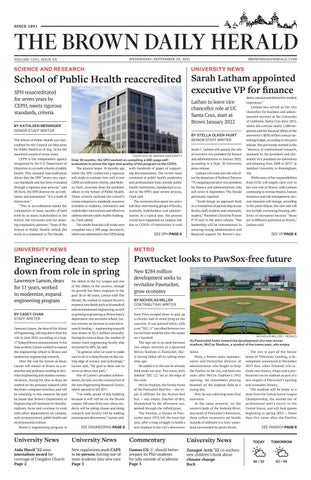
As Pawtucket looks toward the development of a new soccer stadium, McCoy Stadium, a symbol of the towns past, sits empty. failed. Pires, a former state representative and Pawtucket director of administration who fought to keep the PawSox in the city, was born two years after McCoy Stadium’s 1942 opening. He remembers playing baseball on the stadium field as a young boy. Now, he was collecting some final souvenirs. At the same moment, on the western bank of the Seekonk River, just south of Pawtucket’s downtown, three yellow excavators sat beside mounds of sediment in a mini-wasteland surrounded by green brush.
University News
University News
Commentary
University News
Aida Sherif ’22 wins journalism award for coverage of Congdon Church Page 2
New regulations push CAPS to in-person, forcing out-ofstate students into new care Page 3
Gumus GS: U. should better prepare its PhD students for jobs outside of academia Page 5
Zanagee Artis ’22 co-authors new children’s book about climate change Back
The site is part of the future home of Tidewater Landing, a development announced in December 2019 that, when finished, will include new homes, shops and a professional soccer stadium as part of a new chapter of Pawtucket’s sporting and economic history. The stadium will be home to a team from the United Soccer League Championship, the second tier of professional men’s soccer in the United States, and will host games beginning in spring 2023 — fewer than five years after the PawSox
SEE PAWSOX PAGE 6
TODAY
TOMORROW
66 / 52
63 / 48
2
THE BROWN DAILY HERALD | NEWS
WEDNESDAY, SEPTEMBER 29, 2021
UNIVERSITY NEWS
Aida Sherif ’22 receives Rhode Island journalism award Sherif’s reporting on Congdon Street Baptist Church wins first in religious categroy BY JASPER YEH SENIOR STAFF WRITER Aida Sherif ’22 recently won first place in the 2021 Rhode Island Press Association Editorial Awards in the spirituality/ religion category, one of 24 writing award categories granted by the association annually. Sherif’s story, which was originally written as an assignment for ENGL 1050G: “Journalistic Writing,” was published in the Providence Journal in December 2020 after it was pitched by the course’s instructor, Professor of the Practice of English Tracy Breton. Michael McDermott, managing editor of the Journal, nominated Sherif’s story for the award. According to Elyse Major, co-president of the Rhode Island Press Association and editor-in-chief of Providence Media, the story was selected as the winner by a judge from the Idaho Press Association. She added that the RIPA has had an agreement with the Idaho Press Association for numerous years to judge each other’s awards. The story featured the Congdon Street Baptist Church, the oldest African American church in Rhode Island, and illuminated how Pastor Justin Lester has continued to deliver his ser-
mons and engage with his churchgoers throughout the COVID-19 pandemic. “I was walking around one day and I passed by this church … and just noticed how old the building was and how empty it was,” Sherif said. She later went on the church’s website and was able to get in touch with Lester. By speaking with Lester multiple times and observing him record his sermons at the church, Sherif was able to understand in detail the pastor’s transition from in-person gatherings to virtual engagement. “I’m not really a religious person,” Sherif explained. “But I know how important religion is to people, especially for … communities of color who find comfort and safety in religious spaces.” Breton said Sherif’s piece was “beautifully written” and “created a sense of place, as well as a strongly defined character … it was a story about somebody who might not otherwise be in the headlines, but it was a different take on how COVID had affected a segment of our society.” While Sherif had already been informed that her story was selected for an award, it wasn’t revealed that she won first place until the awards banquet at the Quonset ‘O’ Club in North Kingston last Friday. Also during the ceremony, Breton was also inducted into the Rhode Island Journalism Hall of Fame. Although Breton received the honor last year, she wasn’t formally inducted until last Friday due to the COVID-19 pandemic.
COURTESY OF TRACY BRETON
Sherif, who wrote the award-winning story for ENGL 1050G: “Journalistic Writing” with Professor of the Practice of English Tracy Breton, detailed how a pastor engaged with his churchgoers during the pandemic. According to Major, Hall of Fame nominees are judged based on their “contributions to journalism in Rhode Island and/or nationally,” and selected by a committee of press association members, many of whom are already in the Hall of Fame. The award recognized Breton’s four-decade career at the Journal as an “I’ll-get-that-story reporter” and as a mentor of young journalists at Brown where she has been teaching for 20 years. “It was definitely nice to be receiv-
ing an award at the same time as (Breton),” Sherif said. “I found it fitting that she was there to see me receiving (the award) because … she has been probably the primary person to push me to write more and believe in myself in that skill set I have.” Breton, echoing Sherif, also saw the significance of them both receiving awards at the same dinner. “I think what was really cool about this night was that here is this journalism professor … being honored for a
career’s worth of work, and part of the reason is for her teaching and mentoring of students, and one of her students in her journalism class knocked it out of the ballpark and won a first-place prize,” Breton said. During Breton’s acceptance speech at the dinner, she turned the audience’s attention toward the award that Sherif was receiving that same night. “She is a tenacious reporter and a lyrical writer,” Breton remarked. “Certainly a more beautiful writer than I was at her age.”
ENGINEERING FROM PAGE 1 One of Larson’s favorite parts of the job was working with students, whom he described as creative and down to earth. Larson has also participated in projects with other departments, such as chemistry, biology, physics, computer science and entrepreneurship. He has worked closely with Executive Director of the Nelson Center for Entrepreneurship Danny Warshay ’87 and Postdoctoral Research Associate in Epidemiology Xiao Zang. Larson “cares a lot about people, and is a really good fit for Brown because he cares about the students and faculty,” Warshay said. “Anytime I’m in a meeting with him, or see him in a larger venue, you can tell that his priority is what’s right for the students.” Warshay worked with Larson on the planning process leading up to the launch of the Nelson Center. They have also worked together to expand the entrepreneurship curriculum at Brown, which has its origins in the School of Engineering. Larson wanted the School of Engineering to support entrepreneurship financially and academically, he said, which led to collaborative efforts such as the Certificate of Entrepreneurship Program. Although he could have asked that the Nelson Center be housed exclusively in the engineering department, Larson encouraged the center to collaborate with a variety of departments. “To Larry’s credit, he understood that the concept of a Center for Entrepreneurship was going to be bigger and more interdisciplinary than just focused on tech and engineering,”
COURTESY OF BROWN UNIVERSITY
Larson expanded the department into the School of Engineering. His own research focuses on the brain-computer interface. Warshay said. Professor and Chair of Physics Gang Xiao has also worked closely with Larson on joint projects in physics and engineering. He lauded Larson’s skills in executive management and his data-driven approach to problem solving. Xiao said that Larson’s efforts have made Brown more attractive to those studying physical sciences. He also praised Larson’s ability to raise funds from private sectors and from external research. “He is a pure engineer in the best sense. Engineering is about solving problems on time with high quality,” Xiao said, adding that he was particularly impressed by Larson’s work delivering the ERC ahead of time.
Larson also highlighted his enjoyment working alongside faculty colleagues. “For me, it was a feast of intellectual delight,” Larson said. “Almost on a daily basis, a faculty member would come to me with some great new invention, a new paper, and I would just get really excited.” His departure from the role of dean, he believes, will be beneficial to the long-term sustainability of the department. “Refreshing academic leadership on a regular basis is an important thing for the health of the institution,” allowing the department to expand into different areas, he said. Provost Richard Locke P’18 will lead a national search in the coming months to find a successor for Larson.
WEDNESDAY, SEPTEMBER 29, 2021
THE BROWN DAILY HERALD | NEWS
3
UNIVERSITY NEWS
‘The pandemic isn’t over’: CAPS navigates switch to in-person care University partners with telehealth app to offer out-of-state students access to care BY SHILPA SAJJA SENIOR STAFF WRITER After a year of virtual operations, the University’s transition to an in-person learning environment has necessitated adapting to a world neither fully in-person nor fully virtual. For Counseling and Psychological Services, the transition has posed additional challenges due to restrictions regarding where healthcare providers can practice. After students were sent home in March 2020, CAPS continued to offer care remotely to students living outside of Rhode Island, The Herald previously reported. But in an Aug. 23 announcement, CAPS shared that its counselors who are “located in Rhode Island are unable to provide telehealth services to students outside of Rhode Island” due to “newly-implemented regulations.” In early July, Gov. Dan McKee terminated the March 2020 executive order relaxing telemedicine restrictions
that allowed CAPS to treat individuals located outside of Rhode Island. Subsequently, CAPS providers began to transition out-of-state students to local providers in their area, The Herald previously reported. For Dana Kurniawan ’22, the CAPS counselor she worked with during the spring helped her find local care options outside of CAPS. “My counselor had really good recommendations for me,” she said. “She referred me to someone out in California, as I was in California at the time.” Project LETS Co-Coordinator Evan Dong ’22 noted that an important question to consider when thinking about finding care is “what are options (available or not available) outside of CAPS” for students. While in high school, Dong said, “I was not really in a large city that had things like (therapy). I had to drive 30 minutes to go to a nearby city that had a community mental health center.” Addressing this gap for students living in areas where local providers are not as prevalent, a new University partnership with a telehealth application could help students access care. In a Sept. 21 Today@Brown announcement, Executive Director of Health and Wellness Vanessa Britto MSc’96 announced
a partnership with HealthiestYou, a telehealth service through which students can access care “from any location, especially while living, studying or traveling outside of Rhode Island both nationally and internationally.” Specifically, the app will allow students to speak to licensed doctors by phone or video, search for local providers, find low-cost prescriptions and compare prices, according to the app’s website. “We are thrilled to know that no matter where Brown students are, they will be able to access care,” Britto wrote. Virtual care is especially beneficial to students with disabilities who can not come back to campus due to concerns around COVID-19, said Project LETS Co-Coordinator Silver Mckie ’22. “It’s been a really rough two years for disabled people watching everyone around them, or a lot of people around them, basically say, ‘we don’t care about this group of people, we should just reopen up, it only affects this group,’” they said. “Disabled people still really need hybrid options.” For many students, “the pandemic isn’t over,” Dong said. “I think a question is ‘are we living in denial of that or are we still working with that?’ I hope we can do things as a University, and
COURTESY OF ROSLYN CORIZ
The University announced a partnership with telehealth service HealthiestYou to expand virtual counseling on Sept. 21. not just CAPS, that really still meets everyone where they’re at.” For students able to return to campus, CAPS has begun operating in person with a virtual option available for students living in Rhode Island. Some students have also sought to use CAPS as a resource through which to seek care outside of the University. For Mckie, finding care outside of CAPS was necessary to access treatment for mental illnesses outside the scope of the average CAPS counselor’s training, they said. Still, while CAPS can help connect students with off-campus resources, finding open providers can
remain a challenge. Of the two specialists Mckie found in the Providence area, both had waitlists that were “miles long.” Having multiple consultations can also be a tiring process, they added. Finding outside care in Providence is “not any more difficult than in any other area of the country, but it is difficult in the sense that finding an outside provider is always difficult,” they said. “I hope that there are people who can get referred to things that better meet their needs if CAPS can’t, and I wish CAPS had more capacity to meet everyone’s needs,” Dong said.
Join The Herald! Email herald@browndailyherald.com if you are interested in joining.
4
THE BROWN DAILY HERALD | NEWS
VP FROM PAGE 1
WEDNESDAY, SEPTEMBER 29, 2021
According to Latham, she was more prepared to fulfill several of her current responsibilities at UCSC because of her past experience at Samford. In that role, she “really learned about” building, construction and risk management. Since beginning her role at UC Santa Cruz as vice chancellor for business and administrative services, Latham has
classes upon assuming her new role at the University, Latham hopes to teach or be a part of leadership courses at Brown if given the opportunity. While Latham’s new role is different in title and responsibility, she anticipates significant overlap between her work at Brown and her current work at UCSC. “It’s too early to have specific goals about particular projects or tasks,”
made a significant impact on campus administration and provided support during emergency situations, such as the COVID-19 pandemic and the 2020 wildfires, according to UCSC Chancellor Cindy Larive in a Sept. 20 letter to the UCSC community announcing Latham’s departure . Beyond her administrative background, Latham taught as a professor of political science at Samford University and led leadership programs at UC Santa Cruz and University of California, Berkeley. Latham explained that her background as a professor helped prepare her for the responsibilities of an administrator. She understands “how the impact of the departments in my division could either support or cause challenges for what was going on in the classroom, so it made me a better administrator, too,” Latham said. Though she will not be teaching
Latham said. “ I hope to accomplish very quickly the ability to understand the key strengths of the operations at Brown, … and where we have opportunity … to optimize how we support students, faculty and staff.” Latham also hopes to support students through the continuing difficulties of the COVID-19 pandemic, and imagines that she will have to quickly learn “the framework that Brown is using to adapt or change based on (COVID) case counts or situations within Providence.” Latham also hopes to continue her relationship-based approach to her role when she arrives at Brown. “I take a lot of time to engage with and build relationships with faculty and staff and students — to learn their perspective, to learn what needs they have, to learn what concerns they have and then to partner … with them to figure out how to address the challenges,” Latham said.
Latham’s responsibilities as the executive vice president will entail overseeing finance, risk management and human resources. She hopes to continue her relationship-based approach upon her arrival at Brown. She hopes to continue the community engagement she was involved with at UCSC when she comes to Providence. While at UCSC, Latham was involved in working to “advance our campus connections with city and county leaders, serving for two years as co-chair of the annual Second Harvest Food Bank Holiday Food Drive and (serving) as president of the Santa Cruz Chamber of Commerce,” Larive wrote
in the letter to UCSC. “Having our students or faculty staff volunteer locally” and “be involved in civic organizations” allows the Univeristy to impact surrounding communities, Latham said. Community engagement is “about taking the wonderful learning and research and creativity that takes place on a campus like Brown and ensuring that the community at large can also benefit
from it.” Latham expressed excitement about the “special” opportunity this new job presents, while reflecting fondly on the nine years she spent at UCSC. “I’ve made wonderful friendships. I have colleagues that I’m heartbroken to leave in many respects,” Latham said. Brown “will be a great place to turn the next chapter for me professionally.”
SPH FROM PAGE 1
Associate Director of the MPH Program Anne Gjelsvik PhD’03. In the self-study report, the SPH detailed how they are teaching and assessing these competencies down to the course, syllabus and even assignment level, Gjelsvik said. These competencies — including data analysis, cultural awareness and the integration of perspectives from other fields — are meant to prepare MPH graduates for the multidisciplinary and dynamic public health workforce, Gjelsvik said. She added that faculty, including herself, welcomed the chance to revise the school’s courses “creatively” to assess these abstract skills.
COVID-19 “has just exposed how important having a public health workforce that has the skills to tackle really complex issues ... involving society, medicine and science” is, Gjelsvik said. Having the knowledge to address such public health concerns is expected of Brown’s MPH graduates, she said. “I’m a strong believer in accreditation as a lever for organizational change and improvement,” Kern said. “Accreditation improves the quality of education because it requires that you periodically look at your institution from head to toe and ensure that all of your processes are as strong as they
need to be, that you’re collecting data, that you have resources that are sufficient ... and (that) there’s an ongoing feedback loop.” CEPH accredits schools for anywhere between five and seven years. Because the SPH received the maximum award of seven years, it will not have to be reaccreditated again until 2028. “It was a very big deal for us that we got all seven years because that indicates that (the CEPH) believed we were a really strong school that met all their criteria,” Clark said. She added that this indicates that there
are “a lot of staff and faculty and students in the school that work really hard to try to have the best possible school we can.” “The entire SPH community should be proud of their contributions, not only to the accreditation process, but also to the continuing growth, evolution and excellence of the Brown University School of Public Health,” Jha wrote. “CEPH accreditation attests to the quality of our school and will continue to enhance our national reputation as we attract the next generation of leaders who will take on the public health challenges of our time.”
place over Zoom. “We came through with absolute flying colors. The team was very, very impressed. And we met every single standard right out of the gate, which is a really big accomplishment.” Kern said. The SPH was initially accredited by CEPH in 2016 shortly after its opening in 2013, The Herald previously reported. Since then, CEPH has switched its accreditation criteria from being coursebased to competency-based, leading to subsequent changes in the University’s Master of Public Health curriculum, said
COURTESY OF BROWN UNIVERSITY
Support The Herald www.browndailyherald.com/donate
CA L E N DA R
COVID -19 AT BROWN LAST 7 DAYS*
SEPTEMBER S
5
M
6
Tu
7
Completed Tests
People Tested
W
Th
F
S
17,797
12,580
1
2
3
4
Confirmed Positives
Positivity Rates
13
0.1 %
8
9
10
11 SINCE AUGUST 24, 2020*
12
13
14
15
16
17
18
19
20
21
22
23
24
25
26
27
28
29
30
Completed Tests
People Tested
520,631
17,907
Total Cases
Prevalence
781
4.4%
*AS OF SEP 28.
WEDNESDAY, SEPTEMBER 29, 2021
THE BROWN DAILY HERALD | COMMENTARY
5
Gumus GS: PhD programs leave graduates ill-equipped for job market BY SELAHADDIN GUMUS STAFF COLUMNIST If you are a PhD student, you have probably heard something along the lines of “this is a PhD, figure it out by yourself.” While PhD students enter their programs expecting to become highly independent researchers, we do not expect to graduate completely unprepared for the job market. We are told by advisors and administrators that research is the only thing that matters and that if we just focused more on our research, we would be fully equipped for post-PhD life. This is far from true. In fact, focusing solely on research for five years can be detrimental to students, especially those who want to pursue non-academic careers. Industrial jobs require a different skill set than academic jobs, and PhD graduates pursuing a career in industry often find themselves overqualified for the research component and under qualified for non-technical components. But when we request career guidance from our programs, advisors tell us that our research experience on its own is sufficient, that we should be more self-driven and that “this is a PhD.” This lack of career readiness is widespread in PhD programs. Less than one third of respondents to Nature’s national survey of graduate students felt that their PhD program prepared them very well for a satisfying career, and 79% of respondents were concerned about their job prospects. The current PhD experience must be replaced with one that can be tailored to the individual students’ professional goals, be it industry or academia, and that evolves with changes in the job market. The career crisis is particularly prevalent in STEM PhD programs, the curricula of which are designed to raise the next generation of academics. Due to the strong emphasis on developing research skills, many PhD students are driven to believe that academia is the superior career option. However, to become qualified for and obtain an academic position, students
must complete one or more postdoctoral experiences. This requires scientists to forgo a livable salary for at least eight to 10 years after college. At the same time, the proportion of STEM PhD graduates who end up entering a tenure track position is only 7.6% in the life sciences. To make matters worse, PhD students are
dents who wish to be academics. In feedback on my own application, the committee agreed that while I was qualified for the secondary master’s degree and had an outstanding academic record in my chemistry studies, my career aspirations in business consulting were “uninteresting.” They encouraged me to reapply this year with aspirations that better suit
“Universities must allow PhD students to attain skills other than research, or else their graduates will find themselves caught in a post-doctoral career bloodbath.”
largely only encouraged to take coursework and attend workshops that directly relate to their research. If a chemistry PhD student wants to take a class outside of chemistry — for example, economics, which might be relevant for industry work — their advisor is likely to say no. At first glance, Brown appears to be open to graduate students pursuing knowledge outside their immediate field through the Open Graduate Education Program, which enables 10 students each year to pursue a master’s degree alongside their PhD. According to the program’s website, PhD students are encouraged to pursue a field that may be either “close to or quite far removed from that of the doctoral studies.” In practice, many of the students who are accepted into Brown’s program choose a master’s degree that can directly benefit their thesis research, and the faculty that select the STEM recipients seem to be biased toward stu-
the aim of the program. I can only assume that the “aim of the program” was preparing students for academia by allowing them to bolster their dissertations with related master’s degree work. The “academia or bust” mindset dominant in universities forces PhD students to endure low-paying work in the hopes of attaining a coveted — but ultimately unlikely — tenure track position. Universities must allow PhD students to attain skills other than research, or else their graduates will find themselves caught in a postdoctoral career bloodbath. To prepare students to pursue a satisfying career, universities must allow them to indicate their desired career paths as soon as they begin the program. If a student wishes to pursue an industrial career, internships, soft skill training and business training should be readily available and encouraged, and coursework in business knowledge should be required. For students who wish to pursue academic jobs,
training in people management, effective communication and effective mentoring, as well as coursework in grant writing, should be required. And for students who wish to pursue careers adjacent or unrelated to their PhD research, programs should tailor the entire curriculum to best suit the needs of the student. Students should never have to be told “no” by their advisor when they seek to expand their knowledge beyond their research field. Without these critical changes, students will continue to face grim career prospects. In a job market where nearly 40,000 STEM PhDs graduate annually, we must be able to differentiate ourselves in a way that is valuable to our sector. We cannot be expected to do everything by ourselves — the institution must meet us halfway. And at a university that claims to value freedom and flexibility of academic study, it is ironic that PhD students can rarely explore fields beyond that of their research or consider careers outside of academia. If Brown wants to live up to its mission, it must rethink the structure of its PhD programs. In this vein, the spirit of the Open Curriculum should not be reserved for just undergraduate students. Intellectual exploration is beneficial regardless of one’s educational status. As Dean of the College Rashid Zia ’01 says: “Our goal is a high one — that each and every one of our students is engaged, empowered and transformed by their education. What’s unique about Brown is that we elevate the role of students in achieving that goal as active participants in framing their own education.” PhD students are supporting this university by engaging — over-engaging, really — with our education every day. We ask only that, in return, our education empowers and transforms us in a way that prepares us for our dreams. Selahaddin Gumus GS can be reached at selahaddin_gumus@brown.edu. Please send responses to this opinion to letters@browndailyherald.com and op-eds to opinions@ browndailyherald.com.
THE BROWN DAILY HERALD | NEWS
6
PAWSOX FROM PAGE 1 announced their departure. The project, developers and city officials agree, will likely provide greater economic benefits than the proposed new baseball stadium would have, while at the same time catering to a fast-growing soccer fanbase in Pawtucket and Rhode Island. But among both city officials and residents, regret and sadness about the loss of their beloved PawSox still lingers. “My heart was broken,” Pires said. “I think a lot of people’s hearts were broken.” Pires was involved in a 2018 proposal to build a new $83 million stadium for the PawSox. But after the proposal ran into roadblocks in the state legislature and was renegotiated to remove controversial state bond guarantees that lowered the cost of the project, the owners of the PawSox decided they no longer wanted to build a new stadium in the city. On Aug. 17, 2018, the owners held a press conference to announce their agreement to move to the city of Worcester, Mass. Suddenly, after nearly 50 years, the PawSox were set to leave. The team had been a mainstay in the area. Its PawSox Foundation ran charity programs for local schools and, as Pires says, the team provided multiple generations of Rhode Island families with an affordable summer outing. The PawSox’s expected final season in 2020 was canceled due to the pandemic, which Pawtucket Councilwoman Alexis Schuette said made the loss even tougher. “It was difficult … not getting a chance to say a proper goodbye,” she said. Neighborhood residents recalled the sense of joy the PawSox brought to the area. “It was such a good vibe in the neighborhood,” said resident David Lithgoe. “To see families, little kids excited with their glove … it was real, real nice.” “Everybody was happy,” said res-
ident Diane Proulx. “Now, there’s nothing.” A revitalizing proposal The city of Pawtucket, whose Old Slater Mill is recognized as the birthplace of the American Industrial Revolution, was once a thriving industrial city. But after manufacturing left and strip malls opened outside the city, businesses failed or moved away. Former Pawtucket City Councilor John Barry III remembers that when he was a kid, “there was not a vacant storefront” in the city’s downtown. Now, “that’s all gone,” he said. Dawn Porter, co-owner of Stillwater Books downtown, called the area “sad and depressing.” Porter and her husband, Steven Porter, viewed the proposed PawSox stadium as a potential economic spark for the area. Instead, the site where the stadium would have been is an empty, cracked parking lot hosting the old Apex department store, a futuristic, pyramidal building constructed in the 1960s that has been largely unused for several years. When the PawSox stadium proposal failed, Steven Porter said he was left with “extreme disappointment.” Pawtucket “is in a state of decline,” Porter said, citing the closure of Memorial Hospital in 2018 and the relocation of many small businesses from the downtown area. Pawtucket Mayor Donald Grebien said the state government “realized they needed to do something” to revitalize the city after the PawSox left. With the city and state governments eager to move on from the PawSox failure, the city solicited development proposals for the now-vacant McCoy Stadium site. It was during these discussions that project developers Fortuitous Partners proposed the first ideas for Tidewater Landing. Brett Johnson, founder and partner of Fortuitous, said that the company thought Pawtucket was the
perfect city for a new soccer stadium, given the large soccer market in Rhode Island, the new train station being built in the city and the chosen site standing right off I-95. Grebien said the Fortuitous group was highly motivated and very willing to construct housing and storefronts on the perimeter of the stadium. “They understood (ancillary) development needed to happen,” he said. After several revisions, the Rhode Island Commerce Corporation Board approved a proposal in February featuring a $284 million pricetag, making it the largest development project in Pawtucket’s history. The development will occur on a 14-acre piece of land currently covered by trees and vegetation on both banks of the Seekonk River. The centerpiece, an 11,000-seat stadium, will be on the western bank, but the project will also include a public riverwalk, a pedestrian bridge, shops, restaurants, apartments and a parking garage. The state will provide $50 million in incentives for developers, including a $36 million loan that will be repaid with future tax revenue. The stadium itself will be entirely privately financed. “It’s a much bigger, better project (than the new PawSox stadium),” Grebien said. “Soccer is up-and-coming … and also the development that is going to happen is probably 10 times larger than we would’ve gotten under the PawSox.” The state estimates that the project will create 2,500 construction jobs and 1,200 permanent jobs, and Grebien said that over the next 20 years, the project is expected to bring in an additional $800 million in tax revenue. Challenges of filling PawSox’s void But the development has garnered its share of skepticism. Barry, the former councilman, expressed doubt about how much the ancillary development will help the city economically, though he thinks the soccer
SINCE 1891
THE BROWN DAILY HERALD Editorial Leadership Editor-in-Chief Kayla Guo Managing Editors Henry Dawson Li Goldstein Senior Editors Kate Ok Kamran King Emily Teng Emilija Sagaityte Editorial Page Editor Johnny Ren
Metro Editors Ben Glickman Ben Pollard Julia Grossman Katie Chen Liza Mullett Victoria Yin News Editors Caroline Nash Caelyn Pender Gaya Gupta Jack Borris Livia Gimenes Jack Walker Science & Research Editors Rahma Ibrahim
post-magazine Editor-in-Chief Olivia Howe Sections Arts & Culture Editors Irene Chou Nicholas Michael
Sports Editor Ryan Handel Commentary Opinions Editors Augustus Bayard
Jaehyun Hong Matt Walsh Clara Gutman-Argemí Johnny Ren Multimedia/Production Design Editors Anya Semizhova Keelin Lyons Lena He Raphael Li Head Photo Editors Areez Khan Nicole Kim Copy Desk Chief Catherine Healy Assistant Copy Desk Chief Lily Lustig Illustrations Head Loki Olin
Graphics Editor Usha Bhalla Podcast Ben Glickman Corey Gelb-Bicknell Olivia Burdette Business General Managers Michael Wang Noah Colón Office Manager Chelsey Barton-Keenes Directors Sales: Annika Sigfstead Finance: Andrew Willwerth Digital Director of Technology Jed Fox
@the_herald
facebook.com/browndailyherald
@browndailyherald
youtube.com/browndailyherald
88 Benevolent St., Providence, RI (401) 351-3372 www.browndailyherald.com Editorial: herald@browndailyherald.com Advertising: advertising@browndailyherald.com
WEDNESDAY, SEPTEMBER 29, 2021
franchise itself will be successful. Dawn and Steven Porter, the owners of Stillwater Books, also questioned whether Tidewater Landing will bring much business to the downtown area, which is on the other side of I-95 from the project’s site. And if stores are built next to the soccer stadium, they reason, people will have no motivation to walk downtown. But Johnson sees it differently. The project “will lift the collective boats in the broader region,” he said. In addition to proving its potential economic impact, the project will also have to show whether it can fill the PawSox-sized hole in the social fabric of the city. Many involved believe the soccer team can be just as popular as the PawSox were, if not more so. City officials and project leaders cite the decline in popularity of baseball that has coincided with soccer’s rise in the United States. And as Daniel Silva, boys’ soccer coach for Pawtucket’s Tolman High School, said, the city hosts large immigrant communities from Portugal, Cape Verde and Latin American countries, where soccer is popular. But Silva doesn’t know if the city’s interest in the sport will translate to significant support and attendance for the USL team. The team will need to actively make connections with the community and also make tickets affordable, Silva said. And whether the team can replace the intimate relationship the city had with the PawSox is a different question. “A lot of the PawSox fans were so loyal … It will be tough to live up to that,” he said. Most residents who spoke to The Herald agreed. Hubert Severe, who lives in the neighborhood around McCoy Stadium, said the new soccer team “will be something new, but it cannot replace what was there.” “We’re losing part of our history, part of our being,” Grebien said. “So I don’t know if I’ll ever be able to
replace that.” Stadium stands idle While the Tidewater Landing project begins to move ahead — the plan was approved by the Pawtucket City Planning Commission July 20 — McCoy Stadium remains idle. Its future is uncertain, with Grebien previously telling WPRI that the city is exploring the possibility of bringing in another baseball team or turning the stadium into a public safety complex. Pires believes it will likely be torn down, speculating that it could be the site for a new high school building or even a new city hall. But in the meantime, McCoy Stadium lingers as a reminder of his and the city’s loss: slowly deteriorating, but for the moment largely the same as when baseball fans used to fill its seats. Pictures of Red Sox legends in PawSox uniforms still adorn the walkways. A giant box score 33 innings long survives on a concourse wall in dedication to the longest game in baseball history, played at McCoy Stadium in 1981. Advertisements remain the chief decorations of the outfield fence — although one appears to have fallen from the scoreboard. Outside, a banner that used to advertise firework shows after Saturday night games hangs over the stadium’s main entrance, tattered and swept to one side. Clinging awkwardly to the metal beams, it seems a fitting symbol of a community in transition, a Pawtucket unsure of whether to hold fast to the memory of its beloved PawSox, or to let go and move on.
Submissions: The Brown Daily Herald publishes submissions in the form of op-eds and letters to the editor. Op-eds are typically between 750 and 1000 words, though we will consider submissions between 500 and 1200 words. Letters to the editor should be around 250 words. While letters to the editor respond to an article or column that has appeared in The Herald, op-eds usually prompt new discussions on campus or frame new arguments about current discourse. All submissions to The Herald cannot have been previously published elsewhere (in print or online — including personal blogs and social media), and they must be exclusive to The Herald. Submissions must include no more than two individual authors. If there are more than two original authors, The Herald can acknowledge the authors in a statement at the end of the letter or op-ed, but the byline can only include up to two names. The Herald will not publish submissions authored by groups. The Herald does not publish anonymous submissions. If you feel your circumstances prevent you from submitting an op-ed or letter with your name, please email herald@browndailyherald.com to explain your situation. You can submit op-eds to opinions@browndailyherald.com and letters to letters@browndailyherald. com. When you email your submission, please include (1) your full name, (2) an evening or mobile phone number in case your submission is chosen for publication and (3) any affiliation with Brown University or any institution or organization relevant to the content of your submission. Please send in submissions at least 24 hours in advance of your desired publication date. The Herald only publishes submissions while it is in print. The Herald reserves the right to edit all submissions. If your piece is considered for publication, an editor will contact you to discuss potential changes to your submission. Commentary: The editorial is the majority opinion of the editorial page board of The Brown Daily Herald. The editorial viewpoint does not necessarily reflect the views of The Brown Daily Herald, Inc. Columns, letters and comics reflect the opinions of their authors only. Corrections: The Brown Daily Herald is committed to providing the Brown University community with the most accurate information possible. Corrections may be submitted up to seven calendar days after publication. Periodicals postage paid at Providence, R.I. Postmaster: Please send corrections to P.O. Box 2538, Providence, RI 02906. Advertising: The Brown Daily Herald, Inc. reserves the right to accept or decline any advertisement at its discretion.
The Brown Daily Herald, Inc. is a financially independent, nonprofit media organization bringing you The Brown Daily Herald and Post- Magazine. The Brown Daily Herald has served the Brown University community daily since 1891. It is published Monday through Friday during the academic year, excluding vacations, once during Commencement and once during Orientation by The Brown Daily Herald, Inc. Single copy free for each member of the community. Subscription prices: $200 one year daily, $100 one semester daily. Copyright 2021 by The Brown Daily Herald, Inc. All rights reserved.
WEDNESDAY, SEPTEMBER 29, 2021
THE BROWN DAILY HERALD | COMMENTARY
7
Han ’23: The dangers of the ‘model minority’ myth BY BLISS HAN STAFF COLUMNIST A recent poll conducted by the organization Leading Asian Americans to Unite for Change asked respondents to provide adjectives to describe Asian Americans. The three leading answers were: “Smart/Intelligent,” “Hard-Working” and “Kind/Nice/Thoughtful” — which are, as the LAAUNCH report states, “all highly consistent with stereotypes from the ‘model minority’ myth that have been used to describe Asian Americans for over 50 years.” The results of the poll did not surprise me because these are the words that I have heard many people use to describe me. When I was younger, I brushed aside these comments as compliments rather than pondering how they made me uncomfortable. Why did it bother me when Andrew Yang would quip, “I’m Asian, so I know a lot of doctors,” as a Democratic presidential candidate? Why did I bristle when a proctor for a standardized test winked at me and said that she was sure I aced the math section? There are worse things than to be thought of as a doctor who is good at math, I rationalized to myself. What’s the harm in a supposedly positive stereotype? In fact, the belief that Asian Americans have overcome hardship and racism to achieve both educational and economic success is immensely harmful, not least because it generalizes Asian Americans, otherizes them and enables systems of oppression. The idea that all Asian Americans are educationally and economically successful is often backed up with statements about this demographic’s median household income: $85,800 as of 2019, which is more than 30% higher than that of all Americans. It doesn’t help that the most visible recent piece of pop culture featuring an Asian American is the 2018 movie, “Crazy Rich Asians.” But elevating Asian Americans’ relatively higher median income hides the fact that they have the largest income gap of any racial group in the country. Indian Americans have a median household income over $100,000, but the median Burmese American household makes less than $40,000 a year. Generalizing all Asian Americans as economically advantaged — or, God forbid, “crazy rich” — ignores the heterogeneity contained within the
umbrella term that is “Asian American.” The “model minority” myth also functions to otherize Asian Americans by attributing our success to foreign cultural values. New York Times columnist Nicholas Kristof, for example, credited a “long Confucian emphasis on education” for Asian Americans’ relative success in the United States. But this belief ignores the
to America due to their professional skills but were instead fleeing from U.S.-initiated conflict and destruction. Is it any wonder, then, that Asian Americans have such income disparity among us? The myth of a “model minority” flattens our varied experiences as Asian Americans into one narrative, all the while ignoring America’s role in creating this inequality in the
“Asian Americans must be careful not to become convinced of the ‘model minority’ myth lest we become complicit in the oppression of other groups.”
role that the United States’ selective immigration policy has had in shaping what kind of Asian immigrants are able come to America in the first place. The first large wave of Asian immigrants came to America in the 1800s as cheap, forgettable and disposable labor for building railroads and working in agriculture. These immigrants arrived from China, and then Japan, Korea, India and the Philippines, until American xenophobia and fear of the “yellow peril” led to the Chinese Exclusion Act of 1882. Contrary to its name, this law served to not only keep out Chinese immigrants, but all immigrants from Asia. It was only in the 1960s, after the internment of Japanese Americans during World War II and in the wake of the Civil Rights Movement, that Congress lifted this racist immigration ban and passed the 1965 Immigration and Nationality Act instead. This bill prioritized high-skilled labor and family reunification, and efforts to recruit immigrants from Asia fitting this profile only increased in the 1990s. Now, 72% of all high-skilled immigrant visas go to Asian immigrants. On the other hand, wars in Southeast Asia during the 1960s and 1970s created a different class of Asian immigrants: refugees, who were not recruited to immigrate
first place. Further, the “model minority” myth is an effective tool of both capitalism and the maintenance of a racial hierarchy. The adjectives smart, hard-working and nice do not conjure up an image of a leader, a president, an activist, a late-night show host or a CEO, but rather that of the invisible, “interchangeable Asian.” They evoke middle management, white-collar professionals who are too diligent, humble and obedient to agitate for political change. I am both Asian American and an environmental science concentrator, but even I knew nothing about the history of Asian American environmental activism until last year. I blame the ‘model minority’ myth for sidelining Asian American political history in favor of a singular narrative painting Asian Americans as docile. This obfuscation of our political power serves to reinforce systems of capitalism and oppression. If Asian Americans can be convinced that we don’t suffer much racism, as I once thought, and that our purpose is to repay the wondrous country that has given us a second chance at life, we can be persuaded to “play our part” as interchangeable worker bees. We can forget the exclusionary immigration bills and the imperialist wars that forced many of us here.
Perhaps most dangerously, the “model minority” myth reinforces the structure of white supremacy by acting as a “racial wedge” between Asian Americans and other minority groups, particularly Black Americans. If the “model minority” framework were true, and Asian Americans could succeed against the odds due to work ethic and cultural values, it would be evidence that the American Dream is real, that capitalism works and thus, that the socioeconomic struggles of other marginalized groups must be due to their own failings. Obviously, this obscures America’s history of slavery, segregation, Jim Crow, redlining, police brutality and a host of other racial abuses perpetrated against Black Americans. Moreover, it’s convenient for the existing power structure to pit Asian and Black Americans against each other because it prevents them from uniting against white supremacy. For example, recent debates over affirmative action policies at elite universities have featured animus between Asian and Black Americans, distracting from admissions practices like legacy admissions and athletic recruiting that overwhelmingly benefit wealthy, white students. Asian Americans must be careful not to become convinced of the “model minority” myth lest we become complicit in the oppression of other groups. As Cathy Park Hong writes in her book “Minor Feelings: An Asian American Reckoning,” “Whiteness has already recruited us to become their junior partners in genocidal wars; conscripted us to be antiblack and colorist; to work for, and even head, corporations that scythe off immigrant jobs like heads of wheat.” It is comfortable, as an Asian American, to be satisfied with the “model minority” myth because it is usually good to be kind, hard-working and smart. But this comfort comes at the expense of challenging the systems that both oppress us and make us complicit in other groups’ oppression. Thus, we must reject the “model minority” myth and find a way to highlight Asian American identity, diversity and political agency. Bliss Han ’23 can be reached at bliss_han@ brown.edu. Please send responses to this opinion to letters@browndailyherald.com and op-eds to opinions@browndailyherald. com.
LETTER TO THE EDITOR
How we choose Brown’s public art To the Editor: I am writing in response to the Sept. 27 editorial “How can we identify with public art we don’t understand?” When public art stirs up controversial discussions, that is a good thing — it doesn’t do its job if everyone walks by without giving it a second look. First of all, apologies for the outof-date information about the Public Art Working Group online (it has just been updated). The group currently has 13 members: two are un-
dergraduate students, one is a graduate student. Kate Kraczon, director of exhibitions and chief curator of the David Winton Bell Gallery, took over for me as chair this summer, and the new artistic director of the Brown Arts Institute, Avery Willis Hoffman, is also a member. The Public Art Working Group has an advisory role to the Corporations’ Subcommittee on Public Art, which has the final say. Approving a work of art for our campus is the result of a lengthy process in both committees. About the Rebecca Warren sculp-
ture itself: It is a loan on a five-year visit. All associated costs were underwritten by generous donors. Since the piece went up in May, it has received some 111 comments on Brown’s Instagram page, mostly skeptical — and some hilariously funny — but also more than 4,000 likes (not counting the likes on the humorous comments). Decidedly not a representation of a white man on a pedestal, carved realistically in clay and then cast in bronze, Rebecca Warren’s piece questions and satirizes what is placed on pedestals in the first place. It takes
sculptural cliches and a critique of the male gaze in the 20th century as its subject matter and emphasizes process rather than perfection. You can literally see and feel the clay that the artist scooped with her hands out of a bucket and heaped on to the structure — nothing is smoothed over to look life-like, but the labor of making art is made visible. The piece’s irreverence, joyfulness and invitation to rethink our positions is very much in line with Brown’s intellectual traditions. More public art pieces are in the works, and we hope that all of them receive the
same level of critical engagement and desire to understand. Professor of the History of Modern Architecture and Urban Studies Dietrich Neumann was the chair of the Public Art Working Group from 2018 to 2021. He is also the director of the John Nicholas Brown Center for Public Humanities and Cultural Heritage. He can be reached at dietrich_neumann@ brown.edu. Please send responses to this letter to letters@browndailyherald.com and op-eds to opinions@browndailyherald.com.
Follow us on Instagram! @browndailyherald
WEDNESDAY, SEPTEMBER 29, 2021
THE BROWN DAILY HERALD | NEWS
8
UNIVERSITY NEWS
Zanagee Artis ’22 co-authors new climate change book for children Book aims to introduce children to climate change, solutions from young age BY BRENDAN GARDNER SENIOR STAFF WRITER As the threat of climate change grows more imminent, educating children about the phenomenon that will come to define their future has become increasingly important. A new children’s book by Zanagee Artis ’22 and environmental activist Olivia Greenspan aims to help fill this growing need. Their book, “A Kids Book About Climate Change,” aims to teach children ages five through nine about global warming, its causes and its consequences. It was published by A Kids Company About, which prints books dedicated to introducing children to complex topics such as racism, activism and trauma. Artis, a co-founder of international climate activism organization Zero Hour, first met Greenspan at a 2018 Zero Hour youth climate march. Both authors said they were motivated to write this book to provide information about climate change they had lacked growing up.
“This book is a resource for kids, and we really think that they deserve to have this knowledge that we were not able to have when we were kids,” Artis said. “A lot of the environmental education I received (as a child) was very sentimental and non-systemic,” Greenspan added. “If I had known earlier the scale of the issue, I would have been more interested in learning more and helping to address it.” To make this complex topic accessible and relatable for young children, the authors included an analogy that compares climate change to having a fever. The picture book explains how even just a few degrees of warming can wreak havoc on both the body and the Earth, an “analogy (that) really works well for understanding the planet as a larger ecosystem,” Artis said. The authors consulted climate scientist Dr. Heather Price and child mental health counselor Megan Slade during the editing process to ensure it was presenting accurate information in an appropriate way for young children. “A lot of it has to do with framing around solutions,” Artis said. In the book, “there’s a big emphasis on the fact that we can work on this issue, that there are so many different solutions and that kids can be a part of that solution.”
Denise Morales Soto, an editor at A Kids Company About, explained the publisher’s philosophy in broaching difficult topics to children. “Our approach with every one of our books is to talk to kids, not down to them,” Soto wrote in an email to The Herald. “We use the actual words for the thing and take our time to break it down and explain it in a way that makes sense and doesn’t underestimate what they’re capable of.” The authors will also co-host a podcast, titled One Point Five, through their publisher. “We knew that there was so much more that we wanted to say that we just weren’t able to in the book,” Artis said. “We want the podcast to really be a supplement to exploring lots of other themes, and specifically climate justice.” Matthew Winner, the head of podcasts for A Kids Company About, wrote in an email to The Herald that the podcast will address topics like environmental racism and the effects of climate change on marginalized communities. It will also include interviews with climate activists and field experts. Olga Prilipko Huber, senior outreach associate for the University’s Department of Earth, Environmental and Planetary Science, said that the book’s illness analogy is a good way to introduce climate change to young
COURTESY OF OLIVIA GREENSPAN
Zanagee Artis ’22 co-wrote the children’s book with enviornmental activist Olivia Greenspan, who he met at a youth climate march. children. “The concept that you convey is that we are responsible for how Earth can feel,” she said. “Humans are not disconnected. We’re not just taking things and nothing happens in return.” Prilipko Huber added that one challenge in teaching climate change in public schools is that many children have picked up politicized preconceptions about the topic from others in their community. “We can tell them that carbon emissions will have an impact on global temperature, but if your parents tell you that that’s (false), it’s difficult,” she said. Although Prilipko Huber said books like Artis’ and Greenspan’s could be useful tools to introduce climate
change to children, she also sees a much larger need for building critical thinking skills in science education. “Because we don’t have strong science teaching in schools, not only are we not getting the knowledge itself to the students, but also those skills are not developed properly for many,” she said. The book’s authors said they hope that the book will help enable children to create change. “We know that kids have amazing imaginations and that they can really think about this issue of climate change in new and exciting ways,” Artis said. “They have so much to offer to the world when they actually have the knowledge that they need.”