SINCE 1891
THE BROWN DAILY HERALD WEDNESDAY, FEBRUARY 5, 2020
VOLUME CLV, ISSUE 11
UNIVERSITY NEWS
UNIVERSITY NEWS
Students find swastika graffiti in Hegeman, cover it with star Anti-Semitic symbol continues recent trend of homophobic, racist graffiti in dorm building BY MAIA ROSENFELD METRO EDITOR Around six o’clock Tuesday evening, a student found a swastika scribbled in pen on the wall of his dormitory, Hegeman Hall Tower C. His friend covered the graffiti with a yellow paper star, and the students called the Department of Public Safety to report the incident. “It was striking,” said Jack Waters ’21, who discovered the graffiti when he was walking down the stairs in Hegeman. The anti-Semitic symbol was drawn on an overhang above the stairs to the basement, visible from the dormitory’s front entrance. This was not the first instance of hateful graffiti in Hegeman this school year, nor was it the first that Waters has found in his building. The swastika comes amid a recent trend of more than 15 homophobic graffiti incidents in Hegeman since late November, which
BROWNDAILYHERALD.COM
spurred an ongoing hate crime investigation by DPS, The Herald previously reported. Waters also found a racist remark written on a poster in late November. He tore down the poster, which advertised Hasan Minhaj’s lecture that had taken place the day before. “That was an easy fix,” Waters said, “but it doesn’t fix the person who put it up there.” Waters and other Hegeman residents expressed frustration and concern over the recent outburst of hate speech in their dormitory. “Brown is a place where people can be very open about their identity, and the fact that there are people here who are willing to target and harass people who belong to marginalized groups is disgusting,” said Michael LeClerc ’20.5, another Hegeman resident. “It’s scary, but you also feel the need to fight back.” LeClerc added that a Hegeman resident whose mother is Jewish “seemed really shocked” by the graffiti. LeClerc and Waters, who are both transfer students, also noted that they had never heard of this type of hate
Faculty vote to extend first-year orientation New six-day schedule will change move-in day to Thursday before Labor Day BY LIVIA GIMENES SENIOR STAFF WRITER
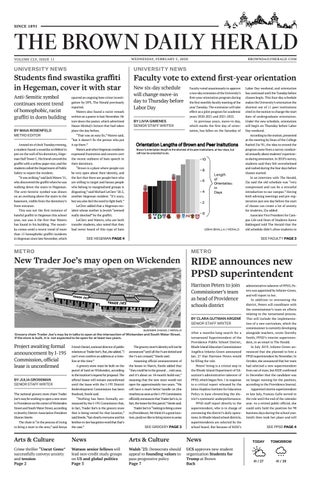
Faculty voted unanimously to approve a two-day extension of the University’s first-year orientation program during the first monthly faculty meeting of the year Tuesday. The extension will take effect as a pilot program for academic years 2020-2021 and 2021-2022. In previous years, move-in day, which marks the first day of orientation, has fallen on the Saturday of
Orientation Lengths of Brown and Peer Insitutions Brown’s orientation length is the shortest of its peer institutions, at four days, but will now be extended to six.
10 8 6 4
Length of Orientation in Days
2 0
USHA BHALLA / HERALD
SEE HEGEMAN PAGE 4
SEE FACULTY PAGE 3
METRO
New Trader Joe’s may open on Wickenden
METRO
RIDE announces new PPSD superintendent Harrison Peters to join Commissioner’s team as head of Providence schools district BY CLARA GUTMAN ARGEMÍ SENIOR STAFF WRITER
SUMMER ZHANG / HERALD
Grocery chain Trader Joe’s may be in talks to open at the intersection of Wickenden and South Water Street. If the store is built, it is not expected to be open for at least two years.
Project awaiting formal announcement by I-195 Commission, official lease is unconfirmed
After a months-long search for a turnaround Superintendent of the Providence Public School District, Rhode Island Education Commissioner Angélica Infante-Green announced Jan. 27 that Harrison Peters would be filling the role. Peters’ hiring is a critical step in the Rhode Island Department of Education’s administrative takeover of PPSD, which began Nov. 1 in response to a critical report released by the Johns Hopkins Institute for Education Policy in June chronicling the district’s systematic underperformance. PPSD staff report directly to the superintendent, who is in charge of overseeing the district’s daily operations. In Rhode Island school districts, superintendents are selected by the school board. But because of RIDE’s
The national grocery store chain Trader Joe’s may be working to open a new store in Providence on the corner of Wickenden Street and South Water Street, according to Jewelry District Association President Sharon Steele. The chain is “in the process of trying to bring a store to the area,” said Kenya
Friend-Daniel, national director of public relations at Trader Joe’s. But, she added, “I can’t even confirm an address or a timeline at this time.” A grocery store must be built on the parcel of land on Wickenden, according to the location’s request for proposal. The official lessee will remain unconfirmed until the lease with the I-195 District Redevelopment Commission has been finalized, Steele said. “Nothing has been formally announced by the I-195 Commission that, in fact, Trader Joe’s is the grocery store that is being vetted for that location,” said Steele, “but clearly everyone and his brother-in-law has gotten word that that’s the case.”
The grocery store’s identity will not be announced “until all the i’s are dotted and the t’s are crossed,” Steele said. Assuming official announcement of the lessee in March, Steele added that “they could be in the ground … mid-year, and it’s about an 18-month build-out,” meaning that the new store would not open for approximately two years. “We will have a much better handle on (the timeline) as soon as the I-195 Commission officially announces that Trader Joe’s is, in fact, the lessee for this parcel,” Steele said. Trader Joe’s is “looking to bring a store to (Providence). We think it’s a great location, (and) we like to bring stores to areas
Arts & Culture
News
Arts & Culture
News
Crime thriller “Uncut Gems” successfully conveys anxiety and tension Page 2
Watson senior fellows will lead non-credit study groups on US and global politics Page 3
Walsh ‘23: Democrats should appeal to founding values to pass progressive policy Page 7
UCS approves new student organization Students for Trump at Brown Back
BY JULIA GROSSMAN SENIOR STAFF WRITER
Labor Day weekend, and orientation has continued until the Tuesday before classes begin. This four-day schedule makes the University’s orientation the shortest out of 11 peer institutions cited in the motion to change the start date of undergraduate orientation. Under the new schedule, orientation will begin on Thursday before Labor Day weekend. According to the motion, presented at the meeting by Dean of the College Rashid Zia ’01, the idea to extend the program came from a survey conducted annually about students’ experiences during orientation. In 2018’s survey, students said they felt overwhelmed and rushed during the four days before classes started. In an interview with The Herald, Zia said the old schedule was “very compressed and can be a stressful introduction to our campus.” Having both advising meetings and pre-registration just one day before the start of classes can create a lot of anxiety for students, Zia added. Associate Vice President for Campus Life and Dean of Students Koren Bakkegard told The Herald that the old schedule didn’t allow students to
SEE GROCERY PAGE 3
administrative takeover of PPSD, Peters was appointed by Infante-Green, and will report to her. In addition to overseeing the district, Peters will coordinate with the commissioner’s team on efforts relating to the turnaround process. This will include the implementation of a new curriculum, which the commissioner is currently developing alongside teachers, wrote Dorothy Smith, PPSD’s interim superintendent, in an email to The Herald. In July 2019, Infante-Green announced that she planned to hire a PPSD superintendent by November. In October, she announced that her team had selected a new superintendent from out of state, but RIDE confirmed in December that the candidate was no longer running for the position, according to the Providence Journal. Appointed interim superintendent in late July, Frances Gallo served in the role until the end of the calendar year. As a retired public official, she could only hold the position for 90 business days during the school year. Smith then took her place and will
SEE PPSD PAGE 4
TODAY
TOMORROW
41 / 27
41 / 39
2
THE BROWN DAILY HERALD | NEWS
WEDNESDAY, FEBRUARY 5, 2020
ARTS & CULTURE
Uncut Gems grips audiences with groundbreaking, tension-filled storyline Safdie brothers complete ten-year long project, Adam Sandler delivers Oscar-worthy performance BY PREETI GANESH SENIOR STAFF WRITER “Uncut Gems,” an American crime thriller directed by Josh and Benny Safdie, is an action-packed cinematic masterpiece. Adam Sandler plays the movie’s main character, Howard Ratner, a gambler and businessman who runs a jewelry store in New York’s diamond district. A 10-year long project, “Uncut Gems” was originally conceptualized
by the Safdie brothers in 2009 and ultimately co-written with Ronald Bronstein. The movie centers on Ratner, a self-centered jeweler who is constantly under pursuit from loan sharks seeking gambling payments. Ratner’s gambling addiction has led him to a handful of broken relationships: conflicts with family members that escalate to violence, a divorce with his wife due to past negligence and a tumultuous relationship with his mistress — who is also his partner-in-crime. As the film progresses, the audience observes — to an almost comedic extent — how Ratner continues to dig himself into a deeper hole when his
personal and professional lives fall apart. Despite the promise of stability, Ratner continues to place risky sports bets and delay his loan repayments. While running from his money lenders, one of whom is revealed to be his brother-in-law, Ratner still spends most of the film chasing the euphoria of a winning bet, convincing others to invest in his decisions and sometimes charging ahead without caution. The Safdie brothers do not shy away from artistic decisions in the production of “Uncut Gems,” employing immersive, lurid close ups of the black opal in the beginning of the film, then transitioning to the inside
of Ratner’s colon during his colonoscopy to introduce his character, metaphorizing an almost molecular connection to the gems around which Ratner’s life revolves. “Uncut Gems” is remarkably successful in its delivery of action through its commitment to presenting tension and anxiety as precursors of the central character’s state of existence. Although the idea was developed in 2009, the Safdie brothers only went into production in September 2018, with the screenplay going through over 160 drafts. During this period, the Safdie brothers worked on other films such as “Heaven Knows What” and “Good Time.” Compressing a mul-
SUMMER ZHANG / HERALD
titude of themes into a character that seems astonishingly simplistic and irritable, Sandler’s performance in this film is regarded to be one of the best of his career. In an interview, the Safdie brothers discussed their desire to cast Sandler in the film. Josh Safdie commented on how Sandler’s acting stems from his unique humor that “acts as (a) kind of needle to poke and let some air out every once in a while.” To ensure an authentic performance, Sandler and other actors observed how jewelers conduct their business in the diamond district. They also watched basketball games with gamblers to get in touch with the vernacular and behavior of the characters they were embodying. In addition to Sandler’s performance, Daniel Lopatin, the movie’s composer professionally known as Oneohtrix Point Never, creates Ratner’s constant state of emergency throughlayers of sounds of shrill, braying voices, the cacophony of New York City and the dramatic musical score to ultimately construct a 135 minute-long, panic-inducing experience for viewers. The film has received critical acclaim, receiving a score of 92 percent on Rotten Tomatoes. Despite not being nominated for any Academy Awards, “Uncut Gems” subverts traditional cinematic techniques of an action thriller and provides an honest depiction of how gambling and addiction manifests in an individual’s life. The movie is currently running in cinemas.
METRO
RI no longer investing in for-profit prisons, assault weapon companies Community activism, survivor testimonies influence divestment decision BY GRACE PARK SENIOR STAFF WRITER On Jan. 31, the Rhode Island public pension fund ceased to invest in companies that either operate for-profit prisons or manufacture assault-style weapons sold to civilians, Treasurer Seth Magaziner ’06 D-RI announced. At the time of the announcement, the state’s public pension system had less than $250,000 invested in the two industries, amounting to just 0.003 percent of the state’s $8.7 billion pension fund, according to a press release. The action will prompt Rhode Island to withdraw its investment from two for-profit prison operators — CoreCivic Inc. and Geo Group Inc. — and two assault weapon manufacturers — American Outdoor Brands Corp. and Sturm Ruger & Co. All four corporations rank among the largest publicly traded for-profit prison and firearm companies in the country. The State Investment Commission, which oversees the pension fund and voted unanimously in favor of divestment, determined that the step would have “virtually no (economic) impact on the state system whatsoever,” Magaziner told The Herald. Despite the small financial change, Magaziner hopes that the decision will send a loud message about community
principles. Such sentiments were echoed by State Rep. Justine Caldwell, D-East Greenwich, who affirmed that the divestment “makes sure that we are living up to Rhode Islanders’ values.” There is still more to be done, Caldwell stressed. Caldwell, along with State Sen. Joshua Miller, D-Cranston, is pressing for legislation banning the sale of assault rifles and high-capacity magazines. Magaziner cited a series of moving testimonies given by mass shooting survivors at the Rhode Island State House last year as “powerful motivators” for his divestment recommendation to the State Investment Commission. With regard to for-profit prisons, Magaziner cited community activism throughout the past year as another influencing factor in his support of divestment. “This is an issue that has garnered more attention locally over the past year with a series of protests at the Wyatt Detention Center,” he said. The Wyatt is a publicly-owned, privately-operated detention facility located in Cranston, R.I. The protests brought fairness and human treatment in prisons to the forefront of dialogue, Magaziner said. Gabe Mernoff ’22, who was present at the Treasurer’s announcement, described the day as a “symbolic” end to “profiting off of human suffering.” Mernoff is co-director of University student group Thoughts Prayers Action, an organization dedicated to the prevention of gun violence in Rhode Island.
Percent of Pension Fund Invested in Private Prisons and Assault-Style Weapons Manufacturers Rhode Island’s state pension system has less than 0.003% of assets invested in affected investments.
$250,000
$8.7 billion
Source: Treasurer Magaziner’s Office USHA BHALLA / HERALD
“The state should be using its fiscal power when it can to stop a nationwide epidemic” of gun violence, Mernoff said. He continued that the divestment decision has the potential to energize and mobilize community organizers working for gun safety. “This year, there’s finally a unified Campaign for Gun Violence Prevention,” he said. “Having state officials that have in-
dicated support and are on our side adds momentum to this campaign.” Regarding possible divestment of the R.I. public pension fund from other industries which cause public harm — such as the fossil fuel industry — Magaziner stated his view that shareholder activism can better serve some causes than full divestment. Shareholder activism describes efforts by investors to change companies’ practices from
within by leveraging their influence as partial owners. Magaziner noted that the state pension fund recently secured an agreement from Williams Companies, a natural gas company, to reduce fossil fuel emissions. “The shareholder activism program has been producing some positive results,” Magaziner said. “We can make more of a difference to our climate and a range of other issues through it.”
WEDNESDAY, FEBRUARY 5, 2020
THE BROWN DAILY HERALD | NEWS
3
UNIVERSITY NEWS
Watson senior fellows to lead study groups Seminars will discuss American and global politics, narrative, elections BY AUBREY LI SENIOR STAFF WRITER Three new senior fellows at the Watson Institute for International and Public Affairs will lead study groups on issues in American society and global politics this semester. The non-credit study groups feature former U.S. Senator Heidi Heitkamp, Senior Advocate at the Supreme Court of India Menaka Guruswamy, writer ZZ Packer and former Republican National Committee Chair Michael Steele, who has led study groups in previous semesters. Topics to be covered include the influence of American domestic policy on the United States’ global status, comparative constitutional democracy between the United States, Iran and India, narratives that shape American identity and the politician’s approach to electoral success. Heitkamp’s study group “How to Influence America’s Future” centers on structural issues in U.S. society and domestic politics and examines how this dysfunction influences America’s global standing. From her early career as a state tax commissioner to her later position as the first female senator elected from North Dakota, Heitkamp had “always been in the place of decision making,” she said. Heitkamp plans to make use of “Data First” points — statistics showing demographic trends of the United States in issues related to the aging population, healthcare, the national deficit and climate change — as part of the study group to inform students of the need to build consensus based on data and fact. “One of the most damaging legacies of (the Trump Administration) is that there’s so little fact-based decision making,” Heitkamp said. “Future leaders of America … need to have a more long-term
FACULTY FROM PAGE 1 complete some “very basic tasks,” such as unpacking their rooms and making friends, before classes started. She said it was important that the new schedule create “a much smoother, more coordinated ... arrival and transition for students.” Zia said that the extended orientation will also give students more time to talk to their Meiklejohn Peer Advisers, Residential Peer Leaders and other students about the classes they intend to take. Pre-registration, which previously occurred on Tuesday before classes began, will now start on Friday and stay open all weekend, allowing students “a great deal of time when they are in the registration environment,” Zia said. The new schedule will also make orientation more convenient for faculty and staff, Zia said. Events that require the most in-depth participation from faculty and staff, such as advisor meetings and First Readings seminars, will now occur on Friday and Tuesday respectively, meaning faculty will not have to come to campus during the long weekend.
HUAYU OUYANG / HERALD
The groups will be run by a former U.S. Senator, a Senior Advocate at the Supreme Court of India, a writer and former GOP committee chair. thinking about America’s problems.” In her session titled “Divided Democracies: Constitutions and Politics in the United States, India, and Iran,” Guruswamy will focus on commonalities and differences between the three constitutional democracies. Comparative constitutional systems is an important topic to discuss because “it can tell us not just about contemporary American politics, but the history of America,” she said. Each of the three well-established constitutional democracies is experiencing a critical moment both politically and constitutionally, Guruswamy said, pointing to partisan American politics and the impeachment trial, the public protest against the Iranian theocratic state and the conflict caused by the Citizenship Amendment Act in India. Packer will lead a study group that investigates the narratives that shape American identity. “The 1619 Project: Governing Narratives” will focus on the New York Times “1619 Project,” which was a journalistic effort to re-examine the legacy of slavery in the United States, according to a Watson press release. Packer’s study group, through the theme of narrative, “offers a new interpretation of American history from the founding of the country through the present that focuses on the institution of slavery,” Director of the Watson Institute Edward Steinfeld said. Guest speakers for the course in-
clude New York Times journalists Jake Silverstein and Wesley Morris, along with Pulitzer Prize winner Tyehimba Jess. In his group “How to Win Elections and Lose the Country,” Steele will focus on the “methods of American political parties and the systems they create in the fight for domination and electoral success,” according to the course syllabus. Topics include partisan politics in relation to U.S. history, the strategies of political campaigns, race and immigration in domestic politics and the prospects for the 2020 election. “The only thing is that I wish we had more readings beforehand, so we (could) have a better sense of the baseline of discussion,” said Colin Olson ’23, who participated in Steele’s “The Dismantling and Rebranding of American Politics” in the fall. The Watson Institute emphasizes expanding diversity and global perspectives, Steinfeld said. The study groups are designed both to have low entry barriers for students across different fields and to avoid infringing on students’ coursework. “In order to understand many challenges facing humankind, you have to expand the number and types of people in the discussion,” he added. Peter Deegan ’21, who has participated in three study groups, said that the discussions “pushed me to construct my own arguments about social media and political polarization.”
The weekend will now be reserved for residential activities, according to Bakkegard. She said that many of orientation’s more serious events aren’t allotted enough time under the current schedule. Mandatory programs like “Building a Culture of Consent” and “Sharing Our Stories,” during which new students learn about sexual assault on campus and diversity, happen late at night, which she said doesn’t allow sufficient time for reflection and discussion. Holding these events during the weekend will ensure that students will “really have more time to engage in these conversations.” Zia said that the new schedule will be built largely around residential units, meaning smaller groups of students living near each other will also attend orientation events together. He hopes to “connect the advising structure to (the) unit structure,” which will help create smaller communities of students over the orientation programs, Zia said. Also in the faculty meeting, President Christina Paxson P’19 affirmed the University’s commitment to helping the struggling Providence Public School District. She announced that
the University will collaborate with PPSD on professional development for teachers, tutoring and helping build new learning spaces, but that the administration is still waiting to hear from PPSD about exactly which schools they will work with. Paxson also outlined the University’s plan to give scholarships to PPSD students to attend University summer programs, as well as a possible partnership with the Community College of Rhode Island to create a pathway for CCRI students to gain access to the University. Paxson also announced a search for a new artistic director for the Brown Arts Initiative. This new director will work with students and faculty in the arts on programming for the new Performing Arts Center. Paxson said she hopes to hire someone for the position by summer or early fall. Provost Richard Locke P’18 also announced a search for a new Dean of the School of Public Health. Dean Bess Marcus finished her term this fall and will return to the Public Health faculty. Locke is forming a committee to conduct a national search to fill the position by the end of the academic year.
GROCERY FROM PAGE 1 where we’re wanted,” said Friend-Daniel. “For us to even be looking in an area, we have to have at least a feeling or an expectation that people would want one there.” Friend-Daniel has “no idea” how the rumors started that the lessee would in fact be Trader Joe’s. “This is a pretty big deal,” Steele said, because “we are sorely in need of a grocery store and have expressed that ad nauseam for the last 10 or 12 years.” She explained that many people who live in the Jewelry District, Fox Point and Downtown currently trek all the way to Warwick to get groceries, and that “it would be fabulous to be able to literally
walk over the (pedestrian) bridge … to do your shopping and walk home.” Steele said that “Trader Joe’s in Warwick … has a huge following,” and that nearby residents “would be thrilled to be able to have something that is in such close proximity.” Some University students are excited about the prospect of a grocery store conveniently located near campus, especially a Trader Joe’s. “Trader Joe’s is, you know, the place,” Rebecca Siegel ’23 said. As the co-president of Brown’s Cooking Club, “being able to get ingredients that easily and having (Trader Joe’s) on Wickenden ... would actually be really useful. For the club, and also just to cook in general.”
MEAL PLAN
changes
REMINDER:
T DAY THE LASEA L PLAN
TO MAKE M EDNESDAY, CHANGES IS W
STEP ONE:
Choose a Meal Plan.
FEB. 5!
VIEW OPTIONS AT BROWN.EDU/FOOD
• You can ADD a new Meal Plan at any time during the year • You can make one CHANGE per semester. The deadline for spring semester changes is Wednesday, Feb. 5 • Meal Plan CANCELLATIONS are not available during the spring
STEP TWO:
Let us help!
EMAIL DINING_SERVICES@BROWN.EDU OR CALL 863-3343 WITH QUESTIONS
• Changes may be made in person weekdays from 9:00AM to 4:00PM at the main Brown Dining office located at 144 Thayer Street (Sharpe Refectory).
ENGLISH DEPARTMENT SPRING PRIZES 2020 Betsy Amanda Lehman ’77 Memorial Award for Excellence in Journalism 1st prize $1000 2nd prize $500
Casey Shearer Memorial Award for Excellence in Creative Nonfiction 1st prize $1000 2nd prize $500
(Hard news pieces and entries over 3000 words will not be considered.)
PRESTON GURNEY PRIZES Literary Criticism Cultural Criticism Literary Criticism of Fiction of Poetry st st st 1 prize $1000 1 prize $1000 1 prize $1000 nd nd 2 prize $500 2 prize $500 2nd prize $500
Entries must be submitted online at: www.brown.edu/go/spring-english-prizes
by 3:00 pm on Thursday, February 13, 2020. *ONE ENTRY PER COMPETITION.* *NO HARD COPIES OR LATE SUBMISSIONS WILL BE ACCEPTED.* *ESSAYS THAT HAVE PREVIOUSLY RECEIVED AN ENGLISH DEPARTMENT AWARD ARE NOT ELIGIBLE.*
For submission details, please visit www.brown.edu/go/spring-english-prizes
4
PPSD FROM PAGE 1 remain in the position until Peters starts full-time Feb. 20. Peters was previously the deputy superintendent and chief of schools for Hillsborough County Public Schools in Florida. He has also worked as a school district administrator in Houston and Chicago. In looking for a candidate, RIDE sought someone who had previous experience in turnaround work in a diverse urban district and would fit well with the commissioner’s team, according to Meg Geoghegan, RIDE’s communications director. Geoghegan said Peters stood out because of his experience in large, diverse school districts — some of which had more students than are in the entire state of Rhode Island. “When we talk about layers of bureaucracy, complexity in large urban districts, he gets it, he’s seen it,” she said. Peters’ appointment may also catalyze the University’s efforts in the district. In October, President Christina Paxson P’19 said the University would channel resources toward developing a new partnership with designated Providence schools, The Herald previously reported. “Brown is in conversation with Education Commissioner Infante-Green and education leaders about a cohesive overall approach to supporting Providence schools in ways that align with efforts at the city and state levels,” wrote Marguerite Joutz ’15, chief of staff to Paxson, in an email to The Herald. Joutz is
THE BROWN DAILY HERALD | NEWS
leading the task force in charge of setting up this partnership. Soljane Martinez, education coordinator at the Annenberg Institute for School Reform, said the University was waiting for the completion of Infante-Green’s team — which included hiring a superintendent — before launching any plans: “Until that team is completely in place, we can’t have specific conversations about what schools it will be.” While the extent of the University’s institutional involvement in the turnaround efforts is still being determined, Martinez, who was hired by the University in August, has created an online inventory cataloguing the current efforts of Brown students and faculty who are involved in the district. Her day-to-day work is “not immediately affected” by Peters’ hiring, she said. Beyond the University, Providence officials are preparing to welcome Peters to the district. Interim Superintendent Smith wrote in an email to The Herald that Gallo has not yet met with Peters, but “she reserved the final 10 days she is able to work under retirement guidelines to be able to meet with him and help ensure his onboarding process goes smoothly.” Emily Crowell, Mayor Jorge Elorza’s chief of communications and senior advisor, wrote in an email to The Herald that Elorza is “impressed by (Peters’) background and his spirit, and (Elorza) believes he’s a good fit for our city.”
WEDNESDAY, FEBRUARY 5, 2020
HEGEMAN FROM PAGE 1
COURTESY OF THE PROVIDENCE PUBLIC SCHOOL DISTRICT
Newly appointed Providence Public School District Superintendent Harrison Peters will start work on Feb. 20.
speech taking place at the University before. But Waters, who is originally from Pittsburgh, added that he is “very intimately aware of anti-Semitism,” coming from a city with a recent history of extreme anti-Semitic violence. “Brown’s reputation as a liberal school really harms people belonging to marginalized communities,” LeClerc said, “because you don’t think it could happen here, and then it also emboldens people to do this sort of thing to lash out against us.” DPS and University Spokesperson Brian Clark could not be reached for comment by press time, but students were informed that the investigation into the most recent graffiti is ongoing. A Jan. 17 email to Hegeman residents from the Office of Residential Life, signed by Vice President for Campus Life Eric Estes and Associate Vice President for Campus Life Koren Bakkegard, informed students that administrators were considering installing security cameras in the public areas of the residence hall “to help put an end to these hurtful incidents.” The email added that residents would be notified if this happened. “I don’t know how they plan to find the person, because it’s somebody literally just using a pen on a wall for a minute, and then they’re gone,” LeClerc said. “I want to find out who’s doing it, and I want them to suffer the consequences of it, because this is gross. It’s just disgusting.” Waters emphasized the importance of not giving attention to the person responsible for the graffiti, saying the students covered up the swastika because such a hateful symbol did not belong in their dormitory. “I think it was actually some interesting symbolism that it was covered with a star,” he added. —With additional reporting by Kamran King
WEDNESDAY, FEBRUARY 5, 2020
THE BROWN DAILY HERALD | TODAY
5
CA L E NDA R TODAY
FEBRUARY S
M
Tu
W
Th
F
S 1
2
3
4
5
6
7
10
11
12
13
14
15
16
17
18
19
20
21
24
25
S U D O KU
26
27
28
Joint Program in Cancer Biology 12:00 P.M. 70 Ship Street, 107
Effective Interviewing 4:00 P.M. CareerLab, 1st Floor
Race, Gender and the 2020 Democratic Primary 5:00 P.M. Stephen Robert ’62 Hall
8
9
23
Brown in Washington Info Session 12:00 P.M. Swearer Center, 311
TOMORROW
22
Career conversation with CEO of My Green Lab 12:00 P.M. 164 Angell Street
Perception & Action Seminar Series 12:00 P.M. Metcalf Research Building, 305
29
Reading: Jenny Zhang 5:30 P.M. McCormack Family Theater
RAD Self-Defense for Women 6:15 P.M. Alumnae Hall, Crystal Room
Q U OTE OF TH E DAY
“I think Brown’s reputation as a liberal school really harms people belonging to marginalized communities because you don’t think it could happen here.” —Michael LeClerc ’20.5 SEE HEGEMAN PAGE 1
C O RRECT I ON CR O S SWO R D
A previous version of the Feb. 4 article, “Graduate Center Bar, Brown Student Agencies to host bartending classes,” misspelled the name of Stephanie Kendler as Stephanie Keller. The Herald regrets the error. A previous version of the Jan. 31 article, “Graduate Student Council looks to CareerLAB for professional support,” mistakenly referred to the Graduate Student Strategic Initiative as the Graduate School Strategic Initiative. The Herald regrets the error.
Find Post- magazine on Facebook! facebook.com/postmagazinebdh
6
THE BROWN DAILY HERALD | COMMENTARY
WEDNESDAY, FEBRUARY 5, 2020
Modi’s government is undermining democracy and tolerance in India BY ARJUN SHANMUGAM ’23 STAFF COLUMNIST “I am a Hindu, a Muslim, a Christian, a Parsi, a Jew,” Mahatma Gandhi once said, underlining his hope for a nation defined by pluralism, tolerance and equality. India’s seven-decade post-independence journey is anything but complete, as the nation still deals with corruption, poverty and intolerance. But Gandhi’s founding vision is not shared by Prime Minister Narendra Modi nor his Bharatiya Janata Party (BJP). In its support of the controversial Citizenship Amendment Act and other immigration reforms, Modi’s government has pushed the country in the wrong direction by sowing division and impeding social development. By adding just a few lines to the rules that regulate Indian citizenship, the BJP has made it easier for non-Indians of certain religions — Hindus, Sikhs, Buddhists, Jains, Parsis, and Christians — to become naturalized. Notably, the act left out Muslims — excluding them from naturalization by omission. In a parliament where the BJP maintains a stifling majority, the blatant discrimination written into the act did not prevent its passage. These deliberately exclusionary moves — undertaken by a nationalist ruling party that portrays itself as the voice of Hindus above all else — are difficult to reconcile with the ethos of a democ-
racy that has been secular since its founding in 1947. Even more alarmingly, Modi’s government wants to demand proof of citizenship from all 1.3 billion people who reside within India’s borders, a move that some worry will disproportionately affect the poor and Muslims — even those whose families have been in the country for generations. The effects of requiring proof of citizenship could be disastrous for Hindus and Muslims alike, especially since India’s population is about 70 percent rural and widely lacks internet access. It is challenging for millions of people to gain access to the governmental processes necessary to obtain the required documentation. For instance, 40 percent of Muslim children lacked birth certificates as of 2016;; Modi’s demand could leave millions of them stateless. This, sadly, is what Modi intends. Questioning the citizenship of the most vulnerable members of Indian society — in conjunction with the Citizenship Amendment Act, which makes it tougher for Muslims than for Hindus to gain citizenship — is a convenient way for the nationalist government to disenfranchise and alienate a minority whose welfare they value little. It is undemocratic, discriminatory and, worst of all, an attack on the secularism that has maintained peace between religions for a generation. Republican ideals about equality in the eyes of the state, regardless of one’s faith, are under attack.
Even from a pragmatic point of view, Modi’s national citizenship registry is downright impractical to implement. Over the past few years, the government applied a small-scale version of the project in the state of Assam, responsible for about 3 percent of the country’s population. Even there, citizens footed a massive bill: $200 million, run up by salaries for 52,000 employees and by years of outreach to remote areas. Rolling out the project for 1.3 billion people would
“(Modi) is redefining a basic question: What does it mean to be Indian?”
be impossibly expensive. The project serves merely a political goal for the BJP, with little benefit to the average Indian. Worse still, violence is already beginning to erupt, a sign that independence-era wounds of religious conflict in India have never fully healed. Just after the government’s proposals became law in December, protests resulted in the death of 27 people — mostly Muslims. Since then, thousands of arrests have contributed to chaos nationwide, as Muslims and left-leaning
Hindus voice their opposition to the government’s actions. The sectarian goals of the BJP are not worth the innocent lives that have been lost. The government is also emboldening the actions of racist groups, such as those behind what is known as the Hindutva movement – a Hindu nationalist coalition that rejects the place of all other religions in India. Now that moderates have been expelled from positions of power, religious fundamentalists have become more belligerent. Early in January of this year, student protesters at the left-wing Jawaharlal Nehru University were assaulted by assailants who consider any objection to the new laws to be anti-Hindu. Sickeningly, nurses and doctors who tried to help injured students were attacked as well. In Modi’s India, there is no room for dissent. You are Hindu, or you are not Indian at all. Indians and the global community need to see through the BJP’s charades and condemn the erosion of republican ideals in the world’s largest democracy. As India’s economy slows, with corruption still endemic, Modi needs a distraction that will protect his party politically. But in the process, he is redefining a basic question: What does it mean to be Indian? Arjun Shanmugam ’23 can be reached at arjun_shanmugam@brown.edu. Please send responses to this opinion to letters@browndailyherald.com and op-eds to opinions@ browndailyherald.com.
STAY UP-TO-DATE. FOLLOW US ON FACEBOOK. FACEBOOK.COM/BROWNDAILYHERALD
SINCE 1891
THE BROWN DAILY HERALD Editorial Leadership Editor-in-Chief Colleen Cronin Managing Editors Sophie Culpepper Allie Reed Senior Editors Elise Ryan Alex Smolar post- magazine Editor-in-Chief Amanda Ngo
Sections Arts & Culture Editors Katherine Ok Emily Teng
Special Projects Coordinators Jacob Lockwood Melanie Pincus
Metro Editors Henry Dawson Olivia George Isabel Inadomi Maia Rosenfeld
Commentary Opinions Editors Jordan Allums James Flynn Krista Stapleford
News Editors Olivia Burdette Daniel Goldberg Li Goldstein Kayla Guo Kamran King Spencer Schultz
Editorial Page Board Amanda Brynn Riley Pestorius Vicky Phan Krista Stapleford Dylan Tian
Science & Research Editors Emilija Sagaityte Cate Ryan Sports Editor Ryan Handel
Multimedia/Production Design Editors Bilal Ismail Ahmed Keelin Lyons Head Photo Editors Rebecca Ho Victoria Yin
Copy Desk Chief Vicky Phan Illustrations Editor Summer Zhang Graphics Editor Usha Bhalla Immersive Editor Michael Bass Business General Managers Nicholas Fabrizio Mariel Jackson Office Manager Diane Silvia Directors Rey Blandon Shreya Das Arman Lateef Michael Wang
@the_herald
facebook.com/browndailyherald
@browndailyherald
youtube.com/browndailyherald
195 Angell St., Providence, RI (401) 351-3372 www.browndailyherald.com Editorial: herald@browndailyherald.com Advertising: advertising@browndailyherald.com
Submissions: The Brown Daily Herald publishes submissions in the form of op-eds and letters to the editor. Op-eds are typically between 750 and 1000 words, though we will consider submissions between 500 and 1200 words. Letters to the editor should be around 250 words. While letters to the editor respond to an article or column that has appeared in The Herald, op-eds usually prompt new discussions on campus or frame new arguments about current discourse. All submissions to The Herald cannot have been previously published elsewhere (in print or online — including personal blogs and social media), and they must be exclusive to The Herald. Submissions must include no more than two individual authors. If there are more than two original authors, The Herald can acknowledge the authors in a statement at the end of the letter or op-ed, but the byline can only include up to two names. The Herald will not publish submissions authored by groups. The Herald does not publish anonymous submissions. If you feel your circumstances prevent you from submitting an op-ed or letter with your name, please email herald@browndailyherald.com to explain your situation. You can submit op-eds to opinions@browndailyherald.com and letters to letters@browndailyherald. com. When you email your submission, please include (1) your full name, (2) an evening or mobile phone number in case your submission is chosen for publication and (3) any affiliation with Brown University or any institution or organization relevant to the content of your submission. Please send in submissions at least 24 hours in advance of your desired publication date. The Herald only publishes submissions while it is in print. The Herald reserves the right to edit all submissions. If your piece is considered for publication, an editor will contact you to discuss potential changes to your submission. Commentary: The editorial is the majority opinion of the editorial page board of The Brown Daily Herald. The editorial viewpoint does not necessarily reflect the views of The Brown Daily Herald, Inc. Columns, letters and comics reflect the opinions of their authors only. Corrections: The Brown Daily Herald is committed to providing the Brown University community with the most accurate information possible. Corrections may be submitted up to seven calendar days after publication. Periodicals postage paid at Providence, R.I. Postmaster: Please send corrections to P.O. Box 2538, Providence, RI 02906. Advertising: The Brown Daily Herald, Inc. reserves the right to accept or decline any advertisement at its discretion.
The Brown Daily Herald, Inc. is a financially independent, nonprofit media organization bringing you The Brown Daily Herald and Post- Magazine. The Brown Daily Herald has served the Brown University community daily since 1891. It is published Monday through Friday during the academic year, excluding vacations, once during Commencement and once during Orientation by The Brown Daily Herald, Inc. Single copy free for each member of the community. Subscription prices: $200 one year daily, $100 one semester daily. Copyright 2019 by The Brown Daily Herald, Inc. All rights reserved.
WEDNESDAY, FEBRUARY 5, 2020
THE BROWN DAILY HERALD | COMMENTARY
7
Democrats, appeal to America’s founding principles BY MATT WALSH ’23 STAFF COLUMNIST Listen to a presidential candidate speak, tune into a debate on the House floor on C-SPAN or visit your representative’s “About” page on their website, and you’ll notice frequent appeals to true “American values.” Regardless of party, American politicians justify their positions by appealing to a common perception of the country’s founding values. For Democrats — the focus of this article — this vision entails a compassionate, activist government that promotes racial justice, fights economic inequality and, more recently, protects the rights of immigrants and asylum seekers. Both Joe Biden, a fervent institutionalist, and Bernie Sanders, the most anti-establishment candidate in the race, acknowledge “core values” and that “we have historically held certain values.” Such appeals to the country’s core values are disingenuous. Unfortunately, racial justice and economic equality are by no means founding principles of American democracy. According to cynics, purporting that these values are founding principles actually advances a delusional narrative about American history and may weaken the country’s drive to rectify past wrongs. While this interpretation has merit, when it comes to passing policy initiatives, framing social justice as a core American value is often the best way to increase support for the Democratic vision. Most Brown students — and most people who paid attention in history class — understand that racial equality has hardly been a long-held American value. The expression “All men are created equal” in the Declaration of Independence was not a plea for social equality but rather a claim that white, land-owning men were entitled to robust property rights and self-determination. Even in the wake of the Civil War, Republicans only protected the rights of Black Americans until 1877, when they cut a deal with Southern Democrats to end Reconstruction. The subsequent events — which in-
cluded mass disenfranchisement of Black people, forced labor of Blacks convicted of minor crimes (convict leasing) and racial terror attacks — left many Northerners unfazed. Yet today, politicians from both parties frame Dr. Martin Luther King Jr.’s message of racial equality as one rooted in our country’s core values. But these same politicians — Democrats and Republicans alike — have helped construct a carceral state that locks up a larger proportion of its Black population than South Africa did at the height of Apartheid. America’s appalling track record of racial inequality demonstrates that its founding values did not align with the vision Dr. King embraced. Widespread admiration of the values enshrined in the Constitution also obscures the
try. Today, history classes teach James Madison’s high-minded musings on the danger of factions and the need for centralization as strokes of political genius. And while they probably were, they also conveniently protected the interests of Madison and his rich friends. Thus, any claims that economic equality is consistent with the country’s founding principles are misguided. Given that the Constitution protected wealthy interests, today’s rampant inequality — exacerbated by 40 years of trickle-down economics, the dissolution of unions and the wealthy’s undue influence on elections — is not a departure from our founding values. Yet the New Deal was marketed to the American people as consistent with the na-
“When it comes to passing policy initiatives, framing social justice as a core American value is often the best way to increase support for the Democratic vision.”
fact that the document was written in part to protect the interests of the moneyed elite from those seeking greater economic equality. In the 1780s, many of the state’s farmers were deep in debt to property-holding creditors. In response, the legislature — comprising those who shared the interests of the debtors — printed paper currency and forced creditors to accept the (worthless) money as debt repayments. To rich Americans wanting to maintain their wealth, this was an example of democracy run amok. Thus, the privileged Framers of the Constitution constructed a government that centralized power and established more elite influence in the governance of the coun-
tion’s founding principles. In justifying U.S. involvement in World War II, President Franklin Delano Roosevelt delivered his famous “Four Freedoms” speech, where he proclaimed that economic security — achieved through New Deal policies — was synonymous with the country’s founding values. On the contrary, it is likely that the Framers would have taken issue with a quasi-populist, redistributive campaign like the New Deal. Whether or not FDR’s messaging about American principles successfully sold the New Deal to the American people, at the least it established (albeit incorrectly) that economic equality could be consistent with our founding principles. The
New Deal’s success, despite the fact that it actually stood against the plutocratic foundations of the United States, is precisely why politicians should sometimes be disingenuous about the nature of original American values. Today, Democrats can piggyback off of FDR’s message to bolster their arguments for universal healthcare, higher taxes on the rich and defending Social Security. The same political strategy of projecting current values onto the past can be applied to champion racial equality. Simply arguing to end mass incarceration and reform the criminal justice system may not suffice to sway voters who do not understand the extent of racial disparities in this country. On the other hand, framing policies supporting racial equality as consistent with American founding principles could better mobilize otherwise apathetic voters — because Americans are proud of their country and its original values. Though using rhetoric referencing the country’s founding principles gives Democrats an edge in arguments about racial justice and economic inequality, it also perpetuates a rose-colored view of American history. To maintain and communicate an accurate historical narrative, history curricula must teach about the context of the Constitution, Indian removal, Northerners’ abandonment of civil rights post-Reconstruction and other unsavory elements of our country’s history. The importance of diffusing an accurate history curriculum does not detract from the political necessity of appealing to the country’s ostensible founding values to create change — even where the values referenced are historically inconsistent with the founders’ intentions. Equating social justice with America’s founding principles to fight racial inequality and break the rich’s stranglehold on our economy is necessary for Democrats to win. Matt Walsh ’23 can be reached at matthew_walsh@brown.edu. Please send responses to this opinion to letters@browndailyherald.com and op-eds to opinions@browndailyherald.com.
8
THE BROWN DAILY HERALD | NEWS
UNIVERSITY NEWS
WEDNESDAY, FEBRUARY 5, 2020
UCS approves new Students for Trump at Brown group New club aims to spread awareness of Trump supporters, policies on campus
South Bend, Indiana, Pete Buttigieg — though it is the only club supporting a specific Republican presidential candidate. Emma Phillips ’23, the club’s president, said that roughly 15-20 students signed up for the group iniBY WILL KUBZANSKY tially, though the group did not table AND BENJAMIN POLLARD at the mid-year activities fair last SENIOR STAFF WRITERS week. Students for Trump at Brown has not yet held its inaugural meeting and has not yet planned events for the upcoming semester. This group stands out on a campus where fewer than 2 percent of students polled said they would vote for Trump in a general election, according to The Herald’s 2016 fall poll. “We’re excited to start a chapter of Students for Trump here at Brown to add to the University’s already diverse viewpoints and create a community for students who support the SUMMER ZHANG/ THE HERALD president and his policies,” Phillips Students for Trump at Brown, an said. organization supporting President The group, Phillips added, plans Donald Trump and his policies, has to become more active on campus become an officially recognized stu- as the general election approaches. dent group by the Undergraduate The club is also affiliated with the Council of Students and the Student national Students for Trump orgaActivities Office. nization, Phillips said. Students for Late last semester, the group’s Trump is a project of Turning Point application was approved; Students Action, the sister organization of for Trump at Brown then became of- Turning Point USA, which was foundficially recognized at the start of this ed by conservative activist Charlie semester, per UCS and SAO policy. Kirk. The group aims to “spread awareness UCS Student Activities Chair Alex of Trump-supporters and Trump-era Song ’20 said that the process for policies on campus,” as well as pro- approval went smoothly: The SAO mote “fair treatment for people of committee responsible for proposing all political affiliations,” according new clubs to UCS voted with a twoto its profile on BearSync. thirds majority to bring the motion The club joins a number of other forward, and the club was approved candidate-specific groups on campus, unanimously. including organizations supporting “Any group with a mission that presidential candidates Sen. Eliz- is achievable, and works within the abeth Warren (D-MA), Sen. Bernie University policy, works,” Song said Sanders (I-VT) and former Mayor of in an interview with The Herald last
semester. Song also noted that the club will start as a Category I group, meaning it does not receive direct funding from UCS, but has privileges including the ability to reserve spaces on campus for events. The group comes as a welcome addition for Julian Haag ’20, president of the Brown College Republicans, who said he expects significant collaboration between Students for Trump and the College Republicans as the election approaches. “It’s almost automatic at this point,” Haag said. “When we get closer to the election, we’ll start doing phone banking, maybe tabling, collaborating to bring in speakers — I wouldn’t limit it to any one thing.” Noah Pirani ’23, political director of the Brown College Democrats, said his organization also welcomes the addition of the group. “We at Brown College Dems certainly support the inclusion of any voice on campus that desires to articulate its perspective with dignity and respect for others.” But Pirani indicated a condition to this support. “If Students for Trump resorts to the demagoguery and the disregard for the truth that is so characteristic of the man they support, then I think it will be much harder for our two organizations to have a reasonable and productive conversation on the issues,” Pirani said. Haag acknowledged that there could be campus backlash to vocal support for Trump. “There’s going to be students that are completely outraged,” he said. “Once you start supporting Donald Trump, it’s like there’s no place for you here.” —With additional reporting by Olivia George