SINCE 1891
THE BROWN DAILY HERALD TUESDAY, OCTOBER 8, 2019
VOLUME CLIV, ISSUE 25
BROWNDAILYHERALD.COM
UNIVERSITY NEWS
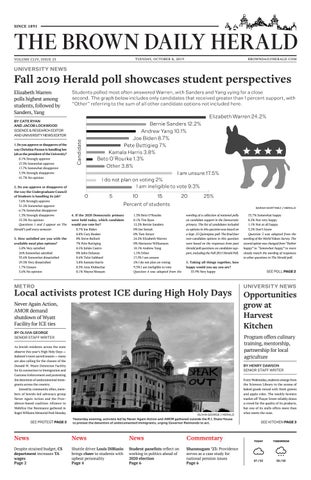
Fall 2019 Herald poll showcases student perspectives Elizabeth Warren polls highest among students, followed by Sanders, Yang BY CATE RYAN AND JACOB LOCKWOOD SCIENCE & RESEARCH EDITOR AND UNIVERSITY NEWS EDITOR 1. Do you approve or disapprove of the way Christina Paxson is handling her job as the president of the University? 8.1% Strongly approve 27.3% Somewhat approve 17.7% Somewhat disapprove 5.3% Strongly disapprove 41.7% No opinion 2. Do you approve or disapprove of the way the Undergraduate Council of Students is handling its job? 7.6% Strongly approve 31.2% Somewhat approve 6.7% Somewhat disapprove 1.3% Strongly disapprove 53.3% No opinion Questions 1 and 2 appear on The Herald’s poll every semester. 3. How satisfied are you with the available meal plan options? 5.8% Very satisfied 26% Somewhat satisfied 33.6% Somewhat dissatisfied 29.3% Very dissatisfied 1.7% Unsure 3.6% No opinion
SARAH MARTINEZ / HERALD
4. If the 2020 Democratic primary were held today, which candidate would you vote for? 8.7% Joe Biden 0.8% Cory Booker 0% Steve Bullock 7% Pete Buttigieg 0.5% Julián Castro 0% John Delaney 0.6% Tulsi Gabbard 3.8% Kamala Harris 0.3% Amy Klobuchar 0.1% Wayne Messam
1.3% Beto O’Rourke 0.1% Tim Ryan 12.2% Bernie Sanders 0% Joe Sestak 0% Tom Steyer 24.2% Elizabeth Warren 0% Marianne Williamson 10.1% Andrew Yang 1.5% Other 17.5% I am unsure 2% I do not plan on voting 9.3% I am ineligible to vote Question 4 was adapted from the
wording of a collection of national polls on candidate support in the Democratic primary. The list of candidates included as options in this question was based on a Sept. 25 Quinnipiac poll. The final four non-candidate options in this question were based on the responses from past Herald poll questions on candidate support, including the Fall 2015 Herald Poll. 5. Taking all things together, how happy would you say you are? 33.9% Very happy
METRO
Local activists protest ICE during High Holy Days Never Again Action, AMOR demand shutdown of Wyatt Facility for ICE ties BY OLIVIA GEORGE SENIOR STAFF WRITER
SEE POLL PAGE 2
UNIVERSITY NEWS
Opportunities grow at Harvest Kitchen Program offers culinary training, mentorship, partnership for local agriculture
As Jewish residents across the state observe this year’s High Holy Days — Judaism’s most sacred season — many are also calling for the closure of the Donald W. Wyatt Detention Facility for its connection to Immigration and Customs Enforcement and protesting
BY HENRY DAWSON SENIOR STAFF WRITER
the detention of undocumented immigrants across the country. Joined by community allies, members of Jewish-led advocacy group Never Again Action and the Providence-based coalition Alliance to Mobilize Our Resistance gathered in Roger Williams Memorial Park Monday
SEE PROTEST PAGE 3
53.7% Somewhat happy 8.2% Not very happy 1.1% Not at all happy 3.2% Don’t know Question 5 was adapted from the wording of the World Values Survey. The second option was changed from “Rather happy” to “Somewhat happy” to more closely match the wording of responses to other questions in The Herald poll.
OLIVIA GEORGE / HERALD
Yesterday evening, activists led by Never Again Action and AMOR gathered outside the R.I. State House to protest the detention of undocumented immigrants, urging Governor Raimondo to act.
News
News
News
Commentary
Despite strained budget, CS department increases TA wages Page 2
Shuttle driver Louis DiBiasio brings cheer to students with upbeat personality Page 4
Student panelists reflect on working in politics ahead of 2020 election Page 6
Shanmugam ’23: Providence serves as a case study for national pension issues Page 6
Every Wednesday, students emerge from the Sciences Library to the aroma of baked goods mixed with fresh greens and apple cider. The weekly farmers market off Thayer Street reliably draws a crowd for the quality of its products, but one of its stalls offers more than what meets the nose.
SEE KITCHEN PAGE 3
TODAY
TOMORROW
67 / 53
59 / 50
2
POLL FROM PAGE 1 6. What do you think is the most important issue facing this country today? 15.9% Current government leadership 37.8% Environment/Climate change 10.9% Gap between rich and poor 10.1% Gun control 6.9% Healthcare 3.5% Immigration 1.9% National debt 4% Poverty/Homelessness 5.2% Race relations/Racism 0.6% Unemployment 3.3% Other Question 6 uses the wording of Gallup’s “Most Important Problem” poll question, which is an open-ended question that classifies responses into several categories. The responses in The Herald’s version of this poll question were based on some of the most common categories of responses to the Gallup poll question. 7. How safe do you feel outside on campus after dark? 32.9% Very safe 47.9% Somewhat safe 16% Somewhat unsafe 2.5% Very unsafe 0.4% Unsure 0.3% No opinion 8. How safe do you feel outside in areas surrounding campus after dark? (incl. Thayer Street) 14.8% Very safe 43.7% Somewhat safe 33.9% Somewhat unsafe 5.9% Very unsafe 1.3% Unsure 0.4% No opinion 9. How satisfied are you with your current housing situation? 42.2% Very satisfied 41.8% Somewhat satisfied 11.4% Somewhat unsatisfied 3.9% Very unsatisfied 0.2% Unsure 0.4% No opinion 10. How often do you use an E-cigarette (e.g. JUUL)? 4.2% Daily 3% Two to three times a week 2.9% Once a week 8.1% Once or twice a month 81.9% Never Question 10 was repeated from the Fall 2018 poll. This follows recent coverage in The Herald on a community health advisory issued by Health Services on the risks of e-cigarette use.
THE BROWN DAILY HERALD | NEWS
TUESDAY, OCTOBER 8, 2019
11. What type of romantic or sexual relationship are you in right now? 25.6% Exclusive relationship with one other person 0.5% Exclusive relationship with multiple people 5.6% Consistent hook-ups with one other person 1.3% Consistent hook-ups with multiple people 8.9% Casual hook-ups with multiple people 1.5% Other 54.6% Not in any kind of relationship 2% Do not know 12. What type of romantic or sexual relationship do you want right now? 56.1% Exclusive relationship with one other person 1.4% Exclusive relationship with multiple people 8.3% Consistent hook-ups with one other person 2.3% Consistent hook-ups with multiple people 4% Casual hook-ups with multiple people 1.1% Other 12.2% Not in any kind of relationship 14.6% Do not know Questions 11 and 12 were repeated from the Fall 2012 Student Poll. The poll was conducted over the course of two days from Oct. 2 – 3. The margin of error is 3.1 percent with 95 percent confidence. The margins of error for specific subsets are as follows: 3.8 percent for females, 4.6 percent for males, 5 percent for first-years, 5 percent for sophomores, 5.4 percent for juniors, 5.6 percent for seniors, 4.5 percent for students who receive financial aid and 3.9 percent for students who do not receive financial aid. The sample of undergraduate students who took the poll is demographically similar to the student body. The sample was 40.7 percent male and 58.6 percent female. First-years made up 31.9 percent, sophomores 30.3 percent, juniors 22.1 percent and seniors 15.7 percent of the poll. Of the students polled, 33.7 percent receive grants from the University covering some costs, 9.8 percent receive grants covering all costs and 56.5 percent receive no financial aid. Varsity athletes made up 8.4 percent, while non-athletes made up 91.6 percent of the sample. Of students surveyed, 77.2 percent identify as heterosexual, 5.9 percent as gay, 13.7 percent as bisexual and 3.2 percent as other. Those involved in a Greek life organization made up 11 percent of all surveyed.
In the sample, 50.7 percent identify as white, 38.2 percent as Asian, 9.7 percent as Hispanic, 9.8 percent as black, 0.9 percent as American Indian/Alaska Native, 0.5 percent as Native Hawaiian/ Pacific Islander and 3.7 percent as other. The percentages add up to more than 100 percent because some students selected more than one race/ethnicity. Students surveyed also marked their concentration area(s): 31.3 percent are in the humanities/arts, 22.3 percent in life sciences, 38.8 percent in physical sciences, 14.6 percent in business (BEO or economics) and 21.6 percent in social sciences (not including BEO or economics). Of the students polled, 16 percent are legacy students, meaning they have a parent, grandparent or sibling who attended Brown, while 84 percent are not. First-generation students made up 16.1 percent of students who took the poll, and non-first-generation students made up 83.9 percent of the sample. Statistical significance was established at the 0.05 level. All cross tabulations are statistically significant. University News Editor Jacob Lockwood ’21 and Science and Research Editor Cate Ryan ’21 coordinated the poll. The poll was conducted on campus by Herald section editors, senior staff writers and other staff members. Over the next few weeks, The Herald will release a series of articles about individual poll questions.
How often do you use an E-cigarette (e.g. JUUL)? The percentage of students vaping on campus did not change significantly from 2018 to 2019. Vaping frequency decreased slightly in all categories except for students who vape daily and students who never vape. 86%
Never 81
76 10
Once or twice a month
8
6
Daily
4
Two to three times a week Once a week 2 2018
2019
Source: Herald Poll 2019
TUESDAY, OCTOBER 8, 2019
WYATT FROM PAGE 1 evening before marching to the steps of the State House, calling on elected officials to act. The demonstration followed months of protests by community members demanding the shutdown of the Wyatt Facility, whose board is currently considering a forbearance agreement that would strengthen the facility’s ties to ICE. During one such protest Aug. 14, a Wyatt correctional officer drove his truck into a group of peacefully-assembled protesters. The incident left five people hospitalized, The Herald previously reported . The High Holy Days “are a time for us to reflect our motivations and the implications of our actions,” said Tal Frieden ’19.5. “It is important work that we do every single year. But it is particularly important in a time like this one,” Frieden added, describing “crimes against fellow human beings (that) are being committed across this country and here in Rhode Island.” The High Holy Days marks the 10day period between Rosh Hashanah and Yom Kippur, the latter taking place from sundown tonight until sundown Oct. 9. During the protest, activists called on Gov. Gina Raimondo to join their cause, as they have been doing since the summer. Raimondo was invited to Monday evening’s demonstration, said Never Again Action spokesperson Amy Anthony, but did not attend. Raimondo could not be reached for comment by press time. Activists reiterated their three key demands for Raimondo: publicly support legislation which would close Wyatt and ban private prisons in Rhode Island, move to release all ICE detainees held at the Wyatt and prohibit local and state collaboration with ICE in Rhode Island. “To our elected officials, to people on the Wyatt Board, we say to them: ‘Any day that you want to decide to make the right choice, it is never too late’,” said Rabbi Michelle Dardashti, associate chaplain for the Jewish community at the University, in reference to the proposed forbearance agreement. “If they won’t come to us, we will go to them,” said former state representative and Never Again Action organizer Aaron Regunberg ’12, before leading dozens of activists to the State House. They chanted, “Up, Up with Liberation! Down, Down with Deportation!” as they made their way. The chants were bolstered with honks
THE BROWN DAILY HERALD | NEWS from passing cars and the activists’ voices only gained in strength as they neared the State House. On their way to the State House at the Smith Street crossing, activists gathered to perform Tashlikh, a High Holy Days atonement ritual that traditionally involves casting bread into a body of water. Dardashti led the ritual while offering words of encouragement and reflection. Bread and slips of paper inscribed with prayer were passed around among the crowd. “We’re here today to do ‘Tashlikh’ to strengthen us … because it is really painful to stand with people in fear. And we may be afraid too,” Dardashti said. “We’ve invited elected officials today to cast off their sins of inaction,” Frieden added. Once gathered on the steps of the State House, community members performed Yizkor, the Jewish Memorial Prayer recited on Yom Kippur, and lit yahrzeit candles to remember the dead. “Let’s take this moment to recommit as we gather here to collectively remember those whose lives have been lost due to ICE and the detention machine, here in Rhode Island and beyond,” Regunberg said. “We will remain in this fight and we will refuse to let up until our community brothers and sisters can live with the safety and humanity that they deserve.” Regunberg also affirmed that Never Again, along with other allies, will continue to pressure elected officials to take action. “Next week is the Jewish holiday of Sukkot,” he said. “We are giving the governor until then to do what any courageous leader should be doing right now — and that is taking action to join our fight.” Wyatt spokesperson Chris Hunter told The Herald that he had not been aware of the planned demonstration. He declined further comment, but confirmed that the next Wyatt Board meeting would take place Oct. 21. The public agenda will be posted 48 hours in advance of the meeting, he added. After the protest and the crowds had cleared, a display of yahrzeit candles, designed to burn for 24 hours, were left glowing in front of the State House. “We are going to leave them here,” Regunberg said, “to make sure that everyone in the State House remembers the violence of this system and the cost of their inaction.”
3
HENRY DAWSON / HERALD
Harvest Kitchen offers culinary training and retail sales experience to adolescents aged 16 to 19 involved with the R.I. Department of Children, Youth and Families. The Kitchen provides a 20-week training program.
KITCHEN FROM PAGE 1 Harvest Kitchen, a non-profit, sells crisp pickles, apple sauce and more delicacies made by youth in a culinary training program in Pawtucket. The Kitchen serves its food in-house at a cafe in Pawtucket and offers services such as co-packing, label production and food for retail at other locations. Adolescents ages 16 to 19 involved with the Department of Children, Youth and Families — who in many cases have faced barriers including homelessness, poverty or incarceration — can apply to Harvest Kitchen’s program. The program runs for 20 weeks and includes culinary training, retail sales experience and temporary paid internship placement. On top of the culinary training, staff at Harvest Kitchen help program participants navigate challenges like health insurance, social security, parenting and the Department of Motor Vehicles. For some participants, the Kitchen is a first step in reintegrating to society after spending time in correctional facilities. Larome Myrick, executive director of juvenile correctional services at R.I. DCYF, said that the training program is part of the state’s targeted efforts to reduce incarceration and keep youth out of detention facilities. “We understand that sending the kids to a secure correctional facility is the last straw,” he said. “So how about we try something else before we send kids there?” Job Charlot, a program alum who currently works at Harvest Kitchen, praised the Kitchen’s director, Jen Stott, for her availability and dedication to
every participant. “She always looks out for the kids,” Charlot said. “Every time I need help, she’s with me.” Beyond serving youth in Rhode Island, the Kitchen aims to bolster small, local farms by turning B-grade foods into more valuable products. For example, “ugly” apples can be turned into apple sauce that is attractive to consumers. John Scott, community liaison for the R.I. DCYF, said he hopes this facet of the program will help reduce waste and buttress local agriculture. The program began as a collaboration between Farm Fresh Rhode Island and DCYF when the groups received a grant to launch the initiative in 2009. The Kitchen has since trained over 130 youths and partnered with over 50 local farmers and producers. The training originally involved only preserving jarred foods, but it has expanded to include instruction in preparing soups, baked goods and cafe menu items like fish melts and grain bowls, as well as catering private events and working retail at the Cafe and farmers markets. The Kitchen graduates forty students a year, though the class size is limited by the physical space of the kitchen and the emphasis on personal attention. Harvest Kitchen moved into its current cafe space in Pawtucket in 2017 — an open, airy space with clean light from surrounding tall windows. “Part of the reason why we’re here in Pawtucket and not in downtown Providence where we’d probably be busier is because we wanted to support the surrounding community with more nutritious and locally sourced foods,”
said Sean Kontos, a chef in the Kitchen. The low rent of the location also helps keep the menu prices down: $2 bagels; $4 breakfast sandwiches; a $7 Ocean State melt made with local fish salad, greens and cheese on toasted whole wheat bread. Bernard Miller has been a chef and instructor for Harvest Kitchen for four months, leaving his career in commercial kitchens to join the program. “I’m giving back what I know to (the students) so that they can use whatever I know,” he said. “Sharpen their swords a little bit, you know what I mean?” Miller, whose favorite menu item is the Ocean State melt, said he likes the mental challenge of the job and working with kids to keep them engaged. He took a break in the middle of the interview to joke with a student — laughing with him about a song. Volunteers from Providence and local universities join staff to help run the cafe. Gwen Edwards, a Providence local who has volunteered at Harvest Kitchen since late winter, enjoys partaking in the culinary training portion of the program. “I love participating in the kids’ learning about cooking, about food, about working together as a team,” she said. “I love the process of watching them over the period of time that I work here getting more and more solid as a team.” Stott is looking forward to the opening of the Farm Fresh Food Hub in the next few years, a single location that will house Farm Fresh R.I.’s many programs and provide space for other local business. Stott hopes additional space will allow her to scale up the Kitchen’s program and production.
4
THE BROWN DAILY HERALD | NEWS
TUESDAY, OCTOBER 8, 2019
UNIVERSITY NEWS
Shuttle driver Louis DiBiasio makes his mark on campus Louis DiBiasio cheers up students with energetic, upbeat greetings BY WILL KUBZANSKY CONTRIBUTING WRITER Rolling into a shuttle stop next to Keeney Quadrangle on a rainy Friday night, Louis DiBiasio, a bus driver for Brown University Shuttle, looked out his right window. The stop didn’t appear to have any potential riders, but he checked again — out the rearview mirror, then the sideview — just in case a straggler was sprinting to catch the bus. “The worst thing I hate to do is miss a student,” he said. “Oh, I hate that!” Even though no one approached the shuttle, DiBiasio still opened the door and called out to a group of students near the bus stop. “Anybody need a ride? Anybody need a ride?” he shouted. This is part of DiBiasio’s routine — making sure no one misses a ride. At Josiah’s and Keeney Quad in the winter, he’ll wait longer at the bus stop in case students are waiting for the bus inside. Louis — sometimes called Lou, affectionately referred to as Uncle Lou by his supervisor and named Luigi on his birth certificate — has driven the bustling clockwise route during the night shift since 2013. This is 78-year-old DiBiasio’s third career, a “relaxation job,” he called it. After driving a truck around the Northeast for various companies deep into the night for 45 years, DiBiasio was ready to be present in his 15 and 18year old grandkids’ lives during the day. He can do that with the 7 p.m. to 2 a.m. late-night shift he takes most
of the week. The energy DiBiasio brings to this job pulses through the bus and emanates outside of it. His whistling reaches the back rows, and his musical greetings, students say, brighten up countless early mornings. “He cares about the students,” said Oren “O” Oliveira, DiBiasio’s head supervisor at First Transit. “His work ethic is unparalleled — he’s always upbeat.” This reputation culminated in a record-breaking “Blueno Bears Admirers” post that Yanhoo Lee Cho ’21 wrote late last month. The Facebook page Blueno Bears Admirers is normally reserved for students to post their appreciation for fellow students, as well as cheesy pick-up lines. Cho’s post far exceeded the page’s typical level of reactions. While the average post receives about eight reactions, the post about DiBiasio, as of Monday morning, had 333 on its own, according to screenshots provided by the Facebook page administrators. The post shouted out Lou and asked other students to comment with their own “love and appreciation towards Lou!” The post took off — comment after comment flowed in, ranging from personal anecdotes to thank you notes to goat emojis, often used to indicate the “Greatest of All Time.” “I was shocked,” Cho said. “More people than I thought engaged with it — I thought people went extremely personal.” DiBiasio, who Cho calls the “purest soul” she’s met on campus, reminds Cho of her own grandfather. She sometimes asks DiBiasio to sing before the clock strikes midnight when she is on the shuttle at night. Renny Ma ’20 shared her appreciation on the Facebook post because DiBiasio had made an impression on her as a first-year student. She’d been alone,
MICHAEL BASS / HERALD
Beloved shuttle bus driver Louis DiBiasio, 78, has worked the 7 p.m. to 2 a.m. late night shift at the University since 2013. late at night, and DiBiasio drove the shuttle from the library to Ma’s front door at her dorm. “I had no idea that anyone would be willing to do that for me,” Ma said. “He’s just very human,” she added. “He’s not just driving a shuttle, he’s making sure that the students at Brown are safe and that they feel welcome.” Back on the bus, DiBiasio was doing just that. At 12:01 a.m., DiBiasio’s bus pulled up near the Nelson Center, and a group of students ran to catch him. “Good morning Brown!” he exclaimed. “Goo-ood mornn-ing! It’s a beautiful mor-ning!” he continued, singing, before exclaiming, “Here comes a runner! We’ve got you, tennis boy!” On the bus hopped a student, racket in hand and dressed in fluorescent yellow. “I remember you, I dropped you off earlier!”
He repeated the same notes again, in the same jubilant tone: “Good morning, it’s a beautiful morning!” The singing rang out into the night each time a student boarded the shuttle. He started the habit a few years ago, in an effort to “rejuvenate (students) and make them happy” late at night after studying, he said. “I’m thinking that would help them a little bit. It’s not easy going to Brown.” “Some other bus drivers don’t greet you at all. I really enjoy his enthusiasm, the fact that it’s every night,” said Ailita Eddy ’21. Even with unruly students, DiBiasio does his best to be accommodating. Some students have laid on the floor of his bus or gotten sick after they drank a little too much “cranberry juice,” so he keeps a bucket in the front. DiBiasio didn’t realize the impact
he was having on students until Cho printed out the Facebook post and its comments. He couldn’t have seen them otherwise because he’s rarely on the internet. “I never knew it. I laughed, I couldn’t, didn’t believe it. I didn’t realize I made an effort like that,” he said. “I didn’t realize it went farther than I expected. I was laughing all night long.” DiBiasio said he wants to keep driving as long as he can — according to him, his career has no end date in sight. And so he drives on deep into the night, meticulously checking his mirrors for runners, singing good morning and picking up students who are alone after his shift ends. “If I can just make them a little bit happier,” DiBiasio said as the bus slowed down in front of the Sciences Library, “I’ve accomplished something.”
Have opinions?
Tell us about them! See guidelines at browndailyherald.com/submissions
TUESDAY, OCTOBER 8, 2019
THE BROWN DAILY HERALD | TODAY
5
CA L E NDA R TODAY
OCTOBER S
6
M
7
Tu
W
Th
F
S
1
2
3
4
5
8
9
10
11
12
13
14
15
16
17
18
19
20
21
22
23
24
25
26
27
28
29
S U D O KU
30
31
How can we stop feeling so overwhelmed? 12:00 P.M. R.I. Department of Administration, 1 Capitol Hill
Retirement Series: Social Security 12:00 P.M. South Street Landing
Narragansett Food Sovereignty Initiative 12:00 P.M. Nightingale-Brown House
Healthy Maki Rolls 7:30 P.M. Sharpe Refectory Bake Shop
TOMORROW Exhibition: Map it Out Providence 10:00 A.M. Nightingale-Brown House
Thinking Out Loud: Teaching Old Bacteria New Tricks 12:00 P.M. Salomon Center for Teaching
A Landscape Without Prisons Fertile Ground: María Berrío, Zoe All Day Charlton, Joiri Minaya Granoff Center for the Creative Arts All Day List Art Building
Q U OTE OF TH E DAY
“The worst thing I hate to do is miss a student. Oh, I hate that!” —Louis DiBiasio, University bus driver
SEE LOUIS PAGE 4
G R ANO F F AMI D G REEN ERY
CR O S SWO R D
REBECCA HO / HERALD
The sleek exterior of the Perry and Marty Granoff Center for the Creative Arts looms behind lush greenery. The interdisciplinary space, open since 2011, is home to the Brown Arts Initiative.
C ORRECTI ON The Oct. 7 article “University, BuDS workers agree to $620,000 settlement,” incorrectly stated that Maxwell Kozlov ’20 will be responsible for any payment of fees assessed by the DLT. In fact, the University will be solely responsible. The Herald regrets the error.
6
THE BROWN DAILY HERALD | NEWS
TUESDAY, OCTOBER 8, 2019
UNIVERSITY NEWS
Students discuss how to influence presidential, local elections Five panelists share experiences working for campaigns, think tanks, non-profits BY MAIA ROSENFELD SENIOR STAFF WRITER As the 2020 presidential race heats up and young people prepare for a highstakes election, University students are talking about how to best leave their mark. In a panel Monday evening, five students drew on their own experiences to break down the different ways Brown undergrads can play a role in shaping political dialogue. They highlighted congressional internships, public policy think tanks, non-profits and grassroots organizing as options for students during summers or during the school year — available through the Brown in Washington Program, a co-sponsor of the event. “2020 is the most important election of our lifetime. And so is every other election,” said Andrew Castillo ’20 to attendees. Castillo worked as a legislative policy intern for Sen. Jack Reed (D-RI) and an organizing fellow for Sen. Kamala Harris’ D-CA campaign for president. He encouraged students to get involved in the upcoming elections and added that campaigns will be looking to hire as many people as possible. The panelists, who all participated in the Brown in Washington program during the 2018-19 school year, focused on the excitement of their political work despite the long hours and sometimes mundane daily tasks. They spoke about their research and organizing work, and stressed their passion for the policy issues they worked on. Some speakers highlighted reproductive rights and foreign affairs as issues that motivated them. Panelist Kimberly Davila ’20 interned last fall for Common Cause, a
MAIA ROSENFELD / HERALD
Yesterday, five Brown students spoke about their involvement with 2020 presidential campaigns for the high-stakes upcoming election. nonpartisan watchdog group based in Washington, D.C. She then spent the summer working in Philadelphia as a field organizer for Organizing Corps 2020, a new initiative by the Democratic National Committee to lay the groundwork for the 2020 election through voter registration, canvassing, community events and volunteer recruitment. “It’s important for us to get engaged, not only as students, but as young people who are leading future efforts,” she said. “And not just in politics but in a lot of other fields too.” For Davila, that might mean joining efforts to get out the vote or working on a campaign after she graduates in May. While no panelist identified openly as conservative, Michael Tian ’20 spoke about his experience working for the right-leaning think tank American Enterprise Institute during his Brown
in Washington internship last spring. “I wanted to work for a conservative think tank because I just wanted to challenge my own views and see what it’s like to immerse myself in the other side,” he said. Tian emphasized the importance of young people mobilizing around issues of student debt, employment in the face of automation and climate change. Carrie Nordlund, associate director of the Master of Public Affairs program, moderated the event. “Brown students are special in the ways that they see the world and the ways that they can offer unique and distinctive viewpoints,” she told The Herald. “It’s incredibly important that all students, but especially Brown students because of their viewpoints, get involved.” Monday’s panel took place in the Kim Koo Library and was co-sponsored
SINCE 1891
THE BROWN DAILY HERALD Editorial Leadership Editor-in-Chief Emily Davies Managing Editors Anna Kramer Priyanka Podugu Senior Editors Anita Sheih Sarah Wang Editorial Page Editors Grace Layer Krista Stapleford post-magazine Editor-in-Chief Anita Sheih
Sections Arts & Culture Editors Elise Ryan Annabelle Woodward Metro Editors Dylan Clark Sophie Culpepper Alex Reice News Editors Celia Hack Jacob Lockwood Melanie Pincus Allie Reed Science & Research Editors Cate Ryan Chris Schutte Sports Editors Alexandra Russell Alex Smolar
Commentary Opinions Editors Rebecca Aman Jamie Flynn Derek Simshauser Multimedia/Production Design Editors Bilal Ismail Ahmed Keelin Lyons Dylan Tian Head Photo Editors Tiffany Ding
Business General Managers Ravi Betzig Nicholas Masiakowski Office Manager Diane Silvia Directors Sales: Bersabel Yifru Finance: Rudra Srivastava Reynaldo Blandon
Copy Desk Chief Kelley Tackett Illustrations Editor Summer Zhang Graphics Editor Sarah Martinez
@the_herald
facebook.com/browndailyherald
@browndailyherald
youtube.com/browndailyherald
195 Angell St., Providence, RI (401) 351-3372 www.browndailyherald.com Editorial: herald@browndailyherald.com Advertising: advertising@browndailyherald.com
by the Swearer Center, the Watson Institute of International and Public Affairs, the CareerLAB and Careers in the Common Good. The library was filled with undergraduate students of all class years, as well as students in the Master of Public Affairs program. Many expressed interest in working in politics and policy after the event. John Graves ’22 attended the panel to hear from students who had worked in government and get advice on landing an internship at a senator’s office or on a presidential campaign. Graves left the event comforted that the panelists felt they had made real policy change and found their work rewarding, even if some of it was menial. “When you look at your work as a whole, it really has a positive benefit,” he said. Other panelists included Julia Rosenberg ’20, who worked in the of-
fice of Sen. Kristen Gillibrand (D-NY) last spring, and Elizabeth Tran ’20, who worked as a communications intern for Harris last fall. Both Rosenberg and Tran hail from the same states as the senators they worked for, and highlighted their passion about the specific issues their respective senators tackled. One message that came from every corner of the room was that students — and anyone else who can — should continue to get involved in politics, especially as the 2020 elections approach. “If you have the privilege to be a political participant, you should,” Tian said. “On a campus like this we do have the ability to influence our peers and make sure that everyone gets involved,” Davila said. “Even if it’s just voting, or even if it’s just canvassing once, anything counts.”
Submissions: The Brown Daily Herald publishes submissions in the form of op-eds and letters to the editor. Op-eds are typically between 750 and 1000 words, though we will consider submissions between 500 and 1200 words. Letters to the editor should be around 250 words. While letters to the editor respond to an article or column that has appeared in The Herald, op-eds usually prompt new discussions on campus or frame new arguments about current discourse. All submissions to The Herald cannot have been previously published elsewhere (in print or online — including personal blogs and social media), and they must be exclusive to The Herald. Submissions must include no more than two individual authors. If there are more than two original authors, The Herald can acknowledge the authors in a statement at the end of the letter or op-ed, but the byline can only include up to two names. The Herald will not publish submissions authored by groups. The Herald does not publish anonymous submissions. If you feel your circumstances prevent you from submitting an op-ed or letter with your name, please email herald@browndailyherald.com to explain your situation. You can submit op-eds to opinions@browndailyherald.com and letters to letters@browndailyherald. com. When you email your submission, please include (1) your full name, (2) an evening or mobile phone number in case your submission is chosen for publication and (3) any affiliation with Brown University or any institution or organization relevant to the content of your submission. Please send in submissions at least 24 hours in advance of your desired publication date. The Herald only publishes submissions while it is in print. The Herald reserves the right to edit all submissions. If your piece is considered for publication, an editor will contact you to discuss potential changes to your submission. Commentary: The editorial is the majority opinion of the editorial page board of The Brown Daily Herald. The editorial viewpoint does not necessarily reflect the views of The Brown Daily Herald, Inc. Columns, letters and comics reflect the opinions of their authors only. Corrections: The Brown Daily Herald is committed to providing the Brown University community with the most accurate information possible. Corrections may be submitted up to seven calendar days after publication. Periodicals postage paid at Providence, R.I. Postmaster: Please send corrections to P.O. Box 2538, Providence, RI 02906. Advertising: The Brown Daily Herald, Inc. reserves the right to accept or decline any advertisement at its discretion.
The Brown Daily Herald, Inc. is a financially independent, nonprofit media organization bringing you The Brown Daily Herald, BlogDailyHerald and Post- Magazine. The Brown Daily Herald has served the Brown University community daily since 1891. It is published Monday through Friday during the academic year, excluding vacations, once during Commencement and once during Orientation by The Brown Daily Herald, Inc. Single copy free for each member of the community. Subscription prices: $200 one year daily, $100 one semester daily. Copyright 2019 by The Brown Daily Herald, Inc. All rights reserved.
TUESDAY, OCTOBER 8, 2019
THE BROWN DAILY HERALD | COMMENTARY
7
To solve its pension puzzle, Providence must make tough choices BY ARJUN SHANMUGAM ’23 STAFF COLUMNIST
Even as Washington intrigue dominates media coverage of our government, American cities continue to define how citizens interact with the institutions around them — with consequences that the public often misses or overlooks. Indeed, a little known yet destructive trend is brewing in city pension funds across the United States. For decades, local government workers across the country have sent a portion of their paychecks to the municipalities that employ them; cities combine these payments with their own annual contributions, invest the money and pay it out to these employees once they reach retirement age. It is under this system that cities have guaranteed financial security to generations of police, teachers and bureaucrats who help run America. But today, those pension funds are running dry as a result of mismanagement, corruption and a dearth of funding. Look no further than Providence, Rhode Island for a case study in such a pension puzzle and for evidence of the danger they pose to middle class livelihoods. The city has suffered from deep-rooted mismanagement of its pension system. Rosy expectations about investment returns and decades of inadequate contributions to the fund — the city came up $16 million short in 1999 alone — have left it just a quarter of the way toward covering the $1.3 billion it owes to current and future retirees. Such numbers are mind-boggling in and of themselves, but the budget pressure they create
reveals an acute crisis with a concrete human impact. A 2010 refinancing scheme demands 3.5 percent yearly increases in Providence’s annual contributions to its pension system, outpacing the 2 percent rate at which the budget grows overall. This means that pension liabilities could edge out priorities like other social spending and infrastructure. This would be cat-
ee payouts must become more sustainable. For instance, city employees currently contribute around 8 percent of their paychecks to pension funds. Even a modest 2 percent increase in that number could eliminate as much as 10 percent of the funding gap that the municipality faces. Similarly, key fixes on the retirees’ end could take pressure off the cash-strained city govern-
“Regardless of the inherent injustice of paying higher taxes to sustain Providence’s pension system, something needs to be done. Without immediate structural reform, Providence will be bankrupt.”
astrophic for a public school system defined by chronically absent teachers, for the 70 percent of Rhode Island streets in poor condition and for a city with the highest poverty rate in the Northeast. The difficult choices that pension reform requires — which can include tax hikes, slimmer pension payouts and more limited provision of local government services — make it extremely unpopular. Yet, in the face of a budget disaster that Providence’s mayor, Jorge Elorza, claims could cause bankruptcy for the whole city in 12 years, policy changes are necessary. First, the system of employee contribution and retir-
ment. Simply reducing payouts on the largest pensions — those whose retirees are afforded over $2,000 a month — by 5 percent would cut the city’s annual retired contribution to the pension fund by $4 to $6 million. But while sustainable support for retirees is important, Providence also needs more revenue if it hopes to avert this crisis. Nonprofits, such as universities and hospitals, do not pay property taxes despite owning 40 percent of city land. They should pay a greater share of government revenue. Former Providence mayors David Cicilline and Angel Taveras attempted to implement property taxes on nonprofits, but these
attempts were unpopular and unsuccessful. Since 2012, when then state treasurer Gina Raimondo raised the alarm about Providence’s broken pension system, middle-class Rhode Islanders who organize their lives around these pension payments — cops, firefighters and teachers — have been outraged, and for good reason. They consider it unfair that citizens should have to pay the price for decades of corruption, poor governance and financial mismanagement in City Hall. In the face of broken promises and burdensome demands from state officials, they are right. Yet what these complaints miss is that, regardless of the inherent injustice of paying higher taxes to sustain Providence’s pension system, something needs to be done. Without immediate structural reform, Providence will be bankrupt. Bankruptcy would be a disaster for the city, leaving it unable to finance services as basic as law enforcement, and deterring enterprising Americans from opening businesses there. Both types of reform — restructuring payments and finding new sources of revenue — though unpopular and austere, are necessary. Providence’s financial woes hold no panacea, and fixing them will require people across the socioeconomic spectrum to make financial sacrifices. In a crisis that threatens the entire city, there is no way around the tough choices that Providence’s citizens must make.
Arjun Shanmugam ’23 can be reached at arjun_shanmugam@brown.edu. Please send responses to this opinion to letters@browndailyherald.com and op-eds to opinions@ browndailyherald.com.
8
THE BROWN DAILY HERALD | NEWS
TUESDAY, OCTOBER 8, 2019
UNIVERSITY NEWS
Computer science dept. raises teaching assistant wages Over 300 TAs receive 10 percent wage boost, head TAs receive 15 percent wage increase BY ROSE HOUGLET CONTRIBUTING WRITER The computer science department increased wages this semester for Undergraduate Teaching Assistants and Head Teaching Assistants by 10 percent and 15 percent respectively. The wages for UTAs increased from $10.60 to $11.66 per hour while the wages for HTAs increased from $10.86 to $12.50 per hour, said Tom Doeppner, the department’s director of undergraduate studies. The wage increase comes as the CS department’s UTA budget has been strained by the department’s growth, The Herald previously reported. CS became the most popular concentration at the University in 2017. Currently, there are around 350 TAs in the department, with a ratio of about eight students per TA in intro courses and 10 students per TA in non-intro courses, Doeppner said. In every course, there is at least one HTA, who is an undergraduate with more experience and is responsible for administrative tasks and managing the course’s other TAs. Both students and professors interviewed by The Herald said they wished that TA wages could be increased fur-
VICTORIA YIN / HERALD
TAs in the CS department received a raise this semester. The department’s UTA budget has been strained in recent years due to the growth of the CS concentration, which became the largest at the University in 2017. ther, but they acknowledged the UTA program’s budget constraints. Doeppner said that the department spends well over $1 million on the UTA program per year. The department sources money from a recently established UTA endowment, the department budget and a portion of revenue from masters stu-
dents’ tuition. Though the CS department raised around $10 million for the UTA endowment in recent years, the concentration almost doubled in size by the end of the fundraising campaign, said Interim Chair of the Computer Science Department John Hughes.
“I believe for the quality of work that (TAs) do, they would be justified in receiving a higher increase in wages,” said Nicole Cheng ’21, an HTA who works around 20 hours per week for CSCI 0111: “Computing Foundations: Data” “But generally, I think that the overall sentiment is positive about the wage increase, as most people know that the CS department is strapped for money when it comes to undergraduate TAs. So we’re happy with what we have.” To help alleviate the UTA program’s budget constraints, TAs are still able — and, for intro courses, often required — to receive up to two course credits in place of wages for their work. With this option, either all TA duties are covered in course credit or, for larger intro courses, the duties are split be-
tween credit and wages. In those cases, grading is compensated with hourly wages, while TA hours and class prep are counted toward course credit. Additionally, starting this year, any student on financial aid can TA intro courses entirely for wages, Doeppner said. The department announced the HTA wage increase last spring and the UTA wage increase a week before this semester started, Doeppner said. Both wage increases went into effect this semester. “I’m happy that they have increased (TA wages) because it gives us security to be able to pay for groceries or pay for rent,” said Chanel Johnson ’20, a UTA for CSCI 0020: “The Digital World.” “It also helps with the work and makes you feel like your work is more appreciated.”
Teaching Old Bacteria New Tricks Kristala L. J. Prather
u|_ u ĺ b Ѵ; uo=;vvou o= _;lb1-Ѵ m]bm;;ubm] -1(b1-u -1 Ѵ| ;ѴѴo -vv-1_ v; v mvঞ| |; o= $;1_moѴo]
Biology is an exquisite chemist, each cell comprised of numerous chemical structures. b1uo0;v 1-m 0; ;m]bm;;u;7 |o u;uo |; -m7 ; |;m7 0bov m|_;ঞ1 r-|_ - v |o l-h; molecules for human use, ranging from drugs to materials. Yet, biology is also designed =ou u;ruo7 1ঞomķ ;-1_ 1;ѴѴ -blbm] |o l-h; lou; o= b|v;Ѵ=ĺ ol; Ѵ;-um _o ubv
0-Ѵ-m1;v |_;v; 1olr;ঞm] o0f;1ঞ ;v |o teach old bacteria some new tricks.
Wednesday, October 9, 2019, 5:30 p.m. SALOMON CENTER FOR TEACHING, ROOM 001
mѴbm; u;]bv|u-ঞom bv mo or;m -|Ĺ brown.edu/thinking-out-loud
STAY UP-TO-DATE. FOLLOW US ON FACEBOOK. FACEBOOK.COM/BROWNDAILYHERALD