SINCE 1891
THE BROWN DAILY HERALD TUESDAY, FEBRUARY 25, 2020
VOLUME CLV, ISSUE 23
BROWNDAILYHERALD.COM
METRO
NEWS
Students struggle to register, request absentee ballots
Shahzad Bashir lectures on Middle Eastern world of poetry
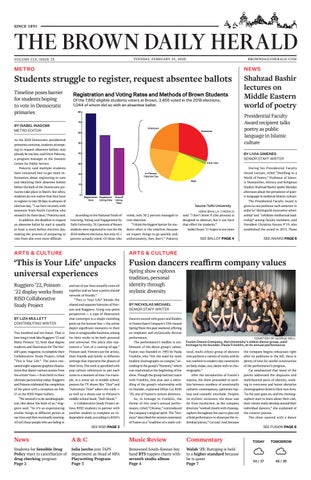
Timeline poses barrier for students hoping to vote in Democratic primaries BY ISABEL INADOMI METRO EDITOR As the 2020 Democratic presidential primaries continue, students attempting to request absentee ballots may already be too late, said Steve Pokorny, a program manager at the Swearer Center for Public Service. Pokorny said multiple students have contacted him to get more information about registering to vote and obtaining their absentee ballots before the bulk of the Democratic primaries take place in March. But often, students do not realize that they have to register to vote 30 days in advance of election day. “I sat here recently with someone from North Carolina who missed it by three days,” Pokorny said. In addition, the deadline to request an absentee ballot by mail is usually at least a week before election day, making the process of preparing to vote from afar even more difficult.
Registration and Voting Rates and Methods of Brown Students Of the 7,662 eligible students voters at Brown, 3,455 voted in the 2018 elections, 1,044 of whom did so with an absentee ballot. 80
70
Unknown
Absentee
60
50
BY LIVIA GIMENES SENIOR STAFF WRITER
40
Early Vote
30
said. “I don’t know if (the process) is designed to obstruct, but it can have that effect for students.” Isabel Reyes ’21 hopes to see more
During his Presidential Faculty Award Lecture, titled “Dwelling in a World of Poetry,” Professor of Islamic Humanities, History and Religious Studies Shahzad Bashir spoke Monday afternoon about the prevalence of poetic language in medieval Islamic culture. The Presidential Faculty Award is given to one professor each semester in order to “distinguish innovative scholarship” and “celebrate intellectual leadership” among faculty members, said President Christina Paxson P’19, who established the award in 2013. Those
SEE BALLOT PAGE 4
SEE AWARD PAGE 6
In-Person, Election Day
20
Mail 10
0
Presidential Faculty Award recipient talks poetry as public language in Islamic culture
Registration Registered Rate Voting Rate
Overall Voting Rate
Source: Tufts University USHA BHALLA / HERALD
According to the National Study of Learning, Voting and Engagement by Tufts University, 78.5 percent of Brown students were registered to vote for the 2018 midterm elections, but only 45.1 percent actually voted. Of those who
voted, only 30.2 percent managed to vote absentee. “I think the biggest barrier for students often is the timeline, because we expect things to go quickly and, unfortunately, they don’t,” Pokorny
ARTS & CULTURE
ARTS & CULTURE
‘This is Your Life’ unpacks universal experiences
Fusion dancers reaffirm company values
Ruggiero ’22, Poisson ’22 display works from RISD Collaborative Study Project BY LIZA MULLETT CONTRIBUTING WRITER Two hundred and ten hours. That is how long it took Jake Ruggiero ’22 and Rémy Poisson ’22, both dual degree students and illustrators for The Herald’s post- magazine, to complete their Collaborative Study Project, titled “This is Your Life.” The piece contained eight separate graphite illustrations that depict various scenes from the artists’ lives — from birth to their ultimate partnership today. Ruggiero and Poisson celebrated the completion of the piece with a reception on Feb. 21 at the RISD Paper Gallery. “We wanted it to be autobiographical, like about the both of us,” Ruggiero said. “So it’s us experiencing similar things at different points in our lives and then eventually meeting. All (of) these people who are fading in
and out of our lives actually come all together and we have a pretty shared network of friends.” “This is Your Life” blends the shared and separate histories of Poisson and Ruggiero. Using one-point perspective — a type of illustration that converges to a single vanishing point on the horizon line — the artists depict significant moments in their lives in recognizable locations, aiming for their works to be both personal and universal. The piece also represents a “sort of a coming-of-age,” Poisson said. Viewers see the artists, their friends and family in different settings that represent the phases of their lives. The work is sprinkled with pop culture references to put each scene in a moment of time. For example, in a scene set in middle school, posters for TV shows like “Glee” and “Adventure Time” adorn the walls — as well as a shout-out to Poisson’s middle school band, “Daft Skunk.” A Collaborative Study Project allows RISD students to partner with another student to complete an independent study, according to RISD’s
Spring show explores tradition, personal identity through stylistic diversity
BY NICHOLAS MICHAEL SENIOR STAFF WRITER Dancers moved with grace and fluidity in Fusion Dance Company’s 37th Annual Spring Show this past weekend, offering an emphatic and stylistically diverse performance. The performance’s medley is emblematic of the dance group’s values. Fusion was founded in 1983 by Paula Franklin, who “felt the need for more student choreography on campus,” according to the group’s “Herstory,” which was read aloud at the beginning of the show. Though the group had lost touch with Franklin, this year saw a rekindling of the group’s relationship with its founder, explained Jillian Cai RISD ’20, one of Fusion’s current directors. So, in homage to Franklin, the theme of this year’s annual performance, titled “Chroma,” reintroduced the company’s original spirit. The “Herstory” described the mission statement of Fusion as a “tradition of a multi-cul-
COURTESY OF GEORGE NOLL
Fusion Dance Company, the University’s oldest dance group, paid homage to its founder, Paula Franklin, at its annual performance. tural, multi-ethnic group of dancers who perform a variety of styles and do not conform to modern-day constraints on body shape, size, dance style or choreography.” After the introduction of Fusion’s mantra, the show proceeded to oscillate between numbers of emotionally cathartic contemporary, optimistic hiphop and comedic interlude. Despite its stylistic variances, the show was far from incoherent, as the company directors “worked closely with choreographers throughout the year to plan out a fluid performance to showcase the individual pieces,” Cai said. And, because
SEE RISD PAGE 3
the company begins rehearsals right after its auditions in the fall, there is plenty of time for careful construction of the performance’s program. Cai emphasized that many of the pieces addressed the disparate and multifaceted parts of identity, working to overcome and honor obstacles choreographers faced in their own lives. “As the year goes on, and the choreographers start to learn about their cast, their visions really develop around their individual dancers,” she explained of the creative process. The show opened with a dance
SEE FUSION PAGE 6
News
A&C
Music Review
Commentary
Students for Sensible Drug Policy react to cancellation of drug checking program Page 2
Julia Jarcho join TAPS department as Head of MFA Playwriting Program Page 3
Renowned South-Korean boy band BTS topples charts with seventh studio album Page 4
Walsh ’23: Buttigieg is held to a higher standard because he is queer Page 7
TODAY
TOMORROW
54 / 37
48 / 39
2
THE BROWN DAILY HERALD | NEWS
TUESDAY, FEBRUARY 25, 2020
UNIVERSITY NEWS
Student group presents on safe drug use practices Students for Sensible Drug Policy reacts to cancellation of drug checking program BY MAISIE NEWBURY SENIOR STAFF WRITER In a crowded conference room in Page Robinson Hall, Laurel McIntyre ’22, Abigail Gulchin ’22, Max Heller ’23 and Noah Mlyn ’20 presented on safe drug use in a culture that maintains prohibition — on campus, in Providence and in the United States. “This presentation was formed partially as a response to our drug checking program being shut down last spring,” McIntyre said. “We used to have a program for students to test their drugs for adulterants, and it was really popular around Spring Weekend.” But just two days before Spring Weekend last spring, the Student Activities Office informed McIntyre and the other members of Students for Sensible Drug Policy that their program was a liability and therefore against school rules, The Herald previously reported. “Brown shutting our program down just shows that they care more about their legal liability than the safety of their own students,” McIntyre said. “Given that there are no longer any harm reduction systems (for drug use) on campus, we want to provide information on how you can protect yourself and inform (yourself) about drug policies that fall hardest on the most marginalized people in our society,” she added. “We want to provide a counterargument to the fear-mongering propaganda that surrounds drug use today.” Students may still access the same testing kits used by SSDP through
Dance Safe, a drug testing kit vendor. But Dance Safe testing kits are less readily available, and “the cost can be prohibitive,” McIntyre said. Heller emphasized that “these kits are not one hundred percent safe or effective, but are certainly better than not testing at all.” The students from SSDP also discussed harm reduction in drug use on a larger scale. Today, harm reduction in drug use “focuses on drug adulteration and the consequent overdose crisis,” Mlyn said. “Prohibition drives the market for illicit substances into the black market, where they are left unregulated.” It also becomes difficult to test drugs because the materials to test them are never provided. “We spend so much money on incarcerating drug users that we, somewhat ironically, don’t have the money to help those same people,” he added. Fentanyl, a powerful synthetic opioid developed for extreme pain and often associated with cancer treatment, is an example of an increasingly common adulterant. “It has leaked into the drug market and is being cut into heroin to make it cheaper,” which drives drug overdose, Mlyn said, adding that the drug is also found in many other drug supplies such as cocaine and MDMA. “We want to talk about what resources (you have) and what you can do to protect yourself,” Gulchin said. “You need to know your rights,” Mlyn added, stating that both Fentanyl test strips and Naloxone, a drug used to reverse the effects of heroin overdose, are legal in Rhode Island. “Marijuana is also decriminalized in Rhode Island,” Mlyn said. “If you have less than one ounce, and you aren’t driving, it is a civil offense, and you will not be charged with a crime.” Rhode Island also has a Good Sa-
MAISIE NEWBURY / HERALD
Members of Students for Sensible Drug Policy delivered a presentation detailing methods for handling potential overdoses, drug checking and contamination of drug supply. maritan Law, which provides legal protections to those who seek medical care for individuals experiencing a drug overdose. Conversely, Rhode Island also has a law entitled Kristen’s Law, which “is advertised as trying drug dealers as murderers when a user overdoses, but really allows any drug user to be charged with murder … Most people who use at some point either share or help people get drugs as well,” Mlyn explained. On campus, students are subject to all of these laws, but have additional resources apart from the discontinued SSDP drug testing program. “BWell has substance and risk information as well as information regarding University policies,” Gulchin said. “They also provide an interesting service where you can speak with a health educator and make a plan if you are worried about your own or someone else’s drug use.”
Gulchin also referenced Brown Opioid Activists, a student organization that provides free Naloxone training sessions and distributes fentanyl test strips. In referencing reform in the larger Providence area, Mlyn described efforts to legalize marijuana in the wake of Massachusetts passing such legislation last year. There are also efforts to legalize and use certain psychedelics for mental health treatment, he added. “It doesn’t have to be this way,” Mlyn said. “The mentality is pretty engrained in America so that full decriminalization and drastic harm reduction measures such as safe injection sites seem out of the question.” Mlyn went on to cite a number of instances in which decriminalization of drug use and harm reduction have worked to decrease drug-related deaths. Portugal, in response to their HIV epidemic, implemented widespread decriminalization and saw new
cases of HIV decrease from 104.2 per million in 2000 to only 4.2 per million in 2015. “It is also important to note that there was a decline in overdose deaths, but that is not what the program targeted,” he said. Mlyn also cited Vancouver as an example of where harm reduction measures were effective. The Canadian government developed a “government-supervised, government-run safe injection site, with health professionals there to give you sterile paraphernalia and allow you to test your drugs to make sure you know what they are.” This system has been shown to decrease overdose rates by 35% in the area around the injection site, he said. “The important thing is we need political will,” Mlyn said. “It may seem clear to us that this is the right way to do things, but it isn’t for our parents. We need to make it a political priority.”
STAY UP-TO-DATE. FOLLOW US ON FACEBOOK. FACEBOOK.COM/BROWNDAILYHERALD
TUESDAY, FEBRUARY 25, 2020
THE BROWN DAILY HERALD | NEWS
3
ARTS & CULTURE
Julia Jarcho brings new vision to MFA Playwriting Program Playwright, director began first term as head of MFA program BY LIZA MULLETT CONTRIBUTING WRITER Julia Jarcho, a playwright and director, began her first term this semester as the Head of Playwriting for the Master of Fine Arts Playwriting program. Jarcho will help Brown playwriting students to develop skills for theatre performance. The MFA Playwriting program is a three-year graduate program at the University that allows students to lean “into faithful transformation of society through theatrical action,” according to the program’s website. Alongside their courses, MFA students attend a graduate playwriting workshop — collaborating with actors, designers and directors — during all six semesters. Jarcho has a PhD in rhetoric from the University of California at Berkeley and has been a professor in the Department of English at New York University since 2013. Her New York City theater company, Minor Theater, promises audiences “dark humor and goofball precision ... where we feed off pop culture’s sticky undergut,” according to the company’s website. Some notable works by Minor Theater include “Grimly Handsome” and “Pathetic,” both written and produced by Jarcho. In a review of Jarcho’s 2017 production “The Terrifying,” the New York Times named Jarcho “a queen of experimental mayhem.” Jarcho was drawn to the Brown MFA Playwriting program for its reputa-
COURTESY OF JENNIFER SEASTONE
Julia Jarcho hopes to lead the program in a direction where she can implement her personal values of important theatrical practices and new writing to shape the futures of the aspiring writers she teaches. tion “of being intellectual, of drawing people who make work thoughtfully, theoretically … and who think creatively,” Jarcho wrote in an email to The Herald. “I write criticism and theory too, and while I think of that and art-making as distinct practices, I always want to be in places where you can keep them both in the room with you — and I want to put my energy into making and maintaining those places,” Jarcho wrote. “Leading this program is a chance to think about what I value in theatrical practice and new writing, and then implement those values at a level that can actually help shape a larger sense of what is possible in this field,” Jarcho
wrote. “The teaching itself, the chance to work closely with a small group of committed, talented writers and … help them figure out how (their work) can grow, get weirder and funnier and more courageous — that’s the kind of teaching I like best.” The MFA Playwriting program was initially founded by Pulitzer Prize-winning playwright Paula Vogel in 1984. Vogel served as the director of the program until 2008. The program was originally housed under the Literary Arts department, but moved to the Department of Theatre Arts and Performance Studies in 2010, “in order to bring playwrights closer to the performance of their work,” The Herald
previously reported. “We were looking for a head of playwriting who would be committed to developing emerging playwrights in our MFA and BFA programs and who would be an innovative artist in their own right,” wrote Patricia Ybarra, chair of the TAPS department, in an email to The Herald. “Julia brought skills of rigorous pedagogy and generosity as well as a strong formal vision. … I think she will support our blending of theory and practice in the department, which serves all of our students and our own vision,” Ybarra wrote. Jarcho’s arrival coincided with MFA admissions season and the Writing Is Live playwriting festival. While still
RISD FROM PAGE 1
COURTESY OF JAKE RUGGIERIO AND RÉMY POISSON
Students Poisson and Ruggiero completed their CSP over the five-week Wintersession period between the fall and spring semesters under the guidance of supervisor Leonard Long, Senior Critic at RISD.
website. Supervised by RISD faculty, students are allowed to complete up to three independent or collaborative study projects while at RISD, each for three credits. Poisson and Ruggiero completed their CSP over the fiveweek Wintersession period and were supervised by Leonard Long, Senior Critic at RISD. “We wanted to work together. That was kind of the starting point,” Poisson said. Collaboration on shared projects “was something we felt that at RISD we were lacking, like not getting to work with other people. You get this assignment in class, you go home and do it by yourself and bring it back in to talk about it,” Ruggiero said. He added that the pair are roommates and “workout buddies,” and were excited by the opportunity to work together. The artists are both pursuing a dual degree from RISD and Brown. While both studying illustration at RISD, Poisson is studying Literary Arts at Brown and Ruggiero concentrates in Biology. Embarking on a project of this scale came with its challenges. Poisson said they “didn’t really realize at the time what an undertaking it was going to be.” Originally, the artists were planning on doing one panel for each year of their lives, which would add up to
adapting to her new role and learning about the program, Jarcho is “trying to watch and listen and figure out what’s here and what’s not here yet.” “I want to make sure there’s a stable, recurring structure for what we offer students — grads and undergrads — in the course of their time here,” Jarcho wrote. She emphasized the importance of experimentation: “It is very important to me that within this structure, students understand themselves as responsible for their own projects. So for example it’s not, ‘Come to Brown and get your plays put on by the theater department,’ but, ‘Come to Brown and write some plays that are so rigorous and wild they surprise even you, and then make them happen onstage.” Jarcho looks forward to bringing new innovative approaches to the MFA Playwriting program. “Designing a new blueprint for the program is a big project, and it’s great to have colleagues and students to think with me in that endeavor.” Outside of her role at the University, Jarcho also currently has several projects in the works with Minor Theater. “Marie It’s Time,” her adaptation of Georg Büchner’s “Woyzeck,” reimagined as a two-woman rock concert, will be performed Feb. 24 and 25 at the HERE Arts Center in New York City. Jarcho is also working on her second critical theory book on “masochism, literary genre and 20th-century theater.” “She’s on the forefront of taking this discipline to another level,” said Kym Moore, professor of theatre arts and performance studies. Jarcho “is not only a playwright, but a director. She does experimental work. She’s a brilliant scholar.”
20 individual illustrations each. Although the artists noted that they worked cohesively together, there were still bumps in the road. “There was a midway point where (Long) was very not pleased,” Ruggiero said. According to Poisson, Long told them that they were “failing, this is hardly done” two weeks before the project’s due date. “I cried after the meeting. It was literally like doomsday,” Ruggiero said. But Long’s critique proved to be a motivating factor for the artists. After this meeting, they took over the shared common room of their suite as a workspace and “started working for an insane amount of time,” Poisson said. . Ruggiero and Poisson ultimately completed the CSP on time and displayed their work in the Paper Gallery of RISD’s Illustration Studies Building. At the reception last Friday, many of their friends featured in the works were surprised — as many had not known that they would see themselves in “This is Your Life.” Eugene Rhee ’23 was surprised to see her likeness in one piece. “The exhibition was in a beautiful part of the Illustration Studies Building, and on the closing night when I went to see the piece, it made me so happy and proud to see all of the hard work Jake and Rémy put into the piece be so appreciated,” Rhee wrote in an email to The Herald.
4
THE BROWN DAILY HERALD | NEWS
TUESDAY, FEBRUARY 25, 2020
MUSIC REVIEW
Latest BTS album dominates international charts ‘Map of the Soul: 7’ investigates SouthKorean boy band’s artistry and success BY KAITI YOO SENIOR STAFF WRITER On Feb. 21, the South-Korean boy band BTS (Beyond the Scene) released their seventh studio album “Map of the Soul: 7.” The album is made up of 20 tracks, five of which come from their previous album “Map of the Soul: Persona.” Each track, regardless of whether it was pre-released or not, secured a spot on the U.S. iTunes Top Twenty sales list within hours of the album’s release, effectively wiping the entire chart clean. This immediate upheaval of charts and streams is nothing new for the internationally acclaimed K-pop group, which continues to break records and global boundaries with every song release and every public performance. BTS is the first group since the Beatles to win three Billboard No. 1’s in a year, and they have the highest number of Twitter engagements on the platform. They are also the first Korean group to present at the Grammys as well as to perform on a U.S. award show. As 2020 is the seven-membered group’s seventh anniversary of their incredibly expansive career, “Map of the Soul: 7” is indeed a symbolic ode to themselves, their fans (who are nicknamed ARMYs) and the mountains they’ve climbed together. In 2013, BTS debuted as nobodies within the K-pop industry, with little funding or name-recognition due to their label’s ongoing recovery from bankruptcy. As a result, their early tracks were populated with lyrics yearning for fame and success such as “No More Dream,” where member Suga raps, “I wanna big house, big cars & big rings.” A few years later, their songs evolved to celebrate
BALLOT FROM PAGE 1 resources on campus for student voters. “My dad came to the U.S. forty years ago and still doesn’t completely understand how to vote here,” she wrote in an email to The Herald. “I think more educational practices on this topic are useful, especially for UFLi students and those from less politically-active backgrounds, as they may have not had this kind of discourse in the past.” Among existing campus resources, the University hosts partnership with a website called TurboVote, which Pokorny said is a valuable resource for student voters. Students who register with TurboVote will be able to register to vote in any state, and “once you’ve done that, they will give you notifications when it’s time to request your
COURTESY OF CHRISTINA TSAI
“MOTS: 7” boasts seven solo tracks, one for each member, that tell their individual stories and reflect on their climb to world success. their successes. For example, in “Mic Drop,” they boast: “Another trophy, my hands carry ‘em / Too many that I can’t even count ‘em.” Now, in “Map of the Soul: 7,” the group seems to be looking over their shoulder for the first time since reaching the peak, grappling with the sudden responsibility of fame, as well as questioning how to stay in love with the craft itself. “Black Swan,” the pre-released angsty, East-Asian influenced melody tactfully epitomizes this agony over the possible dwindling love for one’s art. The members’ distorted voices apprehensively chorus, “If this can no longer resonate / No longer make my heart vibrate / Then like this may be how I die my first death / But what if that moment’s right now?” This doubtful and pensive theme re-appears in Suga’s “Inter-
lude: Shadow” where his rap lyrics parallel a heated dialogue with his inescapable shadow that represents his overwhelming fame. The metaphorical shadow ominously echoes Suga’s older, debut-era lyrics: “I want it all mine / I wanna be rich / I wanna be the king,” while his newfound self fretfully confesses, “I run but the shadow follows / I’m afraid, flying high is terrifying / No one told me how lonely it is up here.” In understanding that their entire career is based off of their art, BTS’s vulnerability in revealing their future’s uncertainty is admirable — it shows how BTS consistently prioritizes authenticity over mass appeal. The album, like all of its predecessors, also allows for plenty of showcasing of the group’s diverse abilities to work both alone and in sub-units. The three rappers — RM, Suga
and J-Hope — collaborate on the bass-boosted, trap-beat-saturated, hard-hitting diss track “UGH!” which calls out the pessimistic, “malice-filled rage” permeating today’s global mindset. The acidic lyrics and punctual beats layered on top of a distinctly East-Asian inspired melody make the track addictive and exhilarating. The four vocalists — Jungkook, V, Jimin and Jin — team up on “00:00” (Zero O’Clock), an uplifting guitar-riff and pop-infused melody that encourages fans to view every new day as an opportunity to start over and strive toward happiness. The message of this track immaculately encapsulates the key factor behind BTS’ ever-expanding fan base and positive brand: their masterful ability to provide genuine support and intimate assurance, not just love songs or catchy beats, to those
who listen. Additionally, each of the seven members contributes his own solo track. From an unforeseen seduction in Jimin’s Latin-inspired melody, “Filter,” to a nostalgic retrospection in V’s angelic ballad, “Inner Child,” to Jin’s heartfelt gratitude toward ARMYs in his upbeat pop track, “Moon,” we witness dynamic and individualistic qualities coalesce into the kaleidoscopic collage of what makes this group so great. Ultimately, BTS has reached a point of fame and worldwide acclaim where any content they release is guaranteed to be well-received. Yet, instead of settling, their efforts in “Map of the Soul: 7” make it clear that they remain committed to exceeding both their and our expectations with every story told and song sung.
absentee ballot.” Additionally, in collaboration with the University Library, the Swearer Center has recently launched a LibGuide portal that can also facilitate the voting process for students by providing voting guides and deadlines. Madison Mandell ’22, a leader of the Voter Education Team within Brown College Democrats, said that the team will be partnering with caucuses within Brown College Democrats to “make sure everyone is aware of the information, knows the dates (and) knows the process.” Mandell also said that in her experience, the timeline is a significant obstacle to student voters. “So many people don’t really put their money where their mouth is in terms of voting,” she said. “It’s just so hard in the life of a Brown
student to find time to actually go get your ballot, request it and send it, but it’s so important.” Students like Natalie Fredman ’21, Adam Stein ’21 and Reyes have been struggling with these time limitations and other issues in the process of registering to vote and obtaining their absentee ballots. Fredman, who is from Florida, first experienced issues receiving her absentee ballot with the 2018 midterm elections: Her ballot came with the wrong middle name and was sent to the wrong county. This year, Fredman attempted to change her address online to receive her absentee ballot at the University, but was told she had to sign an affidavit in Florida to confirm her address change. “That defeats the purpose of an absen-
tee ballot,” she said. “Especially given that Florida is a swing state and young people, especially college students, tend to vote Democrat. To me, this seems like something that’s purposefully making it hard for out-of-state students to vote.” Studying abroad comes with additional barriers to voting, which Stein discovered while abroad in Israel this semester. “When you’re in a foreign country, something that small can be hard — just things like finding a printer, getting stamps, going to the post office and dealing with all that in a foreign language,” he said. Pokorny noted that especially for students studying abroad, the best method for voting absentee is to plan ahead. “If you’re registered in advance it’s not quite as bad. … I would encourage people to register now,” he said.
Reyes, who is studying abroad in Thailand, is facing difficulties in the process of registering to vote in New York this semester. “I think the registration process discourages a lot of people,” Reyes wrote in an email to The Herald. “I know some middle-aged people who haven’t voted in twenty years. I feel lucky to study and live in regions that historically vote the same way that I would, but I’d be pretty anxious if that wasn’t the case.” Despite the current difficulties experienced by students, “I think of the primaries as an opportunity to get our systems in place for the fall,” Pokorny said, encouraging students to register now to prepare for the 2020 presidential election. “People who vote now will be more active voters for the rest of their lives.”
Want daily headlines or weekly Brown Bites in your inbox? linktr.ee/browndailyherald
TUESDAY, FEBRUARY 25, 2020
THE BROWN DAILY HERALD | TODAY
5
CA L E NDA R TODAY
FEBRUARY S
M
Tu
W
Th
F
S 1
2
3
4
5
6
7
10
11
12
13
14
15
16
17
18
19
20
21
22
24
25
S U D O KU
26
27
28
Organizing Against Deportation 4:00 P.M. BCSC Formal Lounge
How to Find a Job for Seniors 6:00 P.M. CareerLAB
Sci-Fi / Fantasy Book Club 7:30 P.M. Center for Information Technology
8
9
23
Goldman Sachs Women’s Breakfast 9:00 A.M. Stephen Robert ‘62 Campus Center
29
TOMORROW Coffee with CAPS 11:00 A.M. The Underground Coffee Shop
Lunch Break: A conversation with filmmaker Stefon Bristol 12:00 P.M. 164 Angell Street
Dread Scott: Imagine a World Music Now with Vijay Iyer Without America 6:00 P.M. 4:00 P.M. Orwig Music Building Granoff Center for the Creative Arts
C O RRECT I ON Correction: A previous version of the Feb. 24 article, “Bill Clinton to speak at Brown lecture,” stated that Shearer’s father met Clinton while “they were both undergraduate students at Yale.” In fact, Clinton completed his undergraduate studies at Georgetown, and Shearer and Clinton met while Clinton was studying at Oxford. The Herald regrets the error. Correction: A previous version of the Feb. 24 letter to the editor, “Criticizing Kanders donations is self-righteous, misses point,” was published with a headline referencing “Defending Kanders donations” where it should have said “Criticizing Kanders donations.” It also identified Warrender as the current Head of International Sales at Renaissance Investment Management, when this is in fact his former position, not current position. The Herald regrets the errors. Clarification: A previous version of the Feb. 24 letter to the editor, “Criticizing Kanders donations is self-righteous, misses point,” read that “Mr. Shihipar chooses to endorse the sentiments of the so-called activists of ‘Decolonize this Place’” when it is more accurate to say that it appears that Mr. Shihipar echoes some of this group’s sentiments.
A C R OW DED G REEN CR O S SWO R D
VICTORIA YIN / HERALD
It’s quite an unusual sight to see Brown students and community members grace the wide steps of the Stephen Robert ’62 Campus Center this early in the year. Looks like spring has sprung early!
6
THE BROWN DAILY HERALD | COMMENTARY
COURTESY OF BROWN UNIVERSITY
Professor of Islamic Humanities, History and Religious Studies Shahzad Bashir gave his Presidential Faculty Award Lecture Monday afternoon. In his talk titled, “Dwelling in a World of Poetry,” Bashir discussed the prevalence of poetic language in medieval Islamic culture.
AWARD FROM PAGE 1 who receive the award are granted a research stipend of $5,000 and an invitation to give the Presidential Faculty Award Lecture to showcase their research to the community. Bashir read aloud selections from diverse Middle Eastern texts from 1400 to 1650 in order to demonstrate the
FUSION FROM PAGE 1 choreographed by Cai herself, and as the full company took the stage, silhouetted by vibrant gel lights, they embodied a modern interpretation of traditional Chinese dance. Titled “Pistachio” in Chinese, Cai’s performance was a glance into her own identity: “I did some traditional Chinese dance growing up, and although I was never formally trained, I really appreciated it and wanted to incorporate it in my piece rather interpretively,” she said. As the song “CASH OUT” by Noga Erez and featuring Sammus began to play, the lighting design drew attention to the forms of the dancers, rendering
poetic nature of all written documents from the period. The words of poetic letters and chronicles — as well as memoirs and even medical records written in verse — echoed in the elegantly carved marble walls and tapestry-laden floors of the John Carter Brown Library. Bashir, who also serves as director of
them representations of organic human movement. As the lights brightened, they revealed the dancers’ elongated sleeves that reference traditional Chinese dance costumery, according to Cai. The song moved into “Anything” by SZA, and the dancers began to play with the sleeves, wrapping themselves and one another in the garb to the expressive R&B tune. In another performance, “they gon’ feel,” choreographed by Lindsey Ruda ’20, red and yellow lights and costumes accentuated the interpretive movements of the nine dancers. Ruda described her piece as split into two parts in the program. The “first
the Center for Middle East Studies, said that he chose this read-aloud approach for his lecture because he wanted to showcase the special nature of the material he works with. Bashir read aloud from a medieval medical record containing a description of a common cold that was purposely written in verse. Ac-
explores the inherent absurdity we feel when subject to our own emotions. … The latter half represents the mental work behind pulling ourselves out of a tough time and realizing our own strength.” The alternating harsh and fluid movements of dancers made the emotional shifts tangible in Ruda’s piece, which began with Sam Cooke’s melancholic “Sad Mood” and finished with Tyler, the Creator’s poignant and bright “IGOR’S THEME.” These themes of emotional weight and personal identity were broken up by blips of humorous interlude, one of which included a compilation of TikTok dances — undoubtedly a
SINCE 1891
THE BROWN DAILY HERALD Editorial Leadership Editor-in-Chief Colleen Cronin Managing Editors Sophie Culpepper Allie Reed Senior Editors Elise Ryan Alex Smolar post- magazine Editor-in-Chief Amanda Ngo
Sections Arts & Culture Editors Katherine Ok Emily Teng
Special Projects Coordinators Jacob Lockwood Melanie Pincus
Metro Editors Henry Dawson Olivia George Isabel Inadomi Maia Rosenfeld
Commentary Opinions Editors Jordan Allums James Flynn Krista Stapleford
News Editors Olivia Burdette Daniel Goldberg Li Goldstein Kayla Guo Kamran King Spencer Schultz
Editorial Page Board Amanda Brynn Riley Pestorius Vicky Phan Krista Stapleford Dylan Tian
Science & Research Editors Emilija Sagaityte Cate Ryan Sports Editor Ryan Handel
Multimedia/Production Design Editors Bilal Ismail Ahmed Ashley Chung Keelin Lyons Head Photo Editors Rebecca Ho Victoria Yin
Copy Desk Chief Vicky Phan Illustrations Editor Summer Zhang Graphics Editor Usha Bhalla Immersive Editor Michael Bass Business General Managers Nicholas Fabrizio Mariel Jackson Office Manager Diane Silvia Directors Rey Blandon Shreya Das Arman Lateef Michael Wang
@the_herald
facebook.com/browndailyherald
@browndailyherald
youtube.com/browndailyherald
195 Angell St., Providence, RI (401) 351-3372 www.browndailyherald.com Editorial: herald@browndailyherald.com Advertising: advertising@browndailyherald.com
cording to Bashir, poetic form was used instrumentally in this context to help doctors memorize symptoms and other medical facts. Bashir did not exclusively cite intentionally poetic texts, though. He also read from the letters of a woman who used poetic language to critique her elderly husband’s looks and ex-
TUESDAY, FEBRUARY 25, 2020
press her desire to cheat on him. In another instance, he showed excerpts from the memoir of a dying man who, even in his last moments, produced a poetically crafted text that reflected on “existence and non-existence,” Bashir said. “There are no texts that are purely prose,” he said. “There are texts that are purely poetry, but all texts (in the medieval Middle East) that have prose have some poetry in them.” The examined texts were all written in Persian, which Bashir said was widely used as a type of “lingua franca” in the region. He also stated that in that region, formal language nearly always took the form of poetry, whereas prose was less highly regarded. “The process of trying to understand why there is all this pervasive poetry throughout this material ... is what motivates my work,” Bashir said. Professor of Humanities and Chair of the Department of Religious Studies Mark Cladis, who gave an introduction to Bashir’s lecture, said that he was struck by its assertion that poetry was a “public language” used in “every part of the empire” in the medieval Middle East, especially when compared to modern society’s use of poetry. Cladis also called Bashir’s lecture “a great argument for the humanities” in showing its potential to “open up windows so we can see different cultures.”
crowd hit. The audience was ceaselessly lively and buoyant, as frequent shouts of dancers’ names made for a supportive and amiable viewing atmosphere. Cai, who has been on Fusion since her freshman year, described the company as “a community so close that they all become like family.” That family-like connection was communicated with lucidity to audience members. Caroline Rotenstreich ’22, who came in support of a friend, reflected that “the bond of the performers really came through in each performance in their passionate expressiveness.”
Follow us on ...
Submissions: The Brown Daily Herald publishes submissions in the form of op-eds and letters to the editor. Op-eds are typically between 750 and 1000 words, though we will consider submissions between 500 and 1200 words. Letters to the editor should be around 250 words. While letters to the editor respond to an article or column that has appeared in The Herald, op-eds usually prompt new discussions on campus or frame new arguments about current discourse. All submissions to The Herald cannot have been previously published elsewhere (in print or online — including personal blogs and social media), and they must be exclusive to The Herald. Submissions must include no more than two individual authors. If there are more than two original authors, The Herald can acknowledge the authors in a statement at the end of the letter or op-ed, but the byline can only include up to two names. The Herald will not publish submissions authored by groups. The Herald does not publish anonymous submissions. If you feel your circumstances prevent you from submitting an op-ed or letter with your name, please email herald@browndailyherald.com to explain your situation. You can submit op-eds to opinions@browndailyherald.com and letters to letters@browndailyherald. com. When you email your submission, please include (1) your full name, (2) an evening or mobile phone number in case your submission is chosen for publication and (3) any affiliation with Brown University or any institution or organization relevant to the content of your submission. Please send in submissions at least 24 hours in advance of your desired publication date. The Herald only publishes submissions while it is in print. The Herald reserves the right to edit all submissions. If your piece is considered for publication, an editor will contact you to discuss potential changes to your submission. Commentary: The editorial is the majority opinion of the editorial page board of The Brown Daily Herald. The editorial viewpoint does not necessarily reflect the views of The Brown Daily Herald, Inc. Columns, letters and comics reflect the opinions of their authors only. Corrections: The Brown Daily Herald is committed to providing the Brown University community with the most accurate information possible. Corrections may be submitted up to seven calendar days after publication. Periodicals postage paid at Providence, R.I. Postmaster: Please send corrections to P.O. Box 2538, Providence, RI 02906. Advertising: The Brown Daily Herald, Inc. reserves the right to accept or decline any advertisement at its discretion.
The Brown Daily Herald, Inc. is a financially independent, nonprofit media organization bringing you The Brown Daily Herald and post- magazine. The Brown Daily Herald has served the Brown University community daily since 1891. It is published Monday through Friday during the academic year, excluding vacations, once during Commencement and once during Orientation by The Brown Daily Herald, Inc. Single copy free for each member of the community. Subscription prices: $200 one year daily, $100 one semester daily. Copyright 2019 by The Brown Daily Herald, Inc. All rights reserved.
TUESDAY, FEBRUARY 25, 2020
THE BROWN DAILY HERALD | COMMENTARY
7
Walsh ’23: Why Buttigieg is held to a higher standard BY MATT WALSH ’23 STAFF COLUMNIST
A year ago today, Pete Buttigieg was a progressive darling. Combining the folksy charm of a Midwestern small-city mayor, the intellect of a Rhodes Scholar and the youthful energy yearned for by those wanting new blood in the party, Buttigieg seemed to be a new hope for Democrats. Moreover, his nominal commitment to social democratic causes, particularly single-payer healthcare, courted progressive Democrats in the Elizabeth Warren/Bernie Sanders camp of the party. But today, many progressives have changed their tone, framing Buttigieg, or “Wall Street Pete,” as a classic resume-building, establishment Democrat content with normality and uncomfortable with structural change. From a progressive point of view, these are valid, principled criticisms not only of Pete, but also of other moderates in the race, including Sen. Amy Klobuchar, former Vice President Joe Biden and former New York City Mayor Michael Bloomberg. But the fact that critics from the left have levied these attacks so fiercely — and in such an ad hominem manner — on Mayor Pete suggests that something specific to Buttigieg has drawn the ire of progressives. His youth and identity as a gay man, both traits more often associated with progressives than with moderates, are the culprits. These attacks represent a toxic form of identity politics that could further polarize the party between its moderate and progressive wings. Early in the race, the allure of Buttigieg came not from his policy proposals — as they were few and far between until spring of 2019 — but from the grace and poise with which he discussed how to take down Trump. While never the first choice of Sanders and Warren supporters, he appeared to earn their respect. Now, it is not uncommon on progressive Twitter — or the Brown campus —to hear the terms “rat” or “resume-builder” thrown around to refer to Pete. Many critics take issue with Pete’s centrist
positions, particularly because, early in the campaign, he appeared to identify with the left wing of the party. Now that he’s decidedly centrist, they frame him as an opportunist willing to shirk his progressive values for political expediency. Others cite his billionaire donors and his two years of employment with McKinsey, a consulting firm tainted by ties to brutal authoritarian regimes and the opioid crisis. Still oth-
And yet, only Buttigieg has earned several ad hominem monikers for his centrist views. (Criticism of Bloomberg has increased, not due exclusively to his moderate platform, but because of alleged misogynistic and racist statements and his shortcomings as mayor of New York.) Being young and gay, Pete is held to a higher standard than the other candidates. Progressives — many of whom are young and have
“These attacks represent a toxic form of identity politics that could further polarize the party between its moderate and progressive wings.”
ers take issue with his questionable record with race relations and policing as mayor of South Bend . Buttigieg’s complex record with race in South Bend merits criticism, particularly because of local Black leaders’ documented frustration with his handling of the city’s race issues. Progressives must continue to hold him accountable. But the other two criticisms — that he’s too moderate and too in touch with the corporate wing of the party — have been levied disproportionately on Buttigieg. It appears that in the attacks on Buttigieg, criticism of fellow centrists Biden and Klobuchar has waned. Biden still has plenty of potentially unsavory features in his record that progressives have yet to pounce on, like his ostensibly cozy relationship with credit card companies. And Klobuchar’s history as a “tough on crime” prosecutor is ripe for justified attacks from progressives. Moreover, Buttigieg’s platform resembles those of the other moderates in the race — not to mention most of the party.
longed for a queer oval office candidate — expect more of a left-wing platform out of a candidate with Pete’s identity. An open letter by Queers Against Pete explains this position, contending that because his positions do not recognize the intersectionality of LGBTQIA+ issues, he is not truly fighting for LGBTQIA+ justice. Without saying it, the open letter implies that Buttigieg, by not subscribing to the progressive politics of queerness, is a traitor to the community. Likewise, as a millenial, he is expected to match the progressivism of Democrats in his generation. A New Yorker thinkpiece puts it more succinctly, calling him “an old politician in a young man’s body, a straight politician in a gay man’s body.” In essence, Buttigieg isn’t gay or millennial enough. Beyond being a moderate, he admits to remaining in the closet throughout college and while in the military to preserve a future political career. And after more than 30 years of passing as straight, Buttigieg has cultivated a persona that doesn’t present as queer. That
Buttigieg pursued the traditional path of political hopefuls (which includes landing a low-level job at McKinsey) and happens to be a centrist puts him at odds with the more radical conception of queer politics. Hence, he’s a “rat” and a “resume-builder” to progressive critics. It’s unfortunate that Buttigieg doesn’t comprehend the intersectionality to LGBTQIA+ issues, and it’s demoralizing that a queer candidate with a less traditional, more flamboyant persona would likely not be as palatable as the masculine, straight-passing Pete. But attacking him as a “rat” and a “resume-builder,” especially when these criticisms derive from a belief that he’s not gay enough, has dangerous implications. It suggests that the only queer people worth electing are those in the left flank of the party, which excludes queer people who faithfully believe in their centrist convictions. Thus, it also implies that mainstream politics is reserved for cis, straight people and that queer people engaging with moderate ideologies are disingenuous and self-serving. As a result, more moderate queer people will face extra hurdles when seeking elected office. Lastly, and most importantly, by holding queer candidates to such high standards, we will disregard the complexities of coming out journeys. Queer people come from all political and geographic backgrounds — and with LGBTQIA+ acceptance on the rise, more people will come out, exposing the diversity of the queer experience. Some queer political hopefuls will be centrists like Buttigieg — not because they seek power at all costs, but because their life experiences and political upbringing have made them so. They deserve the same shot at elected office as cisgender heterosexual people do. Matt Walsh ’23 can be reached at matthew_ walsh@brown.edu. Please send responses to this opinion to letters@browndailyherald. com and op-eds to opinions@browndailyherald.com.
Opinions pieces published in The Herald — which include columns, op-eds , letters to the editor and editorials — are written independently of news coverage.
8
THE BROWN DAILY HERALD | NEWS
TUESDAY, FEBRUARY 25, 2020
ATTEND THE OPEN FORUM: BROWN’S DRAFT
SUSTAINABILITY PLAN WE NEED YOUR INPUT! HELP MAKE BROWN MORE SUSTAINABLE! Wednesday, February 26, 2020 Noon to 1 pm
IBES, 85 Waterman Street, Rm 130
For more information on the Draft Plan visit: http://brown.edu/go/draft-sustainability