SINCE 1891
THE BROWN DAILY HERALD THURSDAY, NOVEMBER 21, 2019
VOLUME CLIV, ISSUE 55
BROWNDAILYHERALD.COM
METRO
UNIVERSITY NEWS
College students across political spectrum, state host debate-night events
BUCC discusses sustainability, library initiative Paxson also discusses search for BAI arts director, professional development program
Over 40 college Democrats from throughout Rhode Island gather in Providence
BY DANIEL GOLDBERG SENIOR STAFF WRITER
BY BEN GLICKMAN AND WILL KUBZANSKY STAFF WRITERS
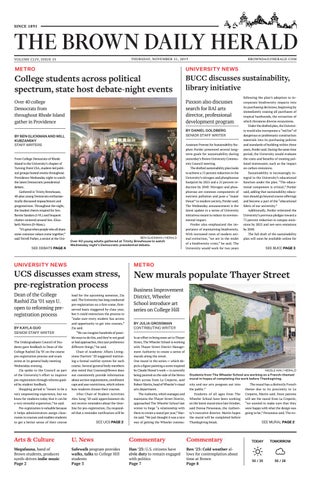
From College Democrats of Rhode Island to the University’s chapter of Turning Point USA, student-led political groups hosted events throughout Providence Wednesday night to watch the latest Democratic presidential debate. Gathered in Trinity Brewhouse, 40-plus young Democrats enthusiastically discussed impeachment and progressivism. Throughout the night, the loudest cheers erupted for Sen. Bernie Sanders (I-Vt.) and frequent chatter centered around Sen. Elizabeth Warren (D-Mass.). “It’s great when people who all share some common values come together,” said Terrell Parker, a senior at the Uni-
SEE DEBATE PAGE 4
BEN GLICKMAN / HERALD
Over 40 young adults gathered at Trinity Brewhouse to watch Wednesday night’s Democratic presidential debate.
UNIVERSITY NEWS
UCS discusses exam stress, pre-registration process Dean of the College Rashid Zia ’01 says U. open to reforming preregistration process BY KAYLA GUO SENIOR STAFF WRITER The Undergraduate Council of Students gave feedback to Dean of the College Rashid Zia ’01 on the course pre-registration process and exam stress at its general body meeting Wednesday evening. Zia spoke to the Council as part of the University’s effort to improve pre-registration through reforms guided by student feedback. Shopping period is “meant to be a very empowering experience, but we know for students today that it can be a very stressful experience,” he said. Pre-registration is valuable because it helps administrators assign classrooms to courses and enables students to get a better sense of their course
load for the upcoming semester, Zia said. The University has long conducted pre-registration on a first-come, firstserved basis staggered by class year, but it could restructure the process to “make sure every student has access and opportunity to get into courses,” Zia said. “We can imagine hundreds of possible ways to do this, and they’re not good or bad approaches, they just preference different things,” he said. Chair of Academic Affairs Livingstone Harriott ’20 suggested instituting a formal waitlist system for each course. Several general body members also noted that Courses@Brown does not consistently provide information about section requirements, enrollment caps and year restrictions, which inform how students choose their courses. After Chair of Student Activities Alex Song ’20 said upperclassmen do not receive reminders about the timeline for pre-registration, Zia responded that a reminder notification will be
SEE UCS PAGE 2
Assistant Provost for Sustainability Stephen Porder presented several longterm goals for sustainability during yesterday’s Brown University Community Council meeting. The drafted sustainability plan looks to achieve a 15 percent reduction in the University’s nitrogen and phosphorous footprint by 2025 and a 25 percent reduction by 2040. Nitrogen and phosphorous are common components of nutrient pollution and pose a “major threat” to modern society, Porder said. The Wednesday announcement is the latest update in a series of University initiatives meant to reduce its environmental impact. Porder also emphasized the importance of maintaining biodiversity. With increased rates of modern animal extinction, “we are in the midst of a biodiversity crisis,” he said. The University would work for two years
following the plan’s adoption to incorporate biodiversity impacts into its purchasing decisions, beginning by immediately ceasing all purchases of tropical hardwoods, the extraction of which threatens diverse ecosystems. Under the drafted plan, the University would also incorporate a “red list” of dangerous or problematic construction materials into its purchasing policies and standards of building within three years, Porder said. During the same time period, the University would evaluate the costs and benefits of treating polluted stormwater, such as the impact on carbon emissions. Sustainability is increasingly integral to the University’s educational function under the plan. “The educational component is critical,” Porder said, adding that sustainability education should go beyond course offerings and become a part of the “educational fabric of our university.” Additionally, Porder reiterated the University’s previous pledges toward a 75 percent reduction in campus emissions by 2025 and net-zero emissions by 2040. The full draft of the sustainability plan will soon be available online for
SEE BUCC PAGE 3
METRO
New murals populate Thayer Street Business Improvement District, Wheeler School introduce art series on College Hill BY JULIA GROSSMAN CONTRIBUTING WRITER In an effort to bring more art to Thayer Street, The Wheeler School is working with Thayer Street District Management Authority to create a series of murals along the street. One mural in the series — which depicts a figure painting a scene inspired by Claude Monet’s work — is currently being painted on the side of the Metro Mart across from La Creperie, said Robert Martin, head of Wheeler’s visual arts department. The Authority, which manages and maintains the Thayer Street District, approached The Wheeler School last winter to forge “a relationship with them to create a mural per year,” Martin said. “We just thought it was a nice way of getting the Wheeler commu-
NICOLE KIM / HERALD
Students from The Wheeler School are working on a French-themed mural in hopes of completing the work before Thanksgiving. nity and our arts program out into the public.” Students of all ages from The Wheeler School have been working on the latest mural since late October, said Donna Personeus, the Authority’s executive director. Martin hopes the mural will be completed before Thanksgiving break.
Arts & Culture
U. News
Commentary
Commentary
Megafauna, band of Brown students, produces synth-driven indie music Page 2
Safewalk program provides walks, talks to College Hill students Page 3
Han ’23: U.S. citizens have civic duty to remain engaged with politics Page 7
Ren ’23: Cold weather allows for contemplation about time at Brown Page 8
The mural has a distinctly French theme due to its proximity to La Creperie, Martin said. Since patrons will see the mural from La Creperie, “we wanted to make sure that they were happy with what the design was going to be,” Personeus said. The ex-
SEE MURAL PAGE 2
TODAY
TOMORROW
50 / 35
56 / 28
2
THE BROWN DAILY HERALD | NEWS
ARTS & CULTURE
Student band brings new sounds to Brown Megafauna experiments with ambitious electronic indie rock songs BY ALEXANDER VALENTI STAFF WRITER For the student band Megafauna, production is at the core of their music. They craft synth-driven indie rock songs with both their laptops and guitars — even during their live shows, the computer plays drums. Made up of housemates Brad Guesman ’20, Demos Efstathiou ’20, David Halpern ’20, Max Mines ’20 and Alex Randaccio ’20, Megafauna began performing live both on and off campus this month. The band is currently working on new music, which they plan to release before they graduate. They say that some of their best work materializes at the IKEA table in their living room. With their new material, the band is interested in creating cohesive sonic “worlds,” both within songs and across multiple tracks. “How do you make something that constructs a place that people can live in for a little bit while they’re listening to your music?” Guesman said. The band cited artists like Arcade Fire and Andy Shauf as influences, artists that have both released conceptual albums telling continuous stories from song to song through separate vignettes. Guesman has recorded and released music as a solo artist under the name “SN0WCRASH” since his senior year of high school. He met Efstathiou and Halpern during his first year at Brown, and then Mines and Randaccio the following year. Soon after, he recruited the four of them to record a live performance sample for a radio
UCS FROM PAGE 1 sent to all students a day prior to their pre-registration period next semester. Zia also solicited feedback from the general body on how to “lower the stakes” around exams in order to reduce stress and curb cheating. In May, University faculty passed a motion to modify the charge of the Standing Committee on the Academic Code in light of increased violations, The Herald previously reported. Under the modified charge, the committee can consider rewriting the academic code and setting up a “low-stakes” adjudication process for code violations, Zia said. Council members also reviewed an excerpt from the “Draft of a Working Paper for Education at Brown University,” the 1967 document proposing that the University adopt an open curriculum and make other changes to the undergraduate academic experience. The excerpt argued that tests “can serve as a learning experience in many ways.” “It is my hope, if we do this right, that there may be some way to share this material with students so that it might help to address the stress and anxiety that comes around with tests,” Zia said, adding that he hopes tests can be framed around learning rather than grades. But while general body members acknowledged the value of viewing tests
COURTESY OF BRAD GUESMAN
The five housemates produce most of their music around the IKEA living room table in their home. music competition for which he was a finalist. Guesman won the competition, and his SN0WCRASH work was played on San Francisco radio station KFOGFM as a result. The five seniors had all been writing music individually before forming Megafauna this semester. They believe collaborating has catalyzed their creative process. “I’m writing lyrics (during) all my classes,” Randaccio said. They are currently performing “SN0WCRASH” songs as well as solo work Mines has released under the name “Language Please.” Both projects feature intricate production that they try to recreate during their shows, weaving electronic sounds with live rock instrumentation.
as learning opportunities, several said students have different perspectives on tests. “At some level, grades do matter,” said Appointments Co-Chair Eamon McKeever ’22. General body members also gave feedback on other ways to reduce stress around exams, such as by encouraging first-years to take courses S/NC. The goal of the conversation with UCS was to consider “how we can help navigate (grades) while still promoting learning,” Zia said. “If we all believe that learning is the value of the campus, then we can use that as an anecdote to those moments when stress levels are high,” he added. After the discussion, the Council debriefed on recommendations to provide Zia, with some general body members expressing uncertainty about tangible changes to improve pre-registration and test taking. “Changing the narrative around tests seems really idealistic,” said UCS President William Zhou ’20. Harriott said that based on his individual conversations with Zia, reducing stress around pre-registration is “definitely one of (the University’s) priorities.” Before Zia spoke, Chief of Staff Melissa Lee ’20 announced that the Council will offer free shuttle rides to Boston Logan International Airport and
As they work on new material, the band said that a central concern is writing music that is meaningful and sonically creative, yet is also accessible to a wide audience and allows for entertaining live performances. “That’s always the balance you’re trying to strike when you’re writing pop music,” Guesman said. “Writing something that you think is accessible, that people want to listen to, but that also doesn’t compromise your artistic integrity,” he added. Fortunately, the band noted, they’ve found students at the University to be eager for new experiences and open to new sounds. “There’s an appetite for creativity,” Efstathiou said.
THURSDAY, NOVEMBER 21, 2019
MURAL FROM PAGE 1 act design of the mural will officially be revealed in a press release that will accompany a ribbon cutting, she added. The date of the ribbon cutting is unknown at this time, and the Authority does not yet know how many more murals will be in the series. Early this past summer, The Wheeler School completed its first public mural in conjunction with the Authority, entitled “Urban Coyote.” This mural is located on the side of Sneaker Junkies at 290 Thayer Street. The Authority is responsible for selecting the mural locations, but The Wheeler School has “some leeway with regard to subject matter,” Martin said. For instance, “the coyote was chosen as a bridge between our environmental science program and our arts program,” he explained. “Wheeler is a pleasure to work with,” Personeus said. “I love the fact that the kids who are right down the street are involved and that they have touched their street in two locations.” Students are not the only ones working on the murals. “It’s really a Wheeler community project,” Martin said. “We have everybody from faculty and alumni to almost every range of the school from kindergarten … up through high school” working on the murals. Feedback about the mural-painting experience has “all been pretty positive,” Martin added. “The younger kids, especially, really enjoy coming
over and being a part of a much bigger project.” Painting the murals has also been a great experience for some of the older kids “who wouldn’t define themselves as painters or artists,” Martin said. Personeus also added that while local businesses “did not ask for the art, we worked with the property owners” to choose mural locations. Roshan Baral, who has owned the Metro Mart convenience store on Thayer Street for the past 10 years, was not contacted about the mural prior to its creation, but he is pleased with its development. “If they can do (murals) all over the street, … (it would) make the street nicer,” Baral said. In addition to beautifying the neighborhood, the murals will help to prevent graffiti, he added. The mural series primarily aims to increase the presence of local art on Thayer Street. Along with the murals, Personeus said that the Authority is working to support community building and artistic endeavors through events such music series and visits from Santa on Thayer Street. In the future, the Authority hopes to collaborate with CVS “to either repair or replace the mural on the side of their wall.” Additionally, Personeus and the Authority look forward to further collaboration with Wheeler and have “many more plans” to bring art to Thayer Street.
LEON JIANG / HERALD
Dean of the College Rashid Zia ’01 spoke at the Undergraduate Council of Students general body meeting Wednesday night. They discussed the class pre-registration process and ways to address exam stress. T.F. Green Airport on the Tuesday and Wednesday before Thanksgiving break, continuing an initiative launched last Thanksgiving. The Council also heard updates from Elections Board Co-Chairs Song and Mary Stack ’21. To prepare for spring elections, Song
and Stack told the Council that UCS will create a working group to evaluate and improve its election bylaws and processes. Any undergraduate student who is not considering running for a position on UCS, the Undergraduate Finance Board or the Class Coordinating Board is eligible to join the working group.
In addition, UCS, UFB and CCB will hold a leadership training on Sunday open to any member of student government at the University. UCS Vice President Jason Carroll ’21 also introduced a form that general body members can fill out if they are interested in starting new initiatives through the Council.
THURSDAY, NOVEMBER 21, 2019
THE BROWN DAILY HERALD | NEWS
3
MUKUL KHANNA / HERALD
The Brown University Community Council discussed long term sustainability goals, the library’s five-year strategic plan and other initiatives at Wednesday’s meeting.
BUCC FROM PAGE 1 comments from community members. Community feedback is an integral part of the planning process, Porder said. During a question-and-answer portion of the presentation, Porder responded to a question about why the University’s drafted plan focuses on quantifiable changes rather than initiatives like increased community outreach and environmental justice. He stressed that he prioritizes quantifiable solutions because their progress is easier to measure. “We can’t as easily measure our impact on environmental justice. … That doesn’t mean we don’t think it’s important,” Porder said.
Later in the Council meeting, Joukowsky Family University Librarian Joseph Meisel presented the library’s five-year strategic plan. Meisel announced goals of heightening community engagement, aligning collections to fit the University’s academic needs and increasing scholarly opportunities through programs like undergraduate fellowships. The library also plans to increase the visibility of its special collections, like those held in the John Hay Library, as well as hire a head of digital technologies to help make the library’s digital collection more navigable. Meisel also stressed the importance of diversity and inclusion in the library. “Libraries have a special responsibility because we are the keepers of the sys-
tems of knowledge upon which scholarship depends,” he said, adding that those systems are often not structured or distributed in an equitable way. During the question-and-answer portion of Meisel’s presentation, Robert Williams ’18 MD’22 asked whether the library plans to make more scholarly resources available to individuals outside of the University community. Meisel said that licensing agreements prevent the University from expanding access to all of its scholarly resources to the greater Providence community. Also during the meeting, President Christina Paxson P’19 announced that the Office of the President, University Human Resources and the Office of Institutional Equity and Diversity
will create a professional development program for mid- and upper-level administrators. The program stems from a recent staff climate survey, which revealed a desire among staff for further professional development services at the University, Paxson said. A pilot program with 18 to 25 participants will launch early next year, Paxson said. “There will be a heavy focus on managing diverse and inclusive teams … and it will be very intensive,” she added. Paxson also announced that the University is currently searching for an artistic director for the Brown Arts Initiative. The director will oversee arts programming for both the Granoff Center for the Creative Arts and
UNIVERSITY NEWS
Safewalk promotes on-campus safety, community Program partners with DPS to provide studentled walks, support system BY GRACE PARK CONTRIBUTING WRITER
When the once-bustling streets of College Hill fall silent at night, some students turn to Safewalk. On Sundays through Thursdays, between 9 p.m. and 2:15 a.m., pairs of students equipped with bright neon vests and walkie-talkies accompany their peers from one destination to another. DPS officers and student supervisors, who oversee shifts, use a radio system to stay connected to Safewalkers as they take calls and circle campus to offer their walking services. “Knowing that there is an organization of nice students who are willing to walk you and talk to you all around
campus, … it gives strength in numbers and creates a communal investment in the ideals of safety,” said Safewalker Ben Zimmerman ’23. Founded in 1988, the program is composed of roughly 34 undergraduate students who are selected through an application and interview process. Once hired, Safewalkers go through a training session to decide pairings and review protocols. While they may not be rigorously trained in defense, these walkers aim to provide a sense of security by emphasizing that students can protect each other after dark. Coordinator Veronica Junco ’21 further stressed the significance of building a community in which students can take safety into their own hands. “It can be uncomfortable to reach out to officers or adults for safety, but we’re just students,” Junco said. “And it’s really important for students to feel like they can reach out to one another for safety.” Although Safewalkers’ primary purpose is to increase safety on campus, they also aim to foster a sense of com-
munity between students. “I like the conversations I have with people,” said Safewalker James Huang ’20. “I like getting to know my (Safewalking) partner and different people.” Junco added that Safewalk can also function as a “support system.” “We’ve had students tell us that it’s nice to have someone walk them after spending all day studying alone,” Junco said. “Not a lot of people realize, but it can be nice to vent to a complete stranger.” Anvita Bhagavathula ’23, who frequently uses Safewalk, recalled a time she used Safewalk after her Astrophysics lab. “It was raining, and the Safewalkers were dancing to ‘Singing in the Rain,’” she said. “I had had a rough day, and seeing that cheered me up and made me feel safer.” Safewalk is not the only resource on campus that aims to build a safe environment on and around campus. For example, the Brown shuttle and 150 outdoor emergency phones referred to as “blue lights” are also available to
students. The Herald’s Fall 2019 poll found that almost 40 percent of undergraduates feel unsafe outside in areas surrounding campus after dark. Safewalk is currently discussing the possibility of adding Friday and Saturday night shifts to the schedule. Though an extension of shifts would be ideal, Junco and Safewalk Supervisor Zachary Baytosh ’21 said there would be limitations in implementing the change. “It not only requires fulfilling financial needs, but also poses the issue of finding walkers that are willing to work on Fridays and Saturdays,” Junco explained. Baytosh added that “there are concerns about restructuring shift assignments and training sessions. Fridays and Saturdays would be considered ‘higher risk’ nights due to alcohol and drug usage, so more intense training would be required for those shifts.” “It requires a lot of pieces coming together, but we’re generally reviewing the possibilities with positivity,” Baytosh said.
the Performing Arts Center once its construction is completed. “The idea is to make Brown this very porous place for the arts,” Paxson said. With the finished PAC, “we will really have expanded the space and scope for artistic expression at Brown,” making the new position necessary, she added. A faculty search committee and an external advisory group are currently working on a list of potential candidates, with a goal of filling the position during summer 2020. Paxson also reported on the University’s recently announced initiative to extend need-blind admission and make standardized test score submissions optional for prospective student veterans.
4
THE BROWN DAILY HERALD | NEWS
DEBATE FROM PAGE 1 versity of Rhode Island and an executive board member of the College Democrats of Rhode Island. “It creates a more genuine and warm environment.” As the debate unfolded, eyes remained fixed on the some of the eight televisions spread around the room. Small groups yelled in support after their candidate of preference made a statement. Some booed. Many joked about candidates who, in their opinion, have no shot at the nomination. The gathering included student groups from Brown, URI, Salve Regina University, Providence College and Bryant University, as well as one representative from Rhode Island College. The umbrella organization CDRI organized the event. The debate-night event was the prominent fall gathering for CDRI, a group that aims to foster collaboration between college democrats across the state. “With the more people we have, the more different perspectives we have,” said Robbie Welcome, a junior at Salve Regina. “It’s also just good networking to meet people from other schools.” CDRI is associated with the College Democrats of America, a nationwide organization of college democratic chapters which is affiliated with the Democratic National Committee. Rose Lang-Maso ’20, president of CDRI and former president of Brown Democrats, organized the event with the help of the Rhode Island Democratic Party. “There are a lot of degrees of separation between us and the (Democratic) party,” Lang-Maso said. “There is room for us to break away from the party to a certain extent, but at the same time, we do try to be respectful of what the party is thinking about.” Cyd McKenna, who is the executive director of the RIDP and was involved with organizing the event, emphasized
THURSDAY, NOVEMBER 21, 2019
the need to help cultivate the next generation of democratic leadership. “It’s important that there’s an overall body that’s inclusive of all the universities, especially in a state like Rhode Island where we have so many,” McKenna said. “Rose (Lang-Maso) has done a great job in reaching out to different universities to bring different groups together.” Meanwhile, in a small classroom in the basement of Friedman Hall, eight students gathered to watch the debate at an event organized by Turning Point USA at Brown, the University’s chapter of the conservative youth organization. On its Facebook page, the group invited students to “A Night of Comedy.” “We’re curious to see what the Democratic candidates have for their vision of America,” said Christian Diaz de Leon ’21, president of Turning Point USA at Brown. “We’re a limited government organization. With candidates like this campaigning for bigger government, of course we’re going to find those policies a little humorous.” During the debate, quiet skepticism and laughter emanated through the room. But the night wasn’t entirely full of animosity toward the candidates. De Leon said that Turning Point encouraged people with all viewpoints to attend the event, adding that at least one Democrat was in the room. At one point, a bobblehead of President Donald Trump made an appearance for photos, circulating through the back of the room. Still, skepticism primarily ruled the night. Attendees yelled out occasional jabs in response to what was happening on the debate stage. For de Leon, the prospect of a candidate such as Sanders or Warren winning the White House is alarming. “It’s kind of scary,” de Leon said. “Prosperity always comes from deregulation, free markets, not a bigger government solution.”
Have opinions?
Tell us about them! See guidelines at browndailyherald.com/submissions
December 5, 2019
THURSDAY, NOVEMBER 21, 2019
THE BROWN DAILY HERALD | TODAY
5
CA L E NDA R TODAY
NOVEMBER S
3
M
Tu
4
5
W
6
Th
7
F
S
1
2
8
9
Brown Gives Bake Sale 8:00 A.M. 121 South Main Street
VR Pop-Up Open Studio Brown University Orchestra 1:00 P.M. Concert Granoff Center for the Creative Arts 8:00 P.M. Sayles Hall
10
11
12
13
14
15
16
17
18
19
20
21
22
23
24
25
26
S U D O KU
27
28
29
Python Programming from Absolute Zero 12:00 P.M. Rockefeller Library
30
TOMORROW DSCoV: DataLad 12:00 P.M. 164 Angell Street
Dinner with President Paxton & Eric Estes 6:30 P.M. Eric Estes’ Residence
Brown Lecture Board presents: HASAN MINHAJ 7:30 P.M. Salomon Center
Neuro DUG Movie Night Memento 7:00 P.M. Smith-Buonnano Hall
Q U OTE OF TH E DAY
“How do you make something that constructs a place that people can live in for a little bit while they’re listening to your music?”
—Brad Guesman ’20 SEE MEGAFAUNA PAGE 2
WATER + COLOR CR O S SWO R D
ANDREW DING / HERALD
Although less breathtaking on paper, this picturesque Providence sunset still seeps into the watery reflections of the serene river bank waters.
6
THE BROWN DAILY HERALD | COMMENTARY
THURSDAY, NOVEMBER 21, 2019
Politics matters, it should matter to you too BLISS HAN ’23 STAFF COLUMNIST
On Tuesday, Nov. 19, a man spoke before a panel of congressional representatives and millions of Americans tuned in to watch an investigation into President Donald Trump’s potentially impeachable interactions with Ukranian officials. That man was Lieutenant Colonel Alexander Vindman, the National Security Council director for Europe and a recipient of the Purple Heart for his valor in Iraq. In his opening statement, Vindman addressed his father, an immigrant who fled with his family from the USSR to the United States when Vindman was just a child. “Do not worry,” Vindman said. “I will be fine for telling the truth.” Later, Rep. Sean Maloney (D-NY) asked Vindman about his statement: “And why do you have the confidence that you can do that, and tell your dad not to worry?” The Lieutenant Colonel shook his head slightly, perhaps in preparation for the weighty words he was going to utter, and responded, “Congressman, this is America. This is the country I’ve served and defended. That all of my brothers have served. And here, right matters.” In so few words, Vindman outlined the morals that undergird what it means to be not only an American president, but an American citizen. To us, right and wrong is supposed to matter. A few days before Vindman’s moving testimony, I got in an argument with a friend over the importance of voting. To me, voting has never been a question. But I had also grown up in a family that emphasized the importance of civic responsibility. I am from Ann Arbor, an extremely politically active and progressive
city within a state that was decided by fewer than 11,000 individual votes in the 2016 election. It was easy for me to think that my singular vote truly mattered, even on a national level. But to my friend, a Californian, none of those statements held true. He argued that in national elections, his state was always going to go blue anyways, regardless of his individual
ery level of office. While our individual political decisions, especially those made at a national level, may not impact the races in a meaningful way, it is still our civic obligation to be politically involved. Even if a race’s outcome is all but decided before we cast our individual votes, it is nonetheless vital to vote. Staying home reflects and contributes to a cynicism about our politi-
“While our individual political decisions, especially those made at a national level, may not impact the races in a meaningful way, it is still our civic obligation to be politically involved.”
action. I responded that elections and political engagement mattered beyond a choice between two candidates for the nation’s highest office, as significant as that was. Elected officials include our school board members, local judges, and state and national representatives. Voting is the method by which citizens can ensure that their representatives and governing bodies reflect their own values and opinions. But he was indifferent to this argument as well, saying that if he did not feel well-informed on the candidates, he would prefer to not vote at all. But this reasoning is precisely why we should educate ourselves on candidates at ev-
cal system that threatens the values of American democracy. Many may sympathize with my friend’s argument more than mine. And it is true that today’s politics seem more cynical, polarized and depressing than ever. But while remaining willfully ignorant of politics because it is tiring or overwhelming is understandable, it also reflects a certain kind of privilege. Yes, many Brown students are lucky enough not to have felt their daily lives be affected by whoever is in the White House. But make no mistake — politics, whether from the White House or not, can affect each and every one of us. Voters ostensibly determine what happens to
their lives at the local, state and national levels. They even have the power to significantly influence the trial of the most powerful elected official in the world — it has been public opinion, more than the individuals beliefs of U.S. senators, that has determined whether an impeached president has been removed or not. Democracy is a gift, but it is also an important responsibility: We only get as much from the government as we put in. It is easy to take our privileges as citizens for granted. When I was looking for a response to my apathetic friend, I asked my father for advice. He has resided in America for almost thirty years since immigrating as a graduate student from South Korea, but he became a citizen less than five years ago. He told me, “When I was just a resident in this country, I still had to pay taxes and work a job. People think that those are responsibilities of American citizens, but I had those responsibilities even when I was not a citizen. All the decisions made by politicians still affected me and my family, but I had no say in the matter. I might as well have been invisible. As a current citizen of this country, I believe that it is not only my right, but my absolute duty, to vote for what I want and for what I think is right.” I hope that my father, my friend, and all Americans were listening when Lieutenant Colonel Vindman said that here, in America, what is right matters. And I pray that even in the face of endless political cynicism, Vindman’s call to our collective civic obligations gives them as much hope as it gave me. Bliss Han ’23 can be reached at bliss_han@ brown.edu. Please send responses to this opinion to letters@browndailyherald.com and op-eds to opinions@browndailyherald. com.
Want daily headlines or weekly Brown Bites in your inbox? linktr.ee/browndailyherald SINCE 1891
THE BROWN DAILY HERALD Editorial Leadership Editor-in-Chief Emily Davies Managing Editors Anna Kramer Priyanka Podugu Senior Editors Anita Sheih Sarah Wang Editorial Page Editors Grace Layer Krista Stapleford post-magazine Editor-in-Chief Anita Sheih
Sections Arts & Culture Editors Elise Ryan Annabelle Woodward Metro Editors Dylan Clark Sophie Culpepper Alex Reice News Editors Celia Hack Jacob Lockwood Melanie Pincus Allie Reed Science & Research Editors Cate Ryan Chris Schutte Sports Editors Alexandra Russell Alex Smolar
Commentary Opinions Editors Rebecca Aman Jamie Flynn Derek Simshauser Multimedia/Production Design Editors Bilal Ismail Ahmed Keelin Lyons Dylan Tian Head Photo Editors Tiffany Ding
Business General Managers Ravi Betzig Nicholas Masiakowski Office Manager Diane Silvia Directors Sales: Bersabel Yifru Finance: Rudra Srivastava Reynaldo Blandon
Copy Desk Chief Kelley Tackett Illustrations Editor Summer Zhang Graphics Editor Sarah Martinez
@the_herald
facebook.com/browndailyherald
@browndailyherald
youtube.com/browndailyherald
195 Angell St., Providence, RI (401) 351-3372 www.browndailyherald.com Editorial: herald@browndailyherald.com Advertising: advertising@browndailyherald.com
Submissions: The Brown Daily Herald publishes submissions in the form of op-eds and letters to the editor. Op-eds are typically between 750 and 1000 words, though we will consider submissions between 500 and 1200 words. Letters to the editor should be around 250 words. While letters to the editor respond to an article or column that has appeared in The Herald, op-eds usually prompt new discussions on campus or frame new arguments about current discourse. All submissions to The Herald cannot have been previously published elsewhere (in print or online — including personal blogs and social media), and they must be exclusive to The Herald. Submissions must include no more than two individual authors. If there are more than two original authors, The Herald can acknowledge the authors in a statement at the end of the letter or op-ed, but the byline can only include up to two names. The Herald will not publish submissions authored by groups. The Herald does not publish anonymous submissions. If you feel your circumstances prevent you from submitting an op-ed or letter with your name, please email herald@browndailyherald.com to explain your situation. You can submit op-eds to opinions@browndailyherald.com and letters to letters@browndailyherald. com. When you email your submission, please include (1) your full name, (2) an evening or mobile phone number in case your submission is chosen for publication and (3) any affiliation with Brown University or any institution or organization relevant to the content of your submission. Please send in submissions at least 24 hours in advance of your desired publication date. The Herald only publishes submissions while it is in print. The Herald reserves the right to edit all submissions. If your piece is considered for publication, an editor will contact you to discuss potential changes to your submission. Commentary: The editorial is the majority opinion of the editorial page board of The Brown Daily Herald. The editorial viewpoint does not necessarily reflect the views of The Brown Daily Herald, Inc. Columns, letters and comics reflect the opinions of their authors only. Corrections: The Brown Daily Herald is committed to providing the Brown University community with the most accurate information possible. Corrections may be submitted up to seven calendar days after publication. Periodicals postage paid at Providence, R.I. Postmaster: Please send corrections to P.O. Box 2538, Providence, RI 02906. Advertising: The Brown Daily Herald, Inc. reserves the right to accept or decline any advertisement at its discretion.
The Brown Daily Herald, Inc. is a financially independent, nonprofit media organization bringing you The Brown Daily Herald, BlogDailyHerald and Post- Magazine. The Brown Daily Herald has served the Brown University community daily since 1891. It is published Monday through Friday during the academic year, excluding vacations, once during Commencement and once during Orientation by The Brown Daily Herald, Inc. Single copy free for each member of the community. Subscription prices: $200 one year daily, $100 one semester daily. Copyright 2019 by The Brown Daily Herald, Inc. All rights reserved.
THURSDAY, NOVEMBER 21, 2019
THE BROWN DAILY HERALD | COMMENTARY
7
On feeling cold BY JOHNNY REN ’23 STAFF COLUMNIST I am your California stereotype: a warm-weather weakling who cannot handle any temperature under 50 degrees Fahrenheit. I shiver at the slightest breeze. A beanie is perpetually glued to my head. The winter jacket I bought before coming to Brown has already become a staple in my wardrobe. Or rather, it has become my entire wardrobe. I often get mocked for my habits. My friends in my dorm, particularly those coming from the Midwest or the East Coast, enjoy roasting me for dressing like a down-stuffed, multi-layered marshmallow. “It’s not even that cold. You are going to die when winter comes,” they say to me. I don’t disagree with them. In fact, I wholeheartedly endorse their hyperbolic forecasting — I am going to freeze if it gets any colder. And yet, the effects of chilly weather have not been entirely painful or fruitless. As I spend more time huddled by the heater in my room, I have also gained more opportunities for reflection. Among other things, I have realized that there is value to feeling cold. More broadly, there is value in recognizing all the feelings we may find unpleasant. Before coming to Brown, I was presented with a carefully constructed image of what life here was supposed to be like. Enthusiastic alums and smiling faces on brochures projected an image of perfection, paradise in Providence, the home where I would spend the best four years of my life. The other day, I saw an intriguing head-
line in The Herald about happiness. I read the piece and came upon a striking statistic: around 90 percent of Brown students considered themselves happy. I felt a small sense of celebration then, knowing that the overwhelming majority of my peers were enjoying their time here. I also felt reassured, reassured that Brown was the place I had imag-
The issue was not my capacity to achieve happiness, rather, it lay in my expectation of it. As I read that innocuous piece of data in the paper, I felt myself straining to be joyful, trying to imagine all the times I was happy, all the ways I was supposed to fit into the ethos of the Brown community. In all honesty, if I looked solely at how I felt in that exact moment, I
“As I spend more time huddled by the heater in my room, I have also gained more opportunities for reflection.”
ined it to be. But right after reading that statistic, I also asked myself the question from the poll — was I happy? And I remember the moment well, because in that instant, I could not answer. Statistically speaking, what were the odds that I would fall into the not-so-happy minority? It seemed unlikely that I would be part of the ten percent, unlikely that I would consider myself anything but happy. After all, I love Brown. My experiences these past few months have exceeded my expectations in many ways. I am constantly stunned by the beauty of fall. I have made new friends whom I cherish greatly. I have learned many things, not just in the realm of academics, but about myself as a person.
was not happy. I was dealing with feelings of homesickness. I was overwhelmed by my studies. I was finally realizing the frightening gravity of my newfound independence. Still, I was unsure of how I would respond. Would saying that I was happy in a poll somehow make it true? Would saying the opposite make the opposite true? Being told the weather was warm never made it any warmer. I have realized that the same is true for my happiness. In reality, I deserve the right to feel cold, to feel sadness. If anything, it would have been more honest for me to answer the question from the poll based off how I felt in the moment. Then, at least, I could begin to acknowledge and remedy my own anxieties.
Many theories in the world seek to describe the relationships between language, belief and reality. There exists the idea, for example, that our words can be performative, that what we say can be willed into reality simply through being said. Some believe in the law of attraction, the theory that positive thoughts give rise to positive outcomes, that negative thoughts give rise to negative outcomes. I had subscribed to these philosophies for the longest time growing up. I had thought that envisioning myself as a strong or competent individual would make it true. Saying that I was doing okay meant that I was doing okay. I felt committed to a narrative, one of lofty goals and aspirations, and I assumed implicitly that any deviation from that predefined path would somehow undermine the final objective. Looking back, it would have been much better for me to simply acknowledge the cracks in the facade, moments of insecurity, fear or failure. The admission of our weakness is equally important as the pursuit of our ideals. When December arrives, I will have no shame in my all my extraneous winter attire. There is value to feeling cold, because when you feel cold you know to put on an extra layer. Spring will arrive again, whatever that means on the East Coast. In the meantime, I will happily endure all the taunts from my more weather-resistant friends. Johnny Ren ’23 can be reached at jiawei_ ren@brown.edu. Please send responses to this opinion to letters@browndailyherald. com and op-eds to opinions@browndailyherald.com
8
THE BROWN DAILY HERALD | NEWS
THURSDAY, NOVEMBER 21, 2019