SINCE 1891
THE BROWN DAILY HERALD MONDAY, NOVEMBER 4, 2019
VOLUME CLIV, ISSUE 43
BROWNDAILYHERALD.COM
SPORTS
Women’s soccer wins league title, beats Penn in double overtime Carchio ’20 puts away penalty kick in 110th minute as only goal in 1-0 match BY RANDI RICHARDSON STAFF WRITER Abby Carchio ’20 ripped off her jersey while running the length of the field, away from the goal where she had just netted her penalty kick during the 110th minute of Saturday night’s women’s soccer game against Penn. The goal sealed a 1-0 victory and secured the Ivy League conference title for the Bears. The entire team, including the bench, enthusiastically chased Carchio down and hoisted her above their shoulders while she held the Ivy League Championship trophy in her hand. After returning to ground level, Carchio sprinted into the open arms of Head Coach Kia McNeill for an embrace. “It couldn’t have been written any better,” Carchio said. “There’s something special about my teammates, and we just proved that tonight. It’s been an amazing ride. I couldn’t have done it without (my teammates’) support through the lows and picking me up, clearly.” The post-game celebration was neatly complemented by a pre-game
ceremony that honored the Bears’ seniors. Bruno channeled its energy from saying farewell to seniors Carchio, Abby Kaplan ’20, Celia Story ’19.5 and Andie Gilmore ’20 into winning the Ivy League title. “It’s just a totally different team here (now),” Kaplan said, recalling her first year. “It’s a fun team to be a part of. It’s definitely become a culture of loving the game and playing for each other rather than just going out and having a hobby. And our team embodies that. It’s exciting to have (my) last season be the longest season we’ve had.” During the competition, the Quakers played for a draw, but Brown intended to win and its drive through double overtime proved it. Throughout the game, the Bears attacked from left to right and often hit the ground after the Quakers tripped, tackled and elbowed them while competing neck and neck for loose balls. The magnitude of what upsetting Brown would mean was not lost on the Quakers, who tapped into that mindset for the whole game. “A lot of times when teams don’t know what to do with you, they get physical and aggressive,” Story said. “We know that that’s not the way we play. We play direct and we play real soccer. We kept our head in the game and didn’t let the (physicality) get to
us.” Where Penn tested Brown with aggressive physicality, cries of support erupted from the bleachers, compelling the referees to make more calls. But their outburst of discontent did not matter to Penn, who kept the pedal to the metal by pushing the Bears around and hoping to outtough the only 12-1-1 team in the conference. The 10th minute of the half saw Penn take advantage of Brown’s disorganized defense to create a one-onone situation in the box. The Quakers shot into the net’s upper right corner, but the Bears’ goalie Kayla Thompson ’21 practically hung still in the air after stretching her entire body to make the save. And so the half ended, scoreless and with a cycle of no-calls, fans voicing outrage and refs having stern consultations with Quakers instead of presenting yellow cards. The second half picked up right where the first half left off, with Penn attempting to physically intimidate Brown, which played with tenacity. A couple of minutes into the half, Zoe Maxwell ’22 sent a long ball up to Brittany Raphino ’23, who was one versus four. Raphino showed off some fancy footwork and sent the ball hurling toward the back left corner of the net. Penn goaltender Kitty Qu was nowhere to be found, but Raphino’s ball hit off
SCIENCE & RESEARCH
U. research may aid cancer treatment Study shows decrease in growth factor is key in preventing cancer’s spread
COURTESY OF BROWN ATHLETICS
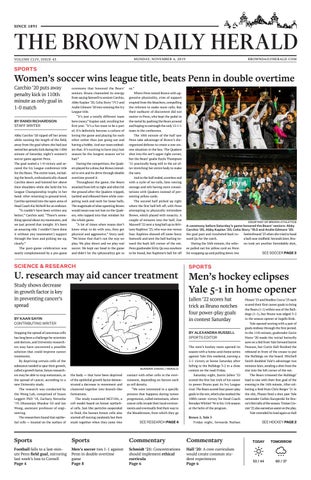
A ceremony before Saturday’s game honored the Bears’ seniors: Abby Carchio ’20, Abby Kaplan ’20, Celia Story ’19.5 and Andie Gilmore ’20. the goal post and ricocheted back to- Seelenfreund ’23 when she tried to head ward Qu for the catch. a ball near midfield. Seconds later, BruDuring the 56th minute, the refer- no took yet another formidable shot, ee pulled out his yellow card on Penn for wrapping up and pulling down Ava SEE SOCCER PAGE 3
SPORTS
Men’s hockey eclipses Yale 5-1 in home opener Jallen ’22 scores hat trick as Bruno notches four power-play goals in contest Saturday
BY KAAN SAYIN CONTRIBUTING WRITER
BY ALEXANDRA RUSSELL SPORTS EDITOR
Stopping the spread of cancerous cells has long been a challenge for scientists and doctors, and University researchers may have uncovered a possible solution that could improve cancer treatments. By depriving certain cells of the substance needed to spur their growth, called a growth factor, future researchers may be able to stop metastasis, or the spread of cancer, according to a new University study. The research was conducted by the Wong Lab, comprised of Susan Leggett PhD ’18, Zachary Neronha ’19, Dhananjay Bhaskar GS and Ian Wong, assistant professor of engineering. The researchers found that epithelial cells — located on the surface of
the body — that have been deprived of the epithelial growth factor demonstrated a decrease in movement and clustered together into branch-like formations. The study examined MCF10A, a cell model based on breast epithelial cells. Just like particles suspended in fluid, the human breast cells also started off moving randomly but then stuck together when they came into
contact with other cells in the environment, depending on factors such as cell density. “We were interested in a specific process that happens during tumor progression, called metastasis, where cancer cells invade their local environments and eventually find their way to the bloodstream, from which they go
Sports
Sports
Commentary
Commentary
Football falls to a last-minute Penn field goal, mirroring last week’s loss to Cornell Page 4
Men’s soccer ties 1-1 against Penn in double overtime game Page 8
Schmidt ’21: Concentrations should implement ethical curricula Page 6
Hall ’20: A core curriculum would create common student experiences Page 6
SUMMER ZHANG / HERALD
SEE RESEARCH PAGE 4
The men’s hockey team opened its season with a home-and-home series against Yale this weekend, earning a 5-1 victory at home Saturday after falling to the Bulldogs 3-2 in a close contest on the road Friday. Saturday night, Justin Jallen ’22 scored the first hat trick of his career to power Bruno past its Ivy League rival. The Bears scored four power-play goals in the win, which also marked the 100th career victory for Head Coach Brendan Whittet ’94 in his 11th season at the helm of the program. Brown 2, Yale 3 Friday night, forwards Nathan
Plessis ’23 and Bradley Cocca ’23 each scored their first career goals to bring the Bears (1-1) within one of the Bulldogs (1-1), but Bruno was edged 3-2 in the season opener at Ingalls Rink. Yale opened scoring with a pair of goals midway through the first period. In the 11th minute, goaltender Gavin Nieto ’20 made the initial butterfly save on a bid from Yale forward Justin Pearson, but Curtis Hall finished the rebound in front of the crease to put the Bulldogs on the board. Mitchell Smith doubled Yale’s advantage two minutes later, sending a shot from the slot into the left corner of the net. The Bears trimmed the Bulldogs’ lead to one with their first goal of the evening in the 14th minute. After collecting a feed from Chris Berger ’21 in the slot, Plessis fired a shot past Yale netminder Corbin Kaczperski for Bruno’s first tally of the season. Tristan Crozier ’22 also earned an assist on the play. Yale extended its lead again as Hall
SEE HOCKEY PAGE 2
TODAY
TOMORROW
53 / 44
60 / 37
2
THE BROWN DAILY HERALD | NEWS
ARTS & CULTURE ROUNDUP BY ANNABELLE WOODWARD AND ELISE RYAN RISD Museum workshop encourages teaching with objects This Tuesday, the Rhode Island School of Design Museum will lead “Museum as Object,” a workshop focused on teaching with objects. Considering questions like “What makes an object museum-worthy?” the workshop intends to provide participants with insight into how museum objects are selected as well as how both museum and object histories can be incorporated into teaching. The workshop comes as part of a series between the University’s Harriet W. Sheridan Center for Teaching and Learning and the RISD Museum. This interactive session will be led by Steven Lubar, professor of American Studies, History and History of Art and Architecture at the University. The workshop will take place from 12 to 1:20 p.m. on Tuesday at the museum. Accomplished artist, filmmaker speaks on artistic vision On Wednesday, artist and filmmaker Carla B. Guttmann ’93 will
speak in the List Art Building, Room 110, about her career path and artistic process. A native of Montreal, Canada, Guttmann studied fine art and semiotics while at Brown and has exhibited her art in cities across the United States and Canada. She was also the creative force behind award-winning films that include “The Double Woman” and “Hel” as well as the documentary “Making Heart of Fire,” which was broadcast on German television in 2009 and 2011. Guttman uses her art to “present gender with more complexity and counteract cliches which flatten the sophistication of our society,” according to her website. The event begins at 5 p.m. Tickets are available online. Grant Recital Hall to fill with electronic, acoustic sounds On Friday from 8 to 10 p.m., students from the University’s music and multimedia composition program will present their recent works in Grant Recital Hall. Throughout the PhD program, students create origi-
MONDAY, NOVEMBER 4, 2019
Follow us on ...
nal works, often pairing electric and acoustic compositions with video, performance and text. The students also collaborate with University faculty, as well as visiting groups and artists. This event, titled “Ideal Hazards,” will include work from PhD students Alex Dupuis, Martim Galvao, Lee Gilboa, Jack Sokolov-Gonzalez, Amber Vistein and Marcel Zaes. Actor Ibrahim Miari to perform one-man play, “In Between” Professional actor and language teacher Ibrahim Miari will perform his one-man play, “In Between,” in Salomon Center 001 this Thursday. Sponsored by the Hebrew Program in Judaic Studies and the Arabic Program in the Center for Language Studies, Miari’s play portrays “the complexities and contradictions inherent in Palestinian-Israeli identity.” As the son of a Palestinian Muslim father and a Jewish Israeli mother, Miari’s work concerns the complexities of living between two cultures. Miari is a professor of Hebrew at Penn.
COURTESY OF BROWN ATHLETICS
The Bears’ 5-1 victory over Yale marked the 100th career win for Head Coach Brendan Whittet ’94. Bruno returns to action with visits to Cornell and Colgate University this weekend.
HOCKEY FROM PAGE 1 posted his second goal of the contest during a four-on-four eight minutes into the second period. But Bruno answered back, notching a power-play goal in the middle of the third stanza to bring the game within one. Waiting at the point, Cocca redirected a pass from Zach Giuttari ’20 past Kaczperski for his first career goal with the Bears. Bruno pulled Nieto with two minutes remaining, but the Bulldogs were able to hold off the attack to secure the win. Nieto made 33 saves in the contest. Brown 5, Yale 1 The following day saw the Bears bounce back with a convincing victory
over the Bulldogs. In addition to Jallen’s hat trick, Cocca and Berger also notched tallies for Bruno, while Michael Maloney ’22 and Giuttari posted three and two assists, respectively. “Friday was a little disappointing — we didn’t play to our strengths and what we’re capable of, but Saturday we answered perfectly and showed them what Brown hockey’s actually like,” Cocca said. Jallen put the Bears on the board late in the first period. After taking advantage of a turnover behind the net, Maloney sent the puck to Jallen, who launched a shot past Kaczperski from the slot. Bruno killed off a pair of critical penalties to preserve its lead midway
through the second stanza. Though Yale’s Cole Donhauser scored unassisted to equalize the contest in the 14th minute, the Bears quickly reclaimed the advantage with a pair of power-play goals late in the frame. Jallen backhanded a rebound past Kaczperski through traffic in front of the net at 16:22, before Berger tapped in another rebound to put Brown up 3-1 three minutes later. Killing the five-on-three “was a big turning point in the game to get the momentum back,” Jallen said. “Winning special teams is huge, and if you win the special teams, you usually win the game. If we can keep doing it on the penalty kill and the power play, I think we’ll be in good shape.” Jallen sealed his hat trick in the sec-
ond minute of the third period, burying a centering feed from Maloney. Cocca followed later in the stanza, finishing a set up from Giuttari and Crozier to give the Bears a final advantage of 5-1. “We did a lot of things that would enable us to have success,” Whittet said. “We put them on their heels a little bit, I thought we really had the puck a large portion of that game, and thought we were excellent in most situations tonight — we played the type of hockey we have to play.” The Bears’ special teams featured heavily in the contests, as the power play went 5-for-9 and penalty kill had a 100 percent success rate over the weekend. “Last year our power play numbers
were really low, so to get off to a hot start is big,” Jallen said. “We have some good chemistry right now, and hopefully we can keep building on it.” The team also saw production from its first-year class of 10, which has added variety and versatility to its roster, Whittet said. “We have some different elements this year with some of the young guys,” Whittet said. “They’ve really helped to elevate us and give us a little bit of depth that maybe we didn’t have in the past.” The Bears seek to carry the momentum from Saturday’s victory forward as they lace up their skates this weekend at No. 4 Cornell and Colgate University. Face-off is at 7 p.m. Friday and 4 p.m. Saturday.
MONDAY, NOVEMBER 4, 2019
THE BROWN DAILY HERALD | NEWS
3
SOCCER FROM PAGE 1 but it was too high. By the end of the half, Brown had stacked up numerous shots that looked good, but the perfect goldilocks shot remained elusive to Bruno, so regulation ended scoreless for both teams and forced overtime. “We knew what was on the line,” Story said. “We’ve worked so hard for this. (Our class) was the first one (McNeill) coached. She came in and really changed the program and (tonight) it’s really full circle. To see it all … I can’t describe the feeling.” An uneventful overtime marked 100 minutes of goalless play. Similar to regulation and the first overtime, Penn played for the draw during the second overtime. The Quakers routinely took 20 seconds or more to play a ball back in and only did so because the referee pressed them to resume play. During the 110th minute, a handball was called on Penn from Maesyn G’Bye’s ’22 throw in and the referee awarded Brown with a penalty kick. Carchio took it, a fitting play for senior night. “We knew it was going to be a physical game,” Kaplan said. “It’s hard when the other team is playing for a tie, but we put it at them and finally got a call our way.” No sooner than when Carchio started her kick did fans see her sprint down
COURTESY OF BROWN ATHLETICS
The women’s soccer team celebrates after winning its first Ive League title since 1994 with the final score of 1-0 to end the match. the field and rip her jersey off with the entire Brown team chasing behind her. Bruno lifted Carchio up and over its shoulders to celebrate a 1-0 victory, securing the Ivy League Title and a spot in the NCAA Tournament. “When (Carchio) kicked that goal
in,” Gilmore said, “tears started rolling down my face. It’s been incredible. This has been an incredible season. Every 5:45 a.m. workout, every run, every tough practice and bad ball is all worth it. The relationships that I’m forming on this team and the experiences we’re
going through, specifically this season… I will remember for the rest of my life.” “The now-seniors were with me from the beginning,” McNeill said. “They’ve seen the ups and downs and (know) what we’ve gone through as a program. I’m just so happy for them
and happy for the way that we can send them out of their (collegiate) careers as Ivy League Champs and going to the NCAA Tournament.” The Bears will face off against Yale to close out the regular season this weekend.
4
THE BROWN DAILY HERALD | NEWS
MONDAY, NOVEMBER 4, 2019
SPORTS
Football comeback falls short against Penn Saturday Bears lose on lastminute field goal for second straight Ivy League game
BY RYAN HANDEL SENIOR STAFF WRITER After the football team fell to Cornell on a go-ahead field goal during the game’s waning seconds last weekend, Brown hoped to rebound Saturday against a Penn squad that was still searching for its first Ivy League victory of the season. Instead, it was deja vu for the Bears, as the Quakers knocked a field goal through the uprights with two seconds left in the game to hand Bruno a 38-36 loss. The defeat left Brown as the last Ivy League team without a conference win, and extended the Bears’ 19-game Ivy losing streak. “It’s difficult to lose, and we’ve got a senior group who’s hungry to win,” said Head Coach James Perry ’00. “But, we keep making progress. Each week, I think we get a little bit better, a little closer.” Brown (1-6, 0-4 Ivy) got off to an explosive start on offense, as quarterback EJ Perry ’21 turned on the jets for a 50-yard rushing touchdown. The Bears’ defense also had a strong first quarter, holding the Quakers to four straight punts and just 24 yards as Bruno finished the period with a 7-0 lead. But Penn’s offense got rolling in the second quarter, as the Quakers
RESEARCH FROM PAGE 1 to other organs,” Dhananjay said. Cells can move through the bloodstream and to other organisms in a process called EMT, or epithelial-mesenchymal transition. “In processes such as wound healing, EMT is really useful since epithelial cells that are normally together have to move together to cover up a wound and to heal it. However, in cancer, this process allows cells to escape to the bloodstream from the original tumor site and spread to the rest of the body. This spreading process causes 90 percent of the cancer deaths in the US,” Neronha said. There are two kinds of ways that cells come together when they are suspended in fluid, and this process is affected by the presence of a growth factor. Under standard conditions, the cells tend to slow their movement and form more high-density clusters without stable connections. But when they are deprived of growth factor, the cells “slow down at much lower densities, as they form meaningful and stable connections with each other,” Neronha said. The study found that in the condition without the growth factors and EMT movement mechanism, the cells formed their respective branch-like clusters but stayed apart from each
JOIN
embarked on a seven-play, 69-yard drive capped by a touchdown from running back Abe Willows. Then a Brown fumble set up Penn with prime field position, and the Quakers needed just four plays to cash in with another Willows rushing touchdown. The Bears’ rushing attack responded, as a 44-yard scamper by running back Allen Smith ’22 set up another score on the ground by Perry. But a missed extra point from Dawson Goepfrich ’20 prevented Bruno from tying the game, and Brown remained behind 14-13. The teams turned to the air as the first half came to a close. Penn quarterback Nick Robinson found receiver Ryan Cragun on a 24-yard scoring connection, but Perry responded with a 37-yard touchdown pass to Jakob Prall ’20. Still, a missed two-point conversion attempt kept the Bears down by two going into the locker room. Following halftime, Penn appeared to grab the momentum. The Bears received the ball to open the third quarter, but Perry tossed an interception to Penn’s Brian O’Neill to give the Quakers possession in the red zone. Penn capitalized with a single play — an 11-yard pass from Robinson to Rory Starkey Jr. to extend the Quaker lead to 28-19. On Brown’s next possession, the Bears coughed up a fumble. O’Neill once again recovered the turnover for the Quakers, and this time took it to the end zone himself to give Penn a commanding 35-19 lead. But the Bears slowly clawed
their way back into the game. Bruno knocked in a 24-yard field goal by Goepfrich, and its defense began to clamp down. Brown forced two consecutive three-and-outs by the Quakers, and Smith found the end zone to
giving Bruno control of a game that seemed like a Penn blowout just minutes prior. “This week, the deficit was created by me, so I think it was my obligation to do whatever I could to get us
COURTESY OF BROWN ATHLETICS
Despite an impressive performance by EJ Perry ’21, featuring a 50-yard touchdown rush, the Bears lost their 19th staight Ivy League game. cut Penn’s lead to just six. The Bears forced a Penn fumble on their next defensive stand, and Perry capitalized with his third rushing touchdown of the afternoon. Suddenly, Brown held a 36-35 advantage, their first lead since going ahead 7-0. Then, safety Joseph Shell ’23 picked off Robinson,
out of it,” EJ Perry said. Unfortunately for the Bears, they proceeded to suffer almost the exact same late-game fate as the previous week against Cornell. Deep in Penn territory with four minutes remaining, Brown turned the ball over on downs, as Demitri Jackson ’20
was only able to pick up nine yards on fourth and ten. Brown’s defense, which had been so unrelenting the previous four possessions, allowed Robinson to lead a game-winning drive and set up Quaker kicker Daniel Karrash for a short field goal. Karrash knocked the 22-yarder through the uprights with just two seconds left in the contest. Perry threw an interception on a desperation heave on the game’s final play, sealing Brown’s 19th consecutive Ivy League loss and their fourth of the season. “It’s hard to take losing in the last second like that, especially after coming a long way,” said tight end Emerson Logie ’20. “But, after watching the film, we did a lot of really good things that put us in that position to come back.” Despite the loss, Perry put up another statistically impressive performance, with 225 passing yards, 117 rushing yards and four total touchdowns. The dual-threat Bears quarterback leads the Ivy League in combined passing and rushing yards. Smith also had a solid day on the ground with 83 yards and two scores— he is seventh in rushing yards among players in the Ancient Eight. Brown returns home next week for a showdown with another Ivy league rival in Yale. “Motivating (the team) for a home game against Yale will be pretty easy, they’ve been a very responsive group for me,” James Perry said. “Even though it’s a tough loss (to Penn), I know we’ll bounce back.”
other. But, when EMT was turned on, the clusters came together to form a “stable web-like structure,” effectively preventing spread of the cancer cells, Nerohna said. “We found that if we starve these cells from the growth factor, they are no longer able to invade their local environment,” Dhananjay said. “Reversing EMT is considered a promising area of cancer research. For example, if we had a drug that could go to the tumor site and absorb the EGF, that would be one way of reversing EMT and preventing metastasis,” he added. “(We) showed that if we also added a certain chemotherapy drug, it … had the same effect as removing the growth factor. So, we can start to manipulate these pathways to control how the way cells move, which might have applications in cancer therapy,” Wong said. The researchers would like to move the experiment from Petri dishes to computer simulations for future research, Wong said. “We want to work with calibrated mathematical models to simulate the experiments in order to see whether it would yield promising results. We’d have to analyze the 3D images and simulations to draw results so 3D image analysis is something we are working toward,” Dhananjay added.
No experience necessary
THE BROWN DAILY HERALD
Photo Video Graphics
Opinion Web Sales
MONDAY, NOVEMBER 4, 2019
THE BROWN DAILY HERALD | TODAY
5
CA L E NDA R TODAY
NOVEMBER S
3
M
Tu
4
5
W
6
Th
7
F
S
1
2
8
9
10
11
12
13
14
15
16
17
18
19
20
21
22
23
24
25
26
S U D O KU
27
28
29
30
Ergonomics Talk 11:00 A.M. Watson CIT
English Language Workshop: Brown Bag News Group 12:00 P.M. Sciences Library
Columbia Law School Information Session 12:00 P.M. CareerLab
NAIS Brown Bag with Darren Ranco 1:00 P.M. Haffenreffer Museum
TOMORROW The Turkish Art of Marbling 12:00 P.M. 195 Angell Street
Museum as Object 12:00 P.M. RISD Museum
Human Security Seminar Series: USAID’s Megan Rhodes 12:00 P.M. Watson Institute
The Swedish Program Information Session 4:00 P.M. Page-Robinson Hall
Q U OTE OF TH E DAY
“It couldn’t have been written any better. There’s something special about my teammates, and we just proved that tonight.”
—Abby Carchio ’20 SEE SOCCER PAGE 1
CR O S SWO R D
C L ARI F I CATI ON A previous version of the Nov. 1 article “Brown Democrats, Republicans debate election topics,” stated that No Labels President Aidan Brice ’21 acknowledged a critique that the debate lacked representation. It is more accurate to say that while Brice acknowledged representation as an issue, No Labels did not decide the individual participants of the debate — each group chose its own participants.
E B O N Y AN D I VORY
LEON JIANG / HERALD
Nearing the middle of the semester, students may find some sonic respite in the practice rooms of Steinert Practice Center. Each sound-proof unit contains a piano and the possibility of music magic.
6
THE BROWN DAILY HERALD | COMMENTARY
MONDAY, NOVEMBER 4, 2019
Brown concentrations should incorporate ethics into their curricula BY RACHAEL SCHMIDT ’21 STAFF COLUMNIST Last year, I wrote a column in The Herald on why students who are concentrating in computer science and are planning to enter the tech industry should be cognizant of the harm that the industry is inflicting on cities such as San Francisco. As a native of San Francisco, I take this issue to heart. As I watch my peers at Brown secure amazing internships at high-impact companies like Uber and Twitter, I also see how, on a daily basis, these companies are gentrifying urban areas, killing local culture and making some neighborhoods too expensive for the average person to live in. The CS department recently hired ethics teaching assistants in an effort to incorporate conversations about the social implications of the work they do in the department. The department has also offered some courses within the concentration that discuss ethical issues within computer science, like CSCI 1870: “Cybersecurity Ethics.” In this way, the CS department has made important strides in creating ethically-minded graduates. But it’s not just CS concentrators who should be mindful of the profound effect their industry has on the world. Many other concentrations at Brown lead graduates to industries that have similarly consequential social impacts. Concentrations such as economics and biology ought to follow the example of the CS department by creating ethics-focused curricula. Brown students shouldn’t go through the entirety of their college careers without taking a class in their concentration that focuses on the ethical implications of the work they will probably go into after graduation. These courses can make Brown graduates more socially-minded
when they enter the workforce. Brown students may not prioritize the ethical and social consequences of the particular disciplines they are studying, because often they are the ones who will go on to benefit from current practices in the related industries. Some students may go through Brown without giving a second thought to the social ramifications of their post-graduate jobs. Some of the most pop-
the average citizen’s financial well-being. For example, hospital mergers, which are often facilitated by financiers and consultants, can have either positive or negative effects on patient outcomes depending on the structure of the merger. Since so many of Brown’s economics concentrators will eventually take powerful positions in these fields, their work will be more beneficial to society if they have a background
“Brown students shouldn’t go through the entirety of their college careers without taking a class in their concentration that focuses on the ethical implications of the work they will probably go into after graduation.”
ular concentrations at Brown are computer science, economics, biology and Business, Entrepreneurship and Organizations. A graduate who is considering entering any one of these fields must give greater priority to the field’s social impact than any of the concentrations currently require. For example, graduates entering the business world and fields such as finance and consulting will be entering industries that can have immense impact on society without strict ethical rules. The decisions they make in these industries can affect the economy in important ways, and can have huge implications for
in business ethics. Currently, economics does not require a single course that is focused only on ethics. My concentration in biology could also stand to benefit from courses in bioethics. Whether students fall into the medical field or find themselves in research for industries like pharmaceuticals, they cannot dismiss the ethics of biomedicine. Big Pharma in the U.S. is known to be a corrupt industry, and lends itself to many ethical considerations, including the pricing of life-saving drugs and biotechnologies and the testing of human and animal subjects. For example, the opioid crisis was at least in
part caused by over-prescription of opioid pain relievers because healthcare providers were reassured by pharmaceutical companies that the medications were not addictive. Other types of biological research require researchers to make ethical decisions, such as genetic engineering and stem-cell research. A bioethics course at Brown would serve biology concentrators well in whatever biology-related fields they decide to enter after Brown, but the biology concentration doesn’t require one. Some students see concentration requirements as a to-do list, and therefore will not take a course in ethics if one is not required of them. But taking just one ethics class can make a difference in the way they carry themselves in the workplace. A 2011 study in Journal of the Scholarship of Teaching and Learning on how ethics classes can impact a student’s decision-making process showed that ethics classes can increase agreeableness, open-mindedness and, most importantly, the students’ ability to apply information to ethical dilemmas in the workplace. If just one intervention can change the way people interpret their impacts on the world around them, it would be in students’ best interests to consider ethics in their concentration. We, as Brown students, have an immense amount of privilege, and a vast amount of knowledge at our fingertips. It’s best to use that knowledge for good and to think critically about the ethics of our postbaccalaureate work. The only way to guarantee that we do so is to ask concentrations like economics and biology to require ethics courses of their students.
Rachael Schmidt ’21 can be reached at rachael_schmidt@brown.edu. Please send responses to this opinion to letters@browndailyherald.com and op-eds to opinions@browndailyherald.com.
Want daily headlines or weekly Brown Bites in your inbox? linktr.ee/browndailyherald SINCE 1891
THE BROWN DAILY HERALD Editorial Leadership Editor-in-Chief Emily Davies Managing Editors Anna Kramer Priyanka Podugu Senior Editors Anita Sheih Sarah Wang Editorial Page Editors Grace Layer Krista Stapleford post-magazine Editor-in-Chief Anita Sheih
Sections Arts & Culture Editors Elise Ryan Annabelle Woodward Metro Editors Sophie Culpepper Alex Reice News Editors Celia Hack Jacob Lockwood Melanie Pincus Allie Reed Science & Research Editors Cate Ryan Chris Schutte Sports Editors Alexandra Russell Alex Smolar
Commentary Opinions Editors Rebecca Aman Jamie Flynn Derek Simshauser Multimedia/Production Design Editors Bilal Ismail Ahmed Keelin Lyons Dylan Tian Head Photo Editors Tiffany Ding
Business General Managers Ravi Betzig Nicholas Masiakowski Office Manager Diane Silvia Directors Sales: Bersabel Yifru Finance: Rudra Srivastava Reynaldo Blandon
Copy Desk Chief Kelley Tackett Illustrations Editor Summer Zhang Graphics Editor Sarah Martinez
@the_herald
facebook.com/browndailyherald
@browndailyherald
youtube.com/browndailyherald
195 Angell St., Providence, RI (401) 351-3372 www.browndailyherald.com Editorial: herald@browndailyherald.com Advertising: advertising@browndailyherald.com
Submissions: The Brown Daily Herald publishes submissions in the form of op-eds and letters to the editor. Op-eds are typically between 750 and 1000 words, though we will consider submissions between 500 and 1200 words. Letters to the editor should be around 250 words. While letters to the editor respond to an article or column that has appeared in The Herald, op-eds usually prompt new discussions on campus or frame new arguments about current discourse. All submissions to The Herald cannot have been previously published elsewhere (in print or online — including personal blogs and social media), and they must be exclusive to The Herald. Submissions must include no more than two individual authors. If there are more than two original authors, The Herald can acknowledge the authors in a statement at the end of the letter or op-ed, but the byline can only include up to two names. The Herald will not publish submissions authored by groups. The Herald does not publish anonymous submissions. If you feel your circumstances prevent you from submitting an op-ed or letter with your name, please email herald@browndailyherald.com to explain your situation. You can submit op-eds to opinions@browndailyherald.com and letters to letters@browndailyherald. com. When you email your submission, please include (1) your full name, (2) an evening or mobile phone number in case your submission is chosen for publication and (3) any affiliation with Brown University or any institution or organization relevant to the content of your submission. Please send in submissions at least 24 hours in advance of your desired publication date. The Herald only publishes submissions while it is in print. The Herald reserves the right to edit all submissions. If your piece is considered for publication, an editor will contact you to discuss potential changes to your submission. Commentary: The editorial is the majority opinion of the editorial page board of The Brown Daily Herald. The editorial viewpoint does not necessarily reflect the views of The Brown Daily Herald, Inc. Columns, letters and comics reflect the opinions of their authors only. Corrections: The Brown Daily Herald is committed to providing the Brown University community with the most accurate information possible. Corrections may be submitted up to seven calendar days after publication. Periodicals postage paid at Providence, R.I. Postmaster: Please send corrections to P.O. Box 2538, Providence, RI 02906. Advertising: The Brown Daily Herald, Inc. reserves the right to accept or decline any advertisement at its discretion.
The Brown Daily Herald, Inc. is a financially independent, nonprofit media organization bringing you The Brown Daily Herald, BlogDailyHerald and Post- Magazine. The Brown Daily Herald has served the Brown University community daily since 1891. It is published Monday through Friday during the academic year, excluding vacations, once during Commencement and once during Orientation by The Brown Daily Herald, Inc. Single copy free for each member of the community. Subscription prices: $200 one year daily, $100 one semester daily. Copyright 2019 by The Brown Daily Herald, Inc. All rights reserved.
MONDAY, NOVEMBER 4, 2019
THE BROWN DAILY HERALD | COMMENTARY
7
Is the Open Curriculum a failed experiment? BY GALEN HALL ’20 STAFF COLUMNIST Brown University’s celebrated Open Curriculum turned 50 this year. As any promotional pamphlet at the front desk of Stephen Roberts ’62 Campus Center will tell you, the Open Curriculum “is responsible for a vibrant intellectual environment in which students are fully engaged.” It was surely one of the most compelling draws for me when applying to universities: I did not realize how restrictive my public high school curriculum had been until I was presented the prospect of free choice among hundreds, if not thousands, of specialized university courses. In my first year at Brown, I felt like a kid in a candy shop. I was so overwhelmed by the selection of courses that I took five each semester and was nearly burnt out by the end of the year. Now, three years later, I’ve begun to question whether this trademark of a Brown education is, in fact, a failed experiment. The Open Curriculum began in large part as an attempt to provide academic freedom and individuality so that students might sample a variety of courses unencumbered by general education requirements. What is the goal of providing such freedom? One answer might be that it is important for students to take greater ownership over the course of their education. Another could be that the Open Curriculum promotes more interdisciplinary study and thus allows us to ask questions we otherwise wouldn’t — a common theme among University promotional material, and one I often heard when applying to Brown. Clearly, an open system encourages more academic and intellectual
experimentation than one that is closed, right? But after four years at the University, I have not found this to be true. To be sure, many students take a wide variety of courses — from political science to Romantic literature, from computer science to Africana Studies — and I believe the University when it claims that most students sample many different classes before settling on a concentration. That was certainly my strategy, and I ben-
might as well be given in different languages, communicate with and subvert each other: the most trenchant critiques of one field often come from an entirely different one. For instance, a decolonial writer might offer narratives far outside the realm of what mainstream economics can discuss. A well-constructed core curriculum can bring these perspectives together in a way that better illuminates the pitfalls and successes of multiple fields. Undergraduate
“The Open Curriculum frees us not only from the bounds of educational requirements, but also from the bounds of community.”
efited from it. Professors and departments also try hard to get students to question the conventional wisdom in their fields. But none of these outcomes measure up to those that a well-constructed core curriculum could achieve. A proper core curriculum allows students to develop an analytical toolset with which they can deconstruct a small set of important questions. Foundational courses in literature, philosophy and economics might all find different ways of explaining how human society ought to be organized. These conclusions, though they
students are rarely equipped to seek out such complementary perspectives by themselves; overburdened advisors lack the time to craft a wide-ranging and interdisciplinary course schedule for each advisee. And it was not until I left Brown to study abroad that I realized one of the more pernicious side-effects of the Open Curriculum. It frees us not only from the bounds of educational requirements, but also from the bounds of community. When I went to Oxford University, I found a place that, albeit riddled with class pol-
itics and deep institutionalized inequality, was nonetheless bound together by a set of common experiences. Among these was a unique education system which placed students within extremely standardized and inflexible curricula. I saw firsthand that the unifying set of common experiences helped to bridge a number of divides among Oxford students that might otherwise be overwhelming. There were many problems with this arrangement, and it was not a panacea — but the extreme lack of flexibility made it an almost perfect foil to Brown’s system. Besides the rush of shopping week, Brown students have very few unifying academic traditions. One of my good friends at Brown has taken almost exclusively journalism and writing courses — I would not have met her, much less had any shared experiences to talk about, if we had not lived in the same building freshman year. Conversely, even as a student abroad, I found that I could always strike up conversations with new people easily. We always had an array of common experiences to draw on — whether derived from the educational structure itself or from course material read by all. At Brown, we lack such a basis for student solidarity, which exacerbates the divisive effects of income inequality and elitism that exist on campus. For these reasons, it is worth asking whether our 50 year experiment has really been as successful as we tout it to be.
Galen Hall ’20 can be reached at galen_hall@brown.edu. Please send responses to this opinion to letters@browndailyherald.com and op-eds to opinions@browndailyherald.com.
8
THE BROWN DAILY HERALD | NEWS
MONDAY, NOVEMBER 4, 2019
SPORTS
Men’s soccer battles to 1-1 draw against Penn Matthew Chow ’20 took six shots, two shots on target against Quakers in tie game BY SAMANTHA MESSING STAFF WRITER In an even match from the opening whistle to the end of double overtime, the Brown Bears battled Penn to a 1-1 draw Saturday. Forward Matthew Chow ’20 gave the Bears a lead early in the second half, but Brown couldn’t find the game-winner after the Quakers evened the score off a penalty kick toward the end of regulation play. The result pushes Brown to 3-8-4 on the season and 1-1-3 in Ivy League play. “It was a classic, hard-fought Ivy League match, with both teams playing a must-win game to continue having the chance of winning the Ivy League,” said Rodrigo D’Andrea ’20. The Bears came out strong and fast in the opening period, controlling play on the attack and keeping Penn (6-53, 2-1-2) on their toes. But, although the Bears created many opportunities, they failed to find the back of the net. The left-wing duo of co-captains Jackson Goebel ’20 and Daniel Schiller ’20 dominated the sideline, passing back and forth to elude the Quaker defense. Schiller consistently overwhelmed his matched defender down the side-
line and sent countless dangerous balls across the face of the net. While these balls largely went unfinished, the Bears maintained possession, commanding the speed and intensity of play. After Brown made a center-midfield substitution in the middle of the first half, Penn gained momentum, increasing their ferocity to match that of the Bears. The Quakers were able to obstruct the Bruno attack by dominating air balls that came through the center of the field. The first half passed scoreless, although the Bears held a modest 9-8 shot advantage at halftime. Goalkeeper Max Waldau ’22 turned away three shots in the opening period. In the 51st minute, the Bears took the lead off a corner kick goal from Chow. The forward sent a corner kick into the box, curling it in off the back post and into the net uncontested for his third goal of the season. “We were able to create our best chances off counter-attack plays in the second half,” D’Andrea said. “But after scoring our goal, we could have done a better job (of) keeping the ball and controlling the game.” Penn responded in the 65th minute for the equalizing goal. A foul called on the Bruno defender Will Mims ’21in the 18-yard box gave the Quakers a penalty kick opportunity. Waldau saved the penalty kick, but the ball remained in play and the Quaker attack charged the goal. The ball bounced around the box while the Bears fought to clear it,
COURTESY OF BROWN ATHLETICS
Mathew Chow ’20 scored a goal early in the second half to give the Bears the lead, but the Quakers eventually scored on a penalty kick to tie the game. The game ended in a draw after 110 minutes of play. but Penn defender Alex Touche was able to find the back of the net just under the crossbar. The Bears fought hard in the final 20 minutes to regain the lead, but the Quakers held the home team off the board to send the contest into overtime. D’Andrea nearly took the game for the Bears in the 84th minute, taking on three defenders and putting a shot on goal that was saved by the Penn netminder. Both teams came out strong and fast in the first overtime period. The Bears kept the Quakers in their own half for
the greater part of the stanza, but they were unable to find the winning shot. “We went into overtime with high energy, creating dangerous chances on net,” said Jack Hagstrom ’19.5. “But we just couldn’t quite take the game.” After 110 minutes of aggressive play, the evenly-matched competition ended in a draw. The Bears outshot the Quakers 18-16, putting four shots on goal. The Bears also earned a 9-8 advantage in corners. Chow outpaced everyone on the field, taking six shots and two shots on goal for the Bears. “We played very well as a team,
especially defensively, and we were unlucky to give up that penalty kick,” Mims said. “But we are getting better every single day and look forward to finishing the season out on a good note.” The Bears will travel to New Haven Saturday to take on first-placed Yale in their second-to-last Ivy League matchup. “I’m very proud of everyone’s effort, the team fought for 110 minutes and there’s a lot of positives to take out of this game and implement in the last two games of the season against Yale and Dartmouth,” D’Andrea said.
The Presidential Faculty Award Lecture
November 18, 2019 4:30 p.m. Warren Alpert Medical School Lecture Hall 170
Professor of Pediatrics and Epidemiology; Director, Lifespan Center for International Health Research (CIHR)
Jennifer Friedman, M.D. Treatment of Pregnant Women for Parasitic Diseases Globally: Using Evidence to Drive Policy Change