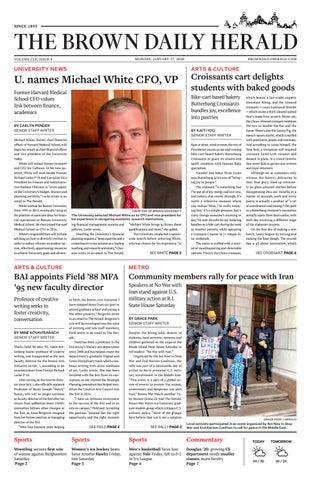
SINCE 1891
THE BROWN DAILY HERALD MONDAY, JANUARY 27, 2020
VOLUME CLV, ISSUE 4
UNIVERSITY NEWS
U. names Michael White CFO, VP Former Harvard Medical School CFO values link between finance, academics
ARTS & CULTURE
Croissants cart delights students with baked goods Bike-cart based bakery Butterbang Croissants bundles joy, excellence into pastries
BY CAELYN PENDER SENIOR STAFF WRITER Michael White, former chief financial officer of Harvard Medical School, will begin his tenure as chief financial officer and vice president of the University today. White will replace former treasurer and CFO Jay Calhoun. In his new position, White will work beside Provost Richard Locke P’18 and Executive Vice President for Finance and Administration Barbara Chernow in “every aspect of the University’s budget, finance and planning portfolio,” Locke wrote in an email to The Herald. White worked for Boston University from 1995 to 2015, eventually rising to the position of associate dean for financial operations at Boston University Medical School. He then joined Harvard Medical School as CFO in 2016. White’s responsibilities will include advising on how to diversify revenue in order to reduce reliance on student tuition, effectively apportioning resources to achieve University goals and advanc-
BROWNDAILYHERALD.COM
BY KAITI YOO SENIOR STAFF WRITER
COURTESY OF BROWN UNIVERSITY
The University selected Michael White as its CFO and vice president for his experience in navigating academic research institutions. ing financial management systems and policies, Locke wrote. Directing the University’s financial planning requires a “deep expertise and a commitment to our mission as a leading teaching and research university,” Chernow wrote in an email to The Herald.
“Michael White brings to Brown these qualifications and more,” she added. The University conducted a nationwide search before selecting White, who was chosen for his experience “in
SEE WHITE PAGE 2
Rain or shine, wind or snow, the city of Providence counts on up-and-coming bike-cart-based bakery Butterbang Croissants to grace its streets and uplift residents with famous flaky specialties. Founder and baker Brian Leosz says Butterbang is his way of “bringing joy to people.” The croissant “is something that I’ve put all of my energy and love into, and (when) that comes through, it’s really a reflective moment where you realize ‘Wow, I’m really enjoying this.’ It’s a simple pleasure, but it (can) change someone’s morning or day,” he said. He sells his joy-inducing bundles on a bike cart during the week as weather permits, while operating a Croissant Counter at 11 Aleppo St. on weekends. The menu is stuffed with a myriad of mouthwatering and delectable options. There’s the Choco croissant,
which boasts a fair-trade, organic chocolate filling, and the Almond croissant — Leosz’s personal favorite — which oozes a thick almond spread that’s made from scratch. Better yet, the Choco Almond croissant combines the two to double the fun and the flavor. There’s also the Dainty Pig, the menu’s savory starlet, which is stuffed with prosciutto, gouda and rosemary. And according to Leosz himself, the Yum Roll, a cinnamon-roll-inspired croissant laced with caramel and doused in glaze, is a crowd favorite that never fails to garner rave reviews and loyal returners. Although we as customers only witness the buttery delicacies in their final glory, lined up intricately on glass-encased shelves before disappearing into our mouths in a matter of seconds, each and every pastry is actually a product of “a lot of coordination and timing.” The path to a Butterbang croissant’s conception actually starts three days earlier, with each day involving a different stage of the elaborate process. On the first day of making a new batch, Leosz begins by mixing and making the base dough. The second day is all about lamination, which
SEE CROISSANT PAGE 4
ARTS & CULTURE
METRO
BAI appoints Field ’88 MFA ’95 new faculty director
Community members rally for peace with Iran
Professor of creative writing seeks to foster creativity, conversation BY MINE KOVAVISARACH SENIOR STAFF WRITER Thalia Field ’88 MFA ’95, Adele Kellenberg Seaver professor of creative writing, was inaugurated as the new faculty director for the Brown Arts Initiative on Jan. 1, according to an announcement from Provost Richard Locke P’18. After serving as the interim director since July 1, she officially replaced Professor of Music Joseph “Butch” Rovan, who will no longer continue as faculty director of the BAI after his return from sabbatical leave. Field’s promotion follows other changes at the BAI, as Anne Bergeron resigned from her former position as managing director of the BAI. “After four fantastic years helping
to birth the Brown Arts Initiative I have stepped down from my post to attend graduate school and pursue a few other projects,” Bergeron wrote in an email to The Herald. Bergeron’s role will be enveloped into the roles of existing and new staff members, Field wrote in an email to The Herald. Field has been a professor in the University’s literary arts department since 2000 and has helped create the department’s graduate Digital and Cross-Disciplinary track, which combines writing with other mediums of art, Locke wrote. She has been involved with the BAI from its conception, as she chaired the Strategic Planning committee that helped transition the Creative Arts Council into the BAI in 2016. “I have an intimate investment in the success of the BAI and in its role on campus,” Field said. Accepting the position “seemed like the right opportunity and the right moment
Speakers at No War with Iran stand against U.S. military action at R.I. State House Saturday BY GRACE PARK SENIOR STAFF WRITER Despite the biting cold, dozens of students, local activists, veterans and children gathered on the steps of the Rhode Island State House Saturday to tell leaders: “No War with Iran.” Organized by the Act Now to Stop War and End Racism Coalition, the rally was part of a nationwide day of action to decry potential U.S. military involvement in the Middle East. “This event is a part of a global series of events to protest the unjust, unnecessary and dangerous war with Iran,” Brown War Watch member Tyler Barnes-Diana GS told The Herald. Brown War Watch is a University graduate student group which critiques U.S. military policy. “Most of the groups here believe that war is not a solution
SEE FIELD PAGE 2
SEE RALLY PAGE 2
GRACE PARK / HERALD
Local activists participated in an event organized by Act Now to Stop War and End Racism Coalition to call for peace in the Middle East.
Sports
Sports
Sports
Commentary
Wrestling secures first win of season against Binghamton Saturday Page 2
Women’s ice hockey beats Saint Anselm Hawks Friday, ties Saturday Page 3
Men’s basketball faces loss against Yale Friday, fall to 0-2 in Ivy League Page 4
Douglas ’20: growing CS department needs smaller classes, more faculty Page 7
TODAY
TOMORROW
44 / 30
40 / 24
2
THE BROWN DAILY HERALD | NEWS
MONDAY, JANUARY 27, 2020
FIELD FROM PAGE 1
RALLY FROM PAGE 1
to advance some of what I think is important about the BAI, like its role in supporting faculty and student work that is collaborative and interdisciplinary and super experimental,” she added. Field acted as interim director for the BAI when the BAI executive committee, a group of faculty representatives from the six departments and two programs in the arts, searched for Rovan’s replacement. During her time as the interim director, Field worked with Brown Motion Pictures and Ivy Film Festival to coordinate their spring events, she wrote in an email to The Herald. Locke commended Field for her “distinct perspective of Brown” as
— it’s not reasonable or justified,” he added . Tensions between the United States and Iran flared after a U.S. drone strike killed top Iranian general Qassem Soleimani in Iraq Jan. 3. At the rally, chants of “Trump wants war, we want peace. U.S. out of the Middle East,” rang through the air. Sentiments such as fear of innocent lives lost in Iran, concern for the mental health of U.S. war veterans and anger for the disregard of climate change culminated in an urgent call for peace. In addition to Brown War Watch, organizations represented included members of the Rhode Island Coalition of Peace, such as Code Pink, and No Endless War or Excessive Militarism. Supporters of presidential candidates Bernie Sanders, Elizabeth Warren and Tulsi Gabbard also stood with flyers to capture voters. “We did our best to get a variety of perspectives, with people from different organizations,” Barnes-Diana explained. “We have groups with diverse focuses come together in agreement about this particular conflict.” Activist after activist stepped up to speak, many reflecting on the turbulent history of American involvement with the Middle East. “Since the Iranian Revolution in 1979, the United States has continually tried to bring Iran back under its influence using economic sanctions,” Satya Mohapatra, organizer of the A.N.S.W.E.R coalition, told the crowd. “The U.S. has
both an alum and a professor at the University. She brings a “requisite depth of knowledge, skills and experience to assume this position at this pivotal juncture,” Locke wrote. Field “emerged as the right choice” for faculty director because of her capability in “taking vision and giving it purpose and moving (the BAI) forward,” said Chira Delsesto, the associate director of the BAI. Delsesto remarked that the committee is currently “heavily involved in planning the next three-year theme and what the programming for that looks like.” According to Delsesto, the three-year themes are one of the ways the BAI organizes its three guiding principles: “experimental, collaborative and engaged.” She added that
WHITE FROM PAGE 1 navigating large, complex academic research institutions,” Locke wrote. Because of White’s previous experience working in academics, he is well-versed in the challenges of managing the finances of large research universities. “There’s a lot of pressure on the cost of higher education,” White said. “I think it’s critically important to support fundraising efforts, to support scholarships for students,” he added. White hopes to use his financial background in education to support students and faculty in their learning and research. Academic institutions feature a less “corporate mentality,” White said. “I think you really need to understand what the faculty members are trying to achieve, what the students are trying to achieve, and really factor that into your decision-making,” he added. White also appreciates the strategic plan and goals laid out by President Christina Paxson P’19 in her ten-year plan, “Building on Distinction,” to promote growth and financial stability within the University.“I like coming into an organization that has a plan and knows where it wants to go,” White said. “I think it would be incredibly gratifying for me to help implement that plan for Brown.” White is particularly fond of medical school and research communities. He is especially interested in working with the Alpert Medical School because he gets an “immense sense of gratification (from) seeing the researchers and the physicians and the scientists achieve their goals,” he said. White distinguished himself to the University through his appreciation of the “importance and interconnectedness” of finance and academics, Locke wrote. CFO “is a big job, which influences every aspect of the University.” “Finance touches every part of an organization,” White said. He likes knowing that he’s “in the background making all those things happen.”
COURTESY OF THALIA FIELD
Literary Arts Professor Thalia Field ’88 MFA ’95, director of BAI, hopes to promote interdisciplinary discourse through her new role. another key focus for the BAI this semester will be future plans for the Performing Arts Center, which is expected to be completed in 2022. As an artist that “works between and against genre in a certain way,” Field hopes to continue the interdisciplinary conversations the BAI enables within the University. One specific initiative she has planned for this semester is to broaden the ways both undergraduate and graduate students can get involved in the BAI. “I want
to make the building more available to student work … there will be new and augmented ways for students to be involved here.” Field’s ultimate hope for the BAI, this semester and beyond, is to continue the creativity and exploration it has been a part of encouraging. “I want to make this (a) place for the unthinkable, the totally unexpected ... I want to really invite students to come here, dream big and make crazy work,” she said.
been waging this war against Iran for a long time.” Mohapatra later told The Herald that his efforts in the rally stemmed from his conviction that the power of coalition building and civic action can effect change. “Thousands of people are on the streets now, simultaneously taking part in this event,” he said of the network of nationwide anti-war rallies attempting to pressure the Trump administration to peacefully de-escalate mounting tensions. “It will put force on the politicians,” Mohapatra added. While speakers such as Mohapatra expressed anger at the destabilization of Iran, others directed their concern more broadly at the U.S. government’s pursuit of international conflict over domestic prosperity. Terri Wright, a homemaker and writer from Providence, demanded “Where are America’s values?” in her address to the crowd. Her calls for peace were personal: Wright has three brothers who have fought in active combat for the United States and witnessed firsthand the toll that war can have on veterans. There is “money to fight a war, but (not to) take care of our land and our people,” she observed, the crowd murmuring in agreement. “War is not the answer. Take a good look around you — we are the offspring of war,” she told the crowd. In conversation with The Herald, Wright offered a message to fellow Americans: “Put the guns down, put the violence away, love your neighbors because we can make this right.”
SPORTS
Wrestling splits road trip against Binghamton, Cornell Bears defeat Bearcats 19-14 for first dual meet win of season, fall to Cornell BY RYAN HANDEL SPORTS EDITOR The wrestling team notched its first victory of the year with a 19-14 triumph over Binghamton University Saturday before falling 36-4 to No. 22 Cornell later that day. With only two weight classes remaining in the dual against Binghamton and the outcome still in doubt, 197 lb wrestler Nino Bastianelli ’21 stormed back from a 6-0 deficit to win his match 8-6 and seal the victory for Bruno. Bastianelli also recorded a major decision against Cornell, becoming the only Brown wrestler to go 2-0 on the day. “We’ve been right there all year,” said Trey Keeley ’20. “Finally breaking through and finding a way to win was huge for us going forward as we build confidence going into (the postseason).” After suffering three losses by four points or fewer in the previous two weeks, the Bears (1-5, 1-4 Eastern Intercollegiate Wrestling Association) looked to break through against their conference rivals Binghamton (3-8, 2-6 EIWA). Keeley (125 lbs) started off strong, winning multiple backand-forth scrambles to take an 8-4 decision. Then, Charlie Faber ’21 (133 lbs) used several powerful double-leg takedowns to record a 15-6 major decision and stretch the team lead to 7-0. Binghamton bounced back with a win at 141 lbs, but Ricky Cabanillas ’23 (149 lbs) edged his opponent 6-4 to return the momentum to the Bears.
COURTESY OF BROWN ATHELTICS
Charlie Faber ’21 (133 lbs) dominated his Binghamton opponent in a 15-6 win, and challenged Cornell’s No. 4 Chas Tucker in an 8-3 defeat. A dominant 4-0 win by Jack Bokina ’22 (157 lbs) put Bruno up 13-3 halfway through the dual. The Bearcats stayed in contention for the team win with a 3-0 victory at 165 lbs. But Cade Wilson ’22 (174 lbs) won an overtime thriller to extend Brown’s lead again. Wilson gave up the first takedown of the match, but two nearfall points helped him send the match to sudden death in a 4-4 tie. Wilson took a shot off the whistle to begin overtime to earn the winning takedown. The Bearcats’ Lou DePrez, who is currently ranked No. 5 nationally at 184 lbs, took a 16-2 major decision, cutting Bruno’s lead to 16-10 and setting up a crucial 197 lb bout. Early in the first period of his match, Bastianelli was tossed to his back and narrowly avoided being pinned. But the Brown wrestler re-
covered and earned a late reversal to enter the second period down 6-2. Bastianelli showed his prowess from the top position by controlling his opponent for the entirety of the second period. He then earned an escape and takedown in the third to reduce his deficit to just one. A two-point tilt gave him the lead, and a bonus point for riding time gave the junior an 8-6 victory and an insurmountable 19-10 edge for Brown. “We knew we needed that match,” Bastianelli said. “Obviously going down 6-0 at the rip was not ideal, but I just kept trying to score the next point and keep working.” Binghamton won a major decision at heavyweight, but it was too little, too late for the Bearcats, who fell 19-14. “Any time you get a win in this conference, it’s always a good win and
something we can build off of,” said Head Coach Todd Beckerman. After their win over Binghamton, Bruno was tasked with taking on perennial wrestling powerhouse No. 22 Cornell. Although the Brown wrestlers kept many of the individual bouts close, they dropped nine of the ten matchups. Keeley fell 8-3 to the Big Red’s Dominic LaJoie, and Charlie Faber faced Chas Tucker, who is ranked No. 4 nationally at 133 lbs. Faber entered the third period down just 3-2 to his highly ranked foe, but Tucker took control late and gained another 8-3 win for Cornell. After a major decision loss at 141 lbs, Brown lost a nail-biter at 149 lbs. Cabanillas recovered from an early 2-0 deficit to tie the match in the third period, but gave up the winning takedown at the end of the bout and went on to fall 5-4. Three more consecutive losses and a forfeit at 184 lbs put Bruno down 30-0 with two matches left. Bastianelli once again excelled in his 197 lb bout, capturing an 11-0 major decision victory. Cornell’s normal 197 lb starter, 2018 All-American Ben Darmstadt, who is ranked No. 11 nationally at 197 lbs, was out of the lineup, and Bastianelli capitalized by dominating the Big Red’s backup. A pin by Cornell’s Brendan Furman at heavyweight put the finishing touches on a 36-4 final score. “I don’t think the score reflected the final result with how hard we fought out there,” Beckerman said. “We have a young team this year … as they continue to get in the lineup and get matches and compete, I think we’ll get to (Cornell’s) level.” Bruno will look to continue its momentum from its win over Binghamton in two EIWA battles Saturday against Ivy league rivals Penn and Princeton.
MONDAY, JANUARY 27, 2020
THE BROWN DAILY HERALD | NEWS
3
SPORTS
Women’s hockey completes 1-0-1 weekend at home against St. Anselm Bruno shuts out St. Anselm College 1-0 Friday and ties 3-3 Saturday BY AMELIA SPALTER STAFF WRITER The Bears came away with a victory against St. Anselm College Friday in a 1-0 shutout before tying the Hawks 3-3 Saturday. Friday’s win marked the second shutout of the season for goalkeeper Calla Isaac ’20. The first two periods passed scoreless for both teams before forward Tina Paolillo ’22 returned her own rebound to score the first and only goal of the match. Veronica Alois ’20 and Mel Anderson ’22 assisted in the game-winning score. Bruno (3-15-2) carried the Friday momentum into the first period on Saturday, winning the opening faceoff and taking four shots in the first two minutes of play. St. Anselm (13-9-3) disrupted Brown’s early rhythm with a hooking penalty at 3:31, resulting in the Hawks’ initial powerplay of the night. Goalkeeper Hayley Kliczko ’22 fought off a series of shots against heavy traffic, stalling St. Anselm’s offense through the remainder of the penalty clock. “(Kliczko) has played well.” said Head Coach Carisa Zaban Wahlig. “It was her opportunity to step up and
show us what she could do.” An interference call against St. Anselm handed Bruno a powerplay of their own at 10:43. None of the Bears’ ensuing five shots slid past the goal line, but at 13:32, less than a
puck, we were able to initiate passes that got us out of the zone.” In the final minutes of the period, the teams traded powerplays again. The Bears made the most out of their opportunity, with defender Jacquie Tam
minute after the powerplay expired, St. Anselm incurred another interference penalty, giving the Bears another chance to notch the opening goal. Forward Shay Maloney ’22 won the powerplay faceoff for the Bears, promptly torpedoing the puck into the Bears’ attack zone. Defender Maybelline Beiring ’20 managed to take possession under pressure and attempt a shot, but was narrowly denied by the Hawks’ goalkeeper. Maloney followed up on the save, smacking the puck back toward the net to score the game’s first in the final second of Brown’s powerplay. Maloney maintained control going into the second period, winning the opening faceoff and taking a shot on goal in the first 30 seconds of the stanza. Maloney led the Bears in faceoff wins for both contests with 15 Friday and 23 Saturday. St. Anselm quickly followed Maloney’s shot with a chance of its own. But Kliczko remained unshaken in the net, blocking the shot and regaining possession for Bruno. But at 7:40, St. Anselm corralled a drifting puck to score their first goal of the weekend. “We were caught puck-watching in those certain situations,” Kliczko observed. “When we were moving the
’22 sniping the lead back for Brown at 2-1 with Beiring and Kaitijane Blumberg ’21 assisting at only nine seconds remaining in the period. The tone of the third stanza was, once again, set by Maloney as she took the faceoff and moved into the offensive zone where defender Anderson attempted Brown’s first shot of the stretch. At the start of the third period, the Bears controlled possession and launched six consecutive shots toward the Hawks’ net. The barrage of shots culminated with the Bears’ third and final goal of the night three minutes into the period, executed by forward Lizzy Gross ’22 and assisted by Beiring and Megan Forrest ’21, bringing the total to 3-1. Beiring assisted on every Brown goal of the night. After the Bears were given another powerplay opportunity with six minutes to go in the game, victory appeared to be in reach. An interference penalty on St. Anselm appeared to present an opportunity for Bruno to extend their lead, but the Hawks recovered a missed shot from the Bears, sprinted toward the opposite net and landed a shorthanded goal to tie the game at three all. “We ultimately always want to go out on top, but to do so, you’ve got to
STAY UP-TO-DATE. FOLLOW US ON FACEBOOK. FACEBOOK.COM/BROWNDAILYHERALD
MEAL PLAN
changes
STEP ONE:
Choose a Meal Plan. VIEW OPTIONS AT BROWN.EDU/FOOD
REMINDER:
T DAY THE LASEA L PLAN
TO MAKE M EDNESDAY, CHANGES IS W
FEB. 5!
• You can ADD a new Meal Plan at any time during the year • You can make one CHANGE per semester. The deadline for spring semester changes is Wednesday, Feb. 5 • Meal Plan CANCELLATIONS are not available during the spring
STEP TWO:
Let us help!
EMAIL DINING_SERVICES@BROWN.EDU OR CALL 863-3343 WITH QUESTIONS
• Changes may be made in person weekdays from 9:00AM to 4:00PM at the main Brown Dining office located at 144 Thayer Street (Sharpe Refectory).
be the team that wants it more, and that wasn’t us tonight,” said Wahlig. The period concluded with a tense two minutes of close exchanges in Brown’s defensive zone, including a pair of
edge, with the buzzer sounding on a 3-3 tie. The Bears took nearly double the shots as the Hawks did throughout the contest, ultimately outshooting them 39-22.
COURTESY OF BROWN ATHLETICS
Bruno outshot the Hawks 39-22 in Saturday’s matchup, which went into a five-minute overtime period but resulted in a 3-3 tie. shots blocked by Tam and Anderson respectively. But the Bears ultimately skated out of the third period into overtime. The five-minute tiebreaking round began with an aggressive St. Anselm winning three consecutive faceoffs. But once Brown took possession, they kept it, giving St. Anselm no further scoring opportunities, winning each remaining faceoff, and shooting nine times in under four minutes. In the five-minute overtime period, neither team could find the winning
“A big thing we had wanted to focus on going into the weekend was generating offense,” said Maloney. “We worked hard in the offensive zone to gain control and beared down on our sides to bring about opportunities for ourselves.” The women’s hockey team will face Yale at home Tuesday at 6 p.m. “Yale is a very different team than St. Anselm,” Wahlig said. “We try to prepare for each team accordingly … the hope is that we bounce back and are ready to go on Tuesday.”
4
CROISSANT FROM PAGE 1 Leosz describes as “the process whereby you fold the dough and the butter together to get all those beautiful layers” that make up the signature croissant texture. On day three, the croissants are allowed to rest and develop flavor before finally being popped in the oven to bake. Leosz’s passion for baking emerged early in his life. His knack for taking on complex baking recipes, such as baklava and cakes, was clear to family, friends and coworkers since he was young. When he visited France as an adult, he fell in love with the croissant and took on that recipe as well. A Boston native, Leosz established Butterbang Croissants as a Denver-based wholesale business in 2014 when he uprooted his Northeast lifestyle to move across the country. Upon arriving, he discovered how well-suited his new home’s environment and commercial scene were to his lifelong hobby. Denver’s high altitude and low atmospheric pressure naturally shortened the length of proofing time and lessened the amount of yeast required for the croissant recipe, making the baking process much more efficient. Additionally, the still-developing food
THE BROWN DAILY HERALD | NEWS
scene provided a promising opportunity to supply original pastries. Upon his return to the East Coast, he decided to try his hand at the industry again, but with a different angle: retail, not wholesale, which meant face-toface interaction with customers in Providence. “For spending so many hours alone in a bakery, in your own head, you really need that interaction, and that’s really what’s been great in doing the bike cart and Croissant Counters here in Providence,” he says. Butterbang Croissants has quite the following and reputation on Instagram, where Leosz keeps his consumer base updated on his daily bike cart locations, upcoming pop-ups and new pastry releases. Recently, he offered a croissant-making master class, which sold out in a mere two hours. When asked about any advice he would give to aspiring entrepreneurs, Leosz offered two main points. First, “find a way to dabble in your idea before making a headfirst dive” to ensure that you enjoy your dream as a reality. Second, for those who specifically wish to enter the food scene, don’t be afraid to “reach out to people who are already established … The wider your network, the more opportunities you will find.”
MONDAY, JANUARY 27, 2020
COURTESY OF BRIAN LEOSZ
The popular bike-cart bakery Butterbang Croissants was first established in Denver by baker Brian Leosz, whose passion for baking originated in childhood. His personal favorite menu item is the Almond croissant.
MONDAY, JANUARY 27, 2020
THE BROWN DAILY HERALD | TODAY
5
CA L E NDA R TODAY
JANUARY S
5
M
Tu
6
7
W
Th
F
S
1
2
3
4
8
9
10
11
12
13
14
15
16
17
18
19
20
21
22
23
24
25
26
27
28
S U D O KU
29
30
31
Joshua R. Sanes, Seminar 12:00 P.M. Sidney Frank Hall for Life Sciences, 220
Public Health Wellness Yoga 4:00 P.M. 121 South Main Street, 247
Bajoghli - Understanding Iran 5:45 P.M. Watson Institute, 101
Race for Profit: A Conversation 6:00 P.M. Salomon Center, 001
TOMORROW Summer Programs Info Session 3:00 P.M. Swearer Center, 111
Geopoltics of China’s Environmental Policy 4:30 P.M. Stephen Robert ’62 Campus Center
Women’s Ice Hockey vs Yale 6:00 P.M. Meehan Auditorium
Deceive Your Friends 8:00 P.M. Harkness House
Q U OTE OF TH E DAY
“It’s a simple pleasure, but it (can) change someone’s morning or day.”
—Brian Leosz SEE CROISSANT PAGE 1
C ORRECTI ON
CR O S SWO R D
The Jan. 24 article “City looks to strengthen e-mobility options, increase safety” referred to Katherine Hypolite as the Director of Communications. In fact, she is the Director of Communications for Plannaing and Development. The Herald regrets the error. The Jan. 24 article “Campbell to serve as 2021 CGS Chair” stated that Dean Campbell will serve as 2021 UGS chair in its headline and caption. In fact, Dean Campbell will serve as the 2021 CGS chair. The article also stated that Campbell will meet and work with leaders from a broad array of universities across the nation and the world. In fact, Campbell will meet and work with leaders from a broad array of universities across the nation. The Herald regrets the errors.
FR O STY F EATURES
LEON JIANG / HERALD
As students’ bones freeze in the cold, the branches of trees around campus look similarly icy. The semester may be fresh but the flora and fauna around campus are still waiting to thaw.
6
THE BROWN DAILY HERALD | COMMENTARY
MONDAY, JANUARY 27, 2020
LETTER TO THE EDITOR
If the Sacklers must go, so too must Kanders To the editor: I am writing in response to Andrew Reed ’21’s defense of Warren Kanders ’79 P’23 . Reed argued against calls for the University to remove Kanders from positions of influence at Brown and to reject any future donations from him. Reed’s premise is that criticism of Kanders is unfair because his involvement in Safariland cannot be directly tied to the improper use of its products to suppress protests. But the question at large has never been whether Safariland’s tear gas was used improperly. The question is, rather, why Brown continues to associate with an individual who profits from the sale of a weapon used to harm people. Tear gas is a chemical weapon that is banned from use in war. Reed considers tear gas a necessary tool for law enforcement agencies to disperse crowds and respond to violent protests. In explaining his point, he brings up a hypothetical Charlottesville-like situation where white supremacists are marching to a synagogue. Let us think back to Charlottesville. Angry white men with tiki torches marched onto the University of Virginia’s campus. They marched on the streets of Charlottesville and were met with resistance only from anti-fascist protestors. By the end of the day, one protestor had died after a white supremacist rammed his car into the crowd. This is not an example of disproportionate force employed
Have opinions?
against unruly protesters. Rather, this is an example of no force employed at all. Police and law enforcement respond inconsistently to different protests – they are more violent and brutal when the protestors are brown and black. Ferguson in 2014 saw more tear gas than Charlottesville did three years later. Tear gas is not a weapon that targets everyone equally – it is used to quash dissent of black, brown and indigenous voices globally. Institutions in the United States, including Brown, have recognized when companies and individuals have done harm and have sought to disassociate themselves. The most evident example is Brown’s redirection of funds from the Sackler family for their involvement in fueling the opioid crisis. Brown recently announced that it would donate the money it had received from the family to programs tackling the crisis and that it would refuse further donations. Why was there such a disparate response? Why was there no controversy in this case? It is because, even though this crisis has touched all corners of America, the victims are perceived as middle-class white people. If we recognize harm when it occurs to white, middle class Americans and hold people to account – then the same standard should apply across the board.
Tell us about them! See guidelines at browndailyherald.com/submissions
Abdullah Shihipar, MPH ’20, abdullah_shihipar@brown.edu
SINCE 1891
THE BROWN DAILY HERALD Editorial Leadership Editor-in-Chief Colleen Cronin Managing Editors Sophie Culpepper Allie Reed Senior Editors Elise Ryan Alex Smolar post-magazine Editor-in-Chief Amanda Ngo
Sections Arts & Culture Editors Katherine Ok Emily Teng
Special Projects Coordinators Jacob Lockwood Melanie Pincus
Metro Editors Henry Dawson Olivia George Isabel Inadomi Maia Rosenfeld
Commentary Opinions Editors Jordan Allums James Flynn Krista Stapleford
News Editors Olivia Burdette Daniel Goldberg Li Goldstein Kayla Guo Kamran King Spencer Schultz
Editorial Page Board Amanda Brynn Riley Pestorius Vicky Phan Krista Stapleford Dylan Tian
Science & Research Editors Emilija Sagaityte Cate Ryan Sports Editor Ryan Handel
Multimedia/Production Design Editors Bilal Ismail Ahmed Keelin Lyons Head Photo Editors Rebecca Ho Victoria Yin
Copy Desk Chief Vicky Phan Illustrations Editor Summer Zhang Graphics Editor Usha Bhalla Immersive Editor Michael Bass Business General Managers Nicholas Fabrizio Mariel Jackson Office Manager Diane Silvia Directors Rey Blandon Shreya Das Arman Lateef Michael Wang
Submissions: The Brown Daily Herald publishes submissions in the form of op-eds and letters to the editor. Op-eds are typically between 750 and 1000 words, though we will consider submissions between 500 and 1200 words. Letters to the editor should be around 250 words. While letters to the editor respond to an article or column that has appeared in The Herald, op-eds usually prompt new discussions on campus or frame new arguments about current discourse. All submissions to The Herald cannot have been previously published elsewhere (in print or online — including personal blogs and social media), and they must be exclusive to The Herald. Submissions must include no more than two individual authors. If there are more than two original authors, The Herald can acknowledge the authors in a statement at the end of the letter or op-ed, but the byline can only include up to two names. The Herald will not publish submissions authored by groups. The Herald does not publish anonymous submissions. If you feel your circumstances prevent you from submitting an op-ed or letter with your name, please email herald@browndailyherald.com to explain your situation. You can submit op-eds to opinions@browndailyherald.com and letters to letters@browndailyherald. com. When you email your submission, please include (1) your full name, (2) an evening or mobile phone number in case your submission is chosen for publication and (3) any affiliation with Brown University or any institution or organization relevant to the content of your submission. Please send in submissions at least 24 hours in advance of your desired publication date. The Herald only publishes submissions while it is in print. The Herald reserves the right to edit all submissions. If your piece is considered for publication, an editor will contact you to discuss potential changes to your submission. Commentary: The editorial is the majority opinion of the editorial page board of The Brown Daily Herald. The editorial viewpoint does not necessarily reflect the views of The Brown Daily Herald, Inc. Columns, letters and comics reflect the opinions of their authors only. Corrections: The Brown Daily Herald is committed to providing the Brown University community with the most accurate information possible. Corrections may be submitted up to seven calendar days after publication. Periodicals postage paid at Providence, R.I. Postmaster: Please send corrections to P.O. Box 2538, Providence, RI 02906. Advertising: The Brown Daily Herald, Inc. reserves the right to accept or decline any advertisement at its discretion.
@the_herald
facebook.com/browndailyherald
@browndailyherald
youtube.com/browndailyherald
195 Angell St., Providence, RI (401) 351-3372 www.browndailyherald.com Editorial: herald@browndailyherald.com Advertising: advertising@browndailyherald.com
The Brown Daily Herald, Inc. is a financially independent, nonprofit media organization bringing you The Brown Daily Herald, BlogDailyHerald and Post- Magazine. The Brown Daily Herald has served the Brown University community daily since 1891. It is published Monday through Friday during the academic year, excluding vacations, once during Commencement and once during Orientation by The Brown Daily Herald, Inc. Single copy free for each member of the community. Subscription prices: $200 one year daily, $100 one semester daily. Copyright 2019 by The Brown Daily Herald, Inc. All rights reserved.
MONDAY, JANUARY 27, 2020
THE BROWN DAILY HERALD | COMMENTARY
7
The CS Dept. needs to change. Here’s how. JONATHAN DOUGLAS ’20 STAFF COLUMNIST In recent years, the computer science department has exploded. In 2015, 133 students graduated with a concentration or joint concentration in computer science. By 2019— just four years later — that number had skyrocketed to 259, an increase of almost 95 percent. Course enrollment has also ballooned as students in other disciplines recognize the growing importance of the field. Enrollment in 1000-level courses increased from 874 students across 16 classes in fall 2016 to 1,352 students in fall 2019 across 22 classes. This change has not gone unnoticed; in December 2018, the department announced that it would hire 15 new faculty members over the next five years, an increase of 50 percent, The Herald previously reported. But so far, only one new tenure-track professor and one new lecturer have joined the department, according to department chair Ugur Cetintemel. Despite these two hires, the department’s growth has not happened fast enough. The addition of new faculty members has yet to decrease the size of the department’s largest classes, and instead the department has come to depend too heavily on undergraduate teaching assistants, who can never fully match the quality of faculty teaching. The department should speed up its hiring timeline, prioritize breaking up large courses and hire professional course assistants to better serve students. Classes in the department have only grown bigger, even as new hires have been brought on. I’ve seen this first-hand: As a concentrator in the department, I will graduate having taken no classes in the concentration with fewer than 100 students. In fall 2019, eight computer science courses had more than 100 students. That number is set to stay the same this semester, barring some massive fluctuation in enrollment. In fact, four courses had more than 250 students. Large classes undermine the computer science education at Brown. They make it difficult for students to ask questions. Many may feel
nervous to speak in front of 200 other people in the room. Even if students aren’t nervous, only a small percentage of us can ask anything without holding up the rest of the class. Massive courses also make it nearly impossible to form a personal relationship with the professor. They only hold a limited number of office hours and do not have the time to meet with all students individually. The department has largely relied on TAs to ensure that these massive classes run smoothly. The TA system has grown so large that it even
careers themselves. While they may have mastered the course material, they cannot provide a broader, expert-level view of the field because they have limited knowledge and have not studied graduate-level material yet. Professors are better-suited to handle each of these problems. More broadly, teaching assistants should not be as critical to the functioning of computer science courses as they are today. In every other department that I have taken a course in, from political science to mathematics to biology, the teaching assistants were helpful but not essen-
“Smaller course sizes and increased attention to individual student problems will bring the department closer to its idyllic goal of ‘excellence in teaching and mentoring.’”
requires multiple “meta-TAs” to coordinate the program. In fall 2013, the department had 165 teaching assistants. By 2019, that number had more than doubled to 342, according to Eleanor Avril ’20, one of the meta-TAs. Without a doubt, I would have failed every single computer science class I have taken without these TAs. By handling questions individually in hours, answering broader questions on answer forums such as Piazza and grading, the TAs are in many ways the backbone of the entire department. But broadening the TA system is not the best solution to address ballooning growth. Putting aside issues of occasionally incompetent TAs and hours-long waits, even an ideal TA program does not give students the resources they need to be successful. Teaching assistants typically cannot offer good course advice, oftentimes because they have not taken the upper level courses themselves. They cannot offer proper career advice, because they have not had
tial to my success. Only in computer science, where the concepts are often separated from one of the critical skills necessary to pass the class — coding — are TAs so vital to learning the necessary skills. Counting on TAs enables the department to shrug off hiring issues, claiming that needs are being met by the UTA program. The answer to the majority of the problems outlined here is simple: hire more faculty. Though the department’s two recent hires have been a step in the right direction, hiring has come too late and has moved too slowly. I, and many other students, have had a worse education as a result. The department should shorten its hiring timeline from the originally intended five years to alleviate the department’s persistent problems more quickly and benefit a larger number of students. Once these professors are hired, the department should focus on breaking up larger classes into smaller sections before offering new ones.
This follows in the footsteps of other large University departments, in particular math and economics. Breaking up courses with more than 200 students will give them a more personal experience with the material and professor, and will alleviate grading and office hour burdens for professors. Massive upper level classes such as data science, deep learning and machine learning should be broken up first, giving advanced students the resources they need to tackle the field’s most difficult problems. When new courses are offered, they should be in subfields related to those with large enrollment numbers today, ideally attracting students away from the largest classes. This strategy has been employed by other universities that are dealing with similar problems, such as Stanford and University of California at Berkeley. The department should also consider hiring expert course assistants. Most similar to lecturers in their scope, these course assistants would be experts in their field but would be solely dedicated to teaching rather than research. These individuals would hold more office hours and assist in grading. Their purpose would be to answer questions typically fielded by an undergraduate teaching assistant, but more effectively, more quickly and with a broader scope. They would provide a level of perspective that is impossible to get from an undergraduate. At other universities, this role might be filled by graduate student teaching assistants. Though some graduate students serve as teaching assistants at the University, it does not currently enroll a large enough computer science graduate student population to fulfill this need. These changes will give students a more personalized education and broaden access to top notch experts in computer science. Smaller course sizes and increased attention to individual student problems will bring the department closer to its idyllic goal of “excellence in teaching and mentoring.”
Jonathan Douglas ’20 can be reached at jonathan_douglas@brown.edu. Please send responses to this opinion to letters@browndailyherald.com and op-eds to opinions@browndailyherald.com.
8
THE BROWN DAILY HERALD | NEWS
MONDAY, JANUARY 27, 2020
SPORTS
Men’s basketball loses to Yale 73-62, fall to 0-2 in Ivy League play Inaccurate shooting, poor rotations doom Bears in loss to conference rivals BY RANDI RICHARDSON SENIOR STAFF WRITER The gravity of a men’s basketball upset against Yale was not lost on either team during Friday night’s matchup. Last week, the Bulldogs won the rivalry game on their homecourt and have won eight of the last 11 meetings at Brown, in addition to leading the historical series 111-53. So Bruno took to the tip with a chip on its shoulder intent on adding to its win column. But despite the added motivation to eclipse Yale’s dominance, the Bears fell short in a 73-62 loss to the defending Ivy League champions. Brown and Yale traded buckets and fouls back and forth during the opening minutes. Neither squad settled into a flow, but both teams provided continuous defensive pressure. The Bulldogs’ man-to-man made Bruno work for each field goal. All five players moved on a line during rotations and got hands in passing lanes. Brown had careless, often unforced turnovers on top of offensive mistakes forced by Bulldog pressure. Yale was unable to capitalize off its opponents’ mistakes, but turnovers would later cost Brown as the game progressed. Bruno ended the half with 10 turnovers andone assist. “(Turnovers) definitely played a part
in us being down,” said Head Coach Mike Martin ’04. “Every time, it was just one less opportunity for us to try and make a basket and put points on the board.” Defensively, the Bears also played man-to-man and got hands on passes. They clogged up the paint to stop drives, which forced Yale to kick out. Bruno scrambled out to cover the ball, but Yale passed to either side for the more open man. Brown’s sluggish rotations repeatedly left a Bulldog open for shots. Inconsistent Bulldog shooting prevented Yale from fully taking advantage of Brown’s defensive lapses. Successful shots proved difficult for both teams because of the defensive pressure causing strings of missed shots. But Tamenang Choh ’21 scored back-to-back buckets that brought life back to Bruno and sparked a run that pulled the Bears within two points. Choh would finish the game with 12 points and three assists. “I had just got off the bench,” Choh said. “It’s good to see the game on the (sideline) because it slows down a little bit. So I knew what moves were probably going to work and thankfully (they) did (and started) a run.” But every time the Bears went on a run, Yale managed to make a timely steal and head the other way for easy points. This back-and-forth sequence wrapped up the first half with Yale leading 33-25. Martin’s message to the team going into the half was to “continue to defend at the level we were, take better care of the basketball (and) get
COURTESY OF BROWN ATHLETICS
Bruno went back and forth with the Yale Bulldogs at home, but ultimately lost despite strong defensive efforts from both teams. The Bears will return to the court to take on Cornell Friday and Columbia Saturday. better ball and body movement in the play. Brandon Anderson ’20 kept Brown “We gotta be tougher. We could’ve done second half.” within striking distance with bank shots more down the stretch and throughout The second half opened with a 5-5 in traffic and pull-up jumpers over de- the whole game.” scoring battle during the first four fenders. Anderson finished the night “We didn’t make shots at the rate minutes. Neither team had particularly with 20 points and six assists. that I expect us to,” Martin said. “We flashy buckets due to their high intenThe Bears’ efforts weren’t enough missed shots that I think we would norsity defenses, but the Bulldogs did just to top the defending Ivy League cham- mally make. Sometimes the ball doesn’t enough to stay comfortably in the lead. pions, as they fell by an 11-point mar- go in the basket and it didn’t go in (Fri“Watching the second half, we gin. Brown finished with 17 turnovers day) night. That was the difference in played with great pace, shared the compared to Yale’s 16, and both teams the game.” ball, spaced the floor and made the were evenly matched across the board. With the defeat, Brown dropped right decision more often than not,” But Bruno’s 35 percent field goal shoot- to 0-2 in conference play. They hope Martin said. ing could not compete with Yale’s 45 to break into the win column against Runs and lulls came and went for percent. Cornell Friday and Columbia Saturday Brown as it struggled to find consistent “I gotta be tougher,” Anderson said. at the Pizzitola Sports Center.
The John F. Kennedy Jr. Initiative for Documentary Film and Social Progress
COUP 53 SCREENING AND PANEL DISCUSSION
The 2019 film depicts the combined efforts of the United Kingdom
Tuesday
and the United States to overthrow the democratically elected
January 28, 2020
government of Iranian Prime Minister Mohammad Mosaddegh.
6:00 pm
The panel discussion will include commentary and Q&A on
MARTINOS AUDITORIUM
the making of the film, historical perspective, and the current
GRANOFF CENTER
situation with Iran.
154 ANGELL STREET
PA N E L I S T S
Taghi Amirani, director Walter Murch, co-writer and editor
I N C O L L A B O R AT I O N W I T H T H E
Stephen Kinzer, Watson Institute senior fellow
Brown Arts Initiative